Category: Policy

  • What to Look For in the Nordic Model

    The Nordic nations, and Sweden in particular, are seen by many as the proof that it is possible to combine innovative and entrepreneurial economies with high tax rates. It is often argued that nations such as the US can gain the attractive social features of Denmark, Sweden, Norway and Finland — such as low crime rates, high life expectancy, and a high degree of social cohesion — simply by expanding the welfare state. An in depth analysis, however, shows that this line of reasoning is flawed.

    To begin with, one should remember that free-markets have been at the core of the Nordic success stories. Sweden, for example, was an impoverished nation before the 1870s; one indication of that was massive emigration to the United States. As a capitalist system evolved out of the agrarian society, the country grew richer. Property rights, free markets, and the rule of law, in combination with large numbers of well-educated engineers and entrepreneurs, created an environment in which Sweden enjoyed an unprecedented period of sustained and rapid economic development. Globally famous companies such as IKEA, Volvo and Tetra Pak were founded during a period when Sweden was characterized by business-friendly economic reforms and relatively low taxes.

    However, during the late 1960s, policies steered sharply to the left and the overall tax burden rose significantly. The Swedish economist Magnus Henrekson has shown that the effective marginal tax rate (marginal tax plus the effect of inflation) that was levied on Swedish businesses could be more than 100 percent of the profits. The sharp left turn in Swedish economic policy did indeed affect entrepreneurship. Sten Axelsson, another Swedish economist, has shown that the period between the end of the 19th century and the beginning of the First World War was a golden age for the founding of successful entrepreneurial firms in Sweden. After 1970, the establishment of new successful firms almost stopped. The experiment of following a middle way between socialism and capitalism was not only unsuccessful, but also short-lived. In the 1990s and onward, a range of market reforms were implemented, paving the way for new entrepreneurial firms.

    Taxes still remain high in the Nordic nations, particularly in Denmark and Sweden. The high tax pressures create high costs for the societies. A report recently published by the European Central Bank finds that both Denmark and Sweden are on the tip of the Laffer curve when it comes to both taxes on income and on capital. This means that capital taxes are so damaging that reducing them by one Kronor would stimulate the economy to grow, so that more than one Kronor in additional taxation could be levied (at the lower tax level). Many entrepreneurs relocate their businesses to other countries in order to avoid Sweden’s high taxes. Skype, for example, was founded by a Dane and a Swede, but they chose to startup in free-market oriented Estonia, and later move the ownership to another free-market oriented nation, Luxembourg.

    So how come the Nordic nations are so prosperous? A key reason is that they, particularly since the 1980s, have compensated for high tax regimes by implementing a range of market reforms. These reforms range from Flexicurity — a combination of strategies to provide flexibility for employers and security for workers — in the Danish labor market, to partial abolition of rent-control in Finland, to school vouchers and partial privatization of the pension system in Sweden. Indeed, the Nordic nations have risen sharply in both the Heritage/WSJ and the Frasier Institute indexes of economic freedom over the years.

    It is also important to realize exactly why the Nordic nations have been able to implement large welfare states, and what the benefits have been. The cultural and economic systems in the Protestant Nordic nations have historically given rise to very strong norms related to work and responsibility. Coupled with uniquely homogeneous societies, these norms made it possible to implement larger welfare states in the Nordic nations than those in other industrialized countries. Since the norms relating to work and responsibility were so firmly rooted, Nordic citizens were not as likely as other Europeans or Americans to try to avoid taxes or misuse generous public support systems. Also, the “one-solution-fits-all” systems of the welfare state are typically less disruptive in a strongly homogeneous social environment, since most of the population has similar norms, preferences, and income levels.

    However, with time the norms have evolved. In the World Value Survey of 1981-84, almost 82 percent of Swedes responded that “claiming government benefits to which you are not entitled is never justifiable”, but in the survey of 1999-2004, only 55 percent held the same belief. It is no coincidence that much of the public policy debate in Norway, Sweden, Denmark and Finland has focused on curbing overutilization of welfare systems.

    Many of the favorable social outcomes in the Nordic nations relate to our unique culture, and the policies cannot simply be copied. In1950, long before the high-tax welfare state, Swedes lived 2.6 years longer than Americans. Today the difference is 2.7 years. The two researchers Jesper Roine and Daniel Waldenström have similarly shown in a new study that “most of the decrease [in economic inequality in Sweden] takes place before the expansion of the welfare state”, occurring during the period when the nation was characterized by low taxes, a small state and a flexible labor market.

    Clearly, the social success in the Nordic countries is not simply a result of welfare policies, but related to cultural and demographic factors. Therefore it would be difficult, if even possible, to achieve these results in nations such as the US simply by introducing a high tax regime. Why not instead be inspired by the fiscal conservatism and the free-market reforms that make the Nordic nations prosper today?

    Flickr Photo by ‘creating in the dark’ (Helen Harrop): Gate to the Mazetti Chocolate Factory, Malmö, Sweden

    Nima Sanandaji has published several books in Sweden relating to subjects such as entrepreneurship, integration and women’s career opportunities. He is the author of the study, “The surprising ingredients of Swedish success – free markets and social cohesion”, which has recently been published by the Institute of Economic Affairs.
  • Rethinking Brand Chicago

    So many Midwest places flail around looking for a brand image or identity. Not Chicago. In fact, the identity and stories of Chicago overflow the page. They are too numerous to be written in a mere blog posting.

    Yet Chicago has in effect decided to jettison that powerful, historic brand identity in favor of a type of global city genericism. This, I believe, is a mistake.

    One trend you can’t help but notice if you travel is the increasing homogenization of the urban culture and standard of urban development. Global markets demand standardized commodities that can be graded and traded. This includes cities. This forces cities increasingly into a standard model of what one expects.

    I’ve written in the past about the example of the Wallpaper guides to world cities. These travel guides, ostensibly a guide for the modern, sophisticated urban traveler to the best of each globally elite locale, often seem identical except for the name on the spine. One modern boutique hotel, one swank restaurant or bar, one fashion outlet, one bike share program, one piece of starchitecture is much the same as another in any city you visit around the world. The frosting might be different, but the cake is the same. And once you’re commoditized, you’re done.

    So it is too with Chicago. I noted in my review of the city’s street lighting what appears to be a deliberate downplaying of the city’s rough-edged, masculine past in favor of a feminized, generic, even suburban motif. You see this repeated throughout.

    It’s truly incredible. Travel anywhere in the world in mention that you’re from Chicago, and immediately the other person will mime a couple of pistols with their fingers and say, “Bang! Bang!” This is a sore spot with many local leaders, who hate the notion that it is still known more for gangsters than glitter. The city over the years has so tried to suppress its Al Capone heritage that it has obliterated many historic sites related to the mob. It’s like the city that wants to pretend it doesn’t exist.

    This sadly makes Chicago like all too many smaller cities that suppress their strongest brand assets out of embarrassment and a desire to be taken seriously by members of the cool kids club. Go talk to urban boosters in Indianapolis, and you probably won’t hear much about the Indy 500, for example. So too it is with Chicago. It’s as if to prove it’s a member of the club – i.e., is exactly like every other cool city – Chicago has to ignore its gritty past and essential culture.

    A friend of mine likes to say that “Chicago is a city that runs on testosterone.” It’s a rugged, manly city, a place where it was said high culture was just the ransom rich men paid to their waves. A place where people wore their shoe leather out trying to make a buck. The land of the hustler. A place of bellowing blast furnaces and brawny immigrants. A place where pedigree didn’t matter and crazy newcomers, dreamers, schemers, and gamblers could win or lose big. A place with audacious ambition and a relentless determination to demolish rivals, whether that be Cincinnati, St. Louis, or Milwaukee. A place that once dreamed to dethroning New York. A place of limitless imagination and inventiveness that brought us everything from the skyscraper to the futures market. A place with music like the blues made for and by the hard luck working man. And yes, a place of gangsters and crooked politicians.

    None of that is part of new Chicago, at least not the image the city wants to portray. The iconic architecture remains, but it has been drained of its cultural content. Listen to what the city tries to project of itself and see what it says. It says that Chicago has become just another way-station along the global city parade. Starchitecture (no longer architecture made in Chicago for the most part), microbrews and microroasts, culinary delights, high culture, boutique hotels, great shopping, bike infrastructure, digital startups (the exact same type every other “hub” is bragging about), music festivals by and for the high end educated hipster, global conferences, etc. Almost every box is checked, with a few exceptions like fashion and media as I highlighted earlier.

    All of this is good in a way and proof of a transformation in Chicago that is in many ways for the better. But something has been lost along the way. These items are all disconnected from the city in which they happen to reside. It’s as if they descended on the place out of the heavens like that flying saucer on top of Soldier Field. Drawing Room mixologist Charles Joly may have a Chicago flag tattooed on his arm, but his bar could be located anywhere.

    Saskia Sassen has written that the economies of global cities are not generic but are inherently linked to their histories. Chicago in the past was a great center of manufacturing, for example, and today is expert at providing global services to manufacturers. But where in underlying economic reality there may be distinctiveness, on the surface there is more homogenization. This may explain why people tend to assume all global cities are alike. To a visitor staying in the central core, the experience may well be quite similar in many ways.

    What’s more, the aspiration seems to be generic. The idea, again, is to demonstrate that you are part of the club by focusing on replicating all the same stuff everybody else is already doing and talking about yourself in much the same way. I’ve seen little in Chicago’s branding or global city rhetoric that is much different from anywhere else.

    Yet the differences remain, especially outside the rarefied precincts of the global elite. And much of that continues to inspire embarrassment to this day. Corruption and cronyism seem to continue unabated, for example.

    Yet there is good as well. Ask yourself what more than anything epitomizes Chicago. To me, it is none other than former Mayor Richard M. Daley. Listen to him speak. Barack Obama he is not. But character he had, lots of it, and what’s more, a fanatical dedication to making Chicago the best city it could possibly be. Was there a lot of corruption in Daley’s Chicago? No doubt. Did he desire to have maximum power over politics in his city? Of course. But nevertheless I get the impression of, as I said in my last piece, a guy who every morning wakes up and asked himself, “What can we do today to make Chicago a greater city?” This is a quality of leadership all too lacking in most Midwestern cities. The character of Chicago and the character of Mayor Daley himself seem to me to have so much in common.

    Ironically, under Mayor Daley, the city pursued that policy I mentioned of abandoning its past, of abandoning the image of the city as evidenced by the mayor himself. You walk down Michigan Ave., through Millennium Park, around the newly thriving neighborhoods, and you expect that city to be led by a Dr. Smooth type character, not a blunt, plainspoken man like the Mayor. But if only he had seen the value in a city that presented a face like his own. A city not ashamed but proud of its rough and tumble edge, of the fact that it was where generations of ne’er-do-wells and hustlers came to wear out their shoe leather trying to make it big, a city that both Al Capone and Paddy Bauler thought not ready for reform, a city that drew generations of farm boys off to its earthly delights, a city from Bridgeport not the Gold Coast. That’s Chicago. Not a genteel, refined metropolis, not a swank, sophisticated type of town, not a city on a hill. No, but a city of dreams nevertheless, where people came to get rich, to reinvent themselves, to change the course of world history. That’s Chicago.

    No, Chicago will never be the Chicago of Cyrus McCormick and Philip Amour and Aaron Montgomery Ward and all the rest. You can’t live off the past. That’s nostalgia and there’s no more corrosive force known to mankind. But you can know who you are, what you stand for, what your heritage is, and how it fits into the future. Not a clinging to the past, but letting your essential character be a guidepost to the future.

    The fifth Frank Gehry titanium Bilbao clone, the n-th swank restaurant or shop, the latest in Italian furniture – ultimately none of them will make Chicago Chicago. It’s going to take the real city, an expression of its own terroir and primal identity to do that.

    I happen to think Chicago can do it. If it changes course and gets way from following the trends to creating its own future. If it steps up and makes sure the world knows that Chicago, and not just yet another generic world city, is here, and determined to claim its rightful place.

    Chicago will only realize its potential for greatness if it is willing to let go of its insecurity and desire to be a member of the club, and dares once again to think of itself as it did back in the days of the Burnham Plan as a city destined to be the greatest in the world, a city proud of itself and not afraid to boldly chart its own course into the great unknown of the future.

    Is Rahm Emanuel is the person who can pull this off? He’s from the North Shore. He was a ballet dancer. He’s a man clearly most comfortable dealing with the elite. Yet he’s also got a rougher side. He’s supposedly Captain F-Bomb. He hates to lose. He mailed some dead fish to a someone once to show his displeasure with some polling. I’d say there’s more than a streak of authentic Chicago in there.

    Maybe the bigger question is whether he wants any change of course. The NATO Summit play suggests not. But it’s still early.

    I would strongly urge the city to rethink its brand and what it wants to be in the marketplace. Bottle up some that classic Chicago heritage and apply it liberally. This is a huge opportunity in the marketplace. With the vast bulk of cities trying to convince you they are all the same, this is in opportunity for Chicago to seize the advantage and stride forth with classic boldness and braggadocio, making other cities take real notice for a change. Want to actually put Chicago on the brand consciousness map? That’s the way to do it.

    In short, it’s time to stop aspiring to global city goo and instead give the world a punch in the face with a little old school Chicago.

    This is the fourth installment in my “State of Chicago” series. Read part one here, part two here, and part three here.

    Aaron M. Renn is an independent writer on urban affairs and the founder of Telestrian, a data analysis and mapping tool. He writes at The Urbanophile, where this piece originally appeared.

  • The End of the Road for Eds and Meds

    In the last few decades, as suburbanization and deindustrialization devastated so many cities, they turned to two sectors that seemed not only immune to decline, but were actually growing: universities and hospitals. The so-called “eds and meds” sectors, often related through university affiliated hospitals, became a great stabilizer for many places. For example, the fabled Cleveland Clinic cushioned the blow of manufacturing decline in that city.  Après steel, a city like Pittsburgh practically saw themselves as defined by an eds and meds economy, with the new economic pillars being the University of Pittsburgh Medical Center and Carnegie-Mellon University.

    Perhaps unsurprisingly, these sectors have come to dominate so many cites’ economic development strategies. It’s harder to find a major city that isn’t touting some variation of a life sciences “cluster” as a strategic industry than one who is, and local medical schools and hospital complexes feature prominently in this. Similarly, technology transfer from schools is supposed to power startups, while in many cities growth in the number of students itself is supposed to be an engine of growth. For example, there are 65,000 students in the so-called “Loop U” collection of colleges in downtown Chicago, and education growth has been a bulwark of the Loop economy.

    Yet in reality, overreliance on eds and meds is problematic. Firstly, these tend to be non-profit, and thus reduce the tax base in cities that are dependent on them. In danger of bankruptcy, Providence, Rhode Island was forced to ask for special contributions from Brown University and RISD, for example. Also, as quasi-public sector type entities, eds and meds are seldom a source to dynamism in communities in and of themselves.  Indeed, universities are among the most conservative of institutions in many respects.  Witness the firing and re-hiring of University of Virginia president Teresa Sullivan, for example, or faculty protests against the appointment of Indiana Governor Mitch Daniels as Purdue University’s next president due to his lack of an academic background.

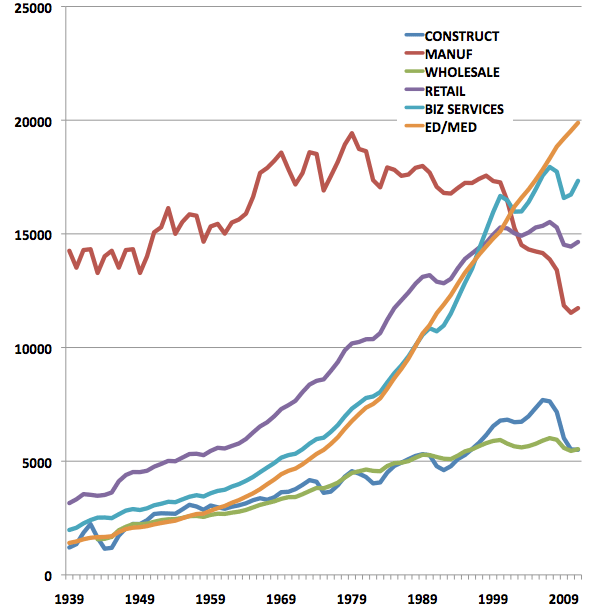
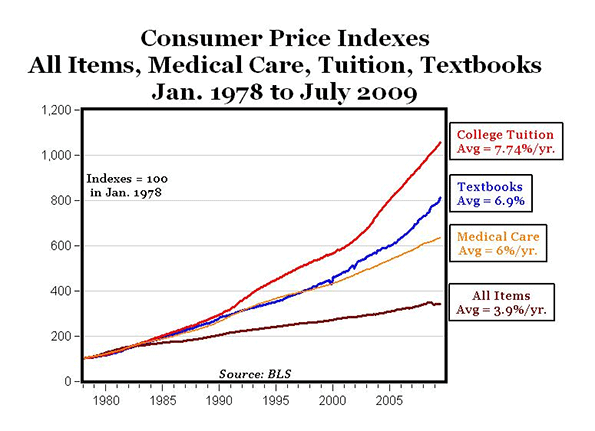
    But for cities hanging their hat on eds and meds growth, a more fundamental problem now looms: these industries are at the end of their growth cycle. Spending on healthcare and college tuition costs has been skyrocketing at rates greater than inflation for years.  Here’s a chart, via Atlantic Cities, showing job creation by sector since 1939:


    If eds and meds employment has been going up continuously since 1939, what’s the problem?  None, so long as it started from a low base at a time when other productive sectors of the economy were likewise growing strongly. But as sectors like manufacturing went into decline or stagnated, eds and meds has continued to increase relentlessly, accounting for an ever larger  portion of total growth.  For example, between 1990 and 2008, eds, meds, and government accounted for about 50% of all national job growth.

    Unsurprisingly, with growth in jobs exploding, costs have followed. Medical costs and tuition have been growing at twice the rate of inflation, and at an increasingly divergent rate, as this chart from Carpe Diem shows:

    Clearly, such a trend cannot go on indefinitely. As the US starts to groan under the weight of spending on health care and higher education, it’s clear that, as a society, we need to be spend less, not more on these items as a share of national output.  Some cities with unique strengths, like Boston, with its many specialized biotech firms, or Houston, with the world’s largest medical center, may thrive in this environment, but the vast majority of cities are likely to be very disappointed in where eds and meds growth will take them.

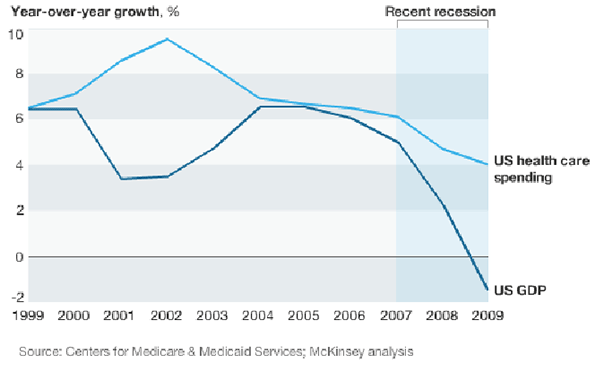
    The problem with health care is most obvious. Aggregate spending on health care has been exceeding the inflation rate for many years. According to a report by McKinsey, spending on health care has consistently grown faster than GDP:


    The net result is a sector that has been consuming an increasing portion of the national economy.  Health care spending is projected to consume fully 20% of the entire US economy by 2021.

    The health care reform act will do little to nothing to rein in this cost. It’s difficult to see how in fact the trend will slow. But with the federal government (especially through Medicare) accounting for more and more total health care coverage, $16 trillion in national debt, and large deficits and unfunded entitlements, one can safely assume that whatever can’t go on forever, won’t. Eventually the government will be forced to take action to stabilize health care spending.

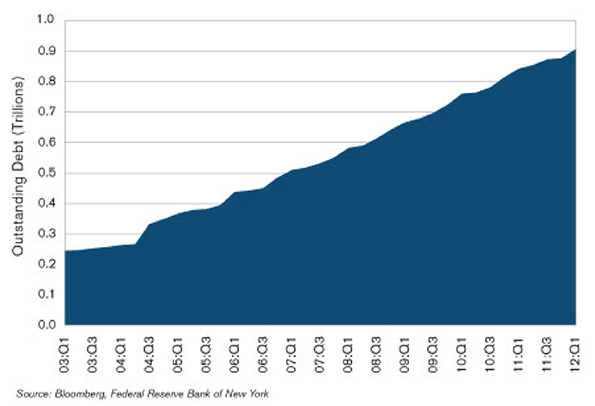
    If the health care cost crisis has long been known, the public is just waking up to the crisis in higher education costs.  Skyrocketing tuition has driven the cost of many colleges through the roof.  This traditionally didn’t bother students, who were assured that a college education the key to a good job that would easily allow loans to be repaid.  In a global age where even knowledge economy jobs are subject to offshore competition, and a recession that’s kept many young people — including many now deeply in debt — unemployed or underemployed.  There is now about $1 trillion of it outstanding, much of it non-dischargeable in bankruptcy:


    This student loan spike was created by many of the same dubious forces that led to the housing crisis. Indeed, some have said that student loans are the next subprime crisis, and commentators like Glenn Reynolds talk of a higher education “bubble”.

    The overall economy will come back at some point, but it’s clear that America is reaching the point at which it can no longer pile more debt onto the backs of students. This by itself will serve to moderate tuition increases at most institutions. There is also a significant amount of reform the current system obviously needs that, if implemented, would also tend to moderate tuition increases.  For example, it doesn’t seem unreasonable to suggest that colleges ought to have some skin in the game for these loans being repaid. Or that cheaper online education might substitute for physical classrooms in some cases.

    Regardless of how it plays out, when you look at spending in aggregate in America, it’s clear increases in health care and higher education spending cannot keep increasing at current rates.  This means that it just isn’t possible for all the cities out there dreaming of eds and meds glory to realize their dream. America simply can’t afford it.

    Whether the end of the great growth phase in eds and meds comes 1, 5, or 10 years from now can’t be predicted. But come in the reasonably near future it will, and that’s when the bulk of the cities that put all their chips in those baskets will receive a very rude awakening.

    Aaron M. Renn is an independent writer on urban affairs and the creator of Telestrian, a data analysis and mapping tool. He writes at The Urbanophile, where this piece originally appeared.

    Hospital photo by Bigstock.

  • Carmel, IN Named Best Small City in America to Live In But Can Others Follow?

    Money Magazine just named the Indianapolis suburb of Carmel as the top small city in America to live in. Fishers, another Indianapolis suburb, ranked #12.

    Any ranking survey, and particularly one done by a magazine, needs to be taken with a grain of salt. However, Carmel and Fishers (along with occasionally Noblesville), frequently show up high in various national rankings. For those interested in suburban living, these places offer a pretty strong combination of good schools, low real estate prices (Indianapolis is basically the cheapest big city housing market in America), low taxes, and fairly high quality of life. With populations of over 75,000 each, these communities also have the scale to efficiently provide quality public services.

    I personally think Fishers has long term sustainability issues. It has kept up with very rapid growth admirably, but it has really not done much to secure its long term future, and when it reaches buildout, I expect problems to set in.

    Carmel by contrast has invested heavily in building towards a future where greenfield growth is no longer the driver. It has invested in high quality public facilities, some of the best suburban transportation infrastructure in the nation, building new urbanist neighborhoods from scratch, upgrading utilities, improving the environment, etc. Dan McFeely of the Indianapolis Star covers Carmel and wrote a bit about this.

    I’ve covered Carmel extensively for years here on the blog, calling it the “next American suburb” and writing about its civic strategy, new urbanist approach, and various criticisms of its leadership.

    I think the Carmel story is an interesting one because it shows how a city, albeit an affluent one, in a very conservative state can fundamentally transform itself in a way that that demonstrates results. This includes urbanism standards and infrastructure standards that exceed those of the urban core of Indianapolis, with many of its public services being better as well.

    The results most notably show up in incomes. While incomes cratered relative to the US in both Indiana and metro Indianapolis, Carmel’s median household income actually inched up versus the US average despite starting from a higher base.

    In short, the strategy has been working, though obviously the national economy has had an effect. And I don’t necessarily support everything they have done. Their $150 million performing arts center, for example, all paid for with public funds, seems expensive for a city of this size, and has saddled the city’s redevelopment commission with debt. But on the whole, things seem to be paying dividends.

    This is part of the explanation for why Indianapolis as a region has done well while its urban core lags many other cities. The majority of people prefer suburbs, and Indy’s newer suburbs provide an exceptional value proposition.

    Ultimately to be successful, the region will have to fire on all cylinders. This means both urban and suburban, with each neighborhood and town bringing a unique approach and its A game to the table. It’s not an either/or situation. I want to build urban cores up, not tear suburbs down. (Downtown Indianapolis has its own game going. Despite some recent criticisms that I stand behind, downtown Indy has positive momentum in a lot of areas. For example, another 300 tech jobs were just announced yesterday).

    I previously highlighted Columbus, Indiana, which has accomplished something similar in a more blue collar environment. So positive stories based on different variations of the same playbook aren’t limited merely to upscale suburbs.

    In a state that has long lagged the nation in job and output growth, and where the very large decline in relative incomes has been a huge issue at all levels, you would think that leaders would be streaming in to study these successful models.

    Alas, that is not the case. Not only is there little interest in learning from models that are actually working (save perhaps for other Indy suburbs looking to Carmel), there’s actual hostility. It’s as I said in some recent posts: Indiana actively discourages the pursuit of excellence. They’d rather cut down the successful than bring up the failing. State level policy choices are trying to do just that.

    Start with school funding. As part of a property tax reform process, the state of Indiana took over 100% of all local school operating funding. However, they also changed the funding formula in a way that stuck well performing metro Indy districts at the bottom of the pile. Out of about 360 school districts statewide, Carmel is fourth from the bottom in per pupil funding from the state. Other regional districts like Fishers and Zionsville are also at the bottom. In effect, the state decided to starve fast growing and well performing suburban districts. Somehow this didn’t make the list of education reforms in that recent Economist article. For a state that claims to want to base its economic future on things like life sciences, this sure seems puzzling.

    The state has also sought to impose a one size fits all, least common denominator approach to services. While it didn’t affect Carmel directly since they already built their first class library, the state’s Department of Local Government Finance vetoed plans by the suburbs of Westfield and Greenwood to build new libraries (partially inspired by Carmel), even though the bonding plans survived a petition challenge. The state’s rationale was that the cost per resident was higher than the state average. It’s easy to see that a policy like this acts as a one way downward ratchet.

    The state also passed a law that not only capped property taxes as a percentage of assessed value – a measure I support – but also put in place a de facto spending freeze for all cities at current levels through a levy cap.* (This levy cap ignores growth in commercial tax base, so if a town built a 50 million square foot industrial park, it wouldn’t even be able to raise the revenues to provide services to it).

    This has left cities increasingly depending on gimmicks to finance anything. And every time a city figures something like that out, the state makes noises about shutting it down. The state has also refused to allow communities to even let their own citizens vote in favor of spending money on things like transit. Indiana has never particularly empowered municipalities, but recent years have seen a strong turn towards disempowerment, with the state’s General Assembly serving as a sort of uber-city council (and now uber-school board too).

    I’d be willing to venture that neither Carmel nor Columbus would be able to accomplish what they have if they were starting out on the journey today under the current state legal and political climate.

    This is not to say that spending money is a solution to problems. Actually, by national standards, places like Carmel and Columbus don’t spend very much money at all. With some exceptions like that performing arts center, they are actually quite frugal. They understood the concept of long term total cost of ownership, and as a result have kept taxes low by not being penny wise, pound foolish in the short term, while so many other places that thought only about the now have descended into a near death spiral of service cuts, tax increases, and abandonment. That’s the tragedy.

    In a rational world, one would think that we’d look at models that are producing population growth, job growth, corporate (including foreign) investment, high quality of services and quality of life, keeping incomes at or above US levels – and mostly importantly all while keeping taxes well below normal (at the bottom of the state in Carmel’s case) even by the standards of Indiana – and say to ourselves: how can we get more of that? Unfortunately, that’s not the case here. (Again, some other Indy suburbs excepted).

    Before proposing solutions to Indiana’s long term under-performing economy, I would suggest that the candidates for governor first take a look around the state to examine at the places that are already doing well and have been doing well over the last decade or more. Then ask the question: what are they doing different and right and what do we need to do to get other places doing those things? First among the places to visit would be suburbs like Carmel and industrial cities like Columbus. If you’re ranked #1 in America, you must be doing something right.

    * This is complicated, but my understanding is that the total property tax levy cannot grow faster than inflation + population growth. This has had many perverse incentives, including keeping entities like townships from lowering their tax levy even when possible because they’re afraid they’ll never be able to raise it again if needed.

    Aaron M. Renn is an independent writer on urban affairs and the creator of Telestrian, a data analysis and mapping tool. He writes at The Urbanophile, where this piece originally appeared.

    Carmel City Hall photo by Bigstock.

  • Obama Fuel Economy Rules Trump Smart Growth

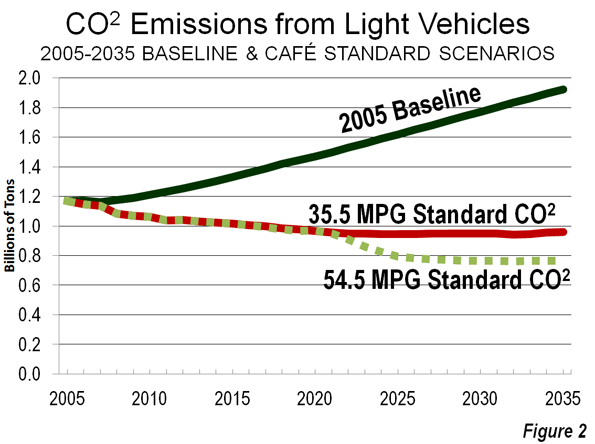
    The Environmental Protection Agency (EPA) has just finalized its regulation requiring that new cars and light trucks (light vehicles) achieve average fuel efficiency of 54.5 miles per gallon (MPG) by 2025 (4.3 liters per 100 kilometers). This increase in the "CAFE" standard (Corporate Average Fuel Efficiency) is the second major step in the Obama Administration’s program to improve light vehicle fuel efficiency. In 2010, EPA adopted regulations requiring 35.5 MPG average by 2016 (6.6 liters per 100 kilometers).

    The EPA standard is based upon carbon dioxide (CO2) grams emitted per mile of light vehicle travel, with an average of 163 grams per mile (101 per kilometer) to be achieved in 2025. This is slightly above the 2020 European Union standard of 152 grams per mile (95 grams per kilometer). Of course, the regulations have both supporters and detractors, with the automobile manufacturers being among the supporters.  

    Assuming the objectives are met, the reductions in CO2 emissions will dwarf the modest gains forecast from anti-suburban smart growth policies. For decades, this powerful movement has sought to limit or prohibit suburban expansion and even outlaw the detached housing that most people prefer. This includes railing against automobile use and seeking to coerce people out of their cars (as expressed by Secretary of Transportation Ray LaHood).

    The anti-suburban movement has many labels in addition to "smart growth," such as “densification policy," "compact cities," "growth management," "urban consolidation," etc. The origins can be traced back to just after World War II, with the enactment of the British Town and Country Planning Act. The policy origins of smart growth in the United States date from the 1960s (the state of Hawaii) and 1970s (the state of Oregon and California local jurisdictions).

    Forecast CO2 Emission Reductions from Smart Growth

    With concerns about greenhouse gas (GHG) emissions (principally carbon dioxide, or CO2), proponents saw the opportunity to force people back into the cities (from which most did not come) and turn smart growth into an imperative for "saving the planet." This is no exaggeration. As late as last month, this was claimed by fellow panelists at a Maryland Association of Counties conference. As is indicated below, the data shows no such association.

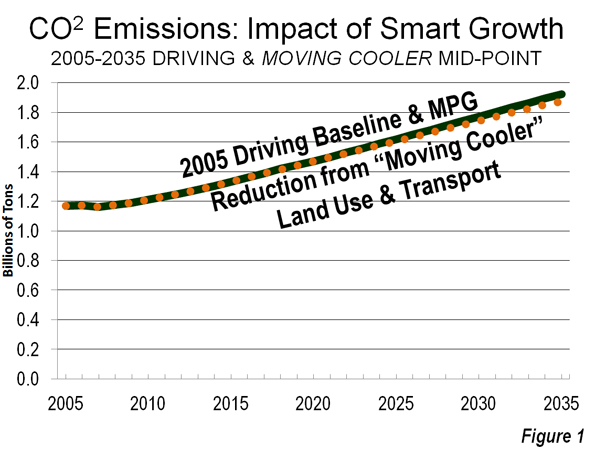
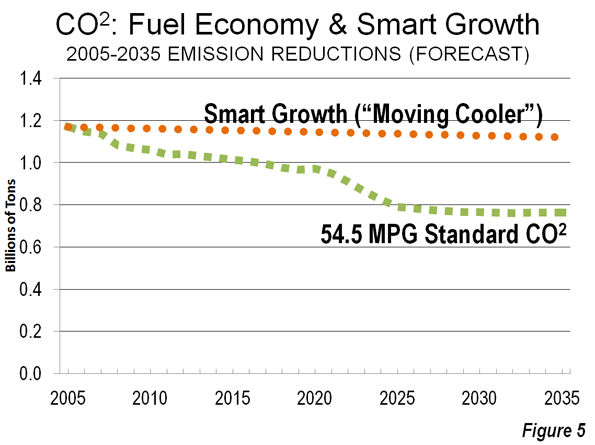
    Even forecasts by proponents fall short of demonstrating an apocalyptic necessity for smart growth. The Cambridge Systematics and Urban Land Institute Moving Cooler report attributed only modest reductions in CO2 emissions to smart growth’s land use and mass transit policies (Moving Cooler was criticized on this site by Alan Pisarski. See ULI Moving Cooler Report: Greenhouse Gases, Exaggerations and Misdirections). The data in Moving Cooler suggests an approximately 50 million ton reduction in CO2 emissions from these smart growth strategies by 2035 (interpolating between 2030 and 2050 figures).

    The more balanced Transportation Research Board Driving and the Built Environment: The Effects of Compact Development on Motorized Travel, Energy Use, and CO2 Emissions  produced similar figures, however it indicated skepticism about whether their higher range projections were "plausible."

    Comparing Smart Growth to the Previous Fuel Economy Standard

    At the 2005 fuel economy rate and the projected driving increase rate in the US Department of Energy Annual Energy Outlook:2008 (AEO), CO2 emissions from light vehicles would have increased 64 percent from 2005 to 2035 (Note 1). This could be called the "baseline" case or the "business as usual" case. This would have resulted in a CO2 emissions increase from light vehicles of approximately 0.75 billion tons.

    Using the more aggressive Moving Cooler forecast, the smart growth transport and land use strategies would only minimally reduce CO2 emissions from the baseline case (64 percent above 2005 levels) to 60 percent. This is "chicken feed" (Figure 1).

    Forecast CO2 Emission Reductions from the 54.5 MPG Standard

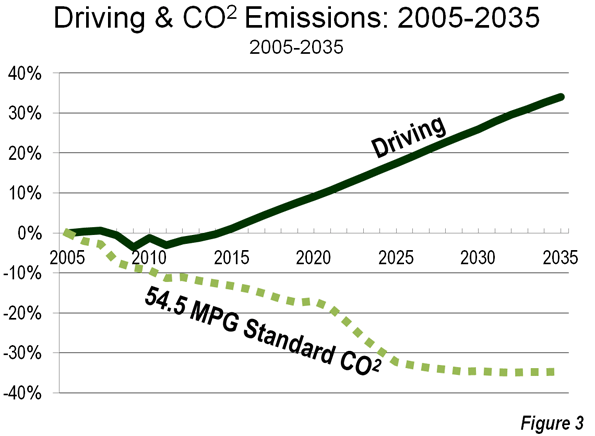
    Under the previous 35.5 MPG standard, AEO:2008 and AEO:2012,  a 19 percent reduction in CO2 emissions from cars and light trucks would occur from 2005 to 2035. We modeled the new regulations based upon AEO:2012 forecasts for the earlier regulation. This yielded a 2035 CO2 emission reduction of 35 percent from 2005 (Figure 2), despite a healthy one-third increase in driving volumes over the period. The calculation also includes an upward adjustment for the rebound effect, as lower costs of driving encourage people to drive more, which EPA estimates at 10 percent ("induced traffic"), which is indicated in Figure 3.


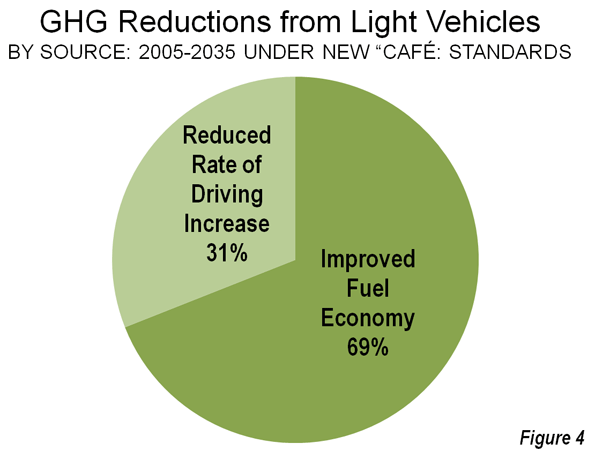
    Achievement of the 54.5 MPG standard would reduce CO2 emissions from light vehicles from 1.9 billion annual tons in 2035 under the 2005 baseline to approximately 0.750 billion metric tons in 2035. Approximately 70 percent of the decline in CO2 emissions would be from improved fuel economy, while 30 percent would be from slower annual increase in vehicle travel that has been adopted in AEO:2012 (Figure 4). The increase in driving is now forecast at 33 percent from 2005.

    The contrast between the potential CO2 emissions from smart growth and fuel economy is stark. By comparison, the annual overall reduction in CO2 emissions (from the 2005 baseline) would be virtually equal to the 30 year impact of smart growth (Figure 5).

    Comparison with Transit

    The 35.5 MPG standard would make cars and light trucks less CO2 intensive than transit. At work trip vehicle occupancy rates, the average new light vehicle would emit less in CO2 per passenger mile in 2016 than transit in all but eight of the nation’s 51 metropolitan areas over 1,000,000 population. The 2025 54.5 MPG standard would drop that number to two (Note 2). Even before these developments, there was only scant potential for replacing automobile use with transit (much less walking or cycling) because of its long travel times. According to data in a Brookings Institution report, less than 10 percent of jobs in the largest metropolitan areas can be reached by the average resident in 45 minutes on transit (Note 3).

    Smart Growth: Not Needed to "Save the Planet"

    Smart growth is an exceedingly intrusive policy that would attempt to enforce personal behaviors,    counter to people’s preferences, by attempting to dictate where people live and how they travel. This is expensive as well as intrusive. It is also detrimental to the economy, which is already taking a toll in lower household discretionary income (especially from higher house prices) and stunted economic growth.

    A report by The McKinsey Corporation and The Conference Board  indicated that sufficient CO2 emissions could be achieved with "…no downsizing of vehicles, home or commercial space and traveling the same mileage" and "…no shift to denser housing." Or, more directly, smart growth is unnecessary, in addition to producing little "gain" for the "pain."

    Wendell Cox is a Visiting Professor, Conservatoire National des Arts et Metiers, Paris and the author of “War on the Dream: How Anti-Sprawl Policy Threatens the Quality of Life.”

    —-

    Note 1: The 2030 to 2035 driving volume is estimated using the annual percentage increase from 2025 to 2030 in AEO: 2008, which has data through 2030.

    Note 2: Calculated from 2010 National Transit Database summary by Randal O’Toole of the Cato Institute. These calculations assume the 250 gram per mile standard for new light vehicles in 2016 and the vehicle occupancy ratio of 1.13 for work trips from the 2009 National Household Travel Survey.

    Note 3: Limited transit access is not just an American problem. In Paris, with arguably the best transit system in the western world, the average resident of a suburban new town on the regional metro (RER) can reach twice as many jobs by car as by transit in an hour, according to Fouchier and Michelon.

    Prius photo by Bigstock.

  • The Creative Destruction of Creative Class-ification

    Bits and pieces of ideal cities have been incorporated into real ones; traffic projects and housing schemes are habitually introduced by their sponsors as at least preliminary steps to paradise. The ideal city gives us the authority to castigate the real one; while the sore itch of real cities goads us into creating ideal ones. Jonathan Raban, from Soft City

    There’s a spot in Cleveland that is becoming what many had hoped for: a bit vibrant, a bit hip, with breweries, local retail, and farm-to-table restaurants turning that hard rawness of a disinvested Rust Belt city strip into a thing less raw.

    Actually, the current mix of grit and slight refinement works well on Cleveland’s W. 25th St in Ohio City. Characters abound. The racial and class mixing feels both natural and unforced. Place authenticity is there, aided no doubt by the presence of the 100-year old West Side Market anchoring what is an emerging neighborhood identity of an area where one can get a bite or sip of Cleveland amidst its architectural integrity. And the distinctive Cleveland-ness of it all is becoming ever more attractive, especially to those looking for something beyond that sea of cities sanitizing their urban terroir.

    West Side Market at night. Courtesy of the Plain Dealer

    I just wonder if the inevitable will happen.

    The inevitable, of course, is called “success”. Often, in the creative class-ification of the urban environment, “success” commonly proceeds this way: an area seeps in its own disability to achieve “highest and best use”—yet it’s cheap, intriguing even, particularly due to “the creative allure of urban grit”. Artists and bohemians make a home and create. A scene unfolds, thus laying the sluice gates toward beautification. Food and coffee places soon come to fill need. Retail locates near the foot traffic. Investment begets investment until all the dead buildings are freshly coated. The professional creative class eventually brings in the rear, effectively dictating a claim of “highest and best use”. Market studies by developers get corporate chains interested. Homogeneity ensues via the unforgiving force that is the economy of space, with income, race, and viewpoint converging into a slice of the urban electorate. This convergence is often presumed to result in the explosion of ideas via agglomeration of knowledge. But suppose it simply results in the deadening of insight via an agglomeration of group think.

    Take the case of Portland. It is a creative class darling, with the young and educated demographic inmigrating rapidly over the past decade. Proponents of the creative class suggest it is Portland’s place-based amenities—its density, its array of bike paths and coffee shops, its craft brews and locavore scene—that is attractive to the psychology of the mobile and modish. Let’s suppose this is true. No suppositions are necessary, however, when inferring what the decade-long demographic shift has done to the diversity of the city’s inner core.

    From an article entitled “In Portland’s heart, 2010 Census shows diversity dwindling”, the author writes:

    “Portland, already the whitest major city in the country, has become whiter at its core even as surrounding areas have grown more diverse…The city core didn’t become whiter simply because lots of white residents moved in…Nearly 10,000 people of color, mostly African Americans, also moved out…As a result, the part of Portland famous for its livability — for charming shops and easy transit, walkable streets and abundant bike paths — increasingly belongs to affluent whites.”

    Of course the irony here is that diversity and tolerance is said to attract a subgroup of forward-looking folks who then congregate using the grease of spatial economics to force said tolerance and diversity out. Given that diversity and tolerance have been argued to be key engines to idea production and subsequent economic growth, perhaps it’s no surprise Portland has not grown economically, regardless of the strained narrative stating otherwise.

    Diversity of people are not the only victims to creative class-ification, so is diversity of place. From a recent Atlantic Cities article, the former owner of the popular Mama’s Bar in the East Village talked about his taxes skyrocketing 380% as the reason he had to close. Later, the owner wonders about the cost of NYC’s decision to world-class the hell out of its urban intricacy and ambiguity:

    I think the thing that makes this city unique is it does have different neighborhoods that are specific and unique unto themselves. They have their own personality. What has happened — and I don’t want to blame the mayor, because it’s the evolution of the city — but things have become so expensive here…the only way businesses can survive in these neighborhoods is if they’re banks or corporate chains. These neighborhoods are being whittled down into carbon copies of each other.


    Mama’s Bar, now closed. Courtesy of community54.com

    Echoing this sentiment, the New York Times just ran an op-ed from the blogger at Vanishing New York about how the place-making standard bearer the High Line has created for a stretch of people lined like cattle amidst a neighborhood increasingly delineated into a pasture of consumption, not a hive of innovation. The author writes:

    [T]he idea was enticing: a public park above the hubbub, a contemplative space where nature softens the city’s abrasiveness…

    …My skepticism took root during my first visit. The designers had scrubbed the graffiti and tamed the wildflowers. Guards admonished me when my foot moved too close to a weed…

    …The neighborhood has since been completely remade. Old buildings fell and mountain ranges of glassy towers with names like High Line 519 and HL23 started to swell…

    Since the op-eds running, the blogger, Jeremiah Moss, has been derided as regressive, an obstructionist, with one commentator on his blog accusing Moss of being “a lazy critic” who is “not interested in either exploring the nature of our changing urban environment or discussing the merits of the [High Line’s] design”. But these critics miss Moss’s point, or that place-making is not simply about beauty, but so too the motive behind beautification. Often, that means economic gain, and often: that means at any cost. From a post in Art Info:

    The High Line — being such an alluring work of design — became, quite literally, a lure to attract groups powerful enough to steamroll socioeconomic diversity and reconstruct the neighborhood into a more glamorous version of New York.

    This was not how it was supposed to go. In a piece in Parks and Recreation, the author describes creative class theorist Richard Florida’s exemplifying of the High Line as an example of “communities transforming old industrial-age infrastructure into unusual and magnetic parks”. Florida explains many cities are figuring out that place has worth, and are prioritizing accordingly:

    The good news is that some cities have come to understand that great parks can rally citizens and hold communities together…and the most far-seeing mayors realize that.

    What is less discussed is how publicly-subsidized parks and other place-based jewels can be used as a hammer to polish out the vicinity around them; that is, how parks can be co-opted to break communities apart.

    Don’t get me wrong. I think place-making has its place. But its Frankenstein effects can’t be ignored. As—again—there is a contradiction at play in creative class theory; namely, that the preconditions of success: diversity, density, and tolerance, can create for a “success” that eats diversity and tolerance, particularly in those “special sauce” dense spots like East Village and downtown Portland that are harmonized to be vessels for new knowledge and thus new economies. In fact it can be argued that such outcomes deaden the long-term growth of cities in that traditional geographic and cultural hearts are being sold for the “gimme now” gains of taxation on objects from coffee to condos. And really: there is nothing much cool or creative about that. Rather, it’s selling your city to the highest bidder. It is mountains turned to coal.

    East Village Condo. Courtesy of http://cityofstrangers.net/

    Looking back, maybe this was all to be expected. Layering a cellophane of universal cool over the topography of distinct places to attract a slice of the urban electorate—many of which have no clue about the genius loci of each place—well, what would one expect?

    Still, there are lessons to be had here. Lessons for cities. Here’s hoping that those so-called failed and dead cities like Cleveland can resist getting their spots of raw locality from being entirely scrubbed out. In fact, in a world of inauthenticity it will be cities of realness that provide for environments fostering a stimulation of thought. It will be these cities collecting the hemorrhaging of thinkers and doers that can no longer stand the plasticity derived from the mold of “highest and best use”. It will be these cities providing for the creative destruction of creative class urbanity.

    Richey Piiparinen is a writer and policy researcher based in Cleveland. He is co-editor of Rust Belt Chic: The Cleveland Anthology. This piece originally appeared at his blog.

    Downtown Cleveland photo by Bigstock.

  • Travel Bans: Do No-Go Lists Fight Freedom?

    Had the 1789 constitutional amendments protected travel alongside the rights to freedom of the press, religion, and assembly, the United States might be a less xenophobic country. It might be less prone to treat arriving tourists as terror suspects, and more encouraging to those of its own citizens who want to explore the world’s darker corners. Instead, foreign travel in the age of terror feels more like an imperial favor than a constitutional right.

    Europe now has few internal border controls, and tourists routinely depart for Algeria and Myanmar. The American government, however, equates travel with a political endorsement, and seems to think that economic embargoes spread the doctrines of life, liberty, and the pursuit of happiness.

    How many departing despots, making their runs for the border, proclaim, “I’d still be in power if it wasn’t for that damned travel ban!” Who thinks keeping tourists from Syria will persuade Bashar al-Assad to abdicate? Nevertheless, dividing the travel world into gardens of good and evil is an increasing preoccupation of the American government.

    Despite President Barack Obama’s celebrated processions and feel-good speeches in Europe and the Middle East, his administration and that of George W. Bush are easily the most xenophobic since President Woodrow Wilson in 1919 unleashed A. Mitchell Palmer and the young J. Edgar on alien associations.

    If you have doubts, add stickers to your luggage from Iran, Somalia, Yemen, North Korea, Cuba, Iraq, Syria, Libya, Afghanistan, Sudan, Pakistan, or Kashmir. See what questions you get asked when returning from your next cruise.

    The ban on Cuban travel dates to October 1960, although the absence of KFC chicken in Havana has done nothing to dislodge the Communist regime. The net effect of the embargo has been to allow the Castros to govern harshly in splendid isolation from American goods and services.

    Would Fidel and his brother have lasted in power for fifty-four years if they had to contend with the landings of Carnival Cruise Lines, instead of those CIA operatives at the Bay of Pigs?

    The U.S. does not explicitly ban travel to countries like Iran and North Korea, although because it is easy to construe travelers checks as commercial relations or to equate Revolutionary Guard souvenirs bought in the Tehran airport as contraband, few Americans are empowered to book passage to Pyongyang or Isfahan.

    Myanmar, or Burma, is another country on the suspect travel list, it being felt that idling in places like Rudyard Kipling’s old Moulmein Pagoda implies support for the ruling military junta.

    Not only does the United States discourage its citizens from wandering the globe freely, it has confronted foreign travelers coming into the US with a nightmare of entrance requirements, including demands for conforming photographs, biometric passports, and thoughtful answers to edgy consular questions. Europeans not on the visa-waiver program have to jump through hoops just to spend money in Disneyland. (“Visit America: Your fingerprints are already here!”)

    President Obama claims credit for “bravely” reducing restrictions on Cuban travel (group visas are now easier to get; relatives can go more often), but maintaining all the other Cuban embargoes, including those on American medicine, hardly adds up to a profile in courage.

    To counter these dark perceptions, there is something new called Brand USA, whose public/private mission is to “encourage increased international visitation to the United States and to grow America’s share of the global travel market. In doing so, we aim to bring millions of new international visitors who spend billions of dollars to the United States, creating tens of thousands of new American jobs.” Needless to say, a worthy goal.

    The $12 million ad campaign includes Roseanne Cash singing “Land of Dreams,” and the assumption that most tourists to America are here for bungee jumping (unless the high wires in the trailer are serving the interrogation needs of Homeland Security).

    The more insecure a government, the more likely it is to impose travel restrictions. The People’s Republic of China had it borders closed for years. Cuba has all sorts of rules to regulate which of its citizens can go abroad (generally only those who leave behind hostages). North Koreans live behind the barbed wire, as did the inmates of Enver Hoxha’s Albania.

    The Iron Curtain and the Berlin Wall were other examples of the degree to which strutting regimes will go to keep their citizens from foreign travel or, as V.I. Lenin said, “voting with their feet.” Who would think the United States would become the heir to the tradition of telling its citizens where they can go, and with whom they can spend their free time?

    Who believes that travel bans and trade restrictions had a hand in bringing change to the Soviet Union, South Africa, Libya, or Rhodesia? Embargoes beggar the local population and enrich the sanction breakers. But they suit the American imperium that wants its laws to govern every corner of the globe. Witness that a British bank was fined $340 million for doing business with Iranians.

    If traveling freely was a constitutional right, Americans could make up their own minds about where to go and what to see, even if it included taking the measure of Beloved Leader’s North Korea or of Potemkin’s villages in Russia. How many Americans would believe the government propaganda about Iran or Cuba if they were free to inspect the poverty themselves, or to mix with local pro-American populations?

    In the last decade the United States has fought wars, directly or by proxy, from Morocco to Kashmir, yet few Americans have been to these countries and even fewer are encouraged to have a look.

    More often than not, Washington ends up in conflict with those countries that start out on its no-go lists, for example, Libya, Syria, Iraq, Iran, Yemen, or Sudan. A travel ban or economic embargo is often the first salute in the drum to war.

    In most of the Middle East, only professional diplomats and journalists are deemed worthy to offer their firsthand impressions, although I would put more stock in backpacker accounts of Iran than I would in a State Department white paper.

    Because I am a wandering contrarian, the travel that often engages me is to countries that belong in the dustbin of history. I am drawn more to the Axis of Evil than to the Magic Kingdom or Vegas floorshows, although I return from places like Albania, apartheid South Africa, or the Soviet Union, immune to the charms of strongman governments.

    Everything I know about Pakistan’s dysfunctional tribal areas I learned in Peshawar, near the border with Afghanistan. I gave up on the Soviet Union after going there on a student tour in the 1970s. The reason I believe little that is reported about the Syrian civil war is because I drove across that country—in a rental car with my teenaged son—something I recommend to anyone… although not just at this moment.

    Flickr Photo by By Sem Paradeiro : Myanmar Visa

    Matthew Stevenson, a contributing editor of Harper’s Magazine, is the author of Remembering the Twentieth Century Limited, a collection of historical travel essays. His next book is “Whistle-Stopping America”.
  • Regionalism: Spreading the Fiscal Irresponsibility

    Stanley Kurtz’s new book, Spreading the Wealth: How Obama is Robbing the Suburbs to Pay for the Cities describes political forces closely tied to President Obama who have pursued an agenda to “destroy” the suburbs for many years. He expresses concern that a second Obama term will be marked by an intensification of efforts to destroy the suburbs through eviscerating their independence thought the imposition of "regionalism". The threat, however, long predates the Obama administration and has, at least in some cases, been supported by Republicans as well as by Democrats.

    America is a suburban nation. Nearly three-quarters of the residents of major metropolitan areas (over 1,000,000 population) live in suburbs, most in smaller local government jurisdictions. Further, outside the largest metropolitan areas most people live in suburbs, smaller towns or smaller local government jurisdictions.

    Smart Growth

    The anti-suburban agenda has more than one dimension. The best known is smart growth, known by a variety of labels, such as compact development, growth management, urban consolidation, etc. Smart growth, from our research, also is associated with higher housing prices, a lower standard of living, greater traffic congestion and health threats from more intense local air pollution.

    Regionalism

    Another, less well-known anti-suburban strategy is regionalism, to which Kurtz grants considerable attention. Regionalism includes two principal strains, local government amalgamation and metropolitan tax sharing. Both of these strategies are aimed at transferring tax funding from suburban local governments to larger core area governments.

    Social welfare and differing income levels are not an issue at this level of government. Local governments, cities, towns, villages, boroughs and townships, finance local services principally with their own local taxes. The programs aimed at social welfare or providing income support are generally administered and financed at the federal, state or regional (county) level. Any suggestion that local suburban jurisdictions are subsidized by core local governments simply reveals a basic unfamiliarity with US municipal finance.

    Local Government Amalgamation

    Opponents of the suburbs have long favored amalgamating local governments (such as cities, towns, villages, boroughs and townships). There are two principal justifications. One suggests "economies of scale" — the idea that larger local government jurisdictions are more efficient than smaller governments, and that, as a result, taxpayers will save. The second justification infers that a larger tax base, including former suburbs, will make additional money available to former core cities, which are routinely characterized as having insufficient revenues to pay for their services. Both rationales are without foundation.

    Proponents of amalgamation incessantly refer to the large number of local governments in some states, implying that this is less efficient. The late Elinor Ostrum put that illusion to rest in her acceptance speech for the Nobel Prize in economics in 2009:

    Scholars criticized the number of government agencies rather than trying to understand why created and how they performed. Maps showing many governments in a metropolitan area were used as evidence for the need to consolidate.

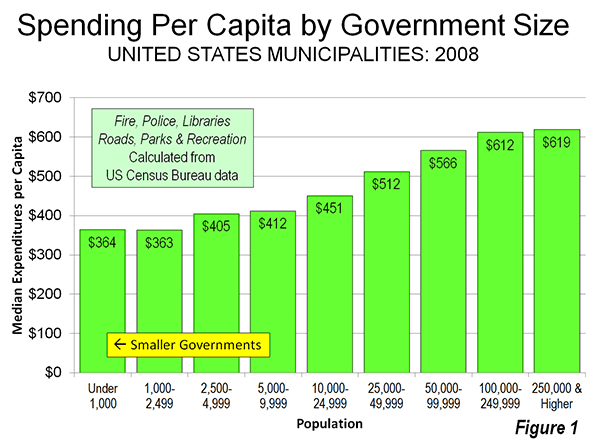
    The reality is that there is a single measure of efficiency: spending per capita. Here there is a strong relationship between smaller local government units and lower taxes and spending. Our review of local government finances in four states (Pennsylvania, New York, Indiana and Illinois) indicates that larger local governments tend to be  less efficient, not more. Moreover, the same smaller is more efficient dynamic is evident in both metropolitan areas as well as outside. "Smaller is better" is also evident at the national level (Figure 1).

    Yet the "bigger is better" faith in local government amalgamation remains compelling to many from   both the Right and Left. Proponents claim that smaller local governments are obsolete, characterizing them as being from the horse-and-buggy era. The same logic could be used to eliminate county and even state governments. However, democracy remains a timeless value. If people lose control of their governments to special interests (which rarely, if ever, lobby for less spending), then democracy is lost, though the word will still be invoked.

    Support of local government amalgamation arises from a misunderstanding of economics, politics and incentives (or perhaps worse, contempt for citizen control). When two jurisdictions merge, everything is leveled up, from labor costs to service levels. The labor contracts, for example, will reflect the wage, benefit and time off characteristics of the more expensive community, as the Toronto "megacity" learned to its detriment.

    Further, special interests have more power in larger jurisdictions, not least because they are needed to finance the election campaigns of elected officials, who always want to win the next election. They are also far more able to attend meetings – sending paid representatives – than local groups. This is particularly true the larger the metropolitan area covered, since meeting are usually held in the core of urban area not in areas further on the periphery. This greater influence to organized and well-funded special interests – such as big real estate developers, environmental groups, public employee unions – and drains the influence of the local grassroots. The result is that voters have less influence and that they can lose financial control of larger local governments. The only economies of scale in larger local government benefit lobbyists and special interests, not taxpayers or residents.

    Regional Tax Sharing

    Usually stymied by the electorate in their attempts to amalgamate local governments, regional proponents often make municipal tax sharing a priority. The idea is that suburban jurisdictions should send some of their tax money to the core jurisdictions to make up for the claimed financial shortages of older cities. Yet this ignores the fact, as Figure 1 indicates, that larger jurisdictions generally spend more per capita already and generally tax more, as our state reports cited above indicate. Larger jurisdictions also tend to receive more in state and federal aid per capita.  A principal reason is that the labor costs tend to be materially higher in larger jurisdictions. In addition to paying well above market employee compensation, many larger jurisdictions have burdened themselves with pension liabilities and post employment health benefits that are well above what their constituencies can afford. The regionalist solution is not to bring core government costs in line with suburban levels but force the periphery to help subsidize their out of control costs.

    Howard Husock, of Harvard University’s JFK School of Government (now at the Manhattan Institute) and I were asked to evaluate a tax sharing a plan put forward by former Albuquerque mayor David Rusk for Kalamazoo County, Michigan (The Kalamazoo Compact) more than a decade ago. Our report (Keeping Kalamazoo Competitive)found no justification for the suburban areas and townships of Kalamazoo County to share their tax bases with the core city of Kalamazoo. The city already spent substantially more per capita, received more state aid per capita and had failed to take advantage of opportunities to improve its efficiency (that is, lower the costs of service without reducing services).  We concluded that the "struggling" core city had a spending problem, not a revenue problem. To the credit of the electorate of Kalamazoo County, the tax sharing proposal is gathering dust, having been made impractical by suburban resistance.

    Spreading the Financial Irresponsibility

    The wanton spending that has gotten many larger core jurisdictions into trouble should not have occurred. The core cities are often struggling because their political leadership has "given away the store," behavior that does not warrant rewarding. Elected officials in the larger jurisdictions had no business, for example, allowing labor costs to become higher than necessary or granting rich pension benefits paid for by private sector employees (taxpayers), most of whom  enjoy only  much more modest pension programs, if at all (See note below).

    The voters are no match for the spending interests with more efficient access to City Hall. The incentives in such larger jurisdictions are skewed against fiscal responsibility and the interests of taxpayers. Making an even larger pool of tax revenues available can only make things worse.

    At the same time, the smaller, suburban jurisdictions around the nation are often the bright spot in an environment of excessive federal, state and larger municipal government spending. Their governments, close to the people, are the only defense against the kind of beggar-the-kids-future spending that has already captured the federal government, state governments and some larger local jurisdictions.

    Either Way the Threat is Very Real

    Even if President Obama is not re-elected or if a second Obama Administration does not pursue the anti-suburban agenda, the threat to the suburbs will remain very real. This is not just about the suburbs, and it is certainly not some secret conspiracy. What opposing regionalism means is the preservation of what is often the last vestige of fiscal responsibility. It is not that the elected officials in smaller  jurisdictions are better or that the electorate is better. The superior performance stems from the reality that smaller governments are closer to the people, and decision-making tends more to reflect their interests more faithfully than in a larger jurisdictions.

    Ed. note: This piece was corrected to add quotation marks around the word “destroy” in the first paragraph. That clause is included in reference to Kurtz’s characterization, not the author’s.

    ——

    Note: A report by the Pew Charitable Trusts (Promises with a Price) indicated that "… in general, the private sector never offered the level of benefits that have been traditionally available in the public sector." The report further indicated that 90 percent of state and local government retirees are covered by the more expensive defined benefit pension programs, compared to 20 percent in the private sector. The median annual pension in the state and local government sector was cited at 130 percent higher than in the private sector. While 82 percent of state and local government retirees are covered by post-employment medical benefits, the figure is 33 percent in the private sector. According to the Bureau of Labor Statistics, after accounting for the one-third higher wages per hour worked among state and local government workers, employer contribution to retirement and savings is 160 percent higher than in the private sector (March 2012). A just published Pew Center on the States report (The Widening Gap Update) indicates that states are $1.3 trillion short of the funding required to pay the pension and post employment medical benefits of employees. This does not include programs administered by local governments.

    Wendell Cox is a Visiting Professor, Conservatoire National des Arts et Metiers, Paris and the author of “War on the Dream: How Anti-Sprawl Policy Threatens the Quality of Life.”

    Lead Photo: Damascus City Hall (Portland, Oregon metropolitan area) by Wiki Commons user Tedder.

  • Form Follows Zoning

    When Louis Sullivan, purveyor of modern American high-rise architecture, said more than 100 years ago that ‘Form Follows Function’, he perhaps didn’t realize the extent to which building form would not be determined only by building type and the laws of physics, but by zoning laws, building safety codes, real estate developer balance sheets and even vocal neighborhood groups.

    For every new building project, an architect’s role is to balance these opposing forces, while also delivering a scheme that is aesthetically pleasing and appropriate for its surroundings. This can be a challenge, but also an opportunity for designers to find creative solutions working within constraints.

    Following are just a few of the many parameters an architect must work with when designing this type of project:

    Form Follows Zoning

    Zoning is a term with broad implications, used to describe the set of regulations put forth by local governments that dictate what type of building can be built where. For each land plot, zoning laws also indicate floor area ratio (FAR, or how much area of building can be constructed), allowable building height, bulk limits, site density, setbacks, and parking requirements, among other constraints.

    The FAR number is of paramount importance: it is the magic number used as a multiplier of a site’s area, resulting in the allowable gross floor area. The higher the FAR number, the more area is allowed to be built on a given plot. In most U.S. cities FAR numbers are difficult to amend except through cumbersome political and legal processes. On the other hand, in developing countries such as China, FAR numbers change on an almost daily basis as zoning regulations remain malleable in order to meet of the moment economic growth needs.

    For high-density commercial and multi-family residential buildings, real estate developers typically seek to maximize FAR to get the highest return on investment. For tall buildings, that means building to the height limit, and then asking for a variance to exceed the height limit if it does not max out the FAR.

    Bulk limits deal with the ascending bulk of skyscrapers, mandating setbacks in the building form as the tower rises up to mitigate shadow impact. That is how you end up with ‘wedding cake’ buildings like the Chrysler Building and the GE Building at Rockefeller Center, both of which were a result of setback mandates in New York City’s 1916 Zoning Resolution. These Art Deco masterpieces are prime examples of how architects cleverly worked within zoning laws to design handsome buildings.

    Form Follows Parking Requirements

    While parking requirements are indicated in zoning laws, this constraint warrants its own category. It is remarkable how much influence the personal automobile has in shaping the modern city, not only in terms of road infrastructure but also in the space required for parking when cars are stopped. Parking requirements are responsible for urban design situations like the ubiquitous linear strip mall setback a great distant from the street, separated by a sea of parking spaces.

    Even in dense urban environments, parking is usually a requirement for new buildings. This means that when designing a multi-story building, the parking layout is what sets the structural column grid that stacks vertically throughout the entire height of the building. A typical 30 ft. column bay (measured from center to center) will accommodate 3 parking spaces, which then results in the building’s entire structure being based on the 30’ column grid.

    Parking garages are either below grade or above grade (above lobby level), and usually do not count towards FAR. There are various reasons (including geological/topographical) for placing a parking garage either below or above grade, but in either case, structure is ultimately designed to accommodate the needs of automobiles.

    Form Follows Rentable/Saleable Area

    In addition to zoning requirements, architects must also meet the needs of their developer clients. This entails realizing in form what real estate bean counters calculate to be the appropriate mix of area for what is to be built.

    If it is commercial office space, developers follow the Building Owners and Managers Association (BOMA) standards of measurement to calculate how much ‘rentable area’ can be squeezed out of a building’s floor given a building’s envelope. Of utmost importance in this calculation is the ‘load factor’ or ratio of rentable area to usable area, determining how much building owners can charge their tenants.

    Also important is the ‘lease span’, with a 45 ft. clear span from service core to exterior wall being the ideal. This allows flexibility in office layout and also ensures enough natural light penetrates deep enough into the office space.

    In residential buildings, saleable are is what developers are after and that determines the mix of unit types (studios, 1 bedrooms, 2 bedrooms, etc…) in a given market. This can frequently change during the design process based on changing market conditions

    For towers with a mix of uses, designing a functional building places tremendous onus on the architect to balance competing forces of different building types consolidated into one vertical structure. With financial rewards ultimately more important than aesthetic outcome, architects have to struggle to create a beautiful building within these constraints.

    Form Follows NIMBY Demands

    In the U.S., and other democratic countries with strong property rights, new building projects are subject to the scrutiny of local neighborhood and vocal environmental groups. Often derided as NIMBYs (Not-In-My-Back-Yard) by those on the pro-development side of a new project, these groups usually have predictable objections, the most common being    increases in traffic. Yet if these NIMBYs, especially in urban settings, have objections to traffic, rather than protest individual projects, they should write their local city councilman suggesting a change in zoning to modify parking requirements.

    Even after the approval of extensive traffic and environmental studies, NIMBYs may criticize a building’s appearance in a last ditch effort to prevent construction. Objections include obscure criticisms such as a design does not fit in with ‘neighborhood character’. This criticism reflects a fundamental misunderstanding that even in historic neighborhoods, a well designed counterpoint or contrast can be a suitable proposal. After all, cities are not static museums frozen in time but dynamic and evolving organisms.

    Unfortunately, the NIMBY victory can often be a final blow to what would’ve otherwise been a successful, beautiful design.

    Conclusion

    For architects, designing a building is more like solving a puzzle rather than an exercise in unrestrained creativity. Surprisingly, there is little discussion of the real world constraints in architecture schools. This is perhaps due in part to the fact that regulations vary greatly from place to place, but the fundamental importance of planning and zoning should be emphasized more often.

    For all stakeholders involved in new building projects (developers, local officials and planning departments, the design team, concerned neighbors) what is written in the local zoning code provides the basis for every decision made. For those interested in making better, more informed planning decisions, individuals and governments should focus less on singular building projects and more on easing the process of making changes to local zoning codes.

    Adam Nathaniel Mayer is an architectural design professional from California. In addition to his job designing buildings he writes the China Urban Development Blog.

    Follow him on Twitter: AdamNMayer

    Chicago skyline photo by Bigstockphoto.com.

  • Why I Don’t Live In Indianapolis

    It’s no secret that Indianapolis has been a huge focus of my blog over the years. One of the biggest criticisms I get here, especially when I ding some other city, is that I’m nothing more than a mindless booster for Indy. While I like to think I’ve given the city a lot of tough love over the years, it’s definitely true that I’ve had many, many good things to say, and I have no problem saying that I’m a big fan of the city overall.

    Why then, might one ask, don’t I actually live in Indianapolis?

    The answer is multifaceted, but without a doubt one key reason is that I simply can’t sign up to what the city is doing in its urban environment. Indy is going one direction, I’m going another. It’s as simple as that.

    Let me give you an example of what I’m talking about. The city recently announced a plan to subsidize a mixed used development on a parcel in the core of downtown, a project called “Block 400.” It would include apartments, retail, etc – all good. While the concept is great, the design is another matter. I could go into depth on the monotony of the structure and other matters, but what I want to show you instead is a parking garage that will house employees from One America insurance. Here was an initial rendering of the garage:

    It’s about as boring a garage as can be imagined. It’s on a prime block just steps from Monument Circle, but has no street level retail or other interest. It’s just a dead parking garage.

    Various folks took umbrage at this, so the developer decided to tack on some awnings, which got them approved by the city’s hearing examiner. Here’s their updated design:

    Let’s be honest: this isn’t a garage, it’s urban design garbage. And guess what? The city of Indianapolis itself is paying to build it.

    I don’t want to let the perfect be the enemy of the good. I can certainly understand that there are economic constraints, tradeoffs to be made, etc. And not every project can be a home run.

    But this isn’t unusual at all – this is standard operating procedure for Indianapolis. This is par for the course. This is just what Indianapolis builds. I cannot name another major city in the United States where the city’s own developer community (including Flaherty and Collins, the developer of this property), own architectural firms (including CSO Architects, who designed this) and own city government so consistently produce subpar development.

    I’m not exaggerating at all. And this isn’t even the worst offender. For example, here’s another downtown development that not only sucks out loud, but the state fire marshal condemned it and forced residents to move out:

    While I’ve named the names of the folks involved in the parking garage and they certainly deserve it, let’s not focus overly on them. This trend goes back a really long way, and is pervasive. The previous city administration, which was of a different political party, behaved no differently. Partially it’s a result of a lack of good urban history of the type that exists in other places. So there isn’t a good template ingrained in the city to follow.

    But ultimately, as I’ve written before, it’s a crisis of values.

    Indianapolis is the place where, as a rule, not good enough is more than good enough for most people, even community leadership.

    That’s why I don’t live there. Because that’s not good enough for me. I may not be perfect, but I aspire to more than mediocrity. I don’t expect any city to be perfect or all the way there yet. You can inspire people, including me, to join your army to take hamburger hill or to get behind the rock and push, if you provide a vision of what can be. That’s one reason people are planting their flag in Detroit. It’s the hope of the possible.

    But when it’s clear that the city itself – and I mean that in the broadest sense – has decided it wants to go march off in a different direction, it’s a lot harder to enlist in that army, no matter how much you might want to.

    Alas, it seems lots of people agree with me – on the actions if not the reasons – as Center Township (the urban core) lost another 24,000 people in the 2000s. They voted with their feet – just like tens of thousands of others have been continuously voting with their feet since 1950 – to go build a better life for themselves somewhere else.

    And in a decade where downtowns made strong residential comebacks, with young people streaming in to live in them, Indianapolis was an exception. Its downtown* added less than a 1000 residents, and their distribution suggests that almost all of that might be a result of jail population expansion. Even downtown Cleveland did better.

    I’m sure Indy’s boosters will be happy to talk about world class parts of downtown like Monument Circle, the Cultural Trail, Georgia St., etc. And these are legitimately first rate. Actually, that makes it worse. It shows that Indianapolis can compete with the best if it wants to, but most of the time it just doesn’t care to. It’s not ignorance. The city knows that to do, it just doesn’t want to do it.

    For some reason locals seem to think that doing it right should be reserved for a handful of special places and occasions. But the mark of at great city isn’t how it treats its special places – everybody does that right – but how it treats its ordinary ones. Indy is like the guy who thinks he can get away with wearing the same old dirty clothes fives days in a row and not taking showers, as long he slaps on a little top shelf cologne before he leaves the house. I’ve got news for you, people are going to notice.

    Indianapolis retains a very compelling regional story to tell. There are tons of reasons for people to come to or build a business in, metropolitan Indianapolis. But the real story there is mostly in the suburbs.

    Yet I believe even the urban core of this not very historically urban city could be compelling as well – if it wanted to be. Indianapolis has all the potential in the world. Indy is like the up and coming star at a company whose boss pulls him aside one day and says, “You’ve got all the potential in the world, but if you want to get that big promotion, you need to stop doing/start doing X, Y, or Z.” Anybody who has made it to the top was fortunately enough to have somebody give them one or more of those good kicks in the pants along the way.

    Indy, unfortunately, has heard the message many times before from many different people, and has elected not to do anything about it.

    Locals love to make excuses for why things can’t be better. F&C’s development director for the project said of the garage, “Some things aren’t achievable.” What is so different about Indianapolis that makes that true there but no where else? What miracle of economics allowed similar cities like Nashville or Cincinnati or Columbus to build many urbanistically correct new developments in those places while somehow it is impossible in Indianapolis? Maybe it’s time to recruit some out of town developers and architectural firms who have a different attitude towards the possible.

    I would encourage Indy’s leaders to take a short hour and a half drive to downtown Cincinnati and take a look around what’s there. Not the old buildings, but the new ones. Most of them are candidly quite bland architecturally, but from an urbanism perspective – and be sure to take someone with you know what’s what they are talking about on this so that they can point it all out – even the bottom quartile of new buildings in downtown Cincinnati beat most of the top 5% of what’s been build in downtown Indy.

    I’ve listened to various civic leaders of late talk about how rebuilding the urban core is now a big priority of the city. If that’s true, and business as usual has been leading to a catastrophic population collapse for some time, wouldn’t you think that you might, you know, try something different? Apparently not.

    When people in Indy want to do something, they can. That’s why they built an amazing franchise in events hosting, particularly sports. They understand what world class is there, they understand the competitive marketplace, and they do what it takes to succeed – including building world class venues, districts, and capabilities to make it happen. So why hasn’t it happened elsewhere?

    I was involved in a discussion about building a high tech industry in Indianapolis a few years ago. Someone boldly said that since Indy had been able to pull off building the sports cluster, it should be very capable of equally pulling off a high tech cluster to rival top hubs in the country. A friend of mine was very dubious about this, and said insightfully, “Sports succeeded because sports is consistent with the state of mind (i.e, the culture, values, and patterns of life) of Indiana. But high tech is more consistent with the state of mind of other places and not so much with Indiana.” Indianapolis is #1 in sports. And while it’s done well in some parts of tech, I don’t see how you could really rate it as more than the middle of the pack nationally on that.

    “State of mind” makes a big difference. That’s ultimately a question people ask themselves these days, whether it is a company and a prospective employee sizing each other up, a consultant and client, or a city and a prospective resident or business. The most important question is always, “Is there a cultural fit?”

    In an era where an ability to attract talent is perhaps the defining characteristic of urban success over the long term, Indy needs to ask itself the hard questions. How competitive is it? I’d have to say right now that it does a great job for people who want to live in a suburban environment like Carmel or Fishers. That’s very, very important and not to be minimized.

    But there are people out there that want more, who prefer different types of environments. Right now Indy is simply not very competitive in that market. And if it keeps on its current path, it never will be. Convince yourself otherwise by finding the exceptions to the rule and getting them to gush about how great things are. But the numbers don’t lie.

    Like that young up and coming employee who’s got the goods but has a few problem areas that will, if not fixed, hold him back, Indy needs to take a serious gut check about the things that hold it back – and an embrace of mediocrity and lack of seriousness in its approach to urban core development are chief among them.

    Ultimately as I said it’s a question a values. There’s nothing wrong with being happy about where you are. Most people don’t have that burning ambition to make it higher, nor a passion for excellence. In this competitive world a lax attitude will probably undermine your performance in the end, but if that’s what you want be, go for it. I won’t judge a place for that. Just don’t expect those who want better for themselves to sign up for it.

    In any choice a city makes, somebody is going to be unhappy. Any branding choice is, in a sense, a choice to exclude by focusing on something rather than something else. There’s nothing wrong with setting down a marker of what you’re going after – and being comfortable with fall out from that.

    Ultimately it’s not about me or any other specific individual. I’m under no illusion that I’m someone who is personally important to future of any city I might find myself. But it about people generally, and being able to attract enough of them – particular of those that are critical to the 21st century economy – to make the city successful and indeed sustainable over the long term.

    Just remember, talented, ambitious people – those with big dreams and hopes for themselves and their societies – want to live in a place where the civic aspiration matches their personal aspiration.

    What do you aspire to, Indianapolis?

    * Downtown defined as the area inside the inner freeway loop and the White River.

    Aaron M. Renn is an independent writer on urban affairs and the founder of Telestrian, a data analysis and mapping tool. He writes at The Urbanophile, where this piece originally appeared.