Category: Policy

  • America’s Two Economies

    Surely you’ve seen it in your own neck of the woods: great contrasts between prosperity and wealth on the one hand, and hardship and despair on the other. I have certainly seen it in every place I have been over the last four years. FDR described the Great Depression as “one-third of a nation ill-housed, ill-clad, ill-nourished.” Yet do we not today have one-third of a nation either unemployed, underemployed, underwater on their one greatest asset (their homes), in crushing debt (which I define as unserviceable from current income), insolvent/bankrupt, on food stamps, unemployment or disability payments, or otherwise dependent on government? The diminishing of the middle class is daunting, but most disturbing is the diminishing of its prospects.

    Perhaps you attribute this state of affairs to the “rich get richer, poor get poorer” meme. But there’s something else, something more going on. I have written about this before (unraveling, stagnation, middle America, middle class is the future), but here bring a fuller picture.

    In the years since the Great Recession started (and ended?) in 2008-2009, the US has been characterized by two economies. One of these American economies is thriving, as are the economic actors part of it. The other economy is miserable, as are its inhabitants. The divergence between these two economies is growing more pronounced. Why is this so, how did it happen, and what does it portend?

    I have been debunking the “rich get richer, poor get poorer” theme for 30 years, maintaining that the relative income gap did not matter as long as absolute income growth was widespread, and economic growth was providing opportunities to all (which was the case). But now those caveats have come into play: middle-income, middle-class earnings, wealth and opportunities are under immense pressure. This is not because the rich get richer, or that redistribution is the answer (I find the debate over austerity vs. growth pretty stupid, when growth too often just means growth of government). It is because of fundamental, structural economic trends which may be with us for a long time to come.

    Divergent Sectors, Divergent Fortunes
    Perhaps you have heard of the manufacturing “renaissance” in America and the exporting “boom.” Both are true. American exports are booming, measuring in at about $180 billion each month (up from $140 per month two years ago). Exports account for about 14% of GDP, and are growing about 16% a year. American manufacturing employment has been hurt by globalization, but manufacturing output continues to grow and exporters are thriving.

    American manufacturing and export prowess are likely to continue into the foreseeable future, as large American companies use innovation and technology to become more productive, and as the growing global middle class demands more American goods (including energy in the form of oil and natural gas).

    The bad news is that exports and manufacturing do not translate into more jobs or even higher wages. Our new job growth has been in health care, education, services and government, areas that do not produce great income and wealth. This holds down the potential income gains of all wage-earning Americans.

    But the income and potential of those in management, finance, high technology and the professions are not adversely affected. The benefits of productivity, manufacturing, exports and economic dynamism generally, therefore, accrue to the already well-situated capitalists, managers and properly skilled. Sure, the internet will continue to make it easier for many small businesses to survive (and some even to thrive), but they cannot be great founts of sustainable jobs.

    Two-tiered economies are well-known and expected in developing countries – an export/manufacturing or raw material sector and a weak domestic service sector – but we’re not used to seeing it in an advanced, technologically sophisticated country like the United States. It actually could mean that the rich will get richer, but the economy will be missing its traditional ladder for those in the middle and below to climb.

    Where will enough employment growth come from to maintain the middle class? Many analysts tell us it will come from the innovation sector, or the innovation economy. But again, the benefits of innovation seem now to accrue to the companies and individuals   already in a position to exploit it, increasing productivity and profitability without a concomitant increase in employees.

    Dystopian Economics
    This is getting perverse, isn’t it? We have high unemployment and underemployment, huge debts and deficits, but companies are profitable and share prices continue to rise. There seems to have been a breakdown in the correlation between employment and GDP, between the housing market and overall economic strength, and between GDP growth and stock market valuations.

    Statistics say we are in a low-inflation environment, but living expenses seem to be rising for food, energy, healthcare and education (the things on which the middle class must spend). Those with jobs and income in sectors that are doing well don’t seem to be as affected. That would certainly help explain the contrasts of wealth and hardship that one sees around the country.

    In other words, what we seem to have created is a winners-take-all economy. Large companies with global exposure, highly skilled workers, and high net worth individuals are the main beneficiaries of current economic policy. Job creation, most small businesses, and low- and medium-end housing are not.

    What if a rising tide no longer lifts all boats?
    We now have the lowest percentage of Americans working or looking for work in 30 years. That really is devastating because the only way out of our fiscal and entitlement nightmare is to have more people working more hours and more years. Is the opposite our future?

    The trends that are creating and sustaining two economies in the US have been building for years and seem to me to be so strong as perhaps impervious to amelioration. The “two economies model” meets my test of sustainability: being supported and reinforced by other fundamental social, demographic, political and technological trends (or at least not being incompatible with them). It is hard to foresee how the “two economies model” can be reversed or even tempered, though it is a path that will leave tens of millions of Americans behind even as the “working” economy improves.

    I have been analyzing, writing and speaking on trends for 30 years. My audiences are often businesses or organizations looking for a picture of the future environment. I usually get a laugh from the observation that the future will be bright for some, dismal for others, and therefore recommend being in the first group. I don’t think I’ll make that joke anymore; somehow it’s no longer funny.

    Dr. Roger Selbert is a trend analyst, researcher, writer and speaker. Growth Strategies is his newsletter on economic, social and demographic trends. Roger is economic analyst, North American representative and Principal for the US Consumer Demand Index, a monthly survey of American households’ buying intentions.

    Finding a job photo by Bigstockphoto.com.

  • The Atlanta Transportation Tax: Too Much for Too Little

    On July 31, voters in a 10 counties of the 28 county Atlanta metropolitan area will vote on whether to raise the sales tax by one cent for $8 billion in transit and highway projects over 10 years. The measure is highly tilted towards transit spending. Sadly, this would do virtually nothing to reduce Atlanta’s traffic or its travel times.

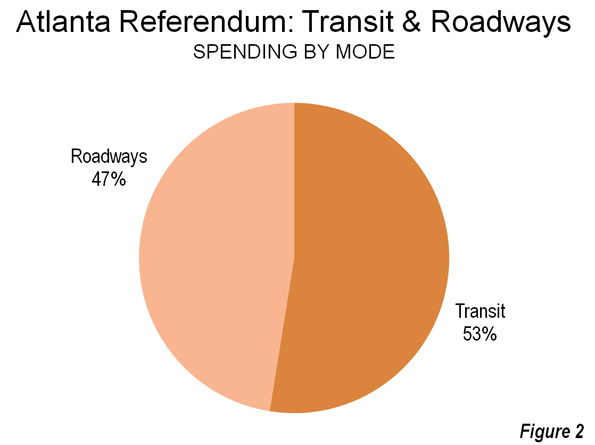
    In a metropolitan area in which barely one percent of travel (Figure 1) and less than five percent of work trip travel is by transit, the tax measure devotes more than 50 percent of the funding to transit (Figure 2).   Yet in reality, the focus of any transportation revenue issue should be on reducing travel times, whether by transit or highways. This is how transportation improves an urban economy. The reality is that with nearly all travel by highways and transit’s inherently slower travel times, much of the tax money would have virtually no impact on reducing travel times or traffic congestion.


    Atlanta’s Traffic Congestion: Promoters of the tax claim that the highway projects will reduce traffic congestion. Atlanta is well known for its serious traffic congestion. There are two reasons for this:

    1. Atlanta’s sparse freeway system is limited to little more than a belt route (I-275) and three radial freeways (I-20, I-75 and I-85) that converge into two in the one place more capacity is needed, the core. Trucks are not permitted on freeways inside the beltway, which concentrates the considerable interstate traffic on a single roadway, I-275. If Atlanta had the higher freeway density (freeway mileage per square mile) of Los Angeles or Minneapolis-St. Paul, traffic congestion would be far less of a problem.
    2. Atlanta’s regional arterial (high capacity streets) system is virtually non-existent. For this reason, I proposed (in 2000) development of a one-mile terrain constrained grid of arterials. The Atlanta Regional Council (ARC), the local metropolitan planning organization, has included a somewhat more modest (but useful) arterial grid in is regional plan.

    Yet despite its reputation, Atlanta’s traffic congestion could be worse. The latest INRIX National Scorecard rates the Atlanta metropolitan area as having the 15th worst traffic congestion in the nation, behind Portland, which is nearly 60 percent smaller and twice as dense, with its compact city policies. Among high-income world metropolitan areas with more than 5 million population, only Nagoya outside the United States may have a shorter work trip travel time (Note 1). Atlanta’s world-competitive work trip travel time of 29 minutes is faster than that of far more transit-dependent Toronto (33 minutes), smaller Sydney (34 minutes) and much smaller Vancouver (31 minutes), despite their compact city policies.

    The Transit Projects: So Much for So Little: The proposed transit projects have virtually no potential to reduce work trip travel times and traffic congestion. Approximately one-fifth of the transit funding would be used to rehabilitate and upgrade the MARTA subway system, a need that should have been legitimately funded from the existing MARTA sales tax. Another nearly 20 percent of the transit funding would be spent on the "Belt-Line" streetcar project in central Atlanta. The role of the Belt-Line is more "city building" (read "real estate speculation") than it is transportation. It will do nothing to reduce work trip travel times. Further, it is exceedingly costly. The extravagance of this project is illustrated by an annualized capital cost alone (principally construction) high enough to pay the lease on a new mid-sized car for each new regular passenger (Note 2). Moreover, that is before the likely capital cost escalation and the substantial operating subsidies (Note 3).

    Transit’s problem in Atlanta (and elsewhere) lies outside its core downtown job market (Note 4). Most destinations in a metropolitan area cannot be reached by transit in a way remotely competitive with the car. The transit tax would only modestly increase transit ridership. ARC projects the transit projects will boost daily transit ridership less than 10 percent. If all of the forecast new passengers were to be taken from cars (which is not likely), the net reduction in traffic volumes over ten years would be equal to less than three months of traffic growth. Put another way, at the best, the transit proposals would mean that the traffic congestion expected on January 1, 2025 would not occur until March of 2025. That’s less than 90 days of traffic relief for 10 years of taxation.

    The Road Projects: In a metropolitan area in which personal mobility predominates, roadway improvements, such as expansions, an arterial grid in Atlanta’s case and completion of the GA-DOT HOT (high occupancy toll) system provide far greater  potential for reducing travel times. There is another significant benefit to highway investments. As traffic speeds increase fuel efficiency improves and both air pollution and greenhouse gas emissions are reduced.

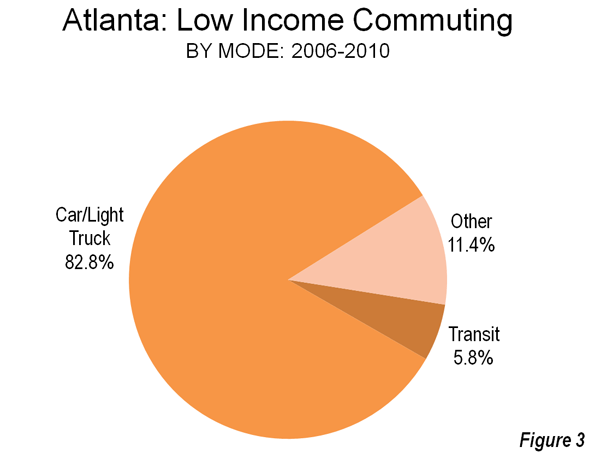
    Under the tax referendum, a significant opportunity to improve mobility would be missed, to the detriment of the vast majority of Atlantans; over 88 percent of all commuters in Atlanta travel by car, but the figure is only slightly less (83 percent) among low income commuters (Figure 3).

    What’s Right About Atlanta: For all its problems, Atlanta has much to be proud of. Former World Bank principal planner Alain Bertaud said of Atlanta in a 2002 study:

    While income and population were rising very fast, Atlanta managed to keep a very low cost of living. A worldwide cost of living survey conducted by the Economist Intelligence Unit in 2002 found that Atlanta had the lowest cost of living among major US cities and ranked 63rd among major cities around the world. This achievement is remarkable in view of the rapid rate of growth of the metropolitan area over the last 20 years. It shows that while demographic and economic growth has certainly contributed to generate pollution and congestion, the various actors responsible for the management of metropolitan Atlanta must have done a lot of things right. High income growth and high demographic growth combined with a low cost of living suggests that labor markets are functioning well and that housing does not encounter important supply bottlenecks (Note 5).

    As successful as local land use policies have been in making Atlanta livable by making it affordable (the first principle of livability is affordability), local leaders need to start over with a proposal primarily designed to reduce traffic congestion, reduce travel times and grow the economy.

    Politics Trumps Reducing Traffic Congestion: Traffic congestion is most effectively addressed by projects that reduce work trip travel times, since it is the concentration of work trips at peak hours that   causes the worst congestion. The long-suffering commuters of Atlanta would have been far better served by a program that selected projects based upon their effectiveness in reducing travel times. A simple cost per hour of delay measure would have been appropriate. Atlanta deserves a much better deal.

    Wendell Cox is a Visiting Professor, Conservatoire National des Arts et Metiers, Paris and the author of “War on the Dream: How Anti-Sprawl Policy Threatens the Quality of Life.”

    —————–

    Note 1: Based upon 109 metropolitan areas for which data is available. Japanese data is reported as median work trip travel time. Nagoya’s median work trip travel time (27 minutes) is less than Atlanta’s (29 minutes). The excessively long rail commute times of many Japanese commuters could make Nagoya’s average work trip travel time as great or greater than Atlanta’s. Dallas-Fort Worth has the shortest work trip travel time of any metropolitan area over 5 million population (and the lowest transit work trip market share)

    Note 2: A team led by Oxford University professor Bengt Flyvbjerg found that passenger rail systems typically have cost overruns of 45 percent. If the average increase is experienced, the Belt-Line cost could escalate to $1 billion.

    Note 3: The capital cost is discounted at 4 percent over 35 years, which equals more than $5,500 annually. A new Ford Fusion, Toyota Camry, Honda Accord or Nissan Altima could be leased for less than $5,000 annually, with no down payment, according to internet sources (such as http://www.leasecompare.com/)

    Note 4: More than 93 percent of metropolitan Atlanta’s employment is outside downtown (and Mid-Town). Downtown’s share of employment declined from 2000 to 2009 (latest data available from the US Census Bureau, County Business Patterns).

    Note 5: Atlanta was most affordable major metropolitan area in the US, UK, Canada, Australia, Ireland, New Zealand and Hong Kong in the 8th Annual Demographia International Housing Affordability Survey.

    ——

    Photo: Atlanta Freeway (by author)

  • It Can Happen Here: The Screwed Generation in Europe and America

    In Madrid you see them on the streets, jobless, aimless, often bearing college degrees but working as cabbies, baristas, street performers, or—more often—not at all. In Spain as in Greece, nearly half of the adults under 25 don’t work.

    Call them the screwed generation, the victims of expansive welfare states and the massive structural debt charged by their parents. In virtually every developed country, and increasingly in developing ones, they include not only the usual victims, the undereducated and recent immigrants, but also the college-educated.

    Nowhere is this clearer than in the European Union’s Club Med of Spain, Greece, Portugal, and Italy, the focal point of the emerging new economic crisis. There’s a growing sense of hopelessness in these places, where debt is turning politics into an ugly choice between austerity, which reduces present opportunities, or renewed emphasis on public spending, which all but guarantees major problems in the bond market, and spending promises that can’t be kept.

    “We don’t know what to do now,” Jaime, a Madrid waiter in his late 20s told me last week. “My wife lost her auditor’s job, and I can’t support the whole family. Maybe we have to move somewhere like Dubai or maybe Miami.”

    Many young Greeks, Italians, Portuguese, and Spaniards already have made their moves, with a half million leaving Spain alone last year. But it’s not just Club Med youths who are contemplating greener pastures. Ireland, which in recent decades actually attracted new migrants, is exporting a thousand people a week. In recession-wracked Britain, nearly half of the population say they would like to move elsewhere.

    Driving this exodus is a growing perception that this collapse is not cyclical but secular. Increasingly, young Europeans are deciding not to start families—the key to future growth—in reaction to the recession. The stories about divorced Spanish or Italian young fathers sleeping on the streets or in their cars are not exactly a strong advertising for parenthood.

    Even in once-rigidly Catholic Spain, marriage and fertility rates have been falling for decades, and family structure weakening. Spaniards are having fewer children now than they did during the brutal civil war of the late 1930s. Alejandro Macarrón Larumbe, a Madrid-based management consultant, in his 2011 book, El Suicidio Demográfico de España, points out that the actual number of Spanish newborns has declined to an 18th-century level.

    This demographic implosion makes sense given the legacy left behind by the boomers, who have held on to generous jobs and benefits but left little opportunity for their children, not to mention a high tax burden on what opportunities they do find. For a generation academics have sold higher education—the more the better—as the cure for unemployment and the great guarantor of success. Yet rising education rates in places like Spain have not created jobs for the rising generation, but only expanded unemployment and falling wages among the ranks of the educated.

    Even America, traditionally a beneficiary of European woes, seems to have turned on its young. College debt is crushing many young people with degrees—particularly those outside the sciences and engineering—that are not easily marketable. The spiking number of people in their 30s working as unpaid interns reflects this erosion of opportunity. This has happened even as the price tag for college has shot up; 94 percent of students who earn a bachelor’s degree now owe money for their educations, compared to 45 percent two decades ago. Here’s a tribute to futility: today a majority of unemployed Americans age 25 and older attended college, something never before seen.

    Governmental priorities here continue to favor boomers and seniors over the young. For a generation, transfer payments have favored the elderly, a trend likely to accelerate as the boomers continue retiring and demand their due. According to Brookings, America spends 2.4 times as much on the elderly as on children. 

    Forced to take lower wages if they can find work at all and facing still-expensive housing in those markets where many of the jobs are, roughly one in five American adults 25 to 34 now live with their parents—almost double the percentage from 30 years ago. Increasingly both Wall Street and green “progressives” urge young people to abandon homeownership for a poorer, more crowded life in expensive, high-density apartment blocks.

    Across the developed world, wages are being cut for young Americans, Europeans, and Japanese as politicians prefer to offer less to the young than to take anything away from those already ensconced in employment, particularly if organized into unions. In the U.S., everything from government jobs to employment in auto factories and even supermarkets is now on a two-tier track, with older workers’ guaranteed pensions and higher salaries not shared by newer hires.

    Pensions represent a bigger generational issue than salaries do. The European welfare state makes America’s seem Scrooge-ish. Their lifetime guarantees are so extensive, and unsustainable, that even the über-frugal Germans are calling for a special tax on younger workers to fund their parents’ pensions.

    This generational transfer will likely be accelerated by an aging electorate. In Spain, notes Larumbe, voters over 60 now make up more than 30 percent of the electorate, up from 22 percent in 1977; in 2050 they will constitute close to a majority. The same patterns can be seen in other European countries and, although less dramatically, in the U.S. as well.

    As a result, boomer- and senior-dominated parties, both right and left, generally end up screwing young people. This occurs even as they proclaim their fulsome concern for “future generations.”

    Politicians on the right, in Europe and elsewhere, scapegoat immigrants in part to hold on to their share of older votes. Left-wing analysts rightly point out that the boomer- and senior-dominated Tea Party here is not likely to cut their own entitlements, preferring instead to push cutbacks in education and other disbursements that aid the young while fighting spending on job creation and productive forms of infrastructure investment.

    Politicians on the left, meanwhile, tend to favor redistribution and “sustainability” over the new wealth creation critical for youthful advancement. Many boomers seem to suspect economic growth itself, as when John Holdren, now President Obama’s senior science adviser, back in the 1970s called for the “de-development” of high-income countries. A cynic might conclude that since the progressive boomers already got theirs, it’s fine for the young to live in an era of limits.

    With the kind of tax and regulatory regime advocated by today’s regressive progressives—already largely adopted in my home state of California—greens and their allies many not have to worry about too much new growth. Only those connected with the government, or able to ride asset inflation, will do well in the new “progressive” order.

    In Europe, east Asia, and America alike, the left and the right have both proven unprepared or unwilling to address the fundamental growth crisis facing the next generation. Neither austerity nor a “progressive” focus on greater government spending and “sustainability” can create the jobs and new opportunities so sorely lacking on the streets of Athens and Madrid and increasingly in American cities as well.

    The developed world’s youth shouldn’t expect much help from an older generation that has preserved its generous arrangements at the cost of increasingly stark prospects for its own progeny. Instead the emerging generation needs to push its own new agenda for economic growth and expanded opportunity.

    Joel Kotkin is executive editor of NewGeography.com and is a distinguished presidential fellow in urban futures at Chapman University, and contributing editor to the City Journal in New York. He is author of The City: A Global History. His newest book is The Next Hundred Million: America in 2050, released in February, 2010.

    This piece originally appeared in The Daily Beast.

    Unemployed woman photo by BigStockPhoto.com.

  • The Evolving Urban Form: Shenzhen

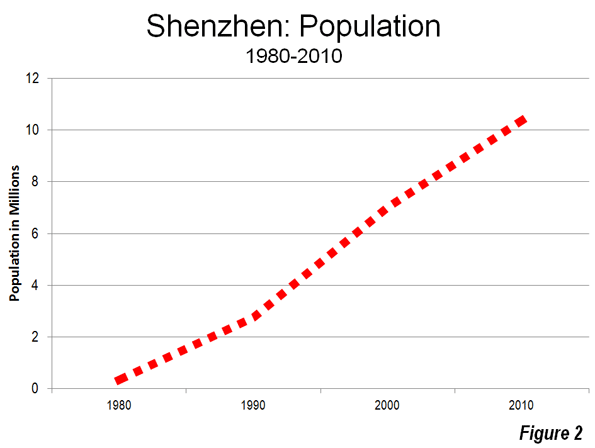
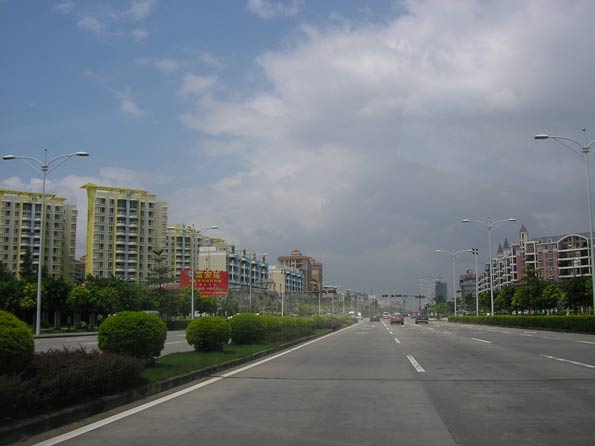
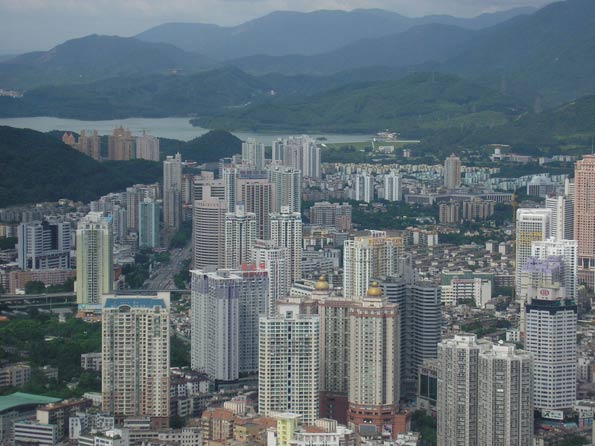
    No urban area in history has become so large so quickly than Shenzhen (Note 1). A little more than a fishing village in 1979, by the 2010 census Shenzhen registered 10.4 million inhabitants. It is easily the youngest urban area to have become one of the world’s 26 megacities (Figure 1). Most other megacities were the largest urban areas in their nations for centuries (such as London and Paris) and a few for more than a millennium (such as Istanbul and Beijing). Shenzhen’s primitiveness can be seen in this 1980 internet photo, and shows the beginnings of construction. A 2006 photograph of one of Shenzhen’s principal streets (Binhe Avenue) is above.

    Pearl River Delta Location: Shenzhen is located in Guangdong Province adjacent to Hong Kong’s northern border. Shenzhen is China’s fourth largest urban area, following Shanghai, Beijing, and Guangzou-Foshan.

    Along with Dongguan, Guanzhou, Foshan and smaller neighbors, Shenzhen forms the Pearl River Delta,   the world’s largest manufacturing center. The Pearl River Delta, along with Hong Kong and Macau, constitutes the world’s largest populated extent of urbanization, with nearly 50 million people. They live in a land area of just over 3,000 square kilometers (7,800 square kilometers. By comparison the world’s largest urban area, Tokyo-Yokohama, has a population of 37 million and covers 3,300 square miles (8,500 square kilometers). I recall from a Hong Kong to Guangzhou trip on the Canton-Kowloon Railway in 1999 that there was plenty of rural territory on the 100 mile (170 kilometers) route. Today,   development takes place along virtually the entire route (Note 2).

    The Special Economic Zone: Shenzhen was established as China’s first special economic zone by Deng Xiaoping in the period of liberalization after the death of Mao Zedong. The special economic zones allowed for alternative, generally market oriented reforms, with the end of improving economic growth. The result was economic progress far greater than anyone expected. The special economic zone program was eventually extended to several other urban areas in the nation.

    Some governmental officials preferred the previous state dominated approach, despite its greater poverty and sought to roll back the reforms. This threat reached its peak in the early 1990s, after Deng Xiaoping had retired from his government positions. In response, Deng undertook his renown "southern tour" to Shenzhen, Guangzhou and other parts of Guangdong province to promote the new economic approach and the progress that had been made. During the southern tour, Deng is reputed to have said that "to be rich is glorious." Three decades before he had said “I don’t care if it’s a white cat or a black cat. It’s a good cat as long as it catches mice." He committed to results rather than to ideology, in a sense Shenzen and its environs are the engines of non-state owned prosperity. Eventually, the publicity from Deng’s southern tour overwhelmed the opposition and China accelerated its move toward a more open economy.

    Shenzhen’s Core: Unlike the fast growing, but much smaller new urban areas of the United States (for example Phoenix, which is largely a low rise, dispersed expanse of suburbanization), Shenzhen has developed a dense central business district. Even though Shenzhen started the decade of the 1990s with little more than 1,000,000 residents, by 1996 it had the fourth tallest building in the world, the Shun Hing Tower. Only the Sears Tower in Chicago and the two World Trade Center Towers in New York were taller.

    In 2011, the Shun Hing Tower lost its local tallest building title to the Kingkey Financial Tower, at 1,449 feet (447 meters) is the 10th tallest building in the world. Now, the world’s second tallest building is under construction in Shenzhen, the Ping An International Financial Center, which is reported to reach 2,125 feet or 655 meters, with 116 floors. Only the Burj Khalifa (2,717 feet, 828 meters, 163 floors) in Dubai would be higher. Like Shanghai and Chongqing (and unlike most Chinese urban areas), Shenzhen has a highly concentrated central business district. As a result deserio.com rates Shenzhen’s skyline as 9th in the world (Note 3).

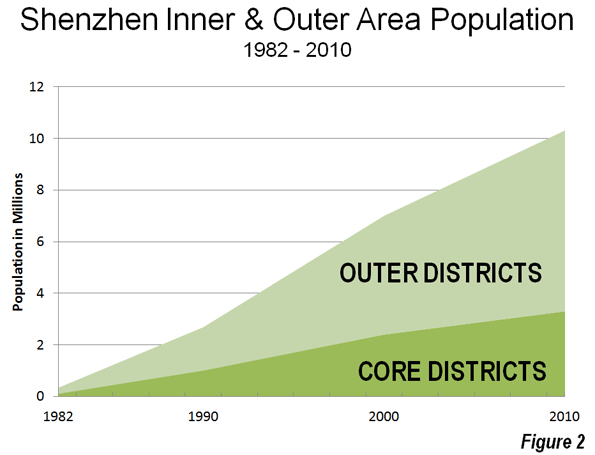
    Outer Areas Growing Faster: The three central districts (the qu of Futian, Luohu and Nanshan) grew from 2.4 million to 3.3 million population between 2000 and 2010, a rate of 38 percent. However, as is natural for a growing urban area, most of the growth was in the outer districts (Photo: Suburban Shenzhen), which grew from 4.6 million to 7.0 million, a growth rate of 52 percent. Thus, nearly three-quarters of the growth was on the periphery (Figure 2). Population growth in the earlier 1990 and 2000 period was slightly less concentrated in the outer area (68 percent). But overall  population growth has begun to slow down, with Shenzhen added 3.3 million new residents, compared to 4.3 million between 1990 and 2000.  


    Photo: Suburban Shenzhen (Longgang)

    The Urban Area: Overall, it is estimated that the Shenzhen urban area (area of continuous development) has a 2012 population of 11.9 million, with a land area of 675 square miles (1,745 square kilometers). The urban area has now crossed the border into the Huiyang district of the Huizhou region, to the east. The population density is estimated at 17,600 per square mile, or 6,800 per square kilometer,  approximately 10 percent less dense than the average urban area in China. Shenzhen is about one quarter the density of Hong Kong and double the density of Paris.

    Rich and Poor in Shenzhen: Like all urban areas, Shenzhen is a mixture of rich and poor. Shenzhen is generally considered one of the most affluent urban areas in China, yet it also has a very large low income population. Approximately one-sixth of China’s residents are considered to be temporary migrants; many work in boomtowns like Shenzhen. Seven million of these 220 million migrants live in Shenzhen,  considered the largest migrant population of any region in the nation. Migrants are attracted to Shenzhen for the same reasons people have moved to cities from early on: to get ahead. At the same time, their remittances sent back home are contributing to improved living conditions far beyond Shenzhen. It is expected that reforms to the "hukou" system of residence permits will allow many of the temporary migrants in Shenzhen and elsewhere obtain permanent residence status. Many of the migrants live in factory housing, or older, very densely packed buildings. At the same time, Shenzhen has a large number of world-class condominium buildings.


    Photo: Older Housing: Central Business District


    Photo: Newer Housing: Central Business District

    The Future of Shenzhen: Much of Shenzhen’s future will depend upon the economy of the Pearl River Delta and the extent to which migrants are able to obtain permanent residency status. There is still land enough in the region for substantial population growth. The longer term integration of the Hong Kong and Shenzhen economies could produce an even larger economic dynamo than the two that are currently separate. One thing is certain, however. Shenzhen has led China into a new economic and urban reality.

    Wendell Cox is a Visiting Professor, Conservatoire National des Arts et Metiers, Paris and the author of “War on the Dream: How Anti-Sprawl Policy Threatens the Quality of Life”.

    —–

    Note 1: Shenzhen is one of China’s regions, often called "cities," as translated from "shi."  "Shi" more resemble regions than "cities" in the non-Chinese sense, this article refers to "shi" as regions. "Shi" were formerly referred to in English as prefectures. A province is usually composed of "shis" and other "shi" level jurisdictions.

    Note 2: These combined regions are not a metropolitan area, for two reasons. First; there is little daily commuting between them and thus they are not a single labor market, which is the definition of a metropolitan area. Second, one of the regions, Hong Kong, has a border with Shenzhen that has international style customs and immigrant controls, which further precludes the two adjacent regions from being a single metropolitan area. In the longer run, greater affluence, greater mobility between the regions and relaxation of border controls could merge some or all of the now separate metropolitan areas.

    Note 3: Desiro.com, unlike some other skyline rating systems, places a premium on the density of buildings, rather than simply amalgamating building heights from throughout an urban area.

    Photo: Shenzhen:  Binhe Avenue from the Shun Hing Tower (by author)

  • How “Public” Is the Public Sector?

    You may have heard the old joke about the convenience store with a neon sign blaring, “Open 24 Hours”. A customer stops in one morning for coffee, and confronts the store’s owner, “Your sign says ‘Open 24 Hours’, but I stopped by last night at midnight for a pack of smokes and you were closed.” The owner replies, “Oh, we’re open 24 hours…just not in a row.”

    I’ve been reminded of this exchange during one of the more intriguing battles over what “public ownership” means in California’s state parks. Governor Brown has designated 70 of them (out of 278) for closure in an effort to help close the state’s chronic multi-billion dollar budget deficit. In response, a Marin County Democratic Assemblyman, Jared Huffman, offered AB 42. The measure, which has now been signed into law, makes it easier for non-profits to enter into operating agreements with at least 20 of the parks on the chopping block. The law cuts the typical red-tape involved in forming such a “public-civic partnership”, including greater freedom in hiring and providing some added legal protections. And AB42 has been written specifically to hold local governments harmless from possible shoddy work, so lawsuits aren’t an issue. Over the last six months a number of parks have started making such arrangements and will continue to operate. But this is not without some consternation.

    The first AB42-enabled contract has recently been signed between the previously closed Jack London State Park in Sonoma County and the Valley of the Moon Natural History Association, which will handle staffing and maintenance for this $500,000 annually budgeted facility. The Association plans to cover expenses through a mix of fundraisers, volunteer labor, and creative marketing.

    Asked for her opinion on these new public-civic partnerships, state Sen. Noreen Evans (D-Coastal Northern CA) recently told The Huffington Post why she disliked the legislation: “My own philosophy is that a state park should be owned and operated by the public. Any time you turn even a portion of a state park away from public control, you always have the problem that the park’s interest becomes inconsistent with serving the public.” But this leaves open the question of what the senator means by ‘owned and operated by the public’?

    Of course a state park is ‘owned by the public’ in the broadest sense, but what control do I, as a Californian, really have over how my state parks are run? In many of these AB 42 relationships between state parks and local organizations, the public is far more involved in the maintenance and running of these places than they were before.

    In another issue I’ve written about, a group of parents and community volunteers were threatened with a union lawsuit if they persisted in their efforts to assume administrative tasks in a San Francisco Bay Area junior high school that had been hit with several years of budget cuts.

    The local chapter of the California Service Employees’ Association (CSEA), sought to prevent parents and residents from volunteering as playground supervisors and back office staff. Said CSEA local president, Loretta Kruusmagi, “As far as I’m concerned, they never should have started this thing. Noon-duty people [lunchtime and playground assistants]—those are instructional assistants. We had all those positions. We don’t have them anymore, but those are our positions. Our stand is you can’t have volunteers, they can’t do our work.”

    Notice the sense of ownership over these public sector positions. Even in the face of dire municipal fiscal situations, with stark choices between whether or not to continue services everywhere from parks to libraries, public sector unions are increasingly challenging local volunteers who are attempting to fill the gap. It is easy to wonder whom are the real “public servants” – the employees or the parents? As to complaints about the quality of volunteers, I’m not sure unprofessional behavior by volunteers outnumbers – even per capita – that by unionized/fulltime employees.

    A similar story is being written currently in the West Los Angeles area Culver City Unified School District. Here, in an interesting twist on the aforementioned tale, a service union in a local elementary school is seeking to force willingly lower paid classroom attendants to unionize, and demanding that a local charity pay for these unionized positions. The El Marino Language School has been a dual language (Spanish and Japanese) immersion program for more than two decades.

    A “blue-ribbon” school in California, the students of El Marino have scored exceedingly high in a number of categories . In order to keep the students “immersed”, the school began hiring native language-speaking “adjuncts” to work in classrooms for a few hours each day – usually a couple of days per week. An additional element to what the district usually supports, these positions – often filled by parents of current or former students with teaching experience – are supported by a group of local booster clubs.

    The longtime program apparently escaped the watchful eye of the Association of Classified Employees (“ACE”), which represents service employees in the district. Upon learning that these non-unionized “adjuncts” were working at El Marino, ACE gave the district an ultimatum: force them to unionize or allow us to bring in our own “adjuncts”.

    The current battles over how “public” libraries will be run in California casts a bright light on the use of this rhetoric by municipal unions seeking to keep out competition from private organizations. The city council of Santa Clarita, voted to withdraw from the Los Angeles County system, and contract out their three libraries to LSSI (Library Systems and Services), a private company based in Germantown, Maryland.

    The response from some residents and the library employees’ union was an outcry at the supposed “privatizing” of the public library. As the New York Times reported, protest signs at the council meeting declared, “keep our libraries public”, as if access to their libraries was going to be constrained by LSSI. As then-mayor pro tem, Marsh McLean responded, “The libraries are still going to be public libraries. When people say we’re privatizing libraries, that is just not a true statement, period.”

    Faced with the prospect of more communities deciding to offer library services through contracted firms, California’s SEIU lobbied the Legislature for passage of AB 438, which adds extra hurdles to city councils making these decisions. Proclaiming that they had “beat the privatization beast in California”, LA County Community Library Manager and SEIU Executive Board Member, Cindy Singer said, “By signing AB 438, Governor Brown put taxpayers and the public ahead of the profits of privately held corporations.” But, once again, knowing exactly what “public” Ms. Singer is referring to requires some circuitous thinking.

    Her statement is patently untrue in Santa Clarita, where, as Atlantic Cities describes, “Hours have increased. The library is now open on Sundays. There are 77 new computers, [and] a new book collection dedicated to homeschooling parents and more children’s programs.” It appears Santa Claritans have come out “ahead”.

    The macroeconomic term “crowding out” is broadly used to describe the adverse impact on private investment created by government action. The phrase also applies to the negating influence government-delivered services can have on the actions of non-profits and businesses. This is not to say that volunteers and businesses can (or should) fill all the gaps exposed by the fiscal crisis, but it may be time to consider a new phrase, as Americans assume an old role: “crowding in” anyone?

    Pete Peterson is Executive Director of the Davenport Institute for Public Engagement and Civic Leadership at Pepperdine University’s School of Public Policy.

    Flickr Photo by robinsan, Parking Volunteer

  • Toward More Competitive Canadian Metropolitan Areas

    The Federation of Canadian Municipalities (FCN) and the Canadian Urban Transit Association (CUTA) have expressed serious concern about generally longer commute trip times making Canadian metropolitan areas less competitive. Each has called for additional funding for transit at the federal level to help reduce commute times and improve metropolitan competitiveness.

    The Right Concern

    The concern over commute times is well placed. Economic research generally concludes that greater economic and employment growth is likely where people can quickly reach their jobs in the metropolitan area. Five of the nation’s six major metropolitan areas (Toronto, Montréal, Vancouver, Ottawa-Gatineau and Calgary) have average one-way work trip travel times that are among the highest in their size classes among 109 metropolitan areas in the more developed world for which data is available. Only Edmonton has an average commute time that is among the shortest (Table 1).

    Table 1
    Average One-way Commute Times: Major Metropolitan Areas
    Compared with International Major Metropolitan Areas
    Major Metropolitan Area One-way Commute Time (Minutes) Overall One-way Commute: Rank out of 109 One-way Commute: Rank in Population Class
    Population Size Class
    Toronto 33 97th  Over 5,000,000 11th out of 19
    Montréal 31 90th  2,500,000 – 5,000,000 19th out of 23
    Vancouver 30 86th  1,000,000 – 2,500,000 60th out of 67
    Ottawa-Gatineau 27 60th  1,000,000 – 2,500,000 55th out of 67
    Calgary 26 58th  1,000,000 – 2,500,000 50th out of 67
    Edmonton 23 15th  1,000,000 – 2,500,000 15th out of 67


    The Wrong Answer

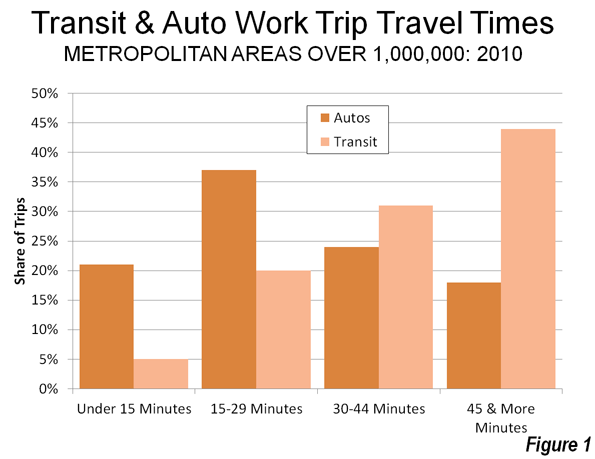
    Yet the solution – more transit and funding for transit – misses the mark. Transit does many things well, but it does not reduce commute times (Figure 1). According to Statistics Canada, average commute times by transit in the Toronto, Montréal and Vancouver metropolitan areas are from 30 per cent longer to nearly double those of average automobile commuters (Note 2). Some 58 percent of car users (drivers and passengers) reach their work locations in under 30 minutes, something accomplished by merely y 25 percent of transit commuters. Overall Toronto commute times are longer than either Los Angeles – famed for its traffic – as well as much less dense, and far less transit dependent, Dallas-Fort Worth. In Toronto, 21 percent of commuters take transit, compared to two percent in Dallas-Fort Worth. Among Montréal commuters, 20 percent use transit and spend more time commuting than their counterparts in more decentralized Phoenix, where less than two percent take transit. Commute times in transit-focused Vancouver are worse than much larger Los Angeles and indeed longer than nearly American metropolitan area, including Dallas-Fort Worth, Houston, and Philadelphia (Table 2).

    Given this pattern, transferring car travel to transit likely would increase commute times and make metropolitan areas even less competitive.

    Table 2
    30- and 40-minute Commute Shares:
    Representative Metropolitan Areas
    Population Classification Work Trip Under 30 Minutes Work Trip 30 to 44 Minutes Work Trip Under 45 Minutes
    5,000,000 and Over      
    Dallas-Fort Worth 59% 24% 83%
    Los Angeles 55% 24% 79%
    Toronto 48% 25% 73%
    Paris 45% 22% 67%
    2,500,000 – 5,000,000      
    Phoenix 57% 26% 83%
    Montréal 47% 27% 74%
    1,000,000 – 2,500,000       
    Edmonton 68% 20% 88%
    Indianapolis 66% 22% 88%
    Ottawa-Gatineau 65% 21% 86%
    Tampa-St. Petersburg 62% 22% 84%
    Calgary 54% 29% 83%
    Vancouver 55% 21% 76%
    Source: Statistics Canada, U.S. American Community Survey, National Institute of Statistics and Economic Studies (France)


    The Geography of Transit

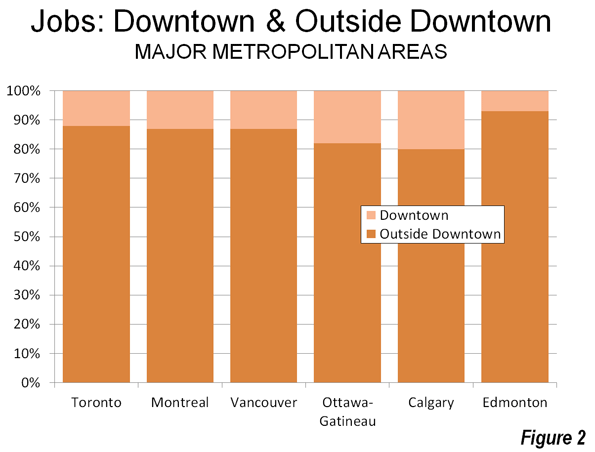
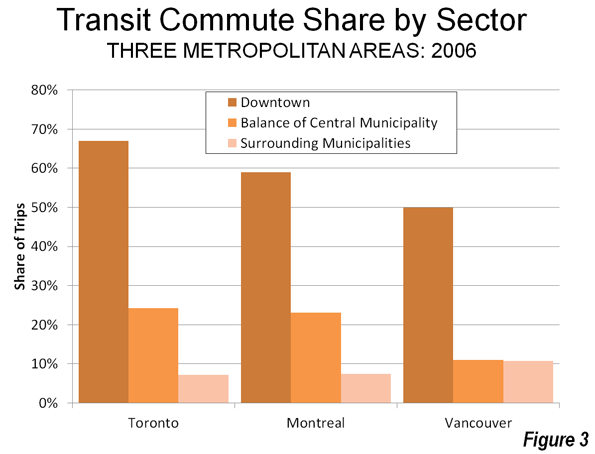
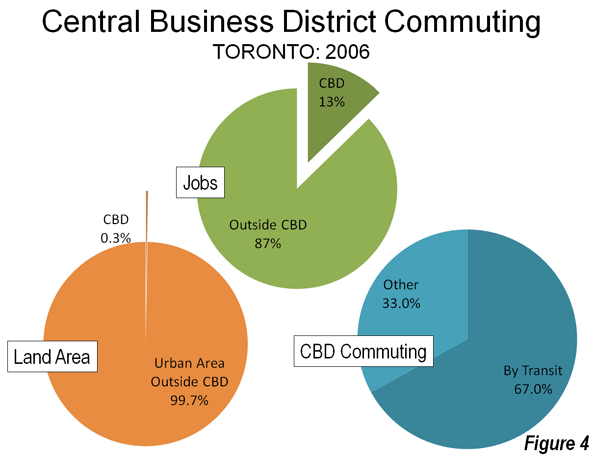
    Rational Transit and Downtown:Transit’s greatest strength is in providing access to the largest downtown areas. These areas have the greatest job densities (jobs per square kilometre) in their metropolitan areas and are typically well served by frequent, rapid and convenient transit service from throughout the metropolitan area. This combination of high employment density and superior transit service attracts one-half or more of all downtown commuters in Canada’s major metropolitan areas to transit (Figure 2). Transit is meets the needs of people who commute to downtown and is the rational choice for many, if not most. However, downtowns contain only a relatively small share (14 per cent) of metropolitan area jobs (Figure 3).

    Rational Personal Mobility Elsewhere: Areas outside downtown lack any such intense concentration of jobs. The area outside downtown, accounting for 6 out of every 7 jobs (Figure 4), maintain much lower employment densities and generally lacks transit service. This is illustrated by the nation’s largest employment center, which surrounds Pearson International Airport in Toronto. Its more than 350,000 employees are spread around an area the size of city of Vancouver (or the city of San Francisco) at a density so low that quick and efficient transit is simply impossible.

    For the overwhelming share of work trips to outside the downtown area, the car does the job and transit accounts for less than 10 percent of commuters. Thus, the automobile is the rational choice for most people who commute to locations outside downtown. And things are not getting better for transit. According to Statistics Canada, employment has been growing much faster outside of downtown than in the high density core areas suited for transit. The 2011 census indicated a continuing dispersion of population as well.


    Transit’s Robust Funding Growth and Declining Productivity

    Strongly Rising Transit Subsidies: Transit subsidies have been growing strongly. According to Transport Canada data, from 1999 to 2008 subsidies grew 83 percent (adjusted for inflation), which is more than three times the 26 percent ridership growth rate and 3.5 times the rate of general inflation. Transit’s declining productivity could indicate a substantial potential for improved cost effectiveness and service expansion within the generous present funding levels.

    Declining Transit Productivity: At the same time, there are concerns about transit productivity. The Conference Board of Canada has documented a 1.2 percent annual decline in productivity for two decades. The same analysis found productivity in other transport sectors to be generally improving. Transit costs have risen well in excess of inflation, service levels and ridership. Rising costs seriously limit transit’s ability to increase its share of travel in metropolitan areas and limits the important role that it is called upon to play in providing door-to-door mobility for the transportation-impaired, such as disabled citizens, the elderly, and students.

    Land Use Strategies that Retard Metropolitan Competitiveness

    Policies that Could Make Metropolitan Areas Less Competitive: While the prospects for improving transit commute times are discouraging, some current land use strategies further increase traffic congestion and lengthen commute times and make metropolitan areas and make metropolitan areas less competitive . Compact cities (also called smart growth) policies have been adopted across Canada in an effort to reduce automobile use and increase urban densities. The planning expectation is that housing should be placed near rail stations. Yet job locations throughout metropolitan areas remain highly dispersed, and with the rise of working at home, are becoming more so. The potential for transit systems (or walking or cycling) to materially impact commuting is very limited in the least.

    International data indicate that higher densities are associated with greater traffic congestion. Further, higher traffic densities are strongly associated with higher levels of air pollution. Improvements in vehicle technology will make reductions in automobile use to reduce greenhouse gas emissions unnecessary, according to U.S. research by McKinsey & Company. Finally, smart growth type policies have been found to retard metropolitan economic growth in the Netherlands, the United Kingdom and the United States (Note 2).

    Improving Metropolitan Competitiveness

    Strategies that reduce commute times can improve metropolitan competitiveness. Expanded telecommuting reduces average commute times by its very nature (though the reported commute times routinely exclude the working at home sector, both in Canada and the US). There are also lessons to be learned from Edmonton and the international metropolitan areas that have been more successful in maintaining shorter commutes: more dispersed employment, lower population densities and a larger share of travel by car (Table 3).

    Table 3
    Comparison of Canadian and U.S. Major Metropolitan Areas
    Average One-way Commute Times and Urban Area Densities
     
    CANADA Canada Metropolitan Areas United States: Metropolitan Area Size Classes
    Commute Time Principal Population Centre Density (per KM2) Average Commute Time Average Principal Population Centre Density (per KM2)
    5,000,000 and Over        
    Toronto 33 2,900 28 1,400
    2,500,000 – 5,000,000        
    Montréal 31 2,200 26 1,200
    1,000,000 – 2,500,00        
    Vancouver 30 1,900 23 1,100
    Ottawa-Gatineau 27 1,900
    Calgary 26 1,600
    Edmonton 23 1,100
    Principal Population Centre: Largest population centre (Statistics Canada term for urban area) in the metropolitan area.


    Focusing on Objectives: To become more competitive, Canada’s metropolitan areas need to improve their average commute times. This requires focusing on strategies that have the highest potential to reduce traffic congestion.

    Residents and businesses in metropolitan areas would be best served by goal-oriented and objective policies squarely directed toward getting people to work faster. The focus should be on what makes commutes shorter, regardless of transport mode, rather than on idealistic notions of how a city should look or how people should travel.

    Wendell Cox is a Visiting Professor, Conservatoire National des Arts et Metiers, Paris and the author of “War on the Dream: How Anti-Sprawl Policy Threatens the Quality of Life”.

    –––

    Note: This article is based upon the recently released Frontier Centre for Public Policy report Improving the Competitiveness of Metropolitan Areas by Wendell Cox, who also serves as a senior fellow at the Centre.

    Note 1: Data not provided for other metropolitan areas.

    Note 2: On a related note, the Bank of Canada (the central bank) and others have indicated a concern about rising house costs relative to incomes. This is to be expected in metropolitan areas adopting green belts, urban growth boundaries and other land rationing policies. Huge housing price increases have occurred in Vancouver, Toronto, Montréal and Calgary (for example), in response to such policies (This is evident from the annual editions of the Demographia International Housing Affordability Survey, sponsored in Canada by the Frontier Centre for Public Policy). The Bank of Canada may be virtually powerless to slow this loss of housing affordability, since its cause (constraining metropolitan land supply) is beyond the reach of the Bank’s monetary policies.

    Photo: Suburban Montreal (by author)

  • Right in the Middle: The Midwest’s Growth Lessons for America

    The Midwest’s troubles are well-known. The decline of manufacturing has resulted in job losses and dying industrial towns. The best and brightest have fled the flatlands for more exciting, sunnier, mountainous, or coastal places where the real action is. Even Peyton Manning has left the heartland for the Rockies.

    This narrative is so deeply embedded both in and outside of the Midwest that many people overlook the ways in which parts of the region are bouncing back. The Midwest’s story is important because it serves in significant ways as a regional microcosm of how growth and opportunity should look in America today.

    In a recent study we look at trends that upend the conventional wisdom about the Midwest. We find that it is neither doomed to a slow and dirty demise like an old house on an eroding slope, nor forced to reinvent itself Dubai-style in order to compete with Silicon Valley or Manhattan. The Midwest’s future is rooted very much in its past—but with some important updates.

    What do we mean? For starters, this means capitalizing on Americans’ desire to reside where the cost of living and doing business is favorable. As the last Census showed, Americans move in droves to regions where the cost of living is low, businesses face fewer obstacles, and workers have choices. As Wendell Cox and Joel Kotkin have shown, this goes for 25- to 35-year-olds as well as 55- to 65-year-olds. People want options and a good quality of life at a price they can afford.

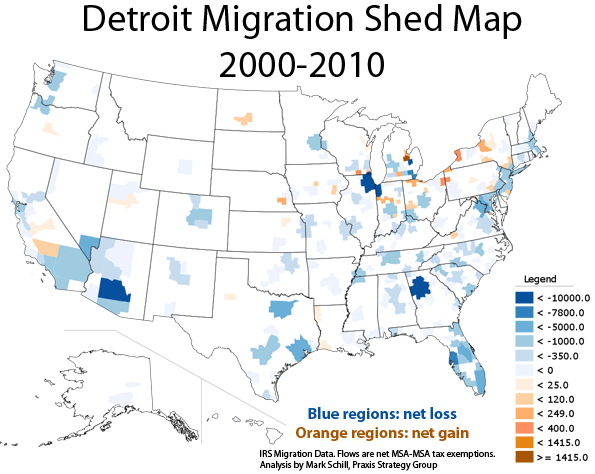
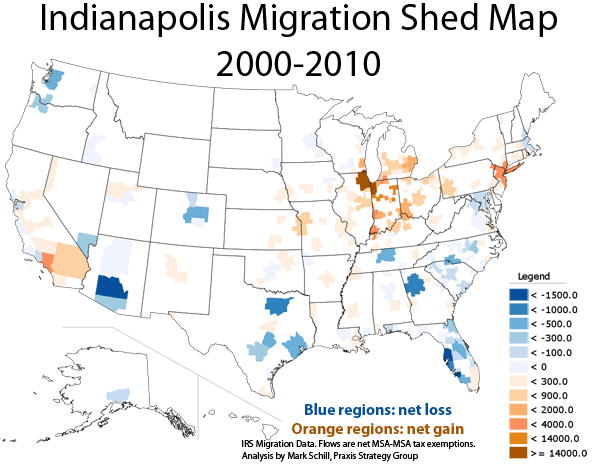
    In the Midwest, these trends have favored placed like Columbus, Ohio, and Indianapolis, Indiana. When people hear “Midwest,” they are more likely to think of this kind of picture:

    The blue areas show destinations to which people from Detroit have moved between 2000 and 2010. The brown shades are the areas from which Detroit has drawn people. Given Detroit’s well-publicized decline, all the blue should be no surprise.

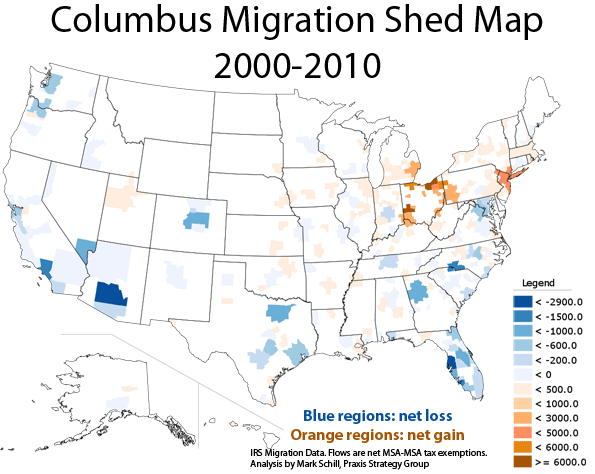
    But a respectable portion of the Midwest looks like this:

    And this:

    Like most parts of America, Columbus and Indianapolis have seen a net outmigration southward to Florida and Texas. No surprise there. But note how both cities are stealing population from Chicago, Detroit, New York, and even southern California and Miami in Indianapolis’s case. The maps also show how intense interstate competition within the Midwest is right now.

    One important measure of the cost of living is housing affordability, which is typically set at 3.0 as a measure of median housing price divided by median income. Compared to San Francisco at 7.2, New York at 6.1, Los Angeles at 5.9, and Miami at 4.7, Columbus stands at 2.8 and Indianapolis at 2.4. Charlotte, which has been an exemplary Sun Belt growth magnet for a while, stands at 3.9, a slight click above the Chicago area’s 3.8.

    Affordability and overall quality of life as measured by schools and greater disposable income matter a lot—even to technology entrepreneurs. Some Midwestern areas are outpacing coastal areas on this front. In a recent Forbes ranking of tech growth in the nation’s largest 51 metro areas, the Midwest had three cities within the top 15, with Columbus in third position, followed by Indianapolis and St. Louis.

    But it would be wrong for tech boosters to think the Midwest’s future rests in harnessing the power of this sector alone. Rather, it’s a combination of brains and brawn that signify the Midwest’s core strength. When we look at Midwestern areas that have experienced above-average growth in bachelor’s degrees, there are important overlaps with areas experiencing above-average growth in manufacturing, too.

    In the corridor from Madison to Milwaukee, or the outlying areas around Chicago, or the Indianapolis metro area, or even in the Quad Cities on the Iowa-Illinois border, we see higher educational attainment and manufacturing growth occurring together. Cedar Rapids, Iowa, had the highest GDP growth from 2000 to 2010 of any metro area in the Midwest. A new corridor has grown up between Cedar Rapids and Iowa City, home to the University of Iowa; it takes advantage of the region’s historical manufacturing capacity and blends it with new technology. Peoria, Illinois, is second to Cedar Rapids in GDP growth. Peoria is home to 200 manufacturing firms, and it is also a Midwestern leader in college degree attainment.

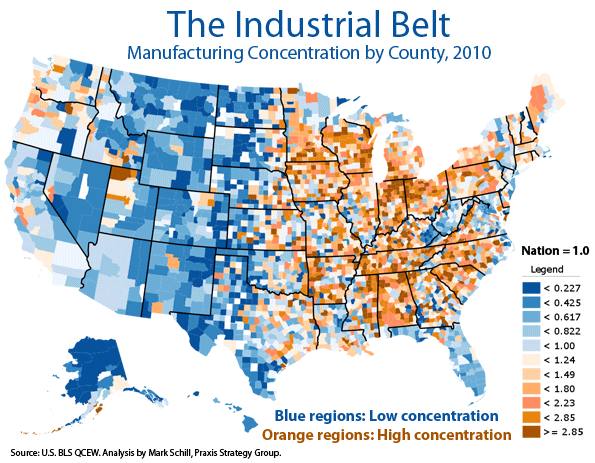
    Manufacturing continues to be part of the regional DNA in the Midwest. Trying to move away from it would be a fool’s errand, as this picture shows:

    The concentration of manufacturing in middle America is a real asset, especially when combined with higher levels of educational attainment, as we have seen. The Midwest is still home to much of the nation’s skilled labor force. And contrary to the declinist narrative mentioned at the outset, the region has added 50,000 “heavy metal” manufacturing jobs since 2009.

    The challenge for the region, actually, will perhaps be filling manufacturing jobs rather than creating them. A recent Deloitte survey found that 83 percent of manufacturers nationwide suffered a moderate or severe shortage of skilled production workers. The Midwest is poised to establish what we call a “new industrial paradigm,” characterized by a blend of heavy manufacturing, new technology, a more highly educated industrial labor base, and lighter labor restrictions (Indiana just became a right-to-work state, and the much-publicized debates in Wisconsin and Ohio over labor laws have only served to draw more attention to the need for reform, whatever the near-term effects). When you add to all of this the new energy sources discovered in some parts of the Midwest—such as new finds in Utica shale in Ohio—a new industrial paradigm in the region could end up being a large source of new wealth creation in the coming generation.

    So why might the Midwest be something of a microcosm for how growth and opportunity look in America as a whole, given its idiosyncratic reliance on manufacturing not shared by other regions? The main reason is that middle America is a clear picture of how much the basics matter: Cost of living, job quality, schools, and opportunities to develop the right skills for the best jobs. The areas within the Midwest that have gotten the basics right are poaching people and companies from the areas that haven’t. Any economic development strategy that ignores the basics in favor of a more stylized theory of growth will usually run off the rails before too long. Americans, at the end of the day, want the places they live to get the basics right so they themselves can build their lives, start their businesses, and raise their children as they wish.

    This piece originally appeared at The American.

    This peice was adapted from a recent report: "Clues from the Past: The Midwest as an Aspirational Region." Download the full pdf version of the report, including charts and maps about the Great Lakes Region.

    Joel Kotkin is executive editor of NewGeography.com and is a distinguished presidential fellow in urban futures at Chapman University, and contributing editor to the City Journal in New York. He is author of The City: A Global History. His newest book is The Next Hundred Million: America in 2050, released in February, 2010.

    Mark Schill is Vice President of Research at Praxis Strategy Group, an economic development and research firm working with communities and states to improve their economies.

    Ryan Streeter is Distinguished Fellow for Economic and Fiscal Policy at the Sagamore Institute. You can follow his work at RyanStreeter.com and Sagamoreinstitute.org.

    Great Lakes Freighter photo by BigStockPhoto.com.

  • The Export Business in California (People and Jobs)

    California Senate President Pro-Tem Darrell Steinberg countered my Wall Street Journal commentary California Declares War on Suburbia in a letter to the editor (A Bold Plan for Sustainable California Communities) that could be interpreted as suggesting that all is well in the Golden State. The letter suggests that business are not being driven away to other states and that the state is "good at producing high-wage jobs," while pointing to the state’s 10 percent growth over the last decade. Senate President Steinberg further notes that the urban planning law he authored (Senate Bill 375) is leading greater housing choices and greater access to transit.

    This may be a description of the California past, but not present.

    Exporting People

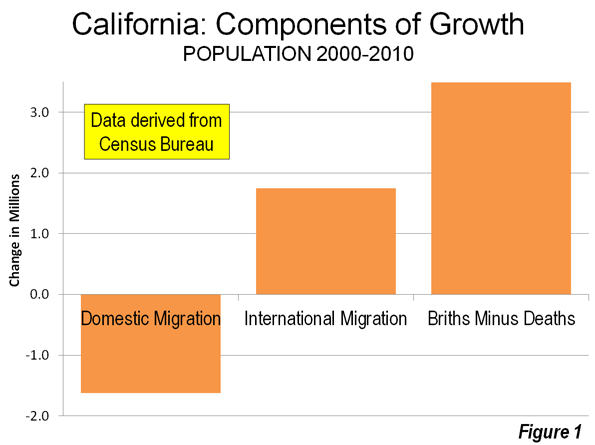
    Yes, California continues to grow. California is growing only because there are more births than deaths and the state had a net large influx of international immigration over the past decade. At the same time, the state has been hemorrhaging residents (Figure 1).

    Californians are leaving. Between 2000 and 2009 (Note), a net 1.5 million Californians left for other states. Only New York lost more of its residents (1.6 million). California’s loss was greater than the population of its second largest municipality, San Diego. More Californians moved away than lived in 12 states at the beginning of the decade. Among the net 6.3 million interstate domestic migrants in the nation, nearly one-quarter fled California for somewhere else.

    The bulk of the exodus was from the premier coastal metropolitan areas. Since World War II, Los Angeles, San Francisco, San Diego and San Jose have been among the fastest growing metropolitan areas in the United States and the high-income world. Over the last decade, this growth has slowed substantially, as residents have moved to places that, all things being considered, have become their preferences.

    More than a net 1.35 million residents left the Los Angeles metropolitan area, or approximately 11 percent of the 2000 population. The San Jose metropolitan area lost 240,000 residents, nearly 14 percent of its 2000 population. These two metropolitan areas ranked among the bottom two of the 51largest metropolitan areas (over 1,000,000 population) in the percentage of lost domestic migrants during the period. The San Francisco metropolitan area lost 340,000 residents, more than 8 percent of its 2000 population and ranked 47th worst in domestic migration (New York placed worse than San Francisco but better than Los Angeles). Each of these three metropolitan areas lost domestic migrants at a rate faster than that of Rust Belt basket cases Detroit, Cleveland and Buffalo.

    San Diego lost the fewest of the large coastal metropolitan areas (125,000). Even this was double the rate of Rust Belt Pittsburgh.

    Exporting Jobs

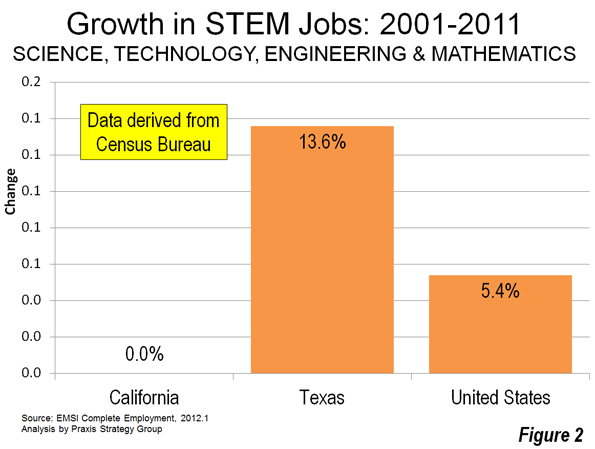
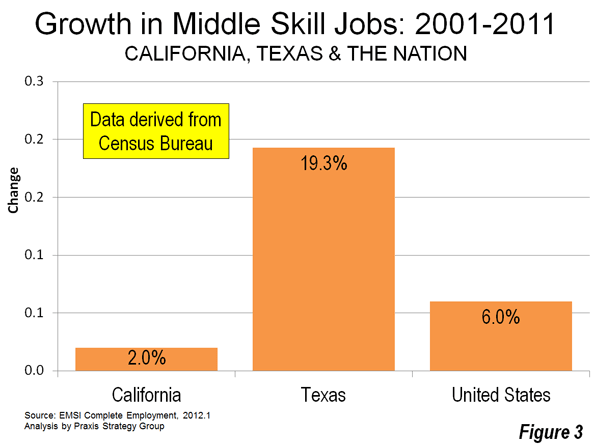
    California is no longer an incubator of high-wage jobs. The state lost 370,000 jobs paying 25 percent or more of the average wage between 2000 and 2008. This compares to a 770,000 increase in the previous 8 years. California is trailing Texas badly and the nation overall in creating criticial STEM jobs and middle skills jobs (Figures 2 & 3) Only two states have higher unemployment rates than California (Nevada and Rhode Island) . California has the second highest underemployment rate (20.8 percent), which includes the number of unemployed, plus those who have given up looking for work ("discouraged" workers) and those who are working only part time because they cannot find full time work. Only Nevada, with its economy that is overly-dependent on California, has a higher underemployment rate.


    Business relocation coach Joseph Vranich conducts an annual census of companies moving jobs out of California and found a quickening pace in 2012. Often these are the very kinds of companies capable of creating the high-wage jobs that used to be California’s forte. Vranich says that the actual number may be five times as high, which is not surprising, not least because there is no reliable compilation of off-shoring of jobs to places like Bangalore, Manila or Cordoba (Argentina).

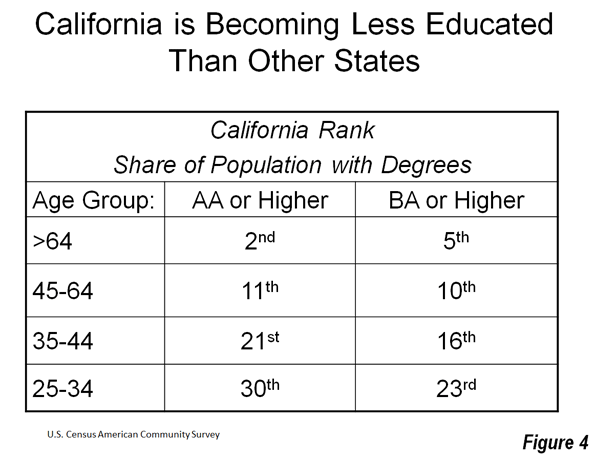
    To make matters worse, California is becoming less educated. California’s share of younger people with college degrees is now about in the middle of the states, while older, now retiring Californians are among the most educated in the nation (Figure 4).

    Denying Housing Choice

    It is fantasy to believe, as Steinberg claims, that there are enough single family (detached) houses in the state to meet the demand for years to come. More than 80 percent of the new households in the state chose detached housing over the last decade. People’s actual choices define the market, not the theories or preferences of planners often contemptuous of the dominant suburban lifestyle.

    In contrast, however, the regional plans adopted or under consideration in the Bay Area, Los Angeles and San Diego would require nearly all new housing be multi-family, at five to 10 times normal California densities (20 or more units to the acre are being called for). New detached housing on the urban fringe would be virtually outlawed by these plans. And, when Sacramento does not find the regional plans dense enough, state officials (such as the last two state Attorneys General) are quick to sue. If the "enough detached housing" fantasy held any water, state officials and planners would not be seeking its legal prohibition. To call outlawing the revealed choice of the 80 percent (detached housing) would justify the equivalent of a Nobel Prize in Doublespeak.

    At the same time by limiting the amount of land on which the state preferred high density housing must be built, land and house prices can be expected to rise even further from their already elevated levels (already largely the result of California’s pre-SB 375 regulatory restrictions).

    Transit Rhetoric and Reality

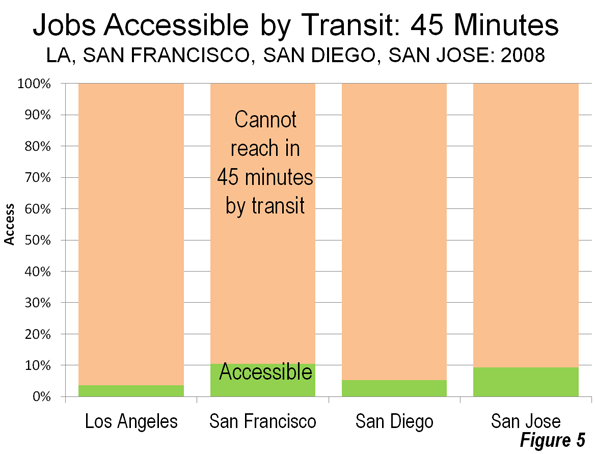
    Transit is important in some markets. About one-half of commuters to downtown San Francisco use transit. The assumptions of SB 375 might make sense if all of California looked like downtown San Francisco. It doesn’t, nor does even most of the San Francisco metropolitan area. Only about 15 percent of employment is downtown, while the 85 percent (and nearly all jobs in the rest of the state) simply cannot be reached by transit in a time that competes with the car. Even in the wealthy San Jose area (Silicon Valley), with its light rail lines and commuter rail line, having a transit stop nearby provides 45 minute transit access to less than 10 percent of jobs in the metropolitan area.

    A recent Brookings Institution report showed that the average commuter in the four large coastal metropolitan areas can reach only 6.5 percent of the jobs in a 45 minute transit commute. This is despite the fact that more than 90 percent of residents can walk to transit stops. Even when transit is close, you can’t get there from here in most cases in any practical sense (Figure 5).

    SB 375 did little to change this. For example, San Diego plans to spend more than 50 percent of its transportation money on transit over the next 40 years. This is 25 times transit’s share of travel (which is less than 2 percent). Yet, planners forecast that all of this spending will still leave 7 out of 8 work and higher education trips inaccessible by transit in 30 minutes in 2050. Already 60 to 80 percent of work trips in California are completed by car in 45 minutes and the average travel time is about 25 minutes.

    For years, planners have embraced the ideal of balancing jobs and housing, so that people would live near where they work, while minimizing travel distances. This philosophy strongly drives the new SB 375 regional plans. What these plans miss is that people choose where to work from the great array of opportunities available throughout the metropolitan area. These varied employment opportunities that are the very reason that large metropolitan areas exist, according to former World Bank principal planner Alain Bertaud.

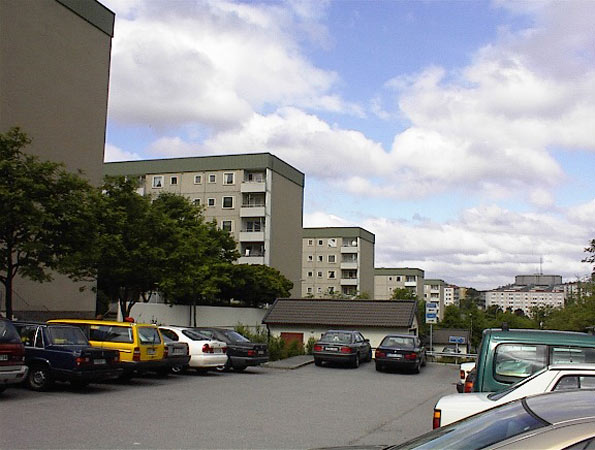
    People change jobs far more frequently than before and multiple earners in households are likely to work far apart. Similar intentions led to the development up to four decades ago of centers like Tensta in Stockholm, which ended up as concentrated low income areas (Photo). It California, such a concentration would do little to improve transit ridership, even low-income citizens are four to 10 times as likely use cars to get to work than to use transit.


    Tensta Transit Oriented Development: Stockholm

    All of this means more traffic congestion and more intense local air pollution, because higher population densities are associated with greater traffic congestion. Residents of the new denser housing would face negative health effects because there is more intense air pollution, especially along congested traffic corridors.

    Self-Inflicted Wounds

    Worst of all, California’s radical housing and transportation strategies are unnecessary. The unbalanced and one-dimensional pursuit of an idealized sustainability damages both quality of life and the economy. This is exacerbated by other issues, especially the state’s dysfunctional economic and tax policies. It is no wonder California is exporting so many people and jobs. California’s urban planning regime under SB 375 is poised to make it worse.

    Wendell Cox is a Visiting Professor, Conservatoire National des Arts et Metiers, Paris and the author of “War on the Dream: How Anti-Sprawl Policy Threatens the Quality of Life”.

    Net Domestic Migration: 2000-2009
    Rank Metropolitan Area Net Domestic Migration Compared to 2000 Population
    1 Raleigh, NC         194,361 24.2%
    2 Las Vegas, NV         311,463 22.4%
    3 Charlotte, NC-SC         248,379 18.5%
    4 Austin, TX         234,239 18.5%
    5 Phoenix, AZ         543,409 16.6%
    6 Riverside-San Bernardino, CA         469,093 14.3%
    7 Orlando, FL         225,259 13.6%
    8 Jacksonville, FL         126,766 11.3%
    9 Tampa-St. Petersburg, FL         260,333 10.8%
    10 San Antonio, TX         177,447 10.3%
    11 Atlanta, GA         428,620 10.0%
    12 Nashville, TN         123,199 9.4%
    13 Sacramento, CA         141,117 7.8%
    14 Richmond, VA           75,886 6.9%
    15 Portland, OR-WA         121,957 6.3%
    16 Dallas-Fort Worth, TX         317,062 6.1%
    17 Houston, TX         243,567 5.1%
    18 Indianapolis. IN           72,517 4.7%
    19 Oklahoma City, OK           41,082 3.7%
    20 Denver, CO           66,269 3.0%
    21 Louisville, KY-IN           34,381 3.0%
    22 Birmingham, AL           26,934 2.6%
    23 Columbus, OH           34,204 2.1%
    24 Kansas City, MO-KS           31,747 1.7%
    25 Seattle, WA           40,741 1.3%
    26 Minneapolis-St. Paul, MN-WI          (19,731) -0.7%
    27 Memphis, TN-MS-AR            (8,583) -0.7%
    28 Hartford, CT            (9,349) -0.8%
    29 Cincinnati, OH-KY-IN          (17,648) -0.9%
    30 Virginia Beach-Norfolk, VA-NC          (20,005) -1.3%
    31 Baltimore, MD          (36,407) -1.4%
    32 St. Louis, MO-IL          (43,750) -1.6%
    33 Philadelphia, PA-NJ-DE-MD        (115,890) -2.0%
    34 Pittsburgh, PA          (52,028) -2.1%
    35 Washington, DC-VA-MD-WV        (107,305) -2.2%
    36 Providence, RI-MA          (49,168) -3.1%
    37 Salt Lake City, UT          (34,428) -3.5%
    38 Rochester, NY          (40,219) -3.9%
    39 San Diego, CA        (126,860) -4.5%
    40 Buffalo, NY          (55,162) -4.7%
    41 Milwaukee,WI          (74,453) -5.0%
    42 Boston, MA-NH        (235,915) -5.4%
    43 Miami, FL        (287,135) -5.7%
    44 Chicago, IL-IN-WI        (561,670) -6.2%
    45 Cleveland, OH        (136,943) -6.4%
    46 Detroit,  MI        (366,790) -8.2%
    47 San Francisco-Oakland, CA        (347,375) -8.4%
    48 New York, NY-NJ-PA     (1,962,055) -10.7%
    49 Los Angeles, CA     (1,365,120) -11.0%
    50 San Jose, CA        (240,012) -13.8%
    51 New Orleans, LA        (301,731) -22.9%
    Data from US Census Bureau


    —–

    Note:  2000 to 2010 data not available

    Lead photo: Largely illegal to build housing under California Senate Bill 375 planning

  • The New Class Warfare

    Few states have offered the class warriors of Occupy Wall Street more enthusiastic support than California has. Before they overstayed their welcome and police began dispersing their camps, the Occupiers won official endorsements from city councils and mayors in Los Angeles, San Francisco, Oakland, Richmond, Irvine, Santa Rosa, and Santa Ana. Such is the extent to which modern-day “progressives” control the state’s politics.

    But if those progressives really wanted to find the culprits responsible for the state’s widening class divide, they should have looked in a mirror. Over the past decade, as California consolidated itself as a bastion of modern progressivism, the state’s class chasm has widened considerably. To close the gap, California needs to embrace pro-growth policies, especially in the critical energy and industrial sectors—but it’s exactly those policies that the progressives most strongly oppose.

    Even before the economic downturn, California was moving toward greater class inequality, but the Great Recession exacerbated the trend. From 2007 to 2010, according to a recent study by the liberal-leaning Public Policy Institute of California, income among families in the 10th percentile of earners plunged 21 percent. Nationwide, the figure was 14 percent. In the much wealthier 90th percentile of California earners, income fell far less sharply: 5 percent, only slightly more than the national 4 percent drop. Further, by 2010, the families in the 90th percentile had incomes 12 times higher than the incomes of families in the 10th—the highest ratio ever recorded in the state, and significantly higher than the national ratio.

    It’s also worth noting that in 2010, the California 10th-percentile families were earning less than their counterparts in the rest of the United States—$15,000 versus $16,300—even though California’s cost of living was substantially higher. A more familiar statistic signaling California’s problems is its unemployment rate, which is now the nation’s second-highest, right after Nevada’s. Of the eight American metropolitan areas where the joblessness rate exceeds 15 percent, seven are in California, and most of them have substantial minority and working-class populations.

    When California’s housing bubble popped, real-estate prices fell far more steeply than in less regulated markets, such as Texas. The drop hurt the working class in two ways: it took away a major part of their assets; and it destroyed the construction jobs important to many working-class, particularly Latino, families. The reliably left-leaning Center for the Continuing Study of the California Economy found that between 2005 and 2009, the state lost fully one-third of its construction jobs, compared with a 24 percent drop nationwide. California has also suffered disproportionate losses in its most productive blue-collar industries. Over the past ten years, more than 125,000 industrial jobs have evaporated, even as industrial growth has helped spark a recovery in many other states. The San Francisco metropolitan area lost 40 percent of its industrial positions during this period, the worst record of any large metro area in the country. In 2011, while the country was gaining 227,000 industrial jobs, California’s manufacturers were still stuck in reverse, losing 4,000.

    Yet while the working and middle classes struggle, California’s most elite entrepreneurs and venture capitalists are thriving as never before. “We live in a bubble, and I don’t mean a tech bubble or a valuation bubble. I mean a bubble as in our own little world,” Google CEO Eric Schmidt recently told the San Francisco Chronicle. “And what a world it is. Companies can’t hire people fast enough. Young people can work hard and make a fortune. Homes hold their value.” Meanwhile, in nearby Oakland, the metropolitan region ranks dead last in job growth among the nation’s largest metro areas, according to a recent Forbes survey, and one in three children lives in poverty.

    One reason for California’s widening class divide is that, for a decade or longer, the state’s progressives have fostered a tax environment that slows job creation, particularly for the middle and working classes. In 1994, California placed 35th in the Tax Foundation’s ranking of states with the lightest tax burdens on business; today, it has plummeted to 48th. Only New York and New Jersey have more onerous business-tax burdens. Local taxes and fees have made five California cities—San Francisco, Los Angeles, Beverly Hills, Santa Monica, and Culver City—among the nation’s 20 most expensive business environments, according to the Kosmont–Rose Institute Cost of Doing Business Survey.

    Still more troubling to California employers is the state’s regulatory environment. California labor laws, a recent U.S. Chamber of Commerce study revealed, are among the most complex in the nation. The state has strict rules against noncompetition agreements, as well as an overtime regime that reduces flexibility: unlike other states, where overtime kicks in after 40 hours in a given week, California requires businesses to pay overtime to employees who have clocked more than eight hours a day. Rules for record-keeping and rest breaks are likewise more stringent than in other states. The labor code contains tough provisions on everything from discrimination to employee screening, the Chamber of Commerce study notes, and has created “a cottage industry of class actions” in the state. California’s legal climate is the fifth-worst in the nation, according to the Institute for Legal Reform; firms face far higher risks of nuisance and other lawsuits from employees than in most other places. In addition to these measures, California has imposed some of the most draconian environmental laws in the country, as we will see in a moment.

    The impact of these regulations is not lost on business executives, including those considering new investments or expansions in California. A survey of 500 top CEOs by Chief Executive found that California had the worst business climate in the country, and the U.S. Chamber of Commerce calls California “a difficult environment for job creation.” Small wonder, then, that since 2001, California has accounted for just 1.9 percent of the country’s new investment in industrial facilities; in better times, between 1977 and 2000, it had grabbed 5.6 percent.

    Officials, including Governor Jerry Brown, argue that California’s economy is so huge that it can afford to lose companies to other states. But for the local economy to be hurt, firms don’t have to leave entirely. Business consultant Joe Vranich, who maintains a website that tracks businesses that leave the state, points out that when California companies decide to expand, often they do so in other parts of the U.S. and abroad, not in their home environment. Further, Brown is too cavalier about the effects of businesses’ departure. As Vranich notes, many businesses leave California “quietly in the night,” generating few headlines but real job losses. He cites the low-key departure in 2010 of Thomas Brothers Maps, a century-old California firm, which transferred dozens of employees from its Irvine headquarters to Skokie, Illinois, and outsourced the rest of its jobs to Bangalore.

    The list of companies leaving the state or shifting jobs elsewhere is extensive. It includes low-tech companies, such as Dunn Edwards Paints and fast-food operator CKE Restaurants, and high-tech ones, such as Acacia Research, Biocentric Energy Holdings, and eBay, which plans to create 1,000 new positions in Austin, Texas. Computer-security giant McAfee estimates that it saves 30 to 40 percent every time it hires outside California. Only 14 percent of the firm’s 6,500 employees remain in Silicon Valley, says CEO David DeWalt. The state’s small businesses, which account for the majority of employment, are harder to track, but a recent survey found that one in five didn’t expect to remain in business in California within the next three years.

    Apologists for the current regime also claim that the state’s venture capitalists will fund and create new companies that will boost employment. It’s certainly true that in the past, California firms funded by venture capital tended to expand largely in California. But as Jack Stewart, president of the California Manufacturing and Technology Association, points out, a different dynamic is at work today: once a company’s start-up phase is over, it tends to move its middle-class jobs elsewhere, as the state’s shrinking fraction of the nation’s industrial investment indicates. “Sure, we are getting half of all the venture capital investment, but in the end, we have relatively small research and development firms only,” Stewart argues. “Once they have a product or go to scale, the firms move [employment] elsewhere. The other states end up getting most of the middle-class jobs.”

    Radical environmentalism has been particularly responsible for driving wedges between California’s classes. Until fairly recently, as historian Kevin Starr says, California’s brand of progressivism involved spurring economic growth—particularly by building infrastructure—and encouraging broad social advancement. “What the progressives created,” Starr says, “was California as a middle-class utopia. The idea was if you wanted to be a nuclear physicist, a carpenter, or a cosmetologist, we would create the conditions to get you there.” By contrast, he says, today’s progressives regard with suspicion any growth that requires the use of land and natural resources. Where old-fashioned progressives embraced both conservation and the expansion of public parks, the new green movement advocates a reduced human “footprint” and opposes cars, “sprawl,” and even human reproduction.

    The Bay Area has served as the incubator for the new green progressivism. The militant Friends of the Earth was founded in 1969 in San Francisco. Malthusian Paul Ehrlich, author of the sensationalist 1968 jeremiad The Population Bomb and mentor of President Obama’s current science advisor, John Holdren, built his career at Stanford. Today, more than 130 environmental activist groups make their headquarters in San Francisco, Berkeley, Oakland, and surrounding cities.

    The environmentalist agenda emerged in full flower under nominally Republican governor Arnold Schwarzenegger, who initially cast himself as a Milton Friedman–loving neo-Reaganite. On his watch, California’s legislature in 2006 passed Assembly Bill 32, which, in order to cut greenhouse-gas emissions, imposes heavy fees on using carbon-based energy and severely restricts planning and development. One analysis of small-business impacts prepared by Sacramento State University economists indicates that AB 32 could strip about $181 billion per year, or nearly 10 percent, from the state’s economy. At the same time, land-use regulations connected to the climate-change legislation hinder expansion for firms.

    Another business-hobbling mandate is the law requiring that 30 percent of California’s electricity be generated by “renewable” sources by 2020. The state’s electricity costs are already 50 percent above the national average and the fifth-highest in the nation—yet state policies make the construction of new oil- or gas-fired power plants all but impossible and offer massive subsidies for expensive, often unreliable, “renewable” energy. The renewable-fuel laws will simply boost electricity costs further. The cost of electricity from the new NRG solar-energy facility in central California, for instance, will be 50 percent higher than the cost of power from a newly built gas-powered facility, according to state officials. For providing this expensive service, NRG will pay no property taxes on its facilities. By some estimates, green mandates could force electricity prices to rise 5 to 7 percent annually through 2020.

    The renewable-fuel regulations are driving even green jobs out of the state. Cereplast, a thriving El Segundo–based manufacturer of compostable plastic, last year moved its manufacturing operations to Indiana, where electricity costs are 70 percent lower. Fuel-cell firm Bing Energy cited cost and regulatory factors when announcing its move from California to Florida. “I just can’t imagine any corporation in their right mind would decide to set up in California right now,” the firm’s CFO, Dean Minardi, told the Inland Valley Daily Bulletin. Still more rules, aimed at improving water quality and protecting endangered species, could have a devastating effect on the construction and expansion of port facilities, which tend to sustain high-wage blue- and white-collar jobs.

    The political class largely ignores the economic consequences of these policies. Indeed, Governor Brown and others insist that they will create jobs—upward of 500,000 of them—while establishing California as a green-energy leader. To turn Brown’s green dreams into reality, the state has approved enormous subsidies and tax breaks for solar and other renewable-energy producers to supplement those dispensed by the Obama administration. Yet for all this, California has barely 300,000 “green jobs,” many of which are low-wage positions, such as weather-stripping installers. And the solar industry, in California and abroad, is imploding.

    Bill Watkins, head of the economic forecasting unit at California Lutheran University, notes that California’s green policies affect the very industries—manufacturing, home construction, warehousing, and agribusiness—that have traditionally employed middle- and working-class residents. “The middle-class economy is suffering since there is no real opposition to the environmental community,” says Watkins. “You see the Democrats, who should worry about blue-collar and middle-income jobs, give in every time.”

    Progressives and many Occupy protesters mourned the death of high-tech innovator and multibillionaire Steve Jobs. They also tend to view social-networking firms like Facebook more as allies than as class enemies. This embrace of Silicon Valley is nearly as strange as the Occupy movement’s decision to target the ports of Los Angeles and Oakland—large employers of well-paid blue-collar workers. Activists portrayed the attempted port shutdowns as attempts to “disrupt the profits of the 1 percent,” but union workers largely saw them as impositions on their livelihood. As former San Francisco mayor and state assembly speaker Willie Brown wrote in the San Francisco Chronicle: “If the Occupy people really want to make a point about the 1 percent, then lay off Oakland and go for the real money down in Silicon Valley. The folks who work on the docks in Oakland or drive the trucks in and out of the port are all part of the 99 percent.”

    The explanation for the progressives’ hypocritical friendliness to Silicon Valley is simple: money and politics. Venture capitalists and highly profitable, oligopolistic firms like Google (with its fleet of eight private jets) invest heavily in green companies; they were also among the primary bankrollers of the successful opposition to a 2010 ballot initiative aimed at reversing AB 32. The digital elite has become more and more involved in local politics, with executives from Facebook, Twitter, and gaming website Zynga contributing heavily to the recent campaign of San Francisco mayor Ed Lee, for example. Lee has, in turn, been extremely kind to the digerati, extending a payroll-tax break to Twitter and a stock-option break to Zynga and other firms that may soon go public.

    Hollywood manages to outdo even Silicon Valley in its class hypocrisy. Former actor Schwarzenegger doesn’t let his green zealotry stop him from owning oversize houses and driving fuel-gorging cars. Canadian-born director James Cameron, who contents himself with a six-bedroom, $3.5 million, 8,300-square-foot Malibu mansion, talks about the need to “stop industrial growth” and applauds the idea of a permanent recession. “It’s so heretical to everybody trying to recover from a recession economy—‘we have to stimulate growth!’ ” says Cameron. “Well, yeah. Except that’s what’s gonna kill this planet.”

    According to the Tax Foundation, California residents already pay the nation’s sixth-highest state tax rates, and they are likely to keep rising. Three tax-raising measures have already been proposed for the November 2012 ballot. Governor Brown’s proposal, which would boost both income and sales taxes, stands a good chance of passage. Hedge-fund manager Tom Steyer, an investor in environmental firms, has floated a measure that would raise taxes on out-of-state companies that conduct any operations in California and use some of the revenue to subsidize green-friendly building projects. And Molly Munger, a civil rights attorney and daughter of Warren Buffett’s longtime business partner, is pressing a measure to raise income taxes to fund schools. The so-called Think Long proposal, financed by nomadic French billionaire Nicolas Berggruen and overseen by a committee including Google’s Schmidt and billionaire philanthropist Eli Broad, proposes a mild cut in income-tax rates for the highest earners (like themselves) but new taxes on services provided by architects, accountants, business consultants, plumbers, gardeners, and others—the sole proprietors and microbusinesses that represent the one growing element in the state’s beleaguered private-sector middle class.

    More money for social services or education might help alleviate some of the recession’s impact, but it cannot break the vicious cycle from which California currently suffers: weak growth leading to low tax revenues, government boosting taxes to make up the shortfall, and those higher taxes driving businesses and jobs away, resulting in continued weak growth. What California’s middle and working classes need above all is broad, private-sector job growth—and that, fortunately, is a goal still well within reach. The Golden State may be run stupidly, but it retains enormous assets: its position on the Pacific Rim, large numbers of aspiring immigrants, unparalleled creative industries, fertile land, and a treasure trove of natural resources.

    The most promising opportunity is in the contentious area of fossil-fuel energy, a mainstay of the state’s economy since the turn of the twentieth century. California still ranks as the nation’s fourth-largest oil-producing state. Traditional energy has long provided good jobs; nationally, the industry pays an average annual salary of $100,000. And elsewhere, from the Great Plains to eastern Ohio, an oil and gas boom is driving growth.

    But California has thus far excluded itself from the party. Even as production surges in other parts of the country, California companies like Occidental Petroleum report diminishing oil production. The drop-off proves, some environmentalists say, that “peak oil” has been reached, but the evidence shows otherwise: the last few years have seen a fourfold increase in applications for drilling permits in California, largely because of the discovery of the massive Monterey shale deposits—containing a potential 15 billion barrels of oil—and of an estimated 10 billion barrels near Bakersfield. The real reason for the reduced production is that California has rejected most of the drilling applications since 2008. “I asked Jerry Brown about why California cannot come to grips with its huge hydrocarbon reserves,” recalls John Hofmeister, former president of Shell Oil’s U.S. operations. “After all, this could turn around the state. He answered that this is not logic, it’s California. This is simply not going to happen here.”

    The anti-fossil-fuel stance, according to the Los Angeles County Economic Development Corporation, has placed some $1 billion in investment and 6,000 jobs on hold. The sense of wasted opportunity can be palpable. If you travel to Santa Maria, a hardscrabble town near the Monterey formation, you pass empty industrial parks and small, decaying shopping centers. As economist Watkins put it at a recent conference there: “If you guys were in Texas, you’d all be rich.”

    California doesn’t even need to abandon its progressive tradition to narrow the class divide. Homebuilding, manufacturing, and warehousing could expand if regulatory burdens other than those associated with fighting climate change were merely modified—not repealed, but relaxed sufficiently to make it possible to do business, put people to work, and make a profit. New energy production could take place under strict regulatory oversight. Future industrial and middle-class suburban development could be tied to practical energy-conservation measures, such as promoting home-based businesses and better building standards. California’s agriculture industry—currently thriving, thanks to exports—could be less burdened by the constant threat of water cutbacks and new groundwater regulations.

    Even from an environmental perspective, increased industrial growth in California might be a good thing. The state’s benign climate allows it to consume fossil-fuel energy far more efficiently than most states do, to say nothing of developing countries such as China. Keeping industry and middle-class jobs here may constitute a more intelligent ecological position than the prevailing green absolutism.

    More important still is that a pro-growth strategy could help reverse California’s current feudalization. The same Public Policy Institute of California study shows that during the last broad-based economic boom, between 1993 and 2001, the 10th percentile of earners enjoyed stronger income growth than earners in the higher percentiles did. The lesson, which progressives once understood, is that upward mobility is best served by a growing economy. If they fail to remember that all-important fact, the greens and their progressive allies may soon have to place the California dream on their list of endangered species.

    This piece originally appeared in The City Journal.

    Joel Kotkin is executive editor of NewGeography.com and is a distinguished presidential fellow in urban futures at Chapman University, and contributing editor to the City Journal in New York. He is author of The City: A Global History. His newest book is The Next Hundred Million: America in 2050, released in February, 2010.

    Los Angeles aqueduct photo by BigStockPhoto.com.
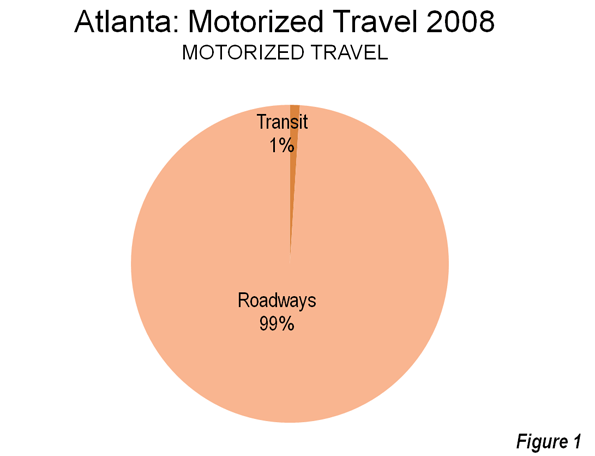
  • As California Collapses, Obama Follows Its Lead

    Barack Obama learned the rough sport of politics in Chicago, but his domestic policies have been shaped by California’s progressive creed. As the Golden State crumbles, its troubles point to those America may confront in a second Obama term.

    From his first days in office, the president has held up California as a model state. In 2009, he praised its green-tinged energy policies as a blueprint for the nation. He staffed his administration with Californians like Energy Secretary Steve Chu—an open advocate of high energy prices who’s lavished government funding on “green” dodos like solar-panel maker Solyndra, and luxury electric carmaker Fisker—and Commerce Secretary John Bryson, who thrived as CEO of a regulated utility which raised energy costs for millions of consumers, sometimes to finance “green” ideals.

    Obama regularly asserts that green jobs will play a crucial role in the future of the American economy, but California, a trend-setter in the field, has yet to reap such benefits. Green jobs, broadly defined, make up only about 2 percent of jobs in the state—about the same proportion as in Texas. In Silicon Valley, the number of green jobs actually declined between 2003 and 2010. Meanwhile, California’s unemployment rate of 10.9 percent is the nation’s third highest, behind only Nevada and Rhode Island.

    When Governor Jerry Brown predicted a half-million green jobs by the end of the decade, even The New York Times deemed it “a pipe dream.”

    Obama’s push to nationalize many of California’s economy-stifling green policies has been slowed down, first by the Republican resurgence in 2010 and then by his reelection considerations. But California’s politicians, living in what’s become essentially a one-party state, have doubled down on green orthodoxy. As the president at least tries to cover his flank by claiming to support an “all-in” energy policy, California has simply refused to exploit much of its massive oil and gas resources.

    Does this matter? Well, Texas has created 200,000 oil and gas jobs over the past decade; California has barely added 20,000. The state’s remaining energy producers have been slowing down as the regulatory environment becomes ever more hostile even as producers elsewhere, including in rustbelt states like Ohio and Pennsylvania, ramp up. The oil and gas jobs the Golden State political class shuns pay around $100,000 a year on average.

    Instead, California has forged ahead with ever-more extreme renewable energy mandates that have resulted in energy costs roughly 50 percent above the national average and expected to rise substantially from there. This tends to drive out manufacturing and other largely blue-collar energy users.

    Over the past decade the Golden State has grown its middle-skilled jobs (those that require two years or more of post-secondary education) by a mere 2 percent compared to a 5.3 percent increase nationwide, and almost 15 percent in Texas. Even in the science-technology-engineering and mathematics field, where California has long been a national leader, the state has lost its edge, growing just 1.7 percent over the past 10 years compared to 5.4 percent nationally and 14 percent in Texas.

    A recent Public Policy of California study shows that since the recession, the gap between rich and poor has widened more in California than in the rest of the nation. Lower-income workers have seen their wages drop more precipitously than those of the affluent. And the middle class is proportionately smaller and has shrunk more than elsewhere. Adjusted for cost of living, it stands at 47.9 percent in California compared to nearly 55 percent for the rest of the country.

    Meantime, many Californians have been departing for more affordable states, with a net loss of four million residents to other states over the past 20 years (while continuing, of course, to attract immigrants.) Of those who remain, nearly two-in-five Californians pay no income tax, and one in four receive Medicaid.

    There are some people are prospering in California, including many of the affluent supporters who Obama courts on his frequent fundraising forays here. Tenure-protected academics from the University of California constitute his third-largest donor base, while Google ranks fifth and Stanford twelfth, according to Open Secrets.

    Silicon Valley may emerge as the biggest source of campaign cash for Obama and the Democrats in the years ahead. After losing 18 percent of its jobs earlier in the decade, the Valley has resurged, along with Wall Street, aided by the cheap-money-for-the-rich policies of Federal Reserve Chairman Ben Bernanke. But while California’s high-tech job growth, largely in software, has been significant, the rate of increase has been less than half that of key competitors such as Utah, Washington, and Michigan.

    The IPO-lottery, Hollywood, and inherited-wealth crowds can afford the state’s sky-high costs, especially along the coast, but most California businesses can’t. Under Brown and his even less well-informed predecessor, Arnold Schwarzenegger, the official mantra has been that the state’s “creative” entrepreneurs would trigger a state revival. This is very much the hope of the administration, which trots out companies like Facebook, Apple, and Google as exemplars of the American future. “No part of America better represents America than here,”  the president told a crowd at the Computer History Museum in Mountain View last fall.

    Yet Silicon Valley represents just a relatively small part of the state’s economic base. Although the Valley—particularly the Cupertino to San Francisco strip—has recovered from the 2008 market meltdown, unemployment in the blue-collar city of San Jose hovers around 10 percent. The Oakland area, just across the Bay, ranked 63rd out of 65 major metropolitan in terms of employment trends, trailing even Detroit according to a recent analysis done by Pepperdine University economist Michael Shires. Other major California metros, including Los Angeles, Orange County, Riverside-San Bernardino, and Sacramento all ranked near the bottom.

    The newer companies that can afford the sky-high costs of coastal California, and can pay their employees adequately to do the same—places like Google, Apple, Facebook, and Twitter—employ relatively few people compared to older, manufacturing-oriented technology firms such as Hewlett-Packard and Intel. While cherry picking highly educated professionals, the new firms create few local support positions that would spread some of the wealth. What middle-income jobs they do create tend to be located in lower-cost, more business-friendly American cities like Salt Lake City or Austin, or, increasingly, overseas.

    Elite institutions like Stanford still thrive, but the state’s once-great educational system is creaking under reduced funding, massive bureaucracy, and skyrocketing pensions. Once among the best-educated Americans, Californians are rapidly becoming less so. Among people over 64, California stands second in percentage of people with an associate degree or higher; among those aged 25 to 34, it ranks 30th.

    For devoted Californians, accustomed to seeing their state as a national and global exemplar, these trends are deeply disturbing. Yet the key power groups in the state—greens, public employees, and rent-seeking developers—seem intent on imposing ever more draconian regulations on energy and land use, seeking for example, to ban construction of the single-family houses preferred by the vast majority of Californians.

    The increasingly delusional nature of the state’s politics is best captured by the urgent political push to build a fantastically expensive—potentially costing as much as $100 billion—high-speed rail line that would eventually connect the Bay Area, Los Angeles and the largely rural places in between. Obama has aggressively promoted high-speed rail nationally, but has been pushed back by mounting Republican opposition. Yet in one-party California, Jerry Brown mindlessly pushes the project despite the state’s huge structural deficits, soaring pension obligations, and decaying general infrastructure. He’s continued doing so even as the plan loses support among the beleaguered California electorate.

    It’s hard to see how these policies, coupled with a massive income tax increase on the so-called rich (families, as well as many small businesses, making over $250,000), can do anything other than widen the state’s already gaping class divide. Yet given the power of Californian ideas over Obama, one can expect more such policies from him in an electorally unencumbered second term. California’s slow-motion tragedy could end up as a national one.

    This piece originally appeared in The Daily Beast.

    Joel Kotkin is executive editor of NewGeography.com and is a distinguished presidential fellow in urban futures at Chapman University, and contributing editor to the City Journal in New York. He is author of The City: A Global History. His newest book is The Next Hundred Million: America in 2050, released in February, 2010.

    Barack Obama photo by BigStockPhoto.com.