Category: Policy

  • Goodbye, Chicago

    Odd as it may seem for someone known as The Urbanophile, I actually grew up in the countryside. I spent most of my childhood on a country road about four miles outside the town of Laconia, Indiana, population 50.  I always used to get confused when John Cougar sang about living in a small town, because I knew he was from Seymour, and with over 15,000 people that seemed a big town in my book.

    Today I still laugh at these urbanites who brag about their green ways like having “rain barrels” to catch reclaimed rainwater from the roof for watering their yard.  For many years that’s what I drank growing up, as we didn’t have city water supplies and had to rely on our cistern.

    After graduating high school I went to Indiana University. Then armed with my bachelors it was on to Chicago, the result of an accident: that’s where my job offer came from.  I had no strong feelings on where to live other than that I didn’t want to go back to my home town. In Chicago I ended up, like many young professionals, in the Lincoln Park neighborhood on the North Side. Though this too was pretty much an accident. I had relatives who lived there and invited me to stay with them when looking for an apartment.

    For many people from small town or suburban environments, going to college is a time of tremendous personal transformation and growth. I didn’t have that experience. For me, the great transformation came from moving to Chicago. Exiting the L in the Loop on my first day going to work, wearing a suit, surrounded by tall buildings and crowds of people, I felt like I was on the set of a movie. It was an almost surreal experience.

    Though urban life was new to me, I fell in love with it. And I was transformed by the experience. I knew nothing about culture, food, fashion, architecture, actually relating to people with different backgrounds from me, traveling, or how to get around in anything other than a car.  Beyond merely learning how to go to work every day, living in Chicago provided a non-stop stream of stimulating and educational experiences that helped me grow as a person.

    But it wasn’t just me who was being  transformed. The urban renaissance of Chicago was underway by the time I arrived in 1992, but it was very early in the process. I recall recruiters for the company I worked for bragging about how Chicago was now an outpost of that uber-hip coffee chain Starbucks. The gentrified areas were still largely confined to a narrow strip along the north Lakefront. Many of the places that later became yuppie playgrounds were then ethnic enclaves or undeveloped. Some were still close to slums.  On the outer reaches of Lincoln Park itself, streetwalkers openly plied their trade along North Ave.

    The 90s were heady a heady decade for  Chicago. The city, like select other major urban metros around the country, exploded with new growth and attracted many new migrants. Chicago experienced perhaps the largest urban condo building boom in America, transforming huge tracts of the city.  The quality on offer improved radically.  The population increased, and the city even added more jobs than Houston. It was a great time to be a Chicagoan, and I enjoyed every minute of it.

    But come the 2000s, the condo boom continued but an economic and political malaise  had clearly set in. Even new mayor Rahm Emanuel has labeled it a lost decade. As the decade ended, I had increasingly made up my mind to leave the city, now the place where I’d spend nearly as many years as my native Indiana. Early this year, I left Chicago behind.

    What made me decide to leave?  There are a few factors, some more personal than others.

    The first is that I simply had done Chicago. The Chicago experience had been transformational when I got there, but after nearly 20 years it was getting stale. It was just more of the same. It was time for new challenges.

    I was also motivated by the bleak economy. I owned a condo, an  anchor that left me at great risk of getting marooned in the city, a phenomenon recently written about by Crain’s Chicago Business. I was willing to sell near the bottom of the market to avoid the risk of getting stranded. There is no clear sense of an imminent major turnaround. There are huge unfunded liabilities at all levels of government in the region and state. The city’s economy seems to have lost a clear raison d’etre. No longer the “city of big shoulders”, it is losing out to urban areas with stronger economic identities — New York, San Francisco, Los Angeles, Washington and, even emerging cities like Houston.  So in the end I decided it was worth paying a “breakup penalty” to get out. Interestingly, no one, not even my alderman, suggested I was wrong in this.

    Lastly, I no longer saw Chicago as a good platform for my personal ambitions. The city likes to see itself as occupying a “sweet spot” as a legitimate urban oriented big city with a lower price tag and higher quality of life. Yet for me Chicago was a “sour spot” that offered neither the opportunities of say a New York, Washington, or San Francisco, but still came with a high price tag. I would rather live in a small city that’s dirt cheap where I can have more impact, or in a place like New York where the cost of living might be greater, but the opportunities are matchless.

    That is ultimately where the city will stand or fall. I’m but one example, but it’s a decision repeated with various results day after day: is this where I’ll plant my flag, seek my fortune and dreams, raise my family, or build my business?  Chicago has to be seen as a success platform for both people and businesses. The demographic and economic results of the 2000s suggest it is losing that battle for the moment, though given the 90s results, it is certainly possible to think that might change again tomorrow.

    As for me, Chicago will always hold a special place in my heart and I’ll treasure my experiences there.   But for now it’s on to new adventures.

    Aaron M. Renn is an independent writer on urban affairs and the founder of Telestrian, a data analysis and mapping tool. His writings appear at The Urbanophile.

    Chicago skyline photo by Bigstockphoto.com.
  • Why Emissions Are Declining in the U.S. But Not in Europe

    It wasn’t that long ago that the U.S. was cast as the global climate villain, refusing to sign the Kyoto accord while Europe implemented cap and trade. 

    But, as we note below in a new article for Yale360, a funny thing happened: U.S. emissions started going down in 2005 and are expected to decline further over the next decade, while Europe’s cap and trade system has had no measurable impact on emissions. Even the supposedly green Germany is moving back to coal.

    Why? The reason is obvious: the U.S. is benefitting from the 30-year, government-funded technological revolution that massively increased the supply of unconventional natural gas, making it cheap even when compared to coal.   

    The contrast between what is happening in Europe and what is happening in the U.S. challenges anyone who still thinks pricing carbon and emissions trading are more important to emissions reductions than direct and sustained public investment in technology innovation. 

    — Ted and Michael

    Yale 360

    Beyond Cap and Trade: A New Path to Clean Energy

    Putting a price and a binding cap on carbon is not the panacea that many thought it to be. The real road to cutting U.S. emissions, two iconoclastic environmentalists argue, is for the government to help fund the development of cleaner alternatives that are better and cheaper than natural gas.

    by Ted Nordhaus and Michael Shellenberger

    A funny thing happened while environmentalists were trying and failing to cap carbon emissions in the U.S. Congress. U.S. carbon emissions started going down. The decline began in 2005 and accelerated after the financial crisis. The latest estimates from the U.S. Energy Information Administration now suggest that U.S. emissions will continue to decline for the next few years and remain flat for a decade or more after that.

    The proximate cause of the decline in recent years has been the recession and slow economic recovery. But the reason that EIA is projecting a long-term decline over the next decade or more is the glut of cheap natural gas, mostly from unconventional sources like shale, that has profoundly changed America’s energy outlook over the next several decades.

    Gas is no panacea. It still puts a lot of carbon into the atmosphere and has created a range of new pollution problems at the local level. Methane leakage resulting from the extraction and burning of natural gas threatens to undo much of the carbon benefit that gas holds over coal. And even were we to make a full transition from coal to gas, we would then need to transition from gas to renewables and nuclear in order to reduce U.S. emissions deeply enough to achieve the reductions that climate scientists believe will be necessary to avoid dangerous global warming.

    But the shale gas revolution, and its rather significant impact on the U.S. carbon emissions outlook, offers a stark rebuke to what has been the dominant view among policy analysts and environmental advocates as to what it would take in order to begin to bend down the trajectory of U.S. emissions, namely a price on carbon and a binding cap on emissions. The existence of a better and cheaper substitute is today succeeding in reducing U.S. emissions where efforts to raise the cost of fossil fuels through carbon caps or pricing — and thereby drive the transition to renewable energy technologies — have failed.

    In fact, the rapid displacement of coal with gas has required little in the way of regulations at all. Conventional air pollution regulations do represent a very low, implicit price on carbon. And a lot of good grassroots activism at the local and regional level has raised the political costs of keeping old coal plants in service and bringing new ones online.

    But those efforts have become increasingly effective as gas has gotten cheaper. The existence of a better and cheaper substitute has made the transition away from coal much more viable economically, and it has put the wind at the back of political efforts to oppose new coal plants, close existing ones, and put in place stronger EPA air pollution regulations.

    Yet if cheap gas is harnessing market forces to shutter old coal plants, the existence of cheap gas from unconventional places is by no means the product of those same forces, nor of laissez faire energy policies. Our current glut of gas and declining emissions are in no small part the result of 30 years of federal support for research, demonstration, and commercialization of non-conventional gas technologies without which there would be no shale gas revolution today.

    Starting in the mid-seventies, the Ford and Carter administrations funded large-scale demonstration projects that proved that shale was a potentially massive source of gas. In the years that followed, the U.S. Department of Energy continued to fund research and demonstration of new fracking technologies and developed new three-dimensional mapping and horizontal drilling technologies that ultimately allowed firms to recover gas from shale at commercially viable cost and scale. And the federal non-conventional gas tax credit subsidized private firms to continue to experiment with new gas technologies at a time when few people even within the natural gas industry thought that firms would ever succeed in economically recovering gas from shale.

    The gas revolution now unfolding — and its potential impact on the future trajectory of U.S. emissions — suggests that the long-standing emphasis on emissions reduction targets and timetables and on pricing have been misplaced. Even now, carbon pricing remains the sine qua non of climate policy among the academic and think-tank crowds, while much of the national environmental movement seems to view the current period as an interregnum between the failed effort to cap carbon emissions in the last Congressand the next opportunity to take up the cap-and-trade effort in some future Congress.

    And yet, the European Emissions Trading Scheme (ETS), which has been in place for almost a decade now and has established carbon prices well above those that would have been established by the proposed U.S. system, has had no discernible impact on European emissions. The carbon intensity of the European economy has not declined at all since the imposition of the ETS. Meanwhile green paragon Germany has embarked upon a coal-building binge under the auspices of the ETS, one that has accelerated since the Germans shut down their nuclear power plants.

    Even so, proponents of U.S. emissions limits maintain that legally binding carbon caps will provide certainty that emissions will go down in the future, whereas technology development and deployment — along with efforts to regulate conventional air pollutants — do not. Certainly, energy and emissions projections have proven notoriously unreliable in the past — it is entirely possible that future emissions could be well above, or well below, the EIA’s current projections. But the cap-and-trade proposal that failed in the last Congress, like the one that has been in place in Europe, would have provided no such certainty. It was so riddled with loopholes, offset provisions, and various other cost-containment mechanisms that emissions would have been able to rise at business-as-usual levels for decades.

    Arguably, the actual outcome might have been much worse. The price of the environmental movement’s demand for its “legally binding” pound of flesh was a massive handout of free emissions allocations to the coal industry, which might have slowed the transition to gas that is currently underway.

    Continuing to drive down U.S. emissions will ultimately require that we develop low- or no-carbon alternatives that are better and cheaper than gas. That won’t happen overnight. The development of cost-effective technologies to recover gas from shale took more than 30 years. But we’ve already made a huge down payment on the technologies we will need.

    Over the last decade, we have spent upwards of $200 billion to develop and commercialize new renewable energy technologies. China has spent even more. And those investments are beginning to pay off. Wind is now almost as cheap as gas in some areas — in prime locations with good proximity to existing transmission. Solar is also close to achieving grid parity in prime locations as well. And a new generation of nuclear designs that promises to be safer, cheaper, and easier to scale may ultimately provide zero-carbon baseload power.

    All of these technologies have a long way to go before they are able to displace coal or gas at significant scale. But the key to getting there won’t be more talk of caps and carbon prices. It will be to continue along the same path that brought us cheap unconventional gas — developing and deploying the technologies and infrastructure we need from the bottom up.

    When all is said and done, a cap, or a carbon price, may get us the last few yards across the finish line. But a more oblique path, focused on developing better technologies and strengthening conventional air pollution regulations, may work just as well, or even better.

    For one thing should now be clear: The key to decarbonizing our economy will be developing cheap alternatives that can cost-effectively replace fossil fuels. There simply is no substitute for making clean energy cheap.

    © 2010 Yale Environment 360

  • California Declares War on Suburbia II: The Cost of Radical Densification

    My April 9 Cross Country column commentary in The Wall Street Journal (California Declares War on Suburbia) outlined California’s determination to virtually outlaw new detached housing. The goal is clear:    force most new residents into multi-family buildings at 20 and 30 or more to the acre. California’s overly harsh land use regulations had already driven housing affordability from fairly typical levels to twice and even three times higher than that of much of the nation. California’s more recent tightening of the land use restrictions (under Assembly Bill 32 and Senate Bill 375) has been justified as necessary for reducing greenhouse gas (GHG) emissions.

    It is All Unnecessary: The reality, however, is that all of this is unnecessary and that sufficient GHG emission reductions can be achieved without interfering with how people live their lives. As a report by the McKinsey Company and The Conference Board put it, there would need to be "no downsizing of vehicles, homes or commercial space," while "traveling the same mileage." Nor, as McKinsey and the Conference Board found, would there be a need for a "shift to denser urban housing." All of this has been lost on California’s crusade against the lifestyle most Californians households prefer.

    Pro and Con: As is to be expected, there are opinions on both sides of the issue. PJTV used California Declares War on Suburbia as the basis for a satirical video, Another Pleasant Valley Sunday, Without Cars or Houses? Is California Banning Suburbia?

    California’s Increasing Demand for Detached Housing? A letter to the editor in The Wall Street Journal suggested that there are more than enough single-family homes to accommodate future detached housing demand in California for the next 25 years. That’s irrelevant, because California has no intention of allowing any such demand to be met.

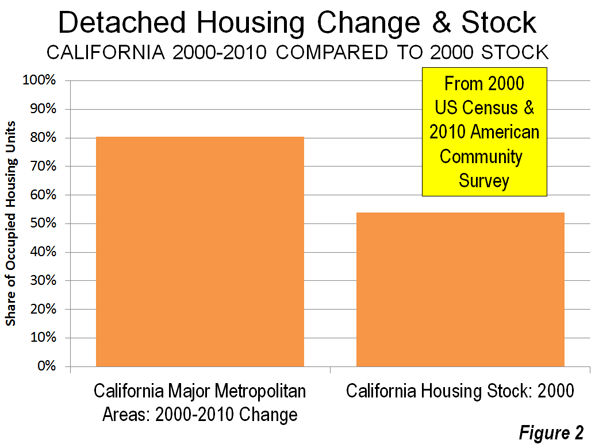
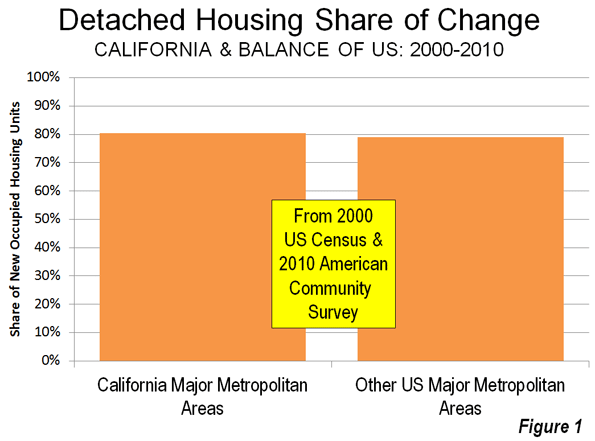
    The data indicates continuing robust demand. In California’s major metropolitan areas, detached houses accounted for 80 percent of the additions to the occupied housing stock between 2000 and 2010, which slightly exceeds the national trend favoring detached housing (Figure 1). If anything, the shift in demand was the opposite predicted by planners, since only 54 percent of growth in occupied housing in the same metropolitan areas was detached in 2000 (Figure 2).


    Watch What they Do, Not What they Say: It does no good to point to stated preference surveys indicating people preferring higher density living. Recently, Ed Braddy noted in newgeography.com (Smart Growth and the New Newspeak) that a widely cited National Association of Realtors had been "spun" to show that people preferred higher density living, from a question on an "unrealistic scenario," and ignoring an overwhelming preference for detached housing – roughly eighty percent – in other questions in the same survey. People’s preferences are not determined by what they say they will do, but rather by what they do.

    Off-Point Criticism: There was also "off-point" criticism, which can be more abundant than criticisms that are "on-point." Perhaps the most curious was by Brookings Institution Metropolitan Policy Program Senior Researcher Jonathan Rothwell (writing in The New Republic) in a piece entitled "Low-Density Suburbs are Are Not Free-Market Capitalism." I was rather taken aback by this, since none of these three words ("free," "market" or "capitalism") appeared in California Declares War on Suburbia. I was even more surprised at the claim that I defend "anti-density zoning and other forms of large lot protectionism." Not so.

    Indeed, I agree with Rothwell on the problems with large lot zoning. However, it is a stretch to suggest, as he does, that the prevalence of detached housing results from large lot zoning. This is particularly true in places like Southern California where lots have historically been small and whose overall density is far higher than that of greater New York, Boston, Seattle and double that of the planning mecca of Portland.

    Rothwell’s own Brookings Institution has compiled perhaps the best inventory of metropolitan land use restrictions, which indicates that the major metropolitan areas of the West have little in large lot zoning. Yet detached housing is about as prevalent in the West as in the rest of the nation (60.4 percent in the West compared to 61.9 percent in the rest of the nation, according to the 2010 American Community Survey). Further, there has been little or no large lot zoning in Canada and Australia, where detached housing is detached, nor in Western Europe and Japan (yes, Japan, see the Note below).  

    On-Point: Urban Growth Boundaries Do Increase House Prices: However, to his credit, Rothwell points out the connection between urban growth boundaries and higher house prices. This is a view not shared by most in the urban planning community, who remain in denial of the economic evidence (or more accurately, the economic principle) that constraining supply leads to higher prices. This can lead to disastrous consequences, as California’s devastating role in triggering the Great Recession indicates.

    The Purpose of Urban Areas: From 1900 to 2010, the urban population increased from 40 percent to 80 percent of the US population. Approximately 95 percent of the population growth over 100 years was in urban areas. People did not move to urban areas the cities for "togetherness" or to become better citizens. Nor did people move out of an insatiable desire for better urban design or planning. The driving force was economic: the desire for higher incomes and better lives. A former World Bank principal urban planner, Alain Bertaud stated the economic justification directly: "large labor markets are the only raison d’être of large cities."

    And for the vast majority of Americans in metropolitan areas, including those in California, those better lives mean living in suburbs and detached houses. All the myth-making in the world won’t change that reality, even if it pushes people out of the Golden State to other, more accommodating pastures.

    The performance of urban areas is appropriately evaluated by results, such as economic outcomes, without regard to inputs, such as the extent to which an area conforms to the latest conventional wisdom in urban planning.

    • Land use policies should not lead to higher housing costs relative to incomes, as they already have in California, Australia, Vancouver, Toronto and elsewhere. If they do, residents are less well served.
    • Transport policies should not be allowed to intensify traffic congestion by disproportionately funding alternatives (such as transit and bicycles) that have little or no potential to improve mobility as seems the likely outcome of radical densification. If they do, residents will be less well served.

    This gets to the very heart of the debate. The “smart growth on steroids” policies now being implemented in California are likely to lead to urban areas with less efficient personal and job mobility, where economic and employment growth is likely to be less than would otherwise be expected. The issue is not urban sprawl. The issue is rather sustaining the middle-income quality of life, which is now endangered by public policy in California, and for no good reason.

    Wendell Cox is a Visiting Professor, Conservatoire National des Arts et Metiers, Paris and the author of “War on the Dream: How Anti-Sprawl Policy Threatens the Quality of Life

    —-

    Note: Despite its reputation for high density living, Japan’s suburbs have many millions of detached houses. In 2010, 47 percent of the occupied housing in Japan’s major metropolitan areas was detached (Tokyo, Osaka-Kobe-Kyoto, Nagoya, Sapporo, Sendai, Hiroshima, Kitakyushu-Fukuoka, Shizuoka and Hamamatsu).

    Photo: An endangered species: Detached houses in Ventura County (Photo by author)

  • Alternative Growth Paths for Sydney: A New Report and its Implications

    Population growth in Australia is double the world average and the New South Wales Department of Planning has projected that the population of the Sydney region will increase by 57,000 people annually. How will these extra people be housed?  The NSW Government follows the usual doctrines based on higher population densities. Its planning policy, known as The Metropolitan Strategy, works on locating some 70% of new dwellings within existing urban communities (in-fill) and 30% in new greenfield sites. 

    This policy is implemented by orders issued by the New South Wales Minister of Planning and imposed by ministerial fiat which are neither tabled nor debated in parliament.

    To achieve this 70/30 strategy the Department of Planning in effect has placed a restrictive growth boundary around Sydney to force higher-densities into existing residential areas. Greenfield land release has been reduced from an historic 10,000 lots per year to less than 2,000. This has caused a severe land shortage. 

    These policies are undemocratic and widely resented. What is more, the government has not justified them in terms of public good.  Indeed they might find that hard to do. For example, Australian studies show that greenhouse gas emissions per person are higher in high-density living, congestion is worse, human health is compromised, the costs of electricity, gas and water services increase, heritage conservation areas valued by the community are often lost and irreplaceable urban patchwork of greenery and wildlife within the city is decimated.

    The CIE Report

    The previous Labor Government commissioned a report on possible planning alternatives for Sydney. This report, by the Centre for International Economics (CIE) titled The Benefits and Costs of Alternative Growth Paths for Sydney: Economic, Social and Environmental Impacts was delivered back in December 2010. It has only now been released by the current government. 

    The report discusses three different scenarios for Sydney.  These portray alternatives of 90%, 70% and 50% of new housing to be built in existing urban areas (in-fill) – and correspondingly 10%, 30% and 50% in greenfield sites.

    The report compares the costs of the 90/10 and 50/50 scenarios with those of the current Metropolitan Strategy 70/30 ratio over a twenty-five-year period. It finds the cost differences between them are comparatively trivial. When compared to the Metropolitan Strategy 70/30 policy, the annual non-discounted cost saving per new dwelling for the 90/10 scenario is only A$151.  For the 50/50 scenario the additional annual cost per new dwelling is found to be A$950.

    This report contains two significant flaws. The first is an implicit assumption that the price of land will be the same for all three scenarios. It also fails to properly consider additional cost factors.

    Price of Land

    Each scenario examined changes the amount of new land that would be released for development. When compared with the current baseline 70/30 strategy, the 90/10 scenario would require even greater restrictions on the release of new housing land and hence an even greater land shortage. By contrast, the 50/50 scenario would allow for a more generous release of new land and hence more land available for construction.  The immutable laws of supply and demand ensure that the degree of land restriction would significantly affect the cost of housing in each scenario, completely swamping the relatively minor cost differences due to other factors.

    Incredibly, the report appears to fail to take the effect of relative scarcity on costs into consideration. It simply assumes that the price of land will remain the same for each scenario.

    This is significant because the report includes in its calculations factors that are highly dependent on the cost of land. If the report’s findings are to be credible, the variation of these factors caused by land price variation in each scenario examined should also be taken into account.  When land is scarce high-density developers can make greater profits as they have less competition from low-priced houses and landholders can get higher prices for their land than would be the case otherwise. 

    Other Costs

    The report alleges that electricity consumption is greater in houses than it is in apartments. This is incorrect. Studies show that consumption per capita is greater in apartments. It appears that the data the report relies on does not take into account the consumption of electricity common to the whole apartment block such as lifts and lighting common areas such as foyers and car spaces. 

    The report also does not take into account costs to existing residents arising from forcing high-density into communities originally designed for low-density. These include:

    • The impact on a single-residential property that has high-rise built next to it. This can involve theft of amenity: new in-fill residents look over gardens of existing residents while the latter have to look onto unsightly structures, and suffer lack of privacy and overshadowing.
    • Congestion. Existing residents have to suffer from increasingly congested streets and shortage of street parking.
    • Shortage of recreational facilities. As more vacant land is built upon in a community originally designed for low-density, it becomes difficult to secure new open areas to service the needs of the additional population at a reasonable standard.
    • Reduction in housing choice, particularly for families.  Most infill development consists of apartments which are not suitable for bringing up young children.  Indeed the majority of those currently living in apartments do not do so by choice. A survey indicates multi-story apartments are not even acceptable to most people wishing to downsize, if they have other choices such as smaller single residential houses or villas.
    • Reduction in biodiversity. When gardens and open space are replaced with unit blocks this has a severe effect on urban plant and animal life.
    • Heritage items valued by the community such as traditional period architect designed housing are often lost.
    • Atmospheric pollution.  There is a local effect on residents of atmospheric pollution in high-density areas.  This is due to higher traffic densities and to less volume of air being available for the dilution and dispersion of pollutants.

    If these considerations had been quantified into the report’s calculations, they would have changed its overall findings.

    Conclusions

    As is not unusual in reports by density advocates throughout the English-speaking world, the report’s findings are marred by the fact that significant factors are omitted.  If costs and benefits were fully accounted for, including the costs and benefits borne by existing residents, an already weak case for emphasising densification over fringe development would vanish.

    As we have seen, even with the flawed accounting used in the report, the magnitude of the cost differences that it finds between its three scenarios is trivial. These tiny differences make the unpopular Metropolitan Strategy 70/30 policy hard to justify, and any intensification of this strategy to 90/10 impossible to justify.   Cost differences of either A$151 or A$950 are small compared to the price that people have to pay for a house (the median price in Sydney is A$650,000). These insignificant figures need to be considered in the light of providing people with the opportunity of living in the housing style of their choice.

    If costs and benefits were to be fully accounted for, including those borne by existing residents, the case for a policy of enforced densification cannot be supported.   When asked voters want less rather than more densification.

    High land prices due to restrictive land-releases are already making housing unaffordable for the next generation.  Unwanted high-rise development represents theft from the community, reducing the amenity of existing residents and transfers that value to property developers without recompense. This theft is aided and abetted by the policies of the State Government. Moreover, it continues to result in well-publicised favours being granted to developers with connections to government.

    The Metropolitan Strategy needs to be replaced. A good start would be for the New South Wales government to adopt the suggested 50/50 strategy as the first step towards reform.  The provision of more choice will allow people to demonstrate whether they prefer to live in high-density or in lower cost, more spacious housing with a garden in the suburbs.

    (Dr) Tony Recsei has a background in chemistry and is an environmental consultant. Since retiring he has taken an interest in community affairs and is president of the Save Our Suburbs community group which opposes over-development forced onto communities by the New South Wales State Government.

    Sydney suburb photo by BigStockPhoto.com.

  • Peyton Manning for President?

    Is the free agency of Colts quarterback Peyton Manning, or the trade of the evangelic Tim Tebow to the New York Jets a far more compelling story than anything yet to emerge from the presidential election news?

    Compared with Peyton Manning’s dignified handling of his neck injuries and his complicated departure from Indianapolis, Mitt Romney seems about as stately as those hair-rinsed, middle-aged men who show up on halftime advertisements with that Viagra look in their eye. (In Romney’s case he is trying to get a few primary delegations to head upstairs.)

    Even those seeking a greater religious presence in public life seem to find the faith of All-American Tim Tebow more engaging than the awkward positions of Rick Santorum, who sounds like he would pass out scarlet letters after his inauguration. And the YouTube Tebowing craze has breathed more fun and light into Christianity than any of Newt Gingrich’s C-SPAN homilies.

    Ron Paul, who speaks in complete sentences about Federal Reserve economics and the national surveillance state, must wish he could command the respect of a retired football coach, someone like John Madden, so that people would listen when he is drawing his Xs and Os to explain the gold standard.

    Had Peyton Manning tearfully retired from the Colts and announced his intention to campaign for president, I am sure he could have given Romney a run for his money. At least no one would begrudge him his millions. Romney’s two-Cadillac wife, $10,000 friendly bets, and country club bearing have doomed him with large swathes of the electorate. By contrast, Manning was able to spin four neck surgeries, a 36-year-old arm, and bad playoff performances into a Denver contract that could pay him $96 million over five years.

    When he signed his deal, you would have thought he had won a Nobel or negotiated a truce in Syria, such was the public acclaim, relief, and satisfaction that he would not have to face the off-season playing fantasy football or that he might be down to his last $200 million.

    The reason the electorate cares more about its quarterbacks than its candidates is because those running for office all sound like team owners, promising everyone season tickets to the American dream, while siphoning the revenue from the concessions and the sky boxes. At least NFL quarterbacks have to play the games and get their uniforms dirty.

    To be sure, professional football organizations no more want to dilute their market share than Democrats or Republicans want to open up the U.S. electoral system to all the small parties — greens, social democrats, Christian socialists, trade unionists, nationalists, etc. — that you find in European countries.

    The reason that the Broncos can afford to gamble $100 million on Peyton Manning’s neck surgeon is because professional football enjoys antitrust exemption, and collectively cashes the dividends of a market rigged more closely than one of Leland Stanford’s freight lines.

    With the blessings of Congress, football hires indentured servants (the draft), limits ownership franchises (the protected guild of the NFL), shares cable contracts, and raids public treasuries to build billion dollar stadiums that only benefit the owners (and perhaps a few beer vendors). Think of the NFL as just another political action committee.

    No wonder Mitt Romney campaigns for president as if auditioning to become the league commissioner, who serves at the grace of the owners and whose job it is speak sternly on 60 Minutes about “the integrity of the game.” In recent years, the real NFL Commissioner, Roger Goodell, has taken to fining players for violent hits and suspending coaches for tolerating bounties on opposing players.

    NFL careers are nasty, brutish and short. Who would pay NFL stars tens of millions if on any given Sunday the game looked like Ultimate Frisbee? As a result of football’s violence, ex-NFL players are prone to dementia and other crippling diseases, with little more support from the league than a handshake when their time on the field is up.

    Listening the bounty tapes, the NFL has no more claim to “integrity” than a hockey enforcer, but the façade is maintained that the league promotes “sport” and “fairness,” even if the Saints’ locker room was home to the mentality of a hit squad.

    Just as Goodell’s job is to preside over a closed chop shop but make it all look and sound like Chariots of Fire, President Obama is the league commissioner of the Fortune 500. That team can only dream of football’s antitrust exemption, even if it got in on some revenue sharing through the stimulus plan and TARP bailouts.

    If the president, even in a minor way, were serious about creating jobs, he could deregulate the football industry by ending the antitrust exemption and allow other owners and cities to form their own teams. Why does the US limit the supply of its professional football?

    Going long, the president could campaign against state and local subsidies ($20 billion by some accounts) for white-elephant stadiums that benefit only political cronies. He could take on the cable television oligopoly and let anyone with a webcam “broadcast” games that should be considered news events, not pay-per-view entertainments. He could also urge that college players be paid, as they work hard at many things, although school usually isn’t one of them.

    The reason that the football establishment has trouble tolerating quarterback Tim Tebow is because he represents the sandlot game as it was played before the sport became a subsidiary of the advertising business — a colorful if violent spectacle around which to plug Taco Bell or Coors Lite. (Players are best understood as animated billboards.) His passes may flutter like wounded ducks, but he’s a free spirit. Tebow is closer to democratic rule than to the corporate hierarchy of the football industry, no doubt one reason that the Broncos moved him along to the Jets, who at least have credentials in preferring anarchy to victories.

    In the presidential election, candidates Romney and Obama will raise and spend more than $1 trillion, and speak endlessly about the “integrity of the country,” even as the CIA posts bounties on the heads of American citizens living abroad. (Maybe disgraced Saints coach Sean Payton should pass his suspended year in Yemen? At least there his talents would not be wasted.)

    An election between Manning and Tebow would at least be fun, instructive, engaging, and offer clear choices. Manning would be the voice of protected industry, in which team owners or corporate sponsors are always munificent and wise, and always in the game for yet another government protection racket under the banner of competition. By contrast, Tebow would stand for a grassroots revival, prairie chapels, and the sense that the game has yet to be fixed.

    Flickr Photo by Tennessee Journalist: Peyton Manning at the podium, looking presidential.

    Matthew Stevenson is the author of Remembering the Twentieth Century Limited, a collection of historical travel essays, and recently edited Rules of the Game: The Best Sports Writing from Harper’s Magazine. His next book is Whistle-Stopping America.
  • Smart Growth: The Maryland Example

    This is Part Two of a two-part series.

    Evidence that people just don’t like Smart Growth is revealed in findings from organizations set up to promote Smart Growth. In 2009, the Washington Post reported, “Scholars at the National Center for Smart Growth Research and Education found that over a decade, smart growth has not made a dent in Maryland’s war on sprawl.”

    Citing the “most comprehensive review to date” from the same Center, the Baltimore Sun in 2011 argued that Maryland had made “little progress with Smart Growth” despite adopting laws and policies hailed across the country as models for growth management.

    One of the innovative policies was the establishment of Priority Funding Areas (PFAs) where development was to be directed and incentivized with money for cash-strapped jurisdictions. Yet the representative bodies closest to the people continued to permit development outside the PFAs.

    Assessing the failure of incentives to concentrate development, the Center concluded: “As the Maryland experience suggests, without statutory requirements, tools that matter to the state are not always those that matter to local governments.”

    The anti-democratic outlook among Smart Growthers was evident in a comment by Gerrit Knapp, the director of the National Center for Smart Growth Research and Education, who said, “What makes incentives so politically attractive is that governments and individuals can choose to ignore them if they wish. Unfortunately, in Maryland over the last decade, that’s exactly what many have been doing.”

    This “unfortunate” behavior by free people is consistent with the conclusion of Robert Bruegmann, author of Sprawl: A Compact History, who found that low density development was “the preferred settlement pattern everywhere in the world where there is a certain measure of affluence and where citizens have some choice in how they live.”

    Deconstructing Density

    Under the new PlanMaryland, Priority Funding Areas essentially become urban growth boundaries. People still can choose to live outside PFAs, but new housing can be built at no greater than one unit per 20 acres, making such dwellings unaffordable to all but the extremely rich. Ninety percent of new development must be inside the PFAs at a minimum density of 3.5 units per acre.

    The impact of increased densities is hard to gauge when presented in this manner, but 3.5 units per acre converts to 2,240 units per square mile. Maryland averages 2.62 people per dwelling unit, so the minimum population density for almost all new development will be on a scale of 5,846 people per square mile, a density higher than Portland or San Francisco, and just shy of Copenhagen, Denmark.

    Furthermore, reviewing previous drafts of PlanMaryland leads one to believe that this minimum density will be the exception to the rule of even higher densities. The earliest draft available for public comment, April 2011, was unapologetic about the need for significantly higher densities, saying this “threshold for new development – a relatively low density of 3.5 units per acre – is not accommodating growth in PFAs as needed to minimize continued impacts on our rural and resource lands and industries.”

    A later draft, September 2011, established ranges for “medium density” (3.5 to 10 units per acre) and “high density” (10+ units per acre) and repeatedly showed a preference for the high density classification, which converts to a scale of at least 16,704 people per square mile.

    For example, on page 18 is the complaint that incentive-based planning “hindered high-density urban development,” and page 35 says there would be dramatic per capita savings “if 25 percent of the low-density development projected to be built from 2000 to 2025 was shifted to high-density development.”

    But a strange thing happened on the road to the final draft: high density was euphemized. The sixteen-page Executive Summary does not once mention density. “Low density” makes numerous appearances in the final draft in the context of wasteful land use patterns, and “high density” appears just once.

    Instead, PlanMaryland relies on the phrase “compact development”. A comparison table, laughably labeled “Low Density versus Compact Development,” steers clear of medium or high density labels even though, when converted to population per square mile, the “compact” living arrangement would be more than seven times Maryland’s current density.

    To discern the density thresholds that Maryland planners have in mind, consider, PlanMaryland claims that “Compact development leads people to drive 20 to 40 percent less, at minimal or reduced cost, while reaping fiscal and health benefits.”

    This appears to be lifted from the influential 2007 Growing Cooler report, sponsored by the National Center for Smart Growth Research and Education, Smart Growth America, and other advocacy organizations. The authors call on “all housing growth” to be built at an average density of 13 units per acre (21,798 people per square mile), in order to increase the overall metropolitan density to 9 units per acre (15,091 people per square mile) by the year 2025. There’s not a lot of room for detached single family homes in this scenario.

    PlanMaryland’s Best Practices section highlights White Flint in North Bethesda for redeveloping “an auto-dominated suburban strip into an environment where people walk to work, shops and transit.” This project puts 1,400 apartments on 32 acres, for a density of 44 units per acre.

    Hyattsville’s Arts District is recognized because “this mixed-use community features row homes, condominiums, live-work units, shops and a new community center,” but there is no room for detached, single family homes among the 500 dwellings crowded onto 25 acres, or 20 units per acre. Also featured is Carroll Creek Park that has 300 residential units, all multi-family, mixed among commercial and office space along a linear 1.3-mile strip.

    As a “Traditional Neighborhood Development,” Kentlands is closer to the norm, and features some single family housing among its mix of shops, apartments, and condos, but the 1,655 residential units on 352 acres is still 35 percent higher than the “minimum” densities mentioned in PlanMaryland, and thirteen times the state’s current density level.

    These places are architecturally striking and aesthetically attractive, but they are unaffordable to most of the state’s population. Furthermore, the dearth of detached single family housing, the predominance of multi-family dwellings mixed with (not nearby) other uses, and dramatically higher densities are not at all what an overwhelming majority of people want in Maryland or anywhere else.

    The emergence of Smart Growth in Maryland is indicative of the movement in general: For successful implementation, it would be necessary to replace incentives with mandates, and continue to rely on euphemistic language to avoid a candid discussion of density.

    In October, I spoke — along with Wendell Cox and a few others — at a technical forum on PlanMaryland, addressing many areas of concern including density. Signed into law by Governor Martin O’Malley in December 2011, PlanMaryland weakens the authority of local governments, eviscerates property rights, and expresses hope for declining interest in the single family home.

    Defenders will argue that most people support Smart Growth; after all, O’Malley and others like him were popularly elected. Yet these politicians never campaign on the specifics of Smart Growth, such as how many people per square mile they believe is necessary, or what kinds of restrictions they will impose on single family housing in the suburbs, or the impacts on affordability.

    The September draft of PlanMaryland said, “PlanMaryland, we believe, is what the public says it wants and deserves in government.” Tellingly, this statement is missing from the final report. That’s because what planners want and what people prefer are starkly different.

    Photo: New residential smart growth, from the state of Maryland’s, “Smart, Green, and Growing” site.

    Ed Braddy is the executive director of the American Dream Coalition, a non-profit organization promoting freedom, mobility and affordable homeownership. Mr. Braddy often speaks on growth management related issues and their impact on local communities or at ed@americandreamcoalition.org

  • Buffalo, You Are Not Alone

    It hurts. When a bigtime Harvard economist writes off your city as a loss, and says America should turn its back on you, it hurts. But Ed Glaeser’s dart tossing is but the smallest taste of what it’s like to live in place like Buffalo. To choose to live in the Rust Belt is to commit to enduring a continuous stream of bad press and mockery.

    I write mostly about the Midwest, but whether we think Midwest or Rust Belt or something else altogether, the story is the same. From Detroit to Cleveland, Buffalo to Birmingham, there are cities across this country that are struggling for a host of historic and contemporary reasons. We’ve moved from the industrial to the global age, and many cities truly have lost their original economic raison d’etre. Reviving them requires the hard work of rebuilding and repositioning them for a new era, a daunting task to be sure.

    But beyond their legitimate challenges, these cities also face the double burden that they are unloved by much of America, and all too often by their own residents. They are forlorn and largely forgotten, except as cautionary tales or as the butt of jokes.

    These cities aren’t sexy. They aren’t hip. They don’t have the cachet of a Portland or Seattle. The creative class isn’t flocking. They are behind in the new economy, in the green economy. Look at any survey of the “best” cities and find the usual suspects of New York, Austin, San Francisco. Look at yet another Forbes “ten worst” list and see Cleveland and Toledo kicked again when they are down. They are portrayed as hopeless basket cases with no hope and no future.

    But I reject that notion. I do not believe in the idea that these cities are beyond repair and unworthy of attention—or affection.

    Someone asked me once why I bother. Why does it matter that these cities come back? Why not just let nature take its course? Why not let Buffalo die, and its people scatter to the winds?

    It’s because it doesn’t just matter to a few proud people in Buffalo, it matters to America. The idea of disposable cities is one that is incompatible with a prosperous and sustainable future for our country. Fleeing Rust Belt cities for neo-Southern boomtowns is nothing more than sprawl writ large. Rather than just abandoning our cores, we’ll now abandon entire regions in the quest for new greenfields to despoil. We can’t have a truly prosperous and sustainable America with only a dozen or so superstar cities that renew themselves from age to age while others bloom like a flower for a season, then wither away. An America littered with an ever increasing number of carcasses of once great cities is not one most of us want to contemplate.

    But beyond that, it’s because I believe we can make it happen. Look closely and the change is already in the air. Globalization taketh away—but it also giveth. Cities like Buffalo or St. Louis now have access to things that even people in Chicago didn’t not that long ago. Amazon, iTunes, and a host of specialty online retailers put the best of the world within reach. Where once you couldn’t get a good cup of coffee, there are now micro-roasters aplenty. Where once your choices were Bud, Miller, or Coors, an array of specialty brews are on tap, often brewed locally. Restaurants are better, with food grown locally and responsibly. Slowly but surely the ship is turning on sustainability, with nascent bike cultures in almost every city, LEED certified buildings, recycling programs, and more. House by house, rehab by rehab, neighborhoods in these cities are starting to come to life.

    Where once moving to one of these cities would have been likened to getting exiled to Siberia, it’s now shocking how little you actually give up. And for every high-end boutique or black tie gala you miss, you get something back in low-cost and easy living. The talent pool may be shallower, but it’s a lot more connected.

    Let’s not get ahead of ourselves. There’s still a long and hard journey ahead. And not every place is going to make it, particularly among cities without the minimum scale. We have to face that reality. But more of them will revive than people think.

    That’s because a new generation of urbanists believes in these cities again. These people aren’t bitter, burdened by the memories of yesteryear and all the goodness that was lost. The city to them isn’t the place with the downtown department store their mother used to take them to in white gloves for tea. It isn’t the place full of good manufacturing jobs with lifetime middle class employment for those without college degrees. The city isn’t a faded nostalgia or a longing for an imagined past. Most of them are young and never knew that world.

    No, this new generation of urbanists sees these cities with fresh eyes. They see the decay, yes, but also the opportunity—and the possibilities for the present and future. To them this is Rust Belt Chic. It’s the place artists can dream of owning a house. Where they can live in a place with a bit of an authentic edge and real character. Where people can indulge their passion for renovating old architecture without a seven-figure budget. Where they have a chance to make a difference—to be a producer, not just a consumer of urban life, and a new urban future. Above all, these people, natives or newcomers, have a deep and abiding passion and love for the place they’ve chosen—yes, chosen—to live.

    Still, it can get lonely, and often depressing. It so often seems like one step forward, two steps back. Making change happen can seem like pushing a rock uphill, like you are up there on some far frontier of the country alone, fighting a quixotic battle. Every historic building demolished, every quality infill project sabotaged by NIMBY’s, every massively subsidized business-as-usual boondoggle, every DOT-scarred transport project is a discouragement.

    But Buffalo, you are not alone. It’s not just you, it’s cities and people across across this country, from St. Louis to Pittsburgh to Milwaukee to Cincinnati to New Orleans to Birmingham, fighting to build a better future. There’s a new movement in all these cities, made up of passionate urbanists committed to a different and better path. Sometimes they are few in number, but they are mighty in spirit— and they are making a difference. Together, they and you can win the battle and make the change happen.

    It won’t be easy. The road will be long. Some, like the great cathedral builders of Europe, may never see completely the fruit of their labors. But the long-ago pioneers who founded these great cities never got to see them in their first glory either. We’ve come full circle. We are present again at the re-founding of our cities. This is the task, the duty, the calling that a new generation has chosen as its own, to write the history of their city anew.

    Go make history again, Buffalo.

    This article originally appeared in Buffalo Rising on June 14, 2010.

    Aaron M. Renn is an independent writer on urban affairs based in the Midwest. His writings appear at The Urbanophile.

    Taste of Buffalo photo by Bigstockphoto.com.

  • Gary Hustwit’s “Urbanized” Re-lighting Debate on Cities

    Gary Hustwit’s new film, “Urbanized,” is the third in his series of documentaries concerning design.  In his first two films, he looks at consumer product design and the global visual culture.  The existential problem of the city, an urgent one about which much of this website is concerned, is scarcely treated in our contemporary mainstream, and Hustwit’s effort is laudable. In this film, he tackles urban design, introducing ideas about how cities should – and should not – accommodate growth.  “Urbanized” tends to favor the big idea over the small, and airs the conventional wisdom of the urban design community.  In doing so, he brings to the public an important debate, but he misses some opportunities to explore change in the urban realm.

    In a visual feast of a film, interlaced with intriguing interviews of some of the luminaries of the 21st century design culture, “Urbanized” makes a case for elevating the environment to the same level of concern as architecture and mobility.  The documentary tends to reinforce, not question, notions of right and wrong growth that are promulgated by the urban intelligentsia, and he declines to explore the validity of most of these notions.  He also tends to focus on large, dramatic solutions to the urban growth dilemma, perhaps because they make for good cinema.  Flashy red Transmilenio buses in Bogatá; NASA-like control centers in Rio de Janiero; and Green Party clashes with the police in Stuttgart all imply that heroes must be at work to keep our cities livable and inspiring.

    To his credit, Hustwit does show local and small changes that are taking place in cities like New Orleans and Detroit.  He interviews urban agriculturalists, conceptual artists, and folks who spray-painted a graph of their power consumption on their street in Brighton, England.  Small moves like these are important, and tell us about how people are coping with unique urban challenges today.  But these stories are background to the larger profile stuff happening elsewhere on the globe.

    In Santiago, Chile, “Urbanized” shows the viewer how affordable housing is being developed on highly desirable land close to jobs.  The architect interviewed potential residents, giving them a choice between a water heater or a bathtub (all chose the bathtub, preferring to save up for the water heater).  Recognizing employment value over land value is exactly the kind of brave step that is much needed in our cities today, and this project provides a bold experiment to watch in this regard.  Even bolder is the strategy that assumes people, through their own devices, will prosper and increase the value of their home on their own – save up to buy a water heater, for example.  The documentary provides an interesting glimpse into an alternative approach to housing in this segment.

    Of course, no moviemaker could expect a good reception to a movie like this without paying homage to New York City, and Hustwit delivers us affectionate portraits of the Big Apple at the beginning, middle, and end of the film.  With the recent transformation of the city’s old elevated rail bridge, the High Line, Hustwit nicely showcases environmental awareness, historic preservation, and sustainability.  In a city that has effectively raised its hierarchy of needs to the ether, the issues of poverty and sanitation are worlds away.

    Which, in fact, they are in this film.  Over half the globe’s population lives in cities, so most—nearly one third of the globe’s population—live in urban  slums.  Hustwit exposes the pain of this reality.  Edgar Pieterse of the African Center for Cities describes the horrific conditions of urban poverty, and in Mumbai, architects discuss the government’s obstinacy in addressing these conditions in this famous slum.  Here, urban design is viewed as a strikingly pessimistic problem.  Density without modern technology violates basic hygiene and human dignity; and there appears to be no solution.

    The stereotype of Mumbai’s slums is reinforced, with a touch of Cape Town thrown in as well.  Yet, one wonders if the contemporary desperation of urban poverty in Western cities might be worth looking at, too; the vicious manner in which the Western poor vandalize their own city and strike out at their fellow citizens seems to be perpetually ignored, while the relatively mild behavior of the Mumbai slum dweller seems all too pitiable when viewed large on the big screen.  The poorest classes in the Western world, lacking access to education and upward mobility, are acutely aware of their neighbors’ material success, thanks to the ubiquitous media.  For fifty years, this tension has wrecked our inner cities, but has been ignored by urban designers.  “Urbanized” continues this trend.

    In the meantime, Hustwit interviews architects, urban planners, politicians, and academics who aspire to make cities walkable, compact, and connected.  Within this community, the car is deemed as a painful problem, and “Urbanized” takes us from Ebenezer Howard’s Garden City to modern day Phoenix.  The arc of the film begins with trains, and then showcases buses, cars, bicycles, and walking solutions.  By now, it is ritual to condemn the car and rejoice in the other options, and “Urbanized” follows this formula.

    Just as Mumbai is shorthand for slums, Phoenix is shorthand for sprawl.  Footage of traffic jams suggest that Phoenix is a worst-case scenario, even though the longest commutes by far take place in denser regions, such as New York and Los Angeles. Again, “Urbanized” does slip in a small, but important point, using Grady Gammage, Jr., a real estate attorney, academic, and political leader in Phoenix.  Gammage reminds the viewer that what is commonly labeled as “sprawl” is, in fact, the density level at which humanity has always dwelt.

    “Urbanized” serves as a timely milestone, bringing together voices and ideas that dominate our thinking about cities today.  While it deals with problems like the rebuilding of New Orleans, it also seems timeless by not mentioning some of the recent changes that affect our urban existence.

    The global recession cooled off the credit market, which has paused construction in all but a few places.  The impact this has had on our cities would be an interesting documentary to watch, for our built environment is much like a consumer product, as buildings go quickly obsolete and competition forces building owners to keep up.  Nimble private developers have already switched gears to repair and renovate; yet our municipal codes, fees, and processes are still geared to the boom.  This schism between private and public thinking is constraining our cities today.

    Affordable housing will sharply affect urban life in the near future, and western cities seem to be on a trajectory that increasingly looks headed towards Mumbai.  Ignoring the gap between the rich and the poor and heaping requirement upon requirement until prosperity is all but lost to the poor could negatively affect our cities.

    The last time city planning was earnestly discussed at the mainstream level was perhaps in Jane Jacobs’s heyday in the early nineteen sixties.  Since then, the arguments and theories seem to have been put away, having solved the problem at the time, and new solutions have not been eagerly considered. These solutions – born in the righteous indignation of Jane Jacobs’s – are a bit shopworn.  Much has changed since the 1960s:  Our population has increased by an order of magnitude; urban dwellers outnumber rural, and our image of the city has changed.  We acquired an internet.  It is time to take stock.

    The debate about how our cities will grow in the 21st century must reach the mainstream, and get out of academia and the professional specialists.    “Urbanized” is a timely examination of the problems of the city today – how to provide a sanitary and dignified urban form at the basic level, and how to inspire and rejoice in the sheer spectacle of the city at a higher level.  It has started to relight the much-needed fires of debate and conversation among citizens of cities today.

    Richard Reep is an Architect and artist living in Winter Park, Florida. His practice has centered around hospitality-driven mixed use, and has contributed in various capacities to urban mixed-use projects, both nationally and internationally, for the last 25 years.

  • Addressing Workforce Shortages in the Dakotas

    While not immune to the recession, the upper Great Plains is in a different economic situation from the rest of the nation. Growth coupled with low unemployment means more strain on the region’s workforce, making it tougher for employers to find the workers they need. It’s not so much about jobs anymore, but about finding the right workers.

    Since 2008, the region covered by Prairie Business Magazine – North Dakota, South Dakota and western Minnesota – has grown its employment by 1.8 percent, compared to a loss of 2.5 percent across the country. In addition to that growth, North Dakota alone has 21,000 unfilled jobs.

    To determine some of the toughest jobs to fill in the region in the past year we used data compiled by EMSI, Inc., a model that includes a combination of over 90 state and federal sources and includes estimates of independent contractors and others. We looked at a number of metrics, including the number of openings in the region due to growth, retirements, and turnover; the number of openings compared to the total jobs in an occupation; and the regional concentration of a job here compared to the rest of the nation.

    The occupations are separated into five groups: construction, extraction, transportation and material moving; business, finance and office; heath care; science, mathematics, engineering and computer; and manufacturing occupations.

    The construction, resource extraction and transportation category is not surprisingly dominated by the ongoing energy boom in western North Dakota. Roustabouts lead the way with 917 new jobs and 979 total openings in the past year. Other oil-related jobs such as service unit operators (781 openings), derrick operators (511), rotary drill operators (479), extraction helpers (335) and wellhead pumpers (295) all have openings above 40 percent of its 2010 employment level. We read a lot about the stress on the labor force in that region, but the numbers are astounding.

    The overall leader in total job openings across the region is heavy truck drivers, with 1,973 openings from 2010-2011. The need is most acute in oil country, but the entire region has a 70 percent higher concentration of heavy truck drivers than the national average. Of the 152 counties in our analysis, 138 have a higher concentration of heavy truck drivers than the national average.

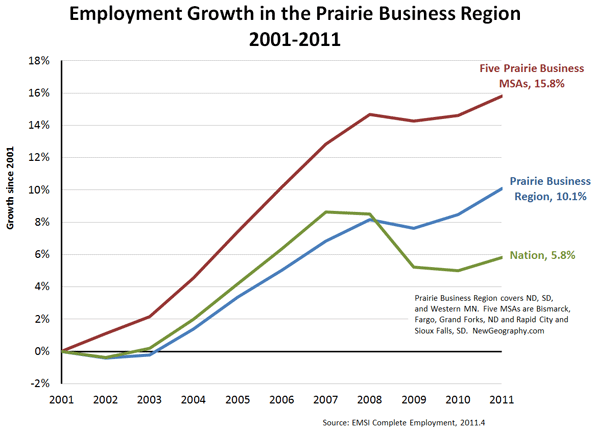
    The national media has credited the oil boom for the economic growth. The economic benefits of the energy boom have spread across the region, but there is more to the story. While the entire region trailed the nation in job growth until 2007, the region’s five largest metropolitan areas – Bismarck, Grand Forks, Fargo, Sioux Falls and Rapid City – were well ahead of the nation through the entire decade. Now containing 39 percent of the regional jobs, these five metropolitan areas beat the nation in job growth over the decade by 10 points, 15.8 to 5.8 percent.

    It’s not just growth in retail and food service jobs. Over the past decade the five metropolitan areas added 8,000 jobs in professional, technical, and scientific services, nearly 18,000 in health care, and 8,000 in finance, with each sector paying roughly $50,000 per year. The region also added 1,500 jobs at management offices and corporate headquarters making an average of $80,000 per year. It’s time that parents in our region stop telling their kids, “you need to leave the state to find a good job.” We need to improve efforts to help students and displaced workers understand the emerging options available in the region.

    The Prairie Business region has also become a growth center for science, math, engineering and computer occupations, adding nearly 18 percent to its technical workforce in the past decade, compared to just 3.6 percent growth in the rest of the nation. The growth rate in the five metropolitan areas was more than 27 percent. Some of the most in-demand jobs include industrial engineers (91 openings), mechanical engineers (87), geological engineers (52), petroleum engineers (50) and geoscientists (45). A new program for petroleum engineers at the University of North Dakota School of Engineering and Mines may help address the shortages in these fields.

    This strong growth in engineering and technical jobs is tempered somewhat because the region still lags the nation in these occupations. The biggest gaps are in bachelor’s degree level information technology and software fields, where the region trails the nation by 25 to 40 percent in many occupations. While the region’s high growth rates are encouraging, there is still plenty of ground to make up. At the same time the region is highly concentrated in many two year level technical jobs, creating a solid foundation for technical industries to build on.

    The region’s manufacturing economy was hit hardest by the recent recession, but was booming in the six years prior and is now recovering. In demand production occupations include welders (677 openings), assemblers (604), supervisors (194), machinists (156), computer-controlled machine tool operators (107), and engine assemblers (88).

    Across the region, 52 of the 152 counties hold an above average number of production jobs. Hot spots in the region include Jerauld, Yankton and Brookings counties in South Dakota; Roseau, Nobles and Kandiyohi in Minnesota; and Sargent and Richland in North Dakota.

    Workforce and economic development agencies, educators and trainers, and the business community need to continue to actively collaborate to share information and create partnerships across state lines. Private businesses must be open to working with training and placement agencies to communicate their needs, and regional governments must be open to creating more flexible funding sources for specialized training. Educational institutions are beginning to use the ample labor market data available to tailor programs to fit the need of the region’s economy.

    Ultimately, the talent narrative in the region needs to shift away from “retaining our young people” towards recruitment of young families. Demographic data confirms the greatest shortage across the region is those age 35 – 44, and employers are reporting troubles recruiting mid-career professionals. Migration data shows that the net loss from North and South Dakota to the Minneapolis region has stopped in the past two years. The Prairie Business region is showing signs of turning the economic and demographic corner. It is now time to act to sustain the region’s long-term future.

    This piece originally appeared in Prairie Business Magazine.

    Mark Schill is Vice President of Research at Praxis Strategy Group, an economic development and research firm working with communities and states to improve their economies. He is Managing Editor of NewGeography.

    Fargo photo by David Kohlmeyer.

  • The Sorry State of American Transport

    We constantly read about the infrastructure crisis in America. I’ll have more to say on this at a future date, but it is pretty clear that we need to spend more money in a whole lot of areas: airports, roads and bridges, public transportation, and more.

    Yet it’s very easy to see that so much of what ails transport has nothing to do with a lack of funds and everything to do with a lack of will. I took a train ride on the Northeast corridor last week that really drove it home to me.

    Start with the sorry state of Penn Station in New York City, America’s busiest train station. (In fact, it’s the busiest transportation facility of any type in the United States, if Wikipedia can be believed). Yes, the place is a depressing underground dump. Yes, there used to be a glorious train station there that was demolished in the 1960s. Yes, we probably need to invest many billions in upgrades.

    Yet is it a lack of funds that make the three agencies that call it home – Amtrak, New Jersey Transit, and the Long Island Railroad – act as though the others don’t exist? The three railroads have completely separate ticketing areas, signage systems, etc. This is hardly the only case in America. For some reason, Amtrak seems to despise sharing ticket agents with other carriers. There are separate windows for Amtrak and commuter lines everywhere I’ve been. Given that many journeys include both commuter and inter-city segments, this seems crazy. If you can’t have integrated ticketing (and actually, I don’t see why you can’t), at least you should be able to have a single agent help you.

    The worst example of this I know is in Providence, where Amtrak monopolizes the four ticket windows. If you want to buy an MBTA T ticket, you have to go to a cafe next door. This tiny little coffee shop found a way to sell both pastries and train tickets (albeit from separate registers), so why can’t Amtrak figure out how to sell two kinds of tickets?

    Also, as near as I can tell, there’s no way to actually get your Amtrak ticket online. You can book a reservation, but then you need to get a physical ticket printed at the station, either from a kiosk or an agent. (If there’s a way to avoid this, please let me know).

    I decided to get my ticket at the window. The line was very short and I was early in any case. When I got there, some guy with his kids was at the window screaming at the agent about a problem with their tickets. I chalked this up to one of those cases where the frustrations of travel just cause somebody to snap. But then as I walked up to the window, the person next to me was also having a similar problem with their ticket and was having an animated discussion with an agent who didn’t seem to care. Fortunately, I had no such issues, but the agent I had to talk to was extremely surly and kept asking me to repeat myself over and over. Who would want to put themselves through such an experience? Customer service is clearly something that should also be within Amtrak’s control.

    Amtrak markets themselves as having wi-fi. But on the train itself, as anyone who has ridden the NEC knows, the wi-fi is basically unusable. How much capital investment would it take to get working wi-fi?

    In short, though the facilities can somewhat be excused as resulting from insufficient capital funding and bad decisions decades ago, there’s so much that could be done right now to upgrade the passenger experience it’s not even funny.

    It’s the same with airports. While a few American cities like Indianapolis and Detroit have upgraded their terminals, too many key gateways remain depressingly dreary and non-functional. While some overseas places like Heathrow certainly would give any American airport a run for its money in the Hall of Shame, the general experience of flying to someplace like Madrid, Singapore, or Tokyo is like night and day versus the US.

    Key among the worst offenders again is New York City, especially LaGuardia. Matt Chaban at the New York Observer recently wrote a piece that is a good overview of the depressing state: “Terminal Condition – How New York’s Airports Crashed and Burned.”

    This is certainly not news to anyone who has flown to New York. But again, the vast billions it would take to replace these decrepit facilities is only part of the problem. Nobody forces America to put its passengers through the “TSA experience.” Last time I flew I was delayed at security while agents patted down some guy that looked like he was around 85 years old who apparently hadn’t stripped down quite far enough to go through the full body scanner. Somehow other advanced nations manage to run safe air travel systems without resorting to this.

    While we are waiting around for funding issues to be resolved, wouldn’t it be nice if our governments and various travel companies actually focused on fixing some of these straightforward problems with coordination, ticketing, and customer service? It’s hard to take their capital requests seriously if they aren’t going to do what they can now.

    Aaron M. Renn is an independent writer on urban affairs based in the Midwest. His writings appear at The Urbanophile.

    Photo By Kyle Gradinger, Amtrak Keystone Snowstorm I. Amtrak AEM-7 locomotive 904 leads a Keystone Corridor train through the snow in Rebel Hill, King of Prussia, PA.