Category: Policy

  • Is Suburbia Doomed? Not So Fast.

    This past weekend the New York Times devoted two big op-eds to the decline of the suburb. In one, new urban theorist Chris Leinberger said that Americans were increasingly abandoning “fringe suburbs” for dense, transit-oriented urban areas. In the other, UC Berkeley professor Louise Mozingo called for the demise of the “suburban office building” and the adoption of policies that will drive jobs away from the fringe and back to the urban core.

    Perhaps no theology more grips the nation’s mainstream media — and the planning community — more than the notion of inevitable suburban decline. The Obama administration’s housing secretary, Shaun Donavan, recently claimed, “We’ve reached the limits of suburban development: People are beginning to vote with their feet and come back to the central cities.”

    Yet repeating a mantra incessantly does not make it true. Indeed, any analysis of the 2010 U.S. Census would make perfectly clear that rather than heading for density, Americans are voting with their feet in the opposite direction: toward the outer sections of the metropolis and to smaller, less dense cities. During the 2000s, the Census shows, just 8.6% of the population growth in metropolitan areas with more than 1 million people took place in the core cities; the rest took place in the suburbs. That 8.6% represents a decline from the 1990s, when the figure was 15.4%.

    Nor are Americans abandoning their basic attraction for single-family dwellings or automobile commuting. Over the past decade, single-family houses grew far more than either multifamily or attached homes, accounting for nearly 80% of all the new households in the 51 largest cities. And — contrary to the image of suburban desolation — detached housing retains a significantly lower vacancy rate than the multi-unit sector, which has also suffered a higher growth in vacancies even the crash.

    Similarly, notes demographer Wendell Cox, despite a 45% boost in gas prices, the country gained almost 8 million lone auto commuters in the past 10 years. Transit ridership, while up slightly, is still stuck at the 1990 figure of 5%, while the number of home commuters grew roughly six times as quickly.

    In the past decade, suburbia extended its reach, even around the greatest, densest and most celebrated cities. New York grew faster than most older cities, with 29% of its growth taking place in five boroughs, but that’s still a lot lower than the 46% of growth they accounted for in the 1990s. In Chicago, the suburban trend was even greater. The outer suburbs and exurbs gained over a half million people while the inner suburbs stagnated and the urban core, the Windy City, lost some 200, 000 people.

    Rather than flee to density, the Census showed a population shift from more dense to less dense places. The top ten population gainers among metropolitan areas — growing by 20%, twice the national average, or more — are the low-density Las Vegas, Raleigh, Austin, Charlotte, Riverside–San Bernardino, Orlando, Phoenix, Houston, San Antonio and Atlanta. By contrast, many of the densest metropolitan areas — including San Francisco, Los Angeles, Philadelphia, Boston and New York — grew at rates half the national average or less.

    It turns out that while urban land owners, planners and pundits love density, people for the most part continue to prefer space, if they can afford it. No amount of spinmeistering can change that basic fact, at least according to trends of past decade.

    But what about the future? Some more reasoned new urbanists, like Leinberger, hope that the market will change the dynamic and spur the long-awaited shift into dense, more urban cores.

    Density fans point to the very real high foreclosure rates in some peripheral communities such as those that surround Los Angeles or Las Vegas. Yet these areas also have been hard-hit by recession — in large part they consist of aspiring, working class people who bought late in the cycle. Yet, after every recession in the past, often after being written off for dead, areas like Riverside-San Bernardino, Calif., have tended to recover with the economy.

    Less friendly to the meme of density’s manifest destiny has been a simultaneous meltdown in the urban condo market. Massive reductions in condo prices of as much as 50% or more have particularly hurt the areas around Miami, Portland, Chicago and Atlanta. There are open holes, empty storefronts, and abandoned projects in downtowns across the country that, if laid flat, would appear as desperate as the foreclosure ravaged fringe areas.

    In many other cases, the prices never dropped because the owners gave up selling condos and started renting them, often to a far lower demographic (such as students) than the much anticipated “down-shifting” boomers. Contrary to one of the most oft-cited urban legends by Leinberger and his cohorts, demographics do not necessarily favor density. Most empty-nesters and retirees, notes former Del Webb Vice President of Development Peter Verdoon, prefer not just outer suburbs but increasingly “small towns and rural areas” Dense cities, he notes, are a relatively rare choice for those seeking a new locale for their golden years.

    Verdoon’s assertion is borne out by our own analysis of the 2010 Census. Generally speaking, aging boomers tended to move out of dense urban cores, and to a lesser extent, even the suburbs. If they moved anywhere, they were headed further out in metropolis towards the more rural area. Among cities the biggest beneficiaries have been low-density cities in the Southwest and southern locales such as Charlotte, Raleigh and Austin.

    What about the other big demographic, the millennials? Like previous generations of urbanists, the current crop mistake a totally understandable interest in cities among post-adolescents. Yet when the research firm Frank Magid asked millennials what made up their “ideal” locale, a strong plurality opted for suburbs — far more than was the case in earlier generations.

    Generational analysts Morley Winograd and Mike Hais note that older millennials — those now entering their 30s — are as interested in homeownership as previous generations. This works strongly in favor of suburbs since they tend to be more affordable and, for the most part, offer safer streets, better parks and schools.

    In the short run, suburbia’s future, like that of much of real estate market, depends on the economy. But even here trends may be different than the density lobby suggests. As housing prices fall, the much ballyhooed trend toward a “rentership” society may weaken. Already in many markets such as Atlanta, Las Vegas and Minneapolis and Phoenix it is cheaper to own than rent, something that favors lower-density suburban neighborhoods.

    Longer term, of course, suburbs, even on the fringe, will change as growth restarts. Cities here and around the world tend to expand outward, and over time the definition of the fringe changes. To be sure, some fringe communities, particularly in highly regulated and economically regressive areas, could indeed disappear; but many others, particularly in the faster growing parts of the country, will reboot themselves.

    They will become, as the inner suburbs already have, more diverse with many working at home or taking shorter trips to their place of work They will become less bedrooms of the core city but more self-contained and “village like,” with shopping streets and cultural amenities near what will still be a landscape dominated primarily by single-family houses.

    In fact the media reports about the “death” of fringe suburbs seem to be more a matter of wishful thinking than fact. If the new urbanists want to do something useful, they might apply themselves by helping these peripheral places of aspiration evolve successfully. That’s far more constructive than endlessly insisting on — or trying to legislate — their inevitable demise.

    This piece first appeared at Forbes.com.

    Joel Kotkin is executive editor of NewGeography.com and is a distinguished presidential fellow in urban futures at Chapman University, and an adjunct fellow of the Legatum Institute in London. He is author of The City: A Global History. His newest book is The Next Hundred Million: America in 2050, released in February, 2010.
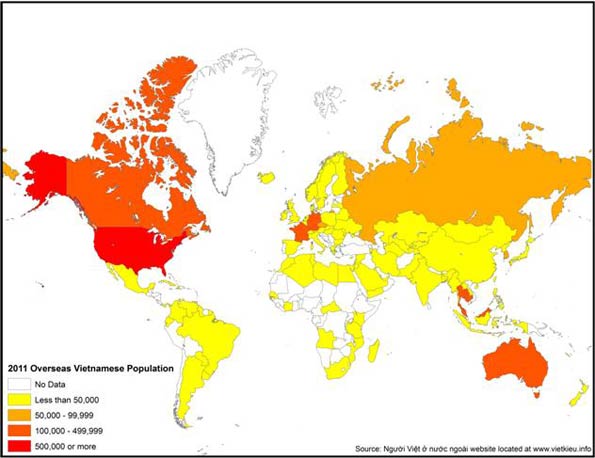
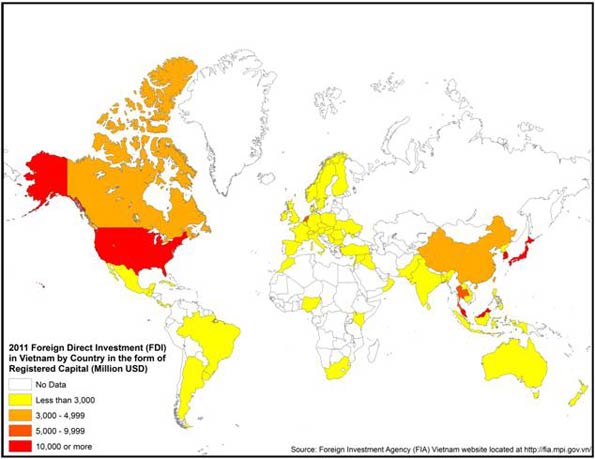
    Photo courtesy of BigStockPhoto.com.

  • Good Morning, Vietnam

    While many experts are pronouncing the demise of the American era and the rise of China, other East Asian nations complicate the picture. As America continues to participate and extend its influence in the dynamic Asian market, there may be no more suitable ally than its old antagonist, Vietnam.

    In some senses, Vietnam has emerged as the un-China, a large, fast-growing country that provides an alternative for American companies seeking to tap the dynamism of East Asia but without enhancing the power of a potentially devastating global competitor. With 86 million people, Vietnam may not offer as large a market, but it has strong historical, cultural, and strategic reasons to lean towards America.

    Why an un-China?

    Vietnam has deep historical reasons for wanting to link closely with the United States and its other allies, such as Singapore, Thailand, South Korea, and Japan. Some of this has to do with the country’s unique history. While France, Japan, and the United States were at times deeply and bloodily entangled with the country, by far the biggest threat to Vietnam has always been its looming neighbor to the north.

    France, Japan, and the United States intervened in Vietnam for comparatively short periods of time. In contrast, China has had an unrelenting interest in Vietnam and its 2,140-mile coastline ever since its nearly thousand-year rule over the country from 111 BC to 938 AD. The two countries have been embroiled in numerous territorial disputes over the years, with the most recent one involving the South China Sea, which has important shipping routes and is believed to contain rich oil and gas deposits.

    Many Vietnamese see some of their former colonialist or “imperialist” powers as necessary allies in protecting themselves from escalating territorial threats from China. Opening Cam Ranh Bay naval base to foreign warships, notably to those from the United States, is an illustrative example of Vietnam’s defensive strategy during the unfolding geopolitical competition.

    Amid the maritime tension between China and Vietnam regarding the oil-rich Spratly and Paracel islands in the South China Sea, the United States in 2010 successfully negotiated with Vietnam to reopen Cam Ranh Bay to foreign warships besides Russia. The bay will take approximately three years to rebuild and the primary foreign visitor is expected to be the United States.  “The regular presence of U.S. warships at Cam Ranh Bay might make China think twice about using coercive military diplomacy against Vietnam,” noted Ian Storey, a fellow at the Institute of Southeast Asian Studies in Singapore.

    The rise of the diaspora

    Perhaps the greatest thing tying America to Vietnam is people. When the Communist government overran the former South Vietnam in 1975, several million Vietnamese fled the country. The Vietnamese eventually settled in 101 different countries and territories throughout the world, with the majority of them heading to the United States, France, Canada, and Australia. There are currently about 4 million Vietnamese living outside of Vietnam. Some settled in the former colonial ruler, France, and others in Australia, Canada, and Singapore. But the bulk—roughly 40 percent—moved to the United States, which is now by far the largest settlement of overseas Vietnamese. About 2 million Vietnamese are estimated to live in the United States (see map of “Overseas Vietnamese”).

    Overseas Vietnamese Population

    Hostile to the Communist regime, the overseas Vietnamese population turned away from their homeland , focusing instead on building new lives in their host countries. They flourished particularly in the United States, clustering in places such as Orange County and San Jose, California, as well as Houston and New Orleans. In 2009, they were enjoying levels of prosperity comparable to the national average, with a median family income of $59,129 and 64.6 percent owning homes. Vietnamese are also three times more likely to be in such fields as information technology, science, and engineering than other immigrants, and have one of the highest rates of naturalization—72.8 percent.

    Contact between this dynamic diaspora and the homeland was constrained by the two governments for decades. After the Vietnam War, the United States had placed a strict embargo against Vietnam and prohibited any political or economic relations between the two countries. The Vietnamese refugees who sought to reconnect with their relatives in Vietnam had to rely on neutral third-party countries to act as an intermediary in sending various goods and money back to needy family members.

    For their part, the Communist regime conducted stringent inspections of packages and letters sent to Vietnam. The Vietnamese government also imposed heavy taxation on financial remittances, which discouraged money transfers through official channels.

    Desperate to help close relatives left behind in their impoverished homeland, many Vietnamese Americans were forced to invent creative alternatives to formal remittances. According to Yen Do, the creator of Nguoi Viet, the most prominent Vietnamese newspaper in the United States, overseas Vietnamese would hide American dollars inside pill bottles sent through either French or Canadian shipping companies.

    With tens of millions of Vietnamese starving in Vietnam despite the clandestine remittances, the Vietnamese government eventually realized that they had to either change their economic strategy or suffer the debilitating consequences of a continually declining economy.

    Remittances have played a critical role in reviving the economy. Last year alone the diaspora sent an estimated $7.2 billion into the country, according to the World Bank. This comprised about 7 percent of Vietnam’s overall GDP in 2010. A 2010 study conducted by Wade Donald Pfau and Giang Thanh Long revealed that 57.7 percent of all international remittances being sent to Vietnam in 1997-1998 came from the United States.

    The growing symbiosis of Vietnam with its diaspora, particularly in the United States, will shape the rapid development of the country. Nowhere will this impact be felt more than in major cities such as Hanoi, Danang, and especially Ho Chi Minh City (the former Saigon). “We are seeing more of the expatriates here, and they are bringing management skill and capital through their family networks,” notes economist Le Dang. “They are a key part of the changes here.”

    The rise of a new dragon

    Aware of the enormous progress being made in China with its liberalization, in 1986 the Vietnamese government made the crucial decision to begin the Renovation Process—also known as Doi Moi—and reform the closed communist economy. It was the first official step that Vietnam had made towards opening its economic doors to the rest of the world.

    With the collapse of the Berlin Wall in 1989 and the subsequent fall of other communist powers in the world, the United States eventually responded to the improved political relations with Vietnam by lifting the 20-year-old embargo against its former foe in 1995. This put Vietnam on the fast track toward economic liberalization and ultimately helped it transition from a developing country to a middle-income country with a GDP per capita of more than $1,000. The International Monetary Fund estimated Vietnam’s GDP per capita as $1,155 for the 2010 fiscal year.

    Yet, in sharp contrast to China—where the largest sources of capital came from Chinese diaspora havens such Hong Kong, Taiwan, and Singapore—most of the money that revived the economy came from outside Southeast Asia. In particular, the biggest investor turned out to be the old arch-enemy, the United States, followed by another former “imperialist” power, Japan. China, now the world’s fourth-largest foreign investor, lagged behind much smaller regional economies, including South Korea, Thailand, and Malaysia, as well as the Netherlands (see map of “FDI by Registered Capital”).

    FDI in Vietnam by Country

    This is all the more remarkable given China’s huge expansion of investment with other developing countries. Over the past decade, China has expanded its capital flows both into other parts of Southeast Asia, including Laos and other Mekong Delta nations, as well as resource rich regions of the Middle East, Latin America, and Australia. Yet Vietnam, with its rich agriculture, fisheries, and developing energy industry, has stayed largely outside the emerging Sinosphere.

    Trade winds

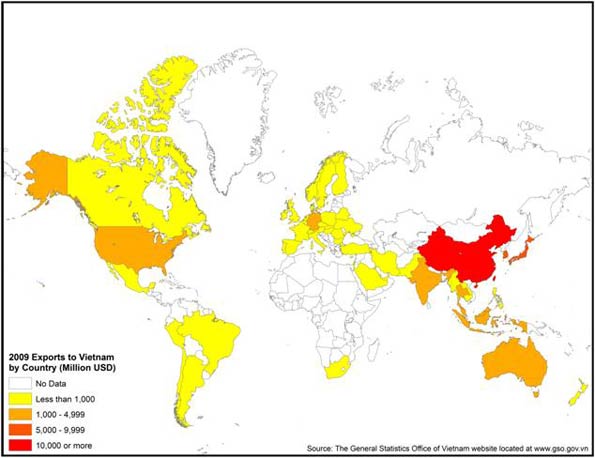
    The tilt in investment is also borne out by trade patterns. Vietnam has seen, like most countries, a flood of Chinese goods, but it has also developed a strong appetite for exports from other countries, notably Japan, South Korea, and the United States (see map of “Exports to Vietnam”).

    Exports to Vietnam by Country

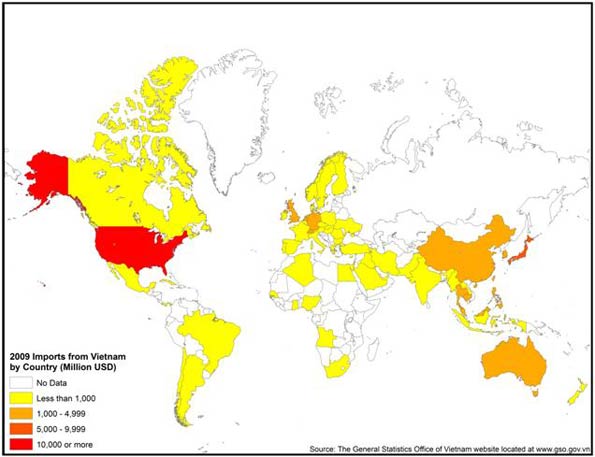
    But perhaps the best measure of Vietnam’s emergence as an un-China can be seen in its own burgeoning exports, which increased from about $5 billion to over $70 billion over the past three decades. The United States has emerged as by far Vietnam’s largest market, with more than $10 billion in annual trade. Japan ranked a strong second, with China lagging behind.

    This is all the more remarkable given that Vietnam possesses many things China needs and the two countries share both a border and obedience, at least nominally, to the same ideology. Vietnam seems to be making a choice to diversify itself away from China and avoid the semi-colonial status that many of China’s neighbors—notably Cambodia, Laos, and Myanmar—seem to have tacitly accepted (see map of “Vietnamese Exports”).

    Imports from Vietnam by Country

    This rising engagement with the global economy has brought great benefits. According to the CIA World Factbook, the country’s poverty rate has dropped from 75 percent in the 1980s to 10.6 percent in 2010. In terms of economic output, a brief on Vietnam by the World Bank reported that between 1995 and 2005 real GDP increased by 7.3 percent annually and per capita income by 6.2 percent annually.

    Why Vietnam matters to America

    Hanoi today—and even more so Ho Chi Minh City, the former Saigon—recalls China in the 1980s. But there are crucial differences. State-owned companies in Vietnam lack the depth and critical mass of their Chinese counterparts and are thus less likely to pose an immediate competitive threat to the United States and other foreign countries.

    Still, this is clearly a country on the way up. Many rural residents—still roughly 70 percent of the population—continue to pour into Hanoi and other cities, but without the same desperation that characterizes, for example, people moving from Bihar to New Delhi or Mumbai. There is nothing of the kind of criminal elements that fester in the favelas of Brazil or Mexico City’s colonias.

    More important still are the “animal spirits” of the place. Adam Smith—or Jane Jacobs for that matter—would enjoy the  very un-socialistic frenzy as motorcyclists barrel down the streets like possessed demons, with little regard to walking lanes or lights. Everyone not on the government payroll seems to be hustling something, or looking to. It reminds one of the Vietnamese outposts in Orange County, California, or in Los Angeles’ Chinatown, which is now largely dominated by Chinese from Vietnam.

    Le Dang Doanh, one of the architects of Doi Moi, estimates that the private sector now accounts for 40 percent of the country’s GDP, up from virtually zero. But Le Dang also estimated that as much as 20 percent more occurs in the “underground” economy where cash—particularly U.S. dollars—is king.

    “You see firms with as many as 300 workers that are not registered,” the sprightly, bespectacled 69-year-old economist explains. “The motive force is underground. You walk along the street. I followed an electrical cable once and it led me to a factory with 27 workers making Honda parts and it was totally off the system.”

    This energy is in part a product of demographics. Most of the people you see in these unofficial workshops are in their 20s and 30s. And unlike what you see in China, these workers also have children. Vietnam may be modernizing and getting richer, but it also enjoys a growing population.

    These trends have enormous long-term consequences. According to the CIA World Factbook, 69 percent of the approximately 86 million people in Vietnam are currently between the working ages of 15 and 64. In the next four decades the Vietnamese workforce is expected to expand rapidly; at the same time, it will contract dramatically in Japan, Taiwan, Singapore, South Korea, and China. As these countries amble into what demographer Nick Eberstadt has called a “fertility implosion” that will lead to a rapid aging of the workforce, Vietnam will remain relatively young.

    Already this enormous source of cheap labor has compelled investors around the world to look toward Vietnam as a way to simultaneously cut costs and increase profits. But more important still is the rapid growth of education. The country enjoys nearly 95 percent literacy.

    This combination of a growing and skilled workforce represents the same combination of factors that previously led to rapid growth in other Asian countries, from Japan in the 1960s to South Korea and Taiwan in the 1980s, and China more recently. One local investment house, Indochina Capital, estimates that by 2050 Vietnam’s economy will be the world’s 14th-largest—ahead of Canada, Italy, South Korea, and Spain.

    Combined with the strong human ties and its aversion to domineering neighbors, these factors suggest that Vietnam may well prove itself as valuable an ally and trade partner to the United States as it was once an irrepressible enemy.

    This piece originally appeared at The American.

    Joel Kotkin is executive editor of NewGeography.com and is a distinguished presidential fellow in urban futures at Chapman University, and an adjunct fellow of the Legatum Institute in London. He is author of The City: A Global History. His newest book is The Next Hundred Million: America in 2050, released in February, 2010.
    Jane Le Skaife is a doctoral candidate at the University of California, Davis. She is currently conducting her dissertation research involving a cross-national comparison of Vietnamese refugees in France and the United States.

    Accompanying maps were prepared for Legatum Institute by Ali Modarres, chairman of the Geography Department, California State University at Los Angeles.

    Photo courtesy of BigStockPhoto.com

    .

  • Mass Transit: Could Raising Fares Increase Ridership?

    Conventional wisdom dictates that keeping transit fares as low as possible will promote high ridership levels. That isn’t entirely incorrect. Holding all else constant, raising fares would have a negative impact on ridership. But allowing the market to set transit fares, when coupled with a number of key reforms could actually increase transit ridership, even if prices increase. In order to implement these reforms, we would need to purge from our minds the idea that public transit is a welfare service that ought to be virtually free in order to accommodate the poor. Concern about poverty should drive welfare policy, not transit policy. Persistent efforts to keep public transit fares as low as possible are a big part of the reason that public transit ridership in North America has hit record lows. To increase ridership, transit agencies have to convince people who can afford to drive that transit is a better option. Convenience, and not lower prices, is the key.

    There are three basic reasons that private automobiles have virtually crowded out transit. First, private automobiles are inherently more convenient for a large segment of the population. Transit routes are naturally limited to well-traveled corridors, which are often slower because of wait and stop times. On the other hand, you can get into your car and immediately take the most efficient route to your destination.

    The second factor is free roads. While people do pay for roads, they don’t pay for using specific roads at specific times. Gas taxes go into general revenues, and road construction and repair isn’t directly connected to usage. As a result, a large percentage of roads are subsidized by travelers who use a small percentage of highly traveled routes. Similarly, drivers don’t pay more during peak times than non-peak times. They instead pay with their time, by waiting in traffic.

    The third factor is that the market dictates private automobile sales. This is important because automobile companies and dealerships have an incentive to keep prices competitive while selling a high quality product. It also ensures that there are a multitude of different types of automobiles, and differing finance schemes and secondary markets tailored to a range of needs. The private sector is great at marketing things to people; government isn’t.

    While public transit can never be as flexible as private automobiles, some of the automobile’s advantages can be reduced. Road tolls and congestion pricing ought to be implemented where practical. Ironically, offsetting these new fees by reducing the gas tax would actually also be beneficial for transit services. After all, the only reason many impractical roads are built is that they are financed out of general revenue. If roads were primarily financed by those who used them, more funding would go to highly traveled urban roads, and less would go toward subsidizing sprawl.

    Here’s the controversial aspect of the solution: Transit should operate on a for profit basis and its prices should closely reflect market forces — even if it means that transit fares increase.

    Mass transit has one major advantage: where there is sufficient demand, transit is inherently cheaper than private automobile usage because the costs are spread over many people, making the per person cost lower. That’s why most people fly with commercial airlines instead of chartering private jets, for example. But keeping the price too low reduces the ability of transit service to provide more routes. And this is important. While there is a segment of the population who are stuck with public transit no matter how inconvenient it is, most people won’t ditch their cars unless they can get to their destinations relatively quickly. And it may not be economical for a transit system to get them to many of those places for $2.25.

    A flat price structure subsidizes inefficient routes with efficient ones. But what if transit services charged the full cost for less efficient routes? While charging more for less popular routes may seem like it would reduce ridership, it wouldn’t. If people knew that there were many additional routes going to out-of-the-way locations that they don’t ordinarily frequent, they would still positively factor it into their calculation of whether or not they need a car. After all, paying $5 to get to an out of the way destination occasionally is still cheaper than getting a cab, and can often be cheaper than the cost of driving. Transit systems have higher ridership in major centres than in small centres, even when the fares are high. Transit is not only cheaper than driving in dense cities, it’s also equally or more convenient.

    But just allowing prices to fluctuate isn’t enough. For a price system to function properly there needs to be an incentive to keep prices as low as possible. Public monopolies don’t have this incentive. Furthermore, there needs to be competition to ensure high levels of service. The reason that air travel service is so high quality and cheap is because it is private, not public.

    The thought of privately delivered public transit will no doubt turn some people off, especially public sector employees. And simply removing government from the transit business isn’t necessarily the best solution. Instead, municipal transit services should be turned into transit commissions that coordinate and contract for transit from competing companies. Transit companies would bid on routes, and pay the city a fixed cost for the right to service each route based on a competitive auction.

    For less cost efficient routes, a city could even offer a small subsidy per rider, should no transit company enter a bid. Whichever company would be willing to service that route at the lowest subsidy level would win. This would maintain downward pressure on costs. But it would be important that the transit commission use this as a last resort. Otherwise it could undermine the competitive market process by creating the incentive for companies not to bid on many marginal routes until a subsidy was offered.

    Collecting variable rates for trains is simple, but it would be more difficult for buses. One method would be to have buses classified as local, express, or commuter, for instance. Each would charge a different rate. An automated payment system could be installed where riders swiped their cards on the way in and out, as they do on the Washington DC Metro, to calculate the rate.

    Changing the operating and pricing structure wouldn’t alter the way that people use transit services. Transit vehicles would still work on a coordinated schedule, and collect fees from riders as they always have. What would change is that the competing companies would have an incentive to keep operating costs lower, and to provide more routes. They also would have to meet performance guidelines monitored by the city, or face fines. What would change is the philosophy of transit companies. They would be out to make a profit.

    This may seem like a radical departure, but consider that London, England, contracts out its bus service. If one of the world’s busiest cities can co-ordinate a public-private partnership of this magnitude, there is no reason smaller cities couldn’t do the same. The key is to create the right incentives and institutions. The current model of treating transit as a welfare service has failed. It is time to make transit the first choice for commuters, not the last.

    Steve Lafleur is a Policy Analyst with the Frontier Centre for Public Policy.

    Image from BigStockPhoto.com: A metro bus in Madison, Wisconsin.

  • Social Market Housing for the USA: Dream or Nightmare?

    Imagine a future America where the home ownership rate climbs from the current 65%1 to 87%2.  Libertarians as well as many social democrats would be cheering.  Imagine that this rate was achieved by the state itself acting as the builder of 88%3 of the housing.  Imagine also that the state imposes rules on home purchases to favor first time buyers and young families. “Progressives”, increasingly tilted towards the unmarried and childless, would bristile.  Imagine racial diversity rules that restrict who you can sell your home to. Time for libertarians to shudder.   

    Most Americans would probably say such a concept is “Utopian” but serious policy makers should reflect that the word “Utopia” literally means “nowhere”. But Social Market Housing is alive and well in Singapore. 

    For Americans living in the hottest real estate markets, the USA is very far from the ideal of a Property Owning Democracy.  At the time of the 2010 census three of New York City’s five boroughs had home ownership rates under 30% and in the Bronx it was under 20%4.   Though many US politicians support the concept of home ownership it has been declining since 1980 when it reached a peak of 68%5

    How have the Singaporeans achieved such high ownership rates despite having the richest economy in South East Asia?  Many factors come into play.  Singapore has an aggressive building program achieved through a public body – the Housing Development Board (HDB).   HDB apartments can only be sold to Singapore citizens and those with permanent resident status, so their prices cannot be inflated by foreign speculators. 

    The HDB also has eminent domain powers to claim land if it needs to.  Singapore’s version of social security is not inter-generational (unlike the USA where the current generation of workers pays for the last generation of retirees) but rather an elaborate system of forced saving by both workers and their employers.  Part of the compulsory savings can be used for a deposit on an HDB flat. Finally there is an elaborate system of price discounts on new HDB flats which is not only designed to favor first time buyers, but also young families and newlyweds. 

    There is even a category of ‘Executive Homes’ to retain managers in Singapore.  These may be larger apartments or semi-detached homes with gardens. 
    There is no problem with runaway maintenance fees.  HDB owners do not pay associations dues.  Their elevators are maintained through local real estate taxes so monthly costs are very predictable.  In the year 2010 the average Singaporean household paid $145 USD a month in property tax6
    .  This is less than the $216 average USD American Condo owners paid in condo fees at the time of the 2000 census.

    Some Americans might argue that this can only work because Asians are conformist and are culturally more receptive to rule-based systems.  I do find that South East Asians are reluctant to draw attention to themselves in public.  When I talk in a Starbucks with my normal New York speaking voice I sometimes look up and find myself orating to a group of open-mouthed onlookers (“I’m so sorry it’s the Tourette’s Syndrome – my shrink keeps forgetting to up my dosage.”)

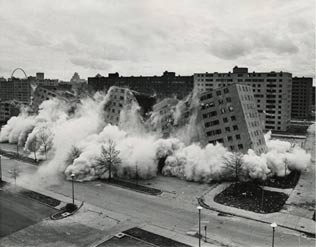
    Many US politicians recoil against the state as a real estate developer largely because tenanted housing projects have been such a magnet for social problems.  The St. Louis public housing scheme, Pruitt-Igoe, was eventually dynamited (see photo right7).  The author of “The Death and Life of Great American Cities”, Jane Jacobs, famously complained that the public housing projects took some mixed income neighborhoods which could have been viable and sealed their doom by concentrating too many low income and unemployed people in the same buildings. 
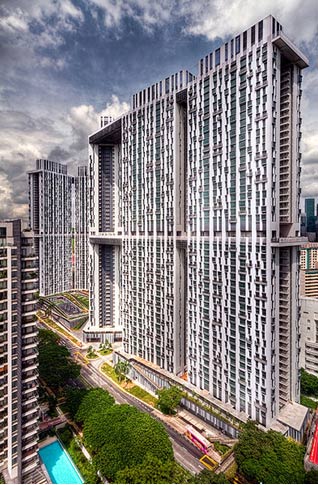
    Singapore’s HDB does act as a direct landlord for a very small number of people who meet a strict income ceiling (about $1160 USD a month8), however the low income tenants are spread thinly among owner occupiers. Income ghettoization is limited. My realtor tells me that one of the blocks in my own HDB estate is for tenants rather than owners but from the outside I cannot tell which building it is.  Another form of deliberate social mixing takes the form of racial quotas intended to prevent the formation of ethnic enclaves.  If the percentage of people in a given racial group has already met the national quota you can be blocked from selling or renting to a person in that category. Access to the more attractive and less attractive neighborhoods is thus shared out more equally.  This looks like a policy American cities should consider given that the 14th amendment, busing and affirmative action have yet to produce full integration. 

    One aspect of America’s public housing projects that particularly angered Jane Jacobs was the wholesale removal of small retailers.   In theory “The Projects” could have included small commercial spaces at the ground floor but generally public rental buildings in most of the US are considered to be danger zones where retailers fear to tread. 

    Typically the ground floor of HDB buildings is a void space where retailers can create businesses. Often they are left empty but sometimes the policy works well.  Near Singapore’s Clementi MRT train station many dozens of “mom and pop” stores are now sheltering under the HDB apartments; late night street life is vibrant.  When I ask Singaporeans to name a neighborhood that would be dangerous to go at night, nobody can think of one.  The country’s homicide rate would pose an absolute disaster for TV script writers.  You could not have a CSI series or Law and Order because Singapore would not be able to supply the requirement of one murder per week.  The homicide rate is currently about one tenth of the USA’s9.

    If she were alive today Jacobs might also criticize the HDB apartment blocks for excessive architectural uniformity.  She loved communities to have buildings with different age profiles.  But most of Singapore’s buildings are so new the option of preserving the old simply does not exist. Greater architectural variety is an attractive goal.  One Singaporean architect commented that they will really have the styles right with you can build an HDB block next to a private condominium and you cannot tell which is which (a sort of urban planning version of the Turing Test).  Local architects are point to a new HDB building, the Pinnacle at Duxton, as an example of a new look more comparable with private designs (pictured right).

    But would greater variety cause costs to escalate?  Observing new HDB construction it is possible to discern a very advanced form of modular building; entire concrete rooms are hoisted into the air at the end of a crane.  Certainly a wider range of designs could be achieved using the same building blocks.  Kids can make a huge variety of things with Lego.  The same cuboids could also make homes with gardens which are America’s preferred form of housing— a gift of an expansiveness impossible to achieve, except in dreams or by immigration, in Singapore.

    Is Social Market Housing a good model for the USA? Certainly there would be many objections but the ideal of home ownership is too often an American Dream that disappears into a distant future. Are we doing enough to create a Commonwealth with “Liberty and Justice for All?” When they say the Pledge of Allegiance we force or children to use the words “Indivisible” and “One Nation”.  Are we enough to make those words a reality?

    Philip Truscott is a Senior Lecturer at Singapore University of Technology and Design
    Notes:

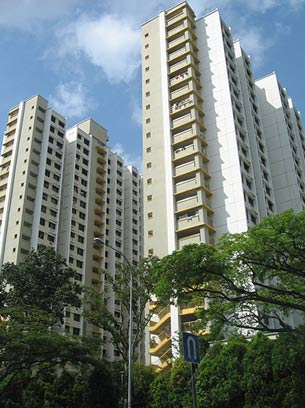
    Lead photo of HDB flats courtesy of BigStockPhoto.com. Other photo image files from  http://commons.wikimedia.org

    ———————————

     1 US Census Bureau, (2011), “Housing Characteristics: 2010”, Washington DC: Bureau of the Census. Accessed on 19/11/2011 from http://www.census.gov/prod/cen2010/briefs/c2010br-07.pdf

    2 SINGSTAT, (2011), “Statistics Singapore: Key Annual Indicators”, Singapore: Department of Statistics. Accessed on 19/11/2011 from <http://www.singstat.gov.sg/stats/keyind.html#hhld>.

    3 SINGSTAT, (2008), “Key Indicators of Residential Households”, Singapore: Department of Statistics, Accessed on 19/11/2011 from <http://www.singstat.gov.sg/stats/themes/people/hhldindicators.pdf>.

    4 US Census Bureau, (2011), “Housing Characteristics: 2010”, Washington DC: Bureau of the Census. Accessed on 19/11/2011 from <http://www.census.gov/prod/cen2010/briefs/c2010br-07.pdf>

    5 This is based on a cross-tabulation of the variables “ownership” and “year” from the IPUMS online data analysis system at this URL http://sda.usa.ipums.org/cgi-bin/sdaweb/hsda?harcsda+1850-2009

    6 Singapore Gross Property Tax Revenue from SINGSTAT, “Public Finance” at http://www.singstat.gov.sg/pubn/reference/yos11/statsT-publicfinance.pdf  The number of resident households has been taken from the Census of Population 2010 at <http://www.singstat.gov.sg/pubn/popn/c2010sr2/t20-25.pdf>

    7 Photo public domain: http://commons.wikimedia.org/wiki/File:Pruitt-Igoe-collapses.jpg

    8 HDB, (2011), “Homes for All”, Singapore: Housing Development Board.  Accessed on 19/11/2011 from < http://www.hdb.gov.sg/fi10/fi10221p.nsf/Attachment/AR0405/$file/home5_frameset.html>.

    9 UNODC, (2011), “Homicide level for 2010, or latest available year”, Vienna: UN Office on Drugs and Crime, accessed on 17/11/2011 from < www.unodc.org/documents/data-and-analysis/statistics/Homicide/Homicide_level.xlsx >.

  • Do Standardized Tests Raise Dropout Rates?

    The No Child Left Behind Act became law in 2002. Among other things, it required standardized testing of students, beginning in 2003. The scores are used to evaluate the quality of the schools.

    It sounds reasonable. Congress certainly thought so. It was co-authored in the Senate by Edward Kennedy (D-MA) and Judd Gregg (R-NH), while John Boehner (R-OH) and George Miller (D-CA) introduced it into the House. It passed both houses by huge bi-partisan majorities, 91-8 in the Senate and 384-45 in the House.

    The Act’s passage also marked the low point in California’s High School dropout rate.

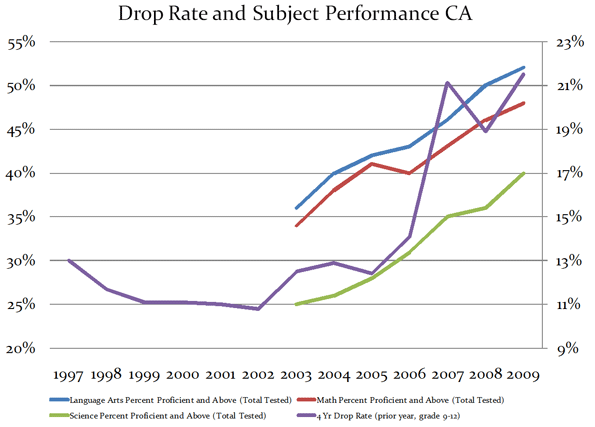
    In 2002, California’s High School dropout rate had been declining for several years. After the act’s passage, the dropout rate trend experienced an unprecedented reversal. What had been a declining trend became an increasing trend, one that continues today. After bottoming out at less than 11 percent in 2002, California’s High School dropout rate is now approaching 22 percent.

    The costs of dropouts are enormous, both for the students who leave school and for society. A person without a High School education is economically crippled. For all but the very exceptional few, dropping out of High School is a sentence to a lifetime of poverty and drudgery. For many dropouts, a lifetime of poverty and drudgery is the best possible outcome. Far too many will be involved in drug abuse, dysfunctional or violent relationships, teenage pregnancies, and crime.

    The costs to society are large. They include losses to crime, and the direct costs of subsidies, social programs, healthcare, prisons, and law enforcement. Those costs may be exceeded by the dropout’s output deficiency, that is, the difference between what the dropout would have produced with a decent education and what he or she actually produces.

    One way to improve standardized test scores is to increase the retention of tested topics by the students. An easier way is to prohibit students who would perform poorly from taking the test. Since all students have to take the test, this means converting poorly-performing students into non-students, letting them drop out.

    It looks to me like California’s educational establishment has opted for the easy way.

    On the chart below, the purple line shows California’s dropout rate from 1997 through 2009; you can see the percentages on the right-hand side of the chart. The other lines show the percentage — on the left side of the chart — of California’s students who passed the standardized tests for Math, Language, and Science. California’s passing percentage in each field has increased lockstep as dropouts increased.

    It is worse than that, though. The percentage of students passing the standardized tests has increased by about 15 percent, on average, while the percentage of students dropping out has just about doubled. That’s an extraordinarily expensive improvement.

    Did the schools follow this strategy deliberately? You can’t rule it out. People react to incentives, and the Act provides an incentive to abandon those who will likely perform poorly on the tests. Teachers will probably object to that, but we have no reason to believe that they should somehow be different that most people and ignore the incentives. Besides, we’ve already seen examples of teachers and administrators cheating on these tests.

    Teachers assert that the solution to all of No Child Left Behind problems is to abandon it. The other solution, of course, is to fix the incentives. The way to do that would be to assign the schools a huge financial penalty for dropouts. Teachers and administrators would scream. They would tell us that dropouts result from problems at home and socioeconomic conditions.

    No doubt, many students have terrible home conditions that put these children at a huge disadvantage, but those are exactly the children that we should be giving the most attention. A lousy home environment doesn’t explain the sudden increase in dropouts. These issues have been with us for a very long time. I took my first college economics class, The Economics of Poverty, in the 1969-1970 school year. There is nothing about poverty today that we didn’t discuss in that class, except that the returns to education have increased dramatically since then.

    Failure to educate disadvantaged children guarantees that the perverse cycle of poverty and despair is perpetuated. Providing them with quality education, even with the active resistance of family, friends, culture, and the students themselves, is the only way to provide them with even the minimum hope for the upward mobility that government-provided education implicitly promises.

    Abandoning our least advantaged children is unconscionable. If we are to have an egalitarian and merit-based society, we must reduce the dropout rate. The way to ensure that no one is abandoned is to penalize the school for dropouts. It sounds harsh, but we owe it to the students, and we owe it to ourselves.

    Bill Watkins is a professor at California Lutheran University and runs the Center for Economic Research and Forecasting, which can be found at clucerf.org

    Flickr Photo by kerryj.com: “On national standardised testing, from a brilliant educator in Western Australia – a student’s view of national summative assessments”.

  • The Secret of Where Good Energy Comes From

    In the wake of Solyndra’s failure, pundits have latched on to a simple, compelling narrative: government can’t do energy right.

    From synfuels to solar panels to "clean coal" (written, inevitably, with knowing quotation marks), demonstration projects funded by the Department of Energy are described as one failed white elephant after another. Today the DOE is the agency everyone loves to hate (and, at least in Texas Gov. Rick Perry’s case, the agency to forget).

    What gets left out (and forgotten) is that virtually every one of today’s major energy technologies exists thanks to sustained US government investments in research, development, and demonstration. Consider:

    To be sure, not every DOE investment has succeeded. But even the projects frequently named as failures were often secret successes.

    Take synfuels. After the oil shocks of the 1970s, the US government created the synthetic fuels program. The program worked to produce fuel competitive with oil at $60 a barrel — the program’s objective. But when the price of oil dropped to $10 a barrel in the early 1980s, Congress sensibly abandoned the program. The total amount spent by Congress on SynFuels ended up being just $2 billion — cheap insurance against future oil embargoes and price shocks, which had sent the United States into a costly recession.

    Most people are surprised to learn that the SynFuels program was a success in another way: it led to the development of the technologies today used for coal gasification and carbon capture and storage, which captures coal plant emissions.

    Clean coal is ridiculed by greens and libertarians alike as pie-in-the-sky. In fact, carbon capture and storage has been demonstrated around the world. One descendent of SynFuels, Dakota Gasification, is to this day still producing gas and sequestering several million tons of CO2 each year at Weyburn in Canada.

    Or consider the case of an abandoned next generation nuclear plant on the Clinch River. The Washington Post singled it out to make a sweeping case against all public investments in advanced energy. What the Post didn’t mention is that, since 1949, the U.S. government has successfully demonstrated and tested more than 50 experimental reactor designs at the National Reactor Testing Station (now Idaho National Labs). One of them — the EBR-II — ran for 30 years at the testing station and was the technological predecessor to the integral fast reactor (IFR), which is increasingly viewed by experts as promising since it is so efficient, burning conventional nuclear reactor waste as fuel.

    Sometimes pundits point to natural gas drawn from shale as an example of how the private sector does the job better. They claim fracking and horizontal drilling were developed by a solitary entrepreneur named George Mitchell in the 1980s. In fact, the key breakthroughs in the development of shale gas technologies occurred thanks to intensive DOE demonstration efforts pursued by President Jimmy Carter, the frequent butt of energy-related jokes, in response to the 1970s oil embargoes.

    Look at what industry and independent experts say. "The Department of Energy was there with research funding when no one else was interested," said the head of Julander Energy, a member of the National Petroleum Council, "and today we are all reaping the benefits." A Senior Director at Halliburton said, "In the early 1980s, the industry as a whole did not have a clear vision for producing gas from shales, and benefited from DOE involvement and funding of [electro-magnetic telemetry] EMT technology… there is a clear line of sight between the initial research project and the commercial EMT service available today." Dr. Terry Engelder of Penn State calls the DOE’s Eastern Gas Shales Research Program "one of the great examples of value-added work led by the DOE."

    In the case of the "shale gas revolution," as in so many examples of breakthrough American innovations, it is this key interplay between public sector research, demonstration, and testing and private sector ingenuity and entrepreneurship that drives major advances in technology.

    To be sure, US investments in energy must be reformed. We should stop bluntly subsidizing the deployment of more of the same energy technologies — whether current-generation wind, solar, biofuels, or nuclear — and retool energy incentives to demand steady and continual innovation and cost improvements. Firms that out-innovate their competitors with next-generation clean energy improvements should be rewarded, and clean tech industries should put themselves on a clear path to subsidy independence over time. The big story about energy innovation remains unwritten. For most insta-experts on energy, it’s easier to just recycle the old one.

    Shellenberger and Nordhaus are co-founders of the Breakthrough Institute, a leading environmental think tank in the United States. They are authors of Break Through: From the Death of Environmentalism to the Politics of Possibility.

    Image from BigStockPhoto.com

  • Does a Big Country Need to do Big Things? Yes. Do We Need a Big Government to do them? No.

    TV network MSNBC’s left-leaning commentator Rachel Maddow has opened herself up to ridicule by the conservative blogsophere over her advert featuring the Hoover Dam. The thrust of the spot is that “we don’t do big things anymore” but that we should. But critics say the dam couldn’t be built today due to environmental opposition to exactly these kinds of projects. Indeed many in the Administration and their green allies are more likely to crusade for the destruction of current dams than for the building of new ones.

    Both sides have their points.

    Building the Hoover Dam was not uncontroversial, to say the least. But it has proven to be beneficial to millions of Americans (flood control, hydroelectric power, recreation, and water for homes, farms and factories). Truly, it has allowed the desert to bloom.

    Public goods like dams are not excludable (their use is not limited to paying customers), so only government can provide them, right? Well, as economist Jodi Beggs points out, there is certainly a case to be made for private ownership of seemingly public goods. The questions to be asked are:

    • Do the benefits to society of these projects outweigh the costs?
    • Could private enterprise provide this good or service if the government did not undertake the project itself?
    • Is there a compelling reason to ensure that everyone have access to this good or service?
    • If so, is there a way to ensure access without wholly providing the good or service?

    In support of the case for private ownership Beggs cites Dingmans Bridge, which provides a crossing of the Delaware River between Pennsylvania and New Jersey, one of the last private toll bridges in America. Ironic she should mention it, because for the past 40 years Dingmans Bridge was supposed to be deep under the water behind the Tocks Island Dam.

    The Big Dam that Never Got Built

    Although Tocks Island Dam was never built, 72,000 acres of land were acquired by the U.S. government, often by condemnation, including farms, homes, and businesses. Whole towns disappeared when people had to move away, including many historic roads and structures that featured prominently in the Revolutionary War. This land now constitutes the Delaware Water Gap Recreation Area, which I visited last August on my summer vacation. It was eerie, haunting, beautiful and amazingly empty on a warm summer’s day within a 90-minute drive from Manhattan (okay, maybe two hours).

    Many of the condemned homes, farms and buildings still exist, abandoned. As I drove through the area I could not help but think something has gone terribly wrong here, but what? Is it a story of government incompetence or good intentions gone bad? Or perhaps a story of NIMBYism run amok to throttle progress, development and future opportunity for future generations?

    The Tocks Island Dam Project had been under consideration even before the 1955 flood, which caused several deaths and immeasurable damage to the Delaware River basin. In 1965 a proposal was made to Congress for the construction of the dam. The Tocks Island National Recreation Area was to be established around the lake, which would offer recreation activities such as hunting, hiking, fishing, and boating. In addition to flood control and recreation, the dam would be used to generate hydroelectric power and to supply water to the cities of New York and Philadelphia.

    There was much local opposition to the project. My sister and brother-in-law have been locals for over 40 years and I can tell you, it’s still a touchy subject. The dam was disapproved by a majority vote of the Delaware River Basin Commission in 1975. With the United States still funding the Vietnam War, financial considerations came to the fore. Also, the geology was questionable for what would have been the largest dam project east of the Mississippi River.

    In 1992, the project was reviewed again and rejected with the provision that it would be revisited ten years later. In 2002, after extensive research, the Tocks Island Dam Project was officially de-authorized. But the heartache of dislocation remains.

    What are the lessons of the Tocks Island Dam?

    Well, if we apply Beggs’ qualifications, we find that the project’s benefits did not outweigh its social, political and economic costs. It would have been nice to know this before all that land was acquired, causing those homes, farms and businesses to be condemned and abandoned by force. Would the dam have prevented the recent damaging floods in New Jersey and Pennsylvania? No, the recent floods were off the Passaic River, not the Delaware. Have New York and Philadelphia experienced major water and/or electricity shortages in the past 40 years that the dam would have ameliorated? Not apparently.

    So we are left with this: even with highest purposes, best intentions and smartest people, government tends to get things wrong. It is not just the law of unintended consequences, but the law of government efforts having the opposite effect of those intended.

    What ever happened to Reinventing Government?

    In 1992 the concerns over government debt, deficits and unfunded liabilities were national issues (sad, ironic and maddening, isn’t it?). So strong were these concerns that they drove a Presidential candidate, Ross Perot, to the largest vote ever received (nominally and percentage-wise) by a national third-party candidate since the Bull Moose Party of Teddy Roosevelt. After Bill Clinton won that election – largely because of the votes Perot took away from George Bush – the newly-elected President would famously say, “The era of big government is over.” Oh, would that it were so.

    That same year saw the publication of a book by David Osborne and Ted Gabler, Reinventing Government: How the Entrepreneurial Spirit is Transforming the Public Sector. Oh, would that it were so. The most compelling concepts in that book (to me) were the privatization and contracting-out of government services – the transformation of government from the entity that provides services to the entity that makes sure needed services are provided.

    What happened? The concept of reinventing government is still alive, at least on the local and state levels; David Osborne is still fighting the good fight with the Public Strategies Group, but as he writes, “Reinventing public institutions is Herculean work.” And at the federal level we have had orgies of spending, debt and deficits.

    Of course, we still need to do big things: Keystone pipeline, anyone? How ironic the opposition to building big things comes from the political left, the greens. In contrast, big Labor generally supports infrastructure projects, but not universally and often with prohibitively expensive terms. One big advantage that FDR enjoyed – something rarely cited by progressives – was the lack of public employee unions.

    Meanwhile, a whole generation of underemployed blue collar youth is coming up, with few prospects and little of the can-do ethic that once propelled us to do big things. The President recently bemoaned this too – citing the Hoover Dam and Golden Gate Bridge. What he does not realize is that, more times than not, big government is now more of a hindrance to, than an agent of, needed and desired change.

    Dr. Roger Selbert is a trend analyst, researcher, writer and speaker. Growth Strategies is his newsletter on economic, social and demographic trends. Roger is economic analyst, North American representative and Principal for the US Consumer Demand Index, a monthly survey of American households’ buying intentions.

    Dingmans Bridge photo by Charlie Anzman via Flickr.

  • Occupy Wall Street: About D@%& Time!

    "Privileged people don’t march and protest; their world is safe and clean and governed by laws designed to keep them happy. I had never taken to the streets before; why bother? And for the first block or two I felt odd, walking in a mass of people, holding a stick with a placard…" Michael Brock in John Grisham’s The Street Lawyer (Doubleday, 1998).

    I’ve been waiting for three years for Americans to get out in the street and protest the actions that created the Financial Crisis that sparked the Great Contraction. As ng.com frequent commenter Richard Reep put it back at the beginning: “What happened to people’s outrage? Where are the torch-bearing citizens marching on Washington?” If some third-world leader had pillaged the national treasury on their way out of town the way Hank Paulson did – with the full and enthusiastic support of New York Fed chief and now Treasury Secretary Timothy Geithner – when he convinced Congress to spend $750 billion to bailout the Wall Street banks, there would be angry mobs, riots and possibly UN Peacekeepers.

    Three years later, all we can muster is a sort of hippy sit-in – but I’ll take it! It’s better than letting it run over us, drip-by-drip, until there is no middle in our increasingly bifurcated economy.

    Let me summarize what 99% of Americans should protest. It started in the early 2000s with good intentioned policies directed toward leveling the playing field by re-designing consumer credit ratings to allow more Americans to own homes. The move was embraced by Mike Milken and his followers as a way to further the cause of The Democratization of Capital – oddly enough, an idea born out of the outrage of the Watts Riots of August 1965.

    Republicans and Democrats alike joined in the movement and a great boom in home prices was born. Expanding homeownership opportunities, especially for minorities, was a fundamental aim of the Bush Administration’s housing policy, one strongly supported by Democrats in Congress. Then everyone got greedy, including wanna-be real estate moguls who started flipping houses instead of working for their living.

    Banks that were writing mortgages soon turned to securitization – bundling mortgages into bonds called mortgage-backed securities – so they could use the proceeds to lend more money to subprime borrowers. The banks were collecting fees at every step. They charged fees for making the mortgage loan and for putting together the bond deal; then they charged commissions for trading the bonds. The interest paid on the bonds was high because the interest charged on the mortgages was high – after all, these were less-than-credit worthy borrowers by traditional standards.  The banks wanted to be compensated for taking the risk – even though they were selling the risk to someone else. It was all about making money on money and eventually demand overtook supply. But that didn’t stop Brother Banker!

    According to a story on PBS (originally aired November 21, 2008), managers at Standard & Poor’s credit rating agency were pressured to give mortgage bonds triple-A ratings in the pursuit of ever higher fees. In essence, the banks paid credit rating agencies to get triple-A ratings for their mortgage bonds so that insurance company and pension fund money could be added to the scheme. Insurance companies and pension funds are highly regulated in order to protect investors who rely on them for compensation in disasters and retirement.

    If the bank couldn’t get the top credit rating for some mortgage bonds, they turned to selling an unregulated kind of insurance called Credit Default Swaps. The swaps became so popular that people who didn’t even own the bonds were buying the swaps. Eventually, there were more credit default swaps than there were bonds – and the banks were making fees on top of fees with no incentive to stop. In the end, there was more money to be made in mortgage defaults than mortgage payoffs and some banks even stopped taking mortgage payments to force the defaults. It was a little like the failing businessman who burns down his own shop because he can make more on the insurance than he can trying to sell it.

    When the swaps came due, companies like AIG collapsed under the pressure of the payments – and American taxpayers were left holding the bag. Using your insurance and pension benefits to create their bonfire, Wall Street staged a weenie-roast! Two years ago you could have purchased all the common stock of Lennar Homebuilders for $1.2 billion – but if they went bankrupt you could collect $40 billion on the swaps. (The European Union fixed this problem in their markets – the US did not.) Like any Ponzi scheme, this one also required that “new money” continue to flow in so that the early investors could receive payouts – hence the need to get your benefit money invested in these things. When Uncle Sam took 80% ownership of AIG in Hank Paulson’s bailout scheme, again approved by our current administration’s financial geniuses, the US Treasury in combination with the Federal Reserve provided an unlimited source of new money. THAT is what you should be protesting today because it can – and probably will – happen again.

    Critics of the protesters like to equate Wall Street with all the companies that create jobs. This ignores how the stock market works. The only time that a company gets money from its stock is in the initial public offering. Those shares are mostly sold to syndicates, underwriters, and primary dealers, not the general public. What happens day in and day out on Wall Street is simply stirring the pot. When the company’s stock goes up, it is the next seller and his broker that make money, not the company. The stock market should have everything to do with jobs. When households have excess earnings – more money than they need for their expenses – they make savings deposits or investments in the stock market through banks. Banks channel savings from households to entrepreneurs and businesses. Entrepreneurs use the money to create new businesses which employ more people, thus increasing the earnings that households have available for savings and investment, which would bring the process fully around the virtuous circle. But Wall Street doesn’t exactly do that anymore. It just makes jobs for Wall Street.

    The other argument is that the problem isn’t Wall Street, it’s the government. Anyone who thinks that only one or the other is to blame doesn’t understand how politics is financed. According to the MAPLight.org’s analysis, Senator Barack Obama’s presidential campaign received more money in 2007-2008 from Wall Street than anyone else, but it was only $2 million more than the $22,108,926 that went to Senator John McCain.

    Blame the government and blame the Wall Street banks that sponsor their political campaigns – they are blaming each other anyway. The occupy protestors – with the possible exception of the violent black band anarchists – are not the perpetrators we need to put in handcuffs.

    The sad fact is that nothing in Washington, D.C. or Wall Street, NYC has changed since that day in September 2008 when Hank Paulson told Congress that the world would end if they didn’t give him $750 billion to spread around Wall Street. For many people, like a Michael Brock, it takes a life-changing event to make you look at the truth all around you. Fixing our broken financial markets requires systemic reform of a great scale.  

    I think a lot of people who joined the 2008 tea parties – myself included – thought we were mounting a petition against bank bailouts and the misuse of public funds. The U.S. Government Accountability Office audit of the Federal Reserve, released in July 2011, proves that petition failed. Call your Representative, write to your Senator, and show up for the #Occupy or Tea Party events in your city. Like Michael Brock, you may find yourself savoring the exercise in civil protest.

    A version of this article appeared in the Omaha World Herald on November 4, 2011.

    Susanne Trimbath, Ph.D. is CEO and Chief Economist of STP Advisory Services. She participated in an Infrastructure Index Project Workshop Series throughout 2010. Her training in finance and economics began with editing briefing documents for the Economic Research Department of the Federal Reserve Bank of San Francisco. She worked in operations at depository trust and clearing corporations in San Francisco and New York, including Depository Trust Company, a subsidiary of DTCC; formerly, she was a Senior Research Economist studying capital markets at the Milken Institute. Her PhD in economics is from New York University. In addition to teaching economics and finance at New York University and University of Southern California (Marshall School of Business), Trimbath is co-author of Beyond Junk Bonds: Expanding High Yield Markets

    Occupy Wall Street Photo by Paul Stien.

  • Brand Loyalty Dominates Trip to Work

    Many public sector mavens watch like the Dow Jones average the shares of workers using various modes of transportation on work trips to see how their favorite mode is doing.  One shouldn’t be surprised when a certain hyperbole creeps into the interpretation of the trends.   But in reality not a whole lot is changing, despite many assertions of ballooning growth from some sectors. 

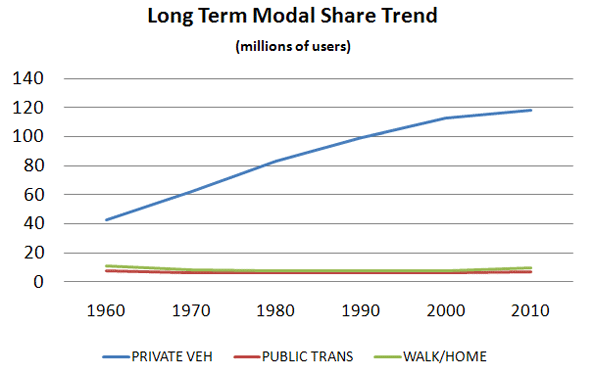
     We should start in 1960 with the first census to cover the Journey to Work.  Back then about two-thirds of workers used a car or truck. More interestingly 13% were on transit, 10% walked and 7% worked at home (think farmers).   As Figure 1 indicates, effectively all of the growth in the last 50 years has occurred in the private vehicle mode.  The melding here of walking and working at home misleads a bit because walking has continually declined while, due to the internet, working at home – once the farm decline reached bottom – has been the “mode” with the greatest and most consistent share of growth in the period.


    Source: 1960-2000 decennial Census; 2010 ACS

    Meanwhile the transit and walk modes have declined in share since the last half century but seem more recently to have bottomed out and reached some base level. 1

    Table 1 shows the relatively stable pattern for the last 20 years in broad terms. 

    1990 decennial

    2000 decennial

    2010

    ACS

    WORKERS

    100%

    100%

    100%

    DRIVE ALONE

    73%

    76%

    77%

    CARPOOL

    13%

    11%

    10%

    TRANSIT

    5%

    5%

    5%

    TAXI 

    0%

    0%

    0%

    BICYCLE

    0%

    0%

    0%

    WALKED

    4%

    3%

    3%

    OTHER

    1%

    1%

    1%

    WORKED AT HOME

    3%

    3%

    4%


    For Figure 1 and Table 1, the 2000 and earlier data are from the decennial censuses. The 2010 data are from a new source, the American Community Survey, which seeks to replicate the census structure.   These data are therefore not strictly comparable.  It has been observed that the ACS has tended to understate carpooling and overstate transit despite best efforts to assure comparability.

    Given the breadth of coverage of the census, it has immense value but a better handle on the mode share question can be found in the National Household Travel Survey (NHTS) of the Federal Highway Administration.  It replicates the census question asking about the usual mode of commuting, but it asks it as part of a collection of a complete diary of a day’s travel for each member of the household. It gets the what did you do yesterday response as well for the same person.   That means we can compare the person’s responses to the two separate queries and learn a great deal about the relationships between the responses. 

    This comparison between census and NHTS products helps state and metro planners know how their surveys might map to the census and helps test the utility of the census products. Just as importantly, it provides a comparison between what people say they do and what they actually do and it tells more about what alternatives travelers shift to when they don’t do “the usual”.   

    When the NHTS asks the question in the “actually-did-yesterday” format things change, in some cases appreciably.

    ‘Usual’

    On  Travel  Day Commuted   by:

    Commute

     Mode:

    Drove Alone

    Carpool

    Transit

    Walk

    Bike

    Other

    Drove Alone

    93.5

    5.6

    0.1

    0.5

    0.1

    0.4

    Carpool

    42.9

    54.8

    0.5

    1

    0

    0.8

    Transit

    13.2

    9.2

    68.3

    6.6

    0.8

    1.9

    Walk

    6.1

    9.3

    3.4

    80.2

    0.2

    0.7

    Bike

    13.8

    3.3

    6

    2.6

    73

    1.4

    Other

    64.1

    19

    4.2

    4.3

    0.3

    8

    Source: NHTS 2009

    Quick Findings

    If we study the yellow boxes we see the “loyalty” relationship between what people say they do and what they actually do.   There are some interesting stories here.

    Drove alone:  According to the NHTS, 93.5% of the people who said they usually drive alone to work actually did.  When they didn’t they almost exclusively shifted to carpooling, with only about 1% shifting out of the auto mode.  This is basically identical to the responses in the 2001 NHTS.2

    Transit:  Only about 68.3% of usual transit users actually used it on a specific day.  The big shift is to the auto-based modes, solo driving or pooling, accounting for more than three quarters of the shift, with the remainder largely shifting to walking.  This is almost the identical loyalty share observed in 2001, but with greater shifts to the auto instead of walking.

    Walking:  Surprisingly about 80% of those who say they usually walk actually do.  Again, when these commuters don’t walk, about three/quarters of the shift is to the private vehicle, with the remainder largely shifting to transit. Also very similar in loyalty to 2001 measures, but showing some increase in transit shifts.  

    Bicycle:   biking exhibits a little less “loyalty” than walking and a little more than transit.   Biking showed a decrease in loyalty from the 77% observed in 2001, perhaps reflecting that the increases in biking we have seen among less inveterate bikers.  The shift to the auto-based modes is less pronounced than the other cases with about a 63% share of the shift.  Transit and walking each obtain appreciable shares of the remainder.   Use of the auto modes as an alternative increased substantially from 2001. 

    Carpooling:  Carpooling is the great surprise.  While transit exhibited the lowest level of loyalty of all modes in 2001 it was surpassed by carpooling in 2009.  Carpooling showed a dramatic decrease in loyalty from 75% in 2001 to 55%, in 2009.  The dominant shift is to driving alone with only about 2% shifting to non-auto modes.  So the auto-based share remains about the same as in 2001. 

    What to Make of All This

    In today’s world we have seen substantial increases in variability in trips to work  – variability  in time of departure, arrival, choice of route to work, even a choice as to whether or not one travels to work at all  with telecommuting becoming more significant every day.  We should not be surprised that there is variability in choice of mode of travel.  Some part of this may simply be that some workers see transit, biking, or walking as the socially preferred modes and will state so when asked – kind of the “good citizen” response – they know what they are supposed to want – “but yesterday was different!”    

    Clearly, auto users tend to remain auto users, with a 98-99% loyalty whether in a carpool or driving solo.  Shifting either way often means things like: the car is in the shop, my wife needs the car, or carpool buddy is on leave, lost a job, or busy doing something else.  This does tell us that carpooling is becoming less formal and more of an occasional and more flexible activity, abetted by cell phones and apps.  One could speculate that these workers often do not have a serious option to the auto.   

    Transit users’ swing is substantial, with significant implications.  Actual users come in at 3.7% of travel rather than the 5% shown for the “usually use” response.  About 3.5% are the usual transit riders who are actually using transit. In terms of survey response reliability we are dancing on the thin edge of trustworthy responses in terms of observation density.    But even with that caveat it would seem appropriate for transit providers to recognize that a significant portion of their riders are “in for the day” because their usual circumstance changed.  Also worth noting is that given that auto users are about 20 times the number of transit riders, an insignificant shift from auto to transit – unnoticeable on the roads – could swamp transit use.   If all the car users had their car in the repair shop once a month it could double transit use in most regions.

    Walkers and bikers, who are those most likely to be affected by weather, both do better than transit in terms of brand loyalty.  This may all be a product of trip length. It has been observed in the past that walkers have an average trip length that is typically so short (circa 15 minutes or about a mile)  that transit (given typical wait times of close to 15 minutes) is not a realistic option so on bad weather days the car may be the substitute. Bike trip lengths to work may be significantly longer than walking so that transit can become a viable option, depending on wait times and routing.    

    Alan E. Pisarski is the author of the long running Commuting in America series. A consultant in travel behavior issues and public policy, he frequently testifies before the Houses of the Congress and advises States on their investment and policy requirements.

    Photo by Nathan Harper, Bottleleaf

    —————–

    Wendell Cox covered this topic in greater detail in a recent New Geography posting Oct 17 2011

    Commuting in America III pg 63

  • Gas Against Wind

    Which would you rather have in the view from your house? A thing about the size of a domestic garage, or eight towers twice the height of Nelson’s column with blades noisily thrumming the air. The energy they can produce over ten years is similar: eight wind turbines of 2.5-megawatts (working at roughly 25% capacity) roughly equal the output of an average Pennsylvania shale gas well (converted to electricity at 50% efficiency) in its first ten years.

    Difficult choice? Let’s make it easier. The gas well can be hidden in a hollow, behind a hedge. The eight wind turbines must be on top of hills, because that is where the wind blows, visible for up to 40 miles. And they require the construction of new pylons marching to the towns; the gas well is connected by an underground pipe.

    Unpersuaded? Wind turbines slice thousands of birds of prey in half every year, including white-tailed eagles in Norway, golden eagles in California, wedge-tailed eagles in Tasmania. There’s a video on YouTube of one winging a griffon vulture in Crete. According to a study in Pennsylvania, a wind farm with eight turbines would kill about a 200 bats a year. The pressure wave from the passing blade just implodes the little creatures’ lungs. You and I can go to jail for harming bats or eagles; wind companies are immune.

    Still can’t make up your mind? The wind farm requires eight tonnes of an element called neodymium, which is produced only in Inner Mongolia, by boiling ores in acid leaving lakes of radioactive tailings so toxic no creature goes near them.

    Not convinced? The gas well requires no subsidy – in fact it pays a hefty tax to the government – whereas the wind turbines each cost you a substantial add-on to your electricity bill, part of which goes to the rich landowner whose land they stand on. Wind power costs three times as much as gas-fired power. Make that nine times if the wind farm is offshore. And that’s assuming the cost of decommissioning the wind farm is left to your children – few will last 25 years.

    Decided yet? I forgot to mention something. If you choose the gas well, that’s it, you can have it. If you choose the wind farm, you are going to need the gas well too. That’s because when the wind does not blow you will need a back-up power station running on something more reliable. But the bloke who builds gas turbines is not happy to build one that only operates when the wind drops, so he’s now demanding a subsidy, too.

    What’s that you say? Gas is running out? Have you not heard the news? It’s not. Till five years ago gas was the fuel everybody thought would run out first, before oil and coal. America was getting so worried even Alan Greenspan told it to start building gas import terminals, which it did. They are now being mothballed, or turned into export terminals.

    A chap called George Mitchell turned the gas industry on its head. Using just the right combination of horizontal drilling and hydraulic fracturing (fracking) – both well established technologies — he worked out how to get gas out of shale where most of it is, rather than just out of (conventional) porous rocks, where it sometimes pools. The Barnett shale in Texas, where Mitchell worked, turned into one of the biggest gas reserves in America. Then the Haynesville shale in Louisiana dwarfed it. The Marcellus shale mainly in Pennsylvania then trumped that with a barely believable 500 trillion cubic feet of gas, as big as any oil field ever found, on the doorstep of the biggest market in the world.

    The impact of shale gas in America is already huge. Gas prices have decoupled from oil prices and are half what they are in Europe. Chemical companies, which use gas as a feedstock, are rushing back from the Persian Gulf to the Gulf of Mexico. Cities are converting their bus fleets to gas. Coal projects are being shelved; nuclear ones abandoned.

    Rural Pennsylvania is being transformed by the royalties that shale gas pays (Lancashire take note). Drive around the hills near Pittsburgh and you see new fences, repainted barns and – in the local towns – thriving car dealerships and upmarket shops. The one thing you barely see is gas rigs. The one I visited was hidden in a hollow in the woods, invisible till I came round the last corner where a flock of wild turkeys was crossing the road. Drilling rigs are on site for about five weeks, fracking trucks a few weeks after that, and when they are gone all that is left is a “Christmas tree” wellhead and a few small storage tanks.

    The International Energy Agency reckons there is quarter of a millennium’s worth of cheap shale gas in the world. A company called Cuadrilla drilled a hole in Blackpool, hoping to find a few trillion cubic feet of gas. Last month it announced 200 trillion cubic feet, nearly half the size of the giant Marcellus field. That’s enough to keep the entire British economy going for many decades. And it’s just the first field to have been drilled.

    Jesse Ausubel is a soft-spoken academic ecologist at Rockefeller University in New York, not given to hyperbole. So when I asked him about the future of gas, I was surprised by the strength of his reply. “It’s unstoppable,” he says simply. Gas, he says, will be the world’s dominant fuel for most of the next century. Coal and renewables will have to give way, while oil is used mainly for transport. Even nuclear may have to wait in the wings.

    And he is not even talking mainly about shale gas. He reckons a still bigger story is waiting to be told about offshore gas from the so-called cold seeps around the continental margins. Israel has made a huge find and is planning a pipeline to Greece, to the irritation of the Turks. The Brazilians are striking rich. The Gulf of Guinea is hot. Even our own Rockall Bank looks promising. Ausubel thinks that much of this gas is not even “fossil” fuel, but ancient methane from the universe that was trapped deep in the earth’s rocks – like the methane that forms lakes on Titan, one of Saturn’s moons.

    The best thing about cheap gas is whom it annoys. The Russians and the Iranians hate it because they thought they were going to corner the gas market in the coming decades. The greens hate it because it destroys their argument that fossil fuels are going to get more and more costly till even wind and solar power are competitive. The nuclear industry ditto. The coal industry will be a big loser (incidentally, as somebody who gets some income from coal, I declare that writing this article is against my vested interest).

    Little wonder a furious attempt to blacken shale gas’s reputation is under way, driven by an unlikely alliance of big green, big coal, big nuclear and conventional gas producers. The environmental objections to shale gas are almost comically fabricated or exaggerated. Hydraulic fracturing or fracking uses 99.86% water and sand, the rest being a dilute solution of a few chemicals of the kind you find beneath your kitchen sink.

    State regulators in Alaska, Colorado, Indiana, Louisiana, Michigan, Oklahoma, Pennsylvania, South Dakota, Texas and Wyoming have all asserted in writing that there have been no verified or documented cases of groundwater contamination as a result of hydraulic fracking. Those flaming taps in the film “Gasland” were literally nothing to do with shale gas drilling and the film maker knew it before he wrote the script. The claim that gas production generates more greenhouse gases than coal is based on mistaken assumptions about gas leakage rates and cherry-picked time horizons for computing greenhouse impact.

    Like Japanese soldiers hiding in the jungle decades after the war was over, our political masters have apparently not heard the news. David Cameron and Chris Huhne are still insisting that the future belongs to renewables. They are still signing contracts on your behalf guaranteeing huge incomes to landowners and power companies, and guaranteeing thereby the destruction of landscapes and jobs. The government’s “green” subsidies are costing the average small business £250,000 a year. That’s ten jobs per firm. Making energy cheap is – as the industrial revolution proved – the quickest way to create jobs; making it expensive is the quickest way to lose them.

    Not only are renewables far more expensive, intermittent and resource-depleting (their demand for steel and concrete is gigantic) than gas; they are also hugely more damaging to the environment, because they are so land-hungry. Wind kills birds and spoils landscapes; solar paves deserts; tidal wipes out the ecosystems of migratory birds; biofuel starves the poor and devastates the rain forest; hydro interrupts fish migration. Next time you hear somebody call these “clean” energy, don’t let him get away with it.

    Wind cannot even help cut carbon emissions, because it needs carbon back-up, which is wastefully inefficient when powering up or down (nuclear cannot be turned on and off so fast). Even Germany and Denmark have failed to cut their carbon emissions by installing vast quantities of wind.

    Yet switching to gas would hasten decarbonisation. In a combined cycle turbine gas converts to electricity with higher efficiency than other fossil fuels. And when you burn gas, you oxidise four hydrogen atoms for every carbon atom. That’s a better ratio than oil, much better than coal and much, much better than wood. Ausubel calculates that, thanks to gas, we will accelerate a relentless shift from carbon to hydrogen as the source of our energy without touching renewables.

    To persist with a policy of pursuing subsidized renewable energy in the midst of a terrible recession, at a time when vast reserves of cheap low-carbon gas have suddenly become available is so perverse it borders on the insane. Nothing but bureaucratic inertia and vested interest can explain it.

    Matt Ridley’s is a journalist and author. His books have sold over 850,000 copies, been translated into 30 languages, been short-listed for seven literary prizes and won three. His latest book “The Rational Optimist: How Prosperity Evolves” argues that human beings are not only wealthier, but healthier, happier, cleaner, cleverer, kinder, freer, more peaceful and more equal than they have ever been.

    Photo “Natural Gas Well at Sunset” by Rich Anderson