Category: Policy

  • The other California: A flyover state within a state

    California may never secede, or divide into different states, but it has effectively split into entities that could not be more different. On one side is the much-celebrated, post-industrial, coastal California, beneficiary of both the Tech Boom 2.0 and a relentlessly inflating property market. The other California, located in the state’s interior, is still tied to basic industries like homebuilding, manufacturing, energy and agriculture. It is populated largely by working- and middle-class people who, overall, earn roughly half that of those on the coast.

    Over the past decade or two, interior California has lost virtually all influence, as Silicon Valley and Bay Area progressives have come to dominate both state politics and state policy. “We don’t have seats at the table,” laments Richard Chapman, president and CEO of the Kern Economic Development Corporation. “We are a flyover state within a state.”

    Virtually all the polices now embraced by Sacramento — from water and energy regulations to the embrace of sanctuary status and a $15-an-hour minimum wage — come right out of San Francisco central casting. Little consideration is given to the needs of the interior, and little respect is given to their economies.

    San Francisco, for example, recently decided to not pump oil from land owned by the city in Kern County, although one wonders what the new rich in that region use to fill the tanks of their BMWs. California’s “enlightened” green policies help boost energy prices 50 percent above those of neighboring states, which makes a bigger difference in the less temperate interior, where many face longer commutes than workers in more compact coastal areas.

    The new Bantustans

    Fresno, Bakersfield, Ontario and San Bernardino are rapidly becoming the Bantustans — the impoverished areas designed for Africans under the racist South African regime — in California’s geographic apartheid. Poverty rates in the Central Valley and Inland Empire reach over a third of the population, well above the share in the Bay Area. By some estimates, rural California counties suffer the highest unemployment rate in the country; six of the 10 metropolitan areas in the country with the highest percentage of jobless are located in the central and eastern parts of the state. The interior counties — from San Bernardino to Merced — also suffer the worst health conditions in the state.

    This disparity has worsened in recent years. Until the 2008 housing crash, the interior counties served, as the Kern EDC’s Chapman puts it, as “an incubator for mobility.” These areas were places that Californians of modest means, and companies no longer able to afford coastal prices, could get a second shot.

    But state policies, notably those tied to Gov. Jerry Brown’s climate jihad, suggests Inland Empire economist John Husing, have placed California “at war” with blue-collar industries like homebuilding, energy, agriculture and manufacturing. These kinds of jobs are critical for regions where almost half the workforce has a high school education or less.

    Read the entire piece at The Orange County Register.

    Joel Kotkin is executive editor of NewGeography.com. He is the Roger Hobbs Distinguished Fellow in Urban Studies at Chapman University and executive director of the Houston-based Center for Opportunity Urbanism. His newest book, The Human City: Urbanism for the rest of us, was published in April by Agate. He is also author of The New Class ConflictThe City: A Global History, and The Next Hundred Million: America in 2050. He lives in Orange County, CA.

    Photo: Michael Patrick, CC License.

  • California: The Republic of Climate

    To some progressives, California’s huge endorsement for the losing side for president reflects our state’s moral superiority. Some even embrace the notion that California should secede so that we don’t have to associate with the “deplorables” who tilted less enlightened places to President-elect Donald Trump. One can imagine our political leaders even inviting President Barack Obama, who reportedly now plans to move to our state, to serve as the California Republic’s first chief executive.

    As a standalone country, California could accelerate its ongoing emergence as what could be called “the Republic of Climate.” This would be true in two ways. Dominated by climate concerns, California’s political leaders will produce policies that discourage blue-collar growth and keep energy and housing prices high. This is ideal for the state’s wealthier, mostly white, coastal ruling classes. Yet, at the same time, the California gentry can enjoy what, for the most part, remains a temperate climate. Due to our open borders policies, they can also enjoy an inexhaustible supply of cheap service workers.

    Of course, most Californians, particularly in the interior, will not do so well. They will continue to experience a climate of declining social mobility due to rising costs, and businesses, particularly those employing blue-collar and middle-income workers, will continue to flee to more hospitable, if less idyllic, climes.

    California in the Trump era

    Barring a rush to independence, Californians now must adapt to a new regime in Washington that does not owe anything to the state, much less its policy agenda. Under the new regime, our high tax rates and ever-intensifying regulatory regime will become even more distinct from national norms.

    President Obama saw California’s regulatory program, particularly its obsession with climate change, as a role model leading the rest of the nation — and even the world. Trump’s victory turns this amicable situation on its head. California now must compete with other states, which can only salivate at the growing gap in costs.

    At the same time, foreign competitors, such as the Chinese, courted by Gov. Jerry Brown and others to follow its climate agenda, will be more than happy to take energy-dependent business off our hands. They will make gestures to impress what Vladimir Lenin labeled “useful idiots” in our ruling circles, but will continue to add coal-fired plants to power their job-sapping export industries.

    Read the entire piece at The Orange County Register.

    Joel Kotkin is executive editor of NewGeography.com. He is the Roger Hobbs Distinguished Fellow in Urban Studies at Chapman University and executive director of the Houston-based Center for Opportunity Urbanism. His newest book, The Human City: Urbanism for the rest of us, was published in April by Agate. He is also author of The New Class ConflictThe City: A Global History, and The Next Hundred Million: America in 2050. He lives in Orange County, CA.

    Photo: By User “Neon Tommy” (https://www.flickr.com/photos/neontommy/8117052872) [CC BY-SA 2.0], via Wikimedia Commons

  • The Shape of Things to Come

    After several years of traveling around the country in the presence of city planners, economic development officials, elected representatives, engineers, production home builders, professional consultants, and groups of concerned citizens I’ve come to my own personal unified theory of America’s land use future. The short version is that we’ve got the built environment that we have and the overwhelming majority of it isn’t ever going to change much. If you want to know what things will look like in thirty or forty years… look around. That’s pretty much it.

    There’s so much of it… tract homes on cul-de-sacs, suburban office parks, strip malls, big box stores, light industrial parks, self storage facilities, garden apartment complexes… even if society wanted to radically transform the landscape (which is absolutely not the case) it would be a sixty or seventy year endeavor. Personally, I won’t live long enough to see that shift. But business-as-usual isn’t an option either regardless of what most people might prefer. What will change is the way the existing landscape will be valued and inhabited.

    Communities are hitting a financial wall. Current tax revenue is entirely insufficient to cover the ongoing maintenance of municipal infrastructure – and by “infrastructure” I mean public services and staffing levels as well as the physical roads, pipes, and civic buildings. There simply isn’t enough productive private economic activity to support the underlaying public chassis that’s been built since World War II. So we’re in for a great deal of deferred maintenance, failed pension obligations, reductions in services, higher taxes (which will be called “user fees” and “code enforcement”) and ultimately default on public debt. That’s already baked in to the cake almost everywhere.

    There are only two options moving forward. We can build more productive stuff on the existing infrastructure, or we can reduce the amount of infrastructure to come in to balance with the available productive capacity. So we’re going to do both – not necessarily on a voluntary basis. And the results will be unevenly distributed.

    Some places will continue to be maintained pretty much as they are largely by skimming revenue from other locations. Other spots will decline, lose value, become politically and culturally disposable, and be allowed to crumble. Still other districts will intensify and gain value and significance through infill development. I say this with a fair amount of confidence because that’s been the historic pattern for a very long time.

    There are people who advocate for small scale incremental infill development that could double or triple the productive capacity of a place gradually over time. A one story building could become a two story building. A two story building could become a three story building. Small cottages could be built in back gardens. A vacant lot could be filled with a small productive structure with a business on the ground floor and an apartment or two upstairs. It could be intimate and charming like the Norman Rockwell Main Street towns of a previous era. But the current regulatory framework doesn’t permit such a process. Neither does the popular culture that sees such infill as a direct assault on the American Dream. The cost and complexity of navigating multiple opaque and unresponsive bureaucracies is generally greater than the ultimate value of such modest projects. So it’s simply not going to happen.

    Infill development needs to be large, complex, and expensive enough to overcome the administrative and cultural friction. A two hundred unit apartment complex with five stories of structured parking works just fine. It may be wildly out of character with the existing neighborhood. It may load up the area with additional traffic congestion. It may be far too expensive to meet the need for working class housing. It may concentrate ownership in to very few hands. It may be built in an otherwise diffuse suburban landscape where walking and transit are unviable. But it can be built while smaller things can’t. Shrug. Whatever.

    New subdivisions with comfortable attractive middle class homes sprout on the side of the freeway like mushrooms after a good rain. These are pleasant places to live. People like them. They’re profitable to build. Municipal officials embrace growth and development. This is how things are supposed to be.

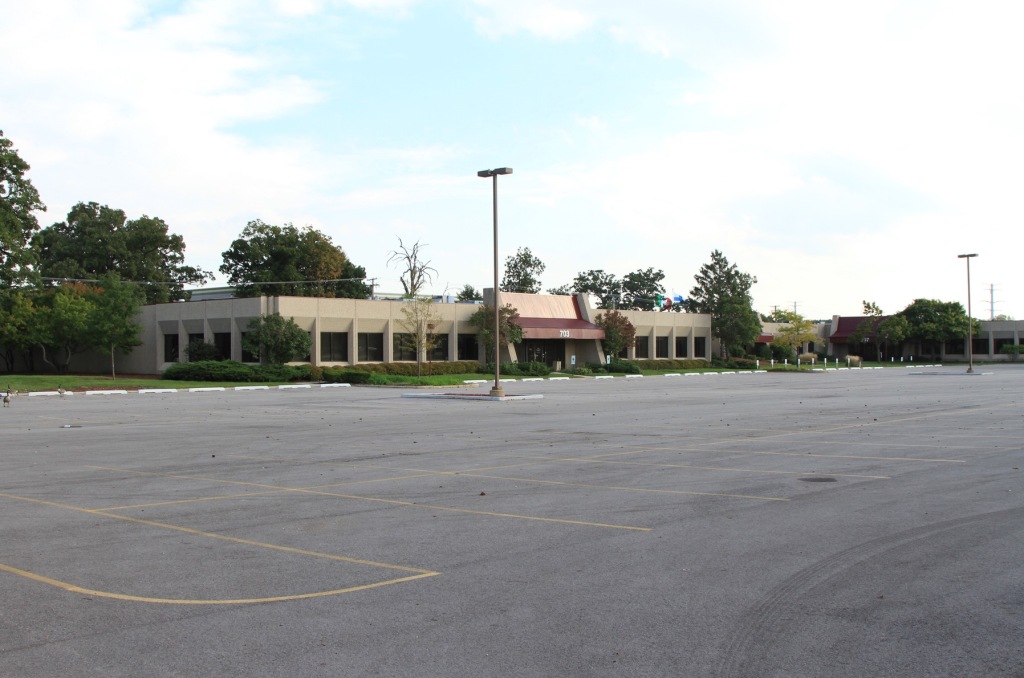
    A few miles away is yesterday’s version of growth and progress. Property values have declined. Businesses have moved away. The schools have lost their appeal. Municipal revenues have crashed. People and money are disappearing. This isn’t an anomaly. It’s the natural consequence of things playing out to their logical conclusions. This is the shape of things to come.

    John Sanphillippo lives in San Francisco and blogs about urbanism, adaptation, and resilience at granolashotgun.com. He’s a member of the Congress for New Urbanism, films videos for faircompanies.com, and is a regular contributor to Strongtowns.org. He earns his living by buying, renovating, and renting undervalued properties in places that have good long term prospects. He is a graduate of Rutgers University.

    All photos by Johnny Sanphillippo

  • Portland Housing Stupidity Grows

    Here’s an incredibly stupid idea to deal with Portland’s housing affordability problems: Multnomah County proposes to build tiny houses in people’s backyard. The people will get to keep the houses on the condition that they allow homeless people to live in them for five years.

    That’s supposed to be an incentive. For five years, you have to share your yard with a homeless person who may be suffering from a variety of problems, after which you get to keep whatever is left of the tiny home. But as one Portland neighborhood activist points out, what homeless people need is healthcare and social work, not to be warehoused in someone else’s backyard.

    I suspect homeowners are going to be wary of this offer because they will have little control who lives in their yard. Not only would the homeowners be required to maintain the tiny houses while the homeless person or people lived in them, Portland is making it increasing difficult for landlords to evict unwanted tenants.

    Update: Despite my pessimism, 580 homeowners have “inquired about hosting a homeless family in their backyards.” Initially, the county will build four, and if it can raise the funds, it will build as many as 300 more.

    More important, this plan is stupidly expensive. The county estimates that each 220-square-foot tiny house will cost $75,000. That’s $341 per square foot! There are an estimated 3,800 homeless people in Portland, so housing them all this way would cost $285 million. That assumes one person per tiny house; some may house two, but housing people in tiny homes will also attract more homeless people into the area.

    There’s also a not-so-hidden agenda here: “creating a denser, more affordable city.” At least, that’s the plan. The reality is density doesn’t make cities more affordable. In fact, the densest cities tend to be least affordable.

    In Portland, people who build tiny houses in their yards face a huge increase in property taxes. That’s because, under Oregon law, their existing home is taxed at its 1996 value, plus a small annual increase for inflation, while new construction is taxed at today’s value. Thus, a new, 220-square-foot tiny house may be taxed more than the 2,000-square-foot house it shares a lot with.

    Multnomah County says it will “try” to waive property taxes for people willing to accept tiny houses for homeless people in their yards, at least for the five years that homeless people live in them. How generous! Mercy, thy name is Multnomah County! Except really, it’s name is Stupid.

    Randal O’Toole is a senior fellow with the Cato Institute specializing in land use and transportation policy. He has written several books demonstrating the futility of government planning. Prior to working for Cato, he taught environmental economics at Yale, UC Berkeley, and Utah State University.

    Photo: DubbaG [GFDL or CC-BY-SA-3.0], via Wikimedia Commons

  • The Quest for Food Freedom

    Mariza Ruelas currently faces up to two years in jail in California for the crime of selling ceviche through a Facebook food group. Welcome to the mad world of American food regulation. In Biting the Hands That Feed Us, Baylen Linnekin looks closely at a system that can take pride in a historically safe food supply but that also imposes too many rules that defy common sense.

    Linnekin traces the system’s origins to The Jungle, Upton Sinclair’s exposé of the appalling conditions in Chicago’s slaughterhouses, and to the New Deal’s hyper-regulation of agriculture. Such intrusiveness culminated in the case of Wickard v. Filburn, in which the Supreme Court ruled that Americans don’t even have the right to consume food they grow themselves, on their own land. Food regulation has marched steadily onward ever since.

    While working conditions and food safety improved dramatically thanks to these efforts, the move to regulate all food products according to uniform standards also produced a system with a host of strange rules—such as requiring organic skim milk that is free of additives to be labeled “Non-Grade ‘A’ Milk Product–Natural Milk Vitamins Removed.” Bans on urban agriculture have outlawed backyard chicken coops and front-yard gardens. Seemingly random changes in safety requirements force the shutdowns of businesses with no incidents of contamination or sickened customers. In some jurisdictions, it’s illegal to slice off a sample of cheese or cut the stalk off of lettuce at farmer’s markets. Microbreweries were threatened with having to register as pet-food manufacturers if they wanted to donate their spent grains for animal feed (a long-standard practice even for big breweries). In public parks, foraging of any sort—such as picking wild berries—is often banned.

    Mariza Ruelas made her ceviche at home, which is why she’s in trouble with the law: food-safety mandates have made home production of food for sale, even in small quantities, illegal. You might be in trouble, too, if, say, you contribute a pan of brownies to the bake sale at your child’s school. That’s probably illegal.

    States and localities are starting to push back at this regulatory insanity. Some states have instituted “cottage-food laws” allowing home preparation of small amounts of food for sale in limited venues, such as at farmer’s markets. Wyoming passed a comprehensive Food Freedom Act reducing regulation of food sales, so long as no middleman is involved. Some cities have legalized the raising of chickens or urban beekeeping. But there’s a long way to go.

    For Linnekin, a food-law professor, the goal is to make traditional and “sustainable” agricultural practices legal. Much of what he argues for makes good sense, but there’s another side to the issue. Because so many urban hipsters want to produce (or at least consume) artisanal food products, food law, along with zoning, often serves as their point of entry into the vast regulatory web that smothers so many American businesses. This awareness doesn’t necessarily turn urban epicures into liberty-minded activists, though. Many small-scale organic-food producers and their customers simply want to make their preferred practices legal and easier to practice—while saddling major corporate producers of food with added regulations. In general, food activists aren’t much interested in establishing better rules and then letting the market determine outcomes. Instead, they seek specific outcomes—more composting, for example—and deem any rule that fails to support such goals to be a bad one.

    Linnekin seems somewhat sympathetic to this small-is-better tendency. He wants to eliminate “ag-gag” laws that protect farmers from harassment by activists. He thinks that many food products carry antiquated grading standards and wants to see them changed. But many of these standards have solid rationales. Linnekin objects, for example, to the USDA’s “prime” grade for beef being determined by the level of fat marbling. But fat is the driver of taste, and many small producers of leaner, grass-fed beef sell products that often don’t taste very good. They don’t deserve a “prime” grading.

    While regulations hostile to industrial, mass-scale agriculture—which feeds a global population of 7 billion people—should be avoided, rationalizing archaic and protectionist regulations makes sense. So does exempting small-scale producers from many regulations and embracing a more general “food-freedom” philosophy. As Biting the Hands That Feed Us makes clear, our current food-regulatory approach is too often a theater of the absurd.

    This post original appeared in City Journal on March 15, 2017.

    Aaron M. Renn is a senior fellow at the Manhattan Institute, a contributing editor of City Journal, and an economic development columnist for Governing magazine. He focuses on ways to help America’s cities thrive in an ever more complex, competitive, globalized, and diverse twenty-first century. During Renn’s 15-year career in management and technology consulting, he was a partner at Accenture and held several technology strategy roles and directed multimillion-dollar global technology implementations. He has contributed to The Guardian, Forbes.com, and numerous other publications. Renn holds a B.S. from Indiana University, where he coauthored an early social-networking platform in 1991.

  • Common Sense on Immigration

    No issue divides the United States more than immigration. Many Americans are resentful of the estimated 11 million undocumented immigrants, worry about their own job security, and fear the arrival of more refugees from Islamic countries could pose the greatest terrorist threat. At the other end of the spectrum are those who believe the welcoming words on the Statue of Liberty represent a national value that supersedes traditional norms of citizenship and national culture.

    What has been largely missing has been a sharp focus on the purpose of immigration. In the past, immigration was critical in meeting the demographic and economic needs of a rapidly growing nation. Simply put, the country required lots of bodies to develop its vast expanses of land and natural resources and to work in its factories.    

    The need for foreign workers remains important, but the conditions have changed. No longer a largely rural, empty country, more than 80 percent of Americans cluster in urban and suburban areas. Many routine jobs have been automated; factories, farms and offices function more efficiently with smaller workforces. Since at least 2000, notes demographer Nicholas Eberstadt, the “Great American Escalator” has stopped working.

    These changes suggest the need to rethink national immigration policies. In a country where wages for the poorest workers have been dropping for decades and incomes have stagnated for the middle class, allowing large numbers of even poorer people into the country seems more burden than balm. They often work hard, but largely in low-income service jobs and in the low end of the health care field. In California, home to an estimated 2.7 million largely Latino undocumented immigrants, approximately three in four Latino non-citizens struggle to make ends meet, as do about half of naturalized Latino citizens, according to a recent United Way study.

    Overall, our current immigrants, legal and illegal, have not advanced as quickly as in previous generations. This, along with the crisis in much of Middle America, should be our primary national concern. This doesn’t necessarily translate to mass deportations or even severe cutbacks in legal immigration, as some, including Attorney General Jeff Sessions and several congressional Republicans, have said. But it certainly does suggest taking a fresh look at how we view immigration.    

    Learning From Abroad

    So, what kind of immigration is best for America?

    Models to consider are those that put premiums on marketable skills and language proficiency rather than family reunification. The Canadian and Australian systems, as President Trump correctly noted, are more attuned to their own national needs, compared with the U.S approach, which emphasizes family re-unification. Canadian authorities allow some 60 to 70 percent of their immigrants to come for economic purposes, notes Carter Labor Secretary Ray Marshall, supporting their system mainly by “filling vacancies that are measured and demonstrated in the Canadian economy.”    

    Such a needs-based program would be a better, and fairer, way of addressing skills shortages than the odious H-IB program, which allows temporary indentured tech workers to replace American citizens. Instead, talented newcomers would be welcomed as future citizens and given the right to negotiate their own labor rates and conditions.

    This emphasis on admitting immigrants with needed skills leaves Canadians and Australians with generally more positive views about immigration than Americans. Australia is one of only three countries in the world where children of migrants do better at school than children of non-migrants. Canadian support for immigration is particularly high in Toronto, which has been transformed from a sleepy Anglo enclave to a vibrant, diverse global capital.

    But such hospitality is not limitless. A former Canadian immigration judge told me recently, in a tone of alarm, that his country’s invitation to 25,000 Syrian refugees could incubate the same sort of disorder that we see across Europe. There, in many heavily immigrant communities, poverty and isolation has persisted, sometimes for generations.    

    I doubt many Americans would want to see the kind of social unrest we see across once peaceful places like Sweden, where women now complain of being perpetually harassed, even as supposedly feminist politicians look the other way. In France, Muslims make up about 7.5 percent of the French population compared to 1 percent in the U.S., but France has been ravaged by Islamic terrorism, Muslim-fueled anti-Semitism, and a widening cultural gap between the immigrants and the indigenous French population. In France and many other European countries, we see the rise of nativist politicians that make Donald Trump seem like Mother Theresa.

    Citizenship and National Culture

    The United States could be headed to a similar devolution. America’s ideals may be universal, but our political community has always been based on U.S. citizenship. You should not have to be an Anglo to admire the Founders, or to embrace the importance of the Constitution. Yet it’s now fashionable among some progressive activists to reject established American political traditions, which constitute a fundamental reason people have come here for the last two centuries.

    Yet the “open borders” lobby on the progressive left increasingly demeans the very idea of citizenship. In some cases, they see immigration as way to achieve their desired end of “white America.” Some advocates for the undocumented, such as Jorge Bonilla of Univision, assert that America is “our county, not theirs” referring to Trump supporters. Others, like New York Mayor Bill di Blasio, refuse to differentiate between legal and illegal immigrants.

    As usual, California leads the lunacy. Gov. Jerry Brown, who famously laid out a “welcome” sign to Mexican illegal and legal immigrants, has also given them drivers’ licenses and provides financial aid for college, even while cutting aid for middle-class residents. Some Sacramento lawmakers are pressing to give undocumented immigrants’ access to state health insurance. Senate President Pro Tem Kevin de Leon recently boasted, “Half of my family would be eligible for deportation under the executive order, because they got a false Social Security card, they got a false identification.”

    The “open borders” ideology has reached its apotheosis in “sanctuary” cities which extend legal protection from deportation to criminal aliens, including those who have committed felonies. Donald Trump opportunistically emphasized this absurd and inappropriate situation—sometimes invoking the names of murdered Americans—during his 2016 campaign. The only mystery is why it would surprise the chattering class that many voters responded to his message.

    Most Americans are more practical about immigration than politicians in either party. The vast majority of us, including Republicans, oppose massive deportations of undocumented individuals with no serious criminal record. Limiting Muslim immigration appeals to barely half of Americans. Only a minority favor Trump’s famous “big beautiful wall” on the Mexico-U.S. border.

    Yet even in California, three-quarters of the population, according to a recent U.C.-Berkeley survey, oppose “sanctuary cities.” Overall, more Americans favor less immigration than more. According to a recent Pew study, most also generally approve tougher border controls and increased deportations. They also want newcomers to come legally and learn English, notes Gallup. This is not just an Anglo issue. In Texas, by some accounts roughly one-third of all Latino voters supported Trump.

    Sadly, immigration as an issue has been totally politicized. Obama deported far more undocumented aliens than his Republican predecessor, or any previous president, for that matter, without inciting mass hysteria. To be sure, Republicans face severe challenges with new generations that are more heavily Latino and Asian and generally more positive about immigration. The undocumented account for roughly one in five Mexicans and upwards of half of those from Central American countries, meaning that overly brutal approaches to their residency would be eventual political suicide for Republicans in many key states, including Arizona, Florida, Nevada, Colorado and even Georgia.

    Any new immigration policy has to be widely acceptable — both where immigrants are common as well as those generally less diverse areas where opposition to immigration is strongest. Unlike many issues, immigration cannot be devolved to local areas to accommodate differing cultural climates; it is, and will remain, a federal issue. A policy that melds a skills-based orientation, compassion, strong border enforcement, expulsion of criminals, and forcing the undocumented to the back of the citizenship line seems eminently fair.

    Economic Growth: The Secret Sauce of Immigration Policy

    Strong, broad-based economic growth remains the key to making immigration work. A weak economy, unemployment, population density, or sudden uncontrolled surges in migration, notes a recent Economic Policy Institute, drives most anti-immigration sentiment. The labor-backed think tank suggests it would be far better to bring in migrants with skills that are in short supply and avoid temporary workers, such as H-1B visa holders, who are paid lower wages, undercutting the employment prospects for Americans.

    Given the demands of competition and changes in technology, it seems foolish to allow many additional lower-skilled people enter our country. This is not elitism: Industry needs machinists, carpenters and nurses as well as computer programmers and biomedical engineers. What we don’t need to do is flood the bottom of the labor market. Again, this reality is race-neutral. Economist George Borjas suggests that the influx of low-skilled, poorly educated immigrants has reduced wages for our indigenous poor, particularly African-Americans, but also for the recent waves of immigrants, including Mexican Americans, over the past three decades.

    Like most high-income countries, America’s fertility rate is below that needed to replace the current generation. This constitutes one rationale for continued legal immigration. But our demographic shortcomings are also entwined with lack of economic opportunity, crippling student debt, and the high cost of family-friendly housing stock. In other words, one reason Millennials are putting off having children is because they can’t afford them.

    Overall immigration is a net benefit, if the economic conditions are right. An overly broad cutback in immigration would deprive the country of the labor of millions of hard-working people, many of whom are highly entrepreneurial. The foreign-born, notes the Kaufmann Foundation, are also twice as likely to start a business as native-born Americans. It’s always been thus—and these aren’t just small, ethnic, family-owned restaurants we’re talking about. More than 40 percent of Fortune 500 companies were founded by immigrants or their offspring.    

    American immigration has succeeded in the past largely due to economic expansion. The historical lesson is clear: a growing economy, more wealth and opportunity, as well as a sensible policy, are the true prerequisites for the successful integration of newcomers into our society.

    Joel Kotkin is executive editor of NewGeography.com. He is the Roger Hobbs Distinguished Fellow in Urban Studies at Chapman University and executive director of the Houston-based Center for Opportunity Urbanism. His newest book, The Human City: Urbanism for the rest of us, was published in April by Agate. He is also author of The New Class ConflictThe City: A Global History, and The Next Hundred Million: America in 2050. He lives in Orange County, CA.

    Photo: Jonathan McIntosh
  • A New Age of Progressive Suburbanism?

    We are living in a global suburban age… While statistics demonstrate that the amount of the world population in metropolitan areas is rapidly increasing, rarely is it understood that the bulk of this growth occurs in the suburbanized peripheries of cities. Domestically, over 69% of all U.S. residents live in suburban areas; internationally, many other developed countries are predominately suburban, while many developing countries are rapidly suburbanizing as well.”

    That’s not some anti-urban crackpot statement (as some inner urban elites might think) but from the introduction to a biennial theme of the MIT Center for Advanced Urbanism (USA). They understand that suburban and regional centres are not irrelevant for the future economy but highly important.  MIT are a pretty credible lot – hardly likely to pursue fringe urban planning or economic theories.

    In Australia, however, that message is not getting through. From the Prime Minister, down, there is a sense of irrational exuberance that the jobs of the future will mostly be concentrated in our CBDs and inner cities. Urban planning which supports increased concentration of employment through generous infrastructure allocations to inner urban areas is the manifestation of this inner urban obsession.  And while CBDs and inner urban areas are lavished with costly projects designed mainly to benefit the minority of people who work there, suburban and regional centres – where the majority live, work and play – have been largely left to fend for themselves.

    This process started in the late 1990s and early 2000s, notions about the “creative class” — many of which are being re-examined by author Richard Florida in a new book —   was a cause celebre amongst planning and government circles. It was widely argued that to attract the creative class of worker (synonymous with high skills and the new economy) cities needed to invest heavily in the quality of life in their downtowns. This was a precursor to the inner urban hipster, and, when real estate prices, rose their successors, the rise of the inner-city latte set.

    This thinking fit in well with two other trendy theories, New Urbanism and ‘Smart Growth’ (which redefined suburban progress as urban sprawl). The collective wisdom moved from supporting a growing suburban realm to one that disparaged it: the burbs were for bogans, the home of sprawl, “McMansions” full of low wage earning, culturally deficient and poorly educated masses, eating fast food diets and slurping sugar drinks. Inner cities by contrast were for educated, cultured and knowledgeable people – who had little need for suburban spaces or suburban habits but greater need for inner city waterfront cycle ways, museums, theatres and quality restaurants run by notable chefs. And, of course, lots of baristas. 

    Urban planning shifted quickly to a highly-regulated approach which promoted much higher densities of inner urban housing (and limits on outward expansion) because, after all, the inner city is where everyone in the future will want to live, right? The promises of these regional planning policies bordered on messianic. Take this example from the “Draft Metropolitan Strategy for Sydney to 2031” from the early 2000s:

    “A home I can afford. Great transport connections. More jobs closer to where I live. Shorter commutes. The right type of home for my family. A park for the kids. Local schools, shops and hospitals. Liveable neighbourhoods.”

    And what have we got thus? Some of the worst housing affordability in the world. Worsening congestion. Longer commutes. Limited housing choice, much of it not ideal for raising families.

    The ongoing policy focus and infrastructure obsession with centralisation is utterly at odds with economic and community signals. New economy industries in technical, scientific or professional services, or health and social care, have little interest in centralisation. Digital technology has broken that tyranny of distance. Undeterred though, we continue to watch as political and industry leaders promote costly infrastructure projects that enhance and support further centralised employment and a concentration of amenity in inner urban cores enjoyed by a privileged, mostly childless minority.

    For the record, the proportion of metropolitan wide jobs in the inner cities of Melbourne, Sydney and Brisbane was 11%, 13% and 12% respectively at the last census.  The reality remains that in our metropolitan centres, most people both live and work outside inner city bubbles of privilege. 

    The penny is finally dropping in some minds. Former Victorian Planning Minister, Matthew Guy (now Opposition Leader) once extolled the virtues of high density inner urban development. Looks like he has had a Damascus moment, commenting in The Australian (March 1, 2017) that: “Victoria is becoming a great, heaving, unsustainable mess. The whole of Victoria is just becoming an offshoot of Melbourne.”

    The emphasis on centralisation of jobs, housing and supportive infrastructure makes little sense in a country with such large land masses and capacity for expansion. Not only that, but the economic winds – enabled by rapid expansion of disruptive technology – are blowing the other way. Suburban and regional centres, long disparaged by the cognoscenti should instead be looked on as part of the solution to economic expansion and development. Where once we promoted urban renewal, we now need to turn our minds to suburban and regional renewal. We need to identify the critical infrastructure constraints of suburban and regional business centres and remedy them to encourage accelerated development of employment opportunities across the board.

    In a bid to put some balance into the discussions about urban development and growth, a Suburban Alliance (www.suburbanalliance.com.au) has been formed in Australia – with the intention of supporting research projects into the nature and needs of the suburban economy, and to use these as a platform for well-informed policy advocacy. Wish us luck. The initial focus starts in Brisbane but if the idea finds support, we’d like to see this expand to cover all major urban and regional centres. 

    The more supporters we can muster the sooner this absurd preoccupation with all things inner city can begin to be balanced with a better understanding of the important role played by suburban and regional business centres and why these are part of the solution to enhanced economic opportunity.

    Ross Elliott has more than twenty years experience in property and public policy. His past roles have included stints in urban economics, national and state roles with the Property Council, and in destination marketing. He has written extensively on a range of public policy issues centering around urban issues, and continues to maintain his recreational interest in public policy through ongoing contributions such as this or via his monthly blog, The Pulse.

    Photo: Photograph by Gnangarra [CC BY 2.5 au], via Wikimedia Commons

  • Chicago’s Crime Wave Understood: Complex Problem, Simple Formula

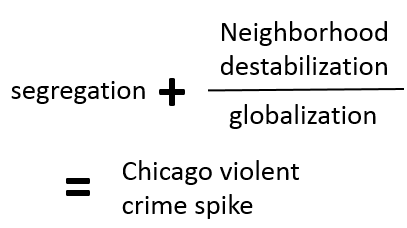
    Chicago’s violent crime problem can be understood through this formula:

    It’s a simplistic, reductionist, even crude, but it explains the roots of Chicago’s crisis as well as anything.

    It has been particularly grueling time in Chicago this recently.  We experienced the murders of at least ten Chicagoans, including two girls, age 12 and 11, shot within 30 minutes of each other in different locations, and a 2-year-old boy.  Once again, Chicago is thrust into the spotlight as President Donald Trump spoke of “two Chicagos” and renewed his pledge to send some kind of federal assistance to deal with the violence (note: you may have seen me refer to “two Chicagos” before, but I’m definitely uneasy with our current President making even starker distinctions between them).  And with each new story of violence, of television and newspaper reporters being sent out to document another life lost, of an expression of heartbreak from a grieving parent, we ask ourselves, “how did it get this way?  How do we solve it?”

    In many respects the violent crime wave is a reaction to the same trends that got our president elected, but coming from even deeper and longer lasting strains of dislocation and disenfranchisement.  It’s also a set of unintended consequences related to very specific policies undertaken by the city itself.  While Chicago’s experience is rather unique among American cities, other cities that exhibit similar traits are seeing the same spike as well.  In each case, the spike is decades in the making.

    Segregation

    It starts with segregation.  Chicago’s leaders during the early years of the twentieth century were the innovators of a segregation system that plagues the city to this day.  Natalie Moore, South Side bureau reporter for Chicago public radio station WBEZ and author of The South Side: A Portrait of Chicago and American Segregation, noted the pervasiveness of segregation in Chicago in this interview with the Chicago Tribune:

    “People know that segregation exists, but they don’t always think about it,” said Moore, WBEZ’s South Side Bureau reporter and the author of “The South Side: A Portrait of Chicago and American Segregation.” “It’s like air and water: You just kind of live it, but you don’t think about it.”

    And how was it established?  Tribune reporter Jeremy Mikula and Moore go on:

    “The institutional racism Moore charts in the book goes back generations and has its roots after the start of the Great Migration. Restrictive covenants prevented African-Americans from moving outside the city’s historic Black Belt until U.S. Supreme Court cases such as Hansberry v. Lee (1940) and Shelley v. Kraemer (1948) eliminated such restrictions in housing.

    Through that time, Moore writes, “the city designed a way for blacks to not fully participate in the freedoms of the North,” and later formulated subtle policy decisions that can still be felt today, she said.

    “All the things from redlining to the Home Owners’ Loan Corporation to blockbusting to white flight, there are so many things that happened in the 20th century that have lingering effects,” Moore said. “It’s never been about white people want to live there and black people want to live there. This is where the history is really important for us to understand.”

    Emphasis added. 

    Tools were developed and employed to create a segregated Chicago — restrictive covenants, redlining, exclusionary zoning, urban renewal, interstate highway development, public housing development, aggressive policing tactics and a judicial system that exploits inequality — and those tools are foundational to our understanding of the way the city operates today. 

    Chicago is not alone in its history of segregation, nor is it alone in its current spike in violent crime.  In fact, it may not even be the worst.  In late 2016, USA Today reported on the nation’s most violent cities, based on 2015 FBI violent crime data.  Chicago was not among the top ten.  The list was headed by St. Louis, followed by Detroit, Birmingham, Memphis, Milwaukee, Rockford, IL, Baltimore, Little Rock, AR, Oakland and Kansas City.  What’s dispiriting is the number of violent cities that are also among the most segregated.  St. Louis, Detroit, Birmingham, Memphis, Milwaukee and Kansas City are on most lists of highly segregated cities, as well as Chicago, Indianapolis, Cleveland, Cincinnati and Philadelphia.  Nearly all have seen violent crime increases.

    Neighborhood Destabilization

    So Chicago became a highly segregated city, with large numbers of blacks cut off from the economic and social networks necessary for upward mobility.  Old segregated spaces increasingly became impoverished spaces, as former white neighborhoods became new segregated spaces.  Concentrated poverty became super-concentrated with the development of the public housing in Chicago, and by the ’80s and ’90s Chicago was notorious for two features of its segregated system: 1) a gigantic collection of gangs operating as organized criminal enterprises; and 2) a depraved and dysfunctional public housing system, which also served as a base for gang activity.  To many, the dysfunction of Chicago’s public housing was crystallized in the story of the murder of Eric Morse, a 5-year-old taken to a vacant 14th floor Ida B. Wells public housing complex apartment by two preteens, and dropped to his death because he would not steal candy for them.  The city, and the nation, was outraged.

    It’s at this point that Chicago made a significant departure from other cities and pursued three policy choices that impacted the stability of its neighborhoods.  First, it made a concerted effort to lock up the leadership of the gang hierarchy, intent on “cutting off the head” of the gangs.  Second, the city recognized the failure of its public housing system, and elected to dismantle its most troublesome projects through its Plan for Transformation.  Third, in a cost-saving measure, the city closed nearly 50 public schools, with nearly all being in the highly segregated south and west sides.

    Each played a role in undermining the stability of Chicago’s south and west side neighborhoods, sending them into the violent crime spiral we see today.

    In the mid-’90s, Chicago police worked with the U.S. Attorney’s office to establish Operation Headache.  At the time the Chicago drug trade was largely controlled by gangs that were more akin to organized crime syndicates than gangs in the conventional sense.  The Gangster Disciples, the Black Disciples, the Vice Lords and the Latin Kings covered large parts of the city and developed distribution networks and open-air drug sales areas, and law enforcement found the problem nearly intractable.  Operation Headache represented a shift in tactics designed to bring them down.  Rather than focus on lower-level drug dealing youth who cycled in and out of the criminal system, they chose to go after gang leaders in an effort to destabilize them, and it was successful:

    “The first wave of convictions stemming from Operation Headache came in March 1996. But the biggest, most symbolically meaningful blow to the Gangster Disciples was delivered in May 1997, when Hoover was convicted of 42 counts of conspiracy to distribute drugs, received a sentence of six life terms, and was transferred to a supermax prison in Colorado, where his cell was located several stories underground and his ability to communicate with the remnants of his gang were severely constrained. Soon, the GDs in Chicago had been all but neutralized, and the authorities shifted their attention to decapitating the city’s other major drug organizations, the Black Disciples and the Vice Lords.

    Over the course of a roughly 10-year stretch starting in the mid-1990s, leaders from the GDs, the Vice Lords, the Black Disciples, and to a lesser extent, the Latin Kings were successfully prosecuted and taken off the street. The top-down assault appeared to work as Safer and his colleagues had hoped: violent crime in Chicago began to decline, with the city’s murder total dropping from a high of 934 in 1993 to 599 10 years later.”

    Beginning in 2000, the Chicago Housing Authority moved out public housing residents from developments that looked like this:

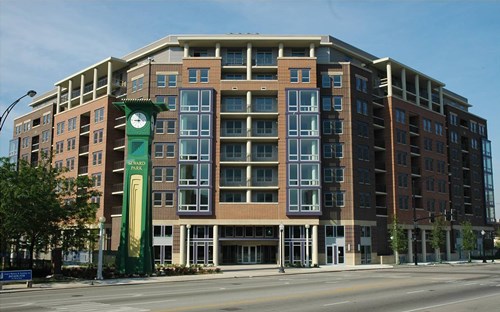
    and demolished them.  The goal was to replace them with less concentrated developments that would be integrated with their surrounding communities that looked more like this:

    or like this:

    The critical difference would be, however, that the CHA would now pursue a mixed-income approach to public housing development to address the city’s segregation problems and poverty concentration.  To do that, a third of residential units in new developments would be reserved for public housing residents, another third would be developed as affordable units for working-class and middle-class residents, and the last third would be sold or rented as market-rate properties. 

    Just as Operation Headache was successful in its early stages, so was the Plan for Transformation.  CHA worked closely with the U.S. Department of Housing and Urban Development to tear down the old public housing towers, and completed developments that did indeed appear more integrated into the surrounding neighborhood and fulfilled the mixed-income character that people desired.  By the mid-2000s both policies looked to be successful elements in the remaking of Chicago.

    But there were unintended consequences that law enforcement and housing officials did not see.  Violent crime in Chicago dropped to historic lows by 2005, leveled off for a few years, and started trending upward.  One reason cited?  Law enforcement became a victim of its success:

    “While experts say the Latin Kings, a Hispanic gang, continue to run a large and rigidly organized drug-selling operation on Chicago’s West Side, the majority of Chicago residents who call themselves gang members are members of a different type of group. Rather than sophisticated drug-selling organizations, most of the city’s gangs are smaller, younger, less formally structured cliques that typically lay claim to no more than the city block or two where they live. The violence stems not from rivalries between competing enterprises so much as feuds that flare up with acts of disrespect and become entrenched in a cycle of murderous retaliation.

    Many close observers of Chicago’s violence believe that, as well-intentioned as it was, the systematic dismantling of gangs like the Disciples led directly to the violence that is devastating the city’s most dangerous neighborhoods in 2016. Taking out the individuals who ran the city’s drug trade, the theory goes, caused a fracturing of the city’s criminal underworld and produced a vast constellation of new entities that are no less violent, and possibly even more menacing, than their vanquished predecessors.”

    Meanwhile, CHA was successful in the dismantling of old projects, but had limited success in the development of new ones, especially when trying to implement the mixed-income model.  In 1999, CHA committed to finding replacement housing for all public housing residents who would be displaced by the demolition, counting on their ability to construct mixed-income developments.  However, they soon ran into several challenges.  Private developers were finding it difficult to obtain financing for mixed-income developments, despite federal, state and local commitments.  But more importantly, market-rate buyers and renters, and even buyers and renters in the affordable range, showed little desire to share space with public housing residents. 

    This curtailed CHA’s ability to construct new developments, and forced them to rely much more heavily on Housing Choice Vouchers (HCVs, commonly referred to as Section 8 vouchers) to provide housing for former public housing residents.   An April 2011 report by CHA found that of the 16,500 public housing family households they committed to developing mixed-income units for, only 20% were actually in such developments.  There were 36% living in CHA projects that weren’t demolished, and 44% received HCVs and were living wherever their voucher would take them.

    Where did voucher holders go?  Generally to working-class black neighborhoods further south or west of former public housing sites on the south and west sides.  Many Robert Taylor and Stateway residents left Bronzeville and moved to the Englewood and Auburn-Gresham neighborhoods further south; many Horner and Rockwell residents left the near west side and Garfield Park and moved to Austin, further west. 

    The last straw was the closure of schools by the Chicago Public Schools in 2013.  By the mid-2000s, for anyone who cared to note it, there was growing evidence of conflict within the city’s public schools as children new to various neighborhoods competed with children of long-time residents.  At the same time the school system continued down its own budget spiral as the service delivery costs went upward and pension obligations went unmet.  That forced consideration of closures by CPS, much to the dismay of community residents familiar with the disruption caused by gang disorganization and an influx of poor residents.  Not only would the education of students be compromised by the closings, they argued, but the conflicts seen as voucher-holding residents moved into their communities would arise again.  New school boundaries would put combustible mixes of vulnerable children in new and dangerous environments.

    Globalization

    The election of Donald Trump as president has brought sharp focus to the polarization of our nation by economics, class and geography.  Well-educated and high-skilled workers are succeeding in today’s economy; less-educated and lower-skilled workers are failing.  A lot of people view this within the context of our nation’s white working class in small cities and rural areas, but the same applies to blacks in cities like Chicago as well.

    I’m going to plagiarize myself and pull some things about Chicago I wrote last year, when I saw six distinct categories of neighborhoods in the city.  Here’s the map:

    Gentrified Communities (dark green): Former middle and working-class neighborhoods that have firmly become well-to-do neighborhoods over the last 30 years or so. Home to a substantial amount of Chicago’s walkable urbanism inventory. Transit supported and amenity rich.

    Gentrifying Communities (light green): Historically similar to the adjacent gentrified communities, but part of a second or third wave of growth that emanated from the first group. Almost as affluent and educated as the first group, and quickly catching up, but not quite there yet.

    Frontline Communities (yellow): Largely working-class neighborhoods that may be experiencing development pressure generated in the gentrified/gentrifying communities. People in the above two areas may identify with communities here as places for authentic ethnic dining or shopping. Less wealthy and with more minorities than the gentrified/gentrifying communities, but less than those on its outer flank. In Chicago, at least, fear of the prospects of gentrification here may exceed reality.

    Stable Prosperous Communities (gold): Middle-class neighborhoods that sprouted in the city at the advent of the suburban era and have changed little since. Single-family home oriented and auto-oriented. In Chicago, home to many city workers who must remain in the city due to residency requirements. Rapidly growing older in its makeup.

    Transitioning Communities (orange): Structurally similar to the stable prosperous communities, but more deeply impacted by one or two transitions. Some are receiving a large influx of new minority residents, largely Latino. Others are experiencing a huge outflow of middle-class families, largely African-American. Those experiencing the Latino influx are becoming younger and less affluent; those experiencing the African-American outmigration are being hollowed out, leaving behind large numbers of older and younger less affluent residents.

    Isolated Communities (brown): Impoverished areas of the city. Middle-class white residents left here in the ’50s and ’60s, replaced by middle-class and working-class blacks who bore the brunt of job loss in the subsequent decades. Plenty of walkable urbanism exists here, but demolition means it’s fading away.

    Here are a few data pieces I gathered for each of the categories I identified (you can click to see bigger):

    Looking at the map, the green and light green neighborhoods have been Chicago’s winners in today’s global economy.  The gold neighborhoods have been doing reasonably well.  Depending on your perspective, the yellow neighborhoods are threatened with gentrification encroachment, or have a reasonable expectation of upcoming revitalization.  The orange and brown neighborhoods?  They’re not doing so well.  They’re the ones largely impacted by Chicago’s century-old segregation legacy, or in various stages of instability via the actions undertaken over the last 25 years. 

    Chicago’s rigid segregation patterns set the stage economic divergence before globalization did, but globalization made it worse.  And in the aftermath of the Great Recession, when globally connected communities returned to their upward trajectory, troubled communities sunk further into the abyss.

    Chicago’s violent crime spike will not be solved with National Guard troops patrolling the streets.  It will not be solved with greater emphasis on gun control laws.  It will not be solved by a wholesale reform of the Chicago Police Department, which has just come out of a year-long investigation by the U.S. Department of Justice that excoriated its “excessive force, lax discipline and bad training.”  All of these measures would have some incremental impact on violent crime.  Crime would go down, if only temporarily.  However, these measures treat the symptom.  None would do anything to address root causes and eliminate the problem for good.

    There is an answer to Chicago’s madness.  It would not solve the problem overnight, but it would have the potential to solve it for the long term.  I’ll outline it in my next blog post later this week.

    Pete Saunders is a Detroit native who has worked as a public and private sector urban planner in the Chicago area for more than twenty years.  He is also the author of “The Corner Side Yard,” an urban planning blog that focuses on the redevelopment and revitalization of Rust Belt cities.

    Top photo: A body is removed from the scene after a man was shot and killed in the 3000 block of West 53rd Place in Chicago. — Anthony Souffle, Chicago Tribune, April 13, 2014

  • Automation, Artificial Intelligence, and Projectile Wooden Shoes

    Sabotage has its root in the French word sabot, which is a kind of wooden shoe. In the early days of the Industrial Revolution craftsmen would throw their shoes into the gears of factory machines. Skilled labor was being replaced with mechanical production, undermining traditional professions, reducing incomes, and removing the social standing of workers. Wealth flowed up to the people who owned the factories and controlled the levers of political power. Sabotage was a form of negotiation. Industrial production was so incredibly efficient and profitable that the craft guilds had no chance of surviving over the long term. And since the cost of manufactured goods dropped like a stone with industrial processes society wasn’t inclined to turn back the clock. What unfolded over the course of a couple of centuries was a series of social, political, and economic convulsions including revolutions, wars, and mass migrations.

    screen-shot-2017-02-14-at-8-09-03-am

    screen-shot-2017-02-14-at-8-08-49-am

    screen-shot-2017-02-14-at-8-09-20-am

    I passed a construction site recently and saw this mobile surveillance pod. This is the beginning of the end of the night watchman. It’s part of the ever expanding panopticon of electronic monitors connected 24/7 to the cloud – complete with facial recognition software and the ability to cross reference an endless number of databases including everyone’s e-mails and geotagged cell phone records. Rent-a-cops are on the way out.

    screen-shot-2017-02-18-at-8-29-21-pm

    screen-shot-2017-02-18-at-8-30-14-pm

    screen-shot-2017-02-18-at-8-29-42-pm

    screen-shot-2017-02-18-at-8-30-03-pm

    Think this is only a big city thing? Try rural Montana. Same same. The squad car parked on the side of the highway with a radar gun is about to fade away. A far more effective and lucrative series of electronic devices will instill discipline in drivers and generate passive municipal revenue instead. Did I mention aerial drones? First they’re used in Afghanistan. Then along the Mexican border. Then poor high crime neighborhoods. Then your quiet little cul-de-sac in Indiana or South Carolina… The code enforcement people are going to love it.

    Screen Shot 2016-03-27 at 10.41.15 PM

    Screen Shot 2016-03-27 at 10.41.39 PM

    How much longer do you think it will be before long haul trucks are fully automated? Autonomous vehicles are cost cutting devices, not the latest upgrade for consumer convenience. What do you think will happen to all the roadside establishments that serve the needs of human truck drivers? Tick tock.

    screen-shot-2017-02-07-at-6-24-10-pm

    This is Google’s newest gadget. It’s comparable to Amazon’s Alexa and Apple’s Siri. Speak to these machines and they perk up. “Play Bohemian Rhapsody.” Or “Order four AA batteries.” Or “When is my next dentist appointment with Dr. Harris?” These devices search the internet and/or various personal files from your phone or computer and seamlessly give you what you want.

    screen-shot-2017-02-18-at-6-20-32-pm

    screen-shot-2017-02-18-at-6-20-54-pm

    Think you’ll be spared because you’re an educated professional? It’s only a matter of time before more advanced versions of artificial intelligence replace an army of human workers in more skilled positions. Medical centers will swap out administrative staff for a suite of voice activated algorithms. Computer programs will eventually read X-Rays and MRI results and provide preliminary diagnoses. Secure pill dispensing machines are already the norm in many hospital pharmacies. Tech support and customer service jobs will disappear. Accountants and paralegals are on that same list. Think outsourcing overseas was a problem for the former middle class? Think illegal immigrants drove down wages? Wait for what’s coming next.

    screen-shot-2017-02-11-at-5-26-33-am

    screen-shot-2017-02-11-at-5-24-40-am

    screen-shot-2017-02-11-at-5-23-25-am

    screen-shot-2017-02-11-at-5-25-55-am

    screen-shot-2017-02-11-at-5-25-03-am

    Here’s a common sight in Silicon Valley. Colonies of second hand RVs parked between a Burger King and a freeway off ramp are occupied by people who have no better option. The middle class tends to write off such populations as alcoholic schizophrenics. I interact with these folks on a regular basis and most have jobs. Some have two or three. They’re adamant that they did nothing wrong, but the larger society has simply discarded them. The median home price in San Jose is $1,085,000. Median rent for a studio apartment is $2,120. Moving to a “cheaper” place like Oakland is no longer an option. Two bedroom apartments there now rent for $3,500 – assuming you can find a vacancy. The minimum wage in these communities ranges between $10.30 and $15 an hour. The numbers don’t add up. There are an awful lot of these homeless camps everywhere these days. This is what a bifurcated economy looks like.

    A friend asked me to write about a possible Minimum Guaranteed Income. The concept is simple enough. If an individual or household earns less than a certain amount of money the government will fill the gap with a cash payment. I remember my social studies teacher talking about a “negative income tax” back in the 1970’s so this isn’t a new idea.

    My response was short and to the point. Not going to happen. Americans reject wealth transfers and chafe at any hint of “social engineering.” Anti-poverty programs are so deeply unpopular that a Minimum Guaranteed Income is a non-starter. And resistance is strongest from the people who would most benefit – the marginal declining middle class.

    The usual solutions aren’t going to work either. Dramatically raising the minimum wage will only encourage more employers to automate more agressively to squeeze labor out of their business models. Jacking up taxes will drive jobs and people out of the state (a process that is already well under way.) Building subsidized housing won’t scale up and is politically toxic. Rent control keeps some people in artificially affordable housing at the expense of their landlords, but does nothing to create new housing – quite the opposite. Reducing regulations and eliminating onerous bureaucracies is structurally impossible since the agencies that administer existing programs are a lot more powerful than the people they’re meant to serve. Moving to Texas works for people who already have a toehold in the middle class, but for those with less skills and no money life in Houston is merely slightly less miserable. The list goes on…

    screen-shot-2017-02-20-at-3-25-18-am

    screen-shot-2017-02-20-at-3-25-08-am

    screen-shot-2017-02-20-at-3-36-01-am

    Screen Shot 2016-02-04 at 7.58.45 PM

    My best guess is we’ll see the implementation of policies that achieve similar goals to a Minimum Guaranteed Income by other means. But they’ll need to be in keeping with the dominant cultural narrative: The Puritan Work Ethic. If you don’t work, you don’t eat. And they’ll have to be designed to filter out people who are deemed unworthy of inclusion. That’s been the pattern for centuries. The military is the primary model. Cradle to grave socialism is perfectly acceptable – often eagerly embraced – by American society if the wealth transfer is to people who are believed to be deserving. The militarization of domestic affairs is a distinct possibility.

    screen-shot-2016-10-12-at-9-23-39-am

    screen-shot-2016-10-12-at-9-49-12-am

    Massive infrastructure building projects are another viable option for employing large numbers of low skill workers. The cost, productive capacity, or return on investment of such projects is essentially irrelevant. Project funding will be allocated by a political process that prioritizes select populations in particular locations. This preserves the existing vested interests – a combination of corporations and big government. Republican. Democrat. Conservative. Liberal. It doesn’t matter. The goal is to allow business-as-usual to limp along for a while longer while mollifying the displaced population. This will work until the feds can no longer borrow and print money. The alternative is a Soviet Union style collapse.

    John Sanphillippo lives in San Francisco and blogs about urbanism, adaptation, and resilience at granolashotgun.com. He’s a member of the Congress for New Urbanism, films videos for faircompanies.com, and is a regular contributor to Strongtowns.org. He earns his living by buying, renovating, and renting undervalued properties in places that have good long term prospects. He is a graduate of Rutgers University.

    All photos by Johnny Sanphillippo

  • Vancouverizing Seattle?

    A recent Wall Street Journal article (“For Chinese buyers, Seattle is the new Vancouver”) reported that Seattle was replacing Vancouver as the most popular destination for Chinese buyers in North America. For years, there has been considerable concern about foreign investment in the Vancouver housing market, especially Chinese investment. This   demand is widely believed to have driven Vancouver house prices “through the roof.” In response, the British Columbia government recently imposed a 15 percent foreign buyers tax that has had the impact of significantly reducing new foreign investment in Vancouver’s housing market.

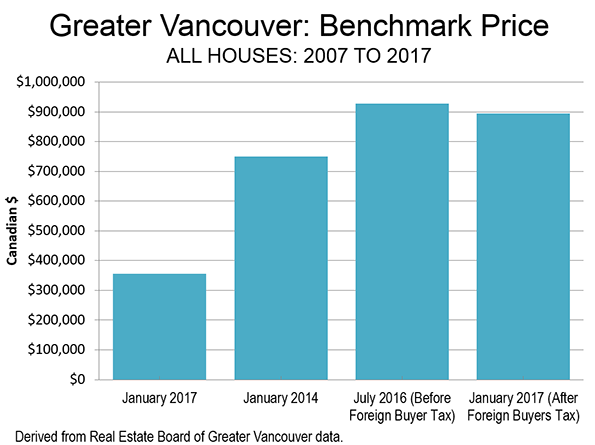
    Yet the impact of the tax has still been muted. Houses remain just about as unaffordable as before. The Real Estate Board of Greater Vancouver benchmark price has dropped less than four percent from six months ago, before the foreign buyers tax was imposed. This compares to an 80 percent increase over the last 10 years and 47 percent increase over just the last three years (Figure).

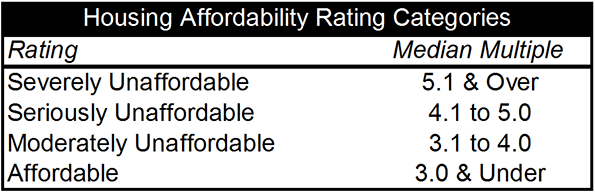
    Clearly there is something other than Chinese investment driving up Vancouver house prices. Since 2004, Vancouver’s median multiple (median house price divided by median household income) has risen from 5.3 to 11.8. This means that that the median house has increased in price more than six times the annual median household income.

    The primary cause of Vancouver’s difficulties is a rigged housing market. For decades, Vancouver has had some of the strongest urban containment policy in the world. Regional land-use authorities have prohibited  housing development from being built on a large agricultural reserve. This land is hardly needed for such use in a nation that has increased its gross agricultural output more than 150 percent since 1961, while reducing its land in farms by three times as many acres as is occupied by all urban settlements combined, according to the 2016 Canadian census. Of course, urban containment restrictions on new housing have driven up house prices, just as Middle East oil supply reductions used to drive up gasoline prices, before the recent supply increases from Canadian and US oil production.

    Vancouver has literally become the third most unaffordable city (metropolitan area) in the nine nations covered by the Demographia International Housing Affordability Survey. This makes a mockery of the Vancouver’s frequent citation as one of the most livable cities in the world. The first principle of livability is affordability — you cannot live where you cannot afford. Most young families of normal economic means cannot hope to ever buy a modest detached house with a yard as their parents or grandparents did decades ago in the Vancouver area. Only Hong Kong and Sydney are less affordable.

    In a recent column (“Not much can or will be done to make Vancouver housing more affordable”) by Gordon Clark in The Province (Vancouver newspaper) describes how things have changed, in a story similar to what you will hear in Sydney, San Francisco and others of the world’s most unaffordable cities. In 1941, his postal supervisor grandfather purchased a house on Oak Street (a main central arterial leading toward downtown) for 1.5 years of income. In 1979 his teacher mother purchased a house in the city of Vancouver for 2.5 times her income. Now with houses costing nearly 12 times incomes, Clark regretfully concludes that nothing can be done: “because the solutions are unacceptable to most people.”

    This illustrates what is perhaps the most powerful characteristic of urban containment regulation — that it creates a strong lobby of support among those who have seen their house values irrationally escalate as a result of unwise government policy. In this environment, public officials simply wring their hands, decry the problem and implement nothing of substance to change the essentially flawed policies. 

    With this rigged market, it should not be surprising that people with money from outside Vancouver, and abroad, would seek to buy houses in Vancouver. After all, the policies all but guaranteed strong returns to anyone with enough capital to enter the market.   It is as if a “Speculators Welcome” banner has been hung from Lion’s Gate Bridge. Not so welcome are those middle-income households being driven out of the market

    Lessons for Seattle

    All of this is a cautionary tale for the Seattle metropolitan area, which also has urban containment policy, but of more recent vintage. Just 140 miles or 225 kilometers south of Vancouver, Seattle’s has housing affordability that already as bad as Vancouver’s  only 12 years ago.

    Seattle has a severely unaffordable median multiple of 5.5, slightly worse than Vancouver’s 5.3 in 2004. In the late 1980s, before Seattle imposed its metropolitan- urban containment policy, the median multiple was as low as 2.4 (Table). Today, a Seattle household with the median income must pay three additional years of income for the median priced house.

    Rising housing demand with severely constricted supply is associated with higher house prices compared to incomes. In this regard, Seattle has multiple risks, from households escaping California to escape from the even higher prices, Seattle is a bargain compared to the “dogs breakfast” of unaffordable housing associated with California where median multiples now exceed 8.0 in all of the major coastal metropolitan areas (Los Angeles, San Francisco, San Diego and San Jose). Prices are so high in California that a seller can buy a comparable house in Seattle for hundreds of thousands less. There may not be as much sun in Seattle, but there’s plenty of money left over for umbrellas and other goods and services.

    Now the pressure is likely to increase as foreign investors who shop the world for rigged housing markets promise quick profits now turn their attention to the Puget Sound. In this environment, it would not be surprising for additional serious house price escalation to be in the offing, and Seattle to indeed become the new Vancouver in the next decade or two.

    Given these forces, we can expect Seattle housing prices   will continue to increase disproportionately to incomes unless there is land use policy reform. Sufficient supply must be allowed on greenfield land to keep house prices from rising farther. And “building to the sky”— which is very expensive and not very family friendly —  is not likely to restore housing affordability in Seattle any more than it has anywhere else. For example, the Manhattanization of central Toronto, with its many new residential towers, has not prevented its median multiple from doubling from 3.9 to 7.7 in the last 12 years. Nor has it prevented a far less obvious (at least to the press) 80 percent share of population growth to be in the suburbs between 2011 and 2016.

    Lost in all of this are ordinary middle and working class people, who routinely take a back seat in public policy to planning obsessions over urban form, and a “sense of place.” Middle-income households are far more in need of a “decent place” to live at a reasonable price. Architectural marvels or sleek streetscapes are no substitute. The issue is not ideological, it is rather practical and human. Nor is it about property rights, or free markets. The issue is that people are being denied the housing they desire by urban containment policy and its distorted priorities. As Paul Cheshire, Max Nathan and Henry G. Overman of the London School of Economics have pointed out, “people rather than places” should be the focus of urban policy.

    It is ironic that progressive metropolitan areas, like Vancouver, where inclusionary zoning drip feeds housing to lower income households, have become, large exclusionary zones where average income households cannot afford houses. Seattle is headed down the same path.  Soon it may be time to hang a “Speculators Welcome” banner from the Space Needle.

    Photograph: Downtown Seattle (by author)            

    Wendell Cox is principal of Demographia, an international public policy and demographics firm. He is a Senior Fellow of the Center for Opportunity Urbanism (US), Senior Fellow for Housing Affordability and Municipal Policy for the Frontier Centre for Public Policy (Canada), and a member of the Board of Advisors of the Center for Demographics and Policy at Chapman University (California). He is co-author of the "Demographia International Housing Affordability Survey" and author of "Demographia World Urban Areas" and "War on the Dream: How Anti-Sprawl Policy Threatens the Quality of Life." He was appointed to three terms on the Los Angeles County Transportation Commission, where he served with the leading city and county leadership as the only non-elected member. He served as a visiting professor at the Conservatoire National des Arts et Metiers, a national university in Paris.