Category: Policy

  • Smart Growth (Livability), Air Pollution and Public Health

    In response to the outcry by job creators about proposed new Nitrogen Oxides emission regulations, the Obama Administration has suspended a planned expansion of these rules.

    The Public Health Risks of Densification

    The purpose of local air pollution regulation is to improve public health. For years, regional transportation plans, public officials, and urban planners have been seeking to densify urban areas, using strategies referred to as “smart growth” or “livability.” They have claimed that densifying urban areas would lead to lower levels of air pollution, principally because it is believed to reduce travel by car. In fact, however, EPA data show that higher population densities are strongly associated with higher levels of automobile travel and more intense air pollution emissions from cars and other highway vehicles. In short, higher emissions cause people to breathe more in air pollution, which can be unhealthful. To use a graphic example, a person is likely to encounter a greater chance of health risk by breathing intense smoke from a fire than if they are far enough from the fire to dilute the intensity of the smoke.

    Overall, more intense air pollution detracts from public health. To put in the economic terms that appear so often in planning literature on "urban sprawl," more intense traffic congestion and the consequent higher air pollution emissions are negative externalities of smart growth and densification.

    This is illustrated by county-level data for nitrogen oxides (NOx) emissions, which is an important contributor to ozone formation. This analysis includes the more than 420 counties in the nation’s major metropolitan areas (those with more than 1 million in population).

    Seven of the 10 counties with the highest NOx emissions concentration (annual tons per square mile) in major metropolitan areas are also among the top 10 in population density (2008). The densest, New York County (Manhattan), has by far the most intense NOx emissions. Manhattan also has the highest concentration of emissions for the other criteria air pollutants, such as carbon monoxide, particulates, and volatile organic compounds (2002 data). New York City’s other three most urban counties (Bronx, Kings, and Queens) are more dense than any county in the nation outside Manhattan, and all land among the top 10 in NOx emission density (Table 1).

    Table 1
    Intensity of Nox Emissions (per Square Mile)
    NOx Emissions
    Rank County Compared to Average
    1 New York Co, NY           23.8
    2 San Francisco Co, CA           14.7
    3 Bronx Co, NY           13.7
    4 Washington city, DC           13.1
    5 St. Louis city, MO           12.4
    6 Arlington Co, VA           11.3
    7 Cook Co, IL           10.0
    8 Suffolk Co, MA             9.5
    9 Kings Co, NY             8.7
    10 Queens Co, NY             8.7
    Calculated from 2008 EPA Data


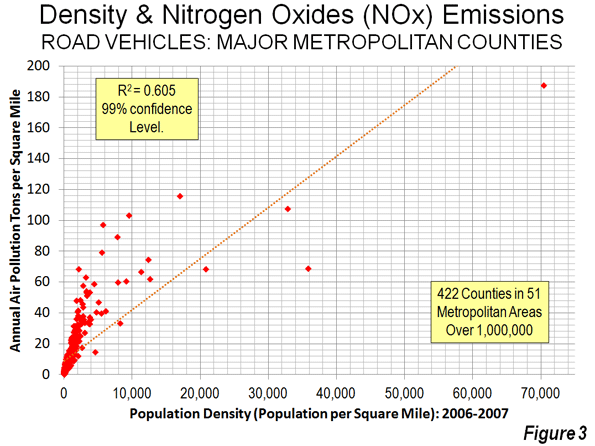
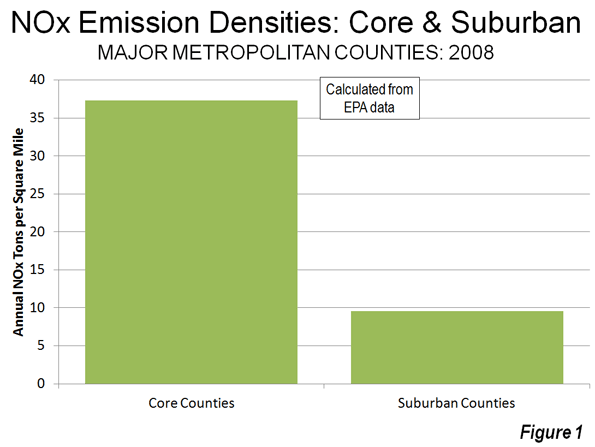
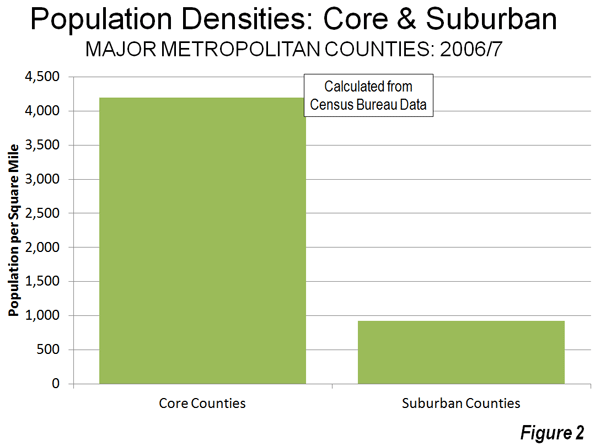
    NOx emission density data by county is provided in the document below, Annual Density of Highway Vehicle NOx Emissions by County: 2008. Overall, this data indicates that the average core county had a NOx density 3.9 times that of the average suburban county (Figure 1). By contrast, the average core county density is 4.5 times that of the average suburban county (Figure 2), indicating a strong relationship that is also shown in Figure 3.
    For example, in the New York metropolitan area, core New York County has NOx emissions that are nearly 15 times as intense in a given volume of air as suburban Morris County. In the Cleveland metropolitan area, core Cuyahoga County has a NOx emissions intensity 12 times that of suburban Geauga County. Charlotte’s core Mecklenberg County has a NOx emissions intensity more than five times that of suburban Union County.

    Traffic and Air Pollution

    More concentrated traffic also leads to greater traffic congestion and more intense air pollution, according to data available from EPA. The data for traffic concentration is similar to population density. Manhattan – despite its huge transit complex – has by far the greatest miles of road travel per square mile of any county, while seven of the densest counties are among the top ten in traffic intensity. As in the case of NOx emissions, the four highly urbanized New York City counties are also among the top 10 in the density of motor vehicle travel (Table 1).

    Table 2
    Intensity of Traffic (per Square Mile)
    Motor Vehicle Travel
    Rank County Compared to Average
    1 New York Co, NY 37.8
    2 Bronx Co, NY 22.3
    3 Fredericksburg city, VA 19.9
    4 Alexandria city, VA 15.8
    5 San Francisco Co, CA 15.6
    6 Arlington Co, VA 15.1
    7 Suffolk Co, MA 14.4
    8 Queens Co, NY 14.3
    9 Kings Co, NY 13.8
    10 Washington city, DC 13.1
    Calculated from 2005 EPA Data


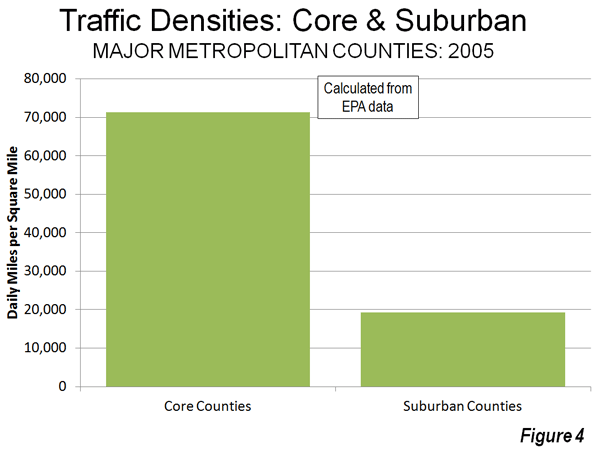
    Traffic density data by county is provided in the second document below, Daily Density of Road Vehicle Miles by County: 2005. Overall, this data indicates that the average core county had a traffic density 3.7 times that of the average suburban county (Figure 4), again a difference similar to the difference in density (Figure 5).
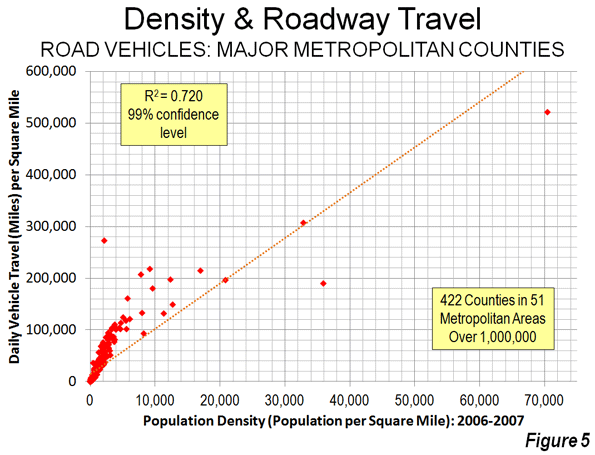
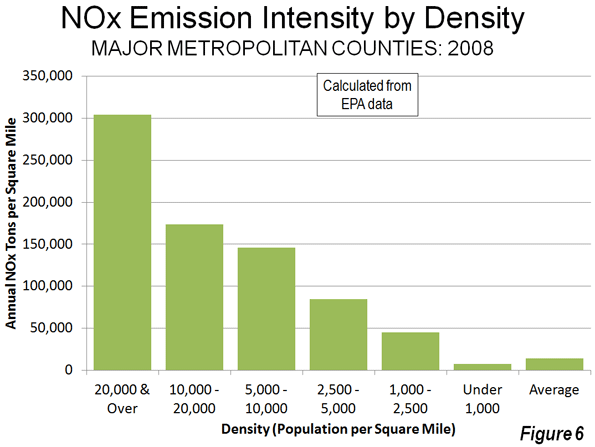
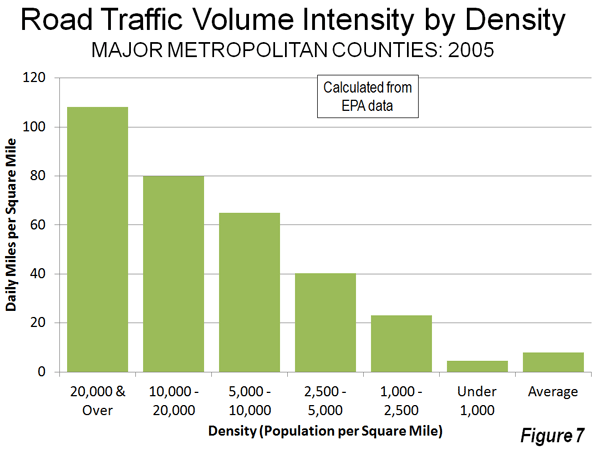
    The overall relationship between higher population densities and both NOx concentration and motor vehicle traffic intensity is illustrated in Figure 6 and Figure 7. There is a significant increase in the concentration of both NOx emissions and motor vehicle travel in each higher category of population density. For example, the counties with more than 20,000 people per square mile have NOx emission concentrations 14 times those of the average county in these metropolitan areas, and motor vehicle travel is 22 times the average. A smaller sample of the most urbanized counties (those with 90 percent or more of the land urbanized) showed a stronger association. This findings are consistent with research by the Sierra Club and a model derived from that research by ICLEI–Local Governments for Sustainability, both strong supporters of the livability and smart growth strategies of densification.
    A Caution: The air pollution data contained in this report is for emissions, not for air quality. Air quality is related to emissions and if there were no other intervening variables, it could be expected that emissions alone would predict air quality. However there are a number of intervening variables, from climate, wind, topography and other factors. Again, Los Angeles County makes the point. As the highest density large urban area in the nation   Los Angeles under any circumstances would have among the highest density of air pollution emissions. However, the situation in Los Angeles is exacerbated by the fact that the urban area is surrounded by mountains which tend to trap the air pollution that is blown eastward by the prevailing westerly winds.

    The EPA data for 2002 can be used to create maps indicating criteria pollutant densities within metropolitan areas. An example is shown of  the Portland (OR-WA) metropolitan area (Figure 8), with the latter indicating the data illustration feature using Multnomah County (the central county of the metropolitan area), which is the most dense county and has the greatest intensity of NOx emissions and traffic congestion.

    The Goal: Improving Public Health

    These data strongly indicate that the densification strategies associated with smart growth and livability are likely to worsen the intensity of both NOx emissions and congestion of motor vehicle travel.

    But there is a more important impact. A principal reason for regulating air pollution from highway vehicles is to minimize public health risks. Any public policy that tends to increase air pollution intensities will work against the very purpose of air pollution regulation: public health. The American Heart Association found that air pollution levels vary significantly in urban areas and that people who live close to highly congested roadways are exposed to greater health risks. The EPA also notes that NOx emissions are higher near busy roadways. The bottom line is that all – things being equal – higher population density, more intense traffic congestion, and higher concentrations of air pollution go together.

    All of this could have serious consequences as the EPA seeks to expand its misguided regulations. For example, officials in the Tampa-St. Petersburg area have expressed concern that the metropolitan area will not meet the new standards, and they have proposed densification as a solution, consistent with the misleading conventional wisdom. The reality is that this is likely to make things worse, not better.  

    Less Livable

    There are myriad difficulties with smart growth and livability policies, not least their association with higher housing prices, a higher cost of living, muted economic growth, and decreased mobility and access to jobs in metropolitan areas. As the EPA data show, the densification policies of smart growth and livability also make air pollution worse for people at risk.

    Virtually all urban areas of Western Europe, North America and Oceania principally rely on cars for their mobility and there is no indicate that this will change. The air is less healthful for residents where traffic intensity is greater. As the air pollution intensity data shows, cars need space.

    Wendell Cox is a Visiting Professor, Conservatoire National des Arts et Metiers, Paris and the author of “War on the Dream: How Anti-Sprawl Policy Threatens the Quality of Life

    —–

    Note 1: The city (county level jurisdiction) of Fredericksburg, Virginia surprisingly ranks third in its concentration of motor vehicle travel yet ranks eighth much lower in population density. This reflects the high volumes of traffic through the  small municipality (and county-equivalent jurisdiction) carried on two of the East’s busiest roadways, Interstate 95 and US-1.

    Note 2: Additional analysis and information is available at Air Pollution, NOx Emissions, Traffic Congestion and Higher Population Density: The Association in Major Metropolitan Areas of the United States.

    Adapted from an article published by the Heritage Foundation.

    Photo of Manhattan traffic by carthesian.

  • First Step for California: Admit There’s a Problem

    The October 29, 2009 issue of Time Magazine had an article titled “Why California is America’s Future.”  I sure hope not.  California is fast becoming a post-industrial hell for almost everyone except the gentry class, their best servants, and the public sector.

    We only need a few numbers to demonstrate that California is clearly on the wrong track:

    • California’s unemployment rate is over 12 percent, about a third higher than the United States.
    • Only eight of California’s 58 counties have unemployment rates in single digits.
    • California has lost jobs in four of the past six months for which we have data, while the United States has gained or had no change in jobs in each month over that period.
    • California’s poverty rate is 16.1 percent compared to the United States 15.1 percent.  The rate goes way up when adjusted for the cost of living.  For example, the respected Public Policy Institute of California estimated that Los Angeles County’s 2007 poverty rate increased 11 percentage points from 15 to 26 percent, when adjusted for cost of living. 
    • Two California cities, Fresno and San Bernardino, are among the ten poorest American cities with populations over 200,000.  In fact, San Bernardino’s 34.6 poverty rate is the second highest of these cities, exceeded only by Detroit.
    • Unemployment among college educated is 34 percent higher in California than in the United States, while Los Angeles’s college educated unemployment rate is almost a whopping 80 percent above the United States’ rate.
    • According the California Department of Education, California’s public colleges and universities graduate over 150,000 students a year, while California’s Economic Development Department is forecasting less than 50,000 openings a year for jobs that require a college degree.

    Of course, that’s not the future that Time was selling.  Time’s future was a “dream state,” a magical place where enlightened pioneers, guided by their superior vision and funded by venture capital, would lead the world in innovation and environmental bliss.  California firms, like Solyndra, would lead the competition to a competitive new green economy.  No kidding, they named Solyndra:

    "It’s (California) building massive power plants for utilities, as well as roof panels for big-box stores, complete subdivisions and individual homes. Prices are plummeting, and competition is fierce, most of it from California firms like BrightSource, Solar City, eSolar, Nanosolar and Solyndra." 

    Along the way to this brave new world, there would be a new, “green” gold rush “beckoning dreamers who want to cook Korean tacos or convert fuel tanks into hot tubs.”

    That vision turned out to be about as real as Disneyland – but not as profitable. 

    Time wasn’t alone.  Brett Arends had a similar piece, The Truth about California, in November 2010, and the ever-optimistic duo of Bill Lockyer and Stephen Levy had a December 2010 piece, California isn’t Broken.

    Visitors can be forgiven for seeing California as a bit of paradise on earth.  It is.  I  am a native myself who could not wait to return from my job at the Federal Reserve in Washington, DC.  I remember going to Santa Barbara in October for my UCSB job interview.  Santa Barbara was magical to me, after enduring weeks of dreary and increasingly cold East Coast weather.  Santa Barbara was warm and sunny, and people were wearing the minimum legal requirements, and State Street was alive and vibrant with a happy energy I hadn’t seen since I’d left California for my East Coast job over a year before. 

    I wanted that job.

    You can still have that experience in certain spots in California.  There’s no doubt, California has abundant charms.  It can seduce almost anyone. 

    But there is a lot of California that visitors don’t see.  They don’t see the many communities in California’s central valley where unemployment rates of over 15 percent are typical, where people live in substandard housing and face the prospect of a lifetime in an ignored underclass.

    Well, they are not exactly ignored.  They receive food stamps and other subsidies, but they are denied opportunity, social mobility, or the confidence and pride that come with self-sufficiency.

    You don’t have to leave Santa Monica or Santa Barbara to see poverty without opportunity though.  Just blocks from Santa Barbara’s State Street or Santa Monica’s Third Street Promenade, over-crowded units , packed sometimes by several families, are the norm, because Coastal California’s housing prices are not related to the local economy. Statewide, 28 percent of California’s children live in crowded housing.  This is the highest rate in the nation, tied only with Hawaii. 

    When you live here, you can’t avoid the signs of California’s decline.  Beaches I walked with High School dates are no longer safe at night.  Water lines in Los Angeles burst with alarming frequency.  Our roads are approaching gridlock and are littered with potholes.  Electrical cutbacks are common in hot weather.  Water is increasingly scarce, except in very rainy years.  Our primary schools are clearly in decline.  Even California’s higher education system, once the envy of the world, has passed its prime. Places like the University of Texas or University of North Carolina are now real competitors.

    It wasn’t always this way, and it doesn’t have to be in the future.  When I started my career, California was a place of opportunity.  One could have a career, own a home, and raise a family. 

    Not any more – not unless you have a trust fund or a secure pensioned public employee job. 

    That’s why California’s middle class is leaving, looking for opportunity and affordable housing.  The evidence is in the migration data.  Domestic migration has been negative for over a decade.  Perhaps even more telling, only 23 percent of U.S. illegal immigrants are coming to California today, down from about 42 percent in 1990.  Even the lowest skilled newcomers know there’s shrinking opportunity here.

    California has a problem, and it’s high time the political class accepted the fact.

    Two steps need to be taken before any problem can be solved.  You need to recognize you have a problem.  Then you need to identify the problem.  Unfortunately, it appears that among Sacramento’s leadership, only Gavin Newsom even recognizes that California has a problem.  Governor Brown gives lip service to jobs, but like Schwarzenegger before him, identifies the failed command and control policies of the green movement as the source of the new jobs.  Solyndra has become the poster child for this fantastical policy failure.

    California’s economic future is pretty grim, until Sacramento takes off the blinders and admits it has a problem. Until then, things are likely to get much worse before they get better.

    Bill Watkins is a professor at California Lutheran University and runs the Center for Economic Research and Forecasting, which can be found at clucerf.org

    Photo illustration by krazydad/jbum.

  • The Demise Of The Luxury City

    The Republican victory in New York City’s ninth congressional district Sept. 13 — in a special election to replace disgraced Rep. Anthony Weiner — shocked the nation.  But more important, it also could have signaled the end of the idea, propagated by Mayor Michael Bloomberg, of New York’s future as a “luxury product.”

    For a decade, the Bloomberg paradigm has held the city together: Wall Street riches fund an expanding bureaucracy that promotes social liberalism and nanny-state green politics. Indeed, Wall Street’s fortune — guaranteed by federal bailouts and monetary policy under both Presidents George W. Bush and Barack Obama — has been the key to the mayor’s largely self-funded political success. Under Bloomberg, Wall Street’s profits allowed city expenditures to grow 40% faster than the rate of inflation. Bloomberg was also able to buy political peace by bestowing raises two to three times the rate of inflation on the city’s unionized workers.

    Now this calculus is falling apart. Layoffs are mounting on Wall Street, while bonuses — the red meat that fuels everything from high-end condos to expensive boutiques and restaurants — are expected to drop 30% from last year.

    The newly Republican ninth district — stretching from south Brooklyn through the upper-middle-class strongholds around Forest Hills, Queens — reflects growing unease in the non-luxury parts of the city. The area is decidedly middle class, but with a median income of $55,000 it is the city’s least wealthy white district. For the most part, its residents have not benefited from Bloomberg’s management nor from Obama’s economic policies.

    Rather, the district reflects the kind of anxiety that is sweeping middle class areas across the country. “These people are worried about their kids and their future,” says Seth Bornstein, executive director the Queens Economic Development Corp. “The fire may not be in the backyard, but it’s around the corner.”

    Like many native New Yorkers, Bornstein sees Manhattan — the epicenter of the “luxury city” — as something of a “fantasy land,” inhabited by those who, despite living in Gotham’s historic core, are “not really New Yorkers.” Most Manhattanites, he notes, did not grow up in New York, and a majority live in single households. They largely either go to school, work in media or Wall Street, or make their livings servicing the rich.

    The ninth district is different socially as well. It is family-oriented. Barely one-third live in single households, compared with a near majority in Manhattan. Unlike the tony Upper East Side or trendy Soho, there are few celebrities or multi-millionaires. Although some of the ninth district’s inhabitants do work in the financial sector, many are tied to industries such as garments, work as professionals, such as doctors or accountants, or own their own small businesses.

    Some Democrats like California Rep. Henry Waxman have another explanation for the vote: greed. “They want to protect their wealth,” he explained, “which is why a lot of well-off voters vote for Republicans.” You almost have to admire the chutzpah of such views from a man who represents Beverly Hills.

    Waxman, of course, is wrong. This election was driven not by desertions of the rich but by the shift to the GOP among largely middle or working class voters. In many ways this election followed the pattern established by Sen. Scott Brown’s stunning 2009 Massachusetts victory, which came largely from middle-income voters. The ninth district’s new representative, Bob Turner, won big in modest Middle Village and South Brooklyn, while losing decisively in the wealthiest precincts such as Forest Hills and some minority, immigrant-oriented enclaves.

    The big story here, as Bornstein suggests, lies in the growing unease about the national and New York economies among large sections of the city’s beleaguered middle class. Despite the enormous wealth generated on Wall Street, New York’s middle class has been fleeing the city at breakneck speed for decades.

    According to the Brookings Institution, New York has suffered the fastest declines of middle class neighborhoods in the U.S.: Its share of middle income neighborhoods is roughly half that of Seattle or the much maligned Long Island suburbs. Twenty-five percent of New York City was middle-class in 1970, but by 2008 that figure had dropped to 16%.

    Even the young, who so dominate parts of lower Manhattan and Brooklyn, do not appear to be hanging around once they get into their 30s, particularly after their children reach school age. One reason: Bloomberg’s much touted school reforms have been, for the most part, ineffective in turning the bulk of the city’s public schools around.

    Ultimately, the basic truth is this: Bloomberg’s luxury city has failed most of its citizens. Despite its self-celebrated “progressive” image, New York has the most unequal distribution of income in the nation. The bulk of the job growth has not been on Wall Street, where employment has declined over the decade, but in hospitality and restaurants, which pay salaries 60% below the city average. In fact, restaurants are now the largest single private employers in Manhattan, with more people serving tables than trading equities.  As the New York Post quipped: “If you can make it here, you can make it anywhere — as a waiter.”

    It gets worse for the poor. One in five New Yorkers lives in poverty. Black male joblessness hovers at around 50%. Overall, New York’s household income, based on purchasing power, ranks 21st in the nation, behind not only such rich areas as San Francisco or Washington, but also places like Houston, Dallas, Indianapolis, Kansas City and even Pittsburgh.

    Ultimately, suggests Jonathan Bowles, president of the Center for an Urban Future, the future of New York’s middle class depends on reducing dependence on Wall Street.  The city needs to focus on industries and niches outside finance, including education, health, design, high-tech services, media and smaller businesses, many of them owned by immigrants.

    Bowles suggests diversification needs to speed up particularly now that Wall Street, the very engine of the “luxury” economy, is sputtering. Such a change will require a new political climate.  Voter engagement and political choice in New York have atrophied under the Medici-like Bloomberg, who has managed to pay off many interest groups with a combination of his own and the city’s money. Combined with a union-financed get-out-the-vote, the choices offered by the city’s once contentious politics have become increasingly constricted.

    But something is stirring in the boroughs.  The district’s voters not only embarrassed their civic betters by voting Republican, but they also demonstrated that New York’s middle class, politically quiescent under Bloomberg, may need to be taken seriously again.

    This gives hope for what Bornstein calls “the real New York” — a place that is neither particularly glamorous nor severely bifurcated between the rich and those who service their needs. With a more diversified economy and family orientation, this unexpected rebellion could represent the first step toward restoring New York’s roots as a city not of luxury but of aspiration.

    This piece originally appeared at Forbes.com.

    Joel Kotkin is executive editor of NewGeography.com and is a distinguished presidential fellow in urban futures at Chapman University, and an adjunct fellow of the Legatum Institute in London. He is author of The City: A Global History. His newest book is The Next Hundred Million: America in 2050, released in February, 2010.

    Photo by flickr user zoonabar

  • Declining Birthrates, Expanded Bureaucracy: Is U.S. Going European?

    To President Barack Obama and many other Democrats, Europe continues to exercise something of a fatal attraction.  The “European dream” embraced by these politicians — as well as by many pundits, academics and policy analysts — usually consists of an America governed by an expanded bureaucracy, connected by high-speed trains and following a tough green energy policy.

    One hopes that the current crisis gripping the E.U. will give even the most devoted Europhiles pause about the wisdom of such mimicry. Yet the deadliest European disease the U.S. must avoid is that of persistent demographic decline.

    The gravity of Europe’s demographic situation became clear at a conference I attended in Singapore last year. Dieter Salomon, the green mayor of the environmentally correct Freiburg, Germany, was speaking about the future of cities. When asked what Germany’s future would be like in 30 years, he answered, with a little smile,  ”There won’t be a future.”

    Herr Mayor was not exaggerating. For decades, Europe has experienced some of the world’s slowest population growth rates. Fertility rates have dropped well below replacement rates, and are roughly 50% lower than those in the U.S. Over time these demographic trends will have catastrophic economic consequences. By 2050, Europe, now home to 730 million people, will shrink by 75 million to 100 million and its workforce will be 25% smaller than in 2000.

    The fiscal costs of this process are already evident. Countries like Spain, Italy and Greece, which rank among the most rapidly aging populations in the world, are teetering on the verge of bankruptcy. One reason has to do with the lack enough productive workers to pay for generous pensions and other welfare-state provisions.

    Germany, the über-economy of the continent, has little hope of avoiding the demographic winter either.  By 2030 Germany will have about 53 retirees for every 100 people in its workforce; by comparison the U.S. ratio will be closer to 30. As a result, Germany will face a giant debt crisis, as social costs for the aging eat away its currently frugal and productive economy. According to the American Enterprise Institute’s Nick Eberstadt, by 2020 Germany debt service compared to GDP will rise to twice that currently suffered by Greece.

    Europe, of course, is not alone in the hyper-aging phenomena. Japan, South Korea, Taiwan and Singapore face a similar scenario of rapid aging, a declining workforce and gradual depopulation.

    In the past, it seemed likely America would be spared the worst of this mass aging. But there are worrisome signs that our demographic exceptionalism could be threatened. One cause for concern is rapid   decline in immigration, both legal and illegal.  Although few nativist firebrands have noticed, the number of unauthorized immigrants living in the U.S. has decreased by 1 million from 2007.   Legal immigration is also down.  Meanwhile, the number of Mexicans annually leaving Mexico for the U.S. declined from more than 1 million in 2006 to 404,000 in 2010 — a 60% reduction.

    More troubling still, fewer immigrants are becoming naturalized residents.   In 2008, there were over 1 million naturalizations; last year there were barely 600,000, a remarkable 40% drop.

    The drop-off includes most key sending countries, including Mexico, which accounts for 30% of all immigrants. Since 2008 naturalizations have dropped by 65% from North America, 24% from Asia and 28% for Europe.  In fact the only place from which naturalizations are on the rise appears to be Africa, with an 18% increase.

    This drop off, if continued, will have severe consequences. Since 1990 immigrants have accounted for some 45% of all our labor force growth and have increased their share from 9.3% to 15.7% of all workers. These immigrants, and their children, have been one key reason why the U.S. has avoided the deadly demography of Europe and much of east Asia.

    This decline can be traced, in part, by rapid decreases in birthrates among such traditional sources of immigrants such as China, India, Mexico and the rest of Latin America. Mexico’s birthrate, for example, has declined from 6.8 children per woman in 1970 to roughly 2 children per woman in 2011. This drop-off has reduced the number of Mexicans entering the workforce from 1 million annually in the 1990s to about 800,000 today. By 2030, that number will drop to 300,000.

    A second major cause lies with the improved economy in many developing countries like Mexico. According to economist Robert Newell, per-capita  Mexico’s GDP and family income have both climbed by more than 45% over the last 10 years  . Not only are there less children to emigrate, but there’s more opportunity for those who chose to remain.

    Asia not only has lower birthrates, and, for the most part, better performing economies. As a result, immigrants — many of them well educated and entrepreneurially oriented — who in earlier years might have felt the need to come to the U.S. now can find ample opportunities at home. Many educated immigrants and graduate  students, notably from Asia, are not staying after graduation. America’s loss is Asia’s gain.

    Finally the weak U.S. economy is also depressing birthrates to levels well below those of the last decade — birthrates that could soon reach its lowest levels in a century. Generally, people have children when they feel more confident about the future. Confidence in the American future is about as low now as any time since the 1930s.

    Other factors could further depress birthrate. High housing costs and a lack of opportunities to purchase dwellings appropriate for raising children have contributed to the growth of childless households in countries as diverse as Italy and Taiwan. Until now, American home prices — including those for single-family units — were relatively affordable outside of a few large metropolitan areas.

    But now many local and state governments — often with strong support from the Obama Administration — are implementing European-style “smart growth” ideas that would severely restrict the number of single-family houses and drive people into small apartments. For decades, areas with affordable low-density development (such as Houston, Dallas, Nashville, Raleigh and Austin) have attracted the most families. If we become a nation of apartment-dwelling renters, birthrates are likely to slide even further.

    What does this suggest for the American future? History has much to tell us about the relationship between demographics and national destiny. The declines of states — from Ancient Rome to Renaissance Italy and early modern Holland — coincided with drops in birthrates and population.

    To many in Europe our entrance to the ranks of hyper-aging countries would be a welcome development. It would also cheer many academics and greens, and likely some members of the Obama Administration, who might see fewer children as an ideal way to reduce our carbon footprint. Perhaps happiest of all: the authoritarian Mandarins in Beijing who can send their most talented sons and daughters to American graduate schools, increasingly confident they will return home to rule the world.

    This piece originally appeared at Forbes.com.

    Joel Kotkin is executive editor of NewGeography.com and is a distinguished presidential fellow in urban futures at Chapman University, and an adjunct fellow of the Legatum Institute in London. He is author of The City: A Global History. His newest book is The Next Hundred Million: America in 2050, released in February, 2010.

    Photo by flickr user Sigs24141

  • Obama’s Economic Trifecta: How The President Helped Kill Progressivism, Capitalism And Moderation

    President Barack Obama‘s “pivot” on jobs this week shows that the president has finally — if belatedly — acknowledged the real misery caused by the Great Recession. However, it does not shed his complicity in the ever deepening employment crisis. Unemployment remains high, exceeding 9% — 16% if you include part-time workers. The percentage of adults in the workforce is bouncing near a 30-year low. And according to a recent Gallup Poll, barely one-fourth of the American public approve of the president’s economic policies.

    Over the past three years, President Obama has done a remarkable job of undermining three very different ideals: progressivism, capitalism and moderation. Progressivism, his own brand, has taken the biggest blow, which may be why so many progressives — particularly environmentalists — have been so critical of their chosen candidate.

    Progressivism’s golden day seemed to have arrived with Obama’s election. But the progressivism embraced by the president was not the middle-class-oriented, growth-inducing kind associated with previous Democrats. Instead, Obama’s progressivism was shaped by his fellow academics, who have enjoyed unprecedented influence in this administration, as well as closely aligned classes such as affluent greens, urban land interests, venture capitalists and the mainstream media.

    Expressing the world view of the well-heeled, Obama’s progressivism did not focus on class mobility and economic growth. The old progressivism’s program was bold and opportunity-oriented: increasing energy supplies (think Tennessee Valley Authority) and encouraging industrial growth through building critical new infrastructure.

    Obama’s stimulus did not seek to increase productivity capacity or create good blue-collar jobs. It largely missed the recession’s biggest victims: minorities, the working class and the young who are well represented of the 1 in 5 Americans now not working.  The president instead chose to service the needs of organized constituencies such as public sector unions, large research universities and “green capitalists.”

    The tragedy is that Obama could have done things differently. A new variation of the Works Progress Administration, for example, would create hundreds of thousands of jobs for the currently unemployed, particularly those under the age of 25. At the same time, it would have created a legacy of tree-planting and road, port and bridge construction, which would have impressed voters of all kinds by actually producing tangible results. Think of all the bridges, public facilities and art bequeathed to us by WPA.

    Instead Obama’s regressive progressivism strangled blue-collar sectors of the economy. Many of his key policy initiatives, particularly in the health and environmental areas, scared businesses from expanding their operations.

    Sadly, the one infrastructure project embraced by the administration — high speed rail — reflected trendy urbanist theory more than common sense. At very best high-speed rail would have served, at an exorbitant cost, a small cadre of tourists and businessmen now capable of getting to the same places by car, plane or Megabus. HSR’s ever rising costs have even led some leftists, such as Mother Jones’ Kevin Drum, to denounce it as “boondoggly.” As Drum sensibly put it, “We have way better uses for the dough.”

    Similarly, Obama’s much ballyhooed “green jobs” have proved an expensive bust. Environmentalists Ted Nordhaus and Michael Shellenberger note there are fewer “green jobs” in Silicon Valley, the industry’s supposed hot bed, today than in 2003. The recent bankruptcy of California-based solar-panel maker Solyndra — recipient of a $500 million federally guaranteed loan — represents just the first of a series of government-backed failures.

    The traditional left is also increasingly persuaded that Obama’s policies have been better for the silk stocking set than the lunch pail crowd. Banks and high-end finance capital have been the biggest beneficiaries of Obama, a peculiar accomplishment for a nominally progressive administration. Wall Street’s subsidized ride to profits — courtesy of TARP and the Bernanke-Geithner fiscal policies — has helped a relative handful of investors and brokers  to enjoy record pay in 2009 and 2010.

    These failures have downgraded the chances for another big stimulus — the prescription most favored on the left — to all but impossible. But left-wing ideology hasn’t been Obama’s only victim; he has also delivered a body blow to the ethos of capitalism itself. For decades conservatives have preached that if we made capital available through a soaring stock market, business would then spend its bounty by reinvesting in the country’s productive capacity. Yet even as the market boomed over the past two years, very little has reached Main Street businesses faced with middle-income customers too skittish to buy their goods and services.

    Obama’s most recent fetish, moderation, also is proving something of a bust. Anxious not to be labeled anti-business, he has surrounded himself not with entrepreneurs but consummate crony capitalists — chief of staff Bill Daley (scion of the Chicago machine family), General Electric‘s Jeffrey Immelt and proposed Commerce Chief John Bryson, who has spent much time as a master manipulator for a large regulated utility. These figures have little or no credibility among grassroots businesspeople. They are seen as being more adept at working the system than succeeding in the free market. If this is what moderation is about, the public has good reason not to trust it.

    So having downgraded progressivism, capitalism and even moderation, Obama’s remaining hope lies in two things: the intrinsic strengths of the U.S. economy and the well-demonstrated ineptitude of his political rivals. He may have helped his cause — to the consternation of his green base — by restraining EPA emissions rules and opening some areas for oil exploration. This could help supercharge the nation’s energy industry, which has added 250,000 new, high-paying jobs since Obama’s election, mostly across the energy belt from Texas to the Dakotas.

    Unencumbered by some of the more draconian EPA rules, America’s increasingly competitive manufacturers should be able to continue boosting exports. The U.S. also retains a big edge in industries from agriculture to software. Just do less egregious harm, and perhaps the economy will come back some on its own.

    And then there’s the gift that keeps giving: the Republican Party. The GOP has no real economic strategy except to cut government and stop higher taxes. Its record on enhancing class mobility, particularly under the Bushes, is less than exemplary; wages barely moved over the George W.’s first five years in office.

    To win this year, the GOP needs to convince enough middle- and working-class voters that it offers something other than a less refined version of the same old insider game, albeit without the annoying professorial rhetoric. In this sense, the recent rush of some former pro-Obama hedge funds to the GOP may represent more of a curse than a blessing since no one, short of Mitt Romney, wants to associate themselves too much with Wall Street.

    The party base’s obsession with antediluvian social views also works to the president’s advantage,  since it distracts from a more  economic focus that would work against Obama’s reelection  . Overt religiosity and social-issue litmus tests are not the best way to win over suburban voters who turned so decisively on the Democrats in 2010.

    For three years President Obama has accomplished a hat trick of economic ineptitude that has downgraded the street cred of progressivism, capitalism and even reason. By all rights, he should be thinking about his profitable future as a post-presidential celebrity. But, for reasons having little to do with his own record, he’ll likely be entering a re-election campaign with a decent chance for another chance to screw up even worse.

    This piece originally appeared at Forbes.com.

    Joel Kotkin is executive editor of NewGeography.com and is a distinguished presidential fellow in urban futures at Chapman University, and an adjunct fellow of the Legatum Institute in London. He is author of The City: A Global History. His newest book is The Next Hundred Million: America in 2050, released in February, 2010.

    Photo courtesy of Barack Obama’s Photostream.

  • Applying Lessons from the UK Riots to Australia

    Many commentators correctly attribute the UK rioting to decades of misgoverning and miseducating youth. Contributing to this has been the breakdown of family discipline, the replacement of working fathers as role models and the creation of a culture of entitlement. Tony Blair has talked about a breakdown in public morality. Less convincingly, many on the left have attributed the cause to the social expenditure cuts of the Cameron Government, cuts that have actually made barely a dent in the proceeding Blair/Brown years of tumescent expenditure growth.

    Adding poison to the brew are government appointments and procedures that deflect police forces away from law enforcement into institutions that “reach out” rather than prevent wrong-doing, seek to understand miscreants rather than enforce the law, and try to contain disturbances rather than prevent them. The soft sociological and managerial ethos that has undermined policing in Britain is all too familiar here in Australia.

    But there are other factors at work. This is especially evident given the nature of those arrested. Many turn out not to be part of some jobless underclass but relatively affluent working people, some in their late twenties and early thirties.

    And the rioters are black and white – though hardly any Indians or other Asians. One reason for this is Asian family background, bringing values based on self-improvement by work rather than theft, reinforced by religious teachings, especially in the case of Muslims, the only group where a large majority are religious practitioners.

    While the complexion of the rioters will be subject to considerable analysis over future months, we can be confident about one hypothesis: few if any of the rioters own their own homes. This is because nothing engenders respect for property and others’ possessions more than people having a personal stake in property themselves. Property ownership – for most of us this means home ownership – is the key to creating a law abiding society. Where riots in England take place outside of areas other than those hosting electrical and sporting goods, they take place on council estates, in areas where people rent. If in owner-occupied housing areas, the rioters are outsiders.

    British families owning their own homes rose steadily up to the early 1980s, reaching 75 per cent. The figure has since fallen back to 70 per cent. More critically, the ability to get on the house ownership ladder has become increasingly difficult for large numbers of young people. Demographia reports that the average house in England now costs over five times the average family’s income. That’s up from three times the average family’s income 25 years ago. In London and other major cities the cost is much higher than this.

    Countless reports in England, Australia and the US demonstrate planning restraints over land use are the cause of houses becoming expensive. Governments do their level best to impose additional costs on house builders, especially through energy saving requirements, but the building industry is highly competitive and finds ways of largely offsetting these costs. However, when government regulations constrain the amount of land that can be built upon this engenders unavoidable costs.

    Ironically, after decades of acquiescing in creating shortages for new home building, the UK Government last month finally expressed a determination to do something about freeing up more land for building. That was met by the usual howls of protest from incumbent home owners wanting to avoid having “riff raff” moving close to them, barking on about preservation of villages and anxious to see a continued shortage of available properties in order to boost their own house values. But these self-centred blockages of new housing stock are contributing to an alienation of many people from mainstream values.

    British Labour Party leader, David Miliband, is arguing that a gulf between rich and poor is a cause of the rioting. He may well have home ownership in mind in offering as his solution, “we need to give people a stake in this society”. But “giving” is not a policy that will work. It morphs into an entitlement regime, which reinforces divisions within society and weakens the self-improvement ethos. Applied to housing, it is reminiscent of the US policy which required banks to make housing loans to those who were not credit-worthy, a policy still unraveling in mortgage defaults and collapsed price bubbles. Removing regulatory restraints that have driven housing prices into unaffordable ranges is the better approach.

    Not being a participant in a home owning democracy provides no excuse for trashing and thieving. But it is clear that there is a vast number of young people who have decided they are excluded and have become eager participants in hooliganism. Policies of tolerating misdemeanors and acquiescing in slack educational supervision will clearly be re-thought in the UK. But so also must be the policies creating barriers that shut people out of home ownership.

    There are lessons in the UK developments for Australia. Not the least concerns home ownership. A fundamental cause of the present economic malaise has been over-investment in US housing as a result misguided attempts to foster home ownership through forcing financial institutions to lend to people who were not creditworthy. This was motivated by the hope that the subsequent property stake would lead to an improvement in civil society on the part of those who found themselves excluded.

    These measures failed because they created a housing price bubble. However, removal of cost enhancing planning restraints would not be likely to bring the same housing inflation outcomes (indeed in states like Texas where the artificial price boosting caused by planning restraints is absent, home price inflation and busts has been modest).

    Planning restraints in Australia have created home costs that are six times family incomes (nine times family incomes in Sydney). House prices in Australia are therefore even higher than in England and urgent steps need to be taken to reform the planning policies that have caused this. If this means a society closer to the ideal of a property owning democracy, so much the better.

    Alan Moran is the Director, Deregulation at the Institute of Public Affairs.

    Photo by bobaliciouslondon.

  • Supply of Tech Workers Greater Than Estimated Demand

    CNBC reports the information technology (IT) sector is “where the jobs are.” And the Los Angeles Times writes that tech jobs in San Francisco are a “rare bright spot in the nation’s troubled economy.”

    EMSI’s most current data, however, paints a slightly less rosy picture.

    It’s clear that IT and tech jobs have mostly bounced back since the recession (or barely saw employment dips in the first place). But not every tech-related profession is faring well; jobs in computer programming, for example, have failed to reach pre-2008 levels.

    And in almost all cases, the supply of IT and tech grads far outweighs the estimated annual openings in those areas over the next five years.

    Overall Trends

    IT jobs are spread across nearly every sector, making labor market analysis at the industry level a bit tricky. Tech jobs too are varied and can incorporate many different activities. For this data spotlight, we focused on 11 occupations — mainly in the computer specialist and database/network administrator realm.

    SOC Code Description
    2006 Jobs
    2011 Jobs
    Change
    % Change
    15-1011 Computer and information scientists, research
    28,349
    30,648
    2,299
    8%
    15-1021 Computer programmers
    452,953
    433,188
    (19,765)
    (4%)
    15-1031 Computer software engineers, applications
    511,199
    555,917
    44,718
    9%
    15-1032 Computer software engineers, systems software
    404,764
    430,792
    26,028
    6%
    15-1041 Computer support specialists
    572,327
    567,082
    (5,245)
    (1%)
    15-1051 Computer systems analysts
    584,711
    606,473
    21,762
    4%
    15-1061 Database administrators
    111,008
    113,975
    2,967
    3%
    15-1071 Network and computer systems administrators
    347,629
    358,743
    11,114
    3%
    15-1081 Network systems and data communications analysts
    355,264
    407,983
    52,719
    15%
    15-1099 Computer specialists, all other
    212,981
    221,861
    8,880
    4%
    17-2061 Computer hardware engineers
    70,797
    68,040
    (2,757)
    (4%)
    SOURCE: EMSI Complete Employment (2011.3)

    In total, these 11 tech-related jobs have grown by 3.9% since 2006 in the US (nearly 143,000 new jobs). The only professions on this list to see a net loss in jobs over the last five years are computer support specialists, computer hardware engineers, and computer programmers.

    Computer support specialists account for the second-most jobs of any occupation in this tech group, and they’ve started to make their way back up with growth from 2010-2011. But hardware engineers and programmers continued to shed jobs in the last year — after seeing drops of 5.6% and 5%, respectively, from ’08 to ’09.

    Key Industries for Tech Jobs

    With EMSI’s research tool, Analyst, we’re able to quickly shift from examining occupations to the top industries that staff those occupations (via inverse staffing patterns). This is a particularly useful analysis for tech jobs.

    Consider the case of programmers: the industry breakdown shows this profession is becoming more specialized. In the last five years, there are more programmers in the computer systems design services and custom computer programming services industries, but fewer in generalized industries such as temporary help services, corporate offices, and state and local government.

    FASTEST-CHANGING INDUSTRIES FOR COMPUTER PROGRAMMERS
    NAICS Code
    Description
    2006-11 Change
    541512 Computer Systems Design Services
    6,865
    541511 Custom Computer Programming Services
    5,225
    561320 Temporary Help Services
    -2,400
    541519 Other Computer Related Services
    -2,335
    518210 Data Processing, Hosting, and Related Services
    -1,076
    920000 State government
    -1,020
    930000 Local government
    -726
    541513 Computer Facilities Management Services
    -721
    551114 Corporate, Subsidiary, and Regional Managing Offices
    -590
    511210 Software Publishers
    -376

    This data also suggests that some tech industries — like data processing/hosting services and other computer related services — are either getting by with fewer programmers and other assorted tech workers, or a good number of these positions have been offshored.

    That doesn’t seem to be the case as much with software engineers. More of these workers have been added to IT-related industries and general industries since 2006. The biggest exceptions are wired telecommunication carriers and data processing, hosting, and related services.

    FASTEST-CHANGING INDUSTRIES FOR SOFTWARE ENGINEERS (15-1031 and 15-1032)
    NAICS Code
    Description
    2006-2011 Change
    541512 Computer Systems Design Services
    35,339
    541511 Custom Computer Programming Services
    24,660
    511210 Software Publishers
    5,727
    551114 Corporate, Subsidiary, and Regional Managing Offices
    3,260
    541712 Research and Development in the Physical, Engineering, and Life Sciences (except Biotechnology)
    2,971
    517110 Wired Telecommunications Carriers
    -2,310
    541330 Engineering Services
    1,310
    518210 Data Processing, Hosting, and Related Services
    -1,080
    334111 Electronic Computer Manufacturing
    -1,048

    Metros with Highest Concentration of Tech Workers

    The area with the largest share of tech workers, on a per capita basis, probably won’t come as a huge shock. The San Jose metro, home to Silicon Valley, is more than 4 times more concentrated in tech workers than the nation, and it has the highest median earnings. With a median wage of $50.14 per hour, San Jose has 7% higher wages than the second best-paying metro, Bridgeport, Conn., ($46.59), and 17% higher wages than the third metro on the list, Boston-Cambridge ($41.69).

    Boulder, Colo., is the second-most concentrated metro, at more than 3 times the national average, followed by DC (with a location quotient of 2.73) and Durham-Chapel Hill, NC (2.7).

    Meanwhile, DC and Seattle-Tacoma have seen the most new tech jobs since 2006. DC has added 18,205 jobs (9%), Seattle has added 14,762 (16%), while San Jose is third with 11,102 new jobs (12%).

    Supply/Demand Imbalance

    The job market for tech workers in San Jose, San Francisco, and other pockets of the country seems to be thriving. But there also appears to be a considerable excess of new graduates in these fields compared to the annual demand over the next five years. According to EMSI estimates, there are more than 3 times as many graduates as annual job openings through 2016.

    We gauged the supply of 2009 grads from programs associated with the 11 tech professions using the US Department of Education’s IPEDS database, and looked at the completions in comparison to estimated annual openings (new and replacement jobs) for the same jobs. Note: Not all graduates from tech-related programs will work in tech-related fields (though in higher-skilled areas such as these, the chances are higher) and IPEDS data is subject to misreporting/error on a college-by-college basis.

    Looking at the supply/demand numbers for the individual tech occupations, computer and information scientists have the largest glut (56,865 too many grads per year). Two other occupations have graduate oversupplies that exceed 50,000: network and computer systems administrators and computer specialists, all other.

    There’s only one occupation, meanwhile, with a shortage of associated graduates: computer support specialists (not to be confused with computer support specialists, all other).

    SOC Code
    Description
    Annual Openings
    2009 Completions
    Surplus/Shortage
    2011 Median Hourly Earnings
    15-1011 Computer and information scientists, research
    1,239
    58,104
    56,865
    $44.90
    15-1071 Network and computer systems administrators
    13,234
    66,273
    53,039
    $31.75
    15-1099 Computer specialists, all other
    7,342
    59,726
    52,384
    $35.04
    15-1061 Database administrators
    3,866
    46,498
    42,632
    $33.48
    15-1081 Network systems and data communications analysts
    21,081
    56,792
    35,711
    $28.07
    15-1032 Computer software engineers, systems software
    13,664
    42,621
    28,957
    $42.80
    15-1021 Computer programmers
    9,670
    29,847
    20,177
    $31.38
    15-1031 Computer software engineers, applications
    18,951
    34,105
    15,154
    $40.15
    15-1051 Computer systems analysts
    23,023
    38,104
    15,081
    $34.23
    17-2061 Computer hardware engineers
    2,420
    5,804
    3,384
    $46.17
    15-1041 Computer support specialists
    22,449
    3,424
    -19,025
    $21.10
    Total
    136,939
    441,298
    304,359

    Joshua Wright is an editor at EMSI, an Idaho-based economics firm that provides data and analysis to workforce boards, economic development agencies, higher education institutions, and the private sector. He manages the EMSI blog and is a freelance journalist. Contact him here.

    Illustration by Mark Beauchamp

  • How to Save Chicago

    The title raises the obvious question: Does Chicago need saving?

    I guess the answer is clear. Aaron Renn published a reviewofthe 2010 census, and for Chicago it was not pretty. Since 2000 the city lost over 200,000 people: nearly 7.5% of its Black residents, and almost 6% on non-Hispanic Whites. Only the Hispanic population grew, but at an anemic 3.4%. Even the metro area writ large isn’t doing all that well, growing by only 3.9% (against the nation’s 10%).

    Los Angeles, described as “a city in secular decline" appealed to the schadenfreude in my heart. As a Chicago booster, the decline of an arch-rival is emotionally (if irrationally) satisfying. But sadly, many of LA’s problems are Chicago’s issues as well: a decline of the central business district, an exodus of major businesses, the disproportionate influence of real estate on local politics, and ethnic politics. Add to that a still vibrant Outfit (mob), a lousy climate, and apart from Lake Michigan, little in the way of natural distinction, and you don’t have a pretty picture.

    Even some gentrification seems to be wearing thin. Walking along Clark St. there are plenty of empty store fronts. It’s beginning to look a little dreary (though still far from a slum).

    That all sounds pretty desperate. But there is some good news as well.

    • My wife and I inadvertently got off the Skyway one exit too soon and wound up driving down 87th St. to Stony Island. This is a thriving, middle-class Black neighborhood. Every storefront was occupied, and there was no graffiti! (Unlike graffiti-scarred Rome, which we also recently visited.)
    • Public transport is alive and well in Chicago. Trains and buses are clean, graffiti-free, and the passengers are civilized.
    • There is lots of affordable housing. Plenty of “luxury apartments” are for rent along Clark St. One can buy a perfectly nice condo for $100K or less. Many neighborhoods have been redeveloped and are really nice; Logan Square is a good example. This is the good side of the real estate bust, and gives the city a huge advantage over, say, New York or San Francisco.
    • Lakeshore Drive, Michigan Avenue, Wacker Drive, and even State Street are as fabulous as ever, especially in nice weather.

    So there is hope, but the patient is sick, and if things don’t change then Chicago could go the way of St. Louis or Detroit.

    So how can Chicago be saved? Here is my advice to Rahm Emanuel, the new Mayor.

    • Forget about the old business model – the world has changed. The days of small-time manufacturing or major banking centers are over. The notion that The Loop is going to be the home of large corporations is past. So concentrate on the new world: what can Chicago do well? I count three things: Residential, Retail, and Tourism. And Chicago has (quite inadvertently) done the residential part right. It’s the other stuff that needs attention.
    • Remember why Sears Roebuck started in Chicago: it was the center of the country. The Windy City is still is the center of the country. It should have the World’s Busiest Airport. It still is the railroad capital of America. It could be the retail capital of America. Chicago – The Loop, Michigan Avenue, Woodfield Mall, all of it – can be where America comes to shop. If relative pipsqueak Minneapolis can make a success of the Mall of America, just think what Chicago can do.
    • So – first step – lower sales taxes! We paid over 10% tax at a restaurant on Rush St. That’s crazy! Reduce sales taxes to 4% (or eliminate them entirely). Perhaps this will mean a decline in government revenue, but so what? It will create thousands of jobs and billions in business. (If politicians were really interested in their constituents rather than their own perks, this would be a no-brainer.)
    • Maintain the neighborhoods. I know the stockyards are long gone, but where is that really good steakhouse in Bridgeport? Likewise, I’m happy to drive to 87th and Stony Island for dinner and good music, but you need to ensure my safety. The city doesn’t need more real estate – it needs more cops, public transit, art, advertising, and street lights.
    • Free parking on Sundays. I know the city has taken a lot of flak for parking, but in principle it works. I parked within a couple of blocks of a fancy restaurant on Rush St. on a Friday night ($6). I parked within a block of Clark & Diversey so my wife could go shopping ($2). Before the new meters I would have had to drive around for an hour to find a place to park, and then it’d be many blocks away. Now it’s easy, and (compared to wasting time and gas) not expensive.

    But free parking on Sundays would bring them in from the suburbs in droves! New York does that, and that’s the only day we drive down to the City. Cut folks a break – it’s good business.

    • Improve public transit. That doesn’t mean new trains, but it does mean more safety. Let me take the train to Chinatown at night and have it be an enjoyable experience. Where is the convenient bus to Hyde Park? Why can’t I buy a tourist day-pass or a weekend pass for the CTA at my local station? And why do the ticket vending machines not accept credit cards? Oh, and if you do have an extra train or two, why not run A and B express trains on the Red Line? They did that 25 years ago.
    • Keep the cows. I don’t mean the stockyards, I mean the art. Of course the actual street-corner cows are passe, but Marilyn Monroe isn’t – she works. Use your architecture, your waterfront, your grand vistas. Use your imagination.

    Here is the key:  for Mayor Emanuel and for all politicians. The citizens have to earn money before you can tax it. Exorbitant sales taxes just spoil it for everybody. Yes, I know you need to spend money on schools and welfare and public-employee pensions. But you can’t do that if the money isn’t there in the first place.

    So get Chicago open for business. Lower sales taxes. Ensure public safety downtown and in the neighborhoods. Invest a little in mass transit. Give up just a bit of the parking revenue. Chicago is a great tourist and shopping destination, better than Rome in every way except ruins. Allow your citizens to cash in before Chicago itself becomes a ruin.

    Daniel Jelski is Dean of Science & Engineering State University of New York at New Paltz.

    Photo by smik67.

  • What Does Rick Perry Have To Do With Texas’ Success?

    You don’t have to like Rick Perry or his sometimes scary neo-confederate politics to admire what has been happening in Texas over the past decade. Rather than trashing the state in order to demean its governor, perhaps the mainstream media should be thinking about what the Lone Star’s success story means for the rest of the country.

    Texas has done what most of other states — notably the blue coastal ones — have failed to do: create jobs. Over the past decade Texas has created 2.1 million jobs — while New York, California, Massachusetts and Illinois have all lost jobs.

    Its relative performance since 2009 has been even more stellar, producing nearly 40% of all new jobs in the U.S. Its unemployment rate stands at 8.2, well below the national average of 9.1 — an outstanding feat given the fact that the state grew 20%, twice the national average, over the decade. Texas is creating jobs for a growing workforce, while other states like New York or Massachusetts struggle to keep up with stagnant or even declining ones.

    Some self-proclaimed progressives like Paul Krugman attribute Texas’ success to population growth and the attraction of low-wage jobs for rapacious employers.

    “It is interesting how, suddenly, not having a job is better than working at a low-paying one,” notes architect and developer Tim Cisneros. True, many of the new jobs in Texas, as elsewhere, pay low wages and do not offer health benefits. But, says Cisneros, insisting that all the new jobs in Texas are low-paying is just not credible. “When you see the new hospitals and the new headquarters being built by Exxon here in Houston you can see there are lots of different opportunities,” Cisneros says.

    As Cisneros points out, people are not flocking to Texas for the privilege of being exploited any more than they come for the 100 degree summer heat. Many — and not only low-skilled campesinos — come for opportunities, including well-paying ones, that are not as readily available elsewhere.

    According to research conducted by the Praxis Strategy group, Texas has boosted mid-skill jobs — those that require two years or more of post-secondary education — by 16% in the past decade, That’s the third-highest rate in the nation (after much smaller Wyoming and Utah) and three times the national average. In contrast, New York has grown such positions by less than 5%, while California and Massachusetts have expanded them by less than 2%. Illinois, President Barack Obama’s home turf, was among the few states to actually lose mid-skill jobs.

    This pattern also applies to the high-tech and science-based industries. Over the past decade Texas’ number of STEM (science, technology, engineering and math-related) jobs has surged by 11%, one of the fastest rates among the states and four times the national average. California, Massachusetts and Illinois all lost positions in these fields.

    Another reason people go to Texas is their wages get them more there than in the big blue metros. For example, houses in Dallas, Austin or Houston cost three times the median income in these areas — or less. That ratio is twice as high, or higher, in places like New York, San Francisco or Los Angeles.

    These factors — job growth and lower costs — may not matter much to “trustifarians” or tenured professors who increasingly dominate the politics of the American left. But they have made Texas cities irresistible for almost every demographic in America, from boomers to the “young and restless” to families. For good measure, the state’s high-tech mecca, Austin, ranked third in attracting college-educated residents — well ahead hip centers like San Francisco, Boston, New York or Los Angeles.

    To be sure, Texas has benefited from higher energy prices, as Perry’s detractors point out.  According to an analysis by the EMSI economic forecasting group, the energy sector jumped from over 230,000 jobs in 2001 to just under 490,000 in 2011. That’s roughly 10% of all the state’s overall job gains. This parallels job growth in other states that have experienced surges in energy-related employment — such as North Dakota and Wyoming.

    But some of this has to do with making your own “luck.” Energy-rich California has all but declared war on its fossil fuel industry, once one of the nation’s most important. Instead, the state has placed lavish bets on renewable fuel and the much ballyhooed notion that “green jobs” could provide a massive base for new employment — something even the green-friendly New York Times has called “a pipe dream.”  In fact, employment in this field has actually started to tick down, and the prospect of ever higher energy prices associated with “clean” fuels could prove another nail in California’s economic coffin.

    So how much of Texas’ relative success is due to Perry and his fiscal policies? Some — but not too much. Perry has faced budget shortfalls based in part on an expanding state government that has grown through the recession: Texas, notes EMSI’s Joshua Wright, is one of only 10 states where state and local government jobs have grown since 2009, rising by almost 30,000 positions. “These numbers don’t exactly bolster Perry’s small-government agenda claims,”says Wright. Free-marketers also point out that Perry clearly favored, sometimes with state funds, people who had the foresight to back his political career.

    But Perry has won business support for things other than naked cronyism. Jim DeCosmo, CEO of the Austin-based Forestar Group, credits Perry with maintaining a business-friendly regulatory regime and with important steps for tort reform. These, he feels, both encourage Texas businesses to expand in the state and for out-of-state companies to move in.

    Most of the credit for Texas’ success lies primarily in the state’s economic culture. Rice University urban scholar Michael Emerson notes that Texas’ pro-business tilt started well before Perry, and is not restricted to the GOP. Many of the state’s most prominent Democrats — including the man Perry beat for governor last year, former Houston Mayor  Bill White — have been strong advocates of economic growth and across-the-board energy development.

    “I do not feel Perry has   much to do with Texas’ success,” says Houston real estate mogul David Wolff , who last year backed both a GOP challenger to Perry and, later, White. “But at least you can say that he has not appeared to hinder it.”

    In fact, Texas’ current and, more so, future prosperity might be better served  if a pragmatist like White ruled the Lone Star State. Perry’s ideological rigidity on spending and social issues may not be the best fit for a state facing massive ethnic change, including a future Latino majority. And as the state becomes more high-tech oriented, education of its surging workforce will grow as a concern, something that Perry does not seem to see as a priority.

    Yet despite the state’s shortcomings — and those of its current governor –  Texas’ success remains remarkable, particularly in comparison with that of the other major states. Rigid adherence to low taxes and light regulation may  not be the panacea for all economic problems but the opposite approach of ever higher taxes and debilitating regulation clearly has failed in terms of creating jobs and opportunities.

    Rather than demean the Lone Star state, perhaps progressives should begin demonstrating an alternative approach for American prosperity that might actually work someplace other than in the fevered imaginations of academics and pundits.

    This piece originally appeared at Forbes.com.

    Joel Kotkin is executive editor of NewGeography.com and is a distinguished presidential fellow in urban futures at Chapman University, and an adjunct fellow of the Legatum Institute in London. He is author of The City: A Global History. His newest book is The Next Hundred Million: America in 2050, released in February, 2010.

    Photo by Gage Skidmore.

  • The U.K. Riots And The Coming Global Class War

    The riots that hit London and other English cities last week have the potential to spread beyond the British Isles. Class rage isn’t unique to England; in fact, it represents part of a growing global class chasm that threatens to undermine capitalism itself.

    The hardening of class divisions    has been building for a generation, first in the West but increasingly in fast-developing countries such as China. The growing chasm between the classes has its roots in globalization, which has taken jobs from blue-collar and now even white-collar employees; technology, which has allowed the fleetest and richest companies and individuals to shift operations at rapid speed to any locale; and the secularization of society, which has undermined the traditional values about work and family that have underpinned grassroots capitalism from its very origins.

    All these factors can be seen in the British riots. Race and police relations played a role, but the rioters included far more than minorities or gangsters. As British historian James Heartfield has suggested, the rioters reflected a broader breakdown in “the British social system,” particularly in “the system of work and reward.”

    In the earlier decades of the 20th century working class youths could look forward to jobs in Britain’s vibrant industrial economy and, later, in the growing public sector largely financed by both the earnings of the City of London and credit. Today the industrial sector has shrunk beyond recognition. The global financial crisis has undermined credit and the government’s ability to pay for the welfare state.

    With meaningful and worthwhile work harder to come by — particularly in the private sector — the prospects for success among Britain working classes have been reduced to largely fantastical careers in entertainment, sport or all too often crime. Meanwhile, Prime Minister David Cameron’s supporters in the City of London may have benefited from financial bailouts arranged by the Bank of England, but opportunities for even modest social uplift for most other people have faded.

    The great British notion of idea of working hard and succeeding through sheer pluck — an idea also embedded in the U.K.’s former colonies, such as the U.S. — has been largely devalued.  Dick Hobbs, a scholar at the London School of Economics, says this demoralization  has particularly affected white Londoners. Many immigrants have thrived doing engineering and construction work as well as in trades providing service to the capital’s affluent elites.

    A native of east London himself, Hobbs  maintains that the industrial ethos, despite its failings, had great advantages. It centered first on production and rewarded both the accumulation of skills. In contrast, by some estimates, the pub and club industry has been post-industrial London’s largest source of private-sector employment growth, a phenomena even more marked in less prosperous regions. “There are parts of London where the pubs are the only economy,” he notes.

    Hobbs claims that the current “pub and club,” with its “violent potential and instrumental physicality,” simply celebrates consumption often to the point of excess. Perhaps it’s no surprise that looting drove the unrest.

    What’s the lesson to be drawn?  The ideologues don’t seem to have the answers. A crackdown on criminals — the favored response of the British right — is necessary but does not address the fundamental problems of joblessness and devalued work. Similarly the left’s favorite panacea, a revival of the welfare state, fails to address the central problem of shrinking opportunities for social advancement.  There are now at least 1 million unemployed young people in the U.K., more than at any time in a generation, while child poverty in inner London, even during the regime of former Mayor “red Ken” Livingstone last decade, stood at 50% and may well be worse now.

    This fundamental class issue is not only present in Britain. There have been numerous outbreaks of street violence across Europe, including in France and Greece. One can expect more in countries like Italy, Spain and Portugal, which will now have to impose the same sort of austerity measures applied by the Cameron government in London.

    And how about the United States? Many of the same forces are at play here. Teen unemployment currently exceeds 20%; in the nation’s capital it stands at over 50%. Particularly vulnerable are expensive cities such as Los Angeles and New York, which have become increasingly bifurcated between rich and poor. Cutbacks in social programs, however necessary, could make things worse, both for the middle class minorities who run such efforts as well as their poor charges.

    A possible harbinger of this dislocation, observes author Walter Russell Mead, may be the recent rise of  random criminality, often racially tinged, taking place in American cities such as Chicago, Milwaukee and Philadelphia.

    Still, with over 14 million unemployed nationwide, prospects are not necessarily great for white working- and middle-class Americans. This pain is broadly felt, particularly by younger workers. According to a Pew Research survey,  almost 2 in 5 Americans aged 18 to 19 are unemployed or out the workforce, the highest percentage in three decades.

    Diminished prospects — what many pundits praise as the “new normal” — now confront a vast proportion of the population. One indication: The expectation of earning more money next year has fallen to the lowest level in 25 years. Wages have been falling not only for non-college graduates but  for those with four-year degree as well.   Over 43% of non-college-educated whites complain they are downwardly mobile.

    Given this, it’s hard to see how class resentment in this country can do anything but grow in the years. Federal Reserve Chairman Ben Bernanke claimed as early as 2007 that he was worried about growing inequality in this country, but his Wall Street and corporate-friendly policies have failed to improve the grassroots economy.

    The prospects for a widening class conflict are clear even in China, where social inequality is now among the world’s worse . Not surprisingly, one survey conducted  the Zhejiang Academy of Social Sciences   found that 96% of respondents “resent the rich.”  While Tea Partiers and leftists in the U.S. decry the colluding capitalism of the Bush-Obama-Bernanke regime, Chinese working and middle classes confront a hegemonic ruling class consisting of public officials and wealthy capitalists. That this takes place under the aegis of a supposedly “Marxist-Leninist regime” is both ironic and obscene.

    This expanding class war creates more intense political conflicts. On the right the Tea Party — as well as rising grassroots European protest parties in such unlikely locales as Finland, Sweden and the Netherlands — grows in large part out of the conviction that the power structure, corporate and government, work together to screw the broad middle class. Left-wing militancy also has a class twist, with progressives increasingly alienated by the gentry politics of the Obama Administration.

    Many conservatives here, as well as abroad, reject the huge role of class.  To them, wealth and poverty still reflect levels of virtue — and societal barriers to upward mobility, just a mild inhibitor. But modern society cannot run according to the individualist credo of Ayn Rand; economic systems, to be credible and socially sustainable, must deliver results to the vast majority of citizens. If capitalism cannot do that expect more outbreaks of violence and greater levels of political alienation — not only in Britain but across most of the world’s leading countries, including the U.S.

    This piece originally appeared at Forbes.com.

    Joel Kotkin is executive editor of NewGeography.com and is a distinguished presidential fellow in urban futures at Chapman University, and an adjunct fellow of the Legatum Institute in London. He is author of The City: A Global History. His newest book is The Next Hundred Million: America in 2050, released in February, 2010.

    Photo by Beacon Radio.