Category: Policy

  • A Detailed Look at Workforce Skill Shortages

    As the United States continues to fight its way out of the Great Recession, more attention has been directed to the question of why is has taken so long for workers to find re-employment. In economist parlance, this is primarily a question of “structural unemployment.” This describes the type of unemployment that results from a mismatch of worker skills and the skills demanded by employers.

    As of April 2011, there were 13.2 million unemployed workers and 2.9 million unfilled job openings. In other words, April’s bulky 8.7% unemployment rate could have been lowered one percentage point (to 7.7%) if just half of the advertised job vacancies were filled by unemployed workers. Obviously, it is not realistic for every position to be filled immediately—it takes time for employers to find the right workers, and vice versa. But the odd pairing of high unemployment and high job vacancies illustrates a structural employment issue, which may have worsened in recent years.

    Historically, when the economy is growing, the unemployment rate is relatively low and the job vacancy rate is relatively high, indicating more job openings than there are workers to fill those positions. Likewise, when the economy is shrinking, the unemployment rate is relatively high and the vacancy rate is relatively low, because there are more workers looking for work than there are jobs. This pattern held between 2008 and mid-2009 but from the second half of 2009 through mid-2011, the vacancy rate has remained surprisingly high when compared to the unemployment rate. 1

    A question that has perplexed jobseekers and economists alike is how there can be so many people looking for work and yet so many unfilled positions in the economy? In an attempt to answer this question, EMSI has taken a fresh look at the skill gap issue using historic jobs and earnings data to determine which segments of the labor market are growing and which are diminishing. Often when examining shifts in the labor market, analysts will look solely at employment changes and highlight the occupations that have increased or declined in total employment, but we believe this is somewhat shortsighted. This method may not tell the whole story. For example, it is possible for employer demand for a certain occupation to increase or remain the same while actual employment levels drop. 2  Therefore, the addition of the earnings measurement over time adds a great deal to this analysis.

    In order to describe this method, a bit of basic economic theory needs to be explained. One of the chief tenants of economics is that in a market that is not exceedingly manipulated by outside forces, demand and supply will meet at a point that is mutually beneficial for both producers and consumers. To put this in labor market economics terms, producers are individuals offering their time and labor for a wage, and consumers are employers seeking the labor of workers in exchange for a wage. The magical meeting place where both groups settle is called “market equilibrium.” Although both parties may not be completely satisfied with the arrangement, they are at least content enough to accept the terms of employment.

    Aggregating the data shows that of all occupations in the potential skills shortages category, 66% are in the fields of healthcare; education; business and finance; and architecture and engineering. Conversely, of all occupations in the potential surpluses category, 63% are in the fields of production; construction and extraction; and installation, maintenance and repair.

    Following this theory, we can expect that any given occupational category (SOC code) will have a wage and employment level that best represents the demand for workers, and the required compensation level for employees. 3 To complicate matters, the economy is never stationary but is in a continuous state of adjustment and realignment. Although the market for certain workers may be at equilibrium in the fourth quarter of one year, changes influencing supply and demand will likely cause that equilibrium to shift such that the equilibrium will be different in the first quarter of the following year. (Think of the demand for commercial fishermen in the Gulf Coast before and after Hurricane Katrina in 2005).

    Based on these theories, EMSI has dug into historic labor market data to look for two characteristic groups:

    1. Potential skill shortages: where employer demand had pushed both employment and earnings upward over time
    2. Potential skill surpluses: where worker availability has exceeded demand and pushed both employment and earnings down over time

    The key word in both of these categories is “potential.” These shortage/surplus measurements are, in fact, only half of the equation. A “skill shortage” only exists if workers have failed to acquire the requisite skills to perform the required tasks at a rate equal to demand. Likewise, a “skill surplus” exists only if workers have failed to retrain and find employment elsewhere after losing their jobs. Both of these measurements are difficult to pin down. In the next post, we will examine whether the potential shortage/surplus occupations have received the requisite amount of workers over the past couple of years, but for the moment it will suffice to examine these increases and decreases in demand over time.

    To perform this analysis, EMSI analyzed 661 SOC codes in terms of jobs and earnings between 1999 and 2010. In order to get the data to line up properly, self-employed workers and every SOC code that ends with “all other” have been excluded. An occupation appears in the potential shortage category if the wage and employment growth between 1999 and 2010 have exceeded the average by a significant degree; and an occupation classifies in the surpluses category if both wages and employment have decreased by a significant degree. 4

    Tables 1 and 2 show the results of this analysis. These tables are ranked by employment in 2010 to provide some gauge of the significance of the potential shortage or surplus. Percent change in employment and percent change in earnings are also shown in these tables.

    Table 1: Top 25 Occupations Facing Potential Skill Shortages

    SOC Description 2010 Employment 1999-2010 Employment % Change 1999-2010 Median Wages % Change
    29-1111 Registered Nurses 2,655,020 20% 17%
    13-2011 Accountants and Auditors 1,072,490 27% 18%
    13-1111 Management Analysts 536,310 78% 11%
    41-4011 Sales Representatives, Wholesale and Manufacturing, Technical and Scientific Products 381,080 11% 23%
    13-2072 Loan Officers 283,330 42% 11%
    11-9111 Medical and Health Services Managers 282,990 23% 20%
    13-1023 Purchasing Agents, Except Wholesale, Retail, and Farm Products 272,370 22% 9%
    29-1051 Pharmacists 268,030 18% 27%
    13-1031 Claims Adjusters, Examiners, and Investigators 262,540 70% 15%
    17-2051 Civil Engineers 249,120 19% 10%
    17-2141 Mechanical Engineers 234,400 16% 7%
    13-2051 Financial Analysts 220,810 55% 15%
    13-1041 Compliance Officers 204,000 65% 16%
    29-2021 Dental Hygienists 177,520 97% 10%
    29-2011 Medical and Clinical Laboratory Technologists 164,430 13% 11%
    25-1071 Health Specialties Teachers, Postsecondary 144,780 101% 6%
    25-2043 Special Education Teachers, Secondary School 141,420 18% 11%
    17-2072 Electronics Engineers, Except Computer 133,660 25% 11%
    11-9151 Social and Community Service Managers 116,480 32% 20%
    29-1127 Speech-Language Pathologists 112,530 31% 12%
    33-3021 Detectives and Criminal Investigators 110,640 33% 14%
    11-9033 Education Administrators, Postsecondary 110,360 15% 16%
    29-1126 Respiratory Therapists 109,270 36% 15%
    25-2042 Special Education Teachers, Middle School 100,510 16% 20%
    29-1122 Occupational Therapists 100,300 27% 12%

    Table 2: Top 25 Occupations Facing Potential Skill Surpluses

    SOC Description 2010 Employment 1999-2010 Employment % Change 1999-2010 Median Wages % Change
    43-5081 Stock Clerks and Order Fillers 1,795,970 0% -6%
    53-3032 Heavy and Tractor-Trailer Truck Drivers 1,466,740 -6% -6%
    47-2031 Carpenters 620,410 -20% -5%
    53-7051 Industrial Truck and Tractor Operators 518,350 -12% -5%
    47-2111 Electricians 514,760 -16% -7%
    53-3031 Driver/Sales Workers 371,670 -4% -15%
    41-9041 Telemarketers 288,760 -41% -8%
    43-9041 Insurance Claims and Policy Processing Clerks 231,570 -14% -8%
    47-2051 Cement Masons and Concrete Finishers 140,950 -7% -5%
    49-3021 Automotive Body and Related Repairers 129,730 -28% -7%
    51-3021 Butchers and Meat Cutters 125,910 -9% -6%
    49-2011 Computer, Automated Teller, and Office Machine Repairers 110,320 -15% -4%
    51-3023 Slaughterers and Meat Packers 88,500 -24% -6%
    47-2081 Drywall and Ceiling Tile Installers 82,320 -30% -11%
    47-2021 Brickmasons and Blockmasons 68,520 -30% -11%
    51-4111 Tool and Die Makers 66,530 -50% -7%
    43-5111 Weighers, Measurers, Checkers, and Samplers, Recordkeeping 66,480 -21% -9%
    19-4031 Chemical Technicians 59,440 -25% -6%
    47-2221 Structural Iron and Steel Workers 58,460 -32% -5%
    13-2082 Tax Preparers 56,990 -2% -13%
    27-2011 Actors 54,740 -35% -22%
    51-4034 Lathe and Turning Machine Tool Setters, Operators, and Tenders, Metal and Plastic 40,970 -51% -7%
    49-9044 Millwrights 36,670 -54% -5%
    51-3093 Food Cooking Machine Operators and Tenders 32,220 -27% -13%
    27-1021 Commercial and Industrial Designers 28,670 -25% -3%

    Analysis

    So what can be gleaned from this analysis? To start at the highest level, this certainly indicates employers’ preferences are shifting away from manual labor occupations and toward knowledge-based occupations. Aggregating the data shows that of all occupations in the potential skills shortages category, 66% are in the fields of healthcare; education; business and finance; and architecture and engineering. Conversely, of all occupations in the potential surpluses category, 63% are in the fields of production; construction and extraction; and installation, maintenance and repair.

    Potential Shortages

    To examine some more specific cases, it is interesting that two of the occupations regularly at the center of skill-shortage discussions, registered nurses and accountants, are at the top of this list. (We must emphasize again that this does not indicate that there is a skills shortage for these occupations but rather that the demand for such workers has increased at a rapid rate over the past 11 years; whether or not the output of students has remained apace with this demand will be explored in the next piece.) It is also not surprising that 10 other healthcare positions land on this list, including occupations such as medical managers, pharmacists, and speech-language pathologists.

    There are also some surprises on this list, such as the contingent of occupations in the business and financial operations category (e.g., loan officers, claims adjusters, and financial analysts). The prevailing theme with these occupations is that each requires individuals with strong interpersonal skills, as well as strong computational and analytical skills. Over the past decade, both the increase in the rate of information sharing and increased complexity of this information can likely explain why employers have been investing higher wages in these workers.

    Management analysts, for example, experienced a wage increase of 11% and employment increase of 78% over the past decade. Their presence on this list highlights the importance of technology in creating job change, as well as changes in business trends. In the past decade, businesses in the professional and technical services sectors have been increasingly hiring businesses and consultants from outside of their own companies to handle departmental work such as advertising, payroll, and human resources. We can account this change, in large part, to the power of technology to move information quickly and efficiently.

    Potential Surpluses

    Many occupations in the manufacturing category have declined sharply in both wages and employment due to offshoring. On this point, we must specifically state that manufacturing skills are not declining on the global scale. Looking worldwide, there are likely more individuals working as industrial truck and tractor operators and tool and die makers in 2010 than there were in 1999, but today many of these positions are now in developing countries. These reflect situations where without the effect of protectionist policies (such as quotas or tariffs) foreign competition has a competitive advantage over American workers because foreign workers are willing to work for lower wages.

    Offshoring is not the only reason that occupations on this list have declined. Just as with the potential surpluses list, technology is the catalyst for many notable changes. Occupations such as stock clerks and order fillers have become less valued in the labor market due to labor-saving technology that efficiently catalogs inventory and computer programs that allow people to make orders for equipment and merchandise without the aid of a middle-man. Likewise, positions such as telephone operators and desktop publishers are quickly becoming obsolete due to advancements that have made telecommunications more accessible for a wider audience.

    The large cohort of construction jobs on this list are a consequence of the precipitous drop in construction employment between 2007 and 2010, and these may or may not represent an actual skill surplus. For example, employment for carpenters had increased every year between 1999 and 2007, but between 2008 and 2010 employment decreased by an average of 14% per year; indicating that this may represent a temporary, or cyclical change. On the other hand, wages consistently decreased for all construction jobs by about 0.5% per year over the last decade. This could indicate that a sustained oversupply issue among construction occupations has allowed employers to pay workers slightly less for their labor. Time will tell whether there are too many or just the right number of people in the workforce with construction skills, but it is difficult to say right now.

    Conclusion

    The dynamic nature of the economy causes routine changes in labor market demand. These data illustrate an important and often overlooked fact: the labor market is driven by all other markets (e.g., markets for cellular phones, houses, and doctor’s office visits, etc.). Over time, we can see labor market changes occurring, for instance, when the number of product orders conducted over the internet increase because there are jobs required to support that increase. At the same time, there are jobs that will be lost because they are no longer the most efficient way to address consumer demand. It is easy to see how skills shortages naturally arise in a market-based economy. When such changes occur, it is imperative that public education, the workforce system, and economic development agencies are able to cope with the changes, and assist workers in the process of moving from areas of skill surplus into areas of skill shortage.

    In the next blog post we will analyze these potential skill gaps from the supply perspective to see whether or the supply of talent has grown at the same rate as the demand for the workers identified here. We will also analyze the knowledge, skills, and abilities (KSAs) that are incumbent to the potential skill shortage occupations in order to see which KSAs could be undersupplied in the labor market.

    Points, a consultant and project manager at EMSI, can be contacted at brian.points@economicmodeling.com. Read more about him here and EMSI Consulting here.

    Illustration by Mark Beauchamp

    1. See page 5 of the Bureau of Labor Statistics’ Job Openings and Labor Turnover highlights from May 2001 for an up-to-date illustration of this relationship: http://www.bls.gov/web/jolts/jlt_labstatgraphs.pdf). It is also worth mentioning that some economists point to the special extension of unemployment benefits that occurred during the recession as a contributing factor to unexpectedly high unemployment. back
    2. This situation occurs when either a) supply drops due to workers’ unionization or the advent of new worker certification requirements that did not previously exist, and/or b) the skills for a certain job category become so specific and technical that only a select group of workers can perform them. back
    3. With this theory, it is assumed that each group of workers is “homogenous.” In other words, no one worker in any occupational category is more knowledgeable or skilled than any other. Of course, in the real labor market some workers are much more capable than others. In such cases, the higher skilled and lower skilled workers each belong to their own occupational groups, which have their own market equilibrium points with different wage and employment levels. back
    4. All wages are in real terms, adjusted for inflation to 2010 dollars. The cut-off point for significance is 0.5 standard deviations from the median. Please be aware: we are not treating this as a standard econometric model in which we are attempting to show a consistent relationship between earnings change and employment change. For this reason, we are not utilizing the same measures for statistical significance that are common to econometric models. back
  • Things They Don’t Tell You About GDP

    I was watching Book TV on C-SPAN last week and I came upon Mr. Ha-Joon Chang talking about his book “23 Things They Don’t Tell You About Capitalism.” For example, Thing #1 is “there is no such thing as a free market.” I actually use this line in my finance and economics courses. If someone thinks there is, I tell them to walk into the office of any securities lawyer and look at the books on the shelf – there are a mountain of regulations just for the stock market. There wasn’t anything in Ha-Joon’s book that I didn’t already know about capitalism – but I spent 11 years in college earning 3 university degrees to learn it. I’m assuming most of my readers have had better things to do than spend that much time in the library.

    It got me thinking. What else doesn’t the general public know about economics? I decided to let you in on some secrets you may not know about the Gross Domestic Product (GDP), a number you see every day in the news as a measure of the performance of the national economy.

    Many people believe that the GDP comes from something like an income statement prepared by accountants.  It does not.  The GDP is an estimate of the total output of all production that occurs in the nation.  The Bureau of Economic Analysis (BEA) estimates the GDP using a variety of assumptions based on information reported from surveys conducted by the Census Bureau and from tax returns submitted to the Internal Revenue Service (IRS).

    The BEA began by creating concepts and a structure of accounts to create an idea for implementing a theoretical income statement for the nation. If the data were 1) accurate, 2) always available, and 3) fit their definitions exactly, then the estimate of income would always equal the estimate of output.  It does not, however.  The “statistical discrepancy” between estimated income and output for the first quarter of 2011 was 1.3 percent of the GDP or about $180 billion.  This discrepancy cannot be accounted for by anything other than how the numbers are created.

    Since some data is simply not available, BEA has to make assumptions about the direction of the changes that they cannot record.  For example, for the first quarter of 2011, the BEA assumed that nondurable manufacturing inventories increased, exports increased, and imports increased. When you read that exports increased this year, that is because the BEA assumed it increased – they did not actually have any data to measure it when they released the new GDP numbers.

    Some data that the BEA needs, such as new car sales, are simply not reported anywhere.  Thus, the BEA developed estimating methods that adjust the data they can collect to match their concepts.  When they need to fill in missing data, the new values are estimated from average list prices, rather than actual sales prices.  For example, “an estimate of expenditures on new cars is calculated as the number of cars sold times average list price” for all cars (at transaction prices—that is, the average list price with options adjusted for transportation charges, sales taxes, dealer discounts, and rebates).  One obvious problem with this approach is that few people pay the actual list price for a car.  Note also that this is not the number of 2010 Toyota Corollas sold times the list price of 2010 Toyota Corolla and the number of 2010 Mercedes C240s sold times the list price of a 2010 Mercedes C240, etc.  It is estimated as the number of all cars sold times the average list price of all cars.

    Some of the data that the BEA uses comes from IRS income tax reports, which use different definitions for income and expenses; or from surveys conducted by the Census Bureau which does not survey all the categories the BEA uses.  Import data comes to us “in a bilateral data exchange” with other countries.  Some values come in as valued at the point of manufacture; the BEA adjusts “these data to foreign port value by adding the cost of transporting the goods” within the other country from the point of manufacture to the point of export to the U.S.  This adjustment is made using average known costs of transportation.

    The BEA also estimates wages as the number of people employed times the average hourly earnings times the average hours worked.  As income inequality rises – hence, salaried employment wages move further away from hourly employment wages – these reported incomes may become increasingly less accurate.  An estimate of interest received may be calculated as the stock of interest-bearing assets times an effective interest rate.  The BEA collects employment data in the middle of the month, which is assumed to represent conditions for the entire month – so they make judgment calls to adjust employment data when there are “significant events” like blizzards on the east coast or hurricanes in Florida, which occur after the data is reported.

    Sometimes there just is no primary source data and the entire category is estimated.  The BEA makes seasonal adjustments, uses moving averages, inputs new data as “best level” or “best change,” and data series are interpolated and extrapolated.  All of that happens before we even begin to discuss the several methods available for calculating adjustments for inflation.

    Don’t put too much weight on every number reported about the economy.  When politicians start talking about, say, the impact of new tax rules on the GDP, they are not just comparing apples and oranges – they are making apple sauce! When someone asks me – a professional economist – how I think the economy is doing, I tell them: “Look out your window.” Do your neighbors have jobs? Are the streets being cleaned and the trash being picked up? Is there more or less traffic when you go to work or the grocery store? Any of those signs will tell you as much as the GDP will about the economy.

    Susanne Trimbath, Ph.D. is CEO and Chief Economist of STP Advisory Services. She will be participating in an Infrastructure Index Project Workshop Series throughout 2010. Her training in finance and economics began with editing briefing documents for the Economic Research Department of the Federal Reserve Bank of San Francisco. She worked in operations at depository trust and clearing corporations in San Francisco and New York, including Depository Trust Company, a subsidiary of DTCC; formerly, she was a Senior Research Economist studying capital markets at the Milken Institute. Her PhD in economics is from New York University. In addition to teaching economics and finance at New York University and University of Southern California (Marshall School of Business), Trimbath is co-author of Beyond Junk Bonds: Expanding High Yield Markets.

    Image courtesy of US BEA.

  • How Los Angeles Lost Its Mojo

    Los Angeles today is a city in secular decline. Its current political leadership seems determined to turn the sprawling capitalist dynamo into a faux New York. But they are more likely to leave behind a dense, government-dominated, bankrupt, dysfunctional, Athens by the Pacific.

    The greatness of Los Angeles stemmed from its willingness to be different. Unlike Chicago or Denver or New York, the Los Angeles metro area was designed not around a central core but on a series of centers, connected first by railcars and later by the freeways. The result was a dispersed metropolis where most people occupied single-family houses in middle-class neighborhoods.

    Lured by the pleasant climate and a business-dominated political economy, industries and entrepreneurs flocked to the region. Initially, the growth came largely from oil and agriculture, followed by the movie industry. Defense and aerospace during World War II and the postwar era fostered a vast industrial base, and by the 1980s Los Angeles had surpassed New York as the nation’s largest port, and Chicago as the nation’s leading industrial center.

    The region hit a rough spot as the end of the Cold War led to massive federal cutbacks in aerospace. Los Angeles County lost nearly 500,000 jobs between 1990 and 1993. But it bounced back, adding nearly 400,000 jobs between 1993 and 1999. Aerospace never fully recovered, but other parts of the industrial belt—including the port and the apparel and entertainment industries—grew. An entrepreneurial class of immigrants—Middle Eastern, Korean, Chinese, Latino—launched new businesses in everything from textiles and ethnic food to computers. The pro-business mayoralty of Richard Riordan and the governorship of Pete Wilson restored confidence among the city’s beleaguered companies.

    Then progress stalled. Employment stayed relatively flat from 2001 until 2005, when Mayor Antonio Villaraigosa was elected, and then started to drop. As of this March, over the entire L.A. metropolitan area, which includes adjacent Orange County, unemployment was 11.4%—the third-highest unemployment rate of the nation’s 20 largest metro areas.

    Why has Los Angeles lost its mojo? A big reason is a decline in the power and mettle of the city’s once-vibrant business community. Between the late 1980s and the end of the millennium, many of L.A.’s largest and most influential firms—ARCO, Security Pacific, First Interstate, Union Oil, Sun America—disappeared in a host of mergers that saw their management shift to cities like London, New York and San Francisco. Meanwhile, says David Abel, a Democratic Party activist and publisher of the influential Planning Report, once-powerful groups like the Los Angeles Chamber of Commerce and the Los Angeles County Economic Development Corporation lost influence.

    The machine that now controls Los Angeles by default consists of an alliance between labor and the political leadership of the Latino community, the area’s largest ethnic population. But since politicians serve at the whim of labor interests, they seldom speak up for homeowners and small businesses.

    Mayor Villaraigosa, a former labor organizer, has little understanding of private-sector economic development beyond well-connected real-estate interests whom he has courted and which have supported him. He has been a strong backer of L.A. Live, a downtown ports and entertainment complex, and other projects that have benefited from favorable tax treatment and major public infrastructure investments. He’s currently supporting a push to build a new downtown football stadium, though L.A. has no professional football team. His biggest priority is to build the so-called subway to the sea, a $40 billion train line to connect downtown with the Pacific.

    But L.A.’s downtown employs a mere 2.5% of the region’s work force; New York’s central business districts, by contrast, employ roughly 20%. “To put the entire focus of development on downtown L.A.,” says Ali Modarres, chairman of the geography department at Cal State Los Angeles, “is to ignore the historical, cultural, economic [and] social forces that have shaped the larger geography of this metropolitan area.”

    Moreover, the mayor’s accent downtown is on housing, not manufacturing. And as Cecilia Estolano, former head of the Community Redevelopment Agency, points out, “downtown housing simply doesn’t create the jobs that small manufacturers do.”

    Meantime, business-strangling regulations proliferate, often with support from a powerful and well-heeled environmental movement, which Mr. Villaraigosa counts on for political support and media validation. There are draconian moves to control emissions at the port from ships and trucks. Also harmful are the city’s efforts to expand the unions’ presence from the docks to the entire network of trucks serving the port—essentially forcing out independent carriers, many of them Latino entrepreneurs, in favor of larger firms using Teamster drivers.

    Such policies could backfire, says economist John Husing, leading shippers to transfer their business to cheaper and less heavily regulated ports such as Charleston, Houston, Savannah and other growth-oriented southern cities. This is particularly dangerous given the planned 2014 widening of the Panama Canal, which will make Southeastern ports far more competitive for Asia-based trade. Mr. Husing notes that L.A.’s port is the largest generator of blue-collar employment in the region.

    Even some liberal Democrats are beginning to realize that the current system isn’t sustainable. Writing recently in the Los Angeles Business Journal, Roderick Wright, a Democratic state senator from south Los Angeles, compared the state and local governments with the Mafia. The “vig” that government takes from local businesses, Mr. Wright argued—both in taxes and in the cost of regulation—has undermined job creation, particularly in working-class districts like his. He also warned that renewable-energy mandates recently imposed by the state would boost the cost of energy in the region, already 53% above the national average, by an additional 20% to 25%.

    Who will challenge the machine and its ruinous economic policy? It’s not likely to be the city’s enervated business sector. But the city’s working and middle classes might, says Ron Kaye, former editor of the San Fernando Valley–based Daily News. He points to the city’s remaining middle-class homeowners, who are concentrated in the San Fernando Valley but also occupy a number of diverse neighborhoods. “These are the places that reflect the whole idea of L.A., as opposed to the Villaraigosa vision of a city of apartment dwellers,” Mr. Kaye says.

    It is uncertain if Los Angeles will experience the Sunshine Revolution it so desperately needs. What is certain is that only when the machine and its masters no longer dictate L.A.’s fate can this diverse and dynamic region resume its ascent toward greatness.

    This piece originally appeared in the Wall Street Journal and is adapted from the Summer 2011 edition of The City Journal.

    Joel Kotkin is executive editor of NewGeography.com and is a distinguished presidential fellow in urban futures at Chapman University, and an adjunct fellow of the Legatum Institute in London. He is author of The City: A Global History. His newest book is The Next Hundred Million: America in 2050, released in February, 2010.

    Photo by pinchof

  • California Wages War On Single-Family Homes

    In recent years, homeowners have been made to feel a bit like villains rather than the victims of hard times, Wall Street shenanigans and inept regulators. Instead of being praised for braving the elements, suburban homeowners have been made to feel responsible for everything from the Great Recession to obesity to global warming.

    In California, the assault on the house has gained official sanction. Once the heartland of the American dream, the Golden State has begun implementing new planning laws designed to combat global warming. These draconian measures could lead to a ban on the construction of private residences, particularly on the suburban fringe. The new legislation’s goal is to cram future generations of Californians into multi-family apartment buildings, turning them from car-driving suburbanites into strap-hanging urbanistas.

    That’s not what Californians want: Some 71% of adults in the state cite a preference for single-family houses. Furthermore, the vast majority of growth over the past decade has taken place not in high-density urban centers but in lower-density peripheral areas such as Riverside-San Bernardino. Yet popular preferences mean little in a state where environmental zealotry increasingly dictates how people should live their lives.

    Some advocates do cite market forces to justify their policies. Economists on the left and right have cited the recent housing bust as proof that homes are not great investments, suggesting people would be better off leaving their money to the tender mercies of Wall Street speculators. Some demographers also suggest that young people will choose to live in high-density regions throughout their lives and that as boomers age they too will opt out of suburbs for urban apartment living.

    These “facts” may be more grounded in academic mythology than reality. Some widely quoted experts, like the Anderson Forecast at UCLA, cite Census information to say that demographics are shifting demand from single-family homes to condos and apartments, although the Census asked no such question. These experts also fail to address why condo prices have dropped even more in the major California markets than single-family home prices; the percentage of starts that come from single-family houses shifts from year to year, but last year’s number tracks around the same level as seen in the 1980s.

    Perhaps the biggest weakness in the analysis lies with long-term demographic factors. As I wrote last week, many of the “young and restless” folks whom city planners try to court tend to move into suburbs and affordable low-density regions as they grow older and begin starting families. Similarly, the vast majority of boomers, according to AARP, want to remain in their old homes as long as possible. Most of those homes are located in suburban, low- to medium-density neighborhoods.

    But who needs facts when you have religion? Take the Association of Bay Area Governments (ABAG) and Metropolitan Transit Commission’s (MTC) new “sustainable communities strategy,” a document designed to meet the requirements of the state’s draconian anti-greenhouse gas legislation.

    This “strategy” seeks to all but reduce growth in the region’s lower-density outer fringe – eastern Contra Costa County as well as the Napa, Vallejo and Santa Rosa metropolitan areas — which grew more than twice as fast as the core and inner suburbs. Instead the ABAG-MTC projects a soaring increase in demand for high-density housing and its latest “vision” report calls for 97% of all the region’s future housing be built in urban areas, virtually all of it multi-family apartments, to accommodate an estimated 2 million residents

    The projections underpinning ABAG’s strategy are absurd. Over the past decade the population of the region’s historic core cites San Francisco and Oakland — where much of the dense growth would be expected to take place — increased by 1.7%, compared with 6.5% for the suburbs. Overall regional growth stood at a modest 5.1%, roughly half that of the previous decade and just about half of the national and state averages.

    Given this record, a more reasonable assumption would be population growth at something closer to 1 million, half the projected amount. Assumptions about the economy to support even this growth are also dubious. The ABAG report, for example, fantasizes that by 2030 the Bay Area will increase its employment by 900,000 — a neat trick for an area that overall lost 300,000 positions over the past decade.

    So, why wage war on the house? Some greens seem to regard the single-family house as an assault on eco-consciousness. Yet in many cases, these objections are overstated. Research supporting higher-density housing , for example, has routinely excluded the greater emissions from construction material extraction and production, building construction itself and& greenhouse gas emissions from common areas like parking levels, entrances and elevators.

    Further, higher densities are associated with greater congestion, which retards fuel efficiency and increases greenhouse gas emissions, a factor not sufficiently considered. Given that less than 10% of Bay Area residents take transit — and barely 3% in its economic engine Silicon Valley — higher density likely would create greater, not fewer, emissions.

    The ABAG report also studiously avoids mentioning the potential greenhouse gas reductions to be had by expanding telecommuting, which is growing six times faster than the fervently pushed transit commuting in the region. The Silicon Valley already has 25% more telecommuters than transit users. Clearly, by pushing telecommuting, you could get big reductions in GHG without a “cramming” agenda.

    Ultimately the density agenda reflects less a credible strategy to reduce GHG than a push among planners to “force” Californians, as one explained to me, out of their homes and into apartments. In pursuit of their “cramming” agenda planners have also enlisted powerful allies – or perhaps better understood as ”useful idiots” — developers and speculators who see profit in the eradication of the single family by forcibly boosting the value of urban core properties.

    In the end, however, substituting religion for markets and people’s preferences is counterproductive. For one thing, people “forced” to live densely will find other places to live the way they like — even if it means leaving California. This is already happening to middle class families in places like San Francisco and may soon be true of California’s traditionally middle-class-friendly interior as well.

    In the end, two markets are likely to grow in the Bay Area. One is low-end rental housing for students and an expanding servant class — after all Google millionaires need people to walk their dogs and paint their toenails. The other is luxury retirement facilities for the region’s growing population of aging affluents. Once a self-consciously “cool” youth magnet, Marin County, for example, is now one of the country’s oldest urban counties, with a median age of 44.5; San Francisco is headed in the same direction.

    Developers can drool over the prospects of building high-end assisted living joints for all those aging hippies who made their bundle during the state’s glory days and settled into places like Mill Valley. After all, unlike young families, these affluent oldsters will be able to afford indulging in the state’s mild climate, natural food restaurants and brilliant scenery. And with easily accessible medical marijuana and a good sound system for playing Grateful Dead recordings, the gray-ponytail set could be in for a hell of a good time, at least as long as it lasts.

    This piece originally appeared at Forbes.com.

    Joel Kotkin is executive editor of NewGeography.com and is a distinguished presidential fellow in urban futures at Chapman University, and an adjunct fellow of the Legatum Institute in London. He is author of The City: A Global History. His newest book is The Next Hundred Million: America in 2050, released in February, 2010.

    Photo by Mike Behnken

  • Citizen Bloomberg – How Our New York Mayor has Given Us the Business

    This piece originally appeared in the Village Voice.

    After a charmed first decade in politics, Mayor Mike Bloomberg is mired in his first sustained losing streak.

    His third term has been shaky, marked by the Snowpocalypse, the snowballing CityTime scandal, the backlash to Cathie Black and “government by cocktail party,” and the rejection by Governor Andrew Cuomo of his plan to change how public-school teachers are hired and fired. With just a couple more years left in office, Bloomberg is starting to look every one of his 70 years.

    Soon, he’ll be just another billionaire.

    The mayor’s legacy is remarkably uncertain—largely because he’s done his best to keep New Yorkers in the dark about what it is he’s really set out to do in office.

    In part, this is because the mayor has been far more effective at selling his Bloomberg brand than in getting things done. But it’s also because what he has done—remaking and marketing New York as a “luxury city” and Manhattan as a big-business monoculture—he prefers to discuss with business groups rather than the voting public.

    Withholding information while preaching transparency is a Bloomberg trademark. He aggressively keeps his private life private—meaning not just his weekends outside the city at “undisclosed” locations, but also his spending, his charitable giving, and his privately held business.

    New Yorkers who have received city, campaign, or Bloomberg bucks in one form or another and who expect to do business again in the future agreed to speak anonymously with the Voice about the mayor’s personality, the intersection of his political and private interests, and the goals he aims to achieve.

    Several sources agreed to speak only after hearing what others had said. “It’s Julius Caesar time,” said one source. “There’s lots of knives, but no one wants to be first.” Others refused to be quoted, but encouraged me to give voice to their complaints—which sometimes diverged but often built into a sort of Greek chorus, an indictment of Bloomberg’s mayoralty from those who have seen it in practice, and are vested in it.

    “Hanging out with a billionaire does bad things to your brain,” a source said. “It makes you think you’re right.”

    The candidate who first ran in 2001 on his private-sector résumé and a deluge of advertising never did bother telling voters much about his agenda.

    He pledged in that first run not to raise taxes and to step away from the daily running of his private company if elected to public office, but he brushed aside both vows after the election. In the case of his business, he claimed to have kept his word until his own testimony in a lawsuit unsealed in 2007 showed that he’d been far more active than he’d previously acknowledged.

    The vast redevelopment schemes he unveiled in office were never mentioned on the stump.

    New Yorkers have no trouble picturing Giuliani’s New York, or Dinkins’s “gorgeous mosaic,” or Koch’s “How’m-I-doing?” New York, or Beame’s bankruptcy, or Lindsay’s “Fun City.”

    After two full terms and change, what do you call Bloomberg’s New York? In many ways, the mayor has been merely a caretaker.

    While Bloomberg has called himself the “education mayor,” his claimed success with the public schools has been exposed as largely accounting tricks.

    When asked to describe the boss’s vision for the city, aides and allies tack post-partisanship on to a checklist of Bloomberg LP buzzwords: transparency, data-driven results, and a CEO fixed on the bottom line. Pressed for actual accomplishments, the city’s post-9/11 resurgence usually is mentioned first.

    The attack and its economic fallout played key roles in all three of Bloomberg’s runs, though the story has less to do with strong leadership than with good timing and salesmanship.

    The attack itself, along with his opponent Mark Green’s fumbled response to it, helped put Bloomberg over the top in 2001. The ensuing Fed-sponsored low-interest-rate bubble inflated New York’s markets just in time to help rescue the mayor from record-low approval ratings and ensure his re-election in 2005. When that bubble finally burst in 2008, the Wall Street meltdown became the public rationale for the “emergency” third term.

    “Post-partisanship” has always meant the party of Bloomberg, a convenient handle for a lifelong Democrat who left the party to avoid a contested primary in New York. After the presidential plotting that occupied most of his second term fell short (the big hit that began his losing streak), Bloomberg aimed for a soft landing with a nakedly undemocratic “emergency” bill to allow himself a third term. Instead, it alienated New Yorkers and wrecked his expensively built reputation as a “post-political” leader in the process.

    Transparency has always been something Bloomberg has preferred to pitch rather than practice. In his 1997 business memoir, Bloomberg on Bloomberg—a sometimes valuable guide to the mayor’s approach—he notes that “if public companies change what they’re doing midstream, everyone panics. In a private company like Bloomberg, the analysts don’t ask, and as to the fact that we don’t know where we’re going—so what? Neither did Columbus.” It’s a philosophy Bloomberg brought with him to City Hall.

    “Data-driven”? It’s hard to credit that when crime numbers are artificially deflated by re-classifying rapes as misdemeanors, NYC-reported public school gains disappear when compared to outside measures, and when the city’s 65 percent graduation rate is undercut by state tests showing only 21.4 percent of city students are ready for college.

    “Bloomberg’s data-driven shtick,” said one source voicing a sentiment repeated by several others, “means no one will tell him anything’s failed.”

    As the city’s “CEO,” Bloomberg has managed only to track the ups and downs of Wall Street and the national economy. It’s a strictly replacement-level performance.

    New York went through its rainy-day reserves this year and, with the federal stimulus money spent, now faces $5 billion budget holes in each of the next three fiscal years. The coming budget crunch, says Manhattan Institute fellow Sol Stern, stems in large part from the mayor’s penchant for awarding generous contracts to teachers and other public-sector workers that also add to the pension bills the mayor has at times written off as “fixed costs.”

    Pushing the idea that the city, like a corporation, has a bottom line, Bloomberg diverts attention from the fundamental issue every mayor faces: what the city ought to be doing.

    So what kind of New York has Bloomberg tried to produce?

    The “buck-a-year mayor” offered his business success and vast wealth as his main credentials for running New York. In office, he has envisioned a big-business-friendly city supporting a New Deal welfare state.

    To make that work, he’s promoted “knowledge workers” as New York’s distinguishing resource, the way that waterways, rail lines, and manufacturing facilities were for industrial cities.

    The mayor has often described that group (which, not coincidentally, matches the profile of Bloomberg terminal subscribers) as “the best and brightest,” with no irony intended. The city now acts as its own advertisement to draw in members of the so-called “creative class” who are as likely to work in ICE (Ideas, Culture, Entertainment) as in the city’s traditional FIRE (Finance, Real Estate, Insurance) base. In his typical salesman’s formulation, Bloomberg often suggests that the only alternative to courting that crowd and their wealthy employers would be a cost-cutting race to the bottom.

    How else to pay for the array of services the city provides if not by building a safe and beckoning environment for elites and their Ivy-educated service class to live and work in, unmolested by an untidy big city?

    That promised environment is the vastly expanded and uninterrupted Midtown Central Business District, a coveted goal of the business and real estate communities for nearly a century—if one viewed with suspicion farther south on Wall Street, where Bloomberg effectively ceded control of Ground Zero to a succession of bumbling governors, a major reason that it’s taken a decade for the Trade Center site to even begin rising back up.

    Bloomberg has used a series of mega-plans including his Olympics bid, historic citywide rezoning changes, and pushing the sale of Stuyvesant Town to cut down what remained of working- and middle-class Manhattan. Gone, going, or forcibly shrinking are the Flower District, the Fur District, the Garment District, the Meatpacking District, and the Fulton Fish Market. Even the Diamond District is being nudged out of its 47th Street storefronts and into a city-subsidized new office tower.

    “If New York is a business,” the mayor said in 2003, “it isn’t Walmart—it isn’t trying to be the lowest-priced product in the market. It’s a high-end product, maybe even a luxury product. New York offers tremendous value, but only for those companies able to capitalize on it.”

    (Perhaps oddly, the mayor is a big booster of Walmart’s push to open stores in the city. Earlier this month, he defended the big-box store’s $4 million donation to a city summer job program, snapping at a Times reporter, “You’re telling me that your company’s philanthropy doesn’t look to see what is good for your company?” Asked how Walmart fits into the mayor’s vision, Deputy Mayor Howard Wolfson told me on Twitter that it “fits into the strategy of creating jobs and capturing tax $$ here that are currently going to NJ and LI.”)

    But even as Wall Street has revived, ordinary New Yorkers haven’t benefited from the promised trickle-down.

    Middle-class incomes in New York have been stagnant for a decade, while prices have soared, with purchasing power dropping dramatically. Never mind Manhattan—Queens taken as its own city would be the fifth most expensive one in America. While unemployment in the city has dropped below 9 percent, through June the city had replaced only about half of the 146,000 jobs lost during the recession—and the new jobs have mostly been in low-paying retail, hospitality, and food services positions, according to the Drum Major Institute for Public Policy. Poorly paid health care and social-service jobs, often subsidized by the city, make up 17.4 percent of all private-sector jobs as of 2007, a nearly one-third increase since 1990. Only 3 percent of the private-sector jobs in New York are in relatively high-paying manufacturing positions as of 2007, a figure that’s in the low double digits in Los Angeles, Chicago, and Houston. And the jobs expected to appear over the next decade are also clustered at the bottom of the pay scale.

    A Marist Poll this year showed a striking 36 percent of New Yorkers under 35 intending to leave in the next five years, with 61 percent of that group citing the high cost of living. New York State already leads the nation in domestic out-migration—and New York City has had more than twice the exit rate of struggling upstate locations like Buffalo and Ithaca. More New Yorkers left the city in every year between 2002 and 2006 than in 1993, when the city was in far worse shape, with sky-high crime rates and an economy on the verge of collapse.

    Despite the mayor’s recruiting efforts, people with bachelor’s degrees continue to leave the city in greater numbers than they arrive here, with Brooklyn alone declining by 12,933 such citizens in 2006, according to the Center for an Urban Future, with many of those leaving discouraged by New York’s high costs, and the low quality of the public education available to their children.

    Mike Bloomberg thinks everyone’s dream is to come to the city with an MBA and find an inefficiency to exploit and become a billionaire, or at least get a good job with one, argued three unrelated sources who have worked with the mayor, all of whom asked not to be quoted directly on the mayor’s view of himself. His idea that everyone’s dream is to be on Park Avenue, say those sources, has alienated and insulted outer-borough “Koch Democrats.” Their dream is a house, and Mike Bloomberg diminishes that dream because he thinks everyone wants to be him.

    As Bloomberg memorably put it while floating his candidacy in early 2001: “What’s a billionaire got to do with it? I mean, would you rather elect a poor person who didn’t succeed? Look, I’m a great American dream.”

    Without an impressive public-school system, Bloomberg’s vision for New York falls apart. But the public-school “miracle” the mayor touted for years has proven all pitch and no payoff.

    Despite a massive 40 percent hike in per-pupil spending during Bloomberg’s first two terms, along with a 43 percent boost in teacher pay, the “historic” gains the mayor trumpets failed to register at all on the gold-standard national tests taken by the same students. When new state leaders put an end to the state’s easily gamed tests, what was left of the city’s years of paper gains disappeared.

    The ever-rising test scores Bloomberg had relentlessly promoted fell almost all the way back to the mundane levels that had prevailed when the mayor took control of the system in 2002. The incredible success he’s claimed in closing the achievement gap between black and Hispanic students and their white and Asian peers that’s vexed generations of educators disappeared entirely by some measures.

    Without high-quality schools to produce a cadre of well-educated citizens attractive to employers, Bloomberg’s implicit social contract with New Yorkers—that courting big businesses will help the little guy—breaks down, and the city’s appeal to those businesses is seriously tarnished, along with its long-term appeal to employees with children.

    “Bloomberg yoked his education agenda to his ambitions for higher office,” said Stern, who had initially backed both mayoral control of the schools and Bloomberg’s education agenda. “He recognized that the way he was going to prove [to voters nationwide] that he’d given more bang for the buck was through test scores, while at the same time he was also introducing cash incentives to principals and teachers for getting the scores up.” (That program was quietly shuttered this month after a city-commissioned study found the payments had no impact on student performance.)

    “So he invited the corruption,” Stern said, adding that he expects a numbers-juicing scandal to hit before Bloomberg leaves office. New Chancellor Dennis Walcott, responding to reports of grade-tampering in the city and a nationwide wave of such scandals, announced his own investigation this month, but it remains to be seen if the school system can fairly probe itself, and with the mayor’s reputation hanging in the balance.

    Asked in 2007 how New Yorkers could register their discontent with the schools now that he was presumably term-limited out of office, Bloomberg cracked, “Boo me at parades.”

    Some New Yorkers have taken him up on that, but more significantly they’ve also stopped caring enough to vote.

    The mayor has indeed governed as the city CEO he promised to be in 2001, redefining public life so that businesses are “clients,” citizens “customers,” and Bloomberg the boss entrusted with the city’s well-being, with no need to consult with the board before acting.

    After 1.9 million New Yorkers took to the polls in the 1989 and 1993 contests between Dinkins and Giuliani, less than 1.5 million voted in 2001’s nail-biter, and just 1.3 million turned out in 2005, when the outcome was never in doubt. Bloomberg nonetheless spent $84.6 million running up the score in a 19-point win intended to make him look “presidential.” In 2009, the mayor, responding to internal polls showing most New Yorkers wanted him out, broke the $100 million mark to project inevitability and discourage voters from showing up at all. Despite perfect weather on election day, three out of every four voters didn’t bother to participate. Just 1.2 million New Yorkers voted in an election that Bloomberg won by only 50,000 votes—collecting the fewest winning votes of any mayor since 1919, when there were 3 million fewer New Yorkers and women didn’t have the franchise. For the first time, Bloomberg’s spending failed to translate into popular support.

    As the city’s electorate shrank around him—even as its population grew by more than a million people between 1990 and 2010, Bloomberg’s political stature swelled. The voters who just stayed home allowed the mayor to hold on to power despite an outnumbered base of the city’s social and financial elites and the technocratic planners they often bankroll, a political and governing coalition last seen 40 years ago under fellow party-switcher John Lindsay.

    “My neighbors [in Manhattan] don’t vote in city primaries,” said a source. “They vote in presidential elections where their vote is useless. They’ve privatized their lives. Private schools, country houses, Kindles instead of libraries, cars instead of trains.”

    In exchange for Citizen Bloomberg’s benighted leadership, we’ve accepted a staggering array of conflicts of interest. The mayor’s fortune renders obsolete the “traditional” model of interest groups buying off politicians. He not only does the reverse, buying off interest groups to advance his political agenda but also uses his fortune to staff and support his business. At the same time, he builds the Bloomberg brand that supports it all: Bloomberg LP, the Bloomberg Family Foundation, Bloomberg Terminals, Bloomberg News, Bloomberg View, Bloomberg Government, Bloomberg Law, Bloomberg Markets—not to mention Mayor Bloomberg.

    The mayor wrote his own rules in a remarkably deferential 2002 agreement with the city’s toothless Conflict of Interest Board, and then ignored them when it was convenient, continuing to be regularly involved in his company’s affairs and acting in city matters where Bloomberg LP or Merrill Lynch (which until recently owned 20 percent of Bloomberg LP) had a stake.

    Top-level City Hall workers, favored legislators, and others have moved freely between City Hall and the mayor’s private interests, keeping it in the “Bloomberg Family.” Bloomberg LP is now run by former Deputy Mayor Dan Doctoroff, while the Bloomberg Family Foundation’s approximately $2 billion endowment is controlled, on a “volunteer” basis, by Deputy Mayor Patti Harris. The prospect of a private Bloomberg jackpot job is on a lot of minds around City Hall and throughout New York.

    Craig Johnson, the former state senator who lost a re-election bid after bucking his party to back the mayor in supporting charter schools, was hired this month by Bloomberg Law. “I wasn’t about to let him go to some other company,” Bloomberg said, all but winking. “I was thrilled to see my company hired him. I didn’t have anything to do with that.”

    Beyond the $267 million he spent in three mayoral runs, he documented nearly $200 million more in “anonymous” charitable contributions. And that cool half-billion is just the spending Bloomberg has chosen to disclose.

    Harris, now City Hall’s highest-paid official, came to the administration from Bloomberg LP. Through her control of Bloomberg’s ostensibly anonymous donations passed through the Carnegie Foundation to local institutions, she’s served as the Medici Mayor’s chief courtier—working for the city while using his private fortune to rent the silence, and occasionally the active assent, of its cultural groups on his behalf. That city giving dropped precipitously when Carnegie was replaced by the new Bloomberg Family Foundation, also run by Harris, which is now spreading cash to potential Bloomberg constituencies nationwide.

    As Bloomberg explained in 1997, when Harris worked for Bloomberg LP:  “Her sole job is to decide which philanthropic activities are appropriate for our company and to ensure we get our money’s worth when we donate time, money, and jobs. One of Patti’s questions is, ‘When does helping others help us?’… Not only does Patti commit our dollars, she also follows, influences, and directs how our gifts are used, ensuring our objectives are met.”

    Elsewhere in his memoir, he adds: “Peer pressure: Its impact in the philanthropic world is hard to overstate.”

    Meanwhile, Bloomberg News, supported by income from his sophisticated “Bloomberg terminals,” has grown to employ about 2,500 journalists, and at some of the best rates in the industry.

    After offering up vague statements about avoiding conflicts of interests—no easy task when the boss is a potential presidential candidate, mayor of the nation’s biggest city, and one of that city’s wealthiest men—Bloomberg View debuted in May with a remarkable opening editorial. The editors conceded that they didn’t know yet what their principles would be—”We hope that over time a general philosophy will emerge”—but they were confident they would end up aligned with the “values embodied by Mike Bloomberg, the founder of Bloomberg LP.”

    In June, brand-name Bloomberg pundit Jonathan Alter launched into an exceptionally vitriolic attack on charter school detractor and former Bloomberg education adviser-turned-foe Diane Ravitch. The piece ran with no acknowledgment of the evident conflict of interest in taking shots at perhaps the most prominent critic of Citizen Bloomberg’s education policies, under the Bloomberg View banner.

    Bloomberg seems to view himself as congenitally above such conflicts, explaining in Bloomberg on Bloomberg, “Our reporters periodically go before our sales force and justify their journalistic coverage to the people getting feedback from the news story readers…. In return, the reporters get the opportunity to press the salespeople to provide more access, get news stories better distribution and credibility, bring in more businesspeople, politicians, sports figures and entertainers to be interviewed…. Most news organizations never connect reporters and commerce. At Bloomberg, they’re as close to seamless as it can get.”

    Speaking of seamless, in 2000 Bloomberg rolled out a new city section, just in time for the boss’s run. Jonathan Capehart, brought in from Newsday, ended up doing double duty as candidate Bloomberg’s policy tutor and his host in different corners of the city, according to former Times reporter Joyce Purnick’s biography of the mayor, Mike Bloomberg: Money, Power, Politics. When the mayor-elect reached out to Al Sharpton on election night to tell him “things will be different with me as mayor,” it was Bloomberg News employee Capehart who placed the call.

    Much as City Hall staffers dream of a Bloomberg job as the big payoff for their loyal labors, few reporters will go out of their way to tweak a potential employer, let alone one who frequently lunches with their current boss. And especially one whose long-rumored ambition is to buy the Times one of these days—a buzz that the mayor’s camp hasn’t discouraged, Berlusconi comparisons be damned. (The Italian prime minister and Ross Perot are two of Bloomberg’s neighbors when he weekends in Bermuda).

    Along with Berlusconi, other comparisons heard in various conversations about Bloomberg included his Trump-like leveraging of his name (“It would be me and my name at risk. I would become the Colonel Sanders of financial information services…. I was Bloomberg—Bloomberg was money—and money talked”), his Hearst-like seduction of legislators with private jet rides and self-serving party-jumping, and his Rockefeller-like use of his private fortune on behalf of the state GOP, though for very different reasons.

    The lifelong Democrat who became a Republican to dodge the mayoral primary has also given millions to the state GOP (as well as $250,000 to the Republican National Committee in 2002, and $7 million in support of the 2004 Republican convention in Manhattan). The cash shipments continued even after the mayor left the party in 2007 to hitch his star to the misleadingly named “Independence Party”—run in the city by crackpot cultist Lenora Fulani.

    While Bloomberg’s support for the GOP dwarfed the money he channeled to the Independence Party, both received just a drop from his enormous bucket of cash—which still made Bloomberg easily the state Republicans’ biggest patron, his table scraps their feast. The party repaid that support in part with their ballot line in 2009, two years after he’d left the party, to go along with his “Independence” line, which proved crucial to his 2001 and 2009 wins, and would have been key had his presidential plans moved forward.

    His Albany cash, though, has often failed to pay off. Perhaps that’s because Bloomberg hasn’t been willing or able to salt the state’s interest groups and leadership class as thoroughly as he has the city’s—his political persuasiveness and popularity have always been coterminous with his cash. In each of his terms, major aims—Far West Side development, congestion pricing, and teacher hiring—have been simply abandoned in the capitol without so much as a vote. Those losses came despite dealing with three weak governors before Cuomo, whose dramatic ascent has left the mayor further diminished. (One of Bloomberg’s rare wins in the state capitol, mayoral control of the city schools, was actually given to him by Assembly Speaker Sheldon Silver, the mayor’s most frequent Albany foil—who had withheld the same gift from Mayor Giuliani.)

    Given Citizen Bloomberg’s success in buying off the city’s opinion makers, cultural institutions, community groups, and organized protesters, it’s no wonder the mayoralty began to feel too small for him, and he spent the bulk of his second term trying to leverage it into the presidency. While his signature congestion-pricing plan failed in the city, it succeeded in landing him on the cover of Time. He followed up by a nationwide victory tour with then-Chancellor Joel Klein and well-compensated occasional sidekick Sharpton to tout the school system’s “amazing results.”

    The master salesman, who talked of transparency while keeping his own cards down, used his fortune to establish at City Hall the “benevolent dictatorship” he saw at Salomon and then employed in his private business: “Nor did so-called corporate democracy get in the way. ‘Empowerment’ wasn’t a concept back then, nor was ‘self-improvement’ or ‘consensus,’ ” Bloomberg writes in his business memoir. “The managing partner in those days made all the important decisions. I suspect that many times, he didn’t even tell the executive committee after he’d decided something, much less consult them before. I’d bet they never had a committee vote. I know they never polled the rest of us on anything. This was a dictatorship, pure and simple. But a benevolent one.”

    But dictatorships never last. “Once Bloomberg leaves a room, it doesn’t exist to him,” said one source, skeptical that the mayor would care about maintaining his influence after he exits office. But given the value of his name, he is taking care to be sure that it isn’t damaged in the exit process.

    Campaign filings released last Friday show the lame duck nonetheless spent $5.6 million on TV and direct mail spots promoting himself in March and April. And after failing to groom a successor, the mayor has belatedly been trying to institutionalize parts of the Bloomberg way.

    “The administration is finally trying to do systematic reform, that’s what [Stephen] Goldsmith is here for,” a source said, referring to the former Indianapolis mayor who emerged as a star of the 1990s “reinventing government” movement, and signed on for Bloomberg’s third term as a deputy mayor. “I think he’s really frustrated. He complains a lot about lawyers.”

    While Police Commissioner Ray Kelly reportedly mulls a Republican run, buzz has been building that Bloomberg will support City Council Speaker Christine Quinn, his Democratic partner in changing the term-limits law, as his successor. A slush-fund scandal left her damaged, but a third term she and the mayor pushed through bought her time to recover, along with a chip to cash with him. Mayor Koch last month outright said that Bloomberg had told him he was backing Quinn, before Koch dialed back his words later the same day.
    But some of the Bloomberg-for-Quinn hype has come from operatives with reason to find a new patron once the billionaire exits office. The mayor, meanwhile, has reason to want a pliant speaker in his final years.
    “Even if he does back her,” a source noted, “he’s not giving her $100 million for a campaign, or to wield as mayor. Once he’s gone, it’s done.”

    Contact Harry Siegel at hsiegel@villagevoice.com

    Photo courtesy of Be the Change, Inc. :: Photo credit Jim Gillooly/PEI

  • Why America’s Young And Restless Will Abandon Cities For Suburbs

    For well over a decade urban boosters have heralded the shift among young Americans from suburban living and toward dense cities. As one Wall Street Journal report suggests, young people will abandon their parents’ McMansions for urban settings, bringing about the high-density city revival so fervently prayed for by urban developers, architects and planners.

    Some demographers claim that “white flight” from the city is declining, replaced by a “bright flight” to the urban core from the suburbs. “Suburbs lose young whites to cities,” crowed one Associated Press headline last year.

    Yet evidence from the last Census show the opposite: a marked acceleration of movement not into cities but toward suburban and exurban locations. The simple, usually inexorable effects of maturation may be one reason for this surprising result. Simply put, when 20-somethings get older, they do things like marry, start businesses, settle down and maybe start having kids.

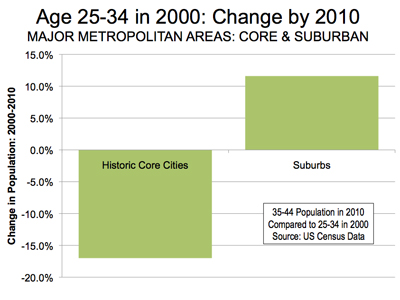
    An analysis of the past decade’s Census data by demographer Wendell Cox shows this. Cox looked at where 25- to 34-year-olds were living in 2000 and compared this to where they were living by 2010, now aged 35 to 44. The results were surprising: In the past 10 years, this cohort’s presence grew 12% in suburban areas while dropping 22.7% in the core cities. Overall, this demographic expanded by roughly 1.8 million in the suburbs while losing 1.3 million in the core cities.

    In many ways this group may be more influential than the much ballyhooed 20-something. Unlike younger adults, who are often footloose and unattached, people between the ages of 35 and 44 tend to be putting down roots. As a result, they constitute the essential social ballast for any community, city or suburb.

    Losing this population represents a great, if rarely perceived, threat to many regions, particular older core cities. Rust Belt centers such as Cleveland and Detroit have lost over 30% of this age group over the decade.

    More intriguing, and perhaps counter-intuitive, “hip and cool” core cities like San Francisco, New York and Boston have also suffered double-digit percent losses among this generation. New York City, for example, saw its 25 to 34 population of 2000 drop by over 15% — a net loss of over 200,000 people — a decade later. San Francisco and Oakland, the core cities of the Bay Area, lost more than 20% of this cohort over the decade, and the city of Boston lost nearly 40%.

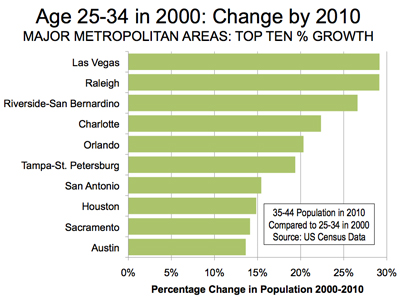
    In contrast, the largest growth among this peer group took place in metropolitan areas largely suburban in form, with a strong domination by automobiles and single-family houses. The most popular cities among this group — with increases of over 10% — were Las Vegas; Raleigh, N.C.; Riverside-San Bernardino, Calif.; Charlotte, N.C.; Orlando, Fla.; San Antonio, Houston and Dallas-Fort Worth, in Texas; and Sacramento, Calif..

    Furthermore, most of the growth took place not in the urban centers of these regions but in the outlying suburbs. This cohort expanded by more than 40% Raleigh’s suburbs — 37,000 people — over the decade. Houston’s suburbs gained the most of any region of the country, adding 174,000 members of this particular generation.

    These findings should inform the actions of those who run cities. Cities may still appeal to the “young and restless,” but they can’t hold millennials captive forever. Even relatively successful cities have turned into giant college towns and “post-graduate” havens — temporary way stations before people migrate somewhere else. This process redefines cities from enduring places to temporary resorts.

    Rather than place all their bets on attracting 20-somethings cities must focus on why early middle-age couples are leaving. Some good candidates include weak job creation, poor schools, high taxes and suffocating regulatory environments. Addressing these issues won’t keep all young adults in urban settings, but it might improve the chances of keeping a larger number.

    Our findings may also give pause to those developers who often buy at face value the urbanist narrative about an city-centric real estate future. In the last decade, many developers have anticipated  a continuing tsunami of wealthy young professionals, as well as legions of “empty-nesters,” flowing into the urban cores. This led to a rash of high-end condominium developments. Yet in the end, the condo market turned out far less appealing than advertised, crashing virtually everywhere from Chicago and Las Vegas to Atlanta, Portland and Kansas City. This has left many investors with empty units, distress auctions or far less profitable rentals.

    One hopes the development community might still learn something from that failure. But the Urban Land Institute among others increasingly maintain that vast new frontiers for new high-density growth will develop in the inner-ring suburbs. Yet in many areas with strong central cores, such as New York, Seattle and Chicago, inner suburbs usually grew slowly, particularly in comparison with the further out peripheral expanses.

    Critically, the notion of mass suburban densification is likely to meet strong resistance from local residents. This will be particularly marked in attractive, affluent “progressive” areas like the Bay Area’s Marin County, Chicago’s North Shore suburbs and New York’s Hudson Valley. People who move to these places are attracted by their leafy, single-family-home-dominated neighborhoods and village-like shopping streets. Nothing short of economic catastrophe or government diktat would make them accept any intense program of densification.

    Of course, some urbanists claim that the new millennial generation, born after 1983,  will prove “different” from all their predecessors. Yet research to date finds older millennials may prove more attracted to suburban living than many density advocates suggest. According to a survey  by Frank Magid and Associates, more millennials consider suburbs as their “ideal place” to settle than do  older groups.

    As generational chroniclers Morley Winograd and Mike Hais have noted, the fact that most millennials plan to get married and have children only reinforces this trend over time. Another problem may prove that millennials may be running out of ideal urban options.  Back in the 1990s it was far easier to buy a home in one of the nation’s handful of really attractive cosmopolitan urban settings — for example,  brownstone Brooklyn, Northside Chicago, LA’s beach communities or San Francisco. Today these areas suffer some of the highest housing prices relative to incomes of any places in the country.

    Rather than blindly accept the vision of a mass movement back to the urban centers, developers might focus instead on what kind of housing, and community, addresses the needs and affordability concerns of millennials as they move into full adulthood. Over the next ten years, the number of millennials entering their mid-30s will expand by over 40 million   – a population larger than those of elderly residents who will be old enough to give up their homes.

    This large group is also most likely to continue moving to the lower-density, more affordable South and  West. These areas already boast disproportionate percentages of millennials, Hais and Winograd report.

    It’s time for developers and planners to look more closely at how young adults as they enter their 30s vote with their feet. Unless there has been a mind-numbing change in attitude or an unexpected return to good governance in cities, young adults entering middle age will continue their shift toward suburban and lower-density areas in the decade ahead, upending the predictions of most pundits, planners and development experts.

    This piece originally appeared at Forbes.com.

    Joel Kotkin is executive editor of NewGeography.com and is a distinguished presidential fellow in urban futures at Chapman University, and an adjunct fellow of the Legatum Institute in London. He is author of The City: A Global History. His newest book is The Next Hundred Million: America in 2050, released in February, 2010.

    Photo by mamamusings, Liz Lawley, Upstairs Window – Encroaching fog

  • Are Millennials the Solution to the Nation’s Housing Crisis?

    During his Twitter-fed Town Hall, President Obama admitted that the housing market has proven one of the “most stubborn” pieces of the economic recovery puzzle to try and fix.  The President — as well the Congress and the building industry — should  consider a new path to a solution for housing by tapping the potential of the very generation whose votes brought Barack Obama into the White House in the first place.   

    The Millennial Generation (born 1982-2003) represents not just the largest generation in American history but the largest potential market for both existing and new housing in the United States. There are over 95 million Millennials and over the next five years the first quarter of this cohort will enter their thirties, an age when people are most likely to buy their first home.

    Contrary to what is often written about this generation it is very much interested in owning a home, preferably in the suburbs. Sixty-four percent of Millennials say it is very important for them to have an opportunity to own their own home; twenty percent named it as one of their most important priorities in life, right behind being a good parent and having a successful marriage.

     And, contrary to the usual claims of “new urbanists” (themselves largely members of the older X and Boomer Generations) most Millennials want to live in the suburbs where the current housing crisis is most acute. According to a study by Frank N. Magid Associates, 43 percent of Millennials describe suburbs as their “ideal place to live,” compared to just 31 percent of older generations, most of whom still yearn for the smaller towns and rural settings of an earlier America.  

    Most Millennials already live in suburbs and enjoyed growing up in suburban settings surrounded by family and friends that supported them.  A certain portion, of course, enjoy living an urban life while young, but most tell researchers that they want to raise the families many are about to start in the same suburban settings they grew up in.

    Furthermore, Americans between the ages of  25 and 34, both Millennials and those on the “cusp” of the generational change from X to Millennial,  represent a greater proportion of the overall population in the South and West than elsewhere. These are the very regions that suffered the most from the collapse of housing prices that stemmed from the mortgage financing scandals of the last few years. Unleashing this potential demand for suburban housing in these hard-hit areas would bring two huge benefits. It would stabilize prices for existing homes while at the same time boosting the prospects for new housing construction.  

    The challenge is how to enable the Millennial Generation to achieve its desire to own homes without reigniting the speculation and unsustainable financial leverage that   triggered the Great Recession. Clearly, in the immediate future at least, the current excess of supply in the housing market should mitigate the risk of too much demand chasing too few houses.  As much as they are criticized by the financial industry and its Republican allies, the recently enacted financial regulatory reforms might also provide an additional bulwark against allowing the market to misbehave a second time.

    But the biggest factor may be the lessons learned from experience.  Millennials have borne much of the brunt of the Great Recession and tend to be keenly aware about the importance of living within your means.  Wanting a suburban home does not mean, as many urbanists assert, that Millennials want McMansions. Like earlier generations, especially their GI Generation great grandparents, they are likely to be cautious and frugal home-buyers. However, this frugality and caution does not translate into a meek acceptance or desire for a future as apartment renters, as some suggest will be the case.    

    In the short run, Millennials will not be able to engineer a turnaround all by themselves; most Millennials can’t afford much beyond the next month’s rent, let alone the down payment on a mortgage. Many are still living with their parents to avoid having to pay rent and the cost of a college education at the same time.

    To address this part of the challenge, the federal government needs to do what it did to revive the moribund housing market in the 1930s. The New Deal created today’s commonly accepted 30 year mortgages with a 20 percent down payment by making them a financial instrument that the newly formed Federal Housing Administration would insure. Before that landmark legislation, home mortgages were rarely offered for more than half of the home’s value and normally had to be repaid in no more than five years.

    As a result that era’s civic generation (the GI or Greatest Generation) was able to afford single family homes with a surrounding tract of land, an offer returning World War II veterans seized with alacrity. These houses now make up much of the country’s inner suburb housing stock.    Today’s housing crisis requires a similarly radical reinvention of the basic home mortgage to be offered to those buying their first home. Under this proposal the length of the mortgage could be extended up to as many as 50 years, reflecting the increased life expectancies — and longer working careers — that most Millennials can expect to enjoy. Since no market for such debt instruments currently exists, it would be up to the federal government to create one through the process of reinsurance, just as it did in 1934.

    To further encourage home buying by Millennials, the federal government should also provide incentives to financial institutions to swap out the principle of the Millennials’ student loans in exchange for a new loan, whose principal would be collateralized by the value of the real estate the former student would be acquiring. The student loan would be paid off as part of the mortgage, making Millennials better able to afford a home and freeing up additional discretionary spending that current worries over student debt curtail. Today’s lower housing prices today might make this package both attractive to investors and financially viable.

    Many economists today argue against the whole notion of encouraging home ownership by anyone, let alone young Millennials. Some point out that when looked upon strictly as an investment choice, the value of a home rarely appreciates faster than the overall stock market.

    This type of analysis, which forms the basis for arguing against any federal policy that would further encourage home ownership, ignores the proven benefits to the nation that derive from home owners committed to the success of their local community.  Voting participation rates among home owners, for instance, traditionally run higher than rates among renters, and neighborhoods of owners tend to be more stable places to raise children. 

    More important still is what homeownership means to the nature of a property-owning republic. Survey after survey shows that home ownership remains a central part of the American Dream and a central aspiration, particularly for immigrants and young people. A policy that works against this ideal presents a political risk that any politician should be wary of taking.

    To restore this part of the American Dream, and to lift the worry of millions of Americans whose house is worth less than what they owe on their mortgage, the Obama administration must take bold steps to restore a vibrant residential housing market.    President Obama, who built his winning margin in 2008 through an unprecedented mobilization of Millennial voters, is the ideal person to combine a plan for economic recovery efforts with meeting the aspirational goals of most Millennials to own their own home.

    To save the housing market, and extend the recovery beyond the financial elites, America will need a new wave of home buyers.  If the President works to tap this resource, he can begin to turn around the “stubborn problem” of the housing market and restore the middle class economy. If he does so, the whole country will soon be tweeting his success.

    Morley Winograd and Michael D. Hais are fellows of NDN and the New Policy Institute and co-authors of Millennial Momentum: How a New Generation Is Remaking America to be published in September and Millennial Makeover: MySpace, YouTube, and the Future of American Politics.

    Photo by 3Ammo

  • America’s Burgeoning Class War Could Spell Opportunity For GOP

    Last week’s disappointing job reports, with unemployment rising above 9%, only reinforced an emerging reality that few politicians, in either party, are ready to address. American society is becoming feudalized, with increasingly impregnable walls between the classes. This is ironic for a nation largely defined by its opportunity for upward mobility and fluid class structure.

    According to the latest data, the current unemployment rate is the highest it has been so deep into a recovery since the 1940s.  Even more troubling, over 6 million Americans have been unemployed for more than six months — the largest number since the feds have begun tracking this number decades ago.

    That’s not the worst of it.  The pool of “missing workers” — those who are unemployed but are not counted as such — has soared to over 4.4 million. And under the first African-American president the employment rate for black men now sits at a record low since the government started measuring the statistic four decades ago.

    This recovery has been particularly parlous to the middle class, of all races. Despite the massive stimulus, small businesses — the traditional engines of job growth and upward mobility — have barely gotten off the matt. Indeed, according to a recent National Federation of Independent Business survey, they are now more likely to reduce payrolls than expand them.

    Many blue-collar and middle-class Americans are becoming increasingly pessimistic about the future and their children’s chances for achieving their level of well-being. Middle-age college graduates, who supported Obama previously, increasingly have shifted from the administration.  Even the young seem to have lost their once fervent enthusiasm. After all, they are seeing their prospects dim dramatically.

    Overall disapproval of President Obama’s economic policies now stands at 57% and will likely grow due to the latest job numbers.  And while the middle and working classes have seen their prospects worsen, the very rich have enjoyed a huge boom.

    Of course, no one in a capitalist country should begrudge the earned wealth of the rich.  But there must be some sense that the prospect of greater prosperity extends beyond the privileged. The policies of Fed chief Ben Bernanke and Treasury Secretary Tim Geithner have done little for the small businesses on Main Street while enriching the owners and managers of financial companies by showering them with cheap money and implicit government guarantees for their survival. Top pay for CEOs of financial companies, including those bailed out by the taxpayers, has soared.  The rise in stock prices has benefited the wealthiest 1% of the population, which owns some 40% of equities and 60% of financial securities.

    The consequences will be profound — socially and politically.  For one thing, the president, despite his occasional barbs against “the rich,” has turned out something of a faux populist. If a George Bush recovery was as bad as this one, we would never hear the end of it from the “progressives” who still cling to Obama.

    Of course, not all the blame belongs to the White House. The formerly Democrat-controlled Congress largely ignored the middle class’ concerns over the economy and jobs. Instead they focused on health care — which, according to the Pew Foundation survey, ranks as only a middling concern among voters — and climate change, which ranked dead last among the top 20 issues for the electorate.

    Even with the Main Street economy grasping for air, Congress chose to impose new regulations and taxes on the entrepreneurial class. Meanwhile Washington has given huge government support to often marginal green ventures such as Tesla, which is building $80,000 plus electric cars. Such assistance was not extended to the struggling garment-maker or semiconductor plant forced to compete globally largely on their own.

    Of course Democrats resort to stirring up class resentments, but their credibility is thin. After all it’s New York Sen. Charles Schumer, not some fat-cat Republican, who remains the financial industry’s designated hitter on the Hill. Instead of chastising the big financial institutions, the administration has largely coddled them. Despite the obvious abuses behind the financial crisis, there have been virtually no prosecutions against what Theodore Roosevelt once identified as “the malefactors of great wealth.”

    This has created a class divide large enough to propel a Republican sweep next year. Some Republicans, like former Bush aide Ryan Streeter, understand this opportunity. Streeter argues for the GOP to become more economically populist approach.  He calls for an “aspiration agenda” based on policies to spark private sector economic growth and a wide range of entrepreneurial ventures. To succeed, the GOP needs a viable alternative to middle and working class voters who are losing faith in Obama-style crony capitalism but who do not want to replace it with policies focused on enhancing the bottom-lines of the top 1% of the population.

    Yet at a time when people are worried primarily about paying their bills and prospects for their children, many Republicans seem determined to campaign on social fundamentalism, something that is already distressingly evident in the Iowa primary race. This may have worked in the past, in generally more prosperous times. Right now what sane person thinks gay marriage is the biggest issue facing the nation?

    Neither right-wing ideology nor mindless support for corporate needs constitute a winning strategy in a nation plagued by a sense that the system works only for the rich and well-connected.  Only by focusing on working and middle class concerns can the GOP permanently separate the people from the party which pretends to represent them.

    This piece originally appeared at Forbes.com.

    Joel Kotkin is executive editor of NewGeography.com and is a distinguished presidential fellow in urban futures at Chapman University, and an adjunct fellow of the Legatum Institute in London. He is author of The City: A Global History. His newest book is The Next Hundred Million: America in 2050, released in February, 2010.

    Official White House Photo by Pete Souza

  • The Costs of Smart Growth Revisited: A 40 Year Perspective

    “Soaring” land and house prices “certainly represent the biggest single failure” of smart growth, which has contributed to an increase in prices that is unprecedented in history. This  finding could well have been from our new The Housing Crash and Smart Growth, but this observation was made by one of the world’s leading urbanologists, Sir Peter Hall, in a classic work 40 years ago. Hall led an evaluation of the effects of the British Town and Country Planning Act of 1947 (The Containment of Urban England) between 1966 and 1971. The principal purpose of the Act had been urban containment, using the land rationing strategies of today’s smart growth, such as urban growth boundaries and comprehensive plans that forbid development on large swaths of land that would otherwise be developable.

    The Economics of Urban Containment (Smart Growth): The findings of Hall and his colleagues were echoed later by a Labour Government report in the mid-2000s which showed housing affordability had suffered under this planning regime. Author Kate Barker was a member of the Monetary Policy Committee of the Bank of England, which like America’s Federal Reserve Board, is in charge of monetary policy. Among other things, the Barker Reports on housing and land use found that urban containment had driven the price of land with "planning permission" to many multiples (per acre) above that of comparable land where planning was prohibited. Under normal circumstances comparable land would have similar value.

    Whether coming from the left or right, economists have demonstrated that prices tend to rise when supply is restricted, all things being equal.  Certainly there can be no other reason for the price differentials virtually across the street that occur in smart growth areas. Dr. Arthur Grimes, Chairman of the Board of New Zealand’s central bank (the Reserve Bank of New Zealand), found the differential on either side of Auckland’s urban growth boundary at 10 times, while we found an 11 times difference in Portland across the urban growth boundary. 

    House Prices in America: The Historical Norm: Since World War II, median house prices in US metropolitan areas have generally been between 2.0 and 3.0 times median household incomes (a measure called the Median Multiple). This included California until 1970 (Figure 1). After that, housing became unaffordable in California, averaging nearly 1.5 times that of the rest of the nation during the 1980s and 1990s (adjusted for incomes). Even after the huge price declines from the peak of the bubble, house prices remain artificially high in Los Angeles, San Francisco, San Diego and San Jose, with median multiples of six or higher.

    William Fischel of Dartmouth University examined a variety of justifications for the disproportionate rise of California housing prices and dismissed all but more restrictive land use regulation. He noted that "growth controls (restrictive land use regulations) have the undesirable effect of raising housing prices." Throughout the rest of the nation, more restrictive land use regulations have been present in every market where house prices rose substantially above the historic Median Multiple norm, even during the housing bubble. No market without smart growth has ever reached these heights.

    Setting Up for the Fall: Excessive Cost Increases in Smart Growth Markets: The Housing Crash and Smart Growth, published by the National Center for Policy Analysis, examined the causes of house price increase during the housing bubble. The analysis included all metropolitan areas with more than 1,000,000 population. It focused on 11 metropolitan areas in which the greatest cost increases occurred (the "ground zero" markets), comparing them to cost increases in the 22 metropolitan areas with less restrictive land use regulation (Note 1).

    • Less Restrictively Regulated Markets: In the less restrictively regulated markets, the value of the housing stock rose approximately $560 billion, or 28 percent from 2000 to the peak of the bubble (Note 2). In nearly all of these markets, the Median Multiple remained within the historical range of 2.0 to 3.0 and none approached the high Median Multiples that occurred in the "ground zero" markets.
    • Ground Zero Markets The value of the housing stock rose $2.9 trillion from 2000 to the peak of the bubble in the "ground zero" markets, all of which have significant land use restrictions (Note 3). The 112 percent increase in the "ground zero" markets was four times that of the less restrictively regulated markets. The Median Multiple rose to unprecedented levels in each of the "ground zero" markets, peaking at from 5.0 to more than 11.0, four times the historic norm.

    The 28 percent increase in relative house value that occurred in the less restrictively regulated markets (those without smart growth) is attributed to the influence of loosened lending standards. The excess above 28 percent, which amounts to $2.2 in the "ground zero" markets is attributed to to the supply restricting strategies of smart growth (Figure 2).

    The Fall: Smart Growth Losses

    The largest house price drops occurred in the markets that had experienced the greatest cost escalation, both because prices were artificially higher but also because prices in smart growth markets are more volatile.  The "ground zero" markets, with only 28 percent of the owner occupied housing stock, accounted for 73 percent of the pre-crash losses ($1.8 trillion). Thus, much of the cause of the housing crash, which most analysts date from the Lehman Brothers bankruptcy (September 15, 2008), can be attributed to these 11 metropolitan areas.

    By contrast, the 22 less restrictively regulated markets accounted for only six percent ($0.16 trillion) of the pre-crash losses. These 22 markets represented 35 percent of the owned housing stock (Figure 3).

    If the losses in the ground zero markets had been limited to the rate in the less restrictively regulated markets (the estimated impact of cheap credit), losses would have been $1.6 trillion less (Note 4). The Great Recession might not have been so "Great."

    Economic Denial and Acknowledgement: In his writing forty years ago, Dr. Hall noted that English planners denied the connection between the unprecedented house price increases and urban containment. This same denial also informs smart growth advocates today. This is perhaps to be expected, because, as Hall noted 40 years ago, an understanding of the longer term consequences would have undermined support for these policies.

    To their credit, some advocates recognize that smart growth raises house prices. The Costs of Sprawl – 2000¸ a volume largely sympathetic to smart growth, also indicates that urban containment strategies can raise housing prices. The only question is how much smart growth raises house prices. The presence of urban containment policy is the distinguishing characteristic of metropolitan markets where prices have escalated well beyond the historic norm.

    The Social Costs of Smart Growth: Moreover, the social impacts of smart growth are by no means equitable. Peter Hall says that the "less affluent house-owner … has paid the greatest price for (urban) containment" (Note 5). He continues: "there can be little doubt about the identity of the group that has got the poorest bargain. It is the really depressed class in the housing market: the poorer members of the privately-rented housing sector." Finally, Hall laments as well the impact of these policies on the "ideal of a property owning democracy."

    Hall’s four decades old concern strikes a chord on this side of the Atlantic. Just last week, a New York Times/CBS News poll found that nine out of ten respondents associated home property ownership with the American Dream. Planning needs to facilitate people’s preferences, not get in their way.

    ——–

    Note 1: The housing stock value uses a 2000 base, which adjusts house prices based upon the change in household incomes to the peak.

    Note 2: The underlying demand for housing was substantial in some of the less restrictively markets, which is illustrated by the strong net domestic migration to metropolitan areas such as Atlanta, Austin, Dallas – Fort Worth, Houston, Raleigh and San Antonio. At the same time, some more restrictive markets (smart growth) that hit historically experienced strong demand were experiencing huge domestic outmigration, indicating little in underlying demand. This includes Los Angeles, San Francisco, San Diego and San Jose. Demand, however is driven upward in more restrictively metropolitan areas by speculation which, according to the Federal Reserve Bank of Dallas is attracted by supply constraints.

    Note 3: The 11 "ground zero" metropolitan markets were Los Angeles, San Francisco, San Diego, San Jose, Sacramento, Riverside-San Bernardino, Las Vegas, Phoenix, Tampa-St. Petersburg, Miami and the Washington, DC area.

    Note 4: The pre-crash losses in the 18 other restrictively regulated markets were $0.5 trillion. These markets accounted for 37 percent of owner occupied housing in the metropolitan areas of more than 1,000,000 population, compared to 35 percent in the less restrictively regulated markets, yet had losses three times as high.

    Note 5: The Containment of Urban England also indicates that new house sizes have been forced downward by the planning regulations (see photo at the top of the article).

    Photograph: New, smaller exurban housing in the London area (by author)

    Wendell Cox is a Visiting Professor, Conservatoire National des Arts et Metiers, Paris and the author of “War on the Dream: How Anti-Sprawl Policy Threatens the Quality of Life

  • Living and Working in the 1099 Economy

    We used to call it “Free Agent Nation.”  Now, it seems like the new term of art will be “The 1099 Economy.”   While the names may change, they all point to a phenomenon of rising importance: the growing number of Americans who don’t have a “regular job” but instead work on individual contracts with employers or customers.   These folks don’t get the traditional W-2 paystub at the end of the year; they report their taxes with the IRS form 1099.

    The 1099ers are a growing part of our economy.   There are a number of ways to slice the data.  If you look at US Census Bureau figures on the self-employed, we find 21.4 million self-employed Americans in 2008.  Recent data from EMSI suggests that the figures might be even higher.   Tracking workers who are not covered by unemployment insurance, the EMSI researchers suggest that more than 40 million Americans operate in the 1099 economy.   This represents about 1/5 of the total US workforce.

    As someone who has operated in the 1099 Economy for a decade, I can state that there are many benefits to this status:  more flexibility, more opportunities for unique and creative work, and more control over one’s work circumstances.    And, 1099 status can be profitable. Many fast growing ventures operate as sole proprietorships.  For example, in 2008, the Inc. 500 list looked at the ownership structures of firms on this list of US’s fast growing companies.  The largest sole proprietorship, Milwaukee’s Service Financial, had $11 million in revenue, but only one employee, its owner. 

    While the freedom of operating in Free Agent Nation can be tempting, there are downsides.  The data suggests that for many people, operating in the 1099 Economy may not be their first choice.  The EMSI research cited above found that the number of non-covered jobs in the US grew by 4 million between 2005 and 2009.   The fastest growth occurred in the mining, quarrying, and oil/gas extraction sectors where more than half of all workers are now non-covered.  Other areas with high concentrations of 1099 workers are in real estate (74% of workers are non-covered) and agriculture/forestry (74%).  This non-covered status creates a more flexible labor market, but it also creates potential challenges for these workers operating in notoriously unstable industries. 

    The 1099 Economy has emerged somewhat below the radar over the past decade.  Few economic development organizations have devoted much thought or research to the needs of this segment of the economy.  And, that’s not a good thing if 20% of the local workforce is invisible to community leaders.   Based on my experience, I see several segments within the broad category of the 1099 economy:  the reluctant 1099ers, the entrepreneurial 1099ers, and the “gig economy” work force. 

    The Reluctant 1099ers:  This group includes those who operate in the 1099 economy because they have no choice.   This group includes those sectors that have previously operated with traditional employment contracts, but have now shifted to the new structures.  Examples include mining, utilities, finance and insurance, and some administrative fields.  While individuals in these specific jobs may be happy with their circumstances, the workers, in a collective sense, face a more uncertain and probably less profitable work situation as 1099 contractors.

    The Entrepreneurial 1099ers:   Many budding entrepreneurs operate in the 1099 economy.  Sole proprietorships and LLCs/LLPs may have numerous workers under contract, yet appear in government statistics as a self-employment venture.  While most sole proprietorships are quite small and generate limited revenue, a sizable portion does generate significant incomes and may be poised for rapid revenue and job growth.  These individuals and their firms are the invisible portion of many local entrepreneurial ecosystems.

    The “Gig Economy” Workforce:   Last but not least, the gig economy workforce refers to those who operate in industries that traditionally operate on a project or “gig” basis.  Perhaps the best known example is film-making where crews come together for a film and then break up for other projects.  Other examples include the arts, theatre, writing, web design, and construction.  These sectors have a long history of operating via these structures.  It is clear that more industries are moving in this direction as well.   In response, a host of new kinds of support organizations, such as New York’s Freelancer’s Union, are emerging.  If current trends continue, we can expect to see similar groups arising across the US.

    Regardless of how one classifies these workers, they remain largely invisible to policy makers and to economic and workforce developers.   That needs to change.  In addition to recognizing the importance of this part of the workforce, we also need to develop a more nuanced understanding of their concerns and needs.   At a minimum, providing a stronger safety net—as suggested by the Freelancer’s Union and others—makes sense.   It also makes sense to develop work spaces that support the 1099ers.   Here, the recent growth in co-work spaces is a positive trend.    Finally, we need new kinds of support and services for the 1099ers.  These might include traditional training in business development, but other supports, such as networking or peer-to-peer lending or on-line tools to find customers and partners should also be part of the mix.    It’s time to recognize that the 1099 economy is here to stay and will be an important part of every community’s workforce for decades to come.

    Erik R. Pages is the President of EntreWorks Consulting, an economic development consulting and policy development firm focused on helping communities and organizations achieve their entrepreneurial potential.