Category: Policy

  • Yuri Gagarin’s Brave, Brilliant Leap into the Dark

    Yuri Gagarin was my hero. For a child just nine years old on 12 April 1961, the day he flew into space, he appeared intrepid, unassuming, and cool. Above all, he appeared in black and white. This was not the glossy, sunlit, bright blue Florida-sky ethic of American efforts in space, all NASA aluminium foil and silver crewcuts in magazines such as Life. No, with Gagarin there was something grittier, more documentary, something altogether scarier than Cape Canaveral. Russia’s success in putting a man into space was, for a child of the West, also a success for grainy monochrome photography and flickering video footage. The mission was dark, seemingly shot at night, and redolent of the air of conspiracy that, in the year of the Berlin Wall going up, surrounded Nikita Khruschev’s Soviet Union.

    Or maybe that’s just a man’s memory playing tricks. In those days, after all, all TV was black and white. But the unmistakable thing about the headlines and the publicity and the genuine celebrations that surrounded this particular celebrity was how strongly they loved both the man and his endeavour. And this was all the more remarkable given the bad light, almost literally, in which the Soviet Union was then regarded.

    The launch of the Soviet satellite Sputnik in 1957 had been a shock to the West. Now, in another surprise gambit, Moscow thumped home its apparent technological superiority over Washington. And yet there was something so smiley, calm, innocent and youthful about Gagarin that people in the West could, with him, forget all about the conflict between capitalism and what was thought to be communism. Gagarin’s achievement was for humanity – to conquer space, gravity, the limitations of this planet. His name was spiky but easily pronounced, and his easy demeanour was not that of an irascible Soviet apparatchik: recognisably Slavic, he was one of us.

    At seven miles a second, he had achieved escape velocity and circumnavigated the Earth in just 108 minutes. Unlike Alan Shepard, who completed a simple up-and-down flight in May 1961, there was nothing ‘sub-orbital’ about Gagarin.

    Obviously, Stalin’s successors milked the occasion, for they had few other heroes they deemed proper for foreign consumption. But even the Soviet bureaucrats couldn’t manage to sour the cream. When Gagarin, who had first trained as a foundry worker, flew to Manchester to receive a medal from the Amalgamated Union of Foundry Workers, thousands mobbed him, and crowds overwhelmed the police. Later, through an interpreter and in a car park, he briefly addressed a large crowd of workers from AEI’s factories at Trafford Park and beyond. ‘There is plenty of room’, he observed, ‘for all in outer space. Plenty of room for the Americans, the Russians, and the British.’

    The daring behind Vostok 1

    Gagarin told the Mancunians that his craft, Vostok 1, had no photographic or military equipment, only scientific gear. Yet although in reality his flight was a Cold War propaganda gesture, there was much about it to applaud – and much that is missing from today’s much less decisive, much more tentative culture.

    First, there was the mission’s willingness to experiment with and explore the unknown in ways that make those who today ‘dare’ to bomb Libya or police a demonstration in central London look like the cowards they are. We forget the scale of scientific ignorance that existed back in 1961. Why was Vostok limited to just one orbit? Because unlike the Americans, who knew how to experiment with minutes of weightlessness flying parabolic arcs in Boeing 707 jets, each of the 20 cosmonauts (out of 2,200 candidates) whom the Russians prepared for space had only experienced a few seconds free of gravity in special ground-based tests. Weightlessness was a great unknown for the Soviet space effort. Result: Sergei Korolev, the Soviet space programme’s legendary chief designer, limited exposure to weightlessness to a journey of just one orbit round the globe (1).

    Second, there was Gagarin’s physical bravery. Sometimes an acrobat, and an excellent high-altitude parachutist, Gagarin, like his colleagues, had to train under a regime little different from Guantanamo Bay. Ghoulish doctors at the aptly named Institute for Medical and Biological Problems in Moscow had, with Korolev and the Soviet military, a commanding influence over the space programme. They therefore took it upon themselves to put cosmonauts in solitary confinement in an isolation chamber for periods of up to 10 days, there to take a battery of mental, physical and psychological tests. Sometimes the doctors starved the cosmonauts of oxygen in the chamber, to see how they got on. They also subjected Gagarin to 12G, or 12 times the force of gravity, aboard a whirling centrifuge.

    One need neither admire this kind of training, nor the tiny primitiveness of the capsule in which Gagarin flew, to note how little of his mettle is around today. Who aspires, in 2011, to handle the exigencies of space? Who would be ready personally to check alignment for re-entry into the Earth’s atmosphere by using Vostok’s ‘Vzor’ porthole, which revealed when the moment was right only by mirrors, lenses and elaborate calibrated markings? Today, people will not even leave the house without a hi-tech mobile phone. When Gagarin came home, the only thing umbilical about his flight was far from reassuring: the ball in which he sat failed to separate completely from the equipment module to his rear, causing the two vehicles, which were connected by electrical and electronic wiring, to tumble headlong round each other. Only burn-up in the atmosphere eventually severed the cabling, setting our hero free.

    The lessons for today

    Gagarin did what he did at the tender age of 27. His subsequent death, in an air accident at the age of 34, was tragic, and long the subject of many conspiracy theories. Yet we know what is important about his feat. The Vostok mission deliberately confronted, and was not fearful of, what today overwhelms the consciousness of the West: the unknown. It was a leap into the dark, but the risks it ran proved surmountable. It wanted to overcome the ignorance of its day.

    Look now at NASA. It has no plans for new manned missions to the Moon, still less for humans to get to Mars. Instead, its leader emphasises that his is a sustainable programme of exploration and innovation. Yes, that’s right – innovation! In truth, the watchwords for NASA, after a series of lethal, Soviet-style mistakes, are our old, familiar, all-too-right-on friends: transparency, accountability, safety, integrity, ‘reaching out’ to foreign partners and stakeholders. There is high-blown bluster about innovation, but the reality is that NASA is more interested in space for its ‘societal benefit’ and putative effect on US competitiveness than for its intrinsic interest or grandeur.

    Is it too much to ask for grandeur, or vaulting ambition, in today’s cautious times? At least the Russians, with their unglamorous rivets and their interchangeable modules, have done well enough over the years to contemplate manned flights to the Moon by 2020 and building a lunar base by 2030. After the events in Japan, fear of Nature, and of the sub-atomic realm, is greater than ever. Meanwhile, outer space is left simply for documentaries designed to inspire awe, or for a handful of astro-billionaires: it is no longer something to which you or I can easily have a human connection, as Gagarin told the people of Manchester that we would.

    Gagarin made everyone sense that connection. For that moment, the human conquest of the planet, rather than man’s subordination to it, was something that everyone could feel proud of.

    This piece originally appeared at Spiked Online.

    James Woudhuysen is author, with Joe Kaplinsky, of Energise! A Future for Energy Innovation, published by Beautiful Books. (Buy this book from Amazon(UK).) He is also a contributor to BIG POTATOES: The London Manifesto for Innovation.

    Photo compilation by Robert Couse-Baker

  • Los Angeles: The MTA’s Bus Stop Strategy

    Those who run the Los Angeles Metropolitan Transportation Authority evidently believe that, since the Consent Decree that forced it to improve service to its bus riders has expired, they are free to rewrite history to justify Metro’s elimination of nine bus lines, its reductions in service on eleven more, and its overall elimination of four percent of its bus service hours by attempting to show that MTA bus service is little utilized and not cost-effective.

    The Consent Decree followed a decade of reductions in bus service and increases in fares while the majority of transit spending by the major LA transit agencies went to rail. As a result of a Federal Title IX (discrimination in utilization of Federal funding) legal action, Labor/Community Strategy Center v MTA, in 1996, Metro agreed to the CD. It was forced to eliminate the effective doubling of fares that it had imposed, to return to offering the monthly passes that had been highly utilized by low-income transit riders, and to commit to a relief of overcrowded bus service. Those of us who fought for the CD, and who fought Metro to make it live up to its commitments, believed the CD to be an incredible success.

    MTA has always felt otherwise.

    To see how MTA characterizes the CD as a failure, and thus justifies bus service reductions, go to the source… literally. The Source is MTA’s blog:

    “After the late 1990’s, Metro increased bus service by more than one million hours. Although overall Metro ridership has increased over time, bus ridership has fallen or been flat in the past two decades.”

    This is a wonderful example of the creative use of statistics.

    The latest National Transit Database data is for 2009, when there were 386 million bus boardings. In 1989, twenty years earlier, there had been 412 million. So, yes, Metro bus ridership fell over this two decade period.

    However, a more relevant way of looking at this is to compare 1996 – the year before the CD went into effect – to 2009. From 1996 to 2009, mostly as a result of the CD, bus vehicle revenue hours were up 20.2%, miles were up 14.6%, and bus boardings were up 14.5%.

    What the CD was intended to correct, more than anything, was Metro’s history of reducing overall ridership, bus and rail, by an average of 12 million a year in the eleven years that followed its start of major rail construction in ’85. The measure of the CD’s success was the turnaround: Once it went into effect, Metro ridership increased 12 million a year for the next eleven years until it expired.

    Metro did increase bus service substantially after the CD, and utilization of this service increased at right about the same level. Again, from The Source:

    “How full are Metro buses today? Overall, Metro buses are running at an average of 42% capacity.”

    The 42% figure is evidently derived by dividing Metro’s FY09 bus average passenger load – passengers-miles/vehicle revenue miles – by the average number of seats on Metro buses. The figure looks low, doesn’t it? Think about all those empty seats.

    However, unlike an airline flight from LAX to JFK, Metro buses make many stops along their routes to pick up and drop off passengers. Bus scheduling is developed around the maximum carrying capacity of a bus at the peak load point of the route during the peak ridership period. This means that, for much of the day, and for most of even the busiest bus trips, there are a lot of empty seats. That’s the nature of the transit business.

    And compare Metro bus service to its 20 largest peers. For 2009, Metro was had the second highest average passenger load of the group, at 17.1, beaten only by MTA-NYCT, at 17.9. The average of the results of the Top 20 was 11.3. That 42% starts looking pretty good . In fact, a ratio this high actually suggests that a lot of Metro bus lines should be examined for overcrowding.

    “At present, Metro subsidizes about 71 percent of the cost of each passenger’s bus ride, an amount higher than most other large transit agencies.”

    More commonly, this ratio is turned around, as in: Metro has a 29% farebox recovery ratio.

    How does Metro bus rank up against its Top 20 peers? Seventh, and the average of the Top 20 is 27%. However,farebox recovery ratio can be a very misleading metric. Direct subsidy ratios are a more significant indicator, particularly taxpayer subsidy per passenger and per passenger-mile. Metro’s subsidy/passenger was $1.74, third in the Top 20, against the average of its peers of $2.49; its subsidy/passenger mile of $.44 was second best, against the average of $.68.

    So, rather than the bus service financial performance being sub-standard, it is actually outstanding, providing good value for the riders and great value for the taxpayers.

    Instead of Metro telling the world what a great job it is doing, and taking pride in what it has accomplished, why is Metro leadership explaining how wasteful it is, and why service must be cut?

    “As to whether [these] will be the final bus service changes, Leahy said that he wasn’t sure. ‘But, if we don’t do these things, the capital program is not sustainable.’”

    For those not familiar with MetroSpeak, “capital program,” when applied to transit, primarily means building more rail.

    This is the central issue: Metro is in the business of construction of transportation infrastructure, and money wasted on actually moving people takes away from what is available to build new guideway transit corridors.

    As of this writing, Metro has Chatsworth Orange Line extension (BRT) and Expo Light Rail Phase I in construction, Expo Phase II approaching construction, and a design/build procurement for Phase 2A of the Pasadena Gold Line is underway.

    Metro is also in various stages of planning and obtaining funding commitments for East San Fernando Valley North-South BRT lines, Sepulveda Pass Transit Corridor, Westside Subway Extension, Downtown Regional Transit Connector, Crenshaw/LAX Transit Corridor, Eastside Transit Corridor, Green Line LAX Extension, South Bay Green Line Extension, and West Santa Ana Transit Corridor. Plus, it’s the majority partner for the seven Metrolink commuter rail lines.

    Clearly, Metro is so short of operating funds that it is cutting service on a bus system that is the best value to the taxpayers and riders in the nation. It cannot afford to operate its current bus system, and it is attempting to get Congress to front-load massive construction funding against the thirty-year half-cent sales tax passed in 2008. Given Metro’s less than stellar record of bringing in capital projects on budget, and considering its failure to provide for the very large capital renewal and replacement costs of the current rail lines as they age, exactly how does it expect to pay the operating costs of the expanded system it is rushing to construct?

    As Will Rogers said, “When you find yourself in a hole, stop digging.”

    Tom Rubin has over 35 years in government surface transportation, including founding the transit industry practice of what is now Deloitte & Touche, LLP, and growing it to the largest of its type. He has served well over 100 transit agencies, MPO’s, State DOT’s, the U.S. DOT, and transit industry suppliers and associations. He was the CFO of the Southern California Rapid Transit District, the third largest transit agency in the U.S. and the predecessor of Los Angeles County Metropolitan Transportation Authority.

    Photo by biofriendly, Metro Bus Campaign, Los Angeles

  • California: Club Med Meets Third World?

    On March 25th, the Bureau of Labor statistics released a report that showed that California jobs had increased by 96,000 in February.  The state’s cheerleaders jumped into action. Never mind that the state still has a 12.2 percent unemployment rate, and part of the decline from 12.4 percent is because just under 32,000 discouraged workers left California’s labor force in February. 

    Unfortunately, the cheerleaders are likely to once again be disappointed.  It is unwise to build a case on one data point.  Data are volatile and subject to all sorts of technical issues.  For example, the estimate of California’s job growth is seasonally adjusted data and subject to revision.

    More importantly, even if California did see 96,000 new jobs in February, that pace is unlikely to be maintained.  California’s economy is just too burdened by the State’s DURT: Delay, Uncertainty, Regulation, and Taxes.  Instead of enjoying the truly vibrant recovery one would expect given its climate, location, natural resources, university network, workforce, and natural and manmade amenities, California’s economy will grow far below its potential, burdened by its DURT. 

    People often ask me to identify the most important impediment to California’s economic growth, but there isn’t just one.  Every business is different.  One may be most impacted by regulation, another by taxes.  Instead, it is the total cost of the DURT.

    Taxes are certainly one component of DURT.  The Tax Foundation ranked California 49th in business taxes and Kiplinger ranks California worst in retiree’s taxes, which serves as a good proxy for individual tax burdens.  No doubt, California’s taxes are high, but that alone wouldn’t be too big a problem.  People happily pay to live in California.  Higher taxes and home costs are just the beginning.

    California is in its own class when it comes to regulation; nothing is unimaginable in a state where bulk of the executive leadership comes from the San Francisco-Oakland area.  Today, there are two regulations that are particularly hurting California’s economy, AB32 and SB375.  AB32 is California’s attempt to unilaterally solve the planet’s global warming problem.  It will have serious implications, all of them detrimental to economic activity.  SB375 attempts to advance its global warming  goals through regional planning mandates.  Here’s a sympathetic analysis of SB375 from a smart guy.

    Those are just the most onerous regulations.  California has thousands of regulations and more come daily.  California had 725 new laws come into effect on January 1, 2011, and the state has over 500 constitutional amendments, averaging over four new constitutional amendments a year.

    Which brings us to uncertainty.

    Uncertainty about the future regulatory environment is detrimental to economic activity.  It is extraordinarily difficult to plan when the regulatory environment is in such a state of flux, and nothing is unimaginable.

    Regulatory uncertainty is far from California’s only source of uncertainty.  California’s local governments are notoriously fickle, particularly in the generally affluent coastal areas.  I know of one project that spent four years in planning, only to be denied by the City Council, even though the project was supported by the planning department.  That’s just expensive.  Developers spend hundreds of thousands of dollars on architects, engineers, and planning consultants while jumping through the hoops set up by the planning department, neighborhood groups, environmentalists, and other special interest groups.

    This type of story is all too common in Coastal California.  Some California communities, such as Santa Monica, require that prior to building a new house, you must use two by fours, string, and flags to provide the outline of the proposed structure for up to 90 days.  This is to facilitate neighbor complaints before the project is built.

    The previous story also relates to delay.  Delay in California is legendary, a result of regulatory hurdles, demand for studies, and legal action.  California newspapers often describe projects as controversial, but this is redundant.  Every project is controversial in California. 

    Want to rebuild an aging bridge?  Someone will sue you and claim the old bridge is a historical landmark.  Want to put in a solar farm?  Someone will sue you because the land is home to endangered rats, turtles, salamanders, toads, fairy shrimp, or something.  Endangered species are everywhere in California.  Want to put a condominium project in a depressed part of town?  Someone will sue you because it doesn’t match the neighborhood.  Want to build a house?  Someone will sue you because it will block their view.

    All these things and more happen in California.  It’s no surprise that businesses find California a very challenging place to be profitable.  California’s markets are huge.  No doubt about it.  So, some business will operate in the state.  California’s location on the Pacific Rim and it ports also compel some business to be in California, even if costs are high.  California is a fantastic place to live.  So, people who can afford to will live here.  Some business owners will locate businesses where the owner wants to live.  But, most businesses are too competitive to give up profits to live in California.  Many keep their headquarter s here while shipping their new jobs to other states, or abroad.

    Even so, California is unlikely to become Detroit.  It, sadly, is also unlikely to achieve its potential or regain its previous economic vigor.  The cost of California DURT is just too high.  Instead, the place will become increasingly divided.  Coastal regions, for the foreseeable future, will become even more affluent, heavily white and increasingly Asian.  Hosts of unseen, less fortunate people support them, often commuting from more hardscrabble interior locations.

    Considerable poverty will coexist uncomfortably in California’s coastal paradise.  Working class families already crowd into housing units designed for one family, and this will likely only get worse. 

    What Coastal California won’t have is much of a middle class.  Lack of opportunity and high housing costs makes the most pleasant parts of California an unattractive place for people who define quality of life by opportunity and affordable housing, young families.  Domestic migration is likely to continue to be negative.

    For its part, inland California is already depressed, 27 counties have unemployment rates over 15 percent.  Eight have unemployment rates above 20 percent.  Even during the boom, many of California’s inland areas had extraordinarily high unemployment rates.  Central California’s poverty and blight will only get worse.

    All this is courtesy of expensive California DURT.  Because of it, California’s economy will lag.  More importantly, California seems to be morphing into almost a Hollywood caricature.  The self-absorbed hedonistic wealthy live side by side with the poor, like  a combination of a Club Med and Leisure Village in a third-world country.

    Bill Watkins is a professor at California Lutheran University and runs the Center for Economic Research and Forecasting, which can be found at clucerf.org.

    Photo by chavez25

  • Bicycle Commuting: A US System and A World-Wide Guide

    To my pleasure, there is now a United States Bicycle Route System that goes more places than Amtrak and Greyhound do. Have a look at the proposed map of the national corridor plan.

    The goal is to create clearly marked north-south and east-west routes, as romantic as the Oregon Trail or as functional as the Erie Canal. The trail of Lewis and Clark is on one of the routes.

    I can only hope that the plan serves as an inspiration to would-be cyclists and every-day bike commuters. To be fair, it takes years to master the dark and often wet arts of cycling. My riding-to-work garb includes reflective gear from London, Alaskan socks, a headlight from San Diego, a lock from Amsterdam, and a rain jacket from Ohio. On my first commute, after a year of wondering of “whether I could do it,” I searched so hard to find a safe route that I got lost.

    Serious bike commuting requires owning two or three bikes, as one or two will always have flats or breakdowns, and, you need a rain bike. Plus, strategic wardrobe planning can take hours. But bike commuters get to have the satisfaction of passing cars stuck in traffic, and tired legs at the end of day leave you feeling more virtuous than Mother Teresa (if you want more inspiration, there’s a cycling jersey with her picture).

    Just to be clear: No one behind the car wheel likes a cyclist, because bicyclists run red lights, hop up on curbs, pound on hoods, drop F-bombs, and give drivers the middle finger salute. Politically, cyclists fall on the spectrum somewhere between Greens and Anarchists. In some 300 cities — it’s a global movement— to protest local (car-inspired) injustices, they have formed into Critical Masses that parade around like errant storm troopers.

    I am surprised that no one has articulated a bicycle foreign policy — in German it would be Fahrradweltanschauung — given that there are more bikes in the world than cars and they are used more often. Fifty million bikes are manufactured annually worldwide, versus twenty million cars. China’s market share is 400 million. But many American states and counties fight having a bicycle coordinator on their payroll.

    Here’s a highly personal comparison of where some cities and regions currently stand in relation to a world of bicycles:

    Geneva: My hometown, so I know the roads well. The city is trying to expand its bike lanes and trams. Whenever road construction is completed, a new bike lane emerges from the rubble. Biking works in Geneva, despite the hills, wind and rain, but many bike lanes are stopped by dead ends or traffic. I am forever lifting my bike over curbs, cobblestones, or rails, and searching for a better way around the medieval town.

    New York: I can thank former New York mayor Ed Koch for converting me into a bicycle romantic. In spring 1980, he decided to accept a strike from New York’s Transport Workers Union that, for eleven days, mothballed the city’s buses and subway. (Koch referred to the strikers as “wackos.”) The only way to get around New York was to walk or ride a bike. I dusted off my childhood Raleigh Grand Prix and rode off to work, never looking back on a life that did not involve bicycles.

    Although I no longer live in New York, I still like riding there. The West Side, Central Park, and the Brooklyn Bridge are bike friendly. If you want to understand why George Washington lost the battle of Harlem Heights (as I do), a bike is the only way to get there. But, as much as biking has improved in and around New York in the last thirty years, it remains a “car” city. Cyclists are an afterthought, and poorly represented by messengers flying down Seventh Avenue, no hands on their bars, talking on their cell phones, flipping off confused pedestrians.

    The administration of Mayor Michael Bloomberg has proposed a master plan of 900 miles of bike lanes around New York, up from 400 miles, bringing out pools of angry car drivers who hate sharing the road with cyclists and haunted pedestrians. A New York Magazine cover story called it “Bikelash.” But 100,000 riders mount a bike every day in Manhattan.

    Hanoi: In 1993, before the Politburo began importing waves of noisy scooters and small motorcycles, to bike around the old French quarter and West Lake (past General Giap’s house and Ho’s mausoleum) was a delight. Everyone rolled at slow speeds, and no one stopped at the intersections; the bike traffic just melded together, like DNA. In the Vietnam War, bikes beat B-52s.

    Berlin: It’s expansive, like Los Angeles, but flat as a dish and with many bike lanes, all of which go to places of historical interest: the Reichstag, the Holocaust Memorial, the remnants of the Berlin Wall, or Checkpoint Charlie. Each time I am there, I rent a bike, and it takes me everywhere. The only downside to Berlin biking is the weather, which has a lot of cold rain. Bikes make Berlin.

    Amsterdam: I find the biking to be hair-raising. The Dutch power through intersections or along bike paths as though they were in a bonus sprint on the cobblestones of Paris-Roubaix (the famous bike race). Yes, the lanes go everywhere, and bikes in Holland — at least those not stolen and thrown into the canals — are sacred objects. But think about wearing some body armor.

    Beijing: My favorite bicycle city. To be in the saddle enables you to go almost anywhere. Bike lanes are wider than many Western boulevards, and you can bike around Tiananman Square, to the Forbidden City, down to South Station, and out toward the Marco Polo Bridge (where World War II began in China). The way to see the hutong — ancient alleys — is on a bike. Beijing treats its citizens with more respect when they are cycling than it shows them at other times.

    London: Cyclists wear reflective vests, stretch rubber bands on their pants legs, and blow strange whistles at anything in their way. Coming out of the mist, they look prehistoric and think nothing of biking in rain, sleet or snow, doing battle with buses, cars, and pedestrians, or riding bikes that look like they survived the Blitz. The London mayor has introduced a fleet of shared bikes that can be used around town, based on annual membership. Because traffic is on the “wrong side,” I find biking in London scary, but it delivers the goods.

    Suburbia, USA: I have spent more time that I would have wished biking around suburbs, exurbs, malls, highways, and developments. It’s the least satisfying bicycle experience. I grew up in the suburbs, with baseball cards in my spokes. Suburban drivers hate cyclists. Integrating bicycles into suburban life, with its SUV panzer divisions, will be a national challenge.

    Toronto: Canada’s guerrilla team, the Urban Repair Squad, goes out at night to paint bike lanes onto city streets. (“They say the city is broke. We fix it. No charge.”) So effective is their painting that the city of Toronto maintained the counterfeit lanes for two years, thinking they were official.

    Southampton, New York: Southampton prohibits riding a bike through town. It’s fine to thunder through the Potemkin village of million dollar boutiques in a gas-guzzling, tinted-windowed pimp mobile, but God forbid that anyone should roll through on their own power. It gets my vote as the worse bicycle town in America.

    ***

    Like all bikevangelists, I dream of highways given over to cyclists, and see cycling as the way wean the U.S. from Middle Eastern oil and solve every problem from global warming to obese children. Consider this: Compared to the costs of high-speed rail and highway construction, the U.S. Bicycle Route System requires only maps, sign posts, imagination… and strong legs.

    Photo by the author: “My bike in Beijing. One gear. Heavy as bricks, but very smooth”.

    Matthew Stevenson is the author of Remembering the Twentieth Century Limited, a collection of historical essays. He is also editor of Rules of the Game: The Best Sports Writing from Harper’s Magazine. He lives and rides in Switzerland.

  • Actually, Cities are Part of the Economy

    “The prosperity of our economy and communities is dependent on the political structures and mechanisms used to manage and coordinate our economic systems.”

    No politician expecting to be taken seriously would say that today. State intervention was discredited long before it collapsed in the 1980s. Even our prime minister in Australia pays lip-service to “flexible markets with the right incentives and price signals to maximise the value of our people and capital resources.” But how does that square with her government’s quiet push for a more intrusive urban policy agenda?

    Over the last twelve months, Infrastructure Minister Anthony Albanese has been laying the ground work for a grand National Urban Policy, to be announced later in the year. To this end, he released three dense documents. Last March we got State of Australian Cities 2010 (“Cities 2010”), a compilation of statistics confirming, amongst other things, that cities account for 80 per cent of our Gross Domestic Product. Then in December came a discussion paper and a background paper, both called Our Cities.

    Their general drift can be gauged from a line in the latter’s final chapter. It’s the sentence quoted at the top of this article, with the words “cities” and “urban” replacing “economy” and “economic.”

    Embarrassed to champion intervention at the macro level, progressives resort to carving chunks out of the national economy and relabeling them “the environment”, “social capital” or “urban planning” before turning reality upside down. As he moves urban policy to the environment ledger, Mr. Albanese promises to transform the “productivity, sustainability and liveability” of our cities. Intervention is bad for the national economy, it seems, but good for the 80 per cent of GDP generated by cities.

    Urban Myths

    The authors of Mr. Albanese’s documents are anonymous, but aficionados will recognize the handiwork of Curtin University’s Sustainable Policy Institute, Griffith University’s Urban Research Program, the Faculty of the Built Environment at NSW University, and other focal-points of green orthodoxy. The reference lists are full of their output. Their technique of persuasion, recycled by Mr. Albanese’s Department, is to evoke plausible images while perpetuating three myths: suburban growth worsens carbon emissions and traffic congestion, people are being forced to live far from jobs concentrated in CBDs, and denser development will make housing cheaper.

    The discussion paper says: “Australian cities generate very high carbon emissions and air pollution from our heavy reliance on carbon fuels for energy and transport. Carbon emissions from transport are principally due to the lengths of trips necessitated by our dispersed cities and our extensive use of private motor vehicles.” Variations of this passage recur throughout the documents. It sounds plausible enough. So many vehicles cris-crossing our wide open cities must be spewing out heaps of carbon dioxide. But the documents ignore evidence painting a different picture.

    There is the Australian Conservation Foundation’s Consumption Atlas, which found that dense, affluent, inner-suburbs account for more carbon than the dispersed fringe, suggesting that, as a factor in emissions, general consumption trumps settlement patterns; there is a 2007 study by Randolph and Troy confirming earlier findings that energy consumption per capita in high-density developments, like high-rise apartments, is notably higher than in detached housing; there is a recent report by Allen Consulting for the Victorian Building Commission, noting the absence of conclusive evidence that vertical living is more ‘sustainable’ than conventional homes; and there is more.

    None of these rate a mention in the documents. Chapter 5 of the background paper does reference a couple of studies by Alford and Whteman (2009) and Trubka, Newman and Bisborough (2010), but these focus on “transport energy consumption” and “transport greenhouse gases.” They don’t investigate the impact of urban form on general consumption, the real determinant of emission levels. And a study by Perkins et al (2009), cited in Cities 2010, actually contradicts the approved message: “overall, it cannot be assumed that centralised, higher density living will deliver per capita emission reductions for residents … ”

    There is no reliable evidence that suburban growth is worse for emissions. Even Griffith’s Brendan Gleeson, a very green urbanist, had to concede that “the faith … in residential density as a simple lever that can be used to manipulate urban sustainability appears to be misplaced. New Australian scientific analysis points to the consumptive lifestyle, not the nature of one’s dwelling, as the root of environmental woes.”

    In any event, transport accounts for 14 per cent of Australia’s 1.4 per cent share of global emissions, or a minuscule 0.197 per cent of the world’s carbon. We should retain a sense of perspective, even if the documents obsess about our high per capita emissions. If the climate is being affected (a big if), it’s absolute volumes that matter.

    Allied to the myth of carbon-spewing suburbs is the myth of centrally-located jobs. We read in Cities 2010 that “the impacts of outward expansion and low density residential development have been a greater separation between residential areas and locations of employment …” The discussion paper asserts, more directly, that “the trend to inner-city living reflects changing preferences for dwellings and location – living closer to employment that is concentrated in central areas.” Again, similar statements crop up throughout the documents. People shouldn’t have to drive or commute long distances to a “centre” where the jobs are.

    Evidence to the contrary is easy to find. According to the NSW Department of Transport, only 12 per cent of Sydney’s jobs are in the CBD, and second tier centres like North Sydney, Chatswood, Parramatta, Hustville and Penrith have no more than 1.8 per cent each. The rest are distributed throughout the metropolitan region. In the case of Melbourne, McCloskey, Birrell and Yip (2009) say it’s absurd to concentrate housing near transit lines since only 19 per cent of jobs within the Melbourne Statistical Division (MSD – Greater Melbourne) were located in the Melbourne Local Government Area (the CBD), while 81 per cent “are scattered throughout the rest of the MSD”.

    In fact, the background paper points out that a majority of the employed in Sydney, Melbourne and Perth live within 10 kilometres of their workplace, while around 15 per cent live more than 20 kilometres away. This is hardly a disaster in the making. Consistently, Cities 2010 refers to “evidence that commuting distances have been stable or even declining since the 1990s in a number of capital cities.”

    For green urbanists, these myths are indispensible. Their agenda hasn’t a hope unless the public accepts that suburban growth will spoil the climate, and hike congestion and transport costs. As for housing affordability, the documents take a leave-pass (social housing is another story). They promote the term “living affordability”, adding petrol prices and mortgage rates to the equation.

    Evidence linking costly housing to supply restrictions on the fringe, like the annual Demographia survey, is too inconvenient. When the background paper does get around to the subject, it says “multiple factors [impede] the delivery of an efficient supply of suitable and affordable housing.”
    These include “land zoning and building code regulations and other standards related to building quality.” A few pages later, however, canvassing some solutions to the problem, the paper proposes “reforming planning systems to … position a variety of residential development in close proximity to centres and transport infrastructure”. Doesn’t this mean a lot more inefficient “land zoning”?

    This is just one instance of disjointed logic and economic illiteracy; many others are scattered throughout the documents.

    The Invisible Hand and Land

    Actually, cities are part of the economy, and are subject to the same principles. The operations of demand, supply and prices are equally applicable to land and structures. They can’t be erased by regulation, even if it’s called planning and zoning. The inflationary effect of coercive zoning on land values is the elephant in the room. Nowhere is it acknowledged in the documents.

    Consider two recent press items. Retail tenants in Pitt Street Mall, the heart of Sydney’s CBD, are paying rents as high as $13,000 a square meter, while industrial tenants on the north-west outskirts pay around $237. These rent differentials are, of course, a function of distance, and influence the viability, not just the location, of various types of activities.

    Restricting expansion and other forms of coercive zoning place an escalating floor under peripheral rents and values. Mr. Albanese’s authors fail to appreciate the implications of this, not least for “urban productivity.” There is little call to dwell on economic mechanisms if you believe, as the discussion paper puts it, “the private sector, through a myriad of individual decisions and investments, guided and constrained by government investments, regulations or charges, is a powerful shaper of cities [emphasis added]”.

    In the documents, lifting productivity boils down to cutting the costs of traffic congestion, estimated to reach $20 billion a year by 2020, principally by reducing “car dependency” (another loaded term, echoing drug dependency).

    Ignoring the reality of high job dispersal, the background paper says “a key challenge is to reduce dependence on motor vehicles while maintaining access between and within locations … the Australian Government recognises that it has a role … in investing in major mass transit systems, identifying and protecting new transport corridors and supporting means to shift from private vehicles to public transport”. But as McCloskey, Birrell and Yip explain, “the high level of job dispersal around Melbourne [and other cities] cannot be easily unwound.” In those conditions, Mr. Albanese’s strategy is doomed to failure.

    Alternatively, when diseconomies from congestion start to outweigh economies from centrality, firms and commuters will move to other, less congested sites, easing congestion all-round. This is the only effective, long-term solution to congestion. However by mandating concentration rather than enabling dispersion, evidenced by a dim view of road-building, green planning stymies this process. The documents want to end it altogether.

    According to the background paper, “connectivity within cities can also be achieved by placing people closer to the jobs, facilities, goods and services they desire – or putting these closer to where people live. This highlights the important role of integrated land-use and infrastructure planning in managing the need for physical travel”. But this notion, that firms and residences can be “placed” by a central authority, is logically flawed. It suffers from something akin to a “coordination problem” (a concept from game theory).

    Suppose household A has, in existing circumstances, chosen its optimal location relative to (1) affordable housing, (2) employment and (3) services. How can the government arrange things so that A ends up in a more optimal location? Moving A closer to work may push it further from affordable housing and services. Moved closer to services, A may end up further from other factors, and so on. It’s unlikely that the government can ever place A in a better location relative to all three factors.

    Then suppose household B has chosen its own optimal location relative to the three factors, some distance away from the point chosen by A. How does the government improve the outcome for both households? Action benefiting A may hurt B and vice versa.

    The same problem can be framed for businesses locating relative to (1) competitive rents, (2) transport routes, (3) suppliers, (4) suitable labour and (5) customers (market). Our cities host hundreds of thousands of households and businesses. There is no way that a planning hierarchy can engineer a more efficient outcome than the people themselves, interacting freely in the marketplace. Official meddling is more likely to induce problems than solve them.

    Instances of disjointed logic abound. One paper talks about “micro-reforms to reduce costs to businesses and consumers”, but another urges “access to a range of [more expensive and less efficient] high-quality renewable energy sources”; a paper commends “the principle of subsidiarity, ensuring that the most local level of government is used …”, but then calls for “improving alignment and integration of planning and investment across all three levels of government to support the nationally agreed … objective”; a paper demands action to “reduce red tape”, but all three documents offer heaps more instruments and regulations.

    Ultimately, Mr. Albanese’s documents are the pretext for a new wave of intrusion into economic life. As such, they represent a glaring case of bureaucratic overreach. However much he may spruik flats, smaller houses, public transport and higher utility bills as an enhancement of urban “liveability”, most Australians will disdain them as anything but liveable.

    John Muscat is a co-editor of The New City, where this piece originally appeared. 

    Photo by Joseph Younis.

  • Energy Policy Reset: Forget Nuclear Reactors and Mideast Oil

    The two largest crises today — the Japanese nuclear disaster and the widening unrest in the Middle East — prove it’s time to de-fetishize energy policy. These serious problems also demonstrate why we must expand the nation’s ample oil and gas supplies — urgently.

    The worsening Japanese nuclear crisis means, for all intents and purposes, that atomic power is, if not dead, certainly on a respirator.

    Some experts may still make the case that nuclear power remains relatively safe. Some green advocates still tout its virtues for emitting virtually no greenhouse gases.

    But the strongest case against nuclear power is now rooted in grave public fears about radiation. Imagine trying to site or revamp a nuclear plant today anywhere remotely close to an earthquake fault or a major city.

    Germany has already begun shutting down some reactors. Opposition throughout Europe and in the United States is likely to grow exponentially as Japan’s tragedy unfolds.

    At the best of times, nukes were a hard sell. Even with support from Energy Secretary Steven Chu, a Nobel Prize-winning physicist who talks tough about fossil fuels, the obstacles to new nuclear construction were steep. Now, no amount of Obama administration green or corporate lobbying can overcome images of horrific fires and the terror, even if exaggerated, of radiation leaks.

    The other shoe dropping relates to the growing chaos in the Middle East, from North Africa to the Gulf. The price of oil is likely to continue climbing, unless the world economy slides back into recession — and perhaps even then. The governments that emerge from the current Mideast upheavals are likely to be far less pliable to Western interests than the authoritarian potentates that Washington long supported. Disruptions in supply, higher energy taxes and emergent environmental movements could constrain markets for months, even years, to come.

    These realities upset all the “best” obsessions of our rival political classes. Much of the progressive community, for example, had embraced nuclear fuel as key to ultimately replacing fossil fuels as a source of electricity — including the long-awaited electric cars. Green advocates often overestimated the readiness of renewable fuels — still far more expensive than fossil fuels and highly dependent on subsidies.

    Wind power, for example, produces, at best, some 2.3 percent of the nation’s electricity. But in addition to wiping out whole flocks of birds, it receives subsidies many times higher per megawatt hour than fossil fuels. In contrast, the dirtiest fuel, coal, still produces close to 50 percent of the nation’s electricity.

    Meanwhile, solar panel production, touted as a wellspring of job creation, seems to be shifting inexorably to China. Algae-based biofuels and other types look promising — but could take decades to become practical.

    Many conservatives, on the other hand, have espoused the nuclear option — in part, because the industry has powerful corporate backing, which is always an influential factor to Republicans. But even red-state denizens are probably looking at the scenes of Fukushima with understandable horror.

    So if the “best” agendas of both parties are flawed, it may be time to look at the “good.” The pragmatic way out of this emerging energy mess means focusing on our increasingly abundant supplies of oil and gas.

    “Peak oil” enthusiasts may not have noticed, but recent discoveries and improvements in technology have greatly expanded the scope of U.S. energy resources. New finds are occurring around the world, but some of the biggest are in the United States.

    Shale oil deposits in the northern Great Plains, Texas, California and Colorado could yield more oil annually by 2015 than the Gulf of Mexico. Within 10 years, these finds have the potential to reduce U.S. oil imports by more than half.

    Even more promising, from the environmental standpoint, are huge natural gas finds. Discoveries in Texas, Arkansas and Pennsylvania could satisfy 100 years of use at current demand levels.

    Natural gas is already muscling out coal as the primary source for new power plants. It can also be converted into transportation fuel, particularly for buses, trucks and taxis. In terms of pollutants and greenhouse gases, natural gas is much cleaner to burn than oil and significantly more so than coal.

    Exploring these resources is, of course, still likely to pose considerable environmental risks. But compared with the existential threat of nuclear radiation, even potential oil spills and damage to water supplies from fracking shale might be regarded as tolerable risks for which we have considerable experience and technology managing with enhanced regulation.

    In contrast, a nuclear meltdown, such as could be happening in Japan, poses a far more immediate threat than the scenarios proposed about climate change. Similarly, ceding even more power to an increasingly unstable Middle East represents a clear threat to both our economic and military security.

    Focusing on near- and medium-term fossil fuel development also has the virtue of fitting into the here-and-now realities of global economic conditions — largely the growing demand for energy in developing countries — and all but guarantees long-term high prices that encourage private investors to assume the risk. The likely demise of “clean” nuclear energy, sadly, makes such bets even more appealing.

    Producing domestic energy also creates the potential for hundreds of thousands of new U.S. jobs — everything from engineering to high-paying blue-collar work in the fields.

    A new gas-led energy boom would also spark increases in demand for manufactured goods like oil rig equipment, tractors, pipelines and refineries. And those are sectors that the United States still dominates.

    Would we rather this economic growth take place in Iran, Saudi Arabia or, for that matter, Vladimir Putin’s Russia?

    The time has come for both political parties to give up their “best” energy options for the good. A green economy that produces millions of new jobs is a laudable goal. But the renewable sector cannot develop rapidly without massive expenditures of scarce public dollars. To fully develop these technologies, we need lots of money and time.

    Republicans, too, need to give up their “bests” — including the notion that no policy is always the best, usually a convenient cover for the narrow interests of large energy corporations. Allowing private corporations to unilaterally determine our energy policy makes little sense. After all, most of our key competitors — China, Brazil and India — approach energy not as an ideological hobby horse but as a national priority.

    This new energy policy can be accomplished at far lower cost than either increasing dependence or waiting for the green Godot. It could also be far less expensive in terms of our soldiers’ lives — which would otherwise be spent protecting oil rights of corrupt Middle East regimes.

    It’s time to demand that our deluded, and self-interested, political class develops an energy policy based not ideology but on how to best guarantee prosperity for future generations of Americans.

    This piece originally appeared in Politico.

    Joel Kotkin is executive editor of NewGeography.com and is a distinguished presidential fellow in urban futures at Chapman University, and an adjunct fellow of the Legatum Institute in London. He is author of The City: A Global History. His newest book is The Next Hundred Million: America in 2050, released in February, 2010.

    Photo by gfpeck

  • Why We Can’t Shun Manufacturing for the Service Sector

    There’s been a lot of talk lately about the shift in the US economy away from production and increasingly into services. Consider the employment data from the US: In 1950, 30% of all US jobs were in manufacturing while 63% were in services. In 2011, 9% of total employment remains in manufacturing, 86% in services.

    So does this signify a shift in consumers’ tastes from manufactured goods to services? The short answer is no; if anything, we consume more “things.” The difference is that things are manufactured with far less labor, and they are increasingly made somewhere else. The manufacturing industries still remaining in the US have seen tremendous improvements in productivity. Less-skilled work continues to flow out of the US, but the work that remains is higher-skilled, and more productive. Accordingly, the manufacturing jobs that remain in the US pay well.

    Some look to the loss of US manufacturing jobs without concern: the future (they argue) is in service industries. As jobs disappear in manufacturing, others open in services like health care and retail. The problem is that as more manufacturing jobs leave, more productivity leaves as well.

    Consider this: Classical economists saw productivity as the key in determining relative wages — the more productive the laborer, the higher his/her wages. Unlike manufacturing, service-sector jobs have strict limits in terms of productivity. For example, a live performance of Beethoven’s 5th requires the same amount of performers/employees as when it was performed early in the 19th century. Compare that with the production of almost anything manufactured — the number of workers now required to produce a bolt of fabric, for example.

    So how is it that workers in service sectors, where productivity has relatively little growth, maintain wages competitive with workers in manufacturing, where productivity has done nothing but increase?

    At least part of the answer lies in what modern economists have dubbed the “Baumol Effect,” after influential economist William Baumol. The Baumol Effect states that lower productivity notwithstanding, service industries have to pay wages comparable to manufacturing in order to get the workers it needs: it’s a simple matter of labor market competition.

    So let’s put a little data behind this. The following table lists the 2010 national sales and employment numbers for 2-digit NAICS industry sectors, ranked in terms of total sales.

    Industry
    Name
    Sales (Millions)
    Jobs 
    Employment Rank
    31-33
    Manufacturing $4,444,349 12,116,153
    4
    90
    Government $3,055,594 23,931,184
    1
    52
    Finance and Insurance $2,335,933 9,276,170
    8
    62
    Health Care and Social Assistance $1,671,158 18,983,244
    2
    54
    Professional, Scientific, and Technical Services $1,482,841 11,711,344
    6
    53
    Real Estate and Rental and Leasing $1,391,188 7,374,135
    11
    44-45
    Retail Trade $1,194,951 17,369,914
    3
    51
    Information $1,135,475 3,252,198
    18
    23
    Construction $1,123,601 8,886,854
    9
    42
    Wholesale Trade $993,673 6,071,136
    13
    48-49
    Transportation and Warehousing $770,350 6,084,630
    12
    72
    Accommodation and Food Services $691,475 11,872,079
    5
    56
    Administrative and Support and Waste Management and Remediation Services $601,900 10,138,827
    7
    81
    Other Services (except Public Administration) $502,463 8,872,041
    10
    22
    Utilities $377,695 595,031
    21
    55
    Management of Companies and Enterprises $376,055 1,935,179
    19
    11
    Agriculture, Forestry, Fishing and Hunting $360,521 3,456,096
    17
    21
    Mining, Quarrying, and Oil and Gas Extraction $355,246 1,410,588
    20
    61
    Educational Services $260,555 4,080,407
    14
    71
    Arts, Entertainment, and Recreation $208,984 3,780,900
    16
    Total $23,334,007 171,198,110
    Source: EMSI Complete Employment, 4th Quarter 2010

    When considering what industry sectors to prioritize for workforce and economic development efforts it is important to look beyond basic employment numbers. This is because, while a sector might have a lot of jobs, it might not actually be producing a lot of income for the region, which is also very important for overall economic health and vitality.

    Sectors that generate more income per worker tend to have much bigger ripple effects, which means that a lot more people are impacted as a result of direct and indirect spending. The following table is organized by sales per worker, derived by dividing the total sales for an industry by total employment for a particular year.

    Industry Sector
    Sales Per Worker
    Utilities
    630K
    Manufacturing
    370K
    Information
    350K
    Finance and Insurance
    250K
    Mining, Quarrying, and Oil and Gas Extraction
    250K
    Real Estate and Rental and Leasing
    190K
    Management of Companies and Enterprises
    190K
    Wholesale Trade
    160K
    Government
    130K
    Professional, Scientific, and Technical Services
    130K
    Construction
    130K
    Transportation and Warehousing
    130K
    Agriculture, Forestry, Fishing and Hunting
    100K
    Health Care and Social Assistance
    90K
    Retail Trade
    70K
    Accommodation and Food Services
    60K
    Administrative and Support and Waste Management and Remediation Services
    60K
    Other Services (except Public Administration)
    60K
    Educational Services
    60K
    Arts, Entertainment, and Recreation
    60K
    Source: EMSI Complete Employment, 4th Quarter 2010

    Here’s our take on manufacturing and a few other basic observations that help to illustrate the difference between production and service sectors.

    When it Comes to Income Manufacturing is Still King

    At $4.4 trillion in total sales, manufacturing is by far the biggest income generator in our nation, despite a fairly rapid decline in employment (manufacturing has slipped to fourth in overall employment). Despite these trends, manufacturing still manages to far outperform all other industries in terms of pure income creation. Each individual that works in manufacturing generates roughly $370,000 per year. This is a very important fact to consider in a day and age when many folks advocate for improving the service sectors. 

    Again, here’s the thing to note: sectors like manufacturing that generate more income per worker have much bigger ripple effects, creating much more impact in a region while helping to raise wages in lower-productivity service sectors. 

    Government Services: High on Employment but Low on Productivity

    The government sector is twice the size of the manufacturing sector (in terms of employment) but only produces $3 trillion in earnings or $130K in income per worker. Government is a bit trickier to analyze using the sales per worker criteria because the government is essentially capturing tax dollars and spending them on various services (education, military, infrastructure). Government can provide a lot of stability to regional economies, but it’s not really a growth industry (unless you’re in DC!).

    Utilities and Finance – Low Employment but High Sales/Job Ratios

    The utility and finance sectors have lower employment (ranked 8th and 21st, respectively) but rather large sales to job ratios (250K per worker and 650K per worker, respectively). Keep in mind, the utility sector has a lot of overhead and equipment that factor into the equation. There is a huge amount of capital in play in this sector that requires a relatively small workforce. Finance and insurance can generate very large amounts of capital, and they have much less overhead.

    Health Care is Not a ‘Growth Industry’

    Health care, the ultimate service sector, has become the second-largest employment sector in the country, yet it produces only $90K in sales per worker, which is pretty low compared to manufacturing, information, or finance. Basically, the health care sector is important for obvious reasons and it can be a source of good jobs for a local region, but it’s not really an “economic driver” that is going to propel our nation into greater prosperity.

    Retail Trade vs. Information

    The retail trade and information industry sectors have similar income generation ($1.19 trillion and $1.13 trillion, respectively), however, retail trade is five times the size of information in terms of employment. This is why every economic developer is looking for “the next Facebook” and not “the next Napa Auto Parts.” Retail trade only generates $70K per worker while information generates $350K per worker.

    So what’s wrong with a service-based economy? It shrinks manufacturing employment as well as the manufacturing sector’s ability to prop up wages. A labor market that loses wage pressures of high-productivity manufacturing industries will settle at wage rates lower than markets where this wage-boosting effect is present. Economic development policy makers should be careful about shunning manufacturing or other production sectors in favor of service sectors.

    Dr. Robison is EMSI’s co-founder and senior economist with 30 years of international and domestic experience. He is recognized for theoretical work blending regional input-output and spatial trade theory and for development of community-level input-output modeling. Dr. Robison specializes in economic impact analysis, regional data development, and custom crafted community and broader area input-output models. Contact Rob Sentz with questions about this analysis.

    Illustration by Mark Beauchamp

  • Why North Dakota Is Booming

    Living on the harsh, wind-swept northern Great Plains, North Dakotans lean towards the practical in economic development. Finding themselves sitting on prodigious pools of oil—estimated by the state’s Department of Mineral Resources at least 4.3 billion barrels—they are out drilling like mad. And the state is booming.

    Unemployment is 3.8%, and according to a Gallup survey last month, North Dakota has the best job market in the country. Its economy “sticks out like a diamond in a bowl of cherry pits,” says Ron Wirtz, editor of the Minneapolis Fed’s newspaper, fedgazette. The state’s population, slightly more than 672,000, is up nearly 5% since 2000.

    The biggest impetus for the good times lies with energy development. Around 650 wells were drilled last year in North Dakota, and the state Department of Mineral Resources envisions another 5,500 new wells over the next two decades. Between 2005 and 2009, oil industry revenues have tripled to $12.7 billion from $4.2 billion, creating more than 13,000 jobs.

    Already fourth in oil production behind Texas, Alaska and California, the state is positioned to advance on its competitors. Drilling in both Alaska and the Gulf, for example, is currently being restrained by Washington-imposed regulations. And progressives in California—which sits on its own prodigious oil supplies—abhor drilling, promising green jobs while suffering double-digit unemployment, higher utility rates and the prospect of mind-numbing new regulations that are designed to combat global warming and are all but certain to depress future growth. In North Dakota, by contrast, even the state’s Democrats—such as Sen. Kent Conrad and former Sen. Byron Dorgan—tend to be pro-oil. The industry services the old-fashioned liberal goal of making middle-class constituents wealthier.

    Oil also is the principal reason North Dakota enjoys arguably the best fiscal situation in all the states. With a severance tax on locally produced oil, there’s a growing state surplus. Recent estimates put an extra $1 billion in the state’s coffers this year, and that’s based on a now-low price of $70 a barrel.

    North Dakota, however, is no one-note Prairie sheikdom. The state enjoys prodigious coal supplies and has—yes—even moved heavily into wind-generated electricity, now ranking ninth in the country. Thanks to global demand, North Dakota’s crop sales are strong, but they are no longer the dominant economic driver—agriculture employs only 7.2% of the state’s work force.

    Perhaps more surprising, North Dakota is also attracting high-tech. For years many of the state’s talented graduates left home, but that brain drain is beginning to reverse. This has been critical to the success of many companies, such as Great Plains Software, which was founded in the 1980s and sold to Microsoft in 2001 for $1.1 billion. The firm has well over 1,000 employees.

    The corridor between Grand Forks and Fargo along the Red River (the border between North Dakota and Minnesota) has grown rapidly in the past decade. It now boasts the headquarters of Microsoft Business Systems and firms such as PacketDigital, which makes microelectronics for portable electronic devices and systems. There are also biotech firms such as Aldevron, which manufactures proteins for biomedical research. Between 2002 and 2009, state employment in science, technology, engineering and math-related professions grew over 30%, according to EMSI, an economic modeling firm. This is five times the national average.

    While the overall numbers are still small compared to those of bigger states, North Dakota now outperforms the nation in everything from the percentage of college graduates under the age of 45 to per-capita numbers of engineering and science graduates. Median household income in 2009 was $49,450, up from $42,235 in 2000. That 17% increase over the last decade was three times the rate of Massachussetts and more than 10 times that of California.

    Some cities, notably Fargo (population 95,000), have emerged as magnets. “Our parking lot has 20 license plates in it,” notes Niles Hushka, co-founder of Kadrmas, Lee and Jackson, an engineering firm active in Great Plains energy development. Broadway Drive in Fargo’s downtown boasts art galleries, good restaurants and young urban professionals hanging out in an array of bars. This urban revival is a source of great pride in Fargo.

    What accounts for the state’s success? Dakotans didn’t bet the farm, so to speak, on solar cells, high-density housing or high-speed rail. Taxes are moderate—the state ranks near the middle in terms of tax per capita, according to the Tax Foundation—and North Dakota is a right-to-work state, which makes it attractive to new employers, especially in manufacturing. But the state’s real key to success is doing the first things first—such as producing energy, food and specialized manufactured goods for which there is a growing, world-wide market. This is what creates the employment and wealth that can support environmental protection and higher education.

    Thankfully, this kind of sensible thinking is making a comeback in some other states, such as Ohio and Pennsylvania. These hard-pressed states realize that attending to basic needs—in their case, shale natural gas—could be just the elixir to resuscitate their economies.

    This piece originally appeared in the Wall Street Journal.

    Joel Kotkin is executive editor of NewGeography.com and is a distinguished presidential fellow in urban futures at Chapman University, and an adjunct fellow of the Legatum Institute in London. He is author of The City: A Global History. His newest book is The Next Hundred Million: America in 2050, released in February, 2010.

    Photo by SnoShuu

  • What kind of Cities do we Want, Sustainable, Liveable or Resilient?

    A critical issue from the dreadful earthquake that has severely damaged so much of central Christchurch, taken so many lives, and terrified so many residents of the whole urban area, lies in whether the Central Area should be rebuilt. Some believe it should be abandoned for some other location; others see an opportunity to set new standards in sustainability, urban design, energy efficiency, or whatever ideal urban form takes your fancy.

    Let’s put the issue of “sustainable cities” to one side because the can words means anything, and hence mean nothing.  It has become one of the most overused phrases in the English language.

    Not surprisingly, Many of Auckand’s leaders are thrilled by the recent official ranking of Auckland as the tenth most livable city in the world, and have announced their determination to make Auckland even more “liveable” than it is now. This target of livability is also surfacing in Christchurch, normally to bolster demands for urban rail, transit-oriented gentrification, promoting cycling and walking, and making the city attractive to the “creative class”.

    However this quote from a US urban blog should give the livability boosters pause:

    Much of the highly touted livability of Portland has come at the expense of making it unlivable, that is, unaffordable, to anyone without a six figure income. The creative and professional classes thrive in Portland because they are the only ones who can afford it, and they are the ones who appreciate the development style the city has tried to mandate.

    I first raised this issue of ‘rich folk’s livability’ in How Can Cities With Unaffordable Housing Be Ranked Among The Most Livable Cities In The World? here on NewGeography. Then Wendel Cox further quantified such city’s “unlivable reality" in Unlivable Vancouver, in NewGeography.

    Cities designed to be sustainable or livable are likely to be unaffordable for all but a few.

    The Case for Resilient Cities

    Many of us watched the devastation caused by the floods in Queensland, Australia, driven by major rainstorms inland, and Pacific Typhoons devastating the West Coast and the hinterlands. The combination of a strong El Nina with the Pacific Decadal Oscillation means such events will be more common and more extreme in this part of the world than we have become used to since the similar combination of 1917/18.

    However, Phil McDermott, on his blog Cities Matter was quick to comprehend the lessons to be learned by our political leaders and urban planners.

    He opens his blog comment Cities in Search of Resilience with:

    An age of extreme events?

    Without debating whether an increase in the frequency of extreme events reflects climate warming, such events can be catastrophic when they impact on densely populated areas. Natural disturbances, whether geophysical (tsunami, earthquakes, mudslides) or climatic (flooding, hurricane strength winds, tidal surges), become disasters if they strike heavily populated centres. 

    So do human acts of aggression. The tactic of terrorising civilian populations taken to new heights in the bombing raids of the Second World War and adopted by today’s extremists is most effective – and destructive – when directed at the heart of major cities.

    Later in the post Phil sets out the following vulnerabilities generated by the current "compact city" planning paradigm:

    It relies on sophisticated, centralised interdependent systems of services. This creates greater capacity for disruption when any one part fails. Economies of scale in utilities may come with increased risk of failure under duress.  This applies to sewage treatment infrastructure, communications, water, energy distribution, and power supplies. It also applies to public transport systems.

    Poorly designed intensification reduces permeable surfaces, intensifying flood impacts.

    Converting brownfield and even greenfield sites (such as undeveloped urban space) to housing or mixed use reduces the safety valve of open space and increases vulnerability associated with the concentration of buildings and populations.

    Crowding more people into smaller spaces around constrained road capacity reduces prospects for rapid evacuation from the city or into safe structures and areas.
    Lifting the density of buildings increases the consequential impacts of severe events by such things as the collapse of structures, the spread of fire, and the transmission of disease.

    Read the whole post here. You might think Phil was setting out a list of lessons to be learned from Christchurch – but that "extreme event" was still in the future. A few days later, Phil responded to this tragedy with a second blog post, that picked up the same theme, titled "A Cruel Blow to a Beautiful City" which offers this timely warning:

    We cannot resist the power of earthquakes, hurricanes, tsunami, and the like. But we can perhaps limit the devastation that accompanies them.

    The implosion of many of Christchurch’s beautiful heritage buildings is a tragedy on its own, the wiping from the landscape of much of the City’s and nation’s history. But seeing the collapse of more modern buildings is sobering. 

    What are the lessons of architecture and engineering that might be drawn from this?

    How much resistance can we realistically build into our structures?  Or should we be thinking less rigidly, and explore designs that deflect or reduce the impacts when buildings are faced with irresistible forces? Should we think more about the survival of the people in and around buildings and less about the survival of the structures? Are there innovations in design that offer refuge, protection, and escape even if walls crumble and floors collapse?

    This event in Christchurch must surely erode planners’ resistance to the decentralisation that is the mark of a prosperous, modern city, that makes it that little bit more liveable, and so much more resilient in the face of disaster?

    Surely, Hurricane Katrina, and these events in Australia and New Zealand suggest that planners should stop worrying about sea level rises that MIGHT, or might not, happen in 100 years – with plenty of warning – and start thinking more about making our cities resilient in the face of catastrophic events which we know can happen tomorrow – hurricanes, cyclones, blizzards, volcanoes, earthquakes and tsunami.

    However, the proper debate should not be as simple-minded as "high rise vs. low rise" or "old vs. modern". In Christchurch, liquefaction contributed to the collapse of some of the modern buildings. In the Kyoto earthquake some robust high-rise blocks simply fell over, because of the total collapse of the ground under the building, but remained in one piece.

    Such problems and issues are not solved by sets of simple rules but by the application of skill, experience and wisdom. 

    Owen McShane is Director of the Centre for Resource Management Studies, New Zealand.

    Photo by Kym Rohman

  • Are Chinese Ready to Rent?

    In 2010 “House price” ranked third on the list of the top 10 most popular phrases used by Chinese netizens. It came to no one’s surprise. In most Chinese cities housing prices have increased significantly over the past decade, with an especially sharp rise over the past three years.

    “House Price” is a term used loosely, due to the fact that the vast majority of Chinese real estate is made up of apartments or condominiums, while only a small few are town houses or fully detached homes. However, terminology aside, owning a property is the greatest life-goal for most Chinese citizens.

    It is worth mentioning that in China property ownership does not mean land ownership as it does in the West. According to Chinese law, what people are buying is similar to a land-use right, which in the case of residential property, expires after 70 years (40 years for commercial property). The countdown begins on the date that the real estate developer signs for the land, and not on the homeowner’s date of purchase.

    So why do Chinese people have such zest for real estate?

    Different from the western mentality: “Home is where your heart is” or “home is where you hang your hat;” the traditional Chinese concept is: “home is where your house is.”

    Prior to the 1980s, people still followed the custom of living with their parents after getting married. It was not uncommon to see a three-generation family living together in a single home. At that time renting was unheard of, as most apartments, if needed, were provided for free to a person or family by their employer, typically a state-owned entity.

    With China’s transformation from a strictly planned economy to a market economy, many state-owned companies became limited companies which restricted    free housing provision. However, employees were given the option of buying their current residences at a very low price, and most people did.

    Increasingly today, when a young couple gets married , both sets of parents make their utmost effort to help their children purchase a home. For many young people who do not live in their original hometown, it is  essential that they buy a property in the city where they work, as that is the easiest way for them to obtain a local hukou (urban residence permit). Without this, they cannot enjoy the same rights and social benefits as the locals. 

    People in China refer to the demand from young couples as “rigid demand,” meaning they must bear the social pressure to purchase a house before they can get married.

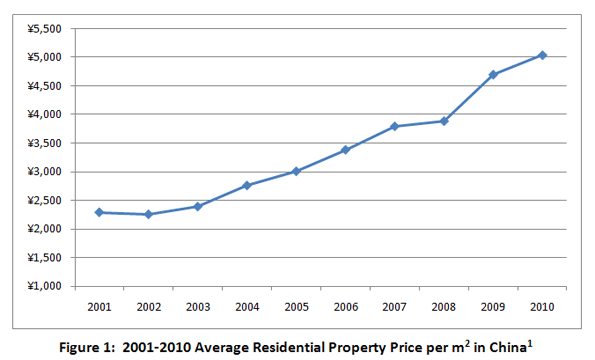
    For middle-aged Chinese, buying a house is seen as a relatively simple and secure investment, because as indicated in Figure 1, housing prices have increased steadily over the past decade.

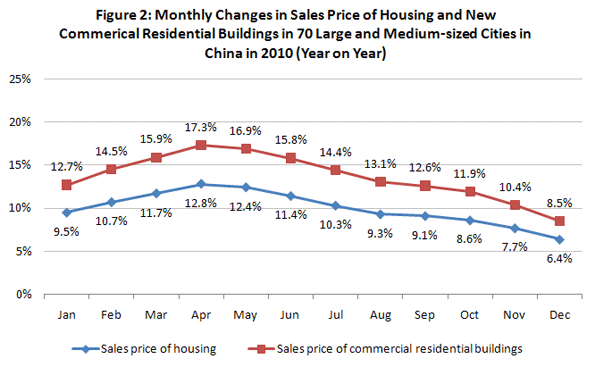
    This may now be getting out hand and the Chinese government has identified housing prices as a serious national issue. Some macro restrictive policies on home buying were issued in April 2010. Figures issued by the National Statistical Bureau, Figure 2, prove these restrictive policies did relieve somewhat the rate of house price increase.

    Immediately following the New Year, the Chinese central government announced that its top priority for 2011 would be controlling inflation. Shortly afterwards, a more stringent policy designed to limit speculation was issued on January 26th, 2011. Subsequently, each city issued its own policies based on this, with Shanghai and Chongqing, two Zhixiashi (provincial level municipalities administrated directly under the central government) taking the lead.

    Shanghai issued the following policies on February 1st, 2011.

    1. Any household purchasing a second home must provide a 60% down payment on a mortgage; and the interest rate on the mortgage will be 110% of the benchmark rate.
    2. From the publication date of this policy, households who already own one house will only be allowed to purchase one additional home.
    3. From the publication date of this policy, households who already own two or more houses will not be allowed to purchase any additional homes.
    4. Individuals selling a home less than five years since the date of purchase will be charged an additional sales tax of 5.5% of the full sales price.

    Many more cities followed in step, and announced their own sets of policies in the following weeks.

    Only one month after these policies came into effect, it is difficult to determine their effectiveness as house prices are still increasing compared with last year, although rate of change has dropped.

    The steady price has led to a renewal of interest in rented public housing. Chongqing became the first city to respond to the central government’s call with plans to build 40 million square meters  in public-rent housing units, which will provide accommodation to 1-2 million people within the next three years and to 800,000 families by 2015. In total, Chongqing will invest 120 billion RMB (18.3 billion USD) on public-rent housing construction.

    By 2012, Chongqing will also grant the urban hukou to 3 million farmers (10 million by 2020) with rural Hukou. In exchange, these farmers will give up their agricultural land, most of which will be developed into public-rent apartments.

    Who will be eligible to apply for public-rent housing?

    Chongqing’s criteria are as follows:

    1. Applicants must be over 18 years of age.
    2. Applicants must have a job which provides steady income.
    3. Monthly income must be under 2000 RMB (305 USD) for individuals and 3000 RMB (457 USD) for families. (These two numbers will fluctuate according to other economic index changes.)
    4. Families must not already have housing or have housing in which the average space per family member is lower than 13m2.

    One thing worth pointing out is that there is no hukou limit for public-rent housing applications, which means that citizens from other cities are equally qualified. All eligible applications will be placed into a lottery and public-rent apartment allocations will go to the lottery winners.

    These public-rent apartments range from 39m2 or 420 square feet (1 bedroom, 1 living room) to 53 m2 or 570 square feet (2 bedrooms, 1 living room) with the corresponding monthly rent around 390 to 530 RMB (59 to 81 USD). When you consider that the current average price of residential property per square meter in Chongqing is 5700 RMB (868 USD), that means a person could rent a 53 m2 apartment for 47.5 years before paying the equivalent cost of purchasing an apartment of the same size.

    Following suit, many other cities in China have also started to construct public-rent apartments.

    Are all the problems solved?

    Certainly this can help most lower-income citizens to find a place to live, but there are other problems. Tenants in China are not protected by laws that uphold renter’s rights as in the west. This is largely due to the fact that there are few apartment buildings owned by a single company or person. Citizens can only rent directly from home-owners with virtually no regulatory controls over the personal renting market.  Long-term leasing contracts are nearly impossible to negotiate, and landlords are able to demand large increases in rent, or even eviction at a whim. This means that renters have no stability, and usually have to face the difficulty of moving frequently.

    More buildings designed specifically for renting, and regulations protecting both tenants and home-owners are desperately needed.

    China has a long way to go when it comes to providing accommodation for its 1.3 billion citizens. Although one clear problem lies with the resources to construct the ”hardware”, this country’s development cannot continue without also upgrading its “software”: people’s way of thinking. In this case, that means convincing people to accept the idea of renting, reversing centuries of preference for ownership.

    Lisa Gu is a 26-year old Chinese national. She grew up in Yangzhou (Jiangsu) and lives and works in Nanjing (Jiangsu).

    Photo by Charles Ryan