Category: Policy

  • Could the Dallas Way be the Right Way?

    Dallas was George W. Bush’s first choice for a retirement destination but it gets low approval ratings elsewhere. A recent poll of readers of American Style magazine rated Dallas only 24th out of 25 large American cities as an arts destination. It came in immediately behind those well-known cultural magnets Milwaukee and Las Vegas, and ahead of only Jacksonville FL, even though it dwarfs all three places in terms of population, arts institutions and urban amenities. An apparently typical assessment residing in the blogosphere states flatly “God I hate Dallas. Everything about it. Especially the airport. Which is the only part of Dallas I’ve ever been in.”

    There has always been urban rivalry, going back at least to the days of the Greek city-states. When Phoenix overtook Philadelphia in the census rankings some years ago, the local newspapers delighted in printing unflattering pieces about the other and extolling their own virtues.

    Increasingly, this rivalry goes beyond traditional boosterism. Cities used to be places where one lived, but they have become metaphors about lifestyle and identity, and the personal has become increasingly highly political.

    In the last presidential election, the former mayor of Wasilla, Alaska seemed to argue that small towns were the keepers of the true American flame, which upset quite a few urbanites. But not all cities are created equal. The creative class thesis suggests that, like high school, there is cool and there is un-cool. This gets complicated when the nerds decide the cool places are. Cities that are designated as cool, like Portland, also tend to be among the least ethnically diverse.

    In short, we are now quarrelling about which cities are the coolest, based upon the extent to which they serve as extensions of our personalities and manifestations of our identities. This has always existed in terms of local rivalries—New York and New Jersey, Minneapolis and St. Paul—but now it is taking on the characteristics of cultural civil war.

    In this scheme of things, Dallas ranks among the totally uncool, which is probably one of the reasons George Bush chose it. But reputation is not necessarily its reality, as visitors to the city can find out for themselves. On a recent Friday afternoon downtown, I saw a line of school buses jostling to drop off and pick up their passengers ranging from young children to strapping adolescents. Every ethnicity seemed to be represented. They were not going to a sports event represented but regular traffic to the Dallas Arts District, a contiguous area amid the high rises that covers 68 acres and contains a broad array of theatres, museums and the city’s Arts Magnet school.

    Texas is hardly short of arts destinations: San Antonio ranked high in the American Style poll, as did Austin, which is known for its South by Southwest and Austin City Limits music festivals. Although Dallas does not automatically come to mind when thinking about highbrow culture, its Arts District is not just a vanity project, but is part of a restructuring of the city’s image taking shape for over three decades. The Arts District was anchored by the opening of the Dallas Museum of Art in 1984; this was followed by the Myerson Symphony Center [designed by I.M. Pei], the Crow Collection of Asian Art, the Nasher Sculpture Center, and the renovation of the Booker T. Washington High School for the Performing and Visual Arts [Norah Jones is an alumna]. Most recent to open is the AT&T Performing Arts Center, the fourth of the cultural buildings to be designed by a prize-winning architect.

    Most metro areas would delight in this kind of enhancement. Yet Harvey Graff, in his book “The Dallas Myth” suggests the city has grown by “brash boosterism”. He argues the ‘Dallas Way’ of getting things done involves an existential denial of the past [especially negative events, notably the Kennedy Assassination] and an equally strong denial of any limits to the future.

    Graff believes that the Dallas Way fails its residents. He argues little, if anything, has been done for poorer neighborhoods. There is substance to this of course: all American cities reflect the inequalities of our society

    Yet what Dallas is doing is still remarkable. In addition to the Arts District, it is pursuing costly projects such as the DART light rail network, which is connecting formerly neglected neighborhoods [now reviving to create a new Uptown] and reaching out to middle suburbia, where whole plazas are sprouting Asian stores and restaurants. No-one is going to be confusing it with New York any time soon, but it does seem that the Dallas Way also has things to recommend it. House prices have not cratered; the Metroplex is not in the fifth circuit of foreclosure hell like Phoenix or Las Vegas.

    Of course, this comes at a literal price, and a figurative one. Reviving some neighborhoods means gentrification. Spending on light rail tends to support young adults rather than children needing kindergartens. Stable house prices in some Dallas neighborhoods can mean modest homes costing more than a half million dollars, the antithesis of affordability.

    Yet the growth machine worked in the past and helped Dallas become a leading producer of higher end jobs and a high degree of home ownership. In many ways Dallas works better for its diverse residents than many urban aesthetes might suggest.

    This leaves unanswered the question of the aspirations of a city like Dallas to be taken seriously by the urban tastemakers. In the current climate, that seems unlikely. Cool is going to beat out the rest—except in the contexts of jobs and incomes, which is the world in which most people operate. Economic growth in Dallas and Houston gets little attention in the chat rooms where the defenders of Portland and its counterparts congregate. But as for me, I’m thinking that for the very first time, George Bush might actually be right.

    Andrew Kirby has been associated with the journal *Cities* for nearly thirty years. He is based in Arizona.

    Photo by purpletwinkie
  • Looking Down Under for a California Turnaround

    At a time when government in California faces an existential crisis, it’s telling to observe a starkly different picture in Australia. Forty years ago, local officials in fast-growing suburban communities in Queensland, Australia looked to their colleagues in fast-growing suburban communities in California as kindred spirits. They began a tradition of trading annual exchange visits to compare notes. Last month I had the opportunity to participate in that exchange. This year’s gathering took place on the “Sunshine Coast” north of Brisbane. While California government seems paralyzed by the strains of the economic crisis, local government Down Under is leading constructive change.

    Fiscal crisis is so pervasive in California that some have questioned whether the nation’s largest state and the world’s eighth largest economy remains “governable.” Every year our state budget is held hostage to interminable partisan bickering. This year, a patently bogus deal was cut that left an estimated $25 billion gap over the next 19 months.

    Until recently, non-partisan local government maintained greater credibility. But with the City of Vallejo declaring bankruptcy, Maywood firing its entire workforce and Bell embroiled in a grotesque corruption scandal, most Californians fear the eclipse of the “California Dream.” Widespread unemployment, home foreclosures, budget meltdowns and severe cuts in government services are the most obvious symptoms. But there’s a growing disconnect between angry voters and their government.

    Yet in Australia, the unofficial national motto is “no worries, mate.” It’s not an excuse for complacency. Australians seem to recognize that innovation is key to continued success. Where California politics has become gridlocked, local government in Queensland plows forward with reorganization and strategic visioning.

    At the annual conference of the Local Government Managers Association in Queensland, the most glaring distinction I viewed was the Australian embrace of “amalgamation.” Beginning a decade ago, state governments in Australia have pushed consolidation of smaller towns into larger and more efficient regional groupings. In Queensland, that process has reduced the number of local governments from 157 to 72. While local officials may have questioned the mandate, they approached the challenge with brisk efficiency. Three years on, Queensland local government officials look forward confidently instead of backward nostalgically.

    After the conference I spent five days with the Central Highlands Regional Council, gaining direct experience with current Australian local government. I was particularly impressed by the Central Highlands motto of “one region, one council”, to underscore their commitment to regional unity and equity.

    In contrast, local officials in California have an almost pathological hostility to State government (not without justification.) California’s 488 cities are part of a confusing jumble of 5,000 overlapping government entities in our state. Californians elect separate boards for schools, colleges, and innumerable water, library, sanitation, transportation and other “special district” agencies. It’s been forty years since the state has done anything to rationalize this fragmented and multilayered governance, despite the glaring meltdown of dysfunctional cities like Bell, Vernon and Maywood.

    Queensland’s appetite for challenges is by no means confined to amalgamation. The conference was dominated by talk of innovation in everything from library services to “reinventing government.”

    Before the housing meltdown, many California cities built new library buildings without rethinking the role of public libraries in the digital age. In contrast, I was captivated by vision I heard from Ross Duncan, Director of Learning Communities on the Sunshine Coast. Infusing their 10 branch library system with a focus on “changing the world,” he’s created a family university offering more than 4500 activities, workshops and events that bring together their 120,000 members in a shared journey toward a “learning community.”

    The vision of the City Council and community in the Sunshine Coast is to create “Australia’s most sustainable region, one that is vibrant, green and diverse.” The library’s role is to promote that through learning. That means that every library is a wireless hotspot which offers a kaleidoscope of classes and seminars on everything from worm farming to support groups for parents of autistic children. The libraries offer a “book a brain” service that allows you to reserve time with a retired business executive or professor to offer advice for your business or community group. Duncan is constantly pushing to “think outside the square,” seeking partners to underwrite new efforts to make learning accessible and attractive, and to make libraries “the key community hub to bring the community together, breaking down barriers of age, income and geography.”

    That pioneering spirit is evident on the larger challenge of “reinventing government.” Professor Ken Wiltshire, head of public administration at the University of Queensland Business School, posed two key questions as challenges for each manager:
    • “If your organization were to be abolished, would it be missed?”
    • “If your organization was privatized, would anyone invest in it?”
    Despite California’s dire crisis, few public organizations are facing those challenges. We are mainly engaged in trimming or chopping existing functions and services, instead of re-organizing for success in the “new normal.”

    At a time of deep distrust and discontent with public institutions, I return to the Golden State buoyed by the professional pride I saw in Queensland local government. Professor Wiltshire illustrated the value of local leaders in shaping and leading change. “Today . . . our work focuses on the ‘transformational’ aspect of leadership, the role of empowering, challenging, inspiring, celebrating and encouraging others to make powerful and enduring changes.”

    That audacious spirit is sorely needed – and missing – in the Golden State. At a time when our crisis calls out for making powerful and enduring changes, we lack the transformational leadership to shape and lead those changes. We might look Down Under for both the hope and example we need to turn California around.

    Photo by mi..chael: Wheel along the Brisbane river in South Bank, Brisbane, Queensland, Australia.

    Rick Cole is city manager of Ventura, California, and 2009 recipient of the Municipal Management Association of Southern California’s Excellence in Government Award. He can be reached at RCole@ci.ventura.ca.us

  • Love and the City

    It has been said that the modern city is soulless, that it is heartless, and that it is brutal. The modern city represents in its scale and complexity one of the most extraordinary of human inventions, but there is also no doubt that everywhere in the world it is also one of our biggest failures.

    The dysfunction of a city in the past was an inconvenience. The dysfunction of a city in the future will be a profound disaster for that city and, ironically, a profound opportunity for another city, of a smarter city. It will be an opportunity for a city that has found out how to position itself better in the world of cities, but more importantly in the eyes and hearts of its citizens.

    All over the world, there is a growing recognition that this brutality must stop; we have to imagine a different kind of city which addresses human needs and that puts the soul back into the city. This is essential to the survival of the city. Put another way, there is a growing understanding that it is actually “love” that will be the prime force in the future economy of successful 21st century cities.

    Who would have thought in the last generation that “love” might become a meaningful topic in a discussion about urban economies, much less a prime force of those economies?

    One important reason for creating a love-based city grows from the struggle today among cities for hegemony. We read all the time about “alpha-cities” and “delta-cities”: the “alphas” enjoy the fruits of labour and the “deltas” just do the labour – they just exist. And why is this?

    Well, it’s because the dynamics of urban growth and competition have fundamentally changed in the last quarter century. The world has become footloose, with people and capital moving at will: business can be done anywhere. Other aspects of life are more important than one’s livelihood and where people choose to settle is not tied down the way it used to be. We can do and be almost anything anywhere.

    The result is a new kind of economic base for our cities, augmenting the traditional economic activities holding our cities together. This is the ideas and service economy and it opens up the imperative to create a city of beauty and quality liveability and style. This is an economy driven by people, their direct needs, their preferences and their day-to-day experiences.

    This ideas and service economy quickly becomes an economy involving almost everyone. If you live in a core city, have you ever tried to get a gardener or a plumber? But, even beyond that, you have to think about all of the professions and vocations that can now demand an enjoyable as well as functioning city.

    We’re not just talking about the service sector or the ‘creatives’, we’re talking about almost everybody. We have to focus the discussion on a city that is liveable for a broad array of its population.

    I worry that in all our creative thinking about sustainable technologies and sustainable urban forms, there may be some strong denial going on about people and their inclinations, denial that will block the way towards sustainability.

    Take the fashion that insists on the primacy of density and mixed use and diversity and sustainable transportation. Sadly, most consumers in the English speaking world, except in a very few of our older gracious places, have shown very little interest in being a part of that kind of city. In my country, two-thirds of Canadians live in auto-dominated suburbs that boast none of these qualities – and that proportion is even higher in America.

    Let’s be blunt: most people hate density because most of it has been so bad; they think of mixed use as probably hitting them negatively and transit is not even in most people’s vocabulary. The ideal of most people is some sort of rural “garden of Eden” that they want to escape to from the city – even if that ends up being an illusory goal.

    I sympathize. The cities we have been building since the War have very seldom offered anything very appealing at almost any density. Who can really fall in love with brutal concrete canyons or anonymous strip malls or wind-swept roads?

    If cities want to offer an alternative, they must change and bring back the human touch – we have to bring placemaking to the very heart of the civic agenda. We have to stop trading away the urban qualities we care about for the urgencies of the moment of modern life.

    We must start to build places that truly appeal to people – yes, places that are sustainable, but also places that are so good that people will choose them. These cities have to have all the human services and they have to have beauty and they have to be gentle. Only then will they become attractive to a wide range of people.

    I call this “Experiential Planning” – learning about and then carefully making the city deliver the experiences people tell us they want in their lives for their families and children.

    Experiential planning looks beyond land-use and transportation patterns to things like character and comfort and health and convenience and the visceral response of the senses and caprice: things that simply make people happy. Happiness is the applied side of love.

    People want all of the efficiencies and choices but they also want more. They want to feel the unique, special spirit of a place as a real thing, not a marketing gimmick. They want their habitat to have a “buzz” that makes them feel good. They want their day-to-day living environment to foster social engagement and neighbourliness not isolation. That is what the contemporary city has often been missing.

    For as long as anyone can remember, modern cities, with very few exceptions, have been shaped by economic activity and politics and the shifting of social groups: the city exploited as a commodity. But that doesn’t have to be the case. We can actually design our cities as an explicit act of creation – grand civic design with the whole city as a canvas. And every city has to find its own way: they should not accept cookie-cutter replications of what’s being done everywhere else.

    To start, every city needs to perform a ritual burning of these outdated and single-purpose rules. Now I am not talking about de-regulation. The city of the future will have to have strong regulations because the possibilities out there for development are just too diverse and the private interests in development too strong. There must be a clear expression of the public interest and public needs to match that of the private sector.

    Also, I want to be clear that this is not a “top-down” agenda. Experiential planning requires an aggressive and diverse engagement of the public at every step along the way to articulate the public perspective and to insure public buy-in and ownership. The general public needs to discuss and debate an overall civic vision and all aspects of urban design.

    In this experiential-based city there will be an alignment of profitability and community building. We will also see people coming back to live in the core city and to suburbs transformed through natural choice and preference. There will be an alignment of consumer selection and sustainable practice. This will include all kinds of people but especially families with children.

    But none of this will happen by accident. We have to make it happen and bring along individual values through a careful process of reconciliation.

    Tomorrow’s city must meet the environmental test and the economic test but it must also meet the experiential test; and that is the test of love; that is the test of soul. It must be beautiful and joyful and sociable and humane and offer a complete rich community life – with all the subtleties of human occupation. That is the real power of an urban love affair.

    Larry Beasley is the retired Director of Planning for the City of Vancouver in Canada. He is now the “Distinguished Practice Professor of Planning” at the University of British Columbia and the founding principal of Beasley and Associates, an international planning consultancy. He chairs the ‘National Advisory Committee on Planning, Design and Realty’ of Ottawa’s National Capital Commission; he is the Chief Advisor on Urban Design for the City of Dallas, Texas; he is on the International Economic Development Advisory Board of Rotterdam in The Netherlands; and he is the Special Advisor on City Planning to the Government of Abu Dhabi in the United Arab Emirates.

    Photo by ecstaticist

  • Toronto Election Highlights Failure of Amalgamation

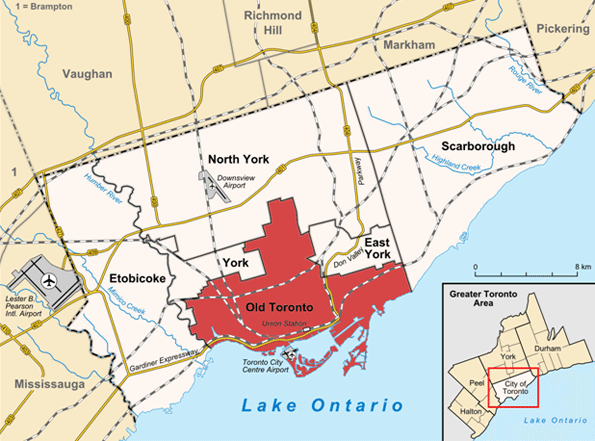
    In my pre-election piece on the Toronto election, I discussed the city’s lingering malaise. It developed slowly but its roots can be traced to the 1998 amalgamation that swallowed up five suburban municipalities. This led to a six folds expansion of city boundaries and a tripling the population base. This amalgamation was initiated by the province of Ontario as a cost saving measure and faced major local opposition. Citizens and politicians were concerned that the benefits of the alleged efficiency saving would be outweighed by the negative impact of losing local decision making powers. The recent Toronto municipal election bore out this concern.

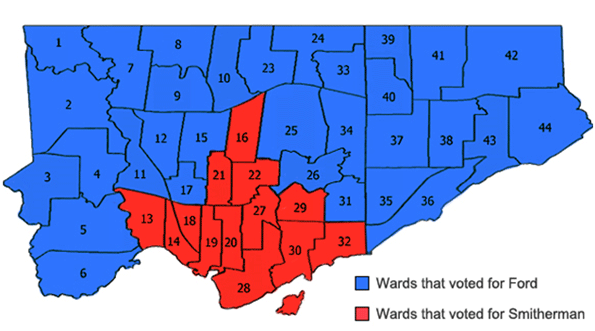
    In the October 25th election, Torontonians were presented with two dramatically different visions. The first vision was presented by former Liberal Ontario cabinet minister George Smitherman. A self-described progressive, Smitherman appealed mainly to voters in the downtown core of Old Toronto. He stood for issues such as improved bicycle lanes, renewal of the downtown waterfront, and improving social housing conditions. The second version was presented by maverick councilor Rob Ford, who represented a ward in the former City of Etobicoke. Ford’s message was simple: it’s time to stop the “gravy train” at City Hall. While he had elaborate platforms on many issues, cutting waste at City Hall was his ubiquitous message.

    Despite Toronto’s social democratic image, Rob Ford won a crushing victory. Ford earned 47% of the vote, while Smitherman ended up with 35%. Far left candidate Joe Pantalone (known primarily for attempting to stop businesses from opening in his own ward) managed to capture 12% of the vote.

    Aside from the shock that a partisan conservative won in Toronto, there are two other significant developments. Both front runners were significantly more fiscally conservative than the current administration. Ford and Smitherman represented constituencies desperately seeking change. Smitherman’s base was frustrated with the inability of the city to provide the services that they want efficiently. Ford’s base was angry that the city is providing many of these services in the first place.

    Not surprisingly the results broke down along specific geographic lines. Ford won an outright majority of votes in every single ward outside of Old Toronto. Within the old boundaries, Smitherman won 13 of the 16 wards. The three Old Toronto wards Ford won are all on the fringes of the Old City.

    In 1997, the newly amalgamated city went to the polls for the first time. Conservative former North York Mayor Mel Lastman narrowly defeated social democratic former Old Toronto Mayor Barbara Hall. Since then, downtown oriented social democrats have controlled the city ever since.

    Clearly this result shows that the concerns expressed by the opponents of amalgamation were largely valid. Amalgamation failed to create cost savings, and has created a dysfunctional megacity. Rather than having six municipalities where voters are focusing on solving local problems, we have one gigantic city with the core and the suburbs fighting for their share of the public purse. This leads to the schizophrenic policy decisions we see today.

    Before amalgamation, there were six different versions of Toronto life that one could choose from. If you didn’t like living in high tax Toronto, you could live in Etobicoke. If Etobicoke’s bylaws and business taxes were hurting your business, you could move to North York. Now all people in the Toronto area can do is vote the bums out on election day, or get out of the area altogether. This isn’t a viable long-term solution.

    The problems are systemic, and cannot be solved so long as the megacity exists. This extends beyond the fact of the impossibility of satisfying the core and the suburbs at the same time. The megacity allows public sector unions to literally hold 2.5 million people hostage whenever they feel like it. A notorious strike last summer lead to a month without garbage collection in the entire city. The 24,000 strikers also shut down parks and recreation services, daycare, provision of municipal licenses, health inspections, animal services, and forced a 25% reduction in ambulance services. In 2008, the transit union called a last minute strike at midnight on a Friday night, grinding the city to a halt. These are just two examples of how powerful Toronto public sector unions have become. The only reason strikes aren’t more frequent is that the city typically gives them whatever they want in order to avoid chaotic strikes. De-amalgamation would not only allow more local control over policy, but would help fray the noose that the unions have tied around the city’s neck.

    Downtown progressives gripe over how Rob Ford is going to destroy their city, but they should take a minute to think about what some of their policies have been doing to suburbanites for years. They have imposed high taxes, and burdensome regulations on the amalgamated cities, as well as a myriad of new bylaws. Some of these policies make sense in Old Toronto. For instance, dissuading automobile usage in the congested core makes sense. Doing so in the suburbs does not. It might make sense to regulate trees on private property in a crowded downtown neighborhood. Not so much in a new subdivision. One-size-fits-all policies don’t work across a city as large and diverse as Metropolitan Toronto.

    Now that the suburbs have wrought their revenge on the old city, progressives need to recognize that de-amalgamation is not just a fantasy of libertarians and angry suburbanites. It is a prerequisite to restoring sound public policy reflecting the preferences of individual communities. Railing against Rob Ford won’t fix the problem. Rob Ford is what the suburbs want. As long as the megacity lives, Toronto will elect a Rob Ford type every now and then.

    The only way to stop this pattern of alternating, divergent visions is by de-amalgamation. Critics will use metaphors such as ‘unscrambling an egg’ to illustrate the difficulties of de-amalgamation. No one should believe that de-amalgamation would be easy. But there will never be a better time than now to take the necessary step of de-amalgamation. A few years of chaotic governance would be worth the long run benefit of restoring local control.

    Downtown Toronto photo by Astro Guy

    Steve Lafleur is a public policy analyst and political consultant based out of Calgary, Alberta. For more detail, see his blog.

  • Amtrak Fails To Weather The Storms

    Why do I persist in riding Amtrak, the short name for the National Railroad Passenger Corporation, a company originally owned by the freight railways, but now subsidized by Congress and run like a Russian bureaucracy, complete with late trains, sullen employees, myriad petty regulations, budget deficits, cold coffee, feather bedding, broken seats, clogged toilets, rail cars that feel like buses, and a schedule that serves the interests of congressmen, lobbyists, unions, budget stimulators, and small-town mayors, but rarely passengers?

    Isn’t it time to let Amtrak go the way of such failed railroads as the Nickel Plate, Erie Lackawanna, Chicago & Alton, Rock Island, Maine Central, Wabash, Missouri Pacific, or the New York Central, lines that outlived their corporate incarnations and were either wound up or merged into larger entities?

    Amtrak was set up in 1971 to replace the passenger rail network that was killed off by government regulations, the Interstate Commerce Commission, subsidized air and road travel, and urban blight. The new entity went to work hauling passengers on a route system better adapted to 1921 than 1971. The earlier trains were faster.

    It’s hard to imagine Leland Stanford or E.H. Harriman buying into the Amtrak business model. Forty years after Amtrak’s creation, little of its plan has changed. It offers corridor services on the East and West coasts and, in between, a meandering schedule of trains that account for less than one percent of all intercity travel.

    Buyers could easily be found for the Northeast Corridor service between Boston and Washington. Better yet, allow competition on the line, and auction off the franchise rights, using the proceeds to pay down national debt.

    England had the dreadful network that operated as BritRail. After it was privatized, Britain’s rail service became competitive, passenger friendly, faster, and more comfortable.

    Compare the new British private train system with the Amtrak experience (“Enjoy the journey”). Think about New York’s Pennsylvania Station, a subterranean strip mall with dank corners, uncomfortable chairs in cheerless waiting rooms, confusing destination boards and dreary platforms that have seen few improvements since I first used them in the early 1960s.

    Passengers buying Amtrak tickets in Penn Station stand in a line that feels like Ceauşescu’s Romania. Only one or two agents are on duty, the tickets are expensive, you need you an identity card to buy one, and getting on the train has the feel of descending into a Chilean mine.

    At the cost of billions, there’s a plan for a new “Moynihan Station” across the street, although much of what’s wrong with Penn Station could be fixed if Amtrak outsourced the operation to Hyatt.

    Its shoddy service explains the rise of discount bus lines that are now digging into core Amtrak passenger revenue between Boston, New York, and Washington. Companies such as Bolt Bus charge $15 or $20 to get from New York to Boston, while Amtrak costs $67 to $95, depending on the day and time.

    Bolt leaves from West 34th Street, and departures are punctually on the hour. The seats are cramped, but the buses are clean and have Wi-Fi. The trip takes less time than many trains, when you add in inevitable Amtrak delays. Nor is there a surly Amtrak conductor reading the riot act at each station.

    To get a flavor of Amtrak’s attitude toward its passengers, read the cheerful words of its CEO in the on-board magazine: “Our identification policy, random screenings in stations, random on-board ticket verification process and more interactive police efforts—including our K-9 teams—are some of the visible activities we have been working on.” Trains used to advertise comfortable berths with sleeping kittens.

    Killing off Amtrak would mean the end of long-haul passenger service, the sleepers that are the heirs to trains like the Twentieth Century Limited. I would deeply regret the absence of long-distance train travel in the United States. But, were Amtrak spun off, its overpriced and indifferent service might be replaced by a network of private operators that would compete to take Americans around a glorious country that longs to be seen by rail.

    Even today, Amtrak trains run near full capacity, and the potential to tap into a travel-happy country of 300 million ought to interest a few hedge funds and stock jobbers, not to mention flourishing overseas rail companies.

    Already there are nascent private companies and sleeping car owners that offer rail trips to national parks, art museums, jazz festivals, baseball games, and the homes of famous writers. Deregulate the passenger industry, and companies like these will flourish. Railroads are in America’s entrepreneurial DNA.

    Recently, for $325, less than the cost of a cramped night in an Amtrak “Slumberette” (emphasis on the “ette”), I rode round-trip in a private rail car, New York Central 3, owned by Lovett Smith III, from New York to Pittsburgh.

    Along the way, I sat on the open, rear platform from which presidential candidates whistle-stopped across America, and took in the sweep of the Philadelphia skyline, the majesty of Amish country (I loved the teams of horses pulling plows), the arched bridge across the Susquehanna, the engineering marvel that is the Horseshoe Curve, the path of the Johnstown Flood, and the remnants of the steel industry around Greensburg. Inside the car, I chatted with my fellow passengers, ate elegant meals, and sampled Italian wines (a group on board had organized a tasting). Were Amtrak a service company, not a protection racket set up to bleed government money into padded contracts, it would have the imagination to operate similar excursions.

    Instead, Amtrak wants to position itself as the paymaster for a national rail plan. The Department of Transportation recently issued a strategic plan called Moving Forward: A Progress Report. (If Amtrak were to issue a report to its passengers, it could be entitled, “Sorry for the Inconvenience: Due to a Track Incident, We’re Being Held in Baltimore.”)

    Amtrak imagines itself as the federal agency that should be hired to spend $117 billion, over thirty years, to build a segregated high-speed rail system between Boston and Washington, and for additional billions, to operate Core Express Corridors between cities less than 500 miles apart.

    Such visions of grandeur come from a company that needs nine hours and fifteen minutes to run a train the 444 miles from New York to Pittsburgh; that’s an average speed of 48 m.p.h.

    To be fair, not all of Amtrak’s failings are its fault. Most of the tracks on which it operates are owned by freight companies that find passengers a nuisance, and think nothing of shunting aside “the varnish” to send through more coal and containers.

    Amtrak, however, is responsible for a corporate culture that makes a mockery of “customer service.” In many ways, it is the perfect metaphor for everything that is wrong with letting Washington have a heavy hand in the economy, or for imagining that an economic revival can be built around companies with federal guarantees.

    Amtrak lacks direction, lives off subsidies and stimulating money, and now wants $117 billion to operate high-speed rail that, for the cost differential, would be only marginally better than the private bus companies now competing up and down the East Coast, with fares of one third or less than what Amtrak charges.

    Americans would happily pay for low-speed rail, if the food was good, the seats spacious, the broadband fast, and if, on the rails, they could surf, shop, eat tacos, and watch movies.

    At the moment, I am riding an Amtrak train that is four hours behind schedule on its way into North Carolina. So far, to use a phrase from railroading legend, the services have not been worth a “plated nickel.”

    Photo By Kyle Gradinger, Amtrak Keystone Snowstorm I. Amtrak AEM-7 locomotive 904 leads a Keystone Corridor train through the snow in Rebel Hill, King of Prussia, PA.

    Matthew Stevenson is the author of Remembering the Twentieth Century Limited, winner of Foreword’s bronze award for best travel essays at this year’s BEA. Growing up, he was a “Central” man, but loved the majesty of the old Pennsylvania Station. Together with his father, now 91, he recently has waded through a 1969 edition of the ‘Official Guide to the Railways’. He lives in Switzerland.

  • The Overdue Debate: Smart Growth Versus Housing Affordability

    American households face daunting financial challenges. Even those lucky enough not to have suffered huge savings and retirement fund losses in the Great Recession seem likely to pay more of their incomes in taxes in the years to come, as governments attempt pay bills beyond their reasonable financial ability. Beyond that, America’s declining international competitiveness and the easy money policies of the Federal Reserve Board could well set off inflation that could discount further the wealth of households.

    In this environment, the last thing governments need do is to raise the cost of anything. It is bad enough that taxes may have to rise and that a dollar will probably buy less. America’s standard of living could stagnate or it could even decline.

    The Choice: Smart Growth or Affordability

    The Washington Examiner, however, succinctly put the choices that face the nation, states and localities with respect to the largest element of household expenditure — housing. In an editorial entitled “Take Your Pick: Smart Growth or Affordable Housing,” the Examiner noted:

    “No matter how much local politicians yammer about how much they support affordable housing, they are the principal cause of the problem via their land use restrictions, such as the urban growth boundary in Montgomery County and large-lot zoning in Loudoun County.”

    The editorial was in response to our Demographia Residential Land & Regulation Cost Index, which estimated the extent to which the land to construction ratio had risen in metropolitan regions. The principal finding was that the share of land and regulatory costs to new house prices had risen only with the impostion of more restrictive land use policies. This is principally because strategies such as urban growth boundaries, suburban large lot zoning and geographical growth steering (such as allowing state financial assistance only in areas meeting smart growth criteria) makes land for housing unnecessarily scarce, raising its price just as surely as OPEC’s oil rationing raises the price of gasoline.

    Urban planner and mayor of Ventura, California Bill Fulton objected to our attributing these increases to land and regulation, instead suggesting that smart growth increases homes prices much less than we claimed although, he admits, “at least a little“ . The pro-smart growth study Costs of Sprawl — 2000 concedes that a number of smart growth strategies can increase house prices (See Table 15-4). Thus, the debate is not about whether more restrictive land use policies raise the price of housing, but rather by how much.

    More often, however, proponents of more restrictive land use regulations have avoided and even denied that the inconvenient truth linking their policies with higher housing costs. Rarely, if ever, have proponents of such policies fully disclosed to elected or appointed officials that more restrictive land use policies would lead to higher house prices. It is doubtful that any urban planning department ever sent representatives to an NAACP chapter to explain how fewer African-Americans would be able to own their own homes, despite already having a one-third lower home ownership rate than non-Hispanic whites. Similarly, the planners probably never told La Raza chapters that Hispanic households, also with a one third less home ownership rate, would find home ownership more costly. Nor was the message delivered to the religious organizations concerned with improving the standard of living for lower income households.

    Pervasive Evidence

    Yet the evidence that smart growth boost prices substantially seems incontrovertible. An early 1970s research effort led by renowned urbanologist Peter Hall quantified the impacts of the restrictive Town and Country Planning Act of 1947, which brought smart growth measures to England. The result, The Containment of Urban England revealed how strict regulations on development had driven the price of land for development from five to ten times the value of comparable on which development was not permitted, but might be permitted in the future. More recently, Bank of England Monetary Policy Committee member Kate Barker, was commissioned by the Blair Labour government to review housing affordability and land regulation. She attributed England’s more steeply rising house prices relative to continental Europe to its more restrictive land use regulations.

    The same effect is evident in the United States. Dartmouth’s William Fischel noted that California house prices were similar to those in the rest of the nation as late as 1970. By 1990, however, California house prices had escalated well ahead of the nation. Fischel found that the higher prices could not be explained by higher construction cost increases, demand, the quality of life, amenities, the property tax reform initiative (Proposition 13), land supply or water issues. His conclusion was that the expansion of land use restrictions were the culprit.

    Let Them Eat Cake?

    The disregard at least some smart growth proponents show about house prices may be characterized, for example, in a comment on the Planetizen website:

    “… smart growth can lead to more expensive housing. So what? At least it’s REAL value, generated by a higher quality of life, easier commutes, more transit options, walkability and a more enriched cultural experience…” (emphasis in original)

    Perhaps it never occurred to the proponents of more restrictive land use policies that not all households have the benefit of incomes typical of urban planners or new urbanist architects. One has to question the “REAL values” of smart growth since most housing consumers place their highest emphasis on things like privacy, security and good schools, not always available at a decent price in urban areas.

    In fact, higher priced housing reduces the discretionary income that is crucial to an acceptable standard of living to many households. Millions of households will not be in the market for “a more enriched cultural experience” until they can afford the housing they desire.

    Housing Affordability and the Cost of Living

    It is not accidental that the cost of living is higher (both in nominal terms and relative to incomes) in metropolitan regions where land use regulation is the strongest, such as San Diego, Washington-Baltimore, Seattle or Boston. Nor is it accidental that house prices have escalated to 40 percent above historic norms in Portland, Oregon, where planners have skimped on geographical urban growth boundary expansions, choosing instead to look skyward, seeking higher densities. California’s aspiration under Senate Bill 375 for new housing at 20 units to the acre offers a more than Jakarta level of density (residential densities above 30,000 per square mile) that could escalate the unprecedented exodus of people and businesses.

    Higher Housing Costs: The Poverty Connection

    The acknowledged relationship between more restrictive land use regulation and higher house prices also applies to standards of living, which are sent lower, and poverty rates, which must inevitably be pushed higher. This constitutes a second inconvenient truth: as discretionary income drops, more households fall into poverty. This creates a difficulty for proponents of more restrictive land use regulation, because there is no constituency for increasing poverty. It is no wonder they have generally discounted, ignored or even denied the nexus between smart growth and higher housing costs.

    Considering the financial uncertainty American households face, it is long past time that the choice between smart growth and housing affordability be seriously debated.

    —-

    Photograph: “Low density” smart growth development adjacent to the urban growth boundary (Hillsboro) in suburban Portland (by author)

    Wendell Cox is a Visiting Professor, Conservatoire National des Arts et Metiers, Paris and the author of “War on the Dream: How Anti-Sprawl Policy Threatens the Quality of Life

  • How Liberalism Self-destructed

    Democrats are still looking for explanations for their stunning rejection in the midterms — citing everything from voting rights violations and Middle America’s racist orientation to Americans’ inability to perceive the underlying genius of President Barack Obama’s economic policy.

    What they have failed to consider is the albatross of contemporary liberalism.

    Liberalism once embraced the mission of fostering upward mobility and a stronger economy. But liberalism’s appeal has diminished, particularly among middle-class voters, as it has become increasingly control-oriented and economically cumbersome.

    Today, according to most recent polling, no more than one in five voters call themselves liberal.

    This contrasts with the far broader support for the familiar form of liberalism forged from the 1930s to the 1990s. Democratic presidents from Franklin D. Roosevelt to Bill Clinton focused largely on basic middle-class concerns — such as expanding economic opportunity, property ownership and growth.

    Modern-day liberalism, however, is often ambivalent about expanding the economy — preferring a mix of redistribution with redirection along green lines. Its base of political shock troops, public-employee unions, appears only tangentially interested in the health of the overall economy.

    In the short run, the diminishment of middle-of-the-road Democrats at the state and national level will probably only worsen these tendencies, leaving a rump party tied to the coastal regions, big cities and college towns. There, many voters are dependents of government, subsidized students or public employees, or wealthy creative people, college professors and business service providers.

    This process — driven in large part by the liberal attachment to economically regressive policies such as cap and trade — cost the Democrats mightily throughout the American heartland. Politicians who survived the tsunami, such as Sen. Joe Manchin in West Virginia, did so by denouncing proposals in states where green policies are regarded as hostile to productive local industries that are major employers.

    Populism, a traditional support of liberalism, has been undermined by a deep suspicion that President Barack Obama’s economic policy favors Wall Street investment bankers over those who work on Main Street. This allowed the GOP, a party long beholden to monied interests, to win virtually every income segment earning more than $50,000.

    Obama also emphasized an urban agenda that promoted nationally directed smart growth, inefficient light rail and almost ludicrous plans for a national high-speed rail network. These proposals appealed to the new urbanist cadre but had little appeal for the vast majority of Americans who live in outer-ring neighborhoods, suburbs and small towns.

    The failure of Obama-style liberalism has less to do with government activism than with how the administration defined its activism. Rather than deal with basic concerns, it appeared to endorse the notion of bringing the federal government into aspects of life — from health care to zoning — traditionally controlled at the local level.

    This approach is unpopular even among “millennials,” who, with minorities, represent the best hope for the Democratic left. As the generational chroniclers Morley Winograd and Michael Hais point out, millennials favor government action — but generally at the local level, which is seen as more effective and collaborative. Top-down solutions from “experts,” Winograd and Hais write in a forthcoming book, are as offensive to millennials as the right’s penchant for dictating lifestyles.

    Often eager to micromanage people’s lives, contemporary liberalism tends to obsess on the ephemeral while missing the substantial. Measures such as San Francisco’s recent ban on Happy Meals follow efforts to control the minutiae of daily life. This approach trivializes the serious things government should do to boost economic growth and opportunity.

    Perhaps worst of all, the new liberals suffer from what British author Austin Williams has labeled a “poverty of ambition.” FDR offered a New Deal for the middle class, President Harry S. Truman offered a Fair Deal and President John F. Kennedy pushed us to reach the moon.

    In contrast, contemporary liberals seem more concerned about controlling soda consumption and choo-chooing back to 19th-century urbanism. This poverty of ambition hurts Democrats outside the urban centers. For example, when I met with mayors from small, traditionally Democratic cities in Kentucky and asked what the stimulus had done for them, almost uniformly they said it accomplished little or nothing.

    A more traditional liberal approach might have focused on improvements that could leave tangible markers of progress across the nation. The New Deal’s major infrastructure projects — ports, airports, hydroelectric systems, road networks — transformed large parts of the country, notably in the West and South, from backwaters to thriving modern economies.

    When FDR commissioned projects such as the Tennessee Valley Authority, he literally brought light to darkened regions. The loyalty created by FDR and Truman built a base of support for liberalism that lasted for nearly a half-century.

    Today’s liberals don’t show enthusiasm for airports or dams — or anything that may kick up some dirt. Deputy Assistant Secretary of the Interior Deanna Archuleta, for example, promised a Las Vegas audience: “You will never see another federal dam.”

    Harold Ickes, FDR’s enterprising interior secretary, must be turning over in his grave.

    The administration would have done well to revive programs like the New Deal Works Progress Administration and Civilian Conservation Corps. These addressed unemployment by providing jobs that also made the country stronger and more competitive. They employed more than 3 million people building thousands of roads, educational buildings and water, sewer and other infrastructure projects.

    Why was this approach never seriously proposed for this economic crisis? Green resistance to turning dirt may have been part of it. But undoubtedly more critical was opposition from public- sector unions, which seem to fear any program that threatens their economic privileges.

    In retrospect, it’s easy to see why many great liberals — like FDR and New York City Mayor Fiorello LaGuardia — detested the idea of public-sector unions.

    Of course, green, public-sector-dominated politics can work — as it has in fiscally challenged blue havens such as California and New York. But then, a net 3 million more people — many from the middle class — have left these two states in the past 10 years.

    If this defines success, you have to wonder what constitutes failure.

    This article originally appeared in Politico.

    Joel Kotkin is executive editor of NewGeography.com and is a distinguished presidential fellow in urban futures at Chapman University and an adjunct fellow with the Legatum Institute in London. He is author of The City: A Global History. His newest book is The Next Hundred Million: America in 2050, released in February, 2010.

    Photo: Tony the Misfit

  • Car Wars: Should Autos Rule The Road? Part II

    We have a severe drug problem, we’ve been told, that mostly affects suburbanites. The dangerous drug is not taken by mouth, nor by injection, yet it is used daily by every family member and must be stopped before we, as a nation, are utterly destroyed. According to many experts, our “dependence” on cars must stop.

    Internet rumors abound that we are about to be legislated out of our stupor, and be taxed into high density, inner core cities. Should this rumor become fact, let’s look at what effect it will have on our economy, and, quite frankly, on the American Dream of home ownership.

    Today, the housing market is still dealing with the disaster of plummeted prices. Since 80% of the new home market this past decade has been suburban, it would be safe to say that 80% of Americans that bought in this century are the hardest hit, because these new homes have dropped to pre-boom pricing. It has been young families, generally, that have driven out to the suburbs to find new homes, the promise of lower density, and newer safe schools. In addition, many (most) of these families believed that their homes were a source of income; after all, values were increasing 10% or more annually, and that equity could be tapped in loans, (both suburban and urban).

    While many think of the suburbs as pure white, that is no longer true. The suburbs today, in general, are intermixed with all races. But the new race being ridiculed by many is the “suburbanite”. The suburbanite yearning for his or her daily fix of the car, consuming our fuel, and spewing carbon into our atmosphere must be eradicated at all costs.

    So how do we eradicate this vermin? There are rumors of a carbon tax that will place a financial burden on those vehicular junkies. Who cares that this major portion of America’s population is under the most financial pressure since the depression. If we tax these infidels, that will surely bring them to their senses , and we can cure their dependence on Chevys, Fords, and Mini-vans. Let’s break their backs once and for all, so that these families will abandon what is left of the suburbs and be forced back to the inner core. If reason does not work, we can just legislate it.

    Let’s imagine this new future filled with promise of a new America. In this fantasy, we visit the Smith family, who moved from their 10,000 foot suburban lot into the urban core. Adam Smith, the father, now must take the bus to the train station for the new light rail line that goes to Edenville, his job out in the suburb as a plant manager (it seems that his place of employment did not make the move). With connections, he can make it to work within an hour, whereas his 10 mile commute from suburb to suburb took 20 minutes.

    Lilly Smith (his new wife, as the old one refused to move into a 20 story inner city high-rise) works at Bester Buy on the edge of the city. She needs two bus connections to get there Having a car is not an option, since parking costs are prohibitive in the city. Luckily, the kids are old enough to be left alone; Josh is 8 years old, Jane is 12, and Joey, who is 15, watches over the siblings. Today is a holiday and they are home from school, but the cold rainy day keeps them inside, along with hundreds of other kids who play in the vast corridors.

    Lilly arrives at work, only to remember that Jane had a dentist appointment which she forgot about. She shivers, thinking about the old days, and the warm comfort of the Mini-van she once relied on to take her kids to appointments. She breaks out into a sweat and falls into a stupor. Her fellow workers recognize the symptoms, as they too have been weaned of their dependence upon personal vehicles. Her manager, Ralph, lets her take a week of sick leave to get help.

    Ralph is lucky. He lives in a single family neighborhood on the edge of the city. He has his own large lot, a spacious 35 feet wide and 90 feet long. He and his wife each posses a car. His luxury two story home, setback five feet from the sidewalk, is 25 feet wide and 50 feet deep; the house itself is a massive 2,500 square feet, over twice as large as the Smiths inner city apartment. He also has three children who enjoy the privacy of their back yard. The garage adjacent to the 12 foot wide alley consumes 440 square feet of their remaining 1,200 square foot rear yard. Still, with 760 square feet of green space, the kids are lucky.

    Ralph and his wife, Mary, both drive electric cars. Mary has the larger vehicle, with a 50 mile range per charge on a warm day. Their daughter wants to play with a cousin who still lives in the suburbs, 20 miles away. This is a cold day, which reduces the range of the vehicle to 35 miles, and their cousins do not have a charging station, so their 11 years old daughter is driven to the Light Rail station, a mile away.

    A week later, back at the Smith apartment, an argument starts between Adam and Lilly about her desire to get out of the city. Even if they did move out to near Adam’s plant, they would need Lilly’s paycheck to make ends meet, so she would need the light rail and two bus connections to get to work. Lilly begins to sweat and shake again… When Josh asks what is wrong with Mommy, Adam explains about the days when Americans were drugged out on their cars, the days when people were free to go when and where they wanted. As he describes those terrible times, he too yearns for those days. Adam and Lilly dream of moving out to a place with space, if only the carbon tax on moving out of the city could allow it, but alas, it’s only a dream that only the wealthy can now afford.

    A fantasy? Here is what I’m experiencing as a planner. When I met with a city official a few weeks ago I was admonished for a proposal that included attached garages. I explained that attaching the garage reduces 40 feet of exterior wall to be built, and here in Minnesota, an attached garage means you do not have to shovel snow between the home and the garage, nor slip on the ice. Why would I detach a garage, I asked? The city official explained that according to his planning staff, the space between the garage and the home is a social gathering spot where neighbors can stop and talk about their day. I had thought that’s what that large front porch we are proposing on the homes was for.

    There is a movement to prevent the toxic drug — the car — from infecting our lives. For me, no way you are taking me off my ERPT — Extremely Rapid Personal Transport — dependence.

    This is the second of a two-part series in which different authors examined the centrality of the autombile in urban and suburban life.

    Photo by Rick Harrison of the author’s ERPT — his Porsche.

    Rick Harrison is President of Rick Harrison Site Design Studio and Neighborhood Innovations, LLC. He is author of Prefurbia: Reinventing The Suburbs From Disdainable To Sustainable and creator of Performance Planning System. His websites are rhsdplanning.com and performanceplanningsystem.com.

  • Car Wars: Should Autos Rule The Road? Part I

    We’ve decided to become a one car family. Denver has proven to be the ideal locale for this experiment, of sorts. The “Mile High City,” and particularly our new neighborhood, provide a range of mobility options beyond the four-wheel variety for trekking from place to place.

    The metropolitan area is naturally blessed with a mobility-favorable landscape. It is approximately 10 miles by 10 miles. More importantly, our neighborhood possesses what I affectionately refer to as “accessible proximity” to local amenities such as grocery stores, coffee houses, parks, and specialty shopping centers. The immediate area is not only safe, it’s engaging in its physical and social makeup, with stately homes and troves of dog-walkers along suburban style streets.

    Recently, our daughter, who is eight, remarked “Ya know, at our old home it seemed like we always needed a car to go places, while here in Denver, we can actually walk places and enjoy the clean air.”

    The website Walkscore, an online index, which ranks communities nationwide based on access by foot to restaurants, coffee houses, schools, businesses and other frequent destinations. Denver’s score provides tangible evidence of my daughter’s contention: According to the site’s analytics, our Denver address registers a whopping 88 out of 100, defined as ‘very walkable,’ meaning that “one is able to accomplish most errands by foot. Our residence in Folsom, California — from which we recently relocated — stumbled in at a paltry 48 out of 100, defined by Walkscore as ‘car dependent’.

    Why is this such a big deal to us, as well as to growing numbers of Americans? I would contend that it is affordability. As Americans continue to struggle financially amid the worst economic times since the great depression, the argument could be made that location efficient neighborhoods offer a cost effective alternative to those that are exclusively auto-centric. In an era where expenses associated with automobile ownership, maintenance and fuel represent a significant slice of our household budgets, policy makers would be wise to expand options that encourage alternative forms of mobility.

    Automobiles are still the transportation mode of choice for most working commuters, and for good reason, as most Americans still live a reasonable distance from where they work. But alternative forms of transportation are gaining momentum, as many struggle with insurance and other automotive related expenses.

    According to the U.S. Census Bureau’s recently released American Community Survey (ACS), bicycling is becoming a viable option for Americans willing to pump the pedal on their way to work. Portland leads the U.S. in terms of the most bike commuters, with almost six percent of its residents using a bicycle as their primary mode of transportation to work in 2009. Minneapolis (3.86%), Seattle (2.99%), San Francisco (2.98%), and Oakland (2.53%) round out the top five.

    Denver is one of a handful of cities that is actively promoting the use of bicycles as a viable short-run commute option. This year, the city introduced the first large-scale bike-sharing program in the U.S. A partnership between Humana, Trek Bicycle and the advertising agency Crispin Porter + Bogusky, this initiative flows from the shared belief that bicycles should serve as vehicles for positive health and environmental change, as well as important parts of a community’s transportation ecosystem. It’s this latter point that has gained the attention of Denver hotels and the convention center, which are seeking to provide visitors with mobility tools that compliment the downtown’s free bus system and walkable grid.

    The dilemma continues to be how to efficiently travel short distances that are too far to walk. Like Pavlovian dogs, many of us are conditioned to reach for the car keys, even for the shortest of trips. This behavior is deeply embedded in our consciousness;, an auto-centric mindset that has been nurtured in us for years.

    Chris Wiggins of the Folsom, California based Glide Electric Cruiser believes that a huge demand exists for short-range transportation options. His invention is ideal for short commutes and has virtually no impact on the environment. What is it? A series of motorized electric scooters with top speeds of up to 38 miles per hour. Currently in a first production run stage, these “cruisers” have attracted a wide swath of interest, from law enforcement agencies to senior groups. “I personally believe they have the potential to revolutionize short-range commuting in the U.S. and beyond,” says Wiggins. “My greatest hope in developing them is that they will have a meaningful impact on the quality of life, as well as improve the environment.”

    Recognizing that car-based travel will continue to be a reality for most Americans, innovative companies like Zip Car and Car2Go have adroitly positioned themselves for where I believe the auto market is headed: Short-term, just-in-time rentals that eliminate the expense of owning a car. And since my family has only one car, I personally am exploring these and other options to assist with those commutes beyond my immediate, local area.

    There are many factors affect the viability of a mobility option. Density currently receives the greatest amount of air-time. I’m often reminded of a business trip several years ago to the wonderful island community of Bermuda. I was intrigued to discover that because of its dense configuration and its size, cars weren’t allowed on the island until 1946. Today, only residents are permitted to drive cars on the island, and only one car is allowed per household. As Bermuda is a heavily trafficked tourist destination, I wondered what forms of transportation were available. An amused hotel bellman directed me to a lot full of mopeds and scooters.I discovered that these low-power transporters were the predominant form of transportation for residents as well as visitors to the island.

    While it could be argued that population density is the raison d’etre for alternative mobility options, there are other factors that should be taken into consideration. Much talk of late has centered around a concept called “intersection density,” which refers to the number of intersections in an area. The greater the intersection density, the shorter the blocks, and it is these short blocks that are the main contributing factor to neighborhood walkability. In Travel and the Built Environment: A Meta Analysis, which appeared in the summer 2010 issue of the Journal of the American Planning Association, Reid Ewing and Robert Cervero, urban planning academics at University of Utah and U.C. Berkeley respectively, found that of all the built environment measurements, intersection density has the largest effect on walking — more than population density, or distance to a store or to a transit stop, or jobs within one mile. According to the authors, it’s this ease of accessibility that spurs walkable foot-traffic to high destination nodes such as shopping and recreation.

    Density, unfortunately, is often associated exclusively with large urban environments that possess tightly packed, downtown center-cities. This undermines the enormous advantages of many suburban style cities such as Naperville, Illinois; Traverse City, Michigan; and Glenwood Springs, Colorado, all of which offer a plethora of local amenities within walking distance of their adjacent neighborhoods.

    Our deeply ingrained auto-centric habit makes it hard to say if any of these lessons in metropolitan mobility will gain traction, and if so, where they are likely to lead us. But one thing is for certain: A new narrative for how to approach short-distance trips is fostering a debate that is, at the very least, a carbon footprint in the right direction.

    This is the first of a two-part series in which different writers examine the centrality of the automobile in urban and suburban life. Tomorrow, read a very different viewpoint in Part Two.

    Photo by Michael Scott of the author’s Denver neighborhood.

    Michael P. Scott is an associate with Centro, Inc, a Denver-based consulting firm focused on the future of our city centers. He can be reached at michael@becentro.com

  • California Suggests Suicide; Texas Asks: Can I Lend You a Knife?

    In the future, historians may likely mark the 2010 midterm elections as the end of the California era and the beginning of the Texas one. In one stunning stroke, amid a national conservative tide, California voters essentially ratified a political and regulatory regime that has left much of the state unemployed and many others looking for the exits.

    California has drifted far away from the place that John Gunther described in 1946 as “the most spectacular and most diversified American state … so ripe, golden.”  Instead of a role model, California  has become a cautionary tale of mismanagement of what by all rights should be the country’s most prosperous big state. Its poverty rate is at least two points above the national average; its unemployment rate nearly three points above the national average.  On Friday Gov. Arnold Schwarzenegger was forced yet again to call an emergency session in order to deal with the state’s enormous budget problems.

    This state of crisis is likely to become the norm for the Golden State. In contrast to other hard-hit states like Pennsylvania, Ohio and Nevada, which all opted for pro-business, fiscally responsible candidates, California voters decisively handed virtually total power to a motley coalition of Democratic-machine politicians, public employee unions, green activists and rent-seeking special interests.

    In the new year, the once and again Gov. Jerry Brown, who has some conservative fiscal instincts, will be hard-pressed to convince Democratic legislators who get much of their funding from public-sector unions to trim spending. Perhaps more troubling, Brown’s own extremism on climate change policy–backed by rent-seeking Silicon Valley investors with big bets on renewable fuels–virtually assures a further tightening of a regulatory regime that will slow an economic recovery in every industry from manufacturing and agriculture to home-building.

    Texas’ trajectory, however, looks quite the opposite. California was recently ranked by Chief Executive magazine as having the worst business climate in the nation, while Texas’ was considered the best. Both Democrats and Republicans in the Lone State State generally embrace the gospel of economic growth and limited public sector expenditure. The defeated Democratic candidate for governor, the brainy former Houston Mayor Bill White, enjoyed robust business support and was widely considered more competent than the easily re-elected incumbent Rick Perry, who sometimes sounds more like a neo-Confederate crank than a serious leader.

    To be sure, Texas has its problems: a growing budget deficit, the need to expand infrastructure to service its rapid population growth and the presence of a large contingent of undereducated and uninsured poor people. But even conceding these problems, the growing chasm between the two megastates is evident in the economic and demographic numbers. Over the past decade nearly 1.5 million more people left California than stayed; only New York State lost more. In contrast, Texas gained over 800,000 new migrants. In California, foreign immigration–the one bright spot in its demography–has slowed, while that to Texas has increased markedly over the decade.

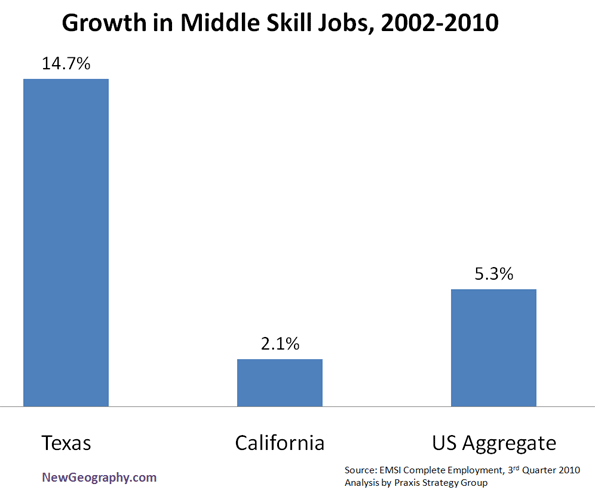
    A vast difference in economic performance is driving the demographic shifts. Since 1998, California’s economy has not produced a single new net job, notes economist John Husing. Public employment has swelled, but private jobs have declined.  Critically, as Texas grew its middle-income jobs by 16%, one of the highest rates in the nation, California, at 2.1% growth, ranked near the bottom. In the year ending September, Texas accounted for roughly half of all the new jobs created in the country.

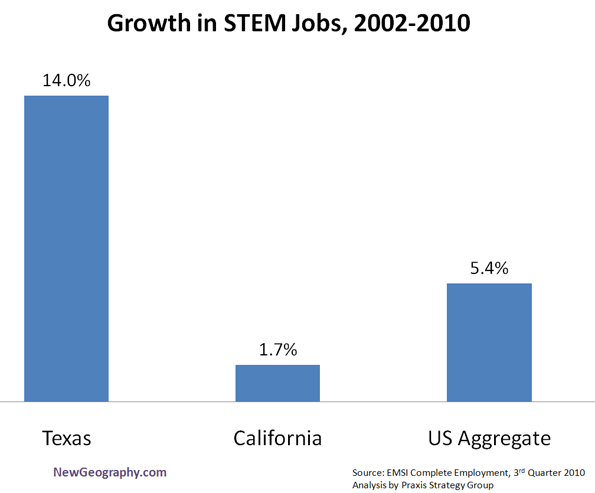
    Even more revealing is California’s diminishing preeminence in high-tech and science-based (or STEM–Science, Technology, Engineering and Mathematics) jobs. Over the past decade California’s supposed bulwark grew a mere 2%–less than half the national rate. In contrast, Texas’ tech-related employment surged 14%. Since 2002 the Lone Star state added 80,000 STEM jobs; California, a mere 17,000.

    Of course, California still possesses the nation’s largest concentrations of tech (Silicon Valley), entertainment (Hollywood) and trade (Port of Los Angeles-Long Beach). But these are all now declining. Silicon Valley’s Google era has produced lots of opportunities for investors and software mavens concentrated in affluent areas around Palo Alto, but virtually no new net jobs overall. Empty buildings and abandoned factories dot the Valley’s onetime industrial heartland around San Jose. Many of the Valley’s tech companies are expanding outside the state, largely to more business-friendly and affordable places like Salt Lake City, the Research Triangle region of North Carolina and Austin.

    Hollywood too is shifting frames, with more and more film production going to Michigan, New Mexico, New York and other states. In 2002, 82% of all film production took place in California–now it’s down to roughly 30%. And plans by Los Angeles County, the epicenter of the film industry, to double permit fees for film, television and commercial productions certainly won’t help.

    International trade, the third linchpin of the California economy, is also under assault. Tough environmental regulations and the anticipated widening in 2014 of the Panama Canal are emboldening competitors, particularly across the entire southern tier of the country, most notably in Houston. Mobile, Ala., Charleston, S.C., and Savannah, Ga., also have big plans to lure high-paid blue collar jobs away from California’s ports.

    Most worrisome of all, these telltale signs  palpable economic decline seem to escape most of the state’s top leaders. The newly minted Lieutenant Governor, San Francisco Mayor Gavin Newsom, insists “there’s nothing wrong with California” and claims other states “would love to have the problems of California.”

    But it’s not only the flaky Newsom who is out of sync with reality. Jerry Brown, a far savvier politician, maintains “green jobs,” up to 500,000 of them, will turn the state around. Theoretically, these jobs might make up for losses created by ever stronger controls on traditional productive businesses like agriculture, warehousing and manufacturing. But its highly unlikely.

    Construction will be particularly hard hit, since Brown also aims to force Californians, four-fifths of whom prefer single-family houses, into dense urban apartment districts. Over time, this approach will send home prices soaring and drive even more middle-class Californians to the exits.

    Ultimately the “green jobs” strategy, effective as a campaign plank, represents a cruel delusion. Given the likely direction of the new GOP-dominated House of Representatives in Washington, massive federal subsidies for the solar and wind industries, as well as such boondoggles as high-speed rail, are likely to be scaled back significantly.  Without subsidies, federal loans or draconian national regulations, many green-related ventures will cut as oppose to add jobs, as is already beginning to occur. The survivors, increasingly forced to compete on a market basis, will likely move to China, Arizona or even Texas, already the nation’s leader in wind energy production.

    Tom Hayden, a ’60s radical turned environmental zealot, admits that given the current national climate the only way California can maintain Brown’s “green vision” will be to impose “some combination of rate heights and tax revenues.”  Such an approach may help bail out green investors, but seems likely to drive even more businesses out of the state.

    California’s decline is particularly tragic, as it is unnecessary and largely unforced. The state still possesses the basic assets–energy, fertile land, remarkable entrepreneurial talent–to restore its luster. But given its current political trajectory, you can count on Texans, and others, to keep picking up both the state’s jobs and skilled workers. If California wishes to commit economic suicide, Texas and other competitors will gladly lend them a knife.


    This article originally appeared at Forbes.com.

    Joel Kotkin is executive editor of NewGeography.com and is a distinguished presidential fellow in urban futures at Chapman University. He is author of The City: A Global History. His newest book is The Next Hundred Million: America in 2050, released in February, 2010.

    Employment data from EMSI.

    Photo by {Guerrilla Futures | Jason Tester}