Category: Policy

  • The State Government Deconstructors

    The results of the mid-term election of 2010 will be written over the next two years. Can the Republicans really make good on their promise of fiscal discipline? A glimpse of our future federal budget may be seen in the fiscal actions (and inaction) of America’s governors. Most states are struggling to balance budgets in troubled economic times with projected shortfalls nationwide of more than $100 billion for Fiscal Year 2012. Federal bail-outs are no longer an option. The hard choices are tax increases, reduction of services or innovative fiscal solutions like deconstruction. These bold and innovative governors, or “Deconstructors,” are what Alexander Hamilton had in mind when he wrote in The Federalist that “energy in the executive is a leading character in the definition of good government.”

    New Jersey Governor Chris Christie was the first Deconstructor to emerge. He wasted no time when he was sworn into office in January of 2010, declaring a fiscal state of emergency and freezing billions of spending. This week he announced 1,200 more public workers will get the axe come January. Governor “Wrecking Ball” is attracting plenty of national attention.

    Governor Mitch Daniels of Indiana has an approval rating today over 70%. This Deconstructor, a former U.S. Office of Management and Budget Director, inherited a $600 million deficit and within a year turned it into a $300 million surplus. Four years later, the state had a $1.3 billion surplus. In 2008, “The Blade” as he is called, ushered through the legislature a bill that cut property taxes on the average house by more than 30%, making Indiana one of the nation’s lowest property tax states.

    Along the way, Daniels decertified the public service unions. Within a year, 92% of government employees quit paying their union dues. He reduced the number of state employees by 14% to a level last seen in 1982. He leased the Indiana Toll Road to foreign investors for $3.85 billion, which he sequestered in an escrow account, where it can only be used for road construction. Today, Indiana is one of nine states with a triple-A bond rating and, it is creating jobs. Despite only 2% of the national population, Indiana generated 7% of all new jobs created in the U.S. last year.

    Mr. Daniels predicted that Americans would come to realize how much of what government now does “we can get by without.” He questions, “will the public sector be the servant, the enabler of the free economy…or will they be the master?” “Some of the anger out there now”, he said, “is directed not just at Wall Street but government employees and their unions.” In August 2010, The Economist wrote of, “his reverence for restraint and efficacy,” adding, “He is, in short, just the kind of man to relish fixing a broken state — or country.”

    Another Deconstructor is Governor Bob McDonnell of Virginia. Since taking office in 2010, Governor McDonnell converted a $1.8 billion deficit into a $200 million surplus. He overhauled Virginia’s pension system, saving $3 billion over 10 years. He imposed an immediate, statewide hiring freeze that covers all noncritical areas of state government. He saved $20 million per year by cutting and consolidating boards and agencies. State employees, who experienced a wage freeze for four years, identified $28 million is savings and will be rewarded with an $83 million bonus this year.

    Governor Haley Barbour of Mississippi inherited a budget deficit of $720 million deficit when he took office and created a surplus without raising taxes. Today Mississippi runs on less money than required two years ago, a lesson Barbour says the federal government needs to learn. Barbour championed serious tort reform. “We’ve gone from being labeled as a judicial hellhole and the center of jackpot justice to a state that now has model legislation,” says Charlie Ross, a Republican who chairs the state Senate Judiciary Committee. He increased funding for education and job training. The reward for his success is talk that Barbour may be a candidate for President in 2012.

    West Virginia Governor Joe Manchin, a Democrat, was elected to take Senator Byrd’s place in the Senate. As governor, he was routinely described as a penny-pincher and a tightwad. Manchin has been so focused on controlling state spending when an employee quit, he refused to allow new hires without his direct permission. West Virginia had a budget surplus last year while other states fired cops, fireman and teachers. The Charleston Gazette called the governor, “Penny wise and pound foolish,” but others praised his budget discipline. Conservative CATO Institute gave Manchin an A for his money management.

    What do these Deconstructors have in common? Despite the Great Recession, they each created a budget surplus. They did so by deconstructing the state government (and state deficits) they inherited. They used bold ideas (selling the toll road) and innovation (decertifying the unions) to do what others said cannot be done.

    The success of these deconstructors should offer some hope for badly managed states like California, Illinois, New York, and Michigan. The question is whether politicians in Sacramento, Springfield, Albany, or Lansing are ready to learn from these early deconstructors or will continue to bankrupt their states. Crunch time is approaching now since, thanks to the election, there is likely little appetite in Washington to bail these states out of their morass.

    **************************

    The Great Recession of 2007 – 2012 will be followed by a period during which budget deficits, unfunded obligations and credit restraints force tremendous change to the core structure of governments worldwide. This period will come to be known as THE GREAT DECONSTRUCTION.

    Robert J Cristiano PhD is the Real Estate Professional in Residence at Chapman University in Orange, CA and Head of Real Estate for the international investment firm, L88 Investments LLC. He has been a successful real estate developer in Newport Beach California for twenty-nine years.

    ¬¬¬
    Other works in The Great Deconstruction series for New Geography
    Deconstruction: The Fate of America? – March 2010
    The Great Deconstruction – First in a New Series – April 11, 2010
    An Awakening: The Beginning of the Great Deconstruction – June 12, 2010
    The Great Deconstruction :An American History Post 2010 – June 1, 2010
    A Tsunami Approaches – Beginning of the Great Deconstruction – August 2010
    The Tea Party and the Great Deconstruction – September 2010
    The Great Deconstruction – Competing Visions of the Future – October 2010The Post Election Deconstructors – Mid-term Election Accelerates Federal Deconstruction – November 2010

  • Building Sustainable Economies in West Africa – One Farmer at a Time

    Among farmers in western Africa, the passion for agriculture runs deep. Kwabena (Koby) Yeboah farms near the village of Gomoa Adumase about 45 minutes outside of Accra, Ghana in West Africa, driven by his focus and intent to succeed.

    Koby started farming five years ago at the age of 22. “I love the outdoors, working with my hands and making things grow,” he says.” I also enjoy hunting too, anything to be outside.” It’s a familiar refrain you’ll hear from almost any farmer you visit in North America. It’s all about the outdoors and a certain respect for the land. (Photo)

    Today he is working on bringing about 200 acres into production on his farm. Over the past five years Koby has built roads, cleared land, accessed water and prepared for production. With a number of full-time villagers who are on the farm every day caring for crops and land, he visits the farm about three days a week, but his mind is on the farm every day. He is anxious for the day when he can bring all of his 850 acres into production and be able to spend seven days a week on the farm. Until then he continues his role as an education consultant recruiting students to schools in Ghana in order to support his family, while spending as much time as he can feeding his passion for farming.

    Koby grows pineapple, maize, peppers, tomatoes and okra. In the near future he plans to add mushrooms, snail production, and has begun work developing a fish pond for Tilapia production. The diversification is impressive. He is also growing several different varieties of specialty potatoes in a custom greenhouse. His plans are to increase potato seed production for planting on his farm and to educate other farmers on growing these potatoes in hopes of expanding acreage around the region. He will seek and secure markets for the potatoes and work to build a reliable and effective means for the region to become a trusted supplier. It is upon the backs of individual farmers and small business operators that economic success will be built.

    Koby’s vision is to turn his farm into a key center of commerce for the village. When he puts out the call for harvest help 40 to 100 people arrive at his farm looking for work, forcing Koby to turn people away. But he has plans to grow and to create a solid source of continued employment for the villagers. His agriculture plan calls for planting dates staggered every six weeks, year round.

    The climate in the region is very steady and stable with consistent temperatures and consistent rainfall year round making it a perfect climate for staggered production. By creating a pattern where harvest and planting activities are happening every month of the year, he could employ farm help every month of the year. The impact of consistent, uninterrupted employment for the village would be an economic boon to the region, and Koby is well aware of this fact. He often speaks of one day being able to provide steady employment to the villagers.

    The villages in rural Ghana are agrarian in nature, mainly for subsistence but also for commercial gain. There is available land, potentially productive but largely untouched in this region. There are also many able hands available in the nearby villages looking for productive work, but too often idled by lack of need for their assistance. Koby Yeboah sees an opportunity to make a difference for the region by setting a strong example for others and helping fellow farmers succeed. It is a sense of honor and commitment not readily found among your average 27 year old, but certainly not lost on this man.

    An example of his commitment to the region, Koby has created a “model farm” just outside the village of Gomoa Adumase. Here on one acre of land he has tilled and prepared the soil and is demonstrating advanced farming practices for raising pineapple. He is teaching other farmers and villagers in the region about the new farming practices so they can learn and produce on their own, and doing it in an entirely hands-on environment. (Photo)

    The sense of community in the area is strong and Koby has grown to become an important part of it. Knowing that the villagers live on tight budgets he says, “I contribute all he can,” often purchasing school uniforms for a number of the children. But, the support doesn’t end there. Just outside the village lies the Gomoa Buduatta Orphanage, home to 16 beautiful young boys and girls who find a safe and secure place to live and go to school. Koby has taken on the incredibly honorable challenge of supporting the orphanage to the best of his ability. Again he says, “I contribute all I can” and you know that it is well appreciated.

    Upon visiting the orphanage the house mother greeted us and invited us in to the quaint accommodations. We visited for a few moments before she invited the children in to say hello. All 16 children came to the door, graciously removed their shoes and stepped inside. Tallest to the back, shortest to the front, nary a word said. As we engaged the children in conversation they were pleasant, extremely polite and often responded as a group in verbal unison. They were just wonderful children.

    We toured the facility to see the sleeping quarters for the 8 boys and the quarters for the 8 girls before stepping into the two small classrooms. It is a humble building, but you can see that to these children it is home and it is safe. Upon our departure all sixteen children in a melodic tone said, “Thank you Mr. Koby.” The whole experience was beyond impressive. (Photo)

    Returning from the tour of the farm, discussion turns to the fragile economy of Ghana and the poor condition of the infrastructure and road system. When asked about it Koby responds, “I live in my own economy. I don’t live in the economy of Ghana,” a stark statement that quiets discussion momentarily. He goes on to explain, “I have a plan and a program. I know what I need to do to succeed and that’s all I am focused on. I cannot worry about what I cannot control.”

    Koby Yeboah has a goal, a plan and is driven to succeed. He says, “I want to be the best farmer in Africa within 10 years.” And you know what? I believe he is just the man to do it.

    Dr. Colin N. Clarke is a senior strategist for AdFarm, a North American agriculture communications firm. AdFarm is a strategic partner of Praxis Strategy Group an economic development consultancy. Follow Dr. Clarke on Twitter @colinnclarke.

  • Livability and All That

    Livability is one of those once innocuous words, like sustainability, that now receive almost unquestioned acceptance in the bureaucracy, academia and the media. After all, words like sustainability and livability have no acceptable negative form. Who could be in favor of anything unlivable, insensitive, unhealthy or unsustainable?

    Back in the late seventies, when I served as Special Assistant for Information Policy in the Office of the Secretary, our shibboleth was “balanced”. Can anyone be in favor of unbalanced transportation? It didn’t matter that the word had no meaning and we couldn’t explain it to others, it still became standard in the rhetoric of secretarial officers. In an unkind moment a reporter asked the present DOT Secretary Ray LaHood what he meant by livable, given that the department had just added it to its criteria for giving away money. He replied vaguely it was something about being able to walk to work and the park and a restaurant, to a doctor and a few more things.

    Well it turns out I was living the livable life style when I was growing up in Queens, New York in the fifties and didn’t know it. Here all along I just thought we were poor.

    Aside from seeking to have the same modal shares of America in 1910, or Tajikistan today, this idea fails on both theoretical and practical grounds. Theoretically, whatever merit the idea might have, livability means very different things in a tenement in Brooklyn, or a place in Billings, Des Moines, or Peoria. I can recall being sent to the store for milk or lettuce by my Mom after school. If I didn’t get there in time the four heads of iceberg lettuce (I was 16 before I found out that there were other kinds) were gone. The milk was “milk”. Today in a supermarket the milk section is bigger than the grocery store I went to as a kid. There’s skim, 1%, 2%, whole, lactaid, acidophilus in quarts, half-gallons, and gallons and 86 kinds of lettuce. The typical market today has above 50,000 items. That means that the market shed for such stores is far broader than it was back in the day.

    We were three generations of the family in the same household and we all had the same doctor who lived two blocks away. Today I don’t have a doctor – I have half a dozen – none of them selected on the basis of distance. When one selects doctors, best, not closest, matters. Hospitals are growing in size but declining in the number of facilities per thousand population. All of this is simply representative of the immense trend towards specialization in our society – an increasing division of labor in all activities and an accompanying division of tastes and preferences in an increasingly affluent society. If you want a loaf of wonder bread there’s a 7-11 down the street; if its ciabatta with sun-dried tomatoes there’s this really great place I know a few miles off of exit 29 on the freeway.

    In today’s job market don’t we expect that people will be willing to go farther to find the job they want or can get? If the average travel time is about 25 minutes and a half-hour commute is acceptable, how long is one unemployed before the acceptable becomes 45 minutes or an hour? In this period of housing constraint in which people are even more locked into their homes by underwater mortgages, the commute will grow as people get desperate.

    In my town of College Point, Queens when the factory whistle blew a few thousand walked in the gate and out again when the whistle blew in the evening. People don’t live outside the factory gate anymore and haven’t for awhile. Again, specialization and division of labor are the main factor. Job groupings are far smaller today, and the rate of job turnover means more people won’t/can’t move every time they change jobs. Moreover, about 70% of workers live in a household with other workers – whose job will they live next to?

    More importantly, the great competitive strength of America lies in access to skilled workers. Employers will be reaching out farther and farther to find the specializations and skills they require. We should expect work trip lengths to grow not become walking trips. It won’t be inner city oriented either. The metropolis of today is of immense size because many employers need a market of hundreds of thousands of potential workers to reach the ones they need. The Atlanta region with 26 counties is not a great economic engine because it is 26 charming adjacent hamlets, but rather because the market reach of employers, suppliers, customers and job seekers spreads over several million residents.

    In this environment it takes massive transportation capability to assure that market shed. The questions are how many potential employees can I reach in half an hour; how many suppliers, how many customers? In the future more of us will be free to live where we want and work where we want. Most will not be willing to trade living floor space for a close-by sidewalk café. Americans will drive to where they want to walk.

    There remains, of course, lots of room now within the existing land use distribution to make it easier for those who wish to live closer to shops, jobs or entertainment. People also are free to go to the nearest store or nearest doctor. The fact that so few do so reflects the oft-forgotten fact that people have their own notions of what is most important. Trying to coerce them to live the way government – particularly the upper bureaucracy – thinks they should live holds many perils. The American people have no obligation to live in ways that make it convenient for government to serve them. Government isn’t smart enough to know how people should live or to order their lives in more “convenient” arrangements.

    On the practical side:

    It’s on the practical side that the concepts of livability really fail. The central failure inheres in what the Europeans call subsidiarity, proposes that any necessary activity of an authority should be conducted by that level of governance closest to the problem that can effectively address it. Having livability rise to become central principle of federal transportation investment planning is an egregious failure in our historical system of decentralized government. If sidewalks and bike paths are federal then everything is federal.

    The mayors of our cities love it. Why not? It is the closest they have come to being able to lay claim to direct federal funding, getting those pesky states and suburban communities where the majority of Americans live out of the way. They see it as finally being their turn at the money from Washington. In these times, when every government level is broke, livability and sustainability can prove a potential lifeline, and a bonanza as well to developers – often themselves subsidized – who focus on the inner city.

    The livability criterion is ultimately centralist: fed-centric. It is not up to local people if they want to densify or not, but real power will rest with a really “smart” guy behind a desk in Washington. Proposals for federal “performance measurement” degenerate into a charade that produces pre-ordained results. Now I can fund my friends, who are as right-thinking as I am!

    The problem here is a total disconnect between what people in a diverse democracy want, and what the central bureaucracy, and their academic allies, wish to impose. The livability agenda may be popular in the press and among pundits, but for most communities and people it’s neither popular nor remotely democratic.

    Alan E. Pisarski is the author of the long running Commuting in America series. A consultant in travel behavior issues and public policy, he frequently testifies before the Houses of the Congress and advises States on their investment and policy requirements.

    Photo by Mastery of Maps

  • Currency Wars: The Yuan and The Dollar Face Off

    In the currency wars looming between the United States and China, everyone is focused on the decline of the U.S. dollar and the overvaluation of the Chinese renminbi. In the standoff, China maintains a low valuation for the yuan — the unit in which the renminbi is denominated — against the dollar, insuring that Wal-Mart can fill its aisles with goods that cost less than the patio furniture and video games made in Paducah, Kentucky.

    The Obama administration would like to “jawbone” the Chinese to relax its currency peg, so that the yuan appreciates, making it possible for Chinese consumers to buy goods from the United States. This monetary logic assumes that Chinese buyers want to own serialization rights to “The Apprentice”, or are shopping for B-1 bombers, as at the moment that may be what the U.S. economy primarily has to offer for export.

    In trying to explain the depth of the current U.S. recession, economists have latched onto the phrase “structural issues,” to indicate that the U.S. needs fewer pilates classes and more steel orders if it is to pay down its debts and create new jobs. The phrase itself is a hint that the currency wars have provoked bizarre east/west role reversals.

    While the mandarins of the Chinese politburo sound increasingly like hard-nosed American executives, the Obama administration is speaking a language that could well be lifted from Mao’s Little Red Book.

    Like the Cultural Revolution, the U.S. administration came to power pledging to get rid of the “four olds”: old thoughts, old culture, old customs, and old habits. It might well have denounced “Party formalism” or “spiritual pollution.” Yes, there would be struggle sessions and the opposition of turmoil elements. But the result of the reforms would be a Great Leap Forward, although one that evidently comes with the price tag of $2 trillion in annual deficits.

    China’s worry, meanwhile, is that its economy relies on one client with a receivable problem. Its treasury sits on $1 trillion of U.S. government bonds and securities, the peg to keep the yuan in line with the dollar, while the dollar is sinking under the weight of its GM shares, subprime loans, entitlement IOUs, and health care payouts.

    Twenty years ago it would have been a dream to imagine “capitalist roaders” running China. Now, we fear having to answer to repo men.

    Like any nervous creditor, the Chinese leadership focuses on “payout ratios,” “interest cover,” “debt-to-equity,” and “price-to-book.” Mao might have warned about “spontaneous tendencies toward capitalism,” but the new Chinese leadership thinks more about solvency and capital adequacy.

    Hence the current American hand–wringing at IMF meetings and the calls in Congress to convene what the Central Committee used to call “Grievance Redress Societies.”

    While the Chinese are working on Saturdays, the Obama administration’s jobs policy, for the moment, consists largely of hiring America’s unemployed into the Census Bureau. Maybe we can expect large posters of Uncle Sam exhorting Americans: “Do Your Economic Duty: Stand Up and Be Counted!”

    Why do Americans have trade and payment imbalances with China? The short (and nonacademic) answer might begin by saying that Americans are in love with such big box stores as Target and Costco, and can’t own enough sheets, towels, housewares, wrapping paper, sweatshirts, shoes, T-shirts, caps, kitchen appliances, televisions, recliners, electronics, iPhones, picture frames, blue jeans, and sneakers, all of which China is willing to supply at cut-rate prices.

    Consumerism in China is not the state religion that it is in the United States. Shoppers in the U.S. congregate in malls and stores that are the size of the Vatican, and they walk around in the same hushed raptures. The average shop in China, as best as I can tell from my travels there, is the size of a closet and sells bags of rice, bottled water, Hand of Buddha Tea, little pots, bird cages, and shoots of bamboo, none of which are made in those retooled New England woolen mills.

    China would buy our software, were it not already stealing it. As it is, all the Chinese want from the U.S. is a few buckets of KFC chicken, some coal plants, and the odd New York Yankees cap. Too bad they don’t want to buy AIG, the city of Las Vegas, or the Social Security system.

    Although the last thing I want to be accused of is “mountaintopism” or “right opportunism,” my fear is that the failure of the Obama administration’s currency pronouncements, combined with the rise of Tea Party nativism, will provoke the kind of protectionism that would warm the earmarks of Senator Smoot and Congressman Hawley.

    What could be easier than to impose tariffs on a variety of Chinese–made goods? The problem with protectionism is that it will further delay the economic recovery.

    In the short run, protectionism could redress the monthly U.S. trade imbalance (up to $28 billion a month with China), stimulate a few jobs, and end the “capitulationism” toward the subsidized state capitalism of the Far East.

    Longer term, protectionism puts the U.S. on a path in which its economy will be isolated from the rest of the world, with these (“renegade”) consequences: trade collapses, government debt remains high, foreign investors disappear, costs and inflation increase, unemployment goes up, savings go down, and “the carefree clique” in Washington raises taxes to pay for these “opportunist errors.”

    The currency disagreements mask the inherent imbalances in the global financial system: the West consumes too much and saves too little, and the developing world, and countries like China, spend too little and horde too much. Only economic expansion, debt reduction, and expanded trade can redress this so-called disequilibrium. Neither protectionism, nor more Fed magic will do the trick. Nor will declaring a currency war against China.

    Even the Chinese know that it’s better to be a dog in peace than a man in troubled times.

    Photo by Eric Mueller, “It’s Money, Comrade!”

    Matthew Stevenson is the author of Remembering the Twentieth Century Limited, winner of Foreword’s bronze award for best travel essays at this year’s BEA. He is also editor of Rules of the Game: The Best Sports Writing from Harper’s Magazine. He lives in Switzerland.

  • The Post Election Deconstructors

    Mid-term Election Accelerates Federal Deconstruction

    The mid-term election of 2010 has already been labeled a political earthquake. It was more like a shift of tectonic plates than a mere earthquake, and its results may be felt for decades. The landmark election signaled the beginning of deconstruction at the federal level in the United States. The Young Guns of the Republican Party (Representatives McCarthy, Cantor and Ryan) will lead a freshman class of 65 new members of Congress on a budget crusade to rein in government spending. Their first act will be to return federal spending to 2008 levels. There will be many acts to follow. These Congressmen will follow the lead of the “Deconstructors” who began deconstruction at the state level earlier this year.

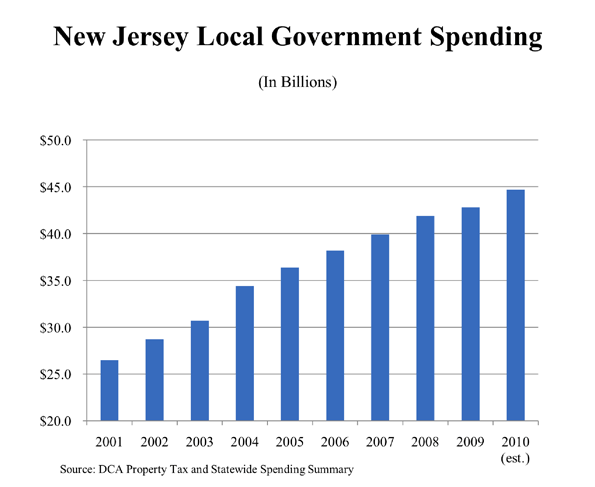
    Republican Governor Chris Christie was sworn into office in January of 2010 in a blue state election shocker. He wasted no time declaring a fiscal state of emergency. New Jersey had raised taxes 115 times in eight years and increased spending from $26 billion in 2001 to $45 billion when Christie took office. The state had a $10 billion deficit and had exhausted its borrowing capacity. Christie slammed on the brakes and froze $2.2 billion of spending. He refused to raise taxes. Christie tackled the Teachers unions, forced the Democratic legislature to impose pension reform, and even cancelled the $10 billion ARC tunnel between New Jersey and New York, the most costly public works project in the United States. Governor Christie has emerged as the first Deconstructor.

    California’s inconsistent governor, Arnold “The Terminator” Schwarzenegger may be forced to become “The Deconstructanator” before he leaves office. Faced with a $19 billion deficit, Arnold was forced to furlough 200,000 government workers. His plan for three day a month furloughs, equivalent to a 14% pay cut, was upheld by California’s Supreme Court. Six labor unions and 37,000 workers settled with Arnold accepting pension reform over furloughs. Further Deconstruction is inevitable.

    Newly elected Governor Brown will not have revenues from housing and dot.com bubbles to sustain the largess of his legislators. On October 23rd, the LA Times reported California shed 37,300 jobs in September. According to the state Employment Development Department, local government absorbed 32,400 of the job losses in September. The public employee layoffs are just beginning as cities and counties join the state in austerity measures. Where the private sector absorbed the brunt of the layoffs in 2008 and 2009, and Obama’s Stimulus bill insulated the public sector in 2010, the next wave will decimate the public employees of California.

    With the mid-term election mandate, federal bail-outs are no longer a viable solution to balance state budgets. Dozens of states have projected budget shortfalls of more than $100 billion for Fiscal Year 2012. Joining California in the state fiscal train wreck category are Illinois, Michigan and New York. Illinois has a budget of $26 billion that is $13 billion in the red. Despite its huge deficit, Illinois legislators increased state spending by 15% this year based on wishful projections that revenues will increase by 17%. Michigan is not far behind with a $4 billion deficit and a budget that was only balanced with $1 billion from the federal government.

    New York has a FY 2012 deficit of $13.5 billion. Its state government is dysfunctional and in denial. Newly elected Governor Cuomo has presented vague plans to solve New York’s misery. E.J. McMahon, executive director of the conservative Empire Center for New York State Policy said, “Cuomo’s budget proposals boil down to vague pledges of reducing costs and rooting out inefficiencies.” Cuomo is no Deconstructor and he will not be able to hide from New York’s fiscal reality. Where rationale fiscal management has long been ignored, Greek-like austerity measures and Deconstruction are inevitable.

    Not All States are Mismanaged

    Rhode Island was in dire straits last year with a $60 million deficit, declining revenues and unemployment at 12%. Governor Donald Carcieri realized the only way out of financial trouble was to make tough choices and embrace “fiscal responsibility.” He trimmed the state workforce through layoffs, attrition and leaving jobs unfilled. A classic deconstructionist, he streamlined and combined offices and agencies. He raised the retirement age for state pensions, cut benefits, and negotiated better contracts with unions and health care providers.

    Another Deconstructor is Governor McDonnell of Virginia. When McDonnell was swept into office with Governor Christie in 2010, Virginia had a $1.8 billion deficit. Virginia’s state budget had grown by 73.4% between 2000 and 2009, much faster than its population and inflation. Since taking office, Governor McDonnell converted the deficit into a $200 million surplus. He overhauled Virginia’s pension system saving $3 billion over 10 years. He imposed an immediate, statewide hiring freeze that covers all noncritical areas of state government. He cut and consolidated boards and agencies saving $20 million per year.

    Deconstruction Goes Global

    Global Deconstruction began in 2010 as a result of reduced worldwide government revenues caused by the prolonged Great Recession. No nation is exempt, including the US. Some like Germany have opted for fiscal discipline, helping to maintain Europe’s strongest economy. The Greeks ignored the crisis and rioted in response to the austerity plan imposed by the European Union. Yet despite their displeasure, austerity is an imposed reality Greek workers cannot avoid.

    The French responded characteristically with paralyzing civil strikes in response to the Sarkozy government increasing the retirement age from 60 to 62. The French unions are adamantly opposed to any change to the pension system. Sarkozy said he would shore up the pension system with “new levies on France’s highest earners and on company profits”. (France 24 International News October 5, 2010)

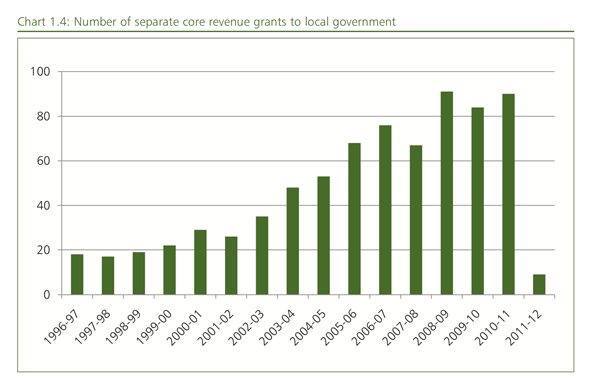
    In England, the response to the fiscal realities of the Great Recession have been draconian cuts which will cost 490,000 public sector jobs 2015. The cuts of $128 billion over 4 years made on “Axe Wednesday” represent 4.5% of their 2014-2015 GDP, equivalent to $650 billion in cuts to the US budget. (Chart 1.4 – SPENDING REVIEW 2010 Presented to Parliament by the Chancellor of the Exchequer by Command of Her Majesty October 2010). The BBC will see its funding cut by 360 million pounds, the budget of all its national radio services combined. Hundreds of London based diplomats will see their jobs disappear. Even the sacrosanct defense budget will receive cuts of 8%. (FT.com Daniel Pimlott October 20, 2010).

    Deconstruction is not limited to Europe. In Russia, Nikolai Volgin, president of the National Assembly of Labour and Social Policy Specialists, said he anticipates widespread layoffs this year, with as many as 1.5 million more people losing their jobs. Russia already has 8 million unemployed. Volgin said, “I do not rule out that there may be 9 to 9.5 million jobless in the country.” If Volgin’s predictions are correct, Russia will see an unemployment rate of 12 to 12.7 percent in 2011.

    Even Cuba has felt the chilling winds of deconstruction. President Raul Castro startled his people in August by stating 20% of Cuban workers may be redundant. He announced they will eliminate 500,000 state jobs in March of 2011 and allow some workers to work for themselves. Cubans are allowed to sell their own fruits and vegetables for the first time. The Cuban workforce is 5.1 million and 95% work for the state. Castro’s deconstruction will effect 10% of all Cuban workers.

    The difficult deconstruction occuring both at home and abroad is just in its earliest stages. Those countries and regions that take the opportunity to reform themselves will be the ones who will emerge with greater prosperity after the Great Deconstruction.

    Robert J Cristiano PhD is the Real Estate Professional in Residence at Chapman University in Orange, CA and Head of Real Estate for the international investment firm, L88 Investments LLC. He has been a successful real estate developer in Newport Beach California for twenty-nine years.

    ¬¬¬

    Other works in The Great Deconstruction series for New Geography
    Deconstruction: The Fate of America? – March 2010
    The Great Deconstruction – First in a New Series – April 11, 2010
    An Awakening: The Beginning of the Great Deconstruction – June 12, 2010
    The Great Deconstruction :An American History Post 2010 – June 1, 2010
    A Tsunami Approaches – Beginning of the Great Deconstruction – August 2010
    The Tea Party and the Great Deconstruction – September 2010
    The Great Deconstruction – Competing Visions of the Future – October 2010

  • New Index Estimates New House Cost Impact of Land Regulation

    In recent decades, an unprecedented variation has developed in the price of new tract housing on the fringe of US metropolitan markets. Nearly all of this difference is in costs other than site preparation and construction, which indicates rising land and regulation costs.

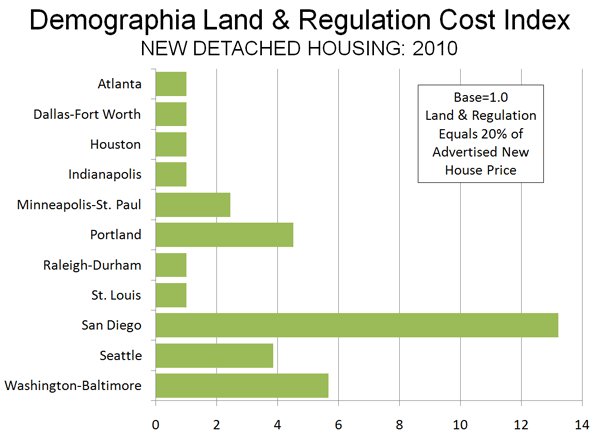
    Our first annual Demographia Residential Land & Regulation Cost Index estimates the price of land and regulation for new entry level houses compared to the historic norm in 11 metropolitan regions (Note 1). Metropolitan regions in which land and regulation costs remain at or below normal have an Index of 1.0 while those with land and regulation costs above normal will have an Index above 1.0 (Figure 1).

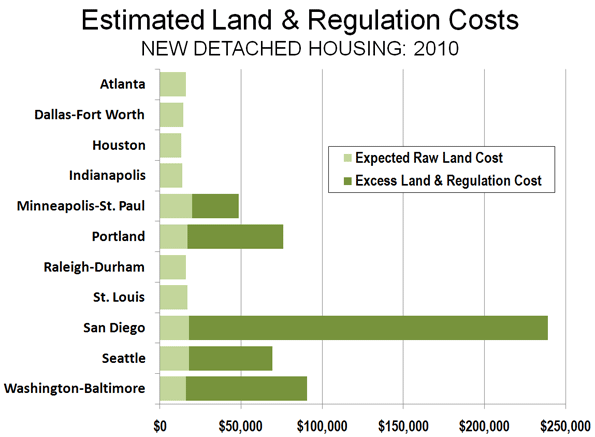
    More restrictive land use regulation is variously referred to as “smart growth,” “growth management” and other terms. More restrictive land use regulation is estimated to have added from nearly $30,000 (in Minneapolis-St. Paul) to more than $220,000 (In San Diego) to the price of a new home.

    Economic research has associated rising residential land costs with more restrictive land use regulations. The table indicates some of the more important price increasing impacts of more restrictive land use regulation.


    More Restrictive Land Use Regulation:

    Factors that Can Drive House Prices Higher

    1.. Increases underlying land costs

    2.. Increases planning and development costs

    3.. Raises financing costs

    4.. Encourages more expensive houses.

    5.. Increases construction costs

    6.. Encourages concentration of market power and land banking

    7.. Encourages land and housing speculation

    The Land and Regulation Ratio

    For decades, construction costs of tract house on the urban fringe in the United States have represented 80% or more of the advertised house price. The balance of 20% or less has been for land and regulation costs and will be referred to as the “land and regulation cost ratio.” In metropolitan markets with less restrictive land use regulation, the historic 20% or less land price ratio remains in place. The Demographia Residential Land & Regulation Cost Index assumes a 20% expected land and regulation ratio.

    In some metropolitan markets, however, house prices have increased far more rapidly than in the rest of the nation. The greater increase in house prices and escalation of land costs above the historic 20% land and regulation cost ratio has occurred in metropolitan markets burdened by more restrictive land use regulations. Urban growth boundaries, limits on the number of houses that can be built, large lot zoning and excessive development impact fees and the like are regulation strategies that increase the cost of land for building houses. These land cost increases are not the result of more rapidly rising construction costs or underlying market forces such as consumer demand.

    More restrictive land use land use regulation also creates obstacles to people buying houses, requiring them to devote more money to housing than necessary and increases their vulnerability to losses in the event of a financial downturn. This exposes mortgage lenders to increased risks of loan defaults. Finally, more restrictive land use regulation makes residential land development more dependent on politics, with the potential for greater influence through campaign contributions.

    The first annual Demographia Residential Land & Regulation Cost Index estimates cost of land and regulation for new entry level houses compared to the historic norm in 11 metropolitan markets. Each of the metropolitan regions in which house prices have risen above normal have adopted more restrictive land use regulations. Conversely, in each of the metropolitan regions in which house prices have not risen above normal levels, there is less restrictive land use regulation. During much of the Post-World War II era, all metropolitan markets had less restrictive land use regulations.

    Results

    The overwhelming majority of new housing in the United States continues to be detached and is built near or on the urban fringe (Note 2). For new detached homes, the Index is 1.0 in six metropolitan markets (Atlanta, Dallas-Fort Worth, Houston, Indianapolis, Raleigh-Durham and St. Louis). This indicates that land use regulation is less restrictive and does not add more than normal to the price of new homes (Note 3).

    In the other five metropolitan markets, the land and regulation cost ratio has risen above 20%, resulting in a higher Index. The Index is 2.4 in Minneapolis-St. Paul, 3.9 in Seattle, 4.5 in Portland, 5.7 in Washington-Baltimore and 13.2 in San Diego. It is estimated that more restrictive land use regulation raises the price of the least expensive detached houses from nearly $30,000 (in Minneapolis-St. Paul) to more than $220,000 (in San Diego) than would be expected if these metropolitan markets had retained less restrictive land use regulation (Figure 2).

    The metropolitan markets with more restrictive regulation have an average Demographia Residential Land & Regulation Cost Index of 5.9 for detached housing, while the metropolitan markets with less restrictive regulation average 1.0.

    Housing Affordability: Through the Bubble and Bust

    There is increasing concern about declining housing affordability across the nation. Even after the deflation of the housing bubble, house prices in some metropolitan markets remain well above pre-bubble prices and historic affordability standards. The housing affordability of the included metropolitan markets is illustrated by land use regulatory category in Figure 3. The Figure indicates the National Association of Home Builders-Wells Fargo Housing Opportunity Index for 1995, the peak of the bubble and early 2010, showing the percentage of households able to afford the median priced house. Similar affordability measures can be reviewed in the Annual Demographia International Housing Affordability Survey.

    Future Editions

    The 11 metropolitan regions included in the initial Demographia Residential Land & Regulation Cost Index were selected to provide a geographical and regulatory balance and because they had sufficient data from which to develop the Index. Additional areas will be added in future editions, with the intention of including all metropolitan regions with more than 1,000,000 population.

    ——-

    Note 1: The Index was derived from a database developed of new house offerings by national, regional and local builders, using internet sites and published metropolitan home guides. The period covered is January through June 2010.

    Note 2: In 2006, more than 85% of new single family houses sold in the United States were detached, according to Bureau of the Census data. Detached housing represents approximately 62% of all US housing units (including multi-unit dwellings).

    Note 3: In each of the metropolitan markets with less restrictive regulation, the estimated construction costs were more than 80% of the house price. By using a 20% land and regulation ratio, the house construction cost was capped at 80% of the house price. In each of the metropolitan markets with more restrictive regulation, the estimated construction cost was less than 80% of the house price.

    Wendell Cox is a Visiting Professor, Conservatoire National des Arts et Metiers, Paris and the author of “War on the Dream: How Anti-Sprawl Policy Threatens the Quality of Life

    Photo: Will County, Chicago urban fringe (By author)

  • The Privatization-Industrial Complex

    “I think this is just the latest way for people to make money off state and local governments. This is the new way the investment banks, their lawyers, and consultants squeeze the taxpayers….They’re going around making these deals, and it’s very lucrative. It’s like a circus coming to town.” – Clint Krislov

    Privatization has long been advocated by many conservatives as a good government measure. Traditionally, privatization was used a tool that subjects government monopolies to competition from the marketplace, driving down costs and improving quality of service. Privatization pioneer Steve Goldsmith, former mayor of Indianapolis and now deputy mayor of New York City, used to apply what he called the “Yellow Pages test.” If he could open the Yellow Pages and find several companies providing a service, he wondered why government should be in that business.

    As Mayor, Goldsmith privatized dozens of city services in Indianapolis, saving the city an estimated $120 million the process. This ranged from contracting out services, to forming a public/private partnership to implement a $500 million infrastructure improvement plan to hiring private managers to run – but not own or lease – the airport and water utility.

    Today, sadly, privatization is less about Goldsmith style operational effectiveness and more about providing jackpots for financiers who stand at the core of a growing privatization-industrial complex. Cities and states salivate over ways to sell or lease off underperforming public asset for large payouts. With local governments cash-strapped and the public unwilling to pay more in taxes, it is politically difficult to even bring user fees to a market rate. Combined with the potential billions in payoffs – Indiana received $3.9 billion for its toll road and Chicago $1.1 billion for its parking meter system – the appeal is obvious.

    But these transactions differ markedly from the Goldsmith-style privatization. They are driven not by efficiencies but by an investment banker mindset focus on money and narrow parameters of the asset operations. They also provide enormous temptation to elected officials to grab the money now even at the expense of future generations. They are also rife with potential conflicts of interest and incentive problems.

    One major source of conflict comes with the professional advisors that drive the deals. Since long term leases involve so much money and are so complex, they require millions of dollars of services from investment banks, lawyers, financial advisors, etc. Unlike for typical government transactions such as issuing bonds or contracting out services like printing, building maintenance, or call centers, for which cities have some experience, the vast majority of cities have little in house expertise for complex financial transactions.

    Thus local officials are at the mercy of these out of town experts to give them the best advice they need to defend the public’s interest. But what advice can we expect from these firms, who have a stake on highly leveraged deals? The people in the firm may be technically competent and possess the highest levels of personal integrity, but still are prisoners of a structural conflict of interest in promoting privatization transactions.

    Consider Morgan Stanley. An arm of Morgan Stanley was the winning bidder on the Chicago parking meter lease. That deal is widely seen as a disaster, giving the idea privatizing meters a black eye, and engendering such headlines as “Morgan Stanley’s $11 billion makes Chicago taxpayers cry (Bloomberg) and “Company [Morgan Stanley] Piles Up Profits from City’s Parking Meter Deal” (NY Times).

    Now Morgan Stanley is back, this time advising Pittsburgh and Indianapolis on potential parking meter privatizations. Morgan Stanley has a huge structural incentive to want those deals to go through. It would restart the market for parking meter privatization, and position the firm as the preferred advisor to cities. Even where they were not the city’s advisor, a restarted parking meter market means they could potentially bid on many more assets.

    If you make money on privatization transactions, then no deals means no money. So obviously these firms have every reason in the world to promote privatization and see deals go through regardless of whether any particular deal is good or not. This doesn’t mean they are crooks, it’s just the reality. These firms now form of the core of the “privatization-industrial complex” with an incentive to cheerlead for leading public assets because that’s how they make their money. They need deal flow, the more transactions the better.

    This was picked up on by Harrisburg, PA. Facing bankruptcy, the state offered an $850K grant to hire Scott Balice Strategies of Chicago, one of the nation’s top privatization financial advisors. The city council turned it down. As one city councilor noted, “Their recommendation is always the same: ‘sell assets’”.

    Many of these investment banks, operators, financial advisers, and law firms also have tight links with each other, and participate on deals together, often as partners, other times as opponents. The Pittsburgh Post-Gazette noted how many of these firms have ties to Chicago’s earlier round of privatization. “When Pittsburgh proposed leasing its public parking facilities, the city became a magnet for a passel of firms – many of them connected to Chicago by blood, politics or business – that pursues similar deals around the country. The firms may be partners in one city, rivals or referees in the next.” The winning bidder on the Pittsburgh parking transaction is actually Morgan Stanley’s partner in the Chicago deal, for example.

    These potential conflicts make it very difficult for cities to know they are making a good deal, especially since they lack the experience necessary to independently judge it. Right now, they often are at the mercy of their advisors. And ask yourself this: when was the last time a city or state looked seriously at one of these deals and their advisors told them not to do it?

    This is frequently combined with traditional clout driven contracting. Many of the Chicago parking meter firms had tight links to the Daley administration. Similarly, in Indianapolis a city-paid chief advisor to the office of the mayor is conveniently also a registered lobbyist for the winning bidder. This combination is a recipe for disaster, resulting in very long term deals that could be very bad for the public.

    Long term lease deals can still make sense – if they are done right. The Chicago Skyway and Indiana Toll Road deals were both home runs, for example. But given the enormous risks if something goes wrong, governments must put into a place a robust process for protecting the public, with a full airing and mitigation plan for the bad incentives that populate so many areas of this field.

    Aaron M. Renn is an independent writer on urban affairs based in the Midwest. His writings appear at The Urbanophile.

    Photo by ehfisher

  • Portland’s Runaway Debt Train

    Tri-Met, the operator of Portland’s (Oregon) bus and light rail system has been in the news lately, and in less than auspicious ways. For decades, the Portland area’s media – as well as much of the national press – has been filled with stories about the national model that Tri-Met has created, especially with its five light rail lines.

    The reality is less impressive. After spending an extra $5 billion over the past quarter century, public transit’s share of work trip travel in Portland is less than it was before. Moreover, the Portland has now become the 38th of the major metropolitan areas (over 1,000,000 population) in which more people work at home (such as telecommuting) than ride transit to work.

    Tri-Met’s more recent notoriety also reveals some serious concerns about financial management . Auditors recently finished their annual report, and it indicates that that Tri-Met has run up some rather large bills that it may be hard-pressed to pay.

    Unfunded Pension Liabilities: Unfunded liabilities on Tri-met’s employee pension funds have grown to more than $260 million. This deficit has developed because Tri-Met can not meet its obligation to pay into the pension funds on a current basis. Indeed, at the rate Tri-Met paid the pension funds for fiscal year 2010 (ended June 30), they would be more than eight years delinquent. Overall, the pension funds are nearly 50 percent under funded.

    Other Post-Employee Benefits: “Other Post-Employee Benefits” (OPEB), made up principally of retiree health care, pose a much bigger problem. As of the end of the fiscal year, the unfunded liability for these benefits was $817 million, up $185 million in just one year. Underfunding is an even greater problem. The retiree benefits are 100 percent under funded. Tri-Met has simply put no money aside for these benefits. Tri-Met has achieved world class status in underfunding its OPEB. The Los Angeles MTA, which carries nearly five times as much travel volume as Tri-Met had unfunded OPEB liabilities of only $730 million (still a huge figure) in 2009, which is the last data available.

    When challenged on the huge unfunded liability and its growth, Tri-Met General Manager Neil McFarlane responded to KATU-TV: “That’s adding apples, oranges and grapefruits together to get a completely unreasonable number.” One wonders what kind of complications the chief executive office of a publicly traded Fortune 500 company would face for similarly dismissing inconvenient data in its annual report (whether from the Securities and Exchange Commission, the board of directors or the stockholders).

    The auditor, Moss-Adams, LLP appended a standard opinion, to the effect that “… the financial statements … present fairly, in all material respects, the financial position of the District as of June 30, 2010…” At another point the auditors note their obligation to perform the audit to “obtain reasonable assurance about whether the financial statements are free of material misstatement.” As far as McFarlane is concerned, there may be some disagreement on whether the financial statements are “free of material misstatement, “given that they include a “completely unreasonable number.”

    A Train of Debt: Other Tri-Met woes come from its frequent bonds issues, which to date have been approved with little oppostion. The present bonded indebtedness is more than $250 million. The agency is asking the electorate for approval of another $125 million in bonds at the November 2 election. The Oregonian, which has been a friend to nearly everything Tri-Met has done, is recommending a “no” vote on the bonds, pointing out that they would not be necessary if Tri-Met had saved sufficiently for vehicle replacement. Further, Tri-Met is searching hard for more money to fund a deficit in its proposed light rail line to suburban Milwaukie in Clackamas County, which seems a questionable project given the agency’s inability to keep fares under control and maintain service levels.

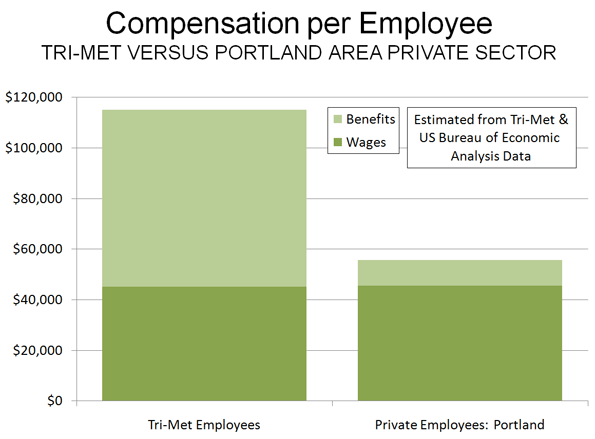
    Bloated Benefits: John Charles, President of the Cascade Policy Institute raised eyebrows when he noted that Tri-Met’s employee benefits expense is by far the highest in the nation. Charles looked at 20 large transit agencies and found that employee benefits were equal to 152 percent of the wage bill, approaching double that of the next highest, San Francisco’s Bay Area Rapid Transit District and Washington’s Metropolitan Transit Authority. With their above 80 percent employer-paid benefits ratios, albeit lower than Tri-Met’s 152 percent, these agencies have nothing to be proud of. In the private sector, employer-paid benefits tend to be less than 25 percent of wages. Tri-Met’s 152 percent is six times that.

    Bloated Compensation: With a benefits ratio of 152 percent, payroll expense per employee is a stratospheric $115,000 annually (assumes the 2008 staffing ratio, later data not identified). In contrast, the average private sector employee in the Portland metropolitan area is compensated at approximately $55,000 annually, which includes wages and a 22 percent extra for benefits (Figure 1).

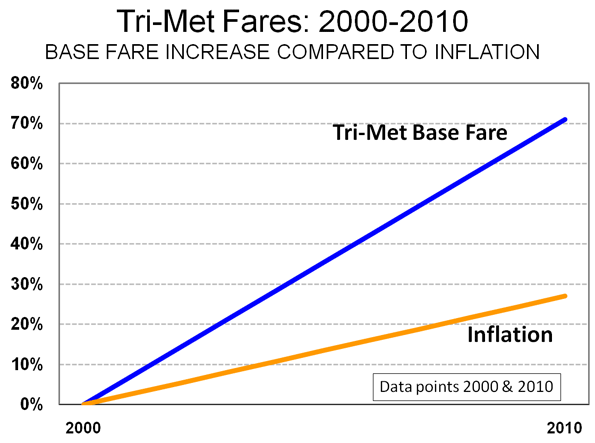
    Employees Ahead of Customers: Tri-Met implemented a fare increase in September and reduced bus service by 5.8 percent and light rail service by 3.5 percent. In the last 10 years, the basic bus fare has risen 71 percent, well above the 27 percent inflation rate (Figure 2). The fare increases and service cuts are imposing substantial hardship on many Tri-Met riders, who have limited incomes and no access to cars. The above inflationary fare increases represent a financial management failure of fundamental proportions.

    Yet while it was raising fares, Tri-Met also increased union employee compensation by three percent and covered increases of 7.5 percent to 22.5 percent on two employee health care programs. Tri-Met has admitted that these increases were not legal obligations (could this be a gift of public funds?). The cost of the non-obligatory wage increase was more than double the amount Tri-Met expects to raise from the September fare increase. Some discontinued service could have been financed with the rest of the wage increase money and the non-obligatory health care premium increases.

    Rising Costs: The question for Portland and Tri-Met remains whether this financial house of cards is sustainable. Operating and capital costs have, not surprisingly, skyrocketed. In fiscal year 2010, it is estimated that costs per passenger mile rose to more than $1.35. This is a full 40 percent above the the national transit average. This is more than five times the per passenger mile – full cost of cars and sport utility vehicles including all user costs and the portion of road expenditures (principally local streets) paid for by taxes – of less than $0.25.

    Fiscal Imprudence: Past and Future: There is some too-little, too-late good news for riders. Tri-Met has told the union that it will not cover health care benefits increases in 2011, nor will there be another non-obligatory wage increase. In its editorial opposing approval of the bond issue The Oregonian spoke of “past fiscal imprudence.” In appears that the mecca of transit is becoming less a role model and more a cautionary tale.

    Wendell Cox is a Visiting Professor, Conservatoire National des Arts et Metiers, Paris and the author of “War on the Dream: How Anti-Sprawl Policy Threatens the Quality of Life

    Photo: Mount Hood in exurban Portland (by author)

  • A Price on Carbon: the New Greenmail

    Hidden from view during the Australian election, a carbon price is back on the political agenda. This comes as no surprise. Anyone following the debate, however, will see that it has nothing to do with the environment. For some time we have been urged to “act now”, but the grounds keep shifting and changing. Early on it was the drought. Then the Great Barrier Reef. After that the Bali Conference. Then the election of Barack Obama. Next came the Copenhagen Conference. Then being “left behind” in clean technology. Now, apparently, “inaction will cost more in the end”. All have come and gone – including the drought which was supposed to be with us forever.

    Even so, we are assured that a price on carbon is “inevitable”.

    The frantic search for a rationale is driven by the plain fact that there is no environmental reason for Australia to have a carbon price. In tandem with efforts to manufacture urgency, there has been an equally devious campaign to misrepresent the process of climate change, or at least the IPCC’s “consensus” version. Crucial has been the cynical manipulation of words like “pollution” and “clean”. “Carbon pollution” is a scientifically absurd term designed to distort the basic issue. If the “consensus” science is right, the problem is with the concentrations of carbon dioxide, not the natural, clean, life-giving gas itself. Most of the public associate “pollution” with “dirty” emissions such as exhaust fumes and particulate matter. By definition, reducing such pollution is good. Many, if not most, still believe this is what climate action is about, thanks to obscurantist Greens and others. In the same way, “clean” energy is seen as the antidote to “dirty” or “polluting” gases. Who can be against cleanliness? Derivative terms like “the big polluters” are also deceptive.

    Greens, activists and others with a stake in climate action live in mortal dread of the public grasping the truth. Since the concentrations are the issue, rather than carbon dioxide as such, Australia can do nothing about climate change. Our share of global emissions is too small. Nor do the world’s highest emitters show any sign of caring about what we do.

    No Australian Prime Minister did, or could have done, more to push climate onto the world’s agenda than Kevin Rudd. Asked about the Copenhagen fiasco in the dying days of his prime ministership, Rudd delivered this famous outburst: “There was no government in the world like the Australian Government which threw its every energy at bringing about a deal, a global deal, on climate change. Penny Wong and I sat up for three days and three nights with 20 leaders from around the world to try and frame a global agreement.” The UN assigned Rudd a special role drafting the text of the prospective protocol. Ultimately, he was rebuffed by large and small emitters alike. The face-saving accord was cobbled together without him.

    Australia can’t combat climate change directly by reducing its own emissions, or indirectly by encouraging larger emitters to reduce theirs. If we lack the power to prevent adverse climate effects, should they eventuate, we can’t avoid any higher costs of delayed action. Forget the constant bleating about China “doing its part.” Now the world’s largest emitter, China’s official policy is to reduce the “carbon intensity” of its economy (the carbon emitted per unit of GDP), not to cut emissions. This means emissions will continue to rise, although (possibly) at a diminishing rate. The point is this “action” is way short of what the IPCC considers necessary to make a difference. Greens keep asking the wrong question. It’s not whether China does “something” that matters, but whether that something is relevant. India does even less. As for the second largest emitter, opinion polls suggest a carbon price will remain dead in the United States after the November mid-term elections.

    So why must Australia have a carbon price? One thing is for sure: it has nothing to do with climate. In his early interviews as Minister for Climate Change, Greg Combet referred to it, repeatedly, as “a very important economic reform”. Calling it an environmental measure would raise too many awkward questions. Certainly, a carbon price has serious economic impacts, but gracing it with the label “economic reform” is disingenuous. The word “reform” connotes improvement. Economic reform is designed to spur growth by improving productivity and efficiency. In contrast, a carbon price damages productivity, by raising cost inputs, and hampers efficient resource allocation. It isn’t economic reform. It’s an environmental measure, but utterly futile.

    Climate activists were elated when Marius Kloppers, the boss of BHP Billiton, recently declared that a global carbon price is inevitable, so Australia should get in early. His grounds for this belief are a mystery. All the evidence suggests that a global price on carbon will be as elusive as world peace. He would have been on firmer ground to restrict his prediction to Australia. Still, environmental factors were far from Kloppers’s mind. As the arguments for a carbon price fall in succession, one lingers on. Endless speculation is undermining investor confidence, so the argument runs, and producing uncertainty in industries with long investment lead times, like the capital-intensive energy industry. This can only be ended with the swift introduction of a carbon price. Of course the argument is entirely circular. The activists, politicians and journalists who push this line are themselves instrumental in generating the speculation, uncertainty and paralysis, and for obvious reasons.

    Back in the 1980s, “greenmail”, an amalgam of blackmail and greenback, referred to the practice of buying enough shares in a company to threaten a takeover, thereby forcing the company to buy the shares back at a premium. As the practise and word have since faded away, perhaps it’s time to revive the term “greenmail” and invest it with new meaning. Greenmail occurs when officials and activists with media power disrupt stability and certainty in a particular industry, maintaining pressure and an air of crisis, to intimidate business leaders holding out against some senseless green measure.

    If Australia does end up with a carbon price, it will be due to greenmail rather than any rational consideration.

    This article first appeared at The New City Journal.

    Photo by Amit (Sydney)

  • Living In Denial About Transportation Funding

    The reaction of various advocacy groups to President Obama’s recent call for a $50 billion stimulus spending plan for transportation infrastructure was predictable. They applauded the President’s initiative and thought that Congress should promptly approve the spending request. The benefits of investing in infrastructure are undisputable and the need for funds is urgent and compelling, they (or their press releases) proclaimed.

    But convincing the next Congress of the need to act, whether to fund the infrastructure “down payment” of $50 billion or to authorize a proposed $500 billion multi-year surface transportation program, will not be easy. Most congressional lawmakers do not perceive infrastructure as an urgent priority. They see no signs of a popular outcry about the stalled transportation reauthorization, nor do they perceive a groundswell of grassroots support for massive transportation investments.

    Indeed, what the lawmakers see is just the opposite. They witness New Jersey voters strongly approving Governor Chris Christie’s decision to cancel work on the long-planned rail tunnel under the Hudson River because, says the Governor, “the state simply doesn’t have the money” to pay for overruns in the potential $9-14 billion project. Mr. Christie, no doubt, has in mind the experience of Boston’s Big Dig which was projected in 1982 to cost $2.8 billion and ended up costing $15 billion.

    The lawmakers also see Republican candidates for governor in California (Meg Whitman), Florida (Rick Scott), Ohio (John Kasich) and Wisconsin (Scott Walker) pledging to cancel high-speed rail projects in their states if elected — and running ahead of their Democratic opponents who unanimously support President Obama’s $8 billion high-speed rail initiative. They see the public greeting with a yawn a bold and visionary Amtrak proposal to link Boston and Washington with a dedicated high-speed rail line. They read in a much noticed Sunday Times Magazine article “Education of a President,” (October 12) that the President himself thinks “there’s no such thing as ‘shovel-ready projects’ when it comes to public works.” And they hear an Administration unable to explain how the $50 billion infrastructure initiative will be paid for. When asked, a top administration official could only lamely reply “Stay tuned, we’ll let you know.”

    More evidence of public reluctance to spend on infrastructure comes from the findings of a new October 2010 survey by the Pew Center on the States and the Public Institute of California titled “Facing the Facts: Public Attitudes and Fiscal Realities in Five Stressed States.” By a large margin, respondents in five states (California, Arizona, Florida, Illinois and New York) showed a strong unwillingness to support additional transportation funding and offered to put transportation on the chopping block when asked which of their state’s biggest expenses they would least protect from budget cuts.

    It may be impolitic to suggest it, but dire warnings about the sorry state of the nation’s infrastructure seem to come largely from organized interests — stakeholders and advocacy groups. That is not to say that the nation’s transportation infrastructure has not been neglected or that America does not need better roads and transit systems. But rightly or wrongly, congressional lawmakers often discount cries about “crumbling infrastructure” as self-serving demands for more government money, often for projects that yield small economic return.

    Moreover, many lawmakers come from rural districts that experience little traffic congestion, whose roads are well maintained and which never hope to benefit from high-speed rail service. Their reluctance to spend more money on public works also has been fueled by what they see as disappointing results from the stimulus initiative. As Rep. John Mica (R-FL), ranking member of the House Transportation and Infrastructure Committee and potential future T&I Committee chairman in the 112th Congress likes to point out, more than 60 percent of the stimulus infrastructure dollars still remain unspent, while unemployment in the construction industries remains high. All this adds weight to the legislative reluctance to tackle an ambitious infrastructure spending bill any time soon.

    As one of our colleagues, a sincere and lifelong transportation advocate, put it, “the transportation community is mostly talking to itself and living in denial about the changing political mood.” That mood—in the nation at large as well as in the next Congress— is unmistakably becoming more conservative and skeptical of big government. An overwhelming 70 percent of Americans think the government does not spend taxpayers’ money wisely, according to a recent Rasmussen poll. Newly elected members of Congress will be marching to the drum of fiscal discipline and looking for ways to curb out-of-control spending, a GOP aide told us. Congress will be closely questioning costly new federal initiatives no matter how well intentioned, he added. The expansive federal-aid surface transportation program as we have known it in the past may no longer be thought politically acceptable or fiscally affordable.

    And who knows, the new mood of fiscal restraint may even infect the White House. As one senior White House adviser, quoted in the Sunday Times Magazine story, put it, “there’s going to be very little incentive for big things over the next two years unless there’s some sort of crisis.” And we doubt that by this he meant “infrastructure crisis.”

    Ken Orski has worked professionally in the field of transportation for over 30 years.

    Photo by woodleywonderworks