Category: Policy

  • Why Housing Will Come Back

    Few icons of the American way of life have suffered more in recent years than  homeownership. Since the bursting of the housing bubble, there has been a steady drumbeat from the factories of futurist punditry that the notion of owning a home will, and, more importantly, should become out of reach for most Americans.

    Before jumping on this bandwagon, perhaps we would do well to understand the role that homeownership and the diffusion of property plays in a democracy. From Madison and Jefferson through Lincoln’s Homestead Act, the most enduring and radical notion of American political economy has been the diffusion of property.

    Like small farmers in the 19th century, homeowners–and equally important, aspiring homeowners–now represent the core of our economy without which a strong recovery is likely impossible.  Houses remain as a financial bulwark for a large percentage of families, the anchor of communities, and, increasingly, home-based businesses.

    The reasons given for abandoning the homeownership ideal are diverse.  Conservatives rightfully look to diminish the outsized role of government in promoting homeownership.  Some suggest  that Americans would be better off  putting their money into things like the stock market or boosting consumer purchases.

    New-urbanist intellectuals like the University of Utah’s  Chris Nelson predict  aging demographics will lead masses to abandon their homes for retiree communities and nursing homes.   The respected futurist Paul Saffo predicts that as skilled laborers move from Singapore to San Francisco to New York and London, there is little need to “own” a permanent place. In the brave new future, he suggests, we will prefer time-sharing residences  as we flit from job to job across the global economy.

    Some of the greatest hostility towards homeownership increasingly comes from the progressive left, some of whom are calling for the total elimination of the homeowner mortgage interest deduction.  “The Case Against Homeownership,” recently published in Time,  encapsulates the current establishment’s  conventional wisdom: that homeownership is by nature exclusionist, “sprawl” promoting and responsible for “America’s overuse of energy and oil.”

    Yet for all the problems facing the housing market, homeownership–not exclusively single-family houses–is not likely to fade dramatically for the foreseeable future. The most compelling reason has to do with continued public preference for single-family homes, suburbs and the notion of owning a “piece” of the American dream.   This is why that four out of every five homes built in America over the past few decades, notes urban historian Witold Rybczynski, have less to do with government policy than “with buyers’ preferences, that is, What People Want.”

    What we are going through now is not a sea change but a correction from insane government and business practices.   The rise in homeownership from 44% in 1944 to nearly 70% at the height of the bubble reflected a great social democratic achievement. But by the mid-2000s government attempts to expand ownership–eagerly embraced by Wall Street speculators–brought in buyers who would have historically been disqualified.

    In some markets, prices exploded as people moved up too quickly into ever more expensive housing. Housing inflation was further exacerbated by “smart growth” policies, which limited new home construction in suburban areas and instead promoted dense, “transit oriented” housing with limited market appeal and economic logic.

    Rather than artificially constraining supply and protecting irresponsible borrowers,   we should let nature take its course. Home values need to readjust historic balance between incomes and prices. Over the past 60 years, notes demographer Wendell Cox, it took two to three years or less of median household income to purchase a median-priced home. At the peak of the boom, that ratio had ballooned to 4.6.

    The disequilibrium was the worst in regions like Los Angeles, Las Vegas, San Bernardino-Riverside and Miami. At the peak of the bubble, between 2006 and 2008, according to the National Homebuilders Association- Wells Fargo “Housing Opportunity Index,” barely 2% of families with a median income households in Los Angeles could afford to buy a median priced home; even in the traditionally affordable Riverside area, the number was roughly 7%. In Miami, barely 10% could afford such a purchase; in Las Vegas, often seen as one of the cheaper markets, only 15%.

    What a difference a market correction makes. The affordability number for Los Angeles is now 34%, 17 times better than two years ago, while Riverside is now near 70%. Miami’s affordability picture has improved to over 60% while in Las Vegas, it’s back over 80%.

    These lower prices–not Wall Street or federal gimmickry–will lure new buyers to the places that some new urbanists   have predicted will be “the next slums.” Already there’s evidence in places like Miami of a renewed interest in now-affordable suburban single-family homes while condos stay empty  or become rentals.

    Of course without a return to robust job growth, particularly in the private sector, the home market– and pretty much all mainstream consumer purchases–will remain weak. No matter how low prices get, people worried about losing employment do not constitute a promising new market for homes.

    But over the longer run most Americans will seek to purchase homes –whatever the geography. Increasingly this will be less a casino gamble, and more  a long-term lifestyle choice.  As America adds upwards of 100 million more Americans by 2050, the demand will stare us in the face.

    As boomers age, the two big groups that will drive housing will be the young Millenial generation born after 1983 as well as immigrants and their offspring. Sixty million strong, the millenials are just now entering their late 20s. They are just beginning to start hunting for houses and places to establish roots. Generational chroniclers  Morley Winograd and Mike Hais, describe millenials in their surveys as family-oriented young people who value homeownership even more than their boomer parents. They also are somewhat more likely to choose suburbia as their “ideal place to live” than the previous generation.

    These tendencies are even more marked among immigrants and their children. Already a majority of immigrants live in suburbia, up from 40% in the 1970s. They are attracted in many cases by both jobs and the opportunity to buy a single-family home. For an immigrant from Mumbai, Hong Kong or Mexico City, the “American dream” is rarely living in high density surrounded by concrete; if they wanted that, they could have stayed home.

    Over coming generations, changes in family and work life will make single-family homes, townhouses and other moderate-to-low density housing more attractive.  Contrary to the anonymity predicted by most futurists, your chosen place is becoming more important, as evidenced by numerous suburban and small town downtown revivals as well as growing local volunteerism.

    Equally important, multi-generational households are on the rise back to 1950s levels–in part due to immigrant lifestyle preferences. People are staying put; even before the bubble burst, mobility had dropped to the lowest level in over a half century. With the rise of new technologies allowing for dispersed work, the single family home increasingly houses not only residents, but part and full-time offices.

    Barring a long-term permanent recession or a national planning regime aimed at curbing single-family home construction, these factors should lead to a new surge in home buying starting later this decade. It may be too late to save many who overextended themselves in the bubble, but this resurgence could do much to propel our anemic economy, restoring the home to its rightful place one of the cornerstone not only of the American dream, but of our democracy.

    This article originally appeared at Forbes.com.

    Joel Kotkin is executive editor of NewGeography.com and is a distinguished presidential fellow in urban futures at Chapman University. He is author of The City: A Global History. His newest book is The Next Hundred Million: America in 2050, released in February, 2010.

    Photo by Wootang01

  • Urban Plight: Vanishing Upward Mobility

    Since the beginnings of civilization, cities have been crucibles of progress both for societies and individuals. A great city, wrote Rene Descartes in the seventeenth century, represented “an inventory of the possible,” a place where people could create their own futures and lift up their families.

    What characterized great cities such as Amsterdam—and, later, places such as London, New York , Chicago, and Tokyo—was the size of their property-owning middle class. This was a class whose roots, for the most part, lay in the peasantry or artisan class, and later among industrial workers. Their ascension into the ranks of the bourgeoisie, petit or haute, epitomized the opportunities for social advancement created uniquely by cities.

    In the twenty-first century—the first in which the majority of people will live in cities—this unique link between urbanism and upward mobility is under threat. Urban boosters still maintain that big cities remain unique centers for social uplift, but evidence suggests this is increasingly no longer the case.

    This process reflects a shift in economic and social realities over the past few decades. For example, according to a recent Brookings Institution study, New York and Los Angeles have, among all U.S. cities, the smallest share of middle-income neighborhoods. In 1980, Manhattan ranked 17th among the nation’s counties for social inequality; by 2007 it ranked first, with the top fifth earning 52 times that of the lowest fifth, a disparity roughly comparable to that of Namibia.

    President Obama’s hometown of Chicago shows much the same pattern, according to a recent survey by Crain’s Chicago Business. Conditions have improved for a relative handful of neighborhoods close to the highly globalized central businesses. But for many neighborhoods things have not improved, and in some cases have deteriorated. Even before the recession there were fewer jobs than in 1989 and fewer opportunities for the middle class, many of whom—including more than 100,000 African-Americans—have left the city over the past decade.

    This pattern does not reflect perverse conditions unique to the United States, as many academics and progressive pundits often suggest. Between 1970 and 2001, the percentage of middle-income neighborhoods in Toronto dropped from two-thirds to one-third, while poor districts had more than doubled to 41 percent. According to the University of Toronto, by 2020, middle-class neighborhoods could account for barely less than 10 percent of the population, with the balance made up of both affluent and poor residents.

    Similarly, Tokyo, once widely seen as an exemplar of egalitarianism, is transforming. The city’s post–World War II boom yielded a thriving middle class and remarkable social mobility. That is now giving way to a society where wealth is increasingly concentrated. The poverty rate, including some 15,000 homeless people, has risen steadily to the highest level in decades.

    Much the same process can be seen in great social democratic havens of Europe. In Berlin, Germany’s largest city, unemployment has remained far higher than the national average, with rates at around 15 percent. Some 36 percent of children are poor; many of them are from other countries. The city, notes one left-wing activist, has emerged as “the capital of poverty and the working poor in Germany.”

    To a large extent, urban poverty in Berlin and other European megacities is concentrated among Muslim immigrants. Muslims constitute at least 25 percent of the population of Marseilles and Rotterdam, 20 percent of Malmo, 15 percent of Birmingham, and 10 percent or more of London, Paris, and Copenhagen. Over the next few decades, according to a recent Pew Research Center study, Muslims will constitute a majority of the population in several of these European cities.

    The Case of London

    Perhaps nowhere is the growing class divide more evident than in London, perhaps the world’s most important megacity. Despite a massive expansion of Britain’s huge welfare state, the ladder for upward mobility seems broken, especially in London. This represents a dramatic shift from the period after World War II. In the ensuing decades, incomes for most Londoners grew, access to education expanded, and the sharply drawn and notorious class lines began to blur.

    But contemporary London’s emergence as the headquarters of globalization has had widely differentiated impacts on class. On the one hand, it has paced the emergence of the West End. Many once hardscrabble neighborhoods—including Shoreditch, Islington, and Putney—have gentrified. Yet walk a bare half mile or less from the Thames River, particularly to the south, and you encounter many marginal, and often dismal, districts. These areas have not much benefited from the global economy and are inhabited largely by those who survive at the expanding bottom of the wage profile.

    Equally troubling, globalization’s benefits have disproportionately accrued to those already possessing considerable means; the ranks of top professionals, according to a 2009 report by the British government’s social mobility task force, have been increasingly dominated by the children of the wealthiest families.

    Even less noted has been London’s deepening concentration of poverty. Today more than one-third of the children in inner London are living in poverty, as are one in five in the outer ring communities. London has the highest incidence of child poverty in Great Britain, even more than the beleaguered Northeast.

    Poverty also affects 30 percent of working-age adults, more than one-third of pensioners in inner London, and roughly one in five in outer London. The inner London rates are the worst in Britain. More than 1 million Londoners were on public support in 2002. These figures are certain to become worse as a result of the recession that began in 2008.

    The conditions are certainly not as extreme as those recorded in Friedrich Engels’s searing 1844 tome, The Condition of the Working Class in England, but there remains a macabre relationship between mortality and geography. Steve Norris, a former Conservative Party chairman and onetime head of London Transport, notes that public health data published by the King’s Fund demonstrates that life expectancy in the poorer parts of east London is 4.5 years lower than in West London. That’s six months for every station east of Waterloo on the Jubilee Line. This poverty, Norris adds, extends to many white Londoners. They often live cheek to jowl with immigrants, and feel themselves competing for housing, jobs, and government services. The rich, Norris adds, “Buy their way out of poor quality education and healthcare” while the working and middle classes “queue for public housing for themselves and their children.”

    Of note is the rise of the phenomena among the white working class described as “yobbism.” Large parts of Britain—including less fashionable corners of London—suffer among the highest rates of alcohol consumption in the advanced industrial world. London School of Economics scholar Dick Hobbs, who grew up in a hardscrabble section of east London, traces this largely to the decline of the blue-collar economy in London. Over the past decade, job gains in Britain, like those in the United States, have been concentrated at the top and bottom of the wage profile. The growth in real earnings for blue-collar professions—in industry, warehousing, and construction—generally has lagged those of white-collar workers.

    One other thing is clear: the welfare state has not reversed the growing class divide. Despite its proletarian roots, New Labour, as London Mayor Boris Johnson acidly notes, has presided over what has become the most socially immobile society in Europe.

    The Role of Housing and ‘the Green Factor’

    Housing costs have exacerbated these conditions. Due largely to restrictions on new housing on the periphery, London now ranks, next to Vancouver, as the most expensive city to buy a house in the English-speaking world. Estimates by the Centre for Social Justice finds that unaffordability for first-time buyers doubled between 1997 and 2007. This has led to a surge in waiting lists for government-funded “social housing”; by mid-2008, some 2 million households (5 million people) were on the waiting list for such housing. In London, this number reached one in ten in 2008.

    Broad-based economic growth might seem the most logical solution to this dilemma. In the past, socialists, liberals, and conservatives might vigorously have debated various approaches, but generally agreed about the desired end result: shrinking slums and expanding opportunity for the middle or working class. Today, however, many urban “progressives” do not trouble themselves overmuch about the hoi polloi. Instead, they are more likely to devise policies to lure the much-ballyhooed “creative class” of well-educated, often childless, high-end workers to their cities. This goes along as well with an increased focus on aesthetic and “green” issues.

    In many ways, these approaches actually work at cross-purposes with upward mobility. Green-oriented policies are often hostile to “carbon intensive” industries such as manufacturing, warehousing, or construction that employ middle-income workers. Green policies implicitly tilt towards industries such as media, entertainment, and finance that employ the best-situated social classes.

    Indeed, some climate change enthusiasts, such as The Guardian’s George Monbiot, see their cause in quasi-religious terms. In Monbiot’s words, he is waging “a battle to redefine humanity.” In his view, we must terminate the economic “age of heroism,” supplanting the “expanders” with anti-growth “restrainers.”

    This is not just the latest edition of British “loony Left” thinking. President Obama’s own science advisor, John Holdren, long has embraced the notion of what he calls “de-development” of Western economies to a lower level of affluence. Such approaches impose enormous costs on both the middle and working classes in European and North American cities, particularly given the unlikelihood of similar restrictions on competitors in China, India, Russia, and other countries. A huge shift to renewable fuels, for example, could quadruple the cost of energy in Britain, forcing a large percentage of the population into “fuel poverty.”

    Key Focus: Economic Growth

    The emerging class conflict in the great global cities ultimately could have many ill effects. Persistently high unemployment and underemployment in British metropolitan areas, for example, has spurred nativist sentiment and intolerance towards immigrants. This is true in America today as well. But views towards immigrants generally soften as an economy improves. Broad-based prosperity is a good antidote for intolerance.

    Attacking the class gap requires a redefinition of current views about the overused term “sustainability.” This concept needs to be expanded beyond its conventional environmental definition to reflect broader social and economic values as well. It is one thing to consider how, in an era dominated by dispersed work, core cities might still attract those elite workers needing direct “face-to-face contact.” It is quite another to develop strategies so that the vast majority will be able to find work doing anything other than servicing the needs of the upper echelons.

    In turning away from the fundamental issues of economic growth and upward mobility, these cities are in danger of permanently undermining the very thing that has made great cities so attractive over the centuries. The ultimate worth of urbanity lies in its ability to deliver a better life, not only to the established affluent and the most skilled, but to that broader population who, like others over the millennia, come to a big city to create a better life.

    This article originally appeared at The American.

    Joel Kotkin is executive editor of NewGeography.com and is a distinguished presidential fellow in urban futures at Chapman University. He is author of The City: A Global History. His newest book is The Next Hundred Million: America in 2050, released in February, 2010.

    Photo by ecstaticist

  • Fortress Australia: Groundhog Day

    A decade ago, politics in Australia lurched to embrace all things rural, happily demonizing urban interests. This happened in response to a renegade Politician – Pauline Hanson – who for a time captured public sympathy with populist anti-immigration sentiments, threatening to unseat entire governments in the process.

    Now the result of the recent National Election in Australia has seen not only the return of anti immigration sentiments, but the ascendency of anti-growth statements in mainstream politics. For a large country with only 24 million people, it’s a dangerous development.

    Two things are shaping in the aftermath of the 2010 Federal Election as portents of things to come for our economic future. One is the rise of an increasingly orthodox view that Australia at 24 million people is reaching its maximum sustainable population. The second is toward appeasing the agrarian socialism and social conservatism of rural politics. Together, this could mean we are about to usher in an era of low growth, high protection policies. Fortress Australia could easily become a reality no matter which side ultimately claims the keys to the Government benches.

    Prior to the recent Federal Election (August 2010) both major political parties have become shy of the country’s long term population growth patterns. In September 2009, Federal Treasurer Wayne Swan released some early findings of the Intergenerational Report, which predicted Australia could reach 35 million by 2050. Although this rate of growth was pretty much the same as the preceding 40 years, the figure was greeted with alarm by media, the community, and much of the political herd. ‘Australia Explodes’ went the headlines and the lemmings followed over an ideological cliff. (See this blog post from a year ago).

    A month later, then Prime Minister Kevin Rudd was proclaiming that he believed in ‘a big Australia’ but by mid 2010 his later nemesis Deputy Prime Minister Julia Gillard was proclaiming she ‘did not believe in a big Australia.’ Gillard replaced Rudd in a Labor Party coup, and then as Prime Minister declared we shouldn’t ‘hurtle’ toward 36 million but instead plan for a ‘sustainable’ population, renaming the recently created portfolio of ‘Population Minister’ the ‘Sustainable Population Minister’ in the process. The word ‘sustainable’ in this context stands for ‘slow down or stop.’

    Then came the election campaign with Opposition Leader Tony Abbot promising to ‘slash’ the ‘unsustainable’ immigration numbers (that his mentor John Howard had been responsible for as conservative Prime Minister for over a decade) and to ‘turn back the boats’ of illegal immigrants and asylum seekers, mainly from south east Asia or Afghanistan. Population growth was to be cut to 1.4% (a long term trend anyway) and migrants potentially forced to settle in rural areas (some dodgy form of zipcode migration policy).

    The message from both political leaders was clear: support for a ‘big Australia’ (35 million population by 2050 or the same rate of growth we’d seen in the last 40 years) was gone.

    Add to that the quixotic Australian entrepreneur Dick Smith and his population TV documentary ‘The Population Puzzle’ where he alleged Australia was at risk of running out of food, out of space and out of control, comparing us (oddly) with places like tiny Bangladesh (population 160 million). Smith might be mad but you can’t discount the impact he has on Australian popular opinion. People believe him, politicians included.

    Could it get any worse for the prospects of maintaining even modest levels of population growth in Australia? The last election outcome means the answer is yes. The balance of power in the Senate of the Australian Parliament will now be controlled by ‘The Greens’ (a left wing environmental party). The Greens’ view on population growth is clear: they don’t support it (unless oddly if you’ve arrived illegally, by boat). “This population boom is not economic wisdom, it is a recipe for planetary exhaustion and great human tragedy” said Greens leader Bob Brown when the Intergenerational Report was released last year.

    In the House of Representatives, the balance of power is now held by a handful of independents, representing rural seats. Socially conservative but economically protectionist, the independents’ views on population suggest they would lean toward the Abbot view: turn back the boats, and slow the overall rate of growth. They are quite likely to also push for a redistribution of economic riches to a range of projects for rural and regional areas. The irony that the election result hinged on big swings in urban seats but that a handful of rural independents are now trying to call the shots shouldn’t be lost on anyone.

    Joining the growing chorus of slow or no growth chants is municipal government. The Local Government Association of Queensland’s annual conference this year talked of limits on population growth unless bountiful riches are showered on local governments to cope with ‘unsustainable’ rates of growth. Association President Paul Bell says “councils cannot let population growth exceed infrastructure needs.”

    “Where we find water supplies no longer match the size of the community, where we find roads are congested, where we’re seeing other infrastructure whether it be health or education are falling behind,” he said, population growth was by implication to blame.

    The bottom line? Population growth is now a dirty word in politics and for any business which relies on growth for its prosperity, this is not good news. Everything from airports to property to construction to farming to retailers, manufacturers and tourism will be affected by slowing growth.

    Even social services could suffer if growth is deliberately slowed. Why? Because in 50 years time, without migration or natural growth, the ageing bubble of post-war baby boomers may mean there are two working adults for every five retired. You wouldn’t want to be one of those two and paying their tax bill in 50 years’ time or dependent on the kindness of those workers.

    How has this come about? The answer is simple: growth itself has never been the problem. Instead, it’s been a notoriously inefficient planning approach which has misdirected precious infrastructure spending, pushed up housing prices through artificial restraint on supply combined with usurious upfront levies, which now average $50,000 per dwelling in Queensland (often more) and considerably more in NSW.

    In the last decade, can anyone honestly claim that our planning schemes are now more efficient and quicker, or more easily understood, or better targeted, than a decade ago? I doubt it.

    Would it be too much to ask for a sensible, evidence-based approach that ties population growth to urban and regional strategies, which emphasises economic progress while maintaining lifestyle and environmental standards? How about some decent plans to link regional urban centres to major cities, based not on pork barrels to influential independents but based only on the business case and community mutual benefit? Or how about putting the ‘growth’ back into smart growth, with policies that allow our urban areas to expand in line with demand matched to infrastructure spending, rather than policy dogma?

    Those same questions were being asked a decade ago. Welcome to ground hog day.

    For those interested, here’s a couple of yarns from 10 years ago:
    Slicker Cities for City Slickers. October 1999.
    Nation Building and a National Urban Strategy. May 2001.

    Ross Elliott has more than 20 years experience in property and public policy. His past roles have included stints in urban economics, national and state roles with the Property Council, and in destination marketing. He has written extensively on a range of public policy issues centering around urban issues, and continues to maintain his recreational interest in public policy through ongoing contributions such as this or via his monthly blog The Pulse.

    Photo by Linh_rOm

  • The Livable Communities Act: A Report Card

    With much fanfare, the Banking Committee of the United States Senate approved the Livable Communities Act (S. 1619, introduced by Democratic Senator Dodd of Connecticut). A purpose of the act is expressed as:

    …to make the combined costs of housing and transportation more affordable to families.

    The Livable Communities Act would provide financial incentives for metropolitan areas to adopt “livability” policies, which are otherwise known as “smart growth,” “growth management” or “compact city” polices.

    “Livability” is the latest rallying cry for planners who want to draw lines around urban areas and force people out of their cars and into denser housing. Secretary of Transportation Ray LaHood has defined livability as “if you don’t want an automobile, you don’t have to have one.” This meaningless slogan presumes that people are forced to have cars. If you are rich enough, you can live without a car on the Upper East Side of Manhattan or Chicago’s Gold Coast. If you are poor enough, you cannot afford a car, which means fewer job prospects and higher retail prices from merchants serving a captive market.

    Perhaps someday we will be beamed from place to place as in Star Trek. However, in the interim, a serious alternative to the car – hopefully a far cleaner, more efficient version – does not loom on the horizon. For all but a privileged few, cars and the quality of life and cars will remain “joined at the hip”. This is why research shows a strong correlation between the automobile access in an urban area and economic growth.

    The Report Card

    It is not premature to issue a report card on the Livable Communities Act, since the effect of its favored policy prescriptions are already well known. Metropolitan areas more inclined toward the act’s menu of livability policies (such as Los Angeles, San Francisco, Portland, Washington and others) are compared to other metropolitan areas (such as Dallas-Fort Worth, Atlanta, Indianapolis, Kansas City and others). Our analysis shows that, for most people, livability policies produce less livability, in terms of higher costs and a lesser quality of life, especially in greater traffic congestion, longer travel times and more exposure to air pollution (Note 1). They will therefore be referred to as “so-called” livability policies.

    Housing Affordability: The Livable Communities Act seeks to make housing more affordable. Sadly, the record associated with such policies in terms of affordability is nothing short of dismal.


    The Livable Communities Act receives an “F” for home ownership affordability


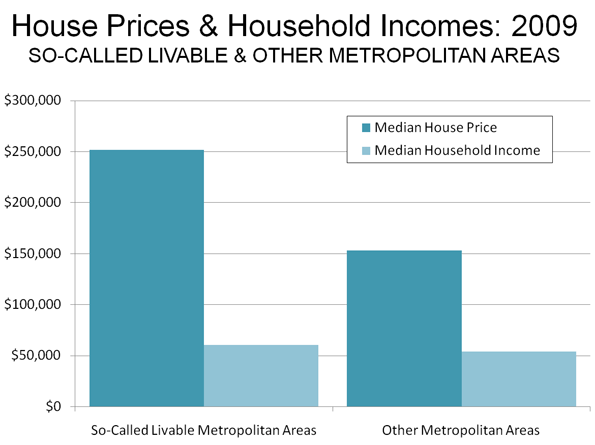
    House prices are considerably higher in the metropolitan areas more inclined toward so-called livability policies. The so-called livable metropolitan areas have nearly 50% higher house prices, after adjustment for incomes (Figure 1). If house prices were at the same level relative to incomes as in the other metropolitan areas, the median price would be $80,000 less. This would mean about $5,000 less in annual mortgage payments. In the least affordable so-called livable metropolitan areas, fewer than 40% of households can afford the median priced house (Los Angeles, New York and San Jose). In all the other metropolitan areas, more than 70% of households can afford the median priced house (Note 2). It takes a lot of gasoline to equal that difference.

    The Livable Communities Act receives an “F” for rental affordability.

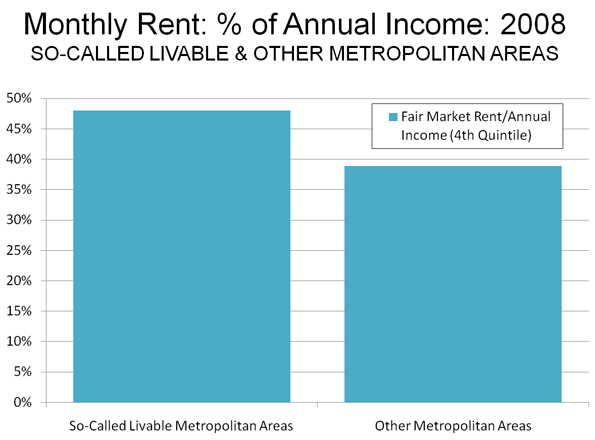
    Rents are also higher in the so-called livable metropolitan areas (Figure 2). The US Department of Housing and Urban Development “fair market rents,” (estimated at the 40th percentile of the rental market, including utilities) for a two bedroom apartment was 25% higher in the so-called livable metropolitan areas in relation to the fourth household income quintile (top of the bottom 25%).

    Why Housing is More Expensive in Livable Metropolitan Areas: The land use regulations typical of the so-called livable metropolitan areas force house prices up by prohibiting development on most available land (urban growth boundaries), imposing building moratoria or, in some cases, by requiring excessively large suburban lot sizes, making it impossible to build housing that is affordable to middle income households. All things being equal, prices increase where supply is restricted, as indicated by a broad economic literature.

    Transportation

    According to the findings in the Livable Communities Act the nation wastes 4.2 billion hours in traffic congestion and loses $87 billion annually from the costs of congestion. The congestion cost is principally the cost of time.

    Transportation Costs: Since commuting by transit nearly always takes longer than commuting by car (twice as long in 2007), any switch to transit is likely to increase costs (lost time is lost time, whether in a train or in a car). The balance of congestion costs are in excess fuel consumption, which would likely also increase under the so-called livability policies, because higher densities produce greater traffic intensities (this from Sierra Club based research), which means more congestion and slower travel speeds, which reduces fuel economy.

    The Livable Communities Act receives an “F” for transportation affordability

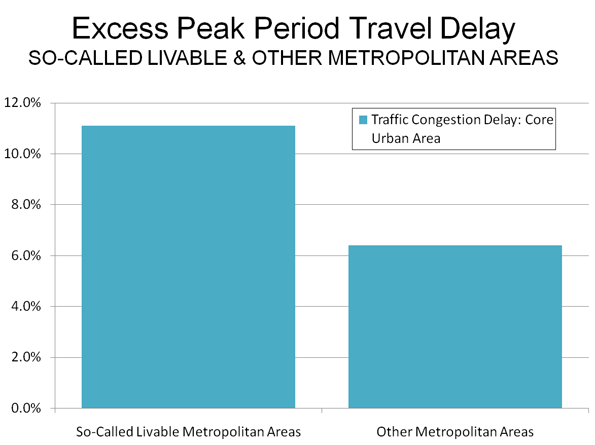
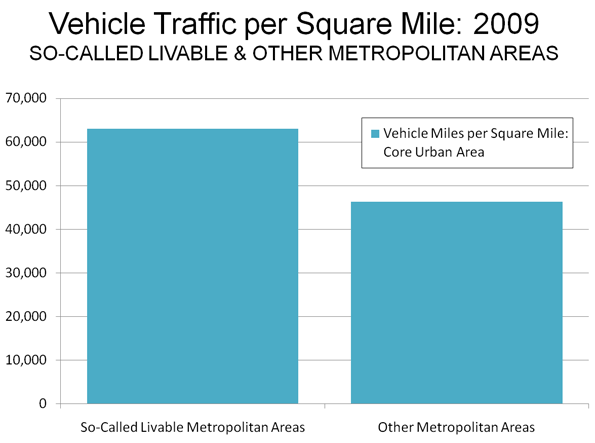
    Transportation Quality of Life: So-called livability policies worsen traffic congestion and air pollution. This is indicated by the latest INRIX traffic scorecard showing that average travel delays during peak travel periods are nearly 75% greater in the so-called livable metropolitan areas (Figure 3). Federal Highway Administration data indicates that the intensity of traffic is more than one-third higher in the so-called livable metropolitan areas (Figure 4)


    The greater traffic intensity also has negative health impacts. The American Heart Association noted that being close to congested roadways increases the likelihood of heart attack and stroke. The American Heart Association cites a study indicating that “a person’s exposure to toxic components of air pollution may vary as much within one city as across different cities.” Obviously, such exposure will be greater where traffic densities are higher.

    The Livable Communities Act receives an “F” on transportation related quality of life issues.

    Consumer Preferences

    In its findings, the Livable Communities Act says that the demand of new housing in dense, walkable (so-called “livable”) areas is 15 times the supply. This misses the extensive overbuilding of dense, walkable communities that ended in the huge condominium bust in Portland, Seattle, Los Angeles, Miami, Atlanta, Chicago and elsewhere. The supply of such housing exceeds the demand, particularly at the current price points.

    Consumer preferences are not revealed by planners’ delusions from surveys people answer in the abstract. For example, most people want shorter commutes, but they vastly prefer single family houses to apartments. In the real context of issues like costs, living space, or schools, people express their priorities.

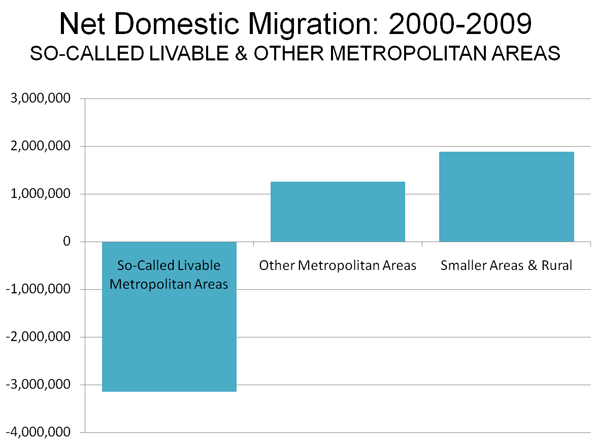
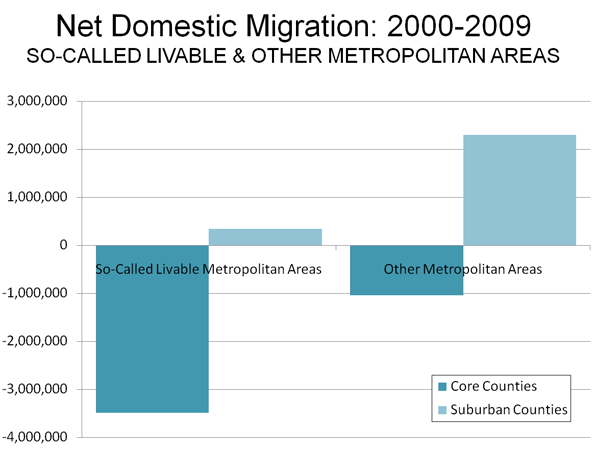
    The “litmus” test of so-called livability is what people do, not what they say they might do. Households continue to vote with their cars and are moving away from so-called “livable” areas. According to 2009 domestic migration data compiled by the Bureau of the Census:

    • The so-called livable metropolitan areas lost more than a net 3,140,000 residents to other areas of the nation, while other metropolitan areas gained more than 1,000,000 and smaller areas gained nearly 2,000,000 (Figure 5).
    • Nearly 3,500,000 residents left the core counties of the so-called livable metropolitan areas for other parts of the nation, while the suburbs gained 340,000 residents.
    • In the other metropolitan areas, more than 1,000,000 residents left the denser core counties, while the suburbs gained 2,300,000 (Figure 6).


    The Livable Communities Act receives an “F” for consistency with consumer preferences

    The Report Card: Not Livable at All

    The Livable Communities Act report card is shown below. In other words, if enacted, it is likely to produce a failing grade for families even if it wins straights A’s with planners, academics and inner city developers.

                                     Report Card

    Livable Communities Act

    Subject

    Grade

    Home Ownership Affordability

    F

    Rental Affordability

    F

    Transportation Affordability

    F

    Transportation Quality of Life

    F

    Consistency with Consumer Preferences

    F

    Overall Grade

    F

    Additional Comments: The favored policies would reduce mobility to major parts of the metropolitan area, which would reduce access to potential employment opportunities and retail establishments with lower prices.

    Note 1: The analysis covers metropolitan areas with more than 1,000,000 population. The “so-called” livable metropolitan areas are classified as those with “more restrictive” land use regulation by Demographia. The other metropolitan areas have less restrictive land use regulation. See note 7 of http://www.demographia.com/db-overhang.pdf.

    Note 2: Calculated from the National Association of Homebuilders-Wells Fargo Housing Opportunity Index.

    Wendell Cox is a Visiting Professor, Conservatoire National des Arts et Metiers, Paris and the author of “War on the Dream: How Anti-Sprawl Policy Threatens the Quality of Life

    Photo: Overbuilding Dense Walkability in Miami (photograph by author)

  • Cities: Size Does Not Matter Much Anymore

    The heart and brain are certainly not the largest organs in the human body, but they are arguably the most important. Why? The heart, through a miles-long network of capillaries, keeps every part of the body supplied with nutrients, and the brain, through an equally extensive network of nerves, provides instructions to every part of the body about what to do with those nutrients. They are important not because they are big, but because they are connected to everything else.

    It seems that cities work in much the same way. Some cities are much larger than others, but these size differences play virtually no role in their economic development today. Instead, urban economies depend primarily on cities’ connections to one another through networks of transportation, communication, business transactions, and cultural exchanges. Well-connected cities, regardless of their size, are more likely to develop robust regional economies.

    This is hardly a recent phenomenon. The ancient network of trade routes known as the Silk Road played a major role in the development of cities as commercial centers throughout Asia, and Rome’s imperial power was built upon and maintained by the fact that, proverbially, all roads led there. But, the importance of networks has become more critical recently for cities in the United States.

    In the past, dominated largely by agriculture and mass commodity production, bigger was better. America’s largest cities served as what Walter Christaller dubbed ‘central places.’ These central places served people living in the surrounding territory, as a place to purchase goods and services, and to sell crops and livestock. Bigger cities drew people in from further away, fueling their economic growth. However, as technological developments allowed people and goods to be transported more quickly and cheaply, people were no longer as shackled to the closest big city. Well connected cities, tied to other places by rail lines and highways, and more recently by airline routes and the internet, could benefit from consumers’ demand and workers’ labor in other places.

    Driven by such technological advances, the economic prosperity of American cities has become more tied to their connectedness than their sheer size. But, exactly what kind of connectedness is important can vary from place to place. Cities like New York or Chicago, which drew strength from their size in the past, today thrive largely by being well connected to other cities globally by multiple types of networks, serving simultaneously as transportation hubs, stock exchanges, and cultural centers.

    But the biggest change has been the rise of selected smaller cities. Some, not long ago relatively inconsequential, are now major players due to their linkages in more specialized networks. For example, much of Miami’s remarkable economic and demographic growth, and its status as a global city, is the result of its role as the primary economic and cultural bridge between North America and Central/South America. The Research Triangle in North Carolina and Silicon Valley in California have benefitted from intellectual linkages among universities and the world wide tech industry that join independent towns like Raleigh and Durham into cohesive urban regions. Even very small towns like Bentonville, Arkansas (2007 estimated population: 33,744) can be influential in the world arena with the help of vast supply-chain networks orchestrated by a major corporation (Wal-Mart) and large inflows of people made possible by a major airport (Northwest Arkansas Regional, nearly 1.2 million passengers in 2006).

    What does this change mean for American cities? Perhaps it’s more helpful to consider what it doesn’t mean. The heightened role networks and connectivity for cities likely does not herald the much-hyped death of distance, where internet technologies like high-resolution teleconferencing allow businesses to successfully operate anywhere. Certainly these technologies may simplify routine transactions like training employees at satellite offices, while email and social networking sites may help maintain existing relationships and collaborations over long distances. However, chance encounters that are almost impossible online but common in hallways or on sidewalks are frequently where new relationships are built and new ideas emerge. Even if technology did eliminate the need for proximity, real physical locations would still be significant. Not all cities are well connected, and this type of inequality serves to channel innovation and wealth toward some places and away from others. Although transportation and communication networks could disperse people and resources evenly across the landscape, more often they concentrate people and resources at key bottlenecks and ‘basing points’ in the networks.

    The triumph of networks over size also does not mean the triumph of all small towns over big cities. Size is not bad but simply increasingly irrelevant. Although large cities may encounter inefficiencies due to their size, strategically designed networks can offset many of them. For instance, congestion can be relieved by public transit worth using, or inadequate public services could be bolstered by improving inter-metropolitan coordination. Still, entrepreneurs increasingly seek to locate outside the city’s central core, in smaller suburbs or edge cities. This is a notable development in economic geography, and seems likely to continue. However, the success of these exurbs comes not from their independence from large cities, but instead from their interdependence upon them. Cheap land or favorable tax codes won’t likely transform an isolated small town into an economic powerhouse, while congestion and pollution won’t likely hinder the continued development of a well-connected port city.

    Ultimately, we need to change how we think about cities and their economic growth. Contrary to strategies that seek to ‘grow’ cities by building (or rebuilding) their tax bases, cities do not necessarily need more people or even more companies. Instead, city leaders need to concentrate on growth in terms of cities’ connectivity. Each new capillary or nerve takes a small amount of energy for the body to build, yet they are precisely what make the heart and brain such efficient and important engines of life. Similarly, forging new relationships between cities often does not deplete scarce resources, and cities that are linked to one another can exploit economies of scale by pooling their strengths, making them sleeker and more efficient. A city that stands on its own, no matter how large or small, is likely to burn out in the long run. But, a city that can draw on the resources of the whole world through extensive network connections to other cities, whether it is a metropolis or a hamlet, is likely to thrive.

    Zachary Neal, PhD, is assistant professor of sociology and global urban studies at Michigan State University. This essay draws on his recent study, “From Central Places to Network Bases,” that will appear in the research journal City and Community, and is available here.

    Photo by wzefri

  • Where’s Next: November May Determine Regional Winners

    As the recovery begins, albeit fitfully, where can we expect growth in jobs, incomes and, most importantly, middle class opportunities? In the US there are two emerging “new” economies, one largely promoted by the Administration and the other more grounded in longer-term market and demographic forces.

    The November election and its subsequent massive expansion of federal power may have determined which regions win the post-bust economy, but the stakes in November are particularly acute for some prime beneficiaries of what could be called the Obama economy: the education lobby, Silicon Valley venture firms, Wall Street, urban land interests and the public sector. All backers of his 2008 campaign, these groups have either reaped significant benefits from the stimulus or have used it to bolster themselves from the worst impact of the recession.

    In a sense the Obama policies are designed to overturn the pattern of economic dispersion –towards the exurbs, the south, the intermountain West, and more recently the Plains – that has defined the last half century. The biggest winner, in regional terms, is the Washington area. Even as local governments cut back, the federal establishment continues to swell. Federal employment, excluding the postal service, remains roughly 200,000 larger than in 2008.

    It is not surprising then that the capital district enjoys the highest job growth since December 2009 of any region. Indeed, the Great Recession barely even hit the imperial center. Given its current trajectory, it’s likely to remain the primary boom town along the east coast.

    There are other less obvious regional winners from Obamanomics. Wall Street, despite its recent wailing, has fattened itself on the Fed’s cheap money. It may benefit further from highly complex new financial regulations that will drive smaller, regional competitors either out of business or into mergers with the megabanks.

    Manhattan – a liberal bastion dependent on arguably the greediest, most venal purveyors of capitalism – enjoyed a revived high end consumer economy of high fashion, fancy restaurants and art galleries. Silicon Valley’s financial community also is seeing a surfeit of grants and subsidies for the latest venture schemes, keeping Palo Alto and its environs relatively prosperous. Perhaps this is the positive “change” that Time recently credited in its paen to the stimulus.

    Other regional winners from the Obama economy generally can be found in state capitals and University towns, particularly those with the Ivy or elite college pedigrees that resonate with this most academic Administration. One illustration can be seen in the relatively strong recovery of Massachusetts – home to many prestigious Universities and hospitals – which has seen jobs grow by 2.2 percent since the Obama ascension.

    Similar, albeit less dramatic recoveries can be found in Columbus, Madison and Minneapolis-St.Paul, with their large university communities and regional federal employment centers. Yet the political benefits of this growth may be limited. Many other parts of these same states, including the outer boroughs of New York are not doing well; aside from Columbus, Ohio has continued to skid as its industrial and corporate base dwindles, often moving to more business friendly states.

    At the same time, the strongest growth clusters in those regions that stick to the basics: relatively low taxes, pro-business regulations and continued infrastructure investment. Some regions – particularly in Texas, Alaska, Wyoming and the Great Plains – also have benefited from the growth in such basic industries as agriculture, oil and mining.

    Like resource-producing Canada and Australia, which barely felt the great recession, these economies have been boosted by continued growth in demand from countries like India and China. The current rise in food commodity prices, in part due to poor conditions in Russia and other former Soviet Republics, may further intensify this trend. Beyond the current food crisis, changing consumer tastes in boom markets like China seem certain to boost demand for such products as corn, used to help meet that country’s soaring demand for pork and other meat products.

    But perhaps even more important, once the economy recovers these areas – with their business friendly regimes and lower costs – may continue to siphon much of the next wave of industrial and even tech growth from the more expensive, largely Obama-friendly regions. Caterpillar, for example, one of the likely beneficiaries of expanded exports, recently announced plans to open a new assembly plant not in its Midwestern base but in Victoria, outside Houston.

    This trend has been building for at least a generation and seems likely to intensify under today’s highly competitive global business environment. If we start seeing a recovery in such things as auto sales, one can expect much of the new demand to be meant in efficient, largely foreign owned factories that have been gearing up across the Southeast. Unless powerful federal intervention forces Americans to buy General Motors products like the Volt, consumer preference is likely to be strongest for smart, fuel efficient brands built largely in towns from southern Ohio down to Texas.

    Perhaps even more significantly, these areas are also challenging the Obama regions in such fields as high-technology. Tech hiring has picked up in places like Silicon Valley, New York and DC, but consistently the fastest growth in science, engineering and technical jobs has been in low-cost states such as North Dakota, Virginia, New Mexico, Utah and Texas. Just recently, several major Silicon Valley powerhouses – Adobe, Twitter, Electronic Arts and eBay – announced major new expansions in Utah, a state that is among a brood seeking to move prized businesses, including even entertainment, from the Golden State.

    To a distressingly large extent, the fate of these two distinct economies may hinge on the outcome in November. If the Republicans gain an effective blocking majority – perhaps with a handful of centrist Democrats from growth-oriented states – many favored programs of the Obama economy may be cut or eliminated entirely. These include high-speed rail, increased subsidies for new light rail lines, massive investments in University research and investment breaks for renewable fuels.

    On the other hand, if the Democratic majority persists the tilt towards the Obama economy may even become stronger, as the Democrats will be the ones primarily losing their seats in many growth states. Many policies inimical to the growth states – support for government satrapies like General Motors, tougher restrictions on domestic fossil fuel development and policies designed to curb suburban single family housing – might even intensify.

    In this sense, we need to see November as much as a conflict between growth economies as an ideological contest. The results could determine what regions are next to boom, and whose economy will slow or even decline. What might be best – a compromise recognizing the need to boost growth in all regions – may be a too far a stretch of logic in this political climate.

    This article originally appeared at Forbes.com.

    Joel Kotkin is executive editor of NewGeography.com and is a distinguished presidential fellow in urban futures at Chapman University. He is author of The City: A Global History. His newest book is The Next Hundred Million: America in 2050, released in February, 2010.

    Photo by bcbeatty

  • A Tsunami Approaches: The Beginning of the Great Deconstruction

    In the distant horizon, a giant wave is building. There are some who recognized the swell and raised the alarm. There are others who deny the possibility of such a wave. Most remain blissfully unaware. The wave is building and when it reaches our shores, it will hit with the force of a tsunami.

    The wave is propelled by government spending and crested with unfunded pension obligations. The Pew Center on the States wrote in The Trillion Dollar Gap (February 2010), “A $1 trillion gap exists between the $3.35 trillion in pension, health care and other retirement benefits states have promised their current and retired workers as of fiscal year 2008 and the $2.35 trillion they have on hand to pay for them.”

    Like any tsunami, the wave began long ago and very far out to sea. Thirty years ago the vast majority of union workers were in the private sector. Public employees in unions reached parity with private sector members by 2009. This was aided in part by campaign contributions from the unions to elect Democratic Party candidates and generous pay packages and retirement plans passed by those same politicians in return.

    By 2010, the general public received a series of shocks. The first shock was the jobless recovery of the Great Recession that cost 8 million jobs. Most of the job losses occurred in the private sector yet the majority of the $800 billion Stimulus Bill went to “save and create” public sector employment. The second shock was learning that civil servants earned twice that of private workers. According to the Bureau of Economic Analysis, Federal workers received average pay and benefits of $123,049 while private workers made $61,051 in total compensation. The third shock was revelation of incredible retirement plans doled out by politicians since 1999. In 2002, California passed SB 183 that allowed police and safety workers to retire after 30 years on the job with 3% of salary for each year of service, or 90% of their last year’s pay. During the Great Recession, fireman began retiring with $150,000 pensions at age 52 despite a life expectancy approaching 80. In Orange County CA, lifeguards, deemed safety workers, retired with $147,000 annual pensions. The Orange County sheriff, recently convicted of witness tampering, will receive $215,000 annually while in jail. Bob Citron, the Treasurer of Orange County who pushed the county into bankruptcy in the 1990s, receives a pension of $150,000 per year. A tsunami of anger and resentment is building.

    As the wave approaches, economists issue thick reports with ominous names like “The Gathering Storm” (Reason Foundation) advising us that the pension obligations we have created are unsustainable. They report cities and states cannot economically allow workers to retire at 52 when they have a life expectancy of 26 years of retirement. They simply cannot pay for these pensions with existing revenue. Services will go down and taxes will go up to pay for these generous pension obligations. Orange County’s CEO, Thomas G. Mauk, predicted that pension requirements in 2014 will take 84% of the county’s law enforcement payroll. It is already 50% today. To exacerbate the problem, The Great Recession forced most states into budget deficits as their revenues decline. For FY2010, every state except Montana and North Dakota has projected a budget deficit. (RedState 3/21/2010).

    California once again leads the nation with a $26 billion budget deficit plus an unfunded pension obligation of $500 billion. Its current financial structure is clearly unsustainable. It has an operational structure that in ungovernable with often duplicative agencies, some collecting less in tax revenue than the agencies spend on collection. Wikipedia lists 500 existing public agencies for the State of California. California can no longer afford such a luxury. It must deconstruct these bloated inefficient government agencies, and rid itself of their chairman, staff, offices, cars, pensions and the overhead that such excess represents. A $26 billion dollar deficit is not something that can be corrected with a wage freeze or job furloughs. Bold leadership can lead California to deconstruct its 500 agencies down to 100 functional organizations. California is a classic example of what must change in the coming Great Deconstruction.

    One Orange County city has already taken bold steps to correct its $10 million deficit. It may be a model for other cities and states across the country. Internally, it has decided it will not replace any city worker that dies, retires, moves or quits. The city will simply out source the employment to an outside service company and eliminate healthcare requirements and unsustainable pensions. Building inspectors will be out sourced as will city plan checkers, librarians and meter maids. Only essential services like top executives and cops will remain on the city payroll. The city staff will eventually decrease from 220 to approximately 35 personnel. This is the essence of deconstruction.

    At the state and local level, the Great Deconstruction has already begun albeit delayed by an infusion of federal stimulus dollars and grants in 2009 and 2010. The federal government must deconstruct as well. It must happen, if only because the revenue is no longer there to sustain all of these often well-intentioned programs. The federal government will not be immune from fiscal reality.

    In this sense, the election in November will be a referendum on the very sustainability of our system of government. One party will continue to borrow and spend in order to maintain the 500 agencies in California and the abundance of federal programs. They have not said how long they will be able to borrow money to sustain their system. The other party will try to simply turn off the spigot – now. Either way, one day the money will run out and the inevitable deconstruction will occur.

    ***************************************************

    The Great Deconstruction is a series written exclusively for New Geography. Future articles will address the impact of The Great Deconstruction at the national, state, county and local levels.

    Robert J. Cristiano PhD is the Real Estate Professional in Residence at Chapman University in Orange County, CA and Director of Special Projects at the Hoag Center for Real Estate & Finance. He has been a successful real estate developer in Newport Beach California for twenty-nine years.


    Other works in The Great Deconstruction series for New Geography

    An Awakening: The Beginning of the Great Deconstruction – June 12, 2010
    The Great Deconstruction :An American History Post 2010 – June 1, 2010
    The Great Deconstruction – First in a New Series – April 11, 2010
    Deconstruction: The Fate of America? – March 2010

  • Progressives Against Progress

    For the first two-thirds of the twentieth century, American liberals distinguished themselves from conservatives by what Lionel Trilling called “a spiritual orthodoxy of belief in progress.” Liberalism placed its hopes in human perfectibility. Regarding human nature as essentially both beneficent and malleable, liberals, like their socialist cousins, argued that with the aid of science and given the proper social and economic conditions, humanity could free itself from its cramped carapace of greed and distrust and enter a realm of true freedom and happiness. Conservatives, by contrast, clung to a tragic sense of man’s inherent limitations. While acknowledging the benefits of science, they argued that it could never fundamentally reform, let alone transcend, the human condition. Most problems don’t have a solution, the conservatives maintained; rather than attempting Promethean feats, man would do best to find a balanced place in the world.

    In the late 1960s, liberals appeared to have the better of the argument. Something approaching the realm of freedom seemed to have arrived. American workers, white and black, achieved hitherto unimagined levels of prosperity. In the nineteenth century, only utopian socialists had imagined that ordinary workers could achieve a degree of leisure; in the 1930s, radicals had insisted that prosperity was unattainable under American capitalism; yet these seemingly unreachable goals were achieved in the two decades after World War II.

    Why, then, did American liberalism, starting in the early 1970s, undergo a historic metanoia, dismissing the idea of progress just as progress was being won? Multiple political and economic forces paved liberalism’s path away from its mid-century optimism and toward an aristocratic outlook reminiscent of the Tory Radicalism of nineteenth-century Britain; but one of the most powerful was the rise of the modern environmental movement and its recurrent hysterias.

    If one were to pick a point at which liberalism’s extraordinary reversal began, it might be the celebration of the first Earth Day, in April 1970. Some 20 million Americans at 2,000 college campuses and 10,000 elementary and secondary schools took part in what was the largest nationwide demonstration ever held in the United States. The event brought together disparate conservationist, antinuclear, and back-to-the-land groups into what became the church of environmentalism, complete with warnings of hellfire and damnation. Senator Gaylord Nelson of Wisconsin, the founder of Earth Day, invoked “responsible scientists” to warn that “accelerating rates of air pollution could become so serious by the 1980s that many people may be forced on the worst days to wear breathing helmets to survive outdoors. It has also been predicted that in 20 years man will live in domed cities.”

    Thanks in part to Earth Day’s minions, progress, as liberals had once understood the term, started to be reviled as reactionary. In its place, Nature was totemized as the basis of the authenticity that technology and affluence had bleached out of existence. It was only by rolling in the mud of primitive practices that modern man could remove the stain of sinful science and materialism. In the words of Joni Mitchell’s celebrated song “Woodstock”: “We are stardust / We are golden / And we got to get ourselves back to the garden.”

    In his 1973 book The Death of Progress, Bernard James laid out an argument already popularized in such bestsellers as Charles Reich’s The Greening of America and William Irwin Thompson’s At the Edge of History. “Progress seems to have become a lethal idée fixe, irreversibly destroying the very planet it depends upon to survive,” wrote James. Like Reich, James criticized both the “George Babbitt” and “John Dewey” versions of “progress culture”—that is, visions of progress based on rising material attainment or on educational opportunities and upward mobility. “Progress ideology,” he insisted, “whether preached by New Deal Liberals, conservative Western industrialists or Soviet Zealots,” always led in the same direction: environmental apocalypse. Liberalism, which had once viewed men and women as capable of shaping their own destinies, now saw humanity in the grip of vast ecological forces that could be tamed only by extreme measures to reverse the damages that industrial capitalism had inflicted on Mother Earth. It had become progressive to reject progress.

    Rejected as well was the science that led to progress. In 1970, the Franco-American environmentalist René Dubos described what was quickly becoming a liberal consensus: “Most would agree that science and technology are responsible for some of our worst nightmares and have made our societies so complex as to be almost unmanageable.” The same distrust of science was one reason that British author Francis Wheen can describe the 1970s as “the golden age of paranoia.” Where American consumers had once felt confidence in food and drug laws that protected them from dirt and germs, a series of food scares involving additives made many view science, not nature, as the real threat to public health. Similarly, the sensational impact of the feminist book Our Bodies, Ourselves—which depicted doctors as a danger to women’s well-being, while arguing, without qualifications, for natural childbirth—obscured the extraordinary safety gains that had made death during childbirth a rarity in developed nations.

    Crankery, in short, became respectable. In 1972, Sir John Maddox, editor of the British journal Nature, noted that though it had once been usual to see maniacs wearing sandwich boards that proclaimed the imminent end of the Earth, they had been replaced by a growing number of frenzied activists and politicized scientists making precisely the same claim. In the years since then, liberalism has seen recurring waves of such end-of-days hysteria. These waves have shared not only a common pattern but often the same cast of characters. Strangely, the promised despoliations are most likely to be presented as imminent when Republicans are in the White House. In each case, liberals have argued that the threat of catastrophe can be averted only through drastic actions in which the ordinary political mechanisms of democracy are suspended and power is turned over to a body of experts and supermen.

    Back in the early 1970s, it was overpopulation that was about to destroy the Earth. In his 1968 book The Population Bomb, Paul Ehrlich, who has been involved in all three waves, warned that “the battle to feed all of humanity is over” on our crowded planet. He predicted mass starvation and called for compulsory sterilization to curb population growth, even comparing unplanned births with cancer: “A cancer is an uncontrolled multiplication of cells; the population explosion is an uncontrolled multiplication of people.” An advocate of abortion on demand, Ehrlich wanted to ban photos of large, happy families from newspapers and magazines, and he called for new, heavy taxes on baby carriages and the like. He proposed a federal Department of Population and Environment that would regulate both procreation and the economy. But the population bomb, fear of which peaked during Richard Nixon’s presidency, never detonated. Population in much of the world actually declined in the 1970s, and the green revolution, based on biologically modified foods, produced a sharp increase in crop productivity.

    In the 1980s, the prophets of doom found another theme: the imminent danger of nuclear winter, the potential end of life on Earth resulting from a Soviet-American nuclear war. Even a limited nuclear exchange, argued politicized scientists like Ehrlich and Carl Sagan, would release enough soot and dust into the atmosphere to block the sun’s warming rays, producing drastic drops in temperature. Skeptics, such as Russell Seitz, acknowledged that even with the new, smaller warheads, a nuclear exchange would have fearsome consequences, but argued effectively that the dangers were dramatically exaggerated. The nuke scare nevertheless received major backing from the liberal press. Nuclear-winter doomsayers placed their hopes, variously, in an unverifiable nuclear-weapons “freeze,” American unilateral disarmament, or assigning control of nuclear weapons to international bodies. Back in the real world, nuclear fears eventually faded with Ronald Reagan’s Cold War successes.

    The third wave, which has been building for decades, is the campaign against global warming. The global-warming argument relied on the claim, effectively promoted by former vice president Al Gore, that the rapid growth of carbon dioxide in the atmosphere was producing an unprecedented rise in temperatures. This rise was summarized in the now-notorious “hockey stick” graph, which supposedly showed that temperatures had been steady from roughly ad 1000 to 1900 but had sharply increased from 1900 on, thanks to industrialization. Brandishing the graph, the UN’s Intergovernmental Panel on Climate Change predicted that the first decade of the twenty-first century would be even warmer. As it turned out, temperatures were essentially flat, and the entire global-warming argument came under increasing scrutiny. Skeptics pointed out that temperatures had repeatedly risen and fallen since ad 1000, describing, for instance, a “little ice age” between 1500 and 1850. The global-warming panic cooled further after a series of e-mails from East Anglia University’s Climatic Research Unit, showing apparent collusion among scientists to exaggerate warming data and repress contradictory information, was leaked.

    As with the previous waves, politicized science played on liberal fears of progress: for Gore and his allies at the UN, only a global command-and-control economy that kept growth in check could stave off imminent catastrophe. The anti-progress mind-set was by then familiar ground for liberals. Back in the 1970s, environmentalist E. J. Mishan had proposed dramatic solutions to the growth dilemma. He suggested banning all international air travel so that only those with the time and money could get to the choice spots—thus reintroducing, in effect, the class system. Should this prove too radical, Mishan proposed banning air travel “to a wide variety of mountain, lake and coastal resorts, and to a selection of some islands from the many scattered about the globe; and within such areas also to abolish all motorised traffic.” Echoing John Stuart Mill’s mid-nineteenth-century call for a “stationary state” without economic growth, Mishan argued that “regions may be set aside for the true nature lover who is willing to make his pilgrimage by boat and willing leisurely to explore islands, valleys, bays, woodlands, on foot or on horseback.”

    As such proposals indicate, American liberalism has remarkably come to resemble nineteenth-century British Tory Radicalism, an aristocratic sensibility that combined strong support for centralized monarchical power with a paternalistic concern for the poor. Its enemies were the middle classes and the aesthetic ugliness it associated with an industrial economy powered by bourgeois energies. For instance, John Ruskin, a leading nineteenth-century Tory Radical and a proponent of handicrafts, declaimed against “ilth,” a negative version of wealth produced by manufacturing.

    Like the Tory Radicals, today’s liberal gentry see the untamed middle classes as the true enemy. “Environmentalism offered the extraordinary opportunity to combine the qualities of virtue and selfishness,” wrote William Tucker in a groundbreaking 1977 Harper’s article on the opposition to construction of the Storm King power plant along New York’s Hudson River. Tucker described the extraordinary sight of a fleet of yachts—including one piloted by the old Stalinist singer Pete Seeger—sailing up and down the Hudson in protest. What Tucker tellingly described as the environmentalists’ “aristocratic” vision called for a stratified, terraced society in which the knowing ones would order society for the rest of us. Touring American campuses in the mid-1970s, Norman Macrae of The Economist was shocked “to hear so many supposedly left-wing young Americans who still thought they were expressing an entirely new and progressive philosophy as they mouthed the same prejudices as Trollope’s 19th century Tory squires: attacking any further expansion of industry and commerce as impossibly vulgar, because ecologically unfair to their pheasants and wild ducks.”

    Neither the failure of the environmental apocalypse to arrive nor the steady improvement in environmental conditions over the last 40 years has dampened the ardor of those eager to make hair shirts for others to wear. The call for political coercion as a path back to Ruskin’s and Mishan’s small-is-beautiful world is still with us. Radical environmentalists’ Tory disdain for democracy and for the habits of their inferiors remains undiminished. True to its late-1960s origins, political environmentalism in America gravitates toward both bureaucrats and hippies: toward a global, big-brother government that will keep the middle classes in line and toward a back-to-the-earth, peasantlike localism, imposed on others but presenting no threat to the elites’ comfortable lives. How ironic that these gentry liberals—progressives against progress—turn out to resemble nothing so much as nineteenth-century conservatives.

    This essay originally appeared in City Journal.

    Fred Siegel is a contributing editor of City Journal, a senior fellow at the Manhattan Institute, and a scholar in residence at St. Francis College in Brooklyn.

    Photo: CarbonNYC

  • Australia 2010: Unstable Politics in a Prosperous Country

    2010 has been something of an annus mirabilis in Australian politics. On 24 June a prime minister was dumped before facing the voters a second time. This was the first time ever for such an early exit. Then the election on 22 August produced a “hung parliament”, an outcome not seen since the 1940s. Having fallen short of enough seats to form government, the major parties are scrambling for the support of four independents and one Green in the House of Representatives.

    If this looks like the politics of a nation mired in economic upheaval, the reality is far different. Australia was one of a handful of advanced countries to avoid recession during the financial crisis. The unemployment rate never rose much above 5 per cent. For some economists, Australia is “the wonder from down under”.

    So why did the Labor government, elected in 2007, fall apart? There was certainly a lack of governing experience after eleven years in opposition. But in a broader sense, the political class is struggling to cope with Australia’s increasingly regionalised economy, and the divergent sources of its new-found prosperity.

    Like many industrialised countries, Australia passed through a seemingly intractable malaise in the 1970s. The country’s predicament appeared worse than that of more diverse and innovative economies like the United States. Relying on agricultural and mineral exports, legacies of a colonial past, Australia’s manufacturing base was inward-looking, outmoded and sclerotic. Disparaging assessments like that of former Singapore Prime Minister Lee Kwan Yew – Australians were destined to be “the poor white trash of Asia” – were common. Some fretted about “the Argentine route”, a country failing to diversify its economy and sliding down world rankings of GDP per capita. As transformed manufactures and high-tech products gobbled up an increasing share of world trade, Australia seemed stuck in the slow lane of commodity exports.

    And then came the 1980s. Protective barriers were slashed, the currency was floated, the financial system was opened up to foreign banks and state-owned agencies were sold off or treated to radical micro-economic reform. By the mid-2000s, the contours of the economy had changed. Activities such as business and property services rose from 10 to almost 15 per cent of GDP over the decade to 2006. Meanwhile manufacturing declined from 15 to 12 per cent. The new economy was dominated by services, now accounting for 68 per cent of GDP. Rather than drag down the economy, however, mining enjoyed parallel growth, from 4.5 to 8 per cent in the same period. China’s explosive arrival on the world scene shifted commodity exports into a very fast lane. These developments set Australia on a growth path that few could have foreseen in the 1970s. A small economy in relative terms to countries like China and the United States, it has evolved into a series of distinct geographic regions.

    The booming commodities export sector, dominated by mining, is concentrated in the northern and western states of Queensland and Western Australia, which account for 74 per cent of onshore mining production. Business and property services are concentrated in the south-eastern states of New South Wales and Victoria, specifically the inner precincts of Sydney and Melbourne, the nation’s emerging global cities. Together, these cities host around 50 per cent of Australia’s finance industry jobs. Public sector services, mostly in health and education, figure prominently in the populous south-east, again skewed towards long-established inner-city localities, where the most prestigious institutions are found. Construction, consumer services, including retail, and light manufacturing, fuelled by demand for household goods and building supplies, thrive in the larger metropolitan regions with high rates of immigration and population growth, like outer Sydney and Melbourne, and increasingly south-east Queensland.

    At the end the true driver of the economy lies with commodities. Today mineral resources make up just under 80 per cent of Australia’s commodity trade and around half of all exports (including services). Australia is the world’s leading exporter of coal and iron ore and ranks high other minerals like zinc and aluminium.

    Reaping the China bounty, former Prime Minister John Howard kept the federal budget in surplus and reduced government debt to zero, while handing out tax cuts and family income supplements. This winning combination delivered Howard eleven years in power. Towards the end of his rule, however, strains in the boom economy began to manifest themselves. Skilled labour shortages and the heated property market began to put pressure on inflation and interest rates, contributing to a sense of policy exhaustion in Howard’s later years.

    By 2007, there was a widespread view that the benefits of the resources boom were not being distributed fairly. The service sector professionals of the south-east, especially in the public sector who dominate the national media, began to shift to Labor as did outer suburban workers, who saw the dream of home ownership slipping beyond their reach. Forced to compete for investment in the open economy, south-eastern state governments, controlled by Labor, were constrained to keep taxes low. An ever larger proportion of their budgets was channelled into health and education services, partly due to close links with powerful public sector unions. There was little left to pay for urban infrastructure on the booming fringes.

    In response, infrastructure costs were shifted onto developers and local government, along with a new set of regulations, and urban consolidation (“smart growth”) was enforced as planning policy, ostensibly to reduce the need for extra resources. These choices reflected the green ideology taking hold in the planning profession, as well as among the professional classes.

    The impact of these measures on housing affordability were disastrous. When the low interest rates of the Howard years began to creep up, the problem turned into a crisis, as the Demographia survey has shown. The property market slowed down, depriving the south-eastern states of even more funds, since property taxes are a significant share of their revenues. This contrasted with conditions in the mining states, prompting the Federal Treasury Secretary to declare Australia a “two speed economy”.

    At the 2007 election, Labor leader Kevin Rudd claimed to have the solutions. Paying lip service to Howard’s fiscal conservatism, he signalled plans to divert mining boom proceeds towards infrastructure and services, including a new deal on health funding and an “education revolution“. Much of this was wrapped up in the rhetoric of climate change, talked up by Rudd as “the greatest moral challenge of our time”. His environmental centrepiece was an Emissions Trading Scheme (cap and trade), a massive revenue raising device for the federal government. In essence it was a mechanism for transferring wealth from the mining states, and their fossil-fuelled economies, to the populous south-east.

    Rudd’s electoral success, and apparent public support for climate action, drove the agenda forward until the crash at Copenhagen. This precipitated a revolt in the opposition Coalition, which replaced ETS supporter Malcolm Turnbull with climate-sceptic Tony Abbott. When Abbott labelled the ETS “a great big new tax on everything“, and blocked its passage in the Senate, public interest in the scheme melted away, particularly in the mining regions. Rudd lost his nerve and shelved it until 2012. For many Australians, he was exposed as a weak leader without the courage of his convictions.

    Rudd refused to give up his dream of redistribution though, turning to Plan B. Having commissioned a review of Australia’s taxation system, he announced a Resource Super Profits Tax, a complex device confiscating up to 40 per cent of mining profits above a threshold. Adopted without consulting the resources industry, it attracted furious opposition from the global mining companies, which launched a powerful advertising campaign against it. Opposition leader Abbott labelled the measure ”a great big new tax on mining”. Opinion polls showed strong opposition to the tax in mining states, and mild support in the south-east. Rudd’s poll ratings fell through the floor. He was soon deposed by his Labor Party colleagues.

    Julia Gillard, the new prime minister, substantially modified the proposal after negotiations with the large miners, but smaller operators remained opposed, along with most of Queensland and Western Australia. Gillard quickly called an election to capitalise on her status as the country’s first female leader. But the legacy of Rudd’s undelivered promises shaped the outcome. Australia’s regional divisions were clearly evident in the voting patterns. Western Australia and Queensland swung to the Coalition, and Queensland proved to be a killing ground, depriving Labor of nine seats. New South Wales also swung to the Coalition, reflecting dissatisfaction with the long-serving state Labor government’s failure to address the infrastructure and housing needs of suburban western Sydney. In contrast, the southern states of Victoria, Tasmania and South Australia swung towards Labor.

    Well over half of Labor’s lost votes moved left to the Greens, who more than doubled their share of the vote, rather than right to the Coalition. Increasing numbers of south-eastern professionals consider the Greens their preferred agent of redistribution. Handing the Greens the balance of power in the Senate, and possibly the House of Representatives (only one seat this time), may prove a better strategy than sticking with a fractured Labor Party. Inevitably though, regional and outer-suburban voters, with their divergent priorities, will react to a green-dominated agenda, which tends to dismiss suburban interests. Over time, and perhaps after the next election, this may mean a shift back to the right and a clear Coalition victory.

    John Muscat is a Sydney lawyer and co-editor of The New City (www.thenewcityjournal.net), a web journal of urban and political affairs.

    Photo by webmink

  • Has America Caught the British Disease?

    As the economy stalls, analysts are worrying that the United States might repeat the experience of Japan’s “lost decade” (actually, two lost decades). Is America turning Japanese? We should be more worried about the prospect that America is turning British.

    The United Kingdom went from creating the first industrial economy and establishing a global empire to lagging Italy by the 1970s. The neoliberal reforms of Thatcher and Blair, intended to modernize the economy, merely replaced a rotting manufacturing economy with an unstable rentier economy centered in the City of London. With a zombie economy characterized by industrial wastelands, off-limits aristocratic landholdings, tourist kitsch and a financial sector that choked on its own excesses, Tony Blair’s “Cool Britannia” looks more like “Ghoul Britannia.”

    The decline of Britain was generations in the making, as Corelli Barnett has argued in his “The Pride and the Fall Books,” a series of polemics that include “The Audit of War” and “The Collapse of British Power.” The industrial strength that made the island nation the pioneer of the modern era was the result of unfashionable people – middle-class manufacturers – in the unfashionable industrial towns of the British midlands.

    Unfortunately, Britain’s industrial revolution was not accompanied by a revolution in values that emphasized making things over inheriting things. The old elite of aristocratic parasites, Church of England drones, and their snobbish retainers like elite lawyers and professors despised upwardly mobile arrivistes, although their children and grand-children might become socially acceptable if they abandoned “trade” for the lifestyle of genteel rentiers and were laundered through public schools like Eton and Oxbridge. The equivalent of Germany’s technical high schools and polytechnics and America’s agricultural and mechanical colleges were (and are) sneered at in Britain as vulgar “redbrick” universities.

    The failure to change Britain’s elite attitudes was accompanied by a failure to change Britain’s temporarily-successful free trade policies when they became anachronistic. From the Tudor era until the nineteenth century, the British state used mercantilist policies of the kind nowadays associated with the “East Asian model” – selective protectionism, subsidies to exporters, procurement, taxes on resource material exports to keep prices low. The American colonies, forbidden to manufacture anything and forced to supply the metropole with food and raw materials in return for high-value-added British manufactures, were part of the mercantilist system, like Scotland, Ireland and India.

    By the 1840s, Britain’s technological supremacy allowed it to take off the protectionist training wheels and practice and preach free trade, confident that its manufactured exports would kill off infant industries in other countries. Beginning in the 1870s, however, the newly-united Germany and post-Civil War America adopted their own high-tariff policies of industry-supporting mercantilism. Despite the warnings of trade reformers like Joseph Chamberlain in the 1880s and 1890s, the British continued to practice one-way free trade, allowing German and American corporations based in their own giant, protected domestic markets to increase their shares of the market in Britain, its dominions and its colonies.

    As British industry shrank under American and German competition, the City of London became even more important. Finance was a clean business, untainted by the grime and odor of the factory, and could be practiced by gentlemen. The British discovered too late that finance follows industry, as the epicenter of global banking migrated from London to New York during World War I.

    Today the U.S. is repeating Britain’s mistakes. First the Japanese and now the Chinese have used a variety of methods, from nontariff barriers (Japan) to currency manipulation (both) to keep U.S. products out of their markets while enjoying unimpeded access to America’s consumer market, the biggest in the world. As in Britain, the center of gravity in the business world has shifted from manufacturing to finance. The catastrophic deregulation of the U.S. financial industry was based on the argument that unless the U.S. scrapped the New Deal era regulations that provided decades of financial stability and steady growth, Wall Street might lose out to the City of London or Hong Kong or Shanghai. For America’s bipartisan oligarchy, Wall Street is more important than Detroit.

    Not content to re-enact the British cycle of deindustrialization and decline, the U.S. imports British pundits to lecture Americans on nineteenth-century free market ideology. Asking dogmatic British free marketers how to organize a successful economy in the twenty-first century is the equivalent of asking unreconstructed Japanese militarists how to run a successful foreign policy or asking Iranian mullahs how to create a world-class R&D sector.

    Innovation without production is not the answer, as Britain’s sad history shows. Britain continued to have a world-class science and technology sector, inventing the jet engine and radar, among other things. But the British were unable to commercialize the products of British R&D because they lacked adequate mass production industries. Similarly, innovation will enrich few Americans other than technologists and venture capitalists if the new products that result are then licensed to be produced in industrial Asia or industrial Europe.

    The irony is that, while the American colonists were right to rebel against their role of hewers of wood and drawers of water in the British Empire, the British mercantile system of the fifteenth through the nineteenth centuries was a great success story, producing not only temporary British supremacy but also modern technological civilization. The Germans, Japanese and Chinese have always practiced subtle and not-so-subtle versions of the technonationalism that Britain pursued before its misplaced confidence led it to adopt the free market ideology that accelerated its downfall. Modern America has more to learn from the pre-liberal, industrializing Britain of the seventeenth and eighteenth centuries that Adam Smith denounced than from the post-1840s Britain that sat nobly on its laurels as it sank beneath the waves it briefly ruled.

    Michael Lind is Policy Director of the Economic Growth Program at the New America Foundation and author of The Next American Nation.

    Photo by **Maurice**