Category: Policy

  • The Housing Bubble: The Economists Should Have Known

    Paul Krugman got it right. But it should not have taken a Nobel Laureate to note that the emperor’s nakedness with respect to the connection between the housing bubble and more restrictive land use regulation.

    A just published piece by the Federal Reserve Bank of Boston, however, shows that much of the economics fraternity still does not “get it.” In Reasonable People Did Disagree: Optimism and Pessimism About the U.S. Housing Market Before the Crash, Kristopher S. Gerardi, Christopher L. Foote and Paul S. Willen conclude that it was reasonable for economists to have missed the bubble.

    Misconstruing Las Vegas and Phoenix: They fault Krugman for making the bubble/land regulation connection by noting that the “places in the United States where the housing market most resembled a bubble were Phoenix and Las Vegas,” noting that both urban areas have “an abundance of surrounding land on which to accommodate new construction” (Note 1).

    An abundance of land is of little use when it cannot be built upon. This is illustrated by Portland, Oregon, which is surrounded by such an “abundance of land.” Yet over a decade planning authorities have been content to preside over a 60 percent increase in house prices relative to incomes, while severely limiting the land that could have been used to maintain housing affordability. The impact is clearly illustrated by the 90 percent drop in unimproved land value that occurs virtually across the street at Portland’s urban growth boundary.

    Building is largely impossible on the “abundance of land” surrounding Las Vegas and Phoenix. Las Vegas and Phoenix have virtual urban growth boundaries, formed by encircling federal and state lands. These are fairly tight boundaries, especially in view of the huge growth these areas have experienced. There are programs to auction off some of this land to developers and the price escalation during the bubble in the two metropolitan areas shows how a scarcity of land from government ownership produces the same higher prices as an urban growth boundary

    Like Paul Krugman, banker Doug French got it right. In a late 2002 article for the Nevada Policy Research Institute, French noted the huge increases auction prices, characterized the federal government as hording its land and suggested that median house prices could reach $280,000 by the end of the decade. Actually, they reached $320,000 well before that (and then collapsed).

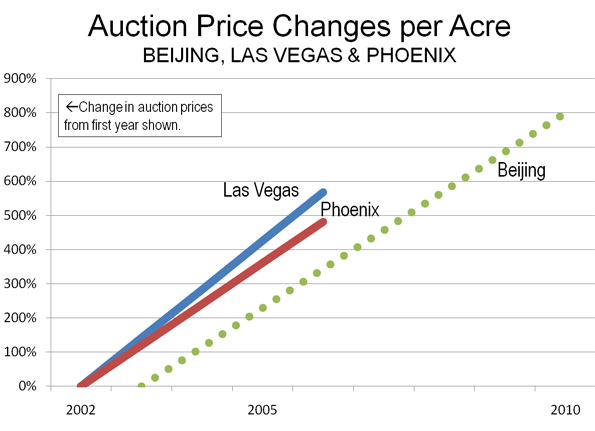
    In Las Vegas, house prices escalated approximately 85% relative to incomes between 2002 and 2006. Coincidentally, over the same period, federal government land auctions prices for urban fringe land rose from a modest $50,000 per acre in 2001-2, to $229,000 in 2003-4 and $284,000 at the peak of the housing bubble (2005-6). Similarly, Phoenix house prices rose nearly as much as Las Vegas, while the rate of increase per acre in Phoenix land auctions rose nearly as much as in Las Vegas.

    In both cases, prices per acre rose at approximately the same annual rate as in Beijing, which some consider to have the world’s largest housing bubble. According to Joseph Gyourko of Wharton, along with Jing Wu and Yongheng Deng Beijing prices rose 800 percent from 2003 to 2008 (Figure). This is true even thought we are not experiencing the epochal shift to big urban areas now going on in China.
    The Issue is Land Supply: The escalation of new house prices during the bubble occurred virtually all in non-construction costs such as the costs of land and any additional regulatory costs. It is not sufficient to look at a large supply of new housing (as the Boston Fed researchers do) and conclude that regulation has not taken its toll. The principal damage done by more restrictive land regulation comes from limiting the supply of land, which drives its price up and thereby the price of houses. In some places where there was substantial building, restrictive land use regulations also skewed the market strongly in favor of sellers. This dampening of supply in the face of demand drove land prices up hugely, even before the speculators descended to drive the prices even higher. Florida and interior California metropolitan areas (such as Sacramento and Riverside-San Bernardino) are examples of this.

    Missing Obvious Signs: There are at least two reasons why much of the economics profession missed the bubble.

    (1) Unlike Paul Krugman, many economists failed to look below the national data. As Krugman showed, there were huge variations in house price trends between the nation’s metropolitan areas. National averages mean little unless there is little variation. Yet most of the economists couldn’t be bothered to look below the national averages.

    (2) Most economists failed to note the huge structural imbalances that had occurred in the distorted housing markets relative to historic norms. Since World War II, the Median Multiple, the median house price divided by the median household income, has been 3.0 or less in most US metropolitan markets. Between 1950 and 2000, the Median Multiple reached as high as 6.1 in a single metropolitan area among today’s 50 largest, in a single year (San Jose in 1990, see Note 2). In 2001, however, two metropolitan areas reached that level, a figure that rose to 9 in 2006 and 2007. The Median Multiple reached unprecedented and stratospheric levels in of 10 or more in Los Angeles, San Francisco, San Diego and San Jose- all of which have very restrictive land use and have had relatively little building. This historical anomaly should have been a very large red flag.

    In contrast, the Median Multiple remained at or below 3.0 in a number of high growth markets, such as Atlanta, Dallas-Fort Worth and Houston and other markets throughout the bubble.. Even with strong housing growth, prices remained affordable where there was less restrictive land use regulation.

    Seeing the Signs: Krugman, for his part, takes a well deserved victory lap in a New York Times blog entitled “Wrong to be Right,” deferring to Yves Smith at nakedcapitalism.com who had this to say about the Federal Reserve Bank of Boston research:

    It is truly astonishing to watch how determined the economics orthodoxy is to defend its inexcusable, economy-wrecking performance in the run up to the financial crisis. Most people who preside over disasters, say from a boating accident or the failure of a venture, spend considerable amounts of time in review of what happened and self-recrimination. Yet policy-making economists have not only seemed constitutionally unable to recognize that their programs resulted in widespread damage, but to add insult to injury, they insist that they really didn’t do anything wrong.

    Maybe we should have known better: beware economists bearing the moment’s conventional wisdom.

    ——

    Note 1: The authors cite work by Albert Saiz of Wharton to suggest an association between geographical constraints and house price increases in metropolitan areas. The Saiz constraint, however, looks at a potential development area 50 kilometers from the metropolitan center (7,850 square kilometers). This seems to be a far too large area to have a material price impact in most metropolitan areas. For example, in Portland, the strongly enforced urban growth boundary (which would have a similar theoretical impact on prices) was associated with virtually no increase in house prices until the developable land inside the boundary fell to less than 100 square kilometers (early 1990s). A far more remote geographical barrier, such as the foothills of Mount Hood, can have no meaningful impact in this environment.

    Note 2: William Fischel of Dartmouth has shown how the implementation of land use controls in California metropolitan areas coincided with the rise of house prices beyond historic national levels. As late as 1970, house prices in California were little different than in the rest of the nation.

    Wendell Cox is a Visiting Professor, Conservatoire National des Arts et Metiers, Paris and the author of “War on the Dream: How Anti-Sprawl Policy Threatens the Quality of Life

    Photograph: $575,000 house in Los Angeles (2006), Photograph by author

  • Can We Socialize Ourselves to Good Health?

    How can we reduce health problems in society? Should we tackle poverty and social problems such as crime and drug abuse, or is the problem inequality in itself? If we reduce the income in a middle class neighborhood, will this in itself improve the health of poor people living in the same city?

    The latter form of reasoning is perhaps not so popular in the US, but quite so amongst European social democrats. A new book highlights how the European left is as concerned with fighting wealth as it is with fighting poverty.

    One year after its publication, the “The Spirit Level: Why More Equal Societies Almost Always Do Better” – by social epidemiologists Richard Wilkinson and Kate Pickett – has been embraced by many European intellectuals and politicians. The Social Democratic Party leader Mona Sahlin relies on the book as one of her main arguments during the current Swedish election campaign.
    Even conservative British Prime Minister David Cameron has praised the book, which claims that income inequality in itself causes more or less every problem in society. The argument goes: if your neighbor’s income increases, so does you chances of catching cancer.

    The authors of the book, Wilkinson and Pickett, seemingly make as strong argument for the notion that social ills are caused not by poverty but rather by inequality itself. Inequality, they say, acts like a “pollutant spread throughout society,” with rich and poor equally susceptible to its toxic effects.

    The book will likely soon appear also on the bookshelves of many US intellectuals, not least amongst the left. It is interesting then to note that its notions are dismissed by current research.

    Last year for example, the “Oxford Handbook of Economic Inequality” was published. There we could clearly read that income inequality in itself is not the cause of health problems or lifespan: “The preponderance of evidence suggests that the relationship between income inequality and health is either non-existent to too fragile to show up in a robustly estimated panel specification.”

    The same conclusion has been drawn in research conducted by Professor Angus Deaton, one of the world’s leading health economists. After a comprehensive survey of the scientific literature he concludes:
    “[I]t is not true that income inequality itself is a major determinant of public health. There is no robust relationship between life expectancy and income inequality among the rich countries, and the correlation across the states and cities of the United States is almost certainly the result of something that is correlated with income inequality, but is not income inequality itself.” (Published in Journal of Economic Literature, 2003).

    One could say that one of the main theses of the European social democracy – that inequality in itself is the problem – has been proven wrong by recent scientific studies. Social problems in themselves do cause inequality.

    If there are problems with drug abuse, racial tensions, unemployment, etc., in one neighborhood for example, this will decrease the income of the citizens. Thus income inequality arises compared to the middle class. Reducing social problems will also reduce inequality. But inequality in itself does not cause social problems.

    The socialist approach – to shrink the income of the middle class instead and hope this will aid the poor – is simply based on a skewed analysis of the correlation between social problems, poverty and inequality.

    A comparison between Sweden and the US is often used to argue that the European social democratic approach will reduce social problems and expand life span. As noted in a previous New Geography article, this reasoning is misleading.

    Sweden was characterized by an even income distribution, low poverty and long life spans already before the introduction of high-tax welfare policies. The difference in lifespan between Swedes and Americans was the same (2.6 years) in 1950 as it is today (2.7 years). And lastly, the 4.4 million Americans with Swedish origin are not only 50% more rich than Swedes living in Sweden, but also have the exact same level of poverty.

    It is simply wrong to assume that high tax welfare state policies automatically improve health. In 1960 Sweden was a low-tax country, with the third highest lifespan in the world. Switzerland was ranked on the sixth position. 45 years later, it was Switzerland that had the second highest lifespan, whilst Sweden was ranked on sixth position. Evidently, retaining a low-tax system did not hinder Switzerland from catching up to and surpassing Sweden.

    Low taxes might however explain why the poorest fifth of Swiss citizens have a considerably higher purchasing power compared to the same group in Sweden (the US figure is slightly, but not much, lower than in Sweden).

    And it is simply not true that socialist policies always lead to low income distribution, whilst free-markets increases inequality. Reforming away from communism to a very free-market oriented approach has for example allowed the Czech Republic, Slovakia and Slovenia from gaining a high living standard. But these nations do not have a low, but rather relatively high level of income equality. Moving away from socialism has benefited not only a small handful of capitalists, but rather the population as a whole.

    History teaches us that one society simply cannot change to another by simply changing its policies. Much can be achieved by focusing on the root of social problems – such as unemployment, crime and drug abuse – but society has little to gain and much to lose from thinking that we should hinder those who strive towards success in the name of social equality.

    Nima Sanandaji is president of the Swedish think tank Captus. He is the author of the book ”Entrepreneurs who go against the stream – what the 90s successful entrepreneurs can teach us” (Swedish title: ¨”Entreprenörer som går mot strömmen – vad 90-talets succéföretagare kan lära om dagens utmaningar”) for Fores.

    Photo by: JavierPsilocybin

  • Vancouver: Planner’s Dream, Middle Class Nightmare

    Vancouver is consistently rated among the most desirable places to live in the Economist’s annual ranking of cities. In fact, this year it topped the list. Of course, it also topped another list. Vancouver was ranked as the city with the most unaffordable housing in the English speaking world by Demographia’s annual survey. According to the survey criteria, housing prices in an affordable market should have an “median multiple” of no higher than 3.0 (meaning that median housing price should cost no more than 3 times the median annual gross household income). Vancouver came in at a staggering 9.3. The second most expensive major Canadian city, Toronto, has an index of only 5.2. Even legendarily unaffordable London and New York were significantly lower, coming in at 7.1 and 7.0 respectively. While there are many factors that make Vancouver a naturally expensive market, there are a number of land use regulations that contribute to the high housing costs.

    Vancouver is a unique real estate market: it’s the only major Canadian city that doesn’t experience frigid winters. This makes it a major draw for high skilled, high salary employees. It is also a major destination for wealthy Canadian retirees, who choose to actually spend their winters in Canada. There is little doubt that it is a naturally expensive real estate market. As with coastal California cities, people pay a premium for (in this case relatively) hospitable weather. The proximity to world class skiing, fishing, and hiking are no doubt another factor in the city’s high real estate costs. There is certainly a premium to be paid for living less than two hours away from the world’s best ski resort.

    Moreover, Vancouver has become an appealing real estate market for overseas investors, particularly Chinese nationals. There has been a good deal of news recently about how many of the nouveau riche in China are now looking to Vancouver, rather than Los Angeles or New York as an immigration destination. In absolute dollar terms, Vancouver is still cheaper than either city. This, combined with the more hospitable Canadian immigration system, has made Vancouver so attractive to overseas investors that real estate agents are now organizing house hunting tours for potential Chinese buyers.

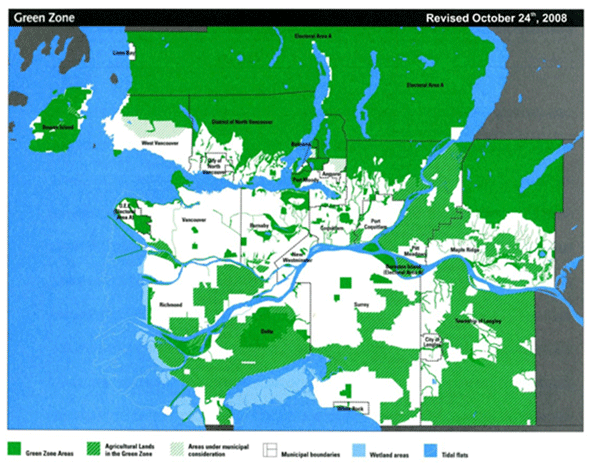
    To be sure, geography deserves much of the blame for Vancouver’s high housing costs. But a large chunk of the blame lies with restrictive municipal and provincial land use policies. Since the introduction of the city’s first comprehensive plan in 1929, Vancouver has used various land use regulations to create dense mixed use development in order to protect green space surrounding the city. In 1972, the provincial government passed legislation aimed at protecting BC farmland. This left less than half of the already scarce land in Greater Vancouver off limits to developers. As a result, the city is circled by undeveloped land, referred to as the Green Zone. The Green Zone acts as a de facto urban growth boundary, largely designed to prevent sprawl.

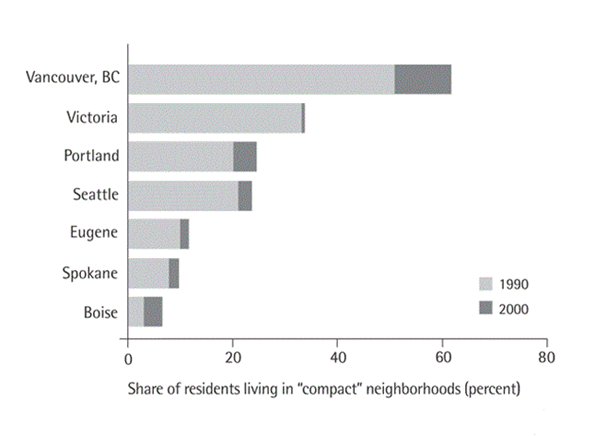
    As a result, Vancouver is one of the few North American cities that have been growing almost exclusively upwards, rather than outwards for the last century. Its narrow streets and lack of a major highway running through the city make it one of the least automobile friendly cities on the continent. Unsurprisingly, Vancouver was ranked the most smart growth oriented city in the Pacific Northwest by the Sightline Institute. Roughly three times more Vancouver residents live in compact neighborhoods as a percentage of the population compared than Portland or Seattle. This arguably makes Vancouver the most smart growth oriented city in North America.

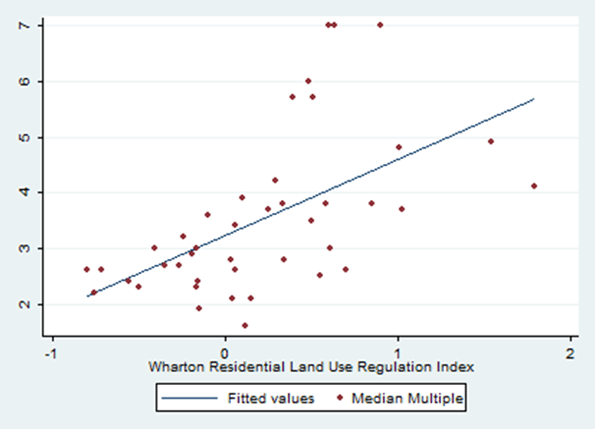
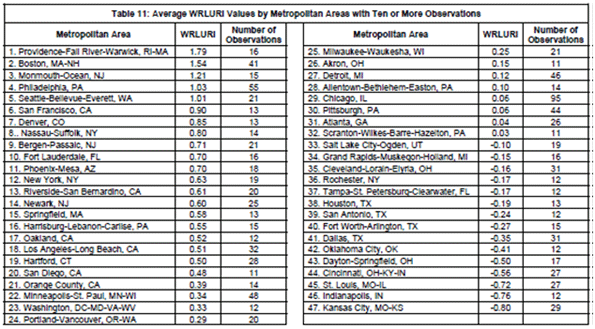
    Smart growth has become a truism for urban planners. Walkable communities with a mix of commercial and residential units combined with strict zoning regulations to encourage transit usage is a formula increasingly prescribed for North American cities. Though many smart growth principles are attractive, there is an strong correlation between heavy land use regulations and housing costs. Using data from the Wharton Residential Land Use Regulation Index (WRLURI), and Demographia’s International Housing Affordability Survey, a simple scatter plot diagram has been included to illustrate this correlation.

    The WRLURI measures the stringency of land use controls imposed on various US jurisdictions by state and local governments. There is a clear correlation between high regulations, and low housing affordability. Though the index does not include Canadian cities, it does include neighboring Seattle. Seattle ranks fifth of 47 cities on the Wharton Index. According to a recent study in Boston College International & Comparative Law Review by David Fox, Vancouver is decades ahead of Seattle in terms of smart growth policies. This means that Vancouver would rank at least fifth in North America on the index, though it is more realistic to assume it would most certainly top the index.

    In addition to smart growth policies, Vancouver also has very stringent inclusionary zoning laws. Inclusionary zoning requires developers to provide a certain number of affordable housing units in any given development. This policy might seem to make the city more affordable, but it functions exactly like rent control. Those fortunate enough to find spaces in the affordable housing units pay less, but the subsidized rent is made up for by higher rent in adjacent units. In a study of inclusionary zoning in California cities, Benjamin Powell and Edward Stringham from the Department of Economics at San Jose State University found that inclusionary zoning imposes an additional $33,000-$66,000 cost on adjacent market rate units.

    There have been some recent policy initiatives that may reduce the cost of housing marginally. In 2004, the city amended its zoning code to permit secondary suites throughout the city. Secondary suites are subdivided units of owner occupied homes that are used as rental units. This zoning change brought tens of thousands of relatively low cost units into the market. There are currently 120,000 secondary suites in the province. The city recently went one step further to allow homeowners to convert laneway garages into rental units. These units have a maximum of 500 square feet. There are 70,000 homes in Vancouver that are eligible for conversion, though it is unclear how many will take up the offer. This will add to the stock of relatively affordable rental housing in the city, but may not significantly reduce housing costs. In fact, by increasing the revenue generating potential of houses, it may actually increase the cost of purchasing a single dwelling home. After all, if the potential rental income of a single dwelling unit increases, the market price of the unit is likely to do the same. This isn’t necessarily an argument against the policy, though it does underscore the fact that housing costs in Vancouver will never decrease without liberalizing municipal and provincial land use policies.

    In short, the City of Vancouver and Province of British Columbia have chosen to favor compact growth over affordable housing costs. This likely makes the city more attractive to affluents from both the rest of Canada and abroad, but increasingly makes it unaffordable for middle class families. There is certainly some substance to the Economist’s claim that Vancouver is the most livable city on earth. It is a very attractive place for those who can afford it. Nevertheless, creating a city fit only for the wealthiest segments of society and non-families is hardly something to be proud of.

    Downtown Vancouver photo by runningclouds

    Steve Lafleur is a public policy analyst and political consultant based out of Calgary, Alberta. For more detail, see his blog.

  • City Thinking is Stuck in the 90s

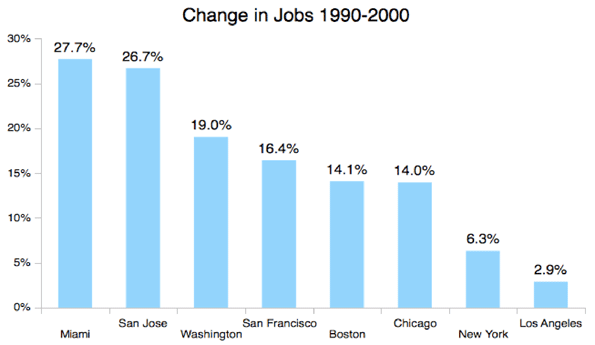
    The 1990s proved to be quite a nice decade indeed for most of America’s largest cities. It was an era of general prosperity in all of America to be sure, but in contrast to previous decades, the turnaround also extended from the suburbs to many of the nation’s biggest cities, notably New York, Chicago, Miami, San Francisco and San Jose. The notion – popular in the 70s and 80s – associating cities with a sour and fatalistic sense of decline and dysfunction, or even anarchy, in the 90s finally began to evaporate. There emerged a bracing new sense of optimism that these large cities had found a new role for themselves in the world.

    This is evident from the large decreases in crime in these cities where lawlessness once reigned and also from the job numbers from that decade, when all of America’s tier one metros added jobs.

    Some of these places lagged overall US growth, but considering their lower rate of population growth most of these cities enjoyed robust economies. The aerospace and defense center of Los Angeles, hit hard by the post-Cold War “peace dividend”, and the devastating 1992 riots, was a partial exception.

    The 90s saw the convergence of two trends that profoundly benefited these cities: the digitization and globalization of business. The 90s were the heart of the digital revolution. At its beginning, corporate “data processing” was still dominated by mainframes and personal computers were not yet fully deployed even on corporate desktops. By the end of it, the internet was widespread and had caused a business revolution. In the middle were several waves of technology change and disruption: first client/server, then internet based computing, PC and mobile phone ubiquity in business, the Y2K retrofit, and the beginnings of integrated Enterprise Resource Planning systems.

    The 90s also saw a lesser known revolution in American business: deregulation and structural changes. In the past many businesses that had previously operated on a local or regional basis – banking, utilities, retail, etc – got rolled up into much larger super-regional, national, and increasingly global players.

    These shifts provided big benefits to these tier one cities. Obviously high tech havens like the Bay Area, DC, and Boston did particularly well in this decade. Also performing strongly were professional services hubs like Chicago. These rapid waves of technology and business change created a lot of new openings for professionals to master, not just by creating and implementing technology, but also in adapting business processes to the new realities as well as managing the organizational change journey. These newly rolled up businesses also needed the types of services firepower typically located in larger locales, stimulating further demand. Notably, virtually all of this demand was satisfied with employment growth on shore, much of it in these tier one cities.

    The 2000s, however, were a very different story. This decade began with the dot com bust and its associated recession, a funk from which the Bay Area economy has yet to fully recover despite Silicon Valley’s continued reign as high tech capital. Similarly, while specialized professional services still flourish, the more mainline areas, such as IT implementations or business process outsourcing, found themselves under significant pressure as digital business matured.

    This caused one commentator to famously declare that “IT Doesn’t Matter.” Then the offshore wave, which had been a born in the 1990s, began to suck away services work just as had occurred previously in manufacturing. This included not just low skill business process outsourcing like invoice processing, but also high value IT engineering and other services not dependent on face to face interaction. This, we found out, could be performed by high skill, low cost labor in places like India.

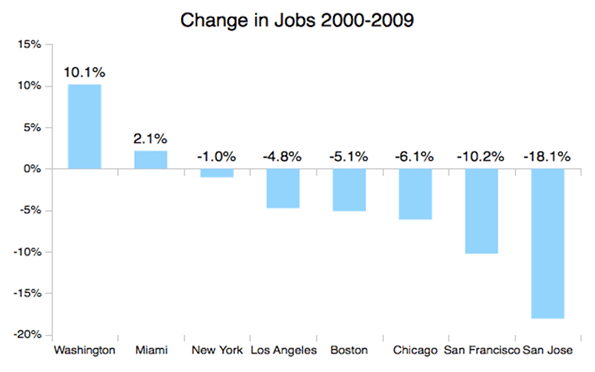
    This helped to create a so-called “lost decade” of job creation in the US during the 2000s. The tier one metros, save for recession-proof Washington, fared even worse, losing jobs during the decade.

    These are facts and trends that barely impacted the world of urbanists, who continued to act as if nothing had changed. The media, located almost totally in primary cities, bought the message but rarely looked at the basic facts.

    As a result, when it comes to thinking about America’s big cities, too many people remain stuck in the 90s.

    Partially this is understandable. The 2000s saw strong increases in GDP per capita in many of these cities. Also, they experienced huge real estate booms and an associated increase in high end amenities of all kinds: swanky hotels, starchitect buildings, upscale new restaurants and shops, etc. But a lot of this has proved somewhat self-delusional. Like Citigroup CEO Chuck Prince’s now infamous statement that “As long as the music is playing, you’ve got to get up and dance,” these cities continued to party like it was 1999 even as their job base continued to erode and the real estate bubble headed for a crash.

    Today, as the Great Recession has civic finances in a vice grip, and places like Chicago and Los Angeles face stunning budget shortfalls, people are less sanguine. Advocates for the big city model still refuse to face up to the core problems that face our large cities. The real issue should not be how to restart the condo boom, but how to restore what drove the resurgence of the 90s: job creation. This is a national problem to be sure, but not one that seems to interest most big city advocates. It’s almost as if there’s an assumption the jobs will come without working for them. The stimulus and bailout, which helped key urban sectors like green building, university research and public employees, is now running out of steam and political support. In the long run they may have served largely to exacerbate complacency.

    So rather than a focus on private sector job growth, many urban boosters have remained free to focus on other things like sustainability and lifestyle enhancers in the assumption they would generate jobs But what if it doesn’t work out that way? What if the current economy, unlike those boom years of the 90s, does not generate enough money and employment to support these huge regions?

    These cities would be well-advised to go beyond counting skyscrapers, new condo construction, green roofs, and bike share programs. Those things are all good, but basic measures of civic health and dynamism like job growth ultimately underpin those things for the long haul. More than anything, these cities need to be fundamentally focused on their commercial success. Their great challenge is figuring out how to recapture that previous era of job growth, and once again become engines of employment.

    Aaron M. Renn is an independent writer on urban affairs based in the Midwest. His writings appear at The Urbanophile.

    Photo by Werner Kunz (werkunz1)

  • In California Cool is the Rule, but Sometimes, Bad is Bad

    Californians value cool. I’m not sure how this came to be. It might be the weather. It might be the entertainment industry. Whatever the reason, Californians don’t get excited. Better to go with flow than to get excited. Things will be ok. Concerned about the economy? Stay cool Dude. It’ll come back. Always has. Always will. Relax.

    It’s not cool to get excited, or heaven forbid, panic. Californians are not quick to react to problems, so confident that eventually the problem will just go away. This was forcefully brought home to me when a member of California’s legislature told me that “It doesn’t matter what we do in this building. California will always rebound.”

    California’s governance is seemingly designed to enforce cool in the government. Term limits, two-thirds requirements, and bipartisan gerrymandering combine to insure that change is not legislated. So you see absurdities, such as the legislature’s worrying about the asbestos content of the State Rock while the budget-less State goes down the path of bankruptcy and economy collapse.

    Institutionalized stasis is why I don’t think it matters who wins the upcoming gubernatorial election. Neither Mercurial Meg Whitman nor Moonbeam Jerry Brown will cause Sacramento to actually do anything to change California’s trajectory.

    Veteran capital-watcher Dan Walters likes to say that when legislators do agree and actually do something important, it’s usually bad. He cites California’s failed “electricity deregulation” back in 2000 as a case in point. The state does have a release valve, the initiative, which is much hated by the political class. But it is their fault. Legislative inaction is probably one reason for the increase we’ve seen in ballot initiatives. Of course, initiatives are seldom the optimal way to create change.

    Proposition 13 is an excellent example. Sacramento was aware of the property-tax problem, but was unable to deal with it. That created a vacuum, and the radical tax reformers stepped in. The result was a far more draconian and less flexible law than necessary or desirable. That’s the way initiatives work. The legislature fails to legislate. Inaction creates a vacuum. The vacuum is filled by more extreme interests. The resulting law is almost always flawed.

    California cool may be legendary, but as the Huey Lewis song says, sometimes bad is bad, and California’s economy is bad, very bad, and it’s not going to get better soon without real change. Plenty of lawmakers, especially the governor, are counting on renewable energy and green industry to provide California with an economic rebirth. It won’t happen. Read why here and here.

    I’m thinking that now would be a good time for Californians to lose their cool.

    Recently, Boeing announced that it is moving two programs from Long Beach California to Oklahoma. The move will cost California about 800 mostly well-paid engineering jobs. This is a relatively small event in an economy the size of California’s, but it is part of a steady drumbeat of businesses leaving California. Northrop Grumman has already decamped. General Dynamics’ San Diego shipbuilding subsidiary, Nassco, is shrinking its workforce by 300 workers, most of them highly skilled. Even the entertainment industry is slowly reducing its footprint in California. The list goes on and on.

    The main reason: California is an expensive place to do business, and the expense is made more onerous by uncertainty about future taxes and regulation. Consequently, those businesses that can increasingly are departing for more reliable, friendlier climes.

    Policy makers may find excuses for each of these events, but the persistence and size of the differences between California’s economic performance and those of better-managed states indicate something few in Sacramento understand: many of California’s economic problems are self inflicted. How big is the difference between California’s economy and other states? The unemployment rate provides one answer: California’s unemployment rate is about 30 percent higher than that of the rest of the country. That’s big, far larger than can be explained by demographic factors.

    High and persistent unemployment is not the only result of California’s job-killing environment. Income inequality is increasing, a legacy of declining opportunity for skilled blue collar workers and a failed educational system. Home prices and sales will not recover for years. Commercial real estate is in freefall, and we may not see anything approaching full occupancy for a decade. Real-per-capita retail sales may never recover, a result of joblessness, high taxes, and increased internet competition. Perhaps the most telling trend is that domestic migration has been negative for most of the past 15 years, as people vote with their feet and seek opportunity in other states.

    About the only source of hope, in a perverse way, is that government revenues are down. By now, it should be clear, even to those who thought their income was independent of economic activity, that a prosperous private sector is a necessary precondition for general prosperity. Professors, non-profit-sector workers, and government employees are learning the hard way their dependence on the private sector. We can hope that personal interest will drive them to more enlightened policy.

    That hope is tempered, though, by the political class’s willingness to embrace the mirage of a free lunch. The AB 32 climate change and SB 375 anti-sprawl bills were the result of a well-meaning search for the Holy Grail of costless environmental and economic virtue.

    Environmental and economic interests are not inherently incompatible, but environmental quality is not costless. In fact, it is a luxury good. Wealthier societies invest far more in environmental protection and rehabilitation than do subsistence societies whose primary concern is finding the next meal. In short, environmental protection requires investment, and wealthier societies are better able to pay the price.

    California’s leadership’s embrace of AB32/SB375 is unlikely to achieve any of its goals. It will be a drag on economic activity. Its impact on global greenhouse gasses will be negligible. Worse, it is very inefficient. Economic research is not ambiguous. Subsidies and command-and-control regulation are far from the cheapest way of improving the environment. The best way to reduce greenhouse gas emissions is through a rebated tax. This would be a carbon tax, where the tax revenue would be rebated to offset a more distortionary tax, say a labor or capital tax. This simultaneously discourages the bad, pollution, while encouraging the good, work or investment.

    AB32/SB375 is certainly not the source of all of California’s problems. The state has lots of them, and it’s time we took a serious approach of addressing them. Maybe, we should lose our cool and demand real leadership from Sacramento.

    Bill Watkins is a professor at California Lutheran University and runs the Center for Economic Research and Forecasting, which can be found at clucerf.org.

    Photo by Duncan H

  • Millennials Are Looking for Something Completely Different

    As the country’s political distemper grows, many commentators, reflecting their own generational biases, mistakenly assume that voters are looking for less government as the solution to the nation’s ills. But survey research data from Washington think tank, NDN, shows that a majority of Americans (54%), and particularly the country’s youngest generation, Millennials, born 1982-2003, (58%), actually favor a more active government, rather than one that “stays out of society and the economy.”

    “Dissatisfaction with Obama and the Democratic Congress,” generational expert Neil Howe has observed, “is probably more fed by their failure to use government boldly and vigorously to face hard challenges than by their excessive boldness.”.

    What Millennials are looking for in terms of public policy, to borrow John Cleese’s warning to his Monty Python audience, is something completely different. They are not buying into the tired approaches of either party that have produced the current partisan gridlock in Washington.

    Millennials are not interested in letting ideological posturing stand in the way of “getting stuff done,” as they like to say. Their generation’s idealism – in sharp contrast to the more ideological approach adopted by Boomers – is characterized by a pragmatic impulse focused on finding practical solutions to problems. Much like the civic generations – most notably the World War II era “greatest generation” – before them, Millennials want to reinvigorate the nation’s institutions utilizing government to improve basic conditions in areas as diverse as health care, education and environmental protection.

    However, unlike America’s last civic generation, the GI Generation (born 1901-1924), Millennials do not want to place responsibility for achieving their desired results in a remote, opaque bureaucracy. After all, Millennials were not shaped either by the New Deal era or the Second World War, when government expanded to deal with economic and international concerns that threatened the very existence of American democracy. . Instead they tend to see government’s role more like that of their parents who set the rules but left room for negotiation on what the rewards would be for abiding by the rules as well as the consequences for not doing so. In this Millennialist approach, government provides information and resources to help individuals connect and learn from each other but let’s each person decide how best to discharge their civic obligations.

    The healthcare reform legislation that was forged out of the white heat of the political debate in Congress came surprisingly close to this model. It disappointed ideological Boomers on both sides of the aisle. Liberals didn’t get their dream of a single payer system or even its “nose-under-the-tent” counterpart, the so-called public option. But conservatives were unable, even after Republican Scott Brown’s surprise election as a United States Senator from deep blue Massachusetts, to prevent Congress from mandating that every person in America buy health insurance in order to achieve the goal of universal access. By building a framework for universal coverage on the scaffolding of the existing private insurance system, the final legislative solution used the liberal approach of regulation and national mandates to create a new role for government, but kept government out of the business of actually providing health care.

    The final shape of that reform reflects a new Millennialist approach to the making and implementation of public policy. This approach will result in setting new national standards in many aspects of our national life while, at the same time, allowing individuals to make their own choices about how to comply with those standards.

    The recent adoption by a majority of states of national curriculum standards for what students must learn in core disciplines such as English, math and science is further evidence of this trend. These standards, developed and coordinated by the National Governors Association Center for Best Practices and the Council of Chief State School Officers, outlines “the knowledge and skills students should have within their K-12 education careers,” without dictating how schools should teach the material.

    Meanwhile the Obama administration’s “Race to the Top” grant program, has sparked a firestorm of educational reform legislation in states competing for the money that weaken the hold of administrators and teachers’ unions on what goes on in the classroom. The demands of the parents of Millennials for bottom line results, reflected in such grass roots initiatives as the Parent Revolution in California and Connecticut, is providing the political support needed to take on the current educational monopoly. This will help open the door to widespread experimentation about what works best at the local school level.

    As of yet, there is no sign at the national level that a more Millennialist approach to addressing concerns over global warming and environmental degradation has been achieved. But the failure of Congress to pass more bureaucratic approaches, such as cap-and-trade, suggest there is an opportunity for such ideas to take hold in the future. For instance, a campaign to reduce the carbon intensive nature of the nation’s infrastructure could include a government sponsored effort to display the carbon footprint of most consumer products. This would allow individuals decide how to alter their personal purchasing decisions to produce the most environmentally favorable results.

    Similarly, the goal of reducing fuel consumption per family could be achieved by providing tax incentives for telecommuting or for trading in aging gas guzzlers for vehicles that exceed the newly strengthened fuel economy standards for passenger cars. These policies, and others like them, would leave it up to each individual to decide the extent to which they wish to contribute to environmental improvement. Just as anti- smoking campaigns financed by taxes on cigarettes has been found to be an effective deterrent to smoking , the strategy would be to “nudge” rather than command behavior in order to achieve the desired policy goal. Given the strong environmental sensitivity of the younger generation, this approach will likely accomplish more in terms of actual carbon usage reduction than the ideologically-driven schemes proposed by Boomers in Congress.

    The trajectory of public policy in a Millennial Era is becoming increasingly evident. The push for an increasing number of national standards and preferred behavior will cause libertarians to decry the evolving “nanny state” and argue strenuously against an increasingly intrusive government. But liberals, too, may be upset by approaches that eschew “top down” bureaucratic solutions and focus on using government to improve society without new administrative burden.

    In the future the public, led by Millennials, will be the one forging sustainable solutions. National consensus, coupled with localism and individual choice, will become the watchwords of the nation’s newest civic era.

    Morley Winograd and Michael D. Hais are fellows of the New Democrat Network and the New Policy Institute and co-authors of Millennial Makeover: MySpace, YouTube, and the Future of American Politics (Rutgers University Press: 2008), named one of the 10 favorite books by the New York Times in 2008.

    Photo by Vincent J. Brown

  • A Localist Solution

    By Richard Reep

    “There is a great deal of historical evidence to suggest that a society which loses its identity with posterity and which loses its positive image of the future loses also its capacity to deal with present problems, and soon falls apart.”
    –Kenneth Boulding, economist and philosopher (1966)

    Written in the depths of the Cold War, when nuclear annihilation appeared imminent, if not inevitable to some, Boulding’s words remain applicable to today’s popular culture. Increasingly unable to imagine a positive future since the 1990s, we have largely replaced the end of the nuclear threat with the beginning of global warming, among other environmental threats. Others have raised the spectre of Chinese global domination or a prolonged and destructive jihad from the Islamic world.

    Fatigued by perpetual threat, our society appears today to have largely lost its capacity to deal with present problems. Government, media and academia all have largely adopted, and even sought to expand their own power, by exacerbating this sense of omnipresent threat. Pick your thesis and line up your dialectical arguments, and you can almost hear the politicians and business leaders talking past each other already. And so goes our contemporary cultural conversation.

    In this circumstance, the task of rebuilding a sense of optimism and resilience has fallen on a number of local community groups seeking to find an alternative pathway out of the current zeitgeist. As the politicians turn up the volume, individuals are simply turning them off, and inventing solutions that address tomorrow’s needs. From these efforts come the most significant optimism for the future.

    Nondialectical change seems to be the only hope in a society where progress, particularly for the hard-pressed middle class, seems increasingly dubious. Small, isolated, cumulative efforts that begin on the grassroots level – localism – are our best, most positive pathway out of the seemingly intractable argument engaging western scientific society.

    Based in communities, families and churches, these groups are very different from those – on both sides of the political aisle, in the corporate world, the media, the scientific and academic communities – who hope to benefit from a climate of gloom and hopelessness. These are people who are thinking not how to gain more power or influence, but to make lives better for themselves, their neighbors and their children.

    Intentional communities. People creating a community around the intention of responsible environmental stewardship began this movement in Vermont in the 1990s. They represent a vehicle for a community to take responsibility for its environmental impact, wherein homeowners’ dues go towards an engineer’s time to monitor the community’s own wastewater treatment system, electrical power generation, and other needs defined by the community. It has parted company with conventional towns and cities, and today this movement represents any groupings of like-minded individuals around ecological concerns, religious affiliations, and other niche interests as a way of dropping out of the mainstream. Coping with stress by removing oneself from the city helps the individual, but leaves the city behind.

    The transition movement, begun in the United Kingdom, may be another pathway, based on the notion of peak oil. Encouraging bicycle riding, walking, and preparation for a low-hydrocarbon future, transition at least increases everyone’s exercise level. It is spreading quickly across America with local organizers creating visioning meetings and action plans, hoping that community strength will be a force multiplier. These movements are building in cities, where the hard work needs to be done. In Central Florida, Transition Orlando leader Jim Belcher facilitates community workshops focused on creating a shared vision for the future of this region. By July, its third gathering attracted over 60 people coming to realize that the future starts here, not in Washington or New York.

    The Living Building Challenge, begun in the Pacific Northwest, is yet another pathway, based on the notion that buildings can actually produce energy and clean water while cleaning pollution. Turning the conventional model on its head, building owners engaging in this process have already produced a few examples that appear to meet their self-imposed requirements to be restorative in character. This initiative takes the existing real estate development industry, sorely in need of reform, down a new road as well. With over 70 buildings being analyzed for compliance with this very new standard, four are close to meeting this challenge: a residence in Victoria, British Columbia; the Tyson Living Learning Center in Eureka, Missouri; the Omega Center for Sustainable Living in Rhinebeck, New York; the Hawaii Preparatory Academy Energy Laboratory in Waimea, Hawaii and the EcoCenter at Heron’s Head Park in San Francisco, California. More projects like these will have an impact on how people think about the role of buildings in society.

    In all these movements, the emphasis is on the process rather than the product. No leadership claims to have all the answers. The importance of this cannot be overstated. With a sense of desperation, communities seem too quick to turn solutions – often concocted from the outside by groups with distinct national or global agendas – that closes off all future dialogue and process, as if the future cannot be trusted to meet its own needs. These approaches may appear to address this generation’s anxiety over the future, but zips the lips of the future generation. A more open, indeterminate vision allows inconsistencies and conflicts to be solved as they arise. Teleological fantasies can only go so far.

    Due to their small size these micro-movements and others mean little if considered individually, and they are easy to dismiss as experiments. They are also reactions to the dialectic, whether peak oil or global warming. The important thing about them is not which side they react to, but rather what they are doing about it, and the gradual, step-by-step basis through which individuals and communities can act.

    These developments should be watched carefully if a positive image of the future is yet to be regained. Enough destruction has occurred, and rather than bemoan the loss of our past lifestyles and bemoan a future of scarcity, the middle class might look at it rather as a freedom to change and grow stronger, more resilient, and less dependent upon the oligarchy of organized interest groups, academic influence, media money and power.

    Richard Reep is an Architect and artist living in Winter Park, Florida. His practice has centered around hospitality-driven mixed use, and has contributed in various capacities to urban mixed-use projects, both nationally and internationally, for the last 25 years.

    Photo by photobunny

  • Flexible Forecasting: Looking for the Next Economic Model

    Last autumn I gave a talk in California’s San Fernando Valley. I was the last of three economists speaking that day, and I watched the other economists’ presentations, each a rosy forecast of recovery and imminent prosperity. So, I was a bit nervous when it was my turn to speak, because I had a forecast of extended malaise. People don’t like to hear bad news, and they do blame the messenger. In the end, I was relieved. No tomatoes, no catcalls.

    That’s how things went last fall and winter. Many economists confidently predicted a rapid recovery, while my group’s forecasts were pretty dismal: weak economic growth with little if any job creation. Today, many of those same economists’ forecasts are far closer to ours. Why?

    Part of the problem is the fact that macroeconomics is an unsettled discipline. We have lots of macroeconomic models, none of which is adequate for all states of the world all the time. Each provides insight, but no single model can cope with the awesome complexity of the world. A large part of the art of forecasting is determining which model is most applicable to the current situation; which ones include insights that are dominant today.

    The problem is exacerbated when economists become excessively committed to a particular model. This isn’t religion or politics, it’s forecasting. It is hard enough. There is no reason to handicap yourself by excessive fealty to some model or doctrine.

    There was another problem that resulted in the change of tune. The world changed in September 2008. We call it a regime shift. It’s a move from one (good) equilibrium to another (bad) equilibrium. Statistical models that worked well in the old regime don’t work in the new regime. We hustled to adjust our models, but admitted that with limited experience in the new regime, we were less confident in our forecasts.

    The problem with a regime shift is that it is similar to a change in the rules of a game. Old relationships don’t hold anymore. Football is an example: If you changed the rules to allow five downs instead of four, nobody would predict punts on fourth down.

    Some economists didn’t recognize the regime shift. They went about their business using the same old models in a new world. Comments about the length of a typical recession or about how sharp declines are followed by rapid recoveries were clear signals that the speaker didn’t understand the situation.

    Some economists were fooled by the stimulus. The rules of accounting cause government spending to be reflected as an increase in economic activity. Stimulus plans such as Cash for Clunkers and tax credits for home purchases moved the timing of transactions, artificially reinforcing the direct spending impacts. Similarly, bailouts and foreclosure prevention programs postponed the recognition of losses.

    Many interpreted the resulting increase in last winter’s reported activity as permanent, but that could not be. We were not building anything or laying the groundwork for sustained prosperity. Instead, we were just continuing the previous decade’s consumption binge. The banks had failed, but the government had stepped in. It became the mother of all banks, borrowing from future citizens and other countries to fuel today’s consumption.

    Regime shifts that lead to a bad equilibrium appear to be similar to bank runs. There need be no basis for panic, but a panic can guarantee the demise of a bank. The result of a panic on a bank ends there. The bank is failed, gone. There may or may not be a contagion effect on another bank.

    A panic can also guarantee an economic decline. But our economy is different than a bank. It can’t fail, in the sense that we can’t shut it down and walk away. We’re all still here after a regime shift. We’re stuck with a mess.

    We did have a mess after September 2008. All of a sudden, everyone’s wealth had declined, a lot. Businesses, consumers and governments were over-leveraged. Risk aversion had increased, perhaps to remain high for decades. Our understanding of economic risks had changed. We had discovered black swans – rare and unexpected outliers — in our system.

    The problem with regime shifts is that we don’t know how to initiate or cause them. We see shifts to bad regimes, and we can see their self-fulfilling nature. Can there be some self-fulfilling process that leads to a shift to a better regime? I hoped so, and I hoped that Obama’s election would initiate such an event. Our forecasts aren’t based on hope though, and it’s just as well that we didn’t forecast that his election would generate a spontaneous recovery.

    Today, enough time has passed that even the most slowly adapting forecasters are forced to confront the post-2008 data and the government’s failed economic efforts. As forecasters confront these facts, their forecasts are becoming increasingly gloomy. Now, forecasts of protracted malaise or even a double-dip recession are increasingly common. Why?

    Because we borrowed to extend a consumption binge, and we compounded that error with omissions and perverse policy.

    The stimulus’s omissions are glaring. We didn’t significantly invest in infrastructure that would improve our future growth. We failed to address the weaknesses in our education sector that fuel increasing inequality, sentence many to a life of hopelessness, and permanently constrain our economic growth. We did nothing to encourage small business’s growth; in an example of perverse policy, we are actually creating a new regulatory regime that favors large companies.

    Then there were the actions that will probably restrain future economic growth. The minimum wage was raised. We had health care reform, but we didn’t address the real problem: the fact that the health care consumer pays an insignificant portion of the bill at the time of consumption. We had financial reform that failed to address the fundamental problems of too-big-to-fail, and we protected risky activities, increasing the regulatory burden and crippling the ability of small banks. We halted much of our offshore drilling.

    Looking forward, there is little reason for optimism. We’re considering huge increases in our energy costs through greenhouse gas regulation. We have a massive tax increase scheduled at the end of the year.

    While a double-dip recession is not the most likely outcome, we can’t reject the possibility. More likely, we face a long slow struggle to overcome ourselves and restore real prosperity. The forecasters’ consensus appears to be moving toward accepting that reality.

    Flickr photo of Petra’s Yoga Poses Around The World

    Bill Watkins is a professor at California Lutheran University and runs the Center for Economic Research and Forecasting, which can be found at clucerf.org.

  • Melbourne: Government Seeking Housing Affordability

    Once a country known as “lucky” for its affordable quality of life, Australia has achieved legendary status as a place where public policies have destroyed housing affordability for the middle class. Draconian land rationing policies (called “urban consolidation” in Australia and more generally “compact city” policy or “smart growth”), have made it virtually illegal to build houses outside tightly drawn urban growth boundaries that leave virtually no room for new construction beyond the urban fringe. As a result, house prices have increased to the point that Australia now suffers one of the most unaffordable markets in the world.

    The consequences of this may finally be dawning on some governments. The state of Victoria, for example, is expanding its urban growth boundary around Melbourne.

    Severely Unaffordable Australia: The Reserve Bank of Australia (the central bank) has described the considerable extent to which house prices have increased relative to incomes since the 1980s. The annual Demographia International Housing Affordability Survey makes similar findings, showing that the price of housing has doubled or tripled relative to household incomes over the past quarter century. All major markets in Australia are “severely unaffordable.” This has occurred in a country that has long boasted one of the largest home ownership shares in the world, which epitomized the “Great Australian Dream.” Until urban consolidation policies were widely adopted and strictly enforced, Australia’s housing affordability (measured by the Median Multiple, which is the median house price divided by median household income) was virtually the same as that of the United States.

    That has changed radically. Over the past two years, the median house price in Melbourne, has risen by 30%.

    Expanding Melbourne’s Urban Growth Boundary: In this environment, it comes as welcome news that the Brumby Labor government has enacted an expansion of the Melbourne urban growth boundary. The initiative attracted broad based support, including that of the Liberal-National opposition in the Victoria (state) parliament. The government expects that the expansion will “maintain” housing affordability.

    There was, not surprisingly, the kind of hysteria that has become typical of Australian land use debates. Suburban Casey Mayor Lorraine Wreford expressed concern that the expansion would consume agricultural land and increase food costs. In fact, the higher costs that Melburnians are paying for housing as a result of the urban growth boundary is more than enough to pay grocery bills for the neighbors on both sides.

    The “loss of agricultural land” argument is even more daft in Australia than in the United States. Australia’s agricultural production continues to improve, which has permitted huge amounts of land to be abandoned and returned to its natural state. Since 1981, an area nearly the size of New South Wales has been taken out of agricultural production. Lest anyone think that urbanization is a factor, this is more than 50 times the land area of all the urbanization that has developed in Australia since western colonization began.

    Will it be Enough? The risk, however, is that the urban growth boundary expansion may not be enough to materially improve housing affordability. The expansion is modest, at less than 170 square miles (440 square kilometers*). Worryingly, the government indicates that this will be the last urban growth boundary expansion in this generation.

    How Much Land is Needed for Housing Affordability? However, US experience indicates that a surprisingly small amount of developable land beyond the urban fringe may be enough to keep land and house prices from escalating.

    For example, Portland’s urban growth boundary appears to have had little cost escalation impact on house prices until the 1990s, when urban fringe developable land within the urban ground boundary fell to less than 10% compared in relation to the already developed urban footprint (Note). This is the equivalent of a developable ring around Portland of less than one/half mile (0.8 kilometers in Portland).

    As the developable land became more scarce, house prices escalated. Now, Portland house prices are more than one-third above the historic Median Multiple norm of 3.0 and they peaked at more than 60% above during the housing bubble.

    Similarly, there are virtual urban growth boundaries in Las Vegas and Phoenix. These development constraints are defined by circumferential government owned land, which has been released to the market at rates intended to maximize revenues, which means they minimize housing affordability. Yet these constraints appear to have had little impact on prices until developable fringe land dropped to below 20% relative to the urban footprint.

    Strengthening Melbourne’s Competitive Position? The Victorian action may have been impelled by a recognition that the affordability-driven economic stagnation already existent in Sydney could well spread. This could help to restore Melbourne to its role as Australia’s principal urban area, more than a century after having been dethroned by Sydney. Bernard Salt, one of the nation’s leading demographers, has predicted that Melbourne’s population will exceed that of Sydney by in less than 20 years.

    Offering Australia’s future generations the chance to live out the Great Australian Dream by improving housing affordability could not only expand Melbourne’s competitive edge over Sydney, but could even neutralize fast-growing Brisbane’s trajectory. Ross Elliot has suggested that the new Southeast Queensland Regional plan could seriously retard growth in that vibrant area.

    Are Australian House Prices in a Bubble?

    There is a raging debate over whether Australia’s housing price boom is an asset bubble. International financial analysts Edward Chancellor, who correctly predicted the Great Recession, believes that Australian housing is a bubble that will burst before long. Others disagree. Either way, Australia loses.

    • If Australia’s price boom is a bubble, history says it will burst (as virtually all do), likely inflicting serious damage to the economy. In this regard, Australia could be more at risk than the United States was in its housing bubble burst, since housing in virtually every market, large and small, has been driven up to unsustainable levels. In the United States, the bubble was contained within markets accounting for about one-half of housing, where Australian-type planning policies were in operation. Other markets, such as Houston, Dallas-Fort Worth, Atlanta and much the Great Plains did not experience the bubble.
    • If Australia’s planners have simply succeeded in raising the long term price of housing and there is no bubble (as many Australian analysts suggest), then future generations of Australians will have much less money to spend and their standard of living will lower than it would otherwise have been.

    Regrettably, the spirited debate over an Australian “bubble” is far different that the public deliberations that preceded the adoption of urban consolidation policies in Australia. For the most part, state governments and planning academics carefully avoided any discussion of the housing affordability consequences. Perhaps this was out of ignorance. But whatever the intentions, the smart growthers have imposed great costs on both present and future generations of Australians.

    —–

    Note: This is a far smaller area than recent research suggesting a relationship between geographic constraints (mountains and other undevelopable land) and higher house prices. Research by Albert Saiz at Wharton uses a 50 kilometer (30 mile) radius from the urban core to identify the share of land that can be developed. The data in the research would indicate that more than 1,750 square miles are developable, yet Portland is among the more geographically constrained according to this analysis. This seems to be an unreasonably large area for measuring the impact of geographical constraints. It is nearly 4 times the urban footprint of Portland and is nearly 60 times the developable land area that exhibited virtually no impact on housing affordability in Portland in the early 1990s and is more land area than covered by all but 8 of the world’s largest urban areas. It is to be expected that that politically imposed development constraints (strongly enforced as in Portland and Australia) render any more remote geographical constraints irrelevant.

    Photo: Inside the expanded urban growth boundary: Western Freeway toward Melton (photography by author)

    *The original version of this essay read 17 square miles and 44 square kilometers.

  • Ownership Subsidies: Dream Homes or Disasters?

    Home ownership has been considered an integral part of the American Dream for as long as anyone can remember. Now it has come under scrutiny, notably in a June Wall Street Journal piece by Richard Florida, which claims that that home ownership reduces employment opportunities for young adults, since it limits their mobility. To support ownership, others — particularly Wendell Cox — have argued that home ownership levels do not correlate with the economic productivity of cities, and cite the rapid suburban development in the Sunbelt as evidence that home ownership is as valuable as ever.

    My inclination is that the truth lies somewhere in between the two sides of the debate. For the sake of simplicity, I’ll refer to them as New Urbanist supporters versus Smart Growth opponents (I realize these are broad generalizations). While they disagree on the merits of home ownership, there’s an interesting point of agreement: both sides oppose subsidies to homeowners. I’d argue that both sides should focus on getting the issue of discontinuing subsidies onto the national agenda.

    Like many 20-something young professionals, I have no aspirations towards home ownership. I ditched my car when I moved out of the suburbs, and I refuse to sign a lease that lasts more than three months. This affords me the flexibility that my life as a freelancer requires. If I were in a profession that didn’t call for a great deal of mobility, perhaps home ownership would be appealing. When North America was a manufacturing powerhouse, most people were in that situation. But an increasingly dynamic labor market requires an increasingly mobile workforce… to an extent.

    For those of us in the 18-30 demographic who work in fairly mobile industries, home ownership isn’t necessarily as big a hindrance as Florida suggests. There are people like me who work in volatile industries and simply can’t be tied down to one city, but we’re in the minority. For the majority, it really depends on the location. If your home is within commuting range of a major city, it should be possible to find work in your field without uprooting.

    But jobs come before home ownership in order of priority. In a scenario where state and local governments create a fiscal climate inhospitable to economic growth, rather than chase cheap housing, people migrate to the strongest economic region (for example, the Sunbelt).

    While home ownership isn’t going to be obsolete any time soon, in decaying cities like Detroit and Buffalo, and in towns far from urban centers, it can be a major hindrance to finding a job. Home owners invest a large amount of their net worth in their homes, and it becomes difficult to simply abandon unsellable homes and pay rent in a new city, though this does happen. There are roughly 90,000 abandoned homes in Detroit alone. Old manufacturing and resource town centers are especially vulnerable, since their economies typically lack the diversity to attract new employment opportunities. This isn’t a fault of government policy, but an unavoidable economic reality.

    Incentives such as the omnibus of initiatives created by the Bush administration’s Ownership Society led to an increase in home ownership levels. But no good can come of home owner subsidies; they lead to inflated prices and distorted patterns of urban development. A survey of first time homeowners in 2009 by Keller Williams Research found that 10% of first time home buyers were primarily motivated to purchase a home because of the $8000 tax credit. A further 4% were primarily motivated by low interest rates. This may seem trivial, but it should be pointed out that the average age of first time US home buyers has decreased to 26. That is a full 8 years younger than in the UK, where the average age is on the upswing. While higher home costs in the UK (partially due to more stringent land use regulations) are probably a major factor, one cannot help but think that the First Time HomeBuyers Tax Credit and subsidized mortgages contributed.

    Subsidies for home ownership are incongruent with the ideological underpinnings of both New Urbanists and Smart Growth opponents (who are mainly conservatives and libertarians). Some Smart Growth opponents are likely to be in favor of these subsidies, since they buy the rationale behind the Ownership Society model. Namely, they believe that ‘pride of ownership’ leads to flourishing communities. On this point, they are probably correct. But the ‘pride of ownership’ argument is based on the ‘broken window theory’ that blight leads to an increase in crime. Ownership Society partisans argue that since owners have more of an incentive to maintain their homes, high home ownership rates should lead to less crime. There is quite a bit of evidence to support this theory. Then again, apartment renters do not control yards or frontage, so the ‘pride of ownership’ argument seems far less relevant with respect to high density development.

    Both sides should take a time out to get the issue of ending housing subsidies on the national agenda. In the wake of a major recession caused partly by misguided housing and mortgage policies, this is an issue that could gain traction with the electorate. The two sides will have plenty of time — and issues — to fight over later.

    “Mid-Century Suburban Home,” Paradise Palms Home, Las Vegas, Nevada by Roadsidepictures

    Steve Lafleur is a public policy analyst and political consultant based out of Calgary, Alberta. For more detail, see his blog.