Category: Policy

  • A New War Between The States

    Nearly a century and half since the United States last divided, a new “irrepressible conflict” is brewing between the states. It revolves around the expansion of federal power at the expense of state and local prerogatives. It also reflects a growing economic divide, arguably more important than the much discussed ideological one, between very different regional economies.

    This conflict could grow in the coming years, particularly as the Obama administration seeks to impose a singular federal will against a generally more conservative set of state governments. The likely election of a more center-right Congress will exacerbate the problem. We may enter a golden age of critical court decisions over the true extent of federal or executive power.

    Some states are already challenging the constitutionality of the Obama health care program. Indiana, North Dakota, Mississippi, Nevada and Arizona joined a suit on March 23 by Florida Attorney General Bill McCollum to overturn the law. And Arizona’s right to make its own pre-immigration regulations has gained support from nine other states: Texas, Alabama, Florida, Nebraska, Pennsylvania, South Carolina, South Dakota, Michigan and Virginia.

    These may be just the opening salvos. If the Republicans and conservative Democrats gain effective control of Congress, the White House may choose to push its agenda through the ever expanding federal apparat. This would transform a policy dispute into something resembling a constitutional crisis.

    Such legal kerfuffles are unlikely to serve as precursors to armed conflict. But the political and rhetorical battles will certainly be heated. The federalistas can take heart from the the Civil War of a century and a half ago, which was decisively won by the union. They can also gain some encouragement from the ultimate success of the New Deal and of World War II.

    The federal government’s greatest bragging right–ending the absolute evil of slavery–was secured during the last war between the states. While most Union soldiers may have gone to war for the Union, the final result was an end to slavery. The consolidation of that gain during the 1960s also rests on expanded federalism.

    But the Civil War also was, as Karl Marx observed, a conflict between powerful economic interests. The Southern economy depended heavily on the export of commodities–primarily cotton, but also tobacco and other foodstuffs. It enjoyed profitable trading ties with the capitalistic superpower of the time, Great Britain. The North, in contrast, was an emerging industrial power for whom the British Empire represented the prime competitor.

    After the war the industrial capitalists ran the country virtually unchallenged. They overcame the Southern commodity producers politically and burdened them with high tariffs. By the 1890s American manufacturing surpassed Great Britain. The North became relatively rich while the South and much of the West remained backwaters until the 1950s.

    The economic map looks very different today. Generally speaking, states in relatively good economic shape are concentrated in an economic “zone of sanity” across the vast Great Plains. They are also in the least “fiscal peril,” according to a recent Pew study. Not surprisingly, these states see little reason to extend federal power and increase taxation in order to bail out their more profligate counterparts.

    To a large extent these states, according to Pew, are also the ones willing to reform their pension and other spending to keep down costs. Significantly, strong pension reforms have been enacted in some hard-hit sunbelt states–such as Nevada, Georgia, New Mexico and Arizona–which appear to be following the fiscal model of the zone-of-sanity states.

    In contrast those states most favorable to a more powerful Washington are often the ones suffering the worst fiscal situations. They also seem least willing to solve their structural budget issues. Free-spending, poorly managed states like New York, California, Michigan, Oregon and Illinois–all of which are controlled by the president’s political allies, need massive federal largesse to pay their bills without ruinous tax increases or painful cuts. Some localities in these states could become the Greeks of late 2010 as they head inexorably toward defaults.

    The differences between the states, however, extend beyond budget items. Many of the worst-managed also benefit from more federal spending on academic and medical research, and from subsidies for their often expensive green energy policies. They can also argue, with some justification, that the zone-of-sanity states have benefited in the past from federal crop supports, military spending and highway funding. Now it’s their turn for disproportionate time at the trough.

    Perhaps the most divisive issue will be the Obama administration’s proposed “cap and trade” legislation. For the most part, the strongest opposition comes from coal-dependent, industrial heartland states such as Indiana, whose governor, Mitch Daniels, has denounced the legislation as “imperialism” from Washington. Other keen opposition can be expected among members in both parties from energy-producing states like West Virginia, Texas, Louisiana, Oklahoma, North Dakota, Alaska and Wyoming.

    In contrast “cap and trade” seems less of a problem to the rapidly deindustrializing coastal states. Many of these states pride themselves as exemplars of an emerging low-carbon “information economy” and seem determined to limit their gas-spewing sectors like agriculture, manufacturing and transportation. A strong federal mandate on carbon emissions also would diminish the competitive gap between states like California, burdened by draconian local climate change policies, and less restrictive places like Texas.

    So who is likely to win the emerging new war between the states? Federal partisans might paint their opponents as the new “Confederates” fighting a protracted rear guard action, this time against science and social enlightenment. Certainly some demographic trends–youth attitudes on environmental issues, growing ethnic diversity and urbanization of “rural” states–favor the unionists.

    Yet you can argue that the fiscally strong states will be better positioned for the future. In contrast to the mid-19th-century Confederates, whose population growth paled compared with the Northern states, many of today’s demographic trends favor the anti-federalists.

    Over the past decade America’s population and enterprises have been shifting away from the unionist strongholds. Once depopulating states like Kentucky and the Dakotas are enjoying net in-migration from the rest of the country. Texas gradually threatens to supplant California as the leading destination for the young and ambitious.

    This suggests that after the 2010 census we could see something of a neo-confederate majority in Congress. Historical patterns may be repeating themselves, but they could produce a very different final result.

    This article originally appeared at Forbes.com.

    Joel Kotkin is executive editor of NewGeography.com and is a distinguished presidential fellow in urban futures at Chapman University. He is author of The City: A Global History. His newest book is The Next Hundred Million: America in 2050, released in February, 2010.

    Photo: Marxchivist

  • Civic Choices: The Quality vs. Quantity Dilemma

    Advocates on opposite sides of urban debates often spend a great deal of time talking past each other. That’s because there’s a certain Mars-Venus split in how they see the world. In effect, there are two very different and competing visions of what an American city should be in the 21st century, the “high quality” model and the “high quantity” model One side has focused on growing vertically, the other horizontally. One group wants to be Neimans or a trendy boutique and ignores the mass market. The other focuses more on the middle class, like a Costco and Target. It should come as no surprise that there’s seldom agreement between the two.

    America’s “High Quality” cities are the traditional large tier-one metro areas, but also include smaller cities like Seattle and Portland. They stress high wage activities such as finance, high tech, and luxury consumption. In this model, traditional growth in areas like population, jobs, or the size of the urban footprint are less important and even seen as a negative. Understandably so. It’s difficult to see, for example, how another million people living in the Bay Area would improve the fortunes of companies like Google or Facebook, or another million Angelenos helping Hollywood.

    Indeed many residents would oppose such growth due to increased traffic, infrastructure spending, and other of the challenges associated with it. In effect, the anti-growth agenda that dominates the culture of many of these places is not based simply on environmental concern, but the economic interests of their dominant regional elites. These places have already achieved the size to support their urban amenities.

    Another reason not to press the growth button: on measures of urban quality such as economic output and income, most are clearly doing very well. Most of these places generate GDP per capita far above the US metro average of $41,737. With the exception of Chicago, they are also growing at a pace that beats the US average. These cities also boast incomes – although often a cost of living – generally well above average, though have been mixed in performance on that metric over the last decade.

    “High Quality” Cities
      Quality Indicators Quantity Indicators
    MSA 2008 Real GDP per Capita Percent Change in GDP per Capita, 2001-2008 2008 Per Capita Income as Pct of US Average PCI Change vs. US Average 2009 Pop. Pop. Pct. Change 2000-2009 2009 Jobs Percent Change in Jobs 2000-2009
    Boston 57916 11.50% 137 -1 4589 4.20% 2408.1 -5.10%
    Chicago 45463 5.50% 113 -4 9581 5.10% 4291 -6.10%
    Los Angeles 47214 16.90% 111 6 12875 3.80% 5200.9 -4.80%
    Miami 40447 15.60% 107 2 5547 10.40% 2201.9 2.10%
    New York 57097 17.60% 137 6 19070 3.90% 8304.5 -1.10%
    Portland 47811 22.40% 99 -9 2242 15.80% 972.4 -0.10%
    San Francisco 60873 10.50% 156 -8 4318 4.40% 1908.8 -10.20%
    San Jose 82880 20.90% 146 -35 1840 5.80% 855.6 -18.10%
    Seattle 55982 11.30% 126 -1 3408 11.60% 1668.7 1.30%
    Washington 61834 15.20% 141 5 5476 13.60% 2950.2 10.10%

    But if these areas are doing well, for those who can afford to live them at least, they tend to do poorly on quantity measures. Many of them have anemic population growth, albeit from a large base. And virtually all of them actually destroyed jobs in the last decade. The ravenous maw of Washington, DC of course, being the great exception.

    This mixed performance isn’t surprising. High end activities are by definition exclusive. The specialized environments they require, and the high value and wealth they create, create expensive places to do business. Unless you have to be in one of these places, such as to take advantage of industry clusters or specialized labor markets, it doesn’t make sense to pay the price to do so. Clearly, mass employers have voted with their feet.

    Four data points from Silicon Valley sum it up. Between 2001 and 2008, the San Jose MSA’s: a) real GDP per capita increased by 20.8% b) total real GDP increased by 25.9%, c) real GDP per job increased by 39.6%, BUT d) total employment declined by 9.4%. That’s the high quality city dynamic in a nutshell.

    America’s “High Quantity” cities follow the opposite pattern. They might have their occasional claims to fame, but few feature the high end business or glamorous lifestyles of America’s premier metros – even though some have spent big bucks on vanity projects to polish their reputations. Rather, what these cities do well is provide quality workaday environments for the middle class. And create jobs – lots of jobs, the Great Recession notwithstanding.

    This is again backed up by the numbers. These cities fare well on quantity measures such as population growth, where they crush the US average of 8.8%, and job growth, where several of them actually managed to post double-digit gains during the generally anemic 2000s.

    “High Quantity” Cities
      Quality Indicators Quantity Indicators
    MSA 2008 Real GDP per Capita Percent Change in GDP per Capita, 2001-2008 2008 Per Capita Income as Pct of US Average PCI Change vs. US Average 2009 Pop. 2009 Jobs Percent Change in Jobs 2000-2009
    Pop. Pct.
      Change
      2000-2009
    Atlanta 43020 -6.00% 95 -16 5475 27.90% 2290.3 0.50%
    Austin 43819 8.50% 93 -16 1705 34.70% 758.2 12.70%
    Charlotte 59191 0.70% 99 -11 1746 30.20% 810.2 5.70%
    Dallas 50067 5.10% 104 -9 6448 24.10% 2864.3 3.70%
    Houston 49182 3.60% 114 1 5867 23.80% 2539 12.60%
    Nashville 43891 9.90% 99 -5 1582 20.10% 723.7 3.30%
    Orlando 42353 13.30% 89 -3 2082 25.70% 1009.5 10.60%
    Phoenix 38009 2.80% 90 -5 4364 33.10% 1719.6 8.90%
    Raleigh 41681 -3.70% 99 -16 1126 40.00% 499.7 14.10%
    Salt Lake City 46453 9.30% 95 0 1130 16.20% 610.8 8.00%

    But all is not well with these cities just because they are adding jobs and people. Their GDP per capita is generally above average, but is growing slowly. Their per capita income may be lower than some, but their cost of living is rock bottom, enabling a high quality of life. But worryingly, those incomes are often not keeping pace with the US average.

    These two dynamics reflect what has happened throughout America, from retail to media, where there has been a great “hour glassing” effect in the marketplace. A small but significant high end is thriving, almost everywhere but particularly in the quality oriented cities. The low end is also doing well, particularly in the quantity oriented cities. Neimans and Wal-Mart, indeed.

    In the future, both models face big challenges. The high quality cities continue to become more exclusive. The problem with getting high end on a smaller base is that your market is asymptotically zero. And as high quality talent gets squeezed out – by being not quite elite enough, for lifestyle, affordability or other reasons – the quantity cities start to poach great people and start stealing even more market share. It’s always easier to climb up the value chain than go down it. At some point, these cities could run out of room to shimmy up the flag pole.

    Some high quantity cities may face even greater risks. America’s great elite metropolises have proven they can stand the test of time. New York, Boston, Chicago, San Francisco – all have made it through many economic cycles, fundamental transformations, and even great physical disasters. Few of the high growth cities have proven they’ve got staying power after exhausting their first great growth phase. Detroit, Cleveland, and other Rust Belt burgs were yesterday’s Sun Belt boomtowns. They serve as a cautionary tale about the risks of not having a quality calling card to fall back on when your allure as a growth story fades

    Partisans of these two models need to learn how to learn from each other. The high quality cities need to learn again the lessons of their youth about the importance of growth. And the high quantity cities need to create environments that will sustain them after they’ve lost greenfield advantages. An hourglass America is not one most of us want to live in for the long term. Maintaining a stable commonwealth for the long term means striving again to restore some new 21st century version of our lost middle ground.

    Data Sources:
    Real GDP per Capita (in 2001 chained dollars) is from the US Bureau of Economic Analysis
    Per Capita Personal Income as a percentage of the US average is from the US Bureau of Economic Analysis.
    Population is the from the annual mid-year estimates from the US Bureau of the Census.
    Total jobs from the US Bureau of Labor Statistics Current Employment Statistics program.
    Data changes are calculated.

    Aaron M. Renn is an independent writer on urban affairs based in the Midwest. His writings appear at The Urbanophile.

    Photo by Werner Kunz (werkunz1)

  • “James Drain” Hits Cleveland

    The ten story of mural of LeBron James is coming down in Cleveland. This one hurts. James wasn’t just the latest embodiment of Cleveland’s hopes, he was a local kid who, unlike so many, had stayed home in Northeast Ohio. His joining of the Cleveland exodus at a time of severe economic distress prompted Cavaliers owner Dan Gilbert to pen a now infamous open letter to fans:

    As you now know, our former hero, who grew up in the very region that he deserted this evening, is no longer a Cleveland Cavalier…..The good news is that the ownership team and the rest of the hard-working, loyal, and driven staff over here at your hometown Cavaliers have not betrayed you nor NEVER will betray you….This shocking act of disloyalty from our home grown “chosen one” sends the exact opposite lesson of what we would want our children to learn. And “who” we would want them to grow-up to become….

    Forty years of frustration boiled over in that letter. Gilbert is from Detroit, but perhaps that’s why he too shares these feelings so viscerally.

    Cleveland’s “Big Thing Theory”

    In a sense though, Cleveland’s disappointment was inevitable. LeBron James was never going to turn around the city. No one person or one thing can. Unfortunately, Cleveland has continually pinned its hopes on a never-ending cycle of “next big things” to reverse decline. This will never work. As local economic development guru Ed Morrison put it, “Overwhelmingly, the strategy is now driven by individual projects….This leads to the ‘Big Thing Theory’ of economic development: Prosperity results from building one more big thing.”

    These have all failed, now even “King James”. The trend lines haven’t changed, even where the individual projects have done well. But often even that hasn’t happened. For example, the Flats, a once-thriving entertainment district in an old warehouse district, now resembles, as one local comedian put it, a “Scooby Doo ghost town.”

    Combating “James Drain”

    James’ departure also fits the narrative of generalized anxiety around “brain drain” and cities losing their best and brightest of each generation. As lots of people really have left Cleveland, this is understandable. But the real story is much more complex. A look at IRS tax return data shows that in reality Cleveland doesn’t have especially high out-migration. Its metro out-migration rate* in 2008 was 28.02. Miami’s was 40.34 and for even the boomtown of Atlanta it was 38.95. Not only is Cleveland not losing an especially high number of people, you can actually argue it is losing too few. A big part of the problem in Cleveland’s economy is that too many people are stuck there.

    Conversely, a real migration problem is that too few people are moving in. As local attorney Richard Herman noted, “New York City and Chicago, like most major cities, see significant out-migration of their existing residents each year. What is atypical is that Cleveland does not enjoy the energy of new people moving in.” The Cleveland metro in-migration rate was only 22.19. Miami’s was 30.36 and Atlanta’s a robust 51.91.

    Cities need new blood. Cleveland isn’t getting it. Its circulatory system is shut down. Cleveland needs more natives to leave and more newcomers to arrive. Both sides win. Those Cleveland departees will move on to be part of the new energy other cities so desperately need. James is going to get to live the high life he wants in South Beach, but somebody else will be fired up to get the opportunity to play in Cleveland.

    Selling Cleveland

    But that begs the question, what’s going to get more people to move to Cleveland? The fact is, James wasn’t getting the job done, and never would. Nor will amenities like the Cleveland Orchestra or the Rock and Roll Hall of Fame Museum.

    The mistake Cleveland and other Rust Belt cities make is that they are too worried about the likes of LeBron James moving to Miami. For people with the means and the desire to choose a place like South Beach, Cleveland simply can’t compete. And let’s not forget, James snubbed Chicago, New York, and Los Angeles too.

    Rather than trying to take on the Chicagos, Miamis, and New Yorks of this world at their strongest points, Cleveland would be far better served ceding that market and fighting where it can best compete. Believe it or not, not everyone wants to live in a huge global city. There are plenty of people who might choose to live in Cleveland, if the city focused on the basic blocking and tackling of city services, quality of life, and business climate instead of splashy grands projets. As Anthony Bourdain said this week:

    I think that troubled cities often tragically misinterpret what’s coolest about themselves. They scramble for cure-alls, something that will “attract business”, always one convention center, one pedestrian mall or restaurant district away from revival. They miss their biggest, best and probably most marketable asset: their unique and slightly off-center character….Cleveland is one of my favorite cities. I don’t arrive there with a smile on my face every time because of the Cleveland Philharmonic.

    In short, Cleveland needs less South Beach, less Chicago Loop, and more American Splendor. Ultimately, my bet is Cleveland will end up missing Harvey Pekar a lot more than it will any multi-millionaire sports star.

    Shooting the Messenger

    Who is going to get that message out about Cleveland? After that sendoff, it sure won’t be LeBron James. That’s a shame. As Jim Russell has richly illustrated, people make migration – and investment – decisions based on knowledge, not just information. Nobody picks a city to live in by entering reams to statistics into a sixteen tab spreadsheet. They’re more likely to move to be near family, friends, or places they know. That knowledge comes from first hand experience – and trusted recommendations.

    Until the switch flips on Cleveland’s brand, it needs to be out earning that trust of prospective residents. The people who’ve left aren’t Judases, they’re your field sales force – or at least they should be. James could have been a missionary “Witness” for Cleveland in a foreign land. Instead, Cleveland blew an enormous opportunity, and left itself with little more than soured memories and a partially demolished mural as an ephemeral reminder of yet another failed Next Big Thing.

    * Tax return exemptions migrating per 1000 overall tax return exemptions in the base year.

    Aaron M. Renn is an independent writer on urban affairs based in the Midwest. His writings appear at The Urbanophile.

    Photo by alexabboud

  • Entrepreneurship Fuels Recession Recovery in Sweden

    In a time when many European nations are burdened by high debts and difficulties to get spending under control, the Swedish economy is amongst the most well managed in Western Europe.

    The nation’s GDP fell dramatically, by more than four percent, when the financial crisis struck. This decline was twice the average of the OECD-15 countries. Despite this, Swedish employment actually increased between the last quarter of 2006 and 2009.

    Sweden was hit hard by the crisis since the country relies heavily on exports. On the other hand, the new center-right government that was elected in 2006 has implemented considerable supply side reforms in terms of tax cuts and tightening of welfare and social insurance benefits. These reforms have encouraged work rather than dependence on handouts, balancing out much of the negative impacts of the crisis.

    This reformist trend is rarely acknowledged in the United States. However, during the last two decades both center-right and social democratic governments have implemented free market reforms, tax reforms, pension reforms, privatization of state owned firms and increased reliance on private production of public services such as education and health care.

    The country has also followed a surprisingly conservative fiscal policy. The welfare state remains, but Sweden is no longer an extreme case in terms of socialist policies. This now helps Sweden stay on top as Europe starts on the road to recovery.

    Bu what are Sweden’s long-term prospects for turning the crisis into an opportunity for growth? As history shows, when the macroeconomic shocks subside, growth to a large extent depends on innovation and entrepreneurship. Typically, entrepreneurship is not included as a factor in economic models. In real life however, the business climate matters.

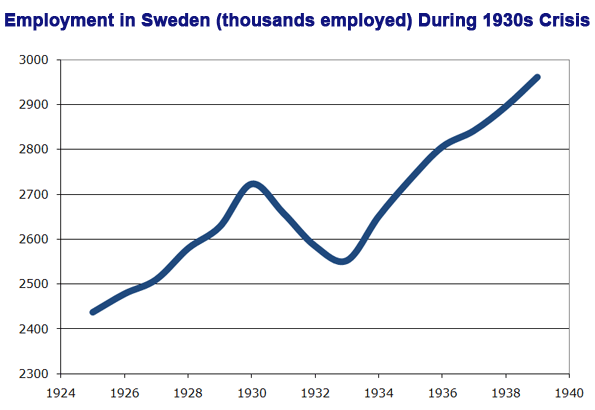
    This is illustrated by how well Sweden handled the great depression. Between 1930-33 170,000 jobs were lost, leading to a six percent drop in employment. However, the downturn soon turned to growth.

    At this time, Sweden was far from a socialist welfare state. The nation boasted low taxes, a flexible labor market and a good business climate. The solution for many who lost their jobs was to start their own business.

    Job creation spurred. Already in 1935 more people were employed compared to before the depression. One reason is that the Swedish economy already had gone through a recession in the 1920s, sparking structural changes.

    New and innovative ventures were started to replace the jobs that had been lost. Several famous Swedish firms, that still today remain as top employers, were formed during and shortly after the depression, such as: Volvo Aero, the mining company Boliden, Securitas and SAAB.

    Swedish social democrats have a surprisingly strong tradition of being quite pro-growth, and even pro-business. However, the hard left resurgence in the 1960s, culminating in the turmoil of 1968 radicalized the Social Democratic party. The tax level started climbing (through hidden taxes on labor and consumption), the labor market became dominated by labor union influence and regulations and the incentives for work, education and entrepreneurship were severely limited.

    As policy shifted, the growth of highly successful entrepreneurial ventures stagnated. A study by economist Sten Axelsson (Axelsson 2006) has examined the entrepreneurial ventures that had the highest revenues in Sweden in 2004. Only two out of 38 firms had been formed after 1970. If the firms were instead ranked after how many the employed, not a single one was shown to have been formed after 1970!

    Another study by economist Jonny Ullström (Ullström 2002) has looked at all the firms that were started in Sweden between 1986 and 1996. Among the 180,000 examined firms, 90 percent had fewer than five employees in 1997. Less than one among a thousand firms had 50 employees or more. Only eight of all the firms had 200 employees or more.

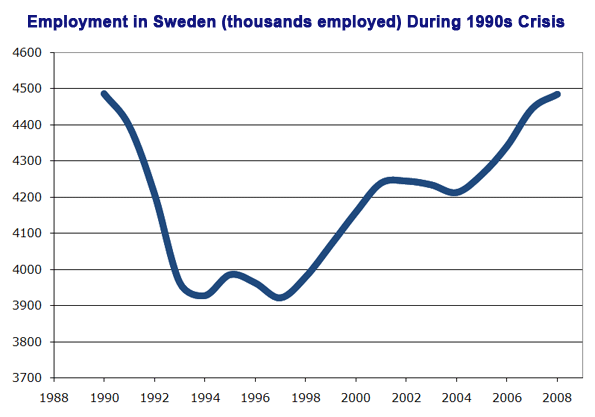
    The drop in entrepreneurship affected Sweden’s ability to deal with downturns. In the beginning of the 1990s, a new crisis hit Sweden. The global economy was growing strongly, but major obstacles faced the Swedish welfare state. Employment fell with almost twelve percent between 1990 and 1993. Within a few years the economy began to grow again. But employment stagnated. It remained until 2008 until Sweden reached the same level of employment as before the crisis.

    However, due to the previously mentioned reforms, the Swedish economy in 2008 was far more flexible than previous years, and thus better able to withstand the international downturn. Since the beginning of the 1990s, Swedish politicians amongst both the right and the left have realized the importance of moving towards greater share of economic freedom and following a generally fiscally conservative path In this time of worldwide crisis, this has helped Sweden’s economy to perform better than many others.

    This is not to say that more reforms are not needed to promote growth and entrepreneurship. Labor market regulations and taxes still depress successful entrepreneurship. For example, a person increasing her or his income with 100 Swedish Kronors has to pay fully 74 Kronors in hidden and visible taxes on employment and consumption taxes.

    Successful entrepreneurs are often highly educated people who already have a good career within large firms. But why spend time and energy on a new venture if up to three quarters of the gains are taxed away?

    Sweden is a nation with a strong history of entrepreneurship, great scientific institutions and strong working ethics. Today the nation stands stronger thanks to reforms towards greater level of economic freedom. But as long as taxes and labor market regulations block the way of growing businesses, the country cannot hope to repeat its stellar recovery course seen during the 1930s.


    Nima Sanandaji is president of the Swedish think tank Captus. He is the author of the book ”Entrepreneurs who go against the stream – what the 90s successful entrepreneurs can teach us” (Swedish title: ¨”Entreprenörer som går mot strömmen – vad 90-talets succéföretagare kan lära om dagens utmaningar”) for Fores.

    Photo by: jdlasica

    References:
    Axelsson, Sten (2006). ”Entreprenören från sekelskifte till sekelskifte – kan företag växa i Sverige?”, in Dan Johansson och Nils Karlsson (ed.), ”Svensk utvecklingskraft”, Ratio.

    Ullström, Jonny (2002). ”Det svenska nyföretagandet 1986-1997: förändringar i företagsstruktur och sysselsättningseffekter”,Vinnova.

  • Economics: Green Shoots & Immigration

    A year ago we were hearing all about green shoots. Analysts claimed to find them everywhere.

    Today, we never see the term. In fact, there seems to be a growing malaise. By the end of June the first quarter’s Gross Domestic Product (GDP) estimate was revised downward a full half a percent, to 2.7 percent. Pundits are depressed. Our President and Secretary of the Treasury are telling the world that the United States cannot lead the world to sustained economic growth. Our Vice President announced that “there’s no possibility to restore eight million jobs lost in the Great Recession.” Our stock markets are down and volatile. Risk premiums have soared.

    What happened?

    Reality happened. The green shoots were always ephemeral, the result of massive government spending increases or temporary government programs. We had housing stimulus programs. We had Cash for Clunkers. We had foreclosure programs. We had bailouts.

    The increased spending and the various programs had an impact. Because of the way GDP is calculated, an increase in government spending results in an increase in GDP, but that is today’s GDP, not tomorrow’s. Tomorrow’s economic growth is a result of investment today, investment in physical capital, technology, and human capital.

    To the extent that government spending detracts from those investments, the growth we saw was cannibalized from the future. For example, the housing stimulus programs served only to change the timing of real estate purchases. Sales fell when the programs ended.

    Even worse, some programs resulted in temporary GDP growth, but were actually detrimental to long-term economic growth. The Cash for Clunkers program destroyed capital, since perfectly good cars were crushed. The foreclosure prevention programs delayed the needed decline in home ownership rates.

    The bailouts prevented assets from being transferred to more productive uses. Bailouts are inefficient, and they prolong periods of economic weakness. Uncertainty and risk premiums remain elevated, holding investment to a minimum, limiting short-term and long-term economic growth. They also leave a hangover of debt, which limits future growth.

    None of the programs addressed the underlying problems of the current economic circumstances, or paved the way for sustained economic growth. The immediate problem was that businesses, consumers, and governments were over-leveraged after September 2008’s asset-value collapse. The longer-term problem was insufficient investment, a result of years of credit-fueled consumption.

    What was needed was investment. What was provided was more credit-fueled consumption. You might be able to borrow your way to prosperity, but to do that you better be investing the borrowed funds. We didn’t do that. Instead we used the government as a bank to increase consumption. Credit-based consumption is not the way to long-term prosperity, regardless of who does the borrowing.

    And, while it appears that most of the decline in asset values has ended, over-leverage is still with us. Indeed, the increase in government leverage makes it more difficult to employ effective government intervention, government investment in productivity-enhancing capital and technology, and investment tax credits.

    Add to these factors the millions of American households, employed and unemployed, that remain over-leveraged. Millions of consumers have been unemployed for months, and many of those still working are uncertain about their future employment. Those who have the income to do so are attempting to pay down debt, and to reduce consumption in the process. The consumer is not likely to soon be a source of rapid economic growth.

    So, we have most or all of the problems of a year ago, but now, because of increased government debt, we have fewer options. Even worse, we now have new problems that were not present in September 2008.

    Today, sovereign default risks are significant and increasing. While potential sovereign debt problems in Europe have received a great deal of attention, the problems are not limited to the continent. Japan continues to have very high debt and deficits. Several U.S. states could also default. A failure of an American state is likely to have impacts very similar to the failure of a small European country.

    I don’t believe that the failure of a country is the most likely outcome, however. Instead, expect to see more international bailouts, just as you can expect to see the federal government bailout several American states.

    Our options are limited, but we do have one option that would provide immediate and sustained economic growth without increasing leverage. That option would be a massive increase in immigration.

    The initial benefits of a new wave of immigration would be seen remarkably quickly. Housing demand would increase, leading to renewed vigor in our real estate markets and the construction industry. Our inner cities would be renewed, as they always have been by immigration waves. New business formations would soar. The tax base would increase, helping to fund debt repayment and baby-boomer retirements.

    Many would oppose such an immigration increase. They worry about increasing job competition, unemployment, crime, and even more demand on welfare programs.

    These fears are misplaced. Criminals are easily sorted out by effective screening processes. People don’t migrate for welfare benefits, but if this is a concern, it is easy to deny immigrant access to social programs for some number of years after immigration. Similarly, people don’t migrate to be unemployed, and unemployment benefits can be denied to immigrants.

    People migrate to more effectively use their human and physical capital, their technology, and their labor. Effectively, immigration would provide new capital, technology, and labor. This is exactly what we need, and it is free. Immigration has served America well in the past. It can serve us well today.

    Red and Green, photo by Rupert Maspero

    Bill Watkins is a professor at California Lutheran University and runs the Center for Economic Research and Forecasting, which can be found at clucerf.org.

  • Singapore’s Demographic Winter

    Over the past half century arguably no place on earth has progressed more than the tiny island state of Singapore. A once impoverished, tropical powder keg packed into 268 square miles at the foot of the Malay Peninsula, the Mandarin-led republic has ascended from its difficult founding in 1965 to one of the richest economies on the planet. Today, in terms of purchasing power, its per capita income stands higher than most European countries’ or Japan’s and is roughly equal to that of the U.S.

    But a catastrophic plunge in the country’s birthrate–a problem plaguing many of the world’s affluent economies–could undermine Singapore’s success. In 1965 Singapore’s leaders feared it could not survive an unsustainable fertility rate above 3.5 and embarked on a campaign encouraging citizens to have smaller families. Today the country’s fertility rate–the number of children per female–has sunk to roughly 1.2 , a rate lower than all but a handful of countries and well below replacement level.

    This pattern poses a threat to the republic’s continued progress over the coming decades. The dependency ratio between retired persons and those 15 to 64–far lower than Europe, America or Japan in the 1970s–will reach the unsustainable levels of places like Japan, Germany and Italy by 2030. By then there could well be more people over 65 than under 15.

    This shift in demographics is a common challenge for almost all advanced countries–even the U.S., which enjoys the healthiest demography of any major wealthy nation. In Europe and particularly Asia, once challenged by overpopulation, there is the looming prospect of what a new documentary calls the “demographic winter.”

    Of course, not everyone finds this “winter” a chilling thought. A growing chorus of environmentalists, particularly in Europe and the U.S., sees the shrinking numbers of “little monsters” a boon for the planet.

    Peter Kareiva, the chief scientist at the Nature Conservancy, one of the more levelheaded environmental organizations, has concluded that not having children is the most effective way of reducing “carbon scenarios” and becoming an “eco hero.” Meanwhile the more extremist Voluntary Human Extinction Movement promotes the lovely notion of terminating the species through voluntary childlessness.

    For their part, Singapore’s leaders have focused on providing parkland, building a functioning subway and recycling city wastes. But these pragmatists show little tolerance for such Western-style species self-hatred. A society proud of its accomplishments, its agglomerated cultures–Chinese, Indian, Malay–continue to value family as the supreme societal unit.

    At the same time, many leaders trace the depth of their demographic problem to their own campaign to limit families back in the 1970s. “We have been very successful in reducing the birthrate,” observes Lui Pao Chuen, adviser to the National Research Foundation and a prime architect of Singapore’s defense systems. “The society will die if it goes on like this. We want our society to live on.”

    In the past decade Singapore’s leaders have tried to change course, attempting to raise the birth rate by offering generous cash incentives and other inducements for baby-making. But so far, they admit, these efforts have had little effect.

    Part of the problem may lie with high densities, an inescapable reality in a city-state with literally no suburban periphery. Singapore’s public housing–80% of citizens live in government flats–is generally better and larger than those in other Asian countries. Still the prospect of raising children in a 1,000-square-foot, two-bedroom flat may seem less appealing than doing so, say, in a suburban housing estate in Australia, New Zealand, California or Texas.

    Equally intractable may be the very competitive spirit at the heart of the republic’s success. Singapore possesses two great natural advantages: a strategic location between the Pacific and Indian Oceans and a motivated population. The city’s leaders have done a brilliant job of capitalizing on both, developing one of the world’s largest ports and one of Asia’s best-educated, hardest-working populations.

    This in turn has created a population that often places education and career advancement over child-raising, marriage and even dating. Some 85% of singles still express a desire to get married, and nearly 80% want two or three children. But the pressure to succeed often prevails. “The pace of life has people putting things on hold,” admits NG Mie Ling, coordinating director for the government’s Family Development Group.

    Despite these challenges, Singapore may not be doomed to follow Europe and other advanced east Asian nations into the demographic dustbin. For one thing, the city’s bureaucracy is cleverer than most and may be able to change some policies–placing more emphasis on leisure time for mate-chasing and child-raising to building larger apartments–to reverse the current birth dearth.

    Singapore’s unique ethnic and national identity may prove an even bigger asset. Unlike its Asian rivals, Singapore–though mainly Chinese–remains a truly multiracial society. Like America, it is a nation of immigrants. Few can trace their local roots there more than two or three generations. This makes the Republic more suited for accommodating newcomers from China, India and Malaysia, as well as from countries like the Philippines or Vietnam.

    Newcomers can find a kindred ethnic or religious community. Many also intermarry with Singaporeans; over 40% of all marriages are between citizens and noncitizens, up from only 30% a decade ago. Interracial marriages are also increasingly common. Whereas it is virtually impossible to become Japanese or Korean, one can become a Singaporean.

    Immigration allows Singapore’s population and skilled workforce to grow at a healthy clip despite the low birth rate. Today barely 3.2 million of the current nearly 5 million Singaporeans are citizens; many others immigrate to enjoy the excellent schools, the high degree of safety and cleanliness and a political stability that is rare in the region. Last year 60,000 people were granted permanent residency and nearly 20,000 became citizens.

    “We are still trying to figure out what it is to be a Singaporean,” observes Calvin Soh, chief creative officer in Asia for the Publicis advertising company. This evolving identity may not be obvious in the city’s impressive but hardly unique office, hotel and condo complexes. It is best illustrated in the city’s remarkable neighborhoods with their open air markets and a strikingly diverse food culture flourishing both in small, family-owned restaurants and hawker stalls.

    The city’s internationally recognized food scene, Soh believes, could serve as a model for other cultural products, from media and fashion to product design. Ideally suited to serve as the crossroads culture of 21st-century Asia , Singapore can emerge like 14th-century Venice, which flourished by connecting Europe with the civilizations further to the east.

    Like their counterparts in other successful countries, Singapore’s executives and administrators face enormous demographic challenges. But if any Asian society can confront, or at least ameliorate, the great fertility crisis, it is this tiny island country with a track record of solving seemingly insurmountable problems.

    This article originally appeared in Forbes.com.

    Joel Kotkin is executive editor of NewGeography.com and is a distinguished presidential fellow in urban futures at Chapman University. He is author of The City: A Global History. His newest book is The Next Hundred Million: America in 2050, released in Febuary, 2010.

    Photo by FeebleOldMan

  • The Economic Significance of Village Markets

    Flea markets and garage sales have been around for years. But for most New Zealanders, produce markets have been associated with old European villages, or the ethnic markets of Hong Kong and other exotic locations. Village markets focus on locally made crafts, while Flea Markets are essentially centralized garage sales.

    At the true Farmers’ Market vendors may sell only what they grow, farm, pickle, preserve, bake, smoke, or catch themselves from a defined area. There are now over 50 “official” Farmers’ Markets in New Zealand. But when all the flea markets, village markets, and less formal markets are tallied up there must be hundreds throughout New Zealand.

    When I grew up they simply didn’t exist – unless we count the school “Bring and Buy” and Church fétes. We simply shopped in shops. Why is this? Why did my parents feel no need for such markets? I suspect my parents would have regarded such markets as somewhat old-fashioned and even primitive. This was the sort of thing our forebears left behind in Ireland in the 1830s.

    However, they are now a part of our lives. For the last few years I have routinely – effectively every Saturday Morning – shopped at our local market at Mangawhai, a nearby coastal village in Northland. It’s where people sell their own produce, but also sell books, bric-a-brac, power-tools, and other bits and pieces. The market works for me because it is just across the road from my excellent butcher, and next door to the local lending library.

    So what’s the new appeal? The conventional theory is that the rise of these markets reflects a desire for fresh healthy food, and fruit and vegetables grown locally, and in-season rather than imported from far away. It’s also considered green to buy local and support local cultivars, and growers of eco-sourced native plants and so on.

    These markets are also a good place to meet for a chat, and they also provide a convenient means of selling off numerous “priceless objects” now growing mould in the garage.

    Indeed, last weekend, my wife and I decided to win back some space and earn some ready cash. Setting up a stall at the Mangawhai market was easy. We simply phoned the market organizer (from the local Cheese Shop) and booked a trestle table.

    We thought our real cash-cow would be the plants and seedlings but the biggest and most regular seller was our collection of vinyl records dating from US pressings of jazz giants from the sixties. Our first major sale was a high-quality Akai turntable. It was fun to see grandmotherly types shuffle up to the table and enthuse over early discs by Oscar Peterson, Miles Davis, and Billie Holliday. As a bonus we gave the turntable buyer a 1950s 10 inch LP of Bill Hayley and his Comets – Don’t Knock the Rock.

    The last time I thought about these markets was two weeks ago when I wrote the sad story of the urban Onehunga Market that had to close because Auckland City demanded a resource consent that would have cost maybe $30,000 dollars.

    I presume our Mangawhai market operates without such costs because it is housed in the Village Hall, on public ground, shared with the Library and the Museum. Consequently our stall space and trestle cost us only $10 for the morning. But if the Council had demanded say $30,000 for a land use consent, then a twenty-trestle market at $10 a trestle would take 150 weeks to recover just the consenting cost. Obviously, there would have to be many more spaces, or the rental would have to be much higher.

    On our first morning we netted only about $80. (Being newcomers, we were outside and it rained) But even this represented about $20 dollars an hour – not huge but better than the minimum wage. On the other hand it was an $80 dollar return on our $10 dollar capital investment (using simple “homespun” economics). Remember the stuff we were selling had negative value, and I drive back and forth from the village every Saturday anyhow.
    And it was fun. But could such markets become an endangered species? As in so many areas, the culprit is heavy-handed regulation. The high costs of land and development, and the burden of consenting and development contributions already make it nearly impossible for small corner stores to make any return on capital.

    Yet, the stall renter’s capital-productivity is massive. But many regulators cannot stand to see such an opportunity slip from their grasp. So the Onehunga market had to close.

    These village markets remind us of the “power of markets”. As the heavy-handed regulators drive down capital productivity, entrepreneurs have responded by rediscovering the outdoor markets of much earlier times when capital was scarce and labour was plentiful. Market economies are like water-beds – push down on one corner and they bounce up in another.

    We are beginning to see similarly ad hoc responses in the residential and commercial property markets. The regulators have so severely constrained the supply of coastal land in New Zealand that people like my parents, who bought a batch at on the coast at Tairua out of their working class income, no longer have a hope of enjoying the sprint from the Kiwi bach straight into the sea.

    Those who have generated this scarcity then complain that only foreigners can afford to buy our coastal land. But many of us really do want to occupy a beach side property for the best weeks of summer, and then return home to our rural dwellings in the regional towns and villages. Enter the motor home.

    As farmers become more and more regulated by central planners who know nothing about agricultural economics but instead are determined to ‘save the planet’, enterprising farmers will look for new ways to supplement their incomes.

    Well, here’s one way we can solve our mutual problem. First, buy a quality self-contained motor home. Then use Google Maps to find what looks like an ideal bay, with a farm track connecting the main road to the beach.

    Then approach the farmer and negotiate a “right to occupy” this little patch of heaven. It could be no more than the right to park on the spot for perhaps eight weeks a year, but could include an obligation to fence off the area to contain any children or pets. No resource consent, no title, no lease – just a right to drive on to the farm, park on the spot, and drive away if it rains.

    Farmers supplement their income and Kiwis reclaim the low cost beach. The Environmental Puritans will gnash their teeth at the prospect of so many people having fun – but this time we might be ready for them. Markets and human ingenuity can still win in the long run.

    Owen McShane is Director of the Centre for Resource Management Studies, New Zealand.

    Photo of Mangawhai Village Saturday Market by Sids1

  • McChrystal Exit: Obama and His Generals

    General Stanley McChrystal may be the first commanding general in the history of warfare to be relieved of his command because he groaned over the receipt of an email from an ambassador, or because one of his aides whispered to a Rolling Stone reporter that the president had looked “intimidated” in a meeting with the military brass.

    In terms of carrying out strategy, it has been stated that the president had no military complaints about the heavy metal general, who was walking the impossibly thin red line between a general war in Afghanistan and a campaign waged only with assassinations and drone missiles.

    Just a month before his firing, McChrystal successfully packaged a tour of the White House and Capitol Hill for President Hamid Karzai. In earlier media campaigns — notably when the president flew into Kabul in the dead of night to lecture a pajama-clad Karzi over corruption — the Afghan president was deemed unworthy of an American war effort.

    However briefly, McChrystal had succeeded in integrating the Afghan government into the order of battle. So why was he sacked for humming a few bars of Satisfaction in the presence of a rock reporter?

    No doubt McChrystal had his enemies within the bureaucracy, including the ubiquitous ambassador Richard Holbrooke, and the U.S. ambassador in Kabul, former general Karl W . Eikenberry. Along with these two add in a legion of jealous Army politicos, all of whom would love to wear combat fatigues to a presidential photo-op.

    In relieving General McChrystal, perhaps as part of a search for his mojo, President Obama joins a long line of presidents who never figured out how to command their commanders. Here’s a brief summary of some of the more complicated relationships between American presidents and their field generals:

    President Lincoln— Often praised for his habits of command in the Civil War, he nevertheless promoted, endorsed, and endured the incompetence of such generals as McClellan, Meade, Burnside, Pope, and Rosecrans before winning the war with Grant and Sherman, both of whom would horrify a Senate confirmation hearing, let alone the editors of Rolling Stone.

    Grant was a drunk who killed thousands at Shiloh and Spotsylvania, and Sherman once celebrated the drowning of a boatload of reporters, pointing out that maybe their “heavy thoughts” had taken them to the bottom. He also burned Atlanta. Both understood how to win modern wars.

    President Madison— In the war of 1812, he had to endure generals who botched several invasions of Canada, allowed Washington to burn, and, in the case of Andrew Jackson at New Orleans, fought battles after the peace was signed. (But the Battle of New Orleans did more than Yorktown to forge American independence.)

    President Kennedy— He loathed his top generals, blaming them for the Bay of Pigs fiasco and for pushing him into Vietnam, saying “They always give you their bullshit about their instant reaction and split-second timing, but it never works out. No wonder it’s so hard to win a war.” Kennedy’s skepticism about the military command, however, pushed him to ignore their advice for invasion and air strikes in the Cuban Missile Crisis, possibly averting nuclear war.

    Presidents Carter and Johnson— In the style of the Obama White House, these two both micro-managed their war efforts. Jimmy Carter was the air traffic controller for Operation Blue Light, the failed attempt to rescue American hostages in Iran. Lyndon Johnson boasted that the Air Force could not hit so much as “a shithouse” in Vietnam without his authorization. Both presidencies were lost due to the foreign entanglements of the commander-in-chief.

    President Roosevelt— A successful example of a commander-in-chief; no president handled generals better than FDR, who was a shrewd judge of character. Roosevelt spent many months of the war in proximity to his fighting forces (including his own sons, who were serving officers). He vested authority in a number of competent commanders, starting with General George C. Marshall.

    Roosevelt was clear in his strategic objectives and did not meddle, for example, in the deployment of 30,000 troops. Nor did he fire General Patton when he slapped a fatigued soldier. Imagine what General MacArthur would have said about FDR to Rolling Stone? Would FDR have cared? (Eisenhower remarked: “I spent seven years under MacArthur studying dramatics.”)

    Despite all the media visibility around his decisions on Afghanistan, we know little about President Obama’s habits of military command. When he’s before large audiences, he is good at articulating the role he sees for the United States in the world. For better or worse, he is unafraid to offend traditional allies, such as Israel and Great Britain. He even sided against England in a recent flare-up around the Falkland Islands.

    Strategically, however, Obama rarely contradicts his military-industrial complex. Yes, he fired McChrystal, but he replaced him with his boss, mentor, and near Siamese twin, General David Petraeus, as if to imply that the only problem in Afghanistan was McChrystal’s joke about Vice President Biden.

    While hitching his political star to the Nobel Prize for Peace, Commander-in-Chief Obama continues to fund Israel’s war footing, stations forces in Iraq, widens the commitment in Afghanistan, attacks Pakistan with drones, and pushes for war sanctions against Iran. In the pulpit, he is Woodrow Wilson; in action, he’s George W. Bush.

    Nor has the Obama administration been able to articulate a coherent war aim behind the commitment of additional forces in Afghanistan. Look at the many mixed messages sent to Karzai, who depending on the week is “our man” or the next Diem.

    The president’s current directive to his generals is to avoid casualties, hold a mountainous country the size of Texas with eight divisions, foster rural development in places like Helmand, find bin Laden, pacify the federal tribal areas, make President Karzai look democratic, train the Afghan army and police, leer across the border at Iran, and prop up a wobbly government in Pakistan — although, politically speaking, all the administration wants is enough shock and awe so that the Republicans in the 2010 mid-term elections cannot paint it as “weak on terror” or having “lost” Afghanistan.

    In turning the strategic decisions about Afghanistan into an endless university teach-in (with all the allusions to “accountability,” “transitions,” and “benchmarks”), the president acts as if all the timing questions in this war were on his side. Let’s hope that the Taliban and other insurgents, especially those now planting car bombs in Islamabad, Baghdad, and Kabul, got the departmental memo that the United States would be on sabbatical in 2011.

    In 1815, Andrew Jackson felt he had to attack the British the very night he heard they had landed near New Orleans. By contrast, President Obama spent a leisurely year pondering the Weltanschauung of Afghanistan and publicly ruminating about strategic options. He now feels he can afford the luxury of sacking a field general for failing to sound reverential in an interview. Aren’t there better measures of a commander? (At Bellow Wood, a Marine officer said: “Retreat? Hell, we just got here.”)

    Before Lincoln could become the wartime president that we admire, he needed to find a general “who fights,” and he needed to articulate an acceptable and collective war aim, which he achieved with his Gettysburg address and Second Inaugural. He also had to come to the conclusion that Grant, drunk, made more sense than his other generals sober.

    President Barack Obama meets with Army Gen. Stanley McChrystal. Official White House photo by Pete Souza.

    Matthew Stevenson is the author of Remembering the Twentieth Century Limited, winner of Foreword’s bronze award for best travel essays at this year’s BEA. He is also editor of Rules of the Game: The Best Sports Writing from Harper’s Magazine. He lives in Switzerland.

  • Follow The Money On Development Deals

    “Follow the money” became a household phrase after the 1976 movie that told the story of Watergate, All the Presidents Men. Personal experiences over four decades in the consulting industry, working to create sustainable developments, often bring the phrase to mind.

    In a meeting a few weeks ago concerning a potential collaboration between our planning company and large engineering consulting firm, I was coached to tone down the fact that the design methods we invented and utilize reduce infrastructure. You might ask, why would reduced infrastructure (one key to a more sustainable world) be a negative condition for an engineering firm whose main purpose is to design the infrastructure that society must rely upon?

    Follow the money… Large engineering projects, as well as many architectural structures, are often quoted as a percentage of construction costs. The incentive is to increase, not decrease construction costs. We have the ability today to reduce the world’s infrastructure possibly up to 30%, which would be a major step towards reducing initial costs of commercial building and residential housing. It would have massive environmental benefits, and reduce the continual maintenance costs to the governmental authorities (forever) up to 30%.

    Follow the money… If the income of consulting firms is based upon construction costs, the consultants’ gross dollar billings would also be reduced by 30%. Firms that supply concrete, steel, pipes, etc would also have their gross income slashed by 30%. Does our world have a chance of becoming sustainable? Dream on!

    Follow the money… A decade ago I met with the president of one of the largest engineering firms in Minnesota. He wanted to know how our firm can produce so much work with so few people (I personally design all of the developments and had a drafting staff of two people). In ten minutes I designed a development of about 15 lots that showed homes, driveways, and all the final geometry, using the commercially available technology we had developed. “Oh my,” he said, and paused. I thought he would say, “We could reduce our staff by half,” but instead said , “You must put the plans on the shelf a few weeks, to justify the billing hours”. Then the enlightenment came to me. I had developed a software technology used in my own consulting business to produce engineering-accurate layouts in a fraction of the time of a CAD (Computer Aided Drafting)-based technology, but started to understand that this might be a hard sell.

    Follow the money… Large consultants often look at the floor of employees as a multiplier, meaning that each workstation will bring some multiple of profit. Suppose a technician costs $50,000 a year, and the multiplier is 3.5. After overhead, that technician represents $100,000 in potential profit. At a 150 person company, replacing one third of the staff by using more efficient technology and methods in the above example reduces the potential consulting income by five million dollars!

    Follow the money… Liability is another roadblock to sustainability. Why try something new when the old tried and true has worked for decades or centuries? In the consulting industry, licensed professionals risk their careers if a new concept causes a major failure, so they’re more likely to discourage anything without a proven history. The loss of a license to certify plans would have a devastating effect on a consultant’s personal finances. It is far safer to claim that the new method cannot work and talk the developer or municipality out of the idea.

    Follow the money… Today, few consultants are making any. Most are either hanging on (barely) or have shut their doors. The unemployment rate among architects, engineers, draftsmen, technicians, planners, and related occupations is very high. The exceptions are those lucky few that have won lucrative government contracts and are holding their own, or even thriving.

    Follow the money… The market reacts to design, innovation and value. The first Toyota Prius was an ugly miniscule car based upon the Echo, but it was highly efficient. Gas was cheap when it was first introduced, and sales were dismal. The first generation Prius had innovation, but lacked design. The next generation Prius came out as gas prices soared. When an attractive interior and exterior design was combined with innovation, it quickly became a symbol for a new era of green thinkers. Rising fuel prices turned the hybrid technology into an increasing value which fueled — so to speak — its success. Before the I-Pod there were many digital music players that were innovative. When players were combined with an attractive package design and the ability to download from the same vendor, the overall value created its success. Like the Prius and the I-Pod, land development itself is a “product”.

    Follow the money… The housing market crashed and many believe the commercial real estate crash to come will also be devastating. Funding for infrastructure keeps many consultants employed when the private development and building industry flounder.

    Those of us in the consulting industry must make some significant foundational changes if we are going to have a sustainable future, and claiming “Sustainability!” on the corporate web site is not enough. Unlike building construction, where being “green” typically increases costs, in land development, environmentally sound design and construction can cost significantly less if done right. That said, it does require more design effort with a greater attention to detail. It is possible to decrease both construction costs and environmental impacts say, 30%, but it could mean the consultant doubling his or her design efforts to do so. Not only does the firm lose 30% of its gross income if billing is based upon a percentage of construction costs, it must make a huge increase in effort to do so.

    Follow the money… In this new age of engineering and designing sustainable development, it is no longer possible to get the best result by simply using an off-the-shelf software to calculate the hydrology of the site (the drainage) within sewer pipes. Using surface flow along with natural materials that can filter pollutants from the run-off before drainage leaves the site requires a botanical engineering solution that blends knowledge of natural and manmade engineering. This requires a specialist, and the complexity that’s required to successfully design these systems with fail-safe methods goes far beyond pressing a software button. Small errors could have devastating results, and the consultant will be liable.

    For example, I installed a no-mow – low watering – fescue lawn, instead of sod, when my home was built last year. This landscaping worked great during the first year, giving us the look of a lawn look without having to mow it. We were told to water twice daily to get it established by the landscaping firm that claimed to be experts on this exciting new low impact landscaping. Well, watering fescue twice daily, it turns out, is the worst thing you can do, according to the prairie restoration consultants. We inadvertently turned our lawn into a fast growing prairie that needs more mowing than sod! But this is just one example of what can go wrong in this new era of sustainability. I was willing to invest, and I believe mistakes can be corrected and documented to reduce future errors. My landscape contractor installed something quite new in the industry, and took on a risk compared to suggesting safe sod. After the bugs are worked out the company will have a market edge and an example to show (but maybe not this year).

    So how can we force an industry to change?

    Lead with Money… Cities and developers hire firms assuming that they are going to use the latest techniques available to get the most efficient design possible. If the bidding process changed from seeking the lowest bidder to looking for the most advanced and efficient bidder, the industry would be rewarding innovation, competition, great design, and risk. Give priority to solutions that exceed the specifications. Contractors and consultants could be rewarded for coming up with revolutionary solutions.

    Lead with Money… The reward could be in the form of a bonus for innovation: For example if a plan saves 100 million in right-of-way purchasing, give half of the savings to the winning contractor and consultant. If the consultant is being paid a percentage of the construction costs (lets use 5% as an example) on a 100 million dollar project, then he or she would gross five million dollars. If they could win the consulting (engineering) contract by demonstrating the most efficient design instead of being the lowest bidder (or the most politically connected), and be paid a percentage of the demonstrated benefit, they would be making more for providing a higher degree of effort and perhaps taking on more risk. In the above example, if 30 million dollars is demonstrated to be a savings or increase in functionality, and 20% of the savings is rewarded back to the consultant, then the consultant would make 5% on the 70 million dollars (3.5 million dollars) and 20% on the 30 million in savings (6 million dollars). The gross revenue to the consultant would almost double.

    Lead with Money… Our military often awards bids for those projects that exceed the specifications. Vendors should compete not just on price, but to demonstrate how they exceeded the specifications. Governments as well as private developers could pick and choose based upon innovation, design, and value. Those taking the extra effort would flourish, and eventually the new higher standards would become the norm.

    How about forcing change through regulations? Regulations can only control minimum standards, pretty much guaranteeing monotony and stagnation. Instead, follow the money: To create a sustainable world, we need to exceed minimums, and foster innovation by rewarding risk, effort, and investment.

    Flickr photo, “George Is Keeping An Eye On You,” by We Love Costa Rica

    Rick Harrison is President of Rick Harrison Site Design Studio and Neighborhood Innovations, LLC. He is author of Prefurbia: Reinventing The Suburbs From Disdainable To Sustainable and creator of Performance Planning System. His websites are rhsdplanning.com and performanceplanningsystem.com.

  • G20: The Siege of Toronto

    Excerpts from Steve Lafleur’s personal “View From The Wreckage” diary and photo log from this month’s G20 conference in Toronto:

    June 25th
    10:51 PM:
    I arrive in Toronto to a surprisingly vacant parking lot on the Esplanade, in the heart of Toronto’s bustling financial district. Quietest Friday night I’ve ever seen in Toronto. Barely a soul out in the usually packed financial district.

    2:12 AM: On the way back to my lodgings, I pass by the French delegation’s bus. The hotel workers had been on strike for the previous few days. The hotel is owned by a French company, so the workers decided to go on strike while the French delegation was there.

    2:14 AM: The Esplanade is conspicuously devoid of returning bar goers.

    June 26th
    10:39 AM:
    I arrive a few minutes after a scheduled keynote speaker at Allen Gardens that I heard about on Twitter. The tent town built by protesters has already been broken up, and its occupants have dispersed. The speaker goes on anyways, with a small crowd.

    10:56 AM: I head to Bay Street, the heart of Canada’s financial district. I figure if there are pre-rally disruptions, they would be here.

    11:11 AM: The Art Gallery of Ontario was one of the many high profile venues that closed for the conference. (Many shows, including the high profile musical, Rock of Ages, were canceled. The Blue Jays were also forced to move three home games to Philadelphia).

    11:29 AM: Arrival at the Security barrier. A few officers hanging around, but surprisingly quiet. The police decided to use tightly meshed chain link fences to make climbing the barriers extremely difficult.

    11:55 AM: The University of Toronto, which was also closed for the conference.

    12:10 PM: Queen’s Park begins to fill up with all of the usual suspects. Union activists, environmentalists, and anti-war protesters seem to be the bulk of the crowd.

    12:34 PM: When I see Greepeace approaching, I know it won’t be quiet much longer… and then I see people in their midst who appear to be Black Bloc anarchists, notorious for their role in the Seattle WTO protests of 1999, where they caused major property destruction.

    12:43 PM: Things get pretty busy at Queen’s Park. Despite the rain, the crowd is estimated to be 5000.

    12:48 PM: A crowd protesting the Ethiopian genocide fills the streets of Queen’s Park. I tell my photographer not to worry about them; that they have nothing to gain from being violent. Spoiler: I am right.

    1:41 PM: The demonstrators have now officially shut down University Avenue. The Queen’s Park subway station, and some other stops, are also closed. Frustrated motorists and streetcar passengers are stuck.

    2:26 PM: Rather than contain the crowds (which would lead to immediate confrontation), the police form a human funnel to shunt the protesters west on Queen Street.

    2:55 PM: As I reach University, the police are once again blockading. Riot police one street south are putting on gas masks. There appear to be police officers fighting with protesters. Police tell us to head north immediately or risk becoming collateral damage. Rioters breaking every window in sight.

    3:48 PM: Smoke is coming from a burning car in the middle of the road. We later find out it was a police car set on fire by protesters with Molotov cocktails (one of at least 3).

    11:46 PM: Stop for a quick drink at Duggan’s, a local microbrewery. Downtown is once again eerily quiet. Some business owners had the foresight to board up in anticipation of the riots.

    11:52 PM: We are greeted by hundreds of riot police outside of our lodgings and escorted across the street. There doesn’t appear to be anything amiss. From the roof, we are able to discover what the police are up to: resting.

    June 27th
    2:09 PM:
    Both the Bank of Montréal and The CIBC across the street from it are smashed in. It is surprising how quickly the vandalized establishments were boarded up. No remaining shattered glass visible from the road.

    2:11 PM: The Gap is one of the predictable targets for protesters, but dozens of less prominent shops are also vandalized. Starbucks, of course, the absolute favorite target of anti-corporate vandals; also the CTV news building, as well as several media vehicles.

    2:15 PM: As I continue along Queen Street, I hear a loud rumble. Yet another protest march coming. I quickly pull a U-turn, and exit the city.

    There are plenty of lessons that one might learn from this experience. This was my second G20; my first was last year’s meeting in Pittsburgh. The lesson that I want to impart is simple: Major political meetings should never be held in large cities. They are a magnet for violent protesters, and endanger local residents. The destruction, along with the billion dollar security tab, will hopefully make politicians think twice about foisting these events upon major cities. As I said before the meeting, it should have stayed in Huntsville, a small tourist town outside of the city, where it was initially supposed to take place.

    Photos by Andrew Lafleur.

    Steve Lafleur is a public policy analyst and political consultant based out of Calgary, Alberta. For more detail, see his blog.