Category: Policy

  • It is Time to Plant

    It is springtime in Kentucky – think foals and mares in the pristine meticulously fenced pastures. But, in another part of the state – the Appalachia region of eastern Kentucky – it is time to plant on those rocky hillsides. As my 90 year old father puts it, you plant your corn when tree buds are the size of squirrel ears. I confess to not having given a thought to whether squirrels even have ears or not … but my father knows. He was born and raised in a part of the world where they know things like that, typical of the mostly Scots-Irish who settled there. He knows the land like the back of his hand, he is self-reliant and stubborn to a fault and he knows what it is like to be poor and bereft of opportunity.

    Appalachia Eastern Kentucky – take just one geographic area out of a huge region spread over several states – is negatively depicted in popular imagery and academic literature as a drag on the Kentucky economy. The whole region is enigmatic like the underachieving child in a family of superstars. Until now, that is. With the financial collapse having brought America to her knees, it is a bit like the screaming headline about Toyota’s debacle: “the A student flunked the class.” Perhaps that underachieving C student finally has her chance to shine. After all, who would have given Ford a chance a few years ago?

    But Appalachian eastern Kentucky is after all a land where every manner of program has been tried, books written, studies undertaken, and mournful music sung. It is where the failed War on Poverty was launched in the 1960s. The reason for a “new day dawning” is that there is a stir across the land that signaling an epochol shift in the evolution of the American Dream. Call it by wonky titles like “new localism” or call it “choosing who I want to be and where I want to do it.” But whatever it is, it is impacting on our lives dramatically and will do more so in the future.

    The prestigious Economist Magazine (May 15, 2010) recently reflected that in the future people will have unprecedented choices of living in big vibrant cities or in smaller more nurturing rural settings. And, the stories abound. Take Patty who left the factories of the north to return to her native land. Always known for her shrewd business acumen, she took over and renovated “The Old Schoolhouse” antique gallery located near Cave Run Lake. She scours the region for her “goods” and is visited daily by weary travelers seeking the authenticity of a culture too long locked in the shadow of conventional definitions of success. Likewise, despite the long held belief that they are leaving, young people are finding ways to stay in the region, such as the young man in a recent audience who has taken advantage of “tele-learning” and plying his trade as a graphic artist for a west coast software company.

    There appears to be a convergence of forces at work that could prove transformational for regions like Appalachia. Brought on by the Great Recession, people have to make choices about their priorities and perhaps even to downsize lifestyle appetites. But that’s not all. These forces will impact all places but particularly rural places like Kentucky, places of great beauty and tranquility and appeal waiting for the right moment that may finally be here.

    These converging forces are driven in large part by technology and the realization of its earlier promise that we truly can live and work anywhere. It is about participating in the preservation of a precious culture locked for too long in the closet of neglect and stigmatized with the label of backwardness. It is about an ability to do more than scrape out a meager living in the rocky hillsides. Evidence can be seen in a migration pattern that is, for the first time in decades, giving Kentucky and surrounding states a positive net migration from the rest of the country. We are seeing youthful retirees coming home in some instances and young families putting down roots in places that feel right for their chosen way of life. And there is a growing business culture that knows about the world but sees no paradox in growing itself in Appalachian soil – and using the culture to its advantage.

    Just take note of Kentucky “ham” country if you want to partake of successful business stories. Recently profiled in the New York Times Magazine (May 23, 2010), Kentucky’s home grown hams are making their way onto the world stage. The author marveled at the ham store owner’s chatter about attending a ham conference in Spain and the desire of buyers to travel to a small town to buy nitrate free bacon. Imagining Kentucky hams being worth a wait in noisy New York City restaurants defies explanation except to acknowledge that the song is right that “somethin’s happenin’ here.”

    What must the Appalachian region of eastern Kentucky and the rest of Appalachia do to take advantage of this new opportunity? It must reinvent itself as with many other aspects of the American Dream under the new rules of the 21st century. Reinvention will require answering the question “what is success”? With extreme partisanship and 30,000 foot politics at other levels of government, it is no longer viable to look in the direction of the “higher ups.” We must look to ourselves. Only we can provide the basis for community building and ensure the investments we need to make in health and education.

    Ah, springtime. Nature has taught us well; re-invention is to see the possible and to seize the moment. The moment is now.

    Sylvia Lovely is an author, commentator and speaker on issues relating to communities and how we must adapt to the new landscape that is the 21st century.

    Photo by J. Stephen Conn.

  • The Future Of America’s Working Class

    Watford, England, sits at the end of a spur on the London tube’s Metropolitan line, a somewhat dreary city of some 80,000 rising amid the pleasant green Hertfordshire countryside. Although not utterly destitute like parts of south or east London, its shabby High Street reflects a now-diminished British dream of class mobility. It also stands as a potential warning to the U.S., where working-class, blue-collar white Americans have been among the biggest losers in the country’s deep, persistent recession.

    As you walk through Watford, midday drinkers linger outside the One Bell pub near the center of town. Many of these might be considered “yobs,” a term applied to youthful, largely white, working-class youths, many of whom work only occasionally or not at all. In the British press yobs are frequently linked to petty crime and violent behavior–including a recent stabbing outside another Watford pub, and soccer-related hooliganism.

    In Britain alcoholism among the disaffected youth has reached epidemic proportions. Britain now suffers among the highest rates of alcohol consumption in the advanced industrial world, and unlike in most countries, boozing is on the upswing.

    Some in the media, particularly on the left, decry unflattering descriptions of Britain’s young white working class as “demonizing a whole generation.” But many others see yobism as the natural product of decades of neglect from the country’s three main political parties.

    In Britain today white, working-class children now seem to do worse in school than immigrants. A 2003 Home Office study found white men more likely to admit breaking the law than racial minorities; they are also more likely to take dangerous drugs. London School of Economics scholar Dick Hobbs, who grew in a hardscabble section of east London, traces yobism in large part to the decline of blue-collar opportunities throughout Britain. “The social capital that was there went [away],” he suggests. “And so did the power of the labor force. People lost their confidence and never got it back.”

    Over the past decade, job gains in Britain, like those in the United States, have been concentrated at the top and bottom of the wage profile. The growth in real earnings for blue-collar professions–industry, warehousing and construction–have generally lagged those of white-collar workers.

    Tony Blair’s “cool Britannia,”epitomized by hedge fund managers, Russian oligarchs and media stars, offered little to the working and middle classes. Despite its proletarian roots, New Labour, as London Mayor Boris Johnson acidly notes, has presided over that which has become the most socially immobile society in Europe.

    This occurred despite a huge expansion of Britain’s welfare state, which now accounts for nearly one-third of government spending. For one thing the expansion of the welfare state apparatus may have done more for high-skilled professionals, who ended up nearly twice as likely to benefit from public employment than the average worker. Nearly one-fifth of young people ages 16 to 24 were out of education, work or training in 1997; after a decade of economic growth that proportion remained the same.

    Some people, such as The Times’ Camilla Cavendish, even blame the expanding welfare state for helping to create an overlooked generation of “useless, jobless men–the social blight of our age.” These males generally do not include immigrants, who by some estimates took more than 70% of the jobs created between 1997 and 2007 in the U.K.

    Immigrants, notes Steve Norris, a former member of Parliament from northeastern London and onetime chairman of the Conservative Party, tend to be more economically active than working-class white Britons, who often fear employment might cut into their benefits. “It is mainly U.K. citizens who sit at home watching daytime television complaining about immigrants doing their jobs,” asserts Norris, a native of Liverpool.

    The results can be seen in places like Watford and throughout large, unfashionable swaths of Essex, south and east London, as well as in perpetually depressed Scotland, the Midlands and north country. Rising housing prices, driven in part by “green” restrictions on new suburban developments, have further depressed the prospects for upward mobility. The gap between the average London house and the ability of a Londoner to afford it now stands among the highest in the advanced world.

    Indeed, according to the most recent survey by demographia.com, it takes nearly 7.1 years at the median income to afford a median family home in greater London. Prices in the inner-ring communities often are even higher. According to estimates by the Centre for Social Justice, unaffordability for first-time London home buyers doubled between 1997 and 2007. This has led to a surge in waiting lists for “social housing”; soon there are expected by to be some 2 million households–5 million people–on the waiting list for such housing.

    With better-paid jobs disappearing and the prospects for home ownership diminished, the traditional culture of hard work has been replaced increasingly by what Dick Hobbs describes as the “violent potential and instrumental physicality.” Urban progress, he notes, has been confused with the apparent vitality of a rollicking night scene: “There are parts of London where the pubs are the only economy.”

    London, notes the LSE’s Tony Travers, is becoming “a First World core surrounded by what seems to be going from a second to a Third World population.” This bifurcation appears to be a reversion back to the class conflicts that initially drove so many to traditionally more mobile societies, such as the U.S., Australia and Canada.

    Over the past decade, according to a survey by IPSOS Mori, the percentage of people who identify with a particular class has grown from 31% to 38%. Looking into the future, IPSOS Mori concludes, “social class may become more rather than less salient to people’s future.”

    Britain’s present situation should represent a warning about America’s future as well. Of course there have always been pockets of white poverty in the U.S., particularly in places like Appalachia, but generally the country has been shaped by a belief in class mobility.

    But the current recession, and the lack of effective political response addressing the working class’ needs, threatens to reverse this trend.

    More recently middle- and working-class family incomes, stagnant since the 1970s, have been further depressed by a downturn that has been particularly brutal to the warehousing, construction and manufacturing economies. White unemployment has now edged to 9%, higher among those with less than a college education. And poverty is actually rising among whites more rapidly than among blacks, according to the left-leaning Economic Policy Institute.

    You can see the repeat here of some of the factors paralleling the development of British yobism: longer-term unemployment; the growing threat of meth labs in hard-hit cities and small towns; and, most particularly, a 20% unemployment rate for workers under age 25. Amazingly barely one in three white teenagers, according to a recent Hamilton College poll, thinks his standard of living will be better than his parents’.

    It’s no surprise then that Democrats are losing support among working-class whites, much like the now-destitute British Labour Party. But the potential yobization of the American working class represents far more than a political issue. It threatens the very essence of what has made the U.S. unique and different from its mother country.

    This article originally appeared in Forbes.com.

    Joel Kotkin is executive editor of NewGeography.com and is a distinguished presidential fellow in urban futures at Chapman University. He is author of The City: A Global History. His newest book is The Next Hundred Million: America in 2050, released in Febuary, 2010.

    Photo by MonkeyBoy69

  • An American History Post 2010: The Great Deconstruction

    There is a great battle brewing – the proverbial paradox of the immovable object versus an irresistible force. The battle lines are drawn. On one side is the Greatest Generation, Americans over 60, middle class and mostly white. Mainstream media calls them The Tea Party and worse.

    On the other side is President Barack Obama and a younger generation of progressive Democrats who see the need for an ever more expansive government. The battlefield is spending and debt. The Greatest Generation, following World War II, bought homes with a 30-year mortgage and 20% down, and paid off those mortgages accumulating trillions in equity along the way. The Credit Card Generation – epitomized by both George W. Bush and his Democratic successor – nurtured the zero down, no doc, adjustable rate mortgage that allowed millions of homebuyers, who could not afford to purchase a home, to buy one. The bursting of the housing bubble cost trillions in lost equity and resulted in 2.8 million foreclosures in 2009.The figures tell the story.

    Spending

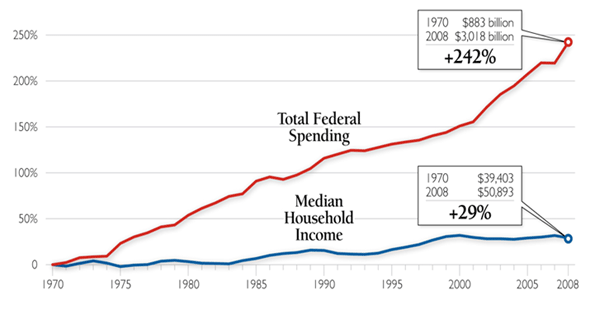
    According to the Office of Management & Budget (OMB), Federal spending has grown more than eight times faster than Household Median Income. Since 1970, middle-income Americans’ earnings have risen 29 percent, but federal spending has increased 242 percent (Percentage Change of Inflation-Adjusted Dollars, 2009). The Greatest Generation believes that spending by Washington politicians has grown out of control. They understand it is not a Republican or Democrat issue. They opposed the $800 billion TARP Bailout under Bush as much as Obama’s $800 Stimulus Bill. They opposed the trillion dollar Healthcare Bill recently enacted into law despite a clear majority opposed to its passage. They recognize that Social Security and Healthcare comprise huge unfunded obligations that will be passed on to their grandchildren.


    Source: Heritage Foundation

    Debt

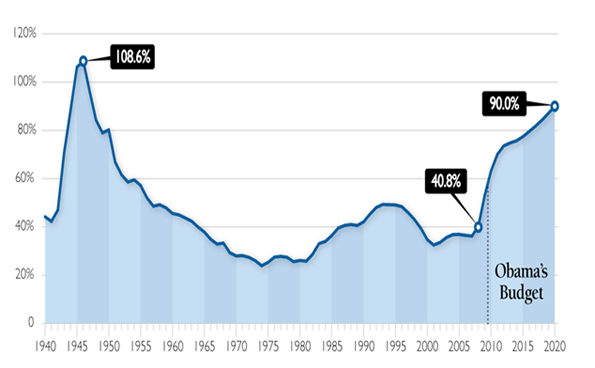
    Since World War II, publicly held debt as a percentage of the economy (GDP) has remained below 50%. In 2008 when President Obama took office, it was 40.8 percent, nearly five points below the post-war average. According to the OMB, Obama’s budget would more than double this figure to 90 percent of Gross Domestic Product by 2020, levels not seen since World War II. (Greece’s debt level of 150% precipitated their meltdown). By 2020, Americans will spend more on interest payments on the Federal debt than on military spending. The Greatest Generation believes these debt levels to be unsustainable.


    Source: Heritage Foundation

    An Unsustainable Path

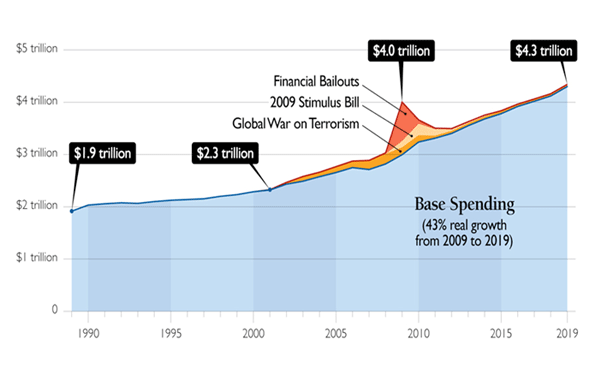
    In 1990, the federal budget was less than $2 trillion. Ten years later the federal budget was just $2.3 trillion. By 2010 the budget exploded to $4 trillion. The Obama budget projects a 43% growth to $4.3 trillion by 2019 according to the OMB. This massive increase over the $2.9 trillion budget Obama inherited in 2008 is not due to emergency spending alone but an intentional structural growth in government. Federal revenues have not kept pace with spending. The U.S. government was forced to borrow $1.5 trillion to pay its bills last year. The national debt is projected to increase from $13 trillion to $20 trillion by 2020 (Inflation-Adjusted Dollars, 2009). The path is unsustainable.


    Source: Heritage Foundation

    While the classic paradox of the immoveable object versus the irresistible force can never be solved, this battle will be settled at the ballot box in 2010 and 2012 when Americans determine the path their country will follow in the 21st Century. If the Greatest Generation prevails, many incumbent politicians will find themselves out of a job as collateral damage. A new wave of politicians will begin The Great Deconstruction.

    New Jersey Governor Chris Christie may be the prototype of this new generation of politicians. He was elected to deconstruct the dysfunctional government of New Jersey, an economy that resembles Greece. Christie inherited the nation’s worst state deficit — $10.7 billion out of a $29.3 billion budget. Christie is doing something unusual, honoring his campaign promises and acting like his last election is behind him. Christie epitomizes the politician the Greatest Generation craves, one willing to lose his job.

    Christie has already declared a state of emergency, signed an executive order freezing spending, and cut $13 billion in spending – in just two months. His first budget included 1,300 layoffs, cut spending by 9%, and privatized government services. The deconstruction of New Jersey has begun. New Jersey may be an unlikely place for The Great Deconstruction to begin, but it is a harbinger of things to come.

    The Great Deconstruction is a series written exclusively for New Geography. Future articles will address the impact of The Great Deconstruction at the national, state, county and local levels.

    Robert J. Cristiano PhD is the Real Estate Professional in Residence at Chapman University in Orange County, CA and Director of Special Projects at the Hoag Center for Real Estate & Finance. He has been a successful real estate developer in Newport Beach California for twenty-nine years.

    Other works in The Great Deconstruction series for New Geography
    The Great Deconstruction – First in a New Series – April 11, 2010
    Deconstruction: The Fate of America? – March 2010

  • The Hong Kong Model for National Identity Cards

    “May I see some identification, please?” asked a retail clerk in my home town Seattle taking my check. I said certainly and handed the sales woman my Hong Kong identity card. She looked at it blankly for a moment then said, “Can I see some other kind of identification?”

    Sometimes when I’m feeling cranky or mischievous, I hand over my Hong Kong ID card when I need to produce some kind of identification. Why not? It is a perfectly valid document. It has my photograph on it. I know of no law that specifies that my state driver’s license has become a national ID card. At least not yet.

    The United States is groping towards a national ID card system, compelled both by worries about security in an age of terrorism and the need to control immigration. In doing so it could learn some lessons from Hong Kong.

    In the U. S. the driver’s license, issued by individual states, has become a de facto identity card. It is used more for cashing checks and opening bank accounts to getting on aircraft even for domestic flights.

    Call me too literal-minded, but a driver’s license is for driving. Identity verification is something else. Why should citizenship be confused with a demonstrated ability navigate through heavy traffic without causing an accident?

    I was reminded of the need for such a card by the controversy over Arizona’s new anti-immigrant law. That state has, if nothing else, put the cart before the horse. Before the police can check on somebody’s “papers” one needs to settle on what “papers” a person should be required to carry.

    The U.S. clearly has a need for some kind of identification card to cash checks, to board airplanes, even to enter a federal building to pick up tax forms. But Americans instinctively balk at the idea of having to carry around a national identity card. Since strictly speaking nobody actually has to have a driver’s license, we kid ourselves into thinking it is still voluntary.

    Before returning to the U.S., I lived for sixteen years in Hong Kong, where everybody over a certain age must obtain an ID card and carry it with him or her at all times. I never considered this a serious infringement on my freedom, although there certainly was a hassle having to obtain one (and to replace one when lost.)

    The Hong Kong police can and do stop people at random and ask them to produce their ID cards. It is not uncommon on the streets to see a couple policemen huddled around a young Chinese man inspecting his ID. That this involves profiling is undeniable. In my sixteen years there, I never once was asked by a policeman to produce my card. It was assumed that being a Westerner I had entered on a valid work permit.

    Of course, I had to produce my ID, or at least provide the number on it, numerous times during the ordinary course of living, from opening a bank account to applying for a job to voting.

    It would be far better to follow Hong Kong’s example and create a national card, probably issued through the Department of Homeland Security. It would lift a burden from state motor vehicle authorities that they were never intended or are equipped to shoulder.

    The advantage that the ID card has over a driver’s license, social security card or any of the other make-shift sources of identification now in use is that they can be coded to show at a glance a person’s status: citizen, permanent resident, foreign student, guest worker.

    In Hong Kong, ID cards are issued to everyone, whether or not they are born there, have become permanent residents or are on short-term work contracts such as the tens of thousands of domestic helpers from Indonesia and the Philippines. In the same way, a national identity card is also a requisite if America is to have any kind of orderly guest-worker program.

    A standardized, secure national ID card issued by the federal government is essential for controlling immigration into the U.S. In short: it’s the way it’s done. Anybody who thinks a national ID card is un-American might have a valid point. But then he should stop complaining about “securing our borders.”

    Todd Crowell worked as a Senior Writer for Asiaweek in Hong Kong before returning to the U.S.

  • Twenty-first Century Electorate’s Heart is in the Suburbs

    Even as the nation conducts its critically important decennial census, a demographic picture of the rapidly changing population of the United States is emerging. It underlines how suburban living has become the dominant experience for all key groups in America’s 21st Century Electorate.

    While suburban living was once seen as the almost exclusive preserve of the white upper-middle class, a majority of all major American racial and ethnic groups now live in suburbia, according to the newest report on the state of metropolitan America from the Brookings Institute. Slightly more than half of African-Americans now live in large metropolitan suburbs, as do 59% of Hispanics, almost 62% of Asian-Americans, and 78% of whites. As a result the country is closer than ever to achieving a goal that many thought would never be achieved: city/suburban racial/ethnic integration. This is particularly so in the faster growing metropolitan areas of the South and West.

    The trend is likely to continue for the foreseeable future. A majority of Millennials live in the suburbs and 43% of them, a portion higher than for any other generation, describe suburbs as their “ideal place to live.”

    The nation’s one hundred largest metropolitan areas have grown twice as fast as the rest of the country in the last decade. That growth was heavily concentrated in lower density suburbs, which grew at three times the rate of cities or inner ring suburbs. At the same time, one third of the nation’s overall population growth was due to immigration. As a result about one-quarter of all children in the United States have at least one immigrant parent. In 2008, non whites became a majority of Americans less than eighteen years old, a demographic milestone that underlines just how fast and how dramatically the country is changing. Any political party that wants to build a lasting electoral majority must align its policy prescriptions with these new demographic realities to attract the votes of a younger, more ethnically diverse population, most of which now lives in the suburbs.

    Economic opportunity continues to be the major driver in determining where people want to live and work. Five of the six fastest growing metropolitan areas in the last decade were also among the top six in job growth according to data from the Census and the Bureau of Labor Statistics analyzed by the Praxis Strategy Group. The same five metropolitan areas – Phoenix, Riverside (CA), Dallas, Houston and Washington, D.C – also ranked high in the diversity of their population, differing only in the degree of educational attainment their residents have achieved.

    With America experiencing the first decade since the 1930s in which inflation adjusted median income declined and job creation slowed to levels not seen in decades, this movement to where the jobs are located is likely to intensify, as current migration to economically buoyant Texas cities and Washington, DC suggests. This crucial factor is often overlooked by urban planners who argue that cultural amenities and sport complexes are the key to attracting new residents. In fact, metropolitan areas that focus on job creation for Millennials (young Americans born 1982-2003) and minorities have the best chance of gaining population in the next decade.

    Clearly providing higher quality public education experiences is a key part of any such economic strategy. The arrival of stealth fighter parents at local school district meetings across the country only reflects the passion among young families about the quality of education their children receive. They are unwilling to allow Boomer ideological debates to delay the changes needed to properly prepare their children for a higher educational experience that increases the odds of economic success. The traditional separation between municipal partisan politics and nominally non-partisan schools is increasingly outdated when so much of a city’s economic success depends on the quality of the education its residents receive.

    Safe neighborhoods of single family dwellings with a surrounding patch of land continue to attract families of every background to the nation’s suburbs. Metropolitan areas that provide such an environment to all of their residents are the furthest along in achieving a more integrated society. Los Angeles, for instance, which is often decried by non-residents as simply an aggregation of suburbs with no central core, has a suburban population whose demographic profile almost exactly matches the city’s population. The fact that most of its housing reflects the tract developments of the 50s and 60s, as well as the city’s low crime rates – down to levels not seen in five decades – are two key reasons for this polyglot profile.

    Rather than fighting this desire on the part of America’s 21st Century Electorate to live comfortably in the suburbs, politicians of all stripes should find ways to embrace it and advocate policies that reflect our new economic realities. For instance, rather than insisting on higher density housing and light rail systems as the only answer to the nation’s appetite for foreign oil, the federal government should adopt tax incentives that encourage telecommuting and continue policies to foster more energy efficient automobiles. If all Americans worked from home, as many Millennials prefer to do, just two days a week, it would cut that portion of our nation’s gas consumption by more than a third. The FCC’s recently announced broadband policy will help put in place the infrastructure required to make such a lifestyle possible and even more productive.

    Three out of four commuting trips involve a single individual driving their car to work and this isn’t likely to change in the foreseeable future. But putting as much emphasis on making our nation’s highways “smart” as in creating a smart electrical grid would make it possible for the existing highway system to shorten commuting time and reduce the quantity of fuel used in such trips. Recent developments in mobile technology makes this a practical, near term solution if state and local governments are prepared to invest in upgrading an infrastructure that is already designed and deployed to connect people’s homes to their workplace.

    Aligning the message at the heart of a party’s programs with the values and behaviors of America’s 21st Century Electorate is the best road towards achieving political victory –for either party – or years to come.

    Morley Winograd and Michael D. Hais are fellows of the New Democrat Network and the New Policy Institute and co-authors of Millennial Makeover: MySpace, YouTube, and the Future of American Politics (Rutgers University Press: 2008), named one of the 10 favorite books by the New York Times in 2008.

    Photo by delbz

  • The Broken Ladder: The Threat to Upward Mobility in the Global City

    Since the beginnings of civilization, cities have been the crucibles of progress both for societies and individuals. A great city, wrote Rene Descartes in the 17th Century, represented “an inventory of the possible”, a place where people could create their own futures and lift up their families.

    In the 21st Century – the first in which the majority of people will live in cities – this unique link between urbanism and upward mobility will become ever more critical. Cities have become much larger. In 1900 London was the world’s largest urban center with seven million people. Today there are three dozen cities with larger populations.

    No longer do a handful of western cities represent the only, or even the most critical, front in the battle for social progress. Mexico City and Mumbai, two cities we have studied, have three times London’s 1900 population. Indeed, of the world’s twenty most populous regions, the preponderance are located in third world or developing countries. The urban drama will play out on a truly global stage, with the most decisive developments taking place in the growing mega-cities of the developing world.

    It is first and foremost in these great cities of the human future that upward mobility must be most accelerated. Urban agglomerations such as Beijing, Shanghai, New Delhi, Sao Paulo, Mumbai, and Mexico City daily stand witness to one of the most rapid expansions of prosperity in history, as well as to wrenching examples of deep seated misery.

    Urbanity in the advanced industrial world is an increasingly interdependent system. The established centers of the global urban culture – New York, Los Angeles, London, Paris, Tokyo, Berlin – provide the critical markets, capital, and technological assistance that drive economic growth in the developing countries, whose growth in turn provides new opportunities for the citizens of the advanced cities.

    These established centers are often seen as occupying the Leninist “commanding heights” of the global economy. Is the kind of centralization we see in these cities, and in other mega-cities around the world, truly inevitable? And is their growth universally desirable? The answers to these questions are vital, notably because it is particularly in these locations that upward mobility now appears to be increasingly stalled. The stasis is reflected in both income trends and popular opinion in the leading centers of advanced world, including the United States, Japan and the United Kingdom.

    Optimists like historian Peter Hall believe that “neither western civilization, nor the western city, shows any sign of decay”. A recent World Bank report insists that large urban concentrations – the more dense the better – are the harbingers of opportunity and wealth creation. “To spread out economic growth”, it argues, is to discourage it. And it is certainly true that as countries modernize, they also urbanize, often quite rapidly. As a result, cities in the developing world – which also receive a great deal of international investment and aid – tend to be growing far more quickly than peripheral regions.

    Yet, in the longer term, the impacts of dense urbanization may not be universally useful at promoting either poverty alleviation or upward mobility. In advanced countries, this is already evident in large urban areas. Indeed, even the strongly pro-urbanist World Bank report acknowledges that as societies reach certain affluence levels, they begin to deconcentrate, with the middle classes in particular moving to the periphery.

    This process reflects a shift in economic and social realities over the past few decades. After nearly a half century of sustained social progress in most advanced countries, income growth for the middle class, even among the best-educated, has slowed considerably, and by some measurements has even turned negative. As we will see, the effects have been particularly tough on the urban middle and working classes in cities as diverse as Toronto, Los Angeles, Tokyo and London.

    Such concerns have been heightened by the current deep recession, which has caused wages to fall in both developing and developed countries. Yet concern over upward mobility was developing even in the relative “boom” times of the recent past, particularly in the advanced western countries, but also in the developing ones. Since 1973, for example, the rate of growth of the “typical family’s income” in the United States has slowed dramatically, and for males has actually gone backwards when adjusted for inflation. This diminishment has been particularly marked in major urban centers such as New York, Chicago, San Francisco and Los Angeles.

    Similar developments can be seen in a host of European cities, including London and Berlin, and even in Tokyo, which long has been seen as distinctly middle class. In all these cities, the middle class appears to be diminishing, while the population living in poverty has increased.

    The reasons for this trend include the impact of technology, aging demographics, globalization, and greater government indebtedness. A critical factor may also be opposition to the very idea of economic growth, something first seen in the 1970s and now increasingly persuasive, at least within large portions of academia, the media, and even parts of the financial community. This attitude is vividly and forcefully expressed, for example, within sectors of the ecology movement.

    Polls of popular opinion in the United States and the United Kingdom find ecological concerns well down the list, behind such issues as the economy, immigration, crime, unemployment and even the state of morality. Yet the agenda to address anthropogenic global warming promotes policies that seem likely to depress economic growth, particularly in cities, through further declines of productive industry, unaffordable housing prices and high levels of taxation.

    As recently seen at the global climate change conference in Copenhagen, few governments in the developing world are anxious to adopt any policy that weakens their ability to spark income and job growth in the near future. The pressing concerns of these cities remain focused on basic issues: sanitation, alleviation of poverty, industrial growth, infrastructure development and employment.

    Policies that prolong poverty and depress mobility seem likely to delay the necessary social consensus needed to enact long-term environmental improvements. When concern for the sustenance of families grows, focus on environmental issues tends to decline, as is already clear in recent surveys in the advanced countries. The much overworked term “sustainability” needs to include both economic and social components, as opposed to strictly ecological ones.

    Within the developing world, as the focus remains on basic economic issues, middle class residents of noted megacities appear to be more optimistic about personal advancement than their counterparts in the advanced countries. This may reflect the fact that countries such as India, China and Brazil have experienced rapid economic growth over the past decade, and expect more of the same in the decades ahead.

    Yet this does not suggest that the rising cities of the Second and Third World are growing in ways that do not deepen inequality. With rapid economic growth, these locations have seen considerable expansion of gaps between rich and poor, particularly with the decline of socialist institutions. Similarly, in some developing cities – Mumbai, Bogota and Sao Paulo, for example – there may be a widening gap between economic success and population density, as growth shifts to places with better infrastructure, less congestion, and less crime.

    In order to look in depth at differing attitudes among urban dwellers, we have focused our research on three megacities that represent different stages of economic development. We start with London, arguably the world’s most important global city, and explore the prospects for upward mobility there.

    Then we look at Mexico City, a city that represents the broad “Second World” of urban centers that have enjoyed some rapid growth but now face increased competition from China and other ascendant locations. Mexico City represents some of the realities that emerging urban centers in the Third World will face as they achieve higher levels of economic development.

    Third, we focus on Mumbai, India’s premier commercial city and financial center. Mumbai reflects the dichotomy of a rapidly growing city in the developing world: increasing wealth and rising expectations among its expanding middle class, with the continued creation of huge populations of destitute slum-dwellers.
    Yet for all the differences between these three great cities, we also find some commonalities. First, their future vitality depends largely on the future of their middle classes. Second, the critical issue for all these places remains how to sustain economic growth to meet the needs and aspirations of their citizens.

    Finally, they share the challenges of the current great economic revolution – what has been called the “post-industrial” era by Daniel Bell or the “third wave” by Alvin Toffler – on the nature of class. The increasing primacy of technology and education, once seen as liberating, could make widespread class mobility far more difficult than in the past.

    As occurred in the early stages of the industrial revolution, the current economic transformation threatens massive displacement of existing classes. Just as the machine age undermined the status of weavers, artisans and small farmers, the current technological epoch could well have similar impacts on not only industrial workers, particularly in the West, but on the supposedly ascendant educated middle class as well.

    This leads us to suggest a primary focus by all great cities on basic economic issues. Current concerns among the dominant cognitive classes in the media, the academic world, and the policy elites, particularly in the First World, have tended to center on aesthetics and “green” issues, as well as on who can draw ‘the best and the brightest”, rather than on how to employ the vast middle or working classes.

    We will explore some of the common challenges that will face all mega-cities as they evolve. Increasingly, they may find that their scale, long seen as an advantage, also produces inherent problems. In a globally interconnected urban environment, they must successfully compete not only with each other, but with smaller scale, and often more efficiently organized, urban areas throughout both the advanced and developing world.

  • It’s the Jobs, Stupid: Infrastructure Matters

    It may surprise you to know that some policy makers and academics believe that “nothing matters” when it comes to infrastructure — the physical structures that make water, energy, broadband and transportation work — and economic prosperity. The thrust of the idea that infrastructure doesn’t matter may have started with Larry Summers, appointed by President Obama as Director of the National Economic Council in 2009. The New York Times says he is “the only top economic adviser with a West Wing office” – meaning he is very powerful in Washington terms.

    His most vocal critic in the matter of infrastructure is Representative Peter DeFazio (D-Oregon). DeFazio appeared on MSNBC’s Rachel Maddow, criticizing Summers, saying that Obama is “ill-advised by Larry Summers” in regards to using stimulus money to cut taxes for businesses. “Larry Summers hates infrastructure,” says DeFazio, who argues that more of the stimulus should have gone to infrastructure. Summers backed away from any earlier comments when he told the Financial Times last June that there may also be “a case for carefully designed support for infrastructure investment.”

    The question seems obvious. What good is it to stimulate business if they don’t have the tools they need to work with?

    Summers’s attitude could make it difficult to generate major new investments in things like roads, bridges, and the broadband communication access that businesses – small and large – need to get the job done. Companies choose to locate where infrastructure is better. Businesses will leave areas where infrastructure is missing or deteriorated – taking jobs with them.

    Certainly U.S. firms look for good infrastructure when they consider placing offices overseas, and foreign firms must do the same when they consider locating here. The idea that good infrastructure would enable economic specialization and lower costs – making U.S. businesses more efficient, more competitive, and therefore able to create more U.S. jobs – is clearly reflected in the way that businesses behave. Emerging market countries remain economically competitive, and are constantly building and rebuilding their infrastructure as their economies develop. Can the U.S. remain competitive if our infrastructure doesn’t keep up with them? It is becoming increasingly clear that deteriorating infrastructure in the United States may actually be contributing to increased costs (and decreased efficiency) of American businesses.

    Recently, the U. S. Chamber of Commerce initiated a project under the Let’s Rebuild America initiative to find a way to measure the performance of infrastructure and the role it plays in economic prosperity. Over the next year, a team of experts (of which I am a member) led by Michael Gallis & Associates will create an Infrastructure Index that can be used to explore the contribution infrastructure makes in keeping American businesses competitive in an increasingly global economy.

    What is innovative about the project team’s approach is that it measures the performance of infrastructure, and not just the size. Thirty years ago researchers on this subject limited their measurement of “infrastructure” to “government spending on public projects” to analyze the impact on economic growth and productivity. This approach is flawed for several reasons.

    First, not all money designated for infrastructure is spent the same way. Government inefficiencies and political corruption plus purchasing power in local economies contribute to inconsistency in quantity and quality of infrastructure based on money spent. Measuring infrastructure in terms of spending alone doesn’t cover the impact of growth on infrastructure. In other words, that a growing economy can afford more infrastructure is just as likely a cause of positive statistical results as the possibility that more infrastructure helps the economy grow. Further, where spending is used to measure infrastructure, the studies usually consider only public spending, ignoring the contribution of investments from private companies (e.g., the contribution of private satellites to communications infrastructure).

    Less than half of the statistical studies using expenditure-based infrastructure measures find that developing or maintaining infrastructure has significant positive effects on the economy. In contrast, over three-fourths of the studies using physical indicators – the number of phone lines, the miles of high-quality road — find a significant positive contribution from infrastructure to the economy.

    There is no dispute that economic growth is necessary as long as there is an increasing population, which will be the case over the next four decades in America as well as Canada and Australia. We need to address the question: is it possible for the economy to “hit a wall” because it runs out of usable infrastructure? In other words, the question is not if infrastructure helps the economy but rather can a lack of infrastructure impede the economy? Can the economy outgrow its infrastructure?

    As the economy changes, so will the demands for infrastructure. The four components of infrastructure – transportation, energy, water and broadband – need to be made relevant across decades, even as the role of one industry may change within the economy. For example, while it is obvious that information-workers, such as computer programmers and software developers who increasingly work from remote locations, require access to broadband infrastructure, they also alter the way that transportation infrastructure is used. Some knowledge-based activities relying on spatial agglomeration place greater importance on rail/subway and less importance on roads. Yet, that does not mean that a knowledge-based economy will need fewer roads – someone has to service those computers and that technician will likely travel to its customers on roads.

    We need to move away from the “one-size-fits-all” approach to infrastructure development toward better integration with the economic activity that uses it. Each region needs to assess its own needs and base their investment decisions on conditions that exist within their region.

    Susanne Trimbath, Ph.D. is CEO and Chief Economist of STP Advisory Services. She will be participating in an Infrastructure Index Project Workshop Series throughout 2010. Her training in finance and economics began with editing briefing documents for the Economic Research Department of the Federal Reserve Bank of San Francisco. She worked in operations at depository trust and clearing corporations in San Francisco and New York, including Depository Trust Company, a subsidiary of DTCC; formerly, she was a Senior Research Economist studying capital markets at the Milken Institute. Her PhD in economics is from New York University. In addition to teaching economics and finance at New York University and University of Southern California (Marshall School of Business), Trimbath is co-author of Beyond Junk Bonds: Expanding High Yield Markets.

  • Houston: Model City

    Do cities have a future? Pessimists point to industrial-era holdovers like Detroit and Cleveland. Urban boosters point to dense, expensive cities like New York, Boston and San Francisco. Yet if you want to see successful 21st-century urbanism, hop on down to Houston and the Lone Star State.

    You won’t be alone: Last year Houston added 141,000 residents, more than any region in the U.S. save the city’s similarly sprawling rival, Dallas-Fort Worth. Over the past decade Houston’s population has grown by 24%–five times the rate of San Francisco, Boston and New York. In that time it has attracted 244,000 new residents from other parts of the U.S., while older cities experienced high rates of out-migration. It is even catching up on foreign immigration, enjoying a rate comparable with New York’s and roughly 50% higher than that of Boston or Chicago.

    So what does Houston have that these other cities lack? Opportunity. Between 2000 and 2009 Houston’s employment grew by 260,000. Greater New York City–with nearly three times the population of Houston–has added only 96,000 jobs. The Chicago area has lost 258,000 jobs, San Francisco 217,000, Los Angeles 168,000 and Boston 100,004.

    Politicians in big cities talk about jobs, but by keeping taxes, fees and regulatory barriers high they discourage the creation of jobs, at least in the private sector. A business in San Francisco or Los Angeles never knows what bizarre new cost will be imposed by city hall. In New York or Boston you can thrive as a nonprofit executive, high-end consultant or financier, but if you are the owner of a business that wants to grow you’re out of luck.

    Houston, however, has kept the cost of government low while investing in ports, airports, roads, transit and schools. A person or business moving there gets an immediate raise through lower taxes and cheaper real estate. Houston just works better at nurturing jobs.

    It’s not just smug coastal places getting smoked by Texas. Since the collapse of the housing bubble Houston has outperformed Sunbelt counterparts like Phoenix, Las Vegas and Los Angeles. A big factor has been that manufacturing, professional services, international trade and technology industries have been the primary drivers of the city’s economic growth–rather than construction and speculation. Ironically, this has increased home values. Since 2007 prices of homes in Houston have ticked slightly higher, while those in Las Vegas, Phoenix, Los Angeles and the Bay Area each are down by more than 35%.

    Some traditional urbanists will concede these facts but then try to shift the focus to “qualitative” factors: the best-educated residents, the highest salaries, the most expensive real estate. Although it also attracts a large number of low-skill migrants, Houston has considerably expanded its white-collar workforce. According to the Praxis Strategy Group, Houston’s ranks of college-educated residents grew 13% between 2005 and 2008. That’s about on par with “creative class” capital Portland, Ore. and well more than twice the rate for New York, San Francisco or Los Angeles.

    But Houston’s biggest advantage cannot be reduced to numbers. Ultimately it is ambition, not style, that sets Houston apart. Texas urbanites are busy constructing new suburban town centers, reviving inner-city neighborhoods and expanding museums, recreational areas and other amenities. In contrast with recession-battered places like Phoenix, Houston remains remarkably open to migrants from the rest of America and abroad.

    Houston, perhaps more than any city in the advanced industrial world, epitomizes the René Descartes ideal–applied to the 17th-century entrepreneurial hotbed of Amsterdam–of a great city offering “an inventory of the possible” to longtime residents and newcomers alike. This, more than anything, promises to give Houstonians the future.

    This article originally appeared in Forbes.com.

    Joel Kotkin is executive editor of NewGeography.com and is a distinguished presidential fellow in urban futures at Chapman University. He is author of The City: A Global History. His newest book is The Next Hundred Million: America in 2050, released in Febuary, 2010.

    Photo by telwink

  • Florida and Oil

    By Richard Reep

    Some say it took Mrs. O’Leary’s cow to make Chicago the city of great architecture that it is today: after the fire of 1871 that destroyed many of its buildings, leading citizens recognized the critical importance of their built environment. Today, we have a city that boasts some of the world’s best architecture. If BP’s oil disaster is a new millennium cow starting another conflagration, the nation may ironically benefit from seeing the ominous oil slick spreading across the gulf, spelling the end to our dependence on oil as the dominant energy source for the nation.

    Cries of “drill baby drill” are suddenly silent as the horror of rusty streaks spreads from MC252, and Florida’s governor Charlie Crist has already viewed the oil slick twice – aware that the tourism industry, already on its knees, will suffer yet another blow amid unemployment, the credit freeze, and state depopulation. The massive disaster looming in the Gulf of Mexico appears to be a giant, ugly metaphor for some choices that America will make in the near future. If we are going to stay dependent upon oil as our energy source of choice, we better grit our teeth, clean it up, and hope for a technological fix to reduce the risk of this happening again.

    Instead of reducing our dependence upon foreign oil, this disaster is causing many in Florida to question whether we should depend on oil at all, foreign or domestic. Ironically, in a state that has consistently banned offshore drilling to prevent such as disaster, Florida’s beaches are likely to suffer from environmental damage anyway. 4,000 or so oil rigs exist in the Gulf of Mexico making this event likely to occur again in the future, and as the engineers experiment with one repair after another it is evident that we are a long way from making these rigs risk-free.

    Over in Florida, the dismay over this event is palpable, and since nothing can be done about it, there is only speculation about what direction to head in the future. Despite the “sunshine state” moniker, the oil industry’s grip on the state is so strong that solar energy is losing market share rather than gaining as an energy resource. The legislature, starved for money to balance the budget, had to kill a rebate program that subsidized building owners when they add solar energy systems to their property. Florida, despite its abundance of renewable energy potential, has yet to see policy that diversifies the energy needs of the state, and sources like solar energy require extraordinarily heavy subsidies to be palpable to most owners.

    While the recession is pushing most prices downward, energy costs are rising across the country, whether fossil fuels or notFlorida is heavily dependent upon fossil fuels, making renewable energy resources someone else’s profit center, judging from California, Oregon, Washington, and Minnesota’s contribution to the top ten cities using renewable energy. Florida, with vast agricultural lands beset by freezes that destroyed much of the cold-sensitive citrus crop this year, has yet to consider energy crops like sugar cane, sorghum, switchgrass, or other biofuels.

    So while Florida sits and watches the oil slick move closer to its shores, some big questions deserve to be asked, and answered. Individuals without the means are generally conserving energy by driving less, biking more, and slowing their lives down to match the pace of their income. All of this is natural conservation of energy is occurring without nannies and big brother shaking a code book at people and may, in the long run, do more to reduce energy consumption than anything else.

    It will take a fundamental shift in thinking to really abandon oil, foreign or otherwise, in Florida or elsewhere. It will take recognition of the incredible abundance of other forms of energy that exist and a passion to seek out ways to use this energy effectively for our needs. This will be only successful with a combination of grass roots and top-down thinking, and perhaps the disaster in the Gulf of will have a legacy similar to the 1969 Santa Barbara oil spill, after which came the Environmental Protection Agency, the Clean Air and Water Act, and a galvanizing of the fledgling environmental movement.

    Sustainability is about preserving the future generation’s ability to choose its own destiny. With this criterion, we should move forward with a pluralist approach to finding energy sources, and consciously step towards them. We won’t abandon oil tomorrow, or the next day, but we can begin to say goodbye to atrocious wastes of nature like the one unfolding in the Gulf of Mexico right now, and we can begin to say hello to a transformation of our lifestyle to embrace different forms of energy for different needs. If this disaster is truly Mrs. O’Leary’s cow, then future generations must truly benefit from the event in order for it to have meaning.

    Richard Reep is an Architect and artist living in Winter Park, Florida. His practice has centered around hospitality-driven mixed use, and has contributed in various capacities to urban mixed-use projects, both nationally and internationally, for the last 25 years.

    Photo by Fabio – Miami

  • Australia: Housing Soars Down Under

    Finally, an important turning point has been reached for Australians in the housing market: on 22 April 2010 the Council of Australian Governments endorsed a new housing supply and affordability agenda.

    The shift in attitude is long overdue. The population of Australia has passed the 22 million mark and is growing at 2.1 per cent per annum. Until now, planning policies based on higher densities have been seen as the solution for this population increase. Such policies are variously euphemistically termed “smart growth”, “urban consolidation” or, more recently, “urban renewal”.

    The deleterious results of high-density policies on both people and the environment are becoming more and more apparent. Australian cities, especially Sydney, are starting to exhibit the downside effects of what might be the most aggressive high-density policies in the world. The general public has not yet comprehended how tight the link is between these restrictive planning policies and the increasing prevalence of community problems.

    The Australian strategy of high-density has had two components. The first has been to artificially strangle the land supply. Residential land release in Sydney has been reduced from a historic average of 10,000 lots per year to less than 2,000, thereby radically reducing the number of dwellings available from greenfield sites.

    The second component of the high-density strategy has required each municipal council to submit a rezoning plan that increases population density to government satisfaction; otherwise, that municipality is adversely impacted. These tactics force high-density onto communities originally designed for low densities.

    Smart-growthers claim a plethora of benefits resulting from high-densities. But any clear-headed examination shows that high-density is detrimental to the public good. Greenhouse gas emissions per person are greater in high-density. The policy overloads infrastructure; choking traffic congestion and longer travel times result. Sewers overflow, electricity supply reaches a breaking point, and there are chronic water shortages. Concrete, tiles and bitumen replace trees, gardens and public open space. Sustainability is adversely affected.

    And, of course, high-density policies create land shortages that result in unaffordable housing. This is the darkest side to the impetus for Smart Growth. The resulting increase in the overall cost of housing is sobering. Even the global financial crisis had very little effect on house prices in Australia. Prices continue to rise, and the Australian Federal Government has become concerned about the impact of increasing housing costs on the economy. The Governor of the Australian Reserve Bank has said that the price of a marginal block of land is too high for a time when interest rates are low and credit is available , and similar sentiments have been expressed by other officials.

    Time series data for Australian cities shows a strong correlation between inadequate land release and excessive housing cost. The land component of the price of a dwelling in Sydney has increased from 30% to 70%. It is apparent that strangling the release of land on the outskirts in order to force high-density has resulted in a shortage and, in the face of ever-increasing demand, the price of land has risen dramatically.

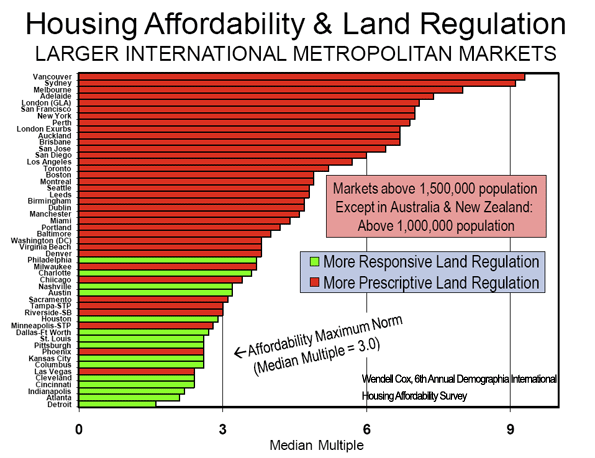
    The 6th Annual Demographia Housing Affordability Survey of six countries portrays a widespread relationship between high housing cost and overly restrictive planning. In the chart below, housing cost is measured as years of family income needed to purchase a house. This year the picture is somewhat complicated by the collapse of the housing bubble in some prescriptive jurisdictions resulting in a substantial reduction of previous high prices.


    Median house price divided by gross annual median household income.

    Only about seven per cent of Australians wish to live in apartments. In spite of this, smart growth policies have resulted in apartments being the only type of housing available to most new entrants to the housing market. These apartments command higher prices than otherwise would be the case, due to an inadequate supply of competing single-residential housing resulting from the scarcity of available sites. This provides the potential for apartment developers to make large profits. Such profits provide the resources for developers to make large donations to the political parties.

    Over the previous five years, the ruling New South Wales Labor Party received donations from the development industry of $9 million, while the Liberal opposition party netted $5 million. These donations exceeded the total contributions to all political parties over the same period from the gambling, tobacco, alcohol, hotel, pharmaceutical and armaments industries combined.

    Numerous documented cases show a large donation being made shortly before permission is granted for a particular development. In response to long-term escalating public anger, the New South Wales Government in December 2009 passed legislation to prohibit donations from property developers. However, the public cynically consider this will not solve the problem and that “donations” will be given in other ways.

    In the face of criticism, state governments maintain that recent land releases have been sufficient. The New South Wales Minister of Housing has stated that land for 131,000 homes has been released in Sydney. Yet the shortage continues to get worse. One reason is the tortoise-like progression of the rezoning process.

    Another is market manipulation. As the Demographia survey points out, governments flag well in advance which greenfield areas will be zoned for developments. Sellers then realise they are cushioned from competition and can command higher prices for their land. Purchasers – developers — know they can pay substantial premiums compared to what would be the case if land release were not so predictable.

    It appears that developers (both government and private) then carefully control the rate at which these greenfield sites are made available to home buyers. It has been reported that the Melbourne government development agency is sitting on a stockpile of 25,000 house blocks that have been zoned for residential approval, but is selling just 700 per year. Private developers and landholders currently hold almost 70,000 house blocks, yet only 1400 of these are available to the market . In the current situation of high demand, it is evident that housing land is being drip fed onto the market, thus keeping prices high.

    The Council of Australian Governments seems to have taken cognisance of this situation, as the review will examine large parcels of land “to assess the scope for increasing competition and bringing land quickly to the market”.

    The Council’s review indicates a welcome change in thinking. Up to now it has not been generally recognised that planning policies are a significant factor in excessive housing cost. Other adverse effects of these policies still need to be acknowledged. One hopes that this review will represent the beginning of a broader appreciation of the downside of high-density policies.

    Photo: A strip of ‘Sydney Lace’in Balmain, Sydney, New South Wales

    (Dr) Tony Recsei has a background in chemistry and is an environmental consultant. Since retiring he has taken an interest in community affairs and is president of the Save Our Suburbs community group which opposes over-development forced onto communities by the New South Wales State Government.