Category: Policy

  • The States and Economic Development, Identifying Top Performers

    This is an excerpt from “Enterprising States: Creating Jobs, Economic Development, and Prosperity in Challenging Times” authored by Praxis Strategy Group and Joel Kotkin. The entire report is available at the National Chamber Foundation website, including highlights of top performing states and profiles of each state’s economic development efforts.

    States throughout American history have done everything they can to cultivate, attract, retain, and grow the businesses that comprise the most fundamental building blocks of their economy. Even in today’s volatile global economy states with severe unemployment and budget woes can point to policies, programs, and investments that foster new economic opportunities and create jobs.

    Read the full report.
    Read part one in this series: The Jobs Imperative: Power to the States

    Many state economic development organizations were originally established with business recruitment and attraction as their primary focus. But today’s mix of state approaches to economic development has moved well beyond earlier, sometimes singularly focused attempts to lure footloose businesses with huge financial incentives and/or by offering a business climate based on cheap labor, low taxes, and lenient regulations.

    States, nonetheless, still compete with each other for companies in “traded sectors” and jobs in the global economy, either directly or by virtue of unique assets and resources, and this sometimes involves financial incentives and tax abatements. But there is growing momentum among governors and state legislatures to grow their economies from within by creating a new set of competitive advantages that include building human capital through workforce development and training, harnessing the power of science and technology assets, making strategic investments in infrastructure, reaching out to global markets, developing opportunities related to energy and the environment, and spurring entrepreneurship and innovation.

    Generally, state economic development efforts include an interrelated array of policies, programs and investments, falling into three major categories: (1) an entrepreneurial approach focusing on new business and technology-based development, oftentimes with a focus on bolstering productivity and innovation; (2) recruitment, expansion, and retention strategies emphasizing financial incentives or investments and other programs, including international trade and export promotion; and (3) “fertile soil” policies28 that create the conditions for growth that will benefit almost any type of business by streamlining governmental regulation, optimizing taxes, investing in infrastructure, and/or by providing a better-educated, more highly skilled work force.

    While it is up to state governors and legislators to set the environment for development to flourish, ultimately economic development success is defined by execution at the local and regional level. With well designed state-implemented development tools, effective workforce development and skills training systems, and strong infrastructure, states can give local economic developers the power to assist the growing businesses, to broker the key partnerships, and to lead the key initiatives that create the jobs needed to sustain our growing population.

    Most of all, states must carefully weigh policy to refrain from constructing barriers to private enterprise growth. Many of the most effective economic development initiatives start from grassroots efforts or private sector business leaders, so supporting these efforts from the state level is imperative.

    Measuring the States: A List of the Top Performers
    A primary goal of any state economic development program is not only to increase the number of jobs in the state, but to improve the quality of jobs and the overall prosperity of the state’s residents.

    This study combines metrics for each economic development policy area to measure overall high performers in each policy topic area. States are compared in each metric and top states are determined by a composite comparison of all metrics in overall performance and in each policy area. For a full description of all metrics and results for each state as well as top performers in exports, innovation, workforce development, infrastructure, and tax and regulation, see the full report.

    To establish the overall best performers we combined measures of Job growth rate since 2000 and since 2007; Gross State Product (GSP) measures: real GSP growth since 2000, GSP per job 2008, Growth in GSP per job 2000-2008; and income: per capita personal income growth 2000-2009 and median four person family income adjusted for cost of living, 2009.

    Top Overall Growth Performers

    1. North Dakota – While North Dakota’s low unemployment and recession resistance is often attributed to healthy agriculture and energy sectors, its construction and manufacturing sectors are relatively healthy and the state has seen 42% job growth in professional and technical services and 36% in management of companies since 2002. North Dakota is the top job performer since the 2007 peak and is fifth since 2000. The state also places first in growth in GSP per job (productivity increase), second in GSP growth and third in per capita income growth. Recent investments in research and development (R&D) infrastructure are beginning to pay off as the state is the fastest growing in science, technology, engineering, and mathematics (STEM) job growth.
    2. Virginia – Already a professional and technical services powerhouse in 2002, Virginia added another 135,000 jobs in that sector since that time, fueled by 90,000 new jobs in computer systems design and management and technical consulting services. The state’s high incomes and slightly below average cost of living placed it first on our cost of living adjusted family income measure.
    3. South Dakota – South Dakota is a strong overall performer, doing best in productivity and output measures. Partly due to an enterprise-friendly regulatory structure, the state has 30% more finance industry employment than the national norm and has added 18% growth in finance employment since 2002. The state’s manufacturing sector actually gained jobs since 2002, led by growth in signs, chemicals, communications equipment, and construction equipment, all averaging more than $43,000 in earnings per worker.
    4. Maryland – Maryland landed in the top 20 or better on all seven performance metrics. Maryland saw strong growth in technical consulting and computer systems design, but especially private scientific research and design services, a sector more than 2.5 times as concentrated in Maryland than the nation as a whole and paying nearly $95,000 in earnings per worker.
    5. Wyoming – Wyoming’s growth is powered by a rapidly expanding energy cluster, which added more than 18,000 jobs since 2002 and now holds 30% of all employment in the state. The energy growth has spilled over into business services sectors such as environmental consulting, surveying and mapping, and testing laboratories. Its overall manufacturing supersector also gained jobs, seeing the fabricated metal and electrical equipment clusters begin to emerge.
    6. New York – While New York saw average job growth through the beginning of the decade, it has weathered the recession better than most other states, and its high productivity and productivity gains help place it among our top performers. Accounting for about 8% of all jobs in the state, the professional and technical services sector added more than 115,000 jobs for 15% growth.
    7. Texas – Texas has seen strong job growth this decade and has weathered the recession well, fueled by 20% expansion of a now 1.1 million job energy cluster. Recently machinery manufacturing and transportation equipment manufacturing clusters are emerging, both growing to more than 90,000 jobs. This has helped stimulate a 15% expansion in transportation and logistics including warehousing and storage and many freight and specialized trucking sectors.
    8. Iowa – A solid performer across most of our metrics Iowa’s strength is perhaps in its stability. The state’s largest cluster, agribusiness, food processing and technology, grew at a 1% rate since 2002, significantly better performing than the same group of industries nationally. Iowa’s other most competitive clusters include machinery manufacturing (farm and construction equipment, refrigeration and heating systems, and other commercial equipment) transportation and logistics, and advanced materials (search and navigation equipment and machine shops).
    9. Nebraska – Nebraska has added 15,000 jobs to its business and financial services cluster since 2002, led by management and technical consulting, management of enterprises, and credit intermediation, all adding at least 3,000 jobs and averaging $55,000 to $90,000 in earnings per worker. The state’s railroads and support industries and freight trucking support a strong transportation and warehousing cluster, and the state has seen a boom in marketing consulting and market research sectors.
    10. Montana – While Montana’s energy and mining clusters added a combined 8,400 high-paying jobs to the state since 2002, Montana’s greatest source of national dominance came from the collection of arts, entertainment, recreation, and visitor industries, perhaps a sign that the rest of the nation is beginning to discover the Big Sky country. Montana is also beginning to see the emergence of smaller clusters in chemicals, apparel and textiles, and fabricated metal products.

    Growing Jobs: How Do They Do It?

    A review of which states are high performing shows a diverse group—some big, some small; some rural, some urban; some inland, some coastal—but a closer examination shows a shared pattern of policies by these high performers.

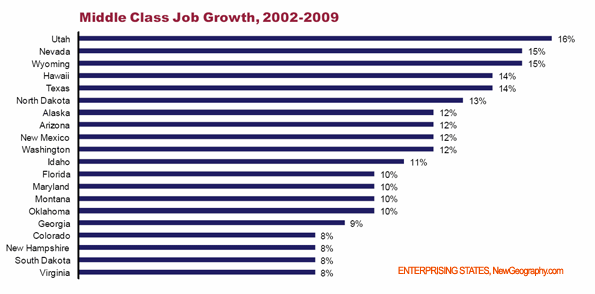
    There is no such thing as single a silver bullet strategy for job creation. Among our top ten performers, all ten have seen at least 4% job growth since 2002 in mid-level jobs requiring at least long term on-the-job training but less than a four-year degree. Five of the ten states increased those jobs more than 10%. At the same time all ten increased science, technology, engineering, and mathematics (STEM) jobs by at least 4% over the same period, with 7 of 10 growing STEM jobs at least 14%.29

    An assessment of top performing states, regardless of by what measure, eventually gets down to a state’s ability to execute successful initiatives. Aside from minding the basics of primary education and supportive infrastructure, success begins with an understanding of a state’s economy and demographics, including its strong points and its gaps. States that can mobilize the relevant partners to put together the strategic networks to build upon those strengths while addressing the weaknesses will be winners in the long run.

    Adequately financing any initiative is paramount to its success. Top performing states have come up with winning formulas often based on combining state funding with federal programs and private sources. As regional workforce skills gaps become more acute, non-governmental agencies and private enterprises more are willing to join new collaborative development projects.

    Programs such as Kentucky’s “Bucks for Brains” which requires universities to match state funds with donations from philanthropists, corporations, foundations, and other non-profit agencies, or Florida’s use of American Recovery and Reinvestment Act (ARRA) funding in combination with existing state funds to tackle major infrastructure programs illustrate unique solutions to sufficiently financing winning initiatives.

    Examples of strong partnerships featuring open communication are especially evident in high performing export states. Export programs are based upon effective communication between the importing country, the exporting manufacturer or business, and the state program helping to facilitate the connection.

    The TexasOne program creates promotional materials to market the state and its manufacturers to importing countries and leads trade missions to importing countries and hosts reverse trade missions to the state. Nevada works with a network of trade representatives in targeted markets throughout Asia, North America and Europe, focused on cultivating distribution channels and facilitating opportunities for foreign direct investment in Nevada enterprises.

    Many high performing states offer an array of corporate, manufacturing, and land tax programs. So too, many states are shying away from direct subsidies for promised job growth in favor of highly targeted tax credit programs that require direct investment by the firm or venture investors wherein the tax benefits are only realized after new jobs are in place. Other credit programs target historically underdeveloped geographical regions.

    Other states such as North Dakota, Florida, and Mississippi have turned to comprehensive tort reform as another key element enterprise-friendliness. Whether these reforms are specific to a particular industry or issue, they ultimately help businesses, large and small, remain competitive and free of excessive burdens from excessive litigation.

    Private sector and academic collaboration is one of the most readily identifiable attributes of high performing states across all measures. Whether it is successful innovation and entrepreneur programs such as Montana’s TechRanch, Oregon’s Innovation Council, Rhode Island’s Center for Innovation and Entrepreneurship, or job creation and economic development initiatives such as Momentum Mississippi, these private and academic partners are providing critical input, oversight, and resources to bolster the effectiveness of state efforts.

    Many states are locating business incubators adjacent to universities in partnership with the schools while others are building laboratory spaces and other specialized infrastructure to offer to growing companies on an a la carte basis. In either case, this business and scientific infrastructure can reduce start-up costs for new enterprises and provide students the chance for experiential learning while earning their degrees.

    While there are obviously other policies or initiatives that high performing states share there are some commonalities: building on momentum; delivering adequate funding for initiatives; developing strong relationships and communication strategies; enterprise-friendly tax and regulation systems; and vigorous collaboration between business, government, and education institutions.

    Read the full report.

    Praxis Strategy Group is an economic development, analysis, and strategic planning firm. Joel Kotkin is executive editor of NewGeography.com and author of The Next Hundred Million: America in 2050

  • Enterprising States: Creating Jobs, Economic Development, and Prosperity in Challenging Times

    This is an excerpt from “Enterprising States: Creating Jobs, Economic Development, and Prosperity in Challenging Times” authored by Praxis Strategy Group and Joel Kotkin. The entire report is available at the National Chamber Foundation website, including highlights of top performing states and profiles of each state’s economic development efforts.

    Read the full report.

    Read part two in this series: The States and Economic Development, Identifying Top Performers

    The Jobs Imperative: Power to the States

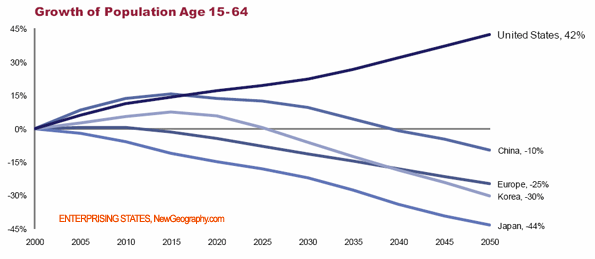
    In the coming decades, the United States will enjoy an enormous demographic advantage over its primary competitors in both Europe and East Asia. As countries such as Germany, France, Japan, South Korea and even China will experience declining workforce growth and rapid aging, by 2050 the pool of people aged 14 to 64 in the United States is expected to grow by more than 40%, compared to what it was in 2000. In contrast, China’s workforce will fall by 15%, Europe’s will decline by 25%, and that of Japan will plunge by 44%.

    This growth represents an unprecedented opportunity for free enterprise in America, but it also poses a tremendous challenge. What the United States does with its “demographic dividend”—that is, its relatively young working-age population—will largely depend on whether or not the private sector can generate growth in jobs and wealth to help meet the needs of a larger aging population.

    Government, too—particularly at the state and local levels—will need to play a role with policies that spur the private sector. Government can facilitate long-term job growth by establishing smart approaches to education, immigration, health care, energy, infrastructure, and tax and regulatory policies.

    A University of Kentucky report prepared for the U.S. Chamber of Commerce has calculated the total number of new jobs needed “to return the economy to our pre-recession level of employment and provide jobs for all the expected new entrants.” It concluded, “The national total is nearly 23 million workers. Almost forty percent of these additional jobs are concentrated in California, Florida, and Texas, three states that comprise 26 percent of the population as of 2008.” Each of the three states that are predicted to need fewer positions since the start of the recession has fewer than 850,000 people. In these states, North Dakota, South Dakota, and Wyoming, the number of workers affected by the recession is more than offset by slower population growth projected by the Census.

    And simply to keep pace with population growth in 2010, the New America Foundation estimates, the country needs to add more than 125,000 jobs a month. The employment imperative is particularly critical today, with over fifteen million unemployed. Even if we reach the administration’s goal of providing 95,000 jobs a month this year, 190,000 monthly next year, and 250,000 in 2012, our overall unemployment rate is expected to remain over 8% by 2012. According to estimates by the Economic Policy Institute, it could take until 2013 or even 2014 to get back to the unemployment levels of before the recession.

    The most critical need is to create jobs for middle and working class people, and for the young, with the teen unemployment rate now over 24% compared to under 15% in 2007.

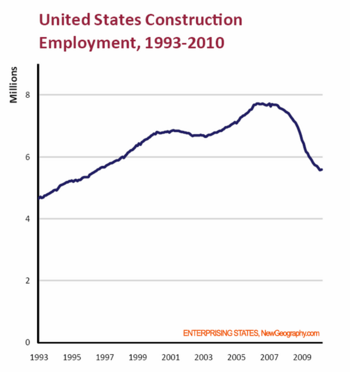
    These groups have borne the brunt of the recession—particularly in areas such as construction, where employment has contracted by two million jobs since 2006. The nature of the federal stimulus, which focused more on the social safety net than on infrastructure, appears to have largely missed this heavily male, blue collar segment.

    Many have been out of work for a long time. Nearly 6.3 million Americans have been unemployed for over six months, the largest number since the federal government started keeping track in 1948. The average duration of unemployment—28.5 weeks—is the highest since the end of the Second World War. According to the labor department, right now there are roughly 6.1 unemployed people for every job, four times the rate in December 2007.

    Needed: An American Approach to Job Creation

    More than a year after the passage of the federal stimulus, much more work needs to be done to strengthen of our free enterprise system. Some analysts suggest that we take our lead from the example of European societies, and use tax dollars to stimulate and preserve employment as well as expand social protections. Others argue that adopting European models of shorter hours and more leisure might benefit the economy. Yet these are not rational choices for the United States, since virtually all these societies are aging rapidly, and few have been growing rapidly.

    Indeed, many of these societies still have higher rates of youth unemployment than the United States. By the end of 2009, unemployment for those under the age of 25 stood at 21% in the European Union (EU), with some countries—Sweden (27%) and Spain (44%)—at extraordinarily high levels.

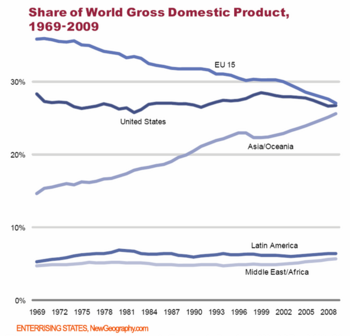
    Overall, the core European countries have not grown as quickly as the United States over the past forty years, and seem to be lagging in the current early stages of the recovery. This is a long term trend. The core EU fifteen countries’ share of the world economy has shrunk considerably, while that of the United States has remained remarkably stable. For EU countries, expansive social protection has not been paired with rapid growth.

    The United States will need to find its own means to address its unique jobs imperative. Clearly, the expansion and preservation of government employment has proven stimulative, but private sector employment continues to be a struggle in most of America.

    One third of the stimulus was directed to local government, and public employment has barely dropped. Even so, there is increasing stress on state and local government, due to the declines in the private sector economy. The limited efficacy of a government-centered approach can be seen in the states—which, after all, cannot print their own money to cover their deficits—with extremely stressed budgets and the inevitability of large cutbacks in public employment.

    Another misplaced approach to job creation is the widely embraced notion—both at the federal and the local levels—that government regulations tied to a “green” economy could create a large new employment source. Various studies in countries that have created massive incentives for such employment—Spain, Germany, Denmark—find that the employment-stimulating impact of such policies can be more than off-set by the negative consequences of resulting high energy prices. When cap and trade mandates raise energy taxes and the cost of doing business, they ultimately inhibit job growth. In the long run new jobs in energy sectors will be created by the creation and production of new technologies.

    Expanding our production of all energy sources could be a major source of jobs. But the experience in some European countries makes clear that green jobs on their own cannot be a fundamental driver of future job creation. Indeed, literature suggests that much of the job growth in green industries has occurred in China and other countries. To date, the actual impact of green jobs seems to be less than expected.

    The one likely way to expand green jobs, notes a series of studies by EMSI, would be through greater economic growth. Most new green jobs depend on the expansion of other key sectors, notably housing, manufacturing, warehousing and agriculture. As these industries expand, they will be the prime markets for new, environmentally responsible technologies and techniques.

    The only sustainable way for the United States to create jobs lies in a rapid expansion of the private sector economy, including in the construction, manufacturing, and energy sectors. A ‘green’ economy cannot be created at the expense of the rest of the economy as a whole. Unreasonable constrictions on manufacturing and construction inhibit job growth. And roadblocks to energy development—including to renewable energy projects—from environmental legislation, as well as from environmentalists and NIMBYs, are also harmful to job growth. Improving the quality of the environment should be a primary concern here, of course, as well. But without robust economic growth, the United States simply will have to accept a massive decline in living standards.

    The growing divergence between advanced countries should not be viewed as a matter of right or wrong, better or worse. Rather, it signifies how societies of different heritages, faced with different prospects, cope with their evolving futures.

    What Is the Best Role for the Federal Government In Job Creation?

    The best role for the federal government is to fund national priorities like energy, physical infrastructure, and the national defense, and to set basic health and safety regulatory guidelines that are carefully balanced against the need to maintain low barriers to entry into the market. But, for the most part, the primary mission for economic development went to the states, and, more importantly, the private sector economy.

    The mounting federal initiatives to wrest environmental, wage, and benefit concessions from private companies are examples of a centralization of government power over both states and private businesses that could take us in the wrong direction. Although certain times do call for increased federal activity—legitimate threats to national security or economic emergencies, such as the Great Depression or the recent financial crisis—we may be approaching a critical juncture where Washington’s power may be reaching beyond its effectiveness.

    The current impulse to create a high-employment economy by imposing federal restrictions—such as the proposal that private firms that do not raise wages will be bullied into doing so by the manipulation of federal contract awards—marks a departure from our free-market traditions. Similarly, possible federal control over local zoning decisions—through such organizations as the EPA—also mark a crossing of the regulatory Rubicon.

    States and localities are far better positioned than the federal government to foster strategic investment, regulations, taxes and incentives that encourage private sector prosperity. In large part, this is because they are more responsive to local conditions. Many academic planners, policy gurus, and national media have tended to favor large government units as the best way to regulate and plan for the future. But central planners consistently seek to reduce the influence exercised by the plethora of villages, towns, and cities in the United States: well over 65,000 general-purpose governments. With so many “small towns,” the average local jurisdiction population in the United States is 6,200, small enough that nonprofessional politicians can have a serious impact on local issues.

    The American preference for solving problems at the state or local level should be central to the government role in job creation. One size determined in Washington will not fit all. South Dakotans and Californians will prefer to address employment problems in different ways. Within the limits of constitutional rights, we should let them try their hand, and let everyone else learn from their success or improve upon their policies.

    Indeed, many Americans on both the right and left are instinctive decentralists. Our economic evolution mirrors this trend. America’s entrepreneurial urge, in contrast to developments elsewhere, has actually strengthened. In 2008, 28% of Americans said they had considered starting a business—more than twice the rate for French or Germans. Self-employment, particularly among younger workers, has been growing at twice the rate of the mid-1990s.

    For this reason, supporting new businesses—and small and medium-sized firms—by ensuring that they can get the credit they need is an essential piece of the job-creation picture. For jobs to grow, these businesses must thrive.

    Innovation and Entrepreneurship Are the Key to Solving the Jobs Imperative

    America will depend on its emerging population of younger workers to keep expanding its economy. In the 1970s, when the coming-of-age of the boomers began to impact the labor market, labor force growth created a period of higher unemployment. Now, we could see a reoccurrence as the large millennial generation starts to seek employment. Yet now, as then, predictions of a long term labor glut could well change as these workers find and develop new opportunities.

    This happened to the boomers in the late 1980s, when talk of long-term high unemployment was replaced with concerns over a labor shortage. The growth of new industries tied to the use of computers, and later of the internet, created a surge in demand for skilled workers. As boomers integrated into the workforce and were replaced by less numerous generation “X”-ers at the entry level, companies fretted increasingly about a diminishing pool of workers.

    The opportunities for employment created by the rise of new industries, and by the innovative expansion of established businesses, cannot be underestimated. Such innovation has long been the source of new growth for the American economy, although the exact nature of that innovation is impossible to predict. Much of the pioneering will likely come from skilled immigrants, who are
    estimated to have started a quarter of all venture-backed
    public companies between 1990 and 2005.

    This enterprising spirit reflects a broad, long-term American trend. U.S. employment has been shifting not to mega corporations, but to individuals and smaller units; between 1980 and 2000, the number of self-employed individuals expanded tenfold to comprise 16 percent of the workforce.

    The smallest businesses—the so-called microenterprises— have enjoyed the fastest rate of growth. By 2006 there were some twenty million such businesses, one for everysix private-sector worker. Hard economic times could slow this trend, but historically, recessions have served as incubators of innovation and entrepreneurship. Many of the individuals starting new firms will be those who have recently voluntarily left or been laid off by bigger companies.

    The Vital Role of Infrastructure and Basic Industries

    To succeed in the mid-21st century, Americans also will need to pay more attention to the country’s basic industries. Some assume that the American future can be built around high-end “creative” jobs, without ever reviving the industrial economy or rebuilding our physical infrastructure. In the America envisioned by advocates of “the creative economy,” our productive facilities would serve mainly as tourist attractions, much as we now visit restored pioneer villages.

    Such an approach assumes that our rising competitors, notably China and India, will surrender high value activities such as media, finance and engineering. This is a dangerous and historically ill-considered assumption. In the 1980s, Japanese firms that were widely written off as “copycats” became primary innovators, particularly in automobiles, semiconductors, and computer games. In the coming decades, Chinese, Indian, and Brazilian companies—to name a few—will seek to move from low-wage work to more specialized, innovative kinds of products. The enormous revenues generated from the less trumpeted activities will provide the funds to invest in their move into ever higher-end activities.

    Americans can create a more prosperous future, but only if we focus on maintaining the physical infrastructure necessary for basic production and transportation, as well as on developing the intellectual prowess of our citizenry. America’s unique demographics require the country to pay attention not only to high-tech industries or financial services, but also to the basics: construction, manufacturing, agriculture, and energy.

    These critical industries underpin our prosperity and employ our expanding blue-collar workforce. They can provide new opportunities for the majority of workers who do not possess four year or advanced college degrees. In 2005, the National Association of Manufacturers, the Manufacturing Institute, and Deloitte Consulting surveyed eight hundred U.S. manufacturing firms: More than 80% reported that they were “experiencing a shortage of qualified workers overall.” Nine in ten firms stated that they faced a “moderate-to-severe shortfall” of qualified technicians. By 2020 this shortage could grow to 13 million workers. A resurgent manufacturing sector would also boost the country’s technological workforce. By 2007, industry employed about a quarter of the nation’s scientists and related technicians.

    This revived focus on production would help large swaths of the country. The Great Plains area, which is still profiting from industrial and agricultural expansion, would benefit, as would the Great Lakes, which has weathered so many challenges in recent decades. Historically neglected regions such as Appalachia would also profit.

    The Critical Role of States

    America is a vast country made up of hundreds of diverse economies. From early on, very different industries clustered in different places. There has been wide divergence in the skills and abilities of local populations. Although federal intervention is necessary in certain areas—for example, in creating national research institutions or interstate transportation—it is often at the state or local level that the best policies for a particular region can be developed.

    The need to tailor economic development to local needs has been a critical aspect of the success of our federal system. By giving a state wide leeway to develop its own solutions to the jobs imperative, we would be providing the other states with potential role models—as well as a warning system of policies to avoid—in their own strategies. The states are described in the famous opinion issued by Supreme Court Justice Louis Brandeis as places that “serve as a laboratory” where the nation can “try novel social and economic experiments without risk to the rest of the country.”

    States have often been leaders in fashioning progressive approaches to economic development. Private and state-sponsored development created the initial network of roads, canals, and steamboats that knit together regional economies. When President James Madison vetoed federal funding for the Erie Canal in 1817, the New York legislature used its own tax and credit resources to complete the 363 mile system eight years later. Eventually the canal helped assure the Empire State’s national preeminence. Other states, including Pennsylvania, Ohio, Indiana, Illinois, Maryland and Virginia, followed suit with their own canal-building projects.

    In the 1920s and 1930s states—and some municipalities—also invested heavily in wealth-creating infrastructure, including highways and water and power systems. These investments supplemented significant new underwriting of projects from private corporations. States continued to make these investments throughout the 1950s.

    At the time, no state was more successful at developing its economy than California. Under both Republican and Democratic Governors, California developed what has become a widely accepted model of local economic development based on the expansion of traditional infrastructure—roads, bridges, water and energy systems—matched by massive investments in “human capital”, including a master plan for higher education that spanned the elite universities to the community colleges.

    California’s state investment and business promotion policies inspired other states, notably Texas and North Carolina. This state role was also embraced by the young Governor of Arkansas, Bill Clinton. Faced with the issues of a poor, racially divided state, Clinton recognized that, given the deep divisions in Washington, “There is no alternative to continued intense state efforts to deal with our most pressing domestic problems.”

    Although unemployment dropped, there remained problems relating to national competitiveness and declining middle class wages, Clinton argued. But he continued to believe in the exercise of local power. “In a country as complex and diverse as ours, in which most job growth is generated by small business,” he noted, “many of these [economic] issues will almost have to be dealt with at the state level.”

    In David Osborne’s landmark work, Laboratories of Democracy, he described how the late 1980s and early 1990s saw the emergence of a whole host of innovative Governors. The “first agenda” of these Governors, Osborne noted, was “creating economic growth”, a notion Governor Clinton later used effectively in his campaign for the Presidency.

    In today’s federal-level climate, states could potentially play a more significant role than they did in the ‘80s and ‘90s. Chuck McCutcheon, co-editor of Politics in America at CQ-Roll Call Group, suggests that continued DC “political gridlock” makes the states better suited to deal with major policy issues. At the state and local levels, he suggests, politicians are more likely than their highly polarized federal counterparts to “get along” with each other.

    Conclusion: The Power of the States to Lead the Jobs Imperative

    Ultimately, states and localities are best qualified to meet the jobs imperative. As Alexis De Tocqueville observed, it is natural that citizens of a state or locality are more solicitous about “the increasing prosperity of his own district,” and this serves “to stir men more readily than the general interests of the country and the glory of the nation.”

    As our country grows, reaching 400 million people by 2050, the differences between our various states and communities will grow. We will have more diverse regional economies, demographics and cultures. We need to look at these local sources—what Thomas Jefferson called “our little Republics”—to lead the jobs imperative. It is an imperative upon which depends the future success of our entire nation.

    Read the full report.

    Praxis Strategy Group is an economic development, analysis, and strategic planning firm. Joel Kotkin is executive editor of NewGeography.com and author of The Next Hundred Million: America in 2050
  • Bungled Parliament:: The Price of Pursuing Safe Society Over Growth and Opportunity

    On May 6 British voters handed themselves a hung Parliament for the first time since 1974. No political party has a governing majority. This has surprised most pundits who have assumed for several years that the Conservatives would reclaim government in Britain by 2010, ending 13 years of Labour rule and the tenure of Gordon Brown, the prime minister everyone loves to hate.

    The reasons for the conservative’s disappointing performance are complex. Certainly the surprisingly adroit performance in the first-ever prime ministerial debates by Nick Clegg, the even-more-telegenic-than-David Cameron leader of the Liberal Democrat party, did not help. But Clegg’s lustre – which became known as “Cleggmania” – eventually wore off by election day, and the Lib Dems ended up losing five seats.

    The real reason for the Conservatives disappointing performance lay elsewhere. To many, it seemed that David Cameron, the Conservatives’ young and telegenic leader, represented a new type of Tory politician – one concerned with social justice and the environment while remaining true to core beliefs about smaller government and enterprise.

    Yet the bigger issue may well be this: the Conservatives, like their rivals, failed to make a compelling case how to restore an environment of growth and opportunity capable of bringing Britain out of its profound economic doldrums.

    Given Britain’s fiscal situation and a widely spread sense of economic malaise, the overall paucity of good policy ideas and public messages about opportunity and economic recovery is difficult to fathom. The fact that the Conservatives – erstwhile harbingers of enterprise and growth – managed to remain vague on economic fundamentals is particularly astounding.

    Days before the election, only 29 percent of voters said they trusted the Conservatives to do the best job dealing with unemployment, compared to 28 percent who preferred Labour. On the economy overall, 37 percent believed Conservatives were the best party compared to 36 percent who preferred Labour’s approach, an amazing result given the fact that Labour has controlled the government for thirteen years. Only on taxes did the British public clearly prefer the Tories to Labour, 31 to 24 percent, which is likely owing to the fact that the Conservatives very publicly opposed Labour’s promise to raise the National Insurance tax (similar to the payroll tax in the U.S.). This ended up as the only economic issue for which Tories showed any public passion in the weeks leading up to the election, and the opinion polls suggest their message got through. But they didn’t capitalize on the lesson.

    The roots of the problem run deep. British politicians have grown too accustomed to thinking about safety and security rather than policies that would require taking some risks for growth. Each party admitted in one way or another that public spending cuts would be necessary to deal with Britain’s deficit, but none – including, shockingly, the Conservatives – laid out an aggressive vision of how these cuts could be combined with the types of policies needed to increase entrepreneurship, create more jobs, attract investment, and promote greater overall opportunity in the economy.

    Consider the third and final televised party leader debate, which focused on the economy. Cameron, to his credit, was the only one to use the word “entrepreneur” or one of its derivatives. He did so three times. The three candidates together only spoke of “growth” six times, and no one ever said anything about creating opportunity. They spoke a lot about the importance of jobs but talked about what is required to create them less than a half dozen times. Meanwhile, Clegg used the word “fair” or one of its derivatives 19 times, and Brown did the same 12 times – addressing everything from the need to make tax increases fair to making compensation for bankers fair. Cameron never engaged in fairness drivel, but he also never countered by laying out a strong growth oriented agenda. In a fundamental way, he punted away his best issue.

    Months earlier, the Conservatives launched an ad campaign with Cameron’s face plastered all over England with the less-than-comprehensible slogan: “We can’t go on like this. I’ll cut the deficit, not the NHS.” With a budget deficit of 11.1 percent of GDP and a national debt of nearly £1 trillion (the interest on which costs the government more than it spends on education), you don’t have to be a financial wizard to know you can’t cut the deficit without touching the NHS.

    Then, at the end of the campaign, Cameron’s team began using the expression “Big Society” as its unifying theme. No one really knew what to make of it. Was it the same as a Fat Society? Was Big better than Effective or Strong? In other words, total tripe. The Conservatives seemed to be promoting social rotundity while saying little about the future of growth, enterprise, education reform (for which the party has a very forward-looking plan) and anything that would create opportunity in this increasingly fragmented, class-bound society.

    All of this is somewhat surprising, given that the Conservative manifesto has important things to say about creating an environment favorable to investment, lower taxes, and progress through important growth sectors such as high-tech exports. It certainly compares well with Labour’s manifesto, which talks blithely about tax hikes and a growing public sector with no sensible formula to restore long-term growth. That the Tories did not exploit this difference seems inexplicable but as a result, they did not look different enough from their competitors to earn the solid majority that was once seen as all but inevitable.

    Ryan Streeter is a Senior Fellow at the London-based Legatum Institute.

    Photo by bixentro

  • A Carbon Added Tax, Not Cap and Trade

    Paul Krugman devoted a recent lengthy New York Times Magazine article to the promotion of a disastrous “cap and trade” regime for reducing carbon emissions. Though he doesn’t outright endorse it, he strongly suggests that the Waxman-Markey bill that passed the House would be acceptable to him. Krugman then proceeds to pooh-pooh the carbon tax idea, one that I believe has far more merit.

    Cap and trade would be a debacle for a slew of reasons. The most important is that it won’t even reduce carbon emissions. Two of the EPA’s own San Francisco attorneys dismissed the Waxman-Markey cap and trade regime as a “mirage” that would not reduce carbon because of the ability of polluters to obtain fictitious carbon offsets, among other problems.

    Even if cap and trade would require American producers to reduce carbon emissions, it would do nothing about overseas polluters. An American manufacturer could escape cap and trade simply by moving production to China. Given China’s massive coal-based electricity infrastructure and other notoriously polluting practices, carbon emissions would likely only get worse as a result, in addition to the US jobs lost.

    Krugman suggests this can be fixed with a carbon tariff, but that’s dangerously naïve. There’s no guarantee a carbon tariff would be put in place after cap and trade passed. In effect, it requires two completely separate policy mechanisms be put in place and kept synchronized over time, which seems dubious. Our trading partners would surely chafe at any carbon tariff, which would be vulnerable to challenge under international trade treaties.

    Cap and trade also has huge distortive impacts within the United States. The Brookings Institution crunched the numbers and found that cap and trade costs vary widely across the country. Compliance costs would be minimal in California and rest of the West and Northeast, while the Midwest, Mid-Atlantic, and the South get pummeled. It should come as no surprise that it is California Rep. Henry Waxman who’s pushing the bill. One can’t help but suspect these regional disparities are the real implicit goal of the bill. Indiana Gov. Mitch Daniels denounced cap and trade as “imperialism”.

    Perhaps the most diabolical part of cap and trade is in its very name. The operative word is “trade”. Who do you think will be doing the trading? Why, none other than the very people who got us into the economic mess we’re in today. Cap and trade is a gigantic giveaway to Goldman; it’s yet another instrument for speculation; it’s another way for the profiteers on Wall Street to line their pockets at our expense.

    So in a sense it’s also another way that, perhaps unintentionally, the richest sectors, the upper classes, and the financial centers like New York, Boston and San Francisco are being favored over the poor Main Street rubes who have taken it on the chin during this recession without a bailout. If you think things are bad now, just wait until CDS stands for “carbon default swap”. It’s pouring fuel on the fire of inequality between the haves and have nots.

    Cap and trade is nothing more than another tranche in the never-ending merry-go-round of bailouts for the financiers. And didn’t we learn anything from Enron’s electricity trading shenanigans? When an Iowa farmer opens up in his electric bill that’s suddenly spiked, or has to pay double to fuel his farm equipment, it’s not too much to ask that it be in the service of actual carbon reduction, not houses in the Hamptons, owned by people to whom the added cost is not material given their wealth.

    There is a better way, and that’s the Carbon Added Tax. Similar to a European-style Value Added Tax, a CAT tax would directly tax the quantity of carbon emissions added to the atmosphere in each stage of the production cycle. The tax could be set at a level that would provide certainty of price such that investments in lower carbon technologies are financially feasible right now, not decades from now.

    Also, similar to the US income tax system, the CAT would apply to the carbon emitted globally, not just in the United States. A deduction would be permitted for any bona fide carbon taxes paid in a foreign jurisdiction, up to the level of the US tax. A true-up on the carbon tax due would be paid at the point of import into the United States. That is, an importer would have to pay the CAT on products brought into the country, less any deductions for foreign carbon taxes paid, at the port of entry.

    While this global approach is a widely, and correctly, maligned feature of the US income tax code, it has important benefits from a carbon reduction perspective. First, it is location neutral. Since the tax is the same whether the carbon is emitted in China or the United States, it doesn’t encourage business to move offshore. But it also doesn’t discriminate against foreign producers. (Like any anti-carbon regime, it would raise costs in the US, affecting both domestic consumers and the competitiveness of exports).

    The CAT is also functionally equivalent to a carbon tariff, but is a unitary regime. That is, you don’t have to figure out how to bundle in or pass a separate carbon tariff as part of implementing a domestic cap and trade system. You simply pass a CAT on global carbon emissions and you are done.

    And this system allows each country to decide on its own level of carbon taxation. If countries like China want to have no tax, that’s their choice. Or, European countries could decide to have a higher tax. The complexity would come in figuring out the allowed deductions for emissions in countries that adopted other schemes like cap and trade, but this should be a readily solvable technical issue.

    There will still be divergent regional domestic impacts under a CAT. This is unavoidable in a nation where carbon emissions are unevenly distributed. But by preventing the financiers from skimming off the top, the total burden is reduced, and a CAT is a more location neutral, transparent mechanism for carbon reductions.

    A Carbon Added Tax is a far superior way to reduce carbon emissions than a cap and trade system only a Wall Street trader could love.

    Aaron M. Renn is an independent writer on urban affairs based in the Midwest. His writings appear at The Urbanophile.

    Photo by Gilbert R.

  • Growing America: Demographics and Destiny

    Over the next four decades, American governments will oversee a much larger and far more diverse population. As we gain upward of 100 million people, America will inevitably become a more complex, crowded and competitive place, but it will continue to remain highly dependent on its people’s innovative and entrepreneurial spirit.

    In 2050, the U.S. will look very different from the country in 2000, at the dawn of the new millennium. By mid-century, the U.S. will no longer be a “white country,” but rather a staggering amalgam of racial, ethnic and religious groups, all participants in the construction of a new civilization whose roots lie not in any one country or continent, but across the entirety of human cultures and racial types. No other advanced, populous country will enjoy such ethnic diversity.

    The implications of this change will be profound for governments-perhaps in ways not now commonly anticipated. Many “progressives” believe a more diverse, populous nation will need more guidance from Washington, D.C., but a more complex and varied country will increasingly not fit well into a one-size-fits-all approach.

    Although the economic crisis of 2008 led to a rapid rise of federal power, there has been a stunning and largely unexpected push-back reflected, in part, by the tea party movement. Some states have passed laws that seek to restrict federal prerogatives on a host of issues. More importantly, public opinion, measured in numerous surveys, seems to be drifting away from major expansions of government power.

    Of course, most Americans would accede to the federal government an important role in developing public works, national defense and regulations for health and safety. But generally speaking, they also tend to believe that local communities, neighborhoods and parents should possess the power to craft appropriate solutions on many other problems.

    This also reflects our historical experience. From its origins, American democracy has been largely self-created and fostered a dispersion of power; in many European countries, and more recently in parts of Asia, democracy was forged by central authorities.

    Other periods of massive government intervention, most notably after the New Deal and the Great Society, also elicited reactions against centralization. But the current push-back’s speed and ferocity has been remarkable. Yet the often polarizing debate about the scope of federal power largely has ignored the longer-term trends that will promote the efficacy of an increasingly decentralized approach to governance.

    Perhaps the most important factor here is the trajectory of greater growth and increasing diversity of who we are and how we live. Not only are Americans becoming more racially diverse, but they inhabit a host of different environments, ranging from dense cities to urbanized suburbs, to smaller cities and towns, that have different needs and aspirations.

    Americans also are more settled than any time in our history-partially a function of an aging population-and thus more concerned with local developments. As recently as the 1970s, one in five Americans moved annually; in 2004 that number was 14 percent, the lowest rate since 1950. In 2008, barely one in 10 moved, a fraction of the rate in the 1960s. Workers are increasingly unwilling to move even for a promotion due to family and other concerns. The recession accelerated this process, but the pattern appears likely to persist even in good times.

    Americans also prefer to live in decentralized environments. There are more than 65,000 general-purpose governments; the average local jurisdiction population in the United States is 6,200-small enough that nonprofessional politicians can have a serious impact on local issues. This contrasts with the vast preference among academic planners, policy gurus and the national media for larger government units as the best way to regulate and plan for the future.

    Short of a draconian expansion of federal power, this dispersion is likely to continue. Roughly 80 to 90 percent of all metropolitan growth in the last decade took place on the periphery; at the same time, the patterns of domestic migration have seen a shift away from the biggest cities and toward smaller ones. As Joel Garreau noted in his classic Edge City, “planners drool” over high-density development, but most residents in suburbia “hate a lot of this stuff.” They might enjoy a town center, a paseo or a walking district, but they usually resent the proliferation of high-rises or condo complexes. If they wanted to live in buildings like them, they would have stayed in the city.

    Attempts to force major densification in these areas will be fiercely resisted, even in the most liberal communities. Some of the strongest anti-growth hotbeds in the nation are areas like Fairfax County, Va., with high concentrations of progressives-well educated people who might seem amenable to environmentally correct “smart growth”-advocating denser development along transit corridors. As one planning director in a well-to-do suburban Maryland county put it, “Smart growth is something people want. They just don’t want it in their own neighborhood.”

    The great long-term spur to successful dispersion will come from technology, as James Martin first saw in his pioneering 1978 book, The Wired Society. A former software designer for IBM, Martin foresaw the emergence of mass telecommunications that would allow a massive reduction in commuting, greater deconcentration of workplaces and a “localization of physical activities … centered in local communities.”

    Technology would allow skilled people to congregate in communities of their choice or at home. Today not only knowledge workers but also those in construction trades, agriculture and other professions are home-based, conducting their operations out of trucks, vans or home offices.

    Many leading-edge companies now recognize this trend. As much as 40 percent of IBM’s work force operates full time at home or remotely at clients’ businesses. Siemens, Hewlett-Packard, Cisco, Merrill Lynch and American Express have expanded their use of telecommuting, with noted increases in productivity.

    At the same time, employment is shifting away from mega-corporations to smaller units and individuals; between 1980 and 2000, self-employed individuals expanded tenfold to include 16 percent of the work force. The smallest businesses, the microenterprises, have enjoyed the fastest rate of growth, far more than any other business category. By 2006 there were some 20 million such businesses, one for every six private-sector workers.

    Hard economic times could slow this trend, but recessions have historically served as incubators of innovation and entrepreneurship. Many individuals starting new firms will have recently left or been laid off by bigger companies, particularly during a severe economic downturn. Whether they form a new bank, energy company or design firm, they will do it more efficiently-with less overhead, more efficient Internet use and less emphasis on pretentious office settings. In addition, they will do it primarily in places that can scale themselves to economic realities.

    Simultaneously the Internet’s rise allows every business-indeed every family-unprecedented access to information, something that militates against centralized power. Given Internet access, many lay people aren’t easily intimidated into accepting the ability of “experts” to dictate solutions based on exclusive knowledge since the hoi polloi now possess the ability to gather and analyze information. Even the powerful media companies are rapidly losing their ability to define agendas; there are too many sources of information to mobilize mass opinion. The widespread breakdown of support for climate change is a recent example of this phenomenon.

    Once the current drive for centralization falters, support for decentralization will grow, including progressive communities that now favor a heavy-handed expansion of federal power. Attempts to impose solutions from a central point will be increasingly regarded as obtrusive and oppressive to them, just as they would to many more conservative places like South Dakota. In the coming era, in many cases, only locally based solutions-agreed to at the community, municipal or state level-can possibly gather strong support.

    This drive toward dispersing power will prove critical if we hope to meet the needs of an unprecedentedly diverse and complex nation of 400 million. New forms of association-from local electronic newsletters to a proliferation of local farmers markets, festivals and a host of ad hoc social service groups-are already growing. Indeed, after a generation-long decline, volunteerism has spiked among Millennials and seems likely to surge among downshifting baby boomers. In 2008, some 61 million Americans volunteered, representing more than one-quarter of the population older than 16.

    It’s these more intimate units-the family, the neighborhood association, the church or local farmers market-that constitute what Thomas Jefferson called our “little republics,” which are most critical to helping mid-21st-century America. Here, our nation of 400 million souls will find its fundamental sustenance and its best hope for the brightest future.

    This article originally appeared in GOVERNING Magazine.

    Joel Kotkin is executive editor of NewGeography.com and is a distinguished presidential fellow in urban futures at Chapman University. He is author of The City: A Global History. His newest book is The Next Hundred Million: America in 2050, released in Febuary, 2010.

    Photo by slynkycat

  • Is Sweden a False Utopia?

    By Nima Sanandaji and Robert Gidehag

    Sweden is often held up by American pundits and experts as a kind of Utopia, a country to be emulated. As is often the case when dealing with Utopias however, the complexities of history, culture and policy frequently are shoved aside.

    Rather than being guinea pigs in a progressive experiment in social engineering, Swedes are a unique people with a long history. Therefore, we should question the lazy assumption that good Swedish outcomes (long life expectancies, social equality) are due to particular Scandinavian policies (the welfare state).

    After all, even before the high-tax welfare state, Sweden was characterized by an even distribution of income, low poverty and long life spans, the same phenomena that today are said to be the result of high-tax welfare policies. In 1950, before the high-tax welfare state, Swedes lived 2.6 years longer than Americans. Today the difference is 2.7 years.

    A more reasonable view of why Sweden performs well on many social metrics has its basis in history and sociology: Swedes have for hundreds of years benefited from sound low-level institutions, such as a strong work ethic and high levels of trust and cooperation.

    These cultural phenomena do not disappear when Swedes cross the Atlantic to the supposedly inferior “cowboy” country. On the contrary, they appear to bloom fully. The 4.4 million Americans with Swedish origins are considerably richer than the average American. If Americans with Swedish ancestry would form their own country their per capita GDP would be $56,900, more than $10,000 above the earnings of the average American.

    The old Sweden, in contrast, has not done as well in economic terms. In 1960 taxation stood at 30 percent of GDP, roughly where the US is today. As taxes rose, economic growth decreased, with Sweden dropping from being the 4th richest country in 1970 to being the 12th richest in 2008. Swedish GDP per capita is now $36,600, far below the $45,500 of the US, and even further behind the $56,900 of Swedes in America.

    A Scandinavian economist once stated to Milton Friedman: “In Scandinavia we have no poverty.” Milton Friedman replied, “That’s interesting, because in America among Scandinavians, we have no poverty either.” Indeed, the poverty rate for Americans with Swedish ancestry is only 6.7%, half the U.S average. Economists Geranda Notten and Chris de Neubourg have calculated the poverty rate in Sweden using the American poverty threshold, finding it to be an identical 6.7%.

    Ironically, this points us towards the conclusion that what makes Sweden uniquely successful is not the welfare state, as is commonly assumed. Rather than being the cause of Sweden’s social strengths, the high-tax welfare state might have been enabled by the hard-won Swedish stock of social capital. It was well before the welfare state, when hard work paid off, that a culture with strong protestant working ethics developed.

    As taxes in Sweden have grown rapidly towards taking up half of the economy, that social capital is being eroded. In the 1990s, supposedly hyper-healthy Sweden established itself as being sickest country in the rich world, in terms of sick-leave. In addition, half a million working-age people (compared to a total labor force of four million) were placed in health-related “early retirement”.

    Labor union economist Jan Edling calculated that a fifth of working-age Swedes were supported by some form of public unemployment support, including sickness related leave in 2004, when the economy was growing strongly.

    The high-tax state has also created an increasingly threatened middle class. In a recent study, the Swedish Taxpayers association noted that wealth formation among the middle classes is weak. There is little correlation between earnings and wealth amongst Swedes.

    Instead of building capital, Swedes go into debt: 27 percent of Swedish households in fact have more debts than wealth, compared to between 16 and 19 percent in the US. With middle class wealth formation being held back by high taxes, Sweden has ironically developed a more unequal wealth distribution than the US. The Gini coefficient for ownership is almost 0.9 in Sweden, compared to slightly above 0.8 in the US.

    In short, there is much to admire in Sweden. But when it comes to economic policy and copying Swedish institutions, Americans are probably better off being inspired by Swedes in America, rather than Swedes in Sweden.

    Nima Sanandaji, is President of the Swedish think-tank Captus and Robert Gidehag is president of the Swedish Taxpayer´s association. They were assisted by Tino Sanandaji and Arvid Malm, chief economists at Captus respectively the Swedish Taxpayers Association.

  • California is Too Big To Fail; Therefore, It Will Fail

    Back in December I wrote a piece where I stated that California was likely to default on its obligations. Let’s say the state’s leaders were less than pleased. California Treasurer Bill Lockyer’s office asserted that I knew “nothing about California bonds, or the risk the State will default on its payments.” My assessment, they asserted, “is nothing more than irresponsible fear-mongering with no basis in reality, only roots in ignorance. Since it issued its first bond, California has never, not once, defaulted on a bond payment.”

    For good measure they labeled as “ludicrous” my comment that the Governor and Legislature may not be able to solve the budget problem next year because “debt service is subject to continuous appropriation. That means we don’t even need a budget to make debt service payments.”

    The Department of Finance was also not amused. They resented my prediction that California is on the verge of a default of its bond debt. They insisted that the state has

    “multiple times more cash coverage than we need to make our debt service payments.“

    “There are three fail-safe mechanisms in place to ensure that debt service payments are made in full and on schedule.”

    “Going back as far as the Great Depression, California has never — ever — missed a scheduled payment to a bondholder or a noteholder. Not during the recession of the early 1980s. Not during the collapse of the defense industry in the early 1990s. Not during the dot-com collapse of the early 2000s. And not now. And we, along with the Treasurer and the Controller, will continue to ensure that this streak will never be broken.”

    I am not alone in being taken to the state woodshed. More recently, Lloyd C. Blankfein, Chairman of the Board and CEO of Goldman, Sachs & Co. received this letter from Lockyer’s office, a letter that was ridiculed by The Financial Times’ Spencer Jacob here.

    Once you get past the name calling, California has two arguments. One argument is that California has never defaulted; therefore it will never default. This is, of course, absolutely absurd, insulting our intelligence. Every person, corporation or other entity that has ever defaulted on a loan has been able to say, at least once, that they have never defaulted. As they say in finance: Past performance is not a guarantee of future performance.

    California’s second argument is that it has both a constitutional requirement to meet certain debt payments and the cash to do so.

    That’s nice.

    I have no idea what a constitutional requirement to meet debt payment means, but it doesn’t mean that California will always pay its bills. California has a constitutional requirement to have a balanced budget every June. That constitutional requirement is ignored almost every year. It was ignored last year. It will be ignored this year. It will be ignored next year, unless the Feds have bailed out California, relegating the state’s legislature to rubber-stamp status.

    California’s constitutional requirement to meet debt payments will mean nothing when the state’s financial crisis comes. It won’t mean anything if a debt issue or rollover can’t be sold. It won’t mean anything if the state has no cash, and banks refuse to honor California’s vouchers.

    The relevant analysis begins with the recognition that California is too big to fail, which means it will fail.

    Since there is no procedure for a state to file bankruptcy, the solution to California’s financial crisis will be chaotic. What does it look like when the government of the world’s eighth largest economy can’t pay its employees, or pay its suppliers, or meet its obligations to school districts, counties, cities or other local government agencies?

    It looks ugly, ugly enough to have huge economic ramifications far beyond California’s borders. It looks ugly enough to mean that California is too big to fail, and that’s why we will have a financial crisis.

    Once something (a bank, a car manufacturer, a state) is too big to fail it has perverse incentives. A moral hazard is created because of the free insurance. In California’s case, the moral hazard is exacerbated by a system that assigns responsibility to no one. The super-majority requirement means that both parties will escape blame, and the required cooperation of the legislature will absolve the governor. The governor will blame the legislature. The Republicans will blame the Democrats. The Democrats will blame the Republicans. The citizens will blame the political class. Talking heads will blame an allegedly fickle electorate. Everyone will point fingers, but the blame will not settle on anyone.

    In the end, blame will not matter. No one in a position of power in California has the incentive to make the tough decisions needed to avoid a crisis. So, no one will. Indeed, at this point everyone has an incentive to not make any hard decisions. A bailout from the Feds will be a wealth transfer from the citizens of other states to California’s citizens. The incentive is to drag things out, to appear to be working on the problem, to maximize the eventual windfall.

    I’d love to see California’s political class show some leadership, step up, and effectively deal with the state’s financial problems, but that really is unlikely, requiring as it will, tough decisions on spending priorities and taxes and foregoing a windfall. Ultimately, money usually trumps character.

    Bill Watkins is a professor at California Lutheran University and runs the Center for Economic Research and Forecasting, which can be found at clucerf.org.

    Photo by pirate_renee

  • Finding the Good in This Bad Time

    This year’s best places rankings held few great surprises. In a nation that shed nearly 6.7 million jobs since 2007, the winners were places that maintained or had limited employment declines. These places typically had high levels of government spending (including major military installation or large blocs of federal jobs) or major educational institutions. Nor was the continued importance of the energy economy surprising in a nation where a gallon of gas is still about $3 a gallon.

    Even including part of 2010, only 13 cities (out of 397) showed growth, reflecting the breadth and depth of the downturn. In an economy where the most promising statistic is a “limited” decline in the number of new job losses from month to month, where is the proverbial silver lining?

    It is found in two places: (1) areas that show some resilience in this dour economy; and (2) a newly retooled American economy positioned to compete more strongly in the future.

    Regions of Current Hope
    With disaster as a backdrop, the early signs of buoyancy in the economies of the Intermountain West, the Great Plains, and even parts of the Midwest are quite impressive. Many predicted these areas would mirror the collapse of their larger, high-growth counterparts in California, Florida, Arizona and Nevada. To the contrary, these relatively rural locations are emerging as beacons of hope.

    In the big cities, there have been across-the-board declines in most sectors led by the collapse of construction and financial services. Thousands of small businesses have disappeared in addition to huge layoffs by large employers. You see many “For lease” signs now at what were once your favorite shops and watering holes.

    In a business climate like this, a lot can be said for slow and steady. Comparatively, slower-growing cities across the middle parts of the country are recovering more easily and more quickly.

    Perhaps the most important lesson is that the economies of the future are not all about the “knowledge class” and that “too-good-to-be-true” high wage jobs may be just that. As seen in the dot-com bubble and in this real estate bubble, those fancy, high-wage finance and tech jobs are highly vulnerable to swings in the economy and high-paying construction jobs are only as good as the housing market.

    This is simply because markets eventually adjust. In the case of overheated stock and real estate markets, the losses are felt by the knowledge class, financiers and construction workers. In the case of manufacturing, as the price is bid up through labor costs, other places become more competitive.

    During volatile times, places with the broad-based growth strategies — like Texas and Utah — do best. Cities that are heavily dependent on a narrow set of industries leave themselves vulnerable, paying back the gains of good years in poor years.

    Part of the success of Texas is not just energy (as the modest performance of Midland and Odessa shows), but rather to the state’s adjustments to a past crisis, the savings and loan crisis of the 1980s. The state instituted new laws that imposed a range of disciplines on financial markets — such as limiting home equity lines — thereby minimizing the damage to the state’s economy as those markets went topsy-turvy.

    Regions of Future Hope
    There remains hope for the future in the story of this recession. One of the defining aspects of this recession was not just that certain sectors were hit hard, but that it was also broadly distributed across the economy. This pervasiveness extended deeply enough to cause every enterprise in America to seriously reconsider their business model and re-engineer how they served their customers.

    Consequently, the American economy is leaner and cleaner than it was three years ago. Businesses are more in touch with what makes them successful. While growth will be slower, it will be focused on areas that will bring about quick increases in productivity across the economy and bring new, real wealth to the local economies.

    Where will this happen most quickly? In those places where businesses survived best. Expect the Intermountain West and smaller manufacturing hubs across the United States to lead the charge (because of their lower costs), but large metros like Los Angeles, Chicago, Houston, Minneapolis, and Dallas, with their deep inventories of manufacturers and large labor pools, should see these returns before too long.

    Similar stories can be told for nearly every sector although the beneficiaries will be different. Much of the growth in information sector, for example, will continue to take place outside Silicon Valley. Business services will grow most rapidly where there is growth in business overall, initially outside the core hubs. Midsized and small communities will lead this recovery, and the big cities will eventually follow.

    Economies open to a wide array of occupations will do better than those that are less diversified. Places like Portland and Atlanta, so deeply focused on attracting high-wage, knowledge-based jobs are likely to miss out on the “basic” job growth that will fuel the first stage of the American recovery. Venture capital is still tight across the nation and capital markets are uncertain, especially with new government regulations up in the air. Consequently, high-end, white collar, and high tech jobs, with their insatiable need for investment capital, will develop more slowly. Even among the high-tech superstars, high profits will not lead to huge surges in hiring.

    Why Government Holds the Key
    Government’s actions over the next six to 12 months will define potential and the pace of this recovery. With an election looming, all sides will be jockeying for electoral advantages in November. They will cater legislation to many competing constituencies, fostering tremendous uncertainty in the private sector.

    One thing is certain, however. The current pace of government spending is unsustainable. Not even the US economy can support ongoing deficits in excess of $1.5 trillion per year. Either government spending must slow or someone must pay a lot more. The only alternative — high inflation — will have its own negative effect. One way or another some combination of the three MUST happen.

    Additionally, current regulatory initiatives will change the dynamics and employment patterns within some important sectors. Whether it is the complete restructuring of the health care industry (part of one of the only bright spots in the current economy), or the prospective new regulation in the financial services sector, potentially destabilizing change is coming.

    And the feds are not the only destabilizing government actors. California’s aggressive climate legislation, for example, and the mixed signals it is sending businesses across the state’s 28 MSAs will certainly shape their near and midterm economic futures.

    So what should the federal and state governments be doing at this time? Most importantly, they need to ensure stability: stable capital and lending markets, a consistent and stable tax code, focusing interventions on broad-based, low-shock actions, and developing a plan for moderating and containing the national deficits and mounting national debt. The key to continued prosperity in these times is a growing private job base, not a growing government sector.

    Moreover, government needs to learn the lessons of the private sector. Even as private firms retrench, governments at all levels need to reduce their cost structures. This is happening in many localities, at least on a temporary basis, as even unionized local employees are accepting wage and benefit reductions to retain jobs. Localities and states must recognize the true cost of the services they provide. They must either find consistent ways of providing funding for them, or eliminate them to preserve more critical services.

    Finally, public and private sectors alike must learn that this has been a transformational recession. Unlike downturns in the past, business and government cannot expect things will return to the way they were. Markets and banks will not be printing imaginary value increases in real property for consumers to spend any time soon and capital markets are cautious about financial good news,,preferring the old tried and true winners to novelties.

    Government and government employees are behind the curve understanding this transformation. Wage and benefit concessions given up during this recession are not likely to reappear. The concepts of furlough and unpaid time off are here to stay. Even as the private sector has been forced to reconsider its baseline practices, so, too, the political pressure now will be on government to retain savings obtained during the recession.

    Michael Shires, Ph.D. is a professor at Pepperdine University School of Public Policy.

  • Guns, Guts, And Geithner

    Calls for more bank regulators remind me of a regulatory go-round with an erratic European bank chairman to whom I once reported. Almost eighty years old, with a failing memory and a fondness for mid-day Martinis, he once interrupted a luncheon to call his wife and ask that she send his revolver over to the bank.

    At one time in his life he might have had a license to carry a firearm, but the permit had long expired. He wanted the great equalizer on this particular afternoon because the television was full of possible terror threats against financial interests, and he figured, after his second highball, that outside agitators might rush the corporate dining room.

    The meal continued, and in due course his chauffeur arrived carrying a white plastic bag, which looked like it was packing lunch more than heat. The chairman removed the pistol, checked it for ammunition, and tucked it into the waistband of his Savile Row suit, as if he had made a loan against a Maltese Falcon.

    News of the lock-and-load chairman circulated around the bank, and eventually reached the ears of the board of directors and the regulators, who, as part of their mandate, had to insure the fitness of the chairman to serve in his capacity. I was present when the regulators were informed that the bank had a chairman who was eighty years old, had no memory, and was loaded not just with booze but for bear.

    Regulators are being celebrated everywhere today as the champions of free markets and fair competition. You might think that they had earned a track record in this regard and — for example, in this instance — would have questioned the chairman’s ability to remain in office.

    Instead, even after they heard about his piece and judged his inability to understand the business of the bank, the regulators did nothing to change the composition of the board. They took the position that there was nothing that they could do, and left him on the job for another few years, during which time the gun would come and go in his briefcase, and occasionally fall on to the conference room table when he was searching for a document. It brought new meaning to the corporate phrase, “Let’s stick to our guns.”

    Does my experience necessarily mean that all banking regulators, notably those charged with implementing financial reform, will be slow on the draw when it comes to cleaning up Dodge City’s balance sheets?

    In general, regulators tend to be recent college graduates who are padding their resumes until going to business or law school, or they are career bureaucrats, immersed in one or two minor regulatory issues. Most miss the big picture, as nearly every regulator did in reviewing the balance sheets of A.I.G., Merrill Lynch, or Washington Mutual. For better or for worse, financial profits — to regulators challenged to understand the strike prices of futures contracts — look like magic.

    The problem with entrusting them with the health of the financial system is that few, at least in my experience, understand anything about how banks, brokerage businesses, and hedge funds operate or how they make money.

    As the ideal regulator, look no further than Treasury Secretary Timothy Geithner, who now is pushing financial reform as hard as he once peddled deregulation and “market solutions” for most banking problems.

    Geithner owes his financial expertise to political expedience, first to that of Henry Kissinger and his associates, and later to presidents Clinton and Obama, all of whom take the view — to use the phrase of historian Richard Hofstadter — that they came to office to defend property as opposed to democracy.

    Had Geithner been a claims adjuster in the arson division of Geico, he might have been less inclined to believe that Wall Street was doing “God’s work.”

    Think, too, of the iconography of Goldman Sachs, which within the last three years has gone from the “culture of success” to America’s most wanted. In between, depending on the country’s mood, it was either the stock pond for Treasury secretaries or in need of a bailout. All the while, the regulators no more understood Goldman’s businesses than did their counter-parties, who were loading up on subprime while the partners went short.

    Despite the high moral tone of Senator Dodd’s proposals to fit bankers with bespoke hair shirts, the challenge of the proposed new financial regulations is how Congress can dress up yet more loopholes and shop them as reforms.

    What Congress will pass is lofty legislation that promises to unleash “consumer watchdogs,” with Volker Rules against proprietary trading and denunciations of derivatives, and it will extend the amount of time that homeowners can live in a house on which the mortgage is in default. Even better, members of Congress will finally have a good safe menace, Wall Street greed and ruin, to run against in November 2010.

    In exchange for the effigy, many of the proposals could have been written by bank lawyers, as these “reforms” subsidize, rather than challenge, bank earnings. Banks love nothing more than a guarantor of bad loans. My feeling is that, whatever the particulars of the federal financial reform package, it will use government dollars to bailout underwater consumers and feed banking bottom lines, much the way health care reform could well have been called the Insurance Industry Full Employment Act of 2010.

    Rather than buy into the prowess of regulators, time and effort should be spent in setting guidelines that will allow the market to ensure the health of good financial institutions or the failure of bad ones. The effect of most regulations, however, is to prop up speculation, if not bad banks, in the interest of preserving “the system” (which sounds a lot like Michael Corleone’s “family”).

    For example, if the financial reform bill did nothing more than require that all banks and bank-like companies maintain 20 percent of their risk assets in capital that is liquid and available within seventy-two hours, it might constrain economic growth. But few banks would fail. Nor would be they be in a position to pay out fat bonuses, as most would have returns on equity like those of hardware stores.

    What wiped out many banks in the recent financial crisis was inadequate capital and mismatched balance sheets. At its risk peak, Lehman had assets thirty-one times its capital, so even a small down move in markets made it insolvent. Even now, Goldman’s balance sheet is more that of a pyramid scheme than a bank.

    A second proposal might mandate the close matching of all financial assets and liabilities, so that future Lehmans could not fund mortgage-backed securities (with the tenors of underlying loans extending to thirty years) using ninety-day commercial paper. Mortgages are fine if they have a cushion of capital and are match funded.

    To protect credit card consumers, cap the interest charged on credit cards to five percent more than three-month interbank borrowing rates, and require that once every two years consumers “clean up” their outstanding balances. The mall will be less crowded, but the banks will not swell with bloated profits.

    The limits of bank regulators could be seen even in fifteenth century Florence, where a financial reformer asked Cosimo the Elder to help stop gambling in the clergy. In response, the head of the Medici clan said: “Maybe first we should stop them from using loaded dice.”

    Matthew Stevenson is the author of Remembering the Twentieth Century Limited, and editor of Rules of the Game: The Best Sports Writing from Harper’s Magazine.

  • Leading a Los Angeles Renaissance

    Surprisingly, despite the real challenges Los Angeles faces today, the city is out in front of many of its urban competitors in transforming its capacity to provide a safe place to raise and properly educate children, exactly the criteria Millennials use in deciding where to settle down and start a family. It is the kind of challenge that cities around the country must meet if they wish to thrive in the coming decade.

    LA’s biggest win in this respect derives from the political courage of former Mayor James Hahn. It was Hahn who appointed Bill Bratton as police chief, who then deployed his COMPSTAT process for continuously reducing crime. During his tenure as the city’s Police Commissioner under both Mayor Hahn and his successor, Antonio Villaraigosa, Bratton achieved the same improvement in LA as he did previously in New York,– in a city with many of the same societal problems but about one-fourth the police resources and a much larger area to patrol. Even as unemployment soared in 2009 during the Great Recession to 12.3 percent in Los Angeles County, the city saw a 17 percent drop in homicides, an 8 percent reduction in property crime and a 10 percent drop in violent crime. This is a first great step in restoring Los Angeles, once the destination for families, back to its historic promise. Today, Angelinos feel safer than they have in decades.

    COMPSTAT is above all a vehicle for changing bureaucratic cultures. In his initial dialogue with the brass of the New York Police Department (NYPD) Bratton told his management team that he planned on holding them accountable for the crime reductions he had promised Mayor Rudy Giuliani.

    Citing the FBI’s national crime reports, they responded by telling Bratton that since crime “is largely a societal problem which is beyond the control of the police,” it was completely unfair to hold them accountable for reducing it. Since the police department was not responsible for the city’s economic vitality, its housing stock, its school system, and certainly not its racial and ethnic tensions, all of which were the root causes of crime, the managers felt it was unreasonable to expect them to actually reduce crime.

    When Bratton asked them what they could be held accountable for, the leadership replied that they were prepared to accept responsibility for the “perception of crime in New York City” and that their existing tactics of high profile drug busts, neighborhood sweeps, and the like were effective ways to manage that perception. Bratton adamantly refused to accept this definition of accountability from his team and went about creating a system that placed accountability for crime reduction on the NYPD’s leadership, something that also worked its way down through the ranks of every precinct in the city and into the fabric of the department’s culture.

    This fully captures the type of cultural change that every part of any city’s bureaucracy must undergo to become a Millennial city.

    During Mayor Hahn’s tenure in Los Angeles, for example, he expanded the COMPSTAT process to all departments in order to hold General Managers accountable for their performance under a program called “CITISTATS.” Some departments, such as Street Services, Sanitation, and Street Lighting, are still using the lessons learned in that experience to continuously improve the cost and quality of their services.

    But Los Angeles’s recovery has often been blocked by the City Council which has proven reluctant to cede its traditional right to intervene in department operations and to direct resources to specific projects or programs in their Councilmanic districts regardless of the overall city’s needs. When Villaraigosa ascended to the Mayor’s office he removed the potential irritant to his relationship with the Council by disbanding CITISTATS. That decision has deprived Los Angeles of key insights that could have been used to help deal with its current budget challenges.

    It also removed one of the more promising vehicles for Neighborhood Councils to hold city bureaucrats accountable for the services they deliver. The Councils, although far from perfect, remain one of the city’s best hopes for fulfilling Millennials’ desire for direct, locally-oriented involvement.

    In contrast, Mayor Villaraigosa’s determination to hold the Los Angeles Unified School District (LAUSD) accountable for the performance of its students has begun to pay dividends. Recently the board voted 6-1 to adopt a policy mandating competitive bids eventually be issued for the management of all 250 “demonstrably failing schools” as defined by federal education law. The parent revolution that spurred this new approach would not have been successful without the support of LAUSD board members that the Mayor had helped to elect.

    Including parents armed with new information on student performance in the process of reforming LAUSD’s schools promises to produce schools that deliver superior results at lower costs and to create a new, decentralized, parent-controlled, educational decision-making system that will be especially attractive to Millennials and their parents.

    Now that the Great Recession has brought single family housing back to affordable levels in many parts of Los Angeles, the building blocks of safer streets and better schools give the metropolitan area an opportunity to establish an environment that can attract large numbers of Millennials just as they enter young adulthood. To take advantage of this opportunity, however, all members of the city’s leadership will need to learn one more Millennial lesson.

    Unlike the Baby Boomers running the Los Angeles City Hall today, Millennials aren’t interested in confrontation and debilitating debates focused on making sure one side wins and the other loses. They want what business people term “win-win” solutions that take into account everyone’s needs and produce outcomes that benefit the group or community as a whole. Los Angeles, a city built on the expectations of the last civic GI Generation that came to LA in the 1940s, must realign itself to the tastes of the emerging next civic generation, the Millennials.

    Finding such solutions, given the many challenges LA faces, will not be easy. LA continues to be run by Boomer politicians, like those in Congress, who know how to play up divisive issues, but haven’t demonstrated an ability to get results.

    But if today’s leaders in cities like Los Angeles aren’t up to the task, it won’t be long before a new generation of leaders who have grown up believing in such an approach will emerge to take their place. As Ryan Munoz, a politically active high school senior put it, “With all the technology at our disposal, our approach is different. We can be less partisan, less confrontational and work better together.”

    Rachel Lester, who at 15 years old just won election as the youngest member of any Los Angeles Neighborhood Council by campaigning with her Facebook friends, captured the potential power of the generation. “When a few teenagers do something, a lot of teenagers do something.” When cities develop leaders as great as America’s newest civic generation, the Millennials, those cities will once again take their rightful place in the pantheon of America’s most desired places to live. Los Angeles would be an ideal place to start that movement.

    Morley Winograd and Michael D. Hais are fellows of the New Democrat Network and the New Policy Institute and co-authors of Millennial Makeover: MySpace, YouTube, and the Future of American Politics (Rutgers University Press: 2008), named one of the 10 favorite books by the New York Times in 2008. Morley Winograd served as a consultant to Mayor Hahn on the implementation of the CITISTAT process.

    Photo by Lucas Janin