Category: Policy

  • Young People Living Off the System in Sweden

    There are those who believe that Sweden has a low level of unemployment. This is far from the truth. The combination of high taxes, generous government benefits and a regulated labor market has led to many Swedes to rely on handouts rather than work. The system does succeed in one thing: hiding the true unemployment.

    A few years ago, the Swedish economist Jan Edling noted that the number of people on sick leave and early retirement tended to correlate strongly with unemployment figures. The reason, Edling explained, was that many of the unemployed were hidden from the statistics through these measures.

    Far from being a right-leaning economist, Edling at the time worked for LO – an influential labor union with strong official and unofficial ties to the then-ruling Social Democratic party. The claim that the Swedish welfare state hid actual unemployment through various measures was unpopular among Swedish socialists. So unpopular in fact that Edlings report was not published, causing him to resign after 18 years faithful service.

    Four years ago a center right government was elected with the promise to reduce visible and hidden unemployment. The government has had some success in this, at last before the financial crisis hit and again raised unemployment. Tax cuts and reduced generosity of government benefits have promoted work over dependence. However, among one group reliance on government has not decreased: young people who are relying on early retirement for their living.

    The concept of relying on early retirement among the relatively youthful might sound a bit strange. Swedish politicians have even changed the term “early retirement” into “activity and sickness compensation” to make it sound more acceptable. And it has oddly enough become more or less an accepted fact that many young Swedes who cannot find a job instead rely on early retirement – often on a permanent basis.

    Since 2004 close to 70,000 Swedes in the ages 20-39 have been supported by early retirement. This represents close to three percent of the total population among this age group living in the country. In the Stockholm region, where the labor market is strong, two percent of the young population is living on early retirement. In regions where jobs are scarcer, the figure is four percent. Even among the youngest group – those between 20-24 years – more than two percent of Sweden’s population is being supported by early retirement.

    One reason for the popularity of early retirement is because of the increasing troubles for young Swedes to find employment. According to Statistics Sweden, the unemployment amongst those between 15-24 years was fully 24 percent in the beginning of 2009. Although Sweden does not have minimum wages set by the government, the vast majority of the employers have to follow labor union contracts and the contracts in turn include very high effective minimum wages.

    Not only is the price of youth labor set too high for demand to meet supply, but employers find it too risky to hire inexperienced youth since rigid labor market regulation make it difficult to fire those who do not perform well on their job.

    The high unemployment amongst youth is not only an economical, but also a social issue. Many young people feel depressed since they cannot find a meaningful purpose and cannot contribute to society. This feeling, strong among the youth who are not even officially employed, but rather hidden from the statistics through early retirement, sick leave or other systems.

    The OECD measures the percentage of those who are officially declared to be outside of the workforce but view themselves as being unemployed. This group is referred to as “discouraged workers”. In countries such as Denmark, Germany and the United Kingdom only 0.1 percent of the labor force of 15-24 year olds is composed of discouraged workers. In Sweden, the figure is almost a hundred times higher.

    The Swedish welfare system is seen as many as a role model. When it comes to creating opportunities for the youth however, Sweden could learn much from free-market systems. Or for that matter it could learn from neighboring welfare state Denmark, which has combined welfare mechanisms with a dynamic labor market. The combination, coined by previous Social Democratic Prime Minister Poul Nyrup Rasmusson as “flexicurity”, is far superior to the system of high effective minimum wages and rigid labor regulations introduced by the Social Democrats and their labor union allies in Sweden.

    Nima Sanandaji is the CEO of Swedish think tank Captus, and author of a report on early retirement among the youth for the think tank Timbro.

    Photo: by Claudio.Ar

  • Obama’s Middle-Class Meltdown

    The rapid decline in public support for Democrats and President Obama represents one of the most breathtaking political collapses in modern times. Little over a year from a huge electoral triumph, President Obama’s level of support has dropped from around 65% to under 50%. The Democrats in Congress, who held as much as a 10% edge over the Republicans last spring, are actually losing a “generic” vote.

    Many Republicans and conservatives may think this represents a confirmation of their values. Yet in reality, the Democratic meltdown has less to do with belated admiration for the GOP—their support as a party remains at historically low levels—than a question of a massive disconnect between the people in power and the large, middle-class majority.

    The Great Disconnect reflects a growing chasm between the normative “wisdom” within political parties and their aligned media, academic and policy cadres. The Disconnect in part derives from the tendency of politicos and their associates to converse mostly with each other—and not develop much of a direct feel for that vast, and increasingly complex, country beyond the Beltway.

    As President, Barack Obama’s Great Disconnect seems most obvious. Although he occasionally uses populist middle-class rhetoric, both Obama’s priorities and body language suggest his inspiration comes largely from the rarified world of the universities and Democratic Party contributors.

    Not surprising then that he started with a stimulus package that, although one was needed, offered little to private sector Main Street businesses. Instead, the primary beneficiaries turned out to be Wall Street grandees, whose high salaries he variously denounces and excuses, and public employee unions.

    Obama’s move was encouraged by the aging leadership of the Democratic Party, shaped by places like Nancy Pelosi’s San Francisco and Henry Waxman’s lushly affluent Beverly Hills. It has little to do with the views of the middle class who reside generally in smaller towns and less-than-tony suburbs—but some of the wealthiest, and most privileged, populations on earth.

    President Obama’s other key constituency lies in the public sector unions, whose power in his home state of Illinois now rivals and perhaps surpasses that of the Daley machine. Even as middle-class voters see their pensions dwindle along with their housing prices and jobs, the public sector has waxed into something resembling the Blue Meanie in Yellow Submarine who consumes everything in sight, and ultimately itself.

    Perhaps nothing so illustrates the Great Disconnect than the president and the congressional lions’ embrace of the radical green climate change agenda. Still popular in upper-class urban areas and university towns, this agenda is notably less well-supported in middle and working class communities, particularly in the middle of the country.

    Even before the Climategate revelations—which led to one top warmist figure admitting to the BBC that there had been in fact “no statistically significant” warming over the past fifteen years—the agenda was losing support, ranking it dead last among 20 priorities in a Pew survey last year. Now the public is becoming openly skeptical, with support for the notion of primarily human-caused warming falling since April from 47 to 35%.

    President Obama must realize that prioritization of the climate agenda, along with other coastal liberal priorities, undermines Democratic support in the Great Plains and the Great Lakes, where the party recently has been making some significant gains. The recent withdrawals of Senators Byron Dorgan and Evan Bayh reflect the Democrats’ growing vulnerability in these regions. Recent polls in Iowa, where Obama won his signature primary victory in 2008, show the president’s popularity at less than 50 percent, in large part due to losses among independent voters.

    Yet if Americans have been departing the Democrats, does it follow that they will shift en masse to the GOP? There is reason for skepticism here as well. After all, this is the same party that, along with the Democrats, supported massive spending under George Bush and actively promoted the disastrous de-regulation of the financial markets. The prescience of the likes of former Majority Leader Dick Armey—a co-conspirator in the Bush era’s profligacy—at the forefront of the Tea Parties should worry even the most credulous small-government activist.

    The Republican claim to the populist mantle is even more suspect. Republicans like House Minority Leader John Boehner have cozied up to Wall Street, hoping to take advantage of rising “buyer’s remorse” among the grandees. Suggesting Republicans could shield the financial sector from even modest Democrat efforts to make them face consequences for their loathsome and disastrous folly, they unintentionally show that their critique of the president’s “crony capitalism” largely involves shifting the identity of the cronies.

    The Republicans also have a bit of a demographic problem. Their Neanderthal stance on social issues varies radically from the rising millennial generation, and threatens to alienate them permanently. And perhaps even more seriously, the strong nativist wing of the party, epitomized by Tea Party keynoter former Representative Tom Tancredo, represent a threat to the other large emerging voting block, immigrants and their offspring.

    If you want to see an illustration of what this means, just examine the plummeting GOP registration levels in increasingly multi-racial California. For the first time in modern history, according to veteran political observer Allan Hoffenblum, there is not a single congressional, state Senate or Assembly district in the state with a majority Republican registration.

    Although the Republicans are riding high now, do not overestimate their ability to seize the field now so ineptly being vacated by the Democrats. It may well turn out that President Obama still may overcome the Great Disconnect before the GOP does. Obama’s ability to change direction already can be seen in such things as his new-found enthusiasm for nuclear power and more drilling on public lands. His most recent jobs bill also has more of a focus on promoting private employment growth than past efforts.

    Ultimately, the party that wins in 2010 and beyond will be the one that addresses the real issues of this age—the battle for private sector jobs and upward mobility—that matter to the vast majority of Americans. It is on those issues, not global warming, ethnic purity or gay marriage that the political future will now turn.

    This article originally appeared at The Daily Beast.

    Joel Kotkin is executive editor of NewGeography.com and is a distinguished presidential fellow in urban futures at Chapman University. He is author of The City: A Global History. His newest book is The Next Hundred Million: America in 2050, released in Febuary, 2010.

    Photo: Official White House Photo by Pete Souza

  • Eminent Domain as Central Planning

    Free markets are out of vogue. The unfortunate lesson that policymakers have learned over the past two years is that a big, brainy government that supposedly creates jobs is superior to irrational, faceless markets that just create catastrophic errors. So Washington has seized on the financial and economic crises to enlarge its role in managing the economy—controlling the insurance giant AIG, for example, and trying to maintain high housing prices through tax credits and “mortgage modification” programs.

    But when it comes to central economic planning, New York City and State are way ahead of the feds. Empire State politicians from both parties already believe that it’s their responsibility to replace people and businesses in allocating the economy’s resources. They’re even confident that their duty to design a perfect economy trumps their constituents’ right to hold private property. Three current cases of eminent-domain abuse in New York show how serious they are—and how much damage such government intrusiveness can wreak.

    Brooklyn’s Prospect Heights, industrial and forlorn for much of the late twentieth century, was looking better by 2003. Government was doing its proper job: crime was down, and the public-transit commute to midtown Manhattan, where many Brooklynites worked, was just 25 minutes. That meant that the private sector could do its job, too, rejuvenating the neighborhood after urban decay. Developers had bought 1920s-era factories and warehouses and converted them into condos for buyers like Daniel Goldstein, who paid $590,000 for a place in a former dry-goods warehouse in 2003. These new residents weren’t put off by the Metropolitan Transportation Authority’s railyards nearby, and they liked the hardwood floors and airy views typical of such refurbished buildings. They also settled in alongside longtime residents in little houses on quiet streets. Wealthier newcomers joined regulars at Freddy’s, a bar that predated Prohibition. Small businesses continued to employ skilled laborers in low-rise industrial buildings.

    But Prospect Heights interested another investor: developer Bruce Ratner, who thought that the area would be perfect for high-rise apartments and office towers. Ratner didn’t want to do the piecemeal work of cajoling private owners into selling their properties, however. Instead, he appealed to the central-planning instincts of New York’s political class. Use the state’s power to seize the private property around the railyards, he told Governor George Pataki, Mayor Michael Bloomberg, and Brooklyn borough president Marty Markowitz. Transfer me the property, and let me buy the railyards themselves below the market price. I’ll build my development, Atlantic Yards, around a world-class basketball arena.

    New York, in short, would give Ratner an unfair advantage, and he would return some of the profits reaped from that advantage by creating the “economic benefits” favored by the planning classes. Architecture critics loved Frank Gehry’s design for the arena. Race activist Al Sharpton loved the promise of thousands of minority jobs. The Association of Community Organizations for Reform Now (Acorn) loved the prospect of administering the more than 2,000 units of “affordable” housing planned for the development, as well as the $1.5 million in loans and grants that Ratner gave it outright. When the state held public hearings in 2006 to decide whether to approve Atlantic Yards, hundreds of supplicants, hoping for a good job or a cheap apartment, easily drowned out the voices of people like Goldstein, who wanted nothing from the government except the right to keep their homes.

    Can New York legally seize private property and transfer it to a developer purely for economic development? The Fifth Amendment to the U.S. Constitution allows the government to take property for a “public use,” long understood to mean such things as roads and railways, so long as it makes “just compensation” for them. Starting around the 1930s, a number of court cases began to broaden “public use” to include more nebulous “public purposes,” such as slum clearance. And in 2005, in Kelo v. New London, the Supreme Court decided that these “public purposes” could even include economic development. But New York’s constitution theoretically holds the state to a higher standard. In 1967, Empire State voters voted not to add a “public purpose” clause to their constitution, preferring to stick with the stricter requirement of “public use.”

    The state hasn’t let this inconvenience derail its plans for Prospect Heights, however. For seven decades, courts have let New York seize and demolish slum housing if it’s blighted—which New York State defines as “substandard” and “unsanitary.” So the Urban Development Corporation (UDC), a public entity of New York State, decided that the “public use” of Atlantic Yards would be blight removal. The city had already designated part of the neighborhood as “blighted” 40 years earlier, long before its resurgence. As for the rest, the UDC commissioned consultants—previously employed by Ratner—who soon returned the requisite blight finding.

    But wait, you say: people don’t buy half-million-dollar apartments in “substandard” or “unsanitary” neighborhoods. You’re right; that’s why the consultants had to stretch. In the 1930s, as Goldstein’s attorney, Matthew Brinckerhoff, pointed out, “substandard” and “unsanitary” meant “families and children dying from rampant fires and pestilence” in tuberculosis-ridden firetraps. In 2006, by contrast, the UDC’s consultants found “substandard” conditions in isolated graffiti, cracked sidewalks, and “underutilization”—that is, when property owners weren’t using their land to generate the social and economic benefits that the government desired.

    In New York, this creative definition of blight is the new central-planning model. Consultants have also cited “underutilization” in West Harlem, where the city’s Economic Development Corporation wants to take land from private owners and hand it to Columbia University for an expansion project. Says Norman Siegel, who represents the owners: “A private property owner has the right to determine the best productive use of his property. It’s not a right to be ceded to any government.”

    And in Queens, the Bloomberg administration is preparing a similar argument to grab swaths of Willets Point, an area adjacent to Citi Field that’s populated with auto-repair shops. The city’s recent “request for qualifications” from would-be developers drew a sharp response from the people who owned the land: “We . . . hold the most significant qualification of all: we own the properties. We are motivated to improve and use our own properties, consistent with the American free market system. We would have done so in spectacular fashion already, had the city upheld its end of the bargain by providing our neighborhood with essential services and infrastructure.” Instead, the city has done the opposite, letting streets disintegrate into ditches to bolster its blight finding. The perversity is astonishing: rather than doing its own job of maintaining public infrastructure and public safety, the government wants to do the private sector’s job—and is going about it by starving that private sector of public resources.

    Property owners have looked to the judiciary to check the overweening grasp of the legislative and executive branches. But courts can be wrong for longer than it takes to save a neighborhood. In Brooklyn, Goldstein and his neighbors have lost their lawsuits—most recently, in New York’s highest court, the court of appeals. In November, the court decided 6–1 that “all that is at issue is a reasonable difference of opinion as to whether the area in question is in fact substandard and insanitary. This is not a sufficient predicate for us to supplant [the state’s] determination.” The court essentially abdicated its duty to protect property owners from the governor and the Legislature.

    Nine days later, the West Harlem owners fared better in a lower court. The first department of the state supreme court’s appellate division found, 3–2, that the blight studies that the city and state had commissioned to justify their rapacity were “bereft of facts”—and further tainted by the fact that one blight consultant also worked for Columbia. The blight designation “is mere sophistry,” the majority concluded, “hatched to justify the employment of eminent domain.” The court further noted that “even a cursory examination of the study reveals the idiocy of considering things like unpainted block walls or loose awning supports as evidence of a blighted neighborhood. Virtually every neighborhood in the five boroughs will yield similar instances of disrepair.”

    The selective and arbitrary process that deems one neighborhood blighted while leaving a similar neighborhood alone also violates due process, the justices went on, as “one is compelled to guess what subjective factors will be employed in each claim of blight.” Another violation: the government responded poorly to property owners’ document requests under the state’s freedom of information law, hampering their right to mount a solid case. Such requests are particularly important in eminent-domain cases because New York property owners don’t enjoy the right to a trial with a discovery phase, but must go straight to appeals court—a seventies-era “reform” meant to speed up development projects.

    The Harlem owners were able to convince the lower court partly because they had commissioned their own “no-blight” study. “We said, ‘Let’s create our own record . . . as a counterweight,’ ” said Siegel. The owners also presented as evidence a government study, performed before Columbia showed interest in the land, that West Harlem was revitalizing itself. This is all very well—but property rights shouldn’t depend on owners’ creativity and resourcefulness in proving beyond all reasonable doubt that their land isn’t blighted.

    Further, the lower-court ruling is a tenuous victory. The case is proceeding to the court of appeals, and though Siegel is “cautiously optimistic” that it will rule in his clients’ favor, there’s no way to be sure. Meantime, Goldstein and fellow residents and business owners in Brooklyn have asked the court of appeals to reconsider its Atlantic Yards ruling after it rules on Harlem. But the starkly different decisions in the Harlem and Brooklyn cases, coming so close together, have pointed up the need for the Legislature and Governor David Paterson to create clear standards for the government’s power to seize property.

    An obvious step is to dispense with “underutilization” as a justification for a taking. As the court noted in the Harlem case, “the time has come to categorically reject eminent domain takings solely based on underutilization. This concept . . . transforms the purpose for blight removal from the elimination of harmful social and economic conditions . . . to a policy affirmatively requiring the ultimate commercial development of all property.”

    But the state should go even further and eliminate blight itself as a justification for property seizure. Since the sixties, when creeping blight seemed to threaten the city’s existence, New York has learned that the real remedy for “substandard” conditions is good policing and infrastructure, which create the conditions for people and companies to move to neighborhoods and improve them. As for 1930s-style “unsanitary” conditions, modern health care, infrastructure, and building codes have eliminated them. Today, the biggest risks to public health are often on government property: dangerous elevators in public housing, for instance, or the 2007 fire that killed two firefighters in the Deutsche Bank building in lower Manhattan, owned by the city and state since 9/11. Unless it needs property to build a road, a subway line, a water-treatment plant, or a similar piece of truly public infrastructure—or unless a piece of land poses a clear and present danger to the public—the state should keep its hands off people’s property.

    Eminent-domain abuse, dangerous though it is, is a symptom of a deeper problem: government officials’ belief that central planning is superior to free-market competition. That’s what New York has decided in each of its current eminent-domain cases. In Brooklyn, high-rise towers and an arena are better than a historic low-rise neighborhood; in Harlem, an elite university’s expansion project is better than continued private investment; and in Willets Point, Queens, almost anything is better than grubby body shops.

    To cure yourself of the notion that the government can do better than free markets in producing economic vitality, stroll around Atlantic Yards. You’ll walk past three-story clapboard homes nestled next to elegantly corniced row houses—the supposedly blighted residences that the state plans to demolish. You’ll see the Spalding Building, a stately sporting-goods-factory-turned-condo-building that, thanks to Ratner and his government allies, has been slated for demolition and now stands empty. You’ll peer up at Goldstein’s nearly empty apartment house, scheduled to be condemned and destroyed.

    And you’ll see how wrecking balls have already made the neighborhood gap-toothed. A vacant lot, for example, now sprawls where the historic Ward Bakery warehouse was, until recently, a candidate for private-sector reinvestment. Today, Prospect Heights finally shows what the state and city governments want everyone to see: decay. The decay, though, isn’t the work of callous markets that left the neighborhood to perish. It’s the work of a developer wielding state power to press property owners to sell their land “voluntarily.” It’s also the result of a half-decade’s worth of government-created uncertainty, which stopped genuine private investment in its tracks.

    Such uncertainty offers a crucial lesson to the rest of the nation, and not just in the area of eminent domain. Whenever government fails to confine itself to a limited role in the economy, it creates similar uncertainty. Even when the results aren’t as poignantly obvious as they are in Brooklyn, the private economy suffers—whether it’s financial or auto bailouts unfairly benefiting some firms at the expense of others, or mortgage bailouts unfairly benefiting some home buyers at the expense of others. Free markets may be imperfect, but they’re far better than the alternative—the blight of arbitrary government control and the uncertainty that it creates.

    This article originally appeared at City Journal. Research for this article was supported by the Brunie Fund for New York Journalism.

    Nicole Gelinas, a City Journal contributing editor and the Searle Freedom Trust Fellow at the Manhattan Institute, is a Chartered Financial Analyst and the author of After the Fall.

    Photo: Tracy Collins

  • Welcome to Ecotopia

    In this era of tea-partying revolutionary-era dress-ups, one usually associates secessionism with the far right. But if things turn sour for the present majority in Washington, you should expect a whole new wave of separatism to emerge on the greenish left coast.

    In 1975 Ernest Callenbach, an author based in Berkeley, Calif., published a sci-fi novel about enviro-secessionists called Ecotopia; a prequel, Ecotopia Rising, came out in 1981. These two books, which have acquired something of a cult following, chronicle–largely approvingly–the emergence of a future green nation along the country’s northwest coast.

    Aptly described by Callenbach as “an empire apart,” this region is, in real life, among the world’s most scenic and blessed by nature. Many in this part of America have long been more enthusiastic about their ties to Asia than those with the rest of the country. It is also home to many fervent ecological, cultural and political activists, who often feel at odds with the less enlightened country that lies beyond their soaring mountains.

    Until the election of Barack Obama, the Pacific Northwest certainly was separating from the rest of America–at least in attitude. After George W. Bush’s victory the 2004 presidential election, the Seattle weekly The Stranger published an angry editorial about how coastal urbanites needed to reject “heartland values like xenophobia, sexism, racism and homophobia” and places where “people are fatter and dumber and slower.”

    Such a narrow, cynical view of the rest of the country is in line with Callenbach’s Ecotopia novels, in which the bad guys–representatives of American government and corporations–are almost always male, overweight and clueless about everything from technology to tending to the earth.

    Of course, would-be Ecotopians have much of which to be proud. The three great cities of the region–San Francisco, Portland and Seattle–easily rank among the most attractive on the continent. They all boast higher-than-average levels of education and–at least around San Francisco and Seattle–some of the world’s deepest concentrations of high-tech companies.

    Yet for all their promise, the Ecotopian regions cannot claim to have missed the current recession. Downtown Seattle currently suffers a vacancy rate in excess of 20%, the highest in decades; last year apartment rental rates dropped 13.8%, the steepest decline among American metros. Meanwhile vacancies in the Silicon Valley area south of San Francisco have soared to above 20%. By early this year, there was enough unoccupied office space in the Valley to fill 15 Empire State Buildings.

    This may seem a bit counter-intuitive for a region that boasts the headquarters of Microsoft, Costco, Amazon, Intel and Apple. But while such companies provide lots of high-wage employment, they are no longer enough to spark much growth across the region’s economy. The San Francisco area has actually lost jobs over the past decade and shows little sign of recovering its once prodigious growth rates.

    But easily the weakest of the economies has been Portland, which lacks the presence of major anchor firms like those in greater Seattle or the Bay Area. Portland’s unemployment rate has been well over 10% since late last year.

    A wave of youthful migration has made the city a slacker haven for the past decade and, in turn, exacerbated unemployment figures. Homeless kids now crowd the downtown area, which, although far from destitute, does appear pretty grungy in places.

    Yet, like the Ecotopians in the Callenbach novels, Portland residents and politicians seem nonplussed about their anemic economic performance. After all, the city voted heavily–despite solid opposition from the rest of the state–to raise Oregon’s taxes on wealthy individuals and corporations, a move likely to deter new in-bound investment.

    “You don’t have a big focus here on economic development,” observes Stephen B. Braun, dean of the School of Management at Portland’s Concordia University. “There’s much more emphasis on quality of life than on making a living.”

    The proof: Portland may have high unemployment, but the big idea around city hall is not how to promote jobs but about investing an additional $600 million in bike lanes.

    All these places, of course, avidly endorse green jobs even if there’s little prospect they could replace the jobs being lost in the fading blue-collar sectors. A growing green job sector needs a vibrant economy that produces things and builds new buildings, notions that have little currency across much of the region.

    This anti-growth attitude reflects that of Callenbach’s Ecotopia, which favors a “stable state” economy over job or wealth creation. Ecotopian politics explicitly ban both population increases and the private automobile.

    While the mayors of Portland, San Francisco and Seattle are hardly that extreme, they could propose policies that would make driving more burdensome. And they certainly seem to do wonders in chasing would-be baby-makers out of the city. All three cities have among the lowest percentages of children of any in the U.S.

    Perhaps the toughest issue facing the Ecotopian political economy lies with the issue of class. Callenbach’s Ecotopia adopts something of an anarchic socialism; the cities of the real ecotopia have tended toward ever greater class bifurcation.

    San Francisco, for example, boasts one of the highest per capita incomes in the nation and remains a favorite destination for inherited wealth, whether among individuals or nested in nonprofits. Yet according to the Public Policy Institute of California, if the cost of living is applied, San Francisco ranks high among urban counties in terms of its concentration of poverty.

    It doesn’t help that the city’s economy has been hemorrhaging corporate headquarters and mid-range middle-class jobs for decades. High-end workers commute to Google and other Valley companies, and others work in the financial or media sectors, but many mid-range jobs have been lost, many of them to more affordable business-friendly locales in places like Colorado.

    As middle-class jobs disappear, Ecotopia’s cities increasingly resemble restrictive communities that are anything but diverse. As analyst Aaron Renn has pointed out, Portland and Seattle stand as among the whitest big cities in the nation. And San Francisco’s once vibrant African-American population has been dropping for decades.

    In the coming years this pattern will likely become more pronounced in Seattle and Portland as well. These cities continue to attract many well-educated people, particularly from California, who in turn bring with them both significant accumulated wealth and anti-growth attitudes.

    Strict “green” planning regimes are also accelerating the decline of the local middle class by driving housing prices up, greatly diminishing the once wide affordability for the middle class. Seattle’s regulatory environment, according to one recent study, has bolstered housing prices in the region by $200,000 since 1989. The percentage of families who could afford a median price home in the area has fallen by more than half.

    Many observers see a similar outcome from Portland’s widely ballyhooed planning regime. Despite the massive acceptance by planners as something of a model for the restored city, the vast majority of all job and population growth in the region has occurred at the less pricey fringes, including across the river in Vancouver, Wash., which lies outside the fearsome Portland planning regime.

    So what is the future for the region, and particularly the eco-cities? If the country starts moving toward the center, and even the right, you can expect Ecotopian sentiment to rise again, perhaps not to the point of secession but expressed in attitude.

    But this may not be all bad. As America’s population grows and other regions rise, perhaps it’s helpful for the various parts of the country to experiment with different systems. Short of civil war, there’s something to be said for relentless, even if sometimes daft, experimentation at the local level. The rest of country may not follow all their strictures, but our would-be Ecotopians could produce some interesting and even usable ideas.

    This article originally appeared at Forbes.com.

    Joel Kotkin is executive editor of NewGeography.com and is a distinguished presidential fellow in urban futures at Chapman University. He is author of The City: A Global History. His newest book is The Next Hundred Million: America in 2050, released in Febuary, 2010.

  • The Heavy Price of Growth Management in Seattle

    The University of Washington Study: Economist Theo Eicher of the University of Washington has published research indicating that regulation has added $200,000 to house prices in Seattle between 1989 and 2006. Eicher told the Seattle Times that “Seattle is one of the most regulated cities and a city whose housing prices are profoundly influenced by regulations.”

    Not surprisingly, this caused consternation in the planning community, which would prefer to minimize or dismiss any negative consequences of planning regulations on housing affordability.

    The Washington Chapter of the American Planning Association (W-APA) published a response. Admitting that “land use regulations do add costs to housing”, it criticizes the Eicher study for focusing “solely on cost” and ignoring how land use regulations add to the quality of life. (Note 1). A recent Washington Policy Center report provides a detailed critique of the W-APA report. This article evaluates Seattle housing affordability trends using basic price and income data and the Median Multiple (median house price divided by median household income), a standard affordability measure that has been recommended by both the World Bank and the United Nations.

    How Growth Management Raises House Prices: It has been established that overly prescriptive land use regulation (called growth management or smart growth) raises house prices. As the former governor of the Reserve Bank of New Zealand Donald Brash has pointed out the affordability of housing is overwhelmingly a function of just one thing, the extent to which governments place artificial restrictions on the supply of residential land.

    However, the mere adoption of growth management or smart growth polices does not increase housing costs. Where, for example, an urban growth boundary (a favored strategy of growth management) is drawn far enough from the urban area, there may be little interference with developable land values. This was the case in Portland, for example, in its early growth management days. However, as land was developed and the urban growth boundary was not moved sufficiently outward in response, land became more scarce and land prices were driven up, leading to Portland’s severe housing unaffordability.

    How Growth Management Drives Up House Prices: Land prices are driven up as market participants perceive scarcity. When government policies constrict the supply of land, developers purchase “land banks” to ensure that they have access to land inventory. Without growth management, developers and builders can purchase land when they need it, because governments have not placed artificial restrictions on its supply.

    In the more prescriptive environment, property appraisals rise and sellers are able to obtain higher prices because development is prohibited on most land. In short, sellers face less competition and can command much higher prices.

    Sometimes growth management proponents claim that their communities have sufficient land available for building. However, the interplay between land buyers and sellers creates a rigged game that leads to higher land prices. This is obvious in everywhere from Seattle and Portland to California and Florida. In these markets, there is not a sufficient supply of “affordable land” for building. A New Zealand government’s “2025 Taskforce” found the price of comparable land to be about 10 times as high if it is inside an urban growth boundary rather than outside (essentially across the road).

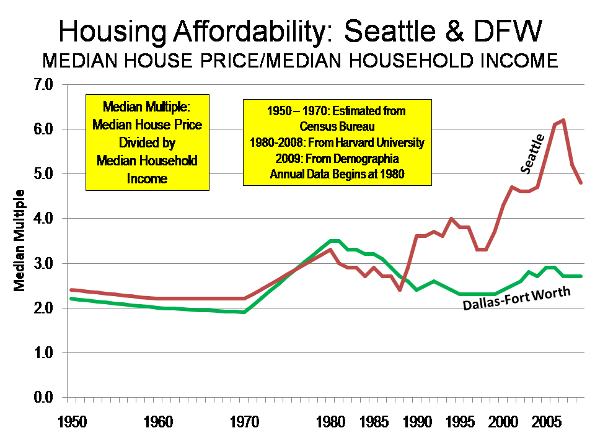
    Seattle’s Lost Housing Affordability Decade: During the decade of the housing bubble (1997 to 2007), the median house price increased from $169,000 to $395,000 in Seattle. In 1997, Seattle’s housing affordability was rated “moderately affordable,” with a Median Multiple of 3.3 (median house price divided by median household income). By 2007, the Median Multiple had escalated to 6.2, indicating housing unaffordability worse than any major metropolitan area between World War II and 1997. (Figure 1). Of course, other markets, particularly in California, became even more unaffordable after 1997.

    In Seattle and other more prescriptive markets, house prices exploded during the housing bubble. At the same time, many other markets experienced only modest house price increases. The easier money and profligate lending practices thus produced very different results. In more prescriptive markets, like Seattle, both underlying and speculative demand drove prices to unprecedented heights. In the more responsive markets, the generally higher underlying demand was accommodated by planning systems that permitted sufficient new housing to be built on affordable land and price escalation was far more modest (as were subsequent price losses).

    New House Example: The role of Seattle’s growth management in driving up land and house prices is obvious. According to W-APA, approximately 62% of the cost of a new house in 1999-2000 was in construction costs. A new house in 1997 costing the same as a median house price would have involved approximately $105,000 in construction costs. Based upon subsequent house cost increases and the decline in house construction costs relative to the rest of the nation in Seattle, construction costs on the same house should have risen $40,000 from 1997 to 2007 (Note 2). At the same time, the median house price in Seattle increased $225,000. Less ss than 20% of the cost escalation could be attributed to construction cost inflation. Nearly $185,000 was due to other factors, principally higher land prices.

    Comparing Seattle to Dallas-Fort Worth: Things were very different in more responsive markets, as is illustrated by Dallas-Fort Worth (Figure 2). Dallas-Fort Worth, now the nation’s fourth largest metropolitan area, trailing only New York, Los Angeles and Chicago has grown more than twice as fast as Seattle (21.2% from 2000 to 2008, compared to 9.6%). Dallas-Fort Worth’s underlying demand has been even greater relative to Seattle, as indicated by its net domestic migration. Dallas-Fort Worth has added more than 10 times as many domestic migrants (260,000 versus 23,000) and more than 5 times its 2000 population (5.0% v. 0.8%). Moreover, and perhaps surprisingly, the Dallas-Fort Worth urban area (along with Houston) is more compact (read “sprawls” less) than Seattle (Note 3). Finally, the share of sub-prime mortgages was higher in Dallas-Fort Worth than in Seattle.

    Yet, despite this huge demand, housing affordability has remained below the historic Median Multiple norm of 3.0. In 2007, the Dallas-Fort Worth Median Multiple was 2.7. The median house price increased $32,000 from 1997 to 2007 and more than 70% of the change was due to construction costs.

    In 1997, the Seattle median house price was $54,000 higher than in Dallas-Fort Worth. By 2007, the price of a median house in Seattle had escalated to nearly $250,000 more than its counterpart in Dallas-Fort Worth (Since 2007, house prices have dropped $90,000 in Seattle and $5,000 in Dallas-Fort Worth, illustrating the more intense price volatility of tightly regulated markets. Even so, Seattle housing affordability remains materially worse than before).

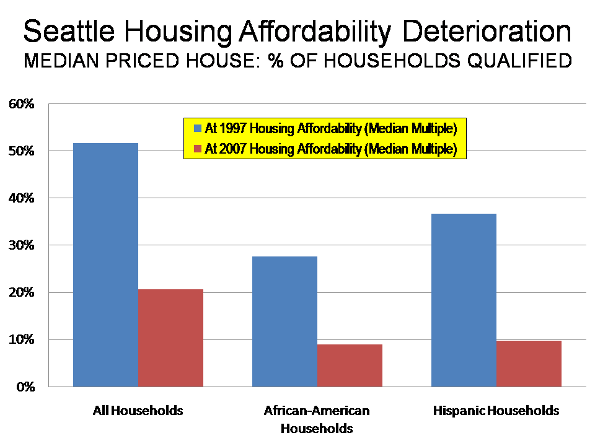
    Driving Households out of the Home Ownership Market: If 1997 housing affordability (using the Median Multiple) had been retained, 50% of Seattle households would have been able to qualify for a mortgage on the median priced house. However, by 2007 only about 20% of Seattle households could have qualified for a mortgage on the median priced house in 2007 at present FHA underwriting standards (Note 4).

    Impact on Minority Households: The highest price, however is being paid by Seattle’s minority households (Figure 2).

    • The share of African-American households able to qualify for a mortgage on the median priced house declined nearly 70% compared to 1997 affordability (Median Multiple). At 1997 housing affordability, more than 25% of African American households would have been able to qualify for a mortgage on the median priced house in 2007. In reality, by 2007, less than 10% of African-American households could have qualified for a mortgage on the median priced house.
    • The share of Hispanic households able to qualify for a mortgage on the median priced house declined more than 70% compared to 1997 affordability (Median Multiple). At 1997 housing affordability, more than 35% of Hispanic households would have been able to qualify for a mortgage on the median priced house in 2007; by 2007 than number had plunged to less than 10%.

    The High Price of Growth Management in Seattle: The 10-year trend of house prices increases in the Seattle metropolitan area supports Eicher’s analysis. We readily admit to the charge of evaluating housing affordability “solely on price.” There is still the dubious W-APA claim that land regulation adds to the quality of life. But whose quality of life? As housing affordability declines, the quality of life may be raised for some, but only by keeping others down.


    Notes:

    (1) The W-APA report makes the common error of presuming that land use restraints were not a factor in the house price escalation of Phoenix and Las Vegas. In fact, the Brookings Institution ranks both metropolitan areas as toward the more restrictive end of the regulatory spectrum. These overly prescriptive regulatory environments are exacerbated by the fact that in both metropolitan areas much of the developable suburban land is owned by government, and is being auctioned, though at a rate less than demand. These factors combined to drive auction prices per acre up nearly 500% in Phoenix and nearly 400% in Las Vegas during the housing bubble. Despite their high building rates, these land restrictions denied sufficient affordable land for development to keep house prices from rising rapidly. Further, W-APA refers to Phoenix and Las Vegas as having “relatively unfettered sprawl,” yet both are more compact than Seattle. In 2000, the Las Vegas urban area (area of continuous urban development) was 62% more dense than Seattle and the Phoenix urban area was 28% more dense than Seattle (calculated from US Bureau of the Census data).

    (2) There are no reliable sources for median new house prices at the metropolitan area level. Generally, however, US Bureau of the Census data indicates that in the West, the median priced new house costs have averaged 6% more than the median priced house in the 2000s. Construction cost escalation (national and Seattle) is calculated from R.S. Means Residential Square Foot Costs (1997 and 2007 editions).

    (3) In 2000, the Seattle urban area had a density of 2,844 persons per square mile. Dallas-Fort Worth had a density of 2,946 and Houston had a density of 2,951. All three were relatively close to Portland (3,340), but well behind Los Angeles (7,069), which is the most dense major urban area in the nation.

    (4) Estimated assuming a FHA “front end ratio” of 29%, (mortgage, property tax and homeowners insurance divided by gross annual income) and a 10% down payment. Calculated using 2007 American Community Survey income data for the Seattle metropolitan area.


    Wendell Cox is a Visiting Professor, Conservatoire National des Arts et Metiers, Paris. He was born in Los Angeles and was appointed to three terms on the Los Angeles County Transportation Commission by Mayor Tom Bradley. He is the author of “War on the Dream: How Anti-Sprawl Policy Threatens the Quality of Life.

  • America’s European Dream

    The evolving Greek fiscal tragedy represents more than an isolated case of a particularly poorly run government. It reflects a deeper and potentially irreversible malaise that threatens the entire European continent.

    The issues at the heart of the Greek crisis – huge public debt, slow population growth, expansive welfare system and weakening economic fundamentals – extend to a wider range of European countries, most notably in weaker fringe nations like Portugal, Italy, Ireland, Greece and Spain (the so-called PIIGS). These problems also pervade many E.U. countries still outside the Eurozone in both the Baltic and the Balkans.

    But things are also dicey in some of the core European powers, notably Great Britain, which has soaring debt, high unemployment and very slow growth. Even solvent economies like France, the Netherlands and the continental superpower, Germany, have fallen short of expectations and are expected to experience meager growth for the rest of the year.

    Europe’s poor performance undermines the widespread view held by left-leaning American pundits, policy wonks and academics about Europe’s supposedly superior model. This Euro-philia has a long history, going back at least to the Tories during the Revolution. In better times America usually moves beyond European norms instead of retreating to its cultural mother.

    When the U.S. hits a rough spot, however, there’s a ready chorus urging us to emulate the old continent. During the psychological meltdown that accompanied the Vietnam War, some pundits looked longingly at the relatively peaceful and increasingly affluent Europe as a role model. “There is much to be said for being a Denmark or Sweden, even a Great Britain, France or Italy,” Andrew Hacker said in 1971.

    In the 1980s, as the country struggled to recover its historic competitiveness, numerous pundits suggested adopting European models, notably French and German, to restore our economic standing – a notion widely echoed by Euro-nationalists such as former French President Francois Mitterand’s eminence grise, Jacques Attali.

    Two decades later, with the U.S. reeling from the Great Recession, there’s been a rebirth of euro-mania. Author Parag Khanna, for his part, envisions a “shrunken” America that is lucky to eke out a meager existence between a “triumphant China” and a “retooled Europe.” And Jeremy Rifkin, in his The European Dream, promotes the continent as a morally preferable model – more egalitarian, open and environmentally sensitive – a sentiment recently echoed in my old New America colleague Steven Hill’s Europe’s Promise: Why the European Way Is the Best Hope in an Insecure Age.

    Yet over the past four decades Europe’s core economies – the E.U. 15 – have lagged behind the U.S. in terms of both gross domestic product and job growth. Overall, the E.U. 15’s share of the global GDP has declined to 26% from 35% while the U.S. has held on to its share, now roughly equal to that of its European counterparts. The big winners, of course, have been in East and South Asia.

    Some of this has to do with the difficulties of maintaining an elaborate welfare state. In a productive, efficient and still largely homogeneous country such as the Netherlands or Sweden, an expansive system of social insurance and a vast public sector remains an affordable luxury.

    In contrast, countries like Portugal, Greece and to some extent Spain have tried to create a Scandinavian-style welfare state based on Banana Republic economies. In addition, over-reliance on tourism and real estate speculation has proved no more viable there than in places like Las Vegas or Phoenix.

    Europe’s problems may prove even more profound in the long term. For example, Europe has some of the lowest birthrates in the world. Among 228 countries ranked in terms of birthrate, Europe accounts for 20 of the bottom 28. These include relatively prosperous Germany (No. 226) and Sweden as well as a range of the shaky fringe including Greece, Bosnia, Hungary, Latvia, Italy, Portugal and Spain.

    The shrinking population problem is complicated by the fact that the one growing source of new Europeans consists of Muslim immigrants who generally have not integrated well into continental society. Many European countries – Denmark, the Netherlands and Switzerland, for example – are taking steps to shut their doors, something that may promote harmony and security but could exacerbate the long-term demographic decline.

    With their state-driven economies pledged largely to support a growing population of aging boomers, it’s hard to see what new sources of growth will propel the continent in the coming decades. Overall, according to the European Central Bank, the Eurozone’s growth potential is now roughly half that of the United States.

    Meager economic growth may also be affecting one of Europe’s greatest achievements: its relative egalitarianism. The trend toward greater inequality, earlier evident in the U.S., has now spread to Europe, including such famously “egalitarian” countries as Finland, Norway and Germany, which was the only E.U. country to see wages fall between 2000 and 2008.

    In Berlin, Germany’s largest city, unemployment has remained far higher than the national average, with rates at around 15%. One quarter of the workforce earns less than 900 euros a month. In Berlin, 36% of children are poor, many of them the children of immigrants. “Red Berlin,” with its egalitarian ethos, notes one left-wing activist, has emerged as “the capital of poverty and the working poor in Germany.” [i]

    As in the U.S., the burden of recession has fallen most heavily on younger people. An OECD analysis found that older European workers enjoyed the best gains during the past 30 years, while children and young people fared worse. For E.U. workers under 25 the unemployment rate is well over 20%, slightly higher than that of the U.S. but a remarkable statistic given the far less rapid expansion of the European workforce.

    The situation is particularly dire in Europe’s exposed southern tier. Young people who rioted in Athens in 2008 suffer unemployment rates in excess of 25%. By the end of 2009 unemployment for those under 25 stood at 44% in Spain and 31% in Ireland. Even in Sweden the youth unemployment rate has reached 27%.

    If the pattern of the last decade holds, many of Europe’s most talented young people will end up in the U.S., particularly once the recession comes to an end. By 2004 some 400,000 European Union science and technology graduates were residing in the U.S. Barely one in seven, according to a recent European Commission poll, intends to return. “The U.S. is a sponge that’s happy to soak up talent from across the globe,” observes one Irish scientist.

    Of course, there is still much we can learn from Europe. Besides a sometimes enviable lifestyle, Europeans offer some intriguing health care models and have led the way in efficient fuel economy standards. But overall, profound differences in demographics and cultural traditions suggest that America cannot easily follow a European approach to social organization and planning.

    Indeed as the U.S. and Europe confront the challenge of the rising Asian powers, their approaches likely will have to diverge. To maintain its economy and pay its debts, America will have to focus on creating jobs and opportunities for a growing population. Europeans will struggle with declining workforces, radically skewed demographics and an increasingly burdensome welfare state.

    In the 21st century we will witness not so much a clash of civilizations, but a more subtle parting of the ways. Americans need to choose a path that makes sense for us, not one drawn from an aging society whose future seems unlikely to match its past achievements.


    [i] “Income inequality and poverty rising in most OECD countries,” OECD, Oct. 21, 2008; Nicholas Kulish, “In German Hearts, a Pirate Spreads the Plunger Again,” New York Times, Nov. 6, 2008; Sally McGrane, “Berlin’s Poverty Protect It From Downturn,” Spiegel on line, March 4, 2009; Emma Bode, “Unemployment and poverty on the rise in Berlin,” World Socialist Web Site, Aug. 30, 2008

    This article originally appeared at Forbes.com.

    Joel Kotkin is executive editor of NewGeography.com and is a distinguished presidential fellow in urban futures at Chapman University. He is author of The City: A Global History. His newest book is The Next Hundred Million: America in 2050, released in Febuary, 2010.

    Photo: leucippus @Flickr

  • The Transportation Community Braces for Continued Uncertainty

    Recent game changing events — notably, the Massachusetts election depriving the Senate Democrats of a filibuster-proof 60-vote majority, and the projected record breaking $1.6 trillion deficit in the FY 2011 budget proposal — have introduced serious uncertainties into the President’s domestic agenda. The federal surface transportation program is no exception.
    Even though this program traditionally has enjoyed bipartisan support it, too, is being buffeted by the shifting political winds. What follows is an assessment of the status and prospects of four legislative initiatives that bear directly on the future of the federal transportation program.

    The National Infrastructure Bank
    The National Infrastructure Bank (NIB) has been receiving a lot of attention lately. It was the subject of a January 20 press conference sponsored by the Building America’s Future coalition. It was endorsed in a Wall Street Journal op-ed by three members of the president’s Economic Recovery Advisory Board. And it was discussed by a panel of experts at a January 25 seminar on “Financing Public Works in Turbulent Times” sponsored by New York University. Responding to the multiple pleas, the White House included a modest $4 billion for the bank in its FY2011 budget request.

    The press conference featured a group of prominent long-time NIB advocates — Pennsylvania Gov. Ed Rendell, Senator Chris Dodd (D-CT), Rep. Rosa DeLauro (D-CT), former House Majority Leader Dick Gephardt and Ambassador Felix Rohatyn. Representatives of some 20 interest groups and trade associations provided a supporting cast. The speakers spoke eloquently about the need for greater infrastructure investment in America and how the National Infrastructure Bank could effectively serve that purpose. The Bank, they said, would fulfill three policy objectives: finance projects of regional and national importance, and create jobs and long-term economic growth. It also would serve as a vehicle for making better resource allocation decisions — based on merit rather than on pork barrel politics.

    The press conference failed to do, however, was to clarify some of the questions posed by critics of the NIB concept. Reason’s Robert has noted that if the NIB were set up “as a genuine bank, operated on commercial principles“, it would not able to fund a broad range of public infrastructure projects, some of which, such as schools, public housing and mass transit facilities which do not generate a revenue stream that could be used to repay the bank loans. Hence, the NIB would require periodic federal appropriations to cover grants for non-revenue producing projects. In that sense, it might turn out to be more like a foundation than a bank.

    There is little likelihood that Congress would be willing to turn the power of decision over large-scale capital projects to a new bureaucratic organization lodged in the Executive Branch. Many lawmakers, including the powerful chairman of the Senate Finance Committee, Sen. Max Baucus (D-MT), believe that Congress must not abdicate its authority over the spending of public capital. As one Senate aide remarked, one cannot “depoliticize” the project selection process, as NIB advocates would urge, because major public infrastructure investment decisions are inherently and fundamentally political in nature.

    The High Speed Rail Program
    The White House decision (announced on January 28) allocates the $8 billion in high-speed rail grants authorized in the Recovery Act to a total of 30 separate projects in 13 different rail corridors. Principal beneficiaries are the California High-Speed Rail Authority ($2.25 billion), the Florida Rail Enterprise and its 84-mile Tampa-Orlando high-speed line ($1.25 billion) and the Chicago-St. Louis rail corridor ($1.10 billion). The remainder of the money is spread around in amounts ranging from half a billion to as little as a few million dollars among 26 rail improvement projects in 31 states.

    Generally, high-speed rail advocates have been disappointed by the Administration’s selections because few of the projects offer the promise of true high-speed service — even the Florida project is not expected to attain European-like average high speeds. In contrast, the Administration’s decision to fund upgrades of rail infrastructure in as many as 13 different rail corridors makes good sense both in terms of politics and cost-effectiveness.

    True “high speed” service (as that term is used in Europe and the Far East, i.e. top speeds of 150 mph and higher) would require separating freight and passenger traffic. It would require building entirely new rail infrastructure in dedicated rights-of-way — something that is clearly not within the scope of a $8 billion program. The final price tag for California’s complete high-speed rail system could reach $60 to $80 billion and a recent Government Accountability Office report cites a range of construction costs for high-speed rail between $22 million/mile to $132 million/mile. From that perspective, the $8 billion looks like a drop in the bucket.

    In the meantime, with railroads expected to assume an ever growing share of intercity freight transport, upgrading infrastructure in existing rail corridors has become an urgent necessity. Since nearly all of Amtrak’s passenger trains run on rail lines owned by freight railroads, such improvements will also benefit passenger traffic. In most corridors, track and signaling upgrades on existing shared passenger/freight lines would permit raising speeds from today’s 60-80 mph to (0-100 mph, according to railroad experts.

    To be sure, a strong case can be made that true high-speed rail service will eventually be necessary between major city-pairs separated by less than 300 miles to relieve unacceptable levels of highway and air traffic congestion. But building a national network of dedicated high-speed rail lines from scratch will require decades of a sustained national commitment, spanning many administrations. There is no assurance that future presidents and future Congresses will share President Obama’s and Transportation Secretary LaHood’s enthusiasm for high-speed rail.

    Climate change legislation
    Chances of enacting tough greenhouse gas (GHG) emission reductions during this session of congress are remote. Senator Byron L. Dorgan (D-ND), Chairman of the Senate Energy Appropriations Subcommittee, has made it clear that a cap-and-trade bill, such as the giant House-passed Waxman-Markey bill, is “probably dead on arrival.” The prospects for a Senate compromise bill authored by Sens. John Kerry (D-MA), Joseph Lieberman (I-CT) and Lindsey Graham (R-SC) are also dubious at best.

    There are many factors that have contributed to the fading prospects for climate change legislation including disappointment over the inability of the Copenhagen Summit to reach a binding agreement to reduce carbon emissions. The revelations of ClimateGate, casting doubts on the integrity of some climate scientists’ objectivity as well as more recent disclosures about false claims of melting Himalayan glaciers have undermined the credibility of the UN Intergovernmental Panel on Climate Change (IPCC). Add to this the opposition of 14 Senate Democrats from coal-dependent states who fear that a cap on GHG emissions would raise energy costs and utility rates and growing public skepticism about the “consensus” over global warming and the future for any strong legislation seems murky. Indeed when the President in his the State of the Union address mentioned “the overwhelming scientific evidence” about global warming, it provoked muffled but clearly audible laughter among the assembled lawmakers.

    With the hopes of enacting a comprehensive cap-and-trade bill fading, attention is turning to energy initiatives that could launch the nation on the road to energy self-sufficiency and greener energy sources. Those prospects have brightened considerably since President Obama spoke of “building a new generation of safe, clean nuclear power plants” and “opening new offshore areas for oil and gas development” during his State of the Union address. However, the prospects for a more sweeping energy bill during this session of Congress remain in doubt.

    The Surface Transportation Reauthorization
    Finally, what of the oft-delayed multi-year surface transportation authorization? The responsibility for enacting this measure will very likely fall upon the shoulders of the next Congress. In the meantime, during the remainder of this year, the U.S. Department of Transportation may be expected to continue its series of “listening sessions” on how to reform the program and develop a vision that would merit broad stakeholder and congressional support. The Senate, for its part, is expected to launch its own process of legislative development. Sen. Barbara Boxer, Chairman of the Environment and Public Works Committee, has announced that her committee will begin drafting a multi-year authorization bill in March and will hold hearings later this year.

    Finding the revenue to support an ambitious multi-year bill will remain the overarching challenge facing reauthorization drafters in 2011. That new Congress may well be more tax-averse; the state of the economy and the price of oil will determine whether a hefty increase in the price of gas will be feasible. Until the question of funding is resolved, the transportation community will continue to live in a state of uncertainty, improvisation and a limited ability to plan ahead.

    Ken Orski has worked professionally in the field of transportation for over 30 years and is publisher of Innovation Briefs

    Photo: Center for Neighborhood Technology

  • Atlanta: Ground Zero for the American Dream

    The Atlanta area has much to be proud of, though it might not be obvious from the attitudes exhibited by many of its most prominent citizens. For years, local planners and business leaders have regularly trekked to planning’s Holy City (Portland) in hopes of replicating its principles in Atlanta. They would be better saving their air fares.

    Money Better Spent by Government than People? Most recently, Jay Bookman of the Atlanta Journal Constitution wonders whether taxes are high enough in Georgia and seems envious of the fact that Oregon’s voters approved tax increases in a recession, despite months of having one of the highest unemployment rates in the nation. Perhaps they were naïve enough to believe that the higher taxes would not stand in the way of attracting new business to the state. Or, perhaps the voters believed that, as a neighbor to basket case California, Golden State businesses might still flee to Oregon as an expensive but less congested environment (Note 1).

    Portland Transit: Nothing to Emulate: Bookman is also envious of Portland’s transit system with its light rail and commuter rail. Perhaps he is unaware of the “pecking order” of transit. Atlanta’s MARTA is superior to Portland’s MAX light rail in virtually every respect. MARTA a world class Metro. It is fully grade separated and averages about 70% faster than MAX, which is a revival of abandoned streetcar technology. It is thus not surprising that MARTA carries three times as much passenger demand as MAX, despite a total route length approximately the same as in Portland. Despite MARTA’s superiority to MAX, both the Atlanta and Portland transit systems share the transit curse of excessive costs. Atlantans are paying far less to subsidize their transit system than if they had unwisely, like Portland, extended it and taxed residents throughout the suburbs.

    Portland’s Embarrassing Commuter Rail Line: And, commuter rail does not appear to be a matter of pride in Portland at this point. Portland’s one commuter rail line celebrated its first year anniversary recently. Before the line opened, Tri-Met transit officials estimated that the line would “have 2,400 riders a day as soon as service begins.” The Wilsonville to Beaverton WES commuter rail line, however, never came close to that number. Daily ridership has been under 1,200. But the relative paucity of riders did not interfere with the transit agency’s spin and the media’s general sheepish agreement. At the one year anniversary a Tri-Met spokeswoman commented that “When you think about having 55,000 jobs lost in the region, that translates into fewer transit riders throughout the system and particularly during rush hour.” However, nowhere near the half of riders that failed to show for WES cannot be blamed on Portland’s high unemployment rate. If Portland were to return to unemployment levels of a year ago, WES would likely add no more than 50 daily riders.

    So, recession-ravaged Portland has built a commuter rail line that carries, at best, 0.5% of the capacity of adjacent freeways when it operates. Moreover, it has been costly. The line costs about $60 per passenger, only $2.50 of which is collected in fares. This means that the annual subsidy per passenger is nearly $15,000, almost enough to pay the annual mortgage cost on two median priced Atlanta homes.

    Portland Traffic Congestion Worse than Atlanta: Atlanta is renowned for its traffic congestion, which is a direct result of its failure to invest in the type of arterial grid that could provide substantial relief for its less than robust freeway system. Yet, based upon the latest Inrix National Traffic Scorecard, (GPS collected data for 2009), there is less peak period travel delay (as measured by the Travel Time Index) in Atlanta than in Portland, which is a reversal from data earlier in the decade (see note).

    Atlanta: Adding a New Zealand: Atlanta has no reason to look to Portland as a model, or anywhere else, for that matter. Coming out of World War II, the Portland metropolitan area was larger than the Atlanta metropolitan area (1950). Since that time, Portland has grown strongly, adding 1.5 million people. Atlanta has added more than three times as many people. The result is an economy that produces at least $150 billion more in wealth every year than Portland. Thus, the difference between Atlanta and Portland is more than the gross domestic product of New Zealand. For at least the last two decades, Atlanta has been the fastest growing large metropolitan area in the high-income world.

    Atlanta: Land of Opportunity: But perhaps the biggest draw about Portland for Atlanta leaders is its “growth management” (so-called “smart growth”) land use policies. Portland has drawn an urban growth boundary around its urbanization. Its land regulators commission “sun rises in the West” studies to deny the fact that this rationing of land increases house prices. There is, however, no question of the impact of more restrictive land use policies, from the World Bank to members of central bank boards to decorated economists such as Kat Barker of the Bank of England and Donald Brash, former governor of the Reserve Bank of New Zealand.

    The result is superior housing affordability. Late in the year, the median house price in Atlanta was 2.1 times median household incomes (the Median Multiple). By comparison, the Median Multiple in Portland was 4.2, indicating that house prices are twice as high relatively speaking in Portland. In 1990, before Portland implemented its more stringent smart growth policies, housing affordability in Portland was about equal to Atlanta.

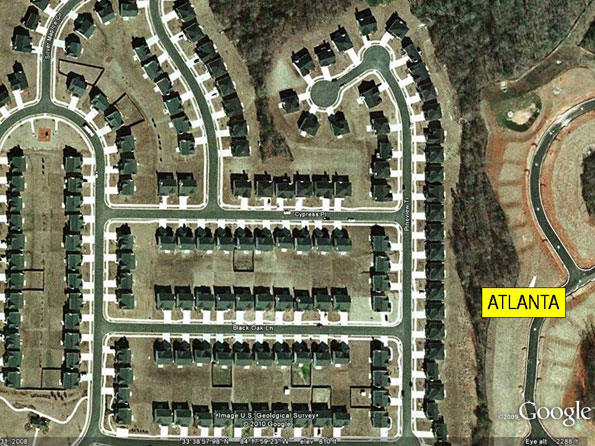
    But there is more to the story. Portland’s heavy handed planning policies are distorting product offerings so much that only the richest can afford more than a miniature back yard. This is illustrated by the images of new housing developments below in the suburbs of Portland and Atlanta (below). Both pictures are taken from approximately 1,500 feet above the ground.

    In the Portland example, virtually on the fringe of the urban area (the next urbanization is at least 10 miles away); houses are stacked in at more than 15 to the acre, with just a few feet between the roof-lines – vaguely reminiscent of third world shantytowns (Note 2). The more traditional suburban development that characterizes most of Portland is also shown on three sides of the overly dense new development.

    In the Atlanta example, houses have been recently built at about 4 to the acre, which has been the American suburban norm (except where land use regulations have required larger lots). The emerging sameness of Portland’s housing gives new meaning to the “ticky tack” criticism of suburbanization.

    Our 6th Annual Demographia International Housing Affordability Survey found Atlanta to be the second most affordable metropolitan area with more than 1,000,000 residents and the 17th most affordable metropolitan area out of 272 markets in six nations. Portland ranked 180th. Atlanta is truly a land of opportunity for young households and lower middle income households that can never hope of owning their own home in Portland’s pricey, growth management driven market.

    Rather than being a shameful example of metropolitan disaster, Atlanta remains one of the diminishing number of American urban areas where the American Dream can still be offered at a price that middle income households can afford. Atlanta has also emerged as one of the world’s best examples of ethnic diversity, not only in the core but also in the suburbs. More than half of the new residents in the suburbs have been non-Anglo since 1990 in Atlanta, about which it can proud. Atlanta is inferior only in the quality of is public relations and self-understanding. It should be a required stop for planners from Portland and beyond, for remedial education on injecting humanity and aspiration back into urbanization.


    Note 1: Bookman also notes in his column that Portland’s traffic congestion has not worsened at the rate I predicted in a 1999 Atlanta Constitution oped. I had not anticipated the huge gasoline price increases, which have materially reduced the rate of traffic growth virtually everywhere and made previous congestion increase rates unreliable as predictors of future growth.

    Note 2: For example, see the similar rooflines in a Dhaka shantytown near Gulshan at 23:47 North and 90:24 East in Google Earth. The principal difference in roof lines is the Dhaka slum’s lack of streets and cars, both of which seem consistent with the anti-mobility stance of “smart growth” planning.

    Wendell Cox is a Visiting Professor, Conservatoire National des Arts et Metiers, Paris. He was born in Los Angeles and was appointed to three terms on the Los Angeles County Transportation Commission by Mayor Tom Bradley. He is the author of “War on the Dream: How Anti-Sprawl Policy Threatens the Quality of Life.

    Photo: hyku

  • Who’s Dependent on Cars? Try Mass Transit

    The Smart Growth movement has long demonstrated a keen understanding of the importance of rhetoric. Terms like livability, transportation choice, and even “smart growth” enable advocates to argue by assertion rather than by evidence. Smart Growth rhetoric thrives in a political culture that rewards the clever catchphrase over drab data analysis, but often fails to identify the risks for cities inherent in their war against “auto-dependency” and promotion of large-scale mass transit to boost the “sustainability” of communities.

    Yet in pursuing this transit-friendly future political leaders rarely confront this inescapable reality: public transportation is fiscally unsustainable and utterly dependent on the very car-drivers transit boosters so often excoriate. For example, a major source of funding for transit comes from taxes paid by motorists, which include principally fuel taxes but also sales taxes, registration fees and transportation grants. The amount of tax diversion varies from place to place, but whether the metro region is small or large the subsidies are significant. In Gainesville, Florida – a college town of 120,000 – the regional transit system received 80 percent of the city’s local option gas tax in 2008. In New York City, the Triborough Bridge and Tunnel Authority diverts 68 percent of its toll revenues to subways and buses.

    In addition to local subsidies, state and federal agencies fund transit operations with revenue from gas taxes and other motorist user fees. In 2007 transit agencies received $10.7 billion from the federal Highway Trust Fund, and that is a conservative figure since another $11.7 billion was diverted for vaguely phrased “non-highway purposes.”

    In contrast, fare box recovery doesn’t come close to covering operating expenses. Nor can transit pay for its own capital outlay. Last year the Metropolitan Washington Airports Authority moved to dedicate toll revenue and toll bonds to cover half the cost of the $5.26 billion Dulles Metrorail project.

    The implications of transit’s auto-dependency are serious. Americans drove 11 billion fewer miles between 2008 and 2009, and for each mile not traveled local, state, and federal taxes were not collected. Without these anticipated revenues, transit systems across the country have suffered and, ironically, those hit hardest are the people who are dependent on public transportation ,that is in most cities, the poor and the young.

    In D.C., transit riders are being warned by Metro officials to expect half-hour waits for buses and trains and more crowded rides as they cut services and lay off positions to close a $40 million budget shortfall. Santa Clara County’s Valley Transit Authority has announced plans to reduce bus service by 8 percent and light rail service by 6.5 percent. In Arizona, both Tempe and Phoenix face major cuts that will lengthen wait times and eliminate routes. Even as demand for transit increases in states like Minnesota, the decline in funding is leading to major readjustments in service.

    The situation is so dire in New York City – with by far the most extensive transit system in the country – that advocates used students as props to protest service cuts caused by a $400 million budget shortfall. Though transit receives funding from other sources, there can be no mistaking the key role played by motorists.

    The decline in driving can be attributed largely to the economic downturn and increased unemployment, but even when the recession ends transit agencies will face an uncertain funding future. New technologies are making automobiles cleaner and more fuel efficient, which will allow people to drive more while paying and polluting less. If auto makers meet new federal standards, cars will soon be achieving 35.5 miles per gallon instead of today’s 27.5 mpg average. Economic growth continues to disperse and there has been a strong uptick in telecommuting.

    But perhaps the biggest threat to the future of auto-dependent transit is the very “cause” that seeks to establish it as the preferred travel mode. The planning doctrine called Smart Growth with its rationale of sustainable development is growing in popularity in urban areas across the country. Local officials are enamored with visions of auto-light cities where the buses are full, sidewalks are crowded and there are more bicycles on the road than cars.

    Beneath the appealing rhetoric of Smart Growth rests the assumption that automobiles are intrinsically bad and that public policy should be directed at restricting their use. Rarely do policymakers weigh the automobile’s many benefits and the improving technologies that are mitigating its negative environmental impact. Even rarer is discussion of whether transit can realistically match the convenience and flexibility of the automobile for both individuals and families.

    Distracted perhaps by pictures of ornate transit hubs and shiny rail cars, many policy makers fail to focus on developing a fiscally sustainable plan for public transportation. They miss the fundamental problem that anything heavily subsidized –particularly in a budget constrained atmosphere – is, by definition, unsustainable. (To the extent roads are subsidized, it breaks down to about a half-penny per passenger mile; transit subsidies are 100 times more than driving subsidies.) Ideally, user fees would cover all expenses of all transportation modes, including driving.

    A responsible policy goal should be for transit users to put their fair share in the fare box. However, given the current tax diversion imbalance, local officials should at least target a near-term goal for fare box recovery of 85 percent of costs instead of its current one-third average. This will reduce both their fatal auto-dependency and the instability that comes when external revenue sources are impacted by external factors like an economic downturn.

    Transit agencies should also right-size their bus fleets. Despite visions of large 55-passenger vehicles filled to capacity with contented commuters, only a small portion of routes in any urban area can fill these big box buses even during certain peak times. A smaller sized fleet would be not only less expensive but also more flexible, allowing cities to adjust routes and increase headways for greater service. It would also have a smaller carbon footprint.

    Finally, responsible policymakers should suspend most of their plans to build rail transit. In addition to routinely running over-budget, rail transit- outside of a few cities such as Washington DC and New York- simply does not carry many passengers relative to automobiles to justify its enormous operating expenses . The Santa Clara Valley Transportation Authority, for example, spent $55.5 million in operating expenses in 2008, recovering just $8.6 million from passenger fares and costing taxpayers an average of $5.88 per trip.

    Rubber tire transit is more efficient compared to rail as a service to those needing public transportation. Santa Clara’s operating expenses per vehicle revenue mile were 25 percent less for bus than for light rail. Additionally, bus transit is far more flexible, easier to expand and less disruptive in the construction phase.

    Essentially, policymakers need to see transit as a service with an important but limited role to play in most urban regions. With jobs and more activities spreading to the suburbs and exurbs – a process often accelerated by economically disruptive urban policies, cities should focus transit on a limited number of central core commuters as well as those people who cannot drive. Unfortunately, such goals are too modest for planners who envision transit as the catalyst for large scale social engineering and who have little concern for their regions’ economic bottom line.

    The dirty little secret remains that public transportation would collapse without the automobile. It will remain unsustainable as long as it remains dependent on that which public policy is trying to discourage. Smart Growth rhetoric makes for great campaign literature but not for smart decision-making. Responsible officials should question the underlying assumptions about automobiles and begin reconsidering the fiscal calculus that underlies transit policy.

    Ed Braddy is the executive director of the American Dream Coalition, a non-profit public policy organization that examines transportation and land-use policies at the local level. The ADC’s annual conference will be held this year on June 10-12 in Orlando, Florida.

    Photo: ahockley

  • Ryan Streeter Making Poverty History: A Short History

    Former chief economist of the Organization for Economic Cooperation and Development David Henderson coined the appellation, “Global Salvationism,” to describe the kind of behavior one witnesses at gatherings such as this past week’s World Economic Forum (WEF) in Davos, Switzerland. WEF was created in 1971 so that elites from around the world could gather to “map out solutions to global challenges,” according to WEF’s website. This year’s forum is entitled, “Improve the State of the World: Rethink, Redesign, Rebuild.” WEF’s program summary explains the urgency of the task facing those gathered in beautiful eastern Switzerland this way: “Improving the state of the world requires catalyzing global cooperation to address pressing challenges and future risks.” In an effort to compound jargon with alliteration, WEF uses “rethinking” in the titles of 29 conference sessions, “redesign” 16 times, and “rebuild” 9 times, for a total of nearly one-quarter of all the sessions. With all the turmoil created by the global recession and other “pressing challenges” in 2009, the world’s elites came together this week ready to re-do about everything.

    Central to WEF’s annual objectives is what to do about life’s inequities and imbalances. Hardly anything warrants “catalyzing global cooperation” more than the ongoing effort to make poverty history, reduce inequality, and correct global imbalances. WEF has announced that global development is taking center stage on the third day of the event.

    How ironic, then, that just prior to their gathering, Maxim Pinkovskiy and Xavier Sala-i-Martin updated findings from their 2009 National Bureau of Economic Research paper, “Parametric Estimations of the World Distribution of Income,” on the economics website VOX. Their findings show precipitous drops in global poverty since 1970—just about the same time WEF began meeting in Davos (Mark Perry wrote about the original paper here).

    Between 1970 and 2006, the global poverty rate fell nearly 75 percent. During this period, the percentage of the world’s population living on less than a dollar a day fell from 26.8 to 5.4 percent. The world’s population grew 80 percent during the same period, which makes the poverty reduction all the more astounding. The global Gini coefficient, a standard measure of inequality, fell from 67.6 to 61.2 percent, indicating a drop in inequality as well as poverty. The same trend is found in other measures of inequality besides Gini.

    And when one computes a measure of global “welfare” understood in the old-fashioned sense of well-being, we find that life has gotten better faster for a larger share of the world’s population than perhaps any time in history. By deriving a calculation of well-being from GDP and inequality measures, the authors show that between 1970 and 2006, global welfare more than doubled, growing faster than GDP.

    The authors also consider the World Bank’s new purchasing power parity (PPP)–adjusted measures of GDP and find that while global poverty increases overall, the rate of poverty actually drops faster since 1970 than it does under more conventional GDP measures. In other words, under the PPP model, the world looks a lot poorer in 1970 than it does using more traditional measures of poverty, but today, the poverty rate is nearly the same regardless of whether one uses the PPP or more traditional measures (see the graph below). Using the World Bank’s adjustment actually has the effect of making it look like we have been doing a better job of reducing poverty over the past three decades, despite how the world looks poorer in any given year.

    graph
    (Chart available at http://www.voxeu.org/index.php?q=node/4508.)

    Now, just days before Pinkovskiy and Sala-i-Martin published their VOX article, Princeton’s Angus Deaton shot to pieces the idea that one can accurately measure global poverty and inequality across countries in his presidential address to the American Economic Association. Deaton’s argument is persuasive and serves as a good reminder that economic measures across different societies are nearly impossible to establish with perfection and complete accuracy. That said, it is interesting that Pinkovskiy and Sala-i-Martin find the same drops in poverty across the various methodologies they test. Something is going on here.

    One might draw the conclusion that the precipitous drop in poverty corresponds with the beginning of the WEF meetings in 1971. Maybe the elite gathering has worked! Or, one might conclude liberalization of states and economies is working. During roughly the same period covered by the authors, the percentage of free countries in the world increased from 29 to 46 percent, according to Freedom House’s annual ratings. Liberalization and economic growth go together. One might also conclude that China’s explosive growth, which has carried Asia as a whole from 19 percent to 28 percent of the global economy during this period, has had a significant impact on poverty reduction, not to mention India’s rapid rise in its share of global GDP.

    Instead of rethinking, redesigning, and rebuilding the world, WEF’s best minds might consider devoting a full day to understanding what worked the past forty years and figuring out how to “repeat” it.

    This post originally appeared at The Enterprise Blog at The American.

    Ryan Streeter is a senior fellow at the London-based Legatum Institute and can be followed on Twitter here.