Category: Policy

  • The Gero-Economy Revs Up

    Green jobs? Great. Gray jobs? Maybe an even better bet for the new jobs bill. If there is a single graphic that everyone concerned with the nation’s future should have tattooed on their eyeballs, my vote goes to the one on your left. Here is its central message:

    Forty years from now, one out of four Americans will be 65 or older.

    Twenty million will be over 85.

    One million will be over 100.

    So far the Big Think on such numbers might be boiled down to a few reasonable conclusions: People will have to work longer and delay retirement. The government should underwrite serial job retraining and promote new kinds of annuity plans. These will boost tax revenue that would help pay the nation’s growing Social Security and Medicare tab. “[It] would constitute a kind of neo-welfare state—a new covenant—that promotes individual responsibility in alliance with the voluntary sector, the market, and government,” observes Robert Butler, the dean of modern gerontology. He calls his package “productive aging.”

    But there is a third rung: incentives to make aging an engine of economic growth. There’s gelt in that there gray! It’s the entire world that’s aging, after all, and that world’s in need of gero-tools, gero-think, gero-innovation. We’ve got it. Let’s sell it – to China, Europe, India.

    I spent some time recently with innovators in this realm. Perhaps the most exciting were those designing new-style senior housing—ranging from high end architects and builders to small time real estate entrepreneurs. They are pursuing ways for the elderly to live more comfortably and safely in their own homes and communities.

    In Palo Alto, one former real estate saleswoman, frustrated with the elder-scary housing stock in that uptown realm, took to providing what turned out to be a popular and profitable service: gero-fitting, or “prostheticizing,” those ultra-modern (and hard-edged) homes with senior-friendly accoutrements: hand bars everywhere in case of a fall, showers and water sources that adjust heat and flow automatically, wheel chair turns in halls and room-by-room phones and computer screens that activate by voice.

    Nursing homes – places where one normally sees neither – are also slowly emerging out from under decades of under-investment and institution-think. Architects and developers from Sweden (one of the fastest aging nations in the world), Japan (the fastest in Asia) and even Italy (one of the most unprepared gero-nations) have been retooling the unfulfilled promise of universal design to come up with new construction methods and new construction materials.

    Yet it’s American builders, with their vast experience and regional flexibility, who stand to be generational leaders in the most profitable arena: building new homes. Where are they?

    Then there is transportation. Cars–and our addiction to them–are perennially painted as villains in elder-world. Yet until they are in their early 80s, aged drivers far outperform their younger counterparts, with fewer injury accidents and fewer tickets. Nevertheless, finding ways to make driving safer and more comfortable suggests another major opportunity: prostheticizing the automobile and making highways less cognitively confusing.

    Here in Los Angeles, the original car capital, one company is using space program sensor technologies to make cars that warn drivers when they are tailgating, when they are weaving, when their off ramp is coming up. Roadways? Someone needs to use our state-of-the-art understanding of cognition to redesign everything from highway signs to lighting. A few farsighted firms are already trying to do so. We need more.

    The aging of the modern stomach could also drive food science to develop new staples that are less glycemic (high blood sugar being one of the biggest sources of chronic inflammation in the elderly) but still tasty and satisfying. And, instead of being peremptorily dismissed, the “anti-aging” medical movement could be scientifically (and systematically) plumbed for real medical advances, tested with gold standard clinical trials, and then sold to the rest of the arthritic world.

    Who, then, will lead? Who will become the Bill Gates of ElderWare, the Al Gore of GeroWarming, the Warren Buffett of AlterAssets?. Right now, we’re still waiting.

    “The boomers are going to have a rougher time in retirement than their parents,” says Robert Butler. “That can mean two things: they can complain about it, or they can retool it for their kids and take advantage of its promise.”

    Greg Critser’s new book is Eternity Soup: Inside the Quest to End Aging (Random/Harmony 2010).

  • Reforming Anti-Urban Bias in Transportation Spending

    State governments have to stop treating transportation like yet another welfare program.

    Among urban and rural areas, who subsidizes whom?

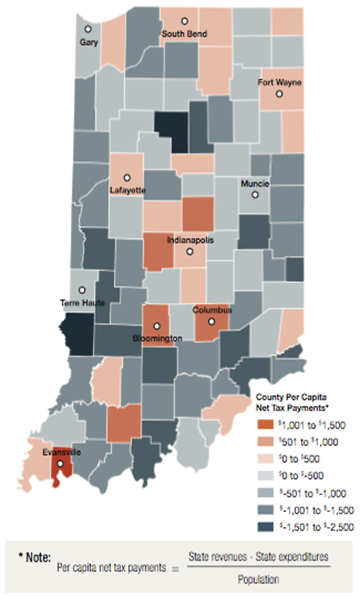
    It’s methodologically difficult to measure net taxation, but the studies that have been done suggest that, contrary to the belief of some, urban areas are big time net tax donors. For example, a recent Indiana Fiscal Policy Institute study found that Indiana’s urban and suburban counties generally subsidize rural ones.

    Just the consolidated city-county of Indianapolis-Marion County sends $420 million more to the state annually than it receives every year. That’s equal to the entire public safety budget of the city. The rest of the metro area sends another $340 million to the state annually.

    Similarly, a 2009 Georgia State University study found that the Atlanta metro area accounted for 61% of state tax collections but only but only 47% of expenditures. A 2004 University of Louisville study found that the state’s three major urban regions – Louisville, Lexington, and Northern Kentucky (south suburban Cincinnati) – generate over half the state’s tax revenues but only receive back about one third in state expenditures, an annual net outflow of $1.4 billion per year.

    The Atlanta and Indianapolis examples are particularly instructive, since both are the capital and by far the largest city of their state. They are sometimes presumed to benefit from disproportionate state spending as a result, but the reality is quite different.

    That’s not to say that this is necessarily bad. The fundamental basis of any government is a commonwealth, a body of citizens who see themselves as fellows, who believe each other’s fates are linked. Thus, generally spreading the burdens on some type of a progressive basis is broadly considered equitable, and assistance to the less fortunate constitutes a core function of government. To the extent that cities generate the most wealth in today’s economy, and have the highest incomes, it is no surprise they pay more in taxes. This doesn’t per se mean there’s an anti-urban bias in policy.

    Indeed, income redistribution is one of the key functions of state government. Actual welfare and safety net programs, including things like health care for the poor, are a major budget item in every state. But it goes beyond that. K-12 education could be treated as a purely local service, but every state spends large amounts on it. One could argue this is strictly to ensure a minimum level of funding equity between rich and poor districts. That is, it’s purely redistributive. Indeed, states sadly spend more time fiddling with funding formulas than in actual education reform and improvement. Even corrections disproportionately and unfortunately affects the poor. We are, in effect, a collection of 50 welfare states.

    The fact that so many of the functions of state government have taken on a redistributive cast also comes with downsides. Most importantly, even functions that should have little to do with welfare or equity have come to be seen through that lens.

    Exhibit A is transportation. Two-thirds of Americans live in large metro areas, yet less than half the federal transportation stimulus funds are going to the top 100 metro areas. Missouri is spending half its stimulus money on 89 small counties that account for only a quarter of the state’s population. In Ohio, the state cancelled plans to spend $100 million in stimulus funds on the crumbling Cleveland Inner Belt bridge in order to divert them to paying for a $150 million bypass around Nelsonville – a town of only 5,000 people. This is part of a plan to construct a four lane divided highway into sparsely populated southeast Ohio as part of a “build it and they will come” economic development plan. Mecklenburg County, NC, the state’s largest and home to Charlotte, received only $7.8 million out of the first $423 million in projects in that state. The Atlantic Monthly described this as a contest between a “mayor’s stimulus” and a “governor’s stimulus” – and the governor won.

    State after state has rural “roads to nowhere.” Without any legitimate economic development strategy on offer for depressed rural areas and small industrial cities, salvation is said to lie in access to four lane highways. The logic is that until every county in America is crisscrossed with these things, somehow residents are deprived of their due. This plays well to rural resentment, allowing people who are by nature proud believers in self-reliance and dismissive of welfare to claim instead that they’ve been cheated out of their “fair share” of transportation money. One suspects at least some deep inside understand the fiscal reality, which accounts for the self-righteous rhetoric designed as much perhaps to convince themselves as others.

    Regardless, a lack of transportation investment is crippling our cities, many of which have congested, crumbling roads and shaky bridges. Earmark reform would help at the federal level. Earmarked projects and “high priority corridors” are too often, as with “strategic” corporate programs, projects for which no traditional justification can be found.

    But beyond this, governance reform at the state level is critical to bring transportation funding allocations in line with real population and economic development measures. That’s not to say that rural areas should get no funding. There are many areas where legitimate state funding is warranted, such as replacing substandard bridges or correcting roads with dangerous geometry. But that doesn’t mean states should spend huge amounts of money on large rural expansion projects of dubious value that rob urban areas of the funds needed for projects with genuine transportation merit and real economic development potential.

    If states won’t act to reform this, then, despite legitimate governance concerns in our system of federalism, the federal government may need to step in to take a more direct role in funding formulas to ensure that a proper share of the money gets sub-allocated to metro areas. The federal government simply can’t allow states to continue diverting critical and limited transport money to boondoggles.

    With metro areas as the economic locus of the 21st century, failing to take action to make sure our cities get the transportation investment they need puts both the state treasury and national economic competitiveness at risk. Cities can only continue to play their role as wealth generators and sources of transfer funds for their states if they themselves are economically healthy, which requires infrastructure investment. As the Indiana, Georgia, and Kentucky examples show, state treasuries and rural funding are dependent on urban economic health. You can’t redistribute money from urban to rural areas if there’s nothing to distribute.

    Aaron M. Renn is an independent writer on urban affairs based in the Midwest. His writings appear at The Urbanophile.

    Photo: Pete Zarria

  • Memo To Obama: Banks Are Beautiful

    In his search for what Theodore Roosevelt called “a good, safe menace,” President Barack Obama has settled on the nation’s largest commercial banks, which as late as last year’s bailouts were still considered the best hope for economic salvation.

    At first Obama was content to rail about the filthy lucre of banker bonuses. Then he got the idea of maybe hitting the bonus babies with special taxes. But the reason that the Secretary of the Treasury is often the former chairman of Goldman Sachs is because the bank is one of the instruments that keeps the government afloat.

    Maybe President Obama didn’t get that memo, but he’s paying the banks’ bonuses, and they are paying his. The President needs the American banking system much in the way that the banking system needs the government as its biggest client.

    In his best imitation of William Jennings Bryant, who didn’t want the American experiment to be crucified on a “cross of gold,” the President has proposed a populist uprising against the bankers, not to mention a restoration of the Glass-Steagall Act and a tax on bank assets to recoup the taxpayer money lost in the crash.

    In attacking the money changers Obama would seem to be on safe ground. Who doesn’t despise an industry that got fat on mortgages and home equity, went bust, found redemption with easy government bailout money, and then celebrated by paying out bonuses from taxpayer contributions?

    It’s easy to imagine the President leading a Million Man March into the temples of Citibank or Bank of America to demand penance for the wages of so many sins. The Democrats may have gotten Massachusetts all wrong, but how can they not benefit from igniting a few bonfires against the vanities of Wall Street?

    The problem with a Banker Crusade is that once the ramparts are breached at castles like that of Goldman Sachs, what will become evident is that the entire American government can be understood as a failed S & L — those savings banks of shame that in the 1980s found their vaults filling up with suspect asset pools, if not whitewater.

    Like the government today, S & Ls lived beyond their means on other-people’s money, invested in bad assets, and resorted to phony accounting to cover up the losses… until the taxpayers were sent the bill for the overdrafts.

    The root cause of the S & L crisis in the 1980s was the decision of the Reagan administration to deregulate savings banks (they were no longer limited to plain vanilla mortgages), but still allow them to keep their federal insurance for deposits up to $100,000.

    Under this no-lose formula, banks could borrow nearly unlimited amounts of money in federally-insured deposits, and then lend out the funds to themselves, their cronies, or any get-rich-quick scheme that happened to send a prospectus to the bank’s board. S & Ls threw money at race horses, private planes, wine cellars, and even a few Senators, including John McCain.

    When the borrowers went broke and the banks failed, the government bailed out the depositors, and the grubstakers moved on down the trail. As Warren Buffett quipped, “In the 1980s, it was the bankers who were wearing the ski masks.”

    In the end, the government paid out something like $500 billion to cover the depositors with federal insurance.

    Fast forward to the U.S. government balance sheet in 2010, over which President Obama presides as the chief credit officer. As I read the annual report, the government is losing about $1.6 trillion a year, liabilities are $14 trillion and growing, and some of the nervous depositors are thinking of lining up at the front doors (or voting Republican).

    The deposits funding the American dream come from government bonds and securities, some of which have been sold to overseas investors. Of the $14 trillion in liabilities on the balance sheet, more than $3 trillion is held abroad, much of it in Asia and especially China.

    More troubling for the country’s Banker-in-Chief is that the government-as-bank — instead of lending its borrowed money against hard assets such as railroads, schools, wharves, hospitals — has put out the money to fund what the brochures might call Lifestyle Loans (“At American Security, you can live like there is no tomorrow”).

    At least 1980s S & Ls had a few houses and planes to repossess. All the U.S. government now shows in its loan bags is a trillion-dollar budget deficit, off balance sheet liabilities (another $1 trillion) to pay for the wars in Iraq and Afghanistan, multi-trillion dollar obligations to the depositors of Fannie Mae and Freddie Mac, and the coupons (with a present value of about $41 trillion) awarded to its citizens for Medicaid, Medicare, and Social Security redemptions.

    As a pyramid scheme, those numbers are hard to beat. The public debt is already equal to the gross domestic product, and government borrowings are projected by 2015 to rise to $20 trillion.

    Lost in the presidential outrage against the commercial lenders is one reason why so many of them are flush with money, even in bad times: banks, notably investment banks, earn huge spreads brokering debt for the American government.

    What put the government into the savings-bank business?

    After 2001, when the economy stalled, the strategy to keep the good times rolling was to encourage lower margin requirements for investment banks, home mortgages, and consumers, who were patriotically encouraged to spend the equity in their homes at places like Wal-Mart. (“When the going gets tough, the tough go shopping.”)

    To fund this asset bonanza (although it was based on dubious collateral), the government turned to the investment banks, which packaged, securitized, swapped, stripped, and laundered mortgage-backed securities until stock and real estate markets had doubled in value.

    The bubble burst not just because of rapacious bankers, but in part because the government’s voracious need for funding dried up liquidity for the leveraged banks. To be sure, the likes of Lehman and A.I.G. had bad loans galore, but the financial crisis is also about an electronic run at banks competing with the government to find funding.

    Ironically, banker greed pales in comparison to that of the U.S. Congress, which through the last decade pushed home ownership (thanks to the subprimers at Fannie and Freddie) as a way to spread the word of electoral happiness. Bad debtors got jumbo mortgages, and members of Congress got re-elected.

    In the current market, Obama manages a balance sheet that looks a lot like Citibank’s: it limps along, based on federal guarantees, and most of the collateral (consisting of subprime mortgages and used B-52 bombers) has little resale value on eBay.

    What bank would not want as its best customer a major industrial country that needs $14 trillion every year to balance its books?

    One percent of $14 trillion is $140 billion, a figure that roughly equates to the annual income of the banks that President Obama is now threatening to penalize. Would he prefer that they stop rolling over government debt?

    Listening to Obama rail against the banking fraternity, I can’t help but recall the high moral tone that starts the movie, Butch Cassidy and the Sundance Kid, which can be viewed as a cautionary tale on the moral hazards of (unauthorized) bank bonuses.

    In the opening scene, Butch is casing out a bank that he is thinking about robbing. The guard signals to him that it’s closing time. Before leaving, Butch asks, “What happened to the old bank? It was beautiful.”

    The guard answers: “People kept robbing it.”

    To which Butch responds: “Small price to pay for beauty.”

    In time, that may become the President’s reconsidered view of the banker bonuses.

    Matthew Stevenson is author of Remembering the Twentieth Century Limited and An April Across America.

  • Connecting Facts to Forecast 2010

    Anyone can figure out the State of the Union by taking a good look around. I mean, I was born in the afternoon – but not yesterday afternoon – I don’t need four days of press coverage and a long speech by the President to tell me that Americans are suffering.

    This time of year, though, everyone is looking for some hint of what is to come. Even the most rational among us are tempted to seek out some prediction of the future. Economists often rate high on the list of seers sought out by most Americans – right up there with stock brokers, Dionne Warwick’s Psychic Friends Network, and Joan Quigley (White House astrologer to the Reagans).

    In this article, I’ll give you a few of my own predictions and then invite you to tell me the subject areas you want predicted. When pressed for my vision of the future, I like to add up what I already know to arrive at what I think will happen. Here’s an example:

    1. Consumer debt is about $2.5 trillion + The Federal Government Bailout commitment topped out at $12.8 trillion = American consumers, no matter how voracious their appetite for debt and foreign goods, are not the problem and cannot be the solution.

    See how it works? I confess I learned to do this while working with Mike Milken on the Global Conferences at his Milken Institute in Santa Monica, California. He called it taking the “view from 35,000 feet.” It entails taking two or more pieces of information that most people don’t hold in their heads at one time and trying to see how the ideas are connected. Here’s another one:

    2. The eight largest bank holding companies decreased lending year-over-year in the first and second quarters of 2009 + Domestic deposits are growing at double digit rates = Too Big to Fail has created monster institutions that do not have to respond to market forces or consumer demands.

    The largest bank holding companies in order of commercial banking assets are JPMorgan Chase, Bank of America, Citigroup, Wells Fargo, PNC Financial Services Group, US Bancorp, Bank of New York Mellon, and Suntrust. That you may not have a “Suntrust” branch on the corner in your town tells you something about how big the first seven are. These banks are so big that they aren’t even using the excess reserves that the Federal Reserve Bank is making available to them – they just let it sit in the Federal Reserve accounts earning zero interest. They are no longer simply U.S. banks, subject to controls by the Fed’s monetary policy actions. They can reach out for funding across the world – including funding from sovereign wealth funds controlled by governments from China to Kuwait.

    Here’s one more, just to get the ball rolling. Then, I’ll turn to your questions and see if we can manage a few more predictions for 2010 and beyond, just using the facts as we know them today.

    3. The Federal Reserve System more than doubled the money in the banking system virtually overnight (from $984 billion on September 17, 2008) and kept it at that level ever since ($2,249 billion as of last week) + the third quarter 2009 increase in economic activity (output or gross domestic product) only got us back to where we were at the same period in 2007 = There’s enough money building up in the banking system to meet the definition of “inflation”: too much money chasing too few goods.

    The rise in GDP, while it may signal the technical end of the recession, does not put an end to the financial stress we are suffering. In the seven years before the technical beginning of the recession, the U.S. economy was growing at more than five percent each year. Basically, that means the recent recession put us about $1 trillion in the hole to economic prosperity. The much-touted improvement in the economy in the third quarter of 2009 was about $90 billion. At this rate, it will take 11 quarters (nearly 3 years) to catch up. That’s why so many economists are more pessimistic than many politicians.

    For the rest of 2010, I invite you to submit comments below or drop me an email with two or three facts that you would like to see connected. I’ll take on the challenge of finding the connections, the relationships and interpreting the signals for what those facts might mean for you and the economy in the coming months.

    Susanne Trimbath, Ph.D. is CEO and Chief Economist of STP Advisory Services. Her training in finance and economics began with editing briefing documents for the Economic Research Department of the Federal Reserve Bank of San Francisco. She worked in operations at depository trust and clearing corporations in San Francisco and New York, including Depository Trust Company, a subsidiary of DTCC; formerly, she was a Senior Research Economist studying capital markets at the Milken Institute. Her PhD in economics is from New York University. In addition to teaching economics and finance at New York University and University of Southern California (Marshall School of Business), Trimbath is co-author of Beyond Junk Bonds: Expanding High Yield Markets.

    Photo: Vermin Inc

  • The Death Of Gentry Liberalism

    Gentry liberalism, so hot just a year ago, is now in full retreat, a victim of its hypocrisy and fundamental contradictions. Its collapse threatens the coherence of President Barack Obama’s message as he prepares for his State of the Union speech on Wednesday.

    Gentry liberalism combines four basic elements: faith in postindustrial “creative” financial capitalism, cultural liberalism, Gore-ite environmentalism and the backing of the nation’s arguably best-organized political force, public employee unions. Obama rose to power on the back of all these forces and, until now, has governed as their tribune.

    Obama’s problems stem primarily from gentry liberalism’s class contradictions. Focused on ultra-affluent greens, the media, Wall Street and the public sector, gentry liberalism generally gives short shrift to upward mobility, the basic aspiration of the middle class.

    Scott Brown’s shocking victory in Massachusetts–like earlier GOP triumphs in Virginia and New Jersey–can be explained best by class. Analysis by demographer Wendell Cox, among others, shows that Brown won his margin in largely middle- and working-class suburbs, where many backed Obama in 2008. He lost by almost 2-to-1 among poor voters and also among those earning over $85,000 a year. He also won a slight margin among union members–remarkable given the lockstep support of their organizations for Brown’s Democratic opponent, Martha Coakley.

    Geography played a role, of course, but class proved the divider. Coakley did well in the wealthiest suburbs largely north and northwest of Boston. But Brown’s edge in the more middle- and working-class suburbs proved insurmountable.

    Obama, a genius at handling race, has always had problems with class. His early primary victories in 2008 resulted not only from superior organization but the preponderance of students and upper-income professionals in early primary states. Once Hillary Clinton morphed, just a bit late, into Harry Truman in a pants suit, she proved unstoppable, rolling over Obama in critical states like Pennsylvania, Texas, California, Florida, Michigan and throughout Appalachia.

    In the general election Obama succeeded in winning over a significant portion of these voters. Long-simmering disgust with the Bush administration and the Republican Congress, combined with a catastrophic economic collapse, undermined the GOP’s hold on middle-class suburbanites.

    Now that the ball is in his court, the president and his party must abandon their gentry-liberal game plan. The emphasis on bailing out Wall Street and public employees, supporting social welfare and manufacturing “green” jobs appealed to the core gentry coalition but left many voters, including lifelong Democrats, wondering what was in it for them and their families.

    In the next few elections there’s an even greater threat of alienation among millennial voters, who in 2008 accounted for much of the president’s margin of victory. Generational researchers Morley Winograd and Mike Hais note that millennials are starting to enter the workforce in big numbers. Right now their prospects are not pretty. The unemployment rate for those under 25 stands at 19%. Even for college graduates, wages are declining even as opportunities dry up.

    The greatest political danger is not so much a millennial switch to the GOP but a loss of enthusiasm that will diminish the youth vote. Winograd and Hais estimate only about one-third of those who voted in 2008 in Massachusetts voted in this last special Senate election. “Republicans will keep on celebrating victories until Democrats turn their attention to young voters and get them as excited as Obama did in 2008,” Winograd warns.

    Ever deepening disillusionment–not only among millennials–is inevitable unless Obama changes course and starts building a broad-based recovery. The president’s economic team is as pro-big-bank as any conjured up by the most rock-ribbed Republican. Its motto could be a reworking of that old notion by onetime GM CEO and Eisenhower Defense Secretary Charles Wilson: “What’s good for General Motors is good for the USA”–just substitute Wall Street for GM.

    But where GM brought jobs and prosperity to millions, the current Wall Street focus has forged a recovery that works for the gentry but fails to promote upward mobility. Bailed out from their disastrous risky bets and then provided with easy access to cheap credit, the financiers have had themselves a fine party while the rest of the private sector economy suffered. The partygoers have become so rarified that they are unable to lift even the New York City economy, whose unemployment rate now surpasses the national average.

    This spectacle has forced Obama to try locating his hidden populist, but dangers lurk in this shift. If he attacks Wall Street with any real ferocity, the only linchpin of the current weak recovery could crumple. An administration that has focused on finance as the essence of the economy may prove poorly suited to skewer its primary object of affection.

    Yet it may not be too late for the president to recover some of his economic mojo. Although his financial tax plan represents little more than petty cash at today’s absurd Wall Street rates, Obama’s endorsement of Paul Volcker’s more muscular reform agenda could rally Democrats while forcing Republicans into a doctrinal crisis. Some, like Sen. John McCain, may favor a policy to downsize the megabanks and limit their activities. But many others who hold up the holy grail of free markets über alles will expose themselves again as mindless corporate lackeys.

    But badmouthing the financial aristocracy is not enough. Obama also must jettison some of the lamer parts of the gentry agenda. Cap and trade, a gentry favorite that satisfies both green piety and Wall Street’s greedy desire for yet another speculative market, needs to be scrapped as a potential job-killer for many industries. Similarly, the administration needs to delay measures to impose draconian limits of greenhouse gas emissions through the Environmental Protection Agency, which could devastate large sectors of the economy, including manufacturing, agriculture and construction.

    Obama, particularly after the Copenhagen fiasco, needs to shift to more practical, job-creating conservation measures like tree-planting and reducing traffic congestion–notably by promoting telecommuting–while continuing research and development of all kinds of cleaner fuels. Measures that make America more energy-efficient and self-sufficient–without ruining the economy with ruinously high prices–would be far more saleable to the public than the current quasi-religious obsession with wind and solar.

    Obama also needs to stop his naive promotion of the chimera of “green jobs” as his signature answer to the country’s mounting employment woes. There is no way a few thousand, mostly heavily subsidized, jobs creating ever more expensive energy can turn around any economy. Just look at the economic carnage in Spain–where youth unemployment has now reached a remarkable 44%–which has bet much of its resources targeting “green” energy.

    More than anything the president needs to make the case that government can help the productive economy. This requires a scaling down of regulatory measures that are now scaring off entrepreneurs–including some aspects of health care reform–and beginning to demonstrate a direct concern for basic industries like manufacturing, agriculture and trade.

    Pivoting away from gentry liberalism will no doubt offend some of the president’s core constituencies. But if he does not do this soon, and decisively, he will find that the middle-class anger seen in Massachusetts will spread throughout the country. As a result Barack Obama, a man who would be Franklin Roosevelt and could settle on being the next Bill Clinton, will end up looking more like that sad sack of Democratic presidents, James Earl Carter.

    This article originally appeared at Forbes.com.

    Joel Kotkin is executive editor of NewGeography.com and is a distinguished presidential fellow in urban futures at Chapman University. He is author of The City: A Global History. His next book, The Next Hundred Million: America in 2050, will be published by Penguin Press February 4th, 2010.

  • Housing Unaffordability as Public Policy: The New Demographia International Housing Affordability Survey

    The just released 6th Annual Demographia International Housing Affordability Survey shows some improvement in housing affordability, especially in the United States and Ireland but a continuing loss of housing affordability, especially in Australia.

    The Survey, co-authored by Hugh Pavletich of Performance Urban Planning, covers 272 metropolitan markets in 6 nations (the United States, the United Kingdom, Canada, Australia, Ireland and New Zealand). The Survey estimates housing affordability using the “Median Multiple,” which is the median house price divided by the median household income. As recently as the late 1980s, the Median Multiple virtually everywhere was 3.0 or below. Over the past 10 to 20 years, however, the Median Multiple has risen worryingly in all major markets of the United Kingdom, Australia, New Zealand and Ireland and in some markets in the United States and Canada.

    Housing affordability is rated on a four category scale, from “affordable” to “severely unaffordable” (Table 1).

    Table 1
    Demographia Housing Affordability Rating Categories

    Housing Affordability Rating

    Median Multiple

    Severely Unaffordable

    5.1 & Over

    Seriously Unaffordable

    4.1 to 5.0

    Moderately Unaffordable

    3.1 to 4.0

    Affordable

    3.0 or Less

    Affordable Markets: The Survey found affordable markets in both the United States and Canada. This included fast-growing markets, such as Atlanta, Dallas-Fort Worth and Houston, which have had the highest underlying demand of any metropolitan areas with more than 5,000,000 population in the high-income world. It also includes the “Rust Belt” metropolitan areas, such as Detroit, which has experienced severe declines in demand in the Great Recession. There were also a number of additional metropolitan areas that are neither fast growing nor in dire economic straits, such as Indianapolis, Kansas City and Cincinnati (Table 2).

    Table 2
    Affordable Major Markets: 2009: Third Quarter
    Affordability Rank Nation Market Median Multiple
    1 United States Detroit, MI 1.6
    2 United States Atlanta, GA 2.1
    3 United States Indianapolis, IN 2.2
    4 United States Rochester, NY 2.3
    5 United States Cincinnati, OH-KY-IN 2.4
    5 United States Cleveland, OH 2.4
    5 United States Las Vegas, NV 2.4
    8 United States Buffalo, NY 2.5
    9 United States Columbus, OH 2.6
    9 United States Kansas City, MO-KS 2.6
    9 United States Phoenix, AZ 2.6
    9 United States Pittsburgh, PA 2.6
    9 United States St. Louis, MO-IL 2.6
    14 United States Dallas-Fort Worth, TX 2.7
    14 United States Jacksonville, FL 2.7
    16 United States Memphis, TN-AR-MS 2.8
    16 United States Minneapolis-St. Paul, MN-WI 2.8
    16 United States Louisville, KY-IN 2.8
    19 United States Houston, TX 2.9
    20 United States Oklahoma City, OK 3.0
    20 United States Riverside-San Bernardino, CA 3.0
    20 United States Tampa-St. Petersburg, FL 3.0

    Severely Unaffordable Markets: There were also 18 severely unaffordable markets, in five nations. The least unaffordable market was Vancouver (Canada), with a Median Multiple of 9.3. Sydney (Australia) was the second least affordable market (9.1), followed by Melbourne (8.0) and Adelaide (7.4). The most unaffordable markets also London (GLA or inside the greenbelt), with a Median Multiple of 7.1, San Francisco (7.0), New York (7.0), Perth, Australia (6.9), Brisbane, Australia (6.7), Auckland, New Zealand (6.7) and the London Exurbs (outside the greenbelt), at 6.7. Los Angeles-Orange County, which was the most unaffordable metropolitan area in the first four Surveys, remained severely unaffordable, at 5.7 (Table 3).

    Table 3
    Severely Unffordable Major Markets: Third Quarter: 2009
    Unaffordability Rank Nation Market Median Multiple
    1 Canada Vancouver 9.3
    2 Australia Sydney 9.1
    3 Australia Melbourne 8.0
    4 Australia Adelaide 7.4
    5 United Kingdom London (GLA) 7.1
    6 United States New York, NY-NJ,-CT-PA 7.0
    6 United States San Francisco, CA 7.0
    8 Australia Perth 6.9
    9 Australia Brisbane 6.7
    9 New Zealand Auckland 6.7
    9 United Kingdom London Exurbs 6.7
    12 United States San Jose, CA 6.4
    13 United Kingdom Bristol-Bath 6.1
    14 United States San Diego, CA 6.0
    15 United States Los Angeles-Orange County, CA 5.7
    16 United Kingdom Stoke on Trent & Staffordshire 5.3
    17 Canada Toronto 5.2
    18 United Kingdom Newcastle & Tyneside 5.1

    Severely Unaffordable Markets: There were also 18 severely unaffordable markets, in five nations. The least unaffordable market was Vancouver (Canada), with a Median Multiple of 9.3. Sydney (Australia) was the second least affordable market (9.1), followed by Melbourne (8.0) and Adelaide (7.4). The most unaffordable markets also London (GLA or inside the greenbelt), with a Median Multiple of 7.1, San Francisco (7.0), New York (7.0), Perth, Australia (6.9), Brisbane, Australia (6.7), Auckland, New Zealand (6.7) and the London Exurbs (outside the greenbelt), at 6.7. Los Angeles-Orange County, which was the most unaffordable metropolitan area in the first four Surveys, remained severely unaffordable, at 5.7 (Table 3).

    Summary by Nation: As in the five previous Surveys, there is a close relationship between housing unaffordability and categories of land use regulation. Virtually all severely unaffordable markets are characterized by “more prescriptive” land use regulation policies (also called “compact city,” “urban consolidation,” “growth management,” or “smart growth”). At the same time, the affordable markets overwhelmingly have “more responsive” land use regulation, in which new residential development is demand driven.

    Australia: The most extreme housing unaffordability has evolved in Australia. Australia’s overall Median Multiple was 6.8, with a housing affordability rating of severely unaffordable. A recent Bank West report also noted the deteriorating housing affordability and indicated housing affordability was a thing of the past for “key workers.” This is a dramatic turnaround; housing had been affordable widely in Australia in the late 1980s, with a Median Multiple of under 3.0 and remained under 3.5 until the late 1990s. All but one of Australia’s 23 markets were severely unaffordable, with one being seriously unaffordable. All of Australia’s major markets (over 1,000,000 population) have strong “urban consolidation” policies that have resulted in unaffordable land on the urban fringe and a substantial decline in house construction, despite the highest national population growth rate among the surveyed nations.

    Canada: Canada has an overall Median Multiple of 3.7 and is thus rated moderately unaffordable. Housing had been affordable in Canada in the late 1990s, with a Median Multiple of 3.0. Canada has 5 affordable markets and 4 severely unaffordable markets. Thirteen markets were rated moderately unaffordable, while 6 were rated seriously unaffordable. Like the United States, land use regulation is under the control of sub-national governments and thus ranges from demand driven to plan driven regimes.

    Ireland: Ireland has experienced a substantial improvement in its housing affordability. Ireland has a Median Multiple of 3.7, and is rated moderately unaffordable. Housing had been affordable as late as the middle 1990s, with a Median Multiple below 3.0.

    New Zealand: New Zealand’s overall Median Multiple was 5.7, for a severely unaffordable rating. Housing had been affordable in the early 1990s, with a Median Multiple of under 3.0. Five of the 8 markets were rated severely unaffordable, while 3 markets were seriously unaffordable. As in Australia, more prescriptive land use regulation is pervasive.

    United Kingdom: The overall Median Multiple in the United Kingdom was 5.1, for a severely unaffordable rating. Housing had been affordable in the late 1990s, with a Median Multiple of under 3.0. Despite the recent house price declines, 19 of the 33 surveyed markets were rated severely unaffordable and 14 were rated seriously unaffordable. The connection between the UK’s housing unaffordability and its plan-driven regulation has been documented in Labour government commissioned report by Kate Barker, a member of the Monetary Policy Committee of the Bank of England.

    United States: The United States is the first nation in Survey history to have achieved an overall affordable rating, with a Median Multiple of 2.9. The recent house price declines have restored national housing affordability to the below 3.0 historic norm (last achieved in the early 2000s), as the price bubble burst in many markets. There were 98 affordable markets, most of which experienced an increase in demand. There were also 58 moderately affordable markets. Even with the price decreases, however, house prices remain far above historic norms in some markets. Eight of the markets were seriously unaffordable, while 11 were severely unaffordable. Plan-driven land use regulation is in place in all of the major markets with severely unaffordable housing affordability.

    Comparing Sydney, Melbourne, Dallas-Fort Worth and Atlanta

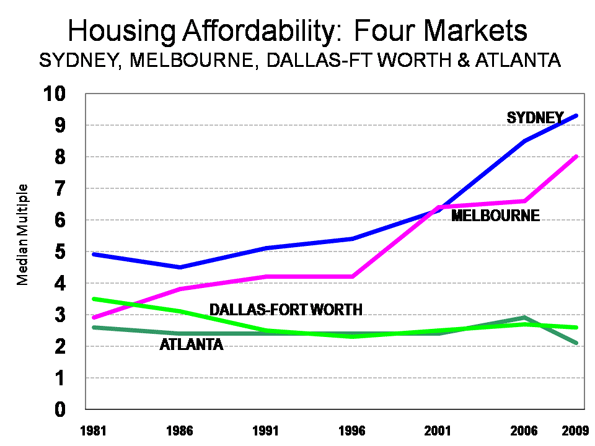
    Australia: A Nation in Mortgage Stress: The Survey includes a comparison of four similar markets, Sydney and Melbourne in Australia to Dallas-Fort Worth and Atlanta in the United States. In the early 1980s, Sydney had a higher population than Dallas-Fort Worth and Melbourne had a higher population than Atlanta. Since that time, the two US metropolitan areas have passed the Australian metropolitan areas in population, having added more people than Australia’s five largest metropolitan areas combined (Sydney, Melbourne, Brisbane, Perth and Adelaide). At the same time, despite their far higher demand, housing affordability has improved in Dallas-Fort Worth and Atlanta, while it has deteriorated markedly in Sydney and Melbourne (Figure 1). During this period, “plan driven” or more prescriptive land use policies were strongly enforced in Sydney and Melbourne in contrast to the “demand driven” land use policies in place in both Atlanta and Dallas-Fort Worth.

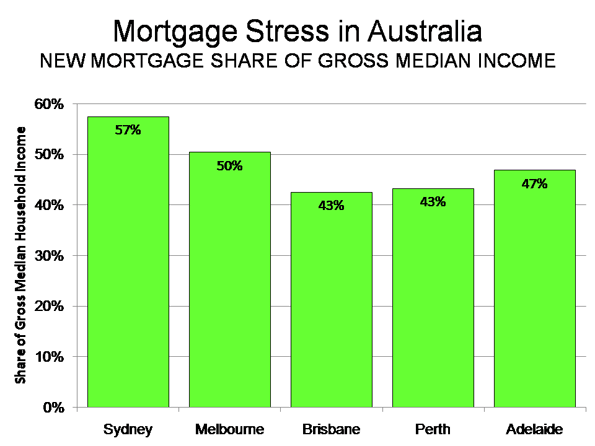
    Australian government agencies consider any household paying more than 30% of its gross income for housing to be in “housing stress.” At this point, a median income household in Sydney or Melbourne would pay more 50% or more of its gross income annually for a new mortgage on a median priced house. In Brisbane, Perth and Adelaide, the figure is above 40%. (Figure 2). By comparison, in Dallas-Fort Worth and Atlanta, however, the median income household would pay less than 20% of its income for the mortgage. Not surprising then is the huge loss in housing affordability in Australia, and a decline in home ownership rates from 72% to 68% between 1995 and 2008.

    Unaffordable Housing as Public Policy: It is clear that much of the cause for the differences in affordability lies with contrasting public policy approaches. The strong intervention in land markets under plan-driven regulation raises the price of land inordinately. Governments appear to have, however unwittingly, established unaffordable housing as an objective of public policy. Yet despite this, there is pressure – including from the US Obama administration, to adopt plan-driven regulation throughout the United States, despite the substantial economic disruption that such policies produced in the US bubble markets. Besides making houses unaffordable for many households, this could set the stage for even more housing bubbles in the future.

    If this trend continues, future generations will pay far more for their housing than did their parents. This seems likely to stunt economic growth and job creation, while facilitating higher levels of poverty and class stratification throughout the English speaking world.

    Wendell Cox is a Visiting Professor, Conservatoire National des Arts et Metiers, Paris. He was born in Los Angeles and was appointed to three terms on the Los Angeles County Transportation Commission by Mayor Tom Bradley. He is the author of “War on the Dream: How Anti-Sprawl Policy Threatens the Quality of Life.

  • Phoenix, Put Aside Dreams of Gotham

    Now that Phoenix’s ascendancy has been at least momentarily suspended, its residents are no doubt wondering what comes next. One tendency is to say the city needs to grow up and become more like East Coast cities or Portland, Ore., with dense urban cores and well-developed rail transit. The other ready option is always inertia – a tendency to wait for things to come back the way they were.

    Neither approach will work in the long run. Over the coming decade, Phoenix has to recalibrate its economy into something based on more than being a second option for Californians and speculative real-estate investment. Instead, it needs to focus laserlike on economic diversity and creating good jobs.

    The model here for Phoenix is not New York or San Francisco. Phoenix can’t rival these cities for their 19th-century charm or early 20th-century infrastructure. As we would say back in New York (my hometown): fuggedaboutit.

    Instead of dreaming about Gotham, Phoenix should think more about Houston. Like the Texas megacity, Phoenix is the ultimate late 20th-century town, dependent on air-conditioning, ample freeway space and a wide-open business culture.

    A century away from becoming “quaint,” Phoenix needs to follow Houston’s example of relentless economic diversification: in Phoenix’s case, away from dependence on tourism and construction. Houston has done this by focusing beyond its core energy sector to fields like international trade, manufacturing and medical services.

    Phoenix’s opportunities may lie elsewhere but may include some of these same industries. The idea is that the region needs to heal its job problem. Only then can the real-estate market rebound on a solid basis.

    This employment focus must replace the current obsession with changing the city’s urban form. Despite the current problems, Phoenix has performed pretty well over the past decade, creating more new jobs than most Sun Belt cities, not to mention job losers like San Francisco, Chicago, Los Angeles and New York. Equally important, it still leads the nation over the past decade in net in-migration among the largest cities

    Unfortunately, some in Phoenix still suffer horribly from Manhattan envy. One prominent Phoenix consultant describes the downtown as “the glorious goose that’s laying the gilded egg” that will turn the city into a dynamic trend-setter of a new urban paradigm. Phoenix, he opined, “won’t be a place of renown till it has the Big It.” In other words, Phoenix will not be a true metropolis until it has its own Times Square, Eiffel Tower, Space Needle or other grand attraction.

    Yet in newer cities like Phoenix, the quest for the “Big It” is often delusional. In Phoenix, the vast majority of the population moved in decades after the original downtown lost its primacy. People have their own notion of what “it” is, and many times, “it” could be in a different center or in more than one center – think Scottsdale, Tempe, Mesa, the Camelback Corridor, or a host of other communities.

    The Valley’s $1.4 billion transit system carries barely 15,000 round trips daily – a microscopic proportion of the region’s trips – with the biggest traffic on weekends. Sounds more like Disneyland than New York.

    Nor does the high-end condo, art-museum, convention-center thing seem to be working so well. Too bad the extra $1.5 billion spent sprucing up the area could not have been spent more usefully for less critical things, like police and fire, or better roads and schools.

    Rather than focus on emulating the urban father figures from the past, Phoenix’s best bet lies with its best assets: being reasonably priced, professionally managed and, well, warm and lovely in December. Shedding its real-estate-obsessed cocoon, Phoenix should focus on creating jobs for both present and future residents. That’s how you can grow up and find your own way.

    This article first appeared at The Arizona Republic.

    Joel Kotkin is executive editor of NewGeography.com and is a distinguished presidential fellow in urban futures at Chapman University. He is author of The City: A Global History. His next book, The Next Hundred Million: America in 2050, will be published by Penguin Press February 4th.

    Photo: robotography

  • Suburbs & Cul-de-Sacs: Is The Romance Over?

    The Virginia Department of Transportation does not like cul-de-sacs. You know, those little circles that suburban home dwellers worship so much and pay a premium to be located on? Under its regulations, all new subdivisions must have only through streets. Essentially, no more cul-de-sacs. Getting rid of these desirable dead-ends, according to the DOT, will improve safety and accessibility for emergency vehicles.

    The new set of rules regarding street regulations is called Secondary Street Acceptance Requirements (SSAR). It requires a set of closed, interconnected street segments designed under specific formulae to make sure the streets are well situated for pedestrians and bicycles. The SSAR is also designed to better distribute traffic in local suburban settings, specifically subdivisions.

    I’m here to defend the cul-de-sac, but not as it is typically built and designed.

    What makes a cul-de-sac lot premium? Homeowners fall in love with the quiet courts and the sense of built-in neighborliness. The words “quiet cul-de-sac location” can spur more sales than the words “new granite counters.” The homes have huge rear yards, because of the extreme pie shape. The paved dead end areas guarantee no traffic will be speeding through, making parents and kids feel safe.

    The wide angles between the adjacent home sides create some useable side yard space, as well as added privacy. Quiet, serene, and safe – what’s not to love?

    Who Determines The Best Street Pattern? One of the biggest problems of suburban street design is that those who typically plan subdivisions don’t focus on vehicular or pedestrian flow, nor are they required to do so. The vast majority of subdivisions (and even of master planned developments) in the US are designed by engineering and land surveying companies that focus on density and meeting the ‘minimums’. A developer will typically hire the same company that engineers and surveys their site to plan the subdivision layout.

    Very little information is available on how to create suburban street patterns with connectivity. These areas may have significant topographic variations, making a traditional urban grid pattern undesirable. Suburban regulations don’t offer much help or guidance, either. Planning commissions and city councils that do not have an understanding of traffic engineering end up giving a yes vote to site plans they do not understand. The result is a conglomeration of people involved in the approval processes that produce a traffic system based more on familiarity than on functionality.

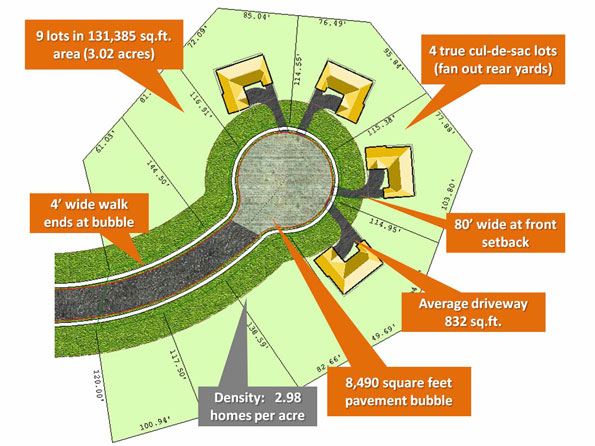
    Cul-de-Sac Design Guidelines: To make matters worse, existing design guidelines for cul-de-sacs create the most waste with the least benefit. Here in the upper Midwest, a cul-de-sac will have a 120 foot diameter right-of-way with a 110 foot circle of asphalt. Why? Because fire departments say they need that radius to turn around a fire truck. Go a bit south and that dimension reduces to a 100 foot diameter right-of-way with a 90 foot diameter circle. I’m not sure why northern firemen don’t turn the steering wheel as tight as those in the South, but according to these regulations, they apparently can’t. So up North the typical cul-de-sac will consume 8,500 square feet of paving, and in the South just under 6,000.

    This means that at a typical 25 foot setback from the right-of-way to the home front, an 80 foot wide suburban lot in the north will result in four or so premium lots. In the South, with a typical 20 foot setback and narrower 60 foot wide lot, there might be five or so premium lots.

    An 8,500 square foot volume of cul-de-sac paving for four Northern-sized lots comes out to 40 percent more square feet of paving per house compared to the same lot on a straight street. This means the home will cost the city 40 percent more for snow removal, resurfacing, etc., forever. It also cost the developer 40 percent more, but that is recouped because the lots on the cul-de-sac can be sold at a huge premium.

    A street leading to a cul-de-sac will have standard size lots fronting it. Depending upon the length of the street, there may be a few lots or dozens of them leading to the premium ones along the circle. These “street” lots might have a slightly higher value because of the low traffic approaching a closed end street, but they will certainly not equal the value of the lots around the circle.

    From an efficiency perspective, it seems like only a fool would defend the use of cul-de-sacs. Here are some facts from that fool. In planning, everyone assumes that the minimum dimension is the most efficient. In cul-de-sacs, the minimum dimensions are typically very inefficient. Making cul-de-sacs larger than the minimum fire engine turning radius makes them more efficient.

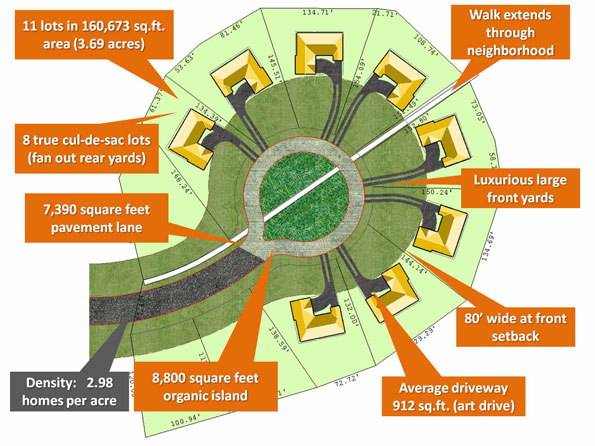
    Impossible? Take a look at the typical suburban design above, and compare it to to this re-designed cul-de-sac:

    By making a typical northern cul-de-sac larger, say 160 feet in diameter, and using a one-way narrow lane with an island in the center, the amount of total paved area plummets. Instead of a solid sea of asphalt, the new cul-de-sac uses 10% less paving and has room for a central park that will be approximately 8,800 square feet of organic surface.

    Now place the homes at a deeper setback. Yes, pulling the homes farther from the right-of-way to a 40 or 50 foot setback (instead of 25) accomplishes two things. It stretches the length of the setback line and makes the lots much less pie-shaped. The new, deeper setback should double the number of lots…with much less paving. Instead of being 40 percent less efficient, the new cul-de-sac is approximately 20 per cent more efficient than a rectangular lot on a straight street.

    And while the new cul-de-sac lot is less pie shaped, it will still have a significantly larger rear yard. The lots overlooking an 8,800 square foot park will have a much higher value than if they were overlooking 8,500 square feet of asphalt or concrete. The park can be used in a variety of ways, but a combination of rain gardens and recreation seems natural. By draining into the center, we eliminate curbing on one side, making them even more efficient. Since the number of premium cul-de-sac lots is at least doubled and uses less paving and less overall land area, there would be fewer cul-de-sacs.

    The Dead End Issue: But what of pedestrian and bicycle circulation? Well, that’s simple, as these non-vehicular designs can extend beyond the cul-de-sac as well as through them, making the central park areas destination places. Emergency vehicular access? Interconnecting walks could be made wide enough at certain locations to provide emergency access that would rival tight grid patterns.

    If these arguments favoring the efficient new cul-de-sacs aren’t enough, God likes them! How do I know? What scripture did I study to make this claim? Well, if God did not want cul-de-sacs, then why vary the natural contours of the land? Not every site is perfectly flat or a perfect square shape. In many cases, contours form peaks and valleys in which cul-de-sacs may be the only way to design a development; anything else would be unnatural.

    Hold your hand in front of you and then spread your fingers wide. When rain falls on the land and runs off it forms peaks and valleys similar to your jutting fingers. Where this happens, using the natural contour for the location of cul-de-sacs makes much more sense than trying to place a circulation pattern between the finger nails. Property configurations also often require a cul-de-sac or two (three, four or more).

    Of course a big bull-dozer could reconfigure any land to implement SSAR, but then…wouldn’t that be a sin?

    Rick Harrison is President of Rick Harrison Site Design Studio and Neighborhood Innovations, LLC. He is author of Prefurbia: Reinventing The Suburbs From Disdainable To Sustainable and creator of Performance Planning System. His websites are rhsdplanning.com and performanceplanningsystem.com.

    Photo:

  • Florida: From Hard Times in the Sunnier Climes

    By Richard Reep

    Florida’s era of hard times continues. Last week we held a “Jobs Summit ” here in Orlando but heard little but self-congratulation by politicians like Governor Charlie Crist. He praised the Legislature’s budget cuts but had little to claim when it came to reviving the economy.

    The basic reality is this: Florida is not only troubled, but in danger of falling further behind. For example, Suntech China, a solar cell manufacturer, recently worked with the State of Florida to build a solar cell manufacturing plant – in Arizona. Thanks to Florida’s unconvincing efforts, this employer decided to call Arizona its new home.

    The television and movie industry is rapidly expanding out of California into states like New York, Louisiana and New Mexico, thanks to incentives by these states to attract film and TV producers. Florida, with MGM, Universal Studios, Full Sail, and other venues, remains stagnant in this industry.

    While Central Florida is one of the country’s top ten “super regions” of population clusters, it consistently fails to get on the national stage regarding transportation, employment, and return on its federal tax money. For every dollar of income tax sent by Central Florida citizens each year, far less than a dollar comes back in terms of federal spending. Other states, like New Mexico and Alaska, receive our portion of that dollar.

    Publicly funded capital improvement projects, such as Nemours Hospital, continue to be awarded to out-of-state companies, leaving companies here in Florida, already reeling from the collapse of the real estate bubble, in even worse shape.

    Florida, which has little onshore energy resources such as oil or gas, has offshore energy resources that could pump billions of dollars into its coffers. Instead the riches of the Gulf are being exploited by Texas, Louisana, and Alabama.

    Florida, the “Sunshine State,” with vast solar and agricultural potential, has no renewable energy policy. Instead, biofuel and solar research leadership seems headed to Michigan, California and other states.

    Florida has yet to create a policy of sustainability at a statewide level. Instead, the state relies on growth, tourism, and agriculture for employment, hardly a sustainable policy given the catastrophe of 2009.

    While statewide unemployment is over 11%, labeled “Great Recession” by the press, those in the design and construction industry face unemployment estimates between 25% and 33%, levels matching that of the Great Depression.

    Nor are politics in our favor, even though Florida, reversing its generally conservative past, cast its lot with Obama in 2008. But now the promises of Transportation Secretary Ray LaHood in return for the State’s funding of commuter rail seem to be largely forsaken. During the Jobs summit, Obama’s railroad czar Joseph Szabo assured Florida that its priority would be yielded to Illinois. High-speed rail in Florida is unlikely in our lifetime. Chicago is simply more important than Orlando in today’s politics.

    Clearly Florida is not yet a basket case. With the right help from Tallahassee, Florida can reinvent itself and take advantage of the following natural assets:

    Sunshine still can bring talent and jobs. Sure, we are behind right now, but sunshine brought jobs before WW2 when Florida was ahead in aviation training. The mild climate is far more forgiving on student pilots than places where harsh winters ground light aircraft.

    Suntech should serve as Florida’s Pearl Harbor. Sure, we lost one solar cell manufacturer, but that technology is barely efficient enough to be viable. Florida could take advantage of this failure to revamp its poor growth management process, which was the reason for the failure to begin with, and actively seek out the best candidate for research and development of photovoltaic technology that would compete with Suntech and win.

    Deregulate Power Generation: The Sunshine State should be a net energy producer, not consumer. We could build a conduit to supply energy, through solar fields, up into the Southeast, as well as down into the Caribbean. There is a rather large island in need of vast amounts of clean power 90 miles away that will need this someday soon.

    Agricultural jobs: The statewide emergency declared as a result of the freeze should be a wake-up call to assist agriculture with some new ideas. Rather than sell dead orange groves out to developers, Florida should assist farmers to convert a portion of cropland to power generation, using solar collectors, photovoltaics, and biofuel crops.

    Media: This is a no-brainer for jobs. The movie industry grew in California because of the climate but is unionized and regulated to death. It’s time for Florida to compete. The next wave of entertainment culture is interactive virtual reality anyway, and the center of this activity has yet to be established, although there is an emerging concentration of firms like Raytheon doing research here. Florida could become a virtual reality technopole if it attracts the right players and provides the right resources.

    Transportation and the National Stage: For too long, Florida’s congressional delegation seems to have labored in the background, and Florida sends too few effective people to Washington. As a state made up of people escaping hard reality up north, we seem to have taken our “live and let live” beach culture too far and it has cost us credibility, capital, and clout. It’s time to reverse this trend and get passionate about our worth as a state and our contribution to America in items that matter. As a destination, Florida must rank much higher than Illinois for travel, and high speed rail should be awarded based on need rather than political favoritism.

    Meanwhile, growth and tourism will come back. They always do. And Florida, instead of losing designers to its competition, could find ways to retain them for the next generation of entertainment and leisure destinations. Housing, presently overbuilt, shouldn’t be ignored, but Florida has much to fix in terms of the quality of housing. Public/private partnerships to increase quality of life over quantity are necessary to make housing attractive and affordable and create quality, desirable communities for the 21st century.

    Florida is truly at a crossroads. For the last hundred and sixty-five years it relied on agriculture, growth, and tourism, but these narrow economic bands perpetuate cyclical booms and busts. Fundamental change can occur if the state’s leadership declares war on business as usual. The state needs to get nimbler to stay competitive when the economy does return. For those who want to stick it out and see Florida through this economic transition, it is imperative that the leadership respond now not just with words, but with actions that effect true, deep, and meaningful change.

    Richard Reep is an Architect and artist living in Winter Park, Florida. His practice has centered around hospitality-driven mixed use, and has contributed in various capacities to urban mixed-use projects, both nationally and internationally, for the last 25 years.

  • The War Against Suburbia

    A year into the Obama administration, America’s dominant geography, suburbia, is now in open revolt against an urban-centric regime that many perceive threatens their way of life, values, and economic future. Scott Brown’s huge upset victory by 5 percent in Massachusetts, which supported Obama by 26 percentage points in 2008, largely was propelled by a wave of support from middle-income suburbs all around Boston. The contrast with 2008 could not be plainer.

    Browns’s triumph followed similar wins by Republican gubernatorial contenders last November in Virginia and New Jersey. In those races suburban voters in places like Middlesex County, New Jersey and Loudoun County, Virginia—which had supported President Obama just a year earlier—deserted the Democats in droves. Also in November, voters in Nassau County, New York upset Nassau County Executive Thomas Suozzi, an attractive Democrat who had carefully cultivated suburban voters.

    The lesson here is that political movements ignore suburbanites at their peril. For the better part of a century, Americans have been voting with their feet, moving inexorably away from the central cities and towards the suburban periphery. Today a solid majority of Americans live in suburbs and exurbs, more than countryside residents and urbanites combined.

    As a result, suburban voters have become the critical determinants of our national politics, culture, and economy. The rise of the Republican majority after 1966 was largely a suburban phenomenon. When Democrats have resurged—as they did under Bill Clinton and again in 2006 and 2008—it was when they came close to splitting the suburban vote.

    But now, once again, things have changed. For the first time in memory, the suburbs are under a conscious and sustained attack from Washington. Little that the administration has pushed—from the Wall Street bailouts to the proposed “cap and trade” policies—offers much to predominately middle-income oriented suburbanites and instead appears to have worked to alienate them.

    And then there are the policies that seem targeted against suburbs. In everything from land use and transportation to “green” energy policy, the Obama administration has been pushing an agenda that seeks to move Americans out of their preferred suburban locales and into the dense, transit-dependent locales they have eschewed for generations.

    As in so many areas, this stance reflects the surprising power of the party’s urban core and the “green” lobby associated with it. Yet, from a political point of view, the anti-suburban stance seems odd given that Democrats’ recent electoral ascendency stemmed in great part from gains among suburbanites. Certainly this is an overt stance that neither Bill nor Hillary Clinton would likely have countenanced.

    Whenever possible, the Clintons expressed empathy with suburban and small-town voters. In contrast, the Obama administration seems almost willfully city-centric. Few top appointees have come from either red states or suburbs; the top echelons of the administration draw almost completely on big city urbanites—most notably from Chicago, New York, Los Angeles, and San Francisco. They sometimes don’t even seem to understand why people move to suburbs.

    Many Obama appointees—such as at the Departments of Transportation and of Housing and Urban Development (HUD) and at the Environmental Protection Agency (EPA)—favor a policy agenda that would drive more Americans to live in central cities. And the president himself seems to embrace this approach, declaring in February that “the days of building sprawl” were, in his words, “over.”

    Not surprisingly, belief in “smart growth,” a policy that seeks to force densification of communities and returning people to core cities, animates many top administration officials. This includes both HUD Secretary Shaun Donovan and Undersecretary Ron Sims, Transportation undersecretary for policy Roy Kienitz, and the EPA’s John Frece.

    Transportation Secretary Ray LaHood revealed the new ideology when he famously declared the administration’s intention to “coerce” Americans out of their cars and into transit. In Congress, the president’s allies, including Minnesota Congressman James Oberstar, have advocated shifting a larger chunk of gas tax funds collected from drivers to rail and other transit.

    In addition, the president’s stimulus—with its $8 billion allocation for high-speed rail and proposed giant increases in mass transit—offers little to anyone who lives outside a handful of large metropolitan cores. Economics writer Robert Samuelson, among others, has denounced the high-speed rail idea as “a boondoggle” not well-suited to a huge, multi-centered country like the United States. Green job schemes also seem more suited to boost employment for university researchers and inner-city residents than middle-income suburbanites.

    Suburbanites may not yet be conscious of the anti-suburban stance of the Obama team, but perhaps they can read the body language. Administration officials have also started handing out $300 million stimulus-funded grants to cities that follow “smart growth principles.” Grants for cities to adopt “sustainability” oriented development will reward those communities with the proper planning orientation. There is precious little that will benefit suburbanites, such as improved roads or investment in other basic infrastructure.

    But ultimately it will be sticks and not carrots that planners hope to use to drive de-suburbanization. Perhaps the most significant will be new draconian controls over land use. Administration officials, particularly from the EPA, participated in the drafting of the recent “Moving Cooler” report, which suggested such policies as charging tolls on the Interstate Highway System, charging people to park in front of their homes, and steering some 90 percent of all future development into the most dense portions of already existing urban development.

    Of course, such policies have little or no chance of being passed by Congress. Too many representatives come from suburban or rural districts to back policies that would penalize a population that uses automobiles for upwards of 98 percent of their transportation and account for 95 percent of all work trips.

    But the president’s cadres may find other ways to impose their agenda. New controls, for example, may be enacted through the courts and regulatory action. There is already precedence for this: As EPA director under Clinton, current climate czar Carole Browner threatened to block federal funds for the Atlanta region due to their lack of compliance with clear air rules.

    Such threats will become more commonplace as regulating greenhouse gases fall under administrative scrutiny. As can already be seen in California, regulators can use the threat of climate change as a rationale to stop funding—and permitting—for even well-conceived residential, commercial, or industrial projects construed as likely to generate excess greenhouse gases.

    These efforts will be supported by an elaborate coalition of new urbanist and environmental groups. At the same time, a powerful urban land interest, including many close to the Democratic Party, would also support steps that thwart suburban growth and give them a near monopoly on future development over the coming decades.

    Glimpse the Future

    One can glimpse this future by observing what takes place in most European countries, including the United Kingdom, where land use is controlled from the center. For decades options for new development have been sharply circumscribed, with mandates for ever-smaller lots and smaller homes more the norm for single-family residences.

    In Britain the dominant planning model is widely known as “cramming,” meaning forced densification into smaller geographic areas. Over the past generation, this has spurred a rapid shrinking of house sizes. Today the average new British “hobbit” house, although quite expensive, covers barely 800 square feet, roughly one-third that of the average American residence. Even in quite distant suburbia many of the features widely enjoyed here—sizable backyards, spare bedrooms, home office space—are disappearing.

    But these suburban hobbits will be living large compared to the sardines who would be forced to move into inner cities. In London, already a densely packed city, planners are calling for denser apartment blocks and congested neighborhoods.

    This top-driven scenario may be playing soon in America. Following the proposed edicts of “Moving Cooler,” the urban option increasingly would become almost the only choice other than the countryside. Unlike their baby boomer parents, the next generation would have few affordable choices in comfortable, low- and medium-density suburbs and single-family homes.

    Ownership of a single-family home would become increasingly the province only of the highly affluent or those living on the fringes of second-tier American cities. Due to the very high costs of construction for multi-family apartments in inner cities, most prospective homeowners would also be forced to remain renters. Although widely hailed as “progressive,” these policies would herald a return to the kind of crowded renter-dominated metropolis that existed prior to the Second World War.

    Are Suburbs Doomed?

    The anti-suburban impulse is nothing new. Suburbs have rarely been popular among academics, planners, and the punditry. The suburbanite displeased “the professional planner and the intellectual defender of cosmopolitan culture,” noted sociologist Herbert Gans. The 1960s counterculture expanded this critique, viewing suburbia as one of many “tasteless travesties of mass society,” along with fast and processed food, plastics, and large cars. Suburban life represented the opposite of the cosmopolitan urban scene; one critic termed it “vulgaria.”

    Liberals also castigated suburbs as the racist spawn of “white flight.” But more recently, environmental causes—particularly greenhouse gas emissions as well as dire warning about the prospects for “peak oil”—now drive much of the argument against suburbanization.

    The housing crash that began in 2007 added grist to the contention that the age of suburban growth has come to an end. To be sure, the early phases of the subprime mortgage bust were heavily concentrated in newer developments in the outer fringes. In part due to rising home prices, a disproportionate number of new buyers were forced to resort to sub-prime and other unconventional mortgages.

    The outer suburban distress attracted much media attention and delighted many who had long detested suburbs. One leading new urbanist, Chris Leinberger, actually described suburban sprawl as “the root cause of the financial crisis.” Leinberger and other critics have described suburbia as the home of the nation’s future “slums.” The favorite images have included McMansions being taken over by impoverished gang-bangers and other undesirables once associated with the now pristine inner city.

    Others portray future suburbs as serving at best as backwaters in a society dominated by urbanites. In contrast to a brave new era for “the gospel of urbanism,” the suburbs are expected to contract and even wither away. According to planner Arthur C. Nelson’s estimate, by 2025 the United States will have a “likely surplus of 22 million large lot homes”—that is, residences on more than one sixth of an acre.

    City boosters, however, largely ignore the real-estate crisis impact on urban condo markets throughout the country. Like the new developments on the fringe, the much hyped apartment complexes in central cities such as New York, Miami, Los Angeles, Chicago, and Denver came on line precisely as the housing market crashed, with similar devastating effects. Many remain unoccupied and others have been converted from high-end condos to more modest rentals.

    Yet fundamentally the attack on suburbia has less to do with market trends or the environment than with a deep-seated desire to change the way Americans live. For years urban boosters have proposed that more Americans should reside in what they deemed “more livable,” denser, transit-oriented communities for their own good. One recent example, David Owens’ Green Metropolis, supports the notion that Americans should be encouraged to embrace “extreme compactness”—using Manhattan as the model.

    Convinced Manhattanization is our future, some “progressives” are already postulating what to do with the remnants of our future abandoned. Grist, for example, recently held a competition about what to do with dying suburbs that included ideas such as turning them into farms, bio-fuel generators, and water treatment plants.

    What Do the Suburbanites Want?

    In their assessments, few density advocates bother to consider whether most suburbanites would like to give up their leafy backyards for dense apartment blocks. Many urban boosters simply could not believe that, once given an urban option, anyone would choose to live in suburbia.

    Jane Jacobs, for example, believed that “suburbs must be a difficult place to raise children.” Yet had Jacobs paid as much attention to suburbs as she did to her beloved Greenwich Village, she would have discovered that they possess their own considerable appeal, most particularly for people with children. “If suburban life is undesirable,” noted Gans in 1969, “the suburbanites themselves seem blissfully unaware of it.”

    Contrary to much of the current media hype, most Americans continue to prefer suburban living. Indeed for four decades, according to numerous surveys, the portion of the population that prefers to live in a big city has consistently been in the 10 to 20 percent range, while roughly 50 percent or more opt for suburbs or exurbs. The reasons? The simple desire for privacy, quiet, safety, good schools, and closer-knit communities. The single-family house, detested by many urbanists, also exercises a considerable pull. Surveys by the National Association of Realtors and the National Association of Home Builders find that some 83 percent of potential buyers prefer this kind of dwelling over a townhouse or apartment.

    In other words, suburbs have expanded because people like them. A 2008 Pew study revealed that suburbanites displayed the highest degree of satisfaction with where they lived compared to those who lived in cities, small towns, and the countryside. This contradicts another of the great urban legends of the 20th century—espoused by urbanists, planning professors, and pundits and portrayed in Hollywood movies—that suburbanites are alienated, autonomous individuals, while city dwellers have a deep sense of belonging and connection to their neighborhoods.

    Indeed on virtually every measurement—from jobs and environment to families—suburban residents express a stronger sense of identity and civic involvement with their communities than those living in cities. One recent University of California at Irvine study found that density does not, as is often assumed, increase social contact between neighbors or raise overall social involvement. For every 10 percent reduction in density, the chances of people talking to their neighbors increases by 10 percent, and their likelihood of belonging to a local club by 15 percent.

    These preferences have helped make suburbanization the predominant trend in virtually every region of the country. Even in Portland, Oregon, a city renowned for its urban-oriented policy, barely 10 percent of all population growth this decade has occurred within the city limits, while more than 90 percent has taken place in the suburbs over the past decade. Ironically, one contributing factor has been the demands of urbanites themselves, who want to preserve historic structures and maintain relatively modest densities in their neighborhoods.

    Multicultural Flight

    Perhaps nothing reflects the universal appeal of suburban lifestyles more than its growing ethnic diversity. In 1970 nearly 95 percent of suburbanites were white. Today many of these same communities have emerged as the new melting pots of American society. Along with immigrants, African-Americans have moved to the suburbs in huge numbers: between 1970 and 2009, the proportion of African-Americans living in the periphery grew from less than one-sixth to 40 percent.

    Today minorities constitute over 27 percent of the nation’s suburbanites. In fast-growing Gwinett County outside Atlanta, minorities made up less than 10 percent of the population in 1980; by 2006 the county was on the verge of becoming “majority minority.” In greater Washington, D.C., the Northeast’s most dynamic region in economic and demographic terms, 87 percent of foreign migrants live in the suburbs, while less than 13 percent live in the district, according to a 2001 Brookings Institution study.

    Perhaps most intriguingly, this diversity is itself diverse, including not only African-Americans but also Latinos and Asians. Suburban areas such as Fort Bend county, Texas, and the city of Walnut, in the San Gabriel Valley east of Los Angeles, already have among the most diverse populations in the nation. And this is not merely a California phenomenon: Aurora (outside Denver), Bellevue (the Seattle suburb), and Blaine (outside Minneapolis) are becoming ever-more diverse even as the nearby city centers become less so. By 2000 well over half of mixed-race households were in the suburbs, a percentage that continues to grow.

    Today the most likely locale for America’s new ethnic shopping centers, Hindu temples, and new mosques are not in the teeming cities but in the outer suburbs of Los Angeles, New York, and Houston. “If a multiethnic society is working out in America,” suggests California demographer James Allen, “it will be worked out in [these] places  . . . The future of America is in the suburbs.”

    A War Not Worth Fighting

    If most Americans clearly prefer suburbs then why would our elected representatives choose to pick a fight with them? Perhaps the most widely used explanation lies with densification as a means of reducing greenhouse gases. But this rationale itself seems flawed, and could reflect more long-standing prejudice than proven science.

    For example, a recent study by the National Academy of Sciences found that a nationally imposed densification policy would at best cut greenhouse gas emissions between less than 1 and 11 percent by 2050. Other research suggests that, by some measurements, low-density development can use less energy than denser urban forms.

    Although automobile commuting now consumes more energy resources than well-traveled traditional urban rail systems, the future generation of low-mileage cars may prove more efficient than often underutilized rail systems that are now seen as critical elements of fighting climate change. A public system running at low capacity—commonplace in many regions—may actually produce more emissions than the coming generation of personal vehicles.

    Moreover, tall buildings may not be as green as some advocates suggest. Recent studies out of Australia show that townhouses, small condos, and even single-family homes generate far less heat per capita than the supposedly environmentally superior residential towers, particularly when one takes into account the cost of heating common areas and the highly consumptive lifestyle of affluent urbanites (with their country homes, vacations, and frequent flying). In terms of energy conservation, the easiest and least expensive option may be to retrofit single-family houses and wood-shaded townhouses.

    Two- or three-story homes or townhouses often require only double-paned windows and natural shading to reduce their energy consumption; one Los Angeles study found that white roofs and shade trees can reduce suburban air conditioning by 18 percent. Such structures are particularly ideal for using the heat- and water-saving elements of landscaping: after all, a nice maple can cool a two-story house more efficiently than it can a ten-story apartment.

    Of course, density advocates can and do produce their own studies to justify their agenda. But there seems enough reasonable doubt to focus on more efficient, and less intrusive, ways to create greener communities by improving energy efficiency of automobiles and changing the way suburbs fit into metropolitan systems.

    Turning Deadwood into Greenurbia

    The “green” assault on suburbia also largely ignores changes already taking place across the suburban landscape. In a historical context, the latest suburban “sprawl” may be compared to Deadwood. That rough-and-ready mining town on the Dakota frontier was developed quickly for the narrow purpose of being close to a vein of gold. But over time these towns developed respectable shopping streets, theaters, and other community institutions.

    One change already evident can be seen in commuting patterns. Density advocates and the media often characterize suburbanites as people who generally take long commutes to work compared to the shorter rides enjoyed by city-dwellers. But with the continuing dispersion of work to the suburbs over the past two decades, suburban work locations actually enjoyed shorter commutes than their inner city counterparts in virtually all the largest metropolitan areas.

    This is true even in New York. Although Manhattanites enjoy short commutes and can even walk to work, most people who live in New York City and work in Manhattan suffer among the longest commutes in the nation. In fact, residents of Queens and Staten Island spend the most time getting to work of all metropolitan counties. Residents in suburbs and particularly exurbs actually endure generally shorter commutes, in large part because of less congestion and closer proximity to employment.

    Such pairing of jobs and housing will shape the suburban future and represents among the easiest ways to cut transportation-related emissions. Even more promising has been the continuing rise in home-based employment. According to Forrester Research, roughly 34 million Americans now commute at least part time from home; by 2016 these numbers are predicted to swell upwards to 63 million.

    Oddly, despite these tremendous potential environmental benefits, the shift toward cyberspace has elicited little support from smart-growth advocates. Indeed most reports on density and greenhouse gases virtually ignore the consideration of telecommuting and dispersed work.

    One reason may be that telecommuting breaks with the prevailing planning and green narratives by making dispersion more feasible. The ability to work full time or part time from home, notes one planning expert, expands metropolitan “commuter sheds” to areas well outside their traditional limits. In exchange for a rural or exurban lifestyle, this new commuter—who may go in to “work” only one or two days a week—will endure the periodic extra long trip to the office.

    Yet although it may offend planning sensibilities, the potential energy savings—particularly in vehicle miles traveled—could be enormous. Telecommuters drive less, naturally; on telecommuting days, average vehicle miles are between 53 percent and 77 percent lower. Overall a 10 percent increase in telecommuting over the next decade will reduce 45 million tons of greenhouse gases, while also dramatically cutting office construction and energy use. Only an almost impossibly large shift to mass transit could produce comparable savings.

    Ultimately, technology will undermine much of the green case against suburbia. If we really want to bring about a greener era, focusing attention on low-density enclaves would bring change that conforms to the preferences of the vast majority of people.

    Think Twice Before You Act

    Ultimately, the war against suburbia reflects a radical new vision of American life which, in the name of community and green values, would reverse the democratizing of the landscape that has characterized much of the past 50 years. It would replace a political economy based on individual aspiration and association in small communities, with a more highly organized, bureaucratic, and hierarchical form of social organization.

    In some ways we could say forced densification could augur in a kind of new feudalism, where questions of land ownership and decision making would be shifted away from citizens, neighbors, or markets, and left in the hands of self-appointed “betters.” This seems strange for an administration—and a party—whose raison d’être ostensibly has been to widen opportunities rather than constrict them.

    Indeed it is one of the oddest aspects of contemporary “progressive” thought that it seeks to undermine even modest middle class aspirations such as living in a quiet neighborhood or a single-family house. This does not seem a winning way to build political support across a broad spectrum of the populace.

    Of course suburbia is not and will not be the option for everyone. There will continue to be a significant, perhaps even growing, segment of the population which opts for a dense urban lifestyle or, for that matter, to live further in the countryside. But unless we see a radical change in human behavior and social organization, the majority will likely settle for a suburban or exurban existence.

    Given these realities, it seems more practical not to work against such aspirations but instead to evolve intelligent policies that would reconcile them with our long-term environmental needs. Suburbanites like their suburbs but would also like to find a way to make them greener as well as more economically and socially viable. Right now neither party has developed such an agenda, and so the suburbs, now clearly leaning right, remain up for grabs. To win suburbanites over, politicians first have to respect the basic preferences while offering a realistic program for improvement. This remains a key to building a sustainable electoral majority, not just for the next election, but for the decades to come.

    This article first appeared at The American.

    Joel Kotkin is executive editor of NewGeography.com and is a distinguished presidential fellow in urban futures at Chapman University. He is author of The City: A Global History. His newest book is The Next Hundred Million: America in 2050, released in Febuary, 2010.