Category: Policy

  • America’s Agricultural Angst

    In this high-tech information age few look to the most basic industries as sources of national economic power. Yet no sector in America is better positioned for the future than agriculture–if we allow it to reach its potential.

    Like manufacturers and homebuilders before them, farmers have found themselves in the crosshairs of urban aesthetes and green activists who hope to impose their own Utopian vision of agriculture. This vision includes shutting down large-scale scientifically run farms and replacing them with small organic homesteads and urban gardens.

    Troublingly, the assault on mainstream farmers is moving into the policy arena. It extends to cut-offs on water, stricter rules on the use of pesticides, prohibitions on the caging of chickens and a growing movement to ban the use of genetic engineering in crops. And it could undermine a sector that has performed well over the past decade and has excellent long-term prospects.

    Over the next 40 years the world will be adding some 3 billion people. These people will not only want to eat, they will want to improve their intake of proteins, grains, fresh vegetables and fruits. The U.S., with the most arable land and developed agricultural production, stands to gain from these growing markets. Last year the U.S.’ export surplus in agriculture grew to nearly $35 billion, compared with roughly $5 billion in 2005.

    The overall impact of agriculture on the economy is much greater than generally assumed, notes my colleague Delore Zimmerman, of Praxis Strategy Group. Roughly 4.1 million people are directly employed in production agriculture as farmers, ranchers and laborers, but the industry directly or indirectly employs approximately one out of six American workers, including those working in food processing, marketing, shipping and supermarkets.

    Yet none of this seems to be slowing the mounting criticisms of “corporate agriculture.” A typical article in Time, called “Getting Real About the High Price of Cheap Food,” assailed the “U.S. agricultural industry” for precipitating an ecological disaster. “With the exhaustion of the soil, the impact of global warming and the inevitably rising price of oil–which will affect everything from fertilizer to supermarket electricity bills–our industrial style of food production,” the article predicts, “will end sooner or later.”

    The romantic model being promoted by Time and agri-intellectuals like Michael Pollan hearkens back to European and Tolstoyan notions of small family farms run by generations of happy peasants. But this really has little to do with the essential ethos of American agriculture.

    Back in the early 19th century Alexis de Tocqueville noted that American farmers viewed their holdings more like capitalists than peasants. They would sell their farms and move on to other businesses or other lands–a practice unheard of in Europe. “Almost all the farmers of the United States,” he wrote, “combine some trade with agriculture; most of them make agriculture itself a trade.”

    Despite the perceptions of a corporatized farm sector, this entrepreneurial spirit remains. Families own almost 96% of the nation’s 2.2 million farms, including the vast majority of the largest spreads. And small-scale agriculture, after decreasing for years, is on the upswing; between 2002 and 2009 the number of farms increased by 4%.

    This trend toward smaller-scale specialized production represents a positive trend, but large-scale, scientifically advanced farming still produces the majority of the average family’s foodstuffs, as well as the bulk of our exports. Overall, organic foods and beverages account for less than 3% of all food sales in the U.S.–hardly enough to feed a nation, much less a growing, hungry planet.

    Then there’s the even more fanciful notion–promoted by Columbia University’s Dickson D. Despommier–of moving food production into massive urban hothouses. In a recent op-ed in the New York Times he argues we are running out of land and need to take agriculture off the farm. According to Despommier, “The traditional soil-based farming model developed over the last 12,000 years will no longer be a sustainable option.”

    Yet Praxis Strategy’s Matthew Lephion, who grew up on a family farm, points out that such projects hardly represent a credible alternative in terms of food production. Urban land is far more expensive–often at least 10 times as much as rural. Energy and other costs of maintaining farms in big cities also are likely to be higher.

    Furthermore the notion that America is running out of land–one justification for subsidizing urban farming–seems fanciful at best. The past 30 years have seen some loss of farmland, but the amount of land that actually grows harvested crops has remained stable. Though some prime farmland close to metropolitan centers should be protected, agriculture has over the past decades returned to nature–forests, wetlands, prairie–millions of acres, far more than the land that has been devoted to housing and other urban needs.

    However ludicrous the arguments, the Obama administration remains influenced by green groups and is the cultural prisoner of the lifestyle left, with its powerful organic foodie contingent. That leaves farmers and the small towns dependent on them with little voice.

    The ability of greens and others to wreak havoc on agriculture can be seen in the disaster now unfolding in California’s fertile Central Valley. Large swaths of this area are being de-developed back to desert–due less to a mild drought than to regulations designed to save obscure fish species in the state’s delta. Over 450,000 acres have already been allowed to go fallow. Nearly 30,000 agriculture jobs–held mostly by Latinos–have been lost, and many farm towns suffer conditions that recall The Grapes of Wrath.

    Not satisfied with these results, the green lobby has prompted the National Marine Fisheries Service to further cut water supplies, in part to improve the conditions for whales and other species out in the ocean. Given these attitudes, farmers, including those I have worked with in Salinas, are fretting about what steps federal and state regulators may take next.

    One particular concern revolves around the movement against genetically modified food. Already there are calls for banning GMOs in Monterey County. Local officials worry this would cripple the area’s nascent agricultural biotech industry as well as the long-term ability of existing farmers to compete with less regulated competitors elsewhere. The fact that a less advanced form of genetic engineering also sparked the “green revolution” that greatly reduced world hunger after 1965 seems, to them at least, irrelevant.

    When viewed globally, the anti-big farm movement seems even more misguided. As Chapman University’s professor of food science Anuradha Prakash observes, India’s own organic farms serve a small portion of the market and cannot possibly meet the nutritional needs of the country’s expanding population. “You just don’t get the yields you need for Africa and Asia from organic methods,” she explains.

    A formula that works for high-end foodies of the Bay Area or Manhattan can’t produce enough affordable food to feed the masses–whether in Minnesota or Mumbai. The emerging war on agriculture threatens not only the livelihoods of millions of American workers; it could undermine our ability to help feed the world.

    This article originally appeared at Forbes.com.

    Joel Kotkin is executive editor of NewGeography.com and is a distinguished presidential fellow in urban futures at Chapman University. He is author of The City: A Global History. His next book, The Next Hundred Million: America in 2050, will be published by Penguin Press February 4th, 2010.

    Photo:

  • Airline Security: The War on Service

    Who hasn’t daydreamed about taking revenge on an industry that has managed to parlay the horrors of modern air travel into a multi-billion dollar federal bailout? Although in most cases, I would guess, the fantasy involves the ticket agent’s undies, not our own, going up in smoke.

    As everyone knows, in response to the Northwest flameout, the Obama administration has adopted policies that are almost exactly the same as those of the Bush administration, turning the flying experience into a political advertisement for all the wonderful things that the president is doing to fight the war on terror.

    Karl Rove’s great contribution to the political landscape was to remind travelers, at every security checkpoint, that unknown aliens were threatening the American way of life, and that the only way to keep jihadists off the USS Dreamliner was to vote Republican.

    That re-election strategy clearly now appeals to the Obama administration, which decided, among other tactics, that an effective weapon in the war on terror is to keep Americans out of mile-high toilets in the last hour of flights.

    The general assumption about the Northwest Airlines Underwear Bomber is that he sought to bring down the airliner in the name of Allah, those seventy-two virgins, and Osama bin Laden.

    But is it possible that he was just another over-wrought airline passenger who has had it with strip searches by airport security agents, surcharges to take a bag on a trip, meal service that consists of peanuts and instant coffee, seats that feel like electric chairs, and those walks through arrival halls that feel like Mao’s Long March?

    Wait until bin Laden hears that we’re coming at him with bladder-busting planes. That measure ought to turn the tide, since clearly banning economy-sized toothpaste tubes from the skies didn’t do the trick.

    While the government uses the flying experience to broadcast political messages, the airlines see the war on terror as a chance to re-price a product that has consistently gone bankrupt, often thanks to corporate mismanagement.

    Most businesses start from the assumption that it is a good idea to try to attract customers with good service and quality products. That is the logic behind the business strategy of a department store or a restaurant.

    The airline business model, however, is based solely on being able to advertise low fares. Once the promotions are in place, the airlines take to the skies with cramped seats, mysterious food, nickel-and-dime charges, surly staff, un-hedged oil contracts, and furious customers, with the hope that the government, if need be, will bail out the industry in the name of national security.

    As the government turns airports into prison lockdowns, the airlines’ response has been to convert their pricing policies into a shell game of bait-and-switch, insuring that travelers get it coming and going.

    Airlines and governments alike conspire to use air tickets to bury all sorts of taxes, oil surcharges, fees, levies, new airport subsidies, and old-fashioned handouts under the banner of “passenger safety,” which has become a variation on a protection racket. Station a few x-ray machines in the nation’s airports, and then charge and tax anything you like for a “war on terror;” by my estimates, it’s a “war” that has taken, on average since 2001, less than 1500 American lives annually, and has cost approximately $500 billion a year in new federal agencies, programs, weapons, and appropriations.

    Am I too cynical? Isn’t the goal safety for the traveling public? In the president’s primetime proclamations, that might seem to be the case, but then what explains the national indifference to the some 40,000 annual deaths, and millions of injuries, on the nation’s highways? Where is the war on automobilism? If the goal is to save American lives, Interstate 80 strikes me as a more accessible target than Yemen.

    The problem with highway safety, as opposed to homeland security, is that it’s a financial and, more important, a political loser. Making car passengers wear crash helmets or body armor, logical as it would appear from the risks of the road, does not lead to as many rewards from the electorate as the specter of al Qaeda crouched in an Afghan cave. And which political party wants to run for re-election on the slogan: “Your Taurus: More Dangerous Than The Taliban.”

    Left to their own devices and customer service, and without government handouts, most large airlines would go out of business. Take the decision on the part of most airlines (Southwest excepted, and bravo to them) to charge passengers for having the audacity to take luggage on a trip.

    Airline bag policies tend to be more complicated than the Da Vinci code, and involve arcane formulas about weight, size, and contents that few travelers can understand. The goal is to lure passengers to an airport, read them obscure airline policies, and demand extortionate payments (“If you wanna see your bags again…”).

    My own bag horror story began when, for an internship in Dubai, my daughter booked onto British Airways, which allows one bag on international flights and charges $50 for a second, which she had.

    Her BA flight was cancelled due to snow in London, and the airline rerouted her on Air France, after an assurance that she could travel to Dubai with two bags. Instead, when she checked in with Air France, that airline demanded $320 to take her second bag (normal size and weight) to Dubai.

    After Air France finished treating her like a shoe bomber, it took an hour for their staff and that of British Airways to arbitrate the second-bag crisis, while my daughter, having been subject to a twelve-hour delay, stood by in tears. I imagine that such unhappy scenes play out thousands of times every day in airports around the world. What other business alienates its customer base for $50?

    Beyond bag hustles, what keeps many airlines in business today is that they have become accomplices in the National Security State, part of a daily pantomime to terrify the traveling public into subsidizing all sorts of undeclared wars, drone missile appropriations, and endless sweetheart contracts to the likes of Blackwater.

    Under this Faustian bargain, the airlines get to charge $50 (if not $320) for extra bags, or $200 to change a reservation, and the government gets to charge $500 billion for homeland security.

    Having tried and failed with Big Brother airlines and airports, why don’t we give the market a chance to sort out the security problem? How much worse could it be?

    Leave it to each private company to decide whether they want to frisk their passengers or not (“Fly Freedom Airways, and Leave the Cavity Searches to Us!”), or charge for luggage, drinks, peanuts, or meals.

    Let each airline decide if they want to take off with armed guards or not. Maybe one of the airlines could dress up its pilots to look like the Lone Ranger and Tonto.

    Finally, let the passengers handle in-flight security. After all, they put out the fires of the Underwear Bomber.

    Matthew Stevenson is author of Remembering the Twentieth Century Limited and An April Across America.

  • If I Were Sheikh Mohammed

    On January 15th, Dubai’s ruler, Sheikh Mohammed bin-Rashid bin-Maktoum responded to an article written by the author and Joel Kotkin suggesting the United Nations should move its headquarters from New York to Dubai. Dubai issued a formal statement, “The emirate would welcome talks with officials at the organisation to inform them of the facilities and advantages that Dubai can offer.”

    If I were Sheikh Mohammed, I would follow this bold gesture with another and offer to lead a modern Marshall Plan for reconstruction of Haiti, fueled by the crude oil fortune pumped from the Persian Gulf. What better way to demonstrate the deservedness of Dubai and the Gulf region as the site of the new United Nations Headquarters than to demonstrate the ability to lead the world in a time of crisis.

    The Marshall Plan was announced by Secretary of State George C. Marshall during a speech at Harvard University on June 5, 1947. Marshall said,

    “The truth of the matter is that Europe’s requirements for the next three or four years of foreign food and other essential products – principally from America – are so much greater than her present ability to pay that she must have substantial additional help or face economic, social, and political deterioration of a very grave character”.

    The European Recovery Program, or Marshall Plan as it was known, reconstructed the war ravaged economies of Western Europe between 1948 and 1952. By 1952, these economies were 35% higher than in 1938. The recovery led to unprecedented growth for twenty years and stability on the continent.

    Change “Europe” to “Haiti” and the words ring as true in 2010 as they did in 1947. The United States has pledged $100 million. Britain has pledged $10 million. The UAE, to date, has offered just “shelter materials” according to the UN Office for the Coordination of Humanitarian Affairs (WSJ 1/16/10). Dubai must do more to take its place as a leader on the world stage.

    Haiti is a tiny island nation of 9,000,000. Between two and three million souls were clustered in ramshackle housing around the city of Port au Prince when a 7.2 earthquake hit. More than 100,000 perished although the true count may never be known. Haiti is one of the poorest places on earth with a per capita income of just $1,317 (2008).

    The Persian Gulf, half a world away, pumps 20,000,000 barrels of crude per day at a cost of approximately $4 per barrel. At current world prices of $80 per barrel, the gulf nations have free cash flow approximating $1.5 billion per day. The developed nations of the West pump more than half a trillion dollars per year into the coffers of the Persian Gulf nations and these nations are struggling with the worst financial crisis in a century. To the contrary, the sovereign wealth funds of Abu Dhabi, Saudi Arabia and other oil rich GCC nations contain $3 trillion dollars.

    Presidents Bill Clinton and George W. Bush have agreed to lead an international effort to raise emergency funds to aid in the immediate rescue of the Haitian people. They will raise enough to bring in badly needed rescue personnel, water, food and tents for 2,000,000 people living in hellish conditions. But their efforts do not touch Haiti’s long term needs.

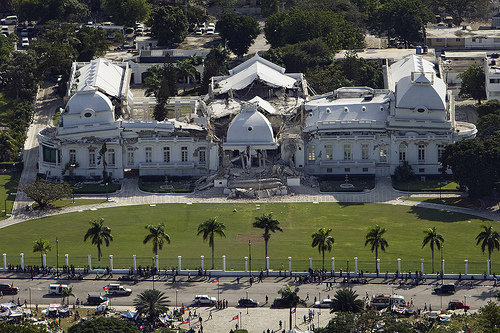
    Haiti has been mostly destroyed. It is estimated that 75% of its buildings have been damaged or destroyed. Its Presidential Palace collapsed as did its main Cathedral and the island’s UN Headquarters. Its infrastructure is in ruins, its water system destroyed. It looks reminiscent of Dresden, Germany during the carpet bombing of World War II. Dead bodies lie everywhere amidst the smoking ruins of a destroyed city.

    The city of Port au Prince needs to be razed to the ground. 2,000,000 people need to be dispersed around the Caribbean as the residents of New Orleans were after Hurricane Katrina. And then a massive reconstruction project, similar to the Marshall Plan after WWII, must be undertaken to rebuild everything from roads and ports to homes, hospitals and schools. Who will lead that effort? The nations of Latin America do not have the expertise or capital. The United States is financially exhausted, drained from two wars half a world away, 10% unemployment and a financial collapse as severe as the Great Depression.

    There is one man who is no stranger to multi-billion dollar projects and the transformation of a nation, Dubai’s ruler, Sheikh Mohammed bin-Rashid bin-Maktoum. Why would Sheikh Mohammed intervene and lead an effort to rebuild Haiti that will cost several billion dollars? Haiti is half a world away from the Persian Gulf. One reason is his proven ability to create and build a radical new urban vision. Sheikh Mohammed built the tallest structure on the planet, huge residential islands in the Gulf, and the world’s largest airport – simultaneously.

    The Gulf Cooperation Council, (GCC) consists of the UAE, Kuwait, Bahrain, Saudi Arabia, Oman and Qatar. To say these nations are rich is an understatement. Their oil reserves total somewhere around 500 billion barrels. Dedicating $10 billion to rebuild Haiti would require allocating a week’s revenue from crude oil production. That much money will not be needed tomorrow. A pledge of $3 billion per year for three years would suffice and not even dent the balance sheets of the Gulf nations.

    Sheikh Mohammed needs to take the lead if he wants the balance of power, respect and authority to move the UN from New York City to the Middle East. For too long, the Middle East has exported oil, its wars, the Israeli/Palestinian conflict and terrorists to the world. To many, the face of Islam has been the face of a terrorist, committing heinous acts on innocent people. Dubai, despite its majesty, has not yet become a true global destination, particularly in the wake of the world economic crisis. What better way to raise the image of Islam and the Middle East than to lead a 21st Century Marshall Plan to rebuild Haiti? The reward might just be a Nobel Peace Prize as George C. Marshall was awarded in 1953.

    Sheik Mohammed should make this announcement at the foot of the tallest structure ever created by man to show, while reaching for the sky, the ruler of Dubai can reach down to the poorest, most ravaged people on the earth and lift them up as well. He could take the center stage of the world, once again, and do what has made him arguably the most visionary developer since the Pharaohs of ancient Egypt.

    Robert J. Cristiano PhD is a successful real estate developer and the Real Estate Professional in Residence at Chapman University in Orange, CA.

    Photos:

  • Denmark, and the US, in 2010

    Denmark is a good microcosm. It holds lessons for us here in the States, good and bad. I felt that way when I first lived there in 1971, when I researched my doctoral dissertation there in 1977, and I feel that way now.

    Denmark is a mixed-economy (free market competition with a large public sector), social welfare, multi-party democratic country that, because of its small size and international exposure, is affected more quickly and deeply by social, economic and political forces at work in the Western (and wider) world. It was a founding NATO member (1949) and the first Nordic member of the European Union (which it joined, simultaneously with Britain and Ireland, on New Year’s Day 1973). For such a small, homogenous country, it has amazing social, economic and political diversity (for example, over the past 36 years some 15 different political parties have at one time or another garnered representation in Folketinget, the Danish Parliament).

    Denmark has had, and continues to have, an outsized global influence relative to its size, whether in diplomacy, design, architecture, or quality manufacturing. Denmark gets a lot of things right. The standard of living is high, and so is the quality of life. As for the Danes themselves, both the famous and anonymous, they display an unmistakable national character combined with healthy individualism. (The unwritten law of Danish culture commands that one is not to draw attention to oneself, but it’s liberally violated!)

    The US is also a mixed-economy, social welfare, multi-party, democratic, diverse nation. There is an undeniable leftist political orientation among elites, media, academia, government and public policy professionals in both countries. What lessons can we learn from recent developments in Denmark? Like the US, Denmark has gone through, and is going through, economic, financial, real estate, employment, debt and deficit problems of unanticipated severity. And like the US, responsible parties have taken their eye off the ball.

    My colleague and partner Jorn Thulstrup, owner, CEO and publisher of News ex-press, a daily compilation of Danish news media presented in English for the diplomatic community in Copenhagen (among other clients), recently wrote a sharply critical report on the hangover left in Denmark by the Climate Conference. He states:

    The COP15 Climate Conference held in Copenhagen in December, fuelled by political and economic special interests and enthusiastically embraced by naive Danish journalists, preoccupied people in this country far more than the rest of the world. For a lengthy period of time, leading Danish politicians and commentators seemed to be suffering from the illusion that, in terms of climate and energy, Denmark could rule the world. A widespread perception flourished that Denmark, as host of COP15, could create some kind of platform to market Danish technology, especially wind energy and enzymes used in the production of bio-ethanol.

    But eventually, as expected, the concluding “Copenhagen Accord” failed to live up to the exaggerated expectations and only confirmed that the skeptics were right at least about the politics: the climate conference was a ritual event without meaning or influence.

    Preoccupation with meaningless things is not costless. Hosting the Climate Conference cost Denmark billions of kroner, but the indirect costs were even more serious: it tied up official government business, cabinet ministers and security forces for such a long time, and to such an extent, that many serious political and economic issues – like how to get the economy growing again – were neglected.

    Denmark deservedly prides itself on its quality of life, which includes a low crime rate. But while Copenhagen was free of the widespread destruction and vandalism that many had feared during the climate conference, the devotion of overwhelming police resources to COP15 over the past two years has actually been accompanied by an increased crime rate generally.

    The failure of COP15 is disappointing, if not unexpected. But the global economic crisis has left its mark throughout this country too. Years of budget surpluses have been transformed into deficits, in the necessary effort to prevent a collapse of the financial sector and limit growing unemployment. The government is now focused on the domestic agenda, with the top priority to restore economic growth, aiming to secure a political platform that will lead to victory at the next general election. Sound familiar?

    Small country, big ideas
    Another more serious problem is Denmark’s inability to compete, writes Thulstrup. Major wage hikes at home and devaluations abroad have made Danish goods and services too expensive. Unfortunately, Danish workers haven’t been able to compensate with increased productivity – in fact, quite the opposite. Possibly, as a society, the crisis was not taken seriously enough. Things went well for years and it appeared, after years of balance of payments and budget surpluses, that the country was capable of managing any setback. Also sound familiar?

    Every year or so some international poll shows that Danes are the “world’s happiest people.” (It would be more accurate to say “most contented,” or, if I’m feeling mischievous, “resigned to their situation”!) But the problem, writes Thulstrup, is that they are no longer very industrious. Studies, reports and commissions have been warning for years of the lack of qualified manpower.

    Denmark has a high workforce participation rate, due to the share of women that work outside the home, but is a laggard in actual hours worked. It’s a case of short working days, long holidays, and a high amount of sick leave. Students take too long to become qualified and too many people retire early – at the state’s expense. More and more fail to contribute anything to production and are being supported by fewer and fewer. A third of working-age adults – the potential labor force – is out of work, compared to just one in four eight years ago. And it’s going to get worse in the coming years. Thulstrup expects very little change in Denmark in 2010, in terms of economic growth. .

    That also sounds depressingly familiar.

    What about “flexicurity,” the Danish labor market scheme that seeks to combine employer flexibility (the ability to hire and fire easily) with employee security (publicly-funded job retraining)? Robert Kuttner praises flexicurity in Foreign Affairs (March/April 2008), while conceding that Danish conditions are unique and not applicable elsewhere. Thulstrup says flexicurity keeps the official Danish unemployment rate artificially low by forcing into job training, and then counting as employed, many people whose employment prospects are meager. In this way and others, he says, the system is susceptible to waste, fraud and abuse. Additionally, its costs are exorbitant: an “astonishing” 4.5% of GDP (as per Kuttner).

    Big country, perverse ideas
    We have taken our eye off the ball here in the States too. Over the past year our liberal elites have been consumed with climate control, health-care reform and public-sector pump-priming, when they should have been focusing on creating the conditions for private sector economic growth. We are now faced with the specter of laws, regulations and taxes that are unwanted and harmful, more expensive energy, and slower economic growth than would otherwise occur. That’s a shame, because economic growth is an all-purpose salve that cures a multitude of ills, and an all-purpose social lubricant that hides a multitude of sins.

    The essence of all of this is the matter of incentives.

    The lesson we should be learning from Denmark is that preoccupation with ritual, meaningless and nonsensical things is not costless. The cost of not working is greater than imagined over time. Misallocation of resources is not just wasteful and expensive, it does violence to the general welfare, not to mention common sense.

    Dr. Roger Selbert is a trend analyst, researcher, writer and speaker. Growth Strategies is his newsletter on economic, social and demographic trends. Roger is economic analyst, North American representative and Principal for the US Consumer Demand Index, a monthly survey of American households’ buying intentions.

    Photo:

  • Copenhagen: the Fall of Green Statism

    Now we have the Copenhagen deniers. These are people who won’t accept that the UN’s climate change process has been derailed. The highest emitting nations refuse to be bound by an enforceable treaty. Instead of bedding down a replacement for the near-defunct Kyoto Protocol, they asked for a rain check.

    If the grandly named Copenhagen Accord is “a first step”, as President Obama put it, what were Rio (1992), Geneva (1996), Kyoto (1997), Buenos Aires (1998), Lyon (2000), The Hague (2000), Marrakech (2001), New Delhi (2002), Milan (2003), Buenos Aires (2004), Montreal (2005), Nairobi (2006), Vienna (2007), Bali (2007), Bangkok (2008), Ghana (2008), Poznan (2008), Bangkok (2009) and Barcelona (2009)?

    Apparently these earlier meetings of the UN Framework Convention on Climate Change were just for cocktails. And the list doesn’t include the eleven or so gatherings since 1998 of the Convention’s “subsidiary bodies”, all held in Bonn.

    Copenhagen wasn’t meant to be just another UNFCCC meeting. It was the Conference of Participants (the Convention’s supreme body) where member nations were to sign off on a successor to Kyoto, which only covers the period to 2012. Their failure to do so means the process is in disarray. Consisting of twelve short clauses, the Accord is little more than a face-saving device full of vague and unenforceable aspirations. The final clause calls “for an assessment of the implementation of this Accord to be completed by 2015”, so the world won’t have a binding operational treaty for some time, if ever.

    Copenhagen wasn’t a first step; it was the last step. It marked the end point in a long cycle of top-down, bureaucratic, multilateralism launched at the 1992 Rio Earth Summit. This all came unstuck in the very different world of 2009.

    The geo-political rifts on display at Copenhagen can’t be papered over with the diplomatic equivalent of a Hallmark greeting card. Essentially, the UN process is hostage to a standoff between the two largest emitters and their respective camps. On the one hand there’s China (for which read the Communist Party, whose grip on power depends on high rates of carbon-spewing growth) and so-called rapidly industrialising countries like India, Brazil, South Africa and Indonesia. On the other there’s the United States (for which read representatives of energy-producing regions in Congress, which must ratify any treaty negotiated by the President) and most of the developed world.

    Negotiations are rarely successful when both parties can only lose. Climate talks are about the apportionment of pain and blame, with benefits flowing to a third category of poorer countries, so the prospect of a workable compromise between the major camps is remote. Expect emissions to go on rising.

    Australia counts for little in all of this and was rebuffed at Copenhagen. Our 1.4 per cent contribution to global emissions has zero impact on the climate.

    Despite all the guff about Copenhagen being “a first step” or “a good beginning”, the collapse of the UNFCCC process changes everything. Absent a binding multilateral instrument, or the realistic prospect of such an instrument, the rationale for government-level, legislative and tax-funded initiatives disappears. The contention that we must enact a framework complementing the Kyoto Protocol and succeeding protocols, and demonstrate a credible intention to achieve prescribed emission targets, has been swept away.

    Bizarrely, our government persists with the argument that early action is essential to avoid the higher costs of delay. This claim rests on the assumption that acting now will prevent adverse climate effects. But that assumption was demolished at Copenhagen. Assuming the IPCC is right, only action by the major emitters, not Australia, can avoid such effects and they aren’t playing ball.

    If this is really about climate change, the government should call a moratorium on climate-related legislation and spending until the international position is clearer.

    Of course, individuals, firms and organizations in the private sector are always entitled to act on their own initiative, should they feel strongly about the issue. There just isn’t a rationale, or moral justification, for coercive state action.

    As John Humphreys of the Centre for Independent Studies points out, “it is an indication of the sorry state of community groups that when faced with a problem, they spend millions of dollars whingeing and asking other people to do something“. He proposes that “instead of whinging and waiting for politicians to become benevolent, people who are worried about anthropogenic global warming can take immediate action”. Climate activists and concerned citizens should put their money where their mouths are.

    On a practical level, Humphreys estimates that if activists were to organise a system of voluntary “workplace giving”, whereby people could opt to allow 0.5 per cent (or more) of their income to go directly into a “climate fighting fund“, more that $1 billion would be raised if only one third of Australians participated. These funds could be used to buy low-emission energy from alternative energy producers for sale to into the power grid at the going market price. For one thing, this would spur investment in alternative energy technologies without inefficient meddling from government.

    This is one of many courses open to those who profess to be alarmed about the coming cataclysm. We’re often told they’re in the majority. Since the future of the planet is at stake, why should higher contributions matter?

    If green activists and entrepreneurs can generate demand for expensive but clean energy sources, the government should facilitate this market by removing barriers to entry, not by mandating or subsidising particular energy options. If property developers can generate demand for high-density “green” housing, planning officials shouldn’t regulate against this, just as they shouldn’t regulate against low-density housing. The same applies to transport and cars. Let consumers choose. This is the real “market solution” to climate change (assuming a solution is needed), not the fake market represented by a cap-and-trade ETS.

    Surveys and electoral returns show that the affluent tend to be more concerned about green issues, so this approach has an added advantage. It relieves wealthy greens of the moral hypocrisy inherent in demanding state interventions which produce glittering opportunities for them, while shifting the pain disproportionately to the most vulnerable in the community.

    This article first apeared at The New City Journal

    Photo:

  • Las Vegas: The Boom – Bust Bender

    It’s delightfully easy to blast Las Vegas… or simply to make fun of it. It is the world capital of shamelessness, so it is more or less beside the point to criticize. Yet with the debut of the colossal $8.5 billion CityCenter, Vegas makes pretension to “sustainable urbanism.” Even by Vegas standards of hype, this is mendacity at a colossal scale.

    CityCenter describes itself as “a collection of spectacular hotels and residences, sensational spas, astonishing dining and extraordinary shopping.” But MGM Mirage CEO Jim Murren asserts higher aspirations for the largest private development in U.S. history, saying he aimed to create “something with expert urban planners” that would “put world-class architects into the mix” in order to “stretch the boundaries of our knowledge and create something that would be a gift, a resource to the community that we could make a lot of money on.” CityCenter’s developers claim that it is “one of the largest sustainable developments in the world, with six Gold LEED certifications from the U.S. Green Building Council.”

    The distinction says more about the shallowness of LEED scoring than about the depth of CityCenter’s commitment to sustainability. Although the buildings employ state-of-the-art energy saving (hence money saving) technology, the gold ratings are based in part on pure gimmickry, like “the world’s first fleet of stretch limos powered by clean-burning compressed natural gas.” A mecca for gambling, shopping and recreation built in a desert climate is, by definition, unsustainable.

    And not just environmentally. The project only averted bankruptcy this spring when MGM paid $100 million in debt service owed by its partner, Dubai World. Dubai World, of course, is the company that recently rocked markets across the globe by asking to postpone its gazillions in debt.

    L.A. Times architecture writer Christopher Hawthorne calls City Center “a final bender for Wall Street’s decade of unreason.” Is it too much to hope that this glitzy fiasco will permanently discredit the blend of leveraged debt, “starchitecture,” and headlong consumerism that has spread around the world with ever taller and more fanciful towers and ever more grandiose claims to represent a glorious future?

    Megaprojects are the product of meglomania, whether in Las Vegas, Shanghai, Dubai, Universal Studios or downtown Los Angeles. No amount of solar-paneled green cladding can disguise their fundamental flaw: Bigness dwarfs and often destroys the human scale that great places have in common.

    It is hard not to admire the audacity, the “make no little plans” grandeur of big visions. The Greeks, however, had a name for such delusions: hubris. When Icarus climbed too close to the sun his wings melted and he plunged into the sea.

    In the case of giant real estate “projects,” it is not only the promoters who get taken down.

    We Americans have our own parable of urban hubris in the saga of Robert Moses. Yet no matter how often the story is told (including the latest book on his nemesis, Jane Jacobs, Wrestling with Moses), public officials continue to be particularly prone to the siren song of megadevelopments. Grand Avenue in Los Angeles; Ground Zero in Manhattan; Atlantic Yards in Brooklyn; Hunters Point in San Francisco… the list of recent “public-private partnerships” to remake cities on a grandiose scale could fill a page.
    The invariable promises of investment returns commensurate with the project’s size invariably disappoint. No one is that smart, it turns out. Sustainable urbanism comes in small doses, crafted to the climate and history of real places. It comes from new building that respects human scale and the fabric of organic towns and cities. It emerges from the efforts of property owners, investors, designers and craftspeople understanding and applying timeless principles to the needs of our time.

    Sustainable urbanism doesn’t have to carry the weight of the overhead and egos of mega developers, starchitects, and all the myriad fixers — lobbyists, lawyers, flacks, event planners, consultants etc — that live off their wake . It doesn’t put the public purse at risk on speculative real estate ventures. The public isn’t jolted with yet another over-the-top effort to shock and awe them with ever-larger and more lavish excess. Instead, sustainable urbanism thrives off both the synergy and the competition that comes from appropriately sized and scaled additions to the cityscape.

    That is not to say that urban interventions must be tiny – only that they not be bloated and autonomous. When the 104 acre Villa Italia Mall in Lakewood, Colorado was taken down, its redevelopment into the mixed-use downtown of Belmar was certainly a big project. Moreover, it shares many of the downsides of megaprojects, including public sector financial subsidies and risk as well as relatively bland, homogenous design and development, particularly in the tilt toward corporate retail tenants. Yet obviously there was no “organic” way to transform a dead mall.

    Similarly, the redevelopment of the thirty-four acre Burlington Northern Railyard on the northern edge of the Pearl District in Portland, Oregon is the product of a single developer. The construction of more than 2500 midrise housing units, 90,000 square feet of retail space, and two major urban parks is a big development by any standards. Yet it differs sharply from the megaprojects in its faithful extension of the famous Portland block pattern over the grayfield site. It may be large, but it is the antithesis of the self-contained and almost invariably anti-urban design of megaprojects. It is simply several more well-executed blocks of the Pearl District, rather than a place unto itself.

    These comparably large projects stretch the limit of scale on place-making, financial risk and social and economic diversity. One of the best designed and intentioned megaprojects of our time, the redevelopment of Denver’s Stapleton Airport, demonstrates that once projects cross the threshold of counting square feet in the millions it becomes essentially impossible to be successful, if success is defined as creating prosperous, human-scale urban fabric. Certainly, Forest City’s Stapleton is an exemplary model for trying to faithfully execute urbanism on a mega-scale (as distinguished from the botch made of Playa Vista in Los Angeles). But even there, the power centers, office park and suburban subdivision elements undercut their claims to authentic sustainability of real urbanism.

    Nor is real urbanism simply an academic conceit or an elitist niche. On the contrary, it is the only proven model for successful civilizations, prosperous regions, environmental staying power and decent living standards for working people. The modern real estate industry’s products, of which megaprojects are simply the reductio ad absurdum examples, have yet to pass the test of surviving in geographies and economic eras not characterized by cheap oil and cheap money. The current economic reckoning is a warning that, like the dinosaurs, megaprojects are highly vulnerable to any change in the climate.

    The counter argument is, of course, that no one knows if they will stand the test of time and “if you build it they will come.” Megaprojects may be forlorn or unloved by urbanists now, but when we have four billion more people on the planet, at least some of these projects will be cherished cornerstone investments in the cities of the future. The optimistic proponents of this view predict “this too shall pass” and, just as Rockefeller Center emerged triumphant from the Depression, CityCenter and its cousins will be vindicated as a form of visionary city building that was simply ahead of its time.

    This view certainly has a well-funded lobby and fawning fans in the media, ever impressed by record-breaking spectacle. But common sense ought to prevail. Megaprojects are bad bets, even in Las Vegas. In almost every regard, giant projects crush the essential elements of diversity, flexibility and intimacy necessary to making – and sustaining – great places.

    Instead of CityCenter, imagine something on its scale broken up into 1500 more modest projects across America; each significant enough to make a mark, yet restrained enough to strengthen the city instead of overwhelm it. Not only would the investment have made a far better contribution to the goal of sustainable urbanism, it would have been far less recklessly risky. As Jane Jacobs warned nearly 50 years ago, “the forms in which money is used must be converted to instruments of regeneration — from instruments buying violent cataclysms to instruments buying continual, gradual, complex and gentler change.”

    Rick Cole is city manager of Ventura, California, and recipient of the Municipal Management Association of Southern California’s Excellence in Government Award. He can be reached at RCole@ci.ventura.ca.us

  • High Tech Won’t Save California’s Economy

    Much has been made of California’s struggles, but some still say California’s best days are ahead of it. In this calculus, innovation in high tech, biotech, green tech, clean tech, any tech will ultimately pull the state out of its current funk and to even greater success tomorrow. Promoters of this view cite an impressive roster of statistics around venture capital, patents, new business formation, etc., along with obligatory anecdotes of ambitious new startups with world changing products (coming soon) and their slick, dynamic founders. This view reached its apotheosis in a Time magazine cover story called “Why California Is Still America’s Future”.

    This view of the world is correct – but incomplete in a fundamental way. These emerging industries are in many ways the future of America, and they all have their creative epicenter in California. But they aren’t generating many net new jobs there.

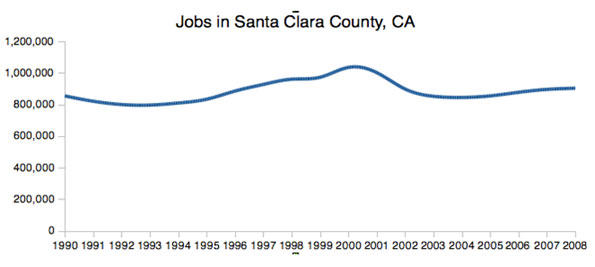
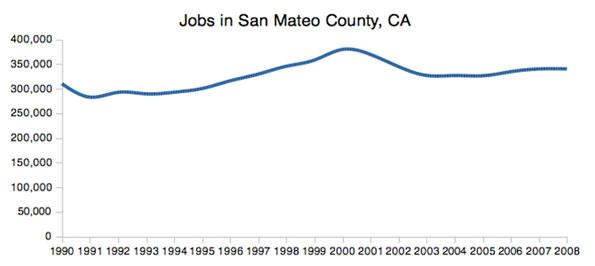
    Let’s consider the counties that make up the heart of these industries. Silicon Valley’s San Mateo and Santa Clara Counties both experienced slow job growth between 1990 and 2009. San Mateo County only added 30,000 net jobs, an average of less than 1,700 new jobs per year, or a compound annual growth rate of 0.5%.

    Santa Clara County added around 50,000 jobs over that 18 year period – about 2,700 jobs per year, but only a CAGR of only 0.3%.

    Both counties added significant new jobs in the late 90s, but these were lost when the dotcom bubble collapsed. The recovery from that decline only reached back to the levels just before the early 90s recession, continuing the long running Silicon Valley boom-bust cycle. Silicon Valley actually added jobs at a slower rate than California as a whole during this period.

    You can see the employment impacts just driving down the 101 freeway; there are more than 43 million square feet of unoccupied space, the equivalent of 15 Empire State Buildings. Twenty one percent of “Class A” space and low rise flex space – used for high-tech research and development – is empty. Unemployment overall in Santa Clara county hovers around 12%, substantially over the national average.

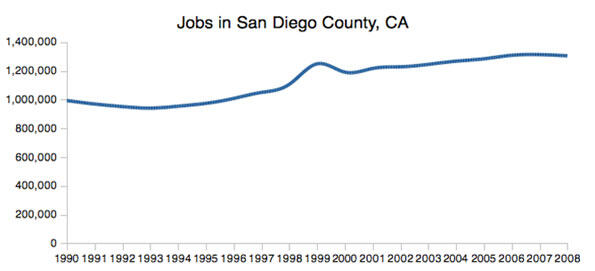
    San Diego County, one of the key centers of the biotech industry, did much better, adding 310,000 jobs over the same timeframe. This is over 17,000 jobs per year, or a CAGR of 1.53%, much better than Silicon Valley, but hardly enough to reflate California’s job market. For example, Los Angeles County added almost a million people during this time, but actually lost jobs.

    A critical consideration may well be that the future could be different from the past for these industries, and that over the next 20 years they will generate far more jobs than in the previous. But the evidence seems to be the other direction.

    California clearly has no shortage of dynamism in high-end economic sectors. There are still plenty of new innovative firms being founded in California or even moving there. And it seems likely these firms will continue to generate significant wealth for the state in the future. Given its current tax structure, the state treasury has significant “operational leverage” to the upside here. Another strong recovery cycle might even replenish the state’s coffers, though won’t offer solace for some time at least.

    But these industries won’t generate many net new jobs. And that is becoming the problem in both Silicon Valley and the state.

    Therein lies California’s dilemma. The ability to generate large amounts of wealth on a narrow job base isn’t enough to support a state of 37 million people. Brazil generates enormous wealth too, and supports lavish stores like Daslu, where you can’t walk in off the street, but there’s a helipad on the roof – and a favela just down the street. But Brazil doesn’t have a middle class economy.

    With innovation the watchword of the day, and no other realistic prospects available in the near term, it is easy to see why places from California to Michigan are placing their hopes on such high end information age jobs. Unlike most, California is already winning the war for the highest value jobs and talent in the space. The headquarters, R&D, core software development, design, and prototyping will be done in California. But it is unlikely to be where the manufacturing, customer support, sales, warehousing, back office support, and other core functions get done. And those are where the jobs are. The back of the iPhone says everything we need to know. “Designed by Apple in California. Assembled in China.”

    California is clearly right to make these industries a priority. The danger is that it comes to focus on them so exclusively that it implements policies that are overly favorable to those select functions, but hostile to everything else. California needs to make sure it has a strategy for middle class and working class jobs beyond the low end service sector. That’s a much harder problem than maintaining Silicon Valley’s dominance, but it’s clearly at least equally as important. The high end portion of various “tech” sectors alone are never going to provide enough jobs to secure a prosperous future for the vast majority of Californians.

    Aaron M. Renn is an independent writer on urban affairs based in the Midwest. His writings appear at The Urbanophile.

  • Beyond Neo-Victorianism: A Call for Design Diversity

    By Richard Reep

    Investment in commercial development may be in long hibernation, but eventually the pause will create a pent-up demand. When investment returns, intelligent growth must be informed by practical, organic, time-tested models that work. Here’s one candidate for examination proposed as an alternative to the current model being toyed with by planners and developers nationwide.

    Cities, in the first decade of this millennium, seem to be infected with a sort of self-hatred over their city form, looking backward to an imagined “golden era”. The most common notion is to recapture some of the glory of the last great consumerist period, the Victorians. During this time, from the 1870s to the early 1900s, many American towns and cities were formed around the horse-drawn wagon and the pedestrian. This created cities with enclaves of single-family homes and suburbs that seem quaint and tiny in retrospect to today’s mega-scale subdivisions and eight-lane commercial strips.

    One bible for the neo-Victorians was “Suburban Nation,” a 2000 publication seething with loathing and anger over urban ugliness. In a noble and earnest effort to repair some of the aesthetic damage, the writers proposed a grand solution. Their goal was essentially to swing the development model back to the era of the streetcar and the alleyway, the era when cars were not dominant form-givers and families lived in higher density and closer proximity.

    In the last decade, this movement gained traction with hapless city officials often tired of hearing nothing from their citizens but complaints over traffic and congestion. They embraced the New Urbanist movement which promised to turn the clock back to an era of walkable live/work/play environment of mixed neighborhoods. In the new model, the car would at last be tamed.

    Yet, looking at most of these communities, the past has not created a better future. More often they have created something more like the simulated towns lampooned by “The Truman Show”. These neo-Victorian communities ended up with some of the form of that era, but devoid of employment and sacred space. They also created social schisms of low-wage, in-town employers and high-salary, bedroom community lifestyles marking not the dawn of a new era but the twilight of late capitalism as the service workers commute into New Urbanist villages while the residents commute out.

    Meanwhile, planners who believe that practical design solutions and the vast quantity of remnants from the tailfin era are “almost all right” have remained quietly on the sidelines. This silent retreat, a natural reaction, now puts many good places in jeopardy as the activist planners try to “fix” neighborhoods and districts that were not broken to begin with. We risk losing some of the important postwar building form that well serves the needs of its users and, rather than being blacklisted, should be held up as a valid, comparative model for use by developers seeking to build good city form when the pent-up development demand returns.

    It is time to hit back. Midcentury modern – the era from about 1945 to 1955 – has become a darling style of the interior design world, has yet to be recognized as a valid model for urban development. For too long, neighborhoods built in this era have been treated poorly by the planning community. Yet this period created a critical transition between the archaic beloved streetcar suburbs and the 1980s commercial car-must-win planning. They provide a valuable, forgotten lesson when the middle class’s newfound prosperity was expressed by low-density, car-oriented mixed-use districts that were still walkable and expressed through their form a certain heroic optimism about the future.

    With building fronts set back just enough for parking, yet still close together to give a pleasant pedestrian scale, these little districts remain abundant in the landscape of our towns and cities – nearly forgotten in the fight over form, perhaps because they are doing just fine. They were built when everyone was encouraged to get a car, but before the car became a caveman club pounding our suburban form into big box “power centers” and endless, eight-lane superhighways of ever-receding building facades. These districts were developed before the local hardware store was replaced by Home Depot and many remain intact, thriving, and chock-full of independent business owners. Many of these are true mixed-use districts – with light industrial, second floor apartments, retail and other uses peacefully coexisting.

    In small commercial districts developed in the late 1940s and early 1950s, a balance was struck between the traditional town form and the car, a balance that has been forgotten in the planning war being waged today. This era produced many neighborhoods and districts that are “almost all right”, in the words of noted Philadelphia architect and thinker Robert Venturi, when defending Las Vegas to the prissy academic community.

    To go right to a case study, take the Audubon Park Garden District in Orlando, Florida. Adjacent to Baldwin Park, a Pritzker-funded New-Urbanist darling of 2002, this district is a vintage collection of mixed-use commercial, residential, and industrial buildings constructed in the 1950s. Set back from the curb approximately 42 feet, the mostly one-story storefronts allow parking in front yet are visible and accessible to pedestrians. The car is accommodated in the front of the store, making access easy and convenient, yet the pedestrian can walk also from place to place without long, hot trudges. Drivers see the storefronts. Scale is preserved. (See attached file for street elevations).


    View Larger Map

    The architecture, instead of recalling nostalgic, Victorian styles, is influenced by the art deco and populuxe styles of the Truman era, when America was united, self confident, and victorious. And the businesses reflect an organic mix serving neighborhood needs, their storefronts and facades created by themselves, not by some Master Planner, theming consultant, or fussy formgiving designer. Here, one finds customers in dialogue with shopkeepers, blue collar and creative class mixed together, a few apartments over their stores, and a localism that has endured for fifty-odd years, largely forgotten because it works.

    Places like this three-block district, and others like it, need to be championed. Decoding just what works here, and how it elegantly accommodates the car and the pedestrian, is critical to counterbalance the coercive impact of the New Urbanist movement and present a working model to future developers.

    When New Urbanism was a fledgling movement, it represented a necessary alternative to car-dominated planning principles, and offered a choice where there previously was none. Today, the rhetoric of this movement has sadly forced out all other choices and emphasized one form – that of the streetcar era – over all others. This increasingly authoritarian movement shuts out all other choices today, and now threatens places like Audubon Park with its singular vision by sending in planners to “workshop” an ideal, Victorian makeover. Such actions, if implemented, will destroy the healthy, functioning connective tissue that makes up vast portions of our urban environment for the sake of a romantic notion of form over substance.

    Instead of enforced, and often overpriced, nostalgia, we would do better to seek out districts planned after the car and have worked through time, and hold them up as valid choices to implement when planners are considering a development. These districts, whether a single building, a collection, or a whole community, will become important models as the pendulum swings back from the extremes that it reached by 2007 and 2008.

    For too long, planners and developers have chosen to be silent in the face of the often strident rhetoric espoused by “smart growth” and New Urbanist ideologues. Meanwhile, a tough analysis of New Urbanism’s successes has yet to be seriously undertaken, and alternative models presented. Cities across the nation are considering a move to form-based codes which would lock out districts like Audubon Park and doom existing ones to Victorian makeovers. Useful, diverse and workable places will be destroyed to fit a “one size fits all” ideology.

    So before midcentury modern becomes just another furniture style, a window of opportunity exists to fight back. These kinds of districts dot the cities and towns of America and deserve to be held up as alternative models for new development. Instead of a dogmatic slavishness to nostalgia, planners and developers need to stand up to the preachers of preapproved form, and look for multiple solutions for future urban form. Smart growth should not supersede the arrival of a more flexible, diverse approach of intelligent growth.

    Richard Reep is an Architect and artist living in Winter Park, Florida. His practice has centered around hospitality-driven mixed use, and has contributed in various capacities to urban mixed-use projects, both nationally and internationally, for the last 25 years.

  • Reducing Traffic Congestion and Improving Travel Options in Los Angeles

    While traffic congestion plagues many cities, Los Angeles stands apart. The Texas Transportation Institute tracks congestion statistics for U.S. metropolitan areas on an annual basis, and Los Angeles routinely ranks first for both total and per-capita congestion delays. Considering the value of wasted time and fuel, TTI estimates the annual cost of traffic congestion in greater Los Angeles at close to $10 billion.

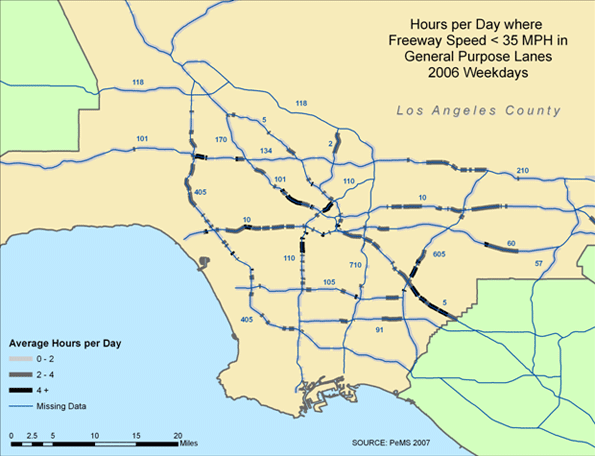
    The map in Figure 1, based on 2006 Caltrans sensor data, illustrates the weekday pattern of traffic congestion on the LA freeway network. Congestion is pervasive throughout much of the county; most freeways have segments on which traffic averages less than 35 mph at least two hours per day, and many bottlenecks are congested at least four hours per day.

    Figure 1. Traffic Conditions on the LA Freeway Network

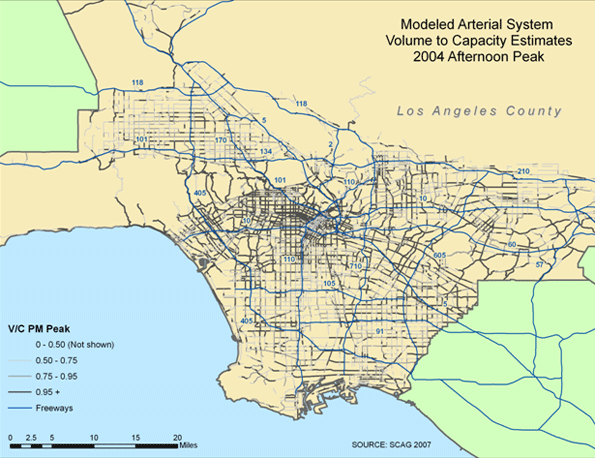
    Conditions on the surface streets are not much better. The map in Figure 2, based on 2004 volume-to-capacity (V/C) estimates from SCAG, depicts the pattern of afternoon traffic congestion on the county’s largest arterials. Here again it is evident that traffic congestion is broadly dispersed, yet the pattern is particularly intense between downtown Los Angeles and the Westside.

    Figure 2. Traffic Conditions on LA Surface Streets

    With the recent run-up in fuel prices followed by a severe recession, total travel in Los Angeles has declined over the past two years, and congestion has correspondingly eased. Yet if past trends hold, this reprieve is likely to be fleeting. Should the region’s economy and population grow in the coming decades, as some forecasts predict, the probable outcome is even more vehicle travel and in turn more intense congestion.

    Controversial Solutions for a Daunting Problem
    Researchers at the RAND Corporation were asked to recommend strategies capable of reducing LA traffic within five years or less (the short timeframe rules out land-use reforms along with major infrastructure investments). The resulting report, Moving Los Angeles: Short-Term Policy Options for Improving Transportation, offers recommendations at once controversial and likely inescapable. To achieve lasting traffic relief, it will be necessary to manage the demand for travel through pricing reforms (e.g., congestion tolls) that increase the cost of driving and parking in the busiest corridors and areas during peak travel hours. Other measures—better transit service, ridesharing programs, traffic signal synchronization, and the like—can complement pricing, but are not on their own sufficient to stem current and projected future traffic congestion.

    Few Strategies Offer Much Promise
    Just why should this be so? Consider, first, that traffic congestion results from an imbalance between the supply of roads and peak-hour automotive travel. In fact, congestion can be viewed as a solution (though an unpleasant one) to this imbalance; when demand exceeds supply, congestion makes us wait our turn for available road space to balance the equation. Over the past several decades, the gap between supply and demand has widened considerably; population growth, economic expansion, and rising incomes have fueled the demand for more vehicle travel, while road construction has stagnated. We have therefore been relying, more and more, on congestion to resolve this imbalance.

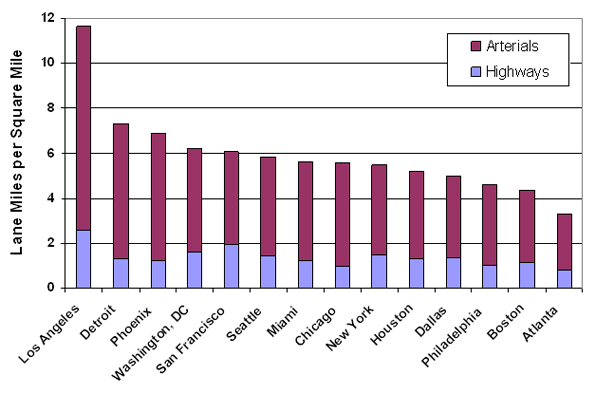
    One response would be to build or expand more roads to accommodate additional vehicle travel. Setting aside policy concerns related to greenhouse gas emissions and energy security, the prospects for “building our way out of congestion” are limited. To begin with, there simply isn’t much space to build new roads in Los Angeles, particularly in the most densely developed urban areas. As shown in Figure 3, the density of the road network in the greater Los Angeles region, measured in lane miles per square mile, is already far greater than in any other large metropolitan area in the country.

    Figure 3. Road Network Density in Major Metropolitan Areas

    We also lack the resources to engage in an extensive road building spree. In recent decades, federal and state elected officials have failed to increase fuel taxes enough to offset the effects of inflation and improved fuel economy, thus hobbling the major source of funding for road construction and repairs.

    Even if we could expand the road network, though, the benefits would be limited by a phenomenon described as “triple convergence.” Congestion has been a problem for years, and many individuals deliberately alter their travel patterns to avoid severe traffic. When an investment in road capacity reduces peak-hour congestion, many will conclude that they no longer need to go out of their way to avoid congestion delays and will thus “converge” on the improvement from (a) other times, (b) other routes, or (c) other modes of travel. The net effect is that the initial traffic-reduction benefits will usually not last over time. This is why we often see, for instance, that the improved traffic flow resulting from a new freeway lane does not last for more than a couple of years.

    If supply-side remedies do not create sustainable reductions in traffic, it becomes necessary to examine ways of reducing peak-hour travel demand. Commonly employed options include improved transit service, voluntary ridesharing programs, flexible work hours, and telecommuting. Unfortunately, the congestion-reduction benefits of these strategies are likewise undermined by triple convergence. If a new subway line induces some peak-hour drivers to switch to transit, other drivers will soon converge on more freely flowing roads to take their place. Indeed, the effects of triple convergence explain why traffic congestion has grown steadily worse despite considerable state and local investment in a broad range of congestion-reduction strategies.

    Only Pricing Strategies Promise Sustainable Reductions in Traffic Congestion
    This brings us to the rationale for pricing strategies. Among the many possible options for reducing traffic congestion, only pricing resist the effects of triple convergence. By increasing the cost of driving or parking in the busiest areas or corridors during the busiest times of day, pricing measures manage the demand for peak-hour travel, in turn reducing congestion. Once traffic flow improves, the prices remain in place, thus deterring excessive convergence on the newly freed capacity.

    Pricing strategies offer two additional benefits. First, pricing generates revenue to support needed transportation investments. And in comparison to sales taxes, a common option for raising local transportation revenue, pricing has been shown to reduce the relative tax burden on lower income groups (though wealthier individuals consume more taxable goods than their less-affluent counterparts, to an even greater extent they (a) drive more, (b) are more likely to travel during peak hours, and (c) are more likely to pay peak-hour tolls rather than alter their travel choices). Second, pricing enables more efficient use of the road capacity that we already have, because roads on which traffic flows smoothly (at roughly 40 mph or higher) can carry far more vehicles per lane per hour than roads snarled in stop-and-go congestion. Paradoxically, then, we see that the introduction of pricing enables roads to accommodate more peak-hour trips. It is therefore useful to think of pricing as a means of managing peak-hour travel demand rather than reducing it.

    Pricing Strategies Will Be Particularly Valuable in Los Angeles
    Pricing holds promise for most major cities, but the case in Los Angeles is especially compelling. To understand why, it is necessary to consider the interactions between population density and travel behavior, factors that help to explain the severity of LA traffic.

    Contrary to its reputation for sprawl, Los Angeles is quite densely populated when viewed at the regional scale. Downtown Los Angeles isn’t as dense as, say, Manhattan or central Chicago, but the suburbs surrounding Los Angeles are much denser than the typical suburb, leading to high aggregate density on a regional basis.

    As population density increases, individuals tend to drive less on a per-capita basis. Trip origins and destinations are closer together, leading to shorter car trips, and in dense neighborhoods people can rely on alternatives such as walking, biking, or transit for a larger share of trips. Yet this can be overwhelmed by the fact that there are also more drivers competing for the same road space within a given area, thus intensifying traffic congestion. The net effect is that greater population density tends to exacerbate congestion—think downtown Manhattan.

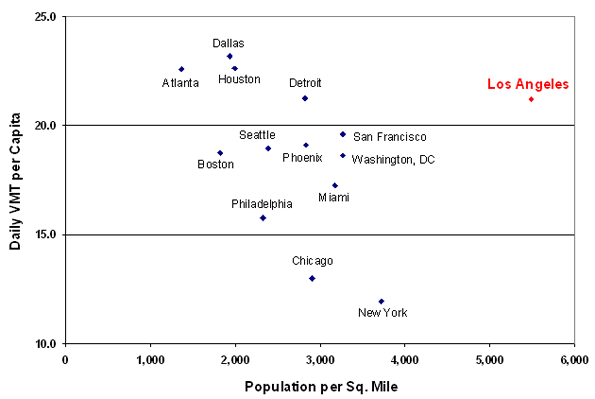
    LA traffic congestion is further exacerbated by the fact that Angelinos do not curtail their driving as much as one would expect in response to higher population density. Figure 4 compares per-capita vehicle miles of travel (VMT) and population density for the 14 largest metropolitan regions in the country.

    Figure 4. Population Density vs. Per-Capita VMT for the 14 Largest U.S. Metropolitan Regions

    Looking across the different regions, there is a fairly consistent relationship in which per-capita VMT declines with regional density. Los Angeles, though, bucks this trend. The only other metropolitan regions with higher per-capita VMT (Atlanta, Dallas, Houston, and Detroit) are all much less dense than Los Angeles. For regions in which the level of density approaches that of Los Angeles (San Francisco, Washington D.C., and New York), per-capita VMT is much lower.

    In short, we see a confluence of three density-related factors that combine to explain the severity of congestion in Los Angeles: (1) congestion is likely to rise with increased population density; (2) Los Angeles is much denser than its peers at the regional level; and (3) Los Angeles exhibits a surprisingly high level of per-capita VMT relative to its density. The third of these underscores the importance of pricing strategies as a means of managing the demand for automotive travel in Los Angeles.

    In the end only pricing strategies promise sustainable reductions in traffic congestion. Other measures – including improvements in alternative transportation modes – can be beneficial, but none will be nearly as effective as pricing. This recommendation will no doubt stir controversy, but pricing offers the only realistic prospects for managing peak-hour travel demand in the most traffic-choked of American metropolises.

    Dr. Paul Sorensen is an operations researcher at the RAND Corporation, wherehe serves as Associate Director of the Transportation, Space, and Technology program. Dr. Sorensen has published peer-reviewed studies in the areas of geographic information analysis, location optimization modeling, emergency response logistics, and transportation finance policy, and he also holds aU.S. patent on a methodology for forecasting the demand for ambulance services. Dr. Sorensen received a BA in computer science from Dartmouth College, an MA in urban planning from UCLA, and a PhD in geography from UCSB.

  • Housing: Density & Desire

    Density — the number of units per acre on a proposed site plan — is at the heart of the developer’s mantra: More density, more profit. Meanwhile, environmentalists and many planners preach high density as the promise for a better future. The compression of families is an attempt to curb sprawl and reduce transportation energy consumption. For these reasons, many Green programs demand a minimum density to qualify for certification. Those who sit on suburban city councils and planning commissions fear over-densification, and typical suburban ordinances are written to oppose density.

    Who’s right? Nobody. There is no ideal density number in planning or development. Forget the search for a numerical value. Instead, concentrate on livability.

    Ordinances throughout the world state minimal dimension requirements. Some suburban ordinances, but not most, specify density maximums. But density alone cannot determine the most important issue in any development: Is it a great place to live? If both environmental impact and affordability were added to the mix, then you could equate livability with sustainability.

    Suburban Settings: The term ‘sprawl’ is recklessly used to describe all new suburban development, as if every new suburb was composed of massive lots with McMansions. Want proof that it’s not so? Take a tour of a suburb near a major city that was developed this past decade. In most, you will find smaller lots with homes compressed close together, often with less open space than older, large lot developments. Many of the new suburban developments that are close to major cities approach New Urbanism in density. There are some large lot developments for large residential estates, which are frowned upon as if achievement has become evil.

    The opponents of suburbia often don’t factor in the changes that have come about in environmental regulations. When urban areas of the past were built, wetlands (previously known as “swamps”) were simply filled in for development. Wooded areas were clear cut for the new city to be built. Today, we cannot fill in wetlands that in some places constitute vast areas within suburban communities. Many suburban cities have tree preservation and slope restrictions that also result in large open spaces. Because land that developers in the past simply built over is now set aside for preservation, today’s suburbs are going to naturally appear much less “dense” than existing suburban areas. Should a new “urban” city sprout today, as a result of these same protections it too may appear far less dense.

    Higher density can drive up raw land value. Developers who can place four homes on each acre are willing to pay much more than they would have a decade ago for the same land, when each acre could yield only two homes or less. The consumer ultimately pays the same (or more) for a much smaller lot, so density does not deliver affordability.

    Ordinances typically do not deliver livability. When we provide amenities that are not required in ordinances such as an architectural theme, or parks, walks, trails, destination places, and then add sustainability elements such as low impact storm drainage, green building, engineering, and landscaping…what keeps all of this affordable? Increased density helps when the original plan is for large lots. But we can only push density increases to a limit that preserves the sense of space that suburban home buyers expect. Cities that have already reduced minimum lots from, say, 10,000 square feet to 5,000 gave up all of their spare space long ago. Reducing lot size on an already small space can destroy livability. When lots were larger, there was negotiating power: Want smaller lots and more density? Then we’ll build a sustainable neighborhood, not a subdivision. With a small lot that negotiating power vanishes.

    Livability results from a balance of the hundreds of elements that must be taken into consideration when planning, engineering and constructing a neighborhood. A density goal can easily tip that balance in the wrong direction.

    I was trained on how to abuse the regulatory system. In the early 1970s, I was on top of the planning game as a master at manipulating regulations. I was able to find holes in the regulations to legally justify cramming units together. I felt victorious when I gained density. After driving through many of the neighborhoods that were eventually built, pride turned into shame. They were nothing special. I created developments that would do nothing to enhance the living standards of the residents; instead, they made the developer (who was now long gone) more profit. I vowed to never again use increased density as a goal, but rather to use balanced design practices as the driving force of all my neighborhood plans.

    Urban Settings: It is expected that density will be higher in urban areas. We recently did a proposal on a four acre infill site in Minneapolis. We pushed the density on one proposal to 111 units. Our goal was to produce an affordable (i.e. low income), environmentally sound development that would provide a sense of space and accomplishment (pride) for the residents. In low income neighborhoods it is important to hide parked cars as they can be an eyesore that can have a negative visual impact. All parked cars were to be hidden in underground parking areas or in the rear of a home.
    Utilizing new architectural design practice, we provided panoramic views of landscaped spaces using the kitchen as the focal spot for every unit. In this new era, which we call Prefurbia, one goal is to make the interior floor plan an integral component of the overall neighborhood design; we break up the architecture to create that all important curb appeal and eliminate the monotony so common in urban settings, especially lower-income ones. Density was also limited because we wanted to keep each unit at a minimum of 900 square feet. Every home was tied to a meandering walk system leading to a central aquatic garden in a 0.7 acre park. A truly wonderful place to live, at any income level.

    Yet when we presented the development plan we were told that the density goal was 120 units. When we asked where that number came from, we were told it was the minimum that was needed for LEED-ND standards. Jamming another 10% of density would bring the proposal out of balance – something would need to be sacrificed. We could eliminate the central park focus, or perhaps throw the parked cars in the open, or make the small units even smaller. We could eliminate the tie between the floor plans and the neighborhood. Going up another floor would just make the parking situation worse, as we would then have no room to hide the cars underneath the apartments. Demanding a minimum density does nothing to assure good development. If anything, it provides another target that detracts from creating a well balanced neighborhood that is a pleasure to live within.

    Density Instead of Profitability: When I began to plan developments for a nationally recognized firm, we achieved the density goals, but had no clue as to the actual costs of constructing a neighborhood. We would cross a creek to reach isolated corners of a site and gain a few lots, never realizing that a bridge costs much more than the profits gained in those few units. Using geometry instead of smart design practices, we stretched the length of streets, never realizing that streets cost about $300 (today’s dollars) for each extra foot. In the end we did get to the desired density ratio, but at what cost? Smarter design would have been to balance the infrastructure needs against the density goals. That was 40 years ago. Unfortunately those regulating and planning many of today’s new developments and redevelopments still look only to density, not to other costs.

    Density And The Environment: Planners assume that if we increase density in one place then we will not need to build somewhere else, and the end result will be that we will be left with vast, natural open spaces. This fantasy can only become a reality if the additional density achieved on a site corresponds with the dedication of a permanent preserve of open space elsewhere in the same city.

    Want to make this a better world to live in? Forget trying to justify a particular number of units per acre. I was guilty of this approach at one time. There is actually a term for the attitude: it’s defined as “difficult to understand or follow because of being closely packed with ideas or complexities of style”…and that word is “Dense”!

    Rick Harrison is President of Rick Harrison Site Design Studio and author of Prefurbia: Reinventing The Suburbs From Disdainable To Sustainable. His website is rhsdplanning.com.