Category: Policy

  • Yes, Manufacturing Matters

    Manufacturing employment has fallen below 12 million jobs for the first time since 1941, and manufacturing jobs as a percentage of total employment has fallen below 9%, the lowest level since the Bureau of Labor Statistics started collecting data in 1939. But annual manufacturing output per worker is also at a record high: $223,915 (in constant 2000 dollars). That’s almost 3 times as much output per worker as in the early 1970s, and twice as much output per worker compared to the mid-1980s.

    That has been the trend over the last 40 years: more output with fewer workers. That’s a good thing, or inevitable, or both – isn’t it? I used to think so; now I’m not so sure.

    Reversing Industrial Decline
    A recent report by the Lexington Institute spells out the depressing picture: After dominating global industrial activity for a century, the United States is losing its edge in manufacturing to other nations. Over the last 30 years, manufacturing has fallen from a quarter to an eighth of the domestic economy, while the share of manufactured goods consumed in America but produced by foreigners has risen from a tenth to a third. The decline of US manufacturing is reflected in record merchandise trade deficits, the loss of over 40,000 manufacturing jobs every month in the current decade, and the shrinking role of American producers in global industries such as electronics, steel, autos, chemicals and shipbuilding.

    US manufacturers continue to generate over 20% of global industrial output and have increased productivity by a third in this decade, but if current trends continue America will cease to be the biggest manufacturing nation in the near future. Many factors have contributed to the slippage in US standing, including high corporate taxes, burdensome regulations, globalization of the economy, and the efforts of trading partners to protect their economies.

    If the erosion of US manufacturing persists, America will become more dependent on offshore sources of goods and the nation’s trade balance will weaken. That will undercut the role of the dollar as a reserve currency and diminish US influence around the world, eventually having an adverse impact on our national security. This can’t be a good thing.

    China Gains in Manufacturing
    China is on its way to surpassing the US as the world’s largest manufacturer far sooner than expected. Does that matter? In terms of actual size, the answer is no. But if size is a proxy for the relative health (and prospects) of each nation’s economy, the answer could be yes.

    The US remains the world’s largest manufactuer. In 2007, the latest year for which data are available, the US accounted for 20% of global manufacturing; China’s share was 12%. The gap, though, is closing rapidly. According to IHS/Global Insight, China will produce more in terms of real value-added by 2015.

    US manufacturing is shrinking, shedding jobs and, in the wake of this deep recession, producing and exporting far fewer goods, while China’s factories keep expanding. Given the massive trade gap between the two nations and uncertainty in the US over when and to what degree manufacturing will recover, China’s ascent has become a point of growing friction.

    Many economists argue that the shrinking of US manufacturing – both in terms of jobs and share of gross domestic product – is a normal economic evolution that started long before China emerged as a manufacturing powerhouse. From their point of view, the shrinking would happen regardless and is actually a sign of health: the sector doesn’t need to be big to be productive.

    To those with this view, China’s rise is normal, healthy and beneficial, for it is the natural course of things for national economies to progress along the continuum from agriculture to manufacturing to services. We have trod that path, and now China is following.

    But another school of thought, held by “manufacturing fundamentalists,” contends that US manufacturing decline is not natural, healthy or beneficial, and must be reversed to retain America’s economic power and well-being. From this perspective, the idea that we can be a nonmanufacturing society – and still be rich, free and independent – is nonsense and folly. Such thinking has led, and will lead, to the collapse of civilizations.

    Even in its weakened state, manufacturing remains a surprisingly large part of the US economy. The sector generates more than 13% of the nation’s GDP, making it a bigger contributor to the economy than retail trade, finance or the health-care industry. Thus it would be devastating if US manufacturers now being hit by the economic downturn never recover.

    Manufacturing Not In Decline
    And yet, according to the Cato Institute, notwithstanding the recent recession that has affected all sectors of the economy, US manufacturing has been thriving in recent years. How can this be so? Again, it’s the productivity. Real US manufacturing output has increased by 81% since 1987. American real manufacturing value-added – the market value of manufactured goods, over and above the costs that went into their production – reached a record-high level in 2007.

    Manufacturing as a share of gross domestic product peaked in 1953 at about 28% of the economy and has been trending downward ever since. Today manufacturing accounts for about 12% of our services-dominated economy, but manufacturing output and value-added are higher than ever in real terms.

    According to the United Nations Industrial Development Organization, US factories are the world’s most productive, accounting for 25% of global manufacturing value-added. By comparison, Chinese factories account for 10.6%.

    That may be hard to fathom, says Cato, given that US factories tend not to produce the sporting goods, toys, tools, and clothing found in Wal-Mart and other retail outlets nowadays. But US factories make pharmaceuticals, chemicals, technical textiles, sophisticated components, airplane parts, and other products. American factories have moved up the value chain.

    In comparison, the percentage of Chinese value-added in high-tech exports is quite small. Economists at the US International Trade Commission estimate that only about 50% of the value of US imports from China is actually Chinese value-added; the rest is value added in other countries and embedded in the components, design, engineering, and labor.

    In iPods, for example, the Chinese value-added is a few dollars on a product that costs $150 to produce and retails for $299. Further, their sale in the United States and elsewhere supports high-paying American engineering, marketing, and logistics jobs, while providing Apple with the profits to conduct R&D to employ more engineers and keep the virtuous circle going. Without complementary Chinese and other foreign labor, far fewer American manufacturing ideas would come to fruition.

    American manufacturing is therefore not in decline, right?

    The Plight of American Manufacturing
    No, that’s not right, and yes, manufacturing is in decline, and therefore so is America. That’s the case strongly made in Manufacturing A Better Future for America, published by Alliance for American Manufacturing.

    The United States is broke because it has stopped producing what it consumes, writes the book’s editor, Richard McCormack, who is also the editor and publisher of Manufacturing & Technology News. Even an increase in consumer demand, he notes, will not put Americans back to work as the spending will only help workers making products overseas.

    About 40,000 US manufacturing plants closed between 2001 and 2008, resulting in the loss of millions of good-paying jobs, according to AAM. Offshoring of production means that the United States is not generating enough wealth to pay its mounting and massive debts. The mindset among America’s economic elite – that the country does not need an industrial base – has put the country and the world economy in a ditch.

    The book refutes some widely promoted myths, including that the US economy can thrive with just service industries as good-paying jobs are replaced by other sectors. It also debunks the notion that lost manufacturing plants will not mean lost research and development. It details the unfair trading practices China employs, and explains the social costs of the decline in manufacturing.

    It is often said our economic future is dependent on innovation and/or job training. These factors are supported most strongly in manufacturing.

    Conclusion
    You can see why I have developed doubts that the diminishing of a manufacturing base and loss of manufacturing jobs are natural, inevitable, or good for the United States and its citizenry. A post-industrial economy does not obviate the need for industry. A large and rising value of intangible goods does not obviate the need for the production of tangible things. And a “new economy” does not obviate the need for a manufacturing base.

    Dr. Roger Selbert is a trend analyst, researcher, writer and speaker. Growth Strategies is his newsletter on economic, social and demographic trends. Roger is economic analyst, North American representative and Principal for the US Consumer Demand Index, a monthly survey of American households’ buying intentions.

  • Let Freedom Ring: Democracy and Prosperity are Inextricably Linked

    With autocratic states like China and Russia looking poised for economic recovery, it’s often hard to make the case for ideals such as democracy and rule of law. To some, like Martin Jacques, author of When China Rules, autocrats seem destined to rule the world economy.

    A columnist for the Guardian, Jacques predicted that by 2050 China will easily surpass America economically, militarily and politically. The belief in the power of autocracy even extends to such leading American capitalists as Warren Buffett and Bill Gates, who have nothing but high praise for what Gates enthusiastically describes as a “brand-new form of capitalism.”

    Fortunately a new study released Monday by my colleagues at the Legatum Institute refutes the notion that the road to worldly riches lies in autocracy and repression. In a careful study of everything from economic opportunity, education and health to security, freedom of expression and societal contentment, the Legatum “Prosperity Index” makes a powerful case for the long-term benefits of democracy, free speech and the rule of law.

    Some of this stems from how Legatum measures prosperity. The survey takes into account both wealth and well-being, and finds that the most prosperous nations in the world are not necessarily those that just have a high GDP, but that also have happy, healthy, free citizens.

    The top of the list, which ranks 104 countries, is dominated by flourishing democracies. The only exception in the top 20 is No. 18’s Hong Kong, which ranks first in economic fundamentals and continues to be ruled, if not quite democratically, under a far more permissive system than the rest of mainland China. The next semi-autocratic state on the list is Singapore, at No. 23 – another Confucian-style autocracy with great economic and human capital fundamentals.

    This linking of democracy and prosperity with well-being is by far the most significant aspect of the study. But what else determines the success of nations in the modern world?

    1. Small democracies do best.

    The denizens of the Greek city-states or their Renaissance counterparts would have recognized something of themselves in the small, well-managed countries that dominate the top of the list. The top five, Finland, Switzerland, Sweden, Denmark and Norway – as well as the Netherlands at No. 8 – certainly fit this description. These countries rank highly on the quality of life measurements, and, not surprisingly, their main cities also tend to dominate the most-livable-cities lists. With the exception of Switzerland and the Netherlands, these places do not perform as well in terms of basic economics, scoring between 10th and 18th. Although some might ascribe these rankings to successful social democratic policies, virtually all these mini-states have instated significant market-oriented reforms in recent years.

    Other top players Australia (No. 6) and Canada (No. 7) are far larger than their European rivals. And though their citizens are not as socially coddled as in Scandinavia, they enjoy strong democratic institutions, high levels of social well-being and good governance and education.

    And in purely economic terms Australia and Canada boast better economic fundamentals than the Scandinavian countries. One reason may be their enormous stockpiles of natural resources, now in high demand from countries like China and India. These countries also benefit by a large and often skilled migration from these and other Asian countries.

    2. Among the mega-countries, the U.S. is still way ahead

    Don’t cry for me, America. In terms of the large countries, both in population and size, no one comes close to the No. 9-ranked U.S. Indeed there’s not another country with over 100 million people on the list until you get to Japan at No. 16.

    Like all big countries, America is a complicated place, with distinct areas of strength as well as disturbing weaknesses. The U.S. leads all countries in entrepreneurship and innovation and ranks second in the stability of its democratic institutions – the Swiss are No. 1. Less than optimal health and safety rankings, however, push America from the top. Its economic fundamentals are also sub-prime, ranking only 14th, which isn’t surprising in light of persistent current account and now government deficits.

    Despite its problems, the U.S. still outperforms its other large rivals, not only Japan but also the U.K. (No. 12), Germany (No. 14) and France (No. 17). Yet judged within the ranks, all four of these economies have to be considered successful in terms of delivering prosperity and a reasonably high quality of life to their citizens.

    3. Breaking down the BRICs

    The Index’s most fascinating findings can be found a bit further down. The focus of the world’s economy has been shifting to countries that have been – and in some cases remain – governed by Communist, military or single-party dictatorships.

    Democracy’s efficacy can be seen clearly in success enjoyed by the former European Communist states – the Czech Republic, Poland, Latvia, Estonia, Slovakia and Hungary – all of which land in the first third of the ratings. Similarly, Taiwan (ranked 24th) and South Korea (26th), long ruled by military-dominated dictatorships, show how democratization and rising prosperity can flourish together.

    This pattern can also be seen among the “big boys” of the economic upstarts – the so-called BRIC countries. Here the leaders of the pack are both functioning democracies, Brazil (No. 41) and India (No. 45). These rapidly growing economies are kept out of the top tier by significant shortcomings in vital fields such as education, health and public safety.

    The other two BRIC powers, China and Russia, neither of which can be considered anything close to open societies, lag behind. Russia’s mineral wealth gets it a respectable 39th in economic fundamentals, but a lack of democracy, personal freedom and personal safety – as well as poor governance and corruption – drags it down to a paltry 69th. China, ranked a disappointing No. 75, also performs admirably on economic fundamentals, clocking in at No. 29, but is hammered for glaring shortfalls in democracy, personal freedom and governance as well as health and education.

    4. Autocracy may seem to pay, but not in the long run

    Throughout modern history, autocracy has proved effective in sparking fast growth, but a pervasive democratic deficit, poor governance and lack of personal freedom seem likely to constrain long-term progress. For one thing, the ruling elite in the dictatorship is under no strong compulsion to adjust to the needs of its population. Short of forestalling outright rebellion, nest-feathering tends to gain the upper hand.

    As you get to the bottom of the list, the price of dictatorship rises higher still. In this nether-region, there is nary a democratic state. Some of the low-ranking Third World countries are obvious – like Cameroon (No. 100) or Yemen (No. 101) – but some potentially rich but despotically ruled nations do poorly as well.

    Take, for example, No. 94 Iran, a country with enormous natural resources, a well-educated population and a rich cultural heritage. A reasonably enlightened Iran would likely sit in the top third of the list instead of skipping toward the bottom.

    Even the bottom-ranked country, Zimbabwe, left its colonial period with a thriving agriculture sector and great mineral wealth. Here again despotic rule has shown itself an adept destroyer of economic promise.

    In these times of acute self-doubt not only in America but across the democratic world, the Legatum ratings validate the idea that if democracy is not the inevitable wave of the future it represents by far the most efficient way to manage a society. In the end, democracy and prosperity prove not two distinct elements, but, in fact, inextricably linked to each other.

    This article originally appeared at Forbes.com.

    Joel Kotkin is executive editor of NewGeography.com and is a distinguished presidential fellow in urban futures at Chapman University. He is author of The City: A Global History. His next book, The Next Hundred Million: America in 2050, will be published by Penguin Press early next year.

  • Executive Bonuses: The Junta In The Boardroom

    Public companies and their management boards are run with all the democratic coziness of banana republics. The object of the junta is to transfer the wealth of the shareholders into the bonuses and stock options of the management. As they used to say in China, “business is better than working.”

    Amidst the outcry over excessive executive pay, it is worth noting that, in the caudillo management culture of many public corporations, there is nothing more annoying than a shareholder with an interest in the company that he or she partly owns. The most dreaded corporate day of the year is that of the annual meeting, when outside consultants are hired to screen bothersome questions and choreograph the happy gathering.

    During the meeting itself the greatest scorn is reserved for nosy shareholder questions about executive compensation and board composition, neither of which is deemed to be in the sphere of shareholder influence.

    The annual meeting ends with the appointment of outside auditors, a few planted questions, and — for those meetings held at some remote subsidiary, to keep activist shareholders from showing up — a trip to a regional airport.

    Archaic company by-laws explain why it will be nearly impossible for various regulators to cap the amounts that companies pay to executives. In short, the shareholders work for the managers, not the other way around. (If Goldman Sachs has so much extra cash, why don’t they raise the dividend?)

    Start with board composition, which is usually the domain of one executive: the chairman and chief executive officer. In a functioning system of corporate governance, the jobs would be separate. Chief executives would not also be assigned the job of monitoring their own performance, which is now the case in most public U.S. companies. Good European companies have a supervisory board, which oversees the performance and pay of the senior management.

    In the U.S., not only do foxes run the chicken coops, they get to eat most of the eggs and then write off the meals on their expense accounts.

    Most chairmen/CEOs stack their board and compensation committees with party-line stalwarts, who vote in favor of excessive pay packages in the hope that the recipient or one of his friends will not forget the favor. To break such a back-scratching system should be relatively easy, especially in companies regulated by the Securities and Exchange Commission. Simply mandate that management cannot sit on its own board of directors.

    Cumulative voting or proportional representation of the shareholders is another way to start breaking the management oligopoly of board composition. Board seats could also be allocated to representatives of retired personnel (who built the company) and those who now work in the company.

    Another way to limit excessive pay packages is to impose a binding ratio that caps executive pay based on the compensation of the company’s lowest paid workers. At the moment, CEOs in big public companies have packages that pay them more than a thousand times that of their employees’ lowest wages.

    J.P. Morgan thought the boss should only be paid twenty times the salary of the average company employee. Such an idea might not cap fat cat bonuses, but it would certainly improve the minimum wage.

    How then to claw back executive pay when the big bosses bet the ranch on something like sub-prime mortgages and lose?

    For starters, boards independent of management self-interest will be less forgiving when executives ruin a company or even turn in mediocre results. That so few banking executives were fired after the Great Collapse of 2008 is testament to the lack of shareholder representation on most boards of directors. Who fires the CEO when he reports to himself?

    Next, mandate that incentive compensation like stock options only be paid into segregated retirement accounts, which ought to align performance with long-term success.

    In financial services, the reward for failure should be just that: failure. In the recent crisis, deposed chairmen and chief executives were marched into the sunset with multi-million dollar severance packages. Remember the $64 million sayonara given to Citigroup’s Charles Prince, about the time the company’s shares lost $275 billion in market capitalization?

    A side affect of the government bailouts was to comfort bad managers. But while these corporate executives were pinning medals on their own chests (very much in the tradition of Latin strongmen), the reason given for the sweetheart loans, especially to banks, was to protect depositors. Under this variation of mutual assured destruction, financial institutions with a large depositor base can never be put to the wall, which gives them an effective government guarantee.

    To replace this kind of dependence on bankers who can gamble with deposits without consequences, there needs to be a mechanism that will protect depositors while allowing the larger financial companies to fail.

    For example, depositors could be given the option of buying deposit insurance — privately funded insurance, unlike that offered by the Federal Deposit Insurance Corporation — much in the way that air travelers buy accident insurance. That the FDIC caps out at $100,000 is neither here nor there. Under this scheme, insurance would be available for all amounts, large and small. It would be paid for in the market, not given as a government gift.

    When customers deposited money somewhere, they would decide if they wanted to insure the deposit or not. Those that wanted coverage would pay for it. Those that wanted to reply on their bank’s full faith and credit would leave their money uninsured and hope they have not found the next Lehman Brothers.

    Publishing rates on deposit insurance, much like posted interest rates, would be yet another indicator of a company’s financial health, much like the credit default swaps that are traded in institutional markets.

    The goal is to alert customers to good banks and bad ones, and to make clear that the bad ones will be allowed to fail, which is nature’s way of telling executives that they are overpaid.

    My last modest proposal is to encourage reconstituted boards of directors to auction off the positions of senior management.

    At the moment, managers justify their self-worth with a lot of encomiums about how big salaries and bonuses are necessary to insure that “we get the best people.”

    From what I can see, all that the big salaries insure is that companies keep a lot of mediocre executives, many of whom, judging by recent performance, then spend their time buying wine and sprucing up their vacation homes. Remember what was said, in Henry Ehrlich’s book of business quotations, about the compensation policies of Harold Geneen at ITT: “He’s got them by their limousines.”

    Under my revised system, top executives would be required to show the board that they have, in writing, a comparable offer from a competing firm (baseball works like this). As well, under the auction system, boards could entertain bids by senior executives to fulfill the roles of senior management.

    Clearly, chief executives have a good time in their corporate jets and swank hotel suites, which might lower what other senior managers would need every month to handle the top jobs.

    My guess is that a number of competent executives could be found willing to do the jobs of Fortune 500 CEOs, and for a lot less than what the current occupants charge the companies for their services (the average is over $10 million). Something tells me that Citigroup could have found a CEO for less than the $38 million that it paid to Vikram Pandit in 2008. Maybe it should have looked on eBay?

    Matthew Stevenson was born in New York, but has lived in Switzerland since 1991. He is the author of, among other books, Letters of Transit: Essays on Travel, History, Politics, and Family Life Abroad. His most recent book is An April Across America. In addition to their availability on Amazon, they can be ordered at Odysseus Books, or located toll-free at 1-800-345-6665. He may be contacted at matthewstevenson@sunrise.ch.
  • Property Owners Pay for City’s Dysfunction Under L.A.’s New Graffiti Ordinance

    Graffiti is a bane of urban life, a form of vandalism that demoralizes entire neighborhoods and invites worse crime.

    Graffiti is an art form and an outlet for expression amid the jumble and obvious strains of urban life.

    You’ll hear arguments from both of those viewpoints, depending on who you talk to about graffiti.

    The Garment & Citizen is of the firm opinion that anyone is free to consider graffiti an art form – but all should be mindful that such status doesn’t give anyone the right to express themselves by painting, etching or otherwise tagging someone else’s property. Pablo Picasso himself would not have had any right to create his “Guernica” on the side of someone else’s building, as far as we’re concerned.

    It would have been a loss to the world, of course, if Picasso had gone through life with no canvass for his genius. The world needs Picassos, and it’s important to remember that such talent sometimes grows on tough corners.

    It would be an ideal situation if we had a school system that could consistently engage such talented individuals…and parents with the time to nurture youngsters inclined toward art…and an overall outlook as a society that values art as something more than a commodity to be marketed.

    We’re lacking to some degree or another on each of those counts.

    Consider what goes on before some kid decides to emblazon graffiti on someone else’s property.

    First, there’s been some breakdown in the family unit. Sometimes it’s a parent or parents who don’t care enough to warn their children off such behavior. Other times they are too busy trying to feed and clothe their kids, leaving little time to teach them right from wrong.

    You can bet that many cases also involve a school that has failed to engage and educate the youngster.

    There’s probably a lack of after-school resources, too, leaving kids to find camaraderie with mischief makers while their parents are still working.

    All of these factors come into play on graffiti in our city. They all point to the dysfunction that has found a cozy spot in Los Angeles for decades.

    We live in a city where the minimum wage is $8 an hour, which will bring $320 for a 40-hour week – hardly enough for rent. Is it any wonder that folks at the bottom end of the pay scale might have to spend more time working and fewer hours on their child’s upbringing?

    Everyone knows that the drop-out rates at Los Angeles Unified School District (LAUSD) campuses are sky high in general, and higher still as you move down the socio-economic ladder. Yet not much ever changes when it comes to expectations of how well the organization teaches our children.

    Then there’s the Los Angeles Police Department (LAPD), which recently came close to a roster of 10,000 officers, the highest mark in the agency’s history. Compare that to other major cities in the U.S. and you’ll see that we still don’t have enough cops. We have never had enough cops. And now there’s talk of trimming staffing levels for LAPD because the city is short on money.

    These are the pillars of the dysfunction that we have lived with for years in Los Angeles. How does a city go so far down a path of ignoring all these problems and allowing the ground for graffiti vandals to grow so fertile?

    Look no further than City Hall. That’s where members of the City Council recently passed an ordinance that will require any new commercial or residential buildings to include anti-graffiti coatings on the structures. The only exception comes if a property owner signs a lifetime contract to remove any graffiti within a week.

    There you have it – this problem rolls downhill. Failure upon failure leads to the doors of property owners. They must, under the ordinance, join city officials in giving up on any thoughts about directly addressing graffiti vandalism. They must, our elected officials say, pay good money to prepare to be vandalized.

    The new ordinance is one way to raise revenue, but it also raises a white flag of surrender – a de facto confirmation that our elected officials lack the governmental skill and political will to face up to graffiti vandals and address the various factors behind the crime.

    That’s a dictionary definition of dysfunction – and it passed the Los Angeles City Council unanimously.

    Jerry Sullivan is the Editor & Publisher of the Los Angeles Garment & Citizen, a weekly community newspaper that covers Downtown Los Angeles and surrounding districts (www.garmentandcitizen.com)

  • Fixing the Mortgage Mess: Why Treasury’s Efforts at both Ends of the Spectrum Are Failing

    To get a better idea why the Obama Administration’s efforts to stem the home foreclosure crisis have failed at both ends of the problem, you need only go back to that great scene in Frank Capra’s classic, “It’s A Wonderful Life,” where protagonist George Bailey (Jimmy Stewart) is on his way out of Bedford Falls with his new bride and high school crush, the former Meg Hatch (Donna Reed). The newlyweds are heading toward the train station to leave on their honeymoon when Meg notices a commotion outside the Bailey Bros. Building & Loan Association, founded by George’s revered but now deceased father, Henry, and Henry’s bumbling brother, Billie.

    The “commotion” is actually a run on the bank. George – bless his heart, and with the full encouragement of the new Mrs. Bailey – hops out of Ernie’s cab to see if he can quell the growing crowd assembling outside the locked doors of the Building & Loan. With his usual calm George assesses the situation, asks Uncle Billie to unlock the doors to let the gathering mob into the Building & Loan, and then proceeds to talk (most of) them out of closing their accounts and being refunded the value of their shares.

    George patiently explains to his anxious Association members that he can’t give each of them 100% of the value of their Bailey Brothers Building & Loan Association shares because the funds from those shares have already been loaned out to worthy borrowers so they can afford to build or buy houses in the community. States George from behind the teller counter:

    “…you’re thinking of this place all wrong. As if I had the money back in a safe. The, the moneys not here. Well, your money’s in Joe’s house…that’s right next to yours. And in the Kennedy’s House, and Mrs. Macklin’s house, and a hundred others. Why, you’re lending them the money to build, and then, they’re going to pay you back as best they can. Now what are you going do? Foreclose on them?”

    Just as George appears to be making progress, however, a now former Association member comes running into the Building & Loan pronouncing that Old Man Potter (Lionel Barrymore), who owns the bank and every other business in Bedford Falls, is offering to buy Bailey Brothers Building & Loan shares at 50 cents on the dollar (in an obvious effort to take advantage of the situation by running George Bailey out of business). Saving the day, and confirming that George has indeed made a life-changing decision in his choice of mates, the new Mrs. Bailey, with $2,000 in cash in her purse for their honeymoon, offers the money to the anxious Association members filling the building lobby. George then adroitly parses out their honeymoon money in the smallest increments he can persuade folks to accept under the circumstances.

    The scene tells us much about what went wrong with the residential real estate market nationwide. It is more than merely nostalgic to long for such elegant simplicity in the manner in which deposited funds were invested in things such as home mortgages. However, the only thing quainter than that scene in “It’s a Wonderful Life” is the idea of a bank or other financial institution originating, owning, and servicing the same mortgage. And therein lies the rub for efforts by the Treasury Department to help right the residential mortgage ship of state through the Making Home Affordable mortgage modification program and the Legacy Asset Recovery program.

    The root the problem lies with the complete disconnect between those who actually own the notes secured by the vast majority of residential mortgages in this country and those who “service ” those mortgages. Right now there is little if any incentive for those servicers to participate in the Treasury Department’s mortgage modification initiative (the Making Home Affordable mortgage modification program or “MHAP”), originally projected to foster the modification of 2.5 million mortgages but having resulted in only a fraction of that number in modified mortgages. This is at least in part because the fee structure under the existing servicing agreements does not adequately compensate the servicer for the amount of effort required to accomplish a mortgage modification. Further, there’s no clearly and easily identifiable “owner” of the notes that are secured by the underlying mortgages putting pressure on the servicers to modify these mortgage

    The national mega-banks that have received the lion’s share of Treasury’s multi-trillion bail-out of the banking industry have been, by far, the worst offenders in not embracing and implementing this program. And the problem can’t easily be fixed because it is structural in nature, the by-product of a system ironically intended to keep credit flowing into the residential sales market. For example, in Treasury’s recently released Servicer Performance Report through September 2009, Bank of America had modified under the MHAP only 11% of its approximately 876,000 home mortgages delinquent by 60 days or more (thereby making them eligible for modification under MHAP).

    The structural problems prevail at the investor-end of this morass as well. After much Congressional rhetoric and even more Wall Street teeth-gnashing over mark-to-market legislation late in 2008 that would have forced the holders of mortgage-backed securities (“MBS”) to mark down the value of their mortgage loan portfolios based on reductions in the underlying collateral value, Congress declined to take such action. The Legacy Asset Recovery program (so-called by Treasury because, quite honestly, who wants to invest in “toxic” assets), the investment component of Treasury’s Public-Private Investment Program or “PPIP,” pairs private capital with Treasury capital and then makes up the difference with federal low-cost debt. This program is intended to mitigate potential risks and rewards for these new equity participants by halving the amount of private equity that must be raised (since half of the total equity is provided by the government) and providing all of the required debt. As with any program whose purpose is to encourage private investments in bad debts – recalling the RTC program from the early 90s – potential profit is directly correlated to discounting the Legacy Asset purchasing entity can achieve in negotiations with the MBS holders.

    Regrettably, the assumptions underpinning the theory quickly prove not to be reasonable. At its core, the problem is that, in order for this initiative to work, the MBS holders need to do that one thing they’ve absolutely refused to do thus far: Take any losses.

    MBS holders are betting on their ability to hold onto their mortgage pools for as long as it takes for the excess housing inventory in the marketplace to get absorbed. They are also waiting for the end of the recession (perhaps around the corner but perhaps not) to turn into a full-fledged economic recovery, so that underlying real estate values start to catch up to portfolio values.

    Will this strategy work? Likely not if there’s a slow, largely jobless recovery that doesn’t support the housing market. As of now, the most recent projections for economic recovery in the real estate sector are looking to 2013. In the meantime, Treasury’s programs at both ends of the mortgage crisis will have done very little to stem foreclosures or stabilize capital flows to the housing market.

    Compounding the structural infirmities of these two “recovery” programs is that job growth is most likely to come first in states that have relatively few problems (Washington, D.C.-Metro Area; Great Plains; Texas) and will be far slower in many of the most troubled states, notably California, Michigan and Ohio, and parts of the Northeast. Hindsight being 20/20, rather than focusing so much attention and so many resources on helping the financial industry, which has been by far the largest recipient of Washington’s largess, the focus should have been on job preservation and job creation. The links, after all, between mortgage performance, housing values, and employment are undeniable.

    Peter Smirniotopoulos, Vice President – Development of UniDev, LLC, is based in the company’s headquarters in Bethesda, Maryland, and works throughout the U.S. He is on the faculty of the Masters in Science in Real Estate program at Johns Hopkins University. The views expressed herein are solely his own.

  • Home-Based Businesses: Residential Zoning and The Cyber Village

    Currently in the United States about 27% of all homes have some form of a home based business. These businesses can be key to conservation efforts that lower our carbon footprint by reducing transportation needs, eliminating redundant facilities, and consolidating equipment. They provide significant opportunities for two solutions to problems that face today’s growth issues.

    My software company was founded in Dallas, where I worked from the dining room table in an apartment. I yearned for the day my business could operate out of a real office. After the business started generating a positive cash flow the apartment was left behind, and my office moved to a location in the newly built Dallas Galleria. My 104 square feet of office space was complimented with a separate meeting room, receptionist, and a parking space in the garage. All this cost me $600 a month. After the initial six month lease was up the rent skyrocketed and parking was no longer free; however, the 104 square feet remained the same.

    Oh, how I yearned for a nice dining room table to work from!

    Soon I decided that the money spent on rent — both apartment and Galleria office — could build a really nice home. In 1982 I built a home specifically designed for a residence and my business. With about 4,000 square feet, of which about one third was dedicated business space with a separate office entrance, we had a viable base from which to live and work.

    The IRS allowed us to write-off one third of the total housing expenses without question. By not having to pay office rent we could double the home payments, and the 30 year mortgage was paid in full in less than 10 years.

    Maple Grove, the lakefront suburban Minnesota community where we had built, allowed a home business occupation via ordinance limited to one non-family employee. At first we complied, but the business grew. At times there were up to 6 employees at the home, but neighbors did not complain.

    I was not the only lake front home operating a big business. Across the lake, a major manufacturer of car radar warning units operated out of the basement of a house. This was a husband-and-wife business, but it was no small operation. The company had full page ads in leading automotive magazines. I sometimes visited; I’d hear the phone ring with an order, and the wife would say ‘I’ll see if we have any in stock at the warehouse, can you hold?’ She would then call down to the basement and ask if they could make an A-50 unit for shipping. Nobody but the UPS man would know the truth!

    Solution #1: The Residential/Business
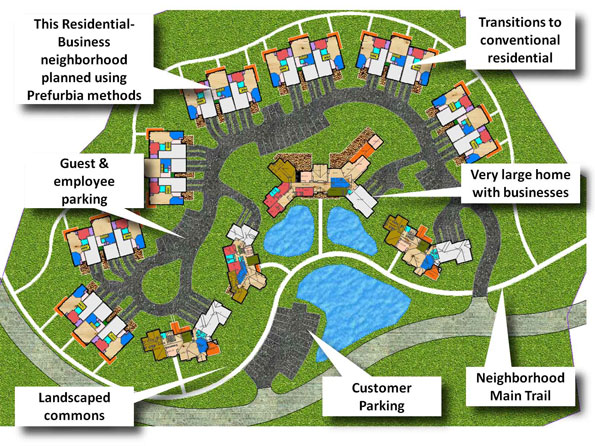
    The Residential/Business (RB zoning) would be an entirely new land use, sort of a morphing of an office center and a neighborhood of luxury single family homes. Office complexes typically have a higher degree of landscaping and architectural detail than single family developments. In the RB neighborhood, homes would be large and impressive with heavily landscaped commons that serve as pedestrian access to the businesses that are located within the home structure.

    Family members and employees would park in the rear, with multiple garage spaces and outside parking for the employees. From the arterial streets abutting these developments it would be an impressive sight, giving a sense of wealth to the neighborhood and municipality. The types of businesses would be restricted to low traffic professional services, including medical services, but also could include very light manufacturing. The RB zones would be an excellent transition (buffer) from commercial centers to residential ones. The RB residential structures would house the entire business and home, serving as the main hub for all of the business needs.

    Below, a Residential/Business community

    There could be some overlap of business functions into the residential elements of the home. For example, a conference center with an 80 inch screen for presentations could be used for Monday night football on occasion. From a financial standpoint, for a small to medium sized business owner this is a win-win situation. It delivers the advantages that I had experienced in my own situation in a comprehensive, specifically designed development plan.

    Solution #2: The Cyber Village
    George E. Van Hoesen, of Global Green Building, LLC, has developed an alternative solution, the Cyber Village.

    The proliferation of computers and cell phones, as well as video conferencing and express delivery, has made the notion of the at-home cyber office an excellent solution for growth issues. New definitions of work, recreation, and education have brought the family home again. Residential design and community planning can begin to address the increasing needs of these new households while keeping the neighborhood’s primarily residential character.

    Unlike the Residential/Business solution, homes in the Cyber Village need not be as business intensive or change the character of a neighborhood. A main component of the Cyber Village is the Cyber Office, serving as the community foundation for business activity. This facility, complete with offices, reception services, mail services, meeting rooms, board rooms, reference libraries and office equipment, would serve subscribers (businesses within the neighborhood) for their out-of-office and administrative needs. This Cyber Office location could serve as the hub for deliveries, recycling, storm shelter, resource center, rideshare, and other community resource needs. Subscribers would choose the level of access to the facility based on their own individual business needs. The features of the cyber office would lend credibility and added professionalism to a residence-based business without breaking the bank.

    Below, a Cyber Village

    The neighborhood Cyber Office could be managed as a for-profit business, providing services for a fee. Communities could also manage a Cyber Office as a part of the homeowners association. A mix of services could be provided, depending on the needs of the community. The overall concept reduces the carbon footprint of the home-based business and addresses the needs of the changing work place.

    Zoning Both Solutions
    Both solutions fall outside the scope of conventional zoning. The Cyber Village may comply more easily with existing regulations, especially those that allow a home to operate a business with a few employees. If a city’s regulations are flexible enough, it may be possible to design and implement a Cyber Village that complies with city code now. The Residential/Business solution, with its more aggressive business size, would compete with — or make obsolete — office complexes. Office “use” is often taxed at a higher rate than residential use. Since cities do not like to lose tax revenue, it is likely that municipalities would require a new basis to tax the RB residents.

    Creating a new zoning class and tax classification is not difficult, but it might be time consuming. The current slow market allows cities to restructure their zoning and tax codes, so now is the time to act.

    Both solutions would have a significant reduction on the carbon footprint of land development. They offer alternatives to the Smart Growth solutions in which shop owners are encouraged to live over their stores in high density developments. Both the Residential/Business and the Cyber Village alternatives curb traffic and sprawl…and at the same time, provide residential settings with enough space for family enjoyment.

    Rick Harrison is President of Rick Harrison Site Design Studio and author of Prefurbia: Reinventing The Suburbs From Disdainable To Sustainable. His website is rhsdplanning.com.

  • Stimulate Yourself!

    Beltway politicians and economists can argue themselves silly about the impact of the Obama administration’s stimulus program, but outside the beltway the discussion is largely over. On the local level–particularly outside the heavily politicized big cities–the consensus seems to be that the stimulus has changed little–if anything.

    Recently, I met with a couple of dozen mayors and city officials in Kentucky to discuss economic growth. The mayors spoke of their initiatives and ideas, yet hardly anyone mentioned the stimulus.

    “We didn’t see much of anything,” noted Elaine Walker, mayor of Bowling Green, a relatively prosperous town of 55,000 in the western part of the state. “The money went to the state and was siphoned off by them. We got about zero from it.”

    Ironically, Walker does not seem overly upset about the lack of federal assistance for Bowling Green. Instead, Walker–a self-described supporter of the president in a part of the country largely resistant to Obamamania–seems more disposed to taking matters into her own hands. Rather than waiting for Obama, Bowling Green is looking to stimulate itself–and other communities would do well to emulate this grassroots approach

    Bowling Green’s “self-stimulation” is part of a concentrated effort at diversification for the city, which has long depended on its General Motors plant, which produces the Corvette. Other single-industry-dominated regions, notably Detroit, have made much noise about moving into other fields, but their emphasis has frequently revolved around high-profile, highly subsidized projects such as “green” industries, entertainment or tourism.

    Instead, says Walker, the first step in diversification lies with boosting small local businesses.

    A primary vehicle for this has been the successful Small Business Accelerator located at an abandoned mall. Buddy Steen, who runs the program in conjunction with Western Kentucky University, claims it has fostered some 38 companies and created over 700 jobs. Blu Pharmaceuticals, developed by Small Business Accelerator, for example, currently employs five but expects to add another 40 workers at its new plant in nearby Franklin. The program’s other firms specialize in everything from electronic warfare to robotics.

    Kentucky may seem an unlikely spot for such ventures, admits local entrepreneur Ed Mills, but things are changing in the Bluegrass State. Mills, a former General Motors executive, and his twin sons, Clint and Chris, founded a Web-based software firm, HitCents, in 1995 when the boys were still in high school.

    Today the company, which develops software for retail and other applications, has over 50 employees and customers from across the country, including GM, as well as a host of local companies, unions and public agencies. “We hope to build a $100 million company, and we think we can do it.” Mills says. “You don’t have to be in California. People think you can’t do this in Kentucky but plainly you can.”

    With its strategic location on Interstate 65 connecting the old industrial heartland to the emerging one along the Gulf, Bowling Green enjoys many advantages. It’s slightly over an hour to Nashville and two hours to Louisville, the area’s two major consumer and cultural marketplaces.

    Other small communities in the state have also realized that any green shoots would have to come from local grassroots. Russellville, a rural community of some 7,200 in the southwest part of the state, is looking at a “back to basics” economic development plan that stresses the export of local food products and crafts.

    “You can ride down the highways and smell the hams smoking,” notes one local economic developer. “We are looking on how to export those hams to the rest of country.”

    Mayor Gary Williamson of Mt. Sterling, a town of 6,000 located in Montgomery County, in the generally more impoverished east, has been pushing a different strategy. His region is dotted with industrial plants of varying sizes. The city is also 45 minutes from Georgetown, site of a large Toyota factory.

    These employers require a steady stream of skilled industrial workers, particularly in such fields as machine maintenance. Williamson and other officials in the area see training such workers–starting at the high school level–as a way to not only keep people employed but to attract other firms to the area. “We want to keep people here, and they will do so if they have jobs after school,” he explains.

    It’s significant that such grassroots-based development–geared to unique local conditions–is taking place in Kentucky. For generations, the state and the rest of the surrounding Appalachian region has been the brunt of both jokes and patronizing attention from the nation’s academes, policy circles and media.

    Most Americans, observed Newsweek in 2008, “see Appalachia through the twin stereotypes of tragedy (miners buried alive) and farce (Jed Clampett).” One prime reflection of that approach can be seen in a CNN report last year that painted a decidedly dismal portrait of the region.

    For generations, Appalachia’s seeming backwardness has led to the creation of numerous federal programs aimed at lifting it into the national economic and cultural mainstream, notes University of Kentucky historian Ronald Eller. In his excellent Uneven Ground: Appalachia Since 1945, Eller describes how these efforts reflected the region’s “struggle with modernity.” Progress has been often associated with efforts to undermine what the late Michael Harrington described as a “separate culture, another nation with its own way of life.”

    Yet, this unique culture also could provide some of the basis for a regional recovery. There’s a growing sense, notes longtime Kentucky League of Cities President Sylvia Lovely, that the region’s fundamental assets–its natural beauty, resources and traditions of craftsmanship–could constitute a distinct advantage in the coming decades.

    More important still could be less tangible values, Lovely notes. “Modernity” in its current unadulterated form–with a lack of community, homogeneity and disconnect from the natural world–could be losing its allure for millions of Americans. In terms of what matters, she suggests, Appalachian towns may possess “if not more information, perhaps more wisdom than those who hold themselves out as experts. “

    Looking at the statistics, the news is not all grim. Despite its still glaring problems, particularly in its rural hinterland, Appalachia has been gaining steadily compared to the rest of the country. In 1960 one-third of Appalachia residents lived in poverty, compared with 1 in 5 nationally; by 2000 the poverty rates had fallen to 13.6%, just a tick higher than the national 12.3%. The region’s continued struggle with the gap between rich and poor, Eller notes, now more reflects broader national trends as opposed to something unique to the region.

    Perhaps the most dramatic changes are illustrated by migration patterns. By the end of the 1960s one out of every three industrial workers in Ohio came from Appalachia. Young people studied, notes Eller, “reading, writing and Route 23,” referring to the main highway to the industrial north.

    Since 2000 Kentucky, as well as Tennessee and West Virginia, have enjoyed positive rates of net migration. Although some parts of the region continue to suffer horrendous poverty and continued out-migration, many other communities–such as Bowling Green, Lexington and Louisville, as well some more rural areas–have attracted more newcomers than they have lost. Overall Appalachian states’ migration statistics look a lot healthier than Ohio and Illinois, not to mention New York or California.

    Walker–who moved to Kentucky from Los Angeles shortly after the 1992 race riots–sees this new migration as part of what will sustain a recovery in the region. Like many newcomers, Walker came to Kentucky not for bright lights but for a good place to raise her children. “Everyone still waves and says hi,” she observes. “That makes a lot more difference to people than many think. In the end, people come here because it’s a better place to live and also to raise your kids. It’s all about families.”

    Ultimately, a combination of folksiness and access to the world brought by technology could spark a continued renaissance not only in Bowling Green but across the region. The fact that the resurgence seems to be the product of largely local efforts not only makes it all the sweeter, but could inspire similar approaches among those communities still waiting for Washington to rescue them.

    This article originally appeared at Forbes.com.

    Joel Kotkin is executive editor of NewGeography.com and is a distinguished presidential fellow in urban futures at Chapman University. He is author of The City: A Global History. His next book, The Next Hundred Million: America in 2050, will be published by Penguin Press early next year.

    Downtown Bowling Green photo courtesy of OPMaster

  • The White City

    Among the media, academia and within planning circles, there’s a generally standing answer to the question of what cities are the best, the most progressive and best role models for small and mid-sized cities. The standard list includes Portland, Seattle, Austin, Minneapolis, and Denver. In particular, Portland is held up as a paradigm, with its urban growth boundary, extensive transit system, excellent cycling culture, and a pro-density policy. These cities are frequently contrasted with those of the Rust Belt and South, which are found wanting, often even by locals, as “cool” urban places.

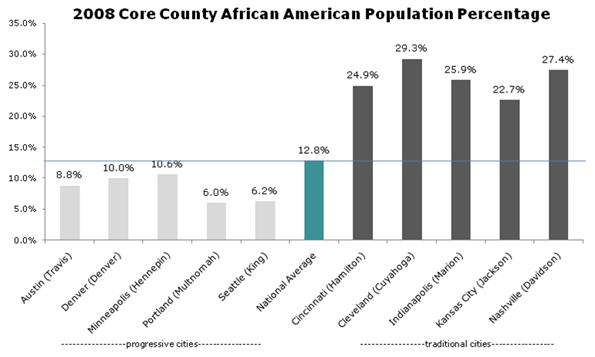
    But look closely at these exemplars and a curious fact emerges. If you take away the dominant Tier One cities like New York, Chicago and Los Angeles you will find that the “progressive” cities aren’t red or blue, but another color entirely: white.

    In fact, not one of these “progressive” cities even reaches the national average for African American percentage population in its core county. Perhaps not progressiveness but whiteness is the defining characteristic of the group.

    The progressive paragon of Portland is the whitest on the list, with an African American population less than half the national average. It is America’s ultimate White City. The contrast with other, supposedly less advanced cities is stark.

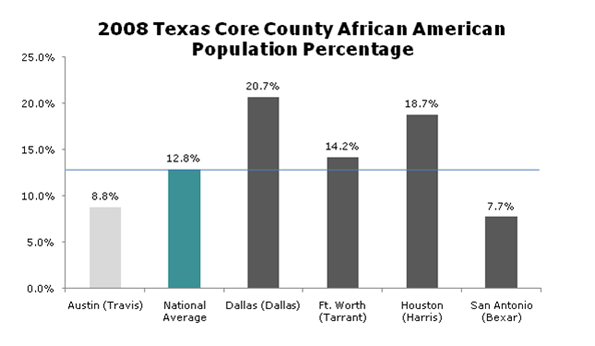
    It is not just a regional thing, either. Even look just within the state of Texas, where Austin is held up as a bastion of right thinking urbanism next to sprawlvilles like Dallas-Ft. Worth and Houston.

    Again, we see that Austin is far whiter than either Dallas-Ft. Worth or Houston.

    This raises troubling questions about these cities. Why is it that progressivism in smaller metros is so often associated with low numbers of African Americans? Can you have a progressive city properly so-called with only a disproportionate handful of African Americans in it? In addition, why has no one called these cities on it?

    As the college educated flock to these progressive El Dorados, many factors are cited as reasons: transit systems, density, bike lanes, walkable communities, robust art and cultural scenes. But another way to look at it is simply as White Flight writ large. Why move to the suburbs of your stodgy Midwest city to escape African Americans and get criticized for it when you can move to Portland and actually be praised as progressive, urban and hip? Many of the policies of Portland are not that dissimilar from those of upscale suburbs in their effects. Urban growth boundaries and other mechanisms raise land prices and render housing less affordable exactly the same as large lot zoning and building codes that mandate brick and other expensive materials do. They both contribute to reducing housing affordability for historically disadvantaged communities. Just like the most exclusive suburbs.

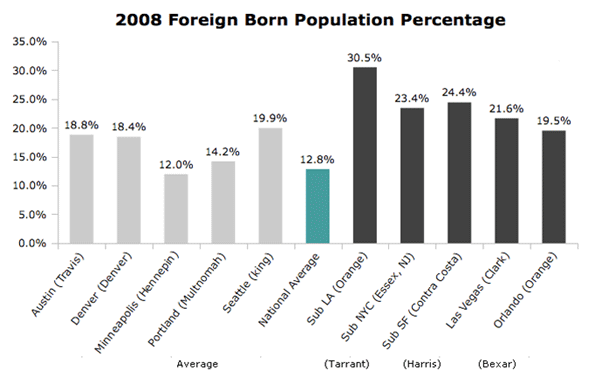
    This lack of racial diversity helps explain why urban boosters focus increasingly on international immigration as a diversity measure. Minneapolis, Portland and Austin do have more foreign born than African Americans, and do better than Rust Belt cities on that metric, but that’s a low hurdle to jump. They lack the diversity of a Miami, Houston, Los Angeles or a host of other unheralded towns from the Texas border to Las Vegas and Orlando. They even have far fewer foreign born residents than many suburban counties of America’s major cities.

    The relative lack of diversity in places like Portland raises some tough questions the perennially PC urban boosters might not want to answer. For example, how can a city define itself as diverse or progressive while lacking in African Americans, the traditional sine qua non of diversity, and often in immigrants as well?

    Imagine a large corporation with a workforce whose African American percentage far lagged its industry peers, sans any apparent concern, and without a credible action plan to remediate it. Would such a corporation be viewed as a progressive firm and employer? The answer is obvious. Yet the same situation in major cities yields a different answer. Curious.

    In fact, lack of ethnic diversity may have much to do with what allows these places to be “progressive”. It’s easy to have Scandinavian policies if you have Scandinavian demographics. Minneapolis-St. Paul, of course, is notable in its Scandinavian heritage; Seattle and Portland received much of their initial migrants from the northern tier of America, which has always been heavily Germanic and Scandinavian.

    In comparison to the great cities of the Rust Belt, the Northeast, California and Texas, these cities have relatively homogenous populations. Lack of diversity in culture makes it far easier to implement “progressive” policies that cater to populations with similar values; much the same can be seen in such celebrated urban model cultures in the Netherlands and Scandinavia. Their relative wealth also leads to a natural adoption of the default strategy of the upscale suburb: the nicest stuff for the people with the most money. It is much more difficult when you have more racially and economically diverse populations with different needs, interests, and desires to reconcile.

    In contrast, the starker part of racial history in America has been one of the defining elements of the history of the cities of the Northeast, Midwest, and South. Slavery and Jim Crow led to the Great Migration to the industrial North, which broke the old ethnic machine urban consensus there. Civil rights struggles, fair housing, affirmative action, school integration and busing, riots, red lining, block busting, public housing, the emergence of black political leaders – especially mayors – prompted white flight and the associated disinvestment, leading to the decline of urban schools and neighborhoods.

    There’s a long, depressing history here.

    In Texas, California, and south Florida a somewhat similar, if less stark, pattern has occurred with largely Latino immigration. This can be seen in the evolution of Miami, Los Angeles, and increasingly Houston, San Antonio and Dallas. Just like African-Americans, Latino immigrants also are disproportionately poor and often have different site priorities and sensibilities than upscale whites.

    This may explain why most of the smaller cities of the Midwest and South have not proven amenable to replicating the policies of Portland. Most Midwest advocates of, for example, rail transit, have tried to simply transplant the Portland solution to their city without thinking about the local context in terms of system goals and design, and how to sell it. Civic leaders in city after city duly make their pilgrimage to Denver or Portland to check out shiny new transit systems, but the resulting videos of smiling yuppies and happy hipsters are not likely to impress anyone over at the local NAACP or in the barrios.

    We are seeing this script played out in Cincinnati presently, where an odd coalition of African Americans and anti-tax Republicans has formed to try to stop a streetcar system. Streetcar advocates imported Portland’s solution and arguments to Cincinnati without thinking hard enough to make the case for how it would benefit the whole community.

    That’s not to let these other cities off the hook. Most of them have let their urban cores decay. Almost without exception, they have done nothing to engage with their African American populations. If people really believe what they say about diversity being a source of strength, why not act like it? I believe that cities that start taking their African American and other minority communities seriously, seeing them as a pillar of civic growth, will reap big dividends and distinguish themselves in the marketplace.

    This trail has been blazed not by the “progressive” paragons but by places like Atlanta, Dallas and Houston. Atlanta, long known as one of America’s premier African American cities, has boomed to become the capital of the New South. It should come as no surprise that good for African Americans has meant good for whites too. Similarly, Houston took in tens of thousands of mostly poor and overwhelmingly African American refugees from Hurricane Katrina. Houston, a booming metro and emerging world city, rolled out the welcome mat for them – and for Latinos, Asians and other newcomers. They see these people as possessing talent worth having.

    This history and resulting political dynamic could not be more different from what happened in Portland and its “progressive” brethren. These cities have never been black, and may never be predominately Latino. Perhaps they cannot be blamed for this but they certainly should not be self-congratulatory about it or feel superior about the urban policies a lack of diversity has enabled.

    Aaron M. Renn is an independent writer on urban affairs based in the Midwest. His writings appear at The Urbanophile.

  • Wikigovernment: Crowd Sourcing Comes To City Hall

    Understanding the potential role of social media such as blogs, twitter, Facebook, You Tube, and all the rest in local government begins with better understanding the democratic source of our mission of community service. The council-manager form of local government arose a century ago in response to the “shame of the cities” — the crisis of local government corruption and gross inefficiency.

    Understanding what business we are in today is vital. It drives the choices we make and the tools we use. Railroads squandered their dominance in transportation because they defined their business as railroading. They shunned expansion into trucking, airlines, and airfreight. While they were loyal to one mode of transportation, their customers were not. Similarly, newspapers are in crisis because they defined their trade as the newspaper industry. Today’s readers don’t wait for timely news to arrive in their driveways. They have digital access on their computers and hand-held phones. Guess where advertisers are going?

    Most local governments suffer similar myopia. Many managers define our core mission as delivering services. But that overlooks the history of why local governments deliver those services. We deliver police services in the way that we do because Sir Robert Peel invented that model in response to the public safety challenges of industrializing London.

    We deliver library services because Ben Franklin invented that model in response to the need for working people in Philadelphia to pursue education and self-improvement. Governments didn’t arise to provide services; services arose from “government of the people, by the people, and for the people.”

    Our core mission is not to provide traditional services, but to meet today’s community needs. To do this, we can learn more from the entrepreneurial risk-taking of Peel and Franklin than from public management textbooks.

    We face these new dangers and opportunities:
    • Transitioning from unsustainable consumption to living in sustainable balance with planetary resources.
    • Overcoming an economic crisis that is slashing our capacity to maintain traditional services and meet growing community needs.
    • Embracing growing diversity while dealing with increasing fragmentation marked by divergent expectations about the role of local government.

    During a similar period of historic upheaval, the young Karl Marx wrote that “all that is solid melts into air.”

    Of course, it’s possible to underestimate the emerging crisis from the perspective of local government in many American towns and suburbs. The local voting population seems stable, though declining in numbers. The “usual suspects” still populate the sparse audiences at council and commission meetings. The budget is horrendous, but we’ve seen these cycles before.

    In reality, this overhang is typical of the lag between action and reaction, the inertia Thomas Jefferson identified when he wrote, “Mankind are more inclined to suffer, while evils are sufferable, than to right themselves by abolishing the forms to which they are accustomed.”

    In California, we’re confounded by the seemingly endless crisis in political leadership that is squandering our state’s credit rating and capacity to deliver vital services. Members of our political class resemble cartoon characters who dash off a cliff, then momentarily hang in the air before abruptly plunging. As the economist Herb Stein wryly observed, “If something cannot go on forever, it will stop.”

    Global Communication Tools
    In the current tough times, we all pay lip service to civic engagement and we all pursue it, with varying degrees of enthusiasm and success. But if we want to avoid plunging into the vortex like the state of California (and Vallejo, California, its bankrupt local counterpart), we will need to reassert and reinvent government of the people, by the people, and for the people in our communities.

    The textbook model puts the elected governing board squarely between us and the public. Elected officials interpret the will of the people. They’re accountable to the public. We report to those who have been elected. But in the modern world, professional staff cannot hide behind that insulation. We cling to the old paradigm because we lack a better one.

    That’s where the real significance of social media comes into focus. These aren’t just toys, gizmos, or youthful fads. Social media are powerful global communication tools we can deploy to help rejuvenate civic engagement.

    The Obama presidential campaign lifted the curtain on this potential. “Nothing can stand in the way of millions of people calling for change,” he asserted at a time when conventional political wisdom doubted his path to the White House. MyBarackObama.com wasn’t his only advantage, but he deployed it with stunning effectiveness to raise colossal sums from small donors, pinpoint volunteer efforts in 50 states to the exact places of maximum leverage, and carry his campaign through storms that would have capsized a conventional campaign.

    It remains to be seen how this translates into governance at the federal level. But it has direct application to local democracy. Crowd sourcing is a new buzzword spawned by social media. It recognizes that useful ideas aren’t confined to positional leaders or experts. Wikipedia is a powerful success story, showing how millions of contributors can build a world-class institution, crushing every hierarchical rival. “Wikigovernment” is not going to suddenly usher in rankless democratic nirvana, but it’s closer to the ideal of government of the people, by the people, and for the people than a typical local government organization chart.

    “To govern is to choose,” John Kennedy famously said. Choices must be made, and citizens will increasingly insist on participating in those decisions. As citizens everywhere balk at the cost of government, we can’t hunker down and wait for a recovery to rescue us. Like carmakers suddenly confronted by acres of unsold cars, we are arriving at the limits of the “we design ‘em, you buy ‘em” mentality.

    A crowd-sourcing approach to local government resembles a barn raising more than a vending machine as a model for serving the community. Instead of elected leaders exclusively deciding the services to be offered and setting the (tax) price of the government vending machine, a barn raising tackles shared challenges through what former Indianapolis mayor Stephen Goldsmith calls “government by network.”

    Citizen groups, individual volunteers, activists, nonprofits, other public agencies, businesses, and ad hoc coalitions contribute to the designing, delivering, and funding of public services. The media compatible with this model are not the newspapers such as — for example — the local newspaper that reports yesterday’s council meeting. The new media are the instant Facebook postings, tweets, and YouTube clips that keep our shifting body politic in touch.

    The Dark Side
    It’s not hard to conjure up the dark side of all this. Web presence is often cloaked in anonymity. This isn’t new in political discourse; the Founders engaged in anonymous pamphleteering. But the Web can harbor vitriol that wasn’t tolerated in the traditional press (at least until recently).

    The Web also tends to segregate people. One study concluded that 96 percent of cyber readers follow only the blogs they agree with. This self-selection of information bypasses editors trained in assessing the credibility of information. Opinion is routinely passed off as fact.

    But it isn’t surprising that the cutting edge of digital communication is full of both danger and promise, nor should it keep us from using these new media in our 2,500-year quest for self-government. The atomization generated by a zillion websites also breeds a hunger for the community of shared experience. Both the election of Barack Obama and the death of Michael Jackson tapped into that yearning.

    We can foster that yearning by deploying these exciting new tools in the service of building community. Yes, it’s risky to be a pioneer, but in a rapidly changing world, it’s even riskier to be left behind.

    This is part two of a two-part series. A slightly different version of this article appeared in Public Management, the magazine of the International City/County Management Association; icma.org/pm.

    Rick Cole is city manager of Ventura, California, and this year’s recipient of the Municipal Management Association of Southern California’s Excellence in Government Award. He can be reached at RCole@ci.ventura.ca.us

  • E-Government: City Management Faces Facebook

    Does a City Manager belong on Facebook?

    Erasmus, the Dutch theologian and scholar, in 1500 wrote, “In the country of the blind the one-eyed man is king.” I feel this way in the land of social media — at least among city and county managers. Inspired by the first city manager blog in the nation, started by Wally Bobkiewicz in Santa Paula, California, I began posting back in 2006. Although most bloggers strive for frequent, short blurbs, I’ve employed blogging to provide a place to get beyond the sound bites (and out of context quotes) in the local press. I seek to provide background, explanation, and context for the stories in the news, along with the trends that don’t make the news.

    I tried MySpace and Facebook initially out of curiosity. For my first six months, I had only six friends on Facebook. Now I have more than 400, and few days go by when I don’t review requests for more. I post at least once a day, usually links to intriguing articles on public policy and photos of my three kids.

    While I was finding my way as a boomer in cyberspace, I resisted Twitter…until an invitation arrived from a friend 30 years older than I. If someone in his 80s was interested in tweets from me, I figured the time had come to join the crowd. And although I’ve never made a YouTube video, several videos of me are floating in cyberspace.

    For local managers, all of these social media offer new tools to work on one of democracy’s oldest challenges: promoting the common good. What local governments can’t do is fall hopelessly behind. The fate of railroads, automakers, and newspapers shows what happens to the complacent. It’s time to get online — and reach far beyond the initial step of a city website with links — to lead the effort to build stronger communities and a healthier democracy for the 21st century.

    Civic Engagement and Social Media: The Ventura Case Study

    Ventura has a civic engagement manager position, but civic engagement is considered a citywide core competency, like tech savvy and customer service. It’s not something we do periodically; it’s how we strive to do everything.

    One of our key citywide performance measures is the level of volunteerism in the community. We look not just at the 40,000 volunteer hours logged by city government last year, but at the percentage of the population that volunteer for any cause or organization: 50 percent versus 26 percent nationally. We strive to raise awareness, commitment, and participation by citizens in local government and their community.

    Reports by Council staff not only list fiscal impacts and alternatives, but document citizen outreach and involvement in each recommendation. There are obviously different levels; they recently ranged from a stakeholder committee that held four facilitated sessions to produce rules governing vacation rentals, to a citywide economic summit cosponsored with the chamber of commerce that drew 300 businesspeople and residents to develop 54 action steps unanimously endorsed by the city council at the conclusion.

    Effective engagement requires aggressive, fine-tuned, and immediate communication. We address traditional media with a weekly interdepartmental round table that reviews what stories are likely to surface and identifies other stories we’d like to see covered. We encourage city staff to quickly post comments to online newspaper postings to set the record straight, respond to legitimate queries, and direct citizens to additional information on our website.

    We have two public access channels — one for government, one for the community — and actively provide both with programming. Our most direct access comes from a biweekly e-newsletter that goes out to 5,000 addresses, linking directly to website resources, including the city manager’s latest blog post.

    Slow at first to embrace Facebook, Twitter, and YouTube, we’re closing the gap. One councilmember is a prolific blogger, and another uses Facebook for interactive community dialogue. We make judicious use of reverse 911 to get public safety information out quickly to residents. We’ve also pioneered “My Ventura Access”, a one-stop portal for all citizen questions, complaints, compliments, and opinions, whether they come by phone, Internet, mail, or in person.

    Not Your Grandfather’s Democracy

    Twitter, which allows just 140 characters – including spaces and punctuation – per “tweet”, gets a disproportionate share of the social media chatter. After a Republican member of Congress was ridiculed for tweeting during the State of the Union address this past February, Twitter usage exploded 3,700 percent in less than a year. By the time you read this, U.S. Twitter users will outnumber the population of Texas, or possibly California. In just five years, techcrunch.com reports, Facebook users have zoomed past 250 million. A Nielsen study estimates that usage has increased by seven times in the past year alone.

    Yet as blogs, tweets, Facebook, YouTube, and text blasts reshape how America communicates, few local governments — and even fewer city and county managers — are keeping pace. E-government remains largely focused on websites and online services. This communication gap leaves local government vulnerable in a changing world. “Business as usual” is not a comforting crutch; it’s foolish complacency. Just look at the sudden implosion of General Motors, the Boston Globe, and the state of California.

    It would be equally shortsighted to thoughtlessly embrace these new communication media as virtual substitutes for thoroughgoing civic engagement. We’re part of a 2,500-year-old experiment in local democracy, launched in Athens long before Twitter and YouTube. Local democracy operated long before the newspapers, broadcast media, public hearings, and community workshops familiar to today’s local government managers.

    We may live in a hi-tech world, but the basis of what we do remains “high touch,” involving what some of the most thoughtful International City/County Management practitioners call “building community.” Social media offer new tools to build community, although they aren’t a magic shortcut.

    This is part one of a two-part series. A slightly different version of this article appeared in Public Management, the magazine of the International City/County Management Association; icma.org/pm.

    Rick Cole is city manager of Ventura, California, and this year’s recipient of the Municipal Management Association of Southern California’s Excellence in Government Award. He can be reached at RCole@ci.ventura.ca.us