Category: Policy

  • Too Big To Fail Needs to Go

    One of the causes of last year’s financial collapse was the adoption of the concept, ‘Too Big To Fail’. Washington decided long ago that some firms are so large and so integral to the economy that the failure of one of these firms would put the entire economy at risk. So, the government insures them at no cost.

    The problem with free insurance against failure is that it encourages excessive risk taking. This is the much-talked-about moral hazard problem, and it was a serious contributor to how we got to September 2008 in the first place. Since then, we’ve merged big bad financial institutions with big good financial institutions to create even larger financial firms. This has to stop.

    Why would a firm grow to the size we observe?

    Often, the firms’ managers tell us they merge to diversify. It is not true. Research I did with Bill English while I was at the Fed showed that large banks really didn’t diversify after they merged. They merged with firms much like themselves in similar markets.

    Besides, the argument for diversification is flawed on its face. Financial theory is clear. The investor can diversify more efficiently than the firm can diversify on the investor’s behalf.

    Firms also claim that they are merging to obtain economies of scale. That is not true either. A reasonably large literature is available on economies of scale. This literature is clear. Economies of scale are fully exploited when firms are much smaller than the ones that are currently considered Too Big To Fail. Indeed, diseconomies may exist at the size of our largest financial firms.

    Are there other reasons firms might want to become the size we see? Sure, but the participants are not likely to advertise those reasons. Firms constantly strive for market power, and size can help them achieve that market power. Of course, when firms have market power, the consumer loses.

    Firms might also merge to get the free Too Big To Fail insurance. That is clearly not in the best interest of anyone except the insured firm.

    The two most believable reasons that firms become Too Big To Fail are counter to the public’s interest. That’s worth repeating more forcefully. Firms that are Too Big To Fail serve no public interest. Since the public is funding the insurance, it needs to go.

    Washington’s response has been counterproductive. The preferred model seems to be fewer and even larger firms subject to more government regulation. This makes no sense. There is no evidence that regulation prevents financial collapse. The firms that were involved in last September’s nightmare were all heavily regulated. Indeed, they are among the most heavily regulated firms in the world, and we still saw the most devastating financial collapse since 1929.

    Additional consolidation and regulation is not only counterproductive, it approaches criminal insanity. It guarantees that we will see something like September 2009 again.

    We can only speculate as to why policy makers are responding to the financial crisis by increasing regulation of a consolidated financial sector. The most generous speculation is that fewer larger firms are easier to regulate effectively. Easier, maybe, but not more effectively.

    We would all be better off if there were no firms that were Too Big To Fail. So, let’s provide a strong incentive for them to voluntarily split themselves up into little, more efficient pieces. The easiest way to do this is to apply an onerous tax on any firm considered Too Big To Fail.

    This would be equivalent to overpricing the Too Big To Fail insurance. If the insurance is overpriced, no one will buy it. Instead, they will divide themselves up into several smaller, hopefully more specialized, firms.

    Implementing such a tax would be very easy to do, and it would be far cheaper than the alternatives. We need to get on with it before another crisis comes our way.

    Bill Watkins is a professor at California Lutheran University and runs the Center for Economic Research and Forecasting, which can be found at clucerf.org.

  • Central Banking: Feds Rule The Game

    In mid-September President Barack Obama mounted Theodore Roosevelt’s bully pulpit and railed against market greed to an audience of corporate tycoons. The objects of his derision included, and were limited to, bankers, financiers, and speculators in the ‘private’ financial community. Notably absent from the enemy bankers list were quasi-government banking corporations and America’s central bankers.

    Needless to say, the Wall Streeters convened in New York’s Federal Hall sat on their hands, perhaps wondering what had happened to the options that they underwrote for the Obama presidency when they passed around his campaign contribution hat to chip in $700 million.

    To hear President Obama’s version of recent financial history — echoed both by demonstrators and summiteers at Pittsburgh’s G20 jamboree — rapacious speculators and freebooters hijacked otherwise innocent American investors, stuffed their portfolios with inflated or worthless mortgage-backed securities, paid themselves huge bonuses for the effort, and then left the mess to be cleaned up, to use a George Bushism, by “the good folks in Washington.”

    The September New York meeting should have made for a compelling prime-time encounter session: Progressive president takes on the robber barons. After all, voters are leery of health care reform partly because they feel that, despite good intentions, their government has already bet the ranch by bailing out the banks.

    Such are the mixed metaphors of the Obama presidency that there is a constituency that cannot tell if he is a creeping socialist (too many public options) or a Wall Street front man (making the world safe for Goldman Sachs). Nor is there much consensus around the proposals to cap the bonuses of corporate hierarchs, even those who bled their companies dry.

    Certainly it seems odd that, after a global collapse of so many markets, President Obama cannot ignite a bonfire of the vanities at the head of Wall Street. After the recent speech, the corporate Medicis dismissed the need for comprehensive financial regulations and justified their bonuses much the way Babe Ruth once explained why he was paid more than the President (“Well, I had a better year”).

    The reason the U.S. administration does not get more traction with the panegyric of financial outrage is that many Americans now see little difference between the speculators on Wall Street and those running the government in Washington.

    After all, the biggest bets on sub-prime were made at two quasi-government corporations, Fannie Mae and Freddie Mac, and many of the bailed-out corporations earn their daily bread floating and trading U.S. government securities. In that sense, Wall Street treats President Obama as a cranky client, someone who often complains about the fees and commissions, but who has few alternatives to discount his paper.

    Teddy Roosevelt was able to take on corporate interests because, during the early 20th century, the U.S. government wasn’t in the banking businesses. President Andrew Jackson had driven a stake through the heart of the Second Bank of the United States, and throughout the 19th century the economy was in private, non-governmental hands.

    That private oligopoly was broken with the Federal Reserve Act of 1913, which put the U.S. government in the money game of issuing and regulating the currency.

    After 1913, it wasn’t just railroad speculators like Daniel Drew who could water the stock. The regional branches of the Federal Reserve System were also in the business of manipulating prices and values in the American economy. But that does not mean that the regulators always got it right.

    One way to read the history of the Great Depression is as a cautionary tale on the fallibility of central banking and the risks of government intervention in a market economy.

    That is a thesis of Liaquat Ahamed’s Lords of Finance, an account of the European and American central banks that “regulated” their economies into the failures of the 1930s. He makes the compelling case that the central bankers of Britain, France, Germany, and the United States fiddled with exchange rates, gold parity, currency issuance, and interest rates until the market crash of 1929-30 became the Great Depression of the 1930s.

    Central banks are, he asserts, above all political and not economic machines, and that for much of the early twentieth century, the government bankers never had “much of a year.”

    Leading up to the Great Depression, Britain pegged its currency to gold at too high an exchange rate, which led to collapse as traders relentlessly exchanged weakening pounds for Bank of England gold. France (like China today) played the game of low exchange rates, and subsidized its exporters with a cheap French franc, which undercut the European competition and hampered Germany’s re-integration into Europe.

    For its part, the United States insisted that France and England repay its war loans, which, indirectly, kept the economic pressure on Germany, which owed billions in reparations to the former Allies. And the German central bank, at various moments, chose to lessen its debt load with runaway inflation, which wiped out not just interest payments, but savings accounts and democratic government.

    In many ways, in steering the U.S. economy away from Great Depression, Part II, the Obama administration is facing the same dilemmas that confronted the Bank of England, if not the German government, after the 1929 Crash. Although the U.S. dollar is not pegged to gold, it is fixed to an artificially high standard of American living, which is supported with massive debt at all government and household levels.

    To pay off these obligations, the government can let the dollar sink, which will subsidize exporters, but infuriate foreign creditors, such as China. This route would also prime the pump of inflation, which is a tax on savings and a gift to debtors, such as the indebted U.S. government.

    Or Washington can push a strong dollar policy, which our allies and creditors would prefer. But that will make the United States a poorer nation, as national wealth and assets will need to be transferred to pay off the borrowing binge.

    Little did President Obama acknowledge, when he stood at Federal Hall in the shadow of George Washington’s first inaugural, that the speculator he should have been denouncing was none other than the government that he heads. This does not excuse the self-congratulatory bonuses of Wall Street punters or the failures that they engineered, and which President Obama papered over with bailout money and stimulus packages. But it does suggest why few in the crowd, or the electorate at large, cried “bully” when he was finished. They are in the same game.

    Matthew Stevenson was born in New York, but has lived in Switzerland since 1991. He is the author of, among other books, Letters of Transit: Essays on Travel, History, Politics, and Family Life Abroad. His most recent book is An April Across America. In addition to their availability on Amazon, they can be ordered at Odysseus Books, or located toll-free at 1-800-345-6665. He may be contacted at matthewstevenson@sunrise.ch.

  • Can Silicon Valley Attract the Right Workforce for its Next Turnaround?

    In less than 30 years, Silicon Valley has rocketed to celebrity status. The region serves as the top magnet for innovation, often occupying the coveted #1 position of global hot spot rankings. More of an informal shared experience than a physical place, Silicon Valley capitalizes on being centrally located in the San Francisco Bay Area, a broader regional zone that is an economic powerhouse.

    Keeping this leadership position requires constant transformation. The region has weathered and reinvented itself through previous downturns. These next few years, in the wake of what some have termed the Great Recession, will provide another test of economic recovery and relevance.

    Based on a recent in-depth research study of global innovation networks, several elements will be essential to the future success of the Bay Area. Two critical but often overlooked factors are specifically community colleges and local demographics. Both are tied directly to people.

    Almost any conversation of innovation assumes that the top research institutions are prerequisites. Boston has MIT and Harvard; the Bay Area has Stanford University and the University of California at Berkeley. One university professor said frankly, “Stanford is part of what the outside world sees as part of the Silicon Valley secret.”

    These tier-one universities do play a critical role within the local economy, receiving the greatest doses of federal research dollars and enjoying their pick of top young talent. They also soak up the spotlight, so much so that the tiers below them are often ignored by local policymakers.

    This elitist mentality dominates the top of the Bay Area food chain. An eminent faculty leader of a biotech institute was astounded when asked about the role of the other local schools for regional growth. He remarked, “We are more focused on the entrepreneurs than the foot soldiers. We kind of believe that [latter] part will take care of itself.”

    This kind of thinking is delusional. In truth, community colleges provide the bedrock for the region’s university ecosystem. They channel bright students up the local educational chain, helping train and transfer them to the upper tiers. Within the Bay Area, the Foothill-De Anza Community College has served a diverse student body, which includes a combination of younger, older, and re-entry students, for over 50 years.

    In particular, community colleges serve as a gateway to ambitious foreign-born talent. Foothill-De Anza admits more international students than any other community college in the U.S., notes Peter Murray, Foothill’s Dean of Physical Sciences, Mathematics and Engineering. Many of these students from outside the U.S. seek a natural entry to Silicon Valley. Once on a student visa, they aggressively pursue their career interests, often transferring to another state school, such as Stanford or the University of California system, to finish their degrees and join the local workforce. Others gain critical technical skills – such as in database management or bioinformatics – critical to operating sophisticated, technology-based companies.

    The community colleges also learn to do more with less. Although state-assisted, Foothill-De Anza funds students at a relatively low rate of $4019 per student, even compared to other national community colleges that average $8041 per student, according to Community College League of California statistics. This is far below what it costs to send students to Berkeley or Stanford.

    Most recently, the school’s administration has faced painfully deep state budget cuts, re-juggling curriculum priorities and teaching staff loads. They adjust by being flexible. The community college system recently announced a partnership with the University of California at Santa Cruz with ambitious plans to build a new billion-dollar multi-university campus at the NASA Ames Research Center. Carnegie-Mellon University in Pittsburgh and San Jose State University in San Jose, Calif., have joined the unique venture that mixes private, public, and industry spheres.

    The new campus will include a new School of Management, major science laboratories, engineering facilities, classrooms, and homes for 3,000 people on 75 acres. The backers are hopeful that this will lead to a “sustainable community for education and research.” If all goes accordingly to plan, this university will offer a new model of education that combines the best of a local community college, local metropolitan school, two universities at a distance, and a strong industry partner.

    Education constitutes only one part of the region’s human capital outlook. Local population trends can reflect the overall strength of the workforce and its ability for continued growth. On a more fundamental level, innovation efforts rest on people who start and grow new ventures. By understanding current demographics, you garner strong hints for future gaps and issues.

    Looking just at Silicon Valley, the area’s population grew modestly by 1.6% to a total of 2.6 million residents for 2008, according to the latest Silicon Valley Index. Compared to California and the U.S., Silicon Valley’s population consists of fewer children and more people between working ages (25–64). This combination bodes well for work productivity, but also indicates that many who start families soon drift to other states to raise the next set of young workers.

    Silicon Valley does better attracting and retaining foreign talent, who seek new opportunity and prosperity. AnnaLee Saxenian, a dean at the University of California at Berkeley, considers this global migration and circulation to be critical in maintaining regional advantage. Foreign immigration has driven Silicon Valley’s population growth. Looking solely at U.S. Census data estimates for the period of 2000 and 2003, foreign migration to the metropolitan cluster of San Francisco, Oakland, and Fremont rose by 10 percent each year, while domestic migration dropped by nearly 14 percent on average.

    Another good sign is that foreign students, particularly those receiving degrees in science and engineering, continue to stay higher in Silicon Valley than other U.S. regions. Unfortunately, when the student visas end, many of these bright workers, who would otherwise stay in the area, take their skills and dreams back home.

    More worrying, college graduates – both foreign and domestic – are leaving the region on their own volition. No city in the greater Bay Area sits in the top 20 list of places to work after college. If American youth are relocating to other areas, then the region may be destined to simply age in place. Local parents in my recent research study simply did not make the connection that nearly all their grown children lived elsewhere – and what that implication entailed for long-term regional vitality.

    Part of this difference in understanding can be explained by generational biases. Each generation brings a dominant set of traits that shape the tone and direction for local innovation. Baby Boomers (born 1943–1960) are focused on their own pursuits. Even when retired, Boomers stay active as consultants and independent contractors, partly to offset decreased life savings as well as enjoy a self-sufficient lifestyle. Often criticized for being narcissistic, they can help to influence innovation activities for others through policy and funding decisions. A senior research policymaker said emphatically, “What are we going to do for the generations out ahead of us? That’s what I care more about than anything.”

    Generation X (born 1961–1981) is the most entrepreneurial generation in U.S. history, but the smallest in size, so policymakers easily overlook them. Certain tensions exist with the prior generation. Research from Neil Howe and William Strauss show that the Boomers are increasingly resisting the decisions made by Gen X to the point of overlooking their contributions in favor of the next generation.

    This is a drastic mistake for two reasons. First, the average age for a U.S.-born technology entrepreneur to start a company is 39, which sits squarely in Gen X. This generation has already become the primary engine for Silicon Valley. Second, this generation has the best academic training and international experience in American history. They may be small in their weight class, but Gen X packs a hefty punch overall. The challenge will be for the Bay Area to retain this population group, as their family and career needs shift.

    In contrast, the Millennials (born 1982–2005) are generally focused on social bonding, authority approval, and civic duty – attributes that may make parents happy, but do not usually drive new economic growth. As the largest generation in American history, they are proving to be massive consumers of technology and social advocates. By and large, Millennials steer away from high-risk ventures, preferring community-oriented activities, and they bring a different set of demands to the Bay Area.

    In the innovation lifecycle, if Boomers serve as advisors and Gen Xers as the entrepreneurs, then the Millennials could provide potent networkers. Each plays an essential role in regional growth, and all frequently vote with their feet. The critical question is whether the Bay Area is positioned to retain the right workforce mix to harness its next turnaround, or whether the dynamism will shift to other regions both in America and abroad.

    Tamara Carleton is a doctoral student at Stanford University, studying innovation culture and technology visions. She is also a Fellow of the Foundation for Enterprise Development and the Bay Area Science and Innovation Consortium.

  • How Smart Growth Disadvantages African-Americans & Hispanics

    It was more than 45 years ago that Dr. Martin Luther King, Jr. enunciated his “Dream” to a huge throng on the Capitol Mall. There is no doubt that substantial progress toward ethnic equality has been achieved since that time, even to the point of having elected a Black US President.

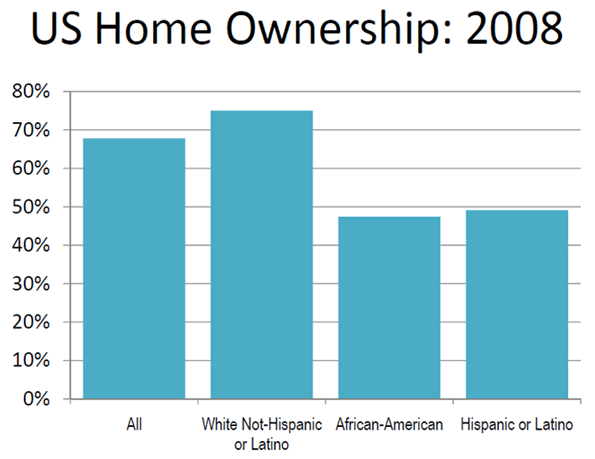
    The Minority Home Ownership Gap: But there is some way to go. Home ownership represents the core of the “American Dream” that was certainly a part of Dr. King’s vision. Yet, there remain significant gap in homeownership by ethnicity. Rather than a matter of discrimination, this largely reflects differing income levels between White-Non-Hispanics, African-Americans and Hispanics or Latinos. Today, approximately 75% of white households own their own homes. Whites have a home ownership rate fully one-half higher than that of African-Americans and Hispanics or Latinos at 47% and 49% (See Figure).

    Setting the Gap in Stone: A key to redressing this difficulty will be convergence of minority household incomes with those of whites, and that is surely likely to happen. However, there is another important dynamic in operation: house prices in some areas have risen well in advance of incomes, so that convergence alone can not narrow the home ownership gap in a corresponding manner. It is an outrage for public policy to force housing prices materially higher so long as home ownership remains beyond the incomes of so many, especially minorities.

    The Problem: Land Use Regulation: The problem is land use regulation. The economic evidence is clear: more restrictive land use regulation raises house prices relative to household incomes. This can be seen with a vengeance in the house price increases that occurred during the housing bubble. As we have previously described, metropolitan markets with more restrictive land use regulation (principally the more radical “smart growth” policies) experienced house price escalation out of all proportion to other areas in the nation. In some cases, they topped out at nearly four times historical norms. On the other hand, in the one-half of major metropolitan area markets where land use regulations were less severe, house prices tended to increase to little more than historic norms, at the most.

    How Smart Growth Destroys Housing Affordability: This difference is principally due to the price of land, which is forced upward when the amount of land available for building is artificially limited, as is the case in smart growth markets. At the peak of the bubble, there was comparatively little difference in house construction costs per square foot in either smart growth or less restrictive markets. However, the far higher land prices drove house prices in smart growth markets far above those in less restrictively regulated markets. Where house prices rise faster than incomes, housing affordability drops as prices rise at escalated rates.

    Wishing Away Reality: It is not surprising that the proponents of smart growth undertake Herculean efforts to deflect attention away from this issue. Usually they pretend there is no problem. Sometimes they produce studies to indicate that limiting the supply of land and housing does not impact housing affordability, which is akin to arguing that the sun rises in the West. Even the proponents, however, cannot “walk a straight line” on this issue, noting in their most important advocacy piece (Costs of Sprawl – 2000) that their more important strategies have the potential to increase the cost of housing.

    The Assault on Home Ownership: Worse, well connected Washington interest groups (such as the Moving Cooler coalition) and some members of Congress seek to universalize smart growth land rationing throughout the nation, which would cause massive supply problems and housing price inflation that occurred in some markets between 2000 and 2007. Even after the crash, these markets experienced generally higher house prices relative to incomes in smart growth markets than in traditionally regulated markets.

    House Price Increases and Minorities: House price increases relative to incomes weigh most heavily on ethnic minority households, because their incomes tend to be lower. This is illustrated by an examination of the 2007 data from the American Community Survey, in our special report entitled US Metropolitan Area Housing Affordability Indicators by Ethnicity: 2007. The year 2007 was the peak of the housing bubble, but represents a useful point of reference for when future “smart growth” policies were imposed nationwide.

    Median Priced Housing: The data (Table) indicates that median house prices were 75% or more higher for African-Americans than Whites, however that African-Americans in smart growth markets require 84% more to buy the median priced house. The situation was slightly better for Hispanics or Latinos with median house prices at least 50% more relative to incomes than for Whites. House prices relative to Hispanic or Latino median household incomes were 86% higher in smart growth markets than in less restrictively regulated markets.

    SUMMARY OF HOUSING INDICATORS BY
    LAND USE REGULATION CATEGORY
    Metropolitan Areas over 1,000,000 Population: 2007
    HOUSING INDICATOR Less Restrictive Land Use Regulation Markets More Restrictive Land Use Regulation Markets All Markets More Restrictive Markets Compared to Less Restrictive Markets
    MEDIAN VALUE MULTIPLE        
    All 3.1 5.8 4.5 1.89
    White Non-Hispanic or Latino 2.7 5.1 3.9 1.90
    African-American 4.9 8.9 6.9 1.84
    Hispanic or Latino 4.2 7.9 6.1 1.86
    LOWEST QUARTILE VALUE MULTIPLE      
    All 2.1 4.2 3.2 2.01
    White Non-Hispanic or Latino 1.8 3.7 2.8 2.01
    African-American 3.3 6.5 5.0 1.95
    Hispanic or Latino 2.9 5.7 4.4 1.98
    MEDIAN RENT/MEDIAN HOUSEHOLD INCOME      
    All 13.8% 17.1% 15.5% 1.24
    White Non-Hispanic or Latino 12.1% 15.1% 13.6% 1.25
    African-American 21.9% 26.1% 24.0% 1.19
    Hispanic or Latino 19.1% 23.0% 21.1% 1.20
    LOWER QUARTILE RENT/MEDIAN HOUSEHOLD INCOME    
    All 10.8% 13.1% 12.0% 1.22
    White Non-Hispanic or Latino 9.4% 11.6% 10.5% 1.23
    African-American 17.0% 20.0% 18.5% 1.17
    Hispanic or Latino 14.9% 17.5% 16.2% 1.18
    NOTES        
    Median Value Multiple: Median House Value divided by Median Household Income
    Low Quartile Value Multiple: Low Quartile House Value divided by Median Household Income
    2007 Data
    Calculated from American Community Survey (US Bureau of the Census) Data
    “More restrictive” land use regulation markets (generally "smart growth") include those classified as "growth management," "growth control," "containment" and "contain-lite" and "exclusions: in "From Traditional to Reformed A Review of the Land Use Regulations in the Nation’s 50 largest Metropolitan Areas" (Brookings Institution, 2006) and markets with significant large lot zoning and land preservation restrictions (New York, Chicago, Hartford, Milwaukee, Minneapolis-St. Paul, and Virginia Beach). Less restrictive" land use regulation markets (generally "traditional") include all others, except for Memphis, where urban growth boundaries have been drawn far enough from the urban area to have no perceivable impact on land prices and Nashville, where the core county is exempt from the urban growth boundary requirement in state law.

    Lower Priced Housing (Lowest Quartile): I recall being told by a participant at a University of California–Santa Barbara economic forum organized by newgeography.com contributor Bill Watkins that, yes, smart growth increases house prices, but not for lower income residents. My challenger went so far as to say that lower income households were aided economically by smart growth. The facts are precisely the opposite. Comparing the lowest quintile (lowest 25%) house price to median household incomes indicates that minorities pay even a higher portion of their incomes for lowest quintile priced houses than the median priced house. African-Americans in smart growth markets needed 95% more relative to incomes to afford the lowest quartile house. Hispanics or Latinos needed 98% more.

    Rental Housing: The problem carries through to rental housing. There is a general relationship between rental prices and house prices, though rental prices tend to “lag” house price increases. In the smart growth markets, minorities must pay approximately 20% more of their income for the median contract rental in smart growth metropolitan areas than in less restrictively regulated markets. Similar results are obtained when comparing minority household median incomes with lowest quintile contract rents, with African-Americans paying 17% more of their incomes in smart growth markets and Hispanics or Latinos paying 18% more.

    Moreover, it is important to recognize that all of the above data is relative, based on shares or percentages of incomes. Varying income levels are thus factored out. Minority and other households in smart growth markets face costs of living that are approximately 30% higher than in less restrictively regulated markets, according to analysis by US Department of Commerce Bureau of Economic Analysis economists. Some, but not all of the difference is in higher housing costs.

    Social Costs of Smart Growth: In 2004, the Tomas Rivera Policy Institute, which focuses on Latino issues, noted concern about the homeownership gap in California, which has been ground zero for land use regulation driven house price increases for decades:

    Whether the Latino homeownership gap can be closed, or projected demand for homeownership in 2020 be met, will depend not only on the growth of incomes and availability of mortgage money, but also on how decisively California moves to dismantle regulatory barriers that hinder the production of affordable housing. Far from helping, they are making it particularly difficult for Latino and African American households to own a home.

    Examples of the restrictions cited by the Tomas Rivera Policy Institute are restrictions on the supply of land, high development impact fees and growth controls.

    California has acted decisively, but against the interests of African-Americans and Hispanics or Latinos. The state enacted Senate Bill 375 in 2008, which will impose far stronger state regulations on residential development, increasing the likelihood that minorities in California will always be disadvantaged relative to White-Non-Hispanics. At the same time, State Attorney General Jerry Brown has forced some counties to adopt more restrictive land use regulations through legal actions. California, which had for decades been considered a state of opportunity, is making home ownership and the pursuit of the “American Dream” far more difficult, particularly for its ever more diverse population.

    Stopping the Plague: In California, the hope to increase African-American and Latino home ownership rates to match those of white-non-Hispanics may already be beyond reach due to the that state’s every intensifying radical smart growth policies. However, the “Dream” continues to “hang on” in many metropolitan markets. Hopefully Washington will not put a barrier in the way of African-Americans and Hispanics or Latinos that live elsewhere in the nation.

    US Metropolitan Area Housing Affordability Indicators by Ethnicity: 2007 includes tables with data for each major metropolitan area in the United States

    Photo: Starter house in Atlanta suburbs (by the author)

    Wendell Cox is a Visiting Professor, Conservatoire National des Arts et Metiers, Paris. He was born in Los Angeles and was appointed to three terms on the Los Angeles County Transportation Commission by Mayor Tom Bradley. He is the author of “War on the Dream: How Anti-Sprawl Policy Threatens the Quality of Life.

  • Perspective on G-20: Don’t Trip on those Green Shoots

    Everywhere you look – from the White House to Wall Street – they are painting a sunny picture of recovery, free from any gloomy ideas. Bernie Madoff is in jail, Goldman Sachs is repaying their bailout money, and everywhere they look they see “green shoots.”

    Yet according to the Congressional Budget Office (CBO), the US economy and federal government are headed for doom. We are on a completely unsustainable path economically and financially. The CBO updated their forecasts after our June piece on the State of the Economy. In their updated Budget and Economic Outlook, CBO clearly concludes that the current rate of high spending and low revenues has the nation on an unsustainable fiscal course. Unemployment won’t drop below 5% until 2014. As a result, according to the latest country risk rankings by Euromoney magazine [http://www.euromoney.com, subscription required for full access] Canada, Australia and most of Scandinavia have passed the US as safer places to invest in business.

    These predictions of doom are, in fact, based on the best-case scenario of 3 percent economic growth next year and 4 percent the year after that; plus the expiration of tax cuts and no new stimulus or bailout packages. Whether we call it a Panic, a Depression, a Recession or a Downturn, it all means the same thing. The nomenclature has been softened over the decades to remove that ever so gloomy feeling folks get when things are bad. If you still have a job, you know someone who has been laid off, had their hours cut, etc. I just received my first new piece of business since February. Things are tough everywhere you look.

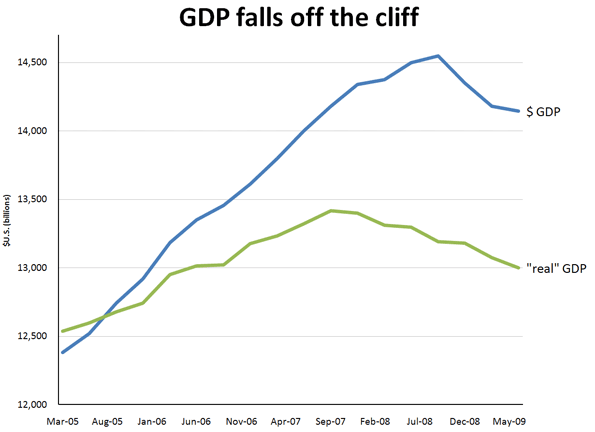
    GDP this year ($14,143 billion) is about where it was two years ago in actual dollar terms ($14,180 billion, third-quarter 2007). Accounting for inflation in consumer prices, our economy is closer to the level it was at the end of March 2006 or even back to the end of 2005. Actual dollar GDP peaked in September 2008 but I prefer the regular “real” GDP, adjusted for changes in what a dollar will buy you, which peaked in the third quarter of 2007 – we live in the real world, using real dollars to pay for real things.

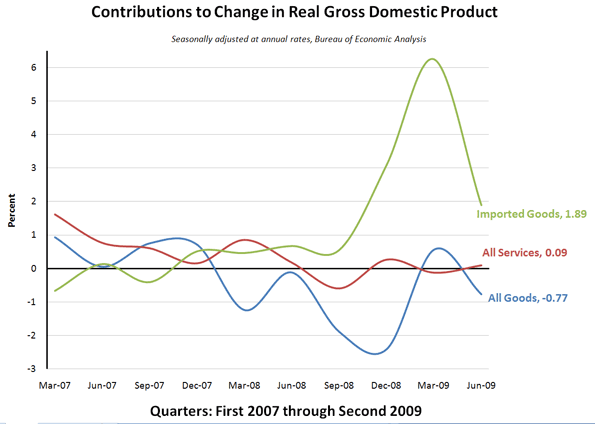
    The importance of changes in the real-dollar economy become most obvious when we consider international trade, which has been on the minds of the leaders of the G-20 nations in Pittsburgh this week. The fact that US consumers sustained and even increased their demand for imported goods until the onset of the global recession and in the face of a declining dollar lends credence to President Obama‘s plan to discuss what the world, not just what the US, can do to “lay the groundwork for balanced and sustainable economic growth.”

    On the one hand, our consumption of imported goods contributed to ours and the world’s economic growth. This fuels concern over whether or not the US can keep the promise to not impose new trade barriers before the end of 2010 and the world’s willingness to continue to buy our debt in the form of US Treasury bonds. At the same time, as Kansas City Federal Reserve Bank President Thomas Hoenig said last week in a speech I attended in Omaha, we need the world’s consumers to continue buying US goods in order to maintain our position as the “industrial leader of the world.” It’s a delicate balance, at best.

    The late 2007 nose dive in the “real” economy exposed the trouble brewing on the housing front, when we became aware of the explosion in credit derivatives, and when many of us started warning people about the insanity taking place in U.S. bond markets. No matter how you measure it, we would need about a 3 percent increase in GDP by next summer just to get back to where we were the last time everyone felt good about their money.

    Data from Bureau of Economic Analysis; author’s calculations

    So, why are we hearing such a positive spin on the economic news? One reason is the lack of understanding among reporters – most of them probably studied literature or journalism in college – not finance or economics. New York Times economics reporter Edmund L. Andrews is a perfect example. He just published a book describing “how he signed away his life for a toxic loan to buy a house in Silver Spring that he couldn’t really afford.” The Washington Post reviewer called the book “bright and breezy.” No gloom there!

    At the same time that he was signing the papers for an outsized mortgage, Andrews was writing articles like this gem from September 1, 2007 – just as the real economy was perched on the edge of the cliff – where he reports on Federal Reserve Bank Chairman Ben Bernanke saying he will “prevent chaos in the mortgage markets from derailing the economy.” The stock market climbed nearly 1 percent that day to close at 13,357.74 – it closed at 9,820.20 last Friday. Yet, Mr. Andrews still has a job with the New York Times – unlike millions of his readers – writing about topics like troubled mortgages.

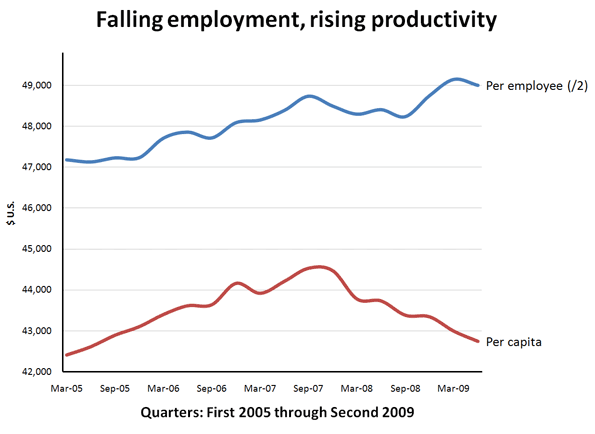
    Data from Bureau of Economic Analysis and Census Bureau. Per employee divided by 2 for scale.

    But what about the recent stock market rise? We should not be surprised if business profits are up: fewer people working means that the output per worker has been increasing since the end of 2008. GDP per capita (per person in the population), on the other hand, has been decreasing since the end of 2007 – an indication of a falling standard of living.

    The next few months are a time to focus, concentrate, plan, and follow-through. We are at a turning point comparable to the beginning of the Industrial Revolution and the system of capitalism that financed it. By frantically printing money and creating credit through bank bail-outs, the Federal Reserve and the Treasury are boosting the stock market by pumping in about $150 billion a month into corporate securities, increased auto sales (with government rebates) and home sales (with government first-time buyer tax credits).

    The problem is that these three pieces – banking, cars and homes – are not the whole economy, and, since they depend on government debt, none of these “green shoots” are sustainable on their own. Keep your eye on the big picture (the Kiplinger Recovery Index is a handy one-stop) – and don’t relax until all the indicators are green.

    Susanne Trimbath, Ph.D. is CEO and Chief Economist of STP Advisory Services. Her training in finance and economics began with editing briefing documents for the Economic Research Department of the Federal Reserve Bank of San Francisco. She worked in operations at depository trust and clearing corporations in San Francisco and New York, including Depository Trust Company, a subsidiary of DTCC; formerly, she was a Senior Research Economist studying capital markets at the Milken Institute. Her PhD in economics is from New York University. In addition to teaching economics and finance at New York University and University of Southern California (Marshall School of Business), Trimbath is co-author of Beyond Junk Bonds: Expanding High Yield Markets.

  • Why the feds should stay out of high-speed rail (and most transportation)

    Set aside for a minute whether high-speed rail (HSR) makes sense or not on a cost-benefit basis. Regardless of whether it does or not (and some smart people are arguing not), I’d like to make the argument that federal funding has no place in HSR. Instead, it should be left to individual states or regional state coalitions.

    The federally-funded interstate system was originally conceived for defense purposes – rapid mobilization – after Ike saw the German autobahns. Freight and people movement were obvious beneficiaries, over short, medium, and long distances. It is a comprehensive network that crosses state lines, which argues for federal involvement. The government made the minimal investment it had to make – road beds – and people/companies paid for vehicles and fuel. Fuel was taxed to pay for it all. If EZ-tag technology had been available at the time, I suspect they would have tolled it all instead to pay for it.

    Airports followed a similar arrangement: government provides the landing strips and terminals while private companies provide the vehicles and fuel. Passenger ticket taxes pay for the infrastructure. As airports are a local decision, they are (mostly) paid for locally, although regulated federally for standardization and safety.

    HSR is targeted at medium distances only, making it more of a state/regional decision (i.e. a small collection of states). It also requires huge subsidies, as the government provides the track, cars, and energy. There is nothing directly related that can be taxed to pay for it (like fuel taxes for roads and passenger ticket taxes for airports). You could try to tax the rail tickets, but if they were fully priced they would not attract nearly enough riders. So no matter how you slice it, in the end the government (i.e. taxpayers) will be paying the majority of the cost of moving each passenger. The infrastructure cost cannot be covered by direct user fees, as demonstrated in other countries.

    Rather than compare HSR to the interstate highway system, the better analogy would be airports. Imagine if California said, “Feds, give us money to build a few airports in key CA cities and provide a subsidized government-run airline to provide frequent intra-state service where tickets are priced way below cost.” Put that way, people would recognize the idea as absurd, and tell California to do it themselves if they think it’s such a good idea.

    The problem is that a simple program that made sense at the time – a federal gas tax to build an interstate highway system – has evolved into a Frankenstein monster of massive federal involvement in enlarged urban freeways, local rail transit, and now high-speed rail – areas where they simply do not belong. Local transportation planners have shifted decision making from “What are the best cost-benefit investments we can make to move people in our area?” to “How to do we grab our ‘fair’ share of the federal pie, regardless of whether or not the project is something we would consider with our own money?” And that is leading to a lot of boondoggles being built around the country, culminating recently in the famous Bridge to Nowhere in Alaska.

    The answer? The feds need to get out of the transportation business beyond minimal maintenance of the interstate highway system (the basic four lanes – not the expanded urban freeways). Let local entities make local decisions on transportation investments, including funding, and a whole lot of waste will magically disappear.

    This post originally appeared at Houston Strategies.

  • Play It Cool at the G-20, Mr. President

    Barack Obama goes to this week’s Pittsburgh G-20 with what seems the weakest hand of any American president since Gerald Ford. In reality, he has a far stronger set of cards to play — he just needs to recognize it.

    Our adversaries may like our new president, but they don’t fear him. And, on the surface, why should they? The national debt is rising faster than the vig for a compulsive, debt-ridden gambler. And our primary rivals, the Chinese, continue to put the squeeze on American producers by devaluing their currency, subsidizing exports and penalizing imports.

    When the Chinese threaten to call in their debts, they can count on Timmy Geithner to kowtow like an obedient vassal. Some of Obama’s most important supporters — like Warren Buffett and The New York Times‘ Thomas Friedman — have discovered what Friedman calls “the great advantages” of autocracy over our cockamamie, boisterous democracy.

    From Virgil, Maecenas and the court of August to Hitler-admirers Henry Ford and George Bernard Shaw, as well as Stalin-fan Max Eastman, imperial scribes and money lenders have long demonstrated a weakness for even the worst autocrats. But our bedraggled democracy may have a lot more aces to play than many recognize.

    Just look at the other players around the table. French President Nicolas Sarkozy, when not worrying about his (lack of) height, tells his countrymen to stop worrying about gross domestic product. Productivity, one presumes, doesn’t mean as much as a good baguette, long vacation or wet kiss from a former model.

    Across the channel, Prime Minister Gordon Brown seems determined to take the Good Ship Brittania further underwater. According to Tony Travers of the London School of Economics, Britain, with the exception of London, is already well on its way to becoming “a second- or third-tier country.” And as my colleague Ryan Streeter points out, New Labour’s response to the economic crisis — basically raising taxes and doubling down on regulation — doesn’t seem a formula for a vibrant economy.

    Germany, Italy, Spain and the rest of E.U. face equally daunting problems. These “progressive” role models suffer from unsustainably low birthrates, and many face a future more Islamic than European. Their “green” rhetoric may thrill some fans in the U.S., but these economies still run largely on oil and natural gas, which makes them ever more dependent on the autocrat of all — Russia.

    And Japan, once considered the mega-tiger of the future by American policy wonks, is transforming itself into something of a post-modern pussycat. It won’t take immigrants even as its population begins to shrink. Largely dependent on exports, its new government does not like globalization and wants to expand its welfare state. Moreover, Japan seems to be wobbling toward a future as a quiescent vassal for the Greater Chinese East Asian sphere.

    So how does America compare? Let’s start with the basics. The U.S. is the only major advanced country that enjoys a steady population increase. Yes, immigrants are driving much of that growth, but our newcomers are generally very different from the largely alienated and isolated Muslim communities now nesting in Europe. America’s Mexicans, Chinese, Indians, Armenians, Caribbeans and Africans — and more pointedly Arabs and Iranians — do not constitute a hostile “them.” Instead they are the ones redefining us by adding new dimensions to what Nathan Glazer once described as “a permanently unfinished country.”

    Of course, it helps to be the only serious global military presence in the world. A strong military represents an invaluable asset in a world dominated by autocrats and lunatics. That doesn’t mean Obama should swagger like a Viagra-enhanced neo-con. He just needs to follow Teddy Roosevelt’s dictum: Speak softly, but keep a hold on that big stick.

    A powerful military and better demographics represent just part of America’s strong hand. Compared with the E.U., Japan, China or even India, the U.S. remains phenomenally rich in resources.

    Take our most basic need: food. The U.S. has the most arable land in the world and is its largest food exporter. Our $1.4 trillion food sector accounts for 12% of our economy, and prospects for expansion are enormous. By 2050, the population of the planet will be around 9 billion people — up from 6 billion today. More than 85% of the world’s population will reside in developing countries, most in cities, and they will constitute a gigantic future market.

    Equally important, the U.S. is sitting on huge energy resources. Of course, renewable fuels should become a major, even dominant, factor, but in the short- and maybe mid-term, oil, gas and even coal will continue driving the economy. The Great Plains and even the Northeast, particularly Pennsylvania, have enough natural gas to become a junior Abu Dhabi.

    Furthermore, despite its many weak links, our industrial base remains the most advanced in the world. If mindless “green” policies don’t force us to dismantle it, we could produce, through the use of new technology and a better-trained workforce, virtually everything we buy from the Chinese and the Europeans.

    This is not to argue for strict protectionism. But right now we buy almost $4.50 from the China for every $1 we sell there. China’s trade with us is worth 13 times to its economy what our trade with them is worth to us.

    Fundamentally, this means that the Chinese are more exposed to a potential trade war than we are. Without rising exports to the U.S., China’s leaders could face massive unemployment and internal unrest. For us, reducing Chinese imports means somewhat higher prices at Wal-Mart — and perhaps more vigorous business with better partners such as Mexico, whose future prosperity is directly tied to ours.

    All this suggests that Obama has more leverage to demand better trade terms than some might think. There’s nothing in the Constitution that mandates that Americans be the world’s trade chumps. So you want trade war, President Hu? Give him a little Clint Eastwood. Make. My. Day. Then give them a wink or a chance to think about it.

    How about the $1.5 trillion that the Chinese are holding? Well, they could call in their $1.5 trillion for yen or euros, ruining those economies by inflating their currencies. Polish zlotys? Iranian rials?

    Of course, losing Chinese investors and cheap products would hurt in the short term, but it could prove beneficial in the long run. After all, during World War II, we learned to thrive without German machinery or Southeast Asian rubber. Best of all, a Chinese withdrawal could force Washington to live on a budget, just like the rest of us.

    None of this suggests that Obama should discard his charm and morph into a svelte Dick Cheney. America’s preeminence rests on far more than missiles, resources, land or machines. The U.S. is more than a geographic place, or the home of a race, but, as Lincoln noted, the great human experiment about self-government and individual aspirations.

    Whatever his faults — and there are plenty — Obama epitomizes this ideal with his very being. When he arrives in Pittsburgh, our president should play the American hand like the guy who knows he holds aces in the hole.

    This article originally appeared at Forbes.

    Joel Kotkin is executive editor of NewGeography.com and is a distinguished presidential fellow in urban futures at Chapman University. He is author of The City: A Global History. His next book, The Next Hundred Million: America in 2050, will be published by Penguin Press early next year.

    Photo: White House Photo/Pete Souza

  • California Golden Dreams

    California may yet be a civilization that is too young to have produced its Thucydides or Edward Gibbon, but if it has, the leading candidate would be Kevin Starr. His eight-part “Dream” series on the evolution of the Golden State stands alone as the basic comprehensive work on California. Nothing else comes remotely close.

    His most recent volume, “Golden Dreams: California in an Age of Abundance, 1950-1963,” covers what might be seen as the state’s true Golden Age. To be sure, there is some intriguing history before—the evolution of Hollywood in the 1920s, the reaction to the Depression and the fevered buildup during the Second World War—but this was California’s great moment, its Periclean peak or Augustan age.

    “It was a time of growth and abundance,” Starr writes in his preface, and provides the numbers to prove it. In 1950, California was home to 10.7 million, making it a large state to be sure, but hardly a dominant one. By the early 1960s, the population passed 16 million, slipping by New York state in population.

    Yet it was not a mere matter of numbers that made California so appealing or important. It was the idea of California as not only a part of America, but also something more. To millions in America and around the world, California grew to mean opportunity, sunshine and innovation.

    The state’s business elite, for example, did not identify with the button-down hierarchy that sat atop teeming New York, and its second-tier competitors like Chicago. The leaders of Los Angeles would never consider it a second city, but simply a different, and generally, better one. There was no need for the excessive Manhattan penis envy that led Chicago to keep trying to build higher buildings than Gotham.

    In a different way, San Francisco’s top executives also did not crave that their city be New York—it was always more beautiful, nuttier, freer and more creative than Gotham. What they shared with their downstate rivals was a sense of superiority over the old part of the country. If anything, they felt a mixture of contempt—particularly the conservatives—and condescension about an older, decaying society that fixated on tradition, order and breeding.

    “California,” Cyril Magnin, scion of one of San Francisco’s great families, told me back in the late 1970s, “has recaptured what America once had—the spirit of pioneering. People in business out here are creative; they’re willing to take risks.”

    Geography also plays a role here. Leaders in California, starting at least by the turn of the last century, looked out across the Pacific and saw themselves as part of an emerging shift from Europe to Asia, a process that continues and will dominate the rest of this century. This connection, suggested Pete Hannaford, a public relations executive and partner of Ronald Reagan’s Svengali, Michael Deaver, took on an almost Spenglerian inevitability. “Out here there’s a sense of being where the action is,” Hannaford believed, “with Japan and the Pacific.”

    Starr captures these attitudes, which already had become deeply entrenched by the late 1950s and early 1960s. There was, as he writes, “a conviction that California was the best place to seek and attain a better American life.” However, it was more than money or power. It was about the quality of life. Success in California was not a matter of living by the rules, sheltered in a dark Manhattan apartment, but about the seduction of the physical world. In California, Starr writes, “Eros vanquished Thanatos.”

    Yet Starr’s book is not merely about the rich, the powerful, and even the culturally influential. He finds his primary muse not in the Bohemian realms of San Francisco or the mansions of Beverly Hills, but in that most democratic of everyman’s places, the San Fernando Valley, the place author Kevin Roderick aptly dubbed “America’s Suburb.”

    To see long excerpts from “Golden Dreams,” click here.

    “The Valley” lies over the Santa Monica Mountains from the Los Angeles Basin. As late as the 1930s, it was largely an arid district of ranches, citrus orchards and chicken farms. The area’s postwar expansion was rapid, even by California standards. Between 1945 and 1950 alone, the Valley’s population more than doubled to nearly 500,000. By 1960, it had doubled again.

    This growth was far more than the mindless bedroom sprawl often depicted by aesthetes and urban intellectuals. People in the Valley did not depend largely on the old part of Los Angeles the way, for example, Long Island lived off Manhattan. Most of the Valley’s growth was homegrown—driven by local industry such as aerospace, entertainment, electronics and until the 1960s automobiles.

    Even today, the Valley has very much its own economy and sense of separation from Los Angeles. However, more important, the Valley was, first, a middle-class phenomenon. A cosmopolitan of the first order, Starr manages to chronicle California’s artistic and literary elites, but does not see in them the essence of the state’s appeal. Instead, he explores the everyday wonders of the Valley’s families, single-family homes and swimming pools—6,000 permitted in one year, between 1959 and 1960!

    As a Valley resident myself, I can still see the basic imprint of that culture, what Starr calls its “way of life.” Compared to the tony Westside and hardscrabble east and southside of Los Angeles, the Valley has remained a relatively safe “child-oriented” society, with a big emphasis on restaurants, malls, ball fields, churches and synagogues.

    The single-family tracts, of course, have changed hands, and the majority of the owners have changed. The primarily WASP and second-generation Eastern European Jews are still there, but they have steadily been augmented, and sometimes outnumbered, by others—Armenians, Orthodox Jews, Israelis, Persians, Thais, Chinese, Mexicans, Salvadorans, African-Americans and at least 10 groups I somehow will neglect and no doubt offend.

    Yet the essential way of life forged in the 1950s and 1960s has remained a constant, and that remains the source of California’s attraction. Of course, it is no longer just a “Valley” phenomenon. As California has grown, there are many such places, outside San Diego, in Orange County, the Inland Empire, outside Sacramento, Fresno and scores of other towns. Almost all have the same imprint—an auto-dominated culture, dispersed workplaces, pools and a culture of aspiration.

    In the ensuing decades, perhaps to be covered in Starr’s next book, this archetype evolved mightily. The San Gabriel Valley, once a plain vanilla suburban appendage, has morphed into the country’s largest Asian suburbia, complete with a shopping center jokingly referred to as “the Great Mall of China.” The often-monotonous housing tracts between San Jose and Palo Alto, on the San Francisco Peninsula, also attracted hundreds of thousands of Asians but also produced something equally astounding—the Silicon Valley, the world’s leading center for technology.

    These suburban developments long ago surpassed in importance the urban roots of California metropolises. A serious corporate center during the time covered by Starr’s volume, San Francisco has devolved in a ultra-politically correct, hip and cool urban Disneyland for Silicon Valley, providing good restaurants and housing for those still too young to crave a house on the Peninsula. The San Gabriel Chinatown long ago replaced the older one in downtown Los Angeles as the center of Asian culture and cuisine.

    These places grew before the current malaise infected the state. As Starr points out, California based its ascendancy on two seemingly contradictory principles: entrepreneurship and activist government. Under Gov. Earl Warren, but also Goodwin Knight and finally Pat Brown, the state made a commitment both to basic infrastructure—energy, water, roads, schools, parks—and expanding its economy.

    By the early 1960s, this system was hitting on all cylinders. New roads, power plants and water systems opened lands for development for farms, subdivisions, factories. Ever expanding and improving schools produced a work force capable of performing higher-end tasks, and capable of earning higher wages. New parks preserved at least some of the landscape, and gave families a place to recreate.

    For Pat Brown, arguably the greatest governor in American history, this was all part of California’s “destiny.” Starr describes Brown’s California as “a modernist commonwealth, a triumph of engineering, a megastate committed to growth as its first premise.” Yet within this great modernist project was also stirring opposition, on both left and right, that would soon place this Golden Age at its end.

    Many of the objections were legitimate. The Sierra Club and its many spinoffs rightfully saw the Brown development machine as threatening California’s landscape, wildlife and, in important ways, the appeal of its way of life. More careful controls on growth clearly were needed. The battle over the nature of those controls continues to this day.

    Some more angry voices, then as now, targeted the very existence of suburbia, the dominant form of the state’s growth, and eventually sought its eradication. This struggle goes on to this day with a religious fervor, led, ironically, by the former and perhaps future governor, Jerry Brown, currently attorney general and leading Torquemada of the greens.

    Minorities also began to stir amid the celebrations of the 1950s and early 1960s. Woefully underrepresented in the halls of power and the corridors of business, Asians and Latinos remained largely passive politically. However, by the early 1960s acceptance of exclusion was giving way to more assertive attitudes. Ultimately the massive immigration that swelled both their numbers in the 1970s and beyond would ensure these groups far more influence both on the politics and in the economy of the state.

    Yet it was the African-American who would really upset the balance of the golden era. Never discriminated against as in the South, black Californians felt the lash of a thousand, often-informal exclusions. As the civil rights movement grew, with it less deferential attitudes, particularly toward the police, a powder keg was building. In 1964, the first year after the era chronicled in “Golden Dreams,” Watts blew up, shattering the comfortable assumptions of a progressive, post-racial state.

    Finally, as Starr reports, there was mounting thunder on the right. The business elite and the middle class were financing the ever-expanding California state. They saw their money go to the poor, to minorities and state employees. Particularly annoying were the university students, many of whom were in open revolt against the state, in the mind of much of the public that had nurtured them.

    By the early 1960s many of these latter Californians also were angry, but their rage would express itself not in riots, but at the ballot box, ushering in the age of Ronald Reagan. The period that follows “Golden Dreams” emerges as one of conflicting visions, between greens, students and minorities, on the one hand, and largely suburban middle-class workers and business owners on the other.

    These two groups would battle over the next generation, with the advantage oscillating over time. Today the heirs of the protesters—greens, minority activists and former ’60s radicals—hold the political advantage, although the state they dominate has fallen on parlous times.

    In retrospect, the golden era before these conflicts does indeed seem like a high point. The question now is whether California, down on its luck, will find a way to rebound, much as imperial Rome did after the demise of the Julian dynasty, or fall, like Athens, into ever more squalid decline. Does the state have a bright “destiny” ahead or only more ruin?

    This, of course, will be the basis for another historical epoch. Let us hope Kevin Starr be around to chronicle it for the rest of us.

    This piece originally appeared at Truthdig.com

    Golden Dreams: California in an Age of Abundance, 1950-1963 at Amazon.com.

    Joel Kotkin is executive editor of NewGeography.com and is a distinguished presidential fellow in urban futures at Chapman University. He is author of The City: A Global History. His next book, The Next Hundred Million: America in 2050, will be published by Penguin Press early next year.

  • Cap And Trade And The Smog Market Ripoff

    Now that Senators have reconvened from summer hiatus, one of their first tasks will be to contemplate the greenhouse-gas cap-and-trade carbon market that President Obama would like to institute to blunt global warming. Their necks better be limber. Partisans of Keynesian, market-based regulations will undoubtedly point to the Midwest’s federally run “acid rain” program to reduce harmful power-plant emissions as proof that giving industry profit incentives in cleaning up their operations can be successful. Regulation skeptics will wave that example off dismissively, urging Senators to swivel their heads for a look across the Atlantic, where the European Union’s Emissions Trading System has registered lousy results.

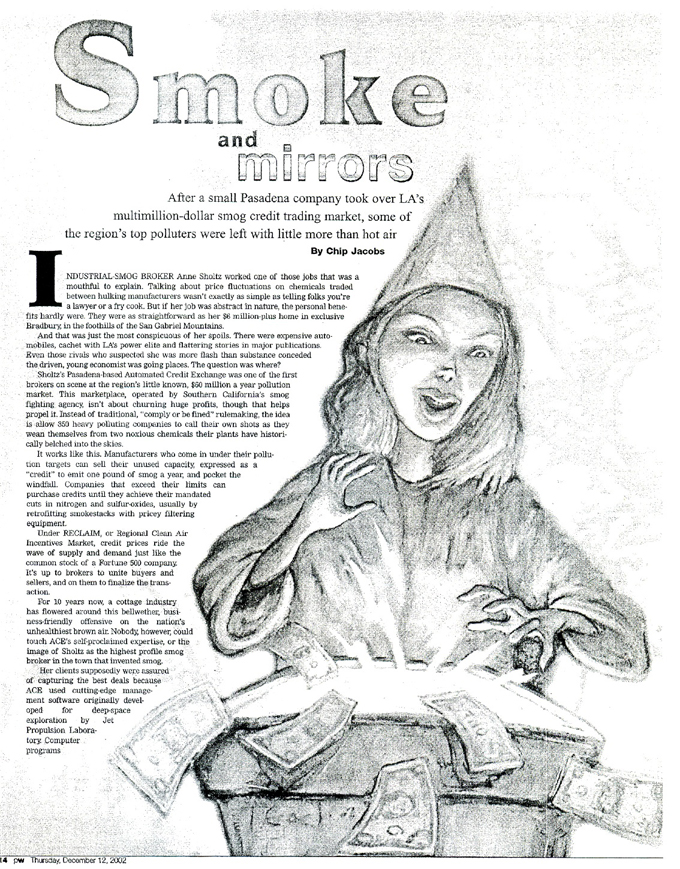
    Whatever those markets do or don’t foreshadow, if the American Clean Energy and Security Act of 2009 and its mandated cap-and-trade become law, a glimpse of an unintended — and unsavory — future may reside in the tale of the inscrutable businesswoman from smog-bound Southern California who scammed the area’s pollution exchange…twice (see my site, www.chipjacobs.com, for the newest revelations of a second scam). Rather than a tale of a dreamer’s demise, Anne Sholtz’s story is a bracing reminder that to create a market, no matter its aim, is also to inspire a class of people determined to game it.

    If Wall Street traders can commodify sub-prime mortgages with impunity, and the Enrons of the world can manipulate energy markets like a pinball machine, imagine a future when tradeable permits for carbon dioxide and other heat-trapping gases are auctioned and swapped over the public’s head. A Heritage Foundation economist expects the action to hit $5.7 trillion in value, and many experts say it all adds up to an irresistible buffet for chicanery.

    Few in Washington ever heard of Sholtz, 44, before last spring, when the former Caltech economist was sentenced in federal court to a year of home-detention and five years of probation for defrauding the nation’s first air pollution cap-and-trade market. Sholtz was cozy with the RECLAIM program and the bureaucrats who run it at the South Coast Air Quality Management District (AQMD). That’s because in the early-1990s she had helped design the concept as an adviser.

    Her know-how proved dangerous. Between November 2000 and April 2001, Sholtz tried fooling one of her clients, a New York-based energy trader, into believing she could complete a fat, multimillion-dollar deal with what is now ExxonMobil Corp. when in fact she could not. Stringing executives at the client company along until she could reactivate a transaction, she emailed and faxed falsified sales documents, including phony invoices.

    Pleasant, brainy and ever-hustling, Anne Sholtz was not somebody folks expected to see handcuffed. Her 2004-arrest by EPA agents on white-collar fraud charges shocked and mystified local environmental circles. She and her companies, Automated Credit Exchange and EonXchange, had boasted a heavyweight list of clients and financial partners, and had worked with the Dutch government on an emissions test-market. As one of California’s rising green-entrepreneurs, Sholtz was a niche-celebrity with access to powerful politicians and regulators, and a hillside mansion, fine cars and whatnot to show for her ingenuity.

    For our purposes, the reasons she’d risk all that matters less than the fact she was able to do so undetected. (You can read the entire expose here.) And that Obama’s proposed carbon market would look a lot like L.A.’s now 15-year-old smog bazaar. RECLAIM sets progressively lower emissions’ limits for roughly 330 of the Southland’s largest oil refineries, power plants and other manufacturers, and allocates credits calculated for each one. Companies that install new particle-trapping equipment or develop cleaner operations in other ways to reduce oxides of nitrogen and sulfur can sell their unused credits to peers who may exceed their allotment. Since 1994, there have been about $1 billion in trades, which brokers help negotiate, and about 40-million pounds of smog chemicals transacted.

    AQMD contends that, after a languid start, its regimen has achieved its emission-cutting goals. At first, an over-allocation of credits to ease industry into the new system simply encouraged many companies to delay purchasing greener equipment. (Using the same logic, the current Obama-backed energy bill, sponsored by House Democrats Henry Waxman of California and Edward Markey of Massachusetts, would initially give away an eye-popping 85 percent of greenhouse-gas credits to cushion carbon-dependent states. This means dramatic emission reductions likely won’t happen for years.)

    RECLAIM added another bold move to Southern California’s environmental pedigree, a change that industry actually wanted. But in developing such an open-ended, boutique market officials essentially flaunted their gullibility to cheaters, scammers and profiteers. It took AQMD several years to learn of Sholtz’s deceit, and only then after nine of her clients complained about being cheated.

    A year before that, in 2001, the air district had been blindsided by California’s electricity crisis, and the subsequent order by then-Gov. Gray Davis that power-plants run nonstop to prevent rolling brownouts. Speculators from Texas to New York with no industrial operations in the South Coast basin hoarded RECLAIM credits they knew utilities needed, later reselling them at huge markups. The market teetered near meltdown, and district brass had to yank power companies from the market.

    Ironically, one reason AQMD officials were oblivious to Sholtz’s actions was because they’d nixed her very own recommendation during RECLAIM’s design phase to stamp each credit with identifying marks, somewhat akin to a bar code. Loose trade-reporting requirements added more vulnerability. As California’s experience makes clear, building an incorruptible greenhouse-gas market may not be just formidable, it may be impossible, because the money and opportunities for deception are so tantalizing.

    This May, two Republican congressmen skeptical of Obama’s cap-and-trade plan, Joe Barton of Texas and Greg Walden of Oregon demanded extensive answers from the EPA about the Sholtz case. Why, they asked, were so many case documents still sealed by the Justice Department? How could this have happened on regulators’ watch, and what does it portend for a greenhouse-gas market?

    On their heels, AQMD executive officer Barry Wallerstein defended his market as virtually bulletproof to further criminality, while the EPA downplayed the matter as an isolated case. Those declarations occurred before documents emerged showing that Sholtz had told prosecutors during her 2005 settlement plea about “rampant” violations and graft by AQMD executives administering the market.

    All of which is to say Senators should look straight forward with furrowed, “prove-it” brows when fellow members and environmental glitterati pronounce that a greenhouse gas market will operate cleanly because really smart people with nifty technology will be policing it. As the Waxman-Markey legislation stands, the Federal Energy Regulatory Commission, the EPA, and perhaps several more agencies will be patrolling for fraud, speculation, price manipulation and so-forth. Other enforcement details are hazy.

    Chip Jacobs is the co-author, with William J. Kelly, of Smogtown: The Lung-Burning History of Pollution in Los Angeles. Jacobs can be reached at chip@chipjacobs.com

  • Smart Growth Must Not Ignore Drivers

    For the time being, battles over health care and energy seem likely to occupy the attention of both the Obama administration and its critics. Yet although now barely on the radar, there may be another, equally critical conflict developing over how Americans live and travel.

    Right now this potential flash point has been relegated to the back burner, as Congress is likely to put any major transportation spending initiative on hold for at least a year, and perhaps longer. This also may be a symptom of mounting concerns over the deficit. Financing major changes in transportation, for example, would probably require higher federal fuel taxes, which would not fly amid a weak economy.

    These delays could prove a blessing to the administration, providing a pause from indulging in yet another policy lurch that might thrill the “progressive” urban left but infuriate much of the country. Initial House proposals on transportation have sought to cut dramatically the share of federal gas taxes — paid by drivers — going to roads while sending more to already heavily subsidized transit. Another large chunk of transport spending would go to a very expensive, and geographically limited, high-speed-rail network.

    This kind of radical shift reflects the preferences of ideologues within the administration. President Barack Obama has clustered an impressive array of “smart growth” devotees around him, including Housing and Urban Development Undersecretary Ron Sims, an early climate change “evangelist,” Transportation Undersecretary for Policy Roy Kienitz and the Environmental Protection Agency’s John Frece. Their priority is not better roads for suburbanites but, as Transportation Secretary Ray LaHood put it, to “coerce” Americans out of their cars and into a denser, more transit-dominated future.

    This approach can expect strong support from the influential “green team” in the administration, including climate czar Carol Browner and science adviser John Holdren. Browner’s hand was shown during the Clinton years when as head of the Environmental Protection Agency she threatened to cut transportation funds for the Atlanta region unless it adopted a smart-growth policy. The threats became moot after the change of administration in 2001.

    It is not difficult to imagine such bureaucrats intruding on how communities and families function on the most basic levels. Traditions governing local land use that have existed since the beginning of the republic would be overturned. The preferred lifestyles of most Americans would come under siege.

    This agenda has been widely promoted for decades, first by the Carter administration and, more recently, by both environmentalists and new urbanists. The recent concerns over global warming have provided an additional raison d’être for a policy promoting both higher transit use and denser housing patterns. The president himself has embraced this agenda, declaring in February that “the days of building sprawl” were, in his words, “over.”

    The administration can expect strong support for such policies in the mainstream media concentrated in New York and Washington. These areas boast both the highest proportion of transit riders and the largest percentages working in the central core. Many among the young, single and childless couples working in media in these communities see no reason why other Americans should not live similarly.

    Politically, such a remaking of America may prove difficult to pull off. Overall less than 6 percent of Americans ride public transit, a percentage that has barely changed for decades. In many states, the transit share is only 1 percent. It’s difficult to imagine a policy that disses roads, small towns and suburbs could pass Congress, 80 percent or so of whose constituents don’t live in the favored dense urban environments. And what about the 95 percent or so of Americans who get around by car? More likely, any spate of new transit and land-use regulations will be enforced through the apparat. In one scenario, administrators at the EPA could simply oppose any transport project — for example, new roads — on the basis of carbon emissions and potential pollution. States and cities with projects not deemed “smart” enough by administrators at the Department of Transportation or HUD might be threatened with loss of funding.

    Yet even this approach risks engendering a backlash. Once again, the administration could be seen as imposing a true-blue policy on a largely red, or at least purple, nation. To be successful, the administration needs to address the needs of suburban, small-city and rural residents as well as those of big-city denizens.

    This is not to say the administration should not address pollution and congestion concerns head-on. But this needs to be done in ways that make both political and practical sense. Mileage requirements on cars are an excellent first step that follows this playbook, getting results without trying to remake a car-driving electorate.

    In addition, the government could develop incentives for increased telecommuting and more flexible work schedules in order to reduce unnecessary driving to work. There is also room for expanded, more economical bus and jitney services that could work in some suburban and small-town locations. Instead of building light rail systems that will never get large ridership, mass transit funding should flow to successful existing systems or to a handful of dense corridors emerging in places like Houston.

    All this speaks to a kind of pragmatism that may not please either the road-building zealots or the smart-growth aficionados. Such an approach would be far preferable — and more politically sustainable — than the current attempt to drive a 21st-century country back to a transportation model more appropriate for the 19th.

    This article originally appeared at Politico.com.

    Joel Kotkin is executive editor of NewGeography.com and is a distinguished presidential fellow in urban futures at Chapman University. He is author of The City: A Global History. His next book, The Next Hundred Million: America in 2050, will be published by Penguin Press early next year.