Category: Policy

  • Healthcare: The Cost Of The Greatest Wealth

    This week and over the coming weeks the media and the nation will once again focus on healthcare. Before we launch into the next phase of the argument, though, we should first dismiss a couple of “Red Herring” claims that we spend too much on health care.

    These claims are the ones based on a view of healthcare spending as a percentage of Gross Domestic Product (GDP), or that look at the increase in healthcare spending over time. Proponents say that spending 14 to 17 percent of gross product on health care is evidence that we spend too much. Or, they say that health care spending is increasing at a far faster rate than the economy is growing.

    So what?

    There is no optimal amount of healthcare as a percentage of GDP. Remember, healthcare is a good thing.

    We live far healthier and longer lives today than we did just a few decades ago. The technology is constantly improving, and marginal improvement is expensive. Life expectancy, both at birth and conditional on age, is constantly increasing; our population is getting older. Our income has been increasing, at least it was prior to the recession, and I’m confident that it will eventually resume growing. All this would imply that we would expect to see increasing healthcare spending. As Virgil said, “the greatest wealth is health.”

    That is not to say that there is no waste in our healthcare system today. We do way too much diagnostic testing in the United States. Our doctors work in constant fear of lawsuits. Consequently, they order far too many diagnostic tests and procedures. The problem is that in a U.S. court — long after the fact and with years to reflect — any test that would have diagnosed the problem always looks as if it would have been the right thing to do. This is true even if not one in a thousand doctors would have performed the test in the same situation.

    In contrast, some countries have special courts for the medical industry. These courts are well-versed in the reasonable procedures and diagnostics that competent, reasonable doctors would perform. Consequently, there are fewer suits, smaller judgments, and less money spent on unnecessary diagnostic tests or procedures. Implementing something like this, or some other tort reform, would lead to potentially huge savings.

    In addition, American healthcare is still a paper-based system. Even after just about every other sector has converted to computer-based record-keeping, the medical sector persists in maintaining paper files. There are estimates that as much as a $300 billion could be saved by digitizing medical records while improving service and health care.

    Arthur Laffer, in an August 5, 2009 Wall Street Journal opinion piece, argued that the problem with US healthcare is that the payer of healthcare services and the user are not the same person or entity. He correctly pointed out that this creates a wedge that enables excessive consumption of healthcare. It’s as if you had a brother-in-law who eats hamburgers, French fries and sodas when he pays his own dinner bill, but orders prime rib and wine when you purchase his meal. He may also be willing to use a generic drug if he is paying for his medicine, but will insist on a more expensive name-brand if someone else is paying. Laffer argues that a private, low-cost, high deductible, catastrophic insurance program would be more efficient. Basically, he wants to let the markets work.

    That’s a great idea. But there is no way we will let markets work. Efficient markets would require that we pay for insurance or medical care or go without.

    It is not going to happen. As a nation, we’re not about to let someone suffer or die because they didn’t purchase insurance, or they can’t pay the deductible, or they can’t afford insurance or medical care.

    A market-driven, high-deductible catastrophic plan would work just fine for many people, but it won’t work for everyone. Some people just can’t afford medical care or insurance, and we have lots of potential ways to help them. A progressive negative income tax could provide a minimal standard of living that included healthcare and an incentive to work, but there are other ways. The government could provide medical care or insurance, or it could simply require that medical providers perform an adequate amount of pro-bono work.

    The real problem lies with people who can afford to purchase insurance, but who rationally may choose to be uninsured—call them the intentionally uninsured. A healthy young person could very well elect to be uninsured, even if we were to allow him or her to suffer the consequences of an uninsured accident or disease. Knowing that we are unwilling to let him face those consequences only makes the decision to be uninsured more attractive.

    How to deal with this incentive problem? Require medical financial responsibility, even though the approach would face some challenges. The result could be something parallel to the requirements California and other states have for automobile drivers. To qualify for a driver’s license, or to register your vehicle, you have to have insurance. Even with these requirements in place, I don’t know of anyone who drives without additional insurance protection for encounters with uninsured motorists.

    Of course, you don’t need a license to live. Knowing that medical treatment is available if needed, many would go uninsured. The question of how we should deal with the intentionally uninsured when they come into the emergency room is a real problem with important implications. These are people who would contribute more than they would consume, and cut the cost to other recipients. It would also increase total spending on health care, as the people would access service more often if they were insured.

    But that’s OK… health care is a good thing.

    Bill Watkins is a professor at California Lutheran University and runs the Center for Economic Research and Forecasting, which can be found at www.clucerf.org.

  • The Costs of Climate Change Strategies, Who Will Tell People?

    Not for the first time, reality and politics may be on a collision course. This time it’s in respect to the costs of strategies intended to reduce greenhouse gas emissions. The Waxman-Markey “cap and trade” bill still awaits consideration by the US Senate, interest groups – mainly rapid transit, green groups and urban land owners – epitomized by the “Moving Cooler” coalition but they are already “low-balling” the costs of implementation.

    But this approach belies a bigger consideration: Americans seem to have limits to how much they will pay for radical greenhouse emissions reduction schemes. According to a recent poll by Rasmussen, slightly more than one-third of respondents (who provided an answer) are willing to spend $100 or more per year to reduce greenhouse gas emissions. About 2 percent would spend more than $1,000. Those may sound like big numbers, but they are a pittance compared to what is likely to be required to meet the more than 80 percent reduction in greenhouse gas emissions that the Waxman-Markey bill would require. Even more worryingly for politicians relying on voters to return them to office, nearly two-thirds of the respondents would pay nothing to reduce greenhouse gas emissions.

    If we do a rough, weighted average of the Rasmussen numbers, it appears that Americans are willing to spend about $100 per household per year (Note 1). This includes everyone, from the great majority, who would spend zero to the small percentage who would spend more than $1,000. At $100 per household, it appears that Americans are willing to spend on the order of $12 billion annually. This may look like a big number. But it is peanuts compared to market prices for greenhouse gas emissions. This is illustrated by the fact that the social engineers whose articles of faith requires building high speed rail to reduce greenhouse gas emissions would spend $12 billion to construct just 150 miles of California’s proposed 800 mile system.

    Comparing Consumer Tolerance to Expected Costs: At $100 per household, Americans are prepared to pay just $2 per greenhouse gas ton removed. All of this is in a policy context in which the United Nations Intergovernmental Panel on Climate Change suggests that $20-$50 per greenhouse gas ton is the maximum that should be spent per ton. The often quoted McKinsey/Conference Board study says that huge reductions in greenhouse gas emissions can be achieved at $50 or less, with an average cost per ton of $17. International markets now value a ton of greenhouse gas emissions at around $20. At $2 per ton, American households are simply not on the same “planet” with the radical climate change lobby as to how much they wish to spend on reducing greenhouse gases.

    International Comrades in Arms? This is not simply about Americans and their perceived differences from others who are so often considered more environmentally sensitive. France’s President Sarkozy has encountered serious opposition in proposing a carbon tax on consumers to discourage fossil fuel use. He is running into problems not only among members of the opposition, but concerns have also been expressed by members of his own party. It appears that many French consumers (like their American comrades) are more concerned about the economy than climate change at the moment.

    China, India and Beyond: If only a bit more than one-third of American households are willing to pay much of anything to reduce greenhouse gas emissions, it seems fair to ask what percentage of households in China, India and other developing nations are prepared to pay anything? A possible answer was provided recently by India’s environment minister, Jairam Ramesh, who released a report predicting that India’s greenhouse gas emissions would rise from the present 1.2 billion tons to between 4 and 7 billion tons in 2030. The minister said the “world should not worry about the threat posed by India’s carbon emissions, since its per-capita emissions would never exceed that of developed countries.” . At the higher end of the predicted range, India would add more greenhouse gas emissions than the United States would cut under even the proposed 80 percent reduction scheme. Suffice it to say that heroic actions to reduce greenhouse gas emissions seem unlikely in developing countries so long as their citizens live below the comfort levels of Americans and Europeans.

    Lower Standard of Living not an Option: I have been giving presentations on this and similar subjects for some years. I have yet to discern any seething undercurrent of desire on the part of Americans (or the vast majority anywhere else) to return to the living standards of 1980, much less 1950 or 1750. Neither Washington’s politicians nor those in Paris or any other high income world capital are going to tell the people that they must accept a lower standard of living. Nor is there any movement in Washington to let the people know that their tolerance for higher prices could well be insufficient to the task.

    For Washington, the dilemma is that every penny of the higher costs will hit consumers (read voters), whether directly or indirectly. There could be trouble when the higher utility bills begin to arrive and it could mean difficulty in delivering on the primary policy objective of virtually all governments, which is to remain in power. This is not to mention the unintended consequences of higher prices on many key industries, notably agriculture, manufacturing, and transportation.

    There is an even larger concern, however, and that is the stability of society. Harvard economist Benjamin Friedman, in The Moral Consequences of Economic Growth suggested from an economic review of history that economies that fail to grow lapse into instability.

    A Public Policy Collision Course? A potential collision between economic reality and public policy initiatives could be in the offing. Many “green” proposals are insufficiently sensitive – even disdainful – towards the concerns of everyday citizens. This suggests that politically there should be an emphasis only on the most cost effective strategies. In a democracy, you must confront to the reality that people are for the most part more concerned about the economy than about strategies meant to slow climate change.

    The imperative then is not to ignore the problem, but to focus on the most rational, low-cost and effective greenhouse gas emission reduction strategies. Regrettably, it does not appear that Washington is there yet. The special interests whose agendas are to cultivate and reap a bounteous harvest of “green” profits or to convert the “heathen” to behaviors – such as riding transit and living in densely packed neighborhoods – that they have been advocating long before the climate change issue emerged.

    Those concerned about the future of the environment also have to pay attention to reality. Reducing greenhouse gases is not a one-dimensional issue. Environmental sustainability cannot be achieved without both political and economic sustainability.


    Note 1: The Rasmussen question was asked of individuals. It is assumed here, however, that the answers related to households. One doubts, for example, that a queried mother answered with an assumption that she would pay $100, her husband would pay $100 and each of the kids would pay $100, but rather meant $100 for the household, since, to put it facetiously, few households devolve their budgeting to the individual members.


    Wendell Cox is a Visiting Professor, Conservatoire National des Arts et Metiers, Paris. He was born in Los Angeles and was appointed to three terms on the Los Angeles County Transportation Commission by Mayor Tom Bradley. He is the author of “War on the Dream: How Anti-Sprawl Policy Threatens the Quality of Life.

  • Alaska To Stimulus Funds: Yup, We’ll Take ‘Em

    Earlier this month the Alaska state legislature, in a special session, voted 44-14 to accept $28.6 million in stimulus funds that Sarah Palin had rejected in May. Sean Parnell, Alaska’s governor since Palin’s resignation, says the money will be used primarily for energy efficiency improvements in public buildings.

    The tale of the showdown between Palin, the state legislature, and the federal Department of Energy may ultimately reveal as much about state sovereignty under the current administration in Washington as it does about Alaska’s internal politics.

    Palin has more than once made her case for rejecting the stimulus money — or at least a portion of it — clear: her objection is that the American Recovery and Reinvestment Act calls for the adoption of the International Energy Conservation Code in exchange for the funds, which would set new standards for things like window fenestration and lighting equipment in new and remodeled commercial and residential buildings. Such codes, however, could be a logistical nightmare for some communities to adopt and for the state to enforce.

    Alaskan buildings are architecturally diverse, each constructed for a particular climate and geography. Homeowners in Ketchikan, for example, where it rains nearly every day of the year, have different concerns than those in Valdez, where the average yearly snowfall is 325 inches. Many communities in the state are only accessible by boat or plane, so the shipping of supplies is costly and inefficient. Economic hardship and subsistence are also the normal standard of living in many of the remote, rugged Alaskan towns and villages.

    Because of these circumstances, the state has always permitted local governments to set their own building codes. Most of the villages choose not to have building codes at all. All things considered, monitoring energy code compliance in perpetuity would easily cost the state more than $28.6 million. Palin also has noted that the state has hundreds of millions of dollars already budgeted for energy efficiency and renewable energy projects, so the less than $30 million in stimulus funds really aren’t a substantial addition to the state’s effort.

    Her rejection of the funds sparked a debate that was carried out in press releases, official letters, and Anchorage Daily News editorials. A legislator from Anchorage claimed in an op-ed piece that Palin was “denying” Alaskans much needed funds, and that rejecting money from the stimulus package brings to mind the old saying, “two wrongs don’t make a right.” The co-chairs of the state senate resources committee wrote a letter urging Palin to consider Missouri’s proposal (accepted by the Department of Energy) which would fulfill the mandate with a 90% compliance rate on the local level, exempting communities with populations under 2,500 and structures without plumbing and electricity. There are enough major Alaska communities that have already adopted energy codes, they said, that the state either already meets or could easily meet the federal requirements in the necessary time frame.

    Palin responded to these opponents with her own editorial and press releases, and an Anchorage architect agreed with her in another op-ed, suggesting that while Alaska has long built energy efficient buildings out of cold weather necessity, the two senators’ numbers for 90 percent compliance didn’t add up. The primary result of taking the money, he claimed, would be “a new regulatory requirement to verify compliance.”

    The disagreement hinged on everyone’s interpretation of the DOE’s language. The initial mandate required “assurances” from the governor that local communities with the authority to do so “will implement” the codes. Because there is no statewide energy code in Alaska and the state constitution supports local self-government, Palin took the stance that this requirement would put her outside of her jurisdiction as governor. She and her staff exchanged letters with the DOE in attempt to clarify the possibility of the Missouri option, and the degree to which the state would be required to oversee code implementation and compliance.

    The DOE admitted that the code mandate wasn’t appropriate for all states, but said the Missouri option was part of the Missouri governor’s “broader commitment” to “work proactively” with communities and the legislature to improve energy efficiency, implying, perhaps, that despite Alaska’s success in these areas, the governor’s personal involvement was non-negotiable. Revisions were offered, but Palin was still dissatisfied with the DOE’s language. Proponents of taking the money suggested that the DOE’s revisions required the governor to work “within the extent of her authority” to promote the building codes, not to actively enforce them. Palin didn’t agree with this interpretation, saying she didn’t want the role of dictating or influencing local policies.

    As a state with a cold climate and an economy vulnerable to volatile fuel prices, Alaska has indeed taken its own steps to improve energy efficiency in recent years. In addition to independently adopted energy codes in most of the major cities and hundreds of millions budgeted for state energy projects, there has been an admirable home energy rebate program in place for several years; homeowners can have their houses audited for energy efficiency and be reimbursed up to $10,000 for making recommended improvements.

    It’s hard to imagine, though, that the legislature’s motives in opposing Palin’s decision were entirely pure. Palin and the legislature had a combative relationship over budget issues for most of her tenure as governor, and this was an opportunity for them to demonstrate their clout. It’s telling, too, that the legislature rejected Parnell’s proposal to extend their special session (which was held primarily to overturn Palin’s veto) by one day in order to extend a year-long suspension of the state’s 8-cent gas tax, which will now be reinstated September 1. The legislature may choose to suspend the gas tax again when the regular session begins in January, but their lack of urgency to act on the issue undermines their claim that the stimulus funds are urgently necessary to help keep Alaskans’ energy costs down.

    Of course, Palin’s own stance has been calculated as well. She initially wanted to decline roughly half of Alaska’s $930 million allotment, and her vocal anti-stimulus statements garnered national attention, which helped establish her as a critic of the Obama administration in her own right, independent of her role in McCain’s presidential campaign. By the time the smoke cleared, however, she was rejecting only this $28.6 million. Critics have said that it looks like a token amount, chosen to make a strategic political statement.

    In her op-ed piece, she noted that during her time as a Wasilla city council member and then mayor, the city experienced a boom in growth that made building codes an issue of great contention. Wasilla is notably missing on the list of major communities that have independently adopted energy codes, which would suggest that it would be one of the key cities that would have problems with a statewide energy code.

    After the legislature’s vote, Sean Parnell wrote to the DOE accepting the funds, noting his own disapproval of the mandates. He quoted an August DOE statement that the state legislature “does not need to adopt, impose and enforce a statewide building code in order to qualify,” making clear that he was accepting the funds on the basis of that statement. He also provided the DOE with “assurances”, not that state or local codes would be adopted, but that the Regulatory Commission of Alaska “will seek to implement general policies to promote energy efficiency and maintain just and reasonable rates while protecting the public.”

    Ultimately, if Alaska holds its ground and does not adopt the IECC, Palin and the legislature may have unwittingly conspired to successfully challenge the federal government’s encroaching influence on the state’s affairs. Perhaps not coincidentally, the legislature unanimously passed a 10th amendment state sovereignty resolution while they were hashing out the stimulus funds controversy, and Palin signed it weeks before resigning as governor. It will be interesting to see how the DOE handles Alaska’s obstinance…and how the Alaska legislature responds if the DOE calls their bluff down the road and asks how the codes are coming along.

    Andrea Gregovich is a writer and translator living in Anchorage.

  • Beijing is China’s Opportunity City

    “What the Western fantasy of a China undergoing identity erasure reveals is a deep identity crisis within the Western world when confronted by this huge, closed, red alien rising. There is a sense that world order is sliding away from what has been, since the outset of industrialization, an essentially Anglo-Saxon hegemony, and a terrible anxiety gathers as it goes.” – Adrian Hornsby, “The Chinese Dream: A Society Under Construction”.

    One year after the conclusion of what may have been the most bombastic Olympic Games ever staged, the host city of Beijing has solidified its position as a growing influential global metropolis. While the rapid pace of change and development in China is well-documented by the Western media, the foreign consensus regarding The Middle Kingdom’s ascendancy to global super power remains decidedly ambivalent. Yet a closer look at China’s second largest city may yield a different, more promising outlook for this gigantic yet mysterious country.

    Much like London was to England in the 19th Century and Los Angeles was to the U.S. in the 20th Century, Beijing is today ground zero for opportunity in China. Shanghai holds on to its reputation as the country’s most cosmopolitan city and banking center, but Beijing continues to strengthen its role as political and cultural hub of China.

    To call Beijing an ‘opportunity city’ is counterintuitive based on its monumental physical characteristics and history as imperialistic capital. Home to the massive Forbidden City and the adjacent Tiananmen Square, the city is defined by a tradition of architectural pomposity. Continued today in buildings like the Olympic Bird’s Nest Stadium and the ominous CCTV Building, subtlety and grace are not Beijing’s strongest suits. Yet underlying these iconic structures is a restless population of 17 million, including many newcomers eager about the prospect of upward mobility.

    As construction of new buildings came to a screeching halt in the U.S. late last year, I also heeded the call of opportunity and headed to Beijing myself. My story is not unique in this regard as the phenomenon of recent American graduates moving to China for jobs was documented earlier this month in an article from the New York Times. Now working with a young, up-and-coming Chinese architecture firm, I am bearing first-hand witness to phenomenal changes.

    Problems exist of course, but criticizing Beijing or the rest of China from afar for its poor air quality or the rampant destruction of its old neighborhoods is too easy. The reality underlying these problems is much more complex, much of it depending on varying perspectives of how Westerners as opposed to Chinese view the country’s direction.

    For instance, Western planners and architects lament the razing of the charming alley and courtyard Hutong neighborhoods as significant losses of urban history. Yet most Chinese people view the process of destruction and rebuilding as a necessary piece of the modernization of their country. As 21-year-old film student and native Beijinger Ashley Zhang observes, “Although the loss of the Hutongs is sad, the reality is that most people would prefer to live in modern buildings where they do not have to go outside and use a shared bathroom or live in an old structure where they are going to be cold during the winter.”

    Other Beijingers have noted how owners of homes in Hutongs are more than willing to trade in their digs for large paydays. Ms. Zhang went on to explain to me that a “change in accommodations will not necessarily alter the spirit or the culture of the Chinese people”. This presents a markedly different perspective from the Western view on the relative importance of permanence in the built environment.

    It could be argued that a true sense of Chinese-ness exists more in the tradition of language and cuisine than in the built form. As such, the new and prolific building and infrastructure projects of China represent more a desire to join the modern world rather than to celebrate its architectural history.

    Yet to say that there is no urban planning in Chinese cities would be off the mark. As put forth by the Beijing Municipal Commission of Urban Planning in 2004, the ‘Beijing 2020 Masterplan’ calls for high intensity development eastwards towards Tianjin and low intensity development westward towards the mountains. The ‘Two Axes, Two Corridors – Multicenters’ Plan’ aims at relieving congestion towards the historic center of Beijing by strengthening outlying polycenters.

    Lisa Friedman of the New York Times recently lambasted the city’s development pattern as Beijing locking itself into a pattern of Los Angeles-type sprawl. In fact, Beijing’s polycentric development can be attributed to the fact that the historic core of the city is already well defined and remains off-limits to new development.

    Also, contrary to most American cities, the designated ‘Central Business District’ lies east of the center of the city. Concentrations of jobs form other business ‘nodes’ in all directions around Beijing. This is not due to any desire to copy Los Angeles per se but rather because the city is gaining tremendously in population and must ‘sprawl’ in order to accommodate these newcomers. In addition, businesses prefer to set up shop in places where land is cheaper.

    Detractors of rapid urban development like to note how sprawl creates unbearable automobile traffic. Yet they forget that the first great exemplars of “sprawl” – London and Los Angeles – did so with massive commuter rail systems long before the rise of LA’s freeway system or London’s ring roads.

    In fact what you have in Beijing is sprawl abetted by a Metro system that would be the envy of American public transportation enthusiasts. There are currently six subway lines operating in the city and in addition, 10 new lines which are under construction are all slated to be completed by 2015. In the end, Beijing’s rail network will constitute 350 miles of track. Compare that to Los Angeles, which destroyed its own huge rail system in favor of buses, where a planned ‘subway to the sea’ consisting of a mere 14 miles of rail is estimated to not be completed until the year 2036.

    Beijing is well on its way to ‘megacity’ status. Along with the city of Tianjin, about 70 miles southeast of Beijing, the Beijing-Tianjin mega-region will be one of the largest in the world. Tianjin, as the fifth-largest city in China and boasting a population of about 11.5 million residents, is going through a building boom of its own. Acting as Beijing’s main port, the two cities together form an economic powerhouse. The marriage between the two cities was consummated a year ago with the opening of the 350 km/h (217 mph) Beijing-Tianjin Intercity Rail – reducing travel time to a mere 30 minutes. I rode this train myself recently and had to cover my eyes from the constant flashbulbs going off recording the speedometer on the monitor in the front of our car.

    China has come a long way since the days of Chairman Mao’s ‘Great Leap Forward’. Although still ‘Communist’ in terms of a political system of one-party rule, traversing the streets of Beijing gives the impression that China may in fact be the most capitalist place on earth. From weather-worn women selling fruit to crafty young men hawking fake watches and pirated DVDs, no piece of the city is off-limits to commerce.

    There’s a huge generation gap between the younger generations and those who were unfortunate enough to have lived through the Cultural Revolution. But I would warn Westerners to not be fooled into thinking that China will forever be just a ‘cheap place to manufacture things’. The country is still very young, and as more young people get educated and travel abroad, China will evolve into an important player in everything from architectural design to green technology and the arts. At that point in time, sadly, there will no longer be any need for ‘Western experts’ like me. But for the time being, as I wait for our economy to recover, I am enjoying the ride as I witness perhaps one of the most compelling urban development stories of the 21st Century.

    Adam Nathaniel Mayer is a native of the San Francisco Bay Area. Raised in Silicon Valley, he developed a keen interest in the importance of place within the framework of a highly globalized economy. Adam attended the University of Southern California in Los Angeles where he earned a Bachelor of Architecture degree. He currently lives in Beijing, China where he works in the architecture profession.

  • Taking the Fun Out of Fighting Global Warming

    It is a rare spectacle when broadly respected national organizations and analysts condemn an initiative by some of the most influential players in the Washington establishment. Yet that is exactly what has happened to the Moving Cooler report, authored by the consulting firm Cambridge Systematics, published by the Urban Land Institute and sponsored by the American Public Transportation Association (APTA), the Environmental Defense Fund, Natural Resources Defense Council, the Environmental Protection Agency and others.

    Forcible Removal: Moving Cooler proposes a radical agenda to reduce greenhouse gas emissions pushing people out of their cars, whether forcibly or by making it so expensive they can no longer drive as much as they need to. Moving Cooler would employ such measures as charging home owners up to $400 annually to park in front of their own houses, placing tolls on now-free interstate highways (up to $0.05 per mile by next year) and pushing as much as 90 percent of future development into existing urban footprints, in the vain hope that cutting driving would reduce greenhouse gas emissions by a similar amount. In fact, as traffic congestion increases in more densified urban areas, the one-to-one relationship between reduced driving and reduced greenhouse gas emissions is materially diminished.

    More Huddled Masses: If this plan, endorsed by at least some in the Administration, occurs densification policies would impose urban growth boundaries and other restrictive regulations. Planning decisions would be removed from counties, cities, towns and villages to regional planning organizations forced to implement federal mandates as a condition of receiving back federal funding, most of which had been taken from their own taxpayers.

    These restrictions would force up to 125,000,000 new residents into existing neighborhoods many of whose residents probably think are already crowded enough. Think of it as adding as many people as live and Mexico and Guatemala, without allowing urban areas to expand. All of this would worsen traffic congestion, lengthen travel times for those who can still afford to drive and severely intensify the unhealthful local air pollution that the nation has fought so successfully to reduce over the past four decades.

    Ignoring Productivity: Alan Pisarski, author of the acclaimed “Commuting in America” series and one of the most respected names in transportation policy issued a cutting indictment on these pages. For example, Pisarski notes that Moving Cooler does not count travel times, “so shifting from a 15 minute car trip to an hour on transit or walking has no penalty.” In a world where time and productivity are inextricably associated, lost time is lost time, whether in a car, in transit or walking. In the broader economy, lost time is lost jobs, lost income and lost economic productivity.

    Misleading Policymakers? C. Kenneth Orski, whose career has included assignments at the Organization for Economic Cooperation and Development in Paris and as Associate Administrator at the Urban Mass Transportation Administration (now the Federal Transit Administration) reported in Innovation Briefs that the American Association of State Highway and Transportation Officials (AASHTO), an original member of the Moving Cooler coalition, walked away from the study, saying that Moving Cooler overstates the greenhouse gas emissions that can be realistically expected from its strategies, underestimates the potential of more fuel efficient cars and telecommuting and minimizes the returns from improved transportation operations and car pooling, which are already yielding “remarkable” results. AASHTO further charged that the Moving Cooler report “did not produce results upon which decision-makers can rely.” In the polite world (really) of Washington transportation policy, these are damning words indeed.

    According to Orski, researchers provided AASTHO with a litany of criticisms including findings that Moving Cooler relied on “assumptions that are not plausible,” analysis that was “flawed and incomplete” and an “invalid” peer review process. Costs were characterized as “incomplete and misleading,” greenhouse gas emission results were “not comparable or plausible” and “many assumptions are extreme, unrealistic and in some cases, downright impossible.” Moving Cooler was dismissed because of its “Heroic assumptions about land use and travel behavior and extraordinary pricing do not come close to the GHG reductions needed by 2050.”

    Orski himself characterized the report as containing “flawed analysis and unrealistic assumptions that could mislead policymakers and the public and raise unreasonable expectations about how much progress can be achieved using these strategies.”

    There is plenty of reason to be concerned. Already Senators Jay Rockefeller (D-WV) and Frank Lautenberg (D-NJ) had introduced legislation that would require annual reductions in how much Americans drive. The senators have confused reducing driving with reducing greenhouse gases. They are not the same thing. After all the federal government is dedicating literally billions of dollars to improving vehicle fuel efficiency. The President himself has promised 150 mile per gallon automobiles. There is significant potential for improving the carbon footprint of cars without forcing people to reduce their driving.

    Land Use & Transit: Meager Returns: Orski strikes a nerve, especially with respect to the Moving Cooler coalition’s favored policies of densification and transit expansion. Moving Cooler itself produces embarrassingly modest (and probably exaggerated) estimates of the potential for densification and transit to reduce greenhouse gas emissions. According to Moving Cooler, these combined strategies would reduce greenhouse gas emissions no more than 7 percent from a 2050 base, and woefully short of any meaningful contribution. Not surprisingly, Moving Cooler ignores the fact that banning development on most suitable land around urban areas would raise land prices and thus home prices, a relationship noted by economists from the left, center and right of the spectrum and grudgingly admitted even in smart growth’s most influential advocacy document, The Costs of Sprawl — 2000.

    As the Tomas Rivera Institute said in a report decrying the barriers to home ownership that California’s similarly restrictive land use policies impose on Hispanic and Latino households: “While there is little agreement on the magnitude of the effect of growth controls on home prices, an increase is always the result.” (Note 1).

    Transit and High Speed Rail? Cross Them Off the List: Moving Cooler endorses significant expansion of transit service and establishment of high speed rail systems, but its own data speaks to the contrary. The maximum necessary cost for removing a ton of greenhouse gas emissions is $50, according to the United Nations Intergovernmental Panel on Climate Change. Moving Cooler’s data puts transit expansion at more up to 20 times the $50 standard ($900) and high speed rail at 14 times the standard (more than $700). To put the matter in context, if the nation were to spend as much per ton to reach the Waxman-Markey “Cap and Trade” legislation’s greenhouse gas reduction target, the annual bill would be more than $5 trillion, more than one-third of the gross domestic product of the United States. With all of the talk in Washington about cost control and reducing the budget deficit, such extravagantly expensive strategies like transit expansion and high speed rail should be crossed off the public policy list.

    And, indicative of the implausible greenhouse gas results noted by the AASHTO researchers, Moving Cooler excludes the greenhouse gases emitted in construction. This leads one to wonder if there are “good” greenhouse gas emissions (like from building high speed rail) and bad greenhouse gas emissions (like from driving). Construction emissions can be very substantial. For example, it has been reported that construction emissions from proposed high speed rail lines in the United Kingdom would offset any reductions achieved in daily operations compared to airplanes.

    Incompatible Bedfellows: Pitifully, Moving Cooler attempts to associate itself with a highly respected study by McKinsey & Company and The Conference Board that concludes significant greenhouse gas reductions can be achieved by 2030 at less than $50 per ton. Moving Cooler cites itself as “companion piece” Yet, the McKinsey/Conference Board study specifically rejects the high-handed social engineering proposed by Moving Cooler, indicating that its strategies would involve “maintaining comparable levels of consumer utility,” which they defined as: “no change in thermostat settings or appliance use, no downsizing of vehicles, home or commercial space and traveling the same mileage annually relative to levels assumed in the government reference case” (Note 2).

    The Mantra: Moving Cooler chants a mantra about how automobile fuel efficiency will improve, but that continued growth in driving will largely cancel out those gains. However, to do so Moving Cooler lumps automobile and other light-duty vehicle data in with railroads, trucks and buses.

    In fact, the Energy Information Administration of the US Department of Energy projects a 13 percent reduction in greenhouse gas emissions from cars and other light-duty vehicles by 2030, and that is before accounting for the more stringent fuel economy standards adopted by the Obama Administration a few months ago. Further, Moving Cooler buries its laughingly ineffective and expensive policy favorites, smart growth, transit expansion and high speed rail, among a panoply of other strategies that would account for the “lion’s share” of the emission reductions it anticipates.

    The Real Agenda? As Pisarski indicated: Maybe the saddest part of it all, the authors appear not to take global warming or energy security very seriously at all. Rather these public concerns are just a convenient hook, the cause du jour, on which to hang their favorite solutions. Given this apparent reality, it is probably not surprising that two of the three Moving Cooler cover pictures are from Europe, which the smart growth movement has worshipped for years.

    The Moving Cooler strategies would not only force people to live in ways they would not voluntarily choose, and for scant gain and no reason. Moving Cooler’s radical measures need to be rejected forcefully. There are better, more effective and far less intrusive ways to reduce greenhouse gases.

    That would, however, probably take the fun out of fighting global warming for those whose real intent is telling others how to live.


    Note 1: “Growth controls” is a synonym for smart growth strategies, such as urban growth boundaries and development impact fees.

    Note 2: The 2007 government reference case used by McKinsey and The Conference Board assumed that per capita driving would increase more than 50 percent between 2005 and 2030. Later estimates have reduced that figure.


    Wendell Cox is a Visiting Professor, Conservatoire National des Arts et Metiers, Paris. He was born in Los Angeles and was appointed to three terms on the Los Angeles County Transportation Commission by Mayor Tom Bradley. He is the author of “War on the Dream: How Anti-Sprawl Policy Threatens the Quality of Life.

  • Live by the Specialty, Die by the Specialty

    By Richard Reep

    Regions have a bad habit of getting into ruts. This is true of any place that focuses exclusively on one industry – with the possible exception of the federal government, which keeps expanding no matter what. This reality is most evident in places like Detroit, but it also applies to one like Orlando, whose tourist-based economy has been held up as a post-industrial model.

    This has not been helped by recent diktats from DC Central Control. As reported in the Wall Street Journal, the Ephemeral City, among others, has now been branded a Sybaris. Private interests continue to book conferences in Central Florida due to its good value, but the closed circle of federal government has prudishly proscribed the family leisure capital of the world in favor of destinations like Chicago. Central Florida’s chagrined congressional delegation, caught in reaction mode, will fight to remove this ban, but the damage has been done. A cold new era has firmly settled into the Sunshine State’s former playground.

    Since welcoming Walt Disney with open arms in 1964, Orlando proudly built its reputation as a family leisure destination. With over 116,000 hotel rooms, Orlando competes with Las Vegas in both the national and global tourism market. Indeed, Europeans, Middle Easterners, Asians, and Latin Americans make Orlando their playground, and if physical evidence is needed, the exquisitely messy honky-tonk of North International Drive testifies to this reality.

    Many couldn’t fault this strategy – at least until until now. Orlando’s mania for tourism, supported by local, regional and state policies, yielded growth beyond the wildest dreams of this once-sleepy agricultural town at a railroad crossing among orange groves and cattle ranches.

    But in the current economy, leisure can be seen as a waste of time and money. “I think Orlando got put on the list of not to go because of the perception that it is a resort and vacation area,” read a July email from a Department of Agriculture employee to an Orlando conference planner. Business in Central Florida has slowed to a trickle, anxiety is increasing and doors are closing. It seems that Orlando’s tourism bubble has popped with visitorship dropping from a high of nearly 50 million in 2005, to a projected high barely above 43 million in 2009, and while civic leaders are huffing and puffing to blow it back up again, Central Florida’s leisure industry is a shadow of its former boisterous self.

    Corporate trainers, state and local government conferences, not-for-profits, trade associations, and incentive groups still find Central Florida a decent place to hold meetings. Airfare is cheap, the vast quantity of hotel rooms makes for competitive rates. The renewed emphasis on bringing the family along makes Orlando a natural fit for many groups seeking a destination, especially in the winter. They may book rooms in more affordable Osceola County rather than pricey Orange County, but are still a few minutes’ drive from Disney’s front door, the beach, and dozens and dozens of food and shopping outlets. Some hotel owners are even contemplating new meeting rooms to keep up with shifting demand.

    The new mood in Washington, however, does not favor Orlando as a destination. Central Florida may be a good value, but this is irrelevant to the equation, for it is the overriding perception of Orlando that seems to worry our national government’s travel planners. And this perception tells us quite a bit about the real thinking that is happening at the federal level.

    If the new policy were to plan trips only to destinations under the median cost, it would send a message that government does not want to waste money. It might also send federal conferences to destinations in overlooked parts of America that could open beltway eyes to the bleak turmoil enveloping so much of the country, despite the steady drumbeat of recovery news.

    Meanwhile, sellers already know that Washington is really the only game in town, as businesses turn towards grant programs, rebates, and other incentives to backfill lost private sector revenue in goods and services. But if one looks closely at the actual investment pattern, Washington seems to favor the financial market, green energy, and possibly its own future health care program – none of which plays to Orlando’s strengths. This extremely narrow set of interests belies a harsh ideology, as harsh as the ideology it replaced, and as bad for the average citizens of America.

    Yet for all this, Central Florida should share some of the blame. Orlando cursed itself by growing around a single specialty, rather than a diverse set of interests. Favoring theme parks over agriculture was certainly an opportunistic decision, but reinforcing tourism and ignoring all other investment has proved a vast miscalculation. The Sunshine State could have been #1 in solar energy research by now, making it Obama’s darling. So Central Florida, without any other true industry, now grovels at the government’s feet to restore itself into good graces and allow a National Park Service meeting to take place at the Ramada Inn again. It is likely that Orlando will be shut out of this closed circle for some time to come.

    Central Florida’s best hope lies in a recovery of the private sector economy, a regained sense of profitability by corporations, and a renewed faith in the future by individuals. Lacking these now, Central Florida hibernates, its giant engines of escapism in low gear, mothballed, or abandoned.

    One almost hopes The Recovery will be delayed long enough to suffer some sense into the politicians and business leaders who can diversify the economy of the region. After all many of things that attract tourists – low costs, good infrastructure, warm weather – should also lure entrepreneurs, skilled workers and capital, foreign and domestic. You wonder why our leaders have not yet thought of this, or put a plan to diversify into action.

    Richard Reep is an Architect and artist living in Winter Park, Florida. His practice has centered around hospitality-driven mixed use, and has contributed in various capacities to urban mixed-use projects, both nationally and internationally, for the last 25 years.

    Photo by Carlos Cruz.

  • Do Home Energy Credits Need A Remodel?

    With the home building industry in peril, you would think that legislators would come up with immediate solutions to help foster new home construction. And there are now two well known Federal programs regarding housing: one is the $8,000 tax credit for first time home buyers, and the other is the 30% energy tax credit for a select few components of home remodeling.

    The $8,000 credit for first time home buyers is a good idea, and seems to have helped at least a few buyers purchase homes. Of course, it’ s not clear how many purchased bargains on previously owned homes and how many actually purchased new homes.

    The 30% energy tax credits are a different matter. I’m against the current incarnation of the program for a host of reasons:

    Problem No. 1: The 30% tax credit applies to only a few select items that somehow qualified, and there’s no (simple) way to get on the approved list. In addition, Energy Star certification assures that the “product” has gone through some scrutiny on performance and reliability. But what of the equally important installers?

    Problem No. 2: New construction gets very limited tax credits. When retrofitting existing houses, tax credits apply to the installation of efficient windows and insulation. But new construction (along with remodels) is not eligible unless it includes Geothermal, Solar Hot Water, or Solar Electricity. These benefits are meaningful only to those with enough income to make a credit of this size enticing. The middle and upper class homeowners who are willing to finance these upgrades hope that the after-tax benefits will make the investment worthwhile.

    In theory, of course, the ticky-tacky downtrodden neighborhoods built after World War II can also be upgraded…to become energy efficient ticky-tacky downtrodden neighborhoods. But the energy credit will not benefit those that need it the most: those in the lower income strata that find it difficult to survive from pay check to pay check. A 30% tax credit does them no good at all. Even if the tax credit made sense for downtrodden neighborhoods, none of the older homes would ever become nearly as energy efficient as new construction.

    As an example, let’s say 50 homes in a low income neighborhood did take advantage of the tax credits and upgraded their windows and insulation, and added geothermal design because that was the only option approved for the benefits. This would easily add up to well over $50,000 per home – at least $2,500,000 – of which almost a million dollars is funded by you, the tax payer.

    As an alternative, the 50 houses could be leveled, and excess streets abandoned to create a large developable contiguous tract of land. New home builders on the verge of bankruptcy, and even corporate national builders, could easily reinvent their business to build new urban neighborhoods using more efficient development patterns. To upgrade a new affordable home with more energy efficient windows would cost $2,000, an inch of foam insulation added to exterior walls would be another $2,000, and a high efficiency heating and cooling design just another $2,000. This highly efficient new home would use a fraction of the energy of an upgraded old home, and would add only $300,000 for all 50 homes. New neighborhoods could also have a fraction of the environmental impact of older ones, if planned using newer techniques. Low income families can live in new green neighborhoods, and the home building industry can find a new market while curbing sprawl at the same time…

    Any politicians reading this? (see study).

    Problem No. 3: The current tax credits promote overkill. Almost all the recent Green Certified Homes sold in the Minneapolis area had geothermal design as part of their package. Certainly a home builder increases profits by including a complex geothermal system instead of a simple, highly efficient and low cost conventional heating and cooling system. Building a new, well insulated home results in a significant reduction of heating and cooling energy needs, and the upgrade to a highly efficient system on a new home costs as little as $3,000 extra. But if the home design is not geothermal it will not get tax credits. A passive solar designed home gets free heat on sunny days — also not eligible for tax credits — but a $50,000 geothermal system is.

    Problem No. 4: The current tax credits are creating a false economy for the very few businesses that manufacture approved items. Without the tax credits, these suppliers and manufacturers would need to come in at a reasonable price point/payback ratio to generate the volume of sales necessary to be profitable. In other words, they would have to invent, innovate, and deliver systems that make sense or fail in the marketplace. As soon as the tax credit ends many will not survive. An article on energy tax programs of the 1980s and the “tin men” that sold under-performing systems shows how 95% of the manufacturers of that era went out of business when the Carter era tax benefits ended. What happens to the warranty and guarantees when the company is no longer around?

    So what’s the solution to the problems? Either fix the tax credit program, or do away with it.

    Make the program flexible enough so that new innovations can be accommodated, and make the system itself easy to access. This would encourage companies to be competitive, and give hope to start-ups that cannot right now get financing. The current application system favors well-funded, big corporations, and is far too restrictive in its scope. Have the tax credit apply to window and insulation upgrades above the “standard for code”, and include all heating and cooling systems that are above the 90% efficiency typically included in new construction. Even a tax credit limited to the price difference created by the upgrade would jump start both the green industry and new home construction.

    And while we’re jumpstarting…let’s not forget a little history. During the dot-com crash earlier this decade, unscrupulous promoters bilked investors out of billions of dollars on false promises. These promoters did not disappear, they simply moved to the next opportunity: mortgage and real estate. Quick profits from flipping real estate created an economy that was un-policed and unsustainable. Let’s not permit energy upgrades supported with a 30% tax credit to become the next unsustainable wave.

    Rick Harrison is President of Rick Harrison Site Design Studio and author of Prefurbia: Reinventing The Suburbs From Disdainable To Sustainable. His website is rhsdplanning.com.

  • The New Radicals

    America’s ”kumbaya” moment has come and gone. The nation’s brief feel-good era initiated by Barack Obama’s stirring post-partisan rhetoric–and fortified by John McCain’s classy concession speech–has dissolved into sectarian bickering more appropriate to dysfunctional Iraq than the world’s greatest democratic republic.

    Yet little of the shouting concerns the fundamental economic issue facing the U.S. today: the decline of upward mobility and income growth for the working and middle classes. Instead we have politicos battling over two versions of ”trickle down” economics.

    The Democrats seem bent on installing a permanent ruling mandarinate alongside a small financial aristocracy. The Republicans, meanwhile, simply want to help the rich hold onto as much of their money as possible.

    Neither approach will improve prospects for the vast majority of Americans. The Bush Administration policies of low taxes–for the upper classes–and less regulation helped engender a massive asset bubble unsupported by economic fundamentals. This ultimately drove up both the current account and federal deficits and led to the severe Great Recession.

    The Obama ”trickle down” is, sadly, not all that different from the Bush-Paulson strategy. Like its predecessor, it endorses the bailout of giant financial institutions as the linchpin of its economic policy. It is, simultaneously, profoundly anti-democratic and anti-capitalist.

    Other aspects of the Obama policy seem likely to prop up Wall Street traders at the expense of the rest of us. The administration’s big ”cap and trade” proposals could prove more advantageous to well-heeled ”carbon traders” than to the environment. The other big winners may be Silicon Valley venture capitalists, who– increasingly bereft of their own ideas for making money–hope to cash in on Washington-subsidized energy schemes.

    Of course, not all Democrats have sold out. Sens. Byron Dorgan, D-N.D., and John Tester, D-Mont., have expressed opposition to bailing out ”too big to fail” institutions. New York Attorney General Andrew Cuomo has been fearless in unveiling the enormous Wall Street bonuses–over $32.6 billion last year– handed out as firms suffered $81 billion in losses and almost drove the world economy to ruin.

    Unfortunately, these are exceptions. Illinois Sen. Dick Durbin recently admitted that the banks remain ”the most powerful lobby on Capitol Hill,” adding that they ”frankly own the place.”

    So far in 2009 the Democrats have netted nearly 60% of all campaign contributions that have come from the financial industry, now the largest sector in terms of donations. The biggest donations have gone to such influential Democrats as Sen. Charles Schumer and his sidekick, newly appointed Sen. Kirsten Gillibrand, from New York; Sen. Chris Dodd D-Conn., and Majority Leader Harry Reid D-Nev. Schumer, the Street’s leading vassal in Congress, has emerged as the rising star in the Democratic leadership. If Majority Leader Reid loses his seat–as is now possible, according to polls in Nevada–Wall Street’s main man could well end up a future Majority Leader.

    Some Democrats try to have it both ways, playing populists for the peanut galleries but getting cozy with the industry when it matters. Massachusetts Rep. Barney Frank, the House Financial Services Chairman, talks tough but has a history of friendly relations with financial powerhouses. One of Frank’s own top assistants, Michael Pease, just went to work for the biggest winner since taking TARP bucks, Goldman Sachs. As left-winger blogger Glenn Greenwald put it recently: ”The only way they can make it more blatant is if they hung a huge Goldman Sachs banner on the Capitol dome and branded it onto the foreheads of leading members of Congress and executive branch officials.”

    In the end the faux populist Democrats end up with policies that make Ronald Reagan’s ”trickle down” seem downright Leninist. Harry Truman once quipped that ”There should be a real liberal party in this country, and I don’t mean a crackpot professional one.” Sadly, it’s increasingly the latter.

    The hypocrisy should open a path for the Republicans as wide as the Grand Canyon. But the ill-named Party of Lincoln still seems to think that the path to power lies in the tired old formula of ultra-patriotism, guns, abortion and religious rectitude. Screaming ”socialism” may awaken the spirits of some on the old right, but it’s hard to make a convincing case when George Bush socialized banking and grew the deficit.

    You certainly can’t trust big-business conservatives to stop bonuses for the TARP babies, particularly the 25 financial firms deemed ”too big to fail” by the likes of Ben Benanke. Give GOP big-business leaders higher stock prices, and they will follow you anywhere. Only a few–such as Sen. Charles Grassley, R-Iowa,–have shown they are truly serious about the free market or defending the interests of the regular taxpayer.

    Given this sad political picture, the best hope now is to build an alternative perspective that focuses on the basic economic issues. This would not be the media celebrated movement of moderates–Democrats-lite and Republicans-lite–who seek kumbaya through compromise. It would, instead, require a radical third tendency–neither strictly left or right–that would draw on long-term American priorities and values.

    These new radicals would focus on basic issues like improving infrastructure, and primary education and bolstering the nation’s productive economy. Their inspiration would come from a long tradition of federal successes–from the Homestead Act and the WPA to the Interstate Highway and the space program. They would view the financial crisis not as an imperative for protecting the well-connected but for financial reform, decentralization and innovation.

    Such an approach would address what the British author Austin Williams calls our ”poverty of ambition.” Americans historically have rejected a future constrained by entrenched hierarchies. Most, I believe, would support spending money and paying taxes, if it was spent to achieve big things that would lead to a greater, more widespread prosperity and opportunity.

    Just imagine if the upward of $1 trillion spent guaranteeing Goldman Sachs and Citigroup executives giant paydays had instead gone into roads, bridges, subways, buses, port development, skills training, energy transmission lines and basic scientific research. And imagine if instead of protecting Citigroup and Bank of America, we encouraged stronger local banks and solvent financial entrepreneurs to fill the breach left behind by gross failures.

    Such an approach may seem extreme, but it might have wide appeal. We know, for example, that the TARP bailout is widely unpopular. Indeed, according to one survey taken earlier this year, Americans oppose continuing bailouts for banks by better than 2 to 1.

    As I travel the country, I find anger is deepest among business owners who find securing loans increasingly difficult nearly a year after the original bailout. Even as the economy slowly recovers, this anger will become more pronounced with the coming bonuses doled out to those at bailed-out firms. As Sen. Grassley puts it: ”My people ask, ‘When are these people going to be put in jail?”’ Instead we’re paying for them to stay at the Ritz.

    This article originally appeared at Forbes.

    Joel Kotkin is executive editor of NewGeography.com and is a presidential fellow in urban futures at Chapman University. He is author of The City: A Global History. His next book, The Next Hundred Million: America in 2050, will be published by Penguin early next year.
  • California Disease: Oregon at Risk of Economic Malady

    California has been exporting people to Oregon for many years, even amid the recession in both states.

    Indeed, the 2005 American Community Survey report shows that California-to-Oregon migration was 56,379 in 2005, the sixth-largest interstate flow in the United States. The 2000 census showed a five-year flow of 138,836 people, the eighth-largest over that time period. Until two years ago, Oregon was managing to absorb this population with mixed results, but generally as part of an expanding and diversifying economy. But that pattern has ended, at least for now.

    So now what will Oregon do with a suddenly excess population? California, at least, can say its emigres over time will reduce unemployment and reduce out-of-whack property prices. The immediate net benefits for Oregon are harder to discern.

    California’s massive economic collapse — which has resulted in 926,700 jobs lost from July 2007 through June 2009 and an unemployment rate of 11.6 percent — is now becoming Oregon’s problem. As Californians, largely for lifestyle and cost reasons, head north across the border, they have helped swell Oregon’s ranks of both unemployed and, perhaps equally important, underemployed.

    Our analysis of California migrants has shown a gradual reduction in their earnings over what they were earning in the Golden State. There also are less quantifiable impacts. Portland, a city attractive to many unemployed and underemployed younger Californians, could well be becoming the “slacker” capital of the world.

    There’s another major problem with the continuing California migration. Along with young people, newcomers to the state also include large numbers of the retired and semi-retired. These people generally have little interest in economic growth, whether for longtime state residents or their fellow, often younger emigres. Instead what they bring with them are political attitudes that could slow down the state’s economic recovery.

    Some might call this California disease. This refers to a chronic inability to make hard decisions as well as a general disregard for business and economic activity.

    California’s inability to plan or create new public infrastructure affects every part of the state’s economy. California was once a leader in building infrastructure, but that was in Pat Brown’s gubernatorial administration in the 1960s when California last planned a major infrastructure project.

    There are consequences to California’s inability to deal with infrastructure. Its freeways are parking lots. Its water problems are threatening the viability of Central Valley agriculture, one of the key drivers of the state’s economy. Its electrical system is so bad that every summer brings the fear of interruptions in the supply of electricity. Its universities are in decline. Its prisons are overcrowded.

    Another symptom of California disease is regulation and red tape that increases the uncertainty for any project and raises the cost.

    California projects can be in planning for years, and at the end of that planning process they may still be denied. The long delays are expensive. And as many would-be California developers will tell you, the uncertainty is a strong detriment to economic activity and development.

    We also see symptoms of California disease in tax policy. California no longer has the United States’ highest income tax rate. Big deal. With a top income tax rate of 10.3 percent, sales taxes that can reach 10.25 percent and a 33.9 cents-per-gallon gas tax, its total taxes are among the highest in the country.

    California’s regulatory climate also reflects the disease. Even as the state endures its most brutal recession in decades, it persists in unilaterally imposing new regulation, making the state less competitive with other states.

    In short, California is whistling past the graveyard, hoping that its economy will rebound, “because it always has.”

    Key symptoms of California disease are forgetting that quality of life begins with a job and negative domestic migration.

    With all the influx of Californians, it’s not surprising that Oregon shows some signs of California disease. It recently increased its tax rates so that Oregon’s highest-income taxpayers face marginal tax rates that match Hawaii’s for the highest in the nation. Oregon’s land-use planning had been extremely centralized for some time. Indeed, Oregon’s land-use planning may be the most centralized in the United States. This makes it harder for communities to control their own destinies, whether they want to grow or not.

    If Oregon does have California disease, the malady is surely not as advanced as it is in California. Oregon has lower gasoline taxes and lower property taxes than California. Oregon, in contrast with California, enjoys net positive domestic migration. It is also a good sign that a significant percentage of the people moving to Oregon from California are young folks. While it seems to many that the typical California immigrant is a wealthy aging baby boomer, the data show that he (or she) is still most likely a young person in his 20s or 30s, and often married with children. They are people who, if the economy grew, could have something to contribute to the economy as well as the cultural development of the state.

    But Oregon’s relationship with California remains a double-edged sword. On the one hand, Oregon has benefited from the inflow of cash and skilled workers. On the other hand, Oregon’s relationship with California has led to the current situation where at 12.2 percent for the month of June, Oregon has one of the highest unemployment rates in the United States.

    Oregon may be at a crossroads. The state is richly endowed with many of the components of a high quality of life. People want to live in Oregon, and they are moving to Oregon even in hard times. Yet as the population swells, there’s no concurrent growth in businesses and employment. Over time, this could pose serious problems. Remember, quality of life begins with a job, preferably a rewarding, well-paying job.

    However, Oregon must avoid making many decisions that led to California’s current situation. The costs of California disease are more than those reflected in the economic statistics. Devastated communities and families, and wasted opportunities, could infect this fair state for years to come.

    Joel Kotkin is author of “The City: A Global History.” Bill Watkins is director of the Center for Economic Research and Forecasting at California Lutheran University.

  • The New Industrial City

    Most American urban economic development and revitalization initiatives seek to position communities to attract high wage jobs in the knowledge economy. This usually involves programs to attract and retain the college educated, and efforts to lure corporate headquarters or target industries such as life sciences, high tech, or cutting edge green industries. Almost everything, whether it be recreational trails, public art programs, stadiums and convention centers, or corporate incentives, is justified by reference to this goal, often with phrases like “stopping brain drain” and “luring the creative class”.

    The future vision underpinning this is a decidedly post-industrial one. This city of tomorrow is made up of people living upscale in town condos, riding a light rail line to work at a smartly designed modern office, and spending enormous sums – with the requisite sales tax benefits – entertaining themselves in cafes, restaurants, swanky shops, or artistic events.

    In contrast the factory has no place in this future city. Indeed industry is considered a blight that needs to be eliminated or repurposed. What were once working docks are to be converted to recreational waterfront parkland. Warehouses and small factories become the site for developing lofts, studios, or boutiques. This urban economy is based almost solely around intellectual work and services, not physical production.

    But there is a problem with this equation. In almost any city, the bulk of the people do not have college degrees. According to Brookings, the average adult college degree attainment rate for the top 100 metro areas is only 30.6% In the many years it will take to raise this, what are the rest of the people supposed to do for a living? Younger cohorts are better educated than their grandparents, so this will improve over time. But better educated for what? Not everyone is cut out, or wants to be a stock-trader or media consultant. We have to think about those who would rather work with their hands, or are better suited for that kind of work.

    The vision touted by too many urban boosters is that of an explicitly two-tier society. There are elite, well paid knowledge workers in industries like finance, law, and technology, and then there is everybody else. Programs designed to boost knowledge industries turn out to be subsidies to cater to the most privileged stratum of society. The public is called on to pay for urban amenities for the favored quarter of the intelligentsia, with the benefit to the rest of the people assumed.

    But little thought is given as to how everyone else will get by, other than working in low wage service occupations catering to the privileged. In the Victorian era, they called this going “into service”. Today we might think of them better as globalization’s coolie class.

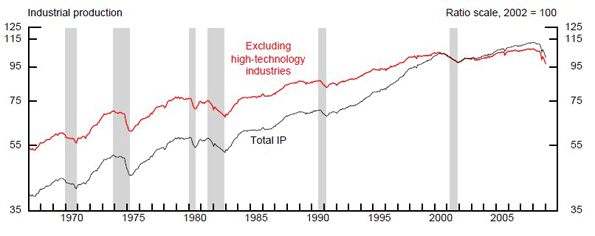
    Beyond this, can we as a country prosper if we don’t actually make things anymore? Some of the fear of manufacturing decline is overblown. Despite large scale job losses in the manufacturing sector, the US has continued to set industrial production records outside of recessions. However, as the chart below from the Federal Reserve shows, industrial production growth flattened significantly in the late 1990s.

    Sadly, manufacturing has been hammered in this Great Recession. There will certainly be a cyclical upturn in output, but restructuring in the automobile industry portends a permanent reduction in domestic output in that sector among others. Unless carefully handled, increasing regulation of carbon emissions, along with the associated energy price rises, will encourage further offshoring to countries with few climate change obligations, such as China, India, Brazil and other developing nations.

    Yet to remain both a prosperous and fair society, the United States must remain a manufacturing power. Manufacturing still provides the traditional route to middle class wages for those without college degrees. It also alone employs 25 percent of scientists and related technicians and 40 percent of engineers and engineering technicians.

    Of course, the next wave of manufacturing will differ greatly from the past. Improvements in productivity and global competition mean a bleak future for large scale, low value-added, routinized production. The era where an assembly plant provided thousands of good jobs at good wages is a thing of the past other than for the lucky few. And where there are new factories, they are often in greenfield locations like the new Honda plant in Greensburg, Indiana – halfway between Indianapolis and Cincinnati – not urban centers. Polluting heavy industry like primary metals and refining really are incompatible with neighborhoods. So what is to be done?

    One answer is to build a new industrial city focusing on small scale craft and specialty manufacturing with high value added. We’re seeing a precursor to this in the rise of organic farming and artisanal products of all kinds. TV shows featuring hip young carpenters renovating homes or gearheads tricking out cars and motorcycles make these professions seem glamorous. Magazines targeted at the global elite like Monocle scour the world in favor of the finest handcrafted products from old school workshops, building demand for these products. The New York Times Magazine recently did an article making the case for working with your hands, and also noted how digitally oriented designers are rediscovering the use of their hands. Perhaps it is no surprise that sociologist Richard Sennett turned his attention to the idea of the craftsman. In short, making things, craftsmanship, and quality are back in fashion.

    The challenge for urban economies is to develop this and put it on a sound industrial and economic footing. One key might be to inspire people to start these craft oriented businesses by tapping into people’s desire to purchase ethical and sustainable products. We increasingly see with foods and other items that people want to understand their provenance, to know who made them, how, with what, and under what conditions. Often today businesses catering to this desire are small scale “Mom and Pop” type operations, but there is no reason they can’t be done at greater scale, or expanded into areas like organic food processing, not just organic farming. American Apparel has done just that by manufacturing low cost, stylish clothing “Made in Downtown Los Angeles. Sweatshop Free.” at scale, for example.

    Beyond craft products, reinvigorating small scale, specialty fabrication and other businesses, to rebuild an American version of Germany’s Mittlesand, creates another, often ignored option for urban economies. Quality, flexibility, responsiveness, and a willingness to do small runs are keys. These businesses can also underpin product companies higher in the value chain. They start building an ecosystem of local companies and expertise that can be useful for related or spin-off businesses. Jane Jacobs, and before her the great French historian Fernand Braudel, noted how cities could incubate many new enterprises because all the diverse products and services they needed were available locally. If you need to scour the globe looking for custom parts and services, it can quickly overwhelm a small business. That’s one reason American Apparel started in Los Angeles, which already had a network of garment producing firms and expertise to draw on. What’s more, these firms might be ideal candidates to take over empty strip mall or other space in decaying inner ring suburbs, helping to solve the “graybox” problem. Even Main St. locations could potentially benefit from businesses beyond traditional boutiques.

    Today these types of specialty firms are often found in America’s largest cities, so they stand to benefit most from this. Smaller cities also need to figure out how to build this ecosystem. The culture needs to change too. Particularly in the Midwest/Rust Belt area, industrial labor has tended towards low skill, repetitive work in larger scale mass production industries. Retraining will be needed for these newer types of businesses, but this is vocational or skill training, not necessarily a college degree. It is a much more tractable problem.

    Not only could this new manufacturing base be a source of urban middle class jobs for the non-college degreed, it would do something arguably more important. It links the fortunes of the new upscale urban residents, the people who are both the customers for many of these products and potentially also the entrepreneurs making them, with that of their less educated neighbors. For many owners, managers, and workers, it might bring into daily contact people who might not otherwise ever interact if one group worked in an office and another in a warehouse. Rebuilding that sense of community and commonwealth, that we are neighbors, fellow citizens, and all in this together, is critical to building a truly sustainable, well-functioning and broadly prosperous society.

    Aaron M. Renn is an independent writer on urban affairs based in the Midwest. His writings appear at The Urbanophile.