Category: Policy

  • Glimpsing the Good in Police Chief Bratton’s Goodbye to L.A.

    Los Angeles Police Department (LAPD) Chief William Bratton’s pending departure makes now a good time to give him credit for a habit that draws scant attention amid talk of his traveling ways and unapologetic ego: The guy works very hard at every aspect of his duties.

    It’s a habit that can touch other lives as a matter of course. It touched me one morning at the Los Angeles Police Academy. Bratton had invited me there to address a graduating class with a reading of a column I had written about the challenges of policing our city. I sat on the main dais with my wife, while some of my other family members were in a front row to the right, where the sun soon drew a bead on them.

    At one point Bratton had finished an inspection of the graduates arrayed on the greensward and was returning to the main dais when he stopped smartly and told my family members to feel free to move back a row or two for some shade.

    It was a considerate gesture amid a precisely timed ceremony – made all the more so because Bratton had no way of knowing that one of my sisters had recently been treated for skin cancer. This is a younger sister of mine, and it’s been some time since she’s needed me to look out for her, but I still do in small ways.

    I took Bratton’s courtesy personally, as a helping hand. It was one of those moments when someone extends themselves without knowing the full effect of their effort. It was the residue of a solid work ethic. It was the by-product of a constant dedication to the protocol that helps inform a sense of duty.

    Bratton has it – and he will be missed.

    There are also plenty of very public reasons to regret Bratton’s departure. Crime has gone down consistently on his watch. Relations between LAPD and the city’s ethnic communities are better than ever, although there’s still work to be done. In any case, the agency has seen broad reform and earned a release from federal oversight.

    Yet there’s an opportunity to be found in taking a break from the intensity Bratton brings to his work. This is a fellow who comprehends much more than the core of policing, taking pains to understand anything that could have a significant bearing on the job, including technology and statistical analysis. Lately he’s talked about using those disciplines in something called predictive policing, an effort to pinpoint who is likely to commit crimes, at what times, and in which locations.

    I think we should all appreciate the fact that substantial individuals are dedicated to an exhaustive pursuit of new tools for law-enforcement.

    We should also remember, however, that Bratton is a cop who views the world from a cop’s perspective. That is altogether appropriate for him — and it leaves us with the responsibility of considering whether a hard-charging chief who is intrigued by predictive policing could hold the potential to bring serious erosion to our civil liberties.

    It’s true that we have elected officials and a judicial system to stand guard against incursions on our civil liberties, adding more than a cop’s view to the debate.

    That’s a bit shaky, though, given political trends of recent years.

    Bratton adds to my worries because he’s as good at politics as any politician in our city. I worry about having a police chief who not only has the ability and drive to get a grasp on something like predictive policing but might also have enough political skill to sell the notion in a way that bypasses healthy debate.

    Perhaps Bratton’s departure will provide time for Mayor Antonio Villaragiosa and others at City Hall to ponder the balance of liberty and security – and to consider how much of one we are willing to trade for the other.

    I thank Bratton for his dynamic approach to reshaping law enforcement in our city, and I certainly don’t intend to diminish his success at fulfilling the mission he took on in Los Angeles.

    I address my concerns to our elected officials, all of whom should recalibrate their relationships with the sort of authority figures who possess the ability to make folks feel safe.

    It could be downright unsafe to get in the habit of relying on a top cop to handle the whole job.

    Jerry Sullivan is the Editor & Publisher of the Los Angeles Garment & Citizen, a weekly community newspaper that covers Downtown Los Angeles and surrounding districts (www.garmentandcitizen.com)

  • Bloomberg Endorses “City of Aspiration” Report Recommendations in New Middle Class Plan

    Earlier this year, the Center for an Urban Future published an extensive report about the mounting challenges New York City faces in both retaining its middle class and elevating more low income residents into the ranks of the middle class. One of our key recommendations from that report, titled Reviving the City of Aspiration, was that “city and state officials must embrace community colleges as engines of mobility and dedicate the resources necessary to strengthen these institutions and ensure that a greater number of middle class, poor and working poor New Yorkers can attend these schools and complete their degrees.”

    City officials are now running with our suggestion. Today, Mayor Bloomberg announced a “Gateway to the Middle Class” plan that focuses on boosting community colleges. The mayor’s proposal aims to “move more New Yorkers into the middle class by increasing the number of city residents that graduate from community colleges and training them for higher wage jobs in growing industries.” The plan will invest an additional $50 million over the next four years to improve the system’s quality, accessibility, affordability, and accountability.

    The new attention and resources for community colleges is an important step in the right direction for the city. Our report found that community colleges in New York are overshadowed by virtually every other facet of the education system and have not received the financial support needed to effectively educate students that come from a wide variety of backgrounds and often require academic remediation. Click here to read the section of our report about community colleges, titled “A Platform For Mobility.”

  • Is the Stage Set for Another Housing Bubble?

    Both the world and the nation remain in the midst of the greatest economic downturn since the Great Depression. But with all the talk of “green shoots” and a recovery housing market, we may in fact be about to witness another devastating bubble.

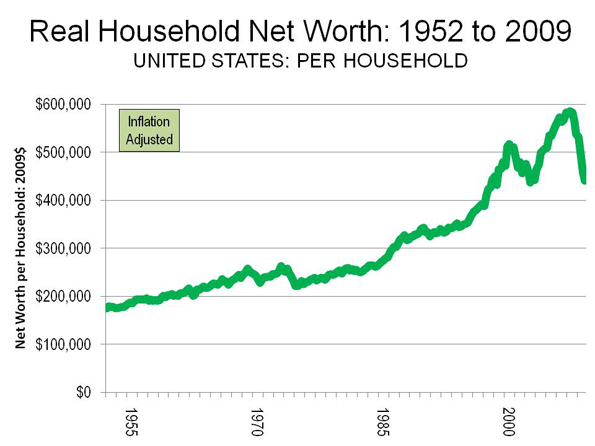
    As we well know, the Great Recession was set off the by the bursting of the housing bubble in the United States. The results have been devastating. The value of the US housing stock has fallen 9 quarters in a row, which compares to the previous modern record of one (Note). This decline has been a driving force in a 25 percent or a $145,000 average decline (inflation adjusted) in net worth per household in less than two years (Figure 1). The Great Recession has fallen particularly hard on middle-income households, through the erosion of both house prices and pension fund values.

    This is no surprise. The International Monetary Fund has noted that deeper economic downturns occur when they are accompanied by a housing bust. This reality is not going to change quickly.

    How did the supposedly plugged-in economists and traders in the international economic community fail to recognize the housing bubble or its danger to the world economy? It is this failure that led Queen Elizabeth II to ask the London School of Economics (LSE) “why did noboby notice it?”. Eight long months later, the answer came in the form of a letter signed by Tim Besley, a member of the Monetary Policy Committee of the Bank of England (the central bank of the United Kingdom) and Professor Peter Hennessey on behalf of the British Academy.

    The letter indicated that some had noticed what was going on,

    But against those who warned, most were convinced that banks knew what they were doing. They believed that the financial wizards had found new and clever ways of managing risks. Indeed, some claimed to have so dispersed them through an array of novel financial instruments that they had virtually removed them. It is difficult to recall a greater example of wishful thinking combined with hubris.

    The letter concluded noting that the British Academy was hosting seminars to examine the “Never Again” question.

    Among those that noticed were the Bank of International Settlements (the central bank of central banks) in Basle, which raised the potential of an international financial crisis to be set off by a bursting of the US housing bubble. Others, like Alan Greenspan, noticed, telling a Congressional Committee that “there was some froth” in local markets. Others, across the political spectrum, like Nobel Laureate Paul Krugman, Thomas Sowell and former Reserve Bank of New Zealand Governor Donald Brash both noticed and understood.

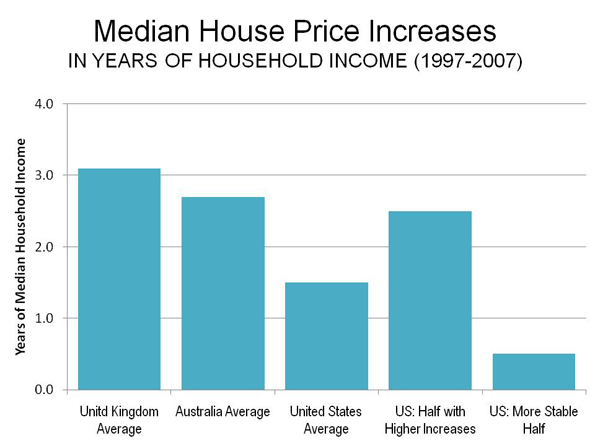
    Missing the Housing Market Fundamentals: The housing market fundamentals were clear. With more liberal credit, the demand for owned housing increased markedly, virtually everywhere. In all markets of the United Kingdom and Australia, house prices rose so much that the historic relationship with household incomes was shattered. The same was true in some US markets, but not others (Figure 2).

    On average, major housing markets in the United Kingdom experienced median house prices that increased the equivalent of three years of median household income in just 10 years (to 2007). The increases were pervasive; no major market experienced increases less than 2.5 years of income, while in the London area, prices rose by 4 years of household income. In Australia, house prices increased the equivalent of 3.3 years of income. Like the UK, the increases were pervasive. All major markets had increases more than double household incomes.

    Based upon national averages, the inflating bubble appears to have been similar, though a bit more muted in the United States, with an average house price increase equal to 1.5 years of household income. But the United States was a two-speed market, one-half of which experienced significant house price increases and the other half which did not. In the price escalating half, house prices increased an average of 2.4 times incomes. The largest increases occurred in Los Angeles, San Francisco and San Diego, where house prices rose the equivalent of 5 years income. In the other half of the market, house prices remained within or near historic norms relative to incomes. A similar contrast is evident in Canadian markets. In some, house prices reached stratospheric and unprecedented highs, while in others, historic norms were maintained.

    Underlying Demand: Greater Where Prices Rose Less: The difference between the two halves of the market was not underlying demand. Overall, the half of the markets with more stable house prices indicated higher underlying demand than the half with greater price escalation. Overall, the housing markets with higher cost escalation lost more than 2.5 million domestic migrants from 2000 to 2007, while the more stable markets gained more than 1,000,000 (Calculated from US Bureau of the Census data).

    The Difference: Land Use Regulation: The primary reason for the differing house price increases in US markets was land use regulation, points that have been made by Krugman and Sowell. This is consistent with a policy analysis by the Dallas Federal Reserve Bank, which indicated that the higher demand from more liberal credit could either manifest itself either in house price increases or in construction of new housing. Virtually all of the markets with the largest housing bubbles had more restrictive land use regulation.

    These regulations, such as urban growth boundaries, building moratoria and other measures that ration land and raise its price collaborated to make it impossible for such markets to accommodate the increased demand without experiencing huge price increases (these strategies are often referred to as “smart growth”). In the other markets, less restrictive land use regulations allowed building new housing on competitively priced land and kept house prices under control. The resulting price distortions leads to greater speculation, as has been shown by economists Edward Glaeser and Joseph Gyourko.

    A Wheel Disengaged from the Rudder: The normal policy response of interest rate revisions had little potential impact on the price escalating half of the housing market, because of the impact of restrictive state, metropolitan and local housing regulations. These regulations materially prohibited building on perfectly suitable land and thus drove the price up on land where building was permitted. So, while Greenspan and the Fed saw the “froth” in local markets, they missed its cause. The British Academy letter to the Queen is similarly near-sighted. Restrictive land use regulation has left central bankers in a position like a ship’s captain trying to steer a massive vessel with a wheel that is no longer connected to the rudder

    The Bubble Bursts: When teaser mortgage rates expired and other interest rates reset, a flood of foreclosures occurred, which led to house price declines that negated much of the housing bubble price increases in the United States. The most significant of these took place in restrictive markets, especially in California and Florida. By September of 2008, the average house had lost nearly $100,000 of its value in the more restrictively regulated half of the market, and averaged $175,000 in these “ground zero” markets. These losses were unprecedented and far beyond the ability of mortgage holders to sustain. This led to “Meltdown Monday,” when Lehman Brothers collapsed and the Great Recession ensued.

    By comparison, the losses in the more stable half of the market were modest, averaging approximately one-tenth that of the price escalating half.

    Can We Avoid Another Bubble? The experience of the Great Recession underscores the importance of having a Fed and other central banks that not only pay attention, but also understand. This requires “getting their hands dirty” by looking beyond macro-economic aggregates and national averages.

    This does not require an increasing of authority of the Federal Reserve or other central banks. As Donald L. Luskin suggested in The Wall Street Journal, we “don’t want the Fed controlling asset prices.” All we really need is for the Fed and other central banks to notice and understand what is going on, not only in housing, but in other markets as well.

    A public that depends upon central banks to minimize the effect of downturns deserves institutions that are not only paying attention, but also understand what is driving the market. The Fed should use its bully pulpit, both privately and publicly, to warn state and local governments of the peril to which their regulatory policies imperil the economy.

    There are strong indications that future housing bubbles could be in the offing. Not more than a year ago, the state of California enacted even stronger land use legislation (Senate Bill 375), which can only heighten the potential for another California-led housing bust in the years to come, while reducing housing affordability in the short run. There is a strong push by interest groups in Washington to go even further (see the Moving Cooler report), making it nearly impossible for housing to be built on most urban fringe land. This is a prescription for another bubble, this time one that would include the entire country, not just parts of it.


    Note: Quarterly data has been available since 1952 from the Federal Reserve Board Flow of Funds accounts


    Wendell Cox is a Visiting Professor, Conservatoire National des Arts et Metiers, Paris. He was born in Los Angeles and was appointed to three terms on the Los Angeles County Transportation Commission by Mayor Tom Bradley. He is the author of “War on the Dream: How Anti-Sprawl Policy Threatens the Quality of Life.

  • Immigrants Are ‘Greening’ our Cities, How About Giving them a Break?

    Debate about immigration and the more than 38 million foreign born residents who have arrived since 1980 has become something of a national pastime. Although the positive impact of this population on the economy has been questioned in many quarters, self-employment and new labor growth statistics illustrate the increasingly important role immigrants play in our national economy.

    There has also been an intense debate within the environmental community about the impact of immigrants. Yet there has been relatively little research done about how immigrants get to work and where most immigrants live. As the ‘green’ movement in the U.S. has increasingly pushed for higher-density housing and transit-oriented development in order to improve public transportation (specifically rail), few have considered how immigrants use transit and what might be the best way to accommodate their needs. In fact, all too often, “green” policies advocate transit choices – favoring such things as light rail over buses – that may work against the interests of immigrant transit riders.

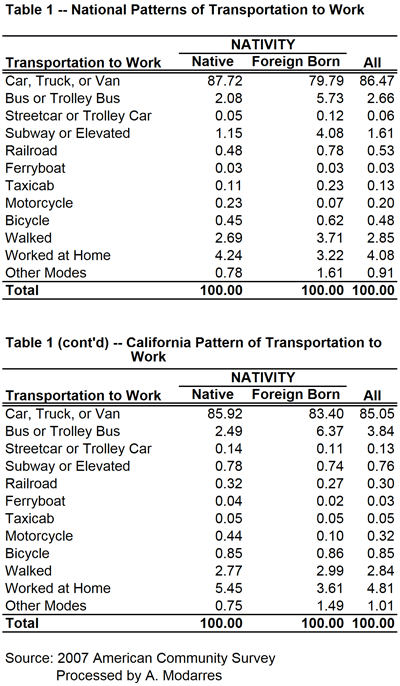
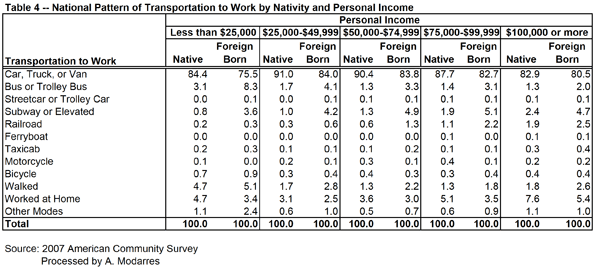
    Based on the 2007 American Community Survey, 117.3 million native-born and 21.9 million foreign-born individuals commuted to work. As Table (1) illustrates, a higher percentage of immigrants rode buses (5.7% vs. 2.1%) and subways (4.1% vs. 1.2%) and many walked to work (3.7% vs. 2.7%). A much smaller percentage drove to work (79.8% vs. 87.7%). Unfortunately, despite their higher usage of alternate means of transportation to work, or perhaps because of it, the commute to work time was on average longer for the foreign-born commuters than their native-born counterparts (28.8 minutes versus 24.7).

    Clearly in terms of using public transportation, immigrants are a bit greener than those born here. But why? Is this habit formed elsewhere? In that case, are recent immigrants even more likely to use public transportation than those who immigrated earlier? Or is it their income that affects their transportation choices?

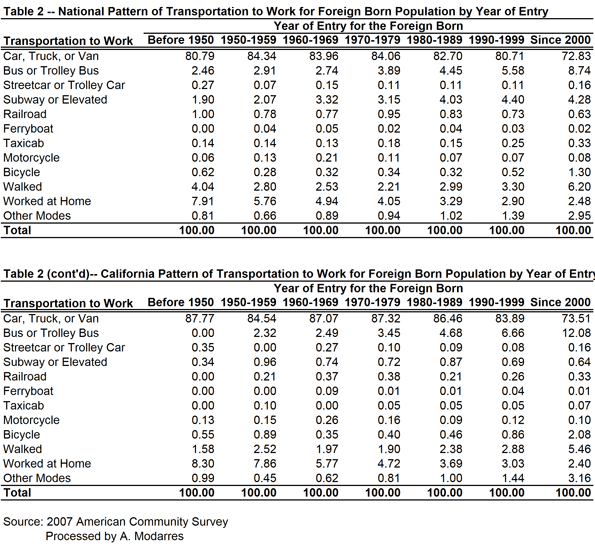
    Table (2) provides the answer to the first question. Recent arrivals are clearly less likely to drive to work and have a higher propensity toward using public transportation, compared to all foreign-born individuals (and significantly more than the native-born). Additionally, over 6% of the immigrants who have arrived since 2000 walk to work.

    Overall, more than a quarter of the immigrants who have arrived since 2000 use an alternative mode of transportation to work. If the rest of America could do the same, we’d be a bit ‘greener’ already. However, it seems that as immigrants stay longer, they eventually tend to use cars more often because automobile usage allows for access to better jobs, better shops, and better schools. For example, immigrants who arrived in the U.S. in the 1970s (which means they have been here over three decades) drive a bit more and use public transportation less.

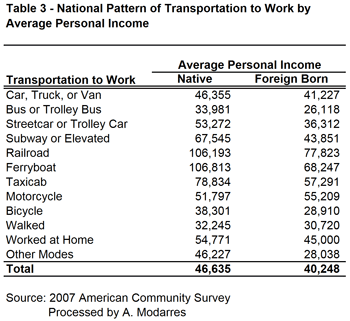
    Even so, their rates are still slightly better than the native-born (compare Tables 1 and 2). This may be in part because of their lower incomes (see Table 3) yet at every level of income they are still more likely to take transit. Table (4) illustrates this point by grouping commuters into income categories and their nativity. In every income category, immigrants use their cars less and are more likely to use public transportation, even though their car ridership increases with income.

    The message from these statistics is loud and clear. Immigrants are more likely to ride public transportation than those born in the U.S., regardless of their income. The ones arriving more recently are even more likely to do so. Overall, this suggests that familiarity with public transportation, combined with the effects of income and place of residence, has made the immigrants’ lives in the U.S. a bit ‘greener’ than those of the native-born. In fact, one factor that may contribute to their higher usage of public transportation stems from their living in neighborhoods whose densities are, on average, 2.5 times higher than those of the native-born. Immigrants, in essence, are doing precisely what planners want the rest of us to do.

    Moving to Southern California

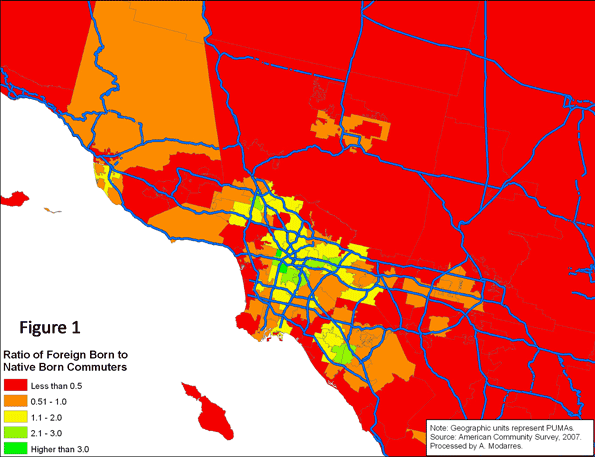
    Southern California still stands as the icon of immigration and multiculturalism and is home to a large number of immigrants in the urban region that extends from eastern Ventura County to the southern tip of Orange County and the Inland Empire. As Figure (1) illustrates, in a number of neighborhoods in Southern California, the foreign-born population outnumbers the native-born by large margins. For example, in areas west and south of downtown Los Angeles, immigrants are more than three times as numerous as the native-born.

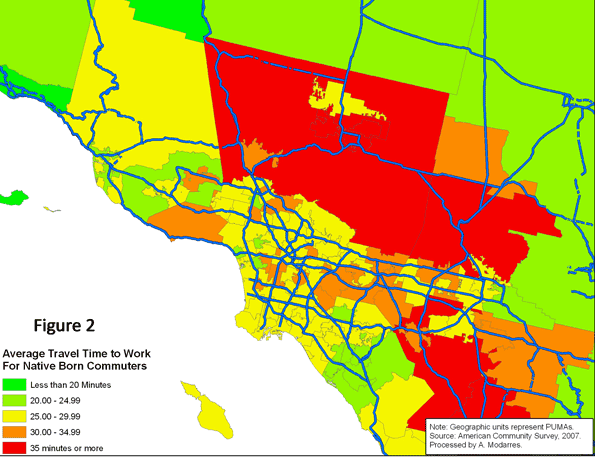
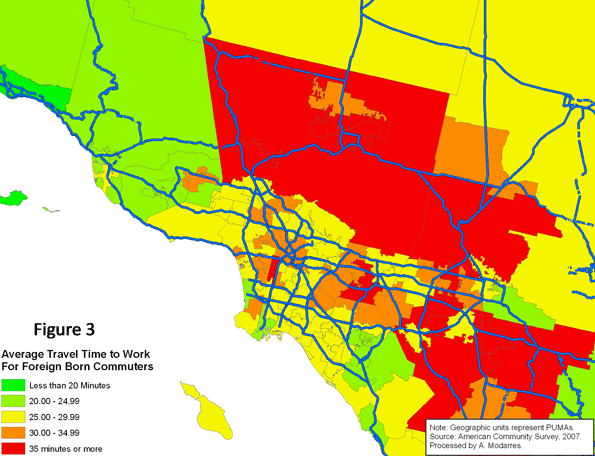
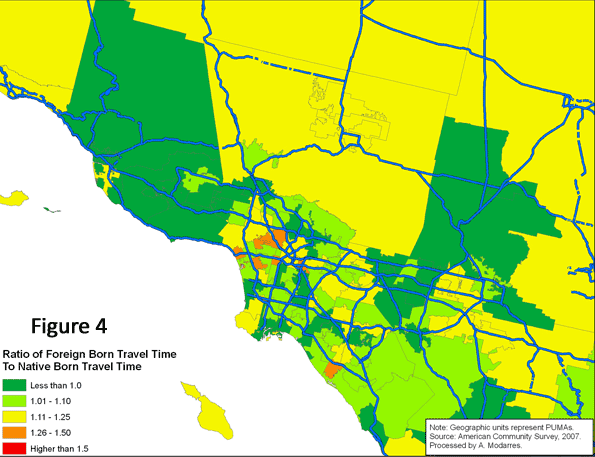
    A comparison of Figures (2) and (3) suggests a wide geographic difference between the native-born and the foreign-born and how long it takes them to get to work. The foreign-born population experiences much longer commutes in highly urbanized areas around downtown Los Angeles and the San Gabriel Valley. Conversely, in the more rural areas, such as northern Ventura County, the foreign-born population experiences shorter commutes compared to their native-born counterparts.

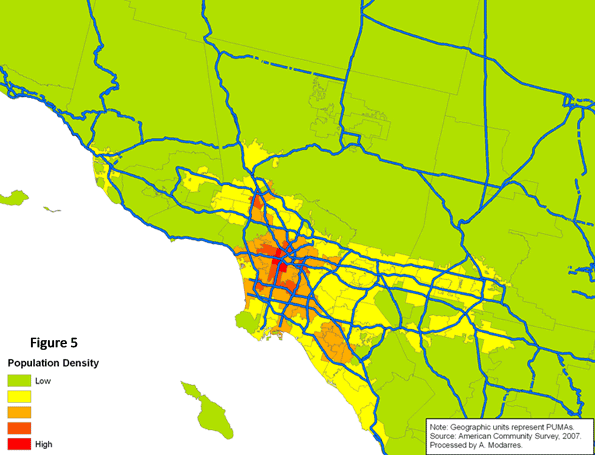
    Figure (4) provides a clear comparison of average travel time to work for both populations (visually comparing Figures 2 and 3). In all areas appearing in the darkest shade of green, the foreign-born population experienced shorter commutes compared to the native-born. These shorter commutes, however rarely occur in high density areas (compare with Figure 5). Conversely, in areas such as Santa Monica, the Wilshire corridor, East Los Angeles, and southern sections of downtown Los Angeles, the foreign-born population experiences much longer commutes than the native-born.


    Statistically speaking, there is a positive relationship between average travel time and density – i.e., the higher the density, the higher the reported average travel time. For the foreign-born population who live in higher density areas, this means much longer commutes, a problem caused by a number of factors, including their dependency on slower public transportation systems and the long distances they have to travel to reach job centers outside the city center.

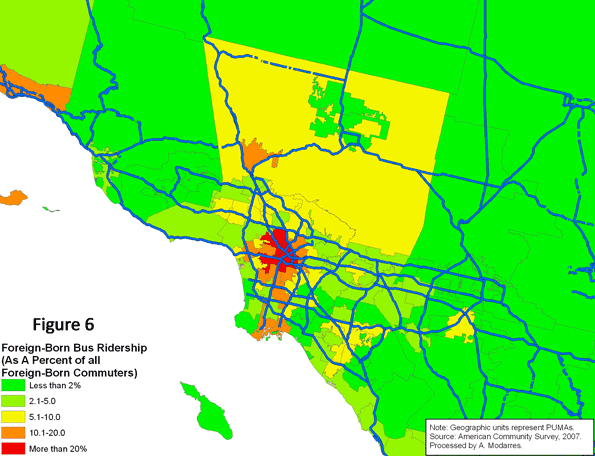
    Figure (6) illustrates the geographic pattern of bus ridership among the foreign-born commuters. As with national patterns, immigrants in Southern California are more likely to settle in high density areas and use public transportation to work, but unfortunately, they also suffer much longer commutes.

    What should the policy responses be? One may be to promote increased car ownership among immigrants and low-income populations in the U.S. This may be objectionable to some environmentalists and planners, but it’s clear that those people who live by the principles of higher density and public transportation use are not rewarded and indeed suffer longer commutes.

    An even more relevant question is why advocates for public transportation focus disproportionately on rail, when buses are so frequently used by low income populations, including immigrants. In California, these riders outnumber the native-born on buses. The situation is reversed on rail and subways. An intelligent policy response to public transportation planning would suggest that buses should receive much more attention. Major metropolitan areas have become polycentric in their employment patterns, and most major employment centers are located at long distances from the central city. Specially-designed buses for reverse commutes could help alleviate transportation problems while helping working immigrants reach their destinations more quickly.

    This challenges the priorities of some public transport advocates, who tend to focus on very expensive rail projects designed primarily to draw more middle class, largely native-born riders who commute to places like downtown Los Angeles. Meanwhile those ‘new’ Americans who already live by a number of ‘green’ standards suffer from the misallocation of transit resources. Those who are already doing what we hope the middle class will do deserve better.

    Ali Modarres is an urban geographer in Los Angeles and co-author of City and Environment.

  • Can Obama be deprogrammed?

    In my first foray into political life in the 1970s, I worked during college on the staff of a liberal Democrat in the Texas state Senate. Only a few years earlier, Patty Hearst had been kidnapped and brainwashed by the Symbionese Liberation Army, and a moral panic about cults seducing college kids was sweeping the nation. One result was the rise of a new, thankfully ephemeral profession: “deprogrammers” who for pay would kidnap a young person from a cult and break the spell, by means of isolation, interrogation and maybe reruns of “The Waltons.”

    A reactionary Republican state senator from the Houston area, who was heartily despised by my senator, introduced a bill granting parents the right to hire deprogrammers to kidnap adult children who belonged to what the parents regarded as cults and then confine them in motels for several weeks, subject to psychological coercion, without notifying the authorities. Needless to say, this deprogramming law was the greatest threat to the tradition of habeas corpus until another reactionary Texan was installed in the White House in 2001. The bill was laughed to death, when, during a hearing, the sponsor was asked if it could be used to deprogram young people who had joined a certain well-known cult. “Why, yes, Senator,” the Republican replied, “it would apply to cults like the Unitarians.”

    Boy, do we need deprogrammers now, to liberate Barack Obama from the cult of neoliberalism.

    By neoliberalism I mean the ideology that replaced New Deal liberalism as the dominant force in the Democratic Party between the Carter and Clinton presidencies. In the Clinton years, this was called the “Third Way.” The term was misleading, because New Deal liberalism between 1932 and 1968 and its equivalents in social democratic Europe were considered the original “third way” between democratic socialism and libertarian capitalism, whose failure had caused the Depression. According to New Deal liberals, the United States was not a “capitalist society” or a “market democracy” but rather a democratic republic with a “mixed economy,” in which the state provided both social insurance and infrastructure like electric grids, hydropower and highways, while the private sector engaged in mass production.

    When it came to the private sector, the New Dealers, with some exceptions, approved of Big Business, Big Unions and Big Government, which formed the system of checks and balances that John Kenneth Galbraith called “countervailing power.” But most New Dealers dreaded and distrusted bankers. They thought that finance should be strictly regulated and subordinated to the real economy of factories and home ownership. They were economic internationalists because they wanted to open foreign markets to U.S. factory products, not because they hoped that the Asian masses some day would pay high overdraft fees to U.S. multinational banks.

    New Dealers approved of social insurance systems like Social Security and Medicare, which were rights (entitlements) not charity and which mostly redistributed income within the middle class, from workers to nonworkers (the retired and the temporarily unemployed). But contrary to conservative propaganda, New Deal liberals disliked means-tested antipoverty programs and despised what Franklin Roosevelt called “the dole.” Roosevelt and his most important protégé, Lyndon Johnson, preferred workfare to welfare. They preferred a high-wage, low-welfare society to a low-wage, high-welfare society. To maintain the high-wage system that would minimize welfare payments to able-bodied adults, New Deal liberals did not hesitate to regulate the labor market, by means of pro-union legislation, a high minimum wage, and low levels of immigration (which were raised only at the end of the New Deal period, beginning in 1965). It was only in the 1960s that Democrats became identified with redistributionist welfarism — and then only because of the influence of the New Left, which denounced the New Deal as “corporate liberalism.”

    Between the 1940s and the 1970s, the New Deal system — large-scale public investment and R&D, regulated monopolies and oligopolies, the subordination of banking to productive industry, high wages and universal social insurance — created the world’s first mass middle class. The system was far from perfect. Southern segregationist Democrats crippled many of its progressive features and the industrial unions were afflicted by complacency and corruption. But for all its flaws, the New Deal era is still remembered as the Golden Age of the American economy.

    And then America went downhill.

    The “stagflation” of the 1970s had multiple sources, including the oil price shock following the Arab oil embargo in 1973 and the revival of German and Japanese industrial competition (China was still recovering from the damage done by Mao). During the previous generation, libertarian conservatives like Milton Friedman had been marginalized. But in the 1970s they gained a wider audience, blaming the New Deal model and claiming that the answer to every question (before the question was even asked) was “the market.”

    The free-market fundamentalists found an audience among Democrats as well as Republicans. A growing number of Democratic economists and economic policymakers were attracted to the revival of free-market economics, among them Obama’s chief economic advisor Larry Summers, a professed admirer of Milton Friedman. These center-right Democrats agreed with the libertarians that the New Deal approach to the economy had been too interventionist. At the same time, they thought that government had a role in providing a safety net. The result was what came to be called “neoliberalism” in the 1980s and 1990s — a synthesis of conservative free-market economics with “progressive” welfare-state redistribution for the losers. Its institutional base was the Democratic Leadership Council, headed by Bill Clinton and Al Gore, and the affiliated Progressive Policy Institute.

    Beginning in the Carter years, the Democrats later called neoliberals supported the deregulation of infrastructure industries that the New Deal had regulated, like airlines, trucking and electricity, a sector in which deregulation resulted in California blackouts and the Enron scandal. Neoliberals teamed up with conservatives to persuade Bill Clinton to go along with the Republican Congress’s dismantling of New Deal-era financial regulations, a move that contributed to the cancerous growth of Wall Street and the resulting global economic collapse. As Asian mercantilist nations like Japan and then China rigged their domestic markets while enjoying free access to the U.S. market, neoliberal Democrats either turned a blind eye to the foreign mercantilist assault on American manufacturing or claimed that it marked the beneficial transition from an industrial economy to a “knowledge economy.” While Congress allowed inflation to slash the minimum wage and while corporations smashed unions, neoliberals chattered about sending everybody to college so they could work in the high-wage “knowledge jobs” of the future. Finally, many (not all) neoliberals agreed with conservatives that entitlements like Social Security were too expensive, and that it was more efficient to cut benefits for the middle class in order to expand benefits for the very poor.

    The transition from New Deal liberalism to neoliberalism began with Carter, but it was not complete until the Clinton years. Clinton, like Carter, ran as a populist and was elected on the basis of his New Deal-ish “Putting People First” program, which emphasized public investment and a tough policy toward Japanese industrial mercantilism. But early in the first term, the Clinton administration was captured by neoliberals, of whom the most important was Treasury Secretary Robert Rubin. Under Rubin’s influence, Clinton sacrificed public investment to the misguided goal of balancing the budget, a dubious accomplishment made possible only by the short-lived tech bubble. And Rubin helped to wreck American manufacturing, by pursuing a strong dollar policy that helped Wall Street but hurt American exporters and encouraged American companies to transfer production for the U.S. domestic market to China and other Asian countries that deliberately undervalued their currencies to help their exports.

    By the time Barack Obama was inaugurated, the neoliberal capture of the presidential branch of the Democratic Party was complete. Instead of presiding over an administration with diverse economic views, Obama froze out progressives, except for Jared Bernstein in the vice-president’s office, and surrounded himself with neoliberal protégés of Robert Rubin like Larry Summers and Tim Geithner. The fact that Robert Rubin’s son James helped select Obama’s economic team may not be irrelevant.

    Instead of the updated Rooseveltonomics that America needs, Obama’s team offers warmed-over Rubinomics from the 1990s. Consider the priorities of the Obama administration: the environment, healthcare and education. Why these priorities, as opposed to others, like employment, high wages and manufacturing? The answer is that these three goals co-opt the activist left while fitting neatly into a neoliberal narrative that could as easily have been told in 1999 as in 2009. The story is this: New Dealers and Keynesians are wrong to think that industrial capitalism is permanently and inherently prone to self-destruction, if left to itself. Except in hundred-year disasters, the market economy is basically sound and self-correcting. Government can, however, help the market indirectly, by providing these three public goods, which, thanks to “market failures,” the private sector will not provide.

    Healthcare? New Deal liberals favored a single-payer system like Social Security and Medicare. Obama, however, says that single payer is out of the question because the U.S. is not Canada. (Evidently the New Deal America of FDR and LBJ was too “Canadian.”) The goal is not to provide universal healthcare, rather it is to provide universal health insurance, by means that, even if they include a shriveled “public option,” don’t upset the bloated American private health insurance industry.

    Education? In the 1990s, the conventional wisdom of the neoliberal Democrats held that the “jobs of the future” were “knowledge jobs.” America’s workers would sit in offices with diplomas on the wall and design new products that would be made in third-world sweatshops. We could cede the brawn work and keep the brain work. Since then, we’ve learned that brain work follows brawn work overseas. R&D, finance and insurance jobs tend to follow the factories to Asia.

    Education is also used by neoliberals to explain stagnant wages in the U.S. By claiming that American workers are insufficiently educated for the “knowledge economy,” neoliberal Democrats divert attention from the real reasons for stagnant and declining wages — the offshoring of manufacturing, the decline of labor unions, and, at the bottom of the labor market, a declining minimum wage and mass unskilled immigration. One study after another since the 1990s has refuted the theory that wage inequality results from skill-biased technical change. But the neoliberal cultists around Obama who write his economic speeches either don’t know or don’t care. Like Bill Clinton before him, Barack Obama continues to tell Americans that to get higher wages they need to go to college and improve their skills, as though there weren’t a surplus of underemployed college grads already.

    Environment? Here the differences between the New Deal Democrats and the Obama Democrats could not be wider. Their pro-industrial program did not prevent New Deal Democrats from being passionate about resource conservation and wilderness preservation. They did not hesitate to use regulations to shut down pollution. And their approach to energy was based on direct government R&D (the Manhattan Project) and direct public deployment (the TVA).

    Contrast the straightforward New Deal approaches with the energy and environment policies of Obama and the Democratic leadership, which are at once too conservative and too radical. They are too conservative, because cap and trade relies on a system of market incentives that are not only indirect and feeble but likely to create a subprime market in carbon, enriching a few green profiteers. At the same time, they are too radical, because any serious attempt to shift the U.S. economy in a green direction by hiking the costs of non-renewable energy would accelerate the transfer of U.S. industry to Asia — and with it not only industry-related “knowledge jobs” but also the manufacture of those overhyped icons of the “green economy,” solar panels and windmills.

    While we can’t go back to the New Deal of the mid-20th century in its details, we need to re-create its spirit. But short of confining them in motel rooms and making them watch newsreels about the Hoover Dam, Glass-Steagall, the TVA and the Manhattan Project, is it possible to liberate President Obama and the Democratic leadership from the cult of neoliberalism?

    This article first appeared at Salon.com

    Michael Lind is Whitehead Senior Fellow at the New America Foundation and Director of the American Infrastructure Initiative.

    Official White House Photo by Pete Souza.
  • One Step for Short-term Economic Stimulus, and One Giant Leap (backward) for U.S. Energy Sustainability

    The “cash for clunkers” (or CARS) program that was widely predicted to be extended by the Congress has been, if nothing else, a clear public relations win for the Obama Administration. It may also be, at least for the short-term, a shot in the arm for the beleaguered American auto industry (including domestic dealerships of foreign car companies, like Honda and Toyota). But the program’s extension may also be bad news for anyone who was hoping that candidate Obama’s campaign promises to fix our domestic energy policy would translate into something resembling a robust make-over.

    Don’t get me wrong; I am a huge fan of President Obama. And I am generally very supportive about what the Administration is trying to do. The President’s agenda is nothing if not ambitious, or may be better described as audacious. In no particular order, President Obama is seeking to fix the environment, reform the healthcare system, overhaul banking and financial services regulations, reverse a downwardly spiraling national and global economy, repair race relations in America, and get drivers to cease texting and talking on their cell phones while driving.

    And yet, one of President Obama’s greatest strengths may also be his greatest weakness: The willingness and ability to compromise, as it is the fundamental nature of compromise that the outcome will inevitably be less than ideal. This consequence of compromise can be seen clearly in the President’s efforts to secure Congressional approval of an additional $2 billion in funding for the CARS program.

    The initial concept behind CARS was elegant in its simplicity: give owners of “gas-guzzlers” (i.e. automobiles with highly inefficient internal combustion engines) a monetary incentive to trade their fuel inefficient vehicles for highly fuel-efficient replacements. The auto industry – albeit more centered in Tokyo than Detroit on this point – clearly is producing numerous passenger vehicles capable of achieving a combined city/highway rating of 30 miles-per-gallon (mpg) or more. Yet there remain a number of registered motor vehicles in the U.S. with substantially less than 18 mpg ratings under the program (any vehicle with a mpg rating above that is not worthy of the “clunker” moniker).

    If this was the Administration’s original goal for the CARS program, the $1 billion authorization could have had a considerable impact on fuel consumption. Assuming the maximum rebate of $4,500 on every trade-in, almost a quarter of a million (222,222 to be exact) fuel-inefficient vehicles would have been voluntarily taken off America’s roads. Great idea! Triple that program funding amount to $3 billion, coupled with the same lofty goal, and two-thirds of a million fuel inefficient cars would have been swapped out for highly fuel efficient cars. If the average driver puts 12,000 miles per year on a car, and the average improvement in fuel efficiency is 12 mpg (i.e. from 18 mpg to 30 mpg) the program would save 1,000 gallons of gas per car, per year, or 666,666,000 gallons of gas annually.

    If only this purpose – to incentivize drivers to purchase only the most fuel efficient vehicles – had remained the thrust of the CARS program. However, it seems that the elegant simplicity behind the CARS concept became intertwined in the “since the government now owns GM and Chrysler don’t you think we should do something to spur domestic car sales” debate. All of a sudden, light trucks (the product type on which the Big Three hung their hats and, subsequently, on which they were hung by their collective petard) became eligible provided they are more fuel-efficient than the millions of light trucks already registered and on domestic highways. So, instead of a rising fleet of truly efficient cars we now see sales of new SUVs of all sizes and dimensions, and not just the recently introduced hybrid versions, being allowed a “cash-for-clunkers” rebate. All that is necessary is for the trade-in vehicle to qualify under CARS and the newly purchased SUV achieve a paltry 18 combined mpg.

    In other words, the concept behind the initial legislation appears to have quickly devolved from “let’s incentivize the best consumer behavior possible when it comes to fuel efficiency” to “let’s get people to buy passenger cars, SUVs, and light trucks.” The Hummer H3, for example, with an MSRP of less than $45,000 (the maximum MSRP allowed under CARS), and a combined city/highway mpg of 18, could qualify for the rebate program (hoping the irony is not lost on anyone that a vehicle, the Humvee, that was the exclusive product of a publicly owned entity, the Defense Department, ended up being the product of another publicly owned entity, GM).

    There’s no doubt that CARS was wildly successful in its public debut, so much so that the $1 billion in federal rebate funds were projected to run out within the first 30 days of the program’s roll-out. Car dealerships and automakers were as ecstatic in their praise for the program as they were vociferous in their clamor to seek the additional $2 billion in Congressional funding. However, the pace at which the CARS rebates were utilized strongly suggests that the cash-for-clunkers program would have been equally successful even if Congress had stuck to the original premise of the program: To get car owners to trade in the worst mpg offenders for the exemplars of fuel efficiency. Instead, Congress and the Administration have botched the chance to make a real, lasting difference, while spending $3 billion in the process.

    So here are the “outcomes” of CARS thus far: According to cars.com, the top ten fuel-efficient cars sold in the U.S. range from the Honda Fit (32 combined mpg) to the Toyota Prius (46 combined mpg). However, based on statistics tracked by jalopnik.com, of the top ten new vehicles purchased using CARS rebates only two, the Toyota Prius (#1 in fuel efficiency and #4 in most-purchased) and the Honda Fit (#10 in fuel efficiency and #9 in most-purchased), are on both lists (see the table below). In fact the list of the most-purchased vehicles using CARS rebates appears to be comprised of more lower-priced cars (e.g. the Chevy Cobalt and Hyundai Elantra) and cars that were already very high-volume sellers before the economic downturn (e.g. Toyota Camry and Corolla).

    Ten Most-Purchased Vehicles Using CARS Rebate*

    Ten Most Fuel-Efficient Vehicles Sold in the U.S.**

    1

    Toyota Corolla

    1

    Toyota Prius 48/45/46 mpg

    2

    Ford Focus FWD

    2

    Honda Civic Hybrid 40/45/42 mpg

    3

    Honda Civic

    3

    Smart Fortwo 33/42/36 mpg

    4

    Toyota Prius

    4

    Nissan Altima Hybrid 35/33/34 mpg

    5

    Toyota Camry

    5

    Toyota Camry Hybrid 33/34/34 mpg

    6

    Hyundai Elantra

    6

    Volkswagen Jetta TDI 30/41/34 mpg

    7

    Ford Escape FWD

    7

    Ford Escape Hybrid*** 34/31/32 mpg         

    8

    Dodge Caliber

    8

    Toyota Yaris 29/36/32 mpg

    9

    Honda Fit

    9

    MINI Cooper/Clubman 28/37/32 mpg

    10

    Chevrolet Cobalt

    10

    Honda Fit 28/35/31 mpg

    *as posted on jalopnik.com Aug. 7th

    **as posted on cars.com Aug. 7th, city/hwy/combined mpg                             

    *** also includes Mercury Mariner/Mazda Tribute Hybrid

    Inasmuch as Congress has already approved the additional $2 billion for the CARS program – without improving the fuel efficiency goals the program incentivizes – then why don’t we at least be honest about it and just add the $3 billion CARS price tag to the federal auto industry bailout. Sadly, as it stacks up now, claiming that this program is all about fuel efficiency or domestic energy policy is a sham.

    Peter Smirniotopoulos, Vice President – Development of UniDev, LLC, is based in the company’s headquarters in Bethesda, Maryland, and works throughout the U.S. He is on the faculty of the Masters in Science in Real Estate program at Johns Hopkins University. The views expressed herein are solely his own.

  • Confronting Street Art

    By Richard Reep

    Street art has been around since ancient times, with the triple theme of craft, sabotage, and branding. Paris’ “Blec le rat” and New York’s Taki 183 were early pioneers in street art. Today, street art has spread into nearly every city with artists, media, and collectors. Skateboards, tattoos, stickers, and spray paint are but a few examples of the craft of the street. The adrenalin rush an artist feels in executing his work is augmented by the urban thrill of working at night, rushing to leave behind a signature before the police come. The chief aim of most street art is branding, as the artist’s main form of expression is to create a recognizable personal logotype.

    On the street, the city’s public space in general has slowly been eviscerated by our culture of consumption, for it provides an antiquated, nearly obsolete physical format for civic discourse. Long ago proclaimed dead by noted architect Daniel Liebeskind, physical public space has precipitously declined in value to most of the citizens of the city. In its place has risen virtual public space – first television, which was a one-way path, and then the internet, which provides a two-way path.

    Yet physical public space continues to serve as medium of the new Street Art form. Stickers, tags, skateboards, and tattoos are all viewed on the street, offering a means to carry this new art form into the next century. The so-called “cutting edge” artists have retreated into their private studios to conceive their next moves in video or computers, but the street artists have taken over the city.


    The elite artists may inhabit the galleries but street artists proclaim their brand of art as supreme. Globalism is achieved by hard work: Artists like Barry McGee or Banksy are no longer confined to one city; Space Invader, having successfully placed his own particular brand across the face of Paris, now has spread to London and New York, making his own global art tour as a form of civic art.

    Viewing a piece of graffiti at once causes a reaction of fear and a perception of danger. Can anyone claim the same immediate, visceral reaction to anything seen in a gallery or museum? This art form reaches people at such a gut level that it trumps most of the work of other artists being exhibited and discussed in the art world. Street artists use this to their own advantage, and their craft reinforces what McLuhan described so well in his epigram “the medium is the message.” The content of the piece is almost irrelevant; the viewer’s reaction is the same regardless of the tag’s content or author.

    Street art is tied into a larger urban culture, and expresses the visual aspect of this larger milieu. As Western mainstream culture retreats from the street into the air-conditioned, connected bubbles of the suburbs, street art and its culture expands to fill the empty space. The zone emptied by the suburbanites does indeed reek of death, more so today, as public investment in the city dwindles or becomes remarkably predictable or prosaic. Budget cuts in schools, government facilities, and even basic street maintenance presage an ever higher level of decay and disrepair, of neglect and abandonment of our shared space, and those who inhabit this space are simply documenting what they see and returning it back to us. We cannot escape the messages of street art, for they are everywhere, embedded into the context. Some are more overt, and some are covert – only noticed, for example, when waiting for a red light – but they are there, reminding us that there is life amidst the emptiness.

    Graffiti’s barrage of skulls, vacant-eyed cartoon children, and other signs of death and destruction are easy to ignore, but they are telling us something important about the urban environment. The sooner we stop and examine this evidence, the sooner we can begin a process to find common ground, and to seek out a shared vision that does not divide the urban world into an us-and-them mentality. Street art simply puts visual form to the voices we have so long shut out of the urban conversation.


    In Orlando, the trend of giving street artists “permission walls,” or walls where they have permission to paint their work, has tamed and channeled some of the sabotage. By allowing graffiti artists to work with permission, they are free to develop their craft without fear of getting caught before completion, and the artwork becomes a colorful, mural-sized effort to which the artists can point with pride. These permission walls encourage friendly competition between teams, or crews, and there is a sense of pride among them for having created something with great exposure.

    Two permission walls exist to the east of downtown Orlando, but it is the cluster of warehouses at 630 E. Central that showcase graffiti artwork at its best. Artist Robin Van Arsdol owns part of this cluster and has been sponsoring an international graffiti conference for several years, bringing in artists from Europe, the Caribbean, and North America for a weekend of painting at his studios. Driving by his property offers a study in converting urban form into art, and perhaps suggests the visual future of more than one city.

    The graffiti artists have offered a philosophical change-up that should not be overlooked. The conversation about postmodern art seemed to have reached a dead end some time ago; artists
    first threw out figure, then form, then color, then the frame, and then wandered into their process itself as an art form. Graffiti artists begin with the end: their signature, or tag, becomes the art,
    and by using this as the starting point, and the city as their canvas, they unconsciously offer a new beginning to think about the relationship between art and the city.

    We must accept the challenge that graffiti artists offer us. We need to confront this takeover of the physical urban form and push back. Street art constitutes a fresh, interesting language. It is the language of a city that is weak and divided. We must hear what graffiti says to us as a society, and retake our physical urban character as a common, broad place that offers secure, sacred, and special places for all citizens. By ignoring graffiti art, we postpone our treatment of the urban malaise. By confronting it and bringing it into the mainstream, we can better treat our urban condition and improve the city as a dwelling place for the benefit of all.

    Richard Reep is an Architect and artist living in Winter Park, Florida. His practice has centered around hospitality-driven mixed use, and has contributed in various capacities to urban mixed-use projects, both nationally and internationally, for the last 25 years.

  • Reducing Vehicle Miles Traveled Produces Meager Greenhouse Gas Emission Reduction Returns

    Senators Jay Rockefeller (D-West Virginia) and Frank Lautenberg (D-New Jersey) have introduced legislation that would require annual per capita reductions in driving each year. Another bill, the National Transportation Objectives Act, introduced by Representative Rush Holt (D-Indiana), Representative Russ Carnahan (D-Missouri) and Representative Jay Inslee (D-Washington.) would require a 16 percent reduction in driving in 20 years.

    Last week, a highly publicized report by the Urban Land Institute (Moving Cooler) also called for policies that would reduce the vehicle miles traveled (VMT) by people in their cars. This report was analyzed here by Alan Pisarski). The reductions in driving would be achieved by highly intrusive land use policies that would make it impossible for most Americans to live where they want, allow for only minor expansion of roadway capacity and force almost all new development to be within existing urban footprints. It would employ such radical strategies as forcing people to pay $400 per year to park their cars in front of their own homes.

    The assumption behind these initiatives is that reducing driving will produce substantial reductions in greenhouse gas emissions. It sounds like a simple enough proposition, since cars emit greenhouse gases in direct proportion to the gasoline they consume. It would seem logical that reducing their use would lower their emissions by a similar percentage. Moving Cooler assumes that for every 10 percent reduction in driving miles, there will be a 9 percent reduction in greenhouse gas emissions.

    Meager GHG Emission Reductions from Reducing Driving: But things are not nearly so simple. It appears that reducing vehicle miles would not produce a similar reduction in greenhouse gases from cars.

    It is well known that at the slower speeds of vehicle operation in cities, fuel economy tends to decline with speed. Further, as congestion increases, so does fuel consumption, due to longer idling periods (such as at signals or in stopped traffic), more acceleration and more deceleration. Thus, not only does fuel economy drop when average speeds drop, but it drops even further when traffic congestion intensifies. The extent to which any reduction in urban driving would reduce greenhouse gas emissions is not at all well known, simply because there has been insufficient research on the subject.

    Perhaps the best indication is a comparison of Environmental Protection Agency (EPA) “driving cycles,” which are tests used to estimate some emissions (although not greenhouse gases) and fuel economy. There is considerable data for the normal urban cycle, which replicates driving conditions in most of the nation’s urban areas. There is much less information available for the “New York City Cycle,” which replicates the congested traffic conditions in New York City, which is far more congested than any of the nation’s urban areas (Note).

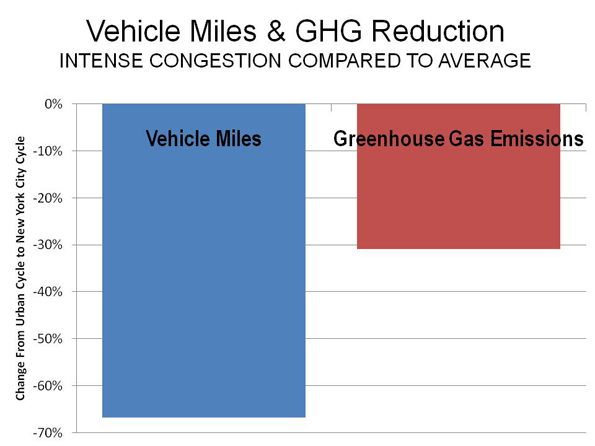
    Under the New York City Cycle average speeds are two-thirds less than under the average urban cycle. This reduction in speed and increase in congestion results in a 50 percent loss in fuel economy, according to an Argonne National Laboratory Study. Thus, between New York City and the average urban area, fuel efficiency drops at a rate 80 percent of the lower driving rate in New York City.

    On average, vehicle travel in New York City is approximately 8 miles per capita daily. In the average large urban area outside New York City (such as the Phoenix urban area, or for that matter the suburbs of New York City), vehicle travel is approximately 24 miles per day per capita. Thus, per capita driving in New York City is 67 percent less than in Phoenix. However, because of the loss in fuel consumption, the greenhouse gas emissions from cars per capita is only 31 percent less (Figure 1). Thus, the limited data indicates that nearly one-half of the greenhouse gas emissions difference between New York City driving rates and Phoenix driving rates are cancelled out by the impacts of slower speeds and increased congestion.

    Shortcomings of Policies to Reduce Driving: UCLA’s Lewis Center for Regional Policy Studies Program on Local Government Climate Action Policies raised concerns about relying on VMT reduction policies in a submittal to the California Air Resources Board:

    Especially in congested areas of California, VMT is an inadequate proxy for vehicle greenhouse gas emissions.

    Yet it is precisely more intense traffic congestion that we can expect if federal laws and policies should force most development into present urban footprints. Between 2010 and 2030, nearly 70,000,000 residents will be added to US urban areas, an increase of more than 25 percent. This increase would mean that the legislation introduced by Congressmen Hold, Carnahan and Inslee would require a one-third reduction in per capita driving to achieve its overall 16 percent reduction. Per capita driving declines such as those envisioned by the Congressmen or Moving Cooler have never occurred before in any American (or international) urban area. By comparison, charging people $400 to park their cars in front of their houses seems utterly reasonable.

    Further, higher population densities are associated with more intense traffic, both at the national and international level. Policies such as recommended by Moving Cooler would produce little additional highway capacity to handle the far higher levels of driving produced by a larger population. We could expect traffic congestion to increase markedly. It would take longer to get to work and local air pollution would be more intense (a health impact largely ignored by proponents of higher densities).

    The Economic Cost: A serious economic toll would be produced by more grid-locked urban areas, because of the positive relationship between personal mobility and economic performance. Remy Prud’homme and Chang-Woon Lee of the University of Paris have shown that greater economic mobility is associated with greater economic growth. Greater personal mobility also alleviates poverty, according to a Progressive Policy Institute study):

    In most cases, the shortest distance between a poor person and a job is along a line driven in a car. Prosperity in America has always been strongly related to mobility and poor people work hard for access to opportunities. For both the rural and inner-city poor, access means being able to reach the prosperous suburbs of our booming metropolitan economies, and mobility means having the private automobile necessary for the trip. The most important response to the policy challenge of job access for those leaving welfare is the continued and expanded use of cars by low-income workers.

    The UCLA submission further notes that policies aimed at reducing driving could damage the economy:

    … policies which seek to reduce VMT may hinder economic growth without reducing emissions.

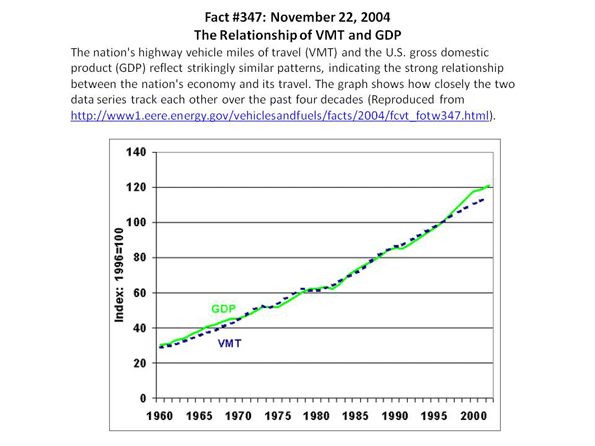
    The relationship between greater mobility and economic prosperity is also demonstrated at the national level. This is vividly illustrated in the chart from the United States Department of Energy (Figure 2).

    The significant improvements in fuel economy from higher mileage cars and less carbon intensive fuels will do far more to reduce greenhouse gas emissions from cars than the meager results that can be achieved by heavy handed policies to “coerce” people out of their cars (as Secretary of Transportation Ray LaHood put it). And, critically, it would do so with far less impact on both economic and physical mobility.

    Both the Economy and Greenhouse Gas Emissions at Stake: With the economic challenges facing the nation, policy makers need to steer clear of strategies that hobble the economy, like forcing people to drive less (or pay $400 to park in front of their houses) and make only minor improvements in reducing emissions. Indeed, a society with less money will have less to spend on reducing emissions through the adoption of new technologies that offer greater hope for creating a more prosperous as well as more environmentally sustainable society.


    Note: The New York City refers to the City of New York, not the metropolitan area or the urban area.


    Wendell Cox is a Visiting Professor, Conservatoire National des Arts et Metiers, Paris. He was born in Los Angeles and was appointed to three terms on the Los Angeles County Transportation Commission by Mayor Tom Bradley. He is the author of “War on the Dream: How Anti-Sprawl Policy Threatens the Quality of Life.

  • People, Planet, Prefurbia

    The term “sustainable” relates to a concept called the “Triple Bottom Line” (TBL): People, Planet, and Profit (the three P’s), endorsed by the United Nations in 2007 for urban and community accounting.

    American suburban land planning is about the SBL (Single Bottom Line): Profit. In city after city, mindless cookie cutter subdivisions, with characterless architecture, serve cars more than people. This dysfunction is caused by the boiler-plate regulations; engineers adhere to the minimum dimensions mandated by city ordinances to gain density, which maximizes developer’s profits. City council and planning commission members are appalled by the monotonous plans developers submit. Subdivisions that meet the minimums must be eventually approved. Developers are judged as evil, but they rely on the engineer who simply follows the city rules. Everyone mistakenly trusts that the consultant whose business card says “Land Planner” is the expert who will lay out the best development. However, “Land Planning” is not a regulated profession.

    What? Astonishingly there are no regulatory requirements to prevent anyone from representing him or herself as a land planner… you too can become one by simply printing the title on your business card, and everyone will assume that you, too are an expert. The suburbs have been ripe for a preferable system, one that we call ‘Prefurbia’. The concept was recently featured in Environmental Protection because of its potential for urban renewal. In terms of what it can do for suburbs, compare Conventional development to Prefurbia in terms of the three P’s of sustainability:

    People: Conventional Subdivision

    The land planner subdivides lots into ordinance minimums. If the city requires that a percentage of the site be set aside for open space, the area likely to be chosen is one that would not be fit for construction, rather than the best open space location for residents. Streets are designed first, then lots. No attention is given to the home or townhome unit other than a “pad” size to fit the structure. The main design focus is always the street layout (also true in Smart Growth plans). If there are any walkways, they parallel the street edge. The typical suburban maze-like street pattern is often difficult to drive through, and even more difficult for pedestrians, which further encourages a drive over a stroll. Suburban Land Use Transitions (zoning) place the lowest income (highest densities) in the most undesirable places. Positioning a high concentration of families overlooking loading docks along the rear of strip retail centers is not just acceptable, it’s encouraged.

    People: Prefurbia

    In Prefurbia, the Neighborhood Planner designs the pedestrian system first. Destinations for the walks are targeted as a basis for the open space “system,” assuring convenient pedestrian connectivity through the developers land. This is called a Pedestrian Oriented Design (POD). In Prefurbia, the suburban desire for space reigns supreme. Each home, attached or detached, is designed to assure that living areas are placed along the best views, giving the illusion of low density. The consultants who design the Prefurbia neighborhood (architects, planners and engineers) must do something that is foreign to them: they need to actually talk to each other! The architectural floor layouts, interior walls and window locations are an integrated component of the overall neighborhood, a first for land planning. Housing is situated so that each home sculpts a unique streetscape, eliminating monotony while embracing individualism (even if the architecture is somewhat repetitive).

    Prefurbia land use places higher density along the most desired site amenities without regard to residents income. In the design process, all income levels are treated as upper class. This new land use theory is called Connective Neighborhood Design (CND).

    Retail in Prefurbia is called the Neighborhood Marketplace. Neighborhood congregation areas such as patios, boardwalks, decks, ponds, etc., are placed along the rear of retail centers, which are also main pedestrian destinations. Since the Prefurbia pedestrian systems are separate from streets, there are few conflict points with vehicles. When walks are situated along streets they meander gracefully as far from the street edge as possible.

    Planet: Conventional

    Subdivision planning sets homes parallel to the edge of the street at the exact minimum distance allowed by regulations. The land planner must stretch the street as much as possible through the site to gain density (also true with Smart Growth design). The developer is burdened with constructing enormous street and utility main lengths to achieve the greatest density. Traffic flow is an afterthought.

    Planet: Prefurbia

    The Prefurbia Neighborhood Planner designs something very unnatural… a plan with dimensions greater than the minimums. Using entirely new geometric theory made practical by new technologies, the Neighborhood Planner separates the street pattern from the positioning of the homes, which results in lesser street length, but maintains density. This creates more organic (non-paved) space – lots of it! It’s more art than science to create independent, meandering shapes that open up the streetscape. In this scenario, it’s possible to maintain density by reducing the length of street by (typically) 25% compared to conventional planning and up to 50% compared to Smart Growth principals.

    The extra landscaped area allows the Prefurbia Neighborhood Engineer to design with much lower environmental impact, and to reduce development costs. The flowing vehicular pattern reduces both time and energy when driving through the neighborhood. All of this together means that in Prefurbia, Green is affordable. Imagine the implications worldwide.

    Profit: Conventional

    A cookie-cutter subdivision developer relies on a price point to generate a profit. The local Land Planner is likely to design the same style for all clients with the thought that the minimum dimensions allowed by ordinance are in fact the absolute dimensions. Because of this, most, if not all, of the developments within the town will look and feel alike. Because competing developments look the same they must compete mainly on price. Selling cheaper to make a profit makes little sense. This is made worse when the Conventional (and Smart Growth) design requires the longest possible street lengths (and, therefore, costs) to achieve density. With the reduced lot values today, building excessive infrastructure from Conventional and Smart growth design can make many developments unprofitable.

    Financial Sustainability: Prefurbia

    Profit is not the correct word to describe the financial advantages of Prefurbia. A home is not something that is disposable after the initial sale. Subdividing land sets a pattern that continues to exist for many centuries. An average home sells once every six years. If the number of residents for each home represents just three people, a 100 unit layout will affect the lives and finances of 10,000 people over two centuries. The financial advantage of Prefurbia is based on a significant reduction of infrastructure that’s needed for development, which allows more funds to be spent on curb appeal. The ability to pay more attention to character building (architectural and landscaping elements) without increasing the initial home price provides a tremendous market advantage.

    Will the home buyer or renter prefer the claustrophobic garage grove subdivision over the beautiful, functional, open Prefurbia neighborhood? The advantages will continue to provide financial sustainability every time a resident resells the property.

    And with a significant reduction of public infrastructure, the municipality is the big winner. A 25% reduction in streets translates into 25% less cost to maintain, yet the tax base stays the same. With the increase in open space, Prefurbia neighborhoods can justify an increase in density that reduces the effects of sprawl.

    Perhaps the best news is that Prefurbia can be ideal not just to develop new suburbs and exurbs, but to redevelop urban areas… and maybe to rewrite the triple bottom line to People, Planet, Prefurbia.

    Rick Harrison is President of Rick Harrison Site Design Studio and author of Prefurbia: Reinventing The Suburbs From Disdainable To Sustainable. You can view a portfolio of pictures and videos of prefurbia at his website, rhsdplanning and at prefurbia.

  • Green Jobs Can’t Save The Economy

    Nothing is perhaps more pathetic than the exertions of economic developers and politicians grasping at straws, particularly during hard times. Over the past decade, we have turned from one panacea to another, from the onset of the information age to the creative class to the boom in biotech, nanotech and now the “green economy.”

    This latest economic fad is supported by an enormous industry comprising nonprofits, investment banks, venture capitalists and their cheerleaders in the media. Their song: that “green” jobs will rescue our still weak economy while saving the planet. Ironically, what they all fail to recognize is that the thing that would spur green jobs most is economic growth.

    All told, green jobs constitute barely 700,000 positions across the country – less than 0.5% of total employment. That’s about how many jobs the economy lost in January this year. Indeed a recent study by Sam Sherraden at the center-left New America Foundation finds that, for the most part, green jobs constitute a negligible factor in employment – and will continue to do so for the foreseeable future. Policymakers, he warns, should avoid “overpromising about the jobs and investment we can expect from government spending to support the green economy.”

    This is true even in California, where green-job hype has become something of a fetish among self-styled “progressives.” One recent study found that the state was creating some 10,000 green jobs annually before recession. To put this into context, the total state economy has lost over 700,000 jobs over the past year (more than 200,000 in Los Angeles County alone). Any net growth in green jobs has barely made a dent in any economic category; only education and health services have shown job gains over this period.

    More worrisome, in terms of national competitiveness, the green sector seems to be going in the wrong direction. The U.S.’s overall “green” trade balance has moved from a $14.4 billion surplus in 1997 to a nearly $9 billion deficit last year. As the country has pushed green energy, ostensibly to free itself from foreign energy, it has become ever more dependent on countries such as China, Japan and Germany for critical technology. Some of this is directly attributable to the often massive subsidies these countries offer to green-tech companies. But as New America’s Sherraden puts it, this “does not augur well for the future of the green trade balance.”

    Nor are we making it any easier for American workers to gain from green-related manufacturing. Some of America’s “greenest” regions are inhospitable for placing environmentally oriented manufacturing facilities. For example, high taxes and regulatory climate have succeeded in intimidating solar cell makers from coming to green-friendly California; a manufacturer from China told the Milken Institute’s Ross DeVol that the state’s “green” laws precluded making green products there.

    Attempts to put windmills in Nantucket, Mass., the Catskills and Jones Beach in New York and other scenic areas have also been blocked by environmentalist groups. Transmission lines, necessary to take “renewable” energy from distant locales to energy-hungry cities, often face similar hurdles. Solar farms in the Mojave desert might help meet renewable energy quotas but, as wildlife groups have noted, may not be so good for local fauna.

    And then there is the impact of green policies on the overall economy. Green power is expensive and depends on massive subsidization, with government support levels at roughly 20 times or more per megawatt hour than relatively clean and abundant natural gas. Lavishing breaks for Wall Street investors and favored green companies also may be harmful to the rest of the economy. A recent study on renewable energy subsidies on the Spanish economy found that for every “green” job created more than two were lost in the non-subsidized economy.

    So how do we build a green economy that is sustainable without massive subsidies? First, governments need to learn how to say no to some environmentalists. Green jobs and renewable energy can not be fully developed without affecting somebody’s backyard. Windmills will have to be built in some scenic places; transmission lines may mar somebody’s “view-shed.”

    Arguably, the thing that would spur green jobs and domestic industries most would be economic growth. Environmentalists long have been cool to growth, since they link it to carbon production and other noxious human infestations. As an official at the Natural Resources Defense Council put it, the recession has “a moment of breathing room.” Disaster may be still looming, but bad times add a few more moments to our carbon clock.

    Long term, though, I would argue hard times may prove harmful for the environmental cause. Even with subsidies, many renewable energy projects are now on hold or being canceled across the country. Slackening energy demand, brought on by a weak economy, has undermined the case for new sources of energy generation; what looked attractive with oil prices at $140 a barrel and headed higher looks at $70 less so.

    Similarly, hard-pressed homeowners and businesses don’t constitute the best market for new, often expensive “green” products. A growing economy, which would drive up energy prices, could spur a more sustainable interest in alternative energy from firms that now only do so for public relations concerns. At the same time, cash-rich consumers could more afford to install energy-saving home insulation or rooftop solar panels. A strong economy would also spur sales of new energy-efficient appliances and cars.

    This process would go more quickly if government relied less on mandates, which tend to scare serious investors, and turned toward incentives. With the right tax advantages, energy efficiency could become a positive imperative for companies.

    There’s also an unappreciated political calculus at work. A persistently weak economy undermines support for the green agenda. For the first time in 25 years, according to a Gallup poll, more people place higher priority on economic growth than on the environment.

    Furthermore, more people now feel claims about global warming are “exaggerated.” Early this year, Pew reported that global warming ranked last among the top 20 priorities of Americans.

    Ultimately, environmentalists need to realize that the road to a green economy does not lie in promoting hysteria, guilt and self-abnegation while ignoring prohibitive costs and grim economic realities. Green enthusiasts should focus on promoting a growing economy capable of generating both the demand and the ability to pay for more planet-friendly products. After all, the economy needs green jobs less than green jobs need a thriving economy.

    This article originally appeared at Forbes.

    Joel Kotkin is executive editor of NewGeography.com and is a presidential fellow in urban futures at Chapman University. He is author of The City: A Global History. His next book, The Next Hundred Million: America in 2050, will be published by Penguin early next year.