Category: Policy

  • Forcing Density in Australia’s Suburbs

    Australia is a continent sized country with total urbanized area of only 0.3%.  As is the case with the USA, the population is increasing as a result of natural growth and immigration. The country is blessed with a sunny climate and enough space to enable its inhabitants to enjoy a relaxed, free lifestyle.

    Given this, one would expect there would be little support for the higher density housing ideology of the Smart Growth advocates. Yet since the early 1990s the Australian Federal Department of Housing has been pushing exactly this approach.

    Sydney, located in the state of New South Wales, has been the forefront for this densification policy. Sydney (population 4.34 million) is subdivided into local municipalities, each run by a popularly elected council. Traditionally these councils have had the responsibility of planning their own areas. Over the years council zoning plans have complied with the expressed preference of over 80% of Australians to live in free-standing homes. In an effort to alter this long-standing pattern the New South Wales Government has resorted to the use of authoritarian processes to force densification, whether areas like it or not.

    High-density regulations from the Planning Minister come about by ministerial fiat without discussion in the State Parliament. These regulations require municipal councils to submit planning strategies to the Planning Minister that increase density, to his/her satisfaction, under threat of removal of a council’s planning powers. In a blatant conflict of interest, half of the members of the minister’s assessment panel are developers who stand to gain from the implementation strategies being assessed and the other half are bureaucrats. There is no community representation.

    Most councils have meekly complied with the coercive demand to submit high-density planning strategies.  As a result previously attractive suburbs with their flowers and foliage are being overcome by the relentless march of grey concrete and bitumen. Bewildered long-time residents find themselves isolated amongst the drab shadows of upward-rising, smothering unit blocks.

    One leafy, mainly single-residential council area in the northern part of Sydney (Ku-ring-gai) insisted that the submission of their residential strategy be delayed until studies could be conducted of the effects of the resulting higher density on infrastructure, traffic, the environment and heritage. This cheekiness was dealt with savagely. Its traditional planning powers have been taken away and given to a planning panel appointed by the Planning Minister.

    This planning panel organised a plan that will increase the population density of the municipality by some 50%. The plan proposes that the traditional village centres and numerous surrounding homes in the area be replaced by massive high-rise tower developments, many spreading deep into surrounding residential streets.

    In a token show of democracy the panel arranged for a public consultation meeting on the draft plan. During the meeting, resident after resident excoriated the high-density plan as grossly excessive, defiant of independent studies and contemptuous of environmental and heritage constraints. Speaker after speaker denounced the panel’s processes – as “failures of transparency and due process”, “patronising and condescending of community concerns”, “pandering to developer interests”, being “part of a process to impose a policy that was not in the greater public interest” and a “sham”. The panel ended the meeting when only half of those who registered to speak had done so. Despite tumultuous scenes of uproar, the planning panel resolved to adopt the high-density plan.

    One would think that such dictatorial impositions on a community could be warranted only by indisputably being in the wider public interest. The Planning Department has attempted to justify its stance by alleging benefits for the greater public good. Chief among these are claims that high density is better for the environment and that the policy saves on infrastructure cost.

    In Australia the evidence points to the contrary. On the question of greenhouse gas emissions, a recent study which allocates greenhouse gas emissions to final consumption at the household level1 shows that on average per person emissions in the high-density inner city areas are nearly twice that in the outer low density areas. Another study shows that there are more greenhouse emissions from domestic energy use in high-density living (5.4t/person/year) than in detached dwellings (2.9t/peson/year)2. This results from lifts, clothes dryers, air-conditioners and common lighted areas such as parking garages and foyers. What is more, the energy required to construct high-rise is nearly five times the energy needed to build single-residential, per resident. 

    In Australia high density hardly reduces travel intensity at all. Research on Melbourne areas shows that the people squeezed into newly converted dense areas did not use public transport to any greater extent than before and there was little or no change in their percentage of car use3.

    There is not nearly enough difference in the greenhouse gas emissions of public versus private transport to counter the increased emissions of high-density dwelling. Greenhouse gas emission per passenger km on the Sydney rail network is 105 gm. The figure for the average car is 155 gm – but for  modern fuel efficient vehicles is as low as 70 gm.

    Adding more people to existing infrastructure results in overload. After 15 years of high-density policies, the quality of Sydney suburban roads, rail service, water supply and electricity has noticeably deteriorated. High-density retrofit is hugely more expensive than laying out new infrastructure on greenfield sites. Infrastructure costs quoted by the authorities almost always omit the cost of restoring the standard of infrastructure back to the level of service people enjoyed before high-density was imposed. One example of these “forgotten” costs – the augmentation of electricity supplies in downtown Sydney, necessitated by 4900 additional apartments, will eventually cost $A429 million ($US340 million) – or $A80,000 per new apartment.4

    The effect of high density policies on the cost of housing has been devastating to the younger generation. In attempting to force people into higher density on existing land, the authorities have drastically cut down the supply of new land for housing. This has resulted in the cost of land now comprising 70% of the cost of a place to stay, instead of the traditional 30%. A new dwelling on Sydney’s outskirts should cost about $A210,000 ($U168,000) but is actually more than $A500,000.

    The cost of commercial land in Sydney has also rocketed out of control. Employers take their business elsewhere. Back in 2000, the New South Wales proportion of the national economy was 35%. This has now plunged to barely 30%.5  The proportion of bankruptcies has increased from 25% to 38%.6

    Besides ostensible “green” ideology, perhaps the powerful driver for high-density policies lies with the resulting opportunities for infill developers to make huge profits. Over the last five years, the ruling New South Wales Labor Party received donations from the development industry of $A9 million while the opposition party netted $A5 million. These donations exceeded the total contributions for all political parties over the same period from the gambling, tobacco, alcohol, hotel, pharmaceutical and armaments industries combined7.

    The political donations gain donors favoured access to government.  This inevitably results in policies sympathetic to them, which in turn result in more profits and more donations.  

    Other Australian states also have implemented high-density policies but not to the degree of New South Wales. Recently in Victoria8 and in Western Australia9 carefully couched announcements have revealed that policies are moving away from excessive high-density.

    Mistaken ideology and financial rewards to a minority have made high-density an enduring feature of New South Wales planning policy. The results are not pretty: more greenhouse gases, high traffic densities, worse health outcomes, a creaking and overloaded infrastructure, a whole generation locked out of owning their own home and business fleeing the state for the greener, less congested pastures elsewhere.

    (Dr) Tony Recsei has a background in chemistry and is an environmental consultant. Since retiring he has taken an interest in community affairs and is president of the Save Our Suburbs community group which opposes over-development forced onto communities by the New South Wales State Government.


    1 Australian Conservation Foundation Consumption Atlas, ,http://www.online.org.au/consumptionatlas/

    2 Myors, P. O’Leary, R. and Helstroom, R.,2005, Multi-Unit Residential Building Energy and Peak Demand Study, Sydney, New South Wales Department of Infrastructure, Planning and Natural Resources

    3 Christopher Hodgetts, 2008,Thesis: Urban Consolidation And Transport, University of Melbourne

    4 EnergyAustralia website accessed October 2008

    5 Sydney Morning Herald 15 November 2008

    6 Sydney Morning Herald 29 March 2009

    7 Sylvia Hale, Member of NSW Legislative Council, 29 April 2009, Speech to the National Trust Breakfast

    8 http://www.theage.com.au/opinion/opposition-to-a-bigger-melbourne-smacks-of-cultural-snobbery-20090624-cwpv.html?page=-1
  • Subsidies, Starbucks and Highways: A Primer

    At a recent Senate Banking Committee hearing, Senator Robert Menendez of New Jersey, responding to comments about large transit subsidies, remarked that the last federal highway bill included $200 billion in subsidies for highways.

    The Senator should know better. The federal highway bill builds highways with fees paid by highway users, not by subsidies. Perhaps the Senator was frustrated at having just heard an effective fact-based dismantling of transit lore in testimony by the Cato Institute’s Randal O’Toole and felt it necessary to strike out at the mode by which nearly all travel occurs in the United States.

    In fact, virtually all of Senator Menendez’s $200 billion for federal highway spending come from user fees, which are paid by people and companies that use the highways, not subsidies. The Menendez comment might simply result from ignorance. But often the error appears to be the purposeful muddying of an issue that has become so common in public affairs.

    The “subsidy” litany is accepted by many in the public, who have better things to do than to check the veracity of statements by public “servants”. As a result, we offer this primer on the subject, not only for casual observers of public policy, but also for any members of Congress who might have an interest in veracity.

    What is A Subsidy?

    A government subsidy occurs when taxpayers are forced to pay for a government service, whether or not they use it. Subsidies are legitimate. Subsidies are needed to fund government services demanded by the electorate, such as welfare services and education. On the other hand, payments made by users of a government service (or private goods and services) in proportion to their use are not subsidies. They are user fees, including taxes on the use of gasoline and other fuels.

    This point can be illustrated by looking at the electricity industry. No one would suggest that Potomac Power, Pacific Gas and Electric or other privately owned utilities that are supported by payments from consumers are subsidized. Similarly, government owned utilities like the Los Angeles Department of Water and Power, Austin Energy and the Tennessee Valley Authority are not subsidized, since they receive their funds from users. It would have been no more absurd to characterize user payments to electricity companies as subsidies than to characterize the federal highway program as subsidized (Note 1).

    There is a simple way to tell the difference between subsidies and user payments. With subsidies you pay whether or not you use the service. In contrast, with user fees, you don’t pay if you don’t use. People who don’t use electricity from the Los Angeles Department of Water and Power don’t pay and people who don’t use the highways don’t pay either.

    Transit Subsidies

    Everyone agrees that transit is subsidized. Approximately one-quarter of transit’s operating and capital funding comes from passenger fares. Nearly all of the rest is subsidies. Moreover, an “open and shut” case can be made for subsidies to transit as a welfare service in core cities where it provides the only mobility for some lower-income residents who do not have access to cars. The case is, however, less than “open and shut” with respect to the substantial subsidies for upper-middle income commuters such as those from Connecticut, the Hudson Valley and New Jersey to Manhattan, or from tony East Bay suburbs to San Francisco, or for well-paid Maryland and Virginia commuters into the District of Columbia.

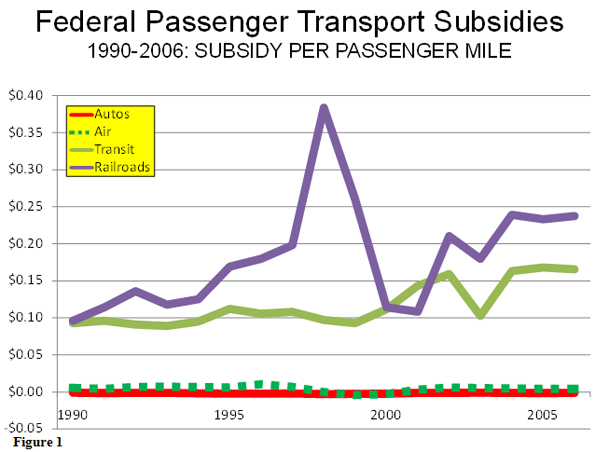
    A 2004 United States Department of Transportation (USDOT) report indicated that federal subsidies to transit amounted to $0.16 per passenger mile in 2002. Our update of this report estimated that the federal subsidy had risen to $0.17 per passenger mile by 2006. Overall, federal subsidies to transit were $7.7 billion in 2002, which increased to $8.6 billion in 2006 (Figure 1).

    Subsidies to Highways

    Virtually all federal highway spending was financed by fees paid by users in proportion to their use of the highways. There was no taxpayer subsidy.

    Indeed, the USDOT report indicates that in 2002, the federal government made a profit on automobile use of highways of $0.001 and had made a profit in every year since 1990, the first year reported upon. Overall, automobile use of the highways earned the federal government a profit of $4.5 billion in 2002 and $5.5 billion in 2006 (Figure 1).

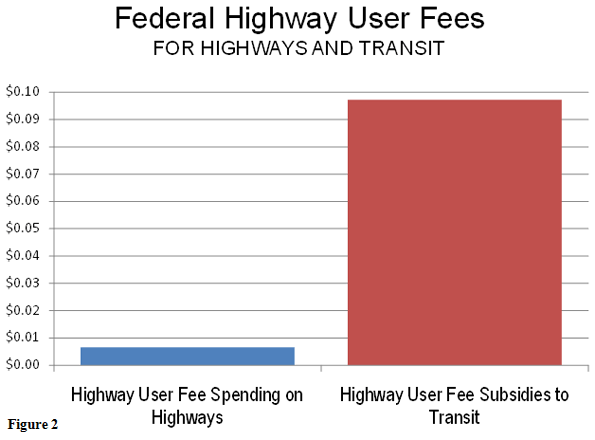
    The profits made by the federal government on highways indicate that highways are, in fact, subsidizing other government services. Senator Menendez neglected to mention, of course, that last highway bill (called “SAFETEA-LU,” its predecessor was called “ISTEA,” pronounced by insiders as “ice tea”) included $34 billion in subsidies by highway users for transit. For more than 25 years, federal law has required an add-on to highway user fees to support transit. Today nearly 15 percent of highway user fees are used to subsidize transit. In fact, road users pay 15 times as much in gas taxes per passenger mile on transit as they paid for highway expenditures (Figure 2).

    The profits do not stop at the federal level. Federal Highway Administration data indicates that user fees exceed the federal and state share of money spent on state highways, these being intercity highways, urban freeways and some other urban roadways. Only at the local government level are expenditures more than highway user fees, indicating subsidy.

    A real world parallel: Most of us have had Starbucks coffee. Our Starbucks coffee is not subsidized; rather we pay for it, 100% of it (Note 2). We can call this a price or we can use the public policy synonym, a user fee. As in the case of highways, those who do not drink Starbucks coffee do not pay for it. However, if Starbucks were financed like the federal highway program, 15 percent of the price of the coffee would be taken to subsidize tea drinkers (the authorizing legislation might be called ICECAFE).

    Airports

    While Senator Menendez did not refer to airports, those afflicted with a love affair with trains frequently claim that airports are subsidized in order to argue for massive expenditures on high speed rail, intercity rail and Amtrak. They are nearly as wrong as Senator Menendez. The air transportation system is overwhelmingly paid for by users, through taxes on tickets and airport fees. As in the case of highways, only those who use airports and the commercial air system pay for them.

    There are relatively small subsidies to commercial air transportation. The USDOT report found subsidies per passenger mile of approximately one-half penny.

    By comparison, the nation’s intercity passenger rail system (Amtrak) was subsidized to the extent of $0.21 per passenger mile in 2002, according to the USDOT report. Our report found that the figure had edged up to $0.24 in 2006, more than 50 times the subsidy to the commercial air system (Figure 1).

    These commercial air subsidies, however small, should be eliminated. Failing that, train proponents have grounds to ask for up to a half-penny per passenger mile of subsidy for high speed rail and intercity rail. Beyond that, equity requires that high speed rail and intercity rail be financed the same way as the commercial air system: with passenger fares, taxes on rail tickets and fees for the use of railroad stations.

    The Bottom Line

    The bottom line is that you pay for your coffee from Starbucks, you pay for your electricity from the Los Angeles Department of Water and Power and you pay for your federal highways with your own money, not with subsidies by people who do not use them.


    Note 1: Of course, if general taxpayer funding is provided to electric utilities, such payments would be subsidies, whether the utility is privately owned or owned by government.

    Note 2: All of this assumes that the local Starbucks is not the recipient of special tax incentives or abatements that might have been used by local government as enticement to locate in the community.

    Wendell Cox is a Visiting Professor, Conservatoire National des Arts et Metiers, Paris. He was born in Los Angeles and was appointed to three terms on the Los Angeles County Transportation Commission by Mayor Tom Bradley. He is the author of “War on the Dream: How Anti-Sprawl Policy Threatens the Quality of Life.

  • Prince Charles is Britain’s Master-eco-fraudster

    Thomas Paine was born in Thetford, Norfolk, in 1737. He understood that history is made. Aged 39, writing his Common Sense, he noted that Britain is constituted of ‘…the base remains of two ancient tyrannies, compounded with some new republican materials.’ These were:

    ‘First. – The remains of monarchical tyranny in the person of the king

    Secondly. – The remains of aristocratical tyranny in the persons of the peers.

    Thirdly. – The new republican materials, in the persons of the commons, on whose virtue depends the freedom of England.’ (1)

    Since Britain’s reformist politicians in the House of Commons have shown no republican virtue, in 2009 we now also suffer the “aristocratical tyranny” of the House of Lords being augmented with life peers. These political appointees must give their allegiance to the monarchy, even if they imagine they serve the majority. In contrast to reformists today, the revolutionary republican Paine had the “common sense” to ask:

    ‘How came the king by a power which the people are afraid to trust, and always obliged to check? Such a power could not be a gift of a wise people, neither can any power, which needs checking, be from God.’ (2)

    The king in waiting, Prince Charles, certainly believes in God, and entertains the myths of many Gods, but his claim to the throne in 2009 is that he understands and represents “the natural order”. He has been arguing like this for 30 years. He reiterated his claim in the 2009 Richard Dimbleby Lecture. His is the 33rd lecture held in honour of the veteran broadcaster who died in 1965. Charles had warned in March 2009 that there were only 100 months in which to avoid disaster. (3) He reminded the BBC audience on 8 July that there were 96 months left. The imagined catastrophe he hopes to avoid is otherwise due in July 2017. (4)

    The full lecture is available to see on BBC iPlayer.

    It does not matter if Charles Windsor is “well meaning”. As Paine understood in the Rights of Man, ‘…a casual discontinuance of the practice of despotism, is not a discontinuance of its principles; the former depends on the virtue of the individual who is immediate possession of the power; the latter, on the virtue and fortitude of the nation.’ (5) Prince Charles conveniently imagines himself to be the “steward” of “natural capital”. He has an urgent “duty” in his mind to use his monarchical authority to sustain not only Britain, but the entire planet, in some undefined “natural balance and harmony”. This is his eco-myth, and no matter how benign, how little he uses his power, along with the military command that entails, he cannot be tolerated by a self-interested people.

    We are weak if we allow his eco-mysticism to go unchecked, and to reinvigorate the monarchy in Britain. Those promoting Charles as the spokesman for “natural capitalism” are worse than weak.

    Charles talks of not taking too much “income” from the Earth, which makes him sound modest in his monarchy. He does not seem like a feudal monarch. Yet Paine could see through this in 1792:

    ‘As time obliterated the history of their beginning, their successors assumed new appearances, to cut off the entail of their disgrace, but the principles and objects remained the same. What at first was plunder, assumed the softer name of revenue; the power originally usurped they affected to inherit.’ (6)

    The Windsors have been adept at assuming new appearances since the Second World War. Where his grandmother walked through Blitzed streets, and his mother managed to appear “ordinary”, the now 60 year old Charles makes an effort to appear “green”. He is an environmentalist promoting the stasis of sustainability, and the political deception works to the point where in drawing his revenue from “natural capital” he seems to be doing not only the British people but the whole of humanity a favour. ‘If we fail the Earth, we fail humanity,’ he says. (7)

    Even if he lived as a monarch as poorly as the majority of the world does, he would still be a focus for every anti-democratic interest in twenty-first century capitalism. Of course, even before he inherits the British throne from his aging mother, he does not live poorly.

    With a Parliament of worse than weak representatives checked by a house of new gentry and old aristocrats, all in deference to a feudal monarchy in charge of an interventionist military, Britain is a mostly low paid industrial democracy of debt-laden professional and amateur residential property speculators using a planning system that makes a political and economic nonsense of freehold land ownership. We must find a way to break free of this social containment, (8) focused in Britain on the impending coronation of a “green” king.

    ‘Hereditary succession is a burlesque upon monarchy. It puts it in the most ridiculous light, by presenting it as an office which any child or idiot may fill. It requires some talents to be a common mechanic; but, to be a king, requires only the animal figure of man – a sort of breathing automation. This sort of superstition may last a few years more, but it cannot long resist the awakened reason and interest of man.’ (9)

    In the second part of Rights of Man, Paine was over-optimistic. He thought that kings would make themselves sufficiently ridiculous. While Charles is worthy of ridicule on many occasions, he still commands loyalty from “greens”, even when they are embarrassed by his fantasy of the Earth as “Gaia”, as a conscious entity.

    It is not enough to point out his self-deceptive eco-hypocrisy, or its popularity. The pervasive idea that capitalism is in any way “natural” must be broken. That requires the promotion of industrial production based on an appreciation of the social division of labour. It is necessary to see that in moaning about the effect of “mechanisation” on the environment, for which the contemporary capitalist will even accept moral and legal responsibility, they will abandon industry and make a virtue out of a life of laborious effort, sustained as a “duty”.

    In 2009, 200 years after Thomas Paine died, ‘…environmentalism is the ideology of capitalism in retreat from production.’ (10) That is what we understand at audacity. What people lack is social control of the vast industrial surplus that is produced by all of us. At present the aggregated value of our social production is taken as privately owned capital, partially taxed and redistributed through government, while mystified and made acceptable by the likes of the Prince of Wales as “natural capital”.

    Charles says:

    ‘It seems to me a self-evident truth that we cannot have any form of capitalism without capital. But we must remember that the ultimate source of all economic capital is Nature’s capital.’ (4)

    Wrong. Nature just exists. Only human labour turns nature into product, using machines to enable less labour to produce more. Capitalism has succeeded so far in developing industry so that sufficient surplus is produced beyond the needs of subsistence. That has allowed employers to live off their employees. Paine did not understand the parasitical relationship of the employer on employees. The workforce is paid less than the value it produces. However Paine could see institutionalised fraud that we tend to ignore:

    ‘Monarchy would not have continued so many ages in the world, had it not been for the abuses it protects. It is the master-fraud, which shelters all others. By admitting a participation of the spoil, it makes itself friends.’ (11)

    Democratic society depends on raising the productivity of labour. He may fool himself, and some of his fellow “greens”, but we must not let Charles fool us. He and his backward, stasis-loving supporters must be denied the appearance of being “natural” leaders, as they attempt to promote an anti-machine age of capitalist “sustainable development”:

    ‘Our current model of progress was not designed, of course, to create all this destruction. It made good sense to the politicians and economists who set it in train because the whole point was to improve the well-being of as many people as possible. However, given the overwhelming evidence from so many quarters, we have to ask ourselves if it any longer makes sense – or whether it is actually fit for purpose under the circumstances in which we now find ourselves?’ (4)

    What “model of progress” and what “destruction” is he talking about? In his pre-recorded Richard Dimbleby Lecture, broadcast on BBC One on 8 July 2009, Charles insisted that Facing The Future meant a new system that is more ‘…balanced and integrated with nature’s complexity.’ (7)

    This is complete nonsense, but popular “sustainababble”. The majority needs complete control of industrial advance. That requires a plan to rescue society from “greens”. Prince Charles knows much “…depends on how you define both ‘growth’ and ‘prosperity’.” (4) Much certainly depends on whether most people accept his redefinitions, anticipating his imagined “catastrophe”, or whether we are no longer willing to be subject to his retreat from industrial production. We don’t need to accept his prediction for 2017. We need not be his duped “commoners”.

    “As to the word ‘Commons,’ applied as it is in England, it is a term of degradation and reproach, and ought to be abolished. It is a term unknown in free countries.” (12)

    There is much to abolish in Britain, fraudulent monarchy included, and much to build with “republican materials” in pursuit of democracy.

    Ian Abley, Project Manager for audacity, an experienced site Architect, and a Research Engineer at the Centre for Innovative and Collaborative Engineering, Loughborough University. He is co-author of Why is construction so backward? (2004) and co-editor of Manmade Modular Megastructures. (2006) He is planning 250 new British towns.

    References:

    1. Thomas Paine, Common Sense: Addressed to the Inhabitants of America, 14 February 1776, Philadelphia, reprinted in Mark Philp, editor, Thomas Paine: Rights of Man, Common Sense, and Other Political Writings, Oxford, Oxford University Press, 1998, p 8

    2. Ibid, p 9

    3. ‘Prince Charles: ‘We have less than 100 months to stop climate change disaster” ‘, 8 March 2009, posted on www.dailymail.co.uk

    4. Prince Charles, ‘Facing the Future’, The Richard Dimbleby Lecture as delivered by HRH The Prince of Wales, St James’s Palace State Apartments, London, 8 July 2009. For transcript see here as directed on the Press Release, ‘Richard Dimbleby Lecture 2009: The Prince of Wales’, 9 July 2009, BBC, posted on www.bbc.co.uk

    5. Thomas Paine, Rights of Man: Being an Answer to Mr Burke’s Attack on the French Revolution, to George Washington, President of the United States of America, 1791, reprinted in Mark Philp, editor, Thomas Paine: Rights of Man, Common Sense, and Other Political Writings, Oxford, Oxford University Press, 1998, p 98

    6. Thomas Paine, Rights of Man: Part the Second, Combining Principle and Practice, 9 February 1792, London, reprinted in Mark Philp, editor, Thomas Paine: Rights of Man, Common Sense, and Other Political Writings, Oxford, Oxford University Press, 1998, p 221

    7. ‘Prince fears Earth “catastrophe” ‘, 8 July 2009, posted on http://news.bbc.co.uk

    8. Ian Abley, We are witnessing a British built “housing crisis” that Government is powerless to resolve, 23 July 2008, posted on this website here

    9. Ibid, p 226

    10. James Heartfield, Green Capitalism – Manufacturing scarcity in an age of abundance, www.heartfield.org, 2008, p 91, with details of how to buy posted here

    11. Ibid, p 257

    12. Ibid, p 351

  • Enviro-wimps: L.A.’s Big Green Groups Get Comfy, Leaving the Street Fighting to the Little Guys

    So far, 2009 has not been a banner year for greens in Los Angeles. As the area’s mainstream enviros buddy up with self-described green politicians and deep-pocketed land speculators and unions who have seemingly joined the “sustainability” cause, an odd thing is happening: Environmentalists are turning into servants for more powerful, politically-connected masters.

    On March 3, voters shot down Measure B, a controversial solar energy initiative pushed by Mayor Antonio Villaraigosa and endorsed heartily by many prominent environmentalists. The stunning defeat in this liberal city came after critics accused the mayor and his friends of secret deals that rushed the measure onto the ballot as a favor to a city union whose workers be guaranteed almost all of the resulting solar jobs.

    Then, on April 29, U.S. District Judge Christina Snyder placed a temporary injunction on part of the “clean trucks” program at the Port of Los Angeles, whose air pollution is so foul that the EPA warns its emissions cause cancer in suburbs like Cerritos, miles upwind of the port. Judge Snyder rejected efforts by Villaraigosa and the Teamsters to force port truckers to give up their independence and work for companies – spun as a green rule, but ridiculed as a move to pressure the truckers to become Teamsters.

    Today, labor unions, big businesses, and politicians are embracing a green economy to solve their own political and financial woes. And the green agenda – repairing a damaged planet and protecting the local environment in which we live – is at risk of ending up an after-thought.

    “I don’t think the traditional environmental organizations are up to speed,” says Miguel Luna of Urban Semillas, a grassroots environmental group. Alberto B. Mendoza, president of the Coalition for Clean Air, concurs: “If we don’t become more modern in our approach, we’ll become obsolete.”

    In Los Angeles, developers now market, or “green wash,” big new buildings as “sustainable” – meaning healthy for the planet over the long term. The city of Los Angeles requires large buildings to follow “LEED” rules – low flush toilets, on-site renewable energy and the like. But do these projects cause more congested streets filled with idling cars, for example, than the energy they claim to save? In truth, nobody knows. “If you have a project that would normally be four stories high and now it has 20 stories,” says Hollywood activist Bob Blue, there’s a “net increase in power, water, sewer, traffic, pollution – and impact.”

    Yet among many greens, LEED is a closed debate – and represents a profound shift. In the 1990s, greens like Marcia Hanscom, Rex Frankel, Bruce Robertson, Cathy Knight, Sabrina Venskus, and Patricia McPherson took on Los Angeles City Hall, preventing it from wiping out the Ballona Wetlands to erect a vast housing development, Playa Vista. Those greens publicly trounced the pols and their speculator friends over absurd “sustainability” claims — including an effort to count the grassy median strips as “open space.”

    Nowadays, though, Los Angeles enviros are sliding toward the argument that big development is good for the air, land and water – and small bits of green are enough. Environmentalists rarely engage in the city’s intense development hearings. “Maybe one time an environmentalist showed up,” Blue says, “but it was on the behalf of the developer.”

    Within the green movement, Andy Lipkis, the founder of Tree People, and Mark Gold, executive director of Heal the Bay, have reputations as heavyweights with access to Villaraigosa and other politicians. Neither of them, though, wants to jump into rough-and-tumble politics. Lipkis, a likeable and dedicated activist, proudly says he is politically “naive.” Gold, a smart and equally dedicated environmentalist, says he is not “even a little” worried that politicians, labor unions or speculators are hijacking the greens’ issues.

    But today, developers regularly peddle their proposed apartments near L.A. freeways as “sustainable” – claiming they bring workers closer to jobs. The developments are backed by Villaraigosa and the L.A. City Council – to the horror of health experts. Researchers now know, for certain, that children living in these projects are burdened with often lifelong lung disease. “They are putting individuals at risk,” says USC professor Jim Gauderman, whose 2007 study confirmed it.

    Heavily focused on lowering emissions region-wide to fight global warming, greens now praise freeway-adjacent housing projects, utterly forgetting about the young humans involved. Incredibly, city Planning Commissioner Michael Woo, a Villaraigosa-appointee, hasn’t heard a word of opposition from them. Two years after USC’s study, he says, “I’m not sure there’s a political will to stop housing projects at these locations.”

    Grassroots activist Marcia Hanscom, who has never gotten anything by staying quiet, worked for years with other environmentalists to save the Ballona Wetlands. In 2003, that relentless effort paid off – the state bought more than 600 acres to protect and restore. But now, she says, the environmental movement in L.A. has lost its way. It’s time to talk openly about a “mid-course correction.”

    L.A. politicians “sometimes call me as if I’m one of their staff members,” she notes, “and I’m supposed to do what they say. They have their roles mixed up. I’m here to advocate for the environment, not to advocate for them.”

    Pro-green politicians control the office of mayor, almost every Los Angeles City Council seat, every Los Angeles Unified School Board seat, and, for years, have controlled the legislature. Yet the greens seem oddly incapable of asserting power. Mark Gold of Heal the Bay, for example, went out of his way to endorse solar power Measure B, even though Villaraigosa clearly dissed him by dreaming it up utterly without Gold’s input. What L.A. union boss would stand for that?

    Stefanie Taylor, interim managing director interim of the Green L.A. Coalition, a group of over 100 organizations, says, “We have to make sure we’re at the table when these decisions are made about the new green economy.” But right now, says enviro-lobbyist John White, environmentalists are “more like the menu.”

    The stark difference between the daily work of Hanscom, the grassroots environmentalist, and Jonathan Parfrey, the political insider and mainstream environmentalist, is instructive. When the Weekly talked with Hanscom, she was in the middle of an almost surreal battle to keep glaring, Vegas-style digital billboards, made up of 480,000 piercingly bright LED light bulbs, from being allowed adjacent to the blue herons and wildflowers of the Ballona Wetlands.

    Says Hanscom, “The city has the Ballona Wetlands as a part of a billboard ‘sign district?’ It’s outrageous! I even had [developer] lobbyists and lawyers ask me what they were thinking.”

    As Hanscom aimed her firepower at City Hall, environmentalist Parfrey, one of Antonio Villaraigosa’s newest political appointees, was getting ready to visit a Department of Water and Power wind farm way out of town, with the idea of creating “educational tours” for environmentalists. Nothing wrong with that, but it sounded like a public relations campaign for the big utility.

    It’s hard to escape the fact that Los Angeles power brokers regard the environmental movement not as a passionate force they can tap to improve the quality of life and to clean the air, water, and open spaces, but, increasingly, as just another jobs program. And some of the greenest greens have begun to wonder if their own leaders are taking part in the movement’s demise.

    Patrick Range McDonald is a staff writer at L.A. Weekly, and this piece appears in full at www.laweekly.com. Contact Patrick Range McDonald at pmcdonald@laweekly.com.

  • Why Rapid Transit Needs To Get Personal

    Innovation in urban transportation is the only long-term correction for expensive environmental losses and energy waste. Why, then, isn’t there a US plan for more vigorous exploration and demonstration of new systems using advanced technologies, particularly automation? Where is the Personal Rapid Transit — PRT — in US transportation policy?

    PRT utilizes automated, energy efficient, very lightweight four seat vehicles that operate on narrow, electrified, dedicated guideways. PRT vehicles reduce pollution and conserve land use. The system preserves the benefits that have made automobiles our current dominant transportation mode: personal, on-demand, fast travel directly to arbitrary destinations. For non-drivers, it’s a form of public transportation that upgrades travel to the personal level now available with the automobile. It allows travelers to avoid the slow, stop and go, repetitive service schedule which has prevented meaningful acceptance of conventional mass transit in all but a few very dense cities.

    PRT works like this: At an off line station, a rider goes to a waiting group of personal cars, inserts a card, punches in a destination and joins the main line for the automatically controlled trip directly to his or her destination.

    By direct use of electric energy to power very efficient drive motors, the limitations and inconvenience of batteries are primarily avoided. In some cases, when complete area coverage for the guideway net is not completed, dual mode cars with minimum battery use can deliver the “last mile” to destinations. Of course, current programs for significant automobile improvement should continue until PRT operations are ready to supplant them.

    There is a safety bonus, since these very light weight, energy efficient cars are segregated from the mixed flow of heavy cars and trucks.

    The simpler, lighter PRT vehicles would use significantly less energy than hybrids or battery powered cars. PRT offers the most potential for deep cuts in greenhouse gases in a few decades, without restricting the mobility necessary for regional productivity.

    Community-useful PRT coverage is not possible “overnight”. But PRT and other emerging technologies can stimulate whole new job producing industries while reducing dependence on both fossil fuels and conventional autos for personal transportation.

    Billions are being spent on mass transit installations that few travelers want. Meanwhile, urban congestion increases. Urban “streamlined” mass transit is seldom faster than 100-year-old trolleys. No really new concepts have appeared, since government has not prioritized new systems. Instead, it supports minor changes in existing models. Look at the military’s successful history of taking advantage of risky new technologies. Imagine if it overlooked a comparable potential; it’s equally difficult to fathom telecommunications companies still offering “Ma Bell” style dial phones.

    There is some limited evidence that the concept and hardware are being adopted. Heathrow airport near London is about to open on-demand personal ground travel between parking and terminals. Masdar is a United Arab Emirates new city which will replace automobiles with PRT. In the US, completely automatic on-demand travel on a small, funds-limited basis has been operating successfully at the University of West Virginia for thirty years.

    Some investigators hope that private funding — perhaps an office park, or a campus — can give PRT its initial boost. Maybe a city would be willing to start such a system in a congested area.. Certainly, the automobile revolution started in piecemeal ways. The commitments that are needed today are larger, however. Today’s climate of regulation and progressive income tax discourage risk capital at the needed levels.

    There are signs that the Federal government realizes that transportation policy has lost direction. A recent National Transportation Policy Project report proposes performance-based investment decisions for economic productivity. Compared to other vital infrastructure and private enterprise accomplishments, truly new concepts in transportation have been missing for many decades. With an opportunity to stimulate the economy, and create new job producing industries of global significance, hopefully this new form of vital personal transportation can be the win-win basis for national economic health and efficient urban transportation.

    For more on PRT vehicles, see the Liberator Car by MonoMobile or the British/Swedish/Korean Vectusport-Vectur Transport.

    Walter Brewer is a retired Vice President of a concepts and management center supporting military missile and space programs.

  • Telecommuting And The Broadband Superhighway

    The internet has become part of our nation’s mass transit system: It is a vehicle many people can use, all at once, to get to work, medical appointments, schools, libraries and elsewhere.

    Telecommuting is one means of travel the country can no longer afford to sideline. The nation’s next transportation funding legislation must promote the telecommuting option…aggressively.

    The current funding legislation, called SAFETEA-LU, is set to expire on September 30. On June 24, a House subcommittee approved a discussion draft of the new funding bill: the Surface Transportation Authorization Act of 2009. U.S. Representatives James L. Oberstar (D-MN) and John L. Mica (R-FL), Chair and Ranking Member, respectively, of the Transportation Committee are now sparring with the Obama Administration about just when Congress should focus on reauthorizing SAFETEA-LU; the lawmakers say now; the Administration says 18 months from now. Regardless of the timetable adopted, the measure the House and Senate ultimately pass must maximize the powerful benefits of internet-based travel.

    Whereas the infrastructure for cars, buses and trains consists of roads and rails, the infrastructure required for telecommuting is broadband. Fortunately for the framers of the new transportation package, the stimulus legislation already provides significant funding – over $7 billion – to expand access to broadband. The transportation legislation should provide more. It should also expressly encourage the use of that broadband to telecommute.

    Some Congressional leaders have called on their colleagues to recognize telecommuting as a full-fledged transportation mode. On May 14th, twelve members of the House wrote to both the House Transportation Committee and the House Committee on Energy and Commerce, requesting that they consider including some pro-commuter reforms as they design the nation’s new transportation and energy laws. Among their requests were initiatives to incentivize telecommuting.

    One strategy these lawmakers proposed for encouraging telework was to condition federal grants to states and localities for transportation infrastructure on their creation of bold incentives for telework. Why impose this condition? Telework limits the wear and tear on new roads and rails, as well as the demand for further construction. Thus, it protects the federal investment in such infrastructure and mitigates future costs.

    There is precedent for insisting that the recipients of federal funding for infrastructure focus on telework’s potential to reduce the need for that infrastructure. Federal law provides that executive agencies, when deciding whether to acquire buildings or other space for employee use, must consider whether needs can be met using alternative workplace arrangements such as telecommuting. Requiring state and local governments that seek federal aid for new roads to include telecommuting in their transportation plans would demonstrate the same kind of fiscal responsibility.

    Other lawmakers have introduced legislation specifically linking broadband and more conventional kinds of transportation infrastructure. Representative Anna G. Eshoo, a Democrat from California, together with Democratic Representatives Henry A. Waxman from California, Rick Boucher from Virginia and Edward J. Markey from Massachusetts, has sponsored the Broadband Conduit Deployment Act, a bill that would require new federal highway projects to include broadband conduits. Democratic Senators Amy Klobuchar from Minnesota, Blanche L. Lincoln from Arkansas and Mark R. Warner from Virginia have introduced companion legislation in the Senate.

    The proposal set forth in the two bills makes economic sense. It would be an unconscionable waste of taxpayer dollars to dig up roadways, expand and repave them and then dig them up again to lay the broadband pipes the stimulus bill made possible. If the pipes are installed while the roadways are under construction, they will be available when broadband providers are ready to get communities online.

    If passed, the Broadband Conduit Deployment Act would only strengthen the case that funding for infrastructure projects should be conditioned on state and local government efforts to facilitate telework. If, as they finance highway projects, American taxpayers also fund broadband, they should not then have to struggle to telecommute. They should be able to help contain transportation costs and, at the same time, easily make the greatest possible use of the broadband access they financed.

    What kind of steps to promote telework should states and localities be required to take if they want to qualify for federal transportation funding?

    Congress should insist that they provide telework tax incentives for both employees and employers; eliminate tax, zoning and other laws that are hostile to telework; and offer both public and private sector employers technical help in developing and implementing robust telework programs. The government grantees should be required to create such programs for their own employees. They should also be required to designate certain high traffic and high pollution days as telework days — days when employees are specifically urged to take the web to work — and to conduct public awareness campaigns about the benefits of telework.

    These benefits go beyond transportation infrastructure savings, emissions reductions, and congestion management. Telework can help businesses and government agencies reduce real estate, energy and other overhead costs and use the savings to avoid job cuts or to hire new staff. It can increase employers’ productivity by 20% or more, and enable them to sustain operations if an emergency, such as the recent swine flu outbreak, compels significant absenteeism.

    Telework enables Americans who cannot find work in their own communities – and cannot sell their homes – to look for more distant positions. It can help those still employed to lower their commuting costs and juggle competing work and family obligations. It can help older Americans who cannot afford to retire to continue working even when they no longer have the stamina for daily commuting. And it can help disabled Americans with limited mobility join or re-enter the workforce.

    When Congress finalizes its new transportation policy, it must exploit the tremendous mileage it can get from encouraging web-based travel. Conditioning funding to state and local governments on investment by those governments in pro-telework measures – and offering meaningful federal funding to promote telecommuting – is a dual strategy that would yield a greener and leaner transportation system.

    In the process, this strategy would advance crucial energy, economic, quality of life and contingency planning goals. A clear emphasis on the need for telework in the new transportation bill is essential to help the nation get to where it needs to go.

    Nicole Belson Goluboff is a lawyer in New York who writes extensively on the legal consequences of telework. She is the author of The Law of Telecommuting (ALI-ABA 2001 with 2004 Supplement), Telecommuting for Lawyers (ABA 1998) and numerous articles on telework. She is also an Advisory Board member of the Telework Coalition.

  • Who Killed California’s Economy?

    Right now California’s economy is moribund, and the prospects for a quick turnaround are not good. Unable to pay its bills, the state is issuing IOUs; its once strong credit rating has collapsed. The state that once boasted the seventh-largest gross domestic product in the world is looking less like a celebrated global innovator and more like a fiscal basket case along the lines of Argentina or Latvia.

    It took some amazing incompetence to toss this best-endowed of places down into the dustbin of history. Yet conventional wisdom views the crisis largely as a legacy of Proposition 13, which in effect capped only taxes.

    This lets too many malefactors off the hook. I covered the Proposition 13 campaign for the Washington Post and examined its aftermath up close. It passed because California was running huge surpluses at the time, even as soaring property taxes were driving people from their homes.

    Admittedly it was a crude instrument, but by limiting those property taxes Proposition 13 managed to save people’s houses. To the surprise of many prognosticators, the state government did not go out of business. It has continued to expand faster than either its income or population. Between 2003 and 2007, spending grew 31%, compared with a 5% population increase. Today the overall tax burden as percent of state income, according to the Tax Foundation, has risen to the sixth-highest in the nation.

    The media and political pundits refuse to see this gap between the state’s budget and its ability to pay as an essential issue. It is. (This is not to say structural reform is not needed. I would support, for example, reforming some of the unintended ill-effects of Proposition 13 that weakened local government and left control of the budget to Sacramento.)

    But the fundamental problem remains. California’s economy–once wondrously diverse with aerospace, high-tech, agriculture and international trade–has run aground. Burdened by taxes and ever-growing regulation, the state is routinely rated by executives as having among the worst business climates in the nation. No surprise, then, that California’s jobs engine has sputtered, and it may be heading toward 15% unemployment.

    So if we are to assign blame, let’s not start with the poor, old anti-tax activist Howard Jarvis (who helped pass Proposition 13 and passed away over 20 years ago), but with the bigger culprits behind California’s fall. Here are five contenders:

    1. Arnold Schwarzenegger

    The Terminator came to power with the support of much of the middle class and business community. But since taking office, he’s resembled not the single-minded character for which he’s famous but rather someone with multiple personalities.

    First, he played the governator, a tough guy ready to blow up the dysfunctional structure of government. He picked a street fight against all the powerful liberal interest groups. But the meathead lacked his hero Ronald Reagan’s communication skills and political focus. Defeated in a series of initiative battles, he was left bleeding the streets by those who he had once labeled “girlie men.”

    Next Arnold quickly discovered his feminine side, becoming a kinder, ultra-green terminator. He waxed poetic about California’s special mission as the earth’s guardian. While the housing bubble was filling the state coffers, he believed the delusions of his chief financial adviser, San Francisco investment banker David Crane, that California represented “ground zero for creative destruction.”

    Yet over the past few years there’s been more destruction than creation. Employment in high-tech fields has stagnated (See related story, “Best Cities For Technology Jobs“) while there have been huge setbacks in the construction, manufacturing, warehousing and agricultural sectors.

    Driven away by strict regulations, businesses take their jobs outside California even in relatively good times. Indeed, according to a recent Milken Institute report, between 2000 and 2007 California lost nearly 400,000 manufacturing jobs. All that time, industrial employment was growing in major competitive rivals like Texas and Arizona.

    With the state reeling, Arnold has decided, once again, to try out a new part. Now he’s posturing as the strong man who stands up to dominant liberal interests. But few on the left, few on the right or few in the middle take him seriously anymore. He may still earn acclaim from Manhattan media offices or Barack Obama’s EPA, but in his home state he looks more an over-sized lame duck, quacking meaninglessly for the cameras.

    2. The Public Sector

    Who needs an economy when you have fat pensions and almost unlimited political power? That’s the mentality of California’s 356,000 workers and their unions, who make up the best-organized, best-funded and most powerful interest group in the state.

    State government continued to expand in size even when anyone with a room-temperature IQ knew California was headed for a massive financial meltdown. Scattered layoffs and the short-term salary givebacks now being considered won’t cure the core problem: an overgenerous retirement system. The unfunded liabilities for these employees’ generous pensions are now estimated at over $200 billion.

    The people who preside over these pensions represent the apex of this labor aristocracy. This year two of the biggest public pension funds, CalPERS and CalSTERS, handed out six-figure bonuses to its top executives even though they had lost workers billions of dollars.

    Almost no one dares suggest trimming the pension funds, particularly Democrats who are often pawns of the public unions. Some reforms on the table, like gutting the two-thirds majority required to pass the budget, would effectively hand these unions keys to the treasury.

    3. The Environment

    Obama holds up California’s environmental policy as a model for the nation. May God protect the rest of the country. California’s environmental activists once did an enviable job protecting our coasts and mountains, expanding public lands and working to improve water and air resources. But now, like sailors who have taken possession of a distillery, they have gotten drunk on power and now rampage through every part of the economy.

    In California today, everyone who makes a buck in the private sector–from developers and manufacturers to energy producers and farmers–cringes in fear of draconian regulations in the name of protecting the environment. The activists don’t much care, since they get their money from trust-funders and their nonprofits. The losers are California’s middle and working classes, the people who drive trucks, who work in factories and warehouses or who have white-collar jobs tied to these industries.

    Historically, many of these environmentally unfriendly jobs have been sources of upward mobility for Latino immigrants. Latinos also make up the vast majority of workers in the rich Central Valley. Large swaths of this area are being de-developed back to desert–due less to a mild drought than to regulations designed to save obscure fish species in the state’s delta. Over 450,000 acres have already been allowed to go fallow. Nearly 30,000 agriculture jobs–held mostly by Latinos–were lost in the month of May alone. Unemployment, which is at a 17% rate across the Valley, reaches upward of 40% in some towns such as Mendota.

    4. The Business Community

    This insanity has been enabled by a lack of strong opposition to it. One potential source–California’s business leadership–has become progressively more feeble over the past generation. Some members of the business elite, like those who work in Hollywood and Silicon Valley, tend to be too self-referential and complacent to care about the bigger issues. Others have either given up or are afraid to oppose the dominant forces of the environmental activists and the public sector.

    Theoretically, according to business consultant Larry Kosmont, business should be able to make a strong case, particularly with the growing Latino caucus in the legislature. “You have all these job losses in Latino districts represented by Latino legislators who don’t realize what they are doing to their own people,” he says. “They have forgotten there’s an economy to think about.”

    But so far California’s business executives have failed to adopt a strategy to make this case to the public. Nor can they count on the largely clueless Republicans for support, since GOP members are often too narrowly identified as anti-tax and anti-immigration zealots to make much of a case with the mainstream voter. “The business community is so afraid they are keeping their heads down,” observes Ross DeVol, director of regional economics at the Milken Institute. “I feel they if they keep this up much longer, they won’t have heads.”

    5. Californians

    At some point Californians–the ones paying the bills and getting little in return–need to rouse themselves. The problem could be demographic. Over the past few years much of our middle class has fled the state, including a growing number to “dust bowl” states like Oklahoma, Texas and Arkansas from which so many Californians trace their roots.

    The last hope lies with those of us still enamored with California. We have allowed ourselves to be ruled by a motley alliance of self-righteous zealots, fools and cowards; now we must do something. Some think the solution is reining in citizens’ power by using the jury pool to staff a state convention, as proposed by the Bay Area Council, or finding ways to undermine the initiative system, which would remove critical checks on legislative power.

    We should, however, be very cautious about handing more power to the state’s leaders. With our acquiescence, they have led this most blessed state toward utter ruin. Structural reforms alone, however necessary, won’t turn around the economy’s fundamental problems and help California reclaim its role as a productive driver of the American dream.

    This article originally appeared at Forbes.

    Joel Kotkin is executive editor of NewGeography.com and is a presidential fellow in urban futures at Chapman University. He is author of The City: A Global History. His next book, The Next Hundred Million: America in 2050, will be published by Penguin early next year.
  • View from the UK: The Progressive’s Dilemma

    American progressives long have looked upon Britain’s Labour Party as an exemplar of how to prioritize social welfare without entirely alienating business. Unlike their European counterparts, whose overly suspicious view of wealth and overly generous view of social welfare spending make poor role models for America, the British Labour Party has brokered a “partnership” between wealth and welfare over the years more suitable to the American psyche.

    Yet today that partnership is nearing collapse. For over a decade Britain’s supercharged financial sector fuelled the growth of an expansive state. But as the financial sector has cooled, Britain’s Labour party is now faced with the stark reality of burgeoning social welfare commitments, unprecedented public debt, and dubious upward mobility prospects for the ordinary citizen. The government has seemed more competent at creating upward mobility for civil servants who service the growing social welfare state than doing the same for the larger population who have to pay for it.

    Now the question for Labour – and the UK – is how to maintain an expansive social insurance program by somehow creating the kind of growth needed to pay for it. Once its “wealth creation strategy” of relying on a fecund banking sector fell apart, its project of providing income security rather than fostering income growth for ordinary people appears to be on the verge of failure.

    In order to maintain social welfare goals amidst a floundering economy, the UK has financed its shortfall through massive debt – something the average British household knows something about. Between 1997 and 2007 average household debt grew from 105 to 177 percent of disposable income. The US, of course, also experienced an explosion of household debt during the same period but not nearly to the same extent. At the end of 2007 America’s average household debt reached 106 percent of disposable income – essentially where the UK started 10 years earlier.

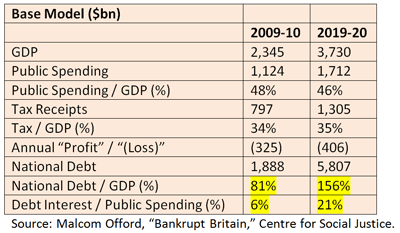
    The UK’s comfort with personal debt has now extended to the public realm. Even before the recession, Britain had $1.2 trillion of public debt, and by next year it will rise to $1.8 trillion, or 81 percent of GDP. If debt payment were a government agency, it would be the fourth largest in Britain. According to the London-based think tank the Centre for Social Justice, 21 percent of total public spending will be devoted to debt service in 2020, compared to 6 percent today. Public debt in the US, by comparison, will reach 60 percent of GDP by next year, and interest on the debt will rise from 4.6 percent to nearly 14 percent ten years from now. Labour’s legacy will be the Mount Everest of indebtedness it has left the current and subsequent generation.

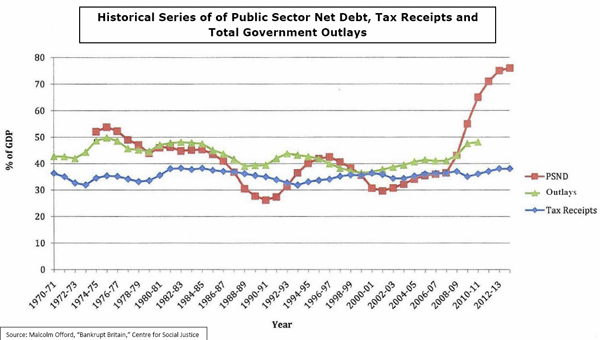
    To put this in perspective, we need look no further than historic trends over the past 30 years. Public debt has tracked fairly proportionately with public spending in the UK during this period. During the economic stagnation of the late 1970s, public debt rose to nearly 50 percent of GDP. It hit its nadir at around 25 percent in 1990 after the Thatcher era, and then rose to around 35 percent, where it has remained ever since – until last year. Suddenly, debt has skyrocketed to more than 75 percent of GDP in the past year – an unprecedented level – and will rise to 100 percent by 2012 before swelling to 150 percent by 2020. In order to reduce debt to its 45 percent level of just a few years ago, public spending would need to be cut by a third. Given that one-fifth of all public spending will go to debt service in 10 years, cutting spending will prove politically impossible for a government – and perhaps an entire nation – that identifies ever expanding government-funded services as essential.

    Even more disquieting, tax receipts have mainly hovered around 35 percent of GDP regardless of the tax rate during the past 30 years. This means that raising tax rates – such as Labour’s proposal to lift the top tax bracket to 50 percent– have little effect as high earners move away or find other ways to protect their assets. Logically, if it hopes to cope with its debt obligations, Britain should therefore keep taxes as low as possible and cut public spending. But instead the UK drives full-speed ahead into the fog of debt without having any notion of how to service its future obligations.

    The UK is therefore faced with a thorny dilemma: on the one hand, it has spent decades creating a social welfare system that reduces risk and promises citizens protection from life’s vagaries, and on the other, it needs people to take risks in order to revitalize the economy. Government spending fostered risk avoidance precisely when Britain most needs an entrepreneurial class that can help diversify the economy away from finance and, to a lesser extent, tourism.

    The people most hurt by social welfare are young working class people – the very group Labour purports to represent. In the UK there’s much talk about the NEETs – young people in their late teens who are Not in Employment, Education, or Training. In 2000 there were 630,000 young people between the ages of 16 and 19 in this group. Today, that number totals 860,000, a 36 percent increase in less than a decade. This would be the equivalent of 4.5 million young people in the United States. If NEETs were a city, they would be the third largest metropolitan area in the UK.

    Increasing numbers of able-bodied young people dropping out of society altogether reflects a growing sense of hopelessness. According to the Gallup World Poll, only 20 percent of 25-34 year olds, and 25 percent of 35-49 year olds, thought the economic conditions in the UK were good before the current economic crisis. The UK’s NEET problem and economic pessimism were rampant when the going was good – something that can only be worse now.

    This is not merely the result of a profligate welfare state. The NEET problem has its origins in complex cultural phenomena. However, it is difficult to argue with the conclusion that an increasing economic resignation among Britain’s younger population is ill-timed for a government betting on future workers to pay the public mortgage.

    The US has a more diversified economy than the UK and likely suffers from less economic resignation, but it is beset with a similar dilemma. Despite historically unprecedented levels of public debt, albeit less extreme than Britain’s, the Obama administration appears to be pursuing an economic program that bears similarities to the Labour preoccupation with creating prophylactics against risk and hardship. In a matter of months, the US deficit has risen from 3.2 to 13.1 percent of GDP, according to the Congressional Budget Office.

    Even with President Obama’s widely doubted promises to cut the deficit in half, the CBO estimates a yearly shortfall of more than $1 trillion ten years from now. Even worse, there is precious little in the administration’s plans – including its grandiose claims about “green jobs” – that will create the growth necessary to carry such debt in the future. In fact many of the administration’s proposals – from its healthcare program to its auto company ownership and a more heavily regulated financial sector – could serve more to curb growth than encourage it. In addition, increased taxes on “the rich” will hit small businesses most grievously, the most plausible engine for growth.

    It appears the administration seems intent on following Labour’s folly of mortgaging the future. Without addressing the issue of how to unleash the entrepreneurial energies of the young generation, it’s hard to see how America will avoid falling into the morass in which its British cousins are now so perilously trapped.

    Ryan Streeter is Senior Fellow at the London-based Legatum Institute.

  • Lessons from the Left: When Radicals Rule – For Thirty Years

    Contrary to popular notions held even here in southern California, Santa Monica was never really a beach town or bedroom community. It was a blue-collar industrial town, home to the famed Douglas Aircraft from before World War II until the 1970s.

    When I first lived there in the early ’70s, the city was pretty dilapidated, decaying and declining (except for the attractive neighborhoods of large expensive homes in the city’s northern sections). I remember a lot of retirees, students, and like me and my wife, renters of small apartments in old buildings. The tiredness of the place was incongruous with its great location and weather. But then the first of several spectacular rises in real estate values took off. Rents started rising precipitously as well, and in a city where 80% of residents were renters, a political earthquake shook the establishment: in 1979 voters passed rent control and soon after that elected a slate of politicians backed by the SMRR – Santa Monicans for Renter Rights – to a majority on the city council. It has now been 30 years that the city of Santa Monica has been dominated by the politics and politicians of SMRR. What have they wrought?

    There have been some momentous battles. Property owners, denied the full use and fair value of their property, came to calling the place “the People’s Republic of Santa Monica.” As economists would predict, rent control resulted in the loss of rental units (and therefore the number of renters), slowed construction of new units, led to the deterioration of existing units as landlords deferred maintenance, decreased the city’s diversity, and increased its exclusivity. These were all opposite effects the original intentions of the new radical rulers.

    But rent control was not the only “social justice” concern on the SMRR agenda; “homeless friendly” policies led to an explosion of homeless people in the city, which comedian Harry Shearer reminds the nation every week on his NPR radio show is “The Home of the Homeless.”

    Other battles fought over the years have involved traffic issues, a living wage ordinance, preferential parking zones, McMansions, development and redevelopment, planning, zoning, schools, affordable housing requirements, and the height of fences and hedges – a thousand things big and small one would expect in a city of 85,000 residents and an annual budget of over $500 million. At some point in the 1980s, the SMRR-dominated City Council, once anti-development, realized that development could generate millions of dollars for city government necessary for funding its political agenda. Massive rezoning and redevelopment were approved.

    One might think that inconsistent policies often causing opposite effect of their intentions would have weakened the left. But two large factors have come into play over time. First, SMRR does not rule without consent and consensus – many, perhaps more than half, of home owners have supported the progressive politics and policies of the SMRR-controlled city council. Secondly, despite the concerns of some property owners and economists, Santa Monica has prospered. Despite powerful regulation, hotels, arts, jobs, and restaurants continue to flow into the city. Opponents on both sides concede most of the population is content and satisfied with the status quo.

    This has been accomplished with pragmatism and a willingness to change policies that were not working. The worst effects of rent control are in the past due to a state law that allowed vacancy decontrol. Same with homelessness: residents wanted to be “progressive” but realized that being kind to the homeless only increased their numbers. The city still overdoes it on permits, regulations, etc., but homeowners and business want to be “progressive,” so they go along with it (and they like regulation when it benefits their interests).

    The city decided to make itself a tourist destination, and it is, but when it looked like nothing but hotels would be built, voters passed a proposition to halt hotel development. On the other hand, last November voters defeated Prop T, which would have limited most commercial development in the city to 75,000 square feet a year for the next 15 years.

    Santa Monica Place, a huge indoor shopping mall, outlived its usefulness, so now it’s being rebuilt as an outdoor mixed-use development. A living wage law was passed by the City Council, and then repealed by voters.

    SMRR is a political machine that has dominated the city for 30 years, using money, favors, jobs for the connected (and bupkis for those not) to build voting blocs for power and control. It inserts its people onto all the boards and commissions with input into policymaking. Their power ultimately comes from persuading renters, who are still a big majority of the city’s inhabitants, that they need SMRR for protection from “greedy landlords.”

    So SMRR dominates political life in the city of Santa Monica, but it does so with the consent of many homeowners, property and business owners, as well as renters. Santa Monica is green, PC, insufferably “tolerant,” self-satisfied, etc., but still doing well for itself. Taxes, rules, regulations and restrictions are onerous, but people and businesses still want to be there.

    I have lived through and observed the political battles of the last 30 years as a renter, homeowner and briefly as a landlord (never again, thanks). The transformation of Santa Monica reflects an interesting story: left-leaning activists who realize they can bend the establishment by controlling it from the inside. They then become the new establishment, but like in today’s left-leaning academia, work to make sure they themselves are never similarly deposed. And yes, I wonder if it holds lessons for the nation, with President Obama and the Democrats now in control and looking to implement a left-leaning agenda.

    What might those lessons be? One, particularly difficult for conservatives to accept, is that the time-tested machinations of leftist political machines sometimes work. They work for the powerful and the connected (who get to have their cake and eat it too: financial reward with a patina of progressivism), and they are perceived to work for the powerless and unconnected (however deleterious in reality). And that the left can come to power and rule with the consent of the governed, if it doesn’t “push the envelope” beyond a certain point, changes course when warranted, rewards cronies and allies, co-opts opponents where possible (and freezes them out where not). It worked for Tammany Hall, it has worked for Mayor Daley, and it seems to be working for Obama. Saul Alinsky would be proud of his protégé.

    Perhaps at the heart of its success is that like all successful political machines, SMRR “fixes potholes.” Frank Gruber, who writes a weekly column about life and politics in Santa Monica for The Lookout News, calls this “squeaky wheel government.” SMRR council members try to turn every complaining resident – and there are many – into happy SMRR voters. Whatever the aims of SMRR, they have created a popular government.

    Gruber, who considers himself an “old leftie” of the “jobs, housing, education, environment” school, takes SMRR to task for putting the needs of comfortable voters (traffic, for instance) ahead of the needs of the larger community (such as jobs for minority youth). (A collection of Gruber’s columns has recently been published in a book called, fittingly, Urban Worrier: Making Politics Personal.)

    In the 2008 elections, in which Santa Monicans voted overwhelmingly for Barack Obama, all four incumbents of the City Council won easily. SMRR seems as entrenched as always. In at least this paradisiacal portion of Southern California, left-wing government appears to be working – even if sometimes at odds with its own old radical objectives.

    Dr. Roger Selbert is a trend analyst, researcher, writer and speaker. Growth Strategies is his newsletter on economic, social and demographic trends; IntegratedRetailing.com is his web site on retail trends. Roger is US economic analyst for the Institute for Business Cycle Analysis and its US Consumer Demand Index, a monthly survey of American households’ buying intentions.

  • Downtown Character and Street Performers

    By Richard Reep

    Carmen Ruest, Director of Cirque de Soleil, recently revealed her start as a street performer, or busker, in Canada. The interviewer did not hesitate to contrast this with the current state of Downtown Orlando, which forbids street performers. Eliminating this ban will improve Orlando’s urban consciousness, both downtown and elsewhere, and improve the city in general.

    The Downtown Development Board (an arm of city government) has long stated its mission to promote arts-based businesses downtown. In the nineties, this board even had special incentives for independent creative enterprises to encourage a local arts scene. Only later did the city give in to the temptation to go for the big box retailers, and all bets were suddenly off.

    Meanwhile, street performers continue to provide local color that graces cities of Europe, Canada, and elsewhere in the United States. Often, tales of tourists include encounters with creative street performers that make the trip; willingly parting with some money for a brief but engaging performance can be a bit of spice in an otherwise overstimulating experience. Such spontaneity is not allowed in Orlando, which ranks among the world’s top tourist destinations.

    The street performer connects with the pedestrian in a unique way: not in the safety of the theater, not in a venue where tickets are taken, and not at a scheduled time. Instead, the performer seeks the audience, and gives the performance first, then hopes for compensation. This puts the onus on the performer to be compelling, original, and brief. In short, the performer has got to have soul. There is no better training ground for future actors and entertainers than the street.

    Meanwhile, Orlando’s downtown arts scene is slowly gentrifying, with a variety of galleries and even artist’s studios. On the third Thursday every month, artists and art lovers from Avalon tour galleries up Pine Street, along Orange Avenue to the City Arts Factory, and some are even brave enough to filter up Magnolia Street to Redefine Gallery.

    However, for anyone who has visited other downtowns, this can be a rather antiseptic experience. If Orlando is serious about Downtown as a tourist venue, perhaps the city should focus a little more on the quality of the experience.

    Right now, spontaneity is missing from Downtown Orlando. The notion of public space is founded on the ability of citizens to express themselves within this space, and by encouraging positive forms of self-expression. If Orlando follows this venerable tradition downtown, the city might be surprised to find the benefits may far outweigh any disadvantages.

    Certainly with the city’s budget cuts, the Police Department has more important places to prioritize cops’ time rather than busting illegal street performance. By legalizing this activity, the shrinking resources of law enforcement can be spent elsewhere, thus improving the general safety and security of the city.

    To encourage the art scene, Downtown has instituted Third Thursdays, an art walk that mimics the ones popularized in the nineties in Scottsdale, Arizona and elsewhere. To experiment with street performers, the pathway taken by the Third Thursdays crowd would be an excellent place to start. If the city were to license street performers and monitor the activity along Pine Street and Orange Avenue, it could be a testing ground for this idea. Given the crowd’s affinity for art, street performers could become another attraction in itself. After all, the walk between galleries includes a lot of blank sidewalk time.

    For Downtown Orlando, it is time to fight fire with fire. Disney is successful because it recreates that lost-in-time feeling of walking in an urban environment and encountering balloon artists, saxophonists, mimes, and other characters. But at Disney and other theme parks this is all carefully choreographed and timed. If the downtown folks were to provide a spontaneous alternative, the city would have a new parking problem as people come to experience this. This proposal is not as ambitious as all that; it is simply to try it for the art walk. That’s once a month on three or four blocks. The city might even collect a license fee, and then let them do their thing.

    For lovers of performance art, the City of Orlando has proposed a new Performing Arts venue to be financed by bond money. However, the City’s Performing Arts Center boosters cannot find anyone else interested in funding this huge trophy. There may be some karmatic justice in the relationship between the City’s distaste for street performers and the City’s evaporating dream of a Performing Arts Center. By allowing and regulating street performers, the City might find itself with a newfound interest in performing arts in general.

    The urban consciousness of the city can be measured in many ways, and one way to measure it is how the citizens of the city use its public spaces. Orlando, with its torpid downtown, has little to lose by experimenting with street entertainment. Perhaps this will help the soul of the city come back to life, and create what has always been missing – an authentic sense of place for the region.

    Richard Reep is an Architect and artist living in Winter Park, Florida. His practice has centered around hospitality-driven mixed use, and has contributed in various capacities to urban mixed-use projects, both nationally and internationally, for the last 25 years.