Category: Policy

  • Frontrunning and Finance: Left Foot Forward

    This month, the Obama administration moved to regulate the so-called ‘invisible’ financial instruments that have come to rule the world of finance. Variations of the ‘shadow’ banking system — or, in the preferred language of financiers, market ‘risk management tools’ — have increasingly taken the spotlight during the current crises.

    Jim Cramer, on one of those CNBC webcasts which he must have thought would never be seen by anyone who counts, appeared to admit in December to something illegal when he said, “A lot of times when I was short (stocks) at my hedge fund, I would create a level of activity beforehand that would drive the futures.”

    Might he have been referring to self-frontrunning, an egregious flim-flam that takes place on two separate exchanges almost simultaneously so that one regulatory eye can’t see what the other one sees? On one exchange, the hedge fund manager sells the index future, and on another, he executes a series of short sales in the stocks of which the index is composed. The net effect is to drive the future down to profitable levels. Or, in the case of Mr. Cramer, who goosed the futures after having shorted the stocks, to draw investors in to an arbitrage that he himself created.

    It is strange and striking that a practice responsible for the lion’s share of the trading profits of the nation’s hedge funds and investment banks should remain a secret… even an open secret. But every morning on CNBC’s Squawk Box, commentators comfortably predict that the market will open up or down based on the movement of the futures. And nine times out of ten they are right.

    This type of thing can go on ad infinitum: after having closed out the short position, one might readily go long the index future and likewise the composite stocks and make money on the upside as well. While not foolproof – a critical mass of fools could upend such plans in a jittery trading environment – one can achieve a comfortable margin of safety by working with other hedge funds to go long or short the identical stocks and futures in concert. The effect is momentum investing in the truest sense of the term. And lofty expectations are sure to be met because the law of one price will force the futures in line with the cash every time. Add computers and a little leverage, and your hedge fund will not only spectacularly outperform the market averages, but take on far less risk in the bargain.

    Of course, Wall Street firms which execute trades for hedge funds often have an advantage over the funds because they have inside knowledge of the trading plans. And they can and often do trade in advance of these moves to the detriment of the hedge fund customers. Recently, a jury convicted three former stockbrokers at Bank of America, Merrill Lynch and Smith Barney for placing open telephone lines next to the internal speaker systems to eavesdrop on block orders by hedge funds and other institutional clients.

    The hedge funds are run by bright people. They caught onto this scam quickly. And rather than miss out, they joined forces with the Wall Street firms themselves to combine their financial power in concerted transactions, which makes the markets even more volatile. Mighty orchestrations of computer-driven buy and sell orders then exploit the minute-to-minute differentials of the stocks and their derivatives. Those differentials add up to trillions of dollars.

    Such bold moves trigger wild price swings and send skittish investors to the exits. But the solipsistic trading strategy is so wonderfully profitable to the insiders that any thought of calming the waters prompts snickers. Regulators don’t seem to care; they think these moves improve efficiency, seemingly without realizing that the traders create the conditions under which index arbitrage makes sense.

    A variant of this practice played a major role in sinking the banks during the credit crisis that began last year. Hedge funds began by shorting the banks, and then forced them into the toilet by shorting the same mortgage pools that banks carried on their balance sheets.
    Mark-to-market accounting created the impression that the banks were insolvent. This not only ensured that the short positions were profitable, but forced the Financial Accounting Standards Board to rush rule changes.

    Years ago, when commodity firms first adopted it, marking to the market seemed like a good idea, as investors need to know not only the cost basis of an asset, but also what it would fetch in the marketplace. Today it’s clear that the market transactions may have less to do with an asset’s actual valuation in a normal trading environment than with its desired valuation in a manipulated one.

    Having ruined the banks, these same swindlers turned on the insurance companies whose short interest skyrocketed in tandem with the crashing of their shares because their annuity products were backed by the same triple-A rated mortgage bonds that reposed on the banks’ balance sheets. Ironically, some firms, such as Lincoln National, ended up buying banks to qualify for bailout money so that they could continue in business.

    The stakes to the economy may seem smaller when insurers — as opposed to banks — appear insolvent, but many alarmed customers were quick to move their business elsewhere at merely the whiff of insolvency. The consequences to both industries were such that for the first time in 16 years the finance and insurance sectors of the economy actually shrank by 16 percent. They now have to raise more equity just to keep their customers.

    The transactions at the source of these woes were the result of what one financial writer termed “regulatory somnambulism,” in that it allowed for the elimination of the up-tick rule — which stipulated that short sales be entered at a price that is higher than the price of the previous trade — and of naked short selling, which can sink a flagship faster than a broadside beneath the water line.

    Naked short selling is a vicious twist on the usual. Normal short selling occurs when investors borrow shares and sell them, hoping the stock will fall and they can buy back the shares at a lower price. Naked short selling artificially increases the supply of a security as one can sell them without first borrowing them and thereby might technically sell more shares than actually exist. This utterly speculative practice has no bearing on the efficiency of the markets, contrary to what its practitioners claim. Its only purpose is to flood the market with sell orders and drive down share prices.

    In doing so, it contributes to an inaccurate picture of financial stringency that plays a major role in the price and allocation of credit and capital, which is central to the proper running of the world economy. It’s a true tail wagging the dog phenomenon that enriches well-placed gamblers at the expense of everyone else.

    Tim Koranda is a former stockbroker who now works as a professional speechwriter. He can be reached at koranda@alum.mit.edu.

  • Can California Make A Comeback?

    These are times that thrill some easterners’ souls. However bad things might be on Wall Street or Beacon Hill, there’s nothing more pleasing to Atlantic America than the whiff of devastation on the other coast.

    And to be sure, you can make a strong case that the California dream is all but dead. The state is effectively bankrupt, its political leadership discredited and the economy, with some exceptions, doing considerably worse than most anyplace outside Michigan. By next year, suggests forecaster Bill Watkins, unemployment could nudge up towards an almost Depression-like 15%.

    Despite all this, I am not ready to write off the Golden State. For one thing, I’ve seen this movie before. The first time was in the mid 1970s. The end of the Vietnam War devastated the state’s then powerful defense industry, leaving large swaths of unemployment and generating the first talk about the state’s long-term decline.

    An even scarier remake came out in the 1990s. Everything was going wrong, from the collapse of the Soviet Union and the unexpected deflating of Japan to a nearly Pharaonic set of plagues, ranging from earthquakes and fires to the awful Los Angeles riots of 1992.

    Yet each time California came roaring back, having reformed itself and discovered new ways to create wealth. In the wake of the early ’70s decline came the first full flowering of Silicon Valley as well as other tech regions, from the west San Fernando Valley to Orange and San Diego counties. Much of the spark for this explosion of growth came from those formerly employed in the defense and space sectors.

    The ’90s recovery was even more remarkable. Amazingly, the politicians actually were part of the solution. Aware the state’s economy was crashing, the state’s top pols–Assembly Speaker Willie Brown, Sen. John Vasconcellos, Gov. Pete Wilson–made a concerted effort to reform the state’s regulatory regime and otherwise welcomed businesses.

    The private sector responded. High-tech, Hollywood, international trade, fashion, agriculture and a growing immigrant entrepreneurial culture all generated jobs and restored the state’s faded luster.

    These sectors still exist and still excel even under difficult conditions. The problem this time is that the political class seems clueless how to meet the challenge.

    Politics have not always been a curse to California. In the 1950s and 1960s, the Golden State’s growth stemmed in large part from what historian Kevin Starr describes as “a sense of mission” on the part of leaders in both parties. Starr chronicles this period in his forthcoming book, Golden Dreams: California in an Age of Abundance, 1950-1963.

    Under figures like Earl Warren, Goodwin Knight and Pat Brown, Starr notes, California “assembled the infrastructure for a great commonwealth.” Their legacy–the great University system, the California Water Project, the freeways and state park system–still undergirds what’s left of the state economy.

    Perhaps the best thing about these investments was that they helped the middle class. Sure, nasty growers, missile makers and rapacious developers all made out like bandits–which is why many of them also backed Pat Brown. But the ’50s and ’60s also ushered in a remarkable period of widespread prosperity.

    Millions of working- and middle-class people gained good-paying jobs, and could send their children to what was widely seen as the world’s best public university system. People who grew up in New York tenements or dusty Midwest farm towns now could enjoy a suburban lifestyle complete with single-family homes, cars, swimming pools and drive-through hamburger stands.

    “This was an epic success story for the middle class,” historian Starr notes. It’s one reason why, when people ask me about my politics, I proudly identify myself as a Pat Brown Democrat.

    That’s why California’s current decline is so bothersome. A state that once was home to a huge aspirational middle class has become increasingly bifurcated between a sizable overclass, clustered largely near the coast, and a growing poverty population.

    Over the past 40 years California’s official poverty rate grew from 9% to nearly 13% in 2007, before the recession. Three of its counties–Monterey, San Francisco and Los Angeles–boast large populations of the über rich but, adjusted for cost of living, also suffer some of the highest percentages of impoverished households in the nation.

    Most worrisome has been the decline of the middle–the increasingly diverse ranks of homeowners, small business people and professionals. The middle has been heading out of state for much of the past decade. Politically, they have proven no match for the power of the wealthy trustfunders of the left, the powerful public employee union as well as a small, but determined right wing.

    The good news is that the middle class shows signs of stirring. The nearly two-to-one rejection of the governor’s budget compromise reflected a groundswell of anger toward both the Terminator and his allies in the legislature.

    Simply put, California voters sense we need something more than an artful quick fix built to please the various Sacramento interest groups. Required now is a more sweeping revolutionary change that takes power away from the state’s most powerful lobby, the public employees, whose one desired reform would be ending the two-thirds rule for approval of new taxes and budgets.

    Middle-class Californians are asking, with justification, why we should be increasing taxes–we’re ranked sixth-highest in the nationto pay for gold-plated state employee pensions as well as an ever-expanding social welfare program. Although state spending has grown at an adjusted 26% per capita over the past 10 years, it is hard to discern any improvement in roads, schools or much of anything else.

    As an opening gambit, the right’s solution–strict limits on state spending–makes perfect sense. However, long-lasting reform needs to be about more than preserving property and low taxes. To appeal to the state’s increasingly minority population, as well as the younger generation, a reform movement also has to be about economic growth and jobs.

    Not surprisingly, local leaders of the “tea party” movement gained some profile from last week’s vote. Yet the right, which has exhibited strong nativist tendencies, is not likely to win over an increasingly diverse state.

    In my mind, California’s revival depends on three key things. First, the lobbyist-dominated Sacramento cabal needs to be shattered, perhaps turning the legislature into a part-time body, as proposed by one group. Perhaps the cleverest plan has come from Robert Hertzberg, a former Speaker of the Assembly who heads up the reformist California Forward group.

    Hertzberg proposes a radical decentralization of power to the state’s various regions, as well as cities and even boroughs in urban areas like Los Angeles. This would break the power of the Sacramento system by devolving tax and spending authority to local governments.

    Secondly, California needs to develop a long-term economic growth strategy. Over the past decade, California’s growth has become ever more bubblicious, dependent first on the dot-com bubble and then one in housing. The basic economy–manufacturing, business services, agriculture, energy–has been either ignored or overly regulated. Not surprisingly, we could see 20% unemployment, or worse, in places like Salinas and Fresno by next year.

    Third, both political reform and an economic strategy aimed at restoring upward mobility depends on a revival of middle-class politics in this state. It would include building an alliance between the more reasoned tea partiers and saner elements of the progressive community.

    The new alliance would not be red or blue, liberal or conservative, but would represent what historian Starr calls “the party of California.” At last there could be a political home for Californians who are angry as hell but still not yet ready to give up on the most intriguing, attractive and potentially productive of all the states.

    This article originally appeared at Forbes.

    Joel Kotkin is executive editor of NewGeography.com and is a presidential fellow in urban futures at Chapman University. He is author of The City: A Global History and is finishing a book on the American future.
  • Sweden’s Taxes – The Hidden Costs of The Welfare State

    By Nima Sanandaji and Robert Gidehag

    Sweden is a nation with extraordinary high tax rates. The average worker not only pays 30 percent of her or his income in visible taxes, but, additionally, close to 30 percent in hidden taxes. The defenders of the punishing tax burden argue that it is needed to maintain Sweden’s generous welfare system. While this claim may seem reasonable on its surface, a deeper look suggests that it is based on flawed analysis.

    Some level of taxation is, of course, required to fund the public sector. At the same time, a high level of taxation does not necessarily translate into an equally high level of welfare:

    Taxes discourage work and encourage tax avoidance. There is strong evidence that Sweden’s highest rate of individual and capital taxation actually reduces public revenue. For this reason, some taxes, such as the wealth tax, have recently been reduced. The result is estimated to be a net increase in tax revenues.

    When Swedish municipalities receive increased funding from the state, the money is used to expand the local bureaucracy, a government survey has shown, instead of going to educators and health care workers.

    Municipalities provide much of the welfare in Sweden. The Swedish Association of Local Authorities and Regions have shown in a study that funding for Swedish municipalities grew dramatically between 1980 and 2005. Despite this, the general public consensus is that the quality of welfare has declined during the same period.

    Welfare provisions don’t necessarily correspond with taxation levels. A 2005 research paper examines the efficiency of the public sector in 23 industrialized countries. The researchers found that Sweden only reaches a mediocre 12th place when it comes to how much the public sector provides in terms of welfare services. When the level of welfare is related to the level of taxation, Sweden falls to the last position in the index.

    There is a high variation in how effectively public money is spent within Sweden. The Swedish Taxpayers Association has, in a number of surveys, shown that identical welfare services such as care of the elderly, can vary in cost quite dramatically across Sweden.

    There are two important reasons why the average Swedish worker pays a large portion of her or his income in taxes, without necessarily receiving an equally high level of welfare.

    First, much of the money is spent on administrative costs at various levels of government. Although a small nation, Sweden has over a hundred public authorities. Vast sums are spent on political projects which fall outside the frames of general welfare. It is, for instance, not unusual for Swedish municipalities to fund bowling alleys, swimming pools, or camping places.

    Second, a large fraction of the population is living on benefits rather than working, due to the combination of high taxes, a rigid labour market and generous welfare benefits. Even before the economic crisis hit, for example, almost one out of five children in Sweden’s third largest city, Malmö, were living in a family supported by social security. Sweden has 105 local districts where the majority of the population lives off of various public benefits, and does not work. This unintended consequence of the welfare state has taken a heavy toll on public services, since an increasing share of tax revenue must be diverted to fund welfare payments, rather than social services.

    Many are immigrant dense neighborhoods; others are situated in the northern part of Sweden, where many cities with stagnating economies have suddenly experienced a boom in the fraction of the population who cannot work due to disability.

    The famous Swedish welfare state is to a large degree a notion of the past. Many feel that its glory days occurred during the late 1950s and early 1960s, when Sweden successfully combined welfare policies with an expanding economy. At that time, however, Swedish taxes were 27 percent of the GDP, compared to 47 percent today. The golden days of Swedish welfare did not coincide with the high tax regime we know today.

    How could Sweden fund a prospering welfare system with relatively low taxes in the past? As the researcher Erik Moberg documents in a book for the Ratio Institute, public money was spent much differently back then. The share of public revenues spent on health care and education at the end of the 1950s was greater than it is today.

    And, compared to the 1950s, close to three times as much of public revenues are now spent on public bureaucracy. Four times as much is spent on welfare payments and social insurance. As the level of taxation has increased, so has the share of taxes going to public bureaucracy and various government handouts.

    The historical comparison with the 1950s and 1960s is worth thinking about. It shows that a high quality of welfare can be achieved with a much lower tax level than we have today. If politicians slim down public bureaucracy and cut wasteful spending, resources can be opened up for increasing welfare and reducing taxes at the same time. If the system rewards work to a greater degree than it does living off the state, fewer will be dependent on the public for their daily living, again opening up tax revenues for better use.

    Sweden has long been a small homogeneous country with a high degree of economic equality. Strong norms related to work and responsibility made it possible to enact an effective welfare system early on. With time, however, welfare dependence has reduced the very norms that formed the foundation of Swedish welfare, and wasteful spending has increased.

    Many important social outcomes that the welfare state aims to address, and that Sweden is famous for, such as a low crime rate, have increased in recent decades, concurrent with the expansion of the welfare state. Even income inequality has increased in Sweden compared to, for example, the 1980s, despite similar or higher public expenditure.

    Swedish decision makers are doing their best to reduce public spending and lower taxes. The reforms have been highly successful so far. As taxes have decreased from 57 percent of GDP in 1989 to 47 percent of GDP in 2009, the incentives to work have improved, with Swedish growth rates benefiting. The convergence of lower taxes and lower public spending is likely to continue. After all, experience has made it quite apparent for many Swedes that extraordinary high taxes are not the key to qualitative welfare services and a well functioning society.

    Nima Sanandaji is president of think tank Captus and a fellow at the Swedish Taxpayers Association. Robert Gidehag is president of the Swedish Taxpayers Association.

  • The Successful, the Stable, and the Struggling Midwest Cities

    The Midwest has a deserved reputation as a place that has largely failed to adapt to the globalized world. For example, no Midwestern city would qualify as a boomtown but still there remain a diversity of outcomes in how the region’s cities have dealt with their shared heritage and challenges. Some places are faring surprisingly well, outpacing even the national average in many measures, while others bring up the bottom of the league tables in multiple civics measures.

    Let us examine the health of various cities, using population growth as a heuristic proxy for overall civic health. Looking at population change from 2000 to 2008, we will classify a city as “successful” if its metro area population growth exceeded the national average growth rate of 8% during that period, as “stable” if it had a population growth rate between 3% and 8%, and as “struggling” if its growth was less than 3%. Let us also put Chicago into its own category of “global city”. It is simply one of a kind in the Midwest, a colossus of nearly 10 million people, and not easily measured against the other cities. Indeed, it is really three cities in one, a prosperous urban core, an archipelago of successful upscale suburbs and edge based growth to the west and north, with a sea of deteriorating city neighborhoods and stagnant to declining suburbs surrounding them. On our scale, Chicago would be “stable” – its inner core has grown but the city overall has lost population, while the outer ring has grown strongly. As a region, it has grown somewhat below the national average.

    Here are the results of our tiering, including all cities in the Midwest* with metro areas exceeding 500,000 in population:

    Global City
    Chicago (5.2%)

    Successful Cities
    Des Moines (15.6%)
    Indianapolis (12.5%)
    Madison (11.9%)
    Columbus (9.9%)
    Kansas City (9.0%)
    Minneapolis-St. Paul (8.8%)

    Stable Cities
    Cincinnati (7.2%)
    Grand Rapids (4.9%)
    St. Louis (4.4%)
    Milwaukee (3.2%)

    Struggling Cities
    Akron (0.5%)
    Detroit (-0.6%)
    Dayton (-1.4%)
    Toledo (-1.5%)
    Cleveland (-2.8%)
    Youngstown (-6.1%)

    These tiers, based only on a single criterion and arbitrary boundaries, nevertheless basically conform to how these cities are performing both economically and in terms of perceptions.

    A few interesting things emerge:

    1. There are a surprisingly large number of Midwestern cities that are growing faster than the US average population. This indicates pockets of strength, in its larger metros at least, seldom associated with the Midwest.
    2. The clear dominance of the successful list by state capitals. This is so pronounced that I have put forth what I call the “Urbanophile Conjecture”, which is that if you want to be a successful Midwestern city, it helps to be a state capital with a metro area population of over 500,000. The only successful city on the list that is not a state capital is Kansas City.
    3. The 500,000 barrier seems to be important as well. The state capitals below that threshold – Lansing, Springfield, and Jefferson City – would not qualify as successful on this list. Note too that the presence or absence of the major state university does not appear to be a decisive factor. Des Moines and Indianapolis are not home to their states’ flagship universities. The home of the academic powerhouse that is the University of Michigan is the Ann Arbor metro area, which was not included in this list because its population is only about 350,000. Notwithstanding, its growth rate would have put it into the stable category.
    4. In a region in which there is such divergence between the performance of cities, a diversity of city specific policies are required. There is no one size fits all for the Midwest. There may indeed be a base of pan-Midwest policies worth pursuing – improvements in education, attractiveness to migrants, better conditions for innovative entrepreneurship, etc – but successful approaches will be those most tailored to uniquely local conditions. For example, a state capital or University town may have different needs than a place that has neither.

    Some suggested areas to investigate by city tier are:

    • Chicago. How can it ease the gap between the thriving global city of Chicago – largely located around the Loop as well as the northern and western suburbs – and the parts of the region that are falling behind, largely the western city neighborhoods and southern edge of metropolis? How do you do this without sacrificing its overall competitiveness? Can the policies appropriate to each be reconciled?
    • Successful Cities. Their policy focus should be on maintaining favorable demographic and economic conditions, and dealing with decaying areas of their urban cores and the potential for decay in some inner ring suburbs. Should the civic aspiration be desirous of it, tuning the engine to attempt to shift the growth rate into high gear to target a profile closer to the Sunbelt boomtowns would be a further focus area. Each city would need to examine which specific policy levers it could pull to attempt to do this. Clearly modernizing and expanding infrastructure to keep up with growth in these places and maintain their high quality of life is a clear imperative.
    • Stable Cities. Their challenge is to bring growth rates up to average or above average levels. It would be worthwhile for them to study the successful areas, and ask what policies and approaches might be adopted. Kansas City offers the best encouragement here. It has managed to maintain a strong growth rate despite not being a state capital and being part of a bi-state metro region. Kansas City features lows costs, high quality of life, a relatively stable housing marketing, and a pro-business culture. It is clearly a standout and worthy of further study for that reason. It may hold the key for moving the stable cities up into the successful tier. Geographically, it is notable that Kansas City is a border state on the far edge of the Midwest, and could arguably be called a Great Plains city. Is that a factor? Some type of peer city comparison with the successful cities, and especially Kansas City, might be warranted here.
    • Struggling Cities. Unfortunately, there isn’t a magic bullet to solve the long festering problems in these places. All of them were heavily industrialized and have borne the brunt of globalization, particularly in manufacturing. This is especially the case in cities linked to the domestic automobile industry, which is clearly in a state of crisis. Until the automobile industry completes its restructuring, and out migration right sizes some of these areas, there does not seem to be a clear path to restart growth. Youngstown, which brings up the bottom of our league table, perhaps offers the best road forward. It is trying to right-size itself to a permanently smaller, but more sustainable, future population based on an aggressive controlled shrinkage plan that has received extensive national notice. This type of plan is likely something all of these cities need to be actively considering as the large fixed costs support a population base that no longer exists will become increasingly unaffordable as the population further shrinks. These cities likely also will need special state and federal help to back this shrinkage plan.

    * The Midwest is defined as Illinois, Indiana, Iowa, Michigan, Minnesota, Missouri, Ohio, and Wisconsin.

    Aaron M. Renn is an independent writer on urban affairs based in the Midwest. His writings appear at The Urbanophile.

  • Housing Downturn Update: We May Have Reached Bottom, But Not Everywhere

    It is well known that the largest percentage losses in house prices occurred early in the housing bubble in inland California, Sacramento and Riverside-San Bernardino, Las Vegas and Phoenix. These were the very southwestern areas that housing refugees fled to in search of less unaffordable housing in California’s coastal metropolitan areas (Los Angeles, San Francisco, San Diego and San Jose).

    Yet now the prices in these hyper-expensive markets are beginning to fall. Once considered widely immune from the severe housing slump, the San Francisco area now has muscled its way into the list of biggest losers. The newly published first quarter 2009 house price data from the National Association of Realtors indicates that prices are down 52.5 percent from the peak. Only Riverside-San Bernardino and Sacramento have experienced greater losses out of the 49 metropolitan areas with a population of more than 1,000,000 for which there is data (see table below). Other metropolitan areas that have seen prices drop more than 50 percent include Phoenix, Las Vegas and, for very different reasons, that rustbelt sad sack, Cleveland.

    Table 1
    Median House Price Loss: Metropolitan Areas Over 1,000,000 Population
    Rank Metropolitan Area
    Median House Price % Loss from 2000-2008 Peak
    Median House Price Loss from 2000-2008 Peak
          1 Riverside-San Bernardino, CA -57.7% $235,600
          2 Sacramento, CA -56.5% $219,600
          3 San Francisco, CA -52.5% $444,800
          4 Phoenix, AZ -51.9% $139,200
          5 Cleveland, OH -51.5% $74,300
          6 Las Vegas, NV -51.3% $163,800
          7 Los Angeles, CA -48.8% $289,400
          8 San Jose, CA -48.0% $415,000
          9 San Diego, CA -47.5% $291,900
        10 Miami-West Palm Beach, FL -47.3% $185,200
        11 Orlando, FL -43.1% $117,200
        12 Tampa-St. Petersburg, FL -42.2% $98,800
        13 Washington, DC-VA-MD-WV -37.3% $165,900
        14 St. Louis, MO-IL -35.8% $56,300
        15 Chicago, IL -35.2% $100,900
        16 Atlanta, GA -34.4% $60,600
        17 Memphis, TN-MS-AR -34.0% $49,400
        18 Providence, RI-MA -33.6% $102,600
        19 Boston, MA-NH -32.5% $140,200
        20 Cincinnati, OH-KY-IN -28.6% $42,600
        21 Richmond, VA -27.9% $66,800
        22 Indianapolis, IN -26.6% $34,300
        23 Minneapolis-St. Paul, MN-WI -25.9% $60,800
        24 Columbus, OH -24.5% $38,400
        25 Denver, CO -24.1% $61,200
        26 Birmingham, AL -23.2% $39,300
        27 Jacksonville, FL -22.4% $44,600
        28 Charlotte, NC-SC -22.1% $48,700
        29 New York, NY-NJ-PA -21.9% $104,700
        30 Virginia Beach-Norfolk, VA -21.2% $54,000
        31 Kansas City, MO-KS -20.4% $32,400
        32 Seattle, WA -20.1% $79,500
        33 Pittsburgh, PA -19.0% $24,300
        34 Hartford, CT -17.7% $47,800
        35 Portland, OR-WA -17.0% $51,100
        36 Baltimore, MD -16.3% $47,900
        37 New Orleans, LA -15.6% $27,800
        38 Philadelphia, PA-NJ-DE-MD -15.2% $37,000
        39 Louisville, KY-IN -15.1% $21,500
        40 Rochester, NY -14.5% $18,000
        41 Houston, TX -13.6% $21,800
        42 Dallas-Fort Worth, TX -13.5% $21,100
        43 Buffalo, NY -13.1% $15,000
        44 Milwaukee, WI -12.1% $27,800
        45 Salt Lake City, UT -6.7% $16,500
        46 San Antonio, TX -6.2% $9,800
        47 Austin, TX -6.1% $11,900
        48 Raleigh, NC -5.3% $12,600
        49 Oklahoma City, OK -3.3% $4,500

    Cleveland, the newest entrant to the “over 50” club, fell largely because of the collapse of its industrial economy. It remains the only one of the thirteen mega-losers without prescriptive land use policies (sometimes called “smart growth”), which raise house prices by rationing land for development and imposing more stringent regulatory requirements. Cleveland illustrates a point made in a previous commentary: that the huge house price losses in the housing downturn have spread broadly from the original metropolitan areas that precipitated Meltdown Monday, the Lehman Brothers bankruptcy on September 15, and the Panic of 2008.

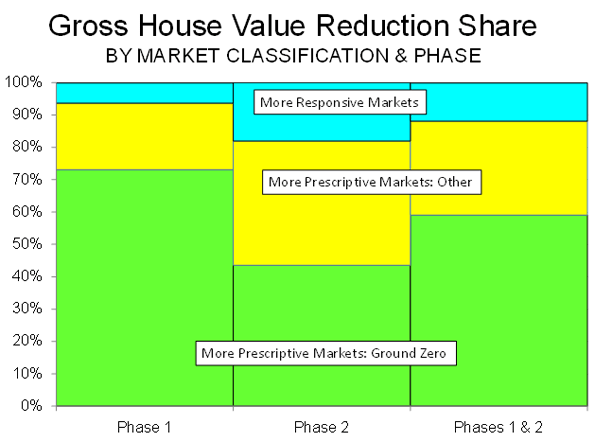
    During Phase I of the housing downturn (through September 2008), the largest losses were concentrated in the “Ground Zero” markets of California, Florida, Las Vegas, Phoenix and Washington, DC. In each of these 11 markets, median house prices dropped at least 25 percent, with per house over $100,000 except in Tampa-St. Petersburg during Phase I. These markets, all with more prescriptive planning, accounted for nearly 75 percent of the gross house value loss in the nation, with other more prescriptive markets accounting for another 20 percent. The more responsive markets, where land use regulation follows more traditional market-driven lines, accounted for slightly more than 5 percent of the loss.

    The Chart below and Table 1 in The Housing Downturn in the United States: 2009 First Quarter Update financial collapse, however, now has spread the losses much more generally. In Phase II, the Ground Zero markets represented 44 percent of the loss, the other more prescriptive markets 38 percent and the more responsive markets 18 percent.

    As of the first quarter of 2009, prices had dropped in all major metropolitan areas. The average per house loss in the Ground Zero markets was still the highest, at 48 percent, though the overall all loss had increased to 34 percent.

    There are indications that the housing downturn may be slowing. The latest data indicates that the median house price increased in March, though not enough to forestall a loss in the first quarter. Another indicator is the fact that the Median Multiple (median house price divided by median household income) has fallen to a national level of 3.1, which is slightly more than the 2.9 historic rate and well below the 4.6 peak.

    The best news of all is that the Median Multiple has dropped to 3.8 in the Ground Zero markets, which is equal to the historic level and well below the peak of 7.3. In the other more prescriptive markets, the Median Multiple is at 3.5, above the 2.9 historic average but well below the peak of 4.8. In the more responsive markets, the Median Multiple has dropped to 2.6, just above the historic average of 2.5 and below the peak figure of 3.2.


    Prices have fallen so much that they now stand at historic 1980 to 2000 Median Multiple levels in 18 of the 49 metropolitan areas. Critically, this includes the Ground Zero markets of Riverside-San Bernardino, Sacramento, Phoenix and Las Vegas.

    Other Ground Zero markets have seen much of their price inflation whittled away, but still have a way to go. Prices need to decline $33,500 to reach the historic Median Multiple level in Los Angeles, $32,300 in Miami, $31,200 in Washington, $18,500 in San Francisco, $11,100 in San Diego and only $1,700 in Tampa-St. Petersburg.

    In other markets, however, prices still have some distance to go before the historic Median Multiple is reached. The largest decrease would have to occur in New York, at $122,000, followed by Portland ($95,000), Seattle ($94,000), Baltimore ($75,000) and Salt Lake City ($74,000). Other markets, including Philadelphia, Virginia Beach, Milwaukee and Ground Zero San Jose would need to have price declines of more than $50,000 to restore their historic Median Multiples. See Table 2.

    Table 2
    Median House Price Reduction Required to Reach Historic Price/Income Ratio (Median Multiple)
    Median House Price Reduction Required to Reach 1980-2000 Median Multiple
    Median Multiple
    Rank Metropolitan Area
    1980-2000 Average
    2000-2008 Peak
    Current (2009: 1st Quarter)
          1 New York, NY-NJ-PA $122,200             3.9            7.7           5.8
          2 Portland, OR-WA $94,700             2.7            5.4           4.4
          3 Seattle, WA $94,400             3.3            6.2           4.7
          4 Baltimore, MD $74,700             2.6            4.6           3.7
          5 Salt Lake City, UT $73,800             2.6            4.3           3.8
          6 Philadelphia, PA-NJ-DE-MD $61,500             2.4            4.2           3.4
          7 San Jose, CA $55,400             4.5          10.2           5.1
          8 Virginia Beach-Norfolk, VA $53,600             2.6            4.7           3.5
          9 Milwaukee, WI $51,400             2.8            4.4           3.8
        10 Boston, MA-NH $41,900             3.5            6.1           4.1
        11 Los Angeles, CA $33,500             4.5          10.1           5.1
        12 Miami-West Palm Beach, FL $32,300             3.4            7.0           4.0
        13 Jacksonville, FL $32,000             2.3            3.6           2.9
        14 Washington, DC-VA-MD-WV $31,200             2.9            5.3           3.3
        15 Providence, RI-MA $29,400             3.1            5.4           3.6
        16 Raleigh, NC $26,700             3.3            3.9           3.7
        17 Austin, TX $20,500             2.8            3.3           3.2
        18 San Francisco, CA $18,500             5.0          11.2           5.2
        19 Denver, CO $18,000             2.9            4.3           3.2
        20 Minneapolis-St. Paul, MN-WI $15,700             2.4            3.6           2.6
        21 Hartford, CT $14,300             3.1            4.2           3.3
        22 San Diego, CA $11,100             4.9            9.5           5.1
        23 Buffalo, NY $10,900             1.9            2.5           2.1
        24 Charlotte, NC-SC $10,100             3.0            4.1           3.2
        25 Richmond, VA $9,500             2.8            4.1           3.0
        26 Louisville, KY-IN $8,100             2.4            3.1           2.6
        27 Chicago, IL $7,800             2.9            4.8           3.0
        28 San Antonio, TX $5,200             3.0            3.3           3.1
        29 Orlando, FL $4,000             2.9            5.2           3.0
        30 Pittsburgh, PA $3,400             2.1            2.8           2.2
        31 Tampa-St. Petersburg, FL $1,700             2.8            4.7           2.8
    Las Vegas, NV  At or Below              3.4            5.3           2.7
    Riverside-San Bernardino, CA  At or Below              3.7            6.6           3.0
    Sacramento, CA  At or Below              3.6            5.6           2.8
    Memphis, TN-MS-AR  At or Below              3.0            3.1           2.0
    New Orleans, LA  At or Below              3.1            3.3           2.8
    Phoenix, AZ  At or Below              2.8            4.7           2.4
    Atlanta, GA  At or Below              2.4            3.1           2.0
    Birmingham, AL  At or Below              3.0            3.5           2.7
    Cincinnati, OH-KY-IN  At or Below              2.3            2.8           2.0
    Cleveland, OH  At or Below              2.2            2.8           1.4
    Columbus, OH  At or Below              2.4            2.9           2.2
    Dallas-Fort Worth, TX  At or Below              2.7            2.7           2.4
    Houston, TX  At or Below              2.5            2.9           2.5
    Indianapolis, IN  At or Below              2.1            2.3           1.7
    Kansas City, MO-KS  At or Below              2.5            2.9           2.3
    Oklahoma City, OK  At or Below              2.8            2.9           2.8
    Rochester, NY  At or Below              2.2            2.4           2.0
    St. Louis, MO-IL  At or Below              2.2            2.9           1.9
    Median Multiple: Median house price divided by median household income.

    These price reductions may or may not occur in over-valued metropolitan areas like New York, Portland and Seattle, all of which are also experiencing serious increases in unemployment. However, given the pervasive evidence that the market is returning to the vicinity of historic price ratios, it would not be surprising if significant price reductions happen in these metropolitan areas, which were previously seen and saw themselves as immune to the fallout that hit the less well-regarded ground zero markets.

    Additional information is available in:
    The Housing Downturn in the United States: 2009 First Quarter Update

    Wendell Cox is a Visiting Professor, Conservatoire National des Arts et Metiers, Paris. He was born in Los Angeles and was appointed to three terms on the Los Angeles County Transportation Commission by Mayor Tom Bradley. He is the author of “War on the Dream: How Anti-Sprawl Policy Threatens the Quality of Life.

  • The Luxury City vs. the Middle Class

    The sustainable city of the future will rest on the revival of traditional institutions that have faded in many of today’s cities.

    Ellen Moncure and Joe Wong first met in school and then fell in love while living in the same dorm at the College of William and Mary. After graduation, they got married and, in 1999, moved to Washington, D.C., where they worked amid a large community of single and childless people.

    Like many in their late 20s, the couple began to seek something other than exciting careers and late-night outings with friends. “D.C. was terrific,” Moncure recalled over lunch near her office in lower Manhattan. “It was an extension of college. But after a while, you want to get to a different ‘place.’”

    The “place” Ellen and Joe looked for was not just a physical location but something less tangible: a sense of community and a neighborhood to raise their hoped-for children. Although they considered suburban locations, as most families do, ultimately they chose the Ditmas Park neighborhood of Brooklyn, where Joe had grown up.

    At first, this seemed a risky choice. While Joe was growing up in the 1980s, the neighborhood — a mixture of Victorian homes and modest apartments — had become crime-infested. The old families were moving out, and newer ones were not replacing them. Yet Joe’s Mom still lived there, and they liked the idea of having grandma around for their planned-for family.

    In a city that has been losing middle-class families for generations, the resurgence of places like Ditmas Park represents a welcome change. In recent years, child-friendly restaurants and shops have started up along once-decayed Cortelyou Road. More important, some local elementary schools have shown marked improvement, with an increase in parental involvement and new facilities.

    Even in hard economic times, the area has become a beacon to New York families, as well as singles seeking a community where they will put down long-term roots. “There’s an attempt in this neighborhood to break down the city feel and to see this more as a kind of a small town,” notes Ellen. “It may be in the city, but it’s a community unto itself, a place where you can stay and raise your children.”

    The Decline of the Urban Middle Class

    The rise of neighborhoods like Ditmas Park suggests that cities can still nurture and accommodate a middle class. Yet sadly this trend continues to fight an uphill battle against a host of forces from high taxes and regulation to poor schools, highly bifurcated labor markets, and the scourge of crime.

    These problems can be seen in the migration numbers. A demographic analysis conducted by my colleagues at the Praxis Strategy Group over the past decade found that New York and other top cities — including Chicago, Los Angeles, San Francisco, and Boston — have been suffering the largest net out-migration of residents of virtually all places in the country, albeit the pattern has slowed with the recession.

    It’s astonishing that, even with the many improvements over the past decade in New York, for example, more residents left its five boroughs for other locales in 2006 than in 1993, when the city was in demonstrably far worse shape. In 2006, the city had a net loss of 153,828 residents through domestic out-migration, compared to a decline of 141,047 in 1993, with every borough except Brooklyn experiencing a higher number of out-migrants in 2006.

    Since the 1990s virtually all the gains made in the New York economy have accrued to the highest income earners. Overall, New York has the smallest share of middle-income families in the nation, according to a recent Brookings Institution study; its proportion of middle-income neighborhoods was smaller than any metropolitan area, except for Los Angeles.

    Much the same pattern can be seen in what has become widely touted as America’s “model city,” President Obama’s adopted hometown of Chicago. The city has also experienced a rapid loss of its largely white middle class at a rate roughly 40 percent faster than the rest of the country.

    Although there has been a considerable gentrification in some pockets around Lake Michigan, Chicago remains America’s most segregated big city. In contrast to the president’s well-integrated cadre of upper-class African Americans, Chicago’s black population remains among the poorest, and most isolated, of any ethnic population in America.

    And like other American cities, Chicago now has a growing glut of “luxury” condos, a pattern that became evident as early as 2006 and has now, as Chicago magazine put it, “stalled” as a result of a “perfect storm” of toughened mortgage standards, overbuilding, job losses, and rising crime.

    Yet there could be some good from the current crisis. Considerable drops in urban rents and residential housing prices should ease the burdens on those who struggle with extremely high prices and taxes. Younger people, including families, may now be able to consider whether a home in Brooklyn, Chicago’s Wicker Park, or Los Angeles’ Studio City might now be affordable and desirable enough to eschew the move to the suburbs.

    The Cost of Being Urban

    In doing scores of interviews recently for a report on New York’s middle class, my coauthor Jonathan Bowles of the Center for an Urban Future and I ran into many people who were considering moving out of the city or had friends who had recently left. This seems particularly true in the remaining middle-class enclaves in the outer boroughs.

    “Almost all the friends I grew up with have moved to Mahopac or Yorktown [in the Hudson Valley],” says Jimmy Vacca, a member of the City Council who represents communities in the Northeast Bronx such as Throgs Neck and Pelham Parkway. “There’s a flight out by many middle-class people because of the schools. A couple gets married and by the time their children gets to age five, they move.”

    Costs, particularly relating to child-raising, are killing the urban middle class. Urban residents generally pay higher taxes and more for utilities, insurance, trash, and sewer than those living elsewhere. Manhattan is by far the most expensive urban area in the United States, with an average cost of living that is more than twice as much as the national average; San Francisco, another city that has seen large-scale middle-class flight, ranks second. The Washington, D.C. area, Los Angeles, and Boston also suffer extremely high living costs.

    These costs are most onerous on the middle class, particularly those with children. This can be seen in the rapidly declining numbers of students in most urban school districts, including such hyped success stories as Chicago, Seattle, Portland, Washington, and San Francisco. Over the past seven years, for example, Chicago’s school system, which was run by new Education Secretary Arne Duncan, has declined by 41,000 students.

    America’s core cities — including the borough of Manhattan in New York — boast among the lowest percentage of children under 17 in the nation. Although Manhattan had a much discussed “baby boomlet” (the borough’s number of toddlers under the age of 4 grew 26 percent between 2000 and 2004), once children over 5 are taken into account, Manhattan’s under-age population is well under the national average. This indicates there may be a process of exhaustion — both mental and financial — as the costs of raising children drain family resources.

    The real issue for the urban middle class is not having babies but being able to sustain their families as the children age and as families expand. One reason: many middle class urbanites spend tens of thousands of dollars a year in additional expenses that those in other cities as well as surrounding suburbs often avoid. For instance, since most middle-class families in big cities today need to have two working parents just to get by, child care becomes a necessity for those without grandparents or other relatives to look after young children. In places like Chicago, Washington, Boston, San Francisco, New York, or Los Angeles these costs typically run from $13,000 to $25,000 per child annually.

    Later many of these same families, if they choose to stay, must then contemplate shelling out considerable sums to send their children to private schools, particularly after the elementary level. This can add from a few thousand dollars to $30,000 a year to their annual costs — and with no tax benefit.

    Do Cities Need a Middle Class?

    Ultimately, in good times or bad, cities have to want a middle class to have one. And politicians, if asked, will genuflect to the idea of maintaining a middle class, yet their actions — on taxes, regulations, schools, development — suggest otherwise.

    Indeed, in reality most urban areas have focused on creating what New York Mayor Michael Bloomberg famously dubbed the “luxury city.” To pay for often inflated public employee costs, the luxury city can only survive off the wealthy and on other groups — empty nesters, singles and students — who demand relatively little in the way of basic services like schools and public health facilities.

    City planners and urban developers favor the unattached: the “young and restless,” the “creative class,” and the so-called “yuspie” — the young urban single professional. Champions of the unattached suggest that companies and cities should capture this segment, described by one as “the dream demographic,” if they wish to inhabit the top tiers of the economic food chain.

    Another key group coveted by cities are the legions of baby boomers who have already raised children. No longer cohabiting with offspring, they are expected to give up their dull family existence and rediscover the allure of a fast-paced, defiantly “youthful” lifestyle. The new retirees, suggests luxury homebuilder Robert Toll, “are more hip-hop and happening than our parents.” They are more interested in indulging “the sophistication and joy and music that comes with city dwelling, and doesn’t come with sitting in the ’burbs watching the day go by.”

    A Demographic Dead End?

    This whole approach has severe limitations. Despite an enormous amount of publicity about empty nesters moving back to the city, surveys conducted by the housing industry find that most aging boomers — upwards of 70 percent — are aging in place, mostly in the suburbs. The numbers moving back into the urban core remain negligible, except in the pages of urban booster publications like The New York Times.

    The young singles provide a more promising demographic for cities. But even here time may be running out. This will be even more evident between 2010 and 2020, when the millennial generation hits their 30s and early 40s and enter the prime years for family formation. Surveys of the cutting edge of this group — the other large age cohort in the population — show that most prefer a single-family home and, like their parents, seem most likely to head to the suburbs.

    But perhaps most troubling of all is what this means in terms of the historic role of cities as incubators of upward mobility. Back in the 1960s, Jane Jacobs could still predict that Latino immigrants to New York, mainly from Puerto Rico, would inevitably make “a fine middle class.” Yet four decades later in the Bronx, the city’s most heavily Latino county, roughly one in three households lives in poverty, the highest rate of any urban county in the nation.

    On the other extreme, in Manhattan, where the rich are concentrated, the disparities between the classes have been rising steadily. In 1980 it ranked 17th among the nation’s counties for social inequality; today it ranks first, with the top fifth of wage earners earning 52 times that of the lowest fifth, a disparity roughly comparable to that of Namibia.

    The University of Chicago’s Terry Nichols Clark, one of the most articulate advocates for this new urban pattern, says cities should focus on acting not so much as vehicles for class mobility, but as “entertainment machines” for the privileged. For these elite residents, the lures are not economic opportunity, but rather “bicycle paths, beaches and softball fields,” and “up-to-the-date consumption opportunities in the hip restaurants, bars, shops, and boutiques abundant in restructured urban neighborhoods.”

    In this formulation cities become the domicile primarily of the young, the rich (and their servants), as well as those members of the underclass who persist in hanging around. What emerges, in the end, is a city largely without children, particularly of school-age, and with a diminishing middle class. Ironically, these are places that, despite celebrating diversity, actually could end up as hip, dense versions of the most constipated suburb imaginable.

    This shift will also limit the economic functions of certain elite cities. Cost pressures, for example, have already helped Houston to replace New York and Los Angeles as the nation’s energy capital; in the future, although now humbled by the collapse of Wachovia, more middle class-oriented Charlotte, as well as other cities, could continue to gain jobs in the post-bust financial sector. Charlotte real estate developer John Harris suggests the city can compete against an expensive metropolitan region not only at the top levels of management but across the board. “It’s hard to be a mass employer in San Francisco,” he notes.

    Joe Gyourko, a real estate professor at the Wharton School, suggests this elite model of urbanism will spread to other favored places such as Portland, Seattle, and possibly Austin. In all these places, we may be seeing the emergence of a European-style pattern of elite urbanism in the core, with a growing concentration of low-wage workers in the least favored parts of the urban periphery.

    The City of Aspiration

    Even if such a model proves sustainable, it certainly means a major change for American urbanism. Unlike most urban cultures, that of the United States has been dominated not by the dictates of princes or priests, but by the efforts of ambitious entrepreneurs and migrants.

    American cities have been driven by a protean, ever-shifting commercial and middle-class culture, willing to break the bonds of tradition. As the great sociologist E. Digby Baltzell noted, the population in New York and other American cities has been “heterogeneous from top to bottom.” Social mobility, Baltzell said, constituted the fundamental reality of American urbanism.

    In this country, cities emerged as the principal North American bastion for those who sought to improve their lives. As historians Charles and Mary Beard noted, “All save the most wretched had aspirations.”

    Such cities often were not inherently pleasant or culturally edifying. Although its wealth would propel it to one day become the world’s cultural capital, visitors from more genteel Philadelphia and Boston often regarded 19th-century New Yorkers as crass and money-oriented.

    The new cities on the opportunity frontier — Chicago, Cleveland, Cincinnati — were, if anything, even more egalitarian. After two years in Cincinnati, British writer Frances Trollope deplored how “every bee in the hive is actively employed in the search for honey…neither art, science, learning, nor pleasure can seduce them from their pursuit.” Chicago, a Swedish visitor commented in 1850, was “one of the most miserable and ugly cities” of America.

    Yet these places were ideal for taking advantage of new technologies from mass manufacturing to trains and the telegraph. They created dynamic societies that provided huge opportunities for vast waves of immigrants, who by 1890 accounted for as much as half of the nation’s urban dwellers.

    The newcomers were joined by others from rural America, including, by the early 20th century, many African Americans. The “Great Migration” of African Americans from the rural south, noted Gunnar Myrdal in 1944, created “a fundamental redefinition of the Negro’s status in America.” Urban life had its horrors, but in the cities it became increasingly difficult to restrict a person into “tight caste boundaries.” African-American migrants from the South may have been different in many ways from newcomers from Italy, Ireland, or Russia, but their fundamental aspirations were often very much the same.

    The Key to a Middle-Class Comeback: The Power of Plain Vanilla

    Compared to the dismal decline in the 1970s and early 1980s, urban prospects have improved, particularly in primary urban areas such as Chicago, New York, and San Francisco. Yet, if these and other cities are to sustain their momentum, they need to look beyond “the luxury city” to the potential of less glamorous neighborhoods that can attract the middle class and people with families.

    These “plain vanilla” neighborhoods include many places that managed to resist the urban decay of the 1970s and in many cases have begun to enjoy a steady resurgence. These include, for example, large swaths of Brooklyn and Queens, as well as the lovely, park-blessed sections of south and west St. Louis, or scattered Los Angeles neighborhoods in places like the San Fernando Valley.

    But these communities can only grow if cities focus on those things critical to the middle class such as maintaining relatively low density work areas and shopping streets, new schools, and parks.

    This would require a massive shift in urban priorities away from the current course of subsidizing developers for luxury mega-developments, new museums, or performing arts centers. To maintain and nurture a middle class, cities need to look at the essentials that have made great cities in the past and could once again do so in the future.

    The New Urban Middle Class

    Perhaps the other key question is what constitutes the economic base for the people who might settle and remain in cities. It’s clear that many traditional industries — heavy manufacturing, warehousing — as well as middle-management white collar jobs will diminish in the future. But it is possible to imagine the rise of a new kind of urban economy built around people working in small firms, or independently in growing fields such as information, education, healthcare, and culture, or as specialists in a wide array of business services.

    These are professions that continued to grow in many older cities, even as other fields declined. In San Francisco, for example, by 2006 there were an estimated 70,000 home-based businesses and a thriving culture of self-employed “Bedouins” working in post-industrial professions. These self-employed people, noted one study, were critical to helping the city withstand the ill effects of the post-2000 dotcom collapse.

    Similarly, the close-in communities of the San Fernando Valley of Los Angeles are home to large contingents of entertainment industry workers, many of them self-employed. According to studies by California State University’s Dan Blake, up to 60 percent of all L.A.-area workers in this highly dispersed industry reside somewhere in this sprawling urban region made up largely of post–World War II single-family houses. Workers in media, graphic arts, and other specialized services have also been among the few groups of middle and upper-middle income earners to see rapid growth in New York’s outer boroughs.

    These post–industrial age artisans — along with more traditional parts of the middle class such as civil servants, teachers, nurses, and other service workers — could provide the critical residential base for the plain vanilla urban neighborhoods’ work. Neither rich nor poor, these artisans could use the new telecommunications net to access clients who may exist in the sprawling suburban rings, throughout the United States, or overseas.

    Cities of the Future

    You can see this emerging reality in places like Ditmas Park, Brooklyn. Nelson Ryland, a film editor with two children who works part-time at his sprawling turn-of-the-century Flatbush house, suggests that the key to an urban revival lies not in the spectacular but in the mundane. “It’s easy to name the things that attracted us — the neighbors, the moderate density,” he says over coffee in a house close to that occupied by Ellen and Joe. “More than anything it’s the sense of community. That’s the great thing that keeps people like us here.”

    This “sense of community” will become the key currency of sustaining urban communities. Such middle-class sensibilities get short shrift by urban scholars such as Richard Florida, who argue that in the so-called “creative age” places of residence should be “leased” like cars. In his mind, single-family homes, the ideal of homeownership, should be replaced “by a new kind of housing” that embraces higher forms of density without long-term commitment to a particular residence or location.

    In fact, the sustainable city of the future will depend precisely on commitment and long-term residents. It also will rest on the revival of traditional institutions that have faded in many of today’s cities. Churches — albeit often in reinvented form — help maintain and nurture such communities. Similarly, extended family networks will be critical to future successful urban areas. As Queens resident and real estate agent Judy Markowitz puts it, “In Manhattan people with kids have nannies. In Queens, we have grandparents.”

    The modest and mundane ties between people that exist in such places represent the key to reviving America’s urban regions in the coming generation. It is in our urban neighborhoods — not in the glamour zones and high-end downtowns — that our country’s cities can find a new life and purpose in the 21st century.

    This article originally appeared at American.com.

    Joel Kotkin is executive editor of NewGeography.com and is a presidential fellow in urban futures at Chapman University. He is author of The City: A Global History and is finishing a book on the American future.
  • Lenny Mills to Urban America: Clock Is Ticking for Ranks of ‘New Homeless’

    I always do my best to make time for Lenny Mills because he’s earned that sort of consideration.

    Mills is the fellow who wrote several pieces under the banner of his trademark “7 Rules” outline, where he applies the tricks he learned as a telemarketer to analyses of real estate development, politics, and other matters.

    Mills did an especially fine job on the “7 Rules of Downtown Gentrification,” which appeared in the Garment & Citizen’s issue of April 21, 2006. He laid out a number of reasons – seven, to be exact –to consider the possibility that the residential real estate boom ringing through Downtown Los Angeles back then would eventually turn into a busted bubble.

    Events have certainly borne out Mills’ prediction, so he brought credibility with him on his latest visit to my office.

    Mills waved a recent copy of USA Today at me, saying that he’s worried about the sort of folks who were featured in a recent front-page story in the national publication, a piece that described the circumstances of some of “the new homeless.” These are individuals who worked steadily their whole lives before hitting the skids and losing their homes in the current economic downturn. It’s a trend that has become familiar these days, with homeless encampments cropping up in all sorts of places, including Los Angeles.

    Mills has some added credibility when he speaks about homelessness – he spent a number of years living on the streets. He knows what it means to go through life with a weather-beaten face, watching opportunities slip away for lack of a telephone number to leave behind when seeking work.

    Mills has a place to live now, but he remains determined to inject his warnings about the new homeless into the public debate. The clock it ticking, he says, and the deterioration that comes with life on the streets will make it harder and harder for folks to climb back into mainstream lives. Once the wardrobe starts to fray, he says, the odds against getting back on track grow longer. Once the teeth start to go, he adds, homeless individuals can just about write off any return to the life they once knew. Each bit of deterioration makes it tougher for the homeless individuals – and more likely that they will become permanent burdens to the rest of us in one way or the other.

    Mills is remarkable in a number of ways, including the ability he mustered to retain his social skills during his time on the streets – something that many individuals quickly lose. I disagree with him on some things, but I can’t fault his ability to make fine use of the language to get his points across.

    Mills used such skill during our recent talk, driving home a couple of points about the new homeless: Our society has a narrow window of opportunity to pay for programs to reverse the trend – and a failure to act soon will mean far greater costs in terms of human lives and the public purse.

    Mills can spout chapter and verse on what he sees as the causes of the increases in homelessness over the past 40 years. He can cite demographic trends, economic patterns, and public policies to make a compelling case that a lot of folks were swept into life on the streets by causes beyond their control. He firmly believes that we as a society could have prevented most of the homelessness we have seen over the years had we not lacked the will to do so.

    I wouldn’t describe Mills as a fun guy. He’s a valuable fellow, though, because he’s willing to tell you what you’d rather not hear – and he’s capable of doing so in reasoned tones.

    Give Mills his due for hitting upon something of vital importance now. It’s clear that all the talk we’ve heard about addressing the old homelessness has led to no great progress over the course of decades. What did that latest Blue-Ribbon Public-Private Committee to End Homelessness Forever accomplish besides a photo opportunity, anyway?

    Someone wake the Blue Ribbon brigade and fire all of them.

    We have a whole new homeless problem – and we’re in desperate need of new ideas.

    Jerry Sullivan is the Editor & Publisher of the Los Angeles Garment & Citizen, a weekly community newspaper that covers Downtown Los Angeles and surrounding districts (www.garmentandcitizen.com)

  • Smart Growth? Or Not So Bright Idea?

    Smart Growth and New Urbanism have increasingly merged into a loosely aligned set of ideas. The benefits of this high-density housing viewpoint are fast becoming a ‘given’ to planners and city governments, but studies that promote the advantages often omit the obvious disadvantages. Here are some downsides that show a much different story:

    Smart Growth or Dumb Idea?

    One goal of Smart Growth is to move our society away from dependence on cars, and many Smart Growth plans intentionally make it difficult to drive through the neighborhood, making walking more inviting. Smart Growth planners advocate short blocks in a grid pattern to distribute traffic (vehicular and pedestrian) evenly within a development. These short blocks produce a multitude of 4-way intersections, and add a multitude of those trendy “turnabouts,” to make a bland site plan look more interesting.

    But all of this together destroys “flow”. On the other hand, in a grid planned neighborhood you might drive a straight line with an occasional turn, giving the impression of a much shorter drive than a curved subdivision. But with short blocks, a driver must stop completely, pause, then when safe accelerate through the intersection onto the next intersection, then repeat… multiple times. This scenario uses a tremendous amount of energy; the car eats gas.

    To understand this point clearly, go out and try to push a modern car. All the safety and convenience features, even in the most basic car sold today, add weight. Even a Toyota Prius is just under 3,000 lbs. While a given model may get great mileage the bulk of energy consumed is in getting the thing moving from a full stop. Should a vehicle maintain a constant flow (at any speed), the energy usage plummets, compared to stop-and-go traffic patterns that intentionally force conflicts.

    To make matters worse, the majority of vehicular vs. pedestrian accidents occur at intersections. Smart Growth designs have many more intersections than conventional suburban plans . Even more dangerous, Smart Growth walkways are placed close to the where the cars turns. Check out Traffic by Vanderbilt for an understanding of the psychology of driving.

    One may argue that cars will become more efficient. So what? This stop and go scenario also consumes time.

    Rooting Out Tree Issues

    Nobody can argue against the character of a tree-lined street… no one, that is, except the city Public Works department that must maintain structures being destroyed by trees growing in close confines to concrete walks and curbs. Smart Growth/New Urbanist compact front yard spaces are typically 10 feet or less. This simply cannot provide for enough room for tree growth when there is a 4’ wide walk typically a few feet away from the curb, the area where street trees grow. Without trees to define the street, these solutions have very little organic life to offset the vast volume of paving in front of each porch.

    Now and in the near future there will be a new era of solar heat and power, most of which will be mounted on the roofs of homes. Guess what blocks the sun’s energy? Yep – street trees! High density means that the proximity of trees to roofs will deter the sun’s energy from reaching those solar panels.

    Get Real About Presentations, Porches and People

    Typically, when a high-density development is proposed, the renderings show large green common areas bounded by homes with grand porches. The presentations usually show only a few cars parked along the street, and plenty of residents enjoying the spaces lined by mature trees that have had about 20 years of growth. This misrepresentation helps to win over councils, planning commissions and concerned neighbors. What is not shown in the presentations for approvals are claustrophobic, intense areas, such as the typical street most residents will live on, or perhaps the views down the alleys.

    There may be some neighborhoods that are built as represented, but architectural and land planning consultants are likely to stretch the truth more than a wee bit to gain approvals. Where can we see the original presentation images compared to what actually gets built?

    Those inviting large porches where neighbors sit and gossip in the presentation: Do they ultimately end up as stoops hardly large enough to fit a standing person? Those large mature trees: Are they actually just seedlings? Does the real streetscape have people walking on the typically narrow 4 foot wide walkways? How many people are walking along the roadway instead? Are the streets lined with just a few cars, as the renderings show, or are they packed with unsightly vehicles, while the nice cars are likely stored in the rear garage?

    The Evolution of Pavement

    Suburbs have changed during the last few decades. For example, in Minnesota thirty years ago an average suburban lot would have been 15,000 square feet and 90 to 100 feet wide. Today, 8,000 square feet and 70 feet wide would be more typical. In a conventional suburban plan, there weren’t any alleys, and the front loaded driveways were appropriately tapered. There were few side streets. The lots might have been 20% larger than in a Smart Growth high density plan, but the street layout might have had about 30% less linear feet of street compared to a Smart Growth grid layout. In the south, where the typical suburban lot is about the same size as that high density lot, the numbers favor the conventional layout even more; the total paved surface area could be 50% or more lower. So, the Smart Growth/New Urban plans place a greater burden on the tax payers to municipally maintain (more) paved surfaces.

    A Final Consolation…

    In reality, fire and police departments, as well as traffic engineers, review suburban development plans. And often the original high-density narrow street proposal doesn’t make it all the way to approvals. With or without the popularity of Smart Growth and New Urbanism, a much wider paved section or a compromised width is often the ultimate result.

    Rick Harrison is President of Rick Harrison Site Design Studio and author of Prefurbia: Reinventing The Suburbs From Disdainable To Sustainable. His websites are rhsdplanning and prefurbia.com.

  • Obama’s Energy Triangulation

    With the possible exception of health care reform, no major issue presents more political opportunities and potential pitfalls for President Barack Obama than energy. A misstep over energy policy could cause serious economic, social and political consequences that could continue over the next decade.

    To succeed in revising American energy policy, the president will need to try to triangulate three different priorities: energy security, environmental protection and the need for economic growth. Right now, the administration would like to think it could have all three, but these concerns often collide more than they align.

    A president should have no higher priority than to ensure that America becomes more independent from foreign producers, particularly those outside North America. This represents a great opportunity to diverge from the failure of the Bush administration to reduce this dependence and encourage conservation.

    Instead, the best course could be called an “all of the above” strategy. This would embrace not only conservation and investment in renewable fuels but also aggressive expansion of the electric grid, the domestic fossil fuel industry and nuclear power. In particular, the country should focus on exploiting our vast reserves of relatively clean natural gas and drive technologies that could also clean up emission from coal, our other large resource.

    Instead of promoting fossil fuel development, environmental lobbyists — and Obama — like to talk about “green jobs.” Although green elements need to be integrated into all walks of economic life, the notion that green jobs can provide economic salvation seems more like a marketing strategy than one based on reality.

    Given current energy prices, large-scale numbers of green jobs can be created only through huge subsidization, the costs of which would, of course, be born by other parts of the economy. At the same time, jobs lost in fossil fuel production and manufacturing because of the high costs associated with renewables would most likely far outweigh any imaginable surge of green jobs.

    A recent study conducted in Spain, another country with a history of strong subsidies for renewable fuels, found that the money invested in green jobs actually cost so much that the overall employment effects were negative. Increasingly, the “green jobs” mantra seems like a story we tell our children to get them to sleep.

    The mantra also obscures the critical fact that the true goal of the environmental lobby is, above all, to shrink the much detested “carbon footprint” of people and communities. People like Obama’s science adviser, John Holdren, do not place much priority on maintaining much of the present American way of life. An acolyte of the many-times-wrong neo-Malthusian Paul Ehrlich, Holdren has promoted the “de-development” of Western societies as a way to lower carbon emissions and redistribute the world’s wealth.

    Such an approach might be popular at academic soirees or even among some investment bankers who see their future in Shanghai as opposed to Saginaw or Sacramento. It may prove a bit less popular among those, particularly in the middle and working class, who might not welcome seeing their families and communities de-developed.

    This should be obvious to the president and the clever political tacticians around him. Recent polls reveal that voters now rate global warming among their 20 least-critical concerns. Not surprisingly, the economy and jobs ranked as the top two.

    There are also serious regional issues to consider. Areas with economies tied to fossil fuels — mainly in Texas, the Great Plains, the Southeast and Appalachia — view the issue differently than do places like Manhattan, San Francisco or Chicago’s Gold Coast, whose residents can afford much higher energy prices and have few ties to traditional productive industries.

    As leader of both the country and his party, the president will have to consider these regional and class divides. The Republicans may be irrelevant, but the swelling ranks of more-pragmatic Democrats from Western, Southern and exurban districts cannot be so easily dismissed.

    In this sense, the possibility of the election next year of Houston Mayor Bill White, a Democrat, to the Senate represents more of a threat to the green lobby than a Republican victory does. White, like many Texas Democrats, has close ties to the energy industry and has already expressed grave misgivings about the administration’s renewables-obsessed carbon emissions policies.

    Given growing opposition in Congress, green groups and their allies in legal circles now argue that the administration can transcend the messy political process by imposing a strict anti-greenhouse-gas policy through the Environmental Protection Agency apparat. This has the virtue of allowing the president to avoid direct confrontation with many congressional Democrats but leaves power firmly in the hands of zealots for whom both energy independence and economic growth are less-than-compelling priorities.

    Ultimately, energy policy is too important to the economy and security to be left in the hands of bureaucratic zealots and their allies. It is up to the president to forge an energy program that, while looking toward renewables in the long run, does not sacrifice the livelihoods of millions of American workers today or leave our country ever more susceptible to the machinations of hostile foreign powers.

    This article originally appeared at Politico.

    Joel Kotkin is executive editor of NewGeography.com and is a presidential fellow in urban futures at Chapman University. He is author of The City: A Global History and is finishing a book on the American future.
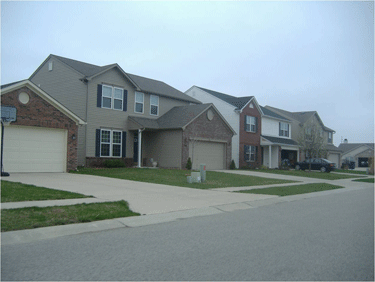
  • Cap and Trade: Who Wins, Who Loses

    President Obama recently announced his plan for environmental protection and Congress took up the debate. Called “Cap and Trade” Obama explained it simply in several public appearances. The government puts a limit on the total amount of carbon emissions that are acceptable in the United States. Carbon emissions come, basically, from burning carbon-based fuels – natural gas, petroleum and coal – in the production and use of energy. Users and producers of energy emit carbon dioxide (and other pollutants) into the atmosphere.

    As Richard Ebeling writes at the Mises Institute, under cap and trade “the government will formally nationalize the atmosphere above the United States.” The program bypasses fundamental questions like what is pollution, how much does it take to cause harm, who is harmed by it and linking the causation between pollution and harm. Fear of lawsuits, torts and injunctions (which could provide the answers) keeps the Administration from addressing these questions head-on. Reliance on the same, tired old source for solutions – Wall Street – ensures that those being harmed aren’t necessarily the ones who will benefit.

    Under Cap and Trade, each carbon-emitting entity – cars, power plants, factories, etc. – is allotted some share of that total limit, or Cap, permitted for carbon spewed into the air in the United States. For example, a power plant producing electricity for 50,000 homes and businesses might be allowed to emit 2 tons of carbon per year. That’s their “cap,” the maximum amount of carbon they are allowed to put in the air.

    Now for the “trade”: if that plant finds a cleaner way to produce the electricity needed for 50,000 homes and businesses, say only 1 tons of carbon per year, they can sell the right to emit 1 ton of carbon to a power plant that puts 3 tons of carbon into the air while generating electricity for 50,000 homes and businesses. The plant that buys the right to emit an extra 1 ton of carbon per year is not required to limit their emissions to 2 tons – they bought the right for the extra ton.

    It all sounds very lovely as long as the caps will control the total amount of carbon added to the air from the United States. The money gained by selling the rights for “unused” emissions will provide financial incentives to the makers and users of cars, power plants and factories to pay for the technology to be cleaner. Since the money spent to pay for the more efficient technology can be recovered in the Cap and Trade marketplace, the cost of the cleaner energy shouldn’t require higher costs to consumers of the now cleaner air.

    This is great if you live near a power plant that manages to reduce the carbon emissions into the air you breathe below the maximum cap level. Here’s the problem: what if you live next to the power plant that paid for the right to put an extra ton of carbon into the air? Two things happen. First, you will be paying for the extra carbon because the power company will have to charge more to pay the cleaner power company for the right to produce the extra ton of carbon. That leads to the second problem: the extra ton of carbon is being emitted into the air around your home. That means that you could end up paying more for your electricity, while also breathing more polluted air.

    Cap and Trade is not a solution, it is another money-making scheme cooked up by the “dangerous dreamers” of Wall Street. In the EU they at least have the good grace to call it a “Trading Scheme.” A global carbon trading market already exists. “Pollution rights” have been traded since the 1990s when the Environmental Protection Agency held the first auction of air emission allowances, or pollution rights, at the Chicago Board of Trade. Starting with sulfur dioxide allowances, other pollutants were added in the next ten years to eventually create a complete trading market on the Chicago Climate Exchange. “The right to use water or air is more valuable than food, and we can use the price system to allocate that right,” said Richard Sandor at the 2005 Milken Institute Global Conference (yes, that Milken). The Chicago Mercantile Exchange and the New York Stock Exchange are now prepared to expand the environmental markets for industrial pollution, also known as the carbon markets, into “futures and options on more than 40 U.S. and international indexes [for pollution rights].”

    But, really, do we want the same bunch of guys that gave us junk bonds, mortgage-backed securities and credit default swaps allocating air and water? Globally? Into the future?

    Like sending subprime mortgages throughout the global economy, this scheme will allow pollution rights to be bought and sold by anyone. So, it isn’t just the factory next door to the power generator in Detroit that will be emitting the extra tons of carbon – factories in other countries will be able to sell their carbon emitting rights to power companies in Detroit. It’s a great money-making scheme for a solar powered producer in Costa Rica – but a very bad deal for those breathing the air and paying for power in Detroit.

    The Cap and Trade scheme is being supported by President Obama’s main economic advisor, Larry Summers – who once said we should export pollution to Africa because their per capita figures are too low. “I think the economic logic behind dumping a load of toxic waste in the lowest wage country is impeccable and we should face up to that.”

    Cap and Trade gets the polluters mixed up with the victims of pollution. Shouldn’t the money generated from the sale of pollution rights accumulate to the persons harmed by the pollution? The idea that you can structure economic incentives to produce socially beneficial results really ends up being about creating paper profits for the money-traders at the expense of the people living with the pollution. This does not seem like a fair trade to me.

    Susanne Trimbath, Ph.D. is CEO and Chief Economist of STP Advisory Services. Her training in finance and economics began with editing briefing documents for the Economic Research Department of the Federal Reserve Bank of San Francisco. She worked in operations at depository trust and clearing corporations in San Francisco and New York, including Depository Trust Company, a subsidiary of DTCC; formerly, she was a Senior Research Economist studying capital markets at the Milken Institute. Her PhD in economics is from New York University. In addition to teaching economics and finance at New York University and University of Southern California (Marshall School of Business), Trimbath is co-author of Beyond Junk Bonds: Expanding High Yield Markets.