Category: Policy

  • In California, the Canary is Dead

    Canaries were used in early coal mines to detect deadly gases, such as methane and carbon monoxide. If the bird was happy and singing, the miners were safe. If the bird died, the air was not safe, and the miners left. The bird served as an early warning system.

    Domestic migration trends play a similar early warning system for states. California’s dynamism was always reflected by its ability to attract newcomers to the state. But today California’s canary is dead.

    Here’s the logic. If net domestic migration is positive, the state’s economy is reasonably sound. Economic growth, taxes, housing, and amenities are strong enough to keep people where they are and attract others. If net domestic migration is negative, it usually means that lack of economic growth, taxes, quality of life, and housing have deteriorated sufficiently to drive people away. This happens despite the inevitable pain of leaving the security and comfort of family, friends, and familiar surroundings.

    California has been a destination for migrating workers and families since 1849. They came form every state and from around the world. Often the migrants faced tremendous challenges and hardship. Illegal immigrants from Mexico and other developing countries still must leap over such barriers. Often, California’s migrants came in waves. The 1850s, 1930s, and 1950s all saw huge surges tied to huge events – the Gold Rush, the Depression and the post-war boom. But even between these waves, California consistently experienced a steady inflow of new immigrants.

    Immigration has been good for California. The new residents brought ambition, skills, and a willingness to take risks. They found a state with abundant natural resources, from oil to rich soil and ample, if sometimes distant water resources. Together with the people already there, they created an economic powerhouse. They built cities with amenities that rival any other. They fed much of the nation and large numbers overseas. They did this while persevering much of California’s unique endowment: the vast coastline, the Sierra Nevada, and the deserts.

    California, with 12 percent of the United States population, became the world’s sixth largest economy while managing to maintain the aura of paradise at the same time. Opportunity and housing were abundant. California was a great place to have a career and raise a family.

    Most recently, though, this has begun to change. California is no longer a preferred destination, at least for domestic migrants. The state’s economy is limping along considerably worse than that of the nation. Opportunity is limited. Housing is relatively expensive, even after the dramatic deflation of the past two years, except for some very hard-hit and generally less attractive inland areas. Taxes are high and increasing. Regulation is onerous and becoming more so. Many California communities are outright hostile to business.

    Consequently, net domestic migration has been negative for 10 of the past fifteen years. International migration to California remains positive, but that reflects more on the weakness of the economies and the attraction of existing ethnic networks than the intrinsic superiority of California. This represents a sea change: anyone predicting it fifteen years ago would have been laughed out of the room.
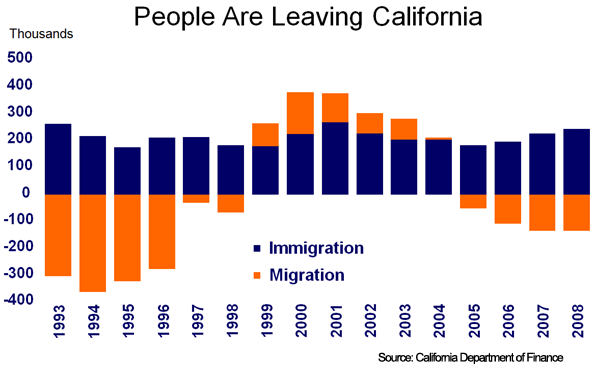
    What happened?

    California’s economy was badly hit by the 1990s recession. The State’s aerospace and defense sectors were especially decimated. Middle-class families moved out by the hundreds of thousands.

    The 1990s out migration caused some soul searching in California. There was lots of talk, and a little action on making the State more competitive. Then came the technology and real estate booms. Domestic migration turned positive. The half-hearted efforts to make California more competitive faded as policy makers were lulled into complacency by the strength of California’s resurgence.

    But the problems that bedeviled the state in the 1990s – high housing prices and taxes, cascading regulations and a deteriorated infrastructure – had only been obscured by the boom. By 2005 migration began to turn negative, largely as soaring housing prices discouraged newcomers and encourage many residents to cash out and move to less expensive places. California had priced itself, and the dream, out of competitiveness. Since then, California has seen four consecutive years of increasingly negative domestic migration. The recent net outflow numbers have been smaller than in the 1990s, but it may be because other tradidional California migrant destination economies – like Oregon, Washington, Nevada and Arizona – have become less competitive as well.

    Today, many argue that California will bounce back, but they can’t identify the reason. What sector will lead the resurgence? They seem to think economic growth will come with the sunshine, beaches, and mountains. There was plenty of sunshine in the 80 years between the founding of the first mission and the gold rush, and not much happened. Similarly, the differences between California cities and neighboring Mexican cities show clearly that successful economies need more than good looks and nice climate.

    It’s hard right now to assume California’s future will include the same predominance in technological innovation. Agriculture is running out of water, in large part due to environmental lawsuits, and the state no longer seems willing to invest in new water projects. Even the entertainment industry is increasingly looking outside of California for growth. You have to ask: what does California offer that will overcome the State’s high costs, regulatory environment, and antipathy to business?

    That is the short term. The long term doesn’t look very good either. The public universities, a major source of innovation over the past two decades, are facing increasingly severe budget challenges. It is unlikely that they will be able to maintain their status even as other states – Texas, Colorado, New Mexico – eye further expansion. Even more ominous are gains in countries, such as China and India, who have long sent their best and brightest to the Golden State.

    All this suggests a relative decline in California’s long-term prospects. What should we do? Part of California’s problem is its political process. The state’s chronic inability to do much of anything reinforces stasis. As Dan Walters says, “everyone has a veto on everything.”

    But even improving the political process may not be enough. Much of Coastal California is dominated by rich, aging, baby boomers. The residents of this increasingly geriatric ghetto often don’t worry much about economic opportunity. They may have the money and votes to guarantee that growth does not impinge on their lifestyles. Unless these conditions change, it will be unlikely to see a renewal of strong domestic migration to California in the coming years.

    Bill Watkins, Ph.D. is the Executive Director of the Economic Forecast Project at the University of California, Santa Barbara. He is also a former economist at the Board of Governors of the Federal Reserve System in Washington D.C. in the Monetary Affairs Division.

  • Unsustainable Transit: New York City

    When it comes to transit, as like many things in the United States, there is no place like New York City. The subways and buses of the New York City Transit Authority (NYCTA) carry more than 40 percent of the nation’s transit rides (unlinked trips). To account for 40 percent of the nation’s ridership is quite an accomplishment inasmuch as the city represents less than 3 percent of the nation’s population.

    Of course, New York City’s ridership domination stems from the evolution of an ideal environment for transit. Most of the ridership comes from the heavily urban boroughs of Manhattan, Brooklyn, Queens and the Bronx, with a much smaller ridership in Staten Island, most of which looks like the second ring adjacent New Jersey suburbs. The four highly urban boroughs have exceedingly high population densities, averaging above 30,000 per square mile. The city of San Francisco, with its reputation for density, is little more than one-half as dense. The four boroughs are nearly as dense as city (23 ku area) of Tokyo, denser than most European core cities and nearly three times as crowded as Amsterdam.

    The most important factor, however, is the concentration of destinations in the central business district, south of 59th Street in Manhattan. This is the world’s second largest central business district and the home of approximately 2,000,000 jobs. Only the geographically larger business district inside Tokyo’s Yamanote Loop has more jobs. The Manhattan business district (really two, Uptown and Lower Manhattan and the area between) has at least four times as many jobs as Chicago’s Loop, the second largest central business district in the nation.

    The share of people commuting to work by transit is far higher than anywhere else in the nation. Approximately 75 percent of the people commuting to jobs in Manhattan get there by transit. Approximately 55 percent of the city’s working population commutes by transit, double the percentage of automobiles. By comparison, other highly urbanized central cities have far smaller transit work trip market shares, with Boston at 34 percent, San Francisco at 33 percent and Chicago at 26 percent. In each of these cities, considerably more people commute by car than by transit.

    Suffice it to say that New York is the penultimate transit city. If transit is the answer anywhere, it is the answer in New York.

    Yet the history of New York City Transit Authority has been one of financial crisis. From the NYCTA’s founding in 1953, transit riders of New York City have been faced by recurring threats of service reductions and fare increases. Over the years, transit fares have risen sharply despite increased subsidies. The financial downturn has generated yet another financial crisis at NYCTA, as well as at many other transit agencies around the country. There may be a financial bail-out from Albany, or there could be significant fare increases or service reductions. But the present financial crisis is by no means the first and it is unlikely to be the last. The problem is that transit is characterized by perverse incentives that keep if from focusing on its principal mission.

    Transit’s mission, as my late Los Angeles County Transportation Commission colleague (and Santa Monica city councilwoman) Christine Reed so eloquently put it, is to serve both riders and taxpayers. Regrettably, however, the riders and taxpayers routinely take a back seat to other more concentrated and powerful groups with a strong interest in getting themselves more money and scant interest in cost efficiency.

    As a result, the story is always the same in New York and elsewhere. Financial crises are characterized as funding crises and the answer to every question is more money. Little or no serious attention is paid to the cost side of the equation. In the present environment, the riders and the taxpayers are unlikely to ever be able to provide enough money to make transit financially sustainable.

    Both labor and management operate in an environment of perverse incentives. Labor unions understandably seek to improve the wages and working conditions of their members. In a competitive environment, there are some limits. But transit remains immune to competitive pressures; it is rather a political environment. Transit board members are appointed by elected officials, many of whom rely heavily on political contributions from labor unions and their often sophisticated get out the vote operations.

    Transit managers must live with this reality and any who become too courageous in their dealings with transit labor can expect to be shown the door. At the same time, transit labor negotiations are often not really conducted between parties across the table from one-another. Indeed, often the table is shoved up against the wall, since the gains that are won by the labor unions are largely duplicated in the pay and benefits packages of transit managers. Thus, costs are higher in transit – whether at NYCTA or at other agencies – than they would be for similar work in the private sector.

    One might expect transit to face frequent crises in Eugene, Madison or even Los Angeles or Seattle. But New York City? Perverse incentives are the problem, but other cities have managed to have successful transit systems without such incentives. In some of the world’s largest cores, such as Tokyo and Hong Kong, transit obtains virtually all of its funds from commercial revenues, principally fares. Without access to the deep pockets of taxpayers, transit is required to live within their means. Serious attention is paid both to funding and costs. It may be too much to ask for transit in New York City to be converted from its heavy subsidies to a profitable operation. But improvements can be made.

    In transit operations, one answer is competitive contracting (competitive tendering), whereby the transit agency seeks competitive bids on bus and rail routes for private operation. The competitive market reduces costs, while the transit agency specifies all aspects of the service. The best example of competitive contracting in the world is the London Transport bus system, which is the largest city bus system in the developed world. Buses are operated by multiple private contractors, under the control of Transport for London, which determines fare levels, routes, schedules and transfer arrangements. To the public, London Transport’s buses look and act like a single system. There is, however, a big difference. Competitive contracting has reduced costs per mile by nearly 40 percent after adjustment for inflation over the past 25 years. The savings have been plowed back into substantial service increases, which have led to strong ridership increases. Subway operating costs have also been reduced through competitive contracting, such as in Stockholm.

    But so long as the focus is on revenues and costs are largely ignored, the only thing sustainable about transit in New York City will be its fiscal crises. Even if there is an eventual financial bailout of NYCTA this time, expect the clock to start ticking towards the next inevitable crisis.

    Wendell Cox is a Visiting Professor, Conservatoire National des Arts et Metiers, Paris. He was born in Los Angeles and was appointed to three terms on the Los Angeles County Transportation Commission by Mayor Tom Bradley. He is the author of “War on the Dream: How Anti-Sprawl Policy Threatens the Quality of Life.

  • Lessons from Chrysler and the Nationalized Economy

    Economists and accountants could very likely have told us six months ago that Chrysler was doomed as a business and that the likely best course of action would be Chapter 11 bankruptcy and restructuring. Doing this in a timely manner would have saved the taxpayers billions of dollars.

    But the politics were not right to permit this to happen at that time. So instead we invested billions of tax dollars to save it, only to find ourselves right back were we started. Except now the clock is striking twelve and it is the right time to reorganize the automaker – politically speaking.

    The politics has worked to “force” Daimler, Cerberus, Banks, UAW and the U.S. taxpayer to forgive nearly $17 billion in debt, and to transfer ownership to a consortium that includes Fiat, U.A.W., and the U.S. and Canadian governments. The same fate may soon await General Motors given the current political atmosphere.

    Government action is not driven so much by economics or accounting as it is by shifts and changes in public opinion and the political winds on Capitol Hill. Regardless of the problem and the consequences of delay, no issue will be dealt with until opinion has been properly shaped around it. This is inefficient by its nature, but government is not a business and cannot fail, so the consequences are never felt by government.

    This means government will often invest in what’s next and ignore what is needed in the present. Why? Because the public likes the new and the novel and grows weary of the old and tried and true. Transportation infrastructure is a great example. It is an accepted fact that our road and bridge infrastructure is failing and will require billions of additional dollars to rebuild and reform into a 21st century, integrated mobility network. Yet there is no political will to address an issue which could seriously undermine our economic competitiveness costing us countless jobs and businesses.

    Politicians know that a solution will require new revenues and very likely a new user fee to augment the current gas tax. Raising taxes is not good for the long term political health of our elected “leaders” because the public does not want to pay for things. So rather than solve a pressing need, government proposes borrowing $8 billion to spend on high speed rail projects like the one to connect Disneyland and Las Vegas. This project works politically because it is filled with perceived benefits and no one really has to pay for them – we can pass it all on to the next generation.

    As we move toward increasing the politicization of our economy where politicians replace CEOs, government becomes a major shareholder in corporations, and the metrics of elections replace standard accounting practices, we should remember the inherent and unintended consequences.

    Businesses succeed or fail based on markets. The government’s attempt to create a false housing market with its affordable housing initiative is arguably one of the major contributing factors to our current recession. They will likely assert their new power in the automobile industry to create “green” cars that may or may not sell. What if consumers choose to buy Japanese, Korean or German label cars made in Mississippi or Alabama, instead of UAW-built cars from Michigan?

    Markets work, and yet they are being ignored. The second most profound economic event of the past year (the collapse of the financial markets being the first) was when the price of gasoline moved above $4.00 a gallon in April of 2008. People drove less. Demand for SUVs plummeted. Ridership of public transportation increased dramatically. Many valued components of American way of life changed almost overnight.

    What is often missed is the fact that government was powerless to do anything about gas prices. Elected leaders looked for scapegoats in speculators and commanded the heads of the Big Oil companies pay homage at their feet. They attacked profits, demanded more drilling, put their environmental agenda on the back burner. The crisis showed them to be feckless on the horns of a dilemma. When prices retreated swiftly in August 2008 and public opinion cooled on the issue, drilling for new energy disappeared from the radar and everything was “green” again. The problem has not disappeared of course, but only public support for a solution. Is this any way to run an economy?

    Businesses concentrate on profit. Elected leaders focus on votes. Bad business decisions are unsustainable in a free market which metes out consequences with failure. Bad political decisions make an elected official unelectable, so it is always better to avoid conflict by putting off the really tough decisions for another day. This is not the way most Americans run their households, but it’s how politicians would run our economy – responding to opinion, not market conditions.

    There are some very difficult decisions as we move through this economic downturn. Do we want more and more of the political processes to be incorporated into our economy on a permanent basis? Banks and financial institutions have already seen first hand the consequences of getting into bed with government. Our automobile industry is next in line. Let’s hope it is the end of the line, but it probably won’t be.

    Dennis M. Powell is president and CEO of Massey Powell an issues management consulting company located in Plymouth Meeting, PA.

  • America’s (Sub)Urban Future

    Cities today have more political clout than at any time in a half century. Not only does an urbanite blessed by the Chicago machine sit in the White House, but Congress is now dominated by Democratic politicians hailing from either cities or inner-ring suburbs.

    Perhaps because of this representation, some are calling for the administration and Congress to “bail out” urban America. Yet there’s grave danger in heeding this call. Hope that “the urban president” will solve inner-city problems could end up diverting cities from the kind of radical reforms necessary to thrive in the coming decades.

    Demographics and economics make self-help a necessity. Despite the wishful thinking of urbanophile pundits and policymakers, central cities have little realistic chance to reclaim their pre-1950 role as the dominant arbiters of American life.

    Short of a catastrophic change, the country will remain predominately made up of suburban, exurban and small town residents. Since 2000, more than four-fifths of metropolitan growth has taken place in suburbs and exurbs. Economically, we see a similar pattern. According to a recent Brookings Institution study of 98 large metropolitan areas, only 21% of employees work within three miles of downtown. The report found that only three regions avoided the decentralizing trend.

    The Brookings report and many others decry all these trends as promoting “sprawl,” but name-calling will not assure that urban areas can impose their political hegemony over the long run. The Obama administration may try to boost cities by imposing barriers to suburban growth, but these seem doomed to failure given both the preference of most Americans for lower-density lifestyles and the president’s demonstrated ability to count votes.

    Rather than waiting for Barack, urban boosters should instead take up the New Testament injunction to “heal thyself.” Cities should have a chance to grow based on the roughly 10% to 20% of Americans who tell researchers they would like to live in a dense urban environment. With an extra 100 million Americans coming on line by 2050, cities could look forward to accommodating upwards of 20 million more people in the next few decades. As my grandmother would say, that’s not exactly chopped liver.

    Yet in order to enjoy this repast, cities will need to address three fundamental and inextricably related issues: public safety, business climate and political reform. Of these, public safety is the most critical. From the earliest times, security has represented a critical pre-condition for urban success. The huge surge in urban crime during the 1960s, for example, played an enormous role in the precipitous decline of cities in the ensuing decades.

    Conversely, improvements in public safety after 1990–notably in New York and Los Angeles but also in other large cities–helped slow the out-migration from urban cores and attract new residents, mostly young educated professionals and immigrants. Now urban crime may be on the rise, and could again threaten new growth.

    This is worrying because urban crime rates, notes demographer Wendell Cox, remain still three times higher than those of surrounding suburbs. Almost all the highest crime areas in America can be found in urban settings, while the safest places tend to be in suburban towns.

    Even the president’s much-celebrated hometown of Chicago suffered roughly a murder a day last year. On the city’s MTA trains, robbery soared 77% between 2006 and 2008. Now there’s also more than a stickup a day.

    Hard economic times may exacerbate these problems, with an estimated 250,000 more Chicagoans predicted to fall into poverty by the end of the year. More widely, unemployment among core urban populations–young people, minorities and immigrants–is on the rise, even more than in the general population. Indeed, for the first time since the mid-1990s, the foreign born now suffer a higher rate of joblessness than the native born.

    Yet even in the face of a tough economy, few cities seem to focus on long-term middle-class job creation. Most seem to prefer to indulge in marginally useful taxpayer-subsidized prestige projects like convention centers, arts complexes, ball parks and arenas. Meanwhile, the core issues stifling growth–high taxes, stiff regulatory burdens and sometimes corrupt governments–remain largely ignored.

    Recently while researching the middle class in New York, I met many otherwise committed urbanites considering leaving to less costly, lower-tax and more business-friendly locales. Up until recently, this problem was somewhat obscured by spectacular earnings on Wall Street, which engendered the growth of an extensive “luxury economy” largely insulated from high costs. But even Timothy Geithner won’t be able to bail out this favored segment of the economy ad infinitum.

    Instead cities, including New York, will have to diversify to less gilded industries. Increasingly cities will need to rely on small companies, micro-enterprises and self-employed high-tech artisans to drive their economies. To keep them there, they will need to attend to basic services–education, police and transportation–while managing to curb taxes and regulations.

    This will necessitate confronting the largest source of high city costs: public employee salaries and pensions. This problem is not unique to core cities, but tends to be more severe in urban areas where public employee unions often dominate local politics.

    Finally, cities need to address their educational systems. Despite all the talk of urban educational reform, the urban dropout rate, according to a recent study of the nation’s largest cities by America’s Promise Alliance remains around 50%, roughly 20 points higher than the rate for suburbs. Poor-quality urban schools drive out both the middle class and the most upwardly mobile segment of the working class.

    Even more money from Washington won’t solve this problem. Cleveland, with a 38% graduation rate, spent far more on students per capita than Ohio’s statewide averages. In contrast, the surrounding suburbs enjoyed an 80% graduation rate.

    Are cities capable of changing their governance for the better? In the 1990s, the emergence of tough, reform-minded mayors like New York’s Rudy Giuliani, Indianapolis’ innovative Steven Goldsmith, Richard Riordan in Los Angeles and Houston’s hard-driving Bob Lanier all sparked urban revivals in their cities.

    Today, however, there are few such personages; Houston’s Bill White is one glaring exception. Yet without an infusion of bold new leadership, the future of American cities, although not universally bleak, will not be nearly as bright as it should be. Rather than a constellation of strong, reviving cities, we can envision the emergence of a less promising set of scenarios.

    One archetype will be the Bloombergian “luxury city,” a very expensive urban area dominated by the wealthy and their servants, students and nomadic young workers as well as the poor. The affluent will drive this growth, but only in a relatively few neighborhoods in attractive places like New York, Chicago, Boston, Los Angeles, Seattle, Portland, Denver and Minneapolis.

    San Francisco may presage this urban form. Already middle-class families are becoming scarce in the city by the bay. The place seems increasingly something of a Disneyland for privileged adults, exempting of course the large homeless population. “A cross between Carmel and Calcutta,” jokes California historian and San Francisco native Kevin Starr.

    At the opposite end of the spectrum lie those cities consistently at the bottom of our Worst Cities For Jobs ranking. Despite some zones of gentrification, such once-great cities as Detroit, Cleveland, Memphis, Baltimore and Philadelphia could continue to suffer persistently high rates of poverty, diminished populations and high crime rates.

    Not that this has to be. These areas could stage a real resurgence if their governments determine to throttle criminals, improve basic services and nurture small businesses. Low housing prices, cheap land and, in some cases, strategic locations could attract businesses as well as some of the millions who will be seeking out an urban lifestyle in the coming decades.

    Currently the brightest hopes for America’s urban future lie with newer, “aspirational,” middle-class-oriented cities such as Houston, Dallas, Austin, Phoenix, Raleigh-Durham, Charlotte and Orlando. Although some are now suffering from the recession, these places will benefit from both lower costs and more business-friendly regimes. Primarily suburban in nature, many of these cities have worked to develop attractive dense urban districts, which could expand much further over the next few decades.

    There remains nothing pre-determined about the urban future. Some cities may surprise us by reviving strongly while others may continue to disappoint. Success will depend not on Washington, but on how each city addresses the basics of safety, economics and governance. Grasping this fundamental truth constitutes the first step towards creating a sustainable long-term urban resurgence.

    This article originally appeared at Forbes.

    Joel Kotkin is executive editor of NewGeography.com and is a presidential fellow in urban futures at Chapman University. He is author of The City: A Global History and is finishing a book on the American future.

  • Credit Cards Flash At The White House

    Back in the 1980s, Citibank CEO John S. Reed looked at the bank’s earnings and said, more or less: This is really a credit card company with six other lines of business. That is, the card portfolio was making lots of dough, and carrying the rest. Commercial lending, real estate lending, clearing, foreign exchange, branch banking — all of them were flat or losing money, while the card business was cooking.

    Membership has its privileges indeed. I am reminded of this today because this past week President Obama has been meeting with the CEOs of the big credit card companies and trying to jawbone them into giving up some of the power they enjoy to goose their earnings by opportunistic manipulation of terms of service to their customers. It’s as if Mobil or BP had the power to come back in the dark of night and siphon off some of the gas they sold you in the afternoon.

    I wish the president well. He made it clear during his session with the card executives that he was familiar with their machinations from personal experience. We have come a long way since the first President Bush marveled at a bar code reader. But I have my doubts. Right now, the whole banking portfolio looks a good deal like Citibank did in those days. Commercial lending, mortgages, trading… all underwater.

    Credit cards may or may not be making money—that shoe doesn’t drop all at once—but when you can squeeze your customers the way all that fine print allows, you don’t give up the franchise lightly. Let’s not forget, the credit card business already had its bailout, in the form of the Bankruptcy Abuse Prevention and Consumer Protection Act of 2005, which functions according to the Law of Goodfellas: Drowning in medical bills? “F* you, pay me.” Swamped by alimony and child support? “F* you, pay me.”

    To that, add: Lost your job, house, and health insurance? “F* you!”

    When I arrived at Citibank in 1980, one of the first speeches I wrote was for the opening of Citibank, South Dakota, which was created expressly for the purpose of lodging the credit card business. Citibank had transplanted this business from New York State because New York still had usury laws, which capped retail interest rates at 12%.

    The bank was in big trouble. In the preceding years, Mr. Reed had flooded the nation with credit cards, a bold move in an era when people did their banking locally. A credit card was generally an extension of an existing banking relationship, replete with a credit history and some suasion of banker over customer. Reed’s folly, as it was occasionally called, entailed giving cards to total strangers by mass mailing—unlike retail banks, the U.S. Post Office could branch across state lines—many of whom were of dubious creditworthiness, or dubious character for that matter. With interest rates capped at 12% by New York law, and overnight money, borrowed as needed from other banks, floating north of that—this was when Paul Volcker was Fed chairman—something had to give. As Walter Wriston put it, “When you borrow money at 14% and lend it at 12%, you can’t make it up on volume.” When I was recruited as a Citibank speechwriter, among the perks my boss mentioned was that I could take out a loan at a low employee rate and buy a CD that paid a higher one.

    New York State legislators never imagined that one of the most venerable of banking institutions would relocate the business to a more favorable venue, a practice called jurisdiction shopping. But armed with some combination of the Bank Holding Company Act and other legislation, and something called the Commerce Clause of the U.S. Constitution, they found their way to South Dakota and its accommodating four-term Governor William Janklow. Governor Janklow’s signature legislative accomplishments were the reinstatement of capital punishment, and lifting the State’s usury limits. (He was later convicted of running a stop sign and hitting a motorcyclist, killing him. The family was precluded from collecting damages because Janklow was heading home from a speech at a country fair, and thus on official business. He is now a practicing lawyer.)

    But enough local color. Suffice it to say that the bank got what it wanted, and so did the State. The bank instantly became South Dakota’s largest employer, and, as we pointed out in our speeches, its college graduates found an employer where they could put their degrees to work without leaving home.

    This was so soon after I started working at Citibank that I was denied my first credit card because I hadn’t been at my job long enough. “I’m writing speeches for the chairman of the bank and for your boss, Rick Braddock,” I told the phone rep. “That may be,” she said, “but you haven’t been employed long enough to qualify.” When I told Rick, he laughed and said, “At least they’re doing their jobs. What do you want, plain vanilla or preferred?”

    Freed from the constraints of New York State law, Citibank survived its catastrophic loan losses and pioneered many now-standard innovations, including risk-based pricing, affinity cards, and a portfolio of cards targeted to different categories and classes of users.

    Even then, the promiscuous marketing of cards and the potential resulting horrors were manifest. Like pornographers’ lawyers, we found the germ of redeeming social importance. We were providing consumers with a tool for managing their personal and family finances. We were freeing working people from the necessity of relying on loan sharks from payday to payday. We were dealing with consenting adults.

    The bankers were fully aware, of course, that in spite of talk about sensible use of credit and managing the household budget, they were really selling liquor to the natives. Behind the scenes was a laboratory where young people with degrees in psychology were kicking the consumer behavior of millions around like a soccer ball, finding ways to hype the impulse to buy, buy, buy, and mining data to place “choices” in front of people based on their previous purchases. We take it all for granted now, with Amazon.com and a thousand other websites, but this took place in the years of the mid-1980s, one of which was 1984.

    By the end of last week, the biggest story out of the credit card summit was that Larry Summers fell asleep, a serendipity that is almost a reenactment of regulatory behavior over the past eight years or more (I am aware of the role Summers played under Clinton). The New York Times reported, “One executive told the president that although her assignment had been to try to persuade the president not to support new restrictions, ‘it was pretty clear I won’t succeed.’” The biggest underlying argument is that with the banks’ other businesses so weak, they don’t want to give up the one cash cow.

    My fear is that whatever new restriction is placed on this weasel industry, whether we have to wait for new Federal Reserve regulations in 2010 or they are expedited, the evil minions at the banks will find a way around it. This is the game they have long played. I have seen their tricks in my own accounts, including that first one that Mr. Braddock granted me. Lower the interest rate? They accelerate the repayment schedule, which means the customer has to pay just as much each month, resulting in lower repayment of interest as a share of the payment.

    It reminds me of the way cigarette companies lower the tar content of cigarettes by perforating the paper. The poor addict drags more often and harder, just to maintain the accustomed nicotine levels. Or the time I paid my balance in full—thousands of dollars worth—when my interest rate was low, then used the card in an emergency, only to find that my rate had shot up to Tony Soprano levels. Why? Because when I had paid my bill in full, they hadn’t yet posted $6 in new interest charges, which went unpaid, and therefore I was now being charged at deadbeat levels.

    Or, as Michael Corleone would put it, just when I thought I was out, they pulled me back in.

    Henry Ehrlich has written speeches as a freelancer for both the new, white-knight CEO of Fannie Mae and the former, disgraced CEO of Freddie Mac. He is author of Writing Effective Speeches and The Wiley Book of Business Quotations.

  • Can Eddie Mac Solve the Housing Crisis?

    Every downturn comes to an end. Recovery has followed every recession including the Great Depression. In 1932, John D. Rockefeller said, “These are days when many are discouraged. In the 93 years of my life, depressions have come and gone. Prosperity has always returned and will again.” The question is not ”IF”, rather it is “WHEN” recovery will begin. The age-old question remains: what can government do to get the nation out of recession?

    Government can act wisely. In the past, it used tax legislation (the mortgage interest deduction) to create the highest home ownership rate in the industrialized world. It can also act stupidly by promoting “Sub-Prime” mortgages, “105%” financing and the “No-Doc” loan that got us into this financial mess. As many as 4.4 million more Americans could lose their homes – unless drastic action is taken to stop the process.

    Much of this was built on good intentions. One example of poor planning can be seen in Department of Housing Development’s “Dollar Homes” program. The HUD website describes this as an altruistic program “to foster housing opportunities for low and moderate income families” by selling homes for $1 after the Federal Housing Authority has been unable to sell them after six months.

    This sounds like a good idea but the program has become consumed by fraud and waste and has delivered little benefit to the parties intended. First, the policy eliminated any ability to sell the properties at market since it is clear that the value will be marked down to $1 in six months. The result was massive losses to the government as previously saleable properties were re-priced to $1. Second, the homes were snatched up by businessmen and the cronies of politicians who knew how to game the system. These homes were then sold on the retail market for huge profits. Very few homes made it to the needy parties intended. This dumb legislation created and fed a lazy, corrupt, bloated, ineffective and expensive bureaucracy.

    In contrast, smart legislation can end the housing crisis that threatens to send our economy reeling into the next Great Depression. A simple but effective governmental action does not have to cost a lot of money and more importantly, does not require a new permanent and expensive bureaucracy. It can be a win-win-win for federal government, local government and working families. This smart legislation is called Eddie Mac, which stands for the Empower Direct Ownership Mortgage Corporation.

    The genesis of Eddie Mac comes from the “good old days” when home prices were high. The most common complaint heard from police, fire, teachers, nurses and municipal workers was that they could not afford to live in the very communities where they worked. The lower wages of these groups forced them onto the freeways to more affordable neighborhoods in distant suburbs. The commute of hundreds of thousands of city workers across the nation clogged our roads, added harmful emissions to our atmosphere and exacerbated our dependence on foreign oil.

    Simply stated, the Eddie Mac program allows local government to buy vacant foreclosed homes from the banks and institutions. Local government then stimulates the local economy by hiring local realtors, appraisers and contracting with local labor to fix up the deteriorated properties. It then leases the properties to police, fire, teachers, nurses and municipal workers who otherwise could not afford to live in their own communities. Local government enters into an “Empower Direct Ownership Lease Option” with their employees so that the employees have the right to purchase the homes in the future using their rental payments to build equity. The Empower Direct Ownership Lease Option allows the employee to acquire the home in five years for the original purchase price plus 50% of the appreciated value.

    Instead of concentrating power in Washington, Eddie Mac empowers local government to solve their own local real estate economy. Eddie would employ local realtors to identify vacant foreclosed properties qualified for the Eddie Mac program. Realtors would earn a 1% fee for identifying and assisting local government with the acquisition. The purchase price would be set by a local appraiser who would also earn an appraisal fee. Use of local appraisers avoids banks profiting unfairly from a government program. The free market system would set the value. The purchase price would include an estimate of costs to bring the home back to local standards, using local workers to fix up these properties. Local government would obtain 100% financing for the acquisition from Eddie Mac bonds that would be sold on Wall Street along side of Fannie Mae, Freddie Mac and Ginnie Mae guaranteed loans.

    A $200,000 home, foreclosed upon, vacant and allowed to deteriorate has likely deteriorated to just $120,000. Its actual value will be determined by appraisal. At $120,000, a 4% guaranteed Eddie Mac mortgage would cost local government just $4,800 per year. Local government would be able to rent that home for $400 per month making it affordable to police, fire, teachers, nurses and municipal workers.

    The Empower Direct Ownership Lease Option allows the employee to acquire the home in five years for the original purchase price plus 50% of the appreciated value. If the baseline value is $120,000 and the home appreciates at 5% per year, it will increase in value $6,000 per year or $33,153 over 5 years. The employee’s Empower Direct Ownership Lease Option allows them to acquire the home in five years for the original purchase price plus 50% of the appreciation or $136,577. The price is $16,577 below market price, creating equity for the home buyer of $16,577 which can be used as the future down payment to acquire the home.

    This is a win-win-win scenario. Stopping the slide in home values by buying up foreclosed homes with federally insured 4% bonds is a low tech, low cost effort to put the brakes on the recession. And it entails no new bureaucracy. The Federal government is the big winner because they would be footing the bill for the bail-out if the economy continued to unravel. Local government wins by solving an age old dilemma of how to house its local work force. The local economy wins as fresh stimulus is put into the economy to locate, appraise, acquire, insure, repair, repaint and refurbish these homes. The city/county/municipal workers win with an opportunity to enjoy the American dream of home ownership in the very communities where they work. The environment wins as we take commuters off the road and lessen the environmental impact of their commute. And, we help reduce our dependence on Middle East oil as the ripple effect of tens of thousands of Eddie Mac homes are leased to local employees who now live and work in their own communities.

    Eddie Mac can become the firebreak to the mortgage crisis, the game changer needed to change market momentum. The hundreds and thousands of vacant foreclosed home sales generated by the implementation of the Eddie Mac program would send a strong signal to the public that the market has bottomed and the recovery has begun. Vacant homes would be acquired, fixed up and occupied by stable, important and long-term members of our communities.

    John D. Rockefeller once stood on the floor of the New York Stock Exchange and quieted the panic by firmly proclaiming; “Buy” in the dark days of the 1929 collapse. Our government can help stop the slide in prices by standing with our local governments and firmly encouraging “Buy” in the local markets. Reckless government got us into this mess. Smart government can get us out.

    Robert J. Cristiano Ph.D. has more than 25 years experience in real estate development in Southern California. He is a resident of Newport Beach, CA.

  • Solving the Economic Crisis: Fix the Banks

    Economic forecasts today reflect a remarkable variation. Some economists are predicting a rapid increase in economic activity within just a few months. Some are forecasting an economic decline that persists for years.

    At the root of the debate lies the question: where is the heart of darkness? Primarily, forecasters are focusing on the impact of the fiscal stimulus and the efficacy of monetary policy. Yet they have been less forthcoming to center on the real problem, which is fixing the banks.

    Government spending as economic stimulus is typically rejected by economists based on either a crowding-out or a Ricardian Equivalence theorem. The crowding out theory says that government spending can replace, or “crowd out”, more productive private investments. The perverse result is that the economy may slow down even more.

    The Ricardian Equivalence theory holds that future taxpayers, recognizing their increased tax obligations, simply increase savings by an offsetting amount. The result is no change in economic activity. Though I’ve simplified the respective cases, crowding-out and Ricardian Equivalence arguments are persuasive for most states of the world. So, for the moment, let’s reject fiscal stimulus as a way out of recession.

    What about monetary policy? One of Ben Bernanke’s contributions to monetary policy has been the notion that the central bank still has policy tools even when interest rates fall to zero. The FED can still purchase all sorts of assets. Those purchases increase the monetary base and directly impact targeted non-liquid markets. Continued action after interest rates reach zero addresses one criticism of Japan’s response to the 1990s in which their central bank essentially did nothing once interest rates reached zero.

    First we need to consider how monetary policy affects economic activity. We teach students that monetary policy works through a money multiplier. The money multiplier is based on lending by a fractional reserve banking system. The money goes to the banks, and the banks lend it out. The reserves are provided by FED purchases of financial assets.

    Of course the multiplier depends on the bank’s lending. What happens when banks don’t choose to lend? Scott Sumner, an economist at Bentley University, has pointed out that this is exactly the situation we have right now. The FED has been increasing reserves, but the banks are not lending. Since October, bank reserves and vault cash has grown to over a trillion dollars but lending has declined. Sumner recommends a penalty on excess reserves, but more is needed to restore bank lending.

    I see three significant issues that are driving the banks’ apparent reluctance to lend. First, banks appear to expect deflation. Fear of deflation is not unfounded. Prices are falling in many markets, impacting bank behaviors.

    I keep hearing that “Cash is king.” This is exactly what one would expect in a deflationary environment, and there is no obvious way to deal with it. You can tax excess reserves and vault cash. You can tax bank deposits. You cannot tax money that is under the mattress, and money under the mattress is profitable in a deflationary world.

    This is what some call Keynes’ famous liquidity trap. Technically, a liquidity trap is when zero interest rates make monetary policy ineffective. As Scott Sumner and others point out, the described situation is really an expectations trap. The problem isn’t zero interest rates, the problem is deflationary expectations.

    But if the “trap” makes monetary policy ineffective the arguments against fiscal stimulus are much weaker. This is where Paul Krugman says we are today, and it changes everything. We need to go back to fiscal policy to find hope for effective policy.

    If we are in a trap, it bolsters Krugman’s criticism that the existing stimulus is too little. To be effective, the stimulus would need to be very large, perhaps 40 to 50 percent of gross product. This would imply a stimulus package in the range of 6 to 8 Trillion dollars!

    But even if we were to follow this notion, I would argue that the composition of the stimulus would have to change. To be effective, government spending would have to create assets that significantly increase the productivity of private assets. We have examples from history. The Tennessee Valley Authority in the Southeast and Hoover Dam in the West cut private industry’s production costs by providing abundant and cheap energy. California’s water system, with its dams and canals, expanded agriculture’s productivity and range.

    Sadly, in spite of its size, the current stimulus plan has nothing that will significantly enhance private-sector productivity. And even any attempt to boost productivity investments is likely to run into roadblocks from the very powerful, well-connected green lobby which enjoys a far more favorable press than does business.

    Are we doomed then to deflation and slow growth? I don’t think so. The federal deficit, monetary policy, the impending Social Security and Medicare crisis, and baby-boom demographics imply eventual inflation.

    The real problem is with the banks. Banks can fail because of a lack of liquidity or a lack of equity. Last fall banks faced a liquidity crisis. There was a run on the entire financial sector. Today banks are probably facing an equity crisis, and the Treasury’s Toxic Asset Plan is exhibit one.

    The Treasury’s Plan does not make sense as presented. The plan is to leverage private sector resources, expertise and cash, with government funds to purchase underpriced toxic assets. This would supposedly reveal a true price for toxic assets. However, Gary Becker and Jeffrey Sachs have convincingly shown that the plan provides strong incentives to dramatically overprice the assets at the taxpayers’ expense. What if those toxic assets are already correctly priced?

    The Treasury’s Toxic Asset Plan does make sense if the banks are insolvent, and policy makers are unwilling or unable to more directly and transparently tackle the problem. To me, the Toxic Asset Plan looks a lot like a backdoor way to recapitalize the banks. If so, we have a problem. Insolvent banks must deleverage as rapidly as possible. That is, they must reduce assets, and a bank that is reducing assets in not a bank in the lending business.

    Here our problem is a variation of the problem faced by the Japanese in the 1990s. Their economic malaise continued for a decade in large part because they would not or could not clean up their banks. We and the rest of the World told Japan, time and again, that there was a toxic asset problem at their banks. Informed observers, inside Japan and out, knew that the core problem was bad bank assets.

    Today, the United States is probably in the same position. Our banks and other financial institutions are in trouble. They are sitting on a bunch of bad assets. If the banks recognize their bad assets, their equity is inadequate. The banks’ unpopularity prevents a bailout or a restructuring, but policy makers are afraid to let them fail. The other solution would be the Swedish solution, but policy makers don’t want to be accused of nationalizing the banks. Right now even President Obama lacks the political capital to address the problem. So, we get the convoluted Treasury Plan.

    What we need is political courage. We need to clean up the banks, and it doesn’t much matter how. We could crank up the bankruptcy courts, or we could implement the Swedish plan. Inaction will only prolong the economic pain. Backdoor plans from an unpopular Secretary of the Treasury aren’t going to get the job done. The sooner we clean up the banks, the sooner they will return to the business of lending, and the sooner we will have a recovery.

    Bill Watkins, Ph.D. is the Executive Director of the Economic Forecast Project at the University of California, Santa Barbara. He is also a former economist at the Board of Governors of the Federal Reserve System in Washington D.C. in the Monetary Affairs Division.

  • Entrepreneurs Overlooked in Recovery Plans

    As most recently spelled out in The Economist , one of America’s most potent advantages – even in the current economic crisis – lies in its entrepreneurialism. America’s entrepreneurs are the proverbial wellspring of innovation and creators of most of the country’s new economic opportunities. Entrepreneurs, or global heroes as The Economist calls them, are not only important here in this country but are the best hope for creating the innovations that will get sufficient traction to resuscitate the world economy.

    Year in and year out Small Business Administration data confirm that small businesses drive employment. Firms with fewer than 500 employees account for most, if not all, net new jobs while large firms with 500 or more employees exhibit a net loss of jobs. About 99 percent of all businesses are small businesses.

    In that case one would expect that government would be doing more to encourage individuals to start businesses and create jobs, which is ultimately the long-term solution for the country’s economic woes. Not so says a recent study by the Kauffman FoundationEntrepreneurship and Economic Recovery: America’s views on the best ways to stimulate growth.

    The key findings of the report include the following:

    • By a margin of three to one (63 percent to 22 percent) Americans favor business creation policies as opposed to government creating new public and private sector jobs. In fact, 79 percent of respondents say entrepreneurs are critically important to job creation, ranking higher than big business, scientists, and government.
    • Only 21 percent of all survey respondents say that the stimulus package supports entrepreneurial activity and 33 percent believe it will retard entrepreneurship.
    • While 78 percent of survey respondents say innovation is important to the health of our economy, only 3 percent say they believe the stimulus package will encourage innovation.
    • Americans think the government does little to encourage entrepreneurship, despite its importance; 72 percent of respondents say the government should do more to encourage individuals to start businesses. Almost half of respondents think the laws in America make it more difficult to start a business.

    So even now, entrepreneurship is widely recognized as more important than the stimulus package in creating long-term economic stability. Yet, Americans doubt that the stimulus package will spur the entrepreneurship that they hold as so important.

    Americans Want Small Business Innovation
    If entrepreneurship and innovation are the keys to revitalizing our economy, how can the federal government spur this on without the delay involved in creating a new bureaucracy? Is there a proven mechanism in place for evaluating, vetting and administering research funds that can be used to address some of our nation’s most pressing challenges related to the environment, a dwindling industrial base, our defense capability, or the health of our nation?

    Of course there is, and it is somehow – amazingly – overlooked. It’s called the Small Business Innovation Research (SBIR) Program, an existing highly competitive program that funds the most promising scientific and engineering ideas from the nation’s small, high-tech, innovative businesses. It’s so competitive that some, if not most, agencies only fund 1 out of 9 Phase 1 proposals.

    Eleven federal departments now participate in the SBIR program; five departments participate in the companion Small Business Technology Transfer (STTR) program, which requires partnerships with universities to harness the intellectual capital of our universities and the market capabilities of small business. Altogether the SBIR/STTR programs award a little over $2 billion each year to small high-tech businesses.

    Since its inception in the late 70s and early 80s the program has awarded $26 billion to over 80,000 Phase 1 projects and about 31,000 Phase 2 projects, resulting in small businesses filing 67,600 patents and attracting over $41 billion in venture capital. Over 650 SBIR companies have gone public. Increasingly, large firms and mid-sized firms have entered into various forms of collaborative relationships with SBIR awardees to commercialize their technologies.

    Despite having a rigorous independent scientific and commercialization review process in place, and despite its record of success, the program now languishes with little support in either Congress or the White House.

    Now let me admit that I’ve been actively involved in the SBIR program since 1992 – now having served as an eight-time principal investigator for Phase 1 and Phase 2 projects. Our company’s innovations are in community-based solutions for technology-based economic development, related to capital investment, trade and technology linkages and infrastructure investment. Our company is a 1997 recipient of the Tibbetts Award, named after the National Science Foundation’s Roland Tibbetts, awarded for success in the program and for the pursuit of science-based solutions to our nations challenges and opportunities.

    I’ve also been an advocate for sustaining and building the program along with numerous colleagues in other small technology businesses and representatives of government from the technology-based economic development community. I’ve made this personal commitment because the program makes a significant difference in the opportunities that are available to small business and because the program works in creating new economic opportunities based on science, engineering and technology.

    Instead of watching the SBIR program evaporate we should be doubling if not tripling our investment. At a minimum a $5 billion SBIR program should be put in place. It will get us much more in growth than the Treasury bailouts of the banks, or General Motors. It represents both what America wants – Small Business Innovation – and needs in these times of economic stress.

    Delore Zimmerman is president and CEO of Praxis Strategy Group and publisher of Newgeography.com

  • We Must Remember Manufacturing

    General Motors‘ reorganization and contemplated bankruptcy represents one possible – and dismal – future trajectory for American manufacturing.

    Unlike highly favored Wall Street, which now employs fancy financial footwork to report a return to profitability, the nation’s industrial core is increasingly marginalized by an administration that appears anxious to embrace a decidedly post-industrial future.

    Indeed, a recent survey of manufacturers found that most see the stimulus as only “slightly effective” for them. This is no surprise, since the lion’s share of the $800 billion is going to bolster the banks, with scraps spread out to green projects, health care and education.

    The administration’s priorities reflect a new political consciousness that, if not openly anti-industrial, seems to minimize manufacturing’s role in the nation’s long-term future.

    Just examine the demands placed upon General Motors and Chrysler. Their workers are being asked to make huge sacrifices – 1,600 new layoffs announced just this weekwhile their executives are largely shunned and demeaned compared with the generally more gentle treatment Wall Street malefactors get.

    This disparity reflects the close ties between Treasury Secretary Timothy Geithner, chief economic adviser Larry Summers and other top administration officials with the increasingly Democratic financial elite.

    Perhaps most revealing has been the somewhat bizarre choice to make mega-contributor and investment banker Steve Rattner as the “car czar” overlooking Detroit’s fate. Rattner, after all, has limited experience with the auto industry. (His expertise is largely in media.) “About all he knows about cars,” joked one person who has worked with him, “is that his chauffeur drives one.”

    Rattner may yet lose his post because of his involvement in New York’s latest pension fund scandal – but his appointment speaks volumes about the disdain with which the administration views the industrial economy.

    It also reflects an attitude – common among the academics, financiers and high-tech executives closest to the administration – that “smart” people can solve any problem better than someone with more hands-on experience but perhaps a less lofty IQ or a less tony advanced degree.

    To be sure, we should be wary of an approach like the Bush administration’s well-demonstrated embrace of mediocrity. But it is also dangerous to embrace a mindset that disdains all practical skill and areas of business not dominated by the cognitive elite.

    These days this mentality appears alongside an overall contempt for the tangible economy. Very few Obama appointees have ties to the country’s core productive sectors: manufacturing, agriculture, energy. Veterans of investment banking, academia or the public sector, they seem to see the economy more in terms of making media, images and trades – as opposed to actually making things.

    Such an approach also reinforces the administration’s surprising radicalism on the environmental front. Most industrial firms understand that precipitous moves to limit greenhouse gases and decimate domestic fossil fuels threaten America’s international competitiveness. Apparently, patience with and sympathetic understanding for Wall Street’s foibles is one thing; figuring out sustainable economic and energy policies that are friendly to industry is another.

    Unless something is done soon, the Obama policy could end up eroding more than just the nation’s industrial base. The president’s much-ballyhooed expansion of “green jobs” to make up for massive manufacturing layoffs worked well on the stump – but in reality it’s largely a fantasy.

    Certainly windmills and solar panels won’t rescue many of the communities at the bottom of our recent list of best cities for job growth. Industrial towns like Lansing and Flint, Mich., as well as Janesville, Wisc. may only see more devastation.

    Since 2007, these areas have lost somewhere between 15% and 25% of their industrial jobs. In Flint, nearly half have disappeared since 2003. These are the places where the American dream is dying most rapidly; Big Three bastions Michigan and Ohio have seen the quickest declines in per-capita incomes for most of this decade.

    The situation may be getting worse. Industrial decline could even be spreading to areas – like Houston, Texas, Fargo, N.D., Tulsa, Okla., or Anchorage, Alaska – that have actually been gaining industrial jobs. One culprit here may prove to be the administration’s anti-fossil fuels agenda, which could undermine even healthy firms and healthy regions. Even if Congress refuses to approve draconian rules for cap and trade or new taxes on greenhouse gas emissions, the “green” agenda could be imposed by the federal apparat anyway, through bureaucratic fiat. One harbinger could be the EPA’s recent actions to regulate carbon dioxide as a pollutant.

    All this doesn’t bode well for the country’s prosperity and for the prospects of millions of Americans. As demographer Richard Morrill has pointed out, traditionally, regions with industrial economies have been more egalitarian than the finance-driven areas. If this anti-manufacturing trend continues, more of America will resemble New York, Los Angeles or Chicago, places sharply divided between a growing class of low-wage workers and a relative few hegemons in finance, academia and media.

    Perhaps even worse, by stimulating everything but industry, the administration risks accelerating the very imbalance between production and consumption that is one key reason for the nation’s economic woes. Padding incomes by handing out money without increasing production may indeed prove a great way to stimulate economies – that is, those of industrial exporters like Germany, Japan and, most critically, China.

    Over time, Republicans may try to make these points. But economic conservatives have tended, if anything, to be at least equally clueless about the importance of industry. As far back as 1984 – the peak of the Reagan era – the New York Stock Exchange issued a report stating that “a strong manufacturing economy is not a requisite for a prosperous economy.”

    Disdain for industry has since grown as industrial employment has ebbed and the finance, service and media industries – and other non-tangible fields – have gained workers. Yet few understand how a swelling manufacturing trade deficit, which has grown ten-fold since 1984 to over $800 billion in 2007, has undermined the nation’s financial position. It has shifted so much wealth to countries focused on productive industry and energy.

    In the long run, too, it’s not just forlorn factory towns that get hurt. A strong manufacturing sector also boosts science and technology; the industrial workforce is increasingly dominated by engineers and highly trained technicians, many of whom are in increasingly short supply. Marketers, media firms, advertising agencies and software companies all benefit when industry expands.

    Fortunately, the situation isn’t hopeless. Despite commonly held assumptions, American can still compete industrially – and could do even better with the right investments in both human and physical infrastructure. In fact, despite unfavorable trade policies and growing regulatory burdens, American factories have remained among the most productive in the world; output has doubled over the past 25 years, and productivity has grown at a rate twice that of the rest of the economy.

    Clearly, not all American factories are run by the kind of boobs who governed General Motors and other failed enterprises. A 2008 McKinsey study noted American factories actually were, on average, considered the best-managed in the world – ahead, albeit slightly, of competitors based in advanced nations like Germany, Sweden and Japan, and considerably better than their counterparts in key emerging competitors China and India.

    To take advantage of these assets, American industry needs government to recognize their importance. We need incentives for improved productivity and investment, including ones for those companies employing “green” technologies. Another step would be to include accurate “carbon accounting” of goods produced elsewhere – particularly in places like China, whose production tends to generate more pollutants than those in more regulated countries like the U.S. Greening may be good, but it should not become another excuse for American de-industrialization.

    Finally, President Obama should recognize that expanding industry presents some of our best chances for future growth. Once the world recovers from the current financial crisis, there will be another surge in demand, particularly from developing countries, for the basic products that the U.S. can produce at prodigious levels, such as foodstuffs and airplanes, as well as farm, energy and construction equipment. The strategic opening for American firms may indeed be greater than any other time since the years after World War II.

    “We’re in the midst of 2 to 4 billion people around the world rising out of abject poverty and demanding a better living standard,” notes Daniel R. DiMicco, head of Nucor, the nation’s largest steelmaker. “That means we have a 20- to 30-year bull market in basic stuff.”

    Hopefully the Obama administration will overcome its preoccupation with post-industrial and green industries and allow American firms and workers to take advantage of this historic opportunity. If they fail to do so, the Great Lakes, Appalachia, parts of the Southeast and other regions can expect ever more economic devastation. Rather than delivering much-anticipated “hope” to the most beleaguered parts of the country, the administration could instead leave a legacy of wasted potential and economic misery that will haunt communities, and the entire country, for generations.

    This article originally appeared at Forbes.

    Joel Kotkin is executive editor of NewGeography.com and is a presidential fellow in urban futures at Chapman University. He is author of The City: A Global History and is finishing a book on the American future.

  • HOPE for Only One Homeowner with a $300 billion Price Tag

    The Housing & Economic Recovery Act of 2008 was passed last August. It created the HOPE for Homeowners Program, which the Congressional Budget Office estimated would help 400,000 homeowners to refinance their loans and stay in their homes. Here’s a stunning revelation: According to the Federal Housing Authority (FHA), in the first six months since the law was passed, exactly one (1) homeowner refinanced under the program!

    You can listen to the story on NPR, “Investors Support Overhauling Homeowner Program“. One such investor, PIMCO, supports programs that would reduce the principal balance on mortgages by a small amount in order to keep the cash flow coming from mortgage payments. Given what we know about investment strategies to push companies into bankruptcy in order to benefit from credit default swap payouts, I was initially leery of such statements coming from bond investors. Then I remembered the problem with the paperwork on the mortgages – if bondholders can’t prove ownership of the lien the homeowner keeps the house with no further payments. That’s when it started to make sense.

    Of course, if they can get the homeowners to come in for a re-fi they can correct the paperwork mistakes. It could be worth it to investors without default protection to accept principal reductions – if the homeowner goes into bankruptcy they may not be able to prove they own the mortgage without the new paperwork. With the re-fi, they get all new documentation.

    These programs were designed for homeowners who are current on their mortgage payments but whose homes are “underwater”, that is, the principal balance on the mortgage is more than the market value of the house. Some can keep up their payments with the hope that the market price of the home adjusts in the distant future; others might benefit by the modest reductions in principal favored by some bond investors. But in a situation described by a Stockton (CA) homeowner the principal reduction is unlikely to be enough – the home is worth $220,000 and the mortgage balance is $420,000. These homeowners’ best financial strategy is to take the hit to their credit report and default on the mortgage. Investors like PIMCO might, if their paperwork is good, get half their investment back by taking possession of the property; they’ll get it all back if they bought the credit default swap; and they get nothing if the paperwork is screwed up.

    How many mortgages are underwater? Bank of America’s annual report says that 23 percent of their residential mortgage portfolio has current loan-to-market value ratios greater than 90 percent. When they include home equity loans in the calculation, totaling lending on a residential property, the share with less than 10 percent equity rises to 37 percent. At the end of 2008, Bank of America held $248 billion in residential mortgages and $152 billion in home equity loans, after taking write-offs of about $4.4 billion last year. On the other hand, Wells Fargo did not specifically report the share of their portfolio with loan-to-market value ratios greater than 90 percent. It’s hard to tell just how many mortgages are how far underwater at an aggregate level. I would imagine that these numbers are being checked in the Treasury’s stress testing of individual banks.

    In any event, Congress is not giving up (although we almost wish they would before this gets any worse). The House Committee on Financial Services combined with the House Judiciary Committee has introduced a new bill to improve the old bill’s version of Hope for Homeowners. Trying to take it a step further, the House Financial Services Committee is holding hearings on a Mortgage Reform Bill next week. The plan is to set lending standards for all mortgage originators. Chairman Barney Frank (D-MA) is of the view that the “great economic hole” we are in was started by“ policymakers’ distrust of regulation in general, their enduring belief that markets and financial institutions could effectively police themselves.”

    With this we do agree: self-regulation in financial services is a root cause of our current economic disaster. Until it is completely removed – not just from mortgage lending but from all financial products and services – nothing Congress does will prevent another crisis.