Category: Policy

  • Why Today’s Green Era May Fail

    Much of the debate about ways to create a landscape of green homes today has focused on the new tax credits for residential energy efficient windows, solar panels and geothermal options. Passive solar and other design methods which make more sense have yet to qualify for tax credits. If history is any guide, this is an error that may take us down the wrong path.

    Yesterday And Today

    To best understand the direction of today’s green movement, let’s remember the first green era, when the Carter Administration offered a 50% tax credit to solve our energy consumption and pollution problems. The most prolific of the tax financed energy saving devices were unsightly rooftop solar water heaters that marred the suburban landscape. Those solar units cost $5,000 or more installed (1983 dollars). So you, the tax payer, financed $2,500 per home. Unfortunately the heaters had a short life span. Over a decade most wore out and disappeared. The good news was the developed landscape looked better without those things … the bad news was the tax payers likely paid billions for systems that quickly failed.

    Back then, I too was a participant in this green era. I built a 1980’s state-of-the-art home: Passive solar, earth bermed, with a 10kW Bergey Wind Generator, of which the tax payers reimbursed me $13,000.

    With “passive” solar, the sun heats up a dark brick floor in the home, which in turn heats the home on a sunny winter day. In the picture here, you can see the south-facing windows, which allow the sun through to heat the dark tile floors. The bricks were built upon a thick concrete base which stored heat over-night; this is known as the “battery”. No complex systems are needed as the home itself is the collector. It proved to work well.

    The City of Maple Grove, Minnesota, where the home was located, had passed a Wind Generator Ordinance allowing a 100 foot tall wind system to be built on a small city lot with just a permit. Perhaps it was the first city in the country with such a ruling.

    So we constructed a 100’ tall tower with a 10kW Bergey Wind System with its 23 foot diameter blades. A quarter century before today’s Green movement, we had a “Net-Zero” home (it produced more energy than it used).

    The neighbors however, were not enthused, and waged a war against the city, resulting in Maple Grove being the nations first city to repeal a Wind Generator ordinance. Years after the construction, the City made a large offer and bought the generator from me. There was no recovery from the tax laws, so I got to keep the $13,000 credit.

    In 1983 this home cost about $121,000. Twelve years later it was appraised at $186,000. It’s architectural oddity severely limited it’s resale potential. In those years of good home appreciation, had it been a conventionally built, the nearly 4,000 sq.ft. lake front home should have been worth a minimum of $350,000. I had lost nearly $200,000 by going green. In fairness the loss was due to the underground construction and lack of curb appeal, and had nothing to do with its passive solar design, which is why we used passive solar again on our new home.

    Late in 2008, I found myself building Green again, this time as a requirement of a land purchase I made from the City of St. Louis Park, Minnesota. I had to agree to build to MNGreenStar certification, a derivative of LEED modified for severe cold climates.

    This time, in a similar situation to the ‘80s, the housing market downturn coincides with an increase in energy awareness and we have a government controlled by the Democratic Party. We have not found any new Green solutions that simultaneously reduce both initial housing costs and energy consumption. It seems that higher an EnergyStar rating on an item, the more expensive it becomes. The option today still remains to pay more now, for the promise of reduced costs later.

    With most Green ratings there is a list of requirements (with MNGreenstar the “list” is 36 pages long in tiny sized fonts) the builder must contend with to earn “points”. MNGreenstar is modeled after LEED which also contains many “social engineering” requirements.

    I also had my builder, Creek Hill Custom Homes, apply for National Association of Home Builders “Green” certification. My Certification comes with a HERS Rating of 59. I have no idea what that means but I’m told it’s pretty good. It’s on an EnergyStar sticker for the entire house.

    Why Passive Solar instead of Geothermal?

    Since Passive Solar is a very low cost design method and our home has a large unobstructed southern exposure, it simply made sense. This first winter the passive solar was inoperable because we discovered Anderson delivered the wrong glass, reflecting the suns energy out, not letting it in. Regardless, our first gas bill for the January 2009 winter (most days the high was below zero) heating period bill was only $200 at a nice and toasty 72 degrees . We used a conventional 95% Bryant HVAC system with a 3 phase air exchanger, plus a separate gas heater for the garage, a 14,000 BTU Fireplace, and three separate gas cooktops – and 3,600 sq.ft. to heat.

    Considering that the average home sells every 6 years, a home buyer is not likely to recover the initial investment on a $20,000 to $60,000 geothermal system, leaving the cost benefit a future home buyer. There is likely to be a significant long term mortgage on the home, so the interest on a $40,000 geothermal system might eventually add up to over $100,000.

    According to a December 2008 study and report by Oak Ridge Laboratory for the US Energy Department, Geothermal Systems should reduce energy consumption 30% to 35% compared to typical conventional systems (not specifying what “typical” means). On our home savings in January, the coldest month in a decade, would have been only $66. At best we would save $500 annually with Geothermal. If we spent an extra $40,000 for geothermal payback ( even after factoring in the new 30% tax credit) it would take almost half a century ( without factoring interest). I’d be 108 years old by then.

    Had Anderson delivered the correct glass, our heating bill would have been much less than an active complex system (geothermal); there are no moving parts to passive solar.

    Sustainable Green

    We need efficient housing for the mass market home buyer at attainable pricing to make the largest difference. We desperately need many more newer and better technologies and methods than we have today. This will take the same type of research and development effort that the automotive industry maintains to be competitive. Twenty five years ago our government spent enormous amounts of tax payer dollars on grants for programs that no longer exist. We are entering a new era where government will likely make huge funds available for energy related technologies.

    How did the housing industry respond when consumers stopped buying? Why didn’t builders respond by going back to the drawing board to develop innovative and efficient affordable home construction? Where has that good old American innovation gone? We need real solutions that work this time around and we need them to be at prices the average home buyer can afford.

    Those applying for grants should show proof of concept of ideas in working prototypes before any money is released to reimburse their efforts. Even then, green still won’t take off unless this next problem is solved.

    Appraising the Situation… Or Not.

    This may come as a shock, but the home appraisal business does not factor in green at all. Not even those items that actually can clearly demonstrate a quick payback. Certainly a soy derived counter top (with questionable service life) won’t win over the bank, but there are sustainable green solutions. So, what good does winning Silver, Gold or Platinum Green Certification mean if the home is not worth a cent more for financing? To the average consumer what’s most important is valuation for financing. Because the appraisals give no extra value for highly energy efficient homes, lenders see no advantage to green certification. Fix the appraisal and mortgage side of green and there is hope.

    Are we Headed In The Wrong Direction?

    In some ways these difficult to comply with “go for the Gold” certification programs create roadblocks to success by adding unnecessary complexity and costs. The new tax credits for energy efficient windows, solar panels, geothermal, and wind energy ignore passive solar and other design methods which make more sense, yet earn no tax credits. New home construction is much easier than retrofitting an old home to be efficient, yet there are few tax benefits if building new. The middle class is unlikely to finance home improvements even with a 30% tax credit. Most likely only the wealthy can access funds to retrofit a home today, and take advantage of the tax credits. If we continue on the current path, this green era will fail, and in another quarter century the next generation will try again.

    Rick Harrison is President of Rick Harrison Site Design Studio and Author of Prefurbia: Reinventing The Suburbs From Disdainable To Sustainable. His websites are rhsdplanning.com and April 19, 2009

  • Sydney: From World City to “Sick Man” of Australia

    Americans have their “American Dream” of home ownership. Australians go one step further. They have a “Great Australian Dream” of home ownership. This was all part of a culture that celebrated its egalitarian ethos. Yet, to an even greater degree than in the United States, the “Dream” is in the process of being extinguished. It all started and is the worst in Sydney.

    Sydney is Australia’s largest urban area, having passed Melbourne in the last half of the 19th century. With an urban area population of approximately 3.6 million, Sydney leads Melbourne by nearly 300,000.

    The “Great Australian Dream” in Sydney: Sydney incubated and perfected the Great Australian Dream. New housing was built in all directions from the central business district. The most expensive was built to the east and north, while the least expensive – the bungalows and other modest detached houses – rose principally to the west and the south. Western Sydney is the culmination of the Great Australian Dream for perhaps more middle and lower middle income households than any other place in the nation.

    Of course, Western Sydney was not planned in the radical sense of the word currently used by contemporary urbanists. In fact, most have little more regard for Western Sydney than for the shantytowns of Jakarta or Manila. Yet, the people of Western Sydney, like the people of countless modest suburban areas around the world, are proud of their communities and of their homes.

    Rationing Land, Blowing Out Land Prices: About three decades ago, Sydney embarked upon what was to become one of the world’s strongest “smart growth” programs (called “urban consolidation” in Australia). Aimed at concentrating population closer to the core, urban consolidation sought to restrict and even prohibit new housing on the urban fringe. Sydney developed its own equivalent of the famous Portland urban growth boundary. The result is that every land owner knows whether or not their property can be developed, and the favored understandably take advantage by charging whatever price the highly constrained market will bear.

    Reserve Bank of Australia research indicates that the price of raw land – Sydney urban fringe land for building a house that has not yet been fitted with infrastructure (sewers, water, streets, etc.) has now risen to a price of about $190,000 for a one-eighth acre lot. In the days before smart growth, the land would cost about $1,000. Needless to say, adding an unnecessary nearly $190,000 plus margins to the price of a house makes housing less affordable.

    But even where development is nominally allowed, government restrictions make building almost impossible. For years the state government has promised to “release” land for new housing on the western fringe. Yet despite announcement and re-announcement, there have been interminable delays.

    Destroying Housing Affordability: As a result, Sydney is now the second most expensive major housing market in the six nations in our Demographia International Housing Affordability Survey, trailing only Vancouver. Sydney’s Median Multiple (the median house price divided by the median household income) is now 8.3. It should be close to the historic norm of 3.0 or less. Indeed, if land prices had risen with inflation from before urban consolidation, Sydney’s Median Multiple would be less than 3.0. As a result, households entering the housing market can expect to pay nearly three times as much for their houses than was the case before. This will lead to an inevitably lower standard of living compared to what would have otherwise been.

    Forcing Density: Urban consolidation is destroying not only housing affordability, but also the character of Sydney itself. Sydney is an urban area of low density suburbs. It is also an urban area of high rise living. These two housing forms have combined with one of the world’s most attractive geographical settings to create an attractive and livable urban area.

    The planners, empowered by the state of New South Wales government, are changing all of that. From the suburbs of Western Sydney to the attractive and more affluent North Shore suburbs, high-rise residential buildings are being thrust upon detached housing neighborhoods. One of Sydney’s great strengths is that the urban area has many local government areas (municipalities), empowering local democracy. These local governments have done their best to resist the state government densification mandates, in response to opposition from their citizens.

    Raw Exercise of Power: One of Sydney’s greatest weaknesses is that the state government exercises undue control over the municipalities and is using its power to “shoe-horn” high density into places where it makes no sense. High density is fine in the Toney Eastern suburbs, but has no place where detached housing is the rule. Unfortunately, the planners seem to presume communities with detached housing have no character worth salvaging.

    Urban Consolidation: Infrastructure Costs: Further, there is an inherent assumption that densification has no costs. The planners routinely exaggerate the cost of providing infrastructure on the urban fringes (failing, for example, to understand that much infrastructure is included in the price of the house, without government involvement). However, the infrastructure built for lower density detached housing is not sufficient for higher densities. As a result, there have been sewer overflows in densifying areas. Huge expenditures have been made for sewer upgrades. Tony Recsei, president of Save Our Suburbs, a community organization seeking to limit inappropriate densification, blamed recent power failures on an electricity infrastructure that was not built for high density in an April 7 Daily Telegraph letter, noting that “Cram in more people and overloading must result. That should not be too hard for people to understand.”

    Greater Traffic Congestion: And, of course, insufficient road expansion has been undertaken to accommodate the inevitable intensification of traffic congestion. The planners like to say that higher densities mean less traffic. In fact virtually all of the evidence, throughout the first world, indicates that more intense traffic congestion is associated with higher densities.

    Sydney is no exception. The average one-way work trip now takes 34 minutes, which equals that of America’s largest urban area, New York, which has more than five times the population and the land area as well as the longest travel time of any major urban area in the nation. Sydney’s planners delight in comparisons with Los Angeles, frequently suggesting that their regulations are necessary to ensure that Sydney does not “sprawl” as much as Los Angeles. Actually Sydney sprawls considerably more in relation to its population. The Los Angeles urban area is a full one-third more dense than the Sydney urban area. And despite the fact that nearly half of the planned Los Angeles freeway system was not built, Angelinos spend one hour less each week getting to work each than Sydneysiders. Even in Atlanta, with a pathetic freeway system little better than Sydney’s and one-third Sydney’s density, people spend an hour less commuting to and from work every two weeks and spend less total time traveling than in Sydney.

    The Economic Cost: There may also be an economic cost. Bernard Salt – perhaps Australia’s leading demographer – has predicted that Melbourne will overtake Sydney in population by 2028. Moreover, there has been substantial domestic migration from New South Wales to Queensland. At current growth rates this could lead the Brisbane-Gold Coast region being larger than Sydney by mid-century. Salt blames Sydney’s declining fortunes on its overly expensive housing.

    Sydney: World-Class City Status Threatened? Research in the United States has associated restrictive land use regulation with lower levels of employment growth in US metropolitan areas. In a more colorful finding, Australia’s Access Economics characterized the economy of New South as “so sick that it is at risk of adoption by Angelina Jolie.” A few decades ago, the English economy was referred to as the “sick man of Europe.” Sydney may well be on its way to becoming the “sick man of Australia.”

    Wendell Cox is a Visiting Professor, Conservatoire National des Arts et Metiers, Paris. He was born in Los Angeles and was appointed to three terms on the Los Angeles County Transportation Commission by Mayor Tom Bradley. He is the author of “War on the Dream: How Anti-Sprawl Policy Threatens the Quality of Life.

  • Planning: A Shout-Out For Local Players

    More than a century ago, Rudyard Kipling, in his American Notes, shared his views on the character of the US. Along with remarks about the American penchant for tobacco spitting, Kipling recounted the near heroic ability of Americans to govern themselves, especially in small cities and towns. Traveling through the town he called “Musquash” (a pseudonym for Beaver, Pennsylvania) in 1889, Kipling described “good citizens” who participated in “settling its own road-making, local cesses [taxes], town-lot arbitrations, and internal government.”

    Today, the pressures from state and federal governments on local planning have increased geometrically. But across America we are seeing a growing trend toward greater civic participation in land use decisions, as local residents seek to define their communities as unique.

    No longer a Deweyan dream, there are several practical reasons why city governments from Starksboro, Vermont to Hercules, California are involving their residents in important land use/planning decisions. Most important is the challenge presented to local governments by the internet, which provides elements that seriously confront even the most legitimate authority: information, and a place to gather. From city and developer websites to Google searches, research into upcoming housing projects or parks is only a few keystrokes away. At the same time, the web’s social networks offer easy and cheap places for residents to communicate with others (usually like-minded) both inside and outside the local community.

    As a result of single-issue local blogs, Facebook networks, and email campaigns, municipalities have had to become proactive in approaching their residents, including them in processes previously limited to a small group of “stakeholders.” Last year, a mid-sized city in the San Francisco Bay Area was considering the residential development of a significant land parcel, which was once commercial property. Not feeling involved in the early stages of the planning process, a localized environmental group used the internet to build a movement within the city, while it also connected with regional and national environmental organizations to find funding in support of an anti-development ballot proposition. After hundreds of thousands of dollars were spent, this “zoning by ballot” measure was defeated in November.

    A second factor that highlights the importance of intentionally involving citizens is the often-enormous financial cost of these projects for small to mid-sized cities. From land to EIRs, the costs of almost any project – especially those with a public purpose, where taxpayer dollars are on the line – have never been greater. Failing to include residents in these processes, while faster and less expensive in the initial stages, can easily end up costing more and adding months, if not years, to a timeline. In 2007, a Los Angeles-area school district had paid almost $5 million in site planning and architectural costs for a middle school building project. Upon learning that the development would demolish a local supermarket, area residents who had not been involved up to that point organized, and elected a representative to the school board on the promise that he would “stop the school.” He won, and he did, turning the multi-million dollar planning element into a sunk cost.

    This pragmatic reasoning behind civic engagement was recently supported in a 2008 study by the National Research Council. On the subject of government agencies that deal with environmental and planning issues, it concluded, “When done well, public participation improves the quality and legitimacy of a decision and builds the capacity of all involved to engage in the policy process. It can lead to better results in terms of environmental quality and other social objectives.”

    Finally, the pressures placed upon communities to grow, while at the same time control growth, have reached crisis levels in many cities. Here in California, even with the recent economic downturn, the state population is forecast to almost double from its current 34 million people by mid-century. Meanwhile, state-mandated land use legislation, like the recently passed SB 375, constricts the space available for residential development by attempting to control growth to major transportation corridors. Even before this bill passed, the battle here between open space advocates, developers and cities has made “putting a shovel in the ground” an excruciating experience. In San Mateo County (just south of San Francisco), less than 20% of the land mass is available for housing; twice that amount is designated for open space. A group of concerned citizens, including business owners, environmentalists and housing advocates, formed “Threshold 2008” to explore options for residential development. Creating a multi-stage process that has involved over 1,000 San Mateans in various online and face-to-face deliberations, leaders from the group are now working with city planners around the county to find solutions to shortages in affordable housing.

    State-level organizations like the one I work with here in the Golden State, Common Sense California, are supporting cities and towns as they try to involve their publics in these local decisions. We have found that the best engagement efforts invite the most diverse and representative group of residents possible, give them information from a variety of perspectives, and facilitate discussions in such a way that forces participants to wrestle with the issues in the same way planners, city managers, and city councils must.

    At their worst, such “participatory planning” campaigns are pre-ordained and, therefore, manipulative. Organizers can hold this control whether they’re inside government, or, like environmental groups and developers, outside of it. Explicit stakeholders, from developers to environmentalists to city officials, are most effectively engaged in the early stages, serving as an “advisory group”, helping to formulate the information packets and option sets that will be presented to the general public. Practitioners like the Orton Family Foundation and Viewpoint Learning are working with cities that are facing tough land use decisions. A growing number of planning and architectural firms are offering these services, but can be predisposed to certain planning outcomes depending on who hires them.

    Restrictions on local planning decisions made at the state level (and, someday, the Federal level?), combined with the homogenizing influences of web-based organizing supported by national organizations, have created a climate in which the challenges to cities seeking their own unique “personalities” have never been greater. Many cities and towns throughout America are discovering that the most creative solutions can be found by legitimately informing and involving local residents in these decisions.

    In this way, may there be more Musquashes.

    Pete Peterson is Executive Director of Common Sense California, a multi-partisan non-profit that consults on and supports civic engagement efforts throughout California. He also lectures on civic engagement at Pepperdine’s School of Public Policy. He can be reached at p.peterson@commonsenseca.org.

  • Beyond the Stimulus: Time to Get Real

    In remarks on Friday following a meeting with Fed Chairman Ben Bernanke and Sheila Bair, Chair of the Federal Deposit Insurance Corporation, President Obama pointed to some “glimmers of hope” in the economy, and indeed a few green shoots – rising mortgage refinancings and a slight uptick in durable goods orders – have appeared in recent weeks.

    But the economy is still in trouble. Don’t bet what remains of your 401K on the White House’s optimistic growth forecasts of the economy rebounding to 3.2 percent to 2010 and then improving to more than 4 percent on average for the next three years. Given the damage the housing and credit bubbles have done to the economy and the inadequacies of the administration’s economic recovery program, these growth assumptions are unrealistic. If anything, we will eventually need another better directed stimulus package before we see the kind of sustained economic growth the White House is predicting for the years beyond 2010.

    With its growth forecasts, the President’s economic team is betting on a sustainable V-shaped recovery typical of a normal business-cycle downturn. But as his team knows, this was not a normal business-cycle recession. For one thing, consumer spending is unlikely to return to its bubble-year levels given high household debt levels, slumping home prices, and constraints on credit expansion. In addition, unemployment is not expected to peak well in double digits until later in 2010, and thus it will put downward pressure on wages and incomes for some time to come. There are also serious impediments to increased business investment, not least of which is the fact that businesses have little incentive to invest given weak demand and excess capacity in many sectors.

    To be sure, Obama’s economic recovery program will help soften the economy’s fall as households and the financial system deleverage and rebuild their balance sheets. But it fails tragically to put the economy on a new more sustainable growth path. First, the $787 economic recovery program passed by Congress in February is too unfocused, too scattered over many areas, and too concerned with social spending to create a big new source of economic growth given likely lower levels of consumption in the future.
    The administration’s much-hyped green investment agenda comes to about $17 billion a year, far short of what is needed to create a new driver of investment and job creation.

    Indeed, on balance, the White House’s green energy agenda could actually become a drag on any economic recovery. The administration’s proposals for doubling the contribution of renewable energy by 2012 will make at best a modest contribution to energy supply. (Together, wind and solar sources produce only 1.1 percent of America’s electricity consumption and a far smaller percentage of all energy use.)

    Meanwhile, the cut-back in the domestic exploration of oil and gas, caused by falling prices and by Obama’s withdrawal of incentives for exploration, seems likely to reduce the domestic supply of energy by as much or even more. This a prescription for a new spike in energy prices that could snuff out any recovery just as it gets going. In the short term the administration’s green investment agenda may actually cost the economy jobs in the energy sector and lead to higher imports of foreign oil.

    Second, the economic recovery program is too concerned with short-term consumption as opposed to long-term investments in our public infrastructure that can create jobs and improve U.S. productivity. The White House estimates that the economic recovery program will create or save at most 3.5 million jobs over two years. Private forecasters are less optimistic and put the number at less than three million. But given the scale of job losses (now running at more than 600,000 per month) created by this recession, the economy will need to create 9 million more jobs to return the economy to something approaching full employment. Wages therefore are not likely to show any significant improvement any time soon, thereby eliminating the possibility of wage and income-led growth in the short-term. At the same time, weak private and public investment will undercut future gains in productivity, eroding the foundation for long-term income gains.

    Third, a sustainable economic recovery depends upon a strengthened tradable goods sector and a sustainable improvement in our trade balance. In order to work our way out of the debt accumulated during this crisis and, at the same time, improve American living standards, we will need to export more and import less. But the Obama economic recovery program will at best provide only a modest boost to America’s manufacturing sector. The most important help will come from the increased infrastructure spending included in the economic recovery program and the 2010 budget. Good basic infrastructure is critical to the success of American-based manufacturing companies, and the program will create some improvements in this area and relieve some bottlenecks that are now preventing increased investment.

    There are, however, other aspects of the Obama program that are much less favorable to the strengthening of manufacturing. As suggested earlier, the Obama green energy strategy will raise the cost of energy to American producers, and thus create new disincentives to business investment. In recent days, the White House has backed away from the president’s ambitious proposals for cap-and-trade, but some Congressional members of the President’s party are determined to push forward with this misguided policy.

    An improved trade balance also depends upon stronger global demand, critical if the exports are to increase in the months ahead. The president understands the importance of rebalancing the global economy with the large current account surplus economies consuming more and saving less. But even though the president received high marks for his recent European trip, he gave up more than he received in this area. Large current-account economies like China and Germany need to increase their fiscal stimulus to encourage more consumption. But in face of resistance from Germany and France, the administration quietly dropped its call for G-20 countries to commit to a modest 2 percent of GDP target for fiscal expansion. At the same time, the administration pledged to resist Buy America provisions and other measures that would ensure that the US stimulus does not leak out of the economy and help economies free-riding off world demand. As a result, once again the U.S. economy will bear a disproportionate burden in pulling the world economy out of a deep recession.

    The basic point here: The administration’s program is not properly structured to create a bridge to a new healthy pattern of economic growth. It is too reliant on the Federal Reserve and its program of quantative easing. At best, this will create a pale version of the debt-financed consumption-led economic growth that we experienced over the last five years – with a new bubble forming in commodities and energy that will act as a drag on a sustained economic recovery. The economy may experience a short recovery that will peter out into a prolonged slow-growth recession with high unemployment as stimulus dries up and energy prices begin to rise

    So how do we avoid this prospect? We need a second economic recovery program, one that focuses on the economic basics of encouraging real investment and demand creation. This economic recovery program would be more strategically focused on creating jobs with more emphasis on investment in America’s tradable goods sector. It would include the following features:

    • A temporary payroll tax cut to help restore the purchasing power of working families and to reduce the cost to employers of retaining or hiring new workers.
    • A greatly expanded long-term public infrastructure investment program that would commit the country to spend 1 percent of GDP beyond current spending to build the infrastructure needed for the 21st century
    • A crash oil and gas exploration energy program, combined with a program to convert part of our transportation fleet to natural gas by 2012, to complement Obama’s renewable energy initiative.
    • A cut in the corporate income tax to draw capital back to the United States and help spur onshoring of investment and jobs.
    • A jobs training program that would provide paid apprenticeships in fields and industries reporting shortages before the economic recession.

    This economic recovery plan should be accompanied by a new global diplomatic initiative that would push for new rules of trade and investment that would force chronic current account surplus economies to expand domestic demand and increase support for international development. If successful, such a global rebalancing plan would increase demand for U.S. good and services. This together with the domestic measures above would enable us to reduce America’s trade deficit and to stimulate private investment and job creation in our tradable goods sector.

    This program would represent a real sustainable economic stimulus for the country because it would create a new pattern of economic growth – one that no longer relies on debt-financed consumption but focuses instead on raising real wages and incomes through investment and job creation in America’s productive economy.

    Sherle Schwenninger directs the New America Foundation’s Economic Growth Program and the Global Middle Class Initiative. He is also the former director of the Bernard L. Schwartz Fellows Program.

  • The Rogue Treasury

    The U.S. Treasury took enormous powers for itself last fall by telling Congress they would use it to “ensure the economic well-being of Americans.” Six months after passage of the Emergency Economic Stabilization Act of 2008 Americans are worse off. Since it was signed into law on October 3, 2008, here are the changes in a few measures of our economic well-being:


    Before TARP

    So Far

    National Unemployment

    7%

    8%

        Lowest state unemployment

    3.3% (WY)

    3.9% (WY)

        Highest state unemployment

    9.3% (MI)

    12% (MI)

    National Foreclosure rate (per 5,000 homes)

    11

    11

        Lowest state foreclosure rate

    < 1 in 7 states

    < 1 in 6 states

        Highest state foreclosure rate        

    68 (NV)

    71 (NV)

    Dow Jones Industrial Average

    10,325

    7,762

    “Before TARP” figures are as close to October 3, 2008 as possible; “So Far” figures are most recent available, which varies by category from February through April. Unemployment and foreclosure rates by state are available at Stateline.org

    The Troubled Asset Relief Program (TARP) was sold to Congress and the American public as an absolute necessity to save the American Dream of homeownership. Once the legislation was passed and the funds were released, however, Treasury decided to give the money to banks with no restrictions on its use – no monitoring, no reporting requirements, no nothing. We are worse off today than we were when the legislation was signed – and are likely to remain so when TARP has its first year birthday later this year.

    Yet, the U.S. government has already paid out $2.9 trillion, with further commitments to raise the total to over $7 trillion – a number that Senator Max Baucus (D-MT) said “is mind-boggling, indeed it is surreal. It’s like having a second government.” The money Treasury is passing out is more than all government spending in 2008. The Senate Finance Committee, of which Baucus is chair, held a hearing on March 31 (TARP Oversight: A Six Month Update). The three parties established as monitors in the 2008 legislation were there to testify. Without exception they “are deeply troubled by the direction in which Treasury has gone.”

    Senator Chuck Grassley (R-IA) suggested [referring to former-Secretary Paulson] that Congress “was awed by a person who comes off of Wall Street, making tens of millions of dollars. … You think he knows all the answers and when it’s all said and done you realize he didn’t know anything more about it than you did.”

    As soon as Treasury got the money they decided to bailout big banks instead of helping homeowners with mortgages bigger than the market value of their homes. Since then, Paulson, Geithner, and Bernanke have refused to comply with demands to produce documents about the TARP recipients’ use of funds.

    Neil Barofsky, Special Inspector General and the one monitor with authority to pursue criminal investigations, directly solicited information from the recipients of TARP funds – all over Treasury’s objections that it couldn’t be done. Barofsky received responses from all 532 recipients. He will be summarizing the findings, but so far knows that some banks used TARP funds to pay off their own debt (including at least one bank that used TARP funds to pay off a loan to another bank that also received TARP funds); some banks made loans they couldn’t otherwise have done. Some banks monitored the funds separately from their other assets; some co-mingled the money with no effort to separate, monitor or control what they did with the TARP bailout money.

    Elizabeth Warren, Chair of the Congressional Oversight Panel, brought up the central issue: once Treasury decided not to bailout homeowners, what was the plan? “What is the strategy that Treasury is pursuing?” she asked. “We have asked this question over and over, with the notion that without a clearly articulated plan and methods to measure progress to goals, we cannot have good oversight.” Warren is still waiting for an answer. She also added that there is no bank in this country that would lend with a policy of “take the money and do what you want with it” – which is exactly what Treasury has done.

    Senator Debbie Stabenow (D-MI) put it bluntly: auto manufacturers get reorganization (through bankruptcy) while banks get subsidization. One side is being held accountable for their past bad decisions and the other side has a total lack of accountability. Her bottom line: “If we don’t make things in this country, we won’t have an economy.”

    Warren laid some of the blame with Congress, who “gave treasury significant discretion” but is unable to get real-time explanations for what is being done with the bailout money. There is no transparency when it comes to Treasury. “Without it, I’m afraid …. Congress and the American people have been cut out of the conversation”, she says. One group in Michigan is being asked to bear enormous pain and another group in New York is not – that’s the way Stabenow sees it and Warren agreed. The alternative offered by Warren is that either Congress manages to “get Treasury to get some religion and put standards in place” or Congress has to step in with new legislation.

    Susanne Trimbath, Ph.D. is CEO and Chief Economist of STP Advisory Services. Her training in finance and economics began with editing briefing documents for the Economic Research Department of the Federal Reserve Bank of San Francisco. She worked in operations at depository trust and clearing corporations in San Francisco and New York, including Depository Trust Company, a subsidiary of DTCC; formerly, she was a Senior Research Economist studying capital markets at the Milken Institute. Her PhD in economics is from New York University. In addition to teaching economics and finance at New York University and University of Southern California (Marshall School of Business), Trimbath is co-author of Beyond Junk Bonds: Expanding High Yield Markets.

  • Borderline Reality

    For years, economic and social observers have taken to redrawing our borders to better define our situation and to attempt to predict the future. Maybe you thought the global financial meltdown has raised anxiety levels in the United States quite enough. But a Russian professor’s decade old prediction of national disintegration suggests much worse on the way.

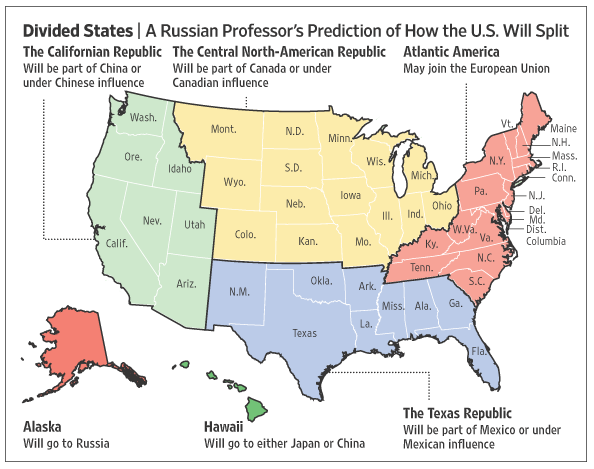
    Prof. Igor Panarin, a 50-year-old former KGB analyst and a dean of the Russian Foreign Ministry’s academy for future diplomats, estimates there’s a 45-55% chance that the United States will disintegrate like the Soviet Union did sometime in 2010. Mass immigration, economic decline and moral degradation will trigger civil war, the collapse of the dollar and massive social unrest. This in turn will lead to the U.S. breaking into six blocs — with Alaska reverting to Russian control – and other foreign powers grabbing other pieces.

    Panarin’s new map of the United States puts the “Californian Republic” under China’s influence, “the Texas region” under Mexico’s. Hawaii will come under Japanese or Chinese rule, East Coast states will join the European Union, while central northern parts of the US will gradually come under Canada’s influence.

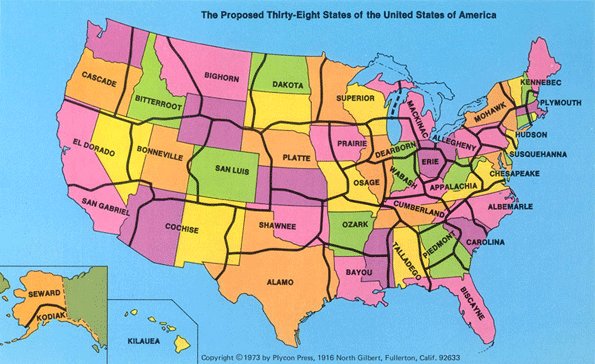
    A less sinister revision of the states that comprise the republic occurred in the 1970s when geography professor C. Etzel Pearcy proposed redrawing the borders of the US states, reducing them from 50 to 38. Pearcy’s framework casts aside the convenience of determining boundaries by using the land’s physical features, such as rivers and mountain ranges, or by the simple usage of latitude and longitude. Instead, his realignment gives high priority to contemporary population density, location of cities, lines of transportation, land relief, and size and shape of individual States.

    In the current fiscal climate some see the new 38 state map as inspired. According to Pearcy, 25% of the expenditures by states can be attributed to the fixed costs associated with the support and maintenance of state governments themselves. For at least some states this kind of savings could be very appealing right now.

    Rethinking, reimagining and then redrawing the borders of maps is by no means a new or even fruitless endeavor. That some if not many borders are where they are for seemingly meaningless or irrational reasons is obvious. Mark Stein’s How the States Got Their Shapes, for example, documents how natural features like rivers come together with the dreams and schemes of people to create today’s jigsaw puzzle of states. Gerrymandering borders for political, economic or religious reasons is both a historical and contemporary reality.

    Any economic planner or strategist worth their salt understands, of course, that borders on a map seldom represent or hold sway over how the real economy operates. Sure there are tangible differences in taxes, regulation and all the things that make up a business environment. But like water, economic activity goes where it wants and finds its own level. This has lead to an increasing amount of policy attention being given to cross-border territories of regions, zones, corridors, clusters, networks and the like.

    North America Re-Imagined
    One of the more reasoned, enduring efforts to make sense of a borderless economic and cultural landscape is Joel Garreau’s landmark work on the The Nine Nations of North America. My 27 year-old copy’s dust jacket asks the reader to forget the traditional map and consider the way North America really works because new realities of power and people are remaking the continent.
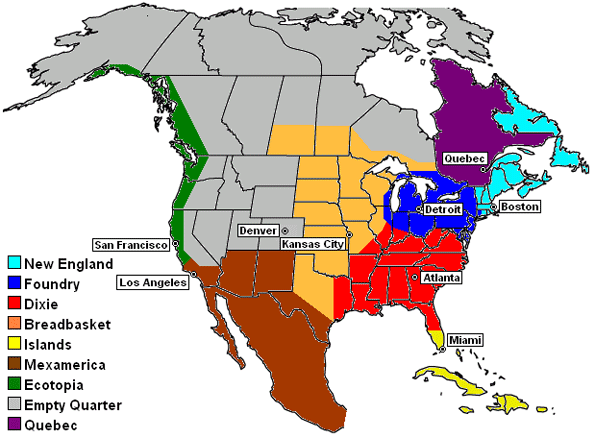
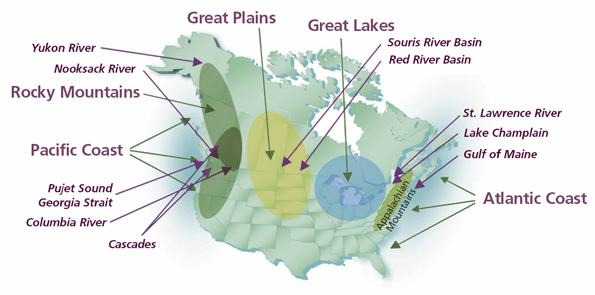
    A recent conference on USA/Canada cross-border economies in the Great Plains confirmed that Garreau’s analysis continues to influence thinking on regionalism. The longevity of his regions lies not only on their basis in actual data but also tied to the distinct “prisms” though which each nation sees the world.

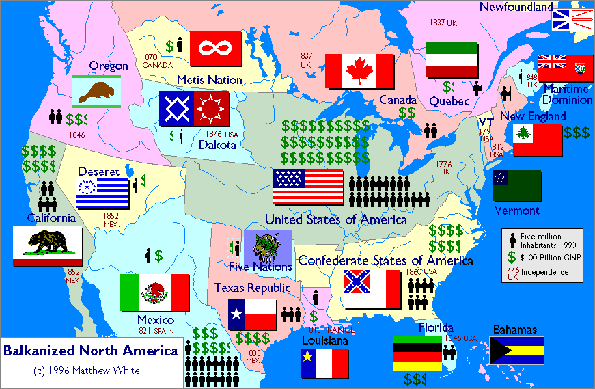
    What could have been in North America, instead of how things really are, is the subject of Matthew White’s 1997 map of a balkanized continent. Here the basic premise is that, in an alternate history beginning in 1787, the westward expansion of the Anglo-American people proceeded pretty much as it did, but the United States government just couldn’t hold the country together against separatists.

    How North America really works and how that is manifested spatially has generated growing interest of late and is reflected in the emergence of cross-border networks and organizations. The government of Canada recently issued an exhaustive report titled The Emergence of Cross-Border Regions Between Canada and the United States: Reaping the Promise and Public Value of Cross-Border Regional Relationships. Here the interest is certainly not on redrawing the borders but on recognizing and building on shared socio-cultural values and furthering relationships between businesses, first and foremost, and universities.

    Mostly a bottom-up phenomenon, these cross-border regional relationships are evidenced by the growth of both informal relationships and formal networks and a rise in cross-border regional co-operative mechanisms. From a policy standpoint the existence of cross-border regions requires new ways of thinking about development, going well beyond our parochial perspective. And this sort of thinking is important because regions – like economic fields of activity – represent the primary theatre in which most activities of international trade and economic integration actually take place.

    Map Forth
    Thematic maps that reconfigure our geography can intrigue and fascinate us. They are really, as some have said, graphic essays that portray spatial variations and interrelationships of geographical distributions. As noted by Norman Joseph William Thrower in Maps and Civilization: Cartography in Culture and Society, thematic maps use the base data of coastlines, boundaries and places, only as point of reference for the phenomenon being explained.

    Sometimes maps can inspire and motivate us by helping to more fully understand the geography of our economic and demographic challenges and opportunities. Perhaps most importantly thematic maps tell a story about places. Some describe the way things really are now while others express a vision of the future. In both cases they can be a graphical point of departure for plans and actions that help us to make the places we inhabit better places to live and work.

    Delore Zimmerman is president and CEO of and publisher of Newgeography.com

  • From Bush’s Cowboy to Obama’s Collusive Capitalism

    Race may be the thing that most obviously distinguishes President Barack Obama from his predecessors, but his biggest impact may be in transforming the nature of class relations — and economic life — in the United States.

    In basic terms, the president is overseeing a profound shift from cowboy to what may be best described as collusive capitalism. This form of capitalism rejects the essential free-market theology embraced by the cowboys, supplanting it with a more managed, highly centralized form of cohabitation between the government apparat and the economic elite.

    Never as pure as its promoters suggested, cowboy capitalism always depended on subsidies to businesses such as corporate farming, suburban development, pharmaceuticals, energy and aerospace. George W. Bush and the Republican majorities of the early 2000s simply drove this essential hypocrisy to a disastrous extreme by increasing deficits and allowing deregulated financial markets to run wild. In the process, they helped drive the world economy off the cliff.

    Not surprisingly, Obama and his backers see their mission to reverse the course. However, the path they are taking may prove no friendlier — and perhaps less so — to the interests of American democracy and the middle class than those of the now-deposed cowboy posse.

    The Obama policy of collusive capitalism is most evident in the financial bailout. He has placed his economic program in the hands of a man — Treasury Secretary Timothy Geithner — who can best be called, as analyst Susanne Trimbath puts it, a “lap dog of Wall Street.” A protégé of former Treasury Secretary and Citicorp board member Robert Rubin, Geithner played a pivotal role in the original Bush bailout of the Wall Street elite.

    Most recently, he proposed selling toxic assets to hedge funds and other financiers, a plan widely denounced by a host of liberal commentators, notably Paul Krugman and Joseph Stiglitz. The Geithner plan, Stiglitz noted this week in a New York Times op-ed, represents “the kind of Rube Goldberg device that Wall Street loves: clever, complex and nontransparent, allowing huge transfers of wealth to the financial markets.”

    The winners in the plan are the top guns of the financial industry, who would welcome further government-sponsored financial consolidation. For them, this would be vastly preferable to the more democratic alternative of selling the remaining assets of the failed large firms to dispersed, healthy, usually smaller, regional institutions.

    Largely missing from even these critiques is precisely why Obama has adopted this collusive approach while mostly avoiding anything smacking of populist anger. Perhaps one has to start with the very obvious fact that the president — despite occasional attacks on the greed of Wall Street — did not run against the financial markets but, rather, with their strong support. As early as the 2008 Democratic primaries, noted New York Times Wall Street maven Andrew Ross Sorkin, Obama had “nailed [down] the hedge fund vote.”

    This group includes the notorious currency speculator George Soros, a major backer of liberal groups in Washington who recently admitted to London’s Daily Mail that he was having “a nice crisis.” Whatever Geithner is doing seems to be working well for Soros and his ilk, although not so beneficently for the people who are losing their jobs and homes.

    I do not mean to suggest the shift to collusive capitalism represents a conspiracy; it simply reflects a changing of the guard among the American elite. The new hegemons include not only financial barons but also powerful interests such as the burgeoning green industry, the high-tech/venture capital complex, urban landowners and, at least in the category of useful idiots, Hollywood and much of the media.

    The new collusive capitalist class differs from the cowboys in its view of government. The collusive capitalists — notably, powerful IT companies and venture capitalists — now look to spur “green” technologies, which are seen as their next meal ticket.

    Others standing to benefit from the rise of collusive capitalism include the university and nonprofit research establishment. Universities have become critical linchpins for the new Democratic Party — providing student shock troops and professorial financial contributions as well as the basic ideological underpinnings and much of the key personnel.

    Are there any dangers for the administration from this approach? In the short run, they certainly have little to fear from the Republicans, whose strident claims about a lurch toward socialism have about as much credibility as their supposed born-again faith in fiscal conservatism.

    A potentially more dangerous threat lies from those parts of the non-gentry left, who fear that collusive capitalism will promote a dangerous further concentration of wealth and power. More immediately, it may also suffer from the limitations of a top-down, green-obsessed strategy that is unlikely to generate enough private-sector jobs, particularly for blue-collar workers.

    This large job creation deficit may take years to become evident but could have a long-term impact on middle-class voters and, perhaps most important, the generally pro-Obama millennial generation workers who are among the prime victims of the current economic malaise. Hopefully, before then, the president will recognize the limitations of collusive capitalism and set out on a broader, more democratic wealth-creating agenda.

    This article originally appeared at Politico.

    Joel Kotkin is executive editor of NewGeography.com and is a presidential fellow in urban futures at Chapman University. He is author of The City: A Global History and is finishing a book on the American future.
  • Geithner’s Reforms: More Power to the Center May Appeal to Europeans, But Won’t Work for U.S.

    There will be much talk in London about global financial regulation, particularly from the Europeans. But don’t count on it ever coming into existence.

    At a House Financial Services Committee on March 26 Treasury Secretary Geithner testified that this particular subject “will be at the center of the agenda at the upcoming Leaders’ Summit of the G-20 in London on April 2.”

    Secretary Geithner presented a 61 page proposal dealing with financial companies that pose systemic risk. Let me paraphrase the main points:

    1. Create a Uni-regulator – This idea has been around a while; it won’t hurt. We tried to do this in the U.S. during the last round of sweeping financial reforms but couldn’t make it happen, primarily due to protectionist politics among the existing regulators (SEC, FRB, Treasury, FDIC, etc.). The UK and others have done it. It didn’t prevent the financial crisis from reaching them. Still, it wouldn’t hurt to have at least one adult in charge of the financial markets when things get messy.
    2. Make companies hold more cash to back up their riskier investments – The banks already have strict national and international capital requirements. It didn’t prevent them from needing a bailout, but the big banks are still standing while the rest of the financial companies are gone. This is probably a good idea.
    3. Set size limits on unregistered fund managers – I don’t think there should be any size limits: if you provide financial services you should register. Don’t plumbers have to be licensed? Why not bankers?
    4. Figure out how to regulate derivatives – We’ve known for a long time that this was a problem. If they haven’t figured it out by now, it’s unlikely they’ll get it right; the proposal is short on details. Geithner’s plan is to bring derivatives into the same centralized system now used for stocks and bonds – consolidating the risk rather than dispersing it – definitely a bad idea. The existing U.S. centralized system has, as of December 31, 2007, only $4.9 billion to back up $5.8 billion in off-balance-sheet obligations.
    5. Have the SEC set requirements for money market fund risk management – I’m not sure why on earth anyone would want the SEC to assume this responsibility. The SEC has failed miserably at protecting investors from basic short selling schemes and even more blatant schemes like Madoff’s Ponzi. Risk management at financial institutions should be the job of the central bank – that means the Federal Reserve, not the SEC.
    6. Let the government nationalize “too big to fail” companies – They just did this with AIG. In essence, the proposed legislation would codify and make permanent authority for the government to lather, rinse and repeat. Government ownership of financial institutions inevitably leads to inefficiency and worse.

    We’ve tried creating “revolutionary” financial laws before: the Depository Institutions Deregulation and Monetary Control Act of 1980 set the stage for the Savings and Loan Crisis; the Financial Services Modernization Act of 1999 helped get us where we are now. Better laws come about in “evolutionary” ways. It starts with a generally accepted good business practice, which all market participants follow. Eventually, one or more participants find a way to advance their position by cheating, by not following that good practice. When they get caught, new laws are created to codify the original “good business practice” and some punishment is put in place for those who don’t. What was once considered just a good way to conduct business now becomes a legal business requirement.

    Geithner’s proposed legislation is law by revolution – an attempt to toss aside all previous practices. The legislation was drafted at Davis, Polk & Wardwell, the New York lawyers for the Federal Reserve Bank and advisors to Fed and Treasury on AIG, not the kind of experience I’d want on my resume this year. There is an embedded comment on page four in the pdf-document: “Can Congress write a federal statute trumping a State Constitution?” I’m not sure what frightens me more: that they want to take power away from the states or that they don’t know if they can get away with it! Now is the time to give more authority to the states, not less. By their own admission, federal authorities have proven themselves incapable of protecting investors: Treasury Secretary Geithner told the House, “our system failed in basic fundamental ways.”

    Worse yet is the idea of proposing a global financial regulator, which will be high on the agenda at the G-20 Leaders’ Summit. Designing one regulatory framework for financial services to serve the capital markets in every country is akin to looking for people in every country to “cheat” the same way. Capital markets can work anywhere in the world, but the social and cultural foundations of the system that supports these markets may be quite different. The laws and regulations will need to be quite different, too. When it comes to developing the financial institutions that provide the infrastructure for robust capital markets, there is no “one size fits all”.

    “Stable financial markets through reform” has been the theme of innumerable conferences, conventions and meetings of the leaders and finance ministers of country groups from G8 to the United Nations. Two decades of experience with the “Washington Consensus” tells us that global regulation will not work any better than concentrating all power in Washington.

    Here’s the primary problem with trying to design one set of financial reforms that will serve many nations: Financial services are global not multi-national. Most other products and services sold around the world are multinational, but not global. For example, salt is a multinational product. The salt sold in Cairo is basically the same product as salt sold in Paris or London. Perhaps the label contains the word “salt” in a different language; maybe the Danes use more salt than the Swedes and the Japanese combine it with sugar. But a package of salt contains the same product and is used for the same purpose – one product, used the same way in many nations.

    Financial services are different. A share of stock in Paris has different rights, a different meaning, than a share of stock issued in Buenos Aries. Bondholders play a prominent role in restructuring companies in bankruptcy in the US; in France, debtors are protected from bondholders completely. Yet anyone anywhere can buy a share of a French company or the bond of a US company – many products, used for different investments in one world. For reasons like this, there is no one solution for regulating the banks, brokers and stock exchanges in every country.

    Economists have known for a long time that global financial regulation – or even ”sweeping” national changes – won’t work. Perhaps the lesson from the current financial crisis will be that national regulation must be supplemented with more oversight in the States. Given Geithner’s plan and his penchant for ever more consolidation of authority over financial services, it’s unlikely we’ll get the chance to find out.

    Susanne Trimbath, Ph.D. is CEO and Chief Economist of STP Advisory Services. Her training in finance and economics began with editing briefing documents for the Economic Research Department of the Federal Reserve Bank of San Francisco. She worked in operations at depository trust and clearing corporations in San Francisco and New York, including Depository Trust Company, a subsidiary of DTCC; formerly, she was a Senior Research Economist studying capital markets at the Milken Institute. Her PhD in economics is from New York University. In addition to teaching economics and finance at New York University and University of Southern California (Marshall School of Business), Trimbath is co-author of Beyond Junk Bonds: Expanding High Yield Markets.

  • Kansas City and the Great Plains is a Zone of Sanity

    Over the past year, coverage of the economy appears like a soap opera written by a manic-depressive. Yet once you get away from the coasts – where unemployment is skyrocketing and economies collapsing – you enter what may be best to call the zone of sanity.

    The zone starts somewhere in Texas and goes through much of the Great Plains all the way to the Mexican border. It covers a vast region where unemployment is relatively low, foreclosures still rare and much of the economy centers on the production of basic goods like foodstuffs, specialized equipment and energy.

    People and companies in the zone feel the recession, but they are not, to date, in anything like the tailspin seen in places like the upper Great Lakes auto-manufacturing zone, the Sunbelt boom towns or, increasingly, the finance-dependent Northeast. Last month, for example, New York City’s unemployment experienced the largest jump on record.

    “That whole swath from Texas and North Dakota did not see either the bump or the decline,” notes Dan Whitney, a principal at Landmarketing.com, a real estate research company based in Kansas City, Kan. “People have a more conservative nature here. It’s just saner.”

    The housing market is one indicator of greater sanity. Kansas City housing prices dropped 7% between 2006 and 2008, compared with 10% in Chicago, 15% in San Francisco, 20% in Washington, D.C., and over 30% in Los Angeles. Houston and Dallas, the Southern anchors of the zone, have seen little movement either way in prices.

    One key measurement is affordability. The median multiple for Kansas City housing – that is the number of years of income compared with a median-priced house – has remained remarkably stable at under 3.0. In contrast, notes demographer Wendell Cox, the ratio approached up to 10 in places like Los Angeles and San Francisco, as well as something close to 7 in New York and Miami.

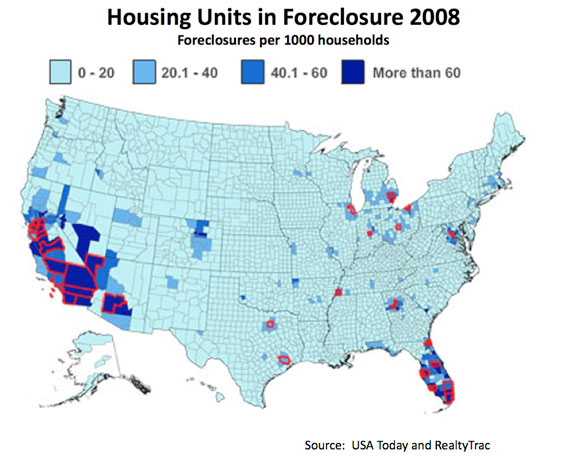
    The result has been that foreclosures – the key driver of many regional economic collapses – have been relatively scarce throughout the zone. This USA Today map reveals how the foreclosures are heavily concentrated in Florida, California, Arizona and Nevada, as well as parts of the old Industrial Belt of the Great Lakes.

    housing_foreclosure_565.jpg

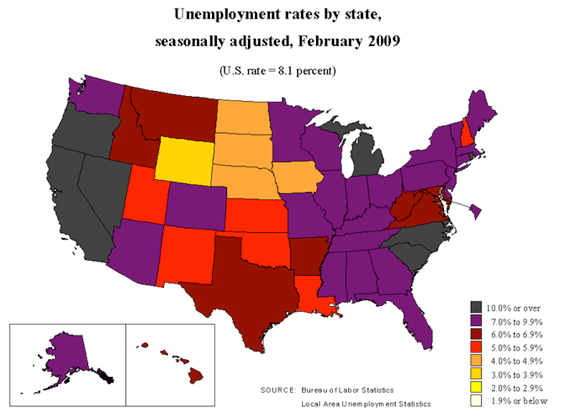
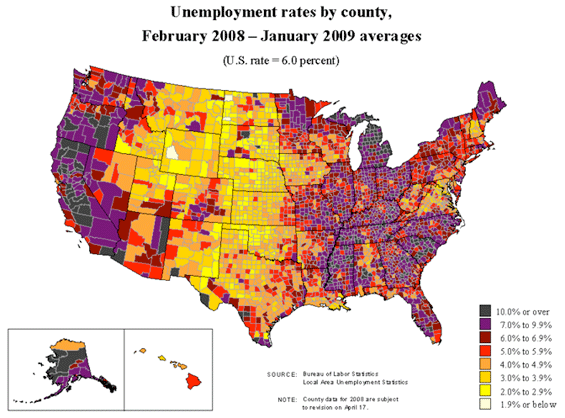
    Analysis by my colleagues at Praxis Strategy Group of the job market’s condition also reveals the divergence between the zone and the rest of the country. Regions from the Northeast, the Great Lakes and the Southeast all have seen significant job losses, and the damage is spreading to the Pacific Northwest, New York and New Jersey. In contrast, the Kansas City area and much of the zone of sanity has experienced only a ratcheting down of its generally steady growth rate. Things are not bustling, but there seem to be few signs of a basic economic collapse.

    unemployment_state_565.gif

    unemployment_country_565.gif

    Sanity, as Whitney put it, may constitute a critical part of the equation. If you discuss why people live in a place like Kansas City, people tend to speak about stability, family-friendliness and the basic ease of everyday life. Many executives, notes Phil DeNicola, who runs Strong Suit Relocation, initially resist a transfer to the region but quickly see the advantages.

    “It is attractive to be here,” notes DeNicola. “You don’t get a lot of highs and lows for years. There is stability instead, particularly for families. It all reduces your stress.”

    Of course, not everyone is satisfied with the status quo. As in many second-tier urban centers, many in Kansas City’s leadership crave being something other than pleasant, affordable and stable. Leaders in the city – home to roughly one in four of the region’s 2 million residents – have been particularly exercised to show that KC can be as hip and cool as New York, L.A. or, at the very least, Chicago.

    “There’s a real kind of self-loathing here,” notes Mary Cyr, a Harvard-trained architect, who works on projects throughout the region. “We feel less than what we are. We do not know what we are as a city. We don’t even realize what we have.”

    Hundreds of millions have been poured and continue to pour into the usual monuments favored by urban policymakers and subsidy-hungry developers – a sparkling new arena, plans for an expanded convention center and a massive entertainment complex called the Power and Light District. Yet at the same time, the city’s budget, like many others, is severely strapped, so much so that City Hall is considering not turning on the city’s iconic fountains this spring.

    Even worse, city and regional issues seem to result in plenty of money for new expressions of wannabe grandiosity. One notable example: plans to build a $700 million-plus light-rail line, the kind of thing that has become the sine qua non for the “monkey see, monkey do” school of urban policymakers across the country.

    This project makes little sense in a region with a well-below-average percentage of jobs in its downtown core – roughly around 7% – with one of the lowest shares of transit-riding residents in the nation. The relative lack of traffic makes a rail system less sensible than could be argued for higher-density urban corridors, where it at least can be imagined that many would give up their cars.

    Ultimately, none of this taxpayer largesse is likely to do much more than replicate the same kind of development that can be found in scores of cities – from St. Louis to Dallas – that have tried it. At best, you get a few blocks of activity but very little in terms of urban dynamism.

    “The growth of downtown is not at all organic – it’s kind of forced,” notes architect Cyr. “They build all those projects in there, and you end up with the huge monumental buildings and the Gap.”

    The problem for the downtown crowd is that Kansas City has remained a quintessential American city, most dynamic in places where private initiative leads the way. Typically the bulk of new growth has taken place in the suburban fringes, but there are several successful nodes within the city, particularly around the lovely, 1920s vintage, privately developed Country Club Plaza area, famous for being the world’s first modern shopping center.

    Similarly, the artist-inspired Crossroads district has also evolved – largely without government help – into a genuine bastion of bohemians, with small companies and locally owned restaurants. With its low-cost commercial and residential space, as opposed to government subsidies, many see the area as precisely the kind of grass-roots urban life with a future in a place like Kansas City.

    Such developments in the city, as well as outside, make it possible to project a very bright future for Kansas City – and across the zone of sanity. Unless there is a massive shift in conditions, the zone should see a return to prosperity earlier than places bogged down with excess foreclosures, shuttering industries, soaring taxes and ever-tightening regulation. Dan Whitney, for example, expects the local housing supply to run out soon – with “tremendous pent-up demand” by the end of the year. If credit conditions improve, new construction should resume within the next 18 months.

    This all reflects the essential attractiveness of cites like Kansas City. Overall, in fact, its rate of domestic in-migration has been higher than much-celebrated Seattle and only slightly below that of Denver. Indeed, since 2000, Kansas City’s regional population has grown 8.6%, more than twice as much as New York, Boston, San Francisco or Los Angeles.

    Unlike the national media, which rarely focus on mundane things that drive most people’s lives, some seem to get the appeal of lower prices, affordable housing options and a generally calm environment. Although never a beacon for newcomers, like Phoenix, Atlanta or Dallas, Kansas City has not suffered the massive out-migration seen in such big metropolitan regions as Los Angeles, San Francisco, Chicago or New York.

    In fact, Kansas City has enjoyed a slow but steady in-migration through the past decade. These newcomers could provide the energy, talent and initiative that a region, known for stability, needs to get to the next level. Attracting more of them – not new prestige projects or subsidized developments – remains the key to the region’s future.

    Instead of trying to duplicate growth patterns that are foundering on the coasts and in countless Rust Belt cities, the denizens of the zone of sanity need to learn how to build on their virtues of stability and affordability. Particularly in hard times, such things count for much more than many – both inside and outside the region – might imagine.

    This article originally appeared at Forbes.

    Joel Kotkin is executive editor of NewGeography.com and is a presidential fellow in urban futures at Chapman University. He is author of The City: A Global History and is finishing a book on the American future.
  • Burnin’ Down the House! Part Two: Wall Street has a Weenie Roast With Your 401k

    Last week I wrote about the first part of my talk to the Bellevue Kiwanis Club on why our economy is in the position it is today. It is a story about good intentioned policies – like modifying credit scoring for Americans working in a cash-economy – that were bastardized in the execution – like some Americans using modified credit scoring to lie about their income. Just like there were superstar firms among the original “junk bond” companies, there were also firms like Enron and WorldCom.

    In the first part of my story: banks wrote mortgages, their broker-arms sold them to the public in the form of bonds, they paid fees to Standard & Poor’s and Moody’s to get triple-A credit ratings, and they devised crazy default protection schemes which they also sold in the public capital markets. On top of all that, they screwed up the paper work so there was no relationship between houses and the ultimate financial paper that could be used to cover potential losses.

    That’s when Wall Street staged a weenie-roast over the blazing fire of your 401k plan. They were making so much money in fees and trading profits that they decided to extend the scheme to car loans, credit card debt, and anything else they could package and sell off in capital markets around the world. When new money stopped flowing in and when the value of the underlying assets began the decline, the whole mess came falling down over their – and our – heads.

    In case after case, there are more derivatives than their underlying assets. Here’s an example of just how absurd this is: The market value of Bank of America (BofA) is $32 billion; the contracts that payoff if BofA fails are worth $119 billion. This isn’t rocket science math. It’s worth a lot more to someone to see BofA fail than it is to see them succeed. Here’s a table of some of financial companies and home builders, alongside some countries, to give you an idea of what the potential cost would be of letting them collapse – because the derivatives would have to be paid off if they collapsed. Where the market value of a company’s publicly-traded shares (or the outstanding public debt of a nation) is greater than the derivatives outstanding (a negative number in the difference column), the “market” is probably betting in favor of the company.

    Entity

    Derivatives outstanding

    Market Value or Public debt

    Difference

    BANK OF AMERICA CORPORATION

    118,689,745,334

    31,558,840,000

    87,130,905,334

    GMAC LLC

    83,556,419,908

    4,690,000

    83,551,729,908

    MORGAN STANLEY

    84,271,180,804

    24,186,940,000

    60,084,240,804

    DEUTSCHE BANK AKTIENGESELLSCHAFT

    71,011,177,628

    18,510,000,000

    52,501,177,628

    CITIGROUP INC.

    61,875,137,002

    12,760,000,000

    49,115,137,002

    AMERICAN INTERNATIONAL GROUP (AIG)

    47,393,950,401

    2,230,000,000

    45,163,950,401

    GENERAL MOTORS CORPORATION

    43,373,996,836

    1,540,000,000

    41,833,996,836

    CENTEX CORPORATION

    41,027,349,092

    856,760,000

    40,170,589,092

    LENNAR CORPORATION

    40,426,782,677

    1,260,000,000

    39,166,782,677

    AMBAC ASSURANCE CORPORATION

    36,835,358,941

    189,580,000

    36,645,778,941

    PULTE HOMES, INC.

    38,364,111,999

    2,460,000,000

    35,904,111,999

    FORD MOTOR COMPANY

    39,618,004,718

    5,030,000,000

    34,588,004,718

    THE GOLDMAN SACHS GROUP, INC.

    80,849,691,288

    46,624,340,000

    34,225,351,288

    BARCLAYS BANK PLC

    44,579,007,183

    11,160,000,000

    33,419,007,183

    WHIRLPOOL CORPORATION

    32,665,900,751

    1,850,000,000

    30,815,900,751

    CBS CORPORATION

    32,484,932,800

    2,600,000,000

    29,884,932,800

    SOUTHWEST AIRLINES CO.

    33,766,673,423

    4,090,000,000

    29,676,673,423

    TOLL BROTHERS, INC.

    27,532,256,817

    2,590,000,000

    24,942,256,817

    SPRINT NEXTEL CORPORATION

    33,852,494,934

    10,230,000,000

    23,622,494,934

    AUTOZONE, INC.

    31,489,303,582

    8,700,000,000

    22,789,303,582

    D.R. HORTON, INC.

    19,889,587,401

    2,540,000,000

    17,349,587,401

    ALCOA INC.

    20,554,123,223

    4,620,000,000

    15,934,123,223

    AMERICAN EXPRESS COMPANY

    28,098,626,953

    13,970,000,000

    14,128,626,953

    K. HOVNANIAN ENTERPRISES, INC.

    9,458,710,459

    70,220,000

    9,388,490,459

    AETNA INC.

    15,056,041,259

    9,720,000,000

    5,336,041,259

    TIME WARNER INC.

    33,530,285,093

    29,240,000,000

    4,290,285,093

    WELLS FARGO & COMPANY

    47,902,948,043

    58,060,000,000

    -10,157,051,957

    JPMORGAN CHASE &CO.

    61,250,536,812

    86,770,000,000

    -25,519,463,188

    RUSSIAN FEDERATION

    102,631,256,656

    151,000,000,000

    -48,368,743,344

    ABBOTT LABORATORIES

    5,273,779,532

    68,720,000,000

    -63,446,220,468

    REPUBLIC OF TURKEY

    169,668,377,905

    243,747,000,000

    -74,078,622,095

    REPUBLIC OF ITALY

    157,609,796,730

    248,773,000,000

    -91,163,203,270

    BERKSHIRE HATHAWAY INC.

    18,409,990,929

    126,860,000,000

    -108,450,009,071

    UNITED MEXICAN STATES

    76,677,172,011

    320,334,000,000

    -243,656,827,989

    FEDERATIVE REPUBLIC OF BRAZIL

    113,249,393,554

    814,000,000,000

    -700,750,606,446

    Derivatives outstanding is data made available by the Depository Trust and Clearing Corporation for publicly traded credit default contracts. Market value is for public companies generally in early March 2009; public debt is for countries generally from year-end 2008. Difference is author’s calculation. The average derivatives outstanding for entities with positive differences are 22 times the value of the entity (excluding GMAC as an outlier with a multiplier of 17,816).

    In other words, you could buy all the shares of Lennar for $1.2 billion. However, if they go bankrupt, the payoff will be $40 billion for the holders of the derivative contracts. And at this point, we – the US taxpayers – are in the position of paying off on these contracts if the banks and other “too big” companies fail. This table also tells you that the “markets” think that Bank of America is significantly more likely to fail than, say, Brazil – which is probably true, if for no other reason than the fact that Brazil has an army and Bank of America doesn’t!

    The bottom line is that the government has to continue to bailout these banks and large companies because many of them, including AIG which is now owned about 80% by us, are the same entities that will have to pay off the bets if the other companies fail. There’s really no way out of it now. I remain opposed to the bailouts – they create “moral hazard,” the scenario whereby it is more profitable to fail than to succeed. But: I understand why they are being done and why we have to keep doing it.

    The reason is: it matters to our 401k plans, the pension plans of teachers and firefighters, the retirement benefits of loyal, hard-working Americans. You see, the debt of insurance companies and other triple-A rated credits (AIG had a good credit rating less than 12 months ago) are required investments for money market funds, pension plans, etc. Take a look at the prospectus for any of these investments if you have them and you’ll see what I mean. It is necessary for such funds to make triple-A investments because the funds need to be able to make payments and honor withdrawals, sometimes on short notice. That means they have to hold some very safe, very easily sold investments. Investments like those issued by AIG.

    If the mutual funds holding your 401k and the pension fund supporting the school teachers and all that go broke – well, no one wants to imagine what that America would look like. Despite all the bad economic news, few Americans have run out in the streets in protest and even those who did didn’t vandalize any property, public or private. Nor did we take our CEOs hostage. In fact, I think a little civil unrest may be called for: print this story, wrap it around a hotdog, mail it to the New York Stock Exchange and tell them to enjoy their weenie-roast!

    Here’s why: the time is coming very soon when Wall Street will need us again. Uncle Sam is doling out the bailout money to the financial institutions, but even now they are devising ways to get ordinary investors to come back to the markets – and to use our own money to do it.

    Susanne Trimbath, Ph.D. is CEO and Chief Economist of STP Advisory Services. Her training in finance and economics began with editing briefing documents for the Economic Research Department of the Federal Reserve Bank of San Francisco. She worked in operations at depository trust and clearing corporations in San Francisco and New York, including Depository Trust Company, a subsidiary of DTCC; formerly, she was a Senior Research Economist studying capital markets at the Milken Institute. Her PhD in economics is from New York University. In addition to teaching economics and finance at New York University and University of Southern California (Marshall School of Business), Trimbath is co-author of Beyond Junk Bonds: Expanding High Yield Markets.