Category: Policy

  • Different Shades of Green

    Last month marked the 15th anniversary of the settlement of Plotkin vs. General Electric, the landmark “greenwashing” lawsuit I filed in 1993. At the time, GE was misleading consumers by selling phony lookalike energy efficient light bulbs that were in fact just old fashioned incandescent wolves in green packaging.

    I took no money from the case. But I required G.E. to make labeling changes and to pony up $3.25 million dollars in consumer refunds and donations to environmental and public service groups. The labeling changes made it easier for the manufacturers of real energy efficient light bulbs, which were just then entering the marketplace, to distinguish their products on the shelves. Plotkin vs. GE also more firmly established the ability of environmental activists to turn to the courts when state and federal government agencies fail to punish greenwashing. The settlement we achieved created a powerful deterrent that continues to produce benefits to this day.

    In the meantime, though, greenwashing has become a virtual industry in the political and policy worlds. Take, for example, the growing push for economically regressive and environmentally problematic HOT (high occupancy toll) lanes. HOT lanes are toll lanes on public highways. Prices are set dynamically so that HOT lanes keep moving even if all the other lanes are stuck. Governor Schwarzenegger and many leading Democrats favor the idea and use it to paint themselves green. HOT lanes are also popular with many affluent motorists who love the idea of driving their SUVs in the carpool lane for what amounts to pocket change. It’s an odd alliance.

    Unfortunately, support for HOT lanes is also becoming a litmus test issue for some environmental groups when they evaluate political candidates, apparently without much thought about the economic consequences, particularly for the poor.

    HOT lane backers push their plan by claiming that only a limited number of lanes will be involved, typically just one to start. But in Europe, where many of these experiments began, “congestion management” programs have since morphed into systems that essentially allow rich drivers to hog public roads. Give the upper crust the fast lane and, it turns out, pretty soon they want the whole road.

    HOT lanes are an example of one of the worst forms of regressive taxation imaginable. Like all regressive taxes, they exact a higher percentage of income from the poor. But in this case, they also tax the very mobility of the poor, making it harder for them to commute, including to work and school, which can effectively lock people into low end jobs and poverty that they might otherwise escape.

    What little thought the proponents of HOT lanes have given to their impact on the poor appears to be in the category of “let them eat cake.” One widely-cited report recommending HOT lanes even dismissed concerns they were unfair to the poor by noting that service workers can use the lanes to get to their clients’ houses more quickly:

    “… studies of Orange County’s SR-91 show that the variable-priced toll lanes are not used exclusively by the wealthy. The ability to save time and reduce uncertainty confers substantial benefits to all drivers, including service professionals who can make more service calls…”

    In the San Francisco Bay Area, Caltrans and the Metropolitan Transportation Commission are fast-tracking a HOT lane implementation plan that could be devastating for students at area community colleges. At De Anza College in Cupertino, California, for example, more than 10,000 students commute to school each day. For many, this is the only reasonable path towards upward mobility. I know. Thirty years ago, I was one of those students, only to return more recently to serve on the college district’s board of trustees.

    A proposed fee of $5 a day per trip on Highway 85 during peak rush hour, as envisioned, would boost a typical De Anza College commuter student’s expenses by as much as $100 a month. That burden is sure to grow over time. Escaping poverty is often a game of inches. Our surveys indicate that thousands of our students live at or near the poverty level. Each additional expense imposed by our government makes a high quality college education less accessible.

    HOT lane proponents say that over the long run the impact on the poor will be positive because the tolls will be used to improve public transit, which will benefit less affluent citizens and increase use of public transportation.

    But this is out of touch with the realities of life in places like Silicon Valley, where the automobile is still the most practical way for many people to get to work. What may work for investment bankers taking transit to downtown San Francisco doesn’t work for a student who lives in Mountain View and needs to get to Cupertino and then to a job in Redwood City each day.

    What’s more, the promised transportation improvements may take decades to implement and may never meet the real world transit needs of working students, not to mention those who also have to stop to pick up their children, get groceries or complete errands on the same trip.

    But one thing is for sure. While we wait for those HOT lane financed transit improvements to kick in, a generation, maybe more, will find it harder to attend school or get to their jobs.

    Global warming is a very real problem. But it can and must be addressed in far better and more equitable ways. Those less regressive ideas include higher taxes on gas guzzlers, road electrification, remote sensing (“by wire”) vehicles, increased subsidies and public support infrastructure for carpools, home-based work and or possibly even a boost in industrial levies based on employee commute profiles. All of these advances will require government action and a communal effort. But each of these more significant steps are far less likely to occur if rich divers can easily get wherever they want to go quickly at the expense of everyone else. That’s the road the current elitist HOT lanes proposal takes us down.

    It also raises the question of what comes next. Will this same crowd of economic elitists also want to make public parks and beaches off limits to all but the affluent, too? After all, those are also getting pretty crowded. Or we will defend a more traditional American value: public spaces, including roads, are created, maintained, protected and improved by the public to benefit the public.

    When General Electric put phony energy efficient light bulbs on stores shelves two decades ago, taking the company to court was the smart way to fight back. Unfortunately, there is no court we can petition to ensure that regressive tax policies aren’t greenwashed in ways that trample the rights of the poor, community college students and working people. But there is at least one place we can fight for the smarter, more effective and more equitable environmental policies we need: the state legislature.

    Hal Plotkin is a veteran Silicon Valley journalist and commentator, a founding editor of Marketplace on public radio, and the founder of the Center for Media Change, Inc., a Palo Alto-based 501(c)3 non-profit that enables crowd-funding of high-quality journalism.
  • One Fundamental Problem: Too Many People Own Homes

    Ben Bernanke made the following statement as he attempted to justify bailing out bad borrowers:

    “…from a policy point of view, the large amount of foreclosures are detrimental not just to the borrower and lender but to the broader system. In many of these situations we have to trade off the moral hazard issue against the greater good.” – Ben Bernanke, February 25, 2009

    I think he is wrong on this, and the moral hazard issue is only a small part of my objections.

    One of the fundamental problems we have right now is that too many people own homes. It sounds harsh, but please bear with me a few sentences. I think we can agree that 100 percent home ownership is not possible, or even desirable. Most of us can remember a time when our income and our jobs were such that home ownership was a bad idea. Home ownership is a commitment that requires a significant amount of stability and discipline. Not everyone is so stable or has the discipline to keep up with the payments.

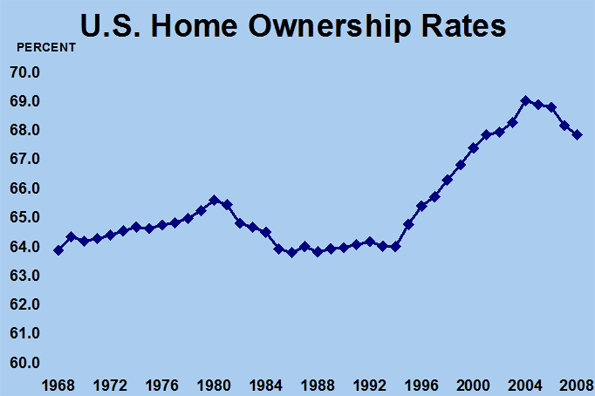
    What is an appropriate national homeownership rate? Theory gives us no answer. We look to the data for a clue. Here’s a chart of home ownership rates since 1968:

    It seems pretty clear that a homeownership rate between 63 percent and 65 percent works pretty well. When we get above that range, problems seem to crop up. This was true in 1980 – the worst recession of the past 30 years – and it is true now.

    In light of these data, let’s think about what Bernanke is saying. He’s arguing that to execute the foreclosures required to move the rate back to that 63 percent to 65 percent range are bad for the economy. So bad in fact, that we’re better off not going there.

    The problem with that argument lies in a lack of historic understanding of the proper levels of homeownership. Financial and real estate markets can’t stabilize until we get closer to that equilibrium. Until we lower the home ownership rate, financial institutions will have a cloud around them, and residential real estate markets will be lifeless. It may not be politically popular, but those are the realities.

    This is a critical issue. For years, economists have believed that the failure of banks to recognize and remove bad assets contributed to Japan’s long period of economic malaise. I agree. Forbearance on bad real estate loans here in the states constitutes much the same thing. Our financial institutions are holding a bunch of bad assets; these are homes that are owned by people who can not afford them – never did, and likely never will. Until the financial institutions recognize those bad assets and get them off their books, our financial institutions won’t have the resources to fund, stabilize and then drive a broader economic recovery.

    What we need is not more mindless beneficence to everyone from Wall Street to Detroit and Main Street. The more we bailout failed financial institutions, automobile manufactures, or any business, the longer we postpone our recovery.

    Recessions are periods when assets are reallocated from less productive to more productive uses. That requires processes like repossession, foreclosure, mergers, and bankruptcy. These processes have been developed over centuries. They are the most efficient methods to restore an economy.

    Why are we suddenly abandoning these processes that have proved themselves in many business cycles? I suppose part of it is the desire to eliminate the business cycle. This is the same thinking that had many – including conservatives – arguing that stocks could not fall during the dot.com bubble or that housing prices would also move up.

    In reality the business cycle can not be eliminated. It can’t be done and it is pure hubris to try. One of the fundamental insights to come out of Real Business Cycle research is that recessions constitute the most efficient response to a negative shock.

    We need to stop wasting resources trying to stem the tide. Instead, let us allow the recession to work for us. In the meantime we can provide a backstop through unemployment benefits and some reasonable fiscal stimulus. But we have to experience some pain and let our processes and institutions work for us. The sooner we get these foreclosures, repossessions, mergers, and bankruptcies behind us, the sooner we will see a return to the only sure cure for a sick economy: real economic growth.

    Bill Watkins, Ph.D. is the Executive Director of the Economic Forecast Project at the University of California, Santa Barbara. He is also a former economist at the Board of Governors of the Federal Reserve System in Washington D.C. in the Monetary Affairs Division.

  • Don’t Mess With Census 2010

    The announcement last week that Congressional Black Caucus members plan to press President Obama to keep the 2010 census under White House supervision, even if the former Democratic Governor of Washington, Gary Locke, is confirmed as Commerce Secretary, brought back memories of a movie I’d seen before — a bad movie.

    The statement came from Rep. William Lacy Clay, D-Mo., the caucus’ leading voice on the census, and chairman of the House Oversight and Government Reform panel, which has jurisdiction over the decennial count. His assertion that the White House needs “to be hands-on, very much involved in selecting the new census director as well as being actively involved and interested in the full and accurate count,” suggests that the partisan gap about what the census should accomplish is no closer to being closed than it was ten years ago when we last undertook the constitutionally mandated exercise in counting everyone living in America. The gap was so big last time that it helped bring about the complete shutdown of the United States government.

    When Newt Gingrich became speaker of the House he decided, in his own paranoid way, that Bill Clinton and the Democrats would use their executive authority to produce a biased census whose over-count of minorities would shift, in his opinion, twenty-four House seats from the Republicans to the Democrats after the 2000 census. Of course, it was ludicrous to think such an outcome would occur, since legislative boundaries are drawn by the party in power in each state. Whatever numbers the census produces in our decennial exercise can be manipulated to produce any outcome each state’s ruling party desires, as Congressman Tom DeLay and his Texas Republican cronies proved a few years ago. Nevertheless, Gingrich was determined to use the Congressional appropriations process to undercut any attempt by the Democrats to overstate minority populations in the several states.

    The method by which this nefarious plot was to be carried out, in the Republican party’s opinion, was by the use of a large sample of Americans to be surveyed at the same time as the actual count, or enumeration, required by the Constitution was taking place. In response to concerns about previous census inaccuracies — both overcounts and undercounts — the National Academy of Sciences had recommended that the Census Bureau use survey sampling techniques to validate not just the overall count but the individual demographic sub-groups that the census’s enumeration process would identify. But this was a hugely expensive undertaking. To gain statistical accuracy, about 1.3 million Americans would have to respond to a lengthy survey that would cost about a half a billion dollars to execute. And it was this expenditure that Gingrich refused to appropriate. When he and Clinton came to the ultimate showdown on funding the government Gingrich blinked.

    As part of the budget settlement that reopened the government after the shutdown, Clinton forced him to reinstate funding for the sample survey. But despite having established the primacy of the White House in the conduct of the census, matters actually got worse for awhile. When I became Director of the National Partnership for Reinventing Government (NPR) under Vice President Al Gore, I was asked to monitor the implementation of the census to be sure it was done as effectively and as efficiently as possible. But the first idea on how to accomplish that came straight out of the same White House partisan playbook that is now being invoked by the Congressional Black Caucus.

    In order to assure that the process was “bi-partisan,” it was suggested that a commission be established made up of equal numbers of Republicans and Democrats who would oversee the activity on behalf of the Congress. Since the commission was to be equally divided, the Clinton White House wanted to make sure that only the most partisan Democrats — those who would never concede an inch to their Republican counterparts on issues such as funding and methodology — were selected. Names like Harold Ickes, Supervisor Gloria Molina, and Congresswoman Maxine Waters were discussed as representative of the type of Democrat who would make sure the use of sampling to confirm the accuracy of the count was preserved. Fortunately, thanks to the eloquence of Rob Shapiro, the Undersecretary for the Department of Commerce who had the actual authority to supervise the Census, cooler heads in the Vice President’s office were able to prevail over their White House counterparts, and the Commission notion was abandoned.

    But that didn’t stop the two parties from continuing their warfare over the value of a sample supplemented census vs. a straight enumeration. Republicans sued the Census Bureau in federal court, demanding that only the actual count of residents as provided in the Constitution be used for any Congressional redistricting by the states. The Federal Appeals court dismissed the Republican lawsuit as none of the Court’s business. Foreshadowing the outcome of Gore v. Bush in 2000, the Supreme Court surprisingly took up the case and overturned the Appeals court ruling. As a result, all subsequent redistricting efforts have used only the enumeration count from the 2000 census. On the other hand, formulas used to allocate federal funds based on population characteristics were unaffected by the ruling and could have used the sampling process, had it not met an untimely and unnecessary death.

    As soon as George W. Bush was elected and the incredibly professional Director of the Census Bureau, Ken Prewitt, was removed from office, the Commerce Department’s new partisan Secretary, Donald Evans, determined that the sample that had been prepared over the strong objections of Congressional Republicans was not useable. Sampling, as originally conceived, was never implemented, and the country ended up relying on a very strong effort to count households and those living in them for its 2000 census. This method tends to overcount families with two houses, who respond to the census form at both of their addresses, and college students who generally answer the form from their dorm room while their parents report them as still in their household back home. And, of course, it tends to undercount less affluent populations with fewer physical ties to a specific dwelling, particularly Native Americans, and to some degree Hispanics and African Americans.

    Despite these problems, a sampling approach could not be used to help correct inaccuracies in this year’s census, even if Rahm Emanuel himself were to oversee it. We are too far along in the process to recreate it. There is, however, a substitute available that should alleviate the concerns of all but the most stubborn partisans on both sides of the issue. Under the Gore reinvention initiative, the Census Bureau conceived of a concept now known as the American Community Survey. It was designed to survey a vast quantity of households over time to acquire the kind of detailed demographic data that was usually obtained from the subset of the population, about one in ten, who were asked to complete the “long form” of the census questionnaire every ten years. Republicans hated this form and the type of questions it asked; they saw it as an unlawful intrusion on the privacy of families by the federal government. Those of us in charge of reinventing the federal government thought the ACS could be a much more scientific and efficient way of collecting this essential data, but our challenge was to keep it from becoming a political football in the partisan warfare over the census.

    Finally, it was agreed that the Clinton administration budget proposals would include a continuing increase in funds for the ACS. In order to garner Republican support, ACS would be justified as a way to eliminate the long form by 2010. The budget request was forwarded by the head of ACS directly to the Vice President’s office, which made it a priority each year, but which never publicly acknowledged any interest in the concept. The ruse worked and the project became a reality. The long form will not be used in the upcoming census because the ACS has gathered, over time, sufficient data on the demographic details of America’s population as to make it unnecessary.

    Given the existence of the ACS, those now waging a battle over sampling vs. enumeration are truly guilty of fighting today’s war with yesterday’s weapons. In this new era, those who have a legitimate interest in as complete and accurate a census as possible should instead direct their efforts to the neighborhoods where the accuracy of the count will actually be determined. During the last count, the Census Bureau formed hundreds of thousands of partnerships with community groups interested in making sure that everyone they knew got counted. Today, these programs, as well as projects such as former Detroit Mayor Dennis Archer’s “Nosy Neighbors” campaign, are the best way to ensure an accurate outcome.

    The responsibility for America’s next census does not and should not rest with the White House. But President Obama’s experience does offer some direction: neighborhood organizing is key. Let’s hope that community leaders will follow the advice to ‘pick yourself up and dust yourself off’… and undertake the huge task of ensuring that every person is present and accounted for in America’s next census.

    Morley Winograd is co-author, with Michael D. Hais of Millennial Makeover: MySpace, YouTube, and the Future of American Politics, now available in paperback. Both of them are fellows with NDN, a progressive think tank, which is also home to his blog.

  • Urban Inequality Could Get Worse

    President Obama’s stated objective to reduce inequality, as laid out in public addresses and budget plans, is a noble one. The growing income gap – not only between rich and poor, but also between the ultra-affluent and the middle class – poses a threat both to the economy and the long-term viability of our republic.

    But ironically, what seems to be the administration’s core proposal, ratcheting up the burden on “rich” taxpayers earning over $250,000, could have unintended consequences. For one thing, it would place undue stress on the very places that have been Obama’s strongest supports, while providing an unintended boost to those regions that most oppose him.

    At the heart of the matter is the age-old debate about who is “rich.” If you define wealthy as $250,000 a year for a family of four, that means different things in different places. America is a vast country, and the cost of living varies widely. What seems a princely sum in, say, red state Oklahoma City is barely enough to eke out a basic middle-class life in blue bastions like New York, Los Angeles or San Francisco.

    In the recent study on the New York middle class that I conducted with Jonathan Bowles at the Center for an Urban Future, we compared the cost of a “middle class” standard of living in New York and other cities. The report found that Manhattan is by far the most expensive urban area in the country, with a cost of living that’s more than twice the national average. (This is according to a cost of living index developed by the ACCRA, a research group formerly known as the American Chamber of Commerce Researchers Association.)

    But even Queens, the city’s middle-class haven and the only other borough included in the ACCRA analysis, suffers the eighth highest cost of living in the country.

    What does that mean? An individual from Houston who earns $50,000 would have to make $115,769 in Manhattan and $81,695 in Queens to live at the same level of comfort. Similarly, earning $50,000 in Atlanta is the equivalent of earning $106,198 in Manhattan and $74,941 in Queens. (See “New York Should End Its Obsession With Manhattan.”)

    The cost of housing constitutes one critical part of the difference. Average monthly rent in New York was $2,720 in the fourth quarter of 2007, by far the top in the nation. That total was both 55% higher than the second place city, San Francisco, where average effective rents are $1,760, and nearly triple the national average of $975.

    Even in relative boom times, such high costs have been driving many out of New York, and now it could get worse. During tough times, people’s incomes drop, so they are less able to absorb high costs and taxes, which are rising in many blue cities and states. Imposing more taxes on some label-rich New Yorkers or Angelenos, who earn $250,000 a year, won’t make them more likely to stay.

    Perhaps even worse, higher taxes probably won’t help the inequality issue. True, historically and to this day, the greatest levels of inequality occur in low-tax areas like the Mississippi Delta, the Rio Grande Valley and Appalachia. But, increasingly, this unsavory distinction is shared by big cities like New York, Los Angeles and Chicago. In contrast, the most egalitarian states are generally deep red places – such as the Dakotas, Alaska, Nebraska and Wyoming.

    Higher costs – manifested in everyday expenses like sales taxes and energy bills – now contribute in a large way to growing inequality even in the richest, most elite cities. When housing and other costs are factored in, notes researcher Deborah Reed of the left-leaning Public Policy Institute of California, deep-blue mainstays Los Angeles and San Francisco rank among the top 10 counties in America with respect to the percentage of people in poverty. Only New York and Washington, D.C., do worse.

    Worst of all, the rise of inequality in these high-cost blue cities seems to be connected to policy decisions. High taxes and strict regulations have expelled relatively well-paying blue collar jobs in manufacturing and warehousing from expensive urban areas. Without them, an extremely bifurcated economy and society forms because no traditional ladders for upward mobility remain; they are critical to a successful urbanity.

    Back in the 1960s, Jane Jacobs predicted that Latino immigrants to New York, mainly from Puerto Rico, would inevitably make “a fine middle class.” Yet four decades later, in the Bronx, the city’s most heavily Latino county, roughly one in three households lives in poverty – the highest rate of any urban county in the nation.

    At the other extreme, in Manhattan, where the rich are concentrated, the disparities between socioeconomic classes have been rising steadily. In 1980, the borough ranked 17th among the nation’s counties for social inequality; today it ranks first, with the top fifth of wage earners earning 52 times that of the lowest fifth, a disparity roughly comparable to that of Namibia.

    To an old-fashioned Truman Democrat like me, this is bad news. But some modern-day “progressives,” like Richard Florida, celebrate the concentration of rich people. They see them as guarantors that places like New York will be the winners of the post-crash economy. The losers? Goods-producing regions of the Great Plains, the industrial Midwest and, of course, those unenlightened, suburban middle-class people.

    Yet it seems more and more likely that raising taxes for urban middle-income workers will, over the long term, add to the flood of people fleeing to less costly locales with lower taxes. This will be particularly true for the growing ranks of information economy “artisans” who might find critical write-offs for home offices and other business expenses cut from their next tax return.

    None of this is necessary. The “creative destruction” resulting from the downturn might actually prove a boon to these big cities – by making them more affordable for the urban middle class. This help would be accelerated if city governments – as in Los Angeles, New York, Houston and even San Francisco during the early 1990s – nurture local businesses.

    But “growth” – a word not widely embraced in this greenest of administrations – does not seem to be a priority in either Washington or in most city halls. There are murmurs that investment in high-cost, subsidized alternative energy will create vast numbers of new jobs, but this is likely just wishful thinking for everyone but Al Gore’s business partners.

    This is not to say cities’ policies need to return to Bush-style Republicanism. Tax breaks for big-time investors and real estate speculators do not make a sustainable urban policy either. What’s needed is something closer to lunch-bucket liberalism, which focuses on productivity-enhancing initiatives and sparking entrepreneurial growth. America – its cities in particular – could do with more private-sector stimulation and a lot less high-minded social engineering.

    With policies geared toward the latter at the expense of the former, one of the great ironies of the Obama era will continue to unfold.

    By targeting the urban middle class to pay for its deficit and new social programs, the president’s plan could end up draining wealth – and boosting inequality – from our nation’s great cities, where he currently draws overwhelming support, to its hinterlands. Not exactly what the White House had in mind, no doubt, but, sadly, it’s a distinct possibility.

    This article originally appeared at Forbes.

    Joel Kotkin is executive editor of NewGeography.com and is a presidential fellow in urban futures at Chapman University. He is author of The City: A Global History and is finishing a book on the American future.
  • Why Homeownership Is Falling – Despite Lower Prices: Look to the Job Market

    By Susanne Trimbath and Juan Montoya

    There’s something about “Housing Affordability” that makes it very popular: Presidents past and present set goals around it. The popularity of this perennial policy goal rests on the feel-good idea that everyone would live in a home that they own if only they could afford it. Owning your own home is declared near and far to be the American Dream.

    Recently, however, it seems that Americans’ aren’t all having the same dream. Despite improving conditions of affordability, home sales continue to decline. Affordability is balanced on a tripod of prices, incomes and interest rates. As incomes become unstable because of mounting job losses, housing falls further out of balance – no change in price or mortgage interest rates will be enough to rebalance the tripod within the next twelve to eighteen months,

    In a new study on Homeownership Affordability we identify two anomalies in the data: home sales are falling as housing affordability is rising; and the rate of homeownership since 2004 has fallen despite the apparent “boom” in housing.

    Rising Affordability with Falling Sales

    In the last three years, the average mortgage interest rate was 6.14%. Such historically low rates should improve affordability compared to, say, the time of the 1990s credit crunch when mortgage rates averaged 9.3%. Leading up to 2007, median income in the US rose by 0.6% and median home prices fell by 3.1% – also a positive indicator for affordability. The mortgage payment to income ratio at the median has fallen to about 23%. Compared to 32% in 2002 and even 40% in 1988, just before the 1990s credit crunch, this should be a very positive indicator for homeowner affordability. Yet, new home sales have plummeted from a rate of about 1.4 million per year in the summer of 2005 to less than 500,000 by the end of 2008.

    In 2007, for every 1% improvement in affordability, home prices fell by 2%. There clearly has been a breakdown in the fundamental relationship between supply and demand. Why? It appears potential buyers are concerned that homes are over-priced and, worse yet, that home price declines will increase in the future. There are indications that some households think that homes are over-priced regardless of affordability and, furthermore, not everyone who can afford a home is interested in buying one. Some communities, some jobs and some lifestyles are better suited to renting.

    Ownership Policies with Falling Ownership

    All this has occurred in the face of conscious federal policy. Expanding homeownership opportunities, especially for minorities, was a fundamental aim of the Bush Administration’s housing policy – one strongly supported by Democrats in Congress. In June 2002, HUD announced a new goal to increase minority homeownership by 5.5 million by the end 2010. Hispanics were the only minorities to have clear gains in homeownership through 2008: a 4.1 percentage point increase compared to the end of the last decade. The gains in homeownership for black Americans was about the same as for the nation as a whole. Yet the ownership rate for the nation as a whole declined by almost 1 percent during the more recent “housing bust” years.

    Some regions saw bigger losses in homeownership than others, especially those outside the urban areas and particularly in the Midwest.

    Where do we go from here?

    We believe the analytical focus needs to shift to employment when analyzing housing for individual states, regions or cities. The accompanying table shows where, at the state level, the workforce is shrinking as unemployment is rising. These are the areas, much like Southern California at the end of the Cold War or Houston after the 1980s bust in oil prices, that will suffer potentially devastating drops in home prices as a result of forced sales by departing labor.

    Supply, demand and pricing, the cost of financing, household income and home prices – all are critical factors in the equation of homeownership. But more than anything we believe that mounting job losses, in addition to a declining stock market, will now play the critical role. Over time, the current credit crisis will not only make funds more scarce – which must eventually drive up the price of credit – but also drive up the risk premium demanded by lenders. Growing job uncertainty will increase the price of credit even further.

    These factors alone will negatively impact affordability in the future. Keeping mortgage rates artificially low (for example, as the Federal Reserve buys up mortgage-backed securities as proposed in Congress) will create upward pressure on prices, which in turn will hurt affordability. Additionally, we see continued imbalances in the supply-demand equation as foreclosures add inventory to the market.

    In the coming 12 to 18 months, we believe that interest rates will rise and incomes will, at best, remain flat in the face of the global recession. More importantly, as job losses mount, “affordability” will be less important and “maintainability” – the ability of homeowners to keep their homes in the face of unemployment – will emerge as a major factor. In the meantime, housing affordability will hang precariously out of balance due to falling incomes and decreasing jobs as well as surging real interest rates.

    State Change in Total Workforce and Unemployed
    State
    %change in number of workforce
    %change in number of unemployed
    Unemployment rate as of Dec. 2008
    Michigan -1.9% 39.7% 10.6%
    Rhode Island -1.8% 88.1% 10.0%
    Alabama -1.8% 75.3% 6.7%
    Illinois -1.5% 40.3% 7.6%
    West Virginia -1.3% 4.6% 4.9%
    Mississippi -1.1% 25.6% 8.0%
    Missouri -0.8% 37.6% 7.3%
    Tennessee -0.4% 59.4% 7.9%
    Ohio -0.3% 33.8% 7.8%
    Arkansas -0.1% 12.7% 6.2%
    New Hampshire -0.1% 33.6% 4.6%
    Utah -0.1% 51.8% 4.3%
    Delaware 0.0% 75.3% 6.2%
    Wisconsin 0.1% 27.8% 6.2%
    Maryland 0.1% 63.4% 5.8%
    Kentucky 0.3% 48.4% 7.8%
    Iowa 0.3% 20.7% 4.6%
    Massachusetts 0.4% 61.1% 6.9%
    Idaho 0.4% 142.6% 6.4%
    Colorado 0.4% 53.8% 6.1%
    Georgia 0.5% 78.3% 8.1%
    Montana 0.5% 68.9% 5.4%
    Maine 0.6% 44.5% 7.0%
    Minnesota 0.6% 47.6% 6.9%
    South Dakota 0.6% 35.4% 3.9%
    North Carolina 0.7% 87.4% 8.7%
    Indiana 0.7% 86.0% 8.2%
    Connecticut 0.7% 48.0% 7.1%
    Florida 0.8% 80.9% 8.1%
    New York 1.0% 51.9% 7.0%
    North Dakota 1.0% 8.5% 3.5%
    Vermont 1.1% 66.9% 6.4%
    Nebraska 1.2% 46.0% 4.0%
    Wyoming 1.3% 12.4% 3.4%
    New York City 1.4% 47.2% 7.4%
    Kansas 1.5% 27.4% 5.2%
    South Carolina 1.6% 55.3% 9.5%
    California 1.8% 60.4% 9.3%
    Virginia 1.8% 69.2% 5.4%
    New Jersey 1.9% 72.8% 7.1%
    Hawaii 2.0% 82.9% 5.5%
    Oklahoma 2.1% 21.7% 4.9%
    Louisiana 2.2% 52.6% 5.9%
    New Mexico 2.2% 56.2% 4.9%
    Alaska 2.4% 22.4% 7.5%
    Pennsylvania 2.4% 55.7% 6.7%
    Washington 2.6% 60.0% 7.1%
    Texas 2.6% 45.9% 6.0%
    Oregon 2.8% 70.4% 9.0%
    Arizona 3.4% 72.0% 6.9%
    Nevada 4.9% 84.6% 9.1%
    Average 0.8% 53.2% 6.7%
    Median 0.7% 52.6% 6.9%

    Dr. Trimbath is a former manager of depository trust and clearing corporations in San Francisco and New York. She is co-author of Beyond Junk Bonds: Expanding High Yield Markets (Oxford University Press, 2003), a review of the post-Drexel world of non-investment grade bond markets. Dr. Trimbath is also co-editor of and a contributor to The Savings and Loan Crisis: Lessons from a Regulatory Failure (Kluwer Academic Press, 2004)

    Mr. Montoya obtained his MBA from Babson College (Wellesley, MA) and is a former research analyst at the Milken Institute (Santa Monica, CA) where he coauthored Housing Affordability in Three Dimensions with Dr. Trimbath. He currently works in the foodservice industry.

  • The Panic of 2008: How Bad Is It?

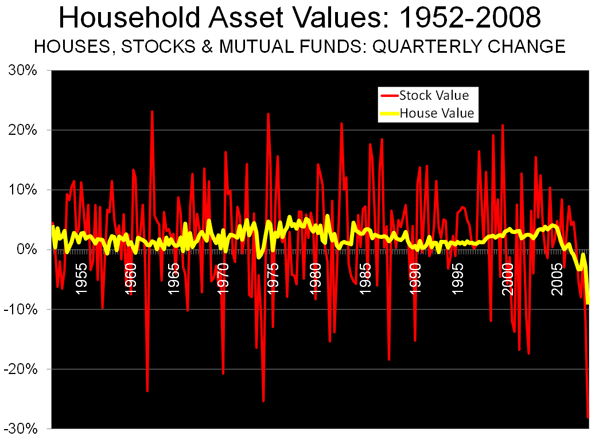
    Just how bad is the current economic downturn? It is frequently claimed that the crash of 2008 is the worst economic downturn since the Great Depression. There is plenty of reason to accept this characterization, though we clearly are not suffering the widespread hardship of the Depression era. Looking principally at historical household wealth data from the Federal Reserve Board’s Flow of Funds Accounts of the United States, summarized in our Value of Household Residences, Stocks & Mutual Funds: 1952-2008, we can conclude it’s pretty bad, but nothing yet like the early 1930s.

    But this Panic of 2008 is no picnic. And in some key areas, notably housing, it could be even worse than what was experienced in the Great Depression.

    Housing: It all started with the housing bubble that saw prices in some markets rise to unheard of levels, principally in California, Florida, Phoenix, Las Vegas and the Washington, DC area. Mortgage lenders, unable to withstand the intensity of losses in these markets caused by declining prices, collapsed like a house of cards. This precipitated the Lehman Brothers bankruptcy on Meltdown Monday (September 15, 2008) and a far broader economic crisis since that time.

    Before the bubble, housing had been a stable store of wealth (equity or savings) for Americans. According to federal data, the value of the US owned housing stock increased in every year since 1935. The bursting of the housing bubble, however, brought declines in both 2007 and 2008, the longest period of housing value decline since between 1929 and 1933. The value of the housing stock was down 20 percent from its peak at the end of 2008. In some markets the losses amounted to more than double this amount. By comparison, the 1929 to 1933 house value decline was 27 percent. However, only one Great Depression year (1932) had a larger single-year decrease than 2008.

    Indeed, between 1952 and 2006, the value of the housing stock never declined for more than a three month period. The bubble changed all that. The value of the housing stock has now fallen eight straight quarters. An investment that has been safe for most middle class Americans – the house in the suburbs – suddenly experienced the price volatility usually associated with the stock market, as is indicated in the chart below.

    The resulting losses have been substantial. By the end of 2008, the value of the housing stock has fallen $4.5 trillion. In Phase I of the housing downturn, before Meltdown Monday, the largest losses were concentrated in the markets with the biggest “bubbles,”. But since that time the market has entered a Phase II decline, while a more general decline has characterized housing markets around the country in the fourth quarter of 2008. The decline continues.

    California, the largest of all the states, has been particularly hard hit. New data for both the San Francisco and Los Angeles areas show price drops of approximately 10 percent in January, 2009 alone, as prices fall like the value of a tin-pot dictatorship’s currency. This decline, it should be noted, has spread from the outer ring of these areas – places like the much maligned Inland Empire region and the Central Valley – into the formerly more stable, and established, areas closer to the larger urban cores, which some imagined would be safe from such declines.

    Sadly, there may well be some time before house price stability can be achieved. To restore the historic relationship between house prices and household incomes to a Median Multiple (median house price divided by median household income) of 3.0 would require another $3 trillion in losses, equating to a more than 15 percent additional loss. Losses are likely to be greater, however, not only in the “ground zero” markets of California and Florida but also other hugely over-valued markets, such as Portland, Seattle, New York and Boston. Of course, these are not normal times, and an intransigent economic downturn could lead to even lower house values than the historical norm would suggest.

    Stocks and Mutual Funds: As noted above, stocks and mutual funds have been inherently more volatile than housing values. According to Federal Reserve data, the value of these holdings fell 24 percent over the year ended September 30. Based upon later data from the World Federation of Exchanges, we estimate that the value declined sharply after September 15, and at December 31 stood at 45 percent below the peak.

    The household value of stocks and mutual funds has declined for five consecutive quarters, as of December 2008. There was a more sustained drop over six quarters in 1969-1970, although the decline in value was less than the present loss, at 37 percent. A larger decline (47 percent) was associated with the four quarter decline of 1973-1974. Comparable data is not available for household stocks and mutual fund holdings before 1952. The less complete data available indicates that the gross value of common and preferred stocks fell 45 percent from 1929 to 1933. As late as 1939, a decade after the crash, the loss had risen to 46 percent, indicating both the depth and length of the Great Depression.

    The present downturn seems on course at a minimum to break the post-depression loss record with an overall decline at 55 percent as of February 20. This would correspond to a household loss of $8 trillion from the peak.

    Consumer Confidence: The Conference Board’s Consumer Confidence Index reached an all time low of 25.0 in February, down a full one-third in a month. Even with its gasoline rationing, the mid-1970s downturn saw a minimum Consumer Confidence Index of 43.2. Normal would be 100; as late as August of 2007, consumer confidence was above 100. Consumer confidence is important. Where it is low, as it is today, there is fear and even people with financial resources are disinclined to spend. Confidence is a major contributor to economic downturns, which is why they used to be called “panics.” Restoring confidence is a requirement for recovery.

    Government Confidence: If there were a federal government index of confidence, it would probably be near zero. This is demonstrated by the trillions that both parties in Washington have or intend to throw at banks, private companies and distressed home owners to stop the downturn. Never since the Great Depression have things become so bad that Washington has opened taxpayer’s checkbooks for massive financial bailouts.

    How Much Wealth has been Lost: The net worth of all US households peaked at $64.6 trillion in the third quarter of 2007, according to the Federal Reserve Board. Since that time, it seems likely that the housing, stock and mutual fund losses by the nation’s households could be as high as $12 trillion – $4 trillion in housing and $8 trillion in stocks and mutual funds. This is a major loss and is unlikely to be recovered soon. Yet it makes sense to consider these losses in context. Unemployment is far lower than in the 1930s, when it reached 25 percent, and the Dust Bowl is not emptying into California (indeed, more than 1,000,000 people have migrated from California to other states this decade).

    Born Yesterday Jeremiahs: It is fashionable to suggest that the current economic crisis is the result of over-consumption and an unsustainable lifestyle. The narrative goes that the supposed excesses of the 1980s and 1990s have finally caught up with us. In fact, however, even with the huge losses, the net worth of the average household is no lower than in 2003 and stands at 70 percent above the 1980 figure (inflation adjusted). This may be a surprise to “born yesterday” economic analysts.

    The reality is that the country achieved astounding economic and social progress since World War II. The reality remains that even after the losses we are not, objectively speaking, experiencing Depression-like conditions. Critically, the answer to the question, “Are you better off today?” in 1950, 1960, 1970, 1980, 1990 and even 2000 is “yes”. This is a critical difference with the situation in the 1930s when the country overall was much poorer, and far less able to withstand such punishing losses.

    Beware the Panglossians: Even so, it seems premature to predict that the economy will turn around soon. Some Panglossian analysts predict recovery later in the year or in 2010 seem likely to miss the mark by years. Remember analysts – particularly those tied to both the real estate and stock sectors – who have discredited themselves with their past cheerleading. In addition, the international breadth and depth of this crisis cannot possibly be fully comprehended at this time. Last week the Federal Reserve predicted a declining economy over the next year.

    And even when the recovery starts, it is likely to be slow because of the public debt run up to stop the bleeding. When the recovery begins, the nation and the world will have to repay the many trillions in bailouts one way or the other. This can take the form of higher taxes, inflation, rising real interest rates or, if you can imagine, all three.

    How Bad Is It? Bad Enough. The present downturn is not as serious as the Great Depression. Nonetheless, the Panic of 2008 is without question, the most serious economic downturn since the Great Depression. The real question is whether the government will react as ineffectively as it did back then, and prolong the downturn well into the next decade.

    Wendell Cox is a Visiting Professor, Conservatoire National des Arts et Metiers, Paris. He was born in Los Angeles and was appointed to three terms on the Los Angeles County Transportation Commission by Mayor Tom Bradley. He is the author of “War on the Dream: How Anti-Sprawl Policy Threatens the Quality of Life.

  • The Decline of Los Angeles

    Next week, Antonio Villaraigosa will be overwhelmingly re-elected mayor of Los Angeles. Do not, however, take the size of his margin – he faces no significant opposition – as evidence that all is well in the city of angels.

    Whatever His Honor says to the media, the sad reality remains that Los Angeles has fallen into a serious secular decline. This constitutes one of the most rapid – and largely unnecessary – municipal reversals in fortune in American urban history.

    A century ago, when L.A. had barely 100,000 souls, railway magnate Henry Huntington predicted that the place was “destined to become the most important city in this country, if not the world.” Long run by ambitious, often ruthless boosters, the city lured waves of newcomers with its pro-business climate, perfect weather and spectacular topography.

    These newcomers – first largely from the Midwest and East Coast, and then from around the world – energized L.A. into an unmatched hub of innovation and economic diversity.

    As a result, L.A. surged toward civic greatness. By the end of the 20th century, it stood not only as the epicenter for the world’s entertainment industry, but also North America’s largest port, garment manufacturer and industrial center. The region also spawned two important presidents – Richard Nixon and Ronald Reagan – and nurtured a host of political and social movements spanning the ideological spectrum.

    Now L.A. seems to be fading rapidly toward irrelevancy. Its economy has tanked faster than that of the nation, with unemployment now close to 10%. The port appears in decline, the roads in awful shape and the once potent industrial base continues to shrink.

    Job growth in the area, notes a forecast by the University of California at Santa Barbara, dropped 0.6% last year and is expected to plunge far more rapidly this year. Roughly one-fifth of the population depends on public assistance or benefits to survive.

    Once a primary destination for Americans, L.A. – along with places like Detroit, New York and Chicago – now suffers among the highest rates of out-migration in the country. Particularly hard hit has been its base of middle-class families, which continues to shrink. This is painfully evident in places like the San Fernando Valley, where I live, long a middle-class outpost for L.A., much like Queens and Staten Island are for New York.

    In such a context, Villaraigosa’s upcoming coronation seems hard to comprehend. By most accounts, he has been at best a mediocre mayor, with few real accomplishments besides keeping police chief Bill Bratton, a man appointed by his predecessor. So far, Bratton has managed to keep the lid on crime, a testament both to his skills and to the demographic aging of much of the city.

    Besides this, virtually every major initiative from Villaraigosa has been a dismal failure; from a poorly executed program to plant more trees to a subsidized drive to refashion downtown Los Angeles into a mini-Manhattan. Instead of reforming a generally miserable business climate, Villaraigosa has fixated on fostering “elegant density” through massive new residential construction. This gambit has failed miserably, with downtown property values plunging at least 35% since their peak. Many “luxury” condominiums there, as well as elsewhere in the city, remain largely unoccupied or have turned into rentals.

    More recently the mayor has presided over a widely ridiculed scheme to hand over the solar business in Los Angeles to a city agency, the Department of Water and Power (DWP), whose workers are among the best paid and most coddled of any municipal agency anywhere. Most solar plans by utilities focus more on competitive bidding by outside contractors. Villaraigosa’s plan, which recent estimates suggests will cost L.A. ratepayers upward of $3.6 billion, would grant a powerful, well-heeled union control of the city’s solar program.

    This has occurred despite years of overruns on previous DWP “clean energy” projects. Not surprisingly, the plan was widely blasted – by the city’s largest newspaper, the rapidly shrinking Los Angeles Times, the feistier LA Weekly and the last independent voice at City Hall, outgoing City Controller Laura Chick, who proclaimed that the whole scheme “stinks.” Yet despite the criticism, a ballot measure endorsing the plan – opponents have little money to stop it – seems likely to be approved next week.

    With his firm grip on political power, Villaraigosa likes to think of himself as a West Coast version of New York’s Michael Bloomberg or Chicago’s Richard Daley. Yet at least they have demonstrated a modicum of seriousness about the job.

    In contrast, Villaraigosa, according to a devastating recent report in the LA Weekly, spends remarkably little time – about 11% – actually doing his job. The bulk of his 16-hour or so days are spent politicking, preening for the cameras and in other forms of relentless self-promotion.

    So how is this person about to be re-elected with only token opposition? Rick Caruso, the developer of luxury shopping center The Grove and one of L.A.’s last private sector power brokers, ascribes this to a growing sense of powerlessness, even among the city’s most important business leaders.

    “People feel it’s kind of hopeless. It’s a dysfunctional city,” Caruso, who once considered a run against Villaraigosa, told me the other day. “They don’t think there’s anything to do.”

    Certainly, odds against changing the current political system seem long to an extreme. The once-powerful business community has devolved into a weak plaintive lobby who rarely challenge our homegrown Putin or his allies in our municipal Duma.

    Of course, entrepreneurial Angelenos still find opportunities, but largely by working at home or in one of the city’s surrounding communities. They tend to flock to locales like Ontario, Burbank, Glendale or Culver City, all of which, according to the recent Kosmont-Rose Institute Cost of Doing Business Survey, are less expensive and easier to do business in than L.A.

    “It’s extremely difficult to do business in Los Angeles,” observes Eastside retail developer Jose de Jesus Legaspi. “The regulations are difficult to manage. … Everyone has to kiss the rings of the [City Hall politicians].”

    Legaspi, like many here, still regards Southern California as an appealing place to work, but takes pains to avoid anything within the purview of City Hall. As the economy recovers, I would bet the smaller cities around L.A. and even the hard-hit periphery rebounds first.

    The only immediate chance of relief for us Angelenos is if Villaraigosa (who will soon face term limits) takes off to run for governor. As the sole southern Californian and Latino candidate, he could prevail in a crowded Democratic primary. But the idea of this empty suit running the once great state of California – not exactly a paragon of good governance – may be enough to push even more people to the exits or, at very least, think about taking a very strong sedative.

    This article originally appeared at Forbes.

    Joel Kotkin is executive editor of NewGeography.com and is a presidential fellow in urban futures at Chapman University. He is author of The City: A Global History and is finishing a book on the American future.

  • Housing Bail Out Part Deux: Just Another Financial Con Job

    Last night I wrote about the Obama Administration’s housing bail out. But, I hate to say, there’s more to tell you – and it’s actually worse. In addition to the giveaways to mortgage holders, we also have to consider the federal government effectively offering to give a credit default swap (CDS, remember those?) to the banks. If one of the lucky homeowners that get a loan modification defaults on their mortgage because home prices fall again in the future, the federal government will make good to the bank for them. There are some differences between this and a real CDS, though – the banks won’t have to pay a premium for the insurance. The federal government is selling CDS for $0. Nice. We taxpayers are putting up $10 billion for this piece.

    Then there are the plans to “Support Low Mortgage Rates by Strengthening Confidence in Fannie Mae and Freddie Mac.” There’s that word again: confidence. In a con game, the con man isn’t the one who is confident; he is the one who gives you confidence. You are so confident that you are making a good decision that you give him all your money to be part of his scheme. If you still have any questions about confidence schemes, watch “The Music Man” again.

    The Treasury nationalized Fannie and Freddie (F&F) last year – they are now owned by the federal government. If you need more “confidence” than that in the strength of F&F then you should consider moving to another country. Under the assumption that “too big to fail” makes sense, the new Bailout plan is increasing the size of F&F’s mortgage portfolios by $50 billion – along with corresponding increases in their allowable debt outstanding. This part of the Homeowner Affordability and Stability Plan will cost $200 billion, an amount that goes beyond the $2.5 trillion cost of the Financial Stability Plan and the $700 billion in the Emergency Economic Stabilization Act/TARP and the $800 billion Stimulus Plan. The new $200 billion in funding, according to the Treasury’s plan, is being made under the Housing and Economic Recovery Act.

    If you can remember back that far, the Housing and Economic Recovery Act was signed into law by the former and largely unmissed resident of the White House back in July 2008 to clean up the subprime mortgage crisis before any of the other bailout money was committed to clean up the subprime mortgage crisis. This legislation established the HOPE for Homeowners Act of 2008 which spent $300 billion to (1) insure refinanced loans for distressed borrowers, (2) reduce principle balances and interest charges to avoid foreclosure, (3) provide confidence in mortgage markets with greater transparency for home values, (4) be used for homeowners and not home flippers or speculators (5) increase the budget at the Federal Housing Administration so they can monitor that all this happens, (6) end when the housing market is stabilized and (7) provide banks with more ways and means to stop foreclosing on delinquent homeowners. Three million homes were foreclosed last year despite this legislation or any of the other bills that passed before and after it.

    Each new bill carries with it an increase in the limit on the national debt. The most recent Stimulus Package increased it from $11.315 trillion to $12.104 trillion effective February 17, 2009. The actual debt is currently at $10.8 trillion and rising. With only $1.3 trillion between the actual debt and the limit, Timmy Geithner’s pals back at the Federal Reserve will have to keep the printing presses running overtime.

    The “new” Homeowner Affordability and Stability Plan is just a rehash of every old financial sector bailout plan. The definition of insanity, according to a quote attributed to Albert Einstein, is doing the same thing over and over again and expecting different results. Here we go again.

    Susanne Trimbath, Ph.D. is CEO and Chief Economist of STP Advisory Services. Her training in finance and economics began with editing briefing documents for the Economic Research Department of the Federal Reserve Bank of San Francisco. She worked in operations at depository trust and clearing corporations in San Francisco and New York, including Depository Trust Company, a subsidiary of DTCC; formerly, she was a Senior Research Economist studying capital markets at the Milken Institute. Her PhD in economics is from New York University. In addition to teaching economics and finance at New York University and University of Southern California (Marshall School of Business), Trimbath is co-author of Beyond Junk Bonds: Expanding High Yield Markets.

  • Death of the California Dream

    For decades, California has epitomized America’s economic strengths: technological excellence, artistic creativity, agricultural fecundity and an intrepid entrepreneurial spirit. Yet lately California has projected a grimmer vision of a politically divided, economically stagnant state. Last week its legislature cut a deal to close its $42 billion budget deficit, but its larger problems remain.

    California has returned from the dead before, most recently in the mid-1990s. But the odds that the Golden State can reinvent itself again seem long. The buffoonish current governor and a legislature divided between hysterical greens, public-employee lackeys and Neanderthal Republicans have turned the state into a fiscal laughingstock. Meanwhile, more of its middle class migrates out while a large and undereducated underclass (much of it Latino) faces dim prospects. It sometimes seems the people running the state have little feel for the very things that constitute its essence — and could allow California to reinvent itself, and the American future, once again.

    The facts at hand are pretty dreary. California entered the recession early last year, according to the Forecast Project at the University of California, Santa Barbara, and is expected to lag behind the nation well into 2011. Unemployment stands at roughly 10 percent, ahead only of Rust Belt basket cases like Michigan and East Coast calamity Rhode Island. Not surprisingly, people are fleeing this mounting disaster. Net outmigration has been growing every year since about 2003 and should reach well over 200,000 by 2011. This outflow would be far greater, notes demographer Wendell Cox, if not for the fact that many residents can’t sell their homes and are essentially held prisoner by their mortgages.

    For Californians, this recession has been driven by different elements than the early-1990s downturn, which was largely caused by external forces. The end of the Cold War stripped away hundreds of thousands of well-paid defense-related jobs. Meanwhile, the Japanese economy went into a tailspin, leading to a massive disinvestment here. In South L.A., the huge employment losses helped create the conditions conducive to social unrest. The 1992 Rodney King verdict may have provided the match, but the kindling was dry and plentiful.

    This time around, the recession feels like a self-inflicted wound, the result of “bubble dependency.” First came the dotcom bubble, centered largely in the Bay Area. The fortunes made there created an enormous surge in wealth, but by 2001 that bust had punched a huge hole in the California budget. Voters, disgusted by the legislature’s inability to cope with the crisis, recalled the governor, Gray Davis, and replaced him with a megastar B-grade actor from Austria.

    Yet almost as soon as the Internet bubble had evaporated, a new one emerged in housing. As prices soared in coastal enclaves, people fled to the periphery, often buying homes far from traditional suburban job centers. At first, it seemed like a miraculous development: people cheered as their home’s “value” increased 20 percent annually. But even against the backdrop of the national housing bubble, California soon became home to gargantuan imbalances between incomes and property prices. The state was also home to such mortgage hawkers as New Century Financial Corp., Countrywide and IndyMac. For a time the whole California economy seemed to revolve around real-estate speculation, with upwards of 50 percent of all new jobs coming from growth in fields like real estate, construction and mortgage brokering.

    As a result, when the housing bubble burst, the state’s huge real-estate economy evaporated almost overnight. Both parties in the legislature and the governor failed miserably to anticipate the impending fiscal deluge they should have known was all but inevitable.

    To many longtime California observers, the inability of the political, business and academic elites to adequately anticipate and address the state’s persistent problems has been a source of consternation and wonderment. In my view, the key to understanding California’s precipitous decline transcends terms like liberal or conservative, Democratic and Republican. The real culprit lies in the politics of narcissism.

    California, like any gorgeously endowed person, has a natural inclination toward self-absorption. It has always been a place of unsurpassed splendor; it has inspired and attracted writers, artists, dreamers, savants and philosophers. That’s especially true of the Bay Area—ground zero for California narcissism and arguably the most attractive urban expanse on the continent; Neil Morgan in 1960 described San Francisco as “the narcissus of the West,” a place whose fundamental asset was first its own beauty, followed by its own culture of self-regard.

    At first this high self-regard inspired some remarkable public achievements. California rebuilt San Francisco from the ashes of the great 1906 fire, and constructed in Los Angeles the world’s most far-reaching transit system. These achievements reached a pinnacle under Gov. Pat Brown, who in the 1960s oversaw the expansion of the freeways, the construction of new university, state- and community-college campuses, and the creation of water projects that allowed farming in dry but fertile landscapes.

    Yet success also spoiled the state, incubating an ever more inward-looking form of narcissism. Even as the middle class enjoyed “the good life” — high-paying jobs, single-family homes (often with pools), vacations at the beach — there was a growing, palpable sense of threats from rising taxes, a restless youth population and a growing nonwhite demographic. One early expression of this was the late-1970s antitax movement led by Howard Jarvis. The rising cost of government was placing too much of a burden on middle-class homeowners, and the legislature refused to address the problem with reasonable reforms. The result, however, was unreasonable reform, with new and inflexible limits on property and income taxes that made holding the budget together far more difficult.

    Middle-class Californians also began to feel inundated by a racial tide. This was not totally based on prejudice; Californians seemed to accept legal immigration. But millions of undocumented newcomers provoked fear that there were no limits on how many people would move into the state, filling emergency rooms with the uninsured and crowding schools with children whose parents neither spoke English nor had the time to prepare their children for school. By 1994, under Gov. Pete Wilson, the anti-immigrant narcissism fueled Proposition 187. It was now OK to deny school and medical services to people because, at the end, they looked different.

    Today the politics of narcissism is most evident among “progressives.” Although the Republicans can still block massive tax increases, the predominant force in California politics lies with two groups — the gentry liberals and the public sector. The public-sector unions, once relatively poorly paid, now enjoy wages and benefits unavailable to most middle-class Californians, and do so with little regard to the fiscal and overall economic impact. Currently barely 3 percent of the state budget goes to building roads or water systems, compared with nearly 20 percent in the Pat Brown era; instead we’re funding gilt-edged pensions and lifetime guaranteed health care. It’s often a case of I’m all right, Jack — and the hell with everyone else.

    The most recent ascendant group are the gentry liberals, whose base lies in the priciest precincts of San Francisco, the Silicon Valley and the west side of Los Angeles. Gentry liberalism reflects the narcissistic values of successful boomers and their offspring; their politics are all about them. In the past this was tied as much to cultural issues, like gay rights (itself a noble cause) and public support for the arts. More recently, the dominant issue revolves around environmentalism.

    Green politics came early to California and for understandable reasons: protecting the resources and beauty of the nation’s loveliest landscapes. Yet in recent years, the green agenda has expanded well beyond that of the old conservationists like Theodore Roosevelt, who battled to preserve wilderness but also cared deeply about boosting productivity and living standards for the working classes. In contrast, the modern environmental movement often adopts a largely misanthropic view of humans as a “cancer” that needs to be contained. By their very nature, the greens tend to regard growth as an unalloyed evil, gobbling up resources and spewing planet-heating greenhouse gases.

    You can see the effects of the gentry’s green politics up close in places like the Salinas Valley, a lovely agricultural region south of San Jose. As community leaders there have tried to construct policies to create new higher-wage jobs in the area (a project on which I’ve worked as a consultant), local progressives — largely wealthy people living on the Monterey coast — have opposed, for example, the expansion of wineries that might bring new jobs to a predominantly Latino area with persistent double-digit unemployment. As one winegrower told me last year: “They don’t want a facility that interferes with their viewshed.” For such people, the crusade against global warming makes a convenient foil in arguing against anything that might bring industrial or any other kind of middle-wage growth to the state. Greens here often speak movingly about the earth — but also about their personal redemption. They have engaged a legal and regulatory process that provides the wealthy and their progeny an opportunity to act out their desire to “make a difference” — often without real concern for the outcome. Environmentalism becomes a theater in which the privileged act out their narcissism.

    It’s even more disturbing that many of the primary apostles of this kind of politics are themselves wealthy high-livers like Hollywood magnates, Silicon Valley billionaires and well-heeled politicians like Arnold Schwarzenegger and Jerry Brown. They might imagine that driving a Prius or blocking a new water system or new suburban housing development serves the planet, but this usually comes at no cost to themselves or their lifestyles.

    The best great hope for California’s future does not lie with the narcissists of left or right but with the newcomers, largely from abroad. These groups still appreciate the nation of opportunity and aspire to make the California — and American — Dream their own.

    Of course, companies like Google and industries like Hollywood remain critical components, but both Silicon Valley and the entertainment complex are now mature, and increasingly dominated by people with access to money or the most elite educations. Neither is likely to produce large numbers of new jobs, particularly for working- and middle-class Californians.

    In contrast, the newcomers, who often lack both money and education, continue in the hierarchy-breaking tradition that made California great in the first place. Many of them live and build their businesses not in places like San Francisco or West L.A., but in the increasingly multicultural suburbs on the periphery, places like the San Gabriel Valley, Riverside and Cupertino. Immigrants played a similar role in the recovery from the early-1990s doldrums. In the ’90s, for example, the number of Latino-owned businesses already was expanding at four times the rate of Anglo ones, growing from 177,000 to 440,000. Today we see signs of much the same thing, though it often involves immigrants from the Middle East, the former Soviet Union, Mexico or South Korea. One developer, Alethea Hsu, just opened a new shopping center in the San Gabriel Valley this January — and it’s fully leased. “We have a great trust in the future,” says the Cornell-trained physician.

    You see some of the same thing among other California immigrants. More than three decades ago the Cardenas family started slaughtering and selling pigs grown on their two-acre farm near Corona. From there, Jesús Sr. and his wife, Luz, expanded. “We would shoot the hogs through the head and sell them off the truck,” says José, their son. “We’d sell the meat to people who liked it fresh: Filipinos, Chinese, Koreans and Hispanics…We would sell to anyone.” Their first store, predominantly a carnicería, or meat shop, took advantage of the soaring Latino population. By 2008, they had 20 stores with more than $400 million in sales. In 2005 they started to produce Mexican food, including some inspired by Luz’s recipes to distribute through such chains as Costco. Mexican food, notes Jesús Jr., is no longer a niche. “It’s a crossover product now.”

    Despite the current mess in Sacramento, this suggests some hope for the future. Perhaps the gubernatorial candidacy of Silicon Valley folks like former eBay CEO Meg Whitman (a Republican), or her former eBay employee Steve Wesley (a Democrat), could bring some degree of competence and common sense to the farce now taking place in Sacramento. Sen. Dianne Feinstein, who’s said to be considering the race, would also be preferable to a green zealot like Jerry Brown or empty suits like Los Angeles Mayor Antonio Villaraigosa or San Francisco’s Gavin Newsom.

    But if I am looking for hope and inspiration, for California or the country, I would look first and foremost at people like the Cardenas family. They create jobs for people who didn’t go to Stanford or whose parents lack a trust fund. They constitute what any place needs to survive: risk takers who are self-confident but rarely selfish. These are people who look at the future, not in the mirror.

    This article originally appeared at Newsweek.

    Joel Kotkin is executive editor of NewGeography.com and is a presidential fellow in urban futures at Chapman University. He is author of The City: A Global History and is finishing a book on the American future.

  • Responsible Home Buyers, Why Be Frugal?

    I was laying in bed this morning, listening to discussions of the Homeowner Affordability and Stability Plan, the 2009 version of a Homeowner Bailout. (The 2008 version was spent on the banks.) I listened closely because I had to decide if it was worth getting out of bed to earn the money to pay my mortgage or not. Like all those bankers that got a bailout, I was wondering if it might be worth more to me to default on my mortgage than to pay it. I mean, what if the only people getting bailed out are the ones who truly screwed up? Being right doesn’t mean being rich and I didn’t want to miss out.

    I realized that I’d have to get out of bed and get to the office anyway if I was going to make sense of this Plan. Radio sound bites are no substitute for real research. Timmy Geithner put several documents up on his website. Much like his plan to print $2.5 trillion, it’s still more rhetoric than reality but at least this time they included lots of number, so I’m happy to rifle through it.

    Step one in the Fact Sheet is “Refinancing for Up to 4 to 5 Million Responsible Homeowners to Make Their Mortgages More Affordable.” The Plan offers an example of a family with a $207,000 30-year fixed rate mortgage at 6.5%. The house value has fallen 15% to $221,000 so they have less than the 20% home equity needed to qualify for current mortgage rates (close to 5%). The lower interest rate would save this homeowner $2,300/year in mortgage payments.

    First of all, this homeowner’s monthly mortgage payment is $1,308 –about 8.6% of all mortgages fall into this range. About 60% of mortgages are below that level. If the mortgage is too much bigger than that, they are into “jumbo” territory in a lot of areas, so we’ll say this plan is directed at the lower 60%. The example of a $260,000 home is a little pricey – the median new home in 2008 was $226,000 and the median existing home price was $202,000.

    The lower price isn’t just because home prices are falling. The US median has never been higher than $247,900 except in places like New York and California. But the median home price has not skyrocketed in vast swaths of middle-class, middle-America. Finally, reducing your payments by $2,300 in a year means a monthly savings of about $200 – enough to cover a northern winter utility bill.

    If they reach the 4 million homeowners that they say they will, that’s 5.3% of all homeowners. But only 1.19% of all mortgages are in foreclosure and only 1.83% are 90 days past due. Maybe they are going to help the slow-pays, because 6.41% of all mortgages have some past due payments. President Obama specifically said that he was doing this to help regular, middle-class homeowners. That should not mean those who have homes worth more than the national median.

    Then there’s this 15% drop in home value in Geithner’s example. The national median fell 8.6% from 247,000 at the beginning of 2007 to $225,700 in the third quarter of 2008 (latest available from HUD). In the West, where California homes have a higher median than middle-America, the median new home price rose from $320,200 in 2007 to $414,400 at the end of 2008. That’s a whopping 29.4% increase in the median price for a new home! Eastern US median home prices did fall, but by 12.6% not 15%. Still, I wouldn’t be hard pressed to find a city or two or three where home prices fell by 12%. But it doesn’t appear that they will be middle-class homes in middle-America. Existing home prices have fallen across the board. But only in the West did these prices fall at an alarming rate. The average for the other regions was only 8.7%.

    Median Existing Home Price
    Period*
    US
    Northeast
    Midwest
    South
    West
    2007 219,000 279,100 165,100 179,300 335,000
    2008 191,600 246,800 152,500 167,200 253,600
    % change
    12.50% 11.60% 7.60% 6.70% 24.30%
    * 2008 is for September, latest available from HUD. 2007 is full year figure.

    Let’s look at the rest of the bill: “A $75 Billion Homeowner Stability Initiative to Reach Up to 3 to 4 Million At-Risk Homeowners.” This part is for those with adjustable-rate mortgages (“have seen their mortgage payments rise to 40 or even 50 percent of their monthly income”) and excludes those slow-pays (“before a borrower misses a payment”) that appear to be getting help from Part One. This Part is only available to those who have a high mortgage-to-income ratio and/or whose mortgage balance is higher than the current market value. Under the “Shared Effort to Reduce Monthly Payments” the federal government would step in to make some of your interest payments after the bank can’t reduce your interest rate any further.

    There’s nothing here that says you’ll have to pay the government back that money – ever. But if the interest rate reduction isn’t enough, and having the government make some of your interest payments still doesn’t get you down to a mortgage payment that is no more than 31% of your income (one of the definitions of affordable), then the government will even pay down some of your principal.

    But wait, that’s not all you get! If you and your bank can work out a deal here’s what else Uncle Obama will throw in for you:

    If you take this action
    The government pays Your Bank 
    The government pays You
    Do a loan modification
    $1,000
    Reduced interest costs and principal balance
    Do it before you miss a payment
    $500
    $1,500
    Stay current
    $3,000 (over 3 years)
    $5,000 (over 5 years)

    Wow! I’m really beginning to regret being a responsible person. I comment on Part 3 of the plan tomorrow. But this is really discouraging. I’m ineligible because I bought responsibly, before the Stimulus Bill gave out incentives to buy. I suspect there are about 70 million households out there just like me. Trillions of dollars running around the economy and all I can see is that the responsible majority will be paying for it while irresponsible bankers, brokers and home buyers benefit.

    To tell you the truth, I need a tissue…

    Read Part II of this look at the Housing Bailout.

    Susanne Trimbath, Ph.D. is CEO and Chief Economist of STP Advisory Services. Her training in finance and economics began with editing briefing documents for the Economic Research Department of the Federal Reserve Bank of San Francisco. She worked in operations at depository trust and clearing corporations in San Francisco and New York, including Depository Trust Company, a subsidiary of DTCC; formerly, she was a Senior Research Economist studying capital markets at the Milken Institute. Her PhD in economics is from New York University. In addition to teaching economics and finance at New York University and University of Southern California (Marshall School of Business), Trimbath is co-author of Beyond Junk Bonds: Expanding High Yield Markets.