Category: Politics

  • Are We Going fascist?

    The rise, and then the improbable election, of Donald Trump have reawakened progressive fears of a mounting authoritarian tide. With his hyperbole and jutting chin, he strikes some progressives as a new Benito Mussolini who will threaten free speech and other basic human rights.

    Some aspects of Trumpism do exhibit some classic fascist modalities — emphasis on personal charisma, attacks on vulnerable minorities, rage against comfortable and self-satisfied elites. Yet, at the same time, some of the most histrionic attacks on Trump come from people who, rather than rejecting authoritarianism, really fear only his politically incorrect version of it.

    During the election, Trump supporters did not generally disrupt Clinton rallies, but disturbances by progressives were somewhat common. After the election, the most hysterical forebodings about free speech came from the very college campuses — along with the left-leaning social media — that have not exactly been friendly to free speech.

    At the same time, the powerful green lobby has made a point of trying to marginalize even distinguished scientists who differ in any degree from its climate change orthodoxy. In some cases, these scientists are not only demonized by fellow academics, but have been targeted for prosecution by “right-thinking” politicians. Sounds pretty fascist to me.

    Read the entire piece at The Orange County Register.

    Joel Kotkin is executive editor of NewGeography.com. He is the Roger Hobbs Distinguished Fellow in Urban Studies at Chapman University and executive director of the Houston-based Center for Opportunity Urbanism. His newest book, The Human City: Urbanism for the rest of us, was published in April by Agate. He is also author of The New Class ConflictThe City: A Global History, and The Next Hundred Million: America in 2050. He lives in Orange County, CA.

    Photo by Gage Skidmore from Peoria, AZ, United States of America (Donald Trump) [CC BY-SA 2.0], via Wikimedia Commons

  • The End of Eyes on the Street

    Jane Jacobs talked about the “sidewalk ballet” of her neighborhood and the importance of eyes on the street. But her conception of that, one where shopkeepers policed the sidewalks in front of their stores and kept an eye out for neighborhood kids, is far away from what we have today.

    My latest post looking at this is over at City Journal and is called “The End of Eyes on the Street“:

    “The bedrock attribute of a successful city district is that a person must feel personally safe and secure on the street among all these strangers,” wrote Jane Jacobs in The Death and Life of Great American Cities. Jacobs is revered as an urban prophet, but key facets of her prescription for how to keep streets safe and maintain thriving urban neighborhoods are increasingly being ignored in New York today.

    Key to safe and thriving sidewalks is what Jacobs called “eyes on the street”: people taking an active interest in what’s happening around them. Citizen vigilance, she believed, was even more important than the police. Public peace, she wrote, was “kept primarily by an intricate, almost unconscious network of voluntary controls and standards among the people themselves, and enforced by the people themselves.” Some eyes on the street were more important than others–especially those belonging to local business owners. “Storekeepers and other small businessmen are typically strong proponents of peace and order themselves,” Jacobs observed. “They hate broken windows and holdups; they hate having customers made nervous about safety.”

    Click through to read the whole thing.

    What’s amazing to me is that at the same time we’re told we can’t do anything about things like a panhandler following my wife a block down the street cursing at her because she refused to give him money (which happened recently), or when we can’t stop mentally ill people from pushing people in front of subway trains and killing them (as happened yesterday at Times Square), we have immense effort being put into farcical items like stopping “microaggressions.” It certainly belies a lot of the rhetoric around what we can and can’t do in society.

    Aaron M. Renn is a senior fellow at the Manhattan Institute, a contributing editor of City Journal, and an economic development columnist for Governing magazine. He focuses on ways to help America’s cities thrive in an ever more complex, competitive, globalized, and diverse twenty-first century. During Renn’s 15-year career in management and technology consulting, he was a partner at Accenture and held several technology strategy roles and directed multimillion-dollar global technology implementations. He has contributed to The Guardian, Forbes.com, and numerous other publications. Renn holds a B.S. from Indiana University, where he coauthored an early social-networking platform in 1991.

    Photo: Andy C (Own work) [CC BY-SA 3.0 or GFDL], via Wikimedia Commons

  • The Future of Racial Politics

    From its inception, the American experiment has been dogged by racial issues. Sadly, this was even truer this year. Eight years after electing the first African-American president, not only are race relations getting worse, according to surveys, but the electorate remains as ethnically divided as in any time of recent history.   

    Donald Trump has emerged in most media accounts as the candidate of Anglo voters, with a margin of 21 percentage points over Hillary Clinton among that segment of the electorate. Clinton’s embrace of “identity” politics may have played a role in turning off many of these white non-Hispanic voters, who might otherwise had voted Democratic.

    Many Democrats maintain still, with some justification, that as demographics evolve over the next decade, the increasingly diverse electorate will reward their identification with racial minorities. The country, and the electorate, seem destined to become ever less white in the coming decades.  Between 2000 and 2015, the nation’s population makeup became increasingly minority, from 31 percent to 38 percent. This trend will continue, with the country conceivably becoming 45 percent non-white by 2030 and 53 percent by 2050.

    White Men Can’t Jump, But They Can Still Vote

    It may well be that Democrats this year jumped the demographic gun. Even as the white population diminishes, it retains a dominant influence in elections. One reason: Whites tend to vote more. Most critical, the African-American share of the electorate, which reached record highs with Barack Obama atop the ticket,  actually dropped by a percentage point in 2016. Latino turnout, widely seen as a surge that would elect Clinton, represented  about the same percentage –11 percent — in 2016 as in 2012.  

     Thesedynamics keyed the Trump victory, particularly in heavily white working-class precincts in the Midwest, Pennsylvania and Florida, where he secured his electoral victory. Many of the pivotal states electorates remain very white indeed. In Wisconsin, for example, more than 80 percent of voters are white, and most of them are not residents of liberal college towns like Madison. This is also the case for Pennsylvania, where more than 75 percent of voters are Caucasian. Even Florida – itself a very diverse state — still has a heavily white electorate, accounting for more than 55 percent of voters.  

     These patterns will remain critical past what might be seen as their sell-by date for two critical reasons. One has to do with the concentration of minority voters. Nearly 60 percent of African-Americans live in Southern states where Trump won by dominating a very conservative white electorate. Other minority voters are clustered in big cities in the Northeast, which are not remotely contestable for Republicans.

     Latino voters, and also Asians, are likewise heavily concentrated, particularly in California,   now essentially a non-GOP zone, as well as the similarly politically homogeneous Northeastern cities and Chicago. To be sure, Latinos are also critical in Texas, and Asians too (increasingly so), but for now the Texas white population still outvotes them by a considerable margin.

     Another problem for the much-ballyhooed “emerging Democratic majority” lies in one stubborn fact: The elderly, most of whom are white, are not dying out quickly enough for Democrats to win. Although the extension of life spans may have slowed, or even slightly reversed in some demographic segments, seniors are clearly living longer than before.  

    The Limits of Identity Politics    

    Ignoring the reality of economic decline in the states that swung to Trump, some observers maintain that the increased conservatism among white working-class voters reflects deep-seated racial antagonisms. But this does not explain the considerable movement  of these voters, particularly in the Rust Belt, from support for Obama to support for Trump, as seen in such places as Youngstown, Ohio, Wheeling, W.Va., Macomb County, Mich., and Erie, Pa.

    The Democratic Party made things easier for Trump by adopting identity politics as its mantra. This is particularly maddening when charges of racism are leveled by affluent professionals, academics and bureaucrats, many from elite universities, who are themselves privileged.

    To their credit, some  progressives suggest shifting away — at least in the short run — from identity politics. But racial determinism may now be too central to their ideological core. Bernie Sanders’ campaign spokesperson Symone Sanders, for example, said that when it comes to picking a new leader for the  Democratic National Committee, whites need not apply.    

     Matthew Yglesias, always an excellent window on progressive dogma, insists that “there’s no other kind of politics” but identity politics; Democrats, he asserts, simply need “to do it better.” Progressives seem about as ready to ditch racialist politics  as Southern segregationists were willing to abandon Jim Crow in 1948.

    The Coming GOP Crisis

    For Republicans, identity politics is the gift that keeps giving, but the question is for how long. If you want a nightmare racial scenario for the GOP, just look at California. Since 1994, when the state passed Proposition 187, a measure widely perceived as anti-Hispanic, the Anglo population has dropped by more than 2 million as the state has added 9 million people, including more than 7 million Hispanics. Minorities now account for 62 percent of the population, compared to 43 percent in 1990. The shift in the electorate has been slower but still significant. In 1994, 49 percent of the electorate was Democratic and 37 percent Republican. Due in large part to ethnic change, by 2016 the Democratic margin was 45 percent-26 percent.

    In California this surge in minority voters has accompanied a gradual erosion of the white population, a large portion of which has left for other states. The Golden State  also has gone out of its way to encourage immigration of undocumented aliens by offering them driver’s licenses, subsidized health care and  financial aid for college; 74 percent of all California children under 15 are  now minorities, compared to 66 percent in 2000, and  25 percent of them live below the poverty line. This is 2.5 times the white non-Hispanic rate in California.  

    Despite largely positive results outside the blue coastal states, potentially the biggest long-term problem facing Republicans is in a dominant aspect of geography:  suburbia. Trump lost   some largely affluent suburban areas like Orange County, where 55 percent the population is Latino or Asian, up from 45 percent in 2000.  Perhaps most emblematic of potential GOP problems was Trump’s — and the GOP’s —  loss of Irvine, a prosperous Orange County municipality that is roughly 40 percent Asian.

    Republicans should be even more worried about trends in Texas, where Latinos are already close to a plurality and the Asian population is surging. There are still enough conservative whites to win elections in Texas — Trump won by 10 percentage points — but the margins will continue to shrink. This trend can already be seen in Houston’s sprawling, increasingly multiracial suburbs. Trump, for example, lost solidly middle-class Fort Bend County, by some estimates among the most diverse in the country, which voted Republican in every presidential elections since 1968.

    If this pattern continues, the die may indeed be cast for the GOP. As most minorities now live in the suburbs — a trend that continues to increase — a loss of suburban voters, given the total Democratic lock on inner city electors, would be too much for rural and small-town whites to overcome.  Simply put, by 2030, losses in the multicultural suburbs could make dreams of progressive long-term dominance all but inevitable.

    How Republicans Can Withstand the Racial Shift

    Republicans must reverse these trends if they don’t want to go the way of the dinosaur. They can take some limited satisfaction in knowing that Trump did somewhat  better than Mitt Romney or John McCain among Hispanics and blacks  as well as improving slightly among Asians.

    To expand on these modest gains, Republicans need to focus not on race but economics.  Our recent study for the Center for Opportunity Urbanism demonstrates clearly that minorities generally do far better in red states than in blue ones, based on such factors as income, homeownership, entrepreneurship and migration. Minorities all continue to move in ever larger numbers to red states because their economic climate and regulatory regime work better for them.

    Conservatives can make a case that Barack Obama’s progressive agenda actually favored the highly affluent, who tend to be disproportionately white.  According to a 2016 Urban League study,  African-American levels of economic equality are lower now than in 2009, surely a disappointment for a black middle class so understandably proud of Obama’s elevation.

    The best role model for the GOP could be in Texas. Latinos in the Lone Star State generally do better than their counterparts in California — as measured by homeownership, marriage rates, incomes — and also tend to vote more conservatively. In 2014, for example, Republican Gov. Greg Abbott won 44 percent of Texas Latinos. In contrast, that same year Democratic Gov. Jerry Brown won 73 percent of the Latino vote in California.  

    Other factors, notably upward mobility among  Latinos, African-Americans and Asians, could play a transformative role. As they continue to move to the suburbs, buy houses and start businesses, they may become less likely to support a high-regulation, high-tax and redistributionist agenda. Since 2000, more than 95 percent of the minority growth (black, Asian and Hispanic) in the 52 largest metropolitan areas has been in suburban and exurban areas. Trump did much better among college-educated black males, for example,  than those with no college education — 16 percent vs. 11 percent.

    If more minorities enter the middle class, particularly under Trump, this  could provide an opening for Republicans, just as occurred after the World War II when Italian, Irish, Polish and other eastern European voters moved to the suburbs and assimilated, even intermarried, after years of living apart. A message that targets the middle class aspirations of minorities could be more effective in the long run than appealing merely to xenophobic sentiments shared by an inexorably diminishing population.

    Critically, in the coming  decades, the vast majority of Latinos and Asians will be native-born. They will have spread out increasingly not only within regions but to more conservative parts of the country, notably Texas and the Southeast. At the same time, the population of undocumented workers, the least assimilated and generally the poorest demographic, is already declining, down by 300,000 since 2008. If it continues to decline, which may be likely under Trump, immigration may soon fade away as a primary issue for Latinos.

    Perhaps even more critical, however, may be the growing trend toward intermarriage among minorities. Among second-generation Latinos and Asians, interracial marriage is creating what could become an increasingly fluid racial identity. Intermarriage involving African-Americans is also on the upswing. The new generation of ethnic hybrids, most with one Anglo parent, will no longer be easily pigeon-holed ethnically. Overall, 15 percent of marriages were between partners of different ethnic groups in 2012.

    These are all opportunities to succeed, but the GOP can only prolong itself if it finds a way to reach minority voters based on an appeal of economic mobility. Whether they take this tack, or simply play for time until white voters lose their primacy, may determine whether it is the stupid party that some suggest, and one that, even at its great moment of opportunity, is destined to remain permanently so.

    Ultimately, Republicans could build on Trump’s economic message by demonstrating its efficacy for minority voters. This may be the party’s only hope in the future, given the demographic trends. The competition could also encourage Democrats to focus more on “bread and butter” issues. If future presidential campaigns are waged over key economic issues, rather than pitting ethnicities against one another, the nation will be both unified and stronger.

    This article first appeared on Real Clear Politics.

    Joel Kotkin is executive editor of NewGeography.com. He is the Roger Hobbs Distinguished Fellow in Urban Studies at Chapman University and executive director of the Houston-based Center for Opportunity Urbanism. His newest book, The Human City: Urbanism for the rest of us, was published in April by Agate. He is also author of The New Class ConflictThe City: A Global History, and The Next Hundred Million: America in 2050. He lives in Orange County, CA.

    Wendell Cox is principal of Demographia, an international public policy and demographics firm. He is a Senior Fellow of the Center for Opportunity Urbanism (US), Senior Fellow for Housing Affordability and Municipal Policy for the Frontier Centre for Public Policy (Canada), and a member of the Board of Advisors of the Center for Demographics and Policy at Chapman University (California). He is co-author of the “Demographia International Housing Affordability Survey” and author of “Demographia World Urban Areas” and “War on the Dream: How Anti-Sprawl Policy Threatens the Quality of Life.” He was appointed to three terms on the Los Angeles County Transportation Commission, where he served with the leading city and county leadership as the only non-elected member. He served as a visiting professor at the Conservatoire National des Arts et Metiers, a national university in Paris.

    Photo: Steve White, Creative Commons

  • Babes In Trumpland: The Coming Rise Of The Heartland Cities

    Contrary to the media notion that Donald Trump’s surprising electoral victory represented merely the actions of unwashed “deplorables,” his winning margin was the outcome of rational thinking in those parts of the country whose economies revolve around the production of tangible goods.

    And their economies stand to gather more steam in the years ahead.

    Trump’s victory was largely minted in the suburbs and smaller cities of the new American Heartland, from Pittsburgh to Omaha to Dallas-Ft. Worth. The heartland regions depend on agriculture, home construction, manufacturing and energy, all of which could benefit from the policies of the new presidential administration and Republican Congress. In contrast, Hillary Clinton favored extending the Obama administration’s policies on fossil fuels and housing that may win support in the dense progressive bastions of the East and West coasts, but were viewed with alarm by many tied to heartland industries, some of which have been under pressure from a global decline in commodity prices.

    Trump’s pro-fossil fuel stance may be anathema in the coastal cities, but will have a very positive effect on the many cities in the “oil patch” that extends from Texas’ Permian Basin to North Dakota, Ohio and western Pennsylvania. This is not just a matter of roughnecks out on the Gulf or West Texas; many of the 100,000 or so jobs lost in the energy industry over the past few years were located in major cities, such as Houston, where many of the employees are both well-educated and dwell close to the urban core.

    Most important of all, manufacturing matters in the heartland in ways that no longer resonate in coastal areas, particularly New York and San Francisco. Since 2000, two of America’s historic centers for manufacturing, Los Angeles and New York together have lost over 600,000 manufacturing positions. Trump’s call for more U.S. industrial jobs could turn out a swan song, but every job that stays in America due to his cajoling is more likely to benefit people in suburban St. Louis or Detroit than Manhattan or Malibu.

    Building on Momentum

    Critically, Trump’s election comes at a time when heartland cities already had economic momentum, including in the Rust Belt.

    The stock, real estate and tech booms on the coasts, as well as increased regulation and taxation there, have made interior cities increasingly attractive to relocating companies and migrants. This is most evident in Texas’ leading metropolitan areas — Dallas-Ft. Worth, Austin, San Antonio and, until recently, Houston — which have consistently led the nation in job and population growth.

    When California companies like Apple look to add middle-class jobs, they don’t often do it in the Golden State, but in more affordable places like Austin. Every big Texas city in recent years can show you a big scalp from my adopted home state: Occidental to Houston, for example, or Toyota America and Jacobs Engineering to Dallas.

    Similar patterns can be seen in the rapid expansion of such smaller cities as Nashville, Charlotte, Columbus, Salt Lake City — all in states that Trump won handily. These cities have developed impressive central cores, but have seen larger scale growth on their periphery. Resilient Great Plains cities like Fargo, Omaha and Sioux Falls have spiffed up and attracted investments in everything from tech and financial services to health care.

    Other industries, such as financial services and business and professional services, are also moving increasingly to heartland cities, and some are building impressive presences in health care.

    Voting With Their Feet

    Perhaps the most underreported, but significant shift towards heartland cities has been a human one. Before, educated people generally clustered in favored blue cities such as San Francisco, New York, Boston, Washington, D.C., and Chicago. This thesis was well documented by urban analyst Richard Florida in his “Rise of the Creative Class.”

    Yet when Richard and I were together in Kansas City last month we were treated to a tour of the region’s ascendant neighborhoods, both in the city and in adjacent parts of Kansas.Cities like Kansas City have seen their downtown residential populations surge, but the vast majority of growth there, as well as in the rest of heartland, tends to be on the periphery.

    As growth in New York and other “hip” cities has slowed, populations are shifting to less expensive ones. Research by demographer Wendell Cox has found that since 2010 over 1.45 million people net have moved from Clinton states to those that favored Trump.

    This increasingly includes young people, according to research conducted at Cleveland State University. There has been a sea change in the migration patterns of educated millennials since 2010, with faster growth in heartland cities than the Bay Area, Washington or New York.

    The biggest drivers for migration to Trumpland tends to be housing prices and rents. Housing prices across the New heartland overall Is 3.4 times the median household income (this is a price-to-income ratio called the “median multiple”). This compares to 7.5 times in California and 4.3 times in the Northeast Corridor (Washington to Boston).Given the choice between more expensive locales on the coasts and less expensive ones in the interior, many people have begun to flock to places like Des Moines, Omaha, Indianapolis and Columbus.

    These trends may become more pronounced when the bulk of millennials enter their 30s and begin to start families and buy homes. Derek Thompson of the Atlantic observes: “The great irony of national migration is that media headquarters overwhelmingly reside in the same dense urban areas that other Americans are desperately trying to escape (or cannot afford).”

    A similar trend may soon take place among immigrants. The Trump campaign may have sought to demonize some of the foreign born, notably the undocumented and Muslims, but many of the cities now growing their immigrant populations most rapidly are in the heartland.

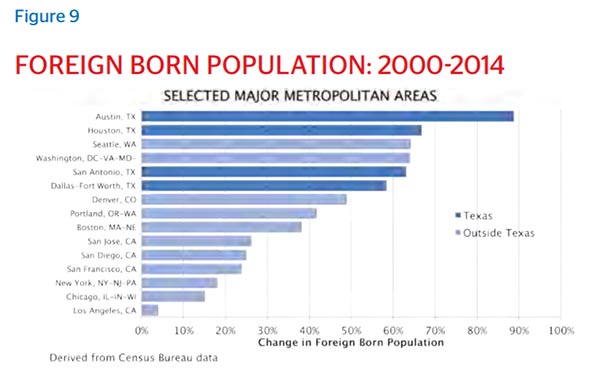
    Houston has been gaining more foreign-born residents than Los Angeles; Dallas now has a higher share of foreign-born residents than Chicago.

    Now the immigrants are expanding to other mid-American outposts such as Nashville, Indianapolis and Columbus. Trumpian politicians may seek to exploit xenophobic sentiments, but metropolitan boosters across the heartland are quick to promote their appeal with foreign-born residents, seeking their entrepreneurial energy and enriching cultural influences. When in Nashville, boosters take you not just to the old country music haunts, but to thriving Kurdish, Somali,  and Mexican enclaves.

    Can Trumpland take success?

    Yet for Trump and his allies in the Republican Party, the resurgence of heartland cities will also bring with it risks. Some of those who now find their future in Kansas City or Houston also bring with them attitudes shaped in blue states, something some progressives are counting on. They may have escaped the worst aspects of ultra-high taxes and abusive regulations, but sometimes this does not stop them from wanting to repeat the old patterns in their new homes.

    the core cities in most of the larger heartland metropolitan areas are either deep blue, as is the case in the Great Lakes, or are turning blue, including Dallas and Houston. The suburbs, particularly the new, further out ones, have remained deeply conservative, but this also could change over time as more young people and immigrants migrate there. Heartland success could undermine some of the very reasons for their resurgence.

    Success also has strange impacts on people’s thinking, and ultimately a resurgent heartland, populated by newcomers and immigrants, could take a very different turn in the decades ahead.

    But this can only happen if Democrats somehow learn to craft their appeal to places outside their current deep-blue bastions. Trump may have won in large part due to the misfortunes heaped on these in the past, but, unless challenged, he ultimately may further consolidate his base by riding on the ascendancy.

    This piece first appeared in Forbes.

    Joel Kotkin is executive editor of NewGeography.com. He is the Roger Hobbs Distinguished Fellow in Urban Studies at Chapman University and executive director of the Houston-based Center for Opportunity Urbanism. His newest book, The Human City: Urbanism for the rest of us, will be published in April by Agate. He is also author of The New Class ConflictThe City: A Global History, and The Next Hundred Million: America in 2050. He lives in Orange County, CA.

    Photo by Max Goldberg from USA (Trump Cedar Rapids) [CC BY 2.0 (http://creativecommons.org/licenses/by/2.0)], via Wikimedia Commons

  • How the Left and Right Can Learn to Love Localism: The Constitutional Cure for polarization

    The ever worsening polarization of American politics—demonstrated and accentuated by the Trump victory—is now an undeniable fact of our daily life. Yet rather than allowing the guilty national parties to continue indulging political brinkmanship, we should embrace a  strong, constitutional solution to accommodating our growing divide: a return to local control.

    Such an approach would allow, within some limits, local constituencies to follow their own course, much as the Founding Fathers suggested, without shaking the fundamentals of the federal union. Localism, as I label this approach, would address the sentiments on both right and left by reversing the consolidation of central power in Washington.

    What Americans across the political spectrum need to recognize is that centralizing power does not promote national unity, but ever harsher division. Enforced central control, from left or right, polarizes politics in dangerous ways. The rather hysterical reaction to Trump’s election on the left is a case in point, with some in alt-blue California calling for secession from the union. Had Clinton and the Democrats won, we would have heard other secessionist sentiment, notably in Texas.

    This is no way to maintain a “United” States. Under Obama, conservative states resisted ever expanding federal executive power; now it’s the progressives’ turn to worry about an overweening central state. Some blue states are already planning to go on their own in such areas as health care and somewhat less plausibly, immigration. Progressives may also face potential federal assaults on such things as legal marijuana by a now GOP-controlled central government.

    Do people want Washington to rule everything? The real issue is not the intrinsic evil of government itself, but how we can best address society’s myriad problems. For decades, many progressives have embraced an expansive central government as the most effective method of changing society for the better. Yet it is far from clear that most Americans prefer that alternative. A rough majority in November cast their votes for either Trump, who attacked President Obama’s executive orders, or libertarian Gary Johnson, a candidate with an even stronger localist tendency. Since 2007, the percentage of people who favored expanding government has dropped from 51 to 45 percent.   

    In contrast, localism is widely embraced by a broad majority of the American public. By 64 percent to 26 percent, according to a 2015 poll—Americans say that they feel “more progress” on critical issues take place on the local rather than the federal level. Majorities of all political affiliations and all demographic groups hold this same opinion.  

    The preference for localism also extends to attitudes toward state governments, many of which have grown more intrusive in recent years. Some 72 percent of Americans, according to Gallup, trust their local governments more than they do their state institutions; even in California, where executive power has run riot, far more people prefer local control to that of Sacramento.  

    Critically, millennials, notes generational analyst Morley Winograd, generally  favor community-based, local solutions to key problems. Indeed, a recent National Journal poll found that less than a third of millennials favor federal solutions over locally-based ones. They are also far less trusting of major institutions than their Generation X predecessors. 

    Any party, right or left,  that wishes to expand federal power will face broad political headwinds. Roughly half of all Americans, according to a 2015 Gallup poll, now consider the federal government “an immediate threat to the rights and freedoms of ordinary citizens”; in 2003, only 30 percent felt that way. The federal bureaucracy is held in such low regard that 55 percent of the public says “ordinary Americans” would do a better job of solving national problems.

    The election of Trump and his “deplorables” is leading more progressives, after years of cheering on President Obama’s ever increasing policy of rule by decree, to seek ways of preserving their own progressive bubble. Cheerleaders for Barack Obama’s imperial presidency, such as The New Yorkerare now embracing states’ rights with an almost Confederate enthusiasm. There are increasing plans to promote new progressive measures, for example on energy as a means to counter the nefarious, anti-planetary intentions of the new monarch.

    Yet in reality, progressivism and localism are hardly incompatible. The progressive Justice Louis Brandeis invoked the notion that the states, not the federal government, should serve as “laboratories of democracy,” empowering them to “try novel social and economic experiments without risk to the rest of the country.”  

    This more decentralized progressive approach was also expounded by David Osborne in his 1990 book, Laboratories of Democracy. Notably, Osborne’s book featured a foreword by the then-governor of Arkansas, Bill Clinton. The future president praised “pragmatic responses” to key social and economic issues by both liberal and conservative governors. Such state-level responses, he correctly noted, were critical in “a country as complex and diverse as ours.”

    Localism also has fans among grassroots leftists. Some embrace the ideal of localism as a reaction against globalization and domination by large corporations. For example, grassroots progressives often support local merchants and locally produced agricultural products. Some have adopted localist ideas as an economic development tool, an environmental win, and a form of resistance to ever-greater centralized big business control.   

    Yale Law professor Heather Gerken makes the case that progressive social causes like racial integration, gay marriage, marijuana legalization, and others have historically tended to be adopted first at a local level before spreading to other areas. Gerken argues that it’s necessary for cities and states to have these powers so that local “cities upon a hill” of social reform can be allowed to flourish and lead by example.

    With Trump and the GOP ensconced in Washington for a likely four more years, more progressives can be expected to adopt Gerken’s strategy. Longtime Washington insiders such as Brookings’ Bruce Katz already have made a strong pitch for a supplanting federal control with a regional approach. Although this usually leads to the dominance of regions by well-connected urban elites, Katz’s approach at least leaves smaller cities and towns free to govern themselves.  

    President-elect Trump needs to recognize there is no great clamor to replace one “imperial president” for another. The authoritarian tendencies of some of his key allies, notably Senator Jeff Sessions, to perhaps overturn state marijuana, abortion and gay rights measures would simply extend, in different fields, the pernicious federalization of daily life. This is not exactly a consistent message for a party that often promotes itself as the voice of “liberty” and local choice.

    We have already seen some harbingers of right-wing centralism on the state level, notes analyst Aaron Renn, where conservative state legislators contravene the progressive agenda of their core cities. Already in some states such as North Carolina and Texas, conservative legislatures have overturned actions adopted by certain cities on issues as diverse as transgender bathrooms and fracking. A better solution would be to allow blue places to reflect their values on as many issues as possible, while granting to conservative places the same right.

    When it comes to preserving the character of our communities, there is often no red or blue. We choose places for their character and, if they need to change, this is preferably shaped along the lines favored by local residents. What may be fine with residents of Portland or Brooklyn does not necessarily work for people in suburban reaches of Dallas, Houston, or, for that matter, New York. As far as I am concerned: vive le difference!

    Localism, of course, is not a panacea for all issues, some of which are indeed better addressed on a larger scale. And some basic rights need to be protected from local overreach. But overall, nothing is more basic to the American identity than, whenever feasible, leaving control of daily life to local communities, and, as much as practical, to individuals and families. Effective policy can only be shaped where there exists a “common civic culture” of shared values, something far more evident today on the local than the national level.

    In his drive to make America “great” again, the new president needs to revitalize our flagging democracy not by doubling down on federal power but by empowering local communities to determine what’s best for them. Anything else gives us a choice between ideological despotisms that can only enrage and alienate half of our population by forcing down their throats policies they can’t abide, and, in most cases, should not be forced to accept.

    This piece first appeared in The Daily Beast.

    Joel Kotkin is executive editor of NewGeography.com. He is the Roger Hobbs Distinguished Fellow in Urban Studies at Chapman University and executive director of the Houston-based Center for Opportunity Urbanism. His newest book, The Human City: Urbanism for the rest of us, will be published in April by Agate. He is also author of The New Class ConflictThe City: A Global History, and The Next Hundred Million: America in 2050. He lives in Orange County, CA.

  • The Texas Urban Model

    This essay is part of a new report from the Center for Opportunity Urbanism titled "The Texas Way of Urbanism". Download the entire report here.

    The future of American cities can be summed up in five letters: Texas. The metropolitan areas of the Lone Star state are developing rapidly. These cities are offering residents a broad array of choices — from high density communities to those where the population is spread out — and a wealth of opportunities.

    Historically, Texas was heavily dependent on commodities such as oil, cotton, and cattle, with its cities largely disdained by observers. John Gunther, writing in 1946, described Houston as having “…a residential section mostly ugly and barren, without a single good restaurant and hotels with cockroaches.” The only reasons to live in Houston, he claimed, were economic ones; it was a city “…where few people think about anything but money.” He also predicted that the area would have a million people by now. Actually, the metropolitan area today is well on the way to seven million.

    It would no doubt shock Gunther to learn that Texas now boasts some of the most dynamic urban areas in the high income world. Approximately 80 percent of all population growth since 2000 in the Lone Star state has been in the four largest metropolitan areas. People may wear cowboy boots, drive pickups and attend the big rodeo in Houston, but they are first and foremost part of a great urban experiment.

    The notion of Texas as an urban model still rankles many of those who think of themselves as urbanists. Most urbanists, when thinking of cities of the future, keep an eye on the past, identifying with the already great cities that follow the traditional transit dependent and dense urban form: New York, London, Chicago, Paris, Tokyo. And yet, within these five urban areas, there are large, evolving, dynamic sections that are automobile oriented and have lower density.

    Measuring Employment Success

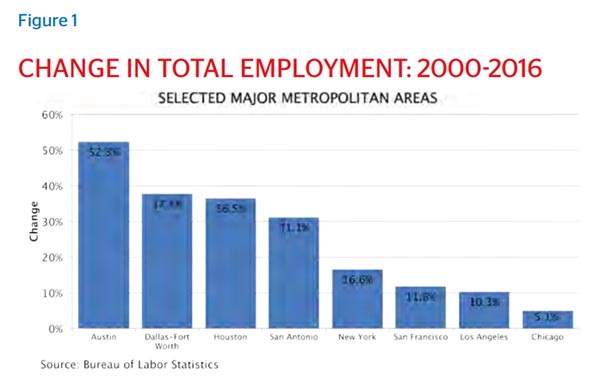
    Since 2000, Dallas and Houston have increased jobs by 31 percent, growing at three times the rate of increase in New York and five times as rapidly as Los Angeles. Texas’ smaller but up-and-coming metropolitan regions are also thriving, with San Antonio and Austin, for example, boasting some of the most rapid job growth in the country.
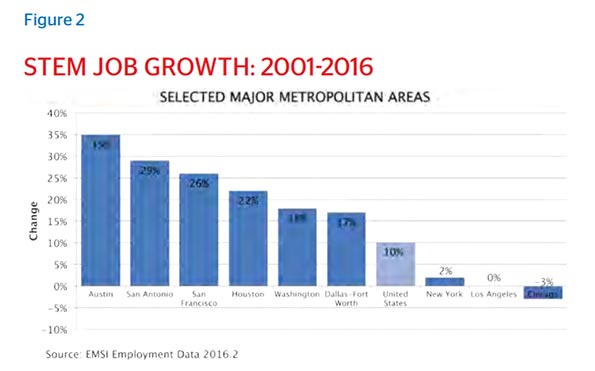
    This growth is not all at the low end of the job market, as some suggest. Over the past fifteen years Texas cities have generally experienced faster STEM (Science, Technology, Engineering and Math-related) job growth than their more celebrated rivals. Austin and San Antonio have grown their STEM related jobs even more quickly than the San Francisco Bay Area has grown theirs, while both Houston and Dallas-Fort Worth have increased STEM employment far more rapidly than New York, Los Angeles or Chicago.
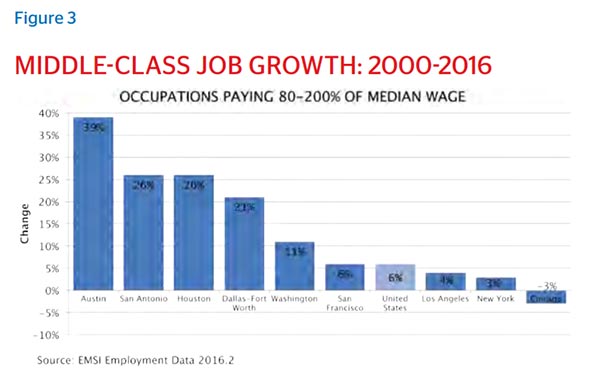
    The Texas cities also have enjoyed faster growth in middle class jobs, those paying between 80 percent and 200 percent of the median wage at the national level. Since 2001, these jobs have grown 39 percent in Austin, 26 percent in Houston, and 21 percent in Dallas-Fort Worth, a much more rapid clip than experienced in San Francisco, New York or Los Angeles, while Chicago has actually seen these kinds of job decrease.
    Recent Pew Research Center data illustrates that between 2000 and 2014, out of the 53 metropolitan areas with populations of more than 1,000,000, San Antonio had the second largest gain in percentage of combined middle-income and upper-income households; the percentage of households in the lower-income segment dropped. Houston ranked 6th and Austin ranked 13th, while Dallas-Fort Worth placed 25th, still in the top half.

    Much of the credit for this growth in jobs goes to the state’s reputation for business friendliness. Texas is consistently ranked by business executives as the first or second leading state. Needless to say, New York, California and Illinois do not fare nearly as well. The Texas tax burden ranks 41st in the country. Compare this to New York, which has the highest total state tax burden, Texas rates are also far lower than those in New York, neighbors Connecticut and New Jersey, or in California.

    The Demographic Equation

    No surprise, then, that people are flocking to the Texas cities. Over the last ten years, Dallas-Ft. Worth and Houston have emerged as the fastest growing big cities of more than five million people in the high-income world, growing more than three times faster in population than New York, Chicago, Los Angeles or Boston. Among the 53 US major metropolitan areas, four of the top seven fastest growing from 2010 to 2015 were in Texas.

    Foreign immigration, a key indicator of economic opportunity, is now growing much faster in Texas’ cities than in those of its more established rivals. Between 2000 and 2014 alone, Texas absorbed more than 1.6 million foreign born citizens. In numbers, that’s slightly less than California took in, but in proportion to Texas’ population it is 60 percent more.

    During that same time period the Latino population of Austin grew by 90 percent; Dallas-Fort Worth and Houston each grew by about 75 percent. In contrast, the Latino population in Los Angeles grew only 17 percent.

    Houston now has a far higher percentage of foreign born residents than Chicago does. Dallas-Ft. Worth draws even with Chicago in that measurement, with an immigrant population that has grown three times as fast as that of the Windy City since 2000.

    Economic opportunity explains much of the difference. Texas’ vibrant industrial and construction culture has provided many opportunities for Latino business owners. In a recent measurement of best cities for Latino entrepreneurs, Texas accounted for more than one third of the top 50 cities out of 150. In another measurement, San Antonio and Houston boasted far larger shares of Latino-owned businesses than Los Angeles, which also has a strong Latino presence.

    Texas is not a totally successful environment for minorities. Poverty levels for blacks and Hispanics remain high, and education levels lag in Houston, Dallas-Fort Worth and San Antonio. But the key factor is that Texas cities present superior prospects for upward mobility.

    Domestic Migration Trends

    Since 2000, Dallas-Ft. Worth has gained 570,000 net domestic migrants, and Houston has netted 500,000. In contrast, the New York area has had a net loss of over 2.6 million people, while Los Angeles hemorrhaged a net 1.6 million, and Chicago nearly 900,000. Dallas-Fort Worth, Houston, Austin and San Antonio were all among the top eleven in total net domestic migration gains. The smaller Texas cities have also experienced large gains in migrants.

    Many newcomers come from places — notably, California — where many Texans once migrated. Between 2001 and 2013, more than 145,000 people (net) have moved from greater Los Angeles to the Texas cities, while about 80,000 have come from Chicago and 90,000 from New York.
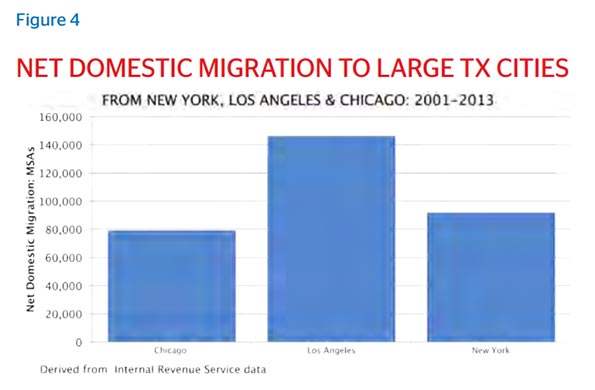
    As Dallas Morning News columnist Mitchell Schnurman says, “If oil prices don’t go up, Texas can always count on California — and New York, Florida, Illinois and New Jersey.”

    Creating the Next Generation of Urbanites

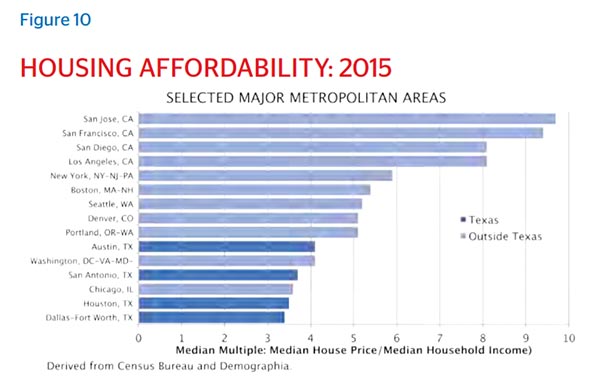
    Texas urban growth has occurred more or less in conjunction with market demand, without the strict controls and grandiose ‘visions’ that dominate planning in New York and California. Overall housing prices in Texas cities remain, on average, one-half or less than those in coastal California cities such as San Francisco, San Jose, San Diego and Los Angeles. They are a third below those in New York, and have not experienced the huge spikes in housing inflation seen elsewhere in the Northeast Corridor, such as in Boston.
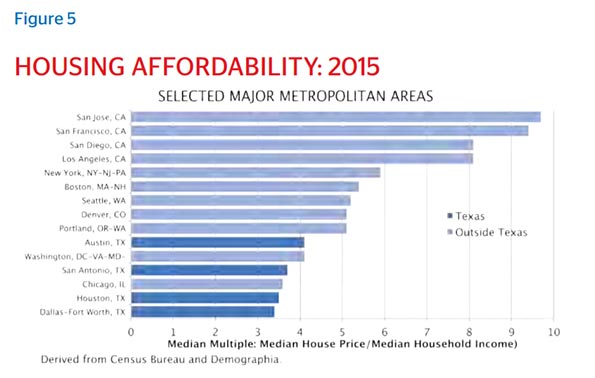
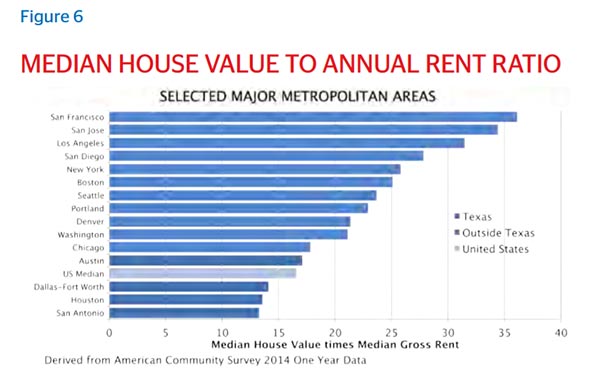
    The lower house prices in Texas facilitate greater aspirations to home ownership, particularly among young people. The financial leap from renting to owning is far less daunting in Texas than it is the Northeast, or in some western US cities.
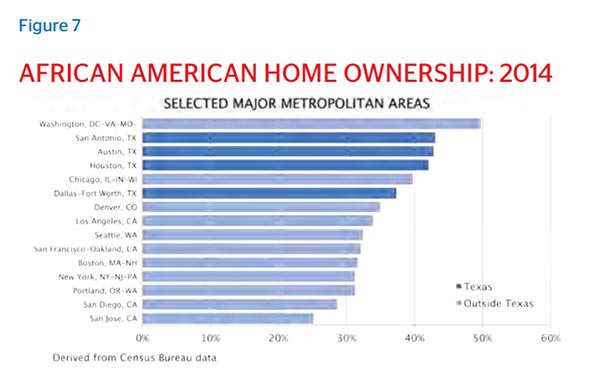
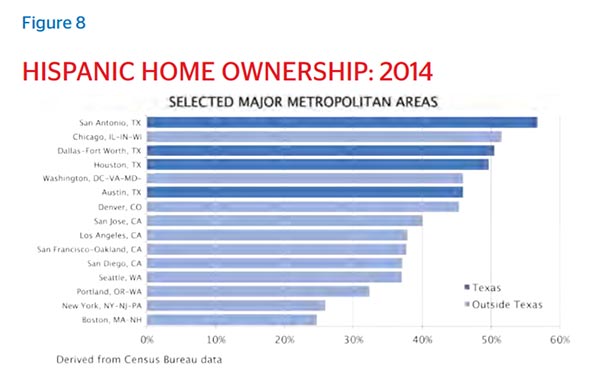
    These lower prices have been a boon to ethnic minorities, who make up an ever-growing percentage of the population in cities nationwide. Latinos and African-Americans are far more likely to be home owners in Texas cities than in New York, Los Angeles, Boston or San Francisco.
    A review of US Department of Commerce Bureau of Economic Analysis data indicates that housing costs are responsible for virtually all of the cost-of-living differences between the nation’s approximately 380 metropolitan areas. Consequently, it is far cheaper to live in Texas cities — even Austin — than in Boston, New York, Los Angeles, San Diego, Chicago and, most of all, the San Francisco and San Jose metropolitan areas.
    Some observers lament that, due to market forces, the vast majority of Texas metropolitan growth — nearly 100 percent — has taken place in the suburbs and exurbs. Yet the Texas cities mirror nationwide experiences: there is essentially no difference between the share of metropolitan development in the Texas suburbs and the share in most other areas. The average share for all major metropolitan areas is 99.8 percent, including in Portland, Oregon, the much ballyhooed model for densification.

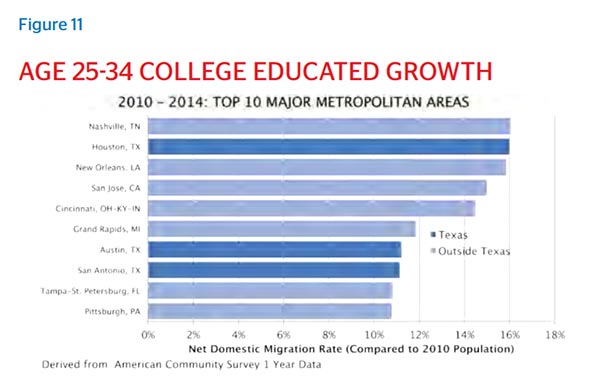
    Ironically, dense housing development has grown more rapidly in Texas cities than it has in California, where the state has tried to mandate dense development. Building permit rates indicate that Texas cities have led the nation in both low density single family housing and in high density multifamily development. Between 2010 and 2015, Texas’ largest cities held three of the top five positions among the 53 major metropolitan areas in the issuance of multifamily building permits. Austin led the nation in these permits, while Houston and Dallas-Fort Worth had higher multifamily building permit rates than San Jose, Denver, Portland, Washington, or Los Angeles. At the same time, these three Texas cities also were in the top 10 in single-family building permits. Who occupies these new residences? Between 2010 and 2014 Texas cities, led by Austin and San Antonio, experienced higher rates of growth among college educated 25 to 34 year olds than did traditional ‘brain centers’ like New York, Boston, Chicago and even San Francisco. During the tech boom of the late 1990s, more people moved from Texas to the Bay Area than vice versa; in the current one, the pattern is reversed. A recent San Jose Mercury poll found that one-third of all Bay Area residents hope to leave the area, primarily citing high housing costs and overall cost of living.
    As young people mature, Texas’ major urban areas provide them with an array of choices. Texas city-dwellers, unlike many New Yorkers or San Franciscans, do not need to choose between living a middle class family lifestyle or staying in a city they love. Texas housing policies that allow organic growth driven by the market are attractive to young people seeking to establish careers or families, and to those who are already newly-established.

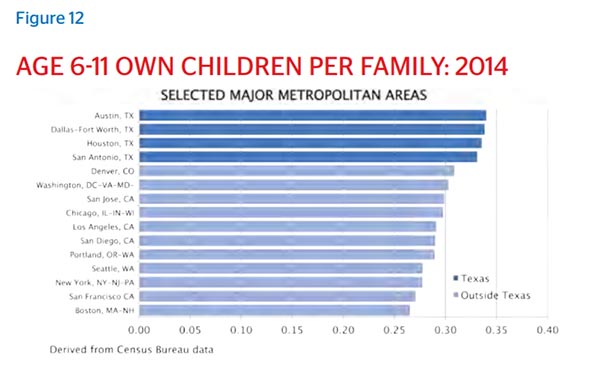
    These trends will have a long-term demographic impact, and suggest a continuing Texan ascendency. According to the American Community Survey’s ranking of elementary-age school children per family, Austin, Dallas-Fort Worth, Houston and San Antonio rank in the top six among the 53 major metropolitan areas. By comparison, Chicago ranks twenty-second, Los Angeles twenty-seventh, New York thirty-sixth, and San Francisco 45th.
    The Lone Star State is already home to two of the nation’s five largest metropolitan areas, the first time in history that any state has so dominated the nation’s large urban centers. At its current rate of growth, Dallas-Ft.Worth, could surpass Chicago in the 2040s, as would Houston a decade later. By 2050 the Lone Star state could dominate America’s big urban centers even more than it does now.

    Joel Kotkin is executive editor of NewGeography.com. He is the Roger Hobbs Distinguished Fellow in Urban Studies at Chapman University and executive director of the Houston-based Center for Opportunity Urbanism. His newest book, The Human City: Urbanism for the rest of us, will be published in April by Agate. He is also author of The New Class ConflictThe City: A Global History, and The Next Hundred Million: America in 2050. He lives in Orange County, CA.

    Wendell Cox is principal of Demographia, an international public policy and demographics firm. He is a Senior Fellow of the Center for Opportunity Urbanism (US), Senior Fellow for Housing Affordability and Municipal Policy for the Frontier Centre for Public Policy (Canada), and a member of the Board of Advisors of the Center for Demographics and Policy at Chapman University (California). He is co-author of the “Demographia International Housing Affordability Survey” and author of “Demographia World Urban Areas” and “War on the Dream: How Anti-Sprawl Policy Threatens the Quality of Life.” He was appointed to three terms on the Los Angeles County Transportation Commission, where he served with the leading city and county leadership as the only non-elected member. He served as a visiting professor at the Conservatoire National des Arts et Metiers, a national university in Paris.

    Welcome To Texas” flickr photo by David Herrera is licensed under CC BY 2.0

  • The Corbynization of the Democratic Party

    The Democratic Party’s current festival of re-examination is both necessary and justified. They have just lost to the most unpopular presidential candidate in recent memory. Lockstep media support and a much larger war chest were not enough to save them from losing not only the presidency, but also in state races across the country.

    Since President Obama’s first election, Democrats have lost control of the House and Senate, as well as a dozen governors’ houses and roughly 900 state legislative seats. Republicans have control of all levels of government in 24 states, while Democrats have total control over six. Overall, the party seems incapable of reaching out to the middle part of the country, white and middle-class voters.

    This contrasts with the 1990s, when a group of party activists consciously rebuilt the party to appeal to middle-class Americans. Groups like the Democratic Leadership Council — for whose think tank, the Progressive Policy Institute, I worked for several years — pushed notions of personal responsibility, welfare reform, tough crime policies and economic growth that, embraced by Bill Clinton, expanded the party’s base in the Midwest, the Appalachians and even the Southeast.

    Leftward Ho!

    Such a shift to the middle is unlikely today. Progressives generally see Hillary Clinton’s loss as largely a rejection of her husband’s neoliberal policies and want to push the party further to the left.

    This parallels developments in the United Kingdom, where, following their defeat in 2015, the Labour Party promoted a far-left figure, Jeremy Corbyn, as its leader. This was driven by grassroots progressives — deeply green, multiculturalist and openly socialist. Many, including several high up in Labour’s parliamentary party, believe the party has little chance to win under such leadership.

    Read the entire piece at The Orange County Register.

    Photo by Gage Skidmore from Peoria, AZ, United States of America – Hillary ClintonCC BY-SA 2.0

  • Three Steps to Fix America’s Election Process

    Almost everyone agrees that we just finished the most painful election season in anyone’s living memory, an agony made worse by the fact that it was nearly two years long. Fortunately, we aren’t doomed to repeat it, as we know many other countries have shorter and more civil election campaigns. Three changes to our method of electing presidents could reduce costs, save time, and make the process less divisive and more welcoming to voters.

    First, we should replace individual state primaries with a national primary in June. Individual primaries not only stretch out the election season and give a few states an inordinate say in the nominations, they also promote divisiveness because they force presidential candidates to concentrate on local issues that are outside the scope of the office of the president.

    Second, we should abolish the electoral college. Hillary Clinton won at least 200,000 more votes than Donald Trump, the second election in sixteen years where the winner of the popular vote didn’t win the election. Trump himself once wrote that “the electoral college is a disaster for democracy.”

    The traditional argument for the electoral college is that it encourages candidates to campaign throughout the country instead of one region and to pay attention to the small states as well as the large. In fact, it does exactly the opposite, leading candidates to focus on a handful of large battleground states that tend to flip between red and blue.

    This suppresses voter participation because people in other states know their votes won’t count, at least in the presidential race, which for many is the draw that brings them into the polling booth. Less than 56 percent of eligible voters cast ballots on Tuesday, and while some didn’t vote because they didn’t like the candidates, others abstained because they realized their vote wouldn’t affect the outcome in their particular state.

    A close look at the Washington Post‘s election map reveals that the real geographic divide is not between east and west, north and south, or big states and little states, but between urban and rural. Clinton won blocks of states on the West Coast and in the Northeast because those states are heavily urbanized, not because they have any common regional interest. The county map shows that major cities in red states such as Texas and Utah went for Clinton while rural areas in California and New York went for Trump. A strong correlation between the urban/rural split and Trump’s margin of victory/loss reveals that the degree of urbanization accounts for more than half of any state’s electoral result.

    Residents of New York City have more in common with people in San Francisco than they do with those in Plattsburgh, while residents of Portland have more in common with people in Austin than they do with those in Roseburg. In short, the electoral college fails to account for the geographic factors that are truly important. Eliminating the college would force candidates to appeal to a wider range of voters, thus stimulating voter participation and reducing alienation.

    The third change is to have a runoff if neither candidate gets a majority of the votes. A low-cost way to do this is through an instant runoff, where voters rank their choices. The candidate winning the fewest votes is eliminated and a winner is decided from amongst the rest of the votes. Whether a ranked vote or a separate election, a runoff could give third-party candidates more of a chance, especially if applied to state and local offices, because voters wouldn’t feel they are “wasting their votes” when they vote for a third party.

    These proposals might not have changed the winner of Tuesday’s election; Donald Trump clearly tapped into voter anger that many other people missed. On the other hand, if these changes were already in place, that anger might not have existed. Candidates would run very different campaigns: we’d have a shorter, less-costly election season; greater voter confidence that the system isn’t “rigged” by the electoral college; and more opportunities for people to express support for third party candidates.

    While there may be other good ways of fixing our election process, if we do nothing the best we can hope for is that the next election won’t be quite as bad as this one. That’s not a very happy thought, especially since, under the current system, the next presidential election campaign will begin in two years and the next congressional campaign will begin in two months.

    Randal O’Toole is a senior fellow with the Cato Institute specializing in land use and transportation policy. He has written several books demonstrating the futility of government planning. Prior to working for Cato, he taught environmental economics at Yale, UC Berkeley, and Utah State University.

    Photo by: By Tom Arthur from Orange, CA, United States (vote for better tape) [CC BY-SA 2.0], via Wikimedia Commons

  • It Wasn’t Rural ‘Hicks’ Who Elected Trump: The Suburbs Were — And Will Remain — The Real Battleground

    Much of the New York and Washington press corps has concluded that Donald Trump’s surprising journey to the Oval Office was powered by country bumpkins expressing their inner racist misogyny. However, the real foundations for his victory lie not in the countryside and small towns, but in key suburban counties.

    The popular notion of “city” and “country,” one progressive and “vibrant,” the other regressive and dying, misses the basic geographic point: the largest metropolitan constituency in the country, far larger than the celebrated, and deeply class-divided core cities, is the increasingly diverse suburbs. Trump won suburbia by a significant five percentage point margin nationally, improving on Romney’s two-point edge, and by more   outside the coastal regions.

    Despite the blue urbanist cant that dense metro areas — inevitably labelled “vibrant” — are the future, in fact, core cities are growing at a slower pace than their more spread out suburbs and exurbs, which will make these edge areas even more important politically and economically in the coming decade. The states that voted for Trump enjoyed net domestic migration of 1.45 million from 2010 to 2015, naturally drawn from the states that were won by Hillary Clinton. Democrat-leaning ethnic groups, like Hispanics, are expanding rapidly, but Americans are moving in every greater numbers to the more conservative geographies of the Sun Belt, the suburbs and exurbs.

    Suburbs Drive Swing States

    The future battles between the parties will have to be waged where the people and jobs are: suburbia. Suburban voters particularly put Trump ahead in the crucial Midwestern states of Michigan, Wisconsin, and came close to winning him supposedly deep blue Minnesota. This is where the Democratic falloff from the Obama years was most evident, notes Mike Barone, falling from  dropping from 54 percent for Obama to 2008 to 45 percent this year.

    Clinton did win some suburban counties, especially in the Philadelphia area, but by lower margins than President Obama had in 2012. Clinton’s margin was also lower in some older rustbelt urban counties: Erie (Buffalo), Onondaga (Syracuse), Monroe (Rochester), Albany, and Hamilton (Cincinnati). A number of college towns and state capitals also invariably voted for Clinton, overwhelmingly.

    Overall, though, most suburban counties in the swing states supported Trump. In Michigan, Trump lost Detroit, and surrounding Wayne County, by better than two to one, but captured four of the five surrounding suburban counties. His margin greatly exceeded that of Romney in these counties, which, combined with his strong support in smaller cities and rural areas outside the major metropolitan areas, put him over the top in this critical state.

    A similar pattern can be seen in Pennsylvania. Clinton, of course, won overwhelmingly in the large urban counties — the city of Philadelphia went for her by 82 to 15. She also won some nearby suburban counties around the city, as was expected. But elsewhere Trump did better. He lost Allegheny County (Pittsburgh) but won all the surrounding suburban countries by piling up 54 percent to 74 percent of the votes; he lost the state capital of Harrisburg but made that up by crushing her in the suburban counties. Particularly striking was his victory in historically Democratic Erie County (population 280.000), west of Buffalo; Obama had won the county by 16 points in 2012.

    Much the same can be said about Wisconsin, where Trump was not expected to be too competitive, as well as Ohio, someplace he was expected to win. Clinton’s edge in Ohio’s smaller, blue collar urban constituencies fell well below the levels enjoyed by President Obama while surrounding suburban counties went, almost without exception, heavily for Trump.

    The Political Geography Of The Future

    Ultimately the road to recovery for Democrats does not lie in expanding the urban core vote. As Mike Lind has suggested, progressives embrace a kind of post-national “open borders” ideology that makes sense in denser, global cities — where the demand for low-end service labor is greater — than in suburban or small town and rural areas that tend to be more egalitarian and, for the most part, whiter.

    There may be growing unanimity of Democratic support in core areas, but urban cores are growing more slowly, or not at all, compared to the suburbs. Indeed the urban vote in the cores, although obviously tilted blue, has dropped in recent years, with the exception of the Obama run in 2008. Nor do attempts to call suburban or “countryside” people “deplorable,” racist and even too fat constitute much of a strategy to appeal to these areas.

    In contrast, Trump’s geographic coalition between the deep red countryside and the suburbs demonstrated an alternative that can work, particularly in key swing states. Despite the wishes of many planners, and their Democratic allies, suburbs and small towns are not about to go away in the near future. Areas outside million-plus metropolitan areas accounted for 100 percent of the vote in Iowa, 61 percent in Wisconsin, 47 percent in Michigan and Pennsylvania, and 44 percent in Ohio. They may not be demographically ascendant, but they still carry considerable heft.

    Nor can blue state advocates continue to claim that millennials will not move to suburbia, because that is clearly happening. Urbanist mythology now holds to a fallback position that millennials move to the suburbs simply because they have been priced out. However, they don’t look at other compelling reasons — notably shaped by life stage — for suburban growth. As most millennials will soon be over 30, its seems likely more will head to the periphery, as did earlier generations to gain more space to raise a family, better schools and safety. Even after the Great Recession people continued to move in large numbers from urban core counties to the less dense suburbs and exurbs. Between 2010 and 2015, suburban counties of major metropolitan areas added 825,000 net domestic migrants, while the urban core counties lost nearly 600,000. The real question is whether millennials will turn these red-trending areas bluer, or will their experience as homeowners and parents make them more traditional and conservatively minded suburbanites?

    The basic geographic and demographic conclusion: the balance of political power lies with suburban and exurban counties, particularly in swing states. Republicans need to build on their success by appealing more the minorities and immigrants who are also moving to the periphery. To return to power, the Democrats should   shift their attention from their urban core base and look more to the periphery. In the end, they need to provide compelling reason why these areas should support a party that, at least for now, seems generally favorable  to their exclusion and even ultimate demise.

    This piece originally appeared in Forbes.

    Joel Kotkin is executive editor of NewGeography.com. He is the Roger Hobbs Distinguished Fellow in Urban Studies at Chapman University and executive director of the Houston-based Center for Opportunity Urbanism. His newest book, The Human City: Urbanism for the rest of us, will be published in April by Agate. He is also author of The New Class ConflictThe City: A Global History, and The Next Hundred Million: America in 2050. He lives in Orange County, CA.

    Wendell Cox is principal of Demographia, an international public policy and demographics firm. He is a Senior Fellow of the Center for Opportunity Urbanism (US), Senior Fellow for Housing Affordability and Municipal Policy for the Frontier Centre for Public Policy (Canada), and a member of the Board of Advisors of the Center for Demographics and Policy at Chapman University (California). He is co-author of the “Demographia International Housing Affordability Survey” and author of “Demographia World Urban Areas” and “War on the Dream: How Anti-Sprawl Policy Threatens the Quality of Life.” He was appointed to three terms on the Los Angeles County Transportation Commission, where he served with the leading city and county leadership as the only non-elected member. He served as a visiting professor at the Conservatoire National des Arts et Metiers, a national university in Paris.

    Electoral map by Ali Zifan (This file was derived from:  USA Counties.svg) [CC BY-SA 4.0], via Wikimedia Commons

  • Five Ideas to Make America Greater

    Donald Trump’s presidential campaign was based on the notion that he could “Make America Great Again.” But beyond the rhetoric — sometimes lurching into demagoguery — the newly elected president comes to office, as one commentator suggests, “the least policy-savvy president in history.”

    To succeed, Trump must adopt innovative policies that transcend traditional right-left divides. He needs to find ways to help his heavily white, working-class base while expanding his appeal to minorities, millennials and educated people who are now largely horrified by his ascendency.

    In the short run, his biggest problem may lie with his own Republican Party establishment, which, rather than “drain the swamp,” would simply like to create one of its own. The looming presence of corporate lobbyists, swarming around the administration like hungry flies, is not encouraging at all, nor are GOP congressional plans to re-establish “earmarks.”

    The key lies not in empowering a different set of K Street parasites, but rather in reversing income stagnation. If he cannot, his triumph may prove to be no more consequential than an absurdist, Latin American-style telenovela.

    A flatter, fairer tax

    The basic instinct among many Republicans tends toward reducing taxes on their richest donors and making life easier for the ultrarich, including some on Trump’s economic team. Trump’s imperative should, instead, be to make the tax system fairer for the middle and working classes. One way would be to make a graduated flat tax that would mean that the rich, who make most of their money from investments, pay the same rate for capital gains as the rest of us do for income.

    Democrats will, no doubt, still charge Trump with being “unfair,” but, as Ronald Reagan proved 20 years ago, Americans support incentives for work if they don’t unfairly tilt conditions to the ultrarich. Main Street business owners, the most hostile constituency to the Obama administration’s policies, pay taxes based on their income and can’t manipulate the system like Apple, Google, Wall Streeters or, for that matter, real estate developers like Trump himself.

    A middle ground for immigration

    Opposition to illegal immigration helped drive the Trump campaign early on, but, outside of the GOP base, there is little support for a mass roundup of the undocumented. The vast majority of Americans, over 70 percent, also oppose “open borders.” After all, even President Obama evicted 2 million people during his two terms in office.

    Trump also can begin reordering our immigration policies toward skilled workers who are interested in becoming citizens. At the same time, Trump could score points by undermining the H1-B visa program, which allows Silicon Valley firms, along with corporations like Disney and Southern California Edison, to lay off American workers and replace them with temporary indentured servants.

    Read the entire piece at The Orange County Register.

    Joel Kotkin is executive editor of NewGeography.com. He is the Roger Hobbs Distinguished Fellow in Urban Studies at Chapman University and executive director of the Houston-based Center for Opportunity Urbanism. His newest book, The Human City: Urbanism for the rest of us, will be published in April by Agate. He is also author of The New Class ConflictThe City: A Global History, and The Next Hundred Million: America in 2050. He lives in Orange County, CA.

    Photo: Gage Skidmore from Peoria, AZ, United States of America (Make America Great Again hat) [CC BY-SA 2.0], via Wikimedia Commons