Category: Politics

  • Lessons Learned from Long-Term Privatizations

    Is long term privatization of government assets in the form of leases or concessions a good idea?

    The answer is not Yes or No but rather What and How.

    Done right, long-term privatization can be a great thing to the public. But given the multi-decade nature of some of these deals, the risk of getting it wrong is high.

    My new Manhattan Institute research paper The Lessons of Long-Term Privatizations: Why Chicago Got It Wrong and Indiana Got It Right looks at two privatization deals, the Chicago parking meter lease and the Indiana toll road lease, and draws lessons about the right kinds of assets to lease and the things you need to get right while leasing them.

    I identify several flaws in the Chicago parking meter lease as compared to the Indiana Toll Road one, grouped into two categories:

    • Things Chicago managed poorly in the transaction (how items). These include the public review process, the transition to the private vendor, squandering the proceeds, and impairing future revenue streams. None of these invalidates the idea of privatization, but rather are areas where governments need to focus to get it right.
    • Reasons why parking meters are a bad kind of asset for long term leases (what items). These include regular, recurring compensation events and the dynamic and close interaction of on street parking with neighborhood health and other public policy considerations.

    Note that I do not critique the amount of money Chicago got for leasing its parking meters. This is a debatable item at best.

    I also do not criticize privatization of parking meter operations. Nobody cares who takes the quarters out of the meter.

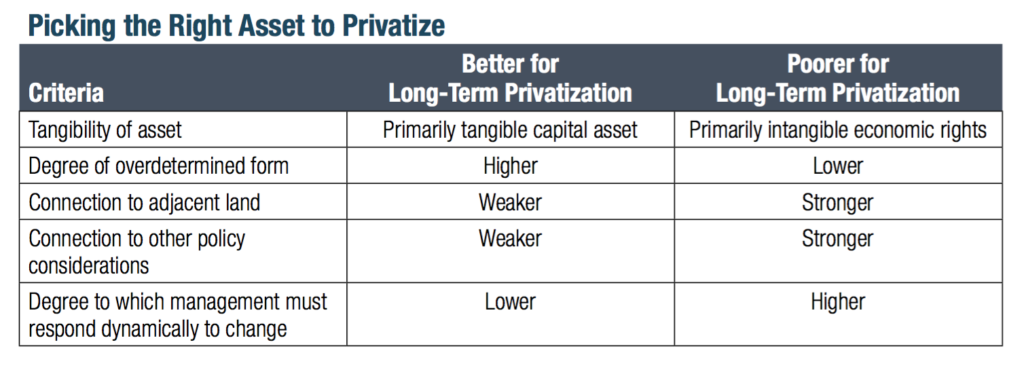
    Contrasting toll roads with parking meters, I created a matrix of characteristics to help determine whether or not an asset is a good candidate for privatization.

    privatization-asset-matrix

    Items that would appear to be better candidates for long term privatizations would be toll roads and bridges, airports, ports, and hospitals.

    Click through to read the entire report.

    Greg Hinz at Crain’s Chicago Business kindly posted some of his thoughts about the study.

    Aaron M. Renn is a senior fellow at the Manhattan Institute, a contributing editor of City Journal, and an economic development columnist for Governing magazine. He focuses on ways to help America’s cities thrive in an ever more complex, competitive, globalized, and diverse twenty-first century. During Renn’s 15-year career in management and technology consulting, he was a partner at Accenture and held several technology strategy roles and directed multimillion-dollar global technology implementations. He has contributed to The Guardian, Forbes.com, and numerous other publications. Renn holds a B.S. from Indiana University, where he coauthored an early social-networking platform in 1991.

  • Why Clinton Could Lose the Working Class in Ohio

    In the latest Quinnipiac poll, Hillary Clinton and Donald Trump are tied in battleground Ohio. This suggests a very close race in Ohio in the fall. Economic issues, especially trade, led many former Democrats to cross party lines to support Trump in the Republican primaries. Many who hadn’t voted in recent elections joined them. We’re likely to see a repeat of this in November unless Democrats change their trade policies. None of this should surprise Democrats, especially those in Ohio.

    As a professor of labor studies and co-director of the Center for Working-Class Studies at Youngstown State University for more than 30 years, I had many opportunities to talk politics with workers there. In 2000, many told me that, after voting for Democrats all their lives, they were choosing guns, gays and God over Al Gore, who had been a primary spokesman for the North American Free Trade Agreement (NAFTA) seven years earlier. In 2002, Northeast Ohio Democrats threw out eight-term congressman Tom Sawyer on the basis of his support for NAFTA, despite Sawyer having a 90 percent voting record on labor issues.

    Since the passage of NAFTA, Ohio Republicans have controlled state government save for a brief interlude caused by Republican corruption in 2006. At the same time, two Democrats — Sen. Sherrod Brown and Rep. Tim Ryan, who replaced Sawyer — have been elected and re-elected in no small part due to their opposition to NAFTA and the pending Trans-Pacific Partnership (TPP). Clearly, trade policy poses a problem for Democrats and their presumptive candidate. Clinton has been tied to former President Bill Clinton’s NAFTA legislation and its Wall Street proponents. While she has stated that she is against TPP at this time, many Ohioans hear that as weasel words that only contribute to their distrust of Clinton.

    It is widely speculated that the Obama administration will push for TPP acceptance in the lame-duck session following the 2016 general election. According to a tweet from CNN’s Dan Merica, Clinton says she will not lobby Congress on the issue. But this will only undermine her credibility and provide Trump with an incentive to continue to demagogue the issue.

    In Ohio, about 60 percent of voters in 2012 did not have a college degree, one of the most commonly used (though problematic) proxies for identifying working-class voters. Slightly more than half of them voted for Obama, according to CNN exit polls. But while Obama won a majority of working-class votes in Ohio, he lost among whites, winning only 41 percent of their votes. This suggests that a significant portion of Obama’s working-class support in 2012 came from Ohio voters of color, not white voters. Four years later, the combination of white working-class support for Trump, as we saw in the primary, and expected lower African-American turnout — Clinton is unlikely to inspire the enthusiasm that Obama generated — may swing Ohio’s prized electoral votes to the presumptive Republican nominee.

    Clinton needs the support of working-class Ohioans – the very people who have been hurt the most by trade policy. To do that, she needs to stop insisting that trade is good. Her current stance is similar to wooing West Virginia coal miners by touting the benefits of non-carbon fuels. Similarly, she should stop talking about retraining and promising high-tech jobs, which only reminds voters of how hollow such programs have been in the past.

    Instead, Clinton should acknowledge that we have lost the trade war and pledge to use every legal means at her disposal to protect American workers and industries from the continued onslaught of imports. This would include initiating trade cases against countries that target American industries by subsidizing their exports, exploiting workers, manipulating their currencies, and polluting the environment.

    She should threaten to impose tariffs on every imported product from countries that refuse to implement the same U.S. Occupational Safety and Health Administration and U.S. Environmental Protection Agency regulations and federal, state and local tax requirements that are imposed on American businesses.

    At the very least, Clinton should do more than promise to build a strong infrastructure program. Such a program would put the skills, materials and physical strength of working-class Ohioans to work and improve Ohio’s competitive economic environment. Clinton has identified specific programs but she needs to do more to explain how she will pay for them. Otherwise, her campaign platform will sound too much like an echo of past hollow campaign promises.

    Clinton should also stress making college affordable for the working class and those living in poverty. Not everyone wants a desk job in front of a computer, and older workers may not be interested in retraining for high-tech jobs. But they do want more education and training for their kids.

    Finally, working people worry about how they will fare economically after retirement. They know that Wall Street oversold 401(k) plans and that traditional pensions are disappearing. Clinton needs to reject Wall Street’s calls for changes in Social Security and offer a specific program to maintain private pension plans without cutting benefits.

    If Clinton does not develop a strong and believable working-class agenda, I predict that the Democrats will lose Ohio in November, and that would open the door to a Trump victory nationally.

    This piece first appeared in the Plain Dealer on June 26,2016, and was re-posted at Working Class Studies blog.

    John Russo is a visiting fellow at Kalmanovitz Initiative for Labor and Working Poor at Georgetown University and at the Metropolitan Institute at Virginia Tech. He is the co-author with Sherry Linkon of Steeltown U.S.A.: Work and Memory in Youngstown (8th printing).

    Photo by Gage Skidmore from Peoria, AZ, United States of America – Hillary ClintonCC BY-SA 2.0

  • The Future of Latino Politics

    The sad decline in race relations has focused, almost exclusively, on the age-old, and sadly growing, chasm between black and white. Yet this divide may prove far less important, particularly in this election, than the direction of the Latino community.

    This may be the first election where Latinos, now the nation’s largest minority group, may directly alter the result, courtesy of the race baiting by GOP nominee Donald Trump. If the GOP chooses to follow his nativist pattern, it may be time to write off the Republican Party nationally, much as has already occurred in California.

    Today, Latinos represent 17 percent of the nation’s population; by 2050, they will account for roughly one in four Americans. Their voting power, as the GOP is likely to learn, to its regret this year, is also growing steadily, to 12 percent of eligible voters this year, and an estimated 18 percent by 2028.

    Political geography may prove as critical here as rising numbers. African Americans, for historic reason, are heavily concentrated in deep blue cities, simply padding already existing Democratic supermajorities, or in the deep red South, where they are overwhelmed by a conservative white majority. In contrast, Latinos represent a growing constituency in critical swing states such as Florida, where they constitute one-fifth of the electorate, as well Virginia, Nevada, Colorado and, thanks to the genius of Donald Trump, perhaps even Arizona.

    Read the entire piece at The Orange County Register.

    Joel Kotkin is executive editor of NewGeography.com. He is the Roger Hobbs Distinguished Fellow in Urban Studies at Chapman University and executive director of the Houston-based Center for Opportunity Urbanism. His newest book, The Human City: Urbanism for the rest of us, will be published in April by Agate. He is also author of The New Class ConflictThe City: A Global History, and The Next Hundred Million: America in 2050. He lives in Orange County, CA.

    Photo by chadlewis76

  • So You Want a Revolution

    You say you want a revolution
    Well you know
    We’d all want to change the world.____ The Beatles (1968)

    Apparently not. Not any more. Not everyone wants to change the world. To the Beatles in 1968, when young people aged less than 30 added up to 52% of the US population, it might have looked like everyone wanted a revolution and that a nascent movement had a deep reserve of younger cohorts ready to push for change. But the percentage of the population aged less than 30 today is only 39% and falling. If 39% vs. 52% does not look like a big difference, consider that 13% of the US population is equivalent to 42 million additional young people who would be among us, if the percentage was the same as in 1968. A quarter to a third (10 to 14 million) would be in their 20s.

    At the same time, because older more conservative generations would weigh less in the total population mix, their moderating influence would be less effective at deterring the young. This shift in the age distribution of the population explains why the youth revolt gained traction in 1968 but more recent attempts such as Occupy Wall Street turned to farce and fizzled out.

    Meanwhile the over-45 age bracket now accounts for 41% of the US population (vs. 31% in 1968), its highest level ever and a level that explains the elevation of the two oldest presidential nominees in US history, Hillary Clinton and Donald Trump. It also helps explain why the nostalgia-powered Trump is still a contender while the youth-oriented Bernie Sanders has withdrawn. At this stage of the process in 1970, Sanders would have been the nominee while Clinton and Trump would have already left the scene.

    Speaking of revolutions, a recent op-ed in the Wall Street Journal draws an analogy between Iran in 1979 and Turkey today in the immediate aftermath of the aborted Turkish coup d’etat. Writes the author:

    Revolutions don’t require majorities, but rather angry and excited minorities that are willing to act violently to take power.

    Undoubtedly true, but they also require a critical mass of young people combined with fairly dismal economic conditions which Turkey does not have now to the same extent as Iran in 1979. In 1979 in Iran, the under 30 accounted for a huge 71% of the population and Iranian GDP per capita on a PPP basis was about $2,000 (in 2013 dollars). By contrast, in Turkey today, the under 30 are only 50% and GDP per capita is in excess of $10,000. That is enough young people to shake things up as the young did in the West in 1968 but probably not enough to impose a lasting change as the young did in Iran in 1979.

    A general hypothesis therefore is that the danger of civil unrest grows when per capita GDP is low and the population is young. Looking at successful uprisings in Algeria (1962), China (1949), Cuba (1952) and Iran (1979), we note that the under 30 numbered more than 60% in every case. Meanwhile revolts failed in Hungary (1956) and Czechoslovakia (1968) where the under 30 were less than 50% of total population. Of course, this is not a comprehensive list and there may be examples that refute the hypothesis. In addition, foreign interference as in Hungary and Czechoslovakia renders the age distribution less relevant to the outcome of a revolt. But it is a fair bet that a larger young population in a lower-income country heightens the risk of unrest.

    The graph below shows for each country the per capita GDP in 2014 dollars and the percentage of people aged less than 30. The US is shown in red. The cutoff levels are set at $5000 for GDP per capita and at 60% for population aged under 30. Countries in the upper left quadrant are wealthier and have fewer young people and are as a result at lower risk of civil unrest. Countries in the lower right are younger and poorer and have in theory a higher risk of civil unrest. Iran in 1979 was clearly in the lower right high-risk quadrant. Turkey today is in the upper left lower-risk quadrant.

    GDPvsCivilUnrest


    Readers of this site may be familiar with this graph from a previous post discussing the relationship of fertility and national income. It is worth revisiting the earlier post to understand why some countries are outliers on the graph.

    So what are the countries that fall in the lower right quadrant? These countries have an under 30 population of 60% or more of total, and a GDP per capita of $5,000 or less. Here is the list.

    Screen Shot 2016-07-18 at 2.08.05 PM (2)


    At the other extreme, if we look at Brexit and the nomination of Donald Trump as examples of a new form of revolt that we may call ‘older age populism’, here are the countries that are exposed to it, using as cutoffs $20,000 for GDP per capita and 40% for population aged less than 30. Not surprisingly, most of these countries are part of the West and most enjoyed a significant demographic dividend in the three decades 1975-2005.

    Screen Shot 2016-07-18 at 2.26.03 PM (2)


    Of course, most revolutions end badly, and many end very badly. On the revolution train, idealists sit in the front and present in the early days the benign and seductive case for change. Radicals bide their time while sitting in the back and later take over with their nefarious plans. The Beatles knew it:

    But when you talk about destruction
    Don’t you know that you can count me out

    Full lyrics here.

    Read more about why Occupy Wall Street failed.

    Sami Karam is the founder and editor of populyst.net and the creator of the populyst index™. populyst is about innovation, demography and society. Before populyst, he was the founder and manager of the Seven Global funds and a fund manager at leading asset managers in Boston and New York. In addition to a finance MBA from the Wharton School, he holds a Master’s in Civil Engineering from Cornell and a Bachelor of Architecture from UT Austin.

  • Election 2016: Peak Transformation

    Barack Obama came to office with a promise of “fundamentally transforming the United States.” Through what one admirer calls “a profound course correction engineered by relentless government activism,” Obama has, indeed, transformed the country and shifted it to what now passes for the Left agenda on America’s role in the world, the environment, gender issues, labor rights and untrammeled executive power over both Congress and local governments.

    As he leaves office, Obama is already being consecrated as a great president whose direction will naturally be followed by his successor. Given his greater popularity – his rankings have been rising for months – the far less popular Hillary Clinton’s pitch will be to portray herself as something like “Obama-plus.” The transformation is about to hit its peak.

    This progressive triumph is occurring despite mediocre economic growth, rising inequality and diminished global status. But it’s a record that can’t be successfully challenged by a GOP that has seen fit to nominate such a noxious candidate. With Trump at the top of the ticket, the Republican Party could also lose the Senate, and thus the Supreme Court, losing the last restraints on “the full monty” of the progressive agenda.

    Trump’s ugly presence is sure to swell the Democratic base – minorities, millennials, unmarried women, highly educated professionals – even as the unstable billionaire captures a larger share of older, working-class, white voters. Hillary, as the American Prospect has argued, inherits a party dedicated to microtargeting its voter base, rather than seeking to reach out to a perceived dying white suburban and small-town middle America. Harold Meyerson, the incisive editor of the Prospect, calls this “the first post-middle-class election.”

    A diminished white middle class is OK for a Democratic Party made up of college-for-free “Bernie bros,” urban hipsters, greens, racial minorities, feminists, public employees and gay activists. These groups won’t really challenge the real winners of the Obama years – the Wall Street and Silicon Valley oligarchs, who are willing to genuflect to the green and social agenda of the party, but can be even more sure, under the many-times-purchased Hillary, that their path to unreasonable, even dangerous, wealth and power will continue unimpeded.

    Read the entire piece at The Orange County Register.

    Joel Kotkin is executive editor of NewGeography.com. He is the Roger Hobbs Distinguished Fellow in Urban Studies at Chapman University and executive director of the Houston-based Center for Opportunity Urbanism. His newest book, The Human City: Urbanism for the rest of us, will be published in April by Agate. He is also author of The New Class ConflictThe City: A Global History, and The Next Hundred Million: America in 2050. He lives in Orange County, CA.

    Barack Obama photo by Bigstock.

  • Population Change, 2015: Not Very Good News for Those Angry White Men

    Data on population growth from 2010 to 2015 show a continuing concentration of people in metropolitan areas, especially in the large areas with over a million people, where presumably traditional values are most challenged.  I show an amazing table, in which I have disaggregated population change by type of settlement, from the million-metro areas to the purely rural counties, comparing growth amounts and rates, plus noting how these areas actually voted in 2012. From the title, the news that growth is greatest in the biggest places seems bad for Republican prospects, but the accompanying maps also show that the greatest growth may well be in more Republican parts of metropolitan America – a story of geography vs. demographics.

    The data from the table are dramatic. Note that 275 million, or 86%, live in census-defined metropolitan areas (with urban agglomerations over 50,000), and 55.5% in just the 58 metro areas of over 1,000,000.  The biggest metro areas (but not the super large New York, Los Angeles, and Chicago) grew by 9.4 million, or 5.5%, the smaller metro areas by 3.4 million, or at 3.3 %, while non-metropolitan America dropped from 46.3 million to 46.1 million, down to 14% of the total population. 

    The final column of the table shows how these areas voted in the 2012 presidential election. Obama won the big metro areas of over one million by taking 57.6 percent of the 2 person vote, which enabled him to get almost 52% of the total US vote while winning the three megacities – New York, Los Angeles and Chicago – by an even wider margin. This meant that despite LOSING all other settlement categories – 48% in smaller metro areas, only 41% in micropolitan areas, and a pathetic 40 percent in rural small town America, the President still won handily.

    Population Change by Settlement Type, 2010 2015
      # Counties 2010 Pop 2015 Pop Change % Chg % of Pop 2015 % Obama, 2012
    Million Metro Center Counties          255   156,143    164,749      8,606 5.5% 51.3%
    Million Metro Outlying Counties          179     13,661      14,416         749 5.5% 4.5%
    Total Million Metros          434   169,804    179,165     9,355 5.5% 55.7% 57.6
    Other Metro Center Counties          473     85,634      89,005      3,371 3.9% 27.7%
    Other Metro Outlying Counties          259       7,025         7,086           61 0.9% 2.2%
    Total Other Metros          732     92,659      96,091     3,432 3.7% 29.9% 48.3
    Micro Center Counties          559     26,422      26,533         111 0.4% 8.3%
    Micro outly            92       1,080         1,070          (10) -0.9% 0.3%
    Total Micropolitan Areas          651     27,502      27,603         101 0.4% 8.6% 41.4
    Rural Sm Town          727     14,058      13,899       (159) -1.1% 4.3%
    Rural Sm Town          598       4,731         4,663          (68) -1.4% 1.5%
    Total Non-metro Counties      1,325     18,789      18,462       (327) -1.7% 5.7% 40
    ALL      3,142   308,774    321,435   12,664 4.1% 100.0% 52


    So the good news for the Democrats is that the greatest population growth occurred in larger cities where Obama did best in and fell in areas he did poorest in.

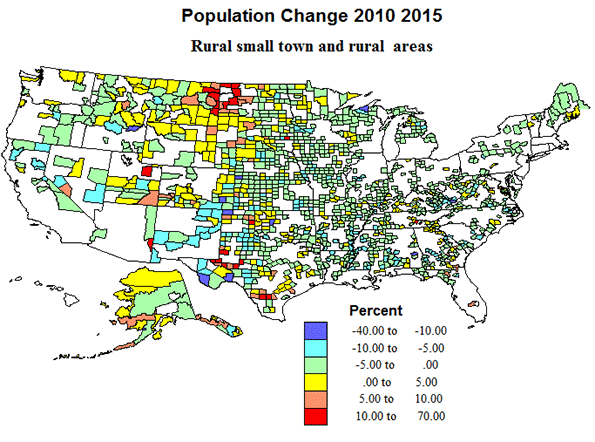
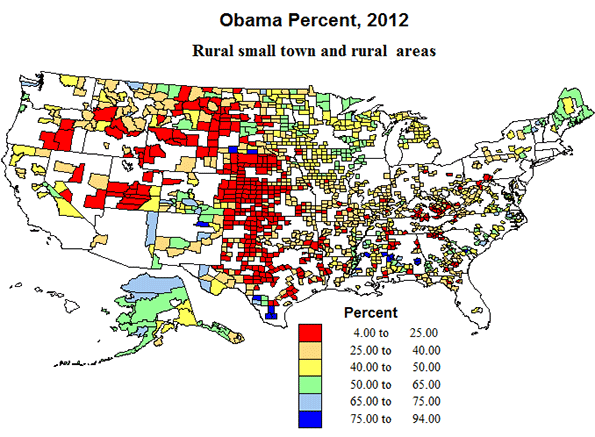
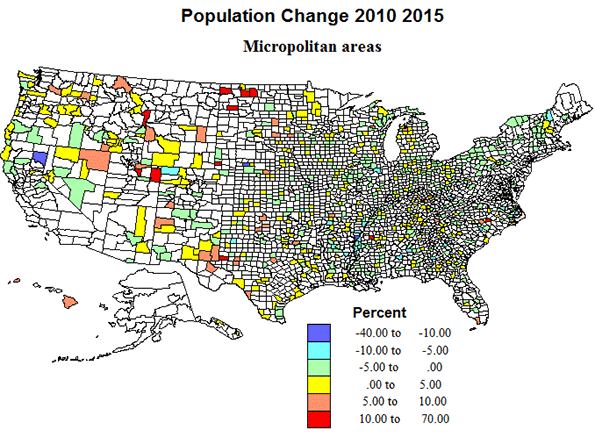
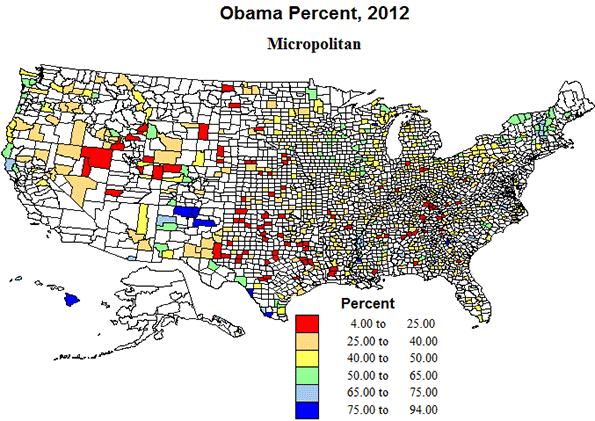
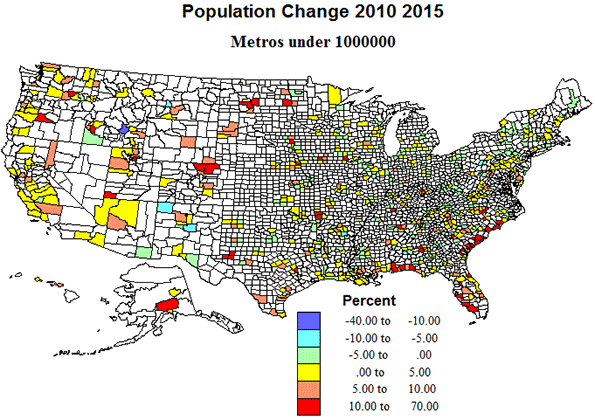
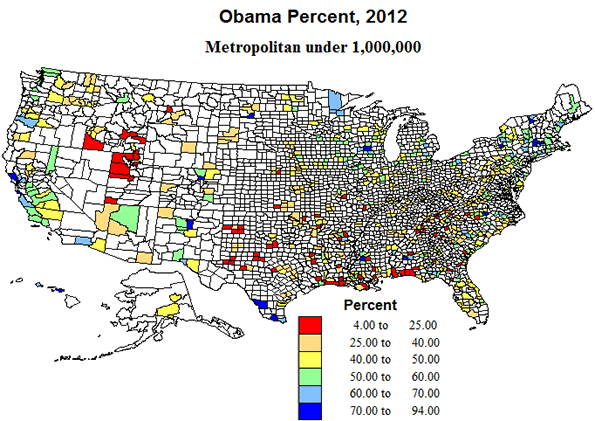
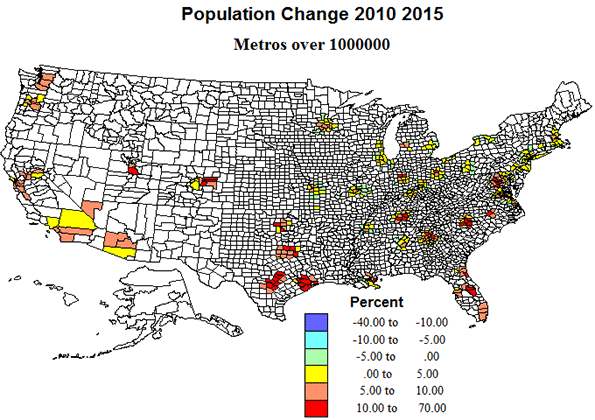
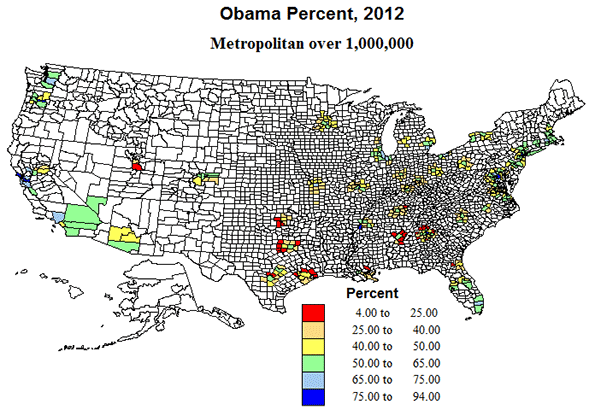
    But the story gets complicated once you get beyond the metro level. I now show maps, first of the pattern of population change by type of settlement, and then show how well Obama did in 2012 by these same settlement types. First we have a general map of population change for all US counties, in which I can display both the absolute change by symbol size and the percent change by color. Most apparent are the dominance of growth in metropolitan areas, especially in suburbs, and notably in the South and West. Note that quite a few of the growing counties appear to be in areas where Obama was not that strong (in maps to follow).

    Population Change by Settlement Type

    Rural and rural-small town areas include about 40% of counties and of the territory, but now hold under 6 percent of the population. Modest population loss is most common, especially across the eastern half of the country, while the pattern of change is more complex in the western half, with pockets of gain in areas of energy development, as in ND-MT, and TX-OK, undoubtedly temporary, and scattered areas of growth in environmental amenity areas farther west. The greatest extent of rurality is still from west Texas, north through Oklahoma, Kansas, Nebraska, South and North Dakota  and Montana.

    Politically, Republican Romney swept most rural, small town territory over sizeable contiguous areas in the high plains, as well as the Mormon realm, but Democrats did win in majority Black counties in the south, Latino counties in Texas, and in Native American Indian counties in the far west. In sum, not a story to comfort Republican hopes.

    Micropolitan areas now include about 20 percent of counties and of territory, and house almost nine percent of the population. They experienced only modest population growth from, 2010 to 2015. They are quite widely dispersed across the country, with the exception of most of California.  Just as with rural small-town territory, a pattern of modest loss prevails over the eastern half of the country and a more mixed pattern in the west, echoing the higher growth in areas of energy development, and in parts of the Mountain states and far west, including some environmentally attractive areas.

    Politically, the micropolitan areas, with urban agglomerations between 10 and 50 thousand were almost as supportive of Republican Romney as the more rural areas, and in essentially the same geographic areas, in southern Appalachia, the high plains from Texas to North Dakota and in the Mormon realm, and with the same Democratic outliers in majority minority areas. Again, a pattern not too comforting for Republican prospects.

    Metropolitan areas under 1 million  represent what could be called middle, compromise America, with about one-fourth of US counties, and with 30% of the population. Their geographic pattern is one of broad distribution in the interior of the country, but with a marked coastal concentration in the Gulf and South Atlantic.  Similarly, growth was modest or losses occurred in most of the interior eastern US,  but big gains in southeastern coastal areas, and across most of the far west.

    Politically, too, these areas are intermediate, with Obama receiving 48% of the vote in 2012.  The outlying smaller metropolitan counties are indeed often quite rural.  Some of the growing areas were tilted  more  Republican, as on the Gulf coast and especially in the Mormon west, but in the Atlantic coastal states, and Pacific coast states, Obama did much better.  

    Metro areas over 1 million.  Okay, these are the behemoths, one-seventh of counties with over half the population, and three-quarters of the growth.  But the fastest growth was across the south and in the west, with moderate growth and even modest losses in the north. The biggest metros – NY, Chicago and LA — grew well below national averages. Also, contrary to the perception of the death of suburbia, the outlying counties of this set experienced very high growth. 

    Politically, these suburban areas around the big metros may prove decisive, with the voting eligibility and inclinations of a diverse population critical to outcomes of the presidency and of Congress. Those suburban counties in the South appear to vote Republican, while those in the north and west became modestly Democratic. Size may benefit Democrats, but growth tilts Republican. Ultimately whichever proves most decisive may determine the election.

    Richard Morrill is Professor Emeritus of Geography and Environmental Studies, University of Washington. His research interests include: political geography (voting behavior, redistricting, local governance), population/demography/settlement/migration, urban geography and planning, urban transportation (i.e., old fashioned generalist).

  • Why the World Is Rebelling Against ‘Experts’

    An unconventional, sometimes incoherent, resistance arises to the elites who keep explaining why changes that hurt the middle class are actually for its own good.

    The Great Rebellion is on and where it leads nobody knows.

    Its expressions range from Brexit to the Trump phenomena and includes neo-nationalist and unconventional insurgent movement around the world. It shares no single leader, party or ideology. Its very incoherence, combined with the blindness of its elite opposition, has made it hard for the established parties across what’s left of the democratic world to contain it.

    What holds the rebels together is a single idea: the rejection of the neo-liberal crony capitalist order that has arisen since the fall of the Soviet Union. For two decades, this new ruling class could boast of great successes: rising living standards, limited warfare, rapid technological change and an optimism about the future spread of liberal democracy. Now, that’s all fading or failing.

    Living standards are stagnating, vicious wars raging, poverty-stricken migrants pouring across borders and class chasms growing. Amidst this, the crony capitalists and their bureaucratic allies have only grown more arrogant and demanding. But the failures of those who occupy what Lenin called “the commanding heights” are obvious to most of the citizens on whose behalf they claim to speak and act.

    The Great Rebellion draws on five disparate and sometimes contradictory causes that find common ground in frustration with the steady bureaucratic erosion of democratic self-governance: class resentment, racial concerns, geographic disparities, nationalism, cultural identity. Each of these strains appeals to different constituencies, but together they are creating a political Molotov cocktail.

    Class Conflict

    The Brexit vote reflected the class aspect of the Rebellion. The London Times post-election analysis , notes socialist author James Heartfield, found the upper classes 57 percent for remain, the upper middle class fairly divided, while everyone below them went roughly two-thirds for leave. It doesn’t get much plainer than that.

    This dissent reflect the consequences of the globalization celebrated by elites in both parties. Britain’s industrial workforce, once the wonder of the world, is half as large as it was as just two decades ago. The social status of the British worker, even among the Labour grandees who pay them lip service, has been greatly diminished, notes scholar Dick Hobbs, himself a product of blue collar east London. “There are parts of London,” he writes, “where the pubs are the only economy.”

    As labor has struggled, writes Heartfield, “the Labour Party became more distant, metropolitan and elitist. It sought to re-write the party’s policy to mirror its own concerns, and also to diminish working people’s aspirations for social democratic reform in their favour. “

    A similar scenario has emerged here in America, where corporations—especially those making consumer goods—have grown fat on access to Chinese, Mexican and other foreign labor. Like their British counterparts, the U.S. working class is falling into social chaos, with declining marriage and church attendance rates, growing drug addiction, poor school performance and even declining life expectancy. Even during the primary campaign, as both Sanders and Trump railed against globalization United Technologies saw fit to announce the movement of a large plant form Indianapolis, where about 1,500 jobs were lost, to Monterrey.

    And much as the leave wave crested in just those parts of the U.K. where trade with Europe is highest, so is Trump support highest in the Southern states that now dominate what remains of American manufacturing.

    Race and Ethnicity

    Ethnic minorities and immigrants have now become core constituents of progressive parties in many countries—the Socialists in France, the British Labour Party and the Democratic Party here in America. In Britain, it never occurred to party’s leaders that most new jobs created during the Blair and Brown regimes went to newcomers. One can admire the pluck of Polish plumbers, Latvian barmaids, Greek waiters and French technicians and still note that many of these jobs could have gone to native born British. This includes the children of the mostly non-white commonwealth immigrants who are now part of the country’s national culture.

     The parallels in America—a much larger, richer and more diverse country—are striking. Silicon Valley and corporate America loves to bring in glorified indentured servants from abroad, earning the assent of Hillary Clinton and the corporate shill wing of the GOP. Only Trump and Sanders have attacked this program, which has cost even trained American workers their jobs.

     As tends to occur when race and ethnicity intrude, ugliness here seeps into the Great Rebellion. Trump has consciously and irresponsibly stoked ethnic resentments tied to immigration. Anti-EU continental Europeans— notably in eastern Europe but also France’s Marine Le Pen— often outdo our TV billionaire’s provocations.

    Geographic Disparities

    The Brexit vote also revealed a chasm between the metropolitan core and the rest of the country. The urban centers of London, Manchester and Liverpool all voted Remain. Central London has benefited from being where the world’s super rich park their money. The devastation of the industrial economy in the periphery has hardly touched the posh precincts of the premier global city.

     In contrast the more distant, often working class, suburbs of London and other cities voted to Leave. Small towns followed suit. The Brexit vote, suggests analyst Aaron Renn, demonstrated that arrogant urbanites, seeing themselves as the exclusive centers of civilization, ignore those who live outside the “glamour zone” at their own peril.

    Similar voting patterns can be seen in the US. The countryside, except for retirement havens of the rich, has gone way to the right. The suburbs are tilting that way, and could become more rebellious as aggressive “disparate impact” policies force communities to reshape themselves to meet HUD’s social engineering standards —for example if they are too middle class or too white—even if there is no proof of actual discrimination.

    Needless to say, such policies could enhance the geographic base of the Great Rebellion, including among middle=class minorities who are now responsible for much of our current suburban growth. Already the small towns and outer suburbs have signed up with Trump; if he can make clear the threat to suburbia from the planners, he could, despite his boorish ugliness, win these areas and the election.

    Nationalism and Cultural Identity

    Nationalism gets a bad rap in Europe, for historically sound reasons. Yet these national cultures also have produced much of the world’s great literature and music, and the world’s most beautiful cities. Yet in contemporary Europe, these national cultures are diminishing. Instead the crony capitalist regime gives us Rem Koolhaas’ repetitiousgeneric city, often as stultifying as the most mindless suburban mall.

    Not just buildings, but historic values are also being undermined, as universities and even grade schools seek to replace cherished values with post-modernist, politically correct formulations. English students at Yale protest having to read Chaucer, Shakespeare or Milton, the foundation writers of the world’s common language whose greatest sin, it appears, was to be both English and male.

    Of course, cultural and political nationalism often shows an ugly side. But everyone who shouts for the British national soccer team or chants USA at the Olympics is not a fascist; they are just people who love their country. Yet academia, the shaper of the young and impressionable, now sometimes regard any positive assessment of America as the land of opportunity or even the American flag as “micro-aggressions.” Brits and Americans have much to be ashamed about in their history, but their glorious achievements remain inspirational to many, who find attempts to replace them with some tortured global syncretism foolish and counterproductive.

    Governance and Localism

    When Brits told pollsters why they had voted to leave the EU, notes James Heartfield, immigration and national identity ranked high but democracy and self-governance was at the top of the list. In contrast, classes who supported remain—the mainstream media, academia, the legal and financial establishments—increasingly see themselves as rightful rulers, the benighted masses be damned.

    This anti-EU rebellion is hardly limited to Britain. Since 2005 FrenchDanish and Dutchvoters have voted against closer EU ties. Hostility to the EU, as recorded by Pew, is actually stronger in many key European countries, including France, than it is in Britain. And after the Brexit vote, there are already moves for similar exit referenda in several European countries.

    But like Washington bureaucrats who can’t be bothered to pay much attention to the views of the underlings of the Heartland, the Eurocrats want to double down. But like Washington bureaucrats who can’t be bothered to pay much attention to the views of the underlings of the Heartland, the Eurocrats want to double down. The Germans, the effective rulers of Europe, have reacted to Brexit with talk about ways to “deepen” the EU, creating the basis for what some have argued would be essentially “a superstate”. This policy approach seems about as brilliant as that of Lord North, whose response to American agitation was to further tighten London’s screws. That certainly worked well.

    — bringing to mind Lord North, who responded to colonial agitation by further tightening London’s screws.

    This arrogance, in part, stems froms what one writer at the Atlantic has called the war on the stupid. In this formulation, those with elite degrees, including the hegemons on Wall Street and Silicon Valley, dismiss local control as rule by the Yahoos. The progressive ideal of government by experts—sometimes seen as “the technocracy”—may sounds good in Palo Alto or London, but often promise a dim future for the middle class. Expert regulation, often with green goals in mind, take hard-earned gains like car and home ownership and cheap air travel all but out of reach for the middle class, while keeping them around for the globe-trotting elites.

    Where does this go

    The Great Rebellion is, if nothing else, politically incoherent.

    Some conservatives hail it as a harbinger of the decline of progressivism. Traditional leftists hope for the return of state socialism, directed from national capitals. Racists see a vindication for their world view. Libertarians hail de-regulation while others, on the nationalist right, embrace the authoritarian nationalism of Vladimir Putin.

    Yet for all its divergent views, the Great Rebellion has accomplished this: the first serious blow to the relentless ascendency of neo-liberal crony capitalism. The revels have put the issue of the super-state and the cause of returning power closer to the people back on the agenda. The Great Rebellion allows localities relief from overweening regulations, cities to be as urban as they want, and the periphery choose how they wish to develop.

    The Rebellion also allows us to move beyond enforced standards of racial “balance” and reparations , replacing the chaos of unenforced borders and enforced “diversity” with something more gradual and organic in nature. Our hope on race and ethnicity lies not in rule-making from above , but in allowing the multiculturalism of the streets to occur, as is rapidly does, in suburban schoolyards, soccer pitches and Main Streets across the Western world.

    National cultures do not need to be annihilated but allowed to evolve. In Texas, California, and across the southwestern, Spanish phraseology, Mexican food and music are already very mainstream. Without lectures from the White House or preening professors, African-American strains will continue to define our national culture, particularly in the south. In Europe, few object to couscous on bistro menus, falafel on the streets and, in Britain, the obligatory curry at the pub.

    The Great Rebellion is much more than the triumph of nativism, stupidity and crudeness widely denounced in the mainstream media. Ethnic integration and even globalization will continue, but shaped by the wishes of democratic peoples, not corporate hegemons or bureaucratic know-it-alls. We can now once again aspire to a better world—better because it will be one that people, not autocrats, have decided to make.

    This piece originally appeared in The Daily Beast.
  • Trump’s Racial Firebombs Weaken U.S.

    The issue of race has scarred the entirety of U.S. history. Although sometimes overshadowed by the arguably more deep-seated issue of class, the racial divide is a festering wound that decent Americans, including politicians, genuinely want to heal.

    Decency and politics have a tenuous relationship, but this year, one candidate has exacerbated racial tensions in a way not seen since the days of segregationist George Wallace and Richard Nixon’s polarizing vice president, Spiro Agnew. Donald Trump, through his outbursts and incendiary rhetoric, opened the door to a new period of even greater racial antagonism.

    Trump promises to “make America great again,” but his divisive approach leaves us both weaker and even more afflicted with racial identity politics. Just as neo-Nazis and old-style racists have rallied to his cause, Trump’s intemperance also has energized ethnic nationalists, particularly in Hispanic communities. Among America’s growing Muslim population, perhaps no one has served as a better recruiter for Islamists, who agree with him that their religion and culture is anathema to America. The triumph of Brexit — in part driven by immigration — may encourage this further.

    Not all the blame for America’s racial discord falls to Trump, of course. Well before his rise to political prominence, Americans had grown pessimistic about race relations, which constitutes something of a failure by an administration that once promised greater racial unity. The president and Hillary Clinton, who have used racial politics to motivate minorities against the perceived racism of middle and working class whites, share responsibility for the deterioration. And liberal media, academics and elected officials can’t be particularly proud of their records of promoting tolerance and multiculturalism.

    White America Betrayed?

    In recent years, large swaths of working whites, like their British counterparts,have seen their jobs disappear and old social orders upended, fueling anger and a general sense of loss, reflected in rapidly rising morbidity and suicide rates. AsPittsburgh psychologist Kenneth Thompson puts it: “Their social habitat is strained, and the strain is showing up in a looming body count.”

    Trump has exploited their anger by turning it on immigrants, characterizing Mexicans as rapists and calling for border walls, immigration bans and tougher trade deals. However cruel and misguided, Trump’s racial divisiveness resonates with these blue-collar whites, as well as among some more affluent middle-class whites.

    In reality, Trump is not a classic racist, but rather an ugly opportunist willing to use ethnic divides for his own benefit. He’s been compared to Adolph Hitler, a monster whose philosophy revolved around race, but Trump has no real theory that extends beyond self-glorification, resentment, and attracting the fetching female; “The Art of the Deal” is not “Mein Kampf.”

    Trump will play the race card as a way to satisfy his narcissistic need for enthusiastic admirers. This does not mean his approach does not echo the racism of the past. His claim of bias by a U.S.-born judge of Mexican descent, as well as his suggestions that Muslim jurists are incapable of ruling independently, recall the worst of the pre-Civil Rights South. His proposals to ban Muslim immigrants in general recall approaches in the late 19th and early 20th centuries which targeted Chinese, Japanese and, ultimately eastern and southern Europeans.

    Other Negative Forces

    Progressives – including the media claque and academic elites — have shown little sympathy for the white working class and have been dismissive of its embrace of Trump’s candidacy, as characterized by Salon’s recent description: “White America’s sad last stand.”

    Instead of trying to understand the deep frustrations of the white middle class, it’s not unusual for progressives to express solidarity with racial minorities and condemn white privilege.

    Clinton takes it a step further, stoking minority fear-mongers to generate badly need enthusiasm. Accused of using “dog whistles” to attract racists against candidate Obama in 2008, Clinton now courts racial nationalists, including some in the Black Lives Matter movement, race-baiter supremo Al Sharpton, and La Raza.

    Interestingly, the fury against white “racism” is most fully throated and often mostviolent in white, deep-blue bastions such as Portland, Seattle, San Francisco andBoston. It’s in these cities, ironically, where minorities increasingly are victims of gentrification, forced out of their neighborhoods to make way for affluent whites.

    At the same time, liberal cities’ planning, energy and environmental policies do not improve life for the working- and middle-class populations, including many minorities. Yet while more highly paid blue-collar jobs disappear, working-class communities frequently are the ones absorbing large numbers of undocumented immigrants. The affluent, “enlightened” liberals in places like Chicago’s Gold Coast, west Los Angeles and the upper east side of Manhattan may get their servants from these populations, but rarely are they neighbors or competitors in the job market.

    These are fruits of America’s failed immigration system, an issue that even Latinos in this country are eager to resolve. Had Trump not crossed so many lines of decency, he might have seized the day and turned immigration policy into a huge plus, earning the support of the solid majority of Americans who agree that the border needs to be tightened.

    But by painting Latinos as drug dealers and criminals and suggesting that Muslims, per se, represent a security danger, Trump has made himself the issue and squandered the opportunity.

    Trump’s willingness to “tell it like it is” may have won over some segments of the population, but it’s fanciful to believe, as some right-wingers do, that it can carry him to the White House. His assaults on issues such as illegal immigration and the need to closely monitor potential terrorists may resonate, but his stridency, and lack of respect for basic decencies, have alienated much of the population.

    Multiculturalism of the Streets

    The good news is that while race seems to have paralyzed politics, society is becoming more integrated. Once lily-white suburbs are increasingly multi-racial, even as some core cities become less diverse. What the Mexican journalist Sergio Munoz once called “the multiculturalism of the streets” is thriving, even as politicians promote division.

    A key indicator is the rising rate of racial intermarriage. Pew surveys show that mixed-race couples account for 15 percent of marriages, including nearly 10 percent of white marriages, 17 percent of black, 26 percent of Hispanic and 28 percent of Asian marriages. This is sure to blur racial distinctions in the decades ahead. If you live in a diverse region like Southern California, you see this mixed-race reality all the time — at grade school graduations, Angels games, in restaurants and Fourth of July parades. This is the new America.

    This 21st century nation-of-immigrants picture is unlikely to stir the soul of the celebrity billionaire with a taste for 24-karat gold plating on everything from his seat belts to his sinks. Trump is in it only to win, because winning is everything to him. The problem is Trump’s vanity campaign will probably cost Republicans the White House, leaving America bluer, more regulated and less responsive to the needs of white workers. In this sense, Trumpism represents something akin to Marx’s “opium of the masses,” an emotional balm that only provides temporary relief.

    Clinton’s embrace of racial nationalists, on the other hand, forces her to lead from a position that is fundamentally partisan and mean-spirited. But it is Trump who threatens racial progress more directly, in a more irresponsible and inflammatory fashion. In this case, at least, the despicable is far preferable to the dangerous.

    The best hope here is that, once this awful and dangerous lout is dismissed from the national scene, our racial wounds will be allowed again to heal. The spark for this will not come from the venal political and media class, but through day-to-day interactions in the communities we increasingly share.

    This piece first appeared at Real Clear Politics.

    Joel Kotkin is executive editor of NewGeography.com. He is the Roger Hobbs Distinguished Fellow in Urban Studies at Chapman University and executive director of the Houston-based Center for Opportunity Urbanism. His newest book, The Human City: Urbanism for the rest of us, will be published in April by Agate. He is also author of The New Class ConflictThe City: A Global History, and The Next Hundred Million: America in 2050. He lives in Orange County, CA.

    Trump protest photo by i threw a guitar at him. (https://www.flickr.com/photos/becc/26879649373/) [CC BY 2.0], via Wikimedia Commons

  • Brits Opt Out

    The famous shot heard “’round the world” this time came from the other side of the Atlantic, but its longtime impact could be equally profound. By voting to leave the European Union and its intrusive bureaucracy, the British people have also risen up against a regime of crony capitalism that has encumbered and perverted democracy across the entire Western world.

    The implications, of course, are greatest for Britain and Europe, but they will affect politics here in North America. The Brexit raises to first priority the more general debate about the trajectory of global capitalism which, for all its many accomplishments, has grown to resemble, in its haughtiness and inbreeding, the very statist despotisms that it was supposed to overturn.

    Brexit also represents a shot across the bow to all the elites, not only in Brussels, but also in Westminster, both left and right, much as the Sen. Bernie Sanders and Donald Trump campaigns have been here in the U.S. The EU pushed policies aimed at the mundane pleasures of the middle class, such as affordable electricity, cheap air travel, cars and single-family housing. Those who opposed the edicts were often excoriated as unenlightened and even racist. The “betters” behind the “Remain” campaign waged a kind of class struggle against the British grassroots – and lost in shocking fashion.

    The Revolt of the Masses

    As the American author Fred Siegel has suggested, at the root of this rebellion lie the attitudes of our cognitive betters. Over the past half-century, he argues in his book “Revolt Against the Masses,” progressivism has become increasingly haughty and dictatorial, reaching its apex in the Obama administration and its penchant for ruling by decree.

    James Heartfield, a powerful thinker on Britain’s old left, described the vote as “a popular reaction against the elite.” The EU did not help its cause by failing to bring a long-promised prosperity to Europe. The recovery that did emerge somewhat in Britain largely benefited the asset-owning property and financial classes, the political base of David Cameron and his high-minded, politically correct brand of Toryism.

    Read the entire piece at The Orange County Register.

    Joel Kotkin is executive editor of NewGeography.com. He is the Roger Hobbs Distinguished Fellow in Urban Studies at Chapman University and executive director of the Houston-based Center for Opportunity Urbanism. His newest book, The Human City: Urbanism for the rest of us, will be published in April by Agate. He is also author of The New Class ConflictThe City: A Global History, and The Next Hundred Million: America in 2050. He lives in Orange County, CA.

    Map by Mirrorme22Nilfanion: English and Scottish council areas TUBS: Welsh council areas Sting: Gibraltar [CC BY-SA 3.0], via Wikimedia Commons

  • A Working-Class Brexit

    I woke up Friday morning to the news that my country decided that it no longer wants to be part of the European Union. With a large turnout of 72% of the eligible electorate, the vote went 51.9% in favour of leaving against 48.1% for remaining – 17.4 million against 16.1 million, in case you wondered. As a result, the clock has begun to tick down on 43 years of British EU membership, creating huge levels of uncertainty. This morning the pound sterling lost 10% of its value against the dollar – the biggest one day decline since 1985 – and a massive £200 billion was wiped off the stock market.

    But what was behind this result, which seemed until the eve of poll to be heading towards remaining in the EU? Class was one of the biggest factors. Let me explain. Early analysis of the results shows that if you had a college degree or were young, you were more likely to vote to remain. Geographically, England and Wales voted for Brexit, except for London. Scotland, however, voted overwhelmingly to remain, opening up a very real prospect of another independence referendum and the disintegration of the UK. Many places in England and Wales outside London, often but not exclusively Labour Party traditional heartlands, were amongst the strongest supporters of leaving. This seems to have resulted from a cocktail of resentments against ‘them’, the ‘elite’, the ‘establishment’ or simply the ‘experts’. This resentment has been simmering in these Labour heartlands for decades and predates the banking crash of 2008. Resignation, despair, and political apathy have been present in many former industrial regions since the wholesale deindustrialisation of the British economy in the 1980s and 1990. The election of the Blair -led Labour administration of 1997 masked the anger felt in these areas as traditional labour supporters and their needs were often ignored, while traditional Labour supporters were used as voting fodder. Over the thirteen years of Labour power, that support ebbed away, first as a simple decline in votes, but gradually turning into active hostility to the Labour party. Many embraced the UK Independence Party (UKIP).

    This opposition, so skillfully drawn on by the leave campaign, is in part a working class reaction not only to six years of austerity but also to a long and deep seated sense of injustice and marginalisation. Most of the remain side, which was a cross party grouping, didn’t seem to understand this before the referendum and, even more depressingly, doesn’t seem to understand it fully now. A stock characterisation of working-class people who intended to vote leave was to label them as unable understanding the issues, easily manipulated, or worse, racist ‘little Englanders’.

    A number of commentators have understood the class resentment underlying the referendum. In his thoughtful video blogs preceding the vote, Guardian journalist John Harris travelled away from the ‘Westminster village’ to the more marginal, often over looked parts of the UK. What he observed was precisely this class demographic of voting intentions, people who were in effect members of what sociologist Guy Standing has called the precariat. Fellow Guardian columnist Ian Jack wrote a similarly powerfully reflective piece linking the working-class vote with deindustrialisation. Both Harris and Jack emphasize the point that for unskilled workers with only a secondary school education, three decades or more of neo-liberalism has left deep scars socially, politically, and culturally, with little hope or expectation that anything would change for the better. In avox pop radio interview the day before the referendum, a person stopped for their views simply said, ‘The working class is going to get screwed whether we stay or leave, so we might as well leave’.

    This sense of ‘them’ versus ‘us’ was heightened by the long line of establishment figures from the world of politics, business, and finance who were trotted out to warn the voters that Brexit would mean Armageddon. Far from helping the remain side, these interventions from the likes of Christine Lagarde, managing director of the International Monetary Fund, Bank of England Governor Mark Carney, and even President Obama merely exaggerated the distance between working-class voters and those who wanted them to vote to remain. Speaking after the official result was announced, UKIP leader Nigel Farage explicitly used the language of class in his celebratory speech, saying that this was a vote of ‘Real people, ordinary people, decent people against the big merchant banks, big business and big politics’.

    Many on the progressive left have seen this Brexit result coming and have linked it to a far wider set of issues than those of the immediate problems of the EU. In a video blog two days before polling, Owen Jones linked the marginalisation and alienation felt by many working-class voters and support for populists like Donald Trump, Bernie Sanders, and other non-mainstream political movements in Europe. What this all points to is a real rejection of the hegemony of what veteran left-winger Tariq Ali has called the ‘extreme centre’ that has promoted globalisation and neo-liberalism. In the narrative of the extreme centre, there is no place for those left behind, damaged by the collapse of industries and forced to face the brunt of never ending austerity. Faced with what are viewed as out of touch elites telling an angry electorate that they must vote to remain, there is little wonder that many working-class people opted to vote out. It’s hard to predict what will happen next, over the short, medium, and long term. But one thing is clear: class will play a big role.

    This piece first appeared at Working Class Perspectives.