Category: Politics

  • It’s Becoming Springtime for Dictators

    In a rare burst of independence and self-interest, the California Legislature, led by largely Latino and Inland Democrats, last month defeated Gov. Jerry Brown’s attempt to cut gasoline use in the state by 50 percent by 2030. These political leaders, backed by the leftovers of the once-powerful oil industry, scored points by suggesting that this goal would lead inevitably to much higher fuel prices and even state-imposed gas rationing.

    Days later, however, state regulators announced plans to impose similarly tough anti-fossil-fuel quotas anyway. This pronouncement, of course, brought out hosannas from the green lobby – as well as their most reliable media allies. Few progressives today appear concerned that an expanding, increasingly assertive regulatory state, as long as it errs on the “right side,” poses any long-term risks.

    Welcome to the new age of authority, in which voters’ mundane concerns are minimized, and the bureaucracy – backed by an elected executive – rules the roost, armed with full confidence that it knows best. Nor is this merely a California phenomenon. Rule by decree has become commonplace in Washington, D.C., as President Obama seems to dictate policies on everything from immigration to climate change without effective resistance from a weak Congress and a listless judiciary.

    While no modern leader since President Richard Nixon has been so bold in trying to consolidate power, this centralizing trend has been building for decades. Since 1910, the federal government has doubled its share of all government spending to 60 percent and grows ever more meddlesome in people’s daily lives. Its share of GDP has now grown to the highest level since the Second World War.

    Read the entire piece at The Orange County Register.

    Joel Kotkin is executive editor of NewGeography.com and Roger Hobbs Distinguished Fellow in Urban Studies at Chapman University, and a member of the editorial board of the Orange County Register. He is also executive director of the Houston-based Center for Opportunity Urbanism. His newest book, The New Class Conflict is now available at Amazon and Telos Press. He is also author of The City: A Global History and The Next Hundred Million: America in 2050. He lives in Orange County, CA.

    Flickr photo by Pranav Bhatt of drivers in Los Angeles.

  • Is This Hell or Indianapolis?

    I’ve observed many times that cities outside of the very top tier almost always come across as generic, cheesy, and trying too hard in their marketing efforts. They highlight everything about their city that is pretty much a variant on things everybody else already has (beer, beards, bicycles, etc) while downplaying the things that truly reflect their community. Call it “aspirational genericism.”

    Most places are extremely desperate to be part of the cool kids club, and so they buy the right preppy clothes, etc. and treat the things that are authentic and true about themselves as something to be ashamed of instead of celebrated.

    Today lots of cities produce videos to showcase themselves. But a while back it was cities commissioning songs, hoping for something like Frank Sinatra’s standards about New York and Chicago. These were for the most part embarrassingly cringe worthy.

    Indianapolis did the same a while back, in an effort I won’t given specifics on to protect the guilty, who were, after all, operating with the utmost sincerity.

    What I do want to highlight is though is that Indianapolis has one of the greatest songs ever recorded about a city, the Bottle Rockets’ “Indianapolis.” I have not, however, ever heard anyone in the city actually bring it up.

    And it’s easy to understand why. The song is an extremely negative take on the city in every respect. The refrain is:

    Can’t go west
    can’t go east
    I’m stuck in Indianapolis
    with a fuel pump that’s deceased

    Ten days on the road
    Now I’m four hours from my hometown
    Is this Hell or Indianapolis
    with no way to get around?

    He proceeds to regale us with a series of humorous but negative observations about the city, such as:

    Who knows what this repair will cost
    Scared to spend a dime
    I’ll puke if that jukebox
    Plays John Cougar one more time.

    Having seen the Bottle Rockets in concert many times, I can tell you that songwriter and lead singer Brian Henneman really does seem to dislike Indianapolis, where he apparently had an actual bad experience. (His hometown is somewhere near St. Louis, and he spent a lot of time with the Uncle Tupelo crew in Southern Illinois – and environment one would not expect to encounter someone looking down on Indy).

    Nevertheless, this is an amazingly great song. Here’s a 1991 acoustic demo version recorded with Jeff Tweedy and Jay Farrar. If the video doesn’t display, click over to listen on You Tube.

    While it’s probably a bridge too far to suggest that the city should embrace this song as a branding anthem, I’d like to point out that many nicknames and branding aspects of cities started out as digs. And let’s be honest, the idea of being trapped in Indy without a car isn’t that far from the truth. I might also observe that gangster rap became a phenom precisely because it did not deny the reality of life in the inner city.

    Here’s another, though not a song but a TV commercial. This one is a local legend. You’ll have to watch it to believe it. It’s a TV ad for local institution “Don’s Guns.” The eponymous Don was famous for his slogan, “I don’t want to make any money, folks. I just love to sell guns.” If the video doesn’t display for you, click over to watch on You Tube.

    If you search “Don’s Guns” on You Tube you can watch a variety of other colorful ads.

    Again, this is not likely to be something that will be used in the chamber of commerce’s marketing materials anytime soon. But if you don’t live in Indy, wouldn’t you find the idea of a bunch of people there who love guns believable? Of course you would, because it’s true. Indiana is a state that explicitly includes a right to bear arms for self defense in its constitution. Now, many people locally may not like guns, but at some point people are going to discover the actual reality of the place, even if you don’t tell them about it. And believe it or not there’s a large market of people who have an interest in guns. If you want to try to market to the gun-free crowd, are they likely to put Indy at the top of their list anyway? You’re probably fighting an uphill battle.

    Then lastly back to music. If there’s one thing that people around the world know about Indianapolis, its the Indianapolis 500. So it’s no surprise that the city and race were featured in the 1983 song “Indianapolis” by Puerto Rican boy band Menudo. There’s even a music video for it. You should click over to watch on You Tube as this copyrighted music has playback restrictions.

    This one, it’s true, is a cultural relic that has not stood the test of time, other than for retro flourish purposes (though it’s not a bad song). But it seems to be little known locally. I didn’t know about it until a message board commenter linked some years back. And I haven’t seen a marketing campaign around the city focused on auto racing in a long time.

    The struggles of working class life in a car dependent town, guns, and auto racing. Not the makings of glamour, but certainly authentic. Jim Russell and others have written a lot about rembracing the industrial heritage of the Midwest as “Rust Belt chic.” Indy is not really Rust Belt in the same sense as Cleveland or Pittsburgh. But these items are part of its own unique take on the formula. What could potentially be done with them?

    Certainly Texas has done well by being Texas. And Nashville has succeeded by being unapologetic about country music. And I’ll point out again that the Midwest repudiated its own heritage of agriculture, workwear, and blue collar lagers only to have them picked up by Brooklyn hipsters and made cool again. The Midwest threw its culture away and Brooklyn bought it out of the thrift store. Now the region is reimporting is own birthright after it has been made “safe” by the embrace of the cool kids. Midwest cities should have owned local and urban agriculture. But of course, in a region of places like Columbus that are deeply ashamed of being seen as “cow towns”, that was simply impossible. If Brooklynites ever start buying up old Chevy Vans, expect that only then will a place like Indy embrace the reality of that culture as well.

    Aaron M. Renn is a senior fellow at the Manhattan Institute and a Contributing Editor at City Journal. He writes at The Urbanophile, where this piece first appeared.

  • The Energy Election

    Blessed by Pope Francis, the drive to wipe out fossil fuels, notes activist Bill McKibben, now has “the wind in its sails.” Setting aside the bizarre alliance of the Roman Catholic Church with secularists such as McKibben, who favor severe limits of family size as an environmental imperative, this is a potentially transformational moment. 

    Simply put, the cultural and foreign policy issues that have defined U.S. politics for the past have century are increasingly subsumed by a divide over climate and energy policy. Progressive pundits increasinglyenvision the 2016 presidential election as a “last chance,” as one activist phrased it, to stop “climate change catastrophe.” As this agenda gets ever more radical, the prominence of climate change in the election will grow ever more obvious.

    The key here is that the green left increasingly does not want to limit or change the mix of fossil fuels, but eliminate them entirely, the faster the better. The progressive website Common Dreams, for example, proposes eliminating fossil fuels within five or six years in order to assure “reasonable margin of safety for the world.”

    This new militancy is a break from the recent past, when many greens embraced natural gas and nuclear power as practical, medium-term means to slow and even reverse greenhouse gas growth. But the environmental juggernaut, deeply entrenched within the federal bureaucracy and pushed by a president with seemingly limitless authority, is committed increasing to the systematic destruction of one of the country’s most important, and high-paying, industries. One goal is to demonize fossil fuel producers along the lines of the tobacco industry.

    The pope’s intervention has bolstered the tendency within the environmental movement not to allow any challenge to its own version of infallibility. This, despite discrepancies between some models of climate change and what has actually taken place.

    As we have moved from a rational discussion of the issue toward an increasingly dogmatic agenda, we have lost sight of more pragmatic, and less economically painful, ways to reduce greenhouse gases through methods such as conservation, the substitution of natural gas for coal, and a re-embrace of nuclear power. As the Breakthrough Institute has shown, most reductions in greenhouse gases in the United States have not come from subsidized renewable energy sources but instead from improved efficiency and the rise of natural gas at the expense of coal. Overall, solar and wind, the favorites of the greens, account for barely 1.35 percent of the world’s energy.

    The Breakthrough Institute’s pragmatism intends to create a middle ground between the left, which demonizes even the slightest criticism of green policy dogma, and the right, which equally mistakenly dismisses climate change as essentially a fabrication. But with the extremes in control of the debate, we can expect next year to mainly hear divisive discourse instead of solutions.

    The Geography of Energy

    In some parts of the country, most notably the Northeast and the West Coast, the imperatives of climate change demand the destruction of the fossil fuel industry. In others, those that depend the most on low-cost energy, the attack on fossil fuels represents a moral threat to local economies, jobs and well-being. The battleground will be in the Great Lakes, arguably the most critical region for the next election. Contrary to its sad sack image, the economy there has been on the rebound for years. Virtually every Great Lakes state except Illinois now enjoys unemployment rates below the national average. Several, led by the Dakotas, Minnesota, Nebraska, and Iowa, boast job rates that are among the nation’s highest. 

    Three key factors are propelling this comeback: an energy boom, a resulting jump in manufacturing, and relatively low housing costs. Energy firms have been a major source of new work for industrial firms, and lower electricity costs have provided U.S. manufacturers with an energy price advantage over European and Asian firms. German electricity prices, a result of their “green” energy policies, are almost three times the average of those in the United States.

    The administration’s directive to all but ban coal could be problematic for many Midwest states, including several—Iowa, Kansas, Ohio, Illinois, Minnesota and Indiana—that rank among those most reliant on coal for electricity. Not surprisingly, much of the opposition to the EPA’s decrees come from Heartland states such as Oklahoma, Indiana, and Michigan.  

    Politically, the energy-rich states running from Texas, Oklahoma, and Louisiana up to the Dakotas may be all but lost to the Democrats. Before the decline in oil prices, these areas enjoyed a gusher in energy jobs, providing high wage employment (roughly $100,000 annually) that exceeds compensation for information, professional services, or manufacturing. Due largely to energy, they have enjoyed the highest jobs growth since 2007 and were among the first states to gain back the jobs lost in the recession. 

    In contrast, the areas that form the solid base of the progressives—basically the Northeast and the West Coast—have an increasingly small stake in fossil fuel industries. California, which has the fifth largest oil reserves among the states, has basically decided to abandon the industry, gradually pushing the remnants of what was once a thriving sector out of the state.

    For the most part, with the notable exception of Pennsylvania, Northeastern states have little in the way of fossil fuels, and have gradually been eliminating much of their manufacturing base for over a half century. Nor do they have much need for electricity for industry as they continue to deindustrialize. Manufacturing accounts for barely 5 percent of state domestic product in New York and 8 percent in California—but 19 percent in Michigan and 30 percent in Indiana.

    Rise of the Climate-Industrial Complex

    Climate activists such as hedge fund billionaire Tom Steyer increasingly couch their policies on theological grounds, one reason why the pope’s intervention was so timely. Stark self-interest is also at work. Many of the Silicon Valley and Wall Street supporters of green policies have been among those most anxious to capitalize on big oil’s demise. 

    This includes cash-rich firms such as Apple, as well as many high-tech financiers and venture capitalists. Some of the biggest new fortunes, notably that of Elon Musk, are largely the creatures of subsidies. Neither SolarCity nor Tesla would be so attractive—and might even not exist—without generous handouts from taxpayers.

    In contrast to traditional manufacturers, capitalists like Musk have a well-developed interest  in taking advantage of the most draconian energy legislation. Other tech figures, including top executives atGoogle, have benefited from government-subsidized renewable energy schemes, including a remarkably inefficient and expensive solar project that has obliterated a huge part of the Mojave Desert. 

    No surprise, then, that the crony capitalists of Silicon Valley and their Wall Street financiers have emerged as primary funders of the green left. Much like the oil firms that help finance Republicans, particularly those who are climate change skeptics, the new oligarchs have solid business reasons to embrace the pontiff’s environmental dogma, though they seem unlikely to follow his admonitions to eschew corporate greed.

    Ironically, the new militancy among greens is likely to hurt most the poor and working class with whom Pope Francis takes pains to identify. A rapid ban on fossil fuels in the developing world would hurt efforts to increase access to electricity. Today, some 1.3 billion people  are off the grid, and not by choice. In sub-Saharan Africa, where much of the world’s population growth is expected to take place, roughlytwo-thirds of the population lacks regular access to electricity.

    As Bjorn Lomborg has pointed out, whatever the negative effects of climate change on the poor, the impact of no electricity and poor sanitation are infinitely greater. Climate change policies, he notes, are an inefficient way to accomplish such things as reducing malaria; the Kyoto Protocol’s carbon cuts could save 1,400 malaria deaths for about $180 billion a year. More traditional approaches could save 300,000 people for about $500 million year.

    Greens seem to have little idea what the poor want or need. When asked, people in developing countries prioritize such things as education, health care, job opportunities and better food; climate change ranked 16th—dead last on the list—according to a UN survey.

    But the green gentry retain their catechisms. Prince Charles embraces the “intuitive grammar” of ultra-dense slums such as Mumbai’s Dharavi, which, he claims, have perfected more “durable ways of living” than those in the suburbanized West.San Francisco’s Friends of the Earth  similarly applauds slum-dwellers as an “inspiration” for the low-carbon urban future, while Stewart Brand openly endorses the notion, “Save the Slums,” because they will save the planet.

    Needless to say, it’s unlikely these apostles of urban squalor would want their children to live like that and it is absurd to suppose that leaders of such emerging powers as India and China have any intention of giving up on their gains in reducing poverty. We cannot expect they will accommodate the passions of wealthy Westerners at the expense of their own people.

    A War on the Western Working Class?

    Those most likely to pay for the new green agenda will be middle- and working-class populations in what are now rich countries. Germany spends hundreds of billions of dollars on solar panels and wind turbines that provide only an unreliable 15 percent of its electricity and 3 percent of its total energy. German consumers pay three times more for electricity than the average American. It’s so bad that Germans have added a new term to the language: “energy poverty.”

    Perhaps the best test case for the impact of draconian climate policies is in my adopted home state of California. Here, high energy costs brought about by renewable mandates have devastated manufacturing growth and boosted electric bills, particularly in the poorer, and hotter, inland areas. Asone recent study found, the summer electrical bills in rich, liberal Marin come to $250 monthly while in impoverished Madera, the average is twice as high.

    Of course, energy policy is just one of the things raising poverty in a state where many of the world’s greatest fortunes are being minted. But it’s part of a climate change-driven agenda that is also somewhat responsible for the state’s absurdly high housing costs by consciously limiting affordable suburban growth. Overall, nearly a quarter of Californians live in poverty, the highest percentage of any state, including Mississippi, and, according to a recent United Way study, close to one in three are barely able to pay their bills.

    With the blessings of the pope and broad support in the media, few Democrats are likely to stand up against the green policies. Hillary Clinton’s shift against the Keystone XL Pipeline, despite strong union support for the project, shows that she is willing to trade blue-collar workers in the Heartland for the approval of the coastal gentry, among whom climate change has acquired something of a religious aspect. “Whether it’s eating vegetarian or wearing organic eye shadow, we’re all shopping for absolution,” observes Daniel Engber in Slate.

    Ultimately Democrats will embrace the determined attempt by President Obama to secure his “legacy” as the great calmer of the Earth’s climate. Yet there’s some question how effective these policies will prove. Invariably, efforts will follow to silence those skeptical of the current course, particularly regarding the economic impact on working-class voters. In California, Steyer and his allies have worked overtime to suppress any potential dissent from politicians who hail from the largely Latino, blue-collar districts hit most directly by these policies.

    Despite a massive investment in Latino “grassroots” front groups, as well as politicians, this effort is not foolproof. This month a handful of largely Latino and inland Democrats, some of them backed by the state’s residual energy industry, killed Jerry Brown’s attempt to force a 50 percent reduction in fossil fuel use by 2030, a measure that would have allowed the state impose gas rationing.

    To be sure, this rebellion may prove short-lived, as state regulators now seem determined to impose by decree what could not even make it through the state’s Democratic-dominated legislature. Steyer loyalists such as State Senate President Kevin de Leon will continue to mollify his impoverished constituents–nearly half of all households in his district earn less than $34,000 a year—with handouts from “cap and trade funds” and the ever illusive chimera of “green jobs.”

    In truth, if anyone has benefited from green policies and subsidies, it’s been the well-off.

    They are the ones who benefit from subsidized solar, electric vehicles, and fuel-efficient cars; a recent UC Berkeley study found the top fifth of households received 60 percent of these wealth transfers, compared to barely 10 percent of those in the bottom quintile. Generally speaking, barrio residents don’t drive $100,000 Teslas.

    So will climate change be an effective issue for the Democrats next year? There is room for skepticism. In 2014 Steyer and his acolytes spent some $85 million on “green” candidates, only to fail impressively. Geography and class work against their efforts, driving longtime working and middle-class Democrats, driving voters in places like Appalachia, the Gulf Coast and some areas of the Great Lakes increasingly out of the Democratic Party.

    It is not even certain that Millennials, faced with diminishing prospects for good jobs and home ownership, will prove reliable backers of a draconian climate agenda. One recent survey suggested that young voters are actually less likely to identify as “environmentalist” than previous generations. 

    Like extreme social conservatism on the right, climate change thrills the coastal “base” of the Democratic Party, but threatens to lose support from other parts of the electorate. Despite the duet of hosannas of both the hyper-secular media and the Bishop of Rome, a policy that seeks, at base, to reduce living standards may well not prove politically sustainable.

    This piece originally appeared at Real Clear Politics.

    Joel Kotkin is executive editor of NewGeography.com and Roger Hobbs Distinguished Fellow in Urban Studies at Chapman University, and a member of the editorial board of the Orange County Register. He is also executive director of the Houston-based Center for Opportunity Urbanism. His newest book, The New Class Conflict is now available at Amazon and Telos Press. He is also author of The City: A Global History and The Next Hundred Million: America in 2050. He lives in Orange County, CA.

    Midwest drilling rig photo by Bigstock.
  • Becoming America the Not-So-Beautiful

    “They don’t know history, but they are making it. But what are they making?”

    – Victor Serge, “The Conquered City,” 1932

    In contrast to the physical sciences, and even other social sciences, the study of history is, by nature, subjective. There is no real mathematical formula to assess the past. It is more an art, or artifice, than a science.

    Yet how we present and think of the past can shape our future as much as the statistics-laden studies of economists and other social scientists. Throughout recorded time, historians have reflected on the past to show the way to the future and suggest those values that we should embrace or, at other times, reject.

    Today we are going through, at both the college and high school levels, a major, largely negative, reassessment of the American past. In some ways, this suggests parallels to the strategy of the Bolsheviks about whom Serge wrote. Under the communists, particularly in the Stalinist epoch, the past was twisted into a tale suited to the needs of the state and socialist ideology. This extended even to Bolshevik history, as Josef Stalin literally airbrushed his most hated rivals – notably Leon Trotsky, founder and people’s commissar of the Red Army – into historical oblivion.

    Progressive Assault

    In the modern reformulation, America – long celebrated as a beacon of enlightenment and justice – now is often presented as just another tyrannical racist and sexist state. The founding fathers, far from being constitutional geniuses, are dismissed as racist thugs and suitable targets of general opprobrium.

    Initially, the progressive assault made some sense. Traditional “civics” education often presented American history in an overly airbrushed manner. Many of the nation’s worst abuses – the near-genocide of American Indians, slavery, discrimination against women, depredations against the working class and the environment – were often whitewashed. These shortcomings now have been substantially corrected in recent decades, from what I can see in my children’s textbooks.

    Read the entire piece at The Orange County Register.

    Joel Kotkin is executive editor of NewGeography.com and Roger Hobbs Distinguished Fellow in Urban Studies at Chapman University, and a member of the editorial board of the Orange County Register. He is also executive director of the Houston-based Center for Opportunity Urbanism. His newest book, The New Class Conflict is now available at Amazon and Telos Press. He is also author of The City: A Global History and The Next Hundred Million: America in 2050. He lives in Orange County, CA.

    Photo by Scott Catron (User:Zaui) (Own work) [GFDL, CC-BY-SA-3.0 or CC BY 2.5], via Wikimedia Commons

  • Neither Olympics Nor NFL Will Rescue Los Angeles

    We all tend to have fond memories of our greatest moments, and for Los Angeles, the 1984 Olympics has served as a high point in the city’s ascendency. The fact that those Summer Games were brilliantly run, required relatively little city expenditure and turned a profit confirmed all those things we Angelenos loved about our city – its flexibility and pragmatism and the power of its civic culture.

    After Boston turned down its chance to be the U.S. entrant in the sweepstakes to host the 2024 Olympics, it’s natural that Mayor Eric Garcetti and the city establishment, at least what’s left of it, desire a return engagement. But the Los Angeles of today barely resembles the vibrant, optimistic city of 30 years ago.

    “The city where the future once came to happen,” a devastating report from the establishmentarian Los Angeles 2020 Commission recently intoned, “is living the past and leaving tomorrow to sort itself out.”

    Last Best Chance?

    So rather than a bold move toward establishing the city’s preeminence, the current move smacks more of a Hail Mary pass. It also seems to embody a kind of nostalgia, a sentiment reflected not only in the desire to relive Olympic glory but also in the efforts to bring pro football back to town, including, perhaps, a return of the long-departed Rams.

    Yet ultimately, neither a third Olympics (the first was in 1932) nor the return of NFL football can alter a city’s fate. After all, the 2000 Athens Olympics did not lead to a new Greek renaissance, but may, instead, have contributed to that country’s fiscal morass. Summer Games in Montreal (1976) and Atlanta (1996) did not usher in a golden age for those cities, but periods of decline.

    Read the entire piece at The Orange County Register.

    Joel Kotkin is executive editor of NewGeography.com and Roger Hobbs Distinguished Fellow in Urban Studies at Chapman University, and a member of the editorial board of the Orange County Register. He is also executive director of the Houston-based Center for Opportunity Urbanism. His newest book, The New Class Conflict is now available at Amazon and Telos Press. He is also author of The City: A Global History and The Next Hundred Million: America in 2050. He lives in Orange County, CA.

    Olympic Torch Tower of the Los Angeles Coliseum” by unknown, U.S. Air Force – http://www.defenseimagery.mil; VIRIN: DD-SC-85-08929. Licensed under Public Domain via Wikimedia Commons.

  • Economic Progress is More Effective Than Protests

    The election of Barack Obama promised to inaugurate the dawn of a post-racial America. Instead we seem to be stepping ever deeper into a racial quagmire. The past two month saw the violent commemoration of the Ferguson protests, “the celebration” of the 50th anniversary of the Watts riots, new police shootings in places as distant as Cincinnati and Fort Worth, and renewed disorder, tied to a police-related shooting, in St. Louis last week.

    When President Obama was elected, two-thirds of Americans thought race relations were good. Now six in 10 think they are bad, according to a New York Times poll, including some 68 percent of African Americans.

    This extreme alienation creates a rich soil for resurgence of a cramped form of black nationalism, as revealed in such widely read books as Ta-Nehisi Coates’s Between the World and Me. Coates, like the black nationalists of the ’60s, is fawned over by today’s progressive gentryNew York Times film critic A.O. Scott gushed that Coates’s writing is “essential, like water or air.” Yet the new nationalists do not, like many previous iterations, look to Africa for salvation, and as a potential place of re-settlement. Instead they may look to Africa for inspiration, but seem content to stew in the American racial cauldron, always apart but also here.

    Yet to this reader, it’s hard to regard Coates’s book as anything more than a narrow selfie that holds little hope for any future racial progress. To Coates, America itself seems irredeemable, its very essence tied to racial oppression and brutality. America is not about ideals not yet fulfilled, but a legacy of “pillaging,” the “destruction of families,” “the rape of mothers,” and countless other outrages. Today’s abusive police—and clearly some can be so described—are not outliers who should be punished but “are merely men enforcing the whims of our country, correctly interpreting its heritage and legacy.” His alienation from America is so great that he admits to little sympathy for the victims of 9/11.

    He has particular contempt for those blacks who seek to succeed within the American system, although Coates, a talented rhetorician, has clearly done well for himself. To him, they are deluded into believing they can make their way by “acting white, of talking white, of being white.” African-American families that have broken away from the inner city or the poor small town and found a home in the suburbs, he suggests, “would rather live white than live free.” In language no doubt reassuring to New York urbanistas, he even accuses these blacks of participating in a grand global destruction merely because they drive cars and live in suburbs.

    Coates’s book also reinforces other nationalist voices such as can be found in certain vocal corners of the “Black Lives Matter” movement, which seems to have little room for the inclusive humanism that characterized the early ’60s civil rights campaigners. They shout down genuine progressives like Bernie Sanders and poseurs like Martin O’Malley for insisting that “all lives matter.” In this world-view all police are tarred similarly; in this construct, clear abuses, such as the Eric Garner case, are no different than that of Michael Brown in Ferguson, which even the Obama Justice Department found unworthy of federal prosecution.

    The current radicalization of some prominent black thinkers poses some challenges to Democrats in particular, reflecting their increased dependence on lopsided support from African Americans. Republicans may be doomed to become “the white man’s party,” as my old friend Harold Meyerson suggests, but who thinks the GOP’s insularity deserves emulating? Do the new black nationalists think they have anything to sell outside the confines of liberal bastions or inner-city African-American communities?

    Ultimately this program represents a dead end, both for the country and its increasingly diverse population. Ta-Nehisi Coates can’t expect to castigate whites as brutes who need to oppress blacks for both self-esteem and economic survival and then expect these same brutes to get on board with concessions, subsidies, and even reparations. Many academics and mainstream journalists may go along with such a program, but this is not a reasonable strategy for the rest of the country.

    ***

    When desegregation began in earnest in the ’60s, the hope was that we would see the emergence of greater equality between minorities and whites. And to be sure, there was reduction in black poverty in the booming ’60s, and then again during the Reagan and Clinton expansions. Yet in ensuing years, and especially with the onset of the Great Recession, this progress reversed, in large part because black and Latino families bore the brunt of the foreclosure crisis. African Americans saw their household wealth plunge 31 percent during the recession, including a steep 35 percent decline in their retirement assets, according to the Urban Institute. By comparison, the wealth of white families fell a relatively mild 11 percent from 2007 to 2010.

    This growing disparity has prompted demands for expanded racially-derived benefits that, according to advocates like former Attorney General Eric Holder, should be a permanent part of national policy. “The question,” says Holder, “is not when does it end, but when does it begin … When do people of color truly get the benefits to which they are entitled?”

    This idea has been further expanded by the Obama administration’s commitment to correcting what it calls “disparate impact,” which would force communities—presumably middle-class suburbs—to accommodate poor and minority residents at taxpayer expense, if the federal Housing and Urban Development or the courts deem it appropriate.

    Such an approach negates the aspirations of middle-class families, including many African Americans who have headed to the suburbs for a better life.Upwardly mobile African Americans have been deserting core cities for years: Today, only 16 percent of the Detroit area’s African Americans live within the city limits.

    The big problem here is the emphasis on legal remedies and identity politics, rather than focusing on economic empowerment for Americans of all ethnicities. Perhaps as much as any senior government official, Holder argued in support of a quota regime, which at its logical extreme guarantees that even the children of black billionaires get preferences easier than a white kid brought up in an Appalachian hovel.

    Yet this is the same official who gently treated Wall Street malefactors—the very people in large part responsible for millions of foreclosures, including those that affected many blacks—to an extent that even the usually pro-Obama Rolling Stone openly wondered if he was a “Wall Street double agent.”

    The Obama years—following the previous disasters left over from the Bush regime—have been largely an economic disaster for black America. Child poverty is at the highest level in 20 years, and among African Americans it stands at a disastrous 38 percent, rising even during the recovery. After decades of gradual decline, concentrated urban poverty has grown rapidly over the past decade.

    Nor have African Americans benefited much from the recovery. White American unemployment is either about the same or below what it was before the recession levels, while the gap with African Americans has grown, in some states two and a half times that of the majority population. In Washington, D.C., the fundamental center of blue-state America, it’s five times as high.

    Far more helpful than expanding racial quotas would have been steps to put African Americans to work, particularly teenagers, who suffer nearly 30 percent unemployment rate, twice the national average. Many African Americans, for example, could have benefited more from a revival of the old Works Progress Administration, which would have put unemployed and underemployed people to work, than from any extension of affirmative action in universities. It’s hard to see how doling out “green” subsidies and breaks to Silicon Valley and Wall Street crony capitalists has been much of a benefit to African-American communities, or other underserved minorities.

    Nor is the overall Obama environmental program—particularly on energy—helpful to African-Americans who need jobs in basic industries and in some places, such as California, are stuck with high electricity bills. Harry Alford, head of the U.S. Black Chamber of Commerce, accuses the EPA of “apparent indifference to the plight of low-income and minority households,” which he calls “inexcusable.”

    For Coates’s part, he claims several times in his book that America depends on the oppression of blacks—who, he claims, represent “the essential below,” an oppressed class of workers whose sweat and blood propel America’s economy. This may well have been true in the times when cotton was king and the South produced most of our exports. But for many states in 2015, the fact is that the low-wage labor force is now made up of workers largely from Latin America or Asia, who do the grueling work that blacks too often performed in the past.

    In a multi-racial society—where African Americans are in many places the second- or third-largest minority—black communities must focus on developing a competitive economic advantage. There are traditions here to draw on, from such disparate figures as Booker T. Washington and Marcus Garvey, who emphasized the need to be competitive with other peoples. The role models are not posturing Black Panthers but those who built institutions like Tuskegee Institute or even Howard University, Coates’s “Mecca.” Instead, Coates seems to prefer the theatrical racialism of the Panthers, whose legacy of violence left little in terms of tangible accomplishments, but who, like him, can count on the continued fawning approval of white intellectuals.

    Revolutionary posturing and racial redress may appeal to New York publishers, but economic success requires more than identity politics. Community members must loan to each other, start banks and nonprofits, and seek to dominate specific niches. In contrast, how much independent wealth or how many jobs have been created by the likes of Al Sharpton, whose career is largely one of extracting money from frightened corporate donors seeking anti-racist absolution?

    Ultimately the fate of black America is no different from the fate of the country as a whole: Both depend on economic progress more than political agitation. In a recent study I conducted with colleagues at the Center for Opportunity Urbanism, we found that the cities where African Americans and other minorities did best—measured by employment, income, homeownership—were those that created the most jobs, particularly for mid-skilled workers, and kept costs, particularly for housing, low.

    These included primarily regions in the least “progressive” parts of the country, such as the Southeast. Since 2000, when the census registered the first increase in the region’s black population in more than a century, the “Great Migration” to the North has now reversed and is heading back South. In our survey, the South accounted for a remarkable 13 of the top 15 metro areas for African Americans. Blacks in Texas, for example, suffer an unemployment rate 50 percent lower than blacks in California. School segregation, notes the University of California’s Civil Rights Project, is greatest in the Northeast and urban areas and least pronounced in the Southeast and the suburbs. 

    ***

    Despite all the negative aspects of America’s tortured racial history, comparing today’s situation to that of the early 20th or even 19th centuries—most particularly in the South—is misleading and hyperbolic. America is no longer a black-white country and many newcomers, such as Asians, also suffered severe discrimination but have made enormous progress. Yet today Asians enjoy higher incomes and levels of education than whites. Increasingly they are no longer the subjects of affirmative action, but among its primary victims.

    Perhaps even more revealing has been the progress of African immigrants, who represent one of the fastest-growing parts of our newcomer population. Between 2000 and 2010, their numbers grew from 800,000 to more than 1.6 million, and since 2010 grew by another 100,000, expanding faster as an immigrant group than those from any part of the world. Like African Americans, they are moving increasingly to Southern states, notably Texas and Virginia. As a group, they have done well in terms of income, education, and entrepreneurship.

    To be sure, most Africans in America, like Latinos and Asians, do not carry with them the burdens of slavery, or as consistent a long history of legal discrimination. They came here by choice and this no doubt influenced their behavior. Yet the success of other minorities does suggest that lingering racism, so deeply entwined in the analysis of Coates and other neo-black nationalists, does not present an insurmountable barrier.

    Of course, there is no clear pattern of such discrimination by police against Asians, and no way to distinguish the experiences of African immigrants from other blacks in terms of crime. Yet each group each is physically distinct, and they have not allowed this fact to prevent their ascendency in American society. This is not to say that serious changes in policing are not necessary—there certainly are—but that the focus of ethnic uplift needs to be focused not on what “they” do to you, but what you can manage to accomplish yourself despite their depredations.

    America’s racial divide cannot be bridged anymore by demonizing the country than by ignoring the issue. America is not, and won’t be, entirely “color blind” any time soon. But that is somewhat beside the point—the key to economic success lies not in celebrating or exploiting victimhood but in people moving forward both as individuals and groups.

    Simply put, to suggest that America is as racist today as in 1865 or 1965 is absurd, given the reality of the Obama presidency or, more specifically, given the demonstrable change in national attitudes. In 1958, a mere 4 percent of the population endorsed racial intermarriage, while today that percentage has risen to 87 percent. These views are particularly deeply felt among millennials, who are themselves the most diverse generation in American history.

    In the long run, demanding an economy with sufficient opportunities represents the best way to address racial disparities. The new black nationalists may be feted by the intellectually chic, but in the end their strategies can only leave their people in a cul-de-sac of disappointment, anger, rage, and, ultimately, impotence.

    This piece first appeared in The Daily Beast.

    Joel Kotkin is executive editor of NewGeography.com and Roger Hobbs Distinguished Fellow in Urban Studies at Chapman University, and a member of the editorial board of the Orange County Register. He is also executive director of the Houston-based Center for Opportunity Urbanism. His newest book, The New Class Conflict is now available at Amazon and Telos Press. He is also author of The City: A Global History and The Next Hundred Million: America in 2050. He lives in Orange County, CA.

    Photo by flickr user amir aziz

  • Tech Oligarchs Tightening Their Grip on Democrats

    The current state of the Republican Party may seem like a demolition derby, but there’s an equally fascinating, if less well-understood, conflict within the Democratic Party. In this case, the disruptive force is largely Silicon Valley, a natural oligarchy that now funds a party teetering toward populism and even socialism.

    The fundamental contradictions, as Karl Marx would have noted, lie in the collision of interests between a group that has come to epitomize self-consciously progressive megawealth and a mass base which is increasingly concerned about downward mobility. For all his occasional populist lapses, President Obama generally has embraced Silicon Valley as an intrinsic part of his political coalition. He has even enlisted several tech giants – including venture capitalist John Doerr, LinkedIn billionaire Reid Hoffman and Sun Microsystems co-founder Vinod Khosla – in helping plan out Obama’s no-doubt lavish and highly political retirement.

    In contrast, Hillary Clinton is hardly the icon in the Valley and its San Francisco annex as are both her husband and President Obama. But her “technocratic liberalism,” albeit hard to pin down, and close ties to the financial oligarchs seems more congenial than the grass-roots populism identified with Bernie Sanders, her chief rival for the Democratic presidential nomination.

    “They don’t like Sanders at all,” notes researcher Greg Ferenstein, who has been polling Internet company founders for an upcoming book. Sanders’ emphasis on income redistribution and protecting union privileges and pensions is hardly popular among the tech elite. “He’s an egalitarian liberal,” Ferenstein explains, “These people are tech liberals. Equality is a nonissue in Silicon Valley.”

    Read the entire piece at The Orange County Register.

    Joel Kotkin is executive editor of NewGeography.com and Roger Hobbs Distinguished Fellow in Urban Studies at Chapman University, and a member of the editorial board of the Orange County Register. He is also executive director of the Houston-based Center for Opportunity Urbanism. His newest book, The New Class Conflict is now available at Amazon and Telos Press. He is also author of The City: A Global History and The Next Hundred Million: America in 2050. He lives in Orange County, CA.

    Official White House Photo by Pete Souza

  • California: “Land of Poverty”

    For decades, California’s housing costs have been racing ahead of incomes, as counties and local governments have imposed restrictive land-use regulations that drove up the price of land and dwellings. This has been documented by both Dartmouth economist William A Fischel and the state Legislative Analyst’s Office.

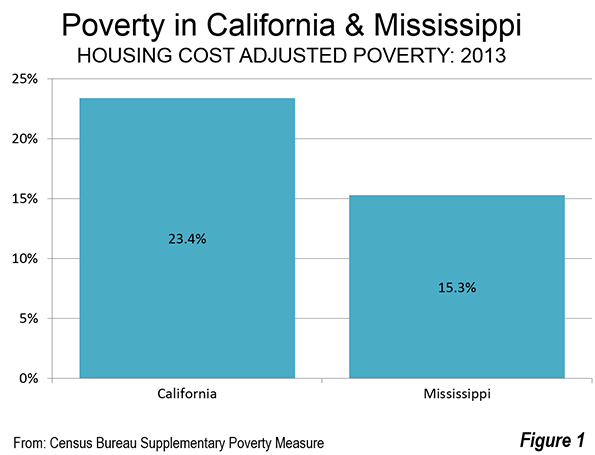
    Middle income households have been forced to accept lower standards of living while less fortunate have been driven into poverty by the high cost of housing.Housing costs have risen in some markets compared to others that the federal government now publishes alternative poverty estimates (the Supplemental Poverty Measure), because the official poverty measure used for decades does not capture the resulting differentials. The latest figures, for 2013, show California’s housing cost adjusted poverty rate to be 23.4 percent, nearly half again as high as the national average of 15.9 percent.

    Back in the years when the nation had a "California Dream," it would have been inconceivable for things to have gotten so bad — particularly amidst what is widely hailed as a spectacular recovery. The 2013 data shows California to have the worst housing cost adjusted poverty rate among the 50 states and the District of Columbia. But it gets worse. California’s poverty rate is now more than 50 percent higher than Mississippi, which long has set the standard for extreme poverty in the United States (Figure 1).

    The size of the geographic samples used to estimate the housing adjusted poverty rates are not sufficient for the Supplemental Poverty Measure to produce local, county level or metropolitan area estimates. However, a new similar measure makes that possible.

    The California Poverty Measure                           

    The Public Policy Institute of California and the Stanford Center on Poverty and Inequality have collaborated to establish the "California Poverty Measure," which is similar to the Supplemental Poverty Measure adjusted for housing costs.

    The press release announcing release of the first edition (for 2011) said that: "California, often thought of as the land of plenty" in the words Center on Poverty and Inequality director Professor David Grusky, is "in fact the land of poverty."

    The latest California Poverty Measure estimate, for 2012, shows a statewide poverty rate of 21.8 percent, somewhat below the Supplemental Poverty Measure and well above the Official Poverty Measure that does not adjust for housing costs (16.5 percent).

    The California Poverty Measure also provides data for most of California’s 58 counties, with some smaller counties combined due to statistical limitations. This makes it possible to estimate the California Poverty Measure for metropolitan areas, using American Community Survey data.

    Metropolitan Area Estimates

    By far the worst metropolitan area poverty rate was in Los Angeles, at 25.3 percent. The Los Angeles County poverty rate was the highest in the state at 26.1 percent, well above that of Orange County (22.4 percent), which constitutes the balance of the Los Angeles metropolitan area. However, the Orange County rate was higher than that of any other metropolitan area or region in the state (Figure 2). San Diego’s poverty rate was 21.7 percent. Perhaps surprisingly, Riverside-San Bernardino (the Inland Empire), which is generally perceived to have greater poverty, but with lower housing costs, had a rate of 20.9 percent. The two counties, Riverside and San Bernardino had lower poverty rates than all Southern California counties except for Ventura (Oxnard) and Imperial.

    The San Francisco metropolitan area had a poverty rate of 19.4 percent, more than one-fifth below that of Los Angeles. San Jose has a somewhat lower poverty rated 18.3 percent (Note 1). The metropolitan areas making constituting the exurbs of the San Francisco Bay Area had a poverty rate of 18.7 percent. This includes Santa Cruz, Santa Rosa, Stockton and Vallejo. Sacramento had the lowest poverty rate of any major metropolitan area, at 18.2 percent.

    The San Joaquin Valley, stretching from Bakersfield through Fresno to Modesto (Stockton is excluded because it is now a San Francisco Bay Area exurb) had a poverty rate of 21.3 percent, slightly below the state wide average of 21.8 percent. The balance of the state, not included in the metropolitan areas and regions described above had a poverty rate of 21.2 percent.

    County Poverty Rates

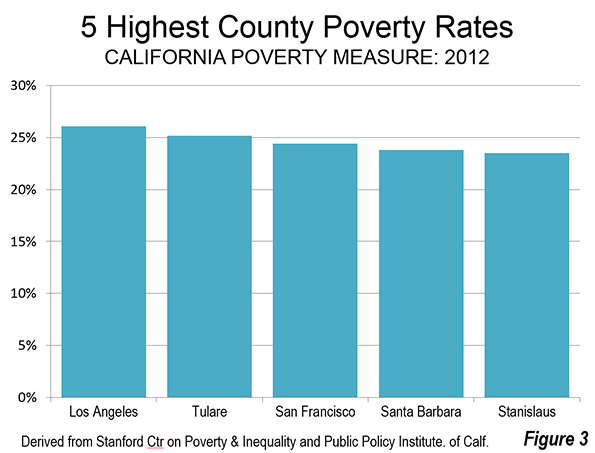
    As was noted above, Los Angeles County had the highest 2012 poverty rate in the state (Note 2), according to the California Poverty Measure (26.1 percent). Tulare County, in the San Joaquin Valley had the second-highest rate at 25.2 percent. Somewhat surprisingly, San Francisco County with its reputation for high income had the third worst poverty rate in the state at 23.4 percent. This is driven, at least in part, by San Francisco’s extraordinarily high median house price to household income ratio (median multiple). In this grisly statistic, it trails only Hong Kong, Vancouver and Sydney in the latest Demographia International Housing Affordability Survey. Wealthy Santa Barbara County has the fourth worst poverty rate in the state, at 23.8 percent. The fifth highest poverty rate is in Stanislaus County, in the San Joaquin Valley (county seat Modesto), which is already receiving housing refugees from the San Francisco Bay Area, unable to pay the high prices (Figure 3).

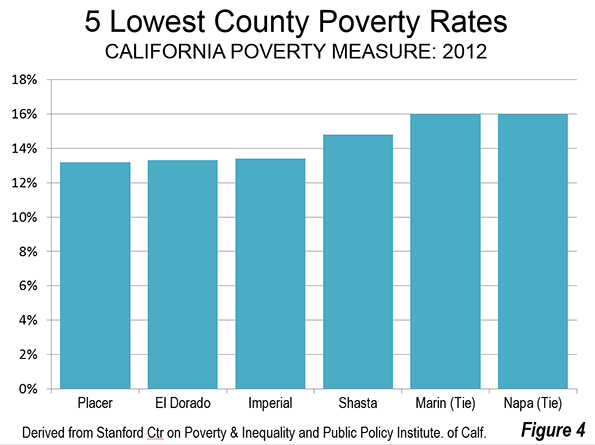
    The two lowest poverty rates were in suburban Sacramento counties (Note 2). Placer County’s rate was 13.2 percent and El Dorado County’s rate was 13.3 percent. Another surprise is Imperial County, which borders Mexico and has generally lower income. Nonetheless, Imperial County has the third lowest poverty rate at 13.4 percent. Shasta County (county seat Redding), located at the north end of the Sacramento Valley is ranked fourth at 14.8 percent. Two counties are tied for the fifth lowest poverty rate (16.0 percent), Marin County in suburban San Francisco and Napa County, in the exurban San Francisco Bay Area (Figure 4).

    Weak Labor Market and Notoriously Expensive Housing

    The original Stanford Center on Poverty and Inequality press release cited California’s dismal poverty rate as resulting from "a weak labor market and California’s notoriously expensive housing." These are problems that can be moderated starting at the top, with the Governor and legislature. The notoriously expensive housing could be addressed by loosening regulations that allow more supply to be built at lower cost. True, the new supply would not be built in Santa Monica or Palo Alto. But additional, lower cost housing on the periphery, whether in Riverside County, the High Desert exurbs of Los Angeles and San Bernardino Counties, the San Francisco Bay Area exurbs or the San Joaquin Valley could begin to remedy the situation.

    The improvement in housing affordability could help to strengthen the weak job market, by attracting both new business investment and households moving from other states.

    Regrettably, Sacramento does not seem to be paying attention. Liberalizing land use regulations is not only absent from the public agenda, but restrictions are being strengthened (especially under the requirements of Senate Bill 375). In this environment, metropolitan areas like Los Angeles, San Francisco, San Jose and San Diego could become even more grotesquely unaffordable, and the already high price to income ratios in the Inland Empire and San Joaquin Valley could worsen. All of this could lead to slower economic growth and to even greater poverty, as more lower-middle-income households fall into poverty.

    Note 1: San Benito County is excluded from the San Jose metropolitan area data. The California Poverty Measure does not report a separate poverty rate for San Benito County.

    Note 2: Among the counties for which specific poverty rates are provided.

    Wendell Cox is Chair, Housing Affordability and Municipal Policy for the Frontier Centre for Public Policy (Canada), is a Senior Fellow of the Center for Opportunity Urbanism (US), a member of the Board of Advisors of the Center for Demographics and Policy at Chapman University (California) and principal of Demographia, an international public policy and demographics firm.

    He is co-author of the "Demographia International Housing Affordability Survey" and author of "Demographia World Urban Areas" and "War on the Dream: How Anti-Sprawl Policy Threatens the Quality of Life." He was appointed to three terms on the Los Angeles County Transportation Commission, where he served with the leading city and county leadership as the only non-elected member. He served as a visiting professor at the Conservatoire National des Arts et Metiers, a national university in Paris.

    Photograph: Great Seal of the State of California by Zscout370 at en.wikipedia [CC BY-SA 3.0], from Wikimedia Commons

  • Obama, the Left Downsizing the American Dream

    Barack Obama has always wanted to be a transformational president, and in this, at least, he has been true to his word. The question is what kind of America is being created, and what future does it offer the next generation.

    President Obama’s great accomplishment, arguably, has been to spur the evolution of a society that formerly rested on individual and familial aspiration, and turn it into a more regulated and centralized regime focused on broader social and environmental concerns. This tendency has been made much stronger as the number of Americans, according to Gallup, who feel there is “plenty of opportunity ahead” has dropped precipitously – from 80 percent in 1997 to barely 52 percent today.

    The shift away from the entrepreneurial model can also be seen in the constriction of loans to the small-business sector. Rates of business start-ups have fallen well below historical levels, and, for young people in particular, have hit the lowest levels in a quarter century. At the same time, the welfare state has expanded dramatically, to the point that nearly half of all Americans now get payments from the federal government.

    In sharp contrast to the Bill Clinton White House, which accepted limits on government largesse, the newly emboldened progressives, citing inequality, are calling for more wealth transfers to the poorer parts of society, often eschewing the notion that the recipients work to actually improve their lives. The ever-expanding regulatory state has powerful backing in the media, on campuses and among some corporations. There is even a role model: to become like Europe. As the New York Times’ Roger Cohen suggests, we reject our traditional individualist “excess” and embrace, instead, Continental levels of material modesty, social control and, of course, ever-higher taxes.

    Read the entire piece at The Orange County Register.

    Joel Kotkin is executive editor of NewGeography.com and Roger Hobbs Distinguished Fellow in Urban Studies at Chapman University, and a member of the editorial board of the Orange County Register. He is also executive director of the Houston-based Center for Opportunity Urbanism. His newest book, The New Class Conflict is now available at Amazon and Telos Press. He is also author of The City: A Global History and The Next Hundred Million: America in 2050. He lives in Orange County, CA.

    Barack Obama Photo by Bigstock.

  • The Changing Patterns Of U.S. Immigration: What The Presidential Field Should Know, And You

    Public concern about illegal immigration, particularly among older native-born Americans, as well as the the rising voting power of Latinos, all but guarantees that immigration is an issue that will remain at the forefront in the run-up to the 2016 elections. Nor is this merely a right-wing issue, as evidenced in the controversy over “sanctuary cities”; even the progressive Bernie Sanders has expressed concern that massive uncontrolled immigration could “make everybody in America poorer.”

    Yet despite the political heat, there is precious little dispassionate examination of exactly where immigrants are coming from, and where in the U.S. they are headed. To answer these questions, we turned to demographer Wendell Cox, who analyzed the immigration data between 2010 and 2013 for the 52 metropolitan statistical areas with populations over a million.

    One would think listening to the likes of Donald Trump that the country is awash with hordes of unwanted newcomers from Mexico and Central America. But sorry, Donald, the numbers show a changing picture in terms of who is coming, as well as the places that they choose to settle.

    Perhaps due to Mexico’s stronger economy and lower birthrates, Mexicans are no longer as dominant in the ranks of new immigrants as in the last decade. Mexico is still the single largest place of origin of new immigrants, but from 2010 through 2013, Mexican migration to the U.S. dropped 17.7% to an average of 140,266 a year, according to data from the U.S. Department of Homeland Security. Meanwhile the inflow from Asia has increased: immigration from China is up 25.8% to 74,458 a year, and 10.7% from India to 65,336 a year. Asia now equals the Americas as a source of new immigrants, with each accounting for 40% of the annual total.

    European immigration, once the mainstay of growth for the U.S., fell 32% from 2010 to 2013 to an average of 91,000 a year, surpassed by the number of African immigrants, which has soared 29.6% to 98,000 annually.

    America’s new African population tends to be well-educated — considerably more than the national average: they are more than 60% more likely to have a graduate degree than other Americans. The vast majority are fluent in English and fully one-third hold management or professional level jobs. Not surprisingly, they are generally doing well in their new country. The places where they settle — notably New York, greater Washington, Houston and Dallas-Fort Worth — will likely benefit from their presence in coming years.

    Just as Mexican and Asian immigration changed the ethnic geography of America, boosting economies and changing local culture, one can expect the Africans to do much the same in the coming years.

    The Largest And Fastest-Growing Immigrant Hubs

    The largest foreign-born communities in America reflect both size and longstanding immigrant populations. The leader remains the New York metropolitan statistical area, which was home in 2013 to 5.69 million people born elsewhere, following by Los Angeles with 4.3 million, Miami with 2.2 million, Chicago with 1.69 million and Houston with 1.39 million.

    But a look at the metro areas with the fastest-growing foreign-born communities tells a different story, one of growing migration into the more interior and central parts of the country. In many ways, this reflects the attraction of areas with relatively low housing prices and buoyant local economies. In contrast, the economies of many traditional immigrant hubs like Los Angeles and Chicago have not done so well, while places in coastal California and near New York suffer from high housing prices.

    Pittsburgh ranks first for recent pace of growth, with a 17.4% jump in its foreign-born population to 89,000 from 2010 through 2013, almost four times the 4.3% national rate over the same span. The western Pennsylvania city has built a robust economy based on energy, medical services and technology. Its housing prices are low — roughly a third those of the Bay Area based on median income — and the city is situated in an attractive setting with rolling hills. Pittsburgh is attracting both less educated immigrants from more expensive places, and also educated newcomers, notes demographer Jim Russell, some due to the strong universities in the area.

    Other surprising heartland destinations for immigrants include Indianapolis, whose foreign-born population expanded 14.3% in 2010-13 to 127,767, the second fastest rate of growth among the largest metro areas; Oklahoma City (third fastest, up 12.9% to 110,269); and Columbus, Ohio (up 9.8% to 139,562). Generally, these cities, like Pittsburgh, have strong economies, low housing prices and favorable state regulatory climates.

    The Move South Continues

    Until the 1970s, the South was an also-ran in immigration, with the exception of Florida. But today many of the fastest-growing foreign-born communities are in the South. These include still-recovering New Orleans, whose numbers of foreign born surged 12.4% in 2010-13 to 91,412, as well as Charlotte (up 11.2% to 225,673) and Austin (up 10.7% to 279,923).

    This  movement to the South in recent decades has changed the geography of the most immigrant rich parts of the country. Three of the 10 metro areas with the largest number of foreign born residents are in the south. Miami has some 2.26 million immigrant residents make  up with 38.8% of its population, the highest proportion of any large metro area in the country. The Houston metro area has the fifth biggest foreign-born population, Dallas-Ft. Worth, the eighth.

    The Texas metro areas, and their emerging southern counterparts, offer much of what the prospering Rust Belt cities also provide — strong broad-based economies and an affordable cost of living, particularly housing. Immigrants tend to prioritize home ownership and often work in thriving blue-collar fields such as manufacturing , logistics and construction.

    Coastal Growth Follows The Economy

    The Atlantic and Pacific coasts have long dominated immigration, but there appears to be some subtle changes in this picture. Most big coastal metro areas have logged steady but below average growth of their foreign-born populations, including New York, with a 3.67% increase. (Note that even with relatively slow growth in percentage terms, New York added a net 208,800 immigrants, more than the total foreign-born populations of any of the four fastest growers.) Some blue areas are doing much better in terms of growth rate, including Seattle (9th), Boston (11th) and San Jose (15th). All tend to be expensive, but have done very well in the recovery, largely due to technology-related growth.

    In contrast, some traditional immigrant hubs with weaker economies have lagged behind. Chicago’s foreign-born population increased 1.71%, less than half the national average. Los Angeles’ foreign born population ticked down 0.1% amid economic stagnation and rising housing prices. When it comes to immigration, it is the geography of opportunity that still prevails.

    U.S. Metropolitan Areas with the Highest Share of Immigrants

    No. 1: Miami, Fla.

    Number of Foreign-Born: 2.26 million

    Percentage of Population, 2013: 38.8%

    No. 2: San Jose, Calif.

    Number of Foreign-Born: 719,460

    Percentage of Population, 2013: 37.5%

    No. 3: Los Angeles, Calif.

    Number of Foreign-Born: 4.39 million

    Percentage of Population, 2013: 33.2%

    No. 4: San Francisco, Calif.

    Number of Foreign-Born: 1.34 million

    Percentage of Population, 2013: 29.7%

    No. 5: New York, NY-NJ-PA

    Number of Foreign-Born: 5.69 million

    Percentage of Population, 2013: 28.5%

    No. 6: San Diego, Calif.

    Number of Foreign-Born: 761,580

    Percentage of Population, 2013: 23.7%

    No. 7: Houston, Tex.

    Number of Foreign-Born: 1.42 million

    Percentage of Population, 2013: 22.6%

    No. 8: Washington, D.C.

    Number of Foreign-Born: 1.31 million

    Percentage of Population, 2013: 22.0%

    No. 9: Las Vegas, Nev.

    Number of Foreign-Born: 440,866

    Percentage of Population, 2013: 21.7%

    No. 10: Riverside-San Bernardino, Calif.

    Number of Foreign-Born: 932,747

    Percentage of Population, 2013: 21.3%


    This piece first appeared in Forbes.

    Joel Kotkin is executive editor of NewGeography.com and Roger Hobbs Distinguished Fellow in Urban Studies at Chapman University, and a member of the editorial board of the Orange County Register. He is also executive director of the Houston-based Center for Opportunity Urbanism. His newest book, The New Class Conflict is now available at Amazon and Telos Press. He is also author of The City: A Global History and The Next Hundred Million: America in 2050. He lives in Orange County, CA.

    Photo by telwink