Category: Politics

  • The Peril to Democrats of Left-Leaning Urban Centers

    Twenty years ago, America’s cities were making their initial move to regain some of their luster. This was largely due to the work of mayors who were middle-of-the-road pragmatists. Their ranks included Rudy Giuliani in New York, Richard Riordan in Los Angeles, and, perhaps the best of the bunch, Houston’s Bob Lanier. Even liberal San Franciscans elected Frank Jordan, a moderate former police chief who was succeeded by the decidedly pragmatic Willie Brown.   

    In contrast, a cadre of modern mayors is minting a host of ideologically new urban politics that put cities at odds with millions of traditional urban Democrats. This trend is strongest on the coasts, but is also taking place in many heartland cities. Bill de Blasio is currently its most prominent practitioner, but left-wing pundit Harold Meyerson says approvingly that many cities are busily mapping “the future of liberalism” with such policies as  the $15-an-hour minimum wage, stricter EPA greenhouse gas regulations, and housing policies intended to force people out of lower density suburbs and into cities.

    For the Democrats, this urban ascendency holds some dangers. Despite all the constant claims of a massive “return to the city,” urban populations are growing no faster than those in suburbs, and, in the past few years, far slower than those of the hated exurbs. This means we won’t see much change in the foreseeable future in the current 70 to 80 percent of people in metropolitan America who live in suburbs and beyond. University of Washington demographer Richard Morrill  notes that the vast majority of residents of regions over 500,000—roughly 153 million people—live in the lower-density suburban places, while only 60 million live in core cities.  

    This leftward shift is marked, but it’s not indicative of any tide of public enthusiasm. One-party rule, as one might expect, does not galvanize voters. The turnout  in recent city elections has plummeted across the country, with turnouts 25 percent or even lower. In Los Angeles, the 2013 turnout that elected progressive Eric Garcetti was roughly one-third that in the city’s 1970 mayoral election.

    Bolstered by this narrow electorate, liberal pundits celebrate the fact that 27 of the largest U.S. cities voted Democratic in 2012, including “red” state municipalities such as Houston — but without counting the suburbs, where voter participation tends to be higher. An overly urban-based party faces the same fundamental challenges of a largely rural-oriented one—for example, the right-wing core of the GOP—in a country where most people live in neither environment.

    Demographic and Political Transformation of American Cities

    City dwellers have historically voted more liberally than their country or suburban cousins, but demographic trends are exacerbating this polarizing impulse. Simply put, the cities that could elect a Giuliani or a Riordan no longer exist. The centrist urban surge of the 1990s was both a reaction to the perceived failures of Democratic “blue” policies as well a reflection of the makeup of white-majority, middle-class neighborhoods in places like Brooklyn, Queens and the San Fernando Valley that featured healthy numbers of politically moderate “Reagan Democrats”—or Bill Clinton Democrats, circa 1992

    Since then, these communities have been largely supplanted by groups far more likely to embrace a more progressive political stance: racial minorities, hipsters, and upper-class sophisticates. These groups have swelled, and gotten much richer, in places like brownstone Brooklyn  or lakeside Chicago, while the number of inner city middle-class neighborhoods, as Brookings  has demonstrated, have declined, to 23 percent of the central city—half the level in 1970.

    This new urban configuration, notes the University of Chicago’s Terry Nichols Clark, tend to have different needs, and values, than the traditional middle class. Since their denizens are heavily single and childless, the poor state of city schools does not hold priority over the political power of the teachers unions. The key needs for the new population, Clark suggests, are good restaurants, shops and festivals, not child-friendly parks and family-oriented stores. Sometimes even crazy notions—such as allowing people to walk through the streets of San Francisco naked—are tolerated in a way no child-centric suburb would allow.

    These tendencies underscore as well the increasingly homogeneous political culture emerging in cities. In 1984, for example, Ronald Reagan took 31 percent of the vote in San Francisco, and 37 percent in New York. He actually carried Los Angeles. By 2012, a Republican with a more moderate history could not muster 20 percent of the vote in San Francisco. And Mitt Romney lost Los Angeles by more than a 2-1 margin, while garnering barely 20 percent in all New York boroughs besides Staten Island.

    Economic Hubris

    These changes also reflect a shift in the economic role of cities. Until the 1970s, cities were centers of production, distribution and administration. Then the industrial base of urban areas, and related jobs such as logistics, began moving away from the traditional manufacturing cities  to overseas, the suburbs or the Southeast.  In 1950 New York, according to economic historian Fernand Braudel, 1 million people worked in factories, mostly for small companies. Today the city’s industrial workforce now stands at a paltry 73,000, a dramatic decline from some 400,000 as recently as the early 1980s.

    A similar, if less spectacular, decline has taken place in what are still the two largest industrial metropolitan statistical areas, Chicago and Los Angeles. The one-time “City of Big Shoulders” and its environs had 461,600 industrial jobs in 2009. Today it has fewer than 300,000. Los Angeles, in a process that started with the end of the Cold War, has seen its once-diverse industrial base erode rapidly, from 900,000 just a decade ago to 364,000 today. 

    In some cities, a new economy has emerged, one that is largely transactional and oriented to media. The upshot is that denizens of the various social media, fashion and big data firms have little appreciation of the difficulties faced by those who build their products, create their energy and food. Unlike the factory or port economies of the past, the new “creative” economy has little meaningful interaction with the working class, even as it claims to speak for that group.

    This urban economy has created many of the most unequal places  in the country. At the top are the rich and super-affluent who have rediscovered the blessings of urbanity, followed by a large cadre of young and middle-aged professionals, many of them childless. Often ignored, except after sensationalized police shootings, is a vast impoverished class that has become ever-more concentrated in particular neighborhoods. During the first decade of the current millennium, neighborhoods with entrenchedurban poverty actually grew, increasing in numbers from 1,100 to 3,100. In population, they grew from 2 million to 4 million.Some 80 percent of all population growth in American cities, since 2000, notes demographer Wendell Cox, came from these poorer people, many of them recent immigrants.

    Such social imbalances are not, as is the favored term among the trendy, sustainable. We appear to be creating the conditions for a new wave of violent crime on a scale not seen since the early 1990s. Along with poverty, public disorderlinessgang activityhomelessness and homicides are on the rise in manyAmerican core cities, including Baltimore, Milwaukee, Los Angeles and New York. Racial tensions, particularly with the police, have worsened. So even as left-leaning politicians try to rein in police, recent IRS data in Chicago reveals, the middle class appears to once again be leaving for suburban and other locales. 

    Urbanity and Politics

    These social and economic changes inform the new politics of the Democratic Party. On social policy, the strong pro-gay marriage and abortion positions of the Democrats makes sense as cities have the largest percentages of both homosexuals and single, childless women. When the party had to worry about rural voters in South Dakota or West Virginia, this shift would have been more nuanced, and less rapid.

    Yet with those battles essentially won, the new urban politics are entering into greater conflict with the suburban mainstream, which tends to be socially moderate, and even more so with the resource-dependent economies of rural America. The environmental radicalism that has its roots in places like San Francisco and Seattle  now directly seeks to destroy whole parts of middle America’s energy economy.

    Such policies tend to radically raise energy costs. In California, the green energy regime has already driven roughly 1 million people, many of them Latinos in the state’s agricultural interior, into “energy poverty”—a status in which electricity costs one-tenth of their income. Not surprisingly, those leaving California, notes Trulia, increasingly are working class; their annual incomes in the range of $20,000 to $80,000 are simply not enough to make ends meet.

    Geography seems increasingly to determine politics. Ideas on climate policy that seem wonderfully enlightened in Manhattan or San Francisco—places far removed from the dirty realities of production—can provide a crushing blow to someone working in the Gulf Coast petro-chemical sector or in the Michigan communities dependent on auto manufacturing.

    It’s more than suburban or rural jobs that are on the urban designer chopping block. Density obsessed planners have adopted rules, already well advanced in my adopted home state of California, to essentially curb  much detested suburban sprawl and lure people back to the dense inner cities. The Obama administration is sympathetic to this agenda, and has adopted its own strategies to promote “back to the city” policies in the rest of the country as well.

    But as these cities go green for the rich and impressionable, they must find ways to subsidize the growing low-paid service class—gardeners, nannies, dog walkers, restaurant servers—that they depend on daily. This makes many wealthy cities, such as Seattle or San Francisco, hotbeds for such policies as a $15-an-hour minimum wage, as well as increased subsidies for housing and health care. In San Francisco, sadly, where the median price house (usually a smallish apartment) approaches  $1 million, a higher minimum wage won’t purchase a decent standard of living. In far more diverse and poorer Los Angeles, nearly half of all workers would be covered — with unforeseen impacts on many industries, including the largegarment industry.

    These radicalizing trends are likely to be seen as a threat to Democratic prospects next year, but instead will meet with broad acclaim among city-dominated progressive media. Then again, the columnists, reporters and academics who embrace the new urban politics have little sympathy or interest in preserving middle-class suburbs, much less vital small towns. If the Republicans possess the intelligence—always an open question—to realize that their opponents are actively trying to undermine how most Americans prefer to live, they might find an opportunity far greater than many suspect.

    This piece first appeared at Real Clear Politics.

    Joel Kotkin is executive editor of NewGeography.com and Roger Hobbs Distinguished Fellow in Urban Studies at Chapman University, and a member of the editorial board of the Orange County Register. He is also executive director of the Houston-based Center for Opportunity Urbanism. His newest book, The New Class Conflict is now available at Amazon and Telos Press. He is also author of The City: A Global History and The Next Hundred Million: America in 2050. He lives in Orange County, CA.

    Photo by Kevin Case from Bronx, NY, USA (Bill de Blasio) [CC-BY-2.0], via Wikimedia Commons
  • Progressive Policies Drive More Into Poverty

    Across the nation, progressives increasingly look at California as a model state. This tendency has increased as climate change has emerged as the Democratic Party’s driving issue. To them, California’s recovery from a very tough recession is proof positive that you can impose ever greater regulation on everything from housing to electricity and still have a thriving economy.

    And to be sure, the state has finally recovered the jobs lost in the 2007-09 recession, largely a result of a boom in values of stocks and high- end real estate. Things, however, have not been so rosy in key blue-collar fields, such as construction, which is still more than 200,000 jobs below prerecession levels, or manufacturing, where the state has lost over one-third of its employment since 2000. Homelessness, which one would think should be in decline during a strong economy, is on the rise in Orange County and even more so in Los Angeles.

    The dirty secret here is that a large proportion of Californians, roughly one-third, or some 3.2 million households, as found by a recent United Way study, find it increasingly difficult to keep their heads above water. The United Way study, surprisingly, has drawn relatively little interest from a media that usually enjoys highlighting disparities, particularly racial gaps. Perhaps this reflects a need to maintain an illusion of blue state success. If Republican Pete Wilson were still governor, I suspect we might have heard much more about this study.

    Read the entire piece at The Orange County Register.

    Joel Kotkin is executive editor of NewGeography.com and Roger Hobbs Distinguished Fellow in Urban Studies at Chapman University, and a member of the editorial board of the Orange County Register. He is also executive director of the Houston-based Center for Opportunity Urbanism. His newest book, The New Class Conflict is now available at Amazon and Telos Press. He is also author of The City: A Global History and The Next Hundred Million: America in 2050. He lives in Orange County, CA.

  • More Local Decisions Usurped by Ideological Regulators

    In hip, and even not-so-hip, circles, markets, restaurants and cultural festivals across the country, local is in. Many embrace this ideal as an economic development tool, an environmental win and a form of resistance to ever-greater centralized big business control.

    Yet when it comes to areas being able to choose their urban form and for people to cluster naturally – localism is now being constantly undermined by planners and their ideological allies, including some who superficially embrace the notion of localism.

    In order to pursue their social and perceived environmental objectives, they have placed particular onus on middle- and upper-class suburbs, whose great crime appears to be that they tend to be the places people settle if they have the means to do so.

    Central planning

    Nothing is more basic to the American identity than leaving basic control of daily life to local communities and, as much as is practical, to individuals. The rising new regulatory regime seeks decisively to change that equation. To be sure, there is a need for some degree of regulation, notably for basic health and public safety, as well as maintaining and expanding schools, parks, bikeways and tree-planting, things done best when supported by local voters.

    Read the entire piece at The Orange County Register.

    Joel Kotkin is executive editor of NewGeography.com and Roger Hobbs Distinguished Fellow in Urban Studies at Chapman University, and a member of the editorial board of the Orange County Register. He is also executive director of the Houston-based Center for Opportunity Urbanism. His newest book, The New Class Conflict is now available at Amazon and Telos Press. He is also author of The City: A Global History and The Next Hundred Million: America in 2050. He lives in Orange County, CA.

    City Hall photo by Flickr user OZinOH.

  • Congratulations Boston!

    Congratulations Boston! Your rejection of the "honor" of representing the US as its candidate for the 2024 Summer Olympics is an inspiring example of government performing its obligation to taxpayers and their hard earned money. Those of us who think that government has a responsibility to wisely use taxpayer money sometimes forget that Massachusetts enacted Proposition 2 1/2 not long after California’s fabled Proposition 13.

    In an era of routinely wasteful government spending, Boston’s decision stands out as unusual. It rivals the courage of New Jersey Governor Chris Christie who cancelled a new Hudson River rail tunnel, mid-project, because of the consultants and builders seemed sure to take advantage of the blank check that New Jersey taxpayers were required to pledge. This, of course has been the record of major infrastructure projects all over the world and most recently one of the most grotesque examples was Boston’s own "Central Artery." But unlike “the Big Dig”. This time Boston didn’t have speaker Tip O’Neill to bring home the bacon. Then, the federal government capped its share and Boston had to pay it all. Unsurprisingly, the bill was much higher and had to be paid by Massachusetts, along with the interest on extra debt that had to be issued.

    Oxford University Professor Bent Flyvbjerg, who has become famous for his quality analysis of large infrastructure projects, especially urban rail projects, produced a report with Allison Stewart on the history of Olympics cost overruns between 1960 and 2012. The two worked under the auspices of the Said Business school of England’s at Oxford. They concluded:

    The data thus show that for a city and nation to decide to host the Olympic Games is to take on one of the most financially risky type of megaproject that exists, something that many cities and nations have learned to their peril.

    They found that every Olympic Games, summer or winter, for which complete data is available experienced cost overruns. The most recent, in London, experienced a cost overrun of 100 percent. Flyvbjerg and Steward used a very simple model that has been applied to the previous infrastructure work. They just looked at the final bill that included all the expenses.This was compared to the amount the sponsors and their funders, the taxpayers, were it was going to cost when the application was approved by the local political process.

    The principal problem was the Olympic Committee requirement that sponsors must ensure the financing of all major capital investment required and are "on the hook" for any cost overruns.

    Montréal’s legendary Mayor Jean Drupeau sold his city on an Olympics bid saying that "the Montréal Olympics and no more have a deficit that a man can have a baby." Well, men are not yet having babies, but Montréal gave birth to a world-class cost overrun in its 1976 summer Olympics.  According to Flyvbjerg and Stewart, the 1976 Montréal Olympics had a cost overrun of nearly 800 percent, nearly double the 1992 420 percent cost overrun of Barcelona. Montréal may have set a record for much more than the Olympics with its cost overrun.

    Things have been virtually as bad in Greece. The researchers reported that "Olympic cost overruns and debt have exacerbated" the Greek economic crisis.

    There has been one exception to this sorry record. Los Angeles, host of the 1984 summer Olympic Games, actually turned a profit, sending more than $300 million to the international Olympic Committee and using the local profits for the LA84 Foundation, which funds youth sports and related activities, even 30 years after the event.

    I coordinated the information program for employees at the Southern California headquarters of Crocker Bank (subsequently sold to Wells Fargo), assisting employees in getting to work during what was expected to be the high traffic from the 1984 Olympics. It turns out that the advice of local officials to encourage and vacations and working at home paid off handsomely. People who commuted during the Olympic Games had unusually light traffic.

    In addition, I was a member of the Los Angeles County Transportation Commission (LACTC), having been appointed by Mayor Bradley and confirmed by the Los Angeles City Council. Both the Mayor and the Council were committed to putting on the show without burdening the taxpayers – no public money. And Olympic Committee was established under the direction of Peter Ueberroth, who became a legend for his skillful management of the games.

    But there was some public money lost on the Olympics. The Southern California Rapid Transit district (SCRTD), the large regional transit operator announced its intention to provide bus service to Olympic venues from all over the Los Angeles area. SCRTD claimed that it would be able to do the job without public subsidy. I believed otherwise and predicted that the service would fall far short of its ridership projections and lose about $5 million. LACTC had the authority to ban the expenditure, which I tried to do. Unfortunately I was unable to obtain the necessary votes to make that happen. In the end, the ridership fell far short of projection (the kind of thing Professor Flybvjerg usually reports on urban rail projects).

    Meanwhile, the Olympics were a one-off to Los Angeles. Most infrastructure projects of this nature are financially ruinous. Maybe Massachusetts learned a lesson from the Central Artery. Boston proved itself to be a world-class city in having the courage to say "no."

    Wendell Cox is Chair, Housing Affordability and Municipal Policy for the Frontier Centre for Public Policy (Canada), is a Senior Fellow of the Center for Opportunity Urbanism (US), a member of the Board of Advisors of the Center for Demographics and Policy at Chapman University (California) and principal of Demographia, an international public policy and demographics firm.

    He is co-author of the "Demographia International Housing Affordability Survey" and author of "Demographia World Urban Areas" and "War on the Dream: How Anti-Sprawl Policy Threatens the Quality of Life." He was appointed to three terms on the Los Angeles County Transportation Commission, where he served with the leading city and county leadership as the only non-elected member. He served as a visiting professor at the Conservatoire National des Arts et Metiers, a national university in Paris. 

    Photograph: Boston, by author

  • The Incompetence Hypothesis to Explain the Great Recession

    Seeking an understanding of the Great Recession, I am finding that most of the 2008 financial crisis and its aftermath can be explained by incompetence. In the final weeks of writing a book on the systemic failure in US capital markets, I had to re-read the Securities and Exchange Commission (SEC) Inspector General’s 2009 report on their failure to stop Bernard Madoff despite having received credible evidence of a Ponzi scheme. The inspector concluded that it did not have anything to do with the fact that an SEC assistant director was dating (and later married) Madoff’s niece; or that Madoff had held a Board seats at important financial regulators.* Despite eight substantive complaints and two academic journal research reports over 16.5 years about problems with Madoff’s investments, Madoff was never caught. In the end he turned himself in, admitting to a $64 billion Ponzi scheme. The inspector’s conclusion: incompetence.

    In economics, ‘interest’ – whether it be self-interest or interest group pressure – is the ‘safe’ explanation for outcomes that are detrimental to the public. If interest group pressure (or even populism) is behind a bad policy decision, then it is not a ‘mistake.’ Rather, it is an intentional, rational decision as described by Chicago School economist and Nobel laureate George Stigler. However, if a policy decision is the result of bad judgment, then Stigler cannot explain it. Brazilian economist Luiz Carlos Bresser-Pereira suggests that the relevant variable in this case is incompetence. Incompetence is an independent explanatory variable; it cannot be explained in rational or historical terms.

    Incompetence arises from three sources: 1) ignorance, 2) arrogance, or 3) fear. Policy advisors and regulators may be guilty of applying theories second-hand but with great authority and self confidence. They may be ignorant of the complexities of economic theory and they may apply abstract economic theories inappropriately to specific policy problems. For example, they allowed banks to engage in a wide range of investments under the financial theory of ‘diversification.’ That theory works for portfolios but not for businesses, which need to specialize to realize the gains from their comparative advantage. Financially derived theories like this were applied automatically, transformed into a series of clichés.

    ‘Diversification’ in a portfolio of financial investments lets you increase the returns while reducing the risk. But in business it means ‘splintering’ which destroys performance capacity and increases risk. Financial institutions are tools to be used in furthering the efforts of the broad economy: the more specialized financial institutions become, the greater their performance capacity. Increased productivity from specialization comes with better quality as businesses become more adept at their specific products and services. The differences in natural aptitudes and abilities produce economic benefits when tasks are matched to capabilities. The more experience a worker has at performing a task, they more efficient they become in doing the work. As management guru Peter Drucker wrote: ‘Organizations can only do damage to themselves and to society if they tackle tasks that are beyond their specialized competence.’

    An example of an economic theory applied arrogantly is Washington’s constant fawning over ‘free market solutions’ when the rules, regulations and court decisions covering capital markets fill the bookshelves of law offices around the world. There is no such thing as a free market – no economist of value believes that the perfectly competitive market exists. The Wall Street Bailout is a good example of the third source of incompetence – fear. Consider this description of the exchange between Treasury Secretary Henry Paulson, Federal Reserve Chairman Ben Bernanke and the senior legislators from the House and Senate on Thursday, September 18, 2008:

    Sen. CHRISTOPHER DODD: Sitting in that room with Hank Paulson saying to us in very measured tones, no hyperbole, no excessive adjectives, that, "Unless you act, the financial system of this country and the world will melt down in a matter of days. "
    JOE NOCERA: Bernanke said, "If we don’t do this tomorrow, we won’t have an economy on Monday."
    Sen. CHRISTOPHER DODD: There was literally a pause in that room where the oxygen left.
    Inside the Meltdown, Frontline February 17, 2009, WGBH Educational Foundation, Boston. 

    Regardless of the source of the incompetence, the visible results are 1) failure to take correct strategic policy decisions, and 2) failure to adopt well-designed reforms.

    Policy decisions are the day-to-day management decisions that usually produce immediate results. In monetary policy, for example, these would be interest rate decisions. Interest rate policy decisions need to be made at the right time and to move rates in the right direction.

    Reforms produce medium-term outcomes that may or may not require legislative approval. The Dodd-Frank Act, which was supposed to reform Wall Street and protect Main Street, in reality created very little change but suggested that financial regulators reform their own rules. Poor reforms may be the result of incompetent designs and not just pressure from interest groups, although this also happens.

    Bresser-Pereira’s analysis offers one more alternative explanation for the cause of bad policy and reforms. Between interest and incompetence lies ‘confidence building.’ It is simply doing what is expected in an effort to gain the confidence of financial supporters. If we substitute “Goldman Sachs” for “United States” and “Wall Street” for “developed countries” in this quote from Bresser-Pereira, then his description of ‘confidence building’ is as true of Washington, D.C. as it is of Brazil:

    ‘They do not limit themselves to seeing the United States and, more broadly, the developed countries, as richer and more powerful nations, whose political institutions and scientific and technological development should be imitated. No, they see the elites in the developed countries both as the source of truth and as natural leaders to be followed. This subordinate internationalism ideology, already called ‘colonial inferiority complex’ and entreguismo**, is as detrimental to a country as old-time nationalism. What I am singling out as a major source of incompetent macroeconomic policies is the uncritical adoption of developed countries’ recommendations.’

    If we say that bad policy decisions are always rational, motivated by interest, then we must conclude that policy-makers are ‘dishonest, protecting their own interest or those of their constituencies rather than the public interest’ (Bresser-Pereira).  If this view were always true, then the world would look more like communist Russia in 1980 than the way it does today. How would entrepreneurs and consumers have financed not only the invention but the proliferation of microchips, cell phones, and personal computers that have made the world safer and easier to navigate; how would they have discovered and made widely available artificial hearts, HIV medications and targeted cancer therapies? Since 1981, the number of poor people in the world declined for the first time in history, by 375 million. Global life expectancy was 68 in 2014, up from 61 in 1980; infant mortality is down to 49.4 per 1000 live births in 2014 from 80 in 1980. Yet as a result of the havoc wrecked upon the global economy in 2008 by incompetent regulators, policy makers and bankers, global unemployment grew from 20 to 50 million while falling incomes combined with rising food prices to raise the number of undernourished people in the world by 11%.

    A solution, from this perspective, lies in cleaning house of the incompetent staff from Washington to Wall Street and improving recruiting methods to build competence for the future.

    * Madoff has a seat on the Board of the International Securities Clearing Corporation, one of the predecessor organizations to the Depository Trust and Clearing Corporation, the world’s largest post-trade processing center. Madoff was also Chairman of the NASDAQ, and had seats on the Boards at the National Association of Securities Dealers (now the Financial Industry Regulatory Authority – the same organization that failed to act on a referral letter from the SEC to stop R. Allen Stanford’s Ponzi scheme.
    **Brazilian Portguese roughly translated as ‘appeasement’ or ‘submission.’

    For more information:
    Luiz Carlos Bresser-Pereira, Latin America’s quasi-stagnation, in A Post Keynesian Perspective on 21st Century Economic Problems, Elgar, UK. http://www.bresserpereira.org.br/
    The World Factbook 2013-14. Washington, DC: Central Intelligence Agency, 2013.
    https://www.cia.gov/library/publications/the-world-factbook/index.html

    Susanne Trimbath, Ph.D. is CEO and Chief Economist of STP Advisory Services. Dr. Trimbath’s credits include appearances on national television and radio programs and the Emmy® Award nominated Bloomberg report Phantom Shares. She appears in four documentaries on the financial crisis, including Stock Shock: the Rise of Sirius XM and Collapse of Wall Street Ethicsand the newly released Wall Street Conspiracy. Dr. Trimbath was formerly Senior Research Economist at the Milken Institute. She served as Senior Advisor on United States Agency for International Development capital markets projects in Russia, Romania and Ukraine. Dr. Trimbath teaches graduate and undergraduate finance and economics.

  • Latino Politicians Putting Climate Change Ahead of Constituents

    Racial and economic inequality may be key issues facing America today, but the steps often pushed by progressives, including minority politicians, seem more likely to exacerbate these divisions than repair them. In a broad arc of policies affecting everything from housing to employment, the agenda being adopted serves to stunt upward mobility, self-sufficiency and property ownership.

    This great betrayal has many causes, but perhaps the largest one has been the abandonment of broad-based economic growth traditionally embraced by Democrats. Instead, they have opted for a policy agenda that stresses environmental puritanism and notions of racial redress, financed in large part by the windfall profits of Silicon Valley and California’s highly taxed upper-middle class.

    Nowhere in California is this agenda more clearly manifested than with state Senate President pro Tem Kevin de León, who represents impoverished East Los Angeles. De León has proclaimed addressing “climate change” as the Senate’s “top priority” and is calling for, among other things, disinvestment from fossil fuel companies. Rarely considered seem to be the actual impacts of these policies on the daily lives of millions of working- and middle-class Californians.

    War on Blue Collar Jobs

    Despite vastly exaggerated claims about the prospects for so-called green jobs since the passage of Assembly Bill 32, the landmark 2006 climate change law, California is adopting policies detrimental to growing the higher-wage blue-collar sector. Green policies favoring expensive alternative energy have fostered energy prices that, for industrial users, are an estimated 57 percent higher than the national average. No surprise, then, that California has produced barely half the rate of new manufacturing jobs as the rest of the nation.

    Read the entire piece at the Orange County Register.

    Joel Kotkin is executive editor of NewGeography.com and Roger Hobbs Distinguished Fellow in Urban Studies at Chapman University, and a member of the editorial board of the Orange County Register. He is also executive director of the Houston-based Center for Opportunity Urbanism. His newest book, The New Class Conflict is now available at Amazon and Telos Press. He is also author of The City: A Global History and The Next Hundred Million: America in 2050. He lives in Orange County, CA.

    By Neon Tommy (Senator Kevin De Leon) [CC BY-SA 2.0], via Wikimedia Commons

  • The Geography of Ideology Ultra R, Ultra D and 50 to 50

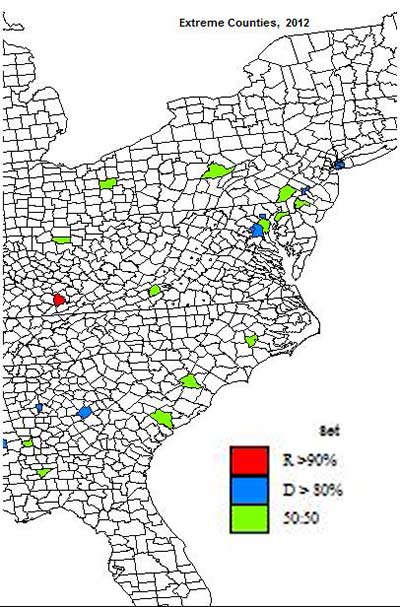
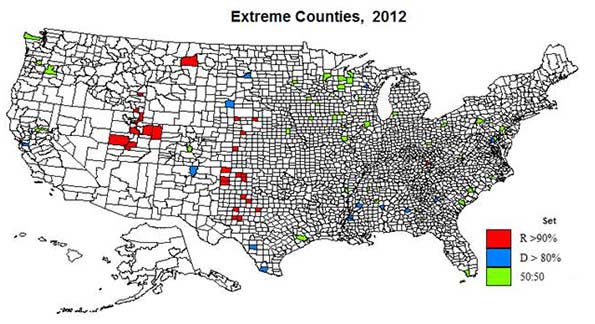
    Recently I grouped all US counties into several categories, from True Believers R and D, R and D leaning groups, and also those areas that are more equally divided. In anticipating the 2016 election, I take here a brief look at a small number of counties (2012 data) that are extreme cases of R voting (over 90%, 28 counties), of D voting (over 80%, 26 counties), and of 50:50 voting (39 counties from 49.7 to 50.3 D vote). These are also shown on the maps. Note that the D counties in blue don’t look impressive, as they are small in area, but big in votes. How do these three sets differ in geography and in character?

    Set 1: Ultra Republican

    The extreme R counties are an amazing set. Ten of the 28 (8 in Utah, 2 in Idaho) are dominantly Mormon. The non-Mormon counties include 17 scattered across the high plains from Montana, 1, Nebraska, 3, Kansas, 1, Oklahoma 1, and 11 in Texas, with one outlier in eastern Kentucky. Only one is east of the 100th Meridian, famous for dividing east and west in the US. All these counties are basically conservative on social issues.

    Overall densities are far lower and rural shares far higher than for the other sets. They are overwhelmingly white (92%) and less than 1% black on average. They have the highest shares of husband-wife families, with and without children, and the lowest shares of single parent families, roommates and singles. For example the black population is essentially 0 in half the counties. Husband-wife and children households ae exceptionally high in 5 counties: Franklin, ID; and Duchesne, Morgan, Sevier, and Uintah Utah—all Mormon. The roommate share is under 2 percent in 7 counties, compared to a national average of almost 5.

    Male labor force participation averages a high 73% and unemployment a low 3.8%. As expected for these locations, farming is a frequent occupation in these counties, exceeding 10% in 8 counties, as in MT, NE, and TX. Finally church attendance is far higher than in the other sets, averaging 71% compared to 48% in the set 2 counties.  

    The Mormon counties exhibit some variation in size and settlement. Five are all rural, four are rural and small town (micropolitan), but one is a small metropolis, Utah county (Provo, with Brigham Young University), perhaps the heart of Mormon orthodoxy. The 18 non-Mormon counties include 13 small rural counties and 5 counties (all in Texas) with small cities.

    Since the total vote in these counties was only 234,000 (76,000 without Utah county!) and 92% R, it is probably not worth a Democrat candidate spending much effort in these locales. Yet it is possible that without the “negativity” of race, an Anglo woman at the top of Democratic ticket should do better in conservative white settings. 

    Set 2: Ultra Democratic   

    The extreme D counties are similarly an amazing set, just in different dimensions. The dominant characteristic is the very high minority share – in all 26 counties – and correlated with that high shares of single parent families, unemployment, and general and especially child poverty. The minority share averages 81%, with 43% black. Thirteen have high black shares: mostly southern and rural, in AL, GA, MS, but also Washington, DC, Baltimore, and Prince George, MD. Four have high Hispanic shares: TX, NM, three Native American (ND, SD, WI), and six are more racially mixed: San Francisco and Alameda, CA, Philadelphia, and 4 New York city boroughs.

    The second distinguishing feature is dense urban character and sheer size, but only for a subset of 12 counties, as 9 are rural or small town minority counties. The large urban counties include San Francisco, Alameda, Washington DC, Orleans, Prince George, Baltimore, St. Louis, Bronx, Kings, New York, Queens, and Philadelphia. These set 2 metropolitan counties are mainly coastal (plus St. Louis and Orleans),   while rural minority counties are mainly in the northern plains, (Native American) or the southern “Black belt”.

    The small city minority counties are Macon, AL (Tuskegee), Hancock, GA, Taos, NM, Starr and  Zavala, TX,  Claiborne, Holmes and Jefferson, MS, and Shannon, SD, leaving only 3 totally rural counties, Greene, AL, Sioux, ND and Menominee, WI. 

    These highest D counties also have the highest share of people 18-44, of singles and of roommate households, and the lowest in families, as well as being lowest in labor force participation and church attendance but highest in poverty and unemployment.

    Even though highly Democratic, with a 2012 D vote of 4,000,000 to 700,000 R, the total vote is so large that it may be worth a fair Republican campaign effort simply to reduce the giant D margin, which was key to the 2008 and 2012 D wins. Without the dominance of race, Republicans might do better, if voter turnout of minorities falls.

    Set 3: Balanced 50-50 counties

    The set 3 counties with a 50:50 D and R split, are far more diverse and complex, as we might expect, and suggest how difficult they can be for candidates to create convincing messages!  These counties are intermediate in density and are quite high in shares of micropolitan territory, that is, independent small city counties.

    Of the 39 counties, 6 are entirely rural (GA, IA, MS and WI (3)), while one (Harris-Houston) is a giant metropolitan core county with almost half the total vote of these set 3  counties. Five are suburban to large metro areas – in GA, MD, NJ, PA, and WA.  Five are small metropolitan areas, Lincoln, NE (Lancaster), Florence, SC, State College (Centre), PA, Montgomery, VA (Blacksburg), and Canton (Stark), OH. Thus 23 are small city micropolitan, with counties in AR, CA, CO, IL, IA, MD, MI, MN, MS, NC, OH, OR, SC, WA, and WI.

    While the set 1 counties are all but one in the western half of the country, and the set 2 counties, coastal urban or southern rural-small town, the set 3 counties are most prevalent in the upper Midwest: IL 2, IA 5, MN 3, WI 5, MI 1, OH 1, and NE 1, almost half the counties, with another ten in the south, AR 1, MS 2, GA 2, SC 2, FL 1, NC 1, and VA, 1. The single largest cluster of these 50:50 counties is in northwestern Wisconsin, with an additional county across the state line in Minnesota.

    In social and economic characteristics these counties tend to be intermediate between the set 1 and set 2 counties, for example averaging 22% minority (closer to set 1 than to set 2), but fairly high in a few counties in the south. They tend to be a little closer to the set 2 D set on the social dimension: shares of roommates, singles, and in religiosity, but closer to the set 1 R set in economic, income and job variables, as in higher labor force participation and lower poverty rates. 

    Clearly these set 3 counties represent the impressive diversity of the more balanced areas of American electorate, where campaigning will be especially critical.

    Table  1 Differences between D, R and 50:50 Sets
    Averages
    Variable Set 1 R Set 2 D Set 3 50:50  
    Age 18-44 30 39 33  
    White 92 33 82  
    Black 0.7 43 11  
    Minority 16 81 22  
    HW w children 28 11 20  
    Single parent 10 29 16  
    Singles 22 30 28  
    Urbanized area 3 54 21  
    UC (small city) 18 11 26  
    Rural 82 32 53  
    Male Labor Force Participation 73 62 69  
    Unemploy 3.8 12.2 7.3  
    Services 15 22 17  
    Farm 7 1 1.7  
    Churches/100 4 1.5 1.8  
    Poor 13 26 14.5  
    Child Poor 17 36 18  


    Conclusion

    These counties are but a small sample of the 3,180 counties. Yet they represent the extreme drivers of a well-publicized American polarization, but also where we see a non-polarized America. The regional concentrations of the three helps illuminate the amazing differences in American cultural and political geography.

    Richard Morrill is Professor Emeritus of Geography and Environmental Studies, University of Washington. His research interests include: political geography (voting behavior, redistricting, local governance), population/demography/settlement/migration, urban geography and planning, urban transportation (i.e., old fashioned generalist).

  • Presidential Candidate Jim Webb is an Old-time Democrat

    Will Rogers famously stated, “I am not a member of any organized political party. I am a Democrat.” And he was not so far from the truth. The old Democratic Party was a motley collection of selected plutocrats, labor bosses, Southern segregationists, smaller farmers, urban liberals and, as early as the 1930s, racial minorities. It was no doubt a clunky coalition but delivered big time: winning World War II, pushing back the Soviet Union and making it to the moon while aiding tens of millions of Americans to ascend into the middle class.

    Only one Democratic candidate in the 2016 presidential race, James Webb, represents this old coalition. A decorated combat veteran, onetime Reagan Navy secretary and former U.S. senator from Virginia, Webb, 69, combines patriotism with a call for expansive economic policies to help the middle class. He speaks most directly to white working-class voters, particularly in places like Appalachia, the South and in rural hamlets and exurbs across the country, precisely where Democrats are now regularly thrashed in elections.

    Webb, notes the National Journal, combines “Elizabeth Warren’s passion for economic justice with Rand Paul’s itch to reinvent foreign policy.” After all, the former soldier was one of the harshest critics of George W. Bush’s disastrous Iraq invasion.

    Yet, so far, his candidacy is attracting little to no mention in the media. Part of the problem may lie with the fact that he most identifies with an America – white, rural or suburban – disdained or ignored by the official press. Many current Democrats not only dislike these constituencies, but don’t even want to deal with them, counting, instead, on their coalition of the affluent, minorities and millennials to carry the day.

    Read the entire piece at The Orange County Register.

    Joel Kotkin is executive editor of NewGeography.com and Roger Hobbs Distinguished Fellow in Urban Studies at Chapman University, and a member of the editorial board of the Orange County Register. He is also executive director of the Houston-based Center for Opportunity Urbanism. His newest book, The New Class Conflict is now available at Amazon and Telos Press. He is also author of The City: A Global History and The Next Hundred Million: America in 2050. He lives in Orange County, CA.

    Jim Webb photo by flickr user kalexnova.

  • Chicago’s Great Financial Fire

    My latest piece is online in City Journal and is called “Chicago’s Financial Fire.” It’s a look at the ongoing financial crisis in that city, which has all of a sudden gotten very real thanks to a downgrade of the city’s credit rating to junk by Moody’s. Here’s an excerpt:

    While some sort of refinancing may be required, the proposed debt issue contains maneuvers similar to those that helped get Chicago into trouble in the first place—including more scoop and toss deferrals, $75 million for police back pay, $62 million to pay a judgment related to the city’s lakefront parking-garage lease, and $35 million to pay debt on the acquisition of the former Michael Reese Hospital site (an architecturally significant complex Daley acquired and razed for an ill-fated Olympic bid). The debt-issue proposal also includes $170 million in so-called “capitalized interest” for the first two years. That is, Chicago is actually borrowing the money to pay the first two years of interest payments on these bonds. In true Chicago style, the proposal passed the city council on a 45-3 vote. Hey, at least the city is getting out of the swaps business.

    Even with no further gimmicks, Emanuel will be six years into his mayoralty before the city can stop borrowing just to pay the interest on its debt. And without accounting for pensions, it will take the full eight years of both his terms to get the city to a balanced budget, where it can pay for the regular debt it has already accumulated.

    Click through to read the whole thing.

    Rahm donned a sweater during his reelection campaign and told the public he recognized he needed to change his ways, saying that he knows he “can rub people the wrong way.” The title of that ad was “Chicago’s Future.”

    I decided to take him up on his new approach. When I was working on this piece, I tried to get some information of the mayor’s press office. I asked them such extremely hard hitting questions as, “Is there a consolidated location where all of the mayor’s most recent financial proposals can be seen in their current form?” I emailed them and got no response. So I followed up with a phone call. I was put on hold for a while then told the person I needed to talk to was away from her desk, but I should email her at a XYZ address. So I did. No response. This is the same pattern all previous inquiries I’ve made have followed, though I believe on occasion I’ve been put through to a voice mail from which I got no callback. Now, it’s not like I try to get stuff from these guys every day, but the message is pretty clear. I gather that this experience is not at all unusual when dealing with Rahm.

    Having his press office simply refuse to respond at all to even basic inquiries from (the apparently many) people on his blacklist is naught put pettiness. Rahm takes people who could be friends and does his best to turn them into enemies. No wonder the Sun-Times titled a recent about him, “Rahm’s troubles plentiful, allies scarce.”

    Thus it is that Chicago, a city of grand and expansive history and ambition, a city so big it overflows the page, comes to have a mayor with a certain smallness of spirit.

    Aaron M. Renn is a senior fellow at the Manhattan Institute and a Contributing Editor at City Journal. He writes at The Urbanophile, where this piece first appeared.

    Chicago photo by Bigstock.

  • Institution of Family Being Eroded

    Recent setbacks for social conservative ideals – most particularly on same-sex marriage – have led some to suggest that traditional values are passé. Indeed, some conservatives, in Pat Buchanan’s phrase, are in “a long retreat,” deserted by mainstream corporate America sporting rainbow logos. Some social conservatives are so despondent that they speak about retreating from the public space and into their homes and churches, rediscovering “the monastic temperament” prevalent during the Dark Ages.

    This response would be a tragedy for society. For all its limitations, the fundamental values cherished by the religious – notably, family – have never been more important, and more in need of moral assistance. The current progressive cultural wave may itself begin to “overreach” as it moves from the certainty of liberal sentiment to ever more repressive attempts to limit alternative views of the world, including those of the religious.

    In the next few years, social conservatives need to engage, but in ways that transcend doctrinal concerns about homosexuality, or even abortion. It has to be made clear that, on its current pace, Western civilization and, increasingly, much of East Asia are headed toward a demographic meltdown as people eschew family formation for the pleasures of singleness or childlessness.

    Read the entire piece at The Orange County Register.

    Joel Kotkin is executive editor of NewGeography.com and Roger Hobbs Distinguished Fellow in Urban Studies at Chapman University, and a member of the editorial board of the Orange County Register. He is also executive director of the Houston-based Center for Opportunity Urbanism. His newest book, The New Class Conflict is now available at Amazon and Telos Press. He is also author of The City: A Global History and The Next Hundred Million: America in 2050. He lives in Orange County, CA.

    Baby photo by Bigstock.