Category: Politics

  • A Fix for California Water Policy

    Critics of California’s current water policy advocate more infrastructure spending on things like dams, canals, and desalination plants.  Many would also curtail water releases for the benefit of fish and other wildlife.

    Certainly, infrastructure spending would be better than wasting money on the governor’s high-speed-train fantasy.  However, California cannot spend enough money on water infrastructure to prevent water shortages.  And, solving California’s water shortage does not require an end to “dumping water” to save fish.

    California has a history of droughts lasting as long as 200 years.  You can dam every canyon in California and line the coast with desalination plants, and you won’t solve the water shortage in a 200-year drought, or even a ten-year drought.  Under the current allocation and pricing system, California will simply consume every new drop of water produced. We will have a water shortage all the same.

    Consider Westborough and Hillsborough, in the South San Francisco area. Hillsborough consumes more than four times the water per person as Westborough, just six miles away. Increasing the supply of water in California will simply allow Westborough to be more like its neighbor. The problem is how to constrain demand in places like Hillsborough.

    California policy makers prefer to use authoritarian conservation policies and police-state enforcement tactics to allocate water and control demand.  These polices do not end water shortages.  They perpetuate the shortage, and they add to the burdens imposed by energy and growth policies which are already driving businesses and people out of the state.

    Eliminating California’s water shortages in the presence of recurring droughts will require that the state resort to something truly radical — a free market in water.  This will require that ownership of water be clearly defined, that resale be allowed, and that we adopt a market-clearing price.

    We know what this looks like. Water markets equipped Australia to endure the 1995-2009 Millennium Drought. This was the worst Australian drought since European settlement.  Total water stored declined to just 27 percent of capacity. Yet water trading allowed Australian cities to avoid the most severe water restrictions. It protected agricultural businesses, and it ensured that the country’s endangered habitats and species received adequate water.

    Remarkably, in an end-of-drought survey, over 90 percent of Australian farmers reported that water markets were important to their businesses’ survival. There are many lessons for California here.  A key one is that the tension between water users is completely the creation of policy. There is no need for the tensions between the agricultural industry and California’s cities, between growers and endangered fish, between Hillsborough and Westborough, between neighbors. Water markets can balance competing uses in a way that benefits all.

    To work, markets need something to trade. The basis for trade in a functioning water market is exclusive access to a share of water from a specific body. Australian water laws provide this. California’s water laws do not.

    In California, water rights are often tied to land ownership. The right to surface- or ground-water is conferred by owning the land and often can only be transferred by selling the land. If a land owner wants to use the water, he needs only to put a straw in the ground or the stream. The landowner is entitled to “reasonable and beneficial” use of the water, but that right only extends to the borders of the property.  He can use all the water he can pump, but he has to use it on his land. There are legal barriers preventing the sale of water.

    This creates a “use it or lose it” system of water allocation, with lots of absurdities.  We have growers using sprinklers to irrigate low-value crops like alfalfa in our deserts, while neighbors shame each other for watering their lawns and cities establish water police to enforce arbitrary rationing goals.  We have huge aquifer overdrafts, with massive damage to the environment and to highways and canals.

    California water users are drawing from a common pool. Since they cannot do anything with their water except use it or lose it, an individual’s incentive is to use as much water as possible, before it’s gone and his neighbor gets it. During a drought, it’s literally a race to the bottom of the well. A functioning water market would provide each user with a specific allocation. Then, as the supply of water diminishes during a drought, remaining allocations would become more valuable, increasing the economic return to conservation.

    Prices in a functioning water market would behave just like those in any number of other healthy markets. Consider gasoline or coffee beans. Over the past year, the price of gasoline in California declined by 30 percent, reflecting new supplies and slower demand growth in some markets. In 2014, coffee bean prices increased by 72 percent, in fewer than four months, reflecting a severe drought in Brazil. Australia’s water behaves the same. During the Millennium Drought, water’s price increased by 20 times, from a low of $25 AUD per acre foot to $500 AUD. Naturally, when the rains returned, the price fell.

    California water prices are much more stable over time, but they vary a lot by geography. California municipalities see prices that vary by about 12 times. For example, Ventura pays pumping charges of just $120 per acre foot, while San Diego is purchasing desalinated water for $2,200 per acre foot. Price discrepancies like this defy economic laws. There is certainly nothing resembling a scarcity price for water.

    When you pay your personal water bill, the price that you pay does not signal that we are facing a critical water shortage. Water prices have increased incrementally, but not nearly enough to convey our dire situation. The gas lines of the 70s reminds us of what a world without scarcity pricing looks like.  Remember how quickly shortages disappeared when price controls were abandoned?

    California does not need another speech by the Governor.  It doesn’t need another legislative proposition promising additional water supply 20 years or more later (think Proposition 1). It doesn’t need more dams or canals.  Remarkably, it doesn’t even need more rain, although more rain would be nice.

    What California needs is a process to define who owns the water and how much is available.  A comprehensive rewrite of California’s water laws is the best way to achieve this, but this is probably politically impossible, especially since that rewrite would require Sacramento to cede control of water allocation to the markets.  Alternatively, California has a court-mediated alternative in place.  The process, adjudication, is far from perfect, but it can work.

    Twenty-three of California’s more than 400 groundwater basins have already undergone adjudication. While not models of efficient water use, adjudicated basins are a big improvement over non-adjudicated basins. Unfortunately, the current legal infrastructure requires a minimum of 10 years for the adjudication process to work.  This is obviously too slow to help with our immediate problem. Sacramento legislators have promised to implement policies to expedite adjudication, but we are still waiting for them to deliver. This should be California’s single highest legislative priority.

    Absent meaningful reform, litigation will take on an increasingly important role. Significant Proposition 218 cases have already been decided in San Juan Capistrano and Ventura. The Ventura case is especially noteworthy. The City sued the local water purveyor over pumping charges which are greater than those of local farmers. Suing to lower the City’s already low water prices during a severe shortage shows impressive audacity. Fortunately, an appeals court ruled that the current rate system is legal. Ventura’s pumping charges are not going down anytime soon.

    The San Juan Capistrano decision seems less helpful. There, an appeals court ruled that the City’s tiered rate system, which increases the cost of water as the number of units increases, is illegal under Proposition 218. We ask the question again, what will constrain the demand for water in places like Hillsborough? Or San Juan Capistrano? We are not qualified to object to the legal decision on its merits. But the cost of water for all users in San Juan Capistrano very likely ought to be higher than it is today. A free market in water would tell us just how much higher.

    Finally, allowing a market price for water would contribute to increased supply during droughts.  Businesses and business people are amazingly efficient at taking advantage of profit opportunities.  Who knows where water would come from if the price were higher? Water districts would have economic incentives to explore supply alternatives such as rain catchment, waste water reuse and desalination. Residents would have incentives to explore household alternatives such as grey water irrigation systems. Maybe Mexico would put in desalination plants and sell it to us? Maybe some business would use tankers to import water?  We don’t know how markets would provide the water, but they would.  We see this with oil, coffee, and every other commodity.  It’s time for California to move to a market price for water.  It’s time to end the current nonsense.

    Matthew Fienup teaches graduate econometrics and works for the Center for Economic Research and Forecasting at California Lutheran University, where he specializes in applied econometric analysis and the economics of land use. He is currently working on his PhD at the Bren School of Environmental Science and Management at the University of California Santa Barbara. He holds a Masters Degree in Economics from UCSB. Bill Watkins is a professor at California Lutheran University and runs the Center for Economic Research and Forecasting, which can be found atclucerf.org.

    Photo by TCAtexas (Own work) [CC BY-SA 3.0], via Wikimedia Commons

  • America’s Cities Mirror Baltimore’s Woes

    The rioting that swept Baltimore the past few days, sadly, was no exception, but part of a bigger trend in some of our core cities towards social and economic collapse. Rather than enjoying the much ballyhooed urban “renaissance,” many of these cities are actually in terrible shape, with miserable schools, struggling economies and a large segmented of alienated, mostly minority youths.

    We are witnessing an unwelcome reprise of the bad old days of the late ’60s, when much of American core cities went up in smoke. Already this year there have been serious disturbances in St. Louis as well as neighboring Ferguson. There’s also been a cascading of urban violence in cities such as Chicago, where the murder rate in 2013 exceeded that of the Capone era. Overall, the geography of fear remains very much what it was a half century ago. The most dangerous places in in the U.S. in terms of violent crime tend to be heavily black cities, led by Detroit, Oakland, Memphis, St. Louis, and Cleveland. Baltimore ranks sixth.

    Of course not everything is as it was. Some cities, notably New York and Los Angeles, are much safer today, and there remains a strong pull for younger people, particularly the well-educated, to move to core cities, at least in their 20s. Black urban professionals enjoy opportunities that were rare a generation ago to reach the highest levels in our most elite cities.

    But, as Baltimore makes clear, we are still very far from what Aaron Ehrenhalt has labeled the “great inversion,” in which our cities change into affluent redoubts while the suburbs devolve into future slums. In reality, this is very far from the truth: cities are, if anything, becoming more bifurcated than ever, with a large, and seemingly unmovable, population that has benefited little from the gentrification of some urban neighborhoods, including some in Baltimore itself.

    The Persistence of Concentrated Poverty

    Perhaps the biggest sign of how limited the urban renaissance has been is to look at the growth of precisely the kind of highly concentrated poor areas like those that blew up in Baltimore. Yet although the suburbs’ share of poverty may have increased, the average poverty rate in the historical core municipalities in the 52 largest U.S. metro areas remains at 24.1 percent, more than double the 11.7 percent rate in suburban areas—despite a considerable urban turnaround in this period.

    BALTIMORE, MD - AUGUST 20: Vacant houses on August 20, 2010 in Baltimore, Maryland . There are an estimated 30,000 vacant homes in Baltimore. More than one third of these buildings are now owned by the city.  (Photo by David S. Holloway/Getty Images)David S. Holloway/Getty

    In fact, neighborhoods suffering entrenched urban poverty (PDF) actually grew in the first decade of the new millennium, increasing in numbers from 1,100 to 3,100 and in population from two to four million. In other words, poverty spread but also became far more intense in cities. “This growing concentration of poverty,” note urban researchers Joe Cortright and Dillon Mahmoudi, “is the biggest problem confronting American cities.”

    Certainly Sandtown-Winchester—where Freddie Gray, whose death sparked the riots, grew up—fits this mode. As the liberal Think Progress website explains, more than half of that neighborhood’s people between the ages of 16 and 64 are out of work and the unemployment rate is double that for the rest of the city. Median income is below the poverty line for a family of four, and nearly a third of families live in poverty. About a quarter to a third of the buildings are vacant, compared to 5 percent in the city as a whole.

    Yet the people in these neighborhoods do not represent the majority of black America. Besides the gap between blacks and whites, there is also a growing one among African-Americans themselves. This is painfully obvious in the Baltimore region which, extending to the Washington, D.C., suburbs, has some of the highest black wages and homeownership rates of any of the county, and ranks among the best places for African-Americans in a new study I co-authored for the Center for Opportunity Urbanism.

    In fact, five of the ten wealthiest black communities in America are in Maryland. Needless to say, residents in those towns are not rioting. There is an increasingly enormous gap between entrenched poor communities, such as those in Baltimore, and a rapidly expanding black suburban population. Barely half of the 775,000 African-Americans in the Baltimore metropolitan region live in the city, and those outside do far better than inside the city limits. In the last decade, suburban Baltimore County added160,000 blacks, far more than moved into the city (PDF). The black suburbanites not only make more money than their urban counterparts but their life expectancy (PDF) is at least eight years longer.

    These trends can be seen nationwide. In the last two decades of the 20th century, more blacks moved into the suburbs than in the previous 70 years, a trend that continues unabated. The 2010 Census indicated that 56 percent of African Americans in major metropolitan areas live in the suburbs. This movement was particularly marked among families with children; the number of black children living in cities like New York, Oakland, Atlanta, Los Angeles all dropped precipitously, as families sought out safer streets, better schools, and more affordable space.

    The Changing Nature of Urban Economies

    African-Americans came to Baltimore and other northern cities in large part to work in the steel, port, and other blue collar, industrial businesses that flourished in mid-century America. Yet most of those jobs are now gone, leaving behind those who must scramble to find work in the growth industries of today—education, technology, medical services. This is the case in almost all heavily black cities, not only in the Northeast, but the Midwest and even parts of coastal California. But today’s star urban industries, notably technology and high-end business services, employ few working class blacks. African-Americans, for example, occupy only the tiniest sliver of jobs—roughly 2 percent—in Silicon Valley. Nor have African Americans done well in the tech boom, driven by software-related firms more likely to staff themselves with Indian technocoolies than boys up from the ’hood. Between 2009 and 2011, earnings dropped 18 percent for blacks and 5 percent for Latinos, according to a 2013 Joint Venture Silicon Valley report.

    Overall the places where these industries have grown often produce not more opportunities for poor people or minorities but rather a subtle form of “ethnic cleansing.” A recent report from the Urban League, for example, pointed out that the very cities most praised as exemplars of urban revival—San Francisco, Chicago and Minneapolis—also suffer the largest gaps between black and white incomes. Notwithstanding the rhetoric, much of the “hip cool” world increasingly consists of monotonic “white cities” with relatively low, and falling, minority populations, such as San FranciscoPortland, and Seattle. These places are achingly political correct in theory, but are actually becoming whiter and less ethnically diverse as the rest of the country diversifies. The situation has changed so much that former MayorGavin Newsom even initiated a task force to address black out-migration.

    Inverting the Inversion

    Baltimore proves that the “great inversion,” insofar as it exists at all, positively affects a relatively small part of the urban population, particularly in historically black cities. Cities may well have become a popular abode for the young, well-educated, and the rich (usually white), but they also contain another, usually much larger population of those, mostly minorities, who have been left behind in the urban evolution. Midwestern urban analyst Pete Saunders describes Chicago in this manner: “one third San Francisco, two thirds Detroit.”

    This is precisely what we see in Baltimore and many traditionally black cities. Everything that does not work in cities today—education, for example, and sometimes law enforcement—most directly affects minorities and the poor. Crime may be down overall in many cities, but not necessarily in predominately minority neighborhoods. As blogger Daniel Hertz has demonstrated, violent crime has actually increased since the early ’90s in several large, predominately African-American Chicago neighborhoods.

    Clearly what we are seeing then is not an urban kumbaya you see in TV ads for fast food and web services, but a hardening of class and racial divisions. Suburban poverty and crime may have increased in recent years, but they are not nearly as entrenched on the periphery as they are in the city. Places like inner Baltimore function essentially as a kind of dead-end, a cul-de-sac for dreams of a better future.

    The Changing Geography of African-American Opportunity

    We are witnessing a very unwelcome resurgence of racial tensions over the past six years, with concern about racism at the highest level since the Rodney King riots in 1992. Today, particularly in the divisive aftermath of Ferguson and other police-related controversies, two in five Americans feel race relations have gotten worse since President Obama took office, while only 15 percent thought they had gotten better.

    How do we reverse this ugly trend? Sadly it takes more than good intentions and handouts. To be sure, the initial Great Society programs helped reduce chronic black poverty. But the poverty rate was already dropping: in the prosperous early ’60s, black poverty plummeted from 56 percent to 34 percent; in contrast, in the years after President Lyndon Johnson launched the war on poverty, it dropped only slightly, to 32 percent. But by the ’70s this progress—despite the implementation of such programs as affirmative action—slowed to a crawl, in large part due to cascading social problems, particularly in industrial cities like Baltimore.

    Many progressives have blamed conservatives starting with President Reagan for the conditions that still prevail for many African Americans. Yet it turns out that expansive era was pretty good for blacks, if not for their leaders. Even as poverty spending growth slowed, the poverty rate dropped in the Reagan years to around 30 percent for African-Americans. Similarly the economic boom of the Clinton era saw even greater progress, with poverty dropping to 25 percent. It began to rise again, albeit slowly, during the tepid recovery of the Bush era, but then began to rise more steeply during the Great Recession, and through the slow, and also tepid, recovery of the Obama years.

    Clearly an improved economy is more important than ramping up social spending. Indeed, according to USC’s Luke Phillips, states. like New York, Massachusetts , California and Illinois spend almost twice as much on welfare payments than do states like North Carolina, Texas, or Florida, both in terms of GDP and state spending. Yet the best results for African Americans in our Center for Opportunity Urbanism study were found overwhelmingly in the former Confederacy, states generally not well known for their generosity to the poor or interest in racial redress.

    This is leading to a stunning reversal in black migration patterns. Between 1910 and 1970 six million African Americans migrated from the South to the North in what became known as the Great Migration. But since World War II the migration has changed course: ambitious blacks now head toward the suburbs, or the South. Between 2000 and 2013, the African American populations of Atlanta, Charlotte, Orlando, Houston, Dallas-Fort Worth, Raleigh, Tampa-St. Petersburg, and San Antonio all experienced growth of close to 40 percent or higher, well above the average of 27 percent for the 52 metropolitan areas.

    “Blacks who have relocated tend to be either retirees or well-educated, well-off middle-agers with children,” John Giggie, associate professor of history and director of graduate studies at the University of Alabama in Tuscaloosa, toldBET.com. They move to the South not because they like the politics (most probably don’t) but because they seek economic progress. Part of the reason may be that sunbelt cities have more broad based opportunites for middle and working class residents than have the increasingly post-industrial economies of California and the Northeast corridor.

    Our leadership class, black and white, misses all this. Sending Al Sharpton, President Obama’s highly publicized advisor, to Baltimore hardly bodes well for improving things on the ground. A little bit of catharsis, perhaps, but at some point you need to deal with reality.

    It would be far better if some CEOs or investors—American, Asian, or European—came to the old Chesapeake city bearing plans for expanding jobs and opportunities. That, at least, would begin to address the economic and social isolation that, inevitably, finds its expression in fires on the street. Good jobs and the prospect of a better future—not good intentions—is what ultimately matters.

    This piece first appeared at The Daily Beast.

    Joel Kotkin is executive editor of NewGeography.com and Roger Hobbs Distinguished Fellow in Urban Studies at Chapman University, and a member of the editorial board of the Orange County Register. He is also executive director of the Houston-based Center for Opportunity Urbanism. His newest book, The New Class Conflict is now available at Amazon and Telos Press. He is also author of The City: A Global History and The Next Hundred Million: America in 2050.  He lives in Los Angeles, CA.

    Photo by Voice of America, Victoria Macchi

  • Building a New California

    The Golden State has historically led the United States and the world in technology, quality of life, social innovation, entertainment, and public policy. But in recent decades its lead has ebbed. The reasons for this are various. But there is one area of decay whose story is a parable for California’s other plights—that area is infrastructure.

    California’s infrastructure, like California, has had a golden past full of larger-than-life personalities and heroic deeds. But in recent decades the state has lost its innovative edge, resting on the laurels of its past successes without adequately preparing for any such bold endeavors in the future. California’s infrastructure imperative, then, is this: to accomplish bold, ambitious projects that promise a transformed and vibrant future for California, yet are still practical and sensible, and have proven viability.

    Should California manage to get its act together and embark upon a course of infrastructure renewal, it will be taking one of several steps necessary to transform itself into an opportunity society again. Systemic reforms beyond infrastructure will be necessary to renew Californian society and lower the cost of living, raise the quality of life, and create opportunities for entrepreneurs and middle-class families. But infrastructure is a fantastic place to start.

    Aside from basic infrastructure renewal like fixing up roads and bridges, expanding our water storage capacity, and reforming public policy and internet regulation to provide a world-class infostructure, there are three main physical infrastructure projects California should be focusing on to bring the state forward into the 21st Century. These are driverless car networks, a new nuclear energy grid, and an archipelago of desalination plants.

    The current strategy for the future of California’s transportation system is wildly unrealistic. Passenger rail is simply too ineffective to justify building an expensive new High Speed Rail system that wouldn’t even be able to pay for itself. Commuter rail usage rates have been on the decline. A better way forward would be to embrace the power of computerization in the transport sector, and put our population on a path towards using self-driving cars.

    The benefits of a driverless car network are numerous. They include greater safety, optimized traffic flow, reduced congestion, higher productivity, and cheaper, more effective travel for those unable to afford a car. The possibilities are endless. Already a test range at the University of Michigan is exploring what a driverless car system would look like. One could expect such a system to seriously reduce traffic congestion, improve transport speeds, conserve energy, nearly eliminate accidents, increase worker productivity, and generally revolutionize driving.

    So how could California go about transitioning to a driverless car system? In the short run, there wouldn’t be much in the way of new construction to worry about. It’s mostly a question of technological investment and regulatory reform.

    First, the state of California should partner with major universities and tech firms currently working on driverless car systems, and fund research and innovation projects geared towards enhancing the vehicles.

    Once driverless cars are tested, California should work to lower the barriers to their deployment. This might include reforming insurance and licensing laws, to make it easier for people to purchase one. It would also help to offer incentives for middle-class individuals to purchase these new vehicles, too, such as tax deductions.

    As with all public goods and services, government policy towards transportation ought to be designed with providing the widest array of convenient options for consumers, rather than forcing people into a single system or expecting them to use costly, uneconomical, heavily subsidized services. The call for a driverless car system is not to rid the roads of traditional vehicles. Nor is this a call to abandon rail or buses or cease investing in bike paths and walkways. This plan, rather, would seek to make one particularly middle-class-convenient option more available.

    The next area California should focus on is its energy generation system, through a new nuclear generator fleet. Currently California generates energy with a combination of coal, oil, natural gas, and renewable power. Governor Brown has launched ambitious initiatives to have as much as 50% of the state’s electricity generated by renewables within a few decades (which doesn’t do anything to make energy cheaper for working and middle-class citizens and families, much less businesses.) Meanwhile the state’s use of fossil fuels for energy generation for backup continues to grow as unstable renewable energy sources go online.

    We need an ambitious energy infrastructure plan if we are to both provide cheap, readily-available energy to the masses of California’s citizens (and thus provide them with a lower cost of living and higher quality of life) and to continue the state’s commitment to combatting climate change. Incidentally, there is a way to achieve both of these goals, while growing the state’s economy at the same time. California should open its fossil fuel fields to exploitation, levy a carbon tax on the profits, and use that revenue from the carbon tax to fund an ambitious nuclear program that could generate a majority of the state’s electricity within a few decades.

    California’s antipathy toward fossil fuels has led it to impose onerous regulations that hurt growth and provide little environmental reward; the deposits of oil and gas off the coast and in the interior have been made even more accessible by the fracking revolution, and if it wanted to, California could become an energy giant. So California could open its fields for drilling, fighting off regulations and lawsuits by various anti-oil interest groups, and begin reaping huge revenues through the imposition of a light carbon tax.

    This light carbon tax would go towards funding research in advanced nuclear energy, and towards a fund for establishing a fleet of a dozen or so advanced nuclear plants across the state. This would signify California’s continued commitment to reducing carbon emissions and adopting advanced energy.

    These new nuclear reactors are not the hulking behemoths of Three Mile Island. Some new reactors have been designed to be as small as a car and power a small city. They are extremely safe. And, far more importantly, nuclear energy is the gift that keeps on giving. In civilizational terms, nuclear energy can power our society forever. And it provides far more bang for the buck than solar or wind, the current green fetish power sources.

    Finally, California seriously needs to confront the water scarcity challenge that has perennially afflicted it throughout its history, and seek a permanent solution for providing cheap and plentiful water to the residents of this parched coastal strip. Desalination is the best way to secure that.

    We are currently in the midst of what appears to be the worst drought California has faced in its entire history as a state, and this does not bode well for the future growth of California. Adequate water is one of those resources that every civilization has depended on. Although California is not literally “down to one year of water” as a recent LA Times article misleadingly claims, we are in a shortage that is economically catastrophic, environmentally devastating, and entirely unnecessary- for it is man-made. Better water policy in past years, allowing Californians to use more of their river water, could have staved it off, as could better storage infrastructure construction. But these projects and policies were never put in place to the degree necessary to stop this drought from happening.

    Rationing and conservation may indeed be the short-term solution, but we need to look to a longer-term solution- and buying more water from other states doesn’t solve the problem.

    Many arid coastal countries – including Australia, Israel, and some of the Persian Gulf states – use desalination plants to water their burgeoning populations, and it is something of a miracle that Southern California has gotten by without such systems. We have a long coastline on which we could build numerous desalination plants, powered by the aforementioned fleet of nuclear reactors. This system could more than satisfy the needs of California residents, farmers, and industries, while simultaneously reducing the pressure on our streams, rivers, and reservoirs.  It would be incredibly capital-intensive and costly, and would perhaps lead to some unforeseen environmental consequences. But it is a better water policy than what we are doing now.

    This infrastructure program would likely require budget, tax and regulatory reform, as well as the broad support of the majority of Californians. It would represent a reasonable response to the now excessive power of the environmental lobby.

    But more than fiscal reform and public support, it would require a newfound political moxie in both the private sector and the public sector. We need a new generation of visionary William Mullhollands, Henry Huntingtons,  and Pat Browns to pursue these and other reforms to turn our Golden State golden again.

    Can it be done? With some political maneuvering and engineering ingenuity, sure. Will it be done? That’s a choice that our next generation of political leaders will have to make for themselves.

    Luke Phillips is a student studying International Relations at the University of Southern California. He is an editorial intern for the magazine The American Interest and a research associate at the Center for Opportunity Urbanism.

  • Southern California Housing Figures to Get Tighter, Pricier

    What kind of urban future is in the offing for Southern California? Well, if you look at both what planners want and current market trends, here’s the best forecast: congested, with higher prices and an ever more degraded quality of life. As the acerbic author of the “Dr. Housing Bubble” blog puts it, we are looking at becoming “los sardines” with a future marked by both relentless cramming and out-of-sight prices.

    This can be seen in the recent surge of housing prices, particularly in the areas of the region dominated by single-family homes. You can get a house in San Francisco – a shack, really – for what it costs to buy a mansion outside Houston, or even a nice home in Irvine or Villa Park. Choice single-family locations like Irvine, Manhattan Beach and Santa Monica have also experienced soaring prices.

    Market forces – overseas investment, a strong buyer preference for single-family homes and a limited number of well-performing school districts – are part of, but hardly all, the story. More important may be the increasingly heavy hand of California’s planning regime, which favors ever-denser development at the expense of single-family housing in the state’s interior.

    Read the entire piece at The Orange County Register.

    Joel Kotkin is executive editor of NewGeography.com and Roger Hobbs Distinguished Fellow in Urban Studies at Chapman University, and a member of the editorial board of the Orange County Register. He is also executive director of the Houston-based Center for Opportunity Urbanism. His newest book, The New Class Conflict is now available at Amazon and Telos Press. He is also author of The City: A Global History and The Next Hundred Million: America in 2050.  He lives in Los Angeles, CA.

    Photo by Downtowngal (Own work) [CC BY-SA 3.0 or GFDL], via Wikimedia Commons

  • The Big Idea: California Is So Over

    California has met the future, and it really doesn’t work. As the mounting panic surrounding the drought suggests, the Golden State, once renowned for meeting human and geographic challenges, is losing its ability to cope with crises. As a result, the great American land of opportunity is devolving into something that resembles feudalism, a society dominated by rich and poor, with little opportunity for upward mobility for the state’s middle- and working classes. 

    The water situation reflects this breakdown in the starkest way. Everyone who follows California knew it was inevitable we would suffer a long-term drought. Most of the state—including the Bay Area as well as greater Los Angeles—is semi-arid, and could barely support more than a tiny fraction of its current population. California’s response to aridity has always been primarily an engineering one that followed the old Roman model of siphoning water from the high country to service cities and farms.  

    But since the 1970s, California’s water system has become the prisoner of politics and posturing. The great aqueducts connecting the population centers with the great Sierra snowpack are all products of an earlier era—the Los Angeles aqueduct (1913), Hetch-Hetchy (1923), the Central Valley Project (1937), and the California Aqueduct (1974). The primary opposition to expansion has been the green left, which rejects water storage projects as irrelevant. 

    Yet at the same time greens and their allies in academia and the mainstream pressare those most likely to see the current drought as part of a climate change-induced reduction in snowpack. That many scientists disagree with this assessment is almost beside the point. Whether climate change will make things better or worse is certainly an important concern, but California was going to have problems meeting its water needs under any circumstances.  

    Not Meeting the Challenges. 

    It’s not like we haven’t been around this particular block before. In the 1860s, a severe drought all but destroyed LA’s once-flourishing cattle industry. This drought was followed by torrential rains that caused their own havoc. The state has suffered three major droughts since I have lived here—in the mid ’70s, the mid ’80s and again today—but long ago (even before I got there) some real whoppers occurred, including dry periods that lasted upwards of 200 years.  

    This, like the threat of earthquakes, is part of the price we pay to live in this most beautiful and usually temperate of states. The real issue is how to meet this challenge, and here the response has been slow and lacking in vision. Not all of this is to be blamed on the greens, who dominate the state politically. California agriculture, for example, was among the last in the nation to agree to monitoring of groundwater. Farmers have also been slow to adjust their crops toward less water-dependent varieties; they continue to plant alfalfa, cotton, and other crops that may be better grown in more water-rich areas. 

    Many cities, too, have been slow to meet the challenge. Some long resisted metering of water use. Other places have been slow to encourage drought-resistant landscaping, which is already pretty de rigeur in more aridity-conscious desert cities like Tucson. This process may take time, but it is already showing value in places like Los Angeles where water agencies provide incentives. 

    But ultimately the responsibility for California’s future lies with our political leadership, who need to develop the kind of typically bold approaches past generations have embraced. One step would be building new storage capacity, which Governor Jerry Brown, after opposing it for years, has begun to admit is necessary. Desalinization, widely used in the even more arid Middle East, notably Israel, has been blocked by environmental interests but could tap a virtually unlimited supply of the wet stuff, and lies close to the state’s most densely populated areas. Essentially the state could build enough desalinization facilities, and the energy plants to run them, for less money than Brown wants to spend on his high-speed choo-choo to nowhere. This piece of infrastructure is so irrelevant to the state’s needs that even many progressives, such as Mother Jones’ Kevin Drum, consider it a “ridiculous” waste of money. 

    And there needs to be, at least for the short term,an end to dumping water into San Francisco Bay for the purpose of restoring a long-gone salmon run, or to the Delta, in order to save a bait-fish, the Delta smelt, which may already be close to extinct. This dumping of water has continued even as the state has faced a potentially crippling water shortage; nothing is too good for our fish, or to salve the hyper-heated consciousness of the environmental illuminati. 

    The Political Equation 

    The biggest reason California has been so slow, and uncharacteristically feckless, in meeting this existential challenge lies with psychology and ends with political power. The generation that built the sinews of modern California—most notably the late Governor Pat Brown Sr., the current governor’s father—sprang from the old progressive spirit which saw in infrastructure development a chance not only to create new wealth, but also provide opportunity to working- and middle-class Californians. 

    Indeed, if you look at California’s greatest achievements as a society, the Pat Brown legacy stands at the core. The California Aqueduct turned vast stretches of the Central Valley into one of the most productive farming regions in the world. The freeway system, now in often shocking disrepair, allowed for the construction of mass suburbia that offered millions a quality of life never experienced by previous generations. At the same time the development of energy resources—California still boasts the nation’s third-largest oil production—helped create a huge industrial base that included aerospace, semiconductors, and a host of specialized industries, from logistics to garment manufacturing. 

    In contrast, Jerry Brown has waged a kind of Oedipal struggle against his father’s legacy. Like many Californians, he recoiled against the sometimes haphazard and even ugly form of development that plowed through much of the state. Cutting off water is arguably the most effective way to stop all development, and promote Brown’s stated goal of eliminating suburban “sprawl.” It is typical that his first target for cutbacks this year has been the “lawns” of the middleclass suburbanite, a species for which he has shown little interest or tolerance.  

    But it’s not just water that exemplifies the current “era of limits” psychology. Energy development has always been in green crosshairs and their harassment has all but succeeded in helping drive much of the oil and gas industry, including corporate headquarters, out of the state. Not building roads—arguably to be replaced by trains—has not exactly reduced traffic but given California the honor of having eight of the top 20 cities nationally with poor roads; the percentage of Los Angeles-area residents who take transit has, if anything, declined slightlysince train-building began. All we are left with are impossible freeways, crumbling streets, and ever more difficulty doing anything that requires traveling.  

    The Road to Feudalism 

    These policies have had numerous impacts, like weakening California’s industrial sector, which cannot afford energy prices that can be twice as high as in competing states. Some of those who might have worked in the factories, warehouses, and farms of California now help swell the numbers of the welfare recipients, who remarkably make up one-third of the nation’s total. As recently as the 1970s and ’80s, the percentage of people living in poverty in California wasbelow the national average; California today, based on cost of living, has thehighest poverty rate in the country.  

    Of course, the rich and entitled, particularly in Silicon Valley have achieved unprecedented riches, but those middle-class Californians once served by Pat have largely been abandoned by his son. California, long a relative beacon of equality and opportunity, now has the fourth-highest rate of inequality in the country. For those who, like me, bought their first home over 30 years ago, high housing prices, exacerbated by regulation, are a personal piggybank. But it’s doubtful either of my daughters will ever be able to buy a house here. 

    What about “green jobs”? California leads in total number of green jobs, simply by dint of size, but on a per-capita basis, a recent Brookings study notes, California is about average. In wind energy, in fact, California is not even in first place; that honor goes to, of all places, Texas, which boasts twice Californias level of production. Today even  The New York Timeshas described Governor Jerry Brown’s promise about creating a half-million green jobs as something of a “pipe dream.” Even surviving solar firms, busy in part to meet the state’s strict renewable mandates, acknowledge that they won’t be doing much of the manufacturing here, anyway. 

    The Cost of Narcissism 

    Ultimately this is a story of a state that has gotten tired, having lost its “animal spirits” for the policy equivalent of a vegan diet. Increasingly it’s all about how the elites in the state—who cluster along the expensive coastal areas—feel about themselves. Even Brown knows that his environmental agenda will do little, or nothing, to combat climate change, given the already minimal impact of the state on carbon emissions compared to escalating fossil fuel use in China, India and elsewhere. But the cosmopolitan former Jesuit gives more priority to his spiritual service to Gaia than the needs of his non-affluent constituents.  

    But progressive narcissism is, as some conservatives assert, not the main problem. California greens are, to be sure, active, articulate, well-organized, and well-financed. What they lack is an effective counterpoint from the business class, who would be expected to challenge some of their policies. But the business leadership often seems to be more concerned with how to adjust the status quo to serve privileged large businesses, including some in agriculture, than boosting the overall economy. The greens, and their public-sector allies, can dominate not because they are so effective as that their potential opposition is weak, intimidated, and self-obsessed. 

    What we are witnessing the breakdown of a once-expansive, open society into one dominated by a small group of plutocrats, largely in Silicon Valley, with an “amen” crew among the low-information donors of Hollywood, the public unions, the green lobby, and wealthy real estate developers favored by Brown’s pro-density policies. This coalition backs Brown and helps maintain the state’s essentially one-party system. No one is more adamant about reducing people’s carbon footprint than the jet set of Silicon Valley or the state’s planning elite, even if they choose not to live in a manner that they instruct all others.

    This fundamentally hypocritical regime remains in place because it works—for the powerful and well-placed. Less understandable is why many Hispanic politicians, such as Senate Leader Kevin de Leon, also prioritize “climate change” as his leading issue, without thinking much about how these policies might worsen the massive poverty in his de-industrializing L.A. district—until you realize that de Leon is bankrolled by Tom Steyer and others from the green uberclass.

    So, in the end, we are producing a California that is the polar opposite of Pat Brown’s creation. True, it has some virtues: greener, cleaner, and more “progressive” on social issues. But it’s also becoming increasingly feudal, defined by a super-affluent coastal class and an increasingly impoverished interior. As water prices rise, and farms and lawns are abandoned, there’s little thought about how to create a better future for the bulk of Californians. Like medieval peasants, millions of Californians have been force to submit to the theology of our elected high priest and his acolytes, leaving behind any aspirations that the Golden State can work for them too.

    This piece originally appeared at The Daily Beast.

    Joel Kotkin is executive editor of NewGeography.com and Roger Hobbs Distinguished Fellow in Urban Studies at Chapman University, and a member of the editorial board of the Orange County Register. He is also executive director of the Houston-based Center for Opportunity Urbanism. His newest book, The New Class Conflict is now available at Amazon and Telos Press. He is also author of The City: A Global History and The Next Hundred Million: America in 2050.  He lives in Los Angeles, CA.

    Los Angeles aqueduct photo by BigStockPhoto.com.

  • In NYC, Throwing Good Infrastructure Money After Bad

    Ten billion dollars — for a bus station. And if other projects are any guide, this price tag for a Port Authority Bus Terminal replacement is only going up from there.

    That’s after we’ve committed: $4.2 billion at the PATH World Trade Center station; $1.4 billion for the Fulton St. subway station; $11 billion for the East Side Access project; $4.5 billion for just two miles of the Second Ave. Subway, and $2.3 billion for a single station extension of the 7-train.

    Having grown numb to multi-billion price tags for building almost anything, New Yorkers might not know just how messed up all this is. In any other American city, even just one of these fiascoes might well have sunk the entire town.

    Read the entire piece at the New York Daily News.

    Photo by Metropolitan Transportation Authority of the State of New York (East Side Access: January 13, 2014) [CC BY 2.0], via Wikimedia Commons

  • Calling Out the High-Tech Hypocrites

    The recent brouhaha over Indiana’s religious freedom law revealed two basic things: the utter stupidity of the Republican Party and the rising power of the emerging tech oligarchy. As the Republicans were once again demonstrating their incomprehension of new social dynamics, the tech elite showed a fine hand by leading the opposition to the Indiana law.

    This positioning gained the tech industry an embarrassingly laudatory piece in the   New York Times, portraying its support for gay rights as symbolic of a “new social activism” that proves their commitment to progressive ideals.

    “So many tech companies have embraced a mission that they say is larger than profits,” Glenn Kelman, chief executive of Redfin, the online real estate firm, told the Times. “Once you wrap yourself up in a moral flag, you have to carry it to the top of other hills.”

    Yet beneath the veneer of good intentions, the world being created by the tech oligarchs   both within and outside of Silicon Valley fails in virtually every area dear to traditional liberals. On a host of issues—from the right to privacy to ethnic and feminine empowerment and social justice—the effects of the tech industry are increasingly regressive.

    The valley elite may have won its gender discrimination lawsuit against Ellen Pao, but this does not dispel the notion that it runs largely on testosterone. The share of women in the tech industry is barely half of their 47 percent share in the total workforce.  Stanford researcher Vivek Wadhwa describes Silicon Valley as still “a boys’ club that regarded women as less capable than men and subjected them to negative stereotypes and abuse.”

    Race is another hot spot for progressives, but outside of Asians, the valley’s record is nothing short of miserable. Some of this reflects the rapid de-industrialization of the industry—the valley has lost 80,000 manufacturing jobs alone since 2000—as companies shift their industrial facilities either to China or to states like Utah and Texas, where they can escape the tax and regulatory regime that they so avidly support back in California.

    So good blue-collar jobs go elsewhere, and the valley’s  own  African-Americans and Hispanics (who  make up roughly one-third of the population) now occupy  barely 5 percent of jobs in the top Silicon Valley firms.  They have not done well in the current tech “boom”: Between  2009 and 2011,  earnings dropped  18 percent for blacks and 5 percent for Latinos, according to a 2013 Joint Venture Silicon Valley eport. 

    Nor can we expect tech firms to go out of their way to train or develop too many American-born workers, of whatever race, for their jobs. Instead the industry’s elites seek to get their employees through H-1B immigrants, largely from Asia. These workers are likely to be more docile, and more limited in their job options than native born or naturalized citizens. Given that there is a surplus of American IT workers, this brings to mind not global consciousness but instead the importation of the original coolie labor force brought to California to build the railroads.

    Similarly, despite claims of a commitment to personal freedom, valley firms like Google are  renowned for their calculated violations of privacy. Support the free movement of labor? Others, notably Apple, are also leaders in seeking to restrain employees  from changing jobs.

    And what about the sensible liberal idea that the rich and corporations should pay their “fair share” of taxes?  That’s a progressive ideal paid for by your Main Street businessman or your local dentists, but don’t expect your tech oligarchs to play by the same rules.  True, Bill Gates has voiced public support for higher taxes on the rich but tech companies, including Microsoft, have bargained to evade paying their own taxes. Facebook paid no taxes in 2012, despite profits in excess of $1 billion.  Apple, which even the New York Times described as “a pioneer in tactics to avoid taxes,” has kept much of its cash hoard abroad to keep away from Uncle Sam.

    If these actions were taken by oil companies or suburban developers, the mainstream media would be up in arms. Yet by embracing “progressive” values on issues like gay rights, the tech oligarchs are trying to secure a politically correct “get out of jail free” card. Monopolistic behavior, tax avoidance, misogyny, and privacy violations are OK, as long as you mouth the right words about gay rights and climate change—and have the money and  the channels to broadcast your message.

    Like other plutocrats, the tech oligarchs seek to buy political protection, usually from the Democrats. In 2012, tech firms gave Democrats roughly twice as much  campaign money to Democrats than to Republicans.

    If anything, grassroots techies are even more left-oriented, with 91 percent  of the contributions of Apple employees in the 2012 presidential race going to President Obama.

    Yet despite these leanings, the tech oligarchs manage to get a pass from conservatives. Perhaps some have over-imbibed Ayn Rand, becoming prisoners of an ideology that suggests the valley elites reflect a  “meritocratic” ideal driven by profits. That’s an interesting take since so many leading tech firms, from Amazon to Twitter, actually earn little or no profit. They benefit instead from easy access to capital markets, from which they can extract enormous earnings through stock inflation.

    Other conservatives also seem to share the views of the most prominent tech libertarian, Paypal co-founder Peter Thiel, who claims that non-conformist business is now “increasingly rare outside of Silicon Valley.” Yet given the “me too” nature of much of what passes for tech today, and the huge advantages to those who can access venture capital,  perhaps American farmers, wildcat oil drillers and even cutting edge restaurateurs take bigger risks, and provide better bigger social rewards to the overall economy.

    Commentators on the right and much of the left  seem to have forgotten that the valley is no longer dominated by scraggly outsiders creating amazing innovative products. In most cases now they are essentially extending the power of the Internet—developed by the U.S. military and paid for by American taxpayers—into a host of fields from transportation to renting out rooms. In many cases they are simply redistributing to themselves money that once went to publishing companies, taxi drivers and hotels. That’s capitalism, but not inherently moral, or compassionate.

    In reality the valley elite is increasingly nothing more than the latest iteration of   oligopolistic crony capitalism. Firms like Google, Apple and Microsoft hold market shares in their fields upwards of 80 percent. In some cases, they do it without improving their products, as anyone using Microsoft products can certainly attest. Their control of their markets is far greater than those of  the  largest oil, automobile or home-building firms.  Tech firms, particularly in California, have also been primary beneficiaries of crony capitalism, particularly in terms of “green energy” schemes that are far from market-worthy. Despite this, Google and their ilk get subsidies to reap profits while forcing California’s middle and working classes to pay higher bills.

    As a country, it is time to understand that the tech oligarchs are not much different from, and no better than, previous business elites. Like oil companies under the Bushes, they relish their ties to the powerful, as evidenced by Google’s weekly confabs with Obama administration officials. No surprise that a host of former top  Obama aides—including former campaign manager David Plouffe (Uber) and White House press secretary Jay Carney (Amazon)—have signed up to work for tech giants.  

    None of this is to say that the tech elites need to be broken up like Standard Oil or stigmatized like the tobacco industry. But it’s certainly well past the time for people both left and right to understand that this oligarchy’s rise similarly poses a danger to our society’s future. By their very financial power, plutocratic elites — whether their names are Rockefeller, Carnegie, Page, Bezos or Zuckerberg —  need  to be closely watched for potential abuses instead of being the subjects of mindless celebration from both ends of the political spectrum.

    This piece first appeared at Real Clear Politics.

    Joel Kotkin is executive editor of NewGeography.com and Roger Hobbs Distinguished Fellow in Urban Studies at Chapman University, and a member of the editorial board of the Orange County Register. He is also executive director of the Houston-based Center for Opportunity Urbanism. His newest book, The New Class Conflict is now available at Amazon and Telos Press. He is also author of The City: A Global History and The Next Hundred Million: America in 2050.  He lives in Los Angeles, CA.

    Official White House Photo by Pete Souza.

  • Shades of Red and Blue Across Counties Show Surprising Balance

    We cannot escape the reality of a polarized America, given the current level of rhetorical and real political gridlock. And maps are frequently invoked to illustrate that this polarization is also geographic, with clear-cut Red and Blue territories.

    Clearly there are large areas of extreme polarization, and we will show them. But there are also more balanced kinds of counties which vote not consistently with one side. These contested areas are more extensive than people likely believe or the media proclaim. This is healthy for the nation.

    I employed a cluster analysis of US counties with selected variables that do best at distinguish voting Democratic or Republican.  This produced a useful 10 cluster solution, based most critically on voting Red or Blue, but also taking into account kinds of settlement, i.e metropolitan, small city, and rural, and a cultural gradation from traditional religious conservative to socially progressive. The historic scale on economic distinctions between Democrat and Republican is virtually extinct.    

    Five clusters exhibit extreme spatial polarization—three highly Republican, two strongly Democratic. Two are solid Republican but not extreme. Three are balanced, so much so that counties in each voted Republican and Democratic, so we divided each of these into Democratic and Republican sub-groups.

    Category Republican Democrat
    True Believers R1, R2, R3 D1, D2
    Moderate Republican R4, R5
    Balanced RD, DRD D3, D3R, D4, RD4

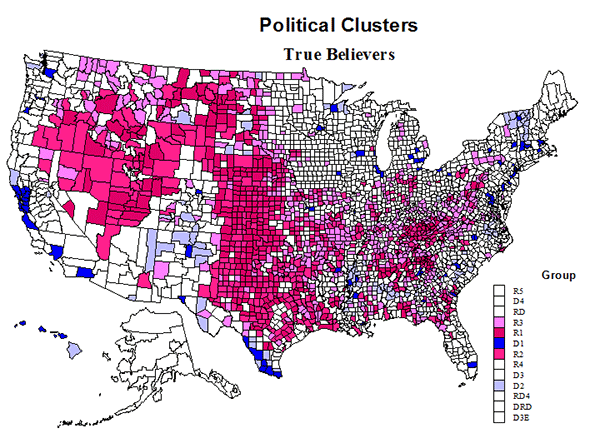
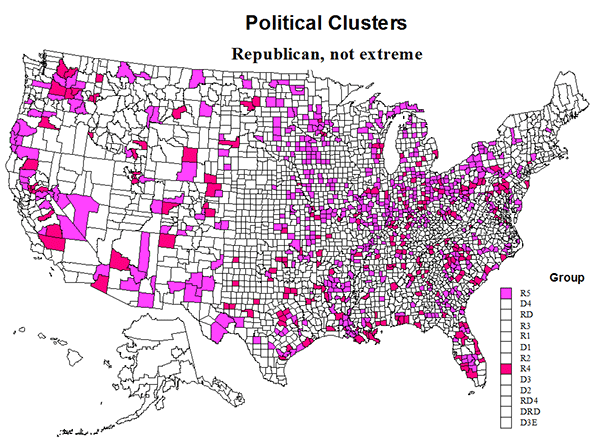
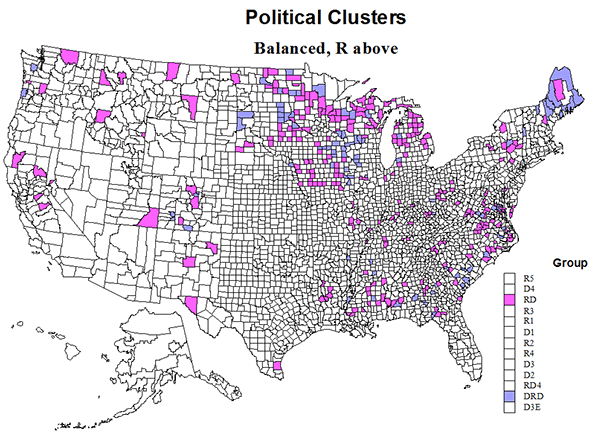
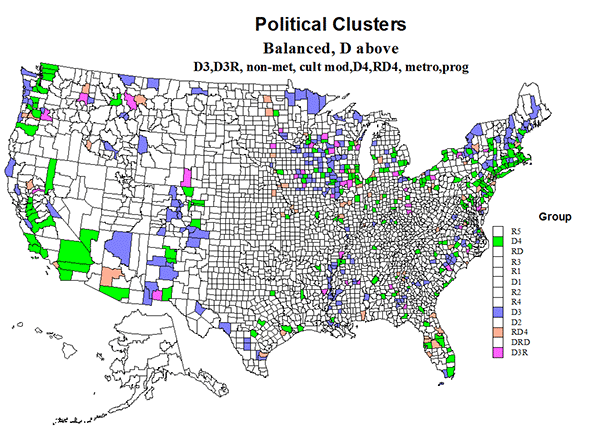
    We locate these groups on four maps, one for True Believer counties of extreme polarization, two not extreme  but Republican leaning counties, two (with 4 sub-groups) that are majority Democratic, and one (with two subgroups) that is majority Republican. 

    Population, votes for Obama and Romney, and values for political character are summarized in Table 1.  The table numbers should surprise many readers. True believer America is hugely important to the parties, especially the Democrats, (and symbolically for Republicans?), but contain just 103 million people and 41 million voters, about one-third of the total.

    Clusters of US Counties on Presidential Politics, 2008-2012
    Group # of Counties % Obama 2012 Settlement Pattern Culture Race Obama vote Romney D Margin Population (Thousands)
    D1 104 72 Lg met Prog + 47           19,600           7,077          12,523                68,307
    D2 112 70 non-met moderate 56                 820               353                467                   2,776
    D extreme 216 70 mixed high min           20,420           7,430          12,990                71,083
    R3 506 32 rural Cons+ 13             1,342           2,791          (1,449)                10,034
    R2 454 25 non-met Cons  21             1,737           5,297          (3,560)                17,920
    R1 340 18 rural Cons + 25                 323           1,587          (1,264)                   4,164
    R extreme 1300 26 rural, non-met Cons  low             3,402           9,675          (6,273)                32,118
    All True Bel 1516 58 all           23,827         17,105            6,722              103,201
    R5 528 40 Non-met moderate 19             3,944           5,777          (1,833)                23,231
    R4 278 36 Larg met moderate 21             6,774         11,581          (4,867)                44,727
    R not extreme 806 37 mix moderate 20           10,718         17,358          (6,640)                67,958
    D3 194 56.5 non-metro mod to pro 21             2,227           1,727                500                   8,723
    RD3 38 49 non-metro mod to pro 28                 415               435                (20)                   2,033
    D3 total 232 55 non-metro 22             2,642           2,162                480                10,756
    D4 194 56 large  met Prog+ 30           22,573         17,792            4,780                95,835
    RD4 68 47.3 Prog+ 24             4,677           5,358             (681)                24,865
    RD total 262 54 Prog+ 29           27,250         23,150            4,100              120,700
    R>D 244 45.2 rural Mod to cons 19                 946           1,486             (540)                   4,574
    DR>D 92 53.6 rural Mod to cons 21                 454               396                  58                   1,814
    R>D total 344 rural Mod to cons 19             1,400           1,882             (482)                   6,388
    All balanced 830 54           31,262         26,194            5,068              137,844
    All D 62.5 metro dominated           45,674         27,335          18,379              177,455
    All R 37 nonmet dominated           20,155         34,312       (14,157)              131,548
    All groups 51.6           65,832         61,647            4,185              309,003


    Another 68 million people and 28 million voters are in strong Republican areas, which, together with the true believer Republican areas, give the GOP dominance in counties with 100 million people and 41 million voters—about one-third of the total. This is higher than the strongly Democratic core areas with 71 million people and 28 million voters.

    But the really interesting story is about the remainder of the country, which we argue is somewhat balanced, with 137 million people (44%) and 57 million voters (45%). These are significant and meaningful battleground territories, and a warning to both parties to be more careful in proclaiming long term dominance. But it is true that the total population in Democratic majority groups totals 177 million, compared to 132 million for the Republican clusters, and thus the basis for a Democratic net margin in 2012.   

    We will discuss the variable settlement and cultural characteristics of the clusters through an analysis of the four maps.

    True Believers

    OK here is the quintessential polarization! Between areas of concentrated blue. Group D1 is mainly in large metropolitan cores, especially on the two coasts – the northeastern Megalopolis, and Los Angeles, San Francisco, Portland and Seattle, but also Chicago, Detroit, Minneapolis, plus a few ethnic minority areas, as along the border with Mexico, and noted in the table as metropolitan, high in minorities, and culturally progressive. Cluster D2 is smaller, non-metropolitan, majority minority, culturally moderate, and primarily with black, Hispanic or Native American settlement, but with a different sub-set of counties in Vermont, upstate New York, and in environmental recreation areas in the west. These tilt more progressive.

    The contrast with the true believer Republican clusters is profound. R1 and R2 are the most conservative, mainly rural and non-metropolitan respectively, and tend to occupy the same areas, dominating huge portions of two realms: the western high plains from Texas to North Dakota, and the extended Mormon region, centered on Utah but stretching to neighboring states. In addition, there are  some added counties in Appalachia and into the south.  R3 counties are as conservative and also rural, and are found mainly in Appalachia, Missouri (Ozarks) and in a far north belt from the Dakotas to eastern Washington. These true believer red counties constitute over half of US counties, and almost half the territory, but have only 11 percent of the population.

    The strongly Republican , yet less extreme counties have a very different geography. They do tend to occur together, embracing many smaller metropolitan areas, together with adjoining non-metro counties. They tend to be culturally moderate, and much more populous than the extreme R1 to R3 groups, with 68 million people, and as important to Republican margins. They are most prevalent across the west and “the north of Appalachian north —  OH, IL, MI, IN, WI, MO, and MN — than in metropolitan and suburban areas in the south, notably FL, NC, SC, LA, and TX, and then in the less or smaller metropolitan west.

    The more balanced counties have 138 million people, and provided a small but critical margin for Obama in 2012, with 106 million in the D majority groups, and 32 million in the R majority groups.

    The Republican majority balance group RD is rural and moderately conservative. They are most prevalent across the northern edge of the country from Maine to MI, WI, MN, and IA  to the Dakotas, a historically moderate area, with scattered exurban and rural areas in the west (mainly R carried) and scattered across the south from LA to VA (also mainly R carried)

    The Democratic majority balanced groups D4 and D3 are quite varied, almost a prototype of the US average! The D3 counties are mainly non-metropolitan, and moderate to progressive. The D and R carried counties tend to be intermingled. These counties are most prevalent in the “old” north from MN and IA to northern New England, but also fairly common in the Rockies and along the Pacific coast. Many of these counties were and even still are resource-oriented, and many have become exurban professional and/or environmental amenity dependent (CO, CA, WA, ID, NM, ME, NH).  

    The D4 group is larger and less dominantly Democrat carried. It is mainly larger metropolitan and culturally progressive, but not as strongly Democratic as the D1 counties. The difference is that many are smaller, often “satellite” metropolitan areas, or suburban-exurban counties, as along the Pacific coast, in Florida and Megalapolis. Many were counties that were historically Republican but have become increasingly socially liberal,   experiencing declines in the Republican margins. Notable are big areas like San Diego, Riverside-San Bernardino, Phoenix, Dallas, Houston, suburban Denver, and suburban-exurban NJ, NY, and CT.

    The balanced counties would seem difficult for a very conservative “Tea party” candidate, and good for Hilary Clinton, but could possibly revert to Republican with a more mainstream candidate. Thus it is premature to write off the long term Republican prospects. Both parties have a long history of decline and resurgence.  If mainstream Republican leaders can restrain the extreme conservatives, then there is at least some prospect of a serious realignment, with perhaps four parties for a transition period, the Tea Party, a Business party, a Green party (progressive environmentalists), historically liberal Republican, and dare I hope, a (social) Democratic party? Bring back economics and this could happen.

    Richard Morrill is Professor Emeritus of Geography and Environmental Studies, University of Washington. His research interests include: political geography (voting behavior, redistricting, local governance), population/demography/settlement/migration, urban geography and planning, urban transportation (i.e., old fashioned generalist).

  • Can Singapore Thrive After Lee Kuan Yew?

    On Sunday, Singapore cremates its greatest leader, the late Lee Kuan Yew, architect of its good fortunes. Yet the flames also could extinguish the era of relentless social and economic progress that Lee ushered in during his long, amazingly productive life.

    World leaders, corporate hegemons, and much of the foreign policy establishment tend to worship Lee’s achievements. But the view from on high, not to mention across the seas, can be quite different from the reality on the ground, as I have learned over many trips to this most remarkable city-state.

    Lee is rightly celebrated for his remarkable success in transforming a poor, southeast Asian metropolis into one of the wealthiest and most productive places on the planet. At the time of its independence in the mid-’60s, Singapore was a corrupt, dirty, and divided Asian metropolis, with a GDP of roughly $2,600 per capita, which put it ahead of China and most of its southeast Asian neighbors but below such countries as the Philippines, Brazil, Yugoslavia, Bolivia, and Argentina, and several times lower than Greece, Spain, and the United Kingdom.

    Uncontestable: A Record of Economic Achievement

    Under Lee and his cadre of well-educated, thoughtful civil servants, the tiny 225 square mile island republic has created arguably the best run and most successful dense urban place on the planet. Today the city-state has a per capita GDP estimated at $55,000, according to the U.S. Bureau of Labor Statistics, above the U.S. level and well ahead of Japan, Germany, and France, as well as its old colonial master, Great Britain.

    Lee got there by having goals but being pragmatic about how to achieve them. He was what one observer called “a patient revolutionary,” a Fabian socialist whose underlying ideology can be boiled down to “what works.” This pragmatism was evident in economic policy, as the country focused first on trade and manufacturing and then towards a greater orientation to technology and high-end services.

    Education was a critical component, and from the start it was seen as the primary way to build both the state and the economy. This policy has resulted in a high proportion of technically trained professionals, leading the Center on International Education Benchmarking Education to call Singapore’s workforce “among the most technically competent in the world. Unlike many places in the developing world, Singapore knows it must compete primarily on quality, not price.”

    Perhaps the most critical aspect of Lee’s success, and that of his successors, was the ability to meet the requirements of multinational companies. Designating English as the national language  was a primary advantage. Due largely to Lee, Singapore is a primarily English-speaking country, and global business tends to go where it is understood, and where its nationals can most easily function.   

    As a result, efficient, globally focused Singapore now boasts more than twice as many regional headquarters of foreign firms than far-larger Tokyo, not to mention Asia’s less affluent megacities. They provide expats working for multinationals with sanitation, parks, trees, clean housing, an educated workforce, and low corruption not readily available in the rest of south Asia. Anyone who has spent time in India, or even Vietnam, marvels at the relative ease of life in Singapore.

    The Limits of Globalization

    Yet with wealth have come new problems that are not widely acknowledged outside the city-state. The influx of foreigners has made property owners wealthier, but many feel it also has eroded local culture. Its benefits to ordinary Singaporeans are increasingly dubious. Even as GDP growth continues to chug at somewhat close to 5 percent per annum,   real wages for ordinary Singaporeans have stagnated. From 1998 to 2008, the income of the bottom 20 percent of households dropped an average of 2.7 percent, while the salaries of the richest 20 percent rose by more than half. 

    For many Singaporeans, discontent has led them to consider a move elsewhere. Already some 300,000 citizens now live abroad, almost one of ten. As many as half of Singaporeans, according to a recent survey, would leave if they could.

    The Shrinking Family

    Arguably the biggest threat to Singapore’s future is occurring in the country’s bedrooms.     As Lee was himself aware, Chinese civilization was built around a large extended family, often with several generations under the same roof. In the Chinese tradition, “regulating the family” was seen as critical to both “ordering the state” and pacifying the world.

    As the Chinese began to spread to Southeast Asia and beyond, they carried elements of this family-centric culture with them. Kinship ties, according to the sociologist Peter Berger, constituted “the absolutely central institution” of overseas Chinese businesses in the Americas, Europe, Africa, and Australia. In Singapore this familial situation propped up the hierarchy of the state; Lee, in a sense, was the father of all Singaporeans while the bureaucracy played the role of “tiger moms,” cajoling, instructing, demanding ever better results from their charges.

    Yet this familial-based system is clearly breaking down. This is reflected by the decision of   more Singaporeans not to have offspring. Indeed today Singapore has one of the world’s lowest fertility rates; and more young people are postponing or completely avoiding marriage (children out of wedlock remain very rare). The fertility rates in Singapore have fallen almost 50 percent below the replacement rate of 2.1. Overall, Singapore-based demographer Gavin Jones estimates that up to a quarter of all East Asian women now entering their 20s—including those in Singapore—will still be single by age 50, and up to a third will remain childless. 

    “People increasingly see marriage and children as very risky, so they avoid it,” notes Singapore based demographer Gavin Jones. “Even though there’s a strong ideology in Asia to have a family, it is fading.”

    The Spiritual Crisis

    Jones and others see this trend as something of a spiritual crisis, coupled with high housing prices and an overemphasis on work. In the old Chinese world, children were seen as essential to economic stability and social status. Now those values have drowned in a tsunami of materialism and global culture.

    “My father was from the old generation,” says Singapore pastor Andrew Ong. “He came from a family of 16. Now people’s priorities have changed. They don’t really believe in sacrifice and family. They want the enjoyment of life, and children would impinge on that … they don’t value family and children the way we used to.”

    In interviews, young Singaporeans often express the decision not to have children in very pragmatic  terms. “Having kids was important to our parents,” noted one 30-something civil servant in Singapore, “but now we tend to have a cost and benefit analysis about family. The cost is tangible but the benefits are not knowable or tangible.”

    The links among housing prices, work competition, and the decision not to have families was repeatedly mention by young people in Singapore. As one young civil servant told me, “I feel Singapore is becoming more stressful—people are living in smaller spaces. There’s no room for a child. The costs are tremendous. A generation ago, it was different. My father was a bus driver and could get a big HDB [Housing Development Board] flat. For my generation, it will be harder.”

    Demographer Jones also links the low marriage and birth rates in part to extreme competition that forces people to work long hours. Despite successes over the past few decades, the degree of economic uncertainty has grown considerably in successful Asian countries, all of them faced with increased competition from the behemoths of India and China. Faced with these challenges, Singapore employers, Jones reports, remain “generally unforgiving of the divided loyalties inherent in the effort to combine child-raising with working.”

    Such pressures were repeatedly reported in interviews with younger Singaporeans. “People are consumed by their work,” one young Singaporean told me. “There’s a lack of time. You would expect nature will take care of this but it doesn’t.”

    These same phenomena can be seen in all the densest cities of Asia, from Tokyo and Seoul to Shanghai. The very work culture that is so impressive to foreign companies has had a very direct impact on family and society. “The focus in Singapore is not to enjoy life, but to keep score: in school, in jobs, in income,” noted one 30-year-old scholar at the NUS Institute for Policy Studies. “Many see getting attached as an impediment to this.”       

    The biggest impact on these change has been among  women, who are playing an increasingly critical role in the local economy. Although most senior executives in the government and outside are male, the middle ranks, and many of the fastest up and comers, are female. Demographer Wolfgang Lutz notes that while Singapore may have strong pro-natalist policies, it still operates an economic system that encourages, even insists on, long hours for employees, many of whom are women. Singapore’s labor force participation rate for women is almost 60 percent. “In Singapore,” Lutz points out, “women work an average of 53 hours a week. Of course they are not going to have children. They don’t have the time.”

    The danger of a ‘now’ society

    The tendency to put off marriage and child-bearing, as well as the focus on material gain,     works against the fundamental values of patience and persistence that animated Lee Kuan Yew’s career, and also shaped Chinese civilization. A society that is increasingly single and childless is likely to be more concerned with serving current needs than addressing the future. Like other societies, Singapore can tilt more into a “now” society, geared towards consuming or recreating today, as opposed to nurturing and sacrificing for tomorrow.

    These problems, of course, exist across the high-income world, but in Singapore, given its small space and its unfriendly neighborhood, the stakes are higher. After all, there is no suburbia for families to flee to, and there is no Texas to balance off the problems of an over-expensive New York or San Francisco. Singapore’s miracle, as Lee knew, was always a fragile one, and may become more so in the years after his passing.

    This piece first appeared at The Daily Beast.

    Joel Kotkin is executive editor of NewGeography.com and Roger Hobbs Distinguished Fellow in Urban Studies at Chapman University, and a member of the editorial board of the Orange County Register. He is also executive director of the Houston-based Center for Opportunity Urbanism. His newest book, The New Class Conflict is now available at Amazon and Telos Press. He is also author of The City: A Global History and The Next Hundred Million: America in 2050.  He lives in Los Angeles, CA.

    Photo: “Lee Kuan Yew” by Robert D. Ward – Cropped by Ranveig from defenselink.mil. Licensed under Public Domain via Wikimedia Commons.

  • California Dreamin’ or California Nightmare?

    Our recent report on “California Social Priorities” — released by Chapman University’s Center for Demographics and Policy and the topic of the first meeting of the Houston based Center for Opportunity Urbanism — stirred up some controversy. A largely negative response came from Josh Stephens from the California Planning and Development Report.

    As a lifelong Democrat, granddaughter/daughter/sister/aunt of union members working in the steel and construction trades, major contributor and multi-decade Board member of several California environmental advocacy organizations, top-ranked California environmental and land use lawyer and recipient of the California Lawyer of the Year award for environment and land use work, and Latina asthma-sufferer who grew up in Pittsburg, California amidst factories that belched pollution into our air and waters, I need to first take exception to the author’s apparent assumption that anyone publishing a thoughtful report with accurate data about California’s acute social needs (income inequality, middle-class job loss, educational non-attainment) is a “conservative” with a “hate on CEQA in much more vague ways.” (Indeed, none of the individuals cited by the author fit the derisive (in much of California) “conservative” label: Both David Friedman and Joel Kotkin worked at the Progressive Policy Institute, the think tank for the Democratic Leadership Council when Bill Clinton was at the helm.) Dismissing uncomfortable demographic facts with politicized name-calling seems more about deflecting, rather than engaging, in what I believe is an entirely appropriate – and necessary – debate about how to address California’s social equity challenges in tandem with California’s environmental policies.

    I do agree with the author’s characterization that I am “an astute observer of, and enthusiastic participant in, the evolution of CEQA caselaw.” Defending CEQA litigation abuse, on behalf of our public and private sector clients, has been and continues to allow me – and a legion of other lawyers and consultants – to earn a generous income.

    I am also delighted that the California Planning & Development Report reported on our demographic analysis at all, because I believe those of us dealing with land use planning uses are long past due for a frank conversation about how the web we have created – the “we” being pro-environment, pro-labor Democrats of a certain age – has without question improved air and water quality, and protected California’s most valuable natural areas, but has also without question managed to dramatically and adversely affect the upward mobility and economic health of many millions of Californians. I believe we are still young enough, still energetic enough, and still creative enough, to work together to improve social equity and economic opportunity – without sacrificing our hard-won environmental improvements.

    I believe that part of the necessary solution, as acknowledged by scores of commenters and impartial observers including last week’s report from the Legislative Analyst’s Office explaining why California housing costs are so high, is modernizing CEQA. I have written extensively about CEQA. In an analysis of 15 years of reported appellate court EIR cases, for example, we learned that the vast majority of CEQA lawsuits challenged non-industrial “infill” projects, renewable energy projects, and transit projects – precisely the types of projects that improve public health and environmental quality, and combat climate change.  This and related work – including widespread media reports of CEQA litigation abuse – calls into question whether CEQA is advancing, or obstructing, progress on today’s environmental challenges. I have too much personal experience as a lawyer with 30 years of experience with CEQA, and now as a researcher and CEQA reform advocate, to pretend that CEQA – and specifically CEQA’s litigation abuse – isn’t a major hurdle we need to discuss, and modernize.

    The author also criticizes this demographic report as failing to recommend specific CEQA reforms, but neither CEQA generally nor CEQA reforms specifically were the primary subjects of this Report. As many of CPDR’s readers well know, I have and continue to advocate for sensible and moderate CEQA reforms, like better integrating this 1970 statute into California’s panoply of modern environmental, public health and planning laws, prohibiting secrecy in CEQA lawsuits that try to conceal abuse of this great statute for non-environmental purposes, and extending to all projects – not just politically favored, donor-rich Sacramento basketball arenas – the right to cure minor errors in CEQA studies with a corrected study (and where appropriate more mitigation) rather than derailing a project approval entirely because a judge decided to grade an EIR addressing more than 100 mandatory study topics with an “A-“ rather than an “A+”.

    One final note: I am not an expert on Prop 13, nor do I understand why curtailing then-skyrocketing property taxes on the elderly and poor – those losing their homes when Prop 13 was enacted – contributes to today’s income inequality or middle-class job loss challenges. CEQA litigation abuse for non-environmental purposes, in contrast, has earned widespread recognition – by the Governor, by Bill Fulton’s (CPDR’s publisher) CPDR blog, and by every editorial page of every major newspaper in California, to name just a few – as a problem. Notwithstanding Mr. Fulton’s pessimistic assessment that special interests are too wedded to CEQA abuse to ever permit Legislative reform, I believe land planners and environmental advocates have a moral obligation to improve what we know (including CEQA) to address the terrible social inequality that has grown so pervasive in California.