Category: Politics

  • Lobbying Pays Off 500-to-1

    I suppose we should not be shocked: businesses that spend money for lobbying and campaign contributions get more favors from government than those that do not. I spent the weekend at Creighton University in a seminar sponsored by the Institute for Humane Studies. I asked Creighton Associate Professor of Economics Diana Thomas about her research on the unintended consequences of regulation. One thing led to another and the next day I downloaded her 2013 paper “Corporate Lobbying, Political Connections, and the Bailout of Banks.” Here is a summary of what can be supported with scientific (statistical) evidence about the influence of big money on big government:

    • Campaign contributions and lobbying influence the voting behavior of politicians.
    • Campaign contributions and lobbying have a positive effect on wealth for the shareholders of the companies that spend.
    • Businesses that pay lobbyists before committing fraud are 38% less likely to get caught; even when they get caught they are able to evade detection almost 4 months longer than those that do not pay for lobbying.
    • Firms with political connections are more likely to receive government bailouts in times of economic distress.

    The US government has a long history of bailing out private industry. In 1970, the Federal Reserve provided financial support to commercial banks after Penn Central Railroad declared bankruptcy. Throughout that decade federal financial support was provided to private companies, banks and municipal governments: Lockheed, ($1.4 billion) Franklin National Bank ($7.8 billion) and New York City ($9.4 billion) were all recipients Uncle Sam’s largess. In the1980s, it was Chrysler Motors ($4.0 billion), Continental Illinois National Bank ($9.5 billion) and the savings and loan industry ($293.3 billion). The data available at OpenSecrets.org doesn’t go back further than 1990, but last year the finance industry spent nearly half a billion dollars on lobbying and campaigns – the most of any industry sector. Just after the terrorist attacks of September 11, 2001, the airline industry received $5 billion in compensation and $10 billion in federal credit. For these favors, the airlines spent barely $15 million in 1996-2000.

    These are all pittances in comparison to the money handed out in 2008 and 2009. NewGeography readers know that the average member of Congress who voted in favor of the $700 billion Bank Bailout received 51% more campaign money from Wall Street than those who voted no – Republicans and Democrats alike. The main finding in Dr. Thomas’ paper is that banks that paid lobbyists and made political campaign contributions were more likely to receive TARP money. To put a fine point on it, for every dollar spent lobbying in the 5 years before the bailout, banks averaged $535.71 in TARP bailout money! We knew the bank bailout was rigged, but that is a better rate of return than even Warren Buffett got for his contribution to the bailout of Goldman Sachs.

    The only good news is that spending – at least the spending that can be tracked – was down in 2014 from 2013. Spending by most industry categories has been in general decline since 2010. Between Congress and the Federal Reserve, businesses benefited from an estimated $16 trillion in government assistance since 2008. They are either having a “why bother” moment or the 2016 Presidential election will be another record breaking year for campaign spending.

  • California Should Make Regular People More of a Priority

    California in 1970 was the American Dream writ large. Its economy was diversified, from aerospace and tech to agriculture, construction and manufacturing, and allowed for millions to achieve a level of prosperity and well-being rarely seen in the world.

    Forty-five years later, California still is a land of dreams, but, increasingly, for a smaller group in the society. Silicon Valley, notes a recent Forbes article, is particularly productive in making billionaires’ lists and minting megafortunes faster than anywhere in the country. California’s billionaires, for the most part, epitomize American mythology – largely self-made, young and more than a little arrogant. Many older Californians, those who have held onto their houses, are mining gold of their own, as an ever-more environmentally stringent and density-mad planning regime turns even modest homes into million-dollar-plus properties.

    What about California society as a whole? The Chapman University Center for Demographics and Policy released a report this month, by attorneys David Friedman and Jennifer Hernandez, on “California’s social priorities.” It painstakingly lays out our trajectory over the past 40 years. For the most part, it’s not a pretty picture and – to use the most overused word in the planning prayer book – far from sustainable from a societal point of view.

    Read the full article at The Orange County Register.

    Joel Kotkin is executive editor of NewGeography.com and Roger Hobbs Distinguished Fellow in Urban Studies at Chapman University, and a member of the editorial board of the Orange County Register. He is also executive director of the Houston-based Center for Opportunity Urbanism. His newest book, The New Class Conflict is now available at Amazon and Telos Press. He is also author of The City: A Global History and The Next Hundred Million: America in 2050.  He lives in Los Angeles, CA.
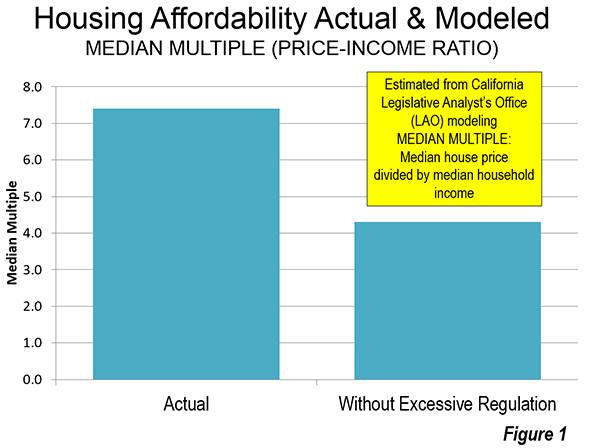
    Photo by Thomas Pintaric (Own work) [GFDL or CC-BY-SA-3.0], via Wikimedia Commons

  • How the California Dream Became a Nightmare

    Important attention has been drawn to the shameful condition of middle income housing affordability in California. The state that had earlier earned its own "California Dream" label now limits the dream of homeownership principally to people either fortunate enough to have purchased their homes years ago and to the more affluent. Many middle income residents may have to face the choice of renting permanently or moving away.

    However, finally, an important organ of the state has now called attention to the housing affordability problem. The Legislative Analyst’s Office (LAO) has published "California’s High Housing Costs: Causes and Consequences," which provides a compelling overview of how California’s housing costs have risen to be by far the most unaffordable in the nation. It also sets out the serious consequences.

    The LAO says that:

    Today, an average California home costs $440,000, about two-and-a-half times the average national home price ($180,000). Also, California’s average monthly rent is about $1,240, 50 percent higher than the rest of the country ($840 per month).

    LAO describes the evolution:

    Beginning in about 1970, however, the gap between California’s home prices and those in the rest country started to widen. Between 1970 and 1980, California home prices went from 30 percent above U.S. levels to more than 80 percent higher. This trend has continued.

    Much of the LAO focus is on California’s coastal counties, where:

    ….community resistance to housing, environmental policies, lack of fiscal incentives for local governments to approve housing, and limited land constrains new housing construction.

    These causes result from conscious political decisions. While California’s coastal counties do not have the vast stretches of flat, appropriately developable land that existed 50 years ago, building is increasingly  prohibited on that which remains (for example, Ventura County, northern Los Angeles county and the southern San Jose metropolitan area).

    Demonstrating an understanding of economic basics not generally shared by California policymakers or the urban planning community, LAO squarely places the blame on the public policy limits to new housing construction:

    This competition bids up home prices and rents.

    In other words, where the supply of a demanded good is limited, prices can be expected to rise, other things being equal. LAO describes the impact of so-called "growth control" policies, which are also called "urban containment" or "smart growth:"

    Many Coastal Communities Have Growth Controls. Over two-thirds of cities and counties in California’s coastal metros have adopted policies (known as growth controls) explicitly aimed at limiting housing growth. Many policies directly limit growth—for example, by capping the number of new homes that may be built in a given year or limiting building heights and densities. Other policies indirectly limit growth—for example, by requiring a supermajority of local boards to approve housing projects. Research has found that these policies have been effective at limiting growth and consequently increasing housing costs.

    According to LAO, the problem is exacerbated by voter initiatives: "More often than not, voters in California’s coastal communities vote to limit housing development when given the option." It is hard to imagine a more sinister disincentive to aspiration, under which voters can deny equality of opportunity in housing to others by artificially driving up the price.  Because new housing further from coast is also limited, options for a middle income living standard are also diminished.

    These public policies have consequences.

    Notable and widespread trade-offs include (1) spending a greater share of their income on housing, (2) postponing or foregoing homeownership, (3) living in more crowded housing, (4) commuting further to work each day, and (5) in some cases, choosing to work and live elsewhere

    Each of these consequences is described below.

    LAO Consequence #1: Spending a Greater Share of Income on Housing

    LAO models the market situation from 1980 to 2010 to estimate the prices that would have prevailed if the regulatory environment had permitted building sufficient to satisfy customer demand at previous lower price levels. In both years, LAO estimates that the median priced house would have cost 80% more than in the rest of the nation (actual data in 1980, modeled data in 2010). This would have kept California house price increases at the national level. I think it would have been better to have modeled from 1970, before the huge house prices before 1980 described by Dartmouth economist William Fischel.

    I have applied this LAO model estimate to the median multiple for California’s six major metropolitan areas (Los Angeles, San Francisco-Oakland, Riverside-San Bernardino, San Diego, Sacramento, and San Jose) to identify how much better middle income housing affordability would be without California’s excessive regulation. Using the LAO estimates the median multiple (median house price divided by median household income) in 2014 would have been at least 40% lower than the actual level in each of the metropolitan areas (Figure 1).

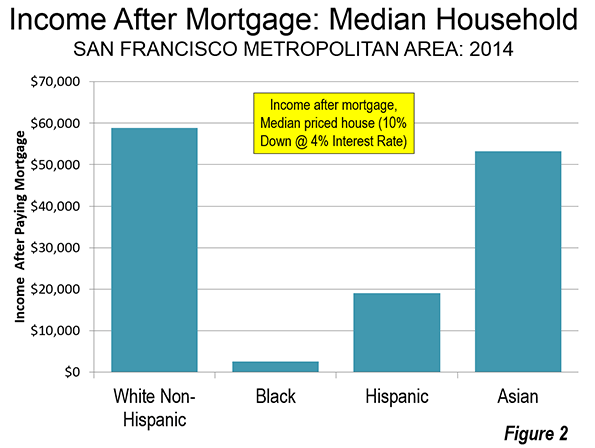
    Many California households already have been priced out of the market. In the worst case, it is estimated that in the San Francisco metropolitan area, a median income White Non-Hispanic household will have nearly $60,000 annually left over after paying the mortgage on the median priced house. This is less than they would have if house prices had remained reasonable, but it’s enough to live on. The median income Asian household would do almost as well, with about $50,000 left over. The median income Hispanic household would have less than $20,000 left, which is considerably less than is likely to be needed for other essentials. The median income Black household would have less than $3,000 left over (Figure 2). If the price ratios of 1980 were controlling, that amount would rise by $16,000.

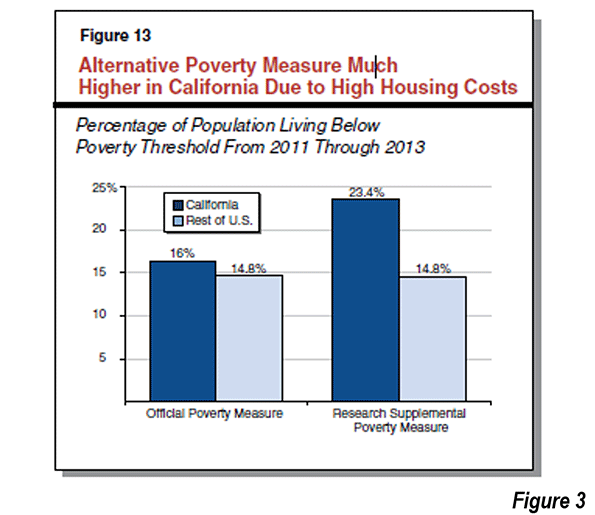
    LAO also points out that the Golden State has the highest housing cost adjusted poverty rate in the nation. The latest data shows housing-adjusted poverty rate is far higher even than that in states with a reputation for grinding poverty. California’s housing adjusted poverty rate is more than 50% higher than that of Mississippi and approaches double that of West Virginia (Figure 3, LAO Figure 13)

    LAO Consequence #2:  Postponing or Forgoing Homeownership

    LAO indicates that California ranks 48th in homeownership percentage, behind only New York and Nevada. LAO emphasizes the value of home ownership:

    Homeownership helps households build wealth, requiring them to amass assets over time. Among homeowners, saving is automatic: every month, part of the mortgage payment reduces the total amount owed and thus becomes the homeowner’s equity. For renters, savings requires voluntarily foregoing near-term spending. Due to this and other economic factors, renter median net worth totaled $5,400 in 2013, a small fraction of the $195,400 median homeowner’s net worth.

    Californians are buying their first houses later. LAO indicates that the average first home buyer in California is three years older than the national average.

    LAO Consequence #3:  Living in More Crowded Housing

    The nation’s worst overcrowding is an unfortunate result of California’s housing policies.

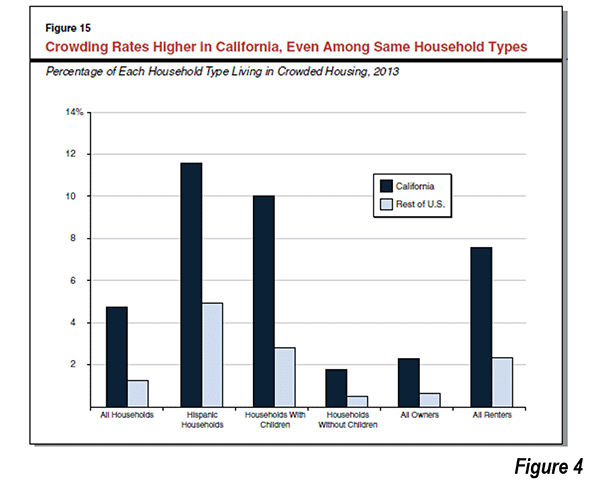
    LAO indicates that California’s overcrowding rate is well above that of the rest of the nation’s rate. Among Hispanics, which were expected to exceed the White-Non-Hispanic population in 2014, to become the state’s largest ethnic group, California overcrowding is more than 2.5 times the Hispanic rate elsewhere. Among households with children, overcrowding in California is four times the national households with children rate. Among renters, overcrowding in California is more than three times the national renter rate (Figure 4, LAO Figure 15).

    This has important negative social consequences. According to LAO, research indicates that overcrowding retards well-being and educational achievement:

    Individuals who live in crowded housing generally have worse educational and behavioral health outcomes than people that do not live in crowded housing. Among adults, crowding has been shown to increase stress and aggression, lead to social isolation, and weaken relationships between parents and their children. Crowding also has particularly notable effects on children. Researchers have found that children in crowded housing score lower on standardized math and reading exams. A lack of available and distraction-free studying space appears to affect educational achievement. Crowding may also result in sleep interruptions that affect mood and behavior. As a result, children in crowded housing also displayed more behavioral problems at school.

    Overcrowding is particularly acute in the higher cost coastal metropolitan areas of Los Angeles, San Francisco, San Diego, and San Jose. There, overcrowding among households with children reaches 10%, and among Hispanic households, overcrowding reaches 18%. Among households with children the figure is slightly higher (Figure 5, LAO Figure 16). Overcrowded housing is generally worse, according to LAO, in areas with higher house prices.

    In a state with a political establishment that prides itself in watching out for low income citizens and ethnic minorities, the need to reform the responsible policies could not be clearer.

    LAO Consequence #4: Commuting Farther to Work

    LAO finds that California’s average work trip commuting times are only moderately above the national average. However, LAO suggests that the commute lengthening impact of higher house prices may be reduced by California’s widespread (I call it dispersed) development pattern, its freeway system and the "above-average share of commuters who drive to work. (Driving commutes are generally fast, and therefore metros with higher shares of driving commuters tend to have shorter commute times.)"

    Nonetheless, according to LAO:

    …our analysis suggests that California’s high housing costs cause workers to live further from where they work, likely because reasonably priced housing options are unavailable in locations nearer to where they work.

    LAO Consequence #5:  Choosing to Work and Live Elsewhere

    LAO also indicates that California’s high housing prices are likely to have reduced its population (and economic) growth. LAO sites the strong net outmigration of California households to other states. LAO also finds in its national metropolitan area analysis that counties with higher growth rates tend to have better housing affordability than counties with lower growth rates.

    There has also been strong net outmigration from the coastal counties to inland counties. This is most evident in the growth of the Riverside-San Bernardino metropolitan area (the Inland Empire) between 2000 and 2010. The Inland Empire captured more than two thirds of the population growth of the Los Angeles Combined Statistical Area (Los Angeles, Orange, Riverside, San Bernardino and Ventura counties). LAO notes the impact of the excess of demand in the coastal counties, again recognizing the nexus between overzealous regulation and the loss of housing affordability:

    This competition bids up home prices and rents. Some people who find California’s coast unaffordable turn instead to California’s inland communities, causing prices there to rise as well.

    LAO also refers to the difficulty that employers have in retaining and recruiting staff. LAO cited survey data from the Silicon Valley, which has for years been California’s economic "Golden Goose" in recent years:

    In a 2014 survey of more than 200 business executives conducted by the Silicon Valley Leadership Group, 72 percent of them cited “housing costs for employees” as the most important challenge facing Silicon Valley businesses.

    In addition, there has been a strong movement of California companies to other parts of the nation, where more liberal regulations foster a better business climate.

    Restoring Housing Affordability

    LAO indicates the importance of fundamental reform and calls for putting "all policy options on the table."

    Major changes to local government land use authority, local finance, CEQA (California Environmental Quality Act), and other major polices would be necessary to address California’s high housing costs.

    In addition:

    The greatest need for additional housing is in California’s coastal urban areas. We therefore recommend the Legislature focus on what changes are necessary to promote additional housing construction in these areas.

    Perhaps the only weakness of the report deals with densification, particularly in coastal counties. For example, LAO suggests that without the housing restrictions the city of San Francisco is population would be 1.7 million, rather than the approximately 800,000 who live there today. In fact that would be unprecedented beyond belief. No core city that had become fully developed and reached 500,000 people by 1950 has achieved growth of this magnitude. The greatest growth was less than 10%, in this category of 60 core cities (which includes the city of San Francisco). Even less likely would be public support for such huge population growth in the second densest major municipality in the nation.

    While LAO does not indicate the additional population that its estimates would have placed in the core of Los Angeles, given the scale of the San Francisco increase, this could be a number of up to 3 million. This area, the broadest expanse of over 10,000 population per square mile density in the nation outside New York City is in the middle of the urban area with the nation’s worst traffic congestion, according to the Texas A&M Transportation Institute. It is doubtful that residents would have the "stomach" to expand roadway capacity to keep the traffic moving. Transit could not have made much difference. Even with its now extensive rail network that has opened since the early 1990s, driving alone accounted for 85% of the additional travel to work from 2000 to 2013 in the city of Los Angeles. Yet, the city of Los Angeles has the most extensive transit in the metropolitan area, including service by all rail lines.

    In reality, core densification is likely to be modest. Keeping housing affordability from getting worse requires regulatory liberalization throughout California, including coastal and inland areas
    The reality is that if California had permitted growth, it would naturally occurred mostly on the periphery. Even with the restrictions on building, the preference for suburban living (largely in detached housing) could not be repressed between 2000 and 2010. Less than 10% of the population growth in the Los Angeles and San Francisco Bay areas occurred in the cores.

    The Challenge

    Should the state of California begin to seriously discuss housing affordability, it will be important to ease restrictions throughout the state, not just in the coastal counties. There are serious barriers to placing the appropriate priority on improving the standard of living and minimizing poverty rates among California’s diverse population. Perhaps the biggest impediment is Senate Bill 375, which is being interpreted by the state and its regional planning agencies to require even more stringent land-use regulation.

    In this environment, LAO rightly raises this concern:

    If California continues on its current path, the state’s housing costs will remain high and likely will continue to grow faster than the nation’s. This, in turn, will place substantial burdens on Californians—requiring them to spend more on housing, take on more debt, commute further to work, and live in crowded conditions. Growing housing costs also will place a drag on the state’s economy.

    It is to be hoped that California’s distorted policy priorities will be righted to restore the California Dream.

    Photograph: Dense suburban development: Inland Empire (San Bernardino Freeway with Uplard toward the top and Ontario toward the bottom) – By author

    Wendell Cox is an international public policy consultant and principal of Demographia in St. Louis. He is a native Los Angelino, having been born within two miles of City Hall. He was appointed to three terms on the Los Angeles County Transportation Commission by Mayor Tom Bradley. Full biography is here.

  • Singapore After Lee Kuan Yew: Future Is Uncertain For The Utilitarian Paradise He Created

    In this age of political Lilliputians, we must acknowledge the passing of giants. Although he ran only a small city-state, Lee Kuan Yew, along with late Chinese Premier Deng Xiaoping, ranks among Asia’s most pivotal figures of the past 50 years.

    These two men — a tall, aristocratic scion of a Hakka trading family and the diminutive Chinese revolutionary — came from very different perspectives, but shared a pragmatic streak, and ultimately strategies that came to be widely copied. You can see their legacy today across the continent, in rapid urbanization and growing economic power.

    But it was Lee who first formulated the essentials of the new Asian economic approach, blending capitalistic modernity with a state-directed economy and authoritarianism. Although repression of dissidents in both countries rightfully offends Westerners, particularly journalists, it has not deterred foreign capital, technology and capital from seeking to cash in on Asia’s growth.

    American and British capital may have fueled global capitalism’s 20th century triumph, but Lee and Deng shaped its expansion in the 21st.

    Lee’s Achievement

    This is not merely a testament to Lee’s tenure as prime minister from 1959 to 1990, the longest of any in world history, but the singularity and durability of his accomplishment. From Singapore’s independence to the present day, Lee helped fashion what is arguably the most successful and best run city in the world.

    In 1965, after Singapore’s acrimonious exit from Malaysia, its outlook was far from promising. Unemployment was high and the fledgling city-state was wracked by internal dissension between its ethnic mix of Chinese, Indians and Malays, and between conservatives and communists, who seemed in political ascendancy as elsewhere in Southeast Asia. The then rough-edged Asian metropolis, an important trading center, boasted a per capita GDP of$2,667 in 1990 dollars, more than double the average for East Asian countries and trailing only Japan in the region, but well behind European countries and North America.

    Faced with imminent disaster, Lee’s response was to create a new political system that blended a mildly socialist program with a development strategy aimed at attracting foreign capital and building up the manufacturing sector. Lee and his People’s Action Party (PAP) focused on developing a modern infrastructure — from the port and roads to education — that is second to none.

    Perhaps PAP’s most remarkable achievement was the creation of the Housing Development Board, which turned the vast majority of Singaporeans from slum-dwellers to owners of apartments that were small but clean and modern. As Asian real estate markets have heated up, HDB has helped keep Singaporean housing costs far more reasonable than in China’s primary cities, or Hong Kong or Tokyo.

    Lee believed widespread homeownership would make Singapore more stable, but it was not enough to make it rich. Under his guidance, everything — from cleaning the streets to developing arguably the best primary education system in the world — was calculated to attract foreign companies and skilled individuals; this at a time when China, India and much of Southeast Asia was either closed to investment, embroiled in lethal civic conflict or primarily dominated by crony capitalists.

    And the world did come, making Singapore among the favored destinations for international corporations. In 1968 Texas Instruments TXN +1.26% established a chip-making plant there, the break Lee later credited with helping transform the city into a technology hotspot.

    A 2011 Roland Berger study named Singapore as the leading location for European companies to establish headquarters in the Asia-Pacific region.Companies with regional headquarters include Microsoft MSFT +1.12%Google GOOGL +0.16%Exxon Mobil XOM +0.15%, and Kellogg’s. Singapore now has more than twice as many regional headquarters as far-larger Tokyo, not to mention Asia’s less affluent megacities.

    Lee’s Chinese Legacy

    Cambridge-educated, and with the demeanor of a British aristocrat, Lee promoted English as the country’s primary language, a decision that made the city particularly attractive to foreign investors and workers. But in many ways he remained very Chinese. Lee’s People’s Action Party blended British parliamentary forms with a highly authoritarian, centrally directed system. Author Alex Josey compared Lee’s role in the PAP to Mao Zedong’s suzerainty over the Chinese Communist Party.

    When Deng visited the city-state in 1978, he saw it as an appealing model for his poor country: a top-down, mandarin-led system that could appeal to global capitalists. Deng, Lee would later recall, was most captivated by Singapore’s modern prosperity: “What he saw in Singapore in 1978,” he recalled in his book Third World to First, “had become the point of reference as the minimum the Chinese people should achieve.”

    Anyone visiting China today can see the results of Deng’s insight: gleaming cities, massive expansion of educational institutions, modern roads and transit systems, and most of a general prosperity that has lifted the mother country of most Singaporeans to almost unimagined heights.

    The story is not so positive for those who believe in liberal democracy. Although Singapore is generally less repressive than China, it did show the Chinese communists that being “free” was not necessary for becoming rich. It’s a lesson that many developing countries around the world — in the Middle East, Africa and Latin America — have taken to heart.

    Singapore After Lee

    Lee bequeathed to Singapore prosperity and order, but the durability of his legacy is in question. To some extent, this reflects the technocratic cast of the Republic; Lee may have been a “founding father” of his country, but he did not leave behind a system of beliefs that can tie people together in the manner of George Washington & co. in the United States. Lee is revered simply for being effective.

    Indeed despite massive government efforts to promote a sense of identity, a recent survey found half of all Singaporeans indifferent to their citizenship as long as their wealth could be maintained. Stabilizing forces like religion and family, have also been weakened by the rush to embrace what former foreign minister S. Rajaratnam labeled “moneytheism.” The emptiness of this religion can be seen in the fact that residents of this highly successful city-state are now among the most pessimistic of peoples, alongside understandably dour residents of Greece, Spain, Cyprus, Slovenia and Haiti.

    So even as the Republic prospers, there is growing disaffection, with the PAP’s support dwindling to the lowest level since independence. Fed up with government controls and the increasingly high cost of living, many Singaporeans are considering a move elsewhere. Already some 300,000 now live abroad, almost one in 10. As many as half of Singaporeans, according to a recent survey, would leave if they could

    The utilitarian paradise created by Lee will also have to face competition from Chinese cities like Shanghai and Beijing, notes Ravi Menon, the former head of the Ministry of Trade and Industry. Companies that might once have located operations in Singapore now feel pressure to locate in Asia’s dominant economy. Once Asia had few places where advanced technology and services could be developed; now it has many. China alone has 13 cities larger than Singapore, many of them with breathtakingly modern infrastructure and far less expensive workforces.

    There is also widespread dissent about PAP’s policy prescription. One particularlyunpopular proposal has been to boost the city-state’s population from 5 million to roughly 7 million by 2030, largely through immigration. To help accommodate this growth, planners have suggested building a vast underground city with shopping malls, public spaces, pedestrian links and cycling lanes. Even normally docile and sociable Singaporeans may recoil from spending their lives like Morlocks in H.G. Wells’ Time Machine.

    The city also has become more dependent on imported labor, not surprising in a county that has one of the world’s lowest birth rates. Many Singaporeans feel the foreign influx is turning them into strangers in their own city. In 1980, over 90% of residents were citizens. Today the percentage is 63% and, by 2030, if the government’s plans hold up, foreigners will outnumber the natives.

    Yet despite these problems, Lee Kwan Yew’s accomplishments are undeniable. He took a struggling, ununified city and left it an urban jewel. That history has moved on is inevitable, but one has to wonder, among all the current chiefs of state, whether any will leave behind anything approaching Yew’s legacy when they pass from this world.

    Percentage Change In Asian Population Since 2000: +23.5%

    This piece first appeared at Forbes.

    Joel Kotkin is executive editor of NewGeography.com and Roger Hobbs Distinguished Fellow in Urban Studies at Chapman University, and a member of the editorial board of the Orange County Register. He is also executive director of the Houston-based Center for Opportunity Urbanism. His newest book, The New Class Conflict is now available at Amazon and Telos Press. He is also author of The City: A Global History and The Next Hundred Million: America in 2050.  He lives in Los Angeles, CA.
    Singapore skyline photo by Bigstockphoto.com.

  • High Density Housing’s Biggest Myth

    Advocates of higher density housing development in Australia’s major cities – inner city areas in particular – are fond of pointing to a range of statistics as evidence of rising demand. Dwelling approvals, dwelling commencements, tower crane counts and various other sources, both reputable and dodgy, are referenced and then highly leveraged to support claims that our housing preferences have fundamentally changed in favour of high density apartments. But what’s the one inescapable fact that these advocates are missing?

    “Higher density living on the rise” is typical of the light weight PR puffery that passes for market analysis these days.  This piece is typical of the boosterism: 

    “Since 2008/09 multi-unit housings’ share of dwelling approvals in Queensland has jumped from 31% to 46%. Much of the increase can be attributed to an increase in approvals for high-rise apartments, with the sector’s share of dwelling approvals doubling between 2008/09 and 2013/14, from about 12% to approximately 24%.” So far, correct.

    But it goes on to draw this unjustified but widely supported conclusion: “the popularity of apartment living in the larger capital cities had been driven by a number of factors including decreasing housing affordability and the changing lifestyle of baby boomers and young professionals.”

    Or how about this piece of PR chasing nonsense pumped out by a bank no less: “Australians are favouring smaller, more affordable homes, with approvals for the construction of flats, townhouses and semi-detached houses nearing their highest level in 20 years.”

    What’s wrong with these conclusions? Simply this: rising dwelling starts for apartments in inner city areas do not necessarily reflect ‘changing lifestyles’ or any ‘popularity’ for this product by home buyers. What it does reflect is a (so far) ravenous investor appetite for the product. This is entirely different to an owner occupier appetite. If owner occupiers were buying these apartments in large numbers, you could then conclude that inner city apartment living was becoming more and more popular. But speculative investors have no intention of living in the product they’re buying.

    Owner occupiers in the main aren’t looking for tiny one or two bedroom units. Some developers have targeted the owner occupier unit market, and their designs feature more three and even four bedroom units, spacious in design and with features designed for living in as adults or families. The price points are vastly different. This is so far a niche market which is performing strongly, but it’s completely different to the cookie-cutter apartment stock which is driving the stats.

    What is happening in Australia now, and which is being reflected in the dwelling stats for apartment construction, is a nation-wide frenzy of speculative investment in inner city apartments, fuelled by negative gearing, SMSFs, foreign buyers and the search for returns in a very low yielding market. For many apartment projects, more than 80% or 90% of the stock is sold to investors, not to people with the intention of living there. This includes a significant proportion of first home buyers as investors, as Michael Pascoe recently pointed out. 

    To meet the investor market, apartments are getting smaller and smaller – to meet the price points demanded by investors. Typically, most projects offer a mix of one and two bedroom units only – and these are designed to squeeze every square inch of efficiency out of them. Construction economics and pricing is all about size, features and finishes and every dynamic is put under the microscope and cut from the project if it means the unit offering can be sold for less without sacrificing margin. Many continue to be offered through project selling agencies or “investment channels” in order to achieve a certain level of pre-sales. ‘Rental guarantees’ from developers provide investors with some certainty that their investment will perform predictably for the first year or two. A successful project is one that is sold out, preferably pre-sold. Actually being occupied is another thing altogether.

    What this is doing is creating a large pool of rental units of similar size and design and in similar locations. And contrary to the sort of froth and bubble many commentators attach to the ‘rising popularity’ of apartments, many are vacant: simply locked up and not used by their owners (often overseas buyers). Others are looking for tenants, but can’t rent for what investors need to get. Inner city apartment vacancy rates are rising, and rents are starting to fall: a sure sign of market where supply is beginning to exceed demand. 

    ‘Official’ vacancy stats produced by Real Estate Institutes only count the properties actively being marketed for rent. The ones that are simply unoccupied and not available for rent don’t form part of the figures. A recent study in Melbourne reviewed water consumption in a number of Docklands Towers and concluded that those apartments with next to no water consumption were effectively empty. They put the vacancy at nearly one in four. Or you can simply look at these towers at night, and count the lights that are on, and draw your own conclusion. Or maybe ask some restaurant or shop owners who took leases in new projects on the promise of “a bustling inner city café society” what the trade is really like.

    Increasingly, smart developers are selling sites with approvals in place but before a sod has been turned. In some cases they’re selling even before the approval has been obtained. Why go through the grief of developing something when someone else is happy to pay you a premium many times what the site cost you? 

    I don’t actually see anything wrong with any of this. Property markets going through booms and busts are not a new thing. Just ask industry people on the Gold Coast. Or have a look at CBD office markets. Plus, if it weren’t for the frenzy of activity we’re seeing in the apartment market now, there’d be precious little else going on. So it’s keeping an industry alive, and all those whose jobs depend on it. Investors are entitled to take risks and they are just as entitled to lose money as make it. There are no guarantees. 

    But please, stop suggesting that what we’re seeing is anything but a case of investor-fueled activity. Investors are buying a financial product, not a lifestyle choice. To suggest it means Australian society is surrendering a three or four bedroom home in favour of a one bedroom apartment is stretching the conclusions that can be drawn from the stats way way way too far.

    Ross Elliott has more than 20 years experience in property and public policy. His past roles have included stints in urban economics, national and state roles with the Property Council, and in destination marketing. He has written extensively on a range of public policy issues centering around urban issues, and continues to maintain his recreational interest in public policy through ongoing contributions such as this or via his monthly blog The Pulse.

  • Corrupt Illinois: Not A Few Bad Apples

    Despite a huge advantage in name recognition, massively more money, and a lift from President Obama, Rahm Emanuel failed to avoid a run-off Tuesday. It seems many Chicago residents are beginning to realize that our present system – and leaders – are leading us off a precipice.

    In the adopted home of a President and the most fabled political machine in the country, the issue here is the factors that drive political decisions. It is increasingly clear that the old political science sense that politicians are less self-interested than regular people – suckers, taxpayers – is dead wrong.  Many American political scientists will claim with enormous conviction that those engaged in the marketplace are more self-interested than those involved in the political process. Liberal scholars and the mainstream media constantly complain about market failure; much less attention is paid to political failure.

    Not all academics studying politics have been so naïve about the political process. Over 100 year ago FDR’s influential progressive advisor Frederic C. Howe, in his long forgotten book, Confessions of a Monopolist explained the essence of politics:

    This is the story of something for nothing—of making the other fellow pay. This making the other fellow pay, of getting something for nothing, explains the lust for franchises, mining rights, tariff privileges, railway control, tax evasions. All these things mean monopoly, and all monopoly is bottomed on legislation.

    Seeking special privileges, Howe reasoned, leads to corruption. By the 1960s this notion was explored by economists Gordon Tullock and Anne Krueger, who developed the concept of “rent-seeking.” They saw how politics represents often merely an investment towards plundering the taxpayers for private gain.

    Now we have a modern day examination of this phenomena, particularly in the crony capital of the world, Illinois. Political scholars Thomas Gradel and Dick Simpson have written a path breaking  book  from The University of Illinois Press on corruption in the state of Illinois. This book is the most comprehensive survey of corruption in the state of Illinois ever published. The lessons here are useful well beyond Illinois. You’ll never understand, for example, Barack Obama’s political career unless you read this book. Gradel and Simpson also remind us that Chicago isn’t the only corrupt place in Illinois.  The corrupt politicians, judges, police, and government bureaucrats are catalogued here and backed by empirical evidence.

    Illinois’ biggest town was corrupt from the start. Even the incorporation vote to start Chicago was fraudulently conducted. Chicago’s City Council is the epitome of the place’s corruption. Gradel and Simpson present the evidence:

    Thirty-three Chicago aldermen and former aldermen have been convicted and gone to jail since 1973. Two others died before they could be tried. Since 1928 there have been only fifty aldermen serving in the council at any one time. Fewer than two hundred men and women have served in the Chicago city council since the 1970’s, so the federal crime rate in the council chamber is higher than in the most dangerous ghetto in the city.

    Those Chicago Aldermen who went on to commit crimes represent all elements of society. White, black, college graduates, rich, poor, felonies on the job, felonies off the job, and more. But, Chicago’s city council isn’t the only corrupt place. Chicago’s police department has faced its’ share of negative publicity:

    Since 1960, more than three hundred Chicago police officers have been convicted of serious crimes, such as drug dealing, beating civilians, destroying evidence, protecting mobsters, theft, and murder. However, this doesn’t include all the illegal and unethical activities that have gone undetected or were covered up internally by the police department.

    The Emanuel administration still has to deal with police behavior from decades ago. Commander Jon Burge, Chicago’s most infamous police torturer, has already cost the city $120 million in settlements and legal fees with the meter still running.  William Hanhardt, who was elevated to Chief of Detectives after joining the police force in 1953, rose through the ranks to be the Chicago Mob’s most important asset on the force.  He was eventually indicted for running a nationwide jewelry theft ring. This was not any ordinary theft ring. As U.S. Attorney Scott Lassar clearly stated: "Hanhardt’s organization surpasses in duration and sophistication -just about any other jewelry theft ring we’ve seen in federal law enforcement."  Chicago’s City Council never held hearings on who Hanhardt promoted in his long career and the long racketeering enterprise he ran.

    This isn’t the fantasy land Barack Obama of  apologist David Maraness, or Jonathan Alter (whose mother was the first woman to be slated for Cook County office by Mayor Richard J. Daley)  concocts.  

    The big question: Was Barack Obama separate from the ethical swamp of Illinois politics? Obama was a foot soldier of the Daley machine when Congressman Bobby Rush had the nerve to run against Mayor Richard M. Daley in 1999, Daley needed to send Congressman Rush a message.  The Daley operation “encouraged” Illinois State Senator Barack Obama to challenge Congressman Bobby Rush. Obama lost, but won the loyalty of Mayor Daley.  The Chicago machine pushed Obama for the Illinois State Senate, the U.S. Senate, and then the Presidency.  Barack Obama was there when the chips were down.  As one Obama observer explained, he endorsed Daley last time in 2007 despite the corruption and the many civil rights violations. Daley, for his part, backed Obama in his successful run for the white House.

    President Obama previously taught constitutional law classes at one the country’s most prestigious law schools, the University of Chicago. Given President Obama’s civil rights knowledge as a law school professor,  President Obama’s 2007 endorsement of Daley for mayor remains even more perplexing. Recent revelations about a Chicago police “black site” – much along the lines of CIA interrogation centers — seem to have done little to change his embrace of the machine.

    Clearly the cord to the machine has hardly been cut. Just look at who President Obama hired as top staff members. Daley fundraiser Rahm Emanuel served as Chief of Staff. Mayor Daley’s brother William followed him as Chief of Staff.  Another powerful figure is Mayor Daley’s deputy Chief of Staff, Valerie Jarret. The head of the less than successful Chicago Public School system, Arne Duncan, got promoted Secretary of Education. Chicago machine donor and housing fraudster Penny Pritzker got appointed to Secretary of Commerce.  

    But don’t rely just on me. Read Thomas Gradel and Dick Simpson— you may realize the price we all, not just in Chicago or Illinois pay, for not confronting the culture of corruption.

    Steve Bartin is a resident of Cook County and native who blogs regularly about urban affairs. He works in Internet sales.

    Official White House Photo by Pete Souza.

  • The Three Faces of Populism

    More than at any other time in recent memory, American politics now are centered on class and the declining prospects of the middle class. This is no longer just an issue for longtime leftists or Democratic or right-wing propagandists. It’s a reality so large that even the most detached and self-satisfied Republicans must acknowledge it.

    The Left’s new superstar, New York City Mayor Bill de Blasio, identifies inequality as “the dominant issue in our public discourse” but similar assessments have recently been coming from such unlikely sources as GOP Senate Majority Leader Mitch McConnell, Jeb Bush and even Mitt Romney.

    So, if populism will become a dominant theme in the next election, what form will it take? Populism itself is more a sentiment than a program; it reflects people’s deep-seated fears about the future and a festering resentment of the seemingly unassailable power of financial and other corporate elites.

    Read the entire piece at The Orange County Register.

    Joel Kotkin is executive editor of NewGeography.com and Roger Hobbs Distinguished Fellow in Urban Studies at Chapman University, and a member of the editorial board of the Orange County Register. He is also executive director of the Houston-based Center for Opportunity Urbanism. His newest book, The New Class Conflict is now available at Amazon and Telos Press. He is also author of The City: A Global History and The Next Hundred Million: America in 2050.  He lives in Los Angeles, CA.
  • Europe Is Still a Second-Rate Power

    In the years after the Cold War, much was written about Europe’s emergence as the third great force in the global political economy, alongside Asia and the United States. Some, such as former French President Francois Mitterand’s eminence grise Jacques Attali, went even further: in his 1991 book Millenium Attali predicted that in the 21st century, “Japan and Europe may supplant the United States as the chief superpowers.”

    This notion of a fading America has been embraced among some here as well, by authors such as Jeremy Rifkin who has written extensively about a “European dream” supplanting the American one on a global scale. In 2008, CNN anchor Fareed Zakaria predicted the rise of what he called “the post-American world,” with the U.S. still preeminent but losing ground, particularly to emerging countries in Asia. This view is widely held in American elite circles, including many people in or close to the Obama administration.

    Yet something funny happened on the road to a post-American era: it didn’t happen. Even under two of the most incompetent administrations in our country’s long history, we are headed not to a “post-American” world, but more likely a “post-European” one.

    The Fading of the “European Dream”

    Fifty years ago, when Europe’s economy was growing faster than America’s on a consistent basis, and Asia was just emerging, the case for the continent’s ascendency seemed much stronger. But for the past 30 years Europe’s economy has been generally performing worse than that of the U.S. , not to mention rising Asian powers, including China and India.

    The Great Recession hit all economies, but recently American growth rates have consistently outperformed those on the continent. By 2013 Europe was still experiencing 12 percent unemployment—a rate that exceeds ours at the height of the U.S. recession. European household debt, notes analyst Morgan Housel, has been increasing while that of American households has dropped.

    The roots of Europe’s poor economy lies in large part in the very welfare state so admired by some progressives. To be sure, generous benefits have helped make Europe somewhat less unequal than the United States. But in the process Europe has become a very expensive place to do business. High taxes and welfare costs, tolerable in an efficient economy like Germany’s, have caught up with weaker, less productive countries such as Italy, Greece, and even France.

    This weakness is most evident in two critical sectors—energy and technology—critical to modern economies. Europe’s much ballyhooed attempt to go “green” has raised energy costs throughout the continent. Ultimately, the effects of high energy prices tend to fall on the middle and working classes, as well as on manufacturing industries, which are are now scouring the world, including the southern United States, for lower cost alternatives.

    Europe is also vastly underrepresented among the rising players in the tech world . The continent still possesses some influential industrial companies—Siemens, BMW, Volkswagen, Bayer, Royal Dutch Shell, Daimler—but it has created no European equivalent to Google, Facebook, Apple, Amazon, Microsoft, Intel, or even IBM. Not one of the world’s 14 largest tech companies by revenue is based in Europe. Five are in Asia, nine in the United States. European officials have tried to curb these often intrusive and arrogant companies, but the problem lies not in overstrong American competition but Europe’s inability to grow and nurture successful young companies.

    The Barrel of the Gun

    It’s understandable that a continent that almost destroyed itself twice with wars in the 20th century would shy away from the use of military force. This was reinforced by decades of reliance on U.S. military might for security. This situation in turn nurtured a strong anti-military, pacifistic streak that resulted in a region with a large economy but with little to offer on the battlefield. England is the only European country to possess one of the world’s top five military budgets. Besides the U.S., by far the largest military power, the top four include China, Russia, and Saudi Arabia. The three largest economies using the Euro—France, Germany, and Italy—spend one third less on defense combined than the U.S. Increasingly the only counterweight to U.S. power will be the emerging Sino-Russian alliance, which matches Russia’s still prodigious arms production with China’s almost limitless bankroll.

    Demilitarization has its perils. As Chairman Mao once noted, “political power grows out of the barrel of a gun.” Sure we should all prefer, like President Obama, to employ “soft power” rather than going in with guns blazing a la George Bush. Yet the world is still full of well-armed people who don’t play by such civilized rules. A hard-baller like Vladimir Putin knows a bluffer when he sees one and knows he can do what he wants, in the Ukraine or elsewhere, without fear of European intervention or even fear that the E.U. might help arm Kiev’s forces. Similarly, Jihadis have learned that you can do what you want to Europeans, knowing that some countries—notably France, Germany, Spain and Italy—will willingly pay ransoms to free their citizens. Kidnap a German and get rich; do it to an American, Brit or, god forbid, an Israeli, and there’s eventually hell to pay.

    The Demographic Disaster

    Europe’s biggest problem, however, happens inside the boudoir. Along with Japan, Europe has pioneered low fertility. European countries average a fertility rate of 1.5, well below the 2.1 children per family needed to replace their population.

    The problem is most acute in Italy, Spain, and, most important, Germany. The number of German babies born annually has dropped below the levels at the turn of the last century. Not surprisingly the U.N. expects Germany’s population to drop 9 percent by 2050. Germany may have fewer children than it did in 1900, but Spain’s total number of births has dropped well below the rates of 1858, and may match those of the 18th century.

    This reflects something of a hangover from the disasters inflicted by Europeans on themselves in the last century. After decades of war and conflict, notes historian Tony Judt, Europeans simply wanted peace and quiet. In post-war Europe, every subsequent generation has been a “me generation,” focusing less on family and religion and more on material goods and financial security. Today Europe is one of the most irreligious places on the planet; there are more atheists in Germany, by some counts, than in the entire United States, a country with nearly four times as many people.

    To maintain their workforces and create new consumers, European countries have by necessity made a priority of bringing in more immigrants. By 2025 Germany’s economy will need six million additional workers; this means 200,000 new migrants every year to keep its economic engine humming, according to government estimates . The situation gets worse from there, and by 2050 Germany’s overall workforce (PDF) is expected to drop 30 percent below 2010 levels, reducing it from 54 to 38 million. In the same time period the American workforce is expected grow by an additional 35 million workers.

    For years, Germany and other western European countries have depended on newcomers from Turkey and other Islamic countries to drive their economy. But Islamic migration is widely believed to have failed to deliver workers with enough skills, not to mention creating ever more dire cultural and social divisions. Concerned about Islamic immigration, Germans are now relying , as they did back in the ’60s, on the diminishing pool of skilled workers from rapidly aging states such as Spain and Italy, as well as from eastern Europe. These economically beleaguered countries have become a major source of new migrants to Germany, numbering roughly one million in 2011, a 20 percent increase from the previous year.

    In the process, much of southern and eastern Europe is gradually depopulating. By 2050, Bulgaria is expected to lose 27 percent of its population, while Latvia, Lithuania, and Romania are expected to lose more than 10 percent of theirs. By 2050 the populations of almost the all of Eastern Europe will fall, according to recent projections.

    Then there is Europe’s rapidly aging population, a natural product of low birth rates, which also imposes enormous burdens on the region’s economy. A proposal by German Chancellor Angela Merkel would impose a one percent income tax as a “demographic reserve” to make up for rising pension costs. “We have to consider the time after 2030, when the baby boomers of the ’50s and ’60s are retired and costing us more in health and care costs,” explained Gunter Krings, who drafted the new proposal for Germany’s ruling Christian Democrats.

    Ultimately the next generation will be the biggest losers in Europe’s decline. Even though birthrates are very low, those young people now entering the workforce face extraordinarily high levels of unemployment ranging 20 percent and higher in countries such as Spain, Greece and France. No surprise that Europe’s young are widely described as “the lost generation.”

    Political Chaos

    Europe’s current political crisis has spawned a new level of political uncertainty most clearly seen in the rise of radical new parties—such as Greece’s Syriza—on both right and left. Two forces driving this shift in political balance have been immigration and a growing grassroots rebellion, such as has emerged in Greece, over EU budget and regulatory policies. In Spain, for example, the fastest rising party, Podemos, borrows directly from Syriza’s brand of quasi-Marxist radicalism.

    But most of the thunder in other parts of Europe comes from the right. Many Europeans have come to see the EU not as a great unified superstate but instead as an oppressive, unelected, despotic power. The “common European home” dreamed of by Soviet President Mikhail Gorbachev is becoming a ramshackle collection of apartments, with neighbors who increasingly don’t get along and look elsewhere for succor.

    Another key driver of opposition from the right is the EU’s generally lenient view about immigration. Despite their growing dependence on immigrants, Europeans are increasingly resentful of the newcomers, particularly those from Africa and the Middle East. Some two thirds of Spaniards, Italians, and British citizens, according to an Ipsos poll, believe there are already “too many immigrants,” while majorities in Germany, Russia, and Turkey also hold negative views about newcomers in their midst.

    In France the long-standing fear of losing control of national destiny has combined with growing fear over immigration, stoked by the recent terrorist incidents there. This has allowed the far right National Front’s Marine Le Pen to emerge as an unlikely front runner in the next race for president. The rise of the United Kingdom’s Independence Party stems from a similar concern about threats to Britain’s sovereignty as well as angst over immigration, particularly among working and middle class voters. Even countries such as Denmark and the Netherlands, once considered paragons of liberalism, have seen the rise of similarly minded rightist movements.

    Back to Bipolarity

    Buffeted by a weak economy and a welter of social ills, the aforementioned visions of Jacques Attali and American Europhiles now seem like wishful thinking, if not delusional. In reality in everything from culture and high tech to military prowess, the continent is rapidly becoming a peripheral global power at best. Only Russia, the most powerful military power and the continent’s primary source of energy, seems to have seen the light. President Putin has made this clear as he develops closer ties to China, with whom he shares an authoritarian philosophy.

    Other countries on the fringe of the continent, such as Greece and Serbia, also are looking increasingly at Russia, and its emergent Chinese alliance, rather than the E.U. Chinese plans for new bullet trains to Central Asia and eastern Europe could further enhance the Middle Kingdom’s linkage to Eurasia and central Asia.

    “So what about us?” Anglo-Americans (culturally if not ethnically) may ask. In a globalized world that speaks and writes in English, the Anglosphere—comprising both the U.K. and its various colonial offspring, including the United States—retains some natural advantages. This is where the most elite colleges and universities are located, and where the top financial, technology, and key business service firms are concentrated. Equally important, the Anglosphere also controls much of what the developing countries will most need in the future—food—through the unsurpassed fecundity of the United States, Canada, Australia, and New Zealand.

    Demographics and a unique ability to absorb a wide range of immigrants make the Anglosphere economically and demographically more vibrant than Europe. By 2050, the Anglosphere will be home to upwards of 550 million people, the largest population grouping outside China and India. English-speakers may not straddle the world like the 19th century empire-makers, but they are likely to remain first among equals well into the current century.

    Ultimately, the various countries of the world will have to choose between the Anglosphere and the Chinese-led authoritarian alliance. This will become something of a new version of the Cold War (but with China not Russia in the lead position), with each bloc seeking to win influence across the world. Anglophone India and Japan, for example, may choose the Anglosphere due to democratic traditions and a feeling of foreboding about a future forged by Chinese economic and, increasingly, military power.

    On the other hand, Latin American nations like Brazil and Argentina may consider “yankee imperialism” a greater threat to their autonomy and choose instead to embrace the Middle Kingdom and its Russian ally. This may also hold true for much of Africa, where China is making deep inroads. The Chinese-led New Development Bank and its $40 billion “Marshall Plan” for infrastructure in developing countries represents a bold move to secure ever more influence in the emerging world order.

    In this bipolar world forged in the context of U.S. vs China competition, Europe will likely be a bit player, wooed by both but essential to neither. In the 21st century, the road to power will not run through Paris or Berlin but through Beijing and Washington. Like the great leaders of the post-war era, American politicians and statesmen need to acknowledge the new reality of the post-European world and begin to address its implications.

    This piece first appeared at The Daily Beast.

    Joel Kotkin is executive editor of NewGeography.com and Roger Hobbs Distinguished Fellow in Urban Studies at Chapman University, and a member of the editorial board of the Orange County Register. He is also executive director of the Houston-based Center for Opportunity Urbanism. His newest book, The New Class Conflict is now available at Amazon and Telos Press. He is also author of The City: A Global History and The Next Hundred Million: America in 2050.  He lives in Los Angeles, CA.
  • The Jewish World is Contracting Toward U.S., Israel

    Recent anti-Semitic events – from France and Belgium to Argentina – are accelerating the relentless shrinking of the Jewish Diaspora. Once spread virtually throughout the world, the Diaspora – the scattering of Jews after the fall of ancient Israel – is retreating from many of its global redoubts as Jews increasingly cluster in two places: Israel and the United States.

    Seventy years after the liberation of Auschwitz, Jewish communities throughout Europe are again on the decline. This time, the pressure mainly comes not from the traditional anti-Semitic Right but from Islamic fundamentalists, which include many European citizens.

    Not all this decline is attributable to attacks from Islamic militants. Demographic factors – intermarriage and low birth rates – afflict almost all Diaspora communities.

    Read the full article at The Orange County Register.

    Joel Kotkin is executive editor of NewGeography.com and Roger Hobbs Distinguished Fellow in Urban Studies at Chapman University, and a member of the editorial board of the Orange County Register. He is also executive director of the Houston-based Center for Opportunity Urbanism. His newest book, The New Class Conflict is now available at Amazon and Telos Press. He is also author of The City: A Global History and The Next Hundred Million: America in 2050.  He lives in Los Angeles, CA.
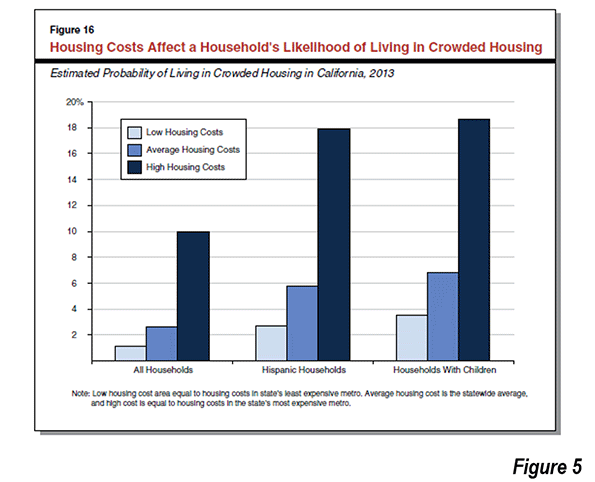
    Photo by Chamber of Fear (originally posted to Flickr as Jewish Family Night) [CC BY-SA 2.0], via Wikimedia Commons

  • America Needs The Texas Economy To Keep On Rolling

    In the last decade, Texas emerged as America’s new land of opportunity — if you will, America’s America. Since the start of the recession, the Lone Star State has been responsible for the majority of employment growth in the country. Between November  2007 and November 2014, the United States gained  a net 2.1 million jobs, with 1.2 million alone in Texas.

    Yet with the recent steep drop in oil prices, the Texas economy faces extreme headwinds that could even spark something of a downturn. A repeat of the 1980s oil bust isn’t likely, says Comerica Bank economist Robert Dye, but he expects much slower growth, particularly for formerly red-hot Houston, an easing of home prices and, likely, a slowdown of in-migration.

    Some blue state commentators might view Texas’ prospective decline as good news. Some, like Paul Krugman, have spent years arguing that the state’s success has little to do with its much-touted business-friendly climate of light regulation and low taxes, but rather, simply mass in-migration by people seeking cheaper housingSchadenfreude is palpable in the writings of progressive journalists like the Los Angeles Times’ Michael Hiltzik, who recently crowed that falling energy prices may finally “snuff out” the detested “Texas miracle.”

    Such attitudes are short-sighted. It is unlikely that the American economy can sustain a healthy rate of growth without the kind of production-based strength that has powered Texas, as well as Ohio, North Dakota and Louisiana. De-industrializing states like California or New York may enjoy asset bubbles that benefit the wealthy and generate “knowledge workers” jobs for the well-educated (nationwide, professional and business services employment rose by 196,000 from October 2007 through October 2014), but they cannot do much to provide opportunities for the majority of the population.

    By their nature, industries like manufacturing, energy, and housing have been primary creators of opportunities for the middle and working classes. Up until now, energy  has been a consistent job-gainer since the recession, adding  199,000 positions from October 2007 through October 2014, says Dan Hamilton, an economist at California Lutheran University. Manufacturing has not recovered all the jobs lost in the recession, but last year it added 170,000 new positions through October. Construction, another sector that was hard-hit in the recession, grew by 213,000 jobs last year through October. The recovery of these industries has been critical to reducing unemployment and bringing the first glimmer of hope to many, particularly in the long suffering Great Lakes.

    Reducing the price of gas will not change the structure of the long-stagnant economies of the coastal states; job growth rates in these places have been meager for decades. Lower oil prices may help many families pay their bills in the short run. But there’s also pain in low prices for a country that was rapidly becoming an energy superpower, largely due to the efforts of Texans.

    Already the decline in the energy economy, which supports almost 1.3 million manufacturing jobs, is hurting manufacturers of steel, construction materials and drilling equipment, such as Caterpillar. Separately, the strengthening of the dollar promises harder times ahead for exporters  in the industrial sector, and greater price competition from abroad, amid weakening overseas demand. Factory activity is slowing, though key indicators like the ISM PMI are still signaling that output is expanding.

    Right now in Texas, of course, the pain is mounting in the energy sector. Growth seems certain to slow in places such as Houston, which Comerica’s Dye says is “ground zero in the down-draft.” Also vulnerable will be San Antonio, the major beneficiary of the nearby Eagle Ford shale. The impacts may be worst in West Texas oil patch towns like Midland, where energy is essentially the economy.

    Yet there remain reasons for optimism. Cheaper energy prices will be a boon for the petrochemical and refining industries, which are thick on the ground around Houston and other parts of the Gulf Coast. The Houston area is not seeing anything like the madcap office and housing construction that occurred during the oil boom of the 1980s. Between 1982 and 1986 the metro area added 71 million square feet of office space; including what is now being built, the area has added just 28 million square feet since 2010. Compared to the 1980s, the residential market is also relatively tight, with relatively little speculative building.

    The local and state economies have also become far more diversified. Houston is now the nation’s largest export hub. The city also is home to the Texas Medical Center, often described as the world’s largest. Dallas has become a major corporate hub and Austin is developing into a serious rival to Northern California’s tech sector.

    Texas needs to increase this diversification given that oil prices could remain low for quite a while, and even drop further after their recent recovery.

    This is not to deny that the state is facing hard times. Energy accounts for 411,372 jobs in Texas, about 3.2% of the statewide total, according to figures from Austin economist Brian Kelsey quoted in the Austin American-Statesman. If oil and gas industry earnings in Texas fall 20%, Kelsey estimates the state could lose half of those jobs and $13.5 billion in total earnings.

    Low prices also could also devastate the state budget, which is heavily reliant on energy industry revenues. A reduction in state spending could have damaging consequences in a place that has tended to prefer low taxes to investing in critical infrastructure, and is already struggling to accommodate break-neck growth. The only good news here is that slower population growth might mitigate some of the turndown in spending, if it indeed occurs.

    But in my mind, the biggest asset of Texas is Texans. Having spent a great deal a time there, the contrasts with my adopted home state of California are remarkable. No businessperson I spoke to in Houston or Dallas is even remotely contemplating a move elsewhere; Houstonians often brag about how they survived the ‘80s bust, wearing those hard times as a badge of honor.

    To be sure, Texans can be obnoxiously arrogant about their state, and have a peculiar talent for a kind of braggadocio that drives other Americans a bit crazy. But they are also our greatest regional asset, the one big state where America remains America, if only more so.

    This piece first appeared at Forbes.

    Joel Kotkin is executive editor of NewGeography.com and Roger Hobbs Distinguished Fellow in Urban Studies at Chapman University, and a member of the editorial board of the Orange County Register. He is also executive director of the Houston-based Center for Opportunity Urbanism. His newest book, The New Class Conflict is now available at Amazon and Telos Press. He is also author of The City: A Global History and The Next Hundred Million: America in 2050.  He lives in Los Angeles, CA.

    Photo:
    West Texas Pumpjack” by Eric Kounce TexasRaiser – Located south of Midland, Texas. Licensed under Public Domain via Wikimedia Commons.