Category: Politics

  • The Emerging New Aspirational Suburb

    Urban form in American cities is in a constant state of evolution. Until recent years, American suburbia was often built without an appreciation for future evolution. This has left many older suburbs in a deteriorated state, and has accelerated claims of a more generalized suburban decline.

    The Indianapolis suburb of Carmel represents a response to this historic pattern. While responding to today’s market demands with a new aspiration level designed to make it nationally competitive, it’s also trying to position itself for success tomorrow and over the longer term.

    This is a critical issue for many suburbs. Like big cities before them, many older suburbs have now aged, and no longer necessarily meet the requirements of the marketplace.  

    There are many reasons for this.  The early, usually small-scale Cape Cod-style housing common to many 50s vintage suburbs is not what today’s market is demanding. It’s the same for older enclosed malls – today “lifestyle centers” and other formats are preferred – many of which are now vacant, their grim remains featured on web sites such as DeadMalls.com. Many suburban areas were also built out with “infrastructure light” without upgraded streets, sidewalks, etc. leaving a big backlog of infrastructure need.

    Across the country many of these older districts have fallen into decay and become increasingly poor, taking on many of the characteristics of the inner city. As the Brookings Institution noted  over a decade ago, they “are experiencing some signs of distress—aging infrastructure, deteriorating schools and commercial corridors, and inadequate housing stock.”1 Today, the public is more aware of the trend, and events in Ferguson, MO recently gave a wakeup call to newer and still-thriving suburbs that they too may be troubled at some point.

    Like other American cities, Indianapolis has many of these older, struggling suburban areas. In its case, many of them are within the core city limits due to a 1970 city-county merger. As regional growth continues to expand outside the central urban county, newer generation suburbs have a chance to learn from the struggles of many of their predecessors.

    Carmel – pronounced like the Biblical Carmel – is the first suburb directly north of the city of Indianapolis. It is an upscale residential and business suburb similar to many others around the country such as Dublin, OH; Naperville, IL; and the Cool Springs, TN area.  Its 2013 population of 83,573 made it the 5th largest municipality in the state. While not monolithically wealthy, its 2013 median household income of $100,358 is the 14th highest in the United States among communities of 65,000 people or more.2 It’s a preferred area for the estate homes of wealthy Indianapolis area residents, such as Indianapolis Colts owner Jim Irsay. But it’s not just a bedroom suburb; real estate brokerage Cassidy Turley reports that the Carmel submarket has over six million square feet of office space.3

    Being located in the center of the favored quarter of the Indianapolis region, Carmel grew as an upscale area. This gives it a leg up in long term sustainability out of the gate.  

    Yet Carmel has not relied just on its wealth to insure against decline. Rather, it has embarked on a transformation program now nearly 20 years old from which three major themes emerge:

    1. Responding to current market forces to build a “state of the art” community that is competitive globally, not just within the Indianapolis region.

    2. Building a full spectrum of amenities and infrastructure to create a “complete city” with a high quality of life and intrinsic appeal that is a) not based solely on newness or low costs, and b) which has broad demographic appeal.

    3. Attempting to create unique cultural and regional attractions  to turn Carmel into a destination in its own right, as much city as suburb.

    The primary driver of this transformation has been Mayor Jim Brainard, a Republican currently in his fifth term.  Carmel long had top performing schools – it’s the top rated district in the state   – houses with generous yards, low taxes, and other standard attractors of suburbia. Previous administrations had put in place key policies such as reserving the Meridian St. corridor for high end office space and banning billboards. But Brainard brought numerous changes in Carmel during his tenure including:

    Annexation. Carmel has undertaken a series of annexations – nearly 20,000 acres since 2001 alone.4 With over 47 square miles of territory, Carmel has now largely achieved its desired geographic scale.

    Parks. Carmel’s park acreage increased from 50 to 1000 acres and it has spent heavily on building out its parks. This includes building a $55 million Central Park, which includes a showplace community and fitness facility called the Monon Center.5 And the popular Monon Trail, a rail-trail through the length of the city that extended a previous project built by the City of Indianapolis.
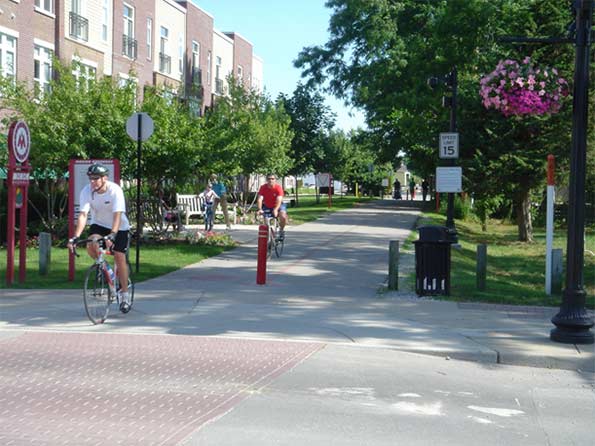

    Monon Trail at Main St.

    Road Infrastructure. Carmel has invested heavily in upgrading the legacy network of county roads that it overgrew. This includes an aggressive deployment of modern roundabouts. Carmel now has over 80 of these, more than any community in the United States.6 It has upgraded miles of collector roads to urban standards with enclosed drainage, curbs, extra-wide travel lanes, landscaped medians, eight foot multi-use side paths on both sides of the street protected by a landscaped buffer zone, and decorative street signs and other detailing.
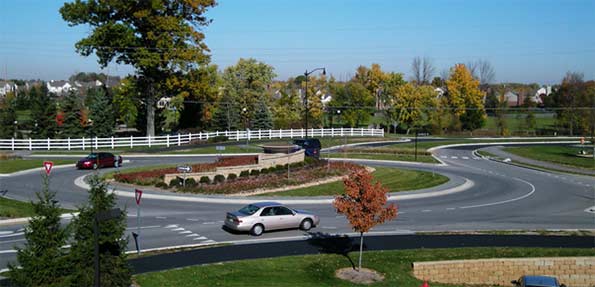
    Roundabout at Main St. and Illinois St. in the fall
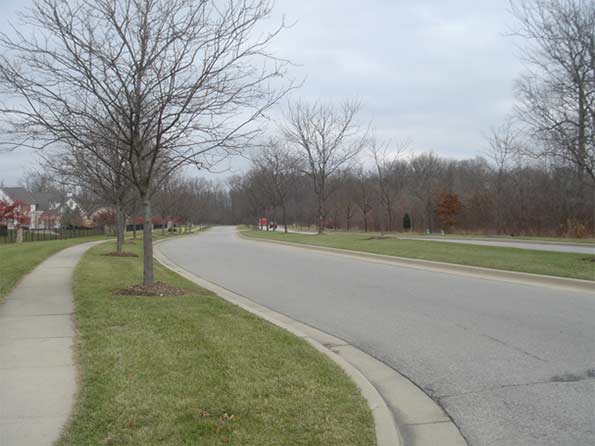

    An upgraded segment of River Rd. in early winter

    Two major state highways passed through the town, Meridian St. (US 31) and Keystone Ave. (SR 431). These were designed as rural style divided surface highways as is common in Indiana. Carmel convinced the state to relinquish Keystone Ave. to the city and give it $90 million for upgrades and future maintenance. Carmel converted this into a mostly free flowing parkway by spending $108 million to replace stoplight intersections with roundabout interchanges. These not only dramatically improved traffic flow, the bridges over the busy highway provided a high quality, safe connection – especially for pedestrians and bicyclists – connecting eastern and central Carmel, which had previously been separated by this “great wall” of a road. The state is currently performing a similar freeway upgrade on Meridian St., the principal office corridor.
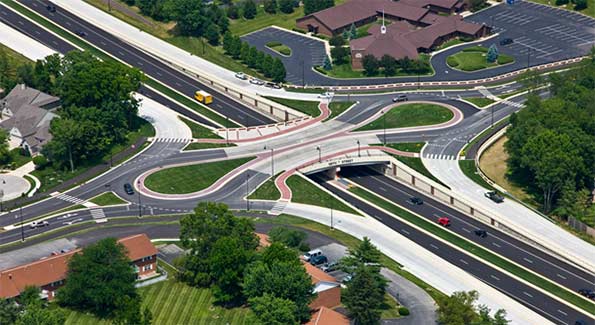

    Roundabout interchange at 126th St. and Keystone Parkway.

    Water and Sewer Upgrades. Part of Carmel previously received water from the Indianapolis water utility. The City of Indianapolis had privatized this utility but sought to repurchase it. Carmel intervened in the process to pressure Indianapolis into selling it the water lines inside Carmel. Carmel has since undertaken significant infrastructure upgrades such as new wells and pumping stations. During a recent summer drought, Carmel, unlike Indianapolis, did not put in place a mandatory restriction on lawn watering.7

    New Urbanism. Beyond core infrastructure, Carmel under Brainard has sought to change its style of development to embrace some of the more positive aspects of New Urbanism such as creating more urban nodes and walkability.

    Unlike some traditional railroad suburbs or county seats, the historic center of Carmel was very tiny, and its Main Street populated mostly with one story buildings and empty lots. This was the first focus area, and started with fixing the physical infrastructure.  

    The city rebranded the area as the “Arts and Design District” and utilized Tax Increment Financing to promote multi-story, mixed use development. The result is a mostly occupied and often well-patronized Main Street district. The surrounding historic residential blocks have seen significant redevelopment activity as well.
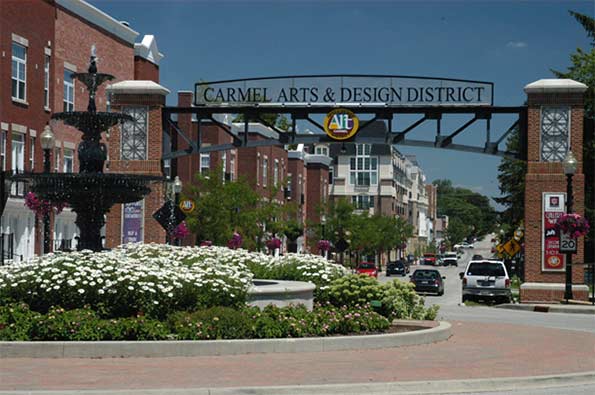

    Main St. at western fountain and gateway arch entryway to rebranded “Arts and Design Distrct.”

    Beyond the historic downtown, Carmel has also implemented multiple New Urbanist style zoning overlays, including on Old Meridian St. and Range Line Rd. (the city’s original suburban commercial strip). These promote mixed use development, buildings that front the street, and multi-story structures. Infrastructure improvements and TIF have been used in these areas as well. There’s also a major New Urbanist type subdivision in western Carmel called the Village of West Clay.
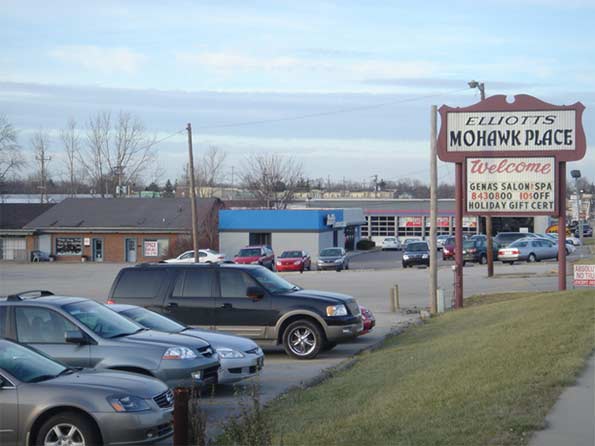
    Strip mall and traditional suburban development along Range Line Rd.
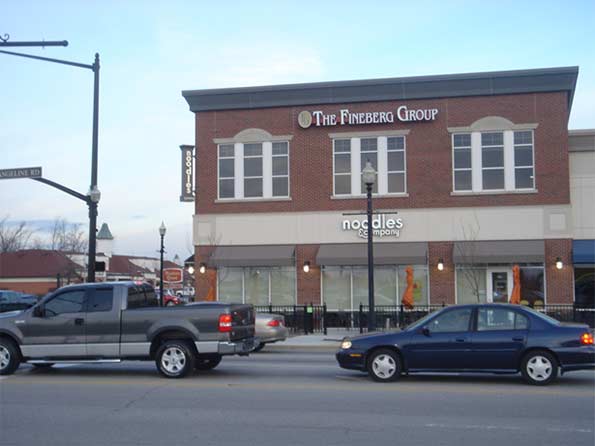

    New Urbanist style development along Range Line Rd.
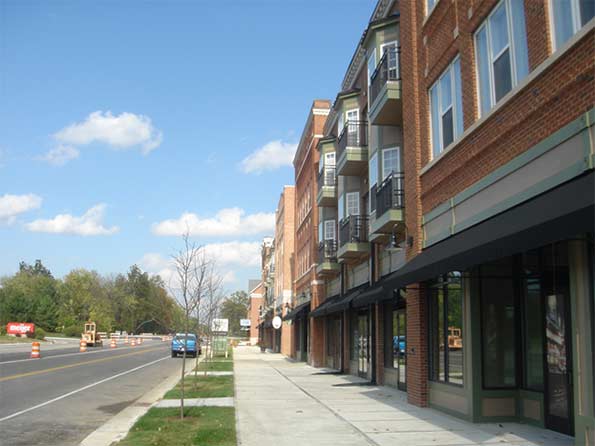

    New Urbanist development and street improvements under construction on Old Meridian St.

    The historic downtown was deemed too small to function effectively as the downtown of a city the size of Carmel today. The city thus decided to create a new downtown area called City Center. The location for this is an area south of the historic downtown area in an older suburban industrial zone that had fallen into a blight pattern. Much of it was vacant and what’s now the principal City Center development was built on the site of a failed strip mall. TIF was aggressively used here as well to redevelop the area.

    The City Center development is only partially complete. A veterans memorial and other civic spaces are complete, as are several small office buildings, apartments, and a large mixed use complex. The anchor is a publicly funded $175 million concert hall called the Palladium and an associated theater complex with three stages.8 While these are complete, significant development remains to complete the City Center vision. The city also wants to redevelop the area between City Center and the old downtown, which they now label Midtown, but very little has been done to date.
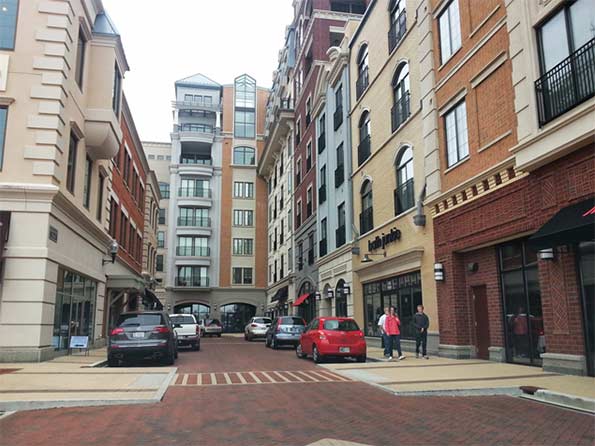

    Interior street of City Center development.

    The goal of all this development is not the full urbanization of Carmel; this city does not aspire to be dense metropolis, or even Indianapolis. It’s rather about creating more town center type districts with the walkable feel that’s increasingly in favor, but without compromising the fundamental suburban character of the city. It’s also designed to create a city with options. Having a diversity of development styles within the city is part of a strategy of appealing to a more diverse demographic base, including singles and retirees, not just the stereotypical younger family with kids. Traffic flow has been improved, but short trips are now easier to undertake by foot or bicycle, not just by car.

    Retro Architecture. Carmel has de facto mandated traditional architectural styles. There’s no one consistent style. Major buildings have been done in Georgian, Second Empire, and Neoclassical type designs. But modernism has been rejected, further differentiating suburban Carmel from urban areas that frequently elect for starchitecture that is unapologetically “of the now.”

    The city has also attempted to prevent large corporations from building their standard architectural templates. Brick is effectively mandated, even for big box retailers like Lowes. Retailers like CVS and Kentucky Fried Chicken were forced to build second stories on their structures to locate in certain areas. Another Carmel CVS has an art deco façade.

    The city wants high quality aesthetics and a unique sense of place. They also want “timeless” design, though like much New Urbanism architecture it can sometimes come across as pastiche.

    Arts and Culture. As part of the attempt to appeal to more arts minded middle aged consumers, as well as members of the  so-called “Creative Class,” Carmel has heavily invested in the arts. The City Center performing arts center was paid for almost entirely with public funds (TIF), an investment in the arts dwarfing even that of Indianapolis. The city has also paid for an extensive public art program, mostly statues by Seward Johnson. And it makes operating grants to local arts organizations such as the Carmel Symphony Orchestra.
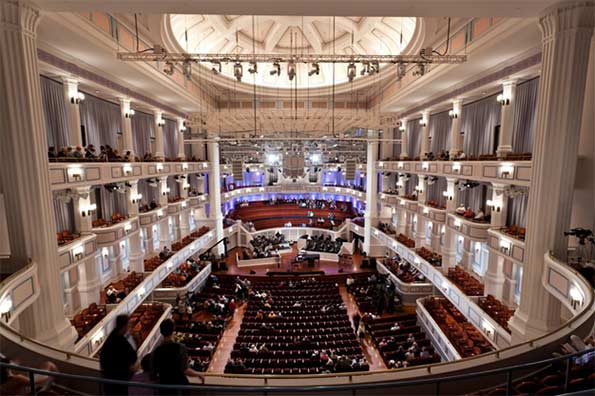

    Interior of the Palladium concert hall. Photo by Zach Dobson.

    Seward Johnson is not a favorite of urban sophisticates. His statutes illustrate the type of play it safe art generally featured by Carmel. More sophisticated or cutting edge fare is not as prevalent. And there have even been some complaints by a limited number of citizens about items such as the classical nudes featured on the door handles of the Evan Lurie Gallery.

    Brainard is thinking about the long term when Carmel is no longer the shiny new thing. As he put it, “Because we are designing a new city that will be in place for hundreds of years, the responsibility of doing it right falls to this generation…Carmel is a young city – we are still building our parks, trails, roads and sanitary sewer and water systems that will be here for centuries.”9

    He’s also keenly aware of global economic competition and the fact that Indiana lacks the type of geographic and weather amenities of other places. He frequently uses slides to illustrate this point. In one talk he said, “Now this picture, guess what, that’s not Carmel; but this picture is the picture of some of our competition. Mountains – that’s San Diego of course, mountains, beautiful weather, you know I think they have sunshine what, 362 days out of the 365…. What we’ve tried to do is to design a city that can compete with the most beautiful places on earth. We’ve tried to do it through the built environment because we don’t have the natural amenities.”10  While the claims to want to equal the most beautiful places in the world may be grandiose, the key is that mayor believes Carmel’s undistinguished natural setting and climate requires a focus on creating aesthetics through the built environment.

    What have the results been to date?  Economically and demographically, the city has performed well. It has managed to create an environment that is proving competitive for business opportunities that might have previously bypassed Indiana. For example, American Specialty Health relocated its headquarters to Carmel from San Diego, with the CEO of the company personally making the move from La Jolla to Carmel.11 Geico also recently expanded. Numerous other corporations are either based in Carmel or have major white collar facilities there. The income levels are very strong, as noted above.

    The city’s demographics have also expanded to become much more diverse. The minority population grew 295% between 2000 and 2010, adding 9,630 people and growing minority population share from 8.7% to 16.3%.12 12% of the city’s households speak a language other than English at home.13 Many of these are highly skilled Chinese and Indian immigrants working for companies like pharmaceutical giant Lilly. Even black professionals are increasingly moving to Carmel, with the black population growing 324% in the 2000s and black population share doubling to 3%.14 Carmel is not a polyglot city today, but it’s far more diverse than in the past.

    Carmel has also attracted both national press and national awards. Money magazine ranked Carmel as the #1 best small city to live in 201215, and it’s scored highly in other surveys as well. Drew Klacik of the Indiana University Public Policy Institute notes that in an echo of the transformation of the city of Indianapolis since the 1970s, “Carmel has transformed itself from a desirable community within Indiana to a desirable and competitive community nationally.”16

    However, it’s hard to argue that Carmel’s results materially outperform peer cities in other regions. Places like Dublin, OH and Cool Springs, TN have significantly more office space, for example. Many of those places are, however, implementing policies similar to those in Carmel . Most Carmel New Urbanist development continues to require TIF subsidies and is not yet sustainable at market rates. The city has obtained better financial terms in some recent deals, however.  And despite major public investment and construction in the central city, many central area census tracts lost population during the 2000s.

    The changes have also attracted significant criticism and opposition in some quarters.  While the public remains largely positive on the results, there have been many critiques of the way they were done, some of them legitimate.  A number of the projects had significant cost overruns. The mayor originally said that the Keystone project could be completed for the $90 million the state gave it. The actual cost was nearly $20 million higher.17 The Palladium was originally sold as an $80 million facility, but ended up costing $175 million. The city also said it planned to pay for ongoing operations by raising a $40 million endowment, but was unable to raise the funds, leaving it on the hook for $2 million in annual operating costs. These are not small misses.

    Critics also pointed to state figures showing Carmel with nearly $900 million in total debt.18 While it is a wealthy community that can afford the payments, in a conservative state like Indiana, a suburb accumulating nearly a billion dollars in debt raises eyebrows. Carmel’s tax rates remain among the lowest the state, however.

    The way the debt was accumulated has been criticized as well. The Palladium was paid for with TIF funds. Rather than bonds, the Carmel Redevelopment Commission – the authority that manages the TIF program and which was controlled by mayoral appointees – structured the Palladium debt as Certificates of Participation to circumvented the need for city council approval, incurring higher interest rates in the process. The city council later refinanced the debt at a lower rate using a general taxing power guarantee in what some called a bailout. In return for the refinancing, the council obtained more oversight over TIF activity.19

    Though some controversy is inevitable and some criticisms are legitimate, ultimately the change program in Carmel has proven popular with the public and the city is booming, a boom that’s lending an increasingly bitter tone to the longstanding hostility Carmel has enjoyed from the region due to its status as the highest profile “rich suburb” in the region.

    Yet for all the controversy, many regional suburbs are copying some aspects of Carmel’s approach, with roundabouts now a regular feature in area communities and major park programs and New Urbanist style town center developments as well. This includes the massive sports-oriented Grand Park in Westfield and the Nickel Plate District in next door Fishers’ town center.20

    It’s also clear that peer type suburbs around the country are adopting similar strategies, such as Dubin, OH’s Bridge Street Corridor proposal21 or Sugar Land, TX’s $84 million performing arts center.22 Imitation, they say, is the sincerest form of flattery. Carmel represents the leading edge of the emergence of a new type of post-Edge City aspirational suburb. It’s something we may be seeing a lot more of in the future.

    Aaron M. Renn is a senior fellow at the Manhattan Institute and a Contributing Editor at City Journal. He writes at The Urbanophile.

    ————————————-

    1 Robert Puentes and Myron Orfield. “Valuing America’s First Suburbs: A Policy Agenda For Older Suburbs in the Midwest,” Brookings Institution, 2002.

    2 U.S. Census Bureau, “American Community Survey 2013 1-yr”, Table B19013.

    3 Cassidy Turley, Indianapolis Office Market Snapshot (Third Quarter 2014), 3.

    4 Ellen Cutter. “Explaining the annexation process,” Greater Fort Wayne Business Weekly, June 12, 2014. Accessed January 8, 2015. http://www.fwbusiness.com/opinions/columnist/businessweekly/article_f42da036-6182-575a-8445-274cd82ca296.html

    5 Matthew VanTryon. “Carmel then and now: World’s Apart,” IndianapolisNewsBeat.com, December 16, 2014. Accessed January 8, 2015. http://blogs.butler.edu/multimedia-journalism/2014/12/16/carmel-worlds/

    6 James Brainard, transcript of speech at 2014 International Making Cities Livable Conference, June 23-27, 2013.

    7 “Why no watering ban in Carmel,” WISH-TV News, July 12, 2012. Accessed January 8, 2015. https://www.youtube.com/watch?v=y51BJYM4Fgc

    8 David Hoppe. “The Palladium’s boffo budget,” Nuvo Newsweekly, June 20, 2011. Accessed on January 8, 2015. http://www.nuvo.net/indianapolis/the-palladiums-boffo-budget/Content?oid=2275080

    9 James Brainard, notes for 2014 State of the City Address.

    10 James Brainard, transcript of speech at 2014 International Making Cities Livable Conference, June 23-27, 2013.

    11 Andrea Muirragui Davis. “Wellness provider beefing up new Carmel office,” Indianapolis Business Journal, October 29, 2014. Accessed on January 8, 2015. http://www.ibj.com/blogs/11-north-of-96th/post/50241-wellness-provider-beefing-up-new-carmel-office?id=11-north-of-96th

    12 U.S. Census Bureau, calculations by author from Census 2000 and Census 2010.

    13 U.S. Census Bureau, “American Community Survey 2013 1-yr”, Table B05007.

    14 U.S. Census Bureau, calculations by author from Census 2000 and Census 2010.

    15 “CNNMoney Ranks Americas Best Places to Live,” Daily Finance, August 20, 2012. Accessed January 8, 2015. http://www.dailyfinance.com/2012/08/20/cnn-money-ranks-americas-20-best-places-to-live/

    16 Drew Klacik, telephone interview with author, December 29, 2014.

    17 “Brainard seeks bonds to finish Keystone,” The Indianapolis Star, October 18, 2009. Accessed January 8, 2015. http://archive.indystar.com/article/20091018/LOCAL/910180409/Brainard-seeks-bond-finish-Keystone

    18 Indiana Department of Local Government Finance. “Local Government Debt Report,” September 21, 2012, 15.

    19 Kathleen McLaughlin. “Brainard seeks deal on maxed-out TIF,” Indianapolis Business Journal, March 31, 2012. Accessed January 8, 2015. http://www.ibj.com/articles/33569-brainard-seeks-deal-on-maxed-out-tif

    20 Cara Anthony. “New look for the Nickel Plate District in Fishers,” The Indianapolis Star, June 28, 2014. Accessed January 16, 2015. http://www.indystar.com/story/news/local/hamilton-county/fishers/2014/06/27/new-look-nickel-plate-district-fishers/11537251/

    21 Brent Warren. “Dublin Moves Ahead With Bridge Street Corridor Plans, Connecting Across River,” Columbus Underground, March 23, 2013. Accessed January 8, 2015. http://www.columbusunderground.com/dublin-moves-ahead-with-bridge-street-corridor-plans-looks-to-connect-across-river-bw1

    22 Rebecca Elliott. “Sugar Land breaks ground on $84 million performing arts center,” Houston Chronicle, December 9, 2014. Accessed January 12, 2015. http://www.houstonchronicle.com/neighborhood/fortbend/news/article/Sugar-Land-breaks-ground-on-84M-performing-arts-5946247.php

  • The Gilded Age Makes A Comeback

    The historian Carl Degler, who recently died, studied the rapid urbanization and industrialization of the late 19th century. That period has striking parallels to our country at the beginning of the 21st century. Between 1880 and 1915 the country’s face changed, and today the same phenomenon is occurring. The polarization of society and the divisive politics of that time were resolved, according to Degler, only by the rise of progressivism, which returned America to a sense of balance. The lack of a progressive “third way” today is startling, given that the concentrations of wealth and power are higher than ever existed in the Gilded Age.

    At the time, America was about to leave behind Jefferson’s ideals of an agrarian-based egalitarian society: the principles of free education, democracy, and land ownership. Now, we are urbanizing again, to a new and greater degree. As we evolve from industrialization to digitalization, the same cycle appears to be occurring. Here in Florida, urbanization is nearly complete, with a single archipelago of semi-urbanity having spread its web across nearly the entire peninsula.

    While this may seem like advancement, a gradually disempowered class feels increasingly resentful of the fast-moving cities. Here in Florida, those cities are woven in and around the rural populations. The situation seems dire, but it’s only a shadow of the human toll taken during the industrial revolution. Still, it is easy to see why social issues and moral values are central to those feeling left out of the cosmopolitan, prosperous cities.

    In the 1890s, no amount of handwringing by do-gooders helped reduce the suffering of children in mines, or the shameful exploitation of railroad workers. Populists, labor firebrands, and utopians contributed little to the solution, only sparking more controversy. Strikes increased divisiveness and polarized the country.

    Ultimately, it was through the emergence of progressivism in the reasonable center that true progress was made, and that the balance of the original founding principles was restored. No such movement exists today.

    An iconoclastic thinker, Degler called the progressive movement an essentially conservative one, pointing out that Fred Howe and its other luminaries pressed to conserve the original Jeffersonian goals of American reform. Degler quoted Howe: “The great problem now before the American people is, how can opportunity be kept open; how can industry be saved from privilege; how can our politics be left to the unimpeded action of talent and ability?” The progressives formed the American Creed around the new city and industry which were then rising. Howe’s questions are apt in this era’s uncertain world.

    A progressive center has yet to emerge from today’s highly polarized political climate. We continue to see and hear more divisiveness, and the upcoming presidential campaign promises to be nasty. Neither party has brought the two sides together. Our political campaigns in Florida reflect this same dialectic. Local races, once a bit more genteel, seem to be modeled after the national scene. A vacuum has opened up in the center. And today, just as at the end of the ninteenth century, there is little incentive yet to fill the vacuum.

    Degler saw turn-of-the-century American society as riven into the many poor and the few rich, and viewed the country’s founding democratic ideal as having been permanently subverted. His penetrating analysis of the last Gilded Age, and of an America that was gradual splintering, influenced a generation of scholars and historians. Degler’s essay, “New World A’Comin,’” noted that the rise of progressivism came only after decades of serious abuse and human tragedy at the end of the Industrial revolution.

    Progressives such as Howe and fellow reformer E. A. Ross encouraged the shouldering of a certain moral responsibility from top to bottom. But up until Ross’s treatise, Sin and Society in 1907, forty years of increasingly grisly and dark times for workers passed before things got much better.

    In today’s America, we don’t see dead children carried out of coal mines; no dead strikers, and no labor riots in the streets. ‘Worker abuse’ does not signify starvation or mortal danger. Protest against the privileged wealthy class is also less strident than it was a hundred years ago. Thus, if a progressive movement emerges from our current troubles, it is likely to be comparatively mild, and will need to fight against much more powerful odds to emerge. For one, the news media has no vested interest in settling disputes. And for another, the working class isn’t in peril for its life, and any great settling of accounts between the working class and the elite seems as though it will be put off to the distant future.

    I was a student in Florida in the 1970s when I first studied Carl Degler’s ideas during a unique period. The Vietnam War had just ended, and the national identity was sensitive. In Florida, we were highly conscious of the difficult relationship with Cuba. So, along with American history, the state required a course called “Americanism vs. Communism.” The notion of Americanism— not capitalism, you may notice, or democracy, but “Americanism”—included the terms “melting pot,” “exceptionalism,” and “The American Dream.” In a rural state with wide-open land at the time, this anxiety to present a unified, signature American identity had a powerful effect on those of us coming of age: Americanism was on the defensive.

    In that mix, Degler’s ideas were provocative. “Wherever men have striven to realize their moral visions, they have demonstrated that ideas, as well as economic forces, can change the direction of history,” Degler wrote in Out of Our Past. With Degler’s death, the notion of history’s moral trajectory may finally have died also. He challenged pat concepts: he refuted the notion of “melting pot,” citing the lack of assimilation of many ethnicities, and the stubborn refusal of a few to put racism behind them. Instead, he called America a “salad bowl.” He also rejected the idea of American exceptionalism, and noted that Jeffersonian ideals were only renewed through hard work. Maintaining these ideals today, in America’s new urban face, seems a fading dream as well.

    Here in Florida, the rancor of last autumn’s gubernatorial race seems forgotten. People are back at work, tourists are flowing into the state, and the population is swelling. Construction, thanks to easy credit, is everywhere. Reform is unlikely while the good times are here. Americanism, it seems, has triumphed, and the quaint, Jeffersonian notions of an agrarian, egalitarian society are again collecting dust for the time being.

    Instead, we have a superficial choice between two political parties that seems less and less substantive, and more and more like a marketer’s dream: Coke or Pepsi. Degler’s notion of history as a continual evolution of ideas, and of the rise of a progressive ‘third way’ is, for now, dormant. Many of us who were lucky enough to read Out of Our Past in Florida’s public schools still keep Degler’s provocative ideas with us. Those ideas may be put to good use when today’s soft drinks go out of style, and the public is thirsty for a middle ground once again.

    Richard Reep is an architect with VOA Associates, Inc. who has designed award-winning urban mixed-use and hospitality projects. His work has been featured domestically and internationally for the last thirty years. An Adjunct Professor for the Environmental and Growth Studies Department at Rollins College, he teaches urban design and sustainable development; he is also president of the Orlando Foundation for Architecture. Reep resides in Winter Park, Florida with his family.

    Flickr photo by Cliff: That Other Gilded Age. Edith Wharton, oil on canvas by Edward Harrison May, seen here during her privileged childhood. Wharton’s fiction became acclaimed for its critical view of Gilded Age society.

  • America A House Divided Over Race

    The election of Barack Obama six years ago was hailed as a breakthrough both for minorities, particularly African Americans, and for his being the first “city guy” elected president in recent history. Both blacks and urbanistas got one of their “own” in power, and there were hopes that race relations and urban fortunes would improve at a rapid pace.

    Instead, the recent controversies over police killings of African American men have revealed a shocking deterioration of race relations not seen in a generation. Since the racial euphoria that accompanied the president’s election, views of race relations held by blacks and whites, according to Pew, have become decidedly less optimistic. Nearly half of whites and roughly two in five blacks, according to a recent Politico poll, say race relations have worsened under Obama. Only 4 percent of whites and 13 percent of African Americans thought relations had improved. Another recent survey, this one by Bloomberg, finds 53 percent of Americans opining that race relations have declined under Obama.

    For the most part, the current racial discord has been traced largely to the long, uneasy relationship between minorities, notably African Americans, and the police. The disparity in perceptions between whites and blacks are most notable here, says Pew, with 70 percent of African Americans, but barely 25 percent of whites, disputing that police do a good job treating the races “equally.”

    Here’s the real tragedy: Some 50 years after the passage of sweeping nationwide civil rights legislation, the institutionalization of affirmative action and billions poured into addressing urban poverty, many African American youth remain well outside the mainstream, unmoored to the economy and far too liable to get into confrontations with law enforcement. This is clearly connected with such factors as the preponderance among African Americans of 70 percent single-female-headed households, nearly half of which are poor.

    Then, there are the murder statistics. Columnist Walter Williams has noted that, out of roughly 7,000 blacks murdered last year, 94 percent were killed by another black person. Half of all homicide victims are black, while blacks account for barely 13 percent of the nation’s population. Williams calculates that the black homicide victimization rate is six times that of whites, and in some cities, more than 22 times higher.

    Pervasive poverty

    Not surprisingly, these sad numbers are also reflected in economic statistics. African American unemployment remains twice that of whites. The black middle class, so responsible for, and understandably proud of, Obama’s elevation, according to the Urban League, in the past decade has conceded many of the gains made over the prior 30 years.

    Despite the hoopla about urban revival, a recent study reveals that entrenched urban poverty – places where 30 percent or more of the population lives below the poverty line – actually grew in the first decade of the new millennium, from 1,100 to 3,100 neighborhoods. Meanwhile, the population of these areas doubled, to 4 million. “This growing concentration of poverty,” notes researchers Joe Cortright and Dillon Mahmoudi, “is the biggest problem confronting American cities.”

    These trends dwarf the oft-celebrated movement of young professionals and empty-nesters into the urban core. Indeed, notes demographer Wendell Cox, roughly 80 percent of population growth in cities during 2000-10 was from poor people. Not surprisingly, many African Americans have moved to suburbs, where a majority of them now live, according to the Census Bureau.

    Also not surprising is that poverty and conflicts with law enforcement are now found in some suburban areas, as was clear in the case of Ferguson, Mo. Yet, poverty in the core cities remains considerably worse than in the suburbs. Despite trite talk about “suburban ghettos,” the poverty rate in the suburbs remains roughly half that of urban centers (as of 2010, 20.9 percent in core compared with 11.4 percent in the suburbs).

    Much the same can be said about crime. The overall violent-crime rate in urban cores, although down from 2001, remains almost four times higher than in the suburbs, according to FBI data. Many of the most crime-ravaged cities are heavily African American: Detroit, Oakland, St. Louis, Memphis, Tenn., Cleveland and Atlanta.

    Big-city class chasms

    The fundamental preconditions for increased racial tensions can be seen in the growing class chasm within cities, particularly gentrifying ones. In New York City, the epicenter of the current debate over policing, good times on Wall Street and among the glitterati has not trickled down into the ghetto. The majority of people in hip Brooklyn, notes researcher Daniel Hertz, have seen their incomes drop over the past decade; roughly one in four Brooklynites, a cohort overwhelmingly black and Hispanic, lives in poverty. Over the entire borough, he points out, residential patterns have become more segregated, and Brooklyn now is second, only to Milwaukee, in terms of racial separation.

    In Chicago, like most cities, areas of concentrated poverty have expanded in recent years. Chicago is widely hailed as the progenitor of Alan Ehrenhalt’s “great inversion,” which predicts a continuing shift of rich people into cities while the poor exit to the dreary suburban wasteland. But the reality is far more complicated, as employment in Chicago has dropped below 2001 levels, and middle-class neighborhoods have continually shrunk.

    Essentially, amidst renewal, there is greater bifurcation. Prosperous and greatly hyped “super-global Chicago,” notes urban analyst Pete Saunders, enjoys income and education levels well above those of the suburban areas. Most Chicagoans, however, live in “rust belt Chicago,” with education and income levels well below suburban levels. Rather than simply bifurcated, Saunders suggests, “Chicago may be better understood in thirds – one-third San Francisco, two-thirds Detroit.”

    The tensions exacerbated by this growing divide are widely evident. Violence is slowly shifting from Chicago’s poorest neighborhoods and into some of the city’s nicest redoubts; Mayor Rahm Emanuel’s 17-year-old son was mugged outside his home. Chicago’s violent-crime rate remains far higher than that of New York or Los Angeles; by some estimates, the city is more dangerous now than during the Al Capone era during Prohibition.

    Chicago’s predicament – with a slight increase in murders in 2014 – could prove a harbinger. In some big cities, like Chicago, New York and Atlanta, populations entrenched in poverty will likely remain for the foreseeable future. It’s hard to imagine East New York or the westside of Chicago, much of south Atlanta, or Watts, for that matter, gentrifying anytime soon.

    Indeed, Los Angeles, which also experienced a big drop in violent crime over the past decade, now expects to report a 7 percent increase this past year. Late last month, L.A. also experienced a possible attempted assassination of police officers, although the assailants, thankfully, missed.

    In some cities, usually smaller and whiter to start with, we are seeing a pattern of what amounts to “ethnic cleansing,” as increasingly isolated communities get driven out of their enclaves by relentlessly rising rents and the loss of blue-collar jobs.

    This process is particularly notable in San Francisco, where the black population already is roughly half what it was in 1970. In the nation’s whitest major city – Portland, Ore. – African Americans are being pushed out of the urban core by gentrification, partly supported by city funding. Similar phenomena can be seen in Seattle and Boston where longtime black communities faced near extinction.

    Under these circumstances, a degree of racial animus seems inevitable. Some Brooklyn residents, reports theDaily Beast,even justified the targeting of law enforcement officers. For their part, many NYPD officers feel betrayed by Mayor Bill de Blasio’s sympathetic comments about anti-police demonstrations. Some officers have expressed their distaste, inappropriately, by being rude to the mayor and staging slowdowns in arrests.

    These racial tensions already are seeping into the political realm. African Americans in New York supported de Blasio’s policing strategy, 2-1, while a strong majority of whites opposed his stance.

    The resurgence in racial animus remains arguably the biggest surprise – and one of the greatest failures – not only of Obama, but of our society. In this respect, neither conservative attempts to blame increased racial discord on the president and, now, attempts by his progressive claque to absolve him of any responsibility, really address the more serious issues behind the widening of the racial divide. Cities and communities, divided against themselves by race and class, cannot thrive in the long run, no matter how many publicists and pundits proclaim the battle for urban America already has been won.

    This piece first appeared at The Orange County Register.

    Joel Kotkin is executive editor of NewGeography.com and Roger Hobbs Distinguished Fellow in Urban Studies at Chapman University, and a member of the editorial board of the Orange County Register. He is also executive director of the Houston-based Center for Opportunity Urbanism. His newest book, The New Class Conflict is now available at Amazon and Telos Press. He is also author of The City: A Global History and The Next Hundred Million: America in 2050.  He lives in Los Angeles, CA.

  • U.S. Economy Needs Hardhats Not Nerds

    The blue team may have lost the political battle last year, but with the rapid fall of oil and commodity prices, they have temporarily gained the upper hand economically. Simultaneously, conditions have become more problematical for those interior states, notably Texas and North Dakota, that have benefited from the fossil fuel energy boom. And if the Obama administration gets its way, they are about to get tougher.

    This can be seen in a series of actions, including new regulations from the EPAand the likely veto by the president of the Keystone pipeline, that will further slow the one sector of the economy that has been generating high-paid, blue collar employment. At the same time, housing continues to suffer, as incomes for the vast majority of the middle class have failed to recover from the 2008 crash.

    Manufacturing, which had been gaining strength, also now faces its own challenges, in large part due to the soaring U.S. dollar, which makes exports more expensive. Amidst weakening demand in the rest of the world, many internationally-oriented firms such as United Technologies and IBM forecast slower sales. Low prices for oil and other commodities also threatens the resurgence of mainstream manufacturers such as Caterpillar, for whom the energy and metals boom has produced a surge in demand for their products.

    Left largely unscathed, for now, have been the other, less tangible sectors of the economy, notably information technology, including media, and the financial sector, as well as health services. In sharp contrast to manufacturing, energy, and home-building, all of these sectors except health care are clustered in the high-cost, blue state economies along the West Coast and the Northeast. As long as the Fed continues to keep interest rates very low, and maintains its bond-buying binge, these largely ephemeral industries seem poised to appear ever more ascendant. No surprise then that one predictably Obama-friendly writer called the current economy “awesome” despite weak income growth and high levels of disengagement by the working class in the economy. If Wall Street and Silicon Valley are booming, what else can be wrong?

    Should the whole economy become more bluish?

    One consistent theme of blue-state pundits, such as Richard Florida, is that blue states and cities “are pioneering the new economic order that will determine our future.” In this assessment, the red states depend on an economy based on energy extraction, agriculture and suburban sprawl. By this logic, growing food for mass market consumers, building houses for the middle class, making cars, drilling for oil and gas—all things that occur in the red state backwaters—are intrinsically less important than the ideas of nerds of Silicon Valley, the financial engineers of Wall Street, and their scattered offspring around the country.

    But here’s a little problem: these industries do not provide anything like the benefits that more traditional industries—manufacturing, energy, housing—give to the middle and working classes. In fact, since 2007, according to the Bureau of Labor Statistics, the information and technology sectors have lost more than 337,000 jobs, in part as traditional media jobs get swallowed by the Internet. Even last year, which may well prove the height of the current boom, the information and technology industry created a net 2,000 jobs. And while social and on-line media may be expanding, having added 5,000 jobs over the last decade, traditional media lost ten times as many positions, according to Pew.

    In contrast, energy has been a consistent job-gainer, adding more than 200,000 jobs during the same decade. And while manufacturing lost net jobs since 2007, it has been on a roll, last year adding more than 170,000 new positions. Construction, another sector hard hit in the recession, added 213,000 positions last year. The recovery of these industries has been critical to reducing unemployment and bringing the first glimmer of hope to many, particularly in the long suffering Great Lakes region.

    These tangible industries seem to be largely irrelevant to deep blue economies. A prospective decline of energy jobs, for example, does not hurt places like California or New York, which depend heavily on other regions to do the dirty work. Overall, for example, California, despite its massive energy reserves, created merely 15,000 jobs since 2007, barely one-tenth as many as in Texas. Energy employment in key blue cities such as New York and San Francisco has remained stagnant, and actually declined in Boston.

    Similarly, a possible slowdown in manufacturing—in part due to an inflated dollar, depressed international demand, and the loss of industrial jobs tied to energy—will affect different regions in varying degrees. Since 2009, the manufacturing renaissance has been strongly felt in traditional hubs like Detroit, Grand Rapids, and Louisville, as well as energy-charged places such as Houston and Oklahoma City. All saw manufacturing growth of 10 percent or more. Meanwhile New York, Los Angeles, Chicago, San Francisco, and Boston all lost industrial positions.

    Finally, there remains the housing sector, a prime employer of blue collar workers and the prime source of asset accumulation for middle class families. Sparked by migration and income growth, construction growth has been generally stronger in Texas cities but far more sluggish in New York and California, where slower population growth and highly restrictive planning rules make it much tougher to build affordable homes or new communities. Last year at the height of the energy boom, Houston alone built more single family homes than the entire state of California.

    If you think inequality is bad now …

    The new ephemera-based economy thrills those who celebrate a brave new world led by intrepid tech oligarchs and Wall Street money-men. The oligarchs in these industries have gotten much, much richer during the current recovery, not only through stocks and IPOs, but also from ultra-inflated real estate in select regional areas, particularly New York City and coastal California. As economist George Stiglitz has noted, such inflation on land costs has been as pervasive an effect of Fed policy as anything else.

    Even in Houston, some academics hail the impending “collapse of the oil industrial economy,” even as they urge city leaders to compete with places like San Francisco for the much ballyhooed “creative class.” Yet University of Houston economist Bill Gilmer notes that low energy prices are driving tens of billions of new investment at the port and on the industrial east side of the city. This growth, he suggests, may help offset some of the inevitable losses in the more white collar side of the energy complex.

    The emergence of a new ephemera-led economy bodes very poorly for most Americans, and not just Texans or residents of North Dakota. The deindustrialized ephemera-dominated economy of Brooklyn, for example, has made some rich, but overall incomes have dropped over the last decade; roughly one in four Brooklynites, overwhelmingly black and Hispanic, lives in poverty. Similar patterns of increased racial segregation and middle class flight can be found in other post-industrial cities, including one-time powerhouse Chicago, where areas of  concentrated poverty have expanded in recent years.

    Nowhere is this clearer than in ephemera central: California. Once a manufacturing juggernaut and a beacon of middle class opportunity, the Golden States now suffers the worst level of poverty in the country. While Silicon Valley and its urban annex, San Francisco, have flourished, most of the state—from Los Angeles to the Inland regions—have done poorly, with unemployment rates 25 percent or higher than the national average. The ultra-“progressive” city now suffers the most accelerated increase in inequality in the country.

    Similar trends have also transformed Silicon Valley, once a powerful manufacturing, product-producing center. As the blue collar and much of older middle management jobs have left, either for overseas or places like Texas or Utah, the Valley has lost much of its once egalitarian allure. San Jose, for example, has long been home to the nation’s largest homeless encampment. Black and Hispanic incomes in the Valley, notes Joint Venture Silicon Valley, have actually declined amidst the boom, as manufacturing and middle management jobs have disappeared, while many tech jobs are taken by predominately white and Asian younger workers, many of them imported “techno-coolies.”

    In contrast, the recoveries in the middle part of the country have been, to date, more egalitarian, with incomes rising quickly among a broader number of workers. At the same time, minority incomes in cities such as Houston, Dallas, Miami, and Phoenix tend be far higher, when compared to the incomes of Anglos, than they do in places like San Francisco, New York, or Boston. In these opportunity cities, minority homeownership—a clear demarcation of middle income aspiration—is often twice as high as it is in the epicenters of the ephemeral economy.

    To succeed in the future, America needs to run on all cylinders.

    The cheerleaders of the ephemeral economy often point out that they represent the technological future of the country, and concern themselves little with the competitive position of the “production” economy—whether energy, agriculture, or manufacturing. They also seek to force the middle class into ever denser development, something not exactly aspirational for most people.

    Nor is the current ephemera the key to new productivity growth. Social media may be fun, but it is not making America more competitive or particularly more productive (PDF). Yet there has been strong innovation in “production” sectors such as manufacturing, which alone accounts for roughly half (PDF) of all U.S. research and development.

    What is frequently missed is that engineering covers a lot of different skills. To be sure the young programmers and digital artists are important contributors to the national economy. But so too are the many more engineers who work in more mundane fields such as geology, chemical, and civil engineering. Houston, for example, ranks second (PDF) behind San Jose in percentage of engineers in the workforce, followed by such unlikely areas as Dayton and Wichita. New York, on the other hand, has among the lowest percentage of engineers of major metropolitan areas.

    To be sure, an aerospace engineer in Wichita is not likely to seem as glamorous as the youthful, urbanista app-developers so lovingly portrayed in the media. Yet these engineers are precisely the people, along with skilled workers, who keep the lights on, planes flying and cars going, and who put most of the food on people’s tables.

    The dissonance between reality and perception is most pronounced in California. The state brags much about the state’s renewable sector to the ever gullible media. But in reality high subsidized solar and wind account for barely 10 percent ofelectrical production, with natural gas and coal, now mostly imported from points east, making up the vast majority. In terms of transportation fuels, the state has a96 percent dependence on fossil fuels, again large imported, despite the state’s vast reserves. Los Angeles, although literally sitting on oil, depends for 40 percent of its electricity on coal-fired power from the Intermountain West.

    Equally critical, the now threatened resurgence of the industrial and energy sectors could reverse trends that have done more to strengthen the U.S. geopolitical situation than anything else in recent decades. Foreign dictators can easily restrict a Google, Facebook, or Twitter, or create locally-based alternatives; for all its self-importance, social media has posed no mortal danger to authoritarian countries. In contrast, the energy revolution has undermined some of the world’s most venal and dangerous regimes, from Saudi Arabia and Iran to Russia and Venezuela.

    In no way do I suggest we don’t need the ephemeral sectors. Media, social and otherwise, remain important parts of the American economy, and testify to the country’s innovative and cultural edge. But these industries simply cannot drive broader based economic growth and opportunity. Part of the problem lies in the nature of these industries, centered largely in Silicon Valley and San Francisco, which require little in terms of blue collar workers. Another prime issue is that these areas can only import so many people from the rest of country due to extraordinary high housing costs.

    Under current circumstances, the centers of the ephemeral economy such as New York or San Francisco cannot accommodate large numbers of upwardly mobile people, particularly families. These, for better or worse, have been vast gated communities that are too expensive, and too economically narrow, to accommodate most people, except those with either inherited money or elite educations. This is why Texas—which has created roughly eight times as many jobs as California since 2007 and has accounted for nearly one-third of all GDP growth since the crash—remains a beacon of opportunity, and the preferred place for migrants, a slot that used to belong to the Golden State.

    As a country, we stand at the verge of a historical opportunity to assure U.S. preeminence by melding our resource/industrial economy with a tech-related economy. Our strength in ephemera can be melded with the power of a resource and industrial economy. In the process, we can choose widespread and distributed prosperity or accept a society with a few pockets of wealth—largely in expensive urban centers—surrounded by a downwardly mobile country.

    The good news is America—alone among the world’s largest economies—has demonstrated it can master both the ephemeral and tangible economies. To thrive we need to have respect not for one, but for both.

    This piece first appeared at The Daily Beast.

    Joel Kotkin is executive editor of NewGeography.com and Roger Hobbs Distinguished Fellow in Urban Studies at Chapman University, and a member of the editorial board of the Orange County Register. He is also executive director of the Houston-based Center for Opportunity Urbanism. His newest book, The New Class Conflict is now available at Amazon and Telos Press. He is also author of The City: A Global History and The Next Hundred Million: America in 2050.  He lives in Los Angeles, CA.

  • Obama Pushes the Pace of Policy

    With his recent series of executive actions on U.S. policies ranging from climate to energy, immigration and, most recently, Cuba, Barack Obama is working to fulfill his long-held dream of being a “transformative” president. By decisively circumventing Congress with bold decrees, the president has won the plaudits of his core media supporters, with predictable “amens” from Eugene Robinson in the Washington Post and from the New York Times’ Paul Krugman, who described him as a more “transformative” president than either Bill Clinton or Ronald Reagan.

    From his earliest days in office, Barack Obama made no secret of his desire to be a “transformational” president. And in Washington’s alternate reality, many in the media still revere Obama, a president with approval numbers in the low 40s, according to RealClearPolitics.com. One giddy CNN commentator even compared our chief executive to “Superman.” Obama insiders have little doubt about his greatness. Former campaign manager Jim Messina calls him not only “transformative” but among the “all-time great presidents.”

    Yet, despite these huzzahs, it seems that voters are less than impressed. One reason: Americans may want some change – and may even be willing to sacrifice some to achieve it – but appear less enthusiastic about being “transformed.” They seem more comfortable with change done through the evolutionary swamp of congressional politics, reaching consensus on important issues and being presidential the old-fashioned way.

    The most recent transformational president, ironically, was George W. Bush. In his case, this was less a matter of ambition (or even narcissism) than a reaction to the events of 9/ll. Bush’s transformational reordering of American foreign and military policy left us with a persistent mess that his successor, and, likely, Obama’s successors, will have to clean up.

    Foreign Policy

    Likewise, it’s hard to see this president’s “transformative” foreign policy ideas as particularly successful, or even well-considered. In many ways, notes Harvard’s Joseph Nye, our best foreign-policy presidents – such as George H.W. Bush or Dwight Eisenhower – are “transactional,” while rejecting what he calls “the cult of transformative leadership” pursued by such idealists as Woodrow Wilson, George W. Bush or Barack Obama.

    When he took office nearly six years ago, Obama was determined to “reach out” to the Islamic world. Given his own multicultural background, not to mention his famously silvered tongue, Obama seemed sure to turn the Islamic world into our ally. But, as is so often the case, in reality, the U.S. has become steadily less popular since his election. It appears that Muslims have been no more mollified by Obama’s words, not to mention his drones, than by George W. Bush’s bolder bombs-away interventions.

    Another exercise in transformational futility has been Obama’s much-hyped “pivot to Asia.” He’s ended up pivoting in circles while China begins to construct its own version of wartime Japan’s imperialist “Greater East Asian Co-Prosperity Sphere.” As China’s military capacities grow, the president is stripping down, something that terrifies our friends in East Asia.

    Climate Change

    Perhaps no issue has less resonance with ordinary Americans than climate change, ranking consistently at the bottom of voters’ expressed concerns. In survey after survey, economic issues such as unemployment, the economy and the federal budget resonate with voters, while climate change barely registers.

    But among those closest to Obama, and to the gentry liberals who are his primary funders, there is no issue more “transformational” than climate change. After all, only a transformative president, like a modern-day Moses, can keep the waters from rising over us as we flee the evil pharaohs of the fossil fuel industry.

    This is not to say climate is not a concern, even if you are skeptical about some advocates’ more hysterical claims. It is probably a good idea to address carbon emissions, if for no other reason than pollution is bad and that the scientific “consensus,” although far from unimpeachable, is strong enough to suggest taking steps not to overheat the planet. So the question is how to best address this issue, and at what cost.

    Unfortunately, the president’s transformational addiction has led to some poor, and likely counterproductive, decisions. This actually hurts the green cause, as most Americans, according to a recent study appearing in the journal Nature Climate Change, are more interested in adapting to climate change than radically reorienting their lifestyles to prevent it. They may fear a changing climate, but not so much that they want to disrupt their lives in the kind of radical ways suggested by many environmental activists and their business backers.

    One thing Americans are not enthusiastic about is – in the name of climate change – sending more of their jobs to developing countries. Obama’s recent much-ballyhooed pact with China on emissions allows the world’s fastest-growing polluter, with a terrible record on this issue, to reject scrutiny of its efforts to limit carbon emissions until 2030. India, another rising greenhouse emitter, refuses even to set a similarly bogus deadline.

    This all leaves America, and its even more clueless European allies, slouching toward the nirvana of an energy base dependent on “renewables.” In Germany, and here in California, radical steps have raised energy prices and pushed industries to seek out places with less-Draconian regulations. Sadly, neither greens nor the administration has embraced the more evolutionary approach: substituting natural gas for far-dirtier coal. This switch has already helped the U.S. reduce its carbon emissions faster than any major country, far more, indeed, than the self-righteous Europeans, whose expensive and inefficient green policies have left them burning more coal.

    Immigration

    As with climate change and foreign policy, good intentions no doubt underpinned the president’s recent orders affecting undocumented U.S. residents. But the way the measure was carried out – after the election, and without the support of Congress – all but guarantees deeper conflict over immigration policy in the coming years. Although most Americans support some form of legalization, most, including many Latinos, also opposed using executive authority to do so.

    Getting legislation through Congress may well be painful, and slow, but there is something worthwhile in achieving broad support within both parties. This is particularly true when the opposition, as it does now, has a near-record degree of control of the House and a solid majority in the incoming Senate. The Reagan 1986 amnesty plan had its critics, but it allowed this critical issue to be handled in a bipartisan way. Reagan, clearly a more transformative president than either George W. Bush or Obama, still followed the basics of the Constitution, and acknowledged the importance of getting broad congressional buy-in on his policies.

    But, given the imperial manner that Obama employed, immigration policy can be dismissed by some as little more than an effort to expand big government’s – and the Democratic Party’s – client base into the next century. One can argue that this strategy is, indeed, transformational, but in a way that threatens to exacerbate ethnic tensions and worsen the economic plight of citizens – Latino and otherwise – already in the country.

    Back to Evolution

    The president’s bids, without popular or congressional support, to achieve transformation by decree represents a dangerous turn for the entire political process. This is unhealthy in the long term, not only for Republicans and conservatives, but, down the road, likely for liberals as well. Liberals like law professor Jonathan Turley believe his fellow liberals may someday “rue” their support for Obama’s “uber-presidency” when a conservative president, citing the Obama precedent, also rules by decree.

    The overall growth of transformational politics endangers the country. If conservatives sometimes overreach in terms of military affairs or regulations in the bedroom, modern transformational liberalism sees itself as blessed by the gods of science, while, of course, ignoring those things – such as the efficacy of natural gas or the need for GMO foods – that are not compatible with their worldview. These polarized positions leave as many as three in five voters, according to Gallup, wishing for a third party.

    A healthy political system, of course, changes, but needs to do so – outside of a major emergency – at a pace that the population can absorb. Every significant change in recent years – from growing legalization of marijuana and gay marriage to bold experiments in educational reform – has come, as it should, from states and localities. This allows change to occur congruent with the values of specific locales, and go national only when this stance appeals to the majority of legislators and voters.

    As we know from nature, evolution is often messy, and sometimes how it works is surprising. But, with patience and time, natural systems, like political ones, tend to be able to rebalance and adapt. By jettisoning evolution for transformation, President Obama, following a predecessor seen by many as inept, has made this adjustment process far more difficult and contentious than it would otherwise be.

    This piece first appeared at The Orange County Register.

    Joel Kotkin is executive editor of NewGeography.com and Roger Hobbs Distinguished Fellow in Urban Studies at Chapman University, and a member of the editorial board of the Orange County Register. His newest book, The New Class Conflict is now available at Amazon and Telos Press. He is author of The City: A Global History and The Next Hundred Million: America in 2050. His most recent study, The Rise of Postfamilialism, has been widely discussed and distributed internationally. He lives in Los Angeles, CA.

    Barack Obama photo by Bigstock.

  • The Inevitability of Tradeoffs, or Understanding New England’s Sky High Energy Costs

    People advance two main sorts of arguments in favor of things for which they advocate: the moral argument (it’s the right thing to do) and the utilitarian one (it will make us better off). As it happens, in practice most people tend to implicitly suggest there’s a 100% overlap between the two categories. That is, if we do what’s right, it will always make us better off too with no down sides at all.

    But is that true?

    For most of us, our life experience suggests that there are always tradeoffs and there’s no such thing as a free lunch. Urbanists tend to argue in way that suggests this isn’t the case. The types of policies advocated by urbanists tend to be presented not only as right in a certain moral sense, but also ones that make society better off in every way. When things go awry in some respect, as they always seem to do, this is always seen as an avoidable defect in policy implementation, not as a problem inherent to the policy itself. Urbanists aren’t alone in this of course. It affects most of the world. But since I cover the urban beat, I’ll focus on us for a minute.

    Today the New York Times opens a window into the type of trade-offs that are studiously avoided in most writings on the subject of climate change. Called “Even Before Long Winter Begins, Energy Bills Send Shivers in New England,” it talks about how a lack of natural gas pipeline capacity is sending electricity and gas costs through the roof as the temperature turns cold.

    John York, who owns a small printing business here, nearly fell out of his chair the other day when he opened his electric bill. For October, he had paid $376. For November, with virtually no change in his volume of work and without having turned up the thermostat in his two-room shop, his bill came to $788, a staggering increase of 110 percent. “This is insane,” he said, shaking his head. “We can’t go on like this.”

    For months, utility companies across New England have been warning customers to expect sharp price increases, for which the companies blame the continuing shortage of pipeline capacity to bring natural gas to the region. Now that the higher bills are starting to arrive, many stunned customers are finding the sticker shock much worse than they imagined.

    I’ve written about this before re:Rhode Island, which is among the most expensive states in America for electricity (most of which is generated by gas). But all of New England is high, with Connecticut ranked as having the country’s most expensive electricity. Gas prices spike every winter to levels far above the rest of the country, as the graph below that I found via City Lab shows:


    This would appear to be a simple problem to solve: just build more pipelines. I included on mylist of starter ideas for improving economic competitiveness in the state.

    Unfortunately, planned pipelines haven’t been built due to environmental opposition:

    The region has five pipeline systems now. Seven new projects have been proposed. But several of them — including a major gas pipeline through western Massachusetts and southern New Hampshire, and a transmission line in New Hampshire carrying hydropower from Quebec — have stalled because of ferocious opposition.

    The concerns go beyond fears about blighting the countryside and losing property to eminent domain. Environmentalists say it makes no sense to perpetuate the region’s dependence on fossil fuels while it is trying to mitigate the effects of climate change, and many do not want to support the gas-extraction process known as hydraulic fracturing, or fracking, that has made the cheap gas from Pennsylvania available.
    ….
    A year ago, the governors of the six New England states agreed to pursue a coordinated regional strategy, including more pipelines and at least one major transmission line for hydropower. The plan called for electricity customers in all six states to subsidize the projects, on the theory that they would make up that money in lower utility bills.

    But in August, the Massachusetts Legislature rejected the plan, saying in part that cheap energy would flood the market and thwart attempts to advance wind and solar projects. That halted the whole effort.

    Here we see the clear tradeoff in action. Reducing carbon emissions has a clear human and economic cost. High electricity costs wallop household budgets in a region with many communities that are struggling or even outright impoverished (as recently as last year, for example, a third of the residents of Woonsocket, RI were on food stamps). This particularly harms poor and minority residents. What’s more, it helps contribute to the region’s low ranking as a place to do business and its anemic job creation.

    Given that gas itself is dirt cheap and will be for the foreseeable future thanks to fracking, hurting residents through high electricity prices designed to drive energy transition is clearly a deliberate policy choice.

    Fair enough if you believe reducing carbon requires subordinating other public goals like more money in poor people’s pockets. But how often is this forthrightly stated by advocates? Almost never.

    Instead we’re treated to article after article in various urbanist publications talking about some awesome green project that’s being implemented somewhere, and how other places ought to do the same thing. There’s lots of doom and gloom about the increased potential for future disasters if the policies aren’t followed. But there’s seldom much about the immediate negative consequences that almost certainly will follow if they are.

    I like energy efficiency. I’m glad we have more fuel efficient cars. I’m very glad I don’t own a car anymore. I’m not so excited about light bulb mandates and other “feel bad” policies that don’t materially affect emissions. But there’s definitely a lot we can do on the energy front.

    But I also care about things like poor people’s electricity bills and economic growth. And I’m not willing to make unlimited sacrifices (including imposing sacrifices on other people) in the name of conservation. I can appreciate that others might make different tradeoffs and want more conservation than I do. But at least they ought to be honest about the costs and harm they are imposing on people in the name of their preferred policy matrix.

    Instead there’s disingenuous talk about the “green economy” powering local economies when there’s no such thing as green industry. Or claiming, as many did in response to my article earlier this year, that Rhode Island’s government is actually conservative, so its problems can’t be laid at the foot of excessively progressive policies imported from places with vastly more economic leverage than most of New England. I guess I did not know that killing gas pipelines in the name of promoting renewable energy via high prices was a Tea Party idea.

    Actually, not even the places that do have huge economic leverage are behaving like this. New York City has more economic leverage than just about anybody. But it also, as the chart above shows, has cheaper gas. One reason is that, as City Lab reported, NYC recently just opened a new gas pipeline into the city:

    A really important thing happened last month to New York City and the rest of the mid-Atlantic. This event will change the daily lives of millions of people, especially during the coldest months of winter. And, despite some protesters, it all went down with less fanfare than Jay Z and Beyonce going vegan for a month.

    An $856-million pipeline expansion began ramping up service, allowing more natural gas to get to New York City consumers. The New York-New Jersey expansion project moves more gas the last few miles from Jersey, which is the terminus for much of the Marcellus Shale gas flowing out of Pennsylvania, into Manhattan. The Energy Information Administration called it “one of the biggest… expansions in the Northeast during the past two decades.” It will bring an additional 800 billion British thermal units (BTU) of gas to the area per day.

    Maybe New England wants to out do New York City when it comes to driving a green energy transition. (NYC seems to be focusing more on climate change adaptation, aka “resiliency,” these days). That’s a valid policy choice to make. But it’s one with consequences.

    Unfortunately, the consequences of these policy choices are seldom presented by their advocates. People only discover them when the costs show up in a way that can be tangible traced back to those policies. Maybe in the case of New England and energy costs, people are starting to wake up to the matter, possibly in a way similar to how sky high housing costs in so many cities woke people up to the actual trade-offs being made in housing policy.

    Advocates are there to advocate of course. So perhaps it’s unrealistic to expect advocates of any stripe to give you the full story. But that’s why we should always pay attention to what the critics of particularly policies have to say. That will give us a more complete picture of the tradeoffs any particular policy set will require.

    Aaron M. Renn is an independent writer on urban affairs and the founder of Telestrian, a data analysis and mapping tool. He writes at The Urbanophile, where this piece originally appeared.

    Photo: Pawtucket Power Plant

    .

  • Seven Years Ago, Wall Street was the Villain. Now it Gets to Call the Shots

    The recent passage by Congress of new legislation favourable to loosening controls on risky Wall Street trading is just the most recent example of the consolidation of plutocratic power in Washington. The new rules, written largely by Citibank lobbyists and embraced by the Obama administration, allow large banks to continue using depositors’ money for high-risk investments, the very pattern that helped create the 2008 financial crisis.

    This move was supported largely by the establishment in each party. Opposition came from two very different groups: the Tea Party Republicans, who largely represent the views of Main Street businesses, and a residue of old-line progressive social democrats, led by Massachusetts Senator Elizabeth Warren.

    Support for big finance is no surprise from Republicans, who are used to worshipping at the altar of Wall Street. But the suborning of “progressivism” to Wall Street has been a permanent feature of this administration. From the onset of his presidential run, Barack Obama had strong ties to Wall Street grandees. New York Times Wall Street maven Andrew Ross Sorkin noted in 2008 how Obama had “nailed down the hedge fund vote”.

    The ultra-rich so backed the president that, at his first inaugural, noted one sympathetic chronicler, the biggest problem for donors was finding parking space for their private jets. Since then, despite occasional flights of populist rhetoric, the president has kept close ties with top financial firms, including the well-connected Jamie Dimon, chairman of JP Morgan, often called Obama’s “favourite banker”. He appears to have been instrumental in getting Democrats to support the recent loosening of financial controls on big banks.

    These Wall Street connections have continued to play dividends for the president, in terms of contributions. The financiers benefited from Obama’s choice of financial managers, such as former treasury secretary Tim Geithner, widely known as a reliable ally of the financial sector. (He liked to explain his support by equating its importance to that of the technology and manufacturing industries.) To no sensible person’s surprise, Geithner, when he left the Treasury last winter, found his reward by joining a large private equity firm. (By way of completing the circle, Geithner’s successor, Jacob Lew, used to work for Citibank.)

    The Justice Department has also been cosy with the plutocracy. Attorney general Eric Holder allowed Wall Street a kind of “get out of jail free card” by failing to launch tough prosecutions of the grandees. In contrast to the situation under previous administrations, both Republican and Democratic, the financial plutocrats have not been forced to pay for their numerous depredations. Instead, most prosecutions have been aimed at low-level traders, Ponzi schemers or inside traders.

    So if you still think 2008 and the financial crisis changed everything, still think of it as a progressive triumph, think again. Instead of the brave new world of reformed finance, what’s been created in the US is something close to a perfect world, policy-wise, for the plutocrats. The biggest rewards have come from an economic policy, backed by the Federal Reserve and the administration, that has maintained ultra-low interest rates. This has forced investors into the market, at the expense of middle-class savers, particularly the elderly. The steady supply of bond purchases has essentially given free money to those least in need and most likely to do damage to everyone else.

    The results make a mockery of the Democrats’ attempts to stoke populist sentiments. In this recovery, the top 1% gained 11% in their incomes while the other 99% experienced, at best, stagnant incomes. As one writer at the Huffington Post put it: “The rising tide has lifted fewer boats during the Obama years – and the ones it’s lifted have been mostly yachts.” If this had occurred during a Republican administration, many progressives would have been horrified. But Democrats, led by New York senator Charles Schumer, Wall Street’s consigliere on the Hill, have been as complicit as Republicans in coddling Wall Street. Democrats, for example, despite their rhetoric about inequality and fairness, have refused to challenge the outrageous discount on taxes for capital gains as opposed to income. A successful professional making $300,000 a year is often taxed at rates twice as high as the rate paid by hedge fund investors, venture capitalists, tech entrepreneurs and Wall Street stock jobbers.

    At the same time, the Obama years have been something of a disaster for Main Street, where most Americans work. A 2014 Brookings report revealed that small business “dynamism”, measured by the growth of new firms compared with the closing of older ones, has declined significantly over the past decade, with more firms closing than starting for the first time in a quarter of a century.

    Small banks, long a critical source of funding for small businesses, have also been pummelled by the very regulatory regime that also allows mega-banks to enjoy both “too big to fail” protections as well as their sacred right to indulge their most cherished risk-oriented strategies. In 1995, the assets of the six largest bank holding companies accounted for 15% of gross domestic product; by 2011, aided by the massive bailout of “ big banks”, this percentage had soared to 64%.

    These trends do much to explain what happened in the recent midterm elections, which saw a massive shift of middle- and working-class voters, especially whites, to the Republicans. Increasingly, Americans suspect that the economic system is rigged against them. By a margin of two to one, according to a 2013 Bloomberg poll, adults feel the American Dream is increasingly out of reach. This pessimism is particularly intense among white working-class voters and large sections of the middle class .

    The other major cause for the Democratic demise in November was the low turnout among minority voters. They certainly have ample reason to be indifferent. Both African American and Latino incomes have declined during the current administration, in large part because neither group tends to benefit much from the appreciation of stocks and high-end real estate.

    In caving in to Wall Street and its economic priorities, members of both parties have demonstrated where their primary loyalties lie. Amid the obscene levels of compensation going to the financial grandees, it seems the ideal time for politicians, right or left, to challenge Wall Street’s control of Washington. High finance has so devastatingly rocked the world of the middle and working classes. Voters, it might be thought, now need leaders who will take these grandees down a notch or two.

    This piece first appeared at The Guardian.

    Joel Kotkin is executive editor of NewGeography.com and Roger Hobbs Distinguished Fellow in Urban Studies at Chapman University, and a member of the editorial board of the Orange County Register. His newest book, The New Class Conflict is now available at Amazon and Telos Press. He is author of The City: A Global History and The Next Hundred Million: America in 2050. His most recent study, The Rise of Postfamilialism, has been widely discussed and distributed internationally. He lives in Los Angeles, CA.

    Wall Street bull photo by Bigstockphoto.com.

  • Our Father, Who Art In The Apple Store: The Decline Of Christmas And The Looming Tech Nightmare

    In the past, this season was marked by a greater interest in divinity, the family hearth and the joy of children. Increasingly our society has been turning away from such simple human pleasures, replacing them with those of technology.

    Despite the annual holiday pageantry, in the West religion is on the decline, along with our society’s emphasis on human relationships. Atheism seems to be getting stronger, estimated at around 13 percent worldwide but much higher in such countries as Japan, Germany and China. “The world is going secular,” claims author Nigel Barber. “Nothing short of an ice age can stop it.”

    In contrast, the religion of technology is gaining adherents. In a poll in the U.K., about as many said they believe Google to have their best interests at heart as God. Religious disbelief has been rising particularly among U.S. millennials, a group that, according to Pew, largely eschews traditional religion and embraces technology as a primary value. Some 26 percent profess no religious affiliation, twice the level of their boomer parents; they are twice as irreligious at their age as any previous generation.

    For millennials, religion is increasingly a matter of personalized “self knowledge” that need not be pursued in church, or as part of their community. Computer scientist Allen Downey has done interesting research that shows that Internet use is a primary driver of declining interest in religion.

    Not surprisingly, religious organizations are in a digital panic. In recent months, some have bemoaned how companies like Google or Apple have replaced churches as creators of the ultimate values. Apple, in particular, notes Brett Robinson, author of “Appletopia,” has adherents who back their products with “fanatical fervor.” Tech products feed into “a celebration of the self” that contradicts most religious teachings, he argues. Even the protocols for using our phones or computers emulate those found in religious services, writes Robinson.

    Our growing digital fixation has also impacted human relationships. Social media has some great positives, particularly for helping potentially isolated groups such as the mentally ill  and seniors. And it is an effective way to keep in touch with far-flung friends and relatives. However, as social media consultant Jay Baer notes, avid users of social media tend to have lots of “friends” but the fewest personal ties.

    As a people, we are becoming digitally detached, argues De Paul professor Paul Booth. Many particularly millennials, increasingly prefer “mediated communication” over face-to-face interaction, also preferring to text than talk on the phone. “Friends,” as defined by Facebook, has little to do with friendship as understood down the centuries: people to talk to and spend time with in a social setting.

    Perhaps most disturbing, reliance on social media tends to work against forming intimate ties, which rest on such real-world factors as proximity and shared experiences, says Rachna Jain, a psychologist who specializes in marriage and divorce. Many millennials have delayed marriage and family formation, in part due to the economy, but it’s possible that technology-enabled distancing is also playing a role.

    Technology As Religion

    Technology’s emergence as a secular religion has been with us since the 19th century. Saint Simon and later Marx identified it as capable of replacing God in creating an earthly paradise. Industrial entrepreneurs like Thomas Edison also believed they were laying the foundation for a new millennium; he prophesied electricity would reduce the need for sleep, help improve the senses and promote the equality of women.

    This notion grew after World War II, which launched a period of rapid technological changes — jet aircraft, missile technology and nuclear power. The growing interest in technology, predicted Daniel Bell in his landmark 1973 The Coming of Post-Industrial Society, would foster the “preeminence of the professional and technical class.” This emergent new “priesthood of power” would eventually overturn the traditional hierarchies and industries and, in process, create the rational “ordering of mass society.”

    Despite the threat of thermonuclear war, the 1950s and 1960s were suffused with a spirit of technological optimism. In his classic 1967 book “The Technological Society,” French philosopher Jacques Ellul drew a contemporary picture of the world of 2000, complete with regular shuttle service to the moon, synthetic foods and an end to hunger and poverty.

    Tech Dreams, Tech Nightmares

    Today technological change may be slower, but its effects on society are more profound, and threatening basic social institutions. Like Marx or Saint Simon, the new tech “gods,” epitomized by Steve Jobs, have pointedly dismissed religion and held themselves as the ultimate “disrupters” of the existing civilization. Techno-evangelist Nicholas Negroponte has even suggested that “digital technology” could turn into “a natural force drawing people into greater world harmony.”

    So we continue to make the mistake of conflating technology, which does bring many blessings, with the improvement of society. As computer industry pioneer Willis Ware warned almost four decades ago, new communication technology, rather than simply making information more universally available, could also increase the “intensive and personal surveillance” of individuals. This has resulted not so much in the creation of a surveillance state” as whatDavid Lyons has referred to as a “surveillance society,” where those who control information include not only state players but certain well-positioned private ones.

    Far from being liberating and diffusing wealth, the emerging information economy serves “a new tiny class of people,” the tech visionary Jaron Lanier argues, particularly at companies like Google, Facebook and Apple that are repeatedly accused of abusing private information. As Google’s Eric Schmidt put it: “We know where you are. We know where you’ve been. We can more or less know what you’re thinking about.”

    In the coming years Google and other digital heavyweights hope to involve themselves ever more in our most mundane activities, whether by monitoring our physical functions or figuring out ways to profit from our inner-most thoughts. Yet the vision at places like Google goes well beyond the mundane, aspiring to powers once believed to be the province of divinities.

    Entrepreneur and inventor Ray Kurzweil, now the director of engineering at Google, sees information technology developing to the point that our biological intelligence will be merged, even subsumed, into that of intelligent machines. Freed from the constraints of life and death by imprinting our brain patterns on software, he predicts, “the entire universe will become saturated by our intelligence.”

    This “transhumanist” vision reflects Kurzweil’s almost obsessive concern with aging – he takes around 150 vitamin supplements a day in hopes of delaying his own demise. This cannot be dismissed as the whimsies of a lone inventor – Kurzweil is an enormously influential figure at the pinnacle of one of the world’s most important technology and media companies, one that is exploring “biological computing,” which seeks to duplicate the brain’s functions in machine language.

    Such research could have powerful and positive impacts, but the insistence on seeing information technology as the solution to basic human problems rests on a new vision that we are machines that can be infinitely improved. This suggests the growth of an ever greater chasm, according to Kurzweil, between those who refuse or are incapable of cybernetically augmenting themselves — what he labels MOSHs or Mostly Original Substrate Humans — and those who do. “Humans who do not utilize such implants are unable to meaningfully participate in dialogues with those who do,” writes Kurzweil.

    Bill Joy, a founder of Sun Microsystems, warns that some in Silicon Valley envision a society where human labor is largely replaced by automatons operated by Bell’s “ priests of the machine.” The current decline in labor force participation, particularly among the young, could just be the beginning. All one can hope, Joy suggests, is that they serve as “good shepherds to the rest of the human race.” But under any circumstance, he predicts, the mass of humanity “will have been reduced to the status of domestic animals.”

    Whatever the advantages that we can derive from technology, this vision of the future violates the basic moral principles of both civil society and religious faith. Before we plug ourselves in for eternity, we might consider, this holiday season, to take a non-digital path to reviving our soils, whether by reading your bible, enjoying Shakespeare, tossing a football with your kids, or simply taking a walk in the woods. Technology might help shape what humanity can do, but it cannot make us any more human. That’s up to us.

    This piece first appeared at Forbes.

    Joel Kotkin is executive editor of NewGeography.com and Roger Hobbs Distinguished Fellow in Urban Studies at Chapman University, and a member of the editorial board of the Orange County Register. His newest book, The New Class Conflict is now available at Amazon and Telos Press. He is author of The City: A Global History and The Next Hundred Million: America in 2050. His most recent study, The Rise of Postfamilialism, has been widely discussed and distributed internationally. He lives in Los Angeles, CA.

    Steve Jobs photo by Justdoit709 (Own work) [CC BY-SA 3.0], via Wikimedia Commons

  • What will our Latino Future Look Like?

    President Obama’s amnesty edict, likely to be the first of other such measures, all but guarantees California’s increasingly Latino future. But, sadly, for all the celebration among progressives, the media, Democratic politicans and in the Latino political community, there has been precious little consideration about the future of the newly legalized immigrants, as well as future generations of Latinos, in the state.

    Although some publications, notably the New York Times, regard California as something of a model for the integration of the undocumented, the reality on the ground is far less attractive. Even as Latinos, now the state’s largest ethnic group, gain greater influence culturally and politically, many are falling into a kind of racial caste system.

    California has roughly one-third of the country’s undocumented immigrants and, in some locales – notably, Los Angeles – they constitute roughly one in 10 residents – or some 1 million people – 85 percent of them from either Mexico or Central America. As of now, these residents, longtimers and recent arrivals, pose, among other things, a potential challenge to local governments trying to serve a new base of largely poor, and generally poorly educated, migrants.

    Today, public agencies in Los Angeles County, notes former county supervisor Pete Schabarum, are facing a “an already impossible fiscal dilemma” and now will need to spend an additional $190 million, without hope of federal compensation, on the newly legalized population. The stress on other key institutions, such as schools and hospitals, will also grow, particularly if more foreign nationals, suspecting the likelihood of amnesty, are encouraged to come here.

    In the past, we could have looked with confidence at this new population as a net plus. But that may no longer be so much the case, given the current economic direction of California. It has become increasingly difficult in the state for many industries – such as agriculture, manufacturing, construction and logistics – that traditionally have employed Latino immigrants. In contrast, the one industry favored by Sacramento’s political class – the technology firms synonymous with Silicon Valley – has not engendered much progress for Latinos, whose incomes there have dropped while those of whites and Asians have grown.

    Perhaps most alarming, few among California’s Latino politicians have a strategy to reverse these trends. Rising Latino figures, such as newly elected Senate President Pro Tem Kevin de Leon, have chosen to link themselves with gentry liberals, such as billionaire environmentalist Tom Steyer. They have embraced the gentry’s regulatory and energy agenda – cap and trade, subsidies for “renewable” energy and hostility toward suburban housing – which conflicts directly with the economic interests of Latino voters, particularly those benefiting from President Obama’s immigration directives.

    This stance may make de Leon the toast of the town in San Francisco, Marin County, Malibu and other white gentry havens. He recently celebrated his elevation to the Senate’s top post with an opulent party at the Disney Concert Hall in Downtown Los Angeles, an event derided by the liberal Sacramento Beeas an “ostentatious display” and a “special interests ball.” Not so worthy of celebration are the economic conditions facing many of his constituents. Large swaths of his district, such as East Los Angeles, suffer high rates of unemployment.

    One key here has been the decline of manufacturing – down 34 percent statewide the past 15 years – as Latino politicians seem to barely shrug as employers flee ever-higher taxes, regulatory constraints and higher electricity prices. Manufacturing, which accounts for a larger share than any other sector of the region’s economic output, has lost more than 300,000 jobs in the Los Angeles area since 2001.

    Another key blue-collar sector, construction, is up 12 percent, but is far from recovering the 40 percent of jobs it lost statewide during the recession.

    These losses have taken away many of the traditional avenues for upward mobility. As a result, some predominately Latino communities, from the Central Valley to Compton, suffer double-digit unemployment. Overall, the Latino unemployment in California is above 10 percent while the rate in pro-industry Texas is under 7 percent. Latinos in California are also considerably less likely to own their own business than their Lone Star State counterparts.

    Long-term California Latinos’ prospects are most undermined by the ailing state education system, whose reform is generally opposed by the Latino political class. The new state Senate leader, like many other Latino politicians, spent much of their careers working for, and then reaping rich support from, public-sector unions, notably the all-powerful California Teachers Association. Not surprising, de Leon proudly backed the successful CTA candidate in the recent race for state superintendent of schools.

    The unions and politicians may have gained by this association, but not so a great many Latino youngsters. A recent article in the National Journalnoted Latinos in the same San Jose neighborhood that produced Cesar Chavez still suffer terrible schools, with one-third of third-graders unable even to read. Amazingly, California’s Latinos are even underperforming their Texas counterparts, despite lower school funding in the Lone Star State.

    This belies the common assumption among progressives, here and elsewhere, that the Golden State is an exemplar of social progress while the Lone Star State is a reactionary backwater that is toxic for both immigrants covered by President Obama’s decrees and legal Latino residents. Compared with the Los Angeles Unified School District, the Houston Independent School District, faced with similar demographics, has twice won the Broad Education Prize and, in relative terms, seems a model of flexibility and innovation.

    Equally important, the newcomers face daunting challenges entering the property-owning middle class. Due in part to regulatory restraints, less than two in five Latinos in Los Angeles or San Francisco own their home, compared with large majorities of Latino homeowners in places like Phoenix and Houston.

    It now takes more than 12 times the median Latino household income to buy a home in the Bay Area and more than nine times in the Los Angeles-Orange County area. In contrast, the multiple is roughly three in metropolitan areas such as Dallas-Fort Worth, Houston, Phoenix and Atlanta.

    The rise of housing prices in the state, as well as meager income gains, have managed to reduce the percentage of Latinos getting new mortgages from almost half in 2006 to 22 percent today.

    Given these trends, one would assume that politicians representing California Latinos would favor policies that would spur growth in housing as well as other blue-collar industries. Yet, as these industries have faded, identity politics, instead, have ascended, particularly since the passage of Proposition 187 in 1994, which aimed to limit access to public services by illegal immigrants. Stanford political scientist Gary Segura suggests that upwardly California Latino voters were shifting toward the GOP until Republican Gov. Pete Wilson’s immigrant-bashing Prop. 187 campaign all but obliterated this trajectory.

    This explains how California increasingly diverges both from the experience of other immigrants over the past century, and what is occurring today in some other states. In Georgia, Kansas and Nevada, as well as Texas, upward of 40 percent of Latino voters this year supported GOP candidates, compared with more than 70 percent lockstep support for Democrats in California.

    The problem here is not party per se – traditional Democrats historically combined liberal views with a strong pro-growth economic orientation. But we now see a shift within California Latino politicians away from support for broad-based growth and toward a greater reliance on redistribution and increased dependence on government. This approach may hurt their constituents but conveniently aligns with the preferences of wealthy white liberals in Marin County, San Francisco and other gentry locales, whose interest is to restrain economic growth.

    One has to wonder, in my case as a non-Latino Californian here for over four decades, where this will all lead. One consequence could be to increase the state’s already large population living in poverty and boost California’s share of welfare recipients, roughly a third of the national total. The potential long term for a dangerous cocktail of racial and class resentment is not hard to envision.

    Latino voters, and all Californians, must demand something better. A good start would be a greater emphasis on broad-based economic growth, which could provide a ladder to the middle class for more Latinos, including the undocumented. But this requires political leaders who are focused less on appealing to San Francisco billionaires and more on the interests of ordinary Californians, many of them Latino. This could turn the presidential directive on immigration into something that builds a better future rather than becoming just another measure to institutionalize further poverty and patterns of dependence.

    This piece first appeared at the Orange County Register.

    Joel Kotkin is executive editor of NewGeography.com and Roger Hobbs Distinguished Fellow in Urban Studies at Chapman University, and a member of the editorial board of the Orange County Register. His newest book, The New Class Conflict is now available at Amazon and Telos Press. He is author of The City: A Global History and The Next Hundred Million: America in 2050. His most recent study, The Rise of Postfamilialism, has been widely discussed and distributed internationally. He lives in Los Angeles, CA.

    Photo by chadlewis76

  • Time to Bring Back the Truman Democrats

    Once giants walked this earth, and some of them were Democrats. In sharp contrast to the thin gruel that passes for leadership today, the old party of the people, with all its flaws, shaped much of the modern world, and usually for the better. Think of Franklin Roosevelt or Harry Truman, John Kennedy, or California’s Pat Brown, politicians who believed in American greatness, economic growth, and upward mobility.

    For more than 40 years, the Democratic Party has drifted far from this tradition, its policies increasingly a blend of racial and gender politics combined with a fashionable brand of environmental fanaticism. No longer does it constitute a reliable, middle class-based alternative to the corporatist mindset of the Republicans. “Today’s Democrats have no more in common with Franklin Roosevelt, Harry Truman, John F. Kennedy and Lyndon Johnson ,” notes author Michael Lind, “than today’s Republicans have in common with Abraham Lincoln or Dwight Eisenhower. “

    To regain their relevancy, Democrats need to go back to their evolutionary roots. Their clear priorities: faster economic growth and promoting upward mobility for the middle and working classes. All other issues—racial, feminine, even environmental—need to fit around this central objective. In survey after survey, economic issues such as unemployment, the economy, and the federal budget top the list of concerns while affirmative action, gay rights, and climate change barely register.

    From Obama Back to Jackson

    Democrats do not need to become Republican lite, as was true among some New Democrats (I was a fellow with the Progressive Policy Institute, the New Democrats think tank). Democrats need to respond aggressively to the crony capitalism practiced by many Republicans, particularly regarding Wall Street. But they can’t do that if all they offer in its place are policies that service instead their own cronies not only in finance, but technology and media as well.

    Right now it’s hard to make the case that the Democrats have a strategy to improve the economic prospects of the middle class. The New York Times’s Tom Edsall notes notes that after six years of Obama, voters stubbornly hold unto pessimistic views about the future. Of course, declining or stagnant wage growth started well before this president took office. Nevetheless, Democratic rule has not only failed to halt the trend, but appears to have accelerated it.

    Not surprisingly, many middle and working class voters, particularly whites, have deserted the Democrats in increasing numbers. This November, notes Gallup, support for Obama among white college graduates dropped to 41 percent while his support among those without degrees fell to a pathetic 27 percent.

    Critically, in 2014 this erosion began to extend to millennials; white millennials, particularly those without BAs (the vast majority), went Republican. This is a generation that, according to the Census, is both somewhat more educated than previous ones but far more likely to live in poverty.

    Although likely to reject Republican views on social issues, such as gay marriage, millennials may not become “permanently blue,” as imagined by some boomer progressives. Faced with the consequences of slow, and poorly distributed growth, they are already less likely to see themselves as environmentalists than the national average and particularly the generally better off boomers.

    Some progressives suggest that working class voters, particularly whites, can be lured back to the party by expanding the welfare state even further. But such an approach works against the traditional pride in self-sufficiency espoused by many in the American middle class. The old Jacksonians challenged financial power—then the Bank of the United States—but also worked to expand the economy, opening new lands to settlement, and encouraging home ownership and grassroots entrepreneurship.

    The Key Issue: Energy and Climate Change

    It would be difficult to find an issue with less resonance with the vast majority of voters than climate change. Concern over the environment has dropped since the Recession, notes Gallup, with climate change ranking near the bottom in voter concerns. In this sense, the emergence of Tom Steyer and other gentry yokes the party to a message with limited appeal once you get a few miles inland from either coast.

    This does not reflect lack of interest in a better environment. Instead, it is a rejection of the Clerisy’s “solutions” to environmental challenges—such as banning suburbs, hiking electricity rates, and opposing new pipelines. These policies don’t hurt the super-rich; they hurt middle and working class voters. Lower oil prices, a product of fracking and other new drilling technologies, represents a boon to the dispersed, largely suburban electorate. But at the same time cheap gas offends progressive writers like the New Yorker’s Michael Specter, who argues that lower oil prices simply reinforces our addiction to an “industrial form of crack.”

    In the next decade, the Obama administration’s bizarrely naïve “agreement” with China threatens to further weaken middle class interests. The South China Morning Post suggests westerners should be skeptical about prospects that China will sacrifice economic growth and, even more important, political stability in favor of planetary salvation. As one Canadian commentator put it, the Chinese deal constituted “a promise in a rented tuxedo” by a country that will cross “its coal fired heart” while the U.S. and the E.U. essentially disarm their economies with ever more draconian regulation.

    Sadly, this choice between growth and climate change may not be necessary. The development of new drilling techniques has sparked a shift from coal fired power to natural gas that has allowed the U.S. to reduce its emissions faster than any major country, far more, indeed, than the self-righteous Europeans whose expensive and inefficient green policies have left them burning more coal.

    Expanding, Not Constraining Geography

    The rapid shrinking of the party’s geographic base is one clear legacy of the Obama years. Energy policy has been key here. Democratic losses have been heavy in those parts of the country that either produce fossil fuels, such as Louisiana, Texas, Colorado, Utah, and Montana, or those, notably in the upper Midwest, that depend on cheap fossil fuels to drive their still critical manufacturing sectors.

    The losses of Democrats in states like Ohio, Michigan, and Wisconsin are arguably the most critical since these are traditionally swing states. The Steyer strategy of wiping out fossil fuels and raising energy costs might appeal to the denizens of climatically mild and highly affluent San Francisco. But people in a hardscrabble factory town in less temperate central Ohio or in greater Detroit , or even interior California, are less well-positioned to indulge green purity.

    And how about the South? As recently as 2008, Democrats held one-third of the South’s Senate seats. Now it’s down to three, two in Virginia and the other in Florida. Convinced the region is lost permanently, some suggest suggest that Democrats “dump Dixie” so as not to have to appeal to voters in what one progressive writer denounced as a “fetid place.”

    But the South accounts for almost 40 percent of the nation’s population, an impossibly large region to simply write off. But even progressives who want to take back the South, such as the New Republic’s Michael Cooper seek to build a coalition of poor whites and minorities in alliance with the growing numbers of graduate-educated professionals. This does not really address the aspirational reasons why so many Americans have been migrating to this region.

    In many ways these attitudes reflect the increasingly urban-centric focus of the party. It diverges dramatically from the approach of traditional Democrats, from Roosevelt and Truman to Clinton, himself the former governor of a poor Southern state, who looked favorably on dispersing growth, particularly to the traditionally poor South, intermountain West and Great Plains, as well to the suburban interior.

    Hostility to the non-urban regions includes a detestation of suburbia. Progressive theorists, like Salon’s Benjamin Ross, like to pin the detested “suburban sprawl” on Ronald Reagan, ignoring the basic fact that suburban growth was fostered for a half century by a Democratic controlled Congress, and was also favored by Democrats from Truman through Clinton. No surprise then that aside from wealthy coastal suburbs, the Democratic base has shrunk to the urban cores and college towns.

    Infrastructure for Growth

    Senator Charles Schumer’s retro perspective about the folly of enacting Obamacare in 2009 revealed much. Schumer rightly pointed out that Obamacare, for all the positives associated with expanding health care coverage, helped a relatively small part of the electorate, as well as the insurance companies.

    A far better move in the early years of Obama’s first term would have been to implement a updated version of the New Deal’s Works Progress Administration. A new WPA would have helped create jobs and provided some training to underemployed or unemployed youth. It could have left a legacy of improved roads, bridges, expanding port facilities, and affordable (usually bus) mass transit options that would appeal to many Americans.

    In contrast to Obamacare, a neo-WPA would have been a difficult target for the GOP. It likely would have appealed to many business people on Main Street, few of whom are free-market fundamentalists. But moves to push such a program elicited opposition from critical parts of the party base, including feminists, who feared that public works would disproportionately help “burly men.”

    Greens also were less than enthusiastic about new massive public works. Environmentalists today generally prefer to limit roads and block new water projects, even in parched California. So the Obama stimulus will be forever linked to insider deals with green energy epitomized by the Solyndra fiasco and massive loans to politically allied venture capitalists.

    Class Not Race

    The growing opposition towards Hillary Clinton’s ascension has one thing right: Democrats should not be seen as the second party of Wall Street. Obama’s recovery and Fed policy have, as Democrats like Elizabeth Warren like to point out, often favored the financial oligarchs, although their support for Democrats makes them far less keen on taking on the Silicon Valley Venture Capitalists, who have also profited under Obama. High valuations—even absurd ones—enrich the insiders who found companies, underwriters, and merger mavens, but those valuations have done precious little for the vast majority of Americans.

    Faced with the loss of middle class voters, the administration seems determined to double down on its current coalition. So to whom do they turn to determine their future political direction? Not to a successful elected official from a swing district or a Main Street businessperson but to Google’s Eric Schmidt, an oligopolist of the first order from the party’s new heartland around the San Francisco Bay Area.

    Given their cozy ties to Wall Street and oligarchs like Schmidt, the Democrats have failed to push class warfare as an issue, preferring instead to play the racial trump card. They allow issues to be dominated by such flawed emissaries as the detestable Al Sharpton, whose job seems to be the stoking of African-American ire. Similarly, the president’s executive order on undocumented residents follows this approach, by trying to appeal to Latino racial interests.

    Yet race politics has limited appeal to whites, and ultimately may not guarantee keeping many minority voters in check. After all, minorities have fared poorly under Obama: a recent Pew study found minority incomes dropped 9 percent between 2010 and 2013, while only 1 percent among whites. Hispanics, notes a recent Pew survey economic issues easily trump immigration. Texas Republicans, for example, got close to half the vote among Latinos in that state, and similar results were found in Kansas. Even in places as blue-leaning as Colorado, Latino support for pro-growth Republicans has been growing. And Asians also showed a shift toward the GOP in the mid-terms.

    Embrace Exceptionalism

    Historically Democrats, like Republicans, believed in American Exceptionalism. This sometimes spills over into messianic overkill—for example, under Woodrow Wilson and George W. Bush—but overall the ideal of a uniquely American national profile has been embraced by Democrats from Jefferson and Jackson to Roosevelt, Truman and, arguably the last of the breed, Bill Clinton.

    President Obama, in contrast, has openly rejected this notion, perhaps reflecting the world view of academics and much of the financial world that sees American Exceptionalism as some sort of patriotic nonsense. In the past the old Democrats saw the country’s broad resources and continental scale as primary sources of national greatness. Early conservationists did not oppose the expansion of industry, mining, or growth as inimical to progressive ideals; instead, they sought to restrain the abuses of the capitalist classes in order to prevent gouging as well as to preserve resources and open space for future generations.

    In sharp contrast to their modern “heirs,” both Progressives and New Dealers were builders of dams, roads, and electrical power systems. They embraced the notion of a growing America, whose economy could be expanded for the benefit of the majority.

    Is There a Messenger For Dino-Democrats?

    Hillary of the many houses, $200,000 speaking gigs, Wall Street linkages, and her aging, wealthy glitterati backers does not exactly appear the ideal messenger for a neo-Jacksonian revival. Rather than the “shot and a beer” Hillary who came back to almost save her 2008 effort, she now reflects gentry views on both economics and climate change in ways that do not significantly diverge from President Obama.

    With dissatisfaction with the economic status quo strong among many traditional Democrats, it’s likely populist candidates could emerge. Some imagine Senator Elizabeth Warren as the charismatic leader of a progressive version of the “tea party.” She has been a strong and vocal critic of Wall Street, which is to her credit, but her base lies not in middle class voters but among academia and wealthy Boston suburbs. On environmental issues, she seeks to out-green Hillary, something that might not appeal to voters in Ohio, Indiana, and a host of other key states.

    Bernie Sanders, the self-described socialist, represents an emotionally appealing alternative to the endlessly grifting Clintons and the law professor Warren. But Sanders, a representative of the Northeastern vacation state of Vermont, also opposes fossil fuel development. This approach would greatly limit his appeal beyond the Northeast and the west coast. It’s hard to envision him campaigning for votes at Great Lakes factories that depend on coal power, or appealing to construction workers who would love to see the Keystone and other pipelines built.

    Right now, former Virginia Senator James Webb may prove the best vehicle for dino-Democratic ideas. A self-conscious inheritor of the Jacksonian tradition, Webb epitomizes the individualist and populist values of his Scotch-Irish forebears. With a strong military background, he also appeals to nationalists who inhabit the South, Appalachia, and the non-coastal parts of the West. Whether his candidacy takes off is still an open question, but the ideas and spirit he embodies could revive a Democratic tradition that, although now submerged, might provide the party with a way out of its current morass. 

    This piece first appeared at The Daily Beast.

    Joel Kotkin is executive editor of NewGeography.com and Roger Hobbs Distinguished Fellow in Urban Studies at Chapman University, and a member of the editorial board of the Orange County Register. His newest book, The New Class Conflict is now available at Amazon and Telos Press. He is author of The City: A Global History and The Next Hundred Million: America in 2050. His most recent study, The Rise of Postfamilialism, has been widely discussed and distributed internationally. He lives in Los Angeles, CA.