Category: Politics

  • RIP, NYC’s Middle Class: Why Families are Being Pushed Away From the City

    Mayor de Blasio has his work cut out for him if he really wants to end New York’s “tale of two cities.” Gotham has become the American capital of a national and even international trend toward greater income inequality and declining social mobility.

    There are things the new mayor can do to help, but the early signs aren’t promising that he will be able to reverse 30 years of the hollowing out of the city’s once vibrant middle class.

    As the cost of living has skyrocketed while pay has stagnated except for those at the very top, New York has shifted from a place people go to make it to a place for those who already have it made, or whose families have.

    And once here, the rich are indeed getting richer even as the rest of the city is barely holding on.

    Manhattan is now the most unequal county in America (it was 17th in 1980), with a Gini coefficient — which measures the disparity between the richest and poorest residents — higher than that of Apartheid-era South Africa.

    Between 1990 and 2010, the city’s 1% saw their median income shoot up from $452,415 to $716,625 in 2010 dollars, even as the bottom 60% hardly saw their incomes budge at all, according to a recent City University study. The trend precedes Michael Bloomberg, the billionaire mayor who envisioned New York as a “luxury city,” and it won’t be easy for de Blasio to reverse — especially as he rolls out pricey new public-employee contracts and programs like universal pre-K that further expand the city’s dependence on its wealthiest citizens.

    In 2009, the 0.5% of New Yorkers who made $1 million or more accounted for 27% of the city’s income (nearly three times their share nationally), and an even higher share of its tax take. But while the smart set that attends President Obama’s frequent Manhattan fundraisers has prospered, in no small part thanks to low-interest Federal Reserve policies that have helped big banks more than working people, just across the Harlem River roughly one in three Bronx households lives in poverty — making it the nation’s poorest urban county.Over the Bloomberg years, New York was the national leader in both luxury housing and in homelessness — with a 73% jump in the number of homeless families here. Last January, an unprecedented 21,000 children were in the city’s shelter system each night. This year, that number is rising.

    And as the city becomes more economically unequal, it’s also become more racially segregated. Demographer Daniel Herz’ census analysis shows New York is now America’s second most racially divided city, behind only Milwaukee.African-American incomes in New York are barely half those of whites, as compared to nearly 70% in Phoenix and Houston.

    And New York City now has the nation’s single most segregated public school system, according to a devastating report from the Civil Rights Project at UCLA.

    As the 2014 report put it: “In 2009, black and Latino students in the state had the highest concentration in intensely-segregated public schools (less than 10% white enrollment), the lowest exposure to white students, and the most uneven distribution with white students across schools.”

    Nowhere are these divergences more obvious than in nouveau hipster and increasingly expensive Brooklyn. In my parents’ native borough, the average income has actually dropped between 1999 and 2011, despite huge increases of wealth in areas closer to Manhattan.

    Roughly one in four Brooklynites — most of them black or Hispanic — lives in poverty.

    Bloomberg’s notion that if “we can find a bunch of billionaires around the world to move here, that would be a godsend,” with prosperity trickling down, hasn’t panned out, at least for most New Yorkers. The billionaires came, bought and flourished, but the same can not be said for Gotham’s middle and working classes.

    Using Bureau of Economic Analysis data, analyst Aaron Renn estimates that the city’s per capita GDP has grown a bare 2.3% since 2010, below the mediocre 3.8% national rate and behind such traditional hard-luck cases as Buffalo, Cleveland and Baltimore.

    The percentage of New Yorkers living in poverty has actually gone up by 1.1% since 2010, while household income has been flat.

    Rather than forge a more upwardly mobile society, New York epitomizes what Citigroup researchers have labeled a “plutonomy,” an economy and society driven largely by the investment behavior and spending of the uber-rich. This creates great demand for low-end service workers — dog-walkers, baristas and waiters — but not much for New York’s middle or aspiring middle class.

    Adjusting for the cost of living here, the average paycheck in New York is one of the lowest of any major metropolitan area. Put otherwise, working New Yorkers pay a huge premium to live in the five boroughs, one that repels middle-class individuals and families who aren’t compelled to be here.

    The exodus of the middle class has been ongoing for 30 years, with New York by one measure now having the second lowest share of middle-income neighborhoods of America’s 100 largest cities.As the middle class has waned, even exemplars of the celebrated creative class — musicians, artists, writers — find the going increasingly rough, and unrewarding. Laments rock icon Patti Smith: “New York has closed itself off to the young and the struggling. New York City has been taken away from you.”

    This is the dynamic New Yorkers elected de Blasio to fix. And he’s right the reality of rising inequality and, more important, diminishing opportunity, must be confronted.

    Critically — and here de Blasio has better instincts than his predecessor — more emphasis needs to be placed on the outer boroughs. Even if Manhattan remains the prototypical luxury city, the rest of New York can be reinvented as a generator of middle-class jobs and opportunities.

    One approach that’s paid dividends for workers in cities such as Houston, Dallas-Ft. Worth, Nashville and Pittsburgh is to concentrate on diversified economic growth.

    Certainly some middle class jobs could be created by boosting such things as the port and logistics, resuscitating industries such as food processing and specialized household goods, and rolling out policies that encourage, rather than overregulate, smaller firms in the business-service industry.

    But de Blasio’s press to bring in more tax revenue to pay for ambitious new programs, more generous social services and new contracts for city workers have the perverse effect of doubling down on Bloomberg’s bet on the wealthy.

    His ambitious ramping up of green-energy policy could be the straw that breaks the back of what remains of the logistics and manufacturing industries in New York, something that has already occurred in California.

    And his kowtowing to the teachers union and attempted assaults on charter schools threaten to further undermine the effectiveness of public education, something vital to middle and working class residents.

    In fact, the effect of de Blasio’s policies may turn out to be more neo-Victorian than progressive. Rather than new homeowners, the city may see a greater concentration of people dependent on government largesse.

    The poor-door phenomena, with a few lucky members of the lower class winning subsidized units in buildings for the rich, but with separate entrances and no access to luxury amenities, recreates not social democracy but the Victorian upstairs-downstairs society.

    The critical point is this: New York is losing its role as a place of opportunity, and the de Blasio toolbox is unlikely to put back the ladder that’s been pulled up.

    A great city does not only serve the rich, transforming others into their servants or recipients of noblesse oblige. New York need to be, as Rene Descartes described Gotham’s founding city, 17th century Amsterdam, “an inventory of the possible.”

    That must hold true for most New Yorkers, not just for the very rich.

    This piece first appeared at the New York Daily News.

    Joel Kotkin is executive editor of NewGeography.com and Roger Hobbs Distinguished Fellow in Urban Studies at Chapman University, and a member of the editorial board of the Orange County Register. His newest book, The New Class Conflict is now available at Amazon and Telos Press. He is author of The City: A Global History and The Next Hundred Million: America in 2050. His most recent study, The Rise of Postfamilialism, has been widely discussed and distributed internationally. He lives in Los Angeles, CA.

    Photo by Kevin Case from Bronx, NY, USA (Bill de Blasio) [CC-BY-2.0], via Wikimedia Commons
  • Look Out for Obama’s Legacy

    With public support for Barack Obama recently at low ebb, some might suggest that his will be a weak political legacy. But, in reality, the president’s legacy may prove profoundly important in having helped usher into power a new dominant political configuration whose influence will survive for decades to come.

    In “The New Class Conflict,” I describe this alliance as the New Clerisy, which encompasses the media, the academy and the expanding regulatory bureaucracy. This Clerisy already dominates American intellectual and cultural life and increasingly has taken virtual control of key governmental functions, as well as the educations of our young people.

    The Clerisy’s ascendency was predicted more than 40 years ago by the great sociologist Daniel Bell. The rise of knowledge-based industries, he predicted in his landmark 1973 book, “The Coming of Post-Industrial Society,” would establish the “pre-eminence of the professional and technical class.” This new “priesthood of power,” he suggested, would aim for the rational “ordering of mass society.”

    Although usually somewhat progressive by inclination, the Clerisy actually functions much like the old First Estate in France – the clergy – helping determine the theology, morals and ideals of the broader population.

    Nowhere is this function clearer than in the university itself, from which Barack Obama sprang, and which has become an essential part of his political coalition.

    Campus intolerance

    In allying with academia, the president has hitched himself to a sector that has, at least till now, enjoyed rapid growth. In 1958, universities and colleges employed under 370,000 people. By 2014 that number had expanded to roughly 1.7 million. Over that time, academe – once a true battleground of ideas – has become about as ideologically diverse as the medieval Catholic Church. President Obama, for example, reaped a remarkable 96 percent of all presidential campaign donations from Ivy League employees, a margin more reminiscent of Soviet Russia than a properly functioning pluralistic academy.

    This level of unanimity, a recent University of California study suggests, is actually becoming more marked, with barely 12 percent of all faculty self-identifying as right of center. As in medieval academies, such uniformity feeds an attitude of intolerance toward other perspectives, as revealed in the cancellations of commencement speaker invitations this spring. More troubling still is a 2012 study finding that roughly two of five professors would be less well-inclined to hire an evangelical or conservative colleague than a more conventionally liberal one.

    Saddest of all is the impact on students. Longtime civil libertarian Nat Hentoff notes a2010 survey of 24,000 college students, which found that barely a third thought it “safe to hold unpopular views on campus.” Recent years have seen the rise of such things as speech codes and the introduction of “trigger warnings” to alert students about what might be objectionable ideas or phrases, even in American classics.

    Imbalanced media

    We see a similar, if less well-enforced, spirit of uniformity running through the news media. There remain strong conservative outposts (largely the News Corp. empire), but a detailed UCLA study found that, of the 20 leading U.S. news outlets, 18 were left of center. A recent Indiana University study found that barely 7 percent of journalists in 2013 were Republican, compared with nearly a quarter in 1971.

    Even Arnold Brisbane, a former ombudsman of the country’s premier news source, the New York Times, admits that group-think now increasingly overshadows objectivity. Brisbane says so many staffers at the newspaper “share a kind of political and cultural progressivism – for lack of a better term.” He suggests “that this worldview virtually bleeds through the fabric of the Times.”

    One key part of Obama’s legacy is an ever-closer marriage between the organs of the Democratic Party and the press. At least 16 prominent journalists have joined the Obama administration, something of a record. Just this past week, the president’s former longtime press secretary, Jay Carney, announced he would become a commentator on CNN.

    “This press corps,” acidly notes the former Jimmy Carter pollster Pat Caddell, “serves at the pleasure of this White House and president.”

    Over the past few months, the president’s off-kilter performance and slipping popularity has irked even some of his loyalist media backers. But this shrinking fealty toward the Obama personage does not suggest an ideological shift from conventional progressive opinion on everything from women’s or minorities issues to the environment.

    This is perhaps most evident with climate change, a critical issue, to be sure, where reporting about the decades-long “pause” in rising temperatures, or the recentexpansion of Arctic sea ice, has been left primarily to the right-wing media, who have their own agenda. The mainstream media seem to view anyone skeptical about any aspect of the climate change agenda – in good medieval fashion – as heretics, deluded or corrupt “deniers.” The Los Angeles Times, as well as the website Reddit, have chosen to exclude contributions from climate change skeptics.

    Sometimes, you have to wonder what happened to an objective press. USA Today’s media columnist, Rem Reider openly justified limiting or eliminating coverage of “reality-challenged people” who refuse to accept what he calls “established truth.” I imagine there were cardinals and bishops saying much the same thing in 15th century Paris.

    ‘Vast left-wing conspiracy’

    Much the same brain lock can be attributed to the entertainment media. When not indulging in portraying sex and violence, our television and movie people reliably push the same basic agenda as the rest of the media. As the liberal author Jonathan Chaitsuggests, the entertainment industry has come to constitute something of “a vast left-wing conspiracy.”

    Theoretically, the third part of my New Clerisy – the government bureaucracy – could be impacted by election results. But even if Republicans or a center-right majority were to gain control of both houses of Congress, the president seems determined to grant “progressive” bureaucracies more direct power, allowing them to become something of an unelected permanent government. An electoral defeat this November, if anything, might make him even bolder to push rule by decree.

    Like the members of the old First Estate, or the Soviet nomenklatura, the upper bureaucracy has evolved into a privileged – and cossetted – caste, with huge benefits and higher pay than their similarly educated private-sector counterparts, a status secured by their vast political influence. Since 1989, public-sector unions have been among the largest contributors to campaigns, giving overwhelmingly to Democrats.

    Nowhere is this permanent government increasingly more evident than in the expansive agenda of the Environmental Protection Agency. Working intimately with allied environmental groups – but without congressional approval – EPA has been reaching to control the nation’s energy policy through administrative diktat.

    Although a low priority for voters, climate change matters much to the Clerisy, perhaps, at least unconsciously, because it creates a perfect raison d’etre for more expansive control. But the EPA is no outlier; other agencies chafe to extend their power over information, immigration, transportation, education and even such functions of government as land use, traditionally determined by local elected officials. By 2016, our daily lives may be controlled more by unelected agencies than through the legislative process.

    This is more than a reaction to Republican obstructionism, although that bears some of the blame. It also reflects a more authoritarian view among the Clerisy that democracy is too unruly, too determined by human passions and loyalties, to address the most serious issues. Former White House budget director Peter Orszag, for example, thinks we need to become “less democratic.” New York Times columnist Thomas Friedman, another key figure of the Clerisy, has praised the Chinese authoritarian system as better-suited to meet new challenges than is our clunky system.

    Against such established and accumulated power, even a strong November showing by the GOP may have surprisingly little effect. Indeed, even with a Republican in the White House, the Clerisy’s ability to shape perceptions, educate the young and control key regulatory agencies will not much diminish. The elevation of the Clerisy to unprecedented influence may prove this president’s most important “gift” to posterity.

    This piece first appeared at the Orange County Register.

    Joel Kotkin is executive editor of NewGeography.com and Roger Hobbs Distinguished Fellow in Urban Studies at Chapman University, and a member of the editorial board of the Orange County Register. His newest book, The New Class Conflict is now available at Amazon and Telos Press. He is author of The City: A Global History and The Next Hundred Million: America in 2050. His most recent study, The Rise of Postfamilialism, has been widely discussed and distributed internationally. He lives in Los Angeles, CA.

    Barack Obama photo by Bigstock.

  • The Unrest In Hong Kong And China’s Bigger Urban Crisis

    The current protests in Hong Kong for democracy reflects only part of the issues facing Chinese cities, as they grow and become ever more sophisticated. In just four decades, China has gone from 17.4 percent to 55.6 percent urban, adding nearly 600 million city residents. And this process is far from over: United Nations projections indicate that over the next 20 years, China’s urban population will increase by 250 million, even as national population growth rates slow and stall.

    Overall this transition has been spectacularly successful. As it has urbanized, China, following the lead of Hong Kong, has become a much richer country, expanding its share of global GDP from 2 percent in 1995 to 12 percent in 2012.

    China now boasts four megacities of over 10 million people, the most of any country. The population of Shanghai, a cosmopolitan world city decades before the Communist takeover of the country, has expanded almost 50% since 2000, and the ancient capital Beijing and the southern commerce and industrial hub of Guangzhou have grown nearly as rapidly. The U.N.’s growth projections suggest that the future list of megacities will include Chongqing, Tianjin and Chengdu.

    Shenzhen, one of the four current megacities, epitomizes the speed of China’s urbanization. A small fishing village along the Hong Kong border with a few factories when I first visited three decades ago, the city rose as the focus of Deng Xiaoping’s first wave of modernization policies. In 1979 it had roughly 30,000 people; now it is a thriving metropolis of 13 million whose population in the past decade grew 56%. Its rise has been so recent and quick that the Asia Society has labeled it “a city without a history.”

    Shenzhen has not only grown but thrived over the past three decades, as was evident on my most recent trip. In contrast to the often impoverished slum cities of the developing world, China’s cities have grown much as Britain’s did in the 19th century, upon the back of rapid expansion of manufacturing and trade. This sets Chinese urbanization apart from India‘s; manufacturing’s share of Indian GDP is half that of China. In the process, Chinese cities have become more tied to the global economy, exposing its people to international trends, as well as greater affluence. This is exactly what has happened earlier in Hong Kong, setting the stage for some of the recent unrest. At the same time, the leading cities of the West are, for the most part, barely growing, and much of that by dint of immigration. With plunging birthrates and generally anemic economies, the great cities of the Europe and North America are hardly likely to blaze a brash urban trail; they are more concerned with retaining what they can from their historical inertia. There is no city in the West — even Houston and Dallas-Fort Worth — that approaches the dynamism one now finds in China.

    The Coming Chinese Urban Economic Crisis

    China’s successful urban transformation now faces a challenge as the country’s export-led economy weakens. Labor costs are soaring and young adults, some four times as many of whom have attended college than those who came of age a decade ago, have little interest in factory work. At the same time, many of China’s most successful and talented people are seeking out lives abroad; two-thirds of the country’s affluent residents, according to one survey, are considering migrating overseas.

    The labor crunch is most intense in China’s coastal cities, home to most of the urban population. These face greater competition from less expensive urban areas further west, such as Chongqing and Chengdu. But even these areas are facing a labor shortage, forcing companies to fill their ranks with not necessarily voluntary student laborers. There is also growing competition as well in labor-intensive industries like textiles from cheaper cities in places like Vietnam, Indonesia and Bangladesh.

    Recent attacks by Beijing on multinationals, charging them for corruption and anti-trust violations, could make things worse. For political reasons, the government has decided to persecute the very companies that account for half of Chinese exports, charging corruption and anti-trust violation. China, where ironically the public is more favorable than most Westerners to large corporations, now faces an investment downturn as foreign companies look for safer havens such as in Mexico or to come back to the U.S.

    The logical solution to this challenge, particularly for coastal Chinese cities, is to move up the value chain, much as Hong Kong and Singapore have already done. This means a greater reliance on finance, business services and technology. Shenzhen, for example, looks to Silicon Valley as a role model. But their attempt is taking place in an urban environment very different than that nurtured in California suburban garages. Instead we see typically immense infrastructure projects like the 15 square kilometer Qianhai development near the city’s main port. Qianhai hopes to lure service and tech employment from pricier, and for now, more unstable Hong Kong.

    But in many cases, high-value industries depend on open access to information, something Beijing clearly sees as a threat to the political order; China’s great Internet Firewall is getting, if anything, higher and more difficult to breach, to the detriment of local knowledge workers. Government authorities realize that Hong Kongers’ access to western media, movies and culture makes them less pliable than those, even in neighboring Shenzhen, where access to major foreign publications, Google and many websites is highly restricted.

    Health And Demographics

    China is not only urbanizing, but doing it at extreme levels of density; barely four to six percent of all new floor space in the country goes to single-family houses. Even on the suburban periphery, there are few low-rise apartment buildings and even fewer houses; much of the construction, particularly for rural migrants, is also substandard, with buildings erected so close that sometimes residents of one can shake the hands of those next to it.

    This has created a series of health problems. Dense urbanization, notes a recent Chinese study, has led to more obesity, particularly among the young, who get less exercise, and spend more time desk-bound. Stroke and heart disease have become leading causes of death.

    Perhaps the best known result from intensified urbanization can be seen outside any window: pervasive air pollution. Beijing and Shanghai rank among the most polluted major cities in the world, just behind Delhi. This problem has become so severe that it has led, even in authoritarian China, to grass-roots protests, many of them targeted at new industrial plants and other facilities near cities such as Shanghai, Dalian, and Hangzhou.

    More serious still has been the impact on birth rates. Even though the government has been relaxing its long-held “one child” policy, the density of Chinese cities continues to help suppress birthrates. This relationship between density and low fertility can also be seen in similarly crowded Singapore, Taiwan and Hong Kong, where there is no official limit on having more than one child. In Hong Kong some 45% of middle-class couples have abandoned the idea of having children, not surprising since the cost of raising a child is now estimated at over $700,000, more than twice than in the United States.

    Given high prices relative to incomes, and dense conditions, Chinese cities appear to follow the same pattern, which over time is almost certain to slow economic growth as the population of elderly grows and the workforce shrinks. Already, notes National University of Singapore demographer Gavin Jones, the fertility rate of women in Shanghai has fallen to 0.7, among the lowest ever reported, well below the “one child” mandate and barely one-third the number required simply to replace the current population. Overall, the Chinese urban fertility rate is a weak 1.08.

    The Future

    Rather than look at the current unrest in Hong Kong as a singular example, we should understand that many problems faced in the former British colony are increasingly felt as well in mainland China. As cities reach middle class status and land prices soar, they need to move up the value scale, but this is very difficult to do under a fundamentally authoritarian system.

    While authoritarian structures can work in an industrial city, they may be less effective in a more information-based economy, in which companies need to adjust to rapidly changing attitudes and trends. The problem here is that, in an authoritarian state, controls over information are often deemed mandatory; in a sense, in an information-dependent economy, this is like trying to run a car with watered down gasoline. At the same time, the health effects of dense urbanism, and the massive pollution of the surrounding countryside, augur poorly for many of the largest Chinese cities, which will be forced to compete not only with more open economies, but with lower-cost cities across the developing world.

    Ultimately, China, whose urban growth has been a great success story, now must consider changing development patterns, perhaps looking at lower density and more dispersed development. One promising sign is that China’s smaller cities, particularly in the West, are now growing faster — with encouragement from Beijing authorities — than megacities. Recently released 2014 population estimates indicate reductions in the annual growth rates of both Shanghai and Beijing.

    Ultimately, a shift towards dispersion — both within regions and between them — could have a many positive effects. It would allow people more living space, and if employment also was also spread out, a quicker and less rigorous commute, with related benefits gained in time and energy conservation. It would greatly help families and children by reducing the need for parents to migrate for work, separating as many as one in five Chinese families.

    Clearly, new models are clearly called for, ones that look not only at bulking up cities, but humanizing them. This may be imperative if Beijing would like to avoid the prospect of a future characterized by an aging, alienated and increasingly unhealthy population.

    This piece first appeared at Forbes.

    Joel Kotkin is executive editor of NewGeography.com and Roger Hobbs Distinguished Fellow in Urban Studies at Chapman University, and a member of the editorial board of the Orange County Register. His newest book, The New Class Conflict is now available at Amazon and Telos Press. He is author of The City: A Global History and The Next Hundred Million: America in 2050. His most recent study, The Rise of Postfamilialism, has been widely discussed and distributed internationally. He lives in Los Angeles, CA.

    Photo by Pasu Au Yeung.

  • California Bad to its Bones

    Any serious student of California knows that the state’s emergence in the past century reflected a triumph of engineering. From the water systems, the dredged harbors, the power stations and the freeway system, California overcame geographical limits of water, power and its often-unmanageable coastline to create a beacon of growth and opportunity.

    That was then, but certainly not the case today. Indeed, since the halcyon postwar days of infrastructure-building under Gov. Pat Brown, roughly one-in-five dollars of state spending went to building roads, bridges, water systems and the like. Today, this investment amounts to less than 5 percent.

    As a result, California, once the exemplar of modernity, has among the worst road conditions in the nation, a tenuous, but still extraordinarily expensive, energy grid, as well as an increasingly uncompetitive port structure. Thinking itself a youthful magnet for building entrepreneurs of all kinds – creators of new communities, manufacturing and logistics industries – California is increasingly viewed by other places, both in the country and abroad, as an ideal place to hunt for skilled people, expanding industries and investment capital.

    Why has this happened? To some extent, the shift away from infrastructure has a generational twist, reflected, for example, in the differences between Pat Brown and his son, Jerry, who, upon first taking office, in 1975, as recalled by a longtime adviser, Tom Quinn, expressed distaste for his father’s “build, build, build” thing.

    This reaction was not totally illogical. Anyone who has lived here for decades naturally recoils from some of the consequences wrought by large-scale construction upon formerly bucolic areas, turning some of them into unsightly, often dysfunctional, messes.

    Under any circumstances, Pat Brown-level infrastructure building is probably beyond the financial means of the state. At the same time, California’s modest population growth – in contrast with the huge increases of the Pat Brown era – means arguably less demand for new building projects.

    Right now, the only dynamic growth sector of the state economy – social media and software – relies far less on traditional infrastructure than do older industries. Unwilling to pay California’s high costs for energy, water and other things, these tech firms tend to place their industrial projects, as well as their computer servers, in lower-cost regions, often states that tend to be more pro-active in their infrastructure investments.

    Yet just because California can’t finance a second huge building program, there’s little question that new and effective investment in roads, pipelines, bridges and ports is desperately needed. Much of this work may be in retrofitting older infrastructure. The recent flooding on and around the UCLA campus from a broken Los Angeles city water main and frequent smaller water main breaks in Southern California are just one indicator that we no longer keep up even with very basic public needs. As the California League of Cities recently observed, the state’s “infrastructure is rapidly deteriorating. Quite simply, California is crumbling.”

    The League of Cities suggested the state needs to spend some $500 billion over 20 years to maintain its economic competitiveness. But right now there’s little reason to think the current administration and bureaucracy is capable of spending money wisely. The recently completed $6.5 billion eastern span of the San Francisco Bay Bridge, built largely of steel imported from China, is widely suspected of being poorly constructed, and, according to one engineering expert, may need repairs well before its time. There appears to have been systematic “disregard for welding procedure,” with cracks already appearing on the bridge.

    The fact that the state allowed such shoddy work, at taxpayer expense, should be a warning that other state projects might be facing similar issues. Indeed, one can already see, as professor and author Walter Russell Mead has suggested, a similar pattern of disappointment even in the initial phases of Gov. Jerry Brown’s high-speed rail project, with rising cost estimates as well as diminished projections of the train’s speed.

    Ultimately, this boils down to a question of priorities. A state that can’t correctly maintain its existing pipelines and bridges is probably not a good candidate for bold new infrastructure adventures. This is not merely a conservative view, but one held by many liberals. Lt. Gov. Gavin Newsom has suggested that the money poured into high-speed rail may be better spent on “other, more-pressing infrastructure needs.”

    Similar criticism has come from progressive journalist Kevin Drum of Mother Jones magazine,who called projections for the bullet train’s ridership and cost – now pegged at close to $100 billion, almost twice the original projection – “jaw-droppingly shameless,” an appropriate characterization based upon the method and documentation. He suggests that a “high school sophomore who turned in work like this would get an F.” Spending for Gov. Brown’s signature project grows exponentially, even as basic needs are ignored.

    This spending on the nice, as opposed to the necessary, extends down to the local level, where infrastructure already often comes in second to ever-expanding public worker pensions. Los Angeles Mayor Garcetti is totally committed to spending more on expensive mass transit and housing densification, which itself strains infrastructure built for much lower density.

    And, this priority persists even though we have particularly tepid population growth in Los Angeles and have seen very little increase the past 30 years in the percentage of people taking public transit to work. The insistence on building expensive light rail, instead of far-less-expensive bus-based systems, effectively chokes off funds for improving the day-to-day lives of most Angelenos.

    Although there’s little hope we can go back to the era of massive building during the Pat Brown years, we could certainly get a lot smarter about how we can rebuild the state and return to sustained, widespread growth. The water crisis, which has plagued the state repeatedly over generations, would have been less severe had we built more storage facilities during the wet years, notes economist Bill Watkins, and improved our ability to move water across the state. Yet, as Sacramento Bee columnist Dan Waltershas pointed out, the environmentalists who suggest California may experience long-term drought conditions due to climate change have also opposed such practical steps to cope with the problem.

    Much of this reflects the economic unreality of California politics. We neglect roads, bridges, ports and economic energy projects because, in many ways, these are not a priority of the green lobby, which prefers less growth, more density and a shift from cars to transit. So, instead, we get money spent on high-speed rail and ultracostly, environmentally damaging solar panel farms or inefficient wind turbines erected in the middle of the desert.

    These energy costs hit hardest the state’s interior and heavily Hispanic working class but this doesn’t seem to much bother the state political leaders, who come overwhelmingly from the affluent parts of the Bay Area and coastal Southern California.

    So in the name of trying to appear “visionary,” as Brown, Garcetti and their minions portray themselves, in the real world, our state falls ever further behind competitors, many of whom are rapidly improving their infrastructure – everything from roads and ports to parks.

    We collectively may no longer be the vibrant young adult of the Pat Brown years a half-century ago, but there’s no reason for us to enter advancing middle age with politically induced decrepitude. It’s a disservice to the people who endure high taxes and relentless regulation with little benefit to their day-to-day lives.

    This piece first appeared at the Orange County Register.

    Joel Kotkin is executive editor of NewGeography.com and Roger Hobbs Distinguished Fellow in Urban Studies at Chapman University, and a member of the editorial board of the Orange County Register. His newest book, The New Class Conflict is now available at Amazon and Telos Press. He is author of The City: A Global History and The Next Hundred Million: America in 2050. His most recent study, The Rise of Postfamilialism, has been widely discussed and distributed internationally. He lives in Los Angeles, CA.

    Photo by Thomas Pintaric (Own work) [GFDL or CC-BY-SA-3.0], via Wikimedia Commons

  • When Patrimony Trumps Political Preference

    Jews, despite their above-average affluence and their entrepreneurial bent, have long been among the most loyal constituencies of the Democratic Party. Half of American Jews earn more than $100,000 annually, three times the national average and far more than typical members of mainline Protestant churches. The only real competition, economically, comes from another outsider group: Hindus.

    In 2008, President Obama received roughly 80 percent of the Jewish vote and, four years later, his percentage remained just under 70 percent, even though the alternative candidate was clearly more pro-Israel and enjoyed the support of some Jewish billionaires.

    Some Republicans point out that Mitt Romney’s show of support among Jews was the strongest since Ronald Reagan ran against Walter Mondale in 1984. They suggest that Jews may finally be shifting toward the center and even to the Right.

    Change on the left

    Changes in attitudes toward Israel, and Jews, could hasten this process. After all, it is painfully obvious that opposition to Israel has now shifted from the traditionally anti-Semitic Right to the multicultural Left, and its various offshoots in the media and on campuses. The growing disconnect between left-leaning Jews, such as Peter Beinart, Jon Stewart, Max Blumenthal and Ezra Klein, and Israel makes such a shift easier.

    This reflects a growing change in the nature of opposition to Israel, and anti-Semitism, in the West, from the old Right to the liberal-dominated media and the academy. Universities, for example, serve as ground zero for powerful boycott and divestment campaigns against Israel. The campaigns’ purpose is not only to hurt Israel’s economy, or protest its sometimes-unwise policies (such as expanding settlements), but also to cast her as a pariah state.

    This is intriguing, indeed, since there seems to be no academic campaign to rein in such huge human-rights abusers – whether against Christians, females, gays or other minorities – as Syria, Saudi Arabia, Iran or Egypt. Only crimes by the Jewish state seem to qualify.

    This clear inconsistency appears not to have slowed the divestment campaigns which, if not openly anti-Semitic, justify prejudice as a natural result of Israeli policies. Indeed, a Stanford professor writing in Salon placed responsibility for rising anti-Semitism on “the actions of the state of Israel in staging a brutal, prolonged attack on the Palestinian people.” This was echoed by another pro-divestment professor who suggested that “Zionists” were “transforming ‘anti-Semitism’ from something horrible into something honorable since 1948.”

    To be clear, there is nothing wrong with opposing specific Israeli policies, as we both do. But you also cannot ignore the fact that anti-Zionism often morphs into eliminationist anti-Semitism.

    “From the [Jordan] River to the [Mediterranean] Sea, Palestine will be free,” protesters chanted outside the U.S. Courthouse in Fort Lauderdale, Fla., during an event co-sponsored by, among others, the Council on American-Islamic Relations and the Broward Green Party.

    Only a fool would think that a Hamas takeover of all Palestine would result in anything other than a second Holocaust. But such associations don’t seem to embarrass many progressives, who write for such publications as the Daily Kos. With anti-Israel policies now an accepted part of the progressive agenda, some Democrats may be forced to gradually shift their views – as has occurred in issues from climate change to foreign policy – to conform to the new accepted line.

    Hostile Europe

    This is already happening across the Atlantic. The two dominant parties in Scotland, Labor and the Scottish Nationalists, notes the National Interest, “try to outdo each other in their radicalism” against Israel and Zionism. Some Labor MPs have even revived old notions of a “cabal of Jewish advisers” who determine British foreign policy. To many on the left of the Labor Party, it’s basically impossible to be both openly Jewish and in the “progressive movement.”

    This new attitude is, if anything, stronger throughout the rest of the European Union. Changing demographics explains part of this. France, long the home of Western Europe’s largest Jewish community, now has many times that number of Muslims. Much the same can be said of Germany, the Netherlands and other European countries. Parties on the left often covet these voters and play to their sympathies.

    This means an embrace of an increasingly harsh view of Jews, not only among Muslim extremists, but also well-placed non-Muslim leftists. The publisher of L’Express, France’s leading left-of-center magazine, recently attacked French Jews for their support of Israel and chastised them for forming self-defense organizations to protect their community from attack. Not surprisingly, many French Jews are considering an exodus to Israel, Canada, Australia or the United States.

    This process, thankfully, is only nascent in the United States, where Muslim and Jewish populations are roughly even. But racial divisions could speed up the dissolution of progressive support for Israel. Although perhaps less than one in five Americans hold strongly anti-Semitic views, that tendency is stronger among both African Americans and foreign-born Hispanics, two key and growing components of the Democratic coalition. This situation may worsen due to well-publicized efforts, particularly in the left-leaning media, to draw close comparison between the recent racial rioting in Ferguson, Mo., to Israel’s attacks on Hamas in Gaza.

    Given these pressures, it is certainly possible that, over time, more Jews may flee to the Right, following the path already trod by many Italians, Irish and other immigrant groups. Yet, if this happens, it won’t do so quickly. Historical inertia still favors the Democrats by a wide margin.

    Shifts among Jews

    What finally may drive this change, more than anything else, are evolving Jewish demographics. More American Jews – who left the former Soviet Union, Arab countries, Iran, even South America – do not share the old left-leaning narrative embraced by the bulk of Jews whose families left Europe before World War II. Among Americans who self-identify as Jews, roughly three-quarters, according to one survey, still consider Israel an important issue.

    Economics and local issues, like public safety and schools, could also accelerate this movement to the right. Jews have tended to support more centrist or conservative candidates, such as Mayors Rudy Giuliani in New York or Richard Riordan in Los Angeles. Take the social issues of the Right – abortion, opposition to gay rights, school prayer – out of the mix, and many Jews may, indeed, vote a bit more like mainline Protestants, or even Mormons.

    But at the same time, Jews’ electoral clout – whatever their party – seems certain to diminish. As more secular Jews intermarry and eschew child bearing, their ties to Judaism tend to fade and clearly will not be passed to nonexistent offspring. At the same time, solidly Jewish-identified communities, such as the Israelis, evidence little interest in local or American politics, outside of issues affecting their native country. Ironically, the Israeli immigrants reflect the old stereotypes of Jews as sojourners, people who are inward looking and not committed to their current place of residence.

    Jews of Iranian, Russian or Sephardic descent – who have chosen to settle here for the long term and are not likely to return “home” – may be more likely to engage for Israel and Jewish culture, but, so far, few have emerged politically. Orthodox Jews, another growing group, are very parochial, and hold social views at variance with the vast majority of their co-religionists. They are unlikely to lead mainstream Jews toward the center or right.

    All this suggests a difficult political future for Jews in America. As the old commonalities – memories of European repression, the Holocaust and Israel – continue to fray, the community’s political influence seems destined to weaken. Those who care about Israel, or traditional Jewish values, may find themselves forced to partner, often uncomfortably, with conservatives with whom they tend to have many disagreements.

    But this strategy of at least considering a conservative linkage could, at a minimum, compel liberals – particularly in heavily Jewish areas like New York or Southern California – to confront the consequences of their growing alliance with anti-Zionists, as well as with blatant anti-Semites. In the end, as the sage and scholar Hillel suggested 2,000 years ago, Jews need to be for themselves, ready to defend their culture and patrimony, as well as Israel. To do this they may find their best allies – at least for now – may be fellow Americans who stand somewhat to their right.

    This piece originally appeared at The Orange County Register.

    Joel Kotkin is executive editor of NewGeography.com and Roger Hobbs Distinguished Fellow in Urban Studies at Chapman University, and a member of the editorial board of the Orange County Register. His newest book, The New Class Conflict is now available at Amazon and Telos Press. He is author of The City: A Global History and The Next Hundred Million: America in 2050. His most recent study, The Rise of Postfamilialism, has been widely discussed and distributed internationally. He lives in Los Angeles, CA.

    Rory Cohen is assistant deputy editor of the Orange County Register’s Opinion pages.

  • The Sick Man Of Europe Is Europe

    The recent near breakup of the United Kingdom — something inconceivable just a decade ago — reflects a deep, pervasive problem of identity throughout the EU. The once vaunted European sense of common destiny is decomposing. Other separatist movements are on the march, most notably in Catalonia, Flanders and northern Italy.

    Throughout the continent, public support for a united Europe fell sharply last year. Opposition to greater integration has emerged, with anti-EU parties gaining support in countries as diverse as the United Kingdom, Greece, Germany and France.

    The new reality is epitomized by France’s ascendant far-right political figure, Marine Le Pen, who is now leading in many polls to win the next presidential election. “The people have spoken loud and clear … they no longer want to be led by those outside our borders, by EU commissioners and technocrats who are unelected,” she declared recently. “They want to be protected from globalization and take back the reins of their destiny.”

    These attitudes suggest that the EU could be devolving from a nascent super-state to something that increasingly resembles the Holy Roman Empire, a fragmented landscape of small, unimportant states wrapped in a unitary, but ephemeral crepe. This challenges the view of some Americans, particularly but not only on the left, who see Europe as a role model for the U.S.

    Not long ago progressive authors like Jeremy Rifkin could project the European Union to be one of the world’s great and admirable powers. Today, Rifkin’s 2005 tome “The European Dream,” and a host of similar tracts, seem absurd amid growing political unrest and spreading economic stagnation.

    Economic Decline

    Some pundits, such as Paul Krugman, routinely describe Europe’s approach to economic, environment and social policy as more enlightened than America’s. Wherever possible, progressives push for European-style action in areas such as curbing carbon emissionsand rapidly converting to “green” energy.

    Yet these policies are not working. The one large relatively fast-growing economy in Europe (excluding Turkey) is Poland.

    Several years ago Germany and the Netherlands were exemplars as opposed to the much-disdained PIGS (Portugal, Italy, Greece and Spain). But German growth rates have plummeted, going negative in the last quarter, along with France and Italy. More stagnation is likely as energy costs surge and key export markets, notably in Russia and China, begin to contract. Today, the “sick man” of Europe is not any one country, or collection of countries; the “sick man of Europe” is Europe.

    Europe’s poor economy stems in large part from policy. The strong welfare state so admired by progressives here has also made Europe a very expensive place to do business. High taxes and welfare costs, long tolerable in an efficient economy like Germany, have a way of catching up with companies and countries. This has been particularly notable after the financial crisis; since 2008 the unemployment rate has shot up 5 percentage points while dropping steadily in the Untied States.

    The European-wide embrace of “green” energy policies has been tough particularly for manufacturers. Under Chancellor Merkel, Germany has embraced a massive shift to green energy that has helped raise electricity costs for companies by 60% over the past five years to double the rates in the United States.

    The Russians, Europe’s one relatively inexpensive energy source, may have calculated that, in the long run, China may prove a better customer than the Europeans. Ironically, some European countries, including Germany, have been forced to boost their use of coal, certainly not much of a climate change win, to make up for shortfalls created by shuttering nuclear plants and overreliance on often erratic green energy.

    Ultimately, high energy prices tend to fall most painfully on the middle and working classes in the form of higher electricity bills. Some may see their jobs threatened as European employers look forlower-cost alternatives, such as in the energy rich South and middle of the United States.

    Demographic Disasters

    The young are arguably the biggest losers in Europe’s decline. Even though birthrates are very low throughout much of Europe from Germany, Italy and Spain to the eastern countries, those now coming into the workforce face extraordinarily high levels of unemployment, topping 50% in some places. It’s no wonder that some are dubbing them a “lost generation.”

    The combination of low birth rates and declining prospects contribute to rising concerns about immigration. Immigration has always been a more contentious issue in Europe, where many countries are dominated by a single ethnic group and the residents prefer something closer to homogeneity. This nativism has been painfully evidenced in recent decades from everything from the violent breakup of Yugoslavia and the far more civilized dismantling of Czechoslovakia to assaults on the Roma in France, the Czech Republic, Greece and other countries.

    In Britain, the anti-immigrant and anti-EU U.K. Independence Party’s recent strong showing in the European Parliament elections reflected this concern. Diversity in London, which by some counts has the world’s largest concentration of immigrants, thrills London’s media and business communities but stirs great resentment, particularly among working and middle-class voters. The fact that by some estimates that most new jobs generated in the recovery have gone to immigrants has not warmed sentiments.

    A Region Without Meaning

    Chancellor Merkel has noted that “multi-culturalism” in Germany has “utterly failed.” Muslims in Europe drifting to ISIS is just one reflection of the continent’s weakness. The slow integration of immigrants into the economy, even in relatively prosperous, enlightened countries like Sweden, reflects also the inability of Europeans to integrate the newcomers who could help provide a workforce and consumer base in the future.

    Perhaps the greatest challenge to Europe is not demographics, economics or energy, but one of identity. In highly secularized Europe, Christianity, which bound the continent around some similar values, is increasingly rarely practiced or believed. More Czechs, for example, believe in UFOs than in God. Outside of some vaguely anti-American, neo-druid communitarianism among some, there’s not much holding Europeans together.

    All this suggests that Americans would do better than look to Europe for future solutions to our own problems. However attractive the European model may seem to our pundit class, the reality on the ground shows something more to be avoided than embraced.

    This piece originally appeared at Forbes.

    Joel Kotkin is executive editor of NewGeography.com and Distinguished Presidential Fellow in Urban Futures at Chapman University, and a member of the editorial board of the Orange County Register. His newest book, The New Class Conflict is now available at Amazon and Telos Press. He is author of The City: A Global History and The Next Hundred Million: America in 2050. His most recent study, The Rise of Postfamilialism, has been widely discussed and distributed internationally. He lives in Los Angeles, CA.

  • Why Suburbia Irks Some Conservatives

    For generations, politicians of both parties – dating back at least to Republican Herbert Hoover and Democrat Franklin Roosevelt – generally supported the notion of suburban growth and the expansion of homeownership. “A nation of homeowners,” Franklin Roosevelt believed, “of people who own a real share in their land, is unconquerable.”

    Support for suburban growth, however, has ebbed dramatically, particularly among those self-styled progressives who claim FDR’s mantle. In California, greens, planners and their allies in the development community have supported legislation that tends to price single-family homes, the preference of some 70 percent of adults, well beyond the capacity of the vast majority of residents.

    Less well-noticed is that opposition to suburbs – usually characterized as “sprawl” – has been spreading to the conservative movement. Old-style Tories like author-philosopher Roger Scruton do not conceal their detestation of suburbia and favor, instead, European-style planning laws that force people to live “side by side.” Densely packed Paris and London, he points out, are clearly better places to visit for well-heeled tourists than Atlanta, Houston or Dallas.

    There may be more than a bit of class prejudice at work here. British Tories long havedisliked suburbs and their denizens. In a 1905 book, “The Suburbans,” the poet T.W.H. Crossland launched a vitriolic attack on the “low and inferior species,” the “soulless” class of “clerks” who were spreading into the new, comfortable houses in the suburbs, mucking up the aesthetics of the British countryside.

    Not surprisingly, many British conservatives, like Scruton, and his American counterparts frequently live in bucolic settings, and understandably want these crass suburbanites and their homes as far away as possible. Yet, there is precious little concern that – in their zeal to protect their property – they have also embraced policies that have engendered huge housing inflation, in places like greater London or the San Francisco Bay Area, that is among the most extreme in the high-income world.

    Of course, the conservative critique of suburbia does not rest only on aesthetic disdain for suburbs, but is usually linked to stated social and environmental concerns. “There’s no telling how many marriages were broken up over the stress of suburb-to-city commutes,” opines conservative author Matt Lewis in a recent article in The Week. In his mind, suburbs are not only aesthetically displeasing but also anti-family.

    What seems clear is that Lewis, and other new retro-urbanist conservatives, are simply parroting the basic urban legends of the smart-growth crowd and planners. If he actually researched the issue, he would learn that the average commutes of suburbanites tend to be shorter, according to an analysis of census data by demographer Wendell Cox, than those in denser, transit-oriented cities. The worst commuting times in America, it turns out, to be in places such as Queens and Staten Island, both located in New York City.

    Other conservatives also point to the alleged antisocial aspect of conservatism, a favored theme of new urbanists everywhere. A report co-written by the late conservative activist Paul Weyrich supported forcing “traditional designs for the places we live, work and shop,” which “will encourage traditional culture and morals,” such as community and family.

    Once again, however, a serious examination of research – as opposed to recitation of planners’ cant – shows that suburbanites, as University of California researchers found, tend to be more engaged with their neighbors than are people closer to the urban core. Similarly, a 2009 Pew study recently found that, among the various geographies in America, residents in suburbia were more “satisfied” than were either rural or urban residents.

    In working against suburbia, these conservatives are waging a war on middle-class America, not necessarily a smart political gambit. Overall, conventional suburban locations are home to three-quarters of the metropolitan population. And even this number is low, given that large parts of most large American cities – such as Los Angeles, Phoenix, Dallas, Kansas City and Houston – are themselves suburban in character, with low transit use and a housing stock primarily made up of single-family residences built during the auto-dominated postwar period. Only approximately 15 percent of residents in major metropolitan areas actually live in dense, transit-oriented communities.

    Given these numbers, one might think conservatives would take issue with progressive plans to circumvent preferences and market forces by constraining suburban and single-family home growth. They might spot a strategic opening to secure the urban periphery, the one area still up for grabs in American politics. In contrast, the blue core cities and red countryside have, for the most part, chosen sides, and both return huge consistent majorities to their preferred party.

    Lured by their own class prejudice, some conservatives nevertheless seem willing to abandon market forces, a supposed conservative virtue. In reality, imposing Draconian planning is not even necessary for the growth of density. In places that are have both liberal planning regimes and economic growth, such as Houston and Dallas, there has been a more rapid increase in multifamily housing than in such cities such as Boston, Los Angeles, San Francisco or New York. The cost is just much lower.

    Unfortunately, few mainstream conservatives apparently bother to study such things, and, as prisoners of the conventional wisdom, embrace the notion that, on economic grounds, suburbs are becoming irrelevant. Some, such as the libertarian economist Tyler Cowen, suggest that a stagnating post-recession America has to adjust to what has been described as a “new normal” of declining expectations.

    With middle-class opportunity seen as largely moribund, many financial interests see America becoming a “rentership” society; for these rent-seeking capitalists, the death of suburbs would be not only morally correct, but also economically advantageous.

    It’s hard for me, even as a nonconservative, to see how this trajectory works for the Right.

    Renters, childless households, highly educated professionals, as well as poor service workers, clustering in dense cities are not exactly prime Republican voters. Without property, and with no reasons to be overly concerned with dysfunctional schools, the new urban population tilts increasingly, if anything, further to the left.

    Meanwhile, the middle-class homeowner, and those who aspire to this status, increasingly find themselves without a party or ideology that champions their interests. In exchange for the approval of the cognitive elites in the media, in academia and among planners, conservatives will have, once again, missed a chance to build a broad popular coalition that can overcome the “upstairs, downstairs” configuration that increasingly dominates the Democratic Party.

    Yet, there remains a great opportunity for either party that will appeal to, and appreciate, the suburban base. Conservative figures such as Ronald Reagan and Margaret Thatcher understood the connection between democracy and property ownership and upward mobility. Much the same could be said for traditional Democrats, from Roosevelt and Harry Truman, all the way to Bill Clinton.

    For all their faults, suburbs represent the epitome of the American Dream and the promise of upward mobility. That they can be improved, both socially and environmentally, is clear. This is already happening in new, mostly privately built, developments where the “ills” of suburbia – long commute distances, overuse of water and energy – are addressed by building new town centers, bringing employment closer to home, the use of more drought-resistant landscaping, promoting home-based business and developing expansive park systems. This seems more promising than following a negative agenda that seeks simply to force ever-denser housing and create heat-generating concrete jungles.

    The abandonment of the suburban ideal represents a lethal affront to the interests and preferences of the majority, as well as their basic aspirations. The forced march towards densification and ever more constricted planning augurs not a return to old republican values, as some conservatives hope, but the transformation of America from a broadly based property-owning democracy into something that more clearly resembles feudalism.

    This piece originally appeared at The Orange County Register.

    Joel Kotkin is executive editor of NewGeography.com and Distinguished Presidential Fellow in Urban Futures at Chapman University, and a member of the editorial board of the Orange County Register. His newest book, The New Class Conflict is now available at Amazon and Telos Press. He is author of The City: A Global History and The Next Hundred Million: America in 2050. His most recent study, The Rise of Postfamilialism, has been widely discussed and distributed internationally. He lives in Los Angeles, CA.

  • Class Issues, Not Race, Will Likely Seal the Next Election

    Recent events in Ferguson, Missouri and along the U.S.-Mexico border may seem to suggest that race has returned as the signature issue in American politics. We can see this already in the pages of mainstream media, with increased calls for reparations for African-Americans, and expanded amnesties for the undocumented. Increasingly, any opposition to Obama’s policies is blamed ondeep-seated white racism.

    Yet in reality, race will not define the 2014 election, or likely those that follow. Instead the real defining issue—class—does not fit so easily into the current political calculus. In terms of racial justice, we have made real progress since the ’60s, when even successful educated minorities were discriminated against and the brightest minority students were often discouraged from attending college. Today an African-American holds the highest office in the land, and African Americans also fill the offices of U.S. attorney general and national security advisor. This makes the notion that race thwarts success increasingly outdated.

    But at the same time that formal racial barriers have been demolished, the class divide continues to grow steeper than in at any time in the nation’s recent history. Today America’s class structure is increasingly ossified, and this affects not only minorities, who are hit disproportionately, but also many whites, who constitute more than 40 percent of the nation’s poor. Upward mobility has stalled under both Bush and Obama, not only for minorities but for vast swaths of working class and middle class Americans. Increasingly, it’s not the color of one’s skin that determines one’s place in society, but access to education and capital, often the inherited variety.

    Worries about upward mobility have been mounting for a generation, and according to Pew, only one-third of Americans currently believe the next generation will do better than them. Indeed, in some surveys pessimism about the next generation stands at an all-time high.

    But race is not the main determinant in looking to the future. The greatest dismay, in fact, is felt among working class and middle class whites, who are generally much more pessimistic about the future for themselves than are either African-Americans or Hispanics.

    This pessimism—for all the discussion on campuses about “white privilege”—is even more deeply seated among young whites. According to a poll conducted by the left-leaning advocacy group Demos, only 12 percent of whites 18 to 34 believe they will do better than their parents, compared to 31 percent for African-Americans and 36 percent among young Hispanics.

    This suggests that the issue of restoring upward mobility has more widespread resonance than a more narrow race-based approach. The political party that best addresses this concern will be in the strongest position to dominate the political landscape not only in 2014, but well beyond.

    The problem for the Democrats in this regard: the record of the last six years. President Obama has presided over an economy that, even when healing, has done little to improve the economic conditions of most Americans. The incomes of middle class Americans have remained stagnant, or shrunk, even as we have seen record corporate profits, a soaring stock market, and huge run ups in elite property markets.

    This failure may explain why some Democrats and progressives feel tempted to go back to race-related issues—as well as social concerns such as gay and abortion rights—to stir their political base. The president’s suggestion of executive action on immigration would be in part to “galvanize” support among Latinos, many of whom can relate personally to the dilemma faced by the undocumented.

    The stirring of resentment among African-Americans has become the critical component of race-based Democratic strategy. The president’s embrace of hoary racial warlord Reverend Al Sharpton, a well-known charlatan and occasional anti-semite, as his “go to guy” demonstrates the administration’s willingness to use the tragedy of the Ferguson shooting case to rally African-American voters for the off-year election.

    These tactics may have some political efficacy, but it’s doubtful that ’60s progressive bromides of race-based politics or calls for redistribution can seriously address inequality or poverty. Certainly the idea that greater dependence on government handouts—the main social focus of modern progressives—has not aided minority uplift or promoted upward mobility. The Great Society may have reduced poverty initially, but in the past decade poverty rates have risen to the highest level since the ’60s.

    If anything, under the most progressive-dominated regime since at least the New Deal, things have gotten even worse. African-American youth unemployment is now twice that of whites while according to the Urban League, the black middle class, once rapidly expanding, has essentially lost the gains made over the past 30 years.

    In the same vein, Hispanic income also has declined relative to whites. Latino poverty rates now stand at 28 percent. The administration’s leniency that permits impoverished kids to flock here from Central America may make moral or political sense, but its actual impact on communities could prove problematical.

    Indeed one has to question the viability of new mass immigration of poor, poorly educated kids at a time when poverty among Latino children already here has risen since 2007, according to the American Community Survey, from 27.5 percent to 33.7 percent in 2012, an increase of 1.7 million. Given their own economic problems, and the vital need to improve their educational performance one has to wonder whether African-Americans or even many Latinos, as opposed to the activist base, actually would welcome a fresh infusion of impoverished refugee children from Central America into the country. A recent Pew survey found that not only half of all whites, but nearly two-fifths of African Americans and roughly a third of Hispanics approved of increased deportations of the undocumented.

    Some Latino and African-American Democrats have already departed from the party line on immigration. Texas Rep. Henry Cuellar, a moderate border district Democrat, has called “the border incursion” “Obama’s Katrina moment” and he is co-sponsoring legislation with Republican Sen. John Cornyn of Texas to speed up the deportation process for kids detained at the border.

    Perhaps even more serious are divisions among Democrats on key economic and regulatory issues. In California, for example, Latino Democrats, particularly from the hard hit interior, have revolted against their party’s “cap and trade” policies, which will lead to ever higher energy costs, and threaten industries that tend to employ working class Latinos. Similarly some unions in the interior, notably the Teamsters and Laborers, have taken strong positions favoring energy development, notably the Keystone pipeline, in sharp opposition to the president’s core supporters.

    And then there’s the reality that blue states—with all the usual progressive policies—suffer the widest gap between the classes. Indeed, notes demographer Wendell Cox, New York City now has an income distribution that approaches that of South Africa under apartheid.

    Similarly a recent Brookings report found the greatest income disparity in such bastions of progressivism as San Francisco, Miami, Boston, Washington D.C., New York, Oakland, Chicago and Los Angeles. Oddly enough, minorities seem to do better, relative to whites, in states that have had more conservative governance, in part because they also tend to have lower costs of living.

    This disconnect between progressive aims and reality stems from the shift in the Left’s class and geographic base. Once dependent on industrial and construction workers, many of them unionized, the party increasingly depends for support from green activists, urban land speculators, and “creative class” workers in expensive regions where regulatory constraints tend to discourage industrial and housing growth. In contrast many red state metros such as Houston, Oklahoma City, Salt Lake, and Dallas-Ft. Worth tend to produce more higher paid, blue collar growth.

    Given these realities, perhaps progressives need to move away from symbolic issues, such as reparations and racial name-calling, and instead directly address middle class and working class concerns. Yet this creates a potential for internecine conflict with other key party constituencies, which seem more interest in suppressing middle class aspirations than fulfilling them.

    It should be clear by now that regulatory and tax regimes imposed in blue states tend to stunt middle and working opportunities, with the worst effects on minorities and working class whites. Blue-state progressive can whine about race, inequality, and poverty with the best of them, but they would contribute far more if they started to address these issues with something other than well-rehearsed indignation and rhetoric.

    But while progressive attempts to address the class divide have been less than successful, can the Republicans fill the breach? Already working class whites are arguably the GOP’s strongest base and Republicans should be able to exploit class resentment toward the increasingly gentrified Democratic leadership. Yet to date, they have shown a remarkable inability to do so, in part due to the ideological constraints and racial baggage of the increasingly Southern-oriented GOP.

    Republicans, particularly those closest to Wall Street, also seem to have a problem even admitting the existence of the class issue. Conservatives economists repeatedly downplay ever greater insecurity about jobs, the affordability of decent housing and generally lower net worths for all but the highly affluent. Convinced that any discussion about these issues constitutes unseemly “class warfare,” the right’s intellectual leadership seems incapable of addressing these concerns.

    What would a policy that addresses inequality look like? Some steps would offend some Republicans, such as restarting a modern version of the Depression era Works Progress Administration. Instead of a stimulus directed at government workers and crony-capitalists, as Obama employed in 2009, a program that brought young people into the work force would help them gain needed practical skills while repairing our increasingly woeful infrastructure.

    Other reforms would include a major overhaul of the tax system, particularly equalizing capital gains and income taxes. Whatever the benefits we may have seen from lower capital gains rates in the past, the current, incredibly unequal recovery undermines the legitimacy of this approach. Rather than stir investment and create middle income jobs, capital gains have become a ruse for the rich to get even richer, largely through asset inflation. Companies, notes a new Harvard Business Review study, have used the low interest bonanza and access to cheap money to boost profits, not by expanding employment but by buying back their own stock.

    Ultimately, the best way to address class concerns, as well as those of minorities, would be to spark strong economic growth, particularly in the energy, manufacturing, and construction sectors, which tend to offer higher wage employment for them. Both Latinos and African-American made their biggest economic strides when the economy was booming under Presidents Reagan and Clinton, both of whom have been criticized for “trickle down” policies.

    A growth agenda is a winning one for the party that embraces and effectively advocates it. A recent analysis (PDF) of public opinion by the Global Strategy Group found that although roughly half of Americans believe inequality per se is a major issue, more than three-quarters believe that faster economic growth should be the main priority.

    In the old Democratic Party, from Truman to Clinton, this approach would be an easy sell. A policy that encouraged building new water facilities, expanding domestic energy , manufacturing and construction, particularly single family homes, would have widespread appeal to working and middle class voters. But a growth agenda likely would face much opposition from the president’s green gentry base, who seem perfectly content with an economy that rewards insiders, venture capitalists, and companies that employ few people, largely the best educated and positioned.

    Republicans could seize the momentum here, but to do so would require shedding some ideological baggage, as well standing up to some of their more ruthless backers on Wall Street and the corporate community. Similar a return to a more traditional growth oriented liberalism would help hard pressed Democrats, particularly in red states, who desperately need to recapture some of their traditional working class backers. It will be here, in the nexus of policy and class, not racial posturing, the political future of the country may well be determined.

    This piece originally appeared at The Daily Beast.

    Joel Kotkin is executive editor of NewGeography.com and Distinguished Presidential Fellow in Urban Futures at Chapman University, and a member of the editorial board of the Orange County Register. His newest book, The New Class Conflict is now available at Amazon and Telos Press. He is author of The City: A Global History and The Next Hundred Million: America in 2050. His most recent study, The Rise of Postfamilialism, has been widely discussed and distributed internationally. He lives in Los Angeles, CA.

  • Integrating Immigrants: Outcomes Not Attitudes Matter

    Many modern economies struggle with integrating foreign-born into their labor markets. In particular, low-skilled immigrants from poor countries experience high unemployment and a range of related social problems. Much has been written about the extent of the problem. In many Western European cities, entire communities of migrants are living in social and economic exclusion. The state of poverty is often persists among their children.

    But although the problem is widely acknowledged, the cause of it remains an issue of vivid debate. One line of reasoning is that modern job markets are increasingly knowledge-based. Technological changes have reduced the availability of simple jobs. The supply of the low‑skilled workforce often becomes higher than the demand for it. A limited number of jobs exist at the formal or informal minimum wage levels in various modern economies. Foreign‑born individuals, who often have weak social networks and language skills, find it particularly hard to obtain these jobs.

    Another related explanation is that welfare states hinder integration. High taxes and generous public benefit systems reduce the incentives for work. Families with children can experience a situation where their actual incomes are only slightly, if at all, increased when a parent transitions to work. In addition, rigid labor market regulations can make it difficult for outsiders to enter the labor market.

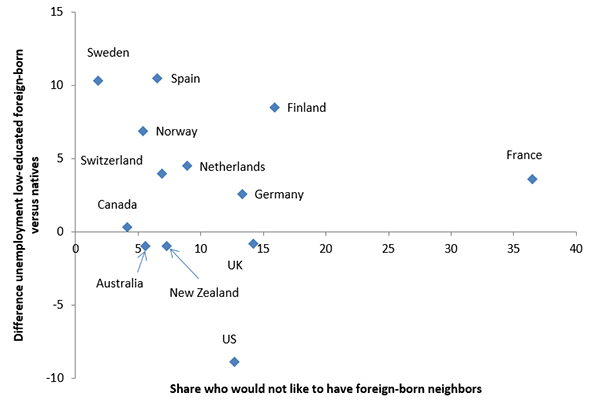
    A third view is that the problem is rooted mainly in discrimination and open racism. Immigrants are simply not given a chance to prove themselves since employers chose not to hire them. Direct and indirect racist structures hinder the success of immigrants and their children.

    It is difficult to conclusively say which explanations are more relevant than the others. But we can look at the relation between discriminatory viewpoints and the labor market success of migrants. This is made possible by the World Value Survey, an ambitious project to map the prevalence of different attitudes around the world.

    Recently the result of latest survey, conducted between the years 2010 and 2014, has been made available. One of the questions included in the survey was how many who would not like to have neighbors which were immigrants or foreign workers. Another was how many who thought that when jobs are scarce, employers should give priority to natives over immigrants.

    As shown below, the prevalence of these answers vary greatly between seven modern economies for which data have been released so far. In Germany and the Netherlands for example a fifth of the population express that they would not like to have foreign-born neighbors. The same view is shared by less than four percent of the Swedish population. Likewise, about half of the public in the US, Australia, New Zealand and Spain believed that employers should give priority to natives over foreign-born when jobs are scarce. In Germany and the Netherlands about four in ten hold the same view, compared to 14 percent in Sweden.

    Would not like foreign-born neighbors

    Employers should give priority to natives

    Unemployment difference low-educated foreign-born versus low-educated natives

    Unemployment difference high-educated foreign-born versus high-educated natives

    Germany

    21

    41

    2.6

    6.1

    Netherlands

    20

    36

    4.5

    3.3

    US

    14

    50

    -8.9

    1.4

    Australia

    11

    51

    -1.0

    2.5

    Spain

    7.5

    53

    11

    9.9

    New Zealand

    5.9

    50

    -0.96

    1.9

    Sweden

    3.5

    14

    10

    8.1

     Data from World Value Survey 2010-2014. Unemployment difference from OECD data over “Indicators of integration of immigrants and their children”, given for the years 2009-2010.  Rounded to two significant digits.


    However, there is no clear link between tolerance for foreign-born as either neighbors or in the labor market on one hand, and actual labor market success on the other. Sweden, where the public expresses the most tolerant viewpoints, could be expected to be characterized by good labor market outcomes for immigrants. However, Sweden is next  to spain is  characterized with the biggest gap in employment between foreign-born and natives. This relation holds regardless if we look at the difference between low-educated or high-educated people with foreign-born and native backgrounds respectively.

    The US on the other hand, has merely 1.4 percentage point higher unemployment amongst high-educated foreign-born compared to natives with similar educational background. Amongst the low-educated in the US the difference is 8.9 percentage points in favor of the foreign-born. At the same time, the share in the US who would not like to have foreign-born neighbors is almost twice as high as in Spain and fully four times as high as in Sweden.

    Perhaps it is difficult to find a strong link since the number of countries included is so small. In order to broaden the sample, we can look at the 2005-2009 edition of the World Value Survey. In that survey the question relating to foreign-born neighbors, but not that of allocation of jobs, was asked. The graph below shows the relation between the share who would not like to have foreign-born neighbors on one hand, and the difference in unemployment on the other. 


    Source for attitudes towards foreign-born neighbors: World Value Survey 2005-2009. Source for difference in unemployment: OECD data over “Indicators of integration of immigrants and their children”, given for the years 2009-2010. 

    The relation between attitudes and employment prospects are not what one would expect. If anything, the countries in which fewest people do not want foreign-born neighbors are also those in which differences in unemployment are the highest. This does not necessarily mean that countries with the different attitude do better. Canada, Australia and New Zealand are nations where a relatively small share has anything against foreign-born neighbors. The same countries have good labor market outcomes for the foreign-born. In Australia and New Zealand, low-skilled individuals with a foreign-born background have slightly lower unemployment than similar natives. In Canada the difference is minute between the two groups.

    Given these outcomes it is difficult to conclusively say what factors that favor integration and what obstacles that stand in the way of integration. It could, for example, be argued that the people in countries such as Sweden are giving politically correct responses. These responses do not necessarily have to translate to the discrimination actually faced by immigrants on a daily basis. At the same time, it is clear that the Anglo-Saxon countries are succeeding in integration. This could be attributed to having English as their main language. It could also be attributed to market-based systems with strong incentives for work and relatively free labor markets. In short, attitudes, at least as reported by the World Value Survey, do not seem to explain the differences in integration. Although all enlightened countries should strive for the tolerant views expressed in countries such as Sweden, this does not guarantee well‑functioning integration.

    Dr. Nima sanandaji is a frequent writer for the New Geography. He is upcoming with the book "Renaissance for Reforms" for the Institute of Economic Affairs and Timbro, co-authored with Professor Stefan Fölster.

    Photo from BigStockPhoto.com.

  • Michigan’s State Legislature Needs to Cut Detroit Down to Size

    What’s often forgotten in politics and governance is municipalities are the creation of state legislatures.  A good deal of the population growth in major cities in the second half of the nineteenth century was due to annexation. One of the best examples is New York‘s amazing growth due to annexing Brooklyn. Few people are talking about it but it’s time to consider smaller political units. As Detroit struggles with failure of bankruptcy, the geographical size of the Motor city is becoming a major issue.

    Detroit’s long decline eventually put it a federal bankruptcy court. The reasons are numerous but the reality is here.  How Detroit exists from bankruptcy court is now an issue. Putting Detroit on a sound economic footing is essential to preventing another bankruptcy. The Detroit Free Press reports:

    The investment banker representing the City of Detroit had talks with billionaire real estate investor Sam Zell and investment firm the Blackstone Group about selling them the city’s vacant property — but the investors weren’t interested, the Free Press has learned.

    The revelation comes as the value of Detroit’s abandoned and blighted property — which the city considers assets in its Chapter 9 bankruptcy — is in dispute.

    Creditors argue that city-owned property is a source of significant value that is being ignored in the city’s bankruptcy restructuring blueprint, called a “plan of adjustment.” The creditors argue the approximately 22 square miles of vacant or blighted property the city owns could be sold — with the proceeds distributed to creditors and even reinvested in the city.

    But Ken Buckfire, president of the city’s investment banking adviser Miller Buckfire, testified that city-owned land “to some extent has negative value,” according to a deposition transcript obtained by the Free Press.

    One way to interpret the comment about “negative value” is where the land is located. If Michigan’s state legislature re-drew Detroit‘s geographical boundaries, investors would be more interested in the land. A new municipality, without Detroit’s corrupt and expensive politics would be a major reform. Detroit as it exists today isn’t viable for job growth and a stable population. Detroit’s local politicians and special interest groups would obviously fight any changes in geographical boundaries in Michigan’s state legislature because a declining Detroit was a way to plunder taxpayers. But Michigan taxpayers need to start asking themselves: is Detroit’s 143 square miles a viable long term enterprise?