Category: Politics

  • State Governments Are Oppressive, Too

    Historically, the battle over the size and scale of government has been focused largely on “states’ rights.” This federalist notion also has been associated with many shameful things, such as slavery, Jim Crow laws and other abuses of personal freedom.

    Yet, increasingly, the clearest threat to democracy and minority rights today comes not just from a surfeit of central power concentrated in Washington, D.C., but also from increased centralization of authority within states, and even regional agencies. Oppressive diktats from state capitals increasingly seek to limit local control over basic issues such as education, zoning, bathroom designations, guns and energy development.

    This follows a historical trend over the past century. Ever since the Great Depression, and even before, governmental power has been shifting inexorably from the local governments to regional, state and, of course, federal jurisdictions. In 1910, the federal level accounted for 30.8 percent of all government spending, with state governments comprising 7.7 percent and the local level more than 61 percent. More than 100 years later, not only had the federal share exploded to nearly 60 percent, but, far less recognized, the state share had nearly doubled, while that of local governments has fallen to barely 25 percent, a nearly 60 percent drop. Much of what is done at the local level today is at the behest, and often with funding derived from, the statehouse or Washington.

    Diversity vs. regimentation

    This trend is particularly notable in the country’s two megastates: California and Texas. Each is increasingly controlled by ideological fanatics who see in their statehouse dominion an ideal chance to impose their agenda on dissenting communities. In California, Jerry Brown’s climate jihad is the rationale for employing “the coercive power of the central state,” in his own words, to gain control over virtually every aspect of planning and development.

    In Texas, the impetus comes from the far right, which has been working to strip localities of their traditional ability to control their own affairs, which, as two Houston scholars recently pointed out, has been critical to that state’s success. These efforts cover a host of issues, from fracking and ride-sharing to transgender bathrooms, a topic which affects very few but has, absurdly, become the key issue for a legislative special session.

    Just as Californians find themselves increasingly controlled by climate warriors and anti-suburban ideologues, diverse Texans in cities like Austin now must conform to the dictates of strident demands by a “liberty caucus” that eerily resembles their authoritarian doppelgangers in Sacramento.

    In other cases, such as in North Carolina, social conservatives, like their Texan bedfellows, seek to circumscribe progressive policies in places like Raleigh or Charlotte. Businesses, in particular, are concerned that some bills, like the state’s transgender bathroom legislation, could lead to painful boycotts by corporations and event planners. Conversely, some blue-state policies, like high mandated minimum wages and policies restricting fossil fuels, hurt disproportionately poorer areas, like upstate New York and rural California, which have lost much of their political clout.

    Read the entire piece in the Los Angeles Daily News.

    Joel Kotkin is executive editor of NewGeography.com. He is the Roger Hobbs Distinguished Fellow in Urban Studies at Chapman University and executive director of the Houston-based Center for Opportunity Urbanism. His newest book is The Human City: Urbanism for the rest of us. He is also author of The New Class ConflictThe City: A Global History, and The Next Hundred Million: America in 2050. He lives in Orange County, CA.

    Photo by LoneStarMike (Own work) [CC BY 3.0], via Wikimedia Commons

  • Postcards From the Zombie Apocalypse

    I’m regularly accused of being a doomer whenever I point out the obvious – that many aspects of how we’ve organized our affairs over the last several decades aren’t meant to last. So they won’t. The end of Jiffy Lube and Lean Cuisine isn’t The End. Civilization will carry on without them, I assure you. But when it’s suggested that our current set of arrangements won’t last forever people immediately imagine Mad Max, as if no other alternative exists. Things are going to change. They always have and they always will. The future will just be different. That’s absolutely not the same as saying the world is coming to an end. Clear eyed individuals who are paying attention can start to get a feel for who the new winners and losers are likely to be and place themselves in the best possible situation ahead of the curve. That’s a pragmatist’s view – not a doomer’s.

    It helps to explore previous versions of these regularly occurring historical shifts. Think of them as postcards from the last few rounds of the Zombie Apocalypse. Here’s a small farm town in rural Nebraska. Its population peaked in the 1920s. The period between World War I and the Great Depression was an especially prosperous time for such towns as commodity prices were high and technological innovation (the telephone, radio, automobiles, tractors, etc.) created an enormous amount of new wealth and opportunity. The 1920s was also an era of rampant unsustainable practices of all kinds that lead to the ruined soils and draughts of the Dustbowl and the collapse of speculative credit based financial institutions. The population of this town began to decline in the 1930s and is currently down to a few dozen souls.

    Remnants of some of that early twentieth century technology still litter pastures on the edge of town. One resourceful farmer organized these old car carcasses into a makeshift corral for his livestock.

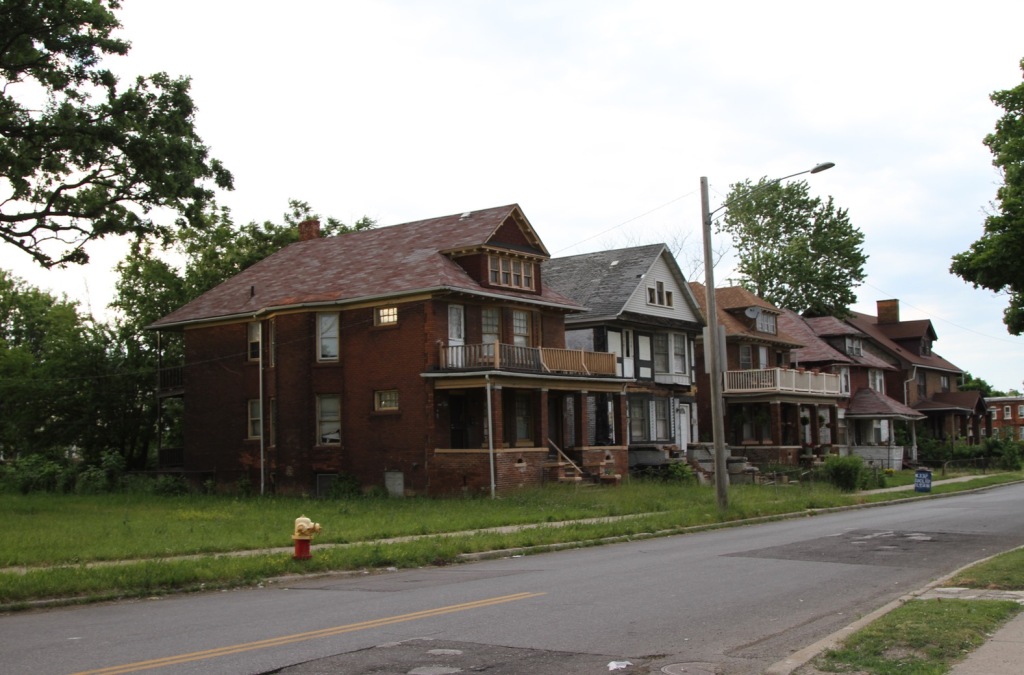
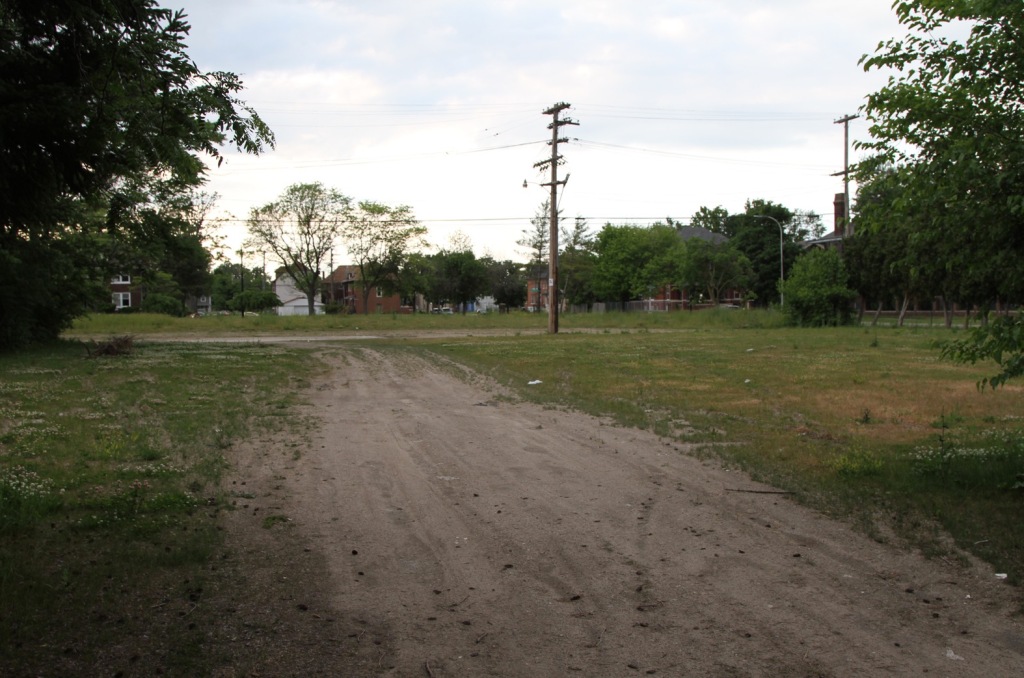
    It’s possible to connect the dots from rural Nebraska to Detroit where those very same vintage vehicles were manufactured all those decades ago. Detroit peaked in population, economic power, and political influence in 1950. Today huge swaths of Motown look remarkably similar to the abandoned farms and small towns of the prairie. Entire city blocks are now cleared of people and buildings. The Zombie Apocalypse arrived there too. If small scale agriculture was made redundant by mechanization and industrial scale production, then industry itself was hammered by other equally powerful forces. Everything has a beginning, middle, and end.

    The most recent iteration of the Zombie Apocalypse has already begun to unfold in some places. Suburbia was exactly the right thing for a particular period of time. But that era is winding down. The modest tract homes and strip malls built after World War II  are not holding up well in an increasing number of marginal landscapes. I have been accused of cherry picking my photo ops, particularly by people who engage in their own cherry picking when discussing the enduring value of prosperous suburbs. But there’s too much decay in far too many places to ignore the larger trend. The best pockets of suburbia will carry on just fine. But the majority of fair-to-middling stuff on the periphery is going down hard.

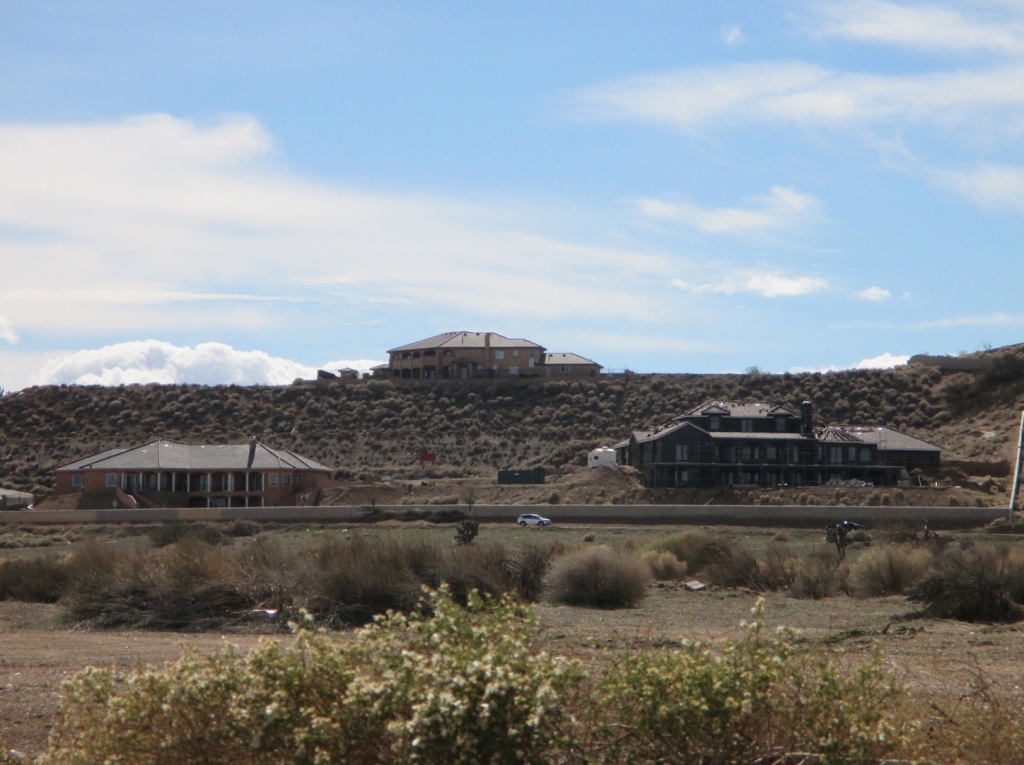
    The desire to push farther out and build ever more upscale suburban developments in increasingly remote locations is palpable. That’s what a significant proportion of the population desires on some level. But in the same spots – often next to each other – is ample evidence that there’s something profoundly wrong.

    Not all farm towns died. Not all industrial cities collapsed into ruin. Not all suburbs will fail… But the external forces at work are going to favor some places much more than others moving forward. The trick is to understand what those forces are before everyone else does and position yourself to benefit instead of getting whacked by the shifts. Would you have rather sold your house in Detroit in 1958 when things were still pretty good, or wait until 1967 when the panicked herd began to stampede? Would it have been better to buy property in the desert in 1970 and take advantage of a wave of growth for a few decades, or buy now at the top of that cycle and slide down from here on out?

    The future drivers of change will be the same as the previous century – only in reverse. The great industrial cities of the early twentieth century as well as the massive suburban megaplexes that came after them were only possible because of an underlaying high tide of cheap abundant resources, easy financing, complex national infrastructure, and highly organized and cohesive organizational structures. Those are the elements of expansion.

    But once the peak has been reached there’s a relentless contraction. The marginal return on investment goes negative as the cost of maintaining all the aging structures and wildly inefficient attenuated systems becomes overwhelming. The places that do best in a prolonged retreat from complexity are the ones with the greatest underlying local resource base and most cohesive social structures relative to their populations. The most complex places with the most critical dependencies will fail first as the tide recedes.

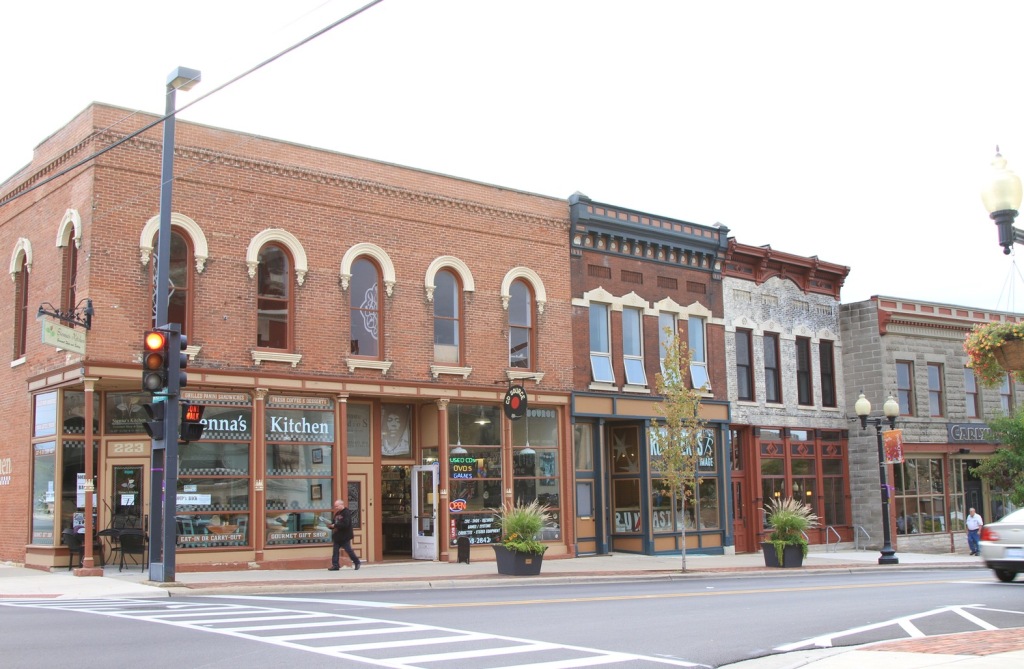
    The next Zombie Apocalypse will relentlessly dismantle superficial decorative landscapes and highly leveraged economies of scale. Take away the twelve thousand mile just-in-time supply chains, heavy debt loads, and limitless cheap resources and you get a very different world. Over the long haul Main Street has a pretty good chance of coming back along with the family farm. But the shorter term in-between period of adjustment to contraction is going to be rough as existing institutions attempt to maintain themselves at all costs.

    This piece first appeared on Granola Shotgun.

    John Sanphillippo lives in San Francisco and blogs about urbanism, adaptation, and resilience at granolashotgun.com. He’s a member of the Congress for New Urbanism, films videos for faircompanies.com, and is a regular contributor to Strongtowns.org. He earns his living by buying, renovating, and renting undervalued properties in places that have good long term prospects. He is a graduate of Rutgers University.

  • On the Outside, Looking In

    The urban political base that was the foundation of African-American politics since the Civil Rights Movement is slowly eroding. Because of large-scale demographic trends at work in our metro areas, black political influence is in decline. Unless blacks become more inclusive (or intersectional) in our political approach, or better at building coalitions, we risk having our political concerns relegated to the margins, by virtue of where we live.

    I said as much nearly three years ago (“How ‘Black = Urban’ Ends”) and in subsequent posts I wrote nearly two years ago about urban and suburban demographic trends and how that’s reflected in our metro areas. I haven’t updated the data, but think the trends are more evident now than ever.

    How can I make this claim? One measure is the number of elected African-American mayors in our nation’s largest cities.

    Let’s look at how thing have changed over the last 25 years. In 1992 four of the ten largest cities in the nation were led by black mayors (New York, Los Angeles, Philadelphia and Detroit). Some cities, like Chicago and Cleveland, had already elected black mayors but no longer had them; others, like Seattle, Denver, Kansas City, Memphis, Minneapolis and San Francisco, would elect their first black mayors before the end of the decade. In all, by 2000, 13 of the 25 largest U.S. cities at the time, and 19 of the 50 largest, either had or would have a black mayor in office.

    But the election of black mayors in large cities would slow greatly after 2000. Today, only six of the 50 largest cities (Houston, Denver, Washington, DC, Baltimore, Kansas City and Atlanta) currently have black mayors. Five more cities in the top 50 — San Antonio, Jacksonville, Columbus, Sacramento and Wichita — had black mayors whose terms started in 2000 or later, but have since been replaced (most recently former San Antonio Mayor Ivy Taylor, just last month).

    Let’s be clear about a couple things, however. While the numbers of black mayors of large cities has declined over the last 25 years, the leadership of our cities is far more diverse — and representative — than it was then. There are more Latino, Asian and women mayors leading our large cities than ever before, and that’s a positive. But that doesn’t change the fact that there are fewer blacks in those positions.

    And while the election of big city mayors is relatively easy to track, identifying trends among other local officials is far more difficult. My guess is that city councils, county boards, special service districts and the like are also more diverse and representative, and may even have more African-Americans in those positions — even as the number of black mayors has declined. That also can be viewed as a positive.

    The Explanation

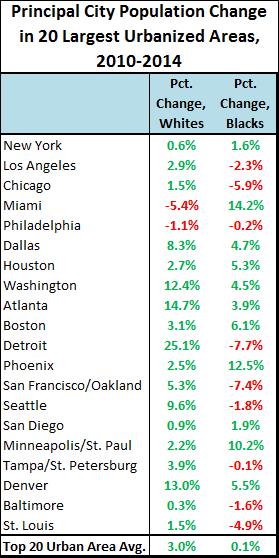
    How can this be explained? Two years ago I pulled some Census Bureau ACS data for the twenty largest U.S. urbanized areas (the contiguous portions of metro areas with more than 1,000 people per square mile) that offered some interesting findings:

    • Nationally, principal cities and their suburbs both grew at 4.4% between 2010 and 2014.

    • Metro area population growth is driven by strong growth among Hispanics, Asians and other groups.

    • Within urbanized areas, however, whites and blacks are growing at much slower rates – blacks at 4.0%, whites at just 0.3% nationwide.

    • Within the twenty largest urbanized areas, the number of white residents is growing in principal cities and decreasing in suburbs.

    • Similarly, the number of black residents in growing in suburbs, and essentially flat in principal cities.

    • At the metro level, 12 of the top 20 metro areas have principal cities where the white population is increasing while the black population is decreasing, or where the growth rate of whites exceeds that of blacks.

    • Similarly, 19 of the top 20 metro areas have suburbs where the black population is increasing while the white population is decreasing, or where the growth rate of whites exceeds that of whites.

    • Here’s how that information looks graphically. First, for whites, blacks, Hispanics, Asians and others, at the national level by city and suburban geography:

    And then, a focus in on whites and blacks nationally, by city and suburban geography:

    Now, let’s look at percentage changes of whites and blacks within the principal cities of the twenty largest urbanized areas:


    And lastly, at percentage changes of whites and blacks in suburban areas of the top 20:


    This data is in need of updating, and there is the question of whether trends evident within the top 20 urban areas are applicable to smaller ones. I’ll try to answer both when I can. In the meantime, simply put, Latino and Asian populations are growing in the largest cities and suburbs. Whites are growing more numerous in cities while declining in suburbs, while blacks are declining in cities and growing in suburbs.

    This is the first part of understanding the change in African-American political influence.

    Much of this seems to slip under the radar of urbanists, because of the second part of trying to understand this — your level of analysis impacts your ability to perceive, and evaluate, the trend. At the metro level, we see that suburbs are becoming more diverse as they add more people of color and cities see a return of white residents to core cities. After generations of practices put in place to exclude people of color from suburbs, this is applauded. But at the neighborhood level, it could be viewed quite differently — an influx of minorities where none previously existed in the suburbs, or an influx of whites in minority-dominated neighborhoods. Only one of these trends at the neighborhood level has truly been considered by most urbanists.

    Speaking of which — I want to dispel any notion that displacement related to gentrification plays a dominant role in this. That’s the narrative that’s fueled gentrification debates for years. But rarely does this narrative consider the aspirational appeal of moving to the suburbs that still resonates with many people of color, just as it did with earlier generations of whites in the 20th century. Lance Freeman, a professor of urban planning at Columbia University, has conducted considerable research that counters this assumption:

    “What distinguishes gentrification is not who moves out; it’s who moves in. In a gentrifying neighborhood, new residents are more likely to be well-off . As a result, the neighborhood’s poverty makeup can shift, even if no one leaves. In 2004, I found that a neighborhood’s poverty rate could drop from 30 percent to 12 percent in a decade with minimal displacement. That’s because gentrification often leads to new construction or to investment in once-vacant properties.”

    Thinking that gentrifiers are forcing this dynamic magnifies their importance, and diminishes the decision-making process of people of color.

    The Impact

    Back to politics. What will this mean going forward, given what we know about how cities are changing the political landscape? We know that cities are pushing forward to develop an urban political agenda; in the aftermath of the election of Donald Trump to the presidency, a key recommendation of Richard Florida’s book The New Urban Crisis was that cities should become more autonomous so they can more effectively address the challenges that impact them. But with increasing numbers of minorities in suburbia, and a growing number of urbanists who have “been there, done that” when it comes to the suburbs, does autonomy come at a price?

    Here’s how I see things playing out over the next decade or two. People of color will continue to move to suburbia in increasing numbers. They will do so for the same reasons people before them did — affordability, good schools, lower crime. They are doing so in part because suburbia is something that eluded them for so long, and is now within their grasp. As they move in, they will begin to wield more influence on suburban politics — suburban mayors, County Board representatives, more representation in state legislatures. We will see more minority representation in the suburbs — just as suburban political influence wanes.

    Why? Because cities are ascendant. It’s not just people flowing back into cities. It’s jobs, and it’s money. More and more people in residential and commercial real estate are finding out that the real money to be made is now in cities. Banks will change lending patterns to favor cities, and not suburbs. The case will be made — and rightly so — that urban density is the right response to lowering carbon emissions in a climate change world, and those who choose density will be rewarded. At the same time, those who choose sprawl will be punished. Banks won’t finance new development or renovations. Property values will decline. Tax dollars for infrastructure improvements will be harder to come by.

    I hardly see this happening to all suburban areas across the country. There are suburbs in some metro areas that are closely aligned with the core city (either by adjacency or transit) and will adapt accordingly. There are pockets of affluence in many suburbs that will not change, no matter what broader trends portend. There are other metro areas whose entire makeup is largely suburban in orientation, and any change they have will more likely be region-wide. As for metro areas with a bigger city-suburban divide, over time I see wealth being pulled from suburbia and back into cities in quite the same way it happened in the middle of the 20th century, in reverse. Minority political representation will continue to decline in cities and increase in suburbs — and they’ll find they own a landscape few people want.

    In other words, even as people of color are making decisions that work in their interests now, we may need to get accustomed to a future of being on the outside, looking in.

    This piece originally appeared on The Corner Side Yard.

    Pete Saunders is a Detroit native who has worked as a public and private sector urban planner in the Chicago area for more than twenty years.  He is also the author of “The Corner Side Yard,” an urban planning blog that focuses on the redevelopment and revitalization of Rust Belt cities.

    Photo: huffingtonpost.com

  • Why the Greens Lost, and Trump Won

    When President Trump pulled out of the Paris climate accords, embraced coal, and stacked his administration from people from fossil-fuel producing states, the environmental movement reacted with near-apocalyptic fear and fury. They would have been better off beginning to understand precisely why the country has become so indifferent to their cause, as evidenced by the victory not only of Trump but of unsympathetic Republicans at every level of government.

    Yet there’s been little soul-searching among green activists and donors, or in the generally pliant media since November about how decades of exaggerated concerns—about peak oil, the “population bomb,” and even, a few decades back, global cooling—and demands for economic, social, and political sacrifices from the masses have damaged their movement.

    The New Religion and the Next Autocracy

    Not long ago, many greens still embraced pragmatic solutions—for example substituting abundant natural gas for coal—that have generated large reductions in greenhouse gas emissions. Rather than celebrate those demonstrable successes, many environmentalists began pushing for a total ban on the development of fossil fuels, including natural gas, irrespective of the costs or the impact on ordinary people.

    James Lovelock, who coined the term “Gaia,” notes that the green movement has morphed into “a religion” sometimes marginally tethered to reality. Rather than engage in vigorous debate, they insist that the “science is settled” meaning not only what the challenges are but also the only acceptable solutions to them. There’s about as much openness about goals and methods within the green lobby today as there was questioning the existence of God in Medieval Europe. With the Judeo-Christian and Asian belief systems in decline, particularly among the young, environmentalism offers “science” as the basis of a new theology.

    The believers at times seem more concerned in demonstrating their faith than in passing laws, winning elections or demonstrating results. So with Republicans controlling the federal government, greens are cheering Democratic state attorney generals’ long-shot legal cases against oil companies. The New York TimesThomas Friedman has talked about dismissing the disorder of democracy as not suited to meeting the environmental challenges we face, and replacing it with rulers like the “reasonably enlightened group of people” who run the Chinese dictatorship.

    After Trump pulled the U.S. out of the Paris climate accord, China was praised, bizarrely, as the great green hope. The Middle Kingdom, though, is the world’s biggest and fastest grower emitter, generating coal energy at record levels. It won’t, under Paris, need to cut its emissions till 2030. Largely ignored is the fact that America, due largely to natural gas replacing coal, has been leading the world in GHG reductions.

    Among many greens, and their supports, performance seems to mean less than proper genuflecting; the Paris accords, so beloved by the green establishment, will make little impact on the actual climate, as both rational skeptics like Bjorn Lomborg and true believers like NASA’s James Hanson agree. In this context, support for Paris represents the ultimate in “virtue signaling.” Ave Maria, Gaia.

    The California Model

    The cutting edge for green soft authoritarianism, and likely model after the inevitable collapse of the Trump regime, lies in California. On his recent trip with China, Brown fervently kowtowed to President Xi Jinping. Brown’s environmental obsessions also seems to have let loose his own inner authoritarian, as when he recently touted “the coercive power of the state.”

    Coercion has its consequences. California has imposed, largely in the name of climate change, severe land use controls that have helped make the state among the most unaffordable in the nation, driving homeownership rates to the lowest levels since the 1940s, and leaving the Golden State with the nation’s highest poverty rate.

    The biggest losers from Brown’s policies have been traditional blue collar, energy-intensive industries such as home building, manufacturing, and energy. Brown’s climate policies have boosted energy prices and made gas in oil-rich California about the most expensive in the nation. That doesn’t mean much to the affluent Tesla-driving living in the state’s more temperate coast, but it’s forced many poor and middle-class people in the state’s less temperate interior into “energy poverty,” according to one recent study.

    That, too, fits the climatista’s agenda, which revolves around social engineering designed to shift people from predominately suburban environments to dense, urban and transit dependent ones. The state’s crowded freeway are not be expanded due to a mandated “road diet,” while local officials repeatedly seek to reduce lanes and “calm traffic” on what are already agonizing congested streets. In this shift, market forces and consumer preferences are rarely considered, one reason these policies have stimulated much local opposition—and not only from the state’s few remaining conservatives.

    California’s greens ambitions even extend to eating habits. Brown has already assaulted the beef producers for their cattle’s flatulence. Regulators in the Bay Area and local environmental activists are proposing people shift to meatless meals. Green lobbyists have already convinced some Oakland school districts to take meat off the menu. OK with me, if I get the hamburger or taco-truck franchise next to school when the kids get out.

    Sadly, many of these often socially harmful policies may do very little to address the problem associated with climate change. California’s draconian policies fail to actually do anything for the actual climate, given the state’s already low carbon footprint and the impact of people and firms moving to places where generally they expand their carbon footprint. Much of this has taken on the character of a passion play that shows how California is leading us to the green millennium.

    Goodbye to the Family

    An even bigger ambition of the green movement—reflecting concerns from its earliest days—has been to reduce the number of children, particularly in developed countries. Grist’s Lisa Hymas has suggested that it’s better to have babies in Bangladesh than America because they don’t end up creating as many emissions as their more fortunate counterparts. Hymas’ ideal is to have people become GINKs—green inclinations, no kids.

    Many green activists argue that birth rates need to be driven down so warming will not “fry” the planet. Genial Bill Nye, science guy, has raised the idea of enforced limits on producing children in high-income countries. This seems odd since the U.S. already is experiencing record-low fertility rates, a phenomenon in almost all advanced economies, with some falling to as little as half the “replacement rate” needed to maintain the current population. In these countries, aging populations and shrinking workforces may mean government defaults over the coming decades.

    The demographic shift, hailed and promoted by greens, is also creating a kind of post-familial politics. Like Jerry Brown himself, many European leaders—in France, Germany, Sweden, the United Kingdom, and the Netherlands—are themselves childless. Their attitude, enshrined in a EU document as “no kids, no problem” represents a breathtaking shift in human affairs; it’s one thing to talk a good game about protecting the “next generation” in the collective abstract, another to experience being personally responsible for the future of another, initially helpless, human being.

    Do As We Say, Not How We Live

    The pressing need to change people’s lives seems intrinsic now to green theology. Without penance and penalties, after all, there is no redemption from original sin. In the process, it seems to matter little if we undermine the great achievements of our bourgeois economy—expanded homeownership, greater personal mobility, the ability to rise to a higher class—if it signals our commitment to achieve a more earth-friendly existence.

    The left-wing theorist Jedidiah Purdy has noted that “mainstream environmentalism overemphasizes elite advocacy” at the expense of issues of economic equity, a weakness that both Trump and the GOP have exploited successfully, particularly in the Midwest, the South, and Intermountain West. Some greens object even to the idea of GDP growth at a time when most Americans are seeing their standard of living drop. No surprise then that the green agenda has yet to emerge from the basement of public priorities, which remain focused on such mundanities as better jobs, public safety, and decent housing.

    To further alienate voters, many green scolds live far more lavishly than the people they are urging to cut back. Greens have won over a good portion of the corporate elite, many of whom see profit in the transformation as they reap subsidies for “green” energy, expensive and often ineffective transit and exorbitant high-density housing. Most notable are the tech oligarchs, clustered in ultra-green Seattle and the Bay Area, who depend on massive amounts of electricity to run their devices, but have reaped huge subsidies for green energy.

    The tech oligarchs have little interest in family friendly suburbs, preferring the model of prolonged adolescence in largely childless places like college campuses and San Francisco. Oligarchs such as Mark Zuckerberg live in spacious and numerous houses, even while pressing policies that would push everyone without such a fortune to downsize. Richard Branson, another prominent green supporter, may not like working people’s SUVs, but he’s more than willing to sponsor climate change events on a remote Caribbean island reachable only by private plane. One does not even need to plumb the hypocrisy of Al Gore’s jet-setting luxurious lifestyle.

    In the manner of Medieval indulgences these mega emissions-generators claim to pay for their carbon sins by activism, buying rain forests and other noble gestures. Hollywood, as usual, is particularly absurd, with people like Leonardo di Caprio flying in his private jet across country on a weekly basis. Living in Malibu, Avatar director James Cameron sees skeptics as “boneheads” who will have “to be answerable” for their dissidence, suggesting perhaps a shootout at high noon.

    In the end, the greens and their wealthy bankrollers may find it difficult to prevail as long as their agenda makes people poorer, more subservient, and more miserable; this disconnect is, in part, why the awful Donald Trump is now in the White House. Making progress on climate change, and other environmental concerns, remains a critical priority, but it needs to explore ways humans, through ingenuity and innovation, can meet these challenges without undermining what’s left of our middle class and faded democratic virtue.

    This piece originally appeared on the Daily Beast.

    Joel Kotkin is executive editor of NewGeography.com. He is the Roger Hobbs Distinguished Fellow in Urban Studies at Chapman University and executive director of the Houston-based Center for Opportunity Urbanism. His newest book is The Human City: Urbanism for the rest of us. He is also author of The New Class ConflictThe City: A Global History, and The Next Hundred Million: America in 2050. He lives in Orange County, CA.

    Photo by Joe Flood, via Flickr, using CC License.

  • Capitalism Did Not Win the Cold War

    When the Soviet Union collapsed 26 years ago, it was generally agreed that the West had won the Cold War. This was affirmed by the prosperity and possibilities awaiting citizens of Western countries, as opposed to the political and economic stagnation experienced by those in Communist states. A natural conclusion, much repeated at the time, was that capitalism had finally defeated communism.

    This sweeping statement was only partially true. If one took capitalism and communism as the only two protagonists in the post–World War II struggle, it was easy to see that the latter had suffered a mortal blow. But there was a third, stealthier protagonist situated between them. This was a system best identified today as cronyism. For if capitalism did win over the other two contenders in 1991, its victory was short-lived. And in the years that have followed, it is cronyism that has captured an ever-increasing share of economic activity. A survey of the distribution of power and money around the world makes it clear: cronyism, not capitalism, has ultimately prevailed.

    Defining Cronyism

    What is cronyism? In a previous article, I objected to the term “crony capitalism” on the grounds that cronyism is itself antithetical to the principles of capitalism and ought not be viewed as a derivative of it. Cronyism is, rather, a separate system that fallsbetween capitalism and state-controlled socialism. When a country drifts from capitalism toward socialism, the transitional period is one in which cronies rule the land.

    Transitional cronyism claims to be capitalistic, whereas socialism claims to be egalitarian. But they are very similar, except for the size of the group of cronies at the top. In cronyistic societies, a larger group extracts a growing share of society’s wealth for themselves and their associates. In socialistic systems, a smaller group vies savagely for wealth and power: because putatively egalitarian economies are usually less efficient at generating wealth, there may be less to go around, making the infighting among socialist leaders that much more bitter.

    Read the entire piece at Foreign Policy.

    Sami Karam is the founder and editor of populyst.net and the creator of the populyst index™. populyst is about innovation, demography and society. Before populyst, he was the founder and manager of the Seven Global funds and a fund manager at leading asset managers in Boston and New York. In addition to a finance MBA from the Wharton School, he holds a Master’s in Civil Engineering from Cornell and a Bachelor of Architecture from UT Austin.

    Photo: Agência Brasil Fotografias [CC BY 2.0], via Wikimedia Commons

  • High-Flying California Charts Its Own Path — Is A Cliff Ahead?

    As its economy bounced back from the Great Recession, California emerged as a progressive role model, with New York Times columnist Paul Krugman arguing that the state’s “success” was proof of the superiority of a high tax, high regulation economy. Some have even embraced the notion that California should secede to form its own more perfect union.

    Pumped up by all the love, California’s leaders have taken it upon themselves to act essentially as if they were running their own nation. In reaction to President Trump’s abandonment of the Paris accords, Gov. Jerry Brown trekked to Beijing to show climate solidarity with President Xi, whose country is by far the world’s largest greenhouse gas emitter and still burns coal at record rates, but mouths all the right climate rhetoric.

    At the same time California’s Attorney General is spending millions to protect undocumented workers and there’s legislation being proposed to transform the entire place into a “sanctuary state.” Sacramento also recently banned travel by government workers to Texas and seven other states that fail to follow the California line on gay and transgender rights.

    Past performance and future trajectory

    When progressive journalists, including those in Texas, speak about the California model, they usually refer to the state’s economic performance since 2010, which has been well above the national average. Yet this may have been only an aberrant phenomenon. Since 2010, Texas’ job count has grown by 20.6 percent compared to 18.6 percent for California. If you pull the curtain even further, to 2000, however, the gap is even bigger, with employment growing 32.7 percent in Texas compared to 18 percent in California.

    The main problem is that California’s once remarkably varied and vital economy has become dangerously dependent on the Bay Area tech boom. Since 2010, the Silicon Valley-San Jose economy and San Francisco have been on a tear, growing their employment base by 25 percent. Job growth in the rest of the state has been a more modest 15 percent. “It’s not a California miracle, but really should be called a Silicon Valley miracle,” notes Chapman University forecaster Jim Doti. “The rest of the state really isn’t doing well.”

    Tech starts to slow

    Such dependency poses dangers. The tech economy is very volatile, and now seems overdue for a major correction. People tend to forget the depth of the tech bust at the turn of the century. If you go back to 2000, San Jose’s job growth rate is among the lowest in the state, less than half the state average.

    Now tech is clearly slowing – job growth in the information sector has slowed over the past year from almost 10 percent to under 2 percent. Particularly hard-hit is high-tech startup formation, down almost half in the first quarter from two years ago; the National Venture Capital Association reported that the number of deals in the quarter was the lowest since the third quarter of 2010.

    The growing hegemony of a few very large firms – chiefly Apple, Google and Facebook — has created a very difficult environment for upstarts. As one recent paper demonstrates, these “super platforms” depress competition, squeeze suppliers and reduce opportunities for potential rivals, much as the monopolists of the late 19th century did.

    And as we found in our recent survey of the hot spots for high wage professional business services jobs, last year’s growth rates for this critical middle class sector in Silicon Valley and San Francisco lagged considerably behind those of boomtowns such as Nashville, Dallas, Austin, Orlando, San Antonio, Salt Lake City and Charlotte. Most other California metro areas, including Los Angeles, have languished in the bottom half of the rankings. These trends suggest that the state’s job performance will at least drop to the national average over the next two years and perhaps below, says California Lutheran University forecaster Matthew Fienup.

    Rising inequality

    California is home to a large chunk of the world’s richest people and particularly dominates the list of billionaires under 40. Yet, by one new measure introduced by the Census Bureau last year, the state also suffers the nation’s highest poverty rate; while a 2015 United Way study found that close to one in three Californians were barely able to pay their bills. No surprise then that as of 2015, the state was the most unequal in the nation, according to the Social Science Research Council.

    As of 2011, nearly half of the 16 counties with the highest percentages of people earning over $190,000 annually were located in California but denizens of the state’s interior have done far worse. A 2015 report found California was home to a remarkable 77 of the country’s 297 most “economically challenged,” cities based on levels of poverty and employment. Altogether these cities had a population of more than 12 million in 2010, roughly one third of the state at the time. Six of the ten metropolitan areas in the country with the highest percentage of jobless are located in the central and eastern parts of the state.

    What is disappearing faster than any state, according to a survey last year, is California’s middle class, a pattern also seen in a recent Pew study. One clear sign of middle class decline: California’s homeownership rates now rank among the lowest in the nation and Los Angeles-Orange County, the state’s largest metropolitan area, suffers the lowest level of homeownership of any major region.

    Jerry’s Jihad and its consequences

    State policies tied to Jerry Brown’s climate jihad have widened these divides. Inland Empire economist John Husing asserts that Brown has placed California “at war“ with blue-collar industries like home building, energy, agriculture and manufacturing. These jobs are critical for regions where almost half the workforce has a high school education or less.

    Richard Chapman, President and CEO of the economic development arm of Kern County, an area dependent on these industries, complains that most polices promulgated in Sacramento — from water and energy regulations to the embrace of sanctuary status and a $15 an hour minimum wage — give little consideration given to the needs of the interior. “We don’t have seats at the table,” he laments. “We are a flyover state within a state.”

    The recent legislation to raise the minimum wage to $15 an hour will have more severe ramifications for less affluent areas than San Francisco. As for climate policies, the state no longer even assesses the economic implications. Yet the state’s costly renewable energy mandates make a lot of difference in the less temperate interior when energy prices are 50 percent rise above neighboring states. A recent study found that the average summer electric bill in rich, liberal and temperate Marin County was $250 a month, while in the impoverished, hotter Central Valley communities, where air conditioners are a necessity, the average bill was twice as high. Some one million Californians, many in the state’s hotter interior, were driven into “energy poverty,” a 2012 Manhattan Institute study stated.

    Housing has arguably emerged as the biggest force accentuating inequality. Environmental restrictions that have cramped home production of all kinds, particularly the building of affordable single-family homes on the periphery. The ever increasing restrictions have made the state among the most unaffordable in the nation, driving homeownership rates to the lowest levels since the 1940s. New “zero emissions” housing policies alone are likely to boost the already bloated cost of new construction by tens of thousands of dollars per home.

    Demographic crisis looms

    In much of California, particularly along the south coast, the number of children has dropped sharply. Since 2000, there has been a precipitous 13.6 percent drop in the number of residents under 17 in Los Angeles, while that number has remained flat in the Bay Area. In contrast, there has been 20 percent growth or better in the under 17 population in more affordable metropolitan areas such as Dallas-Fort Worth, Atlanta, Charlotte, Raleigh, Phoenix and San Antonio.

    Housing prices, in part driven by state and regional regulation, are gradually sending the seed corn — younger workers — to more affordable places. Despite claims that people leaving California are old and poor, the two most recent year’s data from the IRS shows larger net losses of people in the 35 to 54 age group. Losses were particularly marked among those making between $100,000 and $200,000 annually.

    Young people particularly are on the way out. California boomers, as we discussed in a recent Chapman University report, have a homeownership rate around the national average but the state has the third lowest home ownership rate in the nation for people 25 to 34, behind just New York and Washington. The drop among this demographic in San Jose and the Los Angeles areas since 1990 are roughly twice the national average and a recent San Jose Mercury News poll found nearly half of all Bay Area millennials planning to move, mostly motivated by housing and costs. The one population on the upswing in the state are seniors, particularly in the coastal countries, who bought their homes when they were much less expensive.

    As long as home prices stay high, and opportunities for high-wage employment highly limited, the state will continue to suffer net domestic migration outflows, as it has for the last 22 of the past 25 years. Given that the state’s birthrate is also at a historic low and immigration from abroad has slowed, there’s a looming shortage of new workers. Between 2013 and 2025 the number of California high school graduates is expected to drop by 5 percent compared to a 19 percent increase in Texas, 10 percent growth in Florida and a 9 percent increase in North Carolina.

    And for what?

    Of course, many environmental activists generally prefer smaller families to cut greenhouse gas emissions; smaller families also serve the needs of developers of high-density housing, who might prefer that younger people remain long-term adolescents.

    Sadly, many of these climate policies, which cause so much damage, won’t have much of an impact on the actual climate unless the rest of the country adopts similar measures. This stems from the state’s already low carbon footprint and the impact of people as well as firms moving elsewhere, where they usually expand their carbon footprint. Nor does densification make sense as a climate antidote, given the rising temperatures associated with “urban heat islands.”

    The tech boom has been used to justify Sacramento’s crushing regulatory and tax regime. It has also made it possible for apologists to ignore some 10,000 businesses that have left or expanded outside the state, many of them employing middle and working class people.

    Ultimately California’s growing class bifurcation will demand solutions. Hedge fund billionaire-turned green patriarch Tom Steyer now insists that, to reverse our worsening inequality, we should double down on environmental and land use regulation but make up for it by boosting subsidies for the struggling poor and middle class. Certainly the welfare state in California — home to over 30 percent of United States’ on public assistance as of 2012 — will have to expand if the state stays on its present course.

    In the coming years the state’s business leaders fear an ever more leftist, and fiscally damaging, regime after the departure of the somewhat frugal Brown. There are increased calls in Sacramento for new subsidized housing, a single payer healthcare system as well as a big boost to the minimum wage already enacted.

    Ultimately California will pay — demographically, economically and socially — from its current surfeit of good intentions. Those who already own houses will not suffer immediately, but the new generation, immigrants and minorities will face an increasingly impossible burden. With its unparalleled natural assets, and economic legacy, California may be able to survive this toxic policy mix better than most places, but even in the Golden State reality has a way of showing its ugly face.

    This piece originally appeared on Forbes.

    Joel Kotkin is executive editor of NewGeography.com. He is the Roger Hobbs Distinguished Fellow in Urban Studies at Chapman University and executive director of the Houston-based Center for Opportunity Urbanism. His newest book is The Human City: Urbanism for the rest of us. He is also author of The New Class ConflictThe City: A Global History, and The Next Hundred Million: America in 2050. He lives in Orange County, CA.

    Photo by Neon Tommy, via Flickr, using CC License.

  • Is Anybody Really Listening: Pizza with Perez in Youngstown

    Ohio has long been seen as a battleground state, up for grabs in most Presidential elections. The state supported winning candidates of both parties for decades. But as the state shifted back and forth, the Mahoning Valley (Mahoning and Trumbull Counties) in Northeastern Ohio remained a Democratic stronghold. If Democratic candidates could garner more than 62% of the vote in this region – as they often did — they would win the state. In years when Republicans won, the Mahoning Valley still voted for the Democrats, but with less enthusiasm.

    Not this time. In the 2016 primaries, a number of Mahoning Valley Democrats changed their party affiliation to vote for Donald J. Trump. Last year’s big shift came from people who had sat out the past few elections but showed up to vote this year. In November, Hillary Clinton won Mahoning County but received less than 50% of the vote. She actually lost in neighboring Trumbull County. She lost Ohio by more than 8 points, the biggest loss of any candidate in the state since Michael Dukakis gave up the state to George H.W. Bush in 1988.

    That’s why political operatives and journalists are now paying even more attention to the Youngstown area. Even the Ohio Democratic Party (ODP), which has long counted on the Mahoning Valley, is taking notice of a region they didn’t think they needed to worry about.

    In what has become a familiar practice following a series of defeats in recent state-wide elections, the ODP sponsored a “Listening Tour.” On June 12, 2017, the tour came to Youngstown with National Democratic Party Chairperson Tom Perez, who reiterated that Youngstown was a political “bellwether.”

    The event was held at a local pizzeria, Wedgewood Pizza, and billed as “Pizza with Perez.” Approximately 75 attendees, mostly loyal Democratic Party supporters, including a number of local and state politicians, paid $25 to attend the midday event. I paid my $25 to find out whether Party leaders were seriously listening to the concerns of voters and to see how they would react.

    What I saw was a typical campaign event, with the audience doing the listening while Democratic operatives touted their positions. After brief introductions by state and local Party chairs David Peppers and David Betras, Perez explained his commitment to Democratic politics by recalling his father’s experience of moving to Buffalo from the Dominican Republic. Perez talked about how the community and especially the labor movement helped his family make a home there. He promised that Democrats could be counted on to speak to hopes and fears of the working class and to fight for working people.

    When someone asked about why Democrats had lost the election, Perez criticized Republican social and economic policy, but he also acknowledged several mistakes that the Democratic Party had made during the last campaign. “We could have done a better job of speaking more directly to the pocketbook issues that bring people to the ballot,” he said. Among other things, the Party should have recognized that NAFTA hurt working people and acknowledged its role in that trade bill.

    Perez noted that the Party’s “message got muddled,” but he quickly turned to typical campaign trail rhetoric: “I’m here to say very clearly that the Democratic Party is the party that’s fighting for the labor movement. The Democratic Party is the party fighting for quality public education and access to health care and the issues that matter most to the people in the Valley.” But there were very few questions and much of the time devoted to meet and greet. Clearly, no one identified themselves as crossover voters or first time Republican registrants. So much for this being a listening tour.

    The ODP’s misstep of charging admission for a fake listening tour was not lost on local Mahoning County Republican Party Chairman, Mark Munroe, who called it a “strange” event and organized a parallel gathering where he invited crossover voters to explain their positions. As Munroe commented, “If they want to find out why Democrats have become Republicans they need to talk to Republicans because the Dems who have crossed over are not going to be inclined to pay $25 contribution to a Democrat party event.” One of the speakers, Geno DiFabio, explained his party switch: “Every 2 years, every 4 years, locally they’d come around and say, ‘oh, we’ll fight for you and take care of you,’ and then they’d disappear. It was like an abusive relationship.”

    Despite what the invitation promised, the ODP’s tour didn’t involve listening to local voters or even to their leaders, but that’s a familiar pattern for Mahoning Valley Democrats. Voters here remember how the national Party leaders dismissed former Congressman James Traficant when he bitterly criticized the Democratic Party for contributing to deindustrialization, making false promises, and prophetically warned that NAFTA would harm working people. But nobody listened.

    In 2015, Ohio Congressman Tim Ryan told a reporter that “a lot of bad things happened” in 2010 and 2014, and the Party needed “a new approach—a more grounded approach—to turning out voters.” Nobody listened.

    A year ago, after the Ohio primaries, local Party leaders wrote a widely publicized letter to the Clinton campaign and the ODP warning that they should pay more attention to working-class issues. Once again, nobody listened.

    A tone-deaf, let-us-tell-you-how-much-we-care faux listening tour won’t accomplish anything, But the ODP and the DNC should pay more attention to Northeastern Ohio Democrats. They might start by heeding Ryan’s recent critique that the Democratic Party brand has become “toxic.” He has called for a wholesale change, starting with the Party’s leadership in the House of Representatives.

    The Democrats should also pay attention to Ohio Senator Sherrod Brown, who is the only statewide Democratic office holder and one of very few national Party leaders with a consistent pro-worker economic vision.

    If they don’t start actually listening to voters in places like Youngstown, the Democratic Party may well end out talking to itself.

    John Russo is the former co-director of the Center for Working-Class Studies at Youngstown State University and currently a visiting scholar at Georgetown University’s Kalmanovitz Initiative for Labor and the Working Poor.

    Photo by Lonnie Tague for the United States Department of Justice [Public domain], via Wikimedia Commons

  • Inequality and the 2016 Election Outcome: A Dirty Secret and a Dilemma

    The presidential election of 2016 occurred at the crest of a national debate over economic inequality,  deeply researched by economists and sociologists since the 1990s, widely perceived to have risen sharply since the 1970s, and a focus of the first serious left-wing insurgency the Democratic Party in four decades, that of Bernie Sanders. Can class and inequality help explain the election result?  The answer appears to be that they can, quite strongly, but in ways that may seem surprising.

    After Donald Trump’s unexpected victory, Hillary Clinton notably blamed Vladimir Putin, Julian Assange and James Comey.  Clinton-friendly commentators fumed against sexism, racism and the other prejudices of the white working class. A book entitled “Shattered” by two journalists put the onus on the data-driven ineptitude of Clinton’s campaign team.  The legal analyst Jeffrey Toobin called attention to vote suppression (through voter ID laws and by other means) especially in Wisconsin and Michigan, and an analysis of turnout by race, conducted by three political science professors and an analyst at Demos, confirmed that had the 2012 black turnout prevailed in 2016, Clinton rather than Trump would have been elected.

    The election was so close that any of these arguments might be considered valid, up to a point. Even so, simple calculations can put some of them into perspective.  For instance, a study showed that about nine percent of Obama’s 2012 voters went over to Trump. If that is correct, then considerably less than five percent of all voters moved from Obama to Trump, when one considers new voters and those who were no longer voting in 2016, while   about half that proportion went from Romney to Clinton.  Another study of voter attitudes in 2016 found no reason even to measure the effect of late-breaking news on vote-switching from Obama to Trump, as opposed to the economy, immigration, “Muslims,” misogyny or perhaps simple dislike of Hillary Clinton. 

    Still, such a verdict begs two important questions:  Why was the election so close in the first place?  And, did economic inequality have anything to do with the outcome?

    To address these issues, two facts need to be borne in mind.  First, rising economic inequality is   subject to common forces across the entire land-mass and population of the country.  It’s a national phenomenon, as most people perceive and measure it.   But American presidential elections are resolved through winner-take-all in the Electoral College, a constitutional confection of the states. So what happens at the national level in the economy is expressed – if at all – in politics at the level of the state.  So to find meaning in this relationship, we need to find a connection between levels or movement of inequalities and the election outcome at the level of the individual states.

    Coefficients of economic inequality across households within states have been available from the Bureau of Economic Analysis on an annual basis only since 2000.  Before that, sample sizes in the Current Population Survey made measuring inequality in small states problematic, since a state with population of (say) half a million might have as few as one hundred households represented in a national sample survey of 60,000 families.  So data at the required level of detail were available only from the decennial census.  This raised an issue of comparative measurement through time, especially since election years coincide with census years only once every two decades.

    To deal with this issue, Travis Hale and I used the detailed annual measures of the Employment and Earnings database of the Bureau of Labor Statistics to construct annual measures of pay inequality that could be calibrated to the Census measures of income inequality, and we showed that these measures generate reliable annual estimates of state-level income inequality back to 1969.  In recent weeks Jaehee Choi has extended Hale’s measures by a decade to 2014, giving us an uninterrupted panel matrix of 2295 inequality measures for 51 states (including DC) over 45 years.

    There are two ways to look at this data.  One is to compare election outcomes to the current level of inequality in each state, and to ask: did the more egalitarian states have a tendency to choose one candidate over the other? The other approach, accessible only through a data set of the type just described, is to look at changes in inequality over time, and to ask, did states where inequality grew more have a tendency to choose one candidate over the other?  Economists are especially drawn to the second approach, because it washes out (“controls for”) differences in the level of inequality across states that may be due to some timeless historical factors. For instance, a state with large cities and wealthy industries (such as international banking) is likely to have a baseline of inequality quite different from a wheat- or corn-growing state on the Great Plains.

    In this case, both approaches generate a similar, striking result. A simple correlation between the level of inequality in each state and the vote share of one candidate in that state is 0.60.  And the correlation between inequality changes and vote share is even higher:  about 0.69 for the case of the changes from 1990 to 2014; depending on base year chosen the correlation fluctuates up to a maximum of about 0.71.  This means that a large share of the election outcome across the states can be explained solely by the relative degree of rising inequality within each state over a quarter-century, give or take.

    A somewhat surprising result

    Using our measure of pay inequality, which avoids any distortion associated with making a conversion to income inequality measures, the fourteen states with the largest increases in inequality after 1990 without exception voted for Hillary Clinton.1 These fourteen included almost all of the large states that Clinton carried, including California, New York, New Jersey, Massachusetts, Virginia and Illinois. The largest Clinton state below the top fourteen is Washington, and after that, Minnesota (which she carried by whisker); the others include Vermont and Delaware, small states embedded in regions (New England, the Mid-Atlantic) where the increase of inequality was much larger than it was in the states themselves. Vermont is not immune from economic change in New York or Massachusetts, nor is Delaware unaffected by events in New Jersey or Maryland.

    Conversely, the seven states with the smallest increase in inequality, and ten of the lowest twelve, all voted for Donald Trump.  These included Wyoming, West Virginia, Oklahoma, Utah, North Dakota, Montana, Alaska, Indiana, Nebraska and Kentucky, as well as the critical Obama-to-Trump states of Ohio and Michigan. In the middle range, we find a series of states that were (or, in the case of Georgia, might have been) competitive including Wisconsin and Pennsylvania, Florida, and North Carolina.

    The correspondence of inequality-change to the election outcome is almost uncanny.

    A plausible explanation emerges with a moment’s thought.  Clinton-majority states are characterized by high-income enclaves of finance, technology, insurance and government contracts, which often exist alongside large low-income minority and immigrant communities, sufficiently separated by geography and political boundary lines to be almost autonomous from each other. Both of these communities vote Democratic, yet out of highly differing political and social interests; the former perhaps most of all for reasons of social liberalism and environmentalism; the latter out of economic interest and historical alliances on civil rights and immigration.  Where they together predominate, Democrats prevail.

    Trump-majority states are largely middle class, and in the swing states they have industrial communities that once employed unionized black workers but have been for decades in decline    increasing the relative weight of the rural, conservative and white.  Where (as in the South, but also Wisconsin, Michigan and Ohio) these states are racially polarized, election manipulation and vote suppression may have accelerated the political and demographic trend. The shift to Trump, in this analysis, occurred in those states left behind by the takeover of the commanding heights of the national economy by finance and technology, and the shift away from manufacturing.  

    Meanwhile, across the South, a parallel shift is underway in the opposite direction – in Georgia, Arizona, North Carolina, and Texas. This shift is incomplete, and it is not yet very far advanced.  But it leans toward a new coalition of pro-trade business elites, an increasing socially-liberal professional class, and an expanding minority vote, strongly buttressed by the immigrant Hispanic community. While attention in the 2016 election focused on the states that defected to Trump, three of these states moved noticeably in Clinton’s direction, relative to where they had been in 2012. 

    To the extent that this analysis can help foretell the future, the fate of the Democratic Party hangs on a strategic choice. Democrats can seek to recapture the decayed industrial states they lost last year, but might regain with a more populist program. That will be the Sanders strategy in 2020, and it will surely be the strategy of any populist competitor. If Trump falls flat and his working class supporters are disaffected in four years, this may be the quick road back to the White House.  But it may fall short, because the Democratic base in those states is eroding, and the challenge of mobilizing sufficient voters to overcome a growing demographic disadvantage will deepen as the years pass. 

    The other choice, is for the Democrats to ride the demographic drift in the South and Southwest, where inequality is likely to rise as the post-industrial economy shifts there. In that case, they can hope to make up for mid-western losses without dramatic change in the political orientation inherited from the Clintons. The party would then eventually return to electoral predominance on an arc of states running south from Virginia and east from southern California. 

    The problem with this strategy is that it will not work in the near term, because it will require a shift in the linchpin state of Texas, which gave Clinton just 43.2 percent of her vote.  This was a distinct improvement over 2012, and came with a Democratic sweep in Harris County, the nation’s third largest. But it’s too early to say it foretells a statewide tipping point in 2020, and perhaps not even in 2024.  And the dilemma is that the alternative, a move to full-throated populism– perhaps the only reasonable strategy for 2020 – could poison the well in the South and Southwest for later years.

    There are, of course, many reasons to be cautious about placing too much weight on any single variable; the political science literature has seen a fair number of forecasting models come and go. Still, the relationship of inequality change to election outcomes seems strong, and rooted in a certain amount of political common sense.  And it has the appeal of paradox:  as each party achieves its stated agenda, the political fortunes of the other party improve.

    Of course, we have already seen that Republicans have no real interest in delivering their promised manufacturing revival.  Sadly, a similar logic holds on the Democratic side.  Given even a slight hope that Hillary Clinton’s political strategy was not wrong but premature, there is little doubt that the powerful forces behind the Democrats will opt for a perpetual coalition based on grotesque inequalities, and on the fostering of false hopes among the brown and the black.

    Figure:  Changing Inequality 1990-2014 and the Clinton vote share, 2016, by state
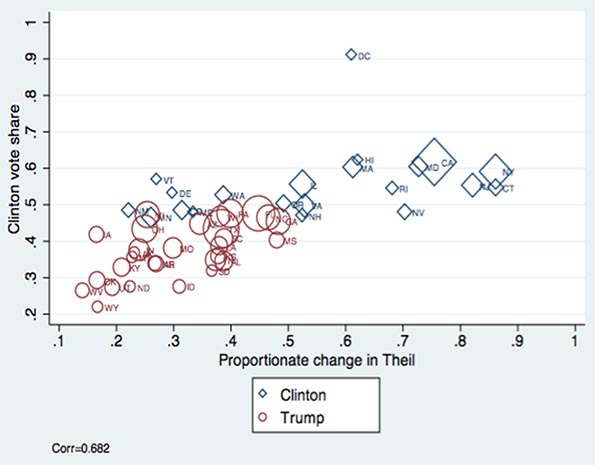
    Each state is weighted by its electoral votes.  Calculations by Jaehee Choi and James Galbraith.

    Change in Inequality 1990-2014 and the Election Outcome, 2016, by State.
    State Change in Pay Inequality 1990 to 2014 (Theil measure), Index Number, 1990 =100 Trump / Clinton Clinton Percentage
    Connecticut 186.4 C 54.6%
    New York 179.6 C 59.0%
    New Jersey 176.7 C 55.5%
    California 172.7 C 61.7%
    Rhode Island 169.4 C 54.4%
    Maryland 168.8 C 60.3%
    Nevada 167.6 C 47.9%
    Hawaii 161.3 C 62.2%
    Massachusetts 160.7 C 60.0%
    District of Columbia 159.4 C 90.9%
    Illinois 149.8 C 55.8%
    Virginia 149.1 C 49.8%
    Oregon 148.1 C 50.1%
    New Hampshire 147.5 C 46.8%
    Georgia 146.7 T 45.9%
    Mississippi 146.7 T 40.1%
    North Carolina 144.2 T 46.2%
    Florida 141.4 T 47.8%
    Washington 139.3 C 51.8%
    Pennsylvania 138.8 T 47.9%
    Louisiana 138.7 T 38.4%
    Wisconsin 138.5 T 46.5%
    Kansas 138.3 T 36.1%
    Alabama 137.4 T 34.4%
    South Carolina 137.3 T 40.7%
    Tennessee 136.2 T 34.7%
    Texas 135.1 T 43.2%
    South Dakota 134.7 T 31.7%
    Maine 132.2 C 47.8%
    Missouri 131.9 T 38.1%
    Colorado 131.8 C 48.2%
    Arizona 131.4 T 45.1%
    Idaho 129.6 T 27.5%
    Delaware 128.8 C 53.4%
    Arkansas 127.3 T 33.7%
    Minnesota 126.4 C 46.4%
    Ohio 126.1 T 43.6%
    Michigan 126.0 T 47.3%
    Kentucky 125.3 T 32.7%
    Nebraska 124.4 T 33.7%
    Vermont 124.3 C 56.7%
    Indiana 123.3 T 37.8%
    Alaska 123.0 T 36.6%
    New Mexico 122.1 C 48.3%
    Montana 121.5 T 35.7%
    North Dakota 120.3 T 27.2%
    Iowa 118.9 T 41.7%
    Utah 117.8 T 27.5%
    Oklahoma 116.2 T 28.9%
    West Virginia 116.0 T 26.5%
    Wyoming 114.5 T 21.9%
    Correlation: 0.687

    James Galbraith is an economist, who teaches at the LBJ School of Public Affairs, The University of Texas at Austin, and directs the University of Texas Inequality Project, at http://utip.lbj.utexas.edu.  His most recent book is Inequality: What Everyone Needs to Know (Oxford, 2016).

    Top image by DonkeyHotey (Hillary Clinton vs. Donald Trump – Caricatures) [CC BY-SA 2.0], via Wikimedia Commons

         Using the measure of income inequality gives a slightly different result:  the top eleven states are all Clinton states.

  • Ten American Experiences: A Fourth of July Meditation

    The Fourth of July is a good time to ask the question: what exactly are we celebrating when we celebrate “America?” Is it a set of ideals and principles rooted in the Enlightenment? Is it a blood-and-soil nation on the American continent, with unique institutions and culture? Is it an idea that happens to have a nation, a nation that happens to have an idea, or something else entirely?

    Another way to define it might be an empirical account of various American experiences. What follows, then, is a narrative litany of what this writer believes to have been the most influential historical experiences shaping Americanism in every epoch of our existence as a nation, from colonial days to the present. Together, in their creative tension, they contribute to the great American story and conversation, full as it is with contradictions and irregularities.

    Of course, in these polarized times, there’s the political question. Some of these experiences, for one reason or another, are distasteful to modern observers of whatever political persuasion. Some might willfully abandon their legacy, out of hopes to build “a better future.” But we cannot forget our own past, or our civilization will fail to thrive beyond its fourth century of existence.

    Ten Experiences that defined America.  

    1. The Origins.

    Americans came from somewhere- the first settlers were different groups of colonists from various parts of England. David Hackett Fischer’s magisterial study of American origins, Albion’s Seed, documents this brilliantly. At a foundational level, America remains and always has been an Anglo nation-state with a powerful yet flexible core cultural heritage. The English language, traditions of common law, and the Protestant influence on American individualism, philosophy, and civic culture and community are all undeniably components of the American identity at a very basic level.

    2. The War of Independence.

    It was the American Revolution that granted our nation its nationhood. Whereas the colonial experience had been a conservative affair of the transference of culture from one side of the Atlantic to the other, the American Revolution sparked the beginnings of American radicalism and universalism, the exuberance and triumphalism of a newly-awakened people firm in the belief that they had Providence on their side.

    3. The Constitution.

    The Revolution won but did not secure America’s liberty- that important work was done by the Framers of the Constitution, who through toil and conflict, reflection and compromise, designed the framework and foundations of a constitutional republic. The Constitution’s checks and balances and divisions of authority, the federal system of state and national sovereignty, a national government that was energetic and powerful, yet limited and constrained, and capable of addressing the great issues of the day and many days beyond, all contributed to the successful organization of the thirteen states and their western territories into a great new federal union. This federal union alone could preserve the liberty of the American people.

    4. The Rise of Jackson.

    The basically aristocratic culture of the early Republic would not outlive the Framers. The Jacksonian Revolution of the late 1820s and 1830s would forever change the culture of American politics, decisively shifting American legitimacy from a mere faith in institutions to something looking more like a democratic “common will.” It would infuse American politics with a common man’s ethos of simplicity, tradition, people’s wisdom, and folk culture, and would turn “democracy” from the dirty word of the Federalists into the litmus test for American statesmen for generations to come. By some measures, America was first truly “American” upon the onset of this democratic ethos.  

    5. The Civil War.

    Upon Abraham Lincoln’s election to the Presidency in 1860, America’s Iliad broke out and consumed the young nation. The Union cause in the Civil War was in some ways a radical affair- the erasure of Southern plantation culture, the expansion of freedom and franchise to more Americans than ever before, the coming hegemony of free-labor industrial capitalism- but in the eyes of the Republicans and the Union Army’s general staff, it was a conservative project. The preservation of the Union, and of American power over the Continent, was the crucial question. The Civil War’s conclusion ensured that the Union, which by now stretched across the American continent from sea to shining sea, would be preserved in whole and not in parts. It would remain the great power it was, positioned towards even higher greatness in the decades and centuries to come.

    6. The Western Migration.

    Long before Fort Sumter, the American people were being shaped by their expansion across the American continent. Americans pushed further and further West, in great numbers starting in the 1830s, and would continue to do so until they’d populated the entirety of American territory between the Mississippi and the Pacific in the late 19th century. As Frederick Jackson Turner argued in The Significance of the Frontier in American History, the land and its conditions left its mark on the culture and society of those who crossed it and settled it. The poet Sam Walter Foss, speaking as the American continent, asked for “Men to Match My Mountains,” and the American people obliged.

    7. The Industrial Revolution.

    Matching the individualist ethos cultivated by the experience of the Westward movement was an entrepreneurial ethos- a great knack for management and organization and innovation, a brilliance and genius rooted in benevolent acquisitiveness, all of which inspired and drove American inventors, investors, and captains of industry. Over the course of several great industrial revolutions, starting in the early 1800s and still ongoing, Americans built titanic industries, infrastructure, and cities, harnessed the power of every natural resource conceivable, and invented contraptions and machines that sent men to the moon and split the atom.

    8. The Progressive Era and the New Deal.

    The excesses and social dislocations of industrial capitalism precipitated a great social crisis, and by the turn of the 20th century, Americans clamored for major reforms in their governing institutions. Some of these efforts were quite radical- the great labor strikes, populist politicians, and socialist movements of the early 20th century have gone down into legend, and few remember today that between the 1880s and 1910s, a few Presidents of the United States were shot by anarchist terrorists. Conservative statesmen and radical reformers joined hands in compromise to reform institutions to quell the social crisis. Americans built up a federally-sponsored safety net and welfare state, a system of collaborative enterprise and regulation, and a government promising a better quality of life for all citizens. The notion that the government ought to serve its people in all ways possible, and marshal resources for national ends, remains integral to American political culture.

    9. World Leadership.

    These modernizing reforms bound the American people together at home just in time for the great Eurasian crises of 1914-1991. The crisis of imperialism in the First World War, and the rise of Fascism and Communism in the 1930s, and our subsequent involvement in the Second World War and competition with the Soviets in the Cold War, stretched our resources and our need to defend the homeland to degrees never before known.  The architects of post-1945 American foreign policy institutionalized the stewardship of international institutions, the maintenance of a navy that could command the seas and keep open the sea lanes of trade, and the preservation of a peaceful balance of power between the most powerful nations on the planet. The consummation of America’s role as a “city upon a hill” and a “light unto the nations” took its fullest form when America assumed the mantle of world leadership- and this has been integral to its self-image ever since.

    10. The Civil Right Movement.

    In the 1950s and 1960s, the Civil Rights Movement- building off of earlier antecedents including Temperance, Abolition, and Women’s Suffrage- successfully enshrined equality before the law, for people of all races and origins, into the American national identity. It paved the way for a fuller integration of people from around the world into the American experience. Its legacy is still felt acutely today, when questions on immigration, civil rights, and American identity frequently bubble up to the foreground of public discourse. More than any of the other American experiences listed here, this one is still ongoing.

    The Future

    We can imagine future “American experiences” that one hundred years from now may prove to be just as vital to the American identity as these ten listed have been. Perhaps the reform of the New Deal state towards a more localized, sustainable, and fundamentally workable system – something like the stymied “New Federalism” of the Nixon Administration, updated by the power of the Information Revolution – could transform American governance in the 21st century as did the Progressive and New Deal reforms of the 20th century. Another great quest with historic antecedents is the conquest of the Solar System: the rejuvenation of the American space program and the exploration and colonization of other worlds beyond the Moon. A great period of exploration can bring out the greatest facets of the existing American character and transform them into something new.

    One begins to notice a pattern, looking across American history: each of these experiences was in some ways conservative and in other ways radical, but distinctively one more than the other. The conservative transference of Anglo culture from the British Isles to the American continent; the radical universalism of the American Revolution; the conservative caution of the Framing of the Constitution; the radical experiments with Jacksonian Democracy; the conservative preservation of the Union in the Civil War; the radical egalitarianism and democracy of the Westward Conquest; the conservatism of culture and class wrought by the Industrial Revolution; the radicalism of the Industrial Age’s excesses, tempered into reforms in the Progressive Era and New Deal movements; the conservatism that went into building the Liberal International Order after the ravages of two world wars; and the fundamental radicalism and reformism of the Civil Rights Movement and its antecedents. Will all this be followed by a conservative reformation of American governance down to the localities? Will that be followed by the radical disruptive technological advancement of space colonization?

    In each case, a primarily radical historical experience was followed by a primarily conservative one, and so on and so forth. This should surprise no one, for America has always been a remarkably extreme nation with no less remarkable staying power. American schizophrenia has been a quality of our national existence for our entire experience as a people, and will surely remain with us until we’ve been extinguished from the Earth.

    Luke Phillips is a political activist and writer in California state politics. His work has been published in a variety of publications, including Fox&Hounds, NewGeography, and The American Interest. He is a Research Assistant to Joel Kotkin at the Center for Opportunity Urbanism.

  • Why Socialism Is Back

    Even as Venezuela falls deeper into crisis, and the former Soviet bloc nations groan under its legacy, socialism is coming back, and in a big way. Its key supporters are not grizzled pensioners yearning for Marxist security, but a whole new generation, most of whom have little memory of socialist failure.

    Although the trend is a-historic, it’s not happening in a vacuum. The primary driver is the global ascendency of neo-liberal capitalism, which in virtually all countries has accelerated inequality. This is particularly true in the United States and the United Kingdom, where the gaps between rich and poor are greatest among developed, democratic countries. In these nations, socialist politicians such as Sen. Bernie Sanders and British Labor leader Jeremy Corbyn (pictured) are now political rock stars among young people.

    In the 2016 presidential primaries, Sanders outpolled Donald Trump and Hillary Clinton put together among younger voters, and is now the nation’s most popular politician. His supporters are gradually taking over much of the Democratic Party, state by state. Corbyn, widely portrayed in the media as a walking time electoral bomb, secured for his party 61 percent of the vote among those under 40 in the recent parliamentary elections. It is increasingly possible that this once-marginal figure could someday occupy 10 Downing St. If the 75-year-old Sanders were a decade younger, he would also have an excellent chance of ascending to the White House.

    A Different Kind of Leftism

    Although neither Sanders nor Corbyn can be labeled classic Stalinists, they do represent a radical departure for their respective parties. Both adopt what are generally seen as far left positions, with Corbyn even suggesting that people displaced by London’s Grenfell fire occupy expensive, but unoccupied units, in the city’s rich precincts. Sanders has called for national health care, massive tax increases for the top income earners — with rates upward of 90 percent — and a ban on new fossil fuel development on federal lands.

    This marks a major departure from past progressive politics in both countries. Democrats and Labour have done best by adhering to the center, and calibrating reforms with the demands of the capital markets. Even President Obama, although revered by progressives, was hardly a radical on economic issues. He did little to stop the consolidation of tech industries — which were also key supporters — as his Justice Department failed to press the anti-trust button. He also supported the expansion of free trade codified as Democratic Party orthodoxy during Bill Clinton’s presidency and which are favored by corporate and commercial interests. Tony Blair and his successor, Gordon Brown, also consistently embraced neo-liberal ideologies and courted support among London’s financial elite.

    In contrast, Sanders, a Senate “independent” for most of his career, is a committed socialist who took his honeymoon in, of all places, the communist Soviet Union. He has adopted positions on trade and special visas for tech workers that are closer to those of Donald Trump than Clinton’s. Corbyn’s leftism is even more extreme than Sanders’, embracing long discarded notions of nationalization of industries, massive re-distribution of income as well as a distinctly pro-Palestinian, pro-Third World view common among European leftists.

    The ‘Precariat’ — the Modern Proletariat

    The “Bernie Bros” who made Sanders such a sudden and unlikely political force in 2016 were disproportionately young white voters who swelled the ranks of the precariat — part-time, conditional workers. The numbers of such people is destined to grow with the emerging “gig economy” and the digitization of retail, which could cost millions of working-class jobs. Even university lecturers in Britain, notes the Guardian, fear that their jobs will be “Uber-ised,” a phenomena also seen at American universities.

    For most Americans, the once promising “New Economy” has meant a descent, as one MIT economist  recently put it, towards a precarious position usually associated with Third World countries. Even Silicon Valley has gone from one of the most egalitarian locales in the country to a highly unequal place where the working and middle class have, if anything, done worse (in terms of income) than before the tech boom.

    For its part, the precariat has rational reasons to embrace socialism, particularly if capitalism seems unlikely to meet their needs. The notion of getting a steady, well-paid, full-time job has vanished for an increasing number of young people. Most millennials are not doing as well as their parents did at the same age. The idea of buying a house — once a sure sign of upward mobility — has declined in much of the U.S. for the current generation, particularly on the coasts, and even more so in the U.K., where house prices are higher and incomes lower. The Grenfell fire was not just something that happens to the poor; it could be the future for many young people who may never live in anything much better.

    How Capitalism Is Failing

    “Capitalism,” Lenin noted, “begins in the village marketplace.” Yet Americans are increasingly loath to start a business. There are now more businesses failing than being born, very different than the pattern of the 1980s and 1990s. The dream of starting a business has often been the way out for people with modest educations and means. Without the societal steam valve of entrepreneurship, the alternative for many millennials is in blue-collar or service jobs, where wages have been falling over the past decade.

    Even in the tech world, which represents the largest opportunity for younger people, start-ups have become increasingly rare. This reflects the growing consolidation of the technology sector, which reduces opportunity even in new fields. As one recent research paper demonstrates, “super platforms” such as Facebook, Google, Amazon, and Apple depress competition, squeeze suppliers and drive down salaries, much as the monopolists of the late 19th century did.

    These tech behemoths assert that their success is based utterly on merit, but they have also exploited their structural advantages, as the most ruthless of moguls did. Companies like Amazon have been able to attract investors even with scant profits, an advantage not enjoyed by their competitors, as investors await the rewards of a near-monopoly. Apple and other tech companies have also become adept at avoiding taxes in a way almost impossible for a business on Main Street. As occurs in corrupted systems, insiders usually do best, almost no matter how well they perform; Yahoo’s Marissa Mayer earned $239 million over five years — almost a million a week —  despite failing to revive one of the net’s earliest stars.

    Intersectionality: The Problem Facing Neo-Socialism

    On the surface, the analytics look good for a socialist revival, particularly in the wake of the almost certain failings of Trump’s ersatz populism. A large number of young people, in both Britain and America, have a more favorable view of socialism than capitalism. They never witnessed the failures of the past and they are reeling under present conditions. And given that many older people feel their children face a diminished future, building a majority for socialism is not inconceivable.

    Yet the neo-socialists face a challenge because their potential coalition is fraught. On numerous policy issues, modern progressivism’s interests diverge starkly from those of potential adherents. Corbyn’s multiculturalism and desire to allow more refugees into Britain may win praise on campuses and in left-wing media, but how attractive is this prospect to British working-class voters, many of whom supported Brexit to help cut back on immigration.

    Similar dynamics exists in the U.S. For example, in discussing politics at the Utah AFL-CIO (where I recently spoke), the local president, Dale Cox, suggested that many parts of the progressive agenda — he specifically mentioned opposition to fossil fuel and mineral development — directly threaten the livelihoods of union laborers. Similarly, police unions also feel alienated from progressives who embrace the agenda of groups like Black Lives Matter. Far better, Cox suggested, would be for progressives to focus on improving the lives of working people in ways that really matter, such as expanding opportunities for business and home ownership, health care, and tax reform.

    These economic positions could gain a majority, but not if the progressives maintain their   polarizing embrace of the most radical aspects of social identity and environmental policy. This in particular threatens to undermine working-class support, particularly in the interior states. The leftists’ thinly disguised distaste for how most Americans live in small towns and suburbs does not help make their case. Until the left decides to focus on the everyday issues that matter to people outside their bubble, the dream of the socialist revival will remain a fantasy.

    This piece originally appeared on Real Clear Politics.

    Joel Kotkin is executive editor of NewGeography.com. He is the Roger Hobbs Distinguished Fellow in Urban Studies at Chapman University and executive director of the Houston-based Center for Opportunity Urbanism. His newest book is The Human City: Urbanism for the rest of us. He is also author of The New Class ConflictThe City: A Global History, and The Next Hundred Million: America in 2050. He lives in Orange County, CA.
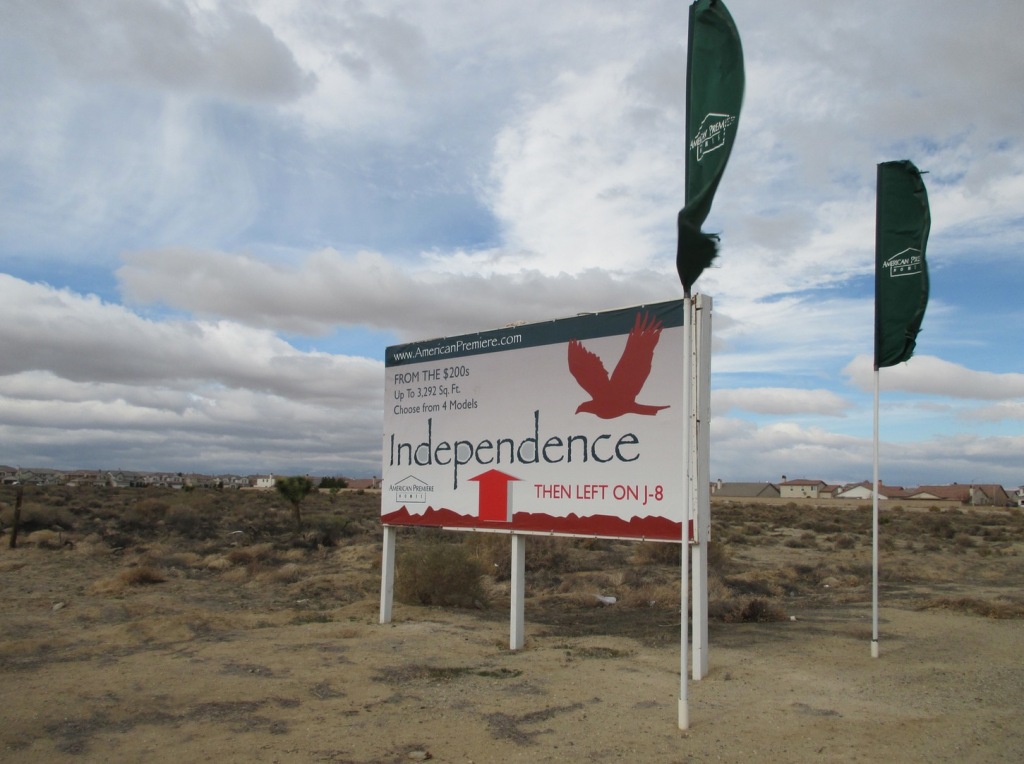
    Photo by paulnew (https://www.flickr.com/photos/paulnew/28243001503) [CC BY 2.0], via Wikimedia Commons