Category: Politics

  • Are States an Anachronism?

    Obviously states aren’t going anywhere anytime soon, but a number of folks have suggested that state’s aren’t just obsolete, they are downright pernicious in their effects on local economies.

    One principal exponent of this point of view is Richard Longworth, who has written about it extensively in his book “Caught in the Middle” and elsewhere. Here’s what he has to say on the topic:

    In the global era, states are simply too weak and too divided to provide for the welfare of their citizens…The reason is a deep, intractable problem. Midwestern states make no sense as units of government. Most Midwestern states don’t really hang together – politically, economically, or socially. In truth, these states and their governments are incompetent to deal with twenty-first century problems because of their history, rooted in the eighteenth and nineteenth centuries.

    Longworth expounds upon this to identify a series of specific issues, which I’ll put into my own terms.

    1. States do not represent communities of interest. With some exceptions, states consist of cities, rural areas, and regions that have very distinct histories, geographies, economies, and and event cultures. As a result, it is incredibly difficult for legislators and leaders from various parts of the state to find common cause.

    Here’s how Longworth describes Illinois:

    Illinois, like Indiana, is three states, and for the same reasons. The southern third, again south of I-70, is a satellite of the South – more give to conservative religions, gun racks in pickup trucks, and a deeply conservative Republicanism….Most of the rest of the state is called Downstate to differentiate it from Chicago, even though some of it, such as Rockford, is actually north of the city. It is an unfocused place…what unites this heterogeneous region is a dislike of the third region, Chicago. Chicago dominates Illinois – politically and economically…If the rest of Illinois obsesses about Chicago, Chicago gives the impression – an accurate one, in fact – of never thinking about the rest of Illinois.

    Additionally, I might add my observation that this creates a situation where the policies which are right for one area may be wrong for another. Since it is the nature of governments to promote uniform rules, this often leaves one or even all regions of a state with suboptimal rules. In fairness, there are are often some types of flexibility, such as that provided by different classes of cities. But important macro policies remain one size fits all.

    Consider Illinois. It’s a combination of a global city core in Chicago, a Rust Belt hinterland, and a southern fringe region. State policy is set by the Chicago elite as a general rule, and predictably it follows a big city, global city favorable model: strong home rule powers for large municipalities, a high tax/high service type model, strong public sector unions, etc. This pretty much works for Chicago, but for downstate it puts their communities in a major economic vice since they don’t benefit from global city friendly policies and are competing against other places that have optimized in other ways.

    Indiana being one example. It is pretty much the opposite. Its largest city region is only about 25% of the state’s population, meaning Indiana is dominated by rural and small city constituencies. As a result, Indiana has optimized for a “Wal-Mart” strategy such as through its low-service/low-tax approach, weak environmental rules, and very weak (I’d argue nearly non-existent) home rule powers for even its largest municipalities. This is great if you are a small manufacturing city trying to beat out Ohio, Michigan, and Illinois for low wage manufacturing and distribution jobs (which sounds bad but is realistically the best short term play these places have). But it’s pretty terrible if you are Indianapolis and trying to fight to have a place in the global economy, attract choice talent, build biotech and high tech business clusters, etc.

    2. Arbitrary state lines encourage senseless border wars. With limited exceptions, the major cities of the Midwest (and often elsewhere around the country) were founded on major bodies of water like rivers, lakes, or an ocean. These were often boundaries of states, thus major cities are frequently at the edge, not the center of states. This means not infrequently you find multi-state metro areas, which creates structural conflicts of interest. The logical economic unit is the metro area, but it matters from a local fiscal point of view (i.e., the ability to collect income, sales, and property taxes) where particular businesses locate. Thus we frequently see the case where localities spend tons of money on incentives simply to get businesses to relocate within the same metro area. You can have bidding wars without multiple states (such as neighboring suburbs competing over a Wal-Mart), but these seldom involve major state level incentives.

    Longworth again summed this up masterfully in a recent blog post called “The Wars Between the States” where he documents the incentives being doled out to convince companies to move back and forth across the state border in the Kansas City metro area:

    It would seem impossible for Midwestern states to get any sillier and more irrelevant, but they’re trying. In a time of continuing recession and joblessness, with crunching budget problems, failing schools, crumbling infrastructure and no real future in sight, these states have decided to solve their problems by stealing jobs from each other.

    The most recent example is the so-called “border war” between Kansas and Missouri, as the two states compete to see how much money they can throw at businesses to move from one state to the other. The focus of this war is Kansas City — both the Kansas one and the Missouri one, basically a single urban area divided not only by an invisible line down the middle of a street but by a mindless hostility that keeps its two parts from working together.

    Competition with “Europe, India, China and the rest of the world” has nothing to do with this juvenile job-raiding. In fact, this “border war” keeps Missouri and Kansas from competing globally — indeed, robs them of the tools they need to compete globally. Some rational thought shows why. It’s precisely these states’ inability to compete globally that causes them to declare war on the folks next door. In a global economy, Kansas and Missouri aren’t competing with each other, any more than Illinois, Indiana and Wisconsin are competing with each other. The real competition is 10,000 miles away and all Midwesterners know that we’re losing it.

    [ Update 5/5/2014: It looks like Missouri and Kansas may be about to declare a truce in their border war ]

    3. Many state capitals are small, isolated, and cut off from knowledge about the global 21st century economy. In some states the state capital is a large city that is well-connected to the global economy – Atlanta, Indianapolis, St. Paul, and Nashville come to mind. But often state capitals were selected because they were in the geographic center of the state, not because they were major centers in their own right. Some, like Indianapolis, managed to grow into major cities. But many others did not. Think Springfield, Jefferson City, Frankfort, etc. This means that the state capital of many states is not very large, and often not very plugged into the global conversation. Longworth again captures the implications of this:

    There is another reason why state governments are botching the economic needs of their states. Some 150 to 200 years ago, state capitals were picked not for economic reasons, but for geographic ones. Many of them remain in this isolated irrelevance today, far from the real action of any of the territories they are meant to govern…In this era of globalization, with overnight shipping and instant communications, this shouldn’t make any difference. In fact, it does. Global cities such as Chicago depend on face-to-face contact, and isolated state capitals live out of earshot of this conversation. The winds of globalization are transforming state economies and generating new thinking about state futures, but the news takes a long time to get to the state houses and legislatures.

    4. Metro areas are the engines of the modern economy, but the rules for municipal and regional governance are set by states, and often in a manner that is directly contrary to urban interests. In this Longworth channels the Brookings Institution, which has tirelessly documented the importance of metro area economies to the nation as well as all the ways states, frequently controlled by non-urban legislators who are actively fearful of cities, have often imposed enormous burdens on those metro areas by tying them down with a morass of Lilliputian rules. Again Longworth:

    States set the boundaries of urban jurisdictions and decide whether or how they can merge. They tell cities who they can tax and how, whether this helps cities or not. State governments help finance local infrastructure and dictate, from miles away, how that money is spent. State priorities on education and workforce programs leave city residents incompetent to deal with the global job market. Highway funds go to rural areas, not to cities that need them more; job creation money goes to wealthy areas, not to the core of battered cities.

    Some urban regions have more or less given up any hope that their state will ever change or be a positive partner, such as Kansas City, as Longworth notes:

    When the Greater Kansas City Community Foundation issued a report on the city’s future, it pretty much told the state to get out of the way. “Nations and states still matter,” it said. “They particularly can do their cities harm. But cities have to take the lead. San Diego did not become San Diego by looking to Sacramento, not Seattle to Olympia.” When the authors talked about Sacramento and Olympia, one felt their really meant Jefferson City.

    I’d probably go even further than Longworth. I think that historically states imposed rules on cities deliberately designed to hobble their growth. For example, the laws that restricted branch banking in most states until recently had the effect of keeping big city banks from buying up rural and small town banks around the state. The end game of course is that when deregulation occurred, the banks in most big cities were so small because of these rules, they were easy prey to out of state acquirers. Thus most states saw basically their entire indigenous banking industry swallowed up.

    Also, states seem to more or less treat their urban regions like ATM machines. Every study I’ve seen documents how, contrary to popular belief, cities actually are net exporters of tax dollars to their state government. Marion County, Indiana for example (Indianapolis), sends a net of about $400 million a year to the state – enough to cover the entire public safety budget of the city.

    I actually don’t have a problem with some redistribution as cities are generally economic engines and more efficient to boot, so they should be expected to be donors at some level. On the other hand, when states proceed to starve those cities of the critical funds they need stay healthy and strip them of the powers they need to manage their own affairs, this is like sticking a knife in the golden goose.

    Again I can use Indianapolis as an example. As part of a tax reform package the state took over all operating educational funding for K-12. So far so good. But they also imposed a funding formula that severely disadvantaged growing suburban districts by denying them equal per pupil funding. The net result was a major funding problem for the best suburban Indianapolis districts like Carmel, Fishers, etc. Many of these districts had to go to referendums to raise local taxes to make up the difference (which was no doubt the state’s plan all along – it simply outsourced the unpleasantries of a tax increase to localities). Here is a state that claims it wants to be in the biotech business, the high tech business, etc, yet it singles out the school districts where the labor force you are trying to attract for those industries is likely to live for outsized cuts. That hardly seems like a winning strategy.

    Indiana also keeps its cities on a tight leash, with some of the weakest home rule powers around. Indianapolis basically can’t do much without legislative approval (a transit referendum, for example, will require specific legislative authorization). And the legislature seems to like it that way. Indiana’s property tax caps, which I support generally from a percentage of assessment perspective, include a lot of poorly advertised gotchas. For example, regardless of assessed value, the total tax levy can only grow at a rate equal to the average personal income growth over the last six years. I’ll caveat this by saying I haven’t studied this in detail and thus may be a bit off base, but the levy cap appears to be a de facto spending cap at current levels regardless in growth of tax base. This may be ok for some, but not others that are growing say their commercial office space base at a rapid clip and need to expand infrastructure and services to support it.

    Clearly many of these policies have no real benefit to the Indianapolis region, which is more or less being asked to be the economic engine of the state and finance state government without being given the tools to do that job property.

    The list goes on but that should give you a flavor. Similar things occur around the country.

    To this list I’ll add one of my own, which has also been richly illustrated by Jim Russell. Namely,

    5. States can’t to much to help, but they can do a lot to hurt. A lot of the national debate seems to center on whether the “red state” or “blue state” model makes the most sense. But to a great extent, policy almost doesn’t matter. In Ohio, with one set of state policies, Columbus thrives while Cleveland struggles. Tennessee is a right to work state with no income tax, but Nashville booms while Memphis stagnates. Texas is doing great with its red state model, but Mississippi and Alabama not so much. And even within Texas, there are plenty of places that are hurting badly.

    While good policy can set the stage for growth, it can’t guarantee local economies will prosper. But bad policies can hurt regions that otherwise would thrive. Extremes of either the blue or red model seem to lead to problems. Witness California, for example, which seems to be holding up a sign to business saying, “Get lost.”

    This puts states in the difficult position of being almost being able to aspire at best to being a neutral influence on their own economy. But it’s easy for them to screw things up.

    This piece first appeared at The Urbanopihle on July 11, 2011.

    Aaron M. Renn is an independent writer on urban affairs and the founder of Telestrian, a data analysis and mapping tool. He writes at The Urbanophile, where this piece originally appeared.

    States map image by Bigstock.

  • The Monuments of Gentry Liberals in Chicago: White Students Dominate the Test-Admittance Public Schools

    According to the U.S. Census Bureau, Chicago’s population peaked a long time ago.  In 1950, Chicago had 3. 6 million people. Recent estimates put Chicago’s population at 2.7 million. With the growth of American suburbs, many Chicago families have fled to public schools in the suburbs. Chicago’s horrible public schools have been an embarrassment for Chicago’s elite. A recent Chicago Tribune editorial estimated that only “only 8 of 100 freshmen who enter Chicago public high schools manage to get a college diploma.”  

    In an attempt to keep white families from fleeing Chicago, the second Mayor Daley came up with a plan:  test-admittance-only public high schools. This was a reasonable solution for gentry liberals who pay high property taxes but didn’t want to leave the city or couldn’t afford to send their children to private schools. These select public high schools produce college bound students while “limiting” gentry liberal’s children from being exposed to children from “troubled backgrounds”. This is a sensitive subject because Chicago’s Public School System is only 9.2% white, while being 39.7% African-American.

    Being admitted to these select magnet schools can often determine whether a family stays in Chicago or moves elsewhere. Recently, Daniel Hertz made news by graphically showing how Chicago’s middle class has being largely eliminated since 1970. The new Chicago is still a one-party town, but is now a coalition of rich and poor with a residual government worker middle class. White children have left Chicago’s Public School system leaving minorities as the majority. But, who gets into the selective public high schools?  The Chicago Sun-Times reports:

    More white students are walking the halls at Chicago’s top four public high schools.

    At Walter Payton College Prep on the Near North Side, more than 41 percent of freshmen admitted the past four years have been white, compared to 29 percent in 2009, a Chicago Sun-Times analysis of Chicago Public Schools data has found.

    At Jones College Prep in the South Loop, 38 percent of this year’s freshman class is white, compared to 29 percent four years ago.

    In 2010 — the first year race was no longer used to determine the makeup of Chicago schools — the percentage of white freshmen at Northside College Prep in North Park rose from 37 percent to 48 percent.
    And at Whitney Young College Prep on the Near West Side, the percentage of black freshmen has steadily declined in the past three years, while the percentage of whites has risen.

    As these schools attract white students, Mayor Rahm Emanuel had to shut down 50 public schools which according to Democracy Now affected” 30,000 students, around 90 percent of them African American.” While Chicago is closing public schools, it is getting ready to build a new school. Not just any public school, but an expensive test only admittance high school named after Chicago’s glorious leader who went far. The new high school will be named Barack Obama College Preparatory High School.

    Gentry liberals leaders have told us with enormous conviction that public education is an “investment”. Yet, President Barack Obama and Mayor Rahm Emanuel send their children to elite private schools. What’s interesting in Rahm Emanuel’s case is he couldn’t find one public school in all of Chicago good enough to send his children. Mayor Rahm Emanuel is so committed to public education that he sends his children to a private school 15 miles away from where his children live.

  • Silicon Valley’s Giants Are Just Gilded Age Tycoons in Techno-Utopian Clothes

    Silicon Valley’s biggest names—Google, Apple, Intel and Adobe—reached a settlement today in a contentious $3 billion anti-trust suit brought by workers who accused the tech giants of secretly colluding to not recruit each other’s employees. The workers won, but not much, receiving only a rumored $300 million, a small fraction of the billions the companies might have been forced to pay had they been found guilty in a trial verdict. 

    The criminality that the case exposed in the boardrooms the tech giants, including from revered figures like Steve Jobs who comes off as especially ruthless, should not be jarring to anyone familiar with Silicon Valley.  It may shock much of the media, who have generally genuflected towards these companies, and much of the public, that has been hoodwinked into thinking the Valley oligarchs represent a better kind of plutocrat—but the truth is they are a lot like the old robber barons.

    Starting in the 1980s, a mythology grew that the new tech entrepreneurs represented a new, progressive model that was not animated by conventional business thinking. In contrast to staid old east coast corporations, the new California firms were what futurist Alvin Toffler described as “third wave.” Often dressed in jeans, and not suits, they were seen as inherently less hierarchical and power-hungry as their industrial age predecessors.  

    Silicon Valley executives were not just about making money, but were trying, as they famously claimed, to “change the world.” One popularizing enthusiast, MIT’s Nicholas Negroponte, even suggested that “digital technology” could turn into “a natural force drawing people into greater world harmony.”

    This image has insulated the tech elite from the kind of opprobrium meted out to their rival capitalist icons in other, more traditional industries. In 2011, over 72 percent of Americans had positive feelings about the computer industry as opposed to a mere 30 percent for banking and 20 percent for oil and gas. Even during the occupy protests in 2012, few criticisms were hurled by the “screwed generation” at tech titans. Indeed, Steve Jobs, a .000001 per center worth $7 billion, the ferocious competitor who threatened “war” against Google if they did not cooperate in his wage fixing scheme, was openly mourned by protestors when news spread that he had passed away.

    But the collusion case amply proves what has been clear to those watching the industry: greed and the desire to control drives tech entrepreneurs as much as any other business group. The Valley is great at talking progressive but not so much in practice. In the very place where private opposition to gay marriage is enough to get a tech executive fired, the big firms have shown a very weak record of hiring minorities and women. And not surprisingly, firms also are notoriously skittish about revealing their diversity data. A San Jose Mercury report found that the numbers of Hispanics and African Americans employees in Silicon Valley tech companies, already far below their percentage in the population, has actually been declining in recent years. Hispanics, roughly one quarter of the local labor force, account for barely five percent of those working at the Valley’s ten largest companies. The share of women working at the big tech companies – despite the rise of high profile figures in management—has also showed declines.    

    In terms of dealing with “talent,” collusion is not the only way the Valley oligarchs work to keep wages down.  Another technique is the outsourcing of labor to lower paid foreign workers, the so called “techno-coolies.” The tech giants claim that they hire cheap workers overseas because of a critical shortage of skilled computer workers but that doesn’t hold up to serious scrutiny. A 2013 report from the labor-aligned Economic Policy Institute found that the country is producing 50% more IT professionals per year than are being employed. Tech firms, notes EPI, would rather hire “guest workers” who now account for one-third to one half of all new IT job holders, largely to maintain both a lower cost and a more pliant workforce.

    Some of this also reflects a preference for hiring younger employees at the expense of older software and engineering workers, many of whom own homes and have families in the area.  

     “I want to stress the importance of being young and technical,” Facebook’s CEO Mark Zuckerberg said at an event at Stanford University in 2007. “Young people are just smarter. Why are most chess masters under 30? I don’t know. Young people just have simpler lives. We may not own a car. We may not have family. Simplicity in life allows you to focus on what’s important.”

    Of course what’s really “important” to Zuckerberg, like moguls in any time and place, is maximizing profits and raking in money, both for themselves and their investors. The good news for the bosses has been that employees are rarely in the way.  Unlike the aerospace, autos or oil industries, the Valley has faced little pressure from organized labor, which has freed them to hire and fire at their preference.  Tech workers wages, on the other hand, have been restrained both by under the table agreements and the importation of “technocoolies.”

    Rather than being a beacon of a new progressive America, the Valley increasingly epitomizes the gaping class divisions that increasingly characterize contemporary America.  Employees at firms like Facebook and Google enjoy gourmet meals, childcare services, even complimentary house-cleaning to create, as one Google executive put it, “the happiest most productive workplace in the world.” Yet, the largely black and Hispanic lower-end service workers who clean their offices, or provide security, rarely receive health care or even the most basic retirement benefits. Not to mention the often miserable conditions in overseas factories, notably those of Apple.

    It’s critical to understand that the hiring restrictions exposed by Friday’s settlement, reflect only one part of the Valley’s faux progressiveness and real mendacity. These same companies have also been adept at circumventing user privacy and avoiding their tax obligations.

    One might excuse the hagiographies prepared by the Valley’s ever expanding legion of public relations professionals, and their media allies,  but the ugly reality remains. The  Silicon Valley tech firms tend to be  every bit as cutthroat and greedy as any capitalist enterprise before it. We need to finally see the tech moguls not as a superior form of oligarch, but as just the latest in long line whose overweening ambition sometimes needs to be restrained, not just celebrated.

    This story originally appeared at The Daily Beast.

    Joel Kotkin is executive editor of NewGeography.com and Distinguished Presidential Fellow in Urban Futures at Chapman University, and a member of the editorial board of the Orange County Register. He is author of The City: A Global History and The Next Hundred Million: America in 2050. His most recent study, The Rise of Postfamilialism, has been widely discussed and distributed internationally. He lives in Los Angeles, CA.

  • Turn Of The Screwed: Does The GOP Have A Shot At Wooing Disgruntled Millennials?

    Over the past five years, the millennial generation (born after 1983) has been exercising greater influence over the economy, society and politics of the country, a trend that will only grow in the coming years. So far, they’ve leaned Democratic in the voting booth, but could the lousy economic fate of what I’ve dubbed “the screwed generation” lead to a change?

    Just look at these numbers. Since 2008, the percentage of the workforce under 25 has dropped by 13.2%, according to the Bureau of Labor Statistics, while that of people over 55 has risen by 7.6%. Among high school graduates who left school in 2009-11, only 16% had full-time work in 2012, and 22% worked part time although most sought a full-time job.

    These trends are likely to continue and could worsen, according to the U.S. Department of Labor, particularly for workers between 20 and 24. Today even a college degree guarantees increasingly little in terms of social uplift. Tuition debt is nearing $1 trillion; the percentage of 25-year-olds with school debt has risen from 25% in 2004 to close 40% in 2012. Average indebtedness amongst borrowers has grown 70% from $15,000 to nearly $25,000.

    A record one in 10 recent college borrowers has defaulted on their debt, the highest level in a decade. With wages for college graduates on a downward slope, one has to wonder how many more will join them.

    Over 43% of recent graduates who are employed are working at jobs that don’t require a college education, according to a recent report by the Heldrich Center for Workforce Development. Some 16% of bartenders and almost the same percentage of parking attendants had a bachelor’s degree or higher, notes Ohio State economics professor Richard Vedder.

    Besides a tepid economy, the millennials confront paying off huge public debts, much of it due to the generous pensions of boomer public employees. This constitutes what economist Robert Samuelson has labeled “a generational war” in which the young are destined to be losers in the “withering of the affluent society.” As he puts it: “For millions of younger Americans—say, those 40 and under—living better than their parents is a pipe dream. They won’t.”

    Not surprisingly, the young, who are traditionally optimists, are becoming far less so. According to a Rutgers study, 56% of recent high school graduates feel they would not be financially more successful than their parents; only 14% thought they’d do better. College education doesn’t seem to make a difference: 58% of recent graduates feel they won’t do as well as the previous generation. Only 16% thought they’d do better.

    According to Pew Research, up to half of millennials lean Democratic, compared to barely a third who favor the Republicans. The actue generational chronciclers Morley Winograd and Mike Hais suggest that this will continue and that hard times may even strengthen millennial support for what they describe as “economically activist government.” They cite a 2011 Pew poll that found millennials preferred a larger government that provided more services over a smaller one by a 54% to 35% margin. By contrast, 54% of boomers (born 1946-1964) and 59% of the silent generation (born 1925-1945) favored a smaller government.

    Critically, they maintain, these political views are likely to remain in place throughout their lifespans. The “Greatest Generation,” those born before 1925 who grew up during the Depression, never lost their enthusiasm for government.

    But it may be premature for Democrats to presume they have a lock on millennials’ loyalty.

    In 2008, twice as many millennials identified as Democrats or leaned Democratic (58%) as identified with the GOP or leaned Republican (29%), according to Pew. Cut to 2014, and the Democrats’ advantage among millennials has narrowed to 16 percentage points (50% to 34%).

    Although barely a a quarter of those under 35 said they had positive feelings toward the Republican Party in the last Wall Street Journal/NBC News poll, in a poll earlier this year, support for the Democrats has also dropped from roughly half to barely a third. Last year, a majority of 18- to 29-year-olds polled in a Harvard study no longer approved of the president’s performance.

    This suggest that like boomers under Jimmy Carter, who then shifted to Reagan, the millennials are not to be taken for granted. To attract them, though, Republicans will need to change many of their positions.

    Millennials, for example, are far more heavily minority, and descended from recent immigrants; they are likely to be far more permissive on immigration reform than earlier generation. At the same time, they embrace significantly more liberal views on issues like gay marriage and legalization of marijuana than older generations. Republicans right now are not competitive on these issues.

    Some conservatives rest their hopes not on attracting millennial voters but on the possibility that they’ll stay home during the mid-term elections. In 2010, 18- to 24-year-olds turned out at half the rate of the rest of electorate. But this can’t go on forever; the millennial share of the vote, even with poor turnouts, will continue to go up and will eventually overwhelm a party that depends on older voters to prop them up. In 2012 millennials accounted for roughly a quarter of the electorate; by 2020 they will be about 36%.

    Simply put, Republicans have no choice but to engage this population. To do so, they must focus primarily on economic growth, where the Democrats don’t have much to recommend themselves. Issues where the GOP could make up ground include reform for boomer pensions, as well as policies to spark job and income growth.

    To win over a significant share of millennials, Republicans don’t so much need a new Reagan as a program that inspires more confidence in the economic future.

    Although I am not fond of either party, a more competitive political environment among millennials would be useful, not only for conservatives also for the generation itself. As African Americans should have learned by now, being taken for granted does not guarantee better service from the political class. Under the country’s first black president, conditions for African Americans have declined rapidly.

    The evolution of the boomer generation suggests that such a change of fortune could happen. Between 1990 and today, the percentage of boomers identifying with the Democratic Party has dropped from 31% in 1990 to 25%. Much of this stemmed from reaction to the failures of the Carter presidency.

    This suggests that, although the formative years are critical, people do change their views as they age, experience life as adults and, most importantly, become parents. Many may not become Republicans, but could easily shift towards independent status. It may not happen this year, but perhaps later in the decade.

    Over time, even the self-absorbed boomers will have to give way to the needs of the new generation. The challenge for both parties is to develop policies that will allow the millennials to rise as have previous American generations. Whether these ideas come from the right or left seems less important than that the debate be engaged, open and focused more on the future than the past.

    This piece originally appeared in Forbes.

    Joel Kotkin is executive editor of NewGeography.com and Distinguished Presidential Fellow in Urban Futures at Chapman University, and a member of the editorial board of the Orange County Register. He is author of The City: A Global History and The Next Hundred Million: America in 2050. His most recent study, The Rise of Postfamilia

    Unemployed photo by BigStockPhoto.com.

  • The Spread of ‘Debate is Over’ Syndrome

    The ongoing trial involving journalist Mark Steyn – accused of defaming climate change theorist Michael Mann – reflects an increasingly dangerous tendency among our intellectual classes to embrace homogeneity of viewpoint. Steyn, whose column has appeared for years on these pages, may be alternatingly entertaining or over-the-top obnoxious, but the slander lawsuit against him marks a milestone in what has become a dangerously authoritarian worldview being adopted in academia, the media and large sections of the government bureaucracy.

    Let’s call it “the debate is over” syndrome, referring to a term used most often in relationship with climate change but also by President Barack Obama last week in reference to what remains his contentious, and theoretically reformable, health care plan. Ironically, this shift to certainty now comes increasingly from what passes for the Left in America.

    These are the same people who historically have identified themselves with open-mindedness and the defense of free speech, while conservatives, with some justification, were associated more often with such traits as criminalizing unpopular views – as seen in the 1950s McCarthy era – and embracing canonical bans on all sorts of personal behavior, a tendency still more evident than necessary among some socially minded conservatives.

    But when it comes to authoritarian expression of “true” beliefs, it’s the progressive Left that increasingly seeks to impose orthodoxy. In this rising intellectual order, those who dissent on everything from climate change, the causes of poverty and the definition of marriage, to opposition to abortion are increasingly marginalized and, in some cases, as in the Steyn trial, legally attacked.

    A few days ago, Brendan Eich, CEO of the web browser company Mozilla, resigned under pressure from gay rights groups. Why? Because it was revealed he donated $1,000 to the campaign to pass Proposition 8, California’s since-overturned ballot measure defining marriage as between one man and one woman.

    In many cases, I might agree with some leftist views, say, on gay marriage or the critical nature of income inequality, but liberals should find these intolerant tendencies terrifying and dangerous in a democracy dependent on the free interchange of ideas.

    This shift has been building for decades and follows the increasingly uniform capture of key institutions – universities, the mass media and the bureaucracy – by people holding a set of “acceptable” viewpoints. Ironically, the shift toward a uniform worldview started in the 1960s, in part as a reaction to the excesses of Sen. Joseph McCarthy and the oppressive conformity of the 1950s.

    But what started as liberation and openness has now engendered an ever-more powerful clerisy – an educated class – that seeks to impose particular viewpoints while marginalizing and, in the most-extreme cases, criminalizing, divergent views.

    Today’s clerisy in some ways resembles the clerical First Estate in pre-revolutionary France, which, in the words of the historian Georges Lefebvre, “possessed a control over thought in the interests of the Church and king.” With today’s clerisy, notes essayist Joseph Bottum, “social and political ideas [are] elevated to the status of strange divinities … born of the ancient religious hunger to perceive more in the world than just the give and take of ordinary human beings, but adapted to an age that piously congratulates itself on its escape from many of the strictures of ancient religion.”

    To be sure, there remains a still-potent camp of conservative ideologues, many associated with think tanks, such as the Heritage Foundation, and a host of publications, most notably the media empire controlled by the Murdoch family. But, for the most part, today’s clerisy in media and academia tilts in one basic direction, embracing a fairly uniform set of secular “truths” on issues ranging from the nature of justice, race and gender, to the environment.

    Those who dissent from the “accepted” point of view may not suffer excommunication, burning at the stake or other public rituals of penance, but can expect their work to be vilified or simply ignored. In some bastions of the new clerisy, such as San Francisco, an actress with unsuitable views can be pilloried, and a campaign launched to remove her from a production for supporting a Tea Party candidate.

    Nowhere is this shift more evident than in academia, as evidenced in Mann’s civil action against Steyn. The climate change issue, one of great import and worthy of serious consideration, is now being buried by the seemingly unscientific notion that everyone needs to follow orthodoxy on an issue that – like the nature of God in the Middle Ages – is considered “settled,” and those who do not agree deserve to be pilloried.

    But climate change is just one manifestation of the new authoritarian view in academia. On many college campuses, “speech codes” have become an increasingly popular way to control thought at many campuses. Like medieval dons, our academic worthies concentrate their fire on those whose views – say on social issues – offend the new canon. No surprise, then, as civil libertarian Nat Hentoff notes, that a 2010 survey of 24,000 college students found that barely a third of them thought it “safe to hold unpopular views on campus.”

    This is not terribly surprising, given the lack of intellectual diversity on many campuses. Various studies of political orientation of academics have found liberals outnumber conservatives, from 8-to-1 to 14-to-1. Whether this is a reflection of simply natural preferences of the well-educated or partially blatant discrimination remains arguable,but some research suggests that roughly two of five professors would be less inclined to hire an evangelical or conservative colleague than one more conventionally liberal.

    Political uniformity is certainly in vogue. A remarkable 96 percent of presidential campaign donations from the nation’s Ivy League faculty and staff in 2012 went to Obama, a margin more reminiscent of Soviet Russia than a properly functioning pluralistic academy.

    This story originally appeared at The Orange County Register.

    Joel Kotkin is executive editor of NewGeography.com and Distinguished Presidential Fellow in Urban Futures at Chapman University, and a member of the editorial board of the Orange County Register. He is author of The City: A Global History and The Next Hundred Million: America in 2050. His most recent study, The Rise of Postfamilialism, has been widely discussed and distributed internationally. He lives in Los Angeles, CA.

  • Why Some Nations Succeed

    Why is it that some nations, such as Switzerland, respond quickly to the need for reform – improving railroads, health care systems and schooling – even before the systems break down? And why do other nations, such as Italy and France, wait until major crises are upon them before introducing institutional change? Some, such as Daron Acemoglu and James Robinson, take a deterministic stance. The acclaimed writers of  Why Nations Fail  believe that cultural and geographical differences, or even historical accidents, put countries on to different trajectories of institutional development which are more or less conducive to growth. Although clearly relevant, this view is incomplete. There are often courageous individual leaders launch far reaching reforms that are initially unpopular, and gain acceptance first after they yield visible results.

    Take Canada as an example. The country was in very bad shape when a new left-liberal government took over power in 1993. Newly appointed Prime Minister Jean Chrétien and minister of finance Paul Martin worked on introducing an ambitious reform agenda. The administration made the difficult choice of market reforms, focusing on liberalizations and reduced spending through action such as abolishing transport subsidies for farmers. These measures were not popular amongst interest groups, the general public, or within the liberal party itself. The new government even introduced higher taxation initially, in order to deal with the deficit and massive public debt. Although each of these steps on their own were anything but popular, voters acknowledges that they would together benefit the country in the long term. The Liberal party was re-elected, and continued with reformist policies. In the coming years, reductions in government spending were used both to deal with the debt and to reduce the tax burden. After yet another successful re-election, Paul Martin took over the reins and won a fourth consecutive term. Later conservative governments have built upon the same policies. Canada is now North America’s new free market role model, but combines this with more generous and effective social policies than its larger neighbor country.

    In spite of ideological differences, experts often roughly agree on what reforms are needed to move forward. In Canada during the early 1990s, it was rather clear that a move towards more limited government and better business climate could boost job creation and entrepreneurship. At the same time it was also clear that similar changes were needed in countries such as Italy, France and Greece. Yet, only many years later, after experiencing stagnant growth and deep recessions, are the latter three countries grudgingly moving in this direction. One explanation might be that market reforms are less appealing in some nations than others due to ideological differences. Another is that structural changes overall are more difficult to introduce in some parts of the world. Jean-Claude Juncker, a likely candidate for the EU-presidency after two decades as Luxemburg’s Prime Minister, famously lamented “We all know what to do, we just don’t know how to get re-elected after we’ve done it.” What does it take for the general public to accept structural reforms, or even demand them?

    In our new book “Renaissance for Reforms” we discuss the concept of “reform threshold”, the point at which a people demand change in response to a perceived problem or challenge. Switzerland is clearly a country with a low reform threshold. Swiss governments have reformed continuously without the catalyst effect of deep crises. According to the reform barometer compiled by the think tank Avenir Suisse, Switzerland has reformed slightly more deeply than Germany since the turn of the century. Germany reformed extensively for a few years between 2002 and 2005 as a response to high unemployment, Switzerland, without such an outside stimulus, has reformed steadily and slowly, and always from a position of economic success.

    One example is that the Swiss made the unemployment insurance system stricter in order to incentivize people to find a new job. The reform in itself is not uncommon amongst developed countries. What sets Switzerland apart is that the change was introduced before dependency of unemployment insurance had reached high levels. In countries with a higher threshold for reforms, it would have been difficult to pass new rules in absence of an unemployment crisis. We believe that gradual and continuous reforms are in many ways a more advantageous approach, both from an economic and a social perspective, than major reforms following downturns. If the Swiss had opted to retain the previous system, a future crisis may have forced sudden and dramatic cut backs.

    Canadians, much like the Swiss, have shown an interest in reforms that can boost growth, although the two nations already have amongst the best business climates in the world. One explanation is that previous positive experience has raised the appetite for change. Focus is more on how to expand economic and social opportunities in society overall, compared to France, Italy and Greece where the debate centers on how existing resources can be distributed.

    Reducing the resistance to reform is easier said than done in most countries. What is needed is long-term commitment to change combined with an evidence-based approach where each reform is objectively studied by researchers in order to map its effects. Institutional competition is another key element. The Swiss test many ideas in their Cantons before introducing them on federal level. If the general public believes that changes are not introduces on a whim, but rather can be shown to have certain effects, support for change will likely increase. In the long-run, we believe that the low threshold for gradual institutional change that exists in Switzerland and Canada is a key for good governance. Perfect political systems are impossible to achieve, but it is still possible to adapt routinely to a changing world. And for each good policy, hopefully the threshold for introducing the next one can be lowered. 

    Dr. Nima Sanandaji is a frequent writer for the New Geography. Stefan Fölster is Professor of economics at the Royal Institute of Technology in Sweden and director of the Reform Institute. The authors are upcoming with the book ”Renaissance for Reforms” which is co-published by Timbro and the Institute of Economic Affairs.

  • Don’t make big-city mayors regional rulers

    Given the quality of leadership in Washington, it’s not surprising that many pundits are shifting focus to locally based solutions to pressing problems. This increasingly includes many progressives, who historically have embraced an ever-more expansive federal government.

    In many ways, this constitutes an extraordinarily positive development. Political decentralization is built into the very framework of American democracy, as Alexis de Tocqueville, among others, recognized. If Paris dominated France and London dominated England, in America, he noted, “intelligence and power is dispersed abroad.”

    Yet, there’s a problem with how the decentralist argument is taking shape. Increasingly, it is becoming a movement to create ever more powerful regional governments, which tend to be dominated by large cities, their mayors and their power blocs, whether unions, bureaucracies or politically connected developers. The notion of mayors running the world has been endorsed by writers such as Benjamin Barber, and has had the strong backing of Bruce Katz of Brookings, who appears to have lost sight of his long-held faith in the federal government.

    Not surprisingly, Katz and other have found a new way to press their agenda: regional governments as essentially extended cities. Like many progressive decentralists, he likes handing more power to big-city mayors, themselves generally presiding over one-party (Democratic) systems.

    This notion of mayors uber alles was recently celebrated at an event in Chicago where mayors such as Atlanta’s Karim Reed, Eric Garcetti of Los Angeles, New York’s Bill de Blasio and Chicago’s Rahm Emanuel claimed that big cities were the future and, where, as Reed put it, “the action is.”

    It’s hard to underestimate the hubris of this assessment. Despite the slowing down from the Great Recession, the vast majority of American demographic growth and job growth continues to go either into the suburban rings or to low-density sprawling regions, such as Houston, Phoenix and Dallas-Fort Worth, where urban areas and their peripheries are more similar than different.

    U.S. suburbs now account for 2.7 times the population of core cities. High-density migration, much-heralded by the urban decentralizers, remains a distinctly minority phenomena, while the largest outmigration tends to be from big, dense cities and to suburbs, less-dense and smaller cities and towns.

    Nor can we see in the mayors some sort of archetype for greater governance. Chicago, under Rahm Emanuel, is hardly an exemplar of efficiency or good fiscal management. The city’s credit rating is among the worst of any municipality, while the economy remains “sub-par,” as a recent bank analyst report shows. Chicago schools are almost bankrupt, and the city’s murder rate is higher than during the Prohibition years.

    In fact, the city, whose debt load is now the heaviest of any large American city other than Detroit, has now experienced repeated downgrades, and estimated debt now exceeds, by some estimates, more than $60,000 per household.

    Yet despite this, Emanuel is still hailed, most recently in a Financial Times profile, as “Mayor America” and even touted as a presidential candidate. Emanuel’s backers can note that many of these problems stem from the more than two-decade Daley regime. Yet, Emanuel was, and remains, part of the Daley machine, and even got his start as a Daley fundraiser. To consider him primarily a tough reformer – outside his often foul-mouthed manner – is patently ludicrous.

    Much the same can be said about L.A.’s Eric Garcetti, who, although certainly an upgrade from Antonio Villaraigosa, was a member, even president, of the same City Council that has driven the city to the brink of financial ruin.

    Much of the problem stems from union power: the city is spending 18 percent of its budget on pensions, three times the level a decade ago. Los Angeles has among the nation’s weakest urban economies – 28 percent of residents are considered poor – and its unemployment rate of roughly 10 percent is well above both the county and statewide averages and twice that of San Francisco.

    In many ways, Atlanta’s Reed is barely qualified to speak for his region, as his city constitutes not even 10 percent of the area’s population. Nor is it a particularly successful locale, suffering among the highest crime rates of any big city in the country and, according to one recent study, the most severe inequality of any U.S. core city.

    Generally speaking, big-city leaders chant a populist rap, but generally it’s the densest urbanized places – San Francisco, Washington D.C., Boston, New York, Miami and, sadly, Los Angeles – that are also the most unequal places.

    Perhaps the only real potential reformer in the group is New York City’s de Blasio, who took office a few months ago. While de Blasio wants to shake things up, his tendency seems to be making things worse. Certainly his attempt to shut down charter schools, which offer an alternative to traditional public schools, particularly for poorer families, hardly represents a step forward. He may be the people’s choice, but it’s likely he will serve, first and foremost, public employee interests, who have been his main political backers.

    This story originally appeared at The Orange County Register.

    Joel Kotkin is executive editor of NewGeography.com and Distinguished Presidential Fellow in Urban Futures at Chapman University, and a member of the editorial board of the Orange County Register. He is author of The City: A Global History and The Next Hundred Million: America in 2050. His most recent study, The Rise of Postfamilialism, has been widely discussed and distributed internationally. He lives in Los Angeles, CA.

    City Hall photo by Flickr user OZinOH.

  • Guess What? The Parties are About Even!

    I’ve written extensively about American presidential elections, trying to understand the nature of Democratic success in 2008 and 2012. Many pundits use these elections and changing demographics and public attitudes to write off the future of the Grand Old Party. But this would be a mistake, because we also know that Republicans have a majority in the House of Representatives and in the state legislatures. They also could well get a majority in the US Senate in 2014. Hardly a death spiral.

    Certainly, gerrymandering played a role, and Democrats won a majority of the popular vote for Congress, but the majority was smaller than the margin for president, which was not as large as widely believed, and considerably less than in 2008. Given this confusion it is worth trying to make a more accurate assessment of the D and R balance.  It turns out that there is a peculiar geography of the electorate at all levels and across states, that tends to help Democrats at the statewide level, due to concentrated block voting and concentrations in cities while Republicans, who hold sway over a wider geographic area, at sub-state levels. Obama won 332 electoral votes, 61%, far above his 52% share of the national vote. Democrats won 51 % of the total vote for Congress but won only 200 seats, 46 % of 435, a shortfall of up to 21 seats.

    Besides the votes for president and the House of Representatives in 2012, we can look at the latest result for all 100 Senate seats, for governors of the states, and for all state legislators, in order to get a more honest assessment of Red and Blue America. What states are truly blue or red, and how many are actually more balanced than we might have thought?  Finally it may be useful to compare the actual votes with opinion polls, which seem to show a country somewhat less “liberal” than electoral results. Perhaps voters are a little more liberal than they admit, but let’s see what the fuller set of data show.

    President

    Democrats won 332 electoral votes, 52 or 10% more than their “fair share” of 280  (52% of 538 electors).  The reason for the imbalance is simply that the peculiar geography in 2012 gave the Democrats small margins in some critically large states. For Obama, CA, 55 electoral votes, FL, 29, NY, 29, IL, 20, PA 20, OH, 18, and MI, 16, versus for Romney, TX, 38, GA, 16 and NC, 15. If Romney had carried just the close OH, FL, and PA, he would have won the election!  No wonder Republicans became interested in adopting the Maine and Nebraska allocation of electors by congressional district! However there is no logical basis for allocation by congressional districts, an unrelated office. Rather there is a rational and logical argument to allocate simply by the party shares of the popular vote in states. Table A shows the effect. Obama would have won but by the small margin of 275 to 263 electoral votes, reflecting the actual close division in the electorate.

    Table A
    Electoral Votes 2012 Electoral Votes 2012
      Actual D Electoral Votes Actual R Electoral Votes D If Allocated by Statewide Vote Shares R If Allocated by Statewide Vote Shares
    AL 9 3 6
    AK 3 1 2
    AZ 11 5 6
    AR 6 2 4
    CA 55 33 22
    CO 9 5 4
    CT 7 4 3
    DE 3 2 1
    DC 3 3 0
    FL 29 15 14
    GA 16 7 9
    HI 4 3 1
    ID 3 1 2
    IL 20 12 8
    IN 11 5 6
    IA 6 3 3
    KS 6 2 4
    KY 8 3 5
    LA 8 3 5
    ME 4 2 2
    MD 10 6 4
    MA 11 7 4
    MI 16 9 7
    MN 10 5 5
    MS 6 3 3
    MO 10 4 6
    MT 3 1 2
    NE 5 2 3
    NV 6 3 3
    NH 4 2 2
    NJ 14 8 6
    NM 5 3 2
    NY 29 18 11
    NC 15 7 8
    ND 3 1 2
    OH 18 9 9
    OK 7 2 5
    OR 7 4 3
    PA 20 10 10
    RI 4 3 1
    SC 9 4 5
    SD 3 1 2
    TN 11 4 7
    TX 38 16 22
    UT 6 1 5
    VT 3 2 1
    VA 13 7 6
    WA 12 7 5
    WV 5 2 3
    WI 10 5 5
    WY 3 1 2
    Total 332 205 275 263


    House

    The situation is quite different for Congress (the House), where Republicans won 235 seats to the Democrats 200, while according to the total popular vote, the Democrats would gain a small majority based on their 50.8% share of the total vote,  of 221 to 214 seats (Table B) .  A lot has already been written about this, including charges of theft by gerrymandering. But if we analyze the peculiar geography again carefully, we will find that the net additional seats for the Democrats, if the seats in each state reflected the actual vote, would only be 15, not enough for a majority, simply because so many D votes are “wasted” in safe districts. In 17 states, Democrats won more seats than their share of the vote, 23, but Republicans won 38 “extra” seats in the other 33 states. 

    Table B
    Actual and ideal seats in the House of Representatives
    State Seats in state Ideal D (according to vote share) Actual D Difference Dem %
    CA 53 33 38 5 62%
    NY 27 18 21 3 65%
    MA 9 7 9 2 75%
    IL 18 10 12 2 55%
    MD 8 5 7 2 65%
    CT 5 3 5 2 66%
    NH 2 1 2 1 52%
    AZ 9 4 5 1 46%
    RI 2 1 2 1 59%
    ME 2 1 2 1 62%
    HI 2 1 2 1 67%
    WA 10 5 6 1 54%
    OR 5 3 4 1 58%
    MN 8 5 5 0 56%
    NM 3 2 2 0 55%
    DE 1 1 1 0 66%
    VT 1 1 1 0 76%
    165 100 124 23
    NV 4 2 2 0 50%
    MT 1 0 0 0 45%
    IA 4 2 2 0 52%
    WV 3 1 1 0 40%
    WY 1 0 0 0 26%
    AK 1 0 0 0 31%
    UT 4 1 1 0 33%
    CO 7 3 3 0 49%
    SDS 1 0 0 0 43%
    ND 1 0 0 0 43%
    LA 6 1 1 0 24%
    MS 4 1 1 0 37%
    ID 2 1 0 1 34%
    NJ 12 7 6 1 56%
    GA 14 6 5 1 41%
    KS 4 1 0 1 21%
    WI 8 4 3 1 51%
    NE 3 1 0 1 36%
    AR 4 1 0 1 32%
    TN 9 3 2 1 37%
    KY 6 2 1 1 40%
    MO 8 3 2 1 43%
    AL 7 3 1 2 36%
    OK 5 2 0 2 32%
    SC 7 3 1 2 42%
    IN 9 4 2 2 46%
    MI 14 7 5 2 53%
    TX 36 14 12 2 40%
    VA 11 5 3 2 49%
    NC 13 7 4 3 51%
    FL 27 13 10 3 47%
    OH 16 8 4 4 48%
    PA 18 9 5 4 51%
    US 270 119 77 38 49%


    Note that 54 Democrats won by over 75%, compared to 34 for Republicans. Still, this does leave  probably 8 or 9 districts won by Republicans because of clever gerrymanders, sometimes proudly proclaimed, as in OH and PA, 2 each, and one each in FL, MI, NC,VA and WI, more than offsetting the likely D gerrymander against Republicans in IL. But Democrats would still have lost if there had been no gerrymandering, and the net implication is that the peculiar geography of the Democrat vote means   that it takes at least a 53% total Democratic plurality to win enough of the relatively few close seats to win a majority of the House.

    Senate

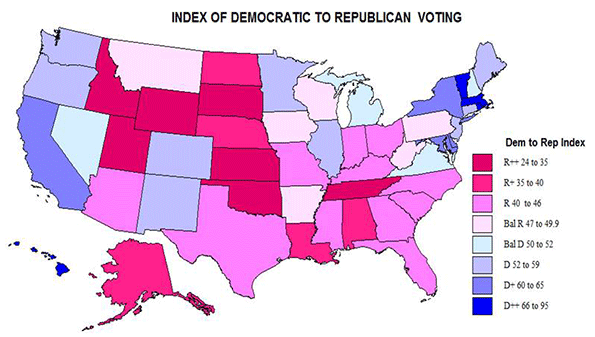
    At 2 seats per state regardless of population, Republicans have an inherent advantage to obtain a majority of senators (or governors), since they dominate a majority of states, and Democrats are over-concentrated in a few larger states. The fact that Democrats currently hold 52 of seats plus the support of independents in VT and ME, is a consequence of the timing of Senate elections and perhaps reflects the extremism of some Republican candidates, who alienated enough middle road, independent voters to swing races to the Democrats. It is also significant that in 15 states voters clearly chose to have senators from both  major parties, indicating either that polarization is not so extreme as proclaimed, or that there are a number of closely divided states, that can vote R or D depending on  issues, personalities, and timing. Please see the summary table C for a listing by strength of the D or R votes for senators across the states. The highest D shares (both seats) were in VT, RI, and NY, for Republicans in WY, TN, SD, and ID.

    Governors  

    Republicans hold 29 of the 50 governors, perhaps an underlying indicator of a Republican majority. Yet, from the table you will see that Democrats elected governors in several states that lean Republican overall e.g., MO, AR, MT, and WV, and that there are Republican governors in several states won by Obama, e.g., MI, NV, NM, ME, and NJ. This ambivalence undermines any simple and strict Red versus Blue dichotomy. Many voters are not as utterly polarized as proclaimed. The most extreme Republican votes were in WY, NE, UT LA, and TN, and the highest Democratic shares in DE, NY and yes, AR, which voted only 38% for Obama.

    Legislatures  

    Legislatures are controlled by Republicans in a majority, 26, of states, with Democrats in control in 20 states, with four state divided: Iowa, Kentucky, New Hampshire and Virginia (almost), and even Washington (de facto). The legislatures are overall the most Republican-leaning of the elections analyzed. But even here, the average share of Democrats in legislatures is a respectable 46 percent. The most extremely Republican legislatures are in WY, UT, ID, KS, TN, and SD and the most extremely Democratic are, predictably, in HI, RI, MA, VT and MD. Again in recognition that a simple red and blue dichotomy is not that certain is the fact that in four states, KY, IA, VA, and NH, the legislative houses are split between the parties.

    So what is the best estimate of the real division between Red and Blue America?

    Table C ranks the states by my composite average index based on the races for president, the House of Representatives, state legislatures, US senators and governors. The numbers (percents) are the Democratic share of the vote for president, for the US house, for US senators and for governors, but for state legislatures, the percent shares of legislators who are Democrats. The final column Is a simple average of these five values. In this way I can distinguish those states which are consistently Democrat or Republican, from those which really are less polarized and more balanced.

    TABLE C: Summary of Democratic-Republican Voting Record
    Electoral Votes President %D Congress %D State Legislatures Senators %D Governors %D Number of D Wins Composite Index
    Sen %D House %D Legis Ave. Type
    WY 3 28.8 25.7 13.3 13.3 13.3 25 27 0 24.0 R++
    UT 6 25.4 33.4 17.2 18.7 18.0 34.75 34 0 29.1 R++
    KS 6 38.9 20.9 22.5 26.4 24.5 33.25 36 0 30.7 R++
    ID 4 33.6 33.9 17.1 18.6 17.9 33.5 39 0 31.6 R++
    OK 7 33.2 32.4 25.0 28.7 26.9 35 40 0 33.5 R++
    TN 11 39.6 36.8 21.2 27.6 24.4 34 35 0 34.0 R++
    SD 3 40.8 42.6 20.0 24.3 22.1 31.25 38.5 0 35.0 R++
    NE 5 38.9 35.8 42 27 0 35.9 R+ 
    ND 3 39.9 43.2 28.3 24.5 26.4 36.75 35.5 0 36.3 R+ 
    AL 9 38.8 36.0 25.5 37.1 31.3 35.6 42 0 36.7 R+ 
    LA 8 41.3 23.9 41.0 42.9 41.9 47.5 34 0 37.7 R+ 
    AK 3 42.7 30.9 35.0 37.5 36.3 38.25 41 0 37.8 R+ 
    MS 6 44.2 36.9 36.5 47.9 42.2 40.3 38 0 40.3 R
    GA 16 46.0 40.8 32.1 33.3 32.7 41.75 46 0 41.5 R
    TX 38 42.0 40.0 38.7 36.7 37.7 43.25 45 0 41.6 R
    SC 9 44.7 42.0 39.1 37.7 38.4 38.25 48 0 42.3 R
    IN 11 44.8 45.8 26.0 31.0 28.5 47.25 48.2 0 42.9 R
    AZ 11 45.4 45.6 43.3 40.0 41.7 43.25 45 0 44.2 R
    FL 29 50.4 47.0 35.0 38.3 36.7 40.5 49.3 1 44.8 R
    MO 10 45.2 43.3 29.4 32.5 31.0 49.5 55.5 1 44.9 R
    KY 8 38.5 40.0 40.0 55.0 47.5 45.7 56 1 45.5 R
    NC 15 49.0 50.9 36.0 35.8 35.9 48.5 44.5 1 45.8 R
    OH 18 51.5 47.9 30.3 39.4 34.8 47 49.5 1 46.2 R
    239
    AR 6 37.8 32.3 40.0 49.0 44.5 59.75 64.5 2 47.8 BalR
    MT 3 43.0 44.5 46.0 37.0 41.5 62 50.5 2 48.3 BalR
    WI 10 53.5 50.8 45.5 39.4 42.4 50.5 47 3 48.8 BalR
    PA 20 52.7 50.8 46.0 45.8 45.9 51.5 45.5 3 49.3 BalR
    IA 6 53.0 51.5 52.0 47.0 49.5 48.6 45 2 49.5 BalR
    WV 5 36.3 40.1 70.6 54.0 62.3 57.5 52 3 49.6 BalR
    50
    MI 16 54.8 52.7 31.6 46.4 39.0 61.5 42 3 50.0 BalD
    VA 13 52.0 49.0 50.0 32.0 41.0 59 50.8 3 50.4 BalD
    NH 4 52.8 52.2 45.8 55.3 50.5 45.25 54 4 51.0 BalD
    NV 6 53.4 49.8 52.4 64.3 58.3 50.5 46 3 51.6 BalD
    39
    CO 9 52.7 48.6 54.3 56.9 55.6 52.25 56 4 53.0 D
    NM 5 55.3 55.2 59.5 55.7 57.6 56.5 46.4 4 54.2 D
    ME 4 57.9 61.7 60.0 56.7 58.3 46.5 49 3 54.7 D
    WA 12 57.6 54.4 51.0 56.1 53.6 56.5 51.5 5 54.7 D
    OR 8 56.3 58.0 53.3 57.6 55.5 54.75 50.4 5 55.0 D
    MN 10 53.9 56.3 58.2 54.5 56.3 58.25 50.5 5 55.1 D
    NJ 14 59.0 55.6 60.0 60.0 60.0 58 46 4 55.7 D
    IL 20 58.6 55.4 67.8 60.2 64.0 59.5 50.5 5 57.6 D
    CT 7 58.8 65.5 61.1 64.9 63.0 55.25 50.3 5 58.6 D
    CA 55 61.9 62.0 68.4 70.0 69.2 58.25 53 5 60.9 D+
    MD 10 63.3 65.5 74.5 69.5 72.0 61.25 56 5 63.6 D+
    NY 29 64.3 64.8 52.4 70.5 61.4 67.25 62 5 64.0 D+
    DE 3 59.4 65.8 61.9 65.9 63.9 62.75 70 5 64.4 D+
    RI 4 64.0 59.0 84.2 92.0 88.1 69 53 5 66.6 D++
    MA 11 61.8 74.9 90.0 81.9 85.9 60 52 5 66.9 D++
    VT 3 68.2 75.6 76.7 67.6 72.1 69 51 5 67.2 D++
    HI 4 71.7 67.5 96.0 86.3 91.1 69.3 58 5 71.5 D++
    DC 3 95.0                  
    211


    Overall 23 states with 239 electoral votes lean fairly strongly Republican across the 5 measures, despite Obama carrying FL and OH, and six more states were somewhat balanced, but leaning moderately Republican, with 50 electoral votes. Of these Obama won 3, WI, PA, and VA, but none of the 5 Obama-carried states in these sets can be considered safely Democratic. Seven states had composite indices less than 35% D, a fairly extreme set. Five states were quite Republican with indices 35 to 40 Democratic, and a larger number, 11, were less strongly or consistently Republican (indices 40 to 46}. The six marginally Republican states, with indices 47.8 to 49.6, all have a mixed pattern of Democratic and of Republican majority percents. AR, MT and WV are an interesting subset, with a less “urban liberal” kind of Democratic tradition.

    Seventeen states (plus the District of Columbia) have Democratic indices over 53. With four (RI, VT, HI, MA) and DC in the over 65 set, 4 in the moderately strong D set, 60 to 65, CA, MD, NY, and DE, and then  9 is the group with D indices from 53 to 60.  But note that 4 of these had a Republican majority in some category. The remaining 4 states with indices from 50 to 52, are only marginally D, and indeed are quite mixed across the categories, almost a classic definition of balance. What all the 21 D leaning states have in common is that Obama won them in 2012.

    In summary Republicans are stronger overall in 29 states with 289 electoral votes, to Democrats in 21 states (+DC) with 249 electoral votes. Democrats can overcome this territorial Republicanism only by the peculiar geography of their huge urban vote, which can enable them to carry marginally Republican states.

    Thus, as to the presidential election in 2016, is there hope for the Republicans? I am convinced that there is now a national consensus that the time has come for a woman president, and that Hilary Clinton can match or even beat Obama’s lopsided 2008 victory, because potentially millions of women will defy their husbands and desert their otherwise moderate conservatism and vote for Clinton. Otherwise the Democrats would be in a desperate situation.

    But 2014 is an entirely different proposition. If we ignore the first column (presidential), Republicans are in a very strong position for the Senate, the House, governors, and legislatures.  This outcome is likely, despite the demographic transition from domination by older white males to younger, more liberal, more urban generations. But moderately conservative folk remain the majority, as attested to by the latest national polls. For example, Gallup polls show conservatives at 38%, liberals at 23 (the highest ever but still unimpressive) and moderates at 34%. The Republican failure to take advantage of this inherent moderate majority reflects the problem with reactionary conservatism that enables Democrats, and liberals (not coincident) to thrive beyond their numbers.

    Richard Morrill is Professor Emeritus of Geography and Environmental Studies, University of Washington. His research interests include: political geography (voting behavior, redistricting, local governance), population/demography/settlement/migration, urban geography and planning, urban transportation (i.e., old fashioned generalist).

  • Ukrainian and Russian: The Geo-Politics of Language

    The Russian-speaking population of Ukraine has been at a disadvantage since the collapse of the Soviet Union. In the Ukrainian parliament, this occasionally erupts in violent brawls caught on YouTube; for average citizens, it is a humanitarian problem. Early on in this conflict the Peace Corps instructed its volunteers in Ukraine to avoid speaking Russian whenever possible. This almost certainly stoked the tensions that have now, years later, destabilized the country.

    In the fall of 1997, just after graduating from college with a degree in English and Russian Studies, I completed Peace Corps training in the city of Cherkassy, then was sent north to Chernigov, my placement city. I then spent several weeks in Kiev before “early terminating” – that’s Peace Corps jargon for leaving your assignment before completing the customary two years of volunteer service.

    The cities where I clocked time in Ukraine are all situated along the northern section of the Dnieper River, which serves as a dividing line between the Ukrainian-dominant west and the Russian-speaking east. Most of the people I met in this central region preferred conversing with me in Russian, or lapsing into Surzhik, the cozy colloquial hodge-podge of both languages. Yet Peace Corps maintained a rather adamant policy that Ukrainian was the preferred language for all our interactions with the Ukrainian public in this part of the country. Ukrainian had become the country’s only official language after the collapse of the Soviet Union.

    This never sat well with me. Peace Corps Ukraine volunteers were instructed to side with a single language in a bilingual country. Now that Russia has annexed Crimea and is threatening a military invasion of eastern Ukraine, I can’t help but see the Peace Corps’ approach as evidence of America’s interference in a cultural conflict in which it should never have been a player.

    Other volunteers told me that in its early years, Peace Corps taught everyone Ukrainian, even the volunteers who were placed in Crimea and the far eastern cities like Donetsk, Kharkov, and Lugansk, where almost all of the locals spoke little or no Ukrainian. Eventually, Peace Corps conceded that these volunteers were better off learning Russian, when it became clear that they were being sent into the field woefully unprepared to communicate.

    In the central part of the country, where both languages were relevant, we were told that we needed to be role models for the citizens who knew Ukrainian but were more comfortable speaking Russian. These people were complacent, they told us; lazy, even. They only spoke Russian because the Soviet Union had forced it on them in school for several generations. If they heard Americans speaking Ukrainian better than they did, they would feel ashamed of themselves, and that was a good thing (or so we were told).

    We were also warned to keep an eye out for that ugly plague of Surzhik, and not to let it infect our use of either language. And Surzhik was everywhere – on the trolleys, in the stores, on the local television news. Even the intelligent mother and daughter I lived with during training used it to speak with each other. They had been warned by the Peace Corps about modeling sloppy language for us, though, so they mostly spoke to me in clean Russian, except for a few days when we made a token effort to converse in Ukrainian after somebody from Peace Corps scolded them for letting me speak so much Russian.

    As somebody with an academic interest in linguistics and language history, I knew that forcing a language on a population, even a language that may have been at one time forced out of them, was an age-old recipe for discontent and conflict. I even had a hard time thinking ill of Surzhik, though I could hear it corrupting both languages as people spoke. Much as we may try to pin down correct usage with grammatical rules, dictionaries, and textbooks, language is ultimately democratic, its evolution driven by the people who speak it. It may have been ugly to some people’s ears, but from a linguistic point of view Surzhik was a perfectly natural development for speakers torn between two rival languages.

    Mine wasn’t necessarily a majority view of the country’s language politics. Plenty of Peace Corps volunteers believed they were benefitting the country by speaking textbook Ukrainian, even when people struggled to converse with them. These folks would respond with friendly scorn when I expressed a preference for speaking Russian because it was easier for me to communicate with people and forge relationships. There were other language problems, too: One woman assigned near the border in southwestern Ukraine told me most people in her town spoke Romanian. Other parts of the west had strongly Polish-influenced dialects.

    The more urgent stories of language oppression, though, came from Ukrainians themselves: a university student during the Soviet Union collapse, for example. She considered herself Ukrainian, but her family and friends only ever spoke Russian. The Ukrainian language was a minor academic requirement for her in school; she never learned to speak it with any fluency. When Ukraine gained its independence and Ukrainian was declared the official language, she and other Russian-speaking students suddenly found themselves in classes conducted strictly in Ukrainian.

    Of course, Ukrainians in the western part of the country had plenty of legitimate complaints about being forced to learn Russian when Ukraine was part of the Soviet Union, and about the disadvantages they faced in the many communities where Ukrainian was and still is the primary or even sole language. Neither side of the country has had an easy linguistic ride over the last century.

    What I was witnessing, though, looked like a regulatory pendulum swing from one extreme position to another, not a benevolent policy change aimed at benefitting the population as a whole. I found myself in an awkward position — the language I’d studied for years turned out to be as frowned upon as it was useful. I remember looking up chess terminology, memorizing the phrase “politicheskaya peshka”, so I could explain in Russian, if the need arose, that I — because of the language I spoke — felt like a political pawn.

    Flickr photo by Dieter Zirnig: Ukraine, 2010

    Since her brief stint in the Peace Corps, Andrea Gregovich earned an M.F.A. in Creative Writing from University of Nevada Las Vegas and has been honing her skills as a translator of Russian literature.

  • Concentrated Wealth or Democracy, but Not Both

    In many uncomfortable ways, American politics now resemble those that arose late in the Roman Republic. As wealth and land ownership concentrated in few hands, a state built on the discipline of soldiers who tended their own farms became ever more dominated by fractious oligarchs. As property consolidated into huge slave-owning estates, more citizens became landless and ever more dependent on the patronage of the rich generals and landowners who increasingly seized control of politics.

    In much the same way, as the wealth has concentrated in America, so, too, has the power exercised by those with money. The wealthy have always played an outsized role in our politics, but today, emboldened by Supreme Court rulings easing controls on contributions, oligarchs are dominating the electoral map in ways that have not been seen at least since the abuses of the Nixon years.

    Perhaps the most notable, or infamous, example is the Koch brothers, David and Charles, billionaire industrialists whose role in conservative politics has made them the ultimate “bogeymen” for crusading liberal journalists concerned with the growing power of the ultrarich on our political system. Campaigning against the Kochs has become standard issue for Democrats such as Senate Majority Leader Harry Reid.

    What makes the Koch brothers such great targets is that they come from an industry – energy – that itself is held in the lowest esteem by the progressive activist community and its media allies. Although they tend to be libertarian in their social views, the Kochs are notably, and not surprisingly, skeptical about climate change policies that might impact their vast oil and gas holdings as well as their industrial companies, which, in the words of former New York Times columnist Frank Rich, “spew” such unhappy products as Lycra and Dixie cups. The Kochs’ ties to the Tea Party have led reliably liberal commentators to suggest that the moguls have played the supposedly grass-roots Tea Party for “suckers.”

    As they rail against the Kochs, few progressives note that the balance of oligarchic politics are increasingly shifting toward the Democratic Party. This, of course, includes the predictable Hollywood figures, such as Dreamworks’ Jeffrey Katzenberg and a large section of Wall Street, notably financier George Soros, long a major source of funding for President Obama.

    These well-heeled progressives have had little to fear from an administration that, despite its occasional populist outbursts, has adopted an economic policy that has exacerbated an already yawning gap in income growth between the wealthy and everyone else. Indeed, Obama, for all his populist rhetoric, retained close ties to firms like Goldman Sachs, staffing his administration with people from, and associated with, that most-detested of Wall Street firms. Indeed the ultrarich so backed the ostensibly left-wing president that, at his first inaugural, notes sympathetic chronicler David Callahan, the biggest problem for donors was finding sufficient parking space for their private jets.

    An examination of campaign contributions shows that the vast majority of America’s wealthiest households may already tilt in this direction. Among the .01 percent who increasingly dominate political giving, three of the largest contributions, besides the conservative Club for Growth, backed by Republican oligarchs, went to groups such as Emily’s List, Act Blue and Moveon.org. Liberal groups accounted for eight of the top 10 ideological causes of the ultra-rich; seven of the 10 congressional candidates most dependent on their money were Democrats.

    This ideological shift among the rich, particularly the new rich, in what author Chrystia Freeland has dubbed an “age of elites,” is critical to understanding contemporary political conflict. There have always been, of course, affluent individuals who backed liberal or Democratic causes, out of a mixture of philosophy and self-interest but, for the most part, the wealthy backed Republicans. This has begun to change.

    Perhaps most ominous for the Right, the biggest growth in oligarchic politics has been from the very group – the so-called “high tech community” – that has flourished under the current easy-money regime. Once primarily middle-of-the-road Republican, the tech oligarchs have moved “left” in their politics, particularly on social and environmental issues. Many also have profited, or attempt to, through “green” energy investments. The leading tech companies, mostly based in the Silicon Valley, routinely send over four-fifths of their contributions to Democratic candidates.

    For the political parties, which are losing influence with every election, the rise of the oligarchs in politics represents a mixed blessing. To be sure, the tens of millions poured into the coffers of party candidates is welcomed, but at the same time, the oligarchs have become so powerful that they have altered, likely for a long time, the nominating and electing process.

    Republicans, for example, must deal with the likes of casino billionaire Sheldon Adelson, whose millions kept the quixotic, and seemingly pointless, Newt Gingrich campaign alive in the most-recent presidential primary campaign. The Koch brothers and others have also supported the supposedly grass-roots Tea Party, whose opposition to the Republican establishment has roiled GOP politics since 2010 and ended up with the nomination of some weak candidates.

    This year, it may be the Democrats’ chance to lament the rise of the oligarchs. At a time when economic growth and inequality are primary issues to most Americans, the presence of oligarchs all but guarantees that other issues – notably, environmental issues or social concerns like gay marriage – dominate the party’s fundraising. After all, it’s hard to imagine a party increasingly dependent on the wealthy seriously advocating, for example, for the equalization of capital gains and regular income taxes.

    Nobody better epitomizes the rise of economic royalist politics in the Democratic Party than San Francisco-based hedge-fund billionaire and green-energy investor Tom Steyer. Steyer has pledged to work against any Democrat who dares express the slightest skepticism about the need to diminish use of fossil fuels, no matter the economic cost. This could prove particularly tough on Democrats from energy states, like Louisiana, Texas, the Dakotas, Colorado and Montana, who historically have supported the fossil fuel industry as a prime generator of high-wage employment, including thousands of unionized blue-collar jobs.

    With Steyer pledging some $100 million to his anti-oil campaign, centered on opposition to the Keystone XL pipleline, the party is running against the popular grain. According to a recent Washington Post poll, the project is favored among the public by a margin of roughly three to one.

    So, Democrats find themselves pressured to oppose something favored by a large majority, all for an issue – climate change – that barely rates as a priority among voters far more worried about their jobs and families than carbon emissions. Just as well-financed Tea Party extremists have led the Republicans to nominate some lamentable candidates, Steyer’s efforts could undermine Democratic prospects – at least outside the solid coastal precincts – by forcing party figures further toward the gentry version of the Left.

    Ultimately, the biggest issue revolves not around the politics of the oligarchs but their overall potential to dominate our entire political culture. As Supreme Court Justice Louis Brandeis suggested in the last century, “We can have democracy in this country, or we can have great wealth concentrated in the hands of a few, but we can’t have both.”

    The founders, too, understood this basic truth. James Madison embraced the ideal of dispersed property – “the possession of different degrees and kinds of property” – as necessary in a functioning republic. Thomas Jefferson, admitting that the “equal division of property” was “impractical,” believed “the consequences of this enormous inequality producing so much misery to the bulk of mankind” that “legislators cannot invent too many devices for subdividing property.”

    It’s time we started listening to Brandeis and the founders. Until we address this issue of concentrated economic power – be it in the hands of oil barons or tech types – our politics will continue to devolve like those of Rome in the late Republic, undermining the last vestiges of citizen-based politics. Whether or not it results in the rise of an actual Caesar, this could be a sad day for what is left of our old Republic.

    This story originally appeared at The Orange County Register.

    Joel Kotkin is executive editor of NewGeography.com and Distinguished Presidential Fellow in Urban Futures at Chapman University, and a member of the editorial board of the Orange County Register. He is author of The City: A Global History and The Next Hundred Million: America in 2050. His most recent study, The Rise of Postfamilialism, has been widely discussed and distributed internationally. He lives in Los Angeles, CA.

    Photo by Peoplesworld.