Category: Politics

  • Leadership and the Challenge of Making a City Visible

    Cities of varying sizes struggle with two related, but seemingly opposing, global and local forces. At one level, every city would like to benefit from the global flow of capital and the emerging landscapes of prosperity seen in “other” places. At another level, to be a recipient of such attention, a city has to offer something more than cheaper real estate and tax benefits.

    What cities need is a sense of uniqueness; something that separates them from other cities. Without uniqueness, a city can easily be made invisible in a world of cities. In other words, without defining the “local,” there is no “global.” Here is where identifying a coherent message about a place, based on its identity, becomes crucial. One of the major challenges facing many cities, small and large, is how to make themselves visible, and how to identify, activate, and communicate their place identity – their brand – through actions.

    The challenge of urban branding is that cities are not commodities. As such, urban branding is not the same as product or corporate-style branding. Cities are much more complex and contain multiple identity narratives; whatever the business and leadership says, there are other local voices that may challenge the accepted “script”. In fact, while city marketing may focus mainly on attracting capital through economic development and tourism, urban branding needs to move beyond the simply utilitarian, and consider   memories, urban experiences, and quality of life issues that affect those who live in a city. A brand does not exist outside the reality of a city. It is not an imported idea. It is an internally generated identity, rooted in the history and assets of a city.

    Catchy phrases, logos, shiny booklets, invented cultural events, or the latest urban design schemes are not the answer. Copying tactics from other cities won’t make a city recognizable; it will make it less visible and less unique. The challenge is, then, to ask what assets a city has that others do not possess; which of these assets can be seen as a city’s mark of achievement or recognizable characteristics; and how does one activate, elevate and sustain those characteristics?

    This search necessarily starts with residents, who are best suited to answer the first question. And who can respond to the second question better than the collective leadership of a city, including its public and private sectors? Leadership needs to be inclusive of all stakeholder groups, as should the voice of the residents, which must include gender, race, class, and age differences.

    At every step of the way, from collecting the diverse narratives to formulating and activating a brand, leadership and inclusive governance play central roles. But who are the leaders? As Robin Hambleton suggested at a recent Urban Studies Lecture at University of Washington Tacoma, leadership does not exclusively translate to political leaders, and governance is not the same as government. He identified four categories of leaders: political, managerial/professional, community, and business. He was careful to distinguish between predatory businesses that are typically place-less and care little about the future of a city, and producer businesses that are typically rooted and place-bound. His fourth category of leaders came from the latter and not the former group of businesses.

    Based on his international observation of various cities, many of which suffered a post-industrial condition (e.g. Malmo, Sweden and Melbourne, Australia) the convergence and collaboration of the four leadership categories created an innovation zone that allowed them to turn their cities around and adopt a way forward. The example of Freiburg in Germany, a city of slightly larger than 200,000 residents, is instructive. With the persistence of the Green political party, the mayor, community activists and an imaginative public servant (the Director of Planning and Building), Freiburg was able to enact a particular vision that elevated its status regionally, nationally and internationally. The city is recognized today as a leading European ‘eco-city;’ its history, geography and natural settings at the edge of the Black Forest in Germany allow Freiburg to incorporate this brand with ease. The four categories of leadership converged on this issue and their innovation paid off.

    The challenge before most post-industrial and mid-size cities is as follows: who are the leaders within each of these four sectors who can help convene, identify, and activate an urban brand, befitting of this urban region? Are these categories equally powerful? Do political and community leaders carry the same clout as the business and the managerial class? Most mid-size cities typically lack predatory businesses, but who are the producer businesses? More importantly, who are the leaders from that sector that could play an active role in the branding process? Is the leadership balance-sheet lopsided in favor of the managerial/professional class? With limited budget, can they carry forward a bold plan that could make this city visible?

    To make a city visible takes more than a logo. The future of a city region depends on a diversity of political, managerial, community and business leaders who will participate and sustain a process that will lead to an inclusively created brand, followed by actions that embrace it. Cities without articulated identities will remain invisible, lamenting at every historical turn the loss of yet another opportunity to be like their more successful neighbors.

    Ali Modarres is the Director of Urban Studies at University of Washington Tacoma.  He is a geographer and landscape architect, specializing in urban planning and policy. He has written extensively about social geography, transportation planning, and urban development issues in American cities.

    Photo by FLickr user belem

  • Crimea and Ukraine: What Putin Could Learn from Yugoslavia

    While American government officials respond to the Russian Anschluss in Crimea by mobilizing their Twitter feeds and making the rounds of the Sunday morning meetings of the press, the Moscow government of Vladimir Putin reinforced its occupation forces around Simferopol and Sebastopol, perhaps at some point passing out small Russian flags to local sympathizers, who can wave them gratefully when the symbolic gates between Russia and Crimea are thrown open.

    To paraphrase a quote that circulated in the 1930s: “The West likes to spend its weekends in the country, while the Russians prefer to take their countries in a weekend.”

    The reason the Russians have chosen this moment to move against Ukraine and its Western patrons is not difficult to reconstruct. Since the fall of the Soviet Union in the early 1990s, the United States, NATO, and most recently the European Union have treated Russia as little more than a Grand Duchy of Lithuania.

    The moment it could, when the Soviet Union was in liquidation and Russia was weak, NATO pushed its military frontiers into Poland, the Baltic States, Slovakia, and even Georgia. At international conferences such as the G7, it sat Russian presidents at the children’s tables. In the Middle East, the United States and its allies blew away Russia’s man in Baghdad — Saddam — and is now doing the same with Assad in Syria.

    In Libya, despite giving Russia assurances that the no-fly zone was there to protect citizens trudging to markets with their donkeys, it was expanded to justify killing Qaddafi and reserving the sweetheart oil contracts for western corporations. No wonder Russia had its doubts when the US and the EU started hinting that Ukraine’s president, Viktor Yushchenko, had stolen more than was necessary.

    More immediately, Putin felt humiliated when the Western press comically treated his Olympics as though he was Comrade Kane, staging a $51 billion snow opera for his girlfriend.

    Putin did not become president-for-life of Russia by giving fundraisers in Napa Valley or interviews to Esquire. By nature intensely competitive, he still smarts from the dissolution of the Soviet Union, especially the loss of Ukraine.

    Short of reviving the 1854 Crimean War coalition (Britain, France, and Turkey, with Austro-Hungary and Prussia neutral) and besieging Sebastopol, there isn’t much that the West can do, or will want to do, to evict Russian troops from Crimea. Will Russia now take up the fallen mantle of the Soviet empire? Will it work?

    By invading or partitioning the Ukraine, Russia sets itself up as the Yugoslavia of the 21st century—Russoslavia? Like Slobodan Milosevic before him, Putin is a former Communist war horse who champions the nationalist cause of disenfranchised Russians cut adrift after the dissolution of the Soviet Union — Yugoslavia on a grander scale, with the same hodgepodge ethnicity. Ukraine becomes the Bosnia of the 21st century.

    Yugoslavia was a 19th century political ideal, to pull together a number of smaller, vulnerable Balkan states from the encroachments of the Austro-Hungarian Empire to the north and the Ottomans to the south. It came into being at the end of World War I, although by that time neither the Austro-Hungarians nor the Turks were powers in southwest Europe.

    Almost immediately, without the common threats, the countries of the Yugoslav federation fell out, although the country lasted, officially anyway, until the 1990s. To be a Serb living in Bosnia or Croatia was fine until those republics went for the exits of Yugoslavia, when to be Serb became to be a symbol of a failed central government or, worse, a second-class citizen living in a new country.

    Russia’s role in the Soviet Union was not unlike the position of Serbia in Yugoslavia. It had the largest population, was the seat of the central government, and, later, had the most to lose when constituent states of the federation decided to secede and take with them large blocs of Russian citizens.

    With the Soviet devolution, Russians became a lost tribe of the Cold War, stranded with few rights and much contempt in places like Ukraine, Moldova, Kazakhstan, Uzbekistan, Belarus, and Latvia.

    When I have traveled in Russia or the ex-Soviet Union, I have met many who say, for example, “My father was from Moldova and my mother was Russian, but during the war we were moved to Uzbekistan, although later I went to school in Riga.”

    Putin is their archangel, much as the writer Aleksandr Solzhenitsyn was their philosopher-king, writing in 1995, “Russia has truly fallen into a torn state: 25 million have found themselves ‘abroad’ without moving anywhere, by staying on the lands of their fathers and grandfathers. Twenty-five million — the largest diaspora in the world by far; how dare we turn our back to it?? Especially since local nationalisms (which we have grown accustomed to view as quite understandable, forgivable, and ‘progressive’) are everywhere suppressing and maltreating our severed compatriots.”

    While there is a rationale for Putin speaking up for the lost rights of the Russian diaspora, the last thing he needs, in exchange for the liberation of Donetsk, is a Muslim Risorgimento in Tatarstan, Chechen agitation, a separatist movement in Siberia, or rebellion from the two million Ukrainians living inside Russia.

    Like Yugoslavia, Russia has a lot it can lose in playing the nationalist card, because it risks a series of border wars if it tries to impose Greater Russia not just on gleeful former citizens, but on less enthusiastic minorities, who want nothing to do with a Russian restoration.

    In its attempts to hang on to its cordon sanitaire in the past, Russia became the patron of bizarre breakaway republics, such as Transnistria (a Russian enclave between Ukraine and Moldova), Abkhazia and South Ossetia in Georgia, and Nagorno-Karabakh in Armenia. An Autonomous Republic of Crimea, run by shady commissars flitting around in SUVs, would fit well with these no-man’s lands, dressed up for the Kremlin masquerade.

    Most likely the Ukraine crisis will end with the same vagueness that has characterized so much of international diplomacy since the end of the Cold War. In most cases, Moscow has ended up as the guardian of a series of rump states, the latest of which might be Crimea.

    Matthew Stevenson, a contributing editor of Harper’s Magazine, is the author of Remembering the Twentieth Century Limited, a collection of historical travel essays. His new book, Whistle-Stopping America, was recently published. He first traveled to the former Soviet Union in 1975, and over the years has been to many of its then-constituent parts, usually by train.

    This post is a different version of a longer analysis at NYTimes eXaminer.

    Flickr photo by Alexxx Malev: Sevastopol 187

  • East of Egan: Success in California is Not Evenly Distributed

    The New York Times ran a Timothy Egan editorial on California on March 6.  The essay entitled Jerry Brown’s Revenge was reverential towards our venerable Governor.  It did, however, fall short of declaring Brown a miracle worker, as the Rolling Stone did last August.  These and other articles are part of an adoring press’s celebratory spasm occasioned by the facts that California has a budget surplus and has had a run of strong job growth.

    Egan at least pauses in his panegyrical prose to mention that all is not perfect in California:

    Without doubt, California has serious structural problems, well beyond the byzantine hydraulic system that allows the state to flourish. For all the job growth, the unemployment rate is one of the highest in the nation. It has unsustainable pension obligations, a bloated public-employee sector led by the prison guard union. And it is so expensive to live here that clashes over the class divide are threatening to get nasty.

    That’s not the worst of it.  Before going there, though, let’s consider Brown’s most celebrated achievement, a budget surplus. 

    California has a budget surplus because of a temporary income tax on its highest earning citizens and because of large capital gains reaped during an amazing year for stocks.  The S&P 500 was up almost 30 percent last year, an event unlikely to be repeated.  California’s tax revenues are excessively dependent on a relatively few wealthy tax payers.  This makes revenues extremely volatile.  When these tax payers do well, Sacramento is flush with cash.  When the high end tax payers don’t do well, Sacramento has very serious problems.

    By increasing California’s reliance on a few wealthy tax payers, Brown’s tax increase made California’s revenues more volatile.  The ongoing bull stock market would have generated higher tax revenues for California without the tax increase.  It generated even more with the tax increase.  When a bear market comes, the state will again face deficits.  This is one reason that Standard and Poors ranks California’s credit as second worst in the country, only above Illinois.

    So far, to his credit and in stark contrast to what we saw in the dot-com boom under Gray Davis, Jerry Brown has, with the exception of his pet project, the high-speed train, effectively resisted the legislature’s knee-jerk impulse to increase long-term spending commitments.  What he has not done is perhaps more important: addressing California’s other financial issues, the ones that are contributing to California’s dismal credit rating.

    California has had several quarters of stronger-than-the-nation job growth, but is still 113,500 jobs below the level in 2007; in contrast Texas is 844,300 jobs above that number.  

    Nor can it be sure that growth will continue. Unfortunately, the day after Egan’s celebratory essay, California’s Economic Development Department announced that the state had lost 31,600 jobs in January.  That’s an initial estimate, and it will be changed, but it’s hard to tell which direction.  The data released with that estimate appear to be a bit of a mess and are internally inconsistent.  We’ve asked for some clarification.

    Regardless of the most recent data point, California’s job performance has been better than expected, and we should all be thankful for that.  However, comparison with the United States average is not the only metric.  Comparison with California’s potential is the correct metric, and there California is underperforming in a big way.  Given all of its advantages, California should be leading the nation in job creation and opportunity.

    California has been averaging about 27,000 new jobs a month over the most recent 12 months for which we have data.  It should be averaging at least 40,000.  This would be slightly more than Texas’ average of 33,900,.  But, it still represents only 3.2 percent job growth, well below Texas’ 3.7 percent job growth rate.

    The state is sitting over estimated oil reserves that are about four times as large as the Bakken Shield, a major contributor to North Dakota’s boom.  Any serious effort to tap that resource would generate huge numbers of jobs.  Many of those jobs would be high wage positions for less educated workers who were hurt the most by the recession.

    California has many advantages over North Dakota, or Texas for that matter, besides oil.  These are well known and include location between Pacific Rim producers and the world’s largest consumer market, ports, workforce, and climate.  Even without oil, we should be doing better.  Policy though, particularly environmental policy, is restraining the state’s job creation.

    Egan makes a big deal of migration.  Here is his first paragraph (emphasis is his):

    Let’s review. Just a few years ago California was a punching bag for conservative scolds — a failed state, profligate with its spending and promiscuous with its ambition. Ungovernable. And everybody’s leaving.

    Later, he returned to the topic:

    Third, the great exodus never happened. Since the dawn of the recession, the state has added about 1.5 million people — almost three Wyomings. And yes, 67,702 people moved from California to Texas in 2012. But 43,005 people moved from Texas to California. (Population growth is not necessarily a good thing, especially in this overstuffed state, but that’s another topic).

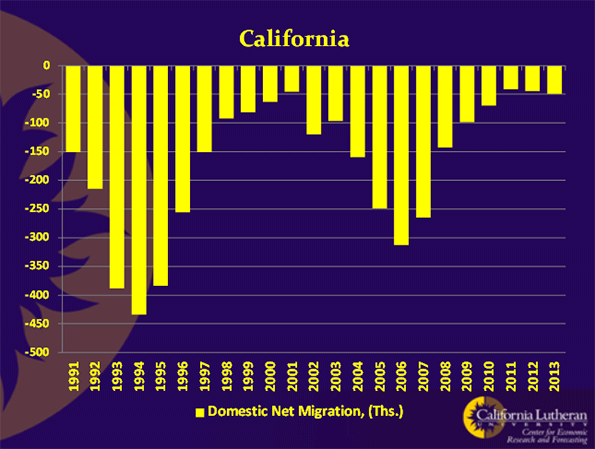
    This is really curious.  A whopping 57 percent more people moved from California to Texas than moved from Texas to California, which was the case for decades.  This is an argument that people aren’t leaving California?  California’s population is up 1.5 million?  California’s population growth is mostly a result of California’s fertile young people.  Census data show that California’s domestic migration has been negative for over 20 consecutive years.   It may not be The Great Exodus, but it’s a reversal of about a 150 year of migratory trend.

    Then there is poverty and unemployment.  Poverty, unemployment and lack of opportunity are why California’s domestic migration data is negative.  Lack of opportunity may be hard to measure, but we have lots of data on unemployment and poverty.   Some examples:

    • San Bernardino has the second highest poverty rate of any major U.S. metropolitan areas.  Only Detroit is worse.
    • California, with about 12 percent of the U.S. population, has 34 percent of U.S. welfare recipients.
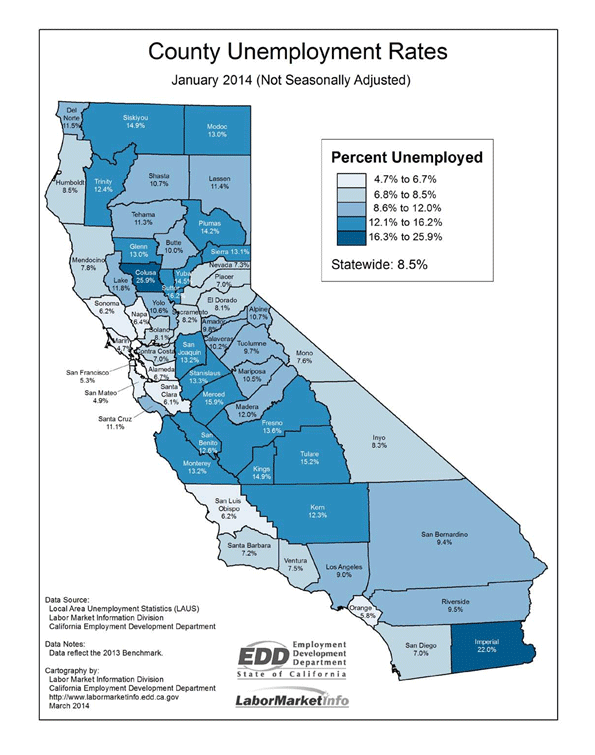
    • Two California counties, the geographically separated Colusa and Imperial, have unemployment rates over 20 percent.
    • Thirty-one of California’s 58 counties have unemployment rates in double digits.

    The geographic distribution of California’s poverty is one reason many people fail to understand California.  Most of California’s poverty is concentrated in regions where the political class —or wayfaring editorialists — seldom venture.  It’s mostly inland, not where most of California’s elite live or travel.  If you stay on the 101 corridor, or hug scenic Route 1, it’s easy to avoid.  You can find it, but you have to have eyes that are open to it, and it helps if you get off the beaten path. 

    Egan wrote his piece in Santa Barbara, where life can be as good as it gets, particularly for the affluent and boomers who bought their homes decades ago.  But, the city of Guadalupe in Santa Barbara County could give him a taste of how the other half lives. Just take a look sometime: it’s about as hardscrabble a town as the Texas town in the movie “The Last Picture Show”.

    California’s poverty is harder to ignore along the 99, but is even more evident in roads like 33 which winds along the eastern side of the coastal range.  Go there, and you will find it hard to believe that you are still in the United States, much less California.  There you will find grinding, hopeless poverty more reminiscent of the Third World than the center of the economic jobs.

    A high speed train won’t help these people.  Neither will Silicon Valley tech jobs, even if they don’t shrink in the inevitable social media shakeout.  Neither will Sacramento, apparently.  Until we start doing something for the state’s huge and struggling working and middle class, and that means creating opportunity for them, we should refrain from congratulating ourselves and each other for our good work.

    Bill Watkins is a professor at California Lutheran University and runs the Center for Economic Research and Forecasting, which can be found at clucerf.org. A slightly different version of this story appeared in CLU Center for Economic Research and Forecasting’s September, 2013 California Economic Forecast.

  • Welcome to Chicagoland

    As part of his plan to boost sagging ratings at the network, CNN chief Jeff Zucker commissioned an eight part reality series about Chicago and its mayor called Chicagoland that premiers tonight at 10pm ET. The show is produced by the same people who did the Brick City series about Newark Mayor Cory Booker, with support from mega-star executive producer Robert Redford.

    Rahm and the Media

    Given that Brick City seems to have only helped Booker’s reputation, cynics in Chicago have already noted the fact that show’s producers are represented by the William Morris Endeavor Agency, which just so happens to be the home of Chicago Mayor Rahm Emanuel’s brother Ari. This is as much because of as in spite of a well-publicized move by directors Marc Levin and Mark Benjamin to ask the agency to recuse themselves from representing them when it comes to the show.


    Trailer for CNN series “Chicagoland” – click here if the video does not display.

    One need not believe in such a conspiracy to see this show as yet another example of Rahm’s media power – and his fearlessness in pursuing high profile opportunities to get his message out even in venues where he’s not in complete control. Rahm has had significant success in getting high profile national and global attention – for example, a glowing profile from NYT columnist Thomas Friedman – since taking office. He didn’t shy away from getting out there even when a spike in murders made global headlines Chicago of the type Chicago didn’t want – a time when many mayors would have crawled into their bunkers. And although he’s been in office a while now, Rahm fatigue seems not to have set in. Sun-Times columnist Neil Steinberg has a lengthy piece on him in the March issue of Esquire with the colorful title of “And Now For the Further Adventures of Rahm the Imapler.” The Financial Times recently ran a mostly positive piece called “Rahm Emanuel: Mayor America.” It even includes a high production quality six and a half minute video that will give you a flavor of it (if the video doesn’t display, click here):


    With his ambition for Chicago as a global city, Rahm clearly sees global media as the ones that really count. Chicago’s status as a media center afterthought means few out of town reporters actually know that much about the city, hence Rahm has a huge opportunity to shape the message. This must infuriate the local media, which to a great extent Rahm is free to ignore because of his ability to go direct at the national and global level. Chicagoland should thus be seen as part of Rahm’s global media push, both for Chicago and for himself.

    Reality TV vs. Journalism

    The series is probably as good for Rahm and the city as it could possible get. Certainly the problems – high crime, poor schools, and labor troubles – are not glossed over. But given that they’ve been well publicized globally, it’s hard to imagine how they could be without sacrificing all credibility. Within the context of realism, this is a big win for the city.

    Whether it’s a big win for journalism is another story. Like most modern documentaries or reality TV shows, Chicagoland is non-fiction in a sense, but also heavily scripted and edited to provide a compelling narrative. This makes for great TV drama and characterizations, but whether it represents truth as a reporter would tell it is much more doubtful.

    Just as one example, the producers clearly had extensive access to Rahm and he’s frequently shown as concerned about crime, battling with unions, boosting the local economy, talking to school kids and even mentoring an inner city kid he brought on as an intern. But is that a fair representation of how Rahm Emanuel spends his time? The Chicago Reader did a two part series analyzing Rahm Emanuel’s schedule and published a two part series about it called “The Mayor’s Millionaire Club” (see part one and part two). They show that access to Rahm is heavily dependent on your wealth, influence, and donations. Yet that doesn’t come through in Chicagoland at all. Instead when the occasional powerful people are shown, they are always doing a good turn for the city, such as a group of tech executives donating products to schools.

    I’m not suggesting this series should have been a bulldog investigative piece. However, I strongly suspect that CNN’s actual journalists will be seething at seeing their network and its relatively strong reputation being used for what is clearly not the type of work they themselves would undertake. Right or wrong, the CNN brand carries an expectation of a certain type of journalistic standard that the Sundance Channel (where Brick City originally ran) doesn’t. Right now on CNN’s Chicagoland page there’s an ad for Anderson Cooper 360. Something tells me that were Anderson Cooper in charge of Chicagoland, it would look quite different.

    Compelling Drama and Characters

    However, taken on the terms of a Sundance series, Chicagoland succeeds, and my guess is that Rahm will be overall pleased. The show sets up the drama by structuring the series as battles between opposing forces. In the first couple episodes, this is the battle between Rahm and Chicago Public Schools leadership on the one hand, and the teachers union and some affected parent groups on the other over plans by CPS to shutter 50 schools. Frankly, I thought it overly portrayed Chicago as if it were Newark. The segments were introduced by short positive vignettes of some aspect of Chicago (like the Stanley Cup playoffs), followed by more extensive coverage of the school closing dispute, and educational and crime problems in Chicago’s impoverished South Side. It would be like doing a flyby of Times Square before doing a deep dive on some of the worst blocks in Newark. While I myself have written on the two Chicagos theme, I was feeling that Chicago was being unfairly stigmatized.

    I need not have worried. After the initial focus on the school closing dispute, the focus shifts. The drama is now between the good guys (basically every single person featured in the show) and the bad guys (gangsters and such who exist almost entirely offscreen, or so we’re led to believe). Almost without exception, the good guy characters are shown as 100% white knight types. Instead of positive vignettes followed by something Newarkesque, there’s a more balanced take in time allocation and the threads start merging across the two Chicagos. The show also starts laying the Chicago sales job on with a trowel. In Chicagoland’s coverage of things like the food scene, the music scene, the comedy clubs, or even footage of Rahm protesting a neo-Nazi march back in the 70s as a teenager, it’s hard to see how this could have been any more positive in its portrayal of the city if it had been produced directly by the Chicago Convention and Tourism Bureau. This is a huge win for the city.

    The show also manages to create several compelling characters. One of them is the surgeon who leads the trauma unit at Cook County Hospital, a job I certainly would not want. How that guy manages to balance family life in Roscoe Village (my old neighborhood) with the reality of what he deals with every night at his job is beyond me.

    But the star of the show is clearly Elizabeth Dozier, principal at Fenger High School in the South Side neighborhood at Roseland. She’s shown fighting not only to only educate her students, but keep them safe over the summer, and even invest in their lives after graduation when they get in trouble. (Dozier trying to help a former student who’s in jail for robbery realistically shows the need for “retail” 1:1 or N:1 investment in the lives of specific troubled people, not just programs, to make a real difference in a troubled person’s life – and even so the difficulty in seeing life change happen). Her obvious passion and dedication in the face of tough odds clearly come through. Yet even here there’s a sense of manufacture. Dozier is a young, attractive, stylish black professional who not only runs a South Side High School, but also gets personal face time with Rahm, knows Grant Achutz of Alinea, and hangs out with Billy Dec on his boat. How much of this A-list hob-nobbing was happening prior to Chicagoland coming to town I wonder? Regardless, it makes for compelling TV.

    While I have my quibbles, I think on the whole Chicagoland is an enjoyable watch that will end up being good for the city and the mayor. Just don’t go in expecting journalism. This is first and foremost reality TV style drama. With that caveat in mind, I recommend watching it.

    Takeaways From the Chicagoland

    Watching Chicagoland made me think again two bigger picture issues.

    First, in watching gangs take revenge on each other in an endless cycle of retaliation that literally stretches on for years and in which no one can actually recall the original offense, I was reminded of Hannah Arendt writing on the role of forgiveness:

    Forgiveness is the exact opposite of vengeance, which acts in the form of re-acting against an original trespassing, whereby far from putting an end to the consequences of the first misdeed, everybody remains bound to the process, permitting the chain reaction contained in every action to take its unhindered course. In contrast to revenge, which is a natural, automatic reaction to transgression and which because of the irreversibility of the action process can be expected and even calculated, the act of forgiving can never be predicted; it is the only reaction that acts in an unexpected way and thus retains, though being a reaction, something of the original character of action. Forgiving, in other words, is the only reaction which does not merely re-act but acts anew and unexpectedly, unconditioned by the act which provoked it and therefore freeing from its consequences both the one who forgives and the one who is forgiven. The freedom contained in Jesus’ teachings of forgiveness is the freedom from vengeance, which incloses both doer and sufferer in the relentless automatism of the action process, which by itself need never come to an end.

    Forgiveness is not the only way to put a stop to a cycle of revenge. Arendt posits official punishment as another. But forgiveness is clearly the fastest and surest route. Until either the police are able to impose order and mete out genuine justice, or the grieving family and aggrieved gang compatriots of these murder victims are able to forgive and forswear vengeance, the cycle is unlikely to ever end.

    I don’t want to judge too harshly teenagers in a ghetto living out the only life script they’ve ever known. But what’s our excuse? We too often live out in miniature the same process ourselves. How often do most of us forgive genuine wrong done against us, even of a much less consequential nature? Tune into the internet any day of the week and see untold amounts of shrieking over some offense or another, real or imagined. I suspect the vast majority of us would be behave no differently from those gangbangers in similar circumstances. We are blessed not to be there, however. But will we use that privileged position to end or perpetuate cycles of wrong in our own lives?

    Secondly, Chicagoland made me think about the bigger picture of leadership in our cities and the major problems they face. I voted for Rahm as mayor, for three reasons. 1) I saw him as like his mentor Bill Clinton, namely someone to whom getting elected and staying in power is more important than pushing any ideological agenda. In short, I saw him as a pragmatist, not an ideologue with a policy ax to grind like Bill de Blasio. 2) Rahm spent a lot of time outside of Chicago. He’s got a global perspective and a global network that’s critical in this era. He’s also got the gravitas to interact at the highest levels of power in America, which is something few mayors can say. 3) Rahm has no natural constituency in Chicago. So if he wants to be re-elected, he needs to perform. He clearly has future political ambitions, and flaming out as mayor wouldn’t be helpful in pursuing them.

    Looking back, while I’ve criticized Rahm for an excessive focus on the elite, I believe my judgment then was correct and on the whole I think he’s done a decent job in a very difficult situation. Apropos of point #3, if Chicago thinks differently, the popular and competent Cook County Board President Toni Preckwinkle is waiting in the wings. Whatever you think of his neoliberal policies, it’s clear Rahm is an actual leader, one with a ton of intelligence, drive, power, and the will to get things done.

    Yet watching Chicagoland, it’s evident that even leadership ability of Rahm’s caliber struggles mightily with the city’s huge challenges. Chicago has a massive fiscal hole, and a very serious problem with a two tier society that has left vast tracts of the city behind. It’s by no means certain that Rahm will be able to make Chicago soar in the way that Daley did in the 90s, or even get re-elected if a there’s any stumble and a credible candidate like Preckwinkle gets into the race.

    When I think about the difficulties in solving the problems in Chicago, which has not only Rahm’s leadership but a massively successful global city economy in the Loop and hundreds of thousands of well-heeled residents, it makes me pause. If Chicago struggles with its problems, how much more so other cities facing similar or worse problems but with much weaker leadership and no global city money and firepower? It really makes me wonder if a lot of places are simply going to die a slow death barring some lucky break from a change in the marketplace.

    This ultimately is what I’d challenge the residents of other cities to think about when watching this show. Look at Chicago and what it is dealing with. Think about your own problems and your resources for combating them vis-a-vis Chicago. If that doesn’t make you sober up, I’m not sure what will.

    Aaron M. Renn is an independent writer on urban affairs and the founder of Telestrian, a data analysis and mapping tool. He writes at The Urbanophile, where this piece originally appeared.

  • Drought Stokes California’s Class War

    As all the Californians who celebrated the deluge of rain that fell the week before last know, it did not do much to ameliorate the state’s deep drought. We are likely to enter our traditionally dry spring, summer and fall in a crisis likely to exacerbate the ever greater estrangement between the state’s squabbling regions and classes.

    There are two prevailing views about how to deal with the drought. Farming interests in the Central Valley want the state to fund construction of additional water storage capacity so that the 700,000 acres of some of world’s richest farmland now fallowed by steep water cutbacks can be put back into production.

    The predominant view embraced by the media and ruling political class identifies the drought as yet another manifestation of relentless global warming, which means the focus should be on reducing greenhouse gas emissions. Greens balk at the idea of massive new spending on water storage for the agriculture sector, the state’s biggest water user, advocating instead for more conservation. New dams and reservoirs would have high environmental impacts, they argue, and their benefits may not justify the costs.

    Yet many believe more storage is precisely what the state needs, including Democratic Sen. Dianne Feinstein, and the state Assembly’s Democratic leadership, under pressure from Republicans and Central Valley Democrats, recently added $1 billion in funding for water storage projects to a draft water bond proposal.

    The southern part of the state, which tends to be drier than the north, has managed to avoid the worst of the drought by investing in its own storage facilities, something the more green-oriented north largely has avoided.

    “Pat Brown understood you had to build capacity and store a lot of water,” former Salinas Mayor Dennis Donahue, a lifelong Democrat and radicchio grower, told me. “As a state we have decided not to build capacity that we could have built. To make this a morality tale about climate change is an insult to the 40% of people who are unemployed in some of our rural towns.”

    California’s drought has become a national partisan issue, but storage is hardly a Tea Party or libertarian obsession. Hard-hit farming regions, in fact, are not calling so much for less government, but an expansion of water facilities largely owned and operated by state and federal agencies.

    Their strongest arguments are economic and, equally important, basic social justice. California produces upwards of of the nation’s fruits and vegetables, and the economy of the interior, and much of the central coast, revolves around agriculture. The interior region suffered the brunt of the Great Recession in California but now must endure the lost of some $5 billion in farm-related revenues; 11 of the 20 metropolitan areas with the highest unemployment in the countryare already located in the interior region of the Golden State.

    Not surprisingly many in the interior and rural parts of California see themselves as victims of wealthy coastal counties, whose economies have been bolstered by rising stock prices and absurd home valuations in Silicon Valley. These people regard high-priced water, like expensive energy, as a relatively minor inconvenience. San Francisco actually depends as much or more as any place in California on imported water, but rich urbanistas do not make their living from growing food, manufacturing or logistics. For them, high prices for resources is a kind of moral penance for lives that contribute to the threat of global warming.

    At the same time, the basic claim that California’s drought is an inevitable product of warmer temperatures seems a stretch. Anyone somewhat familiar with California water issues — as I have been for the better part of 40 years — knows that the state has a history of alternating wet and dry periods dating back hundreds of years. Indeed, while the most recent rains may not augur a new, wetter period, statewide precipitation has now rebounded to levels much closer to historic parameters.

    To be sure, human-caused environmental degradation is real and must be acknowledged, but it’s clear that  droughts have occurred, in California and elsewhere, for thousands of years. Some have lasted for a century or more. The worst dry periods, according to tree records, took place in the 1500s, somewhat before the first SUV hit the road. The 1860s saw massive rains and flooding throughout the state, followed by a severe drought that almost wiped out the state’s cattle industry.

    In the last century, California suffered from severe droughts in the 1920s, the late 1970s and again in the 1990s; all ended when rainfall resumed in subsequent years. Even over a period in which greenhouse gas concentrations were increasing dramatically, three California droughts began and ended in much the same way.

    More generally, the notion that the United States is entering an era of deep and abiding water shortage also remains dubious. A 2008 federal report on climate and drought concluded that the last decade was not as dry as either the 1930s or the 1950s.

    Just a few years ago climate activists were claiming that a major drought throughout the Southeast was a clear harbinger of howglobal warming would affect everyone. Similar claims have been made for a recent drought in the Midwest. According to the U.S. drought monitor map, neither the southeast nor the vast majority of the heartland suffers from serious drought conditions. Indeed over the last year, according to the U.S. Department of Agriculture, the percentage of the country suffering any drought at all has dropped from 66% to close to 50%.

    To be sure there needs to be more attention paid — in California and elsewhere — to water issues and conservation, as many greens suggest. But  that’s  no reason to abandon prudent water management, like storage, in the belief that massive desertification is inevitable. California’s Inland leaders are simply calling for  retrofitting and improving water facilities, many of which were built a half century ago, and create additional wet-period storage capacity. If it does not, a large part of the state’s heartland will return to a  desert more by fiat than climate, leaving behind a huge, largely unemployable, and predominately Latino underclass.

    Fortunately, not all is lost. For all his sometimes obsessive concern on climate change, Governor Jerry Brown has proposed major improvements in the state water system, much of which was built by his father. In this, he has been willing to challenge the green interests, who inevitably will try to block any new facilities. In the past, even Brown has found changing any of California’s complex environmental laws very difficult given the power of the green lobby, particularly within the courts and the regulatory agencies.

    Clearly the  more reasonable water conservation measures urged by the environmentalists should also be adopted. Vast lawns and golf courses watered from the Sierra make little sense in a state whose population and economic centers are totally dependent on imported H20. Yards consume more than half of California’s urban water supply; using more drought resistant plants — my family is replanting our front yard with desert cover — and expanding already available, highly treated recycled water for exterior irrigation are commonsense changes cities and towns throughout the southwest should pursue. Agriculture, which uses more that 75% of the state’s water supply, must also become more conservation-oriented.

    Water-hungry crops, like rice and perhaps even cotton, may need to be phased out. More use should be made of drip irrigation, which is employed extensively in other dry climates such as Israel. A greater emphasis on California’s unique advantages for specialty crops like nuts, green vegetables and fruits inherently makes more sense than growing water-hungry crops in competition with more water-rich locales.

    But unless Brown can fashion a compromise, the drought will continue to serve as propaganda fodder for the climate change community while promoting the demise of yet another basic industry, joining fossil fuel energy and, increasingly, manufacturing. This assault on tangible industries  devastates scores of poorer, less media-savvy communities. The social results of such an approach is already apparent in the state: the highest poverty rate in the nation and one-third of the nation’s welfare recipients. It may seem moral to link this drought to warming for the sophisticates who control California, but from here, the whole approach seems pretty cold indeed.

    This story originally appeared at Forbes.com.

    Joel Kotkin is executive editor of NewGeography.com and Distinguished Presidential Fellow in Urban Futures at Chapman University, and a member of the editorial board of the Orange County Register. He is author of The City: A Global History and The Next Hundred Million: America in 2050. His most recent study, The Rise of Postfamilialism, has been widely discussed and distributed internationally. He lives in Los Angeles, CA.

    Los Angeles aqueduct photo by BigStockPhoto.com.

  • The Evolution of Red and Blue America 1988-2012

    David Jarman of Daily Kos Elections provides an excellent analysis of the absolute change in the Democratic and Republican vote for president from the 1988 through the 2012 elections, together with valuable tables and maps. The maps, tables, and narrative clearly demonstrate that, while the map looks mostly red as if Republicans were the big winners, the reality is that the Democrats were the beneficiaries of vastly more added votes, because of Democrats’ stupendous domination of the denser, bigger, metropolitan territory. For example, Los Angeles County by itself provided a Democratic gain of 1.2 MILLION, while the largest Republican gain was Utah county, Utah (Provo) with a paltry 90,000 gain. Republicans dominate the vast non-metropolitan expanses, Democrats the urban cores.

    But the title of the piece, “Democrats are from cities, Republicans from exurbs”, is not quite right. Density is only one factor in elections; Democrats did quite well in much of exurbia as well as much of suburbia, relegating Republicans to rural, small city, non-metropolitan America. But the story is as much one of social change as of city versus country. Not only the big central cities, but their suburbs and even exurbs have evolved to house the more socially liberal population, with issues of race, women’s rights, and sexuality converting many middle and upper class to the Democratic side, even while rural small town America and much of the South remain socially conservative and supportive of Republicans.

    This analysis extends Jarman’s findings by disaggregating the net change in the D and R vote by first looking at the degree of change in the Democratic share of the presidential vote from 1988 to 2012 and second by classifying by the change by such categories as:

    • increased R vote shares, 1,
    • declining R votes, 2,
    • shift to Democratic to Republican,3,
    • increased D vote shares, 4,
    • decreased D vote shares, 5,  and
    • 6, a shift from Republican to a Democratic majority

    This permits a more subtle geographic evaluation of the evolution of Red and Blue America. I want to thank the Daily Kos Elections which generously provided the necessary data files. This analysis considers only the vote for president, as the story of votes for congress is complicated by gerrymandering and other issues.

    Change in the Democratic vote by type of change (see Table 1)

    Table 1: Net Change by Type of Change
    Number of Counties 2012 %D 1988 %D Change in D% 88-12 net change County Type (Code)
    1411 30.8 39.8 -9 -4,605,125 1 Total
    448 40.3 55.1 -14.5 -1,517,300 3 Total
    108 55.8 57.2 -1.4 -62,214 5 Total
    -6,184,639 R gain
    274 71.1 58 12.8 8,835,866 4 Total
    313 59.7 42.9 16.4 8,917,699 6 Total
    572 42.4 35.3 7.1 463,743 2 Total
    18,217,308 D gain
    12,032,669 Net D Gain

    Almost half of all counties, 1411, experienced Democratic declines and net Republican gains, totaling  a  net change of 4,605,000, with the Democratic share dropping nine points from 39.8% to 30.8%.  Next in importance for Republicans was the gain of 1,517,000 votes in 448 counties taken from the Democratic column in 1988, with a decline in the Democratic share from 55.1% to 40.3%, a big drop of 14.8 points.  Finally a smaller number of counties, 108, remained Democratic but with a declining share (type 5), giving Republicans a small net gain of 62,000. These Republican gains totaled 6,184,000 and look impressive on a US map.

    But what the Democrats lose in vast America, they make up in the crowded parts. Although their increased shares took place in only 274 counties, the gains were populous enough to provide the Democrats with a massive gain of 8,836,000 total votes. The D share rose an impressive 12.5 points from 58.8% to 71.1%. (This exceeds even the R share in the R gaining counties). But even this big number was exceeded by the gain of 8,918,000 in the again fairly small number of counties which switched from Republican to Democratic, with a change in share up 16.4 points from 46.1% D to 59.3%. Finally the Democrats gained a net 464,000 votes in 572 counties carried by Republicans but by a lesser margin than in 1988, with the D share rising from 35.3% to 42.4%.  Overall the net Republican gains of 6,184,000 were surpassed by Democratic gains of 18,717,000 for a net D growth of 12,032,000, a rise in the D share of 5.9 points from 46.1% in 1988 to 52.6% in 2012.

    Change By State

    A short look at the state level is interesting (Table 2).  Sixteen states became even more Republican, with a net gain of 2,681,000.  Most important in total numbers is the southwestern set of  TX, OK, LA, and AR (1,143,000), then the northern mountain states of UT,ID, WY, and MT (477,000), followed by the Great Plains states of ND,SD, NE, KS, and MO (376,000), and the Appalachian set of TN  and KY (488,000). To the latter should be added West Virginia, 210,000, the only state which switched from Democratic to Republican and an apt example of the non-big-metropolitan and ideological shift in the US electorate.  Only one state, Iowa, experienced a small Democratic decline.

    Nine states became even more Democratic, but sixteen switched from Republican to Democratic, and thus spurring the major numeric and geographic manifestation of the 1988-2012 realignment, a total of 15,342,000.  Combining the Democratic states into subregions reveals the overwhelming importance of greater northeastern Megalopolis, yielding a net vote gain of 5,660,000 and of the “Left Coast” with 4,115,000, both dwarfing the total Republican gains. And the gains in the Great Lakes of 2,740,000, northern New England of 443,000, and the southern Mountain states of 431,000 were significant. Finally the major change in the South Atlantic region is notable, with a gain of 1,383,000 in SC, NC, GA, and FL, even though all but Florida remained Republican. At the individual state level California is dominant, 3,367,000, followed by NY-NJ. For Republicans Texas dominated with 578,000 followed by much smaller Utah with 268,000.

    County level

    The first two maps are the traditional red and blue (sort  of) choropleth maps, showing in Map 1 change in the share voting Democratic and in Map 2, the type of change. Map 3 depicts via graduated circles the absolute net change by counties, like the similar map in the Jarman article.

    Percent change in the Democratic and Republican shares, 1988-2012, Map 1
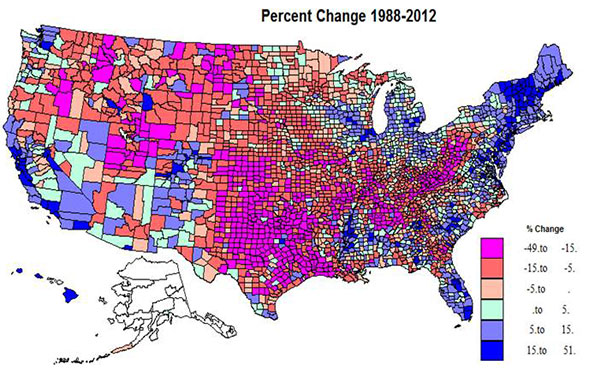
    Somewhat over half the territory of the US experienced Republican gains, in red shadings, but on average, the populations of the counties are smaller than for the Democratic counties in the blue shades. The dominant swath of red in the center third of the country from TX and LA north through the Dakotas and MN is impressive, but also prominent is the extension across the border south from MO and southern IL to KY, WV and into western PA, and then the northwestern extension to the mountain west, as far as the Cascade range. The most extreme Republican gains were in the two cores of southern Appalachia and eastern TX and OK into LA, plus UT. Most are non-metropolitan. A few most extreme R gains were in Knott, KY, 50%, Cameron, LA, 45, Mingo and Logan, WV, 44 and 43, and Kent, TX, 43%.

    Democratic gains were far more concentrated: in the northeast, in the urban Great Lakes, in much of FL, in the Black Belt of the south, in the metropolitan Left Coast, and in the southern mountain states. The highest gains were in central and suburban-exurban counties in the northeast, the west coast, and Great Lakes, and also in non-metropolitan northern New England. Lower Democratic gains were common beyond the big metropolitan cores or on the edges of the Black Belt in the south.  A few of the more extreme Democratic increases were in Clayton, GA, 51%, Rockdale, GA, 33, both suburban Atlanta, Osceola, FL, 31, Prince George, MD, 30, and Hinds, MS (Jackson), 28%. 

    Kind of change, 1988-2012, Map 2
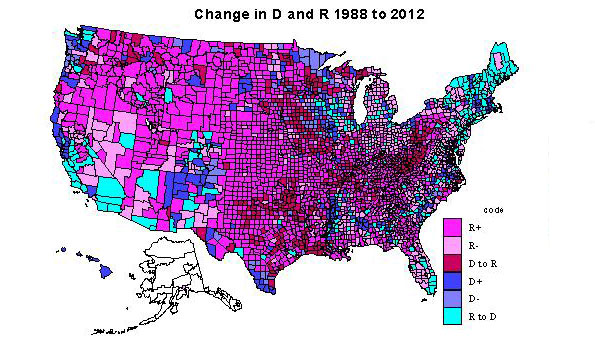
    The 1411 counties becoming even more Republican (type 1) certainly dominate the interior Plains from Canada to the Gulf and the interior, mainly non-metropolitan far northwest. There are a few counties (typically university counties) in this heartland with counties still red, but less so in 2012. The dominant areas for Republican decline (type 2) are found in the Great Lakes states, in the non-metropolitan, often exurban edges of Megalopolis (NY, PA, NJ, MD, VA). Other areas of Republican decline include rural areas in the interior west, especially areas with environmental attractions and/or increasing Latino populations, and even in parts of the traditional south, such as MS, FL, SC,NC, and VA.

    Most notable are such long term Republican strongholds as Orange, CA, Duval (Jacksonville), FL, and Maricopa, (Phoenix).  Counties which switched from Democratic to Republican (type 3) are first and most impressively in Appalachia from western PA, then including most of WV, and into western VA, central TN into northern AL, second in the TX-OK-AR-LA zone, almost totally non-metropolitan.

    Areas of Democratic gains, type 4, darkest blue, require a close look at the map, as they are mainly the metropolitan cores, most notably Los Angeles, Cook, King (Seattle), much of the New York SMSA, San Francisco-Oakland, Detroit, and Philadelphia. However there are also many majority-minority counties: in the Black Belt across the south, in a few Hispanic areas along the Rio Grande, and Native American areas across the west. Highest Democratic share gains were in metropolitan CA,  FL, in exurban New York, Philadelphia, Washington, DC, and Chicago, northern New England and select amenity areas, popular with metropolitan migrants, even in WY and ID!

    Democratic voter share declined (type 5) in  some urban cores, like Allegheny (Pittsburgh), but the most prominent areas are in farming and forestry  areas in the upper Midwest (IA, WI, MN, often adjacent to counties which switched from D to R), and traditionally D forest industry counties in OR and WA. Especially interesting are the counties switching from Republican to Democratic, type 6, most critical to understanding the connection to social liberalism. The most prominent area is northern New England and NY, and extending through Megalopolis snatching a large number of very populous suburban and EXURBAN counties (MA, CT, NY, NJ, MD, VA, PA).

    A second large swath in territory and population is in CA, switching major metropolitan-suburban counties, and also increasingly Hispanic counties to the D column. This switching of suburban and exurban counties was also prevalent in CO, OR, WA, IL, and MI, as well as in parts of the south, e.g., FL and NC. Less visible is the shift of many university counties in most parts of the country. Last and increasingly important is the shift of rural environmentally attractive areas, mostly across the west, but also in the south Atlantic, upper New England and the upper Great Lakes, in part due to retirement of urban professionals. Some of the most important switches were Riverside, San Bernardino, San Diego, Sacramento in CA; Miami and Orlando, FL; Oakland, MI; Suffolk, Bergen and Westchester (all exurban New York); Mecklenburg (Charlotte); and Marion, IN (Indianapolis).

    Absolute change in the D and R vote, 1988-2012, Map 3
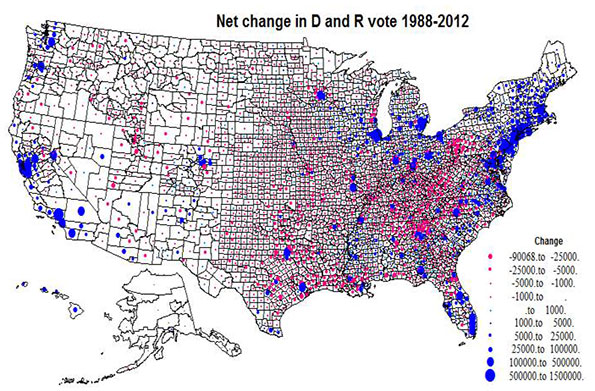
    Map 3 plots the absolute size variation in the Democratic versus Republican change, via a simple blue versus red, to assist the reader in properly interpreting Maps 1 and 2. The map highlights the tremendous concentration of Democratic gains in the northeastern Megalopolis, metropolitan California, the big cities of the Great Lakes, and Florida, versus the much more widespread pattern  of Republican gains, extensive in area but small in voter magnitude across the Plains, Mountain states, and most notably, Appalachia .

    Overall, what emerges is a picture far more subtle than simply cities versus exurbs. The bad news for Republicans is that most of their gains occur in rural areas with little population while the Democrats have consolidated their increases in more populous urban, suburban, and in some places exurban areas. Whether these trends spell the death knell for the GOP in the post-Obama period may turn on how they learn to appeal to the next generation of suburban and exurban voters – many of them Hispanic or Asian – as they enter their 30s, buy houses and start businesses. Economic issues could help here, but an emphasis on social issues, or simple anti-tax dogmatism could spell the GOP’s descent into permanent minority status.

    Table 2: Greatest Changes by State
    State 2012% 1988% % Change Code Net change (000)
    TX 42 43.7 -1.7 1 -578
    UT 25.4 32.6 -7.2 1 -268
    KY 36 44.7 -8.7 1 -254
    OK 33.3 41.6 -8.3 1 -253
    TN 39.5 41.8 -2.3 1 -234
    WV 36.3 52.4 -16.1 3 -210
    WY 28.6 39.5 -10.9 1 -62
    DE 59.6 43.5 16.1 4 114
    VT 68.2 48.3 19.9 6 115
    NV 53.3 39.2 14.1 6 141
    NH 52.9 37.7 15.2 6 157
    ME 57.8 44.3 13.5 6 171
    WA 58.2 50.8 7.4 4 435
    MA 61.7 54 7.7 4 516
    VA 51.9 39.7 12.2 6 598
    OH 51.5 43.9 7.6 6 643
    MI 54.8 46 8.8 6 739
    MD 62.6 48.5 14.1 6 756
    IL 58.6 49 9.6 6 979
    FL 50.4 38.8 11.6 6 1,036
    NJ 59 43.1 15.9 6 1,068
    NY 66.2 52.1 14.1 4 1,720
    CA 61.9 45.2 16.7 4 3,367

    Richard Morrill is Professor Emeritus of Geography and Environmental Studies, University of Washington. His research interests include: political geography (voting behavior, redistricting, local governance), population/demography/settlement/migration, urban geography and planning, urban transportation (i.e., old fashioned generalist).

  • Energy Running Out of California

    The recent decision by Occidental Petroleum to move its headquarters to Houston from Los Angeles, where it was founded over a half-century ago, confirms the futility and delusion embodied in California’s ultragreen energy policies. By embracing solar and wind as preferred sources of generating power, the state promotes an ever-widening gap between its declining middle- and working-class populations and a smaller, self-satisfied group of environmental campaigners and their corporate backers.

    Talk to people who work in the fossil-fuel industry, and they tell you they feel ostracized and even hated; to be an oil firm in California is like being a pork producer in an ultra-Orthodox section of Jerusalem. One top industry executive told me that many of his colleagues in California cringe at the prospect of being attacked by politicians and activists as something akin to war criminals. “I wouldn’t subject my kids to that environment,” the Gulf Coast-based oilman suggested.

    What matters here is not the hurt feelings of energy executives, but a massive lost opportunity to create loads of desperately needed jobs, particularly for blue-collar workers. The nation may be undergoing a massive “energy revolution,” based largely on new supplies of oil and, particularly, cleaner natural gas, but California so far has decided not to play.

    In all but forcing out fossil-fuel firms, California is shedding one of its historic core industries. Not long ago, California was home to a host of top 10 energy firms – ARCO, Getty Oil, Union Oil, Oxy and Chevron; in 1970, oil firms constituted the five largest industrial companies in the state. Now, only Chevron, which has been reducing its headcount in Northern California and is clearly shifting its emphasis to Texas, will remain.

    These are losses that California can not easily absorb. Despite all the hype about the ill-defined “green jobs” sector, the real growth engine remains fossil fuels, which have added a half-million jobs in the past five years. If you don’t believe it, just take a trip to Houston, where Occidental is moving. Houston now has more new office construction, some 9 million square feet, than any region in the country outside New York; Los Angeles barely has 1 million. Indeed, most of the office markets that have performed best in reducing vacancies since 2009 – Pittsburgh, Denver, Houston and Dallas – are all, to some degree, driven by energy.

    Everywhere you drive in Houston, now leading the nation in corporate expansions, one sees new office buildings. Last time I checked, I didn’t see much in the way of a Solyndra, Fisker or other green-business headquarters being constructed anywhere in our Golden State. Energy is driving Houston’s surge of some 50 new office buildings, led by ExxonMobil’s campus, the second-largest office complex under construction in the U.S. (after New York’s Freedom Tower).

    Chevron, once Standard Oil of California, has announced plans to construct a second tower for its downtown Houston campus, yet another signal of how that company is shifting emphasis from its roots in the Golden State to the Lone Star State. Relocating employees will have many people with whom to reminisce about old times; both Fluor and Calpine, major energy-related firms, have already made the Texas two-step.

    California clearly is squandering an opportunity to restart a large part of its economy. Texas energy has created some 200,000 new jobs over the past decade, while California has barely mustered 20,000. These energy jobs pay well, roughly $20,000 a year more than those in the information sector, according to EMSI. In 2011, this sector accounted for nearly 10 percent of all new jobs created in the nation. This has transformed much of the vast energy zone, from the Gulf to North Dakota. Houston, despite strong in-migration, now boasts an unemployment rate of 5.5 percent, almost four points below the jobless rate in Los Angeles.

    What about “green jobs”? Overall, California leads in green jobs, simply by dint of size; but on a per-capita basis, notes a recent Brookings study, California is about average. In wind energy, in fact, California is not even in first place; that honor goes to, of all places, Texas, which boasts twice California’s level of production.

    Ironically, one reason for this mediocre performance lies in environmental regulationsthat make California a tough place even for renewables. Even the New York Times has described Gov. Jerry Brown’s promise about creating a half-million new jobs as something of a “pipe dream.” Even though surviving solar firms are busy, in part to meet the state’s strict renewable mandates, solar firms acknowledge that they won’t be doing much of the manufacturing here, anyway.

    The would-be visionaries who manage the state are selling Californians a lot of pixie dust. Barely 700,000 Americans work in green energy, including building retrofits, compared with 9 million in fossil fuels. Nationwide employment in solar and wind, meanwhile, is well under 200,000. Overall, officials with fossil-fuel-related companies predict 1.4 million jobs in the sector by 2030.

    This predicament can’t be blamed on California running out of oil and gas; some estimates of the state’s oil and gas reserves as considerably larger than those of Texas. The Monterey Shale, located under the state’s economically struggling midsection, holds, according to federal Energy Department estimates, almost two-thirds of the nation’s total supply of shale oil. Tapping this source, notes a recent USC study, could bring as many as 500,000 new jobs to the state over the balance of this decade.

    Despite a bounty of fossil fuels, including along the coast, California’s oil production has continued to drop, and now ranks third among the states, behind No. 1 Texas, which has doubled its oil output in less than three years, and once-insignificant North Dakota. Californians have made a decision, based on green theology, that we don’t want to produce much of the stuff.

    Ordinary Californians bear the brunt of these policies, paying almost 40 percent above the national average for electricity. Rather than produce energy here, we appear set to import much of the oil and gas that, according to the state, still feeds well over 90 percent of California’s energy consumption.

    Particularly hard-hit has been California’s once-vibrant manufacturing sector, which has not mounted anything like the recovery being experienced in other parts of the country. From 2010-13, the country added 510,000 jobs, while California produced fewer than 8,000. Electricity prices are particularly uncompetitive, roughly twice as high in California, as those in prime competitors such Texas, Nevada, Arizona – as well as the hydro-powered Pacific Northwest.

    This has – discouraged manufacturers, such as Intel, from locating or expanding in the state. No surprise, then, that, just last week, it was revealed that the Lone Star State had also surpassed California in exports of high-tech goods.

    The worst impact of this deindustrialization is felt by blue-collar California. Even San Jose, the Central Valley’s traditional manufacturing hub, looks, as analyst Jim Russell suggests, more and more like a “rust-belt town.” Worse off still are the venerable agricultural and manufacturing regions, from the Central Valley to Los Angeles, where one person in five now lives in poverty. California’s green energy fixations, notes economist John Husing, are widening an ever-growing chasm based on “geography, class and race.”

    Despite these conditions, it’s hard to imagine a reversal of our current energy costs. The grip of green interests and their corporate allies in places like Silicon Valley suggests Californians will continue to endure ever-higher energy prices, lagging construction and manufacturing as a regular feature of the economy. This may make the green clerisy in the state happy, but is likely to have the opposite effect on the rest of us and on our economy as it becomes ever more narrowly based and fragile.

    This story originally appeared at The Orange County Register.

    Joel Kotkin is executive editor of NewGeography.com and Distinguished Presidential Fellow in Urban Futures at Chapman University, and a member of the editorial board of the Orange County Register. He is author of The City: A Global History and The Next Hundred Million: America in 2050. His most recent study, The Rise of Postfamilialism, has been widely discussed and distributed internationally. He lives in Los Angeles, CA.

    Oil well photo by BigStockPhoto.com.

  • Oregon’s Sad Focus on ‘Happiness’

    Oregon is a beautiful place, and, for many of the state’s well-heeled residents, including many refugees from equally beautiful but overpriced California, economic growth not only is unimportant but is even a negative. Rather than create opportunity, the real issue, according to Gov. John Kitzhaber, is making sure the state ranks high on “the happiness index.” Forget sweating the hard stuff, and cozy up with a hot soy latte.

    There’s a problem with this. Oregon’s unemployment rate remains above the national average and underemployment – the measure of people working part-time or well below their skill level – stands at nearly 17 percent, behind only Nevada and California. Since 2007, the state has lost over 3.4 percent of its jobs, a performance much worse than the national average and even California.

    “You have to wonder about the rhetoric of happiness,” suggests economist Bill Watkins, who predicts the state won’t be back to 2007 employment levels till next year. “You need jobs for people to be happy, you would think.”

    This dearth of opportunity extends even into Portland, the state’s dominant city. One recent study showed that earnings for educated male in the city are among the worst in the country. Portland, the land of Ph.D.’s driving cabs and working in coffee shops, notes geographer Jim Russell, “attracts talent for the sake of attracting talent” but does little with them once they arrive. No surprise then that the place has become widely described the “slacker capital of the world.”

    Indeed, notes economist Bill Watkins, Oregon over the past five years has lagged in job growth behind not only the nation, but, in particular, its demographic twin, Washington state. Seattle has emerged as the most potent competitor to Silicon Valley, while Oregon’s tech sector is largely propped up by Intel’s plant in suburban Hillsboro, itself a byproduct of California’s regulatory over-reach. There has been no widespread stirring of tech, or for that matter, any strong industry in Oregon.

    “The good news is all Intel,” said Watkins, who has studied the state’s economy for a decade. “The place is run by the complacent and the comfortable. It’s a place of consumption, not production. It’s a great place, though, to relax.”

    ‘small is beautiful’

    Oregon’s parallel-universe approach to economics persisted even during the worst of the 2007-09 recession, with the state tightening its regulatory vise while raising income taxes to the highest levels outside California and Hawaii. It seems hard to imagine why a tech entrepreneur from California or Taiwan would choose a hyper-regulated, high-tax home in Oregon when they can establish themselves in Washington state, which has no income tax but many of the same physical amenities, and access to Seattle’s world-class airport.

    Perhaps I am missing the point. Growth these days is for Neanderthals and conservatives. In the past, social democrats like the great auto union leader Walter Reuther, after World War II favored economic growth as a way to create “a whole new middle class.” Many of today’s progressives actually seem to want a quainter economy, dominated by homey small farms, trendy farm-to-table restaurants and artisan cheese stores.

    Although this approach is now cloaked in progressivism, it also mirrors the biases of traditional Tories, who were fierce opponents to suburban development and utterly dedicated to the preservation of the countryside. Old conservatives in Britain generally favor strict controls on suburban and new town development, which, notes film-maker Martin Durkin, have made British housing prices among the highest and least-affordable in the world. Keep the peasants, that thinking may go, in the apartment blocks, so the gentry can better enjoy the pleasures of the countryside.

    In his influential “Small is Beautiful” (1973), the British author E.F. Schumacher opposed economic growth and favored returning to “the good qualities of an earlier civilization.” This mantra has been increasingly adopted by what is considered the left side of the political spectrum, largely due to the rise of environmentalism. Indeed, there’s a growing movement, and not just in the United States and Britain, to embrace what some call“eco-economics,” which essentially favors steady state, “sustainable” slow growth that focuses on the metric of “happiness.”

    Bhutan, a small Himalayan kingdom of less than a million people and the site of a recent Kitzhaber pilgrimage, has emerged as the “happiness” poster child. And what a fine role model this country makes for Oregon and the rest of us. One Asian development expertrecently described the country as “still mired by extreme poverty, chronic unemployment and economic stupor that paints a glaring irony of the ‘happiness’ the government wants to portray.”

    In this other “happiest place on Earth” one in four people lives in poverty, nearly 40 percent of the population is illiterate, and the infant mortality rate is five times higher than in the United States. Bhutan also has a nasty civil-rights record from expelling members of its Nepalese minority from the country.

    Bhutan, of course, is a pastoral country, but progressive urbanists also increasingly apply their “happiness” ideal to cities. Canadian academic Charles Montgomery, for example, celebrates what he sees as high levels of happiness in the city slums of developing countries. Montgomery points to impoverished Bogota, Colombia, for example, as “a happy city” that shows the way to urban development. If we can’t do a Bhutanese village, we can all aspire to life in a favela.

    These ideas have gained currency among some climate-change campaigners, such as the Guardian’s George Monbiot, who acknowledges that his goal is nothing less than “a battle to redefine humanity” and replace the notion of growth with what is commonly referred to now as “degrowth” – a planned, ratcheting down of mass material prosperity.

    Not yet widely accepted in America, at least outside Oregon, Northern California, New York City’s upper West Side and, perhaps, Vermont, this approach is all the rage in slow-growing Europe. It already has its fans on college campuses and in the media.

    ‘Happiness’ Game winners, losers

    In every case of advocacy, however well-intentioned, there are clearly winners and losers. The “politics of happiness,” as one British author puts it, have proven a boon both for the public sector and those parts of the private sector that profit from work with government. Other beneficiaries include tech oligarchs, and other connected investors, who profit from renewables with the guarantee of public subsidies, and what can be called the Trustifarians, who promote anti-growth policies through their foundations and, as a bonus, get to feel very good about themselves.

    Other winners include the media clerisy, notably in Hollywood, who propagandize against economic growth while living in unimaginable luxury, as well as academics, notably politically compliant scientists, who can win grants to promote this ideology.

    So, who loses in the “politics of happiness”? Certainly, large parts of the working class – farm workers, lumberjacks, factory operatives, and their families – who don’t have much of a role in an economy divided between service providers and the wealthy. Also left out of the equation are young families, who, perhaps forsaking the “slacker” life, now find their aspirations for a house and decent job blocked by the generally older, and better off, advocates for “happiness.”

    Probably worst off are the poor, which in predominantly white (86 percent) Oregon are more likely not to be minorities. This is particularly true in the countryside, where economic conditions, according to one top state official, are “dire” and may be close to irreversibleUnemployment and underemployment in many rural Oregon counties reaches well into the double digits. People in the interior regions of the state, much like their counterparts in California, complain that Portland’s green obsessions over such things as energy and land-use policies makes economic development all but impossible.

    In the coming years, this conflict over economics, and the perceived politics of “happiness,” is likely to grow. Unable to prove that their policies have promoted growth, today’s progressives have found a way to deal with the economy – ignore it.

    This story originally appeared at The Orange County Register.

    Joel Kotkin is executive editor of NewGeography.com and Distinguished Presidential Fellow in Urban Futures at Chapman University, and a member of the editorial board of the Orange County Register. He is author of The City: A Global History and The Next Hundred Million: America in 2050. His most recent study, The Rise of Postfamilialism, has been widely discussed and distributed internationally. He lives in Los Angeles, CA.

    John Kitzhaber photo by S.MiRK

  • Post-Nagin, New Orleans Is On Way To Becoming A Model City

    Last week’s conviction of former New Orleans Mayor Ray Nagin on 20 charges of bribery and fraud marks the end of a tumultuous era in the city’s history, and perhaps also the beginning of a new era in American urban politics. Perhaps most remarkable was the almost total lack of protest in New Orleans over the downfall of Nagin, who had relied heavily on polarizing racial politics in his last five years in office.

    This is among the many hopeful signs in the Crescent City and its environs. Over the past year as I’ve put together a report on the future of New Orleans, I have seen a city once described by Joel Garreau in his Nine Nations of North America (1981)as a “marvelous collection of sleaziness and peeling paint,” clean up its politics, restart and diversify its economy, and begin the slow process of reducing its deep-seated crime problem.

    In the past, the “pay to play” politics and corruption epitomized by Nagin and former congressman William Jefferson were widely winked at in New Orleans as if it were just local color. “We like our politics like our rice — dirty,” a Katrina evacuee in Houston once told me with a knowing smile.

    Katrina changed that. The natural disaster was made far worse by the corruption and incompetence of virtually every key institution, starting with police and the levee boards. With the city largely underwater and much of its population forced to flee, some urban experts, such as Harvard’s Ed Glaeser, wondered if we would be better off to encourage people to leave the area permanently, perhaps with vouchers, to seek a better life elsewhere.

    Yet it is here that the real turnaround began. Business leaders, who had seen Nagin as an ally during his first term, realized he was not up to the extraordinary challenges posed by the disaster. The man who some called “Ray Reagan” for his business-friendly policies was morphing into the worst kind of racial demagogue, a kind of bayou version of Coleman Young or Sharpe James. His appeal to keep New Orleans a “chocolate city” and his now well-documented graft frustrated those who wanted to revive the city and its surrounding region.

    “When Nagin came in, he was seen as a reformer,” recalls Greg Rusovich, former chairman of the New Orleans Business Council, which includes 70 of the Crescent City’s largest businesses. “But after Katrina he really turned into a racial politician and surrounded himself with incompetents.”

    This incompetence, Rusovich suggests, slowed New Orleans’ recovery as Nagin proved unable to help direct the massive federal aid, and the many private donations, that came into the city. Eventually, voters tired of poor public services and began to demand a more competent regime.

    The current mayor, Mitch Landrieu, first elected in 2010 and easily re-electedwith strong black support this month, has brought a climate of technocratic competence to the city. With the active backing of business leaders, the city has attracted large-scale corporate investment, including a 300-person General Electric software development center, as well as a surge of videogame and entertainment companies.

    This growth was in large part sparked by a steady movement of young, educated people into the city. For decades, New Orleans’ “best and brightest” tended to move elsewhere; now the flows for the Crescent City have turned positive, including from the West Coast and the Northeast. By last year, theAtlantic Cities, the leading mouthpiece for “hip” urbanism, proclaimed New Orleans potentially the nation’s “next great innovation hub.”

    Yet for all the hoopla surrounding the growth in the information sector, it is unlikely to be enough to sustain the New Orleans region’s recovery. Not only are the total numbers of such jobs still small, in the realm of 2,600 for entertainment, STEM employment is lower than a decade ago due to cutbacks at the NASA facilities at Michoud as well as in aerospace. More important, the growth of tech and entertainment jobs will likely be insufficient to address the fundamental issues of race and poverty that have bedeviled the city throughout much of its history.

    Today, in part due to the return of evacuees, the poverty rate for the metro area stands at 19%, close to the pre-Katrina level and well above the national average of 15%. The differential between white and black incomes is some $6,000 per household above the national average and some observers, including many African-Americans, fear that the gentrification of parts of the city is reinforcing the class and racial divides that existed before the flood.

    Many African-Americans, notes city employee Lydia Cutrer, have “trust issues after many broken promises, and feel like outsiders are taking over.” Or, as Sherby Guillory, a health care worker who now lives in Houston, described the recovery efforts: “They want to build a shining city on a hill, but without the people.”

    Ultimately, to deal with these concerns, New Orleans needs to focus on the industries that drove its economy for much of its history: energy and trade. These are the primary providers of high-wage jobs, many of which are blue collar. The New Orleans area lost energy jobs from 2007-12, in part due to the Gulf drilling moratorium in the wake of the BP disaster, but activity is rising again and low natural gas prices have prompted a surge in chemical and refinery investment in south Louisiana.

    recent report by the Greater New Orleans Community Data Center concluded that over 10,000 energy, petrochemical and related advanced manufacturing jobs could be added in the region by 2020; in contrast the digital media sector was projected to expand by roughly 2,200 positions. Finding ways to accelerate this development, while using new revenues to shore up the fragile ecosystem, needs to become the primary focus of new development efforts.

    This vision for post-Katrina New Orleans will no doubt meet opposition from those who would like the city to evolve into a humid, southern version of San Francisco. Yet this makes little sense for a place whose history, location and ethnic heritage suggest a more economically diverse future. Having survived Katrina and Ray Nagin, the next task should be to see how to make sure that the recovery reaches into those neighborhoods that have historically been left behind. Rather than stand only as a charming artifact of its past, New Orleans can become a role model in showing how cities can not only survive, but create a prosperous future.

    This piece originally appeared at Forbes.

    Joel Kotkin is executive editor of NewGeography.com and Distinguished Presidential Fellow in Urban Futures at Chapman University, and a member of the editorial board of the Orange County Register. He is author of The City: A Global History and The Next Hundred Million: America in 2050. His most recent study, The Rise of Postfamilialism, has been widely discussed and distributed internationally. He lives in Los Angeles, CA.

    New Orleans photo courtesy of Jon Sullivan.

  • Sustaining Prosperity: A Long Term Vision for the New Orleans Region

    This is the executive summary from a new report Sustaining Prosperity: A Long Term Vision for the New Orleans Region, authored by Joel Kotkin for Greater New Orleans, Inc. Download the full report from GNO, Inc. here: gnoinc.org/sustainingprosperity

    The recovery of greater New Orleans represents one of the great urban achievements of our era. After decades of slow economic, political and social decline, hurricane Katrina seemed a kind of coup de grâce, smothering the last embers of the region’s vitality. In the fall of 2005 it was entirely logical to see New Orleans as just a potential exemplar of failed urbanization, much as we might see in Detroit1, Cleveland, and a host of other once great cities – for example Naples, Lisbon, Antwerp and Osaka – that have tumbled from their once great importance.2

    Yet in New Orleans’ case, disaster engendered not continued decline, but the revival of the en­tire region, its economy, and social and political institutions. Like Chicago after the great fire of 1871, San Francisco in the wake of the 1906 earthquake and fire, or New York following 9-ll, New Orleans has rebounded in ways that have defied expectations.

    Critical to making New Orleans a resilient city has been the transformation of the civic culture. This has much to do with the commitment of New Orleanians to their city – like Chicagoans, New Yorkers and San Franciscans in the past. “A city,” notes urban historian Kevin Lynch,” is hard to kill if it possesses unique cultural appeal, geographic assets and people who are determined to save the city they love.”3

    New Orleans resiliency since Katrina constitutes much more than improved levees or better evacuation procedures; more than new brick and mortar applied to what had been an aging, deterio­rating region. New Orleans has made enormous progress in cleaning up its famously corrupt political system, and also made huge strides in improving its educational infrastructure. Once considered one of the worst places to do business, the region, and the state of Louisiana, has undergone a marked improvement to its reputation. It has emerged as a good place for commerce – something of a “Cin­derella” in economic development terms.4 Allison Plyer of the Greater New Orleans Community Data Center put it, “Greater New Orleans is in some ways rebuilding better than before”.5

    Our analysis shows this progress in a host of indicators. Once a below-average job producer, the region has expanded its employment since the 2007 recession far faster than the national average. It recovered all the jobs lost in the recession by 2012 – and then some – while the nation remained three percent below its pre-recession level. Entrepreneurial activity also has grown faster than the national average by a wide margin.6

    More important still, the region finally began to reverse a demographic decline that, for a gen­eration or more, saw young, educated people and families depart for other locales to seek out a better life. The concentration of 25 to 35 year olds has increased far more quickly in the region than it has in the nation as a whole. Indeed since 2007, New Orleans region has experienced the fastest growth in educated population in the nation.7

    Many economic trends favor the region’s continued ascendency. These include the still nascent US energy boom, which represents arguably the greatest shift in global economic power since the end of the Cold War and the rise of China; the massive flow of investment, domestic and foreign, into lower-cost locales and most particularly into the Third Coast, the burgeoning region around the Gulf of Mexico; and finally the expansion of US trade with Latin America and the Caribbean basin.

    To these powerful forces we can also add demographic and social factors that work to the region’s advantage. One key is a relatively low cost of living, which, in effect, gives area residents and businesses a leg up on their East and West coast rivals. This is critical in attracting net migration from those regions, with their storehouse of educated residents and skilled workers.8 Another force is the breadth of skills that can be easily found in the region, including higher paid skilled professionals ex­perienced in transportation and material moving, installation, maintenance and repair, construction, manufacturing and energy.

    A future scenario can be constructed where greater New Orleans emerges as one of the bright­est spots in the North American economy. Not only does the region have natural advantages in terms of energy resources and transportation, it can claim primary sources of higher-wage employment. It also possesses a cultural cachet that attracts educated workers, but in a cost and regulatory environ­ment that appeals to business investors.

    This is most notable in the growth of the region’s rapidly evolving information industry, in­cluding software, videogames and an expanding film/television industry. Over the past five years, New Orleans has come to enjoy a locational concentration equal to that of New York, and has emerged as a major player in this sector.

    Challenges Ahead: Economic, Social and Environmental

    As the region moves further from the immediate post-Katrina crisis, the great momentum of the last five years is clearly slowing down. Job creation remains positive, but has gradually fallen towards national norms. Indeed, since 2010, after years of running ahead, the region’s job growth rate actually trailed the national average. This could be simply a sign that, after recovering more slowly, the rest of the country is now catching up. But the slowdown relative to other cities should be taken seriously, as it could represent a loss of critical momentum.

    “Concert Of Economic Forces” That Can Make Recovery Permanent

    To overcome its legacy of poverty and inequality, the New Orleans region needs to focus not on just one sector but on five critical ones. In a highly competitive national and global economy, re­gions need to work on their unique strengths, establishing advantages that can lead to more, and bet­ter, job creation. Most particularly, the region needs to develop a broad, but still highly selective, base of industries that can create the higher-wage jobs necessary for the uplift not of a few New Orleani­ans, but for the many.

    1. The first, and most evident, is the region’s cultural legacy, which serves as a major source of jobs for local people as well as a lure for talented people from elsewhere. This, of course, includes the still very important tourism industry, but also encompasses generally higher-wage professions in film, television, video game software and even medical research.

    The growth in information sector employment, something relatively new to the region, rep­resents a clear breakthrough. It allows the region to take advantage of its essential cultural assets, by attracting companies and highly skilled workers. Although it is unlikely that the New Orleans region will ever become as tech-dependent as, say, Silicon Valley — which may prove a good thing, given that industry’s volatility — New Orleans can look forward to a sustained increase in high-paying, and high-visibility, employment. Perhaps most critically, it has an excellent opportunity to make itself the cultural capital of the Third Coast, the burgeoning region around the Gulf, something the region desperately needs and a role that New Orleans is uniquely positioned to fulfill.

    Yet although these industries are important, they alone cannot sustain a long-term, broad recovery. Wages in the tourism industry and the arts tend to be low – one reason for the city’s per­sistently poor income distribution in the past – and higher-wage jobs, except in engineering services and entertainment, remain below national norms in total jobs and will take many years to reach true critical mass. Perhaps most critically, these industries alone cannot produce enough high-wage skilled jobs for the region’s working class population.9

    2. The river system. Its location at the shipping terminus of the Mississippi River, across the regions the region’s ports – New Orleans, South Louisiana, St. Bernard, Manchac, Plaquemines and Grand Isle Port – is the historic reason for the region’s existence and one of the key factors in its future success. The region needs to work to compete successfully with its Third Coast rivals, notably Houston, as well as Mobile and Tampa. Growing trade with the Caribbean and the completion of the Panama Canal expansion project increase the opportunities for expanded logistics and cargo han­dling. In addition, the river provides an ideal spur to new industrial production, such as the Nucor Steel plant in St. James Parish, which some see as the precursor of a new zone, akin to Germany’s Ruhr Valley, that could emerge between New Orleans and Baton Rouge.

    Given the devastation of the region’s unique ecological environment, the river presents unique challenges to be addressed. At the same time, the river offers the region new opportunities to develop yet another nascent sector: environmental remediation. The RESTORE Act funds will bring billions to the Gulf help alleviate the region’s own environmental issues, but could also support the unique expertise and skills related to the profound challenges of maintaining coastal regions. This can be seen already in the over $210 million that has flowed to expert Louisiana companies as a result of Hurricane Sandy.10

    3. The energy revolution. Perhaps no sector has more potential to generate higher wage jobs across the region, particularly for working class residents, than the current energy revolution. This is rapidly shifting economic power to North America, and it’s a shift for which the region has a front row seat. Louisiana and the greater New Orleans area boast enormous oil and gas reserves, but the region has not kept up with Houston or even smaller cities in terms of energy-related jobs. Yet there has been continued growth in many upstream services, such as petro-industrial development and exploration, even if headquarters employment has dropped. With the resolution of the BP disaster, it is hoped that the region will recover more employment in this high-wage sector.

    4. Environmental remediation. This is both a major challenge and an opportunity for economic development. Simply put, there is no long-term future for the region if the environment that sup­ports it collapses. Katrina, after all, was not the first ecological disaster to hit the region, and it won’t be the last. Finding ways to restore coastal wetlands and manage the river and other water resources in a sustainable manner not only preserves the environment that New Orleanians cherish, but could also create significant business opportunities down the road; More than 4% of Dutch GDP is related to water management, and more than 50% of that is related to international projects and the export of water expertise and services.11

    The region has already received $1.3 billion from various BP criminal settlements that will be applied to river diversion and barrier island restoration projects. Over $600 million is already budget­ed for projects being let in 2014 alone, signifying great potential to expand the region’s expertise and capacity in this sector.12

    5. The construction of infrastructure. New industries require new or improved roads, better freight and harbor access, reliable, inexpensive electricity, and improved air service. The region is moving ahead on many of these fronts, from the expansion of the airport to major port improvements and the development of a new biomedical district along the Canal Street corridor. A region that has historically lagged in forward-looking improvements is showing clear signs of determination to catch up with competitors in the country and around the world.13

    Yet all these efforts must be done in conjunction with a long-term commitment to preserve the very environment that New Orleanians treasure. This is the ultimate challenge to sustaining and expanding regional prosperity in the era ahead.

    This concert of economic forces is critical to driving down poverty rates and raising incomes across class and racial lines. This can only be realized if there is a conscious effort to promote broad-based, sustainable growth in a diversity of industries. This requires placing a greater emphasis, among other things, on higher education, particularly on engineering and the biosciences, and, per­haps even more, on community colleges, technical schools and certificate training. The area may now be attracting more college-educated workers, but it still lags behind the national average, reflecting a legacy of out-migration of skilled workers over the past few decades.14

    This is the executive summary from a new report Sustaining Prosperity: A Long Term Vision for the New Orleans Region, authored by Joel Kotkin for Greater New Orleans, Inc. Download the full report from GNO, Inc. here: gnoinc.org/sustainingprosperity

    Joel Kotkin is executive editor of NewGeography.com and Distinguished Presidential Fellow in Urban Futures at Chapman University, and a member of the editorial board of the Orange County Register. He is author of The City: A Global History and The Next Hundred Million: America in 2050. His most recent study, The Rise of Postfamilialism, has been widely discussed and distributed internationally. He lives in Los Angeles, CA.

    Endnotes
    1 http://www.newgeography.com/content/003897-root-causes-detroit-s-decline-should-not-go-ignored
    2 http://www.theatlantic.com/business/archive/2012/01/the-10-fastest-growing-and-fastest-declining-cities-in-the-world/251602/#slide16
    3 Lawrence J. Vale and Thomas J. Campanella, “Conclusion: Axioms of Resilience”, in The Resilient City, editors, Lawrence J. Vale and Thomas J. Campanella, Oxford University Press, (New York: 2005), pp.335-353
    4 http://chiefexecutive.net/best-worst-states-for-business-2012
    5 The New Orleans Index, by Allison Player, 2013
    6 Allison Plyer, Elaine Ortiz, Ben Horwitz and George Hobor, The New Orleans Index at Eight: Measuring Greater New Orleans Progress Towards Prosperity, Greater New Orleans Community Data Center August 13, 2013, p.6-7
    7 newgeography.com/content/002044-americas-biggest-brain-magnets
    8 http://www.newgeography.com/content/002950-the-cities-where-a-paycheck-stretches-the-furthest
    9 Author’s analysis of data from EMSI, Inc.
    10 http://www.bp.com/en/global/corporate/sustainability/environment/managing-our-impact-on-the-environ­ment/complying-with-regulations/clean-water-act-provision.html; http://www.restorethegulf.gov/council/about-gulf-coast-ecosystem-restoration-council
    11 Dale Morris, Senior Economist, Royal Netherlands Embassy
    12 http://www.nfwf.org/gulf/Pages/home.aspx;
    13 http://biodistrictneworleans.org/
    14 Plyer, etal, op. cit., p.12