Category: Politics

  • The U.S. Middle Class Is Turning Proletarian

    The biggest issue facing the American economy, and our political system, is the gradual descent of the middle class into proletarian status. This process, which has been going on intermittently since the 1970s, has worsened considerably over the past five years, and threatens to turn this century into one marked by downward mobility.

    The decline has less to do with the power of the “one percent” per se than with the drying up of opportunity amid what is seen on Wall Street and in the White House as a sustained recovery. Despite President Obama’s rhetorical devotion to reducing inequality, it has widened significantly under his watch. Not only did the income of the middle 60% of households drop between 2010 and 2012 while that of the top 20% rose, the income of the middle 60% declined by a greater percentage than the poorest quintile. The middle 60% of earners’ share of the national pie has fallen from 53% in 1970 to 45% in 2012.

    This group, what I call the yeoman class — the small business owners, the suburban homeowners , the family farmers or skilled construction tradespeople– is increasingly endangered. Once the dominant class in America, it is clearly shrinking: In the four decades since 1971 the percentage of Americans earning between two-thirds and twice the national median income has dropped from 61% to 51% of the population, according to Pew.

    Roughly one in three people born into middle class-households , those between the 30th and 70th percentiles of income, now fall out of that status as adults.

    Neither party has a reasonable program to halt the decline of the middle class. Previous generations of liberals — say Walter Reuther, Hubert Humphrey, Harry Truman, Pat Brown — recognized broad-based economic growth was a necessary precursor to upward mobility and social justice. However, many in the new wave of progressives engage in fantastical economics built around such things as “urban density” and “green jobs,”  while adopting policies that restrict growth in manufacturing, energy and housing. When all else fails, some, like Oregon’s John Kitzhaber, try to change the topic by advocating shifting emphasis from measures of economic growth to “happiness.”

    Other more ideologically robust liberals, like New York Mayor Bill de Blasio, call for a strong policy of redistribution, something with particular appeal in a city with one of the highest levels of income inequality in the country. Over time a primarily redistributionist approach may improve some material conditions, but is likely to help create a permanent underclass of dependents, including part-time workers, perpetual students, and service employees living hand to mouth, who can make ends meet only if taxpayers subsidize their housing, transportation and other necessities.

    Given the challenge being mounted by de Blasio and hard left Democrats, one would imagine that business and conservative leaders would try to concoct a response. But for the most part, particularly at the national level, they offer little more than bromides about low taxes, particularly for the well-heeled investor and rentier classes, while some still bank on largely irrelevant positions on key social issues to divert the middle class from their worsening economic plight.

    The country’s rise to world preeminence and admiration stemmed from the fact that its prosperity was widely shared. In the first decades after the Second World War, when the percentage of households earning middle incomes doubled to 60%, it was no mirage, but a fundamental accomplishment of enlightened capitalism.

    In contrast, the current downgrading of the middle class undermines the appeal of the “democratic capitalism” that so many conservative intellectuals espouse. In reality, capitalism is becoming less democratic: stock ownership has become more concentrated, with the percentage of adult Americans owning stock the lowest since 1999 and a full 13 points less than 2007. The fact that poverty — reflected in such things as an expansion of food stamp use — has now spread beyond the cities to the suburbs, something much celebrated among urban-centric pundits, is further confirmation of the yeomanry’s stark decline.

    How our political leaders respond to this challenge of downward mobility will define the future of our Republic. Some see a future shaped by automation that would “permanently end” what one author calls “the age of mass human labor,” allowing productivity to rise without significant increases in wages. In this world, the current American middle and working class would be economically passé.

    One would hope business would have a better option that would restart upward mobility. Lower taxes on the investor class, less regulation of Wall Street, and the mass immigration of cheap workers — all the rage among investment bankers, tech oligarchs and those with inherited wealth — does not constitute a compelling program of middle-class uplift. Nor does resistance, particularly among the Tea Party, to make the human and physical infrastructure investment that could help restore strong economic growth.

    Fortunately history gives us hope that this decline can be turned around. The early decades of the Industrial Revolution saw a similar societal decline, as once independent artisans and farmers became fodder for the factory lines. Divorce and drunkenness grew as religious attendance failed. But a pattern of reform, in Britain, America and even Germany, helped restore labor’s place in the economy, and rapid growth provided the basis not only for the expansion of the middle class, but remarkably improvements in its well-being.

    A pro-growth program today could take several forms that defy the narrow logic of both left and right.  We can encourage the growth of high-wage, blue-collar industries such as construction, energy and manufacturing. We can also reform taxes so that the burdens fall less on employers and employees, as opposed to those who simply profit from asset inflation. And rather than impose huge tuitions on students who might not  finish with a degree that offers employment opportunities, let’s place new emphasis on practical skills training for both the new generation and those being left behind in this “recovery.” Most importantly, the benefits of capitalism need be more widely shared if business hopes to gain support from the middle class for their agenda.

    This story originally appeared at Forbes.com.

    Joel Kotkin is executive editor of NewGeography.com and Distinguished Presidential Fellow in Urban Futures at Chapman University, and a member of the editorial board of the Orange County Register. He is author of The City: A Global History and The Next Hundred Million: America in 2050. His most recent study, The Rise of Postfamilialism, has been widely discussed and distributed internationally. He lives in Los Angeles, CA.

  • Has Scott Walker Really Turned Around Wisconsin?

    I’ve seen a few pieces in the conservative press lately boasting about Scott Walker’s performance as governor of Wisconsin. For example, the American Spectator ran an article called “Wisconsin Thrives Under Scott Walker“:

    In 2011, Wisconsin had a whopping deficit of $3.6 billion dollars. But a cooperate tax cut and collective bargaining reforms invigorated the state economy. Now, the state is boasting a $911 million surplus, credited to “good stewardship of the taxpayers’ money.”

    And what will Walker do? Buy his wife a $19,000 dress? Increase his paycheck? Go on vacation? Nope. He’s proposing $800 million in tax cuts. “What do you do with a surplus? Give it back to the people who earned it. It’s your money,” Walker said.

    I find these articles revealing because they show how the Tea Party mindset has affected the definition of success in Republican circles generally. Why has Scott Walker been a success in their view? Because Wisconsin’s state government is financially healthy. The actual people of Wisconsin take a back seat to that. A friend of mine in Indiana summed up the mindset when she noted that many people today equate the financial health of government with the well-being of the people in the state.

    This I think is the Tea Party mindset writ large. As I’ve noted before, under Tea Party influence, Republicans have come to see government as purely a fiscal machine in which nearly the entirety of good policy consists in reducing the amount of money flowing through it. This is rooted in a single factor determinism view of economics. Much like Marxism, it has a base and a superstructure. The base in Tea Party thinking is government. If you shrink it, the theory goes, prosperity must inevitably follow.

    The fiscal health of government is no doubt important. But to determine if Wisconsin is actually “thriving” you need to look at statistics that actually affect people. So let’s do that. Scott Walker took office in January 2011. So here is the percentage change in jobs in Midwest states between December 2010 and December 2013 from the Bureau of Labor Statistics:


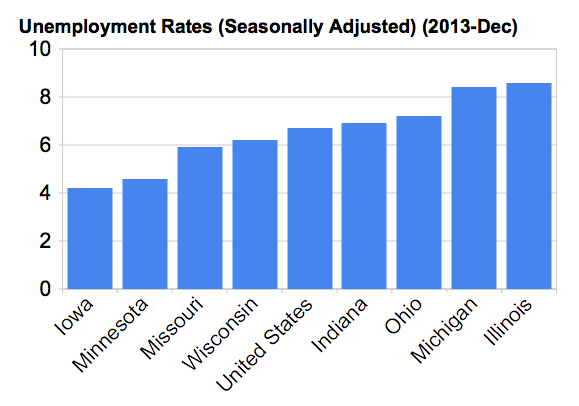
    Wisconsin actually doesn’t rank that well in job growth during Scott Walker’s administration, barely beating fiscal basket case Illinois. The state looks better in its unemployment rate:


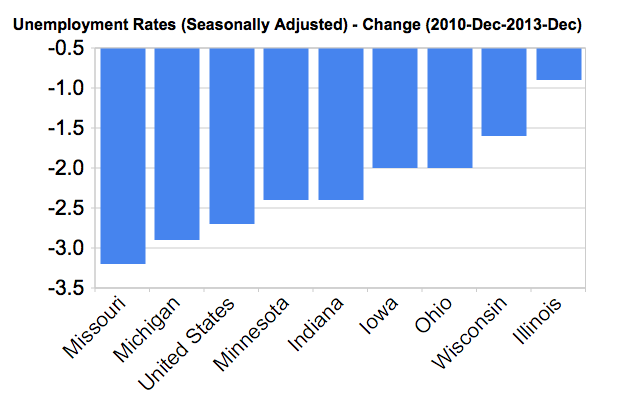
    However, in part that’s because Wisconsin’s unemployment rate was already low on a relative basis when Walker took over. It ranks near the bottom in reducing its unemployment rate, though obviously reductions are harder to come by when you’re already lower. Michigan had nowhere to go but down.


    I actually support many of Scott Walker’s reforms. Public sector unions clearly need to be reigned in or even eliminated as they are a huge barrier to rational fiscal management and effective service delivery in addition to being an inherently corrupting political force. Items like allowing unions to force localities to buy health insurance through union affiliated firms at inflated rate were clearly abusive.

    It’s also early to judge, and this is monthly data that is fairly volatile, even though it’s seasonably adjusted and with a same month comparison. There just isn’t that much other data available.

    What I object to is declaring victory when the budget is balanced. The attitude exposed by this is profoundly revealing and shows everything that’s wrong with Tea Party type thinking. It’s obvious that people claiming Wisconsin has thrived under Walker didn’t even take a cursory look at the actual economic performance of the state.

    Wisconsin balanced its budget? Big deal. You’re supposed to balance the budget. That’s just doing your job. It shows how far we’ve come that you can receive plaudits simply for meeting what should have been the baseline expectation.

    The charts above should also cause a reconsideration of the notion that government finances are the primary determinant of business climate and economic growth. There are states on both the left and right of that issue that are both thriving and struggling. Part of it is that states have limited power in the modern economy. There’s only a limited amount they can do to make things better, whereas they can definitely screw it up.

    Also, the natural condition of a participant in a marketplace is failure. The vast majority of new businesses fail. Similarly, places can fail too, and having a budget surplus can’t necessarily stave that off.

    My view is that while state governments are weak actors and there’s a risk of screwing it up, the likelihood of failure in the marketplace is high enough that government does actually have to try to do things. By all means prudent finances and a good regulatory climate need to be maintained, but if you think that’s enough to save you, you’ve got another thing coming. Now that Scott Walker has repaired the budget, what’s his actual plan moving forward to try to build actual personal and marketplace success for Wisconsin residents and businesses? That’s what will determine his actual legacy. It’s in whether he boosts the fortunes of the state’s residents over the longer term, and manages to bend the curve of progress in a positive direction over time.

    Aaron M. Renn is an independent writer on urban affairs and the founder of Telestrian, a data analysis and mapping tool. He writes at The Urbanophile, where this piece originally appeared.

    Scott Walker photo by AndyLindgren.

  • How a Few Monster Tech Firms are Taking Over Everything from Media to Space Travel and What it Means for the Rest of Us

    The iconic view of tech companies almost invariably stress their roots in people’s garages, plucky individual entrepreneurs ready to challenge all comers. Yet increasingly the leading tech firms – Amazon, Apple, Facebook, Amazon and especially Google – have morphed into vast tech conglomerates, with hands in ever more numerous, and sometimes not obvious, fields of endeavor.

    Ironically, the very entrepreneurial form that defeated Japan’s bid for global technological dominance is morphing into an American version of the famed keiretsu that have long dominated the Japanese economy. The keiretsu,epitomized by such sprawling groups as Mitsubishi, Sumitomo and even Toyota, spread across a vast field of activities, leveraging their access to finance as a means to expand into an ever-increasing number of fields. The can best be understood, notes veteran Japan-based journalist Karel van Wolferen, as a series of “intertwined hierarchies.”

    Increasingly, American technology is dominated by a handful of companies allied to a small but powerful group of investors and serial entrepreneurs. These firms and individuals certainly compete but largely only with other members of their elite club. And while top executives and investors move from one firm to another, the big companies have constrained competition for those below the executive tier with gentleman’s agreements not to recruit each other’s top employees.

    At the top of the American keiretsu system stands a remarkably small group whose fortunes depend in part on monetizing invasions of privacy to use the Internet as a vehicle for advertising. These are not warm and cuddly competitors. Both Google and Microsoft have been accused of using anti-competitive practices to keep out rivals, in part by refusing to license technology acquiring of potential competitors.

    “Tech is something like the new Wall Street,” notes economist Umair Haque,“Mostly white mostly dudes getting rich by making stuff of limited social purpose and impact.”  

    Like their soul brothers on Wall Street , America’s elite tech firms – and their owners – have become fantastically cash rich.  Besides GE, a classic conglomerate, the largest cash hordes now belong to Apple, Microsoft, Cisco, Oracle and Google, all of whom sometimes have more dollars on hand than the US government.  Seven of the eight biggest individual winners from stock gains in 2013 were tech entrepreneurs, led by Jeff Bezos who added $12 billion to his paper wealth, Mark Zuckerberg who ranked in an additional $11.9 billion while Google founders, Sergey Brin and Larry Page, had their wallets expanded by roughly $9 billion.

    This wealth reflects in large part the oligopolistic nature of many key tech sectors, for example, the Apple-Google duopoly on mobile phone software, Microsoft’s dominant position in operating systems for PCs, Google’s utter control of search, and Facebook’s domination of social media. In most cases, these fields are controlled at levels of eighty percent or more.    

    America’s new gilded age giants are similar to Japan’s keiretsu but they also share a lineage with the early 20th Century trusts that controlled railroads, cotton, silver and other commodities. Those early fortunes helped provide the foundation for such banking firms as J.P. Morgan, Goldman Sachs, Oppenheimer, and Lehman Brothers, as well as the basis for the Rockefeller and Hearst empires. Their wealth, in the era before income taxes, was immense; by the 1880s the revenues of Cornelius Vanderbilt’s railroad empire were greater than those of the federal government.

    The control of immense resources by a small group of tech firms, like the oligopolies of the earlier industrial magnates, produces a steady cash-flow them to look further afield for new opportunities and expand into potentially huge new markets. But even more importantly, it gives them the opportunity to fail and still live to acquire another day.

    Google’s recent sale of Motorola’s mobile division, at a paper loss of nearly $10 billion, would have led to bankruptcy head-rolling at many firms but for Google it hardly left a scratch. A $10 billion failure barely threaten a company whose last quarterly revenues neared $17 billion, has cash on hand of over $56.5 billion and whose market cap is now nearly $380 billion.

    Indeed, if any of the tech powers on track to become a full-fledged keiretsu, it’s likely to be Google. Over the past year the company has ventured into a host of fields, such as robotics, energy, mapping, and driverless cars – fields that have great potential but are only tangentially related to their core business. The recentacquisition of Nest, a company founded by Apple alum Tony Fadell , brings Google into the “smart home” marketplace, part of the so-called “internet of things”. This gives these firms a new capacity to harvest ever greater information hauls from your once “dumb,” but at least private, household appliances.

    These investments and cross-industry ties are changing firms like Google in fundamental ways.  As industry veteran Michael Mace observes, Google has stopped being a “unified product company” and is turning instead into what he calls “a post-modern conglomerate.” Its goal, he notes, is no longer to dominate search, or even the internet, but to invest, and hopefully, control anything that uses information technology, including everything from logistics and medical devices to the most mundane household devices.

    By investing widely and eating up developing markets, the “the Gang of Four” internet companies—Microsoft, Apple, Facebook and Google—have two key advantages: almost unlimited capital resources, and tech expertise and credibility. Allied with venture firms, and a vast reservoir of technical experts, the tech oligarchies, for example, already  dominate such promising fields robotics, with Silicon Valley home to half of all venture invested in the field, over 70 percent of employees, and a whopping 90 percent of market cap.  

    Others are turning to space, a field once dominated by NASA, once a key contractor for the Valley. Headquartered in the old aerospace center of Los Angeles, Space X, the largest of the space startups, was founded by billionaire Elon Musk, who previously founded PayPal and Tesla. By 2013, Space’s X’s total employment, including contractors, topped 3800.

    Musk is not alone in the space game. Amazon CEO Jeff Bezos founded his own private space exploration company, Blue Origin, which has launched two vehicles into space, Charon and Goddard. It intends to build orbital space stations, and serves as a contractor for NASA. Like the nascent space industry’s third new player, Richard Branson’s ‘Virgin Galactic,’ these firms are all the pet projects of billionaires fascinated by space. If NASA continues to retreat from many areas of space exploration, it is likely that in the future the heavens too may end up belonging to the oligarchs.

    The Media power-shift

    A Google or Amazon space-ship may still be in the distant future, but we can already see the impact of the new keiretsu on information and culture. In the past, more hardware-oriented companies provided the “pipelines” through which traditional media disseminated their product. But increasingly, it’s the tech oligarchs who control the news and information industry.

    Google, by some estimates, already enjoys more advertising revenues than either the newspaper or magazine industry. And they’re positioned to take over the the hardware side by supplanting the traditional telecommunications companies with their own series of global pipelines.

    This big tech takeover also previews a geographic shift from traditional centers of power like New York and Los Angeles to the new seats of influence, most notably Silicon Valley, San Francisco and the Puget Sound area.

    The transitions of power and influence have come at heavy costs. 

    As the new software-based media expanded over the last decade, massive losses have pummeled newspapers, music, book and magazine publishing Since 200. The paper publishing industry, traditionally concentrated in the New York area, has lost some 250,000 jobs, while internet publishing and portals generated some 70,000 new positions, many in the Bay Area or Seattle.

    To the new oligarchs, the old media are just part of what one venture capitalist derisively called “the paper economy” destined to be swept away by the new digital aristocracy. As relatively young people who have already amassed fortunes, the tech giants have the time to disseminate their views to the public, both the mass and the influential higher echelons. Another $200 million new venture with a mission to support largely left of center investigative reporting, is being backed by eBay founder Pierre Omidyar.

    Buying up prestigious media outlets, an old tactic for consolidating influence that was previously used by gilded age moguls like William Randolph Hearst, has surfaced among the new tech giants, exemplified in the recent purchase of the venerable New Republic by Facebook co-founder, and Obama tech guru, Chris Hughes, who is reportedly worth $850 million.

    But perhaps more critical than buying old outlets will be the growth of their own oligarch controlled news media. Yahoo is now the #1 news sites in the U.S. with 110,000,000 monthly viewers, and Google News isn’t far behind at #4 with 65,000,000 users. The Valleyites are also moving into the culture business with both YouTube (owned by Google) and Netflix now creating original entertainment content.

    The tech firms control over media is likely to become even more pervasive as the millennial generation grows and the older cohorts begin to die off. Among those over 50 only 15 percent, according to a Pew report get their news over the internet; among those under 30, the number rises to 65 percent.   

    Impact on Innovation

    Is this concentration of tech power a good thing? To some extent, the country benefits from having a Google, Amazon, Microsoft or Apple at the forefront of such fields as healthcare, robotics and space. They possess the resources and the technical know-how to develop and market new product lines that smaller, more specialized start-ups might lack.

    Indeed the shift of resources from social media and advertising to robotics or space travel has to be considered a basically positive development. Unlike the social media revolution, which appears to have done relatively little to benefit the overall economy, the developments in space travel or driverless cars, may provide advantages that are more widely shared.

    Yet, there is also a major problem with over-rich and over-confident oligopolies. It’s a lesson demonstrated by Japan’s arc over the past two decades and in the story of the big three US automakers and their era of domination – both examples show how concentration of power can stifle innovation and positive growth. Already some economists see a slowing in the pace of technical breakthroughs. In the 1980s personal computer boom, scores of companies competing across a broad array of tech sectors resulted in few long-term winners but a rapid evolution of technology. In contrast, it is not easy to argue that Google’s search function or Microsoft’s code are any better today than they were three or even five years ago.

    As the tech firms move further from their entrepreneurial roots, one critic notes,many take on “a timid, bureaucratic spirit” that responds to the needs of investors and focuses on preserving already established business lines.

    Would we be better off with say, a garage-bound Steve Jobs developing the software for robotics, rather than having development managed in a corporate structure that answers the demands of Wall Street analysts? Trusting a small, often closely knit group of investors, to oversee critical industries of the future, does not seem to be the best strategy to maintain and deepen our technological lead.

    Digital innovation should be spurring the creation of new competitive companies. Yet,  instead it is fostering an American version of the Japanese keiretsu, where firms like Amazon, Google, Apple and Microsoft try to use their unfathomable riches to dominate the entire technological future. This is not a step forward but one that can limit Americans’ ability to renew the entrepreneurial genius at the heart of our national character.

    This story originally appeared at The Daily Beast.

    Joel Kotkin is executive editor of NewGeography.com and Distinguished Presidential Fellow in Urban Futures at Chapman University, and a member of the editorial board of the Orange County Register. He is author of The City: A Global History and The Next Hundred Million: America in 2050. His most recent study, The Rise of Postfamilialism, has been widely discussed and distributed internationally. He lives in Los Angeles, CA.
    Facebook photo by BigStockPhoto.com.

  • City-Specific Immigration Visas Would Be a Modern Day Indentured Servitude

    An idea that’s been kicked around by many is to help turn around struggling cities like Detroit by offering geographically limited immigrations visas. That is, to allow foreigners get their green card if they agree to live in a particular city for a certain number of years.

    Michigan Gov. Rick Snyder has now officially endorsed the concept, calling for Detroit to be awarded 50,000 city-specific immigration visas for skilled workers over five years. As the NYT put it:

    Under the plan, which is expected to be formally submitted to federal authorities soon, immigrants would be required to live and work in Detroit, a city that has fallen to 700,000 residents from 1.8 million in the 1950s.

    “Isn’t that how we made our country great, through immigrants?” said Mr. Snyder, a Republican, who last year authorized the state’s largest city to seek bankruptcy protection and recently announced plans to open a state office focused on new Americans.

    Later, he added, “Think about the power and the size of this program, what it could do to bring back Detroit, even faster and better.”

    The appeal of the idea is obvious. I’ve probably said positive things about it myself in the past. But examine it more closely and it’s clear this is an idea that’s fatally flawed. By requiring immigrants to live and work in the city of Detroit for a period of time, this program would effectively bring back indentured servitude, only instead of having to work for the people who paid for their trip to America, these immigrants would have to work for Detroit.

    I’ve got to believe that the courts would look skeptically at such a scheme that so radically restricts geographic mobility and opportunity. What’s more, I think it’s plain wrong to invite people into our country with the idea that they are de facto restricted to one municipality.

    L. Brooks Patterson, county executive of wealthy Oakland County in suburban Detroit, took huge heat again this week when he was quoted in the New Yorker saying “I made a prediction a long time ago, and it’s come to pass. I said, ‘What we’re gonna do is turn Detroit into an Indian reservation, where we herd all the Indians into the city, build a fence around it, and then throw in the blankets and the corn.’” Yet isn’t this idea of city specific visas almost literally treating Detroit like a reservation, only for immigrants instead of Indians?

    Some have likened this to programs to entice doctors to rural areas by paying for medical school. I’m not sure how all of those are structured, but they may have questionable elements as well. But more importantly, my understanding is that they are purely financial, where medical school loans are paid off in return for a certain number of years of service. If a doctor elects to leave the program, they are in no worse shape than someone who didn’t sign up would be. They are still licensed to practice medicine and have to repay their loans just like every other doctor.

    I don’t think Gov. Snyder is motivated by any ill will in this. I think he’s genuinely looking for creative solutions to the formidable problems Detroit faces. He’s taken huge heat for finally facing up to the legacy of problems there, and hasn’t shied way from making tough calls. He’s even willing to call for some bailout money, which many in his own party don’t like. But this idea is a bad one. He should withdraw it, and the federal government should by no means open to the door to these types of arrangements.

    Immigrants remain a great way to pursue a civic turnaround, however. Detroit just needs to lure them on the open market the same way Dayton, Ohio and others are trying to do.

    Aaron M. Renn is an independent writer on urban affairs and the founder of Telestrian, a data analysis and mapping tool. He writes at The Urbanophile, where this piece originally appeared.

    Photo by telwink

  • America’s Glass Half-empty, or Half-full?

    The stock market is high, real estate prices have resurged, even the unemployment rate is dropping, yet Americans still feel pretty down about the future. A survey released in January by the AP-NORC Center for Public Affairs Research had 54 percent of respondents expecting American life to go downhill over the coming decades. In a December survey, 23 percent of respondents said things will improve over time.

    Yet, in reality, there are several huge trends – economic, environmental, demographic – working in favor of the United States. Despite 13 straight years of underwhelming leadership, the U.S. can emerge extraordinarily blessed from the Great Recession and lackluster recovery, if Americans take advantage of our current situation.

    Why, then, so glum? One explanation clearly is the shape of the economic recovery, which, due in part to Federal Reserve monetary policy, has favored the rich by primarily promoting stock market and other asset growth. “Qualitative easing,” notes one former high-level Fed official, essentially constituted a “too big to fail” windfall for the largest Wall Street firms. Executives at these same firms set new compensation records in 2011, just three years after the financial “wizards” left the world economy on the brink of economic catastrophe.

    As people on Wall Street, and their hipper counterparts in Silicon Valley, celebrate their good fortune, most people are not doing well, and they know it. Unemployment may have dropped officially, but the percentage of Americans in the workforce is now at the lowest level since December 1977. Huge parts of our society now face long-term unemployment or, at best, a marginal existence at the low end of the job market.

    This trend is most disturbing because it has been going on for a long time and, generally, has been getting worse. Since 1973, for example, the rate of growth of the “typical family’s income” in the United States has slowed dramatically; for males, it has actually gone backward when adjusted for inflation, at least until the early 1980s. In contrast, in 2012, the top 1 percent of earners accounted for one-quarter of all American income, the highest percentage in the past century.

    So, given these problems, why should anyone be optimistic? After all, by 2020, the CIA suggested in 2005, the U.S. world position will have eroded because of the rise, most notably, of India and China; many business leaders share this assessment.

    Nevertheless, here are five reasons for optimism.

    Everyone else is in worse shape

    Looking for a global hot spot that’s doing better? Look again. Virtually all America’s much-vaunted competitors of yesterday – notably, Japan and the European Union – have suffered slow economic and demographic growth. The much-ballyhooed winner of tomorrow, China, also appears to be slowing. Political corruption, soaring local debt and massive levels of pollution are creating a crisis of confidence, reflected by the growing exodus of the educated and affluent from China and Hong Kong , with many ending up in the United States.

    The other members of the so-called BRIC countries – a term coined by one of the geniuses at Goldman Sachs – also are stagnating. Brazil’s successful bids to host the 2016 Summer Olympics and this summer’s soccer World Cup have made ever more obvious the country’s massive poverty and political incompetence, made all the worse by a slowing economy. India, too, is experiencing weak growth and increased political instability. Russia’s uncrowned czar, Vladimir Putin, may be outmaneuvering our gullible, indecisive president but the country Putin controls is going nowhere, with the population stagnating and its weakening economy utterly dependent on extractive resources. Turkey, another favorite of the investment banks, is also showing signs of distress and instability.

    Energy revolution

    Barack Obama has tried to take credit for America’s huge shift toward self-sufficiency in oil and gas, a movement driven largely by wildcatters and independents. Of course, it would have never happened if he had his druthers; under his administration, energy production on federal lands has dropped steadily. Nevertheless, the president seems smart enough not to shut off this amazing development on private and state lands, despite incessant pressure from his environmentalist supporters.

    The energy revolution, notably in natural gas, changes everything. It allows us to tell many of the world’s leading malefactors – Russia, Venezuela, Iran and Saudi Arabia – to keep their oil. It also is driving continued improvement in air quality and reduced levels of greenhouse gases. American natural gas, rapidly replacing coal as an energy source, has turned this country into what one green think tank, the Breakthrough Institute, called “the global climate leader.” We are lowering our emissions far more rapidly than are the Europeans, people widely praised by some U.S. greens for having superior policies.

    Manufacturing resurgence

    For all the concern expressed about the “end of the car era,” the U.S. auto industry is doing pretty well, in fact, selling vehicles at about the levels experienced before the Great Recession. General Motors, nearly dead five years ago, is now investing $1.3 billion to upgrade five Midwest factories. New auto plants, particularly those of European and Asian carmakers, are being erected across the South. But the resurgence of U.S. manufacturing is about more than cars; there also is huge investment in other industries, notably in pharmaceuticals and refining, notably tied to the energy revolution.

    Critically, the vast supplies of oil and, most importantly, natural gas, are pushing down manufacturing costs well below those imposed on Asian and European firms. This is where industrial jobs have been growing the fastest, and are likely to expand in years ahead. In fact, U.S. industrial and energy production has driven U.S. exports to a record level, one clear sign that the nation’s competitiveness is beginning to move beyond our traditional strengths in entertainment, services and agriculture.

    Demographic advantages

    As in other countries, The U.S. birth rate fell during the recession, but this decline has now stopped as the economy has crawled back. Over the past decade, the U.S., through somewhat high birth rates and immigration, has avoided the kind of demographic implosions that afflict most of our key competitors. In the next few decades, the working population of Americans is expected to grow substantially, while those in Japan, Korea, Europe and China all taper off.

    America’s relative youth helps not only fiscally – with more young people to carry the burden of a swelling retiree population – but also culturally. Despite the rise of entertainment and media in other countries (for example, Bollywood films or Korean pop music), the domination of new culture remains overwhelmingly American. Critically, this applies not only to Hollywood but even more so to digital media, where U.S. domination is both overwhelming and terrifying our competitors, particularly the autocrats in Moscow and Beijing.

    Blessings of federalism

    Perhaps America’s greatest strength lies in its constitutional order. Unlike other countries, the U.S. was defined by a separation of powers that accommodates regional differences. The calls from Washington by both Left and Right for more national solutions is misplaced; whether used to promote conservative or liberal policies, one size does not fit nearly all in a country as diverse and differentiated as the United States.

    Instead, we need to let our states and regions seek out the approaches that work best for them. If Ohio and Pennsylvania allow fracking, and it creates significantly better results than those in anti-fossil-fuel states like New York and California, that would send a message to other states, but does not have to reflect a national policy.

    America’s regions have enormous assets and advantages in the global economy. If we allow them to exploit what they have, there may be more hope for the future than many now believe.

    This story originally appeared at The Orange County Register.

    Joel Kotkin is executive editor of NewGeography.com and Distinguished Presidential Fellow in Urban Futures at Chapman University, and a member of the editorial board of the Orange County Register. He is author of The City: A Global History and The Next Hundred Million: America in 2050. His most recent study, The Rise of Postfamilialism, has been widely discussed and distributed internationally. He lives in Los Angeles, CA.

    USA map image by BigStockPhoto.

  • The Changing Face of European Economics: Liberalism Moves North

    Where do we find the nations with the highest tax levels? In the mid-90s the answer was quite clear: in Western Europe. Both Denmark and Sweden had a tax rate of 49 percent of GDP in 1996, followed closely by Finland with a 47 percent level. The tax burden was somewhat lower in France, Belgium, Austria and Italy, where rates ranged from 42 to 44 percent of GDP. Thanks to its oil-wealth Norway could afford a Nordic welfare model with 41 percent taxes, the same level as the Netherlands which had recently slimmed down its welfare system considerably. These Western European welfare states were the nine OECD countries with the highest tax rates. The tenth country was Eastern European Hungary with a rate of 40 percent.

    And where do we today find the high-tax nations? Looking at tax data from 2012, the answer is again amongst the Western European welfare states plus Hungary. At first glance, little seems to have changed with time. The only country to leave the top-10 list is the Netherlands, which has recently been replaced by another Western European nation: Luxembourg. But a closer look shows that Western Europe’s welfare states have indeed changed, and are continuing to do so. With time, a significant convergence has occurred.

    In 2012 Denmark still lead the tax league, with a 48 percent rate. France and Belgium had climbed to shared second position, with 45 percent tax rates. Rising levels in Italy and lowered ones in Sweden and Finland resulted in the three countries sharing a 44 percent level. Austria and Norway had increased their levels slightly, whilst the Netherlands had implemented further reductions. So, the welfare states with the highest taxes lowered their levels, whilst those with somewhat lower levels raised them. The Netherlands is the exception, as it continued to reduce relatively low taxes. No surprise then that it is the only country to leave the top-10 tax league.

    Of course, taxes are far from the only indicator of economic policy. A range of other factors, such as trade openness, business policy and protection of property rights, affect the opportunities for job creation, competition and growth. The Index of Economic Freedom, published by the Heritage Foundation in partnership with the Wall Street Journal, ranks countries based on a broad set of indicators of economic freedom. The Western European welfare states can overall be said to combine large public sectors and high taxation with relatively free economic policies. But the differences between them are significant, and the direction of change has varied considerably during the last decades.

    Tax rate % of GDP

    1996

    2006

    2012

    Change 1996-2012

    Sweden

    49,4

    48,1

    44,3

    -5,1

    Finland

    47,1

    43,5

    44,1

    -3,0

    Netherlands

    40,9

    39,1

    38,6*

    -2,4

    Denmark

    49,2

    49,0

    48,0

    -1,2

    Austria

    42,8

    43,0

    43,2

    0,4

    France

    44,2

    43,6

    45,3

    1,1

    Norway

    40,9

    43,1

    42,2

    1,4

    Belgium

    43,9

    44,4

    45,3

    1,4

    Italy

    41,6

    40,8

    44,4

    2,8

    * Data given for 2011. Source: OECD Stat Extract and own calculations.

    When the index of economic freedom was first published in the mid-90s, it showed that the Netherlands and Austria were the most market liberal of the nine Western European countries listed above. Sweden and Italy were on the other hand found at the bottom. In the latest 2014 edition of the index, Denmark – which compensates for high taxes with market oriented policies, including a liberal labour market – has climbed to become the freest economy amongst the group.

    In fact, Denmark ranks on 10th position globally, higher than even the US on 12th position and the UK on 14th. The Netherlands ranks on 15th place globally, followed by Finland and Sweden on the 19th and 20th positions. Belgium on the other hand has gone from being one of the more economically free Western European welfare states to becoming the third least free. Today the country scores on 35th place globally. France is found on a dismal 70th position, and is unique in having reduced its economic freedom score marginally between 1996 and 2014. Italy has merely increased its score by 0.1 points, ranking at 86th place– just below Kyrgyz Republic. The Western European welfare states might seem to have similar policies at first glance, but differences in market adaptation are in fact quite significant.

    Heritage/WSJ Economic Freedom Score

    1996

    2006

    2014

    Change 1996-2014

    Sweden

    61,8

    70,9

    73,1

    11,3

    Finland

    63,7

    72,9

    73,4

    9,7

    Denmark

    67,3

    75,4

    76,1

    8,8

    Norway

    65,4

    67,9

    70,9

    5,5

    Netherlands

    69,7

    75,4

    74,2

    4,5

    Belgium

    66,0

    71,8

    69,9

    3,9

    Austria

    68,9

    71,1

    72,4

    3,5

    Italy

    60,8

    62,0

    60,9

    0,1

    France

    63,7

    61,1

    63,5

    -0,2

    * Data for 1997 given. Source: Heritage/WSJ Economic Freedom Index and own calculations.

    The change in economic freedom parallels that of change in taxation, since taxation is an important part of economic freedom and since tax-reforms and other market reforms have tended to go hand-in-hand. The major changes have happened in the Nordics, particularly in the three high-tax countries which lack Norway’s oil-wealth. Sweden has lowered its taxes by over 5 percent of GDP between 1996 and 2012, by far the greatest change. The country has also increased its economic freedom score by over 11 points, again the most significant change. If Sweden had retained its 1996 score, it would score as the 78th freest economy today, just below Paraguay and Saudi Arabia.

    Finland has reduced its taxes by 3 percent of GDP, and improved economic freedom almost as much as Sweden. Denmark still leads the tax league, but has also implemented major increases in economic freedom – quite impressive given that the country had a high economic freedom score already in the mid-90s. Norway has liberalized overall economic policy, but increased taxation somewhat. France and Italy have stagnated at a low economic freedom score, and relied on increasing taxation rather than growth-oriented reforms to fund public services. Belgium and Austria have implemented some economic liberalization, but increased taxes. 

    The welfare states of Western Europe are quite complex. Their social and economic systems have much in common, but also differ in many ways. Today, as well as during the mid-90s, the countries in the world with the highest tax rates are found amongst this group. Still, major changes have occurred, and more seem on the way. In the upcoming 2014 elections of Sweden, it is more likely than not that the left will emerge victorious. But even the social democrats have, after initial resistance, accepted most of the current center-right government’s reforms. The social democratic government of Denmark is currently focused on reducing taxes, as well as government spending and the generosity of the welfare state. Part of the inspiration at least seem to come from the recent workfare policies of the Swedish right.

    As I recently discussed in a New Geography article, the current government of the Netherlands has raised the issue of reforming the welfare state further, to a “participation society” by encouraging self-reliance over government dependency. Finnish policies focus on how new entrepreneurial successes can be furthered. Part of the background is that Nokia, which the country relied so much on, has quickly fallen behind the global competition. On the other hand, the small company behind the game Angry Birds has gained global attention and become a symbol of new Finnish ingenuity. France and Italy still struggle with faltering markets and sluggish development. Perhaps with time the countries will follow the lead of the Nordics and the Netherlands, in reducing the scope of big government, and moving towards lower taxes and increased economic freedom?

    It is anything but easy to predict the future development of the Western European welfare states. But one thing is clear: the countries in the region that are doing well today are those that have reformed towards free-market policies and lower tax burdens since the mid-1990s. Given the apparent problems in France and Italy, and the continued interest for market reforms in the more vibrant North, it would seem that increased economic freedom is still the recipe for success.

    Dr. Nima sanandaji is a frequent writer for the New Geography. He is upcoming with the book “Renaissance for Reforms” for the Institute of Economic Affairs and Timbro, co-authored with Professor Stefan Fölster.

    Creative commons photo "Flags" by Flickr user miguelb.

  • California’s Potholed Road to Recovery

    California’s economy may be on the mend, but prospects for continued growth are severely constrained by the increasing obsolescence of the state’s basic infrastructure. Once an unquestioned leader in constructing new roads, water systems, power generation and building our human capital, California is relentlessly slipping behind other states, including some with much lower tax and regulatory burdens.

    The indications of California’s incipient senility can be found in a host of reports, including a recent one from the American Society of Civil Engineers, which gave the state a “C” grade. Roads, in particular, are in bad shape, as many drivers can attest, and, according to another recent study, are getting worse. The state’s shortfall for street repair is estimated at $82 billion over the next 10 years.

    Remarkably, given how Californians spend and tax ourselves, we actually bring up the rear in terms of road conditions. Indeed, one recent survey placed California 47th among the states in road quality. In comparison, low-tax Texas notched No. 11, showing that willingness to spend money is not the only factor.

    Greater Los Angeles is particularly affected; L.A. roads have been ranked by one Washington-based nonprofit as the worst in the nation. Bad roads cost L.A. drivers an average $800 a year in vehicle repairs, and a full quarter of roadways were graded “F,” meaning barely drivable. The region that gave birth to the freeway and the dream of quick, efficient travel, now has worse roads than some much poorer, less-important, lower-tax cities, such as Houston, Dallas or Oklahoma City. Not surprisingly, Los Angeles has been ranked has having the worst traffic congestion in the nation, but San Francisco and San Jose also make it to the 10 metros with the worst traffic.

    But it’s not just the roads that are in bad shape. Other basic sinews of the state’s infrastructure – ports, water systems, electrical generation – are increasingly in disrepair. Conditions are so poor at Los Angeles International Airport, admits new L.A. Mayor Eric Garcetti, that “there’s nothing world class” about the aging facility. This is critical for a city and region with significant global pretensions. Since 2001, LAX traffic has declined by more than 5 percent, while double-digit gains in passenger traffic have been logged by such competitors as New York, Miami, Atlanta and Houston.

    Meanwhile the Los Angeles-Long Beach port system, facing greater competition from the Gulf Coast, as well as other Pacific Coast ports, has been beleaguered by regulations that, among other things, mandate moving heavy loads with zero-emission but expensive, underpowered electric trucks that further undermine port productivity. Rather than see the ports as job and wealth generators, ports also have become increasingly sources for revenue for hard-hit city budgets.

    Overall, the bills are mounting; California faces an enormous shortfall in infrastructure. One study, conducted by California Forward, puts the bill for the next 10 years at $750 billion.

    The case for addressing infrastructure needs should be compelling on its own but, given fiscal limitations, it’s critical first to set some sense of priority. California, particularly under the current governor’s father, the late Edmund G. “Pat” Brown, spent upward of a fifth of its budget on basic infrastructure; today that share is under 5 percent. Rather than build the infrastructure that might spark the economy, as the elder Brown did, we have chosen, instead, to spend on government salaries and pensions, which, however well-deserved, require a transfer of wealth from the private sector to the public sector that brings only minimal benefits.

    These shortfalls are made even worse by ideological considerations that, in this one-party-rule state, overcome even the most rational approach to infrastructure development. The ruling class in Sacramento speaks movingly about the Pat Brown legacy, but has little interest in mundane things like roads, bridges, port facilities and other economically useful infrastructure. Instead, the powerful green and planning clerisy is focused on transforming the state into a contemporary ecotopia, where people eschew cars, live in crowded apartment towers and ride transit to work. Economic considerations, upward mobility and the creation or retention of middle-class jobs are, at best, secondary concerns.

    This ideological bent leads to grossly misplaced priorities. Consider, for example, the billions of dollars being proposed for building Gov. Jerry Brown’s signature project, a $68 billion, 800-mile high-speed rail system, even as state highways erode. The bullet train, which even liberals such as Kevin Drumm at Mother Jones magazine have pointed out, has devolved into a boondoggle with costs far above recent estimates and, given the lack of interest from private investors, something unlikely to offer much of an alternative to commuters for decades to come. Unlike many liberal commentators, who tend to favor crony-capitalist projects with a “green” cast, Drumm denounced the entire project as being justified with projections, such as for ridership, that are “jaw-droppingly shameless.”

    In addition, the project’s future has been clouded by legal challenges from a host of complainants stretching from Central Valley farmers to suburbanites on the San Francisco peninsula. In December, Superior Court Judge Michael Kenny in Sacramento County accused the state high-speed rail authority of ignoring provisions in the authorizing legislation for the project designed to prevent “reckless spending.”

    Public support for this misguided venture has been fading, thankfully. Even before Judge Kenny’s decision, a USC/Los Angeles Times poll showed statewide voter opposition rising to 53 percent, while 70 percent would like to have a new vote on the legislation that authorized the project.

    At the same time, federal funding, critical to keeping this failing project afloat, grows increasingly unlikely. California Congressman Jeff Denham, also a former supporter of the project, joined with Congressman Tom Latham to ask the federal Government Accountability Office if further federal disbursements could be illegal, given the uncertainty of the state funding needed to “match” the federal dollars. With Republicans likely to retain the House after the 2014 elections, it seems all but certain that high-speed rail – at least the statewide system proposed by its advocates – is heading to a less-than-spectacular denouement.

    This tendency to allow ideological considerations to overcome logic suffuses virtually the entire planning process across the board. For example, devotion to alternative energy sources leads the state to reject the expanded use of clean, cheap and plentiful natural gas in favor of extremely expensive renewable fuels, notably wind and solar. This may have much to do with the investments by crony capitalists close to Democratic politicians – think Google or a host of venture-capital firms – as with anything else. Under the right circumstances, such as government mandates, even unsound investments can make some people rich, or, in this case, even richer.

    But the cost to the rest of society of such Ecotopian policies can be profound, and could cost as much as $2,500 a year per California family by 2020. High energy prices will severely affect the state’s already-beleaguered middle- and working-class families, particularly in the less-temperate interior of the state.

    The commitment to expensive energy also makes bringing new industry – such as manufacturing or logistics – that can provide jobs ever more problematical. Similarly, money poured into follies like high-speed rail also weaken the state’s ability to fund, directly or through bonds, more-critically needed, if less-politically correct, transport infrastructure.

    Given these clear abuses of the public purse, it is not surprising that some Californians may simply want to close their wallets. Yet this would be a disservice to future generations, who will need new roads, ports, bridges and electrical generation. California needs to rediscover its historic commitment to being an infrastructure leader, but only after acquainting ourselves once again with the virtues of common sense.

    This story originally appeared at The Orange County Register.

    Joel Kotkin is executive editor of NewGeography.com and Distinguished Presidential Fellow in Urban Futures at Chapman University, and a member of the editorial board of the Orange County Register. He is author of The City: A Global History and The Next Hundred Million: America in 2050. His most recent study, The Rise of Postfamilialism, has been widely discussed and distributed internationally. He lives in Los Angeles, CA.

  • The Divisions In The One Percent And The Class Warfare That Will Shape Election 2014

    There’s general agreement that inequality will be the big issue of this election year. But to understand how this will play out you have to go well beyond the simplistic “one percent” against everyone else mantra that has to date defined discussion of inequality.

    Instead our politics increasingly are being shaped by a complex interplay of class interests across the electorate; class, not merely inequality, is emerging as the driving force of our politics. As Marx among others recognized, class structures can be complicated and contain many separate tendencies. For example, even the much-discussed “one percent” is hardly a cohesive group, but one deeply divided in ideology, geography and industry.

    For example, out of the 20 richest Americans on the 2013 Forbes 400 list, six have a record of favoring the Democrats in political donations, including the top two, Bill Gates and Warren Buffett. Eleven reliably back Republican candidates and causes, while Google founder Larry Page has only donated to his company’s PAC, Larry Ellison has funded both sides and Michael Bloomberg defies easy categorization.

    All three of the top individual political contributors last year — the Soros family, Jets owner Fred Wilpon and Facebook co-founder Sean Parker — also lean to the “party of the people.”

    The Democrats’ new and ascendant oligarchy, based in Silicon Valley, Hollywood, Wall Street and the media, are generally concentrated in the country’s most unaffordable cities, places with high degrees of inequality.

    This alliance is based not solely on attitude, but also sometimes self-interest. Hedge funds siphon up money from public pension funds desperate for the large gains necessary to meet the extravagant, unfunded benefits increases of Democratic politicians. Venture capitalists and companies and core Democratic supporters invest in “green” technology, made profitable largely by mandates, subsidies and government-backed loans.

    These oligarchs represent very different interests than the more traditional plutocracy, based largely in such mainstream endeavors as fossil fuel energy, agribusiness, manufacturing and suburban home development. These worthies, too, are obviously not slum-dwellers, but also live in more dispersed locations such as Houston, Dallas-Fort Worth, Atlanta, Oklahoma City and a host of much more obscure places, at least part of the time. They reflect the somewhat more conservative, fiscally particularly, world view of the broader 1% than their more left-leaning counterparts.

    With the power of money and access to media (particularly the new oligarchs), the two competing factions of the “one percent” will pour millions into trying to win over the other classes. The two key ones are what I call the yeomanry — the small property-owning, private-sector middle class — and America’s modern-day “clerisy”: university professors and administrators, government bureaucrats and those business interests tied closest to the governmental teat.

    One can expect with fair assurance that the clerisy will strongly support the president and the progressive wing of the Democratic Party. There are few groups as lock-step liberal as the universities, particularly the most important and influential ones. In 2012, A remarkable 96 percent of all donations from Ivy League employees went to the president, something more reminiscent of Soviet Russia than a properly functioning pluralistic academy. Public employee unions, charter members of the clerisy, have been among the biggest contributors to federal candidates, overwhelmingly Democrats over the past decade.

    Less certain are the political leanings of the yeomanry. These are not the people who generally benefit from the expansion of government; they are basically stuck being taxpayers. Their distaste for regulation varies, but is most strongly felt when it impacts their businesses or their communities. In 2008, rightfully disgusted by the failures of the Bush administration, they were divided, but in 2012 small business shifted decisively to the right — not enough to save the awful Romney campaign, but they still helped maintain the GOP majority in the House.

    The political calculus of the yeomanry, however, is very complex. Those who are older, and those who already own property, are likely to keep shifting toward the right, as long as the Republican lunatic fringe is kept under control. Obamacare taxes and the cancellations of individual insurance plans hit this group directly in the bottom line, and may do so even more in the future. But for younger members of this group, struggling to buy property or launch proper careers, may look to Washington to provide their health care and provide breaks on their student loans.

    Arguably the yeomanry will determine the winners in 2014. The big issue here may be over expectations for the future. Today there are many, on both right and left, who are telling the yeomanry that their day in the sun is over. Tyler Cowen suggests in the future “the average” skilled worker can expect to subsist on rice and beans. If they stay on the East or West Coast, they also may never be able to buy a house. On the left, particularly among greens and urban aesthetes, the message is not so different except they tend to think abandoning property ownership is a good thing, since multi-unit rental housing is more environmental friendly and communal.

    Sadly many member of the yeoman class — the vast majority of Americans today — believe that the pessimists are correct, and expect their children, will fare worse in the future. If they accept this conclusion, they may be tempted to join the third of Americans who consider themselves “lower” class. With increasingly little prospect of upward mobility, these voters understandably look to Washington and state capitals to redistribute wealth up to them.

    How this class politics plays out this year will determine the 2014 results, and likely politics for the generation to come. Oligarchs favoring Republicans will focus on how redistribution takes from the yeomanry to give to the poor and associated crony capitalists. The failings of Obamacare, the rise in taxes and regulations all play to their advantage. This will play well with the income categories – $50,000 to $200,000 annually — that now constitute the class base of the GOP.

    In opposition, the new oligarchs, and their allies in the clerisy, will seek to convince enough of the yeoman class that they need the government to enjoy anything like a middle-class life. The Obama cartoon The Life of Julia, with its emphasis on the helping hand of government , is not directed at the poor but what used to be an upwardly mobile class. Julia implicitly rejects traditional American middle-class values such as property ownership, marriage and family and embraces a new vision tied to growing dependency to both the Democratic Party and the state.

    Sadly, neither of these approaches addresses the key issue: weak economic growth and a decline in upward mobility. Republicans, in particular, do not tend to associate these things. They seem to believe that faster GDP growth will rebalance our inequality, or at least make it palatable. This misses the fact that we have just gone through one of the most unequal recoveries in history, accelerating the concentration of wealth in ever fewer hands. Growth, clearly, is not enough; what kind of growth must be part of the discussion.

    This perspective is critical if we are to address our class divide. Simply put we need to go beyond both “trickle down” economics — which both sets of oligarchs are understandably fine with — and a redistributionist approach, something that strengthens the hand of the clerisy and the politically connected at the expense of the yeomanry. What we need is something that combines largely free-market, libertarian economics with something like the traditional goal of social democracy.

    “We can have democracy in this country, or we can have great wealth concentrated in the hands of a few,” noted Justice Louis Brandeis,“but we can’t have both.” Over time, even conservatives and libertarians have to recognize that a republic irrevocably divided between the rich and the dependent poor can not turn out well. And for their part, progressives need to realize that the middle class can not be expected to serve as a piggy bank to assuage their delicate consciousness.

    The real issue before us is not inequality per se, but how to spread the ownership of property and improve opportunity; without this America devolves from the world’s exemplar into a second-rate Europe, with less charm, more division, and a national dream finally extinguished.

    This story originally appeared at Forbes.com.

    Joel Kotkin is executive editor of NewGeography.com and Distinguished Presidential Fellow in Urban Futures at Chapman University, and a member of the editorial board of the Orange County Register. He is author of The City: A Global History and The Next Hundred Million: America in 2050. His most recent study, The Rise of Postfamilialism, has been widely discussed and distributed internationally. He lives in Los Angeles, CA.

    Creative Commons photo “Income Inequality” by Flickr user mSeattle.

  • How Silicon Valley Could Destabilize The Democratic Party

    Much has been written, often with considerable glee, about the worsening divide in the Republican Party between its corporate and Tea Party wings. Yet Democrats may soon face their own schism as a result of the growing power in the party of high-tech business interests.

    Gaining the support of tech moguls is a huge win for the Democrats — at least initially. They are not only a huge source of money, they also can provide critical expertise that the Republicans have been far slower to employ. There have always been affluent individuals who backed liberal or Democratic causes, either out of conviction or self-interest, but the tech moguls may be the first large capitalist constituency outside Hollywood to identify almost entirely with the progressives.

    This alliance of high tech and Democrats is relatively new. In the 1970s and 1980s the politics of Silicon Valley’s leaders tended more to middle-of-the-road Republican. But the new generation oligarchs are very different from the traditional “propeller heads” who once populated the Valley. More media savvy and less dependent on manufacturing, the new leaders have less interest in the kind of infrastructure and business policies generally favored by more traditional businesses. They also tend to have progressive views on gay marriage and climate change that align with the gospel of the Obama Democratic Party.

    In the process, the Bay Area, particularly the Silicon Valley – San Francisco corridor, has become one of the most solidly liberal regions in the country. The leading tech companies, mostly based in the area, send over four-fifths of their contributions to Democratic candidates.

    This tech alliance is creating a pool of potential business-tested candidates for the party, including Twitter co-founder Jack Dorsey, who has said he wants to run for mayor of New York someday, even if he now resides in San Francisco.

    The tech oligarchs are also poised to reinforce the media dominance enjoyed by the Democrats. Over the past two years we have seen one tech entrepreneur and Obama ally, Chris Hughes, take over the venerable New Republic, while another, Amazon’s Jeff Bezos, bought the Washington Post.More important, pro-Democratic tech firms such as Microsoft, Yahoo and Google now dominate the online news business, while others, such as Netflix and Amazon, are moving aggressively into music, film and television.

    Yet for all the advantages of this burgeoning alliance with tech interests, it threatens to create tensions with the party’s traditional base — minorities, labor unions and the public sector — as the party tries accommodate a constituency that combines social liberalism and environmentalist sentiments withvaguely libertarian instincts. The fact that this industry has a pretty awful record on labor and equity issues is something that could prove inconvenient to Democrats seeking to adopt class warfare as their primary tactic.

    Indeed, despite its counter-cultural trappings and fashionably progressive leanings, Silicon Valley has turned out to be every bit as cutthroat and greedy as any gaggle of capitalists. Leftist journalists like John Judis may rethink their support for the Valley agenda once they realize that they have become poster children for overweening elite power and outrageous inequality.

    Privacy is one issue that should divide liberals from the tech oligarchs. Historically liberals have been on the front line of the battle to protect personal information. But now tech interests have worked hard, with considerable Democratic support, to block privacy protections that would damage their profits in Europe, and closer to home.

    Another inevitable flashpoint regards unions, a core progressive constituency. Venture capitalist Mark Andreesen recently declared that “there doesn’t seem to be a role” for unions in the modern economy because people are “marketing themselves and their skills.” Amazon has battled unions not only in the United States, but in more union-friendly Europe as well.

    Avatars of equality? Valley boosters speak of the “glorious cocktail of prosperity” they have concocted, but have been very slow to address, or even seek to ameliorate, the vast social chasm that exists under their feet.

    Many core employees at firms like Facebook and Google enjoy gourmet meals, childcare services, even complimentary house-cleaning in an effort to create, as one Google executive put it, “the happiest most productive workplace in the world.”  Yet the reality is less pleasant for other workers in customer support or retail, like the Apple stores, and even more so for contracted laborers in security, maintenance and food service jobs.

    Indeed over the past decade the Valley itself has grown almost entirely in ways that have benefited the affluent, largely white and Asian professional population. Large tech firms are notoriously skittish about revealing their diversity data, but one recent report found the share of Hispanics and African-Americans, already far below their percentage in the population, declined in the last decade; Hispanics, roughly one quarter of the local workforce, held 5.2% of the jobs at 10 of the Valley’s largest companies in 2008, down from 6.8% in 1999, according to the San Jose Mercury News. The share of women in management also has declined, despite the headlines generated by the rise of high-profile figures like Yahoo’s Marissa Mayer and Facebook’s Sheryl Sandberg.

    The mostly male white and Asian top geeks in Palo Alto or San Francisco should celebrate their IPO windfalls, but wages for the region’s African-Americans and Latinos, roughly a third of the local population, have dropped, down 18% for blacks and 5% for Latinos between 2009 and 2011, according to a 2013 Joint Venture Silicon Valley report. Indeed as the Valley has de-industrialized, losing over 80,000 jobs in manufacturing since 2000, some parts of the Valley, notably San Jose, where manufacturing firms were clustered, look more like a Rust Belt city than an exemplar of tech prosperity.

    Overall, most new jobs in the Valley pay less than $50,000 annually, according to an analysis by the liberal Center for American Progress, far below what is needed to live a decent life in this ultra-high cost area. Part-time security workers often have no health or retirement benefits, no paid sick leave and no vacation. Much the same applies to janitors, who clean up behind the tech elites.

    The poverty rate in Santa Clara County has climbed from 8% in 2001 to 14%, despite the current tech boom; today one out of four people in the San Jose area is underemployed, up from 5% a decade ago. The food stamp population in Santa Clara County has mushroomed from 25,000 a decade ago to almost 125,000. San Jose is also home to the largest homeless camp in the continental U.S., known as “the Jungle.” As Russell Hancock, president of Joint Venture Silicon Valley, admitted: “Silicon Valley is two valleys. There is a valley of haves, and a valley of have-nots.”

    These realities suggest that the tech oligarchs, despite their liberal social views, are creating an environment for the “one percent” every bit as stratified as that associated with Wall Street. Google maintains a fleet of private jets at San Jose airport, making enough of a racket to become a nuisance to their working-class neighbors. Google executives tout its green agenda but have burned the equivalent of upwards of tens of millions of gallons of crude oil, which seems somewhat less than consistent.

    At the same time, the moguls have a record of tax evasion — a persistent progressive issue — that would turn castigated plutocrats like Mitt Romney green with envy. Individuals like Bill Gates have voiced public support for higher taxes on the rich, yet Microsoft, Facebook and Apple have all saved billions by exploiting the tax code to shelter profits offshoreTwitter’s founders creatively exploited various arcane loopholes to avoid paying taxes on some of the proceeds of their IPO that they set aside for heirs.

    The set of differing rules for oligarchs and everyone else extends even to the most personal issues. Yahoo’s Mayer, a former Google executive, banned telecommuting for employees — particularly critical for those unable to house their families anywhere close to ultra-pricey Palo Alto. Yet Mayer, herself pregnant at the time, saw no contradiction in building a nursery in her own office.

    This model of economic development seems it would be more appealing to those who believe in “the survival of the fittest” than people with more traditional liberal values. The alliance with tech may well be a critical boon to the progressive cause and its champions for the time being, but at some time even the most deluded progressives will begin to realize with whom they have chosen to share their bed.

    This story originally appeared at Forbes.

    Joel Kotkin is executive editor of NewGeography.com and Distinguished Presidential Fellow in Urban Futures at Chapman University, and a member of the editorial board of the Orange County Register. He is author of The City: A Global History and The Next Hundred Million: America in 2050. His most recent study, The Rise of Postfamilialism, has been widely discussed and distributed internationally. He lives in Los Angeles, CA.

    Official White House Photo by Pete Souza.

  • Some Implications of Detroit’s Bankruptcy

    There’s been so much ink spilled over Detroit’s bankruptcy that I haven’t felt the need to add much to it. But this week the judge overseeing the case ruled that the city of Detroit is eligible for bankruptcy. He also went ahead and ruled that pensions can be cut for the city’s retirees. Meanwhile, the city has received an appraisal of less than $2 billion for the most famous paintings in the Detroit Institute of the Arts.

    A couple of thoughts on this:

    First, every city in America should be doing a strategic review of its assets, and moving everything it doesn’t want turned into de facto debt collateral into entities that can’t be touched by the courts. In the case of the DIA, the city owns the museum and the collection. Hence the question of whether or not art should be sold to satisfy debts. If it were typical separately chartered non-profit institution, this wouldn’t even be a question.

    At this point, I’d suggest cities ought to be taking a hard look at whether they own assets like museums, zoos, etc. that should be spun off into a separate non-profit entity. Keep in mind, the tax dollars that support the institutions can continue flowing to it. But this does protect the assets in the event of a bankruptcy.

    In the case of Detroit, it seems inevitable that at least some art work will be sold. Given that worker pensions are going to be cut, it would be pretty tough to say no to selling art. Assuming this is the case, post-sale the museum should be spun off as a separate entity to hopefully reboot its standing the museum world. As the trustees of the group that operates it have been adamantly opposed to any sale, one would hope other museums would not hold any violations of industry standards against them for, particularly if they acquire ownership of the building and artwork away from the city afterward. The city of Detroit doesn’t need to be in the museum business anyway. It has bigger fish to fry.

    Secondly, public sector employees will have to start rethinking their approach to retirement benefits. The current mindset has been to grab as much as you can anytime you can because the taxpayer will always be forced to cover the promises no matter what. As the actual results in Central Falls, RI and now this show, that’s no longer a good assumption.

    Detroit’s workers don’t have lavish pensions as these things go. But they weren’t shy about abusing the system either. They in effect looted their own pensions by taking out extra, unearned “13th checks”. They also used pensions funds to give a guaranteed 7.9% annual rate of return on supplemental savings accounts workers were allowed to establish. All told these “extra” payments drained about $2 billion out of the pension system.

    This was not something the city did through an arm’s length transaction. As the Detroit Free Press reported, Mayor Dennis Archer was alarmed by the practice and wanted to stop it. But “the city doesn’t control its pension funds, which have been largely administered by union officials serving on two independent pension boards.” So he tried to amend the city’s charter to stop the practice. According the Free Press, “Archer backed an effort to block the payments through a proposed new city charter, which actually passed in August 1996. Enraged, several city unions and a retiree group sued and won. Archer tried again to block payments through a ballot initiative, called Proposal T, but it failed.”

    The unions could brazenly loot their own pension plan because they felt rock-solid assurance that the taxpayers would ultimately be required to make them whole. This bankruptcy is showing that may not be the case after all. It should serve as a warning to unions everywhere not to get too aggressive with their shenanigans.

    They’ll of course appeal the judge’s ruling and may win. But the Michigan constitution says pensions are a contract right. The very definition of bankruptcy is that you can’t pay what you’re contractually obligated to. Bankruptcy is all about breaking contracts. The bondholders have contracts that are not supposed to be impaired too, after all. I’m a fan of local government autonomy as you know, but as Steve Eide rightly points out, any freedom worth its name is freedom to fail. If cities and their various constituencies don’t suffer the consequences of their mistakes, they should be heavily micromanaged from on high.

    When individuals fail, we have a safety net (unemployment insurance, for example). Plus we have personal bankruptcy to give people a fresh start. We don’t even worry about whether the person is at fault for their own position or not. We provide that backstop regardless. But that backstop doesn’t allow people to go on living like they did before as if nothing happened. Similarly, cities in trouble shouldn’t be abandoned, but they need to realize that there are genuine consequences for failure. A realization that failure has consequences for pension holders as well as the taxpayer should hopefully promote healthier decisions about how retirement benefits should be offered, funded, and administered.

    Aaron M. Renn is an independent writer on urban affairs and the founder of Telestrian, a data analysis and mapping tool. He writes at The Urbanophile, where this piece originally appeared.