Category: Politics

  • Political, Economic Power Grow More Concentrated

    Generally speaking, we associate the quest for central government control to be very much a product of the extremes of left and right. But increasingly, the lobby for ever-greater concentration of power – both economically and politically – comes not from the fringes, but from established centers of both parties and media power.

    Recently, for example, an article by Francis Fukuyama, a conservative-leaning intellectual, called for greater consolidation of federal power, most particularly, the Executive Branch. Ironically, Fukuyama’s call for greater central power follows a line most often adopted by “progressive” Democrats, who seek to use federal power to enforce their views on a host of environmental, economic and social issues even on reluctant parts of the country.

    This rush to concentrate powers in Washington seems odd, given the awful rollout of the Affordable Care Act, which seems almost like a parody of a government-managed big program, overly complex and almost impossible to implement. ACA has led even some honest liberals, like the New York Times Tom Edsall, to wonder if “the federal government is capable of managing the provision of a fundamental service through an extraordinarily complex system?”

    To give the Left credit, many liberals would have preferred something less complex, perhaps like the single-payer system, that perhaps would be less amenable to confusion, and exemptions for privileged groups, like congressional staffs. But President Obama and his Democratic allies chose to work with many powerful interests, notably pharmaceutical companies and health insurers, who are in position to capitalize on this bizarre and, in many ways, inexplicably complicated, health care “reform.”

    Other cautionary tales of overcentralization of federal power abound. Recent scandals like NSA eavesdropping and IRS political targeting, would have offended progressive defenders of civil liberties. However, with a favorite Democrat in the Oval Office, and conservatives the primary victims of abuse, their response has been far more muted than if, say, Mitt Romney was president.

    Top-down economy

    Equally critically, many progressives also increasing favor a more centralized economy. With a few brave exceptions, notably Vermont’s feisty socialist Sen. Bernard Sanders and incorrigibles such as Ralph Nader, there have been too-few voices willing to challenge the growing corporatization of the Democratic Party and the ongoing concentration of power in ever-fewer hands.

    Historically, progressives made much about their objections to both government abuse and unrestrained corporate power. After all, progressives (as well as populists) pushed the earliest restraints on trusts and other large corporate combinations. But, now, the very people Theodore Roosevelt defined more than a century ago as the “malefactors of great wealth” have won powerful friends in the progressive camp.

    Take, for instance the growing concentration of banking assets. Over the past 40 years, the asset share of the top five banks has grown from 17 percent to more than 50 percent of the total. This, however, is not enough for some progressive thinkers. Liberal pundits, like Matt Yglesias and Steve Rattner, in fact, think it would be better if we got rid of most smaller financial institutions.

    Some of this is Washington-New York “we know best” elitism at its worst. These are the institutions and individuals that a studied corporatist and influence peddler like Rattnerwould identify with, naturally. Yglesias, for his part doesn’t like small banks in part because they are run by “less-bright and not-as-good guys” as the benevolent geniuses on Wall Street, who almost cracked up the world economy.

    This confluence of large government and big business can be seen in the flow of funds to the Center for American Progress, the Obama-friendly think tank whose head, John Podesta, was just named the president’s latest chief of staff. The center’s primary funders include a who’s who of big corporations, including Apple, AT&T, Bank of America, BMW of North America, Citigroup, Coca-Cola, Discovery, GE, Facebook, Google, Goldman Sachs, PepsiCo, PG&E, the Motion Picture Association of America, Samsung, Time Warner, T-Mobile, Toyota, Visa, Wal-Mart and Wells Fargo.

    These donations reflect a growing lurch of bigger businesses toward the corporatist Democrats; this is particularly true in such fields as media, telecommunications, high technology and health care, where looming environmental and labor reforms are perceived as less a threat than among smaller firms.

    Rise of regulators

    Most worrisome, the increased focus on bigness has engendered growing support for what amounts to government by administrative diktat. As Fukuyama and others argue, our present messy system, particularly Congress, seems incapable of meeting challenges facing the country. This leads to a notion that we need a new “top down” solution through the exercise of greater executive power.

    As is increasingly the case, any attempt to push back against centralization elicits a torrent of name-calling. Objecting to a more expansive federal government, suggests some, smacks of “neo-Confederate” ideology, a charge particularly loaded when the agglomeration of power in Washington is being led by our first African-American president.

    These assaults mask a more dangerous reality: a dismissal of democracy and embrace of authoritarian solutions. Former Obama budget adviser Peter Orszag and the New York Times’ Thomas Friedman have argued that power should shift from contentious, ideologically diverse elected bodies – subject to pressure from the lower orders – toward credentialed “experts” operating in Washington, Brussels or the United Nations. These worthies regard popular will as lacking in scientific judgment and societal wisdom.

    There is no adequate political response to this dangerous tendency. Republicans talk about abuse of power, but, when in office, seem more than willing to indulge in it (with the run-up to the Iraq war and with the Patriot Act). Similarly, few Republicans seem to understand that economic concentration – favored by their remaining friends on Wall Street and the corporate community – tends inevitably to lead to the political variety.

    So far, Republicans have been forced to choose between their own corporatists, who simply favor shifting government largesse to their favorite causes, such as defense or farm subsidies, and the Tea Party movement, whose members often oppose virtually any government initiative, for example, infrastructure improvement, even at the local level, something sure to limit their appeal to a wider electorate.

    Growing distrust

    Yet the situation is far from hopeless. Obama’s ineffective rule has done little to vouch for centralized government. Trust in governmental institutions – the White House, Congress, the courts – is at the lowest ebb in decades. The percentage of people who see the federal government as being too powerful, notes Galluphas surged from barely 50 percent, when President Obama took power, to well over 60 percent today, the highest level ever recorded.

    In such a climate, some thoughtful liberals, such as Yale’s Jacob Hacker, suggest that progressives should avoid embracing an authoritarian, top-down ruling philosophy. “The Democrats have the presidency now,” he suggests, “[but] they won’t hold it forever.” They are essentially “feeding a beast” that, at some date, may turn against them with a vengeance.

    This suspicion of “top down” solutions also extends even to one of the most critical parts of the Democratic base: the millennial generation. Although they have been a core constituency for Barack Obama, they appear to be drifting somewhat away from their lock-step support, with the presidential approval level, according to a recent study by the Harvard Institute of Politics, now under 50 percent.

    Much of the problem, notes generational chronicler Morley Winograd, lies with millennials’ experience with government, which to them often seems clunky and ineffective. The experience with the ACA is not likely to enhance this view, Winograd suspects. “Millennials,” he notes, “have come to expect the speed and responsiveness from any organization they interact with that today’s high tech makes possible. Government, on the other hand, is handcuffed by procurement rules and layers of decision-making, from deploying much of this technology to serve citizens. The result is experiences with government, from long lines at the DMV office to the botched website rollout for Obamacare, causes millennials to be suspicious of, if not downright hostile to, government bureaucracies.”

    It may be here, in the meshing of technology and public purpose, that we may find a new focus that is neither reflexively hostile (as some Tea Partiers appear) to government per se or simply interested in expanding the list of self-interested political clients. The key to future effective government lies not so much in its radical downsizing as in dispersing power to the local level, something that fits both into the mentality of the new generation and the decentralist traditions that have animated our history.

    This story originally appeared at The Orange County Register.

    Joel Kotkin is executive editor of NewGeography.com and Distinguished Presidential Fellow in Urban Futures at Chapman University, and a member of the editorial board of the Orange County Register. He is author of The City: A Global History and The Next Hundred Million: America in 2050. His most recent study, The Rise of Postfamilialism, has been widely discussed and distributed internationally. He lives in Los Angeles, CA.

    Barack Obama photo by Bigstock.
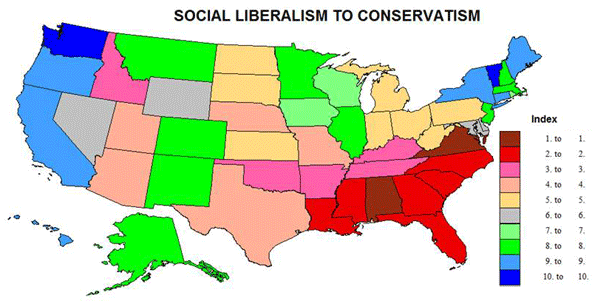
  • The Geography of Cultural Attitudes

    The cultural and political division of America, the gap between “red” and ”blue” with respect to economic and social liberalism or conservatism is a constant and dominant theme in American discourse. Here’s some narrowly specific measures of social liberalism based on actual votes by citizens or legislatures, not polls or broader indices available.   

    We would have liked to use more measures, but data problems restricted us to only 8 measures: women’s suffrage and state votes on the ERA (Equal Rights Amendment), the right to die, the legalization of marijuana, gay sex (sodomy laws), same sex marriage, racial intermarriage, contraception, and abortion (current state).  Data for religion-state separation were inadequate, although we include some extra data on religiosity.

    For women’s suffrage our index notes when suffrage was granted (states which did not until after the 19th Amendment get the lowest score).  Similarly for the ERA, we give high scores to states which early granted rights to women, with low scores for states which did not pass the ERA, or rescinded an earlier yes vote. For racial intermarriage, scores were based on when intermarriage became legal, with the lowest scores for those states where it was still illegal before the 1967 Supreme Court decision. Gay sex similarly gives lowest scores with anti-sodomy laws still in force at the time of the Lawrence vs Texas case in 2003. The same sex marriage measure gives high scores to states which now accept same sex marriage. The contraception measure is based on current restrictions on emergency contraception, as data on earlier history were poor. The “right to die” or “death with dignity” cause is more recent. The abortion measure is based on a state by state analysis of when and if it was accepted by states before Roe, and the degree of current constraints. Finally the marijuana measure considers the vote in CO and WA, and also states with medical marijuana provisions. 

    These nine values are summed to give a score to the states (listed in table 1 below). The table is arranged in order from the lowest total (most conservative) to the highest (most liberal).

    This scaling is compared to the right in the table with a measure of religiosity, two indices of social liberalism from the web (also published) and the Gallup poll. Since the data on the 9 measures and for the other indices were in varying units, I converted all to a simple scale from 1 (extremely conservative) to 10 (extremely liberal).  The Gallup poll was for 2010-2012 surveys, the “religiosity” ranking on a separate Gallup poll on the “importance of religion,” the “Free state liberal” index is from the Free State Project Forum, State Policy Liberalism Rankings,  by Jason Sorens , the social science model rankings from Andrew Gelman , Statistical modeling, causal inference and social science statistics, and based on the 2000 Annenberg Survey.

    Since our analysis was based on varying measures, some quite recent and others quite old, our numbers are rather different from most of the other comparison indices. These are broadly similar to contemporary rankings of conservatism or liberalism, with some intriguing differences, which reflect our choice of measures.

    Consider our low ranking of Virginia and Florida, which actually voted for Obama in 2008 and 2012! The reason is not that there is a dearth of liberals, but that they have not been very effective.  If the state legislatures and courts don’t pass “liberal” measures because they are consistently controlled by conservative tradition and majorities, then many liberal voters are ineffective and irrelevant, except for statewide votes for senate or governor or president. The same principle applies to a lesser extent to Pennsylvania, Ohio, Michigan, and perhaps even Wisconsin. At the opposite end, there are many conservative voters in states like Washington, Oregon, Maine, California, New York and Vermont, but their effectiveness is low, since the governor and legislatures are often controlled by more liberal majorities. Washington may be the extreme in this respect, where the voters themselves, not the legislatures, twice affirmed  abortion rights, then the right to same sex marriage, death with dignity (right to die), and the legalization of marijuana.  Maine and Minnesota affirmed same sex marriage, and Oregon the right to die.    

    The relatively low ranking for the District of Columbia, often the most liberal in other surveys, probably reflects the fact that it was part of the South culturally and perhaps more importantly subject to congressional oversight.

    The story is different for the states which are widely proclaimed to be conservative, but are in the lower “liberal” part of my table.  Most noteworthy is Montana, but also Arkansas, Iowa, New Mexico, and Wyoming, noted among the most conservative in polls and other rankings. The reason again is my particular choice of measures.  Western conservative states tend to embrace a libertarian point of view which can translate into social liberalism despite economic conservatism. Wyoming and then Montana were the first to give women the right to vote, and supported the ERA early on. Montana was the 3rd state to recognize a right to die; it also tried to defy the Supreme Court with respect to corporate political contributions (Citizens United).

    The other main reason for difference is that my ranking is based solely on social issues, while the other ranking all have some degree of economic liberalism affecting their results. This is why many Northeastern states are lower in my more strictly social liberalism ranking. The data show that some states have become more liberal over time while some states in the wide open west have become more conservative (WY, NV, ID AZ).

    The social geography of American states is a fascinating story of tradition and consistency, selective change.  The deeper South (not DE and MD) remains astoundingly monolithic. It is hard to escape the conclusion that to many the Civil War is not over, that race still rules, but also that for less obvious reasons, more fundamentalist religious denominations dominate, while in much of the country, religious adherence has diminished.

    At the other extreme, the “Left coast” and the Megalopolitan Northeast, (except for Pennsylvania!) exhibit a remarkable social liberalism. While the root may lie in a New England moralist or ethical tradition of tolerance, associated with the Congregational and Episcopal churches, this somehow became amplified in the 1960s and since through rising levels of education, professional occupations, and societal experimentation.  To some degree this relatively liberal ideology moved westward across the “northern tier” to the rise of a “progressive” movement in the Great Lakes states, and on to Iowa and Minnesota, (still  apparent!) and even on to Washington and Oregon.

    The Mountain states, including probably Alaska, are more complex, with increasing conservatism, especially in the “Mormon realm” – Utah, Idaho, Arizona, and Wyoming, while New Mexico and Colorado have even become more liberal. Education?  I’ll leave the explanation to the readers!

    This leaves the great Midwestern heartland – the Great Lakes, the northern Plains, and Appalachia. Appalachia was Democratic, a legacy of mining and unions, but social change seemed to pass the region by, as historic forces of fundamentalist religion and traditional values and small-townness, resisted the social change associated with the large metropolis.

    The Great Lakes states (MI, OH, IN, WI, IL) are remarkably alike in the middle ground between liberal and conservative on the social dimension, and seem to defy any simple understanding. They are metropolitan, and historically industrially vibrant, but also retain extensive small-town and farming areas, with a stronger religious tradition than the Left Coast or the megalopolitan realm. Thus they are resistant to the more ‘radical’ social changes, like same sex marriage. And Illinois just changed on same sex marriage! Other states may soon follow.

    The northern Plains, the region from MO and KS to the Dakotas and Minnesota, is more socially diverse, with Minnesota and Iowa far more socially liberal than the other states, especially the less metropolitan western area from Kansas through the Dakotas.

    I would conclude with a warning that this ranking is social, and ignores economic values and votes. Thus while WA maybe the most socially liberal, it is much lower on economic measures. While WA does have the highest minimum wage, it is 50th, yes last, in its regressive tax structure.

    Table 1: Index of Social Liberalism by State
    State Women Vote Equal Rights Act Racial Intermarry Gay Sex Same Sex Marriage Contraception Right to Die Abortion Marijuana Total Score
    AL 1 1 1 1 1 1 1 1 1 9
    VA 1 1 1 1 1 1 1 1 1 9
    MS 3 1 1 1 2 1 1 1 1 12
    FL 2 4 1 1 1 1 1 1 1 13
    GA 2 1 1 3 1 1 1 3 1 14
    LA 3 4 1 1 1 1 1 1 1 14
    NC 1 4 1 1 1 1 1 4 1 15
    SC 1 4 1 1 1 8 1 1 1 19
    OK 9 4 1 1 1 1 1 1 1 20
    AR 5 1 1 3 1 7 1 1 1 21
    KY 6 4 1 5 1 1 1 1 1 21
    ID 9 4 4 1 1 1 1 1 1 23
    TN 5 4 1 5 2 1 1 3 1 23
    MO 6 9 1 2 2 1 1 1 1 24
    NE 5 4 4 8 1 1 1 1 1 26
    UT 9 1 4 1 1 8 1 1 1 27
    TX 5 9 1 1 1 7 1 1 1 27
    AZ 9 1 4 3 2 1 1 3 5 29
    SD 9 4 4 8 1 1 1 1 1 30
    KS 9 9 7 1 1 1 1 1 1 31
    ND 5 9 4 8 1 1 1 1 1 31
    WV 1 9 1 8 4 1 1 7 1 33
    IN 6 9 4 8 3 1 1 1 1 34
    MI 9 9 7 1 1 1 1 1 5 35
    PA 1 9 7 6 3 7 1 1 1 36
    OH 4 9 7 8 1 7 1 1 1 39
    WY 10 9 4 8 3 1 1 4 1 41
    DC 5 9 4 6 9 7 1 1 1 43
    DE 3 9 1 8 9 1 1 6 5 43
    MD 1 9 4 4 10 1 1 9 4 43
    NV 9 4 4 5 5 1 1 9 5 43
    RI 6 9 7 5 9 1 1 4 5 47
    WI 6 10 9 6 3 8 1 4 1 48
    IA 6 9 7 8 9 1 1 6 1 48
    MT 10 9 4 4 2 1 8 9 5 52
    IL 5 4 7 10 9 8 1 7 1 52
    MA 3 9 7 7 9 9 1 7 1 53
    NH 3 9 9 8 9 9 1 7 1 56
    MN 6 9 9 3 9 8 1 6 5 56
    NM 3 9 7 8 7 9 1 9 5 58
    AK 9 9 9 6 2 9 1 9 5 59
    NJ 3 9 9 8 7 8 1 9 5 59
    CO 9 9 4 8 5 7 1 6 10 59
    CT 3 9 9 8 9 8 1 8 5 60
    HI 5 9 9 8 5 9 1 10 5 61
    NY 9 9 9 6 9 8 1 9 1 61
    CA 9 9 4 8 9 9 1 9 5 63
    ME 6 9 7 8 10 9 1 9 5 64
    OR 9 9 4 8 5 8 10 9 5 67
    VT 3 9 9 8 9 9 9 9 5 70
    WA 9 9 7 8 10 9 9 10 10 81


    Table 2: Comparison to Other Indexes
    State Religious Separation Freestate Liberal Socsci model rank Gallup My Ranking
    AL 1 1 3 1 1
    VA 3 3 5 5 1
    MS 1 1 1 1 2
    FL 4 6 4 5 2
    GA 2 2 3 3 2
    LA 1 3 2 2 2
    NC 2 4 4 4 2
    SC 1 2 3 3 2
    OK 1 1 2 2 3
    AR 1 1 1 2 2
    KY 2 2 1 4 3
    ID 8 2 2 2 3
    TN 2 1 2 3 3
    MO 3 2 3 4 4
    NE 4 3 3 2 4
    UT 3 2 3 1 4
    TX 2 1 3 4 4
    AZ 7 4 4 4 4
    SD 3 2 2 4 5
    KS 3 2 4 4 5
    ND 3 1 3 1 5
    WV 3 4 1 3 5
    IN 3 2 3 3 5
    MI 5 6 5 7 5
    PA 4 5 5 6.7 5
    OH 4 7 4 5 5
    WY 7 1 3 1 6
    DC 6 5 9 10 6
    DE 6 7 7 9 6
    MD 4 9 7 6 6
    NV 9 5 4 7 6
    RI 9 8 10 9 7
    WI 3 5 5 4 7
    IA 5 4 5 4 7
    MT 6 5 3 3 8
    IL 6 7 6 6 8
    MA 9 10 10 9 8
    NH 10 6 7 7.8 8
    MN 5 6 6 6 8
    NM 4 4 4 7 8
    AK 9 5 6 1 8
    NJ 7 10 8 6 8
    CO 7 6 5 7 8
    CT 9 8 9 9 9
    HI 8 8 7 8 9
    NY 8 10 9 8 9
    CA 8 9 7 6 9
    ME 10 7 6 7.5 9
    OR 9 7 7 9 9
    VT 10 7 10 9 9
    WA 9 7 6 5 10
    Correlation with My Ranking 0.83 0.74 0.68 0.66

    Richard Morrill is Professor Emeritus of Geography and Environmental Studies, University of Washington. His research interests include: political geography (voting behavior, redistricting, local governance), population/demography/settlement/migration, urban geography and planning, urban transportation (i.e., old fashioned generalist).

  • NewGeography’s Top Stories of 2013

    A new year is upon us, here’s a look back at a handful of the most popular pieces on NewGeography from 2013. Thanks for reading, and happy New Year.

    12. Gentrification as an End Game, and the Rise of “Sub-Urbanity” In January Richey Piiparinen points out that gentrification driven by affluent young people moving back to the city might be creating “a ‘sub-urbanity’ that is emerging when the generalization of gentrification meets the gentrification of the mind.”

    11. The Cities Winning the Battle for the Biggest Growth Sector in the U.S. Joel and I put this index together to measure growth and concentration of the professional, technical, and scientific services sector among the nation’s largest metropolitan areas. As high-end services become easier to export, this sector is becoming a critical region-sustaining sector in many parts of the country. This piece also ran at Forbes.com.

    10. A Map of America’s Future: Where Growth will be Over the Next Decade Working with Forbes Magazine in September, Joel and I laid out seven regions and three city-states across the nation. Regional economic diversity is one of America’s most critical attributes.

    9.  The Dutch Rethink the Welfare State Nima Sanandaji outlines the trajectory of the social services culture in the Netherlands.

    8.  Suburb Hating is Anti-Child In this provocative, widely-discussed piece, Mike Lanza takes it to politicians and commentators who advocate against suburbs, pointing out that “we need to fix suburbs and the way families utilize them,” but “what we shouldn’t do is try to force families to live in dense city centers.”

    7.  Fixing California: The Green Gentry’s Class Warfare Joel Kotkin points out that many green policies are pro-gentry and anti-middle class, particularly in California. This piece originally appeared at U-T San Diego.

    6.  How Can We Be So Dense? Anti-Sprawl Policies Threaten America’s Future In this piece from Forbes, Joel Kotkin argues that high-density housing advocates should be open to a broader range of housing options because policies pushing high density often favor real estate investors over the middle class and the concept of upward mobility.

    5.  Class Warfare for Republicans Joel takes the Republican Party to task for ignoring the issue of class and small business growth in favor of rhetoric about social conservatism, gun control, and free market idealism. This piece originally ran in the Orange County Register.

    4.  Houston Rising: Why the Next Great American Cities Aren’t What you Think In this piece from The Daily Beast, Joel argues that a city’s most important quality is its ability to foster upward mobility and to sustain a middle class, not its urban form.

    3.  The New Power Class Who Will Profit from Obama’s Second Term Who stands to benefit most from the second Obama administration? Joel argues that it’s the plutocrats of Silicon Valley and new media industries and the clerisy of academia. This piece originally appeared at Forbes.com.

    2.  Why are there so Many Murders in Chicago? Aaron Renn lays out seven possible reasons contributing to violent crime in Chicago and calls for an adjustment in strategy to fight it.

    1.  Gentrification and its Discontents: Notes from New Orleans The most read piece of the year is this excellent expose of gentrification and its impact on the culture and age demographics of New Orleans by local geographer Richard Campanella.

    Mark Schill is a community strategist and analyst with Praxis Strategy Group and New Geography’s Managing Editor.

  • Neither Party Dealing with More-Rigid Class Structure

    President Obama’s most-recent pivot toward the issue of “inequality” and saving the middle class might be seen as something of an attempt to change the subject after the health care reform disaster. As the Washington Post’s reliably liberal Greg Sargent explains, this latest bit of foot work back to the “old standby” issues provides “a template for the upcoming elections, one that allows Dems to shift from the grinding war of attrition over Obamacare that Republicans want to the bigger economic themes Dems believe give them the upper hand.”

    True, there’s something mildly risible about appeals to populism offered by a president whose economic record looks more like Herbert Hoover than Franklin Roosevelt. Some 95 percent of the income gains during President Obama’s first term flowed to barely 1 percent of the population, while incomes have declined for 93 percent of Americans. As one writer at the left-leaning Huffington Post put it, “[T]he rising tide has lifted fewer boats during the Obama years – and the ones it’s lifted have been mostly yachts.”

    Diminished prospects – what some describe as the “new normal” – now confront a vast proportion of the population, with wages falling not only for noncollege graduates but also for those with four-year degrees. Overall, median incomes for Americans fell 7 percent in the decade following 2000 and are not expected to recover, according to some economic models, until 2021.

    This decline has infected the national mood. Today, more middle- and working-class Americans predict that their children will not do better than they have done.Overall, almost one-third of the public, according to Pew, consider themselves “lower” class, as opposed the middle class, up from barely one-quarter who thought so in 2008.

    It’s not surprising, then, that the vast majority of Americans believe the president’s economic policy has been a dismal failure, at least for the middle and working classes. Federal Reserve monetary policy, in particular, appeared to favor the interests of the wealthy over those of the middle, yeoman class. “Quantitative easing,” notes one former high-level official, essentially constituted a “too big to fail” windfall for the largest Wall Street firms, and did little for anyone else. Faith in the economy, despite the soaring stock market and increased price of assets, has remained weak. Americans by a 2-1 margin rate the economy negatively.

    These realities helped spark both the Tea Party and the Occupy movements and underpin the support for such disparate figures as Sarah Palin and Elizabeth Warren. At the same time, outrage at our current economy has undermined public esteem for almost every institution of power – from government and large corporations to banks and Wall Street – to the lowest point ever recorded.

    Money goes to money

    This repudiation reflects the fact that neither major political party seems ready to address the emergence, over time, of a class structure more rigid, and arguably less-penetrable, than in the past. Increasingly, wealth adheres to those who are best-positioned, by hereditary wealth and education, to take advantage in the evolving economy. In contrast, those born with fewer resources, even if they work hard, find moving up in society increasingly difficult.

    To be fair, this problem well predates Barack Obama or the current Congress. Middle-class incomes have been declining, particularly compared with those of the wealthy, since the 1970s, with the decline persisting even in the relatively prosperous 1990s, with young workers starting out at incomes one-fourth lower than those of their parents.

    Yet, solutions proposed to date by Obama and his fellow Democrats have done little to reverse this trend, in fact, worsening it. Whatever suffering they ameliorate, a growing reliance on food stamps and extended unemployment insurance, as Walter Mead points out, often ends up creating an unhealthy dependence on the state and fails to address the cultural issues associated with long-term poverty.

    Some Obama proposals, like increasingly affirmative action, seem more like a nod to favored party constituencies than an elixir for the economy. Others, such as an increased minimum wage, promise benefits for some, but could also dry up sources of employment, particularly for part-time and new market entrants, particularly young workers.

    Overall, “blue” policies, as currently constituted, have not been notably effective in reducing poverty or increasing upward mobility. Locales with the nation’s greatest levels of inequality, and the most rapid decline of the middle classes, are generally found in progressive bastions,such as New York and California.

    Capitalism undercut

    But let’s be clear: There is not much here that the Right should be giddy about. The inability of market capitalism to provide more people with a higher standard of living, and increased opportunity, undermines the fundamental promise of free markets. The spread of prosperity from 1950-2000, bolstered conservative, even libertarian, perspectives as the middle class and property ownership expanded. Now, with homeownership in decline and middle-class incomes stagnating, the appeal of “democratic capitalism” marketed by the Right has been somewhat diminished.

    To address this challenge, conservatives need to acknowledge that economic inequality and rising class divisions stand as our nation’s existential political issue. Yet for the most part, their response has been largely to cut benefits to the poor amid hard times. Perhaps since they do not acknowledge the emerging credibility crisis facing capitalism, they feel little reason to address it.

    This story originally appeared at The Orange County Register.

    Joel Kotkin is executive editor of NewGeography.com and Distinguished Presidential Fellow in Urban Futures at Chapman University, and a member of the editorial board of the Orange County Register. He is author of The City: A Global History and The Next Hundred Million: America in 2050. His most recent study, The Rise of Postfamilialism, has been widely discussed and distributed internationally. He lives in Los Angeles, CA.

  • Public Engagement Miracle on 24th Street

    Confrontation and conflict are the favorite dispute resolution tools of Baby Boomers, who were born in the aftermath of WWII and grew up in the rebellious ‘60s. In stark contrast, members of the Millennial generation, born 1982-2003, bring a spirit of collaboration and consensus to solving any problem they encounter. A great example of the difference this generational distinction can be seen in the parents at the LA Unified School District’s 24th Street school, most of whom are Millennials in their twenties or early thirties, in how they resolved  the dispute over the school’s future.

    Located near the 10 freeway and Western Avenue in a predominantly Hispanic, hardscrabble neighborhood, the school appeared regularly on the District’s list of academic underperformers. Beyond poor learning outcomes, the parents at the school were upset by LAUSD’s apparent unwillingness to address their complaints about cleanliness and health issues in the schools including non-functioning bathrooms and dead animals on the premises.  They also felt the principal had a tendency  to use suspensions and a police presence as the way to enforce discipline. Before California’s Parent Trigger law gave parents the legal status to challenge incumbent administrators, the parents had organized a protest designed to remove the principal, but LAUSD failed to respond to their request.  

    So when organizers for the Parent Revolution non-profit that originally conceived of the Parent Trigger law contacted the school’s parents in May  2012, they found a group that was  prepared to spend long hours in the grinding work of organizing their peers into a cohesive and unified force that LAUSD would have to deal with. The parents knocked on doors and handed out flyers at the school inviting mothers to come to a nearby park where they met every Thursday after dropping off their kids at school. The “parent union” leaders surveyed all the other parents to determine what they liked or didn’t like about the school and encouraged those interested to attend the Public School Choice programs LAUSD ran to learn more about school reform options. Dissatisfied with what the District’s processes, the parents who came to the park elected a steering committee that met every Monday morning to organize the Thursday discussions.

    The discussions led to an emerging consensus on the changes the parents wanted to see at the school site.  They wanted to make sure that children with special needs had the right level of support services and the restoration of the preschool Early Education Center the district had eliminated due to budget cuts.  They demanded that dead animals, including gogs and rats, and other health hazards be addressed immediately. But the demand that brought about a real transformation of the conflict at the school and changed its culture in the most fundamental way was their insistence that everyone “play nice” together. They wanted LAUSD’s K-5 24th St. school and the Crown Prep charter school that ran a somewhat competing 5-8 charter school at the same site to embrace a spirit of collaboration addressing  the needs of the children, not necessarily their individual institutional interests.

    On January 17, 2013, about nine months after they were first contacted by Parent Revolution, the parents submitted a “parent trigger” petition to LAUSD, asking that the school be reconstituted under the federal No School Left Behind law’s guidelines for underperforming schools. Unlike other instances in California when such a petition has been presented to a school district’s board, LAUSD, under the guidance of its reform minded superintendent, John Deasy, responded positively to their request.  Eight Letters of Intent were presented to the parents from entities that wanted to take over its operations, including ones from Crown Prep and LAUSD.

    The parents formed a committee, which met every day from 8:30 AM until 2:30 PM, to review these proposals. They presented all the ideas to the parents at the weekly Thursday meetings and asked each bidder to come to the park and talk to them. On the day of LAUSD’s presentation it rained continuously, but Superintendent John Deasy stayed to talk to the parents about how to find common ground.

    Finally, the parents reached a consensus on how to restructure the school. They wanted to retain the college prep focus of the existing charter school, but they didn’t want an organization with little expertise in elementary education taking over K-4. So they asked LAUSD and Crown Prep to establish a collaboration on behalf of their children. If both entities would agree, a brand new LAUSD school with a new principal and new teachers would have responsibility for kindergarten through fourth grade on the campus and Crown Prep would have uncontested responsibility for grades 5-8.  Parents wanted both organizations to agree in writing that children would be on a college readiness track when they went to high school and that both organizations would share professional development of the 24th St. School teachers to ensure a seamless environment on the two school campus, including coordination of schedules. 

    Then a miracle happened. The two competing bidders found a way to agree with the parent’s unprecedented request. They signed an addendum to their bids acceding to the parents’ wishes. The parents voted their approval on April 10, 2013, just about one year after their organizing activities had begun.  A newly responsive LAUSD school board approved this innovative new concept one week later and parents became part of the committees that interviewed prospective principals and teachers for their school. The newly reconstituted school opened in the fall of 2013, with a new principal and a new set of teachers who, in the words of one of the parents, “have lots of new ideas and a strong desire to work on behalf of los niños.”   The early education center is scheduled to reopen in January, 2015.  

    When it came time for LAUSD to decide whether to retain the services of Superintendent Deasy, one of the most eloquent speeches on his behalf was delivered by a parent from the 24th St. School who recalled that day in the rain in the park as evidence of Deasy’s commitment to the children of Los Angeles. A school board riven by differences in personality and policy was taught a lesson about how to work in a more collaborative way by the Millennial parents who had embodied this new spirit in everything they did. As Boomers age and fade from their current leadership roles, perhaps more institutions will find a way to embrace Millennial values and behaviors that have already brought “a smile instead of tears” to the faces of the children of the 24th St. school in the City of Angels.

    Morley Winograd and Michael D. Hais are co-authors of the newly published Millennial Momentum: How a New Generation is Remaking America and Millennial Makeover: MySpace, YouTube, and the Future of American Politics and fellows of NDN and the New Policy Institute.

  • The Law’s No Ass: Rejecting Hollywood Densification

    The city of Los Angeles received a stunning rebuke, when California Superior Court Judge Alan J. Goodman invalidated the Hollywood Community Plan. The Hollywood district, well known for its entertainment focus, contains approximately 5% of the city of Los Angeles’ population. The Hollywood Plan was the basis of the city’s vision for a far more dense Hollywood, with substantial high rise development in "transit oriented developments" adjacent to transit rail stations (Note 1).

    The Hollywood Plan had been challenged by three community groups (Savehollywood.org, La Mirada Avenue Neighborhood Association of Hollywood, and Fix the City), which argued that the approval process had violated provisions of California law, and most particularly had relied on population projections that were both obsolete and inaccurate.

    Judge Goodman called the Hollywood Plan "fatally flawed," and noted that it relied on errors of both "fact and law." He ordered the City to:

    (1) Rescind, set aside and vacate all actions approving the Hollywood Plan and prepare a replacement that is lawful and consistent with the City’s general plan.

    (2) Grant no permits or entitlements from the Hollywood Plan until it has been replaced with a lawful substitute.

    An "Entirely Discredited" Population Baseline

    The principal issue in the case revolved around out-of-date and erroneous population estimates (Note 2). The city based its densification plan on an assumption that the population of Hollywood would rise from 200,000 in 2000 to 224,000 in
    2005. This estimate was produced by the Southern California Association of Governments (SCAG), which is the metropolitan planning organization for all of Southern California outside San Diego County. SCAG had further projected that Hollywood’s population would rise to 250,000 by 2030.

    To house these additional residents, the city reasoned that higher density development was necessary. In a related matter, the Los Angeles City Council approved Millennium Hollywood, a pair of 35 and 39 story mixed use towers. This was in spite of warnings from the State Geologist that the property was bisected by a dangerous earthquake "rupture" fault (Note 3). Litigation is pending.

    But there’s a fly in this planning ointment, rather than gaining population, Hollywood is losing people.   Before the Hollywood Plan was finally approved, 2010 United States Census data was released that indicated the population had dropped to 198,000. This revealed both the SCAG estimate of the actual population and its 2030 projection to be highly inaccurate. Judge Goodman referred to the SCAG 2005 estimate as "entirely discredited."

    Elementary Questions Raised

    Nonetheless, the city proceeded based upon the incorrect population data. This led the Judge to raise elementary questions about the process (paraphrased below).

    (1) Why was the SCAG population estimate used as a baseline by the city of Los Angeles if the US Census count, readily available before the environmental process was completed, had shown a significantly smaller population?

    (2) Why was the 2030 projection (from SCAG) not adjusted in the Plan based on the new, lower 2010 US Census population count?

    The City defended using the stale and erroneous population data. Judge Goodman commented: "That clearly is a post-hoc rationalization of City’s failure to recognize that the HCPU (Hollywood Plan) was unsupported by anything other than wishful thinking" (parentheses and emphasis by author). The Judge continued that this resulted in a "manifest failure to comply with statutory requirements."

    The Judge set out the burden faced by the City to achieve a legal (and rational outcome):

    …if the population estimate for 2030 were to be adjusted based on what the 2010 Census data had shown, then all of the several  analyses which are based on population would need to be adjusted, such as housing, commercial building, traffic, water demand, waste produced -as well as all other factors analyzed in these key planning documents.

    To its discredit, the city incredibly argued that "it was entitled by law to rely on the SCAG 2005 population estimate." The Judge disagreed. Any other conclusion would have proven "the law to be an ass" (Note 4).

    Abuse of Discretion

    The La Mirada Avenue Neighborhood Association argued that the city of Los Angeles had failed to exercise "good faith effort at full disclosure," contrary to the requirements of California environmental law. Judge Goodman appeared to agree, finding that the city of Los Angeles had abused its discretion, noting "A prejudicial abuse of discretion occurs if the failure to include relevant information precludes informed decision-making and informed public participation, thereby thwarting the goals of" the environmental process.

    Inaccurate Population Estimates and Projections

    This is not the first time that Southern California population projections have been so wrong. With more than a century of explosive population growth, more recent trends may have eluded some of the planning agencies. In 1993, SCAG projected that the city of Los Angeles would reach a population of 4.3 million by 2010. SCAG’s predicted increase of more than 800,000 materialized into little more than 300,000. This is not to suggest that projecting population is an exact science, nor that SCAG has been alone in its inaccuracy.

    In 2007, the state’s official population projection agency, the Department of Finance projected that Los Angeles County would reach 10.5 million residents in just three years. But the 2010 US Census counted only 9.8 million residents (See 60 Million Californians? Don’t Bet on It). In contrast with the previously accustomed growth from other parts of the country, Los Angeles County lost a net 1.2 million residents to other parts of the nation while the rate of immigration fell.  

    Not a Unique Problem

    This instance of overinflated and inaccurate projections is not unique to Los Angeles. The use of out-of-date or erroneous information is increasingly being used in regional planning. Recently, the Association of Bay Area Governments and the Metropolitan Transportation Commission approved the San Francisco Plan Area Plan, which used population projections substantially higher even than those of the Department of Finance (despite that agency’s previous over-optimism).

    As in Los Angeles, Plan Bay Area also used outdated data for automobile greenhouse gas emission factors that have long since been rendered obsolete by technological advancements. Other planning agencies around the nation have engaged in similar practices.

    Planners in the Bay Area, SCAG and elsewhere in California are using similarly flawed projections that presume a substantial change in housing preferences toward multifamily and smaller lots. Yet, years later, the projected trends have not emerged in any significant way (See: A Housing Preference Sea-Change: Not in California).

    Wishful Thinking: No Basis for Action

    Judge Goodman’s decision could have relevance well beyond Los Angeles and the state of California. Regional plans must be based upon current and reliable data, no matter how late received.  To proceed based on faulty data is no different than not changing course when an iceberg appears in the navigation path. Wishful thinking has no place in rational planning.

    ——–

    Note 1: The Hollywood rail stations are on the Red Line subway, which was projected to carry 300,000 daily riders by 2000. The Red Line is carrying approximately 170,000 daily riders and would need three-quarters more to reach the projection for more than a decade ago (see: Report on Funding Levels and Allocations of Funds, Urban Mass Transportation Administration, 1991, page B-49)

    Note 2: The plaintiffs also argued that the Hollywood Plan’s densification would result in additional traffic congestion. This is a serious concern, given Hollywood’s central location in the second most congested metropolitan area in North America (following Vancouver, which recently ended the decades long reign of Los Angeles). Greater traffic congestion is associated with higher population densities.

    Note 3: LA Weekly said that the fault might be capable "of opening the Earth, splitting buildings in half" (See: How the Hollywood Fault Made Millennium’s Future Uncertain, and L.A. a Laughingstock).

    Note 4:  "The law is an ass" (as in a donkey) refers to cases in which the law is at odds with common sense. This phrase was used by Charles Dickens, but appears to have first been used in a play as early as 1620.

    Wendell Cox is a Visiting Professor, Conservatoire National des Arts et Metiers, Paris and the author of “War on the Dream: How Anti-Sprawl Policy Threatens the Quality of Life.

    Photograph: Los Angeles City Hall (by author)

  • What is a City For?

    The attached report is derived from a speech given last spring in Singapore at the Singapore University of Technology and Design. The notion here is to lay out a new, more humanistic urban future, not one shaped primarily by large developers, speculators and transient global workers. Singapore was a particularly difficult case to look at since it has no room to spread out, something we still have in much of the rest of the world. Yet the city has been very innovative in the development of open space, and its public housing agency, the Housing Development Board, has worked hard to accommodate the needs of families. I have been struck by how people in different countries want the same things: safety, space, privacy, convenience, and affordable housing. The speech is a call to reconsider our urban priorities and make the city responsive to its denizens.

    Download the full .pdf document.

    Introduction

    What is a city for? In this urban age, it’s a question of crucial importance but one not often asked. Long ago, Aristotle reminded us that the city was a place where people came to live, and they remained there in order to live better, “a city comes into being for the sake of life, but exists for the sake of living well” (Mawr, 2013).

    However, what does “living well” mean? Is it about working 24/7? Is it about consuming amenities and collecting the most unique experiences? Is the city a way to reduce the impact of human beings on the environment? Is it to position the polis — the city — as an engine in the world economy, even if at the expense of the quality of life, most particularly for families?

    I start at a different place. I view “living well” as addressing the needs of future generations, as sustainability advocates rightfully state. This starts with focusing on those areas where new generations are likely to be raised rather than the current almost exclusive fixation on the individual. We must not forget that without families, children, and the neighbourhoods that sustain them, it would be impossible to imagine how we, as a society, would “live well.” This is the essence of what my colleague, Ali Modarres and I call the ‘Human City’.

    Living well should not be about where one lives, but how one lives, and for whom. Families can thrive in many places, but these bearers of the next generation are not the primary focus of much of the urbanist community. I am referring here to urban neighbourhoods like in Singapore or in the great American cities, as well as the country’s vast suburbs. These are not necessarily the abodes of the glittering rich, or the transitory urban nomadic class, who dominate our urban dialogue, but a vast swath of aspiring middle- and working- class people. They are not necessarily the places that hipsters gravitate to, or lure people thinking of a second or third house.

    Download the full .pdf document.

    Published by the Lee Kuan Yew Centre For Innovative Cities

    Joel Kotkin is executive editor of NewGeography.com and Distinguished Presidential Fellow in Urban Futures at Chapman University, and a member of the editorial board of the Orange County Register. He is author of The City: A Global History and The Next Hundred Million: America in 2050. His most recent study, The Rise of Postfamilialism, has been widely discussed and distributed internationally. He lives in Los Angeles, CA.

  • Affordable Housing in Suburbia

    Like many older suburbs in high priced regions, Long Island faces two great crises: a loss of younger residents and a lack of affordable housing for the local workforce, including those employed as nurses, teachers and other professionals.

    Often, proposed developments on Long Island are tailored to be geared towards “luxury” or are age-restricted for residents 55 or older. These proposals serve to almost completely ignore the middle class or the region’s young professionals. While the depth of the "Brain Drain", or flight of the young from Nassau and Suffolk Counties is debatable, the fact remains that housing stock for the area’s younger families is woefully deficient. Thanks to limited job opportunities and affordable housing, Long Island isn’t the attractive bedroom to Manhattan that it once was.  

    Long Island’s housing woes have been in the public eye for the last few months and it’s critical for residents and policymakers alike to understand the issues. The Town of Huntington recently issued a press release announcing that applications are being accepted for 43 affordable rental apartments that are part of the 379-unit Avalon at Huntington Station development. The rents range from $932 a month for a one-bedroom to $1,148 for a two-bedroom to $1,646 for a three-bedroom.

    “Affordable” vs. “Attainable”

    For once, the rents being billed as “affordable” seem aligned with the term. Hypothetically, a Young Islander making $45,000 and renting the single-bedroom option would pay roughly 24.8 percent of his or her salary toward housing, far less than the 35 percent threshold that is considered by the Long Island Index as a “high housing cost burden.”

    Compare these rents to the “attainable” 300- to 400-square-foot micro-unit options that were presented by a group recently, which, when rented at $1,400 a month, would account for about 37 percent of someone’s $45,000 salary (both examples are calculated without utilities, Internet, cable, etc.).

    The Avalon project contains a total of 303 rentals and 76 for-sale townhouses. Forty-three apartments and 11 townhouses will be affordable, while the remaining 260 apartments and 65 townhouses will be market-rate. The project site is a 26.6-acre parcel roughly half a mile from the Huntington Long Island Rail Road station.

    A drop in the bucket

    The Avalon Huntington Station project has rents that seem affordable, but the total amount of units are a drop in the larger bucket when it comes to addressing the Long Island’s greater affordable housing need of 41,429 units. After Avalon is constructed, there will be 41,375 units to go. Is that progress?

    Compare both projects: The microunit approach is “attainable” at $1,400 a month, while Avalon is “affordable” at $932-$1,646 a month. Both terms lack the standardization and definite boundaries necessary to legitimize them in the minds of the public. Is attainable really worth $500 more than the term affordable? Where does “workforce” fall into this ever-sliding scale?

    Our patchwork approach to affordable housing needs to change. For every press release issued touting two affordable units here or 11 workforce homes shoehorned there, the elephant in the room is tackling the monumental demand in the face of our paltry, undefined supply.

    Some big questions

    The issue of overall demand is a very big question that our region has faced for the last 50 years and will continue to face in the immediate future. What Long Islanders must move toward is first quantifying the issue. How many truly affordable units do we have? How many can we reasonably build? What is the true market demand for housing in Nassau and Suffolk counties? Are municipalities able to successfully increase density while preserving land elsewhere?

    Countless times, important planning terms like “sustainable,” “smart growth,” “walkable,” “green” and now “affordable” and “attainable” are cheapened by misuse. These terms once represented important and innovative planning techniques that were once progressive tools in crafting a better community. When the terms are misused by stakeholders and industry insiders the result is a volatile cocktail of higher density suburban sprawl and poor urban design that further leads to suburban blight, and the public’s broken faith in the system.

    A democracy gets the policy it deserves. Currently, Long Islanders are disengaged with the land-use process, and have allowed it to become dominated by biased stakeholders who have much to gain by allowing those important terms to become shallow. It’s easy to sell a project as “green” or “smart” when few, if any, people know what the term means.

    The beauty of it all is that a democracy also can create the policy it needs. This is why it’s so important to take the time to give these critical issues the attention they deserve, and work towards a better Long Island.

    Why do we issue press releases celebrating the creation of 54 affordable units, or 0.13 percent of our regional need? It is because, at this point, not much else is or can be done to tackle this massive problem until we fully understand it.

    Richard Murdocco is a digital marketing analyst for Teachers Federal Credit Union, although the views expressed in this post are Murdocco’s alone and not shared by TFCU. Follow him on Twitter @TheFoggiestIdea, visit thefoggiestidea.org or email him at Rich@TheFoggiestIdea.org.

    Photo from Avalon Communities

  • High Speed Rail Decision: Victory for Rule of Law

    California Judge Michael Kenny has barred state bond funding for the California high speed rail system, finding that “the state’s High-Speed Rail Authority failed to follow voter-approved requirements designed to prevent reckless spending on the $68 billion project.” These protections had been an important in securing voter approval of a $10 billion bond issue in 2008. Sacramento Bee columnist Dan Walters suggested that without the protections in Proposition 1A, the measure “probably would have failed” to obtain voter approval.

    According to the court decision, the California High Speed Rail Authority (CHSRA) had failed to identify $25 billion of the funding that would be necessary to complete the first 300 mile segment. This was required by the terms of Proposition 1A as enacted by the legislature and approved by the voters. Yet, without a legally valid business plan, CHSRA was steaming ahead, at least until the court decision.

    The principal longer-term significance of the ruling is that “rule of law” remains in effect in California. Elizabeth Alexis, co-founder of Californians for Responsible Rail Design (CARRD), a group opposed to the project,  told the Los Angeles Times that CHSRA had been conducting itself as if it were “above the law” (Note 1).

    Judge Kenny’s decision means that the state of California cannot ignore its laws, even when its leadership finds them politically inexpedient. Just like the businesses from the largest companies to the smallest used car lot, the law forbids the state from making legally binding promises and then casting them aside arbitrarily.

    The Court Decision

    The San Diego Union-Tribune summarized the court decision as follows:

    Superior Court Judge Michael Kenny ruled that the California High-Speed Rail Authority could not proceed with using billions of dollars in bond funds to begin construction because it had not credibly identified funding sources for the entire $31 billion it will take to finish the 300-mile initial segment, nor had it completed necessary environmental reviews for the segment. These requirements were among the taxpayer protections written into law by California voters in November 2008, when they voted narrowly for Proposition 1A to allow the state to issue $9.95 billion in bonds as seed money for the project. Kenny said the state must develop a plan that comports with these requirements.

    The Union Tribune further reported that Judge Kenny rejected arguments by the state Attorney General that state the legislature, rather than Proposition 1A (now state law which has not been repealed) was the final authority on how the bonds are used.

    The Los Angeles Daily Newsindicated that the decision left the high speed rail project without either a funding plan or the ability to borrow money. The only remaining source of construction funding is a federal grant, which requires a match of state funding.

    Background

    Proposition 1A and the high speed rail project have had a difficult history.

    A $10 billion high speed rail bond issue to support the project (then called Proposition 1) was scheduled for 2008, after having been postponed twice. There was concern, however, in the state legislature that Proposition 1 had insufficient fiscal, environmental and management guarantees to attract a majority vote of the electorate. As a result, legislature enacted and Gov. Arnold Schwarzenegger signed Assembly Bill 3034, which added substantial protections and recast the ballot measure as Proposition 1A. Assemblywoman Catherine Gagliani, the author, said that the legislation “establishes additional fiscal controls on the expenditure of state bond funds to ensure that they are directed to construction activities in the most cost-effective and efficient way.”

    Leading high speed rail proponent and then CHSRA Chairman Quentin Kopp (Note 2), applauded Assembly Bill 3034 indicating that “Californians will now be able to vote on a high-speed train system grounded in public-private financing and guided by fiscal accountability with the guarantee of no new taxes to fund the system,"

    The Promised System

    In the voter ballot pamphlet, proponents told voters that the proposed system would operate from San Francisco to Los Angeles and Anaheim, as well as through the Inland Empire (Riverside-San Bernardino) to San Diego and to Sacramento. This complete system was to cost $45 billion, according to the proponents (a figure that had already risen substantially).

    Like many other large infrastructure projects, costs were soon to explode. By 2011, the cost had escalated to a range of almost $100 billion to more than $115 billion. Further, the promised extensions to Sacramento and the Inland Empire and San Diego were not included in that price (Note 3).

    From High Speed Rail to “Blended” System

    The political reaction to the cost escalation was negative, leading the CHSRA to radically revise the remaining San Francisco to Los Angeles and Anaheim line. CHSRA removed exclusive high-speed rail tracks in the San Francisco-San Jose and Los Angeles metropolitan areas. The cost of this "blended" system was estimated at $68 billion. CHSRA maintained its claim that the legislatively required travel time of 2:40 could be achieved without the genuine high speed rail configurations in the two metropolitan areas. Sacramento Beecolumnist Walters characterized this expectation as based on “assumptions that defy common sense.”

    Former CHSRA Chair Quentin Kopp withdrew his support at this point, referring to the “blended system” as “the great train robbery.” Kopp also raised the possibility that the new plan could violate Proposition 1A, a judgment that Judge Kenny’s decision confirmed.

    Kevin Drum, of Mother Jones may have provided the best summary of situation as it stands today:

    Its numbers never added up, its projections were woefully rose-colored, and it was fanciful to think it would ever provide the performance necessary to compete against air and highway travel. Since then, things have only gotten worse as cost projections have gone up, ridership projections have gone down, and travel time estimates have struggled to stay under three hours.

    Drum had previously characterized CHSRA claims as “jaw-droppingly shameless,”adding that “A high school sophomore who turned in work like this would get an F.”

    Where From Here?

    Proponents have not given up. As The Economistreported, proponents took comfort in the fact that “Judge Kenny did not cancel the project altogether.” The Economist continued “But if that is a victory, it is not clear how many more wins California high-speed rail can handle.”

    The stalwart supporter San Francisco Chronicle editorialized that the court decision was a “bump” in the path for the project. Yet even the Chronicle conceded that: “The court results are a serious warning sign that the financial fundamentals need work.” 

    Too Big to Fail?

    Columnist Columnist Dan Walters fears that to make the financial fundamentals work would require making the project “too big to fail:”

    As near as I can tell, the HSR authority’s plan all along has been to simply ignore the law and spend the bond money on a few initial miles of track. Once that was done, no one would ever have the guts to halt the project because it would already have $9 billion sunk into it. So one way or another, the legislature would keep it on a funding drip.

    Such a strategy would force California taxpayers to fill the gargantuan funding gap, which for the entire Los Angeles to San Francisco line now stands at approximately $65 billion. With the federal funding of approximately $3 billion, the state is 95 percent short of the $68 billion it needs.

    California taxpayers may not be so accommodating. Even before Judge Kenny’s decision, LA Weekly reports that a USC/Los Angeles Times poll shows statewide opposition now to have risen to 53 percent of voters, while 70 percent would like to have a new vote on Proposition 1A (see “Californians Turn Against LA to SF Bullet Train”).

    Even the federal funding is being questioned.  California Congressman Jeff  Denham, also a former supporter of the project, joined with Congressman Tom Latham to ask (link to letter) the United States Government Accountability Office if  further federal disbursements could be illegal, given the uncertainty of the state funding needed to “match” the federal grant.

    Congressman Kevin McCarthy, the majority whip in the US House of Representatives has indicated that he will work with others in Congress to deny further federal funding to the project.

    The San Jose Mercury-News, which like the Chronicle had been a strong supporter of Proposition 1A in 2008 has long since climbed off the train. In an editorial following Judge Kenny’s decision, the Mercury-News decried the project’s “bait and switch,” tactics and called for “an end to this fraud.”

    The Winners: California Citizens

    At this point, the words of legendary New York Yankees catcher Yogi Berra seem appropriate: “It ain’t over till it’s over.” However, Judge Kenny has rewarded California citizens with something that never should have been taken away from them – a government that follows its laws.

    —-

    Note 1: This is not the first time that the state has run afoul of the law on the high speed rail project. According to the Sacramento Bee:

    The Howard Jarvis Taxpayers Association had challenged the ballot language for Proposition 1A, arguing the Legislature used its pen to “lavish praise on its measure in language that virtually mirrored the argument in favor of the proposition.” The appeals court sided with HJTA [stating], “the Legislature cannot dictate the ballot label, title and official summary for a statewide measure unless the Legislature obtains approval of the electorate to do so prior to placement of the measure on the ballot.”

    Unlike the present decision, the state suffered no consequences for its violation and Proposition 1A was not invalidated.

    Note 2: Chairman Kopp is a retired judge, former state Senator and former member of the San Francisco Board of Supervisors.

    Note 3: Joseph Vranich and I have authored two reports questioning the ability of the California high speed rail system to meet its objectives (financial, environmental, ridership, and operations). The first, The California High Speed Rail Proposal: A Due Diligence Report, was published by the Reason Foundation, Citizens Against Government Waste and the Howard Jarvis Taxpayers Association in 2008. The second, California High Speed Rail: An Updated Due Diligence Report, was published by the Reason Foundation in 2012.

    —-

    Wendell Cox is a Visiting Professor, Conservatoire National des Arts et Metiers, Paris and the author of “War on the Dream: How Anti-Sprawl Policy Threatens the Quality of Life.

    Photo: US Constitution (from National Archives)

  • The Revolt Against Urban Gentry

    The imminent departure of New York’s Mayor Michael Bloomberg, and his replacement by leftist Bill DeBlasio, represents an urban uprising against the Bloombergian  “luxury city” and the growing income inequality it represents. Bloomberg epitomized an approach that sought to cater  to the rich—most prominently Wall Street—as a means to both finance development growth and collect enough shekels to pay for services needed by the poor.

    This approach to urbanism draws some of its inspiration from the likes of Richard Florida, whose “creative class” theories posit the brightest future for “spiky” high cost cities like New York.  But even Florida now admits that what he calls  “America’s new economic geography” provides “ little in the way of trickle-down benefits” to the middle and working classes.    

    Some other urbanists don’t even really see this as a problem. Harvard’s Ed Glaeser, a favorite of urban developers, believes De Blasio should celebrate the huge gaps between New York residents as evidence of the city’s appeal; a similar argument was made recently about California by an urban Liberal (and former Oakland Mayor) Jerry Brown, who claimed the state’s highest in the nation poverty rate reflected its “incredible attractiveness”.

    Couched in progressive rhetoric, the gentry urbanists embrace an essentially neo-feudalist view that society is divided between “the creative class” and the rest of us. Liberal analyst Thomas Frank suggests that  Florida’s “creative class” is numerically small, unrepresentative and self—referential; he describes them as  “members of the professional-managerial class—each of whom harbors a powerful suspicion that he or she is pretty brilliant as well.”

    The Voters rebel.

    The revolt against this mentality surfaced first in New York perhaps because the gaps there are so extreme. Wall Streeters partied under Bloomberg, but not everyone fared so well. The once proudly egalitarian city has become the most unequal place in the country, worse even than the most racially divided, backward regions of the southeast.  In New York, the top 1 percent earn roughly twice as much of the local GDP than is earned in the rest of country. The middle class in the city is rapidly becoming vestigial; according to Brookings its share of the city’s population has fallen from 25 percent in 1970s to barely sixteen percent today.   

    De Blasio rode this chasm between “the two cities” to Gracie Mansion, but his triumph represents just part of a growing urban lurch to the left. Voters in Seattle, for example, just elected an outright Socialist who promptly called on Boeing workers to take over their factory. More reasonably, she is also campaigning for a $15 an hour minimum wage, a reaction against the surging inequalities in that   historically egalitarian Northwest city.

    Similarly  San Franciscans turned down a new luxury condo development along their waterfront, in large part because it was perceived as yet another intrusion of the ultra-rich. Even as the city enjoys its most recent tech bubble, resentment grows between the tech elites, including those traveling on private buses to Silicon Valley, and ordinary San Franciscans, struggling to cope with soaring housing costs.

    The New Urban Demography

    Bloomberg’s “luxury city” was ultimately undermined by its own demographic logic. Bloomberg’s gentry urbanist policies have undermined New York’s private sector middle class, a group that was critical to his own early rise to power and even more decisive in electing his predecessor, Rudy Giuliani. This same group of middle class voters, largely clustered in the San Fernando Valley, also drove the election of Richard Riordan in Los Angeles in 1993 and his comfortable re-election four years later. But the private sector middle class

    The fading of the old middle class came with the rapid decline of industries, like manufacturing and logistics that once employed them.  Since 2000, the New York metropolitan region has lost some 1.9 million net domestic migrants, the most of any  in the country. $50 billion in lost revenue has bled out of the city along with the people departing. Florida alone, the largest destination has gained almost $15 billion in income. Other major cities, notably Los Angeles and Chicago, have suffered similar losses since the 1970s, notes Brookings, as middle income neighborhoods have declined while both poor and very affluent areas have grown.    

    Becoming the ultimate playground to the rich made things worse for most middle class New Yorkers by imposing higher costs, particularly for rents. In fact, controlling for costs the average New York paycheck (costs) is among the lowest in the nation’s 51 largest metro areas, behind not only San Jose, but Houston, Raleigh, and a host of less celebrated burgs. A big part of this is the cost of rents. According to the Center for Housing Policy and National Housing Conference , 31 percent of New York’s working families pay over 50% of their income in rent, well above   the national rate of 24 percent, which itself is far from tolerable.

    Conditions for those further down the economic scale, of course, are even worse. The urban poor in New York, Chicago, Los Angeles or Philadelphia , notes analyst Sam Hersh, find their meager resources strained by high prices not  common in less fashionable cities like Buffalo or Dallas. “In some ways,” he notes, “ the low cost of living in “unsuccessful” legacy cities means that quality of life is in many cases better than in those cities widely regarded as a success.”

    The dirty little secret here is the persistence of urban poverty. Despite the hype over gentrification, urban economies—including that of New York—still underperform their periphery. Nearly half of New York’s residents, notes the Nation are either below the poverty line or just above it. Just look at the penultimate symbol of urban renaissance, Brooklyn. The county (home to most of my family till the 1950s) suffers a median per capita income in 2009 of just under $23,000, almost $10,000 below the national average (PDF).

    Marquee cities haven’t “cured poverty” or exported it largely to the suburbs, as is regularly claimed. Cities still suffer a poverty rate twice as high as in the suburbs. Demographer Wendell Cox notes that  some 80% of the population growth over the past decade in the nation’s 51 largest cities came from the ranks of those with lower incomes, most likely the children of the entrenched poor as well as immigrants.

    The resilience of poor populations has occurred even as there has been a much ballyhooed surge into some cities of younger people, primarily single, often well-educated, childless and less traditional in their values. This demographic shift has further pushed urban politics to the left as singles, particularly women, have become, next to African-Americans, the most reliable Democratic constituency.

    By the time these young people get older and develop more interest in issues like schools, parks and public safety, Census data suggest they leave in cities large numbers, depriving them of a critical source of political, social and economic stability. By the age of 40, according to the most recent data, going up to 2012, more desert the core city than ever came there in the first place.   

    Urban Politics Left Turn

    This new demography—essentially a marriage of rich, young singles and the poor—has created an urban electorate increasingly one-dimensional, and less middle class, not only in economic status, but also, perhaps more importantly, in attitude. This can be seen in the very low participation rates in de Blasio’s victory in New York, where under one quarter of the electorate voted in the election compared to some 57 percent in the 1993 Giuliani vs Dinkins race. Historically, middle class voters were the most reliable voters and their decline has led to record low participation not only in New York, but also in Los Angeles, where new Mayor Eric Garcetti was elected with the lowest turnout, barely twenty percent, in a contested election in recent memory.

    The decline in voter participation occurs as cities are becoming ever more one-party constituencies. Two decades ago a large chunk of the top twelve cities were run by Republicans, but today none are. America’s cities have evolved into a political monoculture, with the Democratic share growing by 20 percent or more in most of the largest urban counties.

    Under such circumstances the worst miscues by liberals are largely ignored or excused as politics and media take place in a kind of left-wing echo chamber. Even the meltdown of the healthcare law, which has hurt the president’s approval rating in national polls, seems to have not impacted his popularity in urban areas.  

    In New York and other cities this shift leftward, ironically, has been enabled by the successes of Bloomberg and other pro-business pragmatists whose successful policies on issues like crime have shifted the political agenda to other matters. “This election is not going to be about crime, as some previous elections were,” de Blasio told National Journal last month. “It used to be in New York you worried about getting mugged. But today’s mugging is economic. Can you afford your rent?”

    Policy Directions.

    With crime a less urgent issue and no sizable right or even centrist voting blocs, urban leaders can now push a set of initiatives—for example on policing—that would have been unthinkable in the New York of Rudy Giuliani or Los Angeles under Riordan. There are also likely to be fewer pushes for education reform, a critical issue for retaining the middle class, since most left-wingers, like de Blasio, largely follow the union party line.

    This is not to suggest that we should long for a return to the Bloombergian  “luxury city.” The gentrification-oriented policies did indeed foster the evolution of  two cities, one preserved by tax increment funding and donations by wealthy and businesses and another, heavily minority city, notes analyst Aaron Renn facing budget constraints, the closing of schools, parks and other facilities  

    But revoking these policies alone does little to expand the middle class and diminish social inequality. A more direct step would be to boost the minimum wage in cities—as suggested by Seattle’s firebrand socialist council member and endorsed by the new Mayor— for the vast numbers of working poor who labor in hotels, fast food restaurants and other service businesses.  This, to his credit, is what Richard Florida suggests as part of his proposed “creative compact” to boost the pay workers who work in service jobs for his dominant “creatives.”

    This policy does address inequities but it may also have the effect of reducing overall employment as companies seek to downsize and automate their operations. Although conceived to help the working poor, it could further reduce job opportunities for those most in need of work.

    Can Social Media Save New York?

    The key issue is how to expand high wage jobs in cities with high rents and costs of living. One approach, embraced by many urban boosters, is to lure social media firms. Tech companies tend to concentrate in denser urban areas and are also a good fit with urban left-wing politics as they tend to be dominated by young, alternative lifestyle types.

    However, this is a risky proposition, given the historic volatility of these companies. After the last bubble, Silicon Alley suffered a downward trajectory, losing 15,000 of its 50,000 information jobs in the first five years of the decade.

    Although some claim, in a fit of delusion, that the city is now second to the Silicon Valley in tech this ignores the long-term trends. In fact, since, since 2001, Gotham’s overall tech industry growth has been a paltry 6% while the number of science, technology, engineering, and math related jobs has fallen 4%. This performance pales compared not only to  the Bay Area, but a host of other cities ranging from Austin and Houston to Raleigh, Salt Lake and Nashville.

    The chances of Gotham becoming a major tech center are further handicapped   by a severe lack of engineering talent. On a per capita basis, the New York area ranks 78th out of the nation’s 85 largest metro areas, with a miniscule 6.1 engineers per 1,000 workers, one seventh the concentration in the Valley and well below that of many other regions, including both Houston and Los Angeles.

    Finally for most cities, and particularly in New York, Los Angeles and Chicago, the rise of social media has been a mixed blessing. Whatever employment is gained in social media has been more than lost by declines in book publishing, videos, magazines and newspapers—all industries historically concentrated in big cities. Since 2001 newspaper publishing has lost almost 200,000 jobs nationwide, or 45% of its total, while employment at periodicals has dropped 51,000,or 30%, and book publishing, an industry overwhelmingly concentrated in New York, lost 17,000 jobs, or 20% of its total.

    Restoring the Aspirational City

    Instead of waiting for the social media Mr. Goodbars to save the day, or try to force up wages by edict, cities may do better to focus on preserving and even bolstering existing middle-income jobs. In New York, for example, more emphasis needs to be placed on retaining mid-tier white collar jobs, which have been fleeing the city for more affordable regions, including the much dissed suburbs.    

    New York’s middle class has been a primary victim of the wholesale desertion of the city by large firms.  In 1960 New York City boasted one out of every four Fortune 500  firms; today it hovers around 46. And even among those keeping their headquarters in Gotham,  many have shipped most of their back office operations elsewhere. Amidst a record run on Wall Street, the financial sector’s employment has fallen by 7.4 percent since 2007. The city’s big employment gains have been mostly concentrated in low-wage hospitality and retail sectors—service jobs that often don’t provide benefits and are vulnerable to fluctuations in the market.

    Other potential sources of higher wage jobs include those tied to   international trade, logistics and, in some areas, manufacturing. Many progressive theorists denigrate these very industries, which tend to pay higher than average wages across the board. Traditional employment sectors like these  have   bolstered urban economies in Houston, Oklahoma City, Dallas-Ft. Worth and Charlotte.  

    Equally important, cities need to shift away from the gentry urbanist fixation on the dense urban core and focus on more diverse neighborhoods. As more workers labor from home, and make their locational decisions based on factors like flexible hours and time with family, cities need to stop viewing neighborhoods as bedrooms for downtown, and begin to envision them as their own generators of wealth and value. The era of the office building has already peaked, and increasingly employment, even in cities, will become dispersed away from the cores.

    Sadly, it’s doubtful the new left-wing urban leaders will embrace these ideas, in some part due to pressure from the “green” lobby. Though he was elected based on a message that assailed the city’s structural inequality, ulitimately de Blasio   may end up more dependent on Wall Street than even his predecessor since his plans to fund expanded social and educational programs depend squarely on extractions from the hated “one percent.”

    What our cities need is not a return to theatrical leftism or hard left redistributive policies, but a new focus on improving the long-term economic prospects of the middle and aspirational working class. Without this shift, the new leftist approach will fail our cities as much, if not more so, than the rightfully discredited gentry urbanism it seeks to supplant.

    This story originally appeared at The Daily Beast.

    Joel Kotkin is executive editor of NewGeography.com and Distinguished Presidential Fellow in Urban Futures at Chapman University, and a member of the editorial board of the Orange County Register. He is author of The City: A Global History and The Next Hundred Million: America in 2050. His most recent study, The Rise of Postfamilialism, has been widely discussed and distributed internationally. He lives in Los Angeles, CA.

    Photo by Mike Lee