Category: Politics

  • Los Angeles: Will The City Of The Future Make It There?

    When I arrived in Los Angeles almost 40 years ago, there was a palpable sense that here, for better or worse, lay the future of America, and even the world. Los Angeles dominated so many areas — film, international trade, fashion, manufacturing, aerospace — that its ascendency seemed assured. Even in terms of the urban form, L.A.’s car-dominated, multipolar configuration was being imitated almost everywhere; it was becoming, as one writer noted, “the original in the Xerox” machine.

    Yet today the nation’s second-largest city seems to have fallen off the map of ascendant urban areas. Today’s dynamic cities in terms of job and population growth are the “new Los Angeleses,” such as Houston, Dallas, Phoenix or Charlotte; at the same time L.A. lags many more traditional “legacy” cities in job creation and growth, notably New York, Boston and Seattle. Worst of all, L.A. has lost its status as the dominant city on the West Coast; that title, in terms of both economic and political power, has shifted to the tech-heavy Bay Area.

    With a weak economy and little media outside Hollywood, the city has lost much of its cachet. A Businessweek survey last year ranked San Francisco asAmerica’s best city to live in. Los Angeles was 50th, behind such unlikely competitors as Cleveland, Omaha, Tulsa, Indianapolis and Phoenix. In another survey that purported to identify the top 10 cities for millennials, Seattle ranked first, followed by Houston, Minneapolis, Dallas, Washington, Boston and New York. Neither L.A. nor Orange County made the cut.

    L.A.’s relative decline reflects a collective inability to readjust to changing economic conditions. Some of this has to do with the end of the Cold War, but also with the loss of the headquarters of many of the area’s top defense contractors, such as Lockheed and, most recently, Northrop Grumman. In 1990, the county had 130,100 aerospace workers. A decade later, that number dropped by more than half to 52,400. By 2010, the county’s aerospace jobs numbered 39,100.

    With the exception of drone technology, the region’s aerospace industry, as one analyst put it, has become “dormant,” a victim of a talent drain and a difficult business environment. This decline has weakened the metro area’s standing as an industrial center — L.A. has lost almost 20% of its manufacturing jobs since 2007. Meanwhile STEM employment in the Los Angeles-Santa Ana area is still stuck below its 2002 levels; once arguably the world’s largest agglomeration of scientists and engineers, the region has now dipped below the national average in the proportion of STEM jobs in the local economy.

    In contrast to the Bay Area, whose tech community also was largely nurtured by defense contracts and NASA, L.A.’s defense and aerospace industries never pivoted into the vast civilian market. Capital, too, has played a role. The L.A. area has lots of rich people, but a relatively weak venture capital community. For example, the Bay Area was a recipient of roughly 45% of U.S. venture capital investment in the third quarter of 2013, while far more populous Los Angeles-Orange County took in under 6.5%.

    The growth of VC-financed companies is one reason why L.A. has been less able to produce high wage jobs than its northern rival. According to a recent projection by Economic Modeling Specialists Inc., high-wage jobs will account for only 28% of L.A.’s job growth from 2013 through 2017 compared to 45% in the Bay Area.

    Far greater problems can be seen further down the economic food chain. The state’s heavy industry — traditionally the source of higher-paid blue-collar employment — entirely missed the nation’s broad manufacturing resurgence. In the first decade of the 2000s, according to an analysis by the Praxis Strategy Group, L.A. lagged all but 10 of the nation’s 51 large metro areas in creating manufacturing jobs.

    Two other once-unassailable economic niches in L.A., its port and entertainment, also are under assault. The expansion of the Panama Canal has increased the appeal of the Gulf ports, as do plans for expanded port facilities in Baja, California.  These shifts threaten many of the roughly 500,000 generally well-paid blue-collar jobs in the local logistics industry.

    Then there’s the slow but steady erosion of L.A.’s dominance in its signature industry, entertainment. Motion picture employment is down 11,000 since 2001. In the same period New York has notched modest gains alongside growth in New Orleans and Toronto. New announcements of industry expansions and an uptick in production in L.A. show that Tinseltown is far from dead, but challenges continue to mount from overseas and domestic competitors.

    Perhaps most shocking has been the tepid response to this relative decline among L.A.’s business and political leaders. Once local entrepreneurs imagined great things, like massive water and port systems, dominated the race for space and planned out the suburban dreamscapes of Lakewood, Valencia and the Irvine Ranch.

    Arguably the signature achievement of this past decade, and the one getting the most attention in the media, has been the revival of downtown as a residential and cultural hub. Having essentially abandoned the model of a multipolar city, L.A. has poured billions in infrastructure and subsidies into a half-baked attempt to turn Los Angeles into a faux New York. This is something of a fool’s errand since barely 3% of area residents work downtown, and most cultural consumers live far away on the westside or in the San Fernando Valley.

    New Mayor Eric Garcetti is also a density advocate, and is placing huge bets on the massive building of high-end high-rise housing, all this despite weak job and population growth. In his campaign he emerged as the candidate of developers who want to densify the city, including Hollywood, over sometimes fierce grassroots opposition.

    Compared to his inept and economically clueless predecessor, Antonio Villaraigosa, Garcetti represents something of an upgrade. He at least knows jobs matter at least as much as development deals for contributors. Yet he remains pretty much a creature of the failed leadership culture of L.A., which is dominated by public employee unions, subsidy-seeking developers and greens, largely from the city’s affluent westside.

    Can L.A. turn itself around? The essential ingredients that drove the city’s ascendency remain: its location on the Pacific, its near-perfect climate and spectacular topography. The key now is for the region to build an economic strategy that allows it to use its assets, and build around its increasingly immigrant-dominated grassroots economy. Innovation in music, fashion and food continue at the grassroots level, with much of the inspiration coming from the city’s increasingly racially diverse mestizo culture.

    What L.A. needs now is not a slick media campaign, but a concerted effort to tap this neighborhood-centered energy. The city of the future needs to reinvent itself quickly, before it fades further behind its competitors on the coasts and in Texas. Successful cities such as  Boston, San Francisco, Seattle  and Houston all managed to find ways to nurture new industries to supplement their traditional ones. Los Angeles should be able to do the same, but only if it seizes on its fundamental assets can it again become a city with a future.

    This story originally appeared at Forbes.com.

    Joel Kotkin is executive editor of NewGeography.com and Distinguished Presidential Fellow in Urban Futures at Chapman University, and a member of the editorial board of the Orange County Register. He is author of The City: A Global History and The Next Hundred Million: America in 2050. His most recent study, The Rise of Postfamilialism, has been widely discussed and distributed internationally. He lives in Los Angeles, CA.
  • Court Rules Against California High Speed Rail

    California Superior Court Judge Michael Kenny ruled against the California High Speed Rail Authority in two decisions announced on November 25. In the first, Judge Kenny ruled that the Business Plan failed to meet the requirements of the voter approved referendum under California Assembly Bill 3034 (2008), in not identifying sufficient capital funding for the first segment. As a result, the Business Plan needs to be redrafted. In the second decision, Judge Kenny declined to issue a conformity ruling that would have paved the way for $8 billion in bonds that had been approved by voters, which were also subject to same Assembly Bill 3034.

    Judge Kenny declined to stop construction of the project, which is scheduled to start in the Spring. However, the Authority only has federal funds for that segment, and which would require, in the longer run, matching state funds (which were to have been from the bonds).

    According to the San Francisco Chronicle , Kenny’s found that the California High Speed Rail Authority "abused its discretion by approving a funding plan that did not comply with the requirements of law."

  • Is Economic Development Dead?

    When Bill De Blasio won New York’s mayoral election a few weeks ago, it came as no surprise to anyone. His impassioned analogies to New York’s “Tale of Two Cities” and his call for a city that provided not just for the wealthiest one or two percent, but for all, appealed to the growing sense that New York is an increasingly unfair and unequal place.

    The angst felt by New Yorkers is not contained only to that city. In Chicago, real estate companies have poured investment into the Loop and a handful of adjacent residential and mixed-use neighborhoods. Yet, whole swaths of the city’s south and southwest side have remained in a state that would rival war-zones and have earned the city a reputation as America’s murder and gang capital du jour. San Francisco’s recent transit strikes, and the ensuing scandal that followed a Silicon Valley tycoon’s less than empathetic statements on Facebook have highlighted that city’s class tensions.

    Saskia Sassen pointed out in her 1991 book The Global City that globalization and modern technologies should push wealth and geopolitical power to a small number of globally connected and powerful metropolises. And in many ways, this thesis has born itself out as financial centers in New York and, to a lesser extent, Chicago and Boston as well as technology in San Francisco and “Eds and Meds” in Philadelphia, Pittsburgh and Boston have all “revitalized” these legacy cities that only thirty years ago would have been widely assumed to be dead. Meanwhile, smaller, less connected legacy cities have shrunk in global importance.

    Left out of many people’s analysis of Sassen’s writings – an analysis that equates geopolitical power with urban success – is the simple fact that a geopolitically powerful city does not always mean a city of evenly distributed wealth or equality. The urban poor in New York, Chicago, or Philadelphia are not necessarily better off than those in Buffalo, St. Louis, or Detroit. In some ways, the low cost of living in “unsuccessful” legacy cities means that quality of life is in many cases better than in those cities widely regarded as a success.

    Given our assumptions about urban success – that it should involve a thriving private sector, a critical mass of wealthy taxpayers, and a sustainable level of investment (as an aside, I know few people who would describe investment in New York as “sustainable” at this point) – it should come as no surprise that the method most commonly employed to realize these goals, economic development, would fail so spectacularly to deliver positive changes in the lives of the urban poor.

    While a thriving private sector, a critical mass of wealthy taxpayers, and a sustainable level of investment certainly register among the necessary descriptions of a successful city, urban economic development too often equates better cities with attracting better people at the cost of dealing with the populations already residing within a city. While the last few decades have seen the resurgence of once decrepit metropolises through TIFs and BIDs and tax breaks aimed at capturing employers of what Richard Florida would describe as “the creative class” – engineers, lawyers, artists, and bankers – De Blasio’s win, along with political movements like Occupy Wall Street augur a shift in focus from the technocratic priorities of Giuliani or Daley to a De Blasio-style redistributive view of urban justice.

    So far I have ignored a bit of nuance between Bloomberg’s market-oriented (some might say neoliberal) focus on growth in “creative class” (high skill and high pay) sectors, and his classically progressive restraints in other initiatives (smoking, trans fat) and the degree to which other mayors have followed New York’s lead in this type of leadership. While I tend to hope that a market-oriented solution to urban problems can be found, the vehicle for urban revitalization seems almost irrelevant when we consider the degree to which it has benefitted the urban wealthy at the exclusion, and occasionally cost, of the urban poor.

    Obviously, inequities in quality of life have been most pronounced in New York where wealth is profligate and new construction has been tightly regulated, pushing cost of living ever upward. Yet, the De Blasio election means less for New York’s poor than it does for the country as a whole. Whether the Rahm Emanuels and Michael Nutters of America’s cities are replaced by De Blasio democrats in the next election will mean a lot for the priorities of development in our cities.

    It’s easy to dismiss the De Blasio win as an event isolated to the confines of New York as the logical end to both Bloomberg’s overreaching policies and “quality of life” initiatives which arguably placed a premium on attracting and retaining the wealthy. But, we should not ignore the very real possibility that De Blasio’s win, and the disdain growing for economic development-focused politicians, may lead to a spiral of urban disinvestment wherein wealthier taxpayers leave cities, making cities ever less attractive places to live, thereby further escalating the effects repelling the middle and upper classes from urban cores. The reason we should not ignore this possibility, though it may seem inflammatory at first consideration, is simple: we are still recovering from its effects throughout the last half of the previous century.

    Yet, De Blasio is probably not as leftist as right-leaning pundits have bombastically proclaimed in the wake of his election. Hopefully, De Blasio and the growing urban left can pull off a type of development that prioritizes development for all, not just for the wealthiest residents, without falling into the traps of the union-entrenched Democrat machines that oversaw the urban perdition of the last half century. The death of urban economic development may well be upon us, but hopefully if it is, something that provides for the development of the whole city will emerge.

    Sam Hersh is currently a student of urban studies at Haverford College in Pennsylvania hoping to use the worlds’ cities to more effectively catalyze human opportunity when he graduates. He can be reached at shershey1@gmail.com.

    Photo courtesy of Bill de Blasio.

  • Progressive Policies Burden the Yeoman Class

    Obamacare’s first set of victims was predictable: the self-employed and owners of small businesses. Since the bungled launch of the health insurance enrollment system, hundreds of thousands of self-insured people have either had their policies revoked or may find themselves in that situation in the coming months. More than 10 million self-insured people, many of them self-employed, could meet a similar fate.

    Unlike large companies or labor unions, which have sought to delay or duck implementing the Affordable Care Act, what could be called the yeoman class lacks the political might to make much of a dent in Washington policies. Indeed, in the Obama era, with its emphasis on top-down solutions and Chicago-style brokering, Americans who work for themselves probably are more marginalized today than at any time in recent memory.

    Virtually every major initiative of this administration – from taxation and regulation to monetary policy and Obamacare – has been promulgated with little concern for the self-employed. Many feel themselves subject to an apparent attempt to transfer middle class incomes to the poor just as ever more wealth concentrates in the “1 percent.” Not surprisingly, 60 percent of business owners surveyed by Gallup expressed opposition to the administration.

    The divide between the yeoman and the political community marks a major departure from the norms of American history. After all, people came to America in large part to secure “a piece of the pie,” whether through owning a small business or a farm, goals often unattainable in Europe. Thomas Jefferson, notes historian Kenneth Jackson, “dreamed of the U.S. as a nation of small yeoman farmers who would own their own land and cultivate it.”

    The rural yeoman ascendency lasted well into the late 19th century, when the populist movement fell to triumphant industrial capitalism. Yet the drive to disperse property did not end there, but resurfaced in the expansion of urban homeownership, something strongly supported by the New Deal administration. “A nation of homeowners,” President Franklin Roosevelt believed, “of people who own a real share in their land, is unconquerable.” From 1940-60, nonfarm homeownership rose from 43 percent of Americans to more than 58 percent.

    Early on, some progressives, particularly among intellectuals, recoiled against the rise of a class of petty landowners. Some of them, historian Christopher Lasch observed, saw “a republic of producers” as necessarily “narrow, provincial and reactionary.” This view is echoed today by Democrats such as former Clinton administration adviser Bill Galston, who dismisses small business as “a building block of the Republican base.” Democrats, he suggests, should instead seek a reconciliation with Big Business and its powerful cadre of lobbyists.

    An expanding cohort

    Yet, Democrats someday may rue tossing off the yeoman class. Unlike such groups as white racists, defense hawks and social conservatives, all of whose ranks are thinning, the numbers of the self-employed are growing. Independent contractors, according to Jeffrey Eisenach, an economist at George Mason University, have increased by 1 million since 2005; one in five works in such fields as management, business services or finance, where the percentage of people working for themselves rose from 28 percent to 40 percent from 2005-10. Many others work in fields like energy, mining, real estate or construction. Altogether, there are as many as 10 million such independent workers, constituting upward of 7.6 percent of the U.S. labor force and earning more than $626 billion.

    This shift to self-employment is occurring even in heavily regulated states like California. Since 2001, the number of self-employed people in the Golden State grew by 15.6 percent, versus a gain of 9.4 percent for the nation. In terms of states’ share of self-employed in the workplace, California ranks in the top five; three of the others, Vermont, Maine and Oregon also are blue states.

    Why is this the case? Ironically, this may be a reaction to expansive regulatory regimes that tend to both reduce corporate employment and also encourage some individuals “to take their talents” solo into the marketplace without having to deal with, for example, labor laws and environmental regulations.

    At the same time, technology allows people to work in an increasingly dispersed manor. The number of telecommuters has soared by 1.7 million workers over the past decade, a 31 percent increase in market share, and now accounts for 4.3 percent of all employment.

    Obamacare is only one aspect of government’s assault on the yeoman class. Attempts to regulate housing and encourage denser, usually rental, units ultimately works against the interests of home-based small businesses by raising house prices. The extra bedroom that becomes the home office now can be seen as “wasteful” even if – in terms of generating greenhouse gases – working at home is far more efficient than commuting, even by mass transit.

    Alienating allies

    Over time, these conflicts could threaten the interests of some groups that now reside firmly in the Obama majority coalition. This reflects the changing demographics of small enterprise; the yeomanry is slowly becoming far more diverse. From 1982-2007, for example, African American-owned businesses increased by 523 percent; Asian American-owned businesses grew by 545 percent; Hispanic American-owned businesses by 696 percent; businesses owned by whites increased by 81 percent. Today, minority-owned firms make up 21 percent of the nation’s 27 million small businesses.

    Immigrants, a largely Democratic-leaning constituency, constitute a growing part of the entrepreneurial landscape. The immigrant share of all new businesses, notes the Kauffman Foundation, grew from 13.4 percent in 1996 to 29.5 percent in 2010. They also constitute roughly a quarter of founders of high-tech start ups, and have done so for most of the past generation.

    Women, another Obama-leaning group, have also expanded their footprint; over the past 15 years, the number of women-owned firms has grown by one and a half times the rate of other small enterprises. These companies account for almost 30 percent of all enterprises; from 1997-2012, the number of women-owned U.S. firms increased by 54 percent, versus an overall growth rate for all firms of 37 percent.

    Eventually, the potential yeoman backlash may also spill over to millennials, another key Obama constituency. As a generation, their desire for homeownership and economic self-reliance runs headlong into both the tepid economic recovery and regulatory policies. Over time, as they age, their interests could diverge from the expanding welfare state, whose primary mission appears to be to transfer wealth not only from the middle class to the poor but from younger to older Americans.

    As millennials age, many will seek to buy homes, start businesses and families. In contrast to their common, often-naïve embrace of the idea of bigger government, developed in their student years, experiences as potential homeowners and parents, as well as business owners, might make them skeptical of “top down” solutions imposed by largely baby boomer ideologues.

    Reply from the Right?

    Yet, this will be no cakewalk for conservatives. It is not enough to simply dismiss Obamacare, or other regulations, without endorsing some of the measures’ positive attributes, such as assuring one’s children or protecting the rights of those with “pre-existing conditions.” The yeomanry may want less-Draconian legislation, but they may not be so anxious to leave their health care utterly exposed to unfettered market forces.

    Democrats, in fact, could make a run at this constituency, particularly if the Republicans continue a political approach that alienates, in particular, a more diverse yeomanry – gays, many women and ethnic minorities, immigrants and creative professionals. Here, in fact, it might be better to be more radical than less, proposing something more like a Canadian “single payer” health system that would separate employment status from health care. Democrats also could also support some form of minimum coverage designed for the growing numbers of Americans who work for themselves.

    Ultimately, over time, the yeoman constituency, although poorly organized and without a programmatic agenda, is one that needs to be addressed, if for no other reason than they constitute a growing portion of the workforce. The party, or movement, that successfully does this will have a great opportunity to seize the political future.

    This story originally appeared at The Orange County Register.

    Joel Kotkin is executive editor of NewGeography.com and Distinguished Presidential Fellow in Urban Futures at Chapman University, and a member of the editorial board of the Orange County Register. He is author of The City: A Global History and The Next Hundred Million: America in 2050. His most recent study, The Rise of Postfamilialism, has been widely discussed and distributed internationally. He lives in Los Angeles, CA.
    Official White House Photo

  • The ‘Great State’ of San Francisco

    The public stock offering by Twitter reflects not only the current bubble in social media stocks, but also the continuing shift in both economic and political power away from Southern California to the San Francisco Bay Area, home to less than one in five state residents. Not since the late 19th century, when San Francisco and its environs dominated the state, has influence been so lopsidedly concentrated in just one region.

    The implications of this shift are profound not only for the ascendant northerners, but also for the increasingly powerless, rudderless regions that are home to the vast majority of Californians. With some 16 million residents by far the state’s largest region, Southern California long dominated both state politics and the economy. Today it, along with virtually all interior parts of the state, is effectively ruled by the Bay Area’s admixture of venture capitalists, tech moguls, political and environmental activists.

    This is very bad news, not just for conservatives and Republicans, a species close to extinction in the Bay Area, but for many working and middle-class Democrats. The Bay Area ideological grip – fiercely green and politically correct to a fault – has separated California from its historic commitment to economic diversity and into a one-size-fits-all approach.

    The current shift of political power has been building for the last decade, and has put to an end a Southern California ascendency that ran from the days of Richard Nixon and Ronald Reagan to Pete Wilson, Gray Davis and Arnold Schwarzenegger. Today, there is not one Southland politician with any true state-wide influence. Indeed, the only politicians of any influence from Southern California have been a steady procession of union-influenced politicians: Fabian Nunez, Herb Wesson, Karen Bass and John Perez – all who have served as State Assembly speakers. And all of them will eventually fade into well-deserved obscurity.

    In contrast, notes long-time analyst Dan Walters, the Bay Area has established a “near-hegemony in California politics.” Home to both of the state’s U.S. Senators, San Francisco’s Dianne Feinstein and Marin’s Barbara Boxer, it also domiciles the state’s most important House leader, Nancy Pelosi, again of San Francisco. But the real domination is at the state-wide level where Bay Area residents control virtually every key political office, including Lt. Gov. Gavin Newsom, former mayor of San Francisco and Attorney Gen. Kamala Harris, San Francisco’s former district attorney.

    Astute observers of state politics, such as Joe Matthews, note that the “machine” nature of Bay Area politics, most epitomized by former San Francisco Congressman Phil Burton and his brother, John, has shaped a political class with sharper elbows. Urban San Francisco, in particular, he suggests, has a rough-and-tumble aspect missing from Southern California’s more dispersed and largely indifferent variety.

    This bizarrely lopsided configuration could prove a temporary and random phenomena, but the long-term economic and demographic trends favor a growing Bay Area ascendency. The current boom in Silicon Valley is minting billions in new riches for denizens of high-tech companies and their financiers at a time when office parks across most of the state, including Los Angeles and Orange Counties, are suffering significant vacancies. In contrast, those in Palo Alto and San Francisco are filling up even at ever-rising prices.

    This reflects in large part the secular decline of Southern California, which has never fully recovered from the loss of its landmark aerospace industry as well as the Los Angeles riots. The area’s dependence on manufacturing, where it remains the nation’s largest center, has suffered huge damage – down 18 percent just since 2007. Some of this can be terraced to the very regulatory policies backed by Bay Area politicos and pundits.

    Race is a factor here, too. For its part, the Bay Area’s population is increasingly dominated by well-educated Anglos and Asians – while historically underperforming African Americans and Latinos, largely immigrants, are concentrated in southern California. San Francisco, for example, is only 22 percent black or Hispanic; in Los Angeles, this percentage approaches 60 percent.

    There is also a vast chasm which has developed in terms of both job creation and unemployment rates. Over the past six years San Francisco and Silicon Valley, after losing many jobs in the 2000-2001 tech bust, have created 44,000 new jobs and now have recovered their losses from 2007. In contrast, Los Angeles and Orange counties, even after some recent growth, are stuck almost 300,000 below their 2007 levels. Not surprisingly unemployment in Santa Clara county sits around 7 percent while San Francisco county and San Mateo county unemployment numbers are under 6 percent. In contrast Los Angeles, the state’s largest county, stays at roughly 10.8 percent.

    Even worse off are places like the Central Valley and the Inland Empire, that have large numbers of under-educated people, and have long depended on such basic industries as construction, agriculture, manufacturing and logistics. Riverside-San Bernardino counties and Sacramento county together are still almost 200,000 jobs below their 2007 levels. Some of the rural counties in the Central Valley still suffer double-digit unemployment rates and staggering levels of poverty even as mid-twenties Bay Area nerds – often heads of companies with no history of profit – engage millions, and even billions, in IPO wealth.

    The confluence of Bay Area political and economic power is not coincidental. Increasingly the Silicon Valley oligarchs are rapidly replacing Hollywood as the primary source of cash for Democratic politicians.

    Energy provides the clearest example of the Bay Area’s ability to determine policy. Many major tech firms and venture capitalists have made millions backing renewable energy ventures made profitable by state mandates and subsidies. With the high energy-consuming industrial part of the Silicon Valley increasingly eclipsed by social media and software segments, high-priced electricity matters less and less to tech oligarchs who can easily place their servers in lower-cost states. Opposition to oil and gas development, which could resuscitate some of the state’s hard-hit quarters, is predictably strongest in the Bay Area.

    Similarly, strict controls over water use, although expensive for the Bay Area, hit agricultural and industrial users mostly located in the interior the hardest. These, measures do not much impact the ultra-rich buyers in places like Palo Alto, much less in lawn-less San Francisco.

    Is this reconfiguration a permanent one? Certainly the Bay Area’s swagger will decline once the current tech bubble, as is inevitable, implodes, likely within a year or two. The “tech glitz” around concentrations of start-up companies is a movie we have seen before. Back in the early years of the decade, similar firms fell victim to flawed business models and rapid industry consolidation. In San Francisco, for example, tech employment crashed from a high of 34,000 in 2000 to barely 18,000 four years later.

    But even if the Bay Area’s economic edge recedes, its political influence is unlikely to be challenged in the near future given the dearth of talented politicians. Indeed the only possible governor candidate from south of San Jose, Antonio Villaraigosa, is lightly regarded for his less-than-successful term as mayor of Los Angeles; his only hope in a primary lies in bloc voting by his fellow Latinos.

    Instead, most likely, our next governor will be either Gavin Newsom or state Attorney General Kamala Harris, progressives from San Francisco. Until Southern California can develop new leaders to replace today’s mediocrities, and starts to push an agenda appropriate to our poorer and more diverse population, we better get used to living in what has become the Great State of San Francisco.

    This story originally appeared at The Orange County Register.

    Joel Kotkin is executive editor of NewGeography.com and Distinguished Presidential Fellow in Urban Futures at Chapman University, and a member of the editorial board of the Orange County Register. He is author of The City: A Global History and The Next Hundred Million: America in 2050. His most recent study, The Rise of Postfamilialism, has been widely discussed and distributed internationally. He lives in Los Angeles, CA.
  • Jerry Brown and California’s “Attractive” Poverty

    Jerry Brown is supposed to be a different kind of politician: well informed, smart, slick, and skilled.  While he has had some missteps, he’s always bounced back.  His savvy smarts have allowed him to have a fantastically successful career while generally avoiding the egregious dishonesty that characterizes so many political practitioners.

    So, I was shocked to read that he said that California’s poverty is a result of the State’s booming economy.  Here’s part of the Sacramento Bee report:

    Gov. Jerry Brown, whose pronouncements of California’s economic recovery have been criticized by Republicans who point out the state’s high poverty rate, said in a radio interview Wednesday that poverty and the large number of people looking for work are "really the flip side of California’s incredible attractiveness and prosperity."

    The Democratic governor’s remarks aired the same day the U.S. Census Bureau reported that 23.8 percent of Californians live in poverty under an alternative calculation that includes the cost of living. Asked on National Public Radio’s "All Things Considered" about two negative indicators — the state’s nation-high poverty rate and the large number of Californians who are unemployed or marginally employed and looking for work — Brown said, "Well, that’s true, because California is a magnet.

    "People come here from all over in the world, close by from Mexico and Central America and farther out from Asia and the Middle East. So, California beckons, and people come. And then, of course, a lot of people who arrive are not that skilled, and they take lower paying jobs. And that reflects itself in the economic distribution."

    This is so incredibly wrong that I’m worried that Brown has lost his head and ability to reason.   If he really believes what he said, he’s living in the past and he’s so ill informed as to be delusional.  If he doesn’t believe what he said, I’m worried that his political skills have slipped.  To my knowledge, he’s never said anything so clearly at odds with the truth in his career.

    Here are the facts:

    • California’s poverty is not where the jobs are, which is what we’d expect if what Brown said was true.  Most of California’s jobs are being created in the Bay Area, a region of fabulous wealth. By contrast, California’s poverty is mostly inland. San Bernardino, for example, has the second highest poverty rate for American cities over 200,000 population, and no, it’s not because it’s a magnet. Most of California’s Great Central Valley is a jobs desert, but the region is characterized by persistent grinding poverty and unemployment.  No one in recent years is moving to Kings County to look for a job.
    • States with opportunity have low poverty rates.  North Dakota may have America’s most booming economy.  According to the Census Bureau, North Dakota’s Supplemental Poverty Measure is 9.2 percent.  That is, after adjustments for cost of living, 9.2 percent of North Dakotans live in poverty.  The rate in Texas – a state with a very diverse population, and higher percentages of Latinos and African-Americans – is 16.4 percent.  California leads the nation with 23.8 percent of Californians living in poverty.
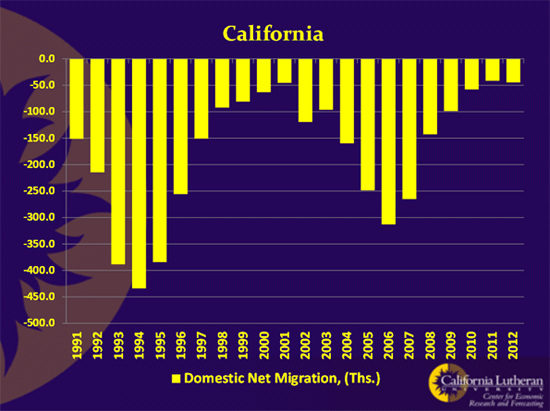
    • According to the U.S. Census, domestic migration (migration between California and other states) has been negative for 20 consecutive years. That is, for 20 years more people have left California for other states than have come to California from other states. Wake up, Jerry, this is no longer your Dad’s state – or that of his successor, Ronald Reagan. This is a big change from when Brown was elected governor the first time.  At that time, California was a magnet.  It had a vibrant economy, one with opportunity.  California was a place where you could have a career, afford a home, raise a family.  It was where the American Dream was realized.
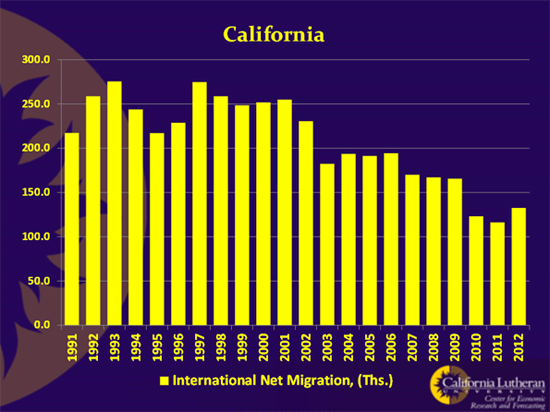
    • How about the magnetic attraction for immigrants from all over the world? According to the Census Bureau, international migration to California is way down.  The number of California international immigrants has been declining for a decade at least.  Indeed, in recent years there have been about half as many international immigrants to California than we saw in the 1990s.  Over the past decade, the number of foreign born increased more in Houston than the Bay Area and Los Angeles put together. Opportunity, not  “attractiveness”, drives people to move.
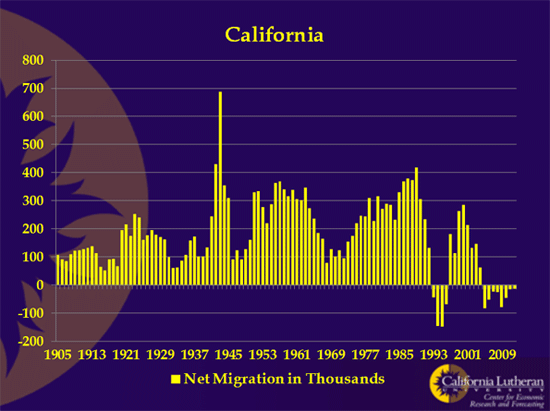
    • The result of negative domestic migration and falling international migration is the total migration to California has been negative in each of the past eight years.  More people have left California than have come to California for eight consecutive years. 
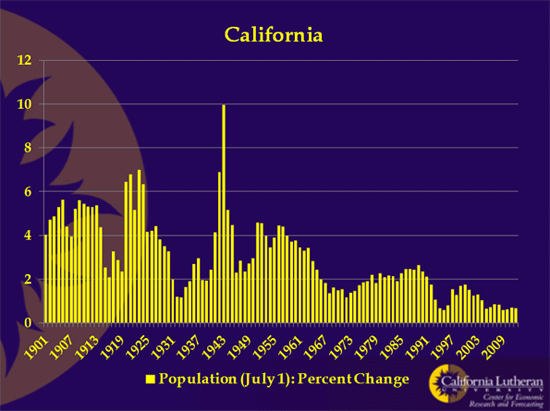
    • California’s migration trends combined with falling birth rates has resulted in the lowest sustained population growth rates that California has seen.

    The data are clear: Brown’s assertions have no basis in fact.  California – with the exception only recently of the Bay Area – is not a magnet. California is not "incredibly attractive and prosperous."  People are not coming from all over the world. California may beckon, but more are leaving, and those here are having fewer children. California’s seductive charms go only so far.

    I don’t know if I’d prefer that Brown was delusional or lying. On the one hand, policy made from a delusional analysis of the world is sure to be bad policy. Brown, for example, may convince himself that Twitter, Google, and Facebook are the future of the California economy, without recognizing how few people, particularly from the working class or historically disadvantaged minorities, they employ. On the other hand, Brown is very skilled in the political arts. If someone as skilled as he has to resort to such outright misdirection, we may be in worse shape than I think.

    Bill Watkins is a professor at California Lutheran University. and runs the Center for Economic Research and Forecasting, which can be found at clucerf.org.

    Jerry Brown photo by Bigstock.

  • The Dutch Rethink the Welfare State

    When the Netherlands’ newly coronated king made his first annual appearance before parliament, he turned some heads when he addressed the deficiencies of the Dutch welfare state.   “Due to social developments such as globalisation and an ageing population, our labour market and public services are no longer suited to the demands of the times”, the king said in a speech written by Liberal prime minister Mark Ruttes cabinet. “The classical welfare state is slowly but surely evolving into a ‘participation society’”, Willem-Alexander continued. By this he meant that the public systems should start encouraging self-reliance over government dependency.

    It is worthwhile to reflect on the challenges faced by the Dutch welfare system. In a knowledge based economy, influenced by strong global competition and dynamic economic development, public policy must encourage thrift, education and build-up of social capital. Discouragingly high taxes and encouragingly high benefits are no way of doing so. Such policies are therefore likely to become even greater obstacles to social and economic development as they are today.

    Concern over the welfare state is not new in the Netherlands. 

    During the beginning of the 1980s the Netherlands ranked as a top spender in terms of welfare policy. Whilst the US and the UK allocated some 22 and 27 percent respectively of GDP to welfare spending, the Netherlands spent fully 40 percent – the same level as the famously generous Swedish public system.  But since then the pattern has been to reduce the welfare state. Indeed as most OECD-countries public spending rose significantly from the 1980s a  report from the OECD notes that the Netherlands, alongside Ireland, gradually scaled theirs down. A combination of economic growth, tightening of welfare state generosity and privatization of sick-pay led to a decline in public social spending in these two countries. In 1980 public social spending was 25 percent of GDP in the Netherlands, much higher than the OECD-average of 16 percent.

    In the beginning of the 2000s the average OECD-country had expanded its welfare state, so that public social expenditure had reached 21 percent of GDP – whilst the Netherlands had reduced its share to the same level. According to another study, benefit expenditure was reduced from 27 to 22 percent of GDP in the Netherland between 1980 and 2001, compared to the EU15 average which rose from 21 to 24 percent during the same period.

    Although the Netherlands does not lie in Scandinavia, there are significant similarities between this advanced European nation and the Nordic countries. The similarities go beyond the fact that the Dutch are tall and blond, and live in a small trade-dependent nation. Shared cultural traits and political beliefs can explain why the Dutch adapted similar welfare policies as the Nordic nations. Similarly to as in Denmark and Sweden, the Netherlands has with time reformed its system, for example by introducing legislation which increases employer’s responsibility for the provision of sickness benefits. In some ways the Dutch have been even keener to reform than the Nordic countries.

    Privatisation of social security and a shift from welfare to workfare have been coupled with the introduction of elaborate markets in the provision of health care and social protection. Not only other European welfare states, but in some regards even the US, can learn much from the Dutch policies of combining a universally compulsory Social health insurance scheme with market mechanisms. Netherlands has, similarly to Denmark, moved towards a “flexicurity” system where labour market regulations have been significantly liberalized within the frame of the welfare system. Taxes in the country peaked at 46 percent of GDP in the late 1980s, but have since fallen to ca. 38-39 percent. The Netherlands has moved from being a country with a large to a medium-sized welfare system, something that still cannot yet be said about culturally and politically similar Sweden and Denmark. The Dutch seem to have been earlier than their Nordic cousins in realizing that overly generous welfare systems and high taxes led to not only sluggish economic growth, but also exclusion of large groups from the labour market. 

    Societal challenges are not difficult to find in the Netherlands, at least not if we look at the difficulty to integrate foreign-born individuals and those with low skills. These problems are shared with other European welfare models, not least the Scandinavian ones. However, the Netherlands overall continues to rank highly  in terms of societal measures such as good school results, high life expectancy, strong civic participation and high life satisfaction. Reforming the welfare state to a smaller size, and introducing more market mechanism within the system, have clearly not lead to a social disaster as some would like to believe.

    The Dutch continue to support the welfare society. This does however not mean supporting an overly generous “cradle to grave” system, with demands that everybody have similar living standard regardless of their individual achievements. As shown in the book “Contested Welfare States: Welfare Attitudes in Europe and Beyond”, Netherlands ranks at second place, following closely after Switzerland, in having the most limited support for the idea that government should be responsible for peoples’ life prospects. A likely reason is that whilst the Dutch are in favor of welfare policies in general, they believe in fostering individual responsibility within the system. The “participation society” that the Dutch king recently spoke about has thus already gained ground.

    There is a strong case to be made that the Dutch can benefit in going further in reducing the size of the state, introducing market reforms and liberalizing the labour market. Such changes would indeed be in line with OECD recommendation. Recently even the IMF recommended the nation to continue structural reforms to enhance growth potential. In addition, considerable savings seem to be possible in the Dutch welfare state, in areas such as health care and education. Luckily, the country can rely on previous positive experience with reforms.

    There is a good chance that the Netherlands will continue on a long-term route towards smaller government and greater prosperity. This does not mean abandoning the idea of public welfare for its citizens but focusing more on enabling people to take care of themselves. The positive experience of past changes, coupled with the realization that change is needed, can catalyze change. If change indeed happens, it will likely not occur over-night. Continuous small steps towards change are more likely. The direction of European nations such as the Netherlands might not excite a US audience, but perhaps there is a lesson to be learned about the value of pragmatic and steady reforms? 

    Dr. Nima Sanandaji has written several books and reports in Sweden, Finland and the UK about subjects such as urban development, entrepreneurship and women’s career opportunities.

  • New Report: Enterprising Cities – A Force for American Prosperity

    The inaugural edition of Enterprising Cities: A Force for Prosperity that was recently released examines best practices in municipalities taking proactive measures to support job creation and economic growth together with the private sector. The U.S. Chamber of Commerce Foundation’s Enterprising States and Cities program takes an in-depth look at the policies and programs being implemented to promote economic growth at the state and local levels.

    The cities highlighted in the Enterprising Cities report—Dayton, OH, Irving, TX, Memphis, TN, Minneapolis, MN, Salt Lake City, UT, San Antonio, TX, Sioux Falls, SD—each, in their own unique way, are examples of how enterprise-friendly leadership, strategies, and partnerships can be put into action to achieve meaningful results.

    Cities, both large and small, play a pivotal role as drivers of America’s economy by creating and sustaining the local ecosystem for innovation, competitiveness, and productivity through enterprise-friendly policies that create jobs, enhance economic development, and build prosperity. Pragmatic leaders at the city level can often take on the issues that Washington will not, or cannot, solve. Enterprise-friendly policies at the city level can indeed facilitate local economic growth by supporting entrepreneurs and mobilizing effective partnerships for improving the conditions for business and job growth. Working together with businesses, city leaders can bolster expansion into national markets and exports to reach global markets.

    City policies and practices that will help strengthen our free enterprise system—the system that has served as the foundation of America’s prosperity and the only system capable of creating the jobs we need for the long haul—are those that do the following:

    • Allow businesses to grow and thrive.
    • Free businesses from excessive taxes, unnecessary regulations, and onerous local government processes.
    • Focus government on the critical tasks that are the foundation of economic opportunity, such as infrastructure and protective services.
    • Help educate, cultivate, and equip the next generation of young entrepreneurs and the workforce of the future.

    Enterprising cities use policy inputs, well-designed community programs, and economic development best practices to create an environment where free enterprise creates jobs and prosperity. Economic prosperity creates fiscally sustainable local governments capable of supporting the infrastructure and workforce that free enterprise needs. 

    Is your city an enterprising city? The 2013 Enterprising Cities were selected based upon their approach to local governance, fiscal management, and program deployment. You can use the criteria upon which these seven cities were selected to assess your own city. 

    • Explicit involvement of the local business community, citizens, and local education institutions.
    • A sound approach to fiscal management and the deployment of government services, often based upon private sector best practices.
    • Strong leadership, communication, and cooperation from the mayor, chamber of commerce, or other civic entities.
    • A focus on metrics to measure outcomes.
    • Open communication between local residents and city leaders, and strong city response to citizen input.
    • Evidence of a plan of action or community strategy carried out by multiple public and private partners.
    • Recognition that local business activity drives the economy, providing the fiscal stability that allows local governments to focus on the safety, education, and infrastructure that the private sector needs to thrive.   

    Praxis Strategy Group is an economic research, policy, strategy and development company.  Praxis and its partner Joel Kotkin conducted the Enterprising Cities study and the four annual Enterprising States studies for the U.S. Chamber of Commerce Foundation.

  • Fixing California: The Green Gentry’s Class Warfare

    Historically, progressives were seen as partisans for the people, eager to help the working and middle classes achieve upward mobility even at expense of the ultrarich. But in California, and much of the country, progressivism has morphed into a political movement that, more often than not, effectively squelches the aspirations of the majority, in large part to serve the interests of the wealthiest.

    Primarily, this modern-day program of class warfare is carried out under the banner of green politics. The environmental movement has always been primarily dominated by the wealthy, and overwhelmingly white, donors and activists. But in the past, early progressives focused on such useful things as public parks and open space that enhance the lives of the middle and working classes. Today, green politics seem to be focused primarily on making life worse for these same people.

    In this sense, today’s green progressives, notes historian Fred Siegel, are most akin to late 19th century Tory radicals such as William Wordsworth, William Morris and John Ruskin, who objected to the ecological devastation of modern capitalism, and sought to preserve the glories of the British countryside. In the process, they also opposed the “leveling” effects of a market economy that sometimes allowed the less-educated, less well-bred to supplant the old aristocracies with their supposedly more enlightened tastes.

    The green gentry today often refer not to sentiment but science — notably climate change — to advance their agenda. But their effect on the lower orders is much the same. Particularly damaging are steps to impose mandates for renewable energy that have made electricity prices in California among the highest in the nation and others that make building the single-family housing preferred by most Californians either impossible or, anywhere remotely close to the coast, absurdly expensive.

    The gentry, of course, care little about artificially inflated housing prices in large part because they already own theirs — often the very large type they wish to curtail. But the story is less sanguine for minorities and the poor, who now must compete for space with middle-class families traditionally able to buy homes. Renters are particularly hard hit; according to one recent study, 39 percent of working households in the Los Angeles metropolitan area spend more than half their income on housing, as do 35 percent in the San Francisco metro area — well above the national rate of 24 percent.

    Similarly, high energy prices may not be much of a problem for the affluent gentry most heavily concentrated along the coast, where a temperate climate reduces the need for air-conditioning. In contrast, most working- and middle-class Californians who live further inland, where summers can often be extremely hot, and often dread their monthly energy bills.

    The gentry are also spared the consequences of policies that hit activities — manufacturing, logistics, agriculture, oil and gas — most directly impacted by higher energy prices. People with inherited money or Stanford degrees have not suffered much because since 2001 the state has created roughly half the number of mid-skilled jobs — those that generally require two years of training after high-school — as quickly as the national average and one-tenth as fast as similar jobs in archrival Texas.

    In the past, greens and industry battled over such matters, which led often to reasonable compromises preserving our valuable natural resources while allowing for broad-based economic expansion. During good economic times, the regulatory vise tended to tighten, as people worried more about the quality of their environment and less about jobs. But when things got tough — as in the early 1990s — efforts were made to loosen up in order to produce desperately needed economic growth.

    But in today’s gentry-dominated era, traditional industries are increasingly outspent and out maneuvered by the gentry and their allies. Even amid tough times in much of the state since the 2007 recession — we are still down nearly a half-million jobs — the gentry, and their allies, have been able to tighten regulations. Attempts even by Gov. Jerry Brown to reform the California Environmental Quality Act have floundered due in part to fierce gentry and green opposition.

    The green gentry’s power has been enhanced by changes in the state’s legendary tech sector. Traditional tech firms — manufacturers such as Intel and Hewlett-Packard — shared common concerns about infrastructure and energy costs with other industries. But today tech manufacturing has shrunk, and much of the action in the tech world has shifted away from building things, dependent on energy, to software-dominated social media, whose primary profits increasingly stem from selling off the private information of users. Servers critical to these operations — the one potential energy drain — can easily be placed in Utah, Oregon or Washington where energy costs are far lower.

    Even more critical, billionaires such as Google’s Eric Schmidt, hedge fund manager Thomas Steyer and venture firms like Kleiner Perkins have developed an economic stake in “green” energy policies. These interests have sought out cozy deals on renewable energy ventures dependent on regulations mandating their use and guaranteeing their prices.

    Most of these gentry no doubt think what they are doing is noble. Few concern themselves with the impact these policies have on more traditional industries, and the large numbers of working- and middle-class people dependent on them. Like their Tory predecessors, they are blithely unconcerned about the role these policies are playing in accelerating California’s devolution into an ever more feudal society, divided between the ultrarich and a rapidly shrinking middle class.

    Ironically, the biggest losers in this shift are the very ethnic minorities who also constitute a reliable voter block for Democratic greens. Even amid the current Silicon Valley boom, incomes for local Hispanics and African-Americans, who together account for one-third of the population, have actually declined — 18 percent for blacks and 5 percent for Latinos between 2009 and 2011, prompting one local booster to admit that “Silicon Valley is two valleys. There is a valley of haves, and a valley of have-nots.”

    Sadly, the opposition to these policies is very weak. The California Chamber of Commerce is a fading force and the state Republican Party has degenerated into a political rump. Business Democrats, tied to the traditional industrial and agricultural base, have become nearly extinct, as the social media oligarchs and other parts of the green gentry, along with the public employee lobby, increasingly dominate the party of the people. Some recent efforts to tighten the regulatory knot in Sacramento have been resisted, helped by the governor and assisted by the GOP, but the basic rule-making structure remains, and the government apparat remains highly committed to an ever more expansive planning regime.

    Due to the rise of the green gentry, California is becoming divided between a largely white and Asian affluent coast, and a rapidly proletarianized, heavily Hispanic and African-American interior. Palo Alto and Malibu may thrive under the current green regime, and feel good about themselves in the process, but south Los Angeles, Oakland, Fresno and the Inland Empire are threatened with becoming vast favelas.

    This may constitute an ideal green future — with lower emissions, population growth and family formation — for whose wealth and privilege allow them to place a bigger priority on nature than humanity. But it also means the effective end of the California dream that brought multitudes to our state, but who now may have to choose between permanent serfdom or leaving for less ideal, but more promising, pastures.

    Joel Kotkin is executive editor of NewGeography.com and Distinguished Presidential Fellow in Urban Futures at Chapman University, and a member of the editorial board of the Orange County Register. He is author of The City: A Global History and The Next Hundred Million: America in 2050. His most recent study, The Rise of Postfamilialism, has been widely discussed and distributed internationally. He lives in Los Angeles, CA.
    This piece originally appeared at U-T San Diego.


  • Bridges Boondoggle, Portland Edition

    A couple weeks ago I outlined how the Ohio River Bridges Project in Louisville had gone from tragedy to farce. Basically none of the traffic assumptions from the Environmental Impact Statements that got the project approved are true anymore. According to the investment grade toll study recently performed to set toll rates and sell bonds, total cross river traffic will be 78,000 cars (21.5%) less than projected in the original FEIS. What’s more, tolls badly distort the distribution of traffic that will come such that the I-65 downtown bridge, which is being doubled in capacity, will never carry just what the existing bridge carries right now anytime during the study period, and won’t exceed the design capacity even slightly until 2050. Meanwhile, the I-64 bridge that will remain free will grow in traffic by 55% by 2030, when it will be 34% over capacity.

    A nearly identical scenario is playing out in Portland with the $2.75 billion I-5 Columbia River Crossing. Joe Cortright of Impresa consulting unearthed the information through freedom of information requests looking into the investment grade toll study on that is being conducted for that bridge. You can see his report here (there’s also a summary available).

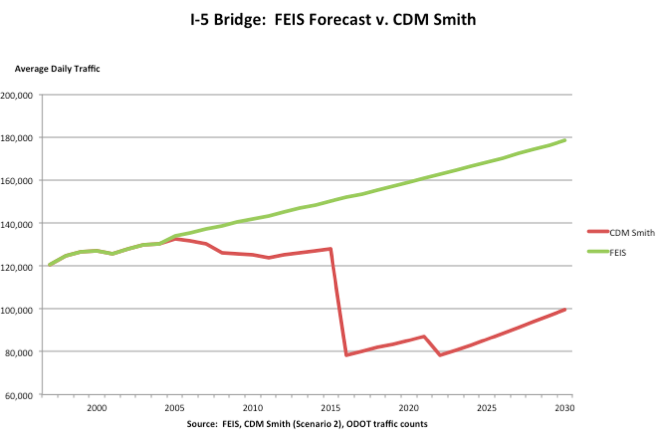
    I’ll highlight some of his truly eye-popping findings. Traffic forecasts are inflated, of course. The toll study is suggesting traffic increases of 1.1% to 1.2% per year when over the last decade traffic has actually declined by 0.2% per year on average even though there are no tolls. But it’s the addition of tolls that badly distort cross-river traffic and make a mockery out of the EIS. Here’s the money chart for the I-5 bridge itself:


    How is it possible that after building a gigantic multi-billion dollar bridge traffic declines? For the same reason as Louisville: tolling will cause huge amounts of traffic to divert to the I-205 free bridge. By 2016 traffic on I-205 would rise from 140,000 per day to 188,000 – and up to 210,000 by 2022 (full capacity).

    This is so eerily similar to the Louisville situation, that someone suggested, only half in jest I suspect, that they must be having “how to” training sessions on this stuff over at AASHTO HQ.

    Unlike Louisville, where a docile press is basically in cahoots with the state DOTs pushing the project, Portland’s media started asking questions. And one local paper even caught a civil engineering professor from Georgia serving on the independent review board for the project labeling the tolling scheme “stupid.” (Louisvillians take note).

    Oregon DOT director Matt Garrett released a letter in response in which he says, “This work is fundamentally different than the traffic analysis completed for the Final Environmental Impact Statement, and with very different goals in mind.” I agree. The FEIS was performed with the goal of getting this bridge the DOT wanted built approved. The toll study was designed to withstand financial scrutiny on Wall Street and be relied on in selling securities. I’ll let you be the judge of which is more likely to be closer to the truth. What’s more, Cortright addresses this very issue by saying in his report, “Neither federal highway regulations nor federal environmental regulations authorize or direct using multiple, conflicting forecasts for a single project, or using one set of traffic numbers for one purpose, and a different set for another.” I might also add that the DOTs in Louisville have not to the best of my knowledge made similar claims to explain away an identical discrepancy there. Nevertheless, the rest of Garrett’s letter acknowledges that I-5 will see a big traffic drop and there will be diversion from tolling. So he appears to just be doing the bureaucratic equivalent of “pay no attention to that man behind the curtain.”

    Again, want to know how it is that we spend so much money on transport infrastructure and get so little value? It’s because far too many of our highway dollars go into boondoggle mega-projects ginned up through political pressure (watch this space as I have another example coming soon) instead of into projects that make transportation sense. It may well be that there are legitimate problems with the existing I-5 river crossing, but these numbers give no confidence that the Oregon DOT has come up with a good or cost-effective plan for dealing with them. Unlike some, I do think we need to build more roads in America. Unfortunately our system is set up to ensure the survival of the unfittest instead of projects that make actual transportation and economic sense.

    Aaron M. Renn is an independent writer on urban affairs and the founder of Telestrian, a data analysis and mapping tool. He writes at The Urbanophile, where this piece originally appeared.

    Photo of current Columbia River crossing by Jonathan Caves.