Category: Politics

  • The Mad Drive to Subvert Democracy in Toronto

    Let me stipulate that I think Toronto’s Rob Ford is a terrible mayor. In fact, while I might not go so far as Richard Florida, who labeled Ford “the worst mayor in the modern history of cities, an avatar for all that is small-bore and destructive of the urban fabric, and the most anti-urban mayor ever to preside over a big city,” I’m willing to say he’s probably in the running for the title.

    The roots of Rob Ford lie in “amalgamation,” the forcible merging of the city of Toronto government with various of its suburbs by the Ontario provincial government. The idea was cost savings, but of course costs went up. Also, it created a Mars-Venus situation that ultimately led to Ford, a former city councilor in Etobicoke, being elected mayor. This would be like a consolidation of Chicago with Cook County in which a member of the Schaumburg city council ended up mayor. Not good. The urban intelligentsia that despises Ford now find themselves in the embarrassing position of having to explain to their friends that they are in total agreement with Wendell Cox, an implacable foe of government consolidations, who predicted these results.

    But there’s a big difference between Florida’s bashing of Ford, which falls within the principles of democratic discourse as we’ve come to know it, and what appears to be an effort by some to subvert democracy by finding any pretext to run Rob Ford out of office.

    I’m not sure where the idea that the loser in an election tries to undermine the legitimacy of the government of the winner came from. But in the modern era it could be the Republican impeachment of Bill Clinton that launched it. This quickly proved to be standard fare. There was the brouhaha over the “selected not elected” George W. Bush as well as the more passionate strain of “birthers” when it comes to President Obama. Given that, especially in the big leagues, there is always some dirtiness in politics, it’s easy to find things to seize upon to claim someone’s holding of an office is invalid. After all, it appears that Clinton really did commit perjury and there was shall we say some murkiness down in Florida. However, these aren’t truly what the people raising a ruckus cared about. What they cared about was the man in office they didn’t like – and getting him out of it.

    Canada has a reputation as a kinder, gentler nation, but they now appear to have imported from America what Clinton labeled “the politics of personal destruction.” Rob Ford has been the target of a series of vicious attacks, generally aided and abetted (if not outright instigated) by the old city Toronto media that clearly don’t like him, designed to drive him out of office.

    One was a lawsuit that claimed he should be tossed out of office because of events related to his using official letterhead and such to raise $3,500 for a charity. Believe it or not, the trial judge actually agreed with this and ordered him removed from office. If that’s the threshold for getting someone kicked out of office, I dare say every major politician in America would be gone. Yes, politicians do often use affiliated charities as a, shall we say, lubricating mechanism. Yes, there’s the appearance or even the reality of some impropriety in these things. But this is such small fry stuff that to throw the mayor of the biggest city in the country out of office over it defies belief. If you think this is removal worthy, I’m confident I can find something just as bad in almost any politician that you actually like. Fortunately, saner heads at the appeals level prevailed and the ruling was overturned.

    Recently we’ve also seen reports originating from, I kid you not, Gawker, in which some shady Somalis supposedly showed a reporter a cell phone video of Rob Ford smoking crack. Shortly thereafter the Toronto Star got in on the act, saying their reporters had seen the video in the back seat of the car, though with the CYA proviso that they had “no way to verify the authenticity of the video.” Other media that may not have directly originated such a story have piled on and thus there’s a firestorm awhirl.

    Where is the video, you might ask? Good question. Supposedly it’s for sale for $200K but oddly no one snapped it up, not even one of the extremely wealthy Ford haters that Toronto has in abundance. So you want to buy it? Oh, Gawker now tell us it might be “gone.” Hmmm…..

    I’m not saying there’s no video. Rob Ford has certainly acted like he’s guilty of something. But it seems amazing to me that in this era in which all types of tapes and documents spontaneously get loose, this one is no where to be found. Also, the idea of the mayor of Toronto smoking crack with a bunch of Somalis while they film him falls into the “extraordinary claims require extraordinary proof” category. The still photo is interesting, but I’ve seen many compromising photos of mayors, who are routinely snapped with all sorts of random people who they may find out later are unsavory characters. I can’t imagine this sort of media feeding frenzy over say, similar allegations against Michael Bloomberg or Rahm Emanuel.

    The Toronto Globe and Mail is a serious newspaper that’s roughly Canada’s New York Times. Though they didn’t break the video story, they did follow-up with a rather tabloidesque article about the history of Rob Ford’s family with drugs. Ford’s brother Doug, the focus of the piece, is on the city council himself, so is a legitimate investigative target so to speak, but the piece also digs into other family members.

    Not only is the Globe and Mail digging up dirt on Rob Ford’s family, this piece did it entirely with anonymous sources. They claimed to talk to no fewer than ten people who called Doug Ford a drug-dealer, but curiously none of them were willing to talk on the record. That didn’t stop the Globe and Mail from reporting:

    Ten people who grew up with Doug Ford – a group that includes two former hashish suppliers, three street-level drug dealers and a number of casual users of hash – have described in a series of interviews how for several years Mr. Ford was a go-to dealer of hash. These sources had varying degrees of knowledge of his activities: Some said they purchased hash directly from him, some said they supplied him, while others said they observed him handling large quantities of the drug.

    The events they described took place years ago, but as mayor, Rob Ford has surrounded himself with people from his past. Most recently he hired someone for his office whose long history with the Fords, the sources said, includes selling hashish with the mayor’s brother.

    There’s nothing on the public record that The Globe has accessed that shows Doug Ford has ever been criminally charged for illegal drug possession or trafficking. But some of the sources said that, in the affluent pocket of Etobicoke where the Fords grew up, he was someone who sold not only to users and street-level dealers, but to dealers one rung higher than those on the street. His tenure as a dealer, many of the sources say, lasted about seven years until 1986, the year he turned 22. “That was his heyday,” said “Robert,” one of the former drug dealers who agreed to an interview on the condition he not be identified by name.

    Upon being approached, the sources declined to speak if identified, saying they feared the consequences of outing themselves as former users and sellers of illegal drugs.

    The Globe also tried to contact retired police officers who investigated drugs in the area at the time. One said he had no recollection of encountering the Fords.

    The article is full of innuendo about the Ford’s such as the idea that Rob Ford recently hired a drug dealing associate of Doug’s from the old days (highlighted above), along with curious mentions and links to beatings, killings, and white supremacy/KKK. (Rob Ford is a white supremacist who likes to smoke crack with Somalis???) It’s capped off by having various anonymous sources given pseudonyms so that they appear to be actual people on the record. As this excerpt notes, the police record and police contacts don’t back up the story, which just adds to the general notion of dubiosity and suggests this is a very exaggerated piece that tries to throw things to the wall to see what sticks.

    All it all, given the extreme reactions to financial dealings that, even if they were proven, would have been a non-issue almost anywhere else, along with a firestorm of allegations about smoking crack and so much more with no actual proof, the Rob Ford affair has thus far generated much more smoke than fire.

    Rob Ford is the price Toronto is paying for the foolishness of the provincial government and the failure of an urban candidate to offer a compelling vision for the entire amalgamated city. But it strikes me very much that a group of old Toronto city partisans, who are incensed a guy like Ford had the temerity to win an election, are determined to use any means necessary to correct what they see is that injustice. But just as with what happened in America and its politics in the wake of the Clinton impeachment, Canada may come to rue the day a group of its citizens decided to try to overturn an election by destroying the winner rather than waiting for their next opportunity at the ballot box.

    Aaron M. Renn is an independent writer on urban affairs and the founder of Telestrian, a data analysis and mapping tool. He writes at The Urbanophile, where this piece originally appeared.

    Photo by Wiki Commons user MTLskyline.
  • Market Surge Confirms Preference for Homeowning

    Ever since the housing bubble burst in 2007, retro-urbanists, such as Richard Florida, have taken aim at homeownership itself, and its “long-privileged place” at the center of the U.S. economy. If anything, he suggested, the government would be better off encouraging “renting, not buying.”

    Similar thinking has gained currency with some high-rise (or multi-unit) builders, speculators and Wall Street financiers, who would profit by keeping Americans permanent renters, with encouragement from former Morgan Stanley financial analyst Oliver Chang, who predicted we were headed toward a “rentership society.”

    Some support comes from research suggesting that higher ownership rates actually create unemployment. A study by the proausterity Peterson Institute for International Economics, cited recently both by Florida and the New York Times’ Floyd Norris, lays out an econometric case against homeownership.

    The authors justified their findings by pointing to larger unemployment-rate changes from 1950-2010 in states, mostly in the South, such as Alabama, Georgia, Mississippi, South Carolina and West Virginia, compared with California, North Dakota, Oregon, Washington and Wisconsin. They then noted that, in the states with the larger unemployment rate increases, homeownership had increased more. Hence, the connection between higher homeownership and higher unemployment rates.

    This analysis is staggeringly ahistorical. It fails to correct for the massive labor market changes that have occurred in the Southern states, as the agricultural and domestic employment common in 1950 has largely disappeared. The analysis begins with a year in which three of the states cited to prove that lower homeownership is associated with lower unemployment had unusually high unemployment in 1950 (California was No. 1, Oregon, No. 4, and Washington, No. 6); unemployment in these three West Coast states averaged nearly double that of the Southern examples.

    Another ahistorical implication is that that the South experienced a huge increase in homeownership since 1950, as economically disadvantaged African-Americans began to buy their residences. An analysis by demographer Wendell Cox indicates that, even as labor markets were being radically altered, per capita incomes in relatively underdeveloped Alabama, Georgia, Mississippi, South Carolina and West Virginia rose during 1950-2010 at more than double the rate experienced in California, North Dakota, Oregon, Washington and Wisconsin (more than 140 percent, adjusted for inflation, compared with approximately 65 percent).

    The Peterson thesis is also undermined by a close examination of county homeownership and unemployment rates, which finds, generally, that large counties with higher rates of homeownership have lower unemployment rates. For example, among the nation’s approximately 260 counties with more than 250,000 residents, those with homeownership rates above 70 percent have average unemployment rates of 8.1 percent. Among the counties with homeownership rates below 50 percent, unemployment rates average 9.6 percent. This is exactly the opposite relationship that would be expected from the Peterson Institute research.

    Finally, many large urban counties with the lowest homeownership rates – Los Angeles, Kings County (Brooklyn), New York County (Manhattan), Queens, Cook County (Chicago) and Philadelphia – also suffer well-above-average levels of unemployment and high levels of poverty. In contrast, suburban counties with high homeownership rates, like Nassau County, N.Y., Chester County (in the Philadelphia area), or Fairfax County, Va., boast considerably lower unemployment than their urban neighbors, and higher per-capita incomes. Most of the cities with the highest ownership rates, like Fort Worth and Austin, Texas, Indianapolis, Denver and Columbus, Ohio, all did very well in the most recent Forbes “Best Cities for Jobs” study.

    It is also alleged that countries with high ownership rates do worse than those with lower ones. And to be sure, troubled countries like Portugal and Spain have high levels of homeownership, while Germany, Sweden and Denmark have somewhat lower ones. Yet, many successful countries – Taiwan, Singapore, Norway, Australia, Canada and Israel – actually do quite well with higher ownership rates than in America.

    Dream that refuses to die.

    From a historic perspective, the present U.S. homeownership rate, 65.4 percent, does not represent a structural decline from the middle 2000s, as is often argued, but remains consistent with the virtual equilibrium achieved over the past half century. As recently as 1940, only 40 percent of Americans owned their homes, a share that reached 60 percent by 1960s. Since then, it has remained fairly stable. The modest decline from the middle 2000s was from an artificially high level that resulted from the virtual suspension of mortgage credit standards – egged on by Wall Street and government agencies – which was followed by a deep recession and a weak recovery.

    The housing bust changed the market, but not because of some fundamental shift in buyer preferences, as is sometimes alleged. Indeed, the recent spike in home sales confirms that Americans continue to aspire to homeownership. Research at the Woodrow Wilson Center indicated that 91 percent of respondents identified it as essential to the American Dream, and most favored steering government policy to spur homeownership.

    Much has been written about how the under-30 population is either living at home or cannot buy a house. Yet, surveys by generational chroniclers Morley Winograd and Mike Hais found that a full 82 percent of adult millennials surveyed said it was “important” to own their own home, which rose to 90 percent among married millennials. Another survey, this one by TD Bank, found that 84 percent of renters ages 18-34 intend to purchase a home in the future.

    Homeownership achieves almost cultish status among immigrants, who account for some 40 percent of all new owner households over the past decade. Among Asians who entered the country before 1974, a remarkable 81 percent own their home, while Latino homeownership is projected to rise to 61 percent by 2020.

    Societal advantages of owning

    Critics of homeownership often point out that renters have far more flexibility to move; that’s true and important particularly for people in their 20s. But, as people age, get married and, especially, have children, they seek to become involved in their communities on a more permanent basis. Pundits and economists often fail to recognize that people are more than simply profit-maximization machines ready to cross the country for an income increase of a few thousand dollars; they also seek out friends, stable neighbors, familial comfort, community and privacy.

    Homeowners reap the financial gains of any appreciation in the value of their property, so they tend to spend more time and money maintaining their residence, which also contributes to the overall quality of the surrounding community. The right to pass property to an heir or to another person also provides motivation for proper maintenance.

    Given their stake, homeowners participate in elections much more frequently than renters. One study found that 77 percent of homeowners had, at some point, voted in local elections, compared with 52 percent of renters. The study also found a greater awareness of the political process among homeowners. About 38 percent of homeowners knew the name of their local school board representative, compared with 20 percent of renters. The study also showed a higher incidence of church attendance among homeowners.

    People who own their homes also tend to volunteer more in their community, notes the National Association of Realtors. This applies to the owners of both expensive and modest properties. One 2011 Georgetown study suggests that homeownership increases volunteering hours by 22 percent.

    Perhaps the largest social benefits relate to children. Owners remain in their homes longer than do renters, providing a degree of stability valuable for children. Research published by Habitat for Humanity identifies a number of other advantages for children associated with homeownership versus renting, ranging from higher academic achievement, fewer behavioral problems and lower incidence of teenage pregnancy.

    ‘A share in their land’

    Even before the American Revolution, the notion of ownership, usually of a farmstead, was a critical lure. Even after the yeoman utopia of the early 19th century faded, Americans continued to yearn for their own homes, something that led them in two great waves, first in the 1920s and again in the 1950s and 1960s, to the suburban periphery.

    In contrast to today’s progressives, many traditional liberals embraced the old American ideal of dispersed land ownership. “A nation of homeowners,” President Franklin D. Roosevelt believed, “of people who own a real share in their land, is unconquerable.”

    Legislation under Roosevelt and successor presidents supported this ideal. More than a response to the market, governments embraced homeownership as a positive societal and economic good for the majority of Americans. This policy – brilliantly exploited by entrepreneurs – worked for both people and the economy. Almost half of suburban housing, notes historian Alan Wolfe, depended on some form of federal financing.

    Road to serfdom?

    The suggestion that we need to abandon what the New York Times denounces as the “dogma on owning a home” has grown deeply entrenched among retro-urbanists. Rather than facilitate the broad dispersion of property ownership across economic classes, the new orthodoxy suggests we would be better off as a nation of renters, living cheek-to-jowl in apartments. This works to the advantage of the Wall Streeters and other investors, who profit from our paying off their mortgages rather than our own. The assault on homeownership also pleases some advocates of austerity, such as Pete Peterson, who would like to eliminate the mortgage interest deduction as a way to raise revenue at the expense of the middle class.

    Turning against homeownership undermines the very promise of American life and the culture of independence critical to our identity as a people. Housing accounts for about two-thirds of a family’s wealth and the vast majority of the property owned by middle- and working-class households. The house represents for the middle class, devastated by the weak recovery, both a chance to make a long-term investment as well as a place to raise a family; a Wall Street portfolio, for all but the very affluent, who can afford the best advice, provides no reasonable alternative.

    We have to consider what kind society we wish to have. The nomadic model now in fashion suggests Americans should simply move from place to place, untethered to any one spot, seeking personal fulfillment and the best financial deal for themselves. Such a model fits with current planning dogma and facilitates a source of profit for some, but undermines the dispersion of property that can sustain our society, and our families, over the long run.

    Joel Kotkin is executive editor of NewGeography.com and a distinguished presidential fellow in urban futures at Chapman University, and a member of the editorial board of the Orange County Register. He is author of The City: A Global History and The Next Hundred Million: America in 2050. His most recent study, The Rise of Postfamilialism, has been widely discussed and distributed internationally. He lives in Los Angeles, CA.

    This piece originally appeared in the Orange County Register.

    Home illustration by Bigstock.
    Update: The Pete Peterson referred to here is not the Pete Peterson running for office in California.

  • Religious Freedom Lures Many to U.S. from Asia

    It’s been two decades since California Gov. Pete Wilson used grainy ads of undocumented immigrants – “They keep coming” – as an effective means of stoking fear of newcomers and assuring his re-election. Yet, increasingly America’s immigration realities are moving far beyond the mojado paradigm of the 1990s in ways that challenges the stereotypes of both conservatives and progressives.

    This discussion of the undocumented, and about the relative benefits of accepting millions of poor, often modestly educated newcomers, has sharply divided the Left and Right. But this often-polarized debate largely has missed the changing nature of immigration and its potential long-term impact on our national future.

    The biggest shift in immigration lies in primary motivation. Traditionally, most immigrants came primarily for economic reasons. Poor people in Mexican or Central American villages saw a better life in the United States and, unlikely to do so legally, chose to make the crossing, anyway. Legal immigrants from further away, including many with educations, such as from Asia, the Middle East and Africa, also came to reap financial opportunities that their still-developing economies could not provide.

    Today these economic motivations are losing their primacy, both for documented and undocumented workers. Many of the economies from which immigrants once fled – including Mexico, Korea, India, Taiwan and China – are now arguably doing better than the U.S. economy. A machinist from Monterrey, a technician from Taipei, or a biologist from Bangalore can find ample, and even greater, opportunities at home than here.

    Most important have been changes with Mexico, from where most undocumented immigrants have come. A survey from the Pew Hispanic Center notes that, during 2005-10, about 1.4 million Mexicans immigrated to the U.S. – exactly the same number of Mexican immigrants and their U.S.-born children who moved back, or were deported, home.

    This trend is likely to continue. Brighter economic prospects south of the border, a rapidly declining birth rate and lack of good jobs for the modestly skilled do much to explain the plunge in Mexican immigration. The “back to Mexico” numbers could even grow since many Mexicans immigrants here – roughly two-thirds of legal residents – have chosen not to become American citizens.

    ‘Lifestyle’ migration

    Now we see a shift both in the primary motivation and geography of immigration. Increasingly, immigrants are coming less out of economic distress and more as a result of what may be called “lifestyle” migration. This may be particularly applicable to the largest source of immigration, Asia. Opportunity, notes a recent Pew study, remains a key lure but freedom to express political views and a better environment to raise children was cited by more than three in five as reasons for coming here.

    Asia has become much richer in the past few decades, but many people find conditions there less than satisfactory. In a place like Beijing, Shanghai and Singapore, even the highest levels of wealth and “success” cannot buy you the comfort and privacy of single-family home. In China, even a billionaire can’t breathe clean air, drink the tap water or easily access quality public education.

    Recent immigrants to places like such as Irvine or Eastvale, a newly minted suburb just outside Ontario, California, will tell you that the “quality of life” here is simply unavailable in their home country, at virtually any price. This quality-of-life migration is particularly evident in California, where twice as many new immigrants now come from Asia than from Latin America. Even the New York Times admits they are not coming here to duplicate the high-density environment of Mumbai or Shanghai, but to indulge “the new suburban dream.”

    Religious freedom

    Of course, some immigrants still come for venerable reasons, such as the freedom to worship. Christians, who make up some 42 percent of Asian-Americans, face surveillance and repression, particularly, in China, where religion is tightly regulated, and dissent from the party line can land adherents in jail. Over half of Asian immigrants, Pew notes, cite freedom of religion as a key advantage of living in America. New faith-based migration could also be seen soon among Christians fleeing increasingly Islamic regimes in Egypt, Syria and other Middle Eastern countries.

    And then there’s the related issue of legality. In China, in particular, property ownership is never secure from state confiscation. This, in part, accounts for a rise in immigrant investors, not only to the United States but to such bastions of legality as Canada and Australia. Lack of faith in the long-term political stability is also driving a growing group of Chinese professionals to emigrate.

    “Chinese come from a country where it isn’t infrequent that government takes land for redevelopment with little concerns for the American notions of due process,” Realtor Tommy Bozarjian of Aslan Properties told Chapman University researcher Grace Kim. “Vietnamese come from a country where they had to gather what little they had into pillow cases and makeshift bags” before boarding helicopters and boats in efforts to escape the communist regime.

    Overall, this new immigration is far more promising than that portrayed in Pete Wilson’s grainy videos. An influx of young families, seeking to establish a better way of life for the children, represent something of an elixir for a sagging economy. Asians, the fastest-growing group, outperform other racial groups across a broad array of measurements, notably education and income.

    Higher entrepreneurship rates among immigrants are providing a bright spot in an otherwise-sagging start-up economy. The immigrant share of all new businesses, notes the Kauffman Foundation, more than doubled, from 13.4 percent in 1996 to 29.5 percent in 2010.

    But not all the positives pertain at the higher end. Clearly, the country will also need some lower-skilled workers, particularly in agriculture, who work in circumstances few Americans would embrace. More important still, immigrants may be necessary for addressing a looming shortage of skilled technicians, such as process engineers, machinists, mold-makers, which are, in part, a result of our still-neglected high school vocational training programs, trade schools and junior colleges.

    Less-in-demand jobs

    At the same time, there may be less need to encourage the migration of workers in hospitality, retail and other entry-level industries when many native-born and naturalized residents still struggle for employment. College graduates, in particular, are increasingly turning to these professions since the number of opportunities for all but the most credentialed, and gifted, seem rather limited. More than 43 percent of recent graduates now working, according to a recent report by the Heldrich Center for Workforce Development, are at jobs that don’t require a college education.

    This dynamic may even be applied to some higher-skilled professions. Silicon Valley executives, such as Facebook’s Mark Zuckerberg, insist we need to import large quantities of tech workers. He’s even backed a faux conservative group to push his agenda within the GOP. Yet, there is growing evidence, as recently revealed in a study by left-of-center Economic Policy Institute, that the country’s much-ballyhooed shortage of STEM (science-technology-engineering-mathematics-related) workers may be vastly exaggerated.

    If EPI’s analysis is accurate, importing vast numbers of young code-writers – what in the Silicon Valley has been sometimes referred to as “techno-coolies” – may result in lowering the price of labor and allow the Silicon Valley elite to not address issues such as inflated housing costs that keep older, American-born workers out of the Valley’s labor pool.

    These are the kind of issues Washington should focus on as politicians look to reshape our immigration laws. So, too, are policies that encourage the immigration of families likely to stay and put down roots long-term here in the United States. As an immigrant country, we do not want to duplicate the dependence on transitory workers associated with places like Dubai, Singapore and large parts of Europe.

    Overall, the newer wave of “lifestyle” immigrants seems a net plus, but legislators should take care to recognize that even the most obvious windfall could have negative unintended impacts on Americans and our economy. Rather than simply a politically motivated rush to judgment, or replaying the immigration wars of the past, we need to pay more attention to the emerging realities of this new wave and devise a policy that best serves the long-term interests of the nation in the decades ahead.

    Joel Kotkin is executive editor of NewGeography.com and a distinguished presidential fellow in urban futures at Chapman University, and a member of the editorial board of the Orange County Register. He is author of The City: A Global History and The Next Hundred Million: America in 2050. His most recent study, The Rise of Postfamilialism, has been widely discussed and distributed internationally. He lives in Los Angeles, CA.

    This piece originally appeared in the Orange County Register.

    Photo “asian american” by flicker user centinel.

  • America’s New Oligarchs—Fwd.us and Silicon Valley’s Shady 1 Percenters

    When Steve Jobs died in October 2011, crowds of mourners gathered outside of Apple stores, leaving impromptu memorials to the fallen businessman. Many in Occupy Wall Street, then in full bloom, stopped to mourn the .001 percenter worth $7 billion, who didn’t believe in charity and whose company had more cash in hand than the U.S. Treasury while doing everything in its power to avoid paying taxes.

    A new, and potentially dominant, ruling class is rising. Today’s tech moguls don’t employ many Americans, they don’t pay very much in taxes or tend to share much of their wealth, and they live in a separate world that few of us could ever hope to enter. But while spending millions bending the political process to pad their bottom lines, they’ve remained far more popular than past plutocrats, with 72 percent of Americans expressing positive feelings for the industry, compared to 30 percent for banking and 20 percent for oil and gas. 

    Outsource Manufacturing, Import Engineers

    Perversely, the small number of jobs—mostly clustered in Silicon Valley—created by tech companies has helped its moguls avoid public scrutiny. Google employs 50,000, Facebook 4,600, and Twitter less than 1,000 domestic workers. In contrast, GM employs 200,000, Ford 164,000, and Exxon over 100,000. Put another way, Google, with a market cap of $215 billion, is about five times larger than GM yet has just one fourth as many workers.

    This is an equation that defines inequality: more and more wealth concentrated in fewer hands and benefiting fewer workers.

    While Facebook and Twitter have little role in the material economy, Apple, which continues to collect the bulk of its profit from physical goods—computers, iPads, iPhones and so on—has outsourced nearly all of its manufacturing to foreign companies like Foxconn that employ workers, often in appalling conditions, in China and elsewhere. About 700,000 people work on Apple’s physical products for subcontractors, according to the New York Times, but almost none of them are in the U.S. “The jobs aren’t coming back,” Jobs bluntly told President Obama at a 2011 dinner in Silicon Valley.

    Not so much anti-union as post-union, the tech elite has avoided issues with labor by having so few laborers who could be organized. Andrew Carnegie and Henry Ford exploited workers in Pittsburgh and Detroit, and had to deal with the political consequences; the risks are much less if the exploited are in Chengdu and Guangzhou.

    “There doesn’t seem to be a role” for unions in this new economy, explained Internet entrepreneur and venture capitalist Marc Andreessen, because people are “marketing themselves and their skills.” He didn’t mention what people without skills in demand at tech companies might do.

    But Americans with those skills shouldn’t rest easy, either. These same companies are always looking to cut down their domestic labor costs. Mark Zuckerberg, in particular, is pouring money into a new advocacy group, Fwd.us, with a board consisting of big-name Valley luminaries, to push “comprehensive immigration reform” (read: letting Facebook bring in a cheaper labor force). In a remarkably cynical move, Fwd.us has separate left- and right-leaning subgroups to prod politicians across the political spectrum to sign on to the bill that would pad the company’s bottom line.

    Ostensibly, the increase in visas for high-skilled computer workers is a needed response to the critical shortage of such workers here—a notion that has been repeatedly dismissed, including in a recent report from the Obama-aligned Economic Policy Institute, which found that the country is producing 50 percent more IT professionals each year than are being employed in the field. The real appeal of the H1B visas for “guest workers”—who already take between a third and half of all new IT jobs in the States—is that they are usually paid less than their pricy American counterparts, and are less likely to jump ship since they need to remain employed to stay in the country. Facebook’s lobbyists, reports the Washington Post, have pressed lawmakers to remove a requirement from the bill that companies make a “good faith” effort to hire Americans first.

    The Valley of the Oligarchs

    Even as market caps rise, the number of Americans collecting any cut of that new wealth has scarcely moved. Since 2008, while IPOs have generated hundreds of billions of dollars of paper worth, Silicon Valley added just 30,000 new tech–related jobs—leaving the region with 40,000 fewer jobs than in 2001, when decades of rapid job growth came to an end.

    The good jobs that are being created are also heavily clustered in one region, the west side of the San Francisco peninsula—a distinct and geographically constrained zone of privilege. The area boasts both formidable technical talent and, more important still, roughly one third of the nation’s venture funds along with the world’s most sophisticated network of tech-savvy investment banks, publicists, and attorneys.

    But little of the Valley’s wealth reaches surrounding communities. Just across the bridge to the East Bay are high crime rates and an economy that’s lost about 60,000 jobs since 2001 with few signs of recovery. Inland, in the central Valley, double-digit unemployment is the norm and local governments are cutting police and other core services and even trying to declare bankruptcy.

    “We live in a bubble, and I don’t mean a tech bubble or a valuation bubble. I mean a bubble as in our own little world,” Google’s Schmidt boasted to the San Francisco Chroniclein 2011. “And what a world it is. Companies can’t hire people fast enough. Young people can work hard and make a fortune. Homes hold their value. Occupy Wall Street isn’t really something that comes up in a daily discussion, because their issues are not our daily reality.”

    Inside the bubble zone, centered around the bucolic university town of Palo Alto, employees at firms like Facebook and Google enjoy gourmet meals, child-care services, even complimentary house-cleaning. With all these largely male, well-paid geeks around, there’s even a burgeoning sex industry, with rates upwards of $500 an hour.

    Those at top of the tech elite live very well, occupying some of the most expensive and attractive real estate in the country. They travel in style: Google maintains a fleet of private jets at San Jose airport, making enough of a racket to become a nuisance to their working-class neighbors. They have even proposed an $85 million flight center, called Blue City Holdings, to manage airplanes belonging to Google’s founders, Larry Page and Sergey Brin, and its executive chairman, Eric Schmidt. Like the Russian oligarchs, currently making a run on Tuscany’s castles and resorts, the Valley elite have embraced conspicuous consumption, albeit dressed up in California casual. In San Francisco, San Mateo, and Santa Clara counties combined, luxury vehicles accounted for nearly 21 percent of new car registrations from April 2011 to March 2012, more than twice the national average. Home prices in places like Palo Alto and the fashionable precincts of San Francisco go for well over a million—and routinely trigger all-cash bidding wars.

    We’re the best thing happening in America,” one tech entrepreneur told the Los Angeles Times. Even a reporter for the New York Times, usually worshipful in its Valley coverage, described the spending as “obscene.” An industry party he attended included a 600-pound tiger in a cage and a monkey that posed for Instagram photos.

    But past the conspicuous consumption, the most outstanding characteristic of the new oligarchs may be how quickly they have made their fortunes—and how much of the vast wealth they’ve held on to, rather than paid out to shareholders or in taxes. Ten of the world’s 29 billionaires under 40 come from the tech sector, with four from Facebook and two from Google. The rest of the list is mostly inheritors and Russian oligarchs.

    Tech oligarchs control portions of their companies that would turn oilmen or auto executives green with envy. The largest single stockholder at Exxon, CEO and chairman Rex Tillerson, controls .04 percent of its stock. No direct shareholder owns as much as 1 percent of GM or Ford Motors. In contrast, Mark Zuckerberg’s 29.3 percent stake in Facebook is worth $9.8 billion. Sergey Brin, Larry Page and Eric Schmidt control roughly two thirds of the voting stock in Google. Brin and Page are worth over $20 billion each. Larry Ellison, the founder of Oracle and the third richest man in America, owns just under 23 percent of his company, worth $41 billion. Bill Gates, who’s semi-retired from Microsoft, is worth a cool $66 billion and still controls 7 percent of his firm. 

    The concentration of such vast wealth in so few hands mirrors the market dominance of some of the companies generating it. Google and Apple provide almost 90 percent of the operating systems for smart phones. Over half of Americans and Canadians and 60 percent of Europeans use Facebook. Those numbers dwarf the market share of the auto Big Five—GM, Ford, Chrysler, Toyota, and Honda—none of whom control much more than a fifth of the U.S. market. Even the oil-and-gas business, associated with oligopoly from the days of John Rockefeller, is more competitive; the world’s top 10 oil companies collectively account for just 40 percent of the world’s production.

    Greater Representation with Minimal Taxation

    Despite this vast wealth, and their newfound interest in lobbying Washington, the tech firms are notorious for paying as little as possible to the taxman. Facebook paid no taxes last year, while making a profit of over $1 billion. Apple, “a pioneer in tactics to avoid taxes,”has kept much of its cash hoard abroad, out of reach of Uncle Sam. Microsoft has staved off nearly $7 billion in tax payments since 2009 by using loopholes to shift profits offshore, according to a recent Senate panel report.

    And now, these 1 percenters—who invested heavily in Obama—are looking to help shape the “public good” in Washington and, as with Fwd.us, what they’re selling as good for us all is what aligns with their interests.

    There’s been a huge surge of Valley investment in Washington lobbying, not just on immigration but also on issues effecting national, industrial, and science policy. Facebook’s lobbying budget grew from $351,000 in all of 2010 to $2.45 million in just the first quarter of this year. Google spent a record $18 million last year. In the process, they have hired plenty of professional Washington parasites to make their case; exactly the kind of people Valley denizens used to demean.

    The oligarchs believe their control of the information network itself gives them a potential influence greater than more conventional lobbies. The prospectus for Fwd.usheaded up by one of Zuckerberg’s old Harvard roommates—suggests tech should become “one of the most powerful political forces,” noting “we control massive distribution channels, both as companies and individuals.”

    One traditional way the wealthy attain influence is purchasing their own news and media companies. Facebook billionaire and former Obama tech guru Chris Hughes (who owes his fortune to having been another of Zuckerberg’s college roommates) has already started on this road by buying the New Republic. (His husband, perhaps not incidentally, is running for the New York State Assembly.) Leaving old-media legacy purchases aside, Yahoo is now the most-read news site in the U.S., with over 100 million monthly viewers, and the Valleyites are also moving into the culture business with both Google-owned YouTube and Netflix getting into the entertainment-content business.

    Great wealth, and high status, particularly at a young age, often persuades people that they know best about the future and how we should all be governed. Twitter founder Jack Dorsey, a 37-year-old resident of San Francisco, recently announced on 60 Minutes that he’d like to be mayor—of New York, a city he’s never lived in.

    Expect more of this kind of hubris from the new oligarchs. Some cities, ranging from Seattle, where Amazon is leading the charge, to Las Vegas and even Detroit now are counting on tech giants to expand or restore their damaged central cores.

    But if those oligarchs do come, they will have little interest in retaining or expanding blue-collar jobs in construction or manufacturing, which they see as passé; the housing they build and even the public amenities they invest in will be for their own employees and other members of the “creative class.” The best the masses can hope for are jobs cutting hair, mowing grass, and painting the toenails of the oligarchs and their favored minions. You won’t see much emphasis, either, on basic skills training and community colleges, which are critical to auto manufacturers, oil refiners, and other older businesses and can provide opportunity for upward mobility for middle- and working-class youth.

    Yet these limitations will not circumscribe the ambitions of the new oligarchs, who see their triumph over cyberspace as a prelude to a power grab in the real world, a proposition they’ve tested over the last three presidential cycles. “Politics for me is the most obvious area [to be disrupted by the Web],” suggests former Facebook president and Napster founder Sean Parker.

    If You’re the Customer, You’re the Product

    Perhaps an even bigger danger stems from the ability of “the sovereigns of cyberspace” to collect and market our most intimate details. Moving beyond the construction of platforms for communication, the oligarchs trade on the value of the personal information of the individuals using their technology, with little regard for social expectations about privacy, or even laws meant to protect it. Google has already been caught bypassing Apple’s privacy controls on phones and computers, and handing the data over to advertisers. The Huffington Post has constructed a long list of the firm’s privacy violations. Apple is being hauled in front of the courts for its own alleged violations while Consumer Reports recently detailed Facebook’s pervasive privacy breaches—culling information from users as detailed as health conditions, details an insurer could use against you, when one is going out of town (convenient for burglars), as well as information pertaining to everything from sexual orientation to religious affiliation to ethnic identity.

    As Google’s Eric Schmidt put it: “We know where you are. We know where you’ve been. We can more or less know what you’re thinking about.”

    But while Facebook and Google have been repeatedly cited both in the United States and Europe for violating users’ privacy, the punishments have been puny compared to the money they’ve made by snatching first and accepting a slap on the wrist later. 

    It’s no surprise then that Silicon Valley firms have been prominent in trying to quell bills addressing Internet privacy, both in Europe and closer to home. Washington is where big firms have always gone to change the rules to protect their own prerogatives and pull the ladder up on smaller competitors. Like previous oligarchical interests, the Valley, predictably, has become a regular and crucial fundraising stop for Obama and other Democrats crafting those rules.

    Al Gore—who owes much of his Romney-sized fortune to lucrative positions on the board of Apple and as a senior adviser to Google, as well as to energy investments heavily backed by federal funds—has emerged as the symbol of the lucrative, if shady, intersection of those two worlds.

    Green is an easy sell in the Valley. If California electricity is too unreliable or expensive, firms will just shift their power-consuming server farms to places with cheap electricity, such as the Pacific Northwest or the Great Plains. Middle-class employees who, in part due to green “smart growth” policies, can no longer afford to live remotely close to Palo Alto or in San Francisco, can be shifted either abroad or to more affordable locales such as Salt Lake City, Phoenix, or Austin, Texas. Meanwhile, with supply restricted, the prices on houses owned by the oligarchs and their favored employees continue to rise into the stratosphere.

    What we have then is something at once familiar and new: the rise of a new ruling class, arrogant and self-assured, with a growing interest in shaping how we are governed and how we live. Former oligarchs controlled railway freight, energy prices, agricultural markets, and other vital resources to the detriment of other sectors of the economy, individuals, and families. Only grassroots opposition stopped, or at least limited, their depredations.

    But today’s new autocrats seek not only market control but the right to sell access to our most private details, and employ that technology to elect candidates who will do their bidding. Their claque in the media may allow them to market their ascendency as “progressive” and even liberating, but the new world being ushered into existence by the new oligarchs promises to be neither of those things.

    Joel Kotkin is executive editor of NewGeography.com and a distinguished presidential fellow in urban futures at Chapman University, and a member of the editorial board of the Orange County Register. He is author of The City: A Global History and The Next Hundred Million: America in 2050. His most recent study, The Rise of Postfamilialism, has been widely discussed and distributed internationally. He lives in Los Angeles, CA.

    This piece originally appeared in the The Daily Beast.

    Official White House Photo by Pete Souza.

  • Why Gentrification?

    The mostly commonly chosen means, or at least attempted means, of revitalizing central cities that have fallen on hard times is gentrification.  Gentrification is the process of replacing the poor population of a neighborhood with the affluent and reorienting the district along upscale lines.  This has seen enormous success in large swaths of New York and Chicago, but even traditionally struggling cities like Cleveland have seen pockets of this type of development downtown.

    What makes gentrification so attractive as a redevelopment strategy? There are many reasons.

    The first and most easily understandable is that is works, at least in a given geographic area. There’s a proven track record and model for redeveloping cities on an upscale basis. It may do very little for the rest of the city, but it does work for those who live, work, and, perhaps most importantly, invest in them.

    But perhaps the best question is: are there any other success models? It’s hard to point to many other successful models for redeveloping urban cores. The only alternative, and one that cities generally pursue in parallel, is attracting immigrants who seek out and revitalize out of fashion districts, often in outlying precincts of the city or the inner ring suburbs. Where there are successful working class districts in cities today, most of them are older neighborhoods that have hung on, not new ones birthed out of decline.

    In a modern America where income equality and class divisions are a huge problem, it’s definitely mission critical for America to restart the middle class jobs engine and renew our metro regions as engines of upward mobility. But that’s easy to say and hard to do, at least from an inner city perspective.

    The manufacturing jobs that previously supported a middle and comfortable working class lifestyle are gone and likely are not coming back. Public sector employment, traditionally another way to a middle class life in the city, is under extreme pressure due to fiscal mismanagement. Key services like the public schools remain intractably broken in most places. Segregation remains entrenched. What is the basis on which a middle or working class life will be re-established in the city? It isn’t clear.  Untold billions pumped into various Great Society type programs accomplished little that was sustainable. Indeed, many programs like urban renewal, yesterday’s urban planning conventional wisdom, turned out to be disasters for cities. Community organizing may have launched the career of President Obama, but it’s not clear how it has helped Chicago’s marginalized communities.  Given the paucity of models other than gentrification, it’s easy to see the attraction.

    Other reasons also drive cities toward gentrification. Clearly with a fiscal crisis, attracting more high income taxpayers (even where local taxes are predominantly on property) is clearly attractive. And the existing affluent residents need to have some assurance that they are being taken seriously by the city and aren’t just being used as ATM machines for redistribution.

    The change in the macro-economy that led to the income gap, including national policies that favor finance and technology rather than traditional manufacturing and energy type sectors, plays a huge role as well. These elite industries require a highly educated, highly skilled workforce and they are subject to clustering economics. Theories like “Creative Class” that describe this phenomenon suggest that this is a fickle group of people who seek out a gentrified neighborhood consisting largely of people like themselves. This has been glommed onto by the elite themselves – the various politicians, the wealthy, business executives, cultural leaders, academics and others. They hold power in cities  and use this to justify further investment in gentrification related programs – that is, their own class interest – although these programs do little for anyone who is not elite.

    Lastly, changes in the composition of local elites favor the publicly subsidized luxury real estate projects aimed at gentrification. In previous generations the CEOs of local operating businesses like banks and utilities were major power players. These tended to be fragmented industries and predominantly local in focus, so the overall civic health – in everything from education to infrastructure – was critical to the health of their core business. The interests of the community and CEOs were aligned.

    Today, most large-scale, and even many smaller, businesses have been nationalized or globalized, and the local power players are increasingly people like lawyers, real estate developers, and construction magnates who make money by the hour or project. The shift from locally focused operating businesses to national or global operating businesses, with remaining locally owned and focused businesses tending to be of the transactional type, produced a local elite who prefers doing deals than building broad community success. Unsurprisingly, they’ve doubled down on high end luxury developments, often subsidized by the government. 

    Lastly, once the ball gets rolling on gentrification, market forces can sustain it provided that the overall policy set remains favorable to elite type development. And having a lot of high end, swanky type development generates buzz for a city, something more prosaic, and more broadly based, working class success never does.

    Given the lack of proven alternative models and the alignment of multiple incentives behind it, there’s no surprise gentrification is the almost universal aspirational choice for cities in redevelopment.  But the gentrification model in most places is simply too narrow to move the needle or produce any benefits down the economic ladder. It is imperative that urban thinkers and leaders try harder to find models that provide more inclusive and broadly-based and socially sustainable benefits.

    Aaron M. Renn is an independent writer on urban affairs and the founder of Telestrian, a data analysis and mapping tool. He writes at The Urbanophile.

    Photo by Dom Dada.

  • The Cleveland Miracle That Should Never Have Been

    “[T]he most obvious, ubiquitous, important realities are often the ones that are the hardest to see and talk about.” Writer David Foster Wallace
    The story of the three Cleveland women kidnapped over 10 years ago and recently found alive in a house on the city’s Near West Side has captivated the national imagination. There is the miracle aspect from the fact that such situations rarely end this way. There is the hero aspect that is Charles Ramsey, the raw dog, uber-Cleveland man that tells it like it is (e.g., “Bro, I knew something was wrong when a little, pretty white girl ran into a black man’s arms.”) But that is not what this essay is about. Rather, it is about our failure as a city, particularly a failure of priority.

    On Monday, May 6th, the feeling in the air as one of the girls-turned-women emerged into her freedom was torn. There was elation at the miracle that the supposed dead were alive, yet there was also a collective unease that comes with the reality that Cleveland can be a violent city, and that there was a need for a miracle in the first place.

    Worse, the fact that the decades-long captivity occurred in the shadows of Cleveland’s revitalization success story, Ohio City—the city’s artisan district and home of the West Side Market—well, let’s just say it was enough to give many in this city pause. Including myself.

    Specifically, the week’s events left me acutely aware that Cleveland is still comprised of remnants of a post-industrial community. For it is a city still reeling. Still struggling. Still failing the most vulnerable. And it is a city still culpable, if only through fostering a continued failure in leadership that refuses to build the city the right way.

    Yes, like many cities, there are pockets of reinvestment, such as the gentrifying neighborhoods of Detroit Shoreway, Downtown, University Circle, Ohio City, and Tremont. And reinvestment in inner-city neighborhoods is needed, as concentrated poverty and segregation is no path forward. But Cleveland is not going to consume and play its way out of this. Re-treading the entertainment district into whatever urban revitalization fad appears to be going on in any given decade will only lead to what we always got: a perpetual state of “revitalization”. What will work is a real reconstitution of Cleveland’s neighborhoods; that is, a reconstitution of people, and not simply of place. To that end, think of the city as a net. No amount of investment will stick until we rethread our community fabric, which involves growing the people that comprise a community in the first place.

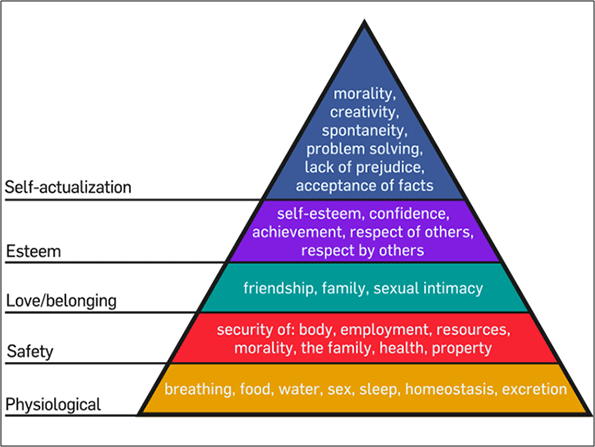
    Maslow's Hierarchy of Needs.svg

    How does a city do this? Well, the first step is to not get too cute, and to do the obvious realities right.. No amount of beautification projects will save a post-industrial city. A city needs to focus on the basics, as you develop a city like you grow a child. Here, the psychologist Albert Maslow’s hierarchy of needs can help.

    To wit, city leaders must prioritize physiological needs: eradicate food deserts, curb environmental threats, etc. Then, focus on safety. Not just manning safety force slots, but making sure those protecting us respect their duty. There are big questions about this in Cleveland. Also, shelter. Real local housing policies are needed, as are innovative educational and workforce development strategies. If you want to get creative, you can even leverage and strategize various needs together, like utilizing a glut of vacant storefronts into small business/entrepreneurial initiatives. Next, encourage social and cultural attachment so the benefits of community capital can be had. Don’t worry. If persons can breathe, eat, work, feel safe, and go home, they are likely to do this on their own. In fact that is the beauty of a hierarchy approach, as investment at the bottom turns into a self-fulfilling process up top. And then the icing on the cake: actualizing individuals, perhaps through fostering creative capital programs. That said, creatively classifying a city is doing it backwards if you haven’t built your city from the foundation up. Said Maslow: “A first-rate soup is more creative than a second-rate painting.”

    And while this makes intuitive sense to regular Clevelanders, it is confusing for the local leaders, if only through the advice of revitalization experts. For instance, in an article addressing concerns over whether or not Detroit’s investment should go to a bike path initiative, the author references an expert as to why the answer is “yes”:

    As Peter Kageyama argues in his book For the Love of Cities, “In the city making ‘hierarchy of needs’ we see most communities focused on bottom-line, core issues of making cities functional and safe. There still are many communities that struggle to even deliver functional and safe but that is not the problem. The problem is when communities only focus on the functional and safe and never raise their aspirations.”…Ultimately, places that do not engage us emotionally do not feel worth caring about.

    Clicking on the link above to Kageyama’s page, the expert details his thoughts and his audience:

    I focus primarily on American cities though the ideas are relevant to any place. I pay particular attention to some of our most challenged places such as Detroit, Cleveland and New Orleans as they have become hot beds of social innovation as government and the “official” city-makers have struggled to reconcile shrinking budgets and diminished capabilities. Into this vacuum has flowed a new breed of city-maker – usually young, independent, unofficial, creative, rule breaking and entrepreneurial. These are the new “frontiersmen” and “frontierswomen” who are rebuilding these cities from the ground up.

    There are a few problems here. First, while attachment to place is important, the logic is a bit flawed. A person insecure in various aspects of livability, like food and shelter, is not going to have their concerns addressed via an emotional connection to a given place. I am not saying developing place is bad. I am only saying such an approach is akin investing in nice drapes as your house is on fire. Put the fire out. Protect your people. Grow your people. After all, according to economic developer Jim Russell, people develop, not places.

    Second, local leaders are elected for a reason. To lead. And to serve and protect. “Frontiersmen” or Frontierswomen” are not going to protect the preyed upon—notwithstanding Charles Ramsey, though I doubt that is what Kageyama had in mind.

    No doubt, the events in Cleveland have shaken the city—yet another tear in an already torn city. And while the local and national news media is branding the escape of three women and one child as the “Miracle in Cleveland”, it wasn’t. At least not for us. We failed these young women. We failed the women before them. I hope this serves as our wake-up call. We will not play our way out of this. And if we continue to try, there will always be shame in the shadows of our revitalization.

    Richey Piiparinen is a writer and policy researcher based in Cleveland. He is co-editor of Rust Belt Chic: The Cleveland Anthology. Read more from him at his blog and at Rust Belt Chic.

    Top photo Courtesy of WOIO/AP

  • Can Public Banks Help Fix Local Finance?

    Are public banks the answer for the recession-induced decline in municipal revenue and other ills that plague our cities? It’s a solution being discussed in more than one American city.  

    Mike Krauss, a founder of the Public Banking Institute and a chairmen of the Pennsylvania Pubic Bank Project, both non-profits that promote public banking, said this month an ad hoc committee made up of Philadelphia City Council members and civic groups started working on the adoption of language for a public bank in the city. He also said the measure is being adopted out of a need for “affordable and sustainable credit.” The PPBP is leading the effort for public banking in the city.

    The recession’s impact on municipal taxes and anger at Wall Street were factors in the push for a public bank. Krauss described the losses to Philadelphia’s school district, street, police and fire departments as “phenomenal.”  

    Krauss mentioned North Dakota’s public bank, founded in 1919 to promote agriculture, commerce and industry in the state, as a role model for cities. The North Dakota bank arose in reaction to farmers’ anger over the predatory practices of East Coast and Minneapolis banks. The bank’s revenues come from the state’s general revenue fund. Krauss cites the Bank of North Dakota’s 2.9 billion portfolio in a state with a population of roughly 600,000 as an example of its success. Philadelphia has a population of approximately 1.5 million. Krauss also said a public bank would be a job creator for cities and again used the BND as an example, as it produced a job for every 100,000 dollars it loaned.

    Like North Dakota’s bank, the proposed public bank in Philadelphia wouldn’t be a commercial bank that offers checking and savings accounts. It would lend money for city projects and also partner with local commercial banks on loans. There are also efforts underway for public banks in San Francisco and Boston, according to Krauss. 

    Public Banking Institute Chairmen Marc Armstrong said that over a trillion dollars in revenue from states and municipalities are deposited in big Wall Street banks every year. Armstrong also said many of the deposits are used to provide loans for transnational corporations that don’t invest in their states and cities. Public banks can provide loans as low as one percent interest, and Wall Street banks consider their existence as a threat, said Armstrong.  When it comes to taxation and other issues that confront cities, a public bank could be used as a weapon against the rent-seeking – meaning using social and political circumstances to extract more money out of the public – activities by financiers. The public bank would instead invest in higher education, automotive and banking industries and as a tool for productive economic enterprises and individuals. This weapon could in turn create more vibrant activities in urban economies.  

    Krauss admitted the possibilities for the use of revenue generated by a public bank are endless, and he said investment in the school district, infrastructure and public safety would be positives. However, other job creating services and projects could be a reality – free wi-fi, the construction of affordable rental housing for retired people and low income residents, rent-to-own home ownership (or condo) programs, research and development to support public science, scientific innovation and high technology industries, childcare facilities, higher education for city residents, public media, new parks, free or reduced utilities for businesses and individuals, and also investments in energy efficiency, recycling, renewable energy and car sharing.  

    The positive impacts of the above mentioned investments go beyond public banking, as it is the starting point for a more vibrant urban economy, education system and ecology. With a new source of revenue, business taxes could be slashed to promote business formation in public banking inclined cities, and more businesses within city limits would mean even more revenue.    

    Similar to slashing taxes for business, free or reduced costs on wi-fi and utilities would also help local businesses and individuals by reducing their overhead costs and in turn create more jobs, as more money could be spent in the form of investment by businesses themselves and in increased individual purchasing power that works its way back into local businesses.  

    Recycling would have a similar effect, as it’s cheaper for a city to recycle, if the program is a well-run, than to pay for waste collection, land filling and incineration. By reducing the costs of waste, cities could again reduce business taxes and once again create more business formation, and at the same time reduce greenhouse gas emissions. Recycling reduces pollution not only by reducing the waste sent to landfills, but it also reduces the need for cutting down more trees and the inputs needed to manufacture a product.

    Urban and non-urban citizens all create waste and for that reason recycling is a bigger job creator than renewable energy which cannot produce all of our energy due to intermittency and also the cost, as it’s still more expensive than traditional forms. Despite these drawbacks, new revenue could be used to create jobs in solar energy by installing solar panels on public buildings – school district offices, schools, and city hall. Also worth thinking about is the possibility of constructing biogas plants that break down organic waste – which can come from the vast amount of sewage a city creates – to create another, perhaps more reliable form of renewable energy.       

    The additional revenue produced by the use of public banking and increased business formation could also be used to lift the burden of rent-seeking higher education institutions by offering lower interest loans to help young people attain a higher education, affordable rent and affordable home or condo ownership without acquiring crushing debt. Cities could offer a few years of free vocational, art, culinary and business education. The media is full of stories of urban residents burdened with student loan debt which benefits universities, colleges and the government and decreases the amount of money circulating into local businesses. Also, cities would benefit from this investment by creating a new generation of productive workers, chefs and artists and the businesses that are created along with them.

    Low interest loans could also be offered to local real estate interest for rent-to-own condo and house programs and affordable apartments could be constructed with low-interest loan portfolios. Of course, landlords would have to abide by low-rent policies if they are to take advantage of the policies, blunting the rent raising effects of gentrification while maintaining its’ positive side.

    Cities could also put public dollars behind a new innovation in transportation – car sharing – which has been pioneered by Zipcar. Cities could help expand the company’s business by offering it low tax rates and subsides to locate within their borders; those arguing they would wasteful should take a second look at what’s spent on sports stadiums. Or maybe cities could building their own car sharing industry with local business leaders. The expansion of car sharing would mean less impact on the infrastructure and reduce the amount spent on infrastructure. It would also reduce traffic congestion and make it possible for residents of surrounding suburbs to enjoy the city’s attractions.      

    Cities can and should be hubs for creative people and immigrants, as they see life in almost-dead neighborhoods and create gentrifying enterprises such as restaurants, cafes, music venues, art galleries, artisan manufacturing, coffee roasting, small boutique retailers and all sorts of internet and technology businesses. However, cities can’t and shouldn’t lose focus on what sustains critical functions such as public safety, infrastructure and education – revenue. The public bank offers an opportunity for cities to invest in themselves, not the profit portfolios of Wall Street.

    Jason Sibert is a freelance writer who has lived in the St. Louis Metro Area since the late 90’s. He worked for the Suburban Journals for a decade and his work has appeared in various publications over the last four years.

    Photo by David Shankbone.

  • The Myth of Green Australia

    Having collected the Nobel peace prize in 2007, Al Gore’s fortunes as a climate crusader slid into the doldrums.  But 8th November 2011 arrived as a ray of sunshine. On that day Australia’s parliament passed into law the world’s first economy-wide carbon tax. Rushing to his blog, Gore posted a short but rapturous statement, cross-posted in The Huffington Post. His fervent language echoed in progressive circles across the globe. Australians have been held-up as pioneering environmentalists ever since, putting Americans to shame.

    “This is a historic moment”, thundered Gore. “With this vote”, he blogged, “the world … turned a pivotal corner in the collective effort to solve the climate crisis”. He proclaimed it “the result of tireless work of an unprecedented coalition that came together to support the legislation”; he praised the “leadership of Prime Minister [Julia] Gillard and the courage of legislators”; and he declared “the voice of the people of Australia has rung loud and clear”.

    But maybe Gore’s enthusiasm was a bit misplaced. In September, less than two years later,   Australians seem likely, according to the polls, to hand the Gillard Labor government a stinging landslide defeat.     

    “A pivotal corner in the collective effort”

    As it turns out, and not for the first time, Gore’s analysis was wrong. For one thing, calling the carbon tax “pivotal” is pure hyperbole. Although a relatively large land mass, Australia is populated by just 23 million people who collectively emit a minuscule 1.5 per cent of the world’s greenhouse gases. Nor is the country influential in a broader political union or association beyond its borders.  Since climate change alarmists suggest that global emissions must fall by 25 to 40 per cent in 2020 compared to 1990 levels, Australia’s efforts must be seen as more symbolic than effective.    Currently, the tax and its post-2015 form as an emissions trading scheme (ETS) are adjusted for a trivial 5 per cent cut from 2000 levels in 2020; 5 percent of 1.5 percent of the world’s emissions barely registers against a few days increase in countries like China.   

    Environmentalists maintain that the important thing is not results, but setting a moral example of climate action. They argue Australia’s emissions may be tiny in absolute terms, but amongst the highest in per capita terms. Major emitters like the US, China, India and the EU, they argue, can be shamed into action by Australia’s noble sacrifice. Unfortunately for them, this argument, not very strong to being with, deflated like a punctured balloon since the shambles at Copenhagen.

    We’ve been here before. In December 2009 Australia’s newly minted Labor Prime Minister, Kevin Rudd, with a bulging entourage of 114 officials, descended on the Copenhagen conference to negotiate a successor to the Kyoto Protocol. He was awarded the task of preparing a draft negotiating text. Rudd played an active role in the lead up, having signed Kyoto and undertaken to legislate for an ETS in his first term, a serious step given Australia’s status as the world’s leading coal exporter. Before flying out to Denmark, he introduced the necessary bills into parliament for a second time.

    Copenhagen was a test of the ‘noble sacrifice’ argument driving Rudd’s activism but resulted in an epic fail. Rudd’s draft text was tossed aside and the conference collapsed into bickering between delegations from the developed and developing worlds. There was no successor to Kyoto, just a flimsy, non-binding accord the delegates “took note of” but didn’t adopt. Greenpeace called Copenhagen “a crime scene”.    

    The UN’s Framework Convention on Climate Change has stayed off the rails ever since. Later Conferences of the Parties (COPs) at Cancun and Durban did little more than kick the can down the road. Durban opened twenty days after the “historic moment” of Australia’s carbon tax, but delegates deferred all talk of a binding agreement to 2015, anticipating a possible start in 2020. Canada pulled the plug on Kyoto altogether, later followed by Japan and Russia. “This empty shell of a plan leaves the planet hurtling towards catastrophic climate change”, huffed Friends of the Earth.

    Under the non-binding Copenhagen Accord, parties were invited to submit emission reduction “pledges”, and most have done so. Even if achieved, though, they get the world nowhere near 25 to 40 per cent reductions on 1990 levels in 2020. Writing in Nature, analysts from the Potsdam Institute of Climate Impacts dismiss them as “paltry”. Amid rising emissions, Australia’s “pivotal” carbon tax is but a straw in the wind.

    “An unprecedented coalition that came together”

    At the end of 2009, Rudd’s ETS was rejected by parliament a second time, due in part from rising doubts about the climate agenda. As 2010 progressed, his popularity waned, battered by his inept handling of the contentious mining tax. Labor colleagues bristled at his secretive and high-handed manner, while powerful union bosses resented his indifference to their concerns. Taking advantage of drooping opinion polls, Rudd was sacked and replaced with Deputy Prime Minister Julia Gillard.

    This sent shockwaves through the country, which had never seen a sitting prime minister dumped in his first term. Fearing a backlash, Gillard hastily called an election for 21st August, hoping to exploit positive feelings around serving as Australia’s first female leader. She proved a poor campaigner, however, and a series of damaging leaks scuttled her efforts. Labor’s support faded and on election night Gillard was left with 72 seats, four short of a majority in the 150 seat House of Representatives. The Liberal-National opposition ended up with 73 seats, also short of a majority. The balance of power was in the hands of one Greens Party member and four independents.

    After weeks of negotiations, the Greens and three of the independents pledged support for a Labor Government under Gillard, the first minority government since the 1940s.  But it became increasingly clear that a fresh election would produce a solid Liberal-National Party majority. Returning to the people for a new mandate was never in Gillard’s interests. As for the Greens and independents, fortune delivered them more power than they ever had or would ever have again. Making the most of their time in the sun, they opted for Gillard, who wasn’t about to call another election. Gillard’s coalition may be “unprecedented”, in Al Gore’s words, but it’s untrue that they “came together to support” high principle. They were thrown together by electoral chance and stuck together out of grim self-interest.

    “Leadership of Prime Minister Gillard and the courage of legislators”

    After the second rejection of his ETS, Rudd shelved the policy indefinitely, to the dismay of the world’s environmentalists. The inner circle which advised him to take this course, according to later revelations, included Julia Gillard. On becoming prime minister she showed little enthusiasm for the climate cause, ruling out a price on carbon unless there was “a deep and abiding community consensus”. Her tokenistic policy at the 2010 election was “citizen’s assembly” to canvass options. The opposition also ruled out a price on carbon. Twice in the lead up to polling day, Gillard explicitly denied rumours of a hidden agenda, uttering the now infamous words “there will be no carbon tax under the government I lead”.

    Gillard entered the post-election negotiations desperately hoping to save her prime ministership.  The radical Greens would never have backed the conservative opposition. But when they demanded a carbon tax as the price of their support, she caved in a fit of panic, displaying little of the courage praised by Gore. The independents signed on to keep the minority government in business.

    Labor’s Clean Energy Future package includes a carbon tax, but also billions of dollars of compensation and credits to cushion the blow. In a massive money churn, around $5 billion of the revenue is disbursed to households in higher benefits and tax breaks, and $9.2 billion goes to industry assistance, including free permits for high emitting industries, $300 million to the steel industry, $1.26 billion to the coal sector, and $1.2 billion to manufacturing. Unhappy about these handouts, the Greens were bought off with a $10 billion Clean Energy Finance Corporation. Australians are left wondering how all of this encourages shifts to “cleaner” energy sources. The handouts muffle some damaging impacts of the tax, but they are hardly “courageous” from the perspective of Al Gore.

    “The voice of the people of Australia has rung loud and clear”

    Gillard made her plans for a carbon tax public on 25th February 2011. Her residual popularity sank like a stone. The Newspoll of 18-20 February 2011 recorded 50 per cent satisfied and 39 per cent dissatisfied with her performance. In the next survey of 4-6 March 2011, those figures were reversed: 39 per cent satisfied, 51 per cent dissatisfied. Labor’s support (first preference) plunged to 30 per cent in the March survey, from 38 per cent at the election. These results were consistent with a general fall in support for climate action. From a high of 68 per cent in 2006, reported the Lowy Institute Poll, it dropped to 41 per cent in 2011. Only 32 per cent of Australians supported the carbon tax when Gore wrote his rapturous blog post.    

    Gillard’s frantic attempts to recover have come to nothing, and calling an election for 14th September hasn’t helped. The latest Newspoll of 5-7 April 2013 had her satisfaction rating at a dismal 28 per cent, with 62 per cent dissatisfied. Labor’s support is still in the basement at 32 per cent, with the Liberal-Nationals at 48 per cent. Likely, the government faces a devastating loss of around 20 seats.  

    The opposition’s implacable campaign against the carbon tax has rocked Gillard’s time in office. They promise to repeal it, dismantle much of the Clean Energy Future package and even abolish the Department of Climate Change. Since the 2010 election Labor has suffered a succession of defeats at the state level, losing power in New South Wales, Victoria, Queensland and the Northern Territory, while the Liberal-National Coalition improved their majority in Western Australia. These elections were fought on state issues, but in every case the conservatives echoed Opposition Leader Tony Abbott’s anti-carbon tax message. Closer to home, Gillard was forced to stare down moves against her by colleagues to restore Kevin Rudd, once in February 2012 and again in March this year. Four senior cabinet ministers were sacked or resigned after the second episode. Labor limps forward in the worst possible shape.

    A Liberal-National victory would probably mean the end of climate change as a major political priority in Australian politics. Al Gore was mistaken. He didn’t hear “the voice of the people of Australia” on 8th November 2011; but if he’s listening he’ll hear it “loud and clear” on 14th September 2013.

    John Muscat is a co-editor of The New City Journal.

  • Enterprising States 2013: Getting Down to Small Business

    The following is an exerpt form a new report, Enterprising States, released this week by the U.S. Chamber of Commerce Foundation and written by Praxis Strategy Group and Joel Kotkin. Visit this site to download the full pdf version of the report, or check the interactive dashboard to see how your state ranks in economic performance and in the five policy areas studied in the report.

    Nothing better expresses America’s aspirational ideal than the notion of small enterprise as the primary creator of jobs and innovation. Small businesses, defined as companies with fewer than 500 employees, have traditionally driven our economy, particularly after recessions. Yet today, in a manner not seen since the 1950s, the very relevance and vitality of our startup culture is under assault. For the country and the states, this is a matter of the utmost urgency.

    The central motor of the job engine clearly is not firing on all cylinders. Historically, small business has accounted for almost two-thirds of all net new job creation, but recent research shows that the rates of new business startups are at record lows. The “gazelle companies”—fast-growing firms, mostly younger ones—have traditionally made outsized contributions to new job creation. After previous recessions, these businesses drove job growth and, perhaps more important, created innovations that often spread to larger, older, more established firms, which sometimes later acquired them.

    Weak job growth has touched the entire economy. Gross domestic product growth is weak, unemployment remains at nearly 8%, and business sentiment is far from optimal. Despite high stock prices and consistently strong corporate profits, the rate of employment growth remains lower than the rate of the expansion of the workforce. Given the understandable focus of larger firms on boosting productivity and on investing capital into technology, it’s highly unlikely these companies will create enough jobs to dent our huge and growing employment deficit.

    Policymakers ignore small business at their own peril and that of the economy.

    The Changing Nature of Small Business

    Small business may be down, but it is far from out. There have been some small, subtle upward shifts in employment in three of the industries—construction, manufacturing, and retail—that bore the brunt of the recession-driven job losses. Any sustained uptick in growth will further widen the opportunities for small business to expand and perhaps recover something of its past vigor.

    It is critical that states and communities that embrace a pro-enterprise vision address a rapidly changing small business environment. Small business today reflects a host of ethnic, social, and generational changes. Successful programs will need to adapt to these new realities that reflect a far more diverse, and profoundly different, set of players.

    Immigrants constitute a growing and important part of the entrepreneurial landscape. Even in the midst of the recession, newcomers continued to form businesses at a record rate. The number of women-owned firms has grown at one and a half times the rate of other small enterprises over the past 15 years. These companies now account for almost 30% of all enterprises. Finally, there is the issue of generational change. Baby boomers were, on the whole, a profoundly entrepreneurial generation, and by many measurements their Generation X successors have proven even more so. The millennial generation, based on recent assessments, may be somewhat less entrepreneurial than their predecessors.

    We are also witnessing the rise of a new kind of enterprise that often employs no more than the proprietors but frequently provides quite sophisticated high-level products or services. In many cases, these “jobless entrepreneurs” include corporate executives, technicians, and marketing professionals who, by either choice or necessity, have chosen to strike out in their own micro-enterprises. A large portion of this growing “1099 economy” comes from the growing ranks of boomers who are no longer willing or able to work for a larger enterprise. According to the Census Bureau, small business without payroll makes up more than 70% of America’s 27 million companies, with annual sales of $887 billion.

    The States Get Down to Small Business

    Every state has policies and programs that are intended to encourage entrepreneurship and support small business development and expansion. Many states have introduced legislation or established programs to focus on startup companies, and many states have bolstered policies targeted at helping existing businesses grow and expand their markets. State funding of programs for entrepreneurial development is estimated to have increased by 30% between 2012 and 2013.  

    States vary considerably in the policies, regulations, and taxes that affect small business. Most states have an array of loosely integrated small business programs, although some have a more comprehensive, integrated small business policy and program framework. No state has the “best” tax policy for all entrepreneurs. Instead, different states have tax policies that suit certain types of companies better than others. Consequently, the states that are best for new businesses are not always the most favorable for existing small businesses; the states that are best for one business sector may not be best for another.

    States and cities should consider small business development not as a separate cause, but as a basic building block for economic growth. Even if state governments can do little to promote enterprise and small business development directly, there are things they can do to increase the chances that entrepreneurs will thrive. Smart, pragmatic economic policymaking at the state level can play an instrumental role in fostering startups and growing companies, particularly when programs are effectively deployed right where the businesses are located.

    The following are some new and innovative policy and program approaches that states are employing and/or supporting to create and expand small businesses, often in cooperation with local and regional development organizations:

    • Accelerator initiatives that focus on starting high-growth firms by turning startups into enduring companies.
    • Economic gardening initiatives that focus on expanding existing firms with strong growth potential.
    • Business plan competitions to identify companies with exciting ideas and high potential.
    • Business ecosystem initiatives, often with a regional focus, that take a comprehensive approach to creating an environment that is highly conducive to startups.
    • Workforce development initiatives that help small businesses find and train the talent they need to operate and compete.
    • Seed and venture funds that focus on startups and expanding firms.
    • Networking and collaboration initiatives that bring small businesses and self-employed entrepreneurs together with large companies and universities.
    • International trade programs that help small businesses reach out to new global export markets.
    • Streamlined state administrative processes and regulatory procedures for small business by cleaning up the DURT (delays, uncertainty, regulations, taxes) that impede small business success.
    • Broadband investments that provide small businesses of all types with the online access necessary in the 21st century.

    Governors of states recognize the importance of small businesses and often take the lead in reforming state policy and service delivery to make growth and commerce easier for small business. Governors can offer fast-track access to financial resources and a full slate of state services that help small businesses connect with technical expertise, customers, suppliers, and state agencies that interact with small business as regulators or partners in development.

    State and local chambers of commerce are on the front lines of promoting a pro-business free enterprise agenda and thwarting anti-business legislation, regulations, and rules. Across the country, chambers of commerce lead the way in advocating on behalf of their members for lower costs of doing business, fairer taxes, fairer regulations, and less regulatory paperwork. They work with the U.S. Chamber of Commerce, governors, industry, and professional associations to pursue outcomes that are beneficial to all businesses and, thereby, advance America’s free enterprise economy.

    Visit this site to download the full pdf version of the report, or check the interactive dashboard to see how your state ranks in economic performance and in the five policy areas studied in the report.

    Praxis Strategy Group is an economic research, analysis, and strategic planning firm. Joel Kotkin is executive editor of NewGeography.com and author of The Next Hundred Million: America in 2050.

  • Class Warfare for Republicans

    As a Truman-style Democrat left politically homeless, I am often asked about the future of the Republican Party. Some Republicans want to push racial buttons on issues like immigration, or try to stop their political slide on gay marriage, which will steepen as younger people replace older people in the voting booth. Others think pure market-oriented principles will, somehow, win the day. Ron Paul did best among younger Republican voters in the primaries.

    Yes, ideas do matter, but a simple defense of free markets is not likely to have broad-enough appeal. What Republicans need is a transformative issue that can attract a mass base – and that issue is class.

    Of course, the whole idea of appealing to class may be repellant to most libertarian-conservative or country-club remnants of the Republican Party. Yet, it’s the issue of the day, as President Obama recognized when he went after patrician Mitt Romney. It also may be the issue Obama now most wants to avoid, which explains his current focus on secondary issues like gun control and gay marriage.

    For their part, Republicans need to make Obama own the class issue since his record is fairly indefensible. The fortunes of the middle quintiles of Americans have been eroding pretty much since Obama took office in 2009.

    There’s nothing fundamentally unRepublican about class warfare. After all, the party – led by what was then called Radical Republicans – waged a very successful war against the old slave-holding aristocracy; there’s nothing to be ashamed of in that conquest. Republicans under Abraham Lincoln also pushed for greater landownership through such things as the Homestead Act, which supplied 160 acres of federal land to aspiring settlers.

    No one expects the Republicans to turn socialist, but they can reap benefits from anger over the crony capitalism that has become emblematic of the Obama era. Wall Street and its more popular West Coast counterparts, the venture capital "community," consistently game the political system and, usually, succeed. They win, but everyone else pretty much has to content themselves with keeping up with the IRS.

    This is where the opportunity lies. Republican opposition to Wall Street is already evident in the rise of Texas Republican Rep. Jeb Hensarling to the chairmanship of the House Banking Committee. He and Iowa GOP Sen. Charles Grassley’s attack on "too big to fail" banks are a stark contrast to the likes of New York Democratic Sen. Charles Schumer, the Capitol consigliere of the Wall Street oligarchs, or the prince of gentry liberals and defender of billionaires everywhere, New York City Mayor Michael "luxury city" Bloomberg.

    Who’s angry and ready to raise their raise their pitchforks? Try the self-employed, who are now, according to Gallup, the large constituency most alienated from the present regime. Even the hapless Romney picked up their support against Obama.

    The new core constituency of the GOP can best be identified as the enterprise base. They include small property owners, mainly in the suburbs, those who are married or aspiring to be so. They are more suburban than urban, and likely to work for someone else or themselves as opposed to working for the state. Combine the top half of private employees, over 50 million people, add some 10 million self-employed and you get to a serious economic, and political, base.

    This group also includes many immigrants, particularly Asians, a constituency that should be tilting GOP but still isn’t. They, too, increasingly live in the suburbs, own homes as well as business. And rarely do they benefit from the prevailing crony capitalism.

    The enterprise base is by nature not ideologically rigid. Most, if you talk to them, would generally support sensible infrastructure improvement as well as repairs; they also tilt towards restrained taxation and a lighter regulatory hold. It’s a movement for "Let’s get this fixed and get on with our lives."

    This new orientation would define the Republicans where they are strongest and the administration weakest – on the economy. The new wedge issues must be for a "level playing field" for entrepreneurs and the middle class and definitely not social issues, like opposition to gay rights, or support for old and new unwise wars.

    An enterprise approach, and a focus on restarting real growth, could put the Democrats on their heels and worrying about their own base. Minorities, for example, have done far worse under this administration than virtually any in recent history, including that of George W. Bush. For many, this has been what the Fiscal Times has called "a food stamp recovery."

    Among Obama’s loyalist core, African Americans, unemployment now stands at the highest level in decades; blacks, while 12 percent of the nation’s population, account for 21 percent of the nation’s jobless. The picture is particularly dire in Los Angeles and Las Vegas, where black unemployment is nearly 20 percent, and Detroit, where’s it’s over 25 percent.

    Of course, Republicans have their work cut out for them among African-Americans. But remember that Barack Obama will not be on any future ballots. A return to what Ishmael Reed has called "neo-classical" Republicanism – the same spirit that freed the slaves and fought for equal rights – could make some inroads.

    Latinos, the other major part of the party’s "downstairs" coalition, also have fared badly under Obama and could be even more amenable to a smarter GOP message. They have seen their incomes drop 4 percent over the past three years, and suffer unemployment two full points above the national average. Overall, the gap in net worth of minority households compared with whites is greater today than in 2005. White households lost 16 percent in recent years, but African-Americans dropped 53 percent and Latinos a staggering 66 percent of their precrash wealth.

    But the most critical potential constituency may prove the millennial generation, who hitherto have been a strong constituency for both the president and his party. They continue to suffer the most of any age cohort in this persistently weak economy. Already, the first wave of millennials are hitting their thirties and may be getting restless about being permanent members of "Generation Rent."

    Let’s say, in two or four years, they are still finding opportunity lagging? Cliff Zukin at Rutgers John J. Heidrich Center for Workforce Development, predicts that many will "be permanently depressed and will be on a lower path of income for probably all their [lives]." One has to wonder if even the college-educated may want to see an economy where their educations count for more than a job at Starbucks. Remember: Baby boomers, too, once tilted to the left, but moved to the center-right starting with Ronald Reagan and have remained that way.

    Yet, despite these threats, Democrats may still be rescued by perennially misfiring Republicans. There’s no Stu Spencer, Michael Deaver or Peter Hannaford on the blue team to plot strategy. Missteps remain endemic: A group of North Carolina Republicans recently proposed a measure to establish Christianity as the state religion, only to blocked by the state’s leadership.

    Others think opposing gay marriage is the ticket to revival, even though public opinion, particularly among the young, is swinging in the other direction. Some 70 percent of millennials – people in their early thirties and younger – support gay marriage, twice the rate of those over 50. Social conservatives are also gearing up on the abortion issue even though three in five Americans, according to the latest Pew survey, oppose overturning Roe v. Wade. North Dakota could be showing that America can work, literally and figuratively, but instead the state passes abortion laws that are among the strictest in the country.

    Yet, there’s still hope that some Republicans will recognize this opportunity. I would like to see this, in part, because I have seen one-party politics in action here in California, and it doesn’t work. Even more so, I’d like to see Republicans wage class warfare on behalf of the "enterprise" constituency because Democrats then would have to offer something in response, which could only have good consequences for the rest of us.

    Joel Kotkin is executive editor of NewGeography.com and a distinguished presidential fellow in urban futures at Chapman University, and a member of the editorial board of the Orange County Register. He is author of The City: A Global History and The Next Hundred Million: America in 2050. His most recent study, The Rise of Postfamilialism, has been widely discussed and distributed internationally. He lives in Los Angeles, CA.

    This piece originally appeared in the Orange County Register.

    Lincoln Memorial photo by Bigstock.