Category: Politics

  • Blue States Double Down On Suicide Strategy

    Whatever President Obama proposes in his State of the Union for the economy, it is likely to fall victim to the predictable Washington gridlock. But a far more significant economic policy debate in America is taking place among the states, and the likely outcome may determine the country’s course in the post-Obama era.

    On one side are the blue states, who believe that higher taxes are not only just, but also the road to stronger economic growth. This is somewhat ironic, since, as we pointed out earlier, higher taxes on the “rich” would seem to hurt their economies more, given their high concentration of high-income earners. However, showing themselves to be gluttons for punishment, many of these states have decided to double down on high taxes, raising their rates to unprecedented levels.

    This cascade of higher income taxes started in 2011 when Illinois, arguably the big state with the weakest economy, and the lowest bond ratings, raised income taxes by 66% and business taxes by 46%. Over the past year several other Democratic state governments have pushed through income tax increases, notably California, which raised the tax rate on people with annual income over $1 million to 13.3%, the highest in the nation. And now it appears that Massachusetts and Minnesota are about to raise their taxes as well.

    This is happening at the same time that some red states — notably Kansas and Louisiana — are looking at lowering income tax rates by shifting to rely more on consumption or sales tax revenues. Some red states don’t have income taxes — notably Florida, Texas and Tennessee — and most of those who do are holding the line. Red state leaders, most notably Louisiana’s Bobby Jindal, are placing their bets on  expanding their economies, which would create new taxpayers, boost consumer spending and expand collections of sales taxes.

    The contrast with the blue states — not so much those who voted for Obama, but those controlled totally by Democrats — could not be clearer. They appear to have chosen an economic path that essentially penalizes their own middle and upper-middle class residents, believing that keeping up public spending, including on public employee pensions, represents the best way to boost their economy.

    Yet the gambit of raising state income taxes could not be coming at a worse time. The president’s adopted tax reforms have eliminated write-offs for state taxes for those individuals with incomes over $250,000 and families earning over $300,000. As a result, the affluent residents of these states — California, New York, New Jersey and Illinois alone count for 40% of these deductions nationally — now can expect to get whacked coming and going.

    So which strategy is likely to work best? Most conservatives would assert that the red state approach will prove more effective. But in the short run at least, the free-money policies of the Federal Reserve are supporting many blue-state economies. Plastering institutional investors with low-interest greenbacks raises the price of assets — notably stocks and real estate — creating high incomes for wealthy taxpayers that can then fill the coffers of these states.

    This particularly benefits New York, which depends heavily on Wall Street earnings. (Residents of New York City, which has a city-level income tax on top of high state rates, have the highest overall tax burden in the country.) States such as Massachusetts, Minnesota and even Illinois also have larger than average pockets of wealthy investors; if they do well, higher income taxes could, in the short run at least, bring substantial returns to their state coffers.

    Perhaps the most obvious short-term beneficiary of the new high-tax policy may be my adopted home state of California. Given the higher share of the tax burden borne by the wealthy, a rising stock market tends to send gushers of funds into state coffers, particularly when Silicon Valley is enjoying one of its periodic bubbles. Equally important, increases in real estate prices — up some 25% in Orange County alone — also drives up capital gains and income taxes. This growth is driven not by higher salaries for Californians but is largely investor driven. A remarkable one in three California home purchasers paid with cash in 2012, up from 27% from the previous year. Home prices are climbing rapidly in the Bay Area, where the economy is performing better, and could reach 2007 pre-crash levels within the next year or two, if the current tech bubble continues.

    In the short run, asset inflation combined with higher levels of taxation could solve California’s perennial budget problems, at least temporarily. The state is expected to move into surplus over the coming year. Gov. Jerry Brown sees this convergence as justification for his current “victory lap” in the state and national media. Brown, argues progressive analysts such as Harold Meyerson, has become very much the model of a modern blue state leader.

    Yet, in the longer run, it’s dubious that higher income taxes will make states like California any more competitive or stable fiscally. During the property bubble in the mid-2000s, California also balanced the budget; in 2007 Gov. Arnold Schwarzenegger started comparing the Golden State to ancient Athens and blithely initiated draconian laws on climate change as well as expansion of the social safety net. All things seemed possible until the bubble burst, and with it the windfall from a relative handful of taxpayers. As revenues fell, the state went through five years of huge deficits, a major loss of jobs and growing impoverishment.

    This is likely to happen again, once there’s a downturn in the housing or stock markets. In a sense  higher income taxes serve as an equivalent to what economist Suzanne Trimbath calls “fiscal crack.” For a short period there’s euphoria, as tax revenues flow in and the economy seems to recover. Yet the real problems, such as inadequate private-sector job growth, are never addressed, and as the high fades, the state again faces a loss of jobs and people.

    Perhaps most troubling, states with high income taxes tend to lose people, particularly in the middle class. Over the past 20 years the four biggest net losers of population were high tax states: California, New York, New Jersey and Illinois. Between them they lost roughly a net 8 million out-migrants. The two big net winners, Texas and Florida, had no such taxes, and most of the other big gainers were relatively low-tax states.

    Of course, not everyone is so concerned with income taxes. The ultra-wealthy like David Geffen seem gleeful to pay higher taxes, perhaps because this class, as Mitt Romney showed, have lots of ways to reduce their tax burdens, and after all, don’t have to worry about personal cash flow to keep the business going.

    But enthusiasm for higher taxes historically has been less marked among the much larger group who, although affluent, are far from billionaires. Between 2006 and 2009, California lost a net 45,000 taxpayers earning between $5 million and $300,000 a year, according to the State Department of Finance.

    To be sure, the outward movement slowed during the recession, but more recently the pattern has reasserted itself. Last year, all ten of the leading states gaining domestic migrants were low-tax states including five with no income tax: Texas, Florida, Tennessee, Washington and Nevada. In contrast high-tax New Jersey, New York, Illinois and California suffered the highest rates of out-migration.

    Given these realities, raising already high income taxes has to qualify as somewhat self-destructive over the long run. But so great are the pressures in the blue states to fund expansive welfare programs and public employee pensions that there’s little chance the rising tax tide will soon abate. Sadly, there’s no hotline that seems capable of persuading them to rethink their latest suicidal lurch.

    Joel Kotkin is executive editor of NewGeography.com and a distinguished presidential fellow in urban futures at Chapman University, and a member of the editorial board of the Orange County Register . He is author of The City: A Global History and The Next Hundred Million: America in 2050. His most recent study, The Rise of Postfamilialism, has been widely discussed and distributed internationally. He lives in Los Angeles, CA.

    This piece originally appeared at Forbes.com.

    Income tax photo by Bigstock.
  • This is Your Government on Crack

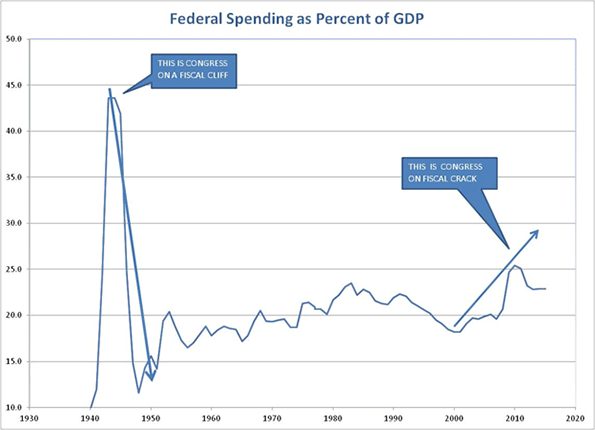
    Forget about a fiscal cliff or the threat of sequestrations. Bernanke’s use of the term “cliff” in 2012 is based on the erroneous analogy that fiscal policy had been moving along some level road for a period of time and was just now approaching an “end” or “falling-off” point. The reality is that federal spending has been rising rapidly since the federal government 1) absorbed the cost of repairing the damage done by the terrorist attacks of 2001, 2) decided to support wars on multiple fronts in the Middle East, 3) bailed out the Wall Street Banks, and 4) failed to pass a budget but 5) decided to continue spending as if nothing had happened. So called “sequestration” – which in this case basically means reducing spending and increasing revenue – would simply be a return to reality, coming down to earth, getting our feet back under us. Unfortunately, we the people appear co-dependents in this addiction.

    This year started with Congress succeeding at its favorite athletic event: kicking the can down the road. The January inauguration of the President and installation of their new members provided the excuse. The fact remains that Congress has not passed a real federal budget since 1997 (“the first balanced budget in a generation”.) An “omnibus spending bill” was passed in April of 2009 but that is not technically a budget.

    Congressional inaction has left the federal government running on extensions (“Continuing Resolutions”) of a budget that was passed when Bill Gates was still CEO of Microsoft, NASA landed the first spacecraft on Mars, and Google was working out of a garage. The last federal budget is from the time before iPods and iPads, before SPAM e-mail exceeded legitimate email, before Facebook, YouTube and Twitter – and before the global financial crisis that sent the world into recession and US federal spending into the stratosphere.

    In lieu of doing anything meaningful, three senators – Kelly Ayotte (R-NH), Ron Johnson (R-WI) and Marco Rubio (R-FL), all in office since 2011 – took the time to write and introduce an amendment to the 1974 Budget Act that would require a macroeconomic analysis of the impact of new legislation. This monumental act of denial was such a complete waste of time that GovTrack.us gave it only a 9% chance of getting out of committee and a 1% chance of being enacted. In fact, from 2011 to 2013, while we were paying these three senators and hundreds more people in Congress, only 12% of the bills introduced in the Senate made it out of committee (11% in the House) and only 14% of those were enacted (24% in the House)! Having passed just a few more than 200 bills, the 112th Congress will go down in history as even less productive than President Harry Truman’s "Do-Nothing Congress" (the 80th, 1947-1948) which nevertheless managed to get 906 bills enacted.

    In the 2012 election, openings were available for 1 new president, 33 new senators and 435 new representatives. Instead, Americans re-elected the same President, 19 of the same senators (58%) and 351 of the same representatives (81%). As a result, the 113th congress looks a lot like the 112th.

    Recently, President Obama signed an executive order to lift the 2009 freeze on federal employee salaries – including the salaries for all members of Congress. When Congress voted to rescind the executive order – they have to vote to prevent an automatic annual pay increase – they did it not just for themselves but for all federal employees. Then they kicked the can (of the “sequestration” spending cuts) down the road two more months.

    Their final act in January was suspending the debt limit “at least until May 19”. H.R. 325 may turn out to be the bright spot in this whole mess despite the fact that it gives Geithner’s, now Lew’s, Treasury carte blanche for financing profligate spending. The “No Budget, No Pay Act” was written on Thursday January 3, 2013; introduced in the House on January 21st by Rep. Dave Camp (R-MI since 1991) and cosponsor Rep. Candice S. Miller (R-MI since 2003); passed in the House on January 23rd by a vote of 285-144; passed in the Senate on January 31st by a vote of 64 to 34.

    According to the bill, if Congress does not pass a real budget by April 15, the salaries of the members of the chamber unable to agree to the budget will be held in escrow until either they pass a budget or the last day of the 113th Congress. All the new Democrat senators voted “aye”; all the new Republican senators voted “nay”. The new House members were mixed. The bill goes to President Obama this week for signature.

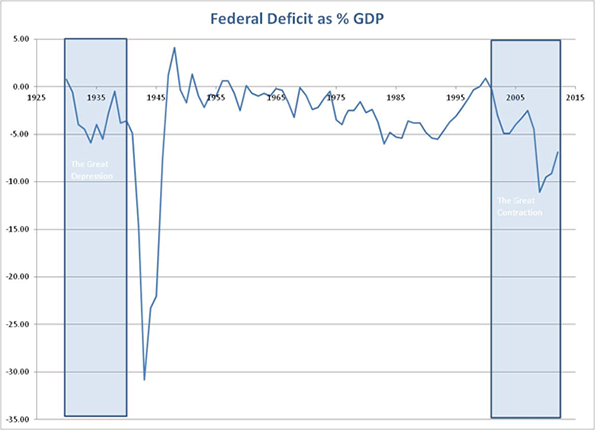
    Assuming he signs it, H.R. 325 allows the federal government to borrow money beyond the record $16.4 trillion debt we already owe. That debt is 104.5% of 2012’s $15.7 trillion GDP. The budget deficit – which has to be covered by borrowing – is running over $1 trillion each year or about 7% of GDP. The deficit alone is 44% of federal receipts. In other words, the government is spending over 40% more than it earns! That’s your government on crack.

    It is like living with a drug addict:

    “Waiting for the problem to resolve itself will get you nowhere. What you are seeing now, if it isn’t already completely out of control, will get completely out of control.”

    The difference is that we, the taxpayers and our children and our children’s children, have to shoulder the burden – something the families of addicts are advised not to do. In a democracy, the majority rules and the majority decided to continue to live with these fiscal crack addicts. For the rest of us, our choice has to be to try to remain optimistic – take the good news where you can find it. There are no “fiscal therapists” or “family support groups” for disgruntled voters. We must seek out the venues where we can talk about the problem openly, don’t be fooled when the fourth estate hides the crack vials to gain favor with the Washington and Wall Street elites and take care of ourselves.

    Susanne Trimbath, Ph.D. is CEO and Chief Economist of STP Advisory Services. Dr. Trimbath’s credits include appearances on national television and radio programs and the Emmy® Award nominated Bloomberg report Phantom Shares. She appears in four documentaries on the financial crisis, including Stock Shock: the Rise of Sirius XM and Collapse of Wall Street Ethics and the newly released Wall Street Conspiracy. Dr. Trimbath was formerly Senior Research Economist at the Milken Institute. She served as Senior Advisor on United States Agency for International Development capital markets projects in Russia, Romania and Ukraine. Dr. Trimbath teaches graduate and undergraduate finance and economics.

    Lead photo: Marion Barry smoking crack, screenshot from FBI surveillance video footage in 1990 via Wikipedia Commons.

  • California Becoming Less Family-Friendly

    For all of human history, family has underpinned the rise, and decline, of nations. This may also prove true for the United States, as demographics, economics and policies divide the nation into what may be seen as child-friendly and increasingly child-free zones.

    Where California falls in this division also may tell us much about our state’s future. Indeed, in his semi-triumphalist budget statement, our 74-year-old governor acknowledged California’s rapid aging as one of the more looming threats for our still fiscally challenged state.

    Gov. Jerry Brown, unsurprisingly, did not acknowledge or address the many factors driving the aging trend that include his own favored policy prescriptions. Whatever their intent, the usual "progressive" basket of policies have had regressive results: a tougher time for both the poor and middle class, and a set of density-oriented policies that are likely to drive up housing prices, particularly for the single-family houses largely preferred by people with children.

    These policies have helped turn California into a state that looks less Sunbelt and more like the long-aging centers of the Northeast and the Midwest. It also mirrors declines in fertility and marriage rates in the most-rapidly aging parts of Europe and east Asia. These regions are shifting toward what Chapman University’s recent report, in cooperation with the Civil Service College of Singapore, characterized as post-familialism. Released this past fall in Singapore, the report will be presented in Orange County this week.

    We believe that the rapid decline of marriage and fertility rates in many advanced countries inevitably leads to economic decline, reduced workforces and, likely, an inevitable fiscal disaster. This may be becoming now more true in the United States, a country which once boasted the most vibrant demographics in the high-income world but since the 2007-09 recession has seen a rapid drop in both its marriage rate and fertility rates to well below 2.1 children per female, what is generally referred to as "the replacement rate."

    Just as it differs by country, the degree of post-familialism varies among countries, but it also does among states and regions. Some states, notes a recent Packard Foundation study, such as Texas, Utah and North Carolina, have seen double-digit gains in their child populations over the past decade while California’s has dropped by over 3 percent. Some urban regions like Raleigh, Austin, Houston, Charlotte, Dallas-Fort Worth and Atlanta have also seen rises in their number of children, with population between ages 5 and 17 growing by 20 percent or more over the past decade.

    Historically, California and its regions stood among these family magnets, but no more. Like the states of the Northeast and upper Midwest, the Golden State is becoming rapidly geriatric, as families opt out, and immigration, the primary source of our growth in younger people, declines in an economy ill-suited to migrants with aspirations for a better life.

    Southern California, where immigration has dropped by roughly a third over the past decade, has shared in this decline.

    All three major regions of greater Los Angeles – the San Bernardino-Riverside area, Orange and Los Angeles counties – have seen a sharp drop in their percentages of children. Only the Inland Empire remains still relatively youthful overall, with some 26 percent of its population under 15, well above the national average. In contrast, Los Angeles and Orange counties experienced a 15.6 decline in under-15 population, highest among the nation’s metropolitan areas. Meanwhile, the over 60 population grew by 21 percent.

    One clear indicator can be seen in our declining school populations. Despite massive expenditures for new construction, over the past decade the Los Angeles Unified School District has seen enrollment drop by 7.5 percent. In that period, the student count fell by over 50,000, the largest numerical drop in the nation.

    What is leading to this exodus of families? Sacramento politicians and their media enablers blame insufficient investment in education or simply national aging trends as the root causes. But then, why are other states, including our key competitors, gaining families and children?

    Sacramento lawmakers of both parties share some responsibility. The dominant progressives’ regulatory and tax agenda continues to reduce economic prospects for younger Californians, leading many young families to exit the state. In contrast, older Anglos, the bulwark of the now largely irrelevant GOP, are committed to massive property tax breaks because of Proposition 13. Add good weather and the general inertia of age, and it’s not surprising that families might flee as seniors stay.

    Other factors work against parents, prospective or otherwise. The knee-jerk progressive response to our demographic problems usually entails more money be sent to the schools.

    But they rarely include the student-oriented reform measures such as those enacted in New Orleans (where I am working as a consultant). The poor performance of public education, clear from miserable test results and dropout rates, makes raising children in California either highly problematic or, factoring the cost of private education, extremely expensive.

    If you think Proposition 30’s higher sales and income taxes will change anything, think again.

    Much of that money will end up, almost inevitably, going toward pensions of teachers and other state workers. The hegemonic teacher unions have as their primary goal protecting the system at all costs and resisting change.

    Equally critical, the state’s "enlightened" planning policies also work to discourage families. California’s new climate-change-mandated housing regime – preferring apartments over houses – does not specifically target families, but the case for greater density is often predicated on an ever-declining number of families and an undemonstrated growing preference for density. "Singles and childless couples are the emerging household type of the future," suggests developer and smart growth guru Chris Leinberger.

    These post-familial trends have been incorporated into the influential report, "The New California Dream," widely accepted as gospel by many in our state’s development community.

    The author, the University of Utah’s Chris Nelson, interpreted early 2000s public opinion surveys to suggest a growing preference for smaller lot sizes and apartments, though the data indicate no change over the past 10 years. Developers assume that as singles, empty-nesters and childless couples become as the state’s primary market, this likely misperceived preference will gain even greater strength

    So what would a post-familial future mean for California? You don’t need a crystal ball to figure this one out. Just look at what is happening in other rapidly aging economies, especially Japan, but also much of Europe.

    Dense housing, high taxes and lack of space (such as back yards) tend to discourage family formation. Slower population and labor-force growth then slows the economic engine, which, in turn, creates a greater imbalance between workers and pensioners. The result, ultimately, could be a kind of fiscal Armageddon.

    Fortunately, none of this is inevitable. States such as Utah, Texas and North Carolina continue to attract families, bringing with them new workers, companies and customers. As their economies grow, they can generate broadly based revenue, unlike California, which is increasingly reliant on housing or stock-price bubbles that benefit the already affluent and older populations.

    It is not our karma, Gov. Brown, to submit to a Japanese-like demographic demise. But revitalizing California will require a radical reevaluation of priorities and reconsideration of policy impacts on families.

    Joel Kotkin is executive editor of NewGeography.com and a distinguished presidential fellow in urban futures at Chapman University, and a member of the editorial board of the Orange County Register. He is author of The City: A Global History and The Next Hundred Million: America in 2050. His most recent study, The Rise of Postfamilialism, has been widely discussed and distributed internationally. He lives in Los Angeles, CA.

    This piece originally appeared in the Orange County Register.

    Childhood kids photo by BigStockPhoto.com.

  • Is Urbanism the New Trickle-Down Economics?

    The pejoratively named “trickle-down economics” was the idea that by giving tax breaks to the wealthy and big business, this would spur economic growth that would benefit those further down the ladder. I guess we all know how that worked out.

    But while progressives would clearly mock this policy, modern day urbanism often resembles nothing so much as trickle-down economics, though this time mostly advocated by those who would self-identify as being from the left. The idea is that through investments catering to the fickle and mobile educated elite and the high end businesses that employ and entertain them, cities can be rejuvenated in a way that somehow magically benefits everybody and is socially fair.

    Trickle down economics type policies failed both because while they contained a great deal of truth – tax rates do matter in economic development – they were a reductionist oversimplification, and perhaps more importantly were self-interested recommendations of the very class that would benefit from them. The tax breaks for the wealthy and big business were in fact the real goals, not primarily policies intended for socially beneficial consequences it was said would result from them.

    As it turns out, urbanism in its current form appears to suffer from the exact same problems, as Richard Florida has just documented in an article over at Atlantic Cities called “More Losers Than Winners in America’s New Economic Geography.”

    A key question remains: Who benefits and who loses from this talent clustering process? Does it confer broad benefits in the form of higher wages and salaries to workers across the board or do the benefits accrue mainly to smaller group of knowledge, technology, and professional workers?

    The University of California, Berkeley’s Enrico Moretti suggests a trickle-down effect, arguing that higher-skill regions benefit all workers by generating higher wages for all workers. Others contend that this new economic geography is at least partially to blame for rising economic inequality.
    ….
    I’ve been examining the winners and losers from this talent clustering process in ongoing research with Charlotta Mellander and our Martin Prosperity Institute team….Our main takeaway: On close inspection, talent clustering provides little in the way of trickle-down benefits. Its benefits flow disproportionately to more highly-skilled knowledge, professional and creative workers whose higher wages and salaries are more than sufficient to cover more expensive housing in these locations. While less-skilled service and blue-collar workers also earn more money in knowledge-based metros, those gains disappear once their higher housing costs are taken into account.

    In short, there’s no flow through to people who aren’t directly tapped into the knowledge economy itself. I might add that this probably does include a number of service sector workers like celebrity chefs and personal trainers who cater to the luxury end of services. But the majority of residents are missing out.

    To put it in political speak, the creative class doesn’t have much in the way of coattails.

    These findings also foot to the implications of Saskia Sassen’s global city theories, in which the global city functions of a region comprise a sort of “city within a city” which has little in common with the rest of the metro region as thus perhaps little impact on it. Indeed, we might even view the two economic geographies as being in conflict.

    Florida and Sassen are academics and so can’t necessarily be seen as advocates for the phenomena they describe. They are describing what is, not what should be. The question is, what have policy makers done with this information?

    As with the tax rate example, there really is an importance to attracting educated people to your city. College degree attainment explains almost everything about per capita income in a region. (Though as Florida notes, per capita values, as means, can be misleading and median is a better way to do analysis where it’s available).

    Have urbanists used this as a call to arms to put all of their energy into helping those left behind in the knowledge/creative class economy? No. Instead, urban advocates have gone the other direction, locking onto this in a reductionist way to develop a set of policies I call “Starbucks urbanism.” That is, the focus is on an exclusively high end, sanitized version of city life that caters to the needs of the elite with the claim that this will somehow “revitalize” the city if they are attracted there.

    As with trickle-down economics, this a) doesn’t work and b) is being promoted by the self-interested.

    Firstly, it doesn’t work because it more or less operates on the basis of displacement. So it might revitalize certain select districts, but only as physical geographies not human ones. This is exactly because of the phenomenon Florida identified: there are few trickle down benefits to be had. Also, this only works in a handful of districts or in cities that are so small that you can plausibly gentrify the entire thing. The area left behind in these places, as the in the violence stricken neighborhoods of Chicago that are making national news, receive virtually no benefit. And as Bill Frey of Brookings once said, “There aren’t enough yuppies to go around to save Detroit.” Thus only a comparatively small number of cities benefit from talent concentrations anyway. (Indeed, the notion of “concentration” is inherently a relative one).

    Secondly, and here I go beyond Florida’s article, urban advocates are a largely self-interested class. Everybody knows that a hedge fund plutocrat is looking out for number one and has a class interest, but if we were honest with ourselves, most of us probably do the same at some different level. For example, it’s easy to cry nepotism when a politician’s relative gets put on the payroll, but if a man gets his son on at the ironworkers union, it generally flies under the radar. I don’t claim to be exempt from this myself.

    The people most aggressively pushing urbanist policies like bike lanes, public art, high end mixed use developments, high tech startups, swank boutiques and restaurants, greening the city policies, etc. are disproportionately those who want to live that lifestyle themselves, or hope to someday. Like me in other words. The fact that you’re a Millennial who rides around to microbreweries on your fixie without necessarily having a high paying job yourself (yet) doesn’t matter. You are still advocating for your own preferred milieu, and that of others who think like yourself.

    I have observed that when challenged on this, urbanists grow indignant, talking about their commitment to the planet or how transit benefits the poor, etc. But ultimately as with the tax cut advocates, that’s just a self-justification. With some notable exceptions, you don’t see social justice and equity issues front and center in the urbanists discussions outside of old-school community organizing/activism circles, groups that are almost totally distinct from Atlantic Cities style urbanism.

    Most urbanists I know are quick to advocate tax increases for the 1% but fail to see how their own policies contribute to a widening of the income gap and class divide in their own cities. Even if they are genuinely motivated to help the entire civic commonwealth, hopefully they recognize that they at least have the same conflict of interest situation they would be quick to highlight in a businessman or politician.

    The answer isn’t to junk urbanism. Just as class warfare rhetoric that demonizes the wealthy and business and wants to tax the daylights out of them isn’t the solution to what ails our economy, neither is abandoning many of the principles of urbanism. After all, tax rates do matter for economic growth. Similarly, liveable streets and such are indeed very important to urban revitalization.

    What’s needed is a new orientation of these ideas so that we don’t end up with an explicitly elitist policy rationale and policy set that caters to the already privileged at the expense of the poor and middle classes of our cities. We need to be asking the question of what exactly we are doing to benefit the people without college degrees beyond assuring them that if we attract more people with college degrees everything will be looking up for them. We need to sell ideas like transit in a way that isn’t totally dependent on items like “enabling us to attract the talent we need for the 21st century economy.” If I read half as much about providing economic opportunity and facilitating upward social mobility for the poor and middle classes as I do about green this, that, or the other thing, we’d be getting somewhere. (Observe Robert Munson’s recent call to broaden the practical definition of green as one example of starting to think this way). I need to do this as much as anyone.

    It’s easy to see why people default to trickle-down type theories even beyond class interest. Both sets of prescriptions – tax cuts for the elite and urbanism for the elite – took place against a backdrop of globalization and deindustrialization that eviscerated the engines of traditional working and middle class prosperity. The answers to how to fix this core problem aren’t obvious. Richard Longworth recently put together a compilation of views on middle class malaise and it is sobering reading.

    In a sense, elite boosting policies have “worked” because they’ve successfully boosted the elite – a reasonably tractable problem in the new economy. But they’ve had few benefits to anyone else and have fueled huge class-based resentments that threaten civic cohesion. But just because the problem of opportunity for the poor and middle classes isn’t easy, doesn’t mean it doesn’t need to be solved. Indeed, rebuilding an engine of broad-based prosperity and upward mobility is the signature challenge of our age, and one to which urbanists should be encouraged to apply their fullest efforts.

    Aaron M. Renn is an independent writer on urban affairs and the founder of Telestrian, a data analysis and mapping tool. He writes at The Urbanophile, where this piece originally appeared.

    Chicago skyline photo by Bigstock.

  • How Green Are Millennials?

    Besides his history-making embrace of full equality for gays and lesbians, the most surprising part of President Barack Obama’s Second Inaugural Address may have been the emphasis placed on dealing with the challenge of climate change. The president devoted almost three whole paragraphs, more than for any other single issue, to the topic. His remarks suggested that America’s economic future depended on the country leading the transition to sustainable energy sources and that “the failure to do so would betray our children and future generations.”

    Different generations reacted differently to the speech. The President’s rhetoric seemed like standard liberal fare to many Baby Boomers (born 1945-1965), who either vehemently agreed or disagreed with what Obama had to say depending on their political ideology. But members of the Millennial Generation (born 1982-2003) were in almost unanimous agreement with the way the President defined the context of this challenge. It was as if he was channeling the thinking of Millennials such as David Weinberger at the Roosevelt Institute’s Campus Network (RICN) who wrote, almost a year ago, “Millennials view environmental protection more as a value to be incorporated into all policymaking than as its own, isolated discipline. We are concerned with economic growth, job creation, enhancing public health, bolstering educational achievement, and national security and diplomacy. Young people recognize that each of these concerns is inextricably tied to the environment.”

    President Obama was also right, from a Millennials’ perspective, to emphasize the need for America to become a leader in sustainable energy technologies. Seventy-one percent of Millennials believe America’s energy policy should focus on developing “alternative sources of energy such as wind, solar and hydrogen technology; only a quarter believes that it should focus on “expanding exploration and production of oil, coal and natural gas.” Similarly, the RICN’s “Blueprint for a Millennial America,” a report prepared by thousands of Millennials who participated in their “Think 2040” project, placed the development and usage of renewable sources of energy at the top of all other environmental initiatives.

    The participants’ proposed solutions to the challenge, however, were not focused on the kind of top-down change so common to Boomers. .Instead the proposals  emphasized taking action at the community level. No one, the RICN blueprint said , should be asked to “make sacrifices without fully considering the cost to communities” whose “texture” is most likely to be impacted dealing with the challenge.

    Many politicians fail to notice this unique Millennial perspective. Members of the generation disagree sharply with their elders on the best way to address environmental challenges, preferring to tackle them through individual initiative and grassroots action rather than a heavy-handed top down bureaucratic approach.

    Of course,  Millennials are the most environmentally conscious generation in the nation’s history. Almost two-thirds of Millennials believe global warming is real and 43% of them think that it is caused by human activity, levels much higher than among all other generations. But, as Weinberger also wrote, “While environmentalists of years past were primarily aiming to bring clean air and clean water concerns into the national policymaking calculus, environmentalists today are far more worried about solving global problems like climate change by using local environmental solutions.”

    Adapting a Millennial approach to dealing with global warming would mark a major change for the Administration. All four of Obama’s first term environmental policy heavyweights were Boomers, whose preference for top down dictates was evident in almost every decision they made. Secretary of the Interior Ken Salazar established new controls on off shore oil drilling that satisfied neither side. Secretary of Energy Stephen Chu tried to jump start the development of renewable energy technologies in the United States by funding startups with dubious chances of marketplace success. And most conspicuously   EPA Administrator Lisa Jackson’s plans for regulating smog were rejected by the President. Fortunately ,  all of them have  announced plans to leave their posts. They will follow in the footsteps of environmental czar, Carol Browner, who left two years ago after a less than stellar performance during the Horizon Deepwater drilling disaster.

    There is talk within the administration of subtle changes in policy.   The departure of this quartet of ideologically-driven Boomers gives the President an excellent opportunity to appoint a new team to execute his vision for meeting the environmental challenges of our time.

    President Obama’s  new team will have to continue to link the need to develop U.S. energy production to both environmental concerns and economic development. It will need to couch the call for progress on reducing carbon dioxide emissions in the context of strengthening, not weakening, local communities and preserving the nation’s natural resources. Just who the president  finds to take on this politically nuanced task will say a great deal about his sensitivity to his Millennial Generation supporters’ attitudes and beliefs. It will also foretell a great deal about how successful he will be in matching the lofty rhetoric of his Second Inaugural Address with today’s political realities during his final term in office.

    Morley Winograd and Michael D. Hais are co-authors of the newly published Millennial Momentum: How a New Generation is Remaking America and Millennial Makeover: MySpace, YouTube, and the Future of American Politics and fellows of NDN and the New Policy Institute.

    Photo by gfpeck

  • Why Are There So Many Murders in Chicago?

    After over 500 murders in Chicago in 2012, the Windy City’s violence epidemic continues – 2013 saw the deadliest January in over a decade – and continues to make national news.  The New York Times, for example, ran a recent piece noting how Chicago’s strict gun laws can’t stem the tide of violence.

    The NYT piece predictably spurred much debate over gun policy, but that distracts from the real question: why exactly does Chicago have so many murders?  Chicago had 512 murders in 2012. New York City – with three times Chicago’s population – had only 418 murders, the lowest since record keeping began in the 1960s.  Los Angeles, with over a million more people than Chicago, had only 298 murders.  These other cities can’t be accused of lax gun laws or somehow being immune to guns being brought in illegally from more lenient jurisdictions. So what’s different about Chicago?

    It’s impossible to say for certain what is causing Chicago’s unique murder problem, but a few possibilities suggest themselves.

    1. The number of police officers.  Depending on the report, Chicago’s police department is about 1,000 officers short of authorized strength and is facing a large number of looming retirements while few new recruits are brought in due to budget constraints. This clearly has had an impact. However, NYPD has also seen a decline in the number of officers without this effect.
    1. Police tactics. New York has made headlines with controversial, but apparently effective, tactics like the so-called “stop and frisk” policy.  The city hasn’t hesitated to defend these, even in the face of enormous negative press and lawsuits. Los Angeles has made huge strides in moving past its Detective Mark Furhman era reputation to build bridges to minority communities while Chicago has spent years and millions of dollars ignoring and defending officers who used torture to extract confessions. New York and Los Angeles also have more experience with statistically driven policing than Chicago.
    1. Politically controlled policing.  Mayor Daley hired Jody Weis from the FBI as police superintendent, but neutered his ability to run the department by assigning a political operative as Weis’ chief of staff.  Similarly, Rahm Emanuel, a fan of centralized control, has been heavily involved in driving major decisions like disbanding the anti-gang strike forces. It’s not clear whether police decisions have been driven by purely professional crime fighting concerns or, as in likely given the city’s culture, political considerations.
    1. William Bratton. Both New York and Los Angeles saw the start of their major successes against crime under the leadership of William Bratton. Los Angeles in particular was extremely smart to go hire him after his success in New York. While other cities have experienced murder declines, often with similar strategies, they are not places of the same scale, demographic diversity and political complexity of New York and LA. Perhaps Chicago should have spent whatever it took to get Bratton as police superintendent, though whether Bratton would have been willing to come into a place with such a history of political meddling with the police is uncertain.
    1. Gang fragmentation. Local and federal officials had great success taking out the leadership of many of the city’s gangs. The result has been significant gang fragmentation and a lack of hierarchical control over the rank and file that some have blamed for contributing to the violence epidemic.
    1. Depopulation. Few analyses of Chicago’s murder problem focus on the city’s very poor demographic performance.  New York City and Los Angeles are at all time population highs. Other urban areas like Boston and Washington, DC have started rebounding from population losses. However, Chicago lost a stunning 200,000 people in the 2000s and now has a population rolled back to levels not seen since 1910.  Loss of population in many neighborhoods has had many pernicious effects, including a loss of social capital (notably middle class families), loss of businesses due to loss of customers, and a diminished tax base.  It’s hard to maintain social cohesion in the face of both extreme poverty and population decline.  Similarly, the Chicago region had the worst jobs performance of any large metro in the US during the 2000s, which couldn’t have helped.
    1. Public housing demolitions. Chicago’s high rise projects like Cabrini-Green and the Robert Taylor Homes were yesterday’s national shame as hotbeds of crime and the killing of youths. Chicago was one of the most aggressive demolishers of these, with all of the high rises effectively destroyed. While this perhaps reduced localized crime, it destroyed the only homes many people had ever known, and, like depopulation, destroyed significant social capital and possibly simply redistributed and dispersed crime, as some research in other cities has suggested.  New York’s public housing is hardly problem free, but NYC  took a very different approach, investing in the high-rises rather than destroying them.  It’s hard not to speculate on what this has meant to the trajectory of crime in those two cities.

    Whatever the actual answer may be, Chicago’s murder epidemic continues to ravage families and neighborhoods. Given the results in January, it would appear the city is no nearer to getting a handle on it than it was a year ago. A reconsideration of the differences between Chicago and other large cities, and a resulting adjustment in strategy, would seem to be long overdue.

    Aaron M. Renn is an independent writer on urban affairs and the founder of Telestrian, a data analysis and mapping tool. He writes at The Urbanophile.

    Chicago photo by Bigstock.

  • State Components of Population Change: 2010-2012

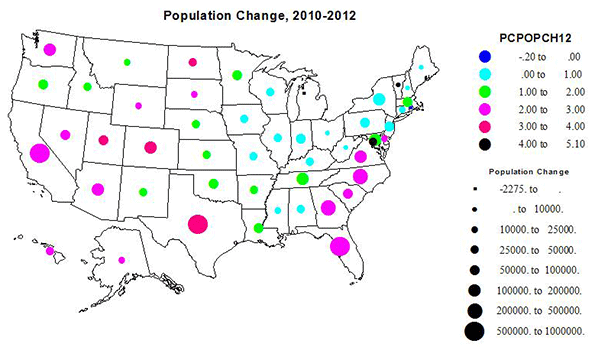
    What have the last two years of modest recovery meant to the growth and redistribution of population among the states? New data on the components of change for states are now available.  In March county level data will permit a more detailed portrait.

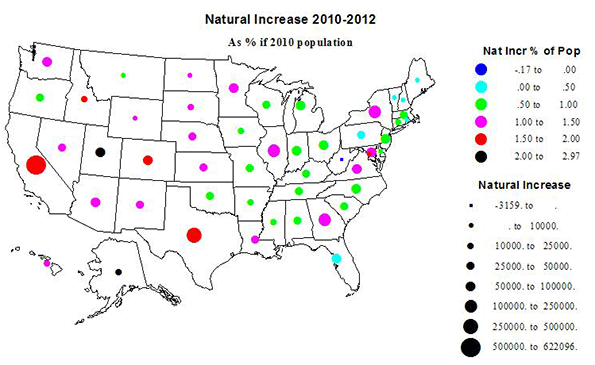
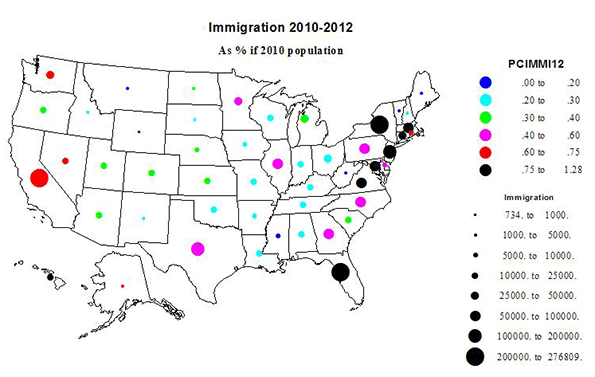
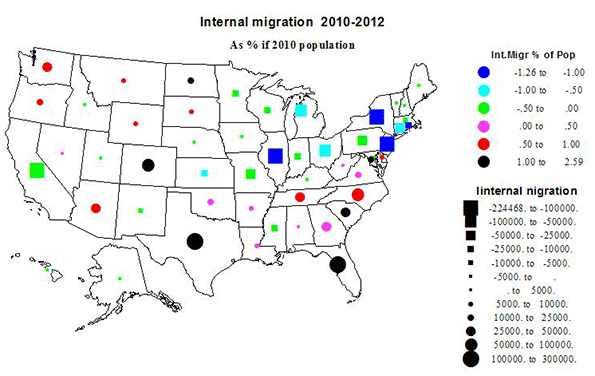
    For states I present four maps, overall population change, change from natural increase, immigration (net international migration) and internal migration between states.

    Population Change

    Not surprisingly, most of the states with larger absolute and percent gains continue trends from the last decade: the South Atlantic states from Florida to Delaware, in the South dominantly Texas (both amount and rate), along with Colorado and Washington State as centers of substantial Western growth. But North Dakota, due to rapid energy development, is the prime addition to the “winning” state for growth, with South Dakota following. The District of Columbia had the highest rate of growth,a beneficiary of expanding government growth, and perhaps more importantly, power.

    Conversely, low rates of growth, even a loss for Rhode Island and possibly Michigan, characterize the northeast and the south central states.

    Natural Increase

    For most states, natural increase (the difference between births and deaths) is the largest component of growth. The rates and amounts are significant to overall growth across the west, California still leads in absolute growth, entirely due to natural increase. In contrast Utah and Idaho also stand out for high rates, in part from their Mormon population.  Some slower growth northeastern states do have substantial natural increase, due to their size, including IL, MI, OH, and NY, while NC and SC and especially FL have lower rates of natural increase due to aging of their populations and migration of older people from the north.

    Immigration

    Total US population growth from 2010-2012 was 5.17 million, of which 3.32 million was from natural increase (8.9 million births and 5.6 million deaths), leaving a substantial part of growth from international migration of 1.85 million. Despite the flak about immigration, the pace has not slowed.

    While immigration in the West (CA, WA, HI) of 277,000 remains significant, the  dominant flow of immigrants went to the  Atlantic seaboard states – how old-fashioned! – such as greater New York,  Florida, and increasingly to GA and NC. New York gained 210,000 and Florida 212,000!   Immigration was fairly modest to the interior of the country. This reflects largely the decreasing immigration from Mexico. Illinois (with a gain of 61,000 from immigration) and Texas are both are experiencing slowdowns.  And note that AZ and NM immigration have become quite small.

    The highest rate of immigration was to HI followed by NJ and FL.

    Internal Migration

    The volume of interstate migration was still lower than was typical in the 1960s through the 1990s, but still potent in explaining the growth differential among the states.

    The pattern of absolute and relative gains and losses was essentially a continuation of trends over the last twenty years, with net in-migration to much, but not all of the South and to the West, except for California, which grows from natural increase and immigration but loses to the rest of the country. 

    Texas, with a net gain of 291,000, easily grew the most, followed by Florida (219,000), then North Carolina (72,000) and Colorado (62000). The highest rate was North Dakota, with net in-migration at 2.6% of the base population, followed by the District of Columbia (2.35%) and Colorado (1.24%). The North Dakota phenomenon is the most remarkable, since it marks an abrupt reversal from decades of loss, and of unknown duration.  In the West, Colorado became the preferred destination, followed by Washington, with Arizona and Nevada less popular than a decade earlier. South Dakota also changed to a small gain due to its strong economy and low unemployment.

    Out-migration characterized 28 states, encompassing the entire northeastern part of the country, from Minnesota to Maine, Kansas and Nebraska to Pennsylvania and New Jersey, and several states experienced high amounts and rates of loss, e.g. New York, -224,000; Illinois, -156,000; New Jersey, -103,000; and Michigan, -93,000; but the highest rates of loss were for Rhode Island, Illinois, New Jersey and New York. Outside the northeast, the biggest loss, as usual was for California: 104,000.

    Differences in Components of Change From the 2000-2010 Decade
    Population growth

    Overall the rates of population growth, of natural increase, and of international immigration are remarkably unchanged. The perhaps surprising turnarounds towards much greater rates of growth occurred in DC, LA (recovery from Katrina), and  the Dakotas. States whose growth slowed markedly were AZ, ID, NV, NM, and UT in the West (partly due to much lower migration from Mexico), and Georgia. Only RI shifted from growth to a loss.

    AK, HI, LA and ND enjoyed increased immigration, while it fell for AZ, CO, NM and TX.  Natural increase grew in ND and DC.  

    Internal migration

    DC, LA and ND changed the most, changing from losses to gains, and CO and SD had increased rates. Twelve states had lower rates of in-migration: AL, AZ, AR, DE, GA, KY, NV, NC, OK, OR, SC, and even VA – presumably a recession effect. But it was worse for seven states which shifted from gains to losses: ID, ME, MO, NH, NM, PA and VT, and for 3 states with bigger losses: CT, IN and NJ. But then seven states reduced rates of loss: CA, HI, IA, MD, MA, NE, and NY. Obvious explanations for some of these changes do not spring quickly to mind.

    What all this shows is that it is hard to make long term projections on the basis of seemingly robust trends over even fairly long periods. Preferences change, economic sectors rise and fall.

    Political Implications

    Analysis of the 2012 elections have shown that the Obama victory is a consequence of demographic change as the country shifts from a domination of white males to a rainbow coalition of yes, white liberals, mostly urban, but propelled largely by a strongly supportive minority population moving toward a majority. At first glance the maps seem to tell us that growing areas in the South and mountain states favor the Republicans while the declining Northeast was the stronghold of Democrats. Yet it is more complex, since states like Virginia, Florida, Colorado and even North Carolina – all with large and growing minority as well as white urban populations – vote increasingly Democratic.

    Richard Morrill is Professor Emeritus of Geography and Environmental Studies, University of Washington. His research interests include: political geography (voting behavior, redistricting, local governance), population/demography/settlement/migration, urban geography and planning, urban transportation (i.e., old fashioned generalist).

  • Why Republicans Need the Cities

    Republicans took an all around shellacking in the 2012 elections. Part of the reason is that Democrats dominated the cities. President Obama won 69% of the big city vote, according to a New York Times exit poll analysis. Some of this is perhaps on account of the racial makeup of the cities, as blacks overwhelmingly vote Democratic. Yet it’s clear that, even among the upscale white urbanist crowd, Republican policies and candidates are finding few takers.

    This bodes ill for the Republicans, but also for the future of cities. Most places suffer when under single-party rule, whether liberal or conservative. This has plagued big cities. Chicago, for example, doesn’t have a single Republican member of its city council. For a long time Republicans dominated large tracts of the suburbs.

    These geographically discrete monopolies have resulted in a thoroughly corrupt bi-partisan system that Chicago Tribune columnist John Kass has dubbed “The Combine.” Some competition remained at the state level, but it should come as no surprise that as the state as a whole as gone solidly blue, state and city finances have cratered, leaving Illinois as a national basket case.

    Cities can benefit from Republican ideas on a variety of fronts. As Harvard Economist Ed Glaeser points out in City Journal, Republicans have been leaders in ideas around urban crime reduction, education reform, and privatization and rationalization of city services.

    Unfortunately, Republicans have largely abandoned the urban playing field, preferring to condemn the cities as cesspools of Democratic corruption, high taxes, and decay. The Republican party today is largely driven by exurban and rural leaders, as well as populist movements like the Tea Party, with values that are not widely shared by urban dwellers. This has not only cost the party votes, but, critically, it has left it on the outside looking in on many debates, as culture is shaped in large urban centers where Republicans have little voice.

    It’s well past time for Republicans to take cities seriously again. This starts with valuing urban environments, and respecting (or at least taking time to understand) the values of the people who live there. For example, urban dwellers expect and indeed require a higher level of public services than many suburban residents. The suburbs might not need quality street lighting, for example, but cities do. The rural area I grew up in can rely on people passing by in pickup trucks with chain saws to clear away trees that fall on the road. Cities can’t. Thus, Tea Party-type policy prescriptions in which basically everything the government does is considered bad, and in which cutting taxes is the main political value, aren’t likely to sell. Urban dwellers actually want to know how you are going to deliver services more effectively. Similarly, just bashing transit as a waste of money, lashing out against location-appropriate density, opposing all environmental initiatives, and shrill anti-immigrant rhetoric only turn urban dwellers off.

    If Republicans took urban concerns seriously, they would find that they have much to offer urban residents and voters. For example, Democrats pay lip service to transit, but much transit policy in America today (heavily shaped by Democrats) is more oriented towards protecting entrenched constituencies than it is towards actual effectiveness. A serious Republican-led effort to reform the federal process and reduce the insane construction price premium (effectively a transit surtax) for American transit versus overseas systems would be welcomed, as long as it was not a Trojan horse for undermining transit. Republicans have so abandoned transportation (other than highway spending), that ideas which Republicans invented, like congestion pricing, have been claimed by the left as their own.

    As an example of what a more urban focused Republican/conservative could be, consider the Manhattan Institute, a free market think tank (full disclosure: I have been a writer for their City Journal magazine). Because they are based in New York City, demonizing transit and such is just not realistic. Hence they’ve focused on policy ideas that are actually relevant to the city. They’ve also not hesitated to praise Mayor Bloomberg’s transportation reforms, and even gave an award to Rhode Island Democratic state treasurer Gina Raimondo for her leadership in pension reform. If more conservatives were similarly focused on driving better urban outcomes in the inner city rather than demonizing it, or on scoring political points, Republicans might be back in the game.

    Republicans have a huge opportunity in the enormous income and wealth gap in inner cities, which Democratic policies, focused on things like greening the city, have done little to address. Indeed, all too much urbanism amounts to a sort of trickle down economics of the left, in which a “favored quarter” of artists, high end businesses, and the intelligentsia are plied with favors and subsidies while precious little ever makes it to those at the bottom rungs of society. A key lever to end this is to cut away at the massive regulatory burden that stifles small scale entrepreneurs, particularly minorities and immigrants. Regulatory relief is right up the Republicans’ alley.

    Republicans also need to take on cities, especially the biggest ones, in order to get more of a voice in the cultural debates. Culture and media emanate from big cities, particularly New York, Los Angeles, and Washington, DC. Major academic centers also are idea generation factories.

    Republicans became all but excluded from the cultural/media industry as the 60s generation took over. The party’s response has been to create a parallel infrastructure of think tanks, talk radio shows, web sites, and even its own TV network, Fox News. This worked well in the era immediately following the end of the Fairness Doctrine, but as the so-called mainstream media reacted by shifting to the left, this has left the Republicans often talking mostly to themselves while the national culture gets shaped by Hollywood, etc. A good example is the web site Atlantic Cities, which fully embodies the values of the international urban elite left, with few identifiable conservative ideas.

    The 2012 election shows the limits of this strategy. Just as evangelical Christians have decided that they must look to plant their flag in the inner cities – both to reach an increasingly secularized, ,upscale population, and to engage with culture where it is made – Republicans need to start showing up seriously in the cities again if they want to influence the culture. There are already some top-notch conservatives participating in and writing about serious culture (e.g., Terry Teachout). More ambitious, talented young conservatives should seek to enter culture and media industries apart from simply writing for conservative magazines. This battle won’t be easy by any means, but defeat is certain if you never fight.

    One thing is for sure: if Republicans want to have any future in America, they can’t afford to cede any more constituencies as monolithic Democratic voting blocks. Urban America is one constituency the Republican Party can’t afford to ignore.

    Aaron M. Renn is an independent writer on urban affairs and the founder of Telestrian, a data analysis and mapping tool. He writes at The Urbanophile.

    Flickr photo by jvoves: Immigrants protest a Republican-sponsored proposal in Chicago.

  • California’s Politics of Farce

    Karl Marx wrote, "History repeats … first as tragedy, then as farce." Nothing better describes how California, with its unmatched natural and human riches, has begun to morph into what the premier California historian Kevin Starr has called "a failed state" – a term more usually applied to African kleptocracies than a place as blessed as the Golden State.

    The tragedy begins with the collapse of a governance system once widely hailed as a leader in efficiency and foresight but which now perpetually teeters at the brink of insolvency and suffers among the worst credit ratings of all the states. Only 20 years ago, the state’s fiscal debt per capita was just below the national average; now it ranks consistently toward the bottom No surprise, then, that California routinely ranked as the "worst governed" state in America.

    This poor performance has consequences, particularly in terms of business. Today, CEOs rank California as just about the worst place to do business in the country, and have for a remarkable eight years in a row. And it’s not just the plutocrats who are angry; a survey by the economic forecasting firm EMSI shows that, in 2011, California also ranked 50th, just ahead of Michigan, in new business startups.

    Unlike my conservative friends, I do not think the fault lies entirely with the Democrats. Instead, it has to do with the total eclipse of the state’s once-lively two-party system. As Starr has noted, California’s golden age of governance from the 1940s to the 1960s was largely a bipartisan affair, with power shifting between the parties. "Despite their differences," Starr writes, "Democrats and Republicans saw sufficiently eye-to-eye" to embrace policies that drove California’s growth.

    Progressives, for their part, often suggest this paradigm died with the 1978 passage of Proposition 13, which diminished local government and concentrated fiscal power in Sacramento. Yet even as late as early 1990s, when the state was facing a dire recession due to the end of the Cold War, liberal Democrats such as Assembly Speaker Willie Brown and state Sen. John Vasconcellos managed to work well with Republican Gov. Pete Wilson and business leaders like Peter Ueberroth to force policy changes that helped spur the state’s last sustained recovery.

    The more recent demise of California governance stems from demographic trends and political miscalculations that have turned our state increasingly into something akin to Mexico under the old dictatorship of the PRI (Institutional Revolutionary Party). Wilson’s decision to embrace the anti-illegal-immigration measure Prop. 187 as part of his 1994 re-election strategy helped precipitate this shift. Although Prop. 187, which passed easily, helped in the short run, it crippled the Republican Party in the ensuing decades.

    Before 1994, Republicans were capable of winning upward of two-fifths of the Latino vote. But after that, as the Latino portion of the electorate grew, from 7 percent in 1980 to more than 21 percent today, these voters became, much like the African-American vote, essentially a bloc owned by the Democrats. In 2010, Jerry Brown won nearly two-thirds of their votes in his bid to return as governor. Asian voters, despite their decidedly middle-class and entrepreneurial bent, sensed the whiff of nativism among Republicans and also turned to the Democrats. With minority communities’ share of the electorate growing every year, the GOP essentially has backed itself into permanent minority status.

    This has set the stage for a bizarre political farce, where minority representatives in Sacramento – with few exceptions – consistently vote against the interests of their own constituents on issues such as water allocations in the Central Valley or regulations that boost energy and housing prices. In their clamor to join the "progressive" team, they, in effect, are placing the California "dream" outside the reach of the state’s heavily minority working class.

    It’s almost surreal to see people who represent impoverished East Los Angeles and Fresno, for example, vote exactly the same way as those who represent rich, white and older voters in Marin County and Westside Los Angeles. You don’t have to watch "Downton Abbey" to see "upstairs, downstairs" politics. Despite mouthing progressive rhetoric, California’s minority legislators seem intent of creating an increasingly feudalized California.

    And what of the middle class – once the bastion of both the GOP and the kind of "responsible liberalism" that promoted growth under the late Gov. Pat Brown? This largely Anglo group has been shrinking, both for decades as a percentage of California’s population and, during the past 10 years, in absolute numbers. From 2000-10 the number of non-Hispanic whites in the state dropped from 15.8 million to 14.95 million.

    Increasingly, the residual California middle class is either part of the public sector nomenklatura or the swelling ranks of retirees. These people often feel no compulsion to leave California for the reasons – such as weather and high property taxes – that drive their counterparts out of places like New York or Illinois. In contrast, the productive, working-age private middle class, harassed by taxes, regulations and soaring costs, increasingly appears more of an endangered species than the famed Delta smelt.

    Of course, there remain pockets of private sector strength, such as Silicon Valley and Hollywood, as well as the various biomedical and biotech companies that still thrive in places such as Orange County and San Diego. These, however, increasingly represent legacy industries, beneficiaries of past accomplishments and better entrepreneurial conditions. Yet, even here, despite the current tech boom, California’s position over the past decade has declined relative to more business-friendly states.

    In the immediate future, we should expect more of the same from our one-party government. Flush from the passage of Prop. 30, tax increases backed by public sector unions, there is little to restrain them beyond occasional resistance from Gov. Brown. Having made California’s income taxes the highest in the U.S., legislators and local officials are already busily concocting new taxes, fees and another spate of bond issues to prop up the nation’s most-cosseted public sector, and, of course, fund its rich pensions at the expense of mostly middle-class taxpayers.

    Indeed the emphasis on income taxes, representing now close to half of state revenue, creates perverse economic outcomes. With their funds hidden in overseas accounts and other dodges, Hollywood moguls and their Silicon Valley counterparts may hang around, mouthing progressive shibboleths while dining exquisitely. But there is clearly erosion among the less-glamorous entrepreneurial class. The number of households earning above $300,000 dropped by 45,000 from 2006-09, according to the Department of Finance, while those earning under $100,000 has grown by more than 180,000. It’s likely that Prop. 30 will accelerate this trend.

    But it’s not only taxes that will depress growth. Our Mad Hatter one-party, public-sector-dominated state seems keen to press its regulatory assault on employers and job creators. With climate change-related legislation certain to boost already high energy costs, we also can expect industries, from food processing to semiconductors and aerospace, to continue heading to friendlier locales.

    Unless these policies are challenged, California will continue to underperform well below its potential. Even worse, a state that created the modern American Dream of upward mobility will continue to devolve toward a kind of neofeudalism dominated by a few rich, with many poor and a well-fed, tenured government caste. The only way to halt this continuing farce in Sacramento is for Californians of all backgrounds to recognize that government that so earnestly claims to serve "the people" is doing anything but that.

    Joel Kotkin is executive editor of NewGeography.com and a distinguished presidential fellow in urban futures at Chapman University, and a member of the editorial board of the Orange County Register. He is author of The City: A Global History and The Next Hundred Million: America in 2050. His most recent study, The Rise of Postfamilialism, has been widely discussed and distributed internationally. He lives in Los Angeles, CA.

    This piece originally appeared in the Orange County Register.

  • The New Power Class Who Will Profit From Obama’s Second Term

    When President Obama takes the oath of office for the second time, he will also usher in a new era in American power politics. Whereas the old left-wing definition of “who rules” focused on large corporations, banks, energy companies and agribusinesses, the Obama-era power structure represents a major transformation.

    This shift stems, in large part, from the movement from a predominately resource and tangible goods-based economy to an information-based one. In the past, political struggles were largely fought over how to divide up the spoils generated by the basic productive economy; labor, investors and management all shared a belief in the ethos of economic growth, manufacturing and resource extraction.

    In contrast, today’s new hegemons hail almost entirely from outside the material economy, and many come from outside the realm of the market system entirely. Daniel Bell, in his landmark 1973 The Coming of Post-Industrial Society, may have been the first to identify this ascension to “pre-eminence of the professional and technical class.” This new “priesthood of power,” as he put it, would eventually overturn the traditional hierarchies based on land, corporate and financial assets.

    Forty years later the outlines of this transformation are clear. Contrary to the conservative claims of Obama’s “socialist” tendencies, the administration is quite comfortable with such capitalist sectors as entertainment, the news media and the software side of the technology industry, particularly social media. The big difference is these firms derive their fortunes not from the soil and locally crafted manufacturers, but from the manipulation of ideas, concepts and images.

    Apple, Google, Facebook, Amazon and Microsoft are far from “the workers of the world,” but closer to modern-day robber barons. Through their own ingenuity, access to capital and often oligopolistic hold on lucrative markets, they have enjoyed one of the greatest accumulations of wealth in recent economic history, even amidst generally declining earnings, rising poverty and inequality among their fellow Americans.

    Last year the tech oligarchs emerged as major political players. Microsoft, Google and their employees were the largest private-sector donors to the president. More important still, tech workers also provided the president and his party with a unique set of digital tools that helped identify potential supporters among traditionally uninformed and disinterested voters, particularly among the young.

    An even greater beneficiary of the second term will be the administrative class, who by their nature live largely outside the market system. This group, which I call the new clerisy, is based largely in academia and the federal bureaucracy, whose numbers and distinct privileges have grown throughout the past half century.

    Even in tough times, high-level academics enjoy tenure and have been largely spared from job cuts. Between late 2007 and mid-2009, the number of U.S. federal workers earning more than $150,000 more than doubled, even as the economy fell into a deep recession. Even as the private sector, and state government employment has fallen, the ranks of federal nomenklatura have swelled so much that Washington, D.C., has replaced New York as the wealthiest region in the country.

    As a former professor at the prestigious University of Chicago, and a longtime ally of public-sector unions, Barack Obama’s political persona is all but indistinguishable from these new hierarchies. Their support for him has become critical, particularly as the onetime “hedge fund candidate,” decided to wage a very effective class warfare campaign on the hapless Mitt Romney.

    This decreased Obama’s support among the plutocrats, even if they have thrived under his watch, but he made up for this in part by tapping bureaucracies that benefit from expanding government. Indeed the clerisy accounted for five of the top eight sources of Obama’s campaign funding, led by the University of California, the federal workforce, Harvard , Columbia and Stanford. Academic support for Obama was remarkably lock-step: a remarkable 96% of all donations from the Ivy League went to the president, something more reminiscent of Soviet Russia than a properly functioning pluralistic academy.

    To understand the possible implications of the new power arrangement, it is critical to understand the nature of the new clerisy. Unlike traditional capitalist power groups, including private-sector organized labor, the clerisy’s power derives not primarily through economic influence per se but through its growing power to inform opinion and regulate everything from how people live to what industries will be allowed to grow, or die.

    The clerisy shares a kind of mission which Bell described as the rational “ordering of mass society.” Like the bishops and parish priests of the feudal past, or the public intellectuals, university dons and Anglican worthies of early 19th century Britain, today’s clerisy attempts to impart on the masses today’s distinctly secular “truths,” on issues ranging from the nature of justice, race and gender to the environment. Academics, for example, increasingly regulate speech along politically correct lines, and indoctrinate the young while the media shape their perceptions of reality.

    Most distinctive about the clerisy is their unanimity of views. On campus today, there is broad agreement on a host of issues from gay marriage, affirmative action and what are perceived as “women’s” issues to an almost religious environmentalism that is contemptuous toward traditional industry and anything that smacks of traditional middle class suburban values. These views have shaped many of the perceptions of the current millennial generation, whose conversion to the clerical orthodoxy has caught most traditional conservatives utterly flat-footed.

    As befits a technological age, the new clerisy also enjoys the sanction of what Bell defined as the “creative elite of scientists.” Prominent examples include the Secretary of Energy, the Nobel Prize-winning physicist David Chu; science advisor John Holdren; NASA’s James Hansen; and the board of the U.N.’s Intergovernmental Panel on Climate Change. In the words of New York Times hyper-partisan Charles Blow, Republicans have devolved into the “creationist party.” In contrast Obama reigns gloriously hailed as “the sun king” of official science.

    Let’s be clear — this new ascendant class is no threat to either the “one percent,”  or even the much smaller decimal groups. Historically, the already rich and large economic interests often profit in a hyper-regulated state; the clerisy’s actions can often stifle competition by increasing the cost of entry for unwelcome new players. Like Cardinal Richelieu or Louis XIV’s finance minister, Jean-Baptiste Colbert, our modern-day dirigistes favor state-directed capital that has benefited, among others, “green” capitalists, Wall Street “too big to fail” firms and, of course, General Motors.

    More disturbing still may be the clerisy’s regal disregard for democratic give and take. Both traditional hierarchies, or new ones like the Bolsheviks after the 1917 revolution, disdain popular will as intrinsically lacking in scientific judgment and societal wisdom. Some leading figures in the clerisy, such as former Obama budget advisor Peter Orszag, openly argue for shifting power from naturally contentious elected bodies to credentialed “experts” operating in places Washington, Brussels or the United Nations.

    Such experts, of course, see little need for give and take with their intellectual inferiors, in Congress or elsewhere. This attitude is expressed in the administration’s increasing use of executive orders to promote policy goals such as better gun control, reduced greenhouse emissions or reform of immigration. Whatever one’s views on these issues, that they are increasingly settled outside Congress represents a troublesome notion.

    Like empowered bureaucrats everywhere, the clerisy also sometimes reserves a nice “taste” for themselves, much as the old bishops and upper clergy indulged in luxury and even prohibited pleasures of the flesh. Just look at the lavish payouts accorded to Orszag and Treasury Secretary-designate Jacob Lew, who, after serving in the bureaucracy, make millions off the same Wall Street firms that have so benefited from administration policies.

    So who loses in the new order? Certainly unfashionable companies  – oil firms, agribusiness concerns, suburban homebuilders — face tougher times from regulators and the mainstream media . But the biggest losers likely will be the small business-oriented middle class. Not surprisingly Main Street, far more than Wall Street, harbors the gravest pessimism about the president’s second term.

    The small business owner, the suburban homeowner, the family farmer or skilled construction tradesperson are intrinsically ill-suited to playing the the insiders’ game in Washington. Played up to at election time, they find their concerns promptly abandoned thereafter, outliers more than ever in a refashioned political order.

    Joel Kotkin is executive editor of NewGeography.com and a distinguished presidential fellow in urban futures at Chapman University, and a member of the editorial board of the Orange County Register . He is author of The City: A Global History and The Next Hundred Million: America in 2050. His most recent study, The Rise of Postfamilialism, has been widely discussed and distributed internationally. He lives in Los Angeles, CA.

    This piece originally appeared at Forbes.com.

    Official White House Photo by Pete Souza.