Category: Politics

  • How Polarization Plays Out in Washington state: Voting for President and the Same-sex Marriage

    Washington may be a left coast “blue” state, but the geography of the voting well illustrates the national phenomena of intensifying polarization.  The division may be among individual people,   but also expressed in geographies down to precincts and census tracts. 

    The Washington 2012 elections provided ample data to assess this political and geographic divide. I review here the two most polarized races, for president (Obama vs. Romney) and for R74, to reaffirm the right to same sex marriage.  

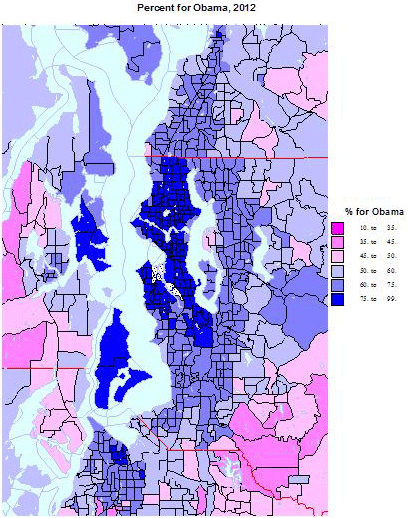
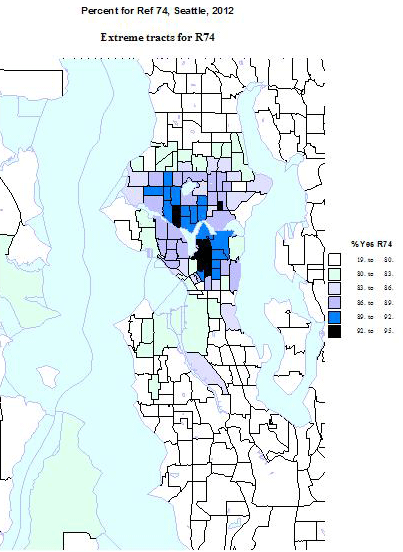
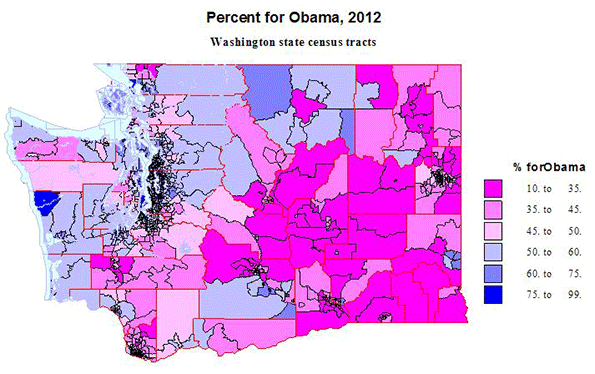
    Here are a series of 6 maps, 3 for the presidential race, for the state as a whole, and for the greater Seattle area, and one showing just the extreme tracts for Obama in the Seattle area, and 3 for the R74 contest, for the state, for greater Seattle and again of just the extreme tracts, all in the city of Seattle.  These maps illustrate the extreme dimensions of polarization impacting the regions.         

    The results suggest three overlapping dimensions. The dominant one is itself ecological – that is the urban-rural, or better large dense metropolitan territory versus rural, small towns, with smaller cities and metropolitan suburbs in between, and less polarized geographically. The strongest correlations in demographic variables are transit use vs. SOV use, density, single persons, and multi-family versus mobile homes.  
    These factors apply to both the Obama race and for R74, but more strongly for Obama. The second dimension is of social liberalism, and is characterized by variables on household relationships, unmarried partners, gay and lesbian, education, e.g., share  with BA vs. with high school only, occupation, e.g., percent managerial professional vs. percent in laboring and construction occupations. The social divide also shows difference by age, those 20-34 more liberal, areas with high shares under 18, that is families, more conservative. This dimension too applies to both contests, but more strongly to R74. The third dimension is race, minority racial areas vs. more white areas, and positively correlated with support for Obama, although the Asian share is much more related to support for R74.  In Washington we will see that the racial dimension really is somewhat distinct from the urban-rural, as Obama did well, but R 74 did poorly in rural small town areas that are now heavily minority (Hispanic and Native American).

    In a few cases with a large difference should be noted. Areas dominantly white are non-supportive of Obama, but not opposed to R74.  Similarly, areas high in managerial-professional occupations and higher education generally are more correlated with support for R74, than for Obama.

    Obama carried Washington state by 464,000 votes, 56 to 44 percent, and R74 won by some 229000 votes, 54 to 46 percent.  Consider first the maps for Washington State as a whole, realizing that like the US as a whole, rural territory dominates most of the physical space.  I use the same intervals for mapping, so comparison is easier.  The main difference between the Obama and R74 maps is race and ethnicity – many of the lighter blue rural small town areas are  Native American Indian reservations, or strongly Latino areas, which voted for Obama, but also cast ballots overwhelmingly against R74, likely reflecting the role of local churches. Obama also did better than R74 in traditional logging areas of western Washington, a continuation of a long history of their identification with Democratic voting, but more conservative on the social issues like same sex marriage. 

    Rural to smaller city areas voting for both Obama and R74 include university towns, notably Pullman (Washington State in eastern Washington,  Bellingham  (Western Washington U), Olympia, the state capitol, and many areas of “spillover” of more educated and professionals, out of the Seattle core to desirable water and mountain environments, for retirement and second homes,    At the other extreme are two areas in western Washington which are extremely “red” , the Centralia area in southwestern Washington,  and the city of Lynden, up at the border with Canada, and still dominated by its Dutch Reformed church adherents.

    Turning to the equivalent maps for Obama and R 74 for the greater Seattle area, with two-thirds of the state population, the picture is broadly the opposite of that for the state. Here blue dominates, with “red” areas pushed to the rural edge.  But the differences in the maps are interesting, illustrating the dimensions of polarization.  The Obama map exhibits a simpler belted pattern, the dense urban core, the city of Seattle with spillover north and south, with an inner suburban belt of moderate Obama domination (60 to 75 percent) and an outer suburban and exurban ring. This pattern was repeated for the city of Tacoma to the south. To the west, however, are two islands of very high Obama support, Vashon and Bainbridge, with very high proportions of professionals commuting to the Seattle core. Areas of support for Romney include a few fairly close in affluent areas and more rural areas, including actual farming areas to the southeast.
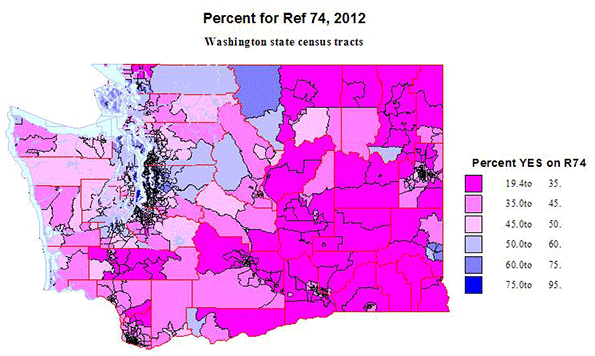
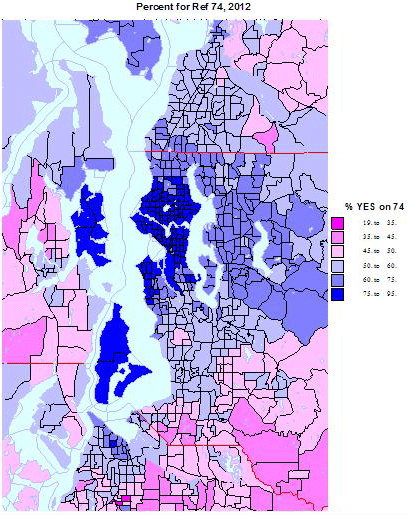
    The map for R74 is subtly different. The area of strongest support is reduced to the city of Seattle, plus the commuter islands, but support for R74 is quite a bit weaker in less affluent and educated black and latino areas. Likewise the majority of inner suburban areas are still supportive for Obama but far less than the core. These are mainly family areas, while the areas of highest support in the city are dominated by singles and childless couples, including unmarried partners.

    Conversely, moderately higher support for Obama and R74 extends somewhat farther east to affluent educated suburbs, e.g, the Microsoft workshed, which is also high in Asian population.  The final two maps are of the tracts with the highest support for Obama and for R74, most of which are confined to the city of Seattle. The areas of over 90 % support are two: the historic CD or Central District, which defined the Seattle Black population as of 1970-1980, not much gentrified at the north end, but also including the core of Seattle’s GLBT community (the westward extension over 90 %. The second area is in near north Seattle, extending from west of the University of Washington westward  in areas dominated by young singles and unmarried couples, including many students. The map for R74 is quite different, with no areas of extreme support to the south of the core GLBT area, but with stronger support than for Obama in the highly affluent and professional areas, just north of the GLBT core.

    Clearly the 3 dimensions of polarization, by settlement type, by social values-education, and by race, all are exemplified by the map results. The geographic concentration of the vote, especially for R74 can be seen in these amazing numbers:

    Vote Results in Washington State
    State State Outside King Co. King Co Seattle King Co. Outside Seattle
    Obama 1,755 1,087 668 279 389
    Romney 1,291 1,015 276 46 230
    Difference 464 72 392 233 159
       
    R74 yes 1,660 1,021 639 274 365
    R74 no 1,431 1,107 315 57 258
    Difference 229 -86 324 217 107


    Obama carried the state by 464,000. Half of this was accounted for by just the city of Seattle. The
    Pro vote for R74 was even more concentrated in the metropolitan core, as the margin just in the central  city of Seattle , 217,000, was essentially the margin for the state!  King County outside Seattle provided an additional margin of 107,000, offsetting a net loss of 86,000 in the entire rest of the state, where the vote was 1,107,000 to 1,021,000 against. 

    It is similarly amazing to note the relative location of areas with very high or very low vote shares for Obama and for R74.  Eighty-nine census tracts were carried by Obama with over 85% of the vote and 83 tracts voted more than 83 percent for R74. The distributions were:

    Number of Census Tracts Voting 85% for Obama or 83% for Measure R74
    Obama R74
    North Seattle 37 33
    Central Seattle 19 26
    South Seattle 26 1
    Pierce (Tacoma, reservation) 1  
    Whatcom (WWU) 2 2
    Whitman (WSU) 2 1
    Yakima (Reservations) 3  
    Thurston (Olympia) 1  

    Eighty-two of 89 of tracts with high Obama shares were in the city of Seattle, dominating the city and well distributed across it. The other 7 were in Tacoma, Olympia, Whatcom and Whitman, both university communities, and in Yakima county Indian reservations.  All these tracts were urban core tracts, except for those on the Yakama reservation.   Sixty of 63 tracts with the highest shares for R74 were in the city of Seattle,  concentrated in the north (University of Washington dominated) or highly professional, and in the center, home of the large GLBT community, with few in the south of the city, which is less affluent and higher in minorities.  The remaining 3 are in Whatcom (WWU) and Whitman (WSU). All these tracts are urban.
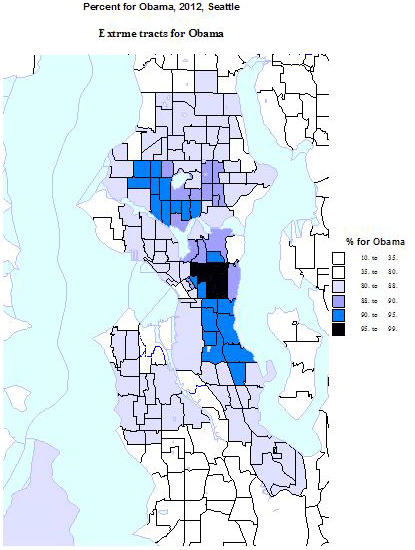
    The distribution of tracts with very low shares for Obama and for R74 shows the other side of the   polarization.  Of the 71 tracts where Obama received less than a third of the vote, 34 were in south central Washington, the region of the Tri Cities of Richland, Kennewick and Pasco, Yakima, county and Grant county, home of the Columbia basin irrigation project, all areas high in Mormon and Latino populations. Another 19 were in north central and northeastern Washington, including much of Okanogan and Lincoln counties, and even some exurban counties around Spokane. Another 8 were in southeastern Washington (wheat country), leaving 9 in western Washington.  Three each were in rural parts of Clark County and Lewis County in the southwest, and 3 were in the very conservative small city of Lynden, on the Canadian border, and home of a large Dutch reformed community. All these tracts are rural except for the city of Lynden and 3 suburban tracts in the Tri-Cities.

    Similarly, of 81 tracts with shares below one third for R74, 32 were again in south central Washington, 21 in north central and northeastern Washington, 4 in the southeast, and now a larger 15 in western Washington. The Lynden area of Whatcom county accounts for 4, but now 6 in socially conservative Lewis County, 4 in rural parts of Clark County, and 2 in family dominated military parts of Pierce County.  All these tracts are rural, small town, except for those in Lynden, again in suburban Tri-cities and 2 in suburban Tacoma.

    Differences between Obama and R74 Shares

    The last discussion compares the vote for Obama and for R74, identifying areas with the greatest difference, recalling that the overall correlation was a very high .87.  Please also see Map 7.
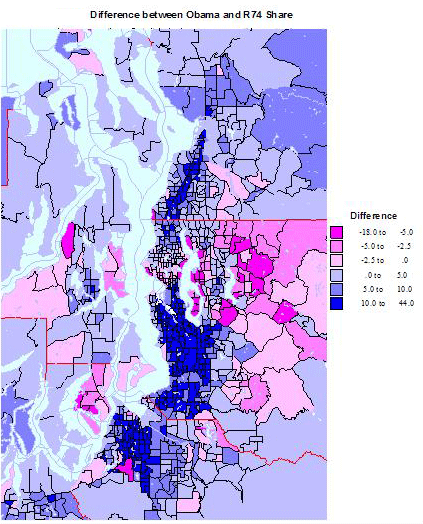
    The Obama vote exceeded the share for R74 by more than 20 percent in 56 census tracts.
    In rural areas Obama did well with the large Latino vote, which also voted against R74. This was true as well in Indian reservation tracts.  In Seattle and Tacoma the tracts are mainly lower to middle class, worker areas, Black or Latino or both.  All of the King county tracts were in south Seattle, extending southward into lower and middle class industrial suburbs.

    The R74 vote exceeded the Obama vote by 5% or more in 51 tracts.

    Overall, R74 fared better than Obama in affluent professional areas, socially more liberal but economically more conservative.  But the pattern surprisingly occurs in several military base areas, as in Island and Kitsap counties. In 15 tracts R74 won but Obama lost, all affluent suburb or military areas in several parts of the state.  In King the 4 tracts are the 2 richest tracts in the state plus 2 near the Microsoft Redmond campus.  In 12 tracts both Obama and R74 won, but R74 polled higher. These tracts were spread across the state, in mainly exurban economically conservative areas. In 24 tracts Obama and R74 won. All but one were in King, most in the professional suburbs east of Seattle and a few in the wealthiest tracts inside the city of Seattle.

    Conclusion

    The electorate of Washington, like that of the country, is ideologically divided, and which is manifest geographically in the familiar red and blue mosaics. Washington overall is on the economically and socially liberal side, although statewide maps would not recognize the degree of this, simply because of the extreme concentration of these sub-populations in the urban cores, and especially in and around the   city of Seattle.

    Richard Morrill is Professor Emeritus of Geography and Environmental Studies, University of Washington. His research interests include: political geography (voting behavior, redistricting, local governance), population/demography/settlement/migration, urban geography and planning, urban transportation (i.e., old fashioned generalist).
  • California’s Poor Long-term Prognosis

    California’s current economic recovery may be uneven at best, but things certainly look better now than the pits-of-hell period in 2008. A cautiously optimistic New York Times piece proclaimed "signs of resurgence," and there was even heady talk in Sacramento of eventually sighting that rarest of birds, a state budget surplus.

    Yet such outbreaks of optimism should not blind us to the bigger issue: the long-term secular decline of the state’s economy. Whether you believe that the new higher taxes may now slow our growth, as my colleagues at Chapman University now believe, or right the fiscal ship, as is widely hoped in the blue California press, it’s more important to look more at the long-term trends, and assess where we stand compared with our domestic competitors.

    California, despite its enormous natural and human resources, is losing ground in most basic areas. Its unemployment rate, a still-horrendous 10 percent, stands as the nation’s third-highest. This is not a new development or the product of a run of bad luck. The state’s unemployment rate has been consistently above the national average for almost all of the past 20 years. Most interior counties, including the Inland Empire and the Central Valley, now suffer unemployment rates well into the double digits, with some approaching 15 percent.

    Overall, the state is still down a half-million jobs during the recession. California’s losses since its employment peak have been considerably above the national average, some 3 percent, far worse than the 2.3 percent erosion seen nationwide. Despite the modest recent uptick, the California Budget Project projects the state would need to add twice as many jobs per month to fully recover from the recession by the summer of 2015.

    Other long-term trends confirm the state’s secular decline in competitiveness. Take per capita income – a decent indicator of relative progress. In 1945, journalist John Gunther, writing his famous "Inside USA," gushingly described California "the most spectacular and most diversified American state … so ripe, golden." At the time, the state boasted the third-highest per capita income in the nation. As late as 1980, the state still ranked fourth. Today, despite Silicon Valley’s money machine, California has fallen to 12th and appears headed for further decline.

    Despite hopes in Sacramento and in the media, high-tech alone can not bail out the state. The much hoped-for windfall around the time of the Facebook IPO has failed to produce the expected fiscal bonanza for the state treasury. Silicon Valley famously gets nearly half the country’s venture capital, but its impact on the rest of the state has diminished. In the 1980s and 1990s, tech booms stretched prosperity throughout its surrounding regions and as far as Sacramento. Now it barely covers half the Bay Area; unemployment in Oakland remains at around 13 percent and one child in three lives in poverty.

    Part of this reflects the shift from an industrial high-tech focus to one fixated on software and social media. Given the extraordinary ease with which support and even research operations can be moved, once companies start to grow, they easily head to India, China or over to lower-cost locales like Utah or Texas. "Sure, we are getting half of all the venture capital investment but in the end we have relatively small research and development firms only," observes Jack Stewart, president of the California Technology and Manufacturing Association. "Once they have a product or go to scale, the firms move elsewhere. The other states end up getting most of the middle-class jobs."

    This can be seen in the long-term trends in STEM (science, technology, engineering, mathematics-related) jobs. Over the past decade, even with the current bubble, Silicon Valley’s STEM employment, according to estimates by Economic Modeling Specialists Inc., has increased by a mere 4 percent over the past decade. In contrast, science-based employment jumped 25 percent in Seattle, 20 percent in Houston and 16.8 percent in Austin, Texas.

    The tech scene in the Los Angeles Basin is doing even worse. STEM employment in the Los Angeles-Santa Ana area is still stuck below 2002 levels, partially a residue of the continued decline of the region’s once-globally dominant aerospace industry. The region, once arguably the world’s largest agglomeration of scientists and engineers, has now dipped below the national average in proportion of STEM jobs.

    Far greater problems can be seen further down the economic food chain, where many working-class and middle-class Californians traditionally have been employed. The state’s heavy industry – traditionally the source of higher-paid blue-collar employment – has missed out on the nation’s broad manufacturing resurgence. Over the past 10 years, according to an analysis by the Praxis Strategy Group, California has ranked 45th among the states in terms of heavy metal job creation, losing 126,000 jobs – more than 27 percent; San Francisco-Oakland ranked last among 51 large metropolitan areas. Both Los Angeles-Orange and San Bernardino ranked in the bottom 10.

    Despite hype about "green jobs," the immediate prospect for a big manufacturing turnaround is not bright. Because of its high energy costs and other regulatory costs, industrial investment has dried up in California. According to the California Technology and Manufacturing Association, California in 2011 did not even make the top 10 states in terms of new industrial investment, accounting for a paltry 2 percent. This was about one-third or less the share garnered by rivals such as Texas, North Carolina and rebounding "rust belt" states, like Pennsylvania.

    Construction, another pillar of higher-paid blue-collar employment, has recovered a bit but remains in worse shape than elsewhere. Overall, the state has lost almost 300,000 construction jobs from the 2007 peak, an almost 40 percent loss compared with 29 percent for the country as a whole.

    Even the trade sector, stalwart performer in producing high-wage jobs, may soon be declining. Recent labor disputes by highly paid, politically powerful California port workers – shutting down operations for eight days in Los Angeles and Long Beach – has reinforced the notion that the state’s an increasingly unreliable place to do business. After peaking around 2002, our ports are watching growth shift to the Gulf ports, such as Houston, and to the ports of the south Atlantic. The challenge will become far greater once the Panama Canal is widened in 2014 to accommodate larger ships from Asia.

    California is also squandering its chance to participate in a potential fourth source of basic employment, the massive expansion in domestic oil-and-gas production. The Golden State sits on potentially the largest gusher in the nation – the Monterey Formation is now estimated to be four times as rich in oil as North Dakota’s Bakken Formation. But our green consciousness dictates we don’t exploit our resources too much. In the past decade, Texas created some 200,000 generally high-paying energy jobs, while greener-than-thou California has generated barely one-tenth as many.

    As a result, wealthier, older, whiter, generally better-educated coastal areas can recover, but the prospects are dismal the further you head into the increasingly Latino, younger and less-educated inland areas. You have flush times for venture capitalists and celebrities, but growing poverty elsewhere. For at least two decades California’s poverty rate has remained higher than the national average. Now, notes a new Census estimate, the Golden State has a poverty rate of more than 23 percent, the highest in the country, something unthinkable a generation ago.

    Clearly, progressive policies are having socially regressive effects. Over the past few years the state, as a recent Public Policy Institute of California study demonstrates, has become ever substantially more unequal than the rest of the nation. Typical California middle-income workers have seen their median wage, adjusted for inflation, decline 4.5 percent since 2006, and now is at the lowest level since 2008. Only the highest-paid workers have avoided a decline in earnings.

    Fortunately, the elements to regain our former broad-based prosperity are still in place. The critical human assets are there: entrepreneurs, hardworking immigrants, top universities. We boast advantages from legacy industries – entertainment and fashion to technology and agriculture. And, perhaps most importantly, California retains its remarkable natural blessings of massive energy resources, fertile soil and a benign climate.

    The imperative now is to take fuller advantage of all these blessings in the coming years. Otherwise California will become poorer, more socially bifurcated and relegated by other places to the proverbial "dustbin of history."

    This piece first appeared in the Orange County Register.

    Joel Kotkin is executive editor of NewGeography.com and is a distinguished presidential fellow in urban futures at Chapman University, and contributing editor to the City Journal in New York. He is author of The City: A Global History. His newest book is The Next Hundred Million: America in 2050, released in February, 2010.

  • California’s Blue Utopia

    The Progressive wing of the Democrat Party sits at the left end of their spectrum. JFK’s liberal positions would be regarded as moderate today. Progressives have a unique vision of what a blue state utopia would look like that begins with clean air, clean water, and green energy. Over the last twenty years, with the backing of the public employee unions that control the political process in California, the Progressives have managed to neuter the Republican Party and turn California Blue, owning every elective office in the state. They did not need much help according to Dan Walters, who stated, “Even the most anti-immigrant, anti-gay marriage, anti-tax, anti-abortion Republican activist must now recognize that with the party’s wipeout in last month’s elections, continuing down its recent path is a plunge into complete irrelevance”.

    In 2012, the progressive Democrats captured a super majority in both houses so that with their Progressive governor, they no longer require a single Republican vote to pass any form of legislation, leaving conservatives an “irrelevant” minority.  As an independent businessman, I have created many jobs and opportunities. But despite my contributions to society, and the taxes I have paid over the last thirty plus years, the Progressives believe I need to pay more so that I pay “my fair share.” Only when I pay my fair share can their blue vision of utopia be fulfilled.

    What is my fair share? Under existing Federal and State income tax rates, I will pay 50% of my income in taxes. In California alone, my “fair share” on a million dollars of income is $133,000 each year. In exchange for my taxes, I receive little from the state. In addition, I pay gasoline taxes that pay for the upkeep of the highways. I pay airline taxes that maintain the airports I use. I pay among the highest in the nation sales tax on what I consume. I pay property taxes for the schools my grown children no longer use (they have already left California). I pay utility taxes for the upgrade of infrastructure. I pay higher health insurance rates. I already pay more than my own way.

    I used to develop new homes in California and paid development fees, school fees, park fees, bridge & thoroughfare fees, endangered species fees, utility hook up fees, and processing fees to employ the city workers who reviewed my plans. Such fees totaled $40,000 to $75,000 for each new home built in California. I more than paid my own way. Such new homes are no longer feasible in California considering that home prices have fallen between 20-40% since 2008. And with the new regulations to be imposed in 2013 with the passage of the Global Warming Solutions Act of 2006, housing and energy will cost even more making new houses even less attractive than they are now.

    A problem in Blue Utopia

    The number 1 topic of conversation amongst the despised 1% in California today is when you are leaving California or whether you can leave. Property owners who cannot move their apartment building or office complexes can move their homes and change their residency. On a flight from Austin, Texas to Orange County last week, I sat next to the owner of a substantial manufacturing business whose plant is in the inland southern California community of Ontario. He lives in Austin, flies in on Monday and home on Thursday. He spends less than 180 days a year in California. His savings in state income taxes more than pays for his airfare, hotel and rental car expenses. His home and gas and energy all cost less in Texas. More significantly, he will not expand his plant in California and intends to move his plant and people to Texas over the next five years.

    What do the progressives have to say about a successful businessman wanting to move out of the state? Some like Paul McCloskey who recently attempted to pass a ballot measure for a Wealth Tax imposed on those leaving the state, would like to follow the French. France imposed a 75% tax rate on anyone making more than one million Euros per year. France’s Prime Minister Jean-Marc Ayrault said about people leaving France for lower rates, “We cannot fight poverty if those with the most, and sometimes with a lot, do not show solidarity and a bit of generosity," McCloskey’s proposal would impose an additional 17.5% tax on those with incomes exceeding $150,000 ($250,000 joint) and 35% on incomes exceeding $350,000/year. He would use the extra income to purchase shares of California public companies to “influence their environmental policies and practices”. While his ballot measure did not succeed, it is sobering to think the Democrats do not need a single Republican vote to pass legislation such as this.

    So many of the 1% are quietly leaving. The exodus has already begun. Spectrum Location Solutions reported that 254 companies left California in 2011. Despite claims of an upturn, a press release by the State Controller’s office last week revealed tax revenues from both personal income taxes and corporate taxes fell during the month of this November. Revenue from personal income dropped 19 percent below projections while corporate tax revenue was down a whopping 213.4 percent. Such declines will continue unabated for years to come as the California brain drain proceeds.

    When a government becomes a one-party state, nothing can stop the utopians and zealots of either party. In California, there’s no brake on progressives imposing its vision of Blue Utopia on its people.   California may have clean water, clean air and green energy but at the expense of its people, prosperity and fiscal health.

    The problems in Blue Utopian society will be similar to the unintended consequence of protecting the Delta Smelt in the Central Valley. The Blues labeled this tiny fish, previously known as “bait,” as an endangered species. The Endangered Species Act was created to protect the American Bald Eagle but now extends protection for the Delta Smelt, forcing water to be diverted from the farms of the Central Valley to the Pacific Ocean. The Delta Stewardship Council shows the water cutoffs had no effect on the smelt population. But it did a devastating effect on another endangered species: the California family. When 300,000 acres went fallow, 37,000 jobs were lost. Unemployment has reached 40% in some areas of the Central Valley. Food lines have appeared in the world’s most fertile agricultural valley. Farmworkers were forced to accept bags of carrots grown in China. Orchards that existed for decades died without water. The Central Valley now needs food stamps to feed its residents.  

    The Blues are excited to impose their vision of Utopia on California. I, for one, will not be here to see it. My home goes on the market next month. My company has already re-located to another state. My children have already moved away seeking a future more promising than anticipated here in California. It is ironic because that is why I left my parents in Cleveland, Ohio to come to California four decades ago. I will be sad to leave my home and friendships acquired over decades. But I realize our leaders will neither notice, and if they did, they would not care. 

    As the tax revenues continue to fall (as they always do when rates increase), the Blues will rail against the remaining 1%, claiming that if only “they” would pay their fair share, things would be perfect. They will raise rates, fees, costs, and penalties again on the business class, and will do so as long as they hold power.

    But there is a problem in Blue Utopia. Short term, the state may be supported by the occasional Internet or Housing Bubble, but the money will finally run out.  When it does, maybe they will ask us to come back to the Golden State. They will promise to lower rates and turn the water back on. But it is already too late for the dead orchards of the Central Valley. And it will soon be too late for all but a handful of entrepreneurs of California.

    ¨¨¨¨¨¨¨¨¨¨¨¨¨¨¨

    Robert J Cristiano PhD is the Real Estate Professional in Residence at Chapman University in Orange, CA, a Senior Fellow at the Pacific Research Institute in San Francisco, CA and President of the international investment firm, L88 Companies LLC in Washington DC – Newport Beach – Denver – Prague. He has been a successful real estate developer in California for more than thirty years and now makes his home in Austin, Texas.

    California coast photo by BigStockPhoto.com.

  • New Geography’s Most Popular Pieces of 2012

    Here’s a list of the most popular pieces from 2012 here at NewGeography, our fourth full calendar year. Thanks for reading and happy 2013.

    10. The Cities Where a Paycheck Stretches the Furthest In this piece from July, Joel Kotkin looks at average pay in U.S. metropolitan areas adjusted for regional cost of living based on my analysis of data from EMSI and C2ER. Since it ran, the table at the end of the piece has been updated with 2012 data. This piece also ran in Forbes.

    9. The Export Business of California (People and Jobs) Wendell Cox quantifies the outmigration from California and outlines a few reasons why residents might be leavings.

    8. America’s Future is Taking Shape in the Suburbs The evidence suggests that it’s not time to write off the suburbs just yet, according to this July Joel Kotkin piece. This piece also appeared at Forbes.

    7. The New Geography of Success in the U.S. and the Trap of the “New Normal” Joel Kotkin suggests that all of the public discussion about a “new normal” of U.S. mediocrity may not be the case due to a few of America’s inherent competitive advantages. “The stories of the successful states tell us the key to success lies  in promoting basic industries like energy, agriculture and manufacturing — which then create business service and high-skilled jobs — combined with a broad agenda favorable to entrepreneurs of all kinds.” This piece also appeared in Forbes.

    6. Sex (or Not) and the Japanese Single Edward Morgan explores the issue of sex and fertility and how it may affect the future of Japan.

    5. The Unseen Class War that Could Decide the Presidential Election In August Joel Kotkin pointed out that the issue of class is one of the most important facing American policymakers. He points out that the “clerisy” of both parties has ignored upward mobility and the needs of the “yeomanry.” This piece also appeared in Forbes.

    4. After the November election, Joel Kotkin argued that the nation may be in for a future similar to the current state of California in the piece, “For a Preview of Obama’s America in 2016, Look at the Crack-up of California.” This piece also appeared in Forbes.

    3. World Urban Areas Population and Density Wendell Cox’s summary of population data on the world’s urban areas has become a popular resource for readers looking for population data in search engines.

    2. Is California the New Detroit? In August Robert Cristiano called out California political leaders about the state of the state: “The beaches are still beautiful. The mountains are still snow capped and the climate is still the envy of the world. Detroit never had that. But will California’s physical attributes be enough?”

    1. Best Cities for Jobs 2012 Articles Our Best Cities Rankings measure short-, medium-, and long-term employment growth in the nation’s metropolitan areas and metropolitan divisions. We keep the measure simple on purpose: to offer an indicator of which regions are changing the fastest.

    Mark Schill is a community strategist and analyst with Praxis Strategy Group and New Geography’s Managing Editor.

  • Demography as Destiny: The Vital American Family

    Recent reports of America’s sagging birthrate ‑ the lowest since the 1920s, by some measures ‑ have sparked a much-needed debate about the future of the American family. Unfortunately, this discussion, like so much else in our society, is devolving into yet another political squabble between conservatives and progressives.

    Conservatives, including the Weekly Standard’s Jonathan Last, regularly cite declining birth and marriage rates as one result of expanding government ‑ and a threat to the right’s political survival. Progressives, meanwhile, have labeled attempts to commend a committed couple with children as inherently prejudicial and needlessly judgmental.

    Yet family size is far more than just another political wedge issue. It is an existential one – essentially determining whether a society wants to replace itself or fall into oblivion, as my colleagues and I recently demonstrated in a report done in conjunction with Singapore’s Civil Service College. No nation has thrived when its birthrate falls below replacement level and stays there – the very level the United States are at now. Examples from history extend from the late Roman Empire to Venice and the Netherlands in the last millennium.

    Falling birthrates and declining family formation clearly effect national economies. One major United States’  advantage has long been high birthrates, akin to a developing nation’s, as well as a vibrant family-oriented culture. This was largely because of immigrants and their children, striving first- and second-generation Americans. The United States, according to the U.S. Census Bureau, is expected to have a roughly 40 percent growth in its workforce in the first half of this century, largely thanks to immigration.

    In contrast, the Census Bureau predicts that leading U.S. competitors, notably Japan, Europe and South Korea, will likely suffer a decline of 25 percent or more over that time. Even China, whose birthrate has dropped precipitously under its one-child policy and rapid urbanization, is expected to see a sharp drop in its labor force over the next decade.

    Perhaps the greatest threat from collapsing fertility is the aging of society. Consider “the dependency ratio,” which measures the number of people in the workforce compared to retirees, in effect, how many working people are needed to support those over age 65. In 1960, before the decline in birthrates, that ratio was 9 percent in the 23 most developed countries. Today, it is 16 percent across these advanced countries. By 2030 it could reach as high as 25 percent.

    Countries with the longest history of declines in fertility face the biggest fiscal crises. By 2050, for example, Germany and Singapore  are predicted to have roughly 57 people above age 65 for every 100 workers. In the United States, this ratio will rise by 50 percent, to roughly 35 per 100 workers, even if the current decline is eventually reversed.

    If birthrates continue to decline, Western nations may devolve into impoverished and enervated nursing homes. And without strong families, children are likely to be more troubled and less productive as adults.

    You don’t need a crystal ball to see what this future could look like. Consider Japan. By 2050, there are expected to be three people above age 65 for every person in Japan under 15. In fact, more people are expected to be over 80 than under 15.

    This demographic shift signals a kind of death sentence for that once thriving, but now declining, nation. Not only are Japanese couples having far fewer children, sociologist Mike Toyota notes, roughly one-third of Japanese women in their 30s are not getting married ‑ which, in that conservative society, essentially means they are unlikely to have children. Even teenagers, according to a recent government-commissioned study by the Family Planning Association, seem oddly indifferent to dating and sex.

    Given the stakes, Americans must forgo political squabbles and focus on practical ways to remove barriers to marriage and child-rearing. One crucial component for strong birthrates is steady economic growth. Before the 2008 economic collapse, the U.S. fertility rate  was 2.12, the highest in 40 years. But the tumultuous economic problems since then have helped drive the fertility rate to 1.9 per woman, the lowest since the economic malaise era under President Jimmy Carter in the late 1970s.

    Even amid increasing awareness of the country’s demographic problems, however, political extremes focus on their own ideological spin. Conservatives set their arguments in neo-traditionalist terms, embracing right-wing tropes against gay marriage and abortion while blaming expansive government and rampant individualism. Others on the extreme right link declining fertility rates, particularly among Caucasians, to what Pat Buchanan calls “the end of white America.”

    Yet conservatives must recognize that fertility is not just a white or high-income Asian issue. Fertility and even marriage rates are, for example, declining throughout much of the Muslim Middle East, in some cases below our own levels, as my colleague Ali Modarres has shown.

    Nor is “white America” likely to be demographically overwhelmed by the current dramatic influx of Latino immigrants, particularly Mexicans, as many on the far right insist. Within a generation, Mexican-Americans immigrants’ fertility rates decline to that of native-born U.S. citizens. In fact, as Mexico modernizes, its fertility rates are falling to U.S. levels.

    Conservatives also seem to have a hard time admitting that one major culprit ‑ particularly in the United States and East Asian countries such as Singapore ‑ is modern capitalism. Young workers building their careers can face consuming demands for long work hours and substantial amounts of travel. Many confront a choice between a career and family.

    “In Singapore,” Austrian demographer Wolfgang Lutz observes, “women work an average of 53 hours a week. Of course they are not going to have children. They don’t have time.”

    For hard-pressed low-wage workers, raising children can be even harder. Indeed, much of the decline in child-rearing in the U.S. can be traced to a fall-off among immigrants, particularly Latinos, who fared particularly poorly in the long recession.

    On the other side, many Democrats praise the rise of “singlism” ‑ demonstrated by  the women in their 40s who never had offspring. This cohort has more than doubled since 1976. Pollsters like Stan Greenberg hail single women as “the largest progressive voting bloc in the country,” and Ruy Texeira, a leading political scientist, asserts that singletons are critical to the “emerging Democratic majority.”

    Progressives also embrace urban density ‑ a residential pattern that discourages child-rearing. Unlike the wave of immigrants or rural migrants who flooded the American metropolises of the early 20th century, urbanites today are not raising large families in cramped spaces. Instead, in virtually all high-income societies, high density today almost always translates into low marriage rates and fertility rates.

    The causes of this radical change are diverse. But crucial reasons include decline of extended family support networks; erosion of traditional, often religiously based values; and a culture that celebrates individualism.

    We no longer see family-centered urban neighborhoods like those depicted in the Chicago of Saul Bellow’s novel The Adventures of Augie March. Instead, many urban centers today are among the most “child free” ‑ whether in Manhattan, San Francisco, inner London or Paris, Singapore, Hong Kong or Tokyo.

    In contrast, America’s nurseries are in the suburbs, exurbs and lower-density greater-metropolitan areas. The metropolitan regions of Atlanta, Dallas-Fort Worth, Houston and Salt Lake City have above-average numbers of children. The percentage of children, according to the census, under age 15 in these cities is almost twice that of Manhattan or San Francisco.

    Many progressives don’t seem to care much if the birthrate falls. Some green activists seem to actually prefer it –  perhaps viewing offspring, particularly in wealthy countries, as unwanted carbon emitters. They seem to have taken up the century-old Malthusian concerns about overpopulation and environmental ruin. “A whole lot of people don’t have kids BECAUSE they’re worried about the future,” explains one critic of our report, suggesting that concern for the environment may justify the decision not to have children.

    Before signing on to a low-fertility agenda, American progressives as well as conservatives might want to consider the long-term consequences. The long fertility-rate declines in Europe and Japan occurred as economic growth flagged. Diminishing expectations of the future, painfully evident in countries such as Spain, Italy and Greece, are now further depressing marriage and childbirth.

    As to the culture wars between religious social conservatives and progressives, let’s declare a truce. Spiritual values and traditional families are precious resources to be nurtured. Mormons, evangelicals, practicing Catholics and highly self-identified Jews, all of whom largely favor big families, help make up for the almost certain continued expansion of single, and often childless, people.

    Social conservatives also need to champion more than the narrowly defined “natural family.” Many children, whether because of divorce or diverse family circumstances, must look to someone other than their birth parents for nurturing. Adoptive parents, grandmothers, uncles or aunts or other sorts of extended-family units also need to be cherished as committed caregivers.

    Popular TV shows like Modern Family show the wide range of family types today. The crucial element is that family obligation often extends well beyond “likes” and ties exist over generations. This can be true for gay couples or “blended families” in a way that can rarely be said of people who are dating, or friends, both of the real and Facebook variety.

    Fortunately, the long-term prognosis is not all bad. Pew Research Center reports that the emerging millennial generation rank being good parents, owning a home and having a good marriage as their top three priorities. Generational chroniclers Morley Winograd and Mike Hais, in their book Millennial Momentum: How a New Generation is Remaking America, suggest that the younger generation is as family-oriented as their elders, albeit with a greater emphasis on shared responsibilities and more flexible gender roles.

    “No matter how many communes people invent,” the anthropologist Margaret Mead once remarked, “the family always creeps back.” Let’s hope she’s right, not only about the past but the future as well.

    Joel Kotkin is executive editor of NewGeography.com and is a distinguished presidential fellow in urban futures at Chapman University, and contributing editor to the City Journal in New York. He is author of The City: A Global History. His newest book is The Next Hundred Million: America in 2050, released in February, 2010.

    This piece originally appeared at Reuters.

    Baby photo by Bigstock.

  • Is America’s Future Progressive?

    Progressives may be a lot less religious  than conservatives, but these days they have reason to think that Providence– or Gaia — has taken on a bluish hue.

    From the solid re-election of President Obama, to a host of demographic and social trends, the progressives seem poised to achieve what Ruy Texeira predicted a decade ago:  an “emerging Democratic majority”.

    Virtually all the groups that backed Obama — singles, millennials, Hispanics, Asians — are all growing bigger while many of the core Republican groups, such as evangelicals  and intact families, appear in secular decline.

    And then, the Republicans, ham handed themselves, are virtually voiceless (outside of the Murdoch empire) in the mainstream national media.

    Whatever the issue that comes up — from Hurricane Sandy to the Newtown shootings or the “fiscal cliffs” — the Republicans, congenitally inept to start with, end up being portrayed as even more oafish.

    Not surprising then that progressive boosters feel the wind of inexorability to their backs. Red states, and cities, suggests Richard Florida are simply immature versions of blue state ones; progress means density, urbanity, apartment living and the decline of suburbs. Republicans, he argues, are “at odds with the very logic of urbanism and economic development.”

    Yet I am not sure all trends are irredeemingly progressive. For one thing, there’s this little matter of economics. What Florida and the urban boosters often predict means something less progressive than feudalist. The Holy Places of urbanism such as NewYork, San Francisco, Washington DC also suffer some of the worst income inequality, and poverty, of any places in the country.

    The now triumphant urban gentry have their townhouses and high-rise lofts, but the service workers who do their dirty work have to log their way by bus or car from the vast American banlieues, either in peripheral parts of the city (think of Brooklyn’s impoverished fringes) or the poorer close-in suburbs. This progressive economy works from the well-placed academics, the trustfunders and hedge funders, but produces little opportunity for a better life for the vast majority of the middle and working class.

    The gentry progressives don’t see much hope for the recovery of blue collar manufacturing or construction jobs, and they are adamant in making sure that the potential gusher of energy jobs in the resurgent fossil fuel never materializes, at least in such places as New York and California. The best they can offer the hoi polloi is the prospect of becoming haircutters and dog walkers in cognitively favored places like Silicon Valley. Presumably, given the cost of living there, they will have to get there from the Central Valley or sleep on the streets.

    Not surprisingly, this prospect is not exciting many Americans. So instead of heading for the blue paradises, but to lower-cost, those who move now tend towards low-cost, lower-density regions like Dallas-Fort Worth, Houston, Atlanta, Austin, Charlotte and Raleigh. Even while voting blue, they seem to be migrating to red places. Once there, one has to doubt whether they are simply biding their time for Oklahoma City to morph into San Francisco.

    In this respect, the class issue so cleverly exploited by the President in the election could prove the potential Achilles heel of today’s gentry progressivism. The Obama-Bernanke-Geithner economy has done little to reverse the relative decline of the middle and working class, whose their share of national income have fallen to record lows. If you don’t work for venture-backed tech firms, coddled, money-for-nearly-free Wall Street or for the government, your income and standard of living has probably declined since the middle of the last decade.

    If the main focus of progressives was to promote upward mobility, they would deserve their predicted political hegemony. But current-day leftism is more about style, culture and green consciousness than jobs and opportunity. It’s more Vogue’s Anne Wintour than Harry Truman. Often times the gentry agenda — for example favoring higher housing and energy prices — directly conflicts with the interests of middle and working class families.

    The progressive coalition also has little to offer to the private sector small business community, which should be producing jobs as they have in the wake of previous recessions but have failed to do so this time. A recent McKinsey study  finds that small business confidence is at a 20 year low, entrepreneurial start-ups have slowed, and with it, the innovation that drives an economy from the ground up.

    These economic shortcomings are unlikely to reverse themselves under the Obama progressives. An old Democrat of the Truman and Pat Brown, perhaps even Bill Clinton, genre would be pushing our natural gas revolution, a key to blue-collar rejuvenation, instead of seeking to slow it down. They would be looking to raise revenues from Wall Street plutocrats rather than raise taxes on modestly successful Main Street businesses. A HUD interested in upward mobility and families would be pressing for more detached housing and dispersal of work, not forcing the masses to live in ever smaller, cramped and expensive lodgings.

    Over time, the cultural identity and lifestyle politics practiced so brilliantly by the President and his team could begin to wear thin even with their core constituencies.  Hispanics, for example, have suffered grievously in the recession — some 28%  now live in poverty, the highest of any ethnic group.

    It’s possible that the unnatural cohesion between gentry progressives and Latinos will tear asunder. For one thing Hispanics seek out life in suburbs with homes and backyards, and often drive more energy-consuming cars that fit the needs of family and work, notably construction and labor blue collar industries — all targets of the gentry and green agenda.

    Arguably the biggest challenge for the blue supremacists may prove the millennials, a group I have called the screwed generation. They have been vulnerable in a torpid recovery following a deep recession since they depend on new jobs or having their elders move to better ones; more than half of those under 25 with college degrees are either looking for work or doing something that doesn’t require tertiary education.

    For now, millennials — socially liberal, ethnically diverse and concerned with economic inequality — naturally tilt strongly to the President. Their voting power continue to swell as they enter the electorate. As Morley Winograd and Mike Hais have demonstrated, if they remain, as they predict, solidly Democratic, the future will certainly be colored blue.

    But this result is not entirely assured. Now that the first wave of millennials are hitting their thirties, they may not want to remain urban Peter Pans, riding their bikes to their barista jobs, as they age. A growing number will start getting married, looking to buy homes to raise children. The urban developers and gentry progressives may not favor this, preferring instead they remain part of “generation rent”  who remain chained to leasing apartments in dense districts.

    And then there’s the economy. What happens if in two or four years, millennials find opportunity still lagging?  Cliff Zukin, at Rutger’s John J. Heidrich Center for Workforce Development, predicts the young generation will “be permanently depressed and will be on a lower path of income for probably all their life”. One has to wonder if, at some point, they might rebel against that dismal fate. Remember the boomers too once tilted to the left, but moved to the center-right starting with Reagan and have remained that way.

    Of course, the blues have one inestimable advantage: a perennially stupid Republican party and a largely clueless, ideologically hidebound conservative movement. Constant missteps on issues like immigration and gay rights could keep even disappointed minority or younger votes in the President’s pocket. You can’t win new adherents by being the party of no and know-nothing. You also have to acknowledge that inequality is real and develop a program to promote upward mobility.

    Unless that is done, the new generation and new Americans likely will continue to bow to the blue idols, irrespective to the failures that gentry progressivism all but guarantees.

    Joel Kotkin is executive editor of NewGeography.com and is a distinguished presidential fellow in urban futures at Chapman University, and contributing editor to the City Journal in New York. He is author of The City: A Global History. His newest book is The Next Hundred Million: America in 2050, released in February, 2010.

    This piece originally appeared at Forbes.com.

    Barack Obama photo by Bigstock.

  • America the Mostly Beautiful

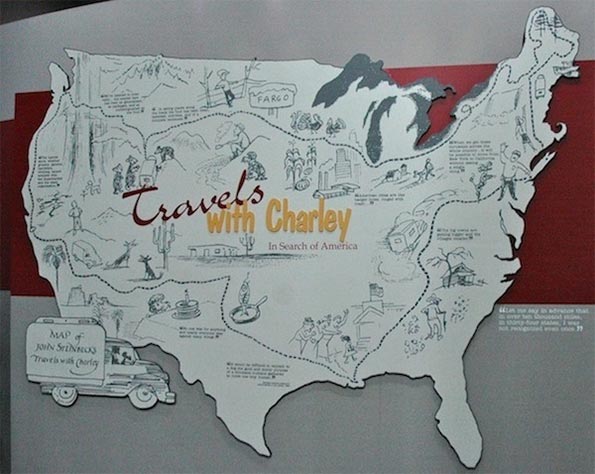
    In the fall of 2010, as part of a book project, ex-newspaperman Bill Steigerwald retraced the route John Steinbeck took in 1960 and turned into his classic “Travels With Charley.” Steigerwald drove 11,276 miles in 43 days from Long Island to the top of Maine to Seattle to San Francisco to New Orleans before heading back to his home in Pittsburgh.  In “Dogging Steinbeck,” his new e-book about how he discovered “Charley” was not nonfiction but a highly fictionalized and dishonest account of Steinbeck’s real trip, Steigerwald describes the America he saw.

    "Big."

    "Empty."

    "Rich."

    "No change since 1960."

    Long after the old farms and new forests of New England disappeared in my rearview mirror, I was still scrawling those words in the reporter’s notebook on my knee. Big, empty, rich and unchanged – that’s a pretty boring scouting report for the America I “discovered” along the Steinbeck Highway. You can add a bunch of other boring but fitting words – “beautiful,” “safe,” “friendly,” “clean,” and “quiet.”

    Like Steinbeck, I didn’t see the Real America or even a representative cross-section of America, neither of which exist anyway. Because I went almost exactly where Steinbeck went and stopped where he stopped, I saw a mostly White Anglo Saxon Protestant Republican America, not a “diverse and politically correct” Obama one. Mostly rural or open country, it included few impoverished or crime-tortured inner cities and no over-developed/underwater suburbs.

    America the Beautiful was hurting in the fall of 2010, thanks to the bums and crooks in Washington and on Wall Street who co-produced the Great Recession.  It still had the usual ills that make libertarians crazy and may never be cured: too many government wars overseas and at home, too many laws, politicians, cops, lawyers, do-gooders and preachers.

    But America was not dead, dying or decaying. There were no signs of becoming a liberal or conservative dystopia. The U.S. of A., as always, was blessed with a diverse population of productive, affluent, generous, decent people and a continent of gorgeous natural resources.

    Everyday of my trip I was surrounded by undeniable evidence of America’s underlying health and incredible prosperity. Everywhere I went people were living in good homes, driving new cars and monster pickup trucks and playing with powerboats, motorcycles and snowmobiles. Roads and bridges and parks and main streets were well maintained. Litter and trash were scarce. Specific towns and regions were hurting, and too many people were out of work, but it was still the same country I knew.

    I didn’t seek out poverty or misery or pollution on my journey, and I encountered little of it. The destitute and jobless, not to mention the increasing millions on food stamps, on welfare or buried in debt, were especially hard to spot in a generous country where taking care of the less fortunate is a huge public-private industry – where even the poor have homes, cars, wide-screen TVs and smart phones.

    I saw the familiar permanent American socioeconomic eyesores – homeless men sleeping on the sidewalks of downtown San Francisco at noon, the sun-bleached ruins of abandoned gas-stations on Route 66, ratty trailer homes parked in beautiful locations surrounded by decades of family junk. I saw Butte’s post-industrial carcass, New Orleans’ struggling Upper Ninth Ward and towns that could desperately use a Japanese car plant.

    But the country as a whole was not crippled or even limping. In the fall of 2010, nine in 10 Americans who said they wanted jobs still had them. The one in 10 who were jobless had 99 weeks of extended unemployment benefits and more than 90 percent of homeowners were still making their mortgage payments.

    Most of the states I shot through – including Maine, northern New Hampshire and Vermont, upstate New York, Wisconsin, Minnesota, North Dakota, Montana – had unemployment and foreclosure rates well below the national averages.

    I didn’t visit the abandoned neighborhoods of poor Detroit. I didn’t see battered Las Vegas, where 14.5 percent of the people were unemployed and one in nine houses – five times the national average – had received some kind of default notice in 2010. But I spent almost two weeks in the Great Train Wreck State of California, where jobless and foreclosure rates were higher than the national average and municipal bankruptcies loomed.

    America had 140 million more people than it did in 1960, but from coast to coast it was noticeably quiet – as if half the population had disappeared. Despite perfect fall weather, public and private golf courses were deserted. Ball fields were vacant. Parks and highway rest stops and ocean beaches were barely populated. Except for metropolises like Manhattan and San Francisco and jumping college towns like Missoula and Northampton, people in throngs simply did not exist. I went through lots of 30-mph towns that looked like they’d been evacuated a year earlier.

    As I drove what’s left of the Old Steinbeck Highway – U.S. routes 5, 2, 1, 11, 20, 12, 10, 101 and 66 – it was obvious many important changes had occurred along it since 1960. Industrial Age powerhouses like Rochester, Buffalo and Gary had seen their founding industries and the humans they employed swept away by the destructive winds of technology and global capitalism. Small towns like Calais in northeastern Maine had lost people and jobs, and vice versa.

    New Orleans had shrunk by half, and not just because of Katrina. The metro areas of Seattle, San Francisco and Albuquerque had exploded and prospered in the digital age. The populations of the West Coast and the Sunbelt had expanded since 1960. The South had shed its shameful system of apartheid and its overt racism, as well as much of its deep-rooted poverty and ignorance. The Northeast had bled people, manufacturing industries and its once overweening role in determining the nation’s political and cultural life.

    Change is inevitable, un-stoppable, pervasive. Nevertheless, it was clear that a great deal of what I saw out my car windows had hardly changed at all since Steinbeck and his French poodle Charley raced by.

    He saw more farmland and fewer forests than I did, especially in the East. But in many places I passed through almost nothing was newly built. Many farms and crossroads and small towns and churches were frozen in the same place and time they were eons ago, particularly in the East and Midwest.

    In Maine the busy fishing village of Stonington was as picturesque as the day Steinbeck left it. He’d recognize the tidy farms of the Corn Belt and the raw beauty of Redwood Country and the buildings if not the people of the Upper Ninth Ward. And at 70 mph whole states – North Dakota and Montana – would look the same to him except for the cell towers and Pilot signs staked out at the interstate exits.

    Steinbeck didn’t like a lot of things about Eisenhower America – sprawl, pollution, the rings of junked cars and rubbish he saw around cities. And he lamented – not in “Charley” but in letters to pals like Adlai Stevenson – that he thought America was a rotting corpse and its people had become too soft and contented to keep their country great and strong.

    But Steinbeck had America’s future wrong by 178 degrees. Fifty years later, despite being stuck in an economic ditch, the country was far wealthier, healthier, smarter and more globally powerful and influential than he could have imagined. Its air, water and landscapes were far less polluted. And, most important, despite the exponential growth of the federal government’s size and scope and its nanny reach, America in 2010 was also a much freer place for most of its 310 million citizens, especially for women, blacks, Latinos and gays.

    You don’t have to be a libertarian to know America is not as free as it should be. But there’s no denying that today our society is freer and more open than ever to entrepreneurs, new forms of media, alternative lifestyles and ordinary people who want to school their own kids, medicate their own bodies or simply choose Fed Ex instead of the U.S. Post Office.

    As for the stereotypical complaints about America being despoiled by overpopulation, overdevelopment and commercial homogenization, forget it. Anyone who drives 50 miles in any direction in an empty state like Maine or North Dakota – or even in north-central Ohio or Upstate New York – can see America’s problem is not overpopulation. More often it’s under-population. Cities like Butte and Buffalo and Gary have been virtually abandoned. Huge hunks of America on both sides of the Mississippi have never been settled.

    From Calais, Me., to Pelahatchie, Miss., I passed down the main streets of comatose small towns whose mayors would have been thrilled to have to deal with the problems of population growth and sprawl.  If anyone thinks rural Minnesota, northwestern Montana, the Oregon Coast, the Texas Panhandle or New Orleans’s Upper Ninth Ward have been homogenized, taken over by chains or destroyed by too much commercial development, it’s because they haven’t been there.

    The America I traveled was unchained from sea to sea. I had no problem eating breakfast, sleeping or shopping for road snacks at mom & pop establishments in every state. The motels along the Oregon and Maine coasts are virtually all independents that have been there for decades. You can go the length of old Route 66 and never sleep or eat in a chain unless you choose to.

    Steinbeck, like many others have since, lamented the loss of regional customs. (I don’t think he meant the local “customs” of the Jim Crow South or the marital mores of the Jerry Lee Lewis clan.)  I didn’t go looking for Native Americans, Amish, Iraqis in Detroit, Peruvians in northern New Jersey or the French-Canadians who have colonized the top edge of Maine.  But I had no trouble spotting local flavor in Wisconsin’s dairy lands, in fishing towns along Oregon’s coast, in the redwood-marijuana belt of Northern California, in San Francisco’s Chinatown or the cattle country of Texas.

    Not to generalize, but the New York-Hollywood elites believe the average Flyover Person lives in a double-wide or a Plasticville suburb, eats only at McDonald’s, votes only Republican, shops only at Wal-Mart and the Dollar Store, hates anyone not whiter than they are, speaks in tongues on Sunday and worships pickup trucks, guns and NASCAR the rest of the week.

    Those stereotypes and caricatures are alive and well in Flyover Country. But though I held radical beliefs about government, immigration and drugs that could have gotten me lynched in many places, I never felt I was in a country I didn’t like or didn’t belong in. Maybe I just didn’t go to enough sports bars, churches and political rallies, but for 11,276 miles I always felt at home.

    Bill Steigerwald, born and raised in Pittsburgh, is a former L.A. Times copy editor and free-lancer who also worked as a docudrama researcher for CBS-TV in Hollywood before becoming a reporter for The Pittsburgh Post-Gazette and a columnist for The Pittsburgh Tribune-Review. He recently retired from daily newspaper journalism.

  • A Volunteer Army’s Attempt to Fill the New York Hurricane Response Gap

    On November 6, eight days after Hurricane Sandy’s surge waters flooded the streets, I started volunteering in the Rockaways, where I stayed for much of the next three weeks.

    On that first day, I joined an ad hoc group of volunteers and took a school bus full of supplies donated by my Brooklyn neighbors out to a church on Beach 67th Street. Unloading the bus alongside parishioners at the Battalion Pentecostal church I learned that it was the first shipment they had received for the immediate area since the storm, and that aside from the traffic cops waving cars through and a National Grid trailer parked in the church lot, there was still no official presence in the neighborhood.

    The donations we brought were being carried away even before the last of them was off the bus, as word spread through the row houses that lined the block. The mother of a disabled girl carried a box of canned food to her powerless apartment and came back to ask for more. Her fridge and cupboards were already emptied.

    The other volunteers and I took the empty bus back to Brooklyn to refill it with more supplies and return later that day. On the drive back, only a mile away from the church, I saw a supermarket parking lot with truckloads of donated material guarded by police and national guardsmen. The people around the church, many of whom lost their cars in the flood, had no way to get the supplies from the parking lot back to their homes, which was incidental since most of them, cut off from any news that didn’t pass by mouth, didn’t even know that the goods were there.

    On my second day in the Rockaways I took some time to drive around and see how things were in other neighborhoods, looking for places like the church on 67th Street that were not yet being helped. I found that at the St. Francis de Sales church in Belle Harbor, on 129th Street, some supplies were already being turned away, as boxes had filled the large main hall and were now overflowing into additional rooms to accommodate the constant influx of donations.

    Several days later I returned to Francis de Sales to ask that they send food to an apartment complex I had found on the tip of the peninsula near Nassau county, where hundreds of elderly residents were living without heat or power, rationing canned goods and prescription medicine. An Australian volunteer at the church told me that he would take care of it, and while I believed he meant it, I also knew that he might be gone the next day, back to work or to his life outside volunteering.

    No one was keeping track.

    There is a city agency charged with just that: the Office of Emergency Management (O.E.M.). Emergencies are, by definition, chaotic, and the office is there to do two things: to compile block-by-block information into a unifying big picture, and to ensure responders and resources are allocated in accordance with that picture. In short: triaging, first understanding needs, and then prioritizing among them. But O.E.M. was conspicuously absent while I was in the Rockaways, and according to volunteers and officials I spoke with while reporting this story.

    Trying to get people food and basic supplies took up much of my first week in the Rockaways, and yet there was no problem with scarcity. The city spent close to $3 million for food and water distribution and, as of November 26, had distributed over 2 million meals, while donations poured in from New York and out-of-state charities.

    Individuals and small groups were doing their best to attend to immediate need, but the lack of direction was acute, resulting in a feast-or-famine situation that varied block by block.

    I visited the parking lot where I had seen the trucks of supplies parked and asked if they could be moved to the under-served church on 67th Street but the National Guardsman posted there explained apologetically that taking supplies neighborhood-to-neighborhood, a more effective manner of distribution, didn’t match their orders.

    Though city officials had been working hard since even before the storm struck, one thing they weren’t doing was taking control of the situation on the ground, canvassing neighborhoods to determine needs and directing services and supplies accordingly. Nor, since they may not have enough staff to do this all themselves, were they effectively organizing and commanding the hodge-podge of official and unofficial groups and the steady stream of volunteers attempting to make themselves useful.

    Relief supplies managed by the city were being delivered to a handful of centralized points without much of a plan for getting them to the people in need, even as the National Guard and the many volunteers looked for ways to help.

    Some volunteer groups had identified this issue early on and attempted to deal with it, on their own, in various ways.

    Some drove around with supplies until they found people who obviously needed them, and some groups like Occupy Sandy and Save the Rockaways used social media and web presence to post alerts identifying where food and volunteers were needed.

    Team Rubicon, a veteran-led relief group, took things even further, using a computer program called Palantir to create an annotated map of conditions in the Rockaways and by stepping up to fill the leadership vacuum. Palantir is a data visualization platform used by the military and intelligence agencies to track and analyze the information gathered from complex environments. It can be highly effective but ultimately relies on human users inputting information gathered from the field.

    The group was initially collecting handwritten work orders and reports on local conditions from team members and local residents to track what work was ongoing and what remained to be done. The task of gathering intelligence and feeding into a single model, whether by writing on a map or using a digital database, is a basic pre-condition for conducting any complex operation—you need to understand an environment in order to address its problems. Once they had Palantir added to their system, Team Rubicon could take any report and add it to their database to create a single fluid model of conditions on the ground.

    When they first arrived in the Rockaways Team Rubicon intended to be a labor force moving supplies and shoveling out flooded basements. But as the crisis dragged on and more volunteers began arriving in the thousands without any government agency directing their work, Rubicon’s leaders shifted their priorities. Rather than doing all the shoveling themselves, they organized the incoming volunteers into small groups with one Rubicon member assigned to each as a team leader, and dispatched the groups to fill the hundreds of work orders that they had compiled through their canvassing.

    As effective as Team Rubicon’s approach was, their reach was limited by their size and the fact that they were only one group among many without any official authority to direct overall efforts. Rubicon’s methodology, collecting and centralizing information in order to coordinate actions, could have been used by the city and implemented on a larger scale and in fact is precisely the approach outlined in the city’s own emergency relief protocols. But, over a month after the hurricane hit, the city’s relief effort still lacks the crucial aspect that has been missing from the start—an effective overhead body leading operations.

    Information management is not just an issue for the next emergency: inefficiencies and failures are still occurring because different volunteer groups are not forced to share information and none of them, despite their working relationships, are really on the same page as the city. As one official in a volunteer group that worked with the city during relief efforts put it, “The city had the intel arms in place, the volunteer groups out in the neighborhoods, but they had no system to receive our reports.”

    When the city finally started to use volunteer groups for canvassing, it appears to have done so only at the urging of those groups, long after the storm hit.

    A Times article details the city housing authority’s failure to properly account for and provide relief to city residents, many of them elderly and unable to evacuate, stuck for weeks in buildings without power or heat. Almost two weeks after the storm, the city called on volunteer groups to go door to door in public housing in Coney Island, surveying to establish how many thousands were stuck in the buildings and what their immediate needs were.

    Responding to complaints from volunteers about the city’s lack of leadership in those relief efforts, Nazli Parvizi, the city’s commissioner for community affairs, is quoted in the Times piece saying that the she didn’t want to disturb the volunteers’ good work by taking control of the situation.

    According to Parvizi, “I wasn’t here to change that narrative [of volunteers leading while the city played a supporting role]. I was asking them, ‘What do you need?’”

    Give Parvizi credit for being honest and not pretending, as many officials have, that the city was aggressively leading relief operations.

    The task of coordinating the efforts of various government agencies, volunteers and non-governmental organizations, and providing an overarching structure for emergency response, is precisely what New York City’s Office of Emergency Management (O.E.M.) was created to do.

    On its website O.E.M. lists “on-scene coordination” as one of the core responsibilities it assumes an emergency. Yet it was only seen sporadically in the hardest-hit parts of the city—including the Rockaways, Staten Island and Coney Island—and was entirely absent from the wave of city-official-sourced tick-tocks and other stories.

    Founded in 1996 by an executive order from Rudy Giuliani, the office effectively took responsibility for emergency planning and response away from the NYPD and gave it directly to the mayor’s office, reportedly to the displeasure of Howard Safir, who was the police commissioner at the time.

    In 2001 after becoming its own independent department outside of the mayor’s office and proving its worth in the eyes of many by its response to the attacks of 9/11, O.E.M. seemed to have justified its founding mission and earned an enduring presence. But things changed when Bloomberg was elected and Ray Kelly returned to take over the NYPD. According to multiple sources and news accounts, Kelly, like Safir before him, saw O.E.M. as an affront to the primacy of the police department’s role in ensuring public safety and pressured the mayor to marginalize the organization.

    Apparently he had some success in this regard. In 2005, O.E.M. commissioner Joseph Bruno testified before the City Council in a hearing over Bloomberg’s decision to place responsibility for handling hazardous materials in a potential terrorist incident into the hands of the NYPD.

    In his testimony, Bruno stated that his office had been more powerful under Giuliani and that in the event of a dispute between the FDNY and NYPD on the site of an emergency he would “give advice,” but “O.E.M. is not going to come in and say, ‘We’ll tell you how to do it.’”

    According to a high-ranking official in a prominent volunteer relief organization who has worked closely with both the mayor’s office and O.E.M., tensions between the offices were obvious during the initial, crucial days following the hurricane and communications terse and perfunctory. This official said that whenever there were disagreements between O.E.M. and the mayor’s office, the mayor’s office won.

    O.E.M. declined to provide comment for this story, but conversations with sources with knowledge of O.E.M.’s operations and a review of the organization’s history and the turf wars that have shaped its current role provide some insight into what went wrong, and ideas about why those problems are likely to recur in the next disaster. On paper, OEM had all of the tools and resources in place to address these problems. The Citywide Asset and Logisitics Management System (CALMS), created in 2003, is touted by the office as its means of facilitating the movement of supplies in emergency response, and as a crucial part of their mission to “[work] with government agencies and nonprofit organizations to provide assistance to disaster victims and manage relief efforts, donations, and spontaneous volunteers.” According to the O.E.M. website, “CALMS integrates multiple resource management systems and provides a single view of the resources managed or accessible to response agencies.”

    But at a meeting held two weeks ago by the New York City chapter of Voluntary Organizations Active in Disaster (VOAD), with an O.E.M. liaison in attendance, the system’s shortcomings were made clear.

    VOAD, which brings together a coalition of volunteer groups to plan and coordinate relief efforts and which has been meeting regularly since before Hurricane Sandy, seems not to have been connected to O.E.M.’s system. The volunteer official that I spoke with attended the VOAD meeting last week and told me that a member of Occupy Sandy stood up to plead for help with ongoing food shortages while across the table a Red Cross official offered that he had a fleet of trucks loaded with food and only needed to know where to send them.

    A second official in a volunteer group I spoke to described driving around the Rockaways on the day of the Northeaster that followed Hurricane Sandy, canvassing neighborhoods to find the people most vulnerable to the coming snowfall. Seeing an O.E.M. setup, he stopped to do some coordination and trade notes and found that the O.E.M. officials were packing up to leave the Rockaways and return to Manhattan in anticipation of the storm.

    “Here we were, volunteers going into the storm, and they were leaving,” he said. “It was just gross negligence on their part.”

    Media coverage of the city’s reaction to the storm mostly reflects the overriding political priority, which is getting as much federal aid money as possible, and figuring out the expected tens of billions in funding once it begins to come in.

    Bloomberg, aware that the polls showed a big majority of New Yorkers approved of the administration’s response to the storm, has focused his limited criticism on flaws in preparedness and on the question of whether to build sea walls.

    A full accounting of the city’s performance will take time and the disclosure of public records not yet available, but the process can start with some simple questions. What should New Yorkers expect of the city when disasters occur? What agencies are responsible for the unique and critical needs that arise from emergencies? Whose job is it to feed individuals and families stuck in homes without power? What is the role of volunteer organizations in disasters of this kind, and to whom are they accountable?

    The core elements of OEM’s mission—on-scene coordination, logistics management, directing government and non-government groups—constitute a short list of the critical functions that have been most lacking in the city’s response. New Yorkers will need real transparency from the office and an accounting of the functioning of city agencies during and after the storm.

    As of this writing, the records of O.E.M.’s action since the hurricane are still minimal, and the office has yet to initiate its own after-action review.

    This piece first appeared at Capital New York.

    Jake Siegel was born and raised in Brooklyn. His writing has appeared in The New York Times, New York Press and New Partisan. HIs short story will appear in "Fire and Forget" an anthology of fiction written by Iraq and Afghanistan veterans being released by Da Capo on February 12, 2013.

    Rockaway Beach hurricane response photo by Bigstock.

  • Want to See Better US-Chinese Relations? American and Chinese Millennials Could Be Key

    While it is still fashionable for politicians in both China and the United States to prove their domestic leadership credentials by taking tough stances against their nation’s chief economic rival, the results of recent Pew surveys conducted in the two countries suggest that this type of rhetoric is a holdover from an earlier era. An examination of the beliefs among the youngest generational cohorts in each country shows a distinct lack of the ideological vitriol so common in the 1960s and 1970s. As a result, we might see a far more congenial relationship between the world’s two great powers — at least once the older generations fade away.  

    Let’s hope so, because older generations sometimes seem  more committed to discord  than accord. During the 2012 US presidential campaign both President Barack Obama and Governor Mitt Romney took full advantage of opportunities to criticize their opponent for the softness of his approach to China.  Xi Jinping, who was named the General Secretary of the Chinese Communist Party about a week after Obama was reelected and will become China’s Premier early next year, has been no less willing to rhetorically censure the United States.

    Yet the Pew research indicates that the youngest generational cohort in both the US and China holds positive attitudes toward and favors contact with the other country.   In the United States that youthful cohort is the Millennial Generation (born 1982-2003), America’s largest and most ethnically diverse and tolerant generation to date. Of the 95 million US Millennials, about four in ten are nonwhite and one in twenty is of Asian descent, with Chinese-Americans comprising the largest portion of that segment. By contrast, among U.S. seniors and Boomers, only about one in five is nonwhite and about two-percent of Asian heritage.

    Generational theorists have not definitively named the Millennials’ Chinese counterparts. Some observers, however, have called at least their urban segment “Little Emperors.” Similar to American Millennials, this generation was often reared by their own hovering “helicopter parents” in a highly protected, hyper-attentive manner that reflected the importance of these special children—the  product of China’s  “one child” policy—and the  great expectations their parents had and continue to have for their offspring. The result of this  upbringing are cohorts of civic-minded, pressured, conventional, patriotic American and Chinese young people who revere their parents, are optimistic about their nation’s future, and  open to the world.

    In China, the Pew research, conducted in March and April, 2012, contained a battery of questions probing attitudes toward the United States, its interactions with China, and its influence on Chinese society. Across all of these questions, the youngest cohort (18-29 year olds) held significantly more favorable opinions about America than older Chinese. Given that Chinese who are 50 or older include generations that established the Communist regime in 1949, fought American troops in Korea, and were part of the ideological Red Guards of the 1960s, this is not altogether surprising.   

    Overall, a majority (51%) of China’s youthful cohort held a positive view of the U.S. as compared with only 38% of older Chinese. More specifically, majorities of 18-29 year olds said they admired American technological and scientific advances (77%), American ideas about democracy (59%), U.S. music, movies, and television (56%), and agree that it is good that American ideas and customs are spreading to China (50%). Across all of these dimensions favorable attitudes toward the United States and its influence were at least 15 percentage points higher among the youngest Chinese cohort than the oldest. In only one area, the American way of doing business, did less than a majority of 18-29 year old Chinese (48%) indicate admiration of the United States; even on this dimension there was a 12-point gap between the positive opinions of younger and older Chinese respondents.

    Pew did not ask the same questions in its American surveys that it did in the Chinese study. However, it did examine many of the same dimensions permitting valid comparison of survey results in the two countries. In a November 2011 survey examining the large generation gap in U.S. politics Pew asked if it was better for the United States to build a stronger economic relationship with China or to get tough with China on economic issues. American Millennials, a generation corresponding to Chinese 18-29 year olds, overwhelmingly favored a policy focusing on building stronger trade relations with China rather than one based on toughness (69% to 24%). By contrast, a plurality of the two oldest American generations—Boomers and seniors—believed that a tougher approach instead of closer economic ties with China was best (48% to 45%). These results reflect the far greater support of Millennials than older generations for free trade agreements overall (63% to 42%).

    In its April 2012 Values survey, Pew examined the openness of Americans to “foreign,” if not specifically Chinese, influences. In one question, respondents were asked to agree or disagree with the statement: “It bothers me when I come in contact with immigrants who speak little or no English.” Only 32% of American Millennials compared to 44% of all older generations agreed. In another item Pew asked for agreement or disagreement with this statement: “the growing number of newcomers from other countries threatens traditional American customs and values.” Only four in ten Millennials (41%) as compared with a majority (53%) of Boomers and seniors agreed.

    American Millennials are a generation that seeks to resolve disputes and conflicts by searching for win-win solutions rather than absolute victories over their opponents. Recent research suggests that their Chinese counterparts share many of the same attitudes. This bodes well for relations between their two countries in coming decades. The big question for the more immediate future is whether older generations in America and China will be able and willing to set aside the attitudes based on the ideologies and policies of the past long enough for Millennials on both sides of the Pacific to forge a new, less contentious relationship.  

    Morley Winograd and Michael D. Hais are co-authors of the newly published Millennial Momentum: How a New Generation is Remaking America and Millennial Makeover: MySpace, YouTube, and the Future of American Politics and fellows of NDN and the New Policy Institute.

    Shanghai photo by Bigstock.

  • Is the Acela Killing America?

    Has the finance industry trainjacked America?

    By all accounts the Acela has been a success. Thought it is far from perfect and constitutes moderate speed rail for the most part, it seems to have attracted strong ridership. A midday train was totally packed on both the BOS-NYC leg and NYC-DC leg the last time I rode it. I didn’t see an empty seat anywhere. Which is pretty amazing given how much more expensive it is than the regional, and frankly not that much faster. It does seem to have accomplished its mission of more closely linking Boston, New York, and Washington.

    The question is, is that actually a good thing? Or has the improved connectivity the Acela brings had unforeseen negative consequences? I believe you can make an argument that the Acela has actually helped birth the stranglehold the finance industry has over federal fiscal and monetary policies, and thus has hurt America.

    I don’t have time to fully develop that here, but to anyone who has been following any of the many excellent sites tracking the financial crisis over the last few years, it is obvious.

    There is now a near merger between Wall Street and K Street. During the financial crisis, the government and the Fed have kept Wall Street well supplied with bailouts and nearly free access to capital that allows them to literally print risk free profits by recycling in the free loans into interest bearing government debt, all while Main St. businesses and homeowners have borne the full brunt of a credit crunch, state and local governments fiscally starve, and infrastructure funds dry up. Finance industry insiders have now obtained a near lock on the position of Treasury Secretary. When a president like Bush dares to appoint someone with actual industrial experience, Wall Street’s displeasure is made manifest, and it generally succeeds in undermining him. New laws like Dodd-Frank strangle new entrants to the field while enshrining the privileged status of the too big to fail. The fact that it allows government to seize these “systematically important financial institutions” shows not the industry’s weakness but its strength, as big banks de facto function as instrumentalities of the state, but with profits privatized and losses socialized. Not a single major figure in the events causing the financial meltdowns has gone to jail or even been prosecuted (only a collection of ponzi schemers and insider traders who, despite their criminality, had no systematic impact – the crisis blew up their scams, their scams did not cause the crisis). The list goes on.

    The geographic proximity of New York to Washington, with quick trips back and forth on the Acela, facilitates this. Clearly, you could get back and forth on the shuttle without it, but given the Acela’s popularity, it does seem to have some big benefits in shrinking the distance between New York and DC. I’d argue this has been unhealthy for America. If true high speed rail ever came to the NYC-DC corridor, who knows what might happen?

    Perhaps you don’t agree and will feed me to the dogs for this post. But I think it’s very clear that transportation networks have vast impact on the structure of society, not just how people and goods get from Point A to Point B. The interstate highway system is proof of that. Indeed, advocates of high speed rail (and I’ve been a qualified one myself, supporting it clearly in the Northeast Corridor but being skeptical about most others) boast of the positive transformational effects of HSR as one of the reasons to build it. But as with the interstate highway system, we need to be aware of the hidden risks as well.

    The Acela is perhaps living proof that high speed rail can reshape America. It is literally helping rewrite the geographic power map of America. Unfortunately, at this point don’t think that’s been a good thing.

    This piece originally appeared at The Ubanophile.