Category: Politics

  • Obama’s Energy Dilemma: Back Energy-Fueled Growth or Please Green Lobby

    Talk all you want about the fiscal cliff, but more important still will be how the Obama administration deals with a potential growth-inducing energy boom. With America about to join the ranks of major natural gas exporters and with the nation’s rising oil production reducing imports, the energy boom seems poised to both  boost our global competitiveness and drive economic growth well above today’s paltry levels.

    This puts President Obama in a dilemma. To please his core green constituency, he can strangle the incipient energy-led boom in its cradle through dictates of federal regulators. On the other hand, he can choose to take credit for an economic expansion that could not only improve the lives of millions of middle- and working-class Americans, but also could assure Democratic political dominance for a decade or more.

    Stronger economic growth remains the only way to solve our nation’s fundamental fiscal problems other than either huge tax hikes or crippling austerity. As economist Bret Swanson has pointed out, the best way to raise revenues and reduce expenditures, particularly for such things as welfare and unemployment, would be to increase overall growth from the current pathetic 2 percent rate to something closer to 3 or 4 percent.

    Swanson suggests in a few simple charts (PDF) that a 4 percent growth rate would drive output to levels that would cover even our current projected spending levels. Even at 3 percent, the additional revenue would be enough, for example, to fill in Medicare’s looming $24.6 billion liability that is projected to 2050. The effects of higher growth are likely far greater than either any anticipated bonanza by raising taxes on the “rich” or enacting the most extreme austerity.

    The energy revolution presents Obama with the clearest path to drive this critical boost to greater economic growth. New technologies for finding and tapping resources, such as fracking and other new technologies to tap older oil fields, could make America potentially the largest oil and gas producer by 2020, according to the International Energy Agency.

    Equally important, an increasingly energy self-sufficient America would enjoy significantly greater independence from pressure from the often hoary influence of such unattractive regimes as Saudi Arabia, Venezuela, and Russia. Approval of the controversial Keystone pipeline from Canada to Texas would cement what would effectively be a North American energy community utterly independent of these trouble spots.

    Those that have embraced the energy revolution have already created a gusher in energy jobs, which pay wages on average higher (roughly $100,000 annually )  than those paid by information, professional services, or manufacturing . The six fastest-growing jobs for 2010-11, according to Economic Modeling Specialists International, are related to oil and gas extraction. In total, nine of the top 11 fast-growing jobs in the nation over the past two years are tied in one way or another to oil and gas extraction.

    Over the decade, the energy sector has created nearly 200,000 jobs in Texas, as well as 40,000 in Oklahoma, and more than 20,000 in Colorado. Growth on a percentage basis is even higher in North Dakota, which saw a 400 percent increase in these jobs, as well as Pennsylvania, where jobs increased by 20,000.

    In contrast California, whose Monterey Formation alone is estimated to be four times larger than North Dakota’s Bakken reserve, has chosen, in its irrepressible quest for ever greater greenness, to sharply limit its fossil-fuel industry As a result, it has generated barely one-tenth the new fossil fuel jobs generated in archrival Texas. Not surprisingly, California and other green-oriented states have lagged behind in GDP and income growth while the energy states have for the most part enjoyed the strongest gains.

    In addition, domestic energy growth directly spurs the construction of new, as well as the rehabilitation of old, industrial facilities. This already is occurring across a vast swath of America, from revived steel mills in Ohio and Pennsylvania to massive new petrochemical plants being planned along the Gulf Coast. Further development of energy resources, according to a study by Price Waterhouse Coopers, could create upwards of a million industrial jobs over the next few years.

    For Obama, getting behind energy boom presents both enormous opportunities as well a serious political dilemma. In terms of cutting emissions, the rising use of natural gas has been a huge boon, allowing the U.S. to make greater cuts than any other major country over the past four years. Yet, the green lobby, once sympathetic to this relatively clean fuel, has turned decisively against any new gas development.

    As a major component of Obama’s wide-ranging  coalition of grievance holders, environmentalists expect  to exercise greater influence in the second Obama term. Hollywood, now virtually an adjunct to the “progressive” coalition, will soon weigh in with Promised Land, a predictably anti-fracking movie, starring Matt Damon. Living up to Hollywood’s tradition of serving as what Lenin called “useful idiots”, the movie is financed in large part  by investors from the United Arab Emirates, whose profits would be threatened by the growth of American energy production.

    The ideological stakes for the green movement are tremendous . Greatly expanded American fossil-fuel production violates the “peak oil” mantra that has underpinned environmental thinking for decades, and undermines some of the core rationale for subsidizing expensive renewables such as solar and wind.

    Geography also may play a major role here. Outside of Colorado, the industrial Midwest and western Pennsylvania, where the shale boom is widely seen as boosting local economies, the vast majority of energy-producing states tilt strongly to the GOP. In contrast, Obama’s strongest support comes from green-oriented coastal residents whose familiarity with energy production starts and ends with turning on a light or switching on an Ipad.

    Obama’s financial base—in contrast to that enjoyed by the Republicans—relies little on the energy industry. The president’s corporate support comes largely from the entertainment, media, and software industries. Many of Obama’s strongest business backers, particularly in Silicon Valley, have become entangled financially with “renewable energy” schemes, many of which can only survive with massive subsidies in the form of tax credits, loans, and surcharges on energy consumers.

    Yet the president has good political reasons not to undermine the energy boom tht can deliver on his promise to deliver high-wage jobs and prosperity to the beleaguered middle class and working classes. In the campaign, the president wisely and openly sublimated his inner green, even taking credit for the expansion of fossil-fuel production. As the campaign came to a close, as Walter Russell Mead observed, “the less we hear about green and the more we hear about brown, about oil and gas drilling.”

    As in so many areas, Obama’s political judgments were on target. His “brown” shift helped deprive the GOP of a key issue in critical swing states such as Colorado, Ohio, and Pennsylvania. Seeming moderation on energy also helped keep Democratic Senate seats in such key producing states as West Virginia, North Dakota, and Montana. A sharp turn back to a hard green position, particularly a ban on fracking, would leave these and other energy-state Democratic miracle babies isolated and vulnerable .

    Right now, the administration’s energy policy seems a bit muddled, as the Obama team emerges from the fog of the campaign wars. On the one hand, there are signs that the Bureau of Land Management may take upwards of 1.5 million acres of western lands off the table for energy production. Yet at the same time, the bureau has announced plans to open 20 million acres off the Gulf Coast for exploration.

    One can understand Obama’s ambivalence on the issue. Embracing the energy boom, and the ensuing economic expansion, could create an economic bonanza while continuing to reduce carbon emissions. This can be further enhanced by backing efforts by natural-gas producers to expand more into the bus, heavy equipment and truck market. On the other hand, this tack will risk the ire of rent-seeking renewable-energy firms and greens,  as well as their media and Hollywood claques.

    Rather than divide the country into green and brown camps, the Breakthrough Institute’s Ted Nordhaus and Michael Shellenberger suggest, the administration should seek “a rapprochement” between the natural gas industry and the environmental movement. Dirtier energy sources, notably coal, could be jettisoned while the country shifts, at least for the medium and short run, toward a greater reliance on cleaner gas energy.

    Ultimately, the decision whether to embrace an energy-led growth strategy may well determine whether President Obama can improve middle-class prospects. In the coming months, he will need to choose between pleasing the green purists around him and generating a long boom that would elevate him to Mount Rushmore levels, and assure his party’s political dominion for a generation.

    Joel Kotkin is executive editor of NewGeography.com and is a distinguished presidential fellow in urban futures at Chapman University, and contributing editor to the City Journal in New York. He is author of The City: A Global History. His newest book is The Next Hundred Million: America in 2050, released in February, 2010.

    This piece originally appeared at The Daily Beast.

    Midwest drilling rig photo by Bigstock.

  • The Blue-State Suicide Pact

    With their enthusiastic backing of President Obama and the Democratic Party on Election Day, the bluest parts of America may have embraced a program utterly at odds with their economic self-interest. The almost uniform support of blue states’ congressional representatives for the administration’s campaign for tax “fairness” represents a kind of  bizarre economic suicide pact.

    Any move to raise taxes on the rich — defined as households making over $250,000 annually — strikes directly at the economies of these states, which depend heavily on the earnings of high-income professionals, entrepreneurs and technical workers. In fact, when you examine which states, and metropolitan areas, have the highest concentrations of such people, it turns out they are overwhelmingly located in the bluest states and regions.

    Ironically the new taxes will have relatively little effect on the detested Romney uber-class, who derive most of their income from capital gains,   taxed at a much lower rate. They also have access to all manner of offshore dodges. Nor will it have much impact on Silicon Valley millionaires and billionaires, or the Hollywood moguls and urban land speculators who constitute the Democratic Party’s “good rich,” and enjoy many of the same privileges as their wealthy conservative counterparts.

    The people whose wallets will be drained in the new war on “the rich” are high-earning, but hardly plutocratic professionals like engineers, doctors, lawyers, small business owners and the like. Once seen as the bastion of the middle class, and exemplars of upward mobility, these people are emerging as the modern day “kulaks,” the affluent peasants ruthlessly targeted by Stalin in the early 1930s.

    The ironic geography of the Democratic drive can be seen most clearly by examining the  distribution of the classes now targeted by the coming purge. The top 10 states with the largest percentage of “rich” households under the Obama formula include true blue bastions Washington, D.C., which has the highest concentration of big earners, Connecticut, New Jersey, Maryland, Massachusetts, New York, California and Hawaii. The only historic “swing state” in the top six is Virginia, due largely to the presence of the affluent suburbs of the capital. These same states, according to the Tax Foundation, would benefit the most from an extension of the much-lambasted Bush tax cuts.

    The pattern of distribution of “the rich” is even more marked when we focus on metropolitan areas. Big metro areas supported Obama, particularly their core cities, by margins as high as four to one. Besides New York, the metro areas with the highest percentage of high-earning households include such lockstep blue cities as San Francisco, Washington, San Jose, Atlanta and Los Angeles.

    The income tax hit may not be the only pain inflicted on these areas in the President’s drive for greater “fairness.” Moves to curb mortgage interest deductions for affluent households also would fall predominately on these same areas. The states with the highest listing prices — and the biggest mortgages on average – are the president’s home state of Hawaii, followed by the District of Columbia, New York, California and Connecticut. According to the Census Bureau and the Federal Housing Agency, median home values in California are 200% higher than the national median, and in New York they’re 150% higher; in contrast, red Texas’ prices are below the median.

    The contrast in prices is even greater between metropolitan areas. The highest prices — and thus largest mortgages — are in the deep blue havens of San Francisco, New York and Los Angeles. If the mortgage interest deduction is capped for loans, say, over $300,000, homeowners in these cities will suffer far more than in key red state cities like Dallas or Houston, where homes are at least half the price.

    The curbing of the mortgage interest deduction constitutes only one part of a broader effort to cut back on all itemized deductions. This would hit states with the highest rates of people taking such deductions: California, New York, the District of Columbia, Connecticut and New Jersey, according to the Wall Street Journal. In contrast, the states least vulnerable to this kind of leveling reform would be either red states such as Indiana, Alaska or Kentucky, or classic “swing” states such as Iowa and Ohio.

    Of course, one can argue that these changes follow the precepts of social justice: Rich people and rich regions should pay more. Yet being “rich” means different things in different places, due to vast differences in costs of living. The cost of living   in New York and Los Angeles, for example, is so high that the adjusted value of salaries rank in the bottom fifth in the nation. In other words, a couple with two children with a $150,000 income in Austin or Raleigh may be, in terms of housing and personal consumption, far “richer” than one making twice that in New York or Los Angeles.

    What would a big tax increase on the “rich” mean to the poor and working classes in these areas? To be sure, they may gain via taxpayer-funded transfer payments, but it’s doubtful that higher taxes will make their prospects for escaping poverty much brighter. For the most part, the economies of the key blue regions are very dependent on the earnings of the mass affluent class, and their spending is critical to overall growth. Singling out the affluent may also reduce the discretionary spending that drives employment in the personal services sector, retail and in such key fields as construction.

    This prospect is troubling since many of these areas are already among the most unequal in America. In the expensive blue areas, the lower-income middle class population that would benefit from the Administration’s plan of  keeping the Bush rates for them is proportionally smaller, although  the numbers of the poor, who already pay little or nothing in income taxes, generally greater. Indeed, according to a recent Census analysis, the two places with the highest proportions of poor people are Washington, D.C., and California. By far the highest level of inequality among the country’s 25 most populous counties is in Manhattan.

    Finally we have to consider the impact of the new tax rates on the fiscal health of these states. Four of the five states in the poorest shape fiscally, according to a recent survey by 24/7 Wall Street, all have congressional delegations dominated by Democrats — California, New Jersey, Rhode Island and Illinois (the one red state is Arizona). Slower economic growth brought about by higher taxes — compounded by high state taxes — is unlikely to make their situation any better.

    So what can we expect to happen if the fiscal cliff appears, or if the President and his party get their taxes on the rich? One can expect a proportionally greater impact on citizens and the budgets of the already expensive, high-tax states, where the new kulak class is concentrated. It may also spark a greater migration of people and companies to less expensive, lower-tax areas.

    Perhaps the greatest  irony in all this is that the Republicans, largely detested in the deep blue bastions, are the ones most likely to fall on their swords to maintain lower rates for the the  mass affluent class in the bluest states and metros. If they were something other than the stupid party, or perhaps a bit more cynical, they would respond to the President’s tax proposals by taking a line from their doddering cultural icon, Clint Eastwood: make my day.

    Joel Kotkin is executive editor of NewGeography.com and is a distinguished presidential fellow in urban futures at Chapman University, and contributing editor to the City Journal in New York. He is author of The City: A Global History. His newest book is The Next Hundred Million: America in 2050, released in February, 2010.

    This piece originally appeared at Forbes.

    Income tax photo by Bigstock.

  • Off the Rails: How the Party of Lincoln Became the Party of Plutocrats

    For a century now, Republicans have confused being the party of plutocrats with being the party of prosperity. Thus Mitt Romney.

    To win back the so-called 47 percent—an insulting description Romney doubled down after the election when he blamed his loss on Obama’s “gifts”—Republican might look farther back, past Calvin Coolidge and Herbert Hoover to their first president, Abraham Lincoln.

    Not only did he spring from the ranks of the plebeian, not the preps, but—as Michael Lind points out in What Lincoln Believed—he aimed to both increase opportunity and expand national power. A corporate attorney, he backed railroad interests and their expansion, which paced the nation’s economic ascendancy, but saw this as part of creating greater opportunity, particularly in the West, for the country’s middle and working classes. He also enacted the Homestead Act, which supplied aspiring settlers with a gift: 160 acres of federal land.

    Whether or not these acts were populist in their intent, their effects helped people achieve their aspirations. Expansion westward was nothing less than the basis of the American dream, allowing millions, many from land-poor and feudalized Europe, an opportunity to strike out on their own.

    This aspirational element should be the centerpiece of the Republican message in this age of growing class bifurcation. The loss of upward mobility long predates President Obama, though it has accelerated under him—with median household incomes down by more than $4,000 since he took office. Even the tepid economy has not done much to improve middle-class fortunes since nearly three-fifths of new jobs are in lower-wage positions.

    Without some unforeseen economic rebound, class issues will dominate our politics in the future even more than they do today. To recover, Republicans, now losing consistently (and often deservedly) on cultural issues, need to outmaneuver the Democrats on their ability to provide opportunity and upward mobility to a broad range of Americans.

    In his time, Lincoln understood the usefulness of class warfare. Tied to industrial interests, he waged a bloody class war on the slave-owning gentry of the South, a group so detestable it makes today’s Wall Street elites seem almost saintly by comparison. Financiers and industrialists may have supported this brutal war between the states, but it was largely aspiring yeoman farmers, skilled workers, and small merchants—all beneficiaries of Lincoln’s expansive economic vision—who fought it.

    In recent decades, Republicans—conscious of their patrician backers—have suppressed thinking about class, often criticizing Democrats for having no such scruples.

    This made them unable to turn issues such as the bank bailouts to their favor; Romney, himself an economic royalist, could not bring himself to denounce the administration’s policies that have worked out wonderfully for large banks now enjoying record profits while pummeling the middle class.

    In the past, Republican deflected class concerns by focusing on cultural issues, national defense, or ideology—but these tactics have worn themselves out. Of course, some conservatives will blame their defeat on a candidate of uncertain convictions and without commitment to the social regressive policies. Yet evangelicals mounted a record effort to get out the vote; it’s hard to see how Romney would have done better trying to sound more like Todd Akin and Richard Mourdock.

    What should concern Republicans was declining turnout in traditionally GOP-leaning suburbs, the very places where middle-class professionals and business owners reside. These voters were not energized by Romney. So even though he improved the GOP’s 2008 vote among the middle class and independents, Romney’s total was about 1,000,000 below that of John McCain. Had Romney equaled McCain’s performance in four states (Florida, Ohio, Virginia, and Colorado), he would have won, rather than losing to a president who received 7 million fewer votes than in the previous election.

    Let’s take a measurement of base stagnation: the nation’s population has grown 20 million since George Bush was elected in 2004, but the GOP vote has actually shrunk. This correlates as well with a stunning decline of roughly 8 million white voters compared to 2008. The white population may be getting old, but it’s not dying off that rapidly.

    This low turnout is remarkable given how unfavorably Obama is viewed by much of the yeoman class. In fact, as Gallup notes, nearly 60 percent of small-business owners disapprove of Obama. The problem was many simply did not see Romney as a viable—let alone an attractive—alternative. In contrast, the Obama team did a far better job of turning out their base of minority, youth, single and childless women, and union members—an effort that delivered their margin of victory in swing states including Ohio, Nevada, and Colorado.

    To change the political dynamic, Republicans need to address class concerns, particularly those of small property owners and aspirant small entrepreneurs. Yet the GOP has no program for this group other than lower taxes and hollow promises to cut the budget (which, of course, they have not done, even when holding both houses of Congress and the presidency). The party’s hodgepodge of corporate managerialism, social regressiveness, and, above all, protection of the plutocratic class is demonstrably not compelling to most Americans.

    It’s hard for a Main Street business owner, or sole proprietor working from home, to relate to a plutocrat, like Romney, who pays lower effective tax rates than they do. Outrage against looming tax hikes would be justifiable, if the true motivation were not so plainly to preserve the privileges of the haute bourgeoisie. This is a politically doomed approach; while small business is widely revered by Americans, big business and banks are among the least well-regarded.

    Class also would provide a means to define negatively the current regime. Instead of making silly attacks on President Obama as a “socialist,” he would be more accurately portrayed as the tribune of both the crony capitalists on Wall Street or Silicon Valley and of big labor, particularly public-employee unions. Obama should also be toxic to grassroots entrepreneurs, who will bear the brunt of the new regulatory regime, health-care system, higher energy prices, as well as rising income taxes.

    Rather than label him as a radical, Republicans should identify him as an avatar of those who are doing best in our concussed economy, and presumably want things to stay that way. His most ardent backers include many of our richest, most celebrated citizens—fabulously wealthy Hollywood types, the Silicon Valley elite as well as those controlling our major media and universities. There’s a reason Obama bested Romney in eight of America’s 10 richest counties.

    In Marin County, Calif.—where Obama claimed nearly 75 percent of the vote—expensive energy and higher housing prices represent not a burden but an environmental good, and, when it comes to housing, an economic opportunity for some to benefit from artificial, government-imposed scarcity. Ban new single-family homes, and the value of the existing stock goes up; for the elite investing class, incentives for “green energy” developments offer insider opportunities to enjoy windfall profits at the expense of middle-class-rate payers.

    If Wall Street wants to join the “progressive” gentry parade again, as it did in 2008, Republican should encourage them. Being the candidate of the phenomenally unpopular financial overclass may have bought Romney the nomination, but it sealed his fate in the general election.

    To reclaim its Lincolnesque transformation, the GOP needs to fundamentally pivot on the role of government. Laissez-faire ideology has its merits, but cannot compete successfully with a population weaned on the welfare state, whose members are keenly attuned to their vulnerability in our volatile era.

    By admitting that government is sometimes a necessary partner in nurturing and sometimes financing infrastructure critical for economic expansion, Republicans can offer their own vision of what growth-inducing services such as new roads—as opposed to the increased regulation and transfer payments and pension bloat peddled by Democrats—government can and should provide. This could appeal to Hispanics, Asians, and younger people who would be the prime beneficiaries of tangible investments.

    As generational chroniclers Morley Winograd and Mike Hais have suggested, most younger people support government action to solve problems but generally dislike the kind of top-down solutions often supported by Democrats. As these voters age, seek to buy homes and start businesses, they might listen to a sensible alternative that does not seek to enhance the left-wing clerisy’s ambition to control all aspects of their lives.

    It’s time for Republicans to break with the traditions of Goldwater, Reagan, and, particularly, Bush and shift to something more akin to the party’s roots in the mid-19th century. This party needs less preaching and libertarian manifestos that essentially defend plutocracy. Instead it’s time to embrace class warfare on today’s gentry, and embrace the aspirations of today’s middle-class. Honest Abe in 2016?

    Joel Kotkin is executive editor of NewGeography.com and is a distinguished presidential fellow in urban futures at Chapman University, and contributing editor to the City Journal in New York. He is author of The City: A Global History. His newest book is The Next Hundred Million: America in 2050, released in February, 2010.

    This piece originally appeared at The Daily Beast.

    Lincoln Memorial photo by Bigstock.

  • For A Preview Of Obama’s America In 2016, Look At The Crack-Up Of California

    Conservatives of the paranoid stripe flocked to the documentary “America: 2016” during the run up to the election, but you don’t have to time travel to catch a vision of President Obama’s plans for the future. It’s playing already in California.

    Some East Coast commentators like Jeff Greenfield saw the election as “a good night” for the Golden State, which the President carried by 20 points, 10 times his margin elsewhere — a massive bear hug from Californians. It certainly was a great night for Democrats, who now have a two-thirds majority in the state legislature and can spend a massive tax increase that targets families making over $250,000 a year.

    These results assure that California will serve as the prime testing ground for President Obama’s form of post-economic liberalism. Every dream program that the Administration embraces — cap and trade, massive taxes on the rich, high-speed rail — is either in place or on the drawing boards. In Sacramento, blue staters don’t even have to worry about over-reach because the Republicans here have dried into a withered husk. They have about as much influence on what happens here as our family’s dog Roxy, and she’s much cuter.

    California now stands as blue America’s end point, but contrary to the media celebration, it presents not such a pretty picture. Even amidst our decennial tech bubble, the state’s unemployment is among the highest in the country, and is trending down very slowly. Over the past decade, California has slowed as a source of fast-growth companies, as a recent Kauffman Foundation study shows, while other states such as Washington, Virginia, Texas and Utah have gained ground.

    Old-style liberals might point out that California’s progressive policies have not done much for the working- or middle-class folks often trumpeted as its beneficiaries. Instead income inequality has grown far more than the national average. True, the fortunate sliver of dot-com geniuses make billions, but the ranks of the poor have swollen to the point that the state, with 12% of the nation’s population, account for one third of its welfare cases. Large parts of the state, notably in the interior regions, suffer unemployment in the 15% range and higher.

    Demographics may be working to the Democratic Party’s favor, but not so much for the state. As California loses its allure as a place of opportunity for all but a few — the best connected, educated and affluent — the state is losing its magnetic appeal to migrants from both inside and outside the state. Domestic migration has been negative for 18 of the past 20 years; immigration from abroad is at the lowest point in the past two decades. In terms of growth in college-educated residents, only San Diego managed to add more than the national average from 2000 to 2010; both the Bay Area and Los Angeles were considerably below. (See “The U.S. Cities Getting Smarter The Fastest“)

    The growing diversity, a good thing in itself, masks a demographic stagnation. California, remarkable for its population growth over the past century, now is heading toward “zero population growth,” notes economist Bill Watkins; the state now barely grows 1% a year. Los Angeles, the state’s largest urban area, grew less, in total numbers, in the last decade than at any time in the last 100 years.

    Although this might elicit hosanas among greens, who generally would like to see fewer people, the emerging reality is sobering. Increasingly the state bifurcates between a generally older, predominately white and Asian coast, and an interior increasingly populated by generally less affluent Hispanics and African-Americans. California now ranks near the bottom in science skills, and while its population over 65 is the fifth largest in the nation, the number of those under 35 is only 23rd. And the future looks even bleaker: California’s eighth graders rank a pathetic 47th in terms of science test scores.

    So how did the ladder of opportunity crack in a state that has massive natural and human resources, not to mention a kind climate and spectacular scenery?

    To some extent, California is suffering the aftereffects of a century of success. Over that period, a large coastal affluent class, now increasingly elderly, enjoyed a spectacular run of rising real estate prices and in some places, like Silicon Valley, a progression of stock windfalls. Once split among liberals and conservatives, this group is now almost uniformly deep blue, as epitomized by Marin County, which voted almost three to one for Obama.

    Blacks, Hispanics and young people may be the new core of the Democratic Party, but  aging affluents may be the most important constituency. Unlike minorities or young people, they have increasingly little reason to support growth. After all, they have theirs and more people simply means more traffic, congestion and crowded schools. Increasingly many affluents also don’t have children — the liberal heartland of San Francisco has among the lowest fertility rates on the continent — the need to create jobs and opportunities for the next generation is not a pressing priority. Feeling “good” about themselves, by voting for the progressive agenda, is good enough for themselves.

    Perhaps the most shocking impact of California’s shift to one-party rule has been the complicity of the once powerful business community. In recent years, California’s business community has accommodated itself to the state’s ever higher taxes and regulations. They acquiesced meekly to the state’s climate change regulations, making the development of anything than largely undesired dense housing developments all but impossible. Industries that use energy — including oil refineries but also chip-makers and server farms — simply go elsewhere, either to another country or across the border to less relentlessly regulated states.

    In the battle over the Proposition 30 tax hike, notes small business advocate Joel Fox, Governor Brown and his legislative allies prevented business leaders from opposing the tax hike. “It was a lot of support the Governor — or else,” he says. Some business organizations, like the establishmentarian Bay Area Council, even actively promoted the income tax increase, which makes the state’s rate the highest in the continental United States. For this, they get praise from progressive mouthpieces like The San Francisco Chronicle as “brave business leaders.”

    To me, this “bravery” looks like a lot more like “Stockholm syndrome,” where a hostage, as famously happened with Patty Hearst, begins to identify with their captors. Once world-beaters and fierce political competitors, California’s business leaders know that if they oppose the Governor or the legislative leadership’s tax or regulatory agenda, he can threaten them with measures specifically targeted at their industry. So the magnates meekly accept an impossible business climate, knowing, like much of the state’s middle class, that they will be welcomed elsewhere.

    In this sense California business has devolved into something analogous to Mexican enterprise under the old PRI regime. If you want to survive, you bow, curtsey and pay up — or else. Business demanded little in return, for example, insisting that education funds be conditional on comprehensive reform. After the election some business types belatedly have started to express concerns about the new Democratic supermajority and what they will do with those new tax revenues. But their inevitable fallback strategy will likely be falling on one knee to beg Governor Brown to save them from an ever more invigorated progressive majority.

    This cringing and economically counterproductive approach to governance will soon make its appearance in a Washington. In the next few months, business lobbyists will wear out their knee pads trying to appease the increasingly all powerful regulatory clerisy. Some of the new players may also be the very people who have been killing California. There’s already widespread talk of bringing L.A.’s term-limited Mayor Antonio Villaraigosa to Washington for a big cabinet posting, perhaps as Transportation Secretary. All this rewards an empty suit who has presided over Los Angeles’ economic and demographic decline, leading that great city to the brink of bankruptcy, and a political system rife with cronyism.

    But in Barack Obama’s America, failure can often pave the road to success. In this age, incompetence is no barrier to promotion, and failed states like California and Illinois are taken not as examples to avoid but as models to emulate. So if you want to get an advanced look at what America could look like in 2016, don’t go to the movies. Just hop a plane to California; after all, the Golden State is a wonderful place to visit in winter. And , as things are going, we will need the cash.

    Joel Kotkin is executive editor of NewGeography.com and is a distinguished presidential fellow in urban futures at Chapman University, and contributing editor to the City Journal in New York. He is author of The City: A Global History. His newest book is The Next Hundred Million: America in 2050, released in February, 2010.

    This piece originally appeared at Forbes.

    Barack Obama photo by Bigstock.

  • Election: “Stop Portland Creep” Resonates in Suburbs

    Election results from all three of Portland, Oregon’s largest suburban counties indicate a reaction against what has been called "Portland Creep," the expansion of the expansive light rail system without voter approval and the imposition of restrictive densification measures by Metro, the regional land-use agency.

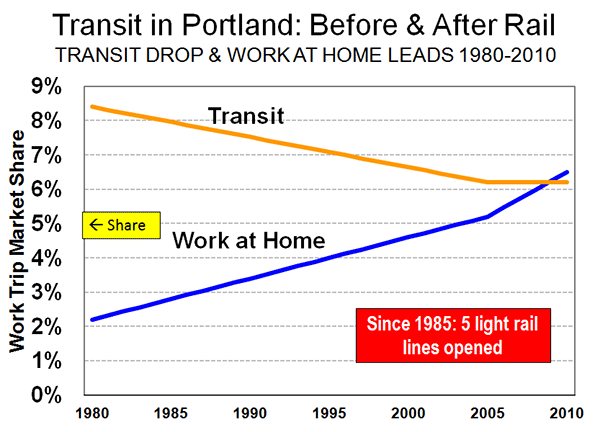
    Portlanders in the three largest Oregon counties (Multnomah, Washington and Clackamas) have previously voted against financing light rail extensions, however the transit agency has found ways to continue the expansion and now operates five lines, with a sixth under construction. While urban rail aficionados tout the success of the Portland system, transit use by commuters has fallen significantly in relative terms from before the opening of the first light rail line. At the same time, working at home, which does not need billions in taxpayer subsidies, has caught up to and passed transit (Figure).

    The electoral events of the past 60 days could severely limit future expansion.

    Clackamas County: Chicanery and its Price

    In a September 2012 election, voters in Clackamas County approved a measure by a 60% – 40% majority requiring that any commitment of funding to rail would require a vote of the people. Perhaps fearing a negative result in the election, the pro-rail Clackamas County commission hastily approved $20 million to support the under construction Portland to Milwaukie (Clackamas County) light rail line.

    Things were to become substantially more difficult for light rail in the November election. In Clackamas County, the two incumbent commissioners on the ballot, both of whom voted for the $20 million bond issue, lost their seats. Voters rewarded their chicanery by replacing them with anti-rail commissioners, leaving the Clackamas County commission with a 3 to 2 anti-rail majority. The Oregonian characterized the election as "a referendum on light rail."

    John Ludlow, who defeated Clackamas County commission chair Charlotte Lehan by a 52% to 48% margin, told The Oregonian:

    "I think the biggest boost my campaign got was when those commissioners agreed to pay that $20 million to TriMet" for Portland-Milwaukie light rail four days before the September election. I think that put Tootie and me over the top." 

    "Tootie" is Tootie Smith, a former state legislator who unseated commissioner Jamie Damon in the same election by a similar margin.

    Washington County, Oregon: Taxpayers Take Control

    Meanwhile, light rail has run into substantial difficulty in suburban Washington County. In September, voters in King City approved a measure to require all light rail funding to be approved by the voters. In the more recent November election, voters in Tigard, the 6th largest city (50,000 population) in the metropolitan area, voted 81%-19% to subject all light rail expenditures to a vote of the people.

    Clark County, Washington: Voters Say No

    Portland’s transit agency also had its eye on expanding light rail service across the state line and the Columbia River to Vancouver, in Clark County, Washington. The plan was to build a new "Interstate Bridge" (Interstate 5) across the river, which would include light rail. The voters of Clark County were asked in a referendum to approve funding for the light rail system and turned it down soundly according to the Columbian, by a 56% – 44% margin.

    But there was more. For some time, citizen activist and business leader David Madore has been working to stop both tolls on the new bridge and light rail service. Madore was elected to the board of commissioners of Clark County at the same time that the light rail referendum was being defeated. Madore, like the two other Clark County commissioners, also hold seats on the transit agency board.

    Tri-Met’s Death Spiral?

    Further, Tri-Met’s dire financial situation could be another barrier to future expansion. As John Charles of the Cascade Policy Institute has shown, Tri-Met’s fringe-benefit bill is astronomically high, at $1.63 for each $1.00 in wages. This is more than five times the average for public employers, according to US Department of Commerce Bureau of Economic Analysis data. Charles refers to Tri-Met as being in a "death spiral" and says that:  

    "The agency is steadily devolving from a transit district to a retirement and health-care center, with unsustainable fringe benefit costs that now far exceed the mere cost of wages."

  • Uniting a Fractured Republic: Innovation, Pragmatism, and the Natural Gas Revolution

    Over the last four years, emissions in the United States declined more than in any other country in the world. Coal plants and coal mines are being shuttered. That’s not from increased use of solar panels and wind turbines, as laudable as those technologies are. Rather it’s due, in large measure, to the technological revolution allowing for the cheap extraction of natural gas from shale. By contrast, Europe, with its cap and trade program, and price on carbon, is returning to coal-burning.

    Could President Obama, during his second term in office, turn this homegrown success story into paradigm-shifting climate strategy? In a speech we gave to the Colorado Oil and Gas Association yesterday, we argue that, after a season of ugly ideological polarization, politicians, environmentalists, and the gas industry have a chance to hit the reset button on energy politics. 

    This will require the natural gas industry to clean up its act, accepting better regulations, cracking down on bad actors, and preventing the leakage of methane, a potent greenhouse gas. It will require environmentalists to consider whether there might be a different path to significant emissions reductions from the one they have pursued over the last 20 years. And it will require Left and Right to put a halt to the tribalism that has characterized the national debate over climate and energy. 

    — Michael and Ted

    Uniting a Fractured Republic

    Innovation, Pragmatism, and the Natural Gas Revolution

    by Ted Nordhaus and Michael Shellenberger

    In 1981, George Mitchell, an independent Texas natural gas entrepreneur, realized that his shallow gas wells in the Barnett were running dry. He had millions of sunk investment in equipment and was looking for a way to generate more return on it. Mitchell was then a relatively small player in an industry that by its own reckoning was in decline. Conventional gas reserves were limited and were getting increasingly played out.

    As he considered how he might save his operation, Mitchell turned his attention to shale. Drillers had been drilling shale since the early 19th Century, but mostly they drilled right through it to get to limestone and other formations. Dan Jarvey, a consultant to Mitchell at the time, told us, "When you look at a [gas drilling] log from the 1930s or 1950s or 1970s it is noted as a ‘gas kick’ or ‘shale gas kick.’ Most categorized it as ‘It’s just a shale gas kick’ – as in, ‘to be expected, but to be ignored.’"

    As Mitchell embarked on his 20-year quest to crack the shale gas code, most of his colleagues in the gas industry thought he was crazy. But Mitchell persisted and his efforts would ultimately culminate in today’s natural gas revolution.

    In doing so, Mitchell upended longstanding assumptions about the future of energy. Just a few years ago, the convention wisdom was that no source of electricity could be cheaper than coal. Today, in the U.S., natural gas is cheaper. As a result, coal’s share as a percentage of electricity generated went from over 50 percent in 2005 to 36 percent in 2012. While global coal use continues to rise, the U.S. is at present leaving much of it in the ground. Meanwhile, estimates of recoverable natural gas results in the United States have nearly doubled, growing from 200 trillion cubic feet in 2005 to 350 trillion cubic feet today.

    The implications for those of us concerned about climate change are also significant. Leaving coal in the ground has been the longstanding goal of those of us concerned about global warming. Natural gas releases emits 45 percent fewer carbon emissions. In large part due to the glut of natural gas, U.S. carbon dioxide emissions will have declined more in the United States than in any other country in the world between 2008 and 2012 — an astonishing 500 million metric tons out of 6 billion, according to the Energy Information Administration.

    While we don’t imagine that any of this is news to most of you in this audience, there is another part of the story that might be. That is the story of the ways in which both the gas industry and the federal government helped Mitchell along the way. In these intensely polarized times, when it seems that almost everyone imagines that either government or corporations are the enemy, and it seems impossible to imagine that the two might actually work together to further the public interest, there are important lessons here too.

    1.
    As Mitchell considered trying his hand at shale, he cast about to see what was known at the time about how to get gas out of shale. A geophysicist who worked with Mitchell recalled telling him that, "It looks similar to the Devonian [shale back east], and the government’s done all this work on the Devonian."

    The work Mitchell’s geophysicist was referring to was the Eastern Gas Shales Project, which was started in 1976 by President Ford. The Shales Project was just one of several aggressive government-led efforts to accelerate technology innovation to increase oil and gas production. Already in 1974 the Bureau of Mines was funding the study of underground fracture formations, enhanced recovery of oil through fluid injection, and the recovery of oil from tar sands. One year later, the government funded the first massive hydofracking at test sites in California, Wyoming and West Virginia, as well as "directionally deviated well-drilling techniques" for both oil and gas drilling.

    The mandate from Congress was for government scientists and engineers to hire private contractors rather than do the work in-house. This was consistent with the tradition of the Bureau of Mines, which would set up trailers around the country to support oil, coal and gas entrepreneurs. This strategy contrasted with the government’s nuclear energy R&D work, which had been hierarchical since its birth in the military’s Manhattan project. This decentralization proved wise, as it ensured that the information would rapidly reach entrepreneurs in the field and not gather dust inside of a federal bureaucracy.

    From early on, Mitchell and his team relied heavily on information coming out of the Eastern Gas Shales project. "We were all reading the DOE papers trying to figure out what the DOE had found in the Eastern Gas Shales," Mitchell geologist Dan Steward told us, "and it wasn’t until 1986 that we concluded that we don’t have open fractures, and that we were making production out of tight shales."

    Through the 1980s, Mitchell didn’t want to ask the government – or the Gas Research Institute, which was funded by a fee on gas pipeline shipments to coordinate government research with experiments being conducted by entrepreneurs in the field – for help because he worried that he wouldn’t be able to take full advantage of the investment he was making in innovation.

    But by the early 1990s Mitchell had concluded that he needed the government’s help, and turned to DOE and the publicly-funded Gas Research Institute for technical assistance. The Gas Research Institute, which had worked with other industry partners to demonstrate the first horizontal fracks, subsidized Mitchell’s first horizontal well. Sandia National Labs provided high-tech underground mapping and supercomputers and a team to help Mitchell interpret the results. Mitchell’s twenty-year quest was also made possible by a $10 billion, 20-year tax credit provided by Congress to subsidize unconventional gas, which was too expensive and risky for most private firms to experiment with otherwise.

    By 2000, the combination of technologies to cheaply frack shale were firmly in place. The final piece of the puzzle was the sale of Mitchell Energy to Devon Energy, which scaled up the use of horizontal wells. Over the next ten years the use of this combination of technologies would spread across the country, resulting in today’s natural gas glut.

    Though the collaboration between Mitchell and the government was one of the most fruitful public-private partnerships in American history, it was mostly unknown until we started interviewing the key players involved around this time last year.

    After our findings were verified by other researches and reporters, including the New York Times and the Associated Press, some in the oil and gas industry, like T. Boone Pickens, have tried to downplay the government’s role.

    But the pioneers of this technology have been forthright. "I’m conservative as hell," Mitchell’s former Vice President Dan Steward told us, but DOE "did a hell of a lot of work and I can’t give them enough credit… You cannot diminish DOE’s involvement." Fred Julander said, “The Department of Energy was there with research funding when no one else was interested and today we are all reaping the benefits." 

    2.
    Today marks the end of one of the most divisive chapters in American political history. There is more partisan polarization in Congress than at any time since Reconstruction. There are vanishingly few swing voters. And the ideological divide between liberals and conservatives at times appears unbridgeable.

    One of the most insidious aspects of today’s political polarization is the way gross exaggerations turn into ossified caricatures. Left and Right view the other as ignorant, insane, or immoral.
    From the Right we have heard that President Obama is taking the country to socialism, and that Big Government is destroying the American dream. From the Left we have heard that Governor Romney would have exported all our jobs to China, and turn Congress over to Big Business. Where this downward spiral takes us is to the conclusion that America is fundamentally broken. The two great institutions of American life — business and government — are viewed by one side or the other as corrupt and nefarious.

    Few issues have become more polarizing than energy. Both sides have taken ever more extreme positions. Prominent conservatives have exaggerated both the size of Obama’s clean energy investments and the number of bankruptcies. They have described global warming and other environmental problems as either not happening or not worth worrying about. Some environmentalists have taken the opposite tack, exaggerating the negative impacts of gas drilling, downplaying the benefits, and accusing anyone who disagrees with them of being on the take.

    As we say in California — everyone needs to chill out. There is too much at stake for America, our environment, and our economy, for such hyper-partisanship to continue.

    In our rush to point fingers and interpret everything in catastrophic terms, we have lost sight of the fact that we are the richest nation on earth, and one with improving environmental quality, precisely because the private sector and the government have worked so well together. The failures of Big Business and Big Government should be put in their appropriate historical context.

    When the Colorado Oil and Gas Association asked us to give this speech at its conference the day after the election, we agreed on two conditions: that we pay our own way and that COGA invite local environmental and elected leaders to attend. We are glad to see them in the audience, because we need a common dialogue.

    As two individuals who came out of the environmental movement, where we spent most of our careers, we are best known for our writings calling for reform and renovation of green politics. In particular, we have advocated that environmentalists drop their apocalyptic rhetoric, which is self-defeating and obscures the very real environmental problems we face.

    And we have argued that environmentalists have been overly focused on regulations, when our focus should also be on revolutionary technological innovation, which is needed to make clean energy and other environmental technologies much cheaper, so that all seven going on 10 billion humans can live modern, prosperous lives on an ecologically vibrant planet.

    But our work has also focused on reminding private investors and corporate executives of the critical role played by the government in creating our national wealth. While economists have long recognized that innovation is responsible for most of our economic growth, few realize that many of our world-changing innovations would have been unlikely to occur without government support. A short list of recognizable technological innovations includes interchangeable parts, computers, the Internet, jet engines, nuclear power and every other major energy technology.

    Consider the information revolution. The government funded the R&D and bought 80 percent of the first microchips. The Internet started out as a federally funded program to connect networks of computers of government. Every major technology in the iPhone can be traced to some connection with government funding. The driver-less robot car that Google has invented relies on technologies that come out of government innovation programs.

    While high tech executives who are our age or younger are unaware of the government roots of the IT revolution, the old-timers of Silicon Valley do, and frequently expresses their gratitude for it.

    While interviewing the participants of the shale gas revolution, we were struck by how much respect and deference each side gave to the other. In many cases the government scientists and engineers acted as consultants to private firms like Mitchell’s — "We never forgot who the customer was," said Alex Crawley, who ran the DOE’s fossil innovation program for many years.

    As environmentalists, we were taught to be suspicious of such cozy relationships between industry and government workers, that government could not simultaneously promote industry while also attempting to regulate it. But when it comes to technology innovation, those cozy relationships, and the revolving door between government agencies, whether DoD or DoE, and private companies like Mitchell Energy, are absolutely essential to allowing knowledge to rapidly spillover and flow throughout the sector.

    And yet, there is also an important role for regulation, not only to protect the public from accidents and environmental degradation, but also to improve technologies and promote better practices throughout the industry. Wise regulation in the long run promotes, rather than hinders, the spread of new technologies and new industries, and this has never been more true than in the case of fracking. While US gas production has taken off, many European nations banned fracking for fear of the local environmental impacts and have started to return to burning coal.

    Last August, George Mitchell and New York Mayor Michael Bloomberg announced they would fund a large effort by the states to establish better fracking practices. They called for stronger control of methane leaks and other air pollution, the disclosure of chemicals used in fracking, optimizing rules for well construction, minimizing water use and properly disposing of waste water, and reducing the impact of gas on communities, roads, and the environment.

    You would be hard pressed to find very many Americans who would call those reforms unreasonable. They are the kinds of things that die-hard anti-fracking activists and much of the natural gas industry could agree to. And indeed, states like Colorado, and environmental groups like the Environmental Defense Fund, deserve credit for bringing regulators and the gas industry together to improve practices. By squarely addressing the methane leakage problem, and reducing the local environmental impacts, the government and the industry can make natural gas an even more obviously better alternative to coal.

    And the good news is that reducing methane leakage is something the industry already knows how to do. Little innovation is required to make sure that old pipelines are not leaking, and that new cement jobs are done properly. Similarly, responsible disposal of fracking fluids is not rocket science, it is something that the oil and gas industry does routinely in other contexts. Promising efforts are also underway to develop more environmentally sound fracking fluids and to further minimize water usage.

    There are costs, of course, associated with all of these efforts. But if the history of fracking proves anything, it is that costs will come down quickly. Indeed, if history is any guide, we will see great improvements to fracking technologies and techniques over the next 30 years that will be mutually beneficial to the industry, the public, and the environment, for the history of the shale gas revolution has been a history of incremental improvements to the technology. The water intensity of fracking, for instance, was originally not an environmental problem for drillers but an economic one. Only once Mitchell and others developed methods that required vastly less water to crack the shale did fracking become economically viable.

    For all of these reasons, we should both regulate fracking fairly and effectively, and also continue to support innovation to improve unconventional gas technologies. Doing so will help assure a future for gas beyond the precincts in which it is already well established. We also need to support innovation in new gas technologies well beyond fracking practices to include carbon capture and storage, which is more viable economically and technologically for gas than for coal, because gas plants are more efficient, and the emissions stream much purer. In a world in which there may remain significant obstacles to moving entirely away from fossil fuels, gas CCS looks much more viable than coal CCS. As such, we need government and the gas industry to work together to demonstrate carbon capture technologies at sites around the country, similar to how we conducted the Eastern Gas Shales Project.

    And the gas industry should support innovation beyond natural gas to include support for innovation in renewables, nuclear and other environmentally important technologies. Championing energy innovation more broadly would do more for the industry than the millions it is currently spending on slick 30-second TV ads and will remind Americans that supporting gas as well as renewables is not a zero sum proposition. Getting our energy from a diversity of sources is in the national interest and gas will thrive for a long time regardless of the energy mix. Moreover, until we have cheap utility scale storage, renewables need cheap gas for backup.

    For all of this to happen, the gas industry and environmentalists alike must change their posture toward regulation. While it is the goal of a small number of us to rid the world of particular practices, whether shale-fracking or atom-splitting, most of the rest of us want to improve them.

    Over the last 10 years, our message to the environmental movement has been that it must change its attitude toward technological innovation. Technologies are not essentially good or bad but rather in a process of continuous improvement. But there is another side to that story that industry must remember. Regulations that are often bitterly opposed sometimes end up being a boon for industry, paving the way for the broad acceptance of new technologies and pushing firms to improve those technologies in ways that make them more economical as well as more environmental.

    In closing we’d like to invoke the title essay of our last e-book, “Love Your Monsters,” which was written by one of our Senior Fellows, a well-known French anthropologist named Bruno Latour. In the essay, Latour monkey-wrenches the Frankenstein fable. The sin of Dr. Frankenstein, according to Latour, was not creating the monster, but rather abandoning him when he turned out to be flawed. We must learn to love our technologies as we do our children, he concluded, constantly helping and improving them. In so doing, we too become all the wiser.

    As we consider the implications of the gas revolution for the future of both our energy economy and our environment, we should commit ourselves to the larger effort of improving our technological creations. In so doing, the gas industry and the environmental movement might together update the concept of sustainability for the 21st Century. We should seek not to put limits on the aspirations of 1.5 billion people who still lack access to electricity, nor on the billions more yearning for enough to power washing machines and refrigerators. Nor should we want to sustain today’s energy technologies to be used in perpetuity. Rather, we should embrace technological innovation as the key to creating cleaner and better substitutes to today’s energy and non-energy resources alike so that we might sustain human civilization far into the future.
  • Why it’s All About Ohio: The Five Nations of American Politics

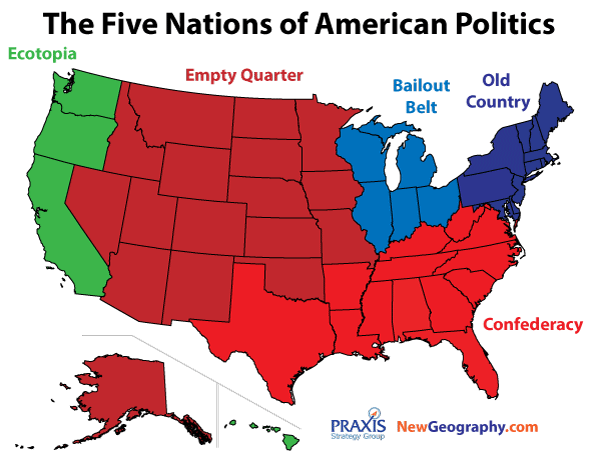
    Looking at Tuesday’s election results, it’s clear the United States has morphed into five distinct political nations. This marks a sharp consolidation of the nine cultural and economic regions that sociologist Joel Garreau laid out 30 years ago in his landmark book “The Nine Nations of North America.”

    In political terms there are two solid blue nations, perched on opposite coasts, that have formed a large and powerful bloc. Opposing them are two almost equally red countries, which include the historic Confederacy as well as the vast open reaches between the Texas panhandle and the Canadian border.

    Between these two largely immovable blocs stands the fifth nation – essentially the Great Lakes industrial heartland. By winning this territory – which could be called “Bailout Nation” – President Barack Obama built a winning coalition. Though this part of the country has suffered economic decline and demographic stagnation for decades, it is now emerging, as former President George W. Bush would put it, as “the decider” of America’s political fate.

    It’s no surprise that the coastal nations voted totally blue, reelecting the president, usually by margins of 10 points or more. The first of these nations can be dubbed “the Old Country,” the most European part of America.

    It stretches along the coast, from Maine to Maryland, and is essentially the Democratic Party’s base. It’s where the intellectual heirs to the traditions of Progressivism, the New Deal and New Frontier are most entrenched.

    Republican presidential nominee Mitt Romney lost by five percentage points or more in every state from this nation. In New York and Massachusetts, Obama won with 60 percent; in Washington, D.C., he received an astronomical 91 percent. Talk about home court advantage.

    This area is heavily urbanized and its economy – except for parts of western Pennsylvania – has become largely de-industrialized. Good jobs here are in the professions and financial services. Unemployment is high in some states, particularly New York and Rhode Island, but low – below 7 percent – in Maryland and Massachusetts.

    In the Old Country, natural resource extraction industries represent a small part of the economy and populations are concentrated in large metropolitan areas, with strong minority communities. It’s ideal territory for today’s Democratic Party, which is devotedly multicultural, strongly supportive of green energy and hostile to fossil fuels, large-scale agriculture and suburban sprawl.

    The region is essentially solid blue – as even the appealing Senator Scott Brown (R-Mass.) found out Tuesday. In the Old Country, things remain more of the same. The election numbers were nearly identical to 2008. States like Rhode Island, for example, didn’t even shift a point, despite lower national polling for Obama and the Dems.

    The Old Country’s coalition partner is Ecotopia, named after the science-fiction best-seller by Ernest Callenbach. “Ecotopia” tells the story of a successful breakaway “green” republic, which embraced most of the totems of West Coast progressivism, everything from renewable energy to militant feminism. This nation includes the states of California, Washington and Oregon. To these you can add Obama’s green-oriented, multicultural home state of Hawaii.

    In political terms, coastal Ecotopians share their states with less progressive regions on the other side of the mountains. Eastern Washington, Oregon and California all tend to be conservative – but are usually outnumbered, as they were this year, by the more densely populated coastal areas.

    Together, these two nations represent 186 electoral votes, almost equal to Romney’s total. They overwhelmingly send Democrats to Congress. And they have outsized influence. Ecotopia is home to Silicon Valley, while the Old Country, along with Hollywood, has turned the culture industry into an adjunct of the Democratic Party.

    For their part, the Republicans increasingly control two nations. One is the former Confederacy, which supported the former Massachusetts governor – only Virginia and possibly Florida slipped over to the Obama. This region has some of the nation’s strongest population growth and a strong allegiance to the military, one key GOP voting bloc.

    Energy defines much of the southern rim of the Confederacy. Texas and Louisiana have seen strong growth from oil and gas. Even the remaining Democrats in this region fear federal energy regulation under Obama will slow their economic growth. President Bill Clinton won Louisiana in 1996; this year the state went for Romney by an astounding 20 points.

    The other nation in the GOP camp is the Empty Quarter, the vast region stretching from the Great Plains and the Inter-mountain West to Alaska. This is where much of America’s food is grown and minerals extracted. Like the Gulf Coast, many in these states feel they have much to lose from a Democratic victory.

    Despite losing Nevada and Colorado and possibly Florida to Obama on Tuesday, these regions have seen expanding shares of Republican vote. Across these two nations, Romney’s margin was considerably better than Senator John McCain’s in 2008. In some states, his margins expanded by 10 points or more. From 2008 to 2012, Obama lost by 10 percentage points in Utah; 7 points in North Dakota and 5 points in Montana, South Dakota, Wyoming and Idaho.

    Yet these Republican nations may not be as stable as their Democratic counterparts. Conservative politics is almost extinct in places like California and New York. But Great Plains voters, however unhappy with Obama, still send some Democrats to the Senate, particularly when the GOP nominates extreme-right candidates.

    Ultimately, the decision comes down to the Great Lakes industrial region – which we can call the Bailout Belt. For these areas, which have high concentrations of manufacturing, the auto bailout was a godsend. And the region is now even more prosperous by the discovery of vast amounts of oil and gas.

    The benefits of the bailouts in this election – communities revived, families uplifted – outweighed those from fossil fuel producers, which now operate under threat of a possible Environmental Protection Agency-ordered shutdown. These states, outside of Indiana, stayed with Obama – by a handsome seven-point margin in Michigan. In virtually all these states, however, Romney did better than McCain.

    The president was quiet about fracking during the election. Now eyes turn to the EPA, since the House of Representatives would likely oppose a ban of any kind. The Bailout Belt may have to decide its energy future before it sides with either party.

    And where this region decides to go, so goes the nation – the entire nation.

    Joel Kotkin is executive editor of NewGeography.com and is a distinguished presidential fellow in urban futures at Chapman University, and contributing editor to the City Journal in New York. He is author of The City: A Global History. His newest book is The Next Hundred Million: America in 2050, released in February, 2010.

    This piece originally appeared at Reuters.

    Barack Obama photo by Bigstock.

  • The Biggest Losers In The 2012 Elections: Entrepreneurs

    Who lost the most in economic terms Tuesday? Certainly energy companies now face a potentially implacable foe — and a re-energized, increasingly hostile bureaucratic apparat. But it’s not them. Nor was it the rhetorically savaged plutocrats who in reality have been nurtured so well by the President’s economic tag team of Ben Bernanke and Tim Geithner.

    The real losers are small business owners, or what might be called the aspirational middle class. The smaller business — with no galleon full of legal slaves pulling for them — will face more regulation of labor, particularly independent contracting. There will be more financial regulation, which is why Romney’s top contributors were all banks.

    Small businesses will also face challenges associated with Obamacare, which now will sail on unchallenged. Health care costs are expected to go up 6.5% per employee. Some 58% of businesses say they will shift the costs to their employees. Many owners will face a higher individual tax bill: couples making $250,000 or more and singles making $200,000 or more will pay a 3.8% Medicare tax starting 2013.

    All this is troubling, as American start-up rates are already falling. Much of what happens now occurs not from a great hunger to succeed as a desire to maintain. Outside of the inherently entrepreneurial immigrant classes, the only group of Americans starting business more than before are the fifty somethings and above. Many of these may simply be former employees of larger firms, now doing work sometimes in the same industry and even for the same company.

    Business owners feel under attack. Gallup reports that, of all professions, those who own or operate their own business dislike President Obama the most.

    So what happens now? As an employment engine, small business will continue to hobble given the expected renewed regulatory onslaught. In the blue states, this may come from local authorities, but everywhere from the increasingly powerful federal bureaucratic class. But there may be growth still in the individual proprietor class. For some of them Obama has cut health care costs and start-up costs and increased deductions. And if you take on no or few employees, many of the most difficult mandates will be less onerous.

    In the next few years, entrepreneurial America will morph increasingly into what might be called “the 1099 economy.” Every state in the union has gained these kind of jobs, which include everything from a handyman to a physicist for rent, even those still way behind their 2007 employment.

    This is occurring in both red and blue states. But increasingly it may become the best strategy to survive in the renewed blue America. If you can’t beat them in a stifling regulatory environment, you look to stay under the radar. No surprise then that self employment now accounts for the highest percentage of the workforce in the bluest of states. California, for example, ranked fourth, behind just Vermont, Maine and Montana.

    Obama’s victory, to be sure, places new barriers in front of entrepreneurs of all kinds. But it will not kill off the entrepreneurial spirit, even if it increasingly occurs in an old closet or at the kitchen table.

    Joel Kotkin is executive editor of NewGeography.com and is a distinguished presidential fellow in urban futures at Chapman University, and contributing editor to the City Journal in New York. He is author of The City: A Global History. His newest book is The Next Hundred Million: America in 2050, released in February, 2010.

    This piece originally appeared at Forbes.

    Barack Obama photo by Bigstock.

  • The Biggest Winners From President Obama’s Re-Election: Crony Capitalists

    President Obama’s re-election does not, as some conservatives suggest, represent a triumph of socialism. Instead, it marks the massive endorsement of an expanding crony capitalism that ultimately could reshape the already troubled American economic system beyond recognition.

    Nowhere is this clearer than in the President’s victory in the Great Lakes states of Ohio, Michigan, Ohio and Wisconsin. All four of these states are highly dependent on manufacturing and, in particular, the auto industry. Without the bailout, it seems doubtful that Obama — who lost the white working class decisively in most of the country — could have won these critical states.

    The auto bailouts have resulted in industrial production growth since February 2010. Furthermore, there has been an industrial revival in the Ohio River valley, with rising output of steel, although much of this has to do with expansion of oil and gas production, which Obama has also taken credit for.

    Other beneficiaries of the election will be other crony capitalists, notably in the beleaguered “green” energy industry. Tied closely to venture capitalists in Silicon Valley, the renewable capitalist have been losing big time in the marketplace, the victims of foreign, largely Chinese competition, and the burgeoning natural gas industry.

    The Obama victory now provides these firms with a new lease on life. Initially Obama promised to create 5 million green jobs and has pledged $150 billion to his green jobs plan over 10 years. Yet with the Republicans in control of the House, he might not be able to fund them as prodigiously as he might have wanted.

    But there may be another way to bail out the “green capitalists.” The federal government and its expanding bureaucracy — another big winner tonight — seems likely to issue Draconian edicts on greenhouse gas, now that the election is over. The whole coal industry is about to get savaged by new regulations and pressure is mounting to regulate fracking as well. Destroying the competition may be the one way to bail out the “green” crony capitalists.

    Other crony capitalists could also benefit form the new regulatory assault: the rise essentially of national zoning. Backed by EPA and HUD, urban land speculators could see their suburban competitors regulated — as is already the case in California — into oblivion. Regions could find themselves obliged to built often expensive, and in some cases, wildly inappropriate transit system. This will benefit not only unions, who will build and operate these systems, but companies like Siemens who push for greater rail expansions at the expense of maintaining and improving such critical infrastructure as roads.

    Ultimately the biggest winners may be those who finance municipal and state debt. Owing his election to the fiscal failures of New York, Illinois and California, Obama could have to use his executive power to forestall looming bankruptcies at the local and even state level. Ironically the biggest winner here in the crony capitalist sweepstakes will be firms like Goldman Sachs, who turned so vehemently against Obama, but have historically made much of their money on financing government operations.

    Some people never seem to lose no matter what the result of the election.

    Joel Kotkin is executive editor of NewGeography.com and is a distinguished presidential fellow in urban futures at Chapman University, and contributing editor to the City Journal in New York. He is author of The City: A Global History. His newest book is The Next Hundred Million: America in 2050, released in February, 2010.

    This piece originally appeared at Forbes.

    Barack Obama photo by Bigstock.

  • A Racially Polarized Election Augurs Ill for Barack Obama’s Second Term

    President Obama, the man many saw as curing the country’s “scar of race,” won a second term in the most racially polarized election in decades. Overall, the Romney campaign relied almost entirely on white voters, particularly in the South and among the working class. Exit polls showed that almost 60 percent of whites voted for Romney. The former Massachusetts governor even won the majority of whites in California and New York.

    In previous elections, including 2008, such a performance would have been enough to assure a GOP victory. But America’s demographics are shifting, with racial minorities constituting upwards of one quarter or more of the vote, and growing.

    Essentially, Obama’s margin of victory was made up not only by a strong base of African-Americans but also Latinos, who appear to have voted for him more than two to one, a slight improvement from his 2008 performance. And for the first time, Latinos accounted for one in ten voters, up from 8 percent four years ago.

    But—despite his poetic, inclusive victory speech—this alliance of people of color could create a potential tragedy for our democracy. This is not because of the final result, but because it suggests that, unless there is some massive change in GOP politics, we may see a re-hardening of politics along racial lines.

    The election showed the efficacy of the new racial politics. Appeals to Latinos paid off massively, even though it may have cost the president some white votes. If Latinos remain solidly Democratic, the new racial outcasts will increasingly be middle- and working-class whites.

    The Democrats will continue to press race, as some Republicans did in the past (remember Willie Horton?), because it  works. The president’s race-conscious campaigning this year was assisted in part because the media did not stress his ties to abrasive reverends like Al Sharpton and Joseph Lowery. He also did well with his Latino gambit since, once again, the media, including many conservatives, were sympathetic to amnesty.

    So where does this go from here? Political revolutions—particularly successful ones—tend to shift rapidly into excess. With the recalcitrant white vote seemingly neutralized, the Obama team can now ever more openly embrace a multicultural politics of the kind Bill Clinton was careful to avoid. One sure voice pushing for race-centered politics will come from Attorney General Eric Holder, who largely embraces the idea that affirmative-action policies should be continued until Latinos and African-Americans achieve social and economic parity with whites.

    Affirmative action and other race-sensitive policies—promoted even by ersatz minorities like new senator Elizabeth Warren—could characterize our politics for the next decade or more. These divisions are already evident among millennials, where whites, particularly evangelicals, have become increasingly alienated from the president. White millennials, who backed Obama in 2008, went with Romney this year 52-44, according to an exit poll—a particularly troubling shift. The gap between white and minority millennials this year appears to be as high as 30 points—a bad augur.

    And racial divisions may become worse if the economy continues to sputter. President Obama may be beloved among Latinos and African-Americans, but his economic policies have not been friendly to them. This is particularly true, ironically, for blacks, who, as Walter Russell Mead among others have pointed out, have fared worst of all in the recession. This situation could be exacerbated by growing financial stress in cities and states, whose governments have traditionally been major employers of black white-collar workers.

    Unless growth comes back, this means minorities, particularly African-Americans, could become ever more strident in their demands. Their appeal to an administration—particularly now that it faces no new elections—that at times seems sympathetic to a racialized agenda could be stronger than could be imagined just a few years ago. This could end badly. In the long run, history has shown, groups that look too much to government (the Irish, for example) do not fare as well as those, such as yesterday’s Jews and today’s Asians, who look more to education and entrepreneurship.

    Alienation among whites is also likely to increase. Like its minority counterpart, the white working class—including millennials—has also suffered in the recession, and suffers double-digit unemployment.  Although this entire generation can be considered screwed, young whites—and young white males—are particularly so. Not only have many been left behind by the economy, but they have been deemed less worthy of assistance by the emerging new ruling class.

    In many ways, this has ominous implications. To date America’s white working and middle classes have not drifted toward the kind of nativist movements that have risen in France, Germany, and, most recently, Greece. Yet a group that feels ignored by the establishment, and feels increasingly like second-class citizens in their own country, can drift in that direction.

    The great tragedy here: the major challenges facing America are not primarily racial. They include stimulating economic growth for the broadest portion of our population. We need better jobs, roads, and bridges and less symbolism or redress for past sins. If politicians think the way to success is to open the scar of race, we will create the kind of politics that will undermine hope for our future success.

    Joel Kotkin is executive editor of NewGeography.com and is a distinguished presidential fellow in urban futures at Chapman University, and contributing editor to the City Journal in New York. He is author of The City: A Global History. His newest book is The Next Hundred Million: America in 2050, released in February, 2010.

    This piece originally appeared at The Daily Beast.

    Voter sign photo by Bigstock.