Category: Politics

  • Why Obama Won: Hispanics, Millenials Were The Difference

    President Obama won re-election primarily because he did so well with two key, and expanding, constituencies: Hispanics and members of the Millennial Generation. Throughout the campaign, Democratic pundits pointed to these two groups as being the key difference makers. They were right.

    Let’s start with Hispanics, arguably the biggest deciders in this election. Exit polling shows Obama winning this group — which gave up to two-fifths of their vote to George Bush — by over two to one. In 2008, Obama improved his winning margin with Latino voters from 67% in 2008 to 69% in 2012. And for the first time they represented 10% of the overall electorate.

    Obama and the Democrats went after this constituency, taking some risks along the way about a backlash among whites. Obama’s move to not deport young undocumented immigrants if they came to this country as a child and met certain other criteria blurred any negative impact from a still weak economy. In contrast, Romney’s platform of more or less making life so horrible that undocumented immigrants have canceled out all the GOP candidate’s credible economic and social proposals that might have appealed to this group.

    To this Republican political malpractice there is an even greater threat: the loss of younger voters. According to CNN exit polls, Millennials voted for Obama 60% to 36% and accounted for 19% of all voters, up from 17% in 2008. Although white male millennials turned slightly less enthusiastic, the President’s huge margin among white women as well as minority millennials — roughly 40 percent of this huge generation — more than made up the difference.

    Why did this happen? Generational theorists Mike Hais and Morley Winograd attribute this to several factors. One is the intrinsic optimism of millennials, even in the face of very difficult economic challenges. This blunted Romney’s main argument. Other issues such as gay marriage, favored by most millennials, as well as a more tolerant attitude towards immigration drove them away from the GOP and towards the President.

    When you combine millennials and minorities, especially Hispanics, the road to recovery for Republicans gets more and more difficult. If you win close to 60% of the white vote and lose the electoral college decisively, you are heading into very difficult territory. In addition, Hais and Winograd note, there are other constituencies — women, particularly singles as well as those with graduate degrees broke strongly for the President.

    Together, they conclude, these groups constitute what they describe as a “21st Century Democratic majority coalition for the next few decades at least.”

    So where does this leave the now hapless GOP? Certainly they can’t blame evangelicals and white working class voters who, for the most part, rallied to their cause. The problem now is based in history and demographics. The old Reagan coalition– as has been evident here in California for a decade — is literally too old, and too white, to overcome the combination of minorities, millennials and educated professionals that Hais and Winograd have identified.

    What should the Republicans do now? They certainly will need to move away from the immigrant-bashing that cost them dearly among the key ascendant voting blocs of millennials and Hispanics. They will also have to turn their family friendly message into something defined more positive; Romney’s tragedy was to embrace Rick Santorum’s views on issues of gay marriage and contraception instead of embracing family, which is a core value among millennials.

    Hais and Winograd add they will need to redefine their party as more open, and appeal to millennial preference for local, grassroots solutions. In the coming four years, there will be an opportunity to challenge the “top-down” decisions made by Obama’s now empowered clerisy. But this opportunity could be lost if Republicans continue to run against the tide of history instead of shaping it to their own advantage.

    Joel Kotkin is executive editor of NewGeography.com and is a distinguished presidential fellow in urban futures at Chapman University, and contributing editor to the City Journal in New York. He is author of The City: A Global History. His newest book is The Next Hundred Million: America in 2050, released in February, 2010.

    This piece originally appeared at Forbes.

    Barack Obama photo by Bigstock..

  • Prairie Populism Goes Bust As Obama’s Democrats Lose The Empty Quarter

    Along Phillips Avenue, the main street of Sioux Falls, South Dakota, the local theater’s marquee is a tribute to the late Senator and 1972 presidential candidate George McGovern, who was buried last month, and is still regarded as a hero by many here. But with McGovern gone, it seems that the Democratic tradition of decent populism he epitomized was being interred along with him.

    In his landmark 1981 book, The Nine Nations of North America, Joel Garreau deemed the vast region stretching from the southern Plains well past the Canadian border The Empty Quarter. Along with the western strip of the neighboring Bread Basket that stretches up from central Texas through the Dakotas, the Quarter—covering much of the nation’s land and home to many of its vital natural resources—is in open revolt against the Democratic Party, threatening the last remnants of prairie populism.

    Although long conservative and GOP leaning, the Empty Quarter—containing Nevada, Utah, Wyoming, Idaho, Montana, and most of Alaska, along with inland California and Washington and parts of Colorado, New Mexico, and Oregon—has a proud progressive tradition as well. Over the past half-century, many of the Democratic Party’s most respected leaders —McGovern, Senator Majority Leaders Mike Mansfield of Montana and Tom Daschle of South Dakota, and powerful figures like North Dakota’s Byron Dorgan and Kent Conrad—have represented the Plains.

    The tradition is still revered there, but today’s Democrats are becoming an endangered species    as the party has become ever more distinctly urban, culturally secular and minority dominated.

    While Obama lost most of the Quarter in 2008, this year polls show that he’s likely to be crushed there, despite the booming economy in many of the states. Obama’s popularity has dropped more in North Dakota, which has the nation’s lowest unemployment rate, than any other state.

    Amidst the growing anti-Obama tide, progressive Democrats in most of the Quarter have been increasingly marginalized, both by their own party and by voters.  In the past two years, Republicans picked up a Senate and House seat in North Dakota, and look likely to pick up another this year,  along with a Senate seat in Nebraska,  and quite possibly another in Montana.  They are also poised to claim the only remaining Democratic House seat in Utah, if Mia Love’s lead over Rep. Jim Matheson holds up.

    By the end of this election, it’s possible that only two classic Prairie Democrats—South Dakota’s Tim Johnson and Montana’s Max Baucus—will remain in the Senate, where they once formed a powerful caucus. The Plains states, plus Alaska, account for 50 Congressional seats and an equal number of electoral votes—more than Florida, North Carolina and New Hampshire combined.

    Why has this occurred? One problem, notes former Daschle top economic aide Paul Batcheller, lies with the “nationalization” of the Democratic Party—and its transformation from an alliance of geographic diverse regions to a compendium of narrow special-interest groups, so that under Obama, the Democratic Party has essentially become the expression of urban-dwellers, greens and minorities, along with public employees.

    This, says Batcheller, has “made it easier for Republicans to paint Democrats as in cahoots with the likes of Ted Kennedy, Nancy Pelosi, etcetera.  And because politics has always been fairly civil here, having those coastal boogeymen to use has made it easier to paint Prairie Dems as having gotten Potomac Fever.”

    He also points to “changes in the media”—especially cable TV—that have made it more difficult for grassroots Democrats to make their case for their own interests, outside of the increasingly polarized national debate.  At the same time, Obama’s policies—focused largely on constituents in dense coastal cities—have widened the gap between the Plains and the Democrats.  It is increasingly difficult to be a successful Prairie progressive when that means striking out consistently against the very industries, from large-scale agriculture to fossil fuels, at the center of these economies.

    At the same time, the failings of Democratic big states, most notably California and Illinois, are not exactly advertisements for the virtues of modern progressivism. Particularly galling, notes Mike Huether, the mayor of Sioux Falls, have been the huge deficits and expanded welfare spending associated with the Obama Administration.

    “This is a fiscally conservative place, we don’t like deficits,” notes Huether, a lifelong Democrat whose city of 156,000 operates with a fiscal surplus. “People here want self-sufficiency. They are happy to give a hand up but they see that as short term and that’s it.”

    And the region’s self-sufficiency is an increasingly important part of our national debate, especially about energy independence. Although often dismissed as a land of rubes and low-end jobs, a study of the Plains  I conducted with the Praxis Strategy Group and Texas Tech University found that, overall, it has outperformed the rest of the country in virtually every critical economic measurement from job creation and wage growth to expansion of GDP.

    The area has also thrived demographically, with population growth well above the national average. Most of this has taken place in the region’s flourishing urban centers, from Ft. Worth and Midland, Texas to Sioux Falls, Bismarck, Fargo, Oklahoma City and Omaha. This growth includes migration from still de-populating smaller towns in the region, but increasingly includes migrants from the coastal areas as well as immigrants.

    More people now arrive in Oklahoma City from Los Angeles than the other way around.   And these arrivals are hardly poor Okies pushed back unwillingly; the Plains cities have become magnets for educated people. Over the past decade, the number of people with BAs in Sioux Falls has grown by almost 60 percent; Bismarck and Fargo saw growth of over 50 percent, while Oklahoma City, Omaha and Lubbock enjoyed forty percent increases. In contrast, the educated population of San Francisco grew at 20 percent and that of New York by 24 percent.

    Any coastal denizen who spends time in these cities may be surprised by the tolerance and lack of bible-thumping one encounters there. Social issues, notes Mayor Huether, have never been drivers in the Plains as they have been in parts of the Deep South. A quiet Nordic spirituality prevails here, rather than evangelical enthusiasm; people and politicians generally do not wear their faith on their sleeves. The real issue in the Plains centers around the future of the economy, and how best to bolster family and community; the Obama program, with its interest-group agendas, simply does not translate well in this environment.

    Ultimately, the red tide sweeping over the Plains is bad news, not simply for Democrats but for the country, part of the trend noted by Batcheller in which moderating regional forces within both parties—New England Republicans and Blue Dog Democrats—are losing ground.

    Prairie Democrats are crucial for ensuring that producers tangible staples—food, fiber and energy—have a space within their party’s tent, along with the big-city coastal consumers of those resources. Never mind the conservative cliché: If Democrats lose their remaining hold on the Plains, the nation’s parties will truly be split between makers and takers.

    This region is likely to become more important over the coming decades, providing much of the food needed for world markets as well as significant share of our new domestic energy. Its manufacturing, technology and service industries are also growing rapidly, integrating the area more into the national and global economies.

    Batcheller, among others, believe that the Plains Democrats may not become extinct, but their future will be limited in the increasingly polarized, and nationalized, political order. On the local level, particularly on key infrastructure projects like Lewis and Clark water project  that is being built to meet the needs of Sioux Falls and its environs, Republicans and Democrats are largely in agreement. Neither tea-party extremists nor greens can block progress towards widely accepted local infrastructure goals.

    One can only hope that the Prairie Democrats manage to survive. They have  contributed a unique brand of civically minded, decent social democracy that added much to the national debate. Egalitarian in intent, their brand of aspirational liberalism, fully content and compatible with notions of individual achievement and hard work, offers an alternative to the “know nothing” extremism increasingly dominant in both parties. This tradition of progressive decency could be sorely missed in the years ahead.

    Joel Kotkin is executive editor of NewGeography.com and is a distinguished presidential fellow in urban futures at Chapman University, and contributing editor to the City Journal in New York. He is author of The City: A Global History. His newest book is The Next Hundred Million: America in 2050, released in February, 2010.

    This piece originally appeared at The Daily Beast.

    Sioux Falls photo by Jon Platek..
  • Honolulu Rail Project Legal Problems Mount

    According to the Hawaii Reporter, Honolulu’s rail transit project has lost a major legal test in The Federal Ninth Circuit Court, as Judge Wallace Tashima ruled in  HonoluluTraffic.com v. Federal Transit Administration et al that the city of Honolulu had violated federal environmental law on three counts.

    The plaintiffs included are a coalition of environmental, civic, political and taxpayer interests, including former Governor and mayoral candidate Benjamin Cayetano, University of Hawaii Law professor Randall Roth, Retired Judge Walter Heen, retired businessman and transportation expert Cliff Slater, Dr. Michael Uechi, Hawaii’s Thousand Friends, Outdoor Circle and the Small Business Hawaii Entrepreneurial Education Foundation.

    The plaintiffs and defendants differ strongly on the impact of the ruling, and the defendants are to return to court in December seeking a permanent injunction against the project.

    University of Hawaii Engineering Professor Panos Prevedouros told the Hawaii Reporter that the decision would require environmental planning revisions that could take up to 2 years.

    This setback is in addition to a previous unanimous Hawaii Supreme Court ruling that had already required construction to be suspended and which could delay project for at least a year, according to the Hawaii Reporter. The Supreme Court in Kaleikini v. Yoshioka, ruled that the city of Honolulu failed to comply with the state’s historic preservation and burial protection laws when it did not complete an archeological inventory survey for the 20-mile route before starting construction.

  • The Suburbs Could Save President Obama From Defeat

    President Obama’s disdain for suburban America has been well-documented. Yet, ironically, the current revival in housing, largely in those same suburbs, might be the one thing that could rescue his floundering campaign. Unlike the Democrat-dominated central cities and the rock-red Republican countryside, the suburbs remain the country’s primary contestable territory.

    With manufacturing facing global headwinds and Wall Street stagnating, the housing recovery is helping keep the still weak economy moving forward. Housing starts are at the highest level in four and a half years. Sales and prices are on the rise, and the vast majority of the action — despite the media’s focus on multi-family developments — is taking place among single-family homes that predominate in the suburban rings of our metropolitan area. Over the past two years, 76% of the new privately owned housing units completed were single-family homes, according to Census Bureau figures. In existing home sales, last year over 4.3 million single-family homes were purchased, compared to 520,000 condos.

    This trend is being driven by such factors as rental costs, which rose with the recession, a decline in foreclosures, low interest rates and, particularly in some markets such as Phoenix, investors who see long-run demand in single-family markets. Demand has sparked a nascent revival of homebuilding, now at the highest level since the Great Recession, although still half its historic rate.

    The housing recovery could make a particularly important difference in the election in key swing state suburban communities on the outskirts of Cleveland, Detroit, Pittsburgh, Philadelphia and Denver, and in the northern Virginia suburbs of the capital. In these areas, homes — not stocks and other financial assets — are the primary measure of wealth, and the most critical weathervane of economic wellbeing. Single-family home sales also spur other sectors of the economy, such as financial services, construction and the home furnishing industries in ways far greater than denser developments. The good feelings about the auto recovery have helped the president in industrial states; similarly the improved housing market gives him a lift in these critical suburban areas.

    Some Clinton-era Democrats, like former U.S. Deputy Treasury Secretary Robert Altman, recognize that expanding housing markets makes for stronger, broader-based economic growth. This is why historically Democrats favored single-family housing, from Roosevelt and Truman to Bill Clinton. Altman predicts a full-scale housing boom by 2015; if he’s right, and Democrats are in power, and on board, this could propel their ascendency for another generation.

    Of course from an ideological point of view, this emerging boom may not be much welcomed in the current administration. Most Obama backers in places like the Department of Housing and Urban Development, including Secretary Shaun Donovan, have long predicted that suburbs are entering their death throes, predicting a massive movement of people from the suburbs to inner city areas. Where possible, HUD has tried to encourage “smart growth” by providing grants for projects aimed at greater densification.

    Yet these widely lauded efforts are swimming against the fundamentals of market demand, and at a cost to both the budget and longer-run economic growth. Despite misleading press reports, inspired in part by Census Bureau epistles focusing on increasing downtown populations, the vast majority of population growth has continued to take place far away from the urban core.

    Indeed over the last decade, while some downtowns have grown, they accounted for 1.3% of the overall population increase in the country’s largest metropolitan areas. At the same time, areas two to five miles from the central cores lost population while areas beyond 10 miles out grew by more than 20% and accounted for more than 60% of growth. Overall Americans have continued to vote with their feet for suburbs — overwhelmingly.

    Some urbanists, including some close to the current administration, claim that the realities of the last decade are now passé, a permanent victim of the housing bust. Yet in reality these claims appear largely off the mark. Recent Census estimates for last year, for example, were widely reported to show greater growth in core cities than suburbs, but turned out to be based on unsupported assumptions that all county growth occurred equally across geographies, making it impossible to judge the widespread claims of a massive movement “back to the cities.”

    At the same time, a new analysis by Trulia.com chief economist Jed Kolko, based on postal data, shows that growth rates were about the same. But in an attempt to discover actual preferences, Kolko then analyzed the growth rates by densities. Much of the “urban” growth, particularly in Sunbelt cities like Phoenix and throughout the Midwest, actually takes place in largely suburbanized, relatively low-density areas.

    Kolko found that the populations of “more suburban” neighborhoods grew 0.73% in the past year, more than twice as fast as the “more urban” neighborhoods, where growth was 0.35%. In fact, urban neighborhoods grew faster than suburban neighborhoods in only five of the 50 largest metro areas — Memphis, New York, Chicago, San Jose and Pittsburgh — and often by a really small margin. In the other 45 large metros, the suburbs grew faster than the more urban neighborhoods. Overall, Kolko concludes, household growth in most metropolitan areas was greatest the further from the core, and less closer to it.

    The movement of people into lower-density areas jibes with one of the biggest reasons for the current nascent housing recovery: the preference by roughly four in five Americans for a single-family house — usually but not always found in the suburbs — over an urban apartment. In a sense, then, the hostility to suburbs among the administration and the Democratic Party is both profoundly anti-democratic and anti-growth.

    Recovering housing prices provide a lifeline for our beleaguered middle class. A recovery provides greater employment to the very people — construction workers, manufacturers of home furnishings and real estate agents — who were among the biggest victims of the Great Recession. Some progressives might celebrate the diminishment of such jobs and prefer they now service the post-industrial uberclass, but it’s hard to see how a large part of our middle and working classes can maintain, much less ascend, without a strong housing sector.

    Signs of recovery, of course, extend beyond housing. Even malls, also long suffering, and under digital assault, are beginning to recover. Meanwhile rental apartments, once the darling of the speculative class, have begun to lose their momentum, in part due to improving home affordability. Massive overbuilding in some markets could lead to a new gusher of real estate tears. Something is happening here.

    Contrary to conventional wisdom, if the economy strengthens, the suburban and single-family market will do likewise in the years to come. First-time homebuyers will provide a strong source of demand for an increasingly scarce product. Rather than rejecting the ideal of owning a home, 84% of today’s renters still intend eventually to purchase their residence, according to a recent study by TD Bank.

    Homeownership and the white picket fence might be out of fashion among the cognoscenti, but not among new Asian immigrants, who are heading to the suburbs, or the rising number of 30-somethings, three quarters of whom, according to a recent Better Homes and Gardens survey, see homeownership as a “key indicator of success.”

    Although still in its early phases, President Obama would be wise to use the suburban housing recovery to help portray himself as the savior of the middle class. The most notable gains made by Romney in the polls recently have been in the suburbs. It may be too late for the president to make better strategic use of the incipient recovery for this election, but if he is victorious and can swallow his anti-suburban mindset and embrace what most Americans regard as their preferred emblem of success, he could help consolidate a strong Democratic hold on the suburbs that could play a deciding role in our politics for the decades ahead.

  • Despite the Great Recession, Obama’s New Coalition of Elites Has Thrived

    The middle class, we’re frequently told, decides elections. But the 2012 race has in many ways been a contest between two elites, with the plutocratic corporate class lining up behind Mitt Romney to try and reclaim its position on top of the pile from an ascendant new group—made up of the leaders of social and traditional media, the upper bureaucracy and the academy—that’s bet big on Barack Obama.

    As recently as 2008, the Wall Street plutocrats were divided, as Obama deftly managed to run as both the candidate of hope and change and the candidate of the banks. But this year, the vast majority of the corporate ultra-rich have backed Romney, who after all is one of their own, his top five sources of donors all financial giants: Goldman Sachs, Bank of America, Morgan Stanley, Credit Suisse, and Wells Fargo. As The Wall Street Journal memorably noted, in 2008, no major U.S. corporation did more to back Obama than Goldman Sachs—and in 2012, none has done more to help defeat him. Those titans, along with the powerful and well-heeled energy sector, have placed most of their bets on the Republican.

    But don’t mourn too much for Obama, who’s held his own in the cash race by assembling a new, competing coalition of wealthy backers, from the “new hierarchies of technical elites” that Daniel Bell predicted in 1976 in The Coming Of Post-Industrial Society. For that group, Bell wrote, nature and human nature ceased to be central, as “fewer now handle artifacts or things” so that “reality is primarily the social world”—which, he warned, “gives rise to a new Utopianism” that mistakenly treats human nature as something that can be engineered and corrected by instruction from their enlightened betters. This approach, although often grounded in good intention, can easily morph into a technocratic authoritarianism.

    Along with Hollywood, Obama’s big donors have come from the tech sector, government, and the academy—with his top five made up of the University of California, Microsoft, Google, the U.S. government, and Harvard. Tech heavyweights such as Craigslist founder Craig Newmark and Facebook COO Sheryl Sandberg have given maximum donations to the president, as have Eric Schmidt and four other top executives at Google.

    These idea wielders make fortunes not through tangible goods but instead by manipulating and packaging information, and so are generally not interested in the mundane economy of carbon-based energy, large-scale agriculture, housing, and manufacturing. They can afford to be green and progressive, since they rarely deal with physical infrastructure (particularly within America) or unions or the challenges of training lower-skilled workers.

    There is a growing synergy between science, academia, and these information elites. Environmental policies pushed by the scientific community not only increase specialists’ influence and funding, but also the emergent regulatory regime expands opportunities for academicians, technocrats, and professional activists. It also provides golden opportunities for corporate rent seeking, particularly among those Silicon Valley figures involved in a host of heavily subsidized “green” ventures, most famously Solyndra.

    In many senses, we are seeing a “progressive” version of the unlamented John Edwards’s two Americas. Much of the U.S. is struggling, but the Clerisy has thrived. Between late 2007 and mid-2009, the number of federal workers earning at least $150,000 more than doubled.

    As government has grown even while the economy staggers, the direct and indirect beneficiaries of that growth have hitched their carts to the administration. Many professors have been protected by tenure, even at hard-hit public institutions. Foundation and NGO heads, financed by philanthropy—much of it from often left-leaning Trustifarian inheritors—have remained comfortably secure, as have their good workers. And Federal Reserve chair Ben Bernanke’s money policies have funneled cash from return-starved investors into the coffers of tech and social-media companies.

    There’s an old name for this new group of winners: the Clerisy, which British poet Samuel Coleridge defined in the 1830s as an enlightened educated class, made up of the Anglican church along with intellectuals, artists, and educators, that would school the rest of society on values and standards.

    But in many ways the New Clerisy most closely resembles the First Estate in pre-revolutionary France, serving as the key organs of enforced conformity, distilling truth for the masses, seeking to regulate speech and indoctrinate youth. Most of Obama’s group serves, as Bell predicted, a “priestly function” for large portions of the population.

    This post-industrial profile has shielded the post-industrial elite from the harsh criticism meted out to Wall Street grandees and energy executives by green activists, urban aesthetes, and progressive media outlets. Steve Jobs, by any definition a ruthless businessman, nevertheless was celebrated at Occupy Wall Street as a cultural icon worthy of veneration.

    There are of course libertarians and even traditional conservatives in academia, the media, the think-tank world, Silicon Valley, and even Hollywood. But they constitute a distinct minority. For the most part, the members of the groups that make up Obama’s Clerisy, like any successful priestly class, embrace shared dogmas: strongly secular views on social issues, fervent environmentalism, an embrace of the anti-suburban “smart growth” agenda, and the ideal of racial redress, of which Obama remains perhaps the most evident symbol.

    As befits a technological age, the New Clerisy also includes now orthodox portions of the scientific community—figures such as President Obama’s science adviser John Holdren, NASA’s James Hansen, and the board of the U.N.’s Intergovernmental Panel on Climate Change. These secular clerics have been extraordinarily influential about global warming, primarily advocating limited consumption by the lower orders.

    Energy marks the clearest demarcating issues between the plutocrats and the Clerisy. The regime of ever higher energy prices with its inevitable immediate impact of slower growth—long preferred by environmentalists and openly espoused by Energy Secretary Steven Chu—represents no real threat to the Clerisy and presents a boon to the “green” capitalists. Yet the rising hyper-regulatory state threatens to slow the overall economy, as it has in California, and to wreak havoc on the largely suburban, exposed middle and working classes.

    But energy is not the only issue dividing the two elites. The Clerisy—as can be seen clearly in the secular mecca of California—also seeks to impose mandates on more and more of private decision making, whether shaping college admissions and the composition of corporate boards, as well as basic choice in everything from housing types to food consumption.

    The Clerisy often employs populist rhetoric, but many of its leading lights, such as former Obama budget adviser Peter Orszag, appear openly hostile to democracy, seeing themselves as a modern-day version of the Calvinist “elect.” They believe that power should rest not with the will of the common man or that of the plutocrats but with credentialed “experts,” whether operating in Washington, Brussels, or the United Nations.

    This authoritarian tendency, often perceived as arrogant, has fueled revulsion among large parts of the nation, as evidence by the Tea Party 2010 sweep. The continued hostility of the bourgeois masses to the Clerical agenda appears to be helping Romney solidify his support in the countryside, the suburbs, and smaller cities.

    Of course, Romney himself is the very opposite of a populist. As president, he would offer four years of technocratic, corporate power. Yet at the same time, a Romney administration—contrary to the claims of Democratic operatives and at times also the mainstream media—would not embrace the savage worldview of Pat Buchanan, Sara Palin, or even Rick Santorum. It would be establishmentarian in a “sensible shoes” kind of way. Mormonism, as an old friend raised in the faith told me, combines “a Pentecostal theology with an Episcopalian mentality.” Expect something like George H.W. Bush, with a religious twist.

    The prospect of four years of plutocratic rule under Romney is no cause for celebration for those who would like to see greater social justice and reduced inequality. But it may prove less damaging to the country than allowing Obama’s new, secular priesthood to wreak damage on the economy that could take decades to unwind.

    Joel Kotkin is executive editor of NewGeography.com and is a distinguished presidential fellow in urban futures at Chapman University, and contributing editor to the City Journal in New York. He is author of The City: A Global History. His newest book is The Next Hundred Million: America in 2050, released in February, 2010.

    This piece originally appeared at The Daily Beast.

    Barack Obama photo by BigStockPhoto.com.

  • Obama’s Base and Politics of Disappointment

    There may be no better illustration of President Barack Obama’s appeal than his ability to hold onto voters — minorities, single moms and young people — who have fared the worst under his presidency. But the bigger question as we approach Election Day may be whether these constituencies, having been mauled by the economy, show up in sufficient numbers to save the presidential bacon.

    Welcome to the politics of disappointment. Much has been said about the problems facing the middle class, who have been losing out since the 1970s. But the biggest recent losers have been groups like African-Americans. In the current economic downturn, middle class African-Americans have lost virtually all the gains they made over the past 30 years, according to the National Urban League. Median annual household income for blacks decline by more than 11 percent between June 2009 and June 2012, according to the Census bureau, twice the loss suffered by whites.

    African-Americans as well as Latinos have also borne much of the pain from the housing downturn. In fact, according to the Census, Latinos suffered the biggest loss of net worth, largely based by housing, in the recession of any ethnic group. The weakness in the housing market, which is now only beginning to recover, hurts many Latinos, who represent a large part of the nation’s construction industry workforce.

    Latinos have been doing so poorly under Obama’s tepid recovery that, by some estimates, more are headed back to Mexico than coming here. Many voters who might make a difference in November could be lounging in Michoacán or Oaxaca rather than Michigan or Ohio.

    As for the young, even those with college education, they still suffer high unemployment rates and constricted job opportunities. More than 15 percent of all workers between 18 and 24 are unemployed.

    A college degree does not assure success.  More than 43 percent of recent graduates now working are doingso at jobs that don’t really require a college education according to a recent report by the Heldrich Center for Workforce Development. Not surprisingly, the stress levels among college freshman are the highest since data started to be collected, a quarter-century ago.

    Ironically the one group that has thrived under Obama — the affluent, including the dreaded “1 percent” — is also the class that has mobilized most aggressively against him. In 2008 Obama split the vote among those making more than $100,000 a year; this year. According to Gallup, the wealthier have shifted heavily to GOP presidential nominee Mitt Romney, with those making over $180,000 favoring him by slightly more than 9 percent.

    Arguably the biggest change has taken place among those at the highest elevations. These include many of the executives of largest banks, who accepted federal bailouts and then helped themselves to huge bonuses in the ensuing years, largely due to the market impact of the Bernanke Monetary spigot. For example, both JP Morgan and Wells Fargo this month announced record profits.

    The top 1 percent of earners gained more than 90 percent of the benefits from the TARP-powered 2009-2010 recovery while the top 0.01 per cent by themselves garnered more than one-third.   They all but avoided serious investigations for their misdeeds; in fact, no major Wall Streeter has yet to go to jail for sending the world economy into disarray.

    Yet the very institutions like Goldman Sachs, who tilted heavily toward Obama in 2008, now favor Romney. Wall Street has sent Romney $37 million this year, and only $4.8 million to the president. For his big business money, the President relies instead on Silicon Valley and Hollywood.

    In contrast, the president continues to dominate his less affluent 2008 core constituencies. But it’s increasingly likely that the poor economy — particularly for these same groups — could depress turnout.  In 2008,   the record turnout of minorities, single women and young voters propelled the Obama near landslide. A weaker showing this year could make the election far close, as we are seeing in polls today, and could even allow Romney — the candidate of predominately white, married, middle class voters — to overcome his party’s chronic demographic shortcomings.

    Let’s start with Obama’s most loyal base, African-Americans. Though certain to turn out overwhelmingly for the president, Gallup reports that the number “likely” to vote has decreased somewhat from 2008. A recent Urban League report  suggested that a diminished African-American turnout could cost the president in such key swing states as Pennsylvania, Florida and even Ohio. A recent poll by Politico and George Washington University found that while 82 percent of whites are “extremely likely” to vote only 71 percent of African-Americans, and 70 percent of Latinos, expressed the same intention.

    Ominously, registration levels in many key African American areas such as Chicago  have dropped precipitously, by more than 12 percent compared to increases in some of the heavily white outer suburbs. Although Obama will still win his home state in November, prospects for Democratic house pick-ups have dimmed.

    More critical still has been a massive reduction in voter registrations    in heavily black and Democratic Cuyahoga County, Ohio (Cleveland). Recent attempts in many states to monitor voting could further reduce minority turnout.

    Latino voters are particularly affected by this move to monitor voting, since many may lack the right paperwork. But even so, there is a real enthusiasm gap, demonstrated by the unexpected decline in registrations among Latinos. Twelve million Hispanics were registered in 2008 and the number was expected to rise to 14 million by this election. Instead the total, as of the last election in 2010, was only 11 million, something that some experts link to Mexicans moving or returning home due to poor economic conditions.

    Arguably decisive in the swing states of Florida, Colorado and Nevada, mobilizing Latinos may pose the greatest challenge for the Obama campaign. In 2008, they voted two to one for Obama, and they seem likely to repeat that feat again this year.

    Even worse for the President, Latinos, like the other core constituencies, don’t appear to be as enthusiastic this year. With Latino unemployment well above the national average, support for the president has waned a bit from 2008 levels. If turnout also decline, this could prove decisive.

    This lack of enthusiasm appears among younger voters as well. Though Romney is winning white voters under age 30, particularly men, he is being hammered among both female and minority millennials. But the real issue may prove to be turnout. Growing alienation seems to have depressed enthusiasm among the young, with barely half of all under 30 pro-Obama voters now planning to turn out to the polls. If this persists, the youth vote will be less important this year from the record turnout that cemented the 2008 victory.

    As he loses ground among middle class whites and families, Obama will need for his core constituencies to show up. This where his “ground game” will be critical. If the key groups come out to the polls, forgetting or at least forgiving what has happened over the past four years, they can renew their faith in the gospel of hope and change for the next four.

    Joel Kotkin is executive editor of NewGeography.com and is a distinguished presidential fellow in urban futures at Chapman University, and contributing editor to the City Journal in New York. He is author of The City: A Global History. His newest book is The Next Hundred Million: America in 2050, released in February, 2010.

    This piece originally appeared at Reuters.com

    Barack Obama photo by BigStockPhoto.com.

  • The GOP’s Hispanic Political Malpractice

    One of the more curious developments in American politics over the last two decades is the political malpractice of Republicans in dealing with Hispanic-Americans.  Indeed, it now appears that the 2012 election may well be determined by the share of the Latino vote that Governor Mitt Romney is able to keep from falling into President Barack Obama’s column.

    According to the Investor’s Business Daily tracking poll, Hispanics prefer Barack Obama by a greater than 2:1 margin (61% to 29% on October 25).  Hispanic-Americans have tilted toward the Democrats for decades, so it is hard to blame the Republican Party’s current predicament on just the political tactics of this year’s campaign.

    But unlike the African-American vote since the 1960s, which has remained rock solid Democratic, history indicates that on occasion the GOP has competed for and won a significant share of the Latino vote.  Hispanics tend to be family oriented and somewhat entrepreneurial, which should make them potential Republicans.

    But deliberate, conscious decisions by Republican leaders focused on the short run gains from immigrant bashing have done severe damage to the long term health of their party. Attacks on immigrants have caused Hispanics to desert the GOP in droves, particularly in the two most recent presidential elections. And, because the Latino population is relatively youthful, if this concern is not dealt with, it may become even more acute for the Republican Party in the years ahead. Among Millennials, America’s youngest adult generation, about one in five is Latino as compared with about one in ten among Baby Boomers and one in twenty among seniors. Among the even younger Pluralist generation (children 10 years old and younger) between a quarter and 30% are Hispanic. Between these two up-and-coming generations, it’s likely that Hispanics will represent nearly 30% of the nation’s population within the next few decades. This suggests that the Republican Party has little hope of winning national elections in the future unless it reverses its current policies to bring them more in alignment with the attitudes and beliefs of this key voter group.   

    Some have estimated that Ronald Reagan won 37% of the Hispanic vote in his successful 1984 re-election campaign.  Since then the presence of Hispanic voters in the electorate has grown by 400%, but the Republican share of their votes has risen above the level at which Latinos supported Reagan only once. That occurred in 2004 when Karl Rove’s strategic focus on Latinos enabled President George W. Bush’s re-election effort to win upwards of 40% of the Hispanic vote. In every other presidential election since 1984, Republicans have struggled to win the votes of even one out of three Hispanics.  

    Recent data from Pew Research demonstrates that the Hispanic rejection of the GOP was not pre-ordained. Their recent survey  showed 70% of Hispanics now identify themselves as Democrats,  but that this percentage falls to just 52% among Evangelical Hispanics, a fast growing  group whose cultural attitudes are more conservative than those of the overall Hispanic population. In 2004, President Bush actually won a majority of the Hispanic Protestant vote even as his support among Catholic Hispanics failed to improve from his showing in 2000.   

    Catholic Hispanics, who comprise about 60% of all Latinos, are more likely to vote based on perceived loyalties to their social-economic class than their attitudes on social issues. Bertha Gallegos, who is Catholic, pro-life and the Vice President of the Colorado Society of Hispanic Genealogy, a nonprofit and nonpartisan organization that researches the state’s Latino history, typifies the attitude among members of her faith toward the Republican Party. “I still don’t get how Hispanics can be Republicans. The only time they’re nice to us is when they want our vote. Republicans work to make the rich richer. They don’t care about the poor.”   

    Since the virulently anti-immigrant campaign in favor of Proposition 187 in California that attempted to bar immigrant access to basic social services the Republicans have continued to play exactly the wrong tune for Hispanics.  In this year’s Republican primary, there was much emphasis on removing undocumented immigrants from American soil through self-deportation or other more draconian means, Republicans have allowed economic resentment and cultural fears to get in the way of positive voter outreach to America’s fastest growing minority population. After all, many Latino legal residents and citizens also have relatives and friends who are undocumented.

    Yet studies as far back as the 2000 presidential election have shown that when properly engaged, Hispanics have an open mind on which party deserves their support. Latinos in that election were statistically more likely to support Bush over Gore if they were contacted by Latino rather than Anglo Republicans. Clearly the election in 2010 of Latino Republican governors, Susana Martinez of New Mexico and Brian Sandoval of Nevada, suggests that the community remains open to such appeals in the future.

    Before such efforts can be successful however, Republicans will have to reverse course on their attitudes toward comprehensive immigration reform, a cause which traces its historical lineage to Ronald Reagan and which was a key part of Karl Rove’s re-election strategy for George W. Bush. Only when the Republican Party’s message changes will their messengers deserve and be able to gain a respectful hearing from America’s Hispanics.   

    Morley Winograd and Michael D. Hais are co-authors of the newly published Millennial Momentum: How a New Generation is Remaking America and Millennial Makeover: MySpace, YouTube, and the Future of American Politics and fellows of NDN and the New Policy Institute.

    Polling place photo by BigStockPhoto.com.

  • The Future of Passenger Rail in America

    On October 19, an Amtrak passenger train hit 111 mph in a test run on a 15-mile stretch of track between Dwight and Pontiac, Illinois. It was the first tangible return from a three-year $1.5 billion program of improvements funded under the Administration’s high-speed rail initiative. The program hopes to shave about an hour off the 5 ½ hour rail trip between Chicago and St. Louis. Transportation Secretary Ray LaHood and Illinois Gov. Pat Quinn who were aboard, called it a "historic" event. They were perhaps unaware, as Chicago SunTimes respected columnist Mark Brown pointed out, that "ten years ago, also on the eve of an election, the same Illinois Department of Transportation offered another demonstration along nearly the same stretch of track, also reaching 110 mph."

    Setting this pre-election rhetoric aside, of President Obama’s vaunted HSR initiative that promised to connect 80 percent of Americans with high-speed rail, only two true high-speed rail projects remain.  They are the California SF-to-LA Bullet Train and the "Amtrak Vision for the Northeast Corridor." The future of these two projects is discussed below. A condensed version of this commentary appeared in the Wall Street Journal on September 24, 2012.

    ### 

    High speed trains are hardly new — they have been crisscrossing France and Japan for over 40 years. But building a nationwide high-speed rail network in America is quite a novel idea. It originated with President Obama who, on April 16, 2009, announced a plan "to give 80 percent of Americans access to high-speed rail within the next 25 years." The program was seeded with an $8 billion grant from the American Recovery and Reinvestment Act of 2009 (ARRA), later supplemented with an additional $2.1 billion in general funds.

    But this lofty and extravagant vision soon yielded to practical realities. One such reality is America’s demography. Unlike Western Europe and Japan, the United States, lacks an urban pattern that favors high-speed rail connections. This pattern requires large traffic generating city-pairs that are neither close enough to each other to favor travel by car nor far enough apart to favor travel by air. In Europe and Japan those distances happen to fall in the range of 200-400 miles (Think Paris-Lyon, 290 miles; or Tokyo-Nagoya, 220 miles). The only corridor in the United States that fits this description is the Northeast Corridor. No wonder, the Boston-to-Washington rail line has lately become a focus of high-speed rail planning.

    Another reality is that true high-speed rail service requires a dedicated alignment reserved exclusively for passenger trains. Such is the case with the French TGV, the German ICE and the Japanese Shinkansen trains— as indeed, with any train that runs at top speeds of 150 miles per hour or higher. Having high-speed trains share a common track with lumbering freight trains as the Obama Administration has proposed to do, is to invite serious operational conflicts and safety problems. But dedicated rights-of-way for high speed trains require relatively straight and level alignments with minimal curvature. To assemble such rights-of-way in densely populated corridors where land holdings are highly fragmented, would be extremely costly and disruptive if not totally impossible.

    Yet another reality is the uncertain prospect for further federal support. Such support is deemed essential for the future of the Administration’s HSR program (but not for the future of privately funded ventures such as the proposed Lone Star HSR line between Dallas and Houston). Congress, by denying White House requests for high-speed rail funds three years in a row, has sent a clear bipartisan signal that states should not count on continued congressional appropriations for high-speed rail. The lawmakers reaffirmed this intention by eliminating Title V of the Senate transportation bill (the National Rail System Preservation, Expansion and Development Act of 2012) from the final version of the surface transportation reauthorization (MAP-21). In the meantime, the $10.1 billion earmarked for high-speed rail has been fully committed.

    In sum, high-speed rail advocates, promoters and dreamers need a triple reality check.

    Improving Existing Rail Service

    But this is not to say that nothing should be done to improve and expand existing passenger rail services, especially commuter rail lines serving major metropolitan areas. Even though such improvements will not result in significant travel time savings, they could lead to more efficient, frequent and reliable transportation service benefitting millions of daily commuters. In 2010, commuter rail systems across the country provided service to nearly 460 million riders.

    Improving commuter rail services is indeed, the approach embraced by the California High Speed Rail Authority. Despite its avowed goal to link LA and San Francisco with high-speed trains, almost half of its initial $10 billion first stage of the project will be devoted to upgrading conventional transit and commuter rail services in Los Angeles and the Bay Area, the "bookends" of the high-speed rail line, e.g. through electrification of the SF-to-San Jose Caltrain and "connectivity" improvements in LA’s Metrolink.

    The dollars spent on commuter rail improvements will have "an immediate and dramatic effect" according to the Authority’s chairman, Dan Richard. Will Kempton, chief executive of the Orange County Transportation Authority (OCTA) and chairman of the Independent Peer Review Group advising the High Speed Rail Authority concurs. It will be a good investment, he said, whether or not the overall $68 billion high-speed rail project ever gets completed.

    Similarly, in the Northeast Corridor where Amtrak has proposed a 30-year $151 billion capital investment program to bring true high-speed rail service between Boston and Washington DC, the initial efforts will be focused on "meaningful incremental improvements" in track, catenary and signals in the New York-to-Philadelphia corridor (the "NEC Upgrade Program"). This stretch of the line was chosen for the initial upgrade because it carries a heavy volume of local commuter traffic in addition to serving long distance trains. As in the case of California’s "bookend" improvements, the upgrades of the 90-mile NY-Philadelphia rail line will not only benefit large numbers of travelers – they also will be far more cost-effective in dollars-per-passenger terms than any eventual improvements raising line speeds over the entire Boston-to-Washington corridor.

    Thus, fiscal, economic and political constraints have caused both the California Bullet Train and the Amtrak vision for the Northeast Corridor — the only two projects that have survived on the Obama Administration’s vaunted high-speed rail agenda — to morph largely into a program of modest near-term improvements in existing commuter rail services. Lack of funds may prevent either project from achieving its avowed goal of providing true high-speed rail service— in the case of California, reducing travel time between LA and San Francisco to two hours and forty minutes (see Note below).  To achieve it, the California project will require $68 billion; the NEC program will need $151 billion.

    Is this goal even worth pursuing? Some people think so—in fact they passionately believe in it. They contend that in order to make our cities less auto-dependent we need to invest in high-speed trains. Minor upgrades in existing rail services, they argue, will not make a significant dent in auto use. But many planners beg to differ. They believe that the best chance of persuading current auto users to leave their cars at home is to improve the daily suburban rail commute. Business travelers will continue flying because they look for the fastest way to get to their destination. Families on vacation trips will not abandon their cars in favor of trains because cars offer the least costly and most convenient way to travel to holiday destinations. The only sector of the traveling public that can be influenced to shift to trains in large numbers are suburban commuters.

    What of the argument that a great nation like ours—a nation that built the Erie Canal, the transcontinental railroad, the Panama Canal and the Interstate Highway System — should continue the tradition of visionary grandiose public works.

    Regretfully, both ventures have come at a most inopportune time. The nation is recovering from a serious recession and is trying to rein in the deficit and reduce the 16 trillion dollar national debt. At a more distant moment in time, when the economy is growing again and the deficit has come under control, the nation might be able to resume its tradition of pursuing "bold endeavors"—ambitious programs of federally financed public works that benefit the whole nation. When that time comes, perhaps toward the end of this decade, it might be appropriate to revive the idea of high-speed rail— at least in the context of the densely populated Northeast Corridor where road and air traffic congestion may eventually threaten its continued growth and productivity. For now, prudence, good sense and the nation’s fiscal well-being require that we lower our sights and focus on improving commuter rail connections.

    ###

    Note on the Status of the California HSR Project

    There is a high likelihood that the LA-SF bullet train project will never get completed. Law suits are pending to stop construction of the first stage of the project—the Central Valley segment from Madera to Bakersfield. A motion for a preliminary injunction has been filed by Madera County, the Madera and Merced County farm bureaus and other opponents. The motion seeks to prevent the rail Authority from moving forward on the initial Madera-to-Fresno section until a trial on the lawsuit is completed. Hearing on the preliminary injunction is set for November 16.

    Even if the preliminary injunction is denied, construction on the rail section will not begin until the fall of 2013 according to a legal declaration filed by the Authority in the Sacramento Superior Court. What’s more, the Madera-to-Fresno section will not be electrified before 2022 according to the rail Authority—and then only if more funds become available. Additional legal challenges are expected over the Fresno-to-Bakersfield section of the line. The City of Bakersfield has already announced plans to file a lawsuit contending that the Authority’s environmental impact report doesn’t meet CEQA standards. The cumulative effect of these delays has led to speculations that the Authority may not be able to complete work on the Central Valley segment by September 2017 when the federal $3 billion grant expires. And if the federal money stops flowing, who will step in to fill the gap?

  • Local Government in Ohio: More Accessible and More Efficient

    There is general agreement that smaller units of government are more responsive and accountable to their electorates. However, proponents of larger governments often claim that this advantage also creates   higher spending and tax levels. On this basis, bigger-is-better proponents often suggest consolidating local governments to save money. Such calls have increased in recent years, with the unprecedented fiscal difficulties faced by governments from the federal to local level. However, more often than not, nothing more underlies consolidation proposals more than an interest in reducing the number (count) of local governments. It is largely taken as an article of faith that larger governments save money relative to smaller governments.

    Ohio has had more than its share of local government consolidation proposals. The Ohio Township Association asked us to review local government financial performance in the state. We were able to confirm that Ohio’s smaller governments are, on the whole, more responsive and accountable. However, the analysis clearly showed that smaller local governments have materially better financial performance.

    We analyzed per capita financial measures for all reporting local general purpose governments in the state, using Auditor of State data (Note). Ohio has three types of general purpose governments. Cities are incorporated municipalities with 5,000 or more population in the last federal census. Villages are incorporated municipalities with less than 5,000 population. The balance of the state is made of townships, which have virtually the same powers as municipalities.

    The Efficiency of Smaller Local Government

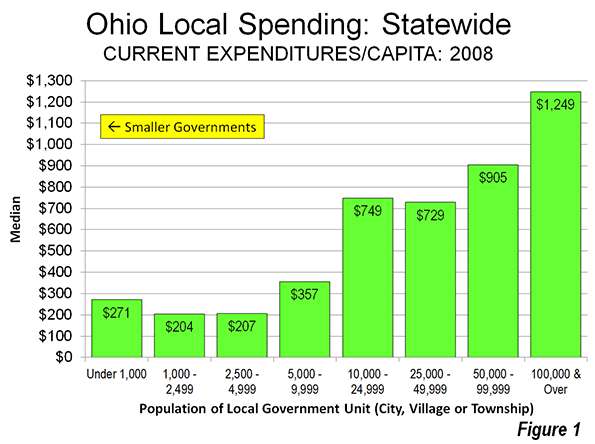
    The data indicates that smaller units of local government have median spending per capita that is less than larger local governments. Local governments with more than 10,000 population spent an average of at least twice that of smaller governments. The lowest per capita spending was in local governments with between 1,000 and 4,999 population (Figure 1).

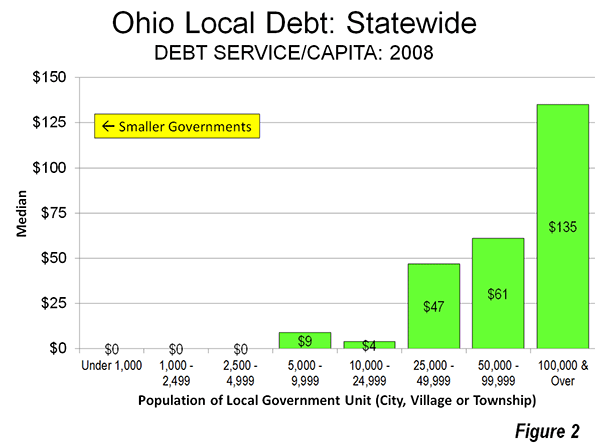
    The smaller government advantage extended to debt. The median debt service per capita for local governments with fewer than 5,000 population was zero, while the median debt service per capita for local governments with 10,000 to 25,000 population was under $10 annually (Figure 2).

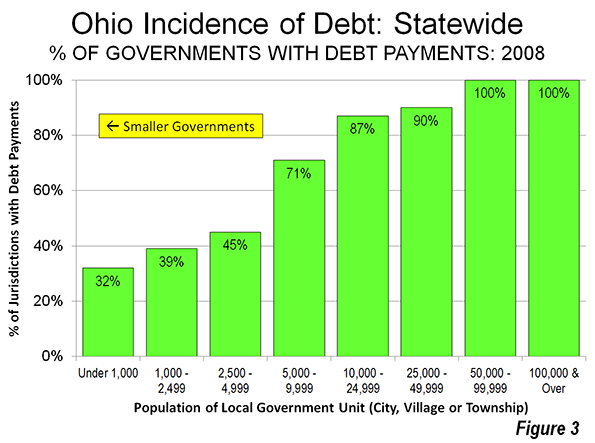
    The incidence of debt was also less among smaller local governments. Fewer than one-half of the local governments under 5,000 population had any debt. In contrast, all of the local governments with 50,000 or more population had debt (Figure 3).

    Smaller Governments Excel in Metropolitan Areas

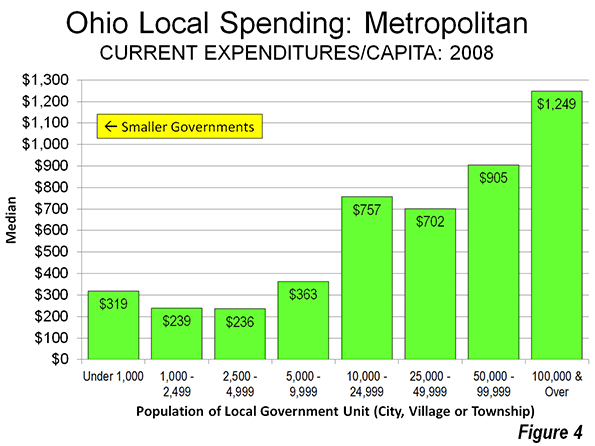
    It might be thought that this smaller-is-better relationship stems from the more rural setting of some smaller local governments. However, an analysis of local government spending and debt per capita within metropolitan areas indicates the same conclusion:  smaller governments spend less and borrow less per capita (Figure 4).

    Townships: Even Less Costly

    Townships have been a particular target of "bigger-is-better" consolidation proposals, perhaps because of their smaller average population. Yet, despite their much larger average service areas (in square miles), townships represent a far smaller share of local government spending than their population share. Townships account for 11 percent of local general purpose government spending (excluding counties), yet have 35 percent of the state’s population.

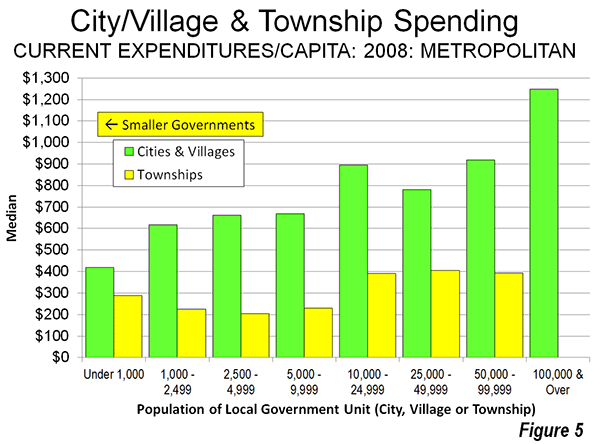
    Townships have lower current expenditures per capita than villages and cities in all but one population category. In metropolitan areas, townships spend less per capita in all population categories (Figure 5). In addition, townships have lower per capita debt service payments than cities and villages
    The lower per capita spending of townships is attributable, at least in part, to lower administrative costs and lower labor costs per capita. Further, as with smaller municipalities, taxpayers often do not often demand the same level of service that is provided in the larger cities.

    Small Government: Less Likely to Enter Fiscal Distress

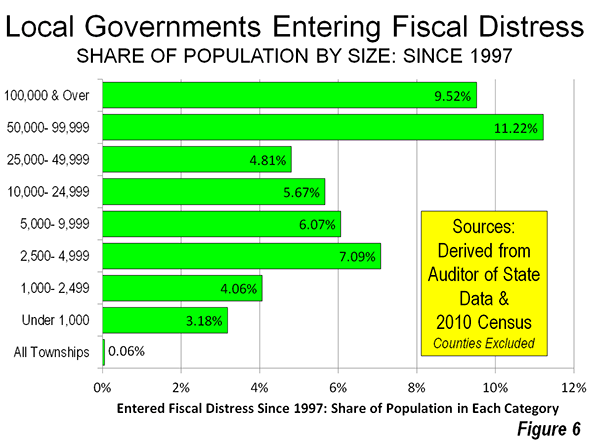
    Smaller local governments have experienced financial distress less. After the city of Cleveland bankruptcy in the 1970s, the state established the Local Government Fiscal Distress, which identifies local governments in serious distress and aids them in returning to normal fiscal health. The smallest cities and villages entered the Fiscal Distress program at a rate less than one-half that of the largest governments. The townships did even better. Only two of the state’s more than 1,300 townships were placed in the Local Government Distress Program (Figure 6).

    Why Larger Local Governments are Less Efficient

    One of the reasons that larger governments spend and borrow more is that they are less accessible to taxpayers and more accessible to interests which benefit from higher spending. This can lead to a vicious cycle that drives taxes so high that governments borrow more, followed by proposals to consolidate when the borrowing capacity becomes more constrained. Further, the very size of some larger governments can make them "too big to fail," like large financial institutions in the Great Financial Crisis. This can lead to "bailouts" by state taxpayers. Ohio’s Local Government Distress Program is an attempt to avoid these difficulties, by providing technical assistance and guidance.

    Smaller governments that consolidate face two critical challenges likely to increase costs. The first is that labor costs tend to be "leveled up" to the compensation levels in the higher cost jurisdiction. The other problem is that services and service levels also tend to be "leveled up."

    Proponents of consolidation sometimes assume that a large number of governments results in duplication of services. However, each of the local governments have exclusive service areas. For example, garbage is not collected by multiple jurisdictions to the same addresses. Smaller jurisdictions also tend to employ more part time staff, and even volunteers, especially in fire departments. Another advantage of smaller governments is that their elected officials are able to more directly manage the business of a smaller jurisdiction, because they do not have to rely more on intermediate staff.

    The performance of Ohio’s smaller governments shows that there is no need to choose between accessible government and efficient government. Ohio’s smaller local governments deliver both.

    Wendell Cox is a Visiting Professor, Conservatoire National des Arts et Metiers, Paris and the author of “War on the Dream: How Anti-Sprawl Policy Threatens the Quality of Life.”

    —–

    Note: These do not include counties, school districts or special districts.

    Illustration: Great Seal of the State of Ohio (from http://www.netstate.com/states/symb/seals/images/seal_ohio2.jpg)

  • It’s Mormon in America

    Whether or not Mitt Romney makes it to the White House, his candidacy signals that Mormons have arrived in American political life. Just as President Obama’s nomination and election marked a sea change in the country’s tortured racial history, so Romney’s nomination has changed religious boundaries that have persisted for more than 160 years. No religious group has been more persecuted by the U.S. government, or more derided by other faiths present in the country, than the Church of Jesus Christ of Latter-day Saints (or the LDS Church, as many Mormons refer to it). Indeed, it was to seek a secure home to practice their heterodox beliefs, including polygamy, that Mormons moved from upstate New York to Ohio, Missouri, Illinois, and finally the Salt Lake Valley in present-day Utah. Led by the irrepressible organizer Brigham Young, the Mormons did more than settle open land. They created a unique blend of communalism and capitalism, industriousness and religious faith, that withstood threats from Native Americans and, later, from the U.S. Army.

    Today, some religious fundamentalists continue to rail against Mormons, while coastal sophisticates scoff at their earnest approach to life, religion, and family. Yet the methodical Mormon way, which stresses education, ambition, and charitable giving, has succeeded in ways equaled by few religious groups. Mormons enjoy levels of education and wealth higher than the national average, for example. Some 54 percent of LDS men and 44 percent of women have secured postsecondary education; the numbers for the general American population are 37 percent and 28 percent, respectively. Mormons also enjoy the nation’s highest rate of charitable giving.

    And while many religious groups in the United States—including the Catholic and mainline Protestant churches, along with most non-Orthodox Jewish denominations—are struggling with declining numbers, the LDS Church is one of the nation’s fastest-growing. Its American membership jumped from 4 million to 6 million between 2000 and 2010. Its global growth over the same period was 45.5 percent, and today, most of its total membership of 14 million resides outside North America. The fastest growth is occurring in Brazil, the South Pacific, and Central America.

    The best advertisement for Mormonism, though, is the kind of society that it seems able to create. Utah, 60 percent of whose population belongs to the LDS Church, has enjoyed one of the fastest job-growth rates in the nation over the past decade, taking a strong lead in a host of industries, from energy and software to composite manufacturing. It has also seen the highest population growth rate of any state, aside from neighboring Arizona and Nevada—and unlike those “bubble” states, Utah survived the housing bust in strong shape.

    The Beehive State’s success is less about low taxes—Utah is not a tax haven like Texas, Nevada, or Florida—than about support for wealth-creating industry. Utahans have a great interest in promoting business growth. Though they revere their state’s handsome landscape, they suffer little from the antigrowth “progressivism” common to the East and West Coasts. Whether backing the creation of a vast mixed-used project in downtown Salt Lake City or encouraging new building for the area’s swelling population, the LDS Church tends to be pro-development.

    That applies to residences as well. Unlike such rival states as California, Utah continues to build affordable single-family houses. Many newly minted housing tracts run along the corridor from Ogden in the north to Provo. A handful of tall condo towers dot downtown Salt Lake City as well. A median-price home in the Salt Lake City region, according to an affordability survey by Demographia, costs roughly three times the median family income—much less than in Los Angeles, New York, and the San Francisco Bay area. Not surprisingly, the New York metropolitan area and California have become the largest net senders of migrants to the Salt Lake City region.

    Such cost advantages, plus the presence of an educated population, appeal to global companies. Goldman Sachs, for example, has set up its second-largest American operation in downtown Salt Lake City. “We consider Salt Lake a high-leverage location,” says Goldman managing director David Lang. “There’s a huge cost differential, and you have a huge, talent-rich environment.” Drive through Provo, and you’ll see office buildings, often just finished, for some of Silicon Valley’s signature companies, including Intel, Adobe, Twitter, eBay, and Fairchild Semiconductor. Over the past decade, the number of Salt Lake–area employees in STEM jobs (those relating to science, technology, engineering, or math) has increased 17.5 percent. The number of such jobs actually declined in Silicon Valley and stagnated in New York, Boston, and Los Angeles.

    Few of the non-Mormon Salt Lake City residents with whom I spoke—“Gentiles,” as LDS members call them—found the city’s atmosphere oppressive. A 2012 Gallup survey ranked Utah first among the states in quality of life. Two decades ago, Gentiles often expressed frustration with Salt Lake City’s dearth of decent restaurants, bars, and even coffeehouses, as Mormons drink neither alcohol nor caffeine. These days, though it’s hardly a party town, the city offers reasonable restaurants and coffee shops, along with plenty of available alcohol. When Kayvan Esfarjani, co–executive director of a Flash Technologies semiconductor plant south of Salt Lake City, first got his assignment there, he thought that he would commute weekly from Silicon Valley. “I had a misconception that this place was somewhere you can’t get a drink, people have multiple wives,” he laughs in his office at the plant, which employs 1,600 workers. But after a short while, the Iranian-born engineer decided to settle down in the Wasatch foothills: “It turns out to be a very good place to raise a family and run a business.”

    Mormons aren’t the wide-eyed, naive people of stereotype; they’re increasingly cosmopolitan and sophisticated. Indeed, Romney may represent only a first move toward the apex of influence in America. We may well hear from former Utah governor Jon Huntsman, a candidate for the Republican presidential nomination this year, or from such engaging newcomers as congressional candidate Mia Love, an exemplar of the new LDS Church (she is of Haitian descent; the church banned black men from its priesthood until the late 1970s). Whether he wins or loses, Romney’s candidacy represents the beginning of the Mormon moment, not its culmination.

    Joel Kotkin is executive editor of NewGeography.com and is a distinguished presidential fellow in urban futures at Chapman University, and contributing editor to the City Journal in New York. He is author of The City: A Global History. His newest book is The Next Hundred Million: America in 2050, released in February, 2010.

    This piece originally appeared in The City Journal.

    Mormon Church Photo by Bigstock.