Category: Politics

  • Barack Obama’s New Chicago Politics Abandon Bill Clinton’s Winning Coalition

    While the Democratic convention this week celebrates the party’s new coalition, Bill Clinton will no doubt try to recapture the white middle class that’s largely deserted the Democrats since his presidency ended. But it’s likely his efforts will be a case of too little, too late for Barack Obama—who will have to look elsewhere for his electoral majority.

    The gentrification of the Democratic Party has gone too far to be reversed in this election. After decades of fighting to win over white working- and middle-class families, Democrats under Obama have set them aside in favor of a new top-bottom coalition dominated by urban professionals—notably academics and members of the media—single women, and childless couples, along with ethnic minorities.

    Rather than representing, as Chris Christie and others on the right suggest, the old, corrupt Chicago machine, Obama in fact epitomizes the city’s new political culture, as described by the University of Chicago’s Terry Nichols Clark, that greatly deemphasizes white, largely Catholic working-class voters, the self-employed, and people involved in blue-collar industries.

    The Chicago that Obama represents is more Hyde Park or the Gold Coast than the Daley family base in blue-collar Bridgeport; more faculty club, media shop or Art Institute than the factory culture of “the city of Big Shoulders”.

    The traditional machine provided him with critical backing early in his political career, but Obama owes his success to new groups that have taken center stage in the increasingly liberal post-Clinton Democratic party: the urban “creative class” made up mostly of highly-educated professionals, academics, gays, single people, and childless couples. It’s a group Clark once called “the slimmer family.” Such people were barely acknowledged and even mistreated by the old machine; now they are primary players in the “the post-materialistic” party. The only holdovers from the old coalition are ethnic minorities and government workers.

    As Clark suggests, the new political urban culture differs in both intent and content from the old one. In the past, say under Richard Daley Sr., Chicago was still a family city where schools, churches, and neighborhood associations were key local amenities. Patronage meant jobs for people who also owned homes, both inside and outside the city, and raised and educated their children, often in Catholic schools. The old Daley machine would no more take on the church on contraception than embrace North Korea as its political role model.

    The  Chicago that spawned Obama  has very different priorities. Clark gives perhaps the best definition—“the city as entertainment machine,” where citizens are preoccupied with quality-of-life issues, “treating their own urban location as if tourists, emphasizing aesthetic concerns.”

    This new city, built around the needs of largely childless and often single professionals, focuses primarily on recreation, arts, culture, and restaurants;  the resources valued by the newly liberated urban individual. The economy of such places focuses primarily on those jobs done by these professionals, either in the over-hyped social-media sector, traditional entertainment, or as service providers— waiters, toenail painters, dog-walkers—that cater to the gentry of the urban core.

    In this urban schema, family, long the basic unit of society, becomes peripheral. The new urban political  base—not only in the Windy City but in Boston, New York, Los Angeles, Seattle, Boston and other parts of the core Obama archipelago—is primarily childless, notes demographer Ali Modarres. A majority of residences in Manhattan, for example, are for singles; thus Mayor Bloomberg’s push for 300 square-foot “affordable” micro units that could cost as much as $2,000 a month. Gentrifying Washington, D.C., now boasts the highest concentration of childless adult females in the nation, a mind-boggling 70 percent of all adult women.

    With more than half of all American women now single and more than half of all births to women under 30 now occurring outside of marriage—both historic developments—Obama has targeted “single women” as a core constituency second only to African Americans. Democratic pollster Stanley Greenberg has dubbed them “the largest progressive voting bloc in the country.” Singles, though not the most reliable voting bloc, almost elected John Kerry, and helped put Obama over the top.

    The new urban political culture Nichols described in Chicago has gone national, essentially gentrifying  the Democratic Party and pushing away the predominately white working- and middle-class families whose goals centered around achieving home ownership, basic essentials, and the occasional luxury. These groups have been leaving both the core cities and the Democratic Party for generations. Bill Clinton, former governor of a poor southern state, connected with these voters through his political genius, natural empathy, and his own biography in ways that have proven difficult for President Obama.

    By all accounts, the inroads made among the group by Clinton, and, thanks to the economic crisis, Barack Obama in 2008, have largely dissipated now. Polling data suggests that these groups are now among the strongest backers of that eminent and hard-to-like patrician, Mitt Romney. 

    Recent Gallup polls show Obama’s strongest support, in terms of professions, coming from “professionals,” such as teachers, lawyers, and educators. He does worst among both small businesspeople and those who work in industries such as energy, manufacturing, transportation and construction, where Democrats from Roosevelt to Clinton often won significant support.

    The division between the new political culture and the older one can be seen in a host of issues, most notably policies that favor urban density over suburbs, and strict environmental policies that hurt basic industries. An agenda aimed at ending “sprawl,” cars, and carbon-generating industries appeals generally to the unmarried and childless, who don’t have to worry overmuch about the need for extra space, backyards, or mundane tasks like taking kids to school, or to Target.  

    Ironically, the other key component of the new political culture comes from the other end of the social order: generally poorer, urban-centered minority populations. For all the hype about gentrification of cities, over the past decade the poor accounted for about 80% of population growth in the urban cores of the nation’s 51 largest metropolitan areas. In suburban areas, by contrast, the poor accounted for just 32 percent of population growth.

    Ironically, these poor minorities continue to back the new political culture even though it favors policies, such as expensive “green energy” and tight regulations, that essentially force all but the highest value-added businesses from the urban core, leaving what Mayor Michael Bloomberg famously defined as “the luxury city.” As manufacturers and many service businesses leave either for the suburbs or less expensive regions, the historical working and middle class has also exited, leaving behind a largely entrenched poverty population, a post-materialist upper class, and little in-between.

    Focused on the “upstairs” part of the new political culture, the administration—confident in minority support—has done very little materially to improve the long-term prospects of those “downstairs.” Minorities, in fact, have done far worse under this administration than virtually any in recent history, including that of the hapless George W. Bush. In 2012, African-American unemployment stands at the highest level in decades; 12 percent of the nation’s population, blacks account for 21 percent of the nation’s jobless. The picture is particularly dire Los Angeles and Las Vegas, where black unemployment is nearly 20%, and Detroit, where’s it’s over 25 percent. 

    Latinos, the other major part of the Party’s “downstairs” coalition, have also fared badly under Obama. This is true even among the aspiring working- and middle-class. Overall, the gap in net worth of minority households compared to whites is greater today than in 2005. White households lost 16% in recent years, but African-Americans dropped 53% and Latinos a staggering 66% of their pre-crash wealth. 

    So how does the Democratic Party, in Chicago and elsewhere, maintain its support among these groups? Needlessly exclusionary Republican policies play a role, scaring off potential minority voters, particularly immigrants and their offspring. Obama also has used his own biography to appeal personally to these groups, most understandably African-Americans, as a way to divert them from his economic shortcomings. And well-timed election-year conversions on key social issues like gay marriage and amnesty for young undocumented immigrants have helped him outmaneuver the hopelessly clueless GOP.

    The fact that there are few decent middle-income jobs—in fact the jobs that have appeared during the recovery have been vastly worse than those lost during the meltdown—for the newly legalized or anyone else seems, at the moment at least, somewhat besides the point.

    Indeed  “besides the point” may be the real Democratic slogan for this year. The Democrats in Charlotte need to argue that results—fewer jobs and far fewer middle-income jobs—matter less than the blessings of green politics, urbanism, and racial-identity politics. In today’s  Democratic party, having  the “correct”  sentiments often seem to outweigh even the fundamentals of broad-based economic success.

    One can only wonder what Harry Truman would think of Obama’s approach, or perhaps even Bill Clinton in his private moments.

    Joel Kotkin is executive editor of NewGeography.com and is a distinguished presidential fellow in urban futures at Chapman University, and contributing editor to the City Journal in New York. He is author of The City: A Global History. His newest book is The Next Hundred Million: America in 2050, released in February, 2010.

    This piece originally appeared in The Daily Beast.

    Bill Clinton photo by Bigstock.
  • Obama Fuel Economy Rules Trump Smart Growth

    The Environmental Protection Agency (EPA) has just finalized its regulation requiring that new cars and light trucks (light vehicles) achieve average fuel efficiency of 54.5 miles per gallon (MPG) by 2025 (4.3 liters per 100 kilometers). This increase in the "CAFE" standard (Corporate Average Fuel Efficiency) is the second major step in the Obama Administration’s program to improve light vehicle fuel efficiency. In 2010, EPA adopted regulations requiring 35.5 MPG average by 2016 (6.6 liters per 100 kilometers).

    The EPA standard is based upon carbon dioxide (CO2) grams emitted per mile of light vehicle travel, with an average of 163 grams per mile (101 per kilometer) to be achieved in 2025. This is slightly above the 2020 European Union standard of 152 grams per mile (95 grams per kilometer). Of course, the regulations have both supporters and detractors, with the automobile manufacturers being among the supporters.  

    Assuming the objectives are met, the reductions in CO2 emissions will dwarf the modest gains forecast from anti-suburban smart growth policies. For decades, this powerful movement has sought to limit or prohibit suburban expansion and even outlaw the detached housing that most people prefer. This includes railing against automobile use and seeking to coerce people out of their cars (as expressed by Secretary of Transportation Ray LaHood).

    The anti-suburban movement has many labels in addition to "smart growth," such as “densification policy," "compact cities," "growth management," "urban consolidation," etc. The origins can be traced back to just after World War II, with the enactment of the British Town and Country Planning Act. The policy origins of smart growth in the United States date from the 1960s (the state of Hawaii) and 1970s (the state of Oregon and California local jurisdictions).

    Forecast CO2 Emission Reductions from Smart Growth

    With concerns about greenhouse gas (GHG) emissions (principally carbon dioxide, or CO2), proponents saw the opportunity to force people back into the cities (from which most did not come) and turn smart growth into an imperative for "saving the planet." This is no exaggeration. As late as last month, this was claimed by fellow panelists at a Maryland Association of Counties conference. As is indicated below, the data shows no such association.

    Even forecasts by proponents fall short of demonstrating an apocalyptic necessity for smart growth. The Cambridge Systematics and Urban Land Institute Moving Cooler report attributed only modest reductions in CO2 emissions to smart growth’s land use and mass transit policies (Moving Cooler was criticized on this site by Alan Pisarski. See ULI Moving Cooler Report: Greenhouse Gases, Exaggerations and Misdirections). The data in Moving Cooler suggests an approximately 50 million ton reduction in CO2 emissions from these smart growth strategies by 2035 (interpolating between 2030 and 2050 figures).

    The more balanced Transportation Research Board Driving and the Built Environment: The Effects of Compact Development on Motorized Travel, Energy Use, and CO2 Emissions  produced similar figures, however it indicated skepticism about whether their higher range projections were "plausible."

    Comparing Smart Growth to the Previous Fuel Economy Standard

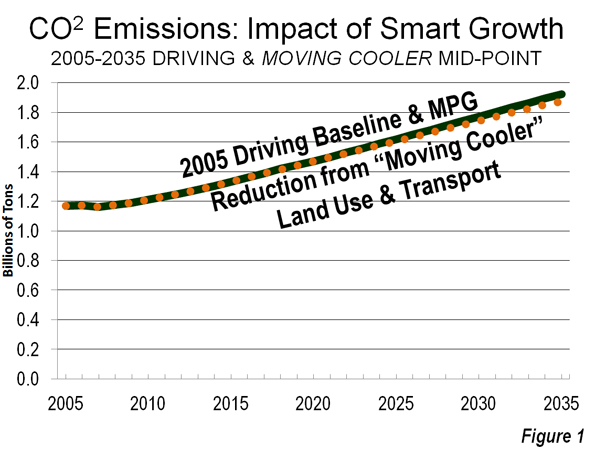
    At the 2005 fuel economy rate and the projected driving increase rate in the US Department of Energy Annual Energy Outlook:2008 (AEO), CO2 emissions from light vehicles would have increased 64 percent from 2005 to 2035 (Note 1). This could be called the "baseline" case or the "business as usual" case. This would have resulted in a CO2 emissions increase from light vehicles of approximately 0.75 billion tons.

    Using the more aggressive Moving Cooler forecast, the smart growth transport and land use strategies would only minimally reduce CO2 emissions from the baseline case (64 percent above 2005 levels) to 60 percent. This is "chicken feed" (Figure 1).

    Forecast CO2 Emission Reductions from the 54.5 MPG Standard

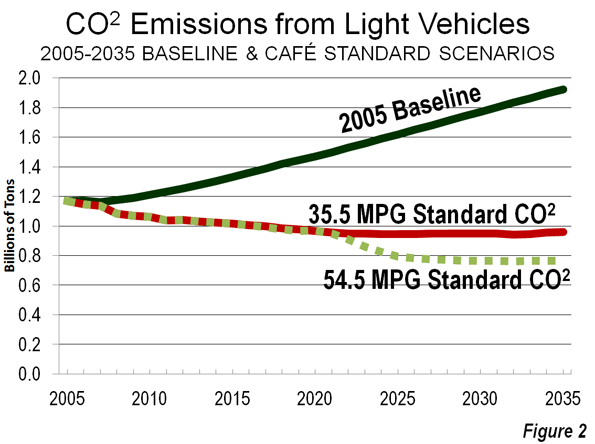
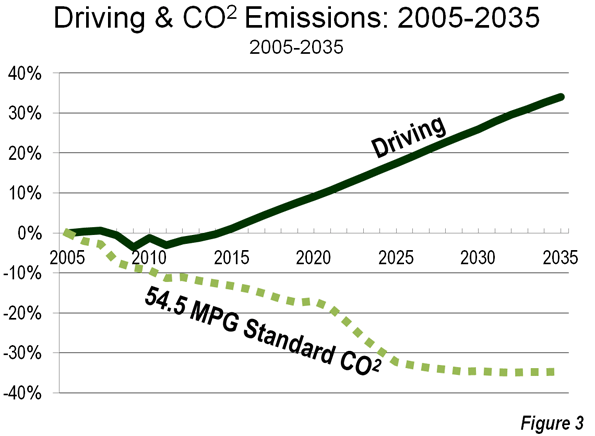
    Under the previous 35.5 MPG standard, AEO:2008 and AEO:2012,  a 19 percent reduction in CO2 emissions from cars and light trucks would occur from 2005 to 2035. We modeled the new regulations based upon AEO:2012 forecasts for the earlier regulation. This yielded a 2035 CO2 emission reduction of 35 percent from 2005 (Figure 2), despite a healthy one-third increase in driving volumes over the period. The calculation also includes an upward adjustment for the rebound effect, as lower costs of driving encourage people to drive more, which EPA estimates at 10 percent ("induced traffic"), which is indicated in Figure 3.


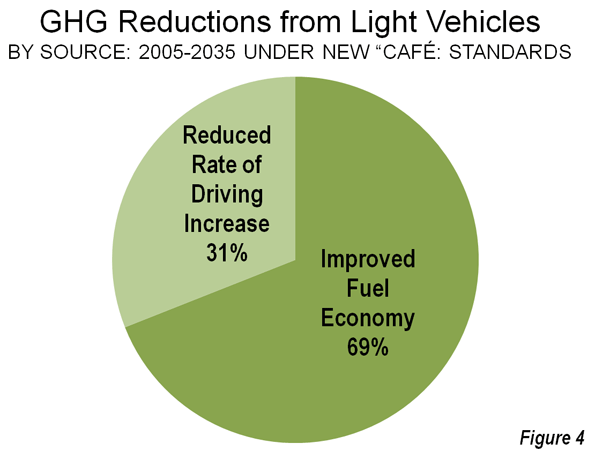
    Achievement of the 54.5 MPG standard would reduce CO2 emissions from light vehicles from 1.9 billion annual tons in 2035 under the 2005 baseline to approximately 0.750 billion metric tons in 2035. Approximately 70 percent of the decline in CO2 emissions would be from improved fuel economy, while 30 percent would be from slower annual increase in vehicle travel that has been adopted in AEO:2012 (Figure 4). The increase in driving is now forecast at 33 percent from 2005.

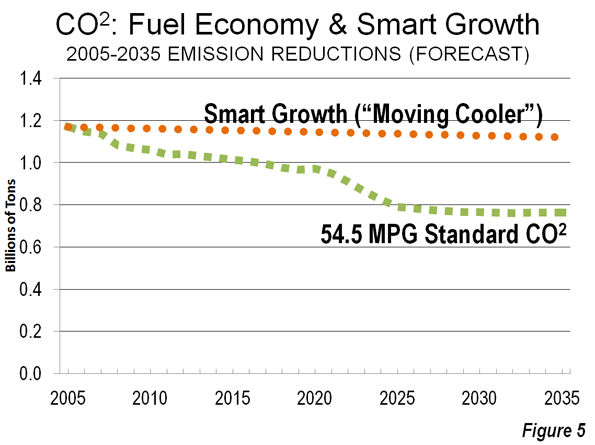
    The contrast between the potential CO2 emissions from smart growth and fuel economy is stark. By comparison, the annual overall reduction in CO2 emissions (from the 2005 baseline) would be virtually equal to the 30 year impact of smart growth (Figure 5).

    Comparison with Transit

    The 35.5 MPG standard would make cars and light trucks less CO2 intensive than transit. At work trip vehicle occupancy rates, the average new light vehicle would emit less in CO2 per passenger mile in 2016 than transit in all but eight of the nation’s 51 metropolitan areas over 1,000,000 population. The 2025 54.5 MPG standard would drop that number to two (Note 2). Even before these developments, there was only scant potential for replacing automobile use with transit (much less walking or cycling) because of its long travel times. According to data in a Brookings Institution report, less than 10 percent of jobs in the largest metropolitan areas can be reached by the average resident in 45 minutes on transit (Note 3).

    Smart Growth: Not Needed to "Save the Planet"

    Smart growth is an exceedingly intrusive policy that would attempt to enforce personal behaviors,    counter to people’s preferences, by attempting to dictate where people live and how they travel. This is expensive as well as intrusive. It is also detrimental to the economy, which is already taking a toll in lower household discretionary income (especially from higher house prices) and stunted economic growth.

    A report by The McKinsey Corporation and The Conference Board  indicated that sufficient CO2 emissions could be achieved with "…no downsizing of vehicles, home or commercial space and traveling the same mileage" and "…no shift to denser housing." Or, more directly, smart growth is unnecessary, in addition to producing little "gain" for the "pain."

    Wendell Cox is a Visiting Professor, Conservatoire National des Arts et Metiers, Paris and the author of “War on the Dream: How Anti-Sprawl Policy Threatens the Quality of Life.”

    —-

    Note 1: The 2030 to 2035 driving volume is estimated using the annual percentage increase from 2025 to 2030 in AEO: 2008, which has data through 2030.

    Note 2: Calculated from 2010 National Transit Database summary by Randal O’Toole of the Cato Institute. These calculations assume the 250 gram per mile standard for new light vehicles in 2016 and the vehicle occupancy ratio of 1.13 for work trips from the 2009 National Household Travel Survey.

    Note 3: Limited transit access is not just an American problem. In Paris, with arguably the best transit system in the western world, the average resident of a suburban new town on the regional metro (RER) can reach twice as many jobs by car as by transit in an hour, according to Fouchier and Michelon.

    Prius photo by Bigstock.

  • The Unseen Class War That Could Decide The Presidential Election

    Much is said about class warfare in contemporary America, and there’s justifiable anger at the impoverishment of much of the middle and working classes. The Pew Research Center recently dubbed the 2000s a “lost decade” for middle-income earners — some 85% of Americans in that category feel it’s now more difficult to maintain their standard of living than at the beginning of the millennium, according to a Pew survey.

    Blaming a disliked minority — rich business folks — has morphed into a predictable strategy for President Obama’s Democrats, stripped of incumbent success. But all the talk of “one percent” versus “the ninety nine percent” misses new splits developing within both the upper and middle classes.

    There is no true solidarity among the rich since no one is yet threatening their status. The “one percent” are splitting their bets. In 2008 President Obama received more Wall Street money than any candidate in history, and he still relies on Wall Street bundlers for his sustenance. For all his class rhetoric, miscreant Wall Streeters, particularly big ones, have evaded big sanctions and the ignominy of jail time.

    Obama enjoys great support from the financial interests that benefit from government debt and expansive public largesse. Well-connected people like Obama’s financial tsar on the GM bailout, Steven Rattner, who is also known as a vigorous defender of “too big to fail.”

    The “patrician left” — a term that might have amused Marx — extends as well to Silicon Valley, where venture capitalists and techies have opened their wallets wider than ever before for the president. Microsoft and Google are two of Obama’s top three organizational sources of campaign contributions. Valley financiers are not always as selfless as they or their admirers imagine: Many have sought to feed at the Energy Department’s bounteous “green” energy trough and all face regulatory reviews by federal agencies.

    The Republicans have turned increasingly to those patricians who depend on the more tangible economy. If you make your living from digging coal or exploring for oil wells, even if you don’t like him, Romney is you man. This saddles the GOP with the burden of being linked to one of America’s most hated interests: oil and gas companies. Almost as detested is the biggest source of Romney cash, large Wall Street banks. (In contrast, Democratic-leaning industries, such as Internet-related companies, enjoy relatively high public support.)

    With the patriarchate divided, the real action in the emerging class war is taking place further down the economic food chain. This inconvenient reality is largely ignored by the left, which finds the idea of anyone this side of Bain Capital supporting Romney as little more than “false consciousness.”

    Obama’s core middle-class support, and that of his party, comes from what might be best described as “the clerisy,” a 21st century version of France’s pre-revolution First Estate. This includes an ever-expanding class of minders — lawyers, teachers, university professors, the media and, most particularly, the relatively well paid legions of public sector workers — who inhabit Washington, academia, large non-profits and government centers across the country.

    This largely well-heeled “middle class” still adores the president, and party theoreticians see it as the Democratic Party’s new base. Gallup surveys reveal Obama does best among “professionals” such as teachers, lawyers and educators. After retirees, educators and lawyers are the two biggest sources of campaign contributions for Obama by occupation. Obama’s largest source of funds among individual organizations is the University of California, Harvard is fifth and its wannabe cousin Stanford ranks ninth.

    Like teachers, much of academia and the legal bar like expanding government since the tax spigot flows in the right direction: that is, into their mouths. Like the old clerical classes, who relied on tithes and the collection bowl, many in today’s clerisy lives somewhat high on the hog; nearly one in five federal workers earn over $100,000.

    Essentially, the clerisy has become a new, mass privileged class who live a safer, more secure life compared to those trapped in the harsher, less cosseted private economy. As California Polytechnic economist Michael Marlow points out, public sector workers enjoy greater job stability, and salary and benefits as much as 21% higher than of private sector employees doing similar work.

    On this year’s Labor Day, this is the new face of unionism. The percentage of private-sector workers in unions has dropped from 24% in 1973 to barely 7% today and in 2010, for the first time, the public sector accounted for an absolute majority of union members. “Labor” increasingly means not guys with overalls and lunch pails, but people whose paychecks are signed by taxpayers.

    The GOP, for its part, now relies on another part of the middle class, what I would call the yeomanry. In many ways they represent the contemporary version of Jeffersonian farmers or the beneficiaries of President Lincoln’s Homestead Act. They are primarily small property owners who lack the girth and connections of the clerisy but resist joining the government-dependent poor. Particularly critical are small business owners, who Gallup identifies as “the least approving” of Obama among all the major occupation groups. Barely one in three likes the present administration.

    The yeomanry diverge from the clerisy in other ways. They tend to live in the suburbs, a geography much detested by many leaders of the clerisy and, likely, the president himself. Yeomen families tend to be concentrated in those parts of the country that have more children and are more apt to seek solutions to social problems through private efforts. Philanthropy, church work and voluntarism — what you might call, appropriately enough, the Utah approach, after the state that leads in philanthropy.

    The nature of their work also differentiates the clerisy from the yeomanry. The clerisy labors largely in offices and has no contact with actual production. Many yeomen, particularly in business services, depend on industry for their livelihoods either directly or indirectly. The clerisy’s stultifying, and often job-toxic regulations and “green” agenda may be one reason why people engaged in farming, fishing, forestry, transportation, manufacturing and construction overwhelmingly disapprove of the president’s policies, according to Gallup.

    Obama supporters sometimes trace the loss of largely white working-class support — even to the somewhat less than simpatico patrician Romney — to “false consciousness.”  A recent Daily Kos article, charmingly entitled “The Masses are Asses,” chose to wave the old bloody shirt of racism, arguing that whites “are the single largest, and most protected racial group in this country’s history.”

    Ultimately this division — clerisy and their clients versus yeomanry — will decide the election. The patricians and the unions will finance this battle on both sides, spreading a predictable thread of half-truths and outright lies. The Democrats enjoy a tactical advantage. All President Obama needs is to gain a rough split among the vast group making around or above the national median income. He can count on overwhelming backing by the largely government dependent poor as well as most ethnic minorities, even the most entrepreneurial and successful.

    Romney’s imperative will be to rouse the yeomanry by suggesting the clerisy, both by their sheer costliness and increasingly intrusive agenda, are crippling their family’s prospects for a better life. In these times of weak economic growth and growing income disparity, the Republicans delude themselves by claiming to ignore class warfare. They need to learn how instead to make it politically profitable for themselves.

    Joel Kotkin is executive editor of NewGeography.com and is a distinguished presidential fellow in urban futures at Chapman University, and contributing editor to the City Journal in New York. He is author of The City: A Global History. His newest book is The Next Hundred Million: America in 2050, released in February, 2010.

    This piece originally appeared in Forbes.

    Mitt Romney image from Bigstock.

  • New Setbacks for the Beleaguered California Bullet Train

    A proposal by Senator Michael Rubio (SB 317) to loosen California’s landmark environmental protection law commonly known as CEQA, has been shelved. The proposed legislation was intended to exempt the Central Valley rail construction project from CEQA requirements, thereby removing the threat of environmental litigation against the project. The bill, if approved,  would have likely led to the dismissal of currently pending lawsuits against the California High-Speed Rail Authority (CHSRA), and specifically the challenges filed by the Merced and Madera Farm Bureaus, according to Gary Patton, a California attorney who has been involved in environmental litigation. With environmental protections remaining in place, CEQA-based challenges could seriously  delay the start of construction and jeopardize the Authority’s ability to complete the Central Valley project by the federally imposed deadline of September 2017. Missing the federal deadline would deprive the project of the balance of the $3.3 billion federal grant.

    The unexpected cancellation of Sen. Rubio’s bill is credited to the opposition of powerful environmental groups and local elected officials. The latter sent a letter to Senate President Pro Tempore Darrel Steinberg and Assembly Speaker John Perez opposing "any proposal to create significant new exemptions or otherwise re-write CEQA in the days ahead." The proposed bill, wrote the officials, contain major changes to the existing law that have not been properly vetted and are being pushed  by "special interests in an end of session power play." In the end, Sen. Steinberg chose to side with the objectors rather than with a fellow Democrat.   "This law for all its strenghts and faults," he said, "is far too important to rewrite in the last days of the session."

    What Lies Ahead?

    The announced schedule for the California HSR procurement process calls for proposals from the five qualified bidders due in September 2012, contract award in December 2012, and Notice to Proceed  (on the 60-mile Merced-to-Fresno section of the line) in January 2013. No schedule has been announced for the Fresno-to-Bakersfield segment whose final EIR/EIS is not expected until early 2013.  

    However, before construction can begin (initially on a 29-mile line segment  from Madera to south of Fresno), the necessary rights-of-way for the HSR track must be acquired. The acquisition  process will include appraisals, acquisition offers, negotiations with land owners and relocation assistance (if any). These actions could be delayed by any potential legal challenges filed against the project by members of the Merced and Madera Farm Bureaus. 

    "It’s going to be a long battle for the Rail Authority, said Amanda Carvajal, executive director of the Merced County Farm Bureau. "There is going to be opposition every step of the way."  "We feel that the evidence against the Authority’s environmental document being adequate or truthful is solid," echoed Tom Rogers, President of the Madera County Farm Bureau in announcing the filing of a class action environmental lawsuit against the Authority in early June. Anja Raudabaugh, executive director of the Farm Bureau added,   "…this lawsuit was necessary to protect the bedrock economy of agriculture in the Valley. … We are actively seeking support from the community, local businesses and anyone who feels the rail project is to the detriment of their livelihood and way of life."    

    The strength of opposition to the bullet train in the Central Valley has led some observers to conclude that the actual groundbreaking and start of construction on the initial segment of the line could be many months if not years away. 

    New Operating Cost Analysis Casts Doubt on the Project’s Profitability

    New doubts concerning the financial viability of the California bullet train have been cast by the August 22 publication  of a report by William Warren and William Grindley, two prominent critics of California’s HSR project. The report challenges the Authority’s claim that the bullet train’s revenues will cover its operating and maintenance (O&M) costs as required by the enabling Proposition 1A law. The 198-page report concludes that  the high-speed train "is in the untenable position of having to compete against the low costs of automobile travel  and intra-California airfares while simultaneously meeting AB 3034 (Proposition 1A) requirement to be profitable."    

    To successfully compete with the low costs of driving and flying, the authors contend the bullet train must keep the per passenger mile (PPM) fares somewhere in the 20 cent/PPM range.  The average PPM fare for existing HSR systems is more than twice what the Authority projects —47 cents versus 23 cents/PPM.

    The authors used the Northeast Corridor’s high-speed train Acela  for their comparison because its operating costs offer the closest equivalent to the California bullet train in terms of  labor, power, maintenance and employee benefit costs   The real life examples show that existing high-speed rail  operating costs exceed 30¢/ PPM, while the Authority claims operating costs of only 10¢/ PPM. 

    The authors conclude: "The difference between the reality of high-speed rail’s operating costs and the fares CHSRA says they will charge can only be made up by subsidies which are  prohibited by law.   That means hundreds of millions to several billions of dollars  will need to be found from California’s taxpayers every year." 
    The report has received  wide distribution in Sacramento and  can be found at  www.sites.google.com/site/hsrcaliffr,  It will be also available at www.cc-hsr.org.

    Ken Orski has worked professionally in the field of transportation for over 30 years.

  • Regionalism: Spreading the Fiscal Irresponsibility

    Stanley Kurtz’s new book, Spreading the Wealth: How Obama is Robbing the Suburbs to Pay for the Cities describes political forces closely tied to President Obama who have pursued an agenda to “destroy” the suburbs for many years. He expresses concern that a second Obama term will be marked by an intensification of efforts to destroy the suburbs through eviscerating their independence thought the imposition of "regionalism". The threat, however, long predates the Obama administration and has, at least in some cases, been supported by Republicans as well as by Democrats.

    America is a suburban nation. Nearly three-quarters of the residents of major metropolitan areas (over 1,000,000 population) live in suburbs, most in smaller local government jurisdictions. Further, outside the largest metropolitan areas most people live in suburbs, smaller towns or smaller local government jurisdictions.

    Smart Growth

    The anti-suburban agenda has more than one dimension. The best known is smart growth, known by a variety of labels, such as compact development, growth management, urban consolidation, etc. Smart growth, from our research, also is associated with higher housing prices, a lower standard of living, greater traffic congestion and health threats from more intense local air pollution.

    Regionalism

    Another, less well-known anti-suburban strategy is regionalism, to which Kurtz grants considerable attention. Regionalism includes two principal strains, local government amalgamation and metropolitan tax sharing. Both of these strategies are aimed at transferring tax funding from suburban local governments to larger core area governments.

    Social welfare and differing income levels are not an issue at this level of government. Local governments, cities, towns, villages, boroughs and townships, finance local services principally with their own local taxes. The programs aimed at social welfare or providing income support are generally administered and financed at the federal, state or regional (county) level. Any suggestion that local suburban jurisdictions are subsidized by core local governments simply reveals a basic unfamiliarity with US municipal finance.

    Local Government Amalgamation

    Opponents of the suburbs have long favored amalgamating local governments (such as cities, towns, villages, boroughs and townships). There are two principal justifications. One suggests "economies of scale" — the idea that larger local government jurisdictions are more efficient than smaller governments, and that, as a result, taxpayers will save. The second justification infers that a larger tax base, including former suburbs, will make additional money available to former core cities, which are routinely characterized as having insufficient revenues to pay for their services. Both rationales are without foundation.

    Proponents of amalgamation incessantly refer to the large number of local governments in some states, implying that this is less efficient. The late Elinor Ostrum put that illusion to rest in her acceptance speech for the Nobel Prize in economics in 2009:

    Scholars criticized the number of government agencies rather than trying to understand why created and how they performed. Maps showing many governments in a metropolitan area were used as evidence for the need to consolidate.

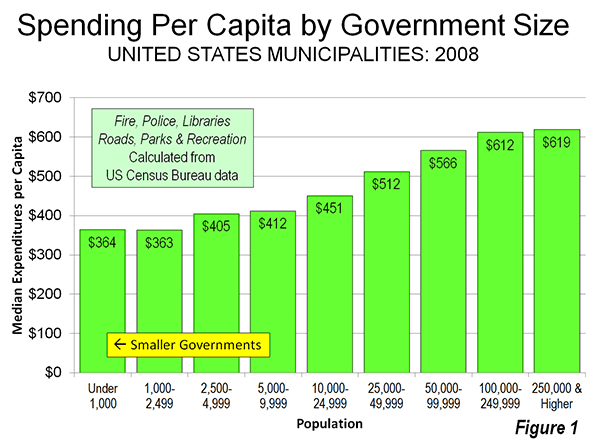
    The reality is that there is a single measure of efficiency: spending per capita. Here there is a strong relationship between smaller local government units and lower taxes and spending. Our review of local government finances in four states (Pennsylvania, New York, Indiana and Illinois) indicates that larger local governments tend to be  less efficient, not more. Moreover, the same smaller is more efficient dynamic is evident in both metropolitan areas as well as outside. "Smaller is better" is also evident at the national level (Figure 1).

    Yet the "bigger is better" faith in local government amalgamation remains compelling to many from   both the Right and Left. Proponents claim that smaller local governments are obsolete, characterizing them as being from the horse-and-buggy era. The same logic could be used to eliminate county and even state governments. However, democracy remains a timeless value. If people lose control of their governments to special interests (which rarely, if ever, lobby for less spending), then democracy is lost, though the word will still be invoked.

    Support of local government amalgamation arises from a misunderstanding of economics, politics and incentives (or perhaps worse, contempt for citizen control). When two jurisdictions merge, everything is leveled up, from labor costs to service levels. The labor contracts, for example, will reflect the wage, benefit and time off characteristics of the more expensive community, as the Toronto "megacity" learned to its detriment.

    Further, special interests have more power in larger jurisdictions, not least because they are needed to finance the election campaigns of elected officials, who always want to win the next election. They are also far more able to attend meetings – sending paid representatives – than local groups. This is particularly true the larger the metropolitan area covered, since meeting are usually held in the core of urban area not in areas further on the periphery. This greater influence to organized and well-funded special interests – such as big real estate developers, environmental groups, public employee unions – and drains the influence of the local grassroots. The result is that voters have less influence and that they can lose financial control of larger local governments. The only economies of scale in larger local government benefit lobbyists and special interests, not taxpayers or residents.

    Regional Tax Sharing

    Usually stymied by the electorate in their attempts to amalgamate local governments, regional proponents often make municipal tax sharing a priority. The idea is that suburban jurisdictions should send some of their tax money to the core jurisdictions to make up for the claimed financial shortages of older cities. Yet this ignores the fact, as Figure 1 indicates, that larger jurisdictions generally spend more per capita already and generally tax more, as our state reports cited above indicate. Larger jurisdictions also tend to receive more in state and federal aid per capita.  A principal reason is that the labor costs tend to be materially higher in larger jurisdictions. In addition to paying well above market employee compensation, many larger jurisdictions have burdened themselves with pension liabilities and post employment health benefits that are well above what their constituencies can afford. The regionalist solution is not to bring core government costs in line with suburban levels but force the periphery to help subsidize their out of control costs.

    Howard Husock, of Harvard University’s JFK School of Government (now at the Manhattan Institute) and I were asked to evaluate a tax sharing a plan put forward by former Albuquerque mayor David Rusk for Kalamazoo County, Michigan (The Kalamazoo Compact) more than a decade ago. Our report (Keeping Kalamazoo Competitive)found no justification for the suburban areas and townships of Kalamazoo County to share their tax bases with the core city of Kalamazoo. The city already spent substantially more per capita, received more state aid per capita and had failed to take advantage of opportunities to improve its efficiency (that is, lower the costs of service without reducing services).  We concluded that the "struggling" core city had a spending problem, not a revenue problem. To the credit of the electorate of Kalamazoo County, the tax sharing proposal is gathering dust, having been made impractical by suburban resistance.

    Spreading the Financial Irresponsibility

    The wanton spending that has gotten many larger core jurisdictions into trouble should not have occurred. The core cities are often struggling because their political leadership has "given away the store," behavior that does not warrant rewarding. Elected officials in the larger jurisdictions had no business, for example, allowing labor costs to become higher than necessary or granting rich pension benefits paid for by private sector employees (taxpayers), most of whom  enjoy only  much more modest pension programs, if at all (See note below).

    The voters are no match for the spending interests with more efficient access to City Hall. The incentives in such larger jurisdictions are skewed against fiscal responsibility and the interests of taxpayers. Making an even larger pool of tax revenues available can only make things worse.

    At the same time, the smaller, suburban jurisdictions around the nation are often the bright spot in an environment of excessive federal, state and larger municipal government spending. Their governments, close to the people, are the only defense against the kind of beggar-the-kids-future spending that has already captured the federal government, state governments and some larger local jurisdictions.

    Either Way the Threat is Very Real

    Even if President Obama is not re-elected or if a second Obama Administration does not pursue the anti-suburban agenda, the threat to the suburbs will remain very real. This is not just about the suburbs, and it is certainly not some secret conspiracy. What opposing regionalism means is the preservation of what is often the last vestige of fiscal responsibility. It is not that the elected officials in smaller  jurisdictions are better or that the electorate is better. The superior performance stems from the reality that smaller governments are closer to the people, and decision-making tends more to reflect their interests more faithfully than in a larger jurisdictions.

    Ed. note: This piece was corrected to add quotation marks around the word “destroy” in the first paragraph. That clause is included in reference to Kurtz’s characterization, not the author’s.

    ——

    Note: A report by the Pew Charitable Trusts (Promises with a Price) indicated that "… in general, the private sector never offered the level of benefits that have been traditionally available in the public sector." The report further indicated that 90 percent of state and local government retirees are covered by the more expensive defined benefit pension programs, compared to 20 percent in the private sector. The median annual pension in the state and local government sector was cited at 130 percent higher than in the private sector. While 82 percent of state and local government retirees are covered by post-employment medical benefits, the figure is 33 percent in the private sector. According to the Bureau of Labor Statistics, after accounting for the one-third higher wages per hour worked among state and local government workers, employer contribution to retirement and savings is 160 percent higher than in the private sector (March 2012). A just published Pew Center on the States report (The Widening Gap Update) indicates that states are $1.3 trillion short of the funding required to pay the pension and post employment medical benefits of employees. This does not include programs administered by local governments.

    Wendell Cox is a Visiting Professor, Conservatoire National des Arts et Metiers, Paris and the author of “War on the Dream: How Anti-Sprawl Policy Threatens the Quality of Life.”

    Lead Photo: Damascus City Hall (Portland, Oregon metropolitan area) by Wiki Commons user Tedder.

  • Utah Up, Chicago Down: Why Mitt Romney Should Embrace His Mormonism

    In his run for the Republican nomination, Mitt Romney downplayed his Mormonism—referring only to “faith” or “shared values”—in the face of small-minded members of the Christian right and the occasional cackle from the Eastern cultural avant-garde. But with his party’s nod in hand, Romney has been “coming out” in the run-up to the Republican convention, letting pool reporters join him and his family at a church service, and even choosing a member of the church to deliver the invocation on the night he addresses the Republican convention.

    The church’s appeal can be seen, in part, in the contrast between booming Utah and Salt Lake City and President Obama’s adopted home state of Illinois and hometown of Chicago.

    Utah netted 150,000 new arrivals from other states in the last decade, while Illinois lost a net of 70,000 people each year to other states. And Utah’s new arrivals include more than Mormons returning to Zion; Salt Lake County is now only 54% Mormon. Twenty-six percent of the county’s residents are minorities, mostly Hispanic immigrants.

    Romney himself reflects the enormous changes in the fast-growing and highly successful Church of Jesus Christ of Latter-day Saints (LDS), the official name of the religion, since the church (which continues to have an all-male clergy), opened itself to black members in 1978. Mormons now enjoy levels of education and wealth well above those of the average American.  Some 53.5% of LDS males have a post–high-school education, compared to 36.5% of the total U.S. population. And 44.3% of LDS females have a post-high-school education, compared to a national average of 27.7%. More impressive still, unlike mainstream churches, Mormonism is thriving; the church membership in North America grew 45 percent over the past decade to more than 6 million members—roughly matching the number of American Jews

    This is not Romney’s father’s—and certainly not his grandfather’s—LDS.

    A recent Gallup survey ranked Utah first in terms of quality of life, in part because of its citizens’ “low smoking habits, ease of finding clean and safe water, having supervisors who treat workers like a partner rather than a boss, learning something new or interesting on any given day, and perceptions that your city or area are ‘getting better’ rather than ‘getting worse.’”

    While Illinois competes with California for the nation’s worst credit ranking, Utah stands at the AAA apex. The job-growth rate in Salt Lake City and the state rank near the top while Chicago and Illinois have sunk relentlessly toward the bottom. Forbes recently ranked Utah “the best state for business and careers” for the second straight year; Illinois ranked 41st.

    While Utah undoubtably owes some of its success to its low-tax, low-regulation culture, and to smart incentives to draw in businesses, it’s also benefitted from a Mormon culture that promotes not supply-side but investment-driven growth.

    From its origins in the great Mormon migration in the late 1840s, the state and the church have built a legacy of careful planning. Brigham Young was many things, control freak and city planner among them, laying out the streets of the towns with exacting detail. The Mormons, wrote Wallace Stegner, a “gentile” who lived among them, “were the most systematic, organized, disciplined, and successful pioneers in our history.”

    Today this legacy is evident in the excellent infrastructure the state is building, including new highways that shame the pot-holed roads that people on the coasts commonly endure. Utahans have invested mightily in their universities, public and private, and are positioning themselves to be major players in fields from energy and agriculture to composite manufacturing, science, and engineering. They are not merely waiting around to ransack the intellectual capital of other states; for the last two years the University of Utah has ranked No. 1 in forging startups, besting institutions like MIT and Columbia.

    It is a bit distressing for a Californian to ride down Highway 15 south from Salt Lake City towards Provo and see buildings, often just finished, from some of Silicon Valley’s signature companies including Intel, Adobe, Twitter, eBay, and Fairchild Semiconductor. These are jobs that used to stay in California, but for a host of reasons—regulation and housing prices chief among them—have moved east to Utah.

    And most of the former Californians I’ve met in Salt Lake like the place, even if they sometimes feel uncomfortable with the Mormon aversion to such habit as drinking. Over the past 30 years, the city has changed for the better. Good food now proliferates—even if the elegantly dressed young Mormons still don’t order wine, much less vodka. The local arts and culture scene has evolved to, if not world-class levels, at least those seen in other similarly-sized cities.

    But what’s most impressive about Utahans may be their devotion to family. Although they make much noise about their dedication to “working families,” the Democratic Party increasingly relies on singles and the childless as its core base, particularly among white voters. In contrast, GOP-dominated Utah (which is largely white, but increasingly diverse) has the highest birth rate and youngest population in the nation. Families thrive there, including those who are not Mormon. It is almost like another America—one where most people raise their children, and push education and enterprise. If you’re getting deep into your 50s like me, you might remember that country.

    True, Salt Lake City now has some high-rise residential areas and some local planners, largely from the University of Utah, who push “smart growth.” But the big growth along the Highway 15 corridor is mostly single-family home communities, affordable and large enough to accommodate several offspring. They seem a lot like the places Long Island and the San Fernando Valley once were.

    Like the church around which it is built, the Mormon Zion in Salt Lake Valley has also changed. It has what may be the largest concentration of multilingual people in the country. With 55,000 missionaries at 340 mission sites across the globe, native English-speaking Mormons have learned more than 50 languages. Former Utah governor and Romney rival Jon Huntsman gained respectability—even among sophistos—for his fluent Mandarin.

    On the business side, Mormons’ linguistic skills have attracted loads of big international companies, such as Goldman Sachs, who need people capable of conversing in Lithuanian, Chinese, or Tongese. Goldman has 1,400 employees in Salt Lake City, making it the investment bank’s sixth largest location in the world.

    In contrast to the antediluvian nonsense sometimes expressed by right-wing evangelical Christians, the LDSers have become more cosmopolitan as their faith has expanded. Once a peculiarly American creed, with the vast majority of its faithful living in the Western United States, Mormonism has morphed into a global religion with over 11 million members—more than half of them outside the United States. Once narrowly white, the church’s biggest growth now is in Brazil, the Philippines, and the Pacific Islands. Even in the U.S., converts have made for an increasingly diverse church, with blacks and Hispanics accounting for one in five new Mormons, according to Pew.

    It’s not likely that the church will be portrayed by the Obama campaign and its associated media outlets in this way. They also are sure to continue portraying millionaire Mitt as the greedy capitalist devil incarnate. Perhaps to avoid getting drawn into a discussion of his faith, Romney rarely mentions that he tithes 10 percent of his substantial income to support church activities. Such tithing, expected of all church members, helps explain why Utahans are easily the nation’s most charitable citizens, according to The Chronicle of Philanthropy—contributing two and a half times more of their income than Illinoisans.

    Yet most appealing about Mormons is their focus on self-help and community outreach, and the church’s highly structured and efficient relief organization—something Romney has never communicated well. Mormons are remarkable for their ability to rise to the occasion during natural disasters like Hurricane Katrina and the earthquake in Haiti.

    “Mitt may not be Bill Clinton or Barack Obama—he’s a boring guy, but he’s not the jerk people think he is,” says Joe Cannon, the former publisher of the Deseret News, the church-owned paper. “When you are a bishop,” as Romney was in Boston, says Cannon, “you are running a huge welfare state on your own. You spend a lot of time helping the poorest and most dysfunctional congregants.”

    In the end, Utah’s Mormon-created reality is bigger than one relentlessly ambitious man’s foibles and tax dodges; Mormonism is the enterprise that transformed a desert province into a productive garden. That’s the story that Romney needs to share between now and November. If he fails, we might see a more appealing Mormon, Jon Hunstman, remind us of this success story in 2016.

    Joel Kotkin is executive editor of NewGeography.com and is a distinguished presidential fellow in urban futures at Chapman University, and contributing editor to the City Journal in New York. He is author of The City: A Global History. His newest book is The Next Hundred Million: America in 2050, released in February, 2010.

    This piece originally appeared in The Daily Beast..

    Mitt Romney photo by BigStockPhoto.com.

  • Form Follows Zoning

    When Louis Sullivan, purveyor of modern American high-rise architecture, said more than 100 years ago that ‘Form Follows Function’, he perhaps didn’t realize the extent to which building form would not be determined only by building type and the laws of physics, but by zoning laws, building safety codes, real estate developer balance sheets and even vocal neighborhood groups.

    For every new building project, an architect’s role is to balance these opposing forces, while also delivering a scheme that is aesthetically pleasing and appropriate for its surroundings. This can be a challenge, but also an opportunity for designers to find creative solutions working within constraints.

    Following are just a few of the many parameters an architect must work with when designing this type of project:

    Form Follows Zoning

    Zoning is a term with broad implications, used to describe the set of regulations put forth by local governments that dictate what type of building can be built where. For each land plot, zoning laws also indicate floor area ratio (FAR, or how much area of building can be constructed), allowable building height, bulk limits, site density, setbacks, and parking requirements, among other constraints.

    The FAR number is of paramount importance: it is the magic number used as a multiplier of a site’s area, resulting in the allowable gross floor area. The higher the FAR number, the more area is allowed to be built on a given plot. In most U.S. cities FAR numbers are difficult to amend except through cumbersome political and legal processes. On the other hand, in developing countries such as China, FAR numbers change on an almost daily basis as zoning regulations remain malleable in order to meet of the moment economic growth needs.

    For high-density commercial and multi-family residential buildings, real estate developers typically seek to maximize FAR to get the highest return on investment. For tall buildings, that means building to the height limit, and then asking for a variance to exceed the height limit if it does not max out the FAR.

    Bulk limits deal with the ascending bulk of skyscrapers, mandating setbacks in the building form as the tower rises up to mitigate shadow impact. That is how you end up with ‘wedding cake’ buildings like the Chrysler Building and the GE Building at Rockefeller Center, both of which were a result of setback mandates in New York City’s 1916 Zoning Resolution. These Art Deco masterpieces are prime examples of how architects cleverly worked within zoning laws to design handsome buildings.

    Form Follows Parking Requirements

    While parking requirements are indicated in zoning laws, this constraint warrants its own category. It is remarkable how much influence the personal automobile has in shaping the modern city, not only in terms of road infrastructure but also in the space required for parking when cars are stopped. Parking requirements are responsible for urban design situations like the ubiquitous linear strip mall setback a great distant from the street, separated by a sea of parking spaces.

    Even in dense urban environments, parking is usually a requirement for new buildings. This means that when designing a multi-story building, the parking layout is what sets the structural column grid that stacks vertically throughout the entire height of the building. A typical 30 ft. column bay (measured from center to center) will accommodate 3 parking spaces, which then results in the building’s entire structure being based on the 30’ column grid.

    Parking garages are either below grade or above grade (above lobby level), and usually do not count towards FAR. There are various reasons (including geological/topographical) for placing a parking garage either below or above grade, but in either case, structure is ultimately designed to accommodate the needs of automobiles.

    Form Follows Rentable/Saleable Area

    In addition to zoning requirements, architects must also meet the needs of their developer clients. This entails realizing in form what real estate bean counters calculate to be the appropriate mix of area for what is to be built.

    If it is commercial office space, developers follow the Building Owners and Managers Association (BOMA) standards of measurement to calculate how much ‘rentable area’ can be squeezed out of a building’s floor given a building’s envelope. Of utmost importance in this calculation is the ‘load factor’ or ratio of rentable area to usable area, determining how much building owners can charge their tenants.

    Also important is the ‘lease span’, with a 45 ft. clear span from service core to exterior wall being the ideal. This allows flexibility in office layout and also ensures enough natural light penetrates deep enough into the office space.

    In residential buildings, saleable are is what developers are after and that determines the mix of unit types (studios, 1 bedrooms, 2 bedrooms, etc…) in a given market. This can frequently change during the design process based on changing market conditions

    For towers with a mix of uses, designing a functional building places tremendous onus on the architect to balance competing forces of different building types consolidated into one vertical structure. With financial rewards ultimately more important than aesthetic outcome, architects have to struggle to create a beautiful building within these constraints.

    Form Follows NIMBY Demands

    In the U.S., and other democratic countries with strong property rights, new building projects are subject to the scrutiny of local neighborhood and vocal environmental groups. Often derided as NIMBYs (Not-In-My-Back-Yard) by those on the pro-development side of a new project, these groups usually have predictable objections, the most common being    increases in traffic. Yet if these NIMBYs, especially in urban settings, have objections to traffic, rather than protest individual projects, they should write their local city councilman suggesting a change in zoning to modify parking requirements.

    Even after the approval of extensive traffic and environmental studies, NIMBYs may criticize a building’s appearance in a last ditch effort to prevent construction. Objections include obscure criticisms such as a design does not fit in with ‘neighborhood character’. This criticism reflects a fundamental misunderstanding that even in historic neighborhoods, a well designed counterpoint or contrast can be a suitable proposal. After all, cities are not static museums frozen in time but dynamic and evolving organisms.

    Unfortunately, the NIMBY victory can often be a final blow to what would’ve otherwise been a successful, beautiful design.

    Conclusion

    For architects, designing a building is more like solving a puzzle rather than an exercise in unrestrained creativity. Surprisingly, there is little discussion of the real world constraints in architecture schools. This is perhaps due in part to the fact that regulations vary greatly from place to place, but the fundamental importance of planning and zoning should be emphasized more often.

    For all stakeholders involved in new building projects (developers, local officials and planning departments, the design team, concerned neighbors) what is written in the local zoning code provides the basis for every decision made. For those interested in making better, more informed planning decisions, individuals and governments should focus less on singular building projects and more on easing the process of making changes to local zoning codes.

    Adam Nathaniel Mayer is an architectural design professional from California. In addition to his job designing buildings he writes the China Urban Development Blog.

    Follow him on Twitter: AdamNMayer

    Chicago skyline photo by Bigstockphoto.com.

  • Is California the New Detroit?

    Most Californians live within miles of its majestic coastline – for good reason. The California coastline is blessed with arguably the most desirable climate on Earth, magnificent beaches, a backdrop of snow-capped mountains, and natural harbors in San Diego and San Francisco. The Golden State was aptly named. Its Gold Rush of 1849 was followed a century later by massive post-war growth.

    There is no mystery why California’s population and economy boomed after the Second World War. Education in California became the envy of the world. California’s public school system led the nation in innovation with brand new schools and classrooms. The Community College system that fed its universities was free for its students. A college education at the UC and Cal State systems was inexpensive. UC-Berkeley, with its graduate schools, was arguably the greatest in the world while Stanford developed into the Harvard of the West. An efficient highway system moved California’s automobile driven commerce while fertile soil of the Central Valley became the fruit and vegetable basket of the world.

    The next wave hit in the 80s as former orchards south of San Francisco morphed into the Silicon Valley. Intel and other chip manufacturers led the computer and software revolution bringing high tech jobs and immense new wealth to the Golden State. The dot-com revolution of the 90s brought more gold to California. Innovators like Google and Apple cashed in by nurturing the Internet era. The next decade heralded the greatest housing and mortgage boom in the nation’s history. Developers from Orange County, south of Los Angeles, invented creative financing vehicles that drove home sales, and profits, to record heights by 2006.  
     
    This success has created a problem: Californians, due to their golden history, live unreflective lives. The Tea Party movement generated a political tsunami that swept more than 60 incumbents from political office in 2010, but the wave petered out at California’s state line as Democrats take every elected office in the state.

    The state budget, mandated to balance by law, has been billions in the red for ten straight years. Yet Californians re-elect the same politicians, year after year, who produce budgets with multi-billion dollar deficits. California voters rejected Meg Whitman, the billionaire founder of Ebay, in favor of Jerry Brown. California now has a $16 billion deficit which “assumes” that California voters will pass massive tax increases on themselves. If they do not, the 2013 deficit becomes a mind numbing $20 billion. Yet despite the red ink, Governor Brown signed into law a “high speed rail” bill that will spend $6 billion on a train between Fresno and Bakersfield – not LA and San Francisco as promised. Polls turned against the choo-choo, but there remain no outcry from California voters.

    California voters rejected Carly Fiorina, who ran Hewlett Packard, for Barbara Boxer in the 2010 Senate race. To protect the endangered Delta Smelt, a fish known better as bait, water has been diverted from Central Valley farms to the Pacific Ocean. Orchards in the Central Valley were allowed to wither and die resulting in unemployment in the Central Valley as high as 40%. Imagine Californians on food stamps, living in what was the fruit basket of American.  

    California’s business climate now ranks dead last according to 650 CEOs measured by Chief Executive Magazine. Apple will take 3,600 jobs to its new $280,000,000 facility in Austin Texas – jobs that California would have had in the past. Texas ranked first in the same survey. California’s unemployment rate is consistently higher than 10% of its work force, and there are few jobs for college students who graduate with as much as $100,000 in student loans. Despite overwhelming evidence that bad public policy is chasing away jobs, the same state politicians are sent back to Sacramento every two years.

    California’s public education system, once the envy of the world, now ranks 46th in the nation in per pupil spending and faces a $1.4 billion cut in the fall. In the last month, three California cities declared bankruptcy. More will follow. Take Poway for example. Its school board borrowed $100,000,000 (for 33,000 students) through a Capital Appreciation Bond. The politicians told the voters there would be no payments for 20 years. What they did not explain was the residents must pay back $1 billion dollars on their $100 million loan. Beginning in 2021, tiny Poway will be forced to pay $50 million per year in bond payments. Huge property tax assessments will be required if homes do not appreciate 400% by then, which is unlikely under foreseeable circumstances.   

    Rather than stare at themselves in the mirror, Californians should take a look at Michigan. In the 50s greater Detroit was the fourth-largest city in America with 2 million inhabitants and the world’s most dominant industry: the automobile.

    Most people had a good paying job. Its burgeoning middle class was the model of the world with excellent public schools and universities. Detroit in 2012 is a shadow of that once great metropolis. Its population has shrunk to 714,000. The average price of a home has fallen to $5,700. Unemployment stands at 28.9%. It has a $300,000,000 deficit. There are 200,000 abandoned buildings in the derelict city. Its public education system, in receivership, is a disgrace producing more inmates than graduates. In 2006, the teacher’s union forced the politicians to reject a $200,000,000 offer from a Detroit philanthropist to build 15 new charter schools. Jobs long ago abandoned Detroit for places like South Carolina and Alabama, with their “right to work” laws and low taxes.

    Now Detroit’s Mayor has proposed razing 40 square miles of the 138 square miles of this once great American city returning 70,000 abandoned homes to farmland. Even such a draconian plan may not be enough to save the city. If a hurricane had hit Detroit, more of us would know of this tragedy in our midst, but this fate was man-made and not wrought by nature. Detroit has had one party rule for more than fifty years. Louis C. Miriani served from September 12, 1957 to January 2, 1962 as Detroit’s last Republican mayor. Since that time the Democrats have ruled the Motor City.  John Dingell has served region since 1956. His father was the Congressman from 1930 to 1956. Despite the disastrous decline of their city, Detroit voters send him back to Congress twenty-two times.

    Like Detroit, California now has one party rule. The Democrats of California did not need a single Republican vote to pass their budget. Governor Brown’s plan is to address the nation’s largest deficit by raising taxes instead of cutting spending. If passed, the deficit would drop from $20 billion to a mere $16 billion. The budget does nothing to cure the systemic problems of a bloated bureaucracy. It does not eliminate one of California’s 519 state agencies.  

    Caltrans stopped building highways under Brown’s first term, but the people kept coming. Now 37 million Californians are locked in traffic jams each day. Brown was rewarded for such prescience with re-election as Governor. California’s egotistical politicians passed the Global Warming Solutions Act in 2006 (AB32) to “solve” climate change. Dan Sperling, an appointee to the California Air Resources Board (CARB) and a professor of engineering and environmental science at UC Davis, is the lead advocate on the board for a “low carbon fuel standard.” The powerful state agency charged with implementing AB 32 and other climate control measures, claims the low carbon fuel standard will “only” raise gasoline prices $.30 gallon in 2013. The California Political Review reported implementation of these the policies will raise prices by $1.00 per gallon.

    Detroit was once the most prosperous manufacturing city in the world, a title later secured by California.    Will California follow Detroit down a tragic path to ruin? In 1950, no one could imagine the Detroit of 2010. In 1970, when foreign imports started to make a foothold, the unions and their bought and paid for politicians resisted any change. In the 1990s as manufacturers fled to Alabama and South Carolina, the unions and their political minions held firm, even as good jobs slipped away. No one in Detroit envisioned their future.

    Today, California is following Michigan’s path with exploding pension obligations, a declining tax base, and disastrous leadership. Housing prices have fallen 30 to 60% across the state, evaporating trillions of dollars of equity and wealth. Unemployment remains stubbornly high and under-employment is rife. Do our politicians need any more signs?

    Governor Brown’s budget will first slash money to schools and raise tuition on its students while leaving all 519 state agencies intact. He apparently will protect political patronage at all costs. Jobs, and job creators, are fleeing the state. Intel, Apple, and Google are expanding out of the state. The best and brightest minds are leaving for Texas and North Carolina. The signs are everywhere. Meanwhile, the voters send the same cast of misfits back to Sacramento each year – just as Detroit did before them.

    The beaches are still beautiful. The mountains are still snow capped and the climate is still the envy of the world. Detroit never had that. But will California’s physical attributes be enough? If the people of California want to glimpse their future, they need look no farther than once proud City of Detroit and the once wealthy state of Michigan.

    It can happen here.

    Robert J Cristiano PhD is the Real Estate Professional in Residence at Chapman University in Orange, CA, a Senior Fellow at the Pacific Research Institute in San Francisco, CA and President of the international investment firm, L88 Companies LLC in Denver – Newport Beach – Washington DC – Prague. He has been a successful real estate developer for more than thirty years.

  • New Chicago Machine Scam In the Works: Eminent Domain Seizure of ‘Underwater’ Mortgages

    With property values down 40% since 2006 in Chicago, the Chicago Democrat Machine has a new scam brewing. The Chicago Sun-Times reports:

    Should Chicago use its sweeping condemnation powers to help stem the foreclosure epidemic — paving the way for underwater mortgages to be written down and repackaged under terms more affordable to struggling homeowners?

    The City Council’s most powerful aldermen believes it’s a concept worth considering, which is why the Finance Committee chaired by Ald. Edward M. Burke (14th) will hold a joint committee hearing on the controversial idea on Tuesday.

    If this passes, the potential for corruption will be unlimited in Chicago. Alderman Burke controls Chicago’s tax code. But, the conflicts are even more pronounced. Alderman Burke slates all the judges in Cook County which means a Burke-slated judge will hear the property seizure case. Even that’s not all; Alderman Burke’s day job is running a property tax appeals tax firm. Being a client of Alderman Burke’s probably will be a good way to avoid a ‘takings’. Expecting a fair appeal, in court, on the seizure? Alderman Burke’s wife, Anne, is a justice on the Illinois Supreme Court. Expecting help from the Illinois state legislature to clamp down on Alderman Burke’s conflicted lifestyle? Alderman Burke’s brother, Daniel, is Assistant Majority Leader of the Illinois General Assembly.

    In conclusion, you can be assured that seizing ‘underwater’ mortgages in Chicago will become a money maker for Alderman Burke. Nothing has left Alderman Burke’s attention in terms of making money off the taxpayers of Chicago. The Chicago Sun-Times has reported that Chicago Public Schools have a history of paying milk money to Alderman Burke. In Chicago, even if you have a checkered past you can still work with Alderman Burke as long as you pay tribute.

  • The Screwed Election: Wall Street Can’t Lose, and America Can’t Win

    About two in three Americans do not think what’s good for Wall Street is good for America, according to the 2012 Harris poll, but do think people who work there are less “honest and moral than other people,” and don’t “deserve to make the kind of money they earn.” Confidence in banks is at a record low, according to Gallup, as they’ve suffered the steepest fall in esteem of any American institution over the past decade. And people have put their money where their mouth is, with $171 billion leaving the stock market last year alone, and 80 percent of Wall Street communications executives conceded that public perception of their firms was not good.

    Americans are angry at the big-time bankers and brokers, and yet, far from a populist attack on crony capitalism, Wall Street is sitting pretty, looking ahead to a presidential election that it can’t possibly lose. They have bankrolled a nifty choice between President Obama, the largest beneficiary of financial-industry backing in history and Mitt Romney, one of their very own.

    One is to the manner born, the other a crafty servant; neither will take on the power.

    Think of this: despite taking office in the midst of a massive financial meltdown, Obama’s administration has not prosecuted a single heavy-hitter among those responsible for the financial crisis. To the contrary, he’s staffed his team with big bankers and their allies. Under the Bush-Obama bailouts the big financial institutions have feasted like pigs at the trough, with the six largest banks borrowing almost a half trillion dollars from uncle Ben Bernanke’s printing press. In 2013 the top four banks controlled more than 40 percent of the credit markets in the top 10 states—up by 10 percentage points from 2009 and roughly twice their share in 2000. Meantime, small banks, usually the ones serving Main Street businesses, have taken the hit along with the rest of us with more than 300 folding since the passage of Dodd-Frank, the industry-approved bill to “reform” the industry.

    Yet past the occasional election-year bout of symbolic class warfare, the oligarchs have little to fear from an Obama victory.

    “Too big to fail,” enshrined in the Dodd-Frank bill, enjoys the full and enthusiastic support of the administration. Obama’s financial tsar on the GM bailout, Steven Rattner, took to The New York Times to stress that Obamians see nothing systemically wrong with the banking system we have now, blaming the 2008 market meltdown on “old-fashioned poor management.”

    “In a world of behemoth banks,” he explained to we mere mortals, “it is wrong to think we can shrink ours to a size that eliminates the ‘too big to fail’ problem without emasculating one of our most successful industries.”

    But consider the messenger. Rattner, while denying wrongdoing, paid $6.2 million and accepted a two-year ban on associating with any investment adviser or broker-dealer to settle with the SEC over the agency’s claims that he had played a role in a pay-to-play scheme involving a $50,000 contribution to the now-jailed politician who controlled New York State’s $125 billion pension fund. He’s also expressed unlimited admiration for the Chinese economic system, the largest expression of crony capitalism in history. Expect Rattner to be on hand in September, when Democrats gather in Charlotte, the nation’s second-largest banking city, inside the Bank of America Stadium to formally nominate Obama for a second term.

    In a sane world, one would expect Republicans to run against this consolidation of power, that has taxpayers propping up banks that invest vast amounts in backing the campaigns of the lawmakers who levy those taxes. The party would appeal to grassroots capitalists, investors, small banks and their customers who feel excluded from the Washington-sanctioned insiders’ game. The popular appeal is there. The Tea Party, of course, began as a response against TARP.

    Instead, the party nominated a Wall Street patrician, Mitt Romney, whose idea of populism seems to be donning a well-pressed pair of jeans and a work shirt.

    Romney himself is so clueless as to be touting his strong fund-raising with big finance. His top contributors list reads something like a rogue’s gallery from the 2008 crash: Goldman Sachs, JPMorgan Chase, Morgan Stanley, Credit Suisse, Citicorp, and Barclays. If Obama’s Hollywood friends wanted to find a perfect candidate to play the role of out-of-touch-Wall Street grandee, they could do worse than casting Mitt.

    With Romney to work with, David Axelrod’s dog could design the ads right now.

    True, some of the finance titans who thought Obama nifty back in 2008 have had their delicate psyches ruffled by the president’s election-year attacks on the “one percent.” But the “progressives,” now tethered to Obama’s chain, are deluding themselves if they think the president’s neo-populist rancor means much of anything. They get to serve as what the Old Bosheviks would have called  “useful idiots,” pawns in the fight between one group of oligopolists and another.

    This division can be seen in the financial community as well. For the most part Obama has maintained the loyalty of those financiers, like Rattner, who seek out pension funds to finance their business. Those who underwrite and speculate on public debt have reason to embrace Washington’s free spenders. They are also cozy to financiers like John Corzine, the former Goldman Sachs CEO and governor of New Jersey, whose now-disgraced investment company MF Global is represented by Attorney General Eric Holder’s old firm. 

    The big-government wing of the financial elite remains firmly in Obama’s corner, as his bundlers (including Corzine) have already collected close to $20 million from financial interests for the president. Record support has also poured in from Silicon Valley, which has become ever more like a hip Wall Street west. Like its east-coast brethren, Silicon Valley has also increased its dependence on government policy, as well-connected venture capitalists and many in the tech community  have sought to enrich themselves on the administration’s “green” energy schemes.

    Romney, on the other hand, has done very well with capital tied to the energy industry, and others who invest in the broad private sector, where government interventions are more often a complication than a means to a fast buck. His broad base of financial support reflects how relatively few businesses have benefited from the current regime.

    Who loses in this battle of the oligarchs? Everyone who depends on the markets to accurately give information, and to provide fundamental services, like fairly priced credit.

    And who wins? The politically well-situated, who can profit from credit and regulatory policies whether those are implemented by  Republicans or Democrats.

    American democracy and the prosperity needed to sustain it are both diminished when Wall Street, the great engineer of the 2008 crash, is all but assured of victory in November.

    Joel Kotkin is executive editor of NewGeography.com and is a distinguished presidential fellow in urban futures at Chapman University, and contributing editor to the City Journal in New York. He is author of The City: A Global History. His newest book is The Next Hundred Million: America in 2050, released in February, 2010.

    This piece originally appeared in The Daily Beast.

    Wall Street bull photo by Bigstockphoto.com.