Category: Politics

  • The Evolving Urban Form: Prague

    Prague is the capital of Czechia, a nation most readers have probably never heard of. Last year, the Czech Republic adopted a new name that does not reveal its governance structure (republic). The new name has not enjoyed widespread acclaim. The union of Czechoslovakia, which dates from the end of World War I, split peacefully in 1993, resulting in the creation of Czech Republic and Slovakia.

    Prague, like its central and eastern European cousins, Warsaw, Budapest and Bucharest, has experienced substantial decentralization of its population following the collapse of communism. As economies improved and more housing choices opened up, many residents opted to move to outer parts of the core cities or even beyond to suburban and exurban areas.

    Today, the municipality of Prague has approximately 100,000 more residents than in 1980. Yet, the distribution of the population is quite different than before. Then, the central and inner districts of the city had a population of approximately 980,000, while the outer districts were home to 200,000. The latest Czech Statistical Office estimates (for January 1, 2017) show the center and inner districts have declined to approximately 785,000 residents. The city’s outer districts have experienced all of the population increase, more than doubling to above 460,000.

    Meanwhile, two-thirds of the growth (Graphic 1) has been in the suburbs of the Středočeský region (Central Bohemia), which surrounds Prague (Graphic 2).

    The Historic Inner District

    Prague’s central district (District 1) comprises the pre-transit walking core of the city. It stretches across the Vltava River (Smetana’s “The Moldau”) from Wenceslaus Square across the Charles Bridge to Prague Castle, the site of St. Vitus Cathedral. The district also includes the Old Town Square. The population of District 1 dropped from 53,000 in 1980 to 29,000 in 2017, a decline of 44 percent.

    The most recent historic events have virtually all taken place in District 1. The 1968 revolt against Soviet control occurred in Wenceslaus Square and was put down by Warsaw Pact military action and tanks, with a loss of 500 Czechoslovakian citizens.

    This was the end of Alexander Dubček’s “Prague Spring” attempt to liberalize communism. Dubček rose from head of the Slovak communist party to leader of the Czechoslovakian communist government. Dubček, however, was luckier than Imre Nagy of Hungary, the communist leader who paid for his liberalizing tendencies by being executed after the 1956 rebellion.

    Wenceslaus Square, named after St. Wenceslaus, Duke of Bohemia, was also the center of the “Velvet Revolution”. Led by Václav Havel, he became Czechoslovakia’s first president following the fall of communism. The communist parliament building (Graphic 3) played a major role, as described by prague-stay.com:

    “This Communist eyesore, loathed by many, loved by few was built after the old Exchange building was destroyed from 1966 – 1973. This glass monstrosity with its two giant pillars is still complete with nuclear shelters. The demands of the Velvet Revolution were accepted here in 1989 and the building was once home to Radio Free Europe who rented the location from former president Vaclav Havel for a very small fee per year (rumor has it that the fee was 1 CZK).”

    I watched Dubček, an unsurprising supporter of the Velvet Revolution, from the building’s gallery in his role as chairman of the national parliament in 1991. Soon after, the national parliament relocated from the building, which is now part of the National Museum. The main building is shown in the top photograph (my photo was not used because of the present scaffolding being used in its refurbishment).

    There is a memorial to victims of the 1968 Warsaw Pact action in front of the main building (Graphic 4), with a barbed wire wreath. Graphics 5 to 7 are also of Wenceslaus Square, which some travel guide books point out is more of a boulevard than a square.

    Old Town Square is shown in Graphics 8 to 12. Charles Bridge is illustrated in Graphics 13 to 16. This historic bridge was built between 1357 and 1402. The approach to Prague Castle and related views are in Graphics 17 to 21. Other views of the inner district are in Graphic 22 (the National Theatre) and Graphic 23.

    Inner and Outer Districts of Prague

    The inner districts (2 through 10) were mainly developed during the mass transit area. The outer districts, where all the city’s growth has occurred, have generally lower population densities. There are some detached houses in the outer districts. Besides the historical buildings, Prague, like other European cities, is in many ways spatially dominated by the automobile, with its narrow, crowded streets and parking on sidewalks. (Graphics 24 to 27).

    The Suburbs

    The Středočeský region surrounds Prague and contains both suburban and exurban development (Graphics 28 to 36), including new construction (Graphics 30 to 36). The Středočeský suburbs exhibit a high quality of suburban infrastructure for eastern Europe, including sidewalks in most cases and curbs. However, the quality of the visible suburban infrastructure falls considerably short of that enjoyed by suburban residents of the United States, Canada, Australia, and New Zealand, where for decades nearly all suburban development has included these features, as well as streets wide enough for parking and cars to pass one-another in opposite directions.

    The Prague Area: Dominating Czechia’s Population Growth

    As is occurring in Tokyo-Yokohama and Budapest, the Prague area is capturing nearly all the national growth, at 86 percent. This includes 58 percent in the suburbs and 28 percent in the outer districts. This is a far greater percentage than Prague’s 25 percent of the population in 1980. (Graphic 37).

    Prague’s Popularity

    For nearly three decades, Prague has been the capital of a nation free to set its own course, the longest period since the 1918 establishment of Czechoslovakia. Prague has become particularly popular among foreign tourists. Trip Advisor ranked Prague 5th among the cities of Europe last year, trailing London, Paris, Rome and Barcelona and ninth in the world. It is no minor accomplishment to edge out cities like Vienna, Amsterdam, and Budapest.

    Wendell Cox is principal of Demographia, an international public policy and demographics firm. He is a Senior Fellow of the Center for Opportunity Urbanism (US), Senior Fellow for Housing Affordability and Municipal Policy for the Frontier Centre for Public Policy (Canada), and a member of the Board of Advisors of the Center for Demographics and Policy at Chapman University (California). He is co-author of the “Demographia International Housing Affordability Survey” and author of “Demographia World Urban Areas” and “War on the Dream: How Anti-Sprawl Policy Threatens the Quality of Life.” He was appointed to three terms on the Los Angeles County Transportation Commission, where he served with the leading city and county leadership as the only non-elected member. He served as a visiting professor at the Conservatoire National des Arts et Metiers, a national university in Paris.

    Top photograph: National Museum. Main building. By Jorge Láscar [CC BY-SA 2.0], via Wikimedia Commons
  • Rebuilding America’s Infrastructure

    President Trump promised a $1 trillion infrastructure plan during his campaign. Spending more money on infrastructure is something that has broad support among people of all political persuasions.

    But as the case of Louisville’s $2.4 billion bridge debacle shows, not all infrastructure spending is good spending.

    And as a judge’s ruling halting the Maryland Purple Line project to require more environmental study shows, many of our infrastructure problems have nothing to do with money.

    I tackle these problems and more in a major essay on the rebuilding America’s infrastructure in the new issue of American Affairs. Some key themes include:

    • America’s infrastructure needs are overwhelmingly for maintenance, not expansion.
    • Infrastructure means much more than surface transport (highways, transit), but includes underfunded items like dams and sewers.
    • There is a mismatch between funding structures and infrastructure needs that must be fixed.
    • Politics and regulatory barriers are often a greater problem than money, and until we improve this, progress on fixing infrastructure will be limited.
    • Private capital alone will not solve the funding challenge and comes with big problems of its own. There’s no such thing as free money.
    • An initial sketch of what an infrastructure program should look like.

    Here is an excerpt:

    Yet there clearly are major infrastructure repair needs in America. We have not been properly maintaining the assets we have built. Levee failures notoriously caused much of the flooding in New Orleans after Hurricane Katrina, but America has yet to address the neglect of its dam and levee systems. For example, the recent possibility of an overflow or collapse at the Oroville Dam in California forced 180,000 people to be evacuated. Many dams, levees, and locks on our inland waterway system are in need of repair, often at significant cost. Examples include Locks 52 and 53 on the Ohio River. Built in 1929, their replacement cost is $2.9 billion. As the New York Times reported, this replacement has been botched, and it was originally supposed to cost only $775 million—still a lot of money.

    Tens of billions of dollars are also needed simply to renovate America’s legacy transit infrastructure. The District of Columbia’s own Metro subway system has suffered several accidents that require emergency repairs to improve safety. It lost 14 percent of its riders last year, as they lost faith in the system. San Francisco’s BART rail system needs at least $10 billion in repairs. Boston’s transit system needs over $7 billion in repairs. New York’s subway signals still mostly rely on 1930s-era technology.

    Similar maintenance backlogs affect other infrastructure types. America’s older urban regions need to spend vast sums of money on sewer system environmental retrofit—$2.7 billion in Cleveland and $4.7 billion in Saint Louis. The state of Rhode Island had to pay $163 million to replace its Sakonnet River Bridge because it had failed to perform routine maintenance on the old one. This is just a sampling of America’s infrastructure gaps.

    But the poster child for American infrastructure problems is Flint, Michigan, where a water treatment error caused lead to leach into the water supply, rendering it unfit for human consumption. This caused then candidate Trump to say, “It used to be cars were made in Flint, and you couldn’t drink the water in Mexico. Now, the cars are made in Mexico and you can’t drink the water in Flint.” To be clear, Flint’s water crisis was caused by human error, but that was only possible because of the city’s old lead-pipe infrastructure. America’s water lines, in many cases, haven’t been touched since they were originally installed many decades ago. Some cities still have wooden water pipes in service. Syracuse mayor Stephanie Miner once said that if her city received the same $1 billion commitment from the state that Buffalo did, she would spend three quarters of it just to fix the city’s water lines.

    While things are not uniformly dire, it is clear that there is a need to repair and upgrade America’s existing infrastructure. It is this rebuilding, not building—making America’s infrastructure great again—that the Trump administration should focus on.

    Click through to read the whole thing.

    Aaron M. Renn is a senior fellow at the Manhattan Institute, a contributing editor of City Journal, and an economic development columnist for Governing magazine. He focuses on ways to help America’s cities thrive in an ever more complex, competitive, globalized, and diverse twenty-first century. During Renn’s 15-year career in management and technology consulting, he was a partner at Accenture and held several technology strategy roles and directed multimillion-dollar global technology implementations. He has contributed to The Guardian, Forbes.com, and numerous other publications. Renn holds a B.S. from Indiana University, where he coauthored an early social-networking platform in 1991.

    By Pi.1415926535 (Own work) [CC BY-SA 3.0], via Wikimedia Commons

  • What Trump has wrought

    Just a few short months ago, we seemed on the brink of a new political era. Donald Trump improbably was headed to the White House, while the Democratic Party, at near historic lows in statehouse power and without control of either house of Congress, seemed to be facing a lengthy period in political purgatory.

    Today some progressive voices still see a “bleak” future, but it is increasingly the Republican Party, and its shattered conservative core, that is reeling. Bitterly divided among themselves, and led by a petulant president with record-low ratings, the Republicans seem to be headed to a major crash just six months after a surprising victory.

    Gone from view now are visions of a renewed Republican Party uniting its traditional base with historically Democratic parts of Middle America. Rather than a realignment in the mode of Richard Nixon or Ronald Reagan, the Trump administration seems to be devolving into a remarkably early interregnum, a pause between alternating progressive eras.

    Trump supporters, not Trump, the real losers

    Donald Trump’s nationalist agenda started with a natural appeal to much ignored non-cosmopolitan America. Unlike the seemingly diffident and distant Barack Obama, Trump offered a laser-like focus on growing high-wage jobs for the declining middle and working classes. A reform agenda on everything from deregulation and taxes seemed to have the potential to escape the low-growth “new normal” and restore broad-based opportunity across the country.

    Due to his obsession with media relations and personal peccadilloes, Trump now has managed to undermine any chance of developing a coherent program to restore dynamism in Middle America. Although some regulatory relief has been imposed, mainly by reversing President Obama’s rule-by-decree, the president has failed to pass a program — for example, new infrastructure spending — that might expand productivity and expand employment opportunities. Instead, he has regressed, in his rare coherent moments, to the GOP corporatist, free-market theology, which threatens many entitlements, notably health care, on which so many Trump voters now depend.

    Trump’s failure to achieve long-term change will end up hurting not just his precious “brand,” but, more importantly, voters and states that backed him. To many who work in manufacturing, energy, homebuilding or agriculture, the president seemed to be a savior. Now these industries may only have four years — at most — before the hammer comes down again, with only the U.S. Supreme Court serving as a possible restraint.

    Read the entire piece at the Orange Country Register.

    Joel Kotkin is executive editor of NewGeography.com. He is the Roger Hobbs Distinguished Fellow in Urban Studies at Chapman University and executive director of the Houston-based Center for Opportunity Urbanism. His newest book is The Human City: Urbanism for the rest of us. He is also author of The New Class ConflictThe City: A Global History, and The Next Hundred Million: America in 2050. He lives in Orange County, CA.

    Photo by Michael Vadon, obtained via Flickr, using the CC License.

  • The globalization debate is just beginning

    The decisive victory of Emmanuel Macron for president of France over Marine Le Pen is being widely hailed as a victory of good over evil, and an affirmation of open migration flows and globalization. Certainly, the defeat of the odious National Front should be considered good news, but the global conflict over trade and immigration has barely begun.

    On both sides of the Atlantic, there are now two distinct, utterly hostile, opposing views about globalization and multiculturalism. The world-wise policies of the former investment banker Macron play well in the Paris “bubble” — and its doppelgangers in New York, San Francisco, Tokyo and London — but not so much in the struggling industrial and rural hinterlands.

    The trade dilemma

    For much of the past half-century, the capitalist powers, led by the United States, favored free trade, even with terms often vastly unbalanced. Now President Donald Trump has undermined this orthodoxy. But anti-globalism transcends conservatism. Besides the National Front, which won over a third of the vote, doubling its support from 2002, the other rising political force in the country, far-left socialist Jean-Luc Melenchon, is at least as hostile to free trade. Much the same can be said of the ascendant Bernie Sanders wing of the Democratic Party.

    Globalists argue that the free trade regime, primarily promoted by the United States, has been a boon to the world economy. Certainly, the last half-century has seen enormous progress in some countries, most notably in East Asia, and led to a general decline in global poverty. It has also produced lower prices for consumers in America and elsewhere.

    Yet, there has been a price to pay, perhaps not in Newport Beach or Beverly Hills, but definitely in areas such as Lille, France, or Rust Belt Ohio, where workers and communities suffered for free trade “principles.” The trade deficit with China alone, notes the labor backer Economic Policy Institute, has cost the country some 3.4 million jobs between 2001 and 2015.

    Read the entire piece at the Orange County Register.

    Joel Kotkin is executive editor of NewGeography.com. He is the Roger Hobbs Distinguished Fellow in Urban Studies at Chapman University and executive director of the Houston-based Center for Opportunity Urbanism. His newest book is The Human City: Urbanism for the rest of us. He is also author of The New Class ConflictThe City: A Global History, and The Next Hundred Million: America in 2050. He lives in Orange County, CA.

    Photo: By Lorie Shaull from Washington, United States (French Election: Celebrations at The Louvre, Paris) [CC BY-SA 2.0], via Wikimedia Commons

  • The Downside of Pragmatism

    ‘Pragmatism killed Michigan.”

    When my consultant friend Dwight Gibson said this about his home state, I was taken aback. I always thought pragmatism was a good thing, and I think of myself as a pragmatic person in many ways. My first response to hearing somebody present an intriguing but nebulous policy idea is usually to say, “Yes, but what exactly am I supposed to do to make this happen?”

    Pragmatism, which we like to identify as a quintessentially American trait, indeed is often a good thing. But as with many other good things, it comes with a dark side.

    In what Gibson, who heads the Exploration Group, calls the “maker” cities and states of the Midwest and Northeast, people historically worked primarily with their hands. They were factory workers, carpenters, plumbers, engineers. They could interact with the physical world to make it do what they wanted.

    That was powerful, but it brought negative baggage, such as the devaluing of other ways of interacting with the world. Political commentator David Frum once said of Detroit that a key reason it failed was a “defiant rejection of education and the arts.” To Frum, the statue of Joe Louis’ fist downtown is a powerful statement: “Here is a city ruled by brawn.” Manual workers often don’t really respect mental work (and vice versa). Hence the old refrain, “He might have book learning, but he doesn’t have any common sense.”

    But there’s more to it than that. We all see problems though the lens of our own occupational backgrounds and skill sets. I often see the world as a consultant would, for example. Rust Belt places, steeped in a culture of working with their hands, view the world in that pragmatic way. The manual worker or tinkering engineer says, “What can I do with the things that are in my hands?” They are often quite ingenious and creative in making use of these, but they tend to think only in those practical terms. The key question is, “Does it work?” From there it is, “Does it work efficiently?” These are the values of industrial management articulated by Frederick Taylor a century ago.

    The problem with this is that there’s no room for anything outside of the immediate and practical. In a pragmatic mindset, how do you make progress when you don’t see a practical path from point A to point B? You can’t, which is one reason why so many of these old industrial communities are stuck, even when you adjust for their legitimate structural challenges. Their world is limited to the possibilities that they hold, in a sense, in their hands. The people are gifted with their hands, but then end up being limited by them. The thinking goes something like, “If I can’t do it, it can’t be done.”

    By contrast, the coasts and creative centers have very different ways of seeing and interacting with the world. Creative people from the Rust Belt who move to Silicon Valley or Austin or New York often describe a sense of relief or even exhilaration. This isn’t because of the physical environment, but because of a culture that sees and values possibilities rather than only practicalities.

    We see this in the mantra of Steve Jobs, who thought that products needed to be “insanely great” and who built a company whose advertising slogan was “Think Different.” In Silicon Valley, people dream the impossible dream, one that is decidedly impractical, then sail off into the unknown to try to make it happen. This is very risky. It often flops badly. But the successes are what create the world we live in.

    On the other coast, it wasn’t a pragmatic decision for Donald Trump to ride down that escalator and announce that he was running for president. He already had a great business. He had a lot to lose by getting involved with politics. As commentators routinely asserted, he didn’t have “a path to victory.” And yet he won anyway.

    Trump is a lifelong New Yorker. His willingness to sail off on a difficult, audaciously ambitious journey without knowing if he could make it to the other side is a powerful, tangible example to the world of why New York has remained America’s and the world’s premier city for so long, even decades after its physical advantages, such as its port, have declined in value.

    Sailing off into the dangerous unknown is what the explorers of old did. Gibson named his firm the Exploration Group to make the point that it is still possible for organizations and places to get to destinations when they aren’t sure how to get there or what they’ll find when they do. This is ultimately what the people in creative capitals do. They explore unknown territories without a map, even if they don’t think about it that way.

    Rust Belt regions shouldn’t try to jettison their history and culture. That’s neither realistic nor desirable. Pragmatism itself is a powerful and necessary tool. It just can’t be the only one in the tool chest. If these communities want to bend the growth curve, they need to expand their repertoire of capabilities to include what appears to be the impractical and the decidedly non-pragmatic. That would do much more for their entrepreneurial ecosystems than any amount of gigabit fiber or venture capital funding ever will.

    *For more on this topic from Aaron M. Renn, listen to this episode of his podcast.

    This article originally appeared on Governing.

    Aaron M. Renn is a senior fellow at the Manhattan Institute, a contributing editor of City Journal, and an economic development columnist for Governing magazine. He focuses on ways to help America’s cities thrive in an ever more complex, competitive, globalized, and diverse twenty-first century. During Renn’s 15-year career in management and technology consulting, he was a partner at Accenture and held several technology strategy roles and directed multimillion-dollar global technology implementations. He has contributed to The Guardian, Forbes.com, and numerous other publications. Renn holds a B.S. from Indiana University, where he coauthored an early social-networking platform in 1991.

    Photo: Mike Boening Photography, CC License.

  • California’s War on the Emerging Generation

    It should be the obligation of older citizens to try to improve the prospects for their successors. But, here in California, as seen in a new report issued by the Chapman Center for Demographics and Policy, we seem to have adopted an agenda designed to make things tougher for them.

    Millennials everywhere face many challenges. The U.S. Census Bureau estimates that, even when working full-time, they earn $2,000 less than the same age group made in 1980. Nationwide, a millennial with a college degree and college debt, according to a recent analysis of Federal Reserve data, earns about the same as someone of the baby boomer generation did at the same age without a degree.

    Generational crisis

    But California millennials face an even greater challenge than most. Despite the anecdotes of youthful fortunes emanating from Silicon Valley, California’s millennials, on average, do not earn more than their counterparts elsewhere. Yet, they confront the highest housing prices in the nation, now 230 percent of the national average.

    These prices hit the newest and youngest buyers hardest. California boomers have rates of homeownership close to the national average, but people aged 25 to 34 suffered the third-worst homeownership rate (25.3 percent) among the 50 states. In San Francisco, Los Angeles and San Diego, the 25-34 homeownership rates range from 19.6 percent to 22.6 percent — approximately 40 percent or more below the national average. That is no surprise here, given that in Los Angeles and the Bay Area a monthly mortgage takes, on average, are close to 40 percent of income, compared to 15 percent nationally.

    California’s young people are also staying with their parents more than their counterparts elsewhere. Overall, approximately 47 percent of 18-34s lived with parents or other relatives in 2015, according to the American Community Survey. In California, the figure was 54 percent.

    Long-term implications

    These soaring prices could have severe demographic consequences. For every two homebuyers who have come to the state, five homeowners left, the research firm Core Logic has found. If millennials continue their current rate of savings, notes one study, it would take them 28 years to qualify for a median-priced house in the San Francisco area, but only five years in Charlotte, N.C., or three years in Atlanta. A recent ULI report found that 74 percent of all Bay Area millennials are considering a move out of the region in the next five years.

    This exodus could accelerate over the next decade, as most millennials reach their 30s, marry, settle down, start families and consider a home purchase. We have already passed, in the words of USC demographer Dowell Myers, “peak urban millennial.”

    The future market demand for affordable single-family homes seems likely to continue expanding. Nationally, among home purchases made by those under 35, four-fifths choose single-family detached houses, a form that is increasingly out of reach. This is not due to preference. Indeed, according to a California Association of Realtors survey, 82 percent of millennial renters in the state believe that purchasing a home is a clever idea and a safe investment.

    Some assume that building more high-density housing will solve California’s severe housing affordability crisis. Unfortunately, construction costs for higher-density housing range up to 7.5 times the cost of building detached housing. Equally important, the clear majority of new households generally prefer single-family residences by a wide margin.

    Read the entire piece at The Orange County Register.

    Click here to see the video on millennial prospects in California.

    Joel Kotkin is executive editor of NewGeography.com. He is the Roger Hobbs Distinguished Fellow in Urban Studies at Chapman University and executive director of the Houston-based Center for Opportunity Urbanism. His newest book is The Human City: Urbanism for the rest of us. He is also author of The New Class ConflictThe City: A Global History, and The Next Hundred Million: America in 2050. He lives in Orange County, CA.

    Photo by American Advisors Group, obtained via flickr using a CC License

  • The news media are losing their search for truth

    To someone who has spent most of his career in the news business, it’s distressing to confront the current state of the media. Rather than a source of information and varied opinion, the media increasingly act not so such as disseminators of information but as a privileged and separate caste, determined to shape opinion to a certain set of conclusions.

    When you pick up a great newspaper like the New York Times, it is sometimes shocking how openly partisan the coverage tends to be. For example, when President Donald Trump unveiled his new tax plan, the headline was not about the proposal per se, but rather how it would serve the wealthy. This may indeed be the case, but such an approach would traditionally be the role of the editorial pages — not the Page 1 headline writers.

    This approach oddly actually plays exactly into the president’s hands at a time when, according to a September Gallup poll, confidence in the media stands at a historic low of 32 percent, down from 55 percent in 1999. Even if they don’t like Trump, most Americans are turned off by the relentless negativity.

    The unique challenge of Trump

    Alienating customers is not good business, especially for an industry that has seen close to 40 percent of its jobs disappear over the past 20 years. Some of the problems, of course, reflect other issues, most notably the rise of online media and the fact that barely 5 percent of Americans aged 18 to 29 get their news from print newspapers. Cable and network news are not doing much better; their audience, notes a March 2014 Pew Research Center report, is now smaller than it was in 2007.

    The public’s growing disdain allows Trump to give the media a “big, fat, failing grade” as one of his essential talking points. His no-show at the White House Correspondents’ Dinner plays well with a large part of the population that feels alienated from the mainstream media.

    Conservatives have long railed against media bias. But under Ronald Reagan, media experts like Michael Deaver and Pete Hannaford flanked the press by using television and radio to go “over their heads.” The Trump approach, spurred by bully-in-chief Steve Bannon, decries the media as “enemies of the people,” an approach more Stalinesque than Reaganesque.

    Trump’s often dubious relationship with the facts remains fair game, but does not excuse the media becoming so obvious and willing a tool of progressive Democrats. Under President Obama, the media simply ignored, or buried, stories such as the Internal Revenue Service’s targeting of conservatives, the expulsion of 2 million immigrants, Obama’s repeated foreign policy failures or his blatant misdirection over health care.

    In contrast, some issues, like transgender issues, anything relating to immigration, particularly undocumented aliens, or climate change, are covered with a one-sided stridency characteristic of Vladimir Putin’s Russia. As a cub reporter, I was told by my editor at the Washington Post, “Nobody gives a crap about your opinion,” and we were obliged to look for dissenting opinions. Informing the public was our job, leaving analysis and opinion to the pundits on the inside pages.

    Read the entire piece at The Orange County Register.

    Joel Kotkin is executive editor of NewGeography.com. He is the Roger Hobbs Distinguished Fellow in Urban Studies at Chapman University and executive director of the Houston-based Center for Opportunity Urbanism. His newest book is The Human City: Urbanism for the rest of us. He is also author of The New Class ConflictThe City: A Global History, and The Next Hundred Million: America in 2050. He lives in Orange County, CA.

    Photo: Steve Jurvetson [CC BY 2.0], via Wikimedia Commons

  • The Great Non-Profit Die Off

    Marc Lapides wrote an op-ed in Crain’s Chicago Business calling for an 1871 accelerator for creating new non-profits.

    Most cities could actually use the opposite. What they need is an infrastructure for euthanizing non-profits that are past their expiration date.

    When I look around older cities, I frequently see that they’ve got a veritable armada of non-profits. Rarely do I see these making a huge difference in the trajectory of the city.

    The usual complaint about too many non-profits is that they aren’t coordinated, and so often overlap or don’t work well together on whatever cause it is they are trying to advance.

    This actually doesn’t bother me. The temptation to try to create a single uber-structure for everything is always there, but distributed systems have their own virtues. And where there are legitimate problems, the organizations generally come up with a solution. An example is the various “clearing house” organizations that charitable orgs use to prevent double-dipping.

    The bigger problem is that all these non-profits are basically sand in the gears that make it harder to get anything done. While the Lapides talks about innovation, from what I’ve seen non-profits seem to be among the biggest advocates for the status quo.

    Ironically, Lapides implicitly makes this point when he acknowledges funders prefer big, established organization.

    Try to do anything in a city and you’ll be told to meet with all these “stakeholders”, a large percentage of whom are non-profit leaders who claim to speak in the name of some constituency or cause but too often represent their own personal fief.

    Anyone wanting to do things in a city has to run this gauntlet of non-profits and find a way to placate them.

    Sean Safford’s famous study “Why the Garden Club Couldn’t Save Youngstown” is a perfect example of this. The Garden Club – a non-profit – was basically a vehicle for reinforcing existing social networks, creating excess social capital that made change difficult.

    Too many cities are like Safford’s Youngstown. They could use a culling of non-profits more than the creation of new ones.

    Killing unneeded stuff off is hard almost everywhere. For example, eliminating an obsolete app or even a report can be very difficult, as I can tell you from my IT experience. But I can also tell you a lot of them do very little. One time I replaced a legacy system with over a thousand reports. We went live with less than 15 initially critical reports, and the lack of the other 1000+ made no difference. In cities, the Pareto principle likely applies to non-profits as it does everywhere else: the top 20% most effective non-profits deliver 80% of the public benefits.

    But just because eliminating organizations is hard doesn’t mean it’s not worthwhile. In cities that are having trouble changing or dealing with problems, leaders should be looking harder at getting rid of a bunch of non-profits than they are at starting new ones.

    This piece was originally published on Urbanophile.

    Aaron M. Renn is a senior fellow at the Manhattan Institute, a contributing editor of City Journal, and an economic development columnist for Governing magazine. He focuses on ways to help America’s cities thrive in an ever more complex, competitive, globalized, and diverse twenty-first century. During Renn’s 15-year career in management and technology consulting, he was a partner at Accenture and held several technology strategy roles and directed multimillion-dollar global technology implementations. He has contributed to The Guardian, Forbes.com, and numerous other publications. Renn holds a B.S. from Indiana University, where he coauthored an early social-networking platform in 1991.

    Image via Crain’s Chicago Business.

  • Subsidies Haven’t Increased Transit Ridership

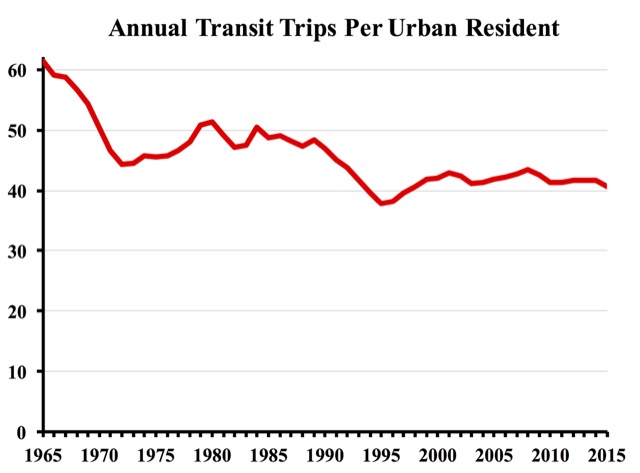
    In 2015, the American Public Transportation Association issued a press release whose headline claimed that transit ridership in 2014 achieved a new record. However, the story revealed that 2014 ridership was the highest since 1956. That’s no more a record than if it was the highest since 2013.

    The truth is that America’s urban population more than doubled between 1956 and 2014. Using the ridership number that really counts–trips per urban resident–2014’s number was a near-record low of 41 trips per person. The only time it was lower before 2014 was a few years in the mid-1990s, when ridership dropped to as low as 38 trips per person. The rate may fall to nearly that level in 2016.

    When Congress passed the Urban Mass Transportation Act of 1964, Americans took an average of 62 transit trips per person. At that time, 82 percent of all transit systems were privately owned. Within a decade, nearly every major transit system and all but a handful of minor ones were “municipalized” and the subsidies began to flow. At first, the federal government provided only capital subsidies, but in 1974 it also provided operating subsidies.

    By 1978, half of operating costs and, of course, all of the capital costs were subsidized. By the late 1980s, fares covered only a little more than a third of operating costs. With most money coming from taxpayers, transit agencies were more beholden to politicians than transit riders, and they became more interested in spending money to please political interests than in boosting transit ridership.

    Since 1965, transit operating subsidies (adjusted for inflation to today’s dollars) total close to $800 billion. We don’t have accurate capital cost data from before 1992, but since then we’ve spent close to $400 billion on capital programs (which in the transit industry include maintenance), most of it on rail transit.

    Thus, well over a trillion dollars in subsidies has resulted in transit ridership falling from 61 trips per urban resident in 1965 to 41 trips in 2015, and even less in 2016. The chart above shows that trips per urbanite have fluctuated since 1970, but those fluctuations are mainly in response to gasoline prices while the general trend is downward. To a large degree, this downward trend is because the subsidies have made transit agencies more responsive to politics than transit riders.

    Advocates of industrial policy argue that government should pick growth industries and nurture them along to help maintain American preeminence in new technologies. Skeptics suggest that government is more likely to pick losers than winners. Transit is clearly one of those losers.

    Most statistics in this post are from the American Public Transportation Association’s 2016 Public Transportation Fact Book data spreadsheet. Data for 2015 is from the National Transit Database. Urban population data are from the Census Bureau.

    This piece first appeared on The Antiplanner.

    Randal O’Toole is a senior fellow with the Cato Institute specializing in land use and transportation policy. He has written several books demonstrating the futility of government planning. Prior to working for Cato, he taught environmental economics at Yale, UC Berkeley, and Utah State University.

    Photo:

  • Father of the Bernie Sanders Presidency

    President Trump’s elite-managed populism opens a path for a more genuine version.

    On the usual political spectrum, there are left and right, people who call themselves progressive or conservative, socialist/social democrat or capitalist. But these labels seem to mean less today than in the past. The Trump phenomenon highlighted another divide that has little to do with the historic left and right. Crudely speaking, we can call it coastal vs. non-coastal, urban vs. rural, ethnically diverse vs. more homogeneous, elitist vs. populist. This at least is the way the dominant media sees it.

    (click chart to enlarge)

    At the same time, the old labels are not completely dead. So if we try to overlay the new on the old and to categorize the Trump following, we could say that some of the old guard conservatives joined forces with the new rural populists. This is a little complicated and barely makes sense given that the former include some of the elites, in other words the very same people who have angered the populists for the past decade. Many people who want lower taxes and free trade and globalization voted for the same person, Donald Trump, as did people who want import tariffs and restrictions on the flows of people, capital and goods. Some of the same people who survived in 2008 thanks to Wall Street bailouts voted for the same candidate as did people who are still seething over the bailouts.

    donald_trump_official_portraitWhen a human construct no longer makes sense because it is the product of decades of layering of one strain over another, it may be better to restart with a clean slate and to find new models to explain the present.
    Our own favorite model is to hypothesize that the country has drifted away from laissez-faire for several decades and that it has been moving towards socialism. The current interregnum is the time when cronies rule the land. Starting around 1990, cronyism corrupted laissez-faire, an unsurprising evolution since laissez-faire is never pure anyway. And later cronyism heralded its own final mutation into socialism. The case we made in The Bridge from Laissez-faire to Socialism is that socialism is not the system that replaces capitalism, but the system that replaces one form of cronyism with another. The sequence therefore is laissez-faire to the first form of cronyism to the second form of cronyism.

    The older form of cronyism claims to be capitalistic (thus the oft-seen oxymoron “crony capitalism”) and the newer form claims to be egalitarian but they are essentially the same, except for the identities of the cronies at the top who extract the most wealth for themselves and their friends. Because egalitarianism is usually less efficient at managing wealth, there may also be a smaller number of cronies under socialism, which makes the infighting among its leaders that much more bitter and savage.

    Feel the Bern 2020

    On this theory and on current trends then, Bernie Sanders would be elected President of the United States in 2020.

    This may look like a bold assertion, mitigated only by the fact that Senator Sanders is already aged 75 today. If he were elected in 2020, could he remain in office until the age of 83? Very possible, given the medical profession’s ability to keep us alive and functioning well into our eighties. For example, another socialist, Robert Mugabe of Zimbabwe, is now 93 and intends to run for another five-year term in 2018.

    At any rate, voters will not care about the Senator’s age, just as they did not care about candidate Trump’s own shortcomings. What will matter to them is that candidate Sanders will be the flag bearer leading in his wake a younger Vice-President and a slew of new generation Democrats who will be just as eager to undo four years of Trump/Pence as Trump/Pence have been to undo eight years of Obama/Biden.

    To every action, there is an equal or, in the case of politics, a greater reaction. When President Obama alienated half of the electorate by passing the Affordable Care Act through unorthodox procedures, the seed for the Tea Party and then for the rise of Trump was planted. And Trump has already planted the seed for Sanders or of his young charismatic political heir, whoever he or she may be. Or, if that seed was already planted thanks to Senator Sanders’ own strong showing during the campaign, the President’s recent actions have provided a truckload of nutritious fertilizer. The anti-Trump blowback so far does not look like a slow growing plant.

    The President’s Barbell Strategy

    Although he has styled himself a populist, Mr. Trump is mainly a populist when he fires messages on Twitter or when he holds rallies in rural settings, places where he would otherwise rarely venture except perhaps to play golf. But when he goes back to New York, Washington or Mar-a-Lago, he is once again surrounded through his own choice by the same usual East Coast elites who for three decades have thrived at the courts of the Bushes, the Clintons and the Obamas.

    President Trump’s entourage is more elitist than populistic. Even the unconventional Steve Bannon graduated from Harvard Business School and was a one-time banker, and cannot therefore claim the life story of an authentic populist. Team Trump’s populism is not truly organic, but looks instead like posturing and voyeurism, like that of investment bankers occupying the most expensive seats at a Bruce Springsteen concert. It can be very enjoyable for the elite to glimpse the world of the working class, so long as they are never at risk of becoming a part of it.

    The President’s barbell strategy of on the one hand giving lip service to blue-collar populism while on the road, and on the other hand appointing some of the same people that a dyed in the wool elitist would have also appointed, has paid off very nicely so far. It is however inherently unstable and unsustainable except under the scenario of a thriving economy. To his credit, Mr. Trump knows this, which is why he will be holding a rally for his base every so often as a way to tell them that he has not forgotten them, even though finance and energy billionaires happen to be among his favorite people in the world. Normally, only a casuist would attempt to square this circle but the President’s distinct genius has enabled him to pull if off so far.

    It will be interesting to see for how long this magical balancing act can be maintained. An easy answer would be: until the next economic slowdown. It is fine to play both sides as long as things are improving, or expected to be improving soon. People believe what they want to believe. But failure to deliver for the thriving elite or for the suffering working class will turn either or both into potent Trump adversaries. And this is how an opening would be created for Senator Sanders.

    TRiUMPh of the Cronies

    Sanders-021507-18335- 0004But why Sanders?

    Instead of attacking cronyism, the endemic problem of our age, as a true populist might do, President Trump has instead given it a strong new lease on life. In truth, whether Hillary Clinton or Donald Trump prevailed last November, the die had been cast that the winner would represent the culmination of cronyism in its ultimate triumph. Both Mrs. Clinton and Mr. Trump have crony credentials that exceed those of former presidents. Therefore, the election of POTUS 45 probably signaled the end of something and not the beginning of something, notwithstanding Mr. Trump’s new-dawn declarations to the contrary.

    For evidence of cronyism’s final ascent to the seat of power, consider again Mr. Trump’s selections for cabinet and advisory positions. Several are successful operators in business activities that are often associated with cronyism, in this case narrow sub-sectors of energy, finance, law and real estate. What differentiates them is not their success, which by itself would be admirable, but their success in cracks of the laissez-faire economy that are extractive or rent-seeking and largely reliant on government dealing and connections, which is less admirable.

    The New York Times reported the following on 15 April 2017:

    President Trump is populating the White House and federal agencies with former lobbyists, lawyers and consultants who in many cases are helping to craft new policies for the same industries in which they recently earned a paycheck.

    Socialism’s day would come in four years because Mr. Trump has misread the economic tea leaves and has ascribed the moribund economy to an excess of taxes and regulations instead of to the true culprit, which is deteriorating demographics. As a consequence his efforts to ignite another Reagan style boom and to create 25 million new jobs are unlikely to succeed. Mr. Sanders is one of the most vocal critics of cronyism and his speech will be rich with I-told-you-sos if President Trump’s impending deregulation of Wall Street leads to another financial crisis on top of a weaker economy.

    After being disappointed by both Obama and Trump, the struggling working class and shrinking middle class will be ready to try yet another new thing. Electing a socialist will be the boomers’ last hurrah and the millennials rose-tinted dream of a new paradise finally blanketing the earth. Joel Kotkin recently noted:

    The millennials —arguably the most progressive generation since the ’30s—could drive our politics not only leftward, but towards an increasingly socialist reality, overturning many of the very things that long have defined American life.

    and further:

    The long-term hopes of the American left lie with the millennial generation. The roughly 90 million Americans born between 1984 and 2004 seem susceptible to the quasi socialist ideology of the post-Obama Democratic Party. They are also far more liberal on key social issues—gender and gay rights, immigration, marijuana legalization—than any previous generation. They comprise the most diverse adult generation in American history: some 40 percent of millennials come from minority groups, compared to some 30 percent for boomers and less than 20 percent for the silent and the greatest generations.

    Millennials’ defining political trait is their embrace of activist government. Some 54 percent of millennials, notes Pew, favor a larger government, compared to only 39 percent of older generations. One reason: Millennials face the worst economic circumstances of any generation since the Depression, including daunting challenges to home ownership. More than other generations, they have less reason to be enamored with capitalism.

    Sanders’ Math

    As to Senator Sanders’ math in 2020, it should be remembered that Mr. Trump carried two pivotal states, Michigan and Wisconsin, by very narrow margins in the general election and that Mr. Sanders won both of these states in the primaries. It would not take a lot for both to tip to Mr. Sanders in a possible Sanders-Trump showdown in 2020.

    screen-shot-2017-02-27-at-12-34-45-pm

    The addition of Ohio or Pennsylvania, both of which were won by Trump in 2016 and by Obama in 2008 and 2012, would be sufficient to secure Mr. Sanders victory if no other states changed sides in 2020 vs. 2016.

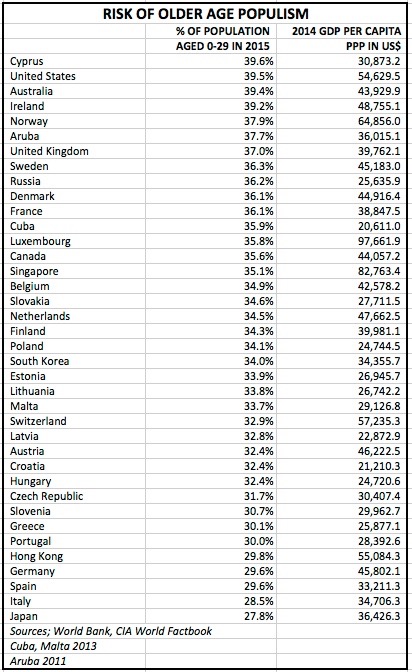
    As noted in So You Want a Revolution, the United States is one of many richer countries at risk of older age populism. These countries have relatively older populations (only 40% or less of the population aged 0-29) and higher GDP per capita ($20,000+).


    Demographics, combined with breakthrough innovations and strong institutions, have made America very wealthy in recent decades. We are now at a critical juncture and at risk of squandering our prosperity by focusing on a wrong set of problems and by empowering the wrong leaders, Trump and stage 1 cronyism that will lead to Sanders and stage 2 cronyism, or socialism.

    Sami Karam is the founder and editor of populyst.net and the creator of the populyst index™. populyst is about innovation, demography and society. Before populyst, he was the founder and manager of the Seven Global funds and a fund manager at leading asset managers in Boston and New York. In addition to a finance MBA from the Wharton School, he holds a Master’s in Civil Engineering from Cornell and a Bachelor of Architecture from UT Austin.

    Bernie Sanders photo by Michael Vadon [CC BY-SA 2.0], via Wikimedia Commons.