Category: Politics

  • Historic Day in Corruption History: Two Governors From Same State in Jail at Same Time

    Today, history will be made. Rod Blagojevich is going to jail in Littleton, Colorado. Blagojevich will join his predecessor Governor George Ryan who’s in prison in Terre Haute, Indiana. America’s fifth largest state will now have two back-to-back Governors in federal prison at the same time. What other state in America can say that? Both Illinois Governors were convicted of major felonies. Have Illinois voters turned the corner on supporting corrupt politicians? It appears not. Recently, U.S. Attorney Patrick Fitzgerald has been busy. Long time Chicago Machine boss William Beavers was indicted on tax fraud. Tuesday, Illinois State Rep. Derrick Smith was arrested on a federal bribery charge.

    Here’s a report from WLS-TV:

  • The Republican Party’s Fatal Attraction To Rural America

    Rick Santorum’s big wins in Alabama and Mississippi place the Republican Party in ever greater danger of becoming hostage to what has become its predominate geographic base: rural and small town America. This base, not so much conservatives per se, has kept Santorum’s unlikely campaign alive, from his early win in Iowa to triumphs in predominately rural and small-town dominated Kansas, Mississippi, North Dakota and Oklahoma. The small towns and rural communities of states such as Michigan and Ohio also sheltered the former Pennsylvania senator from total wipeouts in races he would otherwise have lost in a blowout.

    If America was an exclusively urban or metropolitan country, Mitt Romney would be already ensconced as the GOP nominee and perhaps on his way towards a real shot at the White House. In virtually every major urban region — which means predominately suburbs — Romney has generally won easily. Mike Barone, arguably America’s most knowledgeable political analyst, observes that the cool, collected, educated Mitt does very well in affluent suburbs, confronting President Obama with a serious challenge in one of his electoral sweet spots.

    Outside the Mormon belt from Arizona to Wyoming, however, sophisticated Mitt has been a consistent loser in the countryside. This divergence between rural and suburban/metro America, poses a fundamental challenge to the modern Republican Party. Rural America constitutes barely 16 percent of the country, down from 72 percent a century ago, but still constitutes the party’s most reliable geographic base. It resembles the small-town America of the 19th century, particularly in the South and West, that propelled Democratic Party of Nebraska’s William Jennings Bryan to three presidential nominations.

    Yet like Bryan, who also lost all three times, what makes Santorum so appealing in the hinterlands may prove disastrous in the metropolitan regions which now dominate the country. Much of this is not so much particular positions beyond abortion, gay rights, women’s issues, now de rigueur in the GOP, but a kind of generalized sanctimoniousness that does not play well with the national electorate.

    We can see this in the extraordinary difference in the religiosity between more rural states, particularly in the South, and the rest of country. Roughly half of all Protestants in Mississippi, Alabama and Oklahoma, according to the Pew Center on Religion and Public Life, are evangelicals, not including historically black churches. In contrast, evangelicals make up a quarter or less of Protestants nationally and less still in key upcoming primary states such as Pennsylvania, New York, California and Connecticut, where the percentages average closer to 10 percent.

    Let me be clear: Urbanity is not the key issue here. Cities have become so lock-step Democratic as to be essentially irrelevant to the Republican Party. Instead it’s the suburbs — home to a record 51 percent of the population and growing overall more than 10 times as fast as urban areas — that matter the most. Much of the recent suburban growth has taken place in exurbs, where many formerly rural counties have been swallowed, essentially metropolitanizing the countryside.

    What accounts for the divergence between the suburban areas and rural areas? A lot may turn on culture. Small towns and villages may be far from the isolated “idiocy of rural life” that Marx referred to, but rural areas still remain someone more isolated and still somewhat less “wired” in terms of broadband use than the rest of the country.

    Despite the popularity of country music, rural residents do not have much influence on mainstream culture. Most Hollywood executives and many in New York still commute from leafy ‘burbs. Few of our cultural shapers and pundits actually live predominately in the countryside, even if they spend time in bucolic retreats such as Napa, Aspen or Jackson Hole.

    Until the recent commodity boom, much of rural America was suffering. And even today, poverty tends to be higher overall in rural areas than in urban and especially suburban countries. Some areas, notably in North Dakota and much of the Plains, are doing very well, but rural poverty remains entrenched in a belt from Appalachia and the deep South to parts of west Texas, New Mexico and California’s Central Valley.

    Rural areas generally do not have strong ties to the high-tech economy now leading much of metro growth. This remains a largely suburban phenomenon, urban only if you allow core cities to include their hinterlands. All the nation’s strongest tech clusters — Silicon Valley, Route 128, Austin, north Dallas, Redmond/Bellevue in Washington, Raleigh-Durham — are primarily suburban in form. High tech tends to nurture a consciousness among conservatives more libertarian than socially conservative and populist. Not surprisingly, libertarian Ron Paul often does best in these areas and among younger Republican voters.

    Another key difference: a lack of ethnic diversity. There are now many Hispanics living in rural areas, but they are largely not citizens and most are recent arrivals, attracted by jobs in the oil fields, slaughterhouses and farms. Many small towns, unlike suburbs, remain more homogeneous than suburbs, emerging as the most heterogeneous of all American geographies. Ethnic cultural cross-pollination occurs regularly in metropolitan suburbs; this is not so common in rural America.

    Equally important, environmental issues spin differently in rural areas than in suburbs. Energy development and agriculture drive many rural economies. In some areas, like Ohio and western Pennsylvania, shale oil and gas is bringing long moribund regions back to life. In the Dakotas, parts of Louisiana, Texas and Wyoming, it is ushering in a potentially long-term boom. In contrast, there aren’t many oil and gas wells located next to malls and big housing tracks.

    This does not mean that suburban voters share the anti-fossil fuel green faith of the urban core. But for them “drill baby drill” represents more a matter of price at the pump than a life and death issue for the local economy. Suburbanites feel the energy issue, but do not live it the way more rural communities do. One of the great ironies of American life is that those who live closest to nature are often less ideologically “green” than those, particularly urbanites, residing in an environment of concrete, glass and steel.

    Rural America, of course, is changing, with many areas, particularly in the Plains, getting richer and better educated. These areas are growing faster than the national average and attracting immigrants from abroad and people from other U.S. regions. Yet the influence of newcomers, new wealth and new technology is still nascent. The political pace in rural America today still is being set by an aging, overwhelmingly white and modestly educated demographic.

    Until the Republican nomination fight is settled, the party’s pandering to the sensibilities of such conservatives in rural areas could prove fatal to its long-term prospects. A Santorum nomination almost guarantees a replay of the Bryan phenomena; no matter how many times he runs, he will prove unlikely to win, even against a vulnerable opponent. Even in losing, his preachy, divisive tone — on contraception, prayer, the separation of church and state — has opened a gap among suburban voters that Obama will no doubt exploit.

    The suburbs, with its preponderance of white, middle income independent voters, gave the 2008 election to Obama, and that’s where the next contest will be decided. The countryside will rally to a GOP standard bearer like Romney, albeit somewhat reluctantly, for both economic and social reasons. The battle will then shift to the suburbs, including those urban areas, common in the vast cities of the South and West, that are predominately suburban in form.

    Most of the urban core, meanwhile, will vote lockstep for Obama. But the president, as thoroughly a creature of urban tastes and prejudice as to ever sit in the White House, could prove vulnerable in the suburbs, if the Republicans can deliver a message that is palatable to that geography’s denizens.

    This piece originally appeared in Forbes.com.

    Joel Kotkin is executive editor of NewGeography.com and is a distinguished presidential fellow in urban futures at Chapman University, and contributing editor to the City Journal in New York. He is author of The City: A Global History. His newest book is The Next Hundred Million: America in 2050, released in February, 2010.

    Rick Santorum Image by Bigstockphoto.com.

  • Federal Transit Administration Weighs In on Honolulu Mayor’s Race

    The Federal Transit Administration (FTA) has intervened in the Honolulu Mayor’s race against challenger and former Hawaii Governor Ben Cayetano. Governor Cayetano and Mayor Peter Carlisle are locked in a bitter contest that could determine whether the proposed $5.1 billion rail line is built. Mayor Carlisle is a strong supporter of the rail line. Challenger Cayetano has promised to "pull the plug" on the rail system. Recent polls show that the project’s former thin majority support among Honolulu residents has now turned to opposition.

    At a 1:30 p.m. press conference yesterday (March 13), Governor Cayetano released e-mails from the FTA indicating concerns about the rail project. According to Cayetano, "Not only it is apparent that FTA officials share some of our concerns, but it’s also apparent that they warned the city about pending litigation if certain things were not done."

    One of the FTA emails, obtained from the administrative record said “I do not think the FTA should be associated with their lousy practices of public manipulation and we should call them on it.”

    Reflecting a surprising ability to "turn on a dime," FTA quickly responded in an apparent attempt to diffuse Governor Cayetano’s point. According to KITV, "In response to the press conference, a spokesman for the Honolulu Authority for Rapid Transportation issued the following statement on behalf of the FTA:"

    There is no question that this project has overcome early obstacles because of a much improved Federal partnership with the City of Honolulu and State of Hawaii over the last several years. The Federal Transit Administration believes that this project will bring much needed relief from the suffocating congestion on the H-1 Freeway and provide a real transportation alternative for the people of Oahu as gas prices rise.

    Curiously, the FTA’s statement contradicted its own previous position on the traffic impact of the rail line. In its January 2011 "record of decision" for the project, FTA indicated:  "Many commenters [on the Draft EIS] reiterated their concern that the Project will not relieve highway congestion in Honolulu. FTA agrees…" Further, it is unusual for federal agencies to take part in local election campaigns.

    The Honolulu rail project was covered in more detail in a recent newgeography.com commentary, Honolulu’s Money Train.

    Clarification (March 15). The complete quotation above was not used because it was not necessary to the point, which was FTA agreed that highway congestion would not be relieved by rail in its record of decision, but in its statement on Tuesday appears to have reversed that view. We are unaware of any change in the technical documentation that would have justified such a change.

    The complete quotation was "Many commenters [on the Draft EIS] reiterated their concern that the Project will not relieve highway congestion in Honolulu. FTA agrees, but the purpose of the project is to provide an alternative to the use of congested highways for many travelers.” The "provide an alternative" clause was omitted because it was unrelated to the apparent change in position on traffic congestion by FTA.

    "FTA agrees." in the article above, has been changed to "FTA agrees…"

  • Honolulu’s Money Train

    Honolulu is set to construct an ambitious urban rail project. It’s a $5.125 billion behemoth that this metropolitan area with less than a million residents may not be able to afford.

    Honolulu’s Beleaguered Residents

    Critically, there is plenty of competition for the scarce dollars that Honolulu residents have to spare. The city’s basic infrastructure is in bad shape.

    (Sewer) Water, Water Everywhere: A consent decree signed between local officials and the Environmental Protection Agency requires major upgrades to the sewer system. Sewer overflows are not unusual. Just a few days ago, 51,000 gallon raw sewage spilled into a local stream. The state issued a brown water alert for the entire island of Oahu (which is also the combined city and county of Honolulu), including Waikiki Beach and all other beaches. As of this writing, the brown water advisory has not been cancelled. Just in the last year, the state has reported 17 sewage spills and four brown water alerts. For this to happen in a highly tourist dependent economy is nothing short of astounding.

    More than Leaky Pipes: The city’s water system is in need of major upgrades. From 2004 to 2009, water main breaks were virtually a daily occurrence. In an effort to solve the problem, the city has raised water rates 60 percent in the last five years and plans another 70 percent increase over the next five years. How much more will be required after that is anyone’s guess. "How are people going to make it? I just don’t know" reacted City council Budget Chair Ann Kobayashi.

    Unfunded Government Employee Liabilities: In just three years, unfunded city and county employee pension and retiree benefits have risen from $15,000 to $21,000 per Honolulu household. The state’s actuarial consultant says things are going to get worse. The demographics are skewed against financial control, since people are living longer, and the number of retirees is rising relative to the workers who must pay (most of whom cannot even dream of such rich benefits).   All of this means higher tax bills for Honolulu households.

    High Cost of Housing, High Cost of Living: Honolulu residents already endure the most unaffordable housing  in the nation, with median house prices 8.7 times median household incomes. That is three times Dallas-Fort Worth.  Honolulu’s overall cost of living is also the highest in the nation, outside six metropolitan areas in the greater New York and San Francisco Bay Areas. Honolulu residents pay $1.41 to buy what $1.00 buys in St. Louis, 1.24 for each $1.00 in Austin and $1.21 for each $1.00 in Phoenix.

    Choices: This is not about easy choices. The sewer remediation, water system maintenance, government employee pension and government employee retiree health care benefits are mandatory. The rail expenditures are not.

    The Rickety Rail Project

    Yet the city of Honolulu would tax its residents even more to pay for a 20 mile rail line to empty farmland well beyond the urban fringe. This is a project not unlike the early 1900s land speculation schemes of Henry Huntington in Los Angeles and the Sweringens of Shaker Heights (Cleveland). There is, however, one important difference. The Huntington and the Swearingens bet their own money. Honolulu is betting the money of its taxpayers.


    End of the Honolulu Rail Line

    The city hopes to receive $1.55 billion from the federal government, with local residents left to pay a hefty 70 percent of the cost. This $3.575 billion local share would create the highest tax burden for any urban rail line ever built in the nation, at more than $10,000 per household. But residents should "thank their lucky stars" if that’s all they have to pay, given the history of cost overruns on such projects around the world.

    Stacking the Deck: The Federal Court Challenge: The planning process is being challenged in federal court. The plaintiffs argue that the rail selection process eliminated more cost effective options with biased analysis. This would not be the first time.

    Annie Weinstock, Walter Hook, Michael Replogle, and Ramon Cruz of the Institute for Transportation Development and Policy (with a foreword by Oregon Congressman Earl Blumenaur),  cited circuitous routing of a busway that biased ridership forecasts in favor of light rail for the suburban Washington Purple Line. Weinstock, Hook, Repogle and Cruz refer to a similar "deck stacking technique" that favored an expensive rail project over a busway in the suburban Washington Dulles corridor. They fault local officials more than federal:

    While there is no outright pro-rail bias at the FTA, there is indeed FTA complicity in the rail bias of city and state level mass transit project sponsors. The FTA, when evaluating New Starts and Small Starts project applications, tends to bow to political pressure to favor locally preferred alternatives and ignore certain forms of rail bias by the project sponsors

    Pulling the Plug on Rail? Former Governor Ben Cayatano has filed to run against Mayor Carlisle in the August 2012 election. In announcing his entry, Governor Cayatano said "I will pull the plug on rail." Polls show Mr. Cayetano ahead of both Mayor Carlisle and a third candidate.

    Capital Cost Escalation: A state report indicated that construction costs could rise well above forecast. Every penny above the $5.125 billion capital cost will be the responsibility of local taxpayers. Based upon the international experience, this could easily raise the per household cost from $15,000 to $20,000.

    Ridership Optimism Bias: Echoing general concerns raised by Weinstock, Hook, Repogle and Cruz (above), the state report indicated concern over an optimism bias in the ridership projections. For example, the city expects 60 percent of rail riders to use the bus to get to the train.  This is four times the rate of the largest new rail system built in the nation (Washington’s Metro).  Using the bus to connect to the train makes travel much slower and this factor has often been over-estimated by rail planners. This unrealistic assumption alone could qualify the Honolulu ridership forecast as among the most inaccurate in history.  Fewer riders. more money out of residents pockets.

    A Billion Here, A Billion There: As if all of this were not enough, a report for the Federal Transit Administration, obtained by the Star Advertiser through a freedom of information request, indicates that the operating costs of the transit system may be understated by as much as $1 billion over the next 20 years. That’s $3,000 per Honolulu household (Note 1).

    Federal Doubts: Federal Transit Administration Regional Administrator Leslie Rogers expressed concern about Honolulu’s ability to afford the project in a letter to local officials, noting that the funding program is insufficient. Local taxpayers likely will need to pony up more.

    Debt Limit Suspended: After having claimed it could afford the rail debt, the city suspended its debt limit — a fact discovered four months after the fact by the Star Advertiser.  Usually, breaches of trust like this become evident only much later in the rail construction process. A suspended debt limit means more money out of taxpayer pockets, or worse. Jefferson County, Alabama filed bankruptcy after not being able to afford payments on its sewer debt.

    How Would Rail Change Honolulu

    With rail, Honolulu there are two ways that Honolulu will be changed:

    What Will Change: Walling Off the Waterfront. The elevated design of the rail system is so intrusive that the local chapter of the American Association of Architects opposes the proposal. The elevated line would run directly in front of the waterfront. Its oppressive design would separate the rest of the historic Aloha Tower area from the rest of the city and could preclude future attractive "placemaking" development (see lead photo, courtesy of the Honolulu Chapter of the American Institute of Architects).

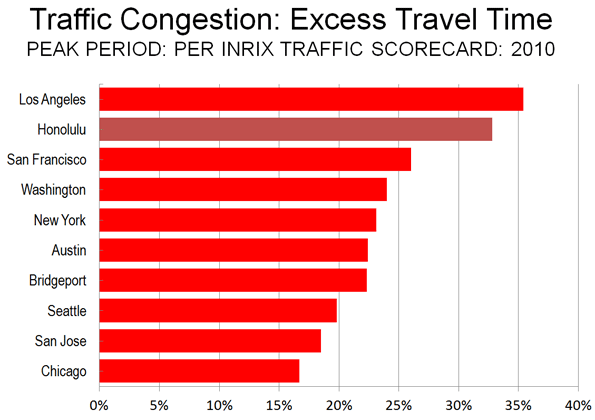
    No Traffic Relief: Despite being only the 52nd largest metropolitan area in the nation, Honolulu has the second worst traffic congestion in the nation (see figure), according to INRIX, the leading international reporting source. Honolulu and Los Angeles are the only US metropolitan areas ranked in the worst 25 out of 200 in Western Europe and the United States. Even with the rail system, local plans call for traffic congestion to get worse.

    Getting the Choices Right

    Incumbent Mayor Peter Carlisle recently returned from a Potemkin Village tour of Manila, raving about that city’s rail system. Governor Cayateno, whose familiarity with Manila extends well beyond a scripted tour, called Mayor Carlisle’s comparison with Manila "comedic," noting that most residents cannot afford a car or that Manila has more than 10 times as many people.  


    Manila Rail System: Part the Mayor Did not See

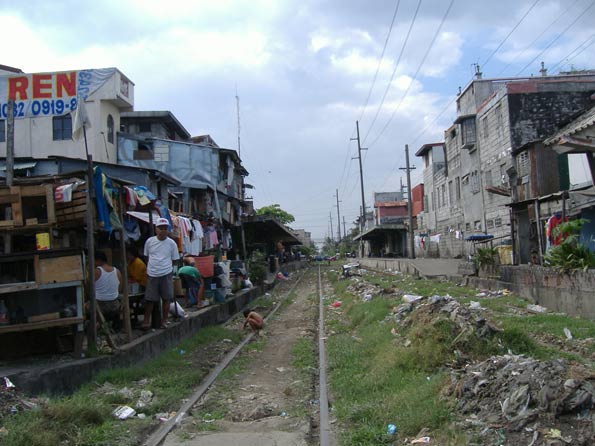
    The mayor may not have been aware that more than 4,000,000 – more than one-third – of Manila’s (National Capital Region) residents live in slums, shantytowns and informal settlements, where sewers are rare if not non-existent. Government projections indicate that the slum population will rise to 9,000,000 by 2050. More than one-half of Manila’s population will be in slums.


    Manila Slum

    In his recent "state of the city’" address, Mayor Carlisle mused "Manila without rail transit would be unthinkable." That may be the view of an itinerate visitor, but not of the majority who never ride it. For millions, a Manila with sewers is unimaginable. First world urban areas all have sewers. But many do not have rail systems. Honolulu could use some genuine prioritization and less contempt for the hard earned income of its residents.

    Wendell Cox is a Visiting Professor, Conservatoire National des Arts et Metiers, Paris and the author of “War on the Dream: How Anti-Sprawl Policy Threatens the Quality of Life

    —–

    Note 1: Illinois Senator Everett McKinley Dirksen, who was minority leader of the United States Senate in the 1960s is reported to have said: "A million here, a million there, pretty soon, you’re talking real money." The line has been often repeated, though the rise in government spending is indicated by the inflation from "millions" to "billions."

    Note 2: Manila’s rail system serves a very small market and represents a small share of transit ridership. The latest available data suggested that barely five percent of transit ridership was on rail.

    Top Photo: Visual of rail system in downtown Honolulu (courtesy of American Institute of Architects, Honolulu Chapter) 

    Photo credits: All others by author

  • No G-8 Summit for Chicago

    Veteran Chicago journalist Ben Joravsky explains why Chicago’s better off without the G-8 summit:

    One, we’re not equipped to handle it. Two, we can’t afford it. And, three, it has the potential to give the Republicans great campaign material for the coming election.

    President Obama has done Mayor Emanuel a great favor, because there’s no real upside to the summit for Chicago. Banks on La Salle Street were planning to close. Many major corporations located downtown were telling their employees to stay home. The fear of violence from the demonstrators was bound to dampen economic activity. There’s no real need to showcase Chicago, international travelers are well aware of the town.

    Some may view as an embarrassment to Emanuel. The Chicago Sun-Times reported to President Obama only gave Emanuel “an hour’s advance notice.”  But Emanuel is the lucky one. Violent demonstrations or not, the G-8 would have put the spotlight on Chicago. Do we want to shine a light on the recent loss of  200,000 people? The high retail sales tax? The bad public schools? The relentless legacy of public corruption?

    President Obama helped his former Chief of Staff dodge a major bullet.

  • California’s Bullet Train — A Fresh Start and a Change in Direction

    A new strategy is beginning to emerge toward California’s embattled high-speed rail venture. The strategy is designed to rescue the project from a possible defeat at the hands of the state legislature, gain friends and supporters among local transportation agencies, win converts among independent analysts and turn around a largely skeptical public.

    The plan combines the existing commitment to proceed with construction of the first rail segment in the Central Valley with near-term actions aimed at upgrading rail facilities at both ends of the proposed LA-to-SF high-speed line. Specifically, the so-called "bookend" strategy will involve "blending" high-speed rail service with commuter rail service in existing Bay Area and Southern California rail corridors.

    At the northern end of the line, between San Francisco and San Jose, bullet trains would share track with Caltrain commuter trains. Both would benefit from new investments in electrification, signaling systems, bridge replacements, passing tracks and grade crossings elimination. Similar type of improvements would be introduced at the Los Angeles/Orange County/San Diego ends of the line, benefitting LA’s Metrolink and other Southern California commuter rail and transit systems.

    Improving the urban "bookends" of the system will make it possible to increase the speed of local commuter trains and thus bring immediate benefits to large segments of California’s urban population. It will be a good investment whether or not the overall $98 billion high-speed rail project ever goes forward, said Will Kempton, chief executive of the Orange County Transportation Authority (OCTA) and Chairman of the independent Peer Review Group advising the High Speed Rail Authority.

    The investments will be funded with a portion of Proposition 1A funds, supplemented by matching funds from local government agencies. Up to $2.3 billion in bond money and its $950 million "interconnectivity" fund would be committed to these near term improvements according to well-informed sources. This would provide approximately $1.4 billion for Southern California and $900 million for the Bay Area, assuming a 60/40 split. Another $2.7 billion has been already set aside for the 130-mile Central Valley segment, leaving roughly $4 billion of Proposition 1A money for future HSR construction.

    The new strategy has evolved from discussions held by the High Speed Rail Authority’s new chairman, Dan Richard with the Governor and his fellow board members. In a conversation we had with Chairman Richard several weeks ago, he was frank to admit that significant changes must be made in the Authority’s way of doing business if the bullet train project is to retain the support of the state legislature, overcome the skepticism of independent critics and turn around public opinion. The Authority must find ways, in the Governor’s words, to do things "better, faster and cheaper."

    While supportive of the Governor’s vision, Richard saw a need to show signs of near-term progress and not have to wait until 2033 to demonstrate the benefits of the investment. The dollars spent on the "bookends" could have "an immediate and dramatic effect," he told us.

    Turning to the Central Valley project, Richard freely admitted the ham-handed way in which the Authority dealt with the affected property owners and local governments. He made plain his resolve to restore trust and rebuild the agency’s credibility with the Valley constituencies. We also were struck by his refreshing willingness to reach out to the program’s critics, in contrast to the Authority’s often arrogant and dismissive posture of the past.

    Richard’s new strategy is beginning to bear fruit. Six Southern California planning and transportation agencies, including the Southern California Regional Rail Authority (Metrolink) voted as a group on March 1 to support the development of high-speed rail "while providing funding for local early investment projects in

    Southern California that will improve rail service immediately." The Authority hopes to stimulate similar expressions of support in Northern California by working closely with the Bay Area’s Caltrain and San Francisco’s Municipal Transportation Agency. The Peer Review Group, which has long supported the "bookends" approach, can be expected to provide an additional boost to Richard’s strategy.

    As for the initial Central Valley segment, its construction, initially planned to begin in September, has been pushed back. The slowdown is due to the need to revisit the environmental report whose initial version has run into a storm of objections concerning the proposed route. The revised draft report will be subject to another round of public hearings before the route through the valley is finalized. Assuming the state legislature authorizes the bond funding, construction in the Central Valley is now expected to begin in early 2013, although court challenges may cause further delays. Critics are expected to continue questioning the value of that investment, fueling continued controversy and increasing the project’s vulnerability.

    A New Perception

    Regardless of what ultimately becomes of the Central Valley project, the new urban "bookends" strategy is bound to profoundly modify the public perception of the bullet train venture. While the Governor and Chairman Richard maintain that the ultimate year 2033 goal of a 2 hour 40 minute train trip from LA to San Francisco has not changed, the practical effect of the new strategy will be to shift the focus from achieving that distant vision to effecting concrete near-term improvements— investments designed to benefit millions of present-day commuters in California’s two largest metropolitan rail corridors.

    Given California’s budget deficit, given the uncertainty of further federal support for high-speed rail in general and for California’s HSR project in particular (see below), and given a lack of any evidence of private investor interest, the"bookend" program of investments may indeed end up as the key accomplishment of the Proposition 1A initiative. While bullet train visionaries will regret this shift in the focus, pragmatists will welcome it as a prudent and realistic response to the growing skepticism. From an economist standpoint, the bookend strategy will be viewed as the best use of scarce financial resources. The public will see it as a victory for common sense: a decision that wisely  places greater value on satisfying present-day needs than on the promise of distant-in-time benefits.

    Could Washington come to the rescue?

    Meanwhile, in Washington, the Administration continues pursuing its fantasy-land rhetoric. "We envision an America in which 80 percent of people have access to high-speed rail," Transportation Secretary Ray LaHood reiterated in a recent blog. "We’re committed to this program… there’s no going back… we will keep the momentum going" he stated at a February 29 high-speed rail conference sponsored by the U.S. High Speed Rail Association.

    Except that this momentum, if there ever was one, has long since vanished. No funds for high-speed rail have been provided two years in a row, including the current (FY 2012) year. Nor are any HSR funds likely to be appropriated  in the next year’s budget. Congressional reaction to the Administration’s $2.5 billion HSR request in its FY 2013 budget submission has ranged from cool to dismissive. The President’s high-speed rail program is "a vision disconnected from reality" members of the Senate Budget Committee told Sec. LaHood at a recent hearing on the Administration’s transportation budget.

    Rep. John Mica (R-FL), chairman of the House Transportation and Infrastructure Committee was even more blunt. "If the president thinks his proposal for high-speed rail is going to fly, he’s pipe-dreaming," he told participants at the February 29 rail conference. In short, all signs point to continued congressional unwillingness to support a federal high-speed rail program. This sentiment seems to cross party lines: neither the Republican-controlled House nor the Democratic-led Senate have included HSR funds in their reauthorization bills. Rep. Jeff Denham’s (R-CA) bill would specifically prohibit new federal funds from going to California’s bullet train project during the entire life of the bill.

    For California, the implications are grave. Without further federal funds, the State of California will be obliged to seek a fresh infusion of public and private funds by 2015 if it is to continue pursuing its $98 billion bullet train vision. Will a new bond initiative or a public-private partnership succeed? Time alone will tell.

  • The Return of the Monkish Virtues

    “[The author of Leviticus] posits the existence of one supreme God who contends neither with a higher realm nor with competing peers. The world of demons is abolished; there is no struggle with autonomous foes, because there are none. With the demise of the demons, only one creature remains with ‘demonic’ power – the human being. Endowed with free will, human power is greater than any attributed to humans by pagan society. Not only can one defy God but, in Priestly language, one can drive God out of his sanctuary. In this respect, humans have replaced demons…..[The author of Leviticus] also posits that the pollution of the sanctuary leads to YHWH’s abandonment of Israel and its ejection from the land….Israel pollutes the land; the land becomes infertile; Israel is forced to leave.” – Jacob Milgrom, Leviticus


    “Pollution ideas are the product of an ongoing political debate about the ideal society. All mysterious pollutions are dangerous, but to focus on the physical danger and to deride the reasoning that attaches it to particular transgressions is to miss the lesson for ourselves…. Pollution beliefs trace causal chains from from actions to disasters…Pollution beliefs uphold conceptual categories dividing the moral from the immoral and so sustain the vision of the good society.” – Mary Douglas and Aaron Wildavsky, Risk and Culture


    “Celibacy, fasting, penance, mortification, self-denial, humility, silence, solitude, and the whole train of monkish virtues; for what reason are they everywhere rejected by men of sense, but because they serve to no manner of purpose; neither advance a man’s fortune in the world, nor render him a more valuable member of society; neither qualify him for the entertainment of company, nor increase his power of self-enjoyment? We observe, on the contrary, that they cross all these desirable ends; stupify the understanding and harden the heart, obscure the fancy and sour the temper. We justly, therefore, transfer them to the opposite column, and place them in the catalogue of vices.” – David Hume, An Enquiry Concerning the Principles of Morals

    The era of the 100 watt incandescent light bulb came to an end in America on January 1st. Lower wattages will soon join them in a phaseout over time. As I noted previously, this will mean factory shutdowns in the United States and the migration of the light bulb manufacturing industry to China. The most common replacement type bulbs, compact fluorescents, are not “instant on,” generally fail to provide a proper light spectrum, contain poisonous mercury, and burn out sooner than advertised. CFL boosters claim none of these are real problems and that CFLs are a slam dunk for benefit/cost reasons, but the cold reality is that despite significant promotion, they never received widespread consumer adoption voluntarily. Given how eagerly consumers slurp up even bona fide more expensive products like Apple computers when they are perceived to be superior, I’m inclined to think the consumers are on to something. I’ve tried out CFLs myself and thought they basically sucked.

    The supposed rationale for imposing an inferior product that did not receive the desired traction in the the marketplace is to prevent climate change. I went searching to try to find exactly what the impact of light bulbs on greenhouse gas emissions was and have found it quite difficult to obtain. The various sites touting CFLs all note the high output of CO2 from electricity generation generally, how much CO2 changing this or that bulb will save, etc, but as for what a wholesale elimination of light bulbs would achieve, that’s harder to find.

    According to the EPA, residential electricity accounted for 784.6 million metric tons of CO2 in 2009, or 11.8% of total US human greenhouse gas emissions. How much of that is from light bulbs? It’s not broken out in the EPA’s report (even the detailed version), but I’ll attempt an estimate of aggregate CO2 savings. (If someone has a direct link to this information, please let me know).

    The Guardian reported that an Australian incandescent ban would save that country 800K tons of CO2 emitted per year and a UK ban would save 2-3 million tons. It also reported that China could save 48 million tons per year by banning incandescents.

    The US is bigger than Australia and the UK, but similarly advanced developmentally. China is a bigger emitter than the US, has far more people, is less advanced developmentally, and is a bigger user of coal for electricity generation. However, all three countries project similar per capita emissions reductions from incandescent elimination. If the US savings were at the upper end of their range, it would have CO2 savings of around 15 million tons a year. That’s only 0.2% of total US greenhouse gas emissions. Even if the US saved the same 48 million tons as China, it’s only 0.7%. I’d be skeptical of anyone claiming the US would save a lot more CO2 per capita than these. Some maybe, a lot, no.

    In short, swapping out incandescent light bulbs is not going to be a major contributor to solving the problem of climate change. I’m not aware of anyone claiming it is. So why pass a law that is unpopular in many quarters and cram CFLs and other type of bulbs consumers haven’t chosen to buy on their own down their throats? It seems to be a purely provocative move of a mostly symbolic nature with little real substance that is sure to only harden opposition to the real changes we need to make to actually make material reductions in GHG emissions. (One might say the same of other items like mandatory recycling or banning plastic grocery bags).

    The answer is that the symbolism is the substance.

    The sad reality is that rather than make policy cases based on benefit/cost or other technical considerations, for political or personal reasons sustainability advocates have decided to model their cause on the template of religion. In it we have an Edenic state of nature in a fallen state because of man’s sin (pollution) for which we will experience a coming apocalyptic judgement (damage from climate change). Thus avoiding the consequences becomes fundamentally a problem of sin management. The proposed sin management solution is again taken from traditional Christianity: confession and repentance, followed by penance, restoration to right standing with God (nature), and committing to a holier life.

    There are two basic problems with this. The first is that while the religion template taps in to a deep psychological vein in the human spirit – some have suggested humanity may even carry a so-called “God gene” – most people already have a religion and aren’t likely to convert to a new one without a major outreach effort.

    But more importantly, the notion of penance, and perhaps of asceticism more generally, has never sold with the public, even in more religious eras. David Hume (a vigorous religious skeptic it should be noted) referred to the values resulting from this lifestyle as the “monkish virtues” and noted that they have “everywhere rejected by men of sense.” Or as Carol Coletta put it more recently, people don’t want to be told to “eat their spinach.”

    It strikes me that while perhaps environmentalists don’t really want to force a particular lifestyle on people, there is a fundamental desire to see people engage in some sort of public penance for our environmental sins. I believe this to be the root logic underlying a lot of feel-good (or perhaps more accurately, “feel-bad”) initiatives like getting rid of incandescent light bulbs. It is a form of penance and embrace of the monkish virtues.

    I can’t help but notice that even Christianity itself has moved away from promoting the monkish virtues. While things humility are of course still preached and expected to be modeled, modern Christianity mostly rejects the notion of an ascetic life. Most Evangelical churches actually preach that God wants humans to be happy. The idea is of a God who wants us to be unselfish, but not unhappy. A not insignificant number of churches actually preach the so-called “prosperity gospel” in which God will provide earthly blessings to His followers. In the Catholic tradition, monasticism itself has been in decline for some time. (I liken the reports of upticks in interest in joining monasteries as similar to the perennial “return of the suit” articles in fashion magazines).

    Whether these theological points are accurate or not is beside the point of this article. They appear to be attractional. For example, well-known prosperity gospel preacher Joel Osteen runs the largest church in the United States, with over 40,000 attending weekly.

    What might the environmental movement have looked like based on a different template? I’ll refer again to the work of Bruce Mau. If you’ve ever seen him present on this topic, he likes to start by noting that if we brought the entire world up to US standards of living, it would take four Earth’s worth of resources given our current technologies and approaches to make it happen. He thinks that’s a good thing, because the patent impossibility of that “takes that option off the table.” He then goes on to talk about all the super-cool new stuff we are going to have to invent and scale up to address the challenges of the future. If you haven’t, I might suggest getting his book Massive Change, which I reviewed a while back. It’s difficult to come away from one of Mau’s books or lectures without being excited about the possibilities of the future.

    I don’t think Mau has any different view of the fundamentals of climate change than your typical orthodox environmentalist. But his approaches to solutions (which are admittedly not always short term practical action plans) and the sales job on them is very different. As a designer, he knows he needs to create something that’s aspirational and attractional in order to get people to want it. It’s a shame too few people have followed that lead.

    The monkish virtues are just never going to sell. Perhaps you can get a room full of the sustainability in-crowd to buy into it, or even focus on top level political success as with the bulb ban. But ultimately I think this is self-defeating.

    In the short term I’d suggest ending any efforts to impose direct consumer mandates. I don’t think that’s where the money is, so to speak, in GHG reductions. Instead, let’s focus on the producer side of the equation in ways that are largely transparent to consumers and don’t involve significant costs. More fuel efficient vehicles might be one. Replacing coal with natural gas is another possibility. (The EPA report I linked earlier cited this as a big contributor the decline in GHG emissions in recent years). New technologies are clearly needed and should perhaps be invested in even though as we know this will lead to many failures along the way.

    As the financial crisis in Greece and elsewhere shows, people rarely confront structural problems, no matter how serious, until the crisis actually comes. At least if “austerity” (a monkish virtue if ever there was one) is the major part of the proposed solution.

    If an environmental equivalent of austerity is required to save the planet, then I’m afraid we should prepare for the deluge. I personally don’t think we’re at that point, given that we’ve had huge gains in energy efficiency for many decades now while our lifestyles have actually improved. More of that, not the promotion of monkish solutions like CFL lightbulbs, is what it will really take to drive further environmental improvements.

    PS: If you don’t think people are really promoting or embracing monkish lifestyles in support of environmentalism, read this article from the Guardian about people giving up on daily showers. Or think about the people trying to completely go “off the grid.” Even if CFLs don’t fit for you, clearly there are plenty of examples. I pick CFLs because they are an institutionalization of monkish virtues, not just the passion of the small minority, which has always been the case.

    Aaron M. Renn is an independent writer on urban affairs based in the Midwest. His writings appear at The Urbanophile, where this essay originally appeared.

    Photo by BigStockPhoto.com.

  • Shale Revolution Challenges the Left and the Right

    In his State of the Union address, President Obama invoked the 30-year history of federal support for new shale gas drilling technologies to defend his present day investments in green energy. Obama stressed the value of shale gas—which will create thousands of jobs and billions in profits—as part of his "all of the above" approach to energy, and defended the critical role government investment has always played in developing new energy technologies, from nuclear to solar panels to wind turbines.

    The president’s remarks unsurprisingly sparked a strong response from some conservatives (here, here, here, and here), who have downplayed and even attempted to deny the important role that federal investments in hydrofracking, geologic mapping, and horizontal drilling played in the shale gas revolution.

    This is an over-reaction. In acknowledging the critical role government funding played in shale gas, conservatives need not write a blank check for all government energy subsidies. Indeed, a closer look at the shale gas story challenges liberal policy preferences as much as it challenges those of conservatives, and points to much-needed reforms for today’s mash of state and federal clean energy subsidies and mandates.

    The Government’s Role

    Some have pointed to the fact that fracking dates back to the 19th century and hydraulic fracking to the 1940s as evidence that federal funding for today’s fracking technologies was unimportant. But dismissing the importance of federal support for new shale gas technologies in the ’70s and ‘80s because private firms had succeeded in fracking for oil in the ’40s and ’50s is like suggesting that postwar military investments in jet engines were unnecessary because the Wright Brothers invented the propeller plane in 1903.

    Enhancing oil recovery from existing wells in limestone formations by injecting various combinations of water, sand, and lubricants, as was done by private firms starting in the 1940s, is a vastly different and less complicated technical challenge than recovering widely dispersed gas methane in rock formations like shale that are simultaneously porous but not highly permeable.

    Recovering gas from shale formations at a commercial scale requires injecting vastly more water, sand, and lubricants at vastly higher pressures throughout vastly larger geological formations than anything that had been attempted in earlier oil recovery efforts. It requires having some idea of where the highly diffused pockets of gas are, and it requires both drilling long distances horizontally and being able to fracture rock under high pressure multiple times along the way.

    The oil and gas industries had no idea how to do any of this at the time that federal research and demonstration efforts were first initiated in the late 1960s—indeed, throughout the 1970s the gas industry made regular practice of drilling past shale to get to limestone gas deposits.

    This is not just our opinion, it was the opinion of the natural gas industry itself, which explicitly requested assistance from the federal government in figuring out how to economically recover gas from shale starting in the late 1970s. Indeed, shale gas pioneer George Mitchell was an avid and vocal supporter of federal investments in developing new oil and gas technologies, and regularly advocated on behalf of Department of Energy fossil research throughout the 1980s to prevent Congress from zeroing out research budgets in an era of low energy prices.

    Early Efforts

    The first federal efforts to demonstrate shale gas recovery at commercial scales did not immediately result in commercially viable technologies, and this too has been offered as evidence that federal research efforts were ineffective. In two gas stimulation experiments in 1967 and 1969, the Atomic Energy Commission detonated atomic devices in New Mexico and Colorado in order to crack the shale and release large volumes of gas trapped in the rock. The project succeeded in recovering gas, but due to concerns about radioactive tritium elements in the gas, the project was abandoned.

    These projects are easy to ridicule. They sound preposterous to both anti-nuclear and anti-government ears. But in fact, the experiment demonstrated that it was possible to recover diffused gas from shale formations—proof of a concept that had theretofore not been established.

    A few years later, the just-established Department of Energy demonstrated that the same result could be achieved by pumping massive amounts of highly pressurized water into shale formations. This process, known as massive hydraulic fracturing (MHF), proved too expensive for broad commercialization. But oil and gas firms, with continuing federal support, tinkered with the amount of sand, water, and binding agents over the following two decades to achieve today’s much cheaper formula, known as slickwater fracking.

    Early federal fracking demonstrations can be fairly characterized as big, slow, dumb, and expensive. But when it comes to technological innovation, the big, slow, dumb, and expensive phase is almost always unavoidable. Innovation typically proceeds from big, slow, dumb, and expensive to small, fast, smart, and cheap. Think of building-sized computers from the 1950s that lacked the processing power to run a primitive, 1970s digital watch.

    Private firms are really good at small, fast, smart, and cheap, but they mostly don’t do big, slow, dumb, and expensive, because the benefits are too remote, the risks too great, and the costs too high. But here’s the catch. You usually can’t do small, fast, smart, and cheap until you’ve done big, slow, dumb, and expensive first. Hence the reason that, again and again, the federal government has played that role for critical technologies that turned out to be important to our economic well-being.

    Drilling Down into Innovative Methods

    In fact, virtually all subsequent commercial fracturing technologies have been built upon the basic understanding of hydraulic fracturing first demonstrated by the Department of Energy in the 1970s. That included not just demonstrating that gas could be released from shale formations, but also the critical understanding of how shale cracks under pressure. Scientists learned from the large federal demonstration projects in the 1970s that most shale in the United States fractures in the same direction. This led government and industry researchers to focus their efforts on technologies that would allow them to drill long distances horizontally, in a direction that situated the well hole perpendicular to the directions that fractures would run, which allowed firms to capture much more gas from each well.

    Government and industry researchers also focused on developing the ability to create multiple fracks from each horizontal well, and in 1986 a joint government-industry venture demonstrated the first multifrack horizontal well in Devonian Shale. During the same period, government researchers at Sandia Laboratory developed tools for micro-seismic mapping, a technique that would prove critical to the development of commercially viable fracking. Micro-seismic mapping allowed firms to see precisely where the cracks in the rock were, and to modulate pressure, fluid, and proppant in order to control the size and geometry of each frack.

    George Mitchell, who is widely credited with having pioneered the shale gas revolution, leaned heavily upon these innovations throughout the 1990s, when he finally put all the pieces together and figured out how to extract gas from shale economically. Mitchell had spent over a decade consolidating his position in the Barnett Shale before he asked for technical assistance from the government. “By the early 1990s, we had a good position, acceptable but lacking knowledge base,” Mitchell Energy Vice President Dan Steward told us recently.

    Mitchell turned to the Gas Research Institute and federal laboratories for help in 1991. GRI paid for Mitchell to attempt his first horizontal well. The Sandia National Laboratory provided Mitchell with the tools and a scientific team to micro-seismically map his wells. It was only after Mitchell turned to GRI and federal laboratories for help that he finally cracked the shale gas code.

    A Counterfactual?

    But so what? Federal investments in new gas technologies may have proved critical to the shale gas revolution, but could they have happened without those investments? Where is the counterfactual?

    Constructing a counterfactual can be a useful analytical method, but it can be abused. In this case, the counterfactual has been asserted as a kind of faith-based defense against the inconvenient history of the shale gas revolution. Nobody has offered a real world example—for instance, a country where private firms developed economical shale gas technology without any public support.

    Nor has anyone offered a detailed historical analysis to justify the claim that private entrepreneurs would have done the critical applied research, developed the fracking technologies, funded the explorations in new drill bits and horizontal wells, and created the micro-seismic mapping technologies that were all required to make the shale revolution possible. A close look at the development of those technologies reveals private sector entrepreneurs, like Mitchell, who were loudly and clearly asking for help because they knew they had neither the technical knowledge nor the ability to finance such risky innovations on their own.

    The Implications for Renewable Energy Subsidies

    In the end though, we are mostly having this debate now because historical federal investments in shale gas are being compared to current investments in renewables. There is much that is in fact comparable—the federal role in the shale gas revolution went well beyond basic research, as some have claimed, and matches up with current renewables programs virtually demonstration for demonstration, tax credit for tax credit, and dollar for dollar when comparing the scale and nature of present federal support for renewables with past support for unconventional gas. But that doesn’t mean that President Obama’s subsidies for green energy are immune to criticism.

    Indeed, once we acknowledge the shale gas case as a government success, not a failure, it offers a powerful basis for reforming present clean energy investments and subsidies. Federal subsidies for shale gas came to an end, and so should federal wind and solar subsidies, at least as blanket subsidies for all solar and wind technologies. In many prime locations, where there is good wind, proximity to transmission, state renewable energy purchase mandates, and multiple state and federal subsidies, wind development is now highly profitable.

    If federal investments in wind and solar are really like those in unconventional gas, then we ought to set a date certain when blanket subsidies for wind and solar energy come to an end. Imposing a phase-out of production subsidies would encourage sustained innovations and absolute cost declines. We might want to extend continuing support for some newer classes of wind and solar technologies, those that are innovating new technological methods to generate energy, or those that are specifically designed to perform better in lower wind or marginal solar locations. But in the ’80s and ’90s we did not provide a tax credit to all gas wells, only those using new technologies to recover gas from new geologic formations—and we should not continue to provide subsidies to wind and solar technologies that are already proven and increasingly widely deployed with no end in sight.

    Another key lesson is that many of the most important research and demonstration projects in new shale gas technologies were funded and overseen by the Gas Research Institute, a partnership between Department of Energy laboratories and the natural gas industry that was funded through a small Federal Energy Regulatory Commission-administered fee on gas prices. GRI had both independence from Congress and the federal bureaucracy, and strong representation from the natural gas industry, which allowed it to focus research and dollars on solving key technical problems that pioneers like George Mitchell were struggling with. Federal investments in applied research and demonstration of new green energy projects ought to be similarly insulated from political meddling and rent seeking.

    These and other lessons from the shale gas revolution point to far-reaching reforms of federal energy innovation and subsidy programs. If the history of the shale gas revolution challenges the tale of a single lone entrepreneur persevering without help from the government, it also challenges the present federal approach to investing in renewables in important respects. The history of federal support for shale gas offers as much a case for reform of current federal clean energy investments as it does for their preservation.

    This piece originally appeared at The American.

    Shellenberger and Nordhaus are co-founders of the Breakthrough Institute, a leading environmental think tank in the United States. They are authors of Break Through: From the Death of Environmentalism to the Politics of Possibility.

  • Is Energy the Last Good Issue for Republicans?

    With gas prices beginning their summer spike to what could be record highs, President Obama in recent days has gone out of his way to sound reassuring on energy, seeming to approve an oil pipeline to Oklahoma this week after earlier approving leases for drilling in Alaska. Yet few in the energy industry trust the administration’s commitment to expanding the nation’s conventional energy supplies given his strong ties to the powerful green movement, which opposes the fossil-fuel industry in a split that’s increasingly dividing the country by region, class, and culture.

    But Republicans, other than the increasingly irrelevant Newt Gingrich, have failed to capitalize on the potent issue, instead lending the president an unwitting assist by focusing the primary fight on vague economic plans and sex-related side issues like abortion, gay marriage, and contraception. The GOP may be winning over the College of Cardinals, but it is squandering its chance of gaining a majority in the Electoral College, holding the House, and taking the Senate.

    No single sector affects more people and industries than energy, and none is more deeply affected by the disposition of government. Energy divides the nation into two camps. On one side there are the regions and industries dependent on the development and use of energy. They include the increasingly expansive energy-producing region stretching from the Gulf Coast and the Great Plains to parts of Ohio, Pennsylvania, and the Appalachian range.

    The centers of energy growth, including areas stretching from the Gulf Coast through the Great Plains to the Canadian border, have generated the highest levels of job and income growth over the past decade (along with parasitic Washington, D.C.).

    Nine of the 11 fastest-growing job categories are related to energy production, according to an analysis by Economic Modeling Systems Inc. Energy jobs pay an average of $100,000 annually, about the same as software engineers earn in Silicon Valley.

    Perhaps more important politically, this bonanza is now spreading to historical battleground states Ohio, Pennsylvania, and Michigan. Long-depressed areas like western Pennsylvania are reversing decades of decline as new finds and advances in natural-gas drilling have opened up vast new stores of domestic energy. The new energy wealth has created new jobs, enriched property owners, and provided states with potential huge new sources of revenue.

    On the other side of the energy divide stand a handful of dense, mostly coastal metropolitan areas with either little in the way of energy resources or, in the case of California’s most affluent urban pockets, little interest in exploiting them. With a shrinking industrial base and less dependence on automobiles, these areas now constitute the political base for the both the Democratic Party and the growing green-industrial complex, which boasts strong ties to Silicon Valley’s well-heeled venture-capital “community” and their less celebrated, but even wealthier, Wall Street allies.

    In these places, the current fossil-energy boom is regarded less as a boon than as an environmental disaster in the making, a view captured in the unrelenting attack on shale development in the news pages of The New York Times and other outlets in broad sympathy with the Obama administration. New production of low-cost, low-emission natural gas also threatens the viability of politically preferred renewables such as solar and wind. But unlike fossil fuels, such “green” initiatives have created very few jobs; overall, the promise of “green jobs,” as even The New York Times has noted, has failed to live up to its hype.

    Given the success in the other energy states, California—with double-digit unemployment—might reconsider its policies, but this is unlikely. “I asked [Gov.] Jerry Brown about why California cannot come to grips with its huge hydrocarbon reserves,” John Hofmeister, a former president of Shell Oil’s American operations and a member of the U.S. Department of Energy’s Hydrogen and Fuel Cell Technical Advisory Committee, told me recently. “After all, this could turn around the state."

    Brown’s answer, according to Hofmeister: “This is not logic, it’s California. This is simply not going to happen here.’”

    But elsewhere in the U.S., new technologies such as hydraulic fracking and vertical drilling have vastly increased estimates of North America’s energy resources, particularly natural gas. By 2020, the United States, according to the consultancy PFC Energy, will surpass Russia and Saudi Arabia as the world’s leading oil and gas producer.

    As President Obama has acknowledged, this surge of production boasts some great economic benefits. American imports of raw petroleum have fallen from a high of 60 percent of the total to less than 46 percent. Overall, according to Rice University’s Amy Myers Jaffe, U.S. oil reserves now stand at more than 2 trillion barrels; Canada has slightly more. She pegs North America’s combined reserves at more than three times the total estimated reserves of the Middle East and North Africa.

    At the same time, energy exploration is sparking something of an industrial revival. The demand for new rigs, pipelines, and a series of new petrochemical facilities has created a burst of industrial production across much of the country. Steel mills, makers of earth-moving equipment, and construction suppliers all have benefited. A recent study by PricewaterhouseCoopers suggests shale gas could lead to the development of 1 million industrial jobs. Not surprisingly, some of the biggest backers of shale-gas exploration are prominent CEOs from industrial firms.

    Energy policy may also be critical for the future of the Great Lakes–based American auto industry. Despite expensive PR ventures like the electric Chevy Volt, the Big Three depend for profits largely on SUVs and trucks. High oil prices will only help their competitors from Japan, South Korea, and Germany, all of which are ramping up in the emerging Southeastern auto corridor. Rising oil prices could also raise the costs of food production, which relies heavily on energy-intensive fertilizers and machinery.

    Aware of the negative consequences for a still-weak recovery, President Obama has started to mount a defense for his energy policies. Last month he launched several preemptive strikes, claiming credit for rising U.S. production while ridiculing Republicans for their “drill, baby, drill” response to rising energy prices.

    Obama is correct in asserting that increases in domestic production will not solve the energy price issue overnight, or even in the near future. But it was disingenuous for him to then take credit for the current energy boom, which resulted largely from policies adopted during the Bush years, while Obama’s policies have, if anything, slowed exploration and development.

    It’s fairly clear that the president and his team—notably Energy Secretary Steven Chu and Interior Secretary Ken Salazar—are at best ambivalent about greater fossil-fuel development. Obama, for example, recently proposed cutting tax breaks and subsidies for the oil industry, which he estimated at $4 billion annually—a new expense for the companies that would in large part be passed on to consumers at the pump.

    This is not necessarily a bad thing in its own right, but along with the effective tax hike, Obama proposed doubling down on the much larger and, to date, far less productive giveaways to the green-industrial complex, which received $80 billion in loans and subsidies in the 2009 stimulus. According to various studies, including the Energy Information Agency, solar firms enjoy rates of subsidization per kilowatt hour at least five times those gained by fossil-fuel firms.

    If all energy subsidies were removed, the fossil-fuel industry likely could shrug off the hit, while the heavily subsidized green-industrial complex would markedly diminish. Yet even if Congress refuses to continue the green subsidies, it’s probable that administration regulators would find ways to slow fossil-fuel expansion in a second Obama term. Responding largely to the Democratic environmental lobby, they have already overruled the State Department to delay the Keystone XL pipeline from Canada. Plans for new multibillion-dollar petrochemical plants on the Gulf will make easy pickings for federal regulators from agencies now controlled by environmental zealots.

    “The energy states feel they are being persecuted for their good deeds,” says Eric Smith, director of the Tulane Energy Institute in New Orleans. “There is a sense there are people in the administration who would like this whole industry to go away.”

    In the short run, Obama’s political exposure in the energy wars is somewhat limited. Most of the big-producing states—Oklahoma, Wyoming, Utah, Texas, Louisiana, Alaska, and North Dakota—are unlikely to vote for him anyway. Nor does he have to worry about too much pressure from inside his party; Democratic ranks in Congress from energy-producing states have thinned considerably in recent years, removing contrary voices inside the party.

    A more dicey issue relates to contestable states like Ohio, Pennsylvania, and Michigan, where many see the energy boom as a source of economic recovery. To make their case in these and other swing states, Republicans first have to make energy the overall revival of the American economy—the key issue for this November’s election. If they insist on campaigning primarily as stolid defenders of rigid social values and election-year promises of painless tax cuts, they will have themselves to blame for their drubbing in November.

    This piece originally appeared in TheDailyBeast.

    Joel Kotkin is executive editor of NewGeography.com and is a distinguished presidential fellow in urban futures at Chapman University, and contributing editor to the City Journal in New York. He is author of The City: A Global History. His newest book is The Next Hundred Million: America in 2050, released in February, 2010.

    Photo courtesy of BigStockPhoto.com.

  • Will Millennials Still be Liberal When They’re Old and Gray?

    The Millennial Generation (born 1982-2003) is the cohort most in favor of using the federal government to promote economic stability and equality since the GI Generation of the 1930s and 1940s. The attitudes of Millennials were heavily shaped by the protected and group-oriented way in which they were reared and their experience of feeling the full brunt of the Great Recession as they emerged into adulthood.  

    As a result, the biggest political story of the first half of the 21st century may well be the extent to which the largest American generation ever retains its economic liberalism and thereby shapes the direction of public policy in coming decades. If history is any guide, much of that story’s plot will be written during the next four or five years.

    Millennials deserve America’s sympathies for the disproportionate impact the Great Recession has had on their generation. According to a recent Pew Research Center survey, a clear plurality (41%) of Americans think that young, rather than middle-aged (29%) or older  (24%) adults are having the toughest time in today’s economy. And they are right.  Last year, the unemployment rate for 18-24 year olds (16.3%) and 25-29 year olds (10.3%) was well above that of those 35-64 (7%). Even among those 18-24 year olds fortunate enough to find full-time employment, real median weekly earnings were down by six percent over the previous four years. Not surprisingly, the weak economy has had a profound impact on the personal lives of Millennials. Nearly half (49%) say they have taken a job (often part time) just to pay the bills. A third (35%) have returned to school, something that may pay benefits in the long term, but is at the expense of current earnings. About a quarter have taken an unpaid job and/or moved back in with their parents (24% each). About one in five have postponed having a baby (22%) and/or getting married (20%). Less than a third (31%) say that they earn or have enough money to lead the kind of life they want.

    Their experiences with the Great Recession have only reinforced Millennials’ support for economically activist government. Last November, when Pew asked whether Americans preferred a larger government that provided more services or a smaller government that provided fewer services, Millennials opted for a bigger government over a smaller one by a large 54% to 35% margin. By contrast, 54% of Boomers (born 1946-1964) and 59% of Silents (born 1925-1945) favor a smaller government. .

    In addition, a majority of (55% to 41%) Millennials favored a greater level of federal spending to help the economy recover from the recession rather than reducing the federal budget deficit. Millennials also continue to support governmental efforts to lessen economic inequality; 63% agreed that government should guarantee every citizen enough to eat and a place to sleep. Consistent with their overall attitudes toward the size of government, the two oldest generations—Boomers and Silents—favored reduced spending and a more limited government role in promoting economic equality.

    The tendency of people to retain their political viewpoints and preferences throughout their lives suggests that once they are set, Millennial Generation attitudes toward government’s proper role in the economy will persist for decades. This conclusion was recently confirmed by   economists Paola Giuliano and Antonio Spilimbergo. In a longitudinal analysis of survey data collected annually since 1972, they found that experiencing an economic recession during one’s “formative” years (18-25 years old) led Americans to favor “leftist” governmental policies that would “help poor people” and lessen “income inequality.” These attitudes were not influenced by experiencing a recession either before or after the formative years and remained in place even when controlled for demographic variables such as sex, race, and social class. However, the same data suggested that the deeper and more sustained the recession, the lower the level of confidence survey respondents had in governmental institutions such as Congress and the presidency.  

    The success of governmental action in dealing with the Great Depression in the 1930s and World War II in the 1940s put the GI or Greatest Generation on the path of lifelong support for governmental activism. After the nation’s victory over the Axis and the economic boom that followed, positive perceptions of government and political efficacy were virtually universal among Americans. Today, although America has begun to shake off the worst aspects of the Great Recession, unemployment remains stubbornly high and growth rates remain below the level needed to make dramatic dents in unemployment rates, especially among Millennials.

    So far Millennial beliefs in activist, egalitarian government policies have not been shaken by the slow pace of the recovery or what  some may perceive as an inadequate federal response. The extent to which those attitudes persist in future decades, when Millennials will represent over one out of every three adult Americans, could depend on how well the government deals with the economic challenges the nation faces in the years just ahead.

    Morley Winograd and Michael D. Hais are co-authors of the newly published Millennial Momentum: How a New Generation is Remaking America and Millennial Makeover: MySpace, YouTube, and the Future of American Politics, named by the New York Times as one of their ten favorite books of 2008.