Category: Politics

  • The White House Transportation Re-authorizaion: An “Unserious” Proposal

    The Administration’s $476 billion six-year transportation reauthorization proposal —included as part of its FY 2013 budget submission —has met with indifference if not outright skepticism in the transportation community. For one thing, the proposal comes at a time when both houses of Congress have already developed and are actively pursuing their own versions of reauthorization legislation. For another thing, the White House proposal is a close replica of the FY 2012 reauthorization proposal — a proposal that had been soundly rejected last year by the Republican House and the Democratic-controlled Senate alike. Lastly, the White House proposal is viewed –both in its levels of spending and its approach to funding — as totally disconnected from political reality The New York Times called it “more a campaign document than a legislative proposal.”

    The six-year budget provides a total of $305 billion for highways, $108 billion for transit and $47 billion for high-speed rail. It calls for an average funding level of $79 billion/year — almost double the $40-42 billion/year proposed in the House and Senate reauthorization bills.

    The total spending authority over six years would exceed the expected revenues by $231 billion. To offset this deficit, the Administration proposes to use “savings” achieved from “reduced Overseas Contingency Operations”— bureaucratic jargon for ending military operations in Iraq and Afganistan. Such offsets have been dismissed as “an accounting gimmick,” “imaginary” and “meaningless” by both Republicans and Democrats on the Senate Budget committee during recent hearings on the Administration’s bill.

    The White House has not helped itself by announcing that “After the six-year reauthorization period, the Administration is committed to working with the Congress on a financing mechanism.” (p.158 of the DOT budget). In effect, the White House is saying, Let the next Administration figure out how to pay for the program. For our part, let’s just pretend it’s paid for with an imaginary “peace dividend” from ramping down overseas military operations.

    Senate Minority Leader Mitch McConnel (R-KY) has called the FY 2013 budget submission “so unserious and political that even members of the President’s own party don’t want to have anything to do with it.” Sen. Jeff Sessions (R-AL), the Budget Committee’s ranking member, described the proposal as “not connected to reality.” Few Congressional aides we have talked to had anything charitable to say about it. In sum, the White House reauthorization proposal, like its FY 2012 version, is considered “dead on arrival.”

    As one Washington wit put it, “it makes you wonder why the Administration keeps coming up with the same proposals over and over again and expecting different results. Didn’t Einstein say…?

  • Academics Find Chicago Most Corrupt Big City

    One of the great failures in studying the politics of American cities has been the assumptions political scientists have used. Many academics assume that politicians work toward serving the public interest. In this naïve or dishonest world, an informed public (aided by a vigilant press) votes for candidates that rise above petty self interest to promote the common good. Recently, The University of Illinois-Chicago Political Science department released an impressive empirical study on corruption. Chicago is number one in public corruption. The facts are rather disturbing, “Since 1973, 31 more aldermen have been convicted of corruption. Approximately 100 aldermen have served since then, which is a conviction rate of about one-third.”

    The study shows that Chicago city council isn’t the only place in Illinois racking up felony convictions. Illinois Governors have an “ethics problem”:

    Since 1970, four Illinois governors have been convicted of corruption. Yet only seven men have held this office in this time, meaning more than half of the state’s governors have been convicted in the past forty-two years. Otto Kerner, who served from 1961 until his resignation in 1968 to accept a federal judgeship, was convicted in 1973 of mail fraud, bribery, perjury, and income tax evasion while governor. Dan Walker, who served from 1973 – 1977, was convicted in 1987 of obtaining fraudulent loans for the business he operated after he left office.

    George Ryan, who served from 1999 – 2003, was found guilty in 2006 of racketeering, conspiracy and numerous other charges. Many of the charges were part of a huge scandal, later called “Licenses for Bribes,” which resulted in the conviction of more than 40 state workers and private citizens. The scandal involved unqualified truck drivers receiving licenses in exchange for bribes that would ultimately end up in Ryan’s campaign fund. The scandal came to light when a recipient of one of these licenses crashed in to a van and killed six children. But perhaps the most famous of all Illinois corrupt officials is Rod Blagojevich, who served from 2003 until his impeachment in 2009. Blagojevich was ultimately convicted in 2011 of trying to sell the U.S. Senate seat vacated by Barack Obama. Other charges included his attempting to shake down Children’s Memorial Hospital for a campaign contribution in return for funding and his trying to extort a racetrack owner.

    When Rod Blagojevich reports in March  to Littleton, Colorado, American history will be made. Illinois will have to back-to- back Governors in jail at the same time. What is it about Chicago and Illinois voters that gets them to vote for crooks? The data in the study is based on Justice Department numbers going back to 1976.

    As we move closer to the next Presidential election, Barack Obama’s association with Chicago’s political culture is bound to be an issue once again. How could a Chicago politician rise so far, so fast, without questioning the corrupt part of the country he comes from? It’s something to keep in mind when you read this study.

  • President Obama Courts Silicon Valley’s New Digital Aristocracy

    President Obama’s San Francisco fundraiser with the tech elites today, along with the upcoming IPO for Facebook, marks the emergence of a new, potentially dominant political force well on its way to surpassing Hollywood and even Wall Street as the business bulwark of the Obama Democratic Party.

    In 2008 the industry gave Obama more than $9 million, three times what it raised for any other politician; it was the first time the digerati outspent Hollywood. The numbers will surely go up this year.

    “The Facebook instant millionaires and billionaires are about all Democrats,” said Morley Winograd, a longtime California Democratic activist and chronicler of information-age politics. “There’s an enormous amount of power residing there—and it will only get greater.”

    Even when they’ve competed with and acted like more established power brokers, the digital ruling class are treated with kid gloves compared to other wealthy elites, rarely suffering the disdain aimed at amoral bankers and at Hollywood’s general venality. Instead, the creators of our iPhones, social networks and Twitter accounts are held up as tool makers and business titans. That esteem is most pronounced among millenials, 75 percent of whom use social media, more than twice the percentage for boomers, according to Pew. When asked what makes their generation “unique,” the most common answer to the open-ended question is technology.

    Those who will benefit most from Facebook and other IPOs resemble the “one percent” about as much as Wall Street.

    In effect, it’s OK to be in the “1 percent”—or even the .0001 percent—if you develop nifty devices and invest in green companies. "We live in a bubble, and I don’t mean a tech bubble or a valuation bubble. I mean a bubble as in our own little world," Google chairman Eric Schmidt recently told the San Francisco Chronicle. "And what a world it is: companies can’t hire people fast enough. Young people can work hard and make a fortune. Homes hold their value. Occupy Wall Street isn’t really something that comes up in daily discussion, because their issues are not our daily reality."

    For their part, the “Occupiers” who struggled mightily to shut down the blue-collar Port of Oakland seem to never have considered an action against the pampered techies at Facebook’s lavish campus.

    The new plutocrats are unburdened by the obligations that come with existing large institutions; with no union presence, they don’t have to worry about anxious retirees or redundant older workers. Green pet causes that align with their financial interests buy more cover from the left, while conservatives, who rarely see anything wrong with extreme wealth, seem somewhat unconscious about the political orientation of the emerging new elite. Ninety-two percent of Facebook executive donations so far this year went to Democrats. This exceeds even the rock-solid support the Democrats enjoy among more established firms like Google and Apple, where support for Democrats runs to the high 80s. Although its former CEO, Meg Whitman, ran as the Republican candidate for governor in 2010, 96 percent of eBay-associated donations went to Democrats. The Seattle area’s two top digital firms, Amazon and Microsoft make two thirds or more of their donations to Democrats.

    The Obama administration’s opposition to the anti-piracy bills SOPA and PIPA came despite intense lobbying for the bill by his party’s long-time allies in Hollywood. Whatever the bills’ failings, their defeat also formally introduced the new power of the digerati moguls and their millions of followers. The presence of Steve Jobs’s wife, Lauren, as Michelle Obama’s guest at the State of the Union speech further cemented the ever-closer ties between the valley’s upper echelon and the president’s party.

    In California, the alliance between progressive Democrats and high tech is palpable. The digital elite has been a consistent backer of Gov. Jerry Brown’s jihad on greenhouse gases, helping finance the campaign against a 2010 measure intended to reform state’s draconian and likely job-killing energy and land-use laws. Google has emerged both as a key backer of the state’s climate-change politics and sought to profit by investing nearly a billion dollars in renewable-energy companies. These firms in turn depend on the state’s strict mandates on utilities to use “green” electricity for their revenues. It’s no coincidence that prominent valley VCs have been particularly active in alternative-energy firms such as Solyndra.

    Brown and the Democratic Party increasingly have come to regard these companies as a potential source of fiscal salvation for the perennial cash-short state. As the Golden State has banked on the valley, the tech firms have become ever more indispensable and now are even dipping their toes in the grubby waters of municipal politics, helping finance the campaign of San Francisco Mayor Ed Lee—who generously concocted new tax breaks for local firms such as Twitter and Zynga.

    The leftward shift by tech firms is a fairly recent development. In the 1970s and 1980s, the formative period for Silicon Valley, the area was politically contested. Valley constituencies routinely sent to Congress moderate Republicans like Pete McCloskey, Ed Zschau, and Tom Campbell. Today the GOP is virtually absent from the valley at all levels of government.

    Some old-line companies, like Hewlett-Packard and Intel, still tend to be fairly evenhanded in their political donations, but they are increasingly rare. Long-time valley maven Leslie Parks explains that the shift came as the Valley’s economy changed. In the 1980s and 1990s—the area’s greatest period of growth—its roots stood solidly in high-tech manufacturing. Now it focuses almost exclusively on product design and information: software, search, and social media. Over the past decade the San Jose area lost one third of its industrial workforce while the neighboring San Francisco region lost some 40 percent—the largest consistent loser among the nation’s 51 metropolitan areas.

    High-tech firms once concerned themselves with many of the same things as other manufacturing companies. They worried about electricity rates, obtrusive environmental legislation, high housing prices, and dysfunctional public education. Many naturally supported Republicans, or business-oriented Democrats.

    But as tech separated from industry, the valley moved leftward.

    Today’s digital aristocrats manufacture virtually nothing here; anything made in volume is produced outside California and usually out of the country. Software-based firms don’t worry about energy costs, since they can simply place their heavy user server farms in places like the Pacific Northwest with low electricity rates. They do not use much in the way of toxic chemicals or groundwater, making it easier to avoid scrutiny and harassment from California’s hyper-aggressive environmental regulators. Because they rely on an increasingly narrow band of highly educated employees from elite schools, the secular decline of the state’s higher education system hardly impacts them. And as many of their employees are young and tend to buy houses after collecting the spoils of an IPO, even high housing costs and poor public K-12 education don’t matter much.

    The growing diversity of the valley has also helped the Democrats. Although relatively few Latinos or African-Americans work in the new companies, new immigrants from Asia and the Middle East and their offspring abound. “You had a big change in diversity, and let’s face it the Republicans do not do well with diversity,” said Parks, who is Japanese-American. “The Democrats, particularly Obama, recognized appealing to these people was a necessity.”

    Many who celebrate this emerging power elite are still slow to recognize that they are in these company’s sights. As we become more dependent on internet based news and entertainment, cultural power is migrating away from New York publishers and Los Angeles studios towards Palo Alto and Menlo Park. Old-line media firms such as newspapers, book companies and the major networks may find themselves overmatched.

    This growing power may do more to concentrate economic power than any development since the Second World War. With their stockpile of personal data on their hundreds of millions of users, firms like Google and Facebook could prove the biggest threat to privacy since Big Brother. As Jason Lanier, a scholar-at-large at Microsoft Research, noted in a recent New York Times op-ed piece, the same companies that led the fight to keep the Internet “free” want to sell hundreds of billions of dollars in advertising built from that free, user-provided information.

    While the old valley empowered people by supplying technology, says Chicago law professor Lori Andrews, social-media firms instead leverage our personal information into fodder for not just advertisers but people reviewing job applications, medical records, and more.

    What’s more, the dominant firms are rapidly becoming oligopolies. In the old days, valley companies battled over everything from semiconductor chips and disk drives to servers and operating systems. In contrast, today’s digital industry tends to gravitate to the best-financed (usually by venture capital) and most well-connected companies. Microsoft, for example, still controls 90 percent of the operating-system-software industry; Facebook is likely to continue with a 60 percent to 70 percent share of the social-media marketplace. Google enjoys a higher than 80 percent share in search.

    This is a degree of control that exists in few older industries. Like the railroads of the old robber barons, those few firms who control the limited number of digital platforms can limit the profitability of smaller would-be competitors—and could end up slowing the rate of innovation in order to maintain their own positions. They may wear T-shirts to work, but the tycoons of Silicon Valley are, in some respects, J.P. Morgan’s true heirs.

    Populism may now be de rigeur inside of the Democratic Party, but the world being created by the new digital haute bourgeoise is anything but social democratic. Parks notes that the lower end of the valley economy, like janitors or food-service workers, generally labor for flinty-eyed outside contractors so they share as little as possible of the wealth collected by higher-skilled employees.

    Even Silicon Valley’s geography is increasingly unfriendly to the mass middle class, much less the aspiring working class. Due largely to strict land-use regulations, median housing costs, even adjusted for income, are among the highest in the nation, more than twice as high as those in places like Raleigh, Salt Lake City, Houston. or Dallas. With a 2,300-square-foot home in Palo Alto going for nearly $1.8 million, the digital heartland is largely off limits for most of us.

    Those who will benefit most from Facebook and other IPOs resemble the “1 percent” about as much as Wall Street. They may see themselves as “progressive,” but they create few broad-based opportunities for members of the middle and working class. A bit of their wealth may trickle down to Democratic politicians, but the rest of us, as dependent as we have become on their technology, have reaped little financial benefit from them. Whatever the value of their creative efforts, the new digital aristocracy’s political ascendency threatens both the populist roots of the Democratic Party and perhaps the delicate social balance of our Republic as well.

    This piece originally appeared in TheDailyBeast.

    Joel Kotkin is executive editor of NewGeography.com and is a distinguished presidential fellow in urban futures at Chapman University, and contributing editor to the City Journal in New York. He is author of The City: A Global History. His newest book is The Next Hundred Million: America in 2050, released in February, 2010.

    Official White House Photo by Pete Souza.

  • Sex, Singles And The Presidency

    By all accounts both President Barack Obama and his likely challenger, former Massachusetts Gov. Mitt Romney, are ideal family men, devoted to their spouses and their children. But support for the two men could not be more different in terms of the electorate’s marriage and family status.

    An analysis comparing the results of the 2008 election and the most recent Gallup surveys with data by demographer Wendell Cox   shows a remarkable correlation between the states and regions with the highest proportion of childless women under 45 –  the best indicator of offspring-free households — and the propensity to vote Democratic. Overall, the most child-free regions were nearly 85% more likely to vote for Obama in 2008. And according to the most recent Gallup survey, they are  similarly inclined to vote Democratic today.

    At the top of the list, with 80% of its women under 45 without children, stands the rock-solid blue District of Columbia. Just behind that taxpayer-financed paradise the six states with the highest percentages — Massachusetts, New York, Rhode Island, Hawaii, Vermont and California — also skew Democratic.  In each of these states the percentage of childless women exceeds 55%.

    The highest percentage of offspring-free women under 45 can be seen as well  in such Democratic metropolitan areas as Boston, San Francisco, Los Angeles, San Diego and New York In each of these metropolitan areas  the percentage of childless woman reached a minimum of 60%  well above the national average of 53%. In the urban cores of these regions the percentage can approach Washington’s 80% figure. To a large extent, childlessness correlates with high density and a less affordable housing stock.

    The top child-bearing regions are almost all deep-red Republican, both in 2008 as well as today. The top five child-bearing states — Mississippi, Idaho, Wyoming , Oklahoma and Arkansas — all generally tilt toward the GOP. So do the metropolitan areas that have the lowest percentages of childless women:  the Texas metros of Dallas-Fort Worth, San Antonio and Houston, Mormon stronghold Salt Lake City and Memphis.  The next five include right-leaning Indianapolis, Charlotte, Louisville, Riverside-San Bernardino and Oklahoma City.

    These numbers would be more striking if not for the somewhat higher propensity for child-bearing among African-Americans and Latinos, two core Democratic constituencies. As other surveys have shown, Republicans gains in recent years have come largely  from married white families. In contrast, Democrats have lost the support of married people overall  since 2008, even while gaining among the unmarried. If Republicans can lose their obsession with opposing homosexual families, they might even garner additional support.

    A growing part of the Democratic base — aside from ethnic minorities — consists of white, childless couples and, in particular, single women. There’s much good news for Democrats here. According to the pro-Democratic advocacy group Women’s Voices, Women Vote, almost two-thirds of this demographic group voted for John Kerrey in 2004; in 2008 they went for Obama by nearly 70%. In 2010, a generally unfavorable political climate for Democrats, unmarried women helped power Democratic victories, particularly in Colorado and California, in the latter case against female Republican candidates.

    Demographically, at least in the short and even medium term, betting of singles and the childless couples seems like a no-brainer. In the past 30 years the percentage of women aged 40 to 44 who have never had children nearly doubled to 19%. At the same time singletons of both sexes are on the rise, numbering over 31 million strong today, up from 27 million in 2000,a growth rate nearly double that of the overall population.

    The increasing role of the childless may already be shifting the Democratic Party toward the kind of post-familalistic secularism generally associated with Europe or parts of East Asia.  This could partly explain why the Obama Administration has been so willing to challenge the Catholic Church — a traditional home to many working class Democrats — on the issue of offering contraception to its employees. Simply put, in Democratic calculations, secular singletons may now outweigh religious Catholic Democrats.

    The importance of singlehood and childlessness is amplified by location. The greatest bastions of non-families are found in the centers of the country’s media, cultural and intellectual life. Single households already constitute a majority in Manhattan and Washington, and they are heading in that direction in Denver, Seattle and San Francisco.

    The growing self-confidence of these post-familial constituencies is evident  in recent articles and books hailing not only the legitimacy but even the preference of this lifestyle option. Kate Bollick’s much celebrated and well-argued portrayal in the Atlantic of attractive matchless, and childless, 40-something females celebrates the coming of age of this new perspective on family life.

    Bollick , citing the degraded condition of today’s males, openly embraces “the end of traditional marriage as an ideal.”  One of her heroines, California psychologist Bella DePaulo, dismisses the traditional family unit as a kind of mental malady she labels “matrimania.” Oh well, there goes the primary basis for four thousand years of civilization.

    The Atlantic piece serves as a kind manifesto for this key emerging  Democratic constituency. But it’s not just single women now swarming into the Democratic Party. NYU Professor Eric Klineberg’s recent ode to singleness in the New York Times follows a similar narrative, but has room for left-leaning male singletons as well. This  trend is even more pronounced in demographically disintegrating  Europe, a fact that only increases its appeal to the sophisticated denizens of the single zone.

    Are there any risks to Democrats — and advantages to Republicans — in this new post-familial tilt? Author and New America fellow Phil Longman argues that in the long run  the  “greater fertility of conservative segments of society” could allow the palpably brain-dead GOP to inherit the country. Childless singletons may be riding high now, he writes, but as non-breeders their influence ends with their own lifespans.

    To win the future, according Democratic activists and millennial chroniclers Morley Winograd and Mike Hais, Democrats must all appeal to the next generation of families. Many of today’s childless millennials are still under 30 and plan to have kids, according to Hais and Winograd’s survey research. Reflecting their own experience with divorce as children, 50% consider being a good parent their highest priority in life. A strong plurality also see themselves ending up in the suburbs.

    That means Democrats could pay a big price for disdaining homemakers, the often unaesthetic chores of child-raising and particularly suburbia, because that’s precisely the place where many of today’s urban millennials will likely end up in the next decade.

    To address the future millennials, Democrats don’t need to adopt the often Medievalist views of their Republican rivals. But they will have to craft a message that appeals to  a demographic that looks, at least somewhat, like the current First Family.

    This piece originally appeared in Forbes.com.

    Joel Kotkin is executive editor of NewGeography.com and is a distinguished presidential fellow in urban futures at Chapman University, and contributing editor to the City Journal in New York. He is author of The City: A Global History. His newest book is The Next Hundred Million: America in 2050, released in February, 2010.

    Official White House Photo by Lawrence Jackson.

  • New Urbanism vs. Dispersionism

    The Florida real estate developer, unburdened of state regulatory agencies, may now focus his efforts on pleasing the investment community and the local market.  I recently played the role of real estate developer interviewing two consultant teams vying to help me create a new fictional community.  Fortified with readings in both the New Urbanist camp and the Dispersionist camp, each team of students pitched their method of community building to me. 

    The actual debate was very lively, with many rebuttals and some serious emotional engagement.  The premise:  I have a multi-acre greenfield property.   I have shortlisted my planning candidates down to two:  a New Urbanist team, and a Dispersionist team.  Each team must pitch their philosophy, and I will select one team to design it.

    Question 1:  Since I am only able to afford Phase 1, future phases will be left to future developers.  In your approach, can future generations be trusted to keep focus on high-quality development?  How would you guarantee that the property rises in value?  I asked the New Urbanists to go first.

    The New Urbanist team was ready:  As Master Planners, they will create the entire form-based vision for the property and design it around a smart code so that the future developers will obey a plan to keep property values rising.  No future developer will get to ‘cheap out’.  For this team, the Master Plan will guarantee a quality of life for all residents.

    The Dispersionists will plan Phase 1, not as a rigid image of a town, but rather as a response to the natural landscape.  This team said the community would grow organically, from its functional needs, guaranteeing  the freedom of future generations to plan their own destiny. They  scoffed at a Master Plan that determined the urban form.  What good is a guarantee of a quality of life, they asked, if future generations want something different than the Master Planner intended?

    This round, in my mind, went to the Dispersionists.  Their argument that future generations should have the freedom to plan based on their functional needs outweighed the seductive beauty of a Master Plan.  Too many Master Plans are implemented poorly, or abandoned due to their disutility based on changing needs and markets.

    Question 2:  How does your viewpoint deal with the car?  How will residents and visitors get around your community?  I asked the Dispersionists to go first this time.

    “Well,” replied the Dispersionists, “Americans love their cars, and we love the car too.  We’ll plan for sidewalks and bikes, but we know that the car is a necessity.  We know that a 5-minute walk isn’t so realistic in Florida’s hot, humid climate.”  The Dispersionists have a hearty regard for cars, and they spoke of long, sweeping curves and scenic drives.  They pointed out that most residents will need to drive to other parts of the city as well.

    The New Urbanists shuddered.  “We will plan for car-free living,” they stated.  With very clever planning, they intended to keep driving to a minimum, and will design walking trails.  One New Urbanist ventured 4-story parking garages, crowing that their proposal would not be littered with gas stations.  The New Urbanists pointed out the ugly commercial strips dominating our current city, and how little they want that to intrude into the new development.

    I liked this, and challenged the Dispersionists.  Isn’t it better health, and less use of oil, to reduce vehicle dependency?  The Dispersionists asked me why, in this ten-acre community, I thought I could attract residents with 4-story parking garages?  Good point, I thought.

    Both sides had good answers, and the question did not fully go to one side or the other.  Cars do tend to  generate a lot of aesthetic horror.  On the other hand, they are not going away anytime soon, so learning how to deal with them seems like an important task for a developer looking to the future.

    Question 3:  How would you distribute density in your development?  One center, multiple centers, and centered around what?  This time the New Urbanists went first.

    The core, they stated, will be in the center of town, and could go to 8-10 stories, leaving the perimeter a green zone.  In the center will be the government and institutional buildings, carefully matched with proper style.  The point, they said, is predictability. They pledged to learn from the failures of the past, and their Master Plan will account for the full scope of development.

    The Dispersionists suggested multiple centers.  “Phase 1 will be our first density cluster,” they said, “and we’ll see how it goes.”  Unlike the New Urbanists, they didn’t want to introduce all their product at once, in case the market changes.  “We believe in New England-style green space,” they said, and wanted to evolve the community around these.  They saw the vitality of the community coming from diversity.

    I asked the New Urbanists what they would do if the market changes .  When pressed, they insisted their Master Plan had plenty of contingency plans in case the original plan wasn’t workable, but it sounded like they were winging it.

    This is what  the Dispersionists saw as their own strong suit.  “We don’t have all the answers,” they said.  Their first phase would gently nudge the community in a certain direction, but it would leave future developers the choice whether to reinforce the first phase, or strike out and build another phase better suited to a unique need.

    I felt that this round went to the Dispersionists. 

    Question 4:  Do you think your development scheme can promote or discourage social values?  Why or why not?  This time the Dispersionists went first.

    The Dispersionists believed that one cannot engineer social values through urban design.  However, they can be influenced.  Conservation, for example, is a value that they would promote in their plan to conserve open space and not overtake the land with development.  A sense of community, they said, was another, giving people a loyalty to their community out of good design.  These, they felt, led to a sustainable plan.

    The New Urbanists guaranteed that conservation land would always be there, and pointed out the Dispersionists’ flexibility as a negative . The New Urbanists insisted that their sense of place would be stronger, because it would be designed.  People want predictability.  New Urbanists would engage people by walking and having front porches.

    The Dispersionists speculated that neighbors will get to know one another in a cul-de-sac just as well as they would if they all had front porches.  They also felt that the shared experiences of a community would transcend the particular style or form that community took.

    Although I gave this one to the New Urbanists, I was skeptical about  the New Urbanists’ implication that well-behaved buildings produce well-behaved people.  The Dispersionists’ view that a cul-de-sac breeds any neighborly closeness also seemed a bit disingenuous.  It was near the end of class.

    Question 5:  Give me your arguments why your strategy is sustainable.  I let the New Urbanists go first.

    For one thing, they said, they will have more efficient transportation. Vertical buildings save land, they argued, and people who choose this community will value open space more highly and be willing to live densely.  They believed that they will have less gridlock by de-emphasizing the car and will be more stable and socially cohesive.  All this will come from a well-designed Master Plan.

    The Dispersionists said  their community would start small and then grow.  Failures won’t cause dead zones, they claimed, because they are not sentimental about form and want a community that works.  So if a building in their development begets a failed business, the building will need to be reinvented to make it successful.

    “Yes, but,” countered the New Urbanists, “for every successful community like yours, there are 10 that have failed and ultimately decline in value.  What guarantee do you give that you will be the one out of ten?”  They went on to cite their successes – Seaside, Celebration, and so on.

    The Dispersionists noted that Seaside was a resort town and Celebration was heavily subsidized by a local employer, so those weren’t exactly good models.  In any case, they said, their community will appeal to a much broader segment of the population than the New Urbanists, and therefore more likely to sustain growth in the future.

    With that, the debate was concluded.  What lingers, however, are some truths that show both sides need to do some more work.

    The New Urbanists, fresh on the scene, seem overly evangelical in their approach, and demand a great deal of faith in the Master (Planner).  The slow, organically grown towns of which they are so fond were largely planned before the car.  While many of these towns, like Charleston, South Carolina, are sentimental favorites, their practical replication in today’s transportation-intensive, constantly changing real estate market is questionable.

    The Dispersionists, on the other hand, have been around for quite a long time, and are the modus operandi for much of the earth’s population.  They seem uninvolved in the aesthetics of the built environment, preferring to leave this up to individual taste, and the result is a rather shabby, cluttered contemporary American scene.  Some cleaning up is certainly in order.

    While the New Urbanists have a hopeful approach in this regard, they are overreacting to the vast consumer-oriented real estate development world that operated up until 2007, and are missing the fundamentals of how a real community works.  None are built around employers or economic producers in any significant way. None admit the lowest socioeconomic groups.  Content, perhaps, to dabble with shopping districts and farmer’s markets, New Urbanists have yet to offer what contemporary employers need – space, flexibility, and room to grow.  They therefore seem doomed to create peripheral urban designs rather than communities integrated with 21st century employers.

    Dispersionists would do well to pay a bit more attention to the natural environment, for the general public is quite aware of the toll that this strategy has taken.  Developers, having overbuilt in so many markets recently, will face tough opposition to bulldozing another woodland, given the empty real estate that exists in our cities today.

    It seems inevitable that dispersionist strategies will continue; they largely dominate our real estate development world and will continue to do so.  They make the most economic sense, they leave the future choices to the future generations, and they respond to people’s natural density tendencies.  One hopes that the New Urbanists will nudge the market a bit more towards aesthetic continuity and environmental stewardship as the next wave of growth inevitably begins again, and that the debate remains healthy, productive, and positive as citizens get re-engaged about the future of their cities.

    Richard Reep is an Architect and artist living in Winter Park, Florida. His practice has centered around hospitality-driven mixed use, and has contributed in various capacities to urban mixed-use projects, both nationally and internationally, for the last 25 years.

    Photo courtesy of BigStockPhoto.com.
  • Why Pleas to Increase Infrastructure Funding Fall on Deaf Ears

    Letting the nation’s roads and bridges deteriorate may worsen traffic congestion and add to our commuting woes, but when water and sewer systems begin to fail our very civilization is at risk. That is the message of a recent story in The Washington Post drawing attention to the alarming state of the nation’s water and sewer infrastructure. The story looks at the Washington D.C. system as a poster child for neglected and dilapidated municipal utilities. The average age of the District water pipes is 77 years and a great many were laid in the 19th century, notes the Post article. Emergency crews rush from site to site to tackle an average of 450 breaks a year. ("Billions needed to upgrade America’s leaky water infrastructure," by Alfred Halsey III, January 2, 2012).

    Antiquated municipal water and sewer systems are indeed a ticking bomb— all the more so since their deterioration, unlike that of highways and bridges— remains invisible until a break occurs. But maintaining water and sewer infrastructure in a state of good repair is a fairly straightforward challenge. Water supply and sewers are a public utility and as such they can cover their maintenance and replacement costs through user fees. So can many other public services such as electricity, natural gas, broadband and telecommunications. The ability to charge for service (and to raise rates as necessary) assures public utilities a steady and reliable stream of revenue with which to maintain, preserve and grow their assets.

    Finding the resources to keep transportation infrastructure in good order is a more difficult challenge. Unlike traditional utilities, roads and bridges have no rate payers to fall back on. Politicians and the public seem to attach a low priority to fixing aging transportation infrastructure and this translates into a lack of support for raising fuel taxes or imposing tolls.

    Investment in infrastructure did not even make the top ten list of public priorities in the latest Pew Research Center survey of domestic concerns. Calls by two congressionally mandated commissions to vastly increase transportation infrastructure spending have gone ignored. So have repeated pleas by advocacy groups such as Building America’s Future, the U.S. Chamber of Commerce and the University of Virginia’s Miller Center.

    Nor has the need to increase federal spending on infrastructure come up in the numerous policy debates held by the Republican presidential candidates. Even President Obama seems to have lost his former fervor for this issue. In his last State-of-the-Union message he made only a perfunctory reference to "rebuilding roads and bridges." High-speed rail and an infrastructure bank, two of the President’s past favorites, were not even mentioned.

    Why pleas to increase infrastructure funding fall on deaf ears

    There are various theories why appeals to increase infrastructure spending do not resonate with the public. One widely held view is that people simply do not trust the federal government to spend their tax dollars wisely. As proof, evidence is cited that a great majority of state and local transportation ballot measures do get passed, because voters know precisely where their tax money is going. No doubt there is much truth to that. Indeed, thanks to local funding initiatives and the use of tolling, state transportation agencies are becoming increasingly more self-reliant and less dependent on federal funding

    Another explanation, and one that I find highly plausible, has been offered by Charles Lane, editorial writer for the Washington Post. Wrote Lane in an October 31, 2011 Washington Post column, "How come my family and I traveled thousands of miles on both the east and west coast last summer without actually seeing any crumbling roads or airports? On the whole, the highways and byways were clean, safe and did not remind me of the Third World countries. … Should I believe the pundits or my own eyes?" asked Lane ("The U.S. infrastructure argument that crumbles upon examination").

    Along with Lane, I think the American public is skeptical about alarmist claims of "crumbling infrastructure" because they see no evidence of it around them. State DOTs and transit authorities take great pride in maintaining their systems in good condition and, by and large, they succeed in doing a good job of it. Potholes are rare, transit buses and trains seldom break down, and collapsing bridges, happily, are few and far between.

    The oft-cited "D" that the American Society of Civil Engineers has given America’s infrastructure (along with an estimate of $2.2 trillion needed to fix it) is taken with a grain of salt, says Lane, since the engineers’ lobby has a vested interest in increasing infrastructure spending, which means more work for engineers.  Suffering from the same credibility problem are the legions of road and transit builders, rail and road equipment manufacturers, construction firms, planners and consultants that try to make a case for more money.

    This does not mean that the country does not need to invest more resources in preserving and expanding its highways and transit systems. The "infrastructure deficit" is real. It’s just that in making a case for higher spending, the transportation community must do a much better job of explaining why, how and where they propose to spend those funds. Usupported claims that the nation’s infrastructure is "falling apart" will not be taken seriously.

    People want to know where their tax dollars are going and what exactly they’re getting for their money. Infrastructure advocates must learn from state and local ballot measures to justify and document the needs for federal dollars with more precision so that the public regains confidence that their money will be spent wisely and well.

  • Who Stands The Most To Win – And Lose – From A Second Obama Term

    As the probability of President Barack Obama’s reelection grows, state and local officials across the country are tallying up the potential ramifications of a second term. For the most part, the biggest concerns lie with energy-producing states, which fear stricter environmental regulations, and those places most dependent on military or space spending, which are both likely to decrease under a second Obama administration.

    On the other hand, several states, and particularly the District of Columbia, have reasons to look forward to another four years. Under Obama the federal workforce has expanded — even as state and localities have cut their government jobs. The growing concentration of power has also swelled the ranks of Washington‘s parasitical enablers, from high-end lobbyists to expense-account restaurants. While much of urban America is struggling, currently Washington is experiencing something of a golden age.

    So what states have the most to lose from a second Obama term? The most obvious is Texas, the fastest-growing of the nation’s big states. Used to owning the inside track in Washington during the long years of Bush family rule, the Lone Star state now has less clout in Congress and the White House than in recent memory. Texans are particularly worried about restrictions on fossil fuel energy development, which is largely responsible for robust growth throughout the state.

    “Obama now wants to take credit for the increased production that has happened, but [increased production] has been opposed in every corner by the administration,” says John Hofmeister, founder of the Houston-based Citizens for Affordable Energy and former CEO of Shell USA. Hofmeister fears that in a second term, with no concern for reelection, Obama could exert even greater controls on fossil fuel development. This would have dramatic, negative implications not only for Texas but for the entire national energy grid, which includes North Dakota, Wyoming, Montana, West Virginia, Oklahoma, Alaska and Louisiana. These states fear that the nation’s recent energy boom, which has generated some of the nation’s strongest job and income growth, could implode in Obama’s second term.

    Take Louisiana, which is still recovering from Hurricane Katrina in 2005 and the BP oil spill in 2010. The administration’s moratorium on offshore drilling, sparked by the spill, has had a deleterious effect on the state’s energy economy, according to a recent study, with half offshore oil and service companies  shifting their operations to other regions and laying off employees.

    Once the moratorium was lifted in 2010, companies have faced long delays for new wells, growing from 60-day delays in 2008 to more than 109 last year  .  “The energy states feel they are being persecuted for their good deeds,” says Eric Smith, director of the Tulane Energy Institute in New Orleans. “There is a sense there are people in the administration who would like this whole industry to go away.”

    Many of these same states also worry about the administration’s proposed downsizing of the military. Obama’s move to cut roughly towards $500 billion in defense spending may make sense, but it  threatens places with large military presences such as Texas, Florida, Oklahoma, Virginia, Georgia, South Carolina and New Mexico.

    The D.C. metro area might also be hit by defense cuts, but overall the it has many reasons to genuflect toward the Obama Administration. Federal wages, salaries and procurement account for 40% of the district’s economic activity, roughly four times the percentage of any state. Expanding regulation on energy, health care and financial services has sparked a steady job boom in lobbying, think tanks and other facets of the persuasion industry — including among Republicans –at a time when employment growth has been sluggish elsewhere.

    D.C. partisans hail their city as the leader of a national urban boom. The district clearly benefits from diminished job opportunities in more market-based economies, particularly for educated 20-somethings.

    No place has flourished as much as the capital, but a second term would be favorable to states such as Maryland, which depend heavily on research spending directed from Washington and where federal spending accounts for fifteen percent of the local economy, over seven times the national average. Maryland agencies such as the National Institutes for Health will likely expand under an increasingly federalized health care system — particularly if Democrats gain more seats in Congress with an Obama win.

    Other big states that may benefit from a second term include New York, California and Illinois. New York benefits largely from the administration’s Wall Street leanings, despite the president’s recent attacks on financial elite. Even for the non-conspiracy theorists, the administration’s ties to Goldman Sachs appear unusually intimate. Powerful allies like Democratic Sen. Charles Schumer, D.C.’s greatest Wall Street booster, suggest big money has little to fear from a second term.

    Overall the administration’s basic policy approach has favored the financial giants. Support for bailouts, seemingly permanent low interest rates, few prosecutions for miscreant investment bankers, the institutionalization of “too big to fail” and easy loans for renewable fuel firms all have benefited the big Wall Street players.

    Of course, a Republican victory would not be a disaster for these worthies. Companies like Goldman Sachs are hedging their bets by sending loads of cash to the likely Republican choice, former Massachusetts Gov. Mitt Romney.

    But other New York interests, such as mass transit funding, would benefit from the current administration’s  generally pro-urban, green sensibilities. Tight regulations on carbon emissions — increasing the price of fossil fuels — may help the competitive position of New York City, which has little industry left and relatively low carbon emissions per capita, in part due to a greater reliance on hydroelectric and nuclear power.

    California also has reasons to root for an Obama victory. Although among the richest states in fossil fuels, particularly oil, the Golden State has become a bastion of both climate change alarmism and renewable energy subsidization. It adamantly won’t develop traditional its energy resources — which would help boost the state’s still weak economy — and Silicon Valley venture firms have eagerly grabbed subsidies and loans for start-ups from Energy Secretary Steven Chu’s seemingly bottomless cornucopia.

    Furthermore,  more powerful EPA would make California’s current “go it alone” energy and environmental problems less disadvantageous compared to more fossil-fuel-friendly states, leveling what is now a tortuous economic playing field.

    Similarly, attempts to push the state’s troubled high-speed rail line — recently described in Mother Jones as “jaw-droppingly shameless” –  will succeed only with strong backing by the federal government. Under a Republican administration and Congress, Brown’s beloved high-speed line would depend entirely on state and private funding, likely terminating the project.

    But no state needs an Obama victory more than his adopted home state of Illinois. To be sure, having a native son in the White House has not prevented the Land of Lincoln from suffering one of the weakest economies in the nation. The state has one of the highest rates of out-migration in the country, according to recent United Van Lines data and Census results.

    Even worse, the Land of Lincoln faces a fiscal crisis so great that it makes California look well-managed.  Without a good friend in the White House, and allies in Congress, Illinois could end up replacing long-struggling, now-improving Michigan as the Great Lakes’ new leading basket case. Count Illinois 20 electoral votes in the Obama column.

    This piece originally appeared in Forbes.com.

    Joel Kotkin is executive editor of NewGeography.com and is a distinguished presidential fellow in urban futures at Chapman University, and contributing editor to the City Journal in New York. He is author of The City: A Global History. His newest book is The Next Hundred Million: America in 2050, released in February, 2010.

    Photo from BigStockPhoto.com.

  • Making Room for the Old and the New Economies

    The announcements by Sens. Ben Nelson (D-Neb.) and Kent Conrad (D-N.D.) that they would not run for reelection reflects what may be the last gasps of the Great Plains Democrats, much as California’s 2010 Democratic landslide assured that Republicans are soon to become endangered species in places like Los Angeles and Silicon Valley.

    The conventional explanation for these trends centers on culture or ideology, but the real cause may lie with an evolving conflict between two dueling political economies.

    On one side lies the information or “creative” economy, centered in coastal big cities and university towns. On the other lies the larger “basic” economy, which produces tangible items like food, manufactured goods and fossil-fuel energy.

    In the past, both political parties had liberals as well as conservatives and operated in both of these economies. Republicans thrived not only in the Heartland but also in information hubs like Silicon Valley, Southern California and even parts of Manhattan.

    Similarly, Democrats were influential in large swaths of the resource and agriculture-dependent parts of the country, including the Great Plains.

    However, this is increasingly no longer true. Plains Democrats, like former Sen. Byron Dorgan of North Dakota, struggled to sell the state’s remarkable energy-driven recovery to an administration hostile to fossil fuels. Many in his state, and other energy centers like Texas, view the Obama administration’s resistance to oil and gas development as an assault on economies that, over the past decade, have had the highest rates of job creation and per capita income growth in the nation.

    Dorgan, frustrated with Obama’s economic policy, chose not to run for reelection in 2010. But his House colleague, Earl Pomeroy, as well as Stephanie Herseth Sandlin (D-S.D.) were defeated. Nelson’s decision reflected a reaction to the strong GOP tide in the Plains. Registered Democrats in Nebraska have dropped from 38 percent to 33 percent just since 2008. The Republicans are at 48 percent.

    This is a remarkable fall from grace. As recently as 2006, Democrats held four of the six Senate seats representing the 650 miles of plains from Nebraska north to the Canadian border. If, as expected, Nelson’s seat is taken by the GOP, there will be only one — Sen. Tim Johnson (D-S.D.), who is up for what might a difficult reelection battle in 2014.

    Yet another energy-state Democrat, Sen. John Tester of Montana, is facing a tough reelection contest. If he is defeated, only a handful of Democrats from energy-producing states — Joe Manchin and Jay Rockefeller of West Virginia and Mary Landrieu of Louisiana — will be left in the Senate.

    For the most part, these Democrats are not being chased from office by cultural brawls over issues like gay rights or abortion — particularly in the socially moderate northern Great Plains. More damaging is the perception that Obama Democrats have little regard, even contempt, for the fundamental economics of basic industries.

    The battle over energy extends beyond the major oil-producing states. In places like eastern Ohio and western Pennsylvania, a nascent shale oil and gas boom is helping strengthen resurgence in industrial jobs lost decades ago. To many business people and workers in cities like Fort Wayne, Ind., looming Environmental Protection Agency regulations on mercury as well as carbon emissions could threaten this nascent revival. Reviving the Rust Belt, many believe, requires the cheap, reliable energy that, in the near future, can come only from fossil fuels.

    Instead, the Obama team reflects an urban, information economy bias. In contrast to President Bill Clinton, who supported industrial and agricultural development back when he was governor of Arkansas, Barack Obama represents an odd admixture of faculty lounge and urban bloc machine. He never developed any links to the basic economy; his worldview appears largely divorced from the realities of production. “It’s MoveOn.org run by the Chicago machine,” according to the mayor of a California farming town, a longtime Democrat.

    This tilt can also be seen in the widely touted strategy of conceding working-class white voters in states like Pennsylvania and Ohio in favor of what Democratic strategist Ruy Texeria calls “the mass upper middle class.”

    Today barely half of white union members, says researcher Alan Abramowicz, tilt Democratic compared with nearly two-thirds who supported them in the 1960s, when Democrats still identified strongly with the industrial and energy sectors.

    This trend may be further accelerated by the prospect of deep defense cuts. Many Plains and Southern states are dependent on defense-related expenditures. In the past, Plains Democrats and Southern Democrats, like retiring Sen. Jim Webb (D-Va.), were the product of or identified strongly with the military. But today, the Democratic Party’s hawkish traditions — extending from Harry S. Truman and Sen. Henry M. Jackson to Georgia’s Sam Nunn and Webb — is all but extinct.

    A parallel development can be seen in the information hubs of the Northeast and West Coast. As recently as the 1990s, Republicans could muster considerable numbers both in Silicon Valley and throughout the Los Angeles Basin. Manhattan’s “silk stocking district” regularly sent Republicans to the House.

    These exceptions barely exist today. Los Angeles County, home to nearly 10 million people, has only one Republican congressman. The Bay Area, which includes the district of House Minority Leader Nancy Pelosi (D-Calif.), and Manhattan each has none. The same pattern is evident at the state and local levels — where almost the entire delegation is now “progressive” Democrats.

    As in the Great Plains, this shift parallels changes in the political economy. Over the past decade, the Bay Area experienced the single largest decline in manufacturing in the country, and New York ranked second. Now the information sector — as well as related finance, health and education sectors — dominate these economies. Even business people in these areas share little in common with business people in the manufacturing or energy economies.

    With dense population and far less reliance on cheap energy like coal, greater metropolitan areas like New York or San Francisco find it easier to embrace the administration’s green (read expensive) energy agenda. Indeed, many companies, including Google and several investment banks, have invested in new renewable fuel and electric battery firms that have received large loans and other subsidies from Washington and sympathetic local governments, notably in California.

    The information economy is also dependent on international markets, capital and, most particularly, brainpower. This makes them more sensitive to the nativist pandering that has been de rigueur in GOP national politics. Republican politicians, who now usually cater to their religious right by campaigning against gay marriage and abortion, turn off even libertarian voters in information hotbeds, where such views are anathema.

    Sadly, these two economic visions exacerbate already existing cultural and political divisions. This also threatens the country’s ability to compete globally at a time of great opportunity. To overcome our competitors, particularly China, the United States needs a Washington that embraces both the information economy — where the United States still remains pre-eminent — and the basic economy — where we are seeing signs of a nascent renaissance.

    Only when both economies are appreciated and supported in both parties can we find the common ground necessary to succeed in the coming decade.

    This piece originally appeared in Politico.

    Joel Kotkin is executive editor of NewGeography.com and is a distinguished presidential fellow in urban futures at Chapman University, and contributing editor to the City Journal in New York. He is author of The City: A Global History. His newest book is The Next Hundred Million: America in 2050, released in February, 2010.

    Photo from BigStockPhoto.com.

  • Housing Affordability and Public Policy

    Nothing in the world today affects citizens more directly than the home in which they live.  And when it comes to housing no piece of recent research opens more interesting avenues of investigation than the Demographia International Housing Affordability Survey.

    Individuals and families across the economic and social spectrum all over the world are eager to gain as much control as they can over the place where they live.  They wish to make sure it cannot be taken away from them arbitrarily; they wish to control who has access to it and who can benefit from it; and, as much as possible, they wish to protect it against negative influences in the larger community around it.   

    This combination of goals sets up some inherent conflicts in every society.   What is good for a given individual or family is not necessarily good for a society as a whole, and what is good for society as a whole is not necessarily good for any given individual or family.  From this fundamental tension has sprung a bewildering set of arrangements for allocating and regulating land and residential structures on it.   At one end of the political spectrum have been societies in which land is owned in common and is supposed to be allocated to individuals and families on the basis of merit or need.  Such has been the case with many Utopian and Socialist societies.  At the other end of the spectrum have been societies where the individual ownership of land and homes is considered a bedrock condition of a democratic society, where ownership is widely dispersed, and individual rights and preferences have been zealously safeguarded from all but the most necessary intervention.   One of the best examples of this would have been the United States, Canada or Australia in the nineteenth century.  The trend over the last fifty years has been a convergence toward the middle of this spectrum as Socialist countries have abandoned the dream of complete common ownership and societies that traditionally were loath to interfere with individual property rights have adopted layer after layer of regulation intended to secure the health, safety and wellbeing of the larger society.

    Given the fundamental importance of housing in all societies, it is remarkable how little we know about the results of housing policies in various parts of the world.   In my own field of architectural and urban history, for example, if you were to ask even some of the greatest experts to compare what an average house or apartment unit in any two given cities looked like at some date in the past or even the present, what it would cost to buy and to operate them and what regulations would affect them, it is very unlikely that the individual would have more than rudimentary hunches.  Historians can tell you in great detail about the palaces, townhouses and country estates of the powerful and wealthy, then and now, and about some of the efforts at reform housing by the government or charitable organizations, but at least until recently, the lack of information about how and where ordinary individuals live has been remarkable. 

    Part of this neglect is due to a discredited but lingering attitude that history is made overwhelmingly by the rich and famous and not by the decisions of millions of ordinary citizens.  Part of it is simply that real estate ownership is now so dispersed and so intensely affected by local conditions that it is hard to quantify in ways that allow for comparative analysis.  Partly it has been due to a widespread belief that commerce and industry are the driving forces in the world economy and that housing is a by-product of the larger economy. This attitude is, of course, obviously wrong-headed, as the central role of residential real estate in the recent economic downturn has proved.  Residential real estate plays a huge and increasingly important role in the economy of every nation. 

    Given the obvious importance of housing, what should public policy be and the role of the individual, the developer, governmental agencies?  Is there an optimal size for cities, for housing units?  How much land should housing occupy?  Should housing be separated from or integrated with other uses?  Should government promote one kind of residential tenure over another, individual home ownership over rental or various kinds of collective ownership over individual property, for example?   Have the citizens of a given city or nation underinvested or overinvested in housing?  Are housing prices in line or out of line with individual and family incomes?   Unfortunately there has been very little data for anyone trying to find answers to questions like these. 

    It was against this backdrop that the appearance, in 2004, of the first international housing affordability survey by Wendell Cox and Hugh Pavletich was such a revelation.  It provided some of most reliable information ever compiled for those who wished to compare nations around the world with quite different housing policies.   Cox and Pavletich had their own point of view.  It is fair to say that both of them tend to favor market solutions to many of the most difficult questions about housing and how it is allocated and regulated, but their compilation of data, like the data found on Cox’s demographia.com website generally can stand on its own as one of the most impressive and reliable collections of comparative urban statistics to be found anywhere.

    The issue that appears to have been the principle motivation to compile this data was the rise of various forms of “Smart Growth” policies around the world.  Whether these policies were intended to enhance the environment or limit sprawl, they clearly had an effect on the price of housing, but what these effects were was very much in dispute.  In the United States, for example, the question of whether the growth boundary around Portland, Oregon, has had an effect in raising housing prices, as some observers claim, or that the dual focus on development at the center and regulation at the edge has kept housing prices reasonable, has raged for a number of years now.  The same debate has been joined in many other places, for example in Australia where the recent rise in prices has been particularly sharp and, given the vast extent of the country, the urban containment policies particularly contentious.

    Cox and Pavletich went out in search of the data they felt could answer questions of this kind.  Their conclusion, that the land use policies in places like coastal California, Vancouver, Britain and Australia, have dramatically driven up the cost of housing, and that the less intrusive policies of places like Atlanta and Houston has kept prices down has been controversial, but I think it is fair to say that a growing number of people who have looked at the figures have tended to agree that a good many well-meaning policies involving housing may be pushing up prices to such an extent that the negative side-effects are more harmful than the problems the policies were intended to correct.   These observers have also noted that measures that restrict land supply, slow growth in the immediate area where the policies are in place and push up housing prices can be very attractive to individuals who already own their own homes.

    In any case, the figures presented in this survey, like the collection of data on demographia.com more generally, are endlessly fascinating and very important.  They provide some basis for exploring issues that will figure importantly in discussions of housing policy for decades to come.

    Robert Bruegmann is professor emeritus of Art history, Architecture and Urban Planning at the University of Illinois at Chicago.
    ____

    Note: This article appeared as the Introduction of the 8th Annual Demographia International Housing Affordability Survey, released January 22, 2012

  • Britain Fears a Developer’s Charter

    The UK Government’s Department for Communities and Local Government (DCLG) announced that there were only 127,780 new housing completions last year in Britain. British house building activity is down to levels of after the First World War, when reliable industrial records began, and still falling. In 1921 the British population was nearly back up to 43 million following the slaughter of the First World War. In 2011 the population of England, Wales, and Scotland is approaching 61 million people. By 2031 the British population is expected to be closer to 70 million. With such existing unmet and growing demand for new housing the DCLG, the Government department that runs the Planning System should be busy finding ways to allow developers to build.

    Many feared that the National Planning Policy Framework (NPPF), prepared by the DCLG for an expected release in January 2012 would be a developer’s charter. We wish it was a developer’s charter! The NPPF continues planning policies, supported by all Parliamentary political parties, which continue to frustrate volume housebuilding. Developers have to prove that their proposals for house building are not merely about building useful homes at a profit, but are “sustainable development” when measured against disputable social and environmental criteria. No developer is free to build on their own land without first having to obtain planning approval from an array of third party interests all insisting on their interpretation of the moral idealism of sustainability.

    This makes the NPPF an anti-development charter for all those who oppose house building and population growth. Anyone can claim that more house building and more households are unsustainable in their area, in the effort to stop a project which they don’t approve of.

    The NPPF will do nothing to challenge the power of contemporary anti-development campaigners, who are well known. Anne Power, Lord Richard Rogers and other members of New Labour’s Urban Task Force (UTF) have correctly identified themselves as allied to the “Hands off Our Land” campaign run by The Daily Telegraph, the Conservative supporting newspaper.  The UTF favors a continuing commitment to ‘… reclaiming brownfield sites and re-densifying cities.’ To build only on previously developed land is the green ideal of the UTF and the “Hands off Our Land” campaign.

    We all know where these policies lead. Not to a golden age of regeneration for all, but to lucrative property investment for those with access to sufficient capital and the right connections to steer themselves through the planning system to obtain approvals. The volume of Greenfield land developed declined dramatically under New Labour. The present Conservative led Coalition Government continues the practice of obstructing development on Greenfield land.

    Between 2000 and 2006 the total area of land built on for new housing fell by 23%, with a 42% fall in the annual amount of Greenfield land used. In 2010 76% of all housing was built on previously developed Brownfield land, a slight decrease from the 80% in 2009. Only 2% of housing was built on the Green Belts around major cities and towns. The Green Belt in England covers 13% of the land, or twice the area already developed for housing. Small wonder that the price of the shrinking supply of land with a prospect of being approved for sustainable development remains inflated.

    House building was only increased from the low point of 2001 by increasing the density of development in the cities. Average densities rose from 25 dwellings per hectare (dph) in 2000, to 43 dph by 2010. In London the average density for new housing is much higher, at 115 dph in 2010.

    Densification policies considered sustainable have meant that the majority of the working British public can no longer buy a new house with a garden, in ways that previous generations may have taken for granted. Instead the plan has been to squeeze more new households into less space. UTF supporters and the DCLG imagined they were regenerating cities and saving the planet for all of society. Like traditional Conservatives they mean to keep developers and the population off Britain’s ample supply of otherwise redundant farmland.

    The Daily Telegraph’s campaign, best articulated by the conservative anti-growth philosopher Roger Scruton, is clearly the flip side of the UTF’s densification argument. He is happy as long as the population is kept away from the countryside he loves. ‘Thank God for obstacles to economic growth,’ says Scruton.

    Scruton speaks for the comfortable who already enjoy plenty of space. The Daily Telegraph’s campaign is ultimately concerned that existing housing markets are protected, sustained through the division between Town and Country, and moralised as a concern for environment and heritage. New Labour supporters are more likely to read The Guardian, but its more middle-class readership finds nothing to object to in The Daily Telegraph’s campaign, in order to restrict the “sprawl” of suburbia and halt the imagined damage this will do to the environment and urban communities. The Guardian’s readership formed the bed-rock of New Labour’s support, and back Next Labour. The working class may have deserted Labour, but is depoliticized and passive. The Guardian and The Daily Telegraph – still supposed by many to be at opposite ends of the old-fashioned and defunct ideological spectrum of Left and Right – prove closer than either cares to think.

    Labour Members of Parliament have traditionally feared the “flight to the suburbs” lest they lose voters and the associated tax revenue. The planning system has proved very effective in maintaining the political geography of Britain. Labour politicians negotiate their political dependency on urban containment with a Red-Green stance in urban areas, without threatening the Blue-Green interests of those who want to keep development out of the countryside. All depend on the denial of development rights that date from the 1947 Town and Country Planning Act, and which the NPPF reinforces.

    Meanwhile working class families are squeezed into what little Twentieth Century suburbia is still affordable, competing unsuccessfully with the more affluent for ownership of this increasingly scarce and valued commodity. What new housing is built is at higher density, usually on the least attractive sites. That is land previously occupied by factories, old infrastructure, and utilities, or by council housing estates re-developed at higher densities. Yet even these unpopular sites enter the inflated British housing market, sustained through a chronic lack of house building.

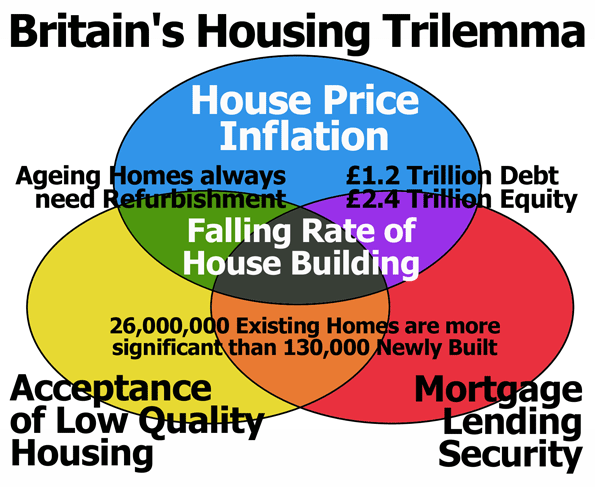
    The working class is caught in a political crusher made manifest through the planning system. The Red-Greens, who may imagine themselves on a new Left, gentrify towns and cities with “sustainable redevelopment”, and the Blue-Greens, who persist with being on the Right, protect their landscape for their exclusive enjoyment. Meanwhile the majority of home owners have come to depend on the inflated and unaffordable housing market. New Labour needed this house price inflation to allow the owner occupying majority to supplement inadequate wages by withdrawing equity from their homes. So does the Coalition. Deliberate or not, The Daily Telegraph’s commitment to building fewer new homes will stabilise what we have called the Housing Trilemma.

    Our current predicament may be thought of as a Trilemma, in which house price inflation supports burdensome mortgage lending and private debt, while households in the owner occupied sector accept low quality housing conditions. High rents shadow private sector housing costs, and private rental housing quality is often of the lowest quality. Many in Britain, including the majority of the home owning middle class, are dependent on the Housing Trilemma remaining stable.

    The planning system serves well in protecting the interests of existing home owners. Behind the NPPF’s moral idealism of sustainability, the immediate instrumental objective is to restrict new housing supply to avoid destabilising housing markets.  Appearing as a moral mission to save the planet from developers, the NPPF and the denial of development rights sustains the Housing Trilemma. Debt is secured, but housing remains unaffordable, quality low, and house building activity is at an all time industrial low. This is not a conspiracy. It is a predicament.

    When Britain’s elites talk about wanting to revive economic growth, they don’t mean a massive surge in new house building or an expansion of infrastructure. What they have in mind is a revival of financial services in The City, subject to uncertainties in the fragmenting Euro Zone, and the maintenance of high housing prices in the hope of more inflation to come. Meanwhile the countryside is kept pristine for the few who can afford access to it as a weekend retreat for the wealthy, including the pro-urban intelligentsia, in all their Red-Green-Blue moral plumage.

    The Coalition could have challenged the Housing Trilemma. Instead they have reinforced it.

    The result is predictable. Planning applications are falling in number and ambition. Only 25,000 new homes were approved in the second quarter of 2011 compared to 32,000 in the second quarter of 2010. This will be read by The Daily Telegraph campaign members as “proof” that there is no demand for development, inverting the causality. Money is being made out of an environmentally sanctioned scarcity rather than through increased productivity and innovation in a sector like house building and the wider construction industry. Britain’s already backward construction industry is further retarded, and it is becoming commonplace for social elites, and not only crazed nationalists, to blame immigration for housing shortages.

    Britain’s economy needs growth, but is unlikely to get it from the house building sector. Britain too needs a dose of political reality while the pro-urban intelligentsia preen their green morality.

    The Coalition cannot afford to confront the political problem of the Housing Trilemma if it is to sustain its fragile political base. Increasingly, only the elderly bother to vote and this equity rich group will be mostly satisfied with modest house price inflation as a hedge against general inflation, while savings in banks attract little return. Meanwhile an influential propertied elite still enjoys sustained house price inflation at the top of the market. They are anxious that environmental and heritage designations operate to enhance the exclusivity and enjoyment of their investments. The unelected charities, agencies and Non-Governmental Organisations that were aligned against the draft of the NPPF in July 2011 represent these elite interests. They may now back the redrafted 2012 NPPF with all its demands for sustainability. Their “Hands off Our Land” campaign has worked for them.

    The NPPF means that house builders face a future in which building on Greenfield land is effectively considered an eco-crime. Only those who can develop Town Centre sites, perhaps as rental housing, or as luxury homes for the equity rich will thrive. Basically Britain is no longer building homes with gardens for sale to young working families on modest incomes.

    If you are in a young working family, or hope to start one, the question is: What are you going to do about the housing predicament you and your friends face?

    We have to face a stark reality. Sadly, there is no contemporary habit of young working families organising to demand housing collectively. Meanwhile the 2011 to 2012 production figures look set to be lower again, and the developmental uncertainties about to be articulated in a redraft of the NPPF in pursuit of sustainable development will further the decline in production.

    Anticipating this feature of Britain’s ratcheting austerity does not make for a Happy New Year. Much depends on what the people of Britain, and particularly the young, do to demand that family houses are built at modest prices in places they want to live together. At present Britain fears a developer’s charter, even though the National Planning Policy Framework is nothing of the sort. Parliament might yet instead be in fear of people demanding cheap land on which to build a better place to live.

    James Stevens is Strategic Planner at the Home Builders Federation, www.hbf.co.uk. Email him at james.stevens@hbf.co.uk. The views expressed are his own and not those of Home Builders Federation. Ian Abley is a site architect and runs the pro-development website audacity, www.audacity.org. Email him at abley@audacity.org. Together they organise the 250 New Towns Club, www.audacity.org/250-New-Towns-index.htm.